Bonjour, pouvez-vous me donner vos points de vue sur le trajet de Durango à Moab?
J'hésite entre 2 trajets:
- Passer par Mesa Verde, Cortez, Monticello (pour randonnée dans les Needles). Donc pour voir Silverton, ce serait un aller-retour au départ de Durango. Avec cette option, j'ai des questions: que faire aux alentours de Silverton hormis la ville elle-même? Dans la journée est-ce pertinent de pousser plus loin que Silverton sachant qu'il faudrait retourner à Durango le soir? Ou serait-il judicieux de dormir à Silverton avant de revenir à Durango? Je ne tiens pas à prendre le train à vapeur car le trajet, même avec aller simple, est bien trop long. Est-ce que le trajet en voiture permet de voir les mêmes paysages?
- Passer par Silverton et Ouray. Mesa Verde serait visité lors d'un aller-retour au départ de Durango. Je ne vois pas les Needles dans ce cas-là (j'ai déjà fait une "visite" express de Canyonlands lors d'un précédent séjour à Moab et manquer Needles cette fois me fait de la peine).
Merci. Je suis ouvert à toutes les idées auxquelles je ne pense pas.
Hi everyone!
Let me introduce us quickly—I’m Matteo (21, originally from Paris, but I’ve been living near the Pyrenees and the Alps for the past 3 years), and my girlfriend Justine (21, grew up in the Alps). We’re starting to get really fed up with being cooped up and sitting in chairs (yep, we’re studying physics and geography at the École Normale Supérieure in Lyon). So, we’re taking a gap year to make a slightly crazy project happen: hitting the road, meeting people, and most importantly—climbing, skiing, and exploring the mountains!
We’ve always been into the mountains: •🧗♂️ 6c-7a/b sport climbing, 6b trad •❄️ Skiing and ice climbing (grade 4/5) •🏔️ Alpine climbing in the Alps (Chamonix, Écrins…) and the Pyrenees—I’m training to become a High Mountain Guide
Our project in a nutshell: •Buying a van (or 4x4) converted in British Columbia around September/October 2025. Ideally, we’d go straight to the US to buy the vehicle there (but reselling might be easier if we buy in Canada). •Heading down to the US to climb at legendary spots like Yosemite, Tuolumne (if it’s too hot), Indian Creek, Moab, and Joshua Tree. •Heading back up to the Canadian Rockies around December for skiing, ice climbing, and winter alpine climbing (might be easier to buy skis there). •Selling the vehicle in Canada at the end of the trip (we need to be back in France by early March 2026 because Justine is preparing for the AMM). I’ve already been to the Rockies, but I want to go back in winter for ice climbing. It’ll probably be too cold to sleep in the van, so we’re hoping to find a small cabin, lodge, or chalet (ideally alone or shared to cut costs). Otherwise, we could work for a month or two at a hostel or something to get free accommodation and earn money to rent a place another month just for climbing. •Visa-wise: we’re hoping to get our Working Holiday Visa (WHV) (still waiting for a response) so we can work there during the trip. For the US, we’ll stay as tourists (no work visa—too complicated and expensive). Any feedback on the WHV or differences from a regular work visa would be great. •With our savings (we’re working in mountain huts this summer), we should be able to buy the van. For daily expenses, I’m hoping to tutor online (math and physics). We live pretty simply and resourcefully: we plan to sleep mostly in the van, cook for ourselves, wash in rivers, and make the most of free nature spots. We’re super motivated, pretty well-rounded when it comes to mountain sports, and we’re not afraid to live simply for a year (we’ve got other projects too: biking to Greece with our climbing gear, a trip to Patagonia for alpine climbing).
Questions and advice: Of course, a road trip like this raises a lot of practical questions. This is our first time embarking on an adventure of this scale, so we’d love to hear your experiences and tips. If any of you have done a long van trip in North America or a WHV in Canada, your insights would be incredibly helpful! Here are some of the questions we’ve got: How do we buy (and later sell) a converted van in British Columbia? We’ll probably land in Vancouver. Is it better to look for a vehicle on online classifieds, Facebook groups, or used car dealerships? Are there any pitfalls to avoid when buying? And for selling it a year later, any tips to make it go smoothly (best time to sell, paperwork, etc.)? What budget should we plan for van life in North America and Canada? If you’ve got any info or feedback on the cost of living in a van in Canada/the US, we’d love to hear it. We’re thinking about expenses like gas (a big one, I imagine!), van maintenance, car insurance, possible tolls, campgrounds or paid spots, etc. We’d like to get an idea of a daily or monthly budget so we’re not too tight. In France, we never stay at campgrounds—we prefer being alone or going where we want. Is that possible in the US and Canada? Any tips for saving money (free camping spots, useful apps…) would be great! Visas, borders, and paperwork: We’re hoping to get a WHV for Canada, but in the US, we’ll be on a tourist visa (90 days max with ESTA, I think). Has anyone combined a WHV in Canada with a trip to the US on the same trip? Anything we should know about crossing the border in a van (insurance, customs, how long we’re allowed in the US, etc.)? We want to avoid any administrative hassles, so any advice on this would be super helpful. Route and seasonality for climbing and skiing: We’re thinking of starting climbing in the US around fall 2025 (probably September/October). Is that the right season for Yosemite, Indian Creek, and Moab? Any must-see spots along the way? For winter, we’re aiming for December to March in the Canadian Rockies (Banff, Jasper, Golden…) for skiing and ice climbing. Any tips on ice climbs or major backcountry skiing spots? We’ve got all our climbing, skiing, and alpine gear—should we bring it all or buy some stuff there? Is the “Wilderness Season Pass” for winter in the Rockies worth it? We came across this pass that offers 7 months of unlimited nights in HI mountain hostels in the Rockies. Has anyone here tried it? Are the dorms usually crowded? Working on the road: To fund the trip, we’re planning to work a bit along the way. Any tips for finding work in Canada while traveling (peak seasons at ski resorts, WWOOFing, odd jobs…)? That’s it for our (many) questions 😅! If you’ve done a similar trip—or even just parts of it (van life, climbing tour, winter in Canada…)—we’d love to hear your experiences, or even if you’re in the area and want to share a few days of climbing. All your contacts, advice, and tips will be a huge help.
Thanks in advance! We can’t wait to read your replies and refine our project with your help.
Matteo & Justine
PS: I’m looking for a summer job from August to September, preferably in a mountain hut (extra help, replacements, etc.). If you’ve got any contacts, don’t hesitate! I’ve also posted on another forum about this with my CV and cover letter (DEMANDE dxsdxsdsxdsx - Forum de www.refuges.info).
Let me introduce us quickly—I’m Matteo (21, originally from Paris, but I’ve been living near the Pyrenees and the Alps for the past 3 years), and my girlfriend Justine (21, grew up in the Alps). We’re starting to get really fed up with being cooped up and sitting in chairs (yep, we’re studying physics and geography at the École Normale Supérieure in Lyon). So, we’re taking a gap year to make a slightly crazy project happen: hitting the road, meeting people, and most importantly—climbing, skiing, and exploring the mountains!
We’ve always been into the mountains: •🧗♂️ 6c-7a/b sport climbing, 6b trad •❄️ Skiing and ice climbing (grade 4/5) •🏔️ Alpine climbing in the Alps (Chamonix, Écrins…) and the Pyrenees—I’m training to become a High Mountain Guide
Our project in a nutshell: •Buying a van (or 4x4) converted in British Columbia around September/October 2025. Ideally, we’d go straight to the US to buy the vehicle there (but reselling might be easier if we buy in Canada). •Heading down to the US to climb at legendary spots like Yosemite, Tuolumne (if it’s too hot), Indian Creek, Moab, and Joshua Tree. •Heading back up to the Canadian Rockies around December for skiing, ice climbing, and winter alpine climbing (might be easier to buy skis there). •Selling the vehicle in Canada at the end of the trip (we need to be back in France by early March 2026 because Justine is preparing for the AMM). I’ve already been to the Rockies, but I want to go back in winter for ice climbing. It’ll probably be too cold to sleep in the van, so we’re hoping to find a small cabin, lodge, or chalet (ideally alone or shared to cut costs). Otherwise, we could work for a month or two at a hostel or something to get free accommodation and earn money to rent a place another month just for climbing. •Visa-wise: we’re hoping to get our Working Holiday Visa (WHV) (still waiting for a response) so we can work there during the trip. For the US, we’ll stay as tourists (no work visa—too complicated and expensive). Any feedback on the WHV or differences from a regular work visa would be great. •With our savings (we’re working in mountain huts this summer), we should be able to buy the van. For daily expenses, I’m hoping to tutor online (math and physics). We live pretty simply and resourcefully: we plan to sleep mostly in the van, cook for ourselves, wash in rivers, and make the most of free nature spots. We’re super motivated, pretty well-rounded when it comes to mountain sports, and we’re not afraid to live simply for a year (we’ve got other projects too: biking to Greece with our climbing gear, a trip to Patagonia for alpine climbing).
Questions and advice: Of course, a road trip like this raises a lot of practical questions. This is our first time embarking on an adventure of this scale, so we’d love to hear your experiences and tips. If any of you have done a long van trip in North America or a WHV in Canada, your insights would be incredibly helpful! Here are some of the questions we’ve got: How do we buy (and later sell) a converted van in British Columbia? We’ll probably land in Vancouver. Is it better to look for a vehicle on online classifieds, Facebook groups, or used car dealerships? Are there any pitfalls to avoid when buying? And for selling it a year later, any tips to make it go smoothly (best time to sell, paperwork, etc.)? What budget should we plan for van life in North America and Canada? If you’ve got any info or feedback on the cost of living in a van in Canada/the US, we’d love to hear it. We’re thinking about expenses like gas (a big one, I imagine!), van maintenance, car insurance, possible tolls, campgrounds or paid spots, etc. We’d like to get an idea of a daily or monthly budget so we’re not too tight. In France, we never stay at campgrounds—we prefer being alone or going where we want. Is that possible in the US and Canada? Any tips for saving money (free camping spots, useful apps…) would be great! Visas, borders, and paperwork: We’re hoping to get a WHV for Canada, but in the US, we’ll be on a tourist visa (90 days max with ESTA, I think). Has anyone combined a WHV in Canada with a trip to the US on the same trip? Anything we should know about crossing the border in a van (insurance, customs, how long we’re allowed in the US, etc.)? We want to avoid any administrative hassles, so any advice on this would be super helpful. Route and seasonality for climbing and skiing: We’re thinking of starting climbing in the US around fall 2025 (probably September/October). Is that the right season for Yosemite, Indian Creek, and Moab? Any must-see spots along the way? For winter, we’re aiming for December to March in the Canadian Rockies (Banff, Jasper, Golden…) for skiing and ice climbing. Any tips on ice climbs or major backcountry skiing spots? We’ve got all our climbing, skiing, and alpine gear—should we bring it all or buy some stuff there? Is the “Wilderness Season Pass” for winter in the Rockies worth it? We came across this pass that offers 7 months of unlimited nights in HI mountain hostels in the Rockies. Has anyone here tried it? Are the dorms usually crowded? Working on the road: To fund the trip, we’re planning to work a bit along the way. Any tips for finding work in Canada while traveling (peak seasons at ski resorts, WWOOFing, odd jobs…)? That’s it for our (many) questions 😅! If you’ve done a similar trip—or even just parts of it (van life, climbing tour, winter in Canada…)—we’d love to hear your experiences, or even if you’re in the area and want to share a few days of climbing. All your contacts, advice, and tips will be a huge help.
Thanks in advance! We can’t wait to read your replies and refine our project with your help.
Matteo & Justine
PS: I’m looking for a summer job from August to September, preferably in a mountain hut (extra help, replacements, etc.). If you’ve got any contacts, don’t hesitate! I’ve also posted on another forum about this with my CV and cover letter (DEMANDE dxsdxsdsxdsx - Forum de www.refuges.info).
Bonjour tout le monde !
Je suis entrain de prévoir notre road trip et je "bloque" sur la fin.
Lundi 13 Avril : Death Valley jusqu'au midi environ. ensuite j'avais prévu d'aller à mammoth lakes, mono lake etc 2 jours mais je viens de me rendre compte que la Tioga road sera fermée pour Yosemite.
Bref il me reste du coup du lundi midi au samedi soir.
Je me suis dis : Sequoia et kings canyon mardi et mercredi Yosemite jeudi et vendredi et San francisco pour la journée de samedi (cela nous suffit pour nous, on préfère privilégier d'autres lieux)
Donc quelques questions : * Es-ce que cela parait bien ou avez vous d'autres idées ?
* De Death Valley à Sequoia il y a au moins 5h30 de route, y a t'il des choses à voir et ne pas louper sur ce trajet ? Quitte à faire une escale :)
Merci à vous tous ! Je rêve de ce voyage depuis des années, hâte d'y être !
MODIF : Après réflexion je préférerai faire : Lundi matin finir Death Valley puis prendre la route vers Lac Tahoe avec escale à mammoth lake ou mono lake pour quelques heures (quel est le mieux ???) Mardi matin fin de la route puis Tahoe mardi aprem et mercredi matin. Mercredi aprem route. Jeudi et Vendredi Yosemite Samedi San francisco.
On fait condensé mais on veut en voir le plus possible car on ne reviendra surement pas! (trop d'envie d'ailleurs et on a qu'une vie pour en voir le plus possible !)
Je suis entrain de prévoir notre road trip et je "bloque" sur la fin.
Lundi 13 Avril : Death Valley jusqu'au midi environ. ensuite j'avais prévu d'aller à mammoth lakes, mono lake etc 2 jours mais je viens de me rendre compte que la Tioga road sera fermée pour Yosemite.
Bref il me reste du coup du lundi midi au samedi soir.
Je me suis dis : Sequoia et kings canyon mardi et mercredi Yosemite jeudi et vendredi et San francisco pour la journée de samedi (cela nous suffit pour nous, on préfère privilégier d'autres lieux)
Donc quelques questions : * Es-ce que cela parait bien ou avez vous d'autres idées ?
* De Death Valley à Sequoia il y a au moins 5h30 de route, y a t'il des choses à voir et ne pas louper sur ce trajet ? Quitte à faire une escale :)
Merci à vous tous ! Je rêve de ce voyage depuis des années, hâte d'y être !
MODIF : Après réflexion je préférerai faire : Lundi matin finir Death Valley puis prendre la route vers Lac Tahoe avec escale à mammoth lake ou mono lake pour quelques heures (quel est le mieux ???) Mardi matin fin de la route puis Tahoe mardi aprem et mercredi matin. Mercredi aprem route. Jeudi et Vendredi Yosemite Samedi San francisco.
On fait condensé mais on veut en voir le plus possible car on ne reviendra surement pas! (trop d'envie d'ailleurs et on a qu'une vie pour en voir le plus possible !)
Hello, here’s a totally subjective recap of our 15-day road trip between Colorado and New Mexico, from late September to mid-October.
Our main interests are culture, museums, and landscapes—no hiking or trails for us. Personally, I’m pretty contemplative, and luckily, there’s always something to see out there! We’re pretty used to the US; we’ve been going there often for a long time (let’s just say we’re not exactly young anymore).
Budget: Even though we don’t set a strict budget beforehand, we try to keep costs as low as possible. This time, we managed to spend around 4000 € for two, all included. To do this: avoid expensive accommodations, staying between 60 and 120 € per night with an average of 90 €/night, mixing Airbnb and motels. And skip the “real” restaurants, which are pretty pricey in the US: sandwiches for lunch, takeout or cooking in the Airbnb in the evening. We shop at Sprouts or Whole Foods—organic-style chains that are pricier than Walmart but better. In the evenings, Sprouts has discounts on items that didn’t sell during the day. Also, avoid toll roads, paid parking, and overly expensive attractions or sites. The dispensary budget is separate…
Route: Denver/Colorado Springs/Alamosa/Raton/Santa Fe/Cuba/Cortez/Grand Junction/Glenwood Springs/Denver This wasn’t too planned in advance—we booked a few nights upon arrival and went with the flow. Flight from CDG to Denver with AF/Delta, car rental at Dollar for a standard SUV. The guy at the Dollar counter upsold me on extra insurance for flat tires (and since I knew we’d be off-roading, I took it). Without telling me, he upgraded me to a Jeep Sahara 4X4 Hybrid. Nice.
Listening to the news upon arrival, the anchor announced, “It’s officially fall now.” We hadn’t really thought about that before leaving, but yeah—it’s the time when the trees turn fluorescent yellow and red. Amazing.
Colorado Springs: Garden of the Gods is a free park with paved trails winding through red/orange rock formations. Magical at sunrise—groups of deer roam around, along with birds and rabbits. It’s small but wow! Didn’t try the Manitou Incline in Manitou Springs, a staircase with thousands of steps going straight up the mountain. Impressive from the bottom, but the parking is paid, which is a downside for those willing to tackle it. The Cog Railway goes up to the summit of Pikes Peak—around $100 when we were there. No thanks. And of course, the parking is paid too. For fans, Maggie’s Farm dispensary is great.
On Route 24, Eleven Mile Canyon Recreation Area is fly-fishing paradise—just like in the movie *A River Runs Through It*. Entry is $11, and a trail follows the river at the bottom of the canyon to the dam. Dozens of people in waders are in the water, casting their lines over and over. You can see the salmon in the clear water, and we had a picnic in the sun, imagining Brad Pitt catching a fish.
Buena Vista: A cute little tourist town with an Outdoor Fair that day—some pretty impressive vehicles for sale, set up for mountain living (like Juniper outfitting a RAM).
Alamosa: The closest town to Great Sand Dunes National Park, crossed by the Rio Grande (and let’s be real—it’s more of a stream than a river!). Park access was free because it was National Park Day. A park with massive dunes—climbing them is pretty exhausting, with lots of wind and sinking sand. Glad we didn’t do it in summer; I can’t imagine how tough it’d be in the heat. It’s a bit deceptive: it looks easy to get to the top of a dune, but it’s really not. The campsites were nice, and it was busy that weekend. We passed the “Point of No Return,” a sandy trail winding through the hills and connecting to Route 559 from above. Didn’t go all the way, but it’s possible the entrance is free from that side. However, you need a 4X4 with good ground clearance. After 1 or 2 km on the trail, you’re alone between the dunes and hills—hardly anyone around. But tricky to turn around or pass other vehicles; the trail isn’t wide. We crossed paths with a Hanomag (registered in the Netherlands—impressive!) coming down without stopping, or risking getting stuck.
On the way out, we took the small Route 403, which quickly turns into a trail crossing the mountain. Entire sections of forest were turning fluorescent yellow with patches of green and red—an incredible sight.
Raton: A small town that probably peaked in the late 19th century and has been in slow decline ever since. The Raton Pass Motor Inn is the kind of place that makes the US legendary—entirely 50s and 60s decor, really well done. I had the Betty Page room—too cool. Felt like we were on Route 66. Even better.
Santa Fe: A small city with no high-rises—almost all low-rise buildings, many in adobe, blending perfectly into the landscape. The old downtown is touristy but nice, with its plaza and church. There’s a really cool vibe—we loved it. For drinks, the bar at the top of La Fonda Hotel was packed for sunset, with a diverse crowd. Not overpriced for the location. SITE Santa Fe is a contemporary art space near the train station. It’s free, and the temporary exhibit was really good—high quality. Museum Hill is, as the name suggests, where several museums are located. We visited the Museum of Indian Art and Culture—great if you’re into “First Nations” history. Saw The Dandy Warhols at The Bridge—an outdoor venue, one of the last concerts of the season before winter makes it too cold. Oddly, there was no bag check, just an ID required (even though it was obvious we were over 21!). Tickets were reasonable, around $30 (concerts in the US can be crazy expensive). The band was good, with fewer than 300 people in front. A sign at the bar warned: Don’t forget you’re at 1,500 meters—alcohol hits harder up here!
Albuquerque: A sprawling city with an old historic center that feels a bit like Disneyland—too perfect for my taste. The real highlight is the Sandia Peak Tramway, which goes up to the old ski resort above the city. Tickets are around $35, and it’s worth it—the ride over the canyons is pretty wild. The ski resort is a bit abandoned; apparently, like elsewhere, there’s no snow anymore. I asked several people about the lack of snow, and the answer was always the same: “It’s cyclical.” Okay then. We arrived for the start of the International Balloon Fiesta (one of the world’s largest hot-air balloon gatherings), hoping to see hundreds of balloons in the sky. Nope—windy today, so no one took off. Bummer.
Las Vegas: New Mexico has its own Las Vegas, but it’s nothing like the other one—a sleepy little town with a perfectly preserved 19th-century Historic Plaza Hotel, brick buildings, and vintage streetlights. Everything is so well-preserved it’s often used as a filming location. NM attracts a lot of productions thanks to tax incentives and its Western landscapes—and it’s cheaper than California! That day, a huge Texas flag was flying in the wind: they were filming the second season of *Ransom Canyon* for Netflix in the town center. If we’d been dressed more “Western,” we could’ve been extras.
Jemez Springs: Its Jemez Hot Springs is super cute—several thermal pools at different temperatures, a New Age vibe. The pools are surrounded by big rocks, and you’re asked to speak softly. A place where you could spend hours. $50 for two hours for two.
Los Alamos: A town made legendary by the bomb, the movie, etc. Heads up: It’s still a research center, and to cross part of the town, you need to show ID. No stopping or taking photos allowed. Other than the Oppenheimer House (currently closed—only the neighboring house is open to visitors), there’s not much to see. There’s a replica of the camp entrance, but it’s been turned into restrooms.
Georgia O’Keeffe Trail (American painter, 1887–1986): Her museum in Santa Fe is pretty good, even if they don’t have tons of works. Entry is $20. Her house in Abiquiu is open for visits, but it’s way overpriced at $65. So we skipped it. You can get an idea of it by stopping at the Welcome Center on Route 84. Further down the same road, Ghost Ranch is worth a visit—beautiful setting, free to enter, with trails to explore and a great atmosphere.
Chaco Culture National Historical Park: A pretty isolated park—25 km of trails to get there, with only a small section paved. The road is decent except for the last few kilometers, which have potholes. I can’t imagine it being accessible after rain, though that doesn’t happen often! This park, in the middle of a desert plain with a few canyons, is one of the rare places where you can find multi-story structures from pre-Columbian civilizations—so, before the “current” tribes. But cruel disappointment: it’s been shut down for a few days. We met a Native ranger—tall, with long hair—who explained that even though he wasn’t being paid, he was still guarding the park and had closed all access to the sites. Darn. Turned around and headed back down the trail.
Same story in the next town, Aztec (a funny name, right?): Aztec Ruins National Monument was closed too.
We passed Ship Rock, the Navajo’s sacred mountain—really impressive. Couldn’t find a trail to get closer, but it’s better from a distance anyway! The town of Shiprock itself is pretty depressing—poor living conditions for some Natives, with rundown mobile homes and piles of junk cars.
Stopped in Cortez to visit Mesa Verde National Park. Ate at Denny’s—hadn’t been there in ages (though it’s the kind of place I should feel at home in!). The customers all looked like they’d stepped out of *The Addams Family*—a little creepy. Or funny, depending on your perspective. For Mesa Verde, after discussing it on this forum with the honorable member Caussat (who didn’t find it that amazing), we were on the fence. Problem solved: it was closed too. Back on the road.
Durango: Really nice with its Main Ave and its shops, cafés—touristy but with local life. Famous for its tourist train to Silverton, but we didn’t do it—way too expensive. Choice between a steam locomotive or diesel (which belches black, stinky smoke—yuck). The diesel should be replaced with electric as soon as they get the funds.
Million Dollar Highway: The road winds through the mountains, and every turn (and there are a lot) is breathtaking—unbelievable landscapes with fluorescent yellow, green, and snow-capped mountains. Just wow.
Silverton: A Western town nestled between two mountains, preserved in its original state despite the tourists arriving by train. Around it, abandoned mines and old wooden ties—must’ve been tough for the 19th-century miners.
Grand Junction: The city is surrounded by giant mesas—pretty impressive. The old downtown is *too* clean—almost sterile.
Colorado National Monument: Just outside the city, a winding road climbs between stunning canyons, with sweeping views of the valley. Entry was free that day due to the shutdown.
Route 330, which we took to get back to the highway, passes through a place called “Cowboy Country”—and it’s true. We saw guys in Stetsons with huge pickups, the road turned into a trail with cows wandering on it, and we had to honk to get them to move. The trail to I-70 was full of potholes—the 4X4 came in handy. Had a picnic by Vega Reservoir: the booth at the entrance was empty, but people left cash in envelopes for camping fees. Anyone passing by could’ve taken it, but it’s an example of US trust and honesty!
Glenwood Springs: A small town famous for its hot springs pool—they claim it’s the largest in the world. I don’t know about that, but it has a great look. Unfortunately, it was closed for maintenance those days! Blew our budget by staying at the Hotel Colorado, a huge 1893 building with a real atmosphere in its grand lobby and fake fireplaces. Fire pits in front of wooden chairs in the garden with mountain views—just really great.
Aspen: The billionaires’ ski resort, but surprisingly, parking was free for 2 hours. Rare to see a place for the super-rich that doesn’t scream “not for you” (like Palm Beach, for example). A former mining town completely redone, every shop occupied by a luxury brand. There’s even a thrift shop run by sweet retirees—funny as hell. Two ski lifts to start directly with your skis, but we didn’t see the price—they were still closed. Lots of houses that aren’t huge but are cute, though looking at real estate prices made us think, “Is there an extra zero on that listing?” A 6-bedroom villa for $52 million? Wow. The mountains around are gorgeous—no wonder it became what it is.
Another fancy resort nearby: Vail, more modern in its construction. The restaurants opted for a “Schwarzwald” decor—kind of odd.
Denver: Nothing really stood out for us in this city, except the Design Museum—the Kirkland, where a local painter collected furniture and supplies from Arts and Crafts to Postmodern. Just really great. Entry is included with a visit to the Denver Art Museum, which has diverse collections—from Impressionism (they have a Manet, a Van Gogh, a Cézanne, several Sisleys) to photography. The best part for me was the “Ancient Americas” totems—huge, impressive wooden sculptures, painted, the kind you’re more used to seeing in Polynesia or Easter Island. Personally, I didn’t know Natives made them too. That’s what museums are for!
Back at the airport, where I had to tag my own luggage (you have to do everything yourself with these US airlines). The tag said SLC/CDG! But we were supposed to connect through JFK. Turns out, they’d put us on a DEN/SLC/CDG flight without telling us. In the end, we gained 30 minutes on our original arrival time in Paris!
There you go—hope this inspires other travelers! !
Our main interests are culture, museums, and landscapes—no hiking or trails for us. Personally, I’m pretty contemplative, and luckily, there’s always something to see out there! We’re pretty used to the US; we’ve been going there often for a long time (let’s just say we’re not exactly young anymore).
Budget: Even though we don’t set a strict budget beforehand, we try to keep costs as low as possible. This time, we managed to spend around 4000 € for two, all included. To do this: avoid expensive accommodations, staying between 60 and 120 € per night with an average of 90 €/night, mixing Airbnb and motels. And skip the “real” restaurants, which are pretty pricey in the US: sandwiches for lunch, takeout or cooking in the Airbnb in the evening. We shop at Sprouts or Whole Foods—organic-style chains that are pricier than Walmart but better. In the evenings, Sprouts has discounts on items that didn’t sell during the day. Also, avoid toll roads, paid parking, and overly expensive attractions or sites. The dispensary budget is separate…
Route: Denver/Colorado Springs/Alamosa/Raton/Santa Fe/Cuba/Cortez/Grand Junction/Glenwood Springs/Denver This wasn’t too planned in advance—we booked a few nights upon arrival and went with the flow. Flight from CDG to Denver with AF/Delta, car rental at Dollar for a standard SUV. The guy at the Dollar counter upsold me on extra insurance for flat tires (and since I knew we’d be off-roading, I took it). Without telling me, he upgraded me to a Jeep Sahara 4X4 Hybrid. Nice.
Listening to the news upon arrival, the anchor announced, “It’s officially fall now.” We hadn’t really thought about that before leaving, but yeah—it’s the time when the trees turn fluorescent yellow and red. Amazing.
Colorado Springs: Garden of the Gods is a free park with paved trails winding through red/orange rock formations. Magical at sunrise—groups of deer roam around, along with birds and rabbits. It’s small but wow! Didn’t try the Manitou Incline in Manitou Springs, a staircase with thousands of steps going straight up the mountain. Impressive from the bottom, but the parking is paid, which is a downside for those willing to tackle it. The Cog Railway goes up to the summit of Pikes Peak—around $100 when we were there. No thanks. And of course, the parking is paid too. For fans, Maggie’s Farm dispensary is great.
On Route 24, Eleven Mile Canyon Recreation Area is fly-fishing paradise—just like in the movie *A River Runs Through It*. Entry is $11, and a trail follows the river at the bottom of the canyon to the dam. Dozens of people in waders are in the water, casting their lines over and over. You can see the salmon in the clear water, and we had a picnic in the sun, imagining Brad Pitt catching a fish.
Buena Vista: A cute little tourist town with an Outdoor Fair that day—some pretty impressive vehicles for sale, set up for mountain living (like Juniper outfitting a RAM).
Alamosa: The closest town to Great Sand Dunes National Park, crossed by the Rio Grande (and let’s be real—it’s more of a stream than a river!). Park access was free because it was National Park Day. A park with massive dunes—climbing them is pretty exhausting, with lots of wind and sinking sand. Glad we didn’t do it in summer; I can’t imagine how tough it’d be in the heat. It’s a bit deceptive: it looks easy to get to the top of a dune, but it’s really not. The campsites were nice, and it was busy that weekend. We passed the “Point of No Return,” a sandy trail winding through the hills and connecting to Route 559 from above. Didn’t go all the way, but it’s possible the entrance is free from that side. However, you need a 4X4 with good ground clearance. After 1 or 2 km on the trail, you’re alone between the dunes and hills—hardly anyone around. But tricky to turn around or pass other vehicles; the trail isn’t wide. We crossed paths with a Hanomag (registered in the Netherlands—impressive!) coming down without stopping, or risking getting stuck.
On the way out, we took the small Route 403, which quickly turns into a trail crossing the mountain. Entire sections of forest were turning fluorescent yellow with patches of green and red—an incredible sight.
Raton: A small town that probably peaked in the late 19th century and has been in slow decline ever since. The Raton Pass Motor Inn is the kind of place that makes the US legendary—entirely 50s and 60s decor, really well done. I had the Betty Page room—too cool. Felt like we were on Route 66. Even better.
Santa Fe: A small city with no high-rises—almost all low-rise buildings, many in adobe, blending perfectly into the landscape. The old downtown is touristy but nice, with its plaza and church. There’s a really cool vibe—we loved it. For drinks, the bar at the top of La Fonda Hotel was packed for sunset, with a diverse crowd. Not overpriced for the location. SITE Santa Fe is a contemporary art space near the train station. It’s free, and the temporary exhibit was really good—high quality. Museum Hill is, as the name suggests, where several museums are located. We visited the Museum of Indian Art and Culture—great if you’re into “First Nations” history. Saw The Dandy Warhols at The Bridge—an outdoor venue, one of the last concerts of the season before winter makes it too cold. Oddly, there was no bag check, just an ID required (even though it was obvious we were over 21!). Tickets were reasonable, around $30 (concerts in the US can be crazy expensive). The band was good, with fewer than 300 people in front. A sign at the bar warned: Don’t forget you’re at 1,500 meters—alcohol hits harder up here!
Albuquerque: A sprawling city with an old historic center that feels a bit like Disneyland—too perfect for my taste. The real highlight is the Sandia Peak Tramway, which goes up to the old ski resort above the city. Tickets are around $35, and it’s worth it—the ride over the canyons is pretty wild. The ski resort is a bit abandoned; apparently, like elsewhere, there’s no snow anymore. I asked several people about the lack of snow, and the answer was always the same: “It’s cyclical.” Okay then. We arrived for the start of the International Balloon Fiesta (one of the world’s largest hot-air balloon gatherings), hoping to see hundreds of balloons in the sky. Nope—windy today, so no one took off. Bummer.
Las Vegas: New Mexico has its own Las Vegas, but it’s nothing like the other one—a sleepy little town with a perfectly preserved 19th-century Historic Plaza Hotel, brick buildings, and vintage streetlights. Everything is so well-preserved it’s often used as a filming location. NM attracts a lot of productions thanks to tax incentives and its Western landscapes—and it’s cheaper than California! That day, a huge Texas flag was flying in the wind: they were filming the second season of *Ransom Canyon* for Netflix in the town center. If we’d been dressed more “Western,” we could’ve been extras.
Jemez Springs: Its Jemez Hot Springs is super cute—several thermal pools at different temperatures, a New Age vibe. The pools are surrounded by big rocks, and you’re asked to speak softly. A place where you could spend hours. $50 for two hours for two.
Los Alamos: A town made legendary by the bomb, the movie, etc. Heads up: It’s still a research center, and to cross part of the town, you need to show ID. No stopping or taking photos allowed. Other than the Oppenheimer House (currently closed—only the neighboring house is open to visitors), there’s not much to see. There’s a replica of the camp entrance, but it’s been turned into restrooms.
Georgia O’Keeffe Trail (American painter, 1887–1986): Her museum in Santa Fe is pretty good, even if they don’t have tons of works. Entry is $20. Her house in Abiquiu is open for visits, but it’s way overpriced at $65. So we skipped it. You can get an idea of it by stopping at the Welcome Center on Route 84. Further down the same road, Ghost Ranch is worth a visit—beautiful setting, free to enter, with trails to explore and a great atmosphere.
Chaco Culture National Historical Park: A pretty isolated park—25 km of trails to get there, with only a small section paved. The road is decent except for the last few kilometers, which have potholes. I can’t imagine it being accessible after rain, though that doesn’t happen often! This park, in the middle of a desert plain with a few canyons, is one of the rare places where you can find multi-story structures from pre-Columbian civilizations—so, before the “current” tribes. But cruel disappointment: it’s been shut down for a few days. We met a Native ranger—tall, with long hair—who explained that even though he wasn’t being paid, he was still guarding the park and had closed all access to the sites. Darn. Turned around and headed back down the trail.
Same story in the next town, Aztec (a funny name, right?): Aztec Ruins National Monument was closed too.
We passed Ship Rock, the Navajo’s sacred mountain—really impressive. Couldn’t find a trail to get closer, but it’s better from a distance anyway! The town of Shiprock itself is pretty depressing—poor living conditions for some Natives, with rundown mobile homes and piles of junk cars.
Stopped in Cortez to visit Mesa Verde National Park. Ate at Denny’s—hadn’t been there in ages (though it’s the kind of place I should feel at home in!). The customers all looked like they’d stepped out of *The Addams Family*—a little creepy. Or funny, depending on your perspective. For Mesa Verde, after discussing it on this forum with the honorable member Caussat (who didn’t find it that amazing), we were on the fence. Problem solved: it was closed too. Back on the road.
Durango: Really nice with its Main Ave and its shops, cafés—touristy but with local life. Famous for its tourist train to Silverton, but we didn’t do it—way too expensive. Choice between a steam locomotive or diesel (which belches black, stinky smoke—yuck). The diesel should be replaced with electric as soon as they get the funds.
Million Dollar Highway: The road winds through the mountains, and every turn (and there are a lot) is breathtaking—unbelievable landscapes with fluorescent yellow, green, and snow-capped mountains. Just wow.
Silverton: A Western town nestled between two mountains, preserved in its original state despite the tourists arriving by train. Around it, abandoned mines and old wooden ties—must’ve been tough for the 19th-century miners.
Grand Junction: The city is surrounded by giant mesas—pretty impressive. The old downtown is *too* clean—almost sterile.
Colorado National Monument: Just outside the city, a winding road climbs between stunning canyons, with sweeping views of the valley. Entry was free that day due to the shutdown.
Route 330, which we took to get back to the highway, passes through a place called “Cowboy Country”—and it’s true. We saw guys in Stetsons with huge pickups, the road turned into a trail with cows wandering on it, and we had to honk to get them to move. The trail to I-70 was full of potholes—the 4X4 came in handy. Had a picnic by Vega Reservoir: the booth at the entrance was empty, but people left cash in envelopes for camping fees. Anyone passing by could’ve taken it, but it’s an example of US trust and honesty!
Glenwood Springs: A small town famous for its hot springs pool—they claim it’s the largest in the world. I don’t know about that, but it has a great look. Unfortunately, it was closed for maintenance those days! Blew our budget by staying at the Hotel Colorado, a huge 1893 building with a real atmosphere in its grand lobby and fake fireplaces. Fire pits in front of wooden chairs in the garden with mountain views—just really great.
Aspen: The billionaires’ ski resort, but surprisingly, parking was free for 2 hours. Rare to see a place for the super-rich that doesn’t scream “not for you” (like Palm Beach, for example). A former mining town completely redone, every shop occupied by a luxury brand. There’s even a thrift shop run by sweet retirees—funny as hell. Two ski lifts to start directly with your skis, but we didn’t see the price—they were still closed. Lots of houses that aren’t huge but are cute, though looking at real estate prices made us think, “Is there an extra zero on that listing?” A 6-bedroom villa for $52 million? Wow. The mountains around are gorgeous—no wonder it became what it is.
Another fancy resort nearby: Vail, more modern in its construction. The restaurants opted for a “Schwarzwald” decor—kind of odd.
Denver: Nothing really stood out for us in this city, except the Design Museum—the Kirkland, where a local painter collected furniture and supplies from Arts and Crafts to Postmodern. Just really great. Entry is included with a visit to the Denver Art Museum, which has diverse collections—from Impressionism (they have a Manet, a Van Gogh, a Cézanne, several Sisleys) to photography. The best part for me was the “Ancient Americas” totems—huge, impressive wooden sculptures, painted, the kind you’re more used to seeing in Polynesia or Easter Island. Personally, I didn’t know Natives made them too. That’s what museums are for!
Back at the airport, where I had to tag my own luggage (you have to do everything yourself with these US airlines). The tag said SLC/CDG! But we were supposed to connect through JFK. Turns out, they’d put us on a DEN/SLC/CDG flight without telling us. In the end, we gained 30 minutes on our original arrival time in Paris!
There you go—hope this inspires other travelers! !
Hello! The itinerary is pretty much set for August 2026. Yeah, I know it’s gonna be *super* hot. But it’s the only time we can get away.
So, here’s the plan: Montpellier-CDG-Dallas.
Stay from July 31 to August 26, 2026: Car rental – check, Hotels – check, Itinerary – almost check, Photo gear – check, Budget – check, 🤪 Meal planning – meh, we’ll see... Walmart, of course, for the cooler when we arrive.
And now, without too much detail...
Fort Worth: The Longhorns and the Stockyards; JR’s ranch (for the missus); Medal of Honor Museum – Arlington.
Houston and NASA Space Center: See the Gulf of Mexico/America.
San Antonio and the missions.
Fort Stockton for an overnight stop.
El Paso via Guadalupe Mountains: El Paso and White Sands.
Tucson and the Pima Air & Space Museum: Tombstone, Bisbee.
Phoenix:
Still working on the program.
Sedona: Round trip around the area via Flagstaff and Williams, or the Grand Canyon (already done) – we’ll decide on the spot.
Albuquerque: Santa Fe, Turquoise Trail, Los Alamos.
Amarillo via Route 66: Old Route 66 in the city; Big Texas Ranch Steak 😏.
Dallas: JFK Museum; Perot Museum; West End district.
And through it all – the road, the road, and more road!!!
We’ll adapt day by day based on our mental and physical state (we’re not exactly spring chickens).
Return to France: Dallas-Montpellier via CDG.
Cheers!
So, here’s the plan: Montpellier-CDG-Dallas.
Stay from July 31 to August 26, 2026: Car rental – check, Hotels – check, Itinerary – almost check, Photo gear – check, Budget – check, 🤪 Meal planning – meh, we’ll see... Walmart, of course, for the cooler when we arrive.
And now, without too much detail...
Fort Worth: The Longhorns and the Stockyards; JR’s ranch (for the missus); Medal of Honor Museum – Arlington.
Houston and NASA Space Center: See the Gulf of Mexico/America.
San Antonio and the missions.
Fort Stockton for an overnight stop.
El Paso via Guadalupe Mountains: El Paso and White Sands.
Tucson and the Pima Air & Space Museum: Tombstone, Bisbee.
Phoenix:
Still working on the program.
Sedona: Round trip around the area via Flagstaff and Williams, or the Grand Canyon (already done) – we’ll decide on the spot.
Albuquerque: Santa Fe, Turquoise Trail, Los Alamos.
Amarillo via Route 66: Old Route 66 in the city; Big Texas Ranch Steak 😏.
Dallas: JFK Museum; Perot Museum; West End district.
And through it all – the road, the road, and more road!!!
We’ll adapt day by day based on our mental and physical state (we’re not exactly spring chickens).
Return to France: Dallas-Montpellier via CDG.
Cheers!
bonjour à tous ;
je me ballade sur le forum car je cherche à faire un voyage à new York fin mars, debut avril 2020 avec ma meilleure amie. nous avions 47 et 58 ans ( 2 jeunes femmes quoi😉) nous sommes assez sportives, nous avions un budget de 1000 euros par personne pour 1 semaine . connaissez vous des hôtels non loin de Manhattan?
j'avoue que nous aimons un minimum de confort et de propreté de l'hôtel surtout que dans nos journées on aura fait les 1000 et 1 pas. sinon un RbnB ou chez l'habitant, pourquoi pas mais je n'ai jamais fait ce style de voyage. nous faisons rarement des voyages lointains et pour préparer ce petit voyage, Jai besoin de votre aide..
qui peut nous donner des filons? des sorties le soir pour prendre un verre? quels sont les endroits qui craignent? les endroits proche de Manhattan à découvrir? le cout de la vie sauf si vous êtes un crack de trouver un all inclus (au moins le petit déjeuner c'est le meilleur moment pour nous avant la découverte)
Jai hâte de vous lire, l temps passe vite et je serais ravie de pourvoir proposer à mon amie la destination CEST UNE SURPRISE😊
je me suis donc permise de bous laisser ce post, merci de m'avoir lu, à très vite!
je me ballade sur le forum car je cherche à faire un voyage à new York fin mars, debut avril 2020 avec ma meilleure amie. nous avions 47 et 58 ans ( 2 jeunes femmes quoi😉) nous sommes assez sportives, nous avions un budget de 1000 euros par personne pour 1 semaine . connaissez vous des hôtels non loin de Manhattan?
j'avoue que nous aimons un minimum de confort et de propreté de l'hôtel surtout que dans nos journées on aura fait les 1000 et 1 pas. sinon un RbnB ou chez l'habitant, pourquoi pas mais je n'ai jamais fait ce style de voyage. nous faisons rarement des voyages lointains et pour préparer ce petit voyage, Jai besoin de votre aide..
qui peut nous donner des filons? des sorties le soir pour prendre un verre? quels sont les endroits qui craignent? les endroits proche de Manhattan à découvrir? le cout de la vie sauf si vous êtes un crack de trouver un all inclus (au moins le petit déjeuner c'est le meilleur moment pour nous avant la découverte)
Jai hâte de vous lire, l temps passe vite et je serais ravie de pourvoir proposer à mon amie la destination CEST UNE SURPRISE😊
je me suis donc permise de bous laisser ce post, merci de m'avoir lu, à très vite!
Hi there,
Just back from 25 days in May 2025 in the American West—here are some practical tips that might help you plan your trip.
Flight: 2 tickets for 1270 € with British Airways (Lyon-LA, SF-Lyon) SIM card: 12GB from Sim USA for 39 €. Useful for looking up accommodation every late afternoon. 12GB was enough for us. Car rental: Booked with BSP Autos. 21 days = 538 € for a Jeep Compass SUV picked up at LA airport and dropped off at SF airport. An SUV isn’t essential at all, but since we had one, we did take some easy dirt roads. Driving is straightforward, highways are toll-free. Gas: Averaged $3.80/gallon = 1 €/liter. We drove 6700 km and spent $500 on gas. Big price differences between states, and even between stations in the same state. We checked Google Maps/fuel for the best deals. Water: Not recommended to drink tap water. We refilled two 3L bottles regularly at visitor centers in the parks and froze two 1L bottles overnight to keep water cool during the day. Money: Bring cash for tips and gas—sometimes cheaper when paying in cash. Accommodation: Averaged $100/night. Only the first night in LA was booked in advance. For the rest of the trip, we found places to stay (mostly motels outside the parks) near where we were each late afternoon by checking availability on Booking, among others. No issues finding places in May—the advantage was the freedom to improvise. For example, we’d planned to do the loop counterclockwise: LA, Joshua Tree, Grand Canyon. But seeing the forecast (3 days of snow and freezing temps at GC), we headed straight from JT to Las Vegas, did the loop clockwise, and by the time we got back to GC, the weather was perfect. Weather: Aside from the first 3 mixed days, we had perfect weather—20-30°C, except Death Valley (37°C) and SF (15°C). Food: Depends on your appetite. For us, snacks during the day, a bigger meal in the evening, plus miscellaneous extras—our budget was $40/day. Miscellaneous: The "America the Beautiful" pass is a must—80 $. Website: For us, the best site was roadtrippin’. Our itinerary: LA, Joshua Tree, Las Vegas, Zion, Bryce Canyon, Capitol Reef, Canyonlands, Arches, Colorado National Monument, Black Canyon of the Gunnison, Mesa Verde, Natural Bridges, Gooseneck Point, Canyon de Chelly, Painted Desert Park, Petrified Forest Park, Sedona, Grand Canyon, Route 66, LV, Red Rock Canyon Park, Death Valley, Sequoia Park, Yosemite Park, Big Sur-Monterey, San Francisco. 25 days—we didn’t lounge around, but we didn’t rush either. We took time in each park to drive the scenic routes, visit viewpoints, and do at least one hike (max 2 hours) per park.
Happy travels!
Flight: 2 tickets for 1270 € with British Airways (Lyon-LA, SF-Lyon) SIM card: 12GB from Sim USA for 39 €. Useful for looking up accommodation every late afternoon. 12GB was enough for us. Car rental: Booked with BSP Autos. 21 days = 538 € for a Jeep Compass SUV picked up at LA airport and dropped off at SF airport. An SUV isn’t essential at all, but since we had one, we did take some easy dirt roads. Driving is straightforward, highways are toll-free. Gas: Averaged $3.80/gallon = 1 €/liter. We drove 6700 km and spent $500 on gas. Big price differences between states, and even between stations in the same state. We checked Google Maps/fuel for the best deals. Water: Not recommended to drink tap water. We refilled two 3L bottles regularly at visitor centers in the parks and froze two 1L bottles overnight to keep water cool during the day. Money: Bring cash for tips and gas—sometimes cheaper when paying in cash. Accommodation: Averaged $100/night. Only the first night in LA was booked in advance. For the rest of the trip, we found places to stay (mostly motels outside the parks) near where we were each late afternoon by checking availability on Booking, among others. No issues finding places in May—the advantage was the freedom to improvise. For example, we’d planned to do the loop counterclockwise: LA, Joshua Tree, Grand Canyon. But seeing the forecast (3 days of snow and freezing temps at GC), we headed straight from JT to Las Vegas, did the loop clockwise, and by the time we got back to GC, the weather was perfect. Weather: Aside from the first 3 mixed days, we had perfect weather—20-30°C, except Death Valley (37°C) and SF (15°C). Food: Depends on your appetite. For us, snacks during the day, a bigger meal in the evening, plus miscellaneous extras—our budget was $40/day. Miscellaneous: The "America the Beautiful" pass is a must—80 $. Website: For us, the best site was roadtrippin’. Our itinerary: LA, Joshua Tree, Las Vegas, Zion, Bryce Canyon, Capitol Reef, Canyonlands, Arches, Colorado National Monument, Black Canyon of the Gunnison, Mesa Verde, Natural Bridges, Gooseneck Point, Canyon de Chelly, Painted Desert Park, Petrified Forest Park, Sedona, Grand Canyon, Route 66, LV, Red Rock Canyon Park, Death Valley, Sequoia Park, Yosemite Park, Big Sur-Monterey, San Francisco. 25 days—we didn’t lounge around, but we didn’t rush either. We took time in each park to drive the scenic routes, visit viewpoints, and do at least one hike (max 2 hours) per park.
Happy travels!
Route 66 in 30 days
From Chicago to Los Angeles with a few stops at sites near the route: a total of 6,800 km. Total trip cost: 8,600 € all-inclusive—flights, car rental, gas, meals (raw veggies and fruit for lunch, fast food in the evening), hotels, and little knick-knacks picked up here and there. British Airways flights from Basel-Mulhouse Midsize car from Dollar via AutoEurope. No issues on return. Accommodations booked through Booking
First off, we met really friendly people all along the way. Most attractions are free, and you can easily walk into bars, hotels, and gas stations without buying anything—though you might get kicked out.
The original Route 66 no longer exists in its entirety. Only sections remain, and signage varies by state. Plus, the route has changed over time. But with a good map or GPS, you can figure it out. I used the CoPilot app, which lets you download all the world’s maps for a small fee—so no data issues abroad. I’d noted the GPS coordinates of places to visit during my trip prep, which came in handy.
Along the route, you’ll find old gas stations, vintage motels (some renovated, some not) with their retro signs. The most famous is Bagdad Café. There are also tons of beautiful murals and the Muffler Men.
Chicago is an amazing city. We stayed for 2 days. The best move is to pick a hotel near a Blues Line metro station—it takes you straight from the airport to your hotel, then to downtown. At the end of the trip, the metro takes you back to the airport to pick up your rental car. The 72-hour pass is super convenient. Must-sees in Chicago: John Hancock Center (skip the Tilt option—it’s a rip-off), the Chicago Riverwalk all the way to Merchandise Mart, Picasso and Calder statues, The Bean and its reflections, and don’t miss the signs marking the start/end of Route 66.
Here’s a non-exhaustive list of things that surprised or delighted us (aside from major sites like Petrified Forest): - Joliet and its prison tied to the *Blues Brothers* story - Gardner and its jail cells - Abraham Lincoln’s tomb in Springfield - Country Classic Cars in Staunton (39.03066, -89.75145): a used car lot with everything from Ford Model Ts to classic American cars. You can walk freely through the three hangars - Old Chain of Rocks Bridge (38.76062, -90.47978) - St. Louis with its Gateway Arch and City Garden (full of sculptures and free to enter) - Philipsburg and its candy factory - Springfield: Bass Pro Shop outdoor store (37.179, -93.296) - Carthage: The Precious Moments Chapel (37.113, -94.345) - Foyil: Ed Galloway’s Totem Park - Tulsa: Harley Davidson dealership (36.111, -95.885) - Oklahoma City: Stockyards City—one of the trip’s highlights. Cattle auctions are wild; plan ahead for open days/hours (35.456, -97.552) - Centennial Land Run Monument (35.461, -97.504) - Amarillo: VW Slug Bug Ranch (35.191, -101.985) - Cadillac Ranch (35.191, -101.985) - Palo Duro Canyon State Park - Bandelier - El Morro, NM - Canyon de Chelly (detour) - Little Painted Desert (35.157608, -110.47105) - Winslow: *Standin’ on the Corner* (Eagles) - Oatman and its burros - Las Vegas: two days, one spent at Valley of the Fire and Red Rock Canyon. Pick a hotel near Fremont Avenue for nightlife - Rainbow Basin Area (35.012369, -117.03858) - The Bottle Tree Ranch (34.69113, -117.34206) - The Justice Private Automotive Collection in Duarte (34.13830, -117.94591) - Los Angeles: 4 days. Start at Griffith Observatory for a city overview and the Hollywood sign. Don’t forget to see the end of Route 66 in Santa Monica. Venice is worth a visit for a more authentic vibe. Check out the Walt Disney Concert Hall and surrounding buildings for the architecture. Distances are huge. We mixed driving with the metro. Avoid the Interstates—they’re packed with traffic and frequent jams. Stick to parallel roads
From Chicago to Los Angeles with a few stops at sites near the route: a total of 6,800 km. Total trip cost: 8,600 € all-inclusive—flights, car rental, gas, meals (raw veggies and fruit for lunch, fast food in the evening), hotels, and little knick-knacks picked up here and there. British Airways flights from Basel-Mulhouse Midsize car from Dollar via AutoEurope. No issues on return. Accommodations booked through Booking
First off, we met really friendly people all along the way. Most attractions are free, and you can easily walk into bars, hotels, and gas stations without buying anything—though you might get kicked out.
The original Route 66 no longer exists in its entirety. Only sections remain, and signage varies by state. Plus, the route has changed over time. But with a good map or GPS, you can figure it out. I used the CoPilot app, which lets you download all the world’s maps for a small fee—so no data issues abroad. I’d noted the GPS coordinates of places to visit during my trip prep, which came in handy.
Along the route, you’ll find old gas stations, vintage motels (some renovated, some not) with their retro signs. The most famous is Bagdad Café. There are also tons of beautiful murals and the Muffler Men.
Chicago is an amazing city. We stayed for 2 days. The best move is to pick a hotel near a Blues Line metro station—it takes you straight from the airport to your hotel, then to downtown. At the end of the trip, the metro takes you back to the airport to pick up your rental car. The 72-hour pass is super convenient. Must-sees in Chicago: John Hancock Center (skip the Tilt option—it’s a rip-off), the Chicago Riverwalk all the way to Merchandise Mart, Picasso and Calder statues, The Bean and its reflections, and don’t miss the signs marking the start/end of Route 66.
Here’s a non-exhaustive list of things that surprised or delighted us (aside from major sites like Petrified Forest): - Joliet and its prison tied to the *Blues Brothers* story - Gardner and its jail cells - Abraham Lincoln’s tomb in Springfield - Country Classic Cars in Staunton (39.03066, -89.75145): a used car lot with everything from Ford Model Ts to classic American cars. You can walk freely through the three hangars - Old Chain of Rocks Bridge (38.76062, -90.47978) - St. Louis with its Gateway Arch and City Garden (full of sculptures and free to enter) - Philipsburg and its candy factory - Springfield: Bass Pro Shop outdoor store (37.179, -93.296) - Carthage: The Precious Moments Chapel (37.113, -94.345) - Foyil: Ed Galloway’s Totem Park - Tulsa: Harley Davidson dealership (36.111, -95.885) - Oklahoma City: Stockyards City—one of the trip’s highlights. Cattle auctions are wild; plan ahead for open days/hours (35.456, -97.552) - Centennial Land Run Monument (35.461, -97.504) - Amarillo: VW Slug Bug Ranch (35.191, -101.985) - Cadillac Ranch (35.191, -101.985) - Palo Duro Canyon State Park - Bandelier - El Morro, NM - Canyon de Chelly (detour) - Little Painted Desert (35.157608, -110.47105) - Winslow: *Standin’ on the Corner* (Eagles) - Oatman and its burros - Las Vegas: two days, one spent at Valley of the Fire and Red Rock Canyon. Pick a hotel near Fremont Avenue for nightlife - Rainbow Basin Area (35.012369, -117.03858) - The Bottle Tree Ranch (34.69113, -117.34206) - The Justice Private Automotive Collection in Duarte (34.13830, -117.94591) - Los Angeles: 4 days. Start at Griffith Observatory for a city overview and the Hollywood sign. Don’t forget to see the end of Route 66 in Santa Monica. Venice is worth a visit for a more authentic vibe. Check out the Walt Disney Concert Hall and surrounding buildings for the architecture. Distances are huge. We mixed driving with the metro. Avoid the Interstates—they’re packed with traffic and frequent jams. Stick to parallel roads
Bonsoir à tous !
Les vacances d'été sont encore loin mais voilà que je réfléchis déjà au voyage de l'été 2021... Ca serait une 1e fois dans "l'ouest US".
Pour nous présenter, nous sommes 4 (les parents + 2 enfants qui auront 12 et 7 ans) et nous voyageons en échange de maison depuis 11 ans.
Je sais que les road trip dans l'ouest sont la principale façon de découvrir afin de voir un max mais là, ça serait un peu différent. C'est pourquoi je voulais vous soumettre mon idée d'itinéraire en fonction des échanges que j'ai pu commencer à trouver. Au début j'étais partie sur plusieurs états mais les trajets et la contrainte des échanges m'ont fait me recentrer sur le Colorado principalement pour faire une boucle. Je n'ai pas encore super bien détaillé les trucs à faire (soyez indulgents !).
Le but du voyage est de prendre le temps de découvrir cet état, de profiter de ce qu'il a à faire, quelques petites balades à pied, d'en prendre aussi plein les yeux avec les jolies routes, de voir des rodéos, profiter de l'ambiance western...
5 jours soit à Evergreen, Louisville ou Boulder (rocky mountains, rodéo, Denver...) 5 jours à Glenwood Springs (sources chaudes, stations en montagne...) 5 jours à Moab (arches et canyonlands) 1 nuit à Monument Valley 5 nuits à Durango (train de silverton, mesa verde...) 1 nuit à Great Dunes 4 nuits à Manitou Springs
Qu'en dites-vous ? Y a t-il des choses qui vous ne semblent pas indispensables ? ou au contraire à faire absolument ? merci !
5 jours soit à Evergreen, Louisville ou Boulder (rocky mountains, rodéo, Denver...) 5 jours à Glenwood Springs (sources chaudes, stations en montagne...) 5 jours à Moab (arches et canyonlands) 1 nuit à Monument Valley 5 nuits à Durango (train de silverton, mesa verde...) 1 nuit à Great Dunes 4 nuits à Manitou Springs
Qu'en dites-vous ? Y a t-il des choses qui vous ne semblent pas indispensables ? ou au contraire à faire absolument ? merci !
Bonjour,
Je recherche des retours sur des nuitées au Yellowstone car nous hésitons entre le Grant Village Premium près du lac ou 1 cabine près du Old Faithfull.
Merci
Hi there,
We’re doing two loops:
from SLC to Grand Tetons/Yellowstone from 06/25 to 06/26 (June 1–8)
and another in Utah from 06/25 to 06/26 (June 8–16).
We’ve already been to these areas and are filling in gaps from previous trips—especially in Utah with Capitol Reef, Kanab (including White Pocket—we’ve already done North and South Coyote Buttes), Wahweap Hoodoos, The Narrows, and a few other little treats.
Renting an AWD SUV from Rugged Rentals and bringing a sat phone for the gravel roads.
I use a Revolut card for payments to avoid hefty foreign-exchange fees, but I’m wondering how much cash we should bring for 15 days.
Thanks for your input! Louis
We’ve already been to these areas and are filling in gaps from previous trips—especially in Utah with Capitol Reef, Kanab (including White Pocket—we’ve already done North and South Coyote Buttes), Wahweap Hoodoos, The Narrows, and a few other little treats.
Renting an AWD SUV from Rugged Rentals and bringing a sat phone for the gravel roads.
I use a Revolut card for payments to avoid hefty foreign-exchange fees, but I’m wondering how much cash we should bring for 15 days.
Thanks for your input! Louis
Hello Everyone!!
Is this American West dream finally going to come true? Illness and the loss of loved ones have forced us to cancel this trip several times over the past few years...
Here’s the rough outline I’m sharing with you—feel free to give constructive feedback!!
From April 20, 2025, to May 5, 2025, that’s 14 days on-site excluding flights.
D20: Flight from Lyon to Phoenix, night in Phoenix L21: Phoenix (visit the zoo, city, Apache Trail? The road is apparently closed??) night in Sedona M22: Sedona, night in Sedona M23: Depart for GC, visit GC, night in GC (no accommodation booked yet, same goes for the following visits) J24: Drive to MV, visit MV, night in Mexican Hat or? V25: End of MV, drive to Page, night in Page S26: Page—Antelope Canyon, Horseshoe Bend, Lake Powell, night in Page D27: Drive to Bryce, visit Bryce, night? L28: End of Bryce, depart for Zion (I’m wondering if it’s worth visiting Zion at the end of April—since the park is at high altitude, is there a risk of snow? Temperatures?) If we skip Zion, could we plan 2 days for Arches before heading to Bryce? Night in Springdale if Zion, otherwise drive to Valley of Fire, night? M29: Valley of Fire, then drive to LV, night in LV M30: Morning in LV, then drive to Death Valley, night in Furnace Creek? J1: Visit Death Valley, return to LV, night in LV And then we have 3 days left... where should we add them? More time in Arches and Zion? An extra day in Sedona? In Page? We’re not big hikers, so we won’t spend more than a day in each park.
Just to clarify: passports and ESTA are all set!!
Thanks for your advice! Best regards, Christophe
Is this American West dream finally going to come true? Illness and the loss of loved ones have forced us to cancel this trip several times over the past few years...
Here’s the rough outline I’m sharing with you—feel free to give constructive feedback!!
From April 20, 2025, to May 5, 2025, that’s 14 days on-site excluding flights.
D20: Flight from Lyon to Phoenix, night in Phoenix L21: Phoenix (visit the zoo, city, Apache Trail? The road is apparently closed??) night in Sedona M22: Sedona, night in Sedona M23: Depart for GC, visit GC, night in GC (no accommodation booked yet, same goes for the following visits) J24: Drive to MV, visit MV, night in Mexican Hat or? V25: End of MV, drive to Page, night in Page S26: Page—Antelope Canyon, Horseshoe Bend, Lake Powell, night in Page D27: Drive to Bryce, visit Bryce, night? L28: End of Bryce, depart for Zion (I’m wondering if it’s worth visiting Zion at the end of April—since the park is at high altitude, is there a risk of snow? Temperatures?) If we skip Zion, could we plan 2 days for Arches before heading to Bryce? Night in Springdale if Zion, otherwise drive to Valley of Fire, night? M29: Valley of Fire, then drive to LV, night in LV M30: Morning in LV, then drive to Death Valley, night in Furnace Creek? J1: Visit Death Valley, return to LV, night in LV And then we have 3 days left... where should we add them? More time in Arches and Zion? An extra day in Sedona? In Page? We’re not big hikers, so we won’t spend more than a day in each park.
Just to clarify: passports and ESTA are all set!!
Thanks for your advice! Best regards, Christophe
Bonsoir à tous,
Depuis le temps que je lis tous les sites et tous les carnets sur le forum je me lance enfin à poster mes interrogations sur l'organisation du voyage prévu normalement en septembre sinon l'année prochaine si on ne peut pas partir (comme ça tout sera prêt) !
La question du jour est : est ce réalisable pour des quinquagénaires randonneurs occasionnels mais en montagne de faire en une journée :
- Départ de Torrey
- Moonsape Overlook
- A/R Long Dong Silver
- LWHC
- Goblin Valley
- route vers Moab pour la nuit
sans courrir, je ne veux pas me sentir prise par le temps.
Merci pour votre aide. Aline
Merci pour votre aide. Aline
Hello les amis,
Je suis à la recherche de choses à voir et activités de grand air à faire entre la Géorgie, le Tennessee et l'Alabama...
J'ai déjà parcouru pas mal de guides et de sites, mais j'avoue ne pas être super emballé pour le moment... Je précise que les musées c'est vraiment pas mon trip. Je préfère une bonne rando VTT ou Kayak, une ballade sur une belle plage, la découverte d'un lieu insolite. Des lieux cultes (déjà repéré Graceland et L'hotel loraine...
Ouais je sais j'en demande beaucoup et je ne pense pas que ce type de destination soit très courue. Mais je tente ma chance.
Je prends toute idée originale 😉
Sinon, je ferais comme d'hab, zéro préparation, 100% AVENTURE 😎
Bonjour je pars une semaine du 23 12 au 30 12 2019 pou New York qu’elle est la meilleure solution pour se rendre de l aéroport de jfk au centre de Manhattan je suppose que les taxis restent chers? Si vous pouvez me recommander des hôtels à prix correct ?
Bonjour à tous,
je prépare un voyage dans l'ouest américain et me demandais quelles sont les chaînes de supermarché à privilégier ou renommer pour faire le plein de salades ou aliments pour sandwich du midi .... (en dehors des fastfoods bien sûr!)
Merci beaucoup
je prépare un voyage dans l'ouest américain et me demandais quelles sont les chaînes de supermarché à privilégier ou renommer pour faire le plein de salades ou aliments pour sandwich du midi .... (en dehors des fastfoods bien sûr!)
Merci beaucoup
Hi there,
We're thinking of driving Route 66 from Chicago to LA in fall 2027 or spring 2028 for about a month.
From what I've found, it doesn't exist everywhere anymore, but that's okay! We're happy to take detours along the way. We're open to visiting less touristy or even completely off-the-beaten-path spots.
Are there any websites dedicated to this road trip?
I'd love any tips and advice for this journey—accommodations, vehicle rental, the pros and cons.
Thanks in advance!
Bonjour,
Je me présente je m'appelle Florence, j'ai 25 ans, et depuis toujours je rêve de partir aux États Unis. Nous allons donc réaliser mon rêve avec mon compagnon, si tout se passe bien, d'ici 2 ans.
Jusqu'ici, je projetais d'utiliser un site spécialisé comme Marco Vasco, pour cela j'avais calculer une moyenne de 5000 € par personne (pour absolument tout, les trajets, location de véhicule, activités, restaurants, et cadeaux). Pour deux nous disposons donc de 10.000 €, pour 17 jours sur la côte Ouest. On m'a dit que cela faisait beaucoup et que nous pouvions nous en sortir pour moins cher si l'on faisait notre propre organisation à nous.
Seulement voilà, je ne suis jamais sortie de la France, mon chéri si mais très peu.
Donc, on se demande comment organiser notre voyage de A à Z.
J'aurai donc de multiples questions et si quelqu'un aurait la gentillesse de m'aider ce serait superbe !
Déjà, j'ai un gros livre le routard sur les Etats Unis, j’attends de finir de le lire pour noter ce que nous souhaitons à tout prix voir ou visiter avant de tracer un itinéraire.
Dans la formule que je devais choisir à la base, nous devions faire Los Angeles, Las Vegas, San Francisco. Entre cela il y avait le Grand Canyon, Death Valley, la route 66, les casinos, etc....Pour vous donner une idée 🙂
Donc voici les questions que je me pose, déjà, que faut t'il réserver en premier (hôtels, avion ?) et combien de temps à l'avance ? Pour la location de la voiture, comment cela fonctionne t'il ? Car je sais que dans notre formule, nous avions une voiture que l'on prenait à Los Angeles, et que l'on rendait à San Francisco. Mais une réservation de nous même, je ne sais pas du tout comment ça se passe 🤪
Le mieux est t'il de louer un camping car ou une voiture et des hôtels à côté ?
Ya t'il des choses importantes à savoir ? Je sais déjà qu'il faut remplir le formulaire ESTA, donner un pourboire à chaque repas, mais j'imagine qu'il y a encore plein d'autres choses à savoir.
Donc tout vos conseils, je prend !
En vous remerciant 🙂
Je me présente je m'appelle Florence, j'ai 25 ans, et depuis toujours je rêve de partir aux États Unis. Nous allons donc réaliser mon rêve avec mon compagnon, si tout se passe bien, d'ici 2 ans.
Jusqu'ici, je projetais d'utiliser un site spécialisé comme Marco Vasco, pour cela j'avais calculer une moyenne de 5000 € par personne (pour absolument tout, les trajets, location de véhicule, activités, restaurants, et cadeaux). Pour deux nous disposons donc de 10.000 €, pour 17 jours sur la côte Ouest. On m'a dit que cela faisait beaucoup et que nous pouvions nous en sortir pour moins cher si l'on faisait notre propre organisation à nous.
Seulement voilà, je ne suis jamais sortie de la France, mon chéri si mais très peu.
Donc, on se demande comment organiser notre voyage de A à Z.
J'aurai donc de multiples questions et si quelqu'un aurait la gentillesse de m'aider ce serait superbe !
Déjà, j'ai un gros livre le routard sur les Etats Unis, j’attends de finir de le lire pour noter ce que nous souhaitons à tout prix voir ou visiter avant de tracer un itinéraire.
Dans la formule que je devais choisir à la base, nous devions faire Los Angeles, Las Vegas, San Francisco. Entre cela il y avait le Grand Canyon, Death Valley, la route 66, les casinos, etc....Pour vous donner une idée 🙂
Donc voici les questions que je me pose, déjà, que faut t'il réserver en premier (hôtels, avion ?) et combien de temps à l'avance ? Pour la location de la voiture, comment cela fonctionne t'il ? Car je sais que dans notre formule, nous avions une voiture que l'on prenait à Los Angeles, et que l'on rendait à San Francisco. Mais une réservation de nous même, je ne sais pas du tout comment ça se passe 🤪
Le mieux est t'il de louer un camping car ou une voiture et des hôtels à côté ?
Ya t'il des choses importantes à savoir ? Je sais déjà qu'il faut remplir le formulaire ESTA, donner un pourboire à chaque repas, mais j'imagine qu'il y a encore plein d'autres choses à savoir.
Donc tout vos conseils, je prend !
En vous remerciant 🙂
Bonjour,
Je me permets de revenir vers vous pour (peut-être) la modification de mon projet.
Afin de gagner quelques jours du côté des parcs autour de Las vegas, je pensais prendre un vol intérieur. Est-ce que certains d'entre vous l'ont déjà fait ?
Même si ce n'est pas le cas, que pensez-vous de ce nouveau planning ?
J'ai enlevé Yosemite et Death Valley, pour pouvoir mieux profiter des autres parcs et prendre le temps d'apprécier sans que cela soit trop la course. Rien n'est fixé encore, c'est juste une possibilité, mais j'aurai aimé avoir votre avis sur la question.
Y a t'il trop de temps à certains endroits, ou inversement trop peu à d'autres ? J'ai un doute aussi sur les 3 derniers jours. Peut être pas assez "remplis".
De nouveau, merci d'avance pour votre aide !
J1 : San Fransisco J2 : San Fransisco J3 : San Fransisco
J4 : Vol SF - Las Vegas dans la matinée. Nuit à Las Vegas
J5 : Valley of fire - Route pour Zion. Nuit à Springdale
J6 : Matin : Zion - AM : Route pour Bryce Canyon. Nuit Bryce
J7 : Matin : Bryce Canyon - AM : Route pour Torrey (Capitol Reef, Scenic 12). Nuit Torrey
J8 : Matin : Hickman Bridge Trail, puis route pour Moab. Nuit Moab
J9 : Moab : Arches. Nuit Moab
J10 : Canyonlands. Nuit Moab
J11 : Route pour Monument Valley. Nuit MV
J12 : Route pour Page. Lower et/ou Upper Antelope, Lac Powell. Nuit Page
J13 : Matin : Page ? - AM : Route pour Needles(et route 66). Nuit Needles
J14 : Matin : Route pour Las vegas - AM : Las Vegas. Nuit Las Vegas
J15 : Las Vegas. Nuit Las Vegas
J16 : vol retour le matin
Je me permets de revenir vers vous pour (peut-être) la modification de mon projet.
Afin de gagner quelques jours du côté des parcs autour de Las vegas, je pensais prendre un vol intérieur. Est-ce que certains d'entre vous l'ont déjà fait ?
Même si ce n'est pas le cas, que pensez-vous de ce nouveau planning ?
J'ai enlevé Yosemite et Death Valley, pour pouvoir mieux profiter des autres parcs et prendre le temps d'apprécier sans que cela soit trop la course. Rien n'est fixé encore, c'est juste une possibilité, mais j'aurai aimé avoir votre avis sur la question.
Y a t'il trop de temps à certains endroits, ou inversement trop peu à d'autres ? J'ai un doute aussi sur les 3 derniers jours. Peut être pas assez "remplis".
De nouveau, merci d'avance pour votre aide !
J1 : San Fransisco J2 : San Fransisco J3 : San Fransisco
J4 : Vol SF - Las Vegas dans la matinée. Nuit à Las Vegas
J5 : Valley of fire - Route pour Zion. Nuit à Springdale
J6 : Matin : Zion - AM : Route pour Bryce Canyon. Nuit Bryce
J7 : Matin : Bryce Canyon - AM : Route pour Torrey (Capitol Reef, Scenic 12). Nuit Torrey
J8 : Matin : Hickman Bridge Trail, puis route pour Moab. Nuit Moab
J9 : Moab : Arches. Nuit Moab
J10 : Canyonlands. Nuit Moab
J11 : Route pour Monument Valley. Nuit MV
J12 : Route pour Page. Lower et/ou Upper Antelope, Lac Powell. Nuit Page
J13 : Matin : Page ? - AM : Route pour Needles(et route 66). Nuit Needles
J14 : Matin : Route pour Las vegas - AM : Las Vegas. Nuit Las Vegas
J15 : Las Vegas. Nuit Las Vegas
J16 : vol retour le matin
After days of reading, I've put together the following route... the issue is that we can't find many travelers who've done this exact itinerary. We've already done a road trip on the West Coast.
My round-trip ticket to New Orleans is booked—it's my home base.
What do you think? Too much time spent in some stops, not enough in others? Could I get your thoughts?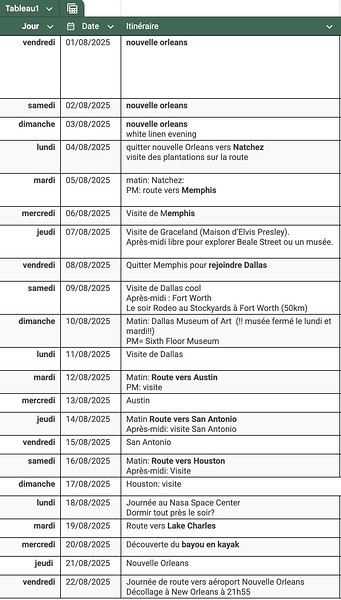
My round-trip ticket to New Orleans is booked—it's my home base.
What do you think? Too much time spent in some stops, not enough in others? Could I get your thoughts?
Hello,
I have the chance to visit Boston for the holidays and I'm looking for accommodation. Any neighborhoods you’d recommend?
We’ll be there for about ten days and can rent a car or use public transit if needed. What do you suggest in the area? For now, we’re sticking to the city and will decide based on the weather.
See you soon,
I have the chance to visit Boston for the holidays and I'm looking for accommodation. Any neighborhoods you’d recommend?
We’ll be there for about ten days and can rent a car or use public transit if needed. What do you suggest in the area? For now, we’re sticking to the city and will decide based on the weather.
See you soon,
Bonjour
parce qu'il faut réver et se projeter..
Les vols sont réservés.. seattle seattle
J'aimerai votre avis sur ce programme. Merci d'avance.
14 juillet buckley (pour sunrise mont rainier) 15 buckley 16 bellevue ou autour 17 Harrison hot spring ou autour 18 clearwater CA 19 clearwater 20 hinton (ou jasper) 21 IDEM 22 banff ou camnore 23 IDEM 24 waterton 25 idem 26 Glacier NP 27 butte ou missoula 28 gardiner 29 gardiner 30 canyon lodge 31 WY 1 aout WY 2 driggs 3 driggs 4 Boise 5 John day 6 bend 7newburry station 8 idem crater lake 9 Vers Florence 10 canon beach 11 forks ou ocean shore 12 forks 13 port angeles ou sequin.
Ce sont les nuits..
votre avis merci d avance
J'aimerai votre avis sur ce programme. Merci d'avance.
14 juillet buckley (pour sunrise mont rainier) 15 buckley 16 bellevue ou autour 17 Harrison hot spring ou autour 18 clearwater CA 19 clearwater 20 hinton (ou jasper) 21 IDEM 22 banff ou camnore 23 IDEM 24 waterton 25 idem 26 Glacier NP 27 butte ou missoula 28 gardiner 29 gardiner 30 canyon lodge 31 WY 1 aout WY 2 driggs 3 driggs 4 Boise 5 John day 6 bend 7newburry station 8 idem crater lake 9 Vers Florence 10 canon beach 11 forks ou ocean shore 12 forks 13 port angeles ou sequin.
Ce sont les nuits..
votre avis merci d avance
Bonjour à tous,
Nous partons du 25.08 au 2.09.20 (Actuellement sur Corsair vol direct A/R pour nous trois, 854 euros avec repas, sans bagage soute) en couple avec notre fille de 10 ans pour visiter les incontournables grand classique de N.Y sauf les musées et en mode cool si on ne peut pas tout faire j'espère pour une autre fois😛🙂
Pouvez-vous m'aider à choisir pour le choix de l'hôtel, les 2 sont biens pour moi, proche des lignes de métro. m'orienter sur le plus facile et intéressant pour les déplacements, ou l'importance de la piscine, l'ambiance des quartiers, le soir soit pour boire un verre ou pour se restaurer facilement.
Club Quarters hôtel World Trade Center 140 washington street N.Y :
Avantage : Wifi gratuit, frigo, micro-onde, cafetière, collations gratuit + bouteilles d'eau prix 1500 euros la semaine situé quartier lower Manathan à coté Mémorial world center
Hôtel Travel Inn - 515 West 42 nd street -Midtown manhattan hell's Kitchen N.Y :
Avantage : Piscine, frigo, micro-onde 1700 euros la semaine + cher situé quartier Midtown West proche Penn station.
En attente de vos réponses, je vous remercie d'avance pour votre temps. Cordialement moune.
Nous partons du 25.08 au 2.09.20 (Actuellement sur Corsair vol direct A/R pour nous trois, 854 euros avec repas, sans bagage soute) en couple avec notre fille de 10 ans pour visiter les incontournables grand classique de N.Y sauf les musées et en mode cool si on ne peut pas tout faire j'espère pour une autre fois😛🙂
Pouvez-vous m'aider à choisir pour le choix de l'hôtel, les 2 sont biens pour moi, proche des lignes de métro. m'orienter sur le plus facile et intéressant pour les déplacements, ou l'importance de la piscine, l'ambiance des quartiers, le soir soit pour boire un verre ou pour se restaurer facilement.
Club Quarters hôtel World Trade Center 140 washington street N.Y :
Avantage : Wifi gratuit, frigo, micro-onde, cafetière, collations gratuit + bouteilles d'eau prix 1500 euros la semaine situé quartier lower Manathan à coté Mémorial world center
Hôtel Travel Inn - 515 West 42 nd street -Midtown manhattan hell's Kitchen N.Y :
Avantage : Piscine, frigo, micro-onde 1700 euros la semaine + cher situé quartier Midtown West proche Penn station.
En attente de vos réponses, je vous remercie d'avance pour votre temps. Cordialement moune.
Bonjour a tous
Alors que nous terminons les préparatifs de notre road trip de cet été de denver à los angeles via le parc du yellowstone.. on a commencé à se pencher sur quoi faire pour les vacances d'avril sachant que nous pouvions partir une petite semaine !! Et la, après une courte réflexion et une large recherche des tarifs des liaison aériennes... hop... on vient de réserver un A/R nice new York ( avec escale car le direct est trop cher a nos dates)..
Donc nous partons revoir, après une 1ère fois en 2009, la grosse pomme... et cette fois ci avec notre jeune ado!!
Les dates sont du samedi 18 avril ( arrivée le soir) au jeudi 23 avril ( départ le soir)...
Me reste plus qu'à peaufiner le choix judicieux de l'hôtel... et de définir les visites des journées qui pourront convenir à tout le monde.. mais ça j'adore!!!
Si vous avez des conseils ( il y a peut-être des nouveautés à New York depuis 10 ans...).. bien sur nous irons au mémorial du 11 sept...
Alors que nous terminons les préparatifs de notre road trip de cet été de denver à los angeles via le parc du yellowstone.. on a commencé à se pencher sur quoi faire pour les vacances d'avril sachant que nous pouvions partir une petite semaine !! Et la, après une courte réflexion et une large recherche des tarifs des liaison aériennes... hop... on vient de réserver un A/R nice new York ( avec escale car le direct est trop cher a nos dates)..
Donc nous partons revoir, après une 1ère fois en 2009, la grosse pomme... et cette fois ci avec notre jeune ado!!
Les dates sont du samedi 18 avril ( arrivée le soir) au jeudi 23 avril ( départ le soir)...
Me reste plus qu'à peaufiner le choix judicieux de l'hôtel... et de définir les visites des journées qui pourront convenir à tout le monde.. mais ça j'adore!!!
Si vous avez des conseils ( il y a peut-être des nouveautés à New York depuis 10 ans...).. bien sur nous irons au mémorial du 11 sept...
Nous sommes un couple 61 ans (mon mari) et 54 ans (moi). Nous sommes originaires de la Réunion, Océan indien et nous y vivons.
Nous avons pour projet de séjourner 3 semaines à NYC en mai 2020.
Nous aimons beaucoup NYC. Ce sera la troisième fois qu'on ira.
Nous aimerions loger pas cher dans Manhattan. Pourquoi pas chez l'habitant ? Participation aux frais bien sûr...
Nous attendons vos idées et suggestions.
Merci à tous.
Nous avons pour projet de séjourner 3 semaines à NYC en mai 2020.
Nous aimons beaucoup NYC. Ce sera la troisième fois qu'on ira.
Nous aimerions loger pas cher dans Manhattan. Pourquoi pas chez l'habitant ? Participation aux frais bien sûr...
Nous attendons vos idées et suggestions.
Merci à tous.
Bonjour ma famille et moi même devont partir le 09 juillet pour faire un trip en Californie pour 3 semaines le souci je n’arrive pas à voir des informations sur l’ouverture des frontières américaines pour nous les européens. Quelqu’un aurait il une réponse à me donner . Merci
Hello, je cherche à organiser pour l'année prochaine ou la suivante un tour centré essentiellement sur l'Utah. Nous avons déjà parcouru les classiques de cet état et nous voudrions approfondir la partie Capitol Reef et Grand Staircase sur quelques jours, en faisant quelques pistes pas difficiles (SUV 4X4 et par temps sec je sais) J'avoue être complètement perdue sur l'organisation de planning. Aller de Boulder à Page par la Burr Trail, puis reprendre la Nothom Bullfrog jusqu'à Capitol Reef ? Ou faire Torrey, scenic road, Nothom B. road ? Et qu'en est-il de la Cottonwood Canyon Road et de la partie Escalante. Comment combiner le tout, sur combien de jours; quelles distances ? J'ai beaucoup de mal organiser des journées qui tiennent la route c'est le cas de la dire ! Je m'adresse aux spécialistes et je précise que nous ne randonnons pas mais évidemment ne sommes pas contre quelques balades tranquilles. Merci de votre éventuelle attention. Bonne semaine, stay safe ! (cette année la Floride en septembre, si si on y croit)
Bonjour tout le monde, billets achetés chez Air France, pour un RT, du 20 juin au 14 juillet, qui nous mènera de Vancouver, à Glacier, en passant par la Pacific Coast, Portland, Mt st Helen, Mt Rainier, Spokane...Glacier. Et là, nous avons Anne et moi, besoin de vous, de vos conseils, bons plans, astuces, bonnes adresses. Surtout des endroits où dormir, motels ou Air bnb, à prix raisonnables. Notamment Vancouver, Portland, et Glacier où les prix flambent à cette période.
Je vous remercie
Antoine
Je cherche un Roof top à New York belle vue et pas cher.
Je ne souhaite pas celui des guides où on doit bien s’habiller mais celui où on va entre potes après le travail. De « l’authentique.
Je ne souhaite pas celui des guides où on doit bien s’habiller mais celui où on va entre potes après le travail. De « l’authentique.
Hi everyone!
After years of hoping, waiting, planning, then changing, saving, and searching for the best possible route... we're FINALLY off this summer for a 5-week road trip in the West.
I had planned a trip to Colorado in 2021 but canceled due to COVID, so with time passing and my eldest’s high school graduation approaching fast, I figured it was now or never!
Anyway, the itinerary has been modified and extended to please everyone (I’m no longer the only one making decisions!!)
Here’s our final route: Day 1 - 7/12/2026 - Brussels / Los Angeles Day 2 - 7/13/2026 - Los Angeles Day 3 - 7/14/2026 - Los Angeles Day 4 - 7/15/2026 - Los Angeles Day 5 - 7/16/2026 - Los Angeles Day 6 - 7/17/2026 - Los Angeles / Kingman Day 7 - 7/18/2026 - Kingman / Grand Canyon Day 8 - 7/19/2026 - Grand Canyon / Page Day 9 - 7/20/2026 - Page Day 10 - 7/21/2026 - Page / Monument Valley Day 11 - 7/22/2026 - Monument Valley / Durango Day 12 - 7/23/2026 - Durango Day 13 - 7/24/2026 - Durango Day 14 - 7/25/2026 - Durango Day 15 - 7/26/2026 - Durango / Glenwood Springs Day 16 - 7/27/2026 - Glenwood Springs Day 17 - 7/28/2026 - Glenwood Springs / Moab Day 18 - 7/29/2026 - Moab Day 19 - 7/30/2026 - Moab Day 20 - 7/31/2026 - Moab Day 21 - 8/1/2026 - Moab Day 22 - 8/2/2026 - Moab / Vernal Day 23 - 8/3/2026 - Vernal / Grand Teton Day 24 - 8/4/2026 - Grand Teton Day 25 - 8/5/2026 - Grand Teton / Cody Day 26 - 8/6/2026 - Cody / Yellowstone Day 27 - 8/7/2026 - Yellowstone Day 28 - 8/8/2026 - Yellowstone Day 29 - 8/9/2026 - Yellowstone Day 30 - 8/10/2026 - Yellowstone / Salt Lake City Day 31 - 8/11/2026 - Salt Lake City / Bryce Canyon Day 32 - 8/12/2026 - Bryce Canyon / Zion Day 33 - 8/13/2026 - Zion Day 34 - 8/14/2026 - Zion Day 35 - 8/15/2026 - Zion / Las Vegas Day 36 - 8/16/2026 - Las Vegas Day 37 - 8/17/2026 - Las Vegas / Los Angeles Day 38 - 8/18/2026 - Los Angeles Day 39 - 8/19/2026 - Los Angeles / Brussels Day 40 - 8/20/2026 - Brussels / Home
We’ll be alternating between house swaps, motels, and campgrounds. I’ve booked all the accommodations (except the campground at Bryce since sunset bookings open only 14 days in advance) and the first activities, as well as the most touristy ones.
I’m currently putting together my day-by-day roadbook and having some trouble planning certain days, like in LA or Las Vegas. Choosing hikes isn’t easy either—it’s tough to decide!
We’re really excited but could definitely use your help with choices and optimizations!!
I had planned a trip to Colorado in 2021 but canceled due to COVID, so with time passing and my eldest’s high school graduation approaching fast, I figured it was now or never!
Anyway, the itinerary has been modified and extended to please everyone (I’m no longer the only one making decisions!!)
Here’s our final route: Day 1 - 7/12/2026 - Brussels / Los Angeles Day 2 - 7/13/2026 - Los Angeles Day 3 - 7/14/2026 - Los Angeles Day 4 - 7/15/2026 - Los Angeles Day 5 - 7/16/2026 - Los Angeles Day 6 - 7/17/2026 - Los Angeles / Kingman Day 7 - 7/18/2026 - Kingman / Grand Canyon Day 8 - 7/19/2026 - Grand Canyon / Page Day 9 - 7/20/2026 - Page Day 10 - 7/21/2026 - Page / Monument Valley Day 11 - 7/22/2026 - Monument Valley / Durango Day 12 - 7/23/2026 - Durango Day 13 - 7/24/2026 - Durango Day 14 - 7/25/2026 - Durango Day 15 - 7/26/2026 - Durango / Glenwood Springs Day 16 - 7/27/2026 - Glenwood Springs Day 17 - 7/28/2026 - Glenwood Springs / Moab Day 18 - 7/29/2026 - Moab Day 19 - 7/30/2026 - Moab Day 20 - 7/31/2026 - Moab Day 21 - 8/1/2026 - Moab Day 22 - 8/2/2026 - Moab / Vernal Day 23 - 8/3/2026 - Vernal / Grand Teton Day 24 - 8/4/2026 - Grand Teton Day 25 - 8/5/2026 - Grand Teton / Cody Day 26 - 8/6/2026 - Cody / Yellowstone Day 27 - 8/7/2026 - Yellowstone Day 28 - 8/8/2026 - Yellowstone Day 29 - 8/9/2026 - Yellowstone Day 30 - 8/10/2026 - Yellowstone / Salt Lake City Day 31 - 8/11/2026 - Salt Lake City / Bryce Canyon Day 32 - 8/12/2026 - Bryce Canyon / Zion Day 33 - 8/13/2026 - Zion Day 34 - 8/14/2026 - Zion Day 35 - 8/15/2026 - Zion / Las Vegas Day 36 - 8/16/2026 - Las Vegas Day 37 - 8/17/2026 - Las Vegas / Los Angeles Day 38 - 8/18/2026 - Los Angeles Day 39 - 8/19/2026 - Los Angeles / Brussels Day 40 - 8/20/2026 - Brussels / Home
We’ll be alternating between house swaps, motels, and campgrounds. I’ve booked all the accommodations (except the campground at Bryce since sunset bookings open only 14 days in advance) and the first activities, as well as the most touristy ones.
I’m currently putting together my day-by-day roadbook and having some trouble planning certain days, like in LA or Las Vegas. Choosing hikes isn’t easy either—it’s tough to decide!
We’re really excited but could definitely use your help with choices and optimizations!!