Results for "Géorgie+événement"
About 5,498 results.
More options
Many results are in French, the community’s main language. English translations are added over time.
Search results
Week-end à mi-chemin entre New York et Montréal?
Bonjour à tous,
J’habite Montréal et mes amis New York. Nous voulons nous réunir à mi-chemin entre les deux villes. Je sais qu’il existe des endroits comme George Lake, Saratoga… Mais je n’ai aucune idée si c’est bien ? Ou loger ?
J’attends de vos nous amis du forum pour un bon plan.
J’habite Montréal et mes amis New York. Nous voulons nous réunir à mi-chemin entre les deux villes. Je sais qu’il existe des endroits comme George Lake, Saratoga… Mais je n’ai aucune idée si c’est bien ? Ou loger ?
J’attends de vos nous amis du forum pour un bon plan.
San Luis 16-23 Fevrier 2006
Salut a tous je vais au San luis du 16 au 23 fevrier j'aimerais savois si y il y a des gens qui y seront!!
Merci😉
Prix des locations/achat de maison aux environs de Punta Cana en République Dominicaine
Bonjour à tous,
Je souhaites aller vivre queques temps en RD, est ce que quequun connais le prix des maison dans le nord de l'île au environ de punta cana.
locations ou éventuelement achat merci des infos
antoine
Je souhaites aller vivre queques temps en RD, est ce que quequun connais le prix des maison dans le nord de l'île au environ de punta cana.
locations ou éventuelement achat merci des infos
antoine
Croisière New-York/Caraïbes octobre 2005 (156 photos commentées et "bullées")
bonjour chers amis des croisières,
nous avons fait la croisière New-York / Caraïbes Occidentales avec NCL sur le DAWN en Novembre 2005.
Nos escales ont été: mercredi 02/11: Ochos Rios en Jamaïque jeudi 03/11: George Town à Grand Cayman vendredi 04/11: Roatan à Bay Islands au Honduras samedi: 05/11: Belize City au Belize dimanche 06/11: Costa Maya au Mexique (car Cozumel a été annulé après le passage de Wilma ! ) lundi 07/11: en mer mardi 08/11: Nassau au Bahamas (car Great Stirrup Cay a été annulé suite Wilma) mercredi 09/11: en mer jeudi 10/11: 10 h arrivée et débarquement au port de New-York (quelle file pour avoir un taxi ! ) Voulez-vous voir nos photos (avec bandeaux explicatifs, bulles humoristiques, et légendes explicatives), alors allez sur le lien suivant. Si vous voulez agrandir une photo particulière, recliquez sur la photo et elle est affichée pleine page, mais alors vous perdez le fil du diaporama (bug ?). http://www.wistiti.fr/camphi:20060117 Bien du plaisir, =Philippe
nous avons fait la croisière New-York / Caraïbes Occidentales avec NCL sur le DAWN en Novembre 2005.
Nos escales ont été: mercredi 02/11: Ochos Rios en Jamaïque jeudi 03/11: George Town à Grand Cayman vendredi 04/11: Roatan à Bay Islands au Honduras samedi: 05/11: Belize City au Belize dimanche 06/11: Costa Maya au Mexique (car Cozumel a été annulé après le passage de Wilma ! ) lundi 07/11: en mer mardi 08/11: Nassau au Bahamas (car Great Stirrup Cay a été annulé suite Wilma) mercredi 09/11: en mer jeudi 10/11: 10 h arrivée et débarquement au port de New-York (quelle file pour avoir un taxi ! ) Voulez-vous voir nos photos (avec bandeaux explicatifs, bulles humoristiques, et légendes explicatives), alors allez sur le lien suivant. Si vous voulez agrandir une photo particulière, recliquez sur la photo et elle est affichée pleine page, mais alors vous perdez le fil du diaporama (bug ?). http://www.wistiti.fr/camphi:20060117 Bien du plaisir, =Philippe
Les bonnes questions
La blagounette du jour...
C'est deubeule iou (lire W) qui visite une école. En milieu de matiné il demande à un élève de lui poser 3 questions de son choix.
Jim demande la parole à George... Je t'écoute Jim M. le Président, j'ai 3 questions:
1 - Pourquoi avons nous envahi l'Irak ?
2 - Où est Ben Laden ?
3 - comment avez-vous fait pour être élu président alors que Al Gore avais plus de voix que vous ?
George s'apprête à répondre lorsque la cloche sonnant la récréation retentit.
Au retour de la récréation, les élèves reprennent leur place. Deubeule iou, reprend la parole: Qui veut poser ses questions ? Un nouvel élève, John, demande la parole. J'ai 5 questions M. le Président. Je t'écoute John M. le Président: 1 - Pourquoi avons nous envahi l'Irak ? 2 - Où est Ben Laden ? 3 - comment avez-vous fait pour être élu président alors que Al Gore avais plus de voix que vous ? 4 - Pourquoi la cloche de la récréation a-t-elle sonné une demie-heure plus tôt qu'habituellement ? 5 - Qu'est devenu Jim ? 😏😏😏 Avant de ma faire égorger par des pro-bush ou encenser par des anti-Bush, n'oubliez pas qu'il s'agit d'une blague et lisez "FBI - Histoire d'un Empire" éditions complexes.
George s'apprête à répondre lorsque la cloche sonnant la récréation retentit.
Au retour de la récréation, les élèves reprennent leur place. Deubeule iou, reprend la parole: Qui veut poser ses questions ? Un nouvel élève, John, demande la parole. J'ai 5 questions M. le Président. Je t'écoute John M. le Président: 1 - Pourquoi avons nous envahi l'Irak ? 2 - Où est Ben Laden ? 3 - comment avez-vous fait pour être élu président alors que Al Gore avais plus de voix que vous ? 4 - Pourquoi la cloche de la récréation a-t-elle sonné une demie-heure plus tôt qu'habituellement ? 5 - Qu'est devenu Jim ? 😏😏😏 Avant de ma faire égorger par des pro-bush ou encenser par des anti-Bush, n'oubliez pas qu'il s'agit d'une blague et lisez "FBI - Histoire d'un Empire" éditions complexes.
Croisière sur le Navigator de Royal Caribbean
Bonjour,
je pars sur le Navigator de Royal Caribbean le 26 novembre pour les Caraïbes de l'Ouest. Nous faisons escale à Ocho Rios (Jamaïque), George Town (Grand Cayman), Cozumel (Mexique) et Labadee (Hispaniola). Quelles excursions intéressantes nous pourrions faire sans se ruiner (2 adultes et 2 enfants de 9 et 13 ans). Si vous avez des petits trucs ou recommandations à me faire vous êtes les bienvenues.
Merci
bye bye
Merci
bye bye
Rencontre à Mons le 20 mai 2005
Alors, pour ceux que ça intéresse, voici le résumé de notre soirée au Doudou à Mons ce vendredi soir.
Etaient présents: Simba, Nikonman, Mile, Jean et Ontheroad.
"-- Censuré! --"
Suite de l'histoire dimanche, après le combat du Lumeçon. On vous dira si Saint George aura tué l'biète.
Bonne nuit, je vais me coucher.
Ben
Etaient présents: Simba, Nikonman, Mile, Jean et Ontheroad.
"-- Censuré! --"
Suite de l'histoire dimanche, après le combat du Lumeçon. On vous dira si Saint George aura tué l'biète.
Bonne nuit, je vais me coucher.
Ben
téléphone cellulaire à Punta Cana
Bonjour, j'aimerais savoir si le cellulaire à la carte fonctionne à Punta Cana, si oui est-ce difficile de se procurer une carte la-bas.
Merci.
Merci.
Distance la Romana - Punta cana
Nous partons à Punta Cana en mars et notre vol arrive à la Romana.
Quelle distance entre les deux ? javascript:%20addTag('fou')
Prince Rupert: camping en bord de mer?
Bonjour à tous ! 🙂
Après un périple de Vancouver jusqu'au parc de Jasper et ses environs en Juillet prochain, nous comptons prendre le train Skeena jusqu'à Prince Rupert. Il y a 24 heures de trajet avec escale d'une nuit à Prince George.
Arrivé à Prince Rupert, nous comptons passé 2 à 3 jours sur place. L'idée première de se séjour et l'observation d'ours aux bords des rivières environantes.
Quelqu'un y connaîtrait un bon camping pas trop cher, et pourquoi pas, en bord de mer ?
De là, nous prendrons le traversier jusqu'à l'Ile de Vancouver...
Souhaitant effectuer cette escale à Prince Rupert convenablement, vos avis et tuyaux nous interesse beaucoup 😉
Merci et à bientot.
Après un périple de Vancouver jusqu'au parc de Jasper et ses environs en Juillet prochain, nous comptons prendre le train Skeena jusqu'à Prince Rupert. Il y a 24 heures de trajet avec escale d'une nuit à Prince George.
Arrivé à Prince Rupert, nous comptons passé 2 à 3 jours sur place. L'idée première de se séjour et l'observation d'ours aux bords des rivières environantes.
Quelqu'un y connaîtrait un bon camping pas trop cher, et pourquoi pas, en bord de mer ?
De là, nous prendrons le traversier jusqu'à l'Ile de Vancouver...
Souhaitant effectuer cette escale à Prince Rupert convenablement, vos avis et tuyaux nous interesse beaucoup 😉
Merci et à bientot.
Avis circuit 7 jours au départ d'Hammamet
Bonjour,
Quelqu'un peut t'il me renseigner sur un circuit qui part de HAMMAMET puis Kairouan, Tozeur, Nefta, Matmata, Douz, Djerba, Gabès retour Hammamet.
La cie aérienne est nouvel air est ce bien comme cie charter ?
+ renseignement sur hôtel VENUS à Hammamet.
+ climat mi mars . Merci d'avance pour toutes vos réponses. A Bientôt GEORGIO
Quelqu'un peut t'il me renseigner sur un circuit qui part de HAMMAMET puis Kairouan, Tozeur, Nefta, Matmata, Douz, Djerba, Gabès retour Hammamet.
La cie aérienne est nouvel air est ce bien comme cie charter ?
+ renseignement sur hôtel VENUS à Hammamet.
+ climat mi mars . Merci d'avance pour toutes vos réponses. A Bientôt GEORGIO
"Glory": an Animal Farm for Zimbabwe—and the world
"400 pages of verbal pyrotechnics and animal magic" — The Times
"Bulawayo leans into exaggeration and irony to tell hard truths. *Glory* is jam-packed with comedy and farce, poking fun at an autocratic regime while illustrating the absurdity and surreal nature of a police state." — The Guardian
The cruelty and savagery of Zimbabwe’s (and Africa’s in general) "powerful animals"
Zimbabwean author NoViolet Bulawayo has written a novel that illustrates better than any documentary the complexity of colonial legacy. In doing so, she revisits George Orwell’s Animal Farm. Her novel *Glory* is a political satire about Zimbabwe—and it’s brimming with humor.
For thirty years, Zimbabwe has been stagnating under Robert Mugabe’s presidency. Human rights violations, corruption, and international sanctions have kept the population mired in poverty and oppression, while the regime exploits the meager earnings of the economy. As the 2017 elections approach, a power struggle erupts over the succession of the very elderly Father of the Nation (Mugabe). On the streets, people hope for long-awaited reforms; the people feel their moment has come.
And indeed, the army ousts Mugabe and his wife—"with her Gucci heels" (p.32)—who was positioning herself for the presidency. Hopes are dashed, however. The generals install former vice-president Emmerson Mnangagwa in power; the regime merely changes faces, but the problems remain the same.
In the novel, the country is called "Jidada, with a -da and another -da" (p.1); there’s no mistaking that this fictional state is Zimbabwe.
For *Glory*, her second novel, NoViolet Bulawayo invents a whole series of codes whose strength lies precisely in how easy they are to decipher. Like George Orwell’s Animal Farm, the characters populating Bulawayo’s universe aren’t humans but horses, goats, or crocodiles with all-too-human traits. Mugabe and Mnangagwa are horses, the spiritual leader is a pig, the soldiers are all bloodthirsty dogs, while the populace consists of goats, chickens, donkeys, and cats. The shift to the animal world serves only to better grasp the laws of despotism—and to ridicule real-life models. On one hand, the animals are humanized: they tweet, torture, travel in private jets. On the other, their greed, stupidity, and brutality stem from their animal nature.
It’s the old trick of fable: dressing men in animal disguises to make them easier to recognize. That’s how Orwell, in Animal Farm, traced how the promise of liberation from the Russian Revolution turned into Stalinist terror. In his 1945 fable, George Orwell describes how the animals of a farm drive out their farmer to organize the exploitation themselves, collectively. For a time, they truly taste freedom, but a clique of pigs ends up taking control. The central figures of the Soviet story—Stalin, Trotsky, Molotov—were easily recognizable.
Yet Bulawayo departs sharply from Orwell. She’s less concerned with precision and the force of argument than with satirical exaggeration. The deposed president is a senile old man who believes he can control even the sun’s course. The new stallion in power is a greedy debaucher. His soldiers sniff respectfully at his tail and backside.
In Bulawayo’s *Glory*, things are more complicated, but her novel also tells of a failed, incomplete liberation. In the author’s Animal Farm, Jidada, the colonial exploiters are followed by new forms of oppression. Because the former liberators become tyrants themselves. And because global power dynamics persist in neocolonial structures.
Wouldn’t that be enough to fuel a deeply depressing narrative? No—Bulawayo turns it into a blazing satire, full of wit and uncompromising criticism of power, a thread running through contemporary (not just) Zimbabwean history. The old warhorses in NoViolet Bulawayo’s Jidada, who continue to act as pack leaders, are easily recognizable as caricatures of the longtime dictator Robert Mugabe and his successor, current president Emmerson Mnangagwa.
The plot kicks off in high gear with independence day festivities. From the crack of dawn, everyone waits on Jidada Square for the Old Horse, the Father of the Nation and former liberator, whose reign "was nearing all of—not one, not two, not three, but four solid decades" (p.1). Everywhere, the colors of the Jidada Party shine; everywhere, true supporters cheer. Even the scorching sun plays its part: "At this point the sun, upon seeing arrive the leader who was decreed by God himself to rule and rule and keep ruling, a leader who'd in turn decreed the very sun to head his cheerleading squad, took a deep, deep breath and thoroughly blazed to impress" (p.2).
Finally, the Old Horse’s luxury carriage approaches "with the slowness of a hearse" (p.2), and "hoping to catch a glimpse of the legendary Father of the Nation," which causes "the animals fell over themselves like intoxicated frogs" (p.2). The sovereign’s speech is delayed a moment longer: "what I really want is a nap," groans the Old Horse as he takes his seat with such care "like his backside was made of expensive porcelain" (p.6).
Meanwhile, Bulawayo parades his entourage: the president’s wife (who earns her doctorate at Jidada University faster than "you could say diss, for dissertation. Tholukuthi it was as easy as ordering from a KFC drive-through, or perhaps even easier being that it was cheaper than KFC; it in fact cost her nothing and the degree actually came with a zero-calorie Diet Coke and a purple straw" (p.41), and she’s now known as Dr Sweet Mother. The cabinet includes "the Minister of the Revolution, the Minister of Corruption, the Minister of Order, the Minister of Things, the Minister of Nothing, the Minister of Propaganda, the Minister of Homophobic Affairs, the Minister of Disinformation and the Minister of Looting" (p.9). And of course the vice-president, who will soon become interim president when the Old Horse finally kicks the bucket—and then settle in as the new long-term president, who in the novel is called Tuvius Delight Shasha, or "Tuvy" for short (p.253), none other than Emmerson Mnangagwa. It’s him Bulawayo reserves her most merciless character description for.
"New Dispensation" (p.109) is Tuvy’s slogan for Jidada, and he loves repeating it so much he even named his parrot after it ("So inspired was Tuvy by the realisation that he rechristened his new pet parrot with the name New Dispensation—tholukuthi the bird having been acquired explicitly for the purposes of tweeting eulogies and accordingly glorifying the Saviour throughout the airs and skies of the nation. Tuvy then went on to hire a lecturer in English from the University of Jidada to teach New Dispensation to say the phrase 'New Dispensation'" p.110). But Tuvy’s Zimbabwe remains a nation without free, fair, and credible elections ("#freefairncredibleelection" p.161), and the promised equal treatment applies only insofar as Zimbabweans now queue up without discrimination in endless lines—and everyone is as poor as the next in the "queuenation" (p.283). Except for the powerful. They can "yes, tholukuthi, her immeasurable riches theirs to take. And take they did—
just take—take—take—take—take—take—take—take—take—take—take—take—take—take—take—take—take—take—take—take—take—take—take—take—take—take—take" (p.249-250).
In short: Bulawayo brilliantly depicts how former independence fighters become exploiters themselves. And how the country threatens to suffocate under the weight of corruption and repression. But she also literally stages the polyphony with which the people oppose imposed obedience to the official line.
Controversial online discussions keep interrupting the narrative—dialogues and social threads (see photo below) that Bulawayo masterfully integrates. From a literary standpoint, it’s a brilliant idea. And it shows, above all, that the author’s sympathy—so likeable—goes to all those who refuse to let their dream of true freedom be stolen, not even by the corrupt elites of their own country.
In the book’s acknowledgments, the first tribute goes to "The Jidadas of the world, clamouring for freedom on many fronts—A luta continua." (p.401) This reflects the realization that, not only in Jidada-Zimbabwe but in many other corners of the world, the end of colonial domination is still far from meaning the freedom hoped for by the vast majority of people. But it also means, more broadly, that this freedom must be won "on many fronts" (see above), both domestically and geopolitically.
That’s precisely what *Glory* so vividly highlights: how complex the project behind the term "postcolonialism" really is. With *Glory*, Bulawayo also delivers a scathing critique of the persistence of colonial mindsets in the West.
In the novel, the murder of George Floyd, racist police violence, and white-supremacist ideology in Trump’s United States perfectly illustrate the persistence of racism. It’s especially in the final chapters that Bulawayo lets Jidada’s inhabitants explicitly and unflinchingly criticize a neocolonial world order:
"It was not lost on us how the West, which loved to 'save' Africa and announce every action to the whole world, did so with one limb while manipulating, looting and fleecing us with the rest of its limbs so that more money in fact poured out of the continent than trickled in." (p.376)
"It was no mistake that multinational corporations yearly reaped and shipped colossal profits from Africa back to their countries as had been the case during colonial times. Even the sticks and stones would tell you that the African earth at any given time howled and shook and heaved from the extraction of its precious minerals that rarely benefited its own miserable children." (p.376)
"(...) we vowed to wage yet another war for Africa's second Liberation from neocolonial oppression. From exploitation. From plunder. From Western dominion. From indignity. From Abuse. We wanted real freedom. We wanted greedy, thieving paws off our wealth. We wanted Justice. We wanted a new world; we wanted a brand-new world so much we didn't sleep a wink that night." (p.377)
The Jidadas of this world must fight two enemies: Western neocolonialism and the autocratic instrumentalization of that argument; the persistence of Western racism and the populist appropriation of that humiliation by tyrants from their own ranks. Neither of these obstacles to freedom diminishes the historical and current guilt of the other. But the path to postcolonial liberation must overcome all these forms of oppression. After all, the colonizers didn’t bequeath democracies to formerly dominated nations, but instability and the principles of oppression and exploitation—which the so-called liberators have also internalized. Yet the fact that a satirical novel can capture the complexity of historical relationships while remaining, despite all the darkness of the subject, hilarious—well, that’s truly astonishing.
Finally, *Glory* ties into a major trauma in Zimbabwe’s post-independence history: the so-called Gukurahundi massacres. Between 1983 and 1987, tens of thousands of civilians were murdered by Mugabe’s bloody henchmen, most of them Ndebele. The State Security Minister and head of secret services at the time? You guessed it—Emmerson Mnangagwa.
When *Glory* turns to the massacres, the novel’s tone shifts completely. The story is now told through the narrative of the goat called Destiny, who, like NoViolet Bulawayo herself, left her home country at 18 for the United States and only returned after 13 years. In the book, the city of Bulawayo becomes a village where Destiny retraces her family’s history—and learns that part of it was also brutally murdered during the massacres.
The abuse of power and life under a dictatorship, dispossession, and a fiercely proud awareness of the psychological wounds and emotional vulnerability of a uprooted and disenfranchised people who had to forge a new language—a new set of names—to express their lived experiences are at the heart of this wonderful Zimbabwean author’s literary work, NoViolet Bulawayo. Shortly after her studies, she was already writing short stories about postcolonial power dynamics in Africa. But her playful, masterful, and often unconventional approach to language also plays a key role in her work. With virtuosity, she shifts from cynical images of power-obsessed elites to compassionate descriptions of the people’s suffering, ending with a hopeful sermon on courage—the courage to break free from fear and thus gain the strength for change ("And every one of them understood that whatever they heard within those hearts was the new national anthem, tholukuthi an anthem that spoke of the kind of glory that burns eternal and glows with living light." p.400). This novel is a genuine pleasure to read. And it’s exceptional. Good, African...
Book info (original English and German translation):
NoViolet Bulawayo. Glory. Chatto & Windus, 2022. NoViolet Bulawayo. Glory. Suhrkamp, 2023.
Hery
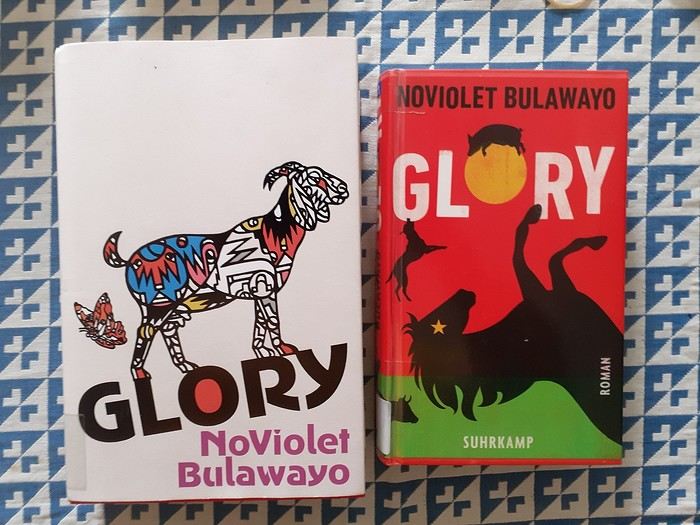 The books (in English, in German)
 Author NoViolet Bulawayo, Zimbabwe
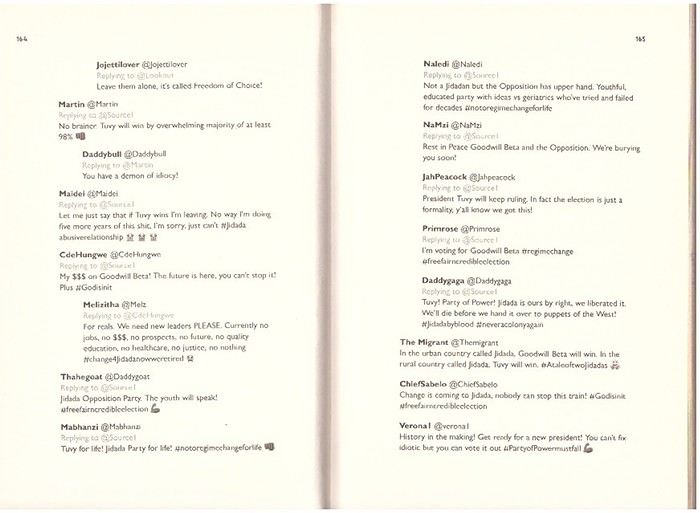 Threads (p.164-165)
"Bulawayo leans into exaggeration and irony to tell hard truths. *Glory* is jam-packed with comedy and farce, poking fun at an autocratic regime while illustrating the absurdity and surreal nature of a police state." — The Guardian
The cruelty and savagery of Zimbabwe’s (and Africa’s in general) "powerful animals"
Zimbabwean author NoViolet Bulawayo has written a novel that illustrates better than any documentary the complexity of colonial legacy. In doing so, she revisits George Orwell’s Animal Farm. Her novel *Glory* is a political satire about Zimbabwe—and it’s brimming with humor.
For thirty years, Zimbabwe has been stagnating under Robert Mugabe’s presidency. Human rights violations, corruption, and international sanctions have kept the population mired in poverty and oppression, while the regime exploits the meager earnings of the economy. As the 2017 elections approach, a power struggle erupts over the succession of the very elderly Father of the Nation (Mugabe). On the streets, people hope for long-awaited reforms; the people feel their moment has come.
And indeed, the army ousts Mugabe and his wife—"with her Gucci heels" (p.32)—who was positioning herself for the presidency. Hopes are dashed, however. The generals install former vice-president Emmerson Mnangagwa in power; the regime merely changes faces, but the problems remain the same.
In the novel, the country is called "Jidada, with a -da and another -da" (p.1); there’s no mistaking that this fictional state is Zimbabwe.
For *Glory*, her second novel, NoViolet Bulawayo invents a whole series of codes whose strength lies precisely in how easy they are to decipher. Like George Orwell’s Animal Farm, the characters populating Bulawayo’s universe aren’t humans but horses, goats, or crocodiles with all-too-human traits. Mugabe and Mnangagwa are horses, the spiritual leader is a pig, the soldiers are all bloodthirsty dogs, while the populace consists of goats, chickens, donkeys, and cats. The shift to the animal world serves only to better grasp the laws of despotism—and to ridicule real-life models. On one hand, the animals are humanized: they tweet, torture, travel in private jets. On the other, their greed, stupidity, and brutality stem from their animal nature.
It’s the old trick of fable: dressing men in animal disguises to make them easier to recognize. That’s how Orwell, in Animal Farm, traced how the promise of liberation from the Russian Revolution turned into Stalinist terror. In his 1945 fable, George Orwell describes how the animals of a farm drive out their farmer to organize the exploitation themselves, collectively. For a time, they truly taste freedom, but a clique of pigs ends up taking control. The central figures of the Soviet story—Stalin, Trotsky, Molotov—were easily recognizable.
Yet Bulawayo departs sharply from Orwell. She’s less concerned with precision and the force of argument than with satirical exaggeration. The deposed president is a senile old man who believes he can control even the sun’s course. The new stallion in power is a greedy debaucher. His soldiers sniff respectfully at his tail and backside.
In Bulawayo’s *Glory*, things are more complicated, but her novel also tells of a failed, incomplete liberation. In the author’s Animal Farm, Jidada, the colonial exploiters are followed by new forms of oppression. Because the former liberators become tyrants themselves. And because global power dynamics persist in neocolonial structures.
Wouldn’t that be enough to fuel a deeply depressing narrative? No—Bulawayo turns it into a blazing satire, full of wit and uncompromising criticism of power, a thread running through contemporary (not just) Zimbabwean history. The old warhorses in NoViolet Bulawayo’s Jidada, who continue to act as pack leaders, are easily recognizable as caricatures of the longtime dictator Robert Mugabe and his successor, current president Emmerson Mnangagwa.
The plot kicks off in high gear with independence day festivities. From the crack of dawn, everyone waits on Jidada Square for the Old Horse, the Father of the Nation and former liberator, whose reign "was nearing all of—not one, not two, not three, but four solid decades" (p.1). Everywhere, the colors of the Jidada Party shine; everywhere, true supporters cheer. Even the scorching sun plays its part: "At this point the sun, upon seeing arrive the leader who was decreed by God himself to rule and rule and keep ruling, a leader who'd in turn decreed the very sun to head his cheerleading squad, took a deep, deep breath and thoroughly blazed to impress" (p.2).
Finally, the Old Horse’s luxury carriage approaches "with the slowness of a hearse" (p.2), and "hoping to catch a glimpse of the legendary Father of the Nation," which causes "the animals fell over themselves like intoxicated frogs" (p.2). The sovereign’s speech is delayed a moment longer: "what I really want is a nap," groans the Old Horse as he takes his seat with such care "like his backside was made of expensive porcelain" (p.6).
Meanwhile, Bulawayo parades his entourage: the president’s wife (who earns her doctorate at Jidada University faster than "you could say diss, for dissertation. Tholukuthi it was as easy as ordering from a KFC drive-through, or perhaps even easier being that it was cheaper than KFC; it in fact cost her nothing and the degree actually came with a zero-calorie Diet Coke and a purple straw" (p.41), and she’s now known as Dr Sweet Mother. The cabinet includes "the Minister of the Revolution, the Minister of Corruption, the Minister of Order, the Minister of Things, the Minister of Nothing, the Minister of Propaganda, the Minister of Homophobic Affairs, the Minister of Disinformation and the Minister of Looting" (p.9). And of course the vice-president, who will soon become interim president when the Old Horse finally kicks the bucket—and then settle in as the new long-term president, who in the novel is called Tuvius Delight Shasha, or "Tuvy" for short (p.253), none other than Emmerson Mnangagwa. It’s him Bulawayo reserves her most merciless character description for.
"New Dispensation" (p.109) is Tuvy’s slogan for Jidada, and he loves repeating it so much he even named his parrot after it ("So inspired was Tuvy by the realisation that he rechristened his new pet parrot with the name New Dispensation—tholukuthi the bird having been acquired explicitly for the purposes of tweeting eulogies and accordingly glorifying the Saviour throughout the airs and skies of the nation. Tuvy then went on to hire a lecturer in English from the University of Jidada to teach New Dispensation to say the phrase 'New Dispensation'" p.110). But Tuvy’s Zimbabwe remains a nation without free, fair, and credible elections ("#freefairncredibleelection" p.161), and the promised equal treatment applies only insofar as Zimbabweans now queue up without discrimination in endless lines—and everyone is as poor as the next in the "queuenation" (p.283). Except for the powerful. They can "yes, tholukuthi, her immeasurable riches theirs to take. And take they did—
just take—take—take—take—take—take—take—take—take—take—take—take—take—take—take—take—take—take—take—take—take—take—take—take—take—take—take" (p.249-250).
In short: Bulawayo brilliantly depicts how former independence fighters become exploiters themselves. And how the country threatens to suffocate under the weight of corruption and repression. But she also literally stages the polyphony with which the people oppose imposed obedience to the official line.
Controversial online discussions keep interrupting the narrative—dialogues and social threads (see photo below) that Bulawayo masterfully integrates. From a literary standpoint, it’s a brilliant idea. And it shows, above all, that the author’s sympathy—so likeable—goes to all those who refuse to let their dream of true freedom be stolen, not even by the corrupt elites of their own country.
In the book’s acknowledgments, the first tribute goes to "The Jidadas of the world, clamouring for freedom on many fronts—A luta continua." (p.401) This reflects the realization that, not only in Jidada-Zimbabwe but in many other corners of the world, the end of colonial domination is still far from meaning the freedom hoped for by the vast majority of people. But it also means, more broadly, that this freedom must be won "on many fronts" (see above), both domestically and geopolitically.
That’s precisely what *Glory* so vividly highlights: how complex the project behind the term "postcolonialism" really is. With *Glory*, Bulawayo also delivers a scathing critique of the persistence of colonial mindsets in the West.
In the novel, the murder of George Floyd, racist police violence, and white-supremacist ideology in Trump’s United States perfectly illustrate the persistence of racism. It’s especially in the final chapters that Bulawayo lets Jidada’s inhabitants explicitly and unflinchingly criticize a neocolonial world order:
"It was not lost on us how the West, which loved to 'save' Africa and announce every action to the whole world, did so with one limb while manipulating, looting and fleecing us with the rest of its limbs so that more money in fact poured out of the continent than trickled in." (p.376)
"It was no mistake that multinational corporations yearly reaped and shipped colossal profits from Africa back to their countries as had been the case during colonial times. Even the sticks and stones would tell you that the African earth at any given time howled and shook and heaved from the extraction of its precious minerals that rarely benefited its own miserable children." (p.376)
"(...) we vowed to wage yet another war for Africa's second Liberation from neocolonial oppression. From exploitation. From plunder. From Western dominion. From indignity. From Abuse. We wanted real freedom. We wanted greedy, thieving paws off our wealth. We wanted Justice. We wanted a new world; we wanted a brand-new world so much we didn't sleep a wink that night." (p.377)
The Jidadas of this world must fight two enemies: Western neocolonialism and the autocratic instrumentalization of that argument; the persistence of Western racism and the populist appropriation of that humiliation by tyrants from their own ranks. Neither of these obstacles to freedom diminishes the historical and current guilt of the other. But the path to postcolonial liberation must overcome all these forms of oppression. After all, the colonizers didn’t bequeath democracies to formerly dominated nations, but instability and the principles of oppression and exploitation—which the so-called liberators have also internalized. Yet the fact that a satirical novel can capture the complexity of historical relationships while remaining, despite all the darkness of the subject, hilarious—well, that’s truly astonishing.
Finally, *Glory* ties into a major trauma in Zimbabwe’s post-independence history: the so-called Gukurahundi massacres. Between 1983 and 1987, tens of thousands of civilians were murdered by Mugabe’s bloody henchmen, most of them Ndebele. The State Security Minister and head of secret services at the time? You guessed it—Emmerson Mnangagwa.
When *Glory* turns to the massacres, the novel’s tone shifts completely. The story is now told through the narrative of the goat called Destiny, who, like NoViolet Bulawayo herself, left her home country at 18 for the United States and only returned after 13 years. In the book, the city of Bulawayo becomes a village where Destiny retraces her family’s history—and learns that part of it was also brutally murdered during the massacres.
The abuse of power and life under a dictatorship, dispossession, and a fiercely proud awareness of the psychological wounds and emotional vulnerability of a uprooted and disenfranchised people who had to forge a new language—a new set of names—to express their lived experiences are at the heart of this wonderful Zimbabwean author’s literary work, NoViolet Bulawayo. Shortly after her studies, she was already writing short stories about postcolonial power dynamics in Africa. But her playful, masterful, and often unconventional approach to language also plays a key role in her work. With virtuosity, she shifts from cynical images of power-obsessed elites to compassionate descriptions of the people’s suffering, ending with a hopeful sermon on courage—the courage to break free from fear and thus gain the strength for change ("And every one of them understood that whatever they heard within those hearts was the new national anthem, tholukuthi an anthem that spoke of the kind of glory that burns eternal and glows with living light." p.400). This novel is a genuine pleasure to read. And it’s exceptional. Good, African...
Book info (original English and German translation):
NoViolet Bulawayo. Glory. Chatto & Windus, 2022. NoViolet Bulawayo. Glory. Suhrkamp, 2023.
Hery
The books (in English, in German)
Author NoViolet Bulawayo, Zimbabwe
Threads (p.164-165)Feedback on 20-Day Malaysia Itinerary
Hi everyone! Here’s a rough draft of my itinerary: I’d like to rent a car in KL and return it in Penang.
Is there an overnight bus from Langkawi to the Perhentians?
Another option: skip one of the two islands to drive back down to KL and stop at Pulau Redang?
Day 1: Arrival at 10 AM, car rental for 7 days, Putrajaya, night in KL Day 2: Batu Caves, Taman Negara, night in TN Day 3: Taman Negara, night in TN Day 4: Drive to Cameron Highlands, night in CH Day 5: Cameron Highlands, Ipoh, night in Penang Day 6: Penang, George Town Day 7: Return rental car in Penang and flight to Langkawi. Night in Langkawi (4 nights) Day 8: Langkawi Day 9: Langkawi Day 10: Langkawi Day 11: Overnight bus? Langkawi to Perhentians (5 nights) Day 12: Perhentians Day 13: Perhentians Day 14: Perhentians Day 15: Perhentians -> KL (flight) Day 17: KL Day 18: KL Day 19: Return flight at 1 PM
Thanks for your expert advice! !
Day 1: Arrival at 10 AM, car rental for 7 days, Putrajaya, night in KL Day 2: Batu Caves, Taman Negara, night in TN Day 3: Taman Negara, night in TN Day 4: Drive to Cameron Highlands, night in CH Day 5: Cameron Highlands, Ipoh, night in Penang Day 6: Penang, George Town Day 7: Return rental car in Penang and flight to Langkawi. Night in Langkawi (4 nights) Day 8: Langkawi Day 9: Langkawi Day 10: Langkawi Day 11: Overnight bus? Langkawi to Perhentians (5 nights) Day 12: Perhentians Day 13: Perhentians Day 14: Perhentians Day 15: Perhentians -> KL (flight) Day 17: KL Day 18: KL Day 19: Return flight at 1 PM
Thanks for your expert advice! !
South Africa, Lesotho, and Eswatini Itinerary
Hi there,
In two months, I’m heading off for 4 weeks with three backpacker friends to South Africa, Lesotho, and Eswatini.
We’ve got our round-trip flight tickets from France to Johannesburg and plan to drive from Johannesburg to Cape Town and back to Johannesburg in an SUV or 4x4.
For other city trips, we’ll use local transport or Uber.
That’s the plan for our transportation.
For the car rental, I’d like to know which company to book with. Can anyone give me some tips on renting a vehicle and crossing into Lesotho and Eswatini?
Next, I’ve put together a rough itinerary that seems good to me, but could you share your experiences and maybe point out any mistakes I’ve made?
Day 1: Arrival in Johannesburg Day 2: Johannesburg (city tour) Day 3: Johannesburg to Cape Town (old town) Day 4: Cape Town (Table Mountain) Day 5: Cape Town (Robben Island + port) Day 6: Cape Town (peninsula: Boulders Beach, Cape of Good Hope) Day 7: Cape Town to Stellenbosch to Franschhoek Day 8: Franschhoek to Greyton to Genadendal to Montagu Day 9: Montagu to Swellendam Day 10: Swellendam to Overberg Day 11: Overberg Day 12: Overberg to George (Garden Route) to Gqeberha (Port Elizabeth) Day 13: Gqeberha to Queenstown to Aliwal North Day 14: Aliwal North to Lesotho (Maseru) Day 15: Lesotho Day 16: Lesotho to Drakensberg Day 17: Drakensberg Day 18: Drakensberg to Durban to St. Lucia Day 19: St. Lucia Day 20: St. Lucia to Eswatini Day 21: Eswatini Day 22: Eswatini to Kruger Day 23: Kruger Day 24: Kruger Day 25: Kruger to Blyde Canyon Day 26: Blyde Canyon to Johannesburg Day 27: Johannesburg Day 28: Johannesburg to France
That’s the plan. Of course, it’d be perfect, but some spots probably deserve more time, while others might be less interesting. I hope you can help me fine-tune this route.
Thanks in advance for your patience and great advice.
Cheers,
Didier
For the car rental, I’d like to know which company to book with. Can anyone give me some tips on renting a vehicle and crossing into Lesotho and Eswatini?
Next, I’ve put together a rough itinerary that seems good to me, but could you share your experiences and maybe point out any mistakes I’ve made?
Day 1: Arrival in Johannesburg Day 2: Johannesburg (city tour) Day 3: Johannesburg to Cape Town (old town) Day 4: Cape Town (Table Mountain) Day 5: Cape Town (Robben Island + port) Day 6: Cape Town (peninsula: Boulders Beach, Cape of Good Hope) Day 7: Cape Town to Stellenbosch to Franschhoek Day 8: Franschhoek to Greyton to Genadendal to Montagu Day 9: Montagu to Swellendam Day 10: Swellendam to Overberg Day 11: Overberg Day 12: Overberg to George (Garden Route) to Gqeberha (Port Elizabeth) Day 13: Gqeberha to Queenstown to Aliwal North Day 14: Aliwal North to Lesotho (Maseru) Day 15: Lesotho Day 16: Lesotho to Drakensberg Day 17: Drakensberg Day 18: Drakensberg to Durban to St. Lucia Day 19: St. Lucia Day 20: St. Lucia to Eswatini Day 21: Eswatini Day 22: Eswatini to Kruger Day 23: Kruger Day 24: Kruger Day 25: Kruger to Blyde Canyon Day 26: Blyde Canyon to Johannesburg Day 27: Johannesburg Day 28: Johannesburg to France
That’s the plan. Of course, it’d be perfect, but some spots probably deserve more time, while others might be less interesting. I hope you can help me fine-tune this route.
Thanks in advance for your patience and great advice.
Cheers,
Didier
15-Day Road Trip in the American West
Hi there,
Do you have any tips for a 15-day road trip in the American West in 2025? We’ll be on the ground for about 15 days with a small to medium-sized group.
Thanks!
Also, thanks to the site for getting back up and running.
Your thoughts on my 14-day South Africa itinerary for a senior traveler
Hello,
I’m taking advantage of the forum reopening to ask this question:
For her 70th birthday, my mom will receive—as a gift—a trip to South Africa at the end of May 2025. We’ll arrive and depart (13 nights later) from JNB on Air France AF990/AF995. We’ll obviously rent a car for certain parts of the trip. I’ve been to the Cape Town area and as far as Agulhas twice, but she’s never been to South Africa before. She might enjoy a day or two of safari, but it’s not a priority for her. I’m well aware that trying to pack in too much is risky, which is why I’m looking for your advice on itineraries, safety, and health (status of the Marburg virus). So far, which combinations of these visits (in no particular order) would be doable and most enjoyable for her at a reasonable pace:
1-day excursion to Pilanesberg Park (+ Hartbeespoort on the way back if possible), self-drive or with a tour guide? 2 nights around the Panorama Route self-driving Garden Route from/to George/PLZ for 5 nights (what are the must-sees for a first-timer with so little time?) Wine region for 2 nights (is it worth doing both the Stellenbosch bus tour and the Franschhoek Wine Tram the next day, or vice versa)—she loves good wine! Cape Town for 2 nights (is it worth stopping at the Cape of Good Hope if—only if—you’ve maybe already been to Agulhas?).
This would give a final itinerary like this:
Day 1: Morning arrival in JNB—rest day/to be defined Day 2: Guided game drive excursion to Pilanesberg Park Day 3: Flight JNB–Port Elizabeth, pick up rental car, drive to Tsitsikamma Day 4–6: Garden Route: activities to be defined Day 7: Transfer to Franschhoek: Wine Tram in the afternoon Day 8: Taxi to Stellenbosch for the Vine Hopper bus tour Day 9–11: Transfer to Cape Town: activities to be defined Day 12: Flight from Cape Town to Hoedspruit or Nelspruit Day 13: Visit the Panorama Route Day 14: Flight from Hoedspruit or Nelspruit to JNB, then evening flight back to France
Given the time spent on the Garden Route, what are the must-sees? Same question for the Panorama Route? In general, she prefers beautiful walks with incredible landscapes/views and cultural visits over big cats, but it would be a shame not to see some local wildlife like meerkats, whales (I doubt it in May), or penguins during her stay! There you go—feel free to critique (not too harshly, though😛)/advise/improve. Thanks in advance! 🙂
For her 70th birthday, my mom will receive—as a gift—a trip to South Africa at the end of May 2025. We’ll arrive and depart (13 nights later) from JNB on Air France AF990/AF995. We’ll obviously rent a car for certain parts of the trip. I’ve been to the Cape Town area and as far as Agulhas twice, but she’s never been to South Africa before. She might enjoy a day or two of safari, but it’s not a priority for her. I’m well aware that trying to pack in too much is risky, which is why I’m looking for your advice on itineraries, safety, and health (status of the Marburg virus). So far, which combinations of these visits (in no particular order) would be doable and most enjoyable for her at a reasonable pace:
1-day excursion to Pilanesberg Park (+ Hartbeespoort on the way back if possible), self-drive or with a tour guide? 2 nights around the Panorama Route self-driving Garden Route from/to George/PLZ for 5 nights (what are the must-sees for a first-timer with so little time?) Wine region for 2 nights (is it worth doing both the Stellenbosch bus tour and the Franschhoek Wine Tram the next day, or vice versa)—she loves good wine! Cape Town for 2 nights (is it worth stopping at the Cape of Good Hope if—only if—you’ve maybe already been to Agulhas?).
This would give a final itinerary like this:
Day 1: Morning arrival in JNB—rest day/to be defined Day 2: Guided game drive excursion to Pilanesberg Park Day 3: Flight JNB–Port Elizabeth, pick up rental car, drive to Tsitsikamma Day 4–6: Garden Route: activities to be defined Day 7: Transfer to Franschhoek: Wine Tram in the afternoon Day 8: Taxi to Stellenbosch for the Vine Hopper bus tour Day 9–11: Transfer to Cape Town: activities to be defined Day 12: Flight from Cape Town to Hoedspruit or Nelspruit Day 13: Visit the Panorama Route Day 14: Flight from Hoedspruit or Nelspruit to JNB, then evening flight back to France
Given the time spent on the Garden Route, what are the must-sees? Same question for the Panorama Route? In general, she prefers beautiful walks with incredible landscapes/views and cultural visits over big cats, but it would be a shame not to see some local wildlife like meerkats, whales (I doubt it in May), or penguins during her stay! There you go—feel free to critique (not too harshly, though😛)/advise/improve. Thanks in advance! 🙂
Serena Fisseau & Vincent Peirani: «So Quiet»
Chansons douces pour Petits (et Grands)
« So quiet » - le titre de l’album en dit long : lorsque tout est bruyant et agité autour de soi, il vaut mieux s‘enfermer et se rendre dans un cadre familier. « So quiet » (2019) est une telle retraite musicale à laquelle la chanteuse-danseuse Serena Fisseau et son mari, l’accordéoniste Vincent Peirani, aussi parents de deux enfants ensemble, nous invitent. Un album tout simplement délicieux...
Par cet album, ces deux artistes nous invitent, pour ainsi dire, dans le cercle de leur petite famille, et représentent des chansons qu’ils jouent et chantent chez eux, notamment à leurs enfants (garçons de 3 et 9 ans), ainsi qu’à leurs proches, lorsqu’ils referment la porte du monde extérieur. Cela crée une ambiance confortable et intime, et avec laquelle on peut décrocher et se détendre : s’il s’agit d‘une chanson de Serge Gainsbourg (« La Javanaise »), de Burt Bacharach (« Close to you ») ou des Beatles (« And I love her »), si ce sont des pièces inspirées de la musique folklorique indonésienne ou brésilienne (Caetano Veloso, Antonio Carlos Jobim, Freire Júnior), si elles sont chantées en bahasa, français, anglais ou portugais, ou jouées à l’accordéon, à l’accordina, au Wurlitzer e-piano, aux body percussions ou même au piano – elle affectionnent la simplicité et enthousiasment. Ma pièce favorie, d’ailleurs, c’est « 3 petites notes de musique » (George Delerue/Henri Colpi) : d’une beauté simple (difficile à mettre en mots !)...
Serena Fisseau et Vincent Peirani font ressortir l’essence de ces chefs-d’œuvres intemporels, de la manière la plus naturelle possible. Seulement avec une voix soyeuse, rassurante et sans toutes fioritures, un instrument toujours distant et beaucoup de silence. Un silence – cette denrée précieuse, aujourd’hui peut-être plus que jamais – qui devient audible dans la musique de Serena Fisseau et Vincent Peirani. Dans les espaces entre les tons, qui sont sur cet album presque plus importants que les tons eux-mêmes. Une musique irrésistiblement légère, souvent joyeuse et claire, qui tire son intimité avant tout du fait que les deux musiciens ne sont pas seulement un couple d’artistes, mais aussi dans la « vraie» vie. Les deux ont fait cet album pour leurs enfants. Et pour tous les autres enfants. Et pour tous les adultes qui ont à nouveau envie de se rêver par des vibrations (très près de l’oreille) d’une voix femelle et d’un accordéon dans une légèreté enfantine pendant la durée d’un album...
Serena Fisseau : voix, body percussions Vincent Peirani : accordéon, accordina, Wurlitzer, piano, plastic bags, music box, voix
Hery
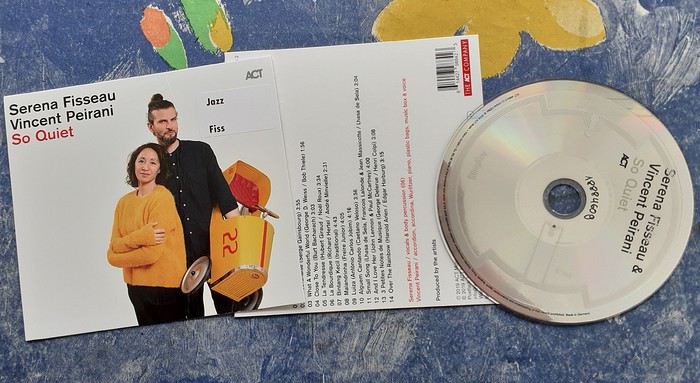
« So quiet » - le titre de l’album en dit long : lorsque tout est bruyant et agité autour de soi, il vaut mieux s‘enfermer et se rendre dans un cadre familier. « So quiet » (2019) est une telle retraite musicale à laquelle la chanteuse-danseuse Serena Fisseau et son mari, l’accordéoniste Vincent Peirani, aussi parents de deux enfants ensemble, nous invitent. Un album tout simplement délicieux...
Par cet album, ces deux artistes nous invitent, pour ainsi dire, dans le cercle de leur petite famille, et représentent des chansons qu’ils jouent et chantent chez eux, notamment à leurs enfants (garçons de 3 et 9 ans), ainsi qu’à leurs proches, lorsqu’ils referment la porte du monde extérieur. Cela crée une ambiance confortable et intime, et avec laquelle on peut décrocher et se détendre : s’il s’agit d‘une chanson de Serge Gainsbourg (« La Javanaise »), de Burt Bacharach (« Close to you ») ou des Beatles (« And I love her »), si ce sont des pièces inspirées de la musique folklorique indonésienne ou brésilienne (Caetano Veloso, Antonio Carlos Jobim, Freire Júnior), si elles sont chantées en bahasa, français, anglais ou portugais, ou jouées à l’accordéon, à l’accordina, au Wurlitzer e-piano, aux body percussions ou même au piano – elle affectionnent la simplicité et enthousiasment. Ma pièce favorie, d’ailleurs, c’est « 3 petites notes de musique » (George Delerue/Henri Colpi) : d’une beauté simple (difficile à mettre en mots !)...
Serena Fisseau et Vincent Peirani font ressortir l’essence de ces chefs-d’œuvres intemporels, de la manière la plus naturelle possible. Seulement avec une voix soyeuse, rassurante et sans toutes fioritures, un instrument toujours distant et beaucoup de silence. Un silence – cette denrée précieuse, aujourd’hui peut-être plus que jamais – qui devient audible dans la musique de Serena Fisseau et Vincent Peirani. Dans les espaces entre les tons, qui sont sur cet album presque plus importants que les tons eux-mêmes. Une musique irrésistiblement légère, souvent joyeuse et claire, qui tire son intimité avant tout du fait que les deux musiciens ne sont pas seulement un couple d’artistes, mais aussi dans la « vraie» vie. Les deux ont fait cet album pour leurs enfants. Et pour tous les autres enfants. Et pour tous les adultes qui ont à nouveau envie de se rêver par des vibrations (très près de l’oreille) d’une voix femelle et d’un accordéon dans une légèreté enfantine pendant la durée d’un album...
Serena Fisseau : voix, body percussions Vincent Peirani : accordéon, accordina, Wurlitzer, piano, plastic bags, music box, voix
Hery
L'industrie de la musique à l'arrêt mardi contre les violences policières
Projet de road trip de Yellowstone à Los Angeles en passant par le Colorado
Bonjour à tous,
Apres un premier road trip en aout 2016 de trois semaines (itineraires classiques) nous souhaitons cet été nous remettre sur les routes. A l'epoque ce forum me fut d'une grande aide.
Nous avons pour cela 23 jours avec quelques critères ce qui rend la chose complexe pour etablir ce planning : - pas hors de prix, ce qui implique des vols internationaux arrivée LA (pour nos dates) - inclure Yellowstone et la Californie ce qui implique de la distance - non nous ne n'y prenons pas 1 an a l’avance pour réserver Yellowstone nous voyagerons en camping - Etre a Monterrey pour un festival de voiture ancienne - faire ce que nous avions aimé au précédent voyage et découvrir de nouvelles routes
- Jour 1 arrivée LA/ vol interne pour Salt Lake City- recuperation voiture - nuit a definir - Jour 2 Courses- Antelope Island et depart pour Jackson - nuit environ de Jackson - Jour 3 Grand Teton - Yellowstone - camping suivant dispo - Jour 4 Yellowstone - camping suivant dispo - Jour 5 Yellowstone - camping suivant dispo - Jour 6 Flaming George - Jour 7 Moab - Jour 8 Moab - Jour 9 Route 128 - Gunnison National Park - Nuit Montrose ou Telluride - Jour 10 Durango - Jour 11 Monument Valley - Jour 12 Page - Jour 13 Grand Canyon par North Rim / point de vue nuit sur place - Jour 14 nuit etape?? zion deja fait et onra pas le temps pour une rando - Jour 15 Las Vegas - Jour 16 Lone Pine - Jour 17 Sequoia - Jour 18 Monterrey - Vintage car race festival - Jour 19 Monterrey / carmel - Jour 20 Route 1 - Nuit Santa Barbara - Jour 21/22/23 Los Angeles
Est ce cohérent, bien que super rapide? Compliqué la route entre Las Vegas et Monterrey, y a t-il plus simple? Nous adorons rouler et sommes habitué aux road trip surtout quand les routes sont belles.
J’espère que ce rêve pourra être faisable. Nous sommes en phase d’étude pour le moment.
Merci , Bien à vous Marie
Apres un premier road trip en aout 2016 de trois semaines (itineraires classiques) nous souhaitons cet été nous remettre sur les routes. A l'epoque ce forum me fut d'une grande aide.
Nous avons pour cela 23 jours avec quelques critères ce qui rend la chose complexe pour etablir ce planning : - pas hors de prix, ce qui implique des vols internationaux arrivée LA (pour nos dates) - inclure Yellowstone et la Californie ce qui implique de la distance - non nous ne n'y prenons pas 1 an a l’avance pour réserver Yellowstone nous voyagerons en camping - Etre a Monterrey pour un festival de voiture ancienne - faire ce que nous avions aimé au précédent voyage et découvrir de nouvelles routes
- Jour 1 arrivée LA/ vol interne pour Salt Lake City- recuperation voiture - nuit a definir - Jour 2 Courses- Antelope Island et depart pour Jackson - nuit environ de Jackson - Jour 3 Grand Teton - Yellowstone - camping suivant dispo - Jour 4 Yellowstone - camping suivant dispo - Jour 5 Yellowstone - camping suivant dispo - Jour 6 Flaming George - Jour 7 Moab - Jour 8 Moab - Jour 9 Route 128 - Gunnison National Park - Nuit Montrose ou Telluride - Jour 10 Durango - Jour 11 Monument Valley - Jour 12 Page - Jour 13 Grand Canyon par North Rim / point de vue nuit sur place - Jour 14 nuit etape?? zion deja fait et onra pas le temps pour une rando - Jour 15 Las Vegas - Jour 16 Lone Pine - Jour 17 Sequoia - Jour 18 Monterrey - Vintage car race festival - Jour 19 Monterrey / carmel - Jour 20 Route 1 - Nuit Santa Barbara - Jour 21/22/23 Los Angeles
Est ce cohérent, bien que super rapide? Compliqué la route entre Las Vegas et Monterrey, y a t-il plus simple? Nous adorons rouler et sommes habitué aux road trip surtout quand les routes sont belles.
J’espère que ce rêve pourra être faisable. Nous sommes en phase d’étude pour le moment.
Merci , Bien à vous Marie
Chauffeur au Sri Lanka
Bonsoir a tous,
je rentre du Sri Lanka,
j'ai passé 15 jours sur place avec un super chauffeur, Karu.
circuit assez classique, negombo, sigyria, polonnaruwa, dambulla, kandy, adams peak, nuwara eliya, horton plains, ella, udawalawe, mirissa, galle.
c'est quelqu'un de discret, très prévenant, très sympathique et qui connait très bien son beau pays, il nous a évité les pièges touristiques, nous a emmené manger dans des resto locaux, évidemment grace a lui les prix des hotel et resto ont été diminués (tarif special touriste ...) Il nous a conseillé mais nous a toujours laissé libre de choisir, bref c'est un super guide il est joignable par mail et répond très vite, il prend 40 euros par jour tout compris, il faut rajouter le pourboire.
karucaa@yahoo.com
enchantée par ce voyage !
circuit assez classique, negombo, sigyria, polonnaruwa, dambulla, kandy, adams peak, nuwara eliya, horton plains, ella, udawalawe, mirissa, galle.
c'est quelqu'un de discret, très prévenant, très sympathique et qui connait très bien son beau pays, il nous a évité les pièges touristiques, nous a emmené manger dans des resto locaux, évidemment grace a lui les prix des hotel et resto ont été diminués (tarif special touriste ...) Il nous a conseillé mais nous a toujours laissé libre de choisir, bref c'est un super guide il est joignable par mail et répond très vite, il prend 40 euros par jour tout compris, il faut rajouter le pourboire.
karucaa@yahoo.com
enchantée par ce voyage !