Results for "Espagne"
About 42,246 results.
More options
Many results are in French, the community’s main language. English translations are added over time.
Search results
Weather in Extremadura in early January (Spain)
hi,
I'm having trouble getting an idea of what the weather's like in this region in winter. I'm thinking of going there the first week of January after spending New Year's Day in Madrid. Is that a good idea? Is it pleasant to walk around the small towns at this time of year? And by car?
thanks a lot
21-Day Trip to La Gomera and La Palma
Travel Journal: 21 Days in La Gomera and La Palma
From February 6 to February 26, 2024
Tuesday, February 6 We left around 9 AM with our car, along with Pierre-Paul and Patricia, heading to the Bluepark parking lot in Bartenheim. As expected, we were awaited and left promptly for EuroAirport Basel. Took off at 12:25 PM for a 4-hour-15-minute flight under excellent conditions. Beautiful arrival in Tenerife with Teide in sight under a clear blue sky. Fifteen minutes later, we waited for bus No. 40 to Los Cristianos with quite a few other tourists, but we managed to find four seats. From the bus station, it was a 20-minute walk to our hotel. We checked into a lovely apartment for the four of us, complete with all the comforts. Outside, it was quite warm—at least 25°C! After dropping off our luggage, we went for a stroll. The immediate surroundings of the hotel held no interest for us: a modern, concrete area filled with hotels, bars, tourist agencies, and unappealing restaurants all offering the same bland international cuisine. Pat went to cool off at the pool, unfortunately overrun by loud, drunk English tourists. I took a walk to the paseo maritimo that leads to the port, skirting the seafront. The promenade was pleasant, but it could have been any seaside resort in the world—same old scene: a succession of bars with blaring music where many elderly people sipped cold beers waiting for the sunset, the backdrop a wall of resort-style hotels resembling rabbit hutches! Upon reaching the port, I scouted the route we’d take the next day to the Fred Olsen ferry. Back at the apartment, in the early evening, we looked for a non-touristy restaurant for dinner. Monique stopped a woman to ask her opinion! In this area, she told us, there’s no restaurant that serves Canarian or Spanish cuisine! The only place with decent restaurants is at the port. Off we went to the port, where we sat down at Al Bordo restaurant and ordered a seafood paella for four. Excellent, and at a very reasonable price (36 € for two). We returned to the hotel along the seafront.
Wednesday, February 7
Woke up at 6 AM. Had breakfast in the apartment with what we’d bought the day before at a supermarket. It was still dark when we left on foot toward the port, walking along the calm seafront at this early hour. Forty minutes later, we arrived and waited 10 minutes before the ferry docked. At 9:30 AM, we left the port of Los Cristianos for a 50-minute crossing on a calm sea under a beautiful blue sky. There were quite a few people on this large ferry, but many had no luggage, meaning they were visiting La Gomera for the day and would take the ferry back in the evening. Upon disembarking, we went straight to our rental car agency to pick up the car we’d booked online a few months earlier. It was a nice Peugeot 2008, spacious enough for the four of us and our luggage. We immediately took the beautiful road from San Sebastián that climbs directly into the mountains toward our rental in Vallehermoso. The road was in perfect condition—it seemed brand new, like all the others we’d take on this island later. This side of the island is very arid with little vegetation, and the terrain is particularly rugged, as it is throughout the island. We stopped at our first miradors, which would be followed by many more throughout our Canarian trip. Our first visit was to the small village of Agulo, perched on a promontory above the sea and at the foot of a high cliff. The village features typical Canarian houses with windows flush with the façade and black volcanic stone masonry on white or reddish-brown walls. The first recommended restaurant was already booked for a group, so we settled for the shaded terrace of the excellent El Alameda bar-restaurant. From Agulo, you can access the Abrante viewpoint via a winding road, where the view of Agulo, 600 meters below, is exceptional. A glass ledge over the void lets you test your fear of heights!
We drove to Vallehermoso to do our grocery shopping at the supermarket—a habit that would continue until the end of the trip. Our little house, "Casa rural El Encatadora," is located in a beautiful flower-filled valley a few kilometers west of Vallehermoso. Each of us had a bedroom with an en-suite bathroom, plus a living room, kitchen, and a small terrace overlooking the quiet street at the valley’s end, which didn’t bother us at all.
Thursday, February 8 The good weather seemed to follow us since our arrival in the Canary Islands. This morning, we took the road—still as beautiful and new—toward Arure, high up to the west. The landscape was magnificent, with breathtaking glimpses of the sea far below. In Arure, we parked in front of Conchita’s bar, where a hike (Rother No. 30) starts toward two viewpoints: Alojera, which we reached after 45 minutes on a lovely path. Monique, tired from the first steep climb, stopped at the first viewpoint and hitchhiked back to Arure. Meanwhile, we continued toward the second viewpoint, Los Barranquillos, where the view of the surroundings was partially hidden by misty clouds rising from the sea. The entire mountain is sculpted by ancient, endless terraces climbing until the slope becomes too steep for construction—visible traces of the hard work of past inhabitants trying to survive in a harsh environment. We had a decent lunch at La Conchita bar, then drove to the small seaside town of Puerto la Caleta, sheltered by an immense cliff plunging into the sea. Black sand beach, rough sea—despite our encouragement, Pat didn’t dare to swim! As for the old village of Caleta, it’s perched on the mountainside, and visiting it requires climbing steep, stair-filled alleys to discover a few traditional houses. Back at the casa, dinner in, and card games...
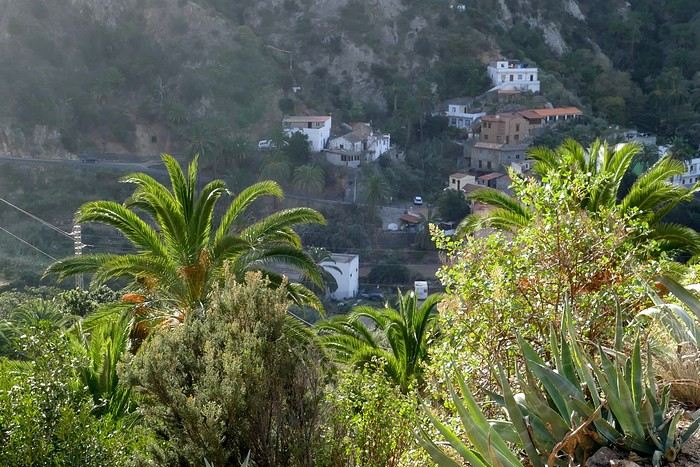 Vallehermoso
Friday, February 9 This morning, the sky was overcast, and the peaks around us were shrouded in clouds. We took the same road as yesterday to hike Las Creces. Quickly gaining altitude, we entered a thick fog—visibility was very limited. We stopped at the Las Creces parking lot; visibility improved, and the sun wasn’t far off. The hike is entirely within a beautiful laurel forest, with the sun playing hide-and-seek, but it wasn’t cold despite the altitude. After finishing the loop trail, we decided to picnic—not there, as it was too chilly—but on Vallehermoso’s beach, where we found a nice picnic area sheltered by large black rocks. A short digestive walk on the surrounding hill to admire the little beach from above. Back in Vallehermoso, we did some grocery shopping, then tried to return to the casa—only to find ourselves locked out because we’d left the key in the lock inside! After several attempts and with the help of Yéli, a relative of the owner we called for help, we were finally able to get back in!
Saturday, February 10
It rained last night, and the sky remained overcast. Monique decided to rest this morning. PP, Pat, and I set off on the hike that starts from the house toward the Marichal reservoir. The sun wasn’t far off, and by 11 AM, it was fully out. The pleasant hike passed by many flower-filled gardens and orchards—orange, lemon, and mandarin trees in fruit. The path climbed gently toward the reservoir, where the view of the Cano rock dominating the landscape was magnificent. The last part of the climb was a bit tough, overgrown with lush vegetation, and the trail was slippery from last night’s rain. We descended via a different, much more pleasant path and returned to the casa just in time for lunch, prepared by Monique. This valley is rich with its many farmers and market gardeners who’ve cultivated the entire valley, taking advantage of the water flowing down from the mountain, captured upstream and redistributed through countless pipes snaking along the paths. Numerous tanks also store water during dry periods. The houses are scattered across both sides of the valley, and these colorful little homes add a beautiful touch to the landscape. The many palm trees give this valley a distinctly tropical feel—you could almost imagine yourself in the Caribbean. Add to that some salsa music drifting from a hut where farmers were working, and the picture is complete. A well-chilled beer apéro capped off a lovely morning. The afternoon was dedicated to rest, relaxation, reading, and games.
Sunday, February 11 The blue sky returned, though a few clouds still capped the highest peaks. Today, we visited Garajonay National Park, which covers the highest central mountains. Up there, we were above the clouds, and the panoramas from the various viewpoints were stunning: first, Cherelepin, accessible from the Laguna Grande parking lot, then Alto de Garajonay, offering an exceptional view of Teide—over 3,000 meters high—emerging from the clouds on Tenerife, far in the distance. We continued to the Los Roques viewpoints, then stopped for lunch at the Degollada de Peraza restaurant, where the view of the barranco was impressive. We descended toward San Sebastián and checked into our new lodging, La Cabezada, located in the countryside about 3 km above San Sebastián. It’s a small apartment adjacent to the owner’s, with a lovely terrace overlooking the surrounding mountains and surrounded by a beautiful garden. Apéro, then dinner on our beautiful terrace.
Monday, February 12 This morning, we went down to visit San Sebastián de La Gomera: its old tower, main street with some beautiful traditional houses, and the Church of the Assumption. Back at the casa for lunch. In the afternoon, Pat, PP, and I set off on the short hike from San Sebastián beach to La Guancha beach. We drove down and parked on the beach. The path climbs along the hill overlooking San Sebastián, passes by the tall Christ statue dominating the landscape, and roughly follows the coast down to the isolated Guancha beach. A beautiful hike under a hot sun, and a swim was welcome, even if the beach and sea access weren’t very comfortable due to large pebbles and quickly deepening water. Apart from two nudist bathers, there was no one on this beach. We returned the same way.
Tuesday, February 13 Rest day. We went down to town to stroll and do some shopping. I took the opportunity to visit the parador, beautifully situated above the city in a lovely garden overlooking the port and town. Together, we went for a cuba libre at the "Cuba Libre" bar, then had lunch at Breñusca (mediocre paella!). Back at the casa, then we went back down to town to see a carnival parade, a "passacalles," which actually passed an hour earlier than scheduled. Oh well.
Wednesday, February 14 Each to their own program this morning. Pat went swimming at San Sebastián beach, Monique rested at the casa, and PP and I set off on the hike from Playa de Avalos to the Ermita de Guadalupe on Playa del Cangrejo. It wasn’t easy to find the right road or the parking spot, but we managed. The path seemed to have suffered landslides, according to a sign at the trailhead! We decided to check it out, ready to turn back if it seemed too dangerous. In the end, apart from one or two slightly tricky spots where we had to climb a pile of rocks, the trail remained passable, though a bit vertigo-inducing in places. The narrow path clings to very vertical cliffs nearly 300 meters above sea level! But what a magnificent view. At one point, the trail runs alongside a wall of basaltic pipes. We returned via the drivable track that parallels the trail a bit lower. Back at the house for lunch. In the late afternoon, we returned to town to attend the "Entierro de las Sardinas" (Burial of the Sardine), which closes the Canarian carnival festivities. While waiting, we strolled through the parador’s gardens and had mojitos in town. Around 9 PM, we heard the noise and cries of the mourners. The procession advanced, led by a large papier-mâché sardine on a float, surrounded by wailing mourners. The procession headed toward the sea, where the sardine was burned, and a mini fireworks display ended the procession. It was all very good-natured, and everyone had fun. We ended the evening with dinner at a good fish restaurant, El Pajar.
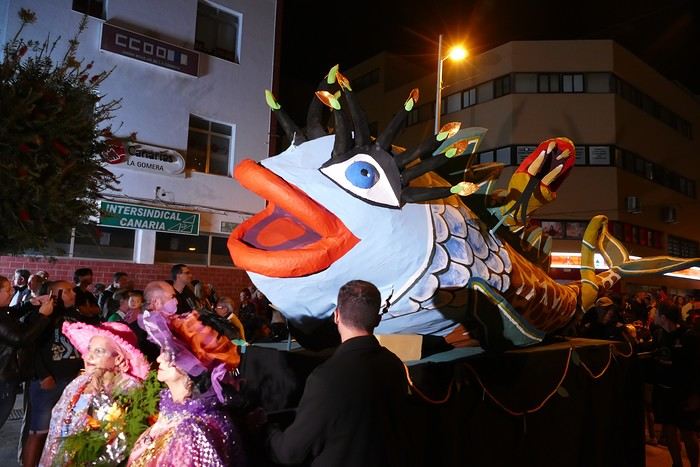 Entierro de la Sardina in San Sebastián de La Gomera
Thursday, February 15
Woke up at 5:15 AM. The only suitable ferry was at 7 AM, which would get us to La Palma by late morning rather than evening. We packed our bags, had breakfast, then headed to the port, left our rental car, and boarded the ferry to Tenerife, from where we’d continue to La Palma. Calm sea, beautiful sun—by 10:30 AM, we disembarked in La Palma. We picked up our car and immediately headed to our new apartment in Breña Alta. It’s a large apartment with a superb terrace facing the sea, fully equipped and very comfortable. The hosts recommended Casa Goyo restaurant, near the airport and close to us. It’s a restaurant with many small rooms, some of which can be reserved for families. The fish-based cuisine (chipirones, pulpo) was excellent, hearty, and reasonably priced. Since it’s in the airport’s flight path, we occasionally heard planes landing. Quick and efficient service. Afterward, we visited Santa Cruz de La Palma, which reminded us of the historic quarters of La Orotava in Tenerife or the capital of Gran Canaria.
Friday, February 16
Beautiful weather, blue sky. We headed to the San Bartolo viewpoint toward the northeast coast, then to the lovely village of San Andrés, which we explored. From there, we walked along the shore to the natural pools of Charco Azul, where we swam in the cool but "swimmable" sea. Back in San Andrés for lunch at the "San Andrés" restaurant on the beautiful church square. Very good fish-based meal. We got back in the car and continued along the north coast to the port of Espindola and the natural pools of Fajana near the Cumplida lighthouse. A fairly strong wind whipped up beautiful waves crashing onto the rocky coast in bursts of foam. Back in Santa Cruz, we stopped at the Mercadona supermarket to buy fresh shrimp for dinner.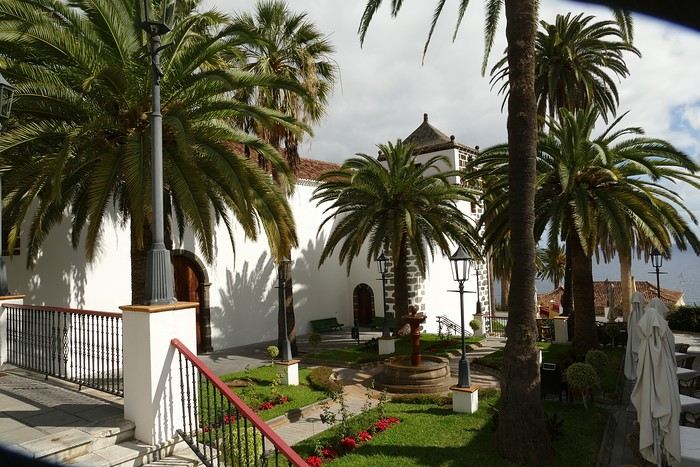 San Andrés
Saturday, February 17
Uniform blue sky, even on the heights. We took the beautiful road that winds up to the summit of the Caldera de Taburiente. Several viewpoints offer 360° views of the entire island and beyond: you can make out La Gomera, El Hierro, and, of course, Tenerife with the perfect triangle of Teide. We parked at the Los Andes viewpoint parking lot and started our hike to Pico de la Cruz along a trail following the ridge, offering superb views into the caldera. We got back in the car and passed by the Roque de los Muchachos astronomical complex, composed of numerous observatories, some with very aesthetic mirror telescopes. We hiked from the Roque de los Muchachos parking lot to the various viewpoints, always as impressive. Picnic on site, then back to Santa Cruz. We stopped by our car dealer because the oil warning light came on—better safe than sorry. The representative reassured us but preferred to give us a Fiat Cross SUV instead.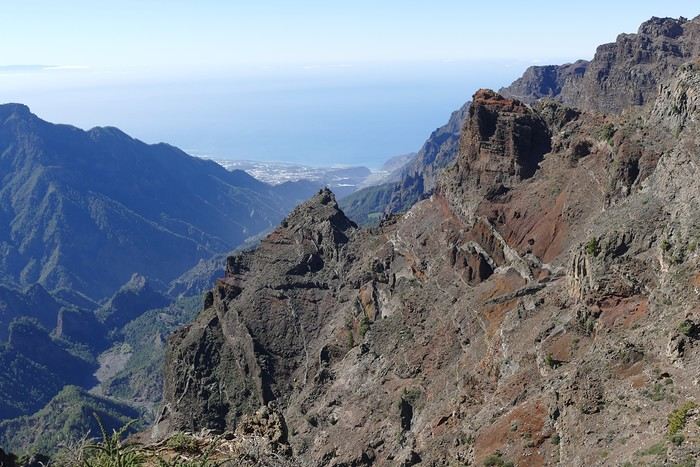 The Caldera de Taburiente
Sunday, February 18 The weather was a bit mixed, with cloudy patches. We set off to hike the Barranco de la Cuba de Galga. Unfortunately, the Los Tilos trail had been closed for several months due to a major landslide. The parking lot by the road was already quite full, and indeed, we crossed paths with many hikers along the way—it’s an easy hike with little elevation gain, which is rare here in La Palma! The beautiful path winds through a very narrow, deep gorge covered in lush tropical vegetation—you’d think you were in a Southeast Asian forest, especially with the humidity in the gorge bringing out earthy and floral scents. Halfway through, Monique turned back while the rest of us continued to the Cuba de Galga. A light drizzle accompanied us on the return. For lunch, we went to Chipi Chipi restaurant in the heights of Santa Cruz. The cool air forced us to leave the lovely terrace for the slightly noisy dining room. The meal was very good and hearty. Afternoon spent resting at our house.
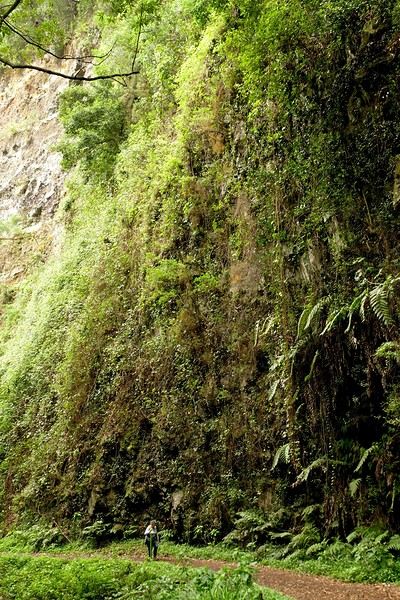 La Cuba de la Galga
Monday, February 19 A few clouds still clung to the nearby mountain peaks. We headed south to Los Canarios. We stopped in front of the small San Antonio Abad church, where a path leads to the viewpoint in 15 minutes. Then we visited the San Antonio Volcano Interpretation Center and climbed to the viewpoint via the trail along the crater’s edge, offering a plunging view into the crater. Then PP, Pat, and I headed toward the Teneguía volcano but turned back given the remaining distance and the intense heat bearing down on us! Plus, the landscape was rather arid and not very interesting. We got back in the car and drove down to the salt flats at the island’s southern tip. The ocean crashes here in large waves, exploding against the volcanic rocks and feeding a "blowhole" carved into the rock. We stopped for drinks at the salt flats restaurant, then headed home.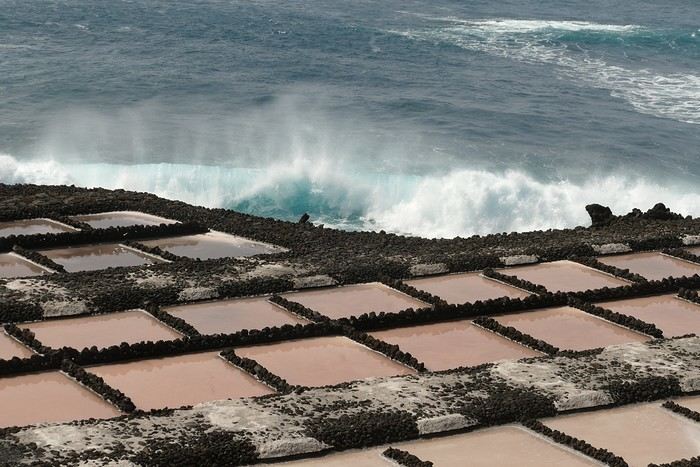 The salt flats in Fuencaliente
Tuesday, February 20 Beautiful weather with a few clouds clinging to the mountains, as usual. A relaxed morning since my parking reservation at La Cumbrecita didn’t start until 1 PM. It takes about 30 minutes from Santa Cruz to reach the valley floor via a beautiful but narrow road toward the end, though there’s very little traffic. Meanwhile, the clouds had disappeared, and the view from the La Cumbrecita viewpoint was superb. We recognized Pico de la Cruz in the distance, where we’d been a few days earlier. We then took the path leading to the Las Chozas viewpoint through a magnificent Canarian pine forest. We picnicked on site, then took the path to the Los Roques viewpoint. We returned the same way since the direct route was closed for construction. Back in Santa Cruz, we visited the Sanctuary of Las Nieves, with its beautiful golden Baroque altar.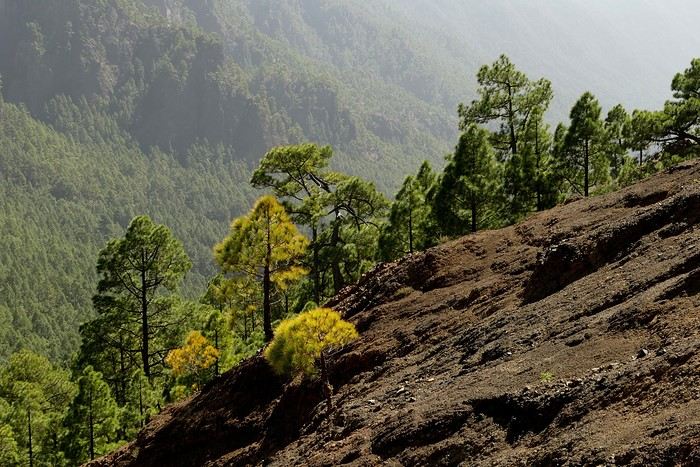 Hike from La Cumbrecita
Wednesday, February 21 After packing our things and loading the car, we left Santa Cruz under a very blue sky for Los Llanos de Aridane, where we stopped to visit this lovely town. The Church of Nuestra Señora de los Remedios has a beautiful coffered ceiling and an original papier-mâché Christ statue from the 16th century. Around it, colorful old Canarian houses brighten the streets of the town center. We took the opportunity to stroll, do some shopping, and finally sat down at La Pergola restaurant for a mediocre lunch. We got back in the car to check into our new house in Arecida. On the way, we stopped at the Mirador del Time, which once again offered an impressive panorama, allowing us—for the first time—to see the damage caused by the Tajogaite volcano eruption in 2021. You can clearly see the still-smoking crater and the large black lava flow covering the landscape down to the sea. We really liked our new accommodation: a local house that’s been renovated on the heights of Arecida, not far from the Canarian pine forest. From several terraces, we have a 360° view of the sea and mountains. We even have a private pool! There are two beautiful, brand-new bedrooms, each with its own bathroom—the best. Plus, we’re on the GR 131 trail that runs along the Barranco de las Angustias toward the northeast.
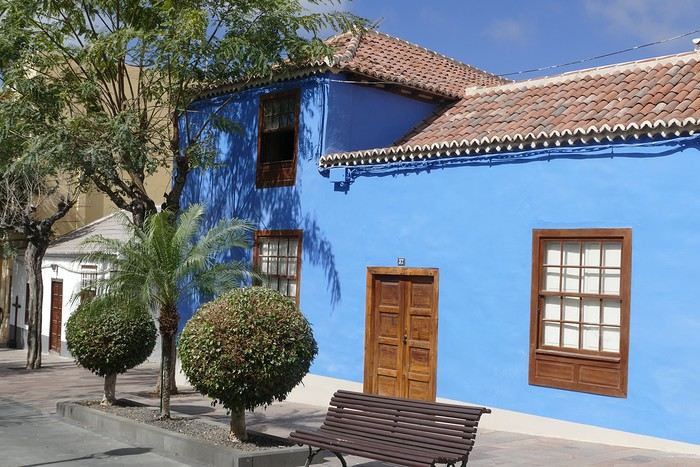 Los Llanos de Aridane
Thursday, February 22 Once again, beautiful weather greeted us when we woke up. We started the GR 131 with the goal of reaching the Torre del Time viewpoint—about 400 meters of elevation gain. The path, quite steep at first, winds through a superb Canarian pine forest. A few viewpoints let you appreciate the sheer drop of the Barranco de las Angustias—watch out for vertigo! At the Torre del Time viewpoint, there’s a nearly 1,000-meter vertical drop. We returned via another path, the PLP1, which meanders first through this beautiful forest, then along lovely flower-filled gardens adjacent to beautiful properties that cascade from the forest down to the road serving these neighborhoods. This afternoon, we tried to get closer to the area devastated by the 2021 lava flows. Several roads are still closed or reserved for residents, while others—brand new—have been rebuilt to open up this densely populated and cultivated region. In some places, the lava flow slightly diverted, sparing some properties that logically should have disappeared. Now, they’re encircled by a massive cooled lava field. In other spots, twisted and charred metal scraps or greenhouse remains protrude from the lava—all that’s left of the former banana plantations. A little higher up, you can see the slightly smoking crater of Tajogaite, responsible for this disaster. Back to Casa Barreros.
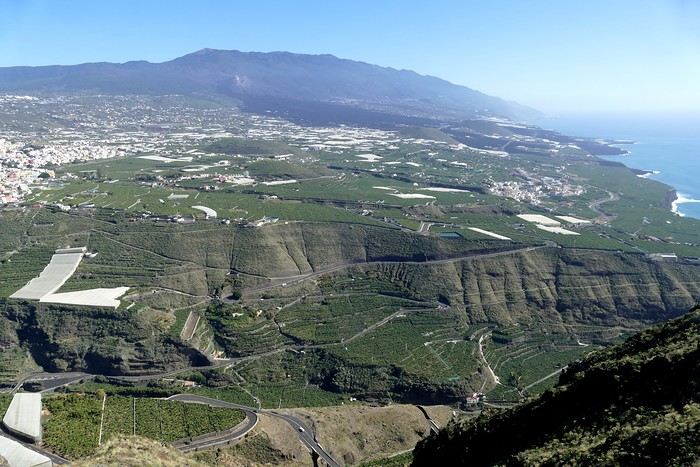 View of Los Llanos and, in the background, the 2021 lava flow
Friday, February 23
Though the sky was still blue, the temperature had dropped due to a chilly wind. By midday, it still rose to 22°C. Today, we headed north, specifically to the town of Tijarafe, where a very narrow road descends to the small port, Porís de Candelaria. The 3.7-kilometer road drops 700 meters in elevation, with gradients up to 30%—it was going to be intense! Indeed, the descent was scary, with the void right next to the very narrow road where passing was impossible except at a few rare spots. Everything went well—there was little traffic at this early hour. From the parking lot at the bottom, a path leads to Porís de Candelaria. It’s surprising to see this small fishing hamlet nestled in the shelter of an immense cave opening onto the sea, which was quite rough today. The sun, at this time of year, would appear late in the cave, which remained in shadow for much of the day. We returned via the same road, strolled through the small town of Puntagorda, and had lunch at El Jardín de los Naranjos restaurant—excellent meal.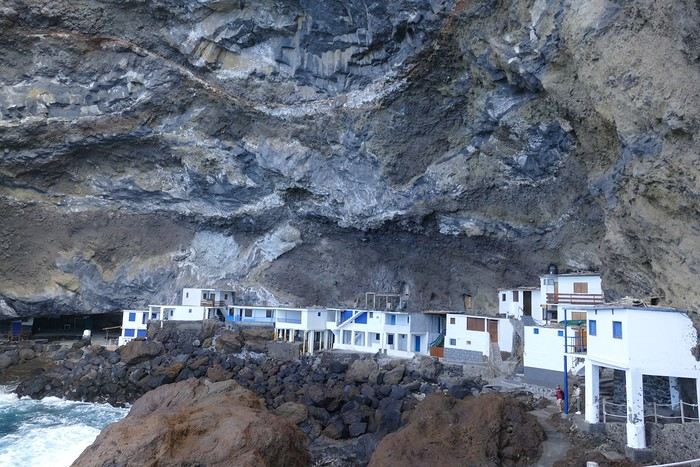 Fishing hamlet of Candelaria
Saturday, February 24 The air was still cool, but the sun was beautiful. While Monique stayed home to rest, the three of us headed to the village of Las Tricias to hike the Buracas Caves trail. We left the car parked on the LP1 road and took the small paved road down to the sign marking the trail’s start. The signage for all the trails we took here, as in La Gomera, was very well done. The path descended steadily, then more steeply toward the caves where the island’s first inhabitants lived—some petroglyphs are still visible in certain caves. The path then climbed back up, passing magnificent dragon trees and more or less elaborate huts occupied by Germans who’ve lived here for many years. Back at Casa Barreros for some rest.
Sunday, February 25 The weather once again blessed us with a beautiful day. This morning, we visited the local produce market held on weekends in Puntagorda. You’ll find agricultural products, crafts, and food to keep you going. A little further on, there’s a glass viewpoint overlooking the barranco plunging toward the sea, with a view of the thrill-seekers trying the zip line right next to it. Lunch at Naranjos—definitely a good spot—with their shrimp and spice tagliatelle. Back home for an afternoon of relaxation.
Monday, February 26 We left Arecida under a cloudy sky. Driving up from Los Llanos de Aridane toward the east, an enormous cascade of clouds poured from the mountain peaks into the Los Llanos plain—very impressive. Arriving in Santa Cruz, we went for a stroll, did some last-minute shopping, then had a final good-quality paella at La Chalana on the paseo maritimo. We left the car in the parking lot and took the 5 PM Olsen ferry to Tenerife on a slightly choppy sea, but the ferry didn’t rock too much. Arriving at 7:15 PM, we dropped off our things near the port in our reserved apartment and went for dinner at Abordo—rubbery chipirones. A digestive stroll among the ever-increasing number of tourists in Los Cristianos—restaurants were packed to the brim, the season is in full swing here. Gone is the calm of La Gomera and La Palma, and the laid-back tourism of German hikers among whom a few French were hiding!
Tuesday, February 27 To make our homemade breakfast more enjoyable, we went to buy pastries at the local bakery, then took one last walk on the paseo along the beaches, mingling with the many mobility scooters driven by elderly or disabled people, joggers, and tourists. Last apéro near the bus station, then off to the airport. After a smooth 4-hour-30-minute flight, we arrived in Basel-Mulhouse at 10:20 PM.
THE END
Conclusion A fantastic trip to two islands with magnificent and diverse nature, where landscapes range from desert-like to tropical depending on exposure to winds and clouds. Thanks to the many beautiful viewpoints, you can truly appreciate these exceptionally dynamic reliefs. A hiker’s paradise, the trails are all very well marked, though the choice of easy or moderate paths for "casual walkers" is quite limited. Another notable advantage, in our opinion, is that these islands are very lightly developed—you’ll hardly see any of those ugly hotel blocks that spoil the landscapes of some other Canary Islands. It’s true that the beaches on these two islands don’t meet traditional international tourism criteria: they’re small, with black sand, and often difficult to access. Special mention for the quality of the road network (except for a few small local roads), which seems brand new, well-paved, and well-signposted. We also enjoyed exceptional weather for February, with fewer than three days of gray or rainy weather out of 21.
Almost all the accommodations we chose met or exceeded our expectations, often at reasonable prices: an average of 98 € per night for an apartment or house with two bedrooms for four people.
All photos can be viewed by clicking this link: https://photos.app.goo.gl/G44pPk4g9PW1rNzg8
Tuesday, February 6 We left around 9 AM with our car, along with Pierre-Paul and Patricia, heading to the Bluepark parking lot in Bartenheim. As expected, we were awaited and left promptly for EuroAirport Basel. Took off at 12:25 PM for a 4-hour-15-minute flight under excellent conditions. Beautiful arrival in Tenerife with Teide in sight under a clear blue sky. Fifteen minutes later, we waited for bus No. 40 to Los Cristianos with quite a few other tourists, but we managed to find four seats. From the bus station, it was a 20-minute walk to our hotel. We checked into a lovely apartment for the four of us, complete with all the comforts. Outside, it was quite warm—at least 25°C! After dropping off our luggage, we went for a stroll. The immediate surroundings of the hotel held no interest for us: a modern, concrete area filled with hotels, bars, tourist agencies, and unappealing restaurants all offering the same bland international cuisine. Pat went to cool off at the pool, unfortunately overrun by loud, drunk English tourists. I took a walk to the paseo maritimo that leads to the port, skirting the seafront. The promenade was pleasant, but it could have been any seaside resort in the world—same old scene: a succession of bars with blaring music where many elderly people sipped cold beers waiting for the sunset, the backdrop a wall of resort-style hotels resembling rabbit hutches! Upon reaching the port, I scouted the route we’d take the next day to the Fred Olsen ferry. Back at the apartment, in the early evening, we looked for a non-touristy restaurant for dinner. Monique stopped a woman to ask her opinion! In this area, she told us, there’s no restaurant that serves Canarian or Spanish cuisine! The only place with decent restaurants is at the port. Off we went to the port, where we sat down at Al Bordo restaurant and ordered a seafood paella for four. Excellent, and at a very reasonable price (36 € for two). We returned to the hotel along the seafront.
Wednesday, February 7
Woke up at 6 AM. Had breakfast in the apartment with what we’d bought the day before at a supermarket. It was still dark when we left on foot toward the port, walking along the calm seafront at this early hour. Forty minutes later, we arrived and waited 10 minutes before the ferry docked. At 9:30 AM, we left the port of Los Cristianos for a 50-minute crossing on a calm sea under a beautiful blue sky. There were quite a few people on this large ferry, but many had no luggage, meaning they were visiting La Gomera for the day and would take the ferry back in the evening. Upon disembarking, we went straight to our rental car agency to pick up the car we’d booked online a few months earlier. It was a nice Peugeot 2008, spacious enough for the four of us and our luggage. We immediately took the beautiful road from San Sebastián that climbs directly into the mountains toward our rental in Vallehermoso. The road was in perfect condition—it seemed brand new, like all the others we’d take on this island later. This side of the island is very arid with little vegetation, and the terrain is particularly rugged, as it is throughout the island. We stopped at our first miradors, which would be followed by many more throughout our Canarian trip. Our first visit was to the small village of Agulo, perched on a promontory above the sea and at the foot of a high cliff. The village features typical Canarian houses with windows flush with the façade and black volcanic stone masonry on white or reddish-brown walls. The first recommended restaurant was already booked for a group, so we settled for the shaded terrace of the excellent El Alameda bar-restaurant. From Agulo, you can access the Abrante viewpoint via a winding road, where the view of Agulo, 600 meters below, is exceptional. A glass ledge over the void lets you test your fear of heights!
We drove to Vallehermoso to do our grocery shopping at the supermarket—a habit that would continue until the end of the trip. Our little house, "Casa rural El Encatadora," is located in a beautiful flower-filled valley a few kilometers west of Vallehermoso. Each of us had a bedroom with an en-suite bathroom, plus a living room, kitchen, and a small terrace overlooking the quiet street at the valley’s end, which didn’t bother us at all.
Thursday, February 8 The good weather seemed to follow us since our arrival in the Canary Islands. This morning, we took the road—still as beautiful and new—toward Arure, high up to the west. The landscape was magnificent, with breathtaking glimpses of the sea far below. In Arure, we parked in front of Conchita’s bar, where a hike (Rother No. 30) starts toward two viewpoints: Alojera, which we reached after 45 minutes on a lovely path. Monique, tired from the first steep climb, stopped at the first viewpoint and hitchhiked back to Arure. Meanwhile, we continued toward the second viewpoint, Los Barranquillos, where the view of the surroundings was partially hidden by misty clouds rising from the sea. The entire mountain is sculpted by ancient, endless terraces climbing until the slope becomes too steep for construction—visible traces of the hard work of past inhabitants trying to survive in a harsh environment. We had a decent lunch at La Conchita bar, then drove to the small seaside town of Puerto la Caleta, sheltered by an immense cliff plunging into the sea. Black sand beach, rough sea—despite our encouragement, Pat didn’t dare to swim! As for the old village of Caleta, it’s perched on the mountainside, and visiting it requires climbing steep, stair-filled alleys to discover a few traditional houses. Back at the casa, dinner in, and card games...
VallehermosoFriday, February 9 This morning, the sky was overcast, and the peaks around us were shrouded in clouds. We took the same road as yesterday to hike Las Creces. Quickly gaining altitude, we entered a thick fog—visibility was very limited. We stopped at the Las Creces parking lot; visibility improved, and the sun wasn’t far off. The hike is entirely within a beautiful laurel forest, with the sun playing hide-and-seek, but it wasn’t cold despite the altitude. After finishing the loop trail, we decided to picnic—not there, as it was too chilly—but on Vallehermoso’s beach, where we found a nice picnic area sheltered by large black rocks. A short digestive walk on the surrounding hill to admire the little beach from above. Back in Vallehermoso, we did some grocery shopping, then tried to return to the casa—only to find ourselves locked out because we’d left the key in the lock inside! After several attempts and with the help of Yéli, a relative of the owner we called for help, we were finally able to get back in!
Saturday, February 10
It rained last night, and the sky remained overcast. Monique decided to rest this morning. PP, Pat, and I set off on the hike that starts from the house toward the Marichal reservoir. The sun wasn’t far off, and by 11 AM, it was fully out. The pleasant hike passed by many flower-filled gardens and orchards—orange, lemon, and mandarin trees in fruit. The path climbed gently toward the reservoir, where the view of the Cano rock dominating the landscape was magnificent. The last part of the climb was a bit tough, overgrown with lush vegetation, and the trail was slippery from last night’s rain. We descended via a different, much more pleasant path and returned to the casa just in time for lunch, prepared by Monique. This valley is rich with its many farmers and market gardeners who’ve cultivated the entire valley, taking advantage of the water flowing down from the mountain, captured upstream and redistributed through countless pipes snaking along the paths. Numerous tanks also store water during dry periods. The houses are scattered across both sides of the valley, and these colorful little homes add a beautiful touch to the landscape. The many palm trees give this valley a distinctly tropical feel—you could almost imagine yourself in the Caribbean. Add to that some salsa music drifting from a hut where farmers were working, and the picture is complete. A well-chilled beer apéro capped off a lovely morning. The afternoon was dedicated to rest, relaxation, reading, and games.
Sunday, February 11 The blue sky returned, though a few clouds still capped the highest peaks. Today, we visited Garajonay National Park, which covers the highest central mountains. Up there, we were above the clouds, and the panoramas from the various viewpoints were stunning: first, Cherelepin, accessible from the Laguna Grande parking lot, then Alto de Garajonay, offering an exceptional view of Teide—over 3,000 meters high—emerging from the clouds on Tenerife, far in the distance. We continued to the Los Roques viewpoints, then stopped for lunch at the Degollada de Peraza restaurant, where the view of the barranco was impressive. We descended toward San Sebastián and checked into our new lodging, La Cabezada, located in the countryside about 3 km above San Sebastián. It’s a small apartment adjacent to the owner’s, with a lovely terrace overlooking the surrounding mountains and surrounded by a beautiful garden. Apéro, then dinner on our beautiful terrace.
Monday, February 12 This morning, we went down to visit San Sebastián de La Gomera: its old tower, main street with some beautiful traditional houses, and the Church of the Assumption. Back at the casa for lunch. In the afternoon, Pat, PP, and I set off on the short hike from San Sebastián beach to La Guancha beach. We drove down and parked on the beach. The path climbs along the hill overlooking San Sebastián, passes by the tall Christ statue dominating the landscape, and roughly follows the coast down to the isolated Guancha beach. A beautiful hike under a hot sun, and a swim was welcome, even if the beach and sea access weren’t very comfortable due to large pebbles and quickly deepening water. Apart from two nudist bathers, there was no one on this beach. We returned the same way.
Tuesday, February 13 Rest day. We went down to town to stroll and do some shopping. I took the opportunity to visit the parador, beautifully situated above the city in a lovely garden overlooking the port and town. Together, we went for a cuba libre at the "Cuba Libre" bar, then had lunch at Breñusca (mediocre paella!). Back at the casa, then we went back down to town to see a carnival parade, a "passacalles," which actually passed an hour earlier than scheduled. Oh well.
Wednesday, February 14 Each to their own program this morning. Pat went swimming at San Sebastián beach, Monique rested at the casa, and PP and I set off on the hike from Playa de Avalos to the Ermita de Guadalupe on Playa del Cangrejo. It wasn’t easy to find the right road or the parking spot, but we managed. The path seemed to have suffered landslides, according to a sign at the trailhead! We decided to check it out, ready to turn back if it seemed too dangerous. In the end, apart from one or two slightly tricky spots where we had to climb a pile of rocks, the trail remained passable, though a bit vertigo-inducing in places. The narrow path clings to very vertical cliffs nearly 300 meters above sea level! But what a magnificent view. At one point, the trail runs alongside a wall of basaltic pipes. We returned via the drivable track that parallels the trail a bit lower. Back at the house for lunch. In the late afternoon, we returned to town to attend the "Entierro de las Sardinas" (Burial of the Sardine), which closes the Canarian carnival festivities. While waiting, we strolled through the parador’s gardens and had mojitos in town. Around 9 PM, we heard the noise and cries of the mourners. The procession advanced, led by a large papier-mâché sardine on a float, surrounded by wailing mourners. The procession headed toward the sea, where the sardine was burned, and a mini fireworks display ended the procession. It was all very good-natured, and everyone had fun. We ended the evening with dinner at a good fish restaurant, El Pajar.
Entierro de la Sardina in San Sebastián de La GomeraThursday, February 15
Woke up at 5:15 AM. The only suitable ferry was at 7 AM, which would get us to La Palma by late morning rather than evening. We packed our bags, had breakfast, then headed to the port, left our rental car, and boarded the ferry to Tenerife, from where we’d continue to La Palma. Calm sea, beautiful sun—by 10:30 AM, we disembarked in La Palma. We picked up our car and immediately headed to our new apartment in Breña Alta. It’s a large apartment with a superb terrace facing the sea, fully equipped and very comfortable. The hosts recommended Casa Goyo restaurant, near the airport and close to us. It’s a restaurant with many small rooms, some of which can be reserved for families. The fish-based cuisine (chipirones, pulpo) was excellent, hearty, and reasonably priced. Since it’s in the airport’s flight path, we occasionally heard planes landing. Quick and efficient service. Afterward, we visited Santa Cruz de La Palma, which reminded us of the historic quarters of La Orotava in Tenerife or the capital of Gran Canaria.
Friday, February 16
Beautiful weather, blue sky. We headed to the San Bartolo viewpoint toward the northeast coast, then to the lovely village of San Andrés, which we explored. From there, we walked along the shore to the natural pools of Charco Azul, where we swam in the cool but "swimmable" sea. Back in San Andrés for lunch at the "San Andrés" restaurant on the beautiful church square. Very good fish-based meal. We got back in the car and continued along the north coast to the port of Espindola and the natural pools of Fajana near the Cumplida lighthouse. A fairly strong wind whipped up beautiful waves crashing onto the rocky coast in bursts of foam. Back in Santa Cruz, we stopped at the Mercadona supermarket to buy fresh shrimp for dinner.
San AndrésSaturday, February 17
Uniform blue sky, even on the heights. We took the beautiful road that winds up to the summit of the Caldera de Taburiente. Several viewpoints offer 360° views of the entire island and beyond: you can make out La Gomera, El Hierro, and, of course, Tenerife with the perfect triangle of Teide. We parked at the Los Andes viewpoint parking lot and started our hike to Pico de la Cruz along a trail following the ridge, offering superb views into the caldera. We got back in the car and passed by the Roque de los Muchachos astronomical complex, composed of numerous observatories, some with very aesthetic mirror telescopes. We hiked from the Roque de los Muchachos parking lot to the various viewpoints, always as impressive. Picnic on site, then back to Santa Cruz. We stopped by our car dealer because the oil warning light came on—better safe than sorry. The representative reassured us but preferred to give us a Fiat Cross SUV instead.
The Caldera de TaburienteSunday, February 18 The weather was a bit mixed, with cloudy patches. We set off to hike the Barranco de la Cuba de Galga. Unfortunately, the Los Tilos trail had been closed for several months due to a major landslide. The parking lot by the road was already quite full, and indeed, we crossed paths with many hikers along the way—it’s an easy hike with little elevation gain, which is rare here in La Palma! The beautiful path winds through a very narrow, deep gorge covered in lush tropical vegetation—you’d think you were in a Southeast Asian forest, especially with the humidity in the gorge bringing out earthy and floral scents. Halfway through, Monique turned back while the rest of us continued to the Cuba de Galga. A light drizzle accompanied us on the return. For lunch, we went to Chipi Chipi restaurant in the heights of Santa Cruz. The cool air forced us to leave the lovely terrace for the slightly noisy dining room. The meal was very good and hearty. Afternoon spent resting at our house.
La Cuba de la GalgaMonday, February 19 A few clouds still clung to the nearby mountain peaks. We headed south to Los Canarios. We stopped in front of the small San Antonio Abad church, where a path leads to the viewpoint in 15 minutes. Then we visited the San Antonio Volcano Interpretation Center and climbed to the viewpoint via the trail along the crater’s edge, offering a plunging view into the crater. Then PP, Pat, and I headed toward the Teneguía volcano but turned back given the remaining distance and the intense heat bearing down on us! Plus, the landscape was rather arid and not very interesting. We got back in the car and drove down to the salt flats at the island’s southern tip. The ocean crashes here in large waves, exploding against the volcanic rocks and feeding a "blowhole" carved into the rock. We stopped for drinks at the salt flats restaurant, then headed home.
The salt flats in FuencalienteTuesday, February 20 Beautiful weather with a few clouds clinging to the mountains, as usual. A relaxed morning since my parking reservation at La Cumbrecita didn’t start until 1 PM. It takes about 30 minutes from Santa Cruz to reach the valley floor via a beautiful but narrow road toward the end, though there’s very little traffic. Meanwhile, the clouds had disappeared, and the view from the La Cumbrecita viewpoint was superb. We recognized Pico de la Cruz in the distance, where we’d been a few days earlier. We then took the path leading to the Las Chozas viewpoint through a magnificent Canarian pine forest. We picnicked on site, then took the path to the Los Roques viewpoint. We returned the same way since the direct route was closed for construction. Back in Santa Cruz, we visited the Sanctuary of Las Nieves, with its beautiful golden Baroque altar.
Hike from La CumbrecitaWednesday, February 21 After packing our things and loading the car, we left Santa Cruz under a very blue sky for Los Llanos de Aridane, where we stopped to visit this lovely town. The Church of Nuestra Señora de los Remedios has a beautiful coffered ceiling and an original papier-mâché Christ statue from the 16th century. Around it, colorful old Canarian houses brighten the streets of the town center. We took the opportunity to stroll, do some shopping, and finally sat down at La Pergola restaurant for a mediocre lunch. We got back in the car to check into our new house in Arecida. On the way, we stopped at the Mirador del Time, which once again offered an impressive panorama, allowing us—for the first time—to see the damage caused by the Tajogaite volcano eruption in 2021. You can clearly see the still-smoking crater and the large black lava flow covering the landscape down to the sea. We really liked our new accommodation: a local house that’s been renovated on the heights of Arecida, not far from the Canarian pine forest. From several terraces, we have a 360° view of the sea and mountains. We even have a private pool! There are two beautiful, brand-new bedrooms, each with its own bathroom—the best. Plus, we’re on the GR 131 trail that runs along the Barranco de las Angustias toward the northeast.
Los Llanos de AridaneThursday, February 22 Once again, beautiful weather greeted us when we woke up. We started the GR 131 with the goal of reaching the Torre del Time viewpoint—about 400 meters of elevation gain. The path, quite steep at first, winds through a superb Canarian pine forest. A few viewpoints let you appreciate the sheer drop of the Barranco de las Angustias—watch out for vertigo! At the Torre del Time viewpoint, there’s a nearly 1,000-meter vertical drop. We returned via another path, the PLP1, which meanders first through this beautiful forest, then along lovely flower-filled gardens adjacent to beautiful properties that cascade from the forest down to the road serving these neighborhoods. This afternoon, we tried to get closer to the area devastated by the 2021 lava flows. Several roads are still closed or reserved for residents, while others—brand new—have been rebuilt to open up this densely populated and cultivated region. In some places, the lava flow slightly diverted, sparing some properties that logically should have disappeared. Now, they’re encircled by a massive cooled lava field. In other spots, twisted and charred metal scraps or greenhouse remains protrude from the lava—all that’s left of the former banana plantations. A little higher up, you can see the slightly smoking crater of Tajogaite, responsible for this disaster. Back to Casa Barreros.
View of Los Llanos and, in the background, the 2021 lava flowFriday, February 23
Though the sky was still blue, the temperature had dropped due to a chilly wind. By midday, it still rose to 22°C. Today, we headed north, specifically to the town of Tijarafe, where a very narrow road descends to the small port, Porís de Candelaria. The 3.7-kilometer road drops 700 meters in elevation, with gradients up to 30%—it was going to be intense! Indeed, the descent was scary, with the void right next to the very narrow road where passing was impossible except at a few rare spots. Everything went well—there was little traffic at this early hour. From the parking lot at the bottom, a path leads to Porís de Candelaria. It’s surprising to see this small fishing hamlet nestled in the shelter of an immense cave opening onto the sea, which was quite rough today. The sun, at this time of year, would appear late in the cave, which remained in shadow for much of the day. We returned via the same road, strolled through the small town of Puntagorda, and had lunch at El Jardín de los Naranjos restaurant—excellent meal.
Fishing hamlet of CandelariaSaturday, February 24 The air was still cool, but the sun was beautiful. While Monique stayed home to rest, the three of us headed to the village of Las Tricias to hike the Buracas Caves trail. We left the car parked on the LP1 road and took the small paved road down to the sign marking the trail’s start. The signage for all the trails we took here, as in La Gomera, was very well done. The path descended steadily, then more steeply toward the caves where the island’s first inhabitants lived—some petroglyphs are still visible in certain caves. The path then climbed back up, passing magnificent dragon trees and more or less elaborate huts occupied by Germans who’ve lived here for many years. Back at Casa Barreros for some rest.
Sunday, February 25 The weather once again blessed us with a beautiful day. This morning, we visited the local produce market held on weekends in Puntagorda. You’ll find agricultural products, crafts, and food to keep you going. A little further on, there’s a glass viewpoint overlooking the barranco plunging toward the sea, with a view of the thrill-seekers trying the zip line right next to it. Lunch at Naranjos—definitely a good spot—with their shrimp and spice tagliatelle. Back home for an afternoon of relaxation.
Monday, February 26 We left Arecida under a cloudy sky. Driving up from Los Llanos de Aridane toward the east, an enormous cascade of clouds poured from the mountain peaks into the Los Llanos plain—very impressive. Arriving in Santa Cruz, we went for a stroll, did some last-minute shopping, then had a final good-quality paella at La Chalana on the paseo maritimo. We left the car in the parking lot and took the 5 PM Olsen ferry to Tenerife on a slightly choppy sea, but the ferry didn’t rock too much. Arriving at 7:15 PM, we dropped off our things near the port in our reserved apartment and went for dinner at Abordo—rubbery chipirones. A digestive stroll among the ever-increasing number of tourists in Los Cristianos—restaurants were packed to the brim, the season is in full swing here. Gone is the calm of La Gomera and La Palma, and the laid-back tourism of German hikers among whom a few French were hiding!
Tuesday, February 27 To make our homemade breakfast more enjoyable, we went to buy pastries at the local bakery, then took one last walk on the paseo along the beaches, mingling with the many mobility scooters driven by elderly or disabled people, joggers, and tourists. Last apéro near the bus station, then off to the airport. After a smooth 4-hour-30-minute flight, we arrived in Basel-Mulhouse at 10:20 PM.
THE END
Conclusion A fantastic trip to two islands with magnificent and diverse nature, where landscapes range from desert-like to tropical depending on exposure to winds and clouds. Thanks to the many beautiful viewpoints, you can truly appreciate these exceptionally dynamic reliefs. A hiker’s paradise, the trails are all very well marked, though the choice of easy or moderate paths for "casual walkers" is quite limited. Another notable advantage, in our opinion, is that these islands are very lightly developed—you’ll hardly see any of those ugly hotel blocks that spoil the landscapes of some other Canary Islands. It’s true that the beaches on these two islands don’t meet traditional international tourism criteria: they’re small, with black sand, and often difficult to access. Special mention for the quality of the road network (except for a few small local roads), which seems brand new, well-paved, and well-signposted. We also enjoyed exceptional weather for February, with fewer than three days of gray or rainy weather out of 21.
Almost all the accommodations we chose met or exceeded our expectations, often at reasonable prices: an average of 98 € per night for an apartment or house with two bedrooms for four people.
All photos can be viewed by clicking this link: https://photos.app.goo.gl/G44pPk4g9PW1rNzg8
How to visit the Alhambra in Granada (Spain)?
I'm looking for the best option to visit the Alhambra and Nasrid Palaces (guided tour + tickets), because there are so many choices and I'm overwhelmed trying to pick one that's good value for money and won't rip me off. Thanks! Sandrine
Review of my 10-day cruise on the Celebrity Equinox
HELLO, here’s a little review of my cruise on the CELEBRITY EQUINOX
9-night / 10-day cruise CONCIERGE CLASS BALCONY CABIN at 1170 € per person
EMBARKATION
We arrived around 11:30 AM and were taken care of right away. Priority boarding is now only for suites, but it’s not really necessary since everyone boards quickly. In less than 15 minutes, we were on board.
The best part? We could head straight to our muster station for the lifeboat drill—done in no time! AZAMARA, if you’re listening : )
Disembarkations at ports were also very smooth, with a little stand offering wet towels and refreshing drinks.
THE CABIN
CONCIERGE BALCONY 2108
Perfectly located, with a huge balcony, on the same deck as the pools, just below the buffet, and close to the elevators that took us straight to the restaurant or reception.
Concierge class doesn’t come with many perks—we only went to the concierge desk once. We got a small plate of canapés in the cabin every day and access to a few invitations we declined, lol.
What really stood out was the location and the large balcony.
DINING
The buffet is always great, with tons of choices—the best buffet of any cruise line, in my opinion, even if PRINCESS isn’t bad either. It was sometimes crowded, but the island layout meant we never had to queue, except for the last two days when we couldn’t serve ourselves due to a GASTRO outbreak... The only downside was the desserts, which weren’t as good as before. Is it the chef? Or a budget cut?
The last day’s FAREWELL BUFFET was amazing.
At the restaurant, we noticed a drop in quality, especially with the starters—mostly veggies or soup, basically cheap stuff :( . Though the escargots were still available and just as good.
Also, we often got the pager because no tables were free, and service was sometimes really slow.
We went to the specialty restaurant « LE MURANO » for around $50 per person. The menu is always the same, but it’s still delicious, with attentive service and the chef flambéing the lobster right in front of you. We loved it!
THE PORTS OF CALL
BARCELONA / AT SEA / LISBON (2 DAYS) / PORTO / AT SEA / TANGIER / CADIZ / AT SEA
A great itinerary with 3 sea days in total. We had mostly great weather, even really nice weather during the 3 sea days. It was less sunny and warm in PORTO and CADIZ.
We did everything on our own, except for the first day in Lisbon, where we took a guided TUK TUK tour with Filipe—it was AMAZING! He was really interesting, and we learned so many fun facts. Loved it!
In PORTO, everything costs money, which was a bit disappointing. The churches and cathedrals are expensive :(
TANGIER was a great discovery. Too bad no mosques are open to visitors, but it’s still a pleasant stop.
We’d already visited CADIZ and love this city.
ENTERTAINMENT DURING THE DAY It’s always quiet during the day. You can play mini-golf or pétanque on the grass, and we didn’t hesitate to do laps around the deck. Of course, we also enjoyed the fantastic adults-only pool in the solarium, though sometimes we went to the outdoor pools too. This adults-only pool is still incredible—big and heated, except for 2 days when I complained because the water was suddenly cold. I don’t know why! Of course, some parents try to bring their kids in at the start of the cruise, but not on my watch, lol. After 2 or 3 days, they give up—the outdoor pools were well-heated anyway, so there was no reason to. Apparently, some people didn’t know CELEBRITY—they must’ve realized it’s not a cruise line for kids, pff. IN THE EVENING Apart from the comedian, we saw all the shows. Some were really beautiful, others just okay, but overall, it was a success. The dance nights, though, were pretty average, except for the ABBA night, which always delivers.
CONCLUSION CELEBRITY is still a pleasant cruise line, even if the quality has dropped a little. We still love that fabulous heated adults-only pool, the calm atmosphere on board, the few kids, no Italians, and the zen vibe. The ship is showing its age a bit, but nothing major. We had a great cruise with good value for money. Can’t wait for the next one on the CELEBRITY INFINITY in February! Thanks for reading 😉 PS: Some photos to come
ENTERTAINMENT DURING THE DAY It’s always quiet during the day. You can play mini-golf or pétanque on the grass, and we didn’t hesitate to do laps around the deck. Of course, we also enjoyed the fantastic adults-only pool in the solarium, though sometimes we went to the outdoor pools too. This adults-only pool is still incredible—big and heated, except for 2 days when I complained because the water was suddenly cold. I don’t know why! Of course, some parents try to bring their kids in at the start of the cruise, but not on my watch, lol. After 2 or 3 days, they give up—the outdoor pools were well-heated anyway, so there was no reason to. Apparently, some people didn’t know CELEBRITY—they must’ve realized it’s not a cruise line for kids, pff. IN THE EVENING Apart from the comedian, we saw all the shows. Some were really beautiful, others just okay, but overall, it was a success. The dance nights, though, were pretty average, except for the ABBA night, which always delivers.
CONCLUSION CELEBRITY is still a pleasant cruise line, even if the quality has dropped a little. We still love that fabulous heated adults-only pool, the calm atmosphere on board, the few kids, no Italians, and the zen vibe. The ship is showing its age a bit, but nothing major. We had a great cruise with good value for money. Can’t wait for the next one on the CELEBRITY INFINITY in February! Thanks for reading 😉 PS: Some photos to come
Cruise Companion on the Costa Smeralda on November 16, 2024?
Hi there. Who’s setting off on a 36-day cruise on the Costa Smeralda from Marseille on November 16, 2024?
Destinations: Spain, the Canary Islands, then Namibia, South Africa, Mauritius, and Oman before finishing in Dubai (return flight).
Where to go in Spain based on our criteria?
Hello fellow travelers!
My husband and I would like to spend a few weeks in Jan-Feb-Mar 2025 in Spain.☺️
Our main criteria: shopping, hiking, long walks along the sea, climate 15-24°C, easy transport, languages (French, English, or Spanish), 🥂🏌️♀️🚴🎾☀️🎼🏝️
We’ve already been to Marbella and Alicante.
However, we don’t know these places apart from suggestions from friends who’ve visited them. 🤔
We’re thinking of renting an apartment or condo near the sea and maybe a car from time to time!
We’ve visited Spain a lot and really enjoy it given the distance and climate for these months away from the cold! 😊
Looking forward to your suggestions and tips! Thanks so much! 🤗
Oh, and we’re seniors but in great shape! 💃🕺😉
The Balearic Islands in a camper van
Hi,
We're planning to go to the Balearic Islands in a camper van in January. We're looking for great tips for the ferry crossing: Sète or Barcelona? Is the weather nice in January? Are 20 days enough? Is wild camping allowed? Are there service areas?
Thanks for your info.
Have a nice day,
Michel
Lisbon or Valencia for a three-night trip
Hi, I’d like to plan a trip for my girlfriend at the end of February/beginning of March for 3 nights. I’m torn between Valencia and Lisbon.
I’d love to hear some opinions to help me decide! 😊
Thanks in advance for your replies.
1-month rental in Torrevieja (Alicante) for December 2024 or January 2025
Hi there,
I’m looking for a 1-month rental in Torrevieja (Alicante) at a reasonable price for November or December 2024, or January 2025. Staying with a local host or just renting a room would work for me. If you’re interested in swapping apartments during any of the periods mentioned above, we can discuss it. Thanks
I’m looking for a 1-month rental in Torrevieja (Alicante) at a reasonable price for November or December 2024, or January 2025. Staying with a local host or just renting a room would work for me. If you’re interested in swapping apartments during any of the periods mentioned above, we can discuss it. Thanks
Meilleure région hivernale dans le sud de l'Espagne?
Bonjour,
Quelle est la meilleure région hivernale dans le sud de l’Espagne ?
L’alicante, Valencia, malaga ...?
Je précise région et non pas ville.
Je ne cherche pas la chaleur mais l’ensoleillement 😎
Merci pour vos avis.
Un TGV low cost Ouigo sur la ligne Madrid - Barcelone en mars 2021
À partir du 15 mars 2021 la SNCF lancera son TGV Barcelone - Madrid, via Saragosse et Tarragone, 5 fois par jour à des prix inférieurs de 50% à ceux pratiqués par Renfe. Pour ce lancement, 10 000 billets à 1 € seront en outre proposés au public.
Lire la suite...
Faire Compostelle avec un enfant, est-ce réaliste selon vous?
Bonjour à tous,
Nous sommes Fab et Lilly, deux passionnés de randonnée et jeunes parents d'une petite fille de 2 ans. Après avoir fait le Chemin de Stevenson il y a 3 ans, nous souhaitons faire le chemin de Compostelle. Mais étant désormais des parents responsables 😉, nous souhaitons organiser ce voyage de la manière la plus réaliste possible et tout en respectant le confort de notre fille, quitte à le faire plus tard si vraiment c'est impossible.
Nous avons vu récemment l'histoire d'une famille qui est partie avec leurs 2 enfants (ils en ont fait un livre d'ailleurs) et on se prend vite à rêver d'un départ prochain... mais on aimerait avoir des retours d'expériences. Donc voici quelques questions :
- Est-ce que certains d'entres-vous marchent avec leurs enfants ? Vous avez commencé à quel age ? - Comment vous y prenez vous ? Combien de kilomètres faites vous par jour par exemple ? Comment rendez-vous la marche ludique ? Avez vous du matériel à conseiller (porte-bébé de randonnée, chariots, etc.) - Le Camino del Norte nous attire beaucoup mais il est réputé plus physique et escarpé. Est-ce que certains d'entres vous l'on fait ? Est-ce que cela vous semble réaliste de le faire en famille ? ou le Camino Francés est il plus approprié ?
Si vous avez des témoignages à nous partager ça serait top également. Merci encore à tous !
Nous sommes Fab et Lilly, deux passionnés de randonnée et jeunes parents d'une petite fille de 2 ans. Après avoir fait le Chemin de Stevenson il y a 3 ans, nous souhaitons faire le chemin de Compostelle. Mais étant désormais des parents responsables 😉, nous souhaitons organiser ce voyage de la manière la plus réaliste possible et tout en respectant le confort de notre fille, quitte à le faire plus tard si vraiment c'est impossible.
Nous avons vu récemment l'histoire d'une famille qui est partie avec leurs 2 enfants (ils en ont fait un livre d'ailleurs) et on se prend vite à rêver d'un départ prochain... mais on aimerait avoir des retours d'expériences. Donc voici quelques questions :
- Est-ce que certains d'entres-vous marchent avec leurs enfants ? Vous avez commencé à quel age ? - Comment vous y prenez vous ? Combien de kilomètres faites vous par jour par exemple ? Comment rendez-vous la marche ludique ? Avez vous du matériel à conseiller (porte-bébé de randonnée, chariots, etc.) - Le Camino del Norte nous attire beaucoup mais il est réputé plus physique et escarpé. Est-ce que certains d'entres vous l'on fait ? Est-ce que cela vous semble réaliste de le faire en famille ? ou le Camino Francés est il plus approprié ?
Si vous avez des témoignages à nous partager ça serait top également. Merci encore à tous !
Bordeaux - Biarritz - San Sebastian à pied
Bonjour,
Dans deux semaines, nous souhaiterions partir randonner de Bordeaux à San Sebastian. Je préfère passer par ce site avant de me lancer ds l'achat de guides...et les infos, pas évidentes à trouver sur internet pour cette portion du trajet.
Bref... je souhaiterais savoir quel est le chemin le plus chouette de Bordeaux à Biarritz, car il existe plusieurs itinéraires. Quel niveau de difficulté? Durée?
En vous remerciant par avance
Dans deux semaines, nous souhaiterions partir randonner de Bordeaux à San Sebastian. Je préfère passer par ce site avant de me lancer ds l'achat de guides...et les infos, pas évidentes à trouver sur internet pour cette portion du trajet.
Bref... je souhaiterais savoir quel est le chemin le plus chouette de Bordeaux à Biarritz, car il existe plusieurs itinéraires. Quel niveau de difficulté? Durée?
En vous remerciant par avance
Itinéraire par la route et les villes au Pays Basque espagnol
Bonjour,
En raison du Covid, j'ai dû laisser tomber mes projets voyages en Afrique et je me rabats donc (avec envie tout de même) sur le Pays Basque espagnol pour une petite semaine en novembre. Pour des raisons professionnelles le départ se ferait en voiture de Bordeaux et j'ai imaginé le circuit suivant, si les conditions sanitaires d'ici là le permettent ...
Jour 1 : Départ de Bordeaux pour San Sebastian en voiture, arrivée en début d'après-midi et visite de la ville
Jour 2 : Visite des environs de San Sebastian, avec deux options qui me font hésiter : - visiter l'est entre San Sebastian et la frontière française (Fontarrabie etc.) et revenir dormir sur San Sebastian - visiter l'ouest (Getaria, Zarautz, Orio) et dormir dans ce secteur
Jour 3 : Route vers Bilbao en passant par la côte avec un arrêt vers midi à Gernika et dans l'après midi la visite de San Gaztelugatxe par la route B2235 (a priori non accessible en novembre, y a t'il un intérêt à voir l'endroit ''de loin''?). Nuit à Bilbao avec retour par la route 3101.
Jour 4 : Visite de la biosphère d'Urdaibai dans l'après midi avec une visite de Bilbao dans la matinée.
Jour 5 : Route vers Pampelune en passant plus bas par l'Alava (un autre itinéraire serait-il plus sympa ? Des arrêts à conseiller sur la route ? ). Vaut-il mieux ''tracer'' la veille au soir vers Pampelune pour avoir une journée de plus dans ce secteur ?)
Jour 6 : Visite des Bardenas Reales par l'entrée nord avec un arrêt à Olite. Nuit à Pampelune (ou à Tudela?)
Jour 7 : Ce jour devrait nous permettre de remonter plus au nord, voire en France, pour une dernière halte avant le retour à Bordeaux. Petite hésitation entre passer par une vallée des Pyrénées genre Roncevaux (fin novembre) ou revenir sur la côte et s'arrêter vers Biarritz (peut être répétitif par rapport au reste du voyage ?)
Jour 8 : Route pour Bordeaux où nous devons arriver pour midi !
Voilà en gros ce que mes recherches ont donné avec beaucoup de ''trous''... Je suis ouverte à toutes les suggestions surtout pour les parties un peu floues de mon itinéraire... L'idée n'est pas d'avoir des vacances reposantes. Au niveau voyage, j'aime visiter par la ''route'', les villes sont plutôt pour moi à visiter en soirée autour d'un bon repas sans m'attarder dans les musées etc !
Merci pour votre aide,
Anna
En raison du Covid, j'ai dû laisser tomber mes projets voyages en Afrique et je me rabats donc (avec envie tout de même) sur le Pays Basque espagnol pour une petite semaine en novembre. Pour des raisons professionnelles le départ se ferait en voiture de Bordeaux et j'ai imaginé le circuit suivant, si les conditions sanitaires d'ici là le permettent ...
Jour 1 : Départ de Bordeaux pour San Sebastian en voiture, arrivée en début d'après-midi et visite de la ville
Jour 2 : Visite des environs de San Sebastian, avec deux options qui me font hésiter : - visiter l'est entre San Sebastian et la frontière française (Fontarrabie etc.) et revenir dormir sur San Sebastian - visiter l'ouest (Getaria, Zarautz, Orio) et dormir dans ce secteur
Jour 3 : Route vers Bilbao en passant par la côte avec un arrêt vers midi à Gernika et dans l'après midi la visite de San Gaztelugatxe par la route B2235 (a priori non accessible en novembre, y a t'il un intérêt à voir l'endroit ''de loin''?). Nuit à Bilbao avec retour par la route 3101.
Jour 4 : Visite de la biosphère d'Urdaibai dans l'après midi avec une visite de Bilbao dans la matinée.
Jour 5 : Route vers Pampelune en passant plus bas par l'Alava (un autre itinéraire serait-il plus sympa ? Des arrêts à conseiller sur la route ? ). Vaut-il mieux ''tracer'' la veille au soir vers Pampelune pour avoir une journée de plus dans ce secteur ?)
Jour 6 : Visite des Bardenas Reales par l'entrée nord avec un arrêt à Olite. Nuit à Pampelune (ou à Tudela?)
Jour 7 : Ce jour devrait nous permettre de remonter plus au nord, voire en France, pour une dernière halte avant le retour à Bordeaux. Petite hésitation entre passer par une vallée des Pyrénées genre Roncevaux (fin novembre) ou revenir sur la côte et s'arrêter vers Biarritz (peut être répétitif par rapport au reste du voyage ?)
Jour 8 : Route pour Bordeaux où nous devons arriver pour midi !
Voilà en gros ce que mes recherches ont donné avec beaucoup de ''trous''... Je suis ouverte à toutes les suggestions surtout pour les parties un peu floues de mon itinéraire... L'idée n'est pas d'avoir des vacances reposantes. Au niveau voyage, j'aime visiter par la ''route'', les villes sont plutôt pour moi à visiter en soirée autour d'un bon repas sans m'attarder dans les musées etc !
Merci pour votre aide,
Anna
Quelques lieux incontournables à visiter en Andalousie
Bonjour à tous,
Suite à un road trip de deux semaines en Andalousie je vous partage le lien d'un article qui pourra peut être vous aider à définir votre itinéraire si vous souhaitez vous y rendre ! Entre le Désert de Tabernas, les villages blancs des Alpujarras, le superbe village troglodyte de Stetenil de las bodegas et tout le reste je me suis régalée !
https://lapprentie-voyageuse.com/2020/01/11/road-trip-andalousie-itineraire/
N'hésitez pas si vous avez besoin d'autres idées ou conseils !
Bon voyage :)
Suite à un road trip de deux semaines en Andalousie je vous partage le lien d'un article qui pourra peut être vous aider à définir votre itinéraire si vous souhaitez vous y rendre ! Entre le Désert de Tabernas, les villages blancs des Alpujarras, le superbe village troglodyte de Stetenil de las bodegas et tout le reste je me suis régalée !
https://lapprentie-voyageuse.com/2020/01/11/road-trip-andalousie-itineraire/
N'hésitez pas si vous avez besoin d'autres idées ou conseils !
Bon voyage :)
Les murailles de Finestras, merveille naturelle en Aragon
Bonjour à tous,
Je vous partage une petite pépite découverte en Aragon : les murailles de Finestras. Un lieu vraiment spectaculaire et une curiosité géologique à voir si vous passez un jour par là !
Voici le lien d'un article qui vous explique tout pour vous y rendre : https://lapprentie-voyageuse.com/2019/09/08/les-murailles-de-finestras-aragon-espagne/
Bon voyage !
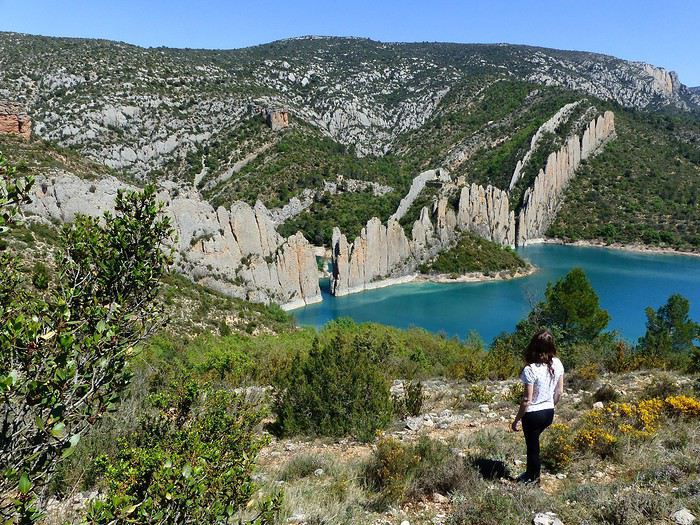
Je vous partage une petite pépite découverte en Aragon : les murailles de Finestras. Un lieu vraiment spectaculaire et une curiosité géologique à voir si vous passez un jour par là !
Voici le lien d'un article qui vous explique tout pour vous y rendre : https://lapprentie-voyageuse.com/2019/09/08/les-murailles-de-finestras-aragon-espagne/
Bon voyage !
Majorque, rien que pour vos yeux
Salut à tous,
Dimanche pluvieux, rentrée dans 2 jours, des masques partout, bref ambiance sinistrose à fond😕... alors je me suis dit qu'il est tant de me replonger dans les photos de Majorque et de vous en faire profiter afin d'égayer (je l'espère) les jours à venir 🙂
Majorque... Franchement cette destination ne m'a jamais fait rêver. Les Baléares, dans mon imaginaire personnel, c'était un peu les vacances Fram pas chères, de la bidasse au bord de la plage et train de siroter des mauvais cocktails, et de la jeunesse encannaillée en boite de nuit au son des boum boum boum...
Cet été, on projetait d'aller en Sicile. Nous c'est Papa, Maman, notre p'tit gars de 10 ans, et notre princesse de 6 ans. Et j'étais plus particulièrement motivé par les îles éoliennes, qui est un des must de la plongée méditerranéenne (ah oui, je suis plongeur, alors c'est toujours un critère obligé de nos destinations de vacances 😎) avec des décors volcaniques qui semblaient magiques. Mais pour différentes raisons, celà ne s'est pas fait. Alors quand ma femme, ayant vu le blog d'une instagrameuse, m'a parlé de Majorque à la place des Eoliennes, j'ai plutôt bondi... Elle a insisté, j'ai cédé, on a acheté le Lonely Planet, et j'ai commencé, toujours peu motivé, à le feuilleter... Et là, ce que je lisais n'était pas du tout en phase avec l'image d'Epinal que j'en avais... Majorque était décrit comme un écrin naturel, à base de criques turquoises, montagnes plongeant dans la mer, petits villages, plantations d'agrumes... Et de très beau coin à plongée, notamment pas mal de grottes autour du Cap de Formentor. Destination parfaite pour allier plaisir des enfants et des parents 🙂 Alors j'ai dit banco !
Un chaine montagneuse (Sierra de Tramontana) couvre la cote Ouest de l'île et se termine par le Cap de Formentor, avec nombreuses criques, parfois sauvages, un peu partout. Le Nord est formé de 2 grandes baies (celles de Pollenca et Alcudia). L'Est est très bétonné ; de belles criques mais pas vraiment sauvages. Le Sud c'est essentiellement la baie de Palma où s'entassent les jeunes anglais et allemands venus ce retourner la tête... Pas grand chose à voir au centre.
Alors on a préparé celà gentiment. Etant donné que nous ciblions la découverte du Nord et de l'Ouest de l'île , on a ciblé un logement dans la région de Sa Pobla, proche de la baie de Pollenca. Billets Transavia en poche en février pour un départ en Juillet, réservation d'une villa par Air b'n'b, il n'y avait plus qu'à... Et la Covid est arrivé🏴☠️. On n'a rien annulé, on a a serré les fesses, et finalement on est passé entre les gouttes. Nos vols ont été maintenus aux dates et horaires prévus.
La dernière chose à faire était la réservation de la voiture de location, faite au dernier moment. Oubliez les prestataires institutionnels, il y a une multitude d'agences locales à l'aéroport de Majorque. On est passé par Wiber, RAS
Et ces deux semaines furent incroyables. Un vrai choc, je ne m'attendais pas à une telle beauté à 1h30 de vol de Paris 😛
Je vais vous raconter, et surtout vous montrer tout celà, tranquillement 😉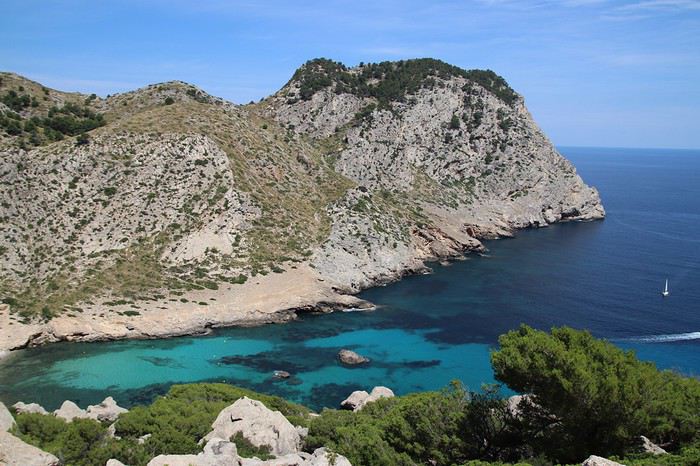
Dimanche pluvieux, rentrée dans 2 jours, des masques partout, bref ambiance sinistrose à fond😕... alors je me suis dit qu'il est tant de me replonger dans les photos de Majorque et de vous en faire profiter afin d'égayer (je l'espère) les jours à venir 🙂
Majorque... Franchement cette destination ne m'a jamais fait rêver. Les Baléares, dans mon imaginaire personnel, c'était un peu les vacances Fram pas chères, de la bidasse au bord de la plage et train de siroter des mauvais cocktails, et de la jeunesse encannaillée en boite de nuit au son des boum boum boum...
Cet été, on projetait d'aller en Sicile. Nous c'est Papa, Maman, notre p'tit gars de 10 ans, et notre princesse de 6 ans. Et j'étais plus particulièrement motivé par les îles éoliennes, qui est un des must de la plongée méditerranéenne (ah oui, je suis plongeur, alors c'est toujours un critère obligé de nos destinations de vacances 😎) avec des décors volcaniques qui semblaient magiques. Mais pour différentes raisons, celà ne s'est pas fait. Alors quand ma femme, ayant vu le blog d'une instagrameuse, m'a parlé de Majorque à la place des Eoliennes, j'ai plutôt bondi... Elle a insisté, j'ai cédé, on a acheté le Lonely Planet, et j'ai commencé, toujours peu motivé, à le feuilleter... Et là, ce que je lisais n'était pas du tout en phase avec l'image d'Epinal que j'en avais... Majorque était décrit comme un écrin naturel, à base de criques turquoises, montagnes plongeant dans la mer, petits villages, plantations d'agrumes... Et de très beau coin à plongée, notamment pas mal de grottes autour du Cap de Formentor. Destination parfaite pour allier plaisir des enfants et des parents 🙂 Alors j'ai dit banco !
Un chaine montagneuse (Sierra de Tramontana) couvre la cote Ouest de l'île et se termine par le Cap de Formentor, avec nombreuses criques, parfois sauvages, un peu partout. Le Nord est formé de 2 grandes baies (celles de Pollenca et Alcudia). L'Est est très bétonné ; de belles criques mais pas vraiment sauvages. Le Sud c'est essentiellement la baie de Palma où s'entassent les jeunes anglais et allemands venus ce retourner la tête... Pas grand chose à voir au centre.
Alors on a préparé celà gentiment. Etant donné que nous ciblions la découverte du Nord et de l'Ouest de l'île , on a ciblé un logement dans la région de Sa Pobla, proche de la baie de Pollenca. Billets Transavia en poche en février pour un départ en Juillet, réservation d'une villa par Air b'n'b, il n'y avait plus qu'à... Et la Covid est arrivé🏴☠️. On n'a rien annulé, on a a serré les fesses, et finalement on est passé entre les gouttes. Nos vols ont été maintenus aux dates et horaires prévus.
La dernière chose à faire était la réservation de la voiture de location, faite au dernier moment. Oubliez les prestataires institutionnels, il y a une multitude d'agences locales à l'aéroport de Majorque. On est passé par Wiber, RAS
Et ces deux semaines furent incroyables. Un vrai choc, je ne m'attendais pas à une telle beauté à 1h30 de vol de Paris 😛
Je vais vous raconter, et surtout vous montrer tout celà, tranquillement 😉
Vol Ryanair pour 14 à 15 jours en Andalousie
Bonjour
Nous devons partir le 11 septembre 2020 en Andalousie par Raynair , mais nous ne voulons pas partir.
Il y a t'il des personnes qui ont écrit à Raynair mais en France
Il y a t'il des personnes qui ont été dans notre cas ?
Il y a t'il des personnes qui sont partis cet été en Andalousie ?
Merci en attendant votre réponse
Chicha, gout et plaque chauffante dans l'avion pour l'Espagne?
Bonsoir, je pars demain en voyage a Lloret del mar en avion et j'aurais aimer savoir si quelques uns d'entre vous ont deja pris l'avion avec une chicha du gout des charbons et une plaque chauffante et si oui ou est ce que je peut mettre ca ? Bagage a main ? soute ? Merci
Cap de Gata un projet hôtelier désastreux (Andalousie)
Le 24 juin, le conseil régional d’Andalousie a donné le feu vert à un projet d’hôtel 4 étoiles dans la baie de Genoveses, un projet qui pourrait déclencher une catastrophe environnementale dans l’une des rares zones de la côte espagnole qui n’a pas encore été exploitée.
Peu importe à quel point ils essaient de rendre ce projet durable et respectueux de l’environnement, cela aura toujours un impact. S’ils tenaient vraiment à ce cadre naturel, ils renonceraient au projet.
Le plus grand intérêt du parc naturel est justement ses plages vierges, qui n’attirent pas trop de monde. Veiller à ne pas surpeupler la zone ni endommager la faune et la flore locale devrait être la seule priorité. Actuellement, la zone de Cabo de Gata a une capacité d’accueil des véhicules limitée, car il y a environ deux cents places de parking, une fois celles-ci pleines, il n’y a pas d’autre choix que de faire demi-tour, ce qui maintient la plage à un faible niveau de fréquentation. La construction de cet hôtel réserverait de fait l’accès aux personnes qui y séjournent, en limitant à certaines personnes la possibilité de profiter d’une plage publique appartenant à un parc naturel protégé.
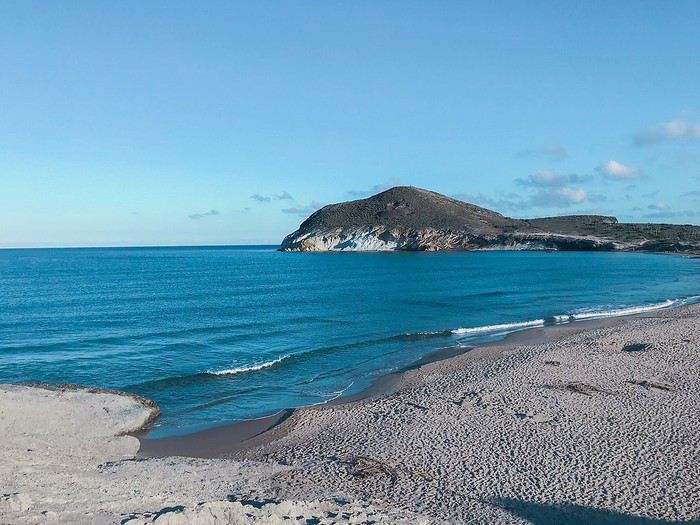
Le plus grand intérêt du parc naturel est justement ses plages vierges, qui n’attirent pas trop de monde. Veiller à ne pas surpeupler la zone ni endommager la faune et la flore locale devrait être la seule priorité. Actuellement, la zone de Cabo de Gata a une capacité d’accueil des véhicules limitée, car il y a environ deux cents places de parking, une fois celles-ci pleines, il n’y a pas d’autre choix que de faire demi-tour, ce qui maintient la plage à un faible niveau de fréquentation. La construction de cet hôtel réserverait de fait l’accès aux personnes qui y séjournent, en limitant à certaines personnes la possibilité de profiter d’une plage publique appartenant à un parc naturel protégé.