Results for "Djibouti+|+101+>+49"
698 results found.
Voyages et sécurité: perceptions et réalités English translation pending
Bonjour,
Je suis une citoyenne du monde, j'ai voyage et ai vecu dans plusieurs coins du monde. J'ai un projet de voyage TDM pour 8-10 mois.
Je voudrais discuter des perceptions de securite et de danger.
J'habite dans la grande metropole de Toronto ou il y a couramment des meurtres au pistolet et au couteau (proximite des US?-je crois que Montreal a moins de violence) et pourtant, c'est ma ville et je m'y sens a l'aise. Je ne prends pas des risques inutiles et je crois que l'on meurt quand son heure est arrivee.
Mais pour mon projet de voyage, je me demande quels pays sont moins surs que d'autres. Quels pays je ferais mieux d'eviter et quelle sorte de problemes je pourrais rencontrer suivant le pays.
Mon itineraire comprend pour l'instant: Espagne-France-Egypte (peut-etre) Dubai-Abu Dhabi-Qatar (peut-etre)-Yemen (presque sur maintenant)-Djibouti (connais tres bien)-Tanzanie (peut-etre)-Malaysie-Singapour-Australie-Cuba-
Je ne m'inquiete pas du troncon Europe-Moyen-orient et je sais que les armes ne circulent pas librement dans ces pays-la. Djibouti est mon pays d'origine et la criminalite est tres faible. C'est sur que pour ceux qui sont occidentaux et ne sont jamais sortis de leur pays, les pays du moyen-orient peuvent inquieter avec tout ce que l'on entend dnas les journaux etc. L'Afrique aussi peut inquieter car il y a beaucoup de pays instables. Je crois quand meme que la Tanzanie est un pays assez tranquille si je reste dans les circuits surs et je ne vais pas prendre de risque. Mais voyez-vous des qu'on ne connait pas un pays ou une partie du monde, les soucis commencent a semer.
Mais c'est surtout le Bresil et l'Afrique du Sud que j'aimerais visiter qui me font peur surtout l'Afrique du Sud...Bresil je suis sure c'est due au film "la Cite des dieux" :) Le Cuba risque aussi de changer bientot et je me demande si je ne devrais pas commencer mon voyage la-bas. Enfin ca c'est une autre question (pour l'instant je voudrais commencer par l'Espagne fin aout-Sept en France).
Il y a aussi la Malaysie-Singapour-Australie que je ne connais pas du tout mais que je ne visualise pas comme des pays a problemes. Enfin, je peux me tromper...l'Australie a bcp de serpent m'as t-on dit ;)
Que pensez-vous de ces pays? Et a quoi faut-il faire attention?
Zarrah
Je suis une citoyenne du monde, j'ai voyage et ai vecu dans plusieurs coins du monde. J'ai un projet de voyage TDM pour 8-10 mois.
Je voudrais discuter des perceptions de securite et de danger.
J'habite dans la grande metropole de Toronto ou il y a couramment des meurtres au pistolet et au couteau (proximite des US?-je crois que Montreal a moins de violence) et pourtant, c'est ma ville et je m'y sens a l'aise. Je ne prends pas des risques inutiles et je crois que l'on meurt quand son heure est arrivee.
Mais pour mon projet de voyage, je me demande quels pays sont moins surs que d'autres. Quels pays je ferais mieux d'eviter et quelle sorte de problemes je pourrais rencontrer suivant le pays.
Mon itineraire comprend pour l'instant: Espagne-France-Egypte (peut-etre) Dubai-Abu Dhabi-Qatar (peut-etre)-Yemen (presque sur maintenant)-Djibouti (connais tres bien)-Tanzanie (peut-etre)-Malaysie-Singapour-Australie-Cuba-
Je ne m'inquiete pas du troncon Europe-Moyen-orient et je sais que les armes ne circulent pas librement dans ces pays-la. Djibouti est mon pays d'origine et la criminalite est tres faible. C'est sur que pour ceux qui sont occidentaux et ne sont jamais sortis de leur pays, les pays du moyen-orient peuvent inquieter avec tout ce que l'on entend dnas les journaux etc. L'Afrique aussi peut inquieter car il y a beaucoup de pays instables. Je crois quand meme que la Tanzanie est un pays assez tranquille si je reste dans les circuits surs et je ne vais pas prendre de risque. Mais voyez-vous des qu'on ne connait pas un pays ou une partie du monde, les soucis commencent a semer.
Mais c'est surtout le Bresil et l'Afrique du Sud que j'aimerais visiter qui me font peur surtout l'Afrique du Sud...Bresil je suis sure c'est due au film "la Cite des dieux" :) Le Cuba risque aussi de changer bientot et je me demande si je ne devrais pas commencer mon voyage la-bas. Enfin ca c'est une autre question (pour l'instant je voudrais commencer par l'Espagne fin aout-Sept en France).
Il y a aussi la Malaysie-Singapour-Australie que je ne connais pas du tout mais que je ne visualise pas comme des pays a problemes. Enfin, je peux me tromper...l'Australie a bcp de serpent m'as t-on dit ;)
Que pensez-vous de ces pays? Et a quoi faut-il faire attention?
Zarrah
Vente d'une voiture en Ethiopie English translation pending
😉 qq'un sait il qq chose sur les possibiltés de vendre une voiture européenne arrivée en Ethiopie ?
Démarches ? Douane ? Type de voitures recherchées. 4x4 ? Diesel ou essence ? âge ?
😏Par avance GRAND merci pour toutes infos issues du terrain
Démarches ? Douane ? Type de voitures recherchées. 4x4 ? Diesel ou essence ? âge ?
😏Par avance GRAND merci pour toutes infos issues du terrain
Éducatrice spécialisée québécoise désirant travailler en France English translation pending
Bonjour
Je suis Marie-Eve, Québécoise, je suis éducatrice spécialisée et je voudrais aller travailler en France. J'aimerais bien trouver un emploi dans mon domaine mais cela s'annonce galère... Surtout travailler dans mon domaine, en éducation spécialisée, j'ai entendue dire que la france n'était pas très ouvert aux diplômes étranger!😠 Alors du coup, j'imagine que je devrai trouver un emploi autre que dans mon domaine... Mais j'ai un ami qui est revenu bredouille de la france, n'ayant pas réussis à se trouver un emploi... J'aimerais trouver un emploi avant daller en france! J'ai un bon cv, en éduation spécialisée, j'ai travailler avec des femmes en difficultés, en maison d'hébergement pour jeunes adultes en difficulté, des enfants en garderie, des adolescents. De plus j'ai vécu 2 mois au mali où j'ai travaillé dans une orphelinat, j'ai aussi vécu 6 mois au mali où j'ai travaillé dans un centre de jour pour des jeunes adultes ayant une déficience intellectuelle ainsi que 6 mois à djibouti où j'ai participé à une étude de réhabilitation nutritionnelle par la spiruline dans un centre de renutrition accueillant des jeunes enfants malnutris.
Je vous demande donc votre aide... Si vous avez des infos sur des endroits potentiel pour m'engager, des infos sur les diplômes étranger, bref tout ce qui peut m'être utilile!
Je vous remercie!!!!!!!!!!
Marie-Eve😏
Je vous demande donc votre aide... Si vous avez des infos sur des endroits potentiel pour m'engager, des infos sur les diplômes étranger, bref tout ce qui peut m'être utilile!
Je vous remercie!!!!!!!!!!
Marie-Eve😏
Merci en plus de 50 langues English translation pending
Albanais: Faleminderit
Allemand: Danke
Anglais: Thank you
Arabe: Shukran
Birman: ceh:zu:tlnba de
Croate: Hvala
Danois: Tak
Chinois (cantonais): doze
Chinois (mandarin): xiexie ni
Coréen: Gam sa ham ni da
Espagnol: Gracias
Estonien: Tänan
Finlandais: Kiitos
Francais: Merci
Grec: efharisto
Gujarati: Tamaaro aabhaar
Hawaïen: Mahalo
Hébreu: toda
Hindi: Dhanyavaad
Hollandais: Dank u wel
Hongrois: Köszönöm
Islandais: Takk fyrir
Indonésien: Terima kasih
Irlandais: Go raibh maith agat
Italien: Grazie
Japonais: Arigatoo
Letton: Paldies
Lituanien: Aciu
Malais: Terima kasih
Navajo: Ahéhee'
Népalais: dhanyabaad
Norvégien: Takk
Pashto: Manana
Portugais: Obrigado
Polonais: Dziekuje
Punjabi: Thanwaad
Roumain: Multumesc
Russe: Spaciba
Serbe: hvala
Slovaque: Dakujem
Slovène: Hvala.
Swahili: Asante
Suédois: Tack
Tagalog: Salamat
Tchèque: dekuji
Thaï: Korp-kun
Tibetain: tujeche
Turque: Tesekkür ederim
Ourdou: Shukriya
Vietnamien: Cam o'n
Yiddish: A dank
Zoulou: Ngiyabonga
Le point sur les franchises bagages Air France et KLM English translation pending
AF et KLM ont harmonisé leurs modalités de transport des bagages depuis le 16 janvier.
Récaputilatif !
TEMPO EN SOUTE.............. : 20 Kg lorsqu'il s'agit de la franchise poids. 2 bagages de 23 kg chacun lorsqu'il s'agit de la franchise nombre de bagages. EN CABINE.............. : 1 bagage et accessoires pour un total de 12 kg.
ESPACE AFFAIRE EN SOUTE : 30 Kg lorsqu'il s'agit de la franchise poids. 2 bagages de 32 kg chacun lorsqu'il s'agit de la franchise nombre de bagages. EN CABINE ............. : 2 bagages et accessoires pour un total de 18 kg.
ESPACE PREMIERE EN SOUTE : 40 kg lorsqu'il s'agit de la franchise poids. 2 bagages de 32 kg chacun lorsqu'il s'agit de la franchise nombre de bagages. EN CABINE .......... : 2 bagages et accessoires pour un total de 18 kg.
Les pays et destinations suivants sont soumis au NOMBRE DE BAGAGES : Vols etats Unis, Canada, Mexique, Bresil, Papeete, Afrique de l'Ouest (sauf vols Dédicate), La Caire, Djibouti, Antananarivo, La Havane, Saint Domingue et Punta Cana.
De plus, pour les vols de.. et vers... : Pointe à Pitre, Fort de France, Cayenne, Reunion, Saint Martin, Aruba, Bonaire, Curaçao et Pramaribo la franchise passe de 20 a 25 kg en Tempo et de 30 à 40 kg en Alizé et Espace Affaire.
Enfin, pour les vols de... et vers ... : La Havane, Punta Cana et Antananarivo, en plus de la règle du nombre de bagages, la franchise passera : 2 bagages de 23 Kg chacun en Tempo 2 bagages de 32 Kg chacun en Alizé et Espace Affaires.
Pas de changements pour les adherents Flying Blue :
Excedents tolérés et grauits : + 5 kg pour Silver + 10 kg pour Gold + 20 kg pour Platinum.
Récaputilatif !
TEMPO EN SOUTE.............. : 20 Kg lorsqu'il s'agit de la franchise poids. 2 bagages de 23 kg chacun lorsqu'il s'agit de la franchise nombre de bagages. EN CABINE.............. : 1 bagage et accessoires pour un total de 12 kg.
ESPACE AFFAIRE EN SOUTE : 30 Kg lorsqu'il s'agit de la franchise poids. 2 bagages de 32 kg chacun lorsqu'il s'agit de la franchise nombre de bagages. EN CABINE ............. : 2 bagages et accessoires pour un total de 18 kg.
ESPACE PREMIERE EN SOUTE : 40 kg lorsqu'il s'agit de la franchise poids. 2 bagages de 32 kg chacun lorsqu'il s'agit de la franchise nombre de bagages. EN CABINE .......... : 2 bagages et accessoires pour un total de 18 kg.
Les pays et destinations suivants sont soumis au NOMBRE DE BAGAGES : Vols etats Unis, Canada, Mexique, Bresil, Papeete, Afrique de l'Ouest (sauf vols Dédicate), La Caire, Djibouti, Antananarivo, La Havane, Saint Domingue et Punta Cana.
De plus, pour les vols de.. et vers... : Pointe à Pitre, Fort de France, Cayenne, Reunion, Saint Martin, Aruba, Bonaire, Curaçao et Pramaribo la franchise passe de 20 a 25 kg en Tempo et de 30 à 40 kg en Alizé et Espace Affaire.
Enfin, pour les vols de... et vers ... : La Havane, Punta Cana et Antananarivo, en plus de la règle du nombre de bagages, la franchise passera : 2 bagages de 23 Kg chacun en Tempo 2 bagages de 32 Kg chacun en Alizé et Espace Affaires.
Pas de changements pour les adherents Flying Blue :
Excedents tolérés et grauits : + 5 kg pour Silver + 10 kg pour Gold + 20 kg pour Platinum.
Destination à moins de six heures de vol de Paris au soleil en été 2007 English translation pending
Bonjour,
Quelle destination pourriez-vous me conseiller pour cet été, avec au moins 6h de vols, au soleil, mais pas l'Afrique.
Je cherche une plage de sable blanc...
Le tout pour pas cher.
Quelle destination pourriez-vous me conseiller pour cet été, avec au moins 6h de vols, au soleil, mais pas l'Afrique.
Je cherche une plage de sable blanc...
Le tout pour pas cher.
Que pensez d'Eritrean Airlines? English translation pending
Bonjour,
Que peut on penser d'Eritrean? En vue d'un séjour en Erythrée courant 2007, j'ai failli faire un infar à la découverte des prix avec Lufthansa.
Il y a d'autres possibiltés de rejoindre Asmara dont utiliser la compagnie nationale.
Avez vous déjà expérimenté?
Merci d'avance
Michel
Égypte-Éthiopie/Érythrée en ferry? English translation pending
Salut,
je suis actuellement en Egypte ou je vais rester 1 mois, apres quoi je compte descendre en Ethiopie...Comment faire?L avion...trop facile, je deteste!En bus a travers le Soudan, apparemment ca le fait au niveau securite, mais les 100US$ de visa pour les quelques jours ou je resterai labas ne m encouragent pas a choisir cette solution.
Il me reste donc le ferry, avez vous des infos?
Merci le QG!!!
Il me reste donc le ferry, avez vous des infos?
Merci le QG!!!
Permis de voyage en Erythrée English translation pending
Bonjour,
Je sais que le ministère du Tourisme érythréen délivre les permis pour quitter Asmara. Mais, en pratique, avez vous rencontré des problèmes pour circuler dans le pays depuis juin 2006 (date de l’installation de l’interdiction de voyage en dehors d’Asmara et de la nécessité de demander des permis pour circuler) ?
J’ai pour but de m’y rendre en 2007, en individuel et comme touriste, et de voyager dans le pays.
Merci pour vos infos
Michel
Où aller en décembre pour la chaleur et la beauté du pays? English translation pending
Salut à tous.
Voilà j'ai une question simple, que me proposez vous pour le mois de Décembre dans cette région ?
Voilà ce que je recherche : Chaleur, pas trop de pluie, en bord de mer, température de l'eau de mer à plus de 20°, peu de délinquance et beauté du pays.
PS : Pas d'Australie. 😛
Merci à tous ceux qui pourront m'aider !!
Voilà j'ai une question simple, que me proposez vous pour le mois de Décembre dans cette région ?
Voilà ce que je recherche : Chaleur, pas trop de pluie, en bord de mer, température de l'eau de mer à plus de 20°, peu de délinquance et beauté du pays.
PS : Pas d'Australie. 😛
Merci à tous ceux qui pourront m'aider !!
Recherche Marcel en Thaïlande English translation pending
il y a bien l'un d'entre vous qui le connait c'est un "pharang" expatrié depuis environ 17 ou 18 ans, il est probablement restaurateur ou un truc comme ça, je crois que c'est important pour moi de retrouver sa trace, merci ha j'oubliais il doit avoir 63 ans.
Expédition de l'Afrique du Sud vers la Thaïlande English translation pending
Bonjour a vous tous,
Je suis presentement en train de preparer un voyage qui partira de l'Afrique du sud (Cape town plus precisement) et qui se terminera en Asie (Thailande). J'essaie de ne pas trop planifier l'itineraire et de me laisser guider au jour le jour selon mon humeur et les conseils des gens rencontres tout au long de la route. Le trajet se fera majoritairement a pieds (bus, auto ou autre lorsqu'impossible).
Si vous avez des suggestions, conseils ou etes presentement en train de faire un semblable periple, n'hesitez pas a me contacter.
Merci d'avance et bons voyages
Je suis presentement en train de preparer un voyage qui partira de l'Afrique du sud (Cape town plus precisement) et qui se terminera en Asie (Thailande). J'essaie de ne pas trop planifier l'itineraire et de me laisser guider au jour le jour selon mon humeur et les conseils des gens rencontres tout au long de la route. Le trajet se fera majoritairement a pieds (bus, auto ou autre lorsqu'impossible).
Si vous avez des suggestions, conseils ou etes presentement en train de faire un semblable periple, n'hesitez pas a me contacter.
Merci d'avance et bons voyages
Validité du passeport pour l'Inde English translation pending
Bonjour,
Je voudrais savoir si le passeport doit être absolument en cours de validité de 6 mois pour aller en Inde. Mon passeport viens d'être fait. Cela est-il possible?
Meci d'avance pour vos réponses,
Cordialement,
David
Je voudrais savoir si le passeport doit être absolument en cours de validité de 6 mois pour aller en Inde. Mon passeport viens d'être fait. Cela est-il possible?
Meci d'avance pour vos réponses,
Cordialement,
David
Politique française africaine English translation pending
J'ai envie d'apprendre plus sur la politique francaise africaine. J'ai fait quelques recherches sur Amazon, et certains oevres surgissent: "Noir Silence" et "Franceafrique" (de Verschave) et "l'Innoubliable" de (St. Exupery). Que-est ce que vous recommendriez pour une premiere lecture? St. Exupery est journaliste du Figaro, mais qui est Verschave, et que-est ce que c'est, son mouvement "Survie"?
J'habite Bruxelles - connaitriez-vous une librarire (pref. de second main) qui aurait ces livres? Et ou pourrais-je trouver un video/DVD de "Congo: White King, Red Rubber, Black Death"?
Que-est ce qu'il devient de la plainte depose au tribunal il y a 2 ans sur la complicite francaise dans le genocide Rwandais?
Merci a tous
J'habite Bruxelles - connaitriez-vous une librarire (pref. de second main) qui aurait ces livres? Et ou pourrais-je trouver un video/DVD de "Congo: White King, Red Rubber, Black Death"?
Que-est ce qu'il devient de la plainte depose au tribunal il y a 2 ans sur la complicite francaise dans le genocide Rwandais?
Merci a tous
Poids maximum des bagages sur Air France? English translation pending
Bonjour,
Je n'arrive pas à trouver nul part la limite de poid des bagages sur un vol Air france trans-atlantique ?
Quelqu'un aurait-il la réponse? Est-ce 20kg ou plus ???
Merci!
Je n'arrive pas à trouver nul part la limite de poid des bagages sur un vol Air france trans-atlantique ?
Quelqu'un aurait-il la réponse? Est-ce 20kg ou plus ???
Merci!
Armée et voyage English translation pending
🙂Bonjour
Je voudrai juste savoir si l'un ou l'une d'entre vous qui a effectué son service militaire (appelé, volontaire ou engagé) et qui a voyagé à l'etranger par cet intermediaire si cela vous a marqué, plu ou degouté de voyager et si l'uniforme à faciliter les contacts avec les autochtones
Pour ma part j'ai eu la chance de faire mon service militaire en tant qu'appelé sur le port helicoptere Jeanne dArc et j'ai fait une bonne partie de la planete aux frais des contribuables et cette experience est encore gravé dans ma memoire et j'ai encore plein de bons souvenirs de ce pêriple (de 5 mois et demi) meme 15 ans aprés et cela m'a decidé de continuer à decouvrir les reste du monde et je voudrai savoir si cela est aussi votre cas !!
Voici donc mon periple Départ de Brest le 12 decembre 1991 5 jours à Istanbul (Turquie) Passage du Canal de Suez 3 jours à Djibouti 5 jours à Cochin (inde) 5 jours à Surabaya(Indonesie) 5 jours à Manille (philippines) 5 jours à Inchon (Corée du Sud) 5 jours à Tokyo (Japon) 5 jours à Vladivostok (Russie) 5 jours à Hong Kong 5 jours à Singapour 5 jours à Phuket (thailande) 5 jours à l'ile Maurice 5 jours à La Reunion 2 jours à Mayotte 3 jours à Djibouti Passage du Canal de Suez 5 jours à Palerme (italie) 5 jours à Barcelone (Espagne) Retour à Brest le 5 juin 1992 aprés plus de 100 jours de mer, de postes de combats, de mal de mer, de tempetes, de baignades, de rencontres, de visites de pagodes monuments et églises, de souvenirs, ...
Voici donc mon periple Départ de Brest le 12 decembre 1991 5 jours à Istanbul (Turquie) Passage du Canal de Suez 3 jours à Djibouti 5 jours à Cochin (inde) 5 jours à Surabaya(Indonesie) 5 jours à Manille (philippines) 5 jours à Inchon (Corée du Sud) 5 jours à Tokyo (Japon) 5 jours à Vladivostok (Russie) 5 jours à Hong Kong 5 jours à Singapour 5 jours à Phuket (thailande) 5 jours à l'ile Maurice 5 jours à La Reunion 2 jours à Mayotte 3 jours à Djibouti Passage du Canal de Suez 5 jours à Palerme (italie) 5 jours à Barcelone (Espagne) Retour à Brest le 5 juin 1992 aprés plus de 100 jours de mer, de postes de combats, de mal de mer, de tempetes, de baignades, de rencontres, de visites de pagodes monuments et églises, de souvenirs, ...
Heure train Addis Abeba /Dire Dawa en Ethiopie English translation pending
Quelqu'un a t-il des info précises de préférence sur les horaires des trains quittant Addis Abeba pour Dire Dawa ?
J'ai lu départ 14 h tous les jours dans le LP mais j'ai remarqué que ses info n'étaient pas toujours à jour.
Merci, je pars dans peu de temps et j'ai besoin d'organiser un Rendez vous à Addis et Harar.
Air Horizons: dépôt de bilan English translation pending
Effectif ce jour lundi 14/11
Le TC doit statuer jeudi 17 sui la suite a donner
http://today.reuters.fr/news/newsArticle.aspx?type=businessNews&storyID=2005-11-14T203150Z_01_TOU473920_RTRIDST_0_OFRBS-FRANCE-TRANSPORT-AIR-HORIZONS-FAILLITE-20051.XML
A suivre !
A suivre !
Trajet Zagora-Foum-Zguid au Maroc English translation pending
Bonjour, pour le trajet Zagora-Foum-Zguid, quelle est la piste la plus sympa, celle qui passe par le lac Iriki ou celle qui passe par les dunes Ch'gaga ??? Merci pour vos infos et bonne journée. 😊
Trek dans les montagnes du Simien (Ethiopie) English translation pending
Souhaitant partir en trek dans les montagnes du Simien lors de mon séjour en Ethiopie (mi octobre à mi novembre), je recherche des infos et contacts avec des locaux pour organiser un trek (3 à 5 jours)
Avez vous des adresses ou contacts sérieux sur place ?
Merci d’avance
Michel
Voyager en Afrique (Kenya) moins cher? English translation pending
Bonjour à tous,
Je vais me rendre au Kénya fin juillet pour 1 mois environ.
Je me suis toujours demandé si il n'était pas plus économique (voire très économique) de réserver un billet d'avion pour une destination du type l'Egypte ou un autre pays en Afrique qui dessert le Kénya puis, ensuite, prendre un billet de l'aéroport de la 1ère destination vers la destination finale...le Kénya.
On a fait ça pour voyager l'an dernier à travers l'Indonésie puisque le prix des billets est vraiment très intéressant car alligné sur le pouvoir d'achat local.
Merci par avance pour vos expériences et avis ds ce domaine.
Hébergement et transports en Ethiopie English translation pending
Bonjour
J'aimerai me rendre et voyager en individuel en Ethiopie par les moyens locaux Quelqu'un a-t-il des infos sur ce pays Possibilités de transport, d'hébergement;.. Cout des hotels etc...
Merci
Philippe LEFEBVRE
J'aimerai me rendre et voyager en individuel en Ethiopie par les moyens locaux Quelqu'un a-t-il des infos sur ce pays Possibilités de transport, d'hébergement;.. Cout des hotels etc...
Merci
Philippe LEFEBVRE
Individuel en Ethiopie: réaliste? English translation pending
Bonjour,
Constatant que les personnes qui répondent à ma première discussion (Meilleure saison pour voyager en Ethiopie) me parlent souvent d'agences de voyages en Ethiopie pour circuler sur place, ma question est la suivante:
ne sait on vraiment pas circuler seul en Ethiopie (Nord et/ou Sud) car pour être franc, je n'ai jamais voyagé en groupe et ne souhaite pas le faire.
Merci
Michel
Infos sur l'Ethiopie English translation pending
je dois partir en janvier prochain sur l ethiopie 4 semaines j aimerai avoir des infos 😉
sur la route historique du nord
sur le sud ballade le long du rift
merci
sur la route historique du nord
sur le sud ballade le long du rift
merci
Hébergement et visites à Addis Abeba en Ethiopie English translation pending
Bonjour à tous,
je dois me rendre à Addis Abeba en aout, et je cherche des infos sur les possibilités d'herbergemeent à Addis Abeba,
si vous avez également des infos sur la ville, les coins à voir, à éviter, et d'autres bons plans, je suis preneuse
merci à tous
je dois me rendre à Addis Abeba en aout, et je cherche des infos sur les possibilités d'herbergemeent à Addis Abeba,
si vous avez également des infos sur la ville, les coins à voir, à éviter, et d'autres bons plans, je suis preneuse
merci à tous
En voilier de Nice (France) pour aller à La Réunion English translation pending
avec mon ami nous avons un rêve de vie et d'aventure, partir en voilier de Nice pour aller à La Réunion. Nous pensons passer par le canal de suez et nous aimerions avoir les contacts avec des navigateurs qui ont tenté cette expérience et qui peuvent nous donner des conseils sur cette traverser et notamment la meilleure periode pour traverser le canal de suez et l'océan indien jusqu'aux Seychelles !!! merci
caroline et thierry
caroline et thierry
Africa: A Heartfelt Love for a Continent
“When the Whites came to Africa, we had the land and they had the Bible. They taught us to pray with our eyes closed: when we opened them, the Whites had the land and we had the Bible.” Jomo Kenyatta (p.7)
The Maggi cube, an unchallenged hegemony, and so much more
“The hopeless continent,” headlined The Economist, a British magazine, in July 2000 about Africa. Eleven years later, the same magazine headlined “Africa rising” instead. Images of Africa in the prosperous North constantly oscillate between apocalyptic scenarios and enthusiastic projections. A key issue with such images lies in the generalization they entail. If you look at the continent, considerable contrasts emerge depending on space and time. It’s no surprise that a region of the world encompassing such diverse ecological zones, maintaining such varied ties with other continents, comprising nearly fifty nation-states in sub-Saharan Africa alone, and characterized by a great diversity of languages, belief systems, and historical paths, doesn’t share a single destiny.
And yet, for many people outside Africa, as well as for many Africans, the continent constitutes a single entity, defined by criteria such as skin color, a colonial past, poverty, and the art of survival. Until now, these perspectives were generally accompanied by the idea that Africa had to—or should have—followed a single path together, sometimes called development, sometimes modernization, sometimes liberation, then a market economy. None of these paths delivered on their promises.
The two writers Alain Mabanckou and Abdourahman Waberi—one from Congo, the other raised in Djibouti, both long settled in France and now professors at renowned North American universities (Los Angeles, Washington)—have had enough of pessimistic scenarios: “We are aware that Africa is in the world and the world is in Africa. The same goes for all other continents, as our destinies are inextricably linked for better or worse. We refuse to see Africa as a reservoir of misfortunes or a continent cursed by atavistic misfortune and characterized by ethnic conflicts. [...] It’s this passionate flame we wanted to capture in a book [...] a kind of stroll through African cultures, without any demands, each letter of the alphabet leading us to a notion, a practice, a concept, a moment in history, literature, painting, politics, economics, cuisine, etc.” (p.10-11). Africa, they write, is on the verge of “imposing a signature, a style, a way of being in the world and in relation to the rest of the world.” (p.11) To put words to the continent’s diversity and dynamism, the two authors created a “rambling ABC,” a kind of portrait—or more precisely, a mythography—that lets you see and feel the pulse of a vast continent whose cultural power is unfolding before our eyes. Once marginalized or even mocked, the voice and importance of the Continent in global affairs are now undeniable” (p.11), containing over a hundred entries, mostly concise, written in a relaxed and casual style. The optimistic, even exuberant tone is set from the brief introduction. The duo of authors wants to “sing a love song to the cultures of our continent, to its inhabitants past and present, to its exceptional resources and its spectacular globalization despite a certain pollution that still clouds our skies due to the unmatched duration of dictatorships in some of our regions.” (p.12) In doing so, they don’t want to be too distracted by today’s Afewerki-Biya-Bongo-Déby & Co. ...
Of course, you’ll find tributes to great precursors like Frantz Fanon (“[...] it was a love story and admiration that wasn’t dimmed by the four decades separating his birth from ours. Let’s add that we were born while the native of Fort-de-France had left the world’s stage four years earlier, in the prime of life” p.141), Mongo Beti (“You must read and reread Mongo Beti, a genius who used his fame to support often just causes in Africa, like defending oppressed groups. His place is already in History. His oppressors, like the dictators Ahmadou Ahidjo and Paul Biya, can’t compete in the same category” p.64), the Malian Amadou Hampâté Bâ
(“Posterity remembers him mainly as an tireless defender of African cultures. His plea for the collection and preservation of traditional African knowledge remains a major event for all men and women of good will. One day in 1960, at the UNESCO podium, the native of Bandiagara sounded the alarm: ‘[...] Since we’ve admitted that the humanity of each people is the heritage of all humanity, if African traditions aren’t collected in time and written down, they’ll one day be missing from the universal archives of humanity.’” p.51),
Kwame Nkrumah, “one of the founders of Pan-Africanism, father of Ghana’s independence” (p.239), as well as the historian Cheikh Anta Diop, the writer, poet, and politician Aimé Césaire, and the economist and thinker Samir Amin, but also very warm tributes to certain contemporary African intellectuals like Souleymane Bachir Diagne and Achille Mbembe
(“A few years ago, in dominant economic circles, a rumor often resurfaced, usually disguised as a cold and scientifically proven analysis: Africa is useless. It’s a burden for the rest of the human community. With its 2% share in world trade, it would disappear from stock market radars without anyone noticing. So? Maybe it’ll be pulled up by other continents. Wanting to surpass itself is a crazy bet for Africans, they concluded. Arrogant or clueless, President Nicolas Sarkozy declared before an audience of students and teachers at Cheikh Anta Diop University in Dakar: ‘The African man hasn’t entered history enough [...] He only knows the eternal repetition of time marked by the endless repetition of the same gestures and words.’ That was in 2007. For decades, armed only with reason, an intellectual often steps up to debunk prejudices, lazy readings, and dishonest frameworks used as false fronts by those who, like Nicolas Sarkozy or former journalist Stephen Smith, out of ignorance, contempt, or condescension, distort African reality. This intellectual is none other than the historian and political scientist Achille Mbembe. This heir of Frantz Fanon, Amílcar Cabral, Jean-Marc Ela, and Fabien Eboussi-Boulaga was born in 1957 in Cameroon, in the Bassa region. Marked early by the upheavals of a fratricidal war, Achille Mbembe became the guardian of the memory of martyrs. After brilliant studies in Paris, he went on to teach at the best American universities, but the call of the Continent was stronger than anything else. In Dakar, he once directed CODESRIA (Council for the Development of Social Science Research in Africa) before joining the University of the Witwatersrand in Johannesburg, South Africa. Even though the author of *Critique of Black Reason* (Éditions La Découverte, 2015) spends a few months at Duke University in North Carolina, his observation post remains South Africa. From Johannesburg, Achille Mbembe scrutinizes Africa and the whole world. A lucid observer with an elegant and generous pen, Achille Mbembe knows how to blend big and small history: ‘I was born one day in July, as the month was drawing to a close. It was 1957, in that part of Africa recently named ‘Cameroon,’ a memory of the wonder that seized Portuguese sailors in the 15th century when, sailing up the river near Douala, they couldn’t help but note the presence of a multitude of crustaceans, and named it *Rio dos Camarões*, meaning ‘River of Shrimp.’ I grew up in the shadow of this nameless land, since, in a way, the name it bears is only the product of someone else’s astonishment: a lexical mistake, if you will.’ From this mistake or wound, he made leaven, a springboard to compose a rich work, recognized worldwide. To denounce barriers and barbarians too. But that’s not enough. Among his peers in circles of thought and action, Achille Mbembe passionately and consistently defends human dignity and the beauty of the world. In doing so, he fulfills the mission Frantz Fanon entrusted to him.” (p.227-229),
as well as entries dedicated to lesser-known artists and intellectuals, like the French journalist and activist Rokhaya Diallo, daughter of Senegalese and Gambian parents, or the Ethiopian filmmaker Haile Gerima, who has long lived in the United States. Other names from politics, sports, music, art, and literature: Kofi Annan, p.36; Barack Obama, p.243; Thomas Sankara, p.277; Ousmane Sow, p.285; Yambo Ouologuem, p.250; Léopold Sédar Senghor, p.282; Muhammad Ali, p.30; Nuruddin Farah, p.146; Salif Keita, p.203; Ahmadou Kourouma, p.206; Ngũgĩ wa Thiong’o, p.236; Winnie Mandela, p.224; Kylian Mbappé, p.226 ...
The authors, who resolutely commit to a “mythography” (p.11) of Africa, also pay special attention to local social movements, cultural events, and aspects of daily life. *Y’en a marre*, “which also meant ‘we’re fed up with sitting on our hands’” (p.320-321), emerged about a decade ago in Senegal as a citizen movement of peaceful resistance and symbolizes, the authors emphasize, the fact that African youth are increasingly fed up “with the political circus deployed in Africa since independence, as our parents would say, ‘since the White man left’...” (p.321). A full entry is dedicated to the Maggi bouillon cube, which has flooded African markets for about forty years and enjoys immense popularity (“It’s everywhere in Africa, from Dakar to Djibouti, and from Tangier to Cape Town. It’s in every pot, every stew. Little hands put it in every sauce, every local or adapted dish. An unchallenged hegemony! You’ll find it in diasporas too. The culinary strolls in Paris, in the [...] neighborhood” p.90). Critics blame it not only for impoverishing the aromatic diversity of local dishes but also for being harmful to health. And yet, “he poorest Africans, those who eat only once a day, a few spoonfuls of white beans and a ball of *foufou*, for example, are the most fervent users of the magic cube.” (p.92-93)
For *fonio*, “the new trendy cereal. [...] From the millet family, fonio is probably the oldest cereal cultivated in West Africa, and mainly in its sub-Saharan part, for millennia. [...] Easy to grow, water-efficient, fonio grows everywhere except on clay soils. Long neglected because it was considered the poor man’s crop, fonio is now a source of pride for the farmers who cultivate it and cherish it like the apple of their eye” (p.156-157), the authors immediately offer a detailed recipe, letting the reader know that “e can’t resist sharing this fonio with chicken recipe from Mali with you:
Ingredients: 1 chicken 3 large ripe red tomatoes 4 tbsp tomato paste 4 large onions 1 garlic clove 1/2 cup oil 2 Maggi cubes or salt 2 large carrots 1 turnip 1 large cabbage 2 large potatoes 1 celery stalk 1 packet pre-cooked fonio 4 okra (or okra powder) salt, pepper
Preparation: 1. Prepare the sauce: wash and cut the chicken. Peel the onions, garlic, and vegetables. 2. In a pot, fry the chicken pieces. 3. Dice the onions, tomatoes, carrots, and turnip very small and add them to the pot. 4. Add the tomato paste, salt, and pepper. 5. Simmer for 15 min, then add 2 L of water and the cooked chicken pieces. 6. Simmer for 30 min, then add the crushed garlic and celery, plus the cabbage cut into 4 and the potatoes cut in half. 7. Prepare the fonio: cover it with warm water, let it rest for 15 min, and cook it over low heat. 8. In a small pot, boil the okra and crush them. 9. Mix the crushed okra with the cooked fonio, then salt. Serve hot.” (p.158-159)
The comedy *Black Mic Mac*, released in French theaters in 1986 and addressing France’s increasingly restrictive immigration policy at the time, also gets an entry, as do *Tintin in the Congo*, the popular comic, and *Jip’s Café* (“[...] a little Africa in the heart of Paris, with passersby stopping to admire the ‘ambianceurs’ on the dance floor or attend the cultural events offered by the place” (p.194), an African establishment in Paris that Alain Mabanckou already immortalized in one of his novels.
The duo of authors also tackles thorny subjects like jihadism (p.119), the Rwandan genocide (p.272), the CFA franc (p.82), and dictatorship (p.110). While the two strike the right tone here, many entries leave a slightly bitter taste. Two examples: why doesn’t the text on Barack Obama mention the great disappointment of many people in Africa, who expected more from the African policy of the first U.S. president with African roots than just occasional warm words? Why do the comments on Winnie Mandela gloss over the fact that she was a highly controversial icon of the anti-apartheid movement due to her involvement in kidnappings, acts of torture, and murders of alleged apartheid collaborators? Instead, there’s a compassion that brings tears to the eyes: “She was often reduced to a secondary role, the wife of a great man” or “When victory came, she didn’t taste its fruits. Divorced, isolated. She would never be a ‘first lady’ in an evening gown, posing before a bed of chrysanthemums. They’d keep her far from the circles of power” (p.224-225). At this point, I would’ve liked the authors to take a slightly more critical stance...
That said, these “weaknesses” (if you can call them that) shouldn’t overshadow the book as a whole. It remains an informative, sometimes very entertaining, and often even original work in its own way.
Book information (the original French and the German translation):
Alain Mabanckou/Abdourahman Waberi. Dictionnaire enjoué des cultures africaines. Fayard, 2019. Alain Mabanckou/Abdourahman Waberi. Der Puls Afrikas. Eine Liebeserklärung von A bis Z. Reclam, 2022.
Hery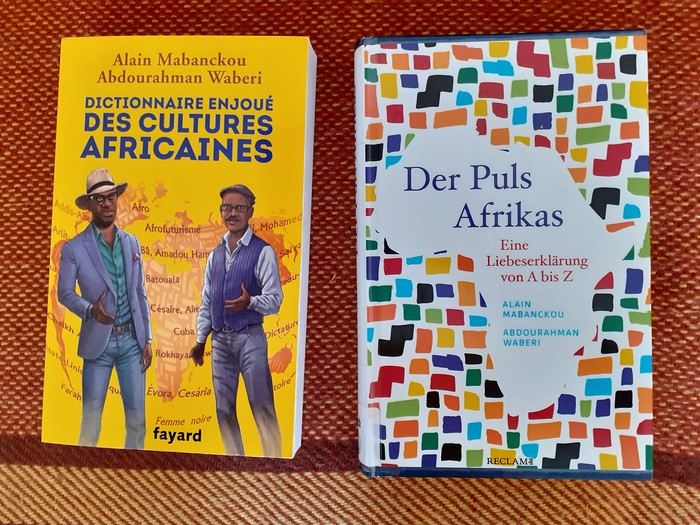
The Maggi cube, an unchallenged hegemony, and so much more
“The hopeless continent,” headlined The Economist, a British magazine, in July 2000 about Africa. Eleven years later, the same magazine headlined “Africa rising” instead. Images of Africa in the prosperous North constantly oscillate between apocalyptic scenarios and enthusiastic projections. A key issue with such images lies in the generalization they entail. If you look at the continent, considerable contrasts emerge depending on space and time. It’s no surprise that a region of the world encompassing such diverse ecological zones, maintaining such varied ties with other continents, comprising nearly fifty nation-states in sub-Saharan Africa alone, and characterized by a great diversity of languages, belief systems, and historical paths, doesn’t share a single destiny.
And yet, for many people outside Africa, as well as for many Africans, the continent constitutes a single entity, defined by criteria such as skin color, a colonial past, poverty, and the art of survival. Until now, these perspectives were generally accompanied by the idea that Africa had to—or should have—followed a single path together, sometimes called development, sometimes modernization, sometimes liberation, then a market economy. None of these paths delivered on their promises.
The two writers Alain Mabanckou and Abdourahman Waberi—one from Congo, the other raised in Djibouti, both long settled in France and now professors at renowned North American universities (Los Angeles, Washington)—have had enough of pessimistic scenarios: “We are aware that Africa is in the world and the world is in Africa. The same goes for all other continents, as our destinies are inextricably linked for better or worse. We refuse to see Africa as a reservoir of misfortunes or a continent cursed by atavistic misfortune and characterized by ethnic conflicts. [...] It’s this passionate flame we wanted to capture in a book [...] a kind of stroll through African cultures, without any demands, each letter of the alphabet leading us to a notion, a practice, a concept, a moment in history, literature, painting, politics, economics, cuisine, etc.” (p.10-11). Africa, they write, is on the verge of “imposing a signature, a style, a way of being in the world and in relation to the rest of the world.” (p.11) To put words to the continent’s diversity and dynamism, the two authors created a “rambling ABC,” a kind of portrait—or more precisely, a mythography—that lets you see and feel the pulse of a vast continent whose cultural power is unfolding before our eyes. Once marginalized or even mocked, the voice and importance of the Continent in global affairs are now undeniable” (p.11), containing over a hundred entries, mostly concise, written in a relaxed and casual style. The optimistic, even exuberant tone is set from the brief introduction. The duo of authors wants to “sing a love song to the cultures of our continent, to its inhabitants past and present, to its exceptional resources and its spectacular globalization despite a certain pollution that still clouds our skies due to the unmatched duration of dictatorships in some of our regions.” (p.12) In doing so, they don’t want to be too distracted by today’s Afewerki-Biya-Bongo-Déby & Co. ...
Of course, you’ll find tributes to great precursors like Frantz Fanon (“[...] it was a love story and admiration that wasn’t dimmed by the four decades separating his birth from ours. Let’s add that we were born while the native of Fort-de-France had left the world’s stage four years earlier, in the prime of life” p.141), Mongo Beti (“You must read and reread Mongo Beti, a genius who used his fame to support often just causes in Africa, like defending oppressed groups. His place is already in History. His oppressors, like the dictators Ahmadou Ahidjo and Paul Biya, can’t compete in the same category” p.64), the Malian Amadou Hampâté Bâ
(“Posterity remembers him mainly as an tireless defender of African cultures. His plea for the collection and preservation of traditional African knowledge remains a major event for all men and women of good will. One day in 1960, at the UNESCO podium, the native of Bandiagara sounded the alarm: ‘[...] Since we’ve admitted that the humanity of each people is the heritage of all humanity, if African traditions aren’t collected in time and written down, they’ll one day be missing from the universal archives of humanity.’” p.51),
Kwame Nkrumah, “one of the founders of Pan-Africanism, father of Ghana’s independence” (p.239), as well as the historian Cheikh Anta Diop, the writer, poet, and politician Aimé Césaire, and the economist and thinker Samir Amin, but also very warm tributes to certain contemporary African intellectuals like Souleymane Bachir Diagne and Achille Mbembe
(“A few years ago, in dominant economic circles, a rumor often resurfaced, usually disguised as a cold and scientifically proven analysis: Africa is useless. It’s a burden for the rest of the human community. With its 2% share in world trade, it would disappear from stock market radars without anyone noticing. So? Maybe it’ll be pulled up by other continents. Wanting to surpass itself is a crazy bet for Africans, they concluded. Arrogant or clueless, President Nicolas Sarkozy declared before an audience of students and teachers at Cheikh Anta Diop University in Dakar: ‘The African man hasn’t entered history enough [...] He only knows the eternal repetition of time marked by the endless repetition of the same gestures and words.’ That was in 2007. For decades, armed only with reason, an intellectual often steps up to debunk prejudices, lazy readings, and dishonest frameworks used as false fronts by those who, like Nicolas Sarkozy or former journalist Stephen Smith, out of ignorance, contempt, or condescension, distort African reality. This intellectual is none other than the historian and political scientist Achille Mbembe. This heir of Frantz Fanon, Amílcar Cabral, Jean-Marc Ela, and Fabien Eboussi-Boulaga was born in 1957 in Cameroon, in the Bassa region. Marked early by the upheavals of a fratricidal war, Achille Mbembe became the guardian of the memory of martyrs. After brilliant studies in Paris, he went on to teach at the best American universities, but the call of the Continent was stronger than anything else. In Dakar, he once directed CODESRIA (Council for the Development of Social Science Research in Africa) before joining the University of the Witwatersrand in Johannesburg, South Africa. Even though the author of *Critique of Black Reason* (Éditions La Découverte, 2015) spends a few months at Duke University in North Carolina, his observation post remains South Africa. From Johannesburg, Achille Mbembe scrutinizes Africa and the whole world. A lucid observer with an elegant and generous pen, Achille Mbembe knows how to blend big and small history: ‘I was born one day in July, as the month was drawing to a close. It was 1957, in that part of Africa recently named ‘Cameroon,’ a memory of the wonder that seized Portuguese sailors in the 15th century when, sailing up the river near Douala, they couldn’t help but note the presence of a multitude of crustaceans, and named it *Rio dos Camarões*, meaning ‘River of Shrimp.’ I grew up in the shadow of this nameless land, since, in a way, the name it bears is only the product of someone else’s astonishment: a lexical mistake, if you will.’ From this mistake or wound, he made leaven, a springboard to compose a rich work, recognized worldwide. To denounce barriers and barbarians too. But that’s not enough. Among his peers in circles of thought and action, Achille Mbembe passionately and consistently defends human dignity and the beauty of the world. In doing so, he fulfills the mission Frantz Fanon entrusted to him.” (p.227-229),
as well as entries dedicated to lesser-known artists and intellectuals, like the French journalist and activist Rokhaya Diallo, daughter of Senegalese and Gambian parents, or the Ethiopian filmmaker Haile Gerima, who has long lived in the United States. Other names from politics, sports, music, art, and literature: Kofi Annan, p.36; Barack Obama, p.243; Thomas Sankara, p.277; Ousmane Sow, p.285; Yambo Ouologuem, p.250; Léopold Sédar Senghor, p.282; Muhammad Ali, p.30; Nuruddin Farah, p.146; Salif Keita, p.203; Ahmadou Kourouma, p.206; Ngũgĩ wa Thiong’o, p.236; Winnie Mandela, p.224; Kylian Mbappé, p.226 ...
The authors, who resolutely commit to a “mythography” (p.11) of Africa, also pay special attention to local social movements, cultural events, and aspects of daily life. *Y’en a marre*, “which also meant ‘we’re fed up with sitting on our hands’” (p.320-321), emerged about a decade ago in Senegal as a citizen movement of peaceful resistance and symbolizes, the authors emphasize, the fact that African youth are increasingly fed up “with the political circus deployed in Africa since independence, as our parents would say, ‘since the White man left’...” (p.321). A full entry is dedicated to the Maggi bouillon cube, which has flooded African markets for about forty years and enjoys immense popularity (“It’s everywhere in Africa, from Dakar to Djibouti, and from Tangier to Cape Town. It’s in every pot, every stew. Little hands put it in every sauce, every local or adapted dish. An unchallenged hegemony! You’ll find it in diasporas too. The culinary strolls in Paris, in the [...] neighborhood” p.90). Critics blame it not only for impoverishing the aromatic diversity of local dishes but also for being harmful to health. And yet, “he poorest Africans, those who eat only once a day, a few spoonfuls of white beans and a ball of *foufou*, for example, are the most fervent users of the magic cube.” (p.92-93)
For *fonio*, “the new trendy cereal. [...] From the millet family, fonio is probably the oldest cereal cultivated in West Africa, and mainly in its sub-Saharan part, for millennia. [...] Easy to grow, water-efficient, fonio grows everywhere except on clay soils. Long neglected because it was considered the poor man’s crop, fonio is now a source of pride for the farmers who cultivate it and cherish it like the apple of their eye” (p.156-157), the authors immediately offer a detailed recipe, letting the reader know that “e can’t resist sharing this fonio with chicken recipe from Mali with you:
Ingredients: 1 chicken 3 large ripe red tomatoes 4 tbsp tomato paste 4 large onions 1 garlic clove 1/2 cup oil 2 Maggi cubes or salt 2 large carrots 1 turnip 1 large cabbage 2 large potatoes 1 celery stalk 1 packet pre-cooked fonio 4 okra (or okra powder) salt, pepper
Preparation: 1. Prepare the sauce: wash and cut the chicken. Peel the onions, garlic, and vegetables. 2. In a pot, fry the chicken pieces. 3. Dice the onions, tomatoes, carrots, and turnip very small and add them to the pot. 4. Add the tomato paste, salt, and pepper. 5. Simmer for 15 min, then add 2 L of water and the cooked chicken pieces. 6. Simmer for 30 min, then add the crushed garlic and celery, plus the cabbage cut into 4 and the potatoes cut in half. 7. Prepare the fonio: cover it with warm water, let it rest for 15 min, and cook it over low heat. 8. In a small pot, boil the okra and crush them. 9. Mix the crushed okra with the cooked fonio, then salt. Serve hot.” (p.158-159)
The comedy *Black Mic Mac*, released in French theaters in 1986 and addressing France’s increasingly restrictive immigration policy at the time, also gets an entry, as do *Tintin in the Congo*, the popular comic, and *Jip’s Café* (“[...] a little Africa in the heart of Paris, with passersby stopping to admire the ‘ambianceurs’ on the dance floor or attend the cultural events offered by the place” (p.194), an African establishment in Paris that Alain Mabanckou already immortalized in one of his novels.
The duo of authors also tackles thorny subjects like jihadism (p.119), the Rwandan genocide (p.272), the CFA franc (p.82), and dictatorship (p.110). While the two strike the right tone here, many entries leave a slightly bitter taste. Two examples: why doesn’t the text on Barack Obama mention the great disappointment of many people in Africa, who expected more from the African policy of the first U.S. president with African roots than just occasional warm words? Why do the comments on Winnie Mandela gloss over the fact that she was a highly controversial icon of the anti-apartheid movement due to her involvement in kidnappings, acts of torture, and murders of alleged apartheid collaborators? Instead, there’s a compassion that brings tears to the eyes: “She was often reduced to a secondary role, the wife of a great man” or “When victory came, she didn’t taste its fruits. Divorced, isolated. She would never be a ‘first lady’ in an evening gown, posing before a bed of chrysanthemums. They’d keep her far from the circles of power” (p.224-225). At this point, I would’ve liked the authors to take a slightly more critical stance...
That said, these “weaknesses” (if you can call them that) shouldn’t overshadow the book as a whole. It remains an informative, sometimes very entertaining, and often even original work in its own way.
Book information (the original French and the German translation):
Alain Mabanckou/Abdourahman Waberi. Dictionnaire enjoué des cultures africaines. Fayard, 2019. Alain Mabanckou/Abdourahman Waberi. Der Puls Afrikas. Eine Liebeserklärung von A bis Z. Reclam, 2022.
Hery
Raid moto en Éthiopie et formalités d'achat et revente English translation pending
Bonjour
Je voudrais faire un raid moto en Éthiopie pendant un mois ou plus avec mon fils.
Apparamment il n'est pas possible de louer sur place, j'envisage donc un achat et revente.
Quelqu'un a t il des infos sur les formalités requise pour les étrangers?
Hello I would like to do a motorcycle raid in Ethiopia for a month or more with my son. Apparently it is not possible to rent on site, so I think to purchase and resale. Does anyone have any information on the formalities required for foreigners?
L'Éthiopie veut construire le plus grand aéroport d'Afrique... et peut-être même du monde English translation pending
Le gouvernement éthiopien et Ethiopian Airlines ont décidé de construire au sud de la capitale ce qui pourrait être un jour le plus grand aéroport africain et même peut-être du monde avec une capacité autour de 100 millions de passagers/an. Celui-ci serait opérationnel pour 2028.
Lire la suite...
Voyage en voilier vers Mayotte depuis la Bretagne English translation pending
Bonjour à tous
Je pars en mutation sur mayotte en début d année prochaine. ...
J envisage d y ramener mon voilier
J aurais aimé avoir des retour d expériences de navigateurs ayant fait ce voyage.......
(Durée du voyage, meilleur periode, meilleur trajet....)
Des infos sur le port de mamoudzou ?
Merci d avance à tous
Jean luc