Results for "plage+ou+balnéaire+|+99+>+86"
275473 results found.
Budget, transport et plages en Birmanie English translation pending
Du 1 janvier 2005 au 12 fevrier, en couple, nous partons en Birmanie.
conseil pour prolonger le visa?
Les bonnes plages, pour un peu de repos?
Les moyens de transport pratique ?
Le budget par jour moyen?
Traitement pallu?
Nous voyageons sac à dos avec petit budget.
Merci. 😉
Nous voyageons sac à dos avec petit budget.
Merci. 😉
Inde: Au pays du choc sensuel English translation pending
Ce matin, 9 heures. Dans ma boîte aux lettres, ce que j'attendais : Qualipixe, mon labo en ligne, me livre mes photos d'un pays inoubliable : l'Inde.
Je reprends le cahier de cuir où sont consignés mes voyages, à la redécouverte d'un monde où cohabitent les plus hauts sommets du globe, des cités fiévreuses et des campagnes immenses. Beauté et misère... L'Inde est, bien plus qu'un pays, un sous-continent couvrant plusieurs méridiens, des sommets de l'Himalaya aux mers tropicales en passant par déserts et rizières. Des milliers de villes, un milliard de personnes, dans un flux ininterrompu de beauté et de misère, et la plus grande dignité qu'il soit donné de voir. Un authentique choc sensuel : odeurs, surtout, et couleurs, sons, visions; tout est brillant, vivant, enchanteur ou choquant. L'Inde ne connaît pas le gris, la demi- teinte: elle vous conquerra ou vous insupportera mais ne vous laissera jamais indifférent !
Qui veut visiter l'Inde, du reste, sait déjà ce qui l'y pousse mais le risque émotionnel est réel : admirer un temple pendant qu'un gardien chasse les mendiants n'est pas la simple contemplation d'un tableau dans un musée.
Consignés dans mon cahier, trois voyages de deux semaines chacun : l'un au Rajasthan (centre Nord) et à Goa (côte Est), et deux dans le sud du pays. Dans tous les cas avec accompagnateur(s): indispensable. J'ai opté pour la formule vol + circuit en auto avec chauffeur + hôtels réservés à l'avance. Le mécanisme d'un tel périple est simple et sûr: vos chauffeurs vous prennent et vous ramènent à la porte de l'hôtel. L'itinéraire est établi avec l'agence de voyages, qui prévoit des nuits dans des établissements de luxe. Au-dessous de quatre étoiles, les conditions d'hygiène et d'accueil restent très difficiles... D'ailleurs, les prix de ces hôtels sont le quart ou le tiers de ceux pratiqués en Europe et on y est très bien reçu. Seul point négatif : un air conditionné souvent sibérien !
La circulation en Inde est une attraction en soi ; le chaos y domine, avec un impératif : passer, quoi qu'il advienne, et ne surtout pas s'arrêter. Automobiles, bicyclettes, autobus, charrettes à bras, piétons, cyclomoteurs, calèches, camions, vaches, enfants et vendeurs ambulants se frôlent continuellement en un magma unique. A la campagne, ce sont des chariots de foin larges comme la route qu'on découvre au détour d'un virage, des poids lourds renversés au milieu de la chaussée, entourés d'un cercle de pierres, une sorte de triangle qui signifie "il y a eu un incident, tôt ou tard nous le résoudrons, merci entre- temps de ne pas voler les pièces détachées"...
En route, donc, pour le Rajasthan : c'est l'Inde des Maharajas, au confluent des civilisations hindoue, musulmane et britannique. Je pars de New Delhi, la capitale, pour faire escale à Agra et son éblouissant Taj Mahal, mausolée construit au XVIIe siècle par un empereur Moghol en la mémoire de son épouse. Puis c'est la fascinante ville rose de Jaipur, Udaipur et ses palais fastueux, dont celui, sur le lac, où furent tournées des scènes d'un James Bond, Octopussy. Jodhpur l'inoubliable, la magique, et sa colossale forteresse, le désert de Thar, entre l'Indus et les monts Aravalli. Et la lointaine, peu accessible mais unique Jaisalmer...
Le sud du pays, aux paysages d'une très grande diversité, c'est l'Inde hindouiste, celle qui n'a jamais connu l'influence islamique et très peu l'anglaise. J'atterris à Madras - désormais nommée Chennai - sur la côte de Coromandel, pour rejoindre Kanchipuram, au milieu des saris multicolores, puis Mahabalipuram et ses temples monolithiques posés sur la plage. Je descends ensuite vers la fascinante Pondichéry, ancienne colonie française, patrie du grand philosophe Sri Aurobindo (1872- 1950) qui y a fondé un ashram toujours en activité. À Thanjavur et sa voisine Tiruchirapalli (ici on dit "Trichy"), j'admire les premiers grands temples dravidiens mais c'est dans la ville sacrée de Madurai (ancienne Madura) que je découvre les plus grands (XVIIe siècle). Il faut absolument louer les services d'un guide local pour pouvoir comprendre et apprécier la signification de ces dieux et déesses sur ces énormes portails où grouillent des milliers de personnages dans un triomphe de couleurs et de formes. Avec un peu d'aide, on peut même atteindre le toit du grand temple principal pour contempler un superbe panorama. De Madurai, je m'enfonce dans les montagnes pour pénétrer au Kerala en passant par la verte et fraîche réserve naturelle qui entoure le lac de Peryar, d'où les tigres ont disparu, pour remontrer ensuite vers Cochin, sur la côte de Malabar. Ancienne colonie portugaise fondée par Vasco de Gama en 1502, les temples hindous y cèdent la place aux églises et même à une ancienne synagogue. L'atmosphère des lieux est renforcée par l'harmonie silencieuse des "backwaters", ces belles lagunes intérieures qui s'étendent parallèlement à la côte jusqu'à Alleppey.
J'y navigue sur une barge jusqu'à la station balnéaire de Kovalam, où les plages sont ombragées de palmiers de cartes postales. De là, il est possible d'embarquer pour les Maldives voisines. Le voyage en bateau s'avérant agité, mieux vaut prendre l'hydravion qui présente en outre l'avantage d'offrir un spectacle inoubliable sur les atolls.
Une vie entière ne suffirait pas à décrire l'Inde. Seule, nécessaire, indispensable solution : y aller soi-même. Et en revenir, différent.
Je reprends le cahier de cuir où sont consignés mes voyages, à la redécouverte d'un monde où cohabitent les plus hauts sommets du globe, des cités fiévreuses et des campagnes immenses. Beauté et misère... L'Inde est, bien plus qu'un pays, un sous-continent couvrant plusieurs méridiens, des sommets de l'Himalaya aux mers tropicales en passant par déserts et rizières. Des milliers de villes, un milliard de personnes, dans un flux ininterrompu de beauté et de misère, et la plus grande dignité qu'il soit donné de voir. Un authentique choc sensuel : odeurs, surtout, et couleurs, sons, visions; tout est brillant, vivant, enchanteur ou choquant. L'Inde ne connaît pas le gris, la demi- teinte: elle vous conquerra ou vous insupportera mais ne vous laissera jamais indifférent !
Qui veut visiter l'Inde, du reste, sait déjà ce qui l'y pousse mais le risque émotionnel est réel : admirer un temple pendant qu'un gardien chasse les mendiants n'est pas la simple contemplation d'un tableau dans un musée.
Consignés dans mon cahier, trois voyages de deux semaines chacun : l'un au Rajasthan (centre Nord) et à Goa (côte Est), et deux dans le sud du pays. Dans tous les cas avec accompagnateur(s): indispensable. J'ai opté pour la formule vol + circuit en auto avec chauffeur + hôtels réservés à l'avance. Le mécanisme d'un tel périple est simple et sûr: vos chauffeurs vous prennent et vous ramènent à la porte de l'hôtel. L'itinéraire est établi avec l'agence de voyages, qui prévoit des nuits dans des établissements de luxe. Au-dessous de quatre étoiles, les conditions d'hygiène et d'accueil restent très difficiles... D'ailleurs, les prix de ces hôtels sont le quart ou le tiers de ceux pratiqués en Europe et on y est très bien reçu. Seul point négatif : un air conditionné souvent sibérien !
La circulation en Inde est une attraction en soi ; le chaos y domine, avec un impératif : passer, quoi qu'il advienne, et ne surtout pas s'arrêter. Automobiles, bicyclettes, autobus, charrettes à bras, piétons, cyclomoteurs, calèches, camions, vaches, enfants et vendeurs ambulants se frôlent continuellement en un magma unique. A la campagne, ce sont des chariots de foin larges comme la route qu'on découvre au détour d'un virage, des poids lourds renversés au milieu de la chaussée, entourés d'un cercle de pierres, une sorte de triangle qui signifie "il y a eu un incident, tôt ou tard nous le résoudrons, merci entre- temps de ne pas voler les pièces détachées"...
En route, donc, pour le Rajasthan : c'est l'Inde des Maharajas, au confluent des civilisations hindoue, musulmane et britannique. Je pars de New Delhi, la capitale, pour faire escale à Agra et son éblouissant Taj Mahal, mausolée construit au XVIIe siècle par un empereur Moghol en la mémoire de son épouse. Puis c'est la fascinante ville rose de Jaipur, Udaipur et ses palais fastueux, dont celui, sur le lac, où furent tournées des scènes d'un James Bond, Octopussy. Jodhpur l'inoubliable, la magique, et sa colossale forteresse, le désert de Thar, entre l'Indus et les monts Aravalli. Et la lointaine, peu accessible mais unique Jaisalmer...
Le sud du pays, aux paysages d'une très grande diversité, c'est l'Inde hindouiste, celle qui n'a jamais connu l'influence islamique et très peu l'anglaise. J'atterris à Madras - désormais nommée Chennai - sur la côte de Coromandel, pour rejoindre Kanchipuram, au milieu des saris multicolores, puis Mahabalipuram et ses temples monolithiques posés sur la plage. Je descends ensuite vers la fascinante Pondichéry, ancienne colonie française, patrie du grand philosophe Sri Aurobindo (1872- 1950) qui y a fondé un ashram toujours en activité. À Thanjavur et sa voisine Tiruchirapalli (ici on dit "Trichy"), j'admire les premiers grands temples dravidiens mais c'est dans la ville sacrée de Madurai (ancienne Madura) que je découvre les plus grands (XVIIe siècle). Il faut absolument louer les services d'un guide local pour pouvoir comprendre et apprécier la signification de ces dieux et déesses sur ces énormes portails où grouillent des milliers de personnages dans un triomphe de couleurs et de formes. Avec un peu d'aide, on peut même atteindre le toit du grand temple principal pour contempler un superbe panorama. De Madurai, je m'enfonce dans les montagnes pour pénétrer au Kerala en passant par la verte et fraîche réserve naturelle qui entoure le lac de Peryar, d'où les tigres ont disparu, pour remontrer ensuite vers Cochin, sur la côte de Malabar. Ancienne colonie portugaise fondée par Vasco de Gama en 1502, les temples hindous y cèdent la place aux églises et même à une ancienne synagogue. L'atmosphère des lieux est renforcée par l'harmonie silencieuse des "backwaters", ces belles lagunes intérieures qui s'étendent parallèlement à la côte jusqu'à Alleppey.
J'y navigue sur une barge jusqu'à la station balnéaire de Kovalam, où les plages sont ombragées de palmiers de cartes postales. De là, il est possible d'embarquer pour les Maldives voisines. Le voyage en bateau s'avérant agité, mieux vaut prendre l'hydravion qui présente en outre l'avantage d'offrir un spectacle inoubliable sur les atolls.
Une vie entière ne suffirait pas à décrire l'Inde. Seule, nécessaire, indispensable solution : y aller soi-même. Et en revenir, différent.
Itinéraire pour le Cambodge English translation pending
Bonjour,
Ca y est 🙂… les billets d’avion sont réservés et livrés à domicile : aller / retour Paris Bangkok, destination Cambodge…. pour deux jeunes qui en veulent !
Nous sommes en train de préparer un itinéraire de voyages… et on s’dit que la difficulté réside dans les temps de transport. Alors pour 3 semaines et demi, je souhaiterais connaître la faisabilité du parcours « théorique » que nous nous donnons.
Point départ Bangkok, direction le poste frontalier Aranya Prathet et premier arrêt à Battambang : ville élégante à l’atmosphère coloniale. Puis, par voie fluviale (Stung Sangker) relier Battambang à Siem Reap et les temples d’Angkor… De là et toujours par voie fluviale (lac Tonlé Sap), relier Siem Reap à Phnom Penh.
Pour la suite, notre choix s’est posé sur la découverte du Nord-Est du Cambodge, et donc laisser de côté pour cette année le Sud et ses stations balnéaires.
Alors.. à partir de Phnom Penh, rejoindre Kratie par voie fluviale, étape utile pour atteindre la région de Ratanakiri. Puis, monter jusqu’à Ban Lung, meilleure base pour explorer les richesses naturelles des alentours.
Après avoir atteint le bout du monde, nous pensons rejoindre Bangkok par liaisons aériennes, de Ban Lung jusqu’à Phnom Pen, puis de Phon Penh jusqu’à Bangkok.
Maintenant à vous de jouer… est-ce que l’itinéraire proposé est envisageable sur 3 semaines et demi ? les transports choisis sont-ils judicieux ?
Je vous remercie d’avance pour tous les conseils que vous pourrez nous donner, afin de faire de ce voyage une expérience humaine inoubliable….
Tane.
Ca y est 🙂… les billets d’avion sont réservés et livrés à domicile : aller / retour Paris Bangkok, destination Cambodge…. pour deux jeunes qui en veulent !
Nous sommes en train de préparer un itinéraire de voyages… et on s’dit que la difficulté réside dans les temps de transport. Alors pour 3 semaines et demi, je souhaiterais connaître la faisabilité du parcours « théorique » que nous nous donnons.
Point départ Bangkok, direction le poste frontalier Aranya Prathet et premier arrêt à Battambang : ville élégante à l’atmosphère coloniale. Puis, par voie fluviale (Stung Sangker) relier Battambang à Siem Reap et les temples d’Angkor… De là et toujours par voie fluviale (lac Tonlé Sap), relier Siem Reap à Phnom Penh.
Pour la suite, notre choix s’est posé sur la découverte du Nord-Est du Cambodge, et donc laisser de côté pour cette année le Sud et ses stations balnéaires.
Alors.. à partir de Phnom Penh, rejoindre Kratie par voie fluviale, étape utile pour atteindre la région de Ratanakiri. Puis, monter jusqu’à Ban Lung, meilleure base pour explorer les richesses naturelles des alentours.
Après avoir atteint le bout du monde, nous pensons rejoindre Bangkok par liaisons aériennes, de Ban Lung jusqu’à Phnom Pen, puis de Phon Penh jusqu’à Bangkok.
Maintenant à vous de jouer… est-ce que l’itinéraire proposé est envisageable sur 3 semaines et demi ? les transports choisis sont-ils judicieux ?
Je vous remercie d’avance pour tous les conseils que vous pourrez nous donner, afin de faire de ce voyage une expérience humaine inoubliable….
Tane.
Quel pays choisir en Amérique du Sud? English translation pending
Salut à tous,
Je suis tout l"été en vacances et désire faire un voyage en amérique du sud (4-5 sem.). Ma blonde est allé au Pérou l'an passé et elle a adoré son voyage mais je ne voudrais pas repasser dans ses traces.
Un ami vénézuelien me suggère l'Équateur, la Bolivie, l'Uruguay qui selon lui sont des pays où il ne coûte pas cher à voyager et que les gens sont chaleureux. Je voyagerai seul (ma blonde travaille) et désire voir du pays sans que ça coûte une fortune (transport en commun, camping, petit auberge pas chère etc.).
Alors, avec toute l'expérience des gens sur le réseau, il y a sûrement quelqu'un qui a une bonne suggestion ou un petit conseil à partager.
Merci!
ciao
Je suis tout l"été en vacances et désire faire un voyage en amérique du sud (4-5 sem.). Ma blonde est allé au Pérou l'an passé et elle a adoré son voyage mais je ne voudrais pas repasser dans ses traces.
Un ami vénézuelien me suggère l'Équateur, la Bolivie, l'Uruguay qui selon lui sont des pays où il ne coûte pas cher à voyager et que les gens sont chaleureux. Je voyagerai seul (ma blonde travaille) et désire voir du pays sans que ça coûte une fortune (transport en commun, camping, petit auberge pas chère etc.).
Alors, avec toute l'expérience des gens sur le réseau, il y a sûrement quelqu'un qui a une bonne suggestion ou un petit conseil à partager.
Merci!
ciao
Deux semaines au Mexique English translation pending
Bonjour à tous! 🙂
Une amie et moi prévoyons partir au Mexique au mois de mai ou juin prochain pour une quinzaine de jours. Nous souhaitons vivre un voyage qui combine l'aventure à la détente. Comme nous ne connaissons pas du tout le pays et que nous voulons voyager de façon autonome, nous avons grand besoin de conseils !!!
D'abord, est-il plus judicieux d'arriver par Mexico ou par Cancun ? Quel serait l'itinéraire idéal pour voir les incontournables du pays ? Est-ce que le transport en bus est efficace et adéquat? Peut-on considérer le Mexique comme un pays sécuritaire ? Quel budget doit-on prévoir pour profiter du voyage sans faire d'excès ?
En fait, nous souhaitons avoir un maximum d'information... Nous vous remercions de nous partager tout renseignement susceptible de nous aider dans les préparatifs de notre voyage ! Merci beaucoup ! 😊
Une amie et moi prévoyons partir au Mexique au mois de mai ou juin prochain pour une quinzaine de jours. Nous souhaitons vivre un voyage qui combine l'aventure à la détente. Comme nous ne connaissons pas du tout le pays et que nous voulons voyager de façon autonome, nous avons grand besoin de conseils !!!
D'abord, est-il plus judicieux d'arriver par Mexico ou par Cancun ? Quel serait l'itinéraire idéal pour voir les incontournables du pays ? Est-ce que le transport en bus est efficace et adéquat? Peut-on considérer le Mexique comme un pays sécuritaire ? Quel budget doit-on prévoir pour profiter du voyage sans faire d'excès ?
En fait, nous souhaitons avoir un maximum d'information... Nous vous remercions de nous partager tout renseignement susceptible de nous aider dans les préparatifs de notre voyage ! Merci beaucoup ! 😊
Hébergements en Espagne English translation pending
Bonjour à tous
Nous partons pour l'Espagne au début de l'été. Notre itinéraire n'est pas encore fixé. On arrive à Madrid et nous voulons aller vers le sud (Cordoue, Seville, Granada, Ronda, Malaga) puis remonter la côte jusqu'à Barcelone. Nous repartons de Madrid, 21 jours plus tard. Nous sommes à la recherche d'endroit sympa. où rester. Entre autre 1 semaine près de la mer. Alors si vous connaissez des hébergements dans ces régions nous serons heureux de les connaître.
Alain
Nous partons pour l'Espagne au début de l'été. Notre itinéraire n'est pas encore fixé. On arrive à Madrid et nous voulons aller vers le sud (Cordoue, Seville, Granada, Ronda, Malaga) puis remonter la côte jusqu'à Barcelone. Nous repartons de Madrid, 21 jours plus tard. Nous sommes à la recherche d'endroit sympa. où rester. Entre autre 1 semaine près de la mer. Alors si vous connaissez des hébergements dans ces régions nous serons heureux de les connaître.
Alain
Circuit au Sri Lanka et météo en septembre? English translation pending
Bonjour,
Ma compagne et moi désirons partir au sri lanka au mois de septembre (comme c'est original 😉) avec un organisme genre nouvelles frontières ou autres qui prévoit toutes les visites etc...
J'ai quelques questions, apparemment septembre c'est la fin de la seconde période de mousson, quelqu'un y a t il déja était à cette époque ? Le soleil est il indispensable pour passer un bon séjour (nancy et adrem vous avez l'air de bien connaitre ??)
Pour finir quelqu'un a t il l'expérience des voyages tout organisé et en particulier au sri lanka ???
Merci pour vos réponses
P.S: Nancy ton carnet de voyage (trés bien) nous donne déja l'eau à la bouche !!!
Ma compagne et moi désirons partir au sri lanka au mois de septembre (comme c'est original 😉) avec un organisme genre nouvelles frontières ou autres qui prévoit toutes les visites etc...
J'ai quelques questions, apparemment septembre c'est la fin de la seconde période de mousson, quelqu'un y a t il déja était à cette époque ? Le soleil est il indispensable pour passer un bon séjour (nancy et adrem vous avez l'air de bien connaitre ??)
Pour finir quelqu'un a t il l'expérience des voyages tout organisé et en particulier au sri lanka ???
Merci pour vos réponses
P.S: Nancy ton carnet de voyage (trés bien) nous donne déja l'eau à la bouche !!!
Itinéraire sur le Mexique (Yucatan?) English translation pending
😮Nous essayons de préparer un voyage au Mexique avec nos 2 enfants âgés de 4 et 8 ans. le Yucatan serait idéal pour la mer des caraïbes mais le tourisme +++ nous effraie. Nous aimons découvrir le vrai quotidien des autochtones et détestons rester dans de grands hôtels luxueux coincés dans des animations touristiques. Alors, ceux ou celles qui peuvent nous conseiller sur un bon itinéraire découverte et sûr avec des enfants ?
Merci d'avance pour les infos.
Info: nous avons fait le Guatemala avec notre fille de 3 ans en 1998, aventure riche et inoubliable...si cela vous intéresse !!
Merci d'avance pour les infos.
Info: nous avons fait le Guatemala avec notre fille de 3 ans en 1998, aventure riche et inoubliable...si cela vous intéresse !!
Feedback on a 3-week Thailand itinerary
Hi everyone,
Could you share your thoughts on my 3-week itinerary?
We’re a small group (family + friends) of 12 people, planning to leave around January 21, 2027.
Here’s my itinerary:
3 nights in Bangkok
4 nights in Chiang Mai
3 nights on Koh Samui
3 nights on Koh Phangan
4 nights in Krabi
4 nights in Phuket
I’m also open to any great tips you might have...
Thanks, everyone! Alain.
2 weeks in the Seychelles
We spent two weeks in the Seychelles at the end of March and beginning of April 2026.
We split our stay as follows: 4 nights on La Digue, nights on Praslin (assuming you meant a specific number here—let me know if you'd like to correct it!), and 6 nights on Mahé.
It’s a classic itinerary.
Inter-island transfers are done with the Cat Coco company. You can book the transfers online on their website, which also offers an airport-to-port shuttle when you arrive in Mahé. It takes about 50 minutes to go from Mahé to Praslin and 10 minutes between Praslin and La Digue.
La Digue is an island with very few cars (only taxis and a few official or business vehicles) and lots of bikes. You can rent them everywhere on the island—we rented ours from our landlady. Things to see and do on the island: a bike tour around the island, the Veuve Reserve (it’s a bird), Union Estate with a giant tortoise park, and especially Anse Source d’Argent (our favorite beach across all three islands) and all the other coves, including Grande Anse, Petite Anse, and Anse Sévère.
For food, there are several takeaways on the island and plenty of small shops for groceries—same goes for the other two islands.
On Praslin, we rented a car, but you can also use the bus network. There aren’t many destinations, the main one being the Vallée de Mai, a must-visit as the sanctuary of the coco de mer (the "butt nut"). It’s best to visit with a guide—they wait for a small group, and the ticket price can be split four ways. You *can* visit alone, but you’ll miss out on a lot of information. Another destination is Anse Georgette, in the north of the island near the airport and the golf course of a big resort. Have your accommodation notify the hotel when you’re heading there, and if you’re driving, park as soon as you see the first signs for the parking lot. Anse Lazio is famous, but much more touristy than Anse Georgette. We stayed in Anse Volbert Village at Côte d’Or, a stunning 3 km beach with shops, takeaways, and restaurants.
Mahé is the largest island. Like on Praslin, you can rent a car or use the buses—we rented one. The roads are good but sometimes narrow. Don’t forget the mountainous terrain in this part of the Seychelles, which makes some climbs very steep (same as on Praslin). Opt for small cars—they’re often automatic, and remember you drive on the left here!
Things to see on Mahé: the Jardin du Roi, a collection of everything that grows in the Seychelles—very interesting, with a great restaurant. Visit Anse Intendance, Anse Bazarca, and Police Bay in the south—three gorgeous beaches. Also check out Anse Royale. For souvenirs, head to the Craft Village, where you can find some unique items. If you’re a fan, visit the Takamaka distillery.
In conclusion, we should’ve added one or two more nights on La Digue—it’s really beautiful—and only stayed three nights on Praslin. We rented apartments through Booking and Airbnb. Don’t forget to get your tourist visa online. The Seychelles is a clean, safe, relaxed, and stress-free country
Inter-island transfers are done with the Cat Coco company. You can book the transfers online on their website, which also offers an airport-to-port shuttle when you arrive in Mahé. It takes about 50 minutes to go from Mahé to Praslin and 10 minutes between Praslin and La Digue.
La Digue is an island with very few cars (only taxis and a few official or business vehicles) and lots of bikes. You can rent them everywhere on the island—we rented ours from our landlady. Things to see and do on the island: a bike tour around the island, the Veuve Reserve (it’s a bird), Union Estate with a giant tortoise park, and especially Anse Source d’Argent (our favorite beach across all three islands) and all the other coves, including Grande Anse, Petite Anse, and Anse Sévère.
For food, there are several takeaways on the island and plenty of small shops for groceries—same goes for the other two islands.
On Praslin, we rented a car, but you can also use the bus network. There aren’t many destinations, the main one being the Vallée de Mai, a must-visit as the sanctuary of the coco de mer (the "butt nut"). It’s best to visit with a guide—they wait for a small group, and the ticket price can be split four ways. You *can* visit alone, but you’ll miss out on a lot of information. Another destination is Anse Georgette, in the north of the island near the airport and the golf course of a big resort. Have your accommodation notify the hotel when you’re heading there, and if you’re driving, park as soon as you see the first signs for the parking lot. Anse Lazio is famous, but much more touristy than Anse Georgette. We stayed in Anse Volbert Village at Côte d’Or, a stunning 3 km beach with shops, takeaways, and restaurants.
Mahé is the largest island. Like on Praslin, you can rent a car or use the buses—we rented one. The roads are good but sometimes narrow. Don’t forget the mountainous terrain in this part of the Seychelles, which makes some climbs very steep (same as on Praslin). Opt for small cars—they’re often automatic, and remember you drive on the left here!
Things to see on Mahé: the Jardin du Roi, a collection of everything that grows in the Seychelles—very interesting, with a great restaurant. Visit Anse Intendance, Anse Bazarca, and Police Bay in the south—three gorgeous beaches. Also check out Anse Royale. For souvenirs, head to the Craft Village, where you can find some unique items. If you’re a fan, visit the Takamaka distillery.
In conclusion, we should’ve added one or two more nights on La Digue—it’s really beautiful—and only stayed three nights on Praslin. We rented apartments through Booking and Airbnb. Don’t forget to get your tourist visa online. The Seychelles is a clean, safe, relaxed, and stress-free country
4 weeks in Bali, Java, and Sulawesi
We’re a couple in our sixties and spent four weeks in Indonesia during October 2025.
First, we got all the necessary documents—Indonesian visa, Bali-specific visa, and customs forms—from specialized Indonesian websites. You *can* get them on arrival, but it takes a lot of time.
Unfortunately, we chose to spend the first six days of our trip in Ubud and Amed, on Bali, which we bitterly regretted. You can arrive in Indonesia without going through Bali—this island is overcrowded with tourists, cars, and scooters, and it’s home to 4,400,000 people despite being smaller than Corsica. The locals are very kind, helpful, and friendly, and the food is good, but everything is geared toward tourists—nothing feels truly authentic. At least in the parts of Bali we visited: Sanur in the south (where we spent three days before flying back to France), Ubud, and Amed. The north of the island might be more interesting, but we didn’t go there.
After Bali, we headed to Yogyakarta, on Java, to explore the city and, most importantly, visit the temples of Borobudur and Prambanan.
It’s like going from a hyper-touristy universe to a world with almost no tourists. When you walk around the city, you barely see any tourists—the people are very approachable and happy to chat. As for Borobudur and Prambanan, they’re an absolute must on this trip. You *can* visit both temples in one day, including seeing Borobudur at sunrise. We split the visits over two days. We booked Borobudur the day before on the official site, which offers specific visiting times. For Prambanan, we bought the ticket and hired a guide on-site.
We spent four days on Java before flying to Sulawesi, also called Celebes. Makassar, the island’s capital, was just a stopover between flights, but we had time to admire the beautiful new mosque at sunset. Then, we spent four days in Toraja country, another highlight of the trip, visiting cemeteries and attending a funeral ceremony with around 600 people near Rantepao. We experienced truly unique and extraordinary moments. Above Toraja country, a few hours’ drive away, lies the Bada Valley and its megaliths—the tallest is 4.8 meters high, and there are about fifteen scattered across the rice fields. We saw five of them. There were a few tourists in Toraja, but in Bada, we were alone. Unforgettable memories, stunning landscapes, and always-smiling, kind, approachable people.
To wrap up the trip, we spent five nights in the Togian Islands, north of the Bada Valley, alone in a resort with three bungalows. The view was a white-sand beach and the nearby coral reef, complete with colorful fish, turtles, dolphins, and sharks.
After eleven nights in Sulawesi, we returned to Bali. Our last nights were in Sanur, a beach town with all-inclusive hotels (we stayed in an Airbnb), restaurants serving beef bourguignon, and tourists who don’t really go to Indonesia—they just go to Bali.
Practical tip: download Grab, the local Uber—it’s super handy. This year, we opted for an eSIM, which is also very convenient. You can buy it in France and activate it when you arrive at the airport.
I’m happy to answer any questions!
PS: Despite my mixed feelings about Bali, it *can* still be a travel destination—but Indonesia has so much more to offer! Marc
First, we got all the necessary documents—Indonesian visa, Bali-specific visa, and customs forms—from specialized Indonesian websites. You *can* get them on arrival, but it takes a lot of time.
Unfortunately, we chose to spend the first six days of our trip in Ubud and Amed, on Bali, which we bitterly regretted. You can arrive in Indonesia without going through Bali—this island is overcrowded with tourists, cars, and scooters, and it’s home to 4,400,000 people despite being smaller than Corsica. The locals are very kind, helpful, and friendly, and the food is good, but everything is geared toward tourists—nothing feels truly authentic. At least in the parts of Bali we visited: Sanur in the south (where we spent three days before flying back to France), Ubud, and Amed. The north of the island might be more interesting, but we didn’t go there.
After Bali, we headed to Yogyakarta, on Java, to explore the city and, most importantly, visit the temples of Borobudur and Prambanan.
It’s like going from a hyper-touristy universe to a world with almost no tourists. When you walk around the city, you barely see any tourists—the people are very approachable and happy to chat. As for Borobudur and Prambanan, they’re an absolute must on this trip. You *can* visit both temples in one day, including seeing Borobudur at sunrise. We split the visits over two days. We booked Borobudur the day before on the official site, which offers specific visiting times. For Prambanan, we bought the ticket and hired a guide on-site.
We spent four days on Java before flying to Sulawesi, also called Celebes. Makassar, the island’s capital, was just a stopover between flights, but we had time to admire the beautiful new mosque at sunset. Then, we spent four days in Toraja country, another highlight of the trip, visiting cemeteries and attending a funeral ceremony with around 600 people near Rantepao. We experienced truly unique and extraordinary moments. Above Toraja country, a few hours’ drive away, lies the Bada Valley and its megaliths—the tallest is 4.8 meters high, and there are about fifteen scattered across the rice fields. We saw five of them. There were a few tourists in Toraja, but in Bada, we were alone. Unforgettable memories, stunning landscapes, and always-smiling, kind, approachable people.
To wrap up the trip, we spent five nights in the Togian Islands, north of the Bada Valley, alone in a resort with three bungalows. The view was a white-sand beach and the nearby coral reef, complete with colorful fish, turtles, dolphins, and sharks.
After eleven nights in Sulawesi, we returned to Bali. Our last nights were in Sanur, a beach town with all-inclusive hotels (we stayed in an Airbnb), restaurants serving beef bourguignon, and tourists who don’t really go to Indonesia—they just go to Bali.
Practical tip: download Grab, the local Uber—it’s super handy. This year, we opted for an eSIM, which is also very convenient. You can buy it in France and activate it when you arrive at the airport.
I’m happy to answer any questions!
PS: Despite my mixed feelings about Bali, it *can* still be a travel destination—but Indonesia has so much more to offer! Marc
Need advice for a trip to Thailand with kids
Hi everyone,
We’re heading to Thailand with our four kids (ages 18, 17, 12, and 10) from August 3rd to 15th, 2026. I’ve been there twice before, but that was over 20 years ago, so I’m completely out of the loop !
We arrive in Bangkok on the morning of the 3rd and leave on the evening of the 15th.
Here’s our rough itinerary—I’d love your thoughts: 1 night in Bangkok on the 3rd (with a little sightseeing during the day), then the Grand Palace, reclining Buddha, and a floating market on the 4th. On the evening of the 4th, we take an overnight train to Chiang Mai. We’ll stay in Chiang Mai from the 5th to the 8th. On the evening of the 8th, we take an overnight train back to Bangkok. On the morning of the 9th, we head to Koh Samui. We’ll stay there from the 9th to the 12th, then return to Bangkok on the 13th. We’ll spend the afternoon of the 13th, the 14th, and the 15th in Bangkok before flying back to France 🙁.
So here are my questions: - Do you think this "itinerary is doable"? - Do you think it’s necessary to travel first class, or is second class with Air Co sufficient for the Bangkok to Chiang Mai trip? - Any recommendations for a great hotel with a pool, super central, so we can do most things on foot and visit the night market in Chiang Mai? - Any recommendations for a great hotel with a pool, super central, so we can do most things on foot and visit the night market in Bangkok? - Any recommendations for a great hotel with a pool, super central, so we can do most things on foot and visit the night market in Koh Samui?
For hotels, we’d like to spend a maximum of 200 € per night for the six of us.
Thanks in advance for your help! Mathilde
We’re heading to Thailand with our four kids (ages 18, 17, 12, and 10) from August 3rd to 15th, 2026. I’ve been there twice before, but that was over 20 years ago, so I’m completely out of the loop !
We arrive in Bangkok on the morning of the 3rd and leave on the evening of the 15th.
Here’s our rough itinerary—I’d love your thoughts: 1 night in Bangkok on the 3rd (with a little sightseeing during the day), then the Grand Palace, reclining Buddha, and a floating market on the 4th. On the evening of the 4th, we take an overnight train to Chiang Mai. We’ll stay in Chiang Mai from the 5th to the 8th. On the evening of the 8th, we take an overnight train back to Bangkok. On the morning of the 9th, we head to Koh Samui. We’ll stay there from the 9th to the 12th, then return to Bangkok on the 13th. We’ll spend the afternoon of the 13th, the 14th, and the 15th in Bangkok before flying back to France 🙁.
So here are my questions: - Do you think this "itinerary is doable"? - Do you think it’s necessary to travel first class, or is second class with Air Co sufficient for the Bangkok to Chiang Mai trip? - Any recommendations for a great hotel with a pool, super central, so we can do most things on foot and visit the night market in Chiang Mai? - Any recommendations for a great hotel with a pool, super central, so we can do most things on foot and visit the night market in Bangkok? - Any recommendations for a great hotel with a pool, super central, so we can do most things on foot and visit the night market in Koh Samui?
For hotels, we’d like to spend a maximum of 200 € per night for the six of us.
Thanks in advance for your help! Mathilde
Bangkok, Chiang Mai, Krabi Itinerary
Hi everyone!
I’m reaching out because we’re planning a trip to Thailand next year (around March/April), and we’d like to visit Chiang Mai and then Krabi, plus a few islands near Krabi.
We’ve been to Thailand before, 10 years ago, and this time, we’d just like to focus on 5 days in Chiang Mai and 10–12 days in the Krabi area.
I’ll admit, I’m really struggling to pick an island near Krabi.
We hated Phi Phi: dirty, noisy, and the food was gross… such a letdown!
Which island would you recommend for snorkeling, nature walks, and beautiful beaches?
Maybe we could also make a stop between Chiang Mai and Krabi—perhaps Sukhothai?
Is it easy to travel between these three cities?
Thanks so much for your help! 🙂
15 days in Turkey with family: Is this itinerary doable?
Hi there.
About a month ago, I posted a potential itinerary for Bulgaria and Istanbul, but in the end, since we found some relatively cheap flight tickets to Istanbul, we decided to go for a trip to Turkey instead.
When? 2 weeks, late August (14th to 29th) Who? Dad, mom, a 17-year-old teen, and an 11-year-old child
Here’s our plan: do you think it’s doable? Any practical tips?
We start with 4 full days in Istanbul (5 nights) Then, we rent a car and head to Ephesus. We stay there for 1 day (2 nights) After that, we drive to Kaş. We stay there for 4 full days (5 nights), enough time to relax a bit, see Kaputaş Beach and Kekova, the site of Myra, the site of Patara, and possibly the site of Çıralı/Olympos—even though it’s a bit far—and Saklıkent Gorge. From Kaş, we spend 2 nights near Denizli to see Pamukkale and Aphrodisias. Is it possible to visit both sites in the same day? Then, we travel from Pamukkale back to Istanbul, return the car, and spend one last night in Istanbul.
Thanks for your thoughts!
When? 2 weeks, late August (14th to 29th) Who? Dad, mom, a 17-year-old teen, and an 11-year-old child
Here’s our plan: do you think it’s doable? Any practical tips?
We start with 4 full days in Istanbul (5 nights) Then, we rent a car and head to Ephesus. We stay there for 1 day (2 nights) After that, we drive to Kaş. We stay there for 4 full days (5 nights), enough time to relax a bit, see Kaputaş Beach and Kekova, the site of Myra, the site of Patara, and possibly the site of Çıralı/Olympos—even though it’s a bit far—and Saklıkent Gorge. From Kaş, we spend 2 nights near Denizli to see Pamukkale and Aphrodisias. Is it possible to visit both sites in the same day? Then, we travel from Pamukkale back to Istanbul, return the car, and spend one last night in Istanbul.
Thanks for your thoughts!
From Split to Mostar via Montenegro: Various questions (sightseeing, hikes, etc.)
Hi there! 🙂
Our summer destination is set: it’ll be a European loop starting from Auvergne, heading down to southern Croatia and then Montenegro, with a return via Mostar.
We’ll zip down to southern Croatia in two stages (we’ve been as far as Šibenik on a previous trip). Here are our booked stops:
Split – 2 nights Makarska – 1 night (via Sveti Jure) Pelješac Peninsula – 6 nights (day trips to Dubrovnik and Korčula from here – Mljet?) Kotor – 1 night Between Cetinje and Budva – 3 nights (Lovćen, Budva, Lake Skadar from our rental) Near Žabljak – 3 nights (via Ostrog / Mrtvica Canyon, Durmitor National Park) Mostar – 2 nights (via Blagaj)
Back to Auvergne in two stages.
Here are my questions:
- Any ideas for sights, detours, or hikes (no more than 500 m elevation gain and 15 km distance) along this route?
- What’s the deal with crossing borders between Croatia and Montenegro, then Montenegro and Bosnia and Herzegovina? I’ve read that the crossing between the first two countries can take hours in the summer...
- Crowds in Croatia: Dubrovnik is apparently best avoided on days when cruise ships dock. I found a site that shows how many ships arrive each day. It says none on Sundays—but is Sunday really accurate? What other places suffer from overtourism? (Before Italian vacation season starts.)
All your suggestions are welcome (just FYI, guided tours, jet skis, jet-set vibes, and quad-bike conga lines are *not* on my wishlist)!
Thanks! 😉
Our summer destination is set: it’ll be a European loop starting from Auvergne, heading down to southern Croatia and then Montenegro, with a return via Mostar.
We’ll zip down to southern Croatia in two stages (we’ve been as far as Šibenik on a previous trip). Here are our booked stops:
Split – 2 nights Makarska – 1 night (via Sveti Jure) Pelješac Peninsula – 6 nights (day trips to Dubrovnik and Korčula from here – Mljet?) Kotor – 1 night Between Cetinje and Budva – 3 nights (Lovćen, Budva, Lake Skadar from our rental) Near Žabljak – 3 nights (via Ostrog / Mrtvica Canyon, Durmitor National Park) Mostar – 2 nights (via Blagaj)
Back to Auvergne in two stages.
Here are my questions:
- Any ideas for sights, detours, or hikes (no more than 500 m elevation gain and 15 km distance) along this route?
- What’s the deal with crossing borders between Croatia and Montenegro, then Montenegro and Bosnia and Herzegovina? I’ve read that the crossing between the first two countries can take hours in the summer...
- Crowds in Croatia: Dubrovnik is apparently best avoided on days when cruise ships dock. I found a site that shows how many ships arrive each day. It says none on Sundays—but is Sunday really accurate? What other places suffer from overtourism? (Before Italian vacation season starts.)
All your suggestions are welcome (just FYI, guided tours, jet skis, jet-set vibes, and quad-bike conga lines are *not* on my wishlist)!
Thanks! 😉
Discover the 10 Must-See Spots in Sardinia
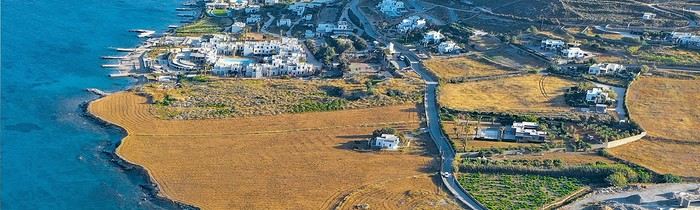
If you're dreaming of idyllic beaches and picturesque villages, you're in the right place! Known for its crystal-clear waters, millennia-old traditions, and preserved nature, Sardinia captivates travelers seeking a change of scenery. Here, you can enjoy a spectacular coastline, but also discover the authentic heart of the island, with its wild mountains and history-laden towns. Visiting Sardinia means taking the time to let yourself be lulled by the song of cicadas and the scent of the maquis. Escape to Sardinia with an all-inclusive stay at a 5-star hotel, allowing you to get away from it all.
To help you plan your itinerary, here’s an overview of ten must-see spots and a few off-the-beaten-path escapes.
Cagliari, the vibrant capital
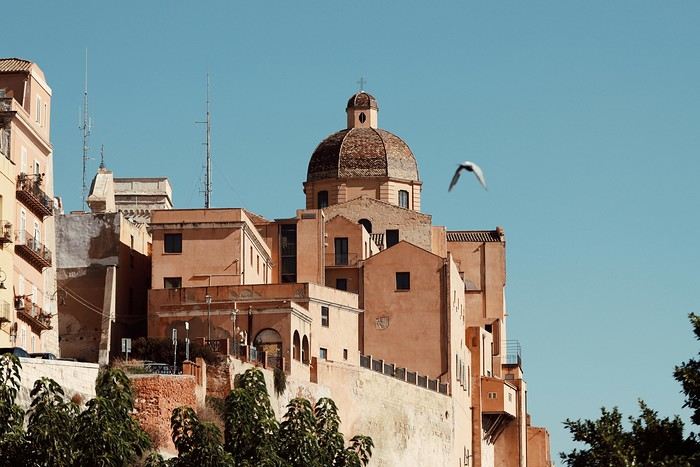
Often the first point of contact with the island, Cagliari charms with its historic center, dominated by the medieval Castello district. Stroll through the narrow streets to reach the Santa Maria Cathedral, then climb up to the Saint-Remy Bastion, where the view of the city and the sea is well worth the effort. Be sure to visit the San Benedetto market, where stalls of cheeses, cured meats, and fish reflect Sardinia’s culinary diversity.
Villasimius, fine sand and turquoise waters
Less than an hour’s drive from Cagliari, the Villasimius area is famous for its dreamy beaches, including Porto Giunco and Simius Beach. The white sand contrasts beautifully with the crystal-clear blue of the sea—a postcard-perfect setting. Diving enthusiasts will be delighted, while hikers can explore Capo Carbonara, a protected area home to pink flamingos.
Costa Smeralda, the glamorous side of the island
Renowned for its prestigious seaside resorts, the Costa Smeralda attracts yachts and lively evenings. Porto Cervo, its iconic port, draws travelers from around the world. Don’t worry—if you venture a little off the beaten path, you’ll find small, wild coves and trails lined with umbrella pines. A stop at a local wine bar to taste a glass of vermentino is highly recommended, if only to admire the view.
The La Maddalena Archipelago, a marine gem
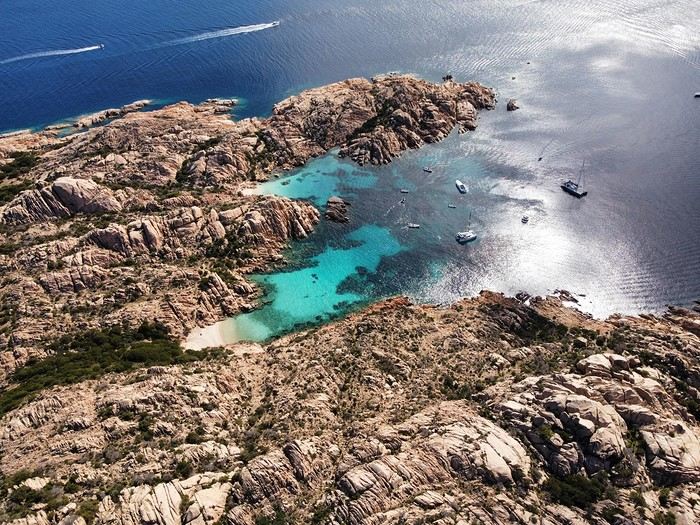
In the northeast, this national marine park comprises several islands with stunning beaches. La Maddalena, the main island, charms with its colorful houses and lively port. Offshore, wonders like Spargi Island or the famous Pink Beach of Budelli await visitors. It’s best to dedicate a full day—or more—to exploring this paradise by boat.
Alghero, the Catalan city
On the northwest coast, Alghero reveals a historic center encircled by ramparts, where the Catalan influence is still strong. Walk along the fortifications to watch the sunset, then sample the local cuisine, focused on seafood and wine. A short drive away, Neptune’s Grotto is a spectacular site: you can reach it via a staircase of 654 steps carved into the cliff or by boat for a more romantic approach.
Bosa, a painting under the open sky
Heading south along the coast from Alghero, you’ll reach Bosa, one of Sardinia’s most charming villages. Its colorful houses line the Temo River, overlooked by the Serravalle Castle. Wander the streets, admiring the vibrant facades, then settle into a small restaurant to taste the famous bottarga. The atmosphere is peaceful—this is la dolce vita.
The Piscinas Dunes, a desert by the sea
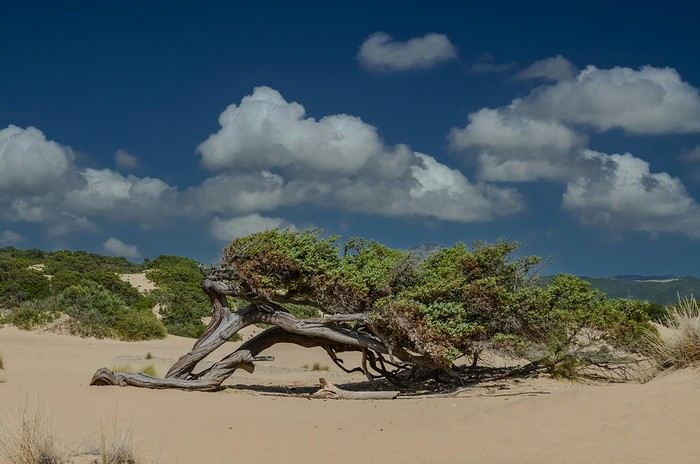
Head southwest to discover Piscinas, a natural site where sand dunes evoke a desert. Between sparse vegetation and turquoise sea, the contrast is simply stunning. The beaches, rarely crowded, offer a soothing tranquility. A perfect spot for lovers of wild landscapes, far from the hustle and bustle of seaside resorts.
Su Nuraxi di Barumini, a prehistoric relic
You can’t truly understand Sardinian history without mentioning the nuraghes, mysterious stone towers left by the Nuragic civilization. In Barumini, you can explore Su Nuraxi, the most famous, a UNESCO World Heritage site. Its millennia-old architecture and vast complex make it a must-visit for anyone wanting to delve into the island’s past.
Orgosolo and the mountainous interior
To experience the deep soul of Sardinia, head to the Supramonte massif. Orgosolo, once a bandit hideout, is known for its mural paintings adorning house facades. These artworks tell the local history, social struggles, and Sardinian pride. The surrounding nature is breathtaking: forests, canyons, and panoramic views invite you to hike.
The Gulf of Orosei, dreamy coves
Finally, it’s hard to miss the beaches of the Gulf of Orosei. Cala Luna, Cala Mariolu, and Cala Goloritzé are among the most beautiful in the Mediterranean. Accessible by boat or on foot, each reveals transparent waters perfect for diving. Time seems to stand still in these wild landscapes, immersing you in the charm of a preserved Sardinia. From its sandy beaches to its rugged mountains, the island offers a stunning array of scenery. Far beyond the Costa Smeralda, Sardinia is full of hidden corners where nature reigns supreme and traditions are still very much alive. Once there, let yourself be swept up by the Sardinian dolce vita, savor its generous cuisine, and soak in its legends.
Happy travels!
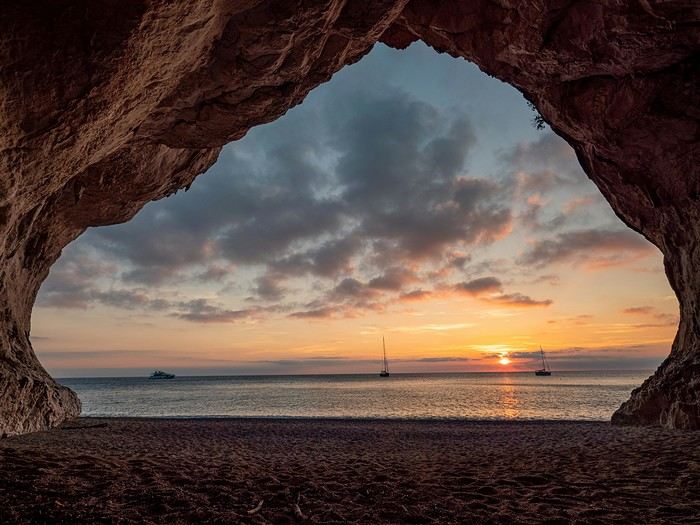
6-day road trip in southern and western Turkey: our experience
Hi everyone,
At the end of October 2024, we were lucky enough to spend a little over a week in Turkey—heading to Antalya. We then set off on a 6-day road trip exploring southern and western Turkey! Since planning a trip isn’t always easy, we’re sharing our itinerary and feedback on the different places we visited.
With a few photos, we hope to wow you 😎!
Here’s our loop itinerary starting from Antalya (a packed schedule, but it let us see so much):
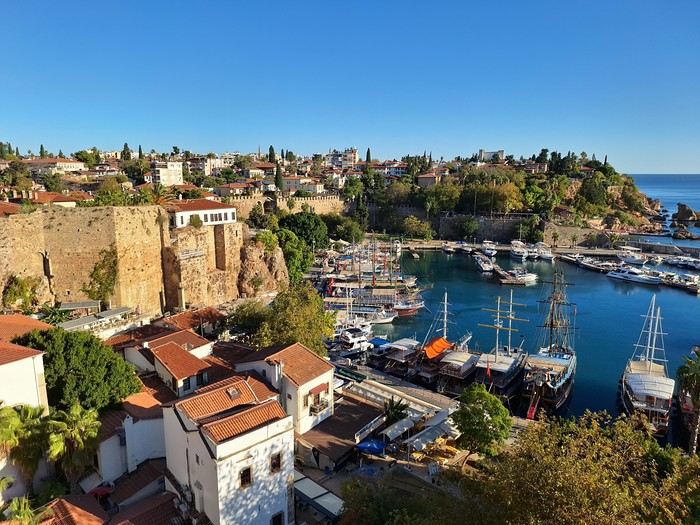
Day 1 - Antalya (Kaleiçi, the historic center of Antalya) and Lara Beach
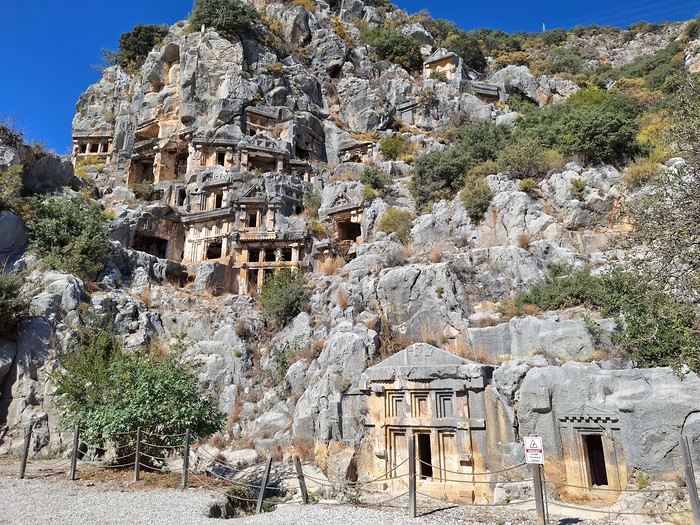
Day 2 - The Lycian site of Myra and the port of Kaş
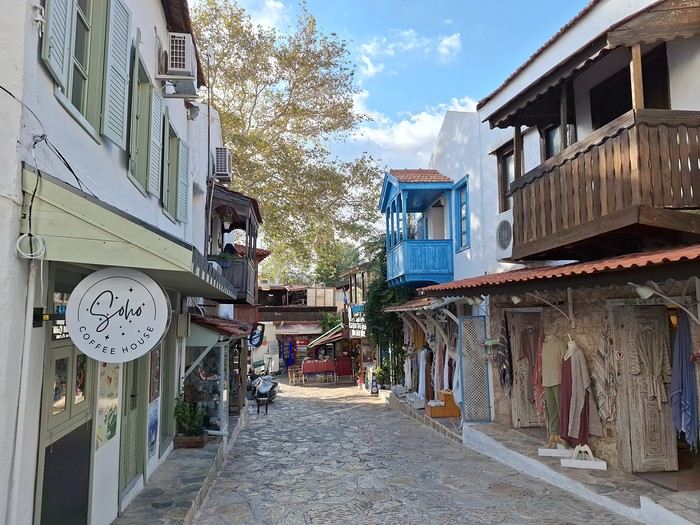
Day 3 - The Turquoise Coast: Kaputaş Beach, the beach and dunes of Patara, the Saklıkent Canyon, the “ghost village” of Kayaköy, the ruins of Telmessos, and the Tomb of Amyntas
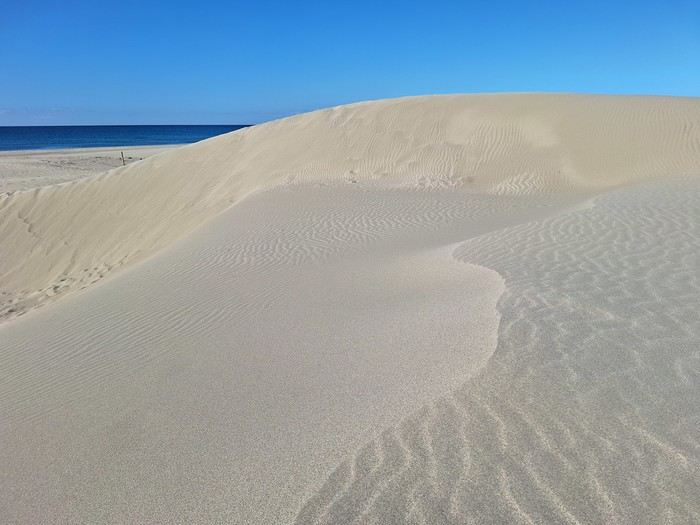
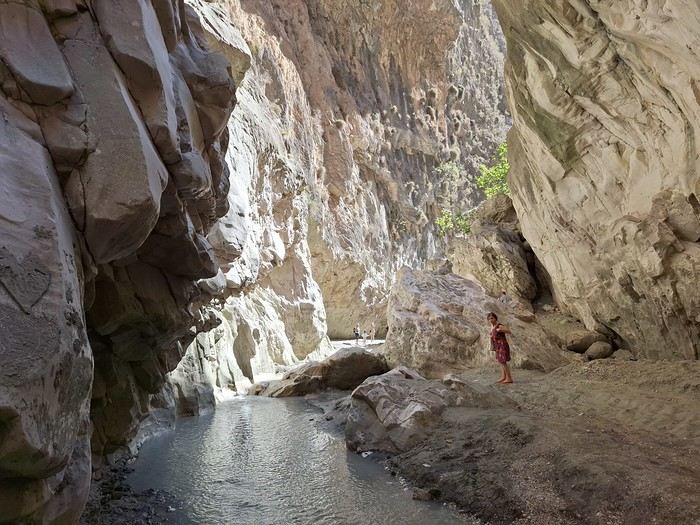
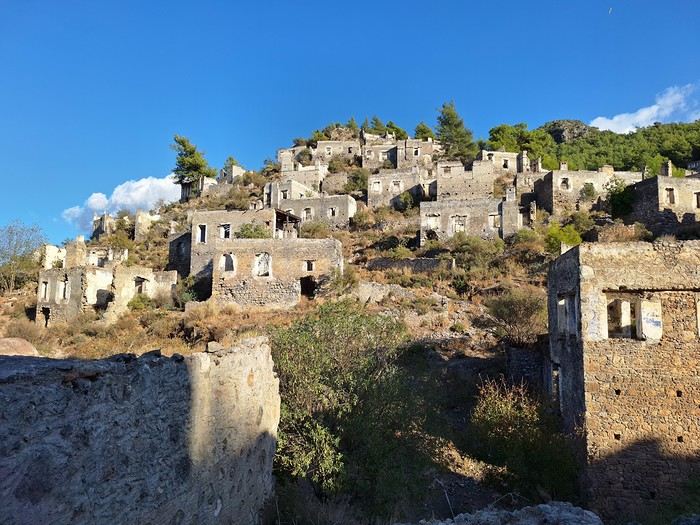
Day 4 - The Iztuzu Beach and the village of Şirince
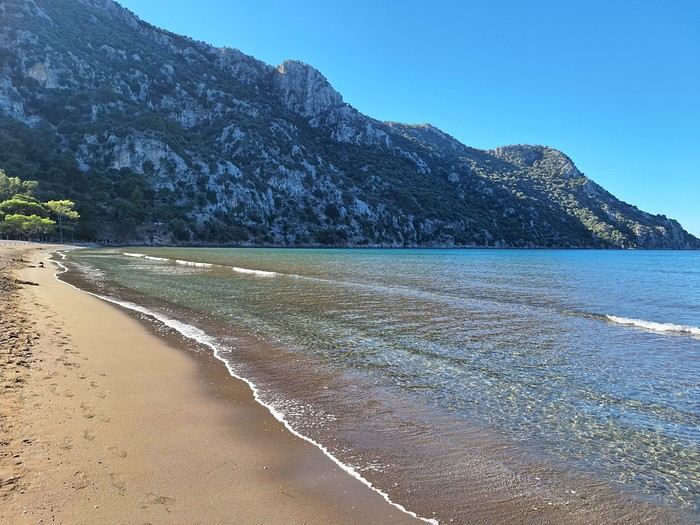
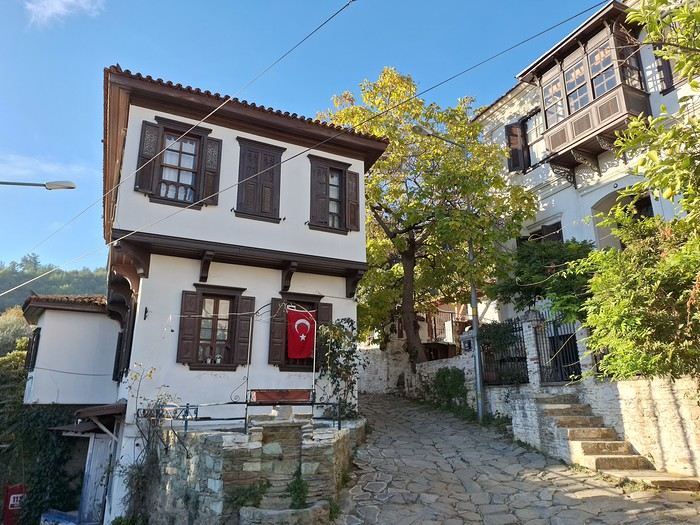
Day 5 - The ancient city of Ephesus and the rural village of Birgi
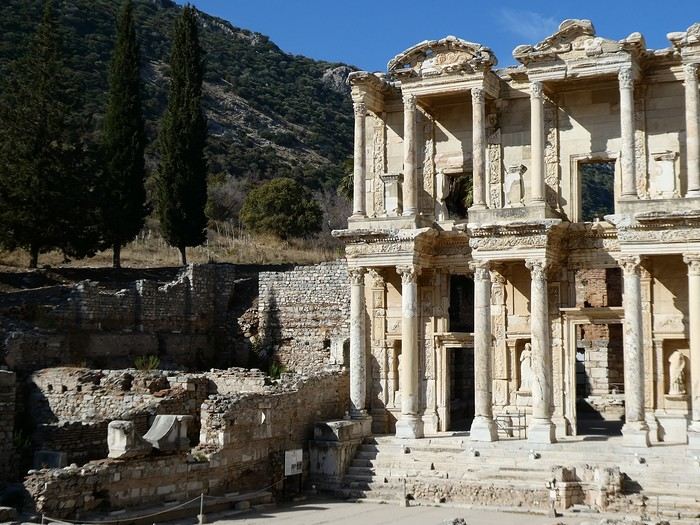
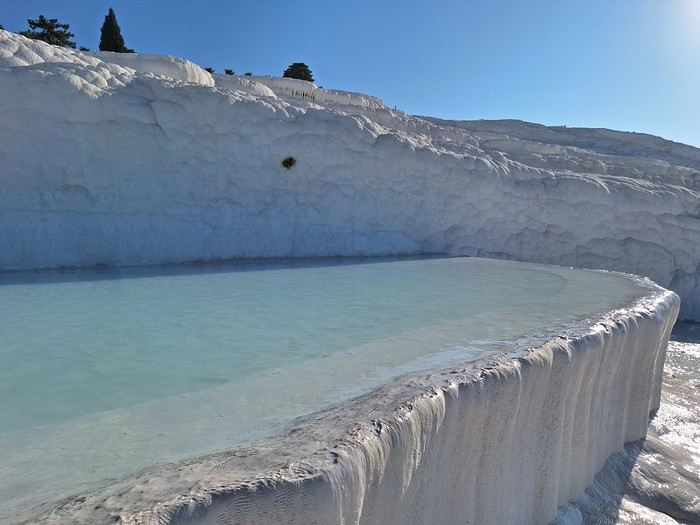
Day 6 - Pamukkale and Hierapolis, then the seaside resort of Side before returning to Antalya (Day 7 in the morning).
So, does this make you want to take a little road trip in Turkey or what 😉?
For each visit, we’ve shared on our personal blog https://ideesdevoyage.fr (type it directly into your address bar) the practical info you need to know (hours, prices, etc.), but most importantly, tips to make the most of your visit (where to park for free, how to avoid crowds, the best time for great lighting, must-see photo spots, and more).
We hope this itinerary and our tips will inspire you and help you plan your future trip to southern and western Turkey.
If you’d like to react or have any questions, don’t hesitate!
At the end of October 2024, we were lucky enough to spend a little over a week in Turkey—heading to Antalya. We then set off on a 6-day road trip exploring southern and western Turkey! Since planning a trip isn’t always easy, we’re sharing our itinerary and feedback on the different places we visited.
With a few photos, we hope to wow you 😎!
Here’s our loop itinerary starting from Antalya (a packed schedule, but it let us see so much):
Day 1 - Antalya (Kaleiçi, the historic center of Antalya) and Lara Beach
Day 2 - The Lycian site of Myra and the port of Kaş
Day 3 - The Turquoise Coast: Kaputaş Beach, the beach and dunes of Patara, the Saklıkent Canyon, the “ghost village” of Kayaköy, the ruins of Telmessos, and the Tomb of Amyntas
Day 4 - The Iztuzu Beach and the village of Şirince
Day 5 - The ancient city of Ephesus and the rural village of Birgi
Day 6 - Pamukkale and Hierapolis, then the seaside resort of Side before returning to Antalya (Day 7 in the morning).
So, does this make you want to take a little road trip in Turkey or what 😉?
For each visit, we’ve shared on our personal blog https://ideesdevoyage.fr (type it directly into your address bar) the practical info you need to know (hours, prices, etc.), but most importantly, tips to make the most of your visit (where to park for free, how to avoid crowds, the best time for great lighting, must-see photo spots, and more).
We hope this itinerary and our tips will inspire you and help you plan your future trip to southern and western Turkey.
If you’d like to react or have any questions, don’t hesitate!
Around Cape Town in 15 days in May
Hi there,
I’ve got a bit of time to share my latest Cape Town – Cape Town trip... A fairly short itinerary, but it was just before heading to Kruger for an extension. In May... Honestly, I’d usually recommend a different time to visit CT—I’ve been there in August, September, and October before. But as they say, "Do as I say, not as I do" or "Only fools never change their minds." Why? Whale season peaks from August to October... and seeing whales right by the shore or breaching out of the water is absolutely spectacular. The end-of-year holiday period—take this year, for example—can get absolutely packed, with beaches closed due to overcrowding, etc. June and July are freezing (for me)... early August isn’t always great either. That said, 2024 saw a September-October with rain, cold, and fog like never before. The Postberg section of West Coast National Park (WCNP) is only open in August and September. Flower season is roughly from mid-August to mid-September.
So, May... The weather? Gorgeous (lucky me!). The route... Not super original (I’ve done it before, though it’s been a while). I didn’t go too far from CT because I prefer slow travel. Cape Town – Langebaan (for WCNP, again) – Cederberg (at Mountain Ceder, again) – Bontebok NP (new to me, and on the way) – De Hoop NR (at De Hoop) – Agulhas NP – Boulders (for Boulders Beach and the peninsula, again and again).
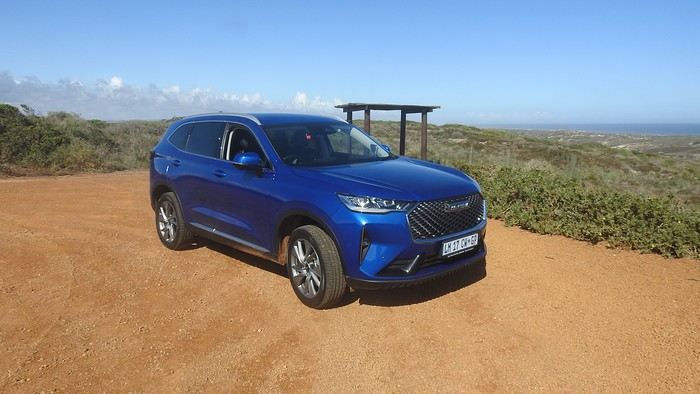
The trip started off badly due to storms in Frankfurt... My overnight flight was delayed until the next day, but via Amsterdam, so a daytime flight instead. A bit stressful, but Lufthansa and KLM handled it well. Now it was my turn to sort things out... "Well, I need you to keep the car for me... I’m arriving tonight!" (aroundaboutcars, a Chinese Haval, blue and 4x4—though I didn’t actually need the 4x4... which waited for me).
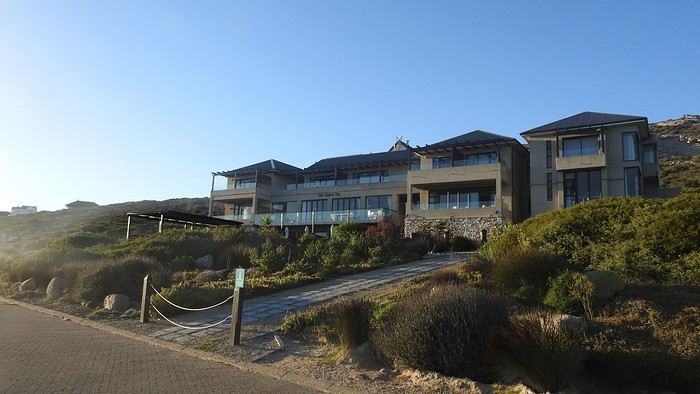
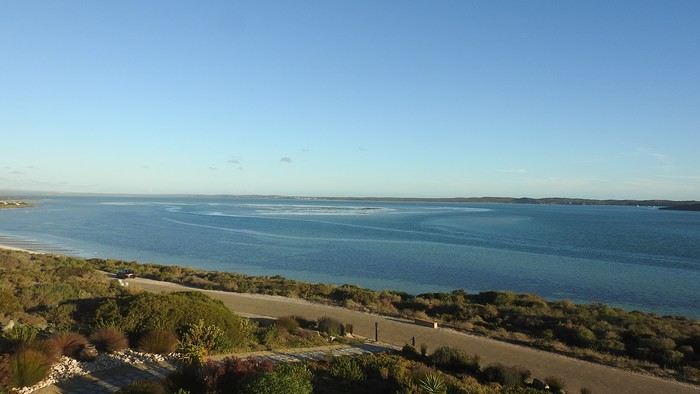
"Well, I need you to keep my room for me... I’m arriving *very* late tonight." A hotel perfectly located by the lagoon, right by the gates of WCNP, but still close to Langebaan and its restaurants. I spotted it myself and booked it during Black Friday...
Yep, what was normally a short 1.5-hour drive *in daylight* from the Mother City to Langebaan... was now *at night*. And here I am, usually the one telling people, "Don’t drive at night, folks!" Well, I know the route, and Google won’t let me get lost... until Langebaan, that is. The last few kilometers were rough—"Don’t they put up signs? Don’t they have streetlights?"
Alright, it’s late, the day’s been long—time for bed! !
I’ve got a bit of time to share my latest Cape Town – Cape Town trip... A fairly short itinerary, but it was just before heading to Kruger for an extension. In May... Honestly, I’d usually recommend a different time to visit CT—I’ve been there in August, September, and October before. But as they say, "Do as I say, not as I do" or "Only fools never change their minds." Why? Whale season peaks from August to October... and seeing whales right by the shore or breaching out of the water is absolutely spectacular. The end-of-year holiday period—take this year, for example—can get absolutely packed, with beaches closed due to overcrowding, etc. June and July are freezing (for me)... early August isn’t always great either. That said, 2024 saw a September-October with rain, cold, and fog like never before. The Postberg section of West Coast National Park (WCNP) is only open in August and September. Flower season is roughly from mid-August to mid-September.
So, May... The weather? Gorgeous (lucky me!). The route... Not super original (I’ve done it before, though it’s been a while). I didn’t go too far from CT because I prefer slow travel. Cape Town – Langebaan (for WCNP, again) – Cederberg (at Mountain Ceder, again) – Bontebok NP (new to me, and on the way) – De Hoop NR (at De Hoop) – Agulhas NP – Boulders (for Boulders Beach and the peninsula, again and again).
The trip started off badly due to storms in Frankfurt... My overnight flight was delayed until the next day, but via Amsterdam, so a daytime flight instead. A bit stressful, but Lufthansa and KLM handled it well. Now it was my turn to sort things out... "Well, I need you to keep the car for me... I’m arriving tonight!" (aroundaboutcars, a Chinese Haval, blue and 4x4—though I didn’t actually need the 4x4... which waited for me).
"Well, I need you to keep my room for me... I’m arriving *very* late tonight." A hotel perfectly located by the lagoon, right by the gates of WCNP, but still close to Langebaan and its restaurants. I spotted it myself and booked it during Black Friday...
Yep, what was normally a short 1.5-hour drive *in daylight* from the Mother City to Langebaan... was now *at night*. And here I am, usually the one telling people, "Don’t drive at night, folks!" Well, I know the route, and Google won’t let me get lost... until Langebaan, that is. The last few kilometers were rough—"Don’t they put up signs? Don’t they have streetlights?"
Alright, it’s late, the day’s been long—time for bed! !
A week in Dalmatia with the kids
Croatia
October 2024
Hi everyone, I wanted to share our family week in Croatia. Alex and I, with Apolline (6), Olympe (4), and Artémis (18 months).
Itinerary
Planning the itinerary was complicated, but in the end, I wouldn’t change a thing. Since we had a round-trip flight from Dubrovnik, I preferred to prioritize proximity, so we skipped Plitvice, which I’d really love to visit—but that’ll be for next time. We had time to... take our time, and it was really nice.
Day 1: Marseille-Dubrovnik flight. Night in Ston.
Day 2: Visit to Ston and Mali Ston. Ferry to Mljet. Night in Pomena (3 nights total).
Days 3 & 4: Walks in Mljet National Park and swimming.
Day 5: Return ferry. Visit to the Trsteno Arboretum. Night in Dubrovnik (3 nights total).
Day 6: Visit to Dubrovnik’s city walls and Old Town.
Day 7: Lokrum.
Day 8: Morning in Dubrovnik, then Cavtat and overnight flight back to Marseille.
Our visits
Ston area:
Ston village, small but charming. We walked the walls from Ston to Mali Ston. It’s a steep climb, but the views over Ston and then Mali Ston are stunning. Easy return by road, and we visited the fort. Stroller impossible on the walls.
Pratpano Beach before taking the ferry. A beautiful beach and our first swim!
Mljet
Everything is beautiful on Mljet—the villages, landscapes, beaches... There are plenty of hiking and biking trails of varying difficulty. We saw lots of bike rental shops (Pomena, Polače, at the dock for St. Mary’s...), with some bikes equipped with child seats (though no baby trailers). In Pomena, there’s a small national park office that provides maps, sells entry tickets, and gives info on possible routes. The trails are well-marked. The boat to St. Mary’s Island is included in the park entry fee.
On the first day, from Pomena, we were 20 minutes’ walk from the small saltwater lake and the dock for St. Mary’s Monastery. We visited the little island, but the monastery interior was closed. We swam in Malo Jezero Lake (but there are plenty of spots to swim in both lakes).
The next day, we did a big loop starting from Pomena, walking through the forest (with beautiful sea views) to Janik (across from the monastery), then returning along the shore paths for a swim. An easy hike with little elevation—Olympe did it without any problems. The route is clearly marked on the bike trail map from the park office.
On our last day before the 3 PM ferry, we swam and had a picnic on one of Saplunara’s gorgeous sandy beaches—we had the whole place to ourselves!
Trsteno Arboretum (30 minutes from Dubrovnik). A stunning botanical garden overlooking the sea, which we visited in the late afternoon. Stroller accessible.
Dubrovnik:
City walls. Very expensive, but worth it! Lets you see the whole Old Town and the port from above. Stroller impossible.
Old Town: lots of beautiful, narrow alleys where laundry dries between buildings. Stroller possible but not practical. We visited the two monasteries and the cathedral inside but skipped the Rector’s Palace and St. Lawrence Fort.
Lokrum: deserves a full day. A beautiful walk circles the island, alternating between coves, historic buildings, and botanical gardens. We were short on time before the last boat left, but there are plenty of great spots to swim. You can’t do the full loop with a stroller, but I think the main sights near the dock are accessible.
Cavtat: a great surprise—I’d recommend it if, like us, you have a late flight. Just 15 minutes from the airport, it’s a charming seaside village with a lovely waterfront promenade (stroller-friendly), several swimming coves, and a cute center with things to see if you have extra time (museum, mausoleum, church...), plus restaurants, gelato shops, and boutiques...
Even though the girls walked a lot and enjoyed the walks, they *loved* swimming almost every day.
Transportation
Flight with Volotea. 1-hour delay on the way back.
Rental car with Goldcar. Office 100m outside the airport (it’s small, so about a 10-minute walk from arrivals). We were first in line, and luckily so—the employee was alone, and the queue behind us got really long, so budget extra time.
Don’t plan on driving in central Dubrovnik—the parking is outrageously expensive (over 5 €/hour near the walls), so book accommodation with parking and be ready for some walking.
Ferry: punctual. This time of year, we didn’t need to be at the dock more than 30 minutes before departure. Booked online.
Accommodation
I won’t talk about our place in Ston—it wasn’t very comfortable—or the one in Pomena, where we were really poorly received. But both locations were great for sightseeing. In Dubrovnik, we spent 3 nights at Natasa’s Airbnb (Apt Kalea), which was well-equipped, comfortable, and well-located—20 minutes’ walk from the center, with parking, a garden, and... a washing machine. All right across from a supermarket and a great bakery. For those with bigger budgets, the Art Deco Hilton in the center had me dreaming for 3 days!
Food
We didn’t eat out much because of the prices, but when we did, the food was great. The cuisine blends Italian and Slavic influences, so expect amazing seafood dishes, cuttlefish ink risotto, and big mixed grilled meats, not to mention pepper sauce. Despite the price, I’d recommend the restaurant in Mali Ston, *Kapetanova Kuća*. The food was great, and the service was friendly. If you have a late flight like we did, don’t hesitate to eat at the bistro almost across from the airport, *Pod Dubom*—good, affordable menu and a smiling waiter!
A great local picnic specialty: *burek*, a delicious savory pie (meat or cheese) you’ll find in bakeries or supermarkets. Also, good dry sheep’s cheese.
For picnics in Dubrovnik, I’d recommend the pine grove at St. Lawrence Fort or the benches above the port (at the end of Dominika Street). Both have amazing views.
Weather
We had beautiful weather—perfect for swimming *and* hiking. A light sweater for mornings and late afternoons, T-shirt and swimsuit during the day. In this part of Croatia, I’d say it’s comparable to southeastern France, so ideal for a fall break.
Gear
We like taking our stroller (Yoyo) for airport trips, but it wasn’t much use otherwise. If you have to choose, a baby carrier is better—between the cobblestones and hiking trails, it’s often the only way to carry a little one. We have the Deuter Pro hiking carrier, and Artémis loves it. We had high chairs in the few restaurants we went to, but not in our accommodations, so I brought a foldable fabric seat that fits on any chair. We had a crib in Ston and Pomena but not in Dubrovnik—Artémis slept on the floor on a folded duvet.
I invested in a Minimax *cabin-sized* suitcase for Apolline for this trip—she was so proud to have her first rolling suitcase! It turned out to be practical and seems sturdy. It let us take just one checked bag for all five of us for the first time.
Good and bad impressions
The swims in Mljet’s stunning, nearly empty nature.
Unfortunately, we felt unwelcome. The guidebook mentioned that Croatians can be standoffish at first, but we never got past that first impression. The constant feeling of being in the way—even though we weren’t there in peak season—was a bit unsettling. On the way back, I found out everyone I talked to (with or without kids) felt the same. Of course, it’s not universal—some people were polite, even warm (yes, really!).
No major issues, but a few things to note:
The car rental company only accepted debit cards, not credit cards. It was clearly stated in the contract, but I didn’t take it seriously. Luckily, Alexandre had a professional debit card, but *double-check yours before you go*.
For the car, despite the super-low rental price, you’ll have to add fees if you plan to take a ferry (50 to 80 € depending on the agency).
On Mljet, the only supermarket in Pomena was closed. We had to drive 10 minutes to Polače for basics. For diapers, we had to go even farther. I only saw formula for newborns in small supermarkets—maybe you can find more in Dubrovnik or at a pharmacy. I ended up using regular milk for Artémis.
Health
No issues, and no one got sick. We swam in very accessible spots given the girls’ ages, but if you’re eyeing a gorgeous little cove, watch out for sea urchins—we saw a lot!
Portable DVD players for the plane and car, but we barely used them. The girls watched cartoons in English on TV.
Kidizoom cameras.
A few toys for Artémis.
Budget
We found Croatia expensive, and I imagine it’s even worse in summer. For restaurants, sightseeing, and groceries, expect to pay the same as—or more than—in France. On the other hand, flights were low-cost, and accommodations were reasonable. The rental car was almost a steal, even with the extra ferry fees.
Round-trip flight from Marseille: 583 €
Car for 8 days: 56 € (+50 € for ferry fees)
Accommodations (7 nights): 509 €
Sightseeing:
Mljet National Park entry: 15 €/adult for 2 days (boat to St. Mary’s included)
Arboretum: 10 €/adult
Dubrovnik walls: 35 €/adult
Ferry Pratpano-Mljet: 60 € round-trip
October 2024
Hi everyone, I wanted to share our family week in Croatia. Alex and I, with Apolline (6), Olympe (4), and Artémis (18 months).
Itinerary
Planning the itinerary was complicated, but in the end, I wouldn’t change a thing. Since we had a round-trip flight from Dubrovnik, I preferred to prioritize proximity, so we skipped Plitvice, which I’d really love to visit—but that’ll be for next time. We had time to... take our time, and it was really nice.
Day 1: Marseille-Dubrovnik flight. Night in Ston.
Day 2: Visit to Ston and Mali Ston. Ferry to Mljet. Night in Pomena (3 nights total).
Days 3 & 4: Walks in Mljet National Park and swimming.
Day 5: Return ferry. Visit to the Trsteno Arboretum. Night in Dubrovnik (3 nights total).
Day 6: Visit to Dubrovnik’s city walls and Old Town.
Day 7: Lokrum.
Day 8: Morning in Dubrovnik, then Cavtat and overnight flight back to Marseille.
Our visits
Ston area:
Ston village, small but charming. We walked the walls from Ston to Mali Ston. It’s a steep climb, but the views over Ston and then Mali Ston are stunning. Easy return by road, and we visited the fort. Stroller impossible on the walls.
Pratpano Beach before taking the ferry. A beautiful beach and our first swim!
Mljet
Everything is beautiful on Mljet—the villages, landscapes, beaches... There are plenty of hiking and biking trails of varying difficulty. We saw lots of bike rental shops (Pomena, Polače, at the dock for St. Mary’s...), with some bikes equipped with child seats (though no baby trailers). In Pomena, there’s a small national park office that provides maps, sells entry tickets, and gives info on possible routes. The trails are well-marked. The boat to St. Mary’s Island is included in the park entry fee.
On the first day, from Pomena, we were 20 minutes’ walk from the small saltwater lake and the dock for St. Mary’s Monastery. We visited the little island, but the monastery interior was closed. We swam in Malo Jezero Lake (but there are plenty of spots to swim in both lakes).
The next day, we did a big loop starting from Pomena, walking through the forest (with beautiful sea views) to Janik (across from the monastery), then returning along the shore paths for a swim. An easy hike with little elevation—Olympe did it without any problems. The route is clearly marked on the bike trail map from the park office.
On our last day before the 3 PM ferry, we swam and had a picnic on one of Saplunara’s gorgeous sandy beaches—we had the whole place to ourselves!
Trsteno Arboretum (30 minutes from Dubrovnik). A stunning botanical garden overlooking the sea, which we visited in the late afternoon. Stroller accessible.
Dubrovnik:
City walls. Very expensive, but worth it! Lets you see the whole Old Town and the port from above. Stroller impossible.
Old Town: lots of beautiful, narrow alleys where laundry dries between buildings. Stroller possible but not practical. We visited the two monasteries and the cathedral inside but skipped the Rector’s Palace and St. Lawrence Fort.
Lokrum: deserves a full day. A beautiful walk circles the island, alternating between coves, historic buildings, and botanical gardens. We were short on time before the last boat left, but there are plenty of great spots to swim. You can’t do the full loop with a stroller, but I think the main sights near the dock are accessible.
Cavtat: a great surprise—I’d recommend it if, like us, you have a late flight. Just 15 minutes from the airport, it’s a charming seaside village with a lovely waterfront promenade (stroller-friendly), several swimming coves, and a cute center with things to see if you have extra time (museum, mausoleum, church...), plus restaurants, gelato shops, and boutiques...
Even though the girls walked a lot and enjoyed the walks, they *loved* swimming almost every day.
Transportation
Flight with Volotea. 1-hour delay on the way back.
Rental car with Goldcar. Office 100m outside the airport (it’s small, so about a 10-minute walk from arrivals). We were first in line, and luckily so—the employee was alone, and the queue behind us got really long, so budget extra time.
Don’t plan on driving in central Dubrovnik—the parking is outrageously expensive (over 5 €/hour near the walls), so book accommodation with parking and be ready for some walking.
Ferry: punctual. This time of year, we didn’t need to be at the dock more than 30 minutes before departure. Booked online.
Accommodation
I won’t talk about our place in Ston—it wasn’t very comfortable—or the one in Pomena, where we were really poorly received. But both locations were great for sightseeing. In Dubrovnik, we spent 3 nights at Natasa’s Airbnb (Apt Kalea), which was well-equipped, comfortable, and well-located—20 minutes’ walk from the center, with parking, a garden, and... a washing machine. All right across from a supermarket and a great bakery. For those with bigger budgets, the Art Deco Hilton in the center had me dreaming for 3 days!
Food
We didn’t eat out much because of the prices, but when we did, the food was great. The cuisine blends Italian and Slavic influences, so expect amazing seafood dishes, cuttlefish ink risotto, and big mixed grilled meats, not to mention pepper sauce. Despite the price, I’d recommend the restaurant in Mali Ston, *Kapetanova Kuća*. The food was great, and the service was friendly. If you have a late flight like we did, don’t hesitate to eat at the bistro almost across from the airport, *Pod Dubom*—good, affordable menu and a smiling waiter!
A great local picnic specialty: *burek*, a delicious savory pie (meat or cheese) you’ll find in bakeries or supermarkets. Also, good dry sheep’s cheese.
For picnics in Dubrovnik, I’d recommend the pine grove at St. Lawrence Fort or the benches above the port (at the end of Dominika Street). Both have amazing views.
Weather
We had beautiful weather—perfect for swimming *and* hiking. A light sweater for mornings and late afternoons, T-shirt and swimsuit during the day. In this part of Croatia, I’d say it’s comparable to southeastern France, so ideal for a fall break.
Gear
We like taking our stroller (Yoyo) for airport trips, but it wasn’t much use otherwise. If you have to choose, a baby carrier is better—between the cobblestones and hiking trails, it’s often the only way to carry a little one. We have the Deuter Pro hiking carrier, and Artémis loves it. We had high chairs in the few restaurants we went to, but not in our accommodations, so I brought a foldable fabric seat that fits on any chair. We had a crib in Ston and Pomena but not in Dubrovnik—Artémis slept on the floor on a folded duvet.
I invested in a Minimax *cabin-sized* suitcase for Apolline for this trip—she was so proud to have her first rolling suitcase! It turned out to be practical and seems sturdy. It let us take just one checked bag for all five of us for the first time.
Good and bad impressions
The swims in Mljet’s stunning, nearly empty nature.
Unfortunately, we felt unwelcome. The guidebook mentioned that Croatians can be standoffish at first, but we never got past that first impression. The constant feeling of being in the way—even though we weren’t there in peak season—was a bit unsettling. On the way back, I found out everyone I talked to (with or without kids) felt the same. Of course, it’s not universal—some people were polite, even warm (yes, really!).
No major issues, but a few things to note:
The car rental company only accepted debit cards, not credit cards. It was clearly stated in the contract, but I didn’t take it seriously. Luckily, Alexandre had a professional debit card, but *double-check yours before you go*.
For the car, despite the super-low rental price, you’ll have to add fees if you plan to take a ferry (50 to 80 € depending on the agency).
On Mljet, the only supermarket in Pomena was closed. We had to drive 10 minutes to Polače for basics. For diapers, we had to go even farther. I only saw formula for newborns in small supermarkets—maybe you can find more in Dubrovnik or at a pharmacy. I ended up using regular milk for Artémis.
Health
No issues, and no one got sick. We swam in very accessible spots given the girls’ ages, but if you’re eyeing a gorgeous little cove, watch out for sea urchins—we saw a lot!
Portable DVD players for the plane and car, but we barely used them. The girls watched cartoons in English on TV.
Kidizoom cameras.
A few toys for Artémis.
Budget
We found Croatia expensive, and I imagine it’s even worse in summer. For restaurants, sightseeing, and groceries, expect to pay the same as—or more than—in France. On the other hand, flights were low-cost, and accommodations were reasonable. The rental car was almost a steal, even with the extra ferry fees.
Round-trip flight from Marseille: 583 €
Car for 8 days: 56 € (+50 € for ferry fees)
Accommodations (7 nights): 509 €
Sightseeing:
Mljet National Park entry: 15 €/adult for 2 days (boat to St. Mary’s included)
Arboretum: 10 €/adult
Dubrovnik walls: 35 €/adult
Ferry Pratpano-Mljet: 60 € round-trip
Morocco, an encounter...
Hello everyone,
I’ve been to Morocco about fifteen times, but I’ve never posted a travel journal here on Voyage Forum. Why? I have no idea… Maybe because this section was so active, with lots of stories and photos. I thought sharing my adventures in *al Maghrib* wouldn’t be very original. Today, this space feels quieter, so what if I tried to give it a little life back, modestly? With some help…
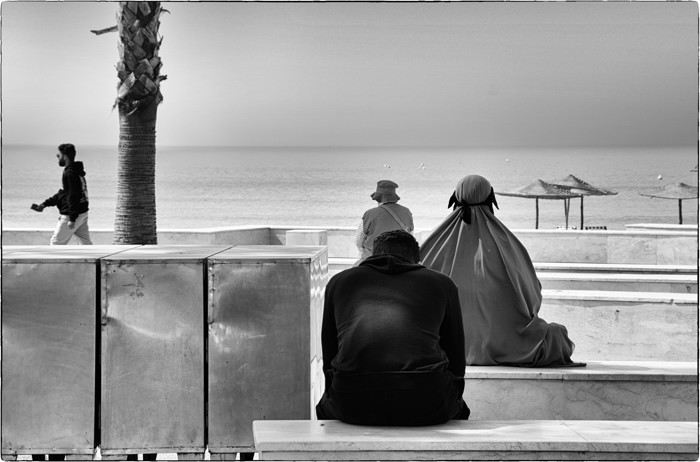
This trip will be different. From the start of my relationship with Richard, I was determined to introduce him to *my* Morocco. But he was a bit reluctant… He’ll tell you about our 2022 meeting, and I’ll illustrate it with my photos, just like we did with our India travel journal.
I’ve been to Morocco about fifteen times, but I’ve never posted a travel journal here on Voyage Forum. Why? I have no idea… Maybe because this section was so active, with lots of stories and photos. I thought sharing my adventures in *al Maghrib* wouldn’t be very original. Today, this space feels quieter, so what if I tried to give it a little life back, modestly? With some help…
This trip will be different. From the start of my relationship with Richard, I was determined to introduce him to *my* Morocco. But he was a bit reluctant… He’ll tell you about our 2022 meeting, and I’ll illustrate it with my photos, just like we did with our India travel journal.
Eastern Crete in September 2024
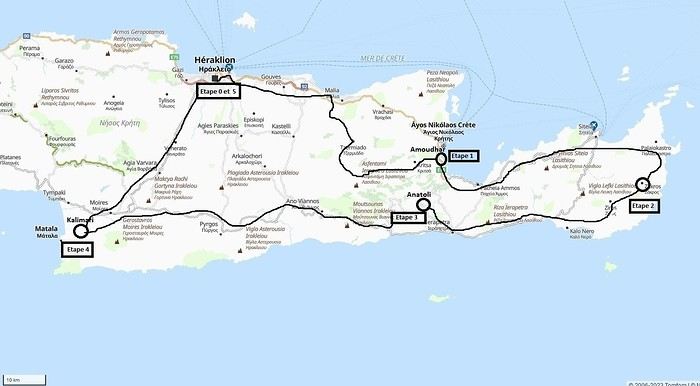
Travel journal in Eastern Crete from September 8th to 29th, 2024
 Our 21-day itinerary
Sunday, 08/09: Once again—and this is the eighth time—we’re setting off, the four of us: Patrick, Michelle, Jacques, and Monique, for the Greek islands. This time, we’ve chosen Crete. No need to wake up at 3 or 4 a.m. to reach Basel-Mulhouse Airport at dawn to catch the first flight to Greece at 6 a.m.! Given the prohibitive prices charged by EasyJet, we found flights that were half the price from Zurich Airport, which is accessible in 3 hours by train from Colmar. Pierre-Paul drives all four of us to Colmar train station, where we take the train to Basel and then, 20 minutes later, the direct train to Zurich Airport. After wandering around the airport, we go for a coffee at 6 € each! We’re in Switzerland, after all. The other dining areas all have vending machines for selecting and paying for meals—soon, there won’t be anyone left to serve you! After a short wait, we take off at 7:45 p.m. (20 minutes late) in an Aegean Airbus A321. Free in-flight meal service isn’t bad either! We land in Heraklion around 11:15 p.m. We pick up our rental car (a red Seat Ibiza) at the airport and head straight to our apartment, located 2 km from the city center. Thanks to the GPS, we find it quickly. It’s a beautiful, fully renovated apartment with all the comforts and well-equipped. On the table, there’s wine, bottles of water, jam, coffee, etc. Given the late hour, we won’t stay up long.
Monday, 09/09: To enhance our breakfast, Michelle and Monique set off to find a bakery nearby. They return with croissants and donuts—yum... Then we head to the west coast. The highway follows the coastline, but we prefer taking the old road to Malia, our first stop. We visit the major archaeological site of this Minoan city under the hot sun. The site covers a vast area, but the ruins aren’t very evocative except for a few beautiful amphorae scattered around. The explanations in a small house at the entrance are interesting and help us better understand the organization of the ancient city with its different districts. From there, we head toward the nearby mountains to see the thousand-year-old plane tree in the village of Krasi. We take the opportunity to enjoy an excellent lunch of moussaka and delicious gemista at the Krassopsychia taverna in the village center. Pleasant surprise: the prices are still reasonable, with a bill of 70 € for four, including wine and water. The friendly tradition of complimentary dessert and glasses of raki continues—great! We’ve set the bar high right away! Let’s hope the rest lives up to it! On the way back toward the Lassithi Plateau, we stop at the Kardiotisa Monastery perched high on the mountain to enjoy a magnificent view of the entire region. Just a little further, we arrive at the Lassithi Plateau: the presence of small windmills used to pump water from the ground is the typical feature of this plateau. We complete a full loop around the plateau, passing by numerous orchards and vegetable gardens that occupy the entire space. At the end of the plateau, we once again cross mountain passes via winding roads that bring us near Agios Nikolaos. Our apartment is located about ten kilometers further south in Amoudhara. The owner, who was notified, waits for us and shows us her superb apartment, whose large terrace overlooks the entire Mirabello Bay. She then gives us valuable information about the different beaches in the area. Dinner will be frugal, given our hearty lunch in Krasi!
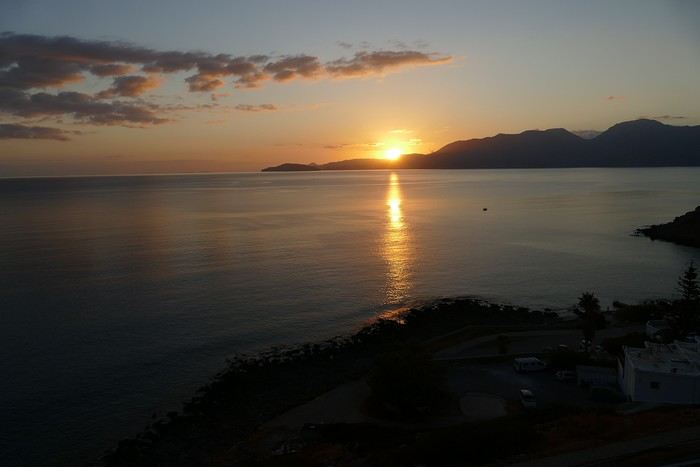 Sunset over Mirabello Bay
Tuesday, 10/09: A bit of a gray sky when we wake up around 8 a.m., but the sun will soon triumph over the scattered clouds. For our first swim, we opt for Voulisma Beach, even though our host warned us it was a bit “crowdy.” That’s understandable given the beautiful emerald color of the sea and the lovely curve of the beach. To avoid the big crowds, we move toward the eastern part of the beach, accessible via a steep staircase. The water is very warm, and this first dip is very pleasant. Before returning to the apartment, we stop at the bakery to buy spinach pies, essential ingredients to accompany our Greek salad for lunch. Of course, everything will be washed down with ouzo, which will remain our favorite drink for the next three weeks—but in moderation!!! A nap is in order after all that effort. In the late afternoon, we drive to Agios Nikolaos, the main seaside resort in Crete. We’re not too enthusiastic about visiting this mass-tourism resort, but the center of Agios, concentrated around the small inner harbor, is pleasant to see despite the plethora of shops and restaurants. We dine a little outside the harbor in the shaded courtyard of the Avli taverna: the oven-baked lamb, squid with spinach, and cuttlefish ink orzo pasta are all highly appreciated. We still stay under a 75 € bill for four.
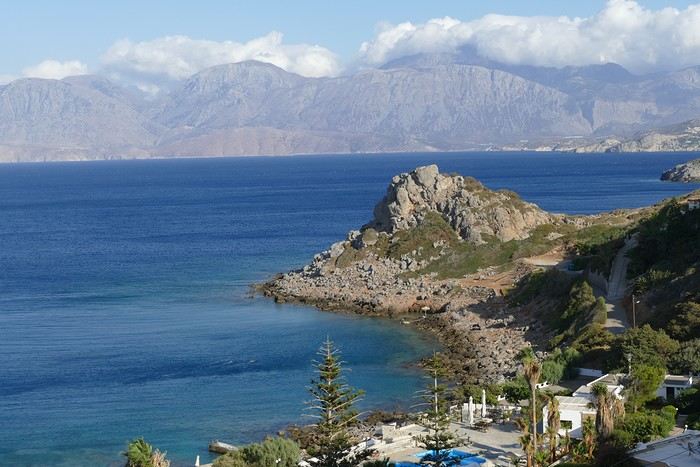 Mirabello Bay seen from our terrace
Wednesday, 11/09: At 8 a.m., the terrace is already bathed in sunlight, and it’s already quite hot. The small parasol barely gives us enough shade, but we’re not complaining! For our second swim, we head to a tiny beach recommended by our host, just 3 minutes by car from our place. The path leading to it is very discreet, and we don’t find it right away! It’s a small sandy cove with a few welcome tamarisk trees for shade. When we arrive, there are two swimmers, and there won’t be more than five or six in the morning. After lunch and a nap, we head to the beautiful village of Kritsa, just a few kilometers away. It’s too late to visit the beautiful church of Kera Panagia, which is already closed. We settle for the exterior, which is worth a look. The weather is clouding over, and big clouds are gathering. Upon arriving in Kritsa, a heavy shower forces us to take shelter in the Platanos taverna in the village center, and since it’s nearly 7 p.m., we decide to stay and dine there. Good choice—excellent meze: croquettes and stuffed zucchini flowers, gigantes beans, grilled tomatoes and feta, and pancetta as the main dish. The rain stops just as we decide to head back.
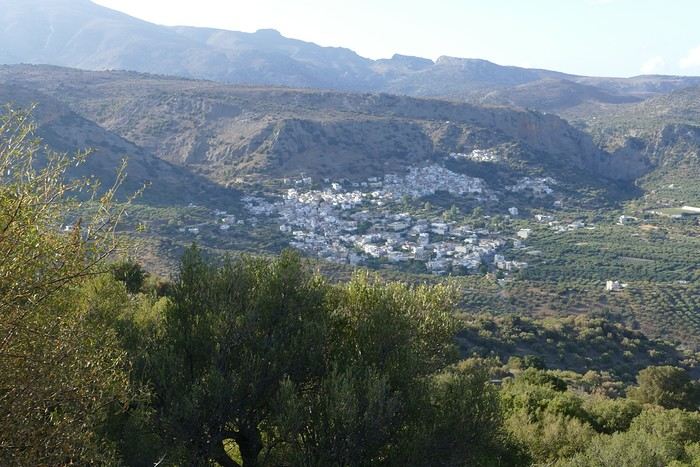 Village of Kritsa
Thursday, 12/09: Our terrace faces east, so we get to watch the sunrise around 7 a.m.—it’s truly a beautiful sight we never tire of. Around 9 a.m., we head to the village of Plaka, where boats depart for the island of Spinalonga, located north of Agios Nikolaos. We board the first boat, which sets sail at 10 a.m., and we’re not alone—the boat is practically full. After 10 minutes, we land on the island at the same time as several other boats from Elounda or Agios. Needless to say, there are already quite a few people walking through the streets of the leper village. The visit remains interesting and moving as we read the explanatory panels recounting the island’s history under Byzantine and then Turkish rule, followed by its transformation into a leper colony. As soon as we climb toward the top of the island via more or less maintained paths, there’s almost no one left. The 360° view from up there is stunning.
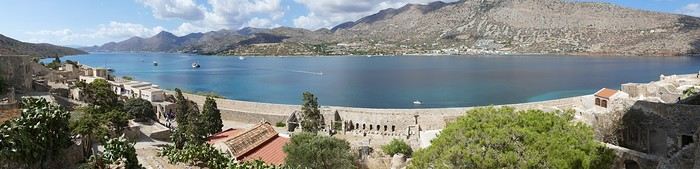
Spinalonga Island
The heat is now unbearable, and we can’t wait to get back home to have lunch on our terrace and rest. In the late afternoon, we go grocery shopping at the AB supermarket at the entrance of Agios. We had spotted another nice restaurant in our guide, but unfortunately, there’s a different one at the indicated location that doesn’t inspire us. So, we return to the Avli taverna for another dinner just as good as the first.
Friday, 13/09: We repeat yesterday’s successful program: a swim in our little cove, lunch on the terrace, a nap, and then, in the late afternoon, we discover another nearby village, Kroustas, nestled in the olive groves near Kritsa. Much less touristy than Kritsa, it’s mostly inhabited by locals, especially the elderly who are enjoying the cool air on their chairs—if you can call it cool given the still-high temperatures in the late afternoon! We then return to visit Kritsa, which we hadn’t been able to explore due to the rain. Dinner at a taverna in the village center at a very reasonable price.
Saturday, 14/09: Today, we move to our new base further east. We start with a high viewpoint at the Faneromeni Monastery, which overlooks Mirabello Bay. The monastery itself is of little interest as it’s under renovation with excessive concrete work. We continue to the village of Kavoussi to see another exceptional tree after a few kilometers on a dusty, bumpy track. It’s an olive tree said to be about 3,200 years old—impressive, and the countryside is very beautiful. It’s time to find a place for lunch. We find one in the charming little port of Mohlos, where a few tavernas surround a very nice small beach. Our choice falls on the Bogazzi taverna, where we enjoy fried fish. To reach our new base in Zakros, we still have to drive through the mountains before reaching Sitia, Paleokastro, and finally Zakros. The region is beautiful, with olive groves and rows of wind turbines taking advantage of the strong wind near the northern tip of the island. In Zakros, we’re greeted by our very friendly host. Here too, we have all the comforts and a beautiful terrace overlooking the village. The apartment has reversible air conditioners, but the overly simple instructions leave us puzzled. Thinking we’ve set it correctly, we realize a little too late that it’s blowing hot air over 30°C! After numerous attempts and testing several confusing programs, we finally succeed! Dinner on our new terrace.
Sunday, 15/09: This morning, we get up early to hike in the “Gorge of the Dead” while it’s still cool. The sky is blue as usual! We park in the nearest parking lot and start our descent via a beautiful path winding through the olive groves. A little further on, the landscape opens up, and the path, now a stony trail, begins the descent to the dry riverbed. On either side of the riverbed rise beautiful reddish cliffs.
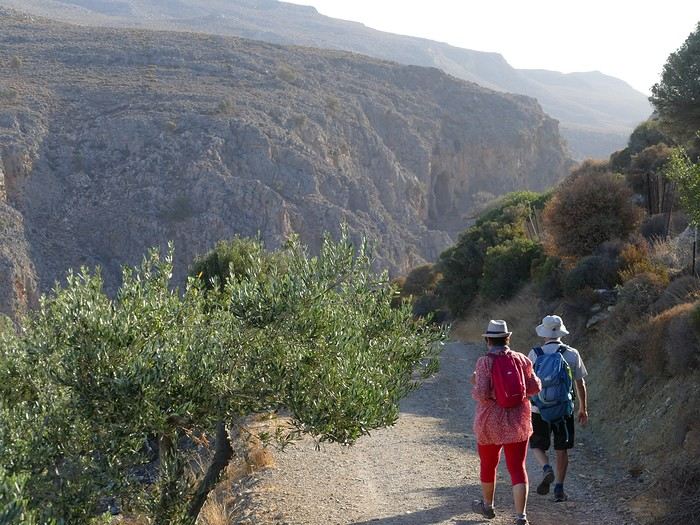
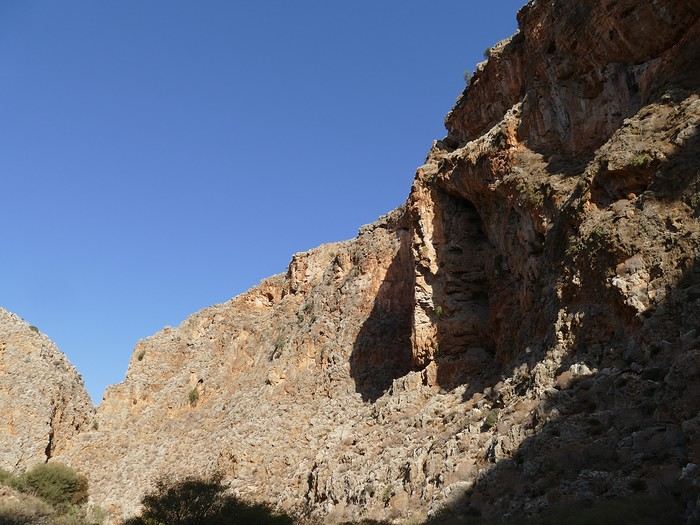
Gorge of the Dead
The trail winds its way through this narrow gorge with difficulty. It was in the many caves visible halfway up the slope that the Minoans buried their dead, hence the name “Gorge of the Dead.” The gorge opens onto a beautiful small pebble beach. A swim is welcome after this hike that made us sweat. The hike took us 1 hour and 25 minutes, and a little less on the way back. Meanwhile, Monique did some shopping and prepared an excellent lunch. In the late afternoon, we go down to dine at Platanakis, a taverna in the small village of Kato Zakros.
Monday, 16/09: This morning, we explore the northern part of the east coast near Palekastro. We start with a dip at the beautiful Hionia Beach near Palekastro. The water is still just as nice, but a light breeze is blowing—not enough to spoil our fun! Seeing all the wind turbines lining the ridges, it’s no surprise.
 Grocery shopping in Palekastro and return to Zakros. A little rain in the late afternoon and an excellent dinner at Iannis Mitsakakis’ Taverna in Adravastis. These are the kind of small tavernas we love—unpretentious, a few tables on a terrace, a warm welcome, a short menu guaranteeing freshness, tasty dishes prepared by the server’s mom, and a light bill. What more could you ask for!
Tuesday, 17/09: We head back toward Palekastro to do some shopping, but it’s also the road to the Toplou Monastery. There, we see a collection of magnificent icons dating from the 15th to the 20th century. We can also admire drawings of Orthodox religious architecture. We continue toward the Mavros Akrotiri headland to enjoy the view of the sea and rocky capes. On the way back to our place, we make a small detour to see the famous Vai palm grove. Meh... As for Vai Beach, it’s filled with paid umbrellas and sunbeds, and there are so many people that we flee. Plus, having to pay for parking is another reason to snub this trendy beach. We prefer our Hionia Beach, which we already appreciated the other day. In the late afternoon, Pat and I start the trail that begins at Kato Zakros Beach heading south. The poorly marked path crosses a plateau of sharp limestone. The paint and cairn markings are no longer very visible, and with dusk approaching, we turn back toward Kato Zakros. Dinner at the Platanakis taverna—less good than last time.
Wednesday, 18/09: To avoid the scorching sun, Pat, Mimi, and I get up earlier than usual to hike the Hohlakies Gorge. At this early hour, the sky is quite cloudy, and it’s drizzling. When we arrive in the village of Hohlakies, we park in front of a small chapel, the start of the hike. The sky is now completely clear. The trail starts among the olive groves, then after passing through a gate, we descend into the gorge filled with large rocks. We’re alone in the world, and the landscape is magnificent. A few wild goats clinging to the cliff watch us from above. After 1 hour and 15 minutes, we emerge onto the wonderful Karoumès Beach. A pleasant swim, then back to civilization! A walk in the late afternoon in Zakros to discover the beautiful springs route. Dinner in Adravastis.
Thursday, 19/09: Another move: Before heading to our next stop, we make a detour to see the beautiful Keratokampos Beach and can’t resist a swim in the still-warm, clear water. We continue our journey via Ziros, then reach the south coast and have lunch at the Stephi taverna in Ferma—excellent meal! The south coast is quite urbanized and has much less charm than the east coast we’ve just left! The numerous plastic greenhouses are partly to blame. We stop for groceries in Ierapetra. Around 3 p.m., we arrive at our destination in the small perched village of Anatoli. Our lodging is at the top of the village, and from the path leading to it, we have a magnificent view of the coastal plain, unfortunately overloaded with plastic greenhouses. It reminds us of the landscapes of El Ejido in Andalusia.
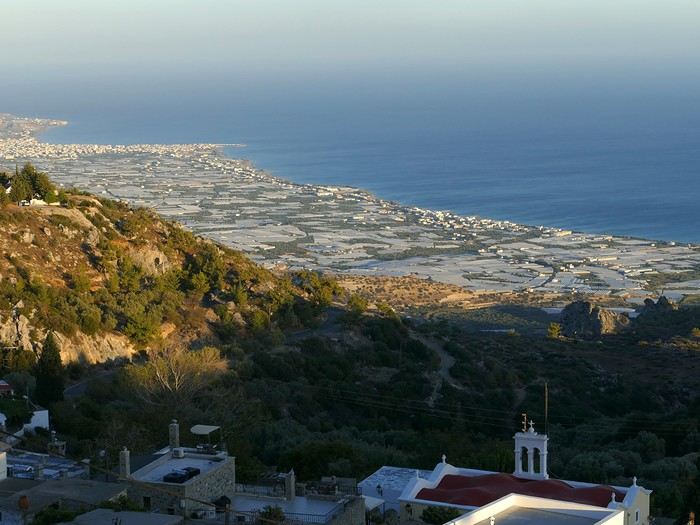 View of the Ierapetra coast from Anatoli
Friday, 20/09: A walk and discovery of the hamlet of Anatoli. There are few services—a tiny grocery store, a taverna, and that’s it. Fortunately, the traveling baker arrives and honks. We take the opportunity to buy fresh bread. Leaving the village, we take a path that should lead us to the hamlet of Drygies. The landscape is beautiful. We walk through a lovely pine forest before arriving at the hamlet. The path continues to a taverna that’s closed today, with a superb terrace overlooking the coast. Luckily, the owner arrives and informs us that the taverna will be open next Sunday and that we can enjoy barbecued meat. Noted! We head back to Anatoli via the small paved road with, fortunately, very limited traffic. Lunch on our terrace, then a dip in our private pool! The water is noticeably cooler than at the beach. Dinner at the village taverna: there’s only one menu—meze starters, souvlaki, water, wine, and bread—all for 35 €! We think we’re dreaming—was there a mistake? No.
Saturday, 21/09: We discover the beach of the village of Myrtos, a small seaside resort that’s quite touristy but on a human scale. We swim in the western part of the beach, and once again, we’re alone in the water. The best part: warm water and tamarisk trees for welcome shade. There’s even a shower to rinse off! In the late afternoon, Pat and I decide to go for a hike in the Selakano pine forest. To get there, we take a narrow, winding, and poorly paved road after the village of Christos. Plus, at this altitude, we encounter clouds clinging to the mountain, so it’s drizzling, and visibility is reduced. We decide to turn back and return to Anatoli. As compensation, we take the path that passes in front of the lodging and leads us to the Timios Stavros chapel, which crowns the summit of the nearby mountain. We arrive at the summit just in time for the sunset at 7 p.m. Breathtaking 360° panorama and magnificent colors!
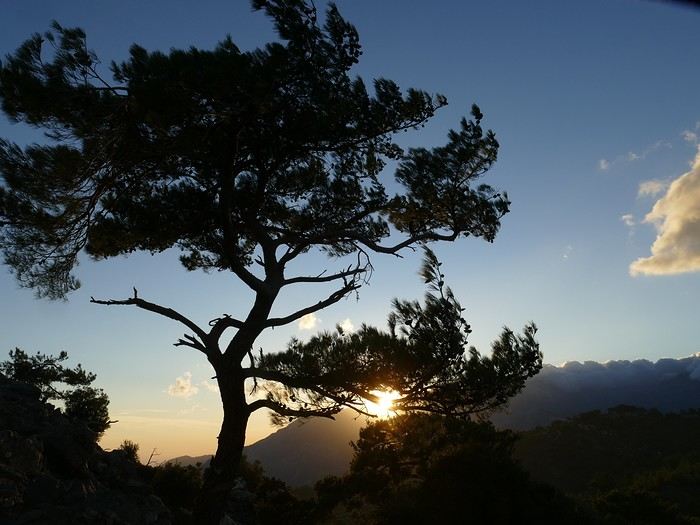 Sunset from Anatoli
Sunday, 22/09: This morning, Pat, Mimi, and I go for a hike in the Sarakina Gorge, located about 12 km from Anatoli via a beautiful road winding through irrigated olive groves. We park in the small parking lot before the trail. At the start, the path follows a levada (small irrigation canal) and quickly enters a very narrow gorge flanked by high cliffs. The riverbed is cluttered with huge rocks blocking the passage. No matter—in the technical sections, ropes or ladders allow us to overcome these obstacles with a bit of skill. You can imagine how quickly the riverbed must rise during a storm, given the narrowness of the gorge!
We progress slowly through this magnificent and impressive rocky chaos. At the exit of the gorge, we take another return path that partly follows the paved road. Back in Anatoli, we go to lunch at the Drygies taverna. We sit at the edge of the terrace under a huge tree that covers almost the entire terrace and order grilled lamb dishes prepared according to the ancient “antikristo” method.
Monday, 23/09: Departure for our last stop before Heraklion. We thought about swimming at Tertsa Beach, but it turns out to be less pleasant than expected, with pebbles and an uneven rocky plateau. So, we return to Myrtos Beach, which we know well and suits us perfectly. We head west, leaving the coast a bit. Around 3:30 p.m., we arrive at our destination in the village of Kamilari, near the famous Matala spot. We’ve rented a beautiful, modern, well-equipped apartment with a lovely shaded terrace. The owner is very friendly and explains everything necessary for a good stay. We explore the quite touristy village with its few tavernas, all full of tourists, mostly Germans.
Tuesday, 24/09: Visit to the village of Sivas, well restored thanks to the Germans, who have invested a lot here. We take the opportunity to scout out “friendly” tavernas, then go for a swim at Kalamaki Beach. Apart from a small sandy access, you have to enter the water via a chaotic limestone plateau—proof of this is that Monique trips slightly when entering the water. A group of very unfriendly German women blocks the sandy passage and doesn’t hesitate to push swimmers they deem too close. Back home, lunch, and a nap. In the late afternoon, we drive to visit the nearby Phaistos site. We benefit from very beautiful lighting. From the elevated site, we overlook the Messara Plain with a beautiful view of the olive grove checkerboards highlighted by the late afternoon sun. The site itself is quite vast, but to appreciate it, it’s better to read the explanatory panels placed throughout the different quarters. At this hour, the site is almost empty, and the beautiful light adds charm to the visit.
Wednesday, 25/09: Departure for the village of Matala, which doesn’t interest us in itself, having been there during the “hippie” era in 1976. However, going to Red Beach, only accessible by taking a path overlooking this area, appeals to us much more. We park in the large parking lot just outside the village and start our climb, which brings us to a pass from where we can admire this beautiful red-sand beach framed by beautiful cliffs plunging into the sea. The weather is magnificent, and at this early hour, there aren’t many people yet. We swim in the free part located near the cliff on the right when arriving at the beach. The sea is like glass, warm, and without a single ripple—a real treat! After half an hour, we turn back, and now there are many people rushing on this path, not at all made for feet in sandals or flip-flops, yet many vacationers venture out like this! Matala lives up to its image—a trendy place, full of shops, bars, and restaurants. You could be in any seaside resort with a standard global urbanism, lacking particular charm. Back home. In the late afternoon, a walk through the olive groves surrounding Kamilari, then dinner at Evangelina’s, who runs the Minoan Parassies taverna in the middle of the olive groves. Evangelina is quite a character: we came to reserve a table for 8 p.m. when it was only 7 p.m., but since we lingered near her restaurant, she prepares a table for us and urges us to sit down! And there she takes our order, and a little later, the meze arrive, followed by the main dishes. We finish this good dinner with several generous glasses of raki, accompanied by Evangelina’s encouragements, repeating “poya poya bravo bravo” in a loop. We’re in great shape too, by the way! We return in the middle of the night, on foot, fortunately, with the path vaguely lit by our phones...
Thursday, 26/09: This morning, we discover a new beach, Kommos Beach, not far from Kamilari either. It’s a long sandy beach, a small part of which is dedicated to paid umbrellas and sunbeds, and the rest is free. We spot a tamarisk tree to take shelter from the still-hot sun, and once again, we enjoy clear, warm water. The few swimmers spread out easily over nearly 500 meters of beach. In the late afternoon, Pat and I go to admire the sunset from the hill near our lodging. The hill, covered with olive trees, is threatened by a planned housing development of large cubic villas—trends dictate. Concrete never stops...
Friday, 27/09: We thought about leaving the car at the Odiyitria Monastery, the end of the paved road, but since the track descending to the cave remains drivable, we park 3 km further at the junction of the track leading to Kali Limenes Beach. We still have to walk for half an hour on a less drivable track, and then we’re at the entrance of the Farango Gorge. It’s a beautiful, easy hike since we follow the dry pebble riverbed. Before arriving at the beach, there’s a very beautiful small chapel sheltered under a large cliff, beautifully lit at this early hour.
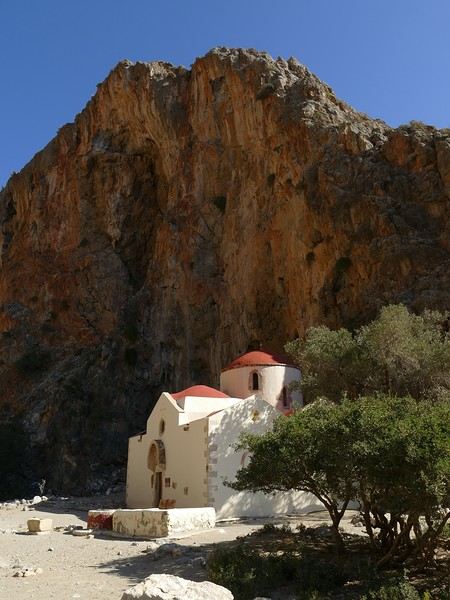
Agio Farango Chapel
A few climbers are scaling the cliff, and about ten swimmers are enjoying the sea. Return to the car under the hot sun. In the late afternoon, we all return to visit the interesting Odiyitria Monastery. Last swim at Kommos Beach and an excellent dinner at the Sigelakis taverna in Sivas.
Saturday, 28/09: There’s an end-of-vacation atmosphere... We pack our bags and head north. A short stop to see the village of Vorri, and a little over an hour later, we arrive in the big city of Heraklion. Since it’s too early to check into the apartment, we park in the city center to visit the famous archaeological museum. It’s indeed a must-see highlight of our stay in Crete. All four of us are amazed by the quantity and quality of the objects presented from the Minoan civilization. After more than 2 hours, we come out without having seen everything, but we’re a bit overwhelmed by all these wonders. Lunch at a nice little taverna very close to the Titus Church. We go to take possession of our apartment—the same as on the way there, still just as satisfying. In the late afternoon, I go alone for a walk in the historic district of the city, passing by the Morosini Fountain, which is bustling with people—some seated at café terraces, others standing and chatting. There’s a lively atmosphere here. A little further on are the Venetian loggia and the Agios Titos Church. I walk down to the old Venetian port to stroll along the jetty and admire the fortifications under beautiful late-afternoon lighting, then return to the apartment. Dinner near our place at Kiriakis, a “chic” restaurant but with very reasonable prices and excellent cuisine.
Sunday, 29/09: Wake-up at 3:30 a.m., quick coffee, and drive to the nearby airport. We leave the car in the parking lot. Already a lot of people at this early hour. Since we don’t have checked luggage, we go straight to security, which goes fairly quickly, then it’s waiting time and takeoff on time in an Airbus A321 for a 45-minute flight to Athens. We take off again in another Airbus A321 with a 50-minute delay to arrive in Zurich at 11:10 a.m. local time. Then we have to take the train to Basel and then the one to Colmar. With fewer Sunday services, we won’t arrive in Colmar until around 4 p.m.
Conclusion All four of us returned very satisfied with this stay in Crete for several reasons: - We found superb beaches with clear, warm water and often very few vacationers. - The few hikes we did were magnificent, especially those where the trails went through gorges leading to deserted beaches. - We greatly appreciated Cretan gastronomy—there were so few disappointments that we can count them on one hand. - All the accommodations we booked turned out to be superb, with the icing on the cake being the very friendly welcome from our hosts. - Generally, contacts with Cretans were always very warm despite the language barrier—we speak a little Greek. - We also appreciated the diversity of landscapes in this eastern part of Crete, with plateaus and mountains with splendid rugged reliefs.
Note: The photo album is available by clicking on this link: https://photos.app.goo.gl/hfdjQndA5eXkL5k7 Captions are only visible per photo by clicking on the circled “i” in the top right. Budget: approximately 3,300 € per couple for 21 days, including train and flights Budget details per couple: - Flight Zurich-Heraklion: 440 € - Trains Colmar-Basel-Zurich round trip for 4: 442.40 € (221 € per couple) - Accommodation: 2,431 € / 21 = 115.80 € per night for 4 (1,216 € per couple) - Car rental for 21 days: 684 € + 145 € fuel (1,150 km) (414 € per couple) - Restaurants, food, etc.: 1,009 €
Our 21-day itinerarySunday, 08/09: Once again—and this is the eighth time—we’re setting off, the four of us: Patrick, Michelle, Jacques, and Monique, for the Greek islands. This time, we’ve chosen Crete. No need to wake up at 3 or 4 a.m. to reach Basel-Mulhouse Airport at dawn to catch the first flight to Greece at 6 a.m.! Given the prohibitive prices charged by EasyJet, we found flights that were half the price from Zurich Airport, which is accessible in 3 hours by train from Colmar. Pierre-Paul drives all four of us to Colmar train station, where we take the train to Basel and then, 20 minutes later, the direct train to Zurich Airport. After wandering around the airport, we go for a coffee at 6 € each! We’re in Switzerland, after all. The other dining areas all have vending machines for selecting and paying for meals—soon, there won’t be anyone left to serve you! After a short wait, we take off at 7:45 p.m. (20 minutes late) in an Aegean Airbus A321. Free in-flight meal service isn’t bad either! We land in Heraklion around 11:15 p.m. We pick up our rental car (a red Seat Ibiza) at the airport and head straight to our apartment, located 2 km from the city center. Thanks to the GPS, we find it quickly. It’s a beautiful, fully renovated apartment with all the comforts and well-equipped. On the table, there’s wine, bottles of water, jam, coffee, etc. Given the late hour, we won’t stay up long.
Monday, 09/09: To enhance our breakfast, Michelle and Monique set off to find a bakery nearby. They return with croissants and donuts—yum... Then we head to the west coast. The highway follows the coastline, but we prefer taking the old road to Malia, our first stop. We visit the major archaeological site of this Minoan city under the hot sun. The site covers a vast area, but the ruins aren’t very evocative except for a few beautiful amphorae scattered around. The explanations in a small house at the entrance are interesting and help us better understand the organization of the ancient city with its different districts. From there, we head toward the nearby mountains to see the thousand-year-old plane tree in the village of Krasi. We take the opportunity to enjoy an excellent lunch of moussaka and delicious gemista at the Krassopsychia taverna in the village center. Pleasant surprise: the prices are still reasonable, with a bill of 70 € for four, including wine and water. The friendly tradition of complimentary dessert and glasses of raki continues—great! We’ve set the bar high right away! Let’s hope the rest lives up to it! On the way back toward the Lassithi Plateau, we stop at the Kardiotisa Monastery perched high on the mountain to enjoy a magnificent view of the entire region. Just a little further, we arrive at the Lassithi Plateau: the presence of small windmills used to pump water from the ground is the typical feature of this plateau. We complete a full loop around the plateau, passing by numerous orchards and vegetable gardens that occupy the entire space. At the end of the plateau, we once again cross mountain passes via winding roads that bring us near Agios Nikolaos. Our apartment is located about ten kilometers further south in Amoudhara. The owner, who was notified, waits for us and shows us her superb apartment, whose large terrace overlooks the entire Mirabello Bay. She then gives us valuable information about the different beaches in the area. Dinner will be frugal, given our hearty lunch in Krasi!
Sunset over Mirabello BayTuesday, 10/09: A bit of a gray sky when we wake up around 8 a.m., but the sun will soon triumph over the scattered clouds. For our first swim, we opt for Voulisma Beach, even though our host warned us it was a bit “crowdy.” That’s understandable given the beautiful emerald color of the sea and the lovely curve of the beach. To avoid the big crowds, we move toward the eastern part of the beach, accessible via a steep staircase. The water is very warm, and this first dip is very pleasant. Before returning to the apartment, we stop at the bakery to buy spinach pies, essential ingredients to accompany our Greek salad for lunch. Of course, everything will be washed down with ouzo, which will remain our favorite drink for the next three weeks—but in moderation!!! A nap is in order after all that effort. In the late afternoon, we drive to Agios Nikolaos, the main seaside resort in Crete. We’re not too enthusiastic about visiting this mass-tourism resort, but the center of Agios, concentrated around the small inner harbor, is pleasant to see despite the plethora of shops and restaurants. We dine a little outside the harbor in the shaded courtyard of the Avli taverna: the oven-baked lamb, squid with spinach, and cuttlefish ink orzo pasta are all highly appreciated. We still stay under a 75 € bill for four.
Mirabello Bay seen from our terraceWednesday, 11/09: At 8 a.m., the terrace is already bathed in sunlight, and it’s already quite hot. The small parasol barely gives us enough shade, but we’re not complaining! For our second swim, we head to a tiny beach recommended by our host, just 3 minutes by car from our place. The path leading to it is very discreet, and we don’t find it right away! It’s a small sandy cove with a few welcome tamarisk trees for shade. When we arrive, there are two swimmers, and there won’t be more than five or six in the morning. After lunch and a nap, we head to the beautiful village of Kritsa, just a few kilometers away. It’s too late to visit the beautiful church of Kera Panagia, which is already closed. We settle for the exterior, which is worth a look. The weather is clouding over, and big clouds are gathering. Upon arriving in Kritsa, a heavy shower forces us to take shelter in the Platanos taverna in the village center, and since it’s nearly 7 p.m., we decide to stay and dine there. Good choice—excellent meze: croquettes and stuffed zucchini flowers, gigantes beans, grilled tomatoes and feta, and pancetta as the main dish. The rain stops just as we decide to head back.
Village of KritsaThursday, 12/09: Our terrace faces east, so we get to watch the sunrise around 7 a.m.—it’s truly a beautiful sight we never tire of. Around 9 a.m., we head to the village of Plaka, where boats depart for the island of Spinalonga, located north of Agios Nikolaos. We board the first boat, which sets sail at 10 a.m., and we’re not alone—the boat is practically full. After 10 minutes, we land on the island at the same time as several other boats from Elounda or Agios. Needless to say, there are already quite a few people walking through the streets of the leper village. The visit remains interesting and moving as we read the explanatory panels recounting the island’s history under Byzantine and then Turkish rule, followed by its transformation into a leper colony. As soon as we climb toward the top of the island via more or less maintained paths, there’s almost no one left. The 360° view from up there is stunning.
Spinalonga Island
The heat is now unbearable, and we can’t wait to get back home to have lunch on our terrace and rest. In the late afternoon, we go grocery shopping at the AB supermarket at the entrance of Agios. We had spotted another nice restaurant in our guide, but unfortunately, there’s a different one at the indicated location that doesn’t inspire us. So, we return to the Avli taverna for another dinner just as good as the first.
Friday, 13/09: We repeat yesterday’s successful program: a swim in our little cove, lunch on the terrace, a nap, and then, in the late afternoon, we discover another nearby village, Kroustas, nestled in the olive groves near Kritsa. Much less touristy than Kritsa, it’s mostly inhabited by locals, especially the elderly who are enjoying the cool air on their chairs—if you can call it cool given the still-high temperatures in the late afternoon! We then return to visit Kritsa, which we hadn’t been able to explore due to the rain. Dinner at a taverna in the village center at a very reasonable price.
Saturday, 14/09: Today, we move to our new base further east. We start with a high viewpoint at the Faneromeni Monastery, which overlooks Mirabello Bay. The monastery itself is of little interest as it’s under renovation with excessive concrete work. We continue to the village of Kavoussi to see another exceptional tree after a few kilometers on a dusty, bumpy track. It’s an olive tree said to be about 3,200 years old—impressive, and the countryside is very beautiful. It’s time to find a place for lunch. We find one in the charming little port of Mohlos, where a few tavernas surround a very nice small beach. Our choice falls on the Bogazzi taverna, where we enjoy fried fish. To reach our new base in Zakros, we still have to drive through the mountains before reaching Sitia, Paleokastro, and finally Zakros. The region is beautiful, with olive groves and rows of wind turbines taking advantage of the strong wind near the northern tip of the island. In Zakros, we’re greeted by our very friendly host. Here too, we have all the comforts and a beautiful terrace overlooking the village. The apartment has reversible air conditioners, but the overly simple instructions leave us puzzled. Thinking we’ve set it correctly, we realize a little too late that it’s blowing hot air over 30°C! After numerous attempts and testing several confusing programs, we finally succeed! Dinner on our new terrace.
Sunday, 15/09: This morning, we get up early to hike in the “Gorge of the Dead” while it’s still cool. The sky is blue as usual! We park in the nearest parking lot and start our descent via a beautiful path winding through the olive groves. A little further on, the landscape opens up, and the path, now a stony trail, begins the descent to the dry riverbed. On either side of the riverbed rise beautiful reddish cliffs.
Gorge of the Dead
The trail winds its way through this narrow gorge with difficulty. It was in the many caves visible halfway up the slope that the Minoans buried their dead, hence the name “Gorge of the Dead.” The gorge opens onto a beautiful small pebble beach. A swim is welcome after this hike that made us sweat. The hike took us 1 hour and 25 minutes, and a little less on the way back. Meanwhile, Monique did some shopping and prepared an excellent lunch. In the late afternoon, we go down to dine at Platanakis, a taverna in the small village of Kato Zakros.
Monday, 16/09: This morning, we explore the northern part of the east coast near Palekastro. We start with a dip at the beautiful Hionia Beach near Palekastro. The water is still just as nice, but a light breeze is blowing—not enough to spoil our fun! Seeing all the wind turbines lining the ridges, it’s no surprise.
Grocery shopping in Palekastro and return to Zakros. A little rain in the late afternoon and an excellent dinner at Iannis Mitsakakis’ Taverna in Adravastis. These are the kind of small tavernas we love—unpretentious, a few tables on a terrace, a warm welcome, a short menu guaranteeing freshness, tasty dishes prepared by the server’s mom, and a light bill. What more could you ask for!Tuesday, 17/09: We head back toward Palekastro to do some shopping, but it’s also the road to the Toplou Monastery. There, we see a collection of magnificent icons dating from the 15th to the 20th century. We can also admire drawings of Orthodox religious architecture. We continue toward the Mavros Akrotiri headland to enjoy the view of the sea and rocky capes. On the way back to our place, we make a small detour to see the famous Vai palm grove. Meh... As for Vai Beach, it’s filled with paid umbrellas and sunbeds, and there are so many people that we flee. Plus, having to pay for parking is another reason to snub this trendy beach. We prefer our Hionia Beach, which we already appreciated the other day. In the late afternoon, Pat and I start the trail that begins at Kato Zakros Beach heading south. The poorly marked path crosses a plateau of sharp limestone. The paint and cairn markings are no longer very visible, and with dusk approaching, we turn back toward Kato Zakros. Dinner at the Platanakis taverna—less good than last time.
Wednesday, 18/09: To avoid the scorching sun, Pat, Mimi, and I get up earlier than usual to hike the Hohlakies Gorge. At this early hour, the sky is quite cloudy, and it’s drizzling. When we arrive in the village of Hohlakies, we park in front of a small chapel, the start of the hike. The sky is now completely clear. The trail starts among the olive groves, then after passing through a gate, we descend into the gorge filled with large rocks. We’re alone in the world, and the landscape is magnificent. A few wild goats clinging to the cliff watch us from above. After 1 hour and 15 minutes, we emerge onto the wonderful Karoumès Beach. A pleasant swim, then back to civilization! A walk in the late afternoon in Zakros to discover the beautiful springs route. Dinner in Adravastis.
Thursday, 19/09: Another move: Before heading to our next stop, we make a detour to see the beautiful Keratokampos Beach and can’t resist a swim in the still-warm, clear water. We continue our journey via Ziros, then reach the south coast and have lunch at the Stephi taverna in Ferma—excellent meal! The south coast is quite urbanized and has much less charm than the east coast we’ve just left! The numerous plastic greenhouses are partly to blame. We stop for groceries in Ierapetra. Around 3 p.m., we arrive at our destination in the small perched village of Anatoli. Our lodging is at the top of the village, and from the path leading to it, we have a magnificent view of the coastal plain, unfortunately overloaded with plastic greenhouses. It reminds us of the landscapes of El Ejido in Andalusia.
View of the Ierapetra coast from AnatoliFriday, 20/09: A walk and discovery of the hamlet of Anatoli. There are few services—a tiny grocery store, a taverna, and that’s it. Fortunately, the traveling baker arrives and honks. We take the opportunity to buy fresh bread. Leaving the village, we take a path that should lead us to the hamlet of Drygies. The landscape is beautiful. We walk through a lovely pine forest before arriving at the hamlet. The path continues to a taverna that’s closed today, with a superb terrace overlooking the coast. Luckily, the owner arrives and informs us that the taverna will be open next Sunday and that we can enjoy barbecued meat. Noted! We head back to Anatoli via the small paved road with, fortunately, very limited traffic. Lunch on our terrace, then a dip in our private pool! The water is noticeably cooler than at the beach. Dinner at the village taverna: there’s only one menu—meze starters, souvlaki, water, wine, and bread—all for 35 €! We think we’re dreaming—was there a mistake? No.
Saturday, 21/09: We discover the beach of the village of Myrtos, a small seaside resort that’s quite touristy but on a human scale. We swim in the western part of the beach, and once again, we’re alone in the water. The best part: warm water and tamarisk trees for welcome shade. There’s even a shower to rinse off! In the late afternoon, Pat and I decide to go for a hike in the Selakano pine forest. To get there, we take a narrow, winding, and poorly paved road after the village of Christos. Plus, at this altitude, we encounter clouds clinging to the mountain, so it’s drizzling, and visibility is reduced. We decide to turn back and return to Anatoli. As compensation, we take the path that passes in front of the lodging and leads us to the Timios Stavros chapel, which crowns the summit of the nearby mountain. We arrive at the summit just in time for the sunset at 7 p.m. Breathtaking 360° panorama and magnificent colors!
Sunset from AnatoliSunday, 22/09: This morning, Pat, Mimi, and I go for a hike in the Sarakina Gorge, located about 12 km from Anatoli via a beautiful road winding through irrigated olive groves. We park in the small parking lot before the trail. At the start, the path follows a levada (small irrigation canal) and quickly enters a very narrow gorge flanked by high cliffs. The riverbed is cluttered with huge rocks blocking the passage. No matter—in the technical sections, ropes or ladders allow us to overcome these obstacles with a bit of skill. You can imagine how quickly the riverbed must rise during a storm, given the narrowness of the gorge!
We progress slowly through this magnificent and impressive rocky chaos. At the exit of the gorge, we take another return path that partly follows the paved road. Back in Anatoli, we go to lunch at the Drygies taverna. We sit at the edge of the terrace under a huge tree that covers almost the entire terrace and order grilled lamb dishes prepared according to the ancient “antikristo” method.
Monday, 23/09: Departure for our last stop before Heraklion. We thought about swimming at Tertsa Beach, but it turns out to be less pleasant than expected, with pebbles and an uneven rocky plateau. So, we return to Myrtos Beach, which we know well and suits us perfectly. We head west, leaving the coast a bit. Around 3:30 p.m., we arrive at our destination in the village of Kamilari, near the famous Matala spot. We’ve rented a beautiful, modern, well-equipped apartment with a lovely shaded terrace. The owner is very friendly and explains everything necessary for a good stay. We explore the quite touristy village with its few tavernas, all full of tourists, mostly Germans.
Tuesday, 24/09: Visit to the village of Sivas, well restored thanks to the Germans, who have invested a lot here. We take the opportunity to scout out “friendly” tavernas, then go for a swim at Kalamaki Beach. Apart from a small sandy access, you have to enter the water via a chaotic limestone plateau—proof of this is that Monique trips slightly when entering the water. A group of very unfriendly German women blocks the sandy passage and doesn’t hesitate to push swimmers they deem too close. Back home, lunch, and a nap. In the late afternoon, we drive to visit the nearby Phaistos site. We benefit from very beautiful lighting. From the elevated site, we overlook the Messara Plain with a beautiful view of the olive grove checkerboards highlighted by the late afternoon sun. The site itself is quite vast, but to appreciate it, it’s better to read the explanatory panels placed throughout the different quarters. At this hour, the site is almost empty, and the beautiful light adds charm to the visit.
Wednesday, 25/09: Departure for the village of Matala, which doesn’t interest us in itself, having been there during the “hippie” era in 1976. However, going to Red Beach, only accessible by taking a path overlooking this area, appeals to us much more. We park in the large parking lot just outside the village and start our climb, which brings us to a pass from where we can admire this beautiful red-sand beach framed by beautiful cliffs plunging into the sea. The weather is magnificent, and at this early hour, there aren’t many people yet. We swim in the free part located near the cliff on the right when arriving at the beach. The sea is like glass, warm, and without a single ripple—a real treat! After half an hour, we turn back, and now there are many people rushing on this path, not at all made for feet in sandals or flip-flops, yet many vacationers venture out like this! Matala lives up to its image—a trendy place, full of shops, bars, and restaurants. You could be in any seaside resort with a standard global urbanism, lacking particular charm. Back home. In the late afternoon, a walk through the olive groves surrounding Kamilari, then dinner at Evangelina’s, who runs the Minoan Parassies taverna in the middle of the olive groves. Evangelina is quite a character: we came to reserve a table for 8 p.m. when it was only 7 p.m., but since we lingered near her restaurant, she prepares a table for us and urges us to sit down! And there she takes our order, and a little later, the meze arrive, followed by the main dishes. We finish this good dinner with several generous glasses of raki, accompanied by Evangelina’s encouragements, repeating “poya poya bravo bravo” in a loop. We’re in great shape too, by the way! We return in the middle of the night, on foot, fortunately, with the path vaguely lit by our phones...
Thursday, 26/09: This morning, we discover a new beach, Kommos Beach, not far from Kamilari either. It’s a long sandy beach, a small part of which is dedicated to paid umbrellas and sunbeds, and the rest is free. We spot a tamarisk tree to take shelter from the still-hot sun, and once again, we enjoy clear, warm water. The few swimmers spread out easily over nearly 500 meters of beach. In the late afternoon, Pat and I go to admire the sunset from the hill near our lodging. The hill, covered with olive trees, is threatened by a planned housing development of large cubic villas—trends dictate. Concrete never stops...
Friday, 27/09: We thought about leaving the car at the Odiyitria Monastery, the end of the paved road, but since the track descending to the cave remains drivable, we park 3 km further at the junction of the track leading to Kali Limenes Beach. We still have to walk for half an hour on a less drivable track, and then we’re at the entrance of the Farango Gorge. It’s a beautiful, easy hike since we follow the dry pebble riverbed. Before arriving at the beach, there’s a very beautiful small chapel sheltered under a large cliff, beautifully lit at this early hour.
Agio Farango Chapel
A few climbers are scaling the cliff, and about ten swimmers are enjoying the sea. Return to the car under the hot sun. In the late afternoon, we all return to visit the interesting Odiyitria Monastery. Last swim at Kommos Beach and an excellent dinner at the Sigelakis taverna in Sivas.
Saturday, 28/09: There’s an end-of-vacation atmosphere... We pack our bags and head north. A short stop to see the village of Vorri, and a little over an hour later, we arrive in the big city of Heraklion. Since it’s too early to check into the apartment, we park in the city center to visit the famous archaeological museum. It’s indeed a must-see highlight of our stay in Crete. All four of us are amazed by the quantity and quality of the objects presented from the Minoan civilization. After more than 2 hours, we come out without having seen everything, but we’re a bit overwhelmed by all these wonders. Lunch at a nice little taverna very close to the Titus Church. We go to take possession of our apartment—the same as on the way there, still just as satisfying. In the late afternoon, I go alone for a walk in the historic district of the city, passing by the Morosini Fountain, which is bustling with people—some seated at café terraces, others standing and chatting. There’s a lively atmosphere here. A little further on are the Venetian loggia and the Agios Titos Church. I walk down to the old Venetian port to stroll along the jetty and admire the fortifications under beautiful late-afternoon lighting, then return to the apartment. Dinner near our place at Kiriakis, a “chic” restaurant but with very reasonable prices and excellent cuisine.
Sunday, 29/09: Wake-up at 3:30 a.m., quick coffee, and drive to the nearby airport. We leave the car in the parking lot. Already a lot of people at this early hour. Since we don’t have checked luggage, we go straight to security, which goes fairly quickly, then it’s waiting time and takeoff on time in an Airbus A321 for a 45-minute flight to Athens. We take off again in another Airbus A321 with a 50-minute delay to arrive in Zurich at 11:10 a.m. local time. Then we have to take the train to Basel and then the one to Colmar. With fewer Sunday services, we won’t arrive in Colmar until around 4 p.m.
Conclusion All four of us returned very satisfied with this stay in Crete for several reasons: - We found superb beaches with clear, warm water and often very few vacationers. - The few hikes we did were magnificent, especially those where the trails went through gorges leading to deserted beaches. - We greatly appreciated Cretan gastronomy—there were so few disappointments that we can count them on one hand. - All the accommodations we booked turned out to be superb, with the icing on the cake being the very friendly welcome from our hosts. - Generally, contacts with Cretans were always very warm despite the language barrier—we speak a little Greek. - We also appreciated the diversity of landscapes in this eastern part of Crete, with plateaus and mountains with splendid rugged reliefs.
Note: The photo album is available by clicking on this link: https://photos.app.goo.gl/hfdjQndA5eXkL5k7 Captions are only visible per photo by clicking on the circled “i” in the top right. Budget: approximately 3,300 € per couple for 21 days, including train and flights Budget details per couple: - Flight Zurich-Heraklion: 440 € - Trains Colmar-Basel-Zurich round trip for 4: 442.40 € (221 € per couple) - Accommodation: 2,431 € / 21 = 115.80 € per night for 4 (1,216 € per couple) - Car rental for 21 days: 684 € + 145 € fuel (1,150 km) (414 € per couple) - Restaurants, food, etc.: 1,009 €
Dream Islands: Greece, French Polynesia, Mauritius...
Hello,
Who among us hasn’t dreamed of having a ticket to Tahiti, Bora Bora, or the Marquesas in their pocket—preferably a one-way ticket to “paradise”?
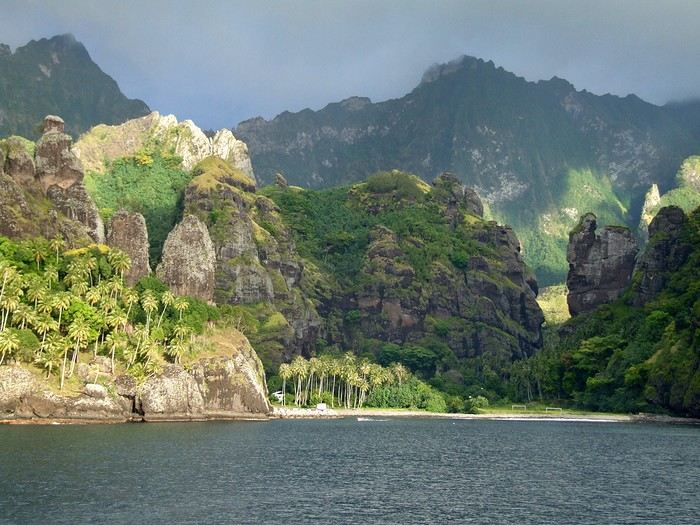 Idyllic landscape of a dream island, but difficult to access: the Bay of Virgins in Fatu Hiva, Marquesas Islands
Among the values conveyed by literature, tourism, and advertising is the quest for “elsewhere,” for a change of scenery, in the truest sense of the word—that is, the need to leave one’s country. This need for otherness, for difference, is projected onto dreamlike, idealized, even mythicized places. In our imaginary world, the island is often that place.
Yet we forget that islands have also been ideal prisons. The examples are numerous: Elba and Saint Helena, Alcatraz and Poulo Condor, If and Yeu, the Devil’s Islands and Leros. The latter, located in Greece in the Dodecanese, hosted a sinister forced labor camp during the colonels’ dictatorship as well as a psychiatric hospital. Despite the beauty of its bay, tourism has remained marginal there due to its bad reputation, unlike the neighboring island of Patmos.
I’d like to share a selection of about a dozen islands from across the world’s seas and oceans. For dreaming...
°°°°°°°°°°°°°°°
SANTORINI
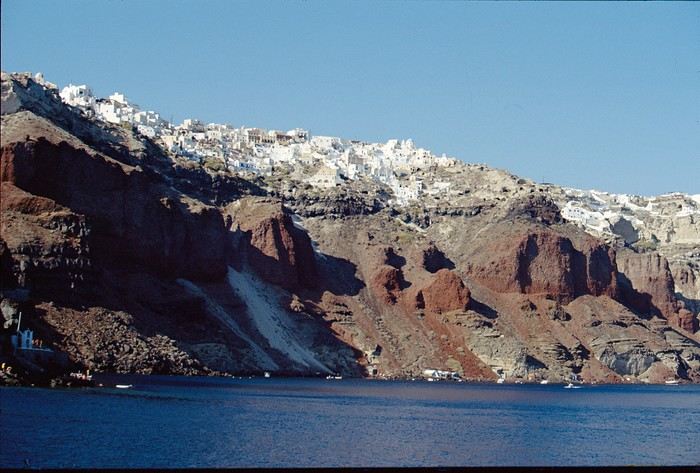
July 27, 1967
At dawn, the ferry from Agios Nikolaos (Crete) enters the immense caldera of Santorini. From the ship’s deck, Rainer, my travel companion, and I are left in awe by the sight of these towering, multicolored cliffs looming over us. We disembark and begin the steep climb on foot via the winding mule path up to the village of Fira, the capital perched above the cliff. Though it’s still very early, we head to the youth hostel. There wasn’t a soul in the alleys that morning—or rather, there were only cats! I have a fond memory of that encounter with Santorini: a sensory shock, a breathtaking volcanic site, a harmony of blue, ochre-red, and white. A welcoming island, as it was traditional to welcome the xénou, an island that hadn’t yet fully recovered from the terrible 1956 earthquake, a Cycladic architectural marvel where local life was still preserved.
It’s easy to see why, in antiquity, the island was named Kallisté (καλλίστη), “the most beautiful,” as it’s nearly impossible to resist gazing at this landscape shaped by tectonic forces. Indeed, a massive volcanic cataclysm—the Minoan eruption—shaped this scenery in the 17th century BCE, creating a caldera that was quickly filled by the sea. The enormous tsunamis that followed reached Crete, leading to the disappearance of the Minoan civilization.
A cliffside path along the caldera leads us to the peaceful village of Oia, at the northern tip of the island. Blue-domed churches and flower-filled villages with whitewashed houses line the way. This walk is a continuous marvel, offering splendid views of the caldera and the neighboring islands formed by the breakup of the ancient volcano (Thirissa, Nea Kameni). Oia is a large, picturesque village, like Fira perched on the cliff’s edge, which was severely damaged by the 1956 earthquake, and its scars are still visible. Its cave-like houses with vaulted roofs haven’t yet been turned into luxury hotels or shops. Absolute tranquility reigns here.
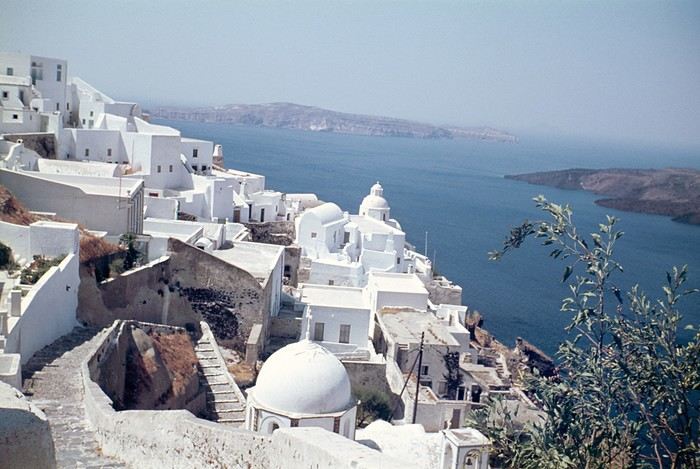 Oia in 1967—a peaceful village overlooking the caldera. But where are the pools and trendy bars?
A lush countryside covered in olive trees and vineyards welcomes us for a pleasant hike, interrupted by the kindness of a friendly islander who gives us a lift in his truck for a few kilometers. He’s off to harvest his tomatoes, which he grows at the foot of Pyrgos Hill. The delicious little cherry tomato of Santorini earned an EU Protected Designation of Origin (PDO) in 2013. We climb up to the village of Pyrgos, perched on a hill and dominated by the elegant bell tower of its church. Finally, we reach the black sand beach of Kamari on the island’s eastern coast to enjoy a swim.
{...} To be continued
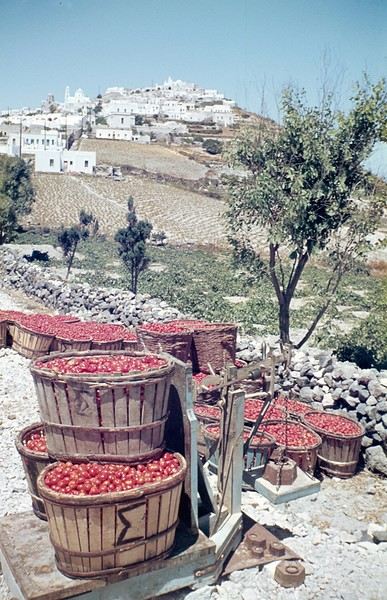

°°°°°°°°°°°°°°°°°
RAIVAVAE (French Polynesia)
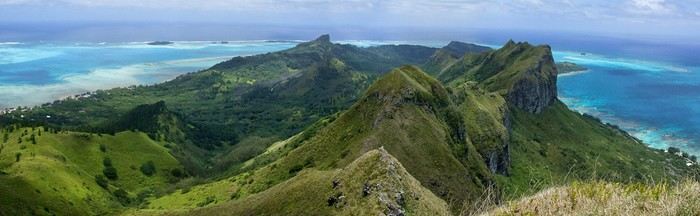
November 15, 2007
Éléonore from Pension Tama welcomes us with traditional flower leis, as if she’d been waiting for old friends she hadn’t seen in ages. The small airport terminal is lively, the atmosphere warm—people hugging, rejoicing in reunions, all under kilos of flowers. Then, just as quickly, the place empties until the next flight... in a few days.
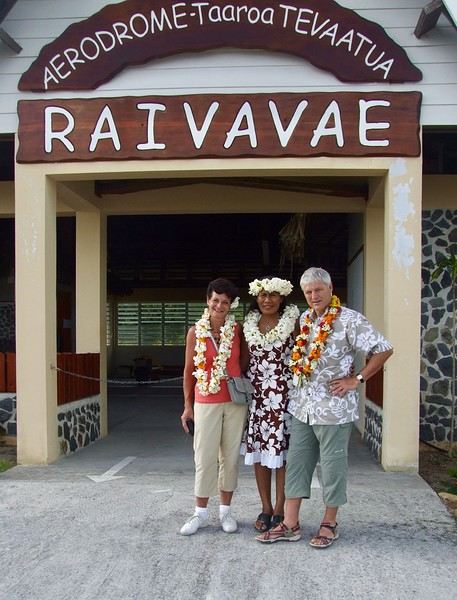
In the Austral Islands, a ninety-minute flight from Tahiti, Raivavae is a world away from the frenetic pace of Papeete or the tourist crowds of the Leeward Islands. The true paradise of the South Seas can still be savored here—it’s a bit like Bora Bora half a century ago. Our first feeling upon arriving on this island is wonder, with smiles that could melt even the gloomiest among us, landscapes so stunning they take your breath away, and above all, a sense of disorientation and fulfillment. Picture a mountainous island, about ten kilometers by three and a half, encircled by a coral reef and wild motu, cradling a lagoon with shades of blue that would make Bora Bora green with envy.
The roughly one thousand inhabitants of Raivavae are spread across four villages around the island. Children are everywhere, as is typical in Polynesia, and they greet you with open, genuine smiles. Here, ancestral values have survived progress. The predominantly Protestant population is very devout, as evidenced by the several temples built across the island. Religious fervor sets the rhythm of daily life. Sundays are reserved for worship and Sunday school (catechism). Work is forbidden on that day, and tourist activities are suspended. These rules are strict and respected.
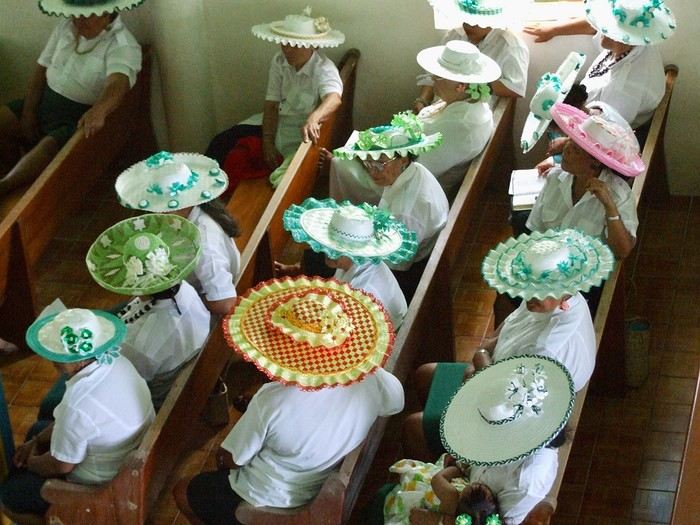 Hat contest for the worship celebration
Yet a sense of resignation is ever-present. The people of Raivavae know they are—and will remain—isolated. Despite the construction of an airstrip in 2004 and a few weekly flights to Tahiti and its nearest neighbor, Tubuai (200 km away), the island remains on the fringes of the world. One painful aspect is the separation of children from their parents when they leave for middle school in Tubuai starting in fifth grade. Television brings daily images of a world the islanders will likely never know, but one they often aspire to.
We are privileged. We have the pristine white-sand beaches of the motu and some of the most beautiful bays in Polynesia all to ourselves. The jewel in the crown, the island’s emblematic spot, is the “motu-pool,” about twenty minutes by boat. A natural, exquisite basin with crystal-clear water, gradients of blue, and white sand. And best of all, there’s almost no one there. In fact, lounging on the beach is frowned upon, especially for young women. Religion looks very unfavorably on sunbathing and lazing around. And yet, everything here leans toward that philosophy of life.
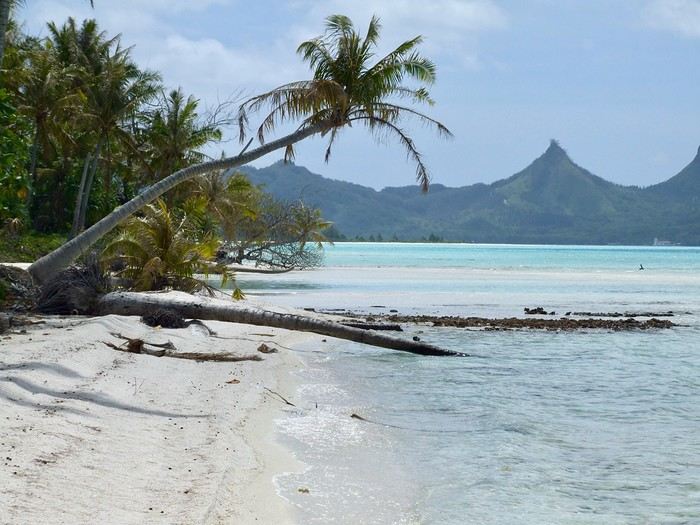
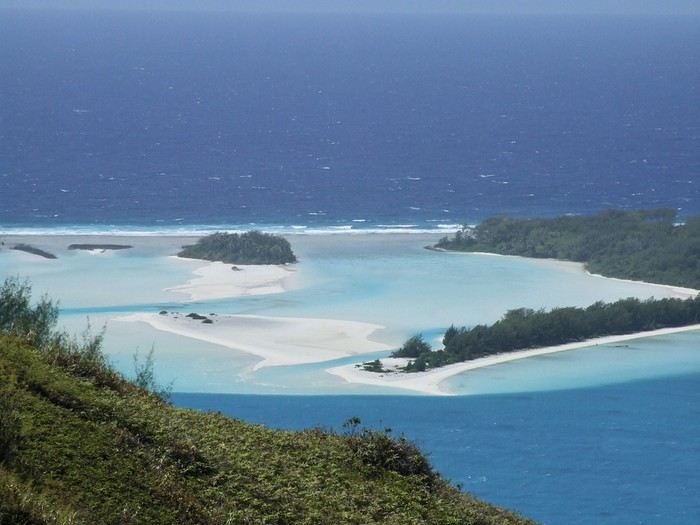 The "motu-pool"
{...} To be continued
Who among us hasn’t dreamed of having a ticket to Tahiti, Bora Bora, or the Marquesas in their pocket—preferably a one-way ticket to “paradise”?
Idyllic landscape of a dream island, but difficult to access: the Bay of Virgins in Fatu Hiva, Marquesas IslandsAmong the values conveyed by literature, tourism, and advertising is the quest for “elsewhere,” for a change of scenery, in the truest sense of the word—that is, the need to leave one’s country. This need for otherness, for difference, is projected onto dreamlike, idealized, even mythicized places. In our imaginary world, the island is often that place.
Yet we forget that islands have also been ideal prisons. The examples are numerous: Elba and Saint Helena, Alcatraz and Poulo Condor, If and Yeu, the Devil’s Islands and Leros. The latter, located in Greece in the Dodecanese, hosted a sinister forced labor camp during the colonels’ dictatorship as well as a psychiatric hospital. Despite the beauty of its bay, tourism has remained marginal there due to its bad reputation, unlike the neighboring island of Patmos.
I’d like to share a selection of about a dozen islands from across the world’s seas and oceans. For dreaming...
°°°°°°°°°°°°°°°
SANTORINI
July 27, 1967
At dawn, the ferry from Agios Nikolaos (Crete) enters the immense caldera of Santorini. From the ship’s deck, Rainer, my travel companion, and I are left in awe by the sight of these towering, multicolored cliffs looming over us. We disembark and begin the steep climb on foot via the winding mule path up to the village of Fira, the capital perched above the cliff. Though it’s still very early, we head to the youth hostel. There wasn’t a soul in the alleys that morning—or rather, there were only cats! I have a fond memory of that encounter with Santorini: a sensory shock, a breathtaking volcanic site, a harmony of blue, ochre-red, and white. A welcoming island, as it was traditional to welcome the xénou, an island that hadn’t yet fully recovered from the terrible 1956 earthquake, a Cycladic architectural marvel where local life was still preserved.
It’s easy to see why, in antiquity, the island was named Kallisté (καλλίστη), “the most beautiful,” as it’s nearly impossible to resist gazing at this landscape shaped by tectonic forces. Indeed, a massive volcanic cataclysm—the Minoan eruption—shaped this scenery in the 17th century BCE, creating a caldera that was quickly filled by the sea. The enormous tsunamis that followed reached Crete, leading to the disappearance of the Minoan civilization.
A cliffside path along the caldera leads us to the peaceful village of Oia, at the northern tip of the island. Blue-domed churches and flower-filled villages with whitewashed houses line the way. This walk is a continuous marvel, offering splendid views of the caldera and the neighboring islands formed by the breakup of the ancient volcano (Thirissa, Nea Kameni). Oia is a large, picturesque village, like Fira perched on the cliff’s edge, which was severely damaged by the 1956 earthquake, and its scars are still visible. Its cave-like houses with vaulted roofs haven’t yet been turned into luxury hotels or shops. Absolute tranquility reigns here.
Oia in 1967—a peaceful village overlooking the caldera. But where are the pools and trendy bars?A lush countryside covered in olive trees and vineyards welcomes us for a pleasant hike, interrupted by the kindness of a friendly islander who gives us a lift in his truck for a few kilometers. He’s off to harvest his tomatoes, which he grows at the foot of Pyrgos Hill. The delicious little cherry tomato of Santorini earned an EU Protected Designation of Origin (PDO) in 2013. We climb up to the village of Pyrgos, perched on a hill and dominated by the elegant bell tower of its church. Finally, we reach the black sand beach of Kamari on the island’s eastern coast to enjoy a swim.
{...} To be continued
°°°°°°°°°°°°°°°°°
RAIVAVAE (French Polynesia)
November 15, 2007
Éléonore from Pension Tama welcomes us with traditional flower leis, as if she’d been waiting for old friends she hadn’t seen in ages. The small airport terminal is lively, the atmosphere warm—people hugging, rejoicing in reunions, all under kilos of flowers. Then, just as quickly, the place empties until the next flight... in a few days.
In the Austral Islands, a ninety-minute flight from Tahiti, Raivavae is a world away from the frenetic pace of Papeete or the tourist crowds of the Leeward Islands. The true paradise of the South Seas can still be savored here—it’s a bit like Bora Bora half a century ago. Our first feeling upon arriving on this island is wonder, with smiles that could melt even the gloomiest among us, landscapes so stunning they take your breath away, and above all, a sense of disorientation and fulfillment. Picture a mountainous island, about ten kilometers by three and a half, encircled by a coral reef and wild motu, cradling a lagoon with shades of blue that would make Bora Bora green with envy.
The roughly one thousand inhabitants of Raivavae are spread across four villages around the island. Children are everywhere, as is typical in Polynesia, and they greet you with open, genuine smiles. Here, ancestral values have survived progress. The predominantly Protestant population is very devout, as evidenced by the several temples built across the island. Religious fervor sets the rhythm of daily life. Sundays are reserved for worship and Sunday school (catechism). Work is forbidden on that day, and tourist activities are suspended. These rules are strict and respected.
Hat contest for the worship celebrationYet a sense of resignation is ever-present. The people of Raivavae know they are—and will remain—isolated. Despite the construction of an airstrip in 2004 and a few weekly flights to Tahiti and its nearest neighbor, Tubuai (200 km away), the island remains on the fringes of the world. One painful aspect is the separation of children from their parents when they leave for middle school in Tubuai starting in fifth grade. Television brings daily images of a world the islanders will likely never know, but one they often aspire to.
We are privileged. We have the pristine white-sand beaches of the motu and some of the most beautiful bays in Polynesia all to ourselves. The jewel in the crown, the island’s emblematic spot, is the “motu-pool,” about twenty minutes by boat. A natural, exquisite basin with crystal-clear water, gradients of blue, and white sand. And best of all, there’s almost no one there. In fact, lounging on the beach is frowned upon, especially for young women. Religion looks very unfavorably on sunbathing and lazing around. And yet, everything here leans toward that philosophy of life.
The "motu-pool"{...} To be continued
Formalités d'embarquement Qatar Airways avec un bébé English translation pending
Bonjour
Je compte voyager avec Qatar Airways à l'Asie de sud-est ( vol multi destination ALG-DPS, KUL-ALG) accompagné de ma femme et de ma petite fille.
Au vol de retour, ma petite fille aura 2 ans et quelques jours, raison pour laquelle je voudrais me renseigner sur la possibilité de réserver un billet pour bébé de moins de 2 ans pour tous les vols et sur la possibilité ( ou la priorité) d'avoir un siège pour la petite en cas de disponibilité. Sinon vous pouvez me partager vos expériences et astuces en compagnie d'enfant de deux ans. Merci d'avance
Je compte voyager avec Qatar Airways à l'Asie de sud-est ( vol multi destination ALG-DPS, KUL-ALG) accompagné de ma femme et de ma petite fille.
Au vol de retour, ma petite fille aura 2 ans et quelques jours, raison pour laquelle je voudrais me renseigner sur la possibilité de réserver un billet pour bébé de moins de 2 ans pour tous les vols et sur la possibilité ( ou la priorité) d'avoir un siège pour la petite en cas de disponibilité. Sinon vous pouvez me partager vos expériences et astuces en compagnie d'enfant de deux ans. Merci d'avance
Programme cohérent Péloponnèse et iles ioniennes sur 27 jours? English translation pending
Bonjour à tous,
Mon programme est il cohérent selon vous? 27 jours sur place, la trame serait:
Athene Hermioni Hermioni Hermioni Hydra Hydra Hydra Monemassia Monemvassia Elafonissos Elafonissos Elafonnissos le magne le magne le magne le magne le magne le magne Itahque (via Kyllini) Itahque Itahque Ithaque Cephalonie Cephalonie Cephalonie Cephalonie Cephalonie Cephalonie Leucade Leucade Leucade Leucade Leucade Leucade Athene Athene: visite, mont licabette, Monastriri Square...
J'emmène de la famille et un ami, ils sont plus plages, petites ballades, paysages naturels que visites culturelles. location de voiture en arrivant à Athène pour tout le séjour.
Selon vous c'est équilibré?
Athene Hermioni Hermioni Hermioni Hydra Hydra Hydra Monemassia Monemvassia Elafonissos Elafonissos Elafonnissos le magne le magne le magne le magne le magne le magne Itahque (via Kyllini) Itahque Itahque Ithaque Cephalonie Cephalonie Cephalonie Cephalonie Cephalonie Cephalonie Leucade Leucade Leucade Leucade Leucade Leucade Athene Athene: visite, mont licabette, Monastriri Square...
J'emmène de la famille et un ami, ils sont plus plages, petites ballades, paysages naturels que visites culturelles. location de voiture en arrivant à Athène pour tout le séjour.
Selon vous c'est équilibré?
Ouverture des frontières aux États-Unis pour les Européens English translation pending
Bonjour ma famille et moi même devont partir le 09 juillet pour faire un trip en Californie pour 3 semaines le souci je n’arrive pas à voir des informations sur l’ouverture des frontières américaines pour nous les européens. Quelqu’un aurait il une réponse à me donner . Merci
Projet de voyage à Bali, itinéraire et hôtels English translation pending
Bonjour,
Je prépare un voyage en été 2021 à Bali.
J'ai repéré des hotels, et imaginé un itinéraire. J'ai l'habitude d'organiser des voyages en Europe en m'occupant de réserver vol, hotel, location de vehicules, excursions etc moi meme. Cela me pose plus de problèmes pour des destinations plus lointaines, d'autant plus lorsqu'on voyage avec un enfant. J'aurai aimé avoir vos avis 7 commentaires sur l'itinéraire :
Arrivée Bali Transfert à Ubud et 5 nuits sur place. Location de voiture avec chauffeur ou guide pour excursions depuis Ubud Ensuite, deux nuits à Munduk Je pensais aller ensuite 3 nuits sur Gili Air avant de redescendre au sud de Lombok pour une fin de séjour plus tranquille à Lombok Kuta (4 nuits) Retour sur Bali, pour une nuit avant retour.
Est ce que cet itinéraire vous parait possible ? J'ai prévu de faire pas mal de chose depuis Ubud qui est central pour ne pas multiplier les hébergements.
Merci d'avance
Je prépare un voyage en été 2021 à Bali.
J'ai repéré des hotels, et imaginé un itinéraire. J'ai l'habitude d'organiser des voyages en Europe en m'occupant de réserver vol, hotel, location de vehicules, excursions etc moi meme. Cela me pose plus de problèmes pour des destinations plus lointaines, d'autant plus lorsqu'on voyage avec un enfant. J'aurai aimé avoir vos avis 7 commentaires sur l'itinéraire :
Arrivée Bali Transfert à Ubud et 5 nuits sur place. Location de voiture avec chauffeur ou guide pour excursions depuis Ubud Ensuite, deux nuits à Munduk Je pensais aller ensuite 3 nuits sur Gili Air avant de redescendre au sud de Lombok pour une fin de séjour plus tranquille à Lombok Kuta (4 nuits) Retour sur Bali, pour une nuit avant retour.
Est ce que cet itinéraire vous parait possible ? J'ai prévu de faire pas mal de chose depuis Ubud qui est central pour ne pas multiplier les hébergements.
Merci d'avance
Séjour à Ayamonte, excursions et sites à visiter (Andalousie) English translation pending
Bonjour a tous et toutes
Tout d'abord meilleurs voeux pour cette nouvelle année 2020 !
Nous allons avoir l'opportunité avec le travail de mon épouse de partir en juin à Ayamonte.
J'aimerai quelques informations sur cette destination pour ceux qui connaissent cet endroit.
1/ Quels sont les sites a ne pas manquer dans le secteur sachant que les grandes villes connues sont éloignées ? sachant que nous sommes aussi bien amateur d'architecture que de paysages sauvages.
2/ En juin, peut on se baigner dans l'océan ou est il encore frais ?
3/ est ce qu'il y a des excursions permettant d'aller voir les dauphins en liberté dans le coin ?
3/ Est ce qu'il y a de bonnes affaires à faire dans le coin (outlets, magasins détaxés ou autres ?
Merci d'avance 🙂
Tout d'abord meilleurs voeux pour cette nouvelle année 2020 !
Nous allons avoir l'opportunité avec le travail de mon épouse de partir en juin à Ayamonte.
J'aimerai quelques informations sur cette destination pour ceux qui connaissent cet endroit.
1/ Quels sont les sites a ne pas manquer dans le secteur sachant que les grandes villes connues sont éloignées ? sachant que nous sommes aussi bien amateur d'architecture que de paysages sauvages.
2/ En juin, peut on se baigner dans l'océan ou est il encore frais ?
3/ est ce qu'il y a des excursions permettant d'aller voir les dauphins en liberté dans le coin ?
3/ Est ce qu'il y a de bonnes affaires à faire dans le coin (outlets, magasins détaxés ou autres ?
Merci d'avance 🙂
Itinéraire d'un mois avec 3 enfants de 7, 9 et 13 ans au Nicaragua en août English translation pending
Bonjour à tous.
Nous sommes une famille avec 3 enfants de 7, 9 et 13 ans.
Nous venons de prendre nos billets pour le Nicaragua, départ le 30 juillet de Bordeaux, retour le 25 aout. ( via Montreal et Houston)
Je commence à lire vos messages et le site de pveyrat pour préparer notre itinéraire.
Nous avons, grâce à ce forum, fait de superbes voyagse en famille par nos propres moyens ( Indonésie, Maroc, ex Yougoslavie, Mexique, crête USA...) en dehors des sentiers touristiques et nous sommes également allés au Pérou et en Bolivie avant d'avoir nos enfants.
Nous aimons les voyages avec une temporalité lente, des étapes de plusieurs jours afin de profiter des lieux et des gens.
Pour le Nicaragua, nous allons privilégier pour des questions de climats et de transports la cote pacifique. Idéalement, 4 a 6 étapes maxi de 3 à 5 jours à localiser (dans le désordre) aux alentours de Granada, Leon, Ometepe, lagune d'apoyo, cosiguina, san juan del sur ( si pas de trop de monde à cette époque..car le surf, les plages bondées et la music à gogo..pas trop pour nous ;-), El ostional, voir pourquoi pas envisager les iles solentiname ou le Rio San Juan ?
D'ors et déjà, je vous sollicite pour les lieux d'étapes qui pourraient permettre de graviter facilement sur plusieurs sites.
Également, je suis preneur des ballades/ randonnées accessibles avec des enfants, notamment pour les volcans.
Nous pensons prendre le bus, mais à 5, la voiture avec chauffeur peut-t-elle être intéressante ?
Une dernière question, il y a t'il un intérêt de passer au Honduras ou au costa rica pour qq jours ( site proche de la frontière ? )
merci d'avance de vos premiers conseils.
Sébastien
Nous sommes une famille avec 3 enfants de 7, 9 et 13 ans.
Nous venons de prendre nos billets pour le Nicaragua, départ le 30 juillet de Bordeaux, retour le 25 aout. ( via Montreal et Houston)
Je commence à lire vos messages et le site de pveyrat pour préparer notre itinéraire.
Nous avons, grâce à ce forum, fait de superbes voyagse en famille par nos propres moyens ( Indonésie, Maroc, ex Yougoslavie, Mexique, crête USA...) en dehors des sentiers touristiques et nous sommes également allés au Pérou et en Bolivie avant d'avoir nos enfants.
Nous aimons les voyages avec une temporalité lente, des étapes de plusieurs jours afin de profiter des lieux et des gens.
Pour le Nicaragua, nous allons privilégier pour des questions de climats et de transports la cote pacifique. Idéalement, 4 a 6 étapes maxi de 3 à 5 jours à localiser (dans le désordre) aux alentours de Granada, Leon, Ometepe, lagune d'apoyo, cosiguina, san juan del sur ( si pas de trop de monde à cette époque..car le surf, les plages bondées et la music à gogo..pas trop pour nous ;-), El ostional, voir pourquoi pas envisager les iles solentiname ou le Rio San Juan ?
D'ors et déjà, je vous sollicite pour les lieux d'étapes qui pourraient permettre de graviter facilement sur plusieurs sites.
Également, je suis preneur des ballades/ randonnées accessibles avec des enfants, notamment pour les volcans.
Nous pensons prendre le bus, mais à 5, la voiture avec chauffeur peut-t-elle être intéressante ?
Une dernière question, il y a t'il un intérêt de passer au Honduras ou au costa rica pour qq jours ( site proche de la frontière ? )
merci d'avance de vos premiers conseils.
Sébastien
Itinéraire Lyon - Slovénie 12 jours en voiture English translation pending
Bonjour à tous,
Nous sommes actuellement entrain de préparer notre périple pour la Slovénie pour l'été 2020 (plutôt aout).
Nous aimerions avoir votre avis sur l'itinéraire que nous avons composé, au départ de Lyon, et en voiture. Ce qu'il faut savoir, c'est que nous partons avec un bébé qui aura à ce moment là 18 mois. On a donc décidé de se concentrer sur la partie ouest de la Slovénie, et de rester plusieurs nuits dans les 3 grands endroits ciblés (Piran, Ljubljana, Bled) histoire de ne pas trop fatiguer notre enfant.
02/08/2020 J-1 Départ Lyon > Verone 03/08/2020 J-2 Verone 04/08/2020 J-3 Verone 05/08/2020 J-4 Verone > Départ pour Piran / Izola / Potorec 06/08/2020 J-5 Piran / Izola / Potorec 07/08/2020 J-6 Piran / Izola / Potorec > Départ pour Ljubljana 08/08/2020 J-7 Ljubljana 09/08/2020 J-8 Ljubljana 10/08/2020 J-9 Ljubljana > Départ pour Bled 11/08/2020 J-10 Bled / Bohinj 12/08/2020 J-11 Bled / Bohinj > Départ pour Bergame (ou ailleurs, juste pour une nuit) 13/08/2020 J-12 Bergame > Départ pour Lyon
Nous avons pour le moment omis volontairement tout ce qui est grottes, gorges, car a première vue, le terrain n'est pas forcément praticable en poussette.
Nous attendons vos avis avec impatience. Tant sur l'itinéraire que sur les durées de séjour dans chaque coin. Si vous avez des conseils pour séjourner selon les endroits, on prend aussi (j'ai cru comprendre que c'était compliqué à Piran par exemple ?).
Merci :)
Nous sommes actuellement entrain de préparer notre périple pour la Slovénie pour l'été 2020 (plutôt aout).
Nous aimerions avoir votre avis sur l'itinéraire que nous avons composé, au départ de Lyon, et en voiture. Ce qu'il faut savoir, c'est que nous partons avec un bébé qui aura à ce moment là 18 mois. On a donc décidé de se concentrer sur la partie ouest de la Slovénie, et de rester plusieurs nuits dans les 3 grands endroits ciblés (Piran, Ljubljana, Bled) histoire de ne pas trop fatiguer notre enfant.
02/08/2020 J-1 Départ Lyon > Verone 03/08/2020 J-2 Verone 04/08/2020 J-3 Verone 05/08/2020 J-4 Verone > Départ pour Piran / Izola / Potorec 06/08/2020 J-5 Piran / Izola / Potorec 07/08/2020 J-6 Piran / Izola / Potorec > Départ pour Ljubljana 08/08/2020 J-7 Ljubljana 09/08/2020 J-8 Ljubljana 10/08/2020 J-9 Ljubljana > Départ pour Bled 11/08/2020 J-10 Bled / Bohinj 12/08/2020 J-11 Bled / Bohinj > Départ pour Bergame (ou ailleurs, juste pour une nuit) 13/08/2020 J-12 Bergame > Départ pour Lyon
Nous avons pour le moment omis volontairement tout ce qui est grottes, gorges, car a première vue, le terrain n'est pas forcément praticable en poussette.
Nous attendons vos avis avec impatience. Tant sur l'itinéraire que sur les durées de séjour dans chaque coin. Si vous avez des conseils pour séjourner selon les endroits, on prend aussi (j'ai cru comprendre que c'était compliqué à Piran par exemple ?).
Merci :)
Visiter la Turquie en camping-car English translation pending
Je remarque que les spécialistes organisant des circuits en camping-car ne proposent plus la destination Turquie dans leurs catalogues.Quelle peut en être la raison : sécurité incertaine ou autres ??
Certains ont-ils visite ce pays récemment en camping-car ?
Quelles sont vos observations ?
Merci de vos informations .