Results for "réchaud"
8006 results found.
Salar de Uyuni et amazonie (Bolivie) English translation pending
Buenas Senoritas y Senores.
Actuellement au Perou a arequipa....je souhaiterai aller en Bolivie pour voir les fameux salar des uyuni....je voudrais savoir comment y aller et combien de tps y aller et si possible le prix de l excurssion...ET surtout est ce la meilleure periode pour aller la bas?Por favor.
D autre part je ne sais pas ou aller en amazonie:l amazonie pres de Cuzco(quillabamba?)..Puertomaldonado?.Rurrenabaque?..ou une autre solution?
Merci d avance.
Michel
Actuellement au Perou a arequipa....je souhaiterai aller en Bolivie pour voir les fameux salar des uyuni....je voudrais savoir comment y aller et combien de tps y aller et si possible le prix de l excurssion...ET surtout est ce la meilleure periode pour aller la bas?Por favor.
D autre part je ne sais pas ou aller en amazonie:l amazonie pres de Cuzco(quillabamba?)..Puertomaldonado?.Rurrenabaque?..ou une autre solution?
Merci d avance.
Michel
Billet Sri Lanka et bons plans English translation pending
C'est bizarre ou tout le monde est en vacances ou tres peu de gens sont allés au sri lanka car je n'ai eu qu'un mess !
Donc je recherche des infos sur le sri lanka pour y partir en fev. 2005 prix approx. du billet ce qu'on doit y voir et surtout ce que l'on ne doit pas aller voir car je n'aime pas perdre mon temps en vacances !
Tous les tuyaux sont les bienvenus, merci à tous !
Donc je recherche des infos sur le sri lanka pour y partir en fev. 2005 prix approx. du billet ce qu'on doit y voir et surtout ce que l'on ne doit pas aller voir car je n'aime pas perdre mon temps en vacances !
Tous les tuyaux sont les bienvenus, merci à tous !
Climat à Holguin en février? (Cuba) English translation pending
Cuba Holgin, 1 ère semaine de février. Ça a l'air de quoi comme température?
Hôtel tout inclus à Matzatlan? English translation pending
😉 BONJOUR
JE VOUDRAIS VOYAGER EN JANVIER 2005 JE VEUX ALLER À MAZATLAN AU MEXIQUE, CONNAISSEZ-VOUS DES HÔTELS EN TOUT INCLUS, ET ME DÉCRIRE LES EXCURSIONS. LES PLAGES SONT-ELLES BELLES. MERCI POUR VOS RÉPONSES.
JE VOUDRAIS VOYAGER EN JANVIER 2005 JE VEUX ALLER À MAZATLAN AU MEXIQUE, CONNAISSEZ-VOUS DES HÔTELS EN TOUT INCLUS, ET ME DÉCRIRE LES EXCURSIONS. LES PLAGES SONT-ELLES BELLES. MERCI POUR VOS RÉPONSES.
Retrouver ses racines..... English translation pending
Après une longue et dure année de travail scolaire quoi de plus merveilleux et agrèable que de retourner dans son pays pour retrouver sa famille, pour frôler ces sols qui m'ont accueillie il y a 16 ans........oui dans un mois je retourne au Portugal et rien que d'y penser j'en suis toute retournée!! Ba oui attendre un an pour pouvoir embrasser de nouveau ma grand mère sur sa joue ridée mais qui dégage un parfum de tendresse et de douceur🙂 Pouvoir de nouveau tout partager avec mes cousines, pouvoir taquiner mes cousins, parler en faisant de belles ballades avec mes tantes. Demander quelques recettes à ma grand mère lui demander conseil sur tout ce qui fait ma vie...........
Dans un mois je serai sous le soleil Portugais qui réchauffera mon coeur. Ce que j'apprecie au Portugal c'est de me mettre pieds nus pour pouvoir sentir ce sol qui n'ai pas comparable aux autres car celui là c'est le mien........celui ou je suis venue au monde............quand je sens ce sol chaud sous mes pieds je ressens alors des émotions indéscriptibles, et puis quand je respire cette air..........rien à voir avec celui de lyon!!
Entrer dans les magasins et entendre des "olà!" "tudu bem?" au lieu de ces habituels "bonjour"!!! Retrouver de nouveau à la télé des "tèlènovelas" bresiliennes qui dure si longtemps que d'une année sur l'autre je peux suivre et comprendre l'histoire de la série!!!!
Profiter de nouveau de ces plats dont seuls les portugais savent les secrets pour bien les reussirs!!!!
Voilà, c'était un petit moment de bonheur que je voulais partager avec vous car je sais que vous comprendrez l'émotion que je veux vous décrire..........vous tous qui avez des âmes de voyageurs.......merci aussi de non seulement aimer les voyages mais aussi de les apprecier et les vivre intensemment🙂
Je vous raconterai tout dès mon retour et si vous êtes sages je vous ferai part de quelques recettes délivrées par ma grand mère!!!!
Bisous et passez une excellente journée!😉
Dans un mois je serai sous le soleil Portugais qui réchauffera mon coeur. Ce que j'apprecie au Portugal c'est de me mettre pieds nus pour pouvoir sentir ce sol qui n'ai pas comparable aux autres car celui là c'est le mien........celui ou je suis venue au monde............quand je sens ce sol chaud sous mes pieds je ressens alors des émotions indéscriptibles, et puis quand je respire cette air..........rien à voir avec celui de lyon!!
Entrer dans les magasins et entendre des "olà!" "tudu bem?" au lieu de ces habituels "bonjour"!!! Retrouver de nouveau à la télé des "tèlènovelas" bresiliennes qui dure si longtemps que d'une année sur l'autre je peux suivre et comprendre l'histoire de la série!!!!
Profiter de nouveau de ces plats dont seuls les portugais savent les secrets pour bien les reussirs!!!!
Voilà, c'était un petit moment de bonheur que je voulais partager avec vous car je sais que vous comprendrez l'émotion que je veux vous décrire..........vous tous qui avez des âmes de voyageurs.......merci aussi de non seulement aimer les voyages mais aussi de les apprecier et les vivre intensemment🙂
Je vous raconterai tout dès mon retour et si vous êtes sages je vous ferai part de quelques recettes délivrées par ma grand mère!!!!
Bisous et passez une excellente journée!😉
Riu Turquesa English translation pending
Bonjour à tous,
😊Nous partons bientôt pour Varadero, au Riu Turquesa. Je me demandais si quelqu'un avait des commentaires sur cette hotel. Et si c'était bien pour les enfants ( 3 ans et 5 ans). Merci
Mamilauve
😊Nous partons bientôt pour Varadero, au Riu Turquesa. Je me demandais si quelqu'un avait des commentaires sur cette hotel. Et si c'était bien pour les enfants ( 3 ans et 5 ans). Merci
Mamilauve
Festival des Globe-Trotters en Avignon (84) English translation pending
Comme chaque année, ABM Avignon organise son (VIIe) Festival des Globe-Trotters. Un rendez-vous à ne pas manquer le samedi 13 mars de 11h00 à 23h00.
Details sur : http://abmavignon.free.fr/festival/cadrefest.html
Details sur : http://abmavignon.free.fr/festival/cadrefest.html
Waterworld plus qu'une realité: le Tuvalu English translation pending
Il y a pas longtemps j'ai lu que le Tuvalu a été rayé de la carte pendant 6 heures, c'est la premiere fois qu'un pays etait engloutie par les flots: est ce le debut de la montée des flots et des premieres disparitions comme le kiribati ou encore les maldives? Mais a quoi est du excatement cette montée des eaux => du a une ère de rechauffement comme il y a eu dans le passé une ère glacière? ou tous simplement on est en train de tuer notre terre par l'appat du gain et de la pollution?
Préparer mon voyage en Chine English translation pending
Salut à tous.Je part en Chine d'ici fin Février et je n'arrive pas à savoir comment préparer mon voyage (Vêtement à prévoir, alimentation conseillée); Je fais un circuit Pékin-Shangai, je souhaiterais pouvoir visiter de beaux sites.
😛Merci de me conseiller.Damien
😛Merci de me conseiller.Damien
Climat à Port El Kantaoui à la mi-mai (Tunisie) English translation pending
Quelqu'un pourrait-il me renseigner sur le climat à Port El Kantaoui à la mi-mai; on souhaiterait y aller (4 adultes et 1 enfant de 2 ans 1/2)
on souhaiterait ainsi savoir si la température y est déjà bonne, possibilité de se baigner dans la mer ? en piscine découverte ?
merci
Ambiance indienne... envoutante English translation pending
Ceux qui ne connaissent pas encore Susheela Raman je leur conseille de l'ecouter trés vite 🙂
Britano-indienne, sa musique est à la mesure de son metissage, on se retrouve entre 2 mondes où les frontières sont abolies, les 2 univers apparement contradictoires se mélent pour donner vie à des mélodies agréablement rythmées, planantes...
Planante aussi, peut etre plus "indienne", la compil Indian Loundge idéal pour nuits étoilées eclairée par quelques bougies et un brin d'encens.... rechauffe l'hiver!
Je ne m'en lasse pas je suis transportée à chaque fois...
Idées de voyage pour janvier 2004 English translation pending
cela fait 18 ans que nous voyageons, 7 avec nos enfants de 5 et 7 ans, et voila ! nous n'arrivons pas à nous décider pour notre prochaine destination.
ce devait être l'argentine, mais au départ de la Reunion ( ou nous habitons) cela fait tout de même cher..On a pensé au Sri Lanka mais avec les évènements récents, on hésite...Sinon, nous avons des vols réservés sur Johannesbourg, alors pourquoi pas retourner en Namibie (et faire découvrir Etosha et Sossusvlei à nos enfants, mais pour nous cela fera un peu réchauffé). Il y aurait aussi Bali (déja vu aussi) ou le Vietnam mais je crains que ce soit plus sage d'attendre encore un ou 2 ans que les enfants soient plus grands.
toutes les suggestions seront bienvenues, nous prévoyons de partir entre le 28 décembre et le 21 janvier environ.
ce devait être l'argentine, mais au départ de la Reunion ( ou nous habitons) cela fait tout de même cher..On a pensé au Sri Lanka mais avec les évènements récents, on hésite...Sinon, nous avons des vols réservés sur Johannesbourg, alors pourquoi pas retourner en Namibie (et faire découvrir Etosha et Sossusvlei à nos enfants, mais pour nous cela fera un peu réchauffé). Il y aurait aussi Bali (déja vu aussi) ou le Vietnam mais je crains que ce soit plus sage d'attendre encore un ou 2 ans que les enfants soient plus grands.
toutes les suggestions seront bienvenues, nous prévoyons de partir entre le 28 décembre et le 21 janvier environ.
Nouvelle Zélande et randonnée English translation pending
Bonjour à tous,
je projette de partir en Nouvelle Zélande en mars pour 3 semaines. Nous voudrions faire pas mal de randos, et déjà une question se pose : est-il facile de laisser les bagages en trop quelque part au début des randonnées, histoire de ne pas être obligé de marcher avec ses grosses chaussures de rando en ville par exemple, donc de pouvoir emmener des habits pas spécifiques à la rando?
Par ailleurs, faut il un bon sac de couchage pour le sud ou est-ce qu'un +5°C suffit?
Enfin, quelle compagnie avez vous utilisé pour voyager, et comment se passent les correspondances de 12h?
Merci d'avance
Sophie
je projette de partir en Nouvelle Zélande en mars pour 3 semaines. Nous voudrions faire pas mal de randos, et déjà une question se pose : est-il facile de laisser les bagages en trop quelque part au début des randonnées, histoire de ne pas être obligé de marcher avec ses grosses chaussures de rando en ville par exemple, donc de pouvoir emmener des habits pas spécifiques à la rando?
Par ailleurs, faut il un bon sac de couchage pour le sud ou est-ce qu'un +5°C suffit?
Enfin, quelle compagnie avez vous utilisé pour voyager, et comment se passent les correspondances de 12h?
Merci d'avance
Sophie
Hôtel le Melao? English translation pending
BONSOIR je compte partir en RD mois de decembre vos conseilles seront les bienvenues sur HOTEL LE MELAO
Trek pour l'Annapurna English translation pending
salut,
J'ai le projet de partir en trek pour l'annapurna.
Peut on faire cette expédition en autonomie,
Et est il possible de louer sur place duvet doudoune.
si oui, quell est la qualité du matos?
et aussi avez vous une idée du budget pour cette aventure ?
Merci à ceux qui voudront bien me répondre.
3 weeks in Laos, stress-free
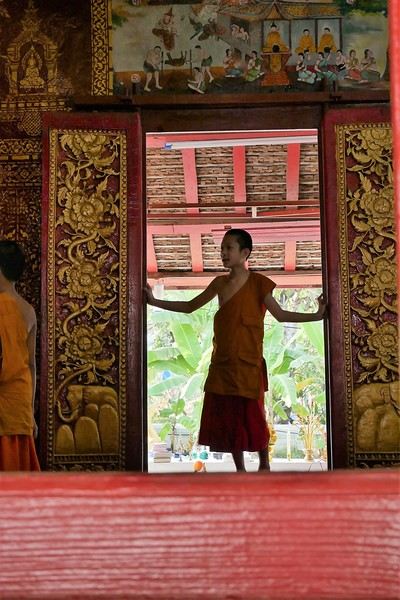 Come along, I'm taking you to this country where it's so nice to wander and slow down...
This trip was in 2023, but when I wanted to write my travel journal, VF was still closed to contributions... So, now that I've just finished my Japan travel journal here, I figured it was high time to honor this destination we came back from so enchanted. Disclaimer 1: This is a written travel journal. There’ll be text! Too much, for some! Disclaimer 2: This is an illustrated travel journal. There’ll be photos! Too many, for some!
I have to say, every time I try to discipline myself, to keep it shorter, to include fewer photos... I end up adding more. It feels like my dear Aunt Nicole, who exhausted us with her slide-show evenings in the 70s/80s, decided to take her revenge. The upside for you, readers, is that you can slip away anytime without offending Aunt Nicole. I won’t even notice!
Anyway, since I love maps, here’s one to give you an idea of where I’m taking you. As you can see, we only saw a tiny part of Laos (the areas circled in red); we only had 3 weeks for ourselves (my husband’s newly retired, I still work), and we prefer taking our time over rushing around like crazy.
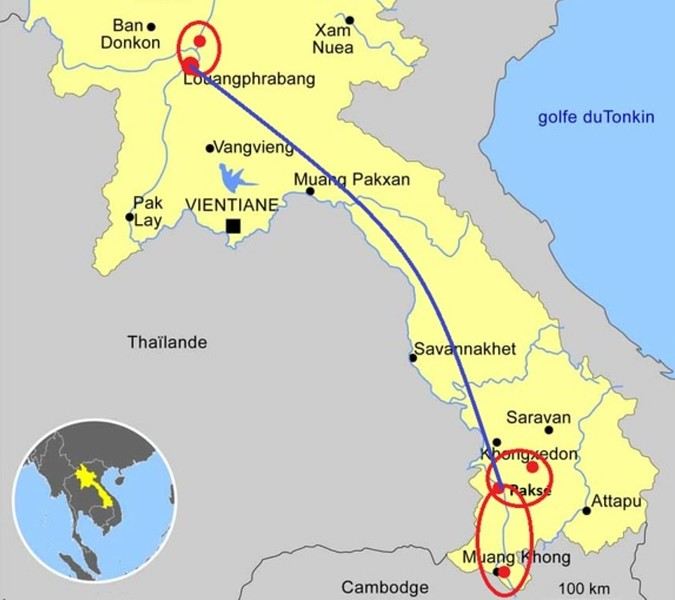
In broad strokes, it was very classic:
First, we “settled in” at Luang Prabang (8 days), because we wanted and needed to. From there, we took three days to venture a little further north—not far in kilometers, but as we know, distances aren’t just about km! Then we flew south to Paksé, letting ourselves drift down to the 4,000 Islands while stopping by the pre-Angkorian archaeological sites. We wrapped up with the Bolaven Plateau.
A few practical notes: We arrived via Bangkok, then took a Bangkok-Luang Prabang flight, having picked up our luggage in Bangkok to check it in for Luang Prabang. No issues—the Bangkok airport, which many of you know, is very well organized. We got our visas on arrival in Luang Prabang. Quick, but to be fair, we were on a “small” plane, and the big flights had arrived earlier, so we weren’t too crowded in line! At the end of our trip, we didn’t fly out of Paksé but from the nearby airport in Thailand, Ubon Ratchathani (a 2.5-hour drive from Paksé), then Bangkok and Paris. You’ll notice we skipped Vientiane to stay longer in Luang Prabang. That said, there’s now a high-speed train between Vientiane and Luang Prabang—good to know—and soon the (Chinese) train will go all the way to Bangkok and even Kuala Lumpur!
With that intro out of the way, let’s dive into the heart of the matter. To be continued: Slowing down the pace... in Luang Prabang
Crossing the Mercantour: Are there any exposed sections?
Hi there,
I’m planning to do the Mercantour crossing following the Randoxygène route in mid-July. I’m used to hiking in the mountains, but I sometimes get vertigo, for example on ridges with drops on both sides. I wanted to check if there are any T4 or T3-T4 sections and find out if there are any very exposed passages—and if so, where—so I can plan an alternative route. Can anyone give me some info on this? Thanks!
I’m planning to do the Mercantour crossing following the Randoxygène route in mid-July. I’m used to hiking in the mountains, but I sometimes get vertigo, for example on ridges with drops on both sides. I wanted to check if there are any T4 or T3-T4 sections and find out if there are any very exposed passages—and if so, where—so I can plan an alternative route. Can anyone give me some info on this? Thanks!
Prague in June: Packing and Sightseeing Tips
Hello,
We’re heading to Prague with so much excitement from June 10th to 20th. I’ve got three main questions for those who live there or have visited:
- What are your thoughts on what to pack clothing-wise? What’s the weather usually like at this time of year? We’re a bit sensitive to the cold—we live way down in southern Andalusia and are used to the *calor* 😎... Should we pack rain gear? Are we likely to get a lot of rain (which we’re dreading a little, but we couldn’t choose other dates)?
- I’ve seen there are "passes" for various attractions, museums, and sites, including one that’s valid for 10 days but costs a whopping 160 € per person—that’s an average of 16 € per day. Do you think it’s really worth it? We won’t be spending our days rushing between every indoor site; we also love wandering the streets and discovering things a bit "at random." If we do two paid visits a day, that’ll probably be the max... Can we make it worth the cost with that? Of course, we want to visit the castle and take a boat trip as a minimum. Are the sites included in these passes iconic, or are they more "minor" attractions? Does having the pass help us skip long lines?
- Finally, a question about communication: I speak French, obviously, plus Spanish and English fluently, but very little German (haven’t practiced in ages), and no Russian or Czech at all. My husband knows a few words of Russian, but it’s "Cuban" Russian—about the same level as my current German 🙂 !! Can we still get by without too much trouble? We don’t want to spend 10 days not saying a word to anyone and communicating only with gestures!!
Thanks for your valuable tips and opinions.
7 weeks and 150 years between us on a southern Morocco road trip
We arrive in the evening in Marrakesh, and a taxi arranged by our friendly Riad is waiting for us. The driver takes us to the door, where we’re briefly greeted by our hosts. The room is heated—phew—because it’s really cold on this January 17th for our arrival. Riad Alisma, where we’re staying for 2 nights. The next morning, it’s pouring rain when we wake up, but after a good breakfast, the rain has calmed down. Off we go to the medersa, which allows for a relatively sheltered visit. We’d visited this palace 15 years ago—it’s been renovated since then.
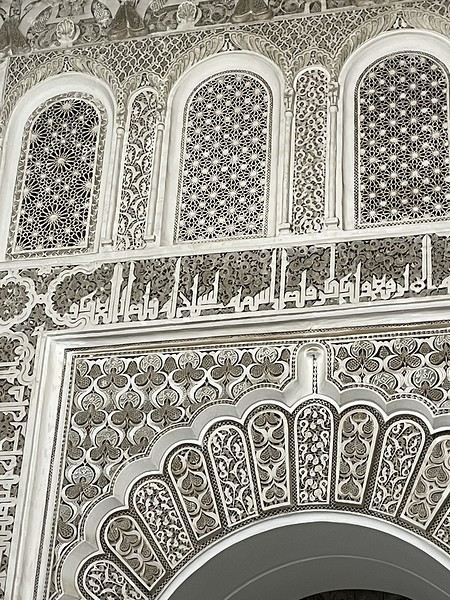
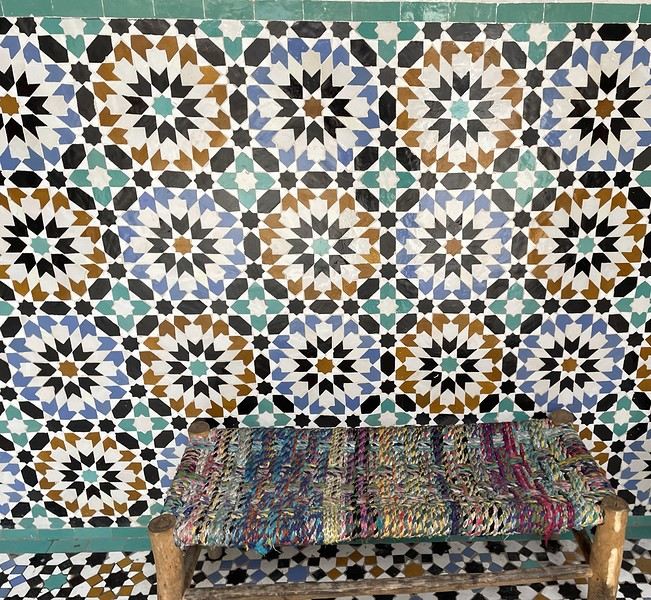
From there, without the rain, we wander aimlessly and eventually end up near the tanneries, but it’s Sunday, and there’s very little activity. Of course, we get hassled by a tout.
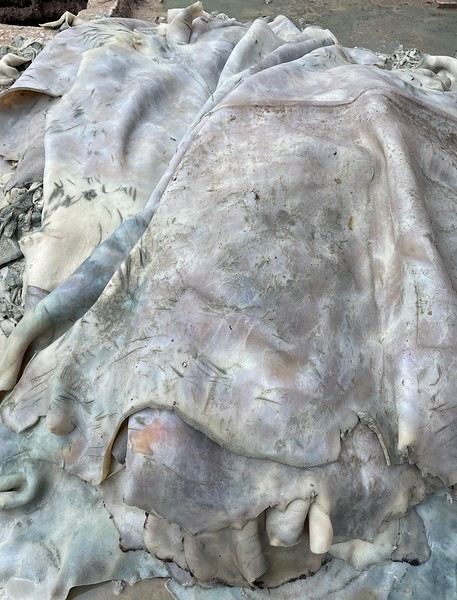
Here, the hides after being treated with lime—I love the colors.
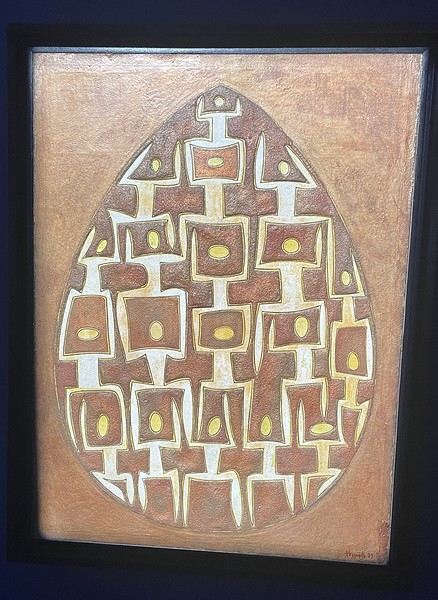
We part ways a bit annoyed. He gets a little revenge by giving us bad directions, and we end up outside the city walls. We decide to take a taxi to the new modern art museum—60 dirhams for the 5 km, which is nothing when you think about it. That tout, who we didn’t ask for anything and made it clear we weren’t buying anything, dragged us into a shop supposedly only open that day and demanded 50 dirhams for his "services"! Let’s forget that bad moment and enjoy the exhibition at the MACAL.
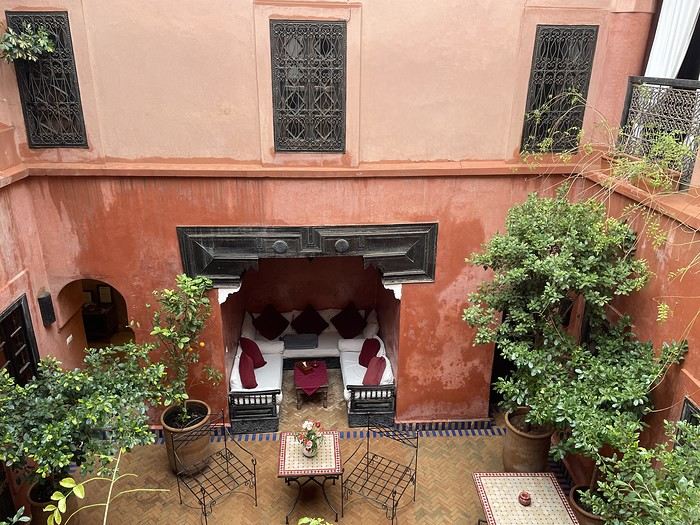
The taxi on the way back drops us off at Place des Ferblantiers, not far from our Riad. We’re a little peckish—it’s worth mentioning that at lunchtime, we only ate a plate of beans from a street vendor. So, we buy a bunch of little sweets, each more delicious than the last, at Ajar. We snack while sipping mint tea and watching life go by around us. A final visit to the Museum of Moroccan Cuisine on our way back helps us dodge a few more showers. Then it’s back to the Riad. The atmosphere in the city is heating up—it’s the AFCON final tonight. The temperatures, though? Not so much. We ordered a meal at the Riad, and it was a good call—not only was it really tasty, but the rain also picked up again. Our day in Marrakesh ends under the covers with a good book and some photo sorting. Still, we managed 10,750 steps. View of our Riad
Tomorrow, we’ll pick up our rental car from Medloc and head to Essaouira.
From there, without the rain, we wander aimlessly and eventually end up near the tanneries, but it’s Sunday, and there’s very little activity. Of course, we get hassled by a tout.
Here, the hides after being treated with lime—I love the colors.
We part ways a bit annoyed. He gets a little revenge by giving us bad directions, and we end up outside the city walls. We decide to take a taxi to the new modern art museum—60 dirhams for the 5 km, which is nothing when you think about it. That tout, who we didn’t ask for anything and made it clear we weren’t buying anything, dragged us into a shop supposedly only open that day and demanded 50 dirhams for his "services"! Let’s forget that bad moment and enjoy the exhibition at the MACAL.
The taxi on the way back drops us off at Place des Ferblantiers, not far from our Riad. We’re a little peckish—it’s worth mentioning that at lunchtime, we only ate a plate of beans from a street vendor. So, we buy a bunch of little sweets, each more delicious than the last, at Ajar. We snack while sipping mint tea and watching life go by around us. A final visit to the Museum of Moroccan Cuisine on our way back helps us dodge a few more showers. Then it’s back to the Riad. The atmosphere in the city is heating up—it’s the AFCON final tonight. The temperatures, though? Not so much. We ordered a meal at the Riad, and it was a good call—not only was it really tasty, but the rain also picked up again. Our day in Marrakesh ends under the covers with a good book and some photo sorting. Still, we managed 10,750 steps. View of our Riad
Tomorrow, we’ll pick up our rental car from Medloc and head to Essaouira.
Are there any tricky sections on the GRR2?
Hi there,
We’re planning to hike the GRR2 this summer with a local agency that offers a self-guided south-to-north route. We’re active and hike regularly, but we’ve never done a trek just the two of us without a guide.
I’d love to know if this trail has any dangerous areas? Drop-offs? Are there spots where it’s easy to lose the path?
I’ve seen that some agencies offer a GPS app—does the signal even reach everywhere inland? 🤪
Thanks! 😄
Looking forward to hearing from you! !
We’re planning to hike the GRR2 this summer with a local agency that offers a self-guided south-to-north route. We’re active and hike regularly, but we’ve never done a trek just the two of us without a guide.
I’d love to know if this trail has any dangerous areas? Drop-offs? Are there spots where it’s easy to lose the path?
I’ve seen that some agencies offer a GPS app—does the signal even reach everywhere inland? 🤪
Thanks! 😄
Looking forward to hearing from you! !
Photo Required for All Visitors to the U.S. (Entry and Exit)
Hi North America forum crew,
Just a little post that might interest some of you:
Travelers to the United States | Photo Now Mandatory Upon Entry and Exit | La Presse
Berlin impressions (live)
Hi there,
I arrived in Berlin last night. In another discussion, I shared how much of a "nightmare" the flights from Nice were.
I’ll be posting some impressions here—what I liked and what I didn’t like as much.
This is my first time in Berlin. I’m staying for two weeks. For now, I’m alone, but I’ll be joined by someone in a few days.
Just to clarify, I won’t be posting any photos because my camera gave up the ghost the day before I left. It refused to read memory cards, and I don’t have a smartphone—just a tablet that I leave at the hotel.
Speaking of photos, a few years ago, at the Ducasse d’Ath in Belgium, I met a retired teacher who wasn’t taking any pictures of the festival. I asked her, "You’re not taking any photos?" She told me that during a trip to Nicaragua, she’d photographed howler monkeys and only noticed when looking at the pictures later that the males had huge testicles—something she hadn’t realized in person. She said, "Since then, I don’t bother with photos anymore!" I’ve thought about that often and wonder if I should do the same and stop taking pictures. Still, I’ll probably get a smartphone since it’s hard to go without one these days.
I arrived in Berlin last night. In another discussion, I shared how much of a "nightmare" the flights from Nice were.
I’ll be posting some impressions here—what I liked and what I didn’t like as much.
This is my first time in Berlin. I’m staying for two weeks. For now, I’m alone, but I’ll be joined by someone in a few days.
Just to clarify, I won’t be posting any photos because my camera gave up the ghost the day before I left. It refused to read memory cards, and I don’t have a smartphone—just a tablet that I leave at the hotel.
Speaking of photos, a few years ago, at the Ducasse d’Ath in Belgium, I met a retired teacher who wasn’t taking any pictures of the festival. I asked her, "You’re not taking any photos?" She told me that during a trip to Nicaragua, she’d photographed howler monkeys and only noticed when looking at the pictures later that the males had huge testicles—something she hadn’t realized in person. She said, "Since then, I don’t bother with photos anymore!" I’ve thought about that often and wonder if I should do the same and stop taking pictures. Still, I’ll probably get a smartphone since it’s hard to go without one these days.
My first trip to Iceland, over 50 years ago.
My first trip to Iceland, in 1974.
Yes, you might be surprised: my first trip to Iceland dates back to July 1974. It’s been a little over 50 years since I first set foot on Icelandic soil. I was 23 years old. At the time, I was a geography student. I had just earned my bachelor’s degree and was finishing my master’s (what we’d now call a "master’s 2") in physical geography, with two specialties: glaciology and volcanology. In both fields, professors showed us slides of Iceland—glaciers and volcanoes—and in tutorials, we worked on maps and documents related to the physical geography of Iceland. So there you have it: ice and fire, in Icelandic « ís og eldur », I learned that year that it was Iceland’s national motto, and that’s what drew me there for my first big trip.
Iceland in 1974 was very different from today. It wasn’t a common destination. There were practically no tourists or tourist infrastructure. Some sites now famous and overcrowded were only accessible after hours of hiking on rough, unmarked trails. GPS didn’t exist, but I had managed to get local 1:100,000 maps that were pretty well done. I took my time to circle the entire island, camping in the wild. Most of my meager budget went toward the flight ticket and renting a Volkswagen "Beetle."
There were no paved roads in the country except in central Reykjavík and the main street of Akureyri. What’s now called Route 1 was everywhere dirt and gravel, pretty bumpy in places. According to my maps, this road didn’t allow for a full loop around Iceland: a section of about a hundred kilometers was missing on the south coast. But when I arrived in that area, I learned at a gas station that the last missing section had just been completed, finally allowing a full loop without backtracking. It was the section crossing the vast Skeiðarársandur, southwest of Vatnajökull. The new road was just a bulldozer track through this black ash desert. We crossed the multiple channels of the sandur on long single-lane wooden bridges. On these long pilings, the road was made of roughly nailed thick planks that made an awful racket when the car drove over them.
A nasty surprise: the cost of living. The difference with France seemed huge—everything was two to three times more expensive than back home. Prices were way beyond my tiny budget, and I wondered how I’d manage to get by.
The Icelanders back then were very different from today. From the start, I felt like a real outsider, ostracized, even outright rejected. Several times, when I asked for permission to pitch my small tent near a farm, the door would slam shut as soon as I asked (in English). Without a word… *Bam!*
So I struggled to feed myself, lacking money. I mostly bought loaves of sliced bread and corn flakes (unknown in France at the time), which I ate with cold, sugary milk. It was the cheapest and most filling thing I could find.
In Reykjavík, my only luxury was daring to enter a snack bar. There, I’d treat myself to a coffee or tea, having quickly learned that after paying for a cup once, you could go back to the counter and have it refilled as much as you wanted. I dreaded being asked if I wanted something to eat because I couldn’t afford it. Luckily, no one asked. So, alone in my corner, I’d pull out my loaf of sliced bread from my backpack and make sandwiches with the contents of the two plastic bottles on every table—one red, one yellow: ketchup and sweet mustard. I avoided the sideways glances from other customers. I’d eat my sandwiches and leave, both full and warmed up.
One time, near Selfoss, I saw a truck stop by the road and pick up two large aluminum cans left at the end of a farm track. A little further down the road, two more similar cans. I realized these cans were there to be collected by… well, I didn’t know who. No one in sight for miles. So, I’ll admit it: I stopped and opened one of those large cans, which contained a dairy product—a kind of very dense, compact white cheese (I later learned it was skyr). I scooped a nice layer from the top, smoothed the surface with my spoon, and carefully closed the can again. Yes, I know it wasn’t right, but that was over fifty years ago, and I can admit it now since the statute of limitations has surely passed, right? Another time, I boiled a piece of dried fish, hard as wood, for a long time on my camping stove—fish I’d taken from huge outdoor drying racks by the side of the road. On the road heading north from Reykjavík, the Akranes underwater tunnel didn’t exist yet. To get to Borgarnes and Snæfellsnes, you had to go around Hvalfjörður. Following the shore of this long fjord, I stumbled upon a whaling station in full operation. Intrigued by the plumes of steam and the sounds of machinery from the road, I stopped, and surprisingly, no one stopped me from entering the vast platform where workers were butchering a large whale. I’ll never forget the acrid smell of those huge piles of meat and bones, fat and guts, the screams of saws and winches, the steam from the boilers… A monstrous, hallucinatory sight that would shape a major interest for the rest of my life: whales.
At the end of my journey, I spent three days in the Westman Islands. The famous eruption of the Eldfell volcano had happened just months earlier, in 1973, and was barely over. Visiting Heimaey was one of the goals of my trip to Iceland, given my volcanology studies. Part of the fishing port was filled in by lava flows, and the entrance channel was reduced to just a few meters wide. Most of the village was covered by a layer of black, hot ash eight to ten meters thick. I walked on the roofs of houses—every now and then, a chimney or skylight would stick out. In the rain, this hot ash released intense steam; you couldn’t see twenty meters ahead. It felt like being in a giant outdoor sauna. The entire population had been evacuated during the eruption, but some residents were starting to return. Bulldozers and excavators were gradually clearing this gigantic mass of ash, street by street, layer by layer, avoiding demolishing the buried houses. A constant stream of trucks dumped these millions of tons of ash into the sea from a cliff. To finish clearing the houses, it was done with shovels and wheelbarrows, and this task was left to the homeowners. One day, I had the chance to lend a hand (or rather, a shovel) to a couple finishing clearing their house. They offered to let me pitch my tent near their place, on a thick layer of warm ash (I’d never experienced such comfort through my sleeping mat), and I’ll never forget that they gave me a big bowl of delicious soup they’d just made. The best meal I had during that trip. The next day, climbing the volcano, which was still smoking and spewing furiously, I nearly suffocated from sulfur dioxide and almost melted the soles of my shoes. So it was during this initiatory trip, 50 years ago, that my addiction to Iceland was born. The following year in Paris, by sheer chance—and perhaps helped by the magic of my amazing Kodachrome slides—I met a young woman who would become my wife. Very quickly, she became as hooked as I was on "the island of the world’s creation" (as I called it back then), and later, it was often her who’d say, "So… how about going back to Iceland this year?" We went back many times, in every season, summer and winter, and in every region of the country. And every time, when the plane starts its descent toward Keflavík Airport, we look at each other like kids invited to a birthday party, discovering the cake buffet… "Here we are… we’re back!"
Our travel conditions changed a lot afterward. With a better budget but still traveling independently, renting well-equipped 4x4s that let us go almost anywhere, at our own pace, including the highlands of the country’s interior. But always taking our time, dedicating each trip to fully exploring one region rather than rushing through kilometers. And leaving time for beautiful hikes or simply doing nothing—sitting at a viewpoint and just watching, observing the wild nature, in contemplative mode… Always staying with locals in the countryside, preferably on real farms with animals, thanks to an association of farmers offering accommodations. We speak fluent English and have learned a few common Icelandic phrases and expressions over time. With a bit of experience, we developed our little techniques for starting interesting conversations with Icelanders… who, thankfully, are no longer as distant as they were in 1974! We even made friends there.
We particularly loved the rugged, wild Iceland—not necessarily the desolate highlands of the interior, but rather the isolated regions where a few very old families still cling to their land and roots. With a soft spot for the Snæfellsnes Peninsula and especially the Westfjords, the "Vestfirðir," as the Icelanders call them. But we also love the Northeast, and even the far Northeast, so remote and where almost no one goes. Over time, we’ve done a lot of reading. We’ve learned a great deal about Iceland—its painful history, its tormented geography, its economy, its incredible medieval literature (the Sagas), and some quirks of its culture. And we greatly appreciate its contemporary authors, whose books fill several shelves in our library.
In 2008, on a return trip to Iceland, we went to the Westman Islands, to Heimaey. I hadn’t been back since my first trip in 1974, right after the Eldfell eruption. It was a pilgrimage for me, so many years later! An emotional moment seeing the huge frozen lava flow again. On the trails now set up to explore this vast chaos, people have put up signs indicating the names of the streets buried under the lava and the nature of the crushed buildings fifteen meters below. Plaques mark the locations of public buildings—here was the school, down there was the hospital… The part of the town that was under ash has been cleared, but not entirely—two streets were left partially buried, probably to show tourists. The volcano is still hot at the top. We climbed it, but this time I didn’t melt my soles.
We often talk about Iceland. We still call it "the island of the world’s creation" and tell our traveler friends how much this country fascinated and enchanted us. Those who’ve never been find it a bit odd, but everyone who’s been there understands.
You may have noticed I’m talking about it in the past tense… Indeed, I’ll admit that for several years now, we haven’t been back to Iceland, and I don’t think we’ll return. What we see on social media and in the news puts us off a bit. Mass tourism has arrived, and many developments have been made—not always for the best. Now, with two and a half million visitors a year, Iceland welcomes nearly six times its population. Tourism has become a key source of income for Icelanders. Good for them, maybe, but we don’t like it at all. We’re a bit wild, perhaps. And besides… the world is vast… We loved Iceland passionately, but we’ve always been inveterate travelers in general. So over the past fifty years, we’ve certainly explored all of Iceland’s regions, but also in the North Atlantic—the beautiful Norway, the stunning Lofoten Islands, the Shetland archipelago, the rugged and grand Faroe Islands, and then further north in the Arctic—the icy Greenland, Svalbard at the edge of the world, and even the Sjuøyane, the last islands before the North Pole, with small groups of enthusiasts and scientists on expedition ships. And many other regions of the world, but always with a taste for slightly offbeat places, both in terms of landscapes and nature and ways of life. Central Asia, the Azores, Peru, Bolivia, the Andes, Chile, Argentina, the vast Patagonia, Tierra del Fuego… and other little secret gems we won’t reveal. Not even on Voyage Forum.
But everywhere—yes, I mean everywhere—wherever you are, wherever you go, there’s always a moment when you think of Iceland…
Chris 51 - November 2025.
Yes, you might be surprised: my first trip to Iceland dates back to July 1974. It’s been a little over 50 years since I first set foot on Icelandic soil. I was 23 years old. At the time, I was a geography student. I had just earned my bachelor’s degree and was finishing my master’s (what we’d now call a "master’s 2") in physical geography, with two specialties: glaciology and volcanology. In both fields, professors showed us slides of Iceland—glaciers and volcanoes—and in tutorials, we worked on maps and documents related to the physical geography of Iceland. So there you have it: ice and fire, in Icelandic « ís og eldur », I learned that year that it was Iceland’s national motto, and that’s what drew me there for my first big trip.
Iceland in 1974 was very different from today. It wasn’t a common destination. There were practically no tourists or tourist infrastructure. Some sites now famous and overcrowded were only accessible after hours of hiking on rough, unmarked trails. GPS didn’t exist, but I had managed to get local 1:100,000 maps that were pretty well done. I took my time to circle the entire island, camping in the wild. Most of my meager budget went toward the flight ticket and renting a Volkswagen "Beetle."
There were no paved roads in the country except in central Reykjavík and the main street of Akureyri. What’s now called Route 1 was everywhere dirt and gravel, pretty bumpy in places. According to my maps, this road didn’t allow for a full loop around Iceland: a section of about a hundred kilometers was missing on the south coast. But when I arrived in that area, I learned at a gas station that the last missing section had just been completed, finally allowing a full loop without backtracking. It was the section crossing the vast Skeiðarársandur, southwest of Vatnajökull. The new road was just a bulldozer track through this black ash desert. We crossed the multiple channels of the sandur on long single-lane wooden bridges. On these long pilings, the road was made of roughly nailed thick planks that made an awful racket when the car drove over them.
A nasty surprise: the cost of living. The difference with France seemed huge—everything was two to three times more expensive than back home. Prices were way beyond my tiny budget, and I wondered how I’d manage to get by.
The Icelanders back then were very different from today. From the start, I felt like a real outsider, ostracized, even outright rejected. Several times, when I asked for permission to pitch my small tent near a farm, the door would slam shut as soon as I asked (in English). Without a word… *Bam!*
So I struggled to feed myself, lacking money. I mostly bought loaves of sliced bread and corn flakes (unknown in France at the time), which I ate with cold, sugary milk. It was the cheapest and most filling thing I could find.
In Reykjavík, my only luxury was daring to enter a snack bar. There, I’d treat myself to a coffee or tea, having quickly learned that after paying for a cup once, you could go back to the counter and have it refilled as much as you wanted. I dreaded being asked if I wanted something to eat because I couldn’t afford it. Luckily, no one asked. So, alone in my corner, I’d pull out my loaf of sliced bread from my backpack and make sandwiches with the contents of the two plastic bottles on every table—one red, one yellow: ketchup and sweet mustard. I avoided the sideways glances from other customers. I’d eat my sandwiches and leave, both full and warmed up.
One time, near Selfoss, I saw a truck stop by the road and pick up two large aluminum cans left at the end of a farm track. A little further down the road, two more similar cans. I realized these cans were there to be collected by… well, I didn’t know who. No one in sight for miles. So, I’ll admit it: I stopped and opened one of those large cans, which contained a dairy product—a kind of very dense, compact white cheese (I later learned it was skyr). I scooped a nice layer from the top, smoothed the surface with my spoon, and carefully closed the can again. Yes, I know it wasn’t right, but that was over fifty years ago, and I can admit it now since the statute of limitations has surely passed, right? Another time, I boiled a piece of dried fish, hard as wood, for a long time on my camping stove—fish I’d taken from huge outdoor drying racks by the side of the road. On the road heading north from Reykjavík, the Akranes underwater tunnel didn’t exist yet. To get to Borgarnes and Snæfellsnes, you had to go around Hvalfjörður. Following the shore of this long fjord, I stumbled upon a whaling station in full operation. Intrigued by the plumes of steam and the sounds of machinery from the road, I stopped, and surprisingly, no one stopped me from entering the vast platform where workers were butchering a large whale. I’ll never forget the acrid smell of those huge piles of meat and bones, fat and guts, the screams of saws and winches, the steam from the boilers… A monstrous, hallucinatory sight that would shape a major interest for the rest of my life: whales.
At the end of my journey, I spent three days in the Westman Islands. The famous eruption of the Eldfell volcano had happened just months earlier, in 1973, and was barely over. Visiting Heimaey was one of the goals of my trip to Iceland, given my volcanology studies. Part of the fishing port was filled in by lava flows, and the entrance channel was reduced to just a few meters wide. Most of the village was covered by a layer of black, hot ash eight to ten meters thick. I walked on the roofs of houses—every now and then, a chimney or skylight would stick out. In the rain, this hot ash released intense steam; you couldn’t see twenty meters ahead. It felt like being in a giant outdoor sauna. The entire population had been evacuated during the eruption, but some residents were starting to return. Bulldozers and excavators were gradually clearing this gigantic mass of ash, street by street, layer by layer, avoiding demolishing the buried houses. A constant stream of trucks dumped these millions of tons of ash into the sea from a cliff. To finish clearing the houses, it was done with shovels and wheelbarrows, and this task was left to the homeowners. One day, I had the chance to lend a hand (or rather, a shovel) to a couple finishing clearing their house. They offered to let me pitch my tent near their place, on a thick layer of warm ash (I’d never experienced such comfort through my sleeping mat), and I’ll never forget that they gave me a big bowl of delicious soup they’d just made. The best meal I had during that trip. The next day, climbing the volcano, which was still smoking and spewing furiously, I nearly suffocated from sulfur dioxide and almost melted the soles of my shoes. So it was during this initiatory trip, 50 years ago, that my addiction to Iceland was born. The following year in Paris, by sheer chance—and perhaps helped by the magic of my amazing Kodachrome slides—I met a young woman who would become my wife. Very quickly, she became as hooked as I was on "the island of the world’s creation" (as I called it back then), and later, it was often her who’d say, "So… how about going back to Iceland this year?" We went back many times, in every season, summer and winter, and in every region of the country. And every time, when the plane starts its descent toward Keflavík Airport, we look at each other like kids invited to a birthday party, discovering the cake buffet… "Here we are… we’re back!"
Our travel conditions changed a lot afterward. With a better budget but still traveling independently, renting well-equipped 4x4s that let us go almost anywhere, at our own pace, including the highlands of the country’s interior. But always taking our time, dedicating each trip to fully exploring one region rather than rushing through kilometers. And leaving time for beautiful hikes or simply doing nothing—sitting at a viewpoint and just watching, observing the wild nature, in contemplative mode… Always staying with locals in the countryside, preferably on real farms with animals, thanks to an association of farmers offering accommodations. We speak fluent English and have learned a few common Icelandic phrases and expressions over time. With a bit of experience, we developed our little techniques for starting interesting conversations with Icelanders… who, thankfully, are no longer as distant as they were in 1974! We even made friends there.
We particularly loved the rugged, wild Iceland—not necessarily the desolate highlands of the interior, but rather the isolated regions where a few very old families still cling to their land and roots. With a soft spot for the Snæfellsnes Peninsula and especially the Westfjords, the "Vestfirðir," as the Icelanders call them. But we also love the Northeast, and even the far Northeast, so remote and where almost no one goes. Over time, we’ve done a lot of reading. We’ve learned a great deal about Iceland—its painful history, its tormented geography, its economy, its incredible medieval literature (the Sagas), and some quirks of its culture. And we greatly appreciate its contemporary authors, whose books fill several shelves in our library.
In 2008, on a return trip to Iceland, we went to the Westman Islands, to Heimaey. I hadn’t been back since my first trip in 1974, right after the Eldfell eruption. It was a pilgrimage for me, so many years later! An emotional moment seeing the huge frozen lava flow again. On the trails now set up to explore this vast chaos, people have put up signs indicating the names of the streets buried under the lava and the nature of the crushed buildings fifteen meters below. Plaques mark the locations of public buildings—here was the school, down there was the hospital… The part of the town that was under ash has been cleared, but not entirely—two streets were left partially buried, probably to show tourists. The volcano is still hot at the top. We climbed it, but this time I didn’t melt my soles.
We often talk about Iceland. We still call it "the island of the world’s creation" and tell our traveler friends how much this country fascinated and enchanted us. Those who’ve never been find it a bit odd, but everyone who’s been there understands.
You may have noticed I’m talking about it in the past tense… Indeed, I’ll admit that for several years now, we haven’t been back to Iceland, and I don’t think we’ll return. What we see on social media and in the news puts us off a bit. Mass tourism has arrived, and many developments have been made—not always for the best. Now, with two and a half million visitors a year, Iceland welcomes nearly six times its population. Tourism has become a key source of income for Icelanders. Good for them, maybe, but we don’t like it at all. We’re a bit wild, perhaps. And besides… the world is vast… We loved Iceland passionately, but we’ve always been inveterate travelers in general. So over the past fifty years, we’ve certainly explored all of Iceland’s regions, but also in the North Atlantic—the beautiful Norway, the stunning Lofoten Islands, the Shetland archipelago, the rugged and grand Faroe Islands, and then further north in the Arctic—the icy Greenland, Svalbard at the edge of the world, and even the Sjuøyane, the last islands before the North Pole, with small groups of enthusiasts and scientists on expedition ships. And many other regions of the world, but always with a taste for slightly offbeat places, both in terms of landscapes and nature and ways of life. Central Asia, the Azores, Peru, Bolivia, the Andes, Chile, Argentina, the vast Patagonia, Tierra del Fuego… and other little secret gems we won’t reveal. Not even on Voyage Forum.
But everywhere—yes, I mean everywhere—wherever you are, wherever you go, there’s always a moment when you think of Iceland…
Chris 51 - November 2025.
Questions about a trip to Paris around mid-February 2026
Hi everyone,
I’m looking into a trip to Paris around mid-February. I’d love to know more about the temperature (weather) in Paris, museum access (closures or anything else), how easy it is to get around on foot (slippery due to ice?), public transport, etc.
Also, are there any events or activities I absolutely shouldn’t miss? I could adjust my dates based on what you know.
On another note, I’d love to catch a hockey game. Are there any around Paris? I’m happy to watch a few games no matter the level 🏒🥅
FYI, I’m not afraid of the cold since I’m from Quebec 😁😆😆🧑🌾
Thanks in advance for your help! 👍😊❤️❤️
I’m looking into a trip to Paris around mid-February. I’d love to know more about the temperature (weather) in Paris, museum access (closures or anything else), how easy it is to get around on foot (slippery due to ice?), public transport, etc.
Also, are there any events or activities I absolutely shouldn’t miss? I could adjust my dates based on what you know.
On another note, I’d love to catch a hockey game. Are there any around Paris? I’m happy to watch a few games no matter the level 🏒🥅
FYI, I’m not afraid of the cold since I’m from Quebec 😁😆😆🧑🌾
Thanks in advance for your help! 👍😊❤️❤️
Turbulence on planes will become more and more frequent and more violent than before.
Hey everyone! 😊
Aircraft manufacturers will probably adapt in the coming years, but until future planes are designed to handle severe turbulence directly linked to climate change, personally, I’ll only unbuckle my seatbelt to go to the bathroom and take a few steps to keep my blood circulating.
I already made it a habit to stay buckled up during my flights.
My only issue is my preference for aisle seats—getting hit in the face with luggage isn’t great 😅.
What about you?
What to see and do on Réunion Island?
Hey there,
I’m moving to Réunion Island in September and I’d love to hear about your experiences there. What’s there to do and what should I avoid?
Do you have any great tips for budget-friendly accommodation or places to stay?
Any advice on how to save money while I’m there?
Thanks in advance!
Traveling to Mongolia in Winter: Practical Info and Experience Feedback
Hi everyone, here are some practical tips from my 5 weeks in Mongolia in February.
The famous Lonely Planet paper guide mostly gives wrong information—we often got let down.
From the airport to the city center (25 km), there are normally buses, but it’s not straightforward, especially for your return trip. Check with the tourism office on Genghis Khan Square.
If you need to stay more than 30 days, your hotel can request an extension for you online. Do this immediately because it can take time. At customs, you’ll get an extra stamp. Each day costs a very small fee, and no photo is needed.
I only travel by public transport. Don’t follow the paper guide, and remember there are buses running daily between Ulaanbaatar and Ölgii (and other routes).
The main issue is finding out the departure time and location. Insist strongly with your hotel—the bus might pass in the middle of the night. Locals have the drivers’ numbers and will let them know there are passengers to pick up. You pay on the bus.
From Karakorum Monastery, if you want to reach Arvaikheer via the mountains, the route is truly stunning. The postal service has a 6-seater van that leaves around 1 PM from the post office—ask around. This avoids going back to Ulaanbaatar. Plus, the van stops right in the center of Arvaikheer, next to a hotel that’s a really ugly red but has good rooms, great prices, and friendly staff.
The Black Market isn’t far, and neither are the city’s two museums.
The yurt camp next to the monastery is well-maintained, with very kind people. It gets too hot in winter, so you’ll have to sleep with the door open.
Ulaanbaatar There are two main long-distance bus stations: "Dragon Station." They’re far from the city center, so take a bus or a taxi—allow plenty of time to get there.
The city is constantly congested and polluted. Climate change is a very visible issue here.
To see a wrestling match in Ulaanbaatar, go directly to the "stadium" on Peace Avenue. Matches often take place at 11 AM, and tickets are sold on-site. Bus No. 1 goes there, among others.
For the Black Market, taking the bus is faster. You’ll find everything for daily life—fabrics, dishes, etc. But be careful: the "antique dealers" don’t provide authenticity papers, and you could get stopped at customs. Stick to the antique dealers in the city center.
I was really disappointed by the Lunar New Year—nothing happens outside, shops and banks are closed. Make sure to bring food, though ATMs work.
To exchange money, go to the 4th floor of the "state store" across from Beatles Park on Peace Avenue. The exchange rate seems good.
There are many great museums in Ulaanbaatar and smaller towns—worth a visit, even if you sometimes have to hunt for the keys and lights. However, the art galleries in Ulaanbaatar no longer exist (at least not when I was there).
I stayed at GoldenGobi Guesthouse—very family-like atmosphere, right in the center, and budget-friendly. They can also help organize things. There’s a kitchen and a terrace for summer, and it’s just a short walk from the "state store" and museums.
The Thousand Camel Festival in Dalanzadgad takes place at the end of January—check the dates, as climate change may shift them.
There’s a direct bus from "Dragon Station" very early in the morning. For accommodation, I stayed at "Happy Bee Hostel," which is well-located on the festival route. It has 3 nice dorms and a small kitchen, and the owner is very friendly. The place was clean.
The festival is 5 km away, but hitchhiking works really well. It lasts 3 days and is free. Day 1: Introductions, networking, and handicrafts. Day 2: Archery (men’s and women’s), camel presentations, and camel polo. Day 3: Camel races, beauty contests, and training demonstrations. There are several yurts where you can enjoy culinary tastings—very pleasant when it’s a bit windy and cold.
You can eat on-site throughout the festival.
There’s also the Ice Festival in the north, which lasts 3 weeks—look into it.
Alcohol (vodka and very strong Mongolian alcohol—cheap) I never encountered any issues on the road—there are lots of police checks. However, I did witness several nighttime fights in hotels. I always made sure my door locked and let the shouting and punches fly. I only took out my whistle if I heard a woman screaming, but usually, it’s just men drinking in their rooms.
I didn’t experience any specific issues as a woman.
Health: Don’t forget your prescriptions. I used SMECTA (a digestive aid), which helped when I couldn’t refuse mutton dumplings—I’m not a big meat eater.
That’s all—I’m sure I forgot some things. I chose winter to attend the Camel Festival and also because there are no tourists or 4x4s everywhere. The downside is that there’s a lot of snow, especially near the Kazakh region, and sometimes it’s impossible to go off the beaten path. Near Ölgii, summer must offer some great hikes. Marie
The famous Lonely Planet paper guide mostly gives wrong information—we often got let down.
From the airport to the city center (25 km), there are normally buses, but it’s not straightforward, especially for your return trip. Check with the tourism office on Genghis Khan Square.
If you need to stay more than 30 days, your hotel can request an extension for you online. Do this immediately because it can take time. At customs, you’ll get an extra stamp. Each day costs a very small fee, and no photo is needed.
I only travel by public transport. Don’t follow the paper guide, and remember there are buses running daily between Ulaanbaatar and Ölgii (and other routes).
The main issue is finding out the departure time and location. Insist strongly with your hotel—the bus might pass in the middle of the night. Locals have the drivers’ numbers and will let them know there are passengers to pick up. You pay on the bus.
From Karakorum Monastery, if you want to reach Arvaikheer via the mountains, the route is truly stunning. The postal service has a 6-seater van that leaves around 1 PM from the post office—ask around. This avoids going back to Ulaanbaatar. Plus, the van stops right in the center of Arvaikheer, next to a hotel that’s a really ugly red but has good rooms, great prices, and friendly staff.
The Black Market isn’t far, and neither are the city’s two museums.
The yurt camp next to the monastery is well-maintained, with very kind people. It gets too hot in winter, so you’ll have to sleep with the door open.
Ulaanbaatar There are two main long-distance bus stations: "Dragon Station." They’re far from the city center, so take a bus or a taxi—allow plenty of time to get there.
The city is constantly congested and polluted. Climate change is a very visible issue here.
To see a wrestling match in Ulaanbaatar, go directly to the "stadium" on Peace Avenue. Matches often take place at 11 AM, and tickets are sold on-site. Bus No. 1 goes there, among others.
For the Black Market, taking the bus is faster. You’ll find everything for daily life—fabrics, dishes, etc. But be careful: the "antique dealers" don’t provide authenticity papers, and you could get stopped at customs. Stick to the antique dealers in the city center.
I was really disappointed by the Lunar New Year—nothing happens outside, shops and banks are closed. Make sure to bring food, though ATMs work.
To exchange money, go to the 4th floor of the "state store" across from Beatles Park on Peace Avenue. The exchange rate seems good.
There are many great museums in Ulaanbaatar and smaller towns—worth a visit, even if you sometimes have to hunt for the keys and lights. However, the art galleries in Ulaanbaatar no longer exist (at least not when I was there).
I stayed at GoldenGobi Guesthouse—very family-like atmosphere, right in the center, and budget-friendly. They can also help organize things. There’s a kitchen and a terrace for summer, and it’s just a short walk from the "state store" and museums.
The Thousand Camel Festival in Dalanzadgad takes place at the end of January—check the dates, as climate change may shift them.
There’s a direct bus from "Dragon Station" very early in the morning. For accommodation, I stayed at "Happy Bee Hostel," which is well-located on the festival route. It has 3 nice dorms and a small kitchen, and the owner is very friendly. The place was clean.
The festival is 5 km away, but hitchhiking works really well. It lasts 3 days and is free. Day 1: Introductions, networking, and handicrafts. Day 2: Archery (men’s and women’s), camel presentations, and camel polo. Day 3: Camel races, beauty contests, and training demonstrations. There are several yurts where you can enjoy culinary tastings—very pleasant when it’s a bit windy and cold.
You can eat on-site throughout the festival.
There’s also the Ice Festival in the north, which lasts 3 weeks—look into it.
Alcohol (vodka and very strong Mongolian alcohol—cheap) I never encountered any issues on the road—there are lots of police checks. However, I did witness several nighttime fights in hotels. I always made sure my door locked and let the shouting and punches fly. I only took out my whistle if I heard a woman screaming, but usually, it’s just men drinking in their rooms.
I didn’t experience any specific issues as a woman.
Health: Don’t forget your prescriptions. I used SMECTA (a digestive aid), which helped when I couldn’t refuse mutton dumplings—I’m not a big meat eater.
That’s all—I’m sure I forgot some things. I chose winter to attend the Camel Festival and also because there are no tourists or 4x4s everywhere. The downside is that there’s a lot of snow, especially near the Kazakh region, and sometimes it’s impossible to go off the beaten path. Near Ölgii, summer must offer some great hikes. Marie
Traveling in the Altai Mountains in Mongolia: staying with a nomadic family and taking the Trans-Siberian
Hi there,
I’m planning to spend two months in Mongolia, and I’d love to be welcomed by a nomadic or semi-nomadic family in the Altai Mountains. I can work and, of course, contribute money for my stay! Has anyone already had this experience? Also, is it still possible today to take the Trans-Siberian to Novosibirsk and then cross the Russia-Mongolia border at Tashanta?
Looking forward to your replies!
Thanks
Best time to visit northern Laos?
What would be the ideal time to travel to northern Laos without it being too cold or too hot, and to enjoy the landscapes with green rice paddies and water? We love photography, hiking, and meeting people.
We’re considering April/May—is that a good choice?
What should we prioritize during a layover in Montreal?
Hi there,
I’ve got a layover in Montreal with my daughter for over 10 hours—we land at 12:30.
I’d love to get out and explore for a few hours. Any tips on how to get around to the must-see spots, and what to visit even if it’s just a short time? We’ve got a few hours to spare.
Also, if any locals are up for showing us around (happy to pay for your time, of course), that’d be amazing.
Thanks so much!
Karine