Results for "safari"
14662 results found.
Conseils pour une année en Afrique English translation pending
..J ai le projet d aller en afrique, a partir de septembre 2004, pendant une année de conge sabbatique ..j ai l intention de visiter la mauritanie, le niger, le kenya, la tanzanie, l afrique du sud, la namibie, madagascar, et les iles seychelles ...je cherche de bons tuyaux au niveau de l hebergement, au niveau des sites a ne pas rater, au niveau des visas, puis de bonnes adresses pour faire des safaris au kenya et tanzanie ....et si il est possible aussi de faire de l humanitaire au niger et a madagascar ..merci d avance
Mais où vont-ils? English translation pending
En lisant le post d'ALAN, je me suis mis a penser(ca m'arrive) a que sera devenus dans 50 ou 100 ans l'industrie du voyage.Je parle aussi bien pour le voyage "tout inclus" que pour le "routard".Quelle seront les changements majeurs, les destinations phares?
Y auras t'il de nouveaux spots qui seront sorti de terre???
Ben j'ai bien une petite idée mais je laisse la main !
Voyage en Namibie English translation pending
Bonjour,
j'envisage un voyage d'un mois en Namibie en août prochain. J'hésite entre 2 formules: tout faire par moi-même (réservation depuis la France d'un 4x4 équipé pour le camping et de qq campings dans les parcs nationaux) ou passer par une agence basée à Windhoek. Cette dernière propose le plus souvent un itinéraire et s'occupe des réservations, et j'en ai trouvé deux sur le Web: Namikala (http://www.namikala-safaris.com/namibie/) et Tourmaline (http://www.planet-terre.com/). Quelqu'un est-il déjà par eux (ou une autre agence), et qu'en pensez-vous ?
En vous remerciant pour vos conseils,
Patrick
j'envisage un voyage d'un mois en Namibie en août prochain. J'hésite entre 2 formules: tout faire par moi-même (réservation depuis la France d'un 4x4 équipé pour le camping et de qq campings dans les parcs nationaux) ou passer par une agence basée à Windhoek. Cette dernière propose le plus souvent un itinéraire et s'occupe des réservations, et j'en ai trouvé deux sur le Web: Namikala (http://www.namikala-safaris.com/namibie/) et Tourmaline (http://www.planet-terre.com/). Quelqu'un est-il déjà par eux (ou une autre agence), et qu'en pensez-vous ?
En vous remerciant pour vos conseils,
Patrick
Hôtel Paradisus Rio de Oro (Guardalavaca) English translation pending
Ma femme et moi voulons partir pour 1 semaine au Paradisus Rio de Oro (Cuba / Guardalavaca) le 30 -31 janvier 2004.
Quelqu'un a déjà séjourné à cet hotel ?
Il y a-t-il des choses intéressantes à faire dans la région de Guardalavaca ?
Et biensûr, qu'elle est la température (eau et air) dans la région au début de février ?
Quelqu'un a déjà séjourné à cet hotel ?
Il y a-t-il des choses intéressantes à faire dans la région de Guardalavaca ?
Et biensûr, qu'elle est la température (eau et air) dans la région au début de février ?
B2 Visa: Visa card refusal for payment
I filled out the B2 form to apply for a visa, created an account on Atvis to pay the visa fees and schedule a meet-up, but every time I try to pay with my Boursobank Visa 1st card, they refuse the payment with a message telling me to check my details (address), even though everything is correct. Does anyone know why this is happening, or maybe they don’t accept Visa cards? Are you aware of this?
Thanks for your feedback!
Elisabeth
How to find out where to see animals while traveling?
After taking a little trip around the world, I came back a few months ago with an idea in mind.
I mostly do diving, and I love observing animals in their natural habitat without disturbing them.
During the trip, I realized it was quite complicated to know where and when to see certain species.
For example:
where to dive with sharks or manta rays where you might get a chance to swim with whales
I even discovered thresher sharks during my trip… I didn’t even know this species existed before, even though they’re incredible to see.
We spent a ton of time searching for info all over the place, especially on social media, without ever getting a clear picture.
So I started putting all this together on my own, in the form of a map, to make it easier to visualize where to go depending on the seasons.
I recently put a first version online (it’s called Fauneya). There are probably mistakes, inconsistencies, or things to improve, and that’s partly why I’m posting here.
I’d really love to know how you all go about planning this kind of trip.
I mostly do diving, and I love observing animals in their natural habitat without disturbing them.
During the trip, I realized it was quite complicated to know where and when to see certain species.
For example:
where to dive with sharks or manta rays where you might get a chance to swim with whales
I even discovered thresher sharks during my trip… I didn’t even know this species existed before, even though they’re incredible to see.
We spent a ton of time searching for info all over the place, especially on social media, without ever getting a clear picture.
So I started putting all this together on my own, in the form of a map, to make it easier to visualize where to go depending on the seasons.
I recently put a first version online (it’s called Fauneya). There are probably mistakes, inconsistencies, or things to improve, and that’s partly why I’m posting here.
I’d really love to know how you all go about planning this kind of trip.
Local agency and French-speaking guide for Annapurna Circuit in Nepal
Hi there, I’m planning the Annapurna Circuit for March 2027 and I’m looking for a local agency with a local guide—preferably French-speaking—to arrange this trek for us. Any suggestions? Thanks
Planning a 3-month Southern Africa trip with kids in a camper van
Hello,
I’m reaching out because I’ve already read tons of info from other forums (thanks a million, by the way!) and blogs, but now I’m overwhelmed with details and have so many questions. I’m really hoping you can help us figure this out! Here’s the plan: We’re leaving France for Senegal in our camper van (with two kids, aged 4 and 7), then shipping the van to South Africa before heading to Namibia. We’re planning to leave this summer and should arrive in South Africa in early September. The goal is to reach Réunion by early December, which gives us 3 months to explore Southern Africa. Originally, we wanted to pick up the van in Cape Town, head up to Namibia, and visit the main parks and iconic spots, then go north to Botswana (Etosha Park) and Zimbabwe (Victoria Falls) before heading back down to South Africa to enjoy the milder temperatures while exploring the country. But now we’re wondering how to get back to South Africa. We’ve come up with three options: - Head back down through Botswana: I’ve read everywhere that Botswana isn’t recommended for kids under 6 (most parks) because it can be potentially dangerous—few enclosures for animals (even though we have a camper van with "secure" beds), and the agencies we’ve contacted don’t recommend it. Plus, southern Botswana is tough to navigate in a camper van. - Return from central Botswana (Maun) to Windhoek and drive back to Cape Town via Namibia. - Cross Zimbabwe and potentially Mozambique to head down to Kruger Park and Johannesburg.
Anyone familiar with this region have any recommendations?
Also, is it necessary to book accommodations in advance? Is that only required in certain countries (maybe Botswana/Zimbabwe)? We’d like a mix of camping and lodges.
All advice is welcome!
I’m reaching out because I’ve already read tons of info from other forums (thanks a million, by the way!) and blogs, but now I’m overwhelmed with details and have so many questions. I’m really hoping you can help us figure this out! Here’s the plan: We’re leaving France for Senegal in our camper van (with two kids, aged 4 and 7), then shipping the van to South Africa before heading to Namibia. We’re planning to leave this summer and should arrive in South Africa in early September. The goal is to reach Réunion by early December, which gives us 3 months to explore Southern Africa. Originally, we wanted to pick up the van in Cape Town, head up to Namibia, and visit the main parks and iconic spots, then go north to Botswana (Etosha Park) and Zimbabwe (Victoria Falls) before heading back down to South Africa to enjoy the milder temperatures while exploring the country. But now we’re wondering how to get back to South Africa. We’ve come up with three options: - Head back down through Botswana: I’ve read everywhere that Botswana isn’t recommended for kids under 6 (most parks) because it can be potentially dangerous—few enclosures for animals (even though we have a camper van with "secure" beds), and the agencies we’ve contacted don’t recommend it. Plus, southern Botswana is tough to navigate in a camper van. - Return from central Botswana (Maun) to Windhoek and drive back to Cape Town via Namibia. - Cross Zimbabwe and potentially Mozambique to head down to Kruger Park and Johannesburg.
Anyone familiar with this region have any recommendations?
Also, is it necessary to book accommodations in advance? Is that only required in certain countries (maybe Botswana/Zimbabwe)? We’d like a mix of camping and lodges.
All advice is welcome!
Visa for multiple border crossings in Zambia and Zimbabwe
Hello, HAPPY NEW YEAR 2026!
We’re heading back in October for a trip through Botswana, Zambia, and Zimbabwe.
I have a question: for our route, we’ll need to cross the Zambia and Zimbabwe borders twice each. From experience, I know we won’t have any issues with Botswana.
But for the other two countries, I can’t find a clear answer.
All your tips are welcome!
Thanks for your replies
Thanks for your replies
Where to stay quietly in Zanzibar for Christmas?
Hi everyone,
We have the opportunity to spend about ten days somewhere for Christmas, and I’m really tempted by Zanzibar. I’ve been dreaming for a long time about the Spice Island, Stone Town, diving...
Which hotels could you recommend? Not a big "resort"—we’re more into "boutique hotels" or even an Airbnb house. Somewhere quiet (we’re not party animals).
I’m thinking of staying the first few nights in Stone Town and then moving to a beach, preferably one where we can swim regardless of the tides, without ending up in seaweed and mud at low tide.
I’m a bit lost with all the beaches because apparently, the north is very crowded, the south is very windy, and the east has some good and some not-so-good spots, with big tides or not... HELP! 🤪
I’d like to limit myself to a maximum of 2 different places to stay over the 10 days.
Thanks in advance! 😉
We have the opportunity to spend about ten days somewhere for Christmas, and I’m really tempted by Zanzibar. I’ve been dreaming for a long time about the Spice Island, Stone Town, diving...
Which hotels could you recommend? Not a big "resort"—we’re more into "boutique hotels" or even an Airbnb house. Somewhere quiet (we’re not party animals).
I’m thinking of staying the first few nights in Stone Town and then moving to a beach, preferably one where we can swim regardless of the tides, without ending up in seaweed and mud at low tide.
I’m a bit lost with all the beaches because apparently, the north is very crowded, the south is very windy, and the east has some good and some not-so-good spots, with big tides or not... HELP! 🤪
I’d like to limit myself to a maximum of 2 different places to stay over the 10 days.
Thanks in advance! 😉
Traveling to Push Your Limits: What the Sea Taught Me in Kenya
Hi there,
I often travel solo, and like many women, I get asked the same questions over and over:
“Aren’t you scared?”
“Do you feel safe?”
“Do you really dare to go that far alone?”
Recently, during a trip along the Kenyan coast, I had an experience that made me think differently about solo female travel.
At Wasini Kenya, on paper, everything seemed simple: a boat ride, then some snorkeling.
But on the boat, the sea was rough. It was rocking hard. And then that familiar little inner voice came back—the one that doubts, that overthinks, that wants to stay in control.
Traveling solo is often like that too:
being responsible for yourself, your decisions, and your limits.
Then, once underwater, everything changed.
The noise disappeared. There was nothing left to prove, nothing to control.
Just breathing, trusting your body, and letting yourself be carried.
That moment reminded me that solo female travel isn’t just about destinations or external safety.
It’s also an inner journey: learning to listen to yourself, to recognize your fears, and sometimes to overcome them without forcing it.
I took the time to share this experience in more detail here, for anyone it might help or reassure:
👉 https://noirenvoyage.com/wasini-kenya-apprendre-a-faire-confiance-sous-leau/
And I’d love to hear your thoughts:
👉 For those of you who travel solo, has travel ever taught you something about yourself?
👉 And for those who are still hesitant: what’s holding you back the most right now?
Looking forward to chatting! 🌊
How to travel from Nairobi to Mombasa via the parks: rental car or train?
Hi there,
I’m heading to Kenya in July 2026. I’d like to travel from Nairobi to Mombasa in 5/6 days, passing through Amboseli, Tsavo West and East, and Taita Hills. Unfortunately, I can’t find any group tours for this itinerary—only private options, which makes the prices skyrocket for camping accommodations. I’m realizing it might actually be cheaper to rent an SUV from Hertz and stay in much more luxurious lodges on my own!
My partner drove for a month from Cape Town to Johannesburg, so left-hand driving doesn’t scare him, but I’ve seen a lot of warnings about chaotic traffic... Has anyone tried this? And what about safety (fake police checks, carjacking, etc.)?
Alternatively, should I take the train and book directly with the lodges? But I’m worried about wasting too much time.
Thanks for your help! Gaëlle
Recommendations for accommodation in Guadeloupe
Hi! We’re visiting Guadeloupe for the first time in January. We’re looking for accommodation near Deshaies to start our trip. A quiet spot, not too far from the sea so we can walk there. Any suggestions are welcome!
Have a great day!
Have a great day!
Questions about planning a 3-week self-drive trip to Uganda with kids
Hi everyone!
We’re heading to Uganda next summer for three weeks with our two kids, who’ll be 7 and 9 years old. We’ve been to Southern Africa before but not East Africa, and after a trip to South Africa two years ago, the kids wanted to return to Africa, while we wanted to explore a new region while staying independent... Uganda’s been catching our eye for a while, and with Rwandair offering relatively attractive prices, we’re going for it!
We’ll be traveling in a 4x4 (self-drive) with roof tents. I don’t have any 4x4 driving experience, so it’ll be a first for me, but we’ll manage 😉 No great apes for us—kids need to be 15, and we don’t want to do that experience without them.
I don’t usually ask the forum much for trip planning, but this time, I’d love your thoughts and advice!
First question: Karamoja or not? At first glance, if we want to add it to a "classic" loop in the southwest, it doesn’t seem realistic—too packed, too much driving. We could consider doing the full loop via Kidepo and then heading down to Murchison, but I’m worried the trip might feel less varied and less kid-friendly. That said, the region looks stunning, and I’m struggling to accept not going at all... What do you think?
If we skip Karamoja, we’d do a loop: Murchison/Fort Portal/QENP/Bunyonyi/Mburo, which seems pretty comprehensive and would let us take our time, which is nice. A few random questions: - How much time should we plan for the Fort Portal area? I was thinking at least 3 days to visit Bigodi Swamp, walk around the craters, and maybe do a community walk (any thoughts on that?). - Between Murchison Falls and the Fort Portal area, is it worth breaking up the drive? I spotted Lake Albert Safari Lodge on the shores of Lake Albert—it’s not too expensive and looks nice. - I’d love to do some easy walks/hikes at the foot of the Rwenzori Mountains, ideally without a guide, but it doesn’t seem straightforward. Do you know if it’s possible to do nice walks independently? I’ve read about hikes in the hills near Kilembe but nothing very specific. Maybe staying somewhere at the foot of the mountains, like Ruboni Community Camp, would allow that. - Lake Mutanda looks really cool, and so does Lake Bunyonyi... Ideally, I’d like to see both, but won’t that feel repetitive? Is Lake Mutanda worth the detour?
Last practical question, since we don’t have experience with this: for the car with kids, would you recommend two tents (a bit more space) or a four-person tent?
I’ll stop here—already a lot of questions...
Thanks in advance for your feedback, and looking forward to exchanging ideas! Gabriel
We’re heading to Uganda next summer for three weeks with our two kids, who’ll be 7 and 9 years old. We’ve been to Southern Africa before but not East Africa, and after a trip to South Africa two years ago, the kids wanted to return to Africa, while we wanted to explore a new region while staying independent... Uganda’s been catching our eye for a while, and with Rwandair offering relatively attractive prices, we’re going for it!
We’ll be traveling in a 4x4 (self-drive) with roof tents. I don’t have any 4x4 driving experience, so it’ll be a first for me, but we’ll manage 😉 No great apes for us—kids need to be 15, and we don’t want to do that experience without them.
I don’t usually ask the forum much for trip planning, but this time, I’d love your thoughts and advice!
First question: Karamoja or not? At first glance, if we want to add it to a "classic" loop in the southwest, it doesn’t seem realistic—too packed, too much driving. We could consider doing the full loop via Kidepo and then heading down to Murchison, but I’m worried the trip might feel less varied and less kid-friendly. That said, the region looks stunning, and I’m struggling to accept not going at all... What do you think?
If we skip Karamoja, we’d do a loop: Murchison/Fort Portal/QENP/Bunyonyi/Mburo, which seems pretty comprehensive and would let us take our time, which is nice. A few random questions: - How much time should we plan for the Fort Portal area? I was thinking at least 3 days to visit Bigodi Swamp, walk around the craters, and maybe do a community walk (any thoughts on that?). - Between Murchison Falls and the Fort Portal area, is it worth breaking up the drive? I spotted Lake Albert Safari Lodge on the shores of Lake Albert—it’s not too expensive and looks nice. - I’d love to do some easy walks/hikes at the foot of the Rwenzori Mountains, ideally without a guide, but it doesn’t seem straightforward. Do you know if it’s possible to do nice walks independently? I’ve read about hikes in the hills near Kilembe but nothing very specific. Maybe staying somewhere at the foot of the mountains, like Ruboni Community Camp, would allow that. - Lake Mutanda looks really cool, and so does Lake Bunyonyi... Ideally, I’d like to see both, but won’t that feel repetitive? Is Lake Mutanda worth the detour?
Last practical question, since we don’t have experience with this: for the car with kids, would you recommend two tents (a bit more space) or a four-person tent?
I’ll stop here—already a lot of questions...
Thanks in advance for your feedback, and looking forward to exchanging ideas! Gabriel
Quiet place to relax by the sea in Sri Lanka?
Hi there,
I’m planning a 3-week trip to Sri Lanka in January. I’ve always traveled with a backpack, moving every couple of days or so, and I’ve seen the recommended itineraries where you only need one night in each place.
But this time, since I’m really tired, I’d like to settle in for a few days when I arrive. I’d love to find a quiet, pretty spot where I can rest, swim, and eat well ;)
Are there still beautiful places by the sea with few tourists? And do any of you know some great spots or hostels you could recommend for those few days?
After that, I’ll move on to a short itinerary—I know I won’t be able to see everything, and that’s not the goal. No rushing this time ;) just enjoying and discovering at my own pace.
Thanks in advance for your tips!
I’m planning a 3-week trip to Sri Lanka in January. I’ve always traveled with a backpack, moving every couple of days or so, and I’ve seen the recommended itineraries where you only need one night in each place.
But this time, since I’m really tired, I’d like to settle in for a few days when I arrive. I’d love to find a quiet, pretty spot where I can rest, swim, and eat well ;)
Are there still beautiful places by the sea with few tourists? And do any of you know some great spots or hostels you could recommend for those few days?
After that, I’ll move on to a short itinerary—I know I won’t be able to see everything, and that’s not the goal. No rushing this time ;) just enjoying and discovering at my own pace.
Thanks in advance for your tips!
Tips and addresses for backpackers traveling from Tanzania to South Africa
Since Voyage Forum is restarting after a few years of hiatus, I couldn’t find any recent info about my trip between late November 2024 and January 20, 2025, going from DAR ES SALAAM to the Cape Town area via ZAMBIA and BOTSWANA.
I’m really happy the site is back up, but I’ve noticed more and more people planning their trips down to the day, mentioning what they’ve scheduled and asking for technical advice for their 4x4 routes.
That’s not how I travel at all—I prefer to leave a lot to the unexpected, like public transport (and the weather) and the people you meet along the way.
The tips I’m sharing below come from the current situation, the randomness that makes unplanned trips special, and the strong connections you can make when you take your time without knowing what tomorrow will bring.
😏 TANZANIA: I had booked a TAZARA train ticket via WhatsApp before leaving to go from DAR ES SALAAM to MBEYA near the Zambian border. I’d contacted the station manager in Dar at +255 713 413 141, who kindly confirmed my reservation. Unfortunately, the train was out of service for an indefinite period, so I had to take the bus from the new Mwenge bus station on the city’s outskirts (allow extra time to get there—traffic is heavy). There’s no longer a direct train to ZAMBIA. You have to get off at MBEYA, then take a bus to the TUNDUMA border (2 hours to the bus station, then a 2 km taxi ride to the border). Crossing is easy—visa is free, no no-man’s-land, and you arrive directly in NAKONDE, Zambia. Exchange money on the Zambian side, but don’t change with the first person you see—check the rate first. I preferred to stop for the night in IRINGA since I took the bus at 4 PM. I arrived at 2 AM at Georges’ place, who picked me up directly from the bus station (several km from town). I’d booked the accommodation via Booking under Travellers Backpackers and Free City Tours. Georges and his employee were extremely helpful—they organized my bus trip to MBEYA the next day (bought the ticket and dropped me off, no commission). The place is decent, clean, and comfortable (10 € per night). Georges also organizes tours and safaris in the area (+255 679 529 700 direct). In MBEYA, I stayed at Karibuni Center Hotel (a quiet evangelical convent, very friendly and open to everyone, 13 € per night with breakfast). You can eat at a restaurant across the street. The rooms are clean and quiet (contact +255 754 510 174). To head to Lake MALAWI or the tea fields in TUKUYU, it’s best to take a moto-taxi from MBEYA to the Uyole junction. From there, you’ll find minibuses heading south frequently—change buses in TUKUYU (the tea fields are 4-5 km away).
😏 ZAMBIA: In NAKONDE, I highly recommend Izukanji Lodge—very quiet and clean, 2 km from the station (take a moto-taxi). The main building’s rooms are pricier than the annex across the street (where the restaurant and pool are). The rooms are just as clean and quiet but only 10 €, breakfast included. Contact the manager directly on WhatsApp at +260 979 649 452. If it’s full, try Divine Guest House (+260 973 127 816). The train isn’t always on time—if you catch it on the scheduled day, consider yourself lucky. The stationmaster, Mr. Chulu, is lovely. Contact him on WhatsApp at +260 777 550 302 for real-time updates. First-class berths are great (4 per compartment), 15 € one-way to KAPIRI MPOSHI. There always seems to be space. Book two berths if you want extra comfort. No need to bring food—the dining car serves decent meals, and there’s a bar. In KAPIRI MPOSHI, I stayed at Kapiri Council Lodge, 2 km from the train station. It’s okay, but there are often power outages in the evening, which means no water either. You’ll have to wait until 8 PM. Breakfast is very basic. For LUSAKA, there are plenty of buses in the morning from the downtown bus station (2-3 hours). The best companies are Power Tools (yellow buses) or UBZ if you can find it (the best in Zambia—Western comfort). In LUSAKA, use Yango taxis (download the app—it’s like Uber in Zambia, very affordable). I stayed at Natwange (Hostelworld chain), reachable at +260 966 303 816. It’s a beautiful, quiet place 3-4 km from downtown, very shady, with a pool. The rooms are clean and comfortable, and the food is excellent (great salads). The staff is super friendly, as they are everywhere in the country. There’s also a mini-supermarket nearby with everything, including takeout meals. Book your bus ticket to LIVINGSTONE at least the day before (UBZ). The trip is pleasant. In LIVINGSTONE, many backpackers stay at Jolly Boys—it’s a nice place to relax by the pool with a beer at the end of the day, but it’s mostly a party hostel for young people doing rafting or canyoning on the Zambezi (pricier than elsewhere). For those who prefer peace and quiet, I highly recommend Likute Guest House on the same street, right near Jolly Boys. The rooms are decent for 10 €, breakfast included (same price as a dorm at JB). You can order dinner in advance. The staff is friendly. Great value at Da Canton restaurant on the main road (pizza, pasta, meat, salads, etc.). The Livingstone Museum is worth a visit if you have time. At the bottom of Kapondo Street, you can take a shared taxi to Victoria Falls or even to KAZUNGULA at the Botswana border (cheap—the taxi leaves when full). People short on time often compare the views of Victoria Falls from the Zambian side (20 $) and the Zimbabwean side (30 $). Honestly, they’re very different, and it’s worth seeing the falls from Zimbabwe even if it’s pricier (visa required, easy to get at the border—everything is done on foot). Cross the bridge where you can bungee jump. Take your time at the falls—it’s truly stunning. You can visit Zimbabwe for half a day and stay in Zambia (cheaper, since everything in Zimbabwe is paid in dollars). There’s more water on the Zimbabwean side, but the Zambian side is beautiful too.
😏 BOTSWANA: Crossing the border at KAZUNGULA from Zambia is quick and easy (brand-new bridge over the Zambezi). Visa is free. Don’t exchange money at the border. There’s a shopping center 1 km away (Choppies store) with an ATM (no commission). I hitched a ride with tourists to the bank since they had a car. In the shopping center parking lot, you can easily find a shared taxi to KASANE. In the area, you can get around easily by shared taxi (just give the name of your guesthouse, and the drivers will tell you which vehicle to take). The fare is fixed (0.50 €). I stayed at Elephant Trail GH and Backpackers—a great spot where you can stay in a 4-bed dorm for 10 €. There are also huts for two in the garden (clean and comfortable) with a pool. You can order dinner (great food) or cook your own meals. The place is quiet and friendly (they organize safaris with early-morning pickups for Chobe and evening boat trips in the Kwando marshes to see animals). I preferred flying (Air Botswana) with a friend to MAUN (55 €) instead of taking an 8-10 hour bus (tickets can be bought directly at the airport). In MAUN, I stayed at Jayla Homestay with Mapula (+267 71 658 737)—a wonderful, kind woman always ready to help. The homestay is in a beautiful family home 3-4 km from downtown, past the Kwanokeng gas station. It’s easy to get there by shared taxi from the downtown taxi stand near Shoprite. Mapula cooks refined, varied meals on request. She also organizes safaris in the OKAVANGO with morning pickups from the guesthouse (picnic included) at a great price. Her rooms are comfortable and very clean (microwave, coffee/tea, and kettle available). The day trip by canoe in the OKAVANGO marshes is a must. However, we saw very few animals because the rainy season had started (zebras, giraffes, buffaloes, hippos). The atmosphere, serenity, and changing light throughout the day were remarkable. Direct flight from MAUN to CAPE TOWN with Airlink for 280 € on December 24.
😏 SOUTH AFRICA: In Cape Town, I stayed at Sunflower Stop Backpackers in the Green Point neighborhood—very quiet and safe. This hostel is perfect for meeting travelers of all ages. Everything is nearby (supermarkets, bars, restaurants, the sea, the park, tourist areas, the stadium, Sea Point, and the Waterfront). I spent 13 days in Cape Town and always found something to do—this city is so pleasant to live in, welcoming, and packed with sports and cultural activities. Don’t miss the Minstrel Carnival in early January if you’re in the area. Kalk Bay beach (with its colorful beach huts) is worth the detour on the way to SIMON’S TOWN and Boulders Beach. Stop for lunch at Salt in FISH HOEK—the homemade ravioli and fish are amazing. Everything is excellent there. At Boulders Beach, when you arrive at the main beach after the entrance gate, don’t hesitate to wade into the water up to your waist if the tide is high and head straight past the northern end of the beach—the penguins are farther out. Beautiful beach and sunset at Scarborough Beach. I took the 8-day Bazbus pass (134 €) for the Garden Route and stopped in STELLENBOSCH on the last day of my loop back to Cape Town. This lets you extend the trip to 10 days if you stay 2 nights in STELLENBOSCH, since it’s easy and cheap to get back to Cape Town with an Uber. I really liked this Bazbus option—it’s convenient because they drop you off and pick you up directly at your chosen hostel or hotel. I loved HERMANUS, even though I didn’t see any whales. The atmosphere is very British and classy. The coastline is beautiful and rugged. Don’t miss the walk to Mosselberg, which overlooks the entire bay. MOSSEL BAY is more working-class and run-down—nothing particularly interesting, in my opinion. In WILDERNESS, try to stay at Beach House Backpackers Lodge. The sea view is stunning, even from the dorm. In KNYSNA, Thesen Island is overrated—it’s full of soulless new buildings. Prefer Leisure Island, which is just as busy with wealthy owners but nice for walks and swimming. Head to The Heads to wander the coastal trails with incredible views of the bay. Don’t hesitate to explore the heart of the artistic Concordia neighborhood (Rastafarian) to Judah Square on your own. The locals are warm and laid-back. No need to go through a tour operator. Anchorage restaurant is excellent for refined dishes and a great variety of food. In STELLENBOSCH, I stayed at Just a Bed (booked for one person on Booking). Don’t hesitate to contact the owner—she has several rooms in her guesthouse. The place is cozy and charming. The town is pleasant but feels disconnected from the surrounding population. You can walk to the Lanzerac vineyard, but don’t miss Boschendal a few kilometers away on the way to FRANSCHHOEK. People talk a lot about safety in South Africa, but as long as you respect the local norms, everything goes smoothly—the people are really welcoming, no matter their social background.
😏 TANZANIA: I had booked a TAZARA train ticket via WhatsApp before leaving to go from DAR ES SALAAM to MBEYA near the Zambian border. I’d contacted the station manager in Dar at +255 713 413 141, who kindly confirmed my reservation. Unfortunately, the train was out of service for an indefinite period, so I had to take the bus from the new Mwenge bus station on the city’s outskirts (allow extra time to get there—traffic is heavy). There’s no longer a direct train to ZAMBIA. You have to get off at MBEYA, then take a bus to the TUNDUMA border (2 hours to the bus station, then a 2 km taxi ride to the border). Crossing is easy—visa is free, no no-man’s-land, and you arrive directly in NAKONDE, Zambia. Exchange money on the Zambian side, but don’t change with the first person you see—check the rate first. I preferred to stop for the night in IRINGA since I took the bus at 4 PM. I arrived at 2 AM at Georges’ place, who picked me up directly from the bus station (several km from town). I’d booked the accommodation via Booking under Travellers Backpackers and Free City Tours. Georges and his employee were extremely helpful—they organized my bus trip to MBEYA the next day (bought the ticket and dropped me off, no commission). The place is decent, clean, and comfortable (10 € per night). Georges also organizes tours and safaris in the area (+255 679 529 700 direct). In MBEYA, I stayed at Karibuni Center Hotel (a quiet evangelical convent, very friendly and open to everyone, 13 € per night with breakfast). You can eat at a restaurant across the street. The rooms are clean and quiet (contact +255 754 510 174). To head to Lake MALAWI or the tea fields in TUKUYU, it’s best to take a moto-taxi from MBEYA to the Uyole junction. From there, you’ll find minibuses heading south frequently—change buses in TUKUYU (the tea fields are 4-5 km away).
😏 ZAMBIA: In NAKONDE, I highly recommend Izukanji Lodge—very quiet and clean, 2 km from the station (take a moto-taxi). The main building’s rooms are pricier than the annex across the street (where the restaurant and pool are). The rooms are just as clean and quiet but only 10 €, breakfast included. Contact the manager directly on WhatsApp at +260 979 649 452. If it’s full, try Divine Guest House (+260 973 127 816). The train isn’t always on time—if you catch it on the scheduled day, consider yourself lucky. The stationmaster, Mr. Chulu, is lovely. Contact him on WhatsApp at +260 777 550 302 for real-time updates. First-class berths are great (4 per compartment), 15 € one-way to KAPIRI MPOSHI. There always seems to be space. Book two berths if you want extra comfort. No need to bring food—the dining car serves decent meals, and there’s a bar. In KAPIRI MPOSHI, I stayed at Kapiri Council Lodge, 2 km from the train station. It’s okay, but there are often power outages in the evening, which means no water either. You’ll have to wait until 8 PM. Breakfast is very basic. For LUSAKA, there are plenty of buses in the morning from the downtown bus station (2-3 hours). The best companies are Power Tools (yellow buses) or UBZ if you can find it (the best in Zambia—Western comfort). In LUSAKA, use Yango taxis (download the app—it’s like Uber in Zambia, very affordable). I stayed at Natwange (Hostelworld chain), reachable at +260 966 303 816. It’s a beautiful, quiet place 3-4 km from downtown, very shady, with a pool. The rooms are clean and comfortable, and the food is excellent (great salads). The staff is super friendly, as they are everywhere in the country. There’s also a mini-supermarket nearby with everything, including takeout meals. Book your bus ticket to LIVINGSTONE at least the day before (UBZ). The trip is pleasant. In LIVINGSTONE, many backpackers stay at Jolly Boys—it’s a nice place to relax by the pool with a beer at the end of the day, but it’s mostly a party hostel for young people doing rafting or canyoning on the Zambezi (pricier than elsewhere). For those who prefer peace and quiet, I highly recommend Likute Guest House on the same street, right near Jolly Boys. The rooms are decent for 10 €, breakfast included (same price as a dorm at JB). You can order dinner in advance. The staff is friendly. Great value at Da Canton restaurant on the main road (pizza, pasta, meat, salads, etc.). The Livingstone Museum is worth a visit if you have time. At the bottom of Kapondo Street, you can take a shared taxi to Victoria Falls or even to KAZUNGULA at the Botswana border (cheap—the taxi leaves when full). People short on time often compare the views of Victoria Falls from the Zambian side (20 $) and the Zimbabwean side (30 $). Honestly, they’re very different, and it’s worth seeing the falls from Zimbabwe even if it’s pricier (visa required, easy to get at the border—everything is done on foot). Cross the bridge where you can bungee jump. Take your time at the falls—it’s truly stunning. You can visit Zimbabwe for half a day and stay in Zambia (cheaper, since everything in Zimbabwe is paid in dollars). There’s more water on the Zimbabwean side, but the Zambian side is beautiful too.
😏 BOTSWANA: Crossing the border at KAZUNGULA from Zambia is quick and easy (brand-new bridge over the Zambezi). Visa is free. Don’t exchange money at the border. There’s a shopping center 1 km away (Choppies store) with an ATM (no commission). I hitched a ride with tourists to the bank since they had a car. In the shopping center parking lot, you can easily find a shared taxi to KASANE. In the area, you can get around easily by shared taxi (just give the name of your guesthouse, and the drivers will tell you which vehicle to take). The fare is fixed (0.50 €). I stayed at Elephant Trail GH and Backpackers—a great spot where you can stay in a 4-bed dorm for 10 €. There are also huts for two in the garden (clean and comfortable) with a pool. You can order dinner (great food) or cook your own meals. The place is quiet and friendly (they organize safaris with early-morning pickups for Chobe and evening boat trips in the Kwando marshes to see animals). I preferred flying (Air Botswana) with a friend to MAUN (55 €) instead of taking an 8-10 hour bus (tickets can be bought directly at the airport). In MAUN, I stayed at Jayla Homestay with Mapula (+267 71 658 737)—a wonderful, kind woman always ready to help. The homestay is in a beautiful family home 3-4 km from downtown, past the Kwanokeng gas station. It’s easy to get there by shared taxi from the downtown taxi stand near Shoprite. Mapula cooks refined, varied meals on request. She also organizes safaris in the OKAVANGO with morning pickups from the guesthouse (picnic included) at a great price. Her rooms are comfortable and very clean (microwave, coffee/tea, and kettle available). The day trip by canoe in the OKAVANGO marshes is a must. However, we saw very few animals because the rainy season had started (zebras, giraffes, buffaloes, hippos). The atmosphere, serenity, and changing light throughout the day were remarkable. Direct flight from MAUN to CAPE TOWN with Airlink for 280 € on December 24.
😏 SOUTH AFRICA: In Cape Town, I stayed at Sunflower Stop Backpackers in the Green Point neighborhood—very quiet and safe. This hostel is perfect for meeting travelers of all ages. Everything is nearby (supermarkets, bars, restaurants, the sea, the park, tourist areas, the stadium, Sea Point, and the Waterfront). I spent 13 days in Cape Town and always found something to do—this city is so pleasant to live in, welcoming, and packed with sports and cultural activities. Don’t miss the Minstrel Carnival in early January if you’re in the area. Kalk Bay beach (with its colorful beach huts) is worth the detour on the way to SIMON’S TOWN and Boulders Beach. Stop for lunch at Salt in FISH HOEK—the homemade ravioli and fish are amazing. Everything is excellent there. At Boulders Beach, when you arrive at the main beach after the entrance gate, don’t hesitate to wade into the water up to your waist if the tide is high and head straight past the northern end of the beach—the penguins are farther out. Beautiful beach and sunset at Scarborough Beach. I took the 8-day Bazbus pass (134 €) for the Garden Route and stopped in STELLENBOSCH on the last day of my loop back to Cape Town. This lets you extend the trip to 10 days if you stay 2 nights in STELLENBOSCH, since it’s easy and cheap to get back to Cape Town with an Uber. I really liked this Bazbus option—it’s convenient because they drop you off and pick you up directly at your chosen hostel or hotel. I loved HERMANUS, even though I didn’t see any whales. The atmosphere is very British and classy. The coastline is beautiful and rugged. Don’t miss the walk to Mosselberg, which overlooks the entire bay. MOSSEL BAY is more working-class and run-down—nothing particularly interesting, in my opinion. In WILDERNESS, try to stay at Beach House Backpackers Lodge. The sea view is stunning, even from the dorm. In KNYSNA, Thesen Island is overrated—it’s full of soulless new buildings. Prefer Leisure Island, which is just as busy with wealthy owners but nice for walks and swimming. Head to The Heads to wander the coastal trails with incredible views of the bay. Don’t hesitate to explore the heart of the artistic Concordia neighborhood (Rastafarian) to Judah Square on your own. The locals are warm and laid-back. No need to go through a tour operator. Anchorage restaurant is excellent for refined dishes and a great variety of food. In STELLENBOSCH, I stayed at Just a Bed (booked for one person on Booking). Don’t hesitate to contact the owner—she has several rooms in her guesthouse. The place is cozy and charming. The town is pleasant but feels disconnected from the surrounding population. You can walk to the Lanzerac vineyard, but don’t miss Boschendal a few kilometers away on the way to FRANSCHHOEK. People talk a lot about safety in South Africa, but as long as you respect the local norms, everything goes smoothly—the people are really welcoming, no matter their social background.
2-Week Itinerary in Senegal with 3 Kids
Hi there!
After our Central Asia trip this summer, we’ll be setting foot in Africa for the first time next February with our three kids (ages 5, 13, and 17).
I’ve fine-tuned a little itinerary with ChatGPT based on our interests and expectations, and here’s what came out:
Tuesday, February 24 — Dakar
Landing at 1:00 AM
Early afternoon: visit Gorée Island
Back to Dakar, light dinner
7:00 PM: boarding the ferry “Aline Sitoé Diatta”
Overnight on board (cabin)
Wednesday, February 25 — Ziguinchor
Arrival between 9:00–11:00 AM
Staying with a local host
Stroll: Saint-Maur market, river port
Overnight in Ziguinchor
Thursday, February 26 – Saturday, February 28 — Casamance (Cap Skirring & Oussouye)
February 26: Ziguinchor → Carabane road trip, explore the island, overnight on the island
February 27: Cap Skirring, beach time
February 28: Cap Skirring, relaxation, stroll, beach
Sunday, March 1 – Tuesday, March 3 — Oussouye
Head to Oussouye (~1 hour)
Discover Diola villages, rice fields, market, handicrafts
Overnights: Oussouye (3 nights)
Wednesday, March 4 – Friday, March 6 — Sine-Saloum
Drive to Toubacouta via the Trans-Gambian Highway (Gambia)
Stay with a local host / camp on the bolongs
Activities: pirogue ride in the delta, Serer villages, biking, handicraft discovery
Overnights: Sine-Saloum (3 nights)
Saturday, March 7 – Sunday, March 8 — Petite Côte
Drive to Somone / Ngaparou (~3 hours)
Stay with a local host
Activities: beach, safari at Bandia Reserve, kayaking on the lagoon, craft market
Overnights: Petite Côte (2 nights, including Sunday, March 8, to enjoy the full day before the nighttime departure)
Monday, March 9 — Departure
Transfer to Blaise Diagne International Airport (~45 minutes)
Flight leaves at 2:00 AM
I’ve got a few questions:
- Is an afternoon on Gorée Island worth it? I really want to go, but the ferry departure days are a bit limiting. - How easy is it to get around between these different stops? Can we find a taxi that fits all five of us? - Do you have any accommodation recommendations? I’d love to stay with locals as much as possible—we’re not looking for luxury, just a bed and a shower. - February 28 is my birthday, and I’d love to do something “special”: any ideas for a nice place to stay, a great restaurant, or an out-of-the-ordinary activity? We’ll be around Cap Skirring. - Does this itinerary seem coherent? I really want to visit Casamance, and we’d prefer to stay no more than 3 nights in the same place.
Don’t hesitate to share your tips! Thanks so much!
After our Central Asia trip this summer, we’ll be setting foot in Africa for the first time next February with our three kids (ages 5, 13, and 17).
I’ve fine-tuned a little itinerary with ChatGPT based on our interests and expectations, and here’s what came out:
Tuesday, February 24 — Dakar
Landing at 1:00 AM
Early afternoon: visit Gorée Island
Back to Dakar, light dinner
7:00 PM: boarding the ferry “Aline Sitoé Diatta”
Overnight on board (cabin)
Wednesday, February 25 — Ziguinchor
Arrival between 9:00–11:00 AM
Staying with a local host
Stroll: Saint-Maur market, river port
Overnight in Ziguinchor
Thursday, February 26 – Saturday, February 28 — Casamance (Cap Skirring & Oussouye)
February 26: Ziguinchor → Carabane road trip, explore the island, overnight on the island
February 27: Cap Skirring, beach time
February 28: Cap Skirring, relaxation, stroll, beach
Sunday, March 1 – Tuesday, March 3 — Oussouye
Head to Oussouye (~1 hour)
Discover Diola villages, rice fields, market, handicrafts
Overnights: Oussouye (3 nights)
Wednesday, March 4 – Friday, March 6 — Sine-Saloum
Drive to Toubacouta via the Trans-Gambian Highway (Gambia)
Stay with a local host / camp on the bolongs
Activities: pirogue ride in the delta, Serer villages, biking, handicraft discovery
Overnights: Sine-Saloum (3 nights)
Saturday, March 7 – Sunday, March 8 — Petite Côte
Drive to Somone / Ngaparou (~3 hours)
Stay with a local host
Activities: beach, safari at Bandia Reserve, kayaking on the lagoon, craft market
Overnights: Petite Côte (2 nights, including Sunday, March 8, to enjoy the full day before the nighttime departure)
Monday, March 9 — Departure
Transfer to Blaise Diagne International Airport (~45 minutes)
Flight leaves at 2:00 AM
I’ve got a few questions:
- Is an afternoon on Gorée Island worth it? I really want to go, but the ferry departure days are a bit limiting. - How easy is it to get around between these different stops? Can we find a taxi that fits all five of us? - Do you have any accommodation recommendations? I’d love to stay with locals as much as possible—we’re not looking for luxury, just a bed and a shower. - February 28 is my birthday, and I’d love to do something “special”: any ideas for a nice place to stay, a great restaurant, or an out-of-the-ordinary activity? We’ll be around Cap Skirring. - Does this itinerary seem coherent? I really want to visit Casamance, and we’d prefer to stay no more than 3 nights in the same place.
Don’t hesitate to share your tips! Thanks so much!
Back from a 3-week trip to South Africa and Mozambique
Hi everyone,
We’ve just returned from a 3-week trip to South Africa:
2 weeks in Kruger Park, Manyeleti, and White River
5 days in Vilankulo
1 day in Johannesburg
If you have any questions or are planning your trip, don’t hesitate! 🙂
Preparing for a trip to Sri Lanka
Hi everyone.
The tickets for SRI LANKA are booked—arriving in COLOMBO on 12/21 and returning from the same place on 01/17. I’ve read here and there that it’ll be high season, but we don’t have a choice, so we’ll make do...
My first question is obviously about the itinerary: Most of the ones I’ve seen go clockwise, and I’m wondering if I should do it the other way: - To avoid the cultural triangle between Christmas and New Year’s - To start with a bit of rest (we’re really wiped out) Does that make sense?
My second question is about the time allocated to each stop, which you’ll find below. Is it balanced? Too much here and not enough there?
My third question will be about Jaffna: yes or no? How long is the trip from Anuradhapura? Where can I fit in the 3 days needed?
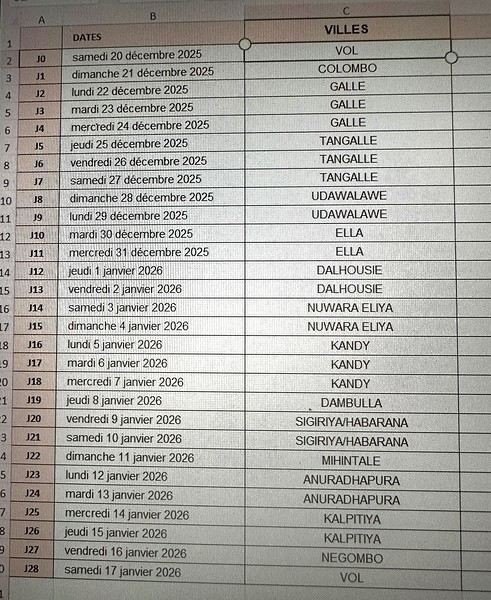
Thanks for your replies. A few details: ultra-independent travelers, using public transport, hikers, minimum 2 nights per accommodation. First time in Sri Lanka! !
The tickets for SRI LANKA are booked—arriving in COLOMBO on 12/21 and returning from the same place on 01/17. I’ve read here and there that it’ll be high season, but we don’t have a choice, so we’ll make do...
My first question is obviously about the itinerary: Most of the ones I’ve seen go clockwise, and I’m wondering if I should do it the other way: - To avoid the cultural triangle between Christmas and New Year’s - To start with a bit of rest (we’re really wiped out) Does that make sense?
My second question is about the time allocated to each stop, which you’ll find below. Is it balanced? Too much here and not enough there?
My third question will be about Jaffna: yes or no? How long is the trip from Anuradhapura? Where can I fit in the 3 days needed?
Thanks for your replies. A few details: ultra-independent travelers, using public transport, hikers, minimum 2 nights per accommodation. First time in Sri Lanka! !
When is the best time to travel to Namibia?
Hi there,
I’m planning a trip to Namibia in 2026.
I’m torn between visiting the Fish River Canyon and the Caprivi Strip / Victoria Falls.
I’d also love your advice on the best time to travel for wildlife viewing and pleasant weather.
I haven’t chosen a tour operator yet... since I’m traveling solo, I’d prefer a small-group escorted trip. Has anyone traveled with a local agency and what’s your feedback or advice?
Thanks so much!
Tips for preparing a trip to Tanzania
Hi everyone!
My mom (75 years old, in great shape!) and I (40) are planning a trip to Tanzania between October 26th and November 16th (duration: 2 to 3 weeks). Yes, it’s a bit short notice to organize, but we don’t really have a choice :)
Here’s the rough idea:
Exploring the country on the go, with a touch of spontaneity and local encounters (not a 100% fixed itinerary). Personally, I’m used to total improvisation when traveling solo, but in this case, I’d prefer to be a bit more informed/structured.
Potentially climbing Kilimanjaro (for me) before ending with a few relaxing days in Zanzibar.
Maybe renting a 4x4 to stay independent?
No luxury requirements: we prioritize authenticity over comfort (as long as it’s at least clean). We’re not opposed to camping either if it lets us do some cool stuff! Not a huge budget, but this time we’re not completely broke either :)
I’m reaching out to you here for:
Ideas for off-the-beaten-path itineraries.
Advice on whether a guide is necessary in certain places or recommendations for reliable and friendly local contacts/tour operators.
If you have any recommendations, experiences, or great tips, we’re all ears! Thanks in advance for your advice and kindness.
See you soon.
Exploring the country on the go, with a touch of spontaneity and local encounters (not a 100% fixed itinerary). Personally, I’m used to total improvisation when traveling solo, but in this case, I’d prefer to be a bit more informed/structured.
Potentially climbing Kilimanjaro (for me) before ending with a few relaxing days in Zanzibar.
Maybe renting a 4x4 to stay independent?
No luxury requirements: we prioritize authenticity over comfort (as long as it’s at least clean). We’re not opposed to camping either if it lets us do some cool stuff! Not a huge budget, but this time we’re not completely broke either :)
I’m reaching out to you here for:
Ideas for off-the-beaten-path itineraries.
Advice on whether a guide is necessary in certain places or recommendations for reliable and friendly local contacts/tour operators.
If you have any recommendations, experiences, or great tips, we’re all ears! Thanks in advance for your advice and kindness.
See you soon.
Trip report: Our South Africa journey in July
Hi there,
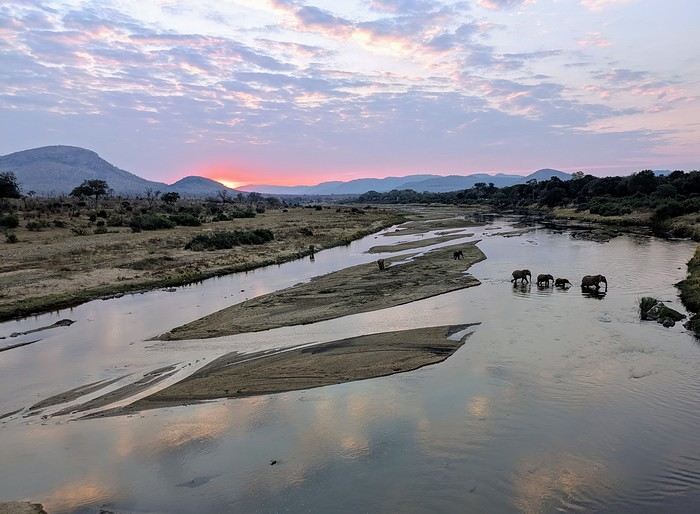
We’re back from our 3-week trip to South Africa in July. It was a family trip with our four grown-up kids (ages 18 to 25).
First off, I’d like to thank everyone on this forum for their great tips—they really helped us plan this trip!
The trip: We spent 15 days between Port Elizabeth and Cape Town, then a week around Kruger (including Blyde River Canyon). We found South Africans to be welcoming and always ready to help. We never felt unsafe (just followed basic safety rules). The police are very visible, especially on the roads.
Logistics: We’d booked our accommodations in advance but made a few changes on the spot based on how we felt at the time. We rented two vehicles from Firefly (Hertz). No complaints—recent cars, quick returns, and the deposit wasn’t charged. We’d gotten our international driver’s permits... which stayed in France! Luckily, no one asked for them. Driving on the left wasn’t an issue (it wasn’t our first time). The roads we took were in good, even great, condition. Only a few tracks to lodges or parks were rough and required extra caution. Lots of pedestrians on the sides of roads, even highways. And plenty of very slow trucks. But they pull over to let you pass. It’s also common for cars to cross into the opposite lane to overtake, even with white lines. We took two domestic flights: one early in the morning (Johannesburg to Port Elizabeth) and one in the late afternoon (Cape Town to Johannesburg) to save time.
We had some highlights and a few disappointments—all part of the journey! More details coming soon.
We’re back from our 3-week trip to South Africa in July. It was a family trip with our four grown-up kids (ages 18 to 25).
First off, I’d like to thank everyone on this forum for their great tips—they really helped us plan this trip!
The trip: We spent 15 days between Port Elizabeth and Cape Town, then a week around Kruger (including Blyde River Canyon). We found South Africans to be welcoming and always ready to help. We never felt unsafe (just followed basic safety rules). The police are very visible, especially on the roads.
Logistics: We’d booked our accommodations in advance but made a few changes on the spot based on how we felt at the time. We rented two vehicles from Firefly (Hertz). No complaints—recent cars, quick returns, and the deposit wasn’t charged. We’d gotten our international driver’s permits... which stayed in France! Luckily, no one asked for them. Driving on the left wasn’t an issue (it wasn’t our first time). The roads we took were in good, even great, condition. Only a few tracks to lodges or parks were rough and required extra caution. Lots of pedestrians on the sides of roads, even highways. And plenty of very slow trucks. But they pull over to let you pass. It’s also common for cars to cross into the opposite lane to overtake, even with white lines. We took two domestic flights: one early in the morning (Johannesburg to Port Elizabeth) and one in the late afternoon (Cape Town to Johannesburg) to save time.
We had some highlights and a few disappointments—all part of the journey! More details coming soon.
Our Trip to Rajasthan
Hello,
We recently went to Rajasthan.
For the duration, I’d recommend about 3 weeks if you can, so you can explore the region at a relaxed pace.
We also wanted to experience "the real Indian life," and our driver showed us small markets, little temples, and his village near Ranakpur in the Marwar region.
For your info, here are some hotels where we stayed—there’s a huge hotel scene in Rajasthan. No need to book in advance; day by day works really well. You arrive, visit, and if you don’t like it, you just move on—it’s no problem in India. No upfront payment, and you can even negotiate on the spot with this approach, which gives you flexibility with your itinerary.
Here are some hotels we stayed at:
Madhuban in Jaipur (Haveli house) and also in Jaipur, the Khandela Haveli, which we preferred
In Jodhpur, the Kuchaman Haveli
In Ranakpur (Ranakpur Hill Resort) with a great pool
Bikaner: Hotel Laxmi Niwas
Udaipur: Hotel Savroopvilas
Jaisalmer: Hotel Rang Mahal
Here’s the itinerary we followed over nearly three weeks:
1 - When we arrived in Delhi, we headed straight north to Nawalgarh and Mandawa (towns with Havelis = painted houses). Along the way, we stopped in Jhunjhunu to see the Rani Sati Temple. We slept in Mandawa (we arrived in the evening and explored the next morning).
2 - Then we drove to Bikaner (Junagarh Fort, but if you have to choose, the forts in Jodhpur and Jaipur are more interesting in our opinion). After that, we took the road to Deshnoke (temple with sacred rats) and before that, we saw a small temple on the way with white rats. In Deshnoke, the rats move freely among people. We’re not too squeamish, so it was fine. Anyway, it was interesting to see.
3 - Next, we headed to Pushkar, where we took a camel ride (you have to negotiate the price; it varies depending on the camel’s quality, the saddle, and its decoration). One to two hours is more than enough. There’s always someone riding with you on the camel (at least that’s how it was for us). There are also things to see along the way.
4 - From Pushkar, we went to Jodhpur (Mehrangarh Fort, Clock Tower, Jaswant Thada). From Jodhpur, we visited villages (including our driver’s village, which was ideal for connecting with locals, having tea, and exploring the village with part of the community tagging along—I think we went into almost every house). We also did a train safari in the hills. Then Ranakpur (splendid Jain temple, Adinath Temple). With a bit of luck, you might spot Raikas, nomadic herders. Then Kumbhalgarh Fort, and after that, Udaipur. Along the way, we spent the night in a very small town called Jojawar at the Rawla Jojawar hotel, owned by the former Maharaja. A wonderful memory.
5 - In Udaipur (City Palace; Monsoon Palace = depends on the weather—if it’s not clear, you won’t see much, but if it is, the view is stunning).
6 - On the way to Jaipur: Sas-Bahu Temple; then in Jaipur: City Palace, Jantar Mantar, Hawa Mahal (Palace of the Winds), the Hanuman Temple, etc.
7 - Heading toward Agra, the Galta Valley with lots of monkeys. We finished with Fatehpur Sikri and then Agra. Agra is *very* touristy, so people are less friendly and can be pushy about selling things or offering their services as guides. You have to stay polite but firm and not let them sweet-talk you. Hotels are also pricier and there’s not always much choice. For the Taj Mahal (closed on Fridays), go very early in the morning when it opens. It’s best to arrive the evening before and spend the night at a hotel before visiting. Inside the Taj Mahal site, it’s already calmer. After that, we visited Akbar’s mausoleum (in Sikandra, near Agra) and the so-called "Baby Taj" (in Agra). For the Taj, I’ve heard they’re doing renovations, but it’s still a must-see.
8 - In Delhi, if you still have time, check out the Jama Masjid mosque and Mahatma Gandhi’s tomb. Also see Humayun’s Mausoleum (in the Nizamuddin East neighborhood).
In Jaisalmer (spend a night in the dunes after a camel ride), Chittorgarh, Bundi, Ranthambore Park, Orchha, and Khajuraho. Actually, you’ll have to make choices, or you’ll spend your whole vacation traveling. The average driving speed is about 50–60 km/h.
Our other trips in India: Gujarat (we love it and have been twice), Himachal Pradesh, Punjab, and also Haridwar and Varanasi. In the south, Kerala, Tamil Nadu, and Karnataka.
In some cities, we visited with a local guide (about two hours), and some spoke French or English.
One last thing that comes to mind: if you go to Jaisalmer, check out Gadi Sagar Lake. Also worth seeing: the Demoiselle Cranes in Kichan, not far from Jodhpur. These are thousands of common cranes that migrate near the region’s lakes during the winter months. A beautiful ornithological spectacle. And Kichan or Keechan.
Happy trip planning!
Jean
How to choose your accommodation in South African national parks
Hi there,
It’s not always easy to pick where to stay in national parks... like Kruger, for example.
Below is an attempt to decode the different types and options...
Remember, to book in a national park, you do it through the Sanparks website, except in KwaZulu-Natal (KZN Wildlife).
Choosing the type of camp that suits you: · Main Rest Camps, Satellite Camps, Bushveld Camps, Overnight Hides, Bush Lodges, Camp Site, Luxury Lodges Main Rest Camps These camps are usually quite large, even very large, like Skukuza. They have a fence! You can move around freely inside these camps at night with a torch. Staff are available, and there are security guards. Shops are more or less well-stocked but have the basics. You’ll find souvenir shops, restaurants, bars, and most often a pool. Depending on your choice, there are camping spots, chalets, huts, etc., with varying levels of comfort. Shared kitchens, shared bathrooms, or private facilities in each accommodation (see below). This isn’t the "wild" version but rather the more luxurious and secure option. Bushveld Camps Smaller and more intimate, with some amenities, but no restaurants or shops. Check if there’s a fence. Satellite Camps Always close to the main camps (more or less). As a rule, you check in at the main camp. Comfort level is lower than the options above. Check if there’s a fence. Camp Site + Overnight Hide The wildest level. That says it all. Bush Lodges + Luxury Lodges Bush lodges: exclusive environment. Since I haven’t tried them, I can’t give any tips. Luxury lodges: well, the name says it all. This is Kruger’s version of a private game reserve lodge. Game drives with a ranger in an open vehicle. Accommodation ranges from luxurious to very luxurious. Meals and lodging are of the same standard. But even so, the game drive rules are the same. Sure, you get exclusive access to a small area, but you can’t leave the marked trails, and normally, the return time to camp is exactly the same. The rule actually says that exceptionally, if there’s a great opportunity within x meters, they *might* go off-trail. First case in the far south: a very flexible ranger and an amazing game drive. Second case: a mediocre ranger and a boring game drive. Note that some may only offer lodging. Personally, I think the added value can be excessively expensive. Choosing your accommodation within a camp. This depends on the camp. Below is an attempt to decode. Camp site: just a spot, that’s it. Access to facilities like toilets, shared kitchen, etc. Huts: basic amenities, usually just a fan. Safari tent: the name says it all. It’s already set up. Bungalow: well, it’s a bungalow, and a guest house is a bungalow for a group. Decoding: AC = air conditioning. Fan = fan. Private or shared toilets. Private or shared bathroom. Equipped kitchen or shared. Terrace. Perimeter or not. View or not. First 2–5 letters — the type of accommodation.
CK = Campsite EH/EA/EB = Hut (AC, so air-conditioned) ES = Hut (fan only) CTT/ST= Safari Tent LBVST = Safari Tent with bush view LRVST = Safari Tent with river view BD/BA = Bungalow with private (and equipped) kitchen BG/BE = Bungalow with shared kitchen F, G or CO = Guesthouse or Cottages (more than one bedroom)
Number after the letters — number of beds 2, 3, 4, or 6 beds. The base price is for 2 people. There’s an extra charge for each additional person. The last letter, if present, indicates a particular feature.
U = Perimeter — close to the camp’s edge V = Perimeter + view (e.g., river) Z = For disabled access L = Large spot (camping) D = DSTV (television) E = Enclosed veranda
Example: BD3U = 3 people, private kitchen (and bathroom/toilet), perimeter with view.
Choosing the type of camp that suits you: · Main Rest Camps, Satellite Camps, Bushveld Camps, Overnight Hides, Bush Lodges, Camp Site, Luxury Lodges Main Rest Camps These camps are usually quite large, even very large, like Skukuza. They have a fence! You can move around freely inside these camps at night with a torch. Staff are available, and there are security guards. Shops are more or less well-stocked but have the basics. You’ll find souvenir shops, restaurants, bars, and most often a pool. Depending on your choice, there are camping spots, chalets, huts, etc., with varying levels of comfort. Shared kitchens, shared bathrooms, or private facilities in each accommodation (see below). This isn’t the "wild" version but rather the more luxurious and secure option. Bushveld Camps Smaller and more intimate, with some amenities, but no restaurants or shops. Check if there’s a fence. Satellite Camps Always close to the main camps (more or less). As a rule, you check in at the main camp. Comfort level is lower than the options above. Check if there’s a fence. Camp Site + Overnight Hide The wildest level. That says it all. Bush Lodges + Luxury Lodges Bush lodges: exclusive environment. Since I haven’t tried them, I can’t give any tips. Luxury lodges: well, the name says it all. This is Kruger’s version of a private game reserve lodge. Game drives with a ranger in an open vehicle. Accommodation ranges from luxurious to very luxurious. Meals and lodging are of the same standard. But even so, the game drive rules are the same. Sure, you get exclusive access to a small area, but you can’t leave the marked trails, and normally, the return time to camp is exactly the same. The rule actually says that exceptionally, if there’s a great opportunity within x meters, they *might* go off-trail. First case in the far south: a very flexible ranger and an amazing game drive. Second case: a mediocre ranger and a boring game drive. Note that some may only offer lodging. Personally, I think the added value can be excessively expensive. Choosing your accommodation within a camp. This depends on the camp. Below is an attempt to decode. Camp site: just a spot, that’s it. Access to facilities like toilets, shared kitchen, etc. Huts: basic amenities, usually just a fan. Safari tent: the name says it all. It’s already set up. Bungalow: well, it’s a bungalow, and a guest house is a bungalow for a group. Decoding: AC = air conditioning. Fan = fan. Private or shared toilets. Private or shared bathroom. Equipped kitchen or shared. Terrace. Perimeter or not. View or not. First 2–5 letters — the type of accommodation.
CK = Campsite EH/EA/EB = Hut (AC, so air-conditioned) ES = Hut (fan only) CTT/ST= Safari Tent LBVST = Safari Tent with bush view LRVST = Safari Tent with river view BD/BA = Bungalow with private (and equipped) kitchen BG/BE = Bungalow with shared kitchen F, G or CO = Guesthouse or Cottages (more than one bedroom)
Number after the letters — number of beds 2, 3, 4, or 6 beds. The base price is for 2 people. There’s an extra charge for each additional person. The last letter, if present, indicates a particular feature.
U = Perimeter — close to the camp’s edge V = Perimeter + view (e.g., river) Z = For disabled access L = Large spot (camping) D = DSTV (television) E = Enclosed veranda
Example: BD3U = 3 people, private kitchen (and bathroom/toilet), perimeter with view.
Disembarkation time at Johannesburg Airport
Hi,
We arrive in Johannesburg (Tambo) at 8:30 in the morning. Do you think we’ll have enough time to catch the 10:30 flight to Hoedspruit, or is it better to play it safe and take the next one at 11:40? The earlier flight would work better for us, but what if the plane is delayed 😕? Plus, we have to collect checked baggage!
Thanks for your feedback and experiences!
Danyèle
Official website for Tanzania e-visa
Hi,
We’re heading to Tanzania at the end of the year and I’d like to know where I can apply for the e-visas because I’ve found some sites, but they’re charging more than what I was told.
It’s not the official site, and I’m struggling to find it.
Do you have the direct official link, please? Thanks so much for your help! 😊
Feedback on our 15-day self-drive trip in South Africa
Hi there
We’re planning to do this route as a self-drive trip. There’ll be six of us, so with a large car—is the drive between Durban and Johannesburg manageable? Thanks for your feedback! Day 2: Cape Town Day 3: Cape of Good Hope Day 4: Hermanus, Cape Agulhas Day 5: Wine Route Day 6: Cape Town → Durban (flight) → St. Lucia Day 7: St. Lucia Day 8: Hluhluwe Day 9: Mlilwane Day 10: Sabi Sand Day 11: Sabi Sand Day 12: Kruger Day 13: Panoramic Route Day 14: Balule → Johannesburg
We’re planning to do this route as a self-drive trip. There’ll be six of us, so with a large car—is the drive between Durban and Johannesburg manageable? Thanks for your feedback! Day 2: Cape Town Day 3: Cape of Good Hope Day 4: Hermanus, Cape Agulhas Day 5: Wine Route Day 6: Cape Town → Durban (flight) → St. Lucia Day 7: St. Lucia Day 8: Hluhluwe Day 9: Mlilwane Day 10: Sabi Sand Day 11: Sabi Sand Day 12: Kruger Day 13: Panoramic Route Day 14: Balule → Johannesburg
Motorhome or camper van for a Scotland road trip with 3 adults and a 7-year-old?
Hi there,
I’m trying to plan a family week’s holiday in Scotland. I’d like to rent a motorhome or a camper van.
My partner has never driven a motorhome and the roads are making me nervous…
I’ve seen camper vans, but are they much smaller? There’ll be 3 adults and a 7-year-old.
Some rental companies tell me “no problem with motorhomes,” while others say “definitely not if you’ve never driven one.”
Can you point me in the right direction?
Thanks
Can you point me in the right direction?
Thanks
Temperatures in South Africa in August
Hi there,
We’re heading to South Africa in August, with a basic itinerary: Johannesburg, Kruger Park, and finishing up in Cape Town. My question—I know it’s winter there—what are the temperatures like? How should we dress? Thanks for your tips!
We’re heading to South Africa in August, with a basic itinerary: Johannesburg, Kruger Park, and finishing up in Cape Town. My question—I know it’s winter there—what are the temperatures like? How should we dress? Thanks for your tips!
All Tanzanian Airlines Banned
Hi,
A pretty serious issue has come up in the past few weeks for traveling to Tanzania.
What’s the deal with airlines in Tanzania? https://www.capital.fr/economie-politique/ce-pays-est-tres-touristique-mais-ses-compagnies-aeriennes-sont-placees-sur-liste-noire-par-l-europe-1515325 https://www.charentelibre.fr/tourisme/la-tanzanie-sur-liste-noire-de-l-europe-des-vols-interieurs-a-haut-risque-pour-100-000-touristes-francais-25002566.php
Basically, all airlines have been blacklisted because they don’t meet European safety standards. They’re banned from flying in Europe but continue operating in Tanzania. The main issue is that travel agencies’ civil liability no longer applies to blacklisted airlines. So we can’t allow clients to fly with these carriers. Of course, there’s huge pressure from European agencies, which are forced to disrupt their plans or even cancel trips because of this. Personally, I’ve got a trip planned for February 2026 to the southern parks in Tanzania, so I’ll be keeping an eye on how this develops. Do any of you have updates? Thanks!
Loïc
A pretty serious issue has come up in the past few weeks for traveling to Tanzania.
What’s the deal with airlines in Tanzania? https://www.capital.fr/economie-politique/ce-pays-est-tres-touristique-mais-ses-compagnies-aeriennes-sont-placees-sur-liste-noire-par-l-europe-1515325 https://www.charentelibre.fr/tourisme/la-tanzanie-sur-liste-noire-de-l-europe-des-vols-interieurs-a-haut-risque-pour-100-000-touristes-francais-25002566.php
Basically, all airlines have been blacklisted because they don’t meet European safety standards. They’re banned from flying in Europe but continue operating in Tanzania. The main issue is that travel agencies’ civil liability no longer applies to blacklisted airlines. So we can’t allow clients to fly with these carriers. Of course, there’s huge pressure from European agencies, which are forced to disrupt their plans or even cancel trips because of this. Personally, I’ve got a trip planned for February 2026 to the southern parks in Tanzania, so I’ll be keeping an eye on how this develops. Do any of you have updates? Thanks!
Loïc