Results for "manger+ou+restaurant+|+1+>+37"
69171 results found.
De retour de Thaïlande il y a 5 jours et déjà le cafard... English translation pending
rentrés de Phuket lundi après 17 jours immergés au pays du sourire et déjà le cafard tous les matins au réveil. Ce qui a été très drole, c'est le mardi matin, lorsque je me susi réveillée dans mon lit, en ouvrant les yeux, je ne savais plus où j'étais... il m'a fallut quelques seconde pour réaliser que nous étions a la maison dans notre chambre, notre lit... j'ai eu un gros poids sur le coeur...
Ce qu'il nous manque? Oh, pleins de choses! Lorsque je demande à ma fille, elle me répond : "Le matin, lorsqu'après le petit déj, on allait se baigner dans les vagues". Il est vrai quà 36 ans, j'y ai retrouvé mon ame d'enfant! J'y ai passé des heures à me faire secouer dans tous les sens, à jouer avec la petite.
Le Sawadeekaa de tous les matins, par la jeune femme du resto de la plage "Smile restaurant", avec son sourire.
Les sourires... le farniente....
Un truc qui est rigolo, c'est que j'ai vite saturé du riz et de leur nourriture et que maintenant, ça me manque vachement. Je me susi gavée de fruits (bananes, ananas, ramboutants, mangoustants, mangue verte). leurs jus de fruits, leur coco plantée d'une paille.
Mon homme a ramené du Whisky Thai et comme on n'a récupéré notre valise qu'hier soir, il s'en est fait un en apéro et il n'a pas le m^me gout, forcément, que celui qu'il se servait tous les soirs sur la terrasse de notre bungalow du baan Chaba. Il lui manque ce goût de vacances... de mon côté, j'ai acheté un ananas au Marché U, et en l'ouvrant, il était tout noir, il a du prendre un coup de frigo, et puis surtout rien à voir...
Et puis, je regarde les prix des fringues dans les magasins... tout me parait hyper cher! Je regrette pleins de chose que je n'ai pas acheté là bas.
Il y'a a quelque temps, quelqu'un avait postait "Etes vous un farang radin?"
Je réponds pour ma part : Oui, sincèrement avec le recul, je l'avoue.
J'étais dans ce pays où tous était entre 3 et 10 fois moins cher qu'en France.. alors tout ce qui était à 100 150 bath, ca allait, mais je me souviens avoir hésité sur des T-shirts à 300-500 bath, avoir parlementé 10 mn à Chatuchak pour le prix d'un pantalon blanc à 500 bath! D'avoir renoncé à une paire de converse à 850 bath! C'est n'importe quoi avec le recul! C'est vrai on peut pas tout acheter, mais au final, j'y ai laissé plein de coups de coeurs parce que le vendeur n'a pas fanché pour 100 bath de trop!
Un conseil, lorsque vous trouvez un truc qui vous plait, et que vosu avez un peu d'argent avec vous, n'hésitez pas comme nosu l'avons fait, en vous donnant le prétexte débile "On en trouvera plus tard". Achetez directement et si vraiment vosu le voyez plus tard moins cher, dites vous que c'est à 2€ près.... pas le bout du monde quand on en a vraiment envie!
La première semaine que nosu avons passé dans le nord a été assez riche culturellement mais hyper fatiguante physiquement a cause des réveils à 6h du décallage horraire, alors c'est vrai que m^me si sur place, j'ai aimé, sur le moment, j'ai pas eu le coup de foudre... mon mari a mis ca sur le compre du fait qu'ayant passé 3 mois sur ce forume à découvrir notre futur destinations, j'ai idéalisé ce voyage. Il est vrai que c'est ce que je me suis dis. En Arrivant à Phuket, la plage de kamala m'a paru un peu sale, deuxième déception... mais après une journée de farnienete, un peu de repos, c'est à ce moment que j'ai commencé à réaliser qu'en fait ce que nous avions vu dans le nord était vraiment chouet, mais pas assez aprofondi. QUe la plage de Kamala n'était si sale que ça, car en fait nous sommes arrvés dans l'après midi, et que la marée amène des saleté qui sont nettoyée par les resto de plage, tous les matins, et pusi en fait tout ça fait partie du décor, on n'y fait plus attention.
Voilà, tout ça aujourd'hui, me manque.... beaucoup
Et puis ces fabuleux couchers de soleil sur Kamala
 Une chose est sure!!!!!!!
On y retournera, je sais pas quand, mais en vol secs et bien plus de temps! Voilà les amis, j'avais envie de vosu écrire tout ceci A bientôt Je susi toujours là!!!!
Barbara
Une chose est sure!!!!!!!On y retournera, je sais pas quand, mais en vol secs et bien plus de temps! Voilà les amis, j'avais envie de vosu écrire tout ceci A bientôt Je susi toujours là!!!!
Barbara
Hôtel Occidental Allegro Agador à Agadir English translation pending
Bonjour,
Je pars en septembre au Maroc à l'hôtel Occidental Allegro Agador à Agadir
si vous y êtes déjà allés, pourriez-vous me donner vos impressions ?
Qualité des prestations?
Propreté de l'hôtel et des chambres ?
Qualité de la restauration ?
A quelle distance se trouve la plage ?
quelles sont les meilleures visites et excursions à faire aux alentours ?
Merci d'avance
A bientôt
Sandrine
Rencontre à Paris dimanche 21 janvier 2007 English translation pending
Bonjour à toutes et à toutes et excellente année 2007 🙂
Je vous propose de se retrouver autour d'un petit repas le dimanche 21 janvier à midi.
🤪 La raison : il faut une raison pour se retrouver ensemble ?
😮 Le thème : pas de thème. Que vous aimiez l'Afrique ou le Canada, que vous partiez en voyage ou que vous en reveniez, que vous soyez à court d'idées ou que vous ayez une idée de destination toutes les 3 minutes, que vous "trekkiez" comme un fou ou que vos os délicats préfèrent la douceur d'un bon lit, vous êtes cordialement invités à vous inscrire sur ce post.
😛 Le restaurant : buffet syrien, déjeuner tibétain, tex mex/thaïlandais ... ou brunch, je ne sais pas encore. D'ici le 21, j'aurais bien trouvé quelque chose ...
Qu'en dites vous ?
Je vous propose de se retrouver autour d'un petit repas le dimanche 21 janvier à midi.
🤪 La raison : il faut une raison pour se retrouver ensemble ?
😮 Le thème : pas de thème. Que vous aimiez l'Afrique ou le Canada, que vous partiez en voyage ou que vous en reveniez, que vous soyez à court d'idées ou que vous ayez une idée de destination toutes les 3 minutes, que vous "trekkiez" comme un fou ou que vos os délicats préfèrent la douceur d'un bon lit, vous êtes cordialement invités à vous inscrire sur ce post.
😛 Le restaurant : buffet syrien, déjeuner tibétain, tex mex/thaïlandais ... ou brunch, je ne sais pas encore. D'ici le 21, j'aurais bien trouvé quelque chose ...
Qu'en dites vous ?
Que visiter à Bangkok et ses alentours? English translation pending
je m envole dimanche pour bangkok, j y reste 4 jours j aimerai savoir quoi voir et ce qu il ne faut pas rater que ce soit sur bangkok meme ou ses alentours, merci de me renseigner
Combiné Ténérife - Fuerteventura English translation pending
Bonjour,
je cherche des infos sur ce combiné Ténérife Fuerteventura 15 jours 14 nuits avec switch aux hôtels Dunas Paraiso à Ténérife et Jandia Mar à Fuerteventure ? en pension compléte !
Nous partons le 26 aout 06 ?
Les hôtels (formule ) ? Est ce la bonne époque . Que faire comme visites ?
Merci d'avance😏
Les hôtels (formule ) ? Est ce la bonne époque . Que faire comme visites ?
Merci d'avance😏
Tenue de gala en croisière? English translation pending
bonjour à tous
Nous allons partir en croisière ma femme et moi le mois prochain, et on nous recommande une tenue de gala pour les repas du soir sur le bateau. Je voudrai savoirce que ça veut dire exactement. Il ne faut tout de même pas un smoking et un noeud papillon quand même? Merci de me tuyauter
Nous allons partir en croisière ma femme et moi le mois prochain, et on nous recommande une tenue de gala pour les repas du soir sur le bateau. Je voudrai savoirce que ça veut dire exactement. Il ne faut tout de même pas un smoking et un noeud papillon quand même? Merci de me tuyauter
Retour du Dominicus Palace English translation pending
Bonjour nous sommes de retour du palace!
Tres belle hotel et tres calme nous avions acces au Beach pour toutes les activités et leurs resto sans aucun supplément.
L'hotel est tres propres et tres belle la plage magnifique et l'eau encore plus.Le manger pas mal.
Au buffet tres bien .au Bambu resto asiatique tres bien.Mexicaine pas tres bon.l'italien La Scala pas mal. Le grille pas tres impressionnant.Mais bon il faut tous les essayer et peut etre serai vous plus chanceux😉.
les chambres sont grandes nous avions deux grand lits et une terrasse presque face a la mer(5805).L'entretiens a tous les jours .
Le vol a bien été air transat et le retour aussi J, ai été malade au retour et l'équipage a tres bien pris soins de moi ils ont meme trouver un medecin dans l'avion pour venir me voir.P.S" si vous avez des probleme de sinus amené vos medicaments avec vous ou des décongestionnants parce que ça fais mal en cri.....😕.
Nous avons eu une représentante hors paire Karine de Nolitour World😏 elle est fantastique. Si vous avez des questions des problemes besoins de conseille elle est toujours là .
Les excursions nous avons fait saona 55 us par personne arret avec étoile de mer baignade à l'ile diner à la capital de l'ile 😉 et arret à la piscine naturel et bapteme a la vitamine. Nous avons fais du snorkeling à Bayahibe 10 us nous voulions voir des poissons et on en a vue beaucoup durée 1 :00 .
Les cigars de grace allé chez Jean-michel et Geatan je vous jure que vous ne vous ferai jamais avoir avec des faux. La presque totalitée des cigars que les autres commerçant vendent son des faux fait avec des feuilles de bananier le magasin se trouve pres du palace on prend la rue Fuller et on tourne a gauche al rue suivante et vous allez voir leur affiches avec leur nous dessus Jean-Michel et Geatan .Un Français et un Quebecquois.😎
Je vous recommande cet hotel et se séjours!
Tres belle hotel et tres calme nous avions acces au Beach pour toutes les activités et leurs resto sans aucun supplément.
L'hotel est tres propres et tres belle la plage magnifique et l'eau encore plus.Le manger pas mal.
Au buffet tres bien .au Bambu resto asiatique tres bien.Mexicaine pas tres bon.l'italien La Scala pas mal. Le grille pas tres impressionnant.Mais bon il faut tous les essayer et peut etre serai vous plus chanceux😉.
les chambres sont grandes nous avions deux grand lits et une terrasse presque face a la mer(5805).L'entretiens a tous les jours .
Le vol a bien été air transat et le retour aussi J, ai été malade au retour et l'équipage a tres bien pris soins de moi ils ont meme trouver un medecin dans l'avion pour venir me voir.P.S" si vous avez des probleme de sinus amené vos medicaments avec vous ou des décongestionnants parce que ça fais mal en cri.....😕.
Nous avons eu une représentante hors paire Karine de Nolitour World😏 elle est fantastique. Si vous avez des questions des problemes besoins de conseille elle est toujours là .
Les excursions nous avons fait saona 55 us par personne arret avec étoile de mer baignade à l'ile diner à la capital de l'ile 😉 et arret à la piscine naturel et bapteme a la vitamine. Nous avons fais du snorkeling à Bayahibe 10 us nous voulions voir des poissons et on en a vue beaucoup durée 1 :00 .
Les cigars de grace allé chez Jean-michel et Geatan je vous jure que vous ne vous ferai jamais avoir avec des faux. La presque totalitée des cigars que les autres commerçant vendent son des faux fait avec des feuilles de bananier le magasin se trouve pres du palace on prend la rue Fuller et on tourne a gauche al rue suivante et vous allez voir leur affiches avec leur nous dessus Jean-Michel et Geatan .Un Français et un Quebecquois.😎
Je vous recommande cet hotel et se séjours!
Namibia Travel Journal: May 2025 - Trip Review
NAMIBIA TRIP 2025: April 24 to May 20: Feel free to comment or ask us any questions about this amazing journey.
>> Find all our photos and videos for each day on our website here: www.montagne-aventure.net
**DAY 1: Thursday, April 24, 2025: Outbound Flights from Lyon to Windhoek via Munich - Visit to Munich:**
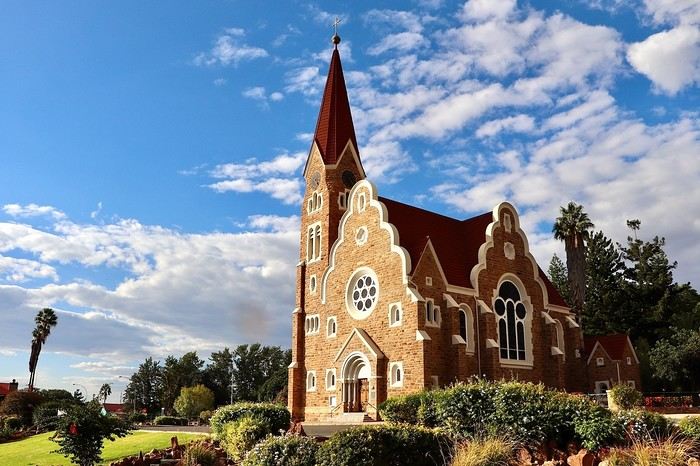
Off we go on a new adventure. The alarm rings at 6:30 AM, the travel bags are packed, and we head to Lyon Airport. We booked our flight tickets with Lufthansa. The first leg to Munich, Germany, is operated by AirBaltic. Departure at 1:05 PM for a 1-hour and 20-minute flight. We arrive at 2:30 PM.
**We now have a 7-hour layover, so we take the opportunity to get some fresh air and explore Munich.** We quickly exit Terminal 2 of the airport and head towards the subway. We buy a group day ticket "Airport-city Day Zone M-5," valid for 2 to 5 people at a price of 30.50 € (instead of 16.30 € per person). We take the S8 line to **Marienplatz** in 35 minutes. **This is the heart of the city.** The weather is overcast, quite cool, but dry. Perfect for a little city trip between two flights while leaving our large luggage in transit at the airport. **Munich is the third-largest German city after Berlin and Hamburg, in the Bavaria region.** **The center has a lot of charm and brings together several religious buildings, easy to explore on foot.** We are impressed by the number of people enjoying these 100% pedestrian streets, which are very pleasant. After Marienplatz, the most famous square with the town hall, we head to the Cathedral of Our Lady, a Gothic church, then continue to **Karlsplatz** and move on to **the food market offering a wide selection of high-end food products in an atmosphere where a certain art of living prevails.** We also visit St. Peter's Church before grabbing a bite to eat. Two good hours were enough for this 10 km city walk. It's time to take the subway back: by 6:30 PM, we are back at the airport. Now, it's time for a bit of waiting and rest. Our second flight is scheduled for 9:35 PM for a 9-hour and 30-minute journey to our final destination in Namibia: **Windhoek.**
> Round-trip flight tickets with Lufthansa from Lyon: 2029 €, or 1,014.50 € per person.
> Lyon Airport parking: 120 €
> Today's expenses: 7 € for 2 pizzas in France / 14 € for the restaurant in Munich / 30.50 € for the daily subway ticket in Munich.
**DAY 2: Friday, April 25, 2024: Arrival in Windhoek, Visit to the Namibian Capital:**
After a 9-hour and 30-minute overnight flight with Discover Airlines, we finally land on Namibian soil just before 7:30 AM. The day is breaking, and the colors are already stunning. We are eager despite the usual fatigue from the flight. The airline was punctual, with friendly staff and good meals, though a bit light. We are the first flight of the day to land, with no more than 15 flights per day here, from 7 AM to 8 PM. We disembark on the tarmac at this airport located in the middle of nowhere, **I finally set foot on African soil for the first time.** We exit among the first from the aircraft to go through the long formalities at the front of the line, as the wait can quickly become endless. Allow at least 5 minutes per person for e-visas. We still wait 45 minutes despite only about twenty people ahead of us. Phew, it's done. We collect our luggage and then withdraw money from an ATM. We make 4 withdrawals of the maximum amount, 2000 NAD $ per withdrawal, for a total of 380 €, or 95.33 € per withdrawal.
Our driver arrives at the same time, perfect timing, we were quick.
We leave the airport at 8:45 AM. By 9:30 AM, we arrive at the **Gracious Whisp vehicle rental agency**, located at the entrance of Windhoek, small and human-sized with a fleet of recent vehicles. More formalities, then a short wait as our vehicle is not yet ready. Time to decompress, catch our breath, and enjoy the very pleasant morning temperature. Not a cloud in sight. Next, a briefing on the vehicle, always with a bit of apprehension due to our approximate English. Allow 45 minutes of explanations, including setting up the roof tent, camping equipment, technical information in case of a flat tire, driving tips in Namibia, and a tour of the 4x4. We have all the necessary equipment for camping: mattresses, sleeping bags, pillows, table, chairs, gas stove, BBQ grill... as well as 2 spare tires, a compressor, a dual tank, and accessories for removing wheels. Off we go, it's time to muster our courage and get behind the wheel. **Heading to SuperSpar Maerua**, fortunately located less than 10 minutes away. We park with the help of a parking attendant; it's very crowded, the space is narrow, but everything goes well despite the cursed right-hand drive. Today's new mission: stock up on groceries. The store is well-stocked with local and imported products, catering to all tastes. We spend 114 € on groceries, from pasta to meat, BBQ lighters to dishwashing products. Two people load our groceries into two carts and transfer them to our vehicle; we feel compelled to leave a tip, 50 NAD $, as we don't have change yet. Now, we head to the hotel, 15 minutes away. Traffic is difficult at a complicated intersection; this will likely be the only traffic jam in Namibia. **We arrive at Kate's Nest Guesthouse & Backpackers around 1:15 PM, quite tired.** We take some well-deserved rest at this recent establishment, quite calm with secure private parking. After a short nap, we enjoy the quiet by the hotel pool. Night falls between 6:30 PM and 7 PM. We eat quietly in our room tonight before starting this long 4x4 road trip in camping mode in the heart of Namibia.
> Today's grocery expenses: 114 € at Super Spar Marua (2395.21 NAD $).
> Round-trip flight tickets with Lufthansa from Lyon: 2029 €, or 1,014.50 € per person.
> Vehicle rental: 4x4 Toyota with roof tent for 24 days: Gracious Whisp Car Rentals: 2,638 € (N$50,640) or **1,319 €** per person - (https://gwcarrentals.com/)
> Distance driven today: 15 km.
> Accommodation: Kate's Nest Guesthouse & Backpackers - 4 Aristotles Street Academia, 9000 Windhoek - 36 € for two for one night.
> Windhoek International Airport website: (https://www.airports.com.na/)
**DAY 3: Saturday, April 26, 2025: Windhoek to Hardap: Mariental Region - Kalahari Desert:**
After a good, restful night, we wake up leisurely around 7 AM. We enjoy the comfort provided by this first and last hotel before 24 nights under the tent.
**We leave Kate's Nest Guesthouse at 8:30 AM to tackle the Namibian roads.** We quickly leave the capital; in just 30 minutes, we find ourselves almost alone in the world. The landscape is dotted with small domes. We leave the **paved B1** quickly to turn left onto the **C15**. **From there, we won't see more than 10 vehicles all day.** After passing through the few houses of **Lekkerwaterpoort**, we tackle our first gravel road. These road sections are limited to 100 km/h, but even at 70 km/h, I find it already challenging. However, I quickly get used to it and gradually pick up speed to reach my cruising speed of around 80 to 90 km/h. **We are on immense straight lines crossing wild expanses as far as the eye can see.** **We come across two baboons, a few ostriches, and numerous cattle and sheep farms.** We pass through the charming village of **Uhlenhorst** with its typical houses and children with broad smiles waving at us. Life here is already very different from Windhoek. **The thermometer rises quickly from 16°C at 8:30 AM to over 28°C in the early afternoon.**
**We arrive at the Hardap Dam reserve at 2 PM.** We stop at the toll booth at the park entrance to pay the entrance fee: 250 NAD $ for 2 people and 1 vehicle. We continue to the dam and then the camp entrance, located a bit further. We had booked in advance, but this place remains little frequented by foreigners.
We take advantage of the hottest hours to rest by the large pool overlooking the immense lake, a very enjoyable moment. Would this be a bit of a vacation?
Around 4:30 PM, we head to the campsite. We overlook this vast water reserve. We arrive first; we will be only 3 vehicles spending the night here. It's time to get to work and set up our equipment for the first time. It takes us a good 20 minutes to set everything up, with a slight apprehension about unfolding the tent. Once this task is done, which we will have to repeat for almost a month, we will become much more efficient over time. Time for rest and contemplation in total silence. The sun gradually sets, and the heat quickly becomes bearable again. Bliss! **This dam is located 20 km northwest of Mariental in an area dotted with conical hills topped with dolerite buttons (Hardap means "hillock" in Nama). It captures the Fish River, which flows south, creating a large lake in the middle of an arid environment. The contrast is striking.** We enjoy our first sunset facing this 360° otherworldly landscape.
Around 7 PM, we start our first BBQ, or "braai" as it's called here. The temperature is perfect. The sun sets, giving way to a star-filled sky of incredible beauty thanks to the absence of any light pollution. The Milky Way will lull us throughout the evening. After some good sausages and potatoes on the BBQ, we head to our roof tent around 9:30 PM with a complete change of scenery in just 24 hours. France already seems so far away...
This campsite has shared showers and toilets, quite clean and functional, as well as a central area with several BBQs and tables. The sites are arranged in a semicircle, each with an electrical outlet. The sites are close to each other but spacious, some slightly shaded. We are only three vehicles tonight, so it's perfectly comfortable and quiet. Not to mention the large pool near the restaurant. Our trip is off to a great start.
> Today's road itinerary: Windhoek > Head south on the B1 to Rehoboth > Turn left onto the C25 then C15 to Stampriet > C20 to Hardap > Full north on the B1 > Then turn left onto the M93 - 5 hours of driving.
> Distance driven today: 354 km.
> Accommodation: Hardap Recreation Resort - 23.3 € for two - Large pool - GR6W+3M2, Hardap Game Reserve, Mariental, Namibia - (http://www.nwr.com.na/resorts/hardap-resort/)
**DAY 4: Sunday, April 27, 2025: Hardap - Brukkaros Volcano - Keetmanshoop - Quivertree Forest Rest Camp**
Our first night under the tent was very pleasant; the little wind quickly calmed down, giving way to absolute silence. The mattress is decent, more comfortable than some nights in Nepal. The length and width give us enough space for maximum comfort, despite my height (1.91 m). We wake up a little before 7 AM as the sun rises, and the lights dazzle us from the start of the day. We pack up the equipment in 30 minutes, quite easily. Then we enjoy the sun, which warms up quickly while we keep our light fleece on.
At 8:30 AM, **we hit the road again, heading south** to our first stop in **Mariental**. We want to do some shopping at SuperSpar, but once we arrive in the parking lot, a young local is fighting with the supermarket security guards and then threatens to throw stones. We don't want to take any risks right at the start, so despite the baton blows he receives, he doesn't stop. We leave empty-handed but fill up with fuel at the Shell station 1 km further. The price per liter is 21.33 NAD $, we fill our 107-liter tank for 107 €. In Namibia, you get served, and they bring the card machine to the window to pay. It's then customary to leave a tip.
We then take the B1 heading due south on a recently renovated road. Around 11:30 AM, we leave it on our right to take **a wild gravel road, the M98**. Just before **Berseba**, we turn right onto a small track, the **D3904 towards Brukkaros Crater up to a camp at 1588 m altitude**. The track then becomes too bumpy. We stop on the counter-slopes where **a wide panorama unfolds over these immense plains as far as the eye can see**. It's 12:15 PM, time for us to eat a rice and tuna salad facing this landscape.
**We are alone in the world until a vehicle arrives and parks next to us.** A bit of apprehension, 4 men head towards us. It turns out to be 4 shepherds looking for a lost foal. The conversation is pleasant, lost in the middle of nowhere. We find ourselves alone again in this absolute silence. **The heat becomes stifling with a good 30°C**. We get back on the road around 1 PM. Back on the B1, **we continue due south to Keetmanshoop**, which we reach around 3 PM. We stop there to do some shopping for 262 NAD $ (12 eggs, a can of tuna, a can of corn, bread, a soda, and a 5-liter water container), or 12.48 €. Two quite insistent children ask us for money or candy at the store exit, yet we give them a small tip, but they continue to cling to the car. Locals parked next to us tell them to leave us alone. Anyway, we finish the trip to **Quivertree Forest**, 15 km away. We will spend the night in this **pleasant farm run by a German**. Upon arrival, as the day before, and as I suppose in the future, we dive straight into the cool pool to relax after all these kilometers. A bliss. Then we take our 4x4 and choose a spot near these famous trees. After the 33°C this afternoon, once 4 PM passed, the temperature drops again and becomes very pleasant. **We are in the middle of the Kokerboom, one of the most interesting and characteristic plants of hot and arid regions. It's not really a tree but a variant of the aloe plant whose botanical name is Aloe Dichotoma. This Kokerboom has a smooth and thick trunk reaching up to 1 m in thickness and 9 m in height. They bloom for the first time at the age of 20 to 30 years.** The flowers are yellow and reach about thirty centimeters during the season between June and July. **They grow mainly in an environment with a high concentration of black rocks absorbing a large amount of heat (38°C). The rocks also serve to anchor the tree with its tentacle-like roots. It also resists frost. Each is between 200 and 300 years old.**
Around 5 PM, we walk to the farm reception to watch the feeding of **two cheetahs**. Magnificent carnivores taking their time to savor their piece of meat. **Then we return near our campsite to enjoy the sunset among these trees. The colors are sublime, as every evening apparently. A magnificent spectacle with colors evolving from yellow to orange then to pink, before giving way once again to a sky filled with thousands of stars.** Our campsite at Quiver Tree Forest Camp is very comfortable; we have a water supply, a stone table, a small lamp, an electrical outlet, a small tree for shade, and a BBQ that we won't use tonight; we'll cook on gas. The sites are far apart, with some shared facilities scattered around, a very beautiful setting. No reservation possible, no need, just show up directly. **The campsite accommodation for 2 people costs 28 €, including the reserve entrance fee of 5 €**. We finish this second bivouac evening around 9:30 PM, time for some reading and sleep in peaceful silence without wind.
> Today's road itinerary: Mariental > B1 heading south to Brukkaros > At Tses turn right towards Berseba via the M98 > Turn right onto the D3904 > 8 km > Brukkaros Volcano (stop at the lower camp as the track is difficult for 1 hour) > Keetmanshoop > Turn left onto the M29 > Quivertree Forest - 4 hours of driving.
> Distance driven today: 371 km.
> Distance walked today: 6 km.
> Today's expenses: Groceries for 12.48 € (262 NAD $) / Fuel for 107 € (1 liter of diesel for 21.33 NAD $).
> Accommodation: Quivertree Forest Rest Camp, P.O. Box 262, Keetmanshoop, Namibia - BBQ, hot showers, toilets, and electricity - No reservation - Pool - 18 €/Person (N$ 340.00 with park entrance) - (http://www.quivertreeforest.com/)
**DAY 5: Monday, April 28, 2025: Quivertree Forest Rest Camp - Giant's Playground - Keetmanshoop - Fish River Canyon - Canyon Roadhouse:**
After an excellent start to the night, we are woken up by the wind shortly before 6 AM, but the sunrise is not far off. We get up at 6:30 AM to enjoy it. The atmosphere is a bit cooler this morning, but the reward is already here.
The adventure continues. At 7:45 AM, we head towards **Giant's Playground**, 4 km away. We take a 3-kilometer walk through this expanse of blocks and igneous rocks.
We continue south at 8:45 AM, passing through Keetmanshoop again where we do some shopping for 25 €, a big stock-up for a good part of the trip: meats, canned goods, pasta, fruits... At 9:30 AM, we take the B4 to Fish River Canyon.
At 11:30 AM, we arrive at the entrance to the NWR park (350 NAD $ entrance for 2 people and 1 vehicle). The track becomes bumpy immediately upon entering the park. After about ten kilometers, we come upon this landscape carved by nature. In the end, it's well worth the detour. We were at the Grand Canyon in the USA exactly (https://www.montagne-aventure.net/2024/04/29/j21-3-juin-2024-grand-canyon-et-lac-powell/) and can thus confirm that this Fish River Canyon is comparable. We make several stops along the southern flank. **Here, nothing is developed; nature is almost in the wild state.** **With 160 km in length, up to 27 km in width, and a depth of 150 m, it is indeed the second-largest canyon in the world.** The history of the canyon is apparent in its different earth layers and stratification: the antiquity of the place is tangible, and the absence of vegetation is surprising. **It consists of two nested canyons, formed at distinct periods. The first distinct layer of schist, sandstone, and eruptive material surrounding the canyon was formed a few two billion years ago, then transformed due to heat and pressure into more solid rock such as gneiss. The inner canyon, carved more recently by the Fish River, has a depth of 270 m.**
We have a picnic once again alone in the world facing this grand panorama at the **Sulphur Spring View Point**. This is where the hiking trail begins, plunging into this narrow canyon, but it is forbidden to venture there alone without a guide. It's 30°C, but a slight wind makes the atmosphere bearable. At 1 PM, we retrace our steps and continue to the **Main View Point** then to the **Hikers View Point**.
In the south of Namibia, the Fish River Canyon, 160 km long, is a true geological wonder: a canyon nested within another canyon, one of the largest in the world. The first sedimentary layers formed two billion years ago; 500 million years ago, a period of tectonic activity caused these layers to crack and tilt, opening a vast canyon in the Earth's crust. The second canyon, with a depth of 270 m, was carved over time by the passage of the Fish River in this new valley.
At 3 PM, we arrive at our very charming camp for the evening, the **Canyon Road House**. We fill up with fuel right away because tomorrow we have a long day of isolated driving: 55 liters for 1240 NAD $. Then we settle into the campsite we had previously reserved in France. We are assigned site 2, very well set up under a tree with its BBQ and stone table just steps from the pool. We quickly set up the tent and jump straight into the pool for the relaxation moment of the day. As usual, the water is quite cool, but it's a real pleasure. Then we stroll around this Canyon Road House, which recreates the atmosphere of the roadside inns of the 1950s with old car wrecks and vintage gas pumps in a bygone era. **Around 5:45 PM, we start a short walk leading us to the top of a hill overlooking the wide plateau where we are to watch the sunset.**
And finally, to end this beautiful day, it's time for the braai, with grilled sausages and white beans on the evening menu.
> Park entrance: 150 DN/person + 50 DN/vehicle (18 € for two). It is possible to enter at two access points: Hobas in the north and Ai-Ais in the south.
> Today's road itinerary: M29 > Keetmanshoop > B1 > B4 > C12 (track) > After Holoog turn right onto the D601 (C37 track) > Accommodation on our right (stop just to check in before 6 PM) > Continue 30 km (30 minutes of track) to the viewpoints after Hobas where you must pay the entrance fee. Sunset View Point to the left > Return before sunset as the park closes (best lights at sunrise). 3 hours.
> Distance driven today: 228 km.
> Distance walked today: 10 km.
> Today's expenses: 25 € for groceries / 17 € for the Fish River Canyon park entrance / 58 € for fuel.
> Accommodation: Canyon Roadhouse, Gondwana Collection Namibia – 34.4 € for two - Pool - Near Hobas - (http://www.gondwana-collection.com/fr/accommodation/canyon-road-campsite)
**DAY 6: Tuesday, April 29, 2025: Canyon Roadhouse - Orange River - South African Border - Vista Trail - Gondwana Sperrgebiet Park - Aus:**
The night was excellent in this very comfortable campsite. **We wake up to the sound of birds** before the alarm at 6:45 AM. Our little morning routine starts as the sun rises. **A big day of driving awaits us to the South African border. This will be the southernmost point of our journey.** We hit the road at 8 AM via the C37, pass through **Hobas**, then turn onto the D207 to **Aussenkehr.** **We cross a mountainous barrier with some high peaks and perfect cones. The rock varies from orange to pink to black.**
We then cross a lunar desert as far as the eye can see on a giant dome; the track winds through nowhere without meeting anyone for hours. The landscapes are surprising. **We spot several ostriches and a gemsbok.** In the middle of this endless expanse, we come to an improbable intersection and continue right onto the D278.
In the middle of these arid lands, we come across a green zone: a vast vineyard. At 10:30 AM, **we come across a "Road closed" sign, fortunately, a local resident waves us to continue; a bit stressed, we proceed.** We start to follow the beautiful Orange River. On the other side of the bank, just a few meters away, South Africa is there. It is the second-longest river in Southern Africa, after the Zambezi. It flows over 2,000 km to the Atlantic. After passing through narrow gorges, we regain altitude before starting the descent, gently heading back north.
**We now cross and follow the Fish River, which joins the Orange River further south** **along this gorge dating back millennia.** At exactly noon, we take a lunch break by the Fish River, still without meeting a soul in this landscape between greenery and aridity. The temperature here is cooler with a pleasant 23°C on the banks, the perfect spot. **We continue on the track to Rosh Pinah**, where we find a paved road again. **The section along the Orange River and the Fish River was officially closed, but we were able to pass without any issues, avoiding a detour of at least 3 hours.** Phew. We now drive at high speed (limited to 120 km/h) through these vast spaces. We come across many ostriches after the **dozens of monkeys along the Fish River**. Around 3 PM, 3 km after the very small town of **Aus**, we reach **our campsite for the evening at Klein Aus Vista**. A new **small peaceful haven very well set up**. As usual, after checking in at reception, we jump straight into the beautiful pool to get our well-deserved dose of coolness, another good thermal shock that our bodies appreciate. Once this moment of relaxation is over, we take our 4x4 to reach the campsite located a bit higher, set apart at the foot of a hill that overlooks us.
After setting up, **around 5 PM, we head to the Vista Trail to climb to the top of a mountain overlooking the vast plain that surrounds us at 360°**. It takes about 30 minutes to climb. The place is just magical, **the perfect viewpoint to admire the sunset**. **We fully savor the moment. We also spot one of the few wild horses in the world capable of living in the desert.** Their numbers have decreased in recent years due to predation and drought (around 100 to 150). At 7 PM, we return to the camp, time for the braai and preparing the meal in this peaceful little camp.
In the south of Namibia, the Fish River Canyon, 160 km long, is a true geological wonder: a canyon nested within another canyon, one of the largest in the world. The first sedimentary layers formed two billion years ago; 500 million years ago, a period of tectonic activity caused these layers to crack and tilt, opening a vast canyon in the Earth's crust. The second canyon, with a depth of 270 m, was carved over time by the passage of the Fish River in this new valley.
> Today's road itinerary: 5 hours of driving: D324 heading south (track) > turn right onto the C10 (track) > D316 heading south > turn right onto the C13 > In Aus turn left onto the B4 > Campsite via a track on the left.
> Fuel station: Solitaire or Aus.
> Distance driven today: 398 km.
> Distance walked today: 7 km.
> Accommodation: Klein-Aus Vista Desert Horse Campsite - Farm Klein-Aus No 8 on the B4 main road to Luederitz Aus 9000, Aus, Namibia - (http://www.klein-aus-vista.com/accommodation/desert-horse-campsite/) 17908 420 DN - Water + Shared shower (hot water). No electricity.
**DAY 7: Wednesday, April 30, 2025: Aus - Kolmanskop - Diaz Point - Luderitz - Kanaan Desert:**
We wake up around 6:45 AM, with partly cloudy weather for once; we feel the ocean's influence gradually. But the sun isn't far off. At 7 AM, we leave the campsite heading west towards Luderitz via the B4. **First stop of the day: Kolmanskop, the ghost town we reach at 8:30 AM**, entry costs 180 NAD $ per person. We discover this **timeless place** in 1.5 hours, moving from building to building amidst violent sand-laden gusts of wind. There's a lot of charm in these different living spaces. **The sand quickly reclaimed the place after this mining town was abandoned.** This was once the headquarters of Consolidated Diamond Mines. It's hard to believe that this former town, where the diamond industry once flourished, had a hospital, a bowling alley, and a theater. The decline in diamond sales after World War II and the discovery of richer deposits put an end to this golden age. By 1956, the town was already completely deserted, and the sand had reclaimed its rights. **These dilapidated buildings swallowed by shifting dunes have something surreal about them.**
At 10:15 AM, we hit the road again **heading to Luderitz, 22 km away**, and first to **Diaz Point** **facing the Atlantic Ocean**. It's a wind-swept peninsula with its characteristic red and white lighthouse. There's a campsite and a coffee shop on site, but the place doesn't inspire rest without shade or shelter from the wind. We return to the city via the D701 track that runs along the ocean, be careful at low tide. We come across **a few fishermen and a fox as well as flamingos.**
We walk through the few streets of the city, much smaller than I imagined, then climb to the **famous little Lutheran church that overlooks the city, the Felsenkirchr.** **The wind blows very strongly here, and the sand is omnipresent, surrounded by the Namib Desert and the southern Atlantic coast.** **A German colonial relic barely touched by the 21st century, Luderitz seems frozen in the past, giving it both a gloomy and a certain charm. In short, it's certainly one of the most incongruous places in Africa.**
At 1:15 PM, just before leaving Luderitz, we do some shopping for 20.50 € and fill up with fuel: 61.50 €, 1290 NAD $ for 61 liters (21.18 $ per liter).
**We return via the B4 to Aus** (paved), **then via rougher tracks**, the C13 then the D707, magnificent as it runs along a mountain range with multiple colors on our right and an endless flat desert on the other side.
To access our campsite for the evening, we must take a **narrow private track for 7 km** on our right to emerge, in this total vastness, at the **isolated Kanaan Desert Retreat on a small hill**. I don't have time today to jump into the pool near the reception; we arrive at 5 PM at 8 small, isolated, and unique sites with a small kitchen, a shower, and a private toilet under a small tarp shelter. **A crazy charm with a unique view...** **This will be my favorite accommodation of this trip. The photos speak for themselves.** We jump into the outdoor shower while savoring the landscape, then prepare our evening braai while enjoying the colors fading, facing this plateau with bushes turning a vivid orange. **A moment that will remain etched for life.** **Savanna atmosphere under a thin emerging moon. Every minute offers different colors. Facing our meal, we have a natural giant screen.**
We end this day contemplating the stars and admire this thin orange moon setting on the horizon (8:42 PM).
**Ghost town just before Luderitz: Kolmanskop** (open from 8 AM to 3 PM - N$ 180 p.p – 9 €). Once, Kolmanskoppe was organized around diamond mining. After finding new, more prolific spots, the town was abandoned and is now a ghost town. The sand and dunes have reclaimed their rights and buried everything humans had built. Houses, train station, bakery, everything has been covered by sand, which passes through the windows, even though they are 1 meter high.
> Today's road itinerary: 5h30: B4 to Luderitz (paved) > Round trip > Kolmanskop on the left > Return via the previous campsite > Then C13 (track) > Turn left D707 (track) > Then track to the right to the campsite.
> Distance driven today: 438 km.
> Distance walked today: 8 km.
> Today's expenses: Groceries at the Spar in Luderitz for 20.50 € / Fuel fill-up in Luderitz for 61.50 €.
> Official Kolmanskop website: (https://kolmanskuppe.com) (open from 8 AM to 1 PM - N$ 180 p.p – 9 €).
> Accommodation: Night at the south of the Namibrand Nature Reserve: Kanaan Desert Retreat – 26.5 € for two - (http://www.kanaannamibia.com/) - Farm 104 Karas 9000 - Sanitary facilities + BBQ + Water + Pool - No electricity - My favorite accommodation of this trip.
**DAY 8: Thursday, May 1, 2025: Kanaan Desert Retreat - Namib Desert - Crossing the Namibrand Nature Reserve – Sesriem Canyon - Elim Dune - Little Sossus Lodge**
After a cooler night than the previous ones with about 10°C, we wake up around 7 AM. We admire, as usual, the sunrise between the desert and the mountains. **The spot from last night was truly perfect, isolated from the world, in total serenity, with a wake-up call to the sound of birds.**
We hit the road a little after 8 AM, heading north via the D707 to Spes Bona, then the gravel road C27 via Betta to Sesriem. **The landscapes roll by and dazzle us.** **We are right in the heart of the Namibrand reserve**, coming across numerous **zebras**, **impalas**, **ruminants that reproduce in large numbers**, and **gemsboks**. At noon, we stop in the shade of a tree to eat. The spot is so romantic facing orange arid mountains and a vast green plateau. **A landscape full of contrasts, timeless and silent.**
**The Namib Desert is the oldest on the planet; its name means "vast arid plain," and it also gave its name to the entire country: Namibia.** The majority of these arid and semi-arid lands dotted with viewpoints are part of the Namib-Naukluft National Park, which covers 23,000 km².
At 1 PM, we enter the Sossusvlei park. We start with the **Sesriem Canyon**, which is 3 km long and 30 m deep. We enter it with a short 1-hour hike into its depths. **It was carved by the Tsauchab River in an agglomerate of sand and pebbles over 15 million years old.** We retrace our steps back to Sesriem, which means "six belts," referring to the number of leather belts (from ox wagons) needed to draw water from the canyon. This remote locality is mainly the gateway to Sossusvlei but offers a gas station and some accommodations. For our part, we sleep 40 km away tonight.
**We then move on to Elim Dune.** It takes about 45 minutes of walking to reach its summit, and the climb is very breath-taking as we progress in the sand where we almost slide back with each step. **A first grand 360° panorama unfolds. The ochre color of the sand contrasts completely with the yellow plain and the brown and black mountains in the distance.**
At 3:15 PM, we start the descent facing Sesriem. We were completely alone once again on this dune. **These Namib dunes are composed of colored quartzite sand, presenting hues ranging from cream to orange and from red to purple. Unlike the ancient dunes of the Kalahari, these move with the wind and adopt distinct, ever-changing shapes.** Star dunes resemble stars seen from above, while transverse dunes, like those on the coast south of Walvis Bay, stand perpendicular to the prevailing southwest wind. The most stable dunes, which thus have the most vegetation, are parabolic dunes, due to the variability of the winds. Longitudinal (seif) dunes measure up to 100 m in height, while barchan dunes, crescent-shaped and predominant at the extreme north of the Skeleton Coast and south of Luderitz, are the most mobile, created by unidirectional winds.
**We get back on the road for 45 minutes to our campsite for the evening, Little Sossus, which we reach at 5 PM**, via C27 then right onto C19. As often upon our arrival, I jump into the cool pool to relax after all this driving, then we proceed to set up the camp. As the day before, the campsite consists of 10 fairly distant sites, with private sanitary facilities and a small roof. We are delighted with this crazy charm. The hot water for our shower is wood-heated: a Namibian lights it every evening around 5 PM.
For a change, or not, the menu features a small BBQ with pork ribs and pasta, facing another sunset, this time with partial cloud cover giving equally splendid colors. Time for a well-deserved rest after long corrugated tracks covered in our 4x4 today.
> Today's road itinerary: 4h45 of driving: Find the D707 and head north (track) > At Spesbona turn left onto the C27 (track) > At Sesriem after entering the park, turn left following View Point Sesriem > Continue 4.5 km to the Sesriem Canyon Parking > Return then head towards Elim Dune > Exit the park then take the D826 > Turn right onto the C19 heading SE > Turn right facing the D854 to the campsite (campsite closes at 7 PM).
> Distance driven today: 272 km.
> Distance walked today: 8 km.
> Today's expenses: Entry to the Sossusvlei Namib-Naukluft Park: 17 € for two (with one car).
> Accommodation: Little Sossus Lodge – 35 € for two - At the junction of the C19 and D854 roads Maltahohe 9000, Maltahohe, Namibia - (http://www.littlesossus.net/) - Pool + Private bathroom + Hot water + Electricity + BBQ + Grocery store (bread to order the day before).
**DAY 9: Friday, May 2, 2025: Little Sossus Lodge - Namib-Naukluft National Park – Sesriem - Sossusvlei - Big Daddy – Deadvlei - Tsauchab River Camp**
Today we start the day early to tackle **the famous dunes of Sossusvlei at first light**. The alarm goes off at 6 AM to leave the camp at 6:45 AM. The wind is blowing quite strongly in gusts this morning, but it only woke us up a quarter of an hour before sunrise. The park opens at 7:15 AM. We start with a small encounter: a friendly **jackal lounging by the roadside.**
We first have to cover the 40 km of track to Sesriem, pay the entrance fee (350 NAD $), and drive 65 km on a paved road this time to reach the **vast salt pan (a lake whose sediments are made of salts) of Sossusvlei**. **It appears amidst the gigantic red dunes that rise on either side. The wind constantly changes the shape of the dunes, as well as their colors, which vary with the light. The setting is breathtaking, giving an impression of immensity and timeless grandeur.**
The paved road ends; the last 4 kilometers become technical and are reserved for 4x4s. Phew, I pass without any problems, though not without stress, switching to L4 mode. **We start the ascent to Big Daddy at 8:45 AM, 325 m of elevation gain in the sand nonetheless.** We climb at an excellent speed despite the strong wind, in exactly 1 hour. At 9:45 AM, we are at the summit of what will remain etched for a long time. The 360° view is simply unimaginable; you have to experience it to believe it. The wind blows violently up there, **it feels like being in the high mountains, on a snow ridge, with a strong transport of sand. The atmosphere is magical.** We start the descent running barefoot in the steep sand.
**We then move on to its neighbor, Deadvlei.** **Here, petrified trees stand in the "vlei" (basin) with their dried branches casting desolate shadows on the white ground. The juxtaposition of the deep blue sky and the towering dunes is captivating.**
We return to the 4x4 parking at 11 AM, the stress rises again for the sandy track passage. We retrace our steps and stop at **Dune 45**.
At noon, we take the opportunity to picnic at the foot of **the beautiful Dune 40**, where there is already no one left. We enjoy the quiet again, well, almost, as the wind remains omnipresent.
At 1 PM, we return to **Sesriem**, where we fill up with fuel (21.15 NAD $ per liter), totaling 1630 for 77 liters (78 €), and do some shopping for 245 NAD $ (two nice pieces of pork, 2 cans, 2 sandwiches for tomorrow, and 1 soda), which is 12.48 €. It's 27°C. We hit the road again, heading to a new destination at 2 PM. We take the C19 back to Little Sossus where we spent the night, then turn left onto the gravel road D854 for about 40 km to **Tsauchab River camp**. Finally, we won't be sleeping here; we are redirected 7 km downstream to **Naukluft View Camp**, which also belongs to Tsauchab River Camp.
We arrive at 4 PM, and thankfully, the fatigue was starting to set in. **Our campsite is located under a small forest, providing some protection from the wind that blew strongly all day. The calm does us a world of good. Once again, a lot of charm**, with very spaced-out sites without any visibility. We can't wait to take our shower. It will be possible from 5 PM with, as the day before, water heated by a wood fire. Time to prepare the campsite for the night. And on the menu, a braai with two superb pieces of pork bought in Sesriem and fries!!!!
**The Namib Desert**
An impressive coastal desert stretching from the Atlantic to a high plateau inland, the narrow Namib Desert runs along the southwest African coast for about 1,300 km. **Considered one of the oldest deserts in the world**, it is bordered to the north by the Kaokoland Desert, which extends into Angola, and to the south by South Africa's Karoo. The narrow Namib is mostly less than 160 km wide. Despite this, it is considered to consist of three sections: the coastal strip influenced by the Atlantic; the Outer Namib, occupying what remains of the western half; and the Inner Namib, comprising the eastern half of the desert. Generally called the Skeleton Coast, the coastal Namib receives almost no rain and depends on regular marine fogs for moisture. From sea level, the terrain rises to 900 m, where the desert meets the base of the Great Escarpment to the east. In the Inner Namib, average annual rainfall is only about 50 mm.
The dryness is such a characteristic of the Namib that it is thought to have been in this arid state for at least 55 million years. It is all the more surprising to learn that animals such as vipers, geckos, zebras, and elephants live in this desert. Some areas of the Namib are also rich in flora, including Welwitschia mirabilis, which grows near the ground with seemingly exhausted leaves, extracting moisture from marine fogs and can live over 1,000 years. In the southern Namib, some dunes are up to 32 km long and 240 m high.
**The frequent fog of the Skeleton Coast:** Driving north along the coast of Namibia, the cold Benguela Current in the Atlantic cools the moist air above the ocean, which, upon meeting the warm desert air, leads to the formation of thick fog banks that drift up to 100 km into the center of the Namib before evaporating under the sun.
> Today's road itinerary: 4 hours of driving: C19 towards Sesriem (track) > D826 (paved) > Foot of Big Daddy via a technical sandy track > Return via the same route > D854 to Tsauchab.
> Gas station: Sesriem.
> Distance driven today: 254 km.
> Distance walked today: 12 km.
> Today's expenses: Park entry at Sesriem for 2 people: 17 € / Fuel fill-up: 78 € / Groceries at Sesriem gas station: 12 € (245 NAD $).
> Accommodation: Tsauchab River Camp - Naukluft View Camp - D054 & D850 GPS: S24 26' 37" E16 10' 11" Sossusvlei 22007, Maltahohe, Namibia - BBQ + Private sanitary facilities + Water - www.tsauchab.com
**DAY 10: Saturday, May 3, 2025: Tsauchab River Camp - Naukluft National Park - Olive Trail Hike (10 km) - Ababis Guest Farm**
We pack up the camp at 8 AM and continue our road trip north via the D854, a bumpy track with many corrugated sections. It's cool this morning, 12°C.
**We enter the Naukluft massif, discovering landscapes with very different terrain than before.** We first need to check in at the campsite, 13 km from the entrance at the end of the track: 350 NAD $ for 2 people and 1 vehicle, then return 4 km back. **On the agenda is the lovely Olive Trail, a 10 km hiking loop that starts 4 km northwest of the park office**, along the D854 that we follow. At 9:45 AM, the hike begins with a fairly steep ascent (about 45 minutes) among the **wild olive trees** from which the trail gets its name. **At the summit, we enjoy a view that embraces the Naukluft Valley.** We then turn east and gradually descend into a deep valley, passing over sometimes slippery rocks. We have a snack around 11:30 AM in these small gorges. **Further on, to cross the wall of a canyon in front of us, some chains are fixed to the rock to help us pass.** We finish this superb loop clockwise at 1:15 PM, taking 3.5 hours including 30 minutes of breaks. We only crossed a small group of 3 people on this wild adventure far from everything. At 1:45 PM, we exit the park and take the **D854 track north to Bullsport**. From there, we turn left and take the C14, which **runs along the bed of the Tsondab River.**
**We arrive at our campsite for the evening, Ababis Guest Farm, at 3 PM.** Quite early for once, allowing us to rest a bit in this peaceful farm where many sheep wander around us. We also enjoy the pool under a magnificent sun, less hot than the previous days, it's 22°C. The camp has only 4 spaced-out sites around shared sanitary facilities. **We are in the middle of a vast plain facing the Naukluft massif mountains.** We will have another beautiful sunset on these mountains. For the first time on this trip, **we will be completely alone at this campsite.** **We haven't encountered many people today**, just 3 during the hike and fewer than 10 vehicles all day.
> Today's road itinerary: Head north on the D854 (track) > Turn left to enter the Naukfluft National Park > Continue on the track then turn right to the Olive Trail hike parking lot (1 hour for 45 km). Return to the D854 and continue north > At Bullsport turn left onto the C14 to Ababis (still a track) > The camp is located on the left facing the D1261 (1 hour for 60 km from Olive Trail). Total: 2 hours of driving for 100 km.
> Gas station: No gas station on the route, except in Solitaire.
> Distance driven today: 115 km.
> Distance walked today: 13 km.
> Accommodation: Ababis Gaestefarm - Night booked by email – payment on site: (https://www.ababis-gaestefarm.de/) - P.O.Box 1004, Maltahöhe - N$ 300.00 per person
**DAY 11: Sunday, May 4, 2025: Ababis Gaestefarm - Namib-Naukluft National Park – Solitaire - Gaub Pass - Kuiseb Canyon - Moon Landscape - Walvis Bay**
The night was, for the first time since the start of this road trip, quite difficult. A strong wind accompanied us all night, making the tent flap constantly. A racket that drove us crazy. We still managed to sleep a few hours. The morning sun brings back our smiles. We hit the road for this new stage a little before 7:45 AM.
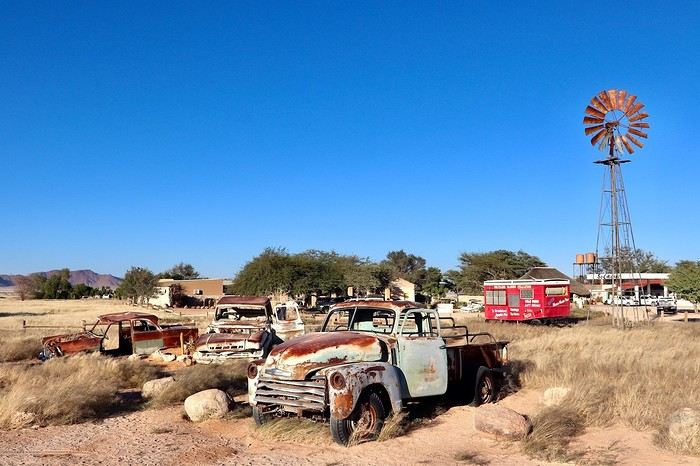
We start the day with a first stop less than 15 km away **on the C14 in Solitaire** at 8:15 AM. **This town is lost in the middle of nowhere with its small gas station with a western atmosphere adorned with rusted and sand-covered car wrecks.** After a quick supply stop: 86 NAD $, or 4 € for 1 water container and a box of cookies, we continue north still on the C14, **crossing the Tropic of Capricorn** then devouring this **magnificent track up to Gaub Pass**. **A succession of narrow gorges, turns, climbs, and descents breaking the monotony of the previous long straight lines.** We are right in the heart of no man's land for 200 km. We then start the descent to the **Kuiseb Canyon. It houses the wide bed of the eponymous river, dry almost all year.** Even when it flows for 2 to 3 weeks during the rainy season, it doesn't go beyond Gobabeb and then seeps into the sand. **The drinking water that supplies Walvis Bay is pumped at Rooibank from this underground water table.** **We now cross the Kuiseb Desert where impressive dunes roll down.** We make a short stop at a **natural rock arch** reminding us of our (https://www.montagne-aventure.net/2024/04/29/j19-1-juin-2024-canyonlands-national-park-et-arches-national-park/). Then we gradually descend towards **Walvis Bay** where we will spend the night. At noon, we enter the **Dorob National Park**. The thermometer drops 10°C in 10 minutes as we get closer to the Atlantic Ocean.
At 12:45 PM, much earlier than initially planned, we arrive at the **Moon Landscape** (View Point 4, free) to have a snack, via a very recent surprising dual carriageway in the middle of nowhere, then via the C28. We are again in the hinterlands, the temperature has soared: 30°C without a bit of shade. Even if the colors and the panorama must be exceptional at sunrise or sunset, the detour for this 360° panorama is still worth it. Extreme aridity as far as the eye can see. The place lives up to its name; it really feels like being on the moon. We get back on the road at 1:30 PM via the D1991, C28, then again the A2, which is very new. The latter runs along the beautiful dunes up to the **Dune 7**, where we make another stop.
Then we head towards our final destination of the day, **Walvis Bay. Its port is sheltered by a sand spit, a natural breakwater that protects the city from the powerful assaults of the ocean. Its port was long a strategic place: claimed by the Cape Colony in 1795, it was officially annexed by the British in 1878 to counter Germany's ambitions in the region. A colony of fur seals, pelicans, flamingos, and whale terns have made it their home.**
We do a big grocery shopping at the Spar located in the center for 66 €; it's very easy to park there. Then we fill up with fuel at an Engen station right across for 1117 NAD $ for 54 liters (20.6 NAD $ per liter), which is 54 €. We then **enjoy the seaside in the Lagoon neighborhood**, where it's also easy to park. After kilometers in the desert, **this cool break is more than welcome. The outside temperature is 22°C. In the distance, we can clearly see the clouds lingering over Swakopmund.**
We take the 4x4 one last time to the **Lagoon Chalets where we will spend the night**. The spot is well set up and surprising in the heart of a residential neighborhood. The sites are quite large, separated by fences around very comfortable shared sanitary facilities. BBQ, electricity, and shaded area. We settle in quietly before going out on foot to watch the **sunset over the Pacific Ocean along Lagoon Promenade Road**. We can still see this impressive persistent mist in the distance. The neighborhood is very peaceful, certainly without much charm, but with a very well-developed seafront that inspires relaxation after kilometers without meeting anyone in inhospitable lands. We end the day with our traditional braai: grilled chicken thighs and sautéed potatoes in the coolness of a starry sky.
> Today's road itinerary: 5h30 of driving (or 3h30 of driving for 250 km without the Moon Landscape): Head north on the C14 > Cross the Tropic of Capricorn > Gaub Pass > Kuiseb Canyon on our left in a round trip > Continue to Green Valley and leave the C14 to the right on the D1984 > Turn right on the C28 > Then left D1991 to Moon Landscape D1991 View Point 4 > Return via the same road and stop at Dune 7 for sunset > Walvis Bay.
> Gas station: Solitaire or Walvis Bay.
> Distance driven today: 372 km.
> Distance walked today: 5 km.
> Today's expenses: Fuel fill-up for 54 € + Groceries for 66 € at Spar.
> Accommodation: Walvis Bay: Lagoon Chalets – 36.6 € for two - (http://www.lagoonchaletswb.com/) - 8th Road West, Meersig Meersig 9000, Walvis Bay, Namibia - BBQ – Electricity – Shared sanitary facilities.
**DAY 12: Monday, May 5, 2025: Walvis Bay - Swakopmund - Round Trip to Cape Cross (seals) - Wreck of the Zeila en route - Henties Bay - Spitzkoppe Tented Camp & Campsite**
After an excellent night, a bit cooler and more humid than usual, we wake up around 7 AM and leave the camp at 7:45 AM to **follow the Atlantic coast heading north**. We thus leave **Walvis Bay**, a very pleasant stopover town, and follow the ocean via the B2. **We enter the mist and Swakopmund** at 8:40 AM, parking **near the lighthouse**. The atmosphere is very quiet, the streets seem dead with large empty parking lots and very little traffic, but the few open shops are filled with expatriates enjoying their breakfasts, French bakeries, cafes, travel agencies... **We are in this Benguela Current, a fast cold ocean current that flows from South Africa, up the coasts of Namibia and Angola, towards the northwest to join a warm equatorial current. Hence the supply of very fish-rich waters and this tenacious mist depending on the seasons. In the northern part of the Namib Desert, fogs are frequent during the southern winter. It's almost the only source of moisture since the city of Swakopmund receives, on average, only 11 liters of water per m² in December and January.**
**Swakopmund is wedged between the dunes and the Atlantic rollers. It is the Namibian capital of adventure activities and has a ghostly colonial remnant. With its German architecture, its seaside promenade, it resembles a seaside town of the North Sea or the Baltic.** It is also a bustling African city. **Nearly two-thirds of Swakopmund's population live in Mondesa, a township created during apartheid, northeast of the city center, a legacy of the South African mandate.** The heart of the city is located in the area of the pier, at the foot of the lighthouse, better known as the Mole. During the South African occupation of Swakopmund, the port took a back seat to Walvis Bay.
Continuing on this C34, sometimes on salt, we come across the famous **wreck of the Zeila, stranded in 2008**, on our left. We can see it through the thick fog, being very close to the beach. It's 10:15 AM. Further on, Henties Bay is a bay that attracts many fishermen; it's teeming with vehicles equipped with fishing rods. Besides its fish-rich waters, it enjoys a relaxed atmosphere and a large beach suitable for walks.
We continue further north, heading to Cape Cross, this time a round trip because we will turn off later here in Henties Bay to reach Spitzkoppe via good gravel roads that are quiet alternatives to the very busy paved B2 further south. **Henties Bay is part of the Dorob National Park, a multi-purpose park protecting coastal ecosystems and hosting the many renowned recreational activities of the region. The part of the coast north of Swakopmund up to the Ugab is particularly popular with fishermen who come in droves to fish for saltwater fish.** The small concrete buildings spaced at regular intervals are actually toilets for fishermen and campers. The coastline is also dotted with world-renowned surf spots.
Even before arriving, we can already smell it before we come across thousands of seals (population in 2021: 1.5 million). **The Cape Cross Seal Reserve, the most renowned on the Namibian coast, is home to the most famous breeding colony of fur seals, which seems to take full advantage of the high concentrations of fish present in the icy waters of the Benguela Current. We are impressed by the sight of these 100,000 pinnipeds lounging on the beach and frolicking in the waves.** We have a picnic a little away from the smells facing the ocean in the sun.
At 12:45 PM, it's time to hit the road again. We retrace our steps back to Henties Bay. We stop there to do another big grocery run before not encountering any big cities for many days. We will only buy fresh items day by day until the end of the trip; we have 23 € worth. **In the space of 30 minutes, we go from 15 to 36°C. The thermal shock with an amplitude of more than 20°C.** At 1:45 PM, we hit the road again via the D1918, then we try a very small track on our left, the D1925. It becomes narrow and rough; I have a bit of apprehension. We arrive at a gate to open in the middle of nowhere, then young children run up to us asking for water or food... We then drive to **Spitzkoppe. The arrival right in front of the mountains is majestic, off the beaten path. This mountain appears in the distance like a mirage above the dusty plains of southern Damaraland.** We come across a second gate held by a guard. We enter the "Community Camp" campsite without realizing it through the west entrance. We are given a small paper, then we go to the reception passing **at the foot of these gigantic, magnificent rocks.** Once at the reception, we are informed that this is not the camp we had booked. Ours is located just a little further, and in the end, it's better because the latter was packed. We were able to cross the park very close to these rocks without paying. We exit through the main entrance; 5 Himba children cling to our doors and trunk asking for bread and food again. We continue despite them staying attached, worried about hurting them. Phew, more fear than harm. We cross the few houses and arrive at the right camp at 4:30 PM, the Spitzkoppe Tented & Campsite. The spot is much quieter and well set up. We have site C12, cozy to perfection with its sink, a private shower and toilet, as well as electricity, under the shade of a tree and facing the mountains. The sunset and sunrise will be perfect. We set up the tent and, without delay, head to the pool for a big dose of coolness. Then it's time to prepare the BBQ and **contemplate the fading lights on the Spitzkoppe massif.**
> Today's road itinerary: 5 hours of driving: Head north on the B2 (paved) along the ocean > Swakopmund > C34 (paved) still heading north > On the left, the wreck of the Zeila before Henties Bay > Cape Cross round trip > Henties Bay > D1916 heading east (track) > Turn left onto D3716 > Turn left to the campsite.
> Gas station: Swakopmund or Henties Bay.
> Distance driven today: 344 km.
> Distance walked today: 6 km.
> Today's expenses: Groceries in Henties Bay: 23 € + Cape Cross park entry: 17 €.
> Accommodation: Spitzkoppe Tented Camp & Campsite - Spitzkoppe River Valley 00000, Spitzkoppe river valley, Namibia - (http://spitzkoppemountaincamp.com/) - 26 € - Pool - BBQ - Shower and toilet.
**DAY 13: Tuesday, May 6, 2025: Spitzkoppe - Rock Pools - Uis**
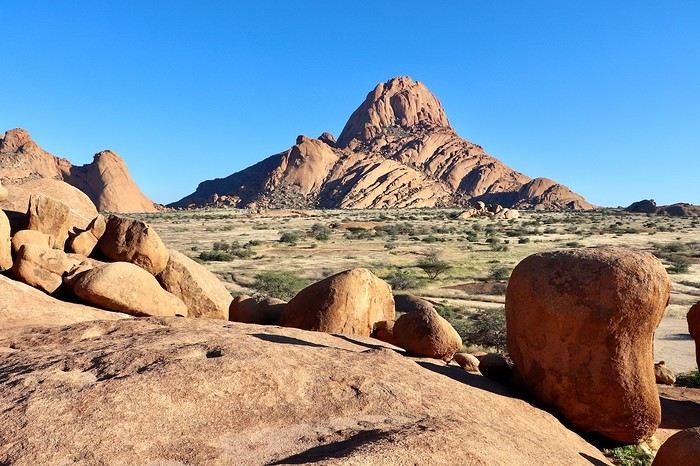
It's 6:45 AM, **we wake up at the foot of one of the most emblematic landscapes of the country, Spitzkoppe, which towers over the valley at 1,728 m.** **The Spitzkoppe massif, "pointed hat" in Afrikaans, is actually a set of three rock formations: Big Spitzkoppe, the granite domes of the Pontok Mountains that surround it, and Little Spitzkoppe, to the southwest. It was first climbed in 1946 and has never stopped attracting experienced climbers; it remains one of the most challenging ascents in the country. The climate in the region is hot**, so try to visit during the cooler months, as it can quickly reach 36°C in the sun in the afternoon. **Spitzkoppe is particularly striking at dusk, as it was last night, and at dawn this morning when the low light sets the rocks ablaze with red and orange hues. The spectacle is unique.**
We re-enter the park managed by the local community (160 NAD $ per person), then start with the **arch sector**. We quietly enjoy all the viewpoints under perfect orange colors. We leave this magnificent spot, reminding us of (https://www.montagne-aventure.net/2024/04/29/j19-1-juin-2024-canyonlands-national-park-et-arches-national-park/), but with much less crowding here. Around 10 AM, we head closer to these mythical peaks, including the main one nicknamed the Matterhorn of Namibia. Then we finish with the **ascent of the rock above Rock Pool. The 360° view of the park is a must-see. Small natural pools carved into the rock bring a bit of water to this arid and rocky landscape.** The wind blows strongly up there, and during a photo shoot with a tripod, it falls forward right onto the lens glass, cracking it... Frustration and shouts, these will be the last quality photos of this trip, and a new bill to pay when we return to replace it... Disgusted.
We continue to **Bushmans Paradise**, have a lunch break in the shade of a rock before hitting the road again around 12:30 PM after thoroughly exploring the park, feeling weakened and sad about my passion: photography...
We fill up with fuel as soon as we arrive in Uis at the price of 21 NAD $ per liter, a total of 1021 NAD $ for 50 liters (52 € by card). **Uis is a former mining town. Tin mining ceased in the early 1990s, but the high white mountain where the ore was dumped is clearly visible. The region is rich in amethysts, Brandberg crystals, and other semi-precious stones; we come across many vendors on the roadside.**
We then head to our final destination of the day, the **Daureb Isib Restcamp**. We arrive quite early for once at 2:45 PM in the heat, but the camp is just perfectly set up, surely the most upscale we will have during this trip. We are in a fortunately shaded area under palm leaves, with a table, chairs with cushions, a sink, a hot shower, toilets, a beautiful pool, and of course our private BBQ. Perfect for regaining a bit of a smile after the fall of my DSLR camera. **We are facing the Brandberg massif, the "fire mountain" in Afrikaans, dominated by Königstein (2,573 m), the highest peak in Namibia.** **The Brandberg owes its name to the reddish-orange glow that forms on its slopes at dawn and dusk, when the sun's rays awaken its red granite faces studded with crystals. It also hides a real treasure inside, as it contains an exceptional concentration of prehistoric rock art**, mainly paintings and some petroglyphs, including the most famous of them, the **White Lady in the Tsisab Gorge**. There are over 43,000 in total, dating back 2,000 to 4,000 years, scattered in hundreds of crevices around the mountain.
Time for the usual swim, laundry, and evening cooking. On the braai menu, local sausages with cheese pasta and leftovers for a good salad the next day.
> Today's road itinerary: 1h45: Head north on the D3716 > Then D1930 (gravel and sand track) to Uis.
> Gas station: Uis.
> Distance driven today: 113 km.
> Distance walked today: 6 km.
> Today's expenses: Fuel fill-up in Uis for 52 € (1,021 NAD $).
> Accommodation: Daureb Isib Restcamp - Erf 672 C/O 3rd & 4th Avenue Uis 9000, Uis, Namibia - (http://www.daurebisib.com/) – 31 € - Pool. Comfort with private bathroom + electricity + Wi-Fi at the restaurant. Clear sky for a beautiful starry night.
**DAY 14: Wednesday, May 7, 2025: Brandberg (Namibia's Highest Mountain) - Damaraland:**
**The Brandberg massif is an isolated, dome-shaped mountain, an inselberg, that towers over the gravel plains scorched by the sun of the Namib Desert to the northwest. It measures 23 km long and 20 km wide. It is the highest point in Namibia at 2,573 meters.**
This massif formed about 130 million years ago when a gigantic viscous mass of magma from deep within the Earth's crust rose through the surrounding rock layers before solidifying. Later, the granite mass was exposed by the erosion of the surrounding rocks.
**The Brandberg is the highest mountain in Namibia, peaking at an altitude of 2,573 m. The indigenous San people call it the "burning mountain," as it appears to glow with a red light at sunset. With its considerable height and width, this massif influences the local climate, attracting more rain on its slopes than the desert below.** The rain seeps through the springs. Unique animal and plant species thrive in this high-altitude environment, and prehistoric paintings adorn the rock faces hidden in the ravines around the base of the mountain.
The first night was also hot since the start of this trip, the thermometer did not drop below 20°C. We wake up gently around 8 AM, a pleasant sleep-in, the sun is already out. After a quick morning cleanup of the 4x4, we have time today, we hit the road at 9:30 AM, getting lost in the Brandberg massif. We are now in the **Damaraland, which stretches from the majestic rock formations of the Brandberg in the south, where we are today, to the bushy expanses at the foot of the rugged mountains of Sesfontein in the north, where we will be tomorrow. It is the perfect destination for wildlife and flora observation.**
We take the track heading towards the **White Lady**, but we want an alternative to this guided visit only. So, just before arriving, we turn right towards a viewpoint named on Google Maps **Rastplatz**. We come across **small Himba villages, living in extreme poverty with no natural resources; the inhabitants ask for water with every passing vehicle...** A bit further, we encounter about ten **ostriches** in the middle of the track, magnificent, as we get closer to the mountains in the background, and a few meters further, **a herd of Oryx**. Then we approach the **bed of the Ugab River**. We then go back and have a snack in the middle of nowhere, under the shade of our 4x4, facing the mountainous massif. We get back on the road around noon, while the temperature is at its peak in this very hot region, 35°C on the gauge with very dry air. We go up the C35 slightly then turn left onto the small track D2319 until we reach the Ugab bed again. Back to Uis in the mid-afternoon.
We did not book the same campsite as the previous night; today we are at the Brandberg Rest Camp. Unfortunately, the camp is not at the same level as the previous one, which was perfect. But the price is also much lower. The sites are next to each other, separated by small fences behind the main building. But it will do just fine. We have our BBQ and electricity, the shared sanitary facilities are decent. We then lounge in the large pool. We will then buy some water for 10 € at the supermarket located right across.
> Gas station: Uis.
> Distance driven today: 118 km.
> Today's expenses: Groceries in Uis: 10 €.
> Accommodation: Brandberg Rest Camp Uis - No 3 Uis Street Namibia 9000, Damaraland, Namibia - (http://www.brandbergrestcamp.com/) - Large pool – Shower – Electricity
**DAY 15: Thursday, May 8, 2025: Damaraland: Petrified Forest - Ugab Valley - Palmwag**
The night was excellent and slightly cooler than the previous one. We wake up around 7 AM and hit the road just before 7:45 AM heading to a new destination as we continue this Namibian road trip. **We cross Damaraland today from south to north.** First via the C35 to **Khorixas**, then turning left onto the C39. **We come across some villagers walking kilometers under the scorching sun with only a small water container in their hand... What a tough life, light-years away from ours.** About 40 km west of this town, we arrive at the **Petrified Forest National Monument**. It is a vast expanse of veld (open vegetation area), dotted with petrified tree trunks that can reach 34 m in length and 6 m in circumference, estimated to be over 260 million years old. These trees belonged to the Gymnospermae family, conifers among which we find today's cycads and welwitschias. The absence of roots and branches suggests that the trunks were deposited here during a significant flood. The site has about fifty trees, some half-buried in sandstone, others perfectly petrified in silica with their bark and growth rings. A guide is mandatory at the entrance to visit the site.
We then continue on this C39 due west to the junction of the D2612. We make a round trip to the south to **Twyfelfontein, which means "uncertain spring" or "bubbling spring" in Damara**. The site is a UNESCO World Heritage site, located at the entrance of the grassy Aba Huab Valley and houses one of the largest collections of rock art on the continent. More than **2,500 petroglyphs** have been discovered on over 200 stones, as well as some rock paintings. They date back about 6,000 years and others 2,500 years. Many engravings depict species that have since disappeared from the region, such as elephants, rhinoceroses, giraffes, and lions. The presence of a seal attests to the existence of links with the coastline at the time, now over 100 km away. It is here, as well as at Brandberg, that the human history of Namibia began with these testimonies of ritual and economic practices among hunter-gatherer peoples.
We continue a bit further south on the D3214 then D3254 to visit the **Organ Pipes, "organ pipes"**. The entrance is also paid, much to our regret... 500 NAD $ for two. We take a well-marked trail leading to a small gorge containing dolerite (coarse-grained basalt) columns 4 m high and aligned on an astonishing 100 m long wall. We are in a volcanic chain stretching over a dozen kilometers, a pile of scoria that seems to have been exposed to fire, the Burnt Mountain "burnt mountain" stands in a bleak and desolate landscape where almost nothing grows.
We head back north and return to the C39 then the C43 to **Palmwag where we will spend the night**. **This concession, covering an area of 5,500 km², is a region of red hills and plains, remarkable for its rolling landscapes as well as its rich fauna and flora**. The region serves as a **buffer zone between Etosha and the Skeleton Coast**. We have a good chance of encountering black rhinos, desert elephants, and lions, as well as spotted hyenas, giraffes, gemsboks, and other antelopes.
We pass the sanitary control barrier at 4 PM, just before entering Palmwag. In our direction, from south to north, we are simply asked about our future destinations and to present my French driver's license. A few meters further, there is a small gas station, then on our left our final destination of the day: the Palmwag Lodge Campsites. We are happy to arrive after this long journey. The welcome is very pleasant, and the site is very comfortable with a real brick shelter housing our shower and toilet, as well as water and electricity. We always have a BBQ available, but today we unfortunately no longer have meat due to concerns about the sanitary control, but we were not sure if it was rather in the other direction that the transport of fresh meat and dairy products is prohibited. We now cross our fingers to be able to observe some different animals, as the place is renowned for elephants, giraffes, and rhinos. We first take some time to relax in the pool before going for a walk around the reserve, without encountering anything unfortunately this evening, but the wake-up will be up to par... Time for the sunset, which is always one of the highlights of the day.
> Today's road itinerary: 5h30 of driving: C35 heading north > Then turn left onto the C39 > Petrified Forest > Go down on the D3612 in a round trip to Twyfelfontain (rock paintings and Organ Pipes) > Go back up on the C39 then C43 to Palmwag > Round trip on the C40 to Mount Grootberg Pass.
For info on the C43, there is a sanitary control at the entrance and exit (transporting raw meat is prohibited).
Palmwag: black rhinos (guided or free visit? at sunrise or sunset).
> Gas station: Twyfelfontain or Palmwag (07:00 – 19:00) – Tire repair in Palmwag.
> Distance driven today: 349 km.
> Distance walked today: km.
> Accommodation: North of Palmwag Lodge Campsites - GPS Coordinates -19.88556°, 13.93694° - Pool – Water and electricity – 34 € - (https://gondwana-collection.com/accommodation/palmwag-campsite?LodgeName=PALMWAG%20CAMPSITE)
**DAY 16: Friday, May 9, 2025: Palmwag - Sesfontein - Entry into Kaokoland - Opuwo**
This morning, we take our time watching for wildlife. We can finally observe our first **kudus** as the sun begins to illuminate the plain in front of us (see video and time-lapse of the day). A few minutes later, we also spot **a couple of giraffes with their calf**, moving calmly and serenely.
**We leave Palmwag** at 9 AM, heading to the northernmost point of Damaraland via the C43 to Sesfontein.
A few kilometers on the track, and we come across **a herd of zebras**, 11 to be exact, in the middle of green hills. Even further, it's more than twenty that cross right in front of us, a treat for our eyes. Their gait is majestic; they are very sensitive to noise. Some are more curious than others and don't hesitate to stay close if we remain quiet. We then cross numerous rough riverbeds. We must always stay very attentive at the wheel because we can drive at over 80 km/h on straight lines and then suddenly have to brake to cross these small streams, usually already dry at this time of year. Many antelopes are still present by the side of the track; the heat is already rising, and they are often lying on the ground at this hour.
**We arrive in Sesfontein at 11:15 AM**, just as the children are leaving school. Transportation is done by donkey-drawn carts. The villagers spend their time in the shade of the trees and in front of the few small shops. The atmosphere of its streets is dusty with a laid-back pace; this town has the feel of an oasis located **by the Hoanib River**, the town of six springs from which it gets its name. Founded in 1896, it was a military outpost built after a cattle plague epidemic. This page of its history is reflected in Fort Sesfontein, erected in 1905 to fight cattle diseases, arms smuggling, and poaching.
We take a lunch break at the exit of the village around 11:30 AM in the shade of a tree, so peaceful, it's 32°C. We continue further north, away from the usual tourist routes, and **enter the Kunene region, also called Kaokoland**. The track becomes narrower and more winding. **These are now vast solitary spaces largely devoid of roads, simply crossed by sandy tracks opened by the South African army just a few decades ago.** The fauna and flora have managed to adapt to this harsh and dry environment, like the desert elephant, an endangered species whose slender legs are perfectly suited to the long journeys the animal must make to find water, a rare resource. This region is also the territory of the Himba people, emblematic of the country. Its name comes from the Kunene River, which marks a narrow belt of vegetation at the Angolan border.
**We arrive in Opuwo at 3 PM**, **this town is the capital of the Kunene region**. Its name means "the end" in the Herero language, a fitting term for this dusty collection of commercial buildings surrounded by traditional huts with round thatched roofs.
**Opuwo is a strong cultural moment of this trip in Himba territory, this semi-nomadic people traditionally settles in an onganda (small village), moving if necessary to find access to water. Himba women are known for their ochre-colored cream, otjize, a mixture of butterfat and ochre powder, applied to protect and moisturize the skin and hair. Fire and smoke play an important role in their culture.** Smoke, often scented with herbs, is used by women for purification. It can also convey prayers to the supreme being, Muluru. In traditional celebrations, there is always a sacred fire that remains lit between the main hut and the animal enclosure, to maintain ties with the ancestors.
Right upon arrival, we fill up with fuel at the Shell station at the price of 21.48 NAD $ per liter, or 67 liters for 1454 NAD $ (72 €) by card. We then quickly stock up on meat at the Spar **where Himba women with bare breasts mix with us, the only white people shopping in the aisles**. **Since the beginning of this trip, this is where life is most bustling**. There are many people on these dusty streets, after kilometers without seeing anyone, the shock is brutal. There are small markets, poverty but also wealth. The town is quite spread out. There are no white people left, **we finally discover the true, harsh African life.**
We arrive at the **Opuwo Country Lodge at 3:30 PM**, located slightly on the heights. We have site 9 at the end of the property for maximum isolation as we like. Once again, we have private sanitary facilities, a BBQ, and electricity. Once settled, we walk 10 minutes to the reception where the pool is located to cool off. An infinity pool that is just magnificent facing the vast landscape before us. But this contrast between this little comfort and the town below makes us uneasy. The employees walk back down. A guard is present at the entrance of the lodge to ensure security; the park where we are is fenced. We enjoy a good braai, then enjoy the few lights of the town gradually lighting up. The night will be quite noisy for once with very loud music rising from a party below until 2:30 AM... And yet it comes from far away... Maybe a bar? In any case, we rule out what we thought was just a party during our visit here on Friday.
> Today's road itinerary: 4 hours of track: Return via the C43 heading south to Opuwo.
> Gas station: Okangwati or Opuwo
> Distance driven today: 261 km.
> Today's expenses: Fuel fill-up in Opuwo for 72 € + Groceries in Opuwo for 21 €.
> Accommodation: Opuwo Country Hotel - Opuwo Hilltop Opuwo 9000, Opuwo, Namibia - -18.044682 / 13.833861 - (http://www.opuwolodge.com/) - N$600.00 - Pool / Water / Private sanitary facilities / Electricity / BBQ.
**DAY 17: Saturday, May 10, 2025: Opuwo to Epupa Falls:**
We take our time this morning by the **Kunene River**, then we hit the road at 8:45 AM. This is our return trip to Opuwo.
After 4 good hours of driving, **we return to the bustling life of Opuwo**. We refill with fuel at the Shell station (21.48 NAD $ per liter) 820 NAD $ (40 €) for 38 liters and do a quick grocery run at the Spar for 488 NAD $ (24 €). We don't take any meat because we have the **sanitary barrier** to cross tomorrow before entering Etosha Park. We pay for these two expenses in cash for the first time; until now, the credit card was always accepted, so we now have to use the cash we withdrew at the airport. Then we head back to the Opuwo Country Lodge, arriving at the campsite at 2 PM. We are the first to arrive, we rest for a moment before heading to the pool and then end the day around our traditional BBQ with sausages and sautéed potatoes. The full moon accompanies us, perfect for nighttime observations in Etosha starting tomorrow.
The campsite's location should be avoided because we again have infernal music that gets louder from 7 PM to 2:30 AM... And yet it comes from far away... Maybe a bar? In any case, we eliminate what we thought was just a party during our visit here on Friday.
> Today's road itinerary: 4 hours of track: Return via the C43 heading south to Opuwo.
> Gas station: Okangwati or Opuwo
> Distance driven today: 180 km.
> Accommodation: Opuwo Country Hotel - Opuwo Hilltop Opuwo 9000, Opuwo, Namibia - -18.044682 / 13.833861 - (http://www.opuwolodge.com/) - N$600.00 - Pool / Water / Electricity / BBQ
**DAY 18: Sunday, May 11, 2025: Epupa Falls:**
Time for a "vacation" day; we wake up leisurely at 8 AM and take our time this morning. Breakfast and even coffee. The night was good, lulled by the sound of the waterfalls.
In the late morning, we head out on the small path along the banks of the Kunene River, which offers magnificent landscapes. We have a beautiful view of Angola from the opposite bank. The falls extend over about 1.5 km and flow over a series of promontories, the highest of which reaches 37 m.
At noon, we return to our campsite to eat in the shade of the palm trees. On the menu: fried eggs and pasta. We take advantage of this afternoon to rest before the last part of this road trip, with reading, writing, and pool time on the agenda.
In the late afternoon, we return to one of the viewpoints overlooking Epupa Falls to once again enjoy the sunset colors from a different angle. We are over the moon; our thoughts wander in all directions. We discuss future trips, adventures, reminisce about our memories, and think about the world around us... We savor the luck of being here. On the way back, a Himba woman asks if we can give her a ride in our 4x4 to Opuwo tomorrow.
Tonight, we dine on our traditional braai with white beans by the Kunene River. We are lulled by the sound of this powerful river flowing under the song of insects. The coolness sets in, and we fall asleep under the stars.
> Distance driven today: 0 km.
> Distance walked today: 10 km.
> Accommodation: Omarunga Lodge Campsites - 68 € for two nights - Site by the river - (https://gondwana-collection.com/fr/accommodation/omarunga-epupa-falls-campsite?LodgeName=OMARUNGA%20EPUPA-FALLS%20CAMPSITE&hsLang=en)
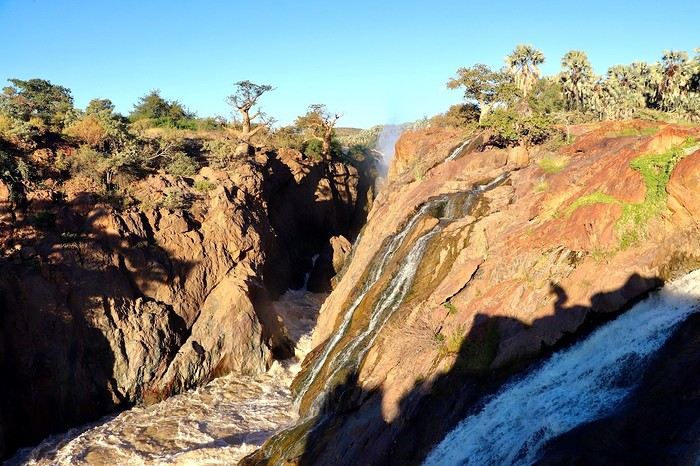
**DAY 19: Monday, May 12, 2025: Epupa to Opuwo**
We enjoy the morning a bit more by the **Kunene River**, then we hit the road at 8:45 AM. This is our return trip to Opuwo.
After 4 good hours on the road, **we return to the bustling life of Opuwo**. We refill with fuel at the Shell station (21.48 NAD $ per liter) for 820 NAD $ (40 €) for 38 liters and do a quick grocery run at the Spar for 488 NAD $ (24 €). We don't take any meat because we have the **sanitary barrier** to cross tomorrow before entering Etosha Park. We pay in cash for these two expenses for the first time; until now, the credit card was always accepted, so we have to use the cash we withdrew at the airport. Then we head back to the Opuwo Country Lodge, arriving at the campsite at 2:30 PM. We are the first to arrive, rest for a moment before heading to the pool, and then end the day with our traditional BBQ: sausages and sautéed potatoes. The full moon accompanies us, perfect for nighttime observations in Etosha starting tomorrow.
The campsite's location should be avoided, as we again have loud music until 2:30 AM... And it comes from far away... Maybe a bar? In any case, we rule out what we thought was just a party during our visit here on Friday.
> Today's road itinerary: 4 hours of track: Return via the C43 heading south to Opuwo.
> Gas station: Okangwati or Opuwo
> Distance driven today: 180 km.
> Accommodation: Opuwo Country Hotel - Opuwo Hilltop Opuwo 9000, Opuwo, Namibia - -18.044682 / 13.833861 - (http://www.opuwolodge.com/) - N$600.00 - Pool / Water / Private sanitary facilities / Electricity / BBQ
**DAY 20: Tuesday, May 13, 2025: Opuwo – Etosha - Olifantsrus**
We wake up before dawn around 6:30 AM. We pack up the camp at 7:15 AM heading to a first waterhole to watch the sunrise and start our day of observations and discoveries. It's 11°C, and as soon as we leave the campsite, we come across numerous zebras, foxes, and springboks with the sun rising on the horizon. Magnificent images.
**At 8:30 AM, we are still alone**, we witness **one of the most beautiful scenes of this trip: 3 lionesses hunting springboks**. It's thanks to the latter, slowing down, that we manage to spot 4 lionesses' heads barely above the tall grass. They hide, stand up, move slowly... We wait without moving. This is their perfect terrain for camouflage. **We are on the lookout and try to be discreet during this hunting scene**. We leave the area to let them finish their remarkable work and continue the track towards the East. The terrain becomes completely flat. It's now been 3 hours since we left the campsite without noticing the time passing, and especially without meeting anyone. Around 10 AM, near a waterhole, we come across a solitary elephant mixed with zebras, buffaloes, and springboks.
Around 11 AM, we take a lunch break; here, it's us who are enclosed in enclosures. Whether in the campsites or the few small equipped areas, we are fenced in by a gate. The animals are free on their territory. The wind has picked up again, just like the sun. We eat alone in absolute calm in the heart of this incredible, unique park; there are no words to describe what nature offers us here, far from any human activity. We start to see some safari vehicles arriving, but the attendance remains much lower than I had imagined. At most, a total of fifteen throughout the day.
Etosha is also a wonderful reserve of vegetation; you can find multiple mopane groves. But also acacias and other trees appreciated by ruminants. The south and east of the park have the most waterholes, which is where most animals gather. In the West, the vegetation is denser, and the wildlife is harder to spot, but it is well present, especially the black-faced impala and Hartmann's mountain zebra, which are found almost nowhere else. The area being less frequented, the bush feeling is more pronounced.
30 minutes of track after eating, **we come across a solitary male lion. The build compared to the females this morning is noticeable from afar**, even though this one is quite far from us unfortunately, unlike this morning when they were right on top of us.
**Etosha is the preferred habitat of lions in Namibia, with about 330 individuals roaming the park's plains, nearly half of the country's wild lions.** The big cats rest under the trees near waterholes, especially the one at Okaukuejo where we arrive today, but it's also a good spot for elephants and rhinos.
We then enter the territory of buffaloes, which we come across by the dozens now. Wow, the encounters keep coming. Then around 2 PM, we follow this immense **Etosha Pan** for the first time, which we will follow for a good part of tomorrow's day.
We arrive at our campsite at 3:30 PM after more than 8 hours of self-safari filled with discoveries. We sleep tonight at the **Olifantsrus Camp**, which we had previously booked in France. We had to wait and click several times for a spot to open up, as the camp has very few sites, and that's a good thing. It is located in one of the wildest areas of Etosha and has a practical observation tower overlooking a waterhole, offering us great opportunities to spot wildlife after nightfall (see photos). **The sunset is once again memorable.** In the guestbook at the reception, where each visitor can note their observations, 3 lions were seen the day before just a few steps from here (1 male, 1 female, and their cub), on a part of the track we didn't cover today; it will be on tomorrow morning's program. We cross our fingers for these predators.
> Today's road itinerary: 6 hours of driving: Leave Opuwo via the C41 (paved road) > Turn right onto the C35 (paved road) to the Galton Gate > Enter Etosha Park.
> Gas station: Opuwo.
> Distance driven today: 369 km.
> Accommodation: Olifantsrus Camping site - 53.4 € for two – Shared sanitary facilities – Electricity – BBQ – No grocery store - (https://www.etoshanationalpark.org/fr/accommodation/olifantsrus-camp)
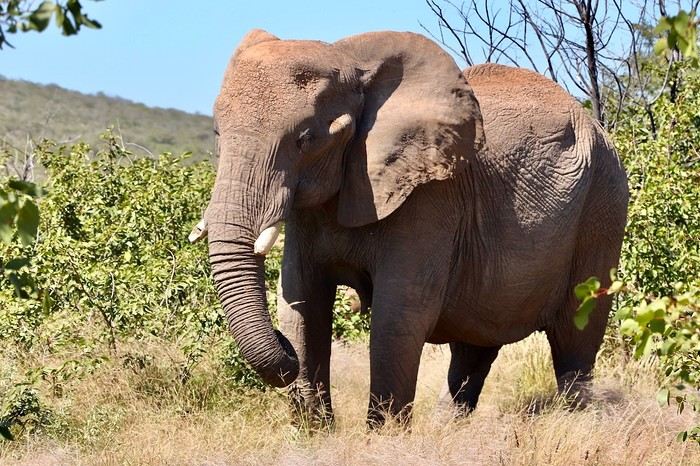
**DAY 21: Wednesday, May 14, 2025: Etosha National Park: From Olifantsrus to Okaukuejo:**
We wake up before dawn around 6:30 AM. We pack up the camp at 7:15 AM as the gates open, heading to a first waterhole to watch the sunrise and start our day of observations. It's 11°C, and just outside the campsite, we come across numerous zebras, foxes, and springboks with the sun rising on the horizon. Magnificent scenes.
**At 8:30 AM, we are still alone**, and we witness **one of the most beautiful moments of this trip: three lionesses hunting springboks**. Thanks to the springboks slowing down, we manage to spot four lionesses' heads barely above the tall grass. They hide, stand up, and move slowly... We wait without moving. This is their perfect terrain for camouflage. **We stay alert and try to be discreet during this hunting scene**. We leave the area to let them finish their remarkable work and continue the track towards the east. The terrain becomes completely flat. It's been 3 hours since we left the campsite without noticing the time, and especially without meeting anyone. Around 10 AM, near a waterhole, we come across a solitary elephant mixed with zebras, buffaloes, and springboks.
Around 11 AM, we take a lunch break; here, it's us who are enclosed in enclosures. Whether in the campsites or the few small equipped areas, we are fenced in by a gate. The animals are free on their territory. The wind has picked up again, just like the sun. We eat alone in absolute calm in the heart of this incredible, unique park; there are no words to describe what nature offers us here, far from any human activity. We start to see some safari vehicles arriving, but the attendance remains much lower than I had imagined. At most, a total of fifteen throughout the day.
Etosha is also a wonderful reserve of vegetation; you can find multiple mopane groves. But also acacias and other trees appreciated by ruminants. The south and east of the park have the most waterholes, which is where most animals gather. In the west, the vegetation is denser, and the wildlife is harder to spot, but it is well present, especially the black-faced impala and Hartmann's mountain zebra, which are found almost nowhere else. The area being less frequented, the bush feeling is more pronounced.
Thirty minutes of track after eating, **we come across a solitary male lion. The build compared to the females this morning is noticeable from afar**, even though this one is quite far from us unfortunately, unlike this morning when they were right on top of us.
**Etosha is the preferred habitat of lions in Namibia, with about 330 individuals roaming the park's plains, nearly half of the country's wild lions.** The big cats rest under the trees near waterholes, especially the one at Okaukuejo where we arrive today, but it's also a good spot for elephants and rhinos.
We then enter the territory of buffaloes, which we come across by the dozens now. Wow, the encounters keep coming. Then around 2 PM, we follow this immense **Etosha Pan** for the first time, which we will follow for a good part of tomorrow's day.
We arrive at our campsite at 3:30 PM after more than 8 hours of self-safari filled with discoveries. We sleep tonight at the **Okaukuejo Resort**. Upon arrival, this impression of a small town in the middle of hundreds of kilometers without infrastructure remains shocking. **The atmosphere is quite different from last night in our small wild campsite**. However, even though the attendance is higher, we are lucky to get a site in a corner (number 46). **The lit waterhole will also be a reward**. After checking in, we take advantage of the small grocery store to buy two meats for our next BBQs in the park, 3 pork chops and sausages, as well as a cold drink for 252 NAD $. This locality also offers a gas station, a restaurant, and a nice pool, but our goal during this park stay remains focused on the wildlife, so I won't give in this time. Time to set up, followed by a short rest, then our toilette before heading to the "waterhole" for the sunset around 6 PM. **A new grand spectacle unfolds before us, a hundred zebras come to hydrate right before our eyes at the water reserve facing the sunset in a cloud of dust. Then a couple of lions approach stealthily without managing to fill their stomachs. A third guest arrives, a second male lion also comes to drink. The waterhole now becomes the territory of the lions... We are speechless facing what nature offers us, we savor for over an hour scrutinizing the smallest details. What an intense day, images that will remain forever etched in our minds.** It's our turn to have our meal with three beautiful pork chops on the BBQ accompanied by curry vegetables.
At 9 PM, we decide to return to the waterhole, a wonderful idea because we find **an elephant and two black rhinos courting in the water. The male has a hard time seducing his sweetheart and eventually leaves, but a third rhino appears out of nowhere to join her. The scenes unfold under the spotlights** accompanied by a sky full of stars. We eventually go to bed. Looking forward to the rest of the story tomorrow.
> Today's road itinerary: Camp Olifantsrus > Camp Okaukuejo.
> Gas station: Okaukuejo camp.
> Distance driven today: 229 km. > Today's expenses: Groceries for 12 €.
> Accommodation: Okaukuejo Camping Site - 48.12 € for two - Pool - Gas station - Lit waterhole - Grocery store - (https://www.etoshanationalpark.org/fr/accommodation/okaukuejo)
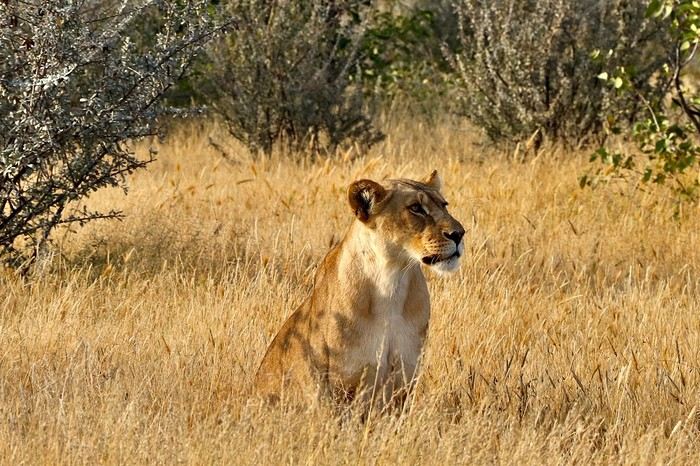
**DAY 22: Thursday, May 15, 2025: Etosha National Park: From Okaukuejo to Halali:**
We wake up around 5:30 AM to a strange noise getting closer, a few thunderclaps, then heavy rain pours down on us! The first since the start of this trip, we had forgotten its sound and smell. We leave the campsite quickly at 7:13 AM as the gates open, the rain stops just in time!
We are right in the heart of the park today. We arrive at the Etosha Pan, an immense flat salt desert that, a few days a year, transforms into a shallow expanse teeming with flamingos and pelicans. At the end of the dry season, everything, from elephants to grasslands, is covered in the white, chalky dust of Etosha.
Around noon, at the Riedfontein waterhole, we spot two male lions in this picturesque savannah. As we've noticed, the females hunt while the males protect the territory. The males and cubs will benefit first.
The day was less emotional than the previous one. We encounter far fewer animals, often at a greater distance. Is it because of the stormy rain we had at dawn this morning, or is it the area? The tracks were also more exhausting, especially the Rhino Drive without meeting a soul. But the view over the immense salt pan as far as the eye can see is worth seeing. Maybe the waterhole at the campsite will surprise us tonight as it did yesterday?
We arrive at 4 PM at the Halali Resort for our last night in the park. We still have a lit waterhole, more intimate than yesterday's, and we can walk around the park thanks to a hiking trail. The sanitary facilities are shared and quite recent, with each site offering its own BBQ and electrical outlet. After setting up and a quick wash, we head on foot to the Halali waterhole for sunset. Tonight's menu features local sausages (beef and pork) with curry pasta.
> Today's road itinerary: Camp Okaukuejo > Camp Halali.
> Gas station: Halali Camp.
> Distance driven today: 242 km.
> Accommodation: Halali Camping Site - 48.12 € for two - Pool - Gas station - Lit waterhole - Grocery store - (https://www.nwr.com.na/resorts/halali-resort/)
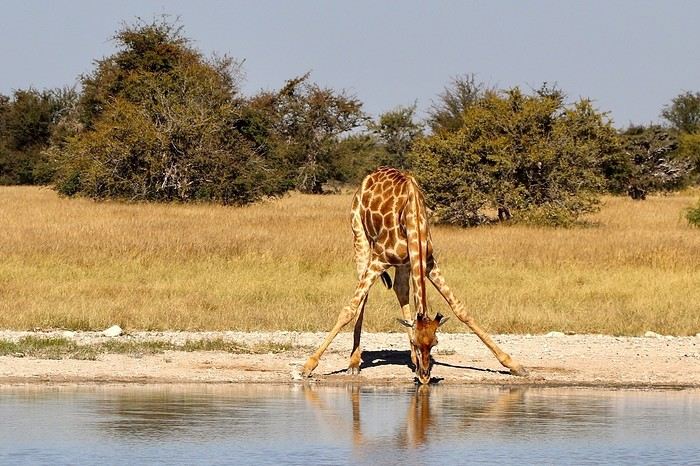
**DAY 23: Friday, May 16, 2025: Etosha National Park: From Halali to Namutoni - Waterberg Park:**
We pack up the camp at 7:15 AM as the gates open. It's 17°C, and the sun is out as usual. **We follow the Etosha Pan, still quite wet at this time of year.** The small track offers different viewpoints under a sun gradually rising higher.
The further east we go, the more we encounter gnus, kudus, and impalas. **We are once again spoiled and delighted by everything we discover this morning.** A majestic **giraffe** appears before our eyes just before arriving at **Namutoni** around 9:45 AM, quickly followed by 4 other companions. From there, we change plans, do the **Fischer's Pan** loop, and then decide to exit through the northern gate, allowing us to cover the entire park. Our last encounters will be with these tallest animals, the giraffes, and what a spectacle to see them spread their legs to hydrate, followed by gnus.
Just before the exit, we take a lunch break at an equipped area at 11:30 AM.
**We leave Etosha National Park with a touch of nostalgia through the King Nehale Iya Mpingana gate** at 12:30 PM. We find the beautiful paved B1 road, which is a great relief. Cows and goats take over; driving at 120 km/h on these single-lane, two-way roads with these animals we brush past requires constant vigilance. We fill up with fuel at 1:30 PM in **Oshivelo** (21.33 $ per liter), 93 liters for 99 € by card. Since we hadn't planned to go so far north out of Etosha, we are surprised to go through a **sanitary check** at the exit of the town, but it turns out to be even quicker than the previous one, a simple glance in the fridge by very smiling women, much more pleasant than the staff at the Etosha entrances and exits.
We pass **near Lake Otjikoto** ("deep hole" in Herero), which is **one of the only two natural lakes in Namibia along with its neighbor Lake Guinas**. In 1851, explorers Charles Andersson and Francis Galton came across this karst lake occupying a limestone cauldron 100 m long, 150 m wide, and 55 m deep. Its steep walls, about 20 m high, are the result of the collapse of the rock roof of the sinkhole under water pressure. This lake is also known for the large quantity of weapons and ammunition found in its depths. Remnants of the region's violent past, they were dumped there in 1915 by the retreating German army, refusing to let South African troops get their hands on them. Unfortunately, it's paid entry, and given the late hour, we continue on our way. To our great surprise, there is a lot of traffic on this B1, including many trucks, the first time we've seen so many people in this country. The landscapes change; we even discover deciduous trees taking on their autumn colors.
We pass through **Tsumeb**, and the road continues to **Otjiwarongo**, which means "pleasant place" in the Herero language, and the town lives up to its name. Prosperous and peaceful, with wide avenues and a relaxed atmosphere, we stop there to do some shopping. We buy some local meat to treat ourselves during these last two remaining camping nights: skewers, pork, and sausages, as well as biscuits, a last water tank, and yogurt for Mimi; 388 NAD $ - 20 €. We get back on the road heading south via the B1 for 15 minutes, then turn left onto the C42, still paved, for 30 minutes and 41 km, then left again onto the D2512, a wavy sandy track for 15 minutes.
**We enter the Waterberg National Park this evening.** The arrival facing this mountainous massif in the middle of the plains under the end-of-day lights of a deep red makes us even more eager to discover it. **Composed of impressive sandstone cliffs, tangles of vines, a canopy teeming with birds, elusive wildlife, and improbable dinosaur footprints. The Waterberg occupies a large sandstone plateau 50 km long and 16 km wide, at an altitude of 150 m above the plain.** It is possible to encounter elands, black wildebeests, roan antelopes, buffaloes, and red hartebeests, and with luck, leopards, as well as 200 identified bird species.
We arrive at the NWR campsite at 6 PM, the first time we arrive so late, just before nightfall. It's from here that various hiking trails start for tomorrow's day, including the **Mountain View Trail** that climbs to the edge of the plateau. We quickly settle into this peaceful camp where calm reigns, no more than 5 vehicles tonight. The place is shaded, with fairly recent shared sanitary facilities, electricity, and a BBQ for each. We savor our second-to-last braai under the stars, hearing our plane that brought us to Frankfurt fly over, every day at the same time over the Waterberg then Etosha. Very rare, as there are very few flights that land or fly over Namibian skies.
> Today's road itinerary: 10 hours of driving: B1 then C42 then D2512.
> Gas station: Exit of Etosha Park, Tsumeb, Otavi, or Waterberg Park.
> Distance driven today: 616 km.
> Accommodation: NWR Waterberg Camping Site - Pool - Water - 45 € for two - (https://www.nwr.com.na/resorts/waterberg-resort/#1577510913112-8f243e49-35a647e7-1997)
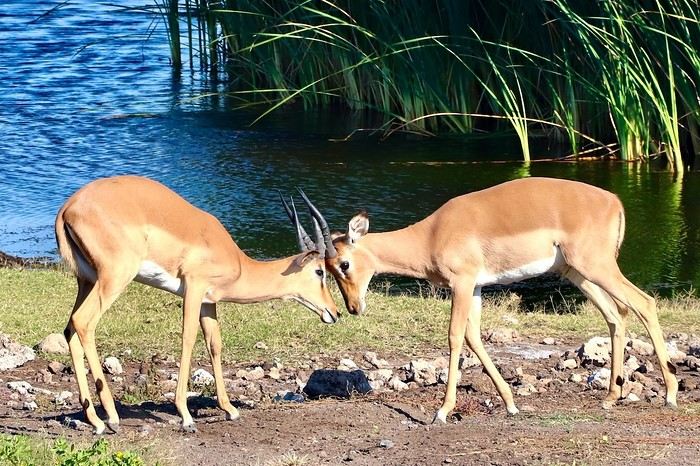
**DAY 24: Saturday, May 17, 2025: Waterberg Park - Otjiwa:**
We wake up around 7 AM after a very cool night.
**At sunrise, the cliffs appear even redder, and the cries of baboons echo around us.** We come across about thirty of them. We start the hike around 8:15 AM. **The Mountain View Trail will take us to the Waterberg Plateau.** The temperature is pleasant for walking. **The trail starts in a thick forest where the song of birds resonates.** The path is little frequented, so progress is slow and irregular; we regularly have to duck, step over, and climb rocks. However, in 35 minutes, we reach the top of the plateau. We are once again alone in the world in this Namibian nature. **The 360° panorama extends over a wide plain of green shrubs below, then over these steep red cliffs** giving access to this suspended plateau of the Waterberg. To enter, unfortunately, a special permit is required, and you must be accompanied by a guide. We savor the moment under the already hot sun at 9 AM. After an hour reminiscing about our journey on our rocky promontory, we start the descent at 10 AM, completing a loop back to our starting point. **At 10:30 AM, we pass by the small cemetery of German fighters who died in 1904**, then we hit the road back to the B1. We take a lunch break at noon at one of the tables scattered regularly along the paved roads. We are watched by **baboons** perched in their tree. We then decide to make a **detour through the town of Otjiwarongo**, which we didn't have time to explore properly yesterday. **A quick visit to the train station is a must to see locomotive No. 41, built in 1912 by the German company Henschel. It was transported to Namibia to carry ore between the mines of Tsumeb and the port of Swakopmund before being decommissioned in 1960 when the tracks were modified.**
We return to do some shopping and bring back some souvenirs for 300 NAD $ (14 €). We then take the road south on the B1. I start to feel the end of this immense loop through Namibia. Morale is gradually dropping. But we still have plenty of beautiful things to discover. We arrive at 3 PM at the **Otjiwa Safari Lodge. This will be our last night camping after 22 nights sleeping in the wild to the sound of animals.** The nostalgia is palpable. We enter this high-end private park; we don't really feel at home upon arrival. The reception, the pool, the restaurant, everything is very upscale, unlike anything we've experienced during this road trip. However, the reserve has its charm; we come across our beautiful antelopes again. The 10 sites are very comfortable, spaced apart under some bushes. Each has, of course, its BBQ, electricity, lighting, and sink. Before enjoying our last evening, we need to do a thorough dusting of the 4x4 and a good cleaning and organizing of our belongings. Then it's time for our last perfect braai: chicken and pork skewers, as well as tomato-flavored white beans.
> Today's road itinerary: 1h30 of driving: Waterberg > Otjiwarongo > Okonjima wildlife reserve - D2512 then C22 then B1 then turn right onto a 3 km track.
> Gas station: Waterberg Park.
> Distance driven today: 135 km.
> Distance walked today: 6 km.
> Today's expenses: Souvenirs for 14 €.
> Accommodation: Otjiwa Safari Lodge - B1 main road, west side Otjiwarongo 12001, Otjiwarongo, Namibia - (http://www.otjiwa.com.na/) – 40 € for two – From 3 PM.
**DAY 25: Sunday, May 18, 2025: Otjiwa - Windhoek:**
For this last leg of our Namibian journey, we complete the loop back to our starting point, Windhoek. We leave our last campsite at Otjiwa, later than usual, at 10 AM. We head due south on the B1 in less than 3 hours to the country's capital, not without a touch of nostalgia after all these kilometers traveled through Namibia. The landscapes roll by with a lot of melancholy. We make a stop 60 km north, in Okahandja. We take the opportunity to fill up with fuel (21.10 $ per liter), 500 NAD $ for 23 liters; the card machine wasn't working, so we had to withdraw from an ATM at the next gas station. A local was quite insistent at my window, asking for food or money. Anyway, after 15 minutes, we get back on the road.
From here, we take the new A1, a 2x2 lane highway limited, like the previous roads, to 120 km/h. Then we gradually see some of the country's industries before entering the capital in the blink of an eye. We arrive at 1:45 PM at Chameleon Backpackers. It's a small hostel-style hotel with a central pool, a shared kitchen, secure indoor parking, and a restaurant. They also organize tours (3 Day Express, 3 Day Link, 4 Days Etosha, 7 Day Norbert Adventure), very different from everything we've encountered so far, a kind of atmosphere like in Thailand. There are dormitories, rooms with shared bathrooms, and our little cocoon, the Love Bird, a room located alone on the upper floor with its small balcony, a swing, its bathroom, and its large bed with a thatched roof. A lot of charm while overlooking the pool. We eat before setting off to explore the capital.
Windhoek is a modern and well-maintained city, contrasting completely with the rest of the country. It is heavily influenced by its German colonial heritage, still very present in some streets of the capital. The architecture is colorful and surprising. The skyline is shared between the spires of a neo-baroque cathedral, the unusual silhouette of three castles from the German colonial era, and glass and steel skyscrapers. Office workers head to Zoo Park at lunchtime.
We enjoy the smell of grills at some street corners lined with small single-story houses with zinc roofs.
We first head to Windhoek's emblematic monument, its unofficial symbol: Christuskirche, just a 10-minute walk away. This German Lutheran church rises above the traffic at the center of an intersection. Built in 1907 with local sandstone. The roof and other elements were imported from Europe. The result evokes a gingerbread house.
We then walk along the pedestrian shopping street of **Post Street Mall** to admire African crafts, but on this Sunday, most shops are closed; we'll come back tomorrow. We return via the Wernhil shopping center.
> Today's road itinerary: Return to Windhoek in 3 hours via the B1 then the A1. In the capital, turn left onto Florence Nightingale, then right onto Beethoven Street then C28 then B6, then Bismarck Street. Take Church Street and Trift Street towards Voight Street.
> Gas station: Okahandja or Windhoek.
> Distance driven today: 245 km.
> Accommodation: Chameleon Backpackers & Guesthouse – 49 € for two - 5-7 Voigt St, North Windhoek Central, 9000 Windhoek
**DAY 26: Monday, May 19, 2025: Windhoek, Visit to the Namibian Capital:**
Our last sleep in Namibia... The wake-up is a bit sad; we still enjoy this return to comfort in a real bed. After a hearty breakfast, we check out of our little cocoon at 10 AM. We leave our vehicle in the secure parking lot and return for a walk in the center of Windhoek. On this Monday, the center is immediately livelier while still remaining extremely calm for a capital. The pace of life is slow; employees move slowly without rushing, each task is performed with a slowness that is almost surprising. A few skyscrapers further on, we quickly leave the hyper-center. We retrace our steps to the shopping gallery where we linger for a while. We eat around noon with African music in the background, making us even more nostalgic. Then the trip will gradually come to an end, unfortunately, until the moment when we will have to, not without regret, return our rental vehicle around 3 PM... We stop by the hotel again and then head to the rental agency and then to the airport by shuttle, included in our contract.
At 4:20 PM, we are back at the airport. We see ourselves upon arrival as if it were yesterday... Tears are not far off; we wait, the formalities are much quicker than upon arrival. **We board by walking across the tarmac on foot, escorted by about fifteen Namibians, facing the sunset. It will be there until the end, beautifully drawn on the horizon, to say goodbye to Namibia...**
> Round-trip flight tickets with Lufthansa from Lyon: 2029 €, or **1,014.50 €** per person.
> Vehicle rental: 4x4 Toyota with roof tent for 24 days: Gracious Whisp Car Rentals: 2,638 € (N$50,640) or **1,319 €** per person - (https://gwcarrentals.com/)
**DAY 27: Tuesday, May 20, 2025:** Flight FRA 8:15 AM -> 9:35 AM LYS (Air Dolomite No. 1074)
Total expenses including flight tickets + vehicle rental + visa + Lyon parking + food + fuel:
Cost per person: 3467 € Cost for two: 6935 €
>> All our photos and videos for each day on our website here: (https://www.montagne-aventure.net/voyages-découvertes/namibie-2025/)
>> Find all our photos and videos for each day on our website here: www.montagne-aventure.net
**DAY 1: Thursday, April 24, 2025: Outbound Flights from Lyon to Windhoek via Munich - Visit to Munich:**
Off we go on a new adventure. The alarm rings at 6:30 AM, the travel bags are packed, and we head to Lyon Airport. We booked our flight tickets with Lufthansa. The first leg to Munich, Germany, is operated by AirBaltic. Departure at 1:05 PM for a 1-hour and 20-minute flight. We arrive at 2:30 PM.
**We now have a 7-hour layover, so we take the opportunity to get some fresh air and explore Munich.** We quickly exit Terminal 2 of the airport and head towards the subway. We buy a group day ticket "Airport-city Day Zone M-5," valid for 2 to 5 people at a price of 30.50 € (instead of 16.30 € per person). We take the S8 line to **Marienplatz** in 35 minutes. **This is the heart of the city.** The weather is overcast, quite cool, but dry. Perfect for a little city trip between two flights while leaving our large luggage in transit at the airport. **Munich is the third-largest German city after Berlin and Hamburg, in the Bavaria region.** **The center has a lot of charm and brings together several religious buildings, easy to explore on foot.** We are impressed by the number of people enjoying these 100% pedestrian streets, which are very pleasant. After Marienplatz, the most famous square with the town hall, we head to the Cathedral of Our Lady, a Gothic church, then continue to **Karlsplatz** and move on to **the food market offering a wide selection of high-end food products in an atmosphere where a certain art of living prevails.** We also visit St. Peter's Church before grabbing a bite to eat. Two good hours were enough for this 10 km city walk. It's time to take the subway back: by 6:30 PM, we are back at the airport. Now, it's time for a bit of waiting and rest. Our second flight is scheduled for 9:35 PM for a 9-hour and 30-minute journey to our final destination in Namibia: **Windhoek.**
> Round-trip flight tickets with Lufthansa from Lyon: 2029 €, or 1,014.50 € per person.
> Lyon Airport parking: 120 €
> Today's expenses: 7 € for 2 pizzas in France / 14 € for the restaurant in Munich / 30.50 € for the daily subway ticket in Munich.
**DAY 2: Friday, April 25, 2024: Arrival in Windhoek, Visit to the Namibian Capital:**
After a 9-hour and 30-minute overnight flight with Discover Airlines, we finally land on Namibian soil just before 7:30 AM. The day is breaking, and the colors are already stunning. We are eager despite the usual fatigue from the flight. The airline was punctual, with friendly staff and good meals, though a bit light. We are the first flight of the day to land, with no more than 15 flights per day here, from 7 AM to 8 PM. We disembark on the tarmac at this airport located in the middle of nowhere, **I finally set foot on African soil for the first time.** We exit among the first from the aircraft to go through the long formalities at the front of the line, as the wait can quickly become endless. Allow at least 5 minutes per person for e-visas. We still wait 45 minutes despite only about twenty people ahead of us. Phew, it's done. We collect our luggage and then withdraw money from an ATM. We make 4 withdrawals of the maximum amount, 2000 NAD $ per withdrawal, for a total of 380 €, or 95.33 € per withdrawal.
Our driver arrives at the same time, perfect timing, we were quick.
We leave the airport at 8:45 AM. By 9:30 AM, we arrive at the **Gracious Whisp vehicle rental agency**, located at the entrance of Windhoek, small and human-sized with a fleet of recent vehicles. More formalities, then a short wait as our vehicle is not yet ready. Time to decompress, catch our breath, and enjoy the very pleasant morning temperature. Not a cloud in sight. Next, a briefing on the vehicle, always with a bit of apprehension due to our approximate English. Allow 45 minutes of explanations, including setting up the roof tent, camping equipment, technical information in case of a flat tire, driving tips in Namibia, and a tour of the 4x4. We have all the necessary equipment for camping: mattresses, sleeping bags, pillows, table, chairs, gas stove, BBQ grill... as well as 2 spare tires, a compressor, a dual tank, and accessories for removing wheels. Off we go, it's time to muster our courage and get behind the wheel. **Heading to SuperSpar Maerua**, fortunately located less than 10 minutes away. We park with the help of a parking attendant; it's very crowded, the space is narrow, but everything goes well despite the cursed right-hand drive. Today's new mission: stock up on groceries. The store is well-stocked with local and imported products, catering to all tastes. We spend 114 € on groceries, from pasta to meat, BBQ lighters to dishwashing products. Two people load our groceries into two carts and transfer them to our vehicle; we feel compelled to leave a tip, 50 NAD $, as we don't have change yet. Now, we head to the hotel, 15 minutes away. Traffic is difficult at a complicated intersection; this will likely be the only traffic jam in Namibia. **We arrive at Kate's Nest Guesthouse & Backpackers around 1:15 PM, quite tired.** We take some well-deserved rest at this recent establishment, quite calm with secure private parking. After a short nap, we enjoy the quiet by the hotel pool. Night falls between 6:30 PM and 7 PM. We eat quietly in our room tonight before starting this long 4x4 road trip in camping mode in the heart of Namibia.
> Today's grocery expenses: 114 € at Super Spar Marua (2395.21 NAD $).
> Round-trip flight tickets with Lufthansa from Lyon: 2029 €, or 1,014.50 € per person.
> Vehicle rental: 4x4 Toyota with roof tent for 24 days: Gracious Whisp Car Rentals: 2,638 € (N$50,640) or **1,319 €** per person - (https://gwcarrentals.com/)
> Distance driven today: 15 km.
> Accommodation: Kate's Nest Guesthouse & Backpackers - 4 Aristotles Street Academia, 9000 Windhoek - 36 € for two for one night.
> Windhoek International Airport website: (https://www.airports.com.na/)
**DAY 3: Saturday, April 26, 2025: Windhoek to Hardap: Mariental Region - Kalahari Desert:**
After a good, restful night, we wake up leisurely around 7 AM. We enjoy the comfort provided by this first and last hotel before 24 nights under the tent.
**We leave Kate's Nest Guesthouse at 8:30 AM to tackle the Namibian roads.** We quickly leave the capital; in just 30 minutes, we find ourselves almost alone in the world. The landscape is dotted with small domes. We leave the **paved B1** quickly to turn left onto the **C15**. **From there, we won't see more than 10 vehicles all day.** After passing through the few houses of **Lekkerwaterpoort**, we tackle our first gravel road. These road sections are limited to 100 km/h, but even at 70 km/h, I find it already challenging. However, I quickly get used to it and gradually pick up speed to reach my cruising speed of around 80 to 90 km/h. **We are on immense straight lines crossing wild expanses as far as the eye can see.** **We come across two baboons, a few ostriches, and numerous cattle and sheep farms.** We pass through the charming village of **Uhlenhorst** with its typical houses and children with broad smiles waving at us. Life here is already very different from Windhoek. **The thermometer rises quickly from 16°C at 8:30 AM to over 28°C in the early afternoon.**
**We arrive at the Hardap Dam reserve at 2 PM.** We stop at the toll booth at the park entrance to pay the entrance fee: 250 NAD $ for 2 people and 1 vehicle. We continue to the dam and then the camp entrance, located a bit further. We had booked in advance, but this place remains little frequented by foreigners.
We take advantage of the hottest hours to rest by the large pool overlooking the immense lake, a very enjoyable moment. Would this be a bit of a vacation?
Around 4:30 PM, we head to the campsite. We overlook this vast water reserve. We arrive first; we will be only 3 vehicles spending the night here. It's time to get to work and set up our equipment for the first time. It takes us a good 20 minutes to set everything up, with a slight apprehension about unfolding the tent. Once this task is done, which we will have to repeat for almost a month, we will become much more efficient over time. Time for rest and contemplation in total silence. The sun gradually sets, and the heat quickly becomes bearable again. Bliss! **This dam is located 20 km northwest of Mariental in an area dotted with conical hills topped with dolerite buttons (Hardap means "hillock" in Nama). It captures the Fish River, which flows south, creating a large lake in the middle of an arid environment. The contrast is striking.** We enjoy our first sunset facing this 360° otherworldly landscape.
Around 7 PM, we start our first BBQ, or "braai" as it's called here. The temperature is perfect. The sun sets, giving way to a star-filled sky of incredible beauty thanks to the absence of any light pollution. The Milky Way will lull us throughout the evening. After some good sausages and potatoes on the BBQ, we head to our roof tent around 9:30 PM with a complete change of scenery in just 24 hours. France already seems so far away...
This campsite has shared showers and toilets, quite clean and functional, as well as a central area with several BBQs and tables. The sites are arranged in a semicircle, each with an electrical outlet. The sites are close to each other but spacious, some slightly shaded. We are only three vehicles tonight, so it's perfectly comfortable and quiet. Not to mention the large pool near the restaurant. Our trip is off to a great start.
> Today's road itinerary: Windhoek > Head south on the B1 to Rehoboth > Turn left onto the C25 then C15 to Stampriet > C20 to Hardap > Full north on the B1 > Then turn left onto the M93 - 5 hours of driving.
> Distance driven today: 354 km.
> Accommodation: Hardap Recreation Resort - 23.3 € for two - Large pool - GR6W+3M2, Hardap Game Reserve, Mariental, Namibia - (http://www.nwr.com.na/resorts/hardap-resort/)
**DAY 4: Sunday, April 27, 2025: Hardap - Brukkaros Volcano - Keetmanshoop - Quivertree Forest Rest Camp**
Our first night under the tent was very pleasant; the little wind quickly calmed down, giving way to absolute silence. The mattress is decent, more comfortable than some nights in Nepal. The length and width give us enough space for maximum comfort, despite my height (1.91 m). We wake up a little before 7 AM as the sun rises, and the lights dazzle us from the start of the day. We pack up the equipment in 30 minutes, quite easily. Then we enjoy the sun, which warms up quickly while we keep our light fleece on.
At 8:30 AM, **we hit the road again, heading south** to our first stop in **Mariental**. We want to do some shopping at SuperSpar, but once we arrive in the parking lot, a young local is fighting with the supermarket security guards and then threatens to throw stones. We don't want to take any risks right at the start, so despite the baton blows he receives, he doesn't stop. We leave empty-handed but fill up with fuel at the Shell station 1 km further. The price per liter is 21.33 NAD $, we fill our 107-liter tank for 107 €. In Namibia, you get served, and they bring the card machine to the window to pay. It's then customary to leave a tip.
We then take the B1 heading due south on a recently renovated road. Around 11:30 AM, we leave it on our right to take **a wild gravel road, the M98**. Just before **Berseba**, we turn right onto a small track, the **D3904 towards Brukkaros Crater up to a camp at 1588 m altitude**. The track then becomes too bumpy. We stop on the counter-slopes where **a wide panorama unfolds over these immense plains as far as the eye can see**. It's 12:15 PM, time for us to eat a rice and tuna salad facing this landscape.
**We are alone in the world until a vehicle arrives and parks next to us.** A bit of apprehension, 4 men head towards us. It turns out to be 4 shepherds looking for a lost foal. The conversation is pleasant, lost in the middle of nowhere. We find ourselves alone again in this absolute silence. **The heat becomes stifling with a good 30°C**. We get back on the road around 1 PM. Back on the B1, **we continue due south to Keetmanshoop**, which we reach around 3 PM. We stop there to do some shopping for 262 NAD $ (12 eggs, a can of tuna, a can of corn, bread, a soda, and a 5-liter water container), or 12.48 €. Two quite insistent children ask us for money or candy at the store exit, yet we give them a small tip, but they continue to cling to the car. Locals parked next to us tell them to leave us alone. Anyway, we finish the trip to **Quivertree Forest**, 15 km away. We will spend the night in this **pleasant farm run by a German**. Upon arrival, as the day before, and as I suppose in the future, we dive straight into the cool pool to relax after all these kilometers. A bliss. Then we take our 4x4 and choose a spot near these famous trees. After the 33°C this afternoon, once 4 PM passed, the temperature drops again and becomes very pleasant. **We are in the middle of the Kokerboom, one of the most interesting and characteristic plants of hot and arid regions. It's not really a tree but a variant of the aloe plant whose botanical name is Aloe Dichotoma. This Kokerboom has a smooth and thick trunk reaching up to 1 m in thickness and 9 m in height. They bloom for the first time at the age of 20 to 30 years.** The flowers are yellow and reach about thirty centimeters during the season between June and July. **They grow mainly in an environment with a high concentration of black rocks absorbing a large amount of heat (38°C). The rocks also serve to anchor the tree with its tentacle-like roots. It also resists frost. Each is between 200 and 300 years old.**
Around 5 PM, we walk to the farm reception to watch the feeding of **two cheetahs**. Magnificent carnivores taking their time to savor their piece of meat. **Then we return near our campsite to enjoy the sunset among these trees. The colors are sublime, as every evening apparently. A magnificent spectacle with colors evolving from yellow to orange then to pink, before giving way once again to a sky filled with thousands of stars.** Our campsite at Quiver Tree Forest Camp is very comfortable; we have a water supply, a stone table, a small lamp, an electrical outlet, a small tree for shade, and a BBQ that we won't use tonight; we'll cook on gas. The sites are far apart, with some shared facilities scattered around, a very beautiful setting. No reservation possible, no need, just show up directly. **The campsite accommodation for 2 people costs 28 €, including the reserve entrance fee of 5 €**. We finish this second bivouac evening around 9:30 PM, time for some reading and sleep in peaceful silence without wind.
> Today's road itinerary: Mariental > B1 heading south to Brukkaros > At Tses turn right towards Berseba via the M98 > Turn right onto the D3904 > 8 km > Brukkaros Volcano (stop at the lower camp as the track is difficult for 1 hour) > Keetmanshoop > Turn left onto the M29 > Quivertree Forest - 4 hours of driving.
> Distance driven today: 371 km.
> Distance walked today: 6 km.
> Today's expenses: Groceries for 12.48 € (262 NAD $) / Fuel for 107 € (1 liter of diesel for 21.33 NAD $).
> Accommodation: Quivertree Forest Rest Camp, P.O. Box 262, Keetmanshoop, Namibia - BBQ, hot showers, toilets, and electricity - No reservation - Pool - 18 €/Person (N$ 340.00 with park entrance) - (http://www.quivertreeforest.com/)
**DAY 5: Monday, April 28, 2025: Quivertree Forest Rest Camp - Giant's Playground - Keetmanshoop - Fish River Canyon - Canyon Roadhouse:**
After an excellent start to the night, we are woken up by the wind shortly before 6 AM, but the sunrise is not far off. We get up at 6:30 AM to enjoy it. The atmosphere is a bit cooler this morning, but the reward is already here.
The adventure continues. At 7:45 AM, we head towards **Giant's Playground**, 4 km away. We take a 3-kilometer walk through this expanse of blocks and igneous rocks.
We continue south at 8:45 AM, passing through Keetmanshoop again where we do some shopping for 25 €, a big stock-up for a good part of the trip: meats, canned goods, pasta, fruits... At 9:30 AM, we take the B4 to Fish River Canyon.
At 11:30 AM, we arrive at the entrance to the NWR park (350 NAD $ entrance for 2 people and 1 vehicle). The track becomes bumpy immediately upon entering the park. After about ten kilometers, we come upon this landscape carved by nature. In the end, it's well worth the detour. We were at the Grand Canyon in the USA exactly (https://www.montagne-aventure.net/2024/04/29/j21-3-juin-2024-grand-canyon-et-lac-powell/) and can thus confirm that this Fish River Canyon is comparable. We make several stops along the southern flank. **Here, nothing is developed; nature is almost in the wild state.** **With 160 km in length, up to 27 km in width, and a depth of 150 m, it is indeed the second-largest canyon in the world.** The history of the canyon is apparent in its different earth layers and stratification: the antiquity of the place is tangible, and the absence of vegetation is surprising. **It consists of two nested canyons, formed at distinct periods. The first distinct layer of schist, sandstone, and eruptive material surrounding the canyon was formed a few two billion years ago, then transformed due to heat and pressure into more solid rock such as gneiss. The inner canyon, carved more recently by the Fish River, has a depth of 270 m.**
We have a picnic once again alone in the world facing this grand panorama at the **Sulphur Spring View Point**. This is where the hiking trail begins, plunging into this narrow canyon, but it is forbidden to venture there alone without a guide. It's 30°C, but a slight wind makes the atmosphere bearable. At 1 PM, we retrace our steps and continue to the **Main View Point** then to the **Hikers View Point**.
In the south of Namibia, the Fish River Canyon, 160 km long, is a true geological wonder: a canyon nested within another canyon, one of the largest in the world. The first sedimentary layers formed two billion years ago; 500 million years ago, a period of tectonic activity caused these layers to crack and tilt, opening a vast canyon in the Earth's crust. The second canyon, with a depth of 270 m, was carved over time by the passage of the Fish River in this new valley.
At 3 PM, we arrive at our very charming camp for the evening, the **Canyon Road House**. We fill up with fuel right away because tomorrow we have a long day of isolated driving: 55 liters for 1240 NAD $. Then we settle into the campsite we had previously reserved in France. We are assigned site 2, very well set up under a tree with its BBQ and stone table just steps from the pool. We quickly set up the tent and jump straight into the pool for the relaxation moment of the day. As usual, the water is quite cool, but it's a real pleasure. Then we stroll around this Canyon Road House, which recreates the atmosphere of the roadside inns of the 1950s with old car wrecks and vintage gas pumps in a bygone era. **Around 5:45 PM, we start a short walk leading us to the top of a hill overlooking the wide plateau where we are to watch the sunset.**
And finally, to end this beautiful day, it's time for the braai, with grilled sausages and white beans on the evening menu.
> Park entrance: 150 DN/person + 50 DN/vehicle (18 € for two). It is possible to enter at two access points: Hobas in the north and Ai-Ais in the south.
> Today's road itinerary: M29 > Keetmanshoop > B1 > B4 > C12 (track) > After Holoog turn right onto the D601 (C37 track) > Accommodation on our right (stop just to check in before 6 PM) > Continue 30 km (30 minutes of track) to the viewpoints after Hobas where you must pay the entrance fee. Sunset View Point to the left > Return before sunset as the park closes (best lights at sunrise). 3 hours.
> Distance driven today: 228 km.
> Distance walked today: 10 km.
> Today's expenses: 25 € for groceries / 17 € for the Fish River Canyon park entrance / 58 € for fuel.
> Accommodation: Canyon Roadhouse, Gondwana Collection Namibia – 34.4 € for two - Pool - Near Hobas - (http://www.gondwana-collection.com/fr/accommodation/canyon-road-campsite)
**DAY 6: Tuesday, April 29, 2025: Canyon Roadhouse - Orange River - South African Border - Vista Trail - Gondwana Sperrgebiet Park - Aus:**
The night was excellent in this very comfortable campsite. **We wake up to the sound of birds** before the alarm at 6:45 AM. Our little morning routine starts as the sun rises. **A big day of driving awaits us to the South African border. This will be the southernmost point of our journey.** We hit the road at 8 AM via the C37, pass through **Hobas**, then turn onto the D207 to **Aussenkehr.** **We cross a mountainous barrier with some high peaks and perfect cones. The rock varies from orange to pink to black.**
We then cross a lunar desert as far as the eye can see on a giant dome; the track winds through nowhere without meeting anyone for hours. The landscapes are surprising. **We spot several ostriches and a gemsbok.** In the middle of this endless expanse, we come to an improbable intersection and continue right onto the D278.
In the middle of these arid lands, we come across a green zone: a vast vineyard. At 10:30 AM, **we come across a "Road closed" sign, fortunately, a local resident waves us to continue; a bit stressed, we proceed.** We start to follow the beautiful Orange River. On the other side of the bank, just a few meters away, South Africa is there. It is the second-longest river in Southern Africa, after the Zambezi. It flows over 2,000 km to the Atlantic. After passing through narrow gorges, we regain altitude before starting the descent, gently heading back north.
**We now cross and follow the Fish River, which joins the Orange River further south** **along this gorge dating back millennia.** At exactly noon, we take a lunch break by the Fish River, still without meeting a soul in this landscape between greenery and aridity. The temperature here is cooler with a pleasant 23°C on the banks, the perfect spot. **We continue on the track to Rosh Pinah**, where we find a paved road again. **The section along the Orange River and the Fish River was officially closed, but we were able to pass without any issues, avoiding a detour of at least 3 hours.** Phew. We now drive at high speed (limited to 120 km/h) through these vast spaces. We come across many ostriches after the **dozens of monkeys along the Fish River**. Around 3 PM, 3 km after the very small town of **Aus**, we reach **our campsite for the evening at Klein Aus Vista**. A new **small peaceful haven very well set up**. As usual, after checking in at reception, we jump straight into the beautiful pool to get our well-deserved dose of coolness, another good thermal shock that our bodies appreciate. Once this moment of relaxation is over, we take our 4x4 to reach the campsite located a bit higher, set apart at the foot of a hill that overlooks us.
After setting up, **around 5 PM, we head to the Vista Trail to climb to the top of a mountain overlooking the vast plain that surrounds us at 360°**. It takes about 30 minutes to climb. The place is just magical, **the perfect viewpoint to admire the sunset**. **We fully savor the moment. We also spot one of the few wild horses in the world capable of living in the desert.** Their numbers have decreased in recent years due to predation and drought (around 100 to 150). At 7 PM, we return to the camp, time for the braai and preparing the meal in this peaceful little camp.
In the south of Namibia, the Fish River Canyon, 160 km long, is a true geological wonder: a canyon nested within another canyon, one of the largest in the world. The first sedimentary layers formed two billion years ago; 500 million years ago, a period of tectonic activity caused these layers to crack and tilt, opening a vast canyon in the Earth's crust. The second canyon, with a depth of 270 m, was carved over time by the passage of the Fish River in this new valley.
> Today's road itinerary: 5 hours of driving: D324 heading south (track) > turn right onto the C10 (track) > D316 heading south > turn right onto the C13 > In Aus turn left onto the B4 > Campsite via a track on the left.
> Fuel station: Solitaire or Aus.
> Distance driven today: 398 km.
> Distance walked today: 7 km.
> Accommodation: Klein-Aus Vista Desert Horse Campsite - Farm Klein-Aus No 8 on the B4 main road to Luederitz Aus 9000, Aus, Namibia - (http://www.klein-aus-vista.com/accommodation/desert-horse-campsite/) 17908 420 DN - Water + Shared shower (hot water). No electricity.
**DAY 7: Wednesday, April 30, 2025: Aus - Kolmanskop - Diaz Point - Luderitz - Kanaan Desert:**
We wake up around 6:45 AM, with partly cloudy weather for once; we feel the ocean's influence gradually. But the sun isn't far off. At 7 AM, we leave the campsite heading west towards Luderitz via the B4. **First stop of the day: Kolmanskop, the ghost town we reach at 8:30 AM**, entry costs 180 NAD $ per person. We discover this **timeless place** in 1.5 hours, moving from building to building amidst violent sand-laden gusts of wind. There's a lot of charm in these different living spaces. **The sand quickly reclaimed the place after this mining town was abandoned.** This was once the headquarters of Consolidated Diamond Mines. It's hard to believe that this former town, where the diamond industry once flourished, had a hospital, a bowling alley, and a theater. The decline in diamond sales after World War II and the discovery of richer deposits put an end to this golden age. By 1956, the town was already completely deserted, and the sand had reclaimed its rights. **These dilapidated buildings swallowed by shifting dunes have something surreal about them.**
At 10:15 AM, we hit the road again **heading to Luderitz, 22 km away**, and first to **Diaz Point** **facing the Atlantic Ocean**. It's a wind-swept peninsula with its characteristic red and white lighthouse. There's a campsite and a coffee shop on site, but the place doesn't inspire rest without shade or shelter from the wind. We return to the city via the D701 track that runs along the ocean, be careful at low tide. We come across **a few fishermen and a fox as well as flamingos.**
We walk through the few streets of the city, much smaller than I imagined, then climb to the **famous little Lutheran church that overlooks the city, the Felsenkirchr.** **The wind blows very strongly here, and the sand is omnipresent, surrounded by the Namib Desert and the southern Atlantic coast.** **A German colonial relic barely touched by the 21st century, Luderitz seems frozen in the past, giving it both a gloomy and a certain charm. In short, it's certainly one of the most incongruous places in Africa.**
At 1:15 PM, just before leaving Luderitz, we do some shopping for 20.50 € and fill up with fuel: 61.50 €, 1290 NAD $ for 61 liters (21.18 $ per liter).
**We return via the B4 to Aus** (paved), **then via rougher tracks**, the C13 then the D707, magnificent as it runs along a mountain range with multiple colors on our right and an endless flat desert on the other side.
To access our campsite for the evening, we must take a **narrow private track for 7 km** on our right to emerge, in this total vastness, at the **isolated Kanaan Desert Retreat on a small hill**. I don't have time today to jump into the pool near the reception; we arrive at 5 PM at 8 small, isolated, and unique sites with a small kitchen, a shower, and a private toilet under a small tarp shelter. **A crazy charm with a unique view...** **This will be my favorite accommodation of this trip. The photos speak for themselves.** We jump into the outdoor shower while savoring the landscape, then prepare our evening braai while enjoying the colors fading, facing this plateau with bushes turning a vivid orange. **A moment that will remain etched for life.** **Savanna atmosphere under a thin emerging moon. Every minute offers different colors. Facing our meal, we have a natural giant screen.**
We end this day contemplating the stars and admire this thin orange moon setting on the horizon (8:42 PM).
**Ghost town just before Luderitz: Kolmanskop** (open from 8 AM to 3 PM - N$ 180 p.p – 9 €). Once, Kolmanskoppe was organized around diamond mining. After finding new, more prolific spots, the town was abandoned and is now a ghost town. The sand and dunes have reclaimed their rights and buried everything humans had built. Houses, train station, bakery, everything has been covered by sand, which passes through the windows, even though they are 1 meter high.
> Today's road itinerary: 5h30: B4 to Luderitz (paved) > Round trip > Kolmanskop on the left > Return via the previous campsite > Then C13 (track) > Turn left D707 (track) > Then track to the right to the campsite.
> Distance driven today: 438 km.
> Distance walked today: 8 km.
> Today's expenses: Groceries at the Spar in Luderitz for 20.50 € / Fuel fill-up in Luderitz for 61.50 €.
> Official Kolmanskop website: (https://kolmanskuppe.com) (open from 8 AM to 1 PM - N$ 180 p.p – 9 €).
> Accommodation: Night at the south of the Namibrand Nature Reserve: Kanaan Desert Retreat – 26.5 € for two - (http://www.kanaannamibia.com/) - Farm 104 Karas 9000 - Sanitary facilities + BBQ + Water + Pool - No electricity - My favorite accommodation of this trip.
**DAY 8: Thursday, May 1, 2025: Kanaan Desert Retreat - Namib Desert - Crossing the Namibrand Nature Reserve – Sesriem Canyon - Elim Dune - Little Sossus Lodge**
After a cooler night than the previous ones with about 10°C, we wake up around 7 AM. We admire, as usual, the sunrise between the desert and the mountains. **The spot from last night was truly perfect, isolated from the world, in total serenity, with a wake-up call to the sound of birds.**
We hit the road a little after 8 AM, heading north via the D707 to Spes Bona, then the gravel road C27 via Betta to Sesriem. **The landscapes roll by and dazzle us.** **We are right in the heart of the Namibrand reserve**, coming across numerous **zebras**, **impalas**, **ruminants that reproduce in large numbers**, and **gemsboks**. At noon, we stop in the shade of a tree to eat. The spot is so romantic facing orange arid mountains and a vast green plateau. **A landscape full of contrasts, timeless and silent.**
**The Namib Desert is the oldest on the planet; its name means "vast arid plain," and it also gave its name to the entire country: Namibia.** The majority of these arid and semi-arid lands dotted with viewpoints are part of the Namib-Naukluft National Park, which covers 23,000 km².
At 1 PM, we enter the Sossusvlei park. We start with the **Sesriem Canyon**, which is 3 km long and 30 m deep. We enter it with a short 1-hour hike into its depths. **It was carved by the Tsauchab River in an agglomerate of sand and pebbles over 15 million years old.** We retrace our steps back to Sesriem, which means "six belts," referring to the number of leather belts (from ox wagons) needed to draw water from the canyon. This remote locality is mainly the gateway to Sossusvlei but offers a gas station and some accommodations. For our part, we sleep 40 km away tonight.
**We then move on to Elim Dune.** It takes about 45 minutes of walking to reach its summit, and the climb is very breath-taking as we progress in the sand where we almost slide back with each step. **A first grand 360° panorama unfolds. The ochre color of the sand contrasts completely with the yellow plain and the brown and black mountains in the distance.**
At 3:15 PM, we start the descent facing Sesriem. We were completely alone once again on this dune. **These Namib dunes are composed of colored quartzite sand, presenting hues ranging from cream to orange and from red to purple. Unlike the ancient dunes of the Kalahari, these move with the wind and adopt distinct, ever-changing shapes.** Star dunes resemble stars seen from above, while transverse dunes, like those on the coast south of Walvis Bay, stand perpendicular to the prevailing southwest wind. The most stable dunes, which thus have the most vegetation, are parabolic dunes, due to the variability of the winds. Longitudinal (seif) dunes measure up to 100 m in height, while barchan dunes, crescent-shaped and predominant at the extreme north of the Skeleton Coast and south of Luderitz, are the most mobile, created by unidirectional winds.
**We get back on the road for 45 minutes to our campsite for the evening, Little Sossus, which we reach at 5 PM**, via C27 then right onto C19. As often upon our arrival, I jump into the cool pool to relax after all this driving, then we proceed to set up the camp. As the day before, the campsite consists of 10 fairly distant sites, with private sanitary facilities and a small roof. We are delighted with this crazy charm. The hot water for our shower is wood-heated: a Namibian lights it every evening around 5 PM.
For a change, or not, the menu features a small BBQ with pork ribs and pasta, facing another sunset, this time with partial cloud cover giving equally splendid colors. Time for a well-deserved rest after long corrugated tracks covered in our 4x4 today.
> Today's road itinerary: 4h45 of driving: Find the D707 and head north (track) > At Spesbona turn left onto the C27 (track) > At Sesriem after entering the park, turn left following View Point Sesriem > Continue 4.5 km to the Sesriem Canyon Parking > Return then head towards Elim Dune > Exit the park then take the D826 > Turn right onto the C19 heading SE > Turn right facing the D854 to the campsite (campsite closes at 7 PM).
> Distance driven today: 272 km.
> Distance walked today: 8 km.
> Today's expenses: Entry to the Sossusvlei Namib-Naukluft Park: 17 € for two (with one car).
> Accommodation: Little Sossus Lodge – 35 € for two - At the junction of the C19 and D854 roads Maltahohe 9000, Maltahohe, Namibia - (http://www.littlesossus.net/) - Pool + Private bathroom + Hot water + Electricity + BBQ + Grocery store (bread to order the day before).
**DAY 9: Friday, May 2, 2025: Little Sossus Lodge - Namib-Naukluft National Park – Sesriem - Sossusvlei - Big Daddy – Deadvlei - Tsauchab River Camp**
Today we start the day early to tackle **the famous dunes of Sossusvlei at first light**. The alarm goes off at 6 AM to leave the camp at 6:45 AM. The wind is blowing quite strongly in gusts this morning, but it only woke us up a quarter of an hour before sunrise. The park opens at 7:15 AM. We start with a small encounter: a friendly **jackal lounging by the roadside.**
We first have to cover the 40 km of track to Sesriem, pay the entrance fee (350 NAD $), and drive 65 km on a paved road this time to reach the **vast salt pan (a lake whose sediments are made of salts) of Sossusvlei**. **It appears amidst the gigantic red dunes that rise on either side. The wind constantly changes the shape of the dunes, as well as their colors, which vary with the light. The setting is breathtaking, giving an impression of immensity and timeless grandeur.**
The paved road ends; the last 4 kilometers become technical and are reserved for 4x4s. Phew, I pass without any problems, though not without stress, switching to L4 mode. **We start the ascent to Big Daddy at 8:45 AM, 325 m of elevation gain in the sand nonetheless.** We climb at an excellent speed despite the strong wind, in exactly 1 hour. At 9:45 AM, we are at the summit of what will remain etched for a long time. The 360° view is simply unimaginable; you have to experience it to believe it. The wind blows violently up there, **it feels like being in the high mountains, on a snow ridge, with a strong transport of sand. The atmosphere is magical.** We start the descent running barefoot in the steep sand.
**We then move on to its neighbor, Deadvlei.** **Here, petrified trees stand in the "vlei" (basin) with their dried branches casting desolate shadows on the white ground. The juxtaposition of the deep blue sky and the towering dunes is captivating.**
We return to the 4x4 parking at 11 AM, the stress rises again for the sandy track passage. We retrace our steps and stop at **Dune 45**.
At noon, we take the opportunity to picnic at the foot of **the beautiful Dune 40**, where there is already no one left. We enjoy the quiet again, well, almost, as the wind remains omnipresent.
At 1 PM, we return to **Sesriem**, where we fill up with fuel (21.15 NAD $ per liter), totaling 1630 for 77 liters (78 €), and do some shopping for 245 NAD $ (two nice pieces of pork, 2 cans, 2 sandwiches for tomorrow, and 1 soda), which is 12.48 €. It's 27°C. We hit the road again, heading to a new destination at 2 PM. We take the C19 back to Little Sossus where we spent the night, then turn left onto the gravel road D854 for about 40 km to **Tsauchab River camp**. Finally, we won't be sleeping here; we are redirected 7 km downstream to **Naukluft View Camp**, which also belongs to Tsauchab River Camp.
We arrive at 4 PM, and thankfully, the fatigue was starting to set in. **Our campsite is located under a small forest, providing some protection from the wind that blew strongly all day. The calm does us a world of good. Once again, a lot of charm**, with very spaced-out sites without any visibility. We can't wait to take our shower. It will be possible from 5 PM with, as the day before, water heated by a wood fire. Time to prepare the campsite for the night. And on the menu, a braai with two superb pieces of pork bought in Sesriem and fries!!!!
**The Namib Desert**
An impressive coastal desert stretching from the Atlantic to a high plateau inland, the narrow Namib Desert runs along the southwest African coast for about 1,300 km. **Considered one of the oldest deserts in the world**, it is bordered to the north by the Kaokoland Desert, which extends into Angola, and to the south by South Africa's Karoo. The narrow Namib is mostly less than 160 km wide. Despite this, it is considered to consist of three sections: the coastal strip influenced by the Atlantic; the Outer Namib, occupying what remains of the western half; and the Inner Namib, comprising the eastern half of the desert. Generally called the Skeleton Coast, the coastal Namib receives almost no rain and depends on regular marine fogs for moisture. From sea level, the terrain rises to 900 m, where the desert meets the base of the Great Escarpment to the east. In the Inner Namib, average annual rainfall is only about 50 mm.
The dryness is such a characteristic of the Namib that it is thought to have been in this arid state for at least 55 million years. It is all the more surprising to learn that animals such as vipers, geckos, zebras, and elephants live in this desert. Some areas of the Namib are also rich in flora, including Welwitschia mirabilis, which grows near the ground with seemingly exhausted leaves, extracting moisture from marine fogs and can live over 1,000 years. In the southern Namib, some dunes are up to 32 km long and 240 m high.
**The frequent fog of the Skeleton Coast:** Driving north along the coast of Namibia, the cold Benguela Current in the Atlantic cools the moist air above the ocean, which, upon meeting the warm desert air, leads to the formation of thick fog banks that drift up to 100 km into the center of the Namib before evaporating under the sun.
> Today's road itinerary: 4 hours of driving: C19 towards Sesriem (track) > D826 (paved) > Foot of Big Daddy via a technical sandy track > Return via the same route > D854 to Tsauchab.
> Gas station: Sesriem.
> Distance driven today: 254 km.
> Distance walked today: 12 km.
> Today's expenses: Park entry at Sesriem for 2 people: 17 € / Fuel fill-up: 78 € / Groceries at Sesriem gas station: 12 € (245 NAD $).
> Accommodation: Tsauchab River Camp - Naukluft View Camp - D054 & D850 GPS: S24 26' 37" E16 10' 11" Sossusvlei 22007, Maltahohe, Namibia - BBQ + Private sanitary facilities + Water - www.tsauchab.com
**DAY 10: Saturday, May 3, 2025: Tsauchab River Camp - Naukluft National Park - Olive Trail Hike (10 km) - Ababis Guest Farm**
We pack up the camp at 8 AM and continue our road trip north via the D854, a bumpy track with many corrugated sections. It's cool this morning, 12°C.
**We enter the Naukluft massif, discovering landscapes with very different terrain than before.** We first need to check in at the campsite, 13 km from the entrance at the end of the track: 350 NAD $ for 2 people and 1 vehicle, then return 4 km back. **On the agenda is the lovely Olive Trail, a 10 km hiking loop that starts 4 km northwest of the park office**, along the D854 that we follow. At 9:45 AM, the hike begins with a fairly steep ascent (about 45 minutes) among the **wild olive trees** from which the trail gets its name. **At the summit, we enjoy a view that embraces the Naukluft Valley.** We then turn east and gradually descend into a deep valley, passing over sometimes slippery rocks. We have a snack around 11:30 AM in these small gorges. **Further on, to cross the wall of a canyon in front of us, some chains are fixed to the rock to help us pass.** We finish this superb loop clockwise at 1:15 PM, taking 3.5 hours including 30 minutes of breaks. We only crossed a small group of 3 people on this wild adventure far from everything. At 1:45 PM, we exit the park and take the **D854 track north to Bullsport**. From there, we turn left and take the C14, which **runs along the bed of the Tsondab River.**
**We arrive at our campsite for the evening, Ababis Guest Farm, at 3 PM.** Quite early for once, allowing us to rest a bit in this peaceful farm where many sheep wander around us. We also enjoy the pool under a magnificent sun, less hot than the previous days, it's 22°C. The camp has only 4 spaced-out sites around shared sanitary facilities. **We are in the middle of a vast plain facing the Naukluft massif mountains.** We will have another beautiful sunset on these mountains. For the first time on this trip, **we will be completely alone at this campsite.** **We haven't encountered many people today**, just 3 during the hike and fewer than 10 vehicles all day.
> Today's road itinerary: Head north on the D854 (track) > Turn left to enter the Naukfluft National Park > Continue on the track then turn right to the Olive Trail hike parking lot (1 hour for 45 km). Return to the D854 and continue north > At Bullsport turn left onto the C14 to Ababis (still a track) > The camp is located on the left facing the D1261 (1 hour for 60 km from Olive Trail). Total: 2 hours of driving for 100 km.
> Gas station: No gas station on the route, except in Solitaire.
> Distance driven today: 115 km.
> Distance walked today: 13 km.
> Accommodation: Ababis Gaestefarm - Night booked by email – payment on site: (https://www.ababis-gaestefarm.de/) - P.O.Box 1004, Maltahöhe - N$ 300.00 per person
**DAY 11: Sunday, May 4, 2025: Ababis Gaestefarm - Namib-Naukluft National Park – Solitaire - Gaub Pass - Kuiseb Canyon - Moon Landscape - Walvis Bay**
The night was, for the first time since the start of this road trip, quite difficult. A strong wind accompanied us all night, making the tent flap constantly. A racket that drove us crazy. We still managed to sleep a few hours. The morning sun brings back our smiles. We hit the road for this new stage a little before 7:45 AM.
We start the day with a first stop less than 15 km away **on the C14 in Solitaire** at 8:15 AM. **This town is lost in the middle of nowhere with its small gas station with a western atmosphere adorned with rusted and sand-covered car wrecks.** After a quick supply stop: 86 NAD $, or 4 € for 1 water container and a box of cookies, we continue north still on the C14, **crossing the Tropic of Capricorn** then devouring this **magnificent track up to Gaub Pass**. **A succession of narrow gorges, turns, climbs, and descents breaking the monotony of the previous long straight lines.** We are right in the heart of no man's land for 200 km. We then start the descent to the **Kuiseb Canyon. It houses the wide bed of the eponymous river, dry almost all year.** Even when it flows for 2 to 3 weeks during the rainy season, it doesn't go beyond Gobabeb and then seeps into the sand. **The drinking water that supplies Walvis Bay is pumped at Rooibank from this underground water table.** **We now cross the Kuiseb Desert where impressive dunes roll down.** We make a short stop at a **natural rock arch** reminding us of our (https://www.montagne-aventure.net/2024/04/29/j19-1-juin-2024-canyonlands-national-park-et-arches-national-park/). Then we gradually descend towards **Walvis Bay** where we will spend the night. At noon, we enter the **Dorob National Park**. The thermometer drops 10°C in 10 minutes as we get closer to the Atlantic Ocean.
At 12:45 PM, much earlier than initially planned, we arrive at the **Moon Landscape** (View Point 4, free) to have a snack, via a very recent surprising dual carriageway in the middle of nowhere, then via the C28. We are again in the hinterlands, the temperature has soared: 30°C without a bit of shade. Even if the colors and the panorama must be exceptional at sunrise or sunset, the detour for this 360° panorama is still worth it. Extreme aridity as far as the eye can see. The place lives up to its name; it really feels like being on the moon. We get back on the road at 1:30 PM via the D1991, C28, then again the A2, which is very new. The latter runs along the beautiful dunes up to the **Dune 7**, where we make another stop.
Then we head towards our final destination of the day, **Walvis Bay. Its port is sheltered by a sand spit, a natural breakwater that protects the city from the powerful assaults of the ocean. Its port was long a strategic place: claimed by the Cape Colony in 1795, it was officially annexed by the British in 1878 to counter Germany's ambitions in the region. A colony of fur seals, pelicans, flamingos, and whale terns have made it their home.**
We do a big grocery shopping at the Spar located in the center for 66 €; it's very easy to park there. Then we fill up with fuel at an Engen station right across for 1117 NAD $ for 54 liters (20.6 NAD $ per liter), which is 54 €. We then **enjoy the seaside in the Lagoon neighborhood**, where it's also easy to park. After kilometers in the desert, **this cool break is more than welcome. The outside temperature is 22°C. In the distance, we can clearly see the clouds lingering over Swakopmund.**
We take the 4x4 one last time to the **Lagoon Chalets where we will spend the night**. The spot is well set up and surprising in the heart of a residential neighborhood. The sites are quite large, separated by fences around very comfortable shared sanitary facilities. BBQ, electricity, and shaded area. We settle in quietly before going out on foot to watch the **sunset over the Pacific Ocean along Lagoon Promenade Road**. We can still see this impressive persistent mist in the distance. The neighborhood is very peaceful, certainly without much charm, but with a very well-developed seafront that inspires relaxation after kilometers without meeting anyone in inhospitable lands. We end the day with our traditional braai: grilled chicken thighs and sautéed potatoes in the coolness of a starry sky.
> Today's road itinerary: 5h30 of driving (or 3h30 of driving for 250 km without the Moon Landscape): Head north on the C14 > Cross the Tropic of Capricorn > Gaub Pass > Kuiseb Canyon on our left in a round trip > Continue to Green Valley and leave the C14 to the right on the D1984 > Turn right on the C28 > Then left D1991 to Moon Landscape D1991 View Point 4 > Return via the same road and stop at Dune 7 for sunset > Walvis Bay.
> Gas station: Solitaire or Walvis Bay.
> Distance driven today: 372 km.
> Distance walked today: 5 km.
> Today's expenses: Fuel fill-up for 54 € + Groceries for 66 € at Spar.
> Accommodation: Walvis Bay: Lagoon Chalets – 36.6 € for two - (http://www.lagoonchaletswb.com/) - 8th Road West, Meersig Meersig 9000, Walvis Bay, Namibia - BBQ – Electricity – Shared sanitary facilities.
**DAY 12: Monday, May 5, 2025: Walvis Bay - Swakopmund - Round Trip to Cape Cross (seals) - Wreck of the Zeila en route - Henties Bay - Spitzkoppe Tented Camp & Campsite**
After an excellent night, a bit cooler and more humid than usual, we wake up around 7 AM and leave the camp at 7:45 AM to **follow the Atlantic coast heading north**. We thus leave **Walvis Bay**, a very pleasant stopover town, and follow the ocean via the B2. **We enter the mist and Swakopmund** at 8:40 AM, parking **near the lighthouse**. The atmosphere is very quiet, the streets seem dead with large empty parking lots and very little traffic, but the few open shops are filled with expatriates enjoying their breakfasts, French bakeries, cafes, travel agencies... **We are in this Benguela Current, a fast cold ocean current that flows from South Africa, up the coasts of Namibia and Angola, towards the northwest to join a warm equatorial current. Hence the supply of very fish-rich waters and this tenacious mist depending on the seasons. In the northern part of the Namib Desert, fogs are frequent during the southern winter. It's almost the only source of moisture since the city of Swakopmund receives, on average, only 11 liters of water per m² in December and January.**
**Swakopmund is wedged between the dunes and the Atlantic rollers. It is the Namibian capital of adventure activities and has a ghostly colonial remnant. With its German architecture, its seaside promenade, it resembles a seaside town of the North Sea or the Baltic.** It is also a bustling African city. **Nearly two-thirds of Swakopmund's population live in Mondesa, a township created during apartheid, northeast of the city center, a legacy of the South African mandate.** The heart of the city is located in the area of the pier, at the foot of the lighthouse, better known as the Mole. During the South African occupation of Swakopmund, the port took a back seat to Walvis Bay.
Continuing on this C34, sometimes on salt, we come across the famous **wreck of the Zeila, stranded in 2008**, on our left. We can see it through the thick fog, being very close to the beach. It's 10:15 AM. Further on, Henties Bay is a bay that attracts many fishermen; it's teeming with vehicles equipped with fishing rods. Besides its fish-rich waters, it enjoys a relaxed atmosphere and a large beach suitable for walks.
We continue further north, heading to Cape Cross, this time a round trip because we will turn off later here in Henties Bay to reach Spitzkoppe via good gravel roads that are quiet alternatives to the very busy paved B2 further south. **Henties Bay is part of the Dorob National Park, a multi-purpose park protecting coastal ecosystems and hosting the many renowned recreational activities of the region. The part of the coast north of Swakopmund up to the Ugab is particularly popular with fishermen who come in droves to fish for saltwater fish.** The small concrete buildings spaced at regular intervals are actually toilets for fishermen and campers. The coastline is also dotted with world-renowned surf spots.
Even before arriving, we can already smell it before we come across thousands of seals (population in 2021: 1.5 million). **The Cape Cross Seal Reserve, the most renowned on the Namibian coast, is home to the most famous breeding colony of fur seals, which seems to take full advantage of the high concentrations of fish present in the icy waters of the Benguela Current. We are impressed by the sight of these 100,000 pinnipeds lounging on the beach and frolicking in the waves.** We have a picnic a little away from the smells facing the ocean in the sun.
At 12:45 PM, it's time to hit the road again. We retrace our steps back to Henties Bay. We stop there to do another big grocery run before not encountering any big cities for many days. We will only buy fresh items day by day until the end of the trip; we have 23 € worth. **In the space of 30 minutes, we go from 15 to 36°C. The thermal shock with an amplitude of more than 20°C.** At 1:45 PM, we hit the road again via the D1918, then we try a very small track on our left, the D1925. It becomes narrow and rough; I have a bit of apprehension. We arrive at a gate to open in the middle of nowhere, then young children run up to us asking for water or food... We then drive to **Spitzkoppe. The arrival right in front of the mountains is majestic, off the beaten path. This mountain appears in the distance like a mirage above the dusty plains of southern Damaraland.** We come across a second gate held by a guard. We enter the "Community Camp" campsite without realizing it through the west entrance. We are given a small paper, then we go to the reception passing **at the foot of these gigantic, magnificent rocks.** Once at the reception, we are informed that this is not the camp we had booked. Ours is located just a little further, and in the end, it's better because the latter was packed. We were able to cross the park very close to these rocks without paying. We exit through the main entrance; 5 Himba children cling to our doors and trunk asking for bread and food again. We continue despite them staying attached, worried about hurting them. Phew, more fear than harm. We cross the few houses and arrive at the right camp at 4:30 PM, the Spitzkoppe Tented & Campsite. The spot is much quieter and well set up. We have site C12, cozy to perfection with its sink, a private shower and toilet, as well as electricity, under the shade of a tree and facing the mountains. The sunset and sunrise will be perfect. We set up the tent and, without delay, head to the pool for a big dose of coolness. Then it's time to prepare the BBQ and **contemplate the fading lights on the Spitzkoppe massif.**
> Today's road itinerary: 5 hours of driving: Head north on the B2 (paved) along the ocean > Swakopmund > C34 (paved) still heading north > On the left, the wreck of the Zeila before Henties Bay > Cape Cross round trip > Henties Bay > D1916 heading east (track) > Turn left onto D3716 > Turn left to the campsite.
> Gas station: Swakopmund or Henties Bay.
> Distance driven today: 344 km.
> Distance walked today: 6 km.
> Today's expenses: Groceries in Henties Bay: 23 € + Cape Cross park entry: 17 €.
> Accommodation: Spitzkoppe Tented Camp & Campsite - Spitzkoppe River Valley 00000, Spitzkoppe river valley, Namibia - (http://spitzkoppemountaincamp.com/) - 26 € - Pool - BBQ - Shower and toilet.
**DAY 13: Tuesday, May 6, 2025: Spitzkoppe - Rock Pools - Uis**
It's 6:45 AM, **we wake up at the foot of one of the most emblematic landscapes of the country, Spitzkoppe, which towers over the valley at 1,728 m.** **The Spitzkoppe massif, "pointed hat" in Afrikaans, is actually a set of three rock formations: Big Spitzkoppe, the granite domes of the Pontok Mountains that surround it, and Little Spitzkoppe, to the southwest. It was first climbed in 1946 and has never stopped attracting experienced climbers; it remains one of the most challenging ascents in the country. The climate in the region is hot**, so try to visit during the cooler months, as it can quickly reach 36°C in the sun in the afternoon. **Spitzkoppe is particularly striking at dusk, as it was last night, and at dawn this morning when the low light sets the rocks ablaze with red and orange hues. The spectacle is unique.**
We re-enter the park managed by the local community (160 NAD $ per person), then start with the **arch sector**. We quietly enjoy all the viewpoints under perfect orange colors. We leave this magnificent spot, reminding us of (https://www.montagne-aventure.net/2024/04/29/j19-1-juin-2024-canyonlands-national-park-et-arches-national-park/), but with much less crowding here. Around 10 AM, we head closer to these mythical peaks, including the main one nicknamed the Matterhorn of Namibia. Then we finish with the **ascent of the rock above Rock Pool. The 360° view of the park is a must-see. Small natural pools carved into the rock bring a bit of water to this arid and rocky landscape.** The wind blows strongly up there, and during a photo shoot with a tripod, it falls forward right onto the lens glass, cracking it... Frustration and shouts, these will be the last quality photos of this trip, and a new bill to pay when we return to replace it... Disgusted.
We continue to **Bushmans Paradise**, have a lunch break in the shade of a rock before hitting the road again around 12:30 PM after thoroughly exploring the park, feeling weakened and sad about my passion: photography...
We fill up with fuel as soon as we arrive in Uis at the price of 21 NAD $ per liter, a total of 1021 NAD $ for 50 liters (52 € by card). **Uis is a former mining town. Tin mining ceased in the early 1990s, but the high white mountain where the ore was dumped is clearly visible. The region is rich in amethysts, Brandberg crystals, and other semi-precious stones; we come across many vendors on the roadside.**
We then head to our final destination of the day, the **Daureb Isib Restcamp**. We arrive quite early for once at 2:45 PM in the heat, but the camp is just perfectly set up, surely the most upscale we will have during this trip. We are in a fortunately shaded area under palm leaves, with a table, chairs with cushions, a sink, a hot shower, toilets, a beautiful pool, and of course our private BBQ. Perfect for regaining a bit of a smile after the fall of my DSLR camera. **We are facing the Brandberg massif, the "fire mountain" in Afrikaans, dominated by Königstein (2,573 m), the highest peak in Namibia.** **The Brandberg owes its name to the reddish-orange glow that forms on its slopes at dawn and dusk, when the sun's rays awaken its red granite faces studded with crystals. It also hides a real treasure inside, as it contains an exceptional concentration of prehistoric rock art**, mainly paintings and some petroglyphs, including the most famous of them, the **White Lady in the Tsisab Gorge**. There are over 43,000 in total, dating back 2,000 to 4,000 years, scattered in hundreds of crevices around the mountain.
Time for the usual swim, laundry, and evening cooking. On the braai menu, local sausages with cheese pasta and leftovers for a good salad the next day.
> Today's road itinerary: 1h45: Head north on the D3716 > Then D1930 (gravel and sand track) to Uis.
> Gas station: Uis.
> Distance driven today: 113 km.
> Distance walked today: 6 km.
> Today's expenses: Fuel fill-up in Uis for 52 € (1,021 NAD $).
> Accommodation: Daureb Isib Restcamp - Erf 672 C/O 3rd & 4th Avenue Uis 9000, Uis, Namibia - (http://www.daurebisib.com/) – 31 € - Pool. Comfort with private bathroom + electricity + Wi-Fi at the restaurant. Clear sky for a beautiful starry night.
**DAY 14: Wednesday, May 7, 2025: Brandberg (Namibia's Highest Mountain) - Damaraland:**
**The Brandberg massif is an isolated, dome-shaped mountain, an inselberg, that towers over the gravel plains scorched by the sun of the Namib Desert to the northwest. It measures 23 km long and 20 km wide. It is the highest point in Namibia at 2,573 meters.**
This massif formed about 130 million years ago when a gigantic viscous mass of magma from deep within the Earth's crust rose through the surrounding rock layers before solidifying. Later, the granite mass was exposed by the erosion of the surrounding rocks.
**The Brandberg is the highest mountain in Namibia, peaking at an altitude of 2,573 m. The indigenous San people call it the "burning mountain," as it appears to glow with a red light at sunset. With its considerable height and width, this massif influences the local climate, attracting more rain on its slopes than the desert below.** The rain seeps through the springs. Unique animal and plant species thrive in this high-altitude environment, and prehistoric paintings adorn the rock faces hidden in the ravines around the base of the mountain.
The first night was also hot since the start of this trip, the thermometer did not drop below 20°C. We wake up gently around 8 AM, a pleasant sleep-in, the sun is already out. After a quick morning cleanup of the 4x4, we have time today, we hit the road at 9:30 AM, getting lost in the Brandberg massif. We are now in the **Damaraland, which stretches from the majestic rock formations of the Brandberg in the south, where we are today, to the bushy expanses at the foot of the rugged mountains of Sesfontein in the north, where we will be tomorrow. It is the perfect destination for wildlife and flora observation.**
We take the track heading towards the **White Lady**, but we want an alternative to this guided visit only. So, just before arriving, we turn right towards a viewpoint named on Google Maps **Rastplatz**. We come across **small Himba villages, living in extreme poverty with no natural resources; the inhabitants ask for water with every passing vehicle...** A bit further, we encounter about ten **ostriches** in the middle of the track, magnificent, as we get closer to the mountains in the background, and a few meters further, **a herd of Oryx**. Then we approach the **bed of the Ugab River**. We then go back and have a snack in the middle of nowhere, under the shade of our 4x4, facing the mountainous massif. We get back on the road around noon, while the temperature is at its peak in this very hot region, 35°C on the gauge with very dry air. We go up the C35 slightly then turn left onto the small track D2319 until we reach the Ugab bed again. Back to Uis in the mid-afternoon.
We did not book the same campsite as the previous night; today we are at the Brandberg Rest Camp. Unfortunately, the camp is not at the same level as the previous one, which was perfect. But the price is also much lower. The sites are next to each other, separated by small fences behind the main building. But it will do just fine. We have our BBQ and electricity, the shared sanitary facilities are decent. We then lounge in the large pool. We will then buy some water for 10 € at the supermarket located right across.
> Gas station: Uis.
> Distance driven today: 118 km.
> Today's expenses: Groceries in Uis: 10 €.
> Accommodation: Brandberg Rest Camp Uis - No 3 Uis Street Namibia 9000, Damaraland, Namibia - (http://www.brandbergrestcamp.com/) - Large pool – Shower – Electricity
**DAY 15: Thursday, May 8, 2025: Damaraland: Petrified Forest - Ugab Valley - Palmwag**
The night was excellent and slightly cooler than the previous one. We wake up around 7 AM and hit the road just before 7:45 AM heading to a new destination as we continue this Namibian road trip. **We cross Damaraland today from south to north.** First via the C35 to **Khorixas**, then turning left onto the C39. **We come across some villagers walking kilometers under the scorching sun with only a small water container in their hand... What a tough life, light-years away from ours.** About 40 km west of this town, we arrive at the **Petrified Forest National Monument**. It is a vast expanse of veld (open vegetation area), dotted with petrified tree trunks that can reach 34 m in length and 6 m in circumference, estimated to be over 260 million years old. These trees belonged to the Gymnospermae family, conifers among which we find today's cycads and welwitschias. The absence of roots and branches suggests that the trunks were deposited here during a significant flood. The site has about fifty trees, some half-buried in sandstone, others perfectly petrified in silica with their bark and growth rings. A guide is mandatory at the entrance to visit the site.
We then continue on this C39 due west to the junction of the D2612. We make a round trip to the south to **Twyfelfontein, which means "uncertain spring" or "bubbling spring" in Damara**. The site is a UNESCO World Heritage site, located at the entrance of the grassy Aba Huab Valley and houses one of the largest collections of rock art on the continent. More than **2,500 petroglyphs** have been discovered on over 200 stones, as well as some rock paintings. They date back about 6,000 years and others 2,500 years. Many engravings depict species that have since disappeared from the region, such as elephants, rhinoceroses, giraffes, and lions. The presence of a seal attests to the existence of links with the coastline at the time, now over 100 km away. It is here, as well as at Brandberg, that the human history of Namibia began with these testimonies of ritual and economic practices among hunter-gatherer peoples.
We continue a bit further south on the D3214 then D3254 to visit the **Organ Pipes, "organ pipes"**. The entrance is also paid, much to our regret... 500 NAD $ for two. We take a well-marked trail leading to a small gorge containing dolerite (coarse-grained basalt) columns 4 m high and aligned on an astonishing 100 m long wall. We are in a volcanic chain stretching over a dozen kilometers, a pile of scoria that seems to have been exposed to fire, the Burnt Mountain "burnt mountain" stands in a bleak and desolate landscape where almost nothing grows.
We head back north and return to the C39 then the C43 to **Palmwag where we will spend the night**. **This concession, covering an area of 5,500 km², is a region of red hills and plains, remarkable for its rolling landscapes as well as its rich fauna and flora**. The region serves as a **buffer zone between Etosha and the Skeleton Coast**. We have a good chance of encountering black rhinos, desert elephants, and lions, as well as spotted hyenas, giraffes, gemsboks, and other antelopes.
We pass the sanitary control barrier at 4 PM, just before entering Palmwag. In our direction, from south to north, we are simply asked about our future destinations and to present my French driver's license. A few meters further, there is a small gas station, then on our left our final destination of the day: the Palmwag Lodge Campsites. We are happy to arrive after this long journey. The welcome is very pleasant, and the site is very comfortable with a real brick shelter housing our shower and toilet, as well as water and electricity. We always have a BBQ available, but today we unfortunately no longer have meat due to concerns about the sanitary control, but we were not sure if it was rather in the other direction that the transport of fresh meat and dairy products is prohibited. We now cross our fingers to be able to observe some different animals, as the place is renowned for elephants, giraffes, and rhinos. We first take some time to relax in the pool before going for a walk around the reserve, without encountering anything unfortunately this evening, but the wake-up will be up to par... Time for the sunset, which is always one of the highlights of the day.
> Today's road itinerary: 5h30 of driving: C35 heading north > Then turn left onto the C39 > Petrified Forest > Go down on the D3612 in a round trip to Twyfelfontain (rock paintings and Organ Pipes) > Go back up on the C39 then C43 to Palmwag > Round trip on the C40 to Mount Grootberg Pass.
For info on the C43, there is a sanitary control at the entrance and exit (transporting raw meat is prohibited).
Palmwag: black rhinos (guided or free visit? at sunrise or sunset).
> Gas station: Twyfelfontain or Palmwag (07:00 – 19:00) – Tire repair in Palmwag.
> Distance driven today: 349 km.
> Distance walked today: km.
> Accommodation: North of Palmwag Lodge Campsites - GPS Coordinates -19.88556°, 13.93694° - Pool – Water and electricity – 34 € - (https://gondwana-collection.com/accommodation/palmwag-campsite?LodgeName=PALMWAG%20CAMPSITE)
**DAY 16: Friday, May 9, 2025: Palmwag - Sesfontein - Entry into Kaokoland - Opuwo**
This morning, we take our time watching for wildlife. We can finally observe our first **kudus** as the sun begins to illuminate the plain in front of us (see video and time-lapse of the day). A few minutes later, we also spot **a couple of giraffes with their calf**, moving calmly and serenely.
**We leave Palmwag** at 9 AM, heading to the northernmost point of Damaraland via the C43 to Sesfontein.
A few kilometers on the track, and we come across **a herd of zebras**, 11 to be exact, in the middle of green hills. Even further, it's more than twenty that cross right in front of us, a treat for our eyes. Their gait is majestic; they are very sensitive to noise. Some are more curious than others and don't hesitate to stay close if we remain quiet. We then cross numerous rough riverbeds. We must always stay very attentive at the wheel because we can drive at over 80 km/h on straight lines and then suddenly have to brake to cross these small streams, usually already dry at this time of year. Many antelopes are still present by the side of the track; the heat is already rising, and they are often lying on the ground at this hour.
**We arrive in Sesfontein at 11:15 AM**, just as the children are leaving school. Transportation is done by donkey-drawn carts. The villagers spend their time in the shade of the trees and in front of the few small shops. The atmosphere of its streets is dusty with a laid-back pace; this town has the feel of an oasis located **by the Hoanib River**, the town of six springs from which it gets its name. Founded in 1896, it was a military outpost built after a cattle plague epidemic. This page of its history is reflected in Fort Sesfontein, erected in 1905 to fight cattle diseases, arms smuggling, and poaching.
We take a lunch break at the exit of the village around 11:30 AM in the shade of a tree, so peaceful, it's 32°C. We continue further north, away from the usual tourist routes, and **enter the Kunene region, also called Kaokoland**. The track becomes narrower and more winding. **These are now vast solitary spaces largely devoid of roads, simply crossed by sandy tracks opened by the South African army just a few decades ago.** The fauna and flora have managed to adapt to this harsh and dry environment, like the desert elephant, an endangered species whose slender legs are perfectly suited to the long journeys the animal must make to find water, a rare resource. This region is also the territory of the Himba people, emblematic of the country. Its name comes from the Kunene River, which marks a narrow belt of vegetation at the Angolan border.
**We arrive in Opuwo at 3 PM**, **this town is the capital of the Kunene region**. Its name means "the end" in the Herero language, a fitting term for this dusty collection of commercial buildings surrounded by traditional huts with round thatched roofs.
**Opuwo is a strong cultural moment of this trip in Himba territory, this semi-nomadic people traditionally settles in an onganda (small village), moving if necessary to find access to water. Himba women are known for their ochre-colored cream, otjize, a mixture of butterfat and ochre powder, applied to protect and moisturize the skin and hair. Fire and smoke play an important role in their culture.** Smoke, often scented with herbs, is used by women for purification. It can also convey prayers to the supreme being, Muluru. In traditional celebrations, there is always a sacred fire that remains lit between the main hut and the animal enclosure, to maintain ties with the ancestors.
Right upon arrival, we fill up with fuel at the Shell station at the price of 21.48 NAD $ per liter, or 67 liters for 1454 NAD $ (72 €) by card. We then quickly stock up on meat at the Spar **where Himba women with bare breasts mix with us, the only white people shopping in the aisles**. **Since the beginning of this trip, this is where life is most bustling**. There are many people on these dusty streets, after kilometers without seeing anyone, the shock is brutal. There are small markets, poverty but also wealth. The town is quite spread out. There are no white people left, **we finally discover the true, harsh African life.**
We arrive at the **Opuwo Country Lodge at 3:30 PM**, located slightly on the heights. We have site 9 at the end of the property for maximum isolation as we like. Once again, we have private sanitary facilities, a BBQ, and electricity. Once settled, we walk 10 minutes to the reception where the pool is located to cool off. An infinity pool that is just magnificent facing the vast landscape before us. But this contrast between this little comfort and the town below makes us uneasy. The employees walk back down. A guard is present at the entrance of the lodge to ensure security; the park where we are is fenced. We enjoy a good braai, then enjoy the few lights of the town gradually lighting up. The night will be quite noisy for once with very loud music rising from a party below until 2:30 AM... And yet it comes from far away... Maybe a bar? In any case, we rule out what we thought was just a party during our visit here on Friday.
> Today's road itinerary: 4 hours of track: Return via the C43 heading south to Opuwo.
> Gas station: Okangwati or Opuwo
> Distance driven today: 261 km.
> Today's expenses: Fuel fill-up in Opuwo for 72 € + Groceries in Opuwo for 21 €.
> Accommodation: Opuwo Country Hotel - Opuwo Hilltop Opuwo 9000, Opuwo, Namibia - -18.044682 / 13.833861 - (http://www.opuwolodge.com/) - N$600.00 - Pool / Water / Private sanitary facilities / Electricity / BBQ.
**DAY 17: Saturday, May 10, 2025: Opuwo to Epupa Falls:**
We take our time this morning by the **Kunene River**, then we hit the road at 8:45 AM. This is our return trip to Opuwo.
After 4 good hours of driving, **we return to the bustling life of Opuwo**. We refill with fuel at the Shell station (21.48 NAD $ per liter) 820 NAD $ (40 €) for 38 liters and do a quick grocery run at the Spar for 488 NAD $ (24 €). We don't take any meat because we have the **sanitary barrier** to cross tomorrow before entering Etosha Park. We pay for these two expenses in cash for the first time; until now, the credit card was always accepted, so we now have to use the cash we withdrew at the airport. Then we head back to the Opuwo Country Lodge, arriving at the campsite at 2 PM. We are the first to arrive, we rest for a moment before heading to the pool and then end the day around our traditional BBQ with sausages and sautéed potatoes. The full moon accompanies us, perfect for nighttime observations in Etosha starting tomorrow.
The campsite's location should be avoided because we again have infernal music that gets louder from 7 PM to 2:30 AM... And yet it comes from far away... Maybe a bar? In any case, we eliminate what we thought was just a party during our visit here on Friday.
> Today's road itinerary: 4 hours of track: Return via the C43 heading south to Opuwo.
> Gas station: Okangwati or Opuwo
> Distance driven today: 180 km.
> Accommodation: Opuwo Country Hotel - Opuwo Hilltop Opuwo 9000, Opuwo, Namibia - -18.044682 / 13.833861 - (http://www.opuwolodge.com/) - N$600.00 - Pool / Water / Electricity / BBQ
**DAY 18: Sunday, May 11, 2025: Epupa Falls:**
Time for a "vacation" day; we wake up leisurely at 8 AM and take our time this morning. Breakfast and even coffee. The night was good, lulled by the sound of the waterfalls.
In the late morning, we head out on the small path along the banks of the Kunene River, which offers magnificent landscapes. We have a beautiful view of Angola from the opposite bank. The falls extend over about 1.5 km and flow over a series of promontories, the highest of which reaches 37 m.
At noon, we return to our campsite to eat in the shade of the palm trees. On the menu: fried eggs and pasta. We take advantage of this afternoon to rest before the last part of this road trip, with reading, writing, and pool time on the agenda.
In the late afternoon, we return to one of the viewpoints overlooking Epupa Falls to once again enjoy the sunset colors from a different angle. We are over the moon; our thoughts wander in all directions. We discuss future trips, adventures, reminisce about our memories, and think about the world around us... We savor the luck of being here. On the way back, a Himba woman asks if we can give her a ride in our 4x4 to Opuwo tomorrow.
Tonight, we dine on our traditional braai with white beans by the Kunene River. We are lulled by the sound of this powerful river flowing under the song of insects. The coolness sets in, and we fall asleep under the stars.
> Distance driven today: 0 km.
> Distance walked today: 10 km.
> Accommodation: Omarunga Lodge Campsites - 68 € for two nights - Site by the river - (https://gondwana-collection.com/fr/accommodation/omarunga-epupa-falls-campsite?LodgeName=OMARUNGA%20EPUPA-FALLS%20CAMPSITE&hsLang=en)
**DAY 19: Monday, May 12, 2025: Epupa to Opuwo**
We enjoy the morning a bit more by the **Kunene River**, then we hit the road at 8:45 AM. This is our return trip to Opuwo.
After 4 good hours on the road, **we return to the bustling life of Opuwo**. We refill with fuel at the Shell station (21.48 NAD $ per liter) for 820 NAD $ (40 €) for 38 liters and do a quick grocery run at the Spar for 488 NAD $ (24 €). We don't take any meat because we have the **sanitary barrier** to cross tomorrow before entering Etosha Park. We pay in cash for these two expenses for the first time; until now, the credit card was always accepted, so we have to use the cash we withdrew at the airport. Then we head back to the Opuwo Country Lodge, arriving at the campsite at 2:30 PM. We are the first to arrive, rest for a moment before heading to the pool, and then end the day with our traditional BBQ: sausages and sautéed potatoes. The full moon accompanies us, perfect for nighttime observations in Etosha starting tomorrow.
The campsite's location should be avoided, as we again have loud music until 2:30 AM... And it comes from far away... Maybe a bar? In any case, we rule out what we thought was just a party during our visit here on Friday.
> Today's road itinerary: 4 hours of track: Return via the C43 heading south to Opuwo.
> Gas station: Okangwati or Opuwo
> Distance driven today: 180 km.
> Accommodation: Opuwo Country Hotel - Opuwo Hilltop Opuwo 9000, Opuwo, Namibia - -18.044682 / 13.833861 - (http://www.opuwolodge.com/) - N$600.00 - Pool / Water / Private sanitary facilities / Electricity / BBQ
**DAY 20: Tuesday, May 13, 2025: Opuwo – Etosha - Olifantsrus**
We wake up before dawn around 6:30 AM. We pack up the camp at 7:15 AM heading to a first waterhole to watch the sunrise and start our day of observations and discoveries. It's 11°C, and as soon as we leave the campsite, we come across numerous zebras, foxes, and springboks with the sun rising on the horizon. Magnificent images.
**At 8:30 AM, we are still alone**, we witness **one of the most beautiful scenes of this trip: 3 lionesses hunting springboks**. It's thanks to the latter, slowing down, that we manage to spot 4 lionesses' heads barely above the tall grass. They hide, stand up, move slowly... We wait without moving. This is their perfect terrain for camouflage. **We are on the lookout and try to be discreet during this hunting scene**. We leave the area to let them finish their remarkable work and continue the track towards the East. The terrain becomes completely flat. It's now been 3 hours since we left the campsite without noticing the time passing, and especially without meeting anyone. Around 10 AM, near a waterhole, we come across a solitary elephant mixed with zebras, buffaloes, and springboks.
Around 11 AM, we take a lunch break; here, it's us who are enclosed in enclosures. Whether in the campsites or the few small equipped areas, we are fenced in by a gate. The animals are free on their territory. The wind has picked up again, just like the sun. We eat alone in absolute calm in the heart of this incredible, unique park; there are no words to describe what nature offers us here, far from any human activity. We start to see some safari vehicles arriving, but the attendance remains much lower than I had imagined. At most, a total of fifteen throughout the day.
Etosha is also a wonderful reserve of vegetation; you can find multiple mopane groves. But also acacias and other trees appreciated by ruminants. The south and east of the park have the most waterholes, which is where most animals gather. In the West, the vegetation is denser, and the wildlife is harder to spot, but it is well present, especially the black-faced impala and Hartmann's mountain zebra, which are found almost nowhere else. The area being less frequented, the bush feeling is more pronounced.
30 minutes of track after eating, **we come across a solitary male lion. The build compared to the females this morning is noticeable from afar**, even though this one is quite far from us unfortunately, unlike this morning when they were right on top of us.
**Etosha is the preferred habitat of lions in Namibia, with about 330 individuals roaming the park's plains, nearly half of the country's wild lions.** The big cats rest under the trees near waterholes, especially the one at Okaukuejo where we arrive today, but it's also a good spot for elephants and rhinos.
We then enter the territory of buffaloes, which we come across by the dozens now. Wow, the encounters keep coming. Then around 2 PM, we follow this immense **Etosha Pan** for the first time, which we will follow for a good part of tomorrow's day.
We arrive at our campsite at 3:30 PM after more than 8 hours of self-safari filled with discoveries. We sleep tonight at the **Olifantsrus Camp**, which we had previously booked in France. We had to wait and click several times for a spot to open up, as the camp has very few sites, and that's a good thing. It is located in one of the wildest areas of Etosha and has a practical observation tower overlooking a waterhole, offering us great opportunities to spot wildlife after nightfall (see photos). **The sunset is once again memorable.** In the guestbook at the reception, where each visitor can note their observations, 3 lions were seen the day before just a few steps from here (1 male, 1 female, and their cub), on a part of the track we didn't cover today; it will be on tomorrow morning's program. We cross our fingers for these predators.
> Today's road itinerary: 6 hours of driving: Leave Opuwo via the C41 (paved road) > Turn right onto the C35 (paved road) to the Galton Gate > Enter Etosha Park.
> Gas station: Opuwo.
> Distance driven today: 369 km.
> Accommodation: Olifantsrus Camping site - 53.4 € for two – Shared sanitary facilities – Electricity – BBQ – No grocery store - (https://www.etoshanationalpark.org/fr/accommodation/olifantsrus-camp)
**DAY 21: Wednesday, May 14, 2025: Etosha National Park: From Olifantsrus to Okaukuejo:**
We wake up before dawn around 6:30 AM. We pack up the camp at 7:15 AM as the gates open, heading to a first waterhole to watch the sunrise and start our day of observations. It's 11°C, and just outside the campsite, we come across numerous zebras, foxes, and springboks with the sun rising on the horizon. Magnificent scenes.
**At 8:30 AM, we are still alone**, and we witness **one of the most beautiful moments of this trip: three lionesses hunting springboks**. Thanks to the springboks slowing down, we manage to spot four lionesses' heads barely above the tall grass. They hide, stand up, and move slowly... We wait without moving. This is their perfect terrain for camouflage. **We stay alert and try to be discreet during this hunting scene**. We leave the area to let them finish their remarkable work and continue the track towards the east. The terrain becomes completely flat. It's been 3 hours since we left the campsite without noticing the time, and especially without meeting anyone. Around 10 AM, near a waterhole, we come across a solitary elephant mixed with zebras, buffaloes, and springboks.
Around 11 AM, we take a lunch break; here, it's us who are enclosed in enclosures. Whether in the campsites or the few small equipped areas, we are fenced in by a gate. The animals are free on their territory. The wind has picked up again, just like the sun. We eat alone in absolute calm in the heart of this incredible, unique park; there are no words to describe what nature offers us here, far from any human activity. We start to see some safari vehicles arriving, but the attendance remains much lower than I had imagined. At most, a total of fifteen throughout the day.
Etosha is also a wonderful reserve of vegetation; you can find multiple mopane groves. But also acacias and other trees appreciated by ruminants. The south and east of the park have the most waterholes, which is where most animals gather. In the west, the vegetation is denser, and the wildlife is harder to spot, but it is well present, especially the black-faced impala and Hartmann's mountain zebra, which are found almost nowhere else. The area being less frequented, the bush feeling is more pronounced.
Thirty minutes of track after eating, **we come across a solitary male lion. The build compared to the females this morning is noticeable from afar**, even though this one is quite far from us unfortunately, unlike this morning when they were right on top of us.
**Etosha is the preferred habitat of lions in Namibia, with about 330 individuals roaming the park's plains, nearly half of the country's wild lions.** The big cats rest under the trees near waterholes, especially the one at Okaukuejo where we arrive today, but it's also a good spot for elephants and rhinos.
We then enter the territory of buffaloes, which we come across by the dozens now. Wow, the encounters keep coming. Then around 2 PM, we follow this immense **Etosha Pan** for the first time, which we will follow for a good part of tomorrow's day.
We arrive at our campsite at 3:30 PM after more than 8 hours of self-safari filled with discoveries. We sleep tonight at the **Okaukuejo Resort**. Upon arrival, this impression of a small town in the middle of hundreds of kilometers without infrastructure remains shocking. **The atmosphere is quite different from last night in our small wild campsite**. However, even though the attendance is higher, we are lucky to get a site in a corner (number 46). **The lit waterhole will also be a reward**. After checking in, we take advantage of the small grocery store to buy two meats for our next BBQs in the park, 3 pork chops and sausages, as well as a cold drink for 252 NAD $. This locality also offers a gas station, a restaurant, and a nice pool, but our goal during this park stay remains focused on the wildlife, so I won't give in this time. Time to set up, followed by a short rest, then our toilette before heading to the "waterhole" for the sunset around 6 PM. **A new grand spectacle unfolds before us, a hundred zebras come to hydrate right before our eyes at the water reserve facing the sunset in a cloud of dust. Then a couple of lions approach stealthily without managing to fill their stomachs. A third guest arrives, a second male lion also comes to drink. The waterhole now becomes the territory of the lions... We are speechless facing what nature offers us, we savor for over an hour scrutinizing the smallest details. What an intense day, images that will remain forever etched in our minds.** It's our turn to have our meal with three beautiful pork chops on the BBQ accompanied by curry vegetables.
At 9 PM, we decide to return to the waterhole, a wonderful idea because we find **an elephant and two black rhinos courting in the water. The male has a hard time seducing his sweetheart and eventually leaves, but a third rhino appears out of nowhere to join her. The scenes unfold under the spotlights** accompanied by a sky full of stars. We eventually go to bed. Looking forward to the rest of the story tomorrow.
> Today's road itinerary: Camp Olifantsrus > Camp Okaukuejo.
> Gas station: Okaukuejo camp.
> Distance driven today: 229 km. > Today's expenses: Groceries for 12 €.
> Accommodation: Okaukuejo Camping Site - 48.12 € for two - Pool - Gas station - Lit waterhole - Grocery store - (https://www.etoshanationalpark.org/fr/accommodation/okaukuejo)
**DAY 22: Thursday, May 15, 2025: Etosha National Park: From Okaukuejo to Halali:**
We wake up around 5:30 AM to a strange noise getting closer, a few thunderclaps, then heavy rain pours down on us! The first since the start of this trip, we had forgotten its sound and smell. We leave the campsite quickly at 7:13 AM as the gates open, the rain stops just in time!
We are right in the heart of the park today. We arrive at the Etosha Pan, an immense flat salt desert that, a few days a year, transforms into a shallow expanse teeming with flamingos and pelicans. At the end of the dry season, everything, from elephants to grasslands, is covered in the white, chalky dust of Etosha.
Around noon, at the Riedfontein waterhole, we spot two male lions in this picturesque savannah. As we've noticed, the females hunt while the males protect the territory. The males and cubs will benefit first.
The day was less emotional than the previous one. We encounter far fewer animals, often at a greater distance. Is it because of the stormy rain we had at dawn this morning, or is it the area? The tracks were also more exhausting, especially the Rhino Drive without meeting a soul. But the view over the immense salt pan as far as the eye can see is worth seeing. Maybe the waterhole at the campsite will surprise us tonight as it did yesterday?
We arrive at 4 PM at the Halali Resort for our last night in the park. We still have a lit waterhole, more intimate than yesterday's, and we can walk around the park thanks to a hiking trail. The sanitary facilities are shared and quite recent, with each site offering its own BBQ and electrical outlet. After setting up and a quick wash, we head on foot to the Halali waterhole for sunset. Tonight's menu features local sausages (beef and pork) with curry pasta.
> Today's road itinerary: Camp Okaukuejo > Camp Halali.
> Gas station: Halali Camp.
> Distance driven today: 242 km.
> Accommodation: Halali Camping Site - 48.12 € for two - Pool - Gas station - Lit waterhole - Grocery store - (https://www.nwr.com.na/resorts/halali-resort/)
**DAY 23: Friday, May 16, 2025: Etosha National Park: From Halali to Namutoni - Waterberg Park:**
We pack up the camp at 7:15 AM as the gates open. It's 17°C, and the sun is out as usual. **We follow the Etosha Pan, still quite wet at this time of year.** The small track offers different viewpoints under a sun gradually rising higher.
The further east we go, the more we encounter gnus, kudus, and impalas. **We are once again spoiled and delighted by everything we discover this morning.** A majestic **giraffe** appears before our eyes just before arriving at **Namutoni** around 9:45 AM, quickly followed by 4 other companions. From there, we change plans, do the **Fischer's Pan** loop, and then decide to exit through the northern gate, allowing us to cover the entire park. Our last encounters will be with these tallest animals, the giraffes, and what a spectacle to see them spread their legs to hydrate, followed by gnus.
Just before the exit, we take a lunch break at an equipped area at 11:30 AM.
**We leave Etosha National Park with a touch of nostalgia through the King Nehale Iya Mpingana gate** at 12:30 PM. We find the beautiful paved B1 road, which is a great relief. Cows and goats take over; driving at 120 km/h on these single-lane, two-way roads with these animals we brush past requires constant vigilance. We fill up with fuel at 1:30 PM in **Oshivelo** (21.33 $ per liter), 93 liters for 99 € by card. Since we hadn't planned to go so far north out of Etosha, we are surprised to go through a **sanitary check** at the exit of the town, but it turns out to be even quicker than the previous one, a simple glance in the fridge by very smiling women, much more pleasant than the staff at the Etosha entrances and exits.
We pass **near Lake Otjikoto** ("deep hole" in Herero), which is **one of the only two natural lakes in Namibia along with its neighbor Lake Guinas**. In 1851, explorers Charles Andersson and Francis Galton came across this karst lake occupying a limestone cauldron 100 m long, 150 m wide, and 55 m deep. Its steep walls, about 20 m high, are the result of the collapse of the rock roof of the sinkhole under water pressure. This lake is also known for the large quantity of weapons and ammunition found in its depths. Remnants of the region's violent past, they were dumped there in 1915 by the retreating German army, refusing to let South African troops get their hands on them. Unfortunately, it's paid entry, and given the late hour, we continue on our way. To our great surprise, there is a lot of traffic on this B1, including many trucks, the first time we've seen so many people in this country. The landscapes change; we even discover deciduous trees taking on their autumn colors.
We pass through **Tsumeb**, and the road continues to **Otjiwarongo**, which means "pleasant place" in the Herero language, and the town lives up to its name. Prosperous and peaceful, with wide avenues and a relaxed atmosphere, we stop there to do some shopping. We buy some local meat to treat ourselves during these last two remaining camping nights: skewers, pork, and sausages, as well as biscuits, a last water tank, and yogurt for Mimi; 388 NAD $ - 20 €. We get back on the road heading south via the B1 for 15 minutes, then turn left onto the C42, still paved, for 30 minutes and 41 km, then left again onto the D2512, a wavy sandy track for 15 minutes.
**We enter the Waterberg National Park this evening.** The arrival facing this mountainous massif in the middle of the plains under the end-of-day lights of a deep red makes us even more eager to discover it. **Composed of impressive sandstone cliffs, tangles of vines, a canopy teeming with birds, elusive wildlife, and improbable dinosaur footprints. The Waterberg occupies a large sandstone plateau 50 km long and 16 km wide, at an altitude of 150 m above the plain.** It is possible to encounter elands, black wildebeests, roan antelopes, buffaloes, and red hartebeests, and with luck, leopards, as well as 200 identified bird species.
We arrive at the NWR campsite at 6 PM, the first time we arrive so late, just before nightfall. It's from here that various hiking trails start for tomorrow's day, including the **Mountain View Trail** that climbs to the edge of the plateau. We quickly settle into this peaceful camp where calm reigns, no more than 5 vehicles tonight. The place is shaded, with fairly recent shared sanitary facilities, electricity, and a BBQ for each. We savor our second-to-last braai under the stars, hearing our plane that brought us to Frankfurt fly over, every day at the same time over the Waterberg then Etosha. Very rare, as there are very few flights that land or fly over Namibian skies.
> Today's road itinerary: 10 hours of driving: B1 then C42 then D2512.
> Gas station: Exit of Etosha Park, Tsumeb, Otavi, or Waterberg Park.
> Distance driven today: 616 km.
> Accommodation: NWR Waterberg Camping Site - Pool - Water - 45 € for two - (https://www.nwr.com.na/resorts/waterberg-resort/#1577510913112-8f243e49-35a647e7-1997)
**DAY 24: Saturday, May 17, 2025: Waterberg Park - Otjiwa:**
We wake up around 7 AM after a very cool night.
**At sunrise, the cliffs appear even redder, and the cries of baboons echo around us.** We come across about thirty of them. We start the hike around 8:15 AM. **The Mountain View Trail will take us to the Waterberg Plateau.** The temperature is pleasant for walking. **The trail starts in a thick forest where the song of birds resonates.** The path is little frequented, so progress is slow and irregular; we regularly have to duck, step over, and climb rocks. However, in 35 minutes, we reach the top of the plateau. We are once again alone in the world in this Namibian nature. **The 360° panorama extends over a wide plain of green shrubs below, then over these steep red cliffs** giving access to this suspended plateau of the Waterberg. To enter, unfortunately, a special permit is required, and you must be accompanied by a guide. We savor the moment under the already hot sun at 9 AM. After an hour reminiscing about our journey on our rocky promontory, we start the descent at 10 AM, completing a loop back to our starting point. **At 10:30 AM, we pass by the small cemetery of German fighters who died in 1904**, then we hit the road back to the B1. We take a lunch break at noon at one of the tables scattered regularly along the paved roads. We are watched by **baboons** perched in their tree. We then decide to make a **detour through the town of Otjiwarongo**, which we didn't have time to explore properly yesterday. **A quick visit to the train station is a must to see locomotive No. 41, built in 1912 by the German company Henschel. It was transported to Namibia to carry ore between the mines of Tsumeb and the port of Swakopmund before being decommissioned in 1960 when the tracks were modified.**
We return to do some shopping and bring back some souvenirs for 300 NAD $ (14 €). We then take the road south on the B1. I start to feel the end of this immense loop through Namibia. Morale is gradually dropping. But we still have plenty of beautiful things to discover. We arrive at 3 PM at the **Otjiwa Safari Lodge. This will be our last night camping after 22 nights sleeping in the wild to the sound of animals.** The nostalgia is palpable. We enter this high-end private park; we don't really feel at home upon arrival. The reception, the pool, the restaurant, everything is very upscale, unlike anything we've experienced during this road trip. However, the reserve has its charm; we come across our beautiful antelopes again. The 10 sites are very comfortable, spaced apart under some bushes. Each has, of course, its BBQ, electricity, lighting, and sink. Before enjoying our last evening, we need to do a thorough dusting of the 4x4 and a good cleaning and organizing of our belongings. Then it's time for our last perfect braai: chicken and pork skewers, as well as tomato-flavored white beans.
> Today's road itinerary: 1h30 of driving: Waterberg > Otjiwarongo > Okonjima wildlife reserve - D2512 then C22 then B1 then turn right onto a 3 km track.
> Gas station: Waterberg Park.
> Distance driven today: 135 km.
> Distance walked today: 6 km.
> Today's expenses: Souvenirs for 14 €.
> Accommodation: Otjiwa Safari Lodge - B1 main road, west side Otjiwarongo 12001, Otjiwarongo, Namibia - (http://www.otjiwa.com.na/) – 40 € for two – From 3 PM.
**DAY 25: Sunday, May 18, 2025: Otjiwa - Windhoek:**
For this last leg of our Namibian journey, we complete the loop back to our starting point, Windhoek. We leave our last campsite at Otjiwa, later than usual, at 10 AM. We head due south on the B1 in less than 3 hours to the country's capital, not without a touch of nostalgia after all these kilometers traveled through Namibia. The landscapes roll by with a lot of melancholy. We make a stop 60 km north, in Okahandja. We take the opportunity to fill up with fuel (21.10 $ per liter), 500 NAD $ for 23 liters; the card machine wasn't working, so we had to withdraw from an ATM at the next gas station. A local was quite insistent at my window, asking for food or money. Anyway, after 15 minutes, we get back on the road.
From here, we take the new A1, a 2x2 lane highway limited, like the previous roads, to 120 km/h. Then we gradually see some of the country's industries before entering the capital in the blink of an eye. We arrive at 1:45 PM at Chameleon Backpackers. It's a small hostel-style hotel with a central pool, a shared kitchen, secure indoor parking, and a restaurant. They also organize tours (3 Day Express, 3 Day Link, 4 Days Etosha, 7 Day Norbert Adventure), very different from everything we've encountered so far, a kind of atmosphere like in Thailand. There are dormitories, rooms with shared bathrooms, and our little cocoon, the Love Bird, a room located alone on the upper floor with its small balcony, a swing, its bathroom, and its large bed with a thatched roof. A lot of charm while overlooking the pool. We eat before setting off to explore the capital.
Windhoek is a modern and well-maintained city, contrasting completely with the rest of the country. It is heavily influenced by its German colonial heritage, still very present in some streets of the capital. The architecture is colorful and surprising. The skyline is shared between the spires of a neo-baroque cathedral, the unusual silhouette of three castles from the German colonial era, and glass and steel skyscrapers. Office workers head to Zoo Park at lunchtime.
We enjoy the smell of grills at some street corners lined with small single-story houses with zinc roofs.
We first head to Windhoek's emblematic monument, its unofficial symbol: Christuskirche, just a 10-minute walk away. This German Lutheran church rises above the traffic at the center of an intersection. Built in 1907 with local sandstone. The roof and other elements were imported from Europe. The result evokes a gingerbread house.
We then walk along the pedestrian shopping street of **Post Street Mall** to admire African crafts, but on this Sunday, most shops are closed; we'll come back tomorrow. We return via the Wernhil shopping center.
> Today's road itinerary: Return to Windhoek in 3 hours via the B1 then the A1. In the capital, turn left onto Florence Nightingale, then right onto Beethoven Street then C28 then B6, then Bismarck Street. Take Church Street and Trift Street towards Voight Street.
> Gas station: Okahandja or Windhoek.
> Distance driven today: 245 km.
> Accommodation: Chameleon Backpackers & Guesthouse – 49 € for two - 5-7 Voigt St, North Windhoek Central, 9000 Windhoek
**DAY 26: Monday, May 19, 2025: Windhoek, Visit to the Namibian Capital:**
Our last sleep in Namibia... The wake-up is a bit sad; we still enjoy this return to comfort in a real bed. After a hearty breakfast, we check out of our little cocoon at 10 AM. We leave our vehicle in the secure parking lot and return for a walk in the center of Windhoek. On this Monday, the center is immediately livelier while still remaining extremely calm for a capital. The pace of life is slow; employees move slowly without rushing, each task is performed with a slowness that is almost surprising. A few skyscrapers further on, we quickly leave the hyper-center. We retrace our steps to the shopping gallery where we linger for a while. We eat around noon with African music in the background, making us even more nostalgic. Then the trip will gradually come to an end, unfortunately, until the moment when we will have to, not without regret, return our rental vehicle around 3 PM... We stop by the hotel again and then head to the rental agency and then to the airport by shuttle, included in our contract.
At 4:20 PM, we are back at the airport. We see ourselves upon arrival as if it were yesterday... Tears are not far off; we wait, the formalities are much quicker than upon arrival. **We board by walking across the tarmac on foot, escorted by about fifteen Namibians, facing the sunset. It will be there until the end, beautifully drawn on the horizon, to say goodbye to Namibia...**
> Round-trip flight tickets with Lufthansa from Lyon: 2029 €, or **1,014.50 €** per person.
> Vehicle rental: 4x4 Toyota with roof tent for 24 days: Gracious Whisp Car Rentals: 2,638 € (N$50,640) or **1,319 €** per person - (https://gwcarrentals.com/)
**DAY 27: Tuesday, May 20, 2025:** Flight FRA 8:15 AM -> 9:35 AM LYS (Air Dolomite No. 1074)
Total expenses including flight tickets + vehicle rental + visa + Lyon parking + food + fuel:
Cost per person: 3467 € Cost for two: 6935 €
>> All our photos and videos for each day on our website here: (https://www.montagne-aventure.net/voyages-découvertes/namibie-2025/)
Croisière Costa aux Caraïbes English translation pending
Bonjour,
Quelqu'un a-t'il en projet (ou fait récemment) une croisière Costa aux Caraïbes, pour échange d'informations ?
Salutations à tous,
Quelqu'un a-t'il en projet (ou fait récemment) une croisière Costa aux Caraïbes, pour échange d'informations ?
Salutations à tous,
Zoji La Pass: la route la plus dangereuse du monde English translation pending
ZOJI LA PASS : LA ROUTE LA PLUS DANGEREUSE DU MONDE ENTRE LEH ET SRINAGAR 10 mars 2019
Zoji La pass est connu pour être la route la plus dangereuse du monde, le terrain est chaotique et sans cesse utilisé par d’énormes camions qu’on ne peut croiser dans ce petit couloir bordé d’un ravin mortel.
Une de mes parties préférées, vers Kakshar juste avant Zoji La Pass
Je me souviens de cet incroyable moment où je vois les locaux marcher sur le bord de la route, avec en arrière plan ces énormes montagnes qui domine tout, les femmes marchant sur le bord de la route paraissent si petites, c’était incroyable. De plus on commence à vraiment rentrer dans la partie musulmane, sur le côté de la route vous pourrez voir de superbes mosquées.
Je suis bientôt à Zoji La Pass !
J’arrive bientôt à Zoji La, la route la plus dangereuse du monde, j’en profite pour m’arrêter tant que la route est bétonnée et pas trop dangereuse, le temps d’une petite pause pour manger et on repart ! Le paysage est toujours incroyable.
Zoji La Pass
Me voilà à Zoji La pass, l’état de la route est catastrophique, les camions pullulent et bouchent toute la route, interdiction de glisser ou sortir de la route ici. Il faut pas non plus s’approcher trop près du bord, un glissement de terrain est vite arrivé. Mais le passage est assez court, on serre les fesses et on passe !
A vrai dire c’est une route potentiellement dangereuse mais elle est si courte que le moment dangereux est vite passé, c’est pas comme la vallée de Spiti qui reste dangereuse du début à la fin.
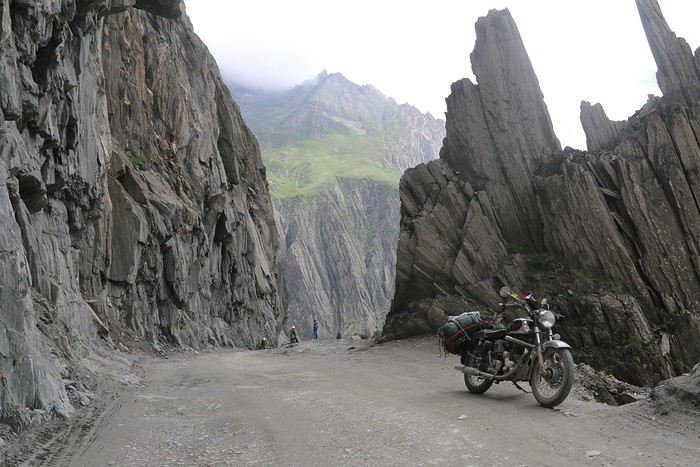
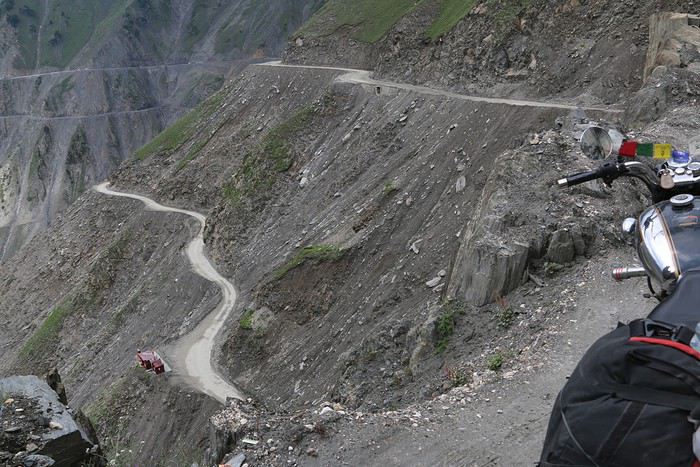
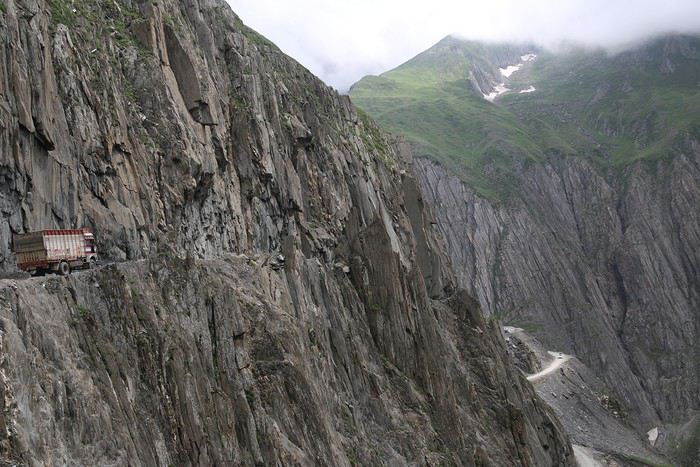
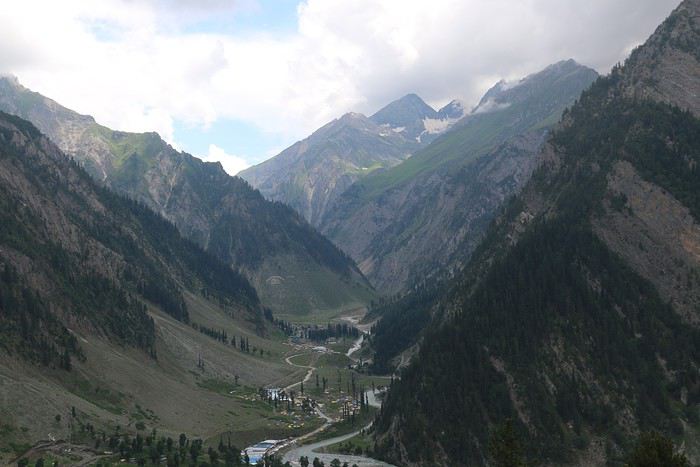
Résumé
Pou résumé, cette route est incroyablement sous-coté, si je devais faire un classement des plus belles routes que j’ai faite dans la région je mettrai Spiti en premier, ensuite Leh – Srinagar et en troisième Manali – Leh.
Et oui on parle beaucoup de Manali – Leh mais le problème est là justement, la route n’est plus vraiment une aventure lorsqu’on croise plein de gens dessus ou quand des restaurants ouvrent au milieu de nulle part. Bien que ça reste un immanquable en Inde évidemment.
Mais cette route là est authentique, je n’y ai croisé aucun autre touriste à partir de Lamayuru et puis c’est assez marrant de chercher un restaurant dans les petits villages et surprendre les gens quand tu t’arrête. Bref je conseille fortement.
Ceci est un extrait rapide de l'article complet : the-wild-trip.fr/...tre-leh-et-srinagar/
Bref retour transat Santos - Savone Costa Favolosa mars 2019 English translation pending
Bonjour
Je connaissais les escales et le bateau, donc pas de surprise.
Très satisfaite, rapport qualité prix ; prix comprenant les fsab, le forfait boisson brindiamo et 1/2 bouteille d'eau/jour.
Bateau loin d'être rempli ; ça se sentait dans les parties communes.
Majorité de Brésiliens à bord. Peu d'italiens pour une fois, 300 francophones environ.
Restauration :
Étant perla diamante, il est prévu que l'on mange au restaurant club ; s'il y a trop de monde, on mange dans un coin réservé avec horaire libre et on a le menu du club.
Ça, c'était "avant" (en décembre, par exemple c'était encore le cas).
Là nous n'étions pas très nombreux et nous avions un coin réservé sur le "balcon" du restaurant mais pas de menu club. On a donc protesté et on a eu des réponses gênées.
On a conservé le petit buffet d'hors d'oeuvres-fromage au déjeuner et le menu général (avec quand même du homard à 3 reprises) ; c'était très correct malgré tout. Bon, la morue revenait souvent, mais je suppose que c'était adapté au goût des passagers. Je n'ai pas testé le buffet.
Est ce que cet avantage est supprimé pour les perles diamants, était ce propre à cette croisière ? Mystère. .. rien sur le site Costa à ce sujet.
Personnel toujours dévoué et aimable. Les serveurs des bars n'étaient pas débordés car les passagers consommaient peu ; de même le SPA était n'était pas surchargé ; quel plaisir de se relaxer dans le jardin d'hiver au son d'une musique zen.
Chacun a ses propres critères d'évaluation ; perso j'adore danser j'ai donc beaucoup apprécié les instructeurs de danse brésiliens qui étaient exceptionnels. Pas le temps de s'ennuyer lors des jours en mer vu les nombreuses activités proposées.
Comme toujours animations musicales variées dès 18h30 pour tous les goûts avec bien sûr de la musique brésilienne.
Remarques : - je préfère faire le trajet dans le sens Europe-Brésil car les journées sont plus longues au Brésil et la météo meilleure. - je suis partie qqs jours avant d'embarquer pour visiter les chutes d'Igacu
Remarques : - je préfère faire le trajet dans le sens Europe-Brésil car les journées sont plus longues au Brésil et la météo meilleure. - je suis partie qqs jours avant d'embarquer pour visiter les chutes d'Igacu
Retour de croisière sur le Bellissima English translation pending
hello, on attend avec impatience le retour des croisieristes partis sur le bellissima, on est impatient, merci beaucoup
Croisière sur le MSC Meraviglia: informations English translation pending
bonsoir,
notre prochaine croisiere est en novembre sur le méraviglia.
qui peut donner des infos?
merci.
Trek de Gangotri à Tapovan (Inde) English translation pending
Bonjour Bonjour !!!
J'aimerai effectuer le trek de GANGOTRI à TAPOVAN..et me rendre dans plusieurs villes : Haridwar, Mussoorie, Uttarkashi..
Plusieurs questions me trottent dans la tête : 1. A qu'elle date ferme le parc national de Gangotri ? 2. Ou s'adresser pour effectuer le trek et combien est ce que ça coûte ? 3. Dormir à Bhojbasa? Comment? Combien ?? 2. Y a t'il des hôtels bon marché hormis l'hôtel du gouvernement à Gangotri ? 3. Concernant les taxis en Inde : Comment s'y prendre ?? Ou réserver ?? 4. Idem pour les trains ?? Y a t'il un site online de réservation des billets ?? 5. Quelqu'un a t'il déjà participé à la fête à venir : DIWALI ?? 6. Haridwar, Mussoorie, Uttarkashi?? Toutes ces villes ont-elles un réel intérêt ou y en a t'il une que je puisse laisser de côté ?
Merci de votre aide et de vos réponses !!!
J'aimerai effectuer le trek de GANGOTRI à TAPOVAN..et me rendre dans plusieurs villes : Haridwar, Mussoorie, Uttarkashi..
Plusieurs questions me trottent dans la tête : 1. A qu'elle date ferme le parc national de Gangotri ? 2. Ou s'adresser pour effectuer le trek et combien est ce que ça coûte ? 3. Dormir à Bhojbasa? Comment? Combien ?? 2. Y a t'il des hôtels bon marché hormis l'hôtel du gouvernement à Gangotri ? 3. Concernant les taxis en Inde : Comment s'y prendre ?? Ou réserver ?? 4. Idem pour les trains ?? Y a t'il un site online de réservation des billets ?? 5. Quelqu'un a t'il déjà participé à la fête à venir : DIWALI ?? 6. Haridwar, Mussoorie, Uttarkashi?? Toutes ces villes ont-elles un réel intérêt ou y en a t'il une que je puisse laisser de côté ?
Merci de votre aide et de vos réponses !!!
Retour de croisière en Alaska avec NCL English translation pending
bonjour tout le monde !
voila après un retour un peu catastrophique hier (nous étions à FRANCFORT hier lors de l'alerte ...) nous sommes rentrées de notre croisière en Alaska à bord du Novegian Jewel
j'ai donné il y a peu un compte Facebook ou nous avons retracé notre parcours, car nous avons fait un petit road trip avant d'embarquer ... pour ceux qui veulent aller voir, je redonne le nom Mother and daughter in Alaska car oui j'ai laissé l'homme à la maison, ou plutôt affalé sur un transat à dormir, pendant que moi et ma fille nous vivions une formidable aventure (ne vous inquiétez pas, il n'a pas été malheureux, il a pu pratiquer son sport favori: dormir toute la journée ...
bref nous avons embarqué le 31 juillet, mais nous étions arrivées le 17 en alaska... nous avons vécue une formidable aventure ...
donc ... à la question qui va venir rapidement "cela vaut 'il le coup de faire tout ce trajet, absorber les 10 heures de décalage horaire, pour faire une croisière d'une semaine ? " je répondrais OUI mais ... A la condition de faire comme nous un road trip avant .... sinon vous ne verrez pas grand chose de l'Alaska !
et à "est ce utile de faire une croisière après un road trip en alaska ? " la .. je réponds oui, si le budget le permet, l'Alaska est une destination très chère ou la moindre excursion coute chère, (je parle de la partie road trip aussi ) après il est vrai qu'après presque 15 jours à mal dormir dans des hôtels mal insonorisés, chers et parfois très limites (souri dans la chambre, toilettes sur le palier, mauvaise odeur etc etc ) à manger à peu près la même chose, car nous ne pouvions pas cuisiner, faire et refaire sans arret la valise, etc etc nous avons apprécié le confort du bateau... cela nous a permis aussi d'en voir un peu plus, de ne pas faire de longues heures de voiture (j'étais le seul chauffeur, et ça a été parfois difficile...) et quel bonheur aussi de voir le souffle des baleines, les bancs de dauphins, les orques ... passer à coté du bateau !!! de jolies navigations aussi, comme la vision du hubbard glacier !! dépassant tout ce qu'on avait pu voir auparavant !!! et le passage intérieur aussi etait vraiment sympa !!
nous n'avons pris aucune excursion avec le bateau, je ne pourrais donc pas vous donner mon avis dessus, mais elles étaient relativement chères, mais très variées
En tout cas, je ne regrette pas d'avoir fait les deux, même si le mauvais temps s'est invité sur une partie ...
le bateau, et la compagnie C'était la première fois que je partais avec NCL plutôt très bonne impression, ! il est vrai que je partais avec des attentes différentes de d'habitude, ne vivant pas du tout ma croisière de la même façon qu'avec l'homme ... nous avions un forfait tout compris: boissons illimitées en dessous de 15 dollars, alcool et boissons non alcoolisées, sauf..et la c'est vraiment paradoxal ... l'eau plate, l'eau gazeuse, et les jus de fruits pressés .. par contre on avait dans la cabine en arrivant une bouteille d'eau par jour et par personne que finalement nous n'avons quasiment pas bu car nous n'en prenions que pour descendre à terre, sinon au restaurant, nous demandions de l'eau en carafe ma fille du vin, et moi parfois des sodas nous avions aussi une sélection de cafés, mais pas utilisée et les frais de séjour compris donc hors dépenses personnelles il n'y avait rien a rajouter
nous avons pris un forfait spa un peu plus de 300 dollars pour la semaine à deux ils ne vendent que 60 forfaits pour éviter la surpopulation au spa il y a une partie non mixte avec sauna hamam et jacuzzi (comme ceux autour des piscines) partie change avec à dispo peignoirs et serviettes et une partie mixte avec un jacuzzi façon costa avec le banc en fer mais plus petit, et des sièges chauffants faces à la mer, à la proue du bateau, idéal pour guetter les baleines, et les bancs de dauphins !! (quand on ne s'endort pas dessus chose absolument irrésistible ... ) dans cette partie thé orangeade citronnade orange café sont à dispo
la cabine, nous avons eu une cabine familiale, avec un lit d'appoint qui descend du plafond mobilier un peu vieillot, et abimé, une grande armoire pour pendre desaffaires, quelque étagères et tiroirs .. suffisant pour toutes les deux, mais petit pour une famille la salle de bain plus grande que chez costa avec possibilité de séparer les toilettes par une porte en verre (douche aussi avec porte en verre ) les lis étaient séparés à notre arrivée, mais du coup un etait collé contre le mur de la salle de bain la taille et celle du balcon sont de la même taille qu'une cabine standard chez costa balcon au sol abimé et rouillé ..mais surement normal par ces latitudes
pour manger nous avions le choix, entre deux restaurants au même menus, mais au style different, nous avons toujours été au même, au fond du bateau avec une immense baie vitrée donnant sur le sillage arrière un restaurant chinois avec menu inchangé, nous y avons été deux fois, un midi et un soir .. très bon un restau au decors style irlandais , ouvert 24H/24 avec quelque plats le self pleins de petits ilots, avec différents thèmes ... inde, asiatique, salades, chaud, froid, pâtes, hamburgers à la demande, pizzas desserts, fromages etcetc, glaces .. assez bon, pas de queue aux stands abordables de differents cotés, limitant ainsi les embouteillages des fontaines de boissons pour tout le monde et enfin un grill et un petit self au fond du navire donnant sur la partie ouverte les trois ouvrant et fermant à tour de rôle
j'ai donné il y a peu un compte Facebook ou nous avons retracé notre parcours, car nous avons fait un petit road trip avant d'embarquer ... pour ceux qui veulent aller voir, je redonne le nom Mother and daughter in Alaska car oui j'ai laissé l'homme à la maison, ou plutôt affalé sur un transat à dormir, pendant que moi et ma fille nous vivions une formidable aventure (ne vous inquiétez pas, il n'a pas été malheureux, il a pu pratiquer son sport favori: dormir toute la journée ...
bref nous avons embarqué le 31 juillet, mais nous étions arrivées le 17 en alaska... nous avons vécue une formidable aventure ...
donc ... à la question qui va venir rapidement "cela vaut 'il le coup de faire tout ce trajet, absorber les 10 heures de décalage horaire, pour faire une croisière d'une semaine ? " je répondrais OUI mais ... A la condition de faire comme nous un road trip avant .... sinon vous ne verrez pas grand chose de l'Alaska !
et à "est ce utile de faire une croisière après un road trip en alaska ? " la .. je réponds oui, si le budget le permet, l'Alaska est une destination très chère ou la moindre excursion coute chère, (je parle de la partie road trip aussi ) après il est vrai qu'après presque 15 jours à mal dormir dans des hôtels mal insonorisés, chers et parfois très limites (souri dans la chambre, toilettes sur le palier, mauvaise odeur etc etc ) à manger à peu près la même chose, car nous ne pouvions pas cuisiner, faire et refaire sans arret la valise, etc etc nous avons apprécié le confort du bateau... cela nous a permis aussi d'en voir un peu plus, de ne pas faire de longues heures de voiture (j'étais le seul chauffeur, et ça a été parfois difficile...) et quel bonheur aussi de voir le souffle des baleines, les bancs de dauphins, les orques ... passer à coté du bateau !!! de jolies navigations aussi, comme la vision du hubbard glacier !! dépassant tout ce qu'on avait pu voir auparavant !!! et le passage intérieur aussi etait vraiment sympa !!
nous n'avons pris aucune excursion avec le bateau, je ne pourrais donc pas vous donner mon avis dessus, mais elles étaient relativement chères, mais très variées
En tout cas, je ne regrette pas d'avoir fait les deux, même si le mauvais temps s'est invité sur une partie ...
le bateau, et la compagnie C'était la première fois que je partais avec NCL plutôt très bonne impression, ! il est vrai que je partais avec des attentes différentes de d'habitude, ne vivant pas du tout ma croisière de la même façon qu'avec l'homme ... nous avions un forfait tout compris: boissons illimitées en dessous de 15 dollars, alcool et boissons non alcoolisées, sauf..et la c'est vraiment paradoxal ... l'eau plate, l'eau gazeuse, et les jus de fruits pressés .. par contre on avait dans la cabine en arrivant une bouteille d'eau par jour et par personne que finalement nous n'avons quasiment pas bu car nous n'en prenions que pour descendre à terre, sinon au restaurant, nous demandions de l'eau en carafe ma fille du vin, et moi parfois des sodas nous avions aussi une sélection de cafés, mais pas utilisée et les frais de séjour compris donc hors dépenses personnelles il n'y avait rien a rajouter
nous avons pris un forfait spa un peu plus de 300 dollars pour la semaine à deux ils ne vendent que 60 forfaits pour éviter la surpopulation au spa il y a une partie non mixte avec sauna hamam et jacuzzi (comme ceux autour des piscines) partie change avec à dispo peignoirs et serviettes et une partie mixte avec un jacuzzi façon costa avec le banc en fer mais plus petit, et des sièges chauffants faces à la mer, à la proue du bateau, idéal pour guetter les baleines, et les bancs de dauphins !! (quand on ne s'endort pas dessus chose absolument irrésistible ... ) dans cette partie thé orangeade citronnade orange café sont à dispo
la cabine, nous avons eu une cabine familiale, avec un lit d'appoint qui descend du plafond mobilier un peu vieillot, et abimé, une grande armoire pour pendre desaffaires, quelque étagères et tiroirs .. suffisant pour toutes les deux, mais petit pour une famille la salle de bain plus grande que chez costa avec possibilité de séparer les toilettes par une porte en verre (douche aussi avec porte en verre ) les lis étaient séparés à notre arrivée, mais du coup un etait collé contre le mur de la salle de bain la taille et celle du balcon sont de la même taille qu'une cabine standard chez costa balcon au sol abimé et rouillé ..mais surement normal par ces latitudes
pour manger nous avions le choix, entre deux restaurants au même menus, mais au style different, nous avons toujours été au même, au fond du bateau avec une immense baie vitrée donnant sur le sillage arrière un restaurant chinois avec menu inchangé, nous y avons été deux fois, un midi et un soir .. très bon un restau au decors style irlandais , ouvert 24H/24 avec quelque plats le self pleins de petits ilots, avec différents thèmes ... inde, asiatique, salades, chaud, froid, pâtes, hamburgers à la demande, pizzas desserts, fromages etcetc, glaces .. assez bon, pas de queue aux stands abordables de differents cotés, limitant ainsi les embouteillages des fontaines de boissons pour tout le monde et enfin un grill et un petit self au fond du navire donnant sur la partie ouverte les trois ouvrant et fermant à tour de rôle
Walks in the Kingdom of Siam
Sometimes a trip to Thailand starts in a hotel near an airport, where guests have misunderstood the meaning of the name easyJet...
We know all too well that this long flight will leave us a bit jet-lagged when we arrive...
all while hoping we won’t start our stay completely...
Still, we’re lucid enough to notice that they could’ve at least leveled the ground before adding the decor at the airport:
As always, our arrival is under the watchful eye of some...
under the frankly curious gaze of others...
but of course, there are plenty who couldn’t care less...
All that’s left is to set off exploring, while staying cautious so we don’t get caught off guard...
We know all too well that this long flight will leave us a bit jet-lagged when we arrive...
all while hoping we won’t start our stay completely...
Still, we’re lucid enough to notice that they could’ve at least leveled the ground before adding the decor at the airport:
As always, our arrival is under the watchful eye of some...
under the frankly curious gaze of others...
but of course, there are plenty who couldn’t care less...
All that’s left is to set off exploring, while staying cautious so we don’t get caught off guard...
Bali - Gili en juillet: touristes et coins à éviter? English translation pending
Bonjour à vous :)
J'ai besoin de vos précieux conseils et surtout d’être conforté sur mon choix de destination qui est Bali !
Voila nous partons mi juillet mais après multiples recherches / avis / carnet de voyage nous ne savons toujours pas où aller.
Enfin, j'abuse un peu 😎 Nous partons 2 semaines environ, nous aimons nous balader, les temples, un peu d'animation , la gastronomie, snorkeling, plage et être tranquille ( j'aime les enfants mais hôtel avec des mioches qui gueulent non stop dans la piscine ca va 5 min.. j'ai rien contre hein mais ce n'est pas pour moi )
Bon là je vous vois venir, en juillet sur Bali c'est complètement blindé ahaha les plages c'est pas le top, le snorkeling non plus..
Bref, après avoir longuement parcouru divers posts j'arrive toujours pas à me décider tellement les avis sont parfois contraire et contradictoire.
Je pense donc que vous pouvez m'aider pour une fois pour toute me décider 😛 Nous partons environ deux semaines et nous allons surtout bouger la 1ère semaine puis un peu plus de tranquillité et repos la seconde semaine avant la reprise ! ( et oui il faut bien travailler pour pouvoir repartir )
Alors la première semaine j'ai un faible pour Ubud car c'est central ( cela permet de rayonner autour et faire les activités genre temples cascades quelques village, riziere.. ), sur ubud le soir c'est comment ? on a de bon resto ? mais j'hésite avec Canggu qui est plus proche de la mer ( mais pas de baignade snorkeling si j'ai bien compris ) mais je ne suis pas bloqué sur le sujet si je peux me rattraper la seconde semaine et il paraitrait que Canggu a une très bonne atmosphère et un peu d'animation ( bar/resto de plage ) et je trouve cela top si le soir je peux me balader en bord de mer prendre un verre ( sans pour autant me retourner la tête jusqu'au petit matin 🤪 ) du coup je pourrais peut être faire 3j ubud et 3j canggu ? A votre avis ? ( j'y compte hein !! )
J'ai lu que la ville d'Ubud c’était horrible.. qu'en pensez vous ( bon après nous on va pas mal bouger.. )
Seconde semaine donc.. objectif, plage - snorkeling - balade a pied - resto - petit apéro : Plaisirs simple mais très appréciable pour se ressourcer et prendre du temps pour soi.
j'hésite donc avec Canggu si je n'y vais pas la 1ere semaine ( oui la plage c'est bof c'est bien ca ? ) sinon je pense partir sur les iles Gili !! ( j'ai écarté nusa dua trop tourisme de masse sans charme a part la qualité des plages.. )
Je pense, d'après mes recherches que Gili Air me conviendrait, mais n'est ce pas trop calme le soir ? et manque de variétés de restos / bars ? comment y est la gastronomie ? Coté activité , surtout lecture, musique, cours de cuisine, belle plage et snorkeling -> bon les coraux semblent tous morts mais si je vois quelques poissons, une petite tortue, une raie sans la mer de déchets ça serait top ! D'ailleurs il y a t il des mosquées qui font l'appel a la prière sur cette ile ? ( comme c''est le cas sur Meno il me semble ) si oui quel coin éviter pour ne pas subir l'appel de 5h du mat" ?
J'ai zap Gili T qui est, de ce que j'ai lu, kuta bis en cette période de juillet. Ai je tord ?
Bon plus généralement si vous avez des conseils, des bons plans, des adresses où bien manger, des activités qui vont ont le plus marqués, des guides francophone je suis PRENEUR !
Merci d'avoir eu le courage de lire ce post jusqu'au bout et j’espère que je trouverais en vous l'inspiration qui me manque ;-)
Baliement votre
J'ai besoin de vos précieux conseils et surtout d’être conforté sur mon choix de destination qui est Bali !
Voila nous partons mi juillet mais après multiples recherches / avis / carnet de voyage nous ne savons toujours pas où aller.
Enfin, j'abuse un peu 😎 Nous partons 2 semaines environ, nous aimons nous balader, les temples, un peu d'animation , la gastronomie, snorkeling, plage et être tranquille ( j'aime les enfants mais hôtel avec des mioches qui gueulent non stop dans la piscine ca va 5 min.. j'ai rien contre hein mais ce n'est pas pour moi )
Bon là je vous vois venir, en juillet sur Bali c'est complètement blindé ahaha les plages c'est pas le top, le snorkeling non plus..
Bref, après avoir longuement parcouru divers posts j'arrive toujours pas à me décider tellement les avis sont parfois contraire et contradictoire.
Je pense donc que vous pouvez m'aider pour une fois pour toute me décider 😛 Nous partons environ deux semaines et nous allons surtout bouger la 1ère semaine puis un peu plus de tranquillité et repos la seconde semaine avant la reprise ! ( et oui il faut bien travailler pour pouvoir repartir )
Alors la première semaine j'ai un faible pour Ubud car c'est central ( cela permet de rayonner autour et faire les activités genre temples cascades quelques village, riziere.. ), sur ubud le soir c'est comment ? on a de bon resto ? mais j'hésite avec Canggu qui est plus proche de la mer ( mais pas de baignade snorkeling si j'ai bien compris ) mais je ne suis pas bloqué sur le sujet si je peux me rattraper la seconde semaine et il paraitrait que Canggu a une très bonne atmosphère et un peu d'animation ( bar/resto de plage ) et je trouve cela top si le soir je peux me balader en bord de mer prendre un verre ( sans pour autant me retourner la tête jusqu'au petit matin 🤪 ) du coup je pourrais peut être faire 3j ubud et 3j canggu ? A votre avis ? ( j'y compte hein !! )
J'ai lu que la ville d'Ubud c’était horrible.. qu'en pensez vous ( bon après nous on va pas mal bouger.. )
Seconde semaine donc.. objectif, plage - snorkeling - balade a pied - resto - petit apéro : Plaisirs simple mais très appréciable pour se ressourcer et prendre du temps pour soi.
j'hésite donc avec Canggu si je n'y vais pas la 1ere semaine ( oui la plage c'est bof c'est bien ca ? ) sinon je pense partir sur les iles Gili !! ( j'ai écarté nusa dua trop tourisme de masse sans charme a part la qualité des plages.. )
Je pense, d'après mes recherches que Gili Air me conviendrait, mais n'est ce pas trop calme le soir ? et manque de variétés de restos / bars ? comment y est la gastronomie ? Coté activité , surtout lecture, musique, cours de cuisine, belle plage et snorkeling -> bon les coraux semblent tous morts mais si je vois quelques poissons, une petite tortue, une raie sans la mer de déchets ça serait top ! D'ailleurs il y a t il des mosquées qui font l'appel a la prière sur cette ile ? ( comme c''est le cas sur Meno il me semble ) si oui quel coin éviter pour ne pas subir l'appel de 5h du mat" ?
J'ai zap Gili T qui est, de ce que j'ai lu, kuta bis en cette période de juillet. Ai je tord ?
Bon plus généralement si vous avez des conseils, des bons plans, des adresses où bien manger, des activités qui vont ont le plus marqués, des guides francophone je suis PRENEUR !
Merci d'avoir eu le courage de lire ce post jusqu'au bout et j’espère que je trouverais en vous l'inspiration qui me manque ;-)
Baliement votre
Compte rendu croisière Pacifica novembre 2017 English translation pending
Bonjour à tous et à toutes
Ce compte rendu relate nos impressions vécues lors de notre croisière de Costa vendue en Promo prix par personne 370€ en cabine balcon pour 6 nuits/7 jours, départ de Marseille et retour à Savone le 26 nov, avec transfert à l'aéroport de Nice compris
le 20 nov 2017
Etant de Lille nous avons pris le train Ouigo direct vers Marseille de Tourcoing, prix 15€/pers avec +5€ car les valises en low cost sont payantes. A la sortie de la gare St Charles nous avons pris un taxi 27€ pour rejoindre le port sous un beau soleil, mais avec 10 degrés.😎
Nous avons attendu dans le terminal chauffé 13H30 pour monter à bord et valider nos réservations reçues par mail, ayant déposé préalablement nos bagages en bas du terminal vers 11H30.
Nous aurions pu faire un tour dans Marseille, mais vu notre lever à 3H30 du matin, nous avons attendu sagement au chaud un embarquement fait en ordre grâce aux numéros d'embarquement, reçus lors de la dépose de nos bagages, pour rejoindre directement le bateau avec nos amis et récupérer nos cartes sur le lit dans nos cabines respectives.
On se rend compte alors que nous ne sommes pas au bon service et à la même table 🤪 au restaurant le soir, bien que les deux réservations aient été faites simultanément à l'agence Azur croisière. Nous devrons donc nous rendre à l'entrée du restaurant à son ouverture pour corriger ce petit problème à 18H30, dès son ouverture pour 1er service.
Nous ne sommes pas les seuls hélas à demander un changement de service, petit couac récurrent dans l'organisation Costa et qui donne pas mal de boulot au maitre d'hôtel, qui pourrait être évité si le service réservation faisait son travail correctement. Nous dinerons donc le premier soir sans nos amis et au mauvais service malgré un des rares privilèges que m'accordait Costa avec ma carte Perla.
Le principal ce fut quand même de se retrouver le lendemain à la même table et à 20H45 pour le second service, merci au maitre d'hôtel qui a bien fait son travail.🙂
A l'embarquement le self au pont 9 est encore ouvert 11H30 à 15H , nous en profitons pour manger après avoir bu l'apéro au bar de la piscine arrière.😉
Nous avions pris un supplément pour le forfait Bridiamo, 25€ par jour par personne, soit le prix d'une place en croisière supplémentaire pour "modération", celui qui "boit toujours" avec nous.😛
A 16H réunion d'informations pour les excursions et vie à bord, que nous zapperons.
Enregistrement de la carte de crédit pour valider les dépenses à bord, pour les deux passagers de la cabine avec balcon n 6236, située à l'avant gauche du bateau au 6ème étage au dessus du théâtre. Là pas de bruit de transat le matin à 6H30, comme pendant une de nos croisières où nous avions été surclassé au pont 10 en Samsara.
A 16H30 réunion d'informations pour l'exercice de sécurité à bord au théâtre pont 3 pour les nouveaux embarqués francophones. Présence obligatoire, sinon on vous convoque à nouveau le lendemain matin.
Un petit changement avec que ce nous avions connu auparavant, où la réunion se tenait sur le pont 3 à l'extérieur, fagotés comme des saucisses de hot dog, à écouter les consignes de sécurité en 6 langues minimum, qui prenaient un certain temps et finissaient en pénible cacophonie des passagers, qui avaient perdu toute leur attention.
Bravo donc pour cette nouvelle et heureuse initiative, 🙂 documentée par un diaporama projeté et bien commenté cette fois uniquement en Français. Cette réunion finira quand même par un repérage à l'extérieur sur le pont 3 face aux chaloupes de secours, équipés de nos gilets et en rang par 5, soit 10mn maxi au lieu des 30 à 45mn passés à ce les geler à l'extérieur.
Le soir nous mangerons très tôt avec d'autres convives à une table de 4 autres Francais, qui ont comme nous profité de cette bonne opportunité de dernière minute.
Un bon diner sélectionné parmi un choix de 3 entrées, 2 soupes, 3 types de pâtes, 3 plats principaux, fromages et 3 desserts accompagnés pour nous de rosé et avec le fromage un vin rouge italien correct, toujours partagé avec "modération".😛
Nous déballerons les valises avant d'aller au spectacle à 21H15 (horaire 2ème service)
Nous nous installerons sur les gradins du pont 4, un peu loin de la scène pour regarder ce beau spectacle SPORT SHOW, avec les danseuses et danseurs du groupe Afro Arimba et des chanteurs.🙂
A 22H fin du spectacle, nous irons au Salon arrière Arround the clock pont 5 prendre un capuccino en écoutant mon orchestre (préféré pendant cette croisière) Cherry cool band 🙂 , avec des musiques modernes, des slows et rocks mais toujours interprétés en Anglais.
Et un petit Limoncello servi par un sympathique garçon avant d'aller au DODO,
Car demain escale à Barcelone, avec un rendez vous fixé à 8H45 avec nos amis.
à suivre .... si toutefois tous ces détails ne vous importune pas
Ce compte rendu relate nos impressions vécues lors de notre croisière de Costa vendue en Promo prix par personne 370€ en cabine balcon pour 6 nuits/7 jours, départ de Marseille et retour à Savone le 26 nov, avec transfert à l'aéroport de Nice compris
le 20 nov 2017
Etant de Lille nous avons pris le train Ouigo direct vers Marseille de Tourcoing, prix 15€/pers avec +5€ car les valises en low cost sont payantes. A la sortie de la gare St Charles nous avons pris un taxi 27€ pour rejoindre le port sous un beau soleil, mais avec 10 degrés.😎
Nous avons attendu dans le terminal chauffé 13H30 pour monter à bord et valider nos réservations reçues par mail, ayant déposé préalablement nos bagages en bas du terminal vers 11H30.
Nous aurions pu faire un tour dans Marseille, mais vu notre lever à 3H30 du matin, nous avons attendu sagement au chaud un embarquement fait en ordre grâce aux numéros d'embarquement, reçus lors de la dépose de nos bagages, pour rejoindre directement le bateau avec nos amis et récupérer nos cartes sur le lit dans nos cabines respectives.
On se rend compte alors que nous ne sommes pas au bon service et à la même table 🤪 au restaurant le soir, bien que les deux réservations aient été faites simultanément à l'agence Azur croisière. Nous devrons donc nous rendre à l'entrée du restaurant à son ouverture pour corriger ce petit problème à 18H30, dès son ouverture pour 1er service.
Nous ne sommes pas les seuls hélas à demander un changement de service, petit couac récurrent dans l'organisation Costa et qui donne pas mal de boulot au maitre d'hôtel, qui pourrait être évité si le service réservation faisait son travail correctement. Nous dinerons donc le premier soir sans nos amis et au mauvais service malgré un des rares privilèges que m'accordait Costa avec ma carte Perla.
Le principal ce fut quand même de se retrouver le lendemain à la même table et à 20H45 pour le second service, merci au maitre d'hôtel qui a bien fait son travail.🙂
A l'embarquement le self au pont 9 est encore ouvert 11H30 à 15H , nous en profitons pour manger après avoir bu l'apéro au bar de la piscine arrière.😉
Nous avions pris un supplément pour le forfait Bridiamo, 25€ par jour par personne, soit le prix d'une place en croisière supplémentaire pour "modération", celui qui "boit toujours" avec nous.😛
A 16H réunion d'informations pour les excursions et vie à bord, que nous zapperons.
Enregistrement de la carte de crédit pour valider les dépenses à bord, pour les deux passagers de la cabine avec balcon n 6236, située à l'avant gauche du bateau au 6ème étage au dessus du théâtre. Là pas de bruit de transat le matin à 6H30, comme pendant une de nos croisières où nous avions été surclassé au pont 10 en Samsara.
A 16H30 réunion d'informations pour l'exercice de sécurité à bord au théâtre pont 3 pour les nouveaux embarqués francophones. Présence obligatoire, sinon on vous convoque à nouveau le lendemain matin.
Un petit changement avec que ce nous avions connu auparavant, où la réunion se tenait sur le pont 3 à l'extérieur, fagotés comme des saucisses de hot dog, à écouter les consignes de sécurité en 6 langues minimum, qui prenaient un certain temps et finissaient en pénible cacophonie des passagers, qui avaient perdu toute leur attention.
Bravo donc pour cette nouvelle et heureuse initiative, 🙂 documentée par un diaporama projeté et bien commenté cette fois uniquement en Français. Cette réunion finira quand même par un repérage à l'extérieur sur le pont 3 face aux chaloupes de secours, équipés de nos gilets et en rang par 5, soit 10mn maxi au lieu des 30 à 45mn passés à ce les geler à l'extérieur.
Le soir nous mangerons très tôt avec d'autres convives à une table de 4 autres Francais, qui ont comme nous profité de cette bonne opportunité de dernière minute.
Un bon diner sélectionné parmi un choix de 3 entrées, 2 soupes, 3 types de pâtes, 3 plats principaux, fromages et 3 desserts accompagnés pour nous de rosé et avec le fromage un vin rouge italien correct, toujours partagé avec "modération".😛
Nous déballerons les valises avant d'aller au spectacle à 21H15 (horaire 2ème service)
Nous nous installerons sur les gradins du pont 4, un peu loin de la scène pour regarder ce beau spectacle SPORT SHOW, avec les danseuses et danseurs du groupe Afro Arimba et des chanteurs.🙂
A 22H fin du spectacle, nous irons au Salon arrière Arround the clock pont 5 prendre un capuccino en écoutant mon orchestre (préféré pendant cette croisière) Cherry cool band 🙂 , avec des musiques modernes, des slows et rocks mais toujours interprétés en Anglais.
Et un petit Limoncello servi par un sympathique garçon avant d'aller au DODO,
Car demain escale à Barcelone, avec un rendez vous fixé à 8H45 avec nos amis.
à suivre .... si toutefois tous ces détails ne vous importune pas
Se rendre à Koh Payam depuis Bangkok English translation pending
BonjouR
Il me semble avoir lu dans un post DES INFOS SUR KOH PAYAM, , pouvez vous me donner son emplacement exact et comment s'y rendre de BKKje veux changer de secteur étant une habituée de K SAMUI et cette île semble être sympa je ne la connais pas. Pour 2018 je serai sur BKK et après je cherche une île où me poser... Merci de vos renseignements. bien cordialement
Il me semble avoir lu dans un post DES INFOS SUR KOH PAYAM, , pouvez vous me donner son emplacement exact et comment s'y rendre de BKKje veux changer de secteur étant une habituée de K SAMUI et cette île semble être sympa je ne la connais pas. Pour 2018 je serai sur BKK et après je cherche une île où me poser... Merci de vos renseignements. bien cordialement
Très déçue par Milan English translation pending
Bonjour,
je reviens d'un petit séjour de 3 jours à Milan grâce à une grosse promo sur un aller-retour en avion depuis l'aéroport de Luxembourg.
je ne peux pas dire que je regrette ce séjour, mais je pense que je ne reviendrai pas dans cette ville, car à part le Duomo, la gallerie Victor Emmanuelle II , le chateau Sforza et quelques églises, il n'y a pas grand chose à voir pour une amoureuse des vieilles pierres que je suis!
Milan est sans doute la ville la moins "italienne" d'Italie, c'est une ville dont l'architecture des bâtiments modernes (construits pour la plupart dans les années 70-80) à très mal vieillit.
Milan capitale de la mode?? alors oui certe la plupart des grandes maisons de couture et de design italiennes ont leur siège à Milan, mais niveau shopping je n'ai rien trouvé d'extraordinaire !! la plupart des petites et grandes marques présentes à Milan le sont aussi à Rome, Paris ou Londres, niveau prix , les grandes marques sont un petit peu moins chère ( à condition de pouvoir ce payer des grandes marques qui , même soldées reste quand même très onéreuses) mais rien de fabuleux non plus.
la ville est très chère (même niveau de prix qu'a Paris) pour le logement et la restauration! Rome est beaucoup moins chère! ( à Rome vous pouvez manger un menu "pâte, viande, dessert, boisson, expresso" pour 12-13 euros, à Milan c'est quasiment le double.)
le + quand même: -les transports en commun ( le métro particulièrement, très propre, réseau dense) -la proximité avec la région des lacs ( lac de Côme, lac Majeur, sans doute un des plus beau coin d'Italie).
je reviens d'un petit séjour de 3 jours à Milan grâce à une grosse promo sur un aller-retour en avion depuis l'aéroport de Luxembourg.
je ne peux pas dire que je regrette ce séjour, mais je pense que je ne reviendrai pas dans cette ville, car à part le Duomo, la gallerie Victor Emmanuelle II , le chateau Sforza et quelques églises, il n'y a pas grand chose à voir pour une amoureuse des vieilles pierres que je suis!
Milan est sans doute la ville la moins "italienne" d'Italie, c'est une ville dont l'architecture des bâtiments modernes (construits pour la plupart dans les années 70-80) à très mal vieillit.
Milan capitale de la mode?? alors oui certe la plupart des grandes maisons de couture et de design italiennes ont leur siège à Milan, mais niveau shopping je n'ai rien trouvé d'extraordinaire !! la plupart des petites et grandes marques présentes à Milan le sont aussi à Rome, Paris ou Londres, niveau prix , les grandes marques sont un petit peu moins chère ( à condition de pouvoir ce payer des grandes marques qui , même soldées reste quand même très onéreuses) mais rien de fabuleux non plus.
la ville est très chère (même niveau de prix qu'a Paris) pour le logement et la restauration! Rome est beaucoup moins chère! ( à Rome vous pouvez manger un menu "pâte, viande, dessert, boisson, expresso" pour 12-13 euros, à Milan c'est quasiment le double.)
le + quand même: -les transports en commun ( le métro particulièrement, très propre, réseau dense) -la proximité avec la région des lacs ( lac de Côme, lac Majeur, sans doute un des plus beau coin d'Italie).
Comment trouver des supermarchés aux États-Unis English translation pending
Bonjour
Je m'explique ma question peut paraitre un peu bete mais je voulais savoir si quelqu'un avait fait une liste de supermarchés en fonction des villes. Quand je cherche sur google map je trouve des supermarches mais à part Walmart (je ne connais pas les autres marques) donc je ne sais pas si c'est un supermarche ou un ensemble de magasin de vetements par ex .je cherche seulement des supermarches pour faire des courses de nourriture pour pouvoir prevoir des piques niques des jours suivants .
merci de votre reponse et bonne apres midi
Nuche
Coins tranquilles et authentiques sur la côte marocaine English translation pending
Bonjour à tous,
Nous envisageons de partir à 8 (2 familles) au Maroc en août prochain pour 2 semaines. Passage obligé par Marrakech (2 jours), nous partirons ensuite sur la côte, et avons pensé à Oualidia, Essaouira et pourquoi pas Taghazout. En fait, nous cherchons des coins "tranquilles" et encore un peu authentiques (port de pêche...) où nous prévoyons de louer des maisons ou riad. Pouvez vous m'indiquer des endroits, sachant que nous aurons les vols à Marrakech.
Merci par avance de votre aide,
Alexandra
Nous envisageons de partir à 8 (2 familles) au Maroc en août prochain pour 2 semaines. Passage obligé par Marrakech (2 jours), nous partirons ensuite sur la côte, et avons pensé à Oualidia, Essaouira et pourquoi pas Taghazout. En fait, nous cherchons des coins "tranquilles" et encore un peu authentiques (port de pêche...) où nous prévoyons de louer des maisons ou riad. Pouvez vous m'indiquer des endroits, sachant que nous aurons les vols à Marrakech.
Merci par avance de votre aide,
Alexandra
Retour d'un premier Yacht Club MSC Fantasia English translation pending
Bonjour 😎
Me voici revenue d une très belle semaine de croisière.
Ce compte rendu aura pour objet de comparer les prestations du YACHT CLUB du MSC FANTASIA et l AQUACLASS de CELEBRITY.
chapitre 1: introduction et avertissement
A) introduction
Cette croisière est la 18 ème apres
- 8 croisières COSTA
- 3 Croisières ROYAL CARIBBEAN
- 3 croisières CELEBRITY ( dont 2 an aquaclass)
- 1 croisière MSC
- 1 croisière NCL
- 1 croisière PRINCESS
Pourquoi avoir choisi cette Croisière en yacht club ?
Nous avions envie d essayer le concept et les curieux que nous sommes , se demandaient ce que valait réellement le yacht club....
De plus les prestations annoncées correspondent a ce que l on recherche : du calme , la qualité du service, un restaurant gastronomique....
Enfin le dernier facteur déterminant a été le prix ! Nous ne voulions pas payer trop cher sans savoir si cela nous plairait vraiment ....
1150 euros la semaine par personne nous a paru être un prix raisonnable.
B) avertissement
Le titre peut sembler très protocolaire mais comme tout le monde le sait, le yacht club est un sujet très sensible sur le forum.... 😕
Beaucoup de polémiques de railleries a la limite des insultes ... 😠
A qui s adresse donc ce compte rendu ?
- a tous ceux qui aimeraient savoir.ce que vaut vraiment le yacht club
- aux personnes qui se demandent s il vaut mieux choisir le yacht club ou une compagnie premium
- a tous les forumeurs qui comme moi se sont toujours demande a quoi servait réellement un majordome
- a toutes les personnes bien intentionnées qui aiment lire les comptes rendus et participer a des échanges constructifs.
A qui ne s adresse pas ce compte rendu ? - aux âmes sensibles qui supportent très mal les critiques négatives et comparaisons entre le yacht club et les compagnies premium - aux personnes pensant qu on n' est pas légitime d écrire un compte rendu sur le yacht club après une seule croisière - aux chasseurs de Pokemon, j ai le regret de leur annoncer qu' aucun pokemon rare n a été trouvé au yacht club - aux cruciverbistes, extra terrestres , champions olympiques.. Le sujet risque de les ennuyer .... 😄
Les choses étant clairement énoncées , libre à chacun maintenant d arrêter le lecture ici ou de poursuivre
Pour ceux qui ont choisi de poursuivre je les invite donc a se préparer pour l embarquement en yacht club a travers les thèmes suivants : - la pré croisière - les embarquements et débarquements - la cabine , les espaces privatifs , le service, le room service - les escales - la restauration et les bars - les espaces piscines et le spa - l'animation et les spectacles - conclusion
A qui ne s adresse pas ce compte rendu ? - aux âmes sensibles qui supportent très mal les critiques négatives et comparaisons entre le yacht club et les compagnies premium - aux personnes pensant qu on n' est pas légitime d écrire un compte rendu sur le yacht club après une seule croisière - aux chasseurs de Pokemon, j ai le regret de leur annoncer qu' aucun pokemon rare n a été trouvé au yacht club - aux cruciverbistes, extra terrestres , champions olympiques.. Le sujet risque de les ennuyer .... 😄
Les choses étant clairement énoncées , libre à chacun maintenant d arrêter le lecture ici ou de poursuivre
Pour ceux qui ont choisi de poursuivre je les invite donc a se préparer pour l embarquement en yacht club a travers les thèmes suivants : - la pré croisière - les embarquements et débarquements - la cabine , les espaces privatifs , le service, le room service - les escales - la restauration et les bars - les espaces piscines et le spa - l'animation et les spectacles - conclusion
3 semaines au Laos: Ravissements et satisfactions! English translation pending
Ca y est ! De retour après 3 semaines fabuleuses au Laos !
Pour celles ou ceux qui ont déjà eu l’occasion de me lire… je suis un amoureux de l’Inde depuis mes 20 ans où j’avais voyagé un an en sac à dos et y suis revenu déjà 7 fois.
Ma première grosse « infidélité » à Mother Bharath avait été concrétisée par un voyage au Vietnam qui m’avait laissé un sur une légère déception…
Si j’avais trouvé le Nord du Pays magnifique côté nature et merveilleux auprès des ethnies du Nord, le reste m’avait assez déçu de par le sentiment de voyager dans un pays où les autorités sont en train de mettre en œuvre un « industrie » touristique… et aussi en raison du contact humain, peu chaleureux et à tout le moins loin d’être inoubliable…
Ayant toujours été fasciné par l’Asie, je voulais me réconcilier avec la région et… bien sûr… on m’avait souvent dit : « Le Laos et le Cambodge n’ont rien à voir avec la Thailande ou le Vietnam… Pays moins fréquentés, gens plus « relax », plus de sourires etc »…. Selon le concept largement consacré : Plus "authentique"...!
C’était donc décidé : le Laos cet été et … tuons le suspense tout de suite : Expérience réussie ! Je reviens absolument conquis (et ma compagne aussi !) !
Voici donc le petit récit de notre périple extrêmement agréable avec itinéraire, conseils pratiques et avis.
Au programme : AR TOULOUSE-BANGKOK – entrée au Nord du Laos avec Muang Khua – Muang Ngoi – Louang Prabang – VANG VIENG – Nuit à Vientiane et Boucle de Thakhek pour finir avant 3 jours plein à BANGKOK.

Pour celles ou ceux qui ont déjà eu l’occasion de me lire… je suis un amoureux de l’Inde depuis mes 20 ans où j’avais voyagé un an en sac à dos et y suis revenu déjà 7 fois.
Ma première grosse « infidélité » à Mother Bharath avait été concrétisée par un voyage au Vietnam qui m’avait laissé un sur une légère déception…
Si j’avais trouvé le Nord du Pays magnifique côté nature et merveilleux auprès des ethnies du Nord, le reste m’avait assez déçu de par le sentiment de voyager dans un pays où les autorités sont en train de mettre en œuvre un « industrie » touristique… et aussi en raison du contact humain, peu chaleureux et à tout le moins loin d’être inoubliable…
Ayant toujours été fasciné par l’Asie, je voulais me réconcilier avec la région et… bien sûr… on m’avait souvent dit : « Le Laos et le Cambodge n’ont rien à voir avec la Thailande ou le Vietnam… Pays moins fréquentés, gens plus « relax », plus de sourires etc »…. Selon le concept largement consacré : Plus "authentique"...!
C’était donc décidé : le Laos cet été et … tuons le suspense tout de suite : Expérience réussie ! Je reviens absolument conquis (et ma compagne aussi !) !
Voici donc le petit récit de notre périple extrêmement agréable avec itinéraire, conseils pratiques et avis.
Au programme : AR TOULOUSE-BANGKOK – entrée au Nord du Laos avec Muang Khua – Muang Ngoi – Louang Prabang – VANG VIENG – Nuit à Vientiane et Boucle de Thakhek pour finir avant 3 jours plein à BANGKOK.
Compte-rendu de 6 semaines en Bolivie - Chili - Argentine English translation pending
J'ai fait un voyage de 6 semaines en Bolivie-Chili-Argentine fin 2012 après avoir fait 1 mois de bénévolat dans une association française qui s'occupe d'enfants défavorisés au Pérou et j'y ai suivi 2 semaines de cours d'espagnol afin de pouvoir comprendre et me faire comprendre des enfants qui sont dans cette association et aussi pour être plus à l'aise afin de pouvoir visiter ensuite la Bolivie, le Chili et l'Argentine.
J'ai créé un blog dans la foulée pour raconter ce voyage en solitaire. Vous y trouverez plein de tuyaux comme j'ai pu en trouver sur ce site et d’autres avant mon départ. J’avais oublié de mettre mon compte-rendu sur ce site voilà qui est fait avec beaucoup de retard…mais certains ont déjà pu le voir sur mon blog avec des photos :
gg3869mesvoyages.blogspot.fr/?view=sidebar
COPACABANA Vendredi 12 octobre 2012 : Arrivée à Copacabana vers 12h. A la descente du bus se trouve « Hostal Colonial » (Av.6 de Agosto, tel 591-2-862-2270 mail : titicacabolivia@yahoo.com.ar site : www.TiticacaBolivia.com ) dans lequel on me propose une chambre pour 1 personne à 45Bs avec petit déjeuner, douche privée avec eau chaude et WIFI. Super chambre spacieuse avec 2 grands lits. Je vais manger au restaurant « Puerta del Sol » menu à 18Bs (entrée, plat, dessert) av. 6 de Agusto : très bon. Ensuite, je parcours les agences pour aller à l'île du soleil samedi et trouver un bus pour La Paz le dimanche. Ici, tout est encore moins cher qu'au Pérou ; 1 bouteille de 2l d'eau est à 6Bs. Climat identique. COPACABANA – ISLA DEL SOL Samedi 13 octobre 2012 : Départ à 8h30 en bateau pour l'île du soleil. Je laisse mon gros sac à dos à l'hôtel et ne prend que ma petite valise. Arrivé vers 11h au nord de l'île pour une balade de 2h ; je laisse ma valise dans le bateau que je reprendrai à 14h pour aller au port sud car je ne veux pas faire le trajet supplémentaire de 3h à pied pour rejoindre le sud de l'île avec mes bagages ! En 2h A/R, il est possible d'aller voir les ruines de Chinkana mais à 4000m je suis obligé de faire de nombreux arrêts pour reprendre ma respiration. A 15h, arrivée au port sud et il faut monter le grand escalier Inca pour chercher un hôtel car il n' y a pas de construction en bordure de plage ! Je me laisse guider par 2 enfants qui me conduisent vers un hôtel de leur connaissance. 30mn pour monter l'escalier et le chemin qui mène au village (à travers les jardins de Yumani), avec de nombreux arrêts dûs à l'altitude et avec ma valise sur l'épaule (je ne mettrai que 10mn pour redescendre le lendemain !). Ils m'indiquent la maison de leur tante « Las Cabanas » qui tient 4 chambres d'hôtes. 60Bs pour une chambre simple avec petit déjeuner, plus cher qu'à Copacabana mais je n'irai pas plus haut pour ce soir... Après avoir déposé mon bagage, je vais faire une balade jusqu'au Temple du Soleil ; je croise de nombreux touristes chargés qui cherchent un hôtel ; il y a aussi beaucoup d'ânes et de lamas dans les terrains en terrasses de cette partie de l'île : ils pourraient les utiliser pour le transport des bagages des touristes mais apparemment ce n'est pas encore d'actualité ! Je me perds au retour pour retrouver l'hôtel (que personne ne connait car cette dame vient d'ouvrir ses chambres d'hôtes depuis quelques mois seulement). Après une rapide visite du centre du village et de ses boutiques, je m'arrête dans un hôtel-restaurant « Hosteria Las Islas » qui propose un très bon menu à 35Bs (soupe, escaloppe de poulet milanese + riz, courgettes, tomates et 1 banane sauce chocolat en dessert). Pour retourner à ma chambre, la lampe de poche est nécessaire car les rues ne sont pas éclairées. ISLA DEL SOL - COPACABANA - LA PAZ Dimanche 14 octobre 2012 : Après une nuit très calme (aucun bruit), je me lève pour regarder le lever de soleil et les superbes paysages à cette altitude, petit déjeuner et redescente vers le port pour attendre le bateau de 10h30 qui arrive à Copacabana à 12h30, ce qui me laisse 40mn pour déjeuner au même restaurant qu'hier midi (je retrouve d'ailleurs le même groupe de 6 français avec leur guide qu'hier midi et aussi le soir au restaurant sur l'île). Je prends le bus pour La Paz à 13h15. Il me déposera en plein centre à 17h et non au terminal de bus comme certaines compagnies. Je cherche un hôtel proche « Hostal Cactus » indiqué sur le routard mais vraiment très sommaire (40Bs sans petit déj). Je changerai d'ailleurs le lendemain matin. Je vois avec une agence (« Viacha Tours » rue Sagarnaga) pour mes prochains déplacements en avion mais vu l'heure tardive (il est 19h et ils vont fermer), ils me disent de revenir le lendemain matin 9h pour pouvoir réserver ce que je souhaite. LA PAZ – VALLEE DE LA LUNE Lundi 15 octobre 2012 : Je prends une chambre au « Maya Inn » au 339 rue Sagarnaga (1 chambre pour 1 personne = 90Bs avec SDB privée, WIFI et petit déjeuner inclus ; il y a en plus ascenseur et service de laverie à l'intérieur), en attendant l'ouverture de l'agence vue hier soir et qui se trouve à 10m plus bas. Mais à 9h30, l'agence est toujours fermée!? Je décide donc d'en voir une autre (« Nuevo Continente » au 348 en face de l'hotel en liaison avec « Fortaleza Tours » pour les billets d'avion). Bon accueil et bons services pour réserver 2 billets d'avion « La Paz-Rurrenabaque » et « La Paz-Sucre » ainsi que 2 tours « Vallée de la lune + Centre-Ville» pour cet après-midi et « Tiwanaku » pour demain. Je paye tout en liquide car il y aurait des frais importants avec la carte bancaire. J'ai des difficultés à trouver un distributeur approvisionné ce lundi matin dans la rue ; je vais donc dans la grande avenue lllampu en haut de Sagarnaga et je peux faire 2 retraits de 800Bs dans 2 distributeurs afin de pouvoir payer l'agence. J'ai un peu de temps pour faire un tour en ville, voir un marché, acheter une montre à 60Bs (la mienne ne fonctionne plus) et manger un sandwiche avant de prendre un taxi pour aller au départ du bus à 13h30 sur la place « Isabel La Catolica ». Le tour pour la Vallée de la lune à 60Bs (www.lapazcitytour.net) est vraiment bien de même que la visite du centre ville commenté par casque en plusieurs langues. De retour vers 17h à l'hôtel, je vais ensuite faire quelques achats (entre autre une veste polaire en prévision du Salar où il fait très froid). Je la mettrai d'ailleurs ce soir car malgré plusieurs couches de vêtements, je n'ai pas très chaud (on est quand même à 3800m ici !). LA PAZ – TIWANAKU Mardi 16 octobre 2012 : Excursion à Tiwanaku assez décevant pour moi car il y a beaucoup de pierres par terre, aucun semblant de temple, mais ils sont en train de tout refaire : il y a du boulot ! Suis un peu enrhumé comme beaucoup de touristes ici, aussi après avoir été faire un tour sur le marché des sorcières (mercado de las brujas), je vais dans une des nombreuses pharmacies dans ce pays pour demander un médicament qu'on me délivre à l'unité. On devrait prendre modèle pour éviter les gaspillages de chez nous... J'achète aussi des bonbons au miel à l'unité (1Bs les 3) dans une des nombreuses boutiques dans la rue. Je dîne chez « Martinni » (c/lllampu 738) où j'hésite entre une pizza et des spaghettis à la carbonara ; je penche pour ces derniers (22Bs l'assiette), je mangerai une pizza la prochaine fois (il y en a à partir de 21Bs). Les autres pizzérias proposent des pâtes entre 35 et 45Bs. LA PAZ – RURRENABAQUE Mercredi 17 octobre 2012 : Ce matin, je part à l'aéroport pour Rurrenabaque. Je prend un taxi pour 50Bs. Il lui faut 30mn de trajet. Il fait 5°C en dehors de la ville et 12°C au centre. Taxe d'aéroport de 15Bs à payer après l'enregistrement des bagages ; j'enregistre mes 2 bagages car on ne peut pas mettre de valise cabine dans ce petit avion. Les 2 font juste 20kg (limite autorisée). L'avion est annoncé avec 50mn de retard apparemment à cause des pluies qui ont endommagées la piste d'atterrisage de RUR. Mais une fois dans l'avion, on nous signae que l'avion ne pourra pas atterrir à RUR mais à Reijes à 1h de taxi qui sera à notre charge (14Bs) ! A l'arrivée, piste en herbe sur laquelle attendent 3 taxis pour emmener les 17 personnes de l'avion. Les bagages sont installés sur le toit. On les récupèrera bien sales en arrivant (beaucoup de poussière, de boue avec un peu de pluie en cours de piste). A l'arrivée à RUR, notre chauffeur nous demande 20Bs (au lieu des 14 anoncés dans l'avion). Nous refusons tous de payer ce supplément et nous arrivons à avoir gain de cause. Mais d'autres compagnies auraient pris en charge ce supplément imprévu ! Je fais 2 agences pour prendre un tour « Pampa » 2J/1N avec « Bala Tours Ecolodges » car il reste 1 place et le départ est immédiat. (je suis un peu coincé car je dois repartir le 19 pour La Paz afin de pouvoir être à Tarabucco pour le marché du dimanche). On repart sur Reijes pour récupérer 2 personnes qui doivent arriver par avion vers 13h. Après 30mn d'attente, personne !? Je pars donc seul comme touriste en taxi pour 2h de piste avec le mauvais temps (pluie fine pendant tout le trajet). On prend 2 locaux en cours de route pour 1h de trajet. On s'est arrêté déjeuner dans un petit restaurant très local à la sortie de Reijes. Arrivée à 15h à l'hôtel de plein air en pleine brousse : chaleur humide mais il ne pleut plus. J'ai une grande chambre à 2 lits avec moustiquaire pour moi seul. Les toilettes et douches froides sont dans un bâtiment extérieur. Vers 16h30, un autre touriste qui était sur place depuis hier souhaitait aller pêcher les piranhas ; nous allons donc en barque avec le guide : pas de canne à pêche, juste une bobine de fil avec un gros hameçon et des morceaux de viande comme appât. Nous en prenons 4 gros que le guide a gardé pour manger et 6 ou 7 petits que nous rejetons à l'eau. Le long du parcours, nous voyons des hérons, caïmans et autres oiseaux et animaux divers. Retour vers 18h pour une douche. Dîner vers 19h30. Coucher vers 21h : l'électricité est fournit par un groupe qui ne tourne que le soir. RURRENABAQUE Jeudi 18 octobre 2012 : Grand tour en barque de 8h à 13h30 : très jolies choses à découvrir (oiseaux, caïmans, cochon d'inde, tortues, singes, toucans, dauphins roses, ...). Retour pour déjeuner vers 14h. Douche et départ en taxi vers 15h pour rejoindre RUR à 3h de piste. Je prends une chambre à l'hotel « Santa Anna » très petite et sommaire mais pour 1 nuit ... A partir de maintenant, une longue histoire avec « Amaszonas » va commencer : En allant pour faire la confirmation de mon vol retour du vendredi 19oct à 15h35, après 1h d'attente, on me dit qu'il n'y a plus de place ou pas d'avion avant samedi (je ne comprends pas trop bien et ils ne font rien pour m'expliquer correctement). Je leur dit que ce n'est pas possible pour moi, que je dois prendre un autre avion sur la même compagnie le 20 à 10h à La Paz. Après vérifications qui me paraissent interminables, ils me disent qu'il y aurait peut-être une place pour le 19 à 17h50 sinon samedi 7h15 (un peu juste pour la correspondance de 10h pour Sucre mais possible s'il n'y a pas de retard). Je dois repasser les voir demain matin. RURRENABAQUE - LA PAZ Vendredi 19 octobre 2012 : Je retourne à l'agence dès l'ouverture ; ce serait bon pour ce soir à 17h50, s'il fait beau sur RUR ! Je fais un tour de ville, achète un petit sac à dos plus grand que le mien pour mettre plus de chose en bagage cabine. (70Bs le sac qui va faire pour le mois de voyage qui me reste mais pas plus !). Déjeuner à « The Angel » un osso buco dans un menu à 15Bs : super bon. Je retourne voir si l'avion est toujours maintenu ce soir même heure : ok. Je monte au mirador en moto taxi négocié à 10Bs puis retour à l'hôtel à 14h30 où j'ai laissé mes bagages (la consigne est payante, de même que la douche que je veux prendre avant de partir vers 15h !). Je parts pour l'agence Amaszonas à 5mn de marche vers 16h pour y prendre une navette qui nous emmène à l'aéroport de RUR. Enregistrement des bagages, paiement de 2 taxes de 7Bs (1 pour l'aéroport + 1 pour le gouvernement local). L'avion fait l'aller retour LPZ-RUR et arrive avec 30mn de retard. La piste est en terre battue et il y a beaucoup de poussière lors de l'atterrissage (dès qu'il pleut, ce doit être effectivement impossible d'atterrir !). Arrivée 19h à La Paz. Je prends un minibus marqué « Aéroport » pour 13,5Bs (ils sont stationnés vers les taxis : pas besoin de sortir 400m plus bas comme indiqué sur le Routard). Je retrouve le froid d'altitude ; il faut remettre la polaire. Arrivée 20h à l'hôtel Alem où je prend 1 chambre simple à 45Bs avec SDB partagée mais petit déjeuner inclus et WIFI (je profite pour envoyer des nouvelles à la famille car dans la brousse, il n'y avait rien). Je retourne chez « Martinni Pizza » pour cette fois prendre une super bonne pizza après 30mn d'attente sur le trottoir pendant laquelle je fait connaissance de 3 jeunes très sympathiques (1 espagnol, 1 bolivienne et 1 israélienne). LA PAZ – SUCRE Samedi 20 octobre 2012 : Levé 6h pour aller prendre le minibus pour l'aéroport un peu plus bas que l'église San Francisco. Il ne faut que 20mn de trajet à cette heure du matin (au lieu de 40 hier soir à 19h). Mais le vol pour sucre de 10h avec « Amaszonas » est repoussé à 13h cause mauvais temps à Sucre !? Sur le tableau d'affichage, je peux voir que le vol de Rurrenabaque de 8h est également repoussé à 11h20 avec « Amaszonas » alors que les autres compagnies (Aerocon, TAM et BoA) pour ces mêmes destinations partent à l'heure !?. Je vais donc aux renseignements et je pense avoir une réponse : les avions de « Amaszonas » ne sont pas équipés d'atterrissage tous temps, ce qui fait qu'au moindre changement météo, ils repoussent ou annulent leurs vols. Arrivé à 14h à l'aéroport de Sucre où le temps est beau mais peut-être un peu de vent de travers... (heureusement que j'avais un jour d'avance pour le marché du dimanche !). Je trouve un touriste pour partager un taxi pour le centre ville (20Bs). Pris 1 chambre à « Hostal Charcas » en face le marché couvert : très bon accueil par la patronne. Je prend un microbus pour aller au mirador de la Recoleta et je redescendrai à pied pour une visite de la ville et de la « Casa de la Libertad ». SUCRE – TARABUCO – SUCRE - POTOSI Dimanche 21 octobre 2012 : Départ à 8h30 pour Tarabuco avec la navette devant l'hôtel. 2H de trajet et 2h1/2 sur place pour arpenter les ruelles autour de la place du marché et voir un défilé en musique de personnes déguisées et des danses locales un peu partout. Retour à Sucre dans l'après midi. A 15h, je pars vers le terminal de bus pour Potosi : plus de place avant 19h après avoir contacté plusieurs agences. La seule compagnie ayant un départ ce soir avec de la place « ALONZO DE IBAÑEZ » ; c'est celle qui propose le plus de départ de Sucre vers Potosi (4h30 de trajet pour 17Bs). Je vais faire un tour en ville en attendant 19h (je peux laisser mes bagages dans la pièce du guichet de la compagnie). Le bus est plein ; il y a même des personnes qui sont debout ou assises par terre ! Le bus se traîne pendant le trajet, ce qui fait qu'on arrivera que vers minuit. Heureusement, j'avais fait réserver par la patronne à Sucre l'« Hostal San Marcos » avec lequel elle est en relation et qui est situé sur les hauteurs dans une rue très calme : chambre pour 1 pers à 60Bs avec SDB, WIFI et petit déjeuner. J'ai pu marchander à 50 Bs en faisant valoir une réduction pour retraité (Jubilado) mais ça ne marche pas toujours ! POTOSI - UYUNI Lundi 22 octobre 2012 : J'avais fait réserver par la patronne de San Marco la visite des mines (80Bs) de 9h à 14h avec l'agence « Turismo Claudia » avec laquelle elle est en relation. Cette agence m'a déçu ainsi que d'autres touristes français à qui on avait promis une guide française... Claudia était avec un groupe dans le Salar d'Uyuni ! Mais ce qui m'a déplu chez eux, c'est qu'on nous a fait visiter une mine pratiquement déserte, ça ne paraissait pas réel : très peu de mineurs à l'intérieur et personne à l'extérieur ; on pourrait penser qu'elle ne fonctionne que pour les touristes..., bref, très différent de ce que j'avais pu lire dans les forums sur ces mines. Je veux faire réserver un bus pour le lendemain mardi pour UYUNI mais j'apprends qu'il y a grève des bus mardi. Je décide donc, puisque j'ai fait ce que j'avais prévu ici, de partir ce soir si possibilité d'avoir une place dans un bus. La réception de l'hôtel me dit que ce n'est pas possible de faire la réservation par téléphone ! Je décide donc de faire un aller-retour au terminal de bus en taxi. Je trouve une place pour 19h30 avec la compagnie « Quijaro » (30Bs) qui me déposera à 23h30 devant un hôtel qui est complet. Un homme me propose une chambre à «Residencial La CABANA » pour 60Bs avec douche, WC et petit déjeuner et m'y emmène en voiture. UYUNI - SALAR Mardi 23 octobre 2012 : Après un petit déjeuner très léger, je vais chercher une agence pour faire le Salar et le sud Lipez. J'en trouve une qui a de la place pour un départ à 11h ce matin « Olivos Tours » 750 Bs pour 3J/2N avec Filiberto (de l'agence CRISTAL) comme très bon chauffeur, très prudent ; ce qui n'est pas le cas de chauffeurs de l'agence « RIPLEY Tours » qui nous ont doublé à vive allure plusieurs fois. Nous avons également très bien mangé pendant 3 jours et avons été logé correctement. Comme je dois passer au Chili à la fin du tour, je vais au bureau de l'émigration faire tamponner mon passeport (sortie datée au 25 oct) et payer 15 Bs. Après un arrêt visite du cimetière de trains à la sortie de la ville, nous partons pour le Salar (nous sommes 6 touristes dans le 4X4). Arrêt déjeuner (très bon) dans un petit restaurant et achat de souvenirs pour ceux qui le souhaitent. On continue en début d'après midi dans le Salar, visite de « Isla Incahuasi » l'île aux cactus (30Bs l'entrée) puis arrivée vers 17h à notre hôtel de sel où on nous offre une tasse de thé. Les chambres sont à 1, 2, 5 ou 7 lits. J'ai la chance d'en avoir une pour moi seul. On marche dans du gros sel partout (gros grains de 5 à 10mm) ! On peut prendre une douche chaude pour 10Bs ! Le dîner sera servi à20h. J'ai donc le temps d'aller faire un petit tour dans le village en contre bas de l'hôtel : je ne rencontre personne, il semble désert (comme le Salar !). Il y a pourtant un terrain de foot et une école ! Pas d'électricité dans ce village. NB: Un groupe électrogène fonctionne de 19h à 21h à l'hôtel : il est donc conseillé de mettre en charge ses appareils pendant ce laps de temps. Nous sommes environ 20 personnes dans cet hôtel (3 groupes différents). Coucher vers 21h30 avant qu'on nous coupe la lumière, mais à 22h c'est toujours éclairé dans la chambre et comme il n'y a pas d'interrupteur, je mets un bandeau sur les yeux pour essayer de dormir avec 2 couvertures car il fait froid. SALAR d'UYUNI – Sud LIPEZ Mercredi 24 octobre 2012 : Départ 7h pour le Sud Lipez : super payasages, lagunes et flamands roses, vigognes, rochers de toutes formes (arbre de pierre dans la pampa de siloli), volcans de 6000m au loin, ... . Nous déjeunons dehors (le repas a été préparé par la dame de l'hôtel ce matin bonne heure. C'est très bon et copieux avec boissons froides et chaudes offertes. Le soir, arrêt à « Hostal Las Rocas ». Vent très froid. Cette fois nous couchons tous dans la même chambre (6 personnes pour 7 lits). Un monsieur australien de notre groupe est malade depuis 2 jours : je lui donne des médicaments que j'ai en trop car jusqu'à présent les siens n'ont pas faits effet. Sud LIPEZ – SAN PEDRO DE ATACAMA Jeudi 25 octobre 2012 : Levé 4h30. Petit déjeuner copieux à 5h. Départ 5h30 pour les geysers et sources thermales. Certains touristes se baignent dans cette eau chaude à 37°C. On passe à des altitudes comprises entre 3500 et 4500m. Il fait très froid, le sol est gelé, mais bien habillé, je supporte. Nous arrivons à 9h à la frontière du Chili. Le 4X4 dépose les touristes qui ne repartent pas sur Uyuni et nous attendons le bus qui va à San Pedro de Atacama à 10h. Attention! Ceux qui ont acheté des fruits ou de la viande doivent les laisser ici car il est interdit de les passer à la frontière du Chili !
CHILI :
La monnaie est le peso chilien ($Ch) - fin 2012, 1€ = environ 620$Ch
Indicatif téléphonique : 56
Décalage horaire : - 4h / France
Pas besoin de visa pour un séjour de moins de 3 mois
Compter environ 30 à 40€/j de repas+hôtel pour ce pays.
SAN PEDRO DE ATACAMA – Vallée de la lune et de la Mort
Jeudi 25 octobre 2012 : Environ 15mn pour aller à la frontière chilienne (depuis le sud Lipez de Bolivie). Passage des bagages aux rayons. Le douanier me fait déballer mon petit sac à dos car il a un doute. Il me restait des sucettes que j'avais acheté en Bolivie pour donner aux enfants et c'est ce qui l'a intrigué mais il me les laisse. Il faut 1h de bonne route de la frontière bolivienne à SPA. Je cherche un hôtel. Il fait très chaud ici (on est pourtant à 2400m) en cherchant à travers les ruelles en terre ; j'ai du poser tous les pulls pour me mettre en tee shirt. Je trouve l'hôtel « La Florida » à un prix pratiqué couramment dans ce pays (18 000$CLP avec WC commun et sans petit déjeuner) après en avoir éliminé 3 ou 4 qui n'étaient pas dans mon budget. Les tarifs n'ont rien à voir avec la Bolivie (3 à 6 fois + cher). Je mange dans un espèce de salon de thé sur la place qui propose également un menu à 3 500$Ch. Ensuite, je vais faire du change et cherche une agence pour voir ce qu'elles proposent comme visites. Un français rencontré dans la rue m'en indique une avec laquelle il a traité : « Maxim Tour experience » qui a l'avantage d'avoir une gérante française. Après présentation des tours, en fonction des prix et vu ce que j'ai déjà fait côté Bolivie (beaucoup de ressemblance), il y en a un à 16h que je prendrai pour faire les vallées de la lune et de la mort (7 000$Ch). Au retour vers 19h30, je trouve une autre agence « COLQUE Tours » qui propose un tour assez complet (Salar de Atacama, plusieurs laguna dont Miscanti, Miñiques et Chaxa, villages de Toconao et Socaire pour 20 000$Ch) pour le lendemain de 7h à 14h avec petit déjeuner inclu. Les autres visites que je pensais faire comme : « Observation des étoiles » est fermée pour cause de peine lune ! Le village de Chiu-Chiu ne peut se visiter pour cause de grafittis sur les pierres !
SAN PEDRO DE ATACAMA – CALAMA
Vendredi 26 octobre 2012 : Ramassage à 7h devant mon hôtel, petit déjeuner copieux dans un hôtel tout neuf à la sortie de la ville puis route vers de superbes paysages un peu identiques à ceux déjà vu au sud de la Bolivie (mais c'est tout proche d'ici!). Le guide est très sympathique et parle un peu français (et italien puiqu'il est italien). Au loin à 5000m d'altitude, on aperçoit le grand observatoire de radioastronomie en construction regroupant plusieurs nationalités. Au retour, arrêt au village de Toconao.
Après un rapide déjeunerà SPA, je récupère mes bagages laissés à l'hôtel et je vais voir s'il y a une place dans un des bus pour Calama (passage obligé pour prendre un avion pour Santiago). Je fais 3 compagnies avant de trouver un départ chez« Intertrans » pour 15h à 2 500$Ch (les autres n'avaient pas de place avant 18h).
Arrivé à 16h30 au centre de Calama. Beaucoup d'hôtel bon marché sont complets. Je trouve « Residencial Toño » à 8000$Ch sans petit déj ni SDB mais chambre correcte avec WIFI. Vers 17h, je vais voir pour mes trajets avion prévus au Chili et Argentine chez LAN et SKY Airlines mais ils ne peuvent réserver que pour les vols au Chili. On me conseille de voir avec l'agence de voyage « Turismo Parina » au 1984 Sotomayor que je cherche et trouve avec beaucoup de difficulté (ce n'est pas comme à SPA où il y en avait plusieurs dizaines mais sans possibilité de réserver des vols avion !) Je souhaitais visiter les mines de Chuquicamata, mais elles sont fermées le week-end. Je ne resterai donc pas plusieurs jours ici et planifie tous mes vols (5 au total) à partir du lendemain. Je reste environ 3h pour tout régler avec les personnes charmantes de cette agence. Je paye avec ma carte bancaire en dollars car ça revient moins cher (1692$ qui bloqueront mon plafond de retrait par la suite; il faut savoir qu'on peut demander une augmentation de la limite à sa banque avant de partir en voyage, chose que je ne savais pas avant). A 21h, j'ai enfin terminé et vais manger à la cafétaria « Bavaria » dans la même rue à 2 pas de l'agence. Repas correct.
CALAMA – SANTIAGO
Samedi 27octobre 2012 : Lever à 7h pour chercher à petit déjeuner aux environs de l'hôtel mais rien d'ouvert avant 8h30 ou 9h ! Je trouve tout de même quelque chose en attendant le taxi que m'a réservé l'agence d'hier pour 10h10, mais il ne viendra pas ! Je suis obligé de passer par l'hôtel pour en faire venir un autre qui m'emmènera à l'aéroport pour 5 000$Ch. Arrivé à 10h50 pour l'enregistrement de mes bagages (13kg pour mon gros sac à dos et 8 pour la valise cabine que j'enregistre aussi : la limite des 20kg autorisés est dépassée mais ça passe sans supplément). Décollage à 11h25 (heure prévue avec SKY Airlines). Arrivé à 14h20 à Santiago (après une escale de 45mn à Copiago sans descendre de l'avion). Je prnds le bus « Centropuerto » qui me dépose au centre ville pour 1600$Ch. Je trouve avec difficulté un hôtel bon marché dans le quartier de Los Heroes. « Hostelling internatonal » me proposera une chambre à 20 000$Ch sans SDB mais avec petit déj et WIFI. Promenade dans le centre ville de 16h à 21h et réservation d'un autre hôtel « Residencial Londres » (au 54 Londres, tel 56-2-6339192, www.londres.cl) pour lundi 29 à 15 000$Ch (payé 25$US en liquide). Je retire du liquide avec ma 2ème carte bancaire car l'autre a dépassé le plafond autorisé. Plusieurs distributeurs sont vides (le week end, c'est courant !). La limite d'un retrait est 40 000$Ch ; je fais 2 retraits l'un derrière l'autre. Je passe devant le Palais de la Moneda puis visite des parcs Santa Lucia et San Cristobal avec tout le quartier « Bellavista » très animé le soir ; beaucoup de restaurants mais assez chers. Je prend le métro pour revenir au centre ville (610$Ch le billet) et dîner vers la « Plaza de Armas » chez « Nuria » : 1 escaloppe/frites + 2 oeufs au plat et 1 verre de bière pour 5100$Ch et pas bon. Les rues grouillent de monde. Retour à l'hôtel vers 21h. SANTIAGO - VALPARAISO
Dimanche 28 octobre 2012 : Beaucoup de bruit cette nuit à l'hôtel : des jeunes avaient fait la fête et ont été malades... Levé à 6h30 : envoi de mail à la famille. Petit déjeuner à 8h20 et rien n'est prêt (pourtant annoncé à partir de 8h), je suis seul, tout le monde dort encore ! Je pars vers 9h prendre le bus pour Valparaiso à la station Alameda (Métro « Universidad de Santiago »). Billet à 2 500$Ch en promotion chez « Tur Bus » au lieu de 3 900 (4 300$Ch chez Pullman). De plus, leurs bus sont très confortables. Aller-retour pour 4 800$Ch. Départ à 9h30, arrivée 11h à Valparaiso. Le long du trajet, paysages très verts, pesage du bus sur l'autoroute. Je trouve une chambre chez « B&B Patricia » à environ 100m du terminal de bus (10 000$Ch avec TV, WIFI et petit déj et SDB commune). Accueil charmant avec quelques mots de français et explications pour visite de la ville. Je vais déjeuner au 1ie étage du marché couvert au milieu des locaux. L'après midi, visite des collines et promenade le long du port.Le soir, difficile de trouver un restaurant ouvert. VALPARAISO - SANTIAGO
Lundi 29 octobre 2012 : Le matin, je retourne me promener dans quelques collines (parmi les 42 autour de la ville). Attention si vous voulez prendre un téléphérique pour y monter, il y en a qui ne sot plus opérationnel ! Je mange dans un restaurant en redescendant, récupère mes bagages laissés à l'hôtel puis prends le bus de 14h pour Santiago. Après une bonne douche en arrivant à l'hôtel (il fait 28°C dehors), je retourne me promener dans le quartier « Bellavista » qui m'avait bien plu avant hier et je mangerai 1 hot dog italien dans un snack (c'est une saucisse dans une baguette de pain avec du guacamol, tomates en morceaux, mayonnaise et frites) ; avec 1 coca, j'en ai pour 2 200$Ch. Je rentre à pied à l'hôtel (1h de marche). SANTIAGO – PUNTA ARENAS
Mardi 30 octobre 2012 : Lever 5h. Comme il n'y a pas de métro avant 6h, je demande à la réception si un taxi peut venir me chercher devant l'hôtel pour aller prendre le bus à la station Los Heroes afin de gagner du temps et de la fatigue dans cette rue toute en pavés, mais après plusieurs coup de téléphone à diverses compagnies, aucun n'est intéressé pour une petite course. Je pars donc à pied jusqu'à l'avenue O'Higgins et hèle un taxi. Le 1ier veut m'emmener à l'aéroport car la course est trop courte pour lui ; le 2ème accepte et 5mn plus tard, je monte dans le bus « Centropuerto » pour l'aéroport. 30mn plus tard, je bois un chocolat chaud (le premier depuis que je suis parti car je ne prend jamais de café) avec un gâteau et une banane acheté hier en guise de petit déjeuner. Enregistement des bagages et l'avion décole à 8h heure prévue. Après 1 arrêt sans descendre, on fait escale à Puerto Montt (1h) et arrivée à Punta Arenas (presque à la pointe sud du Chili) à 13h40. Transfert au centre ville en bus (3 000$Ch). Je cherche un hotel et trouve « Hostal Dany Bastian » 1419 Av España (tel 61-226214) qui est en fait une maison particulière qui dispose de quelques chambres d'hôtes. J'ai une chambre à 2 lits pour 15 000$Ch avec petit déjeuner et WIFI (SDB sur le palier). Je pars en ville pour trouver une agence et voir les visites à faire dans les environs ainsi que réserver un bus pour Puerto Natales le 31. Je vais visiter le cimetière (monument de l'indien inconnu) et monte au mirador pour la belle vue sur la ville. Il fait un vent très froid et je mets le bonnet et les gants en plus des 2 pulls et veste polaire sur le dos. PUNTA ARENAS – PUERTO NATALES
Mercredi 31 octobre 2012 : Lever 5h30. Le petit déjeuner est prêt sur la table de la salle à manger. Je rejoins l'agence « Solo Expediciones » au 1255 José Nogueira (www.soloexpediciones.com) qui est la seule à proposer à cette époque la visite de « La Pingüinera de Isla Magdalena » ; départ prévu vers 6h30 (42 000$Ch). Transfert en mini bus jusqu'au port d'embarquement. Une petite heure de bateau, 1 heure sur l'île sur laquelle on peut voir des milliers de manchots (en fait 150 000) puis 20mn de bateau pour s'approcher (sans descendre) de l'ile Marta où l'on peut observer et entendre depuis le bateau une colonie de lions de mer. Retour en ville vers 11h. Déjeuner puis récupération de mes bagages laissés à l'hôtel et départ pour la station de bus qui est à 15h pour Puerto Natales (4000$Ch avec les Bus Sur). Arrivée 18h15. Je vais directement à « Hospedaje Maria » indiquée sur le guide du routard (10 000$Ch pour une chambre avec petit déjeuner, WIFI et SDB commune mais comme je suis le seul client...). Je pars à la recherche d'une agence pour faire des visites le lendemain ainsi que réserver mon billet de bus pour El Calafate en Argentine. Renseignements pris auprès de plusieurs agences, je prends un tour pour « Torres del Paine » à 20 000$Ch (+18 000 et 4 000 de droit d'entrée sur les sites). L'excursion aux glaciers Balmaceda et Serrano est trop chère (70 000$Ch); j'en ferai une côté argentin (il paraît qu'elles sont moins chères!). Cette agence propose aussi des billets de bus pour El Calafate. Pour le 1/11, seuls les bus « Cootra » font le trajet (12 000$Ch). Je ressort vers 21h de l'agence et vais mangé une pizza dans un des restaurants encore ouvert. Je rencontre 2 couples de français avec leur fille. Nous échangeons des tuyaux sur nos visites. Après une douche chaude, je me couche vers minuit. PUERTO NATALES
Jeudi 1ier novembre 2012 : Lever et super petit déjeuner à 7h (pain de mie à volonté avec grille pain à disposition, 2 sortes de confiture, beurre, yaourt, fruits, barre de céréales et thé ou chocolat chaud). Le minibus de l'agence « Carfran Patagonia » passe me chercher à l'hôtel à 7h30. Il a beaucoup plu pendant la nuit mais ce matin, c'est terminé, mais il y a toujours beaucoup de vent dans le parc (on a vu un pare-brise de voiture s 'envoler !); on ne peut donc pas s'arrêter n'importe où pour prendre des photos. Notre guide et chauffeur José (dit Pépé) est très bien. Après un premier arrêt à la grotte du Milodon (4000$Ch l'entrée), nous parcourons le parc dans lequel se succèdent les steppes, montagnes (parfois cachées dans les nuages bas), lacs, cascades ...Retour vers 17h. Sur les conseils de mon hébergeur, je vais dîner à « La Picada de Carlito » 2500$Ch pour 2 grosses côtes de porc (chuleta de cerdo) accompagnées d'un grand verre de vin rouge excellent à 1 500$Ch. Retour dans ma chambre chauffée à 20h30. PUERTO NATALES – EL CALAFATE
Vendredi 2 novembre 2012 :Je pars à pied à 7h00 pour le nouveau terminal de bus qui est à environ 1km de l'hôtel tout droit en montant la rue. Il a encore plu cette nuit, mais soleil ce matin. Le bus est complet. Il nous faut presque 1h pour passer les 2 frontières ! Vers 12h30, arrêt de 15mn dans un restaurant pour ceux qui veulent manger + toilettes. Arrivée à 14h30.
ARGENTINE :
La monnaie est le peso argentin ($Ar) - fin 2012, 1€ = de 6 à 7$Ar
Indicatif téléphonique : 54
Décalage horaire : - 4h / France
Pas besoin de visa pour un séjour de moins de 3 mois
Compter environ 30 à 40€/j de repas+hôtel pour ce pays.
Pour voir les photos, aller sur mon blog : gg3869mesvoyages.blogspot.fr/?view=sidebar
EL CALAFATE
Vendredi 2 novembre 2012 : Le bus (en provenance de Puerto Natales -Chili) nous laisse au terminal dans le haut de la ville. Il y a des démarcheurs proposant des hôtels. Je vais en voir, mais il n'y a plus de chambre simple ; les autres sont trop chers pour moi (>200$Ar), même ceux du Routard 2012 dans la catégorie « Bon marché » dépassent les prix indiqués. Après en avoir consulté 4 ou 5, un hôtelier m'indique « Hostel Nakel Yenu» Calle Pto. San Julián nº 244, tel (02902) 493711, site : www.posadanakelyenu.com.ar , accueil super sympa avec quelques mots de français et anglais et qui me propose une chambre à 130$Ar (avec 2 lits simples), SDB commune, WIFI et petit déjeuner inclus. Il y a aussi possibilité d'acheter des excursions et réserver la navette pour l'aéroport directement avec eux. Je vais faire du change en ville ; les bureaux de change sont fermés le week end ; je trouve un magasin qui change 1€ pour 6,30$Ar (au lieu de 6 ou 6,10). Je change tout ce qui me reste : 300€ pour payer ma chambre (3 nuits) ainsi que les excursions. Après avoir consulté plusieurs agences en cette fin d'après midi, je prendrai tout à l'hôtel car c'est moins cher : 1-« Todos Glaciares » de 7h à 17h30 pour 620$Ar (journée entière sur le lac Argentino à bord d'un catamaran, approche des glaciers Spegazzini, Upsala et Perito Moreno côté nord) 2- « Glaciar Perito Moreno » de 8h à 16h30 pour 220$Ar avec guide (le même tour sans guide avec le bus local revient à 140$Ar) 3- « Shuttle » pour aller à l'aéroport (35$Ar) Je vais acheter des sandwiches + bananes au super marché (ouvert jusqu'à 22h) pour ces 2 excursions. Je vais manger dans un petit restaurant en face de l'hôtel car « Don Pichon » que des touristes m'ont conseillé est complet (on est vendredi et le week end, il faut réserver dans ce grand restaurant). Je rentre dans ma chambre dans laquelle il fait très chaud (on ne peut régler le chauffage qui est à fond). Je n'aurais pas besoin de couverture les nuits qui viennent ! EL CALAFATE – Les glaciers
Samedi 3 novembre 2012 : Le bus fait le ramassage à 7h20 devant mon hôtel. A 8h, on sort de la ville. A 9h embarquement à Punta Bandera, après avoir payé le droit d'entrée du parc national des glaciers (100$Ar). Tout le long du trajet en bateau nous aurons une pluie fine mais les vues restent tout de même superbes et beaucoup de monde sur le pont extérieur pour prendre des photos (+ de 100) de ces glaciers de couleur bleu et blanc. Retour vers 17h à l'hôtel. Dîner à « Estilo Campo » buffet à volonté, viande au grill excellente. Retour dans ma chambre à 21h où je fais un tri de toutes les photos et films pris aujourd'hui. J'en envoie quelques-unes par mail à toute la famille. EL CALAFATE – Glacier Perito Moreno
Dimanche 4 novembre 2012 : Départ à 8h de l'hôtel pour aller au Perito Moreno. Un 1ier arrêt pour une balade facultative en bateau à 90$Ar. On approche le côté sud du glacier, mais j'ai préféré l'approche d'hier. On doit payer l'entrée du parc (100$Ar) avant de se balader sur les kilomètres de passerelles pendant 3heures ; il y a 3 parcours à faire, tous les 3 magnifiques ! Encore + de 100 photos et films aujourd'hui. NB : Le bus local pour cette excursion est suffisant car le guide ici n'est pas utilisé vu les 3 heures de temps libre pour la balade qui se fait très bien seul. Retour à 6h à l'hôtel. Dîner dans un restaurant : bon menu à 64$Ar (6 côtes d'agneau/purée)+ 10$Ar de couvert + 19$Ar pour un verre de vin). En dessert, je vais déguster une glace à 12$Ar dans un des nombreux magasins de glace de la rue (malgré le froid, ça se mange bien). Retour à 21h dans ma chambre.
EL CALAFATE – SALTA
Lundi 5 novembre 2012 : Départ à 8h10 avec le shuttle pour l'aéroport. Arrivée à 8h30. On paye la navette (35$Ar) à l'arrivée dans un comptoir de l'aéroport. Enregistrement des bagages, paiement de la taxe d'aéroport (38$Ar). L'avion (compagnie Aerolineas Argentinas) décole avec 20mn de retard. Après 3h de vol, escale de 3h à BUENOS AIRES (on est passé de 7°C ce matin à EL CALAFATE à 30°C ici à 13h. Arrivée à SALTA à 17h40 ; je prends un taxi avec 3 autres touristes français (45$Ar pour 4) pour le centre ville. A titre indicatif, le bus coute 18$Ar/pers. Un couple de français avait réservé un hôtel assez chic. Je continue avec un jeune touriste basque pour chercher un hôtel bon marché. Après en avoir visité 3, nous choisissons « Hostal Condor Pass » Urquiza 675, tel 387-4221050 qui a plusieurs chambres (de 150 à 200$Ar) mais aussi des dortoirs de 4 lits à 50$Ar/pers. Le gérant qui parle un peu français nous assure qu'il ne mettra personne avec nous si on prend un dortoir, car il en a un autre de libre et il n'y a actuellement qu'un seul client dans cet hôtel ! Il peut aussi réserver des excursions aux alentours à des prix tout à fait corrects. Je prends 2 excursions pour les 3 jours à venir. La première « Salinas-Humahuaca » en promotion à 435$Ar sur 2 jours et la seconde « Cafayate » à 175$Ar. A savoir : je retire 1000$Ar (somme maximale) avec ma carte Master Card et le distributeur me signale qu'il y aura 19,12$Ar de frais avec cette carte (aucun frais avec la carte VISA). Nous allons dîner au restaurant que nous a conseillé le patron « Jovi Dos »à l'angle de Balcarce 601 et Rivadavia au bout de la place 9 de Julio. On y mange très bien (1 portion de pizza + 1 gros biffe de chorizo pour 60$Ar). La nuit, la cathédrale est éclairée. SALTA – Salinas Grandes et PURMAMARCA
Mardi 6 novembre 2012 : Départ à 7h30 en bus « La Posada » devant l'hôtel. Très jolis paysages pendant toute l'excursion. Nous passons un col à 4170m d'altitude en allant à la saline, mais il ne fait pas froid et je ne suis pas trop essoufflé contrairement en Bolivie à la même altitude ! Déjeuner vers 14h, balade dans la montagne derrière le village de Purmamarca, puis je couche dans un petit hôtel. Le bus me reprendra demain matin pour continuer ce tour. Superbes couleurs des montagnes environnantes. PURMAMARCA – TILCARA – UMAHUACA - SALTA
Mercredi 7 novembre 2012 : Après une balade matinale dans les montagnes (la montagne aux 7 couleurs) que je n'ai pas faites hier soir, le bus me reprend vers 10h30 et nous continuons vers Tilcara pour la visite de la Pucara sur la colline, puis déjeuner à Humahuaca et temps libre pour visite de la ville avant retour sur Salta. SALTA – CAFAYATE
Jeudi 8 novembre 2012 : Départ 7h30 de l'hôtel pour la Quebrada de Las Conchas. Encore de superbes paysages de Salta à Cafayate : Garganta del Diablo, Anfitreatro, El Obelisco... mais la ville par ell-même n'a rien d'extraordinaire. Nous visitons une cave avec dégustation de vins mais d'après d'autres touristes, il y en a une autre ou le vin est bien meilleur. Retour à 19h30. Je vais à l'agence Aerolineas pour confirmer mes 2 vols d'avion à venir. Je retourne dîner chez Jovi Dos. Je croise une manifestation anti-gouvernementale. SALTA – PUERTO IGUAZU
Vendredi 9 novembre 2012 : Visite de Salta le matin : téléphérique du mont San Bernardo (35$Ar) puis balade en ville. Le musée MAAM est fermé cause de travaux. Toujours avec mon équipier de chambrée de Salta, nous passons par le marché artisanal vers San Martin puis allons déjeuner parmi les locaux au marché central à côté de notre hôtel : beaucoup de bruit et grosse chaleur sous ce marché couvert mais il faut le faire ! A 15h20, nous prenons le bus local 8A qui nous dépose à 300m de l'aéroport pour 2$Ar seulement. A 16h, nous enregistrons nos bagages. L'avion décolera avec 15mn de retard (17h35). Arrivée à Puerto Iguazu 19h30. Plusieurs bus pour nous emmener en centre-ville suivant les hôtels pour 35$Ar. Vers 20h, nous cherchons un hôtel : beaucoup sont complets pour ce soir ou trop chers. Nous trouvons chez l'habitant « Alojamiento José Gorgues » une chambre très correcte pour 2 à 140$Ar avec SDB mais sans petit déjeuner. Mon coéquipier ne prendra qu'une nuit ici et ira au « Marcopolo Inn » en dortoir les jours suivants pour le même prix (70$ la nuit) mais avec piscine et petit déjeuner. Pour moi, la charmante propriétaire me fera la même chambre à 80$Ar pour le lendemain. Nous allons dîner dans un restaurant ouvert à 22h (« Sabores » en face de Marco Polo Inn pour 65$Ar bière comprise). Des enfants passent à toutes les tables pour vendre des objets sans intérêt. Je leur demande pourquoi ils ne sont pas couchés à cette heure tardive ; le plus grand (11 ans environ) me dit qu'il ira vers 22h30. Les 2 ou 3 plus jeunes (entre 6 et 9 ans) traîneront encore dans la rue vers minuit ! J'ai su par la suite que c'était des familles indiennes qui séjournaient dans la ville et je les croiserais tous les soirs dans les rues. Les agences de voyages ainsi que les guichets de bus sont encore ouverts à cette heure tardive. Nous nous renseignons sur les prix et horaires pour la visite des chutes côté argentin et brésilien ainsi que pour aller faire des achats au Paraguay (il paraît que les prix sont intéressants). PUERTO IGUAZU – Chutes côté argentin le matin puis brésilien l'aprèsmidi
Samedi 10 novembre 2012 : Lever 6h pour aller prendre le bus (50$Ar A/R) pour les chutes vers 7h. Il y en a toutes les 20mn ; je prends le 1ier (compagnie « Rio Uruguay », mais j'arrive à 7h30 alors que le parc n'ouvre qu'à 8h ! Je serais donc le premier au guichet (entrée=137$Ar) avant la cohue des groupes de touristes qui arrivent en masse à 8h. J'ai largement le temps de tout visiter en 4h. A midi, je reprend le bus pour Puerto Iguazu où on est obligé de repasser pour prendre un autre bus pour les chutes côté brésil (bus direct sans passer par Foz avec la compagnie « Crucero del Norte »). Le passage à la frontière est très rapide à l'aller comme au retour. L'entrée du parc est à 41,10Rls payable aussi en pesos argentins soit environ 100$Ar. Il faut bien 3 à 4h (contrairement à ce qui est dit dans le guide du Routard) pour faire ce côté qui m'a beaucoup impressionné. Retour par le bus de 17h, douche froide pour me raffraichir et dîner dans un des nombreux restaurants de la rue Cordoba qui proposent des menus à prix identiques (entre 60 et 70$Ar). J'ai rempli ma carte d'appareil photo avec plus de 30 petits films et 100 photos sur la journée.Je la vide sur mon ordi portable. PUERTO IGUAZU – PARAGUAY - BUENOS AIRES
Dimanche 11 novembre 2012 : Lever 5h20. Petit déjeuner en face la station de bus avant d' aller à « La Ciutad del Este » au Paraguay pour voir s'il y a des achats intéressants à faire comme on me l'a dit. Je prend le 1ier bus à 6h50 ; passage par la frontière brésilienne (comme hier très rapide pour tamponner le passeport) et passage libre au Paraguay sans formalités. Il faut environ 50mn depuis Puerto Iguazu. On trouve des maillots de foot (originaux et copies) de tous les pays de la planète. J'en achète pour mon petit fils à moitié prix par rapport à celui vu à El Calafate ou Salta. Les appareils électroniques sont sensiblement au même prix qu'en France mais beaucoup moins chers qu'au Brésil. Les gens sont très sympathiques et discutent bien avec moi. Il est 9h20 et mon bus n'est qu'à 9h50 ce qui me fera arriver à Puerto Iguazu vers 11h et je risque de manquer le bus pour l'aéroport qui doit passer entre 10h30 et 11h devant l'hôtel. Je me renseigne donc avec mon vendeur de maillots pour un taxi. Un de ses amis propose de m'emmener jusqu'à Foz (à la frontière brésilienne) pour 5$US et de là je devrais trouver des bus pour Puerto Iguazu. A la frontière, je vois des « motos-taxi international » ; je discute avec eux pour savoir le prix et le temps pour aller à Puerto Iguazu. A 10h10, comme je ne vois toujours pas de bus, je rentre donc en moto-taxi (pour 100$Ar en 30mn avec le passage à la frontière brésilienne). Il me dépose à mon hôtel ; le bus pour l'aéroport n'est pas encore passé : le temps de sortir mes bagages et le bus arrive. Il me dépose à l'aéroport à 11h30 (35$Ar). Un taxi était à 130$Ar. Je mange un sandwiche et une pomme qui me restaient d'hier ; j'enregistre mes bagages et je passe sans problème au détecteur avec une petite bouteille d'eau dans mon petit sac à dos. L'avion décolle avec 15mn d'avance ! Arrivé à BA (Aeroparque) à 14h20. Je prends le bus N°33 pour le centre-ville (2$Ar en pièces). Il ne faut que 30mn et je commence à chercher un hôtel. Le 1ier : complet. Le 2ème « Hostel Colonial » me propose une chambre en dortoir mais je serais seul pour les 4 nuits. Je change 50 € dans la rue à 7,38 (au lieu de 6 en moyenne). Je vais me promener en ville (Plaza de Mayo, Casa Rosada et marché artisanal du dimanche dans les rues adjacentes), puis j'irai jusqu'au port avant de dîner dans un snack pour 36$Ar. BUENOS AIRES
Lundi 12 novembre 2012 : Petit déjeuner léger à 8h (croissant + thé). Je vais voir la relève de la garde à la maison rose, ensuite direction agence IBERIA (avenue 9 de Julio) pour confirmer mon vol retour vers la france, puis grande balade en ville : Recoleta, le cimetière, Plaza Pellegrini, et Francia puis San Nicolas. BUENOS AIRES – TIGRE - BUENOS AIRES
Mardi 13 novembre 2012 : Départ à 9h pour la gare de Retiro. Train pour Tigre (1h de trajet et 4$Ar A/R). Je prends une excursion en bateau-bus en bois qui coûte 34,50 $Ar (pour le circuit « Tres Bocas » avec la compagnie Interisleñar ; 30mn de balade avec arrêt possible pour déjeuner dans un resto au bord du canal). Retour avec un autre bateau de la compagnie toutes les 40 mn. Les autres tours ne permettent pas d'arrêt en cours de balade : le « grand tour » dure 3h pour 80 $Ar et un autre est à 50 $Ar.Dépaysement total par rapport à BA ; on se croirait au Cambodge ou Laos avec tous ces canaux ! Retour en centre ville de Tigre vers 16h30. Le marché aux fruits vers le port est pratiquement tout fermé en semaine à cette heure. Je reprends le train à 17h. Retour BA 18h. Je vais diner au centre ville à « El Palacio de la Papa Frita » : les assiettes sont très copieuses (en frites seulement) ; pour la viande, c'est moins copieux que dans tous les autres restaurants ! Il y a 5 menus proposés en plus de la carte : 65, 68, 70, 90 et 120 $Ar. BUENOS AIRES
Mercredi 14 novembre 2012 : Départ à 9h pour « la Boca » en bus N°152. Peu de monde dans les rues : 2 heures de visite à pied dans ce quartier dit dangereux mais le matin, je n'ai pas eu de problèmes. Devant les grilles du stade, une foule de gamins attendent d'apercevoir des joueurs à l'entraînement. Retour à pied par San Telmo et déjeuner au restaurant « El Desnivel » (Defensa 855) pour 68$Ar (1 empanada, 400g de boeuf grillé et 1 verre de vin). Ensuite promenade dans « Puerto Madero », visite de la frégate Sarmiento pour 2$Ar puis retour dans le centre et visite du musée de la Casa Rosada. Retour à l'hôtel vers 18h pour un douche. Je termine des achats pour liquider mes pesos. BUENOS AIRES
Jeudi 15 novembre 2012 : Je fais mes bagages pour la dernière fois et les laisse à l'hôtel jusqu'en fin d'après midi. Vais me promener dans « Palermo Viejo», « Palermo Hollywood», puis vers le parc botanic autour de la Plaza Italia et retour en métro pour déjeuner au restaurant « Suipacha » au 425 Suipacha c asi esq.Av.Corrientes qui propose beaucoup de choix à moins de 60 $Ar à la carte et un très bon menu à 58 $Ar avec entrée (courgettes + aubergines cuites en vinaigrette), ½ biffe de chorizo+légumes, dessert + 1 boisson. Retour à l'hôtel, douche et je vais prendre le bus N°8 sur l'avenue de Mayo pour un trajet d'environ 2h30 vers l'aéroport Ezeiza où j'ai mon vol retour pour la France (Lyon) via Madrid à 22h25. J'ai 3h30 d'attente et dépense mes dernières pièces de monnaie (3,50$Ar qui me donnent droit à un paquet de chewing gum à 4$Ar : dans ce pays, ils arrondissent sans problème au prix inférieur si on n'a pas la monnaie !). Avec mes 10$US restants, je voulais aussi acheter un pot de confiture de lait (Dulce de letche qui est bien meilleure ici que partout ailleurs) mais le vendeur me dit qu'à Madrid, ça ne passera pas à la douane car c'est considéré comme du liquide ! Il aurait pu me proposer de le mettre sous sac plastic scellé ! L'avion est retardé de 15mn mais une fois à bord, on décolle à l'heure prévue. Je prend un petit somnifère (stilnox) et m'endors très rapidement juste après avoir terminé le repas servi à bord. Je ne me souviens pas avoir été débarassé de mon plateau ! Arrivée à Madrid à 14h avec 30mn d'avance. Pas besoin de changer de terminal et j'ai 3h d'attente. Il fait chaud mais ciel couvert à l'extérieur. Arrivée à Lyon à 20h avec 30mn de retard. Le décalage horaire fera que je n'aurais pas sommeil avant 2h du matin pendant les 3 ou 4 jours qui suivront.
COPACABANA Vendredi 12 octobre 2012 : Arrivée à Copacabana vers 12h. A la descente du bus se trouve « Hostal Colonial » (Av.6 de Agosto, tel 591-2-862-2270 mail : titicacabolivia@yahoo.com.ar site : www.TiticacaBolivia.com ) dans lequel on me propose une chambre pour 1 personne à 45Bs avec petit déjeuner, douche privée avec eau chaude et WIFI. Super chambre spacieuse avec 2 grands lits. Je vais manger au restaurant « Puerta del Sol » menu à 18Bs (entrée, plat, dessert) av. 6 de Agusto : très bon. Ensuite, je parcours les agences pour aller à l'île du soleil samedi et trouver un bus pour La Paz le dimanche. Ici, tout est encore moins cher qu'au Pérou ; 1 bouteille de 2l d'eau est à 6Bs. Climat identique. COPACABANA – ISLA DEL SOL Samedi 13 octobre 2012 : Départ à 8h30 en bateau pour l'île du soleil. Je laisse mon gros sac à dos à l'hôtel et ne prend que ma petite valise. Arrivé vers 11h au nord de l'île pour une balade de 2h ; je laisse ma valise dans le bateau que je reprendrai à 14h pour aller au port sud car je ne veux pas faire le trajet supplémentaire de 3h à pied pour rejoindre le sud de l'île avec mes bagages ! En 2h A/R, il est possible d'aller voir les ruines de Chinkana mais à 4000m je suis obligé de faire de nombreux arrêts pour reprendre ma respiration. A 15h, arrivée au port sud et il faut monter le grand escalier Inca pour chercher un hôtel car il n' y a pas de construction en bordure de plage ! Je me laisse guider par 2 enfants qui me conduisent vers un hôtel de leur connaissance. 30mn pour monter l'escalier et le chemin qui mène au village (à travers les jardins de Yumani), avec de nombreux arrêts dûs à l'altitude et avec ma valise sur l'épaule (je ne mettrai que 10mn pour redescendre le lendemain !). Ils m'indiquent la maison de leur tante « Las Cabanas » qui tient 4 chambres d'hôtes. 60Bs pour une chambre simple avec petit déjeuner, plus cher qu'à Copacabana mais je n'irai pas plus haut pour ce soir... Après avoir déposé mon bagage, je vais faire une balade jusqu'au Temple du Soleil ; je croise de nombreux touristes chargés qui cherchent un hôtel ; il y a aussi beaucoup d'ânes et de lamas dans les terrains en terrasses de cette partie de l'île : ils pourraient les utiliser pour le transport des bagages des touristes mais apparemment ce n'est pas encore d'actualité ! Je me perds au retour pour retrouver l'hôtel (que personne ne connait car cette dame vient d'ouvrir ses chambres d'hôtes depuis quelques mois seulement). Après une rapide visite du centre du village et de ses boutiques, je m'arrête dans un hôtel-restaurant « Hosteria Las Islas » qui propose un très bon menu à 35Bs (soupe, escaloppe de poulet milanese + riz, courgettes, tomates et 1 banane sauce chocolat en dessert). Pour retourner à ma chambre, la lampe de poche est nécessaire car les rues ne sont pas éclairées. ISLA DEL SOL - COPACABANA - LA PAZ Dimanche 14 octobre 2012 : Après une nuit très calme (aucun bruit), je me lève pour regarder le lever de soleil et les superbes paysages à cette altitude, petit déjeuner et redescente vers le port pour attendre le bateau de 10h30 qui arrive à Copacabana à 12h30, ce qui me laisse 40mn pour déjeuner au même restaurant qu'hier midi (je retrouve d'ailleurs le même groupe de 6 français avec leur guide qu'hier midi et aussi le soir au restaurant sur l'île). Je prends le bus pour La Paz à 13h15. Il me déposera en plein centre à 17h et non au terminal de bus comme certaines compagnies. Je cherche un hôtel proche « Hostal Cactus » indiqué sur le routard mais vraiment très sommaire (40Bs sans petit déj). Je changerai d'ailleurs le lendemain matin. Je vois avec une agence (« Viacha Tours » rue Sagarnaga) pour mes prochains déplacements en avion mais vu l'heure tardive (il est 19h et ils vont fermer), ils me disent de revenir le lendemain matin 9h pour pouvoir réserver ce que je souhaite. LA PAZ – VALLEE DE LA LUNE Lundi 15 octobre 2012 : Je prends une chambre au « Maya Inn » au 339 rue Sagarnaga (1 chambre pour 1 personne = 90Bs avec SDB privée, WIFI et petit déjeuner inclus ; il y a en plus ascenseur et service de laverie à l'intérieur), en attendant l'ouverture de l'agence vue hier soir et qui se trouve à 10m plus bas. Mais à 9h30, l'agence est toujours fermée!? Je décide donc d'en voir une autre (« Nuevo Continente » au 348 en face de l'hotel en liaison avec « Fortaleza Tours » pour les billets d'avion). Bon accueil et bons services pour réserver 2 billets d'avion « La Paz-Rurrenabaque » et « La Paz-Sucre » ainsi que 2 tours « Vallée de la lune + Centre-Ville» pour cet après-midi et « Tiwanaku » pour demain. Je paye tout en liquide car il y aurait des frais importants avec la carte bancaire. J'ai des difficultés à trouver un distributeur approvisionné ce lundi matin dans la rue ; je vais donc dans la grande avenue lllampu en haut de Sagarnaga et je peux faire 2 retraits de 800Bs dans 2 distributeurs afin de pouvoir payer l'agence. J'ai un peu de temps pour faire un tour en ville, voir un marché, acheter une montre à 60Bs (la mienne ne fonctionne plus) et manger un sandwiche avant de prendre un taxi pour aller au départ du bus à 13h30 sur la place « Isabel La Catolica ». Le tour pour la Vallée de la lune à 60Bs (www.lapazcitytour.net) est vraiment bien de même que la visite du centre ville commenté par casque en plusieurs langues. De retour vers 17h à l'hôtel, je vais ensuite faire quelques achats (entre autre une veste polaire en prévision du Salar où il fait très froid). Je la mettrai d'ailleurs ce soir car malgré plusieurs couches de vêtements, je n'ai pas très chaud (on est quand même à 3800m ici !). LA PAZ – TIWANAKU Mardi 16 octobre 2012 : Excursion à Tiwanaku assez décevant pour moi car il y a beaucoup de pierres par terre, aucun semblant de temple, mais ils sont en train de tout refaire : il y a du boulot ! Suis un peu enrhumé comme beaucoup de touristes ici, aussi après avoir été faire un tour sur le marché des sorcières (mercado de las brujas), je vais dans une des nombreuses pharmacies dans ce pays pour demander un médicament qu'on me délivre à l'unité. On devrait prendre modèle pour éviter les gaspillages de chez nous... J'achète aussi des bonbons au miel à l'unité (1Bs les 3) dans une des nombreuses boutiques dans la rue. Je dîne chez « Martinni » (c/lllampu 738) où j'hésite entre une pizza et des spaghettis à la carbonara ; je penche pour ces derniers (22Bs l'assiette), je mangerai une pizza la prochaine fois (il y en a à partir de 21Bs). Les autres pizzérias proposent des pâtes entre 35 et 45Bs. LA PAZ – RURRENABAQUE Mercredi 17 octobre 2012 : Ce matin, je part à l'aéroport pour Rurrenabaque. Je prend un taxi pour 50Bs. Il lui faut 30mn de trajet. Il fait 5°C en dehors de la ville et 12°C au centre. Taxe d'aéroport de 15Bs à payer après l'enregistrement des bagages ; j'enregistre mes 2 bagages car on ne peut pas mettre de valise cabine dans ce petit avion. Les 2 font juste 20kg (limite autorisée). L'avion est annoncé avec 50mn de retard apparemment à cause des pluies qui ont endommagées la piste d'atterrisage de RUR. Mais une fois dans l'avion, on nous signae que l'avion ne pourra pas atterrir à RUR mais à Reijes à 1h de taxi qui sera à notre charge (14Bs) ! A l'arrivée, piste en herbe sur laquelle attendent 3 taxis pour emmener les 17 personnes de l'avion. Les bagages sont installés sur le toit. On les récupèrera bien sales en arrivant (beaucoup de poussière, de boue avec un peu de pluie en cours de piste). A l'arrivée à RUR, notre chauffeur nous demande 20Bs (au lieu des 14 anoncés dans l'avion). Nous refusons tous de payer ce supplément et nous arrivons à avoir gain de cause. Mais d'autres compagnies auraient pris en charge ce supplément imprévu ! Je fais 2 agences pour prendre un tour « Pampa » 2J/1N avec « Bala Tours Ecolodges » car il reste 1 place et le départ est immédiat. (je suis un peu coincé car je dois repartir le 19 pour La Paz afin de pouvoir être à Tarabucco pour le marché du dimanche). On repart sur Reijes pour récupérer 2 personnes qui doivent arriver par avion vers 13h. Après 30mn d'attente, personne !? Je pars donc seul comme touriste en taxi pour 2h de piste avec le mauvais temps (pluie fine pendant tout le trajet). On prend 2 locaux en cours de route pour 1h de trajet. On s'est arrêté déjeuner dans un petit restaurant très local à la sortie de Reijes. Arrivée à 15h à l'hôtel de plein air en pleine brousse : chaleur humide mais il ne pleut plus. J'ai une grande chambre à 2 lits avec moustiquaire pour moi seul. Les toilettes et douches froides sont dans un bâtiment extérieur. Vers 16h30, un autre touriste qui était sur place depuis hier souhaitait aller pêcher les piranhas ; nous allons donc en barque avec le guide : pas de canne à pêche, juste une bobine de fil avec un gros hameçon et des morceaux de viande comme appât. Nous en prenons 4 gros que le guide a gardé pour manger et 6 ou 7 petits que nous rejetons à l'eau. Le long du parcours, nous voyons des hérons, caïmans et autres oiseaux et animaux divers. Retour vers 18h pour une douche. Dîner vers 19h30. Coucher vers 21h : l'électricité est fournit par un groupe qui ne tourne que le soir. RURRENABAQUE Jeudi 18 octobre 2012 : Grand tour en barque de 8h à 13h30 : très jolies choses à découvrir (oiseaux, caïmans, cochon d'inde, tortues, singes, toucans, dauphins roses, ...). Retour pour déjeuner vers 14h. Douche et départ en taxi vers 15h pour rejoindre RUR à 3h de piste. Je prends une chambre à l'hotel « Santa Anna » très petite et sommaire mais pour 1 nuit ... A partir de maintenant, une longue histoire avec « Amaszonas » va commencer : En allant pour faire la confirmation de mon vol retour du vendredi 19oct à 15h35, après 1h d'attente, on me dit qu'il n'y a plus de place ou pas d'avion avant samedi (je ne comprends pas trop bien et ils ne font rien pour m'expliquer correctement). Je leur dit que ce n'est pas possible pour moi, que je dois prendre un autre avion sur la même compagnie le 20 à 10h à La Paz. Après vérifications qui me paraissent interminables, ils me disent qu'il y aurait peut-être une place pour le 19 à 17h50 sinon samedi 7h15 (un peu juste pour la correspondance de 10h pour Sucre mais possible s'il n'y a pas de retard). Je dois repasser les voir demain matin. RURRENABAQUE - LA PAZ Vendredi 19 octobre 2012 : Je retourne à l'agence dès l'ouverture ; ce serait bon pour ce soir à 17h50, s'il fait beau sur RUR ! Je fais un tour de ville, achète un petit sac à dos plus grand que le mien pour mettre plus de chose en bagage cabine. (70Bs le sac qui va faire pour le mois de voyage qui me reste mais pas plus !). Déjeuner à « The Angel » un osso buco dans un menu à 15Bs : super bon. Je retourne voir si l'avion est toujours maintenu ce soir même heure : ok. Je monte au mirador en moto taxi négocié à 10Bs puis retour à l'hôtel à 14h30 où j'ai laissé mes bagages (la consigne est payante, de même que la douche que je veux prendre avant de partir vers 15h !). Je parts pour l'agence Amaszonas à 5mn de marche vers 16h pour y prendre une navette qui nous emmène à l'aéroport de RUR. Enregistrement des bagages, paiement de 2 taxes de 7Bs (1 pour l'aéroport + 1 pour le gouvernement local). L'avion fait l'aller retour LPZ-RUR et arrive avec 30mn de retard. La piste est en terre battue et il y a beaucoup de poussière lors de l'atterrissage (dès qu'il pleut, ce doit être effectivement impossible d'atterrir !). Arrivée 19h à La Paz. Je prends un minibus marqué « Aéroport » pour 13,5Bs (ils sont stationnés vers les taxis : pas besoin de sortir 400m plus bas comme indiqué sur le Routard). Je retrouve le froid d'altitude ; il faut remettre la polaire. Arrivée 20h à l'hôtel Alem où je prend 1 chambre simple à 45Bs avec SDB partagée mais petit déjeuner inclus et WIFI (je profite pour envoyer des nouvelles à la famille car dans la brousse, il n'y avait rien). Je retourne chez « Martinni Pizza » pour cette fois prendre une super bonne pizza après 30mn d'attente sur le trottoir pendant laquelle je fait connaissance de 3 jeunes très sympathiques (1 espagnol, 1 bolivienne et 1 israélienne). LA PAZ – SUCRE Samedi 20 octobre 2012 : Levé 6h pour aller prendre le minibus pour l'aéroport un peu plus bas que l'église San Francisco. Il ne faut que 20mn de trajet à cette heure du matin (au lieu de 40 hier soir à 19h). Mais le vol pour sucre de 10h avec « Amaszonas » est repoussé à 13h cause mauvais temps à Sucre !? Sur le tableau d'affichage, je peux voir que le vol de Rurrenabaque de 8h est également repoussé à 11h20 avec « Amaszonas » alors que les autres compagnies (Aerocon, TAM et BoA) pour ces mêmes destinations partent à l'heure !?. Je vais donc aux renseignements et je pense avoir une réponse : les avions de « Amaszonas » ne sont pas équipés d'atterrissage tous temps, ce qui fait qu'au moindre changement météo, ils repoussent ou annulent leurs vols. Arrivé à 14h à l'aéroport de Sucre où le temps est beau mais peut-être un peu de vent de travers... (heureusement que j'avais un jour d'avance pour le marché du dimanche !). Je trouve un touriste pour partager un taxi pour le centre ville (20Bs). Pris 1 chambre à « Hostal Charcas » en face le marché couvert : très bon accueil par la patronne. Je prend un microbus pour aller au mirador de la Recoleta et je redescendrai à pied pour une visite de la ville et de la « Casa de la Libertad ». SUCRE – TARABUCO – SUCRE - POTOSI Dimanche 21 octobre 2012 : Départ à 8h30 pour Tarabuco avec la navette devant l'hôtel. 2H de trajet et 2h1/2 sur place pour arpenter les ruelles autour de la place du marché et voir un défilé en musique de personnes déguisées et des danses locales un peu partout. Retour à Sucre dans l'après midi. A 15h, je pars vers le terminal de bus pour Potosi : plus de place avant 19h après avoir contacté plusieurs agences. La seule compagnie ayant un départ ce soir avec de la place « ALONZO DE IBAÑEZ » ; c'est celle qui propose le plus de départ de Sucre vers Potosi (4h30 de trajet pour 17Bs). Je vais faire un tour en ville en attendant 19h (je peux laisser mes bagages dans la pièce du guichet de la compagnie). Le bus est plein ; il y a même des personnes qui sont debout ou assises par terre ! Le bus se traîne pendant le trajet, ce qui fait qu'on arrivera que vers minuit. Heureusement, j'avais fait réserver par la patronne à Sucre l'« Hostal San Marcos » avec lequel elle est en relation et qui est situé sur les hauteurs dans une rue très calme : chambre pour 1 pers à 60Bs avec SDB, WIFI et petit déjeuner. J'ai pu marchander à 50 Bs en faisant valoir une réduction pour retraité (Jubilado) mais ça ne marche pas toujours ! POTOSI - UYUNI Lundi 22 octobre 2012 : J'avais fait réserver par la patronne de San Marco la visite des mines (80Bs) de 9h à 14h avec l'agence « Turismo Claudia » avec laquelle elle est en relation. Cette agence m'a déçu ainsi que d'autres touristes français à qui on avait promis une guide française... Claudia était avec un groupe dans le Salar d'Uyuni ! Mais ce qui m'a déplu chez eux, c'est qu'on nous a fait visiter une mine pratiquement déserte, ça ne paraissait pas réel : très peu de mineurs à l'intérieur et personne à l'extérieur ; on pourrait penser qu'elle ne fonctionne que pour les touristes..., bref, très différent de ce que j'avais pu lire dans les forums sur ces mines. Je veux faire réserver un bus pour le lendemain mardi pour UYUNI mais j'apprends qu'il y a grève des bus mardi. Je décide donc, puisque j'ai fait ce que j'avais prévu ici, de partir ce soir si possibilité d'avoir une place dans un bus. La réception de l'hôtel me dit que ce n'est pas possible de faire la réservation par téléphone ! Je décide donc de faire un aller-retour au terminal de bus en taxi. Je trouve une place pour 19h30 avec la compagnie « Quijaro » (30Bs) qui me déposera à 23h30 devant un hôtel qui est complet. Un homme me propose une chambre à «Residencial La CABANA » pour 60Bs avec douche, WC et petit déjeuner et m'y emmène en voiture. UYUNI - SALAR Mardi 23 octobre 2012 : Après un petit déjeuner très léger, je vais chercher une agence pour faire le Salar et le sud Lipez. J'en trouve une qui a de la place pour un départ à 11h ce matin « Olivos Tours » 750 Bs pour 3J/2N avec Filiberto (de l'agence CRISTAL) comme très bon chauffeur, très prudent ; ce qui n'est pas le cas de chauffeurs de l'agence « RIPLEY Tours » qui nous ont doublé à vive allure plusieurs fois. Nous avons également très bien mangé pendant 3 jours et avons été logé correctement. Comme je dois passer au Chili à la fin du tour, je vais au bureau de l'émigration faire tamponner mon passeport (sortie datée au 25 oct) et payer 15 Bs. Après un arrêt visite du cimetière de trains à la sortie de la ville, nous partons pour le Salar (nous sommes 6 touristes dans le 4X4). Arrêt déjeuner (très bon) dans un petit restaurant et achat de souvenirs pour ceux qui le souhaitent. On continue en début d'après midi dans le Salar, visite de « Isla Incahuasi » l'île aux cactus (30Bs l'entrée) puis arrivée vers 17h à notre hôtel de sel où on nous offre une tasse de thé. Les chambres sont à 1, 2, 5 ou 7 lits. J'ai la chance d'en avoir une pour moi seul. On marche dans du gros sel partout (gros grains de 5 à 10mm) ! On peut prendre une douche chaude pour 10Bs ! Le dîner sera servi à20h. J'ai donc le temps d'aller faire un petit tour dans le village en contre bas de l'hôtel : je ne rencontre personne, il semble désert (comme le Salar !). Il y a pourtant un terrain de foot et une école ! Pas d'électricité dans ce village. NB: Un groupe électrogène fonctionne de 19h à 21h à l'hôtel : il est donc conseillé de mettre en charge ses appareils pendant ce laps de temps. Nous sommes environ 20 personnes dans cet hôtel (3 groupes différents). Coucher vers 21h30 avant qu'on nous coupe la lumière, mais à 22h c'est toujours éclairé dans la chambre et comme il n'y a pas d'interrupteur, je mets un bandeau sur les yeux pour essayer de dormir avec 2 couvertures car il fait froid. SALAR d'UYUNI – Sud LIPEZ Mercredi 24 octobre 2012 : Départ 7h pour le Sud Lipez : super payasages, lagunes et flamands roses, vigognes, rochers de toutes formes (arbre de pierre dans la pampa de siloli), volcans de 6000m au loin, ... . Nous déjeunons dehors (le repas a été préparé par la dame de l'hôtel ce matin bonne heure. C'est très bon et copieux avec boissons froides et chaudes offertes. Le soir, arrêt à « Hostal Las Rocas ». Vent très froid. Cette fois nous couchons tous dans la même chambre (6 personnes pour 7 lits). Un monsieur australien de notre groupe est malade depuis 2 jours : je lui donne des médicaments que j'ai en trop car jusqu'à présent les siens n'ont pas faits effet. Sud LIPEZ – SAN PEDRO DE ATACAMA Jeudi 25 octobre 2012 : Levé 4h30. Petit déjeuner copieux à 5h. Départ 5h30 pour les geysers et sources thermales. Certains touristes se baignent dans cette eau chaude à 37°C. On passe à des altitudes comprises entre 3500 et 4500m. Il fait très froid, le sol est gelé, mais bien habillé, je supporte. Nous arrivons à 9h à la frontière du Chili. Le 4X4 dépose les touristes qui ne repartent pas sur Uyuni et nous attendons le bus qui va à San Pedro de Atacama à 10h. Attention! Ceux qui ont acheté des fruits ou de la viande doivent les laisser ici car il est interdit de les passer à la frontière du Chili !
CHILI :
La monnaie est le peso chilien ($Ch) - fin 2012, 1€ = environ 620$Ch
Indicatif téléphonique : 56
Décalage horaire : - 4h / France
Pas besoin de visa pour un séjour de moins de 3 mois
Compter environ 30 à 40€/j de repas+hôtel pour ce pays.
SAN PEDRO DE ATACAMA – Vallée de la lune et de la Mort
Jeudi 25 octobre 2012 : Environ 15mn pour aller à la frontière chilienne (depuis le sud Lipez de Bolivie). Passage des bagages aux rayons. Le douanier me fait déballer mon petit sac à dos car il a un doute. Il me restait des sucettes que j'avais acheté en Bolivie pour donner aux enfants et c'est ce qui l'a intrigué mais il me les laisse. Il faut 1h de bonne route de la frontière bolivienne à SPA. Je cherche un hôtel. Il fait très chaud ici (on est pourtant à 2400m) en cherchant à travers les ruelles en terre ; j'ai du poser tous les pulls pour me mettre en tee shirt. Je trouve l'hôtel « La Florida » à un prix pratiqué couramment dans ce pays (18 000$CLP avec WC commun et sans petit déjeuner) après en avoir éliminé 3 ou 4 qui n'étaient pas dans mon budget. Les tarifs n'ont rien à voir avec la Bolivie (3 à 6 fois + cher). Je mange dans un espèce de salon de thé sur la place qui propose également un menu à 3 500$Ch. Ensuite, je vais faire du change et cherche une agence pour voir ce qu'elles proposent comme visites. Un français rencontré dans la rue m'en indique une avec laquelle il a traité : « Maxim Tour experience » qui a l'avantage d'avoir une gérante française. Après présentation des tours, en fonction des prix et vu ce que j'ai déjà fait côté Bolivie (beaucoup de ressemblance), il y en a un à 16h que je prendrai pour faire les vallées de la lune et de la mort (7 000$Ch). Au retour vers 19h30, je trouve une autre agence « COLQUE Tours » qui propose un tour assez complet (Salar de Atacama, plusieurs laguna dont Miscanti, Miñiques et Chaxa, villages de Toconao et Socaire pour 20 000$Ch) pour le lendemain de 7h à 14h avec petit déjeuner inclu. Les autres visites que je pensais faire comme : « Observation des étoiles » est fermée pour cause de peine lune ! Le village de Chiu-Chiu ne peut se visiter pour cause de grafittis sur les pierres !
SAN PEDRO DE ATACAMA – CALAMA
Vendredi 26 octobre 2012 : Ramassage à 7h devant mon hôtel, petit déjeuner copieux dans un hôtel tout neuf à la sortie de la ville puis route vers de superbes paysages un peu identiques à ceux déjà vu au sud de la Bolivie (mais c'est tout proche d'ici!). Le guide est très sympathique et parle un peu français (et italien puiqu'il est italien). Au loin à 5000m d'altitude, on aperçoit le grand observatoire de radioastronomie en construction regroupant plusieurs nationalités. Au retour, arrêt au village de Toconao.
Après un rapide déjeunerà SPA, je récupère mes bagages laissés à l'hôtel et je vais voir s'il y a une place dans un des bus pour Calama (passage obligé pour prendre un avion pour Santiago). Je fais 3 compagnies avant de trouver un départ chez« Intertrans » pour 15h à 2 500$Ch (les autres n'avaient pas de place avant 18h).
Arrivé à 16h30 au centre de Calama. Beaucoup d'hôtel bon marché sont complets. Je trouve « Residencial Toño » à 8000$Ch sans petit déj ni SDB mais chambre correcte avec WIFI. Vers 17h, je vais voir pour mes trajets avion prévus au Chili et Argentine chez LAN et SKY Airlines mais ils ne peuvent réserver que pour les vols au Chili. On me conseille de voir avec l'agence de voyage « Turismo Parina » au 1984 Sotomayor que je cherche et trouve avec beaucoup de difficulté (ce n'est pas comme à SPA où il y en avait plusieurs dizaines mais sans possibilité de réserver des vols avion !) Je souhaitais visiter les mines de Chuquicamata, mais elles sont fermées le week-end. Je ne resterai donc pas plusieurs jours ici et planifie tous mes vols (5 au total) à partir du lendemain. Je reste environ 3h pour tout régler avec les personnes charmantes de cette agence. Je paye avec ma carte bancaire en dollars car ça revient moins cher (1692$ qui bloqueront mon plafond de retrait par la suite; il faut savoir qu'on peut demander une augmentation de la limite à sa banque avant de partir en voyage, chose que je ne savais pas avant). A 21h, j'ai enfin terminé et vais manger à la cafétaria « Bavaria » dans la même rue à 2 pas de l'agence. Repas correct.
CALAMA – SANTIAGO
Samedi 27octobre 2012 : Lever à 7h pour chercher à petit déjeuner aux environs de l'hôtel mais rien d'ouvert avant 8h30 ou 9h ! Je trouve tout de même quelque chose en attendant le taxi que m'a réservé l'agence d'hier pour 10h10, mais il ne viendra pas ! Je suis obligé de passer par l'hôtel pour en faire venir un autre qui m'emmènera à l'aéroport pour 5 000$Ch. Arrivé à 10h50 pour l'enregistrement de mes bagages (13kg pour mon gros sac à dos et 8 pour la valise cabine que j'enregistre aussi : la limite des 20kg autorisés est dépassée mais ça passe sans supplément). Décollage à 11h25 (heure prévue avec SKY Airlines). Arrivé à 14h20 à Santiago (après une escale de 45mn à Copiago sans descendre de l'avion). Je prnds le bus « Centropuerto » qui me dépose au centre ville pour 1600$Ch. Je trouve avec difficulté un hôtel bon marché dans le quartier de Los Heroes. « Hostelling internatonal » me proposera une chambre à 20 000$Ch sans SDB mais avec petit déj et WIFI. Promenade dans le centre ville de 16h à 21h et réservation d'un autre hôtel « Residencial Londres » (au 54 Londres, tel 56-2-6339192, www.londres.cl) pour lundi 29 à 15 000$Ch (payé 25$US en liquide). Je retire du liquide avec ma 2ème carte bancaire car l'autre a dépassé le plafond autorisé. Plusieurs distributeurs sont vides (le week end, c'est courant !). La limite d'un retrait est 40 000$Ch ; je fais 2 retraits l'un derrière l'autre. Je passe devant le Palais de la Moneda puis visite des parcs Santa Lucia et San Cristobal avec tout le quartier « Bellavista » très animé le soir ; beaucoup de restaurants mais assez chers. Je prend le métro pour revenir au centre ville (610$Ch le billet) et dîner vers la « Plaza de Armas » chez « Nuria » : 1 escaloppe/frites + 2 oeufs au plat et 1 verre de bière pour 5100$Ch et pas bon. Les rues grouillent de monde. Retour à l'hôtel vers 21h. SANTIAGO - VALPARAISO
Dimanche 28 octobre 2012 : Beaucoup de bruit cette nuit à l'hôtel : des jeunes avaient fait la fête et ont été malades... Levé à 6h30 : envoi de mail à la famille. Petit déjeuner à 8h20 et rien n'est prêt (pourtant annoncé à partir de 8h), je suis seul, tout le monde dort encore ! Je pars vers 9h prendre le bus pour Valparaiso à la station Alameda (Métro « Universidad de Santiago »). Billet à 2 500$Ch en promotion chez « Tur Bus » au lieu de 3 900 (4 300$Ch chez Pullman). De plus, leurs bus sont très confortables. Aller-retour pour 4 800$Ch. Départ à 9h30, arrivée 11h à Valparaiso. Le long du trajet, paysages très verts, pesage du bus sur l'autoroute. Je trouve une chambre chez « B&B Patricia » à environ 100m du terminal de bus (10 000$Ch avec TV, WIFI et petit déj et SDB commune). Accueil charmant avec quelques mots de français et explications pour visite de la ville. Je vais déjeuner au 1ie étage du marché couvert au milieu des locaux. L'après midi, visite des collines et promenade le long du port.Le soir, difficile de trouver un restaurant ouvert. VALPARAISO - SANTIAGO
Lundi 29 octobre 2012 : Le matin, je retourne me promener dans quelques collines (parmi les 42 autour de la ville). Attention si vous voulez prendre un téléphérique pour y monter, il y en a qui ne sot plus opérationnel ! Je mange dans un restaurant en redescendant, récupère mes bagages laissés à l'hôtel puis prends le bus de 14h pour Santiago. Après une bonne douche en arrivant à l'hôtel (il fait 28°C dehors), je retourne me promener dans le quartier « Bellavista » qui m'avait bien plu avant hier et je mangerai 1 hot dog italien dans un snack (c'est une saucisse dans une baguette de pain avec du guacamol, tomates en morceaux, mayonnaise et frites) ; avec 1 coca, j'en ai pour 2 200$Ch. Je rentre à pied à l'hôtel (1h de marche). SANTIAGO – PUNTA ARENAS
Mardi 30 octobre 2012 : Lever 5h. Comme il n'y a pas de métro avant 6h, je demande à la réception si un taxi peut venir me chercher devant l'hôtel pour aller prendre le bus à la station Los Heroes afin de gagner du temps et de la fatigue dans cette rue toute en pavés, mais après plusieurs coup de téléphone à diverses compagnies, aucun n'est intéressé pour une petite course. Je pars donc à pied jusqu'à l'avenue O'Higgins et hèle un taxi. Le 1ier veut m'emmener à l'aéroport car la course est trop courte pour lui ; le 2ème accepte et 5mn plus tard, je monte dans le bus « Centropuerto » pour l'aéroport. 30mn plus tard, je bois un chocolat chaud (le premier depuis que je suis parti car je ne prend jamais de café) avec un gâteau et une banane acheté hier en guise de petit déjeuner. Enregistement des bagages et l'avion décole à 8h heure prévue. Après 1 arrêt sans descendre, on fait escale à Puerto Montt (1h) et arrivée à Punta Arenas (presque à la pointe sud du Chili) à 13h40. Transfert au centre ville en bus (3 000$Ch). Je cherche un hotel et trouve « Hostal Dany Bastian » 1419 Av España (tel 61-226214) qui est en fait une maison particulière qui dispose de quelques chambres d'hôtes. J'ai une chambre à 2 lits pour 15 000$Ch avec petit déjeuner et WIFI (SDB sur le palier). Je pars en ville pour trouver une agence et voir les visites à faire dans les environs ainsi que réserver un bus pour Puerto Natales le 31. Je vais visiter le cimetière (monument de l'indien inconnu) et monte au mirador pour la belle vue sur la ville. Il fait un vent très froid et je mets le bonnet et les gants en plus des 2 pulls et veste polaire sur le dos. PUNTA ARENAS – PUERTO NATALES
Mercredi 31 octobre 2012 : Lever 5h30. Le petit déjeuner est prêt sur la table de la salle à manger. Je rejoins l'agence « Solo Expediciones » au 1255 José Nogueira (www.soloexpediciones.com) qui est la seule à proposer à cette époque la visite de « La Pingüinera de Isla Magdalena » ; départ prévu vers 6h30 (42 000$Ch). Transfert en mini bus jusqu'au port d'embarquement. Une petite heure de bateau, 1 heure sur l'île sur laquelle on peut voir des milliers de manchots (en fait 150 000) puis 20mn de bateau pour s'approcher (sans descendre) de l'ile Marta où l'on peut observer et entendre depuis le bateau une colonie de lions de mer. Retour en ville vers 11h. Déjeuner puis récupération de mes bagages laissés à l'hôtel et départ pour la station de bus qui est à 15h pour Puerto Natales (4000$Ch avec les Bus Sur). Arrivée 18h15. Je vais directement à « Hospedaje Maria » indiquée sur le guide du routard (10 000$Ch pour une chambre avec petit déjeuner, WIFI et SDB commune mais comme je suis le seul client...). Je pars à la recherche d'une agence pour faire des visites le lendemain ainsi que réserver mon billet de bus pour El Calafate en Argentine. Renseignements pris auprès de plusieurs agences, je prends un tour pour « Torres del Paine » à 20 000$Ch (+18 000 et 4 000 de droit d'entrée sur les sites). L'excursion aux glaciers Balmaceda et Serrano est trop chère (70 000$Ch); j'en ferai une côté argentin (il paraît qu'elles sont moins chères!). Cette agence propose aussi des billets de bus pour El Calafate. Pour le 1/11, seuls les bus « Cootra » font le trajet (12 000$Ch). Je ressort vers 21h de l'agence et vais mangé une pizza dans un des restaurants encore ouvert. Je rencontre 2 couples de français avec leur fille. Nous échangeons des tuyaux sur nos visites. Après une douche chaude, je me couche vers minuit. PUERTO NATALES
Jeudi 1ier novembre 2012 : Lever et super petit déjeuner à 7h (pain de mie à volonté avec grille pain à disposition, 2 sortes de confiture, beurre, yaourt, fruits, barre de céréales et thé ou chocolat chaud). Le minibus de l'agence « Carfran Patagonia » passe me chercher à l'hôtel à 7h30. Il a beaucoup plu pendant la nuit mais ce matin, c'est terminé, mais il y a toujours beaucoup de vent dans le parc (on a vu un pare-brise de voiture s 'envoler !); on ne peut donc pas s'arrêter n'importe où pour prendre des photos. Notre guide et chauffeur José (dit Pépé) est très bien. Après un premier arrêt à la grotte du Milodon (4000$Ch l'entrée), nous parcourons le parc dans lequel se succèdent les steppes, montagnes (parfois cachées dans les nuages bas), lacs, cascades ...Retour vers 17h. Sur les conseils de mon hébergeur, je vais dîner à « La Picada de Carlito » 2500$Ch pour 2 grosses côtes de porc (chuleta de cerdo) accompagnées d'un grand verre de vin rouge excellent à 1 500$Ch. Retour dans ma chambre chauffée à 20h30. PUERTO NATALES – EL CALAFATE
Vendredi 2 novembre 2012 :Je pars à pied à 7h00 pour le nouveau terminal de bus qui est à environ 1km de l'hôtel tout droit en montant la rue. Il a encore plu cette nuit, mais soleil ce matin. Le bus est complet. Il nous faut presque 1h pour passer les 2 frontières ! Vers 12h30, arrêt de 15mn dans un restaurant pour ceux qui veulent manger + toilettes. Arrivée à 14h30.
ARGENTINE :
La monnaie est le peso argentin ($Ar) - fin 2012, 1€ = de 6 à 7$Ar
Indicatif téléphonique : 54
Décalage horaire : - 4h / France
Pas besoin de visa pour un séjour de moins de 3 mois
Compter environ 30 à 40€/j de repas+hôtel pour ce pays.
Pour voir les photos, aller sur mon blog : gg3869mesvoyages.blogspot.fr/?view=sidebar
EL CALAFATE
Vendredi 2 novembre 2012 : Le bus (en provenance de Puerto Natales -Chili) nous laisse au terminal dans le haut de la ville. Il y a des démarcheurs proposant des hôtels. Je vais en voir, mais il n'y a plus de chambre simple ; les autres sont trop chers pour moi (>200$Ar), même ceux du Routard 2012 dans la catégorie « Bon marché » dépassent les prix indiqués. Après en avoir consulté 4 ou 5, un hôtelier m'indique « Hostel Nakel Yenu» Calle Pto. San Julián nº 244, tel (02902) 493711, site : www.posadanakelyenu.com.ar , accueil super sympa avec quelques mots de français et anglais et qui me propose une chambre à 130$Ar (avec 2 lits simples), SDB commune, WIFI et petit déjeuner inclus. Il y a aussi possibilité d'acheter des excursions et réserver la navette pour l'aéroport directement avec eux. Je vais faire du change en ville ; les bureaux de change sont fermés le week end ; je trouve un magasin qui change 1€ pour 6,30$Ar (au lieu de 6 ou 6,10). Je change tout ce qui me reste : 300€ pour payer ma chambre (3 nuits) ainsi que les excursions. Après avoir consulté plusieurs agences en cette fin d'après midi, je prendrai tout à l'hôtel car c'est moins cher : 1-« Todos Glaciares » de 7h à 17h30 pour 620$Ar (journée entière sur le lac Argentino à bord d'un catamaran, approche des glaciers Spegazzini, Upsala et Perito Moreno côté nord) 2- « Glaciar Perito Moreno » de 8h à 16h30 pour 220$Ar avec guide (le même tour sans guide avec le bus local revient à 140$Ar) 3- « Shuttle » pour aller à l'aéroport (35$Ar) Je vais acheter des sandwiches + bananes au super marché (ouvert jusqu'à 22h) pour ces 2 excursions. Je vais manger dans un petit restaurant en face de l'hôtel car « Don Pichon » que des touristes m'ont conseillé est complet (on est vendredi et le week end, il faut réserver dans ce grand restaurant). Je rentre dans ma chambre dans laquelle il fait très chaud (on ne peut régler le chauffage qui est à fond). Je n'aurais pas besoin de couverture les nuits qui viennent ! EL CALAFATE – Les glaciers
Samedi 3 novembre 2012 : Le bus fait le ramassage à 7h20 devant mon hôtel. A 8h, on sort de la ville. A 9h embarquement à Punta Bandera, après avoir payé le droit d'entrée du parc national des glaciers (100$Ar). Tout le long du trajet en bateau nous aurons une pluie fine mais les vues restent tout de même superbes et beaucoup de monde sur le pont extérieur pour prendre des photos (+ de 100) de ces glaciers de couleur bleu et blanc. Retour vers 17h à l'hôtel. Dîner à « Estilo Campo » buffet à volonté, viande au grill excellente. Retour dans ma chambre à 21h où je fais un tri de toutes les photos et films pris aujourd'hui. J'en envoie quelques-unes par mail à toute la famille. EL CALAFATE – Glacier Perito Moreno
Dimanche 4 novembre 2012 : Départ à 8h de l'hôtel pour aller au Perito Moreno. Un 1ier arrêt pour une balade facultative en bateau à 90$Ar. On approche le côté sud du glacier, mais j'ai préféré l'approche d'hier. On doit payer l'entrée du parc (100$Ar) avant de se balader sur les kilomètres de passerelles pendant 3heures ; il y a 3 parcours à faire, tous les 3 magnifiques ! Encore + de 100 photos et films aujourd'hui. NB : Le bus local pour cette excursion est suffisant car le guide ici n'est pas utilisé vu les 3 heures de temps libre pour la balade qui se fait très bien seul. Retour à 6h à l'hôtel. Dîner dans un restaurant : bon menu à 64$Ar (6 côtes d'agneau/purée)+ 10$Ar de couvert + 19$Ar pour un verre de vin). En dessert, je vais déguster une glace à 12$Ar dans un des nombreux magasins de glace de la rue (malgré le froid, ça se mange bien). Retour à 21h dans ma chambre.
EL CALAFATE – SALTA
Lundi 5 novembre 2012 : Départ à 8h10 avec le shuttle pour l'aéroport. Arrivée à 8h30. On paye la navette (35$Ar) à l'arrivée dans un comptoir de l'aéroport. Enregistrement des bagages, paiement de la taxe d'aéroport (38$Ar). L'avion (compagnie Aerolineas Argentinas) décole avec 20mn de retard. Après 3h de vol, escale de 3h à BUENOS AIRES (on est passé de 7°C ce matin à EL CALAFATE à 30°C ici à 13h. Arrivée à SALTA à 17h40 ; je prends un taxi avec 3 autres touristes français (45$Ar pour 4) pour le centre ville. A titre indicatif, le bus coute 18$Ar/pers. Un couple de français avait réservé un hôtel assez chic. Je continue avec un jeune touriste basque pour chercher un hôtel bon marché. Après en avoir visité 3, nous choisissons « Hostal Condor Pass » Urquiza 675, tel 387-4221050 qui a plusieurs chambres (de 150 à 200$Ar) mais aussi des dortoirs de 4 lits à 50$Ar/pers. Le gérant qui parle un peu français nous assure qu'il ne mettra personne avec nous si on prend un dortoir, car il en a un autre de libre et il n'y a actuellement qu'un seul client dans cet hôtel ! Il peut aussi réserver des excursions aux alentours à des prix tout à fait corrects. Je prends 2 excursions pour les 3 jours à venir. La première « Salinas-Humahuaca » en promotion à 435$Ar sur 2 jours et la seconde « Cafayate » à 175$Ar. A savoir : je retire 1000$Ar (somme maximale) avec ma carte Master Card et le distributeur me signale qu'il y aura 19,12$Ar de frais avec cette carte (aucun frais avec la carte VISA). Nous allons dîner au restaurant que nous a conseillé le patron « Jovi Dos »à l'angle de Balcarce 601 et Rivadavia au bout de la place 9 de Julio. On y mange très bien (1 portion de pizza + 1 gros biffe de chorizo pour 60$Ar). La nuit, la cathédrale est éclairée. SALTA – Salinas Grandes et PURMAMARCA
Mardi 6 novembre 2012 : Départ à 7h30 en bus « La Posada » devant l'hôtel. Très jolis paysages pendant toute l'excursion. Nous passons un col à 4170m d'altitude en allant à la saline, mais il ne fait pas froid et je ne suis pas trop essoufflé contrairement en Bolivie à la même altitude ! Déjeuner vers 14h, balade dans la montagne derrière le village de Purmamarca, puis je couche dans un petit hôtel. Le bus me reprendra demain matin pour continuer ce tour. Superbes couleurs des montagnes environnantes. PURMAMARCA – TILCARA – UMAHUACA - SALTA
Mercredi 7 novembre 2012 : Après une balade matinale dans les montagnes (la montagne aux 7 couleurs) que je n'ai pas faites hier soir, le bus me reprend vers 10h30 et nous continuons vers Tilcara pour la visite de la Pucara sur la colline, puis déjeuner à Humahuaca et temps libre pour visite de la ville avant retour sur Salta. SALTA – CAFAYATE
Jeudi 8 novembre 2012 : Départ 7h30 de l'hôtel pour la Quebrada de Las Conchas. Encore de superbes paysages de Salta à Cafayate : Garganta del Diablo, Anfitreatro, El Obelisco... mais la ville par ell-même n'a rien d'extraordinaire. Nous visitons une cave avec dégustation de vins mais d'après d'autres touristes, il y en a une autre ou le vin est bien meilleur. Retour à 19h30. Je vais à l'agence Aerolineas pour confirmer mes 2 vols d'avion à venir. Je retourne dîner chez Jovi Dos. Je croise une manifestation anti-gouvernementale. SALTA – PUERTO IGUAZU
Vendredi 9 novembre 2012 : Visite de Salta le matin : téléphérique du mont San Bernardo (35$Ar) puis balade en ville. Le musée MAAM est fermé cause de travaux. Toujours avec mon équipier de chambrée de Salta, nous passons par le marché artisanal vers San Martin puis allons déjeuner parmi les locaux au marché central à côté de notre hôtel : beaucoup de bruit et grosse chaleur sous ce marché couvert mais il faut le faire ! A 15h20, nous prenons le bus local 8A qui nous dépose à 300m de l'aéroport pour 2$Ar seulement. A 16h, nous enregistrons nos bagages. L'avion décolera avec 15mn de retard (17h35). Arrivée à Puerto Iguazu 19h30. Plusieurs bus pour nous emmener en centre-ville suivant les hôtels pour 35$Ar. Vers 20h, nous cherchons un hôtel : beaucoup sont complets pour ce soir ou trop chers. Nous trouvons chez l'habitant « Alojamiento José Gorgues » une chambre très correcte pour 2 à 140$Ar avec SDB mais sans petit déjeuner. Mon coéquipier ne prendra qu'une nuit ici et ira au « Marcopolo Inn » en dortoir les jours suivants pour le même prix (70$ la nuit) mais avec piscine et petit déjeuner. Pour moi, la charmante propriétaire me fera la même chambre à 80$Ar pour le lendemain. Nous allons dîner dans un restaurant ouvert à 22h (« Sabores » en face de Marco Polo Inn pour 65$Ar bière comprise). Des enfants passent à toutes les tables pour vendre des objets sans intérêt. Je leur demande pourquoi ils ne sont pas couchés à cette heure tardive ; le plus grand (11 ans environ) me dit qu'il ira vers 22h30. Les 2 ou 3 plus jeunes (entre 6 et 9 ans) traîneront encore dans la rue vers minuit ! J'ai su par la suite que c'était des familles indiennes qui séjournaient dans la ville et je les croiserais tous les soirs dans les rues. Les agences de voyages ainsi que les guichets de bus sont encore ouverts à cette heure tardive. Nous nous renseignons sur les prix et horaires pour la visite des chutes côté argentin et brésilien ainsi que pour aller faire des achats au Paraguay (il paraît que les prix sont intéressants). PUERTO IGUAZU – Chutes côté argentin le matin puis brésilien l'aprèsmidi
Samedi 10 novembre 2012 : Lever 6h pour aller prendre le bus (50$Ar A/R) pour les chutes vers 7h. Il y en a toutes les 20mn ; je prends le 1ier (compagnie « Rio Uruguay », mais j'arrive à 7h30 alors que le parc n'ouvre qu'à 8h ! Je serais donc le premier au guichet (entrée=137$Ar) avant la cohue des groupes de touristes qui arrivent en masse à 8h. J'ai largement le temps de tout visiter en 4h. A midi, je reprend le bus pour Puerto Iguazu où on est obligé de repasser pour prendre un autre bus pour les chutes côté brésil (bus direct sans passer par Foz avec la compagnie « Crucero del Norte »). Le passage à la frontière est très rapide à l'aller comme au retour. L'entrée du parc est à 41,10Rls payable aussi en pesos argentins soit environ 100$Ar. Il faut bien 3 à 4h (contrairement à ce qui est dit dans le guide du Routard) pour faire ce côté qui m'a beaucoup impressionné. Retour par le bus de 17h, douche froide pour me raffraichir et dîner dans un des nombreux restaurants de la rue Cordoba qui proposent des menus à prix identiques (entre 60 et 70$Ar). J'ai rempli ma carte d'appareil photo avec plus de 30 petits films et 100 photos sur la journée.Je la vide sur mon ordi portable. PUERTO IGUAZU – PARAGUAY - BUENOS AIRES
Dimanche 11 novembre 2012 : Lever 5h20. Petit déjeuner en face la station de bus avant d' aller à « La Ciutad del Este » au Paraguay pour voir s'il y a des achats intéressants à faire comme on me l'a dit. Je prend le 1ier bus à 6h50 ; passage par la frontière brésilienne (comme hier très rapide pour tamponner le passeport) et passage libre au Paraguay sans formalités. Il faut environ 50mn depuis Puerto Iguazu. On trouve des maillots de foot (originaux et copies) de tous les pays de la planète. J'en achète pour mon petit fils à moitié prix par rapport à celui vu à El Calafate ou Salta. Les appareils électroniques sont sensiblement au même prix qu'en France mais beaucoup moins chers qu'au Brésil. Les gens sont très sympathiques et discutent bien avec moi. Il est 9h20 et mon bus n'est qu'à 9h50 ce qui me fera arriver à Puerto Iguazu vers 11h et je risque de manquer le bus pour l'aéroport qui doit passer entre 10h30 et 11h devant l'hôtel. Je me renseigne donc avec mon vendeur de maillots pour un taxi. Un de ses amis propose de m'emmener jusqu'à Foz (à la frontière brésilienne) pour 5$US et de là je devrais trouver des bus pour Puerto Iguazu. A la frontière, je vois des « motos-taxi international » ; je discute avec eux pour savoir le prix et le temps pour aller à Puerto Iguazu. A 10h10, comme je ne vois toujours pas de bus, je rentre donc en moto-taxi (pour 100$Ar en 30mn avec le passage à la frontière brésilienne). Il me dépose à mon hôtel ; le bus pour l'aéroport n'est pas encore passé : le temps de sortir mes bagages et le bus arrive. Il me dépose à l'aéroport à 11h30 (35$Ar). Un taxi était à 130$Ar. Je mange un sandwiche et une pomme qui me restaient d'hier ; j'enregistre mes bagages et je passe sans problème au détecteur avec une petite bouteille d'eau dans mon petit sac à dos. L'avion décolle avec 15mn d'avance ! Arrivé à BA (Aeroparque) à 14h20. Je prends le bus N°33 pour le centre-ville (2$Ar en pièces). Il ne faut que 30mn et je commence à chercher un hôtel. Le 1ier : complet. Le 2ème « Hostel Colonial » me propose une chambre en dortoir mais je serais seul pour les 4 nuits. Je change 50 € dans la rue à 7,38 (au lieu de 6 en moyenne). Je vais me promener en ville (Plaza de Mayo, Casa Rosada et marché artisanal du dimanche dans les rues adjacentes), puis j'irai jusqu'au port avant de dîner dans un snack pour 36$Ar. BUENOS AIRES
Lundi 12 novembre 2012 : Petit déjeuner léger à 8h (croissant + thé). Je vais voir la relève de la garde à la maison rose, ensuite direction agence IBERIA (avenue 9 de Julio) pour confirmer mon vol retour vers la france, puis grande balade en ville : Recoleta, le cimetière, Plaza Pellegrini, et Francia puis San Nicolas. BUENOS AIRES – TIGRE - BUENOS AIRES
Mardi 13 novembre 2012 : Départ à 9h pour la gare de Retiro. Train pour Tigre (1h de trajet et 4$Ar A/R). Je prends une excursion en bateau-bus en bois qui coûte 34,50 $Ar (pour le circuit « Tres Bocas » avec la compagnie Interisleñar ; 30mn de balade avec arrêt possible pour déjeuner dans un resto au bord du canal). Retour avec un autre bateau de la compagnie toutes les 40 mn. Les autres tours ne permettent pas d'arrêt en cours de balade : le « grand tour » dure 3h pour 80 $Ar et un autre est à 50 $Ar.Dépaysement total par rapport à BA ; on se croirait au Cambodge ou Laos avec tous ces canaux ! Retour en centre ville de Tigre vers 16h30. Le marché aux fruits vers le port est pratiquement tout fermé en semaine à cette heure. Je reprends le train à 17h. Retour BA 18h. Je vais diner au centre ville à « El Palacio de la Papa Frita » : les assiettes sont très copieuses (en frites seulement) ; pour la viande, c'est moins copieux que dans tous les autres restaurants ! Il y a 5 menus proposés en plus de la carte : 65, 68, 70, 90 et 120 $Ar. BUENOS AIRES
Mercredi 14 novembre 2012 : Départ à 9h pour « la Boca » en bus N°152. Peu de monde dans les rues : 2 heures de visite à pied dans ce quartier dit dangereux mais le matin, je n'ai pas eu de problèmes. Devant les grilles du stade, une foule de gamins attendent d'apercevoir des joueurs à l'entraînement. Retour à pied par San Telmo et déjeuner au restaurant « El Desnivel » (Defensa 855) pour 68$Ar (1 empanada, 400g de boeuf grillé et 1 verre de vin). Ensuite promenade dans « Puerto Madero », visite de la frégate Sarmiento pour 2$Ar puis retour dans le centre et visite du musée de la Casa Rosada. Retour à l'hôtel vers 18h pour un douche. Je termine des achats pour liquider mes pesos. BUENOS AIRES
Jeudi 15 novembre 2012 : Je fais mes bagages pour la dernière fois et les laisse à l'hôtel jusqu'en fin d'après midi. Vais me promener dans « Palermo Viejo», « Palermo Hollywood», puis vers le parc botanic autour de la Plaza Italia et retour en métro pour déjeuner au restaurant « Suipacha » au 425 Suipacha c asi esq.Av.Corrientes qui propose beaucoup de choix à moins de 60 $Ar à la carte et un très bon menu à 58 $Ar avec entrée (courgettes + aubergines cuites en vinaigrette), ½ biffe de chorizo+légumes, dessert + 1 boisson. Retour à l'hôtel, douche et je vais prendre le bus N°8 sur l'avenue de Mayo pour un trajet d'environ 2h30 vers l'aéroport Ezeiza où j'ai mon vol retour pour la France (Lyon) via Madrid à 22h25. J'ai 3h30 d'attente et dépense mes dernières pièces de monnaie (3,50$Ar qui me donnent droit à un paquet de chewing gum à 4$Ar : dans ce pays, ils arrondissent sans problème au prix inférieur si on n'a pas la monnaie !). Avec mes 10$US restants, je voulais aussi acheter un pot de confiture de lait (Dulce de letche qui est bien meilleure ici que partout ailleurs) mais le vendeur me dit qu'à Madrid, ça ne passera pas à la douane car c'est considéré comme du liquide ! Il aurait pu me proposer de le mettre sous sac plastic scellé ! L'avion est retardé de 15mn mais une fois à bord, on décolle à l'heure prévue. Je prend un petit somnifère (stilnox) et m'endors très rapidement juste après avoir terminé le repas servi à bord. Je ne me souviens pas avoir été débarassé de mon plateau ! Arrivée à Madrid à 14h avec 30mn d'avance. Pas besoin de changer de terminal et j'ai 3h d'attente. Il fait chaud mais ciel couvert à l'extérieur. Arrivée à Lyon à 20h avec 30mn de retard. Le décalage horaire fera que je n'aurais pas sommeil avant 2h du matin pendant les 3 ou 4 jours qui suivront.
Compte rendu: Costa Diadema "L'éclat de la Méditerranée" (en fauteuil roulant) English translation pending
Petit compte rendu de notre 7eme croisière et 1ere sur le costa Diadema L'éclat de la Méditerranée du 05/06 au 12/06
Départ Marseille, nous arrivons un peu en avance, vers 12h , déposons nos bagages. Nous attendons un peu , temps pendant lequel il est possible de réserver des excursions, de prendre des forfaits boissons ou dans notre cas nous proposer un forfait boisson mieux mais nous refusons car déjà dans le forfait brandiamo il y a du choix! A 13h30 commence l'embarquement puisque nous sommes prioritaires en étant en fauteuil roulant, pas d'attente on passe rapidement les formalités, et hop dans le bateau , direct au self car nous n'avions pas mangé. Puis visite du bateau, qui est très bien moins kitsh que ceux qu'on a fait précédemment mais moins raffiné que chez msc, 2 piscines dont une avec toit amovibles , des spas un peu partout sur le bateau , pour les enfants une aire de jeu avec un bateau de pirate et une aire aquatique sympa pour les plus petits ou grand, et j'en passe, dans l'ensemble une bonne impression. Direction cabine la 8145 que je déconseille fortement, en effet pour une cabine handicapée c'est très petit , impossible de se mouvoir correctement, portes à fermeture automatique ( porte d'entree et salle de bain) impossible à ouvrir en fauteuil, dans les couloirs très difficile de circuler avec les chariots de nettoyage des cabines, nuits blanches quasi toutes les nuits à cause du ding de l’ascenseur et du bruyant chargements de valises 1nuit sur 2. Trop chaud dans la cabine la clim se coupant à minuit. Précision déplaisante est que notre fils a du dormir dans la cabine de nos amis car les cabines handiquapés sont rare mais celle pour 3 en intérieur sont quasi inexistante...
Pour la restauration au restaurant c'était très bien , service rapide, très bon mais Il n'y a plus de carafe d'eau à table! on ne trouve plus dans le menu ni glace , ni pizza tout cela pour que costa les vende dans des restaurants payants. Pour le buffet un peu bof et souvent les mêmes choses et je confirme qu'il y a un buffet le soir ouvert contrairement à ce que j 'ai pu lire . Pour le petit déjeuner, fuyez le buffet trop de monde et de bruit , préférez le restaurant calme ou en plus on peut être servi de plats salé comme des œufs, bacon etc.... qui ont disparus des buffets. Il y a du choix, c'est bon et copieux. Le magnifique buffet de minuit à disparu au profit d'un ridicule buffet de dessert.
Nous n'avons pas participé aux animations qui ne sont pas de toute façon traduites donc difficile de comprendre. Pas assez de places réservées handicapées au théâtre ( il y avait beaucoup de fauteuils roulants lors de cette croisière), certains spectacles étaient super mais 2 étaient plus que bof, c'est une affaire de gout.... Lors des animations, souvent pas de traduction en français , même dans le théâtre où le directeur de croisière ne traduisait pas tout comme on pouvait le voir dans les croisières précédentes et ce malgré la présence d'un grand nombre de français ( plus de 800) !!
Les bars et le service c'est très bien mais il n'y a plus Indiqué les horaires d'ouverture de bars sur le diario.
Nous avons bien testé le club enfant , ils parlent un peu le français , ils sont ouvert de 9h à minuit et peuvent faire manger les enfants à midi sauf en mer donc c'est vraiment souple contrairement à msc ou il faut revenir les chercher à midi sauf si on a pri l'excursion... Le seul point négatif c'est que selon les moments ils font pas mal de TV ...
A noter que je n'ai jamais aussi peu senti les secousses que sur ce bateau , a part avant d'arriver ou on sent quelques petites secousses le bateau n'a vraiment pas bougé, l'impression d’être à terre , impressionnant .
Pour les escales , nous commençons à BARCELONE: Nous avons pris la navette T3 fourni par le port 4€ l'aller retour vers le centre ( statue de Christophe Colomb) contre 9,95€ pour exactement la même chose, voir mieux car accessible en fauteuil, ce qui a de rigolo c'est que dans ces navettes on retrouve beaucoup de français , très peu d'italiens à croire que les français soient plus radin ou débrouillard, à voir ???? lol . Attention le retour ne se fait pas exactement au même endroit , regardez bien en arrivant on voit l’arrêt de bus sur la gauche. Nous nous dirigeons vers les remblas et vers le métro L3 direction l'arret lesseps (descendre à l'arrêt d'après si vous n'êtes pas en fauteuil car cela sera plus facile) pour aller au parc guell qu'il faut réserver avant car sinon vous allez attendre plusieurs heures pour y rentrer, c'est un jolie parc qui est peu commun. Ensuite direction la segrada familia retour metro l3 jusqu a passeig puis l2 jusquà la segrada, la aussi réserver avant ses billets, c'est cher mais c'est vraiment jolie. Puis retour aux remblas, avec arrêt au marque boqueira , place reial , dans le quartier gotic et retour au bateau pour se remettre des 13km de marche sous la chaleur . Il est aussi possible d'aller voir le zoo à 10 min de bus ou de monter en téléférique dans le quartier de fonjjuic. On garde l'idée pour la prochaine fois ;-) Palma de Majorque:
Prendre le bus de ville soit le L1 ( un peu plus cher mais moins cher que les 9.95€ de celui de costa) soit le l3 (1.5€ je crois) qui est plus difficile à trouver mais si vous avez l'appli maps se trouve facilement , pour les arrêts le chauffeur nous a imprimé la liste de s tous les arrêts de la ligne, les arrêts sont numérotés donc facile de s'y retrouver. Visite de la cathédrale et de la place major, il est aussi possible d'aller au chateau bellver . Nous avons pris le L3 ( 15 min de bus) pour aller à Illetes au terminus pour aller à une belle plage . Quand vous arrivez il y a à droite la calla comtesa , il faut descendre jusqu'au bâtiment du ministère ou un garde vous laisse passer en fauteuil sinon les autres il y a un chemin à pied a cote cahotique, soit à gauche la plage illetas ( non accessible ) en fauteuil) , les 2 sont jolies, on avait pris les masques et tubas et on a vu quelques poissons , une belle après midi. Il est aussi possible de se rendre place d’Espagne pour prendre le train soller mais pas accessible en fauteuil.
Cagliari:
Une navette gratuite nous a déposé en ville. Visite agréable de la ville , ses bastions , ses tours, sa cathédrale . Pensez à prendre une carte à l'office de tourisme qui se trouve à gauche sur l'autre rive de la rue dans un grand palais vous pouvez pas le louper. Ensuite on a pris le bus de ville PF OU PQ qui mennent à la plage Poetto, elle est très longue mais agréable juste un peu trop fréquenté, mais elle possède un dallage qui mène jusque dans l'eau et des cabines pour se changer , il y a aussi à disposition un fauteuil de mise à l'eau mais il n'a que 2 roues donc l'accompagnant doit tenir l'assise contrairement à ceux de France. Il y a surement de plus belles plages mais celle la est accessible et pas loin (10 min de bus) .
Rome :
Navettes gratuites qui mènent à la sortie du port, puis soit prendre le train, soit le taxis, soit nous avons choisi le bus Civitatours, ils distribuent un plan (29.50€ adulte et 20€ enfant), le bus nous a posé au Vatican ou nous avons visité la basilique st pierre (1h20 sur place) puis il nous a posé voir le colisée en extérieur (30 min sur place) puis fontaine Trevi et visite jusqu'au point de ralliement. Belle journée par contre on a eu peur pour le retour car retour 17h20 et le temps de prendre la navette on est rentre au bateau 17h45 alors que le tous à bord était de 17h30 mais bon des excursions sont arrivés encore après nous .
Savone:
Belle surprise, en arrivant à l'office de tourisme on nous a donné un plan et toutes les explications utililes pour visiter Savone , qui est sympathique à visiter il y a une belle chapelle sixtine (2€, ouvre à 10h00) à voir à cote de la cathédrale , nous sommes allé au centre commercial qui se trouve à 1km ou on a pu ramener des pâtes différentes de celle de chez nous , on a visité le château ( gratuit) . Il est aussi possible de prendre l bus 7 pour aller a 10 min de la à Albissola Marina un jolie quartier avec une longue plage bordée par un passages des artistes façonné en céramique , on garde l'option pour la prochaine fois .
Et venu le temps du débarquement qui s'est fait sans encombre .
Conclusion: un beau bateau avec une belle infrastructure , des petites améliorations à faire mais perso je préfère costa (qualité prix) , de belles escales qui ont été dans l'ensemble accessible relativement facilement avec mon fauteuil roulant. J'espère ne pas vous avoir ennuyé vu la longueur de mon récit ;-)
Départ Marseille, nous arrivons un peu en avance, vers 12h , déposons nos bagages. Nous attendons un peu , temps pendant lequel il est possible de réserver des excursions, de prendre des forfaits boissons ou dans notre cas nous proposer un forfait boisson mieux mais nous refusons car déjà dans le forfait brandiamo il y a du choix! A 13h30 commence l'embarquement puisque nous sommes prioritaires en étant en fauteuil roulant, pas d'attente on passe rapidement les formalités, et hop dans le bateau , direct au self car nous n'avions pas mangé. Puis visite du bateau, qui est très bien moins kitsh que ceux qu'on a fait précédemment mais moins raffiné que chez msc, 2 piscines dont une avec toit amovibles , des spas un peu partout sur le bateau , pour les enfants une aire de jeu avec un bateau de pirate et une aire aquatique sympa pour les plus petits ou grand, et j'en passe, dans l'ensemble une bonne impression. Direction cabine la 8145 que je déconseille fortement, en effet pour une cabine handicapée c'est très petit , impossible de se mouvoir correctement, portes à fermeture automatique ( porte d'entree et salle de bain) impossible à ouvrir en fauteuil, dans les couloirs très difficile de circuler avec les chariots de nettoyage des cabines, nuits blanches quasi toutes les nuits à cause du ding de l’ascenseur et du bruyant chargements de valises 1nuit sur 2. Trop chaud dans la cabine la clim se coupant à minuit. Précision déplaisante est que notre fils a du dormir dans la cabine de nos amis car les cabines handiquapés sont rare mais celle pour 3 en intérieur sont quasi inexistante...
Pour la restauration au restaurant c'était très bien , service rapide, très bon mais Il n'y a plus de carafe d'eau à table! on ne trouve plus dans le menu ni glace , ni pizza tout cela pour que costa les vende dans des restaurants payants. Pour le buffet un peu bof et souvent les mêmes choses et je confirme qu'il y a un buffet le soir ouvert contrairement à ce que j 'ai pu lire . Pour le petit déjeuner, fuyez le buffet trop de monde et de bruit , préférez le restaurant calme ou en plus on peut être servi de plats salé comme des œufs, bacon etc.... qui ont disparus des buffets. Il y a du choix, c'est bon et copieux. Le magnifique buffet de minuit à disparu au profit d'un ridicule buffet de dessert.
Nous n'avons pas participé aux animations qui ne sont pas de toute façon traduites donc difficile de comprendre. Pas assez de places réservées handicapées au théâtre ( il y avait beaucoup de fauteuils roulants lors de cette croisière), certains spectacles étaient super mais 2 étaient plus que bof, c'est une affaire de gout.... Lors des animations, souvent pas de traduction en français , même dans le théâtre où le directeur de croisière ne traduisait pas tout comme on pouvait le voir dans les croisières précédentes et ce malgré la présence d'un grand nombre de français ( plus de 800) !!
Les bars et le service c'est très bien mais il n'y a plus Indiqué les horaires d'ouverture de bars sur le diario.
Nous avons bien testé le club enfant , ils parlent un peu le français , ils sont ouvert de 9h à minuit et peuvent faire manger les enfants à midi sauf en mer donc c'est vraiment souple contrairement à msc ou il faut revenir les chercher à midi sauf si on a pri l'excursion... Le seul point négatif c'est que selon les moments ils font pas mal de TV ...
A noter que je n'ai jamais aussi peu senti les secousses que sur ce bateau , a part avant d'arriver ou on sent quelques petites secousses le bateau n'a vraiment pas bougé, l'impression d’être à terre , impressionnant .
Pour les escales , nous commençons à BARCELONE: Nous avons pris la navette T3 fourni par le port 4€ l'aller retour vers le centre ( statue de Christophe Colomb) contre 9,95€ pour exactement la même chose, voir mieux car accessible en fauteuil, ce qui a de rigolo c'est que dans ces navettes on retrouve beaucoup de français , très peu d'italiens à croire que les français soient plus radin ou débrouillard, à voir ???? lol . Attention le retour ne se fait pas exactement au même endroit , regardez bien en arrivant on voit l’arrêt de bus sur la gauche. Nous nous dirigeons vers les remblas et vers le métro L3 direction l'arret lesseps (descendre à l'arrêt d'après si vous n'êtes pas en fauteuil car cela sera plus facile) pour aller au parc guell qu'il faut réserver avant car sinon vous allez attendre plusieurs heures pour y rentrer, c'est un jolie parc qui est peu commun. Ensuite direction la segrada familia retour metro l3 jusqu a passeig puis l2 jusquà la segrada, la aussi réserver avant ses billets, c'est cher mais c'est vraiment jolie. Puis retour aux remblas, avec arrêt au marque boqueira , place reial , dans le quartier gotic et retour au bateau pour se remettre des 13km de marche sous la chaleur . Il est aussi possible d'aller voir le zoo à 10 min de bus ou de monter en téléférique dans le quartier de fonjjuic. On garde l'idée pour la prochaine fois ;-) Palma de Majorque:
Prendre le bus de ville soit le L1 ( un peu plus cher mais moins cher que les 9.95€ de celui de costa) soit le l3 (1.5€ je crois) qui est plus difficile à trouver mais si vous avez l'appli maps se trouve facilement , pour les arrêts le chauffeur nous a imprimé la liste de s tous les arrêts de la ligne, les arrêts sont numérotés donc facile de s'y retrouver. Visite de la cathédrale et de la place major, il est aussi possible d'aller au chateau bellver . Nous avons pris le L3 ( 15 min de bus) pour aller à Illetes au terminus pour aller à une belle plage . Quand vous arrivez il y a à droite la calla comtesa , il faut descendre jusqu'au bâtiment du ministère ou un garde vous laisse passer en fauteuil sinon les autres il y a un chemin à pied a cote cahotique, soit à gauche la plage illetas ( non accessible ) en fauteuil) , les 2 sont jolies, on avait pris les masques et tubas et on a vu quelques poissons , une belle après midi. Il est aussi possible de se rendre place d’Espagne pour prendre le train soller mais pas accessible en fauteuil.
Cagliari:
Une navette gratuite nous a déposé en ville. Visite agréable de la ville , ses bastions , ses tours, sa cathédrale . Pensez à prendre une carte à l'office de tourisme qui se trouve à gauche sur l'autre rive de la rue dans un grand palais vous pouvez pas le louper. Ensuite on a pris le bus de ville PF OU PQ qui mennent à la plage Poetto, elle est très longue mais agréable juste un peu trop fréquenté, mais elle possède un dallage qui mène jusque dans l'eau et des cabines pour se changer , il y a aussi à disposition un fauteuil de mise à l'eau mais il n'a que 2 roues donc l'accompagnant doit tenir l'assise contrairement à ceux de France. Il y a surement de plus belles plages mais celle la est accessible et pas loin (10 min de bus) .
Rome :
Navettes gratuites qui mènent à la sortie du port, puis soit prendre le train, soit le taxis, soit nous avons choisi le bus Civitatours, ils distribuent un plan (29.50€ adulte et 20€ enfant), le bus nous a posé au Vatican ou nous avons visité la basilique st pierre (1h20 sur place) puis il nous a posé voir le colisée en extérieur (30 min sur place) puis fontaine Trevi et visite jusqu'au point de ralliement. Belle journée par contre on a eu peur pour le retour car retour 17h20 et le temps de prendre la navette on est rentre au bateau 17h45 alors que le tous à bord était de 17h30 mais bon des excursions sont arrivés encore après nous .
Savone:
Belle surprise, en arrivant à l'office de tourisme on nous a donné un plan et toutes les explications utililes pour visiter Savone , qui est sympathique à visiter il y a une belle chapelle sixtine (2€, ouvre à 10h00) à voir à cote de la cathédrale , nous sommes allé au centre commercial qui se trouve à 1km ou on a pu ramener des pâtes différentes de celle de chez nous , on a visité le château ( gratuit) . Il est aussi possible de prendre l bus 7 pour aller a 10 min de la à Albissola Marina un jolie quartier avec une longue plage bordée par un passages des artistes façonné en céramique , on garde l'option pour la prochaine fois .
Et venu le temps du débarquement qui s'est fait sans encombre .
Conclusion: un beau bateau avec une belle infrastructure , des petites améliorations à faire mais perso je préfère costa (qualité prix) , de belles escales qui ont été dans l'ensemble accessible relativement facilement avec mon fauteuil roulant. J'espère ne pas vous avoir ennuyé vu la longueur de mon récit ;-)
Bus vers le quartier de Trastevere (Rome) depuis l'aéroport Flumicino English translation pending
Bonjour je part en Août a Rome , je séjourne dans un hotel du quartier de la trastevere et j'aimerais savoir comment si rendre depuis l'aéroport de flumicino ?
J'ai vu qu'il y a des bus , je voudrais savoir ou les prendre et si il y a un arret pas loin du quartier .
Merci par avance
Oasis de Tioute English translation pending
Bonjour à tous ,
Je prépare mon circuit pour le mois de mai 😎😎 et je souhaite faire une halte dans l'oasis de Tioute . Quelqu'un peut il m'en parler ? Je n'ai pas trouve grand chose avec la fonction "recherche".
Je prépare mon circuit pour le mois de mai 😎😎 et je souhaite faire une halte dans l'oasis de Tioute . Quelqu'un peut il m'en parler ? Je n'ai pas trouve grand chose avec la fonction "recherche".
Chili: vaccins hépatite A et typhoïde English translation pending
Bonjour à tous,
Je dois partir au Chili vendredi soir prochain pour 19 jours. Mes vaccins étaient à jour hormis ceux pour l'hépatite A et la typhoïde que je viens de faire ce matin. Je voudrais avoir des avis sur le niveau de risque qu'il y a à passer une semaine (mon médecin m'a dit qu'il fallait 10 jours pour que les vaccins soient actifs) sans ces vaccins. Mon médecin n'avait pas l'air trop inquiet, il m'a précisé qu'il fallait bien faire attention à ne pas manger de fruits ou de légumes crus, boire de l'eau en bouteille, éviter les glaçons, me laver les mains souvent. La majeure partie de mon voyage se passera à Santiago. Quelques jours sont prévus dans le sud mais au moment ou les vaccins devraient être actifs.
Dans l'attente de vos avis,
Je vous remercie beaucoup ! 🙂
Julien
Je dois partir au Chili vendredi soir prochain pour 19 jours. Mes vaccins étaient à jour hormis ceux pour l'hépatite A et la typhoïde que je viens de faire ce matin. Je voudrais avoir des avis sur le niveau de risque qu'il y a à passer une semaine (mon médecin m'a dit qu'il fallait 10 jours pour que les vaccins soient actifs) sans ces vaccins. Mon médecin n'avait pas l'air trop inquiet, il m'a précisé qu'il fallait bien faire attention à ne pas manger de fruits ou de légumes crus, boire de l'eau en bouteille, éviter les glaçons, me laver les mains souvent. La majeure partie de mon voyage se passera à Santiago. Quelques jours sont prévus dans le sud mais au moment ou les vaccins devraient être actifs.
Dans l'attente de vos avis,
Je vous remercie beaucoup ! 🙂
Julien
Costa refond sa grille tarifaire pour limiter les ventes de dernière minute English translation pending
Bonjour
infos Costa
http://www.tourhebdo.com/actualites/detail/89903/costa-croisieres-refond-sa-grille-tarifaire-pour-limiter-les-vdm.html
Bonne lecture
Mich74