Results for "Table+Mountain+|+121+>+36"
23000 results found.
Security in lodge tents during a safari in Kenya
Hi there, I’m looking into a future safari in Kenya, and I see a lot of accommodations in lodges or tents.
I’ve seen photos of different places, and it seems like there’s no... door to lock the room 😅
Would anyone know how to secure your belongings in this case? (Suitcases)
The question might seem silly to some, but I’ve never been on a safari before, and I’ve never seen a lodge or tent (other than the basic Decathlon tent).
Thanks everyone
I’ve seen photos of different places, and it seems like there’s no... door to lock the room 😅
Would anyone know how to secure your belongings in this case? (Suitcases)
The question might seem silly to some, but I’ve never been on a safari before, and I’ve never seen a lodge or tent (other than the basic Decathlon tent).
Thanks everyone
Review of a cruise on the Costa Fortuna – November-December 2024
I’ve finally gotten around to writing a review of our transatlantic cruise on the Costa Fortuna. We’ve always loved cruises, especially transatlantic ones. In recent years, we were MSC customers (Diamond card). But this year, we decided to return to Costa, though there was one downside: we lost all the points from our old Costa card (I think we were "Gold"). Still, since we’re former customers, the company generously gave us 1 point and the bronze card. It’s better than nothing.
Our departure nearly went wrong. The ship was leaving Marseille on Friday, December 22 at 2:00 PM, and we were told to be at the port by 10:30 AM. This unusual departure time meant we had to travel to Marseille the day before (since we live in the Paris area). So, we booked a flight from Orly to Marseille on the 21st at 5:15 PM. But December 21 was a particularly rough day in France with a big snowstorm. And as everyone knows, planes and trains don’t handle snow very well. At Orly, in the waiting area, everyone was anxious as the minutes ticked by. The departure time kept getting pushed back in 15-minute increments. They eventually let us board the plane with no guarantees. Once inside, the captain announced we were waiting for a takeoff slot. About an hour later, he said the plane needed de-icing and the wait could be long since airport staff were overwhelmed. Miraculously, after what felt like forever, the de-icing truck finally arrived, and we took off—over two hours late. When we landed in Marseille, the terminal was practically empty. Luckily, our hotel wasn’t too far away.
We later found out that passengers who took the train were even less lucky—trains were canceled. Later, at our table, we met a neighbor who had boarded in Malaga by plane because his Paris-Marseille train had turned back. He’d incurred extra costs, lost two days of the cruise, and had quite a bit of stress.
The next day in Marseille, our boarding went smoothly. We were surprised by the large number of passengers. We later learned that 1,300 people had boarded in Marseille. Since the ship wasn’t full (between 2,300 and 2,500 passengers), the French were in the majority (a rare occurrence). We noticed during the cruise that the French are just as loud as the Italians. The only upside? At least we could understand what was being said.
More to come later.....
Our departure nearly went wrong. The ship was leaving Marseille on Friday, December 22 at 2:00 PM, and we were told to be at the port by 10:30 AM. This unusual departure time meant we had to travel to Marseille the day before (since we live in the Paris area). So, we booked a flight from Orly to Marseille on the 21st at 5:15 PM. But December 21 was a particularly rough day in France with a big snowstorm. And as everyone knows, planes and trains don’t handle snow very well. At Orly, in the waiting area, everyone was anxious as the minutes ticked by. The departure time kept getting pushed back in 15-minute increments. They eventually let us board the plane with no guarantees. Once inside, the captain announced we were waiting for a takeoff slot. About an hour later, he said the plane needed de-icing and the wait could be long since airport staff were overwhelmed. Miraculously, after what felt like forever, the de-icing truck finally arrived, and we took off—over two hours late. When we landed in Marseille, the terminal was practically empty. Luckily, our hotel wasn’t too far away.
We later found out that passengers who took the train were even less lucky—trains were canceled. Later, at our table, we met a neighbor who had boarded in Malaga by plane because his Paris-Marseille train had turned back. He’d incurred extra costs, lost two days of the cruise, and had quite a bit of stress.
The next day in Marseille, our boarding went smoothly. We were surprised by the large number of passengers. We later learned that 1,300 people had boarded in Marseille. Since the ship wasn’t full (between 2,300 and 2,500 passengers), the French were in the majority (a rare occurrence). We noticed during the cruise that the French are just as loud as the Italians. The only upside? At least we could understand what was being said.
More to come later.....
Your favorite cruise lines
Hi everyone (and yes, ladies first 😎)
I was wondering, besides MSC and Costa, which cruise lines are your favorites? Which ones would you like to try?
For my part, I’ve tried Virgin… and how can I put it… it was one of the best cruises of my life! There are a lot of preconceptions about the company that honestly aren’t entirely justified (even if I’ll admit I’m their target audience!).
Anyway, if you’re interested, I’ll give you a little rundown 🙂
I was wondering, besides MSC and Costa, which cruise lines are your favorites? Which ones would you like to try?
For my part, I’ve tried Virgin… and how can I put it… it was one of the best cruises of my life! There are a lot of preconceptions about the company that honestly aren’t entirely justified (even if I’ll admit I’m their target audience!).
Anyway, if you’re interested, I’ll give you a little rundown 🙂
Dress code for gala evenings on the Queen Mary 2
We’ve booked the transatlantic crossing on the Queen Mary. I understand that for the gala evenings, we need to wear a tuxedo and an evening gown.
Do we need a very expensive chic evening gown, or can a more modest one still be tasteful? And where can I buy one? I have the same question about the tuxedo. Thanks!
Eastern Crete in September 2024
Travel journal in Eastern Crete from September 8th to 29th, 2024
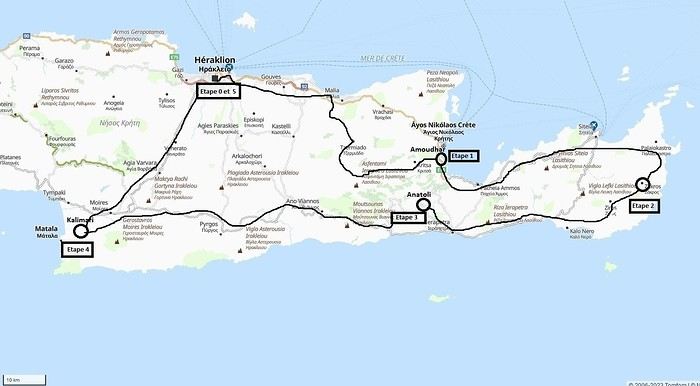 Our 21-day itinerary
Sunday, 08/09: Once again—and this is the eighth time—we’re setting off, the four of us: Patrick, Michelle, Jacques, and Monique, for the Greek islands. This time, we’ve chosen Crete. No need to wake up at 3 or 4 a.m. to reach Basel-Mulhouse Airport at dawn to catch the first flight to Greece at 6 a.m.! Given the prohibitive prices charged by EasyJet, we found flights that were half the price from Zurich Airport, which is accessible in 3 hours by train from Colmar. Pierre-Paul drives all four of us to Colmar train station, where we take the train to Basel and then, 20 minutes later, the direct train to Zurich Airport. After wandering around the airport, we go for a coffee at 6 € each! We’re in Switzerland, after all. The other dining areas all have vending machines for selecting and paying for meals—soon, there won’t be anyone left to serve you! After a short wait, we take off at 7:45 p.m. (20 minutes late) in an Aegean Airbus A321. Free in-flight meal service isn’t bad either! We land in Heraklion around 11:15 p.m. We pick up our rental car (a red Seat Ibiza) at the airport and head straight to our apartment, located 2 km from the city center. Thanks to the GPS, we find it quickly. It’s a beautiful, fully renovated apartment with all the comforts and well-equipped. On the table, there’s wine, bottles of water, jam, coffee, etc. Given the late hour, we won’t stay up long.
Monday, 09/09: To enhance our breakfast, Michelle and Monique set off to find a bakery nearby. They return with croissants and donuts—yum... Then we head to the west coast. The highway follows the coastline, but we prefer taking the old road to Malia, our first stop. We visit the major archaeological site of this Minoan city under the hot sun. The site covers a vast area, but the ruins aren’t very evocative except for a few beautiful amphorae scattered around. The explanations in a small house at the entrance are interesting and help us better understand the organization of the ancient city with its different districts. From there, we head toward the nearby mountains to see the thousand-year-old plane tree in the village of Krasi. We take the opportunity to enjoy an excellent lunch of moussaka and delicious gemista at the Krassopsychia taverna in the village center. Pleasant surprise: the prices are still reasonable, with a bill of 70 € for four, including wine and water. The friendly tradition of complimentary dessert and glasses of raki continues—great! We’ve set the bar high right away! Let’s hope the rest lives up to it! On the way back toward the Lassithi Plateau, we stop at the Kardiotisa Monastery perched high on the mountain to enjoy a magnificent view of the entire region. Just a little further, we arrive at the Lassithi Plateau: the presence of small windmills used to pump water from the ground is the typical feature of this plateau. We complete a full loop around the plateau, passing by numerous orchards and vegetable gardens that occupy the entire space. At the end of the plateau, we once again cross mountain passes via winding roads that bring us near Agios Nikolaos. Our apartment is located about ten kilometers further south in Amoudhara. The owner, who was notified, waits for us and shows us her superb apartment, whose large terrace overlooks the entire Mirabello Bay. She then gives us valuable information about the different beaches in the area. Dinner will be frugal, given our hearty lunch in Krasi!
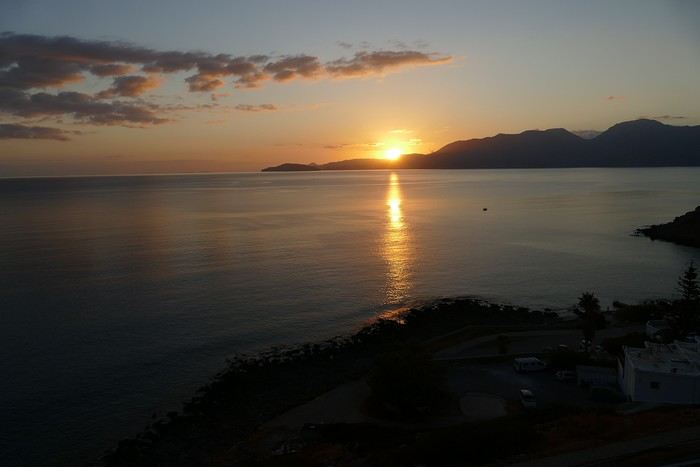 Sunset over Mirabello Bay
Tuesday, 10/09: A bit of a gray sky when we wake up around 8 a.m., but the sun will soon triumph over the scattered clouds. For our first swim, we opt for Voulisma Beach, even though our host warned us it was a bit “crowdy.” That’s understandable given the beautiful emerald color of the sea and the lovely curve of the beach. To avoid the big crowds, we move toward the eastern part of the beach, accessible via a steep staircase. The water is very warm, and this first dip is very pleasant. Before returning to the apartment, we stop at the bakery to buy spinach pies, essential ingredients to accompany our Greek salad for lunch. Of course, everything will be washed down with ouzo, which will remain our favorite drink for the next three weeks—but in moderation!!! A nap is in order after all that effort. In the late afternoon, we drive to Agios Nikolaos, the main seaside resort in Crete. We’re not too enthusiastic about visiting this mass-tourism resort, but the center of Agios, concentrated around the small inner harbor, is pleasant to see despite the plethora of shops and restaurants. We dine a little outside the harbor in the shaded courtyard of the Avli taverna: the oven-baked lamb, squid with spinach, and cuttlefish ink orzo pasta are all highly appreciated. We still stay under a 75 € bill for four.
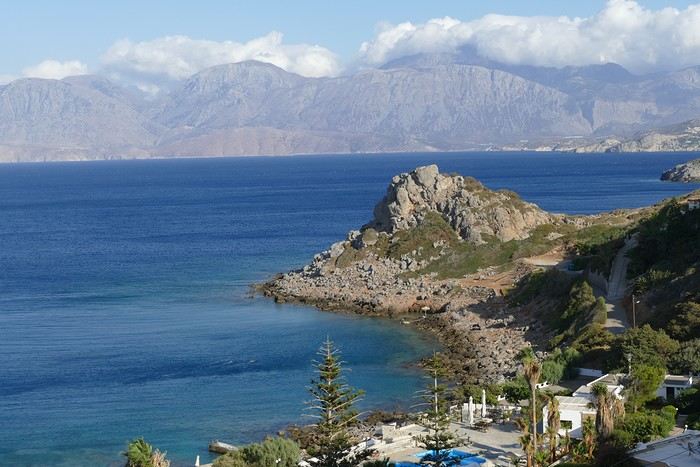 Mirabello Bay seen from our terrace
Wednesday, 11/09: At 8 a.m., the terrace is already bathed in sunlight, and it’s already quite hot. The small parasol barely gives us enough shade, but we’re not complaining! For our second swim, we head to a tiny beach recommended by our host, just 3 minutes by car from our place. The path leading to it is very discreet, and we don’t find it right away! It’s a small sandy cove with a few welcome tamarisk trees for shade. When we arrive, there are two swimmers, and there won’t be more than five or six in the morning. After lunch and a nap, we head to the beautiful village of Kritsa, just a few kilometers away. It’s too late to visit the beautiful church of Kera Panagia, which is already closed. We settle for the exterior, which is worth a look. The weather is clouding over, and big clouds are gathering. Upon arriving in Kritsa, a heavy shower forces us to take shelter in the Platanos taverna in the village center, and since it’s nearly 7 p.m., we decide to stay and dine there. Good choice—excellent meze: croquettes and stuffed zucchini flowers, gigantes beans, grilled tomatoes and feta, and pancetta as the main dish. The rain stops just as we decide to head back.
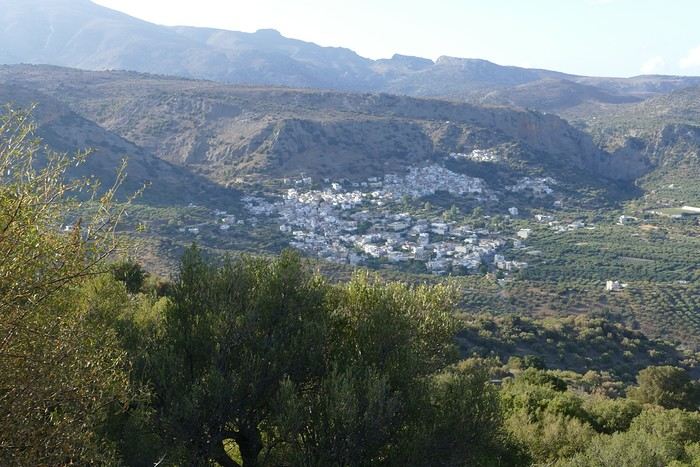 Village of Kritsa
Thursday, 12/09: Our terrace faces east, so we get to watch the sunrise around 7 a.m.—it’s truly a beautiful sight we never tire of. Around 9 a.m., we head to the village of Plaka, where boats depart for the island of Spinalonga, located north of Agios Nikolaos. We board the first boat, which sets sail at 10 a.m., and we’re not alone—the boat is practically full. After 10 minutes, we land on the island at the same time as several other boats from Elounda or Agios. Needless to say, there are already quite a few people walking through the streets of the leper village. The visit remains interesting and moving as we read the explanatory panels recounting the island’s history under Byzantine and then Turkish rule, followed by its transformation into a leper colony. As soon as we climb toward the top of the island via more or less maintained paths, there’s almost no one left. The 360° view from up there is stunning.
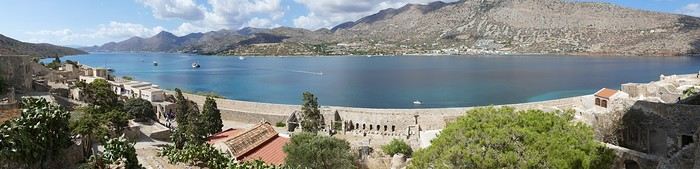
Spinalonga Island
The heat is now unbearable, and we can’t wait to get back home to have lunch on our terrace and rest. In the late afternoon, we go grocery shopping at the AB supermarket at the entrance of Agios. We had spotted another nice restaurant in our guide, but unfortunately, there’s a different one at the indicated location that doesn’t inspire us. So, we return to the Avli taverna for another dinner just as good as the first.
Friday, 13/09: We repeat yesterday’s successful program: a swim in our little cove, lunch on the terrace, a nap, and then, in the late afternoon, we discover another nearby village, Kroustas, nestled in the olive groves near Kritsa. Much less touristy than Kritsa, it’s mostly inhabited by locals, especially the elderly who are enjoying the cool air on their chairs—if you can call it cool given the still-high temperatures in the late afternoon! We then return to visit Kritsa, which we hadn’t been able to explore due to the rain. Dinner at a taverna in the village center at a very reasonable price.
Saturday, 14/09: Today, we move to our new base further east. We start with a high viewpoint at the Faneromeni Monastery, which overlooks Mirabello Bay. The monastery itself is of little interest as it’s under renovation with excessive concrete work. We continue to the village of Kavoussi to see another exceptional tree after a few kilometers on a dusty, bumpy track. It’s an olive tree said to be about 3,200 years old—impressive, and the countryside is very beautiful. It’s time to find a place for lunch. We find one in the charming little port of Mohlos, where a few tavernas surround a very nice small beach. Our choice falls on the Bogazzi taverna, where we enjoy fried fish. To reach our new base in Zakros, we still have to drive through the mountains before reaching Sitia, Paleokastro, and finally Zakros. The region is beautiful, with olive groves and rows of wind turbines taking advantage of the strong wind near the northern tip of the island. In Zakros, we’re greeted by our very friendly host. Here too, we have all the comforts and a beautiful terrace overlooking the village. The apartment has reversible air conditioners, but the overly simple instructions leave us puzzled. Thinking we’ve set it correctly, we realize a little too late that it’s blowing hot air over 30°C! After numerous attempts and testing several confusing programs, we finally succeed! Dinner on our new terrace.
Sunday, 15/09: This morning, we get up early to hike in the “Gorge of the Dead” while it’s still cool. The sky is blue as usual! We park in the nearest parking lot and start our descent via a beautiful path winding through the olive groves. A little further on, the landscape opens up, and the path, now a stony trail, begins the descent to the dry riverbed. On either side of the riverbed rise beautiful reddish cliffs.
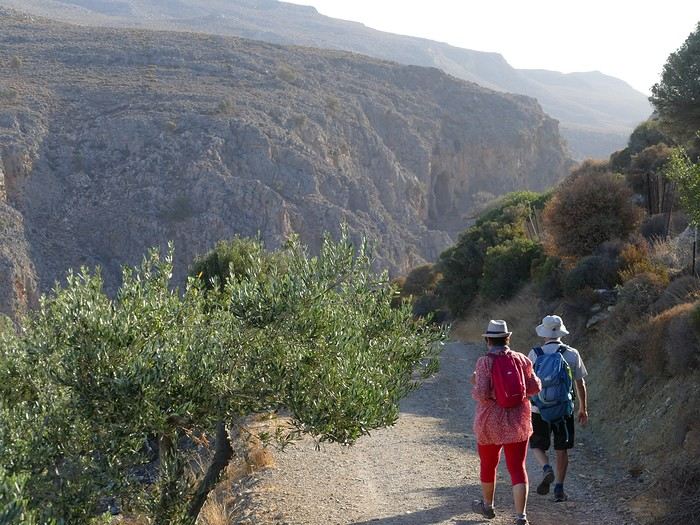
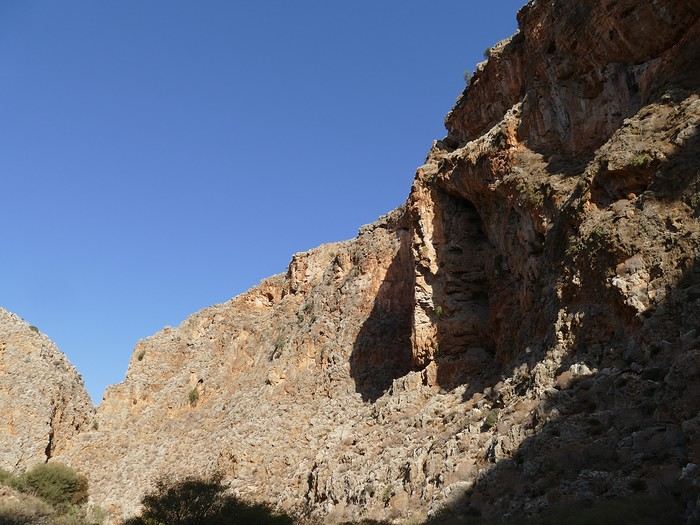
Gorge of the Dead
The trail winds its way through this narrow gorge with difficulty. It was in the many caves visible halfway up the slope that the Minoans buried their dead, hence the name “Gorge of the Dead.” The gorge opens onto a beautiful small pebble beach. A swim is welcome after this hike that made us sweat. The hike took us 1 hour and 25 minutes, and a little less on the way back. Meanwhile, Monique did some shopping and prepared an excellent lunch. In the late afternoon, we go down to dine at Platanakis, a taverna in the small village of Kato Zakros.
Monday, 16/09: This morning, we explore the northern part of the east coast near Palekastro. We start with a dip at the beautiful Hionia Beach near Palekastro. The water is still just as nice, but a light breeze is blowing—not enough to spoil our fun! Seeing all the wind turbines lining the ridges, it’s no surprise.
 Grocery shopping in Palekastro and return to Zakros. A little rain in the late afternoon and an excellent dinner at Iannis Mitsakakis’ Taverna in Adravastis. These are the kind of small tavernas we love—unpretentious, a few tables on a terrace, a warm welcome, a short menu guaranteeing freshness, tasty dishes prepared by the server’s mom, and a light bill. What more could you ask for!
Tuesday, 17/09: We head back toward Palekastro to do some shopping, but it’s also the road to the Toplou Monastery. There, we see a collection of magnificent icons dating from the 15th to the 20th century. We can also admire drawings of Orthodox religious architecture. We continue toward the Mavros Akrotiri headland to enjoy the view of the sea and rocky capes. On the way back to our place, we make a small detour to see the famous Vai palm grove. Meh... As for Vai Beach, it’s filled with paid umbrellas and sunbeds, and there are so many people that we flee. Plus, having to pay for parking is another reason to snub this trendy beach. We prefer our Hionia Beach, which we already appreciated the other day. In the late afternoon, Pat and I start the trail that begins at Kato Zakros Beach heading south. The poorly marked path crosses a plateau of sharp limestone. The paint and cairn markings are no longer very visible, and with dusk approaching, we turn back toward Kato Zakros. Dinner at the Platanakis taverna—less good than last time.
Wednesday, 18/09: To avoid the scorching sun, Pat, Mimi, and I get up earlier than usual to hike the Hohlakies Gorge. At this early hour, the sky is quite cloudy, and it’s drizzling. When we arrive in the village of Hohlakies, we park in front of a small chapel, the start of the hike. The sky is now completely clear. The trail starts among the olive groves, then after passing through a gate, we descend into the gorge filled with large rocks. We’re alone in the world, and the landscape is magnificent. A few wild goats clinging to the cliff watch us from above. After 1 hour and 15 minutes, we emerge onto the wonderful Karoumès Beach. A pleasant swim, then back to civilization! A walk in the late afternoon in Zakros to discover the beautiful springs route. Dinner in Adravastis.
Thursday, 19/09: Another move: Before heading to our next stop, we make a detour to see the beautiful Keratokampos Beach and can’t resist a swim in the still-warm, clear water. We continue our journey via Ziros, then reach the south coast and have lunch at the Stephi taverna in Ferma—excellent meal! The south coast is quite urbanized and has much less charm than the east coast we’ve just left! The numerous plastic greenhouses are partly to blame. We stop for groceries in Ierapetra. Around 3 p.m., we arrive at our destination in the small perched village of Anatoli. Our lodging is at the top of the village, and from the path leading to it, we have a magnificent view of the coastal plain, unfortunately overloaded with plastic greenhouses. It reminds us of the landscapes of El Ejido in Andalusia.
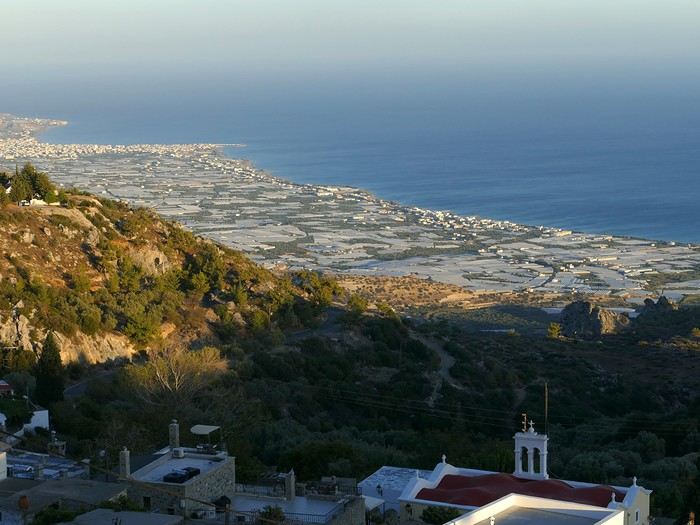 View of the Ierapetra coast from Anatoli
Friday, 20/09: A walk and discovery of the hamlet of Anatoli. There are few services—a tiny grocery store, a taverna, and that’s it. Fortunately, the traveling baker arrives and honks. We take the opportunity to buy fresh bread. Leaving the village, we take a path that should lead us to the hamlet of Drygies. The landscape is beautiful. We walk through a lovely pine forest before arriving at the hamlet. The path continues to a taverna that’s closed today, with a superb terrace overlooking the coast. Luckily, the owner arrives and informs us that the taverna will be open next Sunday and that we can enjoy barbecued meat. Noted! We head back to Anatoli via the small paved road with, fortunately, very limited traffic. Lunch on our terrace, then a dip in our private pool! The water is noticeably cooler than at the beach. Dinner at the village taverna: there’s only one menu—meze starters, souvlaki, water, wine, and bread—all for 35 €! We think we’re dreaming—was there a mistake? No.
Saturday, 21/09: We discover the beach of the village of Myrtos, a small seaside resort that’s quite touristy but on a human scale. We swim in the western part of the beach, and once again, we’re alone in the water. The best part: warm water and tamarisk trees for welcome shade. There’s even a shower to rinse off! In the late afternoon, Pat and I decide to go for a hike in the Selakano pine forest. To get there, we take a narrow, winding, and poorly paved road after the village of Christos. Plus, at this altitude, we encounter clouds clinging to the mountain, so it’s drizzling, and visibility is reduced. We decide to turn back and return to Anatoli. As compensation, we take the path that passes in front of the lodging and leads us to the Timios Stavros chapel, which crowns the summit of the nearby mountain. We arrive at the summit just in time for the sunset at 7 p.m. Breathtaking 360° panorama and magnificent colors!
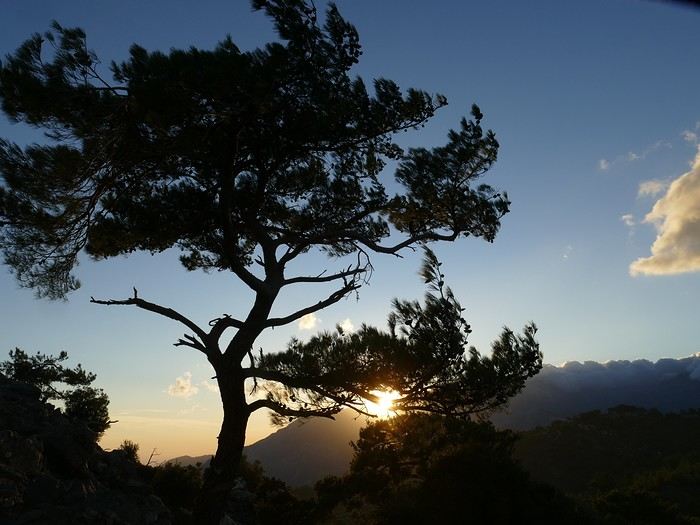 Sunset from Anatoli
Sunday, 22/09: This morning, Pat, Mimi, and I go for a hike in the Sarakina Gorge, located about 12 km from Anatoli via a beautiful road winding through irrigated olive groves. We park in the small parking lot before the trail. At the start, the path follows a levada (small irrigation canal) and quickly enters a very narrow gorge flanked by high cliffs. The riverbed is cluttered with huge rocks blocking the passage. No matter—in the technical sections, ropes or ladders allow us to overcome these obstacles with a bit of skill. You can imagine how quickly the riverbed must rise during a storm, given the narrowness of the gorge!
We progress slowly through this magnificent and impressive rocky chaos. At the exit of the gorge, we take another return path that partly follows the paved road. Back in Anatoli, we go to lunch at the Drygies taverna. We sit at the edge of the terrace under a huge tree that covers almost the entire terrace and order grilled lamb dishes prepared according to the ancient “antikristo” method.
Monday, 23/09: Departure for our last stop before Heraklion. We thought about swimming at Tertsa Beach, but it turns out to be less pleasant than expected, with pebbles and an uneven rocky plateau. So, we return to Myrtos Beach, which we know well and suits us perfectly. We head west, leaving the coast a bit. Around 3:30 p.m., we arrive at our destination in the village of Kamilari, near the famous Matala spot. We’ve rented a beautiful, modern, well-equipped apartment with a lovely shaded terrace. The owner is very friendly and explains everything necessary for a good stay. We explore the quite touristy village with its few tavernas, all full of tourists, mostly Germans.
Tuesday, 24/09: Visit to the village of Sivas, well restored thanks to the Germans, who have invested a lot here. We take the opportunity to scout out “friendly” tavernas, then go for a swim at Kalamaki Beach. Apart from a small sandy access, you have to enter the water via a chaotic limestone plateau—proof of this is that Monique trips slightly when entering the water. A group of very unfriendly German women blocks the sandy passage and doesn’t hesitate to push swimmers they deem too close. Back home, lunch, and a nap. In the late afternoon, we drive to visit the nearby Phaistos site. We benefit from very beautiful lighting. From the elevated site, we overlook the Messara Plain with a beautiful view of the olive grove checkerboards highlighted by the late afternoon sun. The site itself is quite vast, but to appreciate it, it’s better to read the explanatory panels placed throughout the different quarters. At this hour, the site is almost empty, and the beautiful light adds charm to the visit.
Wednesday, 25/09: Departure for the village of Matala, which doesn’t interest us in itself, having been there during the “hippie” era in 1976. However, going to Red Beach, only accessible by taking a path overlooking this area, appeals to us much more. We park in the large parking lot just outside the village and start our climb, which brings us to a pass from where we can admire this beautiful red-sand beach framed by beautiful cliffs plunging into the sea. The weather is magnificent, and at this early hour, there aren’t many people yet. We swim in the free part located near the cliff on the right when arriving at the beach. The sea is like glass, warm, and without a single ripple—a real treat! After half an hour, we turn back, and now there are many people rushing on this path, not at all made for feet in sandals or flip-flops, yet many vacationers venture out like this! Matala lives up to its image—a trendy place, full of shops, bars, and restaurants. You could be in any seaside resort with a standard global urbanism, lacking particular charm. Back home. In the late afternoon, a walk through the olive groves surrounding Kamilari, then dinner at Evangelina’s, who runs the Minoan Parassies taverna in the middle of the olive groves. Evangelina is quite a character: we came to reserve a table for 8 p.m. when it was only 7 p.m., but since we lingered near her restaurant, she prepares a table for us and urges us to sit down! And there she takes our order, and a little later, the meze arrive, followed by the main dishes. We finish this good dinner with several generous glasses of raki, accompanied by Evangelina’s encouragements, repeating “poya poya bravo bravo” in a loop. We’re in great shape too, by the way! We return in the middle of the night, on foot, fortunately, with the path vaguely lit by our phones...
Thursday, 26/09: This morning, we discover a new beach, Kommos Beach, not far from Kamilari either. It’s a long sandy beach, a small part of which is dedicated to paid umbrellas and sunbeds, and the rest is free. We spot a tamarisk tree to take shelter from the still-hot sun, and once again, we enjoy clear, warm water. The few swimmers spread out easily over nearly 500 meters of beach. In the late afternoon, Pat and I go to admire the sunset from the hill near our lodging. The hill, covered with olive trees, is threatened by a planned housing development of large cubic villas—trends dictate. Concrete never stops...
Friday, 27/09: We thought about leaving the car at the Odiyitria Monastery, the end of the paved road, but since the track descending to the cave remains drivable, we park 3 km further at the junction of the track leading to Kali Limenes Beach. We still have to walk for half an hour on a less drivable track, and then we’re at the entrance of the Farango Gorge. It’s a beautiful, easy hike since we follow the dry pebble riverbed. Before arriving at the beach, there’s a very beautiful small chapel sheltered under a large cliff, beautifully lit at this early hour.
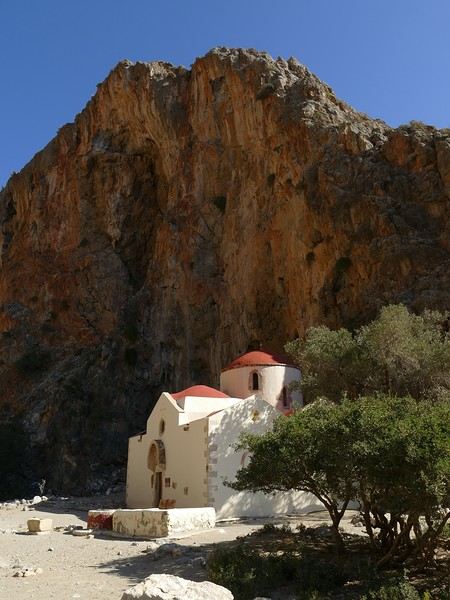
Agio Farango Chapel
A few climbers are scaling the cliff, and about ten swimmers are enjoying the sea. Return to the car under the hot sun. In the late afternoon, we all return to visit the interesting Odiyitria Monastery. Last swim at Kommos Beach and an excellent dinner at the Sigelakis taverna in Sivas.
Saturday, 28/09: There’s an end-of-vacation atmosphere... We pack our bags and head north. A short stop to see the village of Vorri, and a little over an hour later, we arrive in the big city of Heraklion. Since it’s too early to check into the apartment, we park in the city center to visit the famous archaeological museum. It’s indeed a must-see highlight of our stay in Crete. All four of us are amazed by the quantity and quality of the objects presented from the Minoan civilization. After more than 2 hours, we come out without having seen everything, but we’re a bit overwhelmed by all these wonders. Lunch at a nice little taverna very close to the Titus Church. We go to take possession of our apartment—the same as on the way there, still just as satisfying. In the late afternoon, I go alone for a walk in the historic district of the city, passing by the Morosini Fountain, which is bustling with people—some seated at café terraces, others standing and chatting. There’s a lively atmosphere here. A little further on are the Venetian loggia and the Agios Titos Church. I walk down to the old Venetian port to stroll along the jetty and admire the fortifications under beautiful late-afternoon lighting, then return to the apartment. Dinner near our place at Kiriakis, a “chic” restaurant but with very reasonable prices and excellent cuisine.
Sunday, 29/09: Wake-up at 3:30 a.m., quick coffee, and drive to the nearby airport. We leave the car in the parking lot. Already a lot of people at this early hour. Since we don’t have checked luggage, we go straight to security, which goes fairly quickly, then it’s waiting time and takeoff on time in an Airbus A321 for a 45-minute flight to Athens. We take off again in another Airbus A321 with a 50-minute delay to arrive in Zurich at 11:10 a.m. local time. Then we have to take the train to Basel and then the one to Colmar. With fewer Sunday services, we won’t arrive in Colmar until around 4 p.m.
Conclusion All four of us returned very satisfied with this stay in Crete for several reasons: - We found superb beaches with clear, warm water and often very few vacationers. - The few hikes we did were magnificent, especially those where the trails went through gorges leading to deserted beaches. - We greatly appreciated Cretan gastronomy—there were so few disappointments that we can count them on one hand. - All the accommodations we booked turned out to be superb, with the icing on the cake being the very friendly welcome from our hosts. - Generally, contacts with Cretans were always very warm despite the language barrier—we speak a little Greek. - We also appreciated the diversity of landscapes in this eastern part of Crete, with plateaus and mountains with splendid rugged reliefs.
Note: The photo album is available by clicking on this link: https://photos.app.goo.gl/hfdjQndA5eXkL5k7 Captions are only visible per photo by clicking on the circled “i” in the top right. Budget: approximately 3,300 € per couple for 21 days, including train and flights Budget details per couple: - Flight Zurich-Heraklion: 440 € - Trains Colmar-Basel-Zurich round trip for 4: 442.40 € (221 € per couple) - Accommodation: 2,431 € / 21 = 115.80 € per night for 4 (1,216 € per couple) - Car rental for 21 days: 684 € + 145 € fuel (1,150 km) (414 € per couple) - Restaurants, food, etc.: 1,009 €
Our 21-day itinerarySunday, 08/09: Once again—and this is the eighth time—we’re setting off, the four of us: Patrick, Michelle, Jacques, and Monique, for the Greek islands. This time, we’ve chosen Crete. No need to wake up at 3 or 4 a.m. to reach Basel-Mulhouse Airport at dawn to catch the first flight to Greece at 6 a.m.! Given the prohibitive prices charged by EasyJet, we found flights that were half the price from Zurich Airport, which is accessible in 3 hours by train from Colmar. Pierre-Paul drives all four of us to Colmar train station, where we take the train to Basel and then, 20 minutes later, the direct train to Zurich Airport. After wandering around the airport, we go for a coffee at 6 € each! We’re in Switzerland, after all. The other dining areas all have vending machines for selecting and paying for meals—soon, there won’t be anyone left to serve you! After a short wait, we take off at 7:45 p.m. (20 minutes late) in an Aegean Airbus A321. Free in-flight meal service isn’t bad either! We land in Heraklion around 11:15 p.m. We pick up our rental car (a red Seat Ibiza) at the airport and head straight to our apartment, located 2 km from the city center. Thanks to the GPS, we find it quickly. It’s a beautiful, fully renovated apartment with all the comforts and well-equipped. On the table, there’s wine, bottles of water, jam, coffee, etc. Given the late hour, we won’t stay up long.
Monday, 09/09: To enhance our breakfast, Michelle and Monique set off to find a bakery nearby. They return with croissants and donuts—yum... Then we head to the west coast. The highway follows the coastline, but we prefer taking the old road to Malia, our first stop. We visit the major archaeological site of this Minoan city under the hot sun. The site covers a vast area, but the ruins aren’t very evocative except for a few beautiful amphorae scattered around. The explanations in a small house at the entrance are interesting and help us better understand the organization of the ancient city with its different districts. From there, we head toward the nearby mountains to see the thousand-year-old plane tree in the village of Krasi. We take the opportunity to enjoy an excellent lunch of moussaka and delicious gemista at the Krassopsychia taverna in the village center. Pleasant surprise: the prices are still reasonable, with a bill of 70 € for four, including wine and water. The friendly tradition of complimentary dessert and glasses of raki continues—great! We’ve set the bar high right away! Let’s hope the rest lives up to it! On the way back toward the Lassithi Plateau, we stop at the Kardiotisa Monastery perched high on the mountain to enjoy a magnificent view of the entire region. Just a little further, we arrive at the Lassithi Plateau: the presence of small windmills used to pump water from the ground is the typical feature of this plateau. We complete a full loop around the plateau, passing by numerous orchards and vegetable gardens that occupy the entire space. At the end of the plateau, we once again cross mountain passes via winding roads that bring us near Agios Nikolaos. Our apartment is located about ten kilometers further south in Amoudhara. The owner, who was notified, waits for us and shows us her superb apartment, whose large terrace overlooks the entire Mirabello Bay. She then gives us valuable information about the different beaches in the area. Dinner will be frugal, given our hearty lunch in Krasi!
Sunset over Mirabello BayTuesday, 10/09: A bit of a gray sky when we wake up around 8 a.m., but the sun will soon triumph over the scattered clouds. For our first swim, we opt for Voulisma Beach, even though our host warned us it was a bit “crowdy.” That’s understandable given the beautiful emerald color of the sea and the lovely curve of the beach. To avoid the big crowds, we move toward the eastern part of the beach, accessible via a steep staircase. The water is very warm, and this first dip is very pleasant. Before returning to the apartment, we stop at the bakery to buy spinach pies, essential ingredients to accompany our Greek salad for lunch. Of course, everything will be washed down with ouzo, which will remain our favorite drink for the next three weeks—but in moderation!!! A nap is in order after all that effort. In the late afternoon, we drive to Agios Nikolaos, the main seaside resort in Crete. We’re not too enthusiastic about visiting this mass-tourism resort, but the center of Agios, concentrated around the small inner harbor, is pleasant to see despite the plethora of shops and restaurants. We dine a little outside the harbor in the shaded courtyard of the Avli taverna: the oven-baked lamb, squid with spinach, and cuttlefish ink orzo pasta are all highly appreciated. We still stay under a 75 € bill for four.
Mirabello Bay seen from our terraceWednesday, 11/09: At 8 a.m., the terrace is already bathed in sunlight, and it’s already quite hot. The small parasol barely gives us enough shade, but we’re not complaining! For our second swim, we head to a tiny beach recommended by our host, just 3 minutes by car from our place. The path leading to it is very discreet, and we don’t find it right away! It’s a small sandy cove with a few welcome tamarisk trees for shade. When we arrive, there are two swimmers, and there won’t be more than five or six in the morning. After lunch and a nap, we head to the beautiful village of Kritsa, just a few kilometers away. It’s too late to visit the beautiful church of Kera Panagia, which is already closed. We settle for the exterior, which is worth a look. The weather is clouding over, and big clouds are gathering. Upon arriving in Kritsa, a heavy shower forces us to take shelter in the Platanos taverna in the village center, and since it’s nearly 7 p.m., we decide to stay and dine there. Good choice—excellent meze: croquettes and stuffed zucchini flowers, gigantes beans, grilled tomatoes and feta, and pancetta as the main dish. The rain stops just as we decide to head back.
Village of KritsaThursday, 12/09: Our terrace faces east, so we get to watch the sunrise around 7 a.m.—it’s truly a beautiful sight we never tire of. Around 9 a.m., we head to the village of Plaka, where boats depart for the island of Spinalonga, located north of Agios Nikolaos. We board the first boat, which sets sail at 10 a.m., and we’re not alone—the boat is practically full. After 10 minutes, we land on the island at the same time as several other boats from Elounda or Agios. Needless to say, there are already quite a few people walking through the streets of the leper village. The visit remains interesting and moving as we read the explanatory panels recounting the island’s history under Byzantine and then Turkish rule, followed by its transformation into a leper colony. As soon as we climb toward the top of the island via more or less maintained paths, there’s almost no one left. The 360° view from up there is stunning.
Spinalonga Island
The heat is now unbearable, and we can’t wait to get back home to have lunch on our terrace and rest. In the late afternoon, we go grocery shopping at the AB supermarket at the entrance of Agios. We had spotted another nice restaurant in our guide, but unfortunately, there’s a different one at the indicated location that doesn’t inspire us. So, we return to the Avli taverna for another dinner just as good as the first.
Friday, 13/09: We repeat yesterday’s successful program: a swim in our little cove, lunch on the terrace, a nap, and then, in the late afternoon, we discover another nearby village, Kroustas, nestled in the olive groves near Kritsa. Much less touristy than Kritsa, it’s mostly inhabited by locals, especially the elderly who are enjoying the cool air on their chairs—if you can call it cool given the still-high temperatures in the late afternoon! We then return to visit Kritsa, which we hadn’t been able to explore due to the rain. Dinner at a taverna in the village center at a very reasonable price.
Saturday, 14/09: Today, we move to our new base further east. We start with a high viewpoint at the Faneromeni Monastery, which overlooks Mirabello Bay. The monastery itself is of little interest as it’s under renovation with excessive concrete work. We continue to the village of Kavoussi to see another exceptional tree after a few kilometers on a dusty, bumpy track. It’s an olive tree said to be about 3,200 years old—impressive, and the countryside is very beautiful. It’s time to find a place for lunch. We find one in the charming little port of Mohlos, where a few tavernas surround a very nice small beach. Our choice falls on the Bogazzi taverna, where we enjoy fried fish. To reach our new base in Zakros, we still have to drive through the mountains before reaching Sitia, Paleokastro, and finally Zakros. The region is beautiful, with olive groves and rows of wind turbines taking advantage of the strong wind near the northern tip of the island. In Zakros, we’re greeted by our very friendly host. Here too, we have all the comforts and a beautiful terrace overlooking the village. The apartment has reversible air conditioners, but the overly simple instructions leave us puzzled. Thinking we’ve set it correctly, we realize a little too late that it’s blowing hot air over 30°C! After numerous attempts and testing several confusing programs, we finally succeed! Dinner on our new terrace.
Sunday, 15/09: This morning, we get up early to hike in the “Gorge of the Dead” while it’s still cool. The sky is blue as usual! We park in the nearest parking lot and start our descent via a beautiful path winding through the olive groves. A little further on, the landscape opens up, and the path, now a stony trail, begins the descent to the dry riverbed. On either side of the riverbed rise beautiful reddish cliffs.
Gorge of the Dead
The trail winds its way through this narrow gorge with difficulty. It was in the many caves visible halfway up the slope that the Minoans buried their dead, hence the name “Gorge of the Dead.” The gorge opens onto a beautiful small pebble beach. A swim is welcome after this hike that made us sweat. The hike took us 1 hour and 25 minutes, and a little less on the way back. Meanwhile, Monique did some shopping and prepared an excellent lunch. In the late afternoon, we go down to dine at Platanakis, a taverna in the small village of Kato Zakros.
Monday, 16/09: This morning, we explore the northern part of the east coast near Palekastro. We start with a dip at the beautiful Hionia Beach near Palekastro. The water is still just as nice, but a light breeze is blowing—not enough to spoil our fun! Seeing all the wind turbines lining the ridges, it’s no surprise.
Grocery shopping in Palekastro and return to Zakros. A little rain in the late afternoon and an excellent dinner at Iannis Mitsakakis’ Taverna in Adravastis. These are the kind of small tavernas we love—unpretentious, a few tables on a terrace, a warm welcome, a short menu guaranteeing freshness, tasty dishes prepared by the server’s mom, and a light bill. What more could you ask for!Tuesday, 17/09: We head back toward Palekastro to do some shopping, but it’s also the road to the Toplou Monastery. There, we see a collection of magnificent icons dating from the 15th to the 20th century. We can also admire drawings of Orthodox religious architecture. We continue toward the Mavros Akrotiri headland to enjoy the view of the sea and rocky capes. On the way back to our place, we make a small detour to see the famous Vai palm grove. Meh... As for Vai Beach, it’s filled with paid umbrellas and sunbeds, and there are so many people that we flee. Plus, having to pay for parking is another reason to snub this trendy beach. We prefer our Hionia Beach, which we already appreciated the other day. In the late afternoon, Pat and I start the trail that begins at Kato Zakros Beach heading south. The poorly marked path crosses a plateau of sharp limestone. The paint and cairn markings are no longer very visible, and with dusk approaching, we turn back toward Kato Zakros. Dinner at the Platanakis taverna—less good than last time.
Wednesday, 18/09: To avoid the scorching sun, Pat, Mimi, and I get up earlier than usual to hike the Hohlakies Gorge. At this early hour, the sky is quite cloudy, and it’s drizzling. When we arrive in the village of Hohlakies, we park in front of a small chapel, the start of the hike. The sky is now completely clear. The trail starts among the olive groves, then after passing through a gate, we descend into the gorge filled with large rocks. We’re alone in the world, and the landscape is magnificent. A few wild goats clinging to the cliff watch us from above. After 1 hour and 15 minutes, we emerge onto the wonderful Karoumès Beach. A pleasant swim, then back to civilization! A walk in the late afternoon in Zakros to discover the beautiful springs route. Dinner in Adravastis.
Thursday, 19/09: Another move: Before heading to our next stop, we make a detour to see the beautiful Keratokampos Beach and can’t resist a swim in the still-warm, clear water. We continue our journey via Ziros, then reach the south coast and have lunch at the Stephi taverna in Ferma—excellent meal! The south coast is quite urbanized and has much less charm than the east coast we’ve just left! The numerous plastic greenhouses are partly to blame. We stop for groceries in Ierapetra. Around 3 p.m., we arrive at our destination in the small perched village of Anatoli. Our lodging is at the top of the village, and from the path leading to it, we have a magnificent view of the coastal plain, unfortunately overloaded with plastic greenhouses. It reminds us of the landscapes of El Ejido in Andalusia.
View of the Ierapetra coast from AnatoliFriday, 20/09: A walk and discovery of the hamlet of Anatoli. There are few services—a tiny grocery store, a taverna, and that’s it. Fortunately, the traveling baker arrives and honks. We take the opportunity to buy fresh bread. Leaving the village, we take a path that should lead us to the hamlet of Drygies. The landscape is beautiful. We walk through a lovely pine forest before arriving at the hamlet. The path continues to a taverna that’s closed today, with a superb terrace overlooking the coast. Luckily, the owner arrives and informs us that the taverna will be open next Sunday and that we can enjoy barbecued meat. Noted! We head back to Anatoli via the small paved road with, fortunately, very limited traffic. Lunch on our terrace, then a dip in our private pool! The water is noticeably cooler than at the beach. Dinner at the village taverna: there’s only one menu—meze starters, souvlaki, water, wine, and bread—all for 35 €! We think we’re dreaming—was there a mistake? No.
Saturday, 21/09: We discover the beach of the village of Myrtos, a small seaside resort that’s quite touristy but on a human scale. We swim in the western part of the beach, and once again, we’re alone in the water. The best part: warm water and tamarisk trees for welcome shade. There’s even a shower to rinse off! In the late afternoon, Pat and I decide to go for a hike in the Selakano pine forest. To get there, we take a narrow, winding, and poorly paved road after the village of Christos. Plus, at this altitude, we encounter clouds clinging to the mountain, so it’s drizzling, and visibility is reduced. We decide to turn back and return to Anatoli. As compensation, we take the path that passes in front of the lodging and leads us to the Timios Stavros chapel, which crowns the summit of the nearby mountain. We arrive at the summit just in time for the sunset at 7 p.m. Breathtaking 360° panorama and magnificent colors!
Sunset from AnatoliSunday, 22/09: This morning, Pat, Mimi, and I go for a hike in the Sarakina Gorge, located about 12 km from Anatoli via a beautiful road winding through irrigated olive groves. We park in the small parking lot before the trail. At the start, the path follows a levada (small irrigation canal) and quickly enters a very narrow gorge flanked by high cliffs. The riverbed is cluttered with huge rocks blocking the passage. No matter—in the technical sections, ropes or ladders allow us to overcome these obstacles with a bit of skill. You can imagine how quickly the riverbed must rise during a storm, given the narrowness of the gorge!
We progress slowly through this magnificent and impressive rocky chaos. At the exit of the gorge, we take another return path that partly follows the paved road. Back in Anatoli, we go to lunch at the Drygies taverna. We sit at the edge of the terrace under a huge tree that covers almost the entire terrace and order grilled lamb dishes prepared according to the ancient “antikristo” method.
Monday, 23/09: Departure for our last stop before Heraklion. We thought about swimming at Tertsa Beach, but it turns out to be less pleasant than expected, with pebbles and an uneven rocky plateau. So, we return to Myrtos Beach, which we know well and suits us perfectly. We head west, leaving the coast a bit. Around 3:30 p.m., we arrive at our destination in the village of Kamilari, near the famous Matala spot. We’ve rented a beautiful, modern, well-equipped apartment with a lovely shaded terrace. The owner is very friendly and explains everything necessary for a good stay. We explore the quite touristy village with its few tavernas, all full of tourists, mostly Germans.
Tuesday, 24/09: Visit to the village of Sivas, well restored thanks to the Germans, who have invested a lot here. We take the opportunity to scout out “friendly” tavernas, then go for a swim at Kalamaki Beach. Apart from a small sandy access, you have to enter the water via a chaotic limestone plateau—proof of this is that Monique trips slightly when entering the water. A group of very unfriendly German women blocks the sandy passage and doesn’t hesitate to push swimmers they deem too close. Back home, lunch, and a nap. In the late afternoon, we drive to visit the nearby Phaistos site. We benefit from very beautiful lighting. From the elevated site, we overlook the Messara Plain with a beautiful view of the olive grove checkerboards highlighted by the late afternoon sun. The site itself is quite vast, but to appreciate it, it’s better to read the explanatory panels placed throughout the different quarters. At this hour, the site is almost empty, and the beautiful light adds charm to the visit.
Wednesday, 25/09: Departure for the village of Matala, which doesn’t interest us in itself, having been there during the “hippie” era in 1976. However, going to Red Beach, only accessible by taking a path overlooking this area, appeals to us much more. We park in the large parking lot just outside the village and start our climb, which brings us to a pass from where we can admire this beautiful red-sand beach framed by beautiful cliffs plunging into the sea. The weather is magnificent, and at this early hour, there aren’t many people yet. We swim in the free part located near the cliff on the right when arriving at the beach. The sea is like glass, warm, and without a single ripple—a real treat! After half an hour, we turn back, and now there are many people rushing on this path, not at all made for feet in sandals or flip-flops, yet many vacationers venture out like this! Matala lives up to its image—a trendy place, full of shops, bars, and restaurants. You could be in any seaside resort with a standard global urbanism, lacking particular charm. Back home. In the late afternoon, a walk through the olive groves surrounding Kamilari, then dinner at Evangelina’s, who runs the Minoan Parassies taverna in the middle of the olive groves. Evangelina is quite a character: we came to reserve a table for 8 p.m. when it was only 7 p.m., but since we lingered near her restaurant, she prepares a table for us and urges us to sit down! And there she takes our order, and a little later, the meze arrive, followed by the main dishes. We finish this good dinner with several generous glasses of raki, accompanied by Evangelina’s encouragements, repeating “poya poya bravo bravo” in a loop. We’re in great shape too, by the way! We return in the middle of the night, on foot, fortunately, with the path vaguely lit by our phones...
Thursday, 26/09: This morning, we discover a new beach, Kommos Beach, not far from Kamilari either. It’s a long sandy beach, a small part of which is dedicated to paid umbrellas and sunbeds, and the rest is free. We spot a tamarisk tree to take shelter from the still-hot sun, and once again, we enjoy clear, warm water. The few swimmers spread out easily over nearly 500 meters of beach. In the late afternoon, Pat and I go to admire the sunset from the hill near our lodging. The hill, covered with olive trees, is threatened by a planned housing development of large cubic villas—trends dictate. Concrete never stops...
Friday, 27/09: We thought about leaving the car at the Odiyitria Monastery, the end of the paved road, but since the track descending to the cave remains drivable, we park 3 km further at the junction of the track leading to Kali Limenes Beach. We still have to walk for half an hour on a less drivable track, and then we’re at the entrance of the Farango Gorge. It’s a beautiful, easy hike since we follow the dry pebble riverbed. Before arriving at the beach, there’s a very beautiful small chapel sheltered under a large cliff, beautifully lit at this early hour.
Agio Farango Chapel
A few climbers are scaling the cliff, and about ten swimmers are enjoying the sea. Return to the car under the hot sun. In the late afternoon, we all return to visit the interesting Odiyitria Monastery. Last swim at Kommos Beach and an excellent dinner at the Sigelakis taverna in Sivas.
Saturday, 28/09: There’s an end-of-vacation atmosphere... We pack our bags and head north. A short stop to see the village of Vorri, and a little over an hour later, we arrive in the big city of Heraklion. Since it’s too early to check into the apartment, we park in the city center to visit the famous archaeological museum. It’s indeed a must-see highlight of our stay in Crete. All four of us are amazed by the quantity and quality of the objects presented from the Minoan civilization. After more than 2 hours, we come out without having seen everything, but we’re a bit overwhelmed by all these wonders. Lunch at a nice little taverna very close to the Titus Church. We go to take possession of our apartment—the same as on the way there, still just as satisfying. In the late afternoon, I go alone for a walk in the historic district of the city, passing by the Morosini Fountain, which is bustling with people—some seated at café terraces, others standing and chatting. There’s a lively atmosphere here. A little further on are the Venetian loggia and the Agios Titos Church. I walk down to the old Venetian port to stroll along the jetty and admire the fortifications under beautiful late-afternoon lighting, then return to the apartment. Dinner near our place at Kiriakis, a “chic” restaurant but with very reasonable prices and excellent cuisine.
Sunday, 29/09: Wake-up at 3:30 a.m., quick coffee, and drive to the nearby airport. We leave the car in the parking lot. Already a lot of people at this early hour. Since we don’t have checked luggage, we go straight to security, which goes fairly quickly, then it’s waiting time and takeoff on time in an Airbus A321 for a 45-minute flight to Athens. We take off again in another Airbus A321 with a 50-minute delay to arrive in Zurich at 11:10 a.m. local time. Then we have to take the train to Basel and then the one to Colmar. With fewer Sunday services, we won’t arrive in Colmar until around 4 p.m.
Conclusion All four of us returned very satisfied with this stay in Crete for several reasons: - We found superb beaches with clear, warm water and often very few vacationers. - The few hikes we did were magnificent, especially those where the trails went through gorges leading to deserted beaches. - We greatly appreciated Cretan gastronomy—there were so few disappointments that we can count them on one hand. - All the accommodations we booked turned out to be superb, with the icing on the cake being the very friendly welcome from our hosts. - Generally, contacts with Cretans were always very warm despite the language barrier—we speak a little Greek. - We also appreciated the diversity of landscapes in this eastern part of Crete, with plateaus and mountains with splendid rugged reliefs.
Note: The photo album is available by clicking on this link: https://photos.app.goo.gl/hfdjQndA5eXkL5k7 Captions are only visible per photo by clicking on the circled “i” in the top right. Budget: approximately 3,300 € per couple for 21 days, including train and flights Budget details per couple: - Flight Zurich-Heraklion: 440 € - Trains Colmar-Basel-Zurich round trip for 4: 442.40 € (221 € per couple) - Accommodation: 2,431 € / 21 = 115.80 € per night for 4 (1,216 € per couple) - Car rental for 21 days: 684 € + 145 € fuel (1,150 km) (414 € per couple) - Restaurants, food, etc.: 1,009 €
Review of my 10-day cruise on the Celebrity Equinox
HELLO, here’s a little review of my cruise on the CELEBRITY EQUINOX
9-night / 10-day cruise CONCIERGE CLASS BALCONY CABIN at 1170 € per person
EMBARKATION
We arrived around 11:30 AM and were taken care of right away. Priority boarding is now only for suites, but it’s not really necessary since everyone boards quickly. In less than 15 minutes, we were on board.
The best part? We could head straight to our muster station for the lifeboat drill—done in no time! AZAMARA, if you’re listening : )
Disembarkations at ports were also very smooth, with a little stand offering wet towels and refreshing drinks.
THE CABIN
CONCIERGE BALCONY 2108
Perfectly located, with a huge balcony, on the same deck as the pools, just below the buffet, and close to the elevators that took us straight to the restaurant or reception.
Concierge class doesn’t come with many perks—we only went to the concierge desk once. We got a small plate of canapés in the cabin every day and access to a few invitations we declined, lol.
What really stood out was the location and the large balcony.
DINING
The buffet is always great, with tons of choices—the best buffet of any cruise line, in my opinion, even if PRINCESS isn’t bad either. It was sometimes crowded, but the island layout meant we never had to queue, except for the last two days when we couldn’t serve ourselves due to a GASTRO outbreak... The only downside was the desserts, which weren’t as good as before. Is it the chef? Or a budget cut?
The last day’s FAREWELL BUFFET was amazing.
At the restaurant, we noticed a drop in quality, especially with the starters—mostly veggies or soup, basically cheap stuff :( . Though the escargots were still available and just as good.
Also, we often got the pager because no tables were free, and service was sometimes really slow.
We went to the specialty restaurant « LE MURANO » for around $50 per person. The menu is always the same, but it’s still delicious, with attentive service and the chef flambéing the lobster right in front of you. We loved it!
THE PORTS OF CALL
BARCELONA / AT SEA / LISBON (2 DAYS) / PORTO / AT SEA / TANGIER / CADIZ / AT SEA
A great itinerary with 3 sea days in total. We had mostly great weather, even really nice weather during the 3 sea days. It was less sunny and warm in PORTO and CADIZ.
We did everything on our own, except for the first day in Lisbon, where we took a guided TUK TUK tour with Filipe—it was AMAZING! He was really interesting, and we learned so many fun facts. Loved it!
In PORTO, everything costs money, which was a bit disappointing. The churches and cathedrals are expensive :(
TANGIER was a great discovery. Too bad no mosques are open to visitors, but it’s still a pleasant stop.
We’d already visited CADIZ and love this city.
ENTERTAINMENT DURING THE DAY It’s always quiet during the day. You can play mini-golf or pétanque on the grass, and we didn’t hesitate to do laps around the deck. Of course, we also enjoyed the fantastic adults-only pool in the solarium, though sometimes we went to the outdoor pools too. This adults-only pool is still incredible—big and heated, except for 2 days when I complained because the water was suddenly cold. I don’t know why! Of course, some parents try to bring their kids in at the start of the cruise, but not on my watch, lol. After 2 or 3 days, they give up—the outdoor pools were well-heated anyway, so there was no reason to. Apparently, some people didn’t know CELEBRITY—they must’ve realized it’s not a cruise line for kids, pff. IN THE EVENING Apart from the comedian, we saw all the shows. Some were really beautiful, others just okay, but overall, it was a success. The dance nights, though, were pretty average, except for the ABBA night, which always delivers.
CONCLUSION CELEBRITY is still a pleasant cruise line, even if the quality has dropped a little. We still love that fabulous heated adults-only pool, the calm atmosphere on board, the few kids, no Italians, and the zen vibe. The ship is showing its age a bit, but nothing major. We had a great cruise with good value for money. Can’t wait for the next one on the CELEBRITY INFINITY in February! Thanks for reading 😉 PS: Some photos to come
ENTERTAINMENT DURING THE DAY It’s always quiet during the day. You can play mini-golf or pétanque on the grass, and we didn’t hesitate to do laps around the deck. Of course, we also enjoyed the fantastic adults-only pool in the solarium, though sometimes we went to the outdoor pools too. This adults-only pool is still incredible—big and heated, except for 2 days when I complained because the water was suddenly cold. I don’t know why! Of course, some parents try to bring their kids in at the start of the cruise, but not on my watch, lol. After 2 or 3 days, they give up—the outdoor pools were well-heated anyway, so there was no reason to. Apparently, some people didn’t know CELEBRITY—they must’ve realized it’s not a cruise line for kids, pff. IN THE EVENING Apart from the comedian, we saw all the shows. Some were really beautiful, others just okay, but overall, it was a success. The dance nights, though, were pretty average, except for the ABBA night, which always delivers.
CONCLUSION CELEBRITY is still a pleasant cruise line, even if the quality has dropped a little. We still love that fabulous heated adults-only pool, the calm atmosphere on board, the few kids, no Italians, and the zen vibe. The ship is showing its age a bit, but nothing major. We had a great cruise with good value for money. Can’t wait for the next one on the CELEBRITY INFINITY in February! Thanks for reading 😉 PS: Some photos to come
Bus from Tangalle (or Beliatha) to Hatton (Sri Lanka)
Hi there,
Need a little help: How do I get from Tangalle (or from Beliatha/Beliatta) to Hatton (I’m staying a few days nearby in Dickoya)?
Thanks! Florent
Need a little help: How do I get from Tangalle (or from Beliatha/Beliatta) to Hatton (I’m staying a few days nearby in Dickoya)?
Thanks! Florent
French company CFC
Hi
Has anyone sailed with the French company CFC? What do you think?
Haven’t seen many reviews about this company.
Trip report: 3 weeks in India in January 2024
Hello everyone,
Here’s a little recap of our 3-week trip to India (retired couple) in January 2024. This is our personal experience and how we felt at the time. This is the 7th time we’ve been to India, and after experiencing public transport day and night—and with age catching up—we opted for a more "chill" pace this time, prioritizing flights and taxis while slightly increasing our accommodation budget. Regarding that accommodation budget (double room), we chose a range between 30 and 40 €, and we didn’t really notice much difference compared to the lower range we used to book on previous trips (between 20 and 30 €). But prices have likely gone up since my last visit in 2018.
So here are some personal tips and opinions, good addresses, and others to avoid. Exchange rate: In January 2024, 100 rupees were worth about 1.12 euros (1 euro = 89 INR at exchange bureaus). To convert rupees to euros: X rupees divided by 89 = X euros. For simplicity, we divided the price in rupees by 100 and added about 10% to get the equivalent in euros.
Our itinerary: Mumbai/Aurangabad (Ellora and Ajanta) / Badami / Hampi / Goa (Agonda) / Mumbai Flight: With British Airways—very (too) short layover in London (2 hours in theory...) for the connection to Mumbai, but a 1-hour delay on the flight from CDG, so we had to rush in London with two shuttles to take and security to clear before reaching the departure gate. We had a 15-minute margin by speeding... same stress on the way back...
Mumbai: On the day we arrived in Mumbai, we took a flight to Aurangabad with Indigo. **Note:** Terminal change for this flight. Free buses connect T2 to T1. The flight was fine, even with a 2-hour delay...
Aurangabad: Accommodation: Hotel JP International (35 €/night): Large, "decorated" room with comfortable bedding. But the hotel is showing its age. The air conditioning is a bit noisy, and the faucets and shower have seen better days... Breakfast is included in the price with a buffet—it’s decent. You just have to ask for toast, jam, and eggs, as it’s mostly an Indian buffet... The rooftop restaurant is okay. The hotel is a bit pricey for what it is... The owner, a bit gruff at first, was helpful and assisted us with taxis for visiting the Ellora and Ajanta sites, as it’s hard to find taxis for those trips on the street—no travel agencies in this area. Restaurant: Le Great Sagar (on the main street): Close to the hotel, good food, and plenty of choices. Exchange: We struggled to exchange euros in Aurangabad. No banks exchange money (we tried five...). Only Thomas Cook does: Jalna Road near the Ramgiri Hotel.
Ellora: A magnificent site 25 km from Aurangabad. **Tip:** Arrive early (by 9 AM max) and visit the Kailasha Temple first—it’s the world’s largest monolithic structure—and it gets much busier later.
Ajanta: About a 2-hour drive. **Great tip for this visit:** Ask your taxi to drop you off at the Ajanta View Point. Not only do you get a beautiful overview of the cliff and caves, but you can also walk down gently to the site. The descent is easy with stairs and paths, and you approach the site with stunning views. Cross the bridge, and you’re there (start from the end, as it’s less crowded: after crossing the bridge and paying at the ticket counter, turn left and go to the far end to begin your visit). The taxi waited for us at the "official" entrance after we finished exploring the caves.
Badami: To get to Badami, we took an early-morning flight from Aurangabad to Hubli with Indigo (scheduled takeoff at 6:20 AM...) to arrive in Hubli in the early afternoon and find a taxi to Badami. We found a taxi quickly at Hubli Airport. About 2.5 hours (3,400 INR). Hotel: KSTDC Hotel Mayura Chalukya (38 €/night): A state-run hotel that’s a bit dated, located 15 minutes from the center but quiet compared to the chaotic main street in Badami. Large room, a bit dark, slightly worn walls, rustic bathroom... The air conditioning is very noisy. The owner was very friendly and helped with transport. The staff was also very nice. The hotel restaurant is decent, which saves you from going back "into town." A bit pricey for the quality, but it’s peaceful... The visit to the sculpted caves is worth it, as is a walk around the lake. The short climb to the top of the hill from the museum is also worth it—you pass through small gorges. A relaxing atmosphere in these places.
Hampi: Trip from Badami to Hampi by taxi (3,500 INR) – 3 hours. Booked through the Badami hotel, as we couldn’t find taxis on the street or at reasonable prices... Accommodation: Thilak Home Stay (33 €/night): Located in Hampi Bazaar, a small guesthouse with 4 rooms. Simple room with two single beds and a nightstand. The owner was very helpful, making our stay easier with services like tuk-tuks for sightseeing, laundry, bus booking to Goa, and a tuk-tuk to Hospet. A bit pricey for the room quality, but recommended for the owner’s kindness. It was hard to find accommodation in Hampi Bazaar through booking platforms, as they all offer places outside the city, several kilometers away—which is a shame. But we realized you can find places directly on-site. **You must stay in Hampi Bazaar**—the atmosphere changes from morning to night (in the evening, around 9 PM, go into the courtyard of the main temple in Hampi Bazaar, which turns into a huge dormitory—it’s impressive...). Restaurant: Archana Roof Restaurant: Small restaurant on the 1st floor overlooking a banana field with the Hampi rocks in the background. Very friendly welcome, quiet, and excellent thalis. The Hampi site is in a magical natural setting among temples, pilgrims, ochre rocks, and rice fields. We did a one-day circuit with a tuk-tuk to visit the main sites (1,500 INR). We also rented a scooter on the other side of the river (to avoid a long detour from Hampi Bazaar) for a day trip around the area. Some places we visited: Anegondi village, Durga Temple, Hanuman Temple (go early—it’s a climb...), Sanapur Lake. The accommodations on the other side of the river, called "Hippie Island," have been completely destroyed.
Goa (Agonda Beach): Trip from Hampi to Agonda: Booked a sleeper bus with two beds! (1,300 INR/person). Departure at 9 PM from Hospet, theoretical arrival at 4 AM (for us, it was 6 AM) in Canacona, then a 20-minute tuk-tuk ride to Agonda. Comfortable bus with real berths, but the many speed bumps made sleep difficult... The train would have been much longer and more complicated to reach Agonda.
Agonda: Accommodation: New Common Home (35 €/night): Business-like welcome. Decent and fairly large room, rustic bathroom. Breakfast included in the price—it was okay. We only booked one night to choose accommodation afterward, right on the beach. But we didn’t account for the Indian national holiday at the end of the week—everything was fully booked... We found Saxony (44 €/night) at the far end of the beach (left when facing the sea), but only for 2 nights—after that, it was reserved... Decent room, average bathroom, but a beautiful terrace facing the sea. Then 2 nights at Agonda Holiday Home Stay (36 €/night), not on the beach: Very average, bathroom in poor condition, almost no view—but it was all that was left... Restaurant: The Rhino for dinner (not on the beach): Excellent tandoori, chicken tikka, and masala. Great value for money. Cool and friendly atmosphere. Agonda is a beautiful, long, quiet, and family-friendly beach for relaxing, with lovely walks to take. Beautiful sunset!
Mumbai: Trip from Agonda to Mumbai: Flight: We chose Vistara because the departure was in the late afternoon, while Indigo offered flights very early or very late. Bad choice... because this Vistara flight leaves from Mopa Airport, at the very north of Goa state. And from Agonda, it’s a 3-hour taxi ride... (3,700 INR...) **Always check which airport your flight leaves from to reach Mumbai!**
Mumbai: Accommodation: Broadway Hotel Bombay (39 €/night): Very well-located hotel in Colaba, on a street perpendicular to the busy main road. Ask for quiet rooms... Friendly, helpful, and accommodating staff. Very small room with a tiny window and little space to put bags or move around... Small but clean bathroom. Mumbai is expensive for accommodation, and cleanliness often leaves something to be desired... Restaurant: Delhi Darbar, very close to the hotel on the main street. Good, clean, not too noisy... and good value for money. Sightseeing: Mumbai is a bustling city, but the traffic is completely chaotic, and the horn often replaces the brake... The architecture is quite unique and worth a look, with some must-see visits: Crawford Market and its surroundings... Null Bazar and Chor Bazar, where poverty and dirt are quite present... Mani Bhavan: Gandhi’s house in Mumbai, with a very special atmosphere... Balbunath Temple, with its religious fervor. The beautiful Jain temple (Walkeshwar Mandir), where the atmosphere is very different from other temples and full of serenity. The Dhobi Ghats, the laundry district—very impressive. For a few hundred rupees, a "guide" will take you through these washhouses and thousands of clothes. Banganga Tank: A basin surrounded by ghats with a village-like (but quite poor) atmosphere, where Indians come to pray. The dabbawallahs: Their departure around 11 AM and the transport by bicycle of hundreds of lunchboxes from Churchgate Station. **Note:** It’s not easy to find them—we almost missed them, as it seems to be disappearing. They’re on the other side of the road where taxis usually drop you off for Churchgate Station, under some trees. They’re recognizable by their white attire and a crowd. Few passersby seemed to know about them... All these visits can be done easily by taking taxis, which are really cheap—**as long as they agree to use the meter.**
So here are some great tips to share, knowing that every trip is unique, and India remains a magnificent, often disconcerting, elusive country that challenges you. It’s unlike any other country we’ve visited but so fascinating... Good luck with your preparations, and if you need more info, don’t hesitate! I really regret that the new 2024/2025 South India GDR only includes Mumbai for Maharashtra and nothing else... and nothing on Karnataka or Goa. These states don’t seem to be selling points for the GDR anymore... Guy
Here’s a little recap of our 3-week trip to India (retired couple) in January 2024. This is our personal experience and how we felt at the time. This is the 7th time we’ve been to India, and after experiencing public transport day and night—and with age catching up—we opted for a more "chill" pace this time, prioritizing flights and taxis while slightly increasing our accommodation budget. Regarding that accommodation budget (double room), we chose a range between 30 and 40 €, and we didn’t really notice much difference compared to the lower range we used to book on previous trips (between 20 and 30 €). But prices have likely gone up since my last visit in 2018.
So here are some personal tips and opinions, good addresses, and others to avoid. Exchange rate: In January 2024, 100 rupees were worth about 1.12 euros (1 euro = 89 INR at exchange bureaus). To convert rupees to euros: X rupees divided by 89 = X euros. For simplicity, we divided the price in rupees by 100 and added about 10% to get the equivalent in euros.
Our itinerary: Mumbai/Aurangabad (Ellora and Ajanta) / Badami / Hampi / Goa (Agonda) / Mumbai Flight: With British Airways—very (too) short layover in London (2 hours in theory...) for the connection to Mumbai, but a 1-hour delay on the flight from CDG, so we had to rush in London with two shuttles to take and security to clear before reaching the departure gate. We had a 15-minute margin by speeding... same stress on the way back...
Mumbai: On the day we arrived in Mumbai, we took a flight to Aurangabad with Indigo. **Note:** Terminal change for this flight. Free buses connect T2 to T1. The flight was fine, even with a 2-hour delay...
Aurangabad: Accommodation: Hotel JP International (35 €/night): Large, "decorated" room with comfortable bedding. But the hotel is showing its age. The air conditioning is a bit noisy, and the faucets and shower have seen better days... Breakfast is included in the price with a buffet—it’s decent. You just have to ask for toast, jam, and eggs, as it’s mostly an Indian buffet... The rooftop restaurant is okay. The hotel is a bit pricey for what it is... The owner, a bit gruff at first, was helpful and assisted us with taxis for visiting the Ellora and Ajanta sites, as it’s hard to find taxis for those trips on the street—no travel agencies in this area. Restaurant: Le Great Sagar (on the main street): Close to the hotel, good food, and plenty of choices. Exchange: We struggled to exchange euros in Aurangabad. No banks exchange money (we tried five...). Only Thomas Cook does: Jalna Road near the Ramgiri Hotel.
Ellora: A magnificent site 25 km from Aurangabad. **Tip:** Arrive early (by 9 AM max) and visit the Kailasha Temple first—it’s the world’s largest monolithic structure—and it gets much busier later.
Ajanta: About a 2-hour drive. **Great tip for this visit:** Ask your taxi to drop you off at the Ajanta View Point. Not only do you get a beautiful overview of the cliff and caves, but you can also walk down gently to the site. The descent is easy with stairs and paths, and you approach the site with stunning views. Cross the bridge, and you’re there (start from the end, as it’s less crowded: after crossing the bridge and paying at the ticket counter, turn left and go to the far end to begin your visit). The taxi waited for us at the "official" entrance after we finished exploring the caves.
Badami: To get to Badami, we took an early-morning flight from Aurangabad to Hubli with Indigo (scheduled takeoff at 6:20 AM...) to arrive in Hubli in the early afternoon and find a taxi to Badami. We found a taxi quickly at Hubli Airport. About 2.5 hours (3,400 INR). Hotel: KSTDC Hotel Mayura Chalukya (38 €/night): A state-run hotel that’s a bit dated, located 15 minutes from the center but quiet compared to the chaotic main street in Badami. Large room, a bit dark, slightly worn walls, rustic bathroom... The air conditioning is very noisy. The owner was very friendly and helped with transport. The staff was also very nice. The hotel restaurant is decent, which saves you from going back "into town." A bit pricey for the quality, but it’s peaceful... The visit to the sculpted caves is worth it, as is a walk around the lake. The short climb to the top of the hill from the museum is also worth it—you pass through small gorges. A relaxing atmosphere in these places.
Hampi: Trip from Badami to Hampi by taxi (3,500 INR) – 3 hours. Booked through the Badami hotel, as we couldn’t find taxis on the street or at reasonable prices... Accommodation: Thilak Home Stay (33 €/night): Located in Hampi Bazaar, a small guesthouse with 4 rooms. Simple room with two single beds and a nightstand. The owner was very helpful, making our stay easier with services like tuk-tuks for sightseeing, laundry, bus booking to Goa, and a tuk-tuk to Hospet. A bit pricey for the room quality, but recommended for the owner’s kindness. It was hard to find accommodation in Hampi Bazaar through booking platforms, as they all offer places outside the city, several kilometers away—which is a shame. But we realized you can find places directly on-site. **You must stay in Hampi Bazaar**—the atmosphere changes from morning to night (in the evening, around 9 PM, go into the courtyard of the main temple in Hampi Bazaar, which turns into a huge dormitory—it’s impressive...). Restaurant: Archana Roof Restaurant: Small restaurant on the 1st floor overlooking a banana field with the Hampi rocks in the background. Very friendly welcome, quiet, and excellent thalis. The Hampi site is in a magical natural setting among temples, pilgrims, ochre rocks, and rice fields. We did a one-day circuit with a tuk-tuk to visit the main sites (1,500 INR). We also rented a scooter on the other side of the river (to avoid a long detour from Hampi Bazaar) for a day trip around the area. Some places we visited: Anegondi village, Durga Temple, Hanuman Temple (go early—it’s a climb...), Sanapur Lake. The accommodations on the other side of the river, called "Hippie Island," have been completely destroyed.
Goa (Agonda Beach): Trip from Hampi to Agonda: Booked a sleeper bus with two beds! (1,300 INR/person). Departure at 9 PM from Hospet, theoretical arrival at 4 AM (for us, it was 6 AM) in Canacona, then a 20-minute tuk-tuk ride to Agonda. Comfortable bus with real berths, but the many speed bumps made sleep difficult... The train would have been much longer and more complicated to reach Agonda.
Agonda: Accommodation: New Common Home (35 €/night): Business-like welcome. Decent and fairly large room, rustic bathroom. Breakfast included in the price—it was okay. We only booked one night to choose accommodation afterward, right on the beach. But we didn’t account for the Indian national holiday at the end of the week—everything was fully booked... We found Saxony (44 €/night) at the far end of the beach (left when facing the sea), but only for 2 nights—after that, it was reserved... Decent room, average bathroom, but a beautiful terrace facing the sea. Then 2 nights at Agonda Holiday Home Stay (36 €/night), not on the beach: Very average, bathroom in poor condition, almost no view—but it was all that was left... Restaurant: The Rhino for dinner (not on the beach): Excellent tandoori, chicken tikka, and masala. Great value for money. Cool and friendly atmosphere. Agonda is a beautiful, long, quiet, and family-friendly beach for relaxing, with lovely walks to take. Beautiful sunset!
Mumbai: Trip from Agonda to Mumbai: Flight: We chose Vistara because the departure was in the late afternoon, while Indigo offered flights very early or very late. Bad choice... because this Vistara flight leaves from Mopa Airport, at the very north of Goa state. And from Agonda, it’s a 3-hour taxi ride... (3,700 INR...) **Always check which airport your flight leaves from to reach Mumbai!**
Mumbai: Accommodation: Broadway Hotel Bombay (39 €/night): Very well-located hotel in Colaba, on a street perpendicular to the busy main road. Ask for quiet rooms... Friendly, helpful, and accommodating staff. Very small room with a tiny window and little space to put bags or move around... Small but clean bathroom. Mumbai is expensive for accommodation, and cleanliness often leaves something to be desired... Restaurant: Delhi Darbar, very close to the hotel on the main street. Good, clean, not too noisy... and good value for money. Sightseeing: Mumbai is a bustling city, but the traffic is completely chaotic, and the horn often replaces the brake... The architecture is quite unique and worth a look, with some must-see visits: Crawford Market and its surroundings... Null Bazar and Chor Bazar, where poverty and dirt are quite present... Mani Bhavan: Gandhi’s house in Mumbai, with a very special atmosphere... Balbunath Temple, with its religious fervor. The beautiful Jain temple (Walkeshwar Mandir), where the atmosphere is very different from other temples and full of serenity. The Dhobi Ghats, the laundry district—very impressive. For a few hundred rupees, a "guide" will take you through these washhouses and thousands of clothes. Banganga Tank: A basin surrounded by ghats with a village-like (but quite poor) atmosphere, where Indians come to pray. The dabbawallahs: Their departure around 11 AM and the transport by bicycle of hundreds of lunchboxes from Churchgate Station. **Note:** It’s not easy to find them—we almost missed them, as it seems to be disappearing. They’re on the other side of the road where taxis usually drop you off for Churchgate Station, under some trees. They’re recognizable by their white attire and a crowd. Few passersby seemed to know about them... All these visits can be done easily by taking taxis, which are really cheap—**as long as they agree to use the meter.**
So here are some great tips to share, knowing that every trip is unique, and India remains a magnificent, often disconcerting, elusive country that challenges you. It’s unlike any other country we’ve visited but so fascinating... Good luck with your preparations, and if you need more info, don’t hesitate! I really regret that the new 2024/2025 South India GDR only includes Mumbai for Maharashtra and nothing else... and nothing on Karnataka or Goa. These states don’t seem to be selling points for the GDR anymore... Guy
Resuming discussions and returning to Madagascar
Oh, the good news—the site is back up after such a long closure. I think many of us were really missing it, though some have moved on to other forums like Routard.
Hopefully, activity will pick up little by little. Travel habits have probably changed post-Covid, and some regulars won’t be coming back for all sorts of reasons.
But for the rest of us, the forum is here for travel journals and pre-trip questions. Anyway…
Back to the main point: my last trip to Madagascar was a while ago now—about a year—on the High Plateaus during the austral winter. It was really chilly, and to be honest, my feelings were mixed between the joy of returning to Madagascar and the sadness of seeing the state of the country. The infrastructure is crumbling, and the population is sinking into poverty at unprecedented levels. The country’s closure likely had immeasurable consequences, compounded by destructive cyclones. Even secondary cities have seen large numbers of rural people arriving in search of work, while some rural areas barely allow survival. I’ve never felt such despair over the situation in 20 years.
From Tana to Fianar, it was nothing but heartbreaking observations. Probably made worse by the drizzle and cold typical of that season in the region.
In a few weeks, I’m planning to return to the High Plateaus and also Sainte Marie. On that note, a few questions: has anyone stayed at Samaria Cosy Lodge, and what did you think of it? On Île aux Nattes, which hotel would you recommend for a few peaceful days, ideally on the coast best suited for snorkeling?
Thanks in advance
Back to the main point: my last trip to Madagascar was a while ago now—about a year—on the High Plateaus during the austral winter. It was really chilly, and to be honest, my feelings were mixed between the joy of returning to Madagascar and the sadness of seeing the state of the country. The infrastructure is crumbling, and the population is sinking into poverty at unprecedented levels. The country’s closure likely had immeasurable consequences, compounded by destructive cyclones. Even secondary cities have seen large numbers of rural people arriving in search of work, while some rural areas barely allow survival. I’ve never felt such despair over the situation in 20 years.
From Tana to Fianar, it was nothing but heartbreaking observations. Probably made worse by the drizzle and cold typical of that season in the region.
In a few weeks, I’m planning to return to the High Plateaus and also Sainte Marie. On that note, a few questions: has anyone stayed at Samaria Cosy Lodge, and what did you think of it? On Île aux Nattes, which hotel would you recommend for a few peaceful days, ideally on the coast best suited for snorkeling?
Thanks in advance
What if we start with Mont Saint-Michel?
Hello everyone,
Here’s the account of the start of our 5/7-day trip in Normandy (then off to the neighbors in... Brittany):
Day 01 from Valenciennes to Mont Saint-Michel: Sunday, September 6, 2020.
After a detour through the south of Lille (picking up our son), we head southwest around 10:00 AM, taking the highways via Amiens, the Pont de Normandie, and Avranches to arrive at "the Mount" around 4:00 PM after 515 km. Parking P3 (14.20 € for 24 hours) for residents and hotels, located 50 meters from the start of the free round-trip shuttle included in the parking price (not too many tourists at this "late" Sunday hour), and we arrive at the hotel around 4:30 PM. Triple room with a view of the bay at Hôtel Du Guesclin for 1 night. From 5:15 PM to 6:30 PM, we tackle the complete tour of the ramparts counterclockwise from the Porte de l’Avancée, via the Tour du Nord (near the abbey entrance), passing in front of the abbey to reach the Tour Gabriel, and back to the start: stunning, not crowded, great weather, and amazing views. Dinner in the beautiful panoramic restaurant of the hotel, with a bay view at a "window" table (such a nice touch!). Of course, the day isn’t over, and we can then wander through a deserted main street and its unique atmosphere (photos below labeled "night" even though it’s only 9:15/9:30 PM). What a privilege!
Day 02 from Mont Saint-Michel to Saint-Cast: Monday, September 7, 2020.
After a memorable sunrise over the bay and a sit-down breakfast, we climb the steps to the Abbey for our online-reserved time slot (9:30 AM, 11 € per person). The "masked group" is quite large, though within normal limits, and the one-way Covid-marked route (with a small brochure) prevents crowds. No need to rush, and 1 hour 15 minutes later, we’re done. Sure, it doesn’t have the charm of a guided tour, but we’re not complaining about being there! We pick up our bags at the hotel, take the shuttle back, grab the car at Parking P3, and head "south" to Dol-de-Bretagne, 26 km/25 minutes away. Around noon, the small town is very quiet, and parking in front of the Saint-Samson Cathedral** is free. Across the street, the tourist office is generous with info and gives us a great walking map/circuit: Cathedral, a stroll near the ramparts, the historic center** with its typical shopping streets and half-timbered houses, all covered at a leisurely pace in 45 minutes. Then a picnic on-site. It’s another 50 km/50 minutes to Saint-Cast-le-Guildo and the Armor Conseil agency for the apartment keys (Résidence du Casino, 72 m², 5th floor, 2 bedrooms, beach 20 meters away, insane morning and evening views, bed linen rental at Ohier 50 meters away, Carrefour City supermarket, and a bakery 200 meters away, plus a town center that hasn’t changed much in 25/30 years. Really, really nice. After settling in, a short walk is a must up to the heights of the Isle neighborhood behind the seaside residence... memories. Strangely, the well-known Crêperie Bretan’Or seems to be closed, as does the venerable Hôtel du Centre et des Plages (formerly "des Voyageurs")?? And for this reunion evening with the resort, a great crêpe/galette dinner at La Régal’ette, just 100 meters away. Day’s total: 12 km of walking for sightseeing.
A few photos at the bottom of the page...
* Read the rest on the blog: https://blogs.crespel.me/bretagne/
Here’s the account of the start of our 5/7-day trip in Normandy (then off to the neighbors in... Brittany):
Day 01 from Valenciennes to Mont Saint-Michel: Sunday, September 6, 2020.
After a detour through the south of Lille (picking up our son), we head southwest around 10:00 AM, taking the highways via Amiens, the Pont de Normandie, and Avranches to arrive at "the Mount" around 4:00 PM after 515 km. Parking P3 (14.20 € for 24 hours) for residents and hotels, located 50 meters from the start of the free round-trip shuttle included in the parking price (not too many tourists at this "late" Sunday hour), and we arrive at the hotel around 4:30 PM. Triple room with a view of the bay at Hôtel Du Guesclin for 1 night. From 5:15 PM to 6:30 PM, we tackle the complete tour of the ramparts counterclockwise from the Porte de l’Avancée, via the Tour du Nord (near the abbey entrance), passing in front of the abbey to reach the Tour Gabriel, and back to the start: stunning, not crowded, great weather, and amazing views. Dinner in the beautiful panoramic restaurant of the hotel, with a bay view at a "window" table (such a nice touch!). Of course, the day isn’t over, and we can then wander through a deserted main street and its unique atmosphere (photos below labeled "night" even though it’s only 9:15/9:30 PM). What a privilege!
Day 02 from Mont Saint-Michel to Saint-Cast: Monday, September 7, 2020.
After a memorable sunrise over the bay and a sit-down breakfast, we climb the steps to the Abbey for our online-reserved time slot (9:30 AM, 11 € per person). The "masked group" is quite large, though within normal limits, and the one-way Covid-marked route (with a small brochure) prevents crowds. No need to rush, and 1 hour 15 minutes later, we’re done. Sure, it doesn’t have the charm of a guided tour, but we’re not complaining about being there! We pick up our bags at the hotel, take the shuttle back, grab the car at Parking P3, and head "south" to Dol-de-Bretagne, 26 km/25 minutes away. Around noon, the small town is very quiet, and parking in front of the Saint-Samson Cathedral** is free. Across the street, the tourist office is generous with info and gives us a great walking map/circuit: Cathedral, a stroll near the ramparts, the historic center** with its typical shopping streets and half-timbered houses, all covered at a leisurely pace in 45 minutes. Then a picnic on-site. It’s another 50 km/50 minutes to Saint-Cast-le-Guildo and the Armor Conseil agency for the apartment keys (Résidence du Casino, 72 m², 5th floor, 2 bedrooms, beach 20 meters away, insane morning and evening views, bed linen rental at Ohier 50 meters away, Carrefour City supermarket, and a bakery 200 meters away, plus a town center that hasn’t changed much in 25/30 years. Really, really nice. After settling in, a short walk is a must up to the heights of the Isle neighborhood behind the seaside residence... memories. Strangely, the well-known Crêperie Bretan’Or seems to be closed, as does the venerable Hôtel du Centre et des Plages (formerly "des Voyageurs")?? And for this reunion evening with the resort, a great crêpe/galette dinner at La Régal’ette, just 100 meters away. Day’s total: 12 km of walking for sightseeing.
A few photos at the bottom of the page...
* Read the rest on the blog: https://blogs.crespel.me/bretagne/
Retour d'une croisière Ponant sur les côtes bretonnes English translation pending
Bonjour à tous,
Bienvenue à tous si vous souhaitez embarquer une seconde fois cette saison* pour cette magnifique croisière sur les côtes françaises. Elle nous a conduit sur quelques-unes des très belles îles de la Bretagne et fait découvrir des paysages remarquables.
*CR de PapiJP35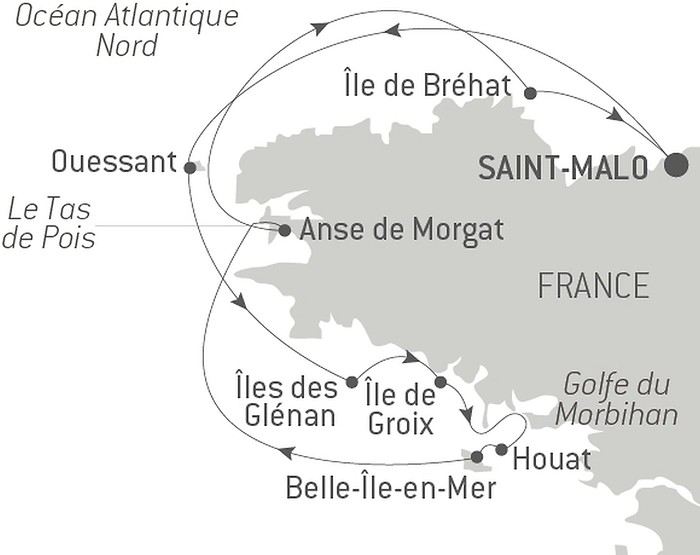
Samedi 29 août 2020, embarquement
Nous sommes depuis deux jours à Saint-Malo, et après qu’il ait plu toute la nuit, le ciel de ce matin est bas, lourd et noir. Nous nous y étions mentalement préparés. J’avais choisi cette semaine en prenant garde d’éviter celle des grandes marées (souvent propice au mauvais temps), mais la météo nous annonce tout de même une semaine catastrophique. Notre première préoccupation est d’aller vérifier que le bateau est bien arrivé. Rituel tellement plaisant, qui gonfle le cœur de joie.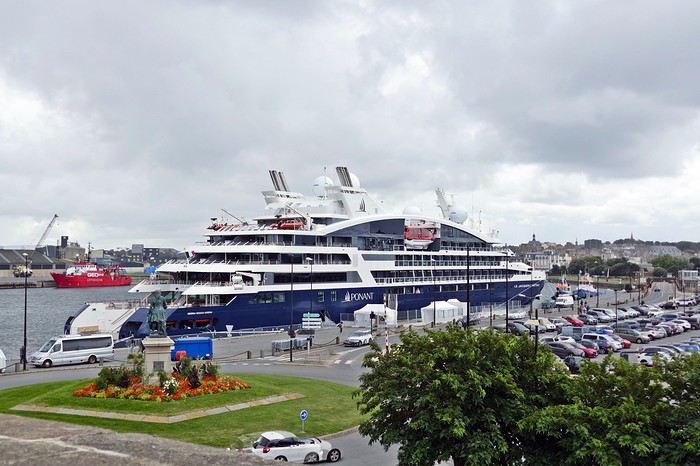 Nous marchons le long du port de plaisance sous ce lourd ciel breton, et oui, le Jacques Cartier est bien amarré au pied des remparts. La balade est très plaisante, le bateau est beau et parait imposant dans ce petit port à taille humaine, la ville est belle…. Et je monte sur mon petit nuage de bonheur pour ne plus en redescendre avant une semaine.
Pour la durée de la croisière Ponant nous a proposé de laisser la voiture sur un parking qui se situe à 2.7 km du port, le prix est de 3.30€ par jour et des navettes sont mises en place pour transférer les passagers jusqu’au bateau.
Nous avons cependant préféré laisser notre voiture au parking Qpark juste devant la porte d’entrée principale de la vieille ville parce que c’est un parking couvert, nous avons payé 55€ pour la semaine et nous sommes à 5 minutes à pieds du bateau (600m). Très bien, s’il ne pleut pas.
Après une très belle averse en début d’après-midi qui a vidé les rues de la ville en quelques minutes, nous embarquons à 16 h sous le soleil. Des tentes sont installées sur le port en guise de terminal de croisière, et dès notre arrivée nous sommes accueillis avec beaucoup de gentillesse et de prévenance.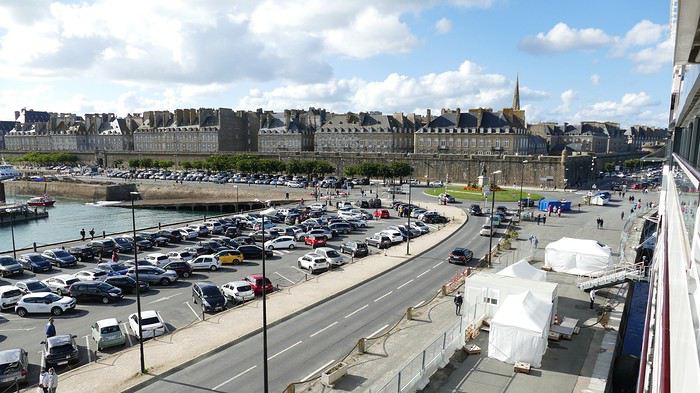 En dépit des mesures covid, nous arrivons à notre cabine en 20 minutes et nos bagages nous ont déjà précédés. Nous avons à ce moment le grand plaisir de découvrir que nous avons été surclassés au pont 4. Nous devons ce cadeau au Directeur des Départements Hôteliers de PONANT. En effet ce Monsieur était avec nous sur le LYRIAL en Corse, en télé travail 😉. Souvent mon mari a discuté avec lui et à la fin de la croisière il a dit qu’il nous réservait une surprise pour notre Croisière en Bretagne. Nous n’y pensions plus, et nous avons été contents et très touchés de cette généreuse surprise.
La différence entre les cabines du pont 3 et celles du pont 4 se porte au niveau du balcon. Au pont 3, la partie au-dessous de l’appui en bois est pleine et l’on ne voit pas la mer. Au pont 4 cette partie sous l’appui en bois est en verre et cela donne plus de lumière et une jolie vue lorsque l’on est assis.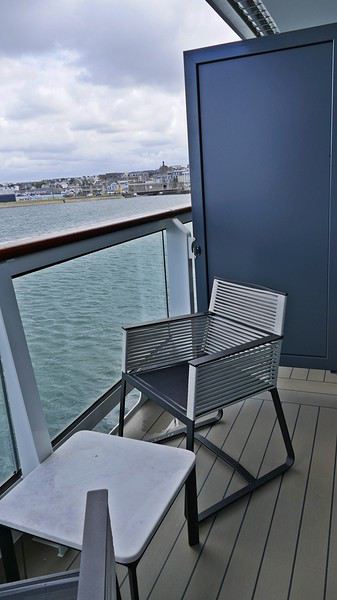 Le bateau est tout neuf, dans des tons très harmonieux, reposants, et clairs. La décoration est épurée dans des matières naturelles aux tons doux et confortables.
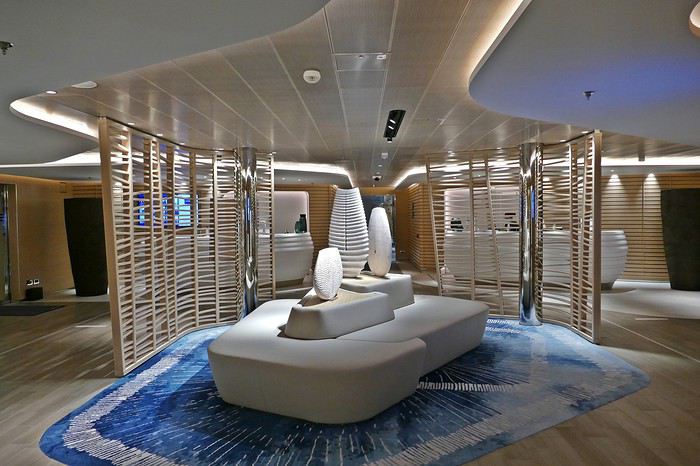 Très beau et original le plafond miroir du grand salon.
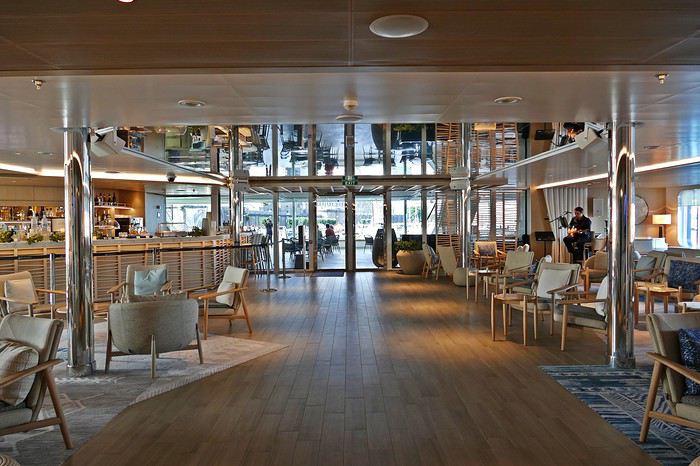 Et très lumineux le salon panoramique avec de larges baies vitrées qui permettent une vue très dégagée.
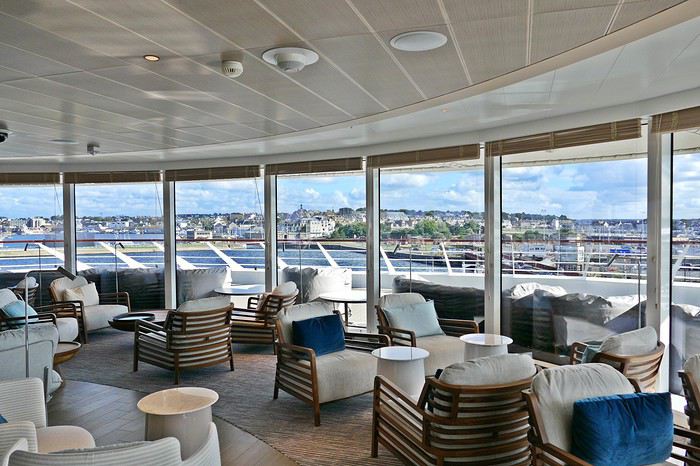 En juillet nous avions sur le LYRIAL des produits Hermès en petits flacons individuels, cette fois ce sont des produits Clarins en distributeurs, les marques françaises sont très présentes, dans tous les domaines, partout sur le bateau, y compris à table et dans la boutique.
Cette fois, nous sommes 68 passagers à embarquer sur cette croisière pour 107 membres d’équipage. Des naturalistes nous avons appris que la compagnie espérait 70 passagers par croisière pour être satisfaite de ces croisières dans les conditions hors normes et exceptionnelles de cet été 2020. Ils nous ont dit aussi que si cet objectif était atteint cette destination pourrait être reconduite l’année prochaine. Cette version est bien différente de ce que peuvent écrire certains journalistes et me semble plus cohérente. Qui a pu croire que des bateaux feraient le plein un été comme celui-ci ? Ces bateaux-là, eux, ne sont pas restés vides et à quai.
Ce programme sur les côtes françaises a été monté en trois mois, entre les contacts à prendre et les autorisations à obtenir, quand il faut deux ans habituellement pour établir un nouvel itinéraire. Ce qui est plutôt une belle prouesse.
*CR de PapiJP35
Samedi 29 août 2020, embarquement
Nous sommes depuis deux jours à Saint-Malo, et après qu’il ait plu toute la nuit, le ciel de ce matin est bas, lourd et noir. Nous nous y étions mentalement préparés. J’avais choisi cette semaine en prenant garde d’éviter celle des grandes marées (souvent propice au mauvais temps), mais la météo nous annonce tout de même une semaine catastrophique. Notre première préoccupation est d’aller vérifier que le bateau est bien arrivé. Rituel tellement plaisant, qui gonfle le cœur de joie.
Nous marchons le long du port de plaisance sous ce lourd ciel breton, et oui, le Jacques Cartier est bien amarré au pied des remparts. La balade est très plaisante, le bateau est beau et parait imposant dans ce petit port à taille humaine, la ville est belle…. Et je monte sur mon petit nuage de bonheur pour ne plus en redescendre avant une semaine.Pour la durée de la croisière Ponant nous a proposé de laisser la voiture sur un parking qui se situe à 2.7 km du port, le prix est de 3.30€ par jour et des navettes sont mises en place pour transférer les passagers jusqu’au bateau.
Nous avons cependant préféré laisser notre voiture au parking Qpark juste devant la porte d’entrée principale de la vieille ville parce que c’est un parking couvert, nous avons payé 55€ pour la semaine et nous sommes à 5 minutes à pieds du bateau (600m). Très bien, s’il ne pleut pas.
Après une très belle averse en début d’après-midi qui a vidé les rues de la ville en quelques minutes, nous embarquons à 16 h sous le soleil. Des tentes sont installées sur le port en guise de terminal de croisière, et dès notre arrivée nous sommes accueillis avec beaucoup de gentillesse et de prévenance.
En dépit des mesures covid, nous arrivons à notre cabine en 20 minutes et nos bagages nous ont déjà précédés. Nous avons à ce moment le grand plaisir de découvrir que nous avons été surclassés au pont 4. Nous devons ce cadeau au Directeur des Départements Hôteliers de PONANT. En effet ce Monsieur était avec nous sur le LYRIAL en Corse, en télé travail 😉. Souvent mon mari a discuté avec lui et à la fin de la croisière il a dit qu’il nous réservait une surprise pour notre Croisière en Bretagne. Nous n’y pensions plus, et nous avons été contents et très touchés de cette généreuse surprise.La différence entre les cabines du pont 3 et celles du pont 4 se porte au niveau du balcon. Au pont 3, la partie au-dessous de l’appui en bois est pleine et l’on ne voit pas la mer. Au pont 4 cette partie sous l’appui en bois est en verre et cela donne plus de lumière et une jolie vue lorsque l’on est assis.
Le bateau est tout neuf, dans des tons très harmonieux, reposants, et clairs. La décoration est épurée dans des matières naturelles aux tons doux et confortables.
Très beau et original le plafond miroir du grand salon.
Et très lumineux le salon panoramique avec de larges baies vitrées qui permettent une vue très dégagée.
En juillet nous avions sur le LYRIAL des produits Hermès en petits flacons individuels, cette fois ce sont des produits Clarins en distributeurs, les marques françaises sont très présentes, dans tous les domaines, partout sur le bateau, y compris à table et dans la boutique.Cette fois, nous sommes 68 passagers à embarquer sur cette croisière pour 107 membres d’équipage. Des naturalistes nous avons appris que la compagnie espérait 70 passagers par croisière pour être satisfaite de ces croisières dans les conditions hors normes et exceptionnelles de cet été 2020. Ils nous ont dit aussi que si cet objectif était atteint cette destination pourrait être reconduite l’année prochaine. Cette version est bien différente de ce que peuvent écrire certains journalistes et me semble plus cohérente. Qui a pu croire que des bateaux feraient le plein un été comme celui-ci ? Ces bateaux-là, eux, ne sont pas restés vides et à quai.
Ce programme sur les côtes françaises a été monté en trois mois, entre les contacts à prendre et les autorisations à obtenir, quand il faut deux ans habituellement pour établir un nouvel itinéraire. Ce qui est plutôt une belle prouesse.
Small hostels in Morocco: what's become of them?
On this forum, we’ve all shared our favorite spots. Today, I’m wondering what’s happening with those small hostels and how they’re coping with the crisis.
I’m thinking especially of Hussein, the owner of the guesthouse in Ijoukak; Majhid from L’Arganier in Tafraout;
the family running Escale Rando in Taliouine; and so many others.
Through hard work, they’d created welcoming hostels where it was great to stop for a few days.
Has anyone heard from them lately?
Thanks in advance for your replies—the list isn’t exhaustive, there are plenty more.
To the Top West End
In this time of general travel-journal scarcity, I’m stepping up to tell you about a far-too-short getaway to the Top West End, a local term for the very northern part of Western Australia, right on the border ( ;) ) with the Northern Territory.
As usual, I didn’t manage to keep it short, but this time I’ve got photos to go with it!
August 2020. Since the opportunities to explore the world are extremely limited right now, all we (R&X) can do is explore our own island! Well, just a part of it, because with the state borders still closed, we’re stuck in Western Australia (WA).
Luckily, we’re pretty fortunate because this state is huge: over 2.5 million km² (that’s more than four times the size of France or 1.5 times Quebec). What’s more, stretching over 20 degrees of latitude between the Antarctic Ocean and the Timor Sea, you’ll find climates ranging from Mediterranean to arid to tropical. That’s actually why we decided to head as far north as possible. Sick of the endless rainy winter in Perth, bring on the heat of the Kimberley... way up Nooorth!
Friday. At the airport, the main terminal was closed (not enough flights), so we ended up in the annex (where flights to the various mines usually depart from). There was no crowd at the gate, and in this huge, single departure lounge, empty seats were plentiful. Only three flights were listed on the screens for the rest of the morning: the first to Coondewanna (?), the second to Darwin, and ours to Kununurra (code KNX).
A cool breeze swept through the half-open corridors along the runways. At the top of the walkway leading to the Fokker 100 (the Airbuses and Boeings are now parked!), a flight attendant greeted us with a basket full of sanitary masks. We were actually the only masked passengers (the staff weren’t wearing them either). With zero Covid-19 cases in WA at the time, the only rule was to maintain social distancing—something pretty hard to do on a full plane!
It was also my first time wearing a mask—it felt weird, pretty uncomfortable, and after a while, painful behind the ears. I really feel for those who have to wear one all day, every day. The flight lasted three long hours, but luckily, I had a good book. From the window, I watched an endless expanse of salt lakes in all shapes and sizes—round, elongated, gray, white, sometimes blue and green—and an infinity of winding, capricious meanders, along with long straight lines that led nowhere. The last half-hour got more interesting as rocky, swollen formations and long, sloping plateaus appeared. Against the vast ochre landscape, green patches became more frequent.
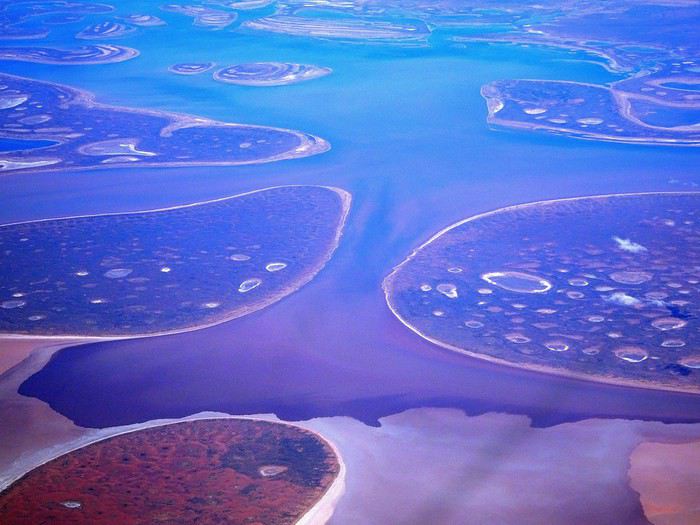
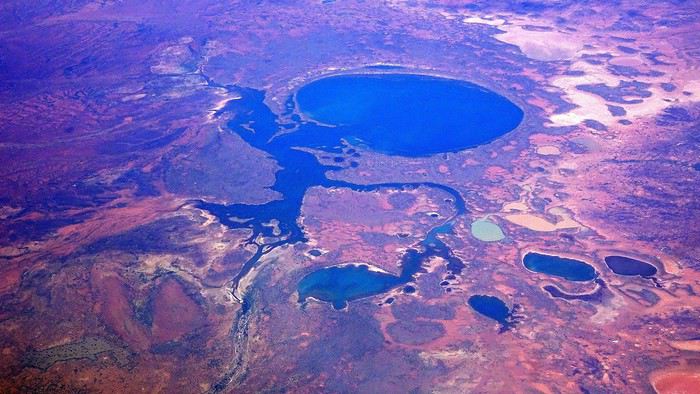
Just before landing, rows of green fields briefly appeared, along with an surprisingly wide river—but we were already rolling down the tarmac. A few hangars, a myriad of small, stationary planes, and a tiny terminal topped with a sign: “Welcome to Kununurra.”
We wanted heat, and here it was—34°C the moment we stepped off the plane! We felt alive again and totally ridiculous in our jeans and sweaters. We quickly grabbed our suitcase and picked up the 4x4 we’d rented—more out of necessity, since only that type of vehicle can access the national parks we planned to visit.
Just four kilometers separated us from Kununurra, a town of 5,000 people founded in 1961 during the construction of the Lake Argyle Dam and the development of the Ord River Irrigation Area Scheme (more on that later). On the horizon, mountain ranges (a bit of an exaggeration, since we know Mt. Meharry, WA’s highest ‘mountain,’ doesn’t even reach 1,250 meters!) and closer to the road, a few irrigation canals cutting through stretches of bush, then a huge park overlooking a small lake lined with reeds.
A row of baobabs (yes, there are baobabs in Australia too!), a series of motels with immaculate lawns, a gas station, and there’s the main street leading to the town center—that is, the parking lots of the two supermarkets, the bottleshop, the pub, the Town Hall, the municipal pool, and the Tourist Office (already closed!), and at the next roundabout, another park, the Presbyterian church, and a few other shops. In short, two or three green blocks that you can explore in no time.
One road leads to the small industrial area and one of the town’s three or four campgrounds, while another heads toward the residential neighborhoods, which look just like the typical suburbs you find in any Australian city—except with tropical vegetation. We stocked up at Coles, an identical copy of the one near our place, and—surprise—the prices were practically the same.
We checked into one of the motels. The receptionist listed the town’s three or four restaurants, insisting that it’s always better to book a table. She recommended the Pump House, a bit outside town on the lake’s edge. “Best spot to watch the sunset, but hurry up.” she told us. It was only 5:00 PM!
When we got there half an hour later, the place was packed, and the sun had already disappeared behind a row of trees! Sure enough, we’d see a few days later that the sunset can be a stunning spectacle—if you wait a bit for the sky (especially if it’s cloudy) to blaze and reflect in the lake’s calm waters. A little disappointed, we headed back into town, where we easily found the other lively spot in town: the pub (nothing like an old English pub). Above the long L-shaped bar, several giant screens (thankfully muted) were broadcasting live footy, rugby league, etc. In one corner, players circled the pool table, while in another, customers were digging into plates of the day’s special. Instead of rooms, there were various patios where groups of friends and coworkers (easily recognizable by the fluoro vests they were still wearing) were gathered. We found a table under a mango tree—unfortunately, a little too close to the guitarist strumming his entire Country Music repertoire, complete with Keith Urban-style tremolos. Guaranteed culture shock!
Since it’s the custom here, we called the Country Club to book a table before the kitchen closed! The CC is the town’s—and even the region’s—fancy spot. Dark decor, modern furniture, dim lighting, and the air conditioning blasting. The twenty or so customers had taken refuge on the vast terrace, lit by torches. The view of the tall eucalyptus trees, illuminated by spotlights shifting from red to blue, was breathtaking.
The menu was minimal, but the grilled salmon was excellent, and the Pavlova (the meringue dessert Kiwis and Aussies have been arguing over since 1906) with melon and watermelon was absolutely divine.
It wasn’t even 9:00 PM, and we were already in bed. Had we already adopted the Top West End’s chicken schedule?!
To be continued... Journal dedicated to Attila
As usual, I didn’t manage to keep it short, but this time I’ve got photos to go with it!
August 2020. Since the opportunities to explore the world are extremely limited right now, all we (R&X) can do is explore our own island! Well, just a part of it, because with the state borders still closed, we’re stuck in Western Australia (WA).
Luckily, we’re pretty fortunate because this state is huge: over 2.5 million km² (that’s more than four times the size of France or 1.5 times Quebec). What’s more, stretching over 20 degrees of latitude between the Antarctic Ocean and the Timor Sea, you’ll find climates ranging from Mediterranean to arid to tropical. That’s actually why we decided to head as far north as possible. Sick of the endless rainy winter in Perth, bring on the heat of the Kimberley... way up Nooorth!
Friday. At the airport, the main terminal was closed (not enough flights), so we ended up in the annex (where flights to the various mines usually depart from). There was no crowd at the gate, and in this huge, single departure lounge, empty seats were plentiful. Only three flights were listed on the screens for the rest of the morning: the first to Coondewanna (?), the second to Darwin, and ours to Kununurra (code KNX).
A cool breeze swept through the half-open corridors along the runways. At the top of the walkway leading to the Fokker 100 (the Airbuses and Boeings are now parked!), a flight attendant greeted us with a basket full of sanitary masks. We were actually the only masked passengers (the staff weren’t wearing them either). With zero Covid-19 cases in WA at the time, the only rule was to maintain social distancing—something pretty hard to do on a full plane!
It was also my first time wearing a mask—it felt weird, pretty uncomfortable, and after a while, painful behind the ears. I really feel for those who have to wear one all day, every day. The flight lasted three long hours, but luckily, I had a good book. From the window, I watched an endless expanse of salt lakes in all shapes and sizes—round, elongated, gray, white, sometimes blue and green—and an infinity of winding, capricious meanders, along with long straight lines that led nowhere. The last half-hour got more interesting as rocky, swollen formations and long, sloping plateaus appeared. Against the vast ochre landscape, green patches became more frequent.
Just before landing, rows of green fields briefly appeared, along with an surprisingly wide river—but we were already rolling down the tarmac. A few hangars, a myriad of small, stationary planes, and a tiny terminal topped with a sign: “Welcome to Kununurra.”
We wanted heat, and here it was—34°C the moment we stepped off the plane! We felt alive again and totally ridiculous in our jeans and sweaters. We quickly grabbed our suitcase and picked up the 4x4 we’d rented—more out of necessity, since only that type of vehicle can access the national parks we planned to visit.
Just four kilometers separated us from Kununurra, a town of 5,000 people founded in 1961 during the construction of the Lake Argyle Dam and the development of the Ord River Irrigation Area Scheme (more on that later). On the horizon, mountain ranges (a bit of an exaggeration, since we know Mt. Meharry, WA’s highest ‘mountain,’ doesn’t even reach 1,250 meters!) and closer to the road, a few irrigation canals cutting through stretches of bush, then a huge park overlooking a small lake lined with reeds.
A row of baobabs (yes, there are baobabs in Australia too!), a series of motels with immaculate lawns, a gas station, and there’s the main street leading to the town center—that is, the parking lots of the two supermarkets, the bottleshop, the pub, the Town Hall, the municipal pool, and the Tourist Office (already closed!), and at the next roundabout, another park, the Presbyterian church, and a few other shops. In short, two or three green blocks that you can explore in no time.
One road leads to the small industrial area and one of the town’s three or four campgrounds, while another heads toward the residential neighborhoods, which look just like the typical suburbs you find in any Australian city—except with tropical vegetation. We stocked up at Coles, an identical copy of the one near our place, and—surprise—the prices were practically the same.
We checked into one of the motels. The receptionist listed the town’s three or four restaurants, insisting that it’s always better to book a table. She recommended the Pump House, a bit outside town on the lake’s edge. “Best spot to watch the sunset, but hurry up.” she told us. It was only 5:00 PM!
When we got there half an hour later, the place was packed, and the sun had already disappeared behind a row of trees! Sure enough, we’d see a few days later that the sunset can be a stunning spectacle—if you wait a bit for the sky (especially if it’s cloudy) to blaze and reflect in the lake’s calm waters. A little disappointed, we headed back into town, where we easily found the other lively spot in town: the pub (nothing like an old English pub). Above the long L-shaped bar, several giant screens (thankfully muted) were broadcasting live footy, rugby league, etc. In one corner, players circled the pool table, while in another, customers were digging into plates of the day’s special. Instead of rooms, there were various patios where groups of friends and coworkers (easily recognizable by the fluoro vests they were still wearing) were gathered. We found a table under a mango tree—unfortunately, a little too close to the guitarist strumming his entire Country Music repertoire, complete with Keith Urban-style tremolos. Guaranteed culture shock!
Since it’s the custom here, we called the Country Club to book a table before the kitchen closed! The CC is the town’s—and even the region’s—fancy spot. Dark decor, modern furniture, dim lighting, and the air conditioning blasting. The twenty or so customers had taken refuge on the vast terrace, lit by torches. The view of the tall eucalyptus trees, illuminated by spotlights shifting from red to blue, was breathtaking.
The menu was minimal, but the grilled salmon was excellent, and the Pavlova (the meringue dessert Kiwis and Aussies have been arguing over since 1906) with melon and watermelon was absolutely divine.
It wasn’t even 9:00 PM, and we were already in bed. Had we already adopted the Top West End’s chicken schedule?!
To be continued... Journal dedicated to Attila
Three weeks in Quebec at the start of summer 2018, on a "semi-organized" trip
I’ve been putting off posting my Quebec travel experience for a long time. Two years later, I’ve finally decided to share it. The memories are still vivid. I hope this gives you the urge to visit this beautiful region, which I literally fell in love with.
We’re traveling as four adults: my brother Guy, my sister-in-law Martine, my friend Pascal, and myself (Christian).
We entrusted the flight, hotel, and car reservations to the travel agency Amplitudes in Toulouse. Planning the day-to-day activities was up to us. We scheduled a few must-see visits, but for the rest, we’d figure it out on the spot.
Our itinerary: Quebec City / Rimouski / Carleton-sur-Mer / Percé / Sainte-Anne-des-Monts / Matane / Tadoussac / Sainte-Rose-du-Nord / Chambord / Saint-Alexis-des-Monts / Montreal
06/25 Here we are at Roissy Charles de Gaulle for the usual pre-flight formalities. Everything goes smoothly and quickly. The hardest part is waiting for takeoff. After an uneventful flight on an Air Canada Boeing 777-300ER, we land at Montréal-Pierre Elliott Trudeau Airport (YUL) in the early afternoon.
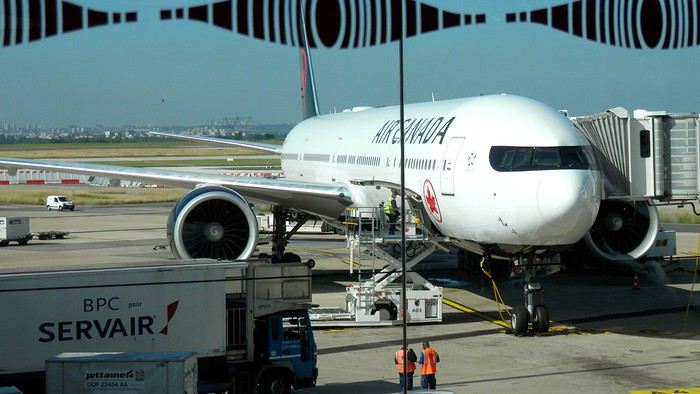
At customs, a surprise—no grumpy officer, but a smiling customs agent who jokingly asks me to name three tourist spots in Quebec, or else he won’t let me in. I pass the test easily and enter Quebec!
We head to the Alamo counter at Trudeau Airport to pick up our car: a Ford Escape with only 300 kilometers on the odometer.
We decided to head straight to Quebec City, saving Montreal for the end of the trip. Pascal takes the wheel and gets on the Trans-Canada Highway E20 for a 255 km drive, taking about 2 hours and 45 minutes. With the time difference, we’re already feeling hungry, so we stop for our first poutine at a highway restaurant.
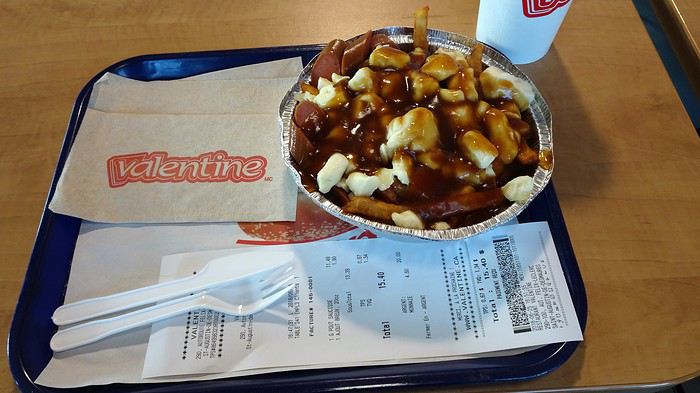
When we arrive in Quebec City, we go straight to the Clarendon Hotel, located right in the heart of Old Quebec. We’ll be staying there for three nights. Tonight, no restaurant—just a short walk around the hotel before bed. We discover a square with pretty colored water fountains near the city hall.
 It’s only 9 PM, but our body clocks say it’s 3 AM.
We’re traveling as four adults: my brother Guy, my sister-in-law Martine, my friend Pascal, and myself (Christian).
We entrusted the flight, hotel, and car reservations to the travel agency Amplitudes in Toulouse. Planning the day-to-day activities was up to us. We scheduled a few must-see visits, but for the rest, we’d figure it out on the spot.
Our itinerary: Quebec City / Rimouski / Carleton-sur-Mer / Percé / Sainte-Anne-des-Monts / Matane / Tadoussac / Sainte-Rose-du-Nord / Chambord / Saint-Alexis-des-Monts / Montreal
06/25 Here we are at Roissy Charles de Gaulle for the usual pre-flight formalities. Everything goes smoothly and quickly. The hardest part is waiting for takeoff. After an uneventful flight on an Air Canada Boeing 777-300ER, we land at Montréal-Pierre Elliott Trudeau Airport (YUL) in the early afternoon.
At customs, a surprise—no grumpy officer, but a smiling customs agent who jokingly asks me to name three tourist spots in Quebec, or else he won’t let me in. I pass the test easily and enter Quebec!
We head to the Alamo counter at Trudeau Airport to pick up our car: a Ford Escape with only 300 kilometers on the odometer.
We decided to head straight to Quebec City, saving Montreal for the end of the trip. Pascal takes the wheel and gets on the Trans-Canada Highway E20 for a 255 km drive, taking about 2 hours and 45 minutes. With the time difference, we’re already feeling hungry, so we stop for our first poutine at a highway restaurant.
When we arrive in Quebec City, we go straight to the Clarendon Hotel, located right in the heart of Old Quebec. We’ll be staying there for three nights. Tonight, no restaurant—just a short walk around the hotel before bed. We discover a square with pretty colored water fountains near the city hall.
It’s only 9 PM, but our body clocks say it’s 3 AM.Croisière Divina et forfait boisson Easy MSC English translation pending
Bonjour à tous , je suis nouveau ici , j'ai déja passer pas mal de temps sur ce forum en tant que anonyme mais la j'ai decider de m'inscrire car je ne trouve pas réponse à ma question.
J'ai reserver une croisiere en mediterranee du 08 novembre au 15 novembre avec la compagnie msc croisiere sur le bateau divina.
J'ai opter pour le forfait boisson easy ( 29e) et je me pose la question si il ne serait pas plus judicieux de prendre le forfait aux dessus car j'ai entendu dire que celui a 29e était très restreint , mais ma question est: avec le forfait boisson aux dessus a 39e ou bien celui a 55e y'a t'il dautre avantages comme par exemple plus de restaurant sans avoir a payer de suppléments. par exemple? merci à vous et n'hesitez pas si vous avez des conseils car se sera ma premiere croisiere
J'ai reserver une croisiere en mediterranee du 08 novembre au 15 novembre avec la compagnie msc croisiere sur le bateau divina.
J'ai opter pour le forfait boisson easy ( 29e) et je me pose la question si il ne serait pas plus judicieux de prendre le forfait aux dessus car j'ai entendu dire que celui a 29e était très restreint , mais ma question est: avec le forfait boisson aux dessus a 39e ou bien celui a 55e y'a t'il dautre avantages comme par exemple plus de restaurant sans avoir a payer de suppléments. par exemple? merci à vous et n'hesitez pas si vous avez des conseils car se sera ma premiere croisiere
Coût de la vie aux Philippines en 2020 English translation pending
Salut à toutes et tous,
enfin un frenchy qui donne des chiffres "réalistes"... ça change de tous ces foreigners qui te disent que tu peux vivre pour moins de 200$/mois sous les cocotiers ! 😉
https://m.youtube.com/watch?fbclid=IwAR3S9qW-bvomF5hMKJO_pZyGBtsggKJgB1IneoxAWgqqdpxFV8cH8FOqGaM&v=5dDJZfOw0E4
enfin un frenchy qui donne des chiffres "réalistes"... ça change de tous ces foreigners qui te disent que tu peux vivre pour moins de 200$/mois sous les cocotiers ! 😉
https://m.youtube.com/watch?fbclid=IwAR3S9qW-bvomF5hMKJO_pZyGBtsggKJgB1IneoxAWgqqdpxFV8cH8FOqGaM&v=5dDJZfOw0E4
Transport aéroport-hôtel à Rome English translation pending
Bonjour, nous partons à Rome un week end. Nous arrivons le soir à 19h45 à l'aéroport et nous dormons à l'Hotel Mondial qui se situe Via Torino. Quel est le meilleur moyen d'y aller ? Train ? Bus ? Metro ?
Merci de votre aide.
Cordialement
Davmax
Quand l'été s'achève... English translation pending
Ce n’est pas un carnet de voyage.
C’est un petit carnet de vacances.
Et, peut-être, avez-vous aussi vécu des instants, des heures, des jours, des semaines comme les miennes.
Sur place, sans voiture, sans train, sans avion, sans vélo.
Enveloppé de joie, de vie, de sourires, de douceur, de tendresse.
Un été entre parenthèse.
...
Dans la grange, la deuxième couvée d’hirondelles apprend à voler. Les parents perchés sur la poutre, pépient avec ardeur et les oisillons semblent écouter. Encore quinze jours et c’est l’envol pour l’Afrique.
Dans la maison, notre volière estivale, le silence s’est installé. Enfants et petits-enfant ont migré vers la ville. Un silence si parfait que j’entends Tiko, l’animal favori de Petit Jules. Tiko est un escargot des haies. Sa coquille jaune vif cerclée de fines bandes noires à ne pas confondre avec l’escargot des jardins, arbore un minuscule morceau de sparadrap. J’ai la garde de Tiko jusqu’en Octobre, nouvelles vacances d’automne. Il croque la salade vert tendre et l’infime bruit de ses mandibules fait écho aux touches de mon clavier.
Notre saison s’est achevée sur le spectacle de théâtre, rituel familial. Pour la première fois les enfants étaient les seuls scénaristes et je n’ai fait qu’orchestrer les répétitions. L’affiche était : « Les virus et les médecins » et l’action se déroulait en 1398 durant la peste noire entre le médecin à cape et bec noir et le médecin du futur, 2020. Les cinq plus jeunes étaient des virus et avaient fabriqué de larges masques ronds et colorés avec deux trous pour les yeux, attachés avec de la ficelle. C’étaient Zika, Ebola, chikungunya, variole et covid (corona pour les intimes, dans le texte). Tous les adultes présents, les parents, ont beaucoup ri et la parodie était parfaite sans qu'ils en aient conscience.
La conclusion était qu’il fallait utiliser les moyens connus au moyen âge et ceux d’aujourd’hui et ils ont fabriqué sur scène une poudre de rat malade à boire diluée dans de l’eau. Astucieux ces petits. Zika, Ebola, chikungunya, les virus africains, trépignaient en disant « pour nous aussi, on nous oublie toujours, c’est pas juste »
Bref, quelle longue digression pour vous dire que même dans le monde magique de l’enfance, ceux-ci sont bien marqués par l’épidémie dont on nous remplit le tête et les oreilles. Ils appréhendent la rentrée masquée au collège, craignent de ne pas se reconnaître dans les nouvelles classes constituées et se demandent comment les profs les reconnaîtront. Et des questions fusaient : « Comment on va faire l’hiver, faudra mette le masque par-dessus l’écharpe dans le bus ? » « Et quand il pleut, comment mon masque va tenir quand il est tout mouillé » « Et pourquoi on peut manger tous ensemble à la cantine sans masque, on est tous collés à la cantine » « Et si j’ai pas ma règle, je pourrais prendre celle de ma copine ? » « Et Jules, il a dix ans et il sera au collège avec ceux de 11ans, il sera obligé de mettre le masque ? ».
Ici dans notre Morvan écrasé de chaleur, pourtant, tout l’été nous avons voyagé. Voyage immobile, sans avion, sans test, sans masque, dans les rires, les cris, les cavalcades, un bazar, un souk, un cirque permanent.
Italie : pizza maison (ahhh les pizzas de Papiluc!) Japon : sushi (beurq, c’était pas ma fête) Inde :poulet byriani (tu mets pas du piment hein mamido) Russie : pelmini ( 480 pelmini, 32 mains pour les faire, 6h pour les préparer) Argentine : asado (souvent et pratique) Grèce : moussaka France : ratatouille
Ainsi, les enfants fabriquaient les petits drapeaux correspondants pour décorer la table et les adultes inventaient des mini quizz sur chaque pays.
On s’est bien marré et l’été s’achève.
Notre maison, comme un coeur palpitant depuis mars, où se sont retrouvés toutes les générations, est redevenue silencieuse.
Je me sens remplie et vide. J’crois bien que si l’on approche un doigt sur mes antennes, j’vais rentrer dans ma coquille, comme Tiko. Mais pour l’heure, ce n’est pas le temps de l’hibernation et je ne vais pas fabriquer mon épiphragme protecteur.
On est bien sur vf, chuis en vacances, en vacance. Contente de vous retrouver.
Crouchhhh, crouchhhh, Tiko poursuit son festin.
A bientôt !
...
Dans la grange, la deuxième couvée d’hirondelles apprend à voler. Les parents perchés sur la poutre, pépient avec ardeur et les oisillons semblent écouter. Encore quinze jours et c’est l’envol pour l’Afrique.
Dans la maison, notre volière estivale, le silence s’est installé. Enfants et petits-enfant ont migré vers la ville. Un silence si parfait que j’entends Tiko, l’animal favori de Petit Jules. Tiko est un escargot des haies. Sa coquille jaune vif cerclée de fines bandes noires à ne pas confondre avec l’escargot des jardins, arbore un minuscule morceau de sparadrap. J’ai la garde de Tiko jusqu’en Octobre, nouvelles vacances d’automne. Il croque la salade vert tendre et l’infime bruit de ses mandibules fait écho aux touches de mon clavier.
Notre saison s’est achevée sur le spectacle de théâtre, rituel familial. Pour la première fois les enfants étaient les seuls scénaristes et je n’ai fait qu’orchestrer les répétitions. L’affiche était : « Les virus et les médecins » et l’action se déroulait en 1398 durant la peste noire entre le médecin à cape et bec noir et le médecin du futur, 2020. Les cinq plus jeunes étaient des virus et avaient fabriqué de larges masques ronds et colorés avec deux trous pour les yeux, attachés avec de la ficelle. C’étaient Zika, Ebola, chikungunya, variole et covid (corona pour les intimes, dans le texte). Tous les adultes présents, les parents, ont beaucoup ri et la parodie était parfaite sans qu'ils en aient conscience.
La conclusion était qu’il fallait utiliser les moyens connus au moyen âge et ceux d’aujourd’hui et ils ont fabriqué sur scène une poudre de rat malade à boire diluée dans de l’eau. Astucieux ces petits. Zika, Ebola, chikungunya, les virus africains, trépignaient en disant « pour nous aussi, on nous oublie toujours, c’est pas juste »
Bref, quelle longue digression pour vous dire que même dans le monde magique de l’enfance, ceux-ci sont bien marqués par l’épidémie dont on nous remplit le tête et les oreilles. Ils appréhendent la rentrée masquée au collège, craignent de ne pas se reconnaître dans les nouvelles classes constituées et se demandent comment les profs les reconnaîtront. Et des questions fusaient : « Comment on va faire l’hiver, faudra mette le masque par-dessus l’écharpe dans le bus ? » « Et quand il pleut, comment mon masque va tenir quand il est tout mouillé » « Et pourquoi on peut manger tous ensemble à la cantine sans masque, on est tous collés à la cantine » « Et si j’ai pas ma règle, je pourrais prendre celle de ma copine ? » « Et Jules, il a dix ans et il sera au collège avec ceux de 11ans, il sera obligé de mettre le masque ? ».
Ici dans notre Morvan écrasé de chaleur, pourtant, tout l’été nous avons voyagé. Voyage immobile, sans avion, sans test, sans masque, dans les rires, les cris, les cavalcades, un bazar, un souk, un cirque permanent.
Italie : pizza maison (ahhh les pizzas de Papiluc!) Japon : sushi (beurq, c’était pas ma fête) Inde :poulet byriani (tu mets pas du piment hein mamido) Russie : pelmini ( 480 pelmini, 32 mains pour les faire, 6h pour les préparer) Argentine : asado (souvent et pratique) Grèce : moussaka France : ratatouille
Ainsi, les enfants fabriquaient les petits drapeaux correspondants pour décorer la table et les adultes inventaient des mini quizz sur chaque pays.
On s’est bien marré et l’été s’achève.
Notre maison, comme un coeur palpitant depuis mars, où se sont retrouvés toutes les générations, est redevenue silencieuse.
Je me sens remplie et vide. J’crois bien que si l’on approche un doigt sur mes antennes, j’vais rentrer dans ma coquille, comme Tiko. Mais pour l’heure, ce n’est pas le temps de l’hibernation et je ne vais pas fabriquer mon épiphragme protecteur.
On est bien sur vf, chuis en vacances, en vacance. Contente de vous retrouver.
Crouchhhh, crouchhhh, Tiko poursuit son festin.
A bientôt !
My Battle with Excess Weight (How I Lost 5 Kilos in 2 Days, by Bike)
New, seen on TV, you won't believe it. Click here.
During my recent trek, I found that my bike—and my luggage—were heavy. Until now, the weight of my gear hadn’t been an issue. Maybe I’m getting old, or maybe I just can’t handle the SNCF’s stairs anymore.
It hit me in Toulouse. A 3-minute stop turned into a 6-hour delay because of a fire that was hard to control between Toulouse and Montauban. Eventually, our train was canceled, and we were told to take another train that was also waiting for the same destination. It was my fourth train of the day. It was 9:30 PM, and I’d left at 9:30 AM that morning. Suddenly, exhaustion took over.
That’s when I met two bike-packers who, without hesitation, lifted their bikes with all their gear attached, carried them down the steps of the Corail train, and then down the stairs to the underground passage. They were young and fit (they smelled like warm sand), and I definitely wasn’t. It was in that scorching heat, struggling up and down all those stairs (Oh Toulouse, as Nougaro would say, may you be cursed for seven generations), that I decided to go on a diet.
It’s a diet anyone can do, it works, and it’s free. So I’m sharing it right away.
No need to exercise or restrict yourself. No, all you have to do is think and do some research. You need a chair, a table, a scale, a computer, and a spreadsheet. Make a list of everything you’ve brought and weigh it all. Set a goal based on the type of trek and your comfort level. Remove everything that doesn’t help you reach that goal.
My goal: - Trekking in France from May to September, in the plains or at most on a plateau like Mont Aubrac, where at 800 m altitude, it can drop to 10 °C at night even in the middle of summer.
- Sleeping in a tent on a good mattress in a sleeping bag (I’m not changing that). Someone suggested I could sleep under the stars on bubble wrap. No way, are you crazy?
- Not cooking. I buy lunch on the way in the morning and dinner on the way in the afternoon (I’m not changing that either). Someone suggested Ducasse delivers everywhere in France. Uh, have you been smoking lemon weed?
That’s how I lost 5 kg, going from 17.7 kg to 12.8 kg, including luggage but not food or water. But I also reduced the volume and quantity of my gear.
Here are the before photos:
https://photos.app.goo.gl/XDfKaoVvHFNxDXrq5
And after:
https://photos.app.goo.gl/STRVKaWuVcNVeCfS9
of my bike.
You can see that a duffel bag is gone, as well as the extra bags behind the panniers. I don’t even use the mesh pockets at the bottom of each pannier anymore. You can also see I’m still carrying my 1 kg U-lock. I know, it’s unforgivable. I’m on the verge of being banned.
So I might do another trek in September to validate my choices.
For the rear panniers, I can save between 1 and 1.5 kg depending on the solution: Arkel Dry-lites (28 L pair, 0.540 kg) or Vaude Aqua Light (38 L pair, 1.080 kg).
I also need to cut down on the tools I bring. I should be able to shave off about 0.5 kg.
And the bike? I’m thinking about it. Someone suggested the folding Savadeck Z2, which only weighs 10 kg. Carbon? Oh, don’t spread the word—it’s even more taboo than aluminum in some circles, and I won’t even mention the belt drive.
During my recent trek, I found that my bike—and my luggage—were heavy. Until now, the weight of my gear hadn’t been an issue. Maybe I’m getting old, or maybe I just can’t handle the SNCF’s stairs anymore.
It hit me in Toulouse. A 3-minute stop turned into a 6-hour delay because of a fire that was hard to control between Toulouse and Montauban. Eventually, our train was canceled, and we were told to take another train that was also waiting for the same destination. It was my fourth train of the day. It was 9:30 PM, and I’d left at 9:30 AM that morning. Suddenly, exhaustion took over.
That’s when I met two bike-packers who, without hesitation, lifted their bikes with all their gear attached, carried them down the steps of the Corail train, and then down the stairs to the underground passage. They were young and fit (they smelled like warm sand), and I definitely wasn’t. It was in that scorching heat, struggling up and down all those stairs (Oh Toulouse, as Nougaro would say, may you be cursed for seven generations), that I decided to go on a diet.
It’s a diet anyone can do, it works, and it’s free. So I’m sharing it right away.
No need to exercise or restrict yourself. No, all you have to do is think and do some research. You need a chair, a table, a scale, a computer, and a spreadsheet. Make a list of everything you’ve brought and weigh it all. Set a goal based on the type of trek and your comfort level. Remove everything that doesn’t help you reach that goal.
My goal: - Trekking in France from May to September, in the plains or at most on a plateau like Mont Aubrac, where at 800 m altitude, it can drop to 10 °C at night even in the middle of summer.
- Sleeping in a tent on a good mattress in a sleeping bag (I’m not changing that). Someone suggested I could sleep under the stars on bubble wrap. No way, are you crazy?
- Not cooking. I buy lunch on the way in the morning and dinner on the way in the afternoon (I’m not changing that either). Someone suggested Ducasse delivers everywhere in France. Uh, have you been smoking lemon weed?
That’s how I lost 5 kg, going from 17.7 kg to 12.8 kg, including luggage but not food or water. But I also reduced the volume and quantity of my gear.
Here are the before photos:
https://photos.app.goo.gl/XDfKaoVvHFNxDXrq5
And after:
https://photos.app.goo.gl/STRVKaWuVcNVeCfS9
of my bike.
You can see that a duffel bag is gone, as well as the extra bags behind the panniers. I don’t even use the mesh pockets at the bottom of each pannier anymore. You can also see I’m still carrying my 1 kg U-lock. I know, it’s unforgivable. I’m on the verge of being banned.
So I might do another trek in September to validate my choices.
For the rear panniers, I can save between 1 and 1.5 kg depending on the solution: Arkel Dry-lites (28 L pair, 0.540 kg) or Vaude Aqua Light (38 L pair, 1.080 kg).
I also need to cut down on the tools I bring. I should be able to shave off about 0.5 kg.
And the bike? I’m thinking about it. Someone suggested the folding Savadeck Z2, which only weighs 10 kg. Carbon? Oh, don’t spread the word—it’s even more taboo than aluminum in some circles, and I won’t even mention the belt drive.
L'Espagne va elle refermer ses frontières? n°2 English translation pending
holà
après la discussion fermée a juste titre et sans intérêt de certain sur le sujet...on en est ou ?
toujours intéressant le ressentie des locaux
touriste motard et dans 20 jours en andalousie, aucune appréhension pour bouger las bas ou en ce moment ici en ouest france mais bien sur avec le respect des consignes meme si ce n'est pas forcement tres clair on fera le compte plus tard !!! je reviens d'allemagne et de hongrie, la communication covid et la compréhension du problème m'a semble plus facile qu"en pays de france...😉 ceci dit en Espagne ces jours ci ?
on reste cool, on parle situation et que situation 😎
merci V
après la discussion fermée a juste titre et sans intérêt de certain sur le sujet...on en est ou ?
toujours intéressant le ressentie des locaux
touriste motard et dans 20 jours en andalousie, aucune appréhension pour bouger las bas ou en ce moment ici en ouest france mais bien sur avec le respect des consignes meme si ce n'est pas forcement tres clair on fera le compte plus tard !!! je reviens d'allemagne et de hongrie, la communication covid et la compréhension du problème m'a semble plus facile qu"en pays de france...😉 ceci dit en Espagne ces jours ci ?
on reste cool, on parle situation et que situation 😎
merci V
Comment organiser son voyage dans l'Ouest américain quand on est "débutant"? English translation pending
Bonjour,
Je me présente je m'appelle Florence, j'ai 25 ans, et depuis toujours je rêve de partir aux États Unis. Nous allons donc réaliser mon rêve avec mon compagnon, si tout se passe bien, d'ici 2 ans.
Jusqu'ici, je projetais d'utiliser un site spécialisé comme Marco Vasco, pour cela j'avais calculer une moyenne de 5000 € par personne (pour absolument tout, les trajets, location de véhicule, activités, restaurants, et cadeaux). Pour deux nous disposons donc de 10.000 €, pour 17 jours sur la côte Ouest. On m'a dit que cela faisait beaucoup et que nous pouvions nous en sortir pour moins cher si l'on faisait notre propre organisation à nous.
Seulement voilà, je ne suis jamais sortie de la France, mon chéri si mais très peu.
Donc, on se demande comment organiser notre voyage de A à Z.
J'aurai donc de multiples questions et si quelqu'un aurait la gentillesse de m'aider ce serait superbe !
Déjà, j'ai un gros livre le routard sur les Etats Unis, j’attends de finir de le lire pour noter ce que nous souhaitons à tout prix voir ou visiter avant de tracer un itinéraire.
Dans la formule que je devais choisir à la base, nous devions faire Los Angeles, Las Vegas, San Francisco. Entre cela il y avait le Grand Canyon, Death Valley, la route 66, les casinos, etc....Pour vous donner une idée 🙂
Donc voici les questions que je me pose, déjà, que faut t'il réserver en premier (hôtels, avion ?) et combien de temps à l'avance ? Pour la location de la voiture, comment cela fonctionne t'il ? Car je sais que dans notre formule, nous avions une voiture que l'on prenait à Los Angeles, et que l'on rendait à San Francisco. Mais une réservation de nous même, je ne sais pas du tout comment ça se passe 🤪
Le mieux est t'il de louer un camping car ou une voiture et des hôtels à côté ?
Ya t'il des choses importantes à savoir ? Je sais déjà qu'il faut remplir le formulaire ESTA, donner un pourboire à chaque repas, mais j'imagine qu'il y a encore plein d'autres choses à savoir.
Donc tout vos conseils, je prend !
En vous remerciant 🙂
Je me présente je m'appelle Florence, j'ai 25 ans, et depuis toujours je rêve de partir aux États Unis. Nous allons donc réaliser mon rêve avec mon compagnon, si tout se passe bien, d'ici 2 ans.
Jusqu'ici, je projetais d'utiliser un site spécialisé comme Marco Vasco, pour cela j'avais calculer une moyenne de 5000 € par personne (pour absolument tout, les trajets, location de véhicule, activités, restaurants, et cadeaux). Pour deux nous disposons donc de 10.000 €, pour 17 jours sur la côte Ouest. On m'a dit que cela faisait beaucoup et que nous pouvions nous en sortir pour moins cher si l'on faisait notre propre organisation à nous.
Seulement voilà, je ne suis jamais sortie de la France, mon chéri si mais très peu.
Donc, on se demande comment organiser notre voyage de A à Z.
J'aurai donc de multiples questions et si quelqu'un aurait la gentillesse de m'aider ce serait superbe !
Déjà, j'ai un gros livre le routard sur les Etats Unis, j’attends de finir de le lire pour noter ce que nous souhaitons à tout prix voir ou visiter avant de tracer un itinéraire.
Dans la formule que je devais choisir à la base, nous devions faire Los Angeles, Las Vegas, San Francisco. Entre cela il y avait le Grand Canyon, Death Valley, la route 66, les casinos, etc....Pour vous donner une idée 🙂
Donc voici les questions que je me pose, déjà, que faut t'il réserver en premier (hôtels, avion ?) et combien de temps à l'avance ? Pour la location de la voiture, comment cela fonctionne t'il ? Car je sais que dans notre formule, nous avions une voiture que l'on prenait à Los Angeles, et que l'on rendait à San Francisco. Mais une réservation de nous même, je ne sais pas du tout comment ça se passe 🤪
Le mieux est t'il de louer un camping car ou une voiture et des hôtels à côté ?
Ya t'il des choses importantes à savoir ? Je sais déjà qu'il faut remplir le formulaire ESTA, donner un pourboire à chaque repas, mais j'imagine qu'il y a encore plein d'autres choses à savoir.
Donc tout vos conseils, je prend !
En vous remerciant 🙂
Le Nord de l'Italie English translation pending
Bonjour tout le monde !
Les vacances ont pris un virage particulier cette année. Grâce ou à cause d'un virus qui fait peur à beaucoup. Justifié ou pas. Il a donc fallu changer les plans. Pas de séjour au Moyen-orient, vu que les aéroports sont fermés et donc, après moultes réflexions, et au vu des pays assez sûrs pour nous laisser la possibilité de ne pas trop souffrir du port du masque, nous avons choisi le Nord de l'Italie.
Au Sud des Dolomites plus précisément. Avec un arrêt à l'aller sur Varazze et la côte Ligure. Et au retour un arrêt sur Arenzzano. Que je vais d'ailleurs rayer de mes fichiers. Très mauvaise expérience cette dernière ville.
Bref et en détail, le suivi du carnet sera le suivant :
Sud de la France vers Montpellier, Varazze (Hotel 2 nuits), Pescheria del Garde, en courant d'air, Trente (Hotel 10 nuits), Molveno/Andolo et les lacs, Le Lac de Garde, Venise (en train), Bolzano (en train), Verone (en train), Merano, San Candido, Levico Terme et les Lacs, Aranzzano, Retour France.
En résumé que dire ?
La côte reste la côte. avec ses qualités et ses défauts. Mais c'est l'Italie que l'on aime. Ses bains privés, ses morceaux (2 mètres😎 ) de plage publique pour le peuple, ses cris, ses odeurs... et sa circulation automobile anarchique au possible.
Le Nord en revanche est assez....coincé, et même assez "Bobo". Très allemand aussi car la région du Trentin/Haut-Adige n'est Italienne que depuis 1918. Tout ici respire l'ordre et la méthode. En clair, vous pouvez déguster une pizza mais avec de la viande fumée au lieu du Chorizo😎 . Humour ! On parle Allemand et après Italien. Tout est en deux langues. Même les pompiers de San Candido parlent allemand entre eux.
Au bord des routes, on vend des sacs de patates en lieu et place de fruits et légumes.
Le pire dans le coin étant les sportifs en vélo ! Dans le Nord, les pistes cyclables sont légions. Et s'il n'y en a pas, on prends le trottoir. Je suis en vélo, donc j'ai tous les droits. Comme sur Amsterdam. Il faut faire attention de ne pas froisser les cyclistes. Pas trop écolos car beaucoup de vélo électriques...Qui doivent bien se recharger quelque part... Marrant le type qui vient prendre son petit-déjeuner avec les chaussures à cales sur un parquet ancien et bien entretenu. Très classe !!! Les motards sont plus civilisés ! Même une horde sauvage de 30 Harleys qui passe dans un petit village avec un bruit ... d'Harley ! 😎
Sinon, le coin est sympa.
Ha, j'allais oublier.
Un mot pour nos ami(e)s camping-caristes. Dans le Nord et sur quasiment toutes les villes (au moins) que j'ai pu visiter, il y a des parcs pour les CC. On ne se pose pas où l'on veut. Et pas de discussions !!! 😎 Molveno par exemple ou les CC sont en rang d'oignons avec juste de quoi ouvrir la porte ou poser une table de camping. La nuit, ce doit être marrant😏
Nous commencerons donc demain par Varazze. 2600 photos à trier et classer... c'est long. Juste une pour commencer.
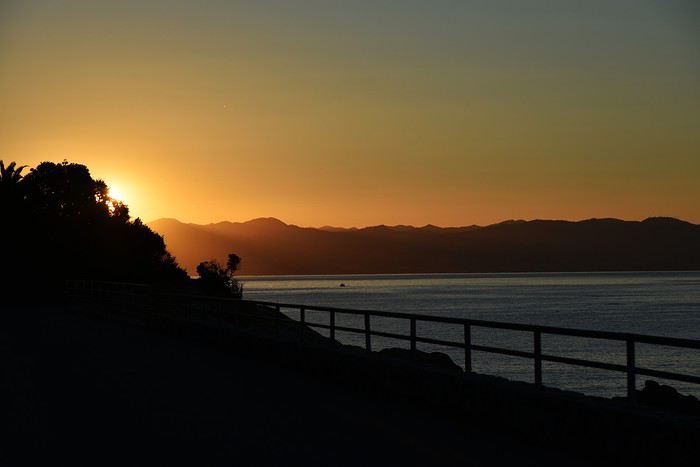
Les vacances ont pris un virage particulier cette année. Grâce ou à cause d'un virus qui fait peur à beaucoup. Justifié ou pas. Il a donc fallu changer les plans. Pas de séjour au Moyen-orient, vu que les aéroports sont fermés et donc, après moultes réflexions, et au vu des pays assez sûrs pour nous laisser la possibilité de ne pas trop souffrir du port du masque, nous avons choisi le Nord de l'Italie.
Au Sud des Dolomites plus précisément. Avec un arrêt à l'aller sur Varazze et la côte Ligure. Et au retour un arrêt sur Arenzzano. Que je vais d'ailleurs rayer de mes fichiers. Très mauvaise expérience cette dernière ville.
Bref et en détail, le suivi du carnet sera le suivant :
Sud de la France vers Montpellier, Varazze (Hotel 2 nuits), Pescheria del Garde, en courant d'air, Trente (Hotel 10 nuits), Molveno/Andolo et les lacs, Le Lac de Garde, Venise (en train), Bolzano (en train), Verone (en train), Merano, San Candido, Levico Terme et les Lacs, Aranzzano, Retour France.
En résumé que dire ?
La côte reste la côte. avec ses qualités et ses défauts. Mais c'est l'Italie que l'on aime. Ses bains privés, ses morceaux (2 mètres😎 ) de plage publique pour le peuple, ses cris, ses odeurs... et sa circulation automobile anarchique au possible.
Le Nord en revanche est assez....coincé, et même assez "Bobo". Très allemand aussi car la région du Trentin/Haut-Adige n'est Italienne que depuis 1918. Tout ici respire l'ordre et la méthode. En clair, vous pouvez déguster une pizza mais avec de la viande fumée au lieu du Chorizo😎 . Humour ! On parle Allemand et après Italien. Tout est en deux langues. Même les pompiers de San Candido parlent allemand entre eux.
Au bord des routes, on vend des sacs de patates en lieu et place de fruits et légumes.
Le pire dans le coin étant les sportifs en vélo ! Dans le Nord, les pistes cyclables sont légions. Et s'il n'y en a pas, on prends le trottoir. Je suis en vélo, donc j'ai tous les droits. Comme sur Amsterdam. Il faut faire attention de ne pas froisser les cyclistes. Pas trop écolos car beaucoup de vélo électriques...Qui doivent bien se recharger quelque part... Marrant le type qui vient prendre son petit-déjeuner avec les chaussures à cales sur un parquet ancien et bien entretenu. Très classe !!! Les motards sont plus civilisés ! Même une horde sauvage de 30 Harleys qui passe dans un petit village avec un bruit ... d'Harley ! 😎
Sinon, le coin est sympa.
Ha, j'allais oublier.
Un mot pour nos ami(e)s camping-caristes. Dans le Nord et sur quasiment toutes les villes (au moins) que j'ai pu visiter, il y a des parcs pour les CC. On ne se pose pas où l'on veut. Et pas de discussions !!! 😎 Molveno par exemple ou les CC sont en rang d'oignons avec juste de quoi ouvrir la porte ou poser une table de camping. La nuit, ce doit être marrant😏
Nous commencerons donc demain par Varazze. 2600 photos à trier et classer... c'est long. Juste une pour commencer.
Recherche guide pour visite en voiture du sud de l'île Maurice English translation pending
Bonjour à tous,
n'ayant pas trouvé ce qui me concernait dans le forum, je me permets de vous solliciter pour savoir si quelqu'un pourrait me recommander un guide sympa pour une visite du sud de l'ile , en voiture, avec découverte du Parc des georges de la rivière Noire, Grand bassin, Chamarel, les terres aux 7 couleurs et autres pépites, pour mon mari et moi, la dernière semaine d'octobre.Mais , je recherche un guide local , qui ne nous prendra pas pour des "pigeons" mais privilégiera la découverte des lieux authentiques de cette ile. Quelqu'un a-t-il eu la chance de connaitre ce type de personne et pourrait-il nous en faire profiter?
merci à tous de votre aide.
Gingibus
n'ayant pas trouvé ce qui me concernait dans le forum, je me permets de vous solliciter pour savoir si quelqu'un pourrait me recommander un guide sympa pour une visite du sud de l'ile , en voiture, avec découverte du Parc des georges de la rivière Noire, Grand bassin, Chamarel, les terres aux 7 couleurs et autres pépites, pour mon mari et moi, la dernière semaine d'octobre.Mais , je recherche un guide local , qui ne nous prendra pas pour des "pigeons" mais privilégiera la découverte des lieux authentiques de cette ile. Quelqu'un a-t-il eu la chance de connaitre ce type de personne et pourrait-il nous en faire profiter?
merci à tous de votre aide.
Gingibus
11 jours en Corse avec bébé: le Nebbio et Porto Vecchio English translation pending
Bonjour
voici un petit compte-rendu rapide de notre séjour en Corse en cet été 2020 un peu particulier. On le repétera jamais assez : c'est LA bonne année pour découvrir la Corse en haute saison. Le plus dur sera peut-être d'arriver à mettre le pied en Corse, les vols et ferrys étant en service minimum cette année. Mais une fois là-bas vous pourrez découvrir la Corse sans la foule. Plages de rêve, restaurants, hôtels, gîtes à moitié vide... La Corse sans personne en plein été ? Vous en rêviez la covid l'a fait !
Seul dans l'eau à Palombaggia, qui l'eût cru ?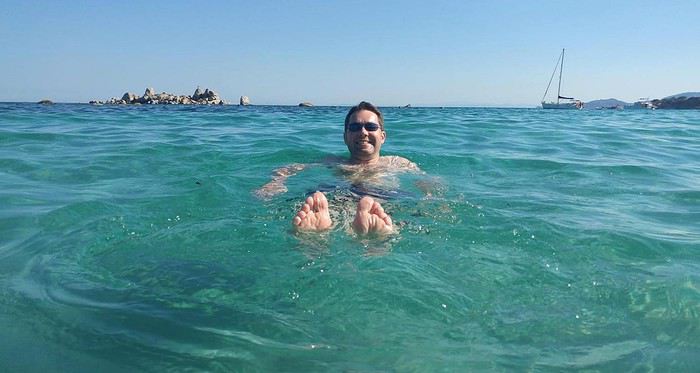
Nos points de chute : Berbi Rosse (gîte) à Saint-Florent/Oletta On a adoré. On recommande. Hôtes très accueillants et disponibles. Prêts à rendre service si besoin. Gîte 1 chambre bien rénové, tout en bois. Moustiquaires aux fenêtres :) Belle terrasse ombragée. Terrain arboré. Pas au bord de la mer mais bien situé, à 5 minutes de la plage en voiture, à 2 min du supermarché.
Lisa Maria (centre de vacances) à Favone Bof. Côté plus : Appart correct et grand. Avec clim. Belle piscine et presque personne ;) Côté moins : Pas de wifi ! Meubles pas adapté à la loc. (3 penderies dans le logement et aucune étagère... euh c'est pour les costards des vacanciers? ) Route dangereuse à traverser pour aller à pied à la plage. Grande terrasse mais orientée plein sud. Même avec le parasol après 11h le matin c'est surchauffé. Bon plan : logements numéro 53 et 54 ont la terrasse ombragée ;) Pas mal situé si vous voulez faire surtout de la plage ou rester aux environs de Porto Vecchio. Pour visiter le sud c'est un peu excentré : Bonifacio à 1h de route, Cucuruzzu 1h30, Palombaggia 50 min...
Déplacements Europcar Nombreuse voitures, pas de pénurie. La flotte est constituée de Renault neuves. RAS si ce n'est que le siège bébé ne correspondant pas à mes attentes en matière de sécurité. Toutes les voitures proposées à la loc sont compatibles isofix (ce qui pour moi est le miminum en matière de sécurité) mais les sièges proposés sont avec le vieux système d'enfilade de la ceinture...
Volotea Le gros point noir du voyage Vol retour Bastia-Toulouse annulé sans nous en informer !!! Je m'en suis rendu compte en me connectant pour imprimer les cartes d'embarquement du vol aller 3 jours avant le départ. Pratique tout simplement inacceptable ! Panique à bord : Car notre réservation a été reportée sur un autre vol 2 jours plus tôt. Sans aucune option : ni bagages, ni sièges, ni bébé ! J'essaie de les remettre moi-même via le site internet mais notre dossier est bloqué, avec une mention "en attente". Il faut trouver une autre solution. Pas de chat disponible, il reste donc le téléphone. Je passe donc la journée de vendredi au téléphone pour essayer de joindre Volotea. Une dizaine d'appel plus tard, et 52 euros de facture de téléphone !, je réussis finalement à avoir quelqu'un pour faire rétablir les options manquantes. J'en profite pour changer la date. On rentrera 2 jours plus tard que prévu, au lieu de 2 jours plus tôt. Ce n'est pas cette bande de goujats qui nous gâchera les vacances. Rester 2 jours plus longtemps est plutôt positif in fine. Mais c'est bien la seule chose comparé aux emm**des engendrées, car il faut aussi modifier la loc de la voiture, trouver un hébergement...Et accessoirement rallonger d'une cinquantaine d'euros car cette date est plus chère.
Arrivés à l'aéroport de Toulouse on se présente à l'embarquement : pas de bébé enregistré ! Et l'employée ne peut pas le faire sur son ordinateur, il faut aller au comptoir Volotea à l'autre bout du hall ! Re-panique à bord. C'est semble t-il un oubli de la personne que j'ai eu au téléphone. Mais cela s'arrange... moyennant 30 euros à payer sur la champ. Ah bon mais dans ma réservation initiale (que j'avais pris le soin d'imprimer) il y a bien un bébé avec 2 adultes. Mais apparemment ce n'est pas le problème de l'employée de l'aéroport. Il faut payer pour pouvoir décoller, et faire réclamation plus tard. Donc en gros on pays ou pas de vacances... L'employée me précise qu'il faudra faire la même manip avant le vol retour, donc ne pas oublier d'arriver un peu en avance à l'aéroport de Bastia.
Vol retour : je vais donc au comptoir Satab (qui regroupe et sous-traite les services pour plusieurs compagnies aériennes). L'employée rajoute bébé dans le dossier avec l'aide d'une collègue car visiblement elle ne sait pas comment faire. Comme je m'y attendais il faut de nouveau payer 30 euros... On se présente au comptoir d'enregistrement, et là coup de théâtre : pas de bébé dans le système informatique ! J'explique à l'employée la manip que j'ai faite 15 minutes avant au bureau Satab. Elle me répond que le bébé est dans le dossier mais n'a pas de carte d'embarquement. Il faut donc retourner au bureau et payer pour pouvoir faire embarquer bébé !!! Re-re-panique à bord, et surtout beaucoup d'énervement ! Je tape du poing sur la table, ou plutôt de la paume sur le comptoir ! (oui ça fait un peu mal, mais ça marche) Tout en exprimant clairement mais poliment que j'en ai marre de leurs histoires, que c'est pas moi qui ai annulé le vol retour est foutu le b*rdel dans notre dossier où plus rien n'est à la bonne place. La panique change de camp. Elle me répond qu'elle doit aller voir sa superviseur. S'en suivra plusieurs aller-retour entre son poste et celui de sa superviseur, l'air visiblement perdue, cela pendant 40 minutes... 40 minutes à regarder ce spectacle qui aurait pu être comique si nous n'avions pas un bébé fatigué dans les bras. A la décharge de cette employée visiblement débutante sa superviseur ne l'a pas beaucoup aidé. Cette dernière n'a pas daigné se lever une seule fois pour venir voir par elle même l'écran ou le dossier... Finalement nous embarquons sans rien payer de plus. Vol retour sans encombre mais Volotea c'est fini pour nous. Avec bébé plus jamais ! En cas de problème site internet inefficace et SAV inexistant.
Seul dans l'eau à Palombaggia, qui l'eût cru ?
Nos points de chute : Berbi Rosse (gîte) à Saint-Florent/Oletta On a adoré. On recommande. Hôtes très accueillants et disponibles. Prêts à rendre service si besoin. Gîte 1 chambre bien rénové, tout en bois. Moustiquaires aux fenêtres :) Belle terrasse ombragée. Terrain arboré. Pas au bord de la mer mais bien situé, à 5 minutes de la plage en voiture, à 2 min du supermarché.
Lisa Maria (centre de vacances) à Favone Bof. Côté plus : Appart correct et grand. Avec clim. Belle piscine et presque personne ;) Côté moins : Pas de wifi ! Meubles pas adapté à la loc. (3 penderies dans le logement et aucune étagère... euh c'est pour les costards des vacanciers? ) Route dangereuse à traverser pour aller à pied à la plage. Grande terrasse mais orientée plein sud. Même avec le parasol après 11h le matin c'est surchauffé. Bon plan : logements numéro 53 et 54 ont la terrasse ombragée ;) Pas mal situé si vous voulez faire surtout de la plage ou rester aux environs de Porto Vecchio. Pour visiter le sud c'est un peu excentré : Bonifacio à 1h de route, Cucuruzzu 1h30, Palombaggia 50 min...
Déplacements Europcar Nombreuse voitures, pas de pénurie. La flotte est constituée de Renault neuves. RAS si ce n'est que le siège bébé ne correspondant pas à mes attentes en matière de sécurité. Toutes les voitures proposées à la loc sont compatibles isofix (ce qui pour moi est le miminum en matière de sécurité) mais les sièges proposés sont avec le vieux système d'enfilade de la ceinture...
Volotea Le gros point noir du voyage Vol retour Bastia-Toulouse annulé sans nous en informer !!! Je m'en suis rendu compte en me connectant pour imprimer les cartes d'embarquement du vol aller 3 jours avant le départ. Pratique tout simplement inacceptable ! Panique à bord : Car notre réservation a été reportée sur un autre vol 2 jours plus tôt. Sans aucune option : ni bagages, ni sièges, ni bébé ! J'essaie de les remettre moi-même via le site internet mais notre dossier est bloqué, avec une mention "en attente". Il faut trouver une autre solution. Pas de chat disponible, il reste donc le téléphone. Je passe donc la journée de vendredi au téléphone pour essayer de joindre Volotea. Une dizaine d'appel plus tard, et 52 euros de facture de téléphone !, je réussis finalement à avoir quelqu'un pour faire rétablir les options manquantes. J'en profite pour changer la date. On rentrera 2 jours plus tard que prévu, au lieu de 2 jours plus tôt. Ce n'est pas cette bande de goujats qui nous gâchera les vacances. Rester 2 jours plus longtemps est plutôt positif in fine. Mais c'est bien la seule chose comparé aux emm**des engendrées, car il faut aussi modifier la loc de la voiture, trouver un hébergement...Et accessoirement rallonger d'une cinquantaine d'euros car cette date est plus chère.
Arrivés à l'aéroport de Toulouse on se présente à l'embarquement : pas de bébé enregistré ! Et l'employée ne peut pas le faire sur son ordinateur, il faut aller au comptoir Volotea à l'autre bout du hall ! Re-panique à bord. C'est semble t-il un oubli de la personne que j'ai eu au téléphone. Mais cela s'arrange... moyennant 30 euros à payer sur la champ. Ah bon mais dans ma réservation initiale (que j'avais pris le soin d'imprimer) il y a bien un bébé avec 2 adultes. Mais apparemment ce n'est pas le problème de l'employée de l'aéroport. Il faut payer pour pouvoir décoller, et faire réclamation plus tard. Donc en gros on pays ou pas de vacances... L'employée me précise qu'il faudra faire la même manip avant le vol retour, donc ne pas oublier d'arriver un peu en avance à l'aéroport de Bastia.
Vol retour : je vais donc au comptoir Satab (qui regroupe et sous-traite les services pour plusieurs compagnies aériennes). L'employée rajoute bébé dans le dossier avec l'aide d'une collègue car visiblement elle ne sait pas comment faire. Comme je m'y attendais il faut de nouveau payer 30 euros... On se présente au comptoir d'enregistrement, et là coup de théâtre : pas de bébé dans le système informatique ! J'explique à l'employée la manip que j'ai faite 15 minutes avant au bureau Satab. Elle me répond que le bébé est dans le dossier mais n'a pas de carte d'embarquement. Il faut donc retourner au bureau et payer pour pouvoir faire embarquer bébé !!! Re-re-panique à bord, et surtout beaucoup d'énervement ! Je tape du poing sur la table, ou plutôt de la paume sur le comptoir ! (oui ça fait un peu mal, mais ça marche) Tout en exprimant clairement mais poliment que j'en ai marre de leurs histoires, que c'est pas moi qui ai annulé le vol retour est foutu le b*rdel dans notre dossier où plus rien n'est à la bonne place. La panique change de camp. Elle me répond qu'elle doit aller voir sa superviseur. S'en suivra plusieurs aller-retour entre son poste et celui de sa superviseur, l'air visiblement perdue, cela pendant 40 minutes... 40 minutes à regarder ce spectacle qui aurait pu être comique si nous n'avions pas un bébé fatigué dans les bras. A la décharge de cette employée visiblement débutante sa superviseur ne l'a pas beaucoup aidé. Cette dernière n'a pas daigné se lever une seule fois pour venir voir par elle même l'écran ou le dossier... Finalement nous embarquons sans rien payer de plus. Vol retour sans encombre mais Volotea c'est fini pour nous. Avec bébé plus jamais ! En cas de problème site internet inefficace et SAV inexistant.
En bas, la Thaïlandaise faisait des faux visas, en haut l'Américain cultivait de la ganja English translation pending
Retour de croisière sur la Belle des océans 26 juillet-2 août (est-ce bien raisonnable...) English translation pending
Bonjour
Je dois être l'une des dernières à avoir fait une croisière en février-mars et l'une des 1res à en refaire une cet été. Je sais donc parfaitement à quoi m'attendre et suis consciente des risques encourus, puisque j'ai subi l'épidémie et le confinement sur le Luminosa en mars dernier. 🤪
Après ce retour calamiteux, j'ai vécu une longue période de sidération suivie d'une non moins longue période de torpeur ; je me suis donc décidée à réagir. D'habitude l'été est consacré aux retrouvailles avec la famille qui vit à l'étranger mais ils ont craint les fermetures de frontières et donc ne sont pas venus en France. Du coup gros coup de blues... A la lecture du forum j'ai découvert l'existence de Croisieurope (merci Hyerois83) qui proposait le tour de la Corse en une semaine. Comme beaucoup de gens, je me disais que la Corse ce n'était pas loin et que j'avais le temps de la découvrir... et les années passent. Bref c'était une opportunité d'autant que voyageant seule c'est compliqué et onéreux d'obtenir une cabine single à un tarif "démocratique". Et cette année les promotions sont intéressantes. Le départ depuis Nice où je réside était également un argument séduisant. Toujours est il que je me suis décidée sur un coup de tête ; il y a une agence croisieurope à Nice, réservation faite le mardi pour un départ le dimanche suivant ; je leur demande s'ils ont de bons retours et j'apprends que ce sera la 1re rotation ; donc aucun risque d'annulation et de perspective de vouchers si près du départ.
On va passer rapidement sur l'aspect médical longuement évoqué sur un autre post ; on nous a fait remplir un questionnaire médical que l'on remet à l'embarquement ; personnellement j'avais subi un test sanguin dans le cadre du dépistage organisé par la ville de Nice. C'est tout. Prise de température à l'entrée du bateau pour la forme. (Sur le Luminosa on nous prenait aussi la température et on sait les suites tragiques de cette croisière.)
Résidant à Nice j'ai pris les transports en commun ; la ligne 2 du tram arrive directement sur le port. Ma voisine de table a pris le taxi depuis la gare et a payé 26 euros : je crois que les taxis niçois sont les plus chers du monde.
Embarquement donc au port Lympia de Nice à 17 h. Aucune attente. La valise est prise en charge et nettoyée et je la retrouverai devant la cabine ; j'ai une jolie cabine de 17 m2 avec un sabord, taille similaire aux cabines extérieures de chez Costa. Une petite entrée pourvue d'un spacieux placard en face une salle d'eau avec une grande douche ; un lit de 160, 2 tables de chevet un canapé, un fauteuil, une table, un bureau, un réfrigérateur. Sur le lit 2 chocolats, 2 masques et 2 fioles de gel désinfectant. Il y en a en permanence à la réception car nous devons bien sûr nous masquer pour circuler à l'intérieur suivant un parcours qui doit permettre la fameuse distanciation sociale. Il y a 72 passagers. (Capacité 128 pour 62 cabines.) Prises de courant américaines mais un adaptateur est fourni.
Je dois être l'une des dernières à avoir fait une croisière en février-mars et l'une des 1res à en refaire une cet été. Je sais donc parfaitement à quoi m'attendre et suis consciente des risques encourus, puisque j'ai subi l'épidémie et le confinement sur le Luminosa en mars dernier. 🤪
Après ce retour calamiteux, j'ai vécu une longue période de sidération suivie d'une non moins longue période de torpeur ; je me suis donc décidée à réagir. D'habitude l'été est consacré aux retrouvailles avec la famille qui vit à l'étranger mais ils ont craint les fermetures de frontières et donc ne sont pas venus en France. Du coup gros coup de blues... A la lecture du forum j'ai découvert l'existence de Croisieurope (merci Hyerois83) qui proposait le tour de la Corse en une semaine. Comme beaucoup de gens, je me disais que la Corse ce n'était pas loin et que j'avais le temps de la découvrir... et les années passent. Bref c'était une opportunité d'autant que voyageant seule c'est compliqué et onéreux d'obtenir une cabine single à un tarif "démocratique". Et cette année les promotions sont intéressantes. Le départ depuis Nice où je réside était également un argument séduisant. Toujours est il que je me suis décidée sur un coup de tête ; il y a une agence croisieurope à Nice, réservation faite le mardi pour un départ le dimanche suivant ; je leur demande s'ils ont de bons retours et j'apprends que ce sera la 1re rotation ; donc aucun risque d'annulation et de perspective de vouchers si près du départ.
On va passer rapidement sur l'aspect médical longuement évoqué sur un autre post ; on nous a fait remplir un questionnaire médical que l'on remet à l'embarquement ; personnellement j'avais subi un test sanguin dans le cadre du dépistage organisé par la ville de Nice. C'est tout. Prise de température à l'entrée du bateau pour la forme. (Sur le Luminosa on nous prenait aussi la température et on sait les suites tragiques de cette croisière.)
Résidant à Nice j'ai pris les transports en commun ; la ligne 2 du tram arrive directement sur le port. Ma voisine de table a pris le taxi depuis la gare et a payé 26 euros : je crois que les taxis niçois sont les plus chers du monde.
Embarquement donc au port Lympia de Nice à 17 h. Aucune attente. La valise est prise en charge et nettoyée et je la retrouverai devant la cabine ; j'ai une jolie cabine de 17 m2 avec un sabord, taille similaire aux cabines extérieures de chez Costa. Une petite entrée pourvue d'un spacieux placard en face une salle d'eau avec une grande douche ; un lit de 160, 2 tables de chevet un canapé, un fauteuil, une table, un bureau, un réfrigérateur. Sur le lit 2 chocolats, 2 masques et 2 fioles de gel désinfectant. Il y en a en permanence à la réception car nous devons bien sûr nous masquer pour circuler à l'intérieur suivant un parcours qui doit permettre la fameuse distanciation sociale. Il y a 72 passagers. (Capacité 128 pour 62 cabines.) Prises de courant américaines mais un adaptateur est fourni.
Croisière fluviale sur la Saône et le Rhône du 22 au 29 juillet English translation pending
Bonjour,
Les croisières maritimes de masse ne sont toujours pas reparties, sauf pour faire des ronds dans l’eau sans escales en Europe du nord. Aux dernières informations il est assez peu probable que ça redémarre avant septembre en Europe du sud. Les compagnies américaines quant à elles reportent les unes après les autres, la dernière en date étant NCL qui prévoit novembre 2020.
Nous souvenant du proverbe disant : « fautes de grives on mange des merles », nous nous sommes rabattus sur une fluviale. Avant de revenir sur les escales, je vais parler de l’embarquement et du bateau, Notre décision de partir en dernière minute a été prise en fonction de 3 éléments : les précautions sanitaires indiquées avec en gage le sérieux allemand, la climatisation individuelle des cabines et un prix défiant toute concurrence.
Le Bijou du Rhône de la compagnie Nicko est un bateau de 115 m de long, 11,4 de large et 1,5 de tirant d’eau. Jusqu’à présent cette marque n’était pas commercialisée en France, mais Covid oblige, il fallait trouver des clients et nous avons été les 20 premiers français à bord sur 80 passagers ce total représentant 55 % de sa capacité. Il y a 3 catégories de cabines. Celles du pont inférieur sont petites et mal pratiques. Celles du pont intermédiaire et du pont supérieur sont identiques, seule la taille de la fenêtre (pas de balcon) change. Leur équipement est très proche de ce dont nous avons l’habitude en mer quoi que plus petites, avec beaucoup de rangements.
Il était dit que la compagnie travaille sur l’organisation d’un test rapide à l’embarquement, avec 3 hypothèses selon les résultats. Raté, ils n’ont pas pu finir leur « travail » à temps, personne parmi les français n’a été testé. Les allemands arrivés en bus peut-être au départ, je n’ai pas pensé à poser la question. Il y avait tout de même un questionnaire médical à remplir, mais, bon…. Par prudence, j’avais apporté un résultat de test sanguin, mais datant de 15 jours. Nous avons eu droit à une prise de température c’est tout ! Sur ce coup, le sérieux germanique a été pris en défaut, zéro pointé !! Les masques étaient obligatoires dans les espaces communs (bien respecté), mais pas sur le pont supérieur où le problème n’était pas de trouver une table ou une chaise longue, mais plutôt de savoir laquelle choisir ! Une réunion d’accueil en allemand et une en français ont eu lieu.
Prochaine publication : la vie à bord.
https://photos.app.goo.gl/9w5XjX3mcxoRj8Yi9
Les croisières maritimes de masse ne sont toujours pas reparties, sauf pour faire des ronds dans l’eau sans escales en Europe du nord. Aux dernières informations il est assez peu probable que ça redémarre avant septembre en Europe du sud. Les compagnies américaines quant à elles reportent les unes après les autres, la dernière en date étant NCL qui prévoit novembre 2020.
Nous souvenant du proverbe disant : « fautes de grives on mange des merles », nous nous sommes rabattus sur une fluviale. Avant de revenir sur les escales, je vais parler de l’embarquement et du bateau, Notre décision de partir en dernière minute a été prise en fonction de 3 éléments : les précautions sanitaires indiquées avec en gage le sérieux allemand, la climatisation individuelle des cabines et un prix défiant toute concurrence.
Le Bijou du Rhône de la compagnie Nicko est un bateau de 115 m de long, 11,4 de large et 1,5 de tirant d’eau. Jusqu’à présent cette marque n’était pas commercialisée en France, mais Covid oblige, il fallait trouver des clients et nous avons été les 20 premiers français à bord sur 80 passagers ce total représentant 55 % de sa capacité. Il y a 3 catégories de cabines. Celles du pont inférieur sont petites et mal pratiques. Celles du pont intermédiaire et du pont supérieur sont identiques, seule la taille de la fenêtre (pas de balcon) change. Leur équipement est très proche de ce dont nous avons l’habitude en mer quoi que plus petites, avec beaucoup de rangements.
Il était dit que la compagnie travaille sur l’organisation d’un test rapide à l’embarquement, avec 3 hypothèses selon les résultats. Raté, ils n’ont pas pu finir leur « travail » à temps, personne parmi les français n’a été testé. Les allemands arrivés en bus peut-être au départ, je n’ai pas pensé à poser la question. Il y avait tout de même un questionnaire médical à remplir, mais, bon…. Par prudence, j’avais apporté un résultat de test sanguin, mais datant de 15 jours. Nous avons eu droit à une prise de température c’est tout ! Sur ce coup, le sérieux germanique a été pris en défaut, zéro pointé !! Les masques étaient obligatoires dans les espaces communs (bien respecté), mais pas sur le pont supérieur où le problème n’était pas de trouver une table ou une chaise longue, mais plutôt de savoir laquelle choisir ! Une réunion d’accueil en allemand et une en français ont eu lieu.
Prochaine publication : la vie à bord.
https://photos.app.goo.gl/9w5XjX3mcxoRj8Yi9
Fêtes de fin d'année au Canada 2019-2020! English translation pending
Bonjour à tous,
Je poste enfin mon carnet de voyages de cet hiver passé.
Nous sommes partis en couple du 23/12/2019 au 04/01/2020 avec KLM/ Air France depuis Bordeaux à Montréal. Nous avons acheté les billets en Juillet 2019 pour 1286€ à 2 (inclus 1 bagage en soute chacun à l’aller et un seul pour le retour). ***j’ai ramené les skis à ma cousine*** Nous sommes arrivés à Montréal vers 17h00 (-2°C), ma cousine est venue nous chercher et nous a logés dans un appartement proche de la station de métro Namur (ligne orange). Pendant 3 jours, cet endroit était notre point de chute car le Condo de ma cousine était en travaux. Le premier soir, on a mangé Burger King (24 CAD pour 2) et on s’est couché tôt car nous étions fatigués du voyage.
Le lendemain (24/12), on s’est fait un bon petit déjeuner à l’appart et on est parti se balader au centre-ville : on a traversé le quartier chinois, on a flâné dans la rue St Paul Est, on a fait une pause sur la Place Jacques-Cartier, puis on est allé au Marché Bonsecours. On a également vu la Basilique Notre Dame de Montréal (où s’est mariée Céline DION) 😊
On s’est promené sur les quais du Vieux-Port et vu la Grande roue avec la patinoire aménagée pour la saison hivernale. A l’approche du réveillon de Noël, peu de monde dans les rues…. On a grignoté des Tacos vers 15h00, mais pas top ☹ (99 CAD pour 4 tout de même) on se rattrapera le soir 😊. Nous avons marché sur toute la rue Ste Catherine d’Ouest en Est et nous sommes remontés jusqu’à la station de métro Laurier en passant dans les rues du quartier Plateau Mont-royal fatigués nous avons pris le métro pour rentrer jusqu’à notre logement. (8 allers/retours = 26 CAD – à utiliser en plusieurs fois).
Nous avions décidé de réveillonner pour la première fois en amoureux (ma cousine partait dans sa belle-famille). Malheureusement, beaucoup de restaurants étaient fermés pour les fêtes et bien sûr j’avais oublié de lui demander conseil ! pfff ! … Après plusieurs appels (faute de trouver quelque chose qui nous convienne vraiment), on réserve au Rib’n Reef Steakhouse pour 21h30 non loin de l’appart (pensant que ce restaurant était équivalent à « La Boucherie »). Enfin, une sieste s’impose de 18h à 20h30 et nous voilà repartis à pieds au restau. De loin, ça ne payait pas de mine, un peu dans une zone commerciale, mais une fois arrivés devant on regarde sur le parking : que des voitures haut de gamme et un portier aussi devant l’entrée ! Une famille est arrivée en même temps que nous (ils avaient la classe !) et nous, on était en jeans, blouson de ski et boots 😊 (la honte !). Le restau était spacieux et rempli de monde, les serveurs et serveuses étaient bien apprêtés (robe sexy et costumes), et quasiment un par table…
Même si on n’était pas bien habillés, on savait qu’on allait finalement passer un bon moment romantique et se faire plaisir. Notre serveur était drôle et a bien mérité son pourboire. On a pris des huîtres en entrée : passables, on ne peut pas les comparer aux françaises bien sûr ! On a bu une bouteille de vin rouge californien « Cabernet Sauvignon 2016 » (conseillé par notre serveur) à un prix raisonnable (69 CAD) contrairement à celles notées sur la carte des vins (les prix s’envolaient), puis on a choisi une côte de bœuf chacun environ 400 gr accompagnés de légumes et purée. Hélas, la cuisson de la viande n’a pas été à la hauteur de nos espérances, elle n’était pas grillée comme on aurait pu l’imaginer mais cuite dans un jus/ bouillon. Elle était tendre, mais déçus ! ☹ La note finale avec 2 expressos = 350 CAD pour 2. Pour notre 1ère expérience dans un restaurant canadien et pour le réveillon de Noël, on a passé un très bon moment : c’était fort agréable et convivial ! Nous sommes rentrés vers 1h00 du matin (environ -9°C) gla-gla !
Le jour de Noël (25/12), nous avons un peu dormi, et ma cousine et son fiancé nous ont rejoints pour le petit déjeuner/ brunch. Ils avaient réservé un spa nordique à Rosemère pour la journée de Noël : « Spa Le Finlandais » (40 CAD/ pers + 22 CAD/ pers pour le prêt des peignoirs et serviettes). Journée très agréable et détente. Il faisait entre -1° et 2°C dehors et l’eau était à 38°C, trop génial ! La sensation de froid sur le visage et de chaud sur le reste du corps est excellent ! Il n’y avait pas trop de monde le matin, mais les gens sont arrivés en milieu d’après-midi. Le soir, nous étions invités chez des canadiens, des amis à ma cousine (comme elle dit : sa famille de cœur !) pour fêter Noël tous ensemble. Nous étions une quinzaine d’adultes et une dizaine d’enfants. Quel moment magique nous avons passé avec eux : nous avons été accueillis les bras grands ouverts, nous avons bu et mangé à outrance et quel repas délicieux ! Nous nous sommes bien amusés et sommes rentrés vers 4h du matin.
Nous sommes partis en couple du 23/12/2019 au 04/01/2020 avec KLM/ Air France depuis Bordeaux à Montréal. Nous avons acheté les billets en Juillet 2019 pour 1286€ à 2 (inclus 1 bagage en soute chacun à l’aller et un seul pour le retour). ***j’ai ramené les skis à ma cousine*** Nous sommes arrivés à Montréal vers 17h00 (-2°C), ma cousine est venue nous chercher et nous a logés dans un appartement proche de la station de métro Namur (ligne orange). Pendant 3 jours, cet endroit était notre point de chute car le Condo de ma cousine était en travaux. Le premier soir, on a mangé Burger King (24 CAD pour 2) et on s’est couché tôt car nous étions fatigués du voyage.
Le lendemain (24/12), on s’est fait un bon petit déjeuner à l’appart et on est parti se balader au centre-ville : on a traversé le quartier chinois, on a flâné dans la rue St Paul Est, on a fait une pause sur la Place Jacques-Cartier, puis on est allé au Marché Bonsecours. On a également vu la Basilique Notre Dame de Montréal (où s’est mariée Céline DION) 😊
On s’est promené sur les quais du Vieux-Port et vu la Grande roue avec la patinoire aménagée pour la saison hivernale. A l’approche du réveillon de Noël, peu de monde dans les rues…. On a grignoté des Tacos vers 15h00, mais pas top ☹ (99 CAD pour 4 tout de même) on se rattrapera le soir 😊. Nous avons marché sur toute la rue Ste Catherine d’Ouest en Est et nous sommes remontés jusqu’à la station de métro Laurier en passant dans les rues du quartier Plateau Mont-royal fatigués nous avons pris le métro pour rentrer jusqu’à notre logement. (8 allers/retours = 26 CAD – à utiliser en plusieurs fois).
Nous avions décidé de réveillonner pour la première fois en amoureux (ma cousine partait dans sa belle-famille). Malheureusement, beaucoup de restaurants étaient fermés pour les fêtes et bien sûr j’avais oublié de lui demander conseil ! pfff ! … Après plusieurs appels (faute de trouver quelque chose qui nous convienne vraiment), on réserve au Rib’n Reef Steakhouse pour 21h30 non loin de l’appart (pensant que ce restaurant était équivalent à « La Boucherie »). Enfin, une sieste s’impose de 18h à 20h30 et nous voilà repartis à pieds au restau. De loin, ça ne payait pas de mine, un peu dans une zone commerciale, mais une fois arrivés devant on regarde sur le parking : que des voitures haut de gamme et un portier aussi devant l’entrée ! Une famille est arrivée en même temps que nous (ils avaient la classe !) et nous, on était en jeans, blouson de ski et boots 😊 (la honte !). Le restau était spacieux et rempli de monde, les serveurs et serveuses étaient bien apprêtés (robe sexy et costumes), et quasiment un par table…
Même si on n’était pas bien habillés, on savait qu’on allait finalement passer un bon moment romantique et se faire plaisir. Notre serveur était drôle et a bien mérité son pourboire. On a pris des huîtres en entrée : passables, on ne peut pas les comparer aux françaises bien sûr ! On a bu une bouteille de vin rouge californien « Cabernet Sauvignon 2016 » (conseillé par notre serveur) à un prix raisonnable (69 CAD) contrairement à celles notées sur la carte des vins (les prix s’envolaient), puis on a choisi une côte de bœuf chacun environ 400 gr accompagnés de légumes et purée. Hélas, la cuisson de la viande n’a pas été à la hauteur de nos espérances, elle n’était pas grillée comme on aurait pu l’imaginer mais cuite dans un jus/ bouillon. Elle était tendre, mais déçus ! ☹ La note finale avec 2 expressos = 350 CAD pour 2. Pour notre 1ère expérience dans un restaurant canadien et pour le réveillon de Noël, on a passé un très bon moment : c’était fort agréable et convivial ! Nous sommes rentrés vers 1h00 du matin (environ -9°C) gla-gla !
Le jour de Noël (25/12), nous avons un peu dormi, et ma cousine et son fiancé nous ont rejoints pour le petit déjeuner/ brunch. Ils avaient réservé un spa nordique à Rosemère pour la journée de Noël : « Spa Le Finlandais » (40 CAD/ pers + 22 CAD/ pers pour le prêt des peignoirs et serviettes). Journée très agréable et détente. Il faisait entre -1° et 2°C dehors et l’eau était à 38°C, trop génial ! La sensation de froid sur le visage et de chaud sur le reste du corps est excellent ! Il n’y avait pas trop de monde le matin, mais les gens sont arrivés en milieu d’après-midi. Le soir, nous étions invités chez des canadiens, des amis à ma cousine (comme elle dit : sa famille de cœur !) pour fêter Noël tous ensemble. Nous étions une quinzaine d’adultes et une dizaine d’enfants. Quel moment magique nous avons passé avec eux : nous avons été accueillis les bras grands ouverts, nous avons bu et mangé à outrance et quel repas délicieux ! Nous nous sommes bien amusés et sommes rentrés vers 4h du matin.
Vacances en Corse en Transporter Volkswagen English translation pending
Bonjour nous envisageons d aller en Corse de fin juillet au 20 Août. Quelle compagnie de bateaux conseillez vous ?
Est il envisageable de dormir ailleurs que dans un camping avec ce véhicule non aménagé ?
Y a t il déjà beaucoup de monde là bas actuellement ?
Merci