Results for "Saint-Jean+Luz+et+(camping+ou+hôtel+ou+hébergement)"
82320 results found.
Encore au sujet de l'année du Brésil English translation pending
Dans le cadre de l’année du Brésil (à ce sujet, j’ai toujours besoin d’aide pour les caipiriñas, cf. post dans forum cuisine), je vous transmets ici le cycle « Le Brésil dans l’imaginaire français », réalisé par La Maison de l'Amérique Latine, et attire votre attention sur les séances traitant d’Henri Michaux, Claude Levi-Strauss et Blaise Cendrars. Ca risque d’être fort fort fort intéressant pour peu que l'on apprécie l'oeuvre des ces personnages. Ce cycle est tout public, ce n'est pas un colloque de chercheurs et/ou de penseurs. Le Brésil dans l'imaginaire français de Jules Verne à Georges Bernanos Allant du romantisme à Georges Bernanos, ce cycle s'échelonnera au long de l'année 2005 sur sept séances mensuelles. Ni séminaire pointu, ni colloque savant, ce cycle s'adresse à tous les publics. Au cours de chacune d'elles seront confrontés le rôle, l'importance et l'influence d'en général deux écrivains, appariés autant pour ce qui les réunit que pour ce qui les distingue, voire les oppose. On essaiera d'y dessiner la trajectoire, depuis le dix-neuvième siècle, de ces moments de dialogues franco-brésiliens, « encontros » et « desencontros », en tous les cas mutuellement stimulants. Dans ces échanges, le Brésil s'est révélé une ressource puissante et un territoire fécond pour les Français, nourrissant en permanence, sur des modes souvent renouvelés, notre imaginaire et sa littérature par delà poncifs et stéréotypes. C'est dans cet esprit qu'on veillera à suivre particulièrement les circulations de l'imaginaire, privilèges de la littérature, de la poésie ou de la fiction. SÉANCE 1 : mardi 19 avril, 18 h 30 : Présentation générale de ces rencontres et Le Brésil français, du romantisme à Jules Verne. Avec le romantisme, le Brésil retrouve une place féconde dans l'imaginaire français. La Jangada s'en nourrit partiellement, à travers notamment la lecture de Ferdinand Denis qui contribue de façon décisive à la naissance des études brésiliennes en France. Mais le roman de Jules Verne, l'une des plus belles oeuvres « brésiliennes » du siècle et la plus populaire, porte aussi la marque des débats politiques de son temps et de la nouvelle vague d'expansions scientifiques et colonisatrices qui caractérise le XIXe siècle. Séance animée par Ana Beatriz Demarchi Barel et Michel Riaudel. SÉANCE 2 : mardi 10 mai, 18 h 30 : Passeurs transatlantiques : de Valery Larbaud à Roger Caillois. C ette séance traitera des voyages, images et mirages de certains écrivains français face au Brésil, des tentatives de divulgation de la littérature brésilienne en France, où se signalent passage ou présence d'écrivains comme Oswald de Andrade, Ribeiro Couto, Vicente do Rego Monteiro, Murilo Mendes… Croisements, rencontres, malentendus : les uns choisissent un moment la langue française pour s'exprimer, d'autres s'ouvrent les portes de revues importantes comme les Cahiers du Sud et le Mercure de France, grâce à Roger Bastide, ou de la collection La Croix du Sud, créée chez Gallimard par Roger Caillois. Séance animée par Pierre Rivas et Roger Grenier. SÉANCE 3 : mardi 7 juin 18 h 30 : Paul Claudel/Darius Milhaud. L e célèbre musicien a été le secrétaire du poète, ministre de France à Rio de Janeiro pendant la première Guerre mondiale. La table ronde évoquera la part trop méconnue du Brésil dans l'oeuvre de Claudel et rendra compte de la découverte séminale de la musique brésilienne par Milhaud ainsi que de ses répercussions françaises. Séance animée par Jean-Noël Ségrestaa et le compositeur Alain Bancquart, ancien élève de Darius Milhaud. SÉANCE 4 : mardi 27 septembre, 18 h 30 : Claude Lévi-Strauss/Roger Bastide. L e propos n'est évidemment pas d'empiéter sur le terrain des sciences sociales et de comparer la contribution scientifique de ces deux monuments de l'anthropologie française, mais bien d'interroger leur rapport subjectif au Brésil, ce en quoi il relève de l'imaginaire et de la littérature, l'un tourné vers nos origines primitives, l'autre vers notre enracinement religieux et sacré, à travers la transe africaine, la poésie… ; l'un remonte l'Amazonie jusqu'aux ethnies les plus sauvages, l'autre défriche le Nordeste en noir & blanc… L'expérience pauliste fut chez l'un écourtée et empreinte de tristes tropismes, chez l'autre longue et heureuse. Séance animée par Catherine Clément, Walnice Nogueira Galvão et François Laplantine, (sous réserve). SÉANCE 5 : mardi 18 octobre, 18 h 30 : Blaise Cendrars/Benjamin Péret. S eront associés dans cette séance deux poètes tournés vers le Brésil profond, deux écritures de la rupture et de la modernité, chacun en contact avec des représentants du premier modernisme brésilien, chacun faisant retour vers le Brésil à des périodes diverses, nourris et attirés cependant par des horizons dissemblables. Séance animée par Colette Astier, Claude Leroy, Claude Courtot et Carlos Augusto Calil . SÉANCE 6 : mardi 8 novembre, 18 h 30 : Jules Supervielle/Henri Michaux. C es deux poètes amis et voyageant parfois de conserve en Amérique latine ont été aussi des amis des poètes brésiliens. Le Franco-Uruguayen Jules Supervielle, auteur des Escales brésiliennes (Débarcadères), a effectué un pèlerinage au Minas baroque (cf. Boire à la source, 1933). Pour cet homme « entre deux mondes », les antipodes se touchent. Dans Ecuador (1929), Henri Michaux tourne le dos à la tradition du récit de voyage, interrogeant sa possibilité. Il y refuse toute complaisance exotique et renvoie au contraire à l'irréductible altérité de l'autre et de l'ailleurs, prolongeant ainsi le parcours d'un Segalen vers une ethnologie plus radicale. Séance animée par Michel Collot. SÉANCE 7 : mardi 6 décembre, 18 h 30 : Georges Bernanos. C ette soirée conclusive portera sur un romancier, homme du terrain, entier, homme d'action, de combat, qui s'est engagé corps et âme au Brésil, a entretenu des contacts avec les milieux intellectuels catholiques brésiliens (Alceu de Amoroso Lima, Jorge de Lima…). Séance animée par Monique Gosselin, Sandra Nitrini et Pierre Rivas. Conclusion du cycle et permanence du Brésil en France. Maison de l’Amérique latine 217, bd Saint-Germain - 75007 PARIS Tél : 01 49 54 75 00 - Fax : 01 45 49 06 33 E-mail : culturel@mal217.org - Web : www.mal217.org
au départ de la Gaspésie.....itinéraire conseillé English translation pending
😉Salut à tous,
Mon conjoint et moi avons été invités chez des amis qui vivent à Matane (Gaspésie) pour juillet 2005, nous souhaiterions passé 2-3 jours à Matane et ensuite visiter Montréal et Québec.
Nous disposons de 15 jours au total.
Où pourrait-on loger? Où pourrait-on louer une voiture? Est-ce que cet intinéraire est faisable sur 15 jours?
D'avance merci.😎
Mon conjoint et moi avons été invités chez des amis qui vivent à Matane (Gaspésie) pour juillet 2005, nous souhaiterions passé 2-3 jours à Matane et ensuite visiter Montréal et Québec.
Nous disposons de 15 jours au total.
Où pourrait-on loger? Où pourrait-on louer une voiture? Est-ce que cet intinéraire est faisable sur 15 jours?
D'avance merci.😎
Besoin d'aide por déterminer un itinéraire d'un voyage québec English translation pending
🙂Bonjour à tous🙂
Je viens bientôt en vacance au qubec et j'aimerais vraiment déterminer un itinéraire d'avance, pour cela j'ai besoin d'aide je sais que je vais louer une voiture, (avec qui je ne sais pas encore) mais ce qui est sur c'est que nous somme quatre et nous faisons un mois au total du du 15 juillet au 15 aout. Je désire vraiment voir les endroits incontournable. Si vous avec des idée sur un itinéraire au complet avec les endroits touristique, les hôtels etc.....
merci merci et encore merci🙂🙂
Je viens bientôt en vacance au qubec et j'aimerais vraiment déterminer un itinéraire d'avance, pour cela j'ai besoin d'aide je sais que je vais louer une voiture, (avec qui je ne sais pas encore) mais ce qui est sur c'est que nous somme quatre et nous faisons un mois au total du du 15 juillet au 15 aout. Je désire vraiment voir les endroits incontournable. Si vous avec des idée sur un itinéraire au complet avec les endroits touristique, les hôtels etc.....
merci merci et encore merci🙂🙂
La RD en club a déconseillé aux routards! English translation pending
Bonjour,
nous sommes revenus de notre semaine à Punta Cana!
Je ne pouvais pas croire ce que l'on me disait qu'il n'y a rien a faire, mais maintenant je le sais, si tu ne pars pas avec pas mal d'argent a dépenser en excursions, tu peux aller sur n'importe quelle plage des antilles, ce sera la même chose car quand tu es dans ton hôtel on t'interdit de sortir de l'enceinte de l'hotel, en dehors des excursions ou accompagné d'un taxi!
Pour les excursions c'est cher mais c'est partout pareil. A faire le Bavaro Runner (75 Euros par personnes il me semble). Nous avons fait catalina, mais c'est l'usine et des plages comme ça, en corse elles sont aussi belles!) Tout le monde parle de Saona, mais c'est l'usine (catalina aussi d'ailleurs, plage paradisiaque 2000000000000000000000 de touristes!).
Pour ce qui est de la bouffe dans les excursions, c'est très moyen et à l'hôtel : encore plus que moyen. Peut être vaut il mieux choisir une chaine française (la bouffe pour les français est plus importante), car là, tout est fait pour les americains, et les canadiens, et c'est franchement médiocre.
Ne vous faites pas avoir par le restaurant "Pirates des Caraibes" ou le menu langouste est a 35 euros (apero, salade de fruits de mer "frais", c'est eux qui le disent, langoustes grillée a la crème d'ail, riz, et banane flambée). Si vous n'avez jamais mangé de langouste, peut être que vous trouverez cele-ci bonne, mais la chaire de la langouste doite être bien ferme, or, là elle est spongieuse, la salade de fruits de mer, moyenne, et le mieux c'est la banane flambée.
Bon, on s'est reposé, on a rencontré des gens très sympa mais ce n'est pas une destination que je conseille. Faites plutôt cuba dans le même style. On l'a fait il ya 12 ans c'est bien mieux.
Ou pour rien faire, faite saint martin. Nous y étions en 98, hôtel Netlé Bay hôtel. Jolie chambre, bon petit dej. Nous y avions loué une voiture et tous les jours nous changions de plages. Elles sont magnifiques. Le soir nous sortions car il y a des soirées tout au long de la semaine dans des lieux différent, des casinos, boites à Streap Tease. Pas grand chose à visité, mais plus fête. Bref j'ai préféré. Voilà mon avis sur la RD.
Mais vous me direz, je ne l'ai pas fait dans des conditions idéal. Le mieux c'est circuit pour faire le tour de l'ile et voire d'autres choses que les TO nous obligent à voir!
A vous de voir!
Cela dit le soleil ça fait du bien, où que l'on soit!
Barbara
Barbara
le club med: une formule banalisée? English translation pending
salut à tous,
je jette un oeil sur les différentes discussions de ce forum et je me demande si le Club Med (qui revient souvent) ne serait pas devenu quelque chose de "banal" à tel point qu'il est employé comme contre-modèle du voyage ou comme une autre façon de découvrir les autres...
bref qu'évoque pour vous le Club Med d'aujourd'hui?
je jette un oeil sur les différentes discussions de ce forum et je me demande si le Club Med (qui revient souvent) ne serait pas devenu quelque chose de "banal" à tel point qu'il est employé comme contre-modèle du voyage ou comme une autre façon de découvrir les autres...
bref qu'évoque pour vous le Club Med d'aujourd'hui?
Comment trouver job et logement en Angleterre? English translation pending
Je recherche de coin me loger et chercher un job d'été en angleterre pour pouvoir m'améliorer en anglais.
Merci d'avance pour votre aide!
Merci d'avance pour votre aide!
Excursions près de Bayahibe? English translation pending
bonsoir a tous et d avance merci pour vos reponses, voila je part en republique dominicaine en juin, plus exactement a bayahibe et je souhaiterais savoir tous les bons plan excursion de la region centre d interets. nous partons 15 jours et voulons voir les plus belle choses.
egalement savoir un peu les tarifs de location de voiture et si eventuelement si il fallait reserver a l avance
egalement savoir un peu les tarifs de location de voiture et si eventuelement si il fallait reserver a l avance
Retour du Palladium Bavaro - Commentaires English translation pending
Tout d’abord, bonjour à tous et heureux de vous retrouver 😉 !
Je suis rentré dimanche soir et je m’empresse de vous faire part de mes commentaires sur ces 12 jours trop vites passés…
1/ les vols : Nous devions avoir la chance (?) d’étrenner le nouveau 767-300 de TUI Airlines ; il n’en fut rien car il semble que l’appareil ne soit pas encore opérationnel pour cause de problèmes techniques (voir infos dans la partie « compagnies aériennes » du forum). Les vols ont donc été assurés par la compagnie portugaise Euro Atlantic. Mis à part les retards inhérents aux vols charters (2h à l’aller, 3h au retour), nous avons eu des conditions de vol tout à fait satisfaisantes. A l’aller, vol direct Bruxelles - Punta Cana en 9h sur un vieux Tristar usé jusqu’à la corde. Nous étions en classe « VIP », donc nous n’avons pas eu à nous plaindre. Il n’en est pas de même de ceux qui étaient en classe « éco » : pas de film, 1 wc fonctionnel sur les 4 avec bain de pieds assuré à chaque visite, fils électriques dénudés courant à travers la cabine, etc… Au retour, escale à Puerto Plata, puis 9h20 de vol jusqu’à Bruxelles sur un 767-300. Comme à l’aller classe « VIP » avec à nouveau repas correct, champagne pour les amateurs, personnel aux petits soins et film (Le Terminal). Rien à redire.
2/ l’hôtel : Le resort est IMMENSE. Il comporte depuis peu 5 hôtels : le Palladium Bavaro, le Beach, le Lookéa, le Palladium Palace et maintenant le Royal Suites. L’ensemble est desservi par un petit train bien pratique pour rallier un point à l’autre, vu la grandeur de l’ensemble. Il serait fastidieux de vous faire un descriptif du tout ; je me limiterais donc ici au Bavaro.
Lobby et réception : coin agréable où il fait bon prendre un verre au frais lorsqu’il fait trop chaud. Un petit orchestre jour chaque soir de 18h à 24h. Le bar du lobby est le meilleur de l’hôtel (il y en d’autres à la plage et la piscine) ; le personnel charmant. Cuba Libre, Caipiriha, Coco Loco, Chichi, Pina Colada et naturellement la fameuse Presidente nous ont accompagné tout au long de notre séjour. A noter : il y a TOUJOURS quelqu’un à la réception qui parle couramment le français, y compris aux relations publiques (pour les réservations des restaurants à la carte). Le reste du personnel parle essentiellement espagnol et un peu anglais. Le lobby donne directement accès au restaurant principal, et indirectement à trois des cinq restaurants à la carte du resort. Il donne aussi accès sur quelques commerces et autres services de l’hôtel : coiffeur, service photo, bar (avec billards) et cyber café. Les prix dans les boutiques sont relativement élevés, il vaut mieux négocier à l’extérieur de l’hôtel. Idem pour le change à la réception, moins avantageux bien sûr que dans les banques situées à l’extérieur. Piscine : au cœur de l’hôtel, relativement vaste avec comme il se doit le bar au milieu (accès dans l’eau ou en terrasse). Transats un peu vieillots (élastiques détendus, on sent les barres dans les reins !). Nombre de parasols suffisant vu que l’hôtel était à peu près à 50 % de remplissage. Quant il est plein, ce doit être du sport pour trouver de la place ! Personnellement, je préfère celle du Palace, plus grande et plus calme, avec un resto-grill et la plage à proximité immédiate. Restaurants : 10 jours sur place ne nous ont pas permis d’en faire le tour. Le resto principal propose un thème différent chaque jour. Beaucoup de choix, on y mange très bien et il faudrait être très difficile pour ne pas apprécier la qualité de ce qui y est proposé. A noter : c’est le seul endroit où vous trouverez des jus de fruits frais (pas dans les bars…). Il y a moyen de manger « à la carte » mexicain, asiatique, italien, espagnol et méditerranéen. Ceux que nous avons essayé étaient très bien. Cependant, il y a trois services sur la soirée : 17h30, 19h et 20h30, et le temps qui vous est imparti est limité. Le service est donc trop rapide à mon sens, et vous n’avez pas encore fini votre plat que le serveur est déjà là avec le suivant… C’est la seule critique que je puisse formuler, outre le fait que la fameuse langouste locale était aux abonnés absents (ce qui n’était le cas auparavant) ! A oui, j’oubliais, mais ce n’est un secret pour personne : le vin, qu’il soit blanc, rosé ou rouge, est affreux. Pas grave, on ne vient pas spécialement pour ça ! Dernière chose : le port du pantalon est souhaité le soir pour les messieurs (un jean’s suffit), et vous ne rentrerez pas en maillot au restaurant de la plage. Sports et plage : à mon avis l’une des plus belles plage de Bavaro, avec celle du Riu. Vaste et bien ombragée avec ses cocotiers : le cadre est magnifique. A l’extrémité des suites royales (à droite en regardant la mer), se trouve le petit village d’El Cortecito. Activités possibles sur la plage : volley-ball, planche à voile, catamaran, kayak, etc… Un centre de fitness est à proximité pour les amateurs, ainsi qu’un sauna et une salle de massage. Pas loin non plus terrains de tennis, de pétanque, de badmington, tir à l’arc. En construction derrière le Lookéa : terrains de mini foot et de basket. Il y a de quoi s’occuper. Les chambres : j’avais demandé tôt par mail (auquel je n’ai pas eu de réponse) une chambre calme avec vue sur mer, avec lit kingsize ; souhait exaucé. Nous étions dans le bloc 28 en bordure de plage. En un mot : simple et parfait. Salle de bain avec jaccuzzi, chambre avec coffre-fort (gratuit), frigo (approvisionné en boissons non alcoolisées tous les deux jour), télé satellite (TV5) avec jeux Nitendo pour les (grands ?) enfants, planche et fer à repasser, terrasse. A noter : pas besoin d’emmener un adaptateur dans cet hôtel : les prises de courant acceptent indifféremment les fiches nord américaines et européennes. Pratique. Les chambres sont dans chaque pavillon au nombre de huit : deux au rez-de-chaussée, deux à l’étage. Le nombre de pavillons semble effrayant (il y en a plus de 60 !), mais ils savamment répartis dans un immense jardin très bien aménagé. On a jamais l’impression d’être les uns sur les autres. Seul inconvénient : quant on est près de la plage, il faut dix bonnes minutes de marche pour aller au lobby et au restaurant principal. Le petit train trouve alors toute son utilité. Il y en a un toutes les 30 minutes. Le soir, un second est mis en service, réduisant le temps d’attente à 15 minutes. Discothèque et casino : il en existe deux à l’entrée du Bavaro et du Palace. Nous n’y avons pas mis les pieds. Animation et spectacles : c’est le point faible de l’hôtel. Les spectacles sont relativement moyens avec selon les jours, de la danse (très bons danseurs mais costumes bof), des concours et jeux style club (on apprécie ou pas). A ne pas manquer : le spectacle de magie, non pas pour les tours mais pour l’humour. Vous passerez assurément un bon moment de rigolade. Quant à l’équipe d’animation, elle est sympa (sans plus), mais ne parle pas un mot de français. Pour les amateurs, il suffit donc d’aller au Lookéa. Etat de l’hôtel en général : il est à noter aussi que pratiquement toutes les traces du passage de l’ouragan de septembre sont à présent effacées. Cependant, on y travaille encore actuellement. Les dégâts ont vraiment du être importants car beaucoup de nouvelles plantations ont du être faites. On s’emploie d’ailleurs encore à refaire des toits (au Lookéa), et la zone où il subsiste encore des traces se situe à la limite du Beach et du Palace (évitez donc ces chambres si possible).
3/ excursions : Nous n’avons fait aucune excursion via Jetair. La représentante locale (Katrien) qui n’était d’ailleurs pas des plus sympathiques, n’était d’ailleurs là que pour vendre sa soupe avec insistance. Nous sommes donc passés par RH Tours, et comme ma femme découvrait le pays pour la première fois avons fait les suivantes :
Saona Exclusive : à faire absolument ! Départ hôtel à 7h10. Bus jusqu’à Bayahibe, puis vedette rapide (à éviter pour les très jeunes enfants) jusqu’à la piscine naturelle pour une première baignade avec les étoiles de mer géantes, le tout accompagné de Merengue et de vitaminas. Comme nous étions partis tôt, nous étions les premiers sur le site. Ensuite on s’est tiré la bourre avec deux autres vedettes jusqu’à une plage où seuls les 20 personnes du bateau ont débarqué : paradisiaque ! Une heure après, c’était l’heure de l’apéro et quelques collations nous furent offertes. Départ ensuite et visite d’un des deux villages de pêcheurs de l’île, puis arrêt pour le repas de midi en compagnies des autres bateaux. Repas correct, puis détente (pour moi l’occasion d’avoir une discussion très intéressante avec José notre guide du jour). Certains profitaient de la plage pendant que d’autres dansaient le Merengue. Il fut temps alors de prendre le catamaran pour le retour vers Bayahibe. Mer d’huile, soleil à gogo : le piège pour cramer ! N’oubliez surtout chapeau et protection solaire ! De nouveau Merengue et vitaminas (ils ne nous lâchent pas !). Enfin, retour en bus vers Punta Cana où nous sommes revenus pour 18h. Gens et Pays : découverte de l’intérieur du pays et de la population. Notre guide Miguel nous fait visiter Higuey et sa cathédrale, ses rues, ses commerces (ah les boucheries !) et son marché très coloré. Un peu de shopping (les prix sont plus intéressants qu’à Bavaro), puis départ pour la découverte de petits villages et de leurs écoles, et arrêt à Alto de Chavon, superbe petit village tout en pierres de corail. Magnifique. La ballade sur le Rio Chavon ne se fait plus, le bateau à fond plat a été détruit suite à l’ouragan (tout comme le restaurant sur la berge d’ailleurs). Départ pour la Romana et visite d’une petite fabrique de cigares. Nous repartons ensuite à travers les champs de canne à sucre vers les environs d’Higuey où un ranch nous accueille pour un bon repas. Vient ensuite une (petite) ballade à cheval, et retour à l’hôtel pour 18h30. Jurassic Safari : de nouveau l’intérieur du pays, mais cette fois ci à bord d’un petit camion 4x4 qui va nous mener à travers les petits chemins vers le bas de la cordillère. Direction Miches et là on découvre ce qu’est une route dominicaine ! Visites de plantations de bananes, de café, de canne à sucre, d’une ferme et d’habitations locales. Démonstration de combat de coqs. On part ensuite vers les hauteurs à travers la jungle et les rivières pour arriver à l’endroit où l’on va manger. Repas toujours très bien (comme les deux premiers), puis petite ballade pour digérer et découvrir iguanes, crocodiles, perroquets. Descente vers la rivière que l’on traverse sur un pont de singes, et repos au bord de l’eau. Nous reprenons ensuite la route vers le ranch visité lors de l’excursion précédente (re-ballade à cheval), puis direction vers une plage sauvage (pour le moment) à l’ouest de Bavaro pour une baignade rafraîchissante. 19h : nous sommes de retour à l’hôtel. Le guide du jour était Roberto, aussi sympa que ses deux collègues précédents.
Voilà, il y a encore beaucoup à découvrir, mais ça fera l’objet du prochain voyage. Nous avons exclus la visite de Saint Domingue car il y a 3h de car aller, plus 3h de car retour. Cette excursion est plutôt à faire à partir de Bayahibe. Katrien nous a proposé d’aller voir les baleines à Samana (coût plus de 200 $ !) en nous assurant qu’elles étaient là. Autre version chez RH Tours qui nous a affirmé qu’ils n’avaient pas encore vu de baleine à Samana et qu’il valait mieux attendre un peu ! Cherchez l’erreur… A noter : RH Tours vous fera un prix si vous prenez plusieurs excursions (nous avons eu un rabais total de 18 $ pour les trois excursions précitées).
4/ shopping : un conseil, fuyez El Cortecito ! Les vendeurs se foutent du monde de par les prix annoncés. Ils sont hyper agressifs et leurs produits altérés du fait de l’air marin. Allez plutôt du côté du Plazza Bavaro, c’est plus cool et il y plus de choix. N’ayez pas peur de marchander et de diviser le prix initial par trois pour commencer, afin de conclure avec une ristourne de 40 à 50 % minimum (et encore, je suis sûr qu’on peut faire largement mieux !). De toute façon, si le prix n’est pas décent, ils ne vendent pas ! Evitez aussi le supermercado : les prix, s’ils sont fixes, sont généralement plus chers qu’à l’hôtel, c’est dire ! Les meilleurs prix, nous les avons trouvé à Higuey, mais si vous allez à Saint Domingue, c’est encore moins cher.
5/ météo : nous sommes arrivés le mercredi soir sous la pluie, mais le temps était radieux dès le jeudi matin. Température moyenne (à l’ombre) : 25-27°. Le soir : 20°. Deux-trois jours nuageux durant la semaine suivante, un gris, et pluie durant 2h une après-midi. Pas de quoi s’affoler, il fait toujours agréable là-bas, sauf quant il pleut.
6/ Nous avions nos valises pleines de cadeaux à l’aller (la place des souvenirs au retour) : cosmétiques, vêtements, jouets et fournitures scolaires pour les enfants. Les vêtements furent donnés à notre femme de ménage, et visiblement, ça ne lui a pas fait plus plaisir que cela… Le pourboire laissé (5 $ le premier jour, 2 $ les suivants) sur l’oreiller semblait plus l’intéresser. Réservez donc vos présents pour les gens des villages, et là vous verrez leur sourire radieux et reconnaissant !
Voilà, je pense avoir fait le tour de la question, mais je suis certain d’avoir aussi oublié plein de choses. Alors n’hésitez pas à m’envoyer vos demandes, j’y répondrai avec plaisir.
😉
Je suis rentré dimanche soir et je m’empresse de vous faire part de mes commentaires sur ces 12 jours trop vites passés…
1/ les vols : Nous devions avoir la chance (?) d’étrenner le nouveau 767-300 de TUI Airlines ; il n’en fut rien car il semble que l’appareil ne soit pas encore opérationnel pour cause de problèmes techniques (voir infos dans la partie « compagnies aériennes » du forum). Les vols ont donc été assurés par la compagnie portugaise Euro Atlantic. Mis à part les retards inhérents aux vols charters (2h à l’aller, 3h au retour), nous avons eu des conditions de vol tout à fait satisfaisantes. A l’aller, vol direct Bruxelles - Punta Cana en 9h sur un vieux Tristar usé jusqu’à la corde. Nous étions en classe « VIP », donc nous n’avons pas eu à nous plaindre. Il n’en est pas de même de ceux qui étaient en classe « éco » : pas de film, 1 wc fonctionnel sur les 4 avec bain de pieds assuré à chaque visite, fils électriques dénudés courant à travers la cabine, etc… Au retour, escale à Puerto Plata, puis 9h20 de vol jusqu’à Bruxelles sur un 767-300. Comme à l’aller classe « VIP » avec à nouveau repas correct, champagne pour les amateurs, personnel aux petits soins et film (Le Terminal). Rien à redire.
2/ l’hôtel : Le resort est IMMENSE. Il comporte depuis peu 5 hôtels : le Palladium Bavaro, le Beach, le Lookéa, le Palladium Palace et maintenant le Royal Suites. L’ensemble est desservi par un petit train bien pratique pour rallier un point à l’autre, vu la grandeur de l’ensemble. Il serait fastidieux de vous faire un descriptif du tout ; je me limiterais donc ici au Bavaro.
Lobby et réception : coin agréable où il fait bon prendre un verre au frais lorsqu’il fait trop chaud. Un petit orchestre jour chaque soir de 18h à 24h. Le bar du lobby est le meilleur de l’hôtel (il y en d’autres à la plage et la piscine) ; le personnel charmant. Cuba Libre, Caipiriha, Coco Loco, Chichi, Pina Colada et naturellement la fameuse Presidente nous ont accompagné tout au long de notre séjour. A noter : il y a TOUJOURS quelqu’un à la réception qui parle couramment le français, y compris aux relations publiques (pour les réservations des restaurants à la carte). Le reste du personnel parle essentiellement espagnol et un peu anglais. Le lobby donne directement accès au restaurant principal, et indirectement à trois des cinq restaurants à la carte du resort. Il donne aussi accès sur quelques commerces et autres services de l’hôtel : coiffeur, service photo, bar (avec billards) et cyber café. Les prix dans les boutiques sont relativement élevés, il vaut mieux négocier à l’extérieur de l’hôtel. Idem pour le change à la réception, moins avantageux bien sûr que dans les banques situées à l’extérieur. Piscine : au cœur de l’hôtel, relativement vaste avec comme il se doit le bar au milieu (accès dans l’eau ou en terrasse). Transats un peu vieillots (élastiques détendus, on sent les barres dans les reins !). Nombre de parasols suffisant vu que l’hôtel était à peu près à 50 % de remplissage. Quant il est plein, ce doit être du sport pour trouver de la place ! Personnellement, je préfère celle du Palace, plus grande et plus calme, avec un resto-grill et la plage à proximité immédiate. Restaurants : 10 jours sur place ne nous ont pas permis d’en faire le tour. Le resto principal propose un thème différent chaque jour. Beaucoup de choix, on y mange très bien et il faudrait être très difficile pour ne pas apprécier la qualité de ce qui y est proposé. A noter : c’est le seul endroit où vous trouverez des jus de fruits frais (pas dans les bars…). Il y a moyen de manger « à la carte » mexicain, asiatique, italien, espagnol et méditerranéen. Ceux que nous avons essayé étaient très bien. Cependant, il y a trois services sur la soirée : 17h30, 19h et 20h30, et le temps qui vous est imparti est limité. Le service est donc trop rapide à mon sens, et vous n’avez pas encore fini votre plat que le serveur est déjà là avec le suivant… C’est la seule critique que je puisse formuler, outre le fait que la fameuse langouste locale était aux abonnés absents (ce qui n’était le cas auparavant) ! A oui, j’oubliais, mais ce n’est un secret pour personne : le vin, qu’il soit blanc, rosé ou rouge, est affreux. Pas grave, on ne vient pas spécialement pour ça ! Dernière chose : le port du pantalon est souhaité le soir pour les messieurs (un jean’s suffit), et vous ne rentrerez pas en maillot au restaurant de la plage. Sports et plage : à mon avis l’une des plus belles plage de Bavaro, avec celle du Riu. Vaste et bien ombragée avec ses cocotiers : le cadre est magnifique. A l’extrémité des suites royales (à droite en regardant la mer), se trouve le petit village d’El Cortecito. Activités possibles sur la plage : volley-ball, planche à voile, catamaran, kayak, etc… Un centre de fitness est à proximité pour les amateurs, ainsi qu’un sauna et une salle de massage. Pas loin non plus terrains de tennis, de pétanque, de badmington, tir à l’arc. En construction derrière le Lookéa : terrains de mini foot et de basket. Il y a de quoi s’occuper. Les chambres : j’avais demandé tôt par mail (auquel je n’ai pas eu de réponse) une chambre calme avec vue sur mer, avec lit kingsize ; souhait exaucé. Nous étions dans le bloc 28 en bordure de plage. En un mot : simple et parfait. Salle de bain avec jaccuzzi, chambre avec coffre-fort (gratuit), frigo (approvisionné en boissons non alcoolisées tous les deux jour), télé satellite (TV5) avec jeux Nitendo pour les (grands ?) enfants, planche et fer à repasser, terrasse. A noter : pas besoin d’emmener un adaptateur dans cet hôtel : les prises de courant acceptent indifféremment les fiches nord américaines et européennes. Pratique. Les chambres sont dans chaque pavillon au nombre de huit : deux au rez-de-chaussée, deux à l’étage. Le nombre de pavillons semble effrayant (il y en a plus de 60 !), mais ils savamment répartis dans un immense jardin très bien aménagé. On a jamais l’impression d’être les uns sur les autres. Seul inconvénient : quant on est près de la plage, il faut dix bonnes minutes de marche pour aller au lobby et au restaurant principal. Le petit train trouve alors toute son utilité. Il y en a un toutes les 30 minutes. Le soir, un second est mis en service, réduisant le temps d’attente à 15 minutes. Discothèque et casino : il en existe deux à l’entrée du Bavaro et du Palace. Nous n’y avons pas mis les pieds. Animation et spectacles : c’est le point faible de l’hôtel. Les spectacles sont relativement moyens avec selon les jours, de la danse (très bons danseurs mais costumes bof), des concours et jeux style club (on apprécie ou pas). A ne pas manquer : le spectacle de magie, non pas pour les tours mais pour l’humour. Vous passerez assurément un bon moment de rigolade. Quant à l’équipe d’animation, elle est sympa (sans plus), mais ne parle pas un mot de français. Pour les amateurs, il suffit donc d’aller au Lookéa. Etat de l’hôtel en général : il est à noter aussi que pratiquement toutes les traces du passage de l’ouragan de septembre sont à présent effacées. Cependant, on y travaille encore actuellement. Les dégâts ont vraiment du être importants car beaucoup de nouvelles plantations ont du être faites. On s’emploie d’ailleurs encore à refaire des toits (au Lookéa), et la zone où il subsiste encore des traces se situe à la limite du Beach et du Palace (évitez donc ces chambres si possible).
3/ excursions : Nous n’avons fait aucune excursion via Jetair. La représentante locale (Katrien) qui n’était d’ailleurs pas des plus sympathiques, n’était d’ailleurs là que pour vendre sa soupe avec insistance. Nous sommes donc passés par RH Tours, et comme ma femme découvrait le pays pour la première fois avons fait les suivantes :
Saona Exclusive : à faire absolument ! Départ hôtel à 7h10. Bus jusqu’à Bayahibe, puis vedette rapide (à éviter pour les très jeunes enfants) jusqu’à la piscine naturelle pour une première baignade avec les étoiles de mer géantes, le tout accompagné de Merengue et de vitaminas. Comme nous étions partis tôt, nous étions les premiers sur le site. Ensuite on s’est tiré la bourre avec deux autres vedettes jusqu’à une plage où seuls les 20 personnes du bateau ont débarqué : paradisiaque ! Une heure après, c’était l’heure de l’apéro et quelques collations nous furent offertes. Départ ensuite et visite d’un des deux villages de pêcheurs de l’île, puis arrêt pour le repas de midi en compagnies des autres bateaux. Repas correct, puis détente (pour moi l’occasion d’avoir une discussion très intéressante avec José notre guide du jour). Certains profitaient de la plage pendant que d’autres dansaient le Merengue. Il fut temps alors de prendre le catamaran pour le retour vers Bayahibe. Mer d’huile, soleil à gogo : le piège pour cramer ! N’oubliez surtout chapeau et protection solaire ! De nouveau Merengue et vitaminas (ils ne nous lâchent pas !). Enfin, retour en bus vers Punta Cana où nous sommes revenus pour 18h. Gens et Pays : découverte de l’intérieur du pays et de la population. Notre guide Miguel nous fait visiter Higuey et sa cathédrale, ses rues, ses commerces (ah les boucheries !) et son marché très coloré. Un peu de shopping (les prix sont plus intéressants qu’à Bavaro), puis départ pour la découverte de petits villages et de leurs écoles, et arrêt à Alto de Chavon, superbe petit village tout en pierres de corail. Magnifique. La ballade sur le Rio Chavon ne se fait plus, le bateau à fond plat a été détruit suite à l’ouragan (tout comme le restaurant sur la berge d’ailleurs). Départ pour la Romana et visite d’une petite fabrique de cigares. Nous repartons ensuite à travers les champs de canne à sucre vers les environs d’Higuey où un ranch nous accueille pour un bon repas. Vient ensuite une (petite) ballade à cheval, et retour à l’hôtel pour 18h30. Jurassic Safari : de nouveau l’intérieur du pays, mais cette fois ci à bord d’un petit camion 4x4 qui va nous mener à travers les petits chemins vers le bas de la cordillère. Direction Miches et là on découvre ce qu’est une route dominicaine ! Visites de plantations de bananes, de café, de canne à sucre, d’une ferme et d’habitations locales. Démonstration de combat de coqs. On part ensuite vers les hauteurs à travers la jungle et les rivières pour arriver à l’endroit où l’on va manger. Repas toujours très bien (comme les deux premiers), puis petite ballade pour digérer et découvrir iguanes, crocodiles, perroquets. Descente vers la rivière que l’on traverse sur un pont de singes, et repos au bord de l’eau. Nous reprenons ensuite la route vers le ranch visité lors de l’excursion précédente (re-ballade à cheval), puis direction vers une plage sauvage (pour le moment) à l’ouest de Bavaro pour une baignade rafraîchissante. 19h : nous sommes de retour à l’hôtel. Le guide du jour était Roberto, aussi sympa que ses deux collègues précédents.
Voilà, il y a encore beaucoup à découvrir, mais ça fera l’objet du prochain voyage. Nous avons exclus la visite de Saint Domingue car il y a 3h de car aller, plus 3h de car retour. Cette excursion est plutôt à faire à partir de Bayahibe. Katrien nous a proposé d’aller voir les baleines à Samana (coût plus de 200 $ !) en nous assurant qu’elles étaient là. Autre version chez RH Tours qui nous a affirmé qu’ils n’avaient pas encore vu de baleine à Samana et qu’il valait mieux attendre un peu ! Cherchez l’erreur… A noter : RH Tours vous fera un prix si vous prenez plusieurs excursions (nous avons eu un rabais total de 18 $ pour les trois excursions précitées).
4/ shopping : un conseil, fuyez El Cortecito ! Les vendeurs se foutent du monde de par les prix annoncés. Ils sont hyper agressifs et leurs produits altérés du fait de l’air marin. Allez plutôt du côté du Plazza Bavaro, c’est plus cool et il y plus de choix. N’ayez pas peur de marchander et de diviser le prix initial par trois pour commencer, afin de conclure avec une ristourne de 40 à 50 % minimum (et encore, je suis sûr qu’on peut faire largement mieux !). De toute façon, si le prix n’est pas décent, ils ne vendent pas ! Evitez aussi le supermercado : les prix, s’ils sont fixes, sont généralement plus chers qu’à l’hôtel, c’est dire ! Les meilleurs prix, nous les avons trouvé à Higuey, mais si vous allez à Saint Domingue, c’est encore moins cher.
5/ météo : nous sommes arrivés le mercredi soir sous la pluie, mais le temps était radieux dès le jeudi matin. Température moyenne (à l’ombre) : 25-27°. Le soir : 20°. Deux-trois jours nuageux durant la semaine suivante, un gris, et pluie durant 2h une après-midi. Pas de quoi s’affoler, il fait toujours agréable là-bas, sauf quant il pleut.
6/ Nous avions nos valises pleines de cadeaux à l’aller (la place des souvenirs au retour) : cosmétiques, vêtements, jouets et fournitures scolaires pour les enfants. Les vêtements furent donnés à notre femme de ménage, et visiblement, ça ne lui a pas fait plus plaisir que cela… Le pourboire laissé (5 $ le premier jour, 2 $ les suivants) sur l’oreiller semblait plus l’intéresser. Réservez donc vos présents pour les gens des villages, et là vous verrez leur sourire radieux et reconnaissant !
Voilà, je pense avoir fait le tour de la question, mais je suis certain d’avoir aussi oublié plein de choses. Alors n’hésitez pas à m’envoyer vos demandes, j’y répondrai avec plaisir.
😉
Tamasheq (langue touareg) English translation pending
Bonjour
J'aimerais trouver des cours de tamasheq (Niger) même par correspondance ou des livres. Je vais voir des amis dans le sahara libyen régulièrement. Nous avons commencé un lexique mais lorsque je reviens en France je ne peux continuer. Je sais qu'il y a parfois des differences d'un pays à l'autre c'est pourquoi j'ai précisé le tamasheq utilisé au Niger. Merci pour votre aide.
J'aimerais trouver des cours de tamasheq (Niger) même par correspondance ou des livres. Je vais voir des amis dans le sahara libyen régulièrement. Nous avons commencé un lexique mais lorsque je reviens en France je ne peux continuer. Je sais qu'il y a parfois des differences d'un pays à l'autre c'est pourquoi j'ai précisé le tamasheq utilisé au Niger. Merci pour votre aide.
Finale France-Brésil 1998: où étiez-vous? English translation pending
en voyant le post de la miss sur un match de foot en bolivie, je me suis rappelé THE MATCH que l'on soit fan de foot (ce qui mon cas) ou alergique a ce sport (mais qu'on a quand méme regarder le match)
chaque francais se rapelle tres précisément ou il etait se soir la.
alors je vais commencer par lraconter ma soirée a hanoi, et tous ceux qui voudrons apres
hanoi 12 juillet 98
le match est a 2 h du matin
nous avons choisi un bar "branché" qui retransmet le match sur ecran géant, nous somme une cinquantaine francais et 3 brésiliens, une vingtaine de vietnamien pro bresilien.
les hymnes!!pour la 1er et seul fois de ma vie je chante la marseillaise, nous sommes tous les mains sur les épaules concient que cette soirée sera magique.
le match débute
1er buttttttttttttttttt le délire !!!!!
2eme but de zizou, les bouchon volent !!!!!
mi temps, je sort dehors il est 3 h du mat et la ville est en effervécences (les vietnamien sont sans aucun doute les plus passioné de foot avec les sud américains).
je m'assoie sur les marche de la cathédrale le temps de me remettre de mes émotions, des enfant jouent au foot (que des zizou bien sur)
il est temps de voir la 2eme mi temps
les minutes passent qui nous rapproche du bonheur!!derniere action le ballon qui remonte, tout les monde est debout;il va marquer, il va marquer........................buttttttttttttttttttttttttttttttttt
le délire complet dans le bar, tous le monde s'embrasse, tous le monde s'arrose, c'est incroyable.
le match est fini!! la coupe est a nous et la télé s'eteind
pour la 1ere fois depuis notre départ de france 23 mois plus tot (nous etions ds un tdm a vélo)je regrettede ne pas etre en france
mais a peine le match fini que c'est du délire dans les rues d'hanoi, il est 4 h du matin et tous le monde est ds la rue, nous sommes au bord du lac (ds le centre) lorsque nous tombons sur une fanfare de jeunes francais, tous le monde danse et cri
tous a l'ambassade!!!il est 5 h du mat lorsque nous arrivons devant les grilles 2/300 francais mélé de vietnamien danse font la chenille, c'est du délire!!la police n'as jamais vu ca
il est 6h du mat lorsqu'un de nous lance, tous a l'alliance!!!nous debarquons a une centaine devant l'alliance ou une soirée vip sur carton d'invitation etait donner, sans trop de résistance nous rentrons et finissons les petits four, je passe derriere le bar et ouvre la pompe a biere (rassurer vous c'est nos impots qui régalais!!!)tournée générale tant que la pompe débite
il est 7 h lorsqu'on sort de la, le jour se léve sur hanoi, tous au lac!!!, et c'est repartis ;la joyeuse troupe (une centaine de personnes repart en direction du lac) ;les gens nous applaudisent, certain se jete direct dans le lac, la fievre n'est pas retomber!!!
8 h du mat, c'est l'heure d'aller se coucher, une journée commence lorsque nous nous couchon la téte en féte.
ce soir la j'avais ma famille a st etienne, des potes a tahiti, san francisco, lhassa.
et vous vous etiez ou ?
c'etais comment ?
chaque francais se rapelle tres précisément ou il etait se soir la.
alors je vais commencer par lraconter ma soirée a hanoi, et tous ceux qui voudrons apres
hanoi 12 juillet 98
le match est a 2 h du matin
nous avons choisi un bar "branché" qui retransmet le match sur ecran géant, nous somme une cinquantaine francais et 3 brésiliens, une vingtaine de vietnamien pro bresilien.
les hymnes!!pour la 1er et seul fois de ma vie je chante la marseillaise, nous sommes tous les mains sur les épaules concient que cette soirée sera magique.
le match débute
1er buttttttttttttttttt le délire !!!!!
2eme but de zizou, les bouchon volent !!!!!
mi temps, je sort dehors il est 3 h du mat et la ville est en effervécences (les vietnamien sont sans aucun doute les plus passioné de foot avec les sud américains).
je m'assoie sur les marche de la cathédrale le temps de me remettre de mes émotions, des enfant jouent au foot (que des zizou bien sur)
il est temps de voir la 2eme mi temps
les minutes passent qui nous rapproche du bonheur!!derniere action le ballon qui remonte, tout les monde est debout;il va marquer, il va marquer........................buttttttttttttttttttttttttttttttttt
le délire complet dans le bar, tous le monde s'embrasse, tous le monde s'arrose, c'est incroyable.
le match est fini!! la coupe est a nous et la télé s'eteind
pour la 1ere fois depuis notre départ de france 23 mois plus tot (nous etions ds un tdm a vélo)je regrettede ne pas etre en france
mais a peine le match fini que c'est du délire dans les rues d'hanoi, il est 4 h du matin et tous le monde est ds la rue, nous sommes au bord du lac (ds le centre) lorsque nous tombons sur une fanfare de jeunes francais, tous le monde danse et cri
tous a l'ambassade!!!il est 5 h du mat lorsque nous arrivons devant les grilles 2/300 francais mélé de vietnamien danse font la chenille, c'est du délire!!la police n'as jamais vu ca
il est 6h du mat lorsqu'un de nous lance, tous a l'alliance!!!nous debarquons a une centaine devant l'alliance ou une soirée vip sur carton d'invitation etait donner, sans trop de résistance nous rentrons et finissons les petits four, je passe derriere le bar et ouvre la pompe a biere (rassurer vous c'est nos impots qui régalais!!!)tournée générale tant que la pompe débite
il est 7 h lorsqu'on sort de la, le jour se léve sur hanoi, tous au lac!!!, et c'est repartis ;la joyeuse troupe (une centaine de personnes repart en direction du lac) ;les gens nous applaudisent, certain se jete direct dans le lac, la fievre n'est pas retomber!!!
8 h du mat, c'est l'heure d'aller se coucher, une journée commence lorsque nous nous couchon la téte en féte.
ce soir la j'avais ma famille a st etienne, des potes a tahiti, san francisco, lhassa.
et vous vous etiez ou ?
c'etais comment ?
Etat de la route Nouadhibou-Nouakchott en Mauritanie? English translation pending
Bonjour,
Je suis à la recherche de renseignements récents sur les conditions de circulation entre Nouadhibou et Nouakchott. Où en est la route, combien de kilomètres encore non goudronnés ?
Je souhaite descendre sur Nouakchott cet été pour déménéger avec ma femme et nos 2 enfants car nous allons y travailler à partir de septembre . Est-ce que c'est envisageale avec une Xsara ??
Merci de nous renseigner !!
Yann
Je suis à la recherche de renseignements récents sur les conditions de circulation entre Nouadhibou et Nouakchott. Où en est la route, combien de kilomètres encore non goudronnés ?
Je souhaite descendre sur Nouakchott cet été pour déménéger avec ma femme et nos 2 enfants car nous allons y travailler à partir de septembre . Est-ce que c'est envisageale avec une Xsara ??
Merci de nous renseigner !!
Yann
Climat en septembre-octobre en France English translation pending
😇 Bonjour à tous les Français. Je vous adore et je débarque chez vous pour septembre. Je dois m'acheter un sac de voyage et je veux savoir pour bien le remplir:
comment est la température pour septembre, octobre en France du nord au sud.
merci....d'autres questions suiveront au cours de l'été....merci de me répondre 😊
comment est la température pour septembre, octobre en France du nord au sud.
merci....d'autres questions suiveront au cours de l'été....merci de me répondre 😊
Cours de français langue étrangère à la Réunion? English translation pending
Salut a tous, oui oui je squatte le forum!!!!
Alors, pour savoir si par hasard il y a des centres qui offrent des cours de Francais Langue Etrangere a La Reunion, c'est-a-dire des cours de francais pour les non-francophones.
JE sais bien que notre chere education nationale considere qu'a La Reunion le francais est une langue maternelle (le colonialisme tient tjs en place, non?enfin moi ce que j'en dis, je suis pas une specialiste...je voudrais pas polemiquer), mais moi je suis prof de francais pour les etrangers, donc je voudrais savoir s'il y aurait des debouchés pour moi...que ce soit de riches touristes, ou... allez savoir!!!
Car sur le site officiel des institutions qui offrent ce type de cours, je n'ai rien vu sur l'ile...
Ou pensez-vous que, boum badaboum, je puisse monter un tel centre pour attirer les touristes ? ou les scolaires de je ne sais où ?
A bientot,
merci pour les reponses futures...
lili
Alors, pour savoir si par hasard il y a des centres qui offrent des cours de Francais Langue Etrangere a La Reunion, c'est-a-dire des cours de francais pour les non-francophones.
JE sais bien que notre chere education nationale considere qu'a La Reunion le francais est une langue maternelle (le colonialisme tient tjs en place, non?enfin moi ce que j'en dis, je suis pas une specialiste...je voudrais pas polemiquer), mais moi je suis prof de francais pour les etrangers, donc je voudrais savoir s'il y aurait des debouchés pour moi...que ce soit de riches touristes, ou... allez savoir!!!
Car sur le site officiel des institutions qui offrent ce type de cours, je n'ai rien vu sur l'ile...
Ou pensez-vous que, boum badaboum, je puisse monter un tel centre pour attirer les touristes ? ou les scolaires de je ne sais où ?
A bientot,
merci pour les reponses futures...
lili
Viva dominicus beach English translation pending
Bonjour,
Je vais au Viva dominicus beach en février et j'aimerai avoir des renseignements sur les sports motorisés praticables à proximité. Je souhaiterai savoir si l' on peut pratiquer le scooters des mers et si oui quels sont les tarifs. De plus, je souhaiterai savoir si il est préférable de partir avec des euros ou des dollars?
Merci à tous d'avance
Je vais au Viva dominicus beach en février et j'aimerai avoir des renseignements sur les sports motorisés praticables à proximité. Je souhaiterai savoir si l' on peut pratiquer le scooters des mers et si oui quels sont les tarifs. De plus, je souhaiterai savoir si il est préférable de partir avec des euros ou des dollars?
Merci à tous d'avance
Citations sur les voyages English translation pending
... En ce 1er jour de l'an 2004 😉...
Voici trois jolies citations sur les voyages ... certains d'entre vous, s'y retrouveront peut-être ?
"Le véritable voyage de découverte ne consiste pas à chercher de nouveaux paysages mais d'avoir de nouveaux yeux" - M. Proust.
"Il n' y a d'homme plus complet que celui qui a beaucoup voyagé, qui a changé vingt fois la forme de sa pensée et de sa vie" A. De Lamartine.
"Tant il est vrai qu'on est persuadé que les voyages forment le jugement et perfectionnent l'homme, qu'on prétend être comme ces plantes qui ne peuvent porter de bons fruits qu'après avoir été transplantées" F.Deseine.
Et pour finir ...un proverbe chinois ... Puisque nous entamons une nouvelle année 🙂 ...
"Il faut rajouter de la vie aux années et non des années à la vie"
Bonne année 2004 à tous ... remplie de fabuleux voyages et de profondes découvertes.
Gene
Voici trois jolies citations sur les voyages ... certains d'entre vous, s'y retrouveront peut-être ?
"Le véritable voyage de découverte ne consiste pas à chercher de nouveaux paysages mais d'avoir de nouveaux yeux" - M. Proust.
"Il n' y a d'homme plus complet que celui qui a beaucoup voyagé, qui a changé vingt fois la forme de sa pensée et de sa vie" A. De Lamartine.
"Tant il est vrai qu'on est persuadé que les voyages forment le jugement et perfectionnent l'homme, qu'on prétend être comme ces plantes qui ne peuvent porter de bons fruits qu'après avoir été transplantées" F.Deseine.
Et pour finir ...un proverbe chinois ... Puisque nous entamons une nouvelle année 🙂 ...
"Il faut rajouter de la vie aux années et non des années à la vie"
Bonne année 2004 à tous ... remplie de fabuleux voyages et de profondes découvertes.
Gene
Quoi choisir pour janvier? English translation pending
Bonjour a vous tous!😊
J'essais de planifier mon voyage pour janvier 2004 mais a force de regarder toutes ces revues je vous avoue que je ne sais vraiment plus quoi choisir j'aimerais avoir vos avis et commentaire, je recherche un endroit tranquille avec une eau calme de préférence un 4 ou 5 étoiles mon seul but est le repos total merci pour vos suggestion
J'essais de planifier mon voyage pour janvier 2004 mais a force de regarder toutes ces revues je vous avoue que je ne sais vraiment plus quoi choisir j'aimerais avoir vos avis et commentaire, je recherche un endroit tranquille avec une eau calme de préférence un 4 ou 5 étoiles mon seul but est le repos total merci pour vos suggestion
Tour du Québec en camping-car. English translation pending
Bonjour à toutes et à tous,
Voila, je m'appelle Didier et je suis tombé amoureux fou du Québec l'hiver dernier, lorsque j'y ai accompagné mon fils lors du tournoi pee-wee 2003, célèbre tournoi de hockey mondial au colisée pepsi de Québec...
Je compte y retourner l'été 2004 avec toute ma famille pour environ 3 semaines. Notre projet est de faire le tour du Québec en camping-car au départ de Montréal. Quelqu'un pourrait il me renseigner pour la location de camping-car (adresses, tarifs...) à Montréal ou à Québec...
Pour les itinéraires de visites je vais m'inspirer des messages déja inscrits sur ce forum, mais je suis preneur de tous renseignements...
Merci encore pour tout, québecement votre...
didier
Voila, je m'appelle Didier et je suis tombé amoureux fou du Québec l'hiver dernier, lorsque j'y ai accompagné mon fils lors du tournoi pee-wee 2003, célèbre tournoi de hockey mondial au colisée pepsi de Québec...
Je compte y retourner l'été 2004 avec toute ma famille pour environ 3 semaines. Notre projet est de faire le tour du Québec en camping-car au départ de Montréal. Quelqu'un pourrait il me renseigner pour la location de camping-car (adresses, tarifs...) à Montréal ou à Québec...
Pour les itinéraires de visites je vais m'inspirer des messages déja inscrits sur ce forum, mais je suis preneur de tous renseignements...
Merci encore pour tout, québecement votre...
didier
New adventures from Perpignan to Ranchi (Jharkhand)
March 2nd — Departure by bus from Latour at 6:50 AM. The journey isn’t direct: we pass through Elne then Corneilla. In Perpignan, I switch to a BlablaBus heading to Barcelona’s northern bus station. Before reaching Le Perthus, French police stop us to check IDs. Several people aren’t in order, but after about fifteen minutes, we’re on our way again. We’re checked again at La Jonquera: this time, the wait lasts almost forty-five minutes while police identify those in violation and wait for a vehicle to pick them up. The driver then tries to make up for lost time; we finally arrive at our destination half an hour late.
I quickly head to the Arc de Triomphe metro station, located 200 meters away: you have to cross the bridge along the bus parking lot, then walk through a large garden; the station is on the right before the garden entrance. The trip to the airport isn’t direct: I have to change at Tomasso and take the line to the airport, where I arrive at 1 PM.
At the Emirates counter, I learn my flight was just canceled due to the war in Iran; they offer me another flight for the next day. I have to wait at the airport until 7 PM before being taken to a hotel; the next morning, I’ll take a flight to Vienna (with an 8-hour layover), then an Air India flight to Delhi, and finally a flight to Kolkata. I agree: I don’t know Vienna, so it’ll be an unexpected discovery.
At 7 PM, a small group is taken to the hotel, 35 minutes from the airport, where we’re served a light dinner upon arrival.
March 3rd — A taxi picks me up at 6:30 AM; the flight to Vienna takes off at 9:30 AM and arrives at noon. I’m free until 7 PM; the metro is direct to the city center. The weather is pleasant and not too cold, luckily, since my clothes are light.
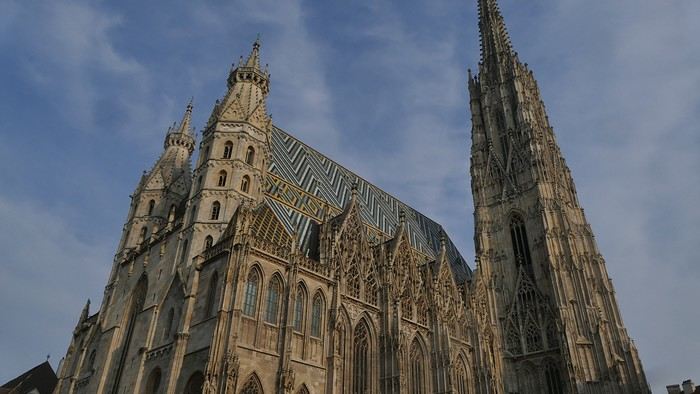
When I exit the metro, I spot the St. Stephen’s Cathedral tower in the distance and approach it: the roof, made of glazed tiles, is remarkable.
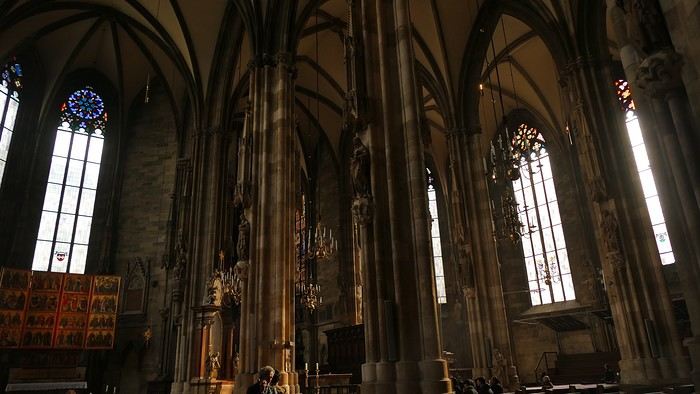
Entry is free, and the interior, a mix of Gothic and Baroque styles in the center, is stunning.
Not far from there is St. Anne’s Church
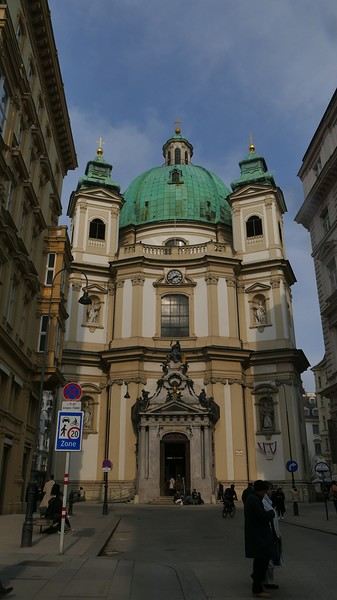
, also Baroque, adorned with beautiful frescoes
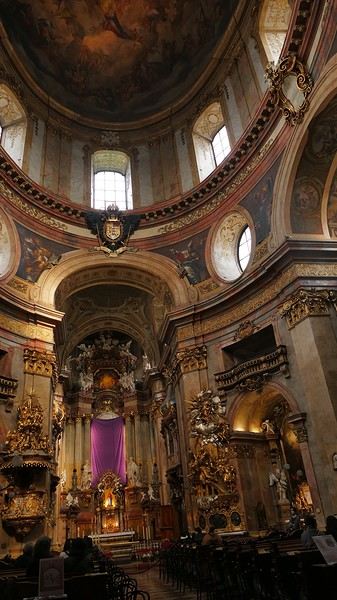
—a music concert adds an enchanting atmosphere to the visit. I continue my walk at random through the pedestrian streets lined with magnificent buildings: I’m charmed by the city.
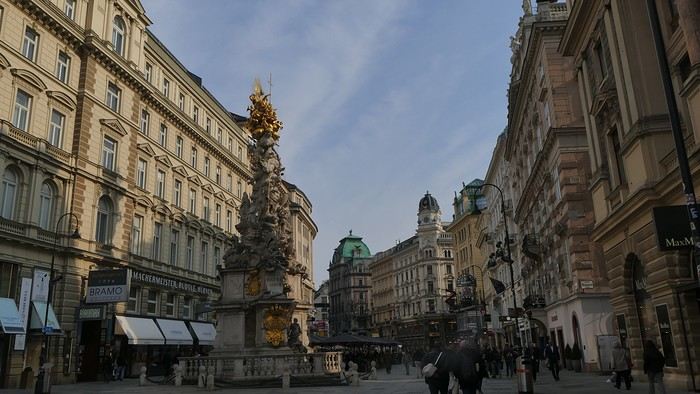
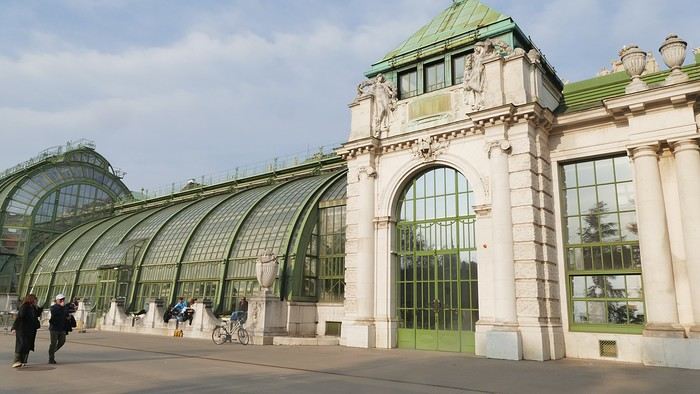
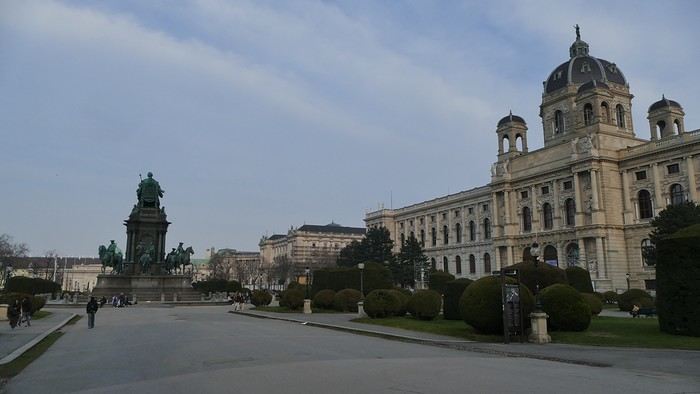
Before heading back to the airport, I stop at a lovely tea salon. My flight will eventually leave with a delay.
Wednesday, March 4th — Delhi and a little luggage scare We arrive in Delhi shortly after noon. Immigration is quick, and good news: my bag was checked through from Barcelona to Kolkata. I head to the connecting terminal and arrive half an hour before boarding: the flight goes smoothly. Upon arrival, the luggage comes out quickly… except mine. After filing a report, I’m told my bag is in Delhi—I have to retrieve it before taking another flight. I didn’t know (or had forgotten): with the delays, I wouldn’t have had time to pick it up and make the connection.
I take a taxi to the Ichamati Hotel. The welcome is warm, and the room is clean but very small. Without my bag, I feel a bit lost—I have nothing to change into.
Tonight, I’m dining with Raja and his friends at a beautiful restaurant, an old colonial house turned into a hotel.
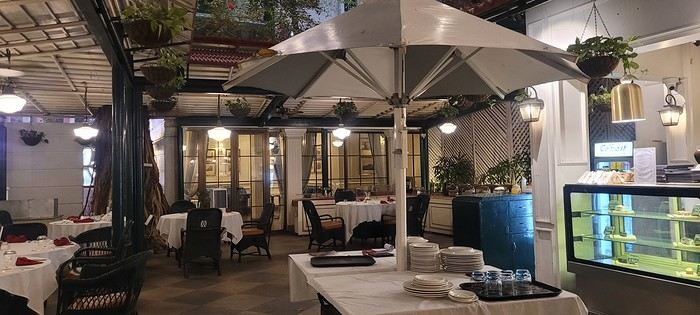
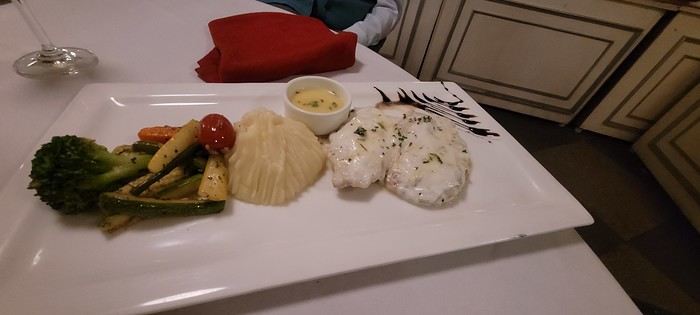
We’re happy to see each other and have a comforting evening together.
I quickly head to the Arc de Triomphe metro station, located 200 meters away: you have to cross the bridge along the bus parking lot, then walk through a large garden; the station is on the right before the garden entrance. The trip to the airport isn’t direct: I have to change at Tomasso and take the line to the airport, where I arrive at 1 PM.
At the Emirates counter, I learn my flight was just canceled due to the war in Iran; they offer me another flight for the next day. I have to wait at the airport until 7 PM before being taken to a hotel; the next morning, I’ll take a flight to Vienna (with an 8-hour layover), then an Air India flight to Delhi, and finally a flight to Kolkata. I agree: I don’t know Vienna, so it’ll be an unexpected discovery.
At 7 PM, a small group is taken to the hotel, 35 minutes from the airport, where we’re served a light dinner upon arrival.
March 3rd — A taxi picks me up at 6:30 AM; the flight to Vienna takes off at 9:30 AM and arrives at noon. I’m free until 7 PM; the metro is direct to the city center. The weather is pleasant and not too cold, luckily, since my clothes are light.
When I exit the metro, I spot the St. Stephen’s Cathedral tower in the distance and approach it: the roof, made of glazed tiles, is remarkable.
Entry is free, and the interior, a mix of Gothic and Baroque styles in the center, is stunning.
Not far from there is St. Anne’s Church
, also Baroque, adorned with beautiful frescoes
—a music concert adds an enchanting atmosphere to the visit. I continue my walk at random through the pedestrian streets lined with magnificent buildings: I’m charmed by the city.
Before heading back to the airport, I stop at a lovely tea salon. My flight will eventually leave with a delay.
Wednesday, March 4th — Delhi and a little luggage scare We arrive in Delhi shortly after noon. Immigration is quick, and good news: my bag was checked through from Barcelona to Kolkata. I head to the connecting terminal and arrive half an hour before boarding: the flight goes smoothly. Upon arrival, the luggage comes out quickly… except mine. After filing a report, I’m told my bag is in Delhi—I have to retrieve it before taking another flight. I didn’t know (or had forgotten): with the delays, I wouldn’t have had time to pick it up and make the connection.
I take a taxi to the Ichamati Hotel. The welcome is warm, and the room is clean but very small. Without my bag, I feel a bit lost—I have nothing to change into.
Tonight, I’m dining with Raja and his friends at a beautiful restaurant, an old colonial house turned into a hotel.
We’re happy to see each other and have a comforting evening together.
Where to go for 2 weeks in Canada during Indian summer?
Hi everyone,
I’ve got 2 weeks of vacation to take (around Sept 15–Oct 10 max).
I’m thinking of Canada since I’ve never been, to see the beautiful fall colors, mix in some sports activities (hiking or others), and a bit of city exploration...
Traveling solo, backpacker style (youth hostels), renting a car/van or using buses... (whichever is most cost-effective and practical).
Which area would you recommend?
For arrival, I can fly into Montreal, Quebec City, or Toronto at the cheapest fares.
What itinerary (big picture) or activities would you suggest? Or maybe you’d advise against it? ))
Thanks in advance!
For arrival, I can fly into Montreal, Quebec City, or Toronto at the cheapest fares.
What itinerary (big picture) or activities would you suggest? Or maybe you’d advise against it? ))
Thanks in advance!
June 2026 Theme Thread: Such a Beautiful Landscape
This is where we chat.
Africa: A Heartfelt Love for a Continent
“When the Whites came to Africa, we had the land and they had the Bible. They taught us to pray with our eyes closed: when we opened them, the Whites had the land and we had the Bible.” Jomo Kenyatta (p.7)
The Maggi cube, an unchallenged hegemony, and so much more
“The hopeless continent,” headlined The Economist, a British magazine, in July 2000 about Africa. Eleven years later, the same magazine headlined “Africa rising” instead. Images of Africa in the prosperous North constantly oscillate between apocalyptic scenarios and enthusiastic projections. A key issue with such images lies in the generalization they entail. If you look at the continent, considerable contrasts emerge depending on space and time. It’s no surprise that a region of the world encompassing such diverse ecological zones, maintaining such varied ties with other continents, comprising nearly fifty nation-states in sub-Saharan Africa alone, and characterized by a great diversity of languages, belief systems, and historical paths, doesn’t share a single destiny.
And yet, for many people outside Africa, as well as for many Africans, the continent constitutes a single entity, defined by criteria such as skin color, a colonial past, poverty, and the art of survival. Until now, these perspectives were generally accompanied by the idea that Africa had to—or should have—followed a single path together, sometimes called development, sometimes modernization, sometimes liberation, then a market economy. None of these paths delivered on their promises.
The two writers Alain Mabanckou and Abdourahman Waberi—one from Congo, the other raised in Djibouti, both long settled in France and now professors at renowned North American universities (Los Angeles, Washington)—have had enough of pessimistic scenarios: “We are aware that Africa is in the world and the world is in Africa. The same goes for all other continents, as our destinies are inextricably linked for better or worse. We refuse to see Africa as a reservoir of misfortunes or a continent cursed by atavistic misfortune and characterized by ethnic conflicts. [...] It’s this passionate flame we wanted to capture in a book [...] a kind of stroll through African cultures, without any demands, each letter of the alphabet leading us to a notion, a practice, a concept, a moment in history, literature, painting, politics, economics, cuisine, etc.” (p.10-11). Africa, they write, is on the verge of “imposing a signature, a style, a way of being in the world and in relation to the rest of the world.” (p.11) To put words to the continent’s diversity and dynamism, the two authors created a “rambling ABC,” a kind of portrait—or more precisely, a mythography—that lets you see and feel the pulse of a vast continent whose cultural power is unfolding before our eyes. Once marginalized or even mocked, the voice and importance of the Continent in global affairs are now undeniable” (p.11), containing over a hundred entries, mostly concise, written in a relaxed and casual style. The optimistic, even exuberant tone is set from the brief introduction. The duo of authors wants to “sing a love song to the cultures of our continent, to its inhabitants past and present, to its exceptional resources and its spectacular globalization despite a certain pollution that still clouds our skies due to the unmatched duration of dictatorships in some of our regions.” (p.12) In doing so, they don’t want to be too distracted by today’s Afewerki-Biya-Bongo-Déby & Co. ...
Of course, you’ll find tributes to great precursors like Frantz Fanon (“[...] it was a love story and admiration that wasn’t dimmed by the four decades separating his birth from ours. Let’s add that we were born while the native of Fort-de-France had left the world’s stage four years earlier, in the prime of life” p.141), Mongo Beti (“You must read and reread Mongo Beti, a genius who used his fame to support often just causes in Africa, like defending oppressed groups. His place is already in History. His oppressors, like the dictators Ahmadou Ahidjo and Paul Biya, can’t compete in the same category” p.64), the Malian Amadou Hampâté Bâ
(“Posterity remembers him mainly as an tireless defender of African cultures. His plea for the collection and preservation of traditional African knowledge remains a major event for all men and women of good will. One day in 1960, at the UNESCO podium, the native of Bandiagara sounded the alarm: ‘[...] Since we’ve admitted that the humanity of each people is the heritage of all humanity, if African traditions aren’t collected in time and written down, they’ll one day be missing from the universal archives of humanity.’” p.51),
Kwame Nkrumah, “one of the founders of Pan-Africanism, father of Ghana’s independence” (p.239), as well as the historian Cheikh Anta Diop, the writer, poet, and politician Aimé Césaire, and the economist and thinker Samir Amin, but also very warm tributes to certain contemporary African intellectuals like Souleymane Bachir Diagne and Achille Mbembe
(“A few years ago, in dominant economic circles, a rumor often resurfaced, usually disguised as a cold and scientifically proven analysis: Africa is useless. It’s a burden for the rest of the human community. With its 2% share in world trade, it would disappear from stock market radars without anyone noticing. So? Maybe it’ll be pulled up by other continents. Wanting to surpass itself is a crazy bet for Africans, they concluded. Arrogant or clueless, President Nicolas Sarkozy declared before an audience of students and teachers at Cheikh Anta Diop University in Dakar: ‘The African man hasn’t entered history enough [...] He only knows the eternal repetition of time marked by the endless repetition of the same gestures and words.’ That was in 2007. For decades, armed only with reason, an intellectual often steps up to debunk prejudices, lazy readings, and dishonest frameworks used as false fronts by those who, like Nicolas Sarkozy or former journalist Stephen Smith, out of ignorance, contempt, or condescension, distort African reality. This intellectual is none other than the historian and political scientist Achille Mbembe. This heir of Frantz Fanon, Amílcar Cabral, Jean-Marc Ela, and Fabien Eboussi-Boulaga was born in 1957 in Cameroon, in the Bassa region. Marked early by the upheavals of a fratricidal war, Achille Mbembe became the guardian of the memory of martyrs. After brilliant studies in Paris, he went on to teach at the best American universities, but the call of the Continent was stronger than anything else. In Dakar, he once directed CODESRIA (Council for the Development of Social Science Research in Africa) before joining the University of the Witwatersrand in Johannesburg, South Africa. Even though the author of *Critique of Black Reason* (Éditions La Découverte, 2015) spends a few months at Duke University in North Carolina, his observation post remains South Africa. From Johannesburg, Achille Mbembe scrutinizes Africa and the whole world. A lucid observer with an elegant and generous pen, Achille Mbembe knows how to blend big and small history: ‘I was born one day in July, as the month was drawing to a close. It was 1957, in that part of Africa recently named ‘Cameroon,’ a memory of the wonder that seized Portuguese sailors in the 15th century when, sailing up the river near Douala, they couldn’t help but note the presence of a multitude of crustaceans, and named it *Rio dos Camarões*, meaning ‘River of Shrimp.’ I grew up in the shadow of this nameless land, since, in a way, the name it bears is only the product of someone else’s astonishment: a lexical mistake, if you will.’ From this mistake or wound, he made leaven, a springboard to compose a rich work, recognized worldwide. To denounce barriers and barbarians too. But that’s not enough. Among his peers in circles of thought and action, Achille Mbembe passionately and consistently defends human dignity and the beauty of the world. In doing so, he fulfills the mission Frantz Fanon entrusted to him.” (p.227-229),
as well as entries dedicated to lesser-known artists and intellectuals, like the French journalist and activist Rokhaya Diallo, daughter of Senegalese and Gambian parents, or the Ethiopian filmmaker Haile Gerima, who has long lived in the United States. Other names from politics, sports, music, art, and literature: Kofi Annan, p.36; Barack Obama, p.243; Thomas Sankara, p.277; Ousmane Sow, p.285; Yambo Ouologuem, p.250; Léopold Sédar Senghor, p.282; Muhammad Ali, p.30; Nuruddin Farah, p.146; Salif Keita, p.203; Ahmadou Kourouma, p.206; Ngũgĩ wa Thiong’o, p.236; Winnie Mandela, p.224; Kylian Mbappé, p.226 ...
The authors, who resolutely commit to a “mythography” (p.11) of Africa, also pay special attention to local social movements, cultural events, and aspects of daily life. *Y’en a marre*, “which also meant ‘we’re fed up with sitting on our hands’” (p.320-321), emerged about a decade ago in Senegal as a citizen movement of peaceful resistance and symbolizes, the authors emphasize, the fact that African youth are increasingly fed up “with the political circus deployed in Africa since independence, as our parents would say, ‘since the White man left’...” (p.321). A full entry is dedicated to the Maggi bouillon cube, which has flooded African markets for about forty years and enjoys immense popularity (“It’s everywhere in Africa, from Dakar to Djibouti, and from Tangier to Cape Town. It’s in every pot, every stew. Little hands put it in every sauce, every local or adapted dish. An unchallenged hegemony! You’ll find it in diasporas too. The culinary strolls in Paris, in the [...] neighborhood” p.90). Critics blame it not only for impoverishing the aromatic diversity of local dishes but also for being harmful to health. And yet, “he poorest Africans, those who eat only once a day, a few spoonfuls of white beans and a ball of *foufou*, for example, are the most fervent users of the magic cube.” (p.92-93)
For *fonio*, “the new trendy cereal. [...] From the millet family, fonio is probably the oldest cereal cultivated in West Africa, and mainly in its sub-Saharan part, for millennia. [...] Easy to grow, water-efficient, fonio grows everywhere except on clay soils. Long neglected because it was considered the poor man’s crop, fonio is now a source of pride for the farmers who cultivate it and cherish it like the apple of their eye” (p.156-157), the authors immediately offer a detailed recipe, letting the reader know that “e can’t resist sharing this fonio with chicken recipe from Mali with you:
Ingredients: 1 chicken 3 large ripe red tomatoes 4 tbsp tomato paste 4 large onions 1 garlic clove 1/2 cup oil 2 Maggi cubes or salt 2 large carrots 1 turnip 1 large cabbage 2 large potatoes 1 celery stalk 1 packet pre-cooked fonio 4 okra (or okra powder) salt, pepper
Preparation: 1. Prepare the sauce: wash and cut the chicken. Peel the onions, garlic, and vegetables. 2. In a pot, fry the chicken pieces. 3. Dice the onions, tomatoes, carrots, and turnip very small and add them to the pot. 4. Add the tomato paste, salt, and pepper. 5. Simmer for 15 min, then add 2 L of water and the cooked chicken pieces. 6. Simmer for 30 min, then add the crushed garlic and celery, plus the cabbage cut into 4 and the potatoes cut in half. 7. Prepare the fonio: cover it with warm water, let it rest for 15 min, and cook it over low heat. 8. In a small pot, boil the okra and crush them. 9. Mix the crushed okra with the cooked fonio, then salt. Serve hot.” (p.158-159)
The comedy *Black Mic Mac*, released in French theaters in 1986 and addressing France’s increasingly restrictive immigration policy at the time, also gets an entry, as do *Tintin in the Congo*, the popular comic, and *Jip’s Café* (“[...] a little Africa in the heart of Paris, with passersby stopping to admire the ‘ambianceurs’ on the dance floor or attend the cultural events offered by the place” (p.194), an African establishment in Paris that Alain Mabanckou already immortalized in one of his novels.
The duo of authors also tackles thorny subjects like jihadism (p.119), the Rwandan genocide (p.272), the CFA franc (p.82), and dictatorship (p.110). While the two strike the right tone here, many entries leave a slightly bitter taste. Two examples: why doesn’t the text on Barack Obama mention the great disappointment of many people in Africa, who expected more from the African policy of the first U.S. president with African roots than just occasional warm words? Why do the comments on Winnie Mandela gloss over the fact that she was a highly controversial icon of the anti-apartheid movement due to her involvement in kidnappings, acts of torture, and murders of alleged apartheid collaborators? Instead, there’s a compassion that brings tears to the eyes: “She was often reduced to a secondary role, the wife of a great man” or “When victory came, she didn’t taste its fruits. Divorced, isolated. She would never be a ‘first lady’ in an evening gown, posing before a bed of chrysanthemums. They’d keep her far from the circles of power” (p.224-225). At this point, I would’ve liked the authors to take a slightly more critical stance...
That said, these “weaknesses” (if you can call them that) shouldn’t overshadow the book as a whole. It remains an informative, sometimes very entertaining, and often even original work in its own way.
Book information (the original French and the German translation):
Alain Mabanckou/Abdourahman Waberi. Dictionnaire enjoué des cultures africaines. Fayard, 2019. Alain Mabanckou/Abdourahman Waberi. Der Puls Afrikas. Eine Liebeserklärung von A bis Z. Reclam, 2022.
Hery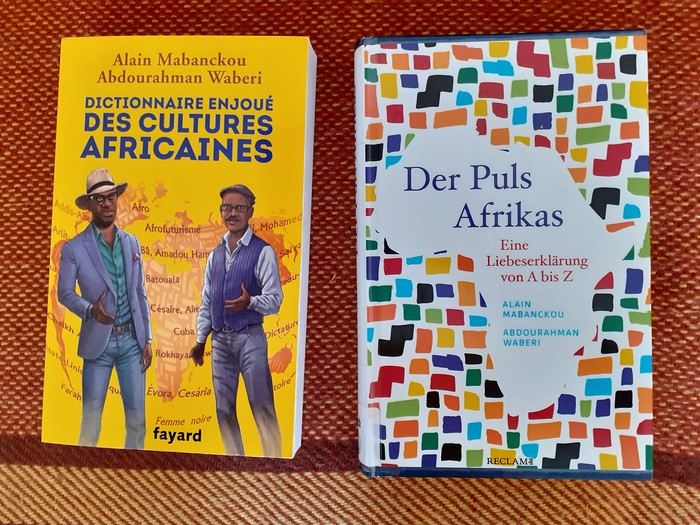
The Maggi cube, an unchallenged hegemony, and so much more
“The hopeless continent,” headlined The Economist, a British magazine, in July 2000 about Africa. Eleven years later, the same magazine headlined “Africa rising” instead. Images of Africa in the prosperous North constantly oscillate between apocalyptic scenarios and enthusiastic projections. A key issue with such images lies in the generalization they entail. If you look at the continent, considerable contrasts emerge depending on space and time. It’s no surprise that a region of the world encompassing such diverse ecological zones, maintaining such varied ties with other continents, comprising nearly fifty nation-states in sub-Saharan Africa alone, and characterized by a great diversity of languages, belief systems, and historical paths, doesn’t share a single destiny.
And yet, for many people outside Africa, as well as for many Africans, the continent constitutes a single entity, defined by criteria such as skin color, a colonial past, poverty, and the art of survival. Until now, these perspectives were generally accompanied by the idea that Africa had to—or should have—followed a single path together, sometimes called development, sometimes modernization, sometimes liberation, then a market economy. None of these paths delivered on their promises.
The two writers Alain Mabanckou and Abdourahman Waberi—one from Congo, the other raised in Djibouti, both long settled in France and now professors at renowned North American universities (Los Angeles, Washington)—have had enough of pessimistic scenarios: “We are aware that Africa is in the world and the world is in Africa. The same goes for all other continents, as our destinies are inextricably linked for better or worse. We refuse to see Africa as a reservoir of misfortunes or a continent cursed by atavistic misfortune and characterized by ethnic conflicts. [...] It’s this passionate flame we wanted to capture in a book [...] a kind of stroll through African cultures, without any demands, each letter of the alphabet leading us to a notion, a practice, a concept, a moment in history, literature, painting, politics, economics, cuisine, etc.” (p.10-11). Africa, they write, is on the verge of “imposing a signature, a style, a way of being in the world and in relation to the rest of the world.” (p.11) To put words to the continent’s diversity and dynamism, the two authors created a “rambling ABC,” a kind of portrait—or more precisely, a mythography—that lets you see and feel the pulse of a vast continent whose cultural power is unfolding before our eyes. Once marginalized or even mocked, the voice and importance of the Continent in global affairs are now undeniable” (p.11), containing over a hundred entries, mostly concise, written in a relaxed and casual style. The optimistic, even exuberant tone is set from the brief introduction. The duo of authors wants to “sing a love song to the cultures of our continent, to its inhabitants past and present, to its exceptional resources and its spectacular globalization despite a certain pollution that still clouds our skies due to the unmatched duration of dictatorships in some of our regions.” (p.12) In doing so, they don’t want to be too distracted by today’s Afewerki-Biya-Bongo-Déby & Co. ...
Of course, you’ll find tributes to great precursors like Frantz Fanon (“[...] it was a love story and admiration that wasn’t dimmed by the four decades separating his birth from ours. Let’s add that we were born while the native of Fort-de-France had left the world’s stage four years earlier, in the prime of life” p.141), Mongo Beti (“You must read and reread Mongo Beti, a genius who used his fame to support often just causes in Africa, like defending oppressed groups. His place is already in History. His oppressors, like the dictators Ahmadou Ahidjo and Paul Biya, can’t compete in the same category” p.64), the Malian Amadou Hampâté Bâ
(“Posterity remembers him mainly as an tireless defender of African cultures. His plea for the collection and preservation of traditional African knowledge remains a major event for all men and women of good will. One day in 1960, at the UNESCO podium, the native of Bandiagara sounded the alarm: ‘[...] Since we’ve admitted that the humanity of each people is the heritage of all humanity, if African traditions aren’t collected in time and written down, they’ll one day be missing from the universal archives of humanity.’” p.51),
Kwame Nkrumah, “one of the founders of Pan-Africanism, father of Ghana’s independence” (p.239), as well as the historian Cheikh Anta Diop, the writer, poet, and politician Aimé Césaire, and the economist and thinker Samir Amin, but also very warm tributes to certain contemporary African intellectuals like Souleymane Bachir Diagne and Achille Mbembe
(“A few years ago, in dominant economic circles, a rumor often resurfaced, usually disguised as a cold and scientifically proven analysis: Africa is useless. It’s a burden for the rest of the human community. With its 2% share in world trade, it would disappear from stock market radars without anyone noticing. So? Maybe it’ll be pulled up by other continents. Wanting to surpass itself is a crazy bet for Africans, they concluded. Arrogant or clueless, President Nicolas Sarkozy declared before an audience of students and teachers at Cheikh Anta Diop University in Dakar: ‘The African man hasn’t entered history enough [...] He only knows the eternal repetition of time marked by the endless repetition of the same gestures and words.’ That was in 2007. For decades, armed only with reason, an intellectual often steps up to debunk prejudices, lazy readings, and dishonest frameworks used as false fronts by those who, like Nicolas Sarkozy or former journalist Stephen Smith, out of ignorance, contempt, or condescension, distort African reality. This intellectual is none other than the historian and political scientist Achille Mbembe. This heir of Frantz Fanon, Amílcar Cabral, Jean-Marc Ela, and Fabien Eboussi-Boulaga was born in 1957 in Cameroon, in the Bassa region. Marked early by the upheavals of a fratricidal war, Achille Mbembe became the guardian of the memory of martyrs. After brilliant studies in Paris, he went on to teach at the best American universities, but the call of the Continent was stronger than anything else. In Dakar, he once directed CODESRIA (Council for the Development of Social Science Research in Africa) before joining the University of the Witwatersrand in Johannesburg, South Africa. Even though the author of *Critique of Black Reason* (Éditions La Découverte, 2015) spends a few months at Duke University in North Carolina, his observation post remains South Africa. From Johannesburg, Achille Mbembe scrutinizes Africa and the whole world. A lucid observer with an elegant and generous pen, Achille Mbembe knows how to blend big and small history: ‘I was born one day in July, as the month was drawing to a close. It was 1957, in that part of Africa recently named ‘Cameroon,’ a memory of the wonder that seized Portuguese sailors in the 15th century when, sailing up the river near Douala, they couldn’t help but note the presence of a multitude of crustaceans, and named it *Rio dos Camarões*, meaning ‘River of Shrimp.’ I grew up in the shadow of this nameless land, since, in a way, the name it bears is only the product of someone else’s astonishment: a lexical mistake, if you will.’ From this mistake or wound, he made leaven, a springboard to compose a rich work, recognized worldwide. To denounce barriers and barbarians too. But that’s not enough. Among his peers in circles of thought and action, Achille Mbembe passionately and consistently defends human dignity and the beauty of the world. In doing so, he fulfills the mission Frantz Fanon entrusted to him.” (p.227-229),
as well as entries dedicated to lesser-known artists and intellectuals, like the French journalist and activist Rokhaya Diallo, daughter of Senegalese and Gambian parents, or the Ethiopian filmmaker Haile Gerima, who has long lived in the United States. Other names from politics, sports, music, art, and literature: Kofi Annan, p.36; Barack Obama, p.243; Thomas Sankara, p.277; Ousmane Sow, p.285; Yambo Ouologuem, p.250; Léopold Sédar Senghor, p.282; Muhammad Ali, p.30; Nuruddin Farah, p.146; Salif Keita, p.203; Ahmadou Kourouma, p.206; Ngũgĩ wa Thiong’o, p.236; Winnie Mandela, p.224; Kylian Mbappé, p.226 ...
The authors, who resolutely commit to a “mythography” (p.11) of Africa, also pay special attention to local social movements, cultural events, and aspects of daily life. *Y’en a marre*, “which also meant ‘we’re fed up with sitting on our hands’” (p.320-321), emerged about a decade ago in Senegal as a citizen movement of peaceful resistance and symbolizes, the authors emphasize, the fact that African youth are increasingly fed up “with the political circus deployed in Africa since independence, as our parents would say, ‘since the White man left’...” (p.321). A full entry is dedicated to the Maggi bouillon cube, which has flooded African markets for about forty years and enjoys immense popularity (“It’s everywhere in Africa, from Dakar to Djibouti, and from Tangier to Cape Town. It’s in every pot, every stew. Little hands put it in every sauce, every local or adapted dish. An unchallenged hegemony! You’ll find it in diasporas too. The culinary strolls in Paris, in the [...] neighborhood” p.90). Critics blame it not only for impoverishing the aromatic diversity of local dishes but also for being harmful to health. And yet, “he poorest Africans, those who eat only once a day, a few spoonfuls of white beans and a ball of *foufou*, for example, are the most fervent users of the magic cube.” (p.92-93)
For *fonio*, “the new trendy cereal. [...] From the millet family, fonio is probably the oldest cereal cultivated in West Africa, and mainly in its sub-Saharan part, for millennia. [...] Easy to grow, water-efficient, fonio grows everywhere except on clay soils. Long neglected because it was considered the poor man’s crop, fonio is now a source of pride for the farmers who cultivate it and cherish it like the apple of their eye” (p.156-157), the authors immediately offer a detailed recipe, letting the reader know that “e can’t resist sharing this fonio with chicken recipe from Mali with you:
Ingredients: 1 chicken 3 large ripe red tomatoes 4 tbsp tomato paste 4 large onions 1 garlic clove 1/2 cup oil 2 Maggi cubes or salt 2 large carrots 1 turnip 1 large cabbage 2 large potatoes 1 celery stalk 1 packet pre-cooked fonio 4 okra (or okra powder) salt, pepper
Preparation: 1. Prepare the sauce: wash and cut the chicken. Peel the onions, garlic, and vegetables. 2. In a pot, fry the chicken pieces. 3. Dice the onions, tomatoes, carrots, and turnip very small and add them to the pot. 4. Add the tomato paste, salt, and pepper. 5. Simmer for 15 min, then add 2 L of water and the cooked chicken pieces. 6. Simmer for 30 min, then add the crushed garlic and celery, plus the cabbage cut into 4 and the potatoes cut in half. 7. Prepare the fonio: cover it with warm water, let it rest for 15 min, and cook it over low heat. 8. In a small pot, boil the okra and crush them. 9. Mix the crushed okra with the cooked fonio, then salt. Serve hot.” (p.158-159)
The comedy *Black Mic Mac*, released in French theaters in 1986 and addressing France’s increasingly restrictive immigration policy at the time, also gets an entry, as do *Tintin in the Congo*, the popular comic, and *Jip’s Café* (“[...] a little Africa in the heart of Paris, with passersby stopping to admire the ‘ambianceurs’ on the dance floor or attend the cultural events offered by the place” (p.194), an African establishment in Paris that Alain Mabanckou already immortalized in one of his novels.
The duo of authors also tackles thorny subjects like jihadism (p.119), the Rwandan genocide (p.272), the CFA franc (p.82), and dictatorship (p.110). While the two strike the right tone here, many entries leave a slightly bitter taste. Two examples: why doesn’t the text on Barack Obama mention the great disappointment of many people in Africa, who expected more from the African policy of the first U.S. president with African roots than just occasional warm words? Why do the comments on Winnie Mandela gloss over the fact that she was a highly controversial icon of the anti-apartheid movement due to her involvement in kidnappings, acts of torture, and murders of alleged apartheid collaborators? Instead, there’s a compassion that brings tears to the eyes: “She was often reduced to a secondary role, the wife of a great man” or “When victory came, she didn’t taste its fruits. Divorced, isolated. She would never be a ‘first lady’ in an evening gown, posing before a bed of chrysanthemums. They’d keep her far from the circles of power” (p.224-225). At this point, I would’ve liked the authors to take a slightly more critical stance...
That said, these “weaknesses” (if you can call them that) shouldn’t overshadow the book as a whole. It remains an informative, sometimes very entertaining, and often even original work in its own way.
Book information (the original French and the German translation):
Alain Mabanckou/Abdourahman Waberi. Dictionnaire enjoué des cultures africaines. Fayard, 2019. Alain Mabanckou/Abdourahman Waberi. Der Puls Afrikas. Eine Liebeserklärung von A bis Z. Reclam, 2022.
Hery
From Avignon to Casamance Without Flying
Hi there,
Last February, I made a trip using "public transport" from France to southern Senegal via Spain, Morocco, Western Sahara, and Mauritania.
It’s a journey of about 5,000 km, where I took trains (as far as Marrakech), ferries (to cross Gibraltar and then to reach Casamance from Dakar), and mostly buses on the long desert straightaways. I hadn’t planned any stops in advance or booked any hotels, except for the very first train to Spain, which left plenty of room for the unexpected. Why travel by land and sea? In recent years, flight-free travel has been gaining popularity. On social media, posts explaining how to cross Europe by train as quickly as possible go viral. Traveling without flying—and making sure people know about it—has become a great way to earn a badge of eco-responsibility: an essential totem for anyone wanting to prove both their dedication to the ecological cause and the wisdom of slow travel. I haven’t flown in years, and this journey to West Africa could easily be filed under "responsible travel." But it wouldn’t be honest to say that: in reality, it wasn’t really my aversion to flying that motivated this long trek. I see overland travel primarily as a way to experience the world’s geography at a grounded, earthly pace—the pace of the locals. Besides, I’ll be flying back, which disqualifies any claim to being a model of sustainability. So no eco-badge, and no adventurer’s badge either: you won’t find any heroic tales of camel rides in lost lands or mineral train wagons in this account (popular with influencers, the Mauritania iron ore train now attracts tourists from all over the world, turning "the experience" into something you "have to do at least once in your life"). This five-part story, written on the road, has no other ambition than to recount a journey through places and people, and to share the thoughts they inspire in me. As simply and, I hope, as humbly as possible.
I’m posting the episodes here, which you can also find on my blog (with more photos) at the following links:
Episode 1: Spain, from Avignon to Algeciras
Episode 2: Morocco, from Tangier to Tarfaya
Episode 3: Western Sahara, from Tarfaya to Guerguerat
Episode 4: Mauritania, from Guerguerat to Nouakchott
Episode 5: Senegal, from Rosso to Saloulou
To help those who might want to make the same trip, I’ve also put together a summary of the route with recommendations—you can read it at the end of the story and on the blog: From France to Senegal Without Flying: Route and Itinerary Recommendations
Happy reading, and safe travels!
Last February, I made a trip using "public transport" from France to southern Senegal via Spain, Morocco, Western Sahara, and Mauritania.
It’s a journey of about 5,000 km, where I took trains (as far as Marrakech), ferries (to cross Gibraltar and then to reach Casamance from Dakar), and mostly buses on the long desert straightaways. I hadn’t planned any stops in advance or booked any hotels, except for the very first train to Spain, which left plenty of room for the unexpected. Why travel by land and sea? In recent years, flight-free travel has been gaining popularity. On social media, posts explaining how to cross Europe by train as quickly as possible go viral. Traveling without flying—and making sure people know about it—has become a great way to earn a badge of eco-responsibility: an essential totem for anyone wanting to prove both their dedication to the ecological cause and the wisdom of slow travel. I haven’t flown in years, and this journey to West Africa could easily be filed under "responsible travel." But it wouldn’t be honest to say that: in reality, it wasn’t really my aversion to flying that motivated this long trek. I see overland travel primarily as a way to experience the world’s geography at a grounded, earthly pace—the pace of the locals. Besides, I’ll be flying back, which disqualifies any claim to being a model of sustainability. So no eco-badge, and no adventurer’s badge either: you won’t find any heroic tales of camel rides in lost lands or mineral train wagons in this account (popular with influencers, the Mauritania iron ore train now attracts tourists from all over the world, turning "the experience" into something you "have to do at least once in your life"). This five-part story, written on the road, has no other ambition than to recount a journey through places and people, and to share the thoughts they inspire in me. As simply and, I hope, as humbly as possible.
I’m posting the episodes here, which you can also find on my blog (with more photos) at the following links:
Episode 1: Spain, from Avignon to Algeciras
Episode 2: Morocco, from Tangier to Tarfaya
Episode 3: Western Sahara, from Tarfaya to Guerguerat
Episode 4: Mauritania, from Guerguerat to Nouakchott
Episode 5: Senegal, from Rosso to Saloulou
To help those who might want to make the same trip, I’ve also put together a summary of the route with recommendations—you can read it at the end of the story and on the blog: From France to Senegal Without Flying: Route and Itinerary Recommendations
Happy reading, and safe travels!
Rome: Feedback on my 7-day itinerary
Hello,
We’re heading to Rome from 21/09, arriving in the early afternoon, and returning on 28/09, leaving in the morning. We’ve already booked our flight tickets and our accommodation in the city center: Via Ezio.
I’d love to get your feedback on our itinerary and if there are any visits we should book right now:
Monday 21 afternoon:
Largo di Torre Argentina: a sacred spot for cats.
Tuesday 22:
The Vatican: Vatican Museums and Sistine Chapel in the morning. Afternoon: St. Peter’s Basilica, the dome, and if possible, the necropolis.
Wednesday 23:
Morning: Colosseum, Roman Forum, and Palatine Hill. Afternoon: Trastevere neighborhood and the Monumento a Garibaldi.
Thursday 24:
Piazza Navona, Church of St. Louis of the French, the Pantheon, Campo de’ Fiori, Piazza Venezia, Piazza Santa Maria Maggiore, Trevi Fountain.
Friday 25:
Villa Borghese, Piazza del Popolo, Spanish Steps, Quirinale, Piazza della Repubblica, and Santa Maria degli Angeli.
Saturday 26:
Aventine and Testaccio neighborhoods, the Capuchin Crypt.
Sunday 27:
Ostia.
Monday 28:
Departure.
Are any days too packed, or should we add more visits?
Thanks for your input and help!
Cheers!
Anne
Off on an adventure in Sri Lanka
Day 1 – December 6
Our decision is our decision. And it’s firm and final. Next winter, our plane will spread its great wings toward the island of Ceylon! "Wait a minute... Ceylon... Ceylon... that name rings a bell, but I can’t quite place it on the globe Grandma gave me for Christmas! Ceylon... Oh right, I’ve got it: Ceylon is the name of my tea!" Exactly. But the name on your pretty tea box is also the one used until 1972 for this island nation, a speck on the Indian Ocean at the southern tip of the Indian subcontinent: Sri Lanka!
For this new adventure, I’m exceptionally leaving my Flo behind, cowardly replaced by a double dose of testosterone. To write the book of this journey with me, I’m bringing along my brother, who’s used to this kind of thing, and... a guest star: My model of resilience. My dad! All aboard! Or rather, all aboard our tuk-tuk! Yes, you read that right: A real tuk-tuk, a little colorful rolling box that putters along at two miles an hour. The idea? Well, Sri Lanka and its winding roads overlooking the vastness of lush nature are tailor-made for this kind of vehicle. And since it’s one of only two countries in the world that allow foreigners to rent and drive these mini speedsters, we’ll be crisscrossing the island in our two-square-meter rolling box. Plus, adopting this mode of transport is a surefire way to connect directly with the locals, who’ll surely be curious to see a foreigner driving their iconic vehicle. Not to mention the... let’s say... spicy anecdotes it might generate. I mean, heading into a subtropical zone with my jet-black dad and his unpredictable digestive flora while deliberately choosing the tuk-tuk as our *only* means of transport? That’s the winning combo for an unforgettable adventure! "More seriously, Dad, Sullivan, I’m already loving the idea of living this adventure together, the three of us—brothers and father..."
So, does the intro to this new adventure get your salivary glands going? Yes? Too bad. Because unfortunately, the program handed out by the lady at the entrance has been slightly... let’s say *crumpled*. Some might even say "scrunched up and nearly tossed in the trash." First, six days ago, as the countdown echoed in us like a call to adventure, Cyclone Ditwah grabbed Sri Lanka, played with it like a rag doll, and left it battered on the ground. The toll is devastating: over a thousand dead, thousands of homes wiped out by relentless rains, roads and railways swallowed by massive mudslides. A country wounded once again, after the civil war, the 2004 tsunami, and the post-Covid economic crisis.
But as if this weather disaster wasn’t enough to shake our unbreakable adventurer spirit, fate decided to mess with us further by cutting our trio down to two. The victim? My brother, violently turned away because of a simple date on his passport that didn’t match the border officials’ expectations. Return to sender!
So now it’s just the two of us allowed to board the Qatar Airways Airbus A380 for this trip. If he were here, Denis Brognart would say, "And in the end, only one remains!" Except I know you’ll be with us, following our adventures! Right?
Our decision is our decision. And it’s firm and final. Next winter, our plane will spread its great wings toward the island of Ceylon! "Wait a minute... Ceylon... Ceylon... that name rings a bell, but I can’t quite place it on the globe Grandma gave me for Christmas! Ceylon... Oh right, I’ve got it: Ceylon is the name of my tea!" Exactly. But the name on your pretty tea box is also the one used until 1972 for this island nation, a speck on the Indian Ocean at the southern tip of the Indian subcontinent: Sri Lanka!
For this new adventure, I’m exceptionally leaving my Flo behind, cowardly replaced by a double dose of testosterone. To write the book of this journey with me, I’m bringing along my brother, who’s used to this kind of thing, and... a guest star: My model of resilience. My dad! All aboard! Or rather, all aboard our tuk-tuk! Yes, you read that right: A real tuk-tuk, a little colorful rolling box that putters along at two miles an hour. The idea? Well, Sri Lanka and its winding roads overlooking the vastness of lush nature are tailor-made for this kind of vehicle. And since it’s one of only two countries in the world that allow foreigners to rent and drive these mini speedsters, we’ll be crisscrossing the island in our two-square-meter rolling box. Plus, adopting this mode of transport is a surefire way to connect directly with the locals, who’ll surely be curious to see a foreigner driving their iconic vehicle. Not to mention the... let’s say... spicy anecdotes it might generate. I mean, heading into a subtropical zone with my jet-black dad and his unpredictable digestive flora while deliberately choosing the tuk-tuk as our *only* means of transport? That’s the winning combo for an unforgettable adventure! "More seriously, Dad, Sullivan, I’m already loving the idea of living this adventure together, the three of us—brothers and father..."
So, does the intro to this new adventure get your salivary glands going? Yes? Too bad. Because unfortunately, the program handed out by the lady at the entrance has been slightly... let’s say *crumpled*. Some might even say "scrunched up and nearly tossed in the trash." First, six days ago, as the countdown echoed in us like a call to adventure, Cyclone Ditwah grabbed Sri Lanka, played with it like a rag doll, and left it battered on the ground. The toll is devastating: over a thousand dead, thousands of homes wiped out by relentless rains, roads and railways swallowed by massive mudslides. A country wounded once again, after the civil war, the 2004 tsunami, and the post-Covid economic crisis.
But as if this weather disaster wasn’t enough to shake our unbreakable adventurer spirit, fate decided to mess with us further by cutting our trio down to two. The victim? My brother, violently turned away because of a simple date on his passport that didn’t match the border officials’ expectations. Return to sender!
So now it’s just the two of us allowed to board the Qatar Airways Airbus A380 for this trip. If he were here, Denis Brognart would say, "And in the end, only one remains!" Except I know you’ll be with us, following our adventures! Right?
A Bold Combo: Southern Peru, Bolivia, and Northern Chile
Hello everyone,
For our latest 3-week family trip (yes, the kids are growing up, and two of them are about to enter the working world), we’re heading to South America! For our first time on this continent, I had planned a classic 3-week loop in Peru.
But since we won’t be returning to this part of the world anytime soon, I thought: why not follow in the footsteps of Franck, aka Bibouns51, who, in 18 days, didn’t just stick to Peru but also added two of the planet’s most stunning landscapes to his itinerary... the Salar de Uyuni in Bolivia and its neighbor, the fabulous Atacama Desert in northern Chile !!
So, I set about the tricky task of limiting the regions we’d visit in Peru to those we considered must-sees, to avoid rushing too much. The visit schedules were optimized, including several comfortable overnight buses that have the huge advantage of letting us hop between regions.
So, we’re off on a somewhat adventurous trip with three domestic flights (two on the first day and one on the last), two overnight buses for quick hops, several car rentals, the services of a few drivers to make the trip more comfortable, and even a tour operator for crossing the Salar...
Our main concern is altitude sickness, and we’re bringing Diamox, aspirin, etc., just in case.
Our second worry before departure was not even getting off the ground... Yes, for once, we’re leaving from France—Marseille, to be exact. The week before our departure, with the surprise air traffic controllers’ strike, I remembered why we usually prefer to leave from abroad, like Turin or Barcelona... In the end, it wasn’t the air traffic controllers who made us nervous but the early July wildfires that paralyzed the airport a few days before our departure. Fortunately, the fires were quickly brought under control, and on the big day, everything was smooth sailing!
Detailed itinerary (which changed on Day 1 due to departure hiccups): Day 0: Flight Marseille - Madrid - Lima PERU Theoretical and abandoned Day 1: Flight Lima - Cuzco and visit Cuzco (Puka Pukara, Tambomachay, Cristo Blanco Observatory, Sacsayhuaman sunset) - Night in Cuzco Day 2: Taxi -> Chinchero - Moray - Maras Salt Mines - Ollantaytambo - Train to Aguas Calientes Day 3: Machu Picchu - Return train to Ollantaytambo Day 4: 2-day taxi -> Pisac - Tipon - Andahuaylillas - Huaro - Night in San Pedro Day 5: Palcoyo - Checacupe - Vinicunca - Return and night in Cuzco Day 6: Day in Cuzco (catch-up on Sacsayhuaman, San Blas district, Temple of the Sun) - Overnight bus to Arequipa Day 7: Rental car -> On the road to Colca Canyon, night in Cabanaconde Day 8: Descent to the bottom of Colca Canyon, night at Oasis Sangalle Day 9: Ascent from the canyon - Maca - Chivay - Return and night in Arequipa Day 10: Visit Arequipa (Santa Catalina Convent, La Recoleta Church and Monastery, La Compañía Church, Cathedral) - Overnight bus to Puno Day 11: Lake Titicaca - Night in Puno BOLIVIA Day 12: Shared taxi -> Road to La Paz, visit downtown La Paz - Night 1 in La Paz Day 13: Moon Valley and Las Animas Valley - Night 2 in La Paz Day 14: Day in La Paz - Night 3 in La Paz Day 15: Flight to Uyuni - Day 1 of Salar de Uyuni tour - Night at the edge of the Salar Day 16: Crossing the Lipez region and lagoons - Night near Laguna Colorada Day 17: Sol de Mañana CHILE Day 17 cont.: Pre-booked transfer to SPDA - 4x4 rental - Pukara de Quitor - Stargazing tour - Night 1 in SPDA Day 18: Death Valley and Moon Valley - Night 2 in SPDA Day 19: Miscanti and Miniques Lagoons, Salar de Aguas Calientes and its Piedra Roja, Tebenquiche Lagoon and Quebrada del Diablo - Night 3 in SPDA Day 20: Rainbow Valley and swim in the Puritama River - Night 4 in SPDA Day 21: Tebenquiche Lagoon - Bus to Calama - Flight to Santiago Day 22: Return Santiago - Madrid - Marseille
Day 0 - 11/07: Destination Lima
Our first flight from Marseille went smoothly to our Iberia layover in Madrid.
In Madrid, just after getting off the plane around 8 PM, and as we were walking through the terminal, we got a rude awakening!!
We saw the word "Cancelled" next to our flight number on the display boards. Thinking it must be a glitch, we checked another screen, but the system was stubborn, and the same dreaded word appeared !
So, we headed to the Iberia counter, where an agent confirmed that our Friday evening flight was canceled and rescheduled for the next morning. The reason? A breakdown and no replacement plane, even though we were in Madrid, Iberia’s home base!
To make matters worse, I remembered our super-tight schedule, planned to the minute, with no buffer day in Lima. Since I’m a bit phobic of megacities and hadn’t found anything appealing in the Peruvian capital in our guidebooks, we’d planned to leave Lima as soon as possible for Cusco, the heart of the Sacred Valley, to spend our first day there.
Bad idea, because we already knew the 4-hour buffer wouldn’t be enough, and we’d miss the domestic flight, which was, of course, non-refundable and non-changeable. So, we had to call LATAM from Madrid to find another flight for Saturday evening and negotiate a rate to recover some of our initial outlay.
After an hour on the phone with customer service, several endless holds, and three failed attempts to dictate our credit card number over the phone to a Spaniard speaking English with a thick accent, we finally managed to confirm the transaction, securing our new flight tickets for a moderate extra cost of just 150 € total.
At first, we were pretty bummed about losing a day and incurring extra fees to reschedule the domestic flight, but then, when we learned from an Iberia customer service rep that we’d receive the max compensation of 600 € per traveler, we even ended up grinning... because 3000 € in refunds for only losing the first day in Cusco? We’d sign up for that 10 times over!!
Iberia then took care of us, putting us up in a hotel where we had dinner before a short 5-hour night and an early morning departure. I took the opportunity to improvise a quick day of sightseeing in Lima, focusing on the Barranco and Miraflores districts.
For our latest 3-week family trip (yes, the kids are growing up, and two of them are about to enter the working world), we’re heading to South America! For our first time on this continent, I had planned a classic 3-week loop in Peru.
But since we won’t be returning to this part of the world anytime soon, I thought: why not follow in the footsteps of Franck, aka Bibouns51, who, in 18 days, didn’t just stick to Peru but also added two of the planet’s most stunning landscapes to his itinerary... the Salar de Uyuni in Bolivia and its neighbor, the fabulous Atacama Desert in northern Chile !!
So, I set about the tricky task of limiting the regions we’d visit in Peru to those we considered must-sees, to avoid rushing too much. The visit schedules were optimized, including several comfortable overnight buses that have the huge advantage of letting us hop between regions.
So, we’re off on a somewhat adventurous trip with three domestic flights (two on the first day and one on the last), two overnight buses for quick hops, several car rentals, the services of a few drivers to make the trip more comfortable, and even a tour operator for crossing the Salar...
Our main concern is altitude sickness, and we’re bringing Diamox, aspirin, etc., just in case.
Our second worry before departure was not even getting off the ground... Yes, for once, we’re leaving from France—Marseille, to be exact. The week before our departure, with the surprise air traffic controllers’ strike, I remembered why we usually prefer to leave from abroad, like Turin or Barcelona... In the end, it wasn’t the air traffic controllers who made us nervous but the early July wildfires that paralyzed the airport a few days before our departure. Fortunately, the fires were quickly brought under control, and on the big day, everything was smooth sailing!
Detailed itinerary (which changed on Day 1 due to departure hiccups): Day 0: Flight Marseille - Madrid - Lima PERU Theoretical and abandoned Day 1: Flight Lima - Cuzco and visit Cuzco (Puka Pukara, Tambomachay, Cristo Blanco Observatory, Sacsayhuaman sunset) - Night in Cuzco Day 2: Taxi -> Chinchero - Moray - Maras Salt Mines - Ollantaytambo - Train to Aguas Calientes Day 3: Machu Picchu - Return train to Ollantaytambo Day 4: 2-day taxi -> Pisac - Tipon - Andahuaylillas - Huaro - Night in San Pedro Day 5: Palcoyo - Checacupe - Vinicunca - Return and night in Cuzco Day 6: Day in Cuzco (catch-up on Sacsayhuaman, San Blas district, Temple of the Sun) - Overnight bus to Arequipa Day 7: Rental car -> On the road to Colca Canyon, night in Cabanaconde Day 8: Descent to the bottom of Colca Canyon, night at Oasis Sangalle Day 9: Ascent from the canyon - Maca - Chivay - Return and night in Arequipa Day 10: Visit Arequipa (Santa Catalina Convent, La Recoleta Church and Monastery, La Compañía Church, Cathedral) - Overnight bus to Puno Day 11: Lake Titicaca - Night in Puno BOLIVIA Day 12: Shared taxi -> Road to La Paz, visit downtown La Paz - Night 1 in La Paz Day 13: Moon Valley and Las Animas Valley - Night 2 in La Paz Day 14: Day in La Paz - Night 3 in La Paz Day 15: Flight to Uyuni - Day 1 of Salar de Uyuni tour - Night at the edge of the Salar Day 16: Crossing the Lipez region and lagoons - Night near Laguna Colorada Day 17: Sol de Mañana CHILE Day 17 cont.: Pre-booked transfer to SPDA - 4x4 rental - Pukara de Quitor - Stargazing tour - Night 1 in SPDA Day 18: Death Valley and Moon Valley - Night 2 in SPDA Day 19: Miscanti and Miniques Lagoons, Salar de Aguas Calientes and its Piedra Roja, Tebenquiche Lagoon and Quebrada del Diablo - Night 3 in SPDA Day 20: Rainbow Valley and swim in the Puritama River - Night 4 in SPDA Day 21: Tebenquiche Lagoon - Bus to Calama - Flight to Santiago Day 22: Return Santiago - Madrid - Marseille
Day 0 - 11/07: Destination Lima
Our first flight from Marseille went smoothly to our Iberia layover in Madrid.
In Madrid, just after getting off the plane around 8 PM, and as we were walking through the terminal, we got a rude awakening!!
We saw the word "Cancelled" next to our flight number on the display boards. Thinking it must be a glitch, we checked another screen, but the system was stubborn, and the same dreaded word appeared !
So, we headed to the Iberia counter, where an agent confirmed that our Friday evening flight was canceled and rescheduled for the next morning. The reason? A breakdown and no replacement plane, even though we were in Madrid, Iberia’s home base!
To make matters worse, I remembered our super-tight schedule, planned to the minute, with no buffer day in Lima. Since I’m a bit phobic of megacities and hadn’t found anything appealing in the Peruvian capital in our guidebooks, we’d planned to leave Lima as soon as possible for Cusco, the heart of the Sacred Valley, to spend our first day there.
Bad idea, because we already knew the 4-hour buffer wouldn’t be enough, and we’d miss the domestic flight, which was, of course, non-refundable and non-changeable. So, we had to call LATAM from Madrid to find another flight for Saturday evening and negotiate a rate to recover some of our initial outlay.
After an hour on the phone with customer service, several endless holds, and three failed attempts to dictate our credit card number over the phone to a Spaniard speaking English with a thick accent, we finally managed to confirm the transaction, securing our new flight tickets for a moderate extra cost of just 150 € total.
At first, we were pretty bummed about losing a day and incurring extra fees to reschedule the domestic flight, but then, when we learned from an Iberia customer service rep that we’d receive the max compensation of 600 € per traveler, we even ended up grinning... because 3000 € in refunds for only losing the first day in Cusco? We’d sign up for that 10 times over!!
Iberia then took care of us, putting us up in a hotel where we had dinner before a short 5-hour night and an early morning departure. I took the opportunity to improvise a quick day of sightseeing in Lima, focusing on the Barranco and Miraflores districts.
From the Awakening to Travel to Morocco in the 90s
As I’ve mentioned elsewhere, I inherited my love of travel from my parents and some of my grandparents. A strong passion, but one that was unfortunately limited by our family’s modest resources. Back then, living in northern Alsace, a simple trip to the southern part of the region—with the Wine Route as our destination—felt like an extraordinary journey to a land of plenty for the little boy I was in the late 60s and early 70s.
Everything seemed so huge when you were still just a kid.
Back then, I was overwhelmed by countless sensations—I was already highly sensitive, with a keen mind and a nose and taste buds that were developing like a pro’s. Which, as I’d later realize, wasn’t always an advantage.
Those magical days always began with a gentle late-spring or midsummer morning. The interior of the white Peugeot 404, license plate 210 LZ 67, had already soaked up the sun before the engine purred to life, and the cabin gave off a scent I could still recognize today—a fragrance I found so pleasant. Back then, I had no idea it was just the smell of warm plastic from the car’s interior. Yes, the scents of the 404 on sunny days became my madeleine de Proust... What’s more, the whole family was unusually cheerful because those moments of relaxation and leisure were rare. Everyone worked, and no one had an easy job or was well paid. Without the *Trente Glorieuses*, these experiences might never have happened.
Once we crossed the canton’s borders, I felt like I was light-years away from my everyday surroundings, and every kilometer plunged me deeper into *terra incognita*. It was thrilling. Far from my so-called "medium-sized" town, wheat fields, cornfields, and cabbage patches stretched out, punctuated by tall poles connected by long wires and topped with vegetation—like giant clotheslines without laundry, where magical beanstalks might grow to touch the sky. Back then, I was still far from tasting their product, which was simply beer. At the time, there was still a significant local hop production. Fun fact: it wasn’t until 2002 that Anglo-Saxon scientists proved hops and cannabis belong to the same biological family.
After the fields, the landscape took another step up as it rolled past the little boy’s eyes, often glued to the windows. First came modest hills, then a succession of rolling slopes that soon formed an unbroken chain. Their 700 meters in altitude felt like Himalayan peaks to me—impressive, inert giants, a whole new world. Gazing at them, an intense emotion welled up somewhere between my stomach and lungs, nearly taking my breath away. What mysteries, what treasures did these heights hold? And then there were the cherries on top—the crowning touch that made the scene even more magical: proud, majestic castles perched on the summits like impassive sentinels. Monuments from the past, yet firmly rooted in the present on their rocky spurs. The little boy’s eyes sparkled—he’d been given a castle for Christmas, complete with battlements, towers, a drawbridge, and fully armed knights. He’d watched and lived *Ivanhoe* on the only French TV channel that existed back then.
Only once did my paternal grandfather join us on one of these trips. A tall, intelligent man with a face that could shift from stern to mischievous, clearly full of humor and charisma. Sadly, his relationship with alcohol had taken a toll on his life and, by extension, those of his loved ones. He had a strong personality—if his boss crossed the line, he wouldn’t hesitate to punch him, which meant he went through a lot of different jobs. Back then, you could quit one job and easily find another. It was quite something to see him in his final stages, hallucinating pink elephants and even drinking perfume when he had nothing else left. The last time I saw him, he’d slipped away from the doctors and nurses while hospitalized in pretty bad shape—at least, I assume his liver was the issue. We were sitting down for a family lunch when the door burst open, and there he stood in his pajamas, eyes twinkling with mischief, clearly pleased with the dramatic entrance. That theatrical moment didn’t spare us from burying him a few months later at the age of 71. One day, my mother told me the family doctor had quietly remarked that it was a shame—with his robust constitution, he could’ve lived to be a hundred. Yes, the family doctor—this was the man who’d come treat you any day, at almost any hour, just for a phone call. It really existed, it’s not a myth!
That day, his wife—my paternal grandmother—was also along for the ride. Everyone agreed that Jeannette was a good woman. She worked as a waitress at *Le Tigre*, the biggest brasserie in town, right in the center. Most customers preferred to be served by her, including local dignitaries and even the mayor. As a kid, I didn’t find her very fun, open, or warm—she seemed a bit stern. Back then, women in their fifties already had the face and build of grandmothers. Same went for men, don’t get me wrong. I had no idea about the struggles she faced because of her husband. I didn’t know that 30 years earlier, she’d had to flee Alsace while pregnant, under threat from Nazi fighter-bombers. I didn’t know she’d had several miscarriages, and that my father—her only surviving child, born prematurely in March 1940 at the other end of France—weighed less than a kilo at birth and was so tiny he could fit in a shoebox. Hard to imagine he’d grow into a strapping man nearly 1.80 meters tall, tipping the scales at 100 kilos. When you come back from summer camp in early August and ask why she didn’t pick you up with your parents, and they gently tell you she’s "in heaven," you don’t realize she passed away at 54 after suffering greatly from stomach cancer that had spread.
Back to that family outing, that enchanted parenthesis. I even remembered where we’d had lunch when I passed through Dambach-la-Ville decades later. One of those charming, flower-filled towns Alsace produces in abundance—and preserves so well. This one sits high on a hill, and I was a bit stunned on the parking lot because the view stretched far, revealing the Alsace plain below—its fields, villages, hills, and forests. The world seemed so vast and enticing that day, even though I was only glimpsing a tiny fraction of it.
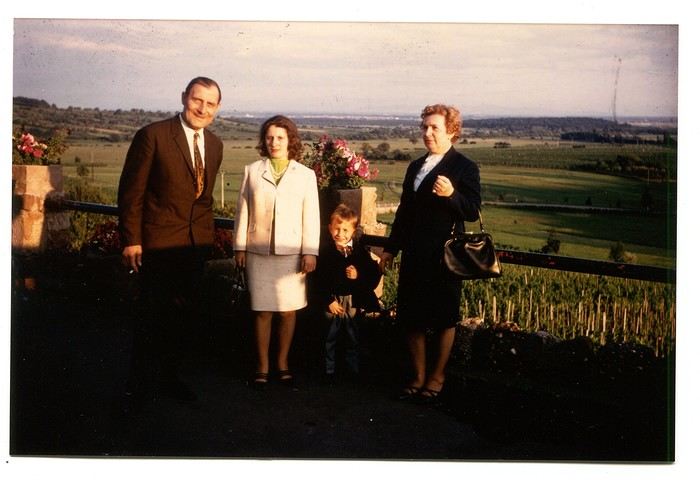
The region was already very touristy, but I wouldn’t notice the downsides until much later. That Sunday noon, I discovered a large restaurant filled with diners. I can still see the enormous piece of meat they served me, decorated with a little wooden skewer topped with a flag. I kept that one for a long time. Those were the golden days of rich, flowing, thick sauces—so flavorful—and the era of the world’s best fries, made on the spot with the best potatoes. To top it off, I was *exceptionally* allowed a small bottle of apple juice, Orangina, or—even better if possible—Sinalco. Yes, Sinalco—like Orangina, but better. A brand that must’ve disappeared in the 70s, but why, and what a shame! Since then, Orangina’s little bubbles have taken the brand to the other side of the planet—it’s now Japanese.
Year after year, I’d eagerly await that ecstatic moment when the most beautiful castle in Alsace, the Haut-Koenigsbourg, appeared in my field of vision. The perfect model, the archetype that blended into the landscape at the height of a child’s dreams. The trip home always felt like a reality check—less jarring than an alarm clock, but more diffuse and melancholic. From then on, there was only one wish: *When do we leave again?*
Those magical days always began with a gentle late-spring or midsummer morning. The interior of the white Peugeot 404, license plate 210 LZ 67, had already soaked up the sun before the engine purred to life, and the cabin gave off a scent I could still recognize today—a fragrance I found so pleasant. Back then, I had no idea it was just the smell of warm plastic from the car’s interior. Yes, the scents of the 404 on sunny days became my madeleine de Proust... What’s more, the whole family was unusually cheerful because those moments of relaxation and leisure were rare. Everyone worked, and no one had an easy job or was well paid. Without the *Trente Glorieuses*, these experiences might never have happened.
Once we crossed the canton’s borders, I felt like I was light-years away from my everyday surroundings, and every kilometer plunged me deeper into *terra incognita*. It was thrilling. Far from my so-called "medium-sized" town, wheat fields, cornfields, and cabbage patches stretched out, punctuated by tall poles connected by long wires and topped with vegetation—like giant clotheslines without laundry, where magical beanstalks might grow to touch the sky. Back then, I was still far from tasting their product, which was simply beer. At the time, there was still a significant local hop production. Fun fact: it wasn’t until 2002 that Anglo-Saxon scientists proved hops and cannabis belong to the same biological family.
After the fields, the landscape took another step up as it rolled past the little boy’s eyes, often glued to the windows. First came modest hills, then a succession of rolling slopes that soon formed an unbroken chain. Their 700 meters in altitude felt like Himalayan peaks to me—impressive, inert giants, a whole new world. Gazing at them, an intense emotion welled up somewhere between my stomach and lungs, nearly taking my breath away. What mysteries, what treasures did these heights hold? And then there were the cherries on top—the crowning touch that made the scene even more magical: proud, majestic castles perched on the summits like impassive sentinels. Monuments from the past, yet firmly rooted in the present on their rocky spurs. The little boy’s eyes sparkled—he’d been given a castle for Christmas, complete with battlements, towers, a drawbridge, and fully armed knights. He’d watched and lived *Ivanhoe* on the only French TV channel that existed back then.
Only once did my paternal grandfather join us on one of these trips. A tall, intelligent man with a face that could shift from stern to mischievous, clearly full of humor and charisma. Sadly, his relationship with alcohol had taken a toll on his life and, by extension, those of his loved ones. He had a strong personality—if his boss crossed the line, he wouldn’t hesitate to punch him, which meant he went through a lot of different jobs. Back then, you could quit one job and easily find another. It was quite something to see him in his final stages, hallucinating pink elephants and even drinking perfume when he had nothing else left. The last time I saw him, he’d slipped away from the doctors and nurses while hospitalized in pretty bad shape—at least, I assume his liver was the issue. We were sitting down for a family lunch when the door burst open, and there he stood in his pajamas, eyes twinkling with mischief, clearly pleased with the dramatic entrance. That theatrical moment didn’t spare us from burying him a few months later at the age of 71. One day, my mother told me the family doctor had quietly remarked that it was a shame—with his robust constitution, he could’ve lived to be a hundred. Yes, the family doctor—this was the man who’d come treat you any day, at almost any hour, just for a phone call. It really existed, it’s not a myth!
That day, his wife—my paternal grandmother—was also along for the ride. Everyone agreed that Jeannette was a good woman. She worked as a waitress at *Le Tigre*, the biggest brasserie in town, right in the center. Most customers preferred to be served by her, including local dignitaries and even the mayor. As a kid, I didn’t find her very fun, open, or warm—she seemed a bit stern. Back then, women in their fifties already had the face and build of grandmothers. Same went for men, don’t get me wrong. I had no idea about the struggles she faced because of her husband. I didn’t know that 30 years earlier, she’d had to flee Alsace while pregnant, under threat from Nazi fighter-bombers. I didn’t know she’d had several miscarriages, and that my father—her only surviving child, born prematurely in March 1940 at the other end of France—weighed less than a kilo at birth and was so tiny he could fit in a shoebox. Hard to imagine he’d grow into a strapping man nearly 1.80 meters tall, tipping the scales at 100 kilos. When you come back from summer camp in early August and ask why she didn’t pick you up with your parents, and they gently tell you she’s "in heaven," you don’t realize she passed away at 54 after suffering greatly from stomach cancer that had spread.
Back to that family outing, that enchanted parenthesis. I even remembered where we’d had lunch when I passed through Dambach-la-Ville decades later. One of those charming, flower-filled towns Alsace produces in abundance—and preserves so well. This one sits high on a hill, and I was a bit stunned on the parking lot because the view stretched far, revealing the Alsace plain below—its fields, villages, hills, and forests. The world seemed so vast and enticing that day, even though I was only glimpsing a tiny fraction of it.
The region was already very touristy, but I wouldn’t notice the downsides until much later. That Sunday noon, I discovered a large restaurant filled with diners. I can still see the enormous piece of meat they served me, decorated with a little wooden skewer topped with a flag. I kept that one for a long time. Those were the golden days of rich, flowing, thick sauces—so flavorful—and the era of the world’s best fries, made on the spot with the best potatoes. To top it off, I was *exceptionally* allowed a small bottle of apple juice, Orangina, or—even better if possible—Sinalco. Yes, Sinalco—like Orangina, but better. A brand that must’ve disappeared in the 70s, but why, and what a shame! Since then, Orangina’s little bubbles have taken the brand to the other side of the planet—it’s now Japanese.
Year after year, I’d eagerly await that ecstatic moment when the most beautiful castle in Alsace, the Haut-Koenigsbourg, appeared in my field of vision. The perfect model, the archetype that blended into the landscape at the height of a child’s dreams. The trip home always felt like a reality check—less jarring than an alarm clock, but more diffuse and melancholic. From then on, there was only one wish: *When do we leave again?*
The Foam of Days
Now that the curtain has fallen on the past year, it’s time to see what’s happening around here.
It seems pretty quiet, but I’ll read more in detail later.
First, I need to tell you all an anecdote.
My eldest little girl, in her third year of law school, was really scared she wouldn’t pass the year. I told her: “Trust yourself, you’ve worked so hard, and worst case, if you fail, you’ll just redo the year.” “But I don’t think I’ll make it—they changed the rules, and if I mess up even one unit, I have to start all over.” I knew her grades weren’t exactly stellar, and with what I was about to say, I wasn’t taking much of a risk. “Here’s the deal, sweetheart: if you pass, I promise I’ll take you to India, just the two of us.” I have to admit, India is a country I’ve talked about so much to all my grandchildren that in their minds, it’s become a magical, mythical place (hmm).
July had barely begun when my phone rang, her name flashing on the screen. “Mamido, I did it!” My promise came rushing back—oh no, oh no, oh no! “Congratulations, sweetheart!” A little shyly, she said: “Is the India trip still on?”
And me, replying: “Of course it is!”
And that’s that—a promise is a promise, or you risk losing that precious trust that keeps hearts warm and at peace.
We’re leaving in February. Only 8 days—yikes, the carbon footprint! But we can’t miss her tutorials, or she’ll be kicked out. Personally, that works just fine for me.
Going to India has become a challenge for me. It’s far, it’s exhausting, I sweat, I hate mosquitoes, the spices bother my mouth when I used to love them. There’s noise all the time—at night, the dogs bark nonstop, and we almost get run over. I’ll get lost in the streets because my sense of direction has vanished. I don’t like rice anymore. All that chaos and those cultural differences that once enchanted me now just overwhelm me. But I promised.
The upside—and it’s a big one—Raman, the same driver I’ve had forever, will be at the airport with a sign with our names. We’ll stop at the same little shop for chai (or tea, plain and simple) with that aroma that intoxicates me, halfway through the trip.
It’ll be a tiny trip—staying with friends, I’ll show her a few places I love: Chidambaram, Mamallapuram, and the clinic where I worked. Then we’ll head back. My little girl will go home to her parents.
As for me, I’ll leave right away for our Scottish island with Homme for our chilly winter.
How can you love a country so much you want to live there, then suddenly reject it, no longer able to appreciate what once made it special? That’s the mystery of love, I guess.
First, I need to tell you all an anecdote.
My eldest little girl, in her third year of law school, was really scared she wouldn’t pass the year. I told her: “Trust yourself, you’ve worked so hard, and worst case, if you fail, you’ll just redo the year.” “But I don’t think I’ll make it—they changed the rules, and if I mess up even one unit, I have to start all over.” I knew her grades weren’t exactly stellar, and with what I was about to say, I wasn’t taking much of a risk. “Here’s the deal, sweetheart: if you pass, I promise I’ll take you to India, just the two of us.” I have to admit, India is a country I’ve talked about so much to all my grandchildren that in their minds, it’s become a magical, mythical place (hmm).
July had barely begun when my phone rang, her name flashing on the screen. “Mamido, I did it!” My promise came rushing back—oh no, oh no, oh no! “Congratulations, sweetheart!” A little shyly, she said: “Is the India trip still on?”
And me, replying: “Of course it is!”
And that’s that—a promise is a promise, or you risk losing that precious trust that keeps hearts warm and at peace.
We’re leaving in February. Only 8 days—yikes, the carbon footprint! But we can’t miss her tutorials, or she’ll be kicked out. Personally, that works just fine for me.
Going to India has become a challenge for me. It’s far, it’s exhausting, I sweat, I hate mosquitoes, the spices bother my mouth when I used to love them. There’s noise all the time—at night, the dogs bark nonstop, and we almost get run over. I’ll get lost in the streets because my sense of direction has vanished. I don’t like rice anymore. All that chaos and those cultural differences that once enchanted me now just overwhelm me. But I promised.
The upside—and it’s a big one—Raman, the same driver I’ve had forever, will be at the airport with a sign with our names. We’ll stop at the same little shop for chai (or tea, plain and simple) with that aroma that intoxicates me, halfway through the trip.
It’ll be a tiny trip—staying with friends, I’ll show her a few places I love: Chidambaram, Mamallapuram, and the clinic where I worked. Then we’ll head back. My little girl will go home to her parents.
As for me, I’ll leave right away for our Scottish island with Homme for our chilly winter.
How can you love a country so much you want to live there, then suddenly reject it, no longer able to appreciate what once made it special? That’s the mystery of love, I guess.
Martine from DD in Arizona and New Mexico
Good evening everyone! 🙂
We’re back from our September 2025 road trip, this time to explore Arizona and New Mexico, and it’s time for me to start my travel journal—especially since everything’s already booked for another trip in September 2026 (to California), and I need to get started on the planning.
I was a little worried this new visit to Uncle Sam’s country might not be as "wow" as the others, but we still discovered some incredible places.
For those who don’t know us, we’re a couple in our seventies who speak very little English, but that didn’t stop us from fully enjoying our stay.
For this 6th road trip in the U.S., we spent 21 nights there, drove 4,160 km by car, and walked nearly 160 km in a loop starting from Phoenix.
We’d been to Arizona before (but not this side) and never to New Mexico. This whole road trip was a huge discovery for us.
In the prices mentioned (some in euros, others in dollars), bank fees and exchange charges are included. The flights, car rental, and parking were all paid for in December 2024 when we booked.
We’d downloaded the MPC (Mobile Passport Control) app, but there wasn’t a dedicated line at Phoenix Airport. Still, we got through quickly with friendly, smiling agents.
I don’t drive at all (I hate it), so the stops were chosen based on activities but also, for some, to limit daily mileage for the sole driver. The kilometers listed in the itinerary are the daily distances.
We traveled from September 9th to 22nd, unfortunately once again without our dear friends Mimi and Maumau.
The itinerary
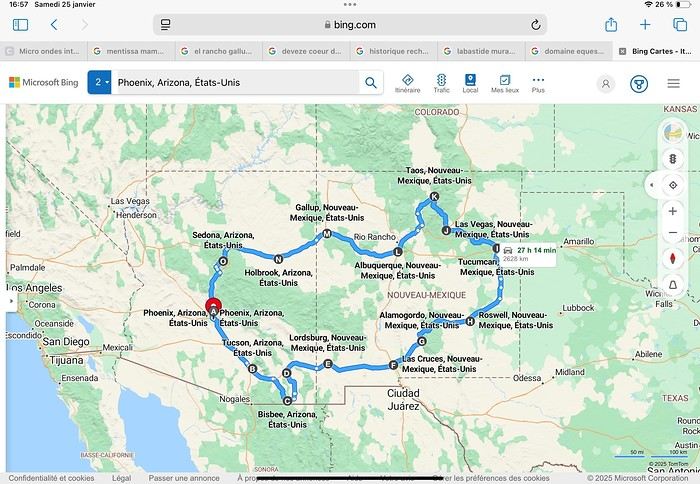
Day 1: Flight Marseille-Paris-Phoenix, then Gold Canyon (133 km) Day 2: Tucson (271 km) Lost Dutchman State Park Day 3: Tucson (155 km) Day 4: Tucson (34 km) Day 5: Bisbee (182 km) Day 6: Lordsburg (345 km) Day 7: Las Cruces (253 km) Day 8: Alamogordo (162 km) Day 9: Roswell (264 km) Day 10: Tucumcari (369 km) Day 11: Las Vegas (281 km) – the one in New Mexico Day 12: Taos (213 km) Day 13: Santa Fe (224 km) Day 14: Albuquerque (123 km) Day 15: Gallup (246 km) Day 16: Holbrook (224 km) Day 17: Flagstaff (179 km) Day 18: Sedona (118 km) Day 19: Sedona (48 km) Day 20: Sedona (41 km) Day 21: Phoenix (256 km) Day 22: Phoenix Airport (35 km)
📊 **Budget**: A little over 7,500 € for both of us, all included. The exchange rate was in our favor (1.17 dollars to 1 €). 📊 **Flights**: Marseille-Paris Charles de Gaulle-Phoenix: 1,787 € for two, with one checked bag each (Air France) 📊 **ESTA**: $42 📊 **America the Beautiful Pass**: $80 📊 **Parking**: 134 € (super eco at Marseille) 📊 **Car rental (Hertz)**: 865 €. Since there were no SUVs left in the reserved category (Nissan Rogue), we got an upgrade (4x4 Ford Explorer). We booked through Air France (15% discount). We’d originally reserved it in December for 1,140 €, but since prices dropped in March, we canceled and rebooked for 865 €. Hertz offers a free Hertz Gold Plus Rewards program, which gives you priority counter service when picking up the car. 📊 **Accommodation**: 2,400 € We stayed in hotels and motels of varying standards (from 60 to 203 € per night, depending on the city), all booked through Booking.com or Hotels.com. Out of 21 nights, only two didn’t include breakfast in the price. Booking.com sometimes offers slightly cheaper rates if you book by phone using the mobile app, and our Genius 3 status on the site also got us some preferential rates. 📊 **Supplementary insurance**: AVA 200 € for medical care if needed 📊 **Cash**: $2,078. We left with 1,000 € exchanged before departure and made two withdrawals of $500. This cash covered: - Evening restaurants and tips - Midday picnics - Gas: $298 for 4,160 km - Museum and private park entries (per person): - Lost Dutchman: $10 - Arizona-Sonora Desert Museum: $28 - Bird Cage Theater: $16 - Tombstone Shootout: $8 - New Mexico Farm & Ranch Museum: $12 - Roswell International UFO Museum: $5 - Billy the Kid Museum: $7 - Rancho de Taos: $22 - West Fork Oak Creek Trail entry: $15 We got a few discounts thanks to our senior age (+65). - Souvenirs and little treats
Like on our previous road trips, we didn’t rent a GPS. We got around using offline GPS apps Here WeGo and Organic Maps, with maps of the states we visited downloaded before we left (on our phones).
❤️❤️❤️ **Highlights** (there are so many!) 📍 Goldfield Ghost Town (even if it’s a reconstruction) 📍 The standing army of Saguaro cacti at Saguaro National Park West 📍 Diving into the cowboy universe of Tombstone 📍 The welcome from Rick and Henry at our guesthouse in Bisbee (Garden at Mile High Ranch) 📍 The tangled rocks of Chiricahua National Monument 📍 The flavored pistachios from Dwayne’s Fresh Jerky and Mac Ginnis Pistachioland 📍 Restaurants: La Posta (Las Cruces), Diner 66 (Albuquerque), and the Haunted Hamburger (Jerome) 📍 The old plazas of New Mexico 📍 The solitude and beauty of the white dunes at White Sands National Park 📍 Stepping back in time at the Billy the Kid Museum (Fort Stanton) 📍 Sections of historic Route 66 and the old motels of Tucumcari, especially at night when all the neon lights are on 📍 Taos Pueblo and diving into Native American culture 📍 After the Rio Grande Bridge, the descent via NM 567 to the very bottom of the Rio Grande Gorge, then the road along the riverbanks to Taos 📍 The tranquility of the Chimayo Sanctuary 📍 Discovering the ingenious native dwellings at Bandelier National Monument and Walnut Canyon National Park 📍 The small towns along the Turquoise Trail 📍 The red rocks of Red Rock Park and the Painted Desert 📍 The extraordinary colors of the petrified trees at Petrified Forest National Park 📍 Sedona, its red rocks, and the reward of the viewpoints at the end of hikes (Devil’s Bridge, The Subway, and West Fork Oak Creek) 📍 The immersion in Mexico when visiting Tlaquepaque 📍 The almost-ghost town of Jerome and its terraced streets 📍 The incredible kindness of Americans, always ready to help and up for a chat ❤️
☹️☹️☹️ **Flops** (there are very few) 📍 Several museums and churches being closed, so we couldn’t visit them 📍 Some museums and visitor centers opening late (10 AM) and closing early (4 PM) 📍 A 64 € phone roaming charge because we got near the Mexican border and picked up their cell tower 📍 The outrageous price ($5.99) for a gallon of gas at the Shell near Phoenix Airport
I hope this helps! Anyway, thanks for reading my long post. Don’t hesitate to reach out, even via PM, if you see I haven’t replied and you’d like more details. Have a great evening, everyone! 🙂
We’re back from our September 2025 road trip, this time to explore Arizona and New Mexico, and it’s time for me to start my travel journal—especially since everything’s already booked for another trip in September 2026 (to California), and I need to get started on the planning.
I was a little worried this new visit to Uncle Sam’s country might not be as "wow" as the others, but we still discovered some incredible places.
For those who don’t know us, we’re a couple in our seventies who speak very little English, but that didn’t stop us from fully enjoying our stay.
For this 6th road trip in the U.S., we spent 21 nights there, drove 4,160 km by car, and walked nearly 160 km in a loop starting from Phoenix.
We’d been to Arizona before (but not this side) and never to New Mexico. This whole road trip was a huge discovery for us.
In the prices mentioned (some in euros, others in dollars), bank fees and exchange charges are included. The flights, car rental, and parking were all paid for in December 2024 when we booked.
We’d downloaded the MPC (Mobile Passport Control) app, but there wasn’t a dedicated line at Phoenix Airport. Still, we got through quickly with friendly, smiling agents.
I don’t drive at all (I hate it), so the stops were chosen based on activities but also, for some, to limit daily mileage for the sole driver. The kilometers listed in the itinerary are the daily distances.
We traveled from September 9th to 22nd, unfortunately once again without our dear friends Mimi and Maumau.
The itinerary
Day 1: Flight Marseille-Paris-Phoenix, then Gold Canyon (133 km) Day 2: Tucson (271 km) Lost Dutchman State Park Day 3: Tucson (155 km) Day 4: Tucson (34 km) Day 5: Bisbee (182 km) Day 6: Lordsburg (345 km) Day 7: Las Cruces (253 km) Day 8: Alamogordo (162 km) Day 9: Roswell (264 km) Day 10: Tucumcari (369 km) Day 11: Las Vegas (281 km) – the one in New Mexico Day 12: Taos (213 km) Day 13: Santa Fe (224 km) Day 14: Albuquerque (123 km) Day 15: Gallup (246 km) Day 16: Holbrook (224 km) Day 17: Flagstaff (179 km) Day 18: Sedona (118 km) Day 19: Sedona (48 km) Day 20: Sedona (41 km) Day 21: Phoenix (256 km) Day 22: Phoenix Airport (35 km)
📊 **Budget**: A little over 7,500 € for both of us, all included. The exchange rate was in our favor (1.17 dollars to 1 €). 📊 **Flights**: Marseille-Paris Charles de Gaulle-Phoenix: 1,787 € for two, with one checked bag each (Air France) 📊 **ESTA**: $42 📊 **America the Beautiful Pass**: $80 📊 **Parking**: 134 € (super eco at Marseille) 📊 **Car rental (Hertz)**: 865 €. Since there were no SUVs left in the reserved category (Nissan Rogue), we got an upgrade (4x4 Ford Explorer). We booked through Air France (15% discount). We’d originally reserved it in December for 1,140 €, but since prices dropped in March, we canceled and rebooked for 865 €. Hertz offers a free Hertz Gold Plus Rewards program, which gives you priority counter service when picking up the car. 📊 **Accommodation**: 2,400 € We stayed in hotels and motels of varying standards (from 60 to 203 € per night, depending on the city), all booked through Booking.com or Hotels.com. Out of 21 nights, only two didn’t include breakfast in the price. Booking.com sometimes offers slightly cheaper rates if you book by phone using the mobile app, and our Genius 3 status on the site also got us some preferential rates. 📊 **Supplementary insurance**: AVA 200 € for medical care if needed 📊 **Cash**: $2,078. We left with 1,000 € exchanged before departure and made two withdrawals of $500. This cash covered: - Evening restaurants and tips - Midday picnics - Gas: $298 for 4,160 km - Museum and private park entries (per person): - Lost Dutchman: $10 - Arizona-Sonora Desert Museum: $28 - Bird Cage Theater: $16 - Tombstone Shootout: $8 - New Mexico Farm & Ranch Museum: $12 - Roswell International UFO Museum: $5 - Billy the Kid Museum: $7 - Rancho de Taos: $22 - West Fork Oak Creek Trail entry: $15 We got a few discounts thanks to our senior age (+65). - Souvenirs and little treats
Like on our previous road trips, we didn’t rent a GPS. We got around using offline GPS apps Here WeGo and Organic Maps, with maps of the states we visited downloaded before we left (on our phones).
❤️❤️❤️ **Highlights** (there are so many!) 📍 Goldfield Ghost Town (even if it’s a reconstruction) 📍 The standing army of Saguaro cacti at Saguaro National Park West 📍 Diving into the cowboy universe of Tombstone 📍 The welcome from Rick and Henry at our guesthouse in Bisbee (Garden at Mile High Ranch) 📍 The tangled rocks of Chiricahua National Monument 📍 The flavored pistachios from Dwayne’s Fresh Jerky and Mac Ginnis Pistachioland 📍 Restaurants: La Posta (Las Cruces), Diner 66 (Albuquerque), and the Haunted Hamburger (Jerome) 📍 The old plazas of New Mexico 📍 The solitude and beauty of the white dunes at White Sands National Park 📍 Stepping back in time at the Billy the Kid Museum (Fort Stanton) 📍 Sections of historic Route 66 and the old motels of Tucumcari, especially at night when all the neon lights are on 📍 Taos Pueblo and diving into Native American culture 📍 After the Rio Grande Bridge, the descent via NM 567 to the very bottom of the Rio Grande Gorge, then the road along the riverbanks to Taos 📍 The tranquility of the Chimayo Sanctuary 📍 Discovering the ingenious native dwellings at Bandelier National Monument and Walnut Canyon National Park 📍 The small towns along the Turquoise Trail 📍 The red rocks of Red Rock Park and the Painted Desert 📍 The extraordinary colors of the petrified trees at Petrified Forest National Park 📍 Sedona, its red rocks, and the reward of the viewpoints at the end of hikes (Devil’s Bridge, The Subway, and West Fork Oak Creek) 📍 The immersion in Mexico when visiting Tlaquepaque 📍 The almost-ghost town of Jerome and its terraced streets 📍 The incredible kindness of Americans, always ready to help and up for a chat ❤️
☹️☹️☹️ **Flops** (there are very few) 📍 Several museums and churches being closed, so we couldn’t visit them 📍 Some museums and visitor centers opening late (10 AM) and closing early (4 PM) 📍 A 64 € phone roaming charge because we got near the Mexican border and picked up their cell tower 📍 The outrageous price ($5.99) for a gallon of gas at the Shell near Phoenix Airport
I hope this helps! Anyway, thanks for reading my long post. Don’t hesitate to reach out, even via PM, if you see I haven’t replied and you’d like more details. Have a great evening, everyone! 🙂
"Tropical Odyssey" CFC Renaissance – November 1st to 22nd, 2025
We’ve just returned from a cruise that my wife and I will remember—unfortunately, not in a good way.
There’s so much to say that I’ll proceed chapter by chapter.
Pre-Cruise
On January 24th, 2025, I booked through a supposedly attentive cruise agent the repositioning cruise of the CFC Renaissance to the French West Indies, initially departing from Le Havre, then from Dunkirk, on November 1st, 2025.
The return flight was included in the price of this trip.
From January, right after booking, this adventure got off to a bad start.
Used to major cruise lines, I asked my agent to reserve a table for 4 at the "Vatel" restaurant for the second seating, and to link this reservation to the cabin of friends traveling with us. First brush-off: "Ask the maître d’ at the restaurant entrance on the first night."
"To govern is to foresee, and to foresee nothing is to head for disaster," as Émile de Girardin said.
Following this maxim, in February, I started looking for transportation to Le Havre, which was initially the departure port. Then, I asked the travel agent which airport the return flight would land at. I knew flights from Pointe-à-Pitre to Paris served both main Parisian airports. Here, I found myself like a ping-pong ball between the cruise agent and CFC: The cruise agent said, "Ask CFC," and CFC replied, "No, your agent is your intermediary—ask them." It went back and forth like that. Impossible to pre-book the flight that would take us back to our final destination. During the summer, we learned that the departure port was no longer Le Havre but Dunkirk. We canceled our transfers to Le Havre but, of course, lost the cost of the reservations. Meanwhile, we purchased our "Beverage" package—we chose the "Fraîcheur" option, which included all non-alcoholic cocktails, canned sodas, fruit juices, bottled water, and regular coffees. This detail is important for the rest of the story. Every month, I followed up to find out the return airport. Nothing until October 28th (3 days before departure), when CFC finally informed me it was Orly, along with the flight number and time. Of course, on top of booking at full price, I had to arrange my final transfer home. Since I had very little time before the return flight, I had to book an Uber in a rush for the Orly/CDG transfer. Right after, we were told that our first stop in Lisbon—the most anticipated for many cruisers—had been canceled due to a strike at the port of Lisbon and replaced with Vigo, Spain. A completely unremarkable stop—nothing outstanding. As you can see, the prelude was already problematic, yet we’re far from reaching the peak of our disappointments. .......... to be continued soon.
"To govern is to foresee, and to foresee nothing is to head for disaster," as Émile de Girardin said.
Following this maxim, in February, I started looking for transportation to Le Havre, which was initially the departure port. Then, I asked the travel agent which airport the return flight would land at. I knew flights from Pointe-à-Pitre to Paris served both main Parisian airports. Here, I found myself like a ping-pong ball between the cruise agent and CFC: The cruise agent said, "Ask CFC," and CFC replied, "No, your agent is your intermediary—ask them." It went back and forth like that. Impossible to pre-book the flight that would take us back to our final destination. During the summer, we learned that the departure port was no longer Le Havre but Dunkirk. We canceled our transfers to Le Havre but, of course, lost the cost of the reservations. Meanwhile, we purchased our "Beverage" package—we chose the "Fraîcheur" option, which included all non-alcoholic cocktails, canned sodas, fruit juices, bottled water, and regular coffees. This detail is important for the rest of the story. Every month, I followed up to find out the return airport. Nothing until October 28th (3 days before departure), when CFC finally informed me it was Orly, along with the flight number and time. Of course, on top of booking at full price, I had to arrange my final transfer home. Since I had very little time before the return flight, I had to book an Uber in a rush for the Orly/CDG transfer. Right after, we were told that our first stop in Lisbon—the most anticipated for many cruisers—had been canceled due to a strike at the port of Lisbon and replaced with Vigo, Spain. A completely unremarkable stop—nothing outstanding. As you can see, the prelude was already problematic, yet we’re far from reaching the peak of our disappointments. .......... to be continued soon.
Off we go on an adventure in Puglia!
Hey there, VF crew!
After wrapping up our travel journal on Java (link below), we’re now diving into our recent adventure in Puglia! Happy reading... Off we go on an adventure in Java (and a bit of Bali) | Travel journal > Indonesia | Voyage Forum
Day 1 - October 19
When you tell your friends and family you’re itching to escape to the other side of the planet to mingle with the Mongols, you can usually expect a barrage of questionable jokes and terrible puns. For this new adventure, it’s a different destination but the same old story—this time, we’re visiting the "pouilleux" (the "scruffy" ones). We’re taking off straight for Puglia! If you need a cheat sheet to remember where this oddly named place is on a world map, just think of it this way: Puglia is the maiden name on the ID card of the heel of the Italian boot! Personally, I prefer to remember it as the land of creamy burrata, the smell of focaccia fresh from the oven, orecchiette shaped by mamas, golden olive oil that shines like the sun (which beams down here 300 days a year), amaretto that makes you happy, and those famous trulli—those little hobbit-like dry-stone houses straight out of a movie set...
But I’ll stop spoiling the rest of our trip and focus on a factual rundown of this first Puglian day. So, are you joining us on this new adventure beyond our Gallic borders? Either way, Sasha (my youngest) and Luna (Flo’s daughter) didn’t need much convincing to stick with us and keep up the pace!
Our plane drops our little crew in Bari, the site of a famously tragic battle lost in 1991. But revenge is sweet! After renting a motorized carriage, we escape the landing zone and head to our military base of operations: Ostuni, a strategic little town where we’ll set up camp for the next four days. Why Ostuni? First, for its central location, which lets us explore a region packed with must-see gems. Second, for its vibe and beauty, which have earned it quite the reputation. Perched high on a hill, the *città bianca* (the "White City") lives up to its nickname. It literally dazzles visitors. The reason? The whitewashed facades of its houses, a testament to the region’s rich architectural heritage.
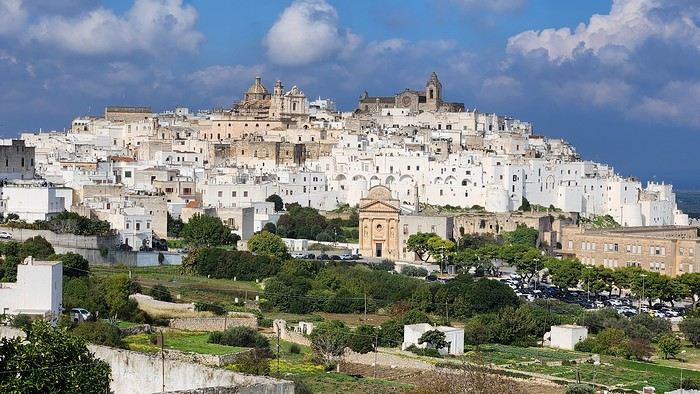
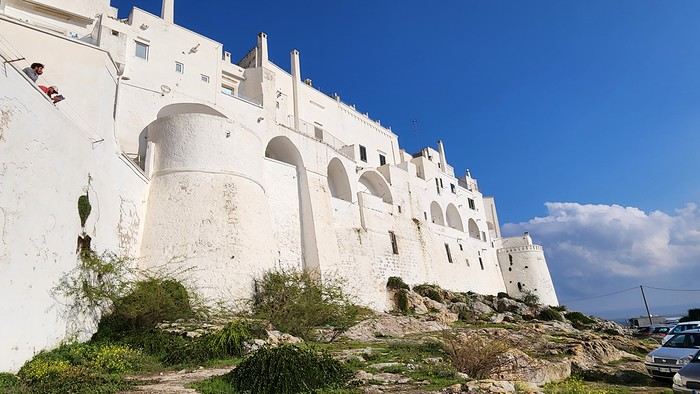
We arrived late last night, so only the two bravest soldiers volunteered to scout ahead at dawn, while the younger recruits stayed behind—for now. But not for long! After the first wave of streets and the next round of exploration, headquarters made the inevitable call to retreat. Reinforcements were needed! A few strategic errands, a breakfast ration, and our battalion marched in tight formation, flag held high, to conquer Ostuni the White! *Charge!* In my squadron leader’s memoirs, I’ll write that I didn’t expect Ostuni to put up such a fight. What I thought would take two hours to conquer turned into a humbling experience—we could only bow in respect to its beauty, its relentless charm. The alleys are whiter, more labyrinthine, narrower, and more photogenic than the last. *Veni, vidi, vici*—but what an entrance, my troops!
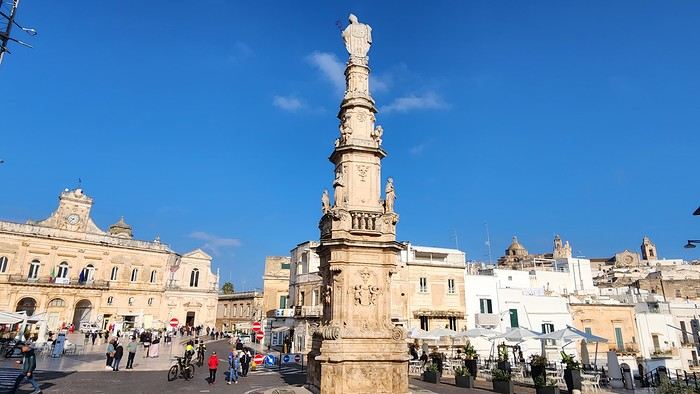
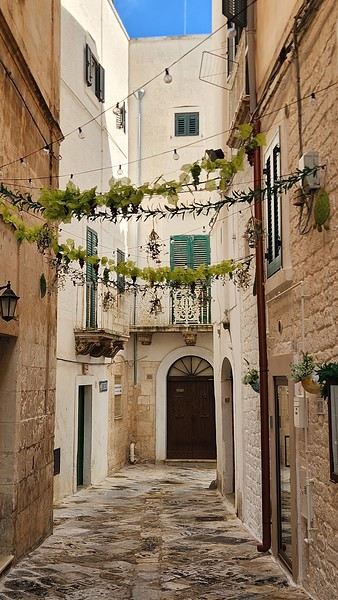
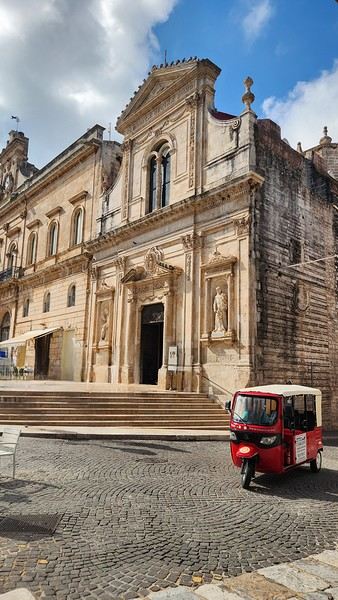
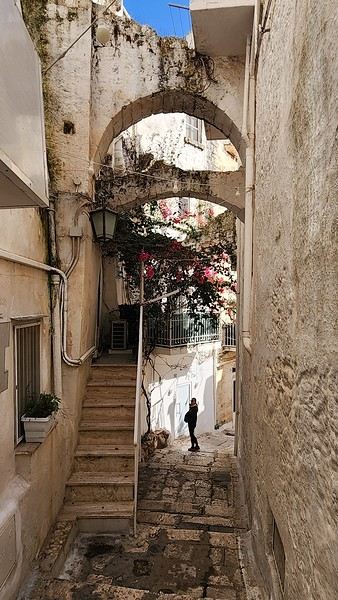
After wrapping up our travel journal on Java (link below), we’re now diving into our recent adventure in Puglia! Happy reading... Off we go on an adventure in Java (and a bit of Bali) | Travel journal > Indonesia | Voyage Forum
Day 1 - October 19
When you tell your friends and family you’re itching to escape to the other side of the planet to mingle with the Mongols, you can usually expect a barrage of questionable jokes and terrible puns. For this new adventure, it’s a different destination but the same old story—this time, we’re visiting the "pouilleux" (the "scruffy" ones). We’re taking off straight for Puglia! If you need a cheat sheet to remember where this oddly named place is on a world map, just think of it this way: Puglia is the maiden name on the ID card of the heel of the Italian boot! Personally, I prefer to remember it as the land of creamy burrata, the smell of focaccia fresh from the oven, orecchiette shaped by mamas, golden olive oil that shines like the sun (which beams down here 300 days a year), amaretto that makes you happy, and those famous trulli—those little hobbit-like dry-stone houses straight out of a movie set...
But I’ll stop spoiling the rest of our trip and focus on a factual rundown of this first Puglian day. So, are you joining us on this new adventure beyond our Gallic borders? Either way, Sasha (my youngest) and Luna (Flo’s daughter) didn’t need much convincing to stick with us and keep up the pace!
Our plane drops our little crew in Bari, the site of a famously tragic battle lost in 1991. But revenge is sweet! After renting a motorized carriage, we escape the landing zone and head to our military base of operations: Ostuni, a strategic little town where we’ll set up camp for the next four days. Why Ostuni? First, for its central location, which lets us explore a region packed with must-see gems. Second, for its vibe and beauty, which have earned it quite the reputation. Perched high on a hill, the *città bianca* (the "White City") lives up to its nickname. It literally dazzles visitors. The reason? The whitewashed facades of its houses, a testament to the region’s rich architectural heritage.
We arrived late last night, so only the two bravest soldiers volunteered to scout ahead at dawn, while the younger recruits stayed behind—for now. But not for long! After the first wave of streets and the next round of exploration, headquarters made the inevitable call to retreat. Reinforcements were needed! A few strategic errands, a breakfast ration, and our battalion marched in tight formation, flag held high, to conquer Ostuni the White! *Charge!* In my squadron leader’s memoirs, I’ll write that I didn’t expect Ostuni to put up such a fight. What I thought would take two hours to conquer turned into a humbling experience—we could only bow in respect to its beauty, its relentless charm. The alleys are whiter, more labyrinthine, narrower, and more photogenic than the last. *Veni, vidi, vici*—but what an entrance, my troops!