Results for "Suisse+normande+|+127"
23112 results found.
Laos: The Most Affordable Destination in 2025
A recent ranking reveals the countries where travel costs the least in 2025. Laos tops the list with a daily budget of just 14 CHF (around 15 €).
💰 A study comparing the average cost of travel in 136 countries, including accommodation, food, and local transportation, highlights the most budget-friendly destinations. Laos ranks first, followed by Kazakhstan (18 €) and Rwanda (20 €).
On the other hand, Caribbean countries are the most expensive, with Barbados leading the way (319 €/day). In Europe, Switzerland and France are among the priciest destinations, at 242 € and 181 € per day, respectively.
Check out the article...
💰 A study comparing the average cost of travel in 136 countries, including accommodation, food, and local transportation, highlights the most budget-friendly destinations. Laos ranks first, followed by Kazakhstan (18 €) and Rwanda (20 €).
On the other hand, Caribbean countries are the most expensive, with Barbados leading the way (319 €/day). In Europe, Switzerland and France are among the priciest destinations, at 242 € and 181 € per day, respectively.
Check out the article...
10 European Carnivals You Shouldn't Miss in 2025 (Venice Excluded)
Europe is packed with spectacular carnivals where traditions and festivities blend in vibrant, colorful parades. In 2025, several must-see events will draw visitors, including:
1. Cologne Carnival (Karneval) in Germany 2. Menton Lemon Festival (Fête du Citron) in France 3. Santa Cruz de Tenerife Carnival in the Canary Islands 4. Binche Carnival in Belgium 5. Nice Carnival in France 6. Cádiz Carnival in Spain 7. Basel Carnival (Fasnacht) in Switzerland 8. Dunkirk Carnival in France 9. Rijeka Carnival in Croatia 10. London Carnival in the UK
A great opportunity to discover unique celebrations without heading to Venice, which is already well-known to the general public. See the slideshow
1. Cologne Carnival (Karneval) in Germany 2. Menton Lemon Festival (Fête du Citron) in France 3. Santa Cruz de Tenerife Carnival in the Canary Islands 4. Binche Carnival in Belgium 5. Nice Carnival in France 6. Cádiz Carnival in Spain 7. Basel Carnival (Fasnacht) in Switzerland 8. Dunkirk Carnival in France 9. Rijeka Carnival in Croatia 10. London Carnival in the UK
A great opportunity to discover unique celebrations without heading to Venice, which is already well-known to the general public. See the slideshow
Where to stay for summer vacation in the Jura?
Hello,
I’m starting to plan my summer vacation.
I’ve decided on the Jura.
I’m looking for a pleasant place to stay for three weeks.
My criteria are a pretty little village, easy hiking opportunities with beautiful viewpoints (around Lake Vouglans or elsewhere), and nice swimming spots.
For info, I’ll be traveling with my wife (no kids).
Thanks for your help—I’m really curious and interested in any tips or advice you can share.
Have a great day,
Thierry
Romania with the wind in my face
Hi there,
In spring 2023, I headed to Romania by motorcycle. I’ve been going there for over 20 years—by car, bike, and plane—and I’ve really fallen for this country. I feel so at home there. The big difference this time? I had all the time in the world, no constraints at all.
I left the Paris region (IDF) and headed for the Sundgau, avoiding the motorways. I know a little hotel tucked away in the countryside there. The next day, I followed the Swiss border on a small road along the Lucelle River, which acts as the frontier. Around a bend, you cross to the other side and then back into France—kind of fun.

I crossed Switzerland via the motorway—I know the route well, so no sightseeing. I arrived in Austria, which I also know pretty well, and took the Arlberg Pass. It was deserted, everything was closed, and there was still snow.

The weather wasn’t great—it was raining—so I stopped for the night at a remote inn. Perfect for drying off! I set off in the rain the next morning and kept going. Gradually, the rain stopped. I took a detour through the Trentino-Alto Adige region and the Sella Pass. Up there, it was rain, snow, and a bit of black ice in a tunnel (wind + rain + sub-zero temps = skating rink).

I arrived in Burgenland to see the famous giant glass-and-metal grape cluster, the largest in Europe. The region is hilly, full of tiny roads, and covered in vineyards.

Burgenland

Then into Slovenia.

I stopped for the night at a winegrower’s B&B perched on a ridge straddling the Croatian border. The welcome was fantastic—I spent the evening with the owners and their friends who arrived later. The white wine was amazing! The next day, I hit the road again.

I headed for Vukovar, on the Danube, a symbol of resistance during the Balkan War. I found a really comfortable B&B by the river and stayed for two nights to explore. What a strange monument!

I visited the water tower, which you can go inside—it’s riddled with bullet holes. There’s an exhibition inside. I also checked out a museum of equipment used during the Balkan War. Since it’s in a barracks, it’s guarded. I asked if I could bring my motorcycle in, and a Croatian officer came to meet me and gave me permission, along with a sticker to put on the bike. I met some fellow bikers from Marseille riding beautiful vintage bikes.

I left Vukovar following the Danube toward Serbia. The rain caught up with me. The roads were busy, with construction causing mud everywhere and crazy truck drivers. At one point, I cut through the construction zone! I stopped for coffee in a village—it had a *Deliverance* vibe. Total silence when I walked in, and the owner gave me a suspicious look. Finally, the Romanian border... and the sun came out! The Romanian customs officer asked if I had anything to declare. "Yes—just happy to be back in Romania!" I stopped for the night at a *cabana* (mountain hut) lost in the forest. Chaos ensued—a tourist! So they rushed to get supplies, quench my thirst, give me a room, and then the owner took charge: țuică (plum brandy), omelette, beers... Everyone bent over backwards to make me happy.
I love these Romanian roads!


I passed through Băile Herculane, which isn’t as beautiful as it once was—everything’s run-down. What are they waiting for to restore this *Mittel Europa*-style spa town that’s still active?
I stopped at the birthplace of Constantin Brâncuși.

Keep your eyes peeled on the roads!

Via the Jiu Valley, I arrived in Craiova to visit my in-laws. A few days of laughs and outings. I picked up my wife at the airport.
My favorite brand

We took a trip to Horezu, a village famous for its beautiful ceramics.


After those few days together, I dropped my wife off at the airport, and the next day, I set off for Dobrogea, a region split in two after the war with Bulgaria. The road was dull—flat as far as the eye could see—but the sun was out. I followed a military convoy of about fifty vehicles, with orders not to overtake. I stopped by the roadside for some homemade *ciorbă* (sour soup). That evening, I stopped in Călărași. The next day, I crossed the Danube by ferry. There are two ferries—one goes to Bulgaria, the other stays in Romania.

A priest on board came over to bless the motorcycle, the rider, and the ferry. I arrived on the other side with some traffic. Dobrogea

It’s like that all the way to the Bulgarian border—no restaurants, hotels, or gas stations, just old collective farms. And it’s the same in Bulgaria! I stopped at Adamclisi, site of a major battle in Moesia (now Dobrogea) in 101–102 BC, one of Trajan’s most important Dacian Wars.

An oasis in the agricultural steppe.

I arrived at the Bulgarian border.

A customs officer—built like a weightlifter, shaved head, thick neck, and as square as a truck—saw me take this photo and came over to ask me to delete it. I did... but I didn’t empty the trash! The weather turned stormy. I arrived in Balchik, a resort town where the last queen of Romania, Maria, used to vacation.
The Black Sea and the Bulgarian coast

The weather wasn’t great, so I headed back to Romania to follow the coastline. Constanța and its casino

Then came the seaside resorts—just as ugly as each other: Neptun, Mangalia, Eforie Nord, Eforie Sud. I stopped at a B&B near the Danube Delta, in some random village. The welcome was nice. The next day, I headed for Dunavățu de Jos, the last stretch of tarmac in Romania. After that, it’s the Danube Delta. The area is flat and sandy, with typical houses featuring reed roofs.

Now, I’m following the Ukrainian border. I passed the last active quarantine station in Europe. I came across a funeral procession—it’s customary to honk as you pass. If you’re on foot, you cross yourself. When I arrived in Galați, it was raining. I boarded the ferry in a downpour. On board, we were packed in like sardines. As soon as the ramp hit land, the drivers rushed out, revving their engines and honking. I let them go and exited calmly. I continued toward the Székely Land. These are Hungarians who, back in the day, were border guards for the king. They’ve kept their own script (it looks like runes), their flag, and their independence streak. For them, Romania is Hungarian, despite the Treaty of Sèvres in 1920. There are still clashes between Romanians and Székely Hungarians now and then. Since I speak a bit of Romanian, I used it—logical, since it’s the language there—and it put everyone in a good mood! Székely flag

I passed through Bicaz Chei, arriving via one of my favorite kinds of roads. During a break, a bear came to check me out from a distance.

Bicaz Chei

I arrived at the "Heart of Jesus" monument, built by public subscription to thank God for sparing the village from severe flooding.

Now, I’m heading west—next stop, Transylvania, with the in-laws. On the road

Roma house

Bozorka—a Hungarian specialty... 450 grams of meat!
I made it back to France without any issues, already thinking about my next trip. Actually, I just got back from one!
I left the Paris region (IDF) and headed for the Sundgau, avoiding the motorways. I know a little hotel tucked away in the countryside there. The next day, I followed the Swiss border on a small road along the Lucelle River, which acts as the frontier. Around a bend, you cross to the other side and then back into France—kind of fun.
I crossed Switzerland via the motorway—I know the route well, so no sightseeing. I arrived in Austria, which I also know pretty well, and took the Arlberg Pass. It was deserted, everything was closed, and there was still snow.
The weather wasn’t great—it was raining—so I stopped for the night at a remote inn. Perfect for drying off! I set off in the rain the next morning and kept going. Gradually, the rain stopped. I took a detour through the Trentino-Alto Adige region and the Sella Pass. Up there, it was rain, snow, and a bit of black ice in a tunnel (wind + rain + sub-zero temps = skating rink).
I arrived in Burgenland to see the famous giant glass-and-metal grape cluster, the largest in Europe. The region is hilly, full of tiny roads, and covered in vineyards.
Burgenland
Then into Slovenia.
I stopped for the night at a winegrower’s B&B perched on a ridge straddling the Croatian border. The welcome was fantastic—I spent the evening with the owners and their friends who arrived later. The white wine was amazing! The next day, I hit the road again.
I headed for Vukovar, on the Danube, a symbol of resistance during the Balkan War. I found a really comfortable B&B by the river and stayed for two nights to explore. What a strange monument!
I visited the water tower, which you can go inside—it’s riddled with bullet holes. There’s an exhibition inside. I also checked out a museum of equipment used during the Balkan War. Since it’s in a barracks, it’s guarded. I asked if I could bring my motorcycle in, and a Croatian officer came to meet me and gave me permission, along with a sticker to put on the bike. I met some fellow bikers from Marseille riding beautiful vintage bikes.
I left Vukovar following the Danube toward Serbia. The rain caught up with me. The roads were busy, with construction causing mud everywhere and crazy truck drivers. At one point, I cut through the construction zone! I stopped for coffee in a village—it had a *Deliverance* vibe. Total silence when I walked in, and the owner gave me a suspicious look. Finally, the Romanian border... and the sun came out! The Romanian customs officer asked if I had anything to declare. "Yes—just happy to be back in Romania!" I stopped for the night at a *cabana* (mountain hut) lost in the forest. Chaos ensued—a tourist! So they rushed to get supplies, quench my thirst, give me a room, and then the owner took charge: țuică (plum brandy), omelette, beers... Everyone bent over backwards to make me happy.
I love these Romanian roads!
I passed through Băile Herculane, which isn’t as beautiful as it once was—everything’s run-down. What are they waiting for to restore this *Mittel Europa*-style spa town that’s still active?
I stopped at the birthplace of Constantin Brâncuși.
Keep your eyes peeled on the roads!
Via the Jiu Valley, I arrived in Craiova to visit my in-laws. A few days of laughs and outings. I picked up my wife at the airport.
My favorite brand
We took a trip to Horezu, a village famous for its beautiful ceramics.
After those few days together, I dropped my wife off at the airport, and the next day, I set off for Dobrogea, a region split in two after the war with Bulgaria. The road was dull—flat as far as the eye could see—but the sun was out. I followed a military convoy of about fifty vehicles, with orders not to overtake. I stopped by the roadside for some homemade *ciorbă* (sour soup). That evening, I stopped in Călărași. The next day, I crossed the Danube by ferry. There are two ferries—one goes to Bulgaria, the other stays in Romania.
A priest on board came over to bless the motorcycle, the rider, and the ferry. I arrived on the other side with some traffic. Dobrogea
It’s like that all the way to the Bulgarian border—no restaurants, hotels, or gas stations, just old collective farms. And it’s the same in Bulgaria! I stopped at Adamclisi, site of a major battle in Moesia (now Dobrogea) in 101–102 BC, one of Trajan’s most important Dacian Wars.
An oasis in the agricultural steppe.
I arrived at the Bulgarian border.
A customs officer—built like a weightlifter, shaved head, thick neck, and as square as a truck—saw me take this photo and came over to ask me to delete it. I did... but I didn’t empty the trash! The weather turned stormy. I arrived in Balchik, a resort town where the last queen of Romania, Maria, used to vacation.
The Black Sea and the Bulgarian coast
The weather wasn’t great, so I headed back to Romania to follow the coastline. Constanța and its casino
Then came the seaside resorts—just as ugly as each other: Neptun, Mangalia, Eforie Nord, Eforie Sud. I stopped at a B&B near the Danube Delta, in some random village. The welcome was nice. The next day, I headed for Dunavățu de Jos, the last stretch of tarmac in Romania. After that, it’s the Danube Delta. The area is flat and sandy, with typical houses featuring reed roofs.
Now, I’m following the Ukrainian border. I passed the last active quarantine station in Europe. I came across a funeral procession—it’s customary to honk as you pass. If you’re on foot, you cross yourself. When I arrived in Galați, it was raining. I boarded the ferry in a downpour. On board, we were packed in like sardines. As soon as the ramp hit land, the drivers rushed out, revving their engines and honking. I let them go and exited calmly. I continued toward the Székely Land. These are Hungarians who, back in the day, were border guards for the king. They’ve kept their own script (it looks like runes), their flag, and their independence streak. For them, Romania is Hungarian, despite the Treaty of Sèvres in 1920. There are still clashes between Romanians and Székely Hungarians now and then. Since I speak a bit of Romanian, I used it—logical, since it’s the language there—and it put everyone in a good mood! Székely flag
I passed through Bicaz Chei, arriving via one of my favorite kinds of roads. During a break, a bear came to check me out from a distance.
Bicaz Chei
I arrived at the "Heart of Jesus" monument, built by public subscription to thank God for sparing the village from severe flooding.
Now, I’m heading west—next stop, Transylvania, with the in-laws. On the road
Roma house
Bozorka—a Hungarian specialty... 450 grams of meat!
I made it back to France without any issues, already thinking about my next trip. Actually, I just got back from one!
Cycling the Douro (Portugal) by bike
Hi there!!
We’re planning a bike trip down the Douro from the Spanish border to Porto in May 2025. We’re looking for any info on possible routes and trails, as well as camping options and/or homestays. Thanks so much!!
We’re planning a bike trip down the Douro from the Spanish border to Porto in May 2025. We’re looking for any info on possible routes and trails, as well as camping options and/or homestays. Thanks so much!!
Eastern Crete in September 2024
Travel journal in Eastern Crete from September 8th to 29th, 2024
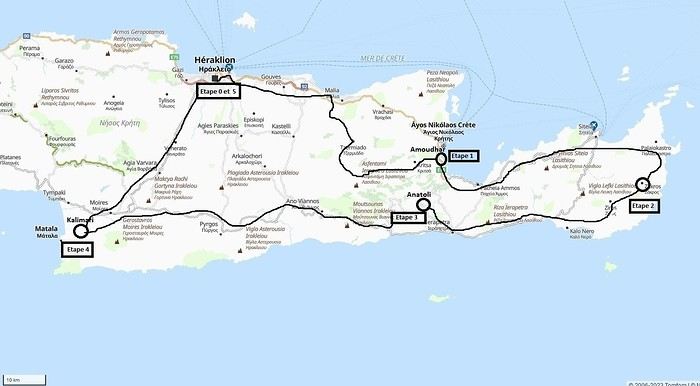 Our 21-day itinerary
Sunday, 08/09: Once again—and this is the eighth time—we’re setting off, the four of us: Patrick, Michelle, Jacques, and Monique, for the Greek islands. This time, we’ve chosen Crete. No need to wake up at 3 or 4 a.m. to reach Basel-Mulhouse Airport at dawn to catch the first flight to Greece at 6 a.m.! Given the prohibitive prices charged by EasyJet, we found flights that were half the price from Zurich Airport, which is accessible in 3 hours by train from Colmar. Pierre-Paul drives all four of us to Colmar train station, where we take the train to Basel and then, 20 minutes later, the direct train to Zurich Airport. After wandering around the airport, we go for a coffee at 6 € each! We’re in Switzerland, after all. The other dining areas all have vending machines for selecting and paying for meals—soon, there won’t be anyone left to serve you! After a short wait, we take off at 7:45 p.m. (20 minutes late) in an Aegean Airbus A321. Free in-flight meal service isn’t bad either! We land in Heraklion around 11:15 p.m. We pick up our rental car (a red Seat Ibiza) at the airport and head straight to our apartment, located 2 km from the city center. Thanks to the GPS, we find it quickly. It’s a beautiful, fully renovated apartment with all the comforts and well-equipped. On the table, there’s wine, bottles of water, jam, coffee, etc. Given the late hour, we won’t stay up long.
Monday, 09/09: To enhance our breakfast, Michelle and Monique set off to find a bakery nearby. They return with croissants and donuts—yum... Then we head to the west coast. The highway follows the coastline, but we prefer taking the old road to Malia, our first stop. We visit the major archaeological site of this Minoan city under the hot sun. The site covers a vast area, but the ruins aren’t very evocative except for a few beautiful amphorae scattered around. The explanations in a small house at the entrance are interesting and help us better understand the organization of the ancient city with its different districts. From there, we head toward the nearby mountains to see the thousand-year-old plane tree in the village of Krasi. We take the opportunity to enjoy an excellent lunch of moussaka and delicious gemista at the Krassopsychia taverna in the village center. Pleasant surprise: the prices are still reasonable, with a bill of 70 € for four, including wine and water. The friendly tradition of complimentary dessert and glasses of raki continues—great! We’ve set the bar high right away! Let’s hope the rest lives up to it! On the way back toward the Lassithi Plateau, we stop at the Kardiotisa Monastery perched high on the mountain to enjoy a magnificent view of the entire region. Just a little further, we arrive at the Lassithi Plateau: the presence of small windmills used to pump water from the ground is the typical feature of this plateau. We complete a full loop around the plateau, passing by numerous orchards and vegetable gardens that occupy the entire space. At the end of the plateau, we once again cross mountain passes via winding roads that bring us near Agios Nikolaos. Our apartment is located about ten kilometers further south in Amoudhara. The owner, who was notified, waits for us and shows us her superb apartment, whose large terrace overlooks the entire Mirabello Bay. She then gives us valuable information about the different beaches in the area. Dinner will be frugal, given our hearty lunch in Krasi!
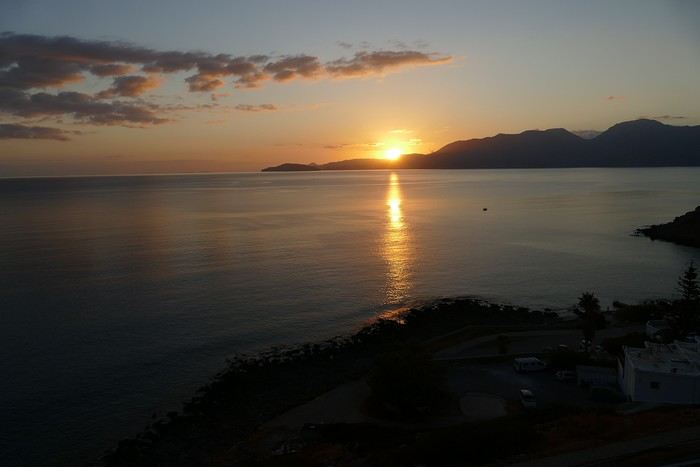 Sunset over Mirabello Bay
Tuesday, 10/09: A bit of a gray sky when we wake up around 8 a.m., but the sun will soon triumph over the scattered clouds. For our first swim, we opt for Voulisma Beach, even though our host warned us it was a bit “crowdy.” That’s understandable given the beautiful emerald color of the sea and the lovely curve of the beach. To avoid the big crowds, we move toward the eastern part of the beach, accessible via a steep staircase. The water is very warm, and this first dip is very pleasant. Before returning to the apartment, we stop at the bakery to buy spinach pies, essential ingredients to accompany our Greek salad for lunch. Of course, everything will be washed down with ouzo, which will remain our favorite drink for the next three weeks—but in moderation!!! A nap is in order after all that effort. In the late afternoon, we drive to Agios Nikolaos, the main seaside resort in Crete. We’re not too enthusiastic about visiting this mass-tourism resort, but the center of Agios, concentrated around the small inner harbor, is pleasant to see despite the plethora of shops and restaurants. We dine a little outside the harbor in the shaded courtyard of the Avli taverna: the oven-baked lamb, squid with spinach, and cuttlefish ink orzo pasta are all highly appreciated. We still stay under a 75 € bill for four.
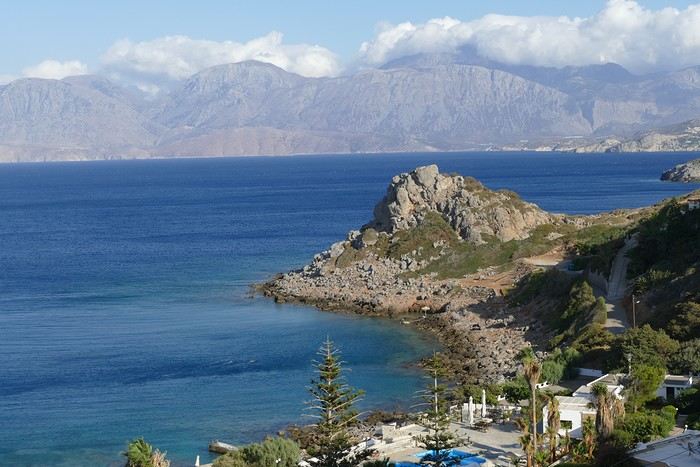 Mirabello Bay seen from our terrace
Wednesday, 11/09: At 8 a.m., the terrace is already bathed in sunlight, and it’s already quite hot. The small parasol barely gives us enough shade, but we’re not complaining! For our second swim, we head to a tiny beach recommended by our host, just 3 minutes by car from our place. The path leading to it is very discreet, and we don’t find it right away! It’s a small sandy cove with a few welcome tamarisk trees for shade. When we arrive, there are two swimmers, and there won’t be more than five or six in the morning. After lunch and a nap, we head to the beautiful village of Kritsa, just a few kilometers away. It’s too late to visit the beautiful church of Kera Panagia, which is already closed. We settle for the exterior, which is worth a look. The weather is clouding over, and big clouds are gathering. Upon arriving in Kritsa, a heavy shower forces us to take shelter in the Platanos taverna in the village center, and since it’s nearly 7 p.m., we decide to stay and dine there. Good choice—excellent meze: croquettes and stuffed zucchini flowers, gigantes beans, grilled tomatoes and feta, and pancetta as the main dish. The rain stops just as we decide to head back.
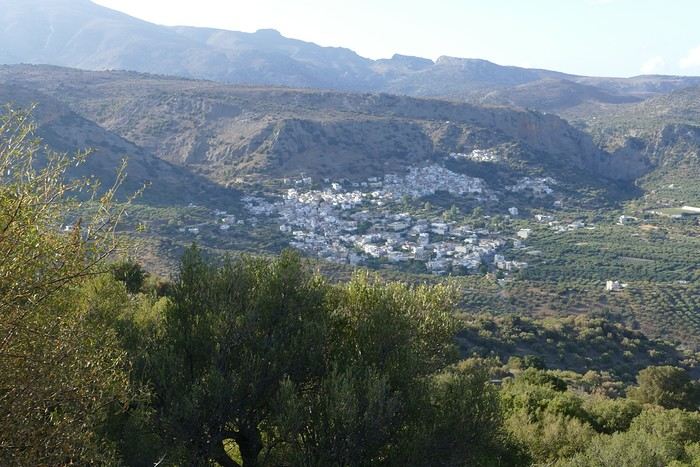 Village of Kritsa
Thursday, 12/09: Our terrace faces east, so we get to watch the sunrise around 7 a.m.—it’s truly a beautiful sight we never tire of. Around 9 a.m., we head to the village of Plaka, where boats depart for the island of Spinalonga, located north of Agios Nikolaos. We board the first boat, which sets sail at 10 a.m., and we’re not alone—the boat is practically full. After 10 minutes, we land on the island at the same time as several other boats from Elounda or Agios. Needless to say, there are already quite a few people walking through the streets of the leper village. The visit remains interesting and moving as we read the explanatory panels recounting the island’s history under Byzantine and then Turkish rule, followed by its transformation into a leper colony. As soon as we climb toward the top of the island via more or less maintained paths, there’s almost no one left. The 360° view from up there is stunning.
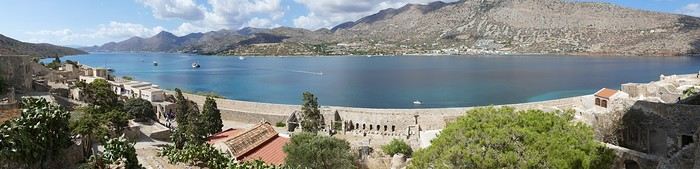
Spinalonga Island
The heat is now unbearable, and we can’t wait to get back home to have lunch on our terrace and rest. In the late afternoon, we go grocery shopping at the AB supermarket at the entrance of Agios. We had spotted another nice restaurant in our guide, but unfortunately, there’s a different one at the indicated location that doesn’t inspire us. So, we return to the Avli taverna for another dinner just as good as the first.
Friday, 13/09: We repeat yesterday’s successful program: a swim in our little cove, lunch on the terrace, a nap, and then, in the late afternoon, we discover another nearby village, Kroustas, nestled in the olive groves near Kritsa. Much less touristy than Kritsa, it’s mostly inhabited by locals, especially the elderly who are enjoying the cool air on their chairs—if you can call it cool given the still-high temperatures in the late afternoon! We then return to visit Kritsa, which we hadn’t been able to explore due to the rain. Dinner at a taverna in the village center at a very reasonable price.
Saturday, 14/09: Today, we move to our new base further east. We start with a high viewpoint at the Faneromeni Monastery, which overlooks Mirabello Bay. The monastery itself is of little interest as it’s under renovation with excessive concrete work. We continue to the village of Kavoussi to see another exceptional tree after a few kilometers on a dusty, bumpy track. It’s an olive tree said to be about 3,200 years old—impressive, and the countryside is very beautiful. It’s time to find a place for lunch. We find one in the charming little port of Mohlos, where a few tavernas surround a very nice small beach. Our choice falls on the Bogazzi taverna, where we enjoy fried fish. To reach our new base in Zakros, we still have to drive through the mountains before reaching Sitia, Paleokastro, and finally Zakros. The region is beautiful, with olive groves and rows of wind turbines taking advantage of the strong wind near the northern tip of the island. In Zakros, we’re greeted by our very friendly host. Here too, we have all the comforts and a beautiful terrace overlooking the village. The apartment has reversible air conditioners, but the overly simple instructions leave us puzzled. Thinking we’ve set it correctly, we realize a little too late that it’s blowing hot air over 30°C! After numerous attempts and testing several confusing programs, we finally succeed! Dinner on our new terrace.
Sunday, 15/09: This morning, we get up early to hike in the “Gorge of the Dead” while it’s still cool. The sky is blue as usual! We park in the nearest parking lot and start our descent via a beautiful path winding through the olive groves. A little further on, the landscape opens up, and the path, now a stony trail, begins the descent to the dry riverbed. On either side of the riverbed rise beautiful reddish cliffs.
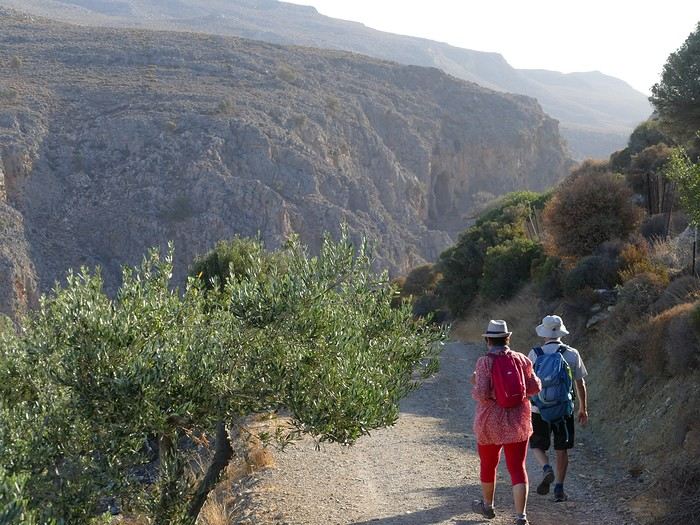
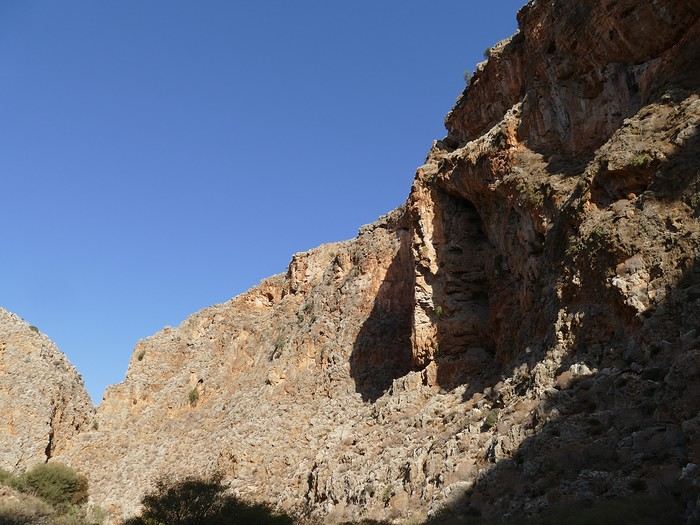
Gorge of the Dead
The trail winds its way through this narrow gorge with difficulty. It was in the many caves visible halfway up the slope that the Minoans buried their dead, hence the name “Gorge of the Dead.” The gorge opens onto a beautiful small pebble beach. A swim is welcome after this hike that made us sweat. The hike took us 1 hour and 25 minutes, and a little less on the way back. Meanwhile, Monique did some shopping and prepared an excellent lunch. In the late afternoon, we go down to dine at Platanakis, a taverna in the small village of Kato Zakros.
Monday, 16/09: This morning, we explore the northern part of the east coast near Palekastro. We start with a dip at the beautiful Hionia Beach near Palekastro. The water is still just as nice, but a light breeze is blowing—not enough to spoil our fun! Seeing all the wind turbines lining the ridges, it’s no surprise.
 Grocery shopping in Palekastro and return to Zakros. A little rain in the late afternoon and an excellent dinner at Iannis Mitsakakis’ Taverna in Adravastis. These are the kind of small tavernas we love—unpretentious, a few tables on a terrace, a warm welcome, a short menu guaranteeing freshness, tasty dishes prepared by the server’s mom, and a light bill. What more could you ask for!
Tuesday, 17/09: We head back toward Palekastro to do some shopping, but it’s also the road to the Toplou Monastery. There, we see a collection of magnificent icons dating from the 15th to the 20th century. We can also admire drawings of Orthodox religious architecture. We continue toward the Mavros Akrotiri headland to enjoy the view of the sea and rocky capes. On the way back to our place, we make a small detour to see the famous Vai palm grove. Meh... As for Vai Beach, it’s filled with paid umbrellas and sunbeds, and there are so many people that we flee. Plus, having to pay for parking is another reason to snub this trendy beach. We prefer our Hionia Beach, which we already appreciated the other day. In the late afternoon, Pat and I start the trail that begins at Kato Zakros Beach heading south. The poorly marked path crosses a plateau of sharp limestone. The paint and cairn markings are no longer very visible, and with dusk approaching, we turn back toward Kato Zakros. Dinner at the Platanakis taverna—less good than last time.
Wednesday, 18/09: To avoid the scorching sun, Pat, Mimi, and I get up earlier than usual to hike the Hohlakies Gorge. At this early hour, the sky is quite cloudy, and it’s drizzling. When we arrive in the village of Hohlakies, we park in front of a small chapel, the start of the hike. The sky is now completely clear. The trail starts among the olive groves, then after passing through a gate, we descend into the gorge filled with large rocks. We’re alone in the world, and the landscape is magnificent. A few wild goats clinging to the cliff watch us from above. After 1 hour and 15 minutes, we emerge onto the wonderful Karoumès Beach. A pleasant swim, then back to civilization! A walk in the late afternoon in Zakros to discover the beautiful springs route. Dinner in Adravastis.
Thursday, 19/09: Another move: Before heading to our next stop, we make a detour to see the beautiful Keratokampos Beach and can’t resist a swim in the still-warm, clear water. We continue our journey via Ziros, then reach the south coast and have lunch at the Stephi taverna in Ferma—excellent meal! The south coast is quite urbanized and has much less charm than the east coast we’ve just left! The numerous plastic greenhouses are partly to blame. We stop for groceries in Ierapetra. Around 3 p.m., we arrive at our destination in the small perched village of Anatoli. Our lodging is at the top of the village, and from the path leading to it, we have a magnificent view of the coastal plain, unfortunately overloaded with plastic greenhouses. It reminds us of the landscapes of El Ejido in Andalusia.
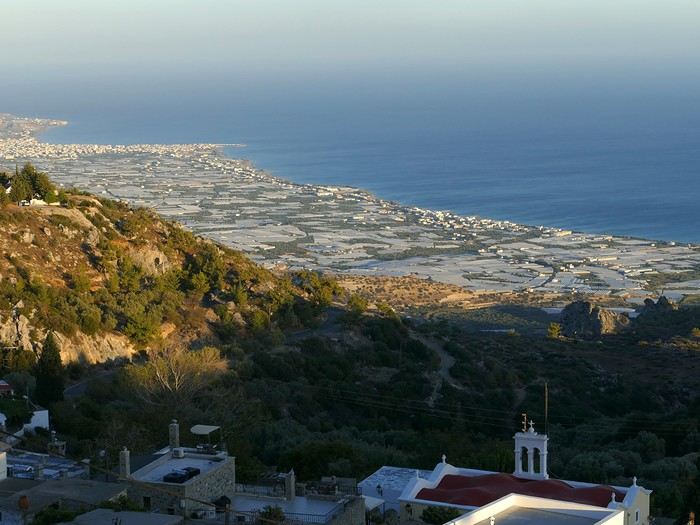 View of the Ierapetra coast from Anatoli
Friday, 20/09: A walk and discovery of the hamlet of Anatoli. There are few services—a tiny grocery store, a taverna, and that’s it. Fortunately, the traveling baker arrives and honks. We take the opportunity to buy fresh bread. Leaving the village, we take a path that should lead us to the hamlet of Drygies. The landscape is beautiful. We walk through a lovely pine forest before arriving at the hamlet. The path continues to a taverna that’s closed today, with a superb terrace overlooking the coast. Luckily, the owner arrives and informs us that the taverna will be open next Sunday and that we can enjoy barbecued meat. Noted! We head back to Anatoli via the small paved road with, fortunately, very limited traffic. Lunch on our terrace, then a dip in our private pool! The water is noticeably cooler than at the beach. Dinner at the village taverna: there’s only one menu—meze starters, souvlaki, water, wine, and bread—all for 35 €! We think we’re dreaming—was there a mistake? No.
Saturday, 21/09: We discover the beach of the village of Myrtos, a small seaside resort that’s quite touristy but on a human scale. We swim in the western part of the beach, and once again, we’re alone in the water. The best part: warm water and tamarisk trees for welcome shade. There’s even a shower to rinse off! In the late afternoon, Pat and I decide to go for a hike in the Selakano pine forest. To get there, we take a narrow, winding, and poorly paved road after the village of Christos. Plus, at this altitude, we encounter clouds clinging to the mountain, so it’s drizzling, and visibility is reduced. We decide to turn back and return to Anatoli. As compensation, we take the path that passes in front of the lodging and leads us to the Timios Stavros chapel, which crowns the summit of the nearby mountain. We arrive at the summit just in time for the sunset at 7 p.m. Breathtaking 360° panorama and magnificent colors!
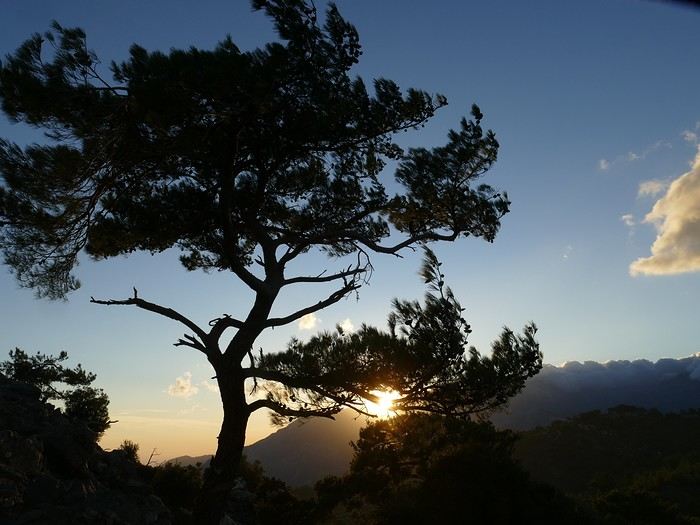 Sunset from Anatoli
Sunday, 22/09: This morning, Pat, Mimi, and I go for a hike in the Sarakina Gorge, located about 12 km from Anatoli via a beautiful road winding through irrigated olive groves. We park in the small parking lot before the trail. At the start, the path follows a levada (small irrigation canal) and quickly enters a very narrow gorge flanked by high cliffs. The riverbed is cluttered with huge rocks blocking the passage. No matter—in the technical sections, ropes or ladders allow us to overcome these obstacles with a bit of skill. You can imagine how quickly the riverbed must rise during a storm, given the narrowness of the gorge!
We progress slowly through this magnificent and impressive rocky chaos. At the exit of the gorge, we take another return path that partly follows the paved road. Back in Anatoli, we go to lunch at the Drygies taverna. We sit at the edge of the terrace under a huge tree that covers almost the entire terrace and order grilled lamb dishes prepared according to the ancient “antikristo” method.
Monday, 23/09: Departure for our last stop before Heraklion. We thought about swimming at Tertsa Beach, but it turns out to be less pleasant than expected, with pebbles and an uneven rocky plateau. So, we return to Myrtos Beach, which we know well and suits us perfectly. We head west, leaving the coast a bit. Around 3:30 p.m., we arrive at our destination in the village of Kamilari, near the famous Matala spot. We’ve rented a beautiful, modern, well-equipped apartment with a lovely shaded terrace. The owner is very friendly and explains everything necessary for a good stay. We explore the quite touristy village with its few tavernas, all full of tourists, mostly Germans.
Tuesday, 24/09: Visit to the village of Sivas, well restored thanks to the Germans, who have invested a lot here. We take the opportunity to scout out “friendly” tavernas, then go for a swim at Kalamaki Beach. Apart from a small sandy access, you have to enter the water via a chaotic limestone plateau—proof of this is that Monique trips slightly when entering the water. A group of very unfriendly German women blocks the sandy passage and doesn’t hesitate to push swimmers they deem too close. Back home, lunch, and a nap. In the late afternoon, we drive to visit the nearby Phaistos site. We benefit from very beautiful lighting. From the elevated site, we overlook the Messara Plain with a beautiful view of the olive grove checkerboards highlighted by the late afternoon sun. The site itself is quite vast, but to appreciate it, it’s better to read the explanatory panels placed throughout the different quarters. At this hour, the site is almost empty, and the beautiful light adds charm to the visit.
Wednesday, 25/09: Departure for the village of Matala, which doesn’t interest us in itself, having been there during the “hippie” era in 1976. However, going to Red Beach, only accessible by taking a path overlooking this area, appeals to us much more. We park in the large parking lot just outside the village and start our climb, which brings us to a pass from where we can admire this beautiful red-sand beach framed by beautiful cliffs plunging into the sea. The weather is magnificent, and at this early hour, there aren’t many people yet. We swim in the free part located near the cliff on the right when arriving at the beach. The sea is like glass, warm, and without a single ripple—a real treat! After half an hour, we turn back, and now there are many people rushing on this path, not at all made for feet in sandals or flip-flops, yet many vacationers venture out like this! Matala lives up to its image—a trendy place, full of shops, bars, and restaurants. You could be in any seaside resort with a standard global urbanism, lacking particular charm. Back home. In the late afternoon, a walk through the olive groves surrounding Kamilari, then dinner at Evangelina’s, who runs the Minoan Parassies taverna in the middle of the olive groves. Evangelina is quite a character: we came to reserve a table for 8 p.m. when it was only 7 p.m., but since we lingered near her restaurant, she prepares a table for us and urges us to sit down! And there she takes our order, and a little later, the meze arrive, followed by the main dishes. We finish this good dinner with several generous glasses of raki, accompanied by Evangelina’s encouragements, repeating “poya poya bravo bravo” in a loop. We’re in great shape too, by the way! We return in the middle of the night, on foot, fortunately, with the path vaguely lit by our phones...
Thursday, 26/09: This morning, we discover a new beach, Kommos Beach, not far from Kamilari either. It’s a long sandy beach, a small part of which is dedicated to paid umbrellas and sunbeds, and the rest is free. We spot a tamarisk tree to take shelter from the still-hot sun, and once again, we enjoy clear, warm water. The few swimmers spread out easily over nearly 500 meters of beach. In the late afternoon, Pat and I go to admire the sunset from the hill near our lodging. The hill, covered with olive trees, is threatened by a planned housing development of large cubic villas—trends dictate. Concrete never stops...
Friday, 27/09: We thought about leaving the car at the Odiyitria Monastery, the end of the paved road, but since the track descending to the cave remains drivable, we park 3 km further at the junction of the track leading to Kali Limenes Beach. We still have to walk for half an hour on a less drivable track, and then we’re at the entrance of the Farango Gorge. It’s a beautiful, easy hike since we follow the dry pebble riverbed. Before arriving at the beach, there’s a very beautiful small chapel sheltered under a large cliff, beautifully lit at this early hour.
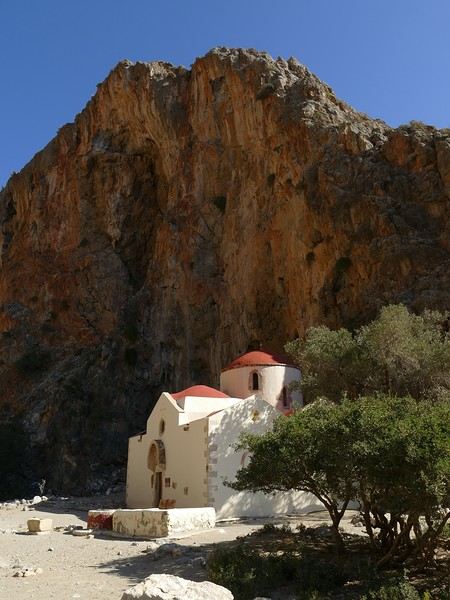
Agio Farango Chapel
A few climbers are scaling the cliff, and about ten swimmers are enjoying the sea. Return to the car under the hot sun. In the late afternoon, we all return to visit the interesting Odiyitria Monastery. Last swim at Kommos Beach and an excellent dinner at the Sigelakis taverna in Sivas.
Saturday, 28/09: There’s an end-of-vacation atmosphere... We pack our bags and head north. A short stop to see the village of Vorri, and a little over an hour later, we arrive in the big city of Heraklion. Since it’s too early to check into the apartment, we park in the city center to visit the famous archaeological museum. It’s indeed a must-see highlight of our stay in Crete. All four of us are amazed by the quantity and quality of the objects presented from the Minoan civilization. After more than 2 hours, we come out without having seen everything, but we’re a bit overwhelmed by all these wonders. Lunch at a nice little taverna very close to the Titus Church. We go to take possession of our apartment—the same as on the way there, still just as satisfying. In the late afternoon, I go alone for a walk in the historic district of the city, passing by the Morosini Fountain, which is bustling with people—some seated at café terraces, others standing and chatting. There’s a lively atmosphere here. A little further on are the Venetian loggia and the Agios Titos Church. I walk down to the old Venetian port to stroll along the jetty and admire the fortifications under beautiful late-afternoon lighting, then return to the apartment. Dinner near our place at Kiriakis, a “chic” restaurant but with very reasonable prices and excellent cuisine.
Sunday, 29/09: Wake-up at 3:30 a.m., quick coffee, and drive to the nearby airport. We leave the car in the parking lot. Already a lot of people at this early hour. Since we don’t have checked luggage, we go straight to security, which goes fairly quickly, then it’s waiting time and takeoff on time in an Airbus A321 for a 45-minute flight to Athens. We take off again in another Airbus A321 with a 50-minute delay to arrive in Zurich at 11:10 a.m. local time. Then we have to take the train to Basel and then the one to Colmar. With fewer Sunday services, we won’t arrive in Colmar until around 4 p.m.
Conclusion All four of us returned very satisfied with this stay in Crete for several reasons: - We found superb beaches with clear, warm water and often very few vacationers. - The few hikes we did were magnificent, especially those where the trails went through gorges leading to deserted beaches. - We greatly appreciated Cretan gastronomy—there were so few disappointments that we can count them on one hand. - All the accommodations we booked turned out to be superb, with the icing on the cake being the very friendly welcome from our hosts. - Generally, contacts with Cretans were always very warm despite the language barrier—we speak a little Greek. - We also appreciated the diversity of landscapes in this eastern part of Crete, with plateaus and mountains with splendid rugged reliefs.
Note: The photo album is available by clicking on this link: https://photos.app.goo.gl/hfdjQndA5eXkL5k7 Captions are only visible per photo by clicking on the circled “i” in the top right. Budget: approximately 3,300 € per couple for 21 days, including train and flights Budget details per couple: - Flight Zurich-Heraklion: 440 € - Trains Colmar-Basel-Zurich round trip for 4: 442.40 € (221 € per couple) - Accommodation: 2,431 € / 21 = 115.80 € per night for 4 (1,216 € per couple) - Car rental for 21 days: 684 € + 145 € fuel (1,150 km) (414 € per couple) - Restaurants, food, etc.: 1,009 €
Our 21-day itinerarySunday, 08/09: Once again—and this is the eighth time—we’re setting off, the four of us: Patrick, Michelle, Jacques, and Monique, for the Greek islands. This time, we’ve chosen Crete. No need to wake up at 3 or 4 a.m. to reach Basel-Mulhouse Airport at dawn to catch the first flight to Greece at 6 a.m.! Given the prohibitive prices charged by EasyJet, we found flights that were half the price from Zurich Airport, which is accessible in 3 hours by train from Colmar. Pierre-Paul drives all four of us to Colmar train station, where we take the train to Basel and then, 20 minutes later, the direct train to Zurich Airport. After wandering around the airport, we go for a coffee at 6 € each! We’re in Switzerland, after all. The other dining areas all have vending machines for selecting and paying for meals—soon, there won’t be anyone left to serve you! After a short wait, we take off at 7:45 p.m. (20 minutes late) in an Aegean Airbus A321. Free in-flight meal service isn’t bad either! We land in Heraklion around 11:15 p.m. We pick up our rental car (a red Seat Ibiza) at the airport and head straight to our apartment, located 2 km from the city center. Thanks to the GPS, we find it quickly. It’s a beautiful, fully renovated apartment with all the comforts and well-equipped. On the table, there’s wine, bottles of water, jam, coffee, etc. Given the late hour, we won’t stay up long.
Monday, 09/09: To enhance our breakfast, Michelle and Monique set off to find a bakery nearby. They return with croissants and donuts—yum... Then we head to the west coast. The highway follows the coastline, but we prefer taking the old road to Malia, our first stop. We visit the major archaeological site of this Minoan city under the hot sun. The site covers a vast area, but the ruins aren’t very evocative except for a few beautiful amphorae scattered around. The explanations in a small house at the entrance are interesting and help us better understand the organization of the ancient city with its different districts. From there, we head toward the nearby mountains to see the thousand-year-old plane tree in the village of Krasi. We take the opportunity to enjoy an excellent lunch of moussaka and delicious gemista at the Krassopsychia taverna in the village center. Pleasant surprise: the prices are still reasonable, with a bill of 70 € for four, including wine and water. The friendly tradition of complimentary dessert and glasses of raki continues—great! We’ve set the bar high right away! Let’s hope the rest lives up to it! On the way back toward the Lassithi Plateau, we stop at the Kardiotisa Monastery perched high on the mountain to enjoy a magnificent view of the entire region. Just a little further, we arrive at the Lassithi Plateau: the presence of small windmills used to pump water from the ground is the typical feature of this plateau. We complete a full loop around the plateau, passing by numerous orchards and vegetable gardens that occupy the entire space. At the end of the plateau, we once again cross mountain passes via winding roads that bring us near Agios Nikolaos. Our apartment is located about ten kilometers further south in Amoudhara. The owner, who was notified, waits for us and shows us her superb apartment, whose large terrace overlooks the entire Mirabello Bay. She then gives us valuable information about the different beaches in the area. Dinner will be frugal, given our hearty lunch in Krasi!
Sunset over Mirabello BayTuesday, 10/09: A bit of a gray sky when we wake up around 8 a.m., but the sun will soon triumph over the scattered clouds. For our first swim, we opt for Voulisma Beach, even though our host warned us it was a bit “crowdy.” That’s understandable given the beautiful emerald color of the sea and the lovely curve of the beach. To avoid the big crowds, we move toward the eastern part of the beach, accessible via a steep staircase. The water is very warm, and this first dip is very pleasant. Before returning to the apartment, we stop at the bakery to buy spinach pies, essential ingredients to accompany our Greek salad for lunch. Of course, everything will be washed down with ouzo, which will remain our favorite drink for the next three weeks—but in moderation!!! A nap is in order after all that effort. In the late afternoon, we drive to Agios Nikolaos, the main seaside resort in Crete. We’re not too enthusiastic about visiting this mass-tourism resort, but the center of Agios, concentrated around the small inner harbor, is pleasant to see despite the plethora of shops and restaurants. We dine a little outside the harbor in the shaded courtyard of the Avli taverna: the oven-baked lamb, squid with spinach, and cuttlefish ink orzo pasta are all highly appreciated. We still stay under a 75 € bill for four.
Mirabello Bay seen from our terraceWednesday, 11/09: At 8 a.m., the terrace is already bathed in sunlight, and it’s already quite hot. The small parasol barely gives us enough shade, but we’re not complaining! For our second swim, we head to a tiny beach recommended by our host, just 3 minutes by car from our place. The path leading to it is very discreet, and we don’t find it right away! It’s a small sandy cove with a few welcome tamarisk trees for shade. When we arrive, there are two swimmers, and there won’t be more than five or six in the morning. After lunch and a nap, we head to the beautiful village of Kritsa, just a few kilometers away. It’s too late to visit the beautiful church of Kera Panagia, which is already closed. We settle for the exterior, which is worth a look. The weather is clouding over, and big clouds are gathering. Upon arriving in Kritsa, a heavy shower forces us to take shelter in the Platanos taverna in the village center, and since it’s nearly 7 p.m., we decide to stay and dine there. Good choice—excellent meze: croquettes and stuffed zucchini flowers, gigantes beans, grilled tomatoes and feta, and pancetta as the main dish. The rain stops just as we decide to head back.
Village of KritsaThursday, 12/09: Our terrace faces east, so we get to watch the sunrise around 7 a.m.—it’s truly a beautiful sight we never tire of. Around 9 a.m., we head to the village of Plaka, where boats depart for the island of Spinalonga, located north of Agios Nikolaos. We board the first boat, which sets sail at 10 a.m., and we’re not alone—the boat is practically full. After 10 minutes, we land on the island at the same time as several other boats from Elounda or Agios. Needless to say, there are already quite a few people walking through the streets of the leper village. The visit remains interesting and moving as we read the explanatory panels recounting the island’s history under Byzantine and then Turkish rule, followed by its transformation into a leper colony. As soon as we climb toward the top of the island via more or less maintained paths, there’s almost no one left. The 360° view from up there is stunning.
Spinalonga Island
The heat is now unbearable, and we can’t wait to get back home to have lunch on our terrace and rest. In the late afternoon, we go grocery shopping at the AB supermarket at the entrance of Agios. We had spotted another nice restaurant in our guide, but unfortunately, there’s a different one at the indicated location that doesn’t inspire us. So, we return to the Avli taverna for another dinner just as good as the first.
Friday, 13/09: We repeat yesterday’s successful program: a swim in our little cove, lunch on the terrace, a nap, and then, in the late afternoon, we discover another nearby village, Kroustas, nestled in the olive groves near Kritsa. Much less touristy than Kritsa, it’s mostly inhabited by locals, especially the elderly who are enjoying the cool air on their chairs—if you can call it cool given the still-high temperatures in the late afternoon! We then return to visit Kritsa, which we hadn’t been able to explore due to the rain. Dinner at a taverna in the village center at a very reasonable price.
Saturday, 14/09: Today, we move to our new base further east. We start with a high viewpoint at the Faneromeni Monastery, which overlooks Mirabello Bay. The monastery itself is of little interest as it’s under renovation with excessive concrete work. We continue to the village of Kavoussi to see another exceptional tree after a few kilometers on a dusty, bumpy track. It’s an olive tree said to be about 3,200 years old—impressive, and the countryside is very beautiful. It’s time to find a place for lunch. We find one in the charming little port of Mohlos, where a few tavernas surround a very nice small beach. Our choice falls on the Bogazzi taverna, where we enjoy fried fish. To reach our new base in Zakros, we still have to drive through the mountains before reaching Sitia, Paleokastro, and finally Zakros. The region is beautiful, with olive groves and rows of wind turbines taking advantage of the strong wind near the northern tip of the island. In Zakros, we’re greeted by our very friendly host. Here too, we have all the comforts and a beautiful terrace overlooking the village. The apartment has reversible air conditioners, but the overly simple instructions leave us puzzled. Thinking we’ve set it correctly, we realize a little too late that it’s blowing hot air over 30°C! After numerous attempts and testing several confusing programs, we finally succeed! Dinner on our new terrace.
Sunday, 15/09: This morning, we get up early to hike in the “Gorge of the Dead” while it’s still cool. The sky is blue as usual! We park in the nearest parking lot and start our descent via a beautiful path winding through the olive groves. A little further on, the landscape opens up, and the path, now a stony trail, begins the descent to the dry riverbed. On either side of the riverbed rise beautiful reddish cliffs.
Gorge of the Dead
The trail winds its way through this narrow gorge with difficulty. It was in the many caves visible halfway up the slope that the Minoans buried their dead, hence the name “Gorge of the Dead.” The gorge opens onto a beautiful small pebble beach. A swim is welcome after this hike that made us sweat. The hike took us 1 hour and 25 minutes, and a little less on the way back. Meanwhile, Monique did some shopping and prepared an excellent lunch. In the late afternoon, we go down to dine at Platanakis, a taverna in the small village of Kato Zakros.
Monday, 16/09: This morning, we explore the northern part of the east coast near Palekastro. We start with a dip at the beautiful Hionia Beach near Palekastro. The water is still just as nice, but a light breeze is blowing—not enough to spoil our fun! Seeing all the wind turbines lining the ridges, it’s no surprise.
Grocery shopping in Palekastro and return to Zakros. A little rain in the late afternoon and an excellent dinner at Iannis Mitsakakis’ Taverna in Adravastis. These are the kind of small tavernas we love—unpretentious, a few tables on a terrace, a warm welcome, a short menu guaranteeing freshness, tasty dishes prepared by the server’s mom, and a light bill. What more could you ask for!Tuesday, 17/09: We head back toward Palekastro to do some shopping, but it’s also the road to the Toplou Monastery. There, we see a collection of magnificent icons dating from the 15th to the 20th century. We can also admire drawings of Orthodox religious architecture. We continue toward the Mavros Akrotiri headland to enjoy the view of the sea and rocky capes. On the way back to our place, we make a small detour to see the famous Vai palm grove. Meh... As for Vai Beach, it’s filled with paid umbrellas and sunbeds, and there are so many people that we flee. Plus, having to pay for parking is another reason to snub this trendy beach. We prefer our Hionia Beach, which we already appreciated the other day. In the late afternoon, Pat and I start the trail that begins at Kato Zakros Beach heading south. The poorly marked path crosses a plateau of sharp limestone. The paint and cairn markings are no longer very visible, and with dusk approaching, we turn back toward Kato Zakros. Dinner at the Platanakis taverna—less good than last time.
Wednesday, 18/09: To avoid the scorching sun, Pat, Mimi, and I get up earlier than usual to hike the Hohlakies Gorge. At this early hour, the sky is quite cloudy, and it’s drizzling. When we arrive in the village of Hohlakies, we park in front of a small chapel, the start of the hike. The sky is now completely clear. The trail starts among the olive groves, then after passing through a gate, we descend into the gorge filled with large rocks. We’re alone in the world, and the landscape is magnificent. A few wild goats clinging to the cliff watch us from above. After 1 hour and 15 minutes, we emerge onto the wonderful Karoumès Beach. A pleasant swim, then back to civilization! A walk in the late afternoon in Zakros to discover the beautiful springs route. Dinner in Adravastis.
Thursday, 19/09: Another move: Before heading to our next stop, we make a detour to see the beautiful Keratokampos Beach and can’t resist a swim in the still-warm, clear water. We continue our journey via Ziros, then reach the south coast and have lunch at the Stephi taverna in Ferma—excellent meal! The south coast is quite urbanized and has much less charm than the east coast we’ve just left! The numerous plastic greenhouses are partly to blame. We stop for groceries in Ierapetra. Around 3 p.m., we arrive at our destination in the small perched village of Anatoli. Our lodging is at the top of the village, and from the path leading to it, we have a magnificent view of the coastal plain, unfortunately overloaded with plastic greenhouses. It reminds us of the landscapes of El Ejido in Andalusia.
View of the Ierapetra coast from AnatoliFriday, 20/09: A walk and discovery of the hamlet of Anatoli. There are few services—a tiny grocery store, a taverna, and that’s it. Fortunately, the traveling baker arrives and honks. We take the opportunity to buy fresh bread. Leaving the village, we take a path that should lead us to the hamlet of Drygies. The landscape is beautiful. We walk through a lovely pine forest before arriving at the hamlet. The path continues to a taverna that’s closed today, with a superb terrace overlooking the coast. Luckily, the owner arrives and informs us that the taverna will be open next Sunday and that we can enjoy barbecued meat. Noted! We head back to Anatoli via the small paved road with, fortunately, very limited traffic. Lunch on our terrace, then a dip in our private pool! The water is noticeably cooler than at the beach. Dinner at the village taverna: there’s only one menu—meze starters, souvlaki, water, wine, and bread—all for 35 €! We think we’re dreaming—was there a mistake? No.
Saturday, 21/09: We discover the beach of the village of Myrtos, a small seaside resort that’s quite touristy but on a human scale. We swim in the western part of the beach, and once again, we’re alone in the water. The best part: warm water and tamarisk trees for welcome shade. There’s even a shower to rinse off! In the late afternoon, Pat and I decide to go for a hike in the Selakano pine forest. To get there, we take a narrow, winding, and poorly paved road after the village of Christos. Plus, at this altitude, we encounter clouds clinging to the mountain, so it’s drizzling, and visibility is reduced. We decide to turn back and return to Anatoli. As compensation, we take the path that passes in front of the lodging and leads us to the Timios Stavros chapel, which crowns the summit of the nearby mountain. We arrive at the summit just in time for the sunset at 7 p.m. Breathtaking 360° panorama and magnificent colors!
Sunset from AnatoliSunday, 22/09: This morning, Pat, Mimi, and I go for a hike in the Sarakina Gorge, located about 12 km from Anatoli via a beautiful road winding through irrigated olive groves. We park in the small parking lot before the trail. At the start, the path follows a levada (small irrigation canal) and quickly enters a very narrow gorge flanked by high cliffs. The riverbed is cluttered with huge rocks blocking the passage. No matter—in the technical sections, ropes or ladders allow us to overcome these obstacles with a bit of skill. You can imagine how quickly the riverbed must rise during a storm, given the narrowness of the gorge!
We progress slowly through this magnificent and impressive rocky chaos. At the exit of the gorge, we take another return path that partly follows the paved road. Back in Anatoli, we go to lunch at the Drygies taverna. We sit at the edge of the terrace under a huge tree that covers almost the entire terrace and order grilled lamb dishes prepared according to the ancient “antikristo” method.
Monday, 23/09: Departure for our last stop before Heraklion. We thought about swimming at Tertsa Beach, but it turns out to be less pleasant than expected, with pebbles and an uneven rocky plateau. So, we return to Myrtos Beach, which we know well and suits us perfectly. We head west, leaving the coast a bit. Around 3:30 p.m., we arrive at our destination in the village of Kamilari, near the famous Matala spot. We’ve rented a beautiful, modern, well-equipped apartment with a lovely shaded terrace. The owner is very friendly and explains everything necessary for a good stay. We explore the quite touristy village with its few tavernas, all full of tourists, mostly Germans.
Tuesday, 24/09: Visit to the village of Sivas, well restored thanks to the Germans, who have invested a lot here. We take the opportunity to scout out “friendly” tavernas, then go for a swim at Kalamaki Beach. Apart from a small sandy access, you have to enter the water via a chaotic limestone plateau—proof of this is that Monique trips slightly when entering the water. A group of very unfriendly German women blocks the sandy passage and doesn’t hesitate to push swimmers they deem too close. Back home, lunch, and a nap. In the late afternoon, we drive to visit the nearby Phaistos site. We benefit from very beautiful lighting. From the elevated site, we overlook the Messara Plain with a beautiful view of the olive grove checkerboards highlighted by the late afternoon sun. The site itself is quite vast, but to appreciate it, it’s better to read the explanatory panels placed throughout the different quarters. At this hour, the site is almost empty, and the beautiful light adds charm to the visit.
Wednesday, 25/09: Departure for the village of Matala, which doesn’t interest us in itself, having been there during the “hippie” era in 1976. However, going to Red Beach, only accessible by taking a path overlooking this area, appeals to us much more. We park in the large parking lot just outside the village and start our climb, which brings us to a pass from where we can admire this beautiful red-sand beach framed by beautiful cliffs plunging into the sea. The weather is magnificent, and at this early hour, there aren’t many people yet. We swim in the free part located near the cliff on the right when arriving at the beach. The sea is like glass, warm, and without a single ripple—a real treat! After half an hour, we turn back, and now there are many people rushing on this path, not at all made for feet in sandals or flip-flops, yet many vacationers venture out like this! Matala lives up to its image—a trendy place, full of shops, bars, and restaurants. You could be in any seaside resort with a standard global urbanism, lacking particular charm. Back home. In the late afternoon, a walk through the olive groves surrounding Kamilari, then dinner at Evangelina’s, who runs the Minoan Parassies taverna in the middle of the olive groves. Evangelina is quite a character: we came to reserve a table for 8 p.m. when it was only 7 p.m., but since we lingered near her restaurant, she prepares a table for us and urges us to sit down! And there she takes our order, and a little later, the meze arrive, followed by the main dishes. We finish this good dinner with several generous glasses of raki, accompanied by Evangelina’s encouragements, repeating “poya poya bravo bravo” in a loop. We’re in great shape too, by the way! We return in the middle of the night, on foot, fortunately, with the path vaguely lit by our phones...
Thursday, 26/09: This morning, we discover a new beach, Kommos Beach, not far from Kamilari either. It’s a long sandy beach, a small part of which is dedicated to paid umbrellas and sunbeds, and the rest is free. We spot a tamarisk tree to take shelter from the still-hot sun, and once again, we enjoy clear, warm water. The few swimmers spread out easily over nearly 500 meters of beach. In the late afternoon, Pat and I go to admire the sunset from the hill near our lodging. The hill, covered with olive trees, is threatened by a planned housing development of large cubic villas—trends dictate. Concrete never stops...
Friday, 27/09: We thought about leaving the car at the Odiyitria Monastery, the end of the paved road, but since the track descending to the cave remains drivable, we park 3 km further at the junction of the track leading to Kali Limenes Beach. We still have to walk for half an hour on a less drivable track, and then we’re at the entrance of the Farango Gorge. It’s a beautiful, easy hike since we follow the dry pebble riverbed. Before arriving at the beach, there’s a very beautiful small chapel sheltered under a large cliff, beautifully lit at this early hour.
Agio Farango Chapel
A few climbers are scaling the cliff, and about ten swimmers are enjoying the sea. Return to the car under the hot sun. In the late afternoon, we all return to visit the interesting Odiyitria Monastery. Last swim at Kommos Beach and an excellent dinner at the Sigelakis taverna in Sivas.
Saturday, 28/09: There’s an end-of-vacation atmosphere... We pack our bags and head north. A short stop to see the village of Vorri, and a little over an hour later, we arrive in the big city of Heraklion. Since it’s too early to check into the apartment, we park in the city center to visit the famous archaeological museum. It’s indeed a must-see highlight of our stay in Crete. All four of us are amazed by the quantity and quality of the objects presented from the Minoan civilization. After more than 2 hours, we come out without having seen everything, but we’re a bit overwhelmed by all these wonders. Lunch at a nice little taverna very close to the Titus Church. We go to take possession of our apartment—the same as on the way there, still just as satisfying. In the late afternoon, I go alone for a walk in the historic district of the city, passing by the Morosini Fountain, which is bustling with people—some seated at café terraces, others standing and chatting. There’s a lively atmosphere here. A little further on are the Venetian loggia and the Agios Titos Church. I walk down to the old Venetian port to stroll along the jetty and admire the fortifications under beautiful late-afternoon lighting, then return to the apartment. Dinner near our place at Kiriakis, a “chic” restaurant but with very reasonable prices and excellent cuisine.
Sunday, 29/09: Wake-up at 3:30 a.m., quick coffee, and drive to the nearby airport. We leave the car in the parking lot. Already a lot of people at this early hour. Since we don’t have checked luggage, we go straight to security, which goes fairly quickly, then it’s waiting time and takeoff on time in an Airbus A321 for a 45-minute flight to Athens. We take off again in another Airbus A321 with a 50-minute delay to arrive in Zurich at 11:10 a.m. local time. Then we have to take the train to Basel and then the one to Colmar. With fewer Sunday services, we won’t arrive in Colmar until around 4 p.m.
Conclusion All four of us returned very satisfied with this stay in Crete for several reasons: - We found superb beaches with clear, warm water and often very few vacationers. - The few hikes we did were magnificent, especially those where the trails went through gorges leading to deserted beaches. - We greatly appreciated Cretan gastronomy—there were so few disappointments that we can count them on one hand. - All the accommodations we booked turned out to be superb, with the icing on the cake being the very friendly welcome from our hosts. - Generally, contacts with Cretans were always very warm despite the language barrier—we speak a little Greek. - We also appreciated the diversity of landscapes in this eastern part of Crete, with plateaus and mountains with splendid rugged reliefs.
Note: The photo album is available by clicking on this link: https://photos.app.goo.gl/hfdjQndA5eXkL5k7 Captions are only visible per photo by clicking on the circled “i” in the top right. Budget: approximately 3,300 € per couple for 21 days, including train and flights Budget details per couple: - Flight Zurich-Heraklion: 440 € - Trains Colmar-Basel-Zurich round trip for 4: 442.40 € (221 € per couple) - Accommodation: 2,431 € / 21 = 115.80 € per night for 4 (1,216 € per couple) - Car rental for 21 days: 684 € + 145 € fuel (1,150 km) (414 € per couple) - Restaurants, food, etc.: 1,009 €
Six weeks in Réunion in January/February
Hello, we’re a couple over 70 and will be spending about six weeks in Réunion next January/February, staying first in Saint-Leu and then in Saint-Pierre, each time in independent accommodations. We’ll have a car and enjoy hiking, though nothing too strenuous. Otherwise, we live quietly—cooking our own meals and exploring at a relaxed pace. Our goal is simply to escape the harshest part of the European winter in good conditions. Can anyone share some great tips, easy hikes, must-see spots, or surprising activities? In return, we’d be happy to share insights about Valais in Switzerland—a sunny but chilly winter destination! Best, Bernard.
Looking for a travel companion for Sicily
Hey there,
My boyfriend or my ex—I can’t even tell anymore—just bailed on me, saying "he can’t get on the plane." Long story short, I should be in Sicily right now, and I’m really bummed... I’ve got friends, like everyone else, but they’re all working. So, who knows why, but I’m looking for a stranger who’d be up for wandering around with me next week—I don’t even know where yet. At least I’ll have tried, right? Thanks.
Elodie
Oh, and I live in French-speaking Switzerland, in case that matters
Cost of withdrawals in Albania, using euros and bank cards
Hi there,
I’ve read that Albanian merchants (hotels, restaurants, gas stations, etc.) aren’t big fans of card payments and that the euro is widely accepted.
How is it these days? Should I plan to pay only in cash (which feels pretty unusual these days...)?
Also, all ATMs seem to charge a minimum withdrawal fee of 5 €. Which networks are the least expensive? And what’s the maximum amount you can withdraw?
Thanks to recent travelers for your answers! 🙂
I’ve read that Albanian merchants (hotels, restaurants, gas stations, etc.) aren’t big fans of card payments and that the euro is widely accepted.
How is it these days? Should I plan to pay only in cash (which feels pretty unusual these days...)?
Also, all ATMs seem to charge a minimum withdrawal fee of 5 €. Which networks are the least expensive? And what’s the maximum amount you can withdraw?
Thanks to recent travelers for your answers! 🙂
Partir en croisière dans les Caraïbes début 2021? English translation pending
Bonjour,
J'hésite à réserver une croisière MSC pour le début d'année 2021 aux caraïbes ... j'aimerai avoir le retour de ceux et celles qui reviennent de croisière.
Comment se passent les escales ?
Merci à vous.
Road trip 15 jours de Stockholm au grand nord English translation pending
Bonjour, je suis heureux de vous accueillir à bord de ce nouveau carnet de voyage.
2020 est décidément une année bien compliquée et ce voyage est à 1000 lieux de ce qui était prévu à la base pour cette année.
A la base, un voyage était prévu début septembre, dans le Wyoming. Il a été reporté à 2021. Un voyage qui avait été annulé en mai en Slovénie a donc été placé à ces dates. Hélas, une semaine avant le départ, la Slovénie a imposé une quarantaine aux français et un test covid à réaliser dans les 36 avant le départ, donc : report à mai 2021.
Je cherchais donc une nouvelle destination… Danemark, Pologne, Suisse ? Ces 3 pays ont restreint également la venue des français. Il me restait donc la Suède, pays qui a eu une ligne et une stratégie stable face à la crise du covid.
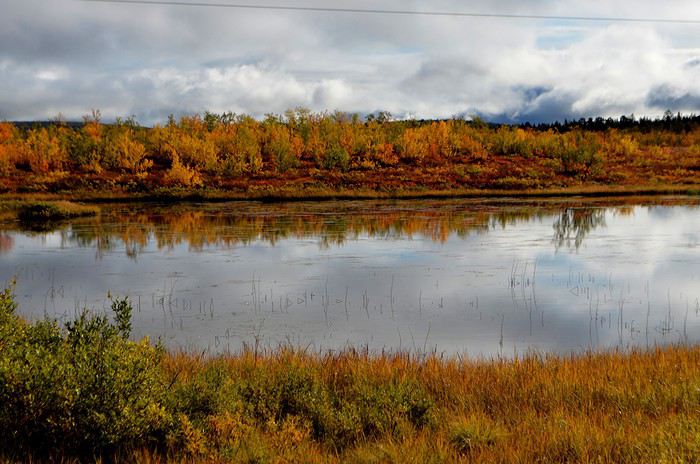
J’ai donc acheté 3 billets flexibles sur Air France 3 jours avant le départ en cas de report de dernière minute. Seule la 1ere nuit a été réservée. Les autres l'ont été au fur et à mesure.
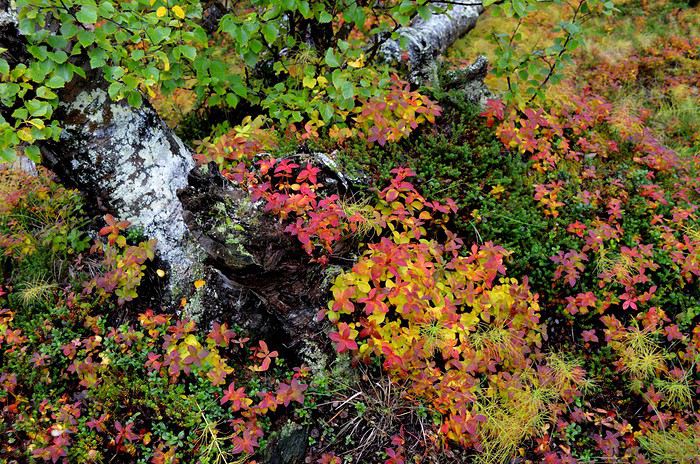
Nous avons décidé de nous concentrer sur le nord, plus sauvage. Notre besoin de grands espaces vierges nous avait poussés à réserver le Wyoming. La Suède nous offrira-t-elle la même chose ?
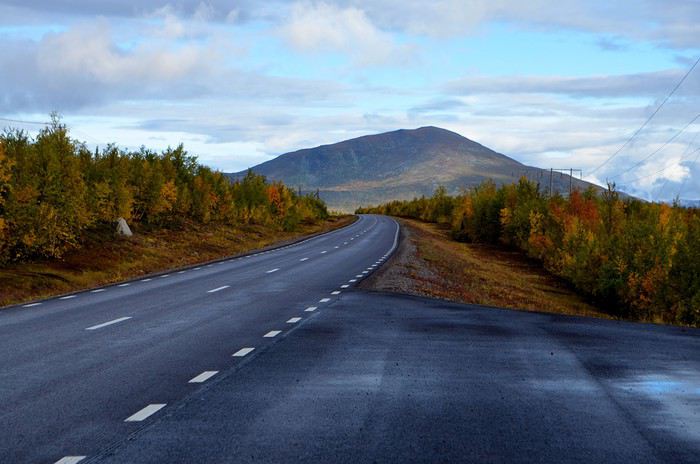
Voici donc le road trip effectué : Samedi 29 août : Marseille-Amsterdam-Stockholm Dimanche 30 août : Stockholm Lundi 31 août : Stockholm et train de nuit pour Lulea Mardi 1er septembre : Lulea, Gammelstad Mercredi 2 septembre : Lulea-chutes de Storforsen-Jokkmokk Jeudi 3 septembre : Le parc national de Muddus Vendredi 4 septembre : Jokkmokk-Kiruna Samedi 5 septembre : Le parc national d’Abisko Dimanche 6 septembre : Jukkajärvi et le massif du Kebnekaise Lundi 7 septembre : Kiruna-Arvidsjaur Mardi 8 septembre : Arjeplog Mercredi 9 septembre : Arvidsjaur-Umea Jeudi 10 septembre : Umea-Lulea et train de nuit pour Stochkolm Vendredi 11 septembre : Ile de Vaxholm Samedi 12 septembre : Stockholm-Marseille via Paris.
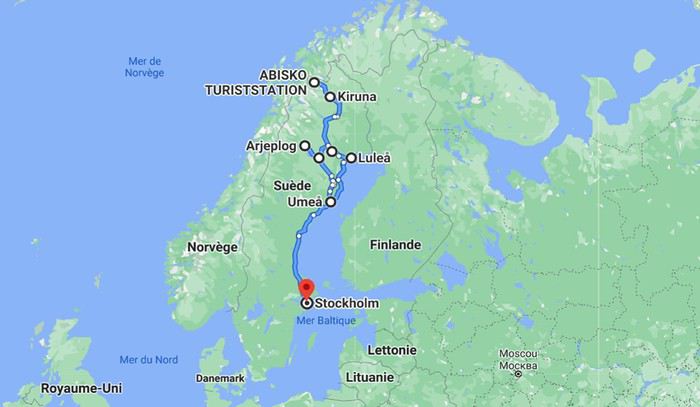
Au niveau du budget : Nous sommes partis à 2 avec un bébé de 22 mois. Les vols : 760€ A/R pour toute la famille Train de nuit SJ A/R : 483€ à 2 Location de voiture Europcar via carigami.fr : 405€ pour 9 jours à Lulea. Hébergements : réservés via booking.com · Stockholm : 2 nuits au Best Western Plus 4* : 160€ (pt dej inclus) · Lulea : 1 nuit au First Arctic camp (cabane) : 80€ · Jokkmokk : 2 nuits à l’hôtel Akerlund : 300€ (pt dej inclus) · Kiruna : 3 nuits au Ripan Camp 4* : 450€ (pt dej inclus) · Arvidsjaur : 2 nuits au camp Gielas : 160€ · Umea : 1 nuit à l’hôtel Aveny : 80€ (pt dej inclus) · Stockholm : 1 nuit au SAS Radisson Blu Waterfront : 89€
A la base, un voyage était prévu début septembre, dans le Wyoming. Il a été reporté à 2021. Un voyage qui avait été annulé en mai en Slovénie a donc été placé à ces dates. Hélas, une semaine avant le départ, la Slovénie a imposé une quarantaine aux français et un test covid à réaliser dans les 36 avant le départ, donc : report à mai 2021.
Je cherchais donc une nouvelle destination… Danemark, Pologne, Suisse ? Ces 3 pays ont restreint également la venue des français. Il me restait donc la Suède, pays qui a eu une ligne et une stratégie stable face à la crise du covid.
J’ai donc acheté 3 billets flexibles sur Air France 3 jours avant le départ en cas de report de dernière minute. Seule la 1ere nuit a été réservée. Les autres l'ont été au fur et à mesure.
Nous avons décidé de nous concentrer sur le nord, plus sauvage. Notre besoin de grands espaces vierges nous avait poussés à réserver le Wyoming. La Suède nous offrira-t-elle la même chose ?
Voici donc le road trip effectué : Samedi 29 août : Marseille-Amsterdam-Stockholm Dimanche 30 août : Stockholm Lundi 31 août : Stockholm et train de nuit pour Lulea Mardi 1er septembre : Lulea, Gammelstad Mercredi 2 septembre : Lulea-chutes de Storforsen-Jokkmokk Jeudi 3 septembre : Le parc national de Muddus Vendredi 4 septembre : Jokkmokk-Kiruna Samedi 5 septembre : Le parc national d’Abisko Dimanche 6 septembre : Jukkajärvi et le massif du Kebnekaise Lundi 7 septembre : Kiruna-Arvidsjaur Mardi 8 septembre : Arjeplog Mercredi 9 septembre : Arvidsjaur-Umea Jeudi 10 septembre : Umea-Lulea et train de nuit pour Stochkolm Vendredi 11 septembre : Ile de Vaxholm Samedi 12 septembre : Stockholm-Marseille via Paris.
Au niveau du budget : Nous sommes partis à 2 avec un bébé de 22 mois. Les vols : 760€ A/R pour toute la famille Train de nuit SJ A/R : 483€ à 2 Location de voiture Europcar via carigami.fr : 405€ pour 9 jours à Lulea. Hébergements : réservés via booking.com · Stockholm : 2 nuits au Best Western Plus 4* : 160€ (pt dej inclus) · Lulea : 1 nuit au First Arctic camp (cabane) : 80€ · Jokkmokk : 2 nuits à l’hôtel Akerlund : 300€ (pt dej inclus) · Kiruna : 3 nuits au Ripan Camp 4* : 450€ (pt dej inclus) · Arvidsjaur : 2 nuits au camp Gielas : 160€ · Umea : 1 nuit à l’hôtel Aveny : 80€ (pt dej inclus) · Stockholm : 1 nuit au SAS Radisson Blu Waterfront : 89€
Payer une contravention de stationnement à Porto English translation pending
Bonjour à tous.
En visitant PORTO je me suis fait verbaliser pour stationnement ( délai dépassé), de retour en France j'ai souhaité payer par virement bancaire et sur l'avis j'ai le site telpark avec un numéro qui quand je le renseigne sur le site ne correspond à rien, et en dessous on me signal que je dois payer via multibanco avec une référence.
Auriez-vous une solution à me proposer afin de régulariser ma situation?
Merci d'avance.
En visitant PORTO je me suis fait verbaliser pour stationnement ( délai dépassé), de retour en France j'ai souhaité payer par virement bancaire et sur l'avis j'ai le site telpark avec un numéro qui quand je le renseigne sur le site ne correspond à rien, et en dessous on me signal que je dois payer via multibanco avec une référence.
Auriez-vous une solution à me proposer afin de régulariser ma situation?
Merci d'avance.
L'Espagne va elle refermer ses frontières? n°2 English translation pending
holà
après la discussion fermée a juste titre et sans intérêt de certain sur le sujet...on en est ou ?
toujours intéressant le ressentie des locaux
touriste motard et dans 20 jours en andalousie, aucune appréhension pour bouger las bas ou en ce moment ici en ouest france mais bien sur avec le respect des consignes meme si ce n'est pas forcement tres clair on fera le compte plus tard !!! je reviens d'allemagne et de hongrie, la communication covid et la compréhension du problème m'a semble plus facile qu"en pays de france...😉 ceci dit en Espagne ces jours ci ?
on reste cool, on parle situation et que situation 😎
merci V
après la discussion fermée a juste titre et sans intérêt de certain sur le sujet...on en est ou ?
toujours intéressant le ressentie des locaux
touriste motard et dans 20 jours en andalousie, aucune appréhension pour bouger las bas ou en ce moment ici en ouest france mais bien sur avec le respect des consignes meme si ce n'est pas forcement tres clair on fera le compte plus tard !!! je reviens d'allemagne et de hongrie, la communication covid et la compréhension du problème m'a semble plus facile qu"en pays de france...😉 ceci dit en Espagne ces jours ci ?
on reste cool, on parle situation et que situation 😎
merci V
Les Cyclades en juillet: Anafi, Amorgos, Astypaléa English translation pending
GENESE
Comme tous, le COVID a chamboulé nos plans. Normalement nous devions aller à Madagascar pendant un mois, projet reporté à l’année prochaine. Seulement, n’ayant jamais arrêté de travailler, malgré le confinement et le Covid j’avais réellement besoin de faire une « pause ».
Souhaitant limiter les risques de restrictions de déplacements nous ne quitterons pas l’Europe en nous centrant sur des endroits que nous avons toujours voulu visiter, mais habituellement trop fréquentés pour nous. Il y avait la Suisse avec ses montagnes et ses trains de légende, l’Islande et les îles Grecques.
Au final c’est l’attrait du soleil qui l’a emporté … enfin surtout auprès de madame ! Nous avions « entrevu » Santorin et Myconos lors d’une croisière en méditerranée en 2007 avec les enfants. Nous avions adoré … sauf la fréquentation !
Le premier élément à choisir est le point d’entrée, accessible en avion. Il y a Santorin et Myconos dans les Cyclades. Comme je rêvais de revoir la caldera de Santorin, le choix fut rapide. Ensuite je voulais des îles peu fréquentées ne nécessitant pas de trop long trajet en ferry. Sur 2 semaines 3 îles m’a paru être le bon choix. Avec le recul je confirme que c’est un bon dosage. Je me suis beaucoup servi du site Hellenica et Cycladen.be, qui sont très bien, pour faire mes choix.
La première sera Anafi, dans la catégorie « peu fréquentée » elle est très bien placée, en plus elle est petite, montagneuse et avec de belles plages. Une des raisons de sa faible fréquentation est le peu de liaison maritimes, ce sera donc à partir de cette contrainte que s’articulera le voyage.
Le second choix sera Astypalea car il y a un aéroport pour repartir, en plus c’est aussi une île peu fréquentée par les étrangers. Elle fait partie des Dodécanèse mais géographique se trouve proche des Cyclades.
Amorgos se glissera très naturellement entre les deux.
Une fois le planning établi j’ai réservé les vols chez Volotea qui a le bon goût de partir de Strasbourg … mauvais choix car les vols seront annulés 2 semaines plus tard.🏴☠️ Je me suis retourné vers Easy Jet qui part de Bâle Mulhouse, finalement tout aussi proche de chez nous que Strasbourg. Il faut dire qu’en Alsace nous avons la chance d’avoir pas mal d’aéroports dans un rayon de 3 heures autour de chez nous (en plus des deux précités il y a surtout Zurich et Frankfurt). Nous ferons donc BSL – Athènes – Santorin puis Astypalea – Athènes – BSL.
J’ai réservé par internet en direct les pensions : Villa Kalamiotissa pour Anafi Emprostiada Traditional Guest House et Pano Gitonia pour Amorgos Studio Killindra pour Astypalea Je réserve aussi une voiture à Amorgos puisque l’île est assez grande … et au final, suite à un échange avec mon logeur, également à Anafi.
Le roadbook sera assez rapide à établir … tant mieux car je n’ai que très peu de temps disponible, relancer mon entreprise suite au Covid-19 a accaparé tout mon temps.
En voiture ... pour ceux qui veulent 🙂
Comme tous, le COVID a chamboulé nos plans. Normalement nous devions aller à Madagascar pendant un mois, projet reporté à l’année prochaine. Seulement, n’ayant jamais arrêté de travailler, malgré le confinement et le Covid j’avais réellement besoin de faire une « pause ».
Souhaitant limiter les risques de restrictions de déplacements nous ne quitterons pas l’Europe en nous centrant sur des endroits que nous avons toujours voulu visiter, mais habituellement trop fréquentés pour nous. Il y avait la Suisse avec ses montagnes et ses trains de légende, l’Islande et les îles Grecques.
Au final c’est l’attrait du soleil qui l’a emporté … enfin surtout auprès de madame ! Nous avions « entrevu » Santorin et Myconos lors d’une croisière en méditerranée en 2007 avec les enfants. Nous avions adoré … sauf la fréquentation !
Le premier élément à choisir est le point d’entrée, accessible en avion. Il y a Santorin et Myconos dans les Cyclades. Comme je rêvais de revoir la caldera de Santorin, le choix fut rapide. Ensuite je voulais des îles peu fréquentées ne nécessitant pas de trop long trajet en ferry. Sur 2 semaines 3 îles m’a paru être le bon choix. Avec le recul je confirme que c’est un bon dosage. Je me suis beaucoup servi du site Hellenica et Cycladen.be, qui sont très bien, pour faire mes choix.
La première sera Anafi, dans la catégorie « peu fréquentée » elle est très bien placée, en plus elle est petite, montagneuse et avec de belles plages. Une des raisons de sa faible fréquentation est le peu de liaison maritimes, ce sera donc à partir de cette contrainte que s’articulera le voyage.
Le second choix sera Astypalea car il y a un aéroport pour repartir, en plus c’est aussi une île peu fréquentée par les étrangers. Elle fait partie des Dodécanèse mais géographique se trouve proche des Cyclades.
Amorgos se glissera très naturellement entre les deux.
Une fois le planning établi j’ai réservé les vols chez Volotea qui a le bon goût de partir de Strasbourg … mauvais choix car les vols seront annulés 2 semaines plus tard.🏴☠️ Je me suis retourné vers Easy Jet qui part de Bâle Mulhouse, finalement tout aussi proche de chez nous que Strasbourg. Il faut dire qu’en Alsace nous avons la chance d’avoir pas mal d’aéroports dans un rayon de 3 heures autour de chez nous (en plus des deux précités il y a surtout Zurich et Frankfurt). Nous ferons donc BSL – Athènes – Santorin puis Astypalea – Athènes – BSL.
J’ai réservé par internet en direct les pensions : Villa Kalamiotissa pour Anafi Emprostiada Traditional Guest House et Pano Gitonia pour Amorgos Studio Killindra pour Astypalea Je réserve aussi une voiture à Amorgos puisque l’île est assez grande … et au final, suite à un échange avec mon logeur, également à Anafi.
Le roadbook sera assez rapide à établir … tant mieux car je n’ai que très peu de temps disponible, relancer mon entreprise suite au Covid-19 a accaparé tout mon temps.
En voiture ... pour ceux qui veulent 🙂
Itinéraire 10 jours à la découverte des paysages autrichiens! English translation pending
Bonjour tout le monde ! 🙂
Vu la situation sanitaire actuelle, je n'avais pas prévu de partir ce été mais finalement, j'en ressens quand même le besoin et prévois donc d'organiser "à la dernière minute" un voyage en Autriche (+ un peu de la Bavière).
Pourquoi l'Autriche ? Car je suis à la recherche de paysages grandioses, sauvages et que c'est un pays qui m'a toujours attiré. La Suisse étant plus chère, l'Autriche m'ira très bien ! 😎
Je compte donc partir 1 semaine-10 jours en Autriche, en axant mon voyage sur les paysages et la nature plutôt que les villes.
J'habite la Belgique et je m'y rendrai avec mon véhicule.
Ne connaissant encore rien à ce pays, je viens vers vous pour des conseils d'itinéraires. J'ai déjà une vague idée après mes quelques recherches mais vos conseils seront les bienvenus.
Grosso modo, je diviserais le voyage en trois parties : 1) Innsbruk et ses alentours, 2) Grossglockner/Route 107 et alentours, 3) Salzbourg et alentours.
Pour rendre le trajet aller moins pénible, j'envisage de m'arrêter à Munich et d'y dormir.
J1 : trajet Belgique-Munich (nuit à Munich) - visite de la ville J2 : de Munich au château de Neuschwanstein - visite du château - nuit dans la région J3 : de Munich à Alpspitze : visite de Alpspitze et Zugspitze - nuit dans la région J4 : de Alpspitze à Innsbruk : passage à Blindsee et autres points d'intérêt, viste d'Innsbruk - nuit à Innsbruk J5 : de Innsbruk à Solden : passage à Piburgersee, visite Solden - nuit à ? J6 : journée supplémentaire dans la région d'Innsbruk et alentours (est-ce nécessaire ?) J7 : de Innsbruk à Zemm am See - nuit à Zemm am See (ou autre) J8 : Grossglockner / Route 107 - nuit à Zemm am See (ou autre) J9 : de Zemm am See à Hallstatt - nuit à Hallstat (ou autre) J10 : de Hallstatt à Salzbourg - nuit à Salzbourg J11 : de Salzbourg à Berchtesgaden - visite du nid d'aigle - nuit à Berchtesgaden J12 : retour en Belgique
Est-ce que cet itinéraire vous paraît cohérent et faisable ? Le but étant encore une fois de profiter un maximum des paysages, de voir pas mal de choses sans pour autant courir non stop. On adore la photo donc on aimerait pouvoir profiter de chaque endroit, dans la mesure du possible.
Je ne connais rien au pays donc n'hésitez pas à me dire si je dois prévoir plus ou moins de temps à tel ou tel endroit.
Merci d'avance pour vos avis éclairés ! 🙂
Bonne fin de journée,
Jonafly
Vu la situation sanitaire actuelle, je n'avais pas prévu de partir ce été mais finalement, j'en ressens quand même le besoin et prévois donc d'organiser "à la dernière minute" un voyage en Autriche (+ un peu de la Bavière).
Pourquoi l'Autriche ? Car je suis à la recherche de paysages grandioses, sauvages et que c'est un pays qui m'a toujours attiré. La Suisse étant plus chère, l'Autriche m'ira très bien ! 😎
Je compte donc partir 1 semaine-10 jours en Autriche, en axant mon voyage sur les paysages et la nature plutôt que les villes.
J'habite la Belgique et je m'y rendrai avec mon véhicule.
Ne connaissant encore rien à ce pays, je viens vers vous pour des conseils d'itinéraires. J'ai déjà une vague idée après mes quelques recherches mais vos conseils seront les bienvenus.
Grosso modo, je diviserais le voyage en trois parties : 1) Innsbruk et ses alentours, 2) Grossglockner/Route 107 et alentours, 3) Salzbourg et alentours.
Pour rendre le trajet aller moins pénible, j'envisage de m'arrêter à Munich et d'y dormir.
J1 : trajet Belgique-Munich (nuit à Munich) - visite de la ville J2 : de Munich au château de Neuschwanstein - visite du château - nuit dans la région J3 : de Munich à Alpspitze : visite de Alpspitze et Zugspitze - nuit dans la région J4 : de Alpspitze à Innsbruk : passage à Blindsee et autres points d'intérêt, viste d'Innsbruk - nuit à Innsbruk J5 : de Innsbruk à Solden : passage à Piburgersee, visite Solden - nuit à ? J6 : journée supplémentaire dans la région d'Innsbruk et alentours (est-ce nécessaire ?) J7 : de Innsbruk à Zemm am See - nuit à Zemm am See (ou autre) J8 : Grossglockner / Route 107 - nuit à Zemm am See (ou autre) J9 : de Zemm am See à Hallstatt - nuit à Hallstat (ou autre) J10 : de Hallstatt à Salzbourg - nuit à Salzbourg J11 : de Salzbourg à Berchtesgaden - visite du nid d'aigle - nuit à Berchtesgaden J12 : retour en Belgique
Est-ce que cet itinéraire vous paraît cohérent et faisable ? Le but étant encore une fois de profiter un maximum des paysages, de voir pas mal de choses sans pour autant courir non stop. On adore la photo donc on aimerait pouvoir profiter de chaque endroit, dans la mesure du possible.
Je ne connais rien au pays donc n'hésitez pas à me dire si je dois prévoir plus ou moins de temps à tel ou tel endroit.
Merci d'avance pour vos avis éclairés ! 🙂
Bonne fin de journée,
Jonafly
Opération en France pour résident à Madagascar English translation pending
Le forum complètement mort m'affole. je suis en France et plus de nouvelles de ce pays compliqué, corrompu que j'aime tant.
Une question : un ami à Diego a des problèmes de hanche et aimerai venir se faire opérer en France. Pensez vous qu'il a des chances d'y parvenir ?
Compagnon(e) de marche en toute quiétude English translation pending
Bonjour,
J habite la région parisienne, plus précisement dans la val d oise que j ai pas mal exploré.J aimerais trouver un compagnon ou une compagne de marche , car mon entourage n est pas toujours et j avoue que j en ai assez de randonner seule.De plus, les clubs de marche ne marche ne me satisfont pas.
Alors si vous etes partant ou partante?...
Retour en Thaïlande le 1er Juillet? English translation pending
Enfin le 30 Juin 2020 le gouvernement Thaïlandais a décidé la réouverture de son aéroport international. Les premiers avions peuvent le 01 Juillet 2020 atterrir sur l'aéroport international de Bangkok. Vraiment ?
Ça va faire 5 mois que nous sommes coincés ma femme Thaïlandaise et moi à cause du virus. Je suis Français résidant en Thaïlande.
Nous voici à l'embarquement le 02 Juillet sur l'aéroport de Nice avec Swissair pour Zurich puis correspondance pour Bangkok Vol numéro LX 563 à10h05 et LH 772 à 22h00. Notre vol initial Zurich Bangkok fut annulé. Nous avions 2 h de d'attente à Zurich pour le transfert à Bangkok alors que maintenant +10 h d'attente à l'aéroport. Ça va être long.
Nice aéroport. Je suis le premier tout excité à l'embarquement. Pour une fois. Moi qui traine toujours le dernier pour embarquer. Désolé Monsieur, me dit la petite dame d'hôtesse de l'air, dernière son tapis roulant, assise à hauteur de mes yeux. Vol annulé tout simplement sans prévenir pour ceux qui partent pour Bangkok. Bouh !!!! Au revoir vous qui faites la queue pour Zurich. Moi j'y ai pas droit. Sic ...
La chef hôtesse de l'embarquement. Me dit: <> Je pense intérieur <>
Du coup on va plus en Suisse mais en Allemagne. <>
Un autre couple Franco Thai tout comme moi mais enregistré juste après moi. Se voit annulé leurs vols. Plus de places pour le lendemain. Ho !!! C'est con pour eux... Pas cool Swissair. Mais nous --Lucky--.(pour une fois) et deuxième Lucky. Je récupére juste deux heures d'attente avant le prochain vol pour Bangkok à l'aéroport de Francfort. << Vous suivez? Ok je continue>>
Le lendemain nous revoici ma femme et moi devant les comptoirs de l'embarquement. Il a fallu que je bataille la négoce pour rentrer chez moi. En Thaïlande sur Chiang Mai. Je lâche rien.
Mon adresse sur le passport Francais délivré par l'ambassade de France de Bangkok ne fait pas la preuve que j'habite en Thaïlande.
Le livret de famille délivré aussi par rnotre chère ambassade de France non plus. Heureusement que j'avais avec moi le certificat de mariage Thaï traduit en Français que me chère épouse avait en sa possession pour l'obtention de son Visa Tchengen pour sa venue en France. Surtout aussi beaucoup que sur son passport elle a le même nom de famille que moi. (Ouf sauvé alors).
Ça marche, je peux embarquer. Me voici en possession des des tickets d'embarquements. Puis entre nous, je vais vous dire un secret. Elle est devenue une parfaite illégale de visa, ma femme car bloquée à cause de Covid 19. Elle a dépassé de plus de trois mois son visa Français Tchengen. Mais pour les étrangers sur le sol Français pas de soucis que me dit la Paf (Police aux frontières)( vous savez ceux qui font les tampons sur les passports.) C'ést beau la France.
Et voilà on est dans l'avion on verra bien à Francfort
C'est pas trés compliqué à Franckfort. La douane côté international avant d'aller rejoindre ta porte d'embarquement. Ils te mettent presque tout nu et te font faire de l'exercice en levant les bras et mettre les pieds dans des starting block comme pour les jeux VDO. < Tu sais là où tu danse avec la croix , le carré, le rond et le triangle> Pour vérifier si le portique électromagnétique ne sonne pas. Par contre s'il sonne alors là tout comme pour moi tu as droit à des soins particuliers de la part du douanier. Il met un petit ticket de plastique transparent de partout dans tes poches et tes mains quil met dans ce que tu crois être la play Station. Mais non s'en est pas une. Puis heureusement qui il a marqué négatif pour moi. Car l'autre gars en face de moi. Lui il a pas eu cette chance. Sorti positif. Ils l'ont attrapé à trois et plaqué au sol comme au rugby en milieu de terrain. Il avait pas l'air de vraiment savoir jouer au rugby en tout ce gars là. Car il n'a pas compris les règles du jeux du négatif positif.
Francfort porte D 25. Salle d'attente en face porte 24 car la 25 est prise d'assaut par le retour des Thais chez eux. Boarding pass en main. C'est le Cézanne d'embarquement. Maintenant tu mets le code barre du bout de ton ticket sur la porte qui s'ouvre automatiquement et qui fait le boulot de nos chères hôtesses qui à part te casser les bonbons pour regarder si tu as bien attaché ta ceinture avant le décollage et distribuer une mini bouteille d'eau ne font plus grand chose. Mais voilà que tant quand bien que mal notre tour arrive à ma femme et moi.
Et la, ça s'ouvre pas ses portes et même que ça clignote rouge !? On va jouer au rugby !? Monsieur Titiasie que je m'attends dire!? Oui c'est moi. On vous attendez, venez nous suivre s'il vous plaît. Je sais, j'ai compris que c'est le début des misères. L'Ambassadeur ou Consul de Thaïlande officiant en Allemagne est la. Si si, il est la à me parler. Il est la présent à l'embarquement de cette avion de la LUFTHANSA. Il me pose deux questions. Ça première question surprise, il me demande comment j'ai pu acquérir ce billet ? Je lui répond tout simplement que ce n'est pas moi qui l'ai fait, mais Swissair (tralala....que j'ai envie de lui dire) Ça deuxième question, est ce que vous êtes invité par une personne du gouvernement Thaïlandais ? Heu !!! Moi , non biensur.
Puis me dit : <>
Ha....oui biensur. Mais il y a quand même un soucis. C'est que ma femme elle ne peux plus rentrer en France où tout simplement même plus rentrer du côté Allemend. Puisqu'elle n'a plus de visa.
Ça sert bien que d'être Ambassadeur. On a des amis partout. Ils lui ont donné un nouveau tampon de droit d'entrer aux Etats Tchengens pour trois mois de plus en 15 mn. Quand tu sais le temps et les paperasses qu'il faut fournir pour obtenir le visa Tchengen !!! Ça aurait été mieux qu'il fasse son boulot de gouverneur en accordant le rapatriement et droit d'asile à un de leur concitoyen. De plus qu'elle avait déjà sa place assise dans ce fameux avion spécial. Comprends pas des fois, la logique de l'ilogique
Enfin voilà. On est dehors. J'ai pas pu récupérer ma valise qui tournait en boucle depuis 2 h sur les tourniquets des bagages. Elle a finie par être récupérée par le service de déminage, par crainte de suspicion d'explosif. Ils me l'ont renvoyée à Nice après examen, sans même rien ne demander. Sont cool quand même Lufthansa, non !?
Ils nous ont donné un voucher d'hôtel gratuit pour la nuit. C'est l'hôtel des pilotes de lignes. Il est une heure du matin et on doit reprendre la navette à 5h40. Pour l'ouverture des bureaux de la Lufthansa a 6 h du mat.
Le lendemain retour au Nice à mes frais. Fin du voyage.
Conclusion, qu'on me dise pas où ne me parle pas de parité entre pays. Car les français qui étaient bloqués en Thaïlande à cause du Covid 19. La soit disante ouverture des frontières Thaïs le 01 juillet. J'en ai croisé un qui rentrait par le meme avion que moi sur Nice et qui venait de Bangkok. Sans aucun soucis d'enregistrement ou vol spécial. Ils ne jouent pas le jeux les Thaïlandais comme il l'ont dit. Ça ne marche qu'à sens unique après mensonges et duperies. En tout cas moi j'ai essayé et croyez moi , j'avais tous les papiers qu'il fallait.
Ça va faire 5 mois que nous sommes coincés ma femme Thaïlandaise et moi à cause du virus. Je suis Français résidant en Thaïlande.
Nous voici à l'embarquement le 02 Juillet sur l'aéroport de Nice avec Swissair pour Zurich puis correspondance pour Bangkok Vol numéro LX 563 à10h05 et LH 772 à 22h00. Notre vol initial Zurich Bangkok fut annulé. Nous avions 2 h de d'attente à Zurich pour le transfert à Bangkok alors que maintenant +10 h d'attente à l'aéroport. Ça va être long.
Nice aéroport. Je suis le premier tout excité à l'embarquement. Pour une fois. Moi qui traine toujours le dernier pour embarquer. Désolé Monsieur, me dit la petite dame d'hôtesse de l'air, dernière son tapis roulant, assise à hauteur de mes yeux. Vol annulé tout simplement sans prévenir pour ceux qui partent pour Bangkok. Bouh !!!! Au revoir vous qui faites la queue pour Zurich. Moi j'y ai pas droit. Sic ...
La chef hôtesse de l'embarquement. Me dit: <> Je pense intérieur <>
Du coup on va plus en Suisse mais en Allemagne. <>
Un autre couple Franco Thai tout comme moi mais enregistré juste après moi. Se voit annulé leurs vols. Plus de places pour le lendemain. Ho !!! C'est con pour eux... Pas cool Swissair. Mais nous --Lucky--.(pour une fois) et deuxième Lucky. Je récupére juste deux heures d'attente avant le prochain vol pour Bangkok à l'aéroport de Francfort. << Vous suivez? Ok je continue>>
Le lendemain nous revoici ma femme et moi devant les comptoirs de l'embarquement. Il a fallu que je bataille la négoce pour rentrer chez moi. En Thaïlande sur Chiang Mai. Je lâche rien.
Mon adresse sur le passport Francais délivré par l'ambassade de France de Bangkok ne fait pas la preuve que j'habite en Thaïlande.
Le livret de famille délivré aussi par rnotre chère ambassade de France non plus. Heureusement que j'avais avec moi le certificat de mariage Thaï traduit en Français que me chère épouse avait en sa possession pour l'obtention de son Visa Tchengen pour sa venue en France. Surtout aussi beaucoup que sur son passport elle a le même nom de famille que moi. (Ouf sauvé alors).
Ça marche, je peux embarquer. Me voici en possession des des tickets d'embarquements. Puis entre nous, je vais vous dire un secret. Elle est devenue une parfaite illégale de visa, ma femme car bloquée à cause de Covid 19. Elle a dépassé de plus de trois mois son visa Français Tchengen. Mais pour les étrangers sur le sol Français pas de soucis que me dit la Paf (Police aux frontières)( vous savez ceux qui font les tampons sur les passports.) C'ést beau la France.
Et voilà on est dans l'avion on verra bien à Francfort
C'est pas trés compliqué à Franckfort. La douane côté international avant d'aller rejoindre ta porte d'embarquement. Ils te mettent presque tout nu et te font faire de l'exercice en levant les bras et mettre les pieds dans des starting block comme pour les jeux VDO. < Tu sais là où tu danse avec la croix , le carré, le rond et le triangle> Pour vérifier si le portique électromagnétique ne sonne pas. Par contre s'il sonne alors là tout comme pour moi tu as droit à des soins particuliers de la part du douanier. Il met un petit ticket de plastique transparent de partout dans tes poches et tes mains quil met dans ce que tu crois être la play Station. Mais non s'en est pas une. Puis heureusement qui il a marqué négatif pour moi. Car l'autre gars en face de moi. Lui il a pas eu cette chance. Sorti positif. Ils l'ont attrapé à trois et plaqué au sol comme au rugby en milieu de terrain. Il avait pas l'air de vraiment savoir jouer au rugby en tout ce gars là. Car il n'a pas compris les règles du jeux du négatif positif.
Francfort porte D 25. Salle d'attente en face porte 24 car la 25 est prise d'assaut par le retour des Thais chez eux. Boarding pass en main. C'est le Cézanne d'embarquement. Maintenant tu mets le code barre du bout de ton ticket sur la porte qui s'ouvre automatiquement et qui fait le boulot de nos chères hôtesses qui à part te casser les bonbons pour regarder si tu as bien attaché ta ceinture avant le décollage et distribuer une mini bouteille d'eau ne font plus grand chose. Mais voilà que tant quand bien que mal notre tour arrive à ma femme et moi.
Et la, ça s'ouvre pas ses portes et même que ça clignote rouge !? On va jouer au rugby !? Monsieur Titiasie que je m'attends dire!? Oui c'est moi. On vous attendez, venez nous suivre s'il vous plaît. Je sais, j'ai compris que c'est le début des misères. L'Ambassadeur ou Consul de Thaïlande officiant en Allemagne est la. Si si, il est la à me parler. Il est la présent à l'embarquement de cette avion de la LUFTHANSA. Il me pose deux questions. Ça première question surprise, il me demande comment j'ai pu acquérir ce billet ? Je lui répond tout simplement que ce n'est pas moi qui l'ai fait, mais Swissair (tralala....que j'ai envie de lui dire) Ça deuxième question, est ce que vous êtes invité par une personne du gouvernement Thaïlandais ? Heu !!! Moi , non biensur.
Puis me dit : <>
Ha....oui biensur. Mais il y a quand même un soucis. C'est que ma femme elle ne peux plus rentrer en France où tout simplement même plus rentrer du côté Allemend. Puisqu'elle n'a plus de visa.
Ça sert bien que d'être Ambassadeur. On a des amis partout. Ils lui ont donné un nouveau tampon de droit d'entrer aux Etats Tchengens pour trois mois de plus en 15 mn. Quand tu sais le temps et les paperasses qu'il faut fournir pour obtenir le visa Tchengen !!! Ça aurait été mieux qu'il fasse son boulot de gouverneur en accordant le rapatriement et droit d'asile à un de leur concitoyen. De plus qu'elle avait déjà sa place assise dans ce fameux avion spécial. Comprends pas des fois, la logique de l'ilogique
Enfin voilà. On est dehors. J'ai pas pu récupérer ma valise qui tournait en boucle depuis 2 h sur les tourniquets des bagages. Elle a finie par être récupérée par le service de déminage, par crainte de suspicion d'explosif. Ils me l'ont renvoyée à Nice après examen, sans même rien ne demander. Sont cool quand même Lufthansa, non !?
Ils nous ont donné un voucher d'hôtel gratuit pour la nuit. C'est l'hôtel des pilotes de lignes. Il est une heure du matin et on doit reprendre la navette à 5h40. Pour l'ouverture des bureaux de la Lufthansa a 6 h du mat.
Le lendemain retour au Nice à mes frais. Fin du voyage.
Conclusion, qu'on me dise pas où ne me parle pas de parité entre pays. Car les français qui étaient bloqués en Thaïlande à cause du Covid 19. La soit disante ouverture des frontières Thaïs le 01 juillet. J'en ai croisé un qui rentrait par le meme avion que moi sur Nice et qui venait de Bangkok. Sans aucun soucis d'enregistrement ou vol spécial. Ils ne jouent pas le jeux les Thaïlandais comme il l'ont dit. Ça ne marche qu'à sens unique après mensonges et duperies. En tout cas moi j'ai essayé et croyez moi , j'avais tous les papiers qu'il fallait.
Chasse et randonnée en France English translation pending
Bonjour à tous,
J'ai une semaine de vacances fin septembre, au moment de l'ouverture de la chasse. Je cherche une idée de rando de 5/6 jours, en moyenne montagne, ou n'importe où en France, tant que c'est joli ! J'habite dans l'Essonne, et certains jours, surtout à l'automne, impossible de se balader tranquillement (jusqu'à devoir faire des détours par le goudron pour éviter les battues)... Un week-end en Baie de Somme avait été gâché par des sentiers inaccessibles... fermés par les chasseurs (et ça tirait énormément !)
J'ai déjà fait une bonne partie du gr34, le chemin de St Guilhem (ma rando préférée), le Gr30... mais pas à cette époque-là.
Merci pour vos bonnes idées !
Camping en tente pour trois et une voiture en Bavière English translation pending
Bonjour. J'hésite à prendre mon vieux fourgon, et je me renseigne aussi sur les campings en tente en Bavières. Avez-vous une idée? Sur le guide que j'ai, tous les campings sont indiqués pour 2 personnes et nous partons à 3 adultes. J'ai un peu peur de devoir payer 2 fois 2, ce qui du coup serait hors budget pour moi. Merci
Voyage en Ukraine avec son véhicule personnel English translation pending
BONJOUR
Je suis marié à une citoyenne ukrainienne , je compte me rendre en ukraine en "PLAN B" par la route en août 2020 dès que les frontières terrestres seront rouvertes , ( car nos vols AIR FRANCE ont été annulés ) le seul hic, c'est que mon assurance française ne me couvre pas en Ukraine , malgré mon insistance je n'ai pas pu avoir une extension de garantie d'assurance, j'ai entendu dire qu'il existait aux postes frontières Pologne/Ukraine ou Hongrie/Ukraine , des bureaux d'assurances, aux fins d'établir un contrat "d'assurance auto temporaire" pour une période , en ce qui me concerne ce serait pour 1 mois maximum" , y-a-t-il quelqu'un sur le forum, qui a déjà été dans ce cas de figure , c'est à dire d'avoir été obligé de prendre une assurance temporaire hors Union européenne car ma compagnie d'assurance ne valide pas cette option, et en l'occurrence l'UKRAINE ( UA) est barrée au dos de mon attestation d'assurance , merci pour votre retour d'expérience, si possible. Dans mon cas précis, je compte passer la frontière entre la hongrie à Zahony et arriver sur Tchop en ukraine , Mon itinéraire depuis le sud de la france , par la suisse, l'autriche , la hongrie merci bien cordialement
Je suis marié à une citoyenne ukrainienne , je compte me rendre en ukraine en "PLAN B" par la route en août 2020 dès que les frontières terrestres seront rouvertes , ( car nos vols AIR FRANCE ont été annulés ) le seul hic, c'est que mon assurance française ne me couvre pas en Ukraine , malgré mon insistance je n'ai pas pu avoir une extension de garantie d'assurance, j'ai entendu dire qu'il existait aux postes frontières Pologne/Ukraine ou Hongrie/Ukraine , des bureaux d'assurances, aux fins d'établir un contrat "d'assurance auto temporaire" pour une période , en ce qui me concerne ce serait pour 1 mois maximum" , y-a-t-il quelqu'un sur le forum, qui a déjà été dans ce cas de figure , c'est à dire d'avoir été obligé de prendre une assurance temporaire hors Union européenne car ma compagnie d'assurance ne valide pas cette option, et en l'occurrence l'UKRAINE ( UA) est barrée au dos de mon attestation d'assurance , merci pour votre retour d'expérience, si possible. Dans mon cas précis, je compte passer la frontière entre la hongrie à Zahony et arriver sur Tchop en ukraine , Mon itinéraire depuis le sud de la france , par la suisse, l'autriche , la hongrie merci bien cordialement
Ouvrir ma valise Eastpak TSA English translation pending
Bonjour je retrouve hier soir ma valise bloque.... Je ne sais pas comment faire pour ouvrir. Des malins on du me la fermer alors que j utilise jamais le code de la valise car je prefere la laisser ouverte pour pas attirer mais la pour le coup je me retrouve avec mes affaire bloque dans ma propre valise
Help
Qui pourra aller en Grèce cet été? English translation pending
https://www.lesoir.be/303972/article/2020-05-29/les-belges-ne-pourront-pas-se-rendre-en-grece-contrairement-dautres
Les touristes et voyageurs en provenance de 29 pays seulement pourront à nouveau se rendre en Grèce à partir du 15 juin sans devoir subir de quarantaine, a indiqué vendredi le ministre grec du Tourisme. Ni la Belgique ni la France n’en font partie. Athènes réexaminera le 1er juillet la situation et étendra éventuellement sa liste à d’autres pays.
Les 29 pays concernés par l’absence de quarantaine sont l’Allemagne, l’Autriche, la Suisse, l’Albanie, l’Australie, la Macédoine du Nord, la Bulgarie, le Danemark, l’Estonie, le Japon, Israël, la Chine, la Croatie, Chypre, la Lettonie, le Liban, la Lituanie, Malte, le Monténégro, la Nouvelle-Zélande, la Norvège, la Corée du Sud, la Hongrie, la Roumanie, la Serbie, la Slovaquie, la Slovénie, la République Tchèque et la Finlande.
Les touristes et voyageurs en provenance de 29 pays seulement pourront à nouveau se rendre en Grèce à partir du 15 juin sans devoir subir de quarantaine, a indiqué vendredi le ministre grec du Tourisme. Ni la Belgique ni la France n’en font partie. Athènes réexaminera le 1er juillet la situation et étendra éventuellement sa liste à d’autres pays.
Les 29 pays concernés par l’absence de quarantaine sont l’Allemagne, l’Autriche, la Suisse, l’Albanie, l’Australie, la Macédoine du Nord, la Bulgarie, le Danemark, l’Estonie, le Japon, Israël, la Chine, la Croatie, Chypre, la Lettonie, le Liban, la Lituanie, Malte, le Monténégro, la Nouvelle-Zélande, la Norvège, la Corée du Sud, la Hongrie, la Roumanie, la Serbie, la Slovaquie, la Slovénie, la République Tchèque et la Finlande.
L'UE lance un site d'information pour les vacanciers intra-européens English translation pending
Afin d'aider les vacanciers qui souhaitent séjourner dans un des pays de l'U.E. cet été, la Commission européenne est en train de finaliser un site Web qui permettra à chacun de s'informer quant aux possibilités, restrictions, précautions, etc, prévues dans chaque état ou région.
Lire la suite...
Ferroutage Moscou-Irkoutsk English translation pending
Bonjour à tous les voyageurs,
Nous envisageons un voyage en Russie avec notre véhicule (Pinzgauer 6X6) avec aller en ferroutage (nous et le véhicule si possible) entre Moscou et Irkoutsk (par exemple, le projet débute à peine) et effectuer le retour avec le Pinz selon un itinéraire qui n'est pas arrêté. Avez-vous des infos sur le ferroutage en Russie : coût, difficultés administratives, ..
Merci pour votre aide!
http://lepinzenvoyage.net/
http://lepinzenvoyage.net/
Accès calendrier croisières? English translation pending
Bonjour,
je suis nouveau sur le forum.Comment fait-on pour voir si d'autres personnes font la même croisière que nous? Merci de votre aide. Bien cordialement et vive les croisières!!!
je suis nouveau sur le forum.Comment fait-on pour voir si d'autres personnes font la même croisière que nous? Merci de votre aide. Bien cordialement et vive les croisières!!!
L'Allemagne pourrait prendre 25% du capital de Lufthansa English translation pending
Le plan de sauvetage que Lufthansa négocie actuellement avec le gouvernement allemand aboutira à la prise par l'Etat d'une part de 25,1% dans le capital de la compagnie aérienne, écrit Der Spiegel vendredi.
Le plan de renflouement de la compagnie, frappée de plein fouet par l'arrêt du trafic aérien pour cause de coronavirus, se monte à 10 milliards d'euros selon l'hebdomadaire.
Sur cette somme, 5,5 milliards d'euros seraient constitués d'actions sans droit de vote, pour lesquelles le gouvernement allemand réclame le versement d'un dividende de 9%.
Des prêts à hauteur de 3,5 milliards d'euros seraient également accordés à Lufthansa par la banque publique KFW(Kreditanstalt für Wiederaufbau).
La Belgique, l'Autriche et la Suisse pourraient contribuer au plan de renflouement.
Vos retours d'expérience sur l'EuroVelo 6 en tricycle couché English translation pending
Bonjour,
Certains d'entre vous ont-ils fait l'EV6 en trike ?
Quels sont vos retours d'expérience et recommandations ?
Merci,
Romain
Costa Rica: Two Incredible Weeks
Hi everyone,
Taking advantage of the quiet days that Covid-19 has brought us, I thought it was time to share my experience in Costa Rica. Once again, I found a lot of helpful information on this forum, so if I can help in return, I’d be happy to!
Here’s some general info: - 2-week trip in a 4x4 during the dry season, from 01/27 to 02/10 - Two 27-year-old travelers, no kids And here’s our itinerary: Day 1: Arrival in San José Day 2: San José - Tortuguero Day 3: Tortuguero Day 4: Tortuguero - Arenal Day 5: Arenal Day 6: Arenal - Tenorio Day 7: Tenorio - Monteverde Day 8: Monteverde - Quepos Day 9: Quepos Day 10: Quepos - Uvita Day 11: Uvita - Sierpe - Bahía Drake Day 12 & 13: Bahía Drake Day 14: Bahía Drake - San José Day 15: Flight back to Switzerland...
Of course, we had to make choices—it’s impossible to see everything in two weeks—but honestly, we’re *really* happy with our route. We even saw more than we expected!
So, ready 😉? Here we go!
DAY 1 – Arrival in San José
After a smooth Zürich-Frankfurt-San José flight, we finally made it to San José 😎!! After months of planning and excitement, we’re here! Since we’d booked a 4x4 with the ToutCostaRica agency for the next day, we stayed at one of their hotels, the Melrost. One of their agents was there to pick us up at the airport and take us to the hotel, which is really close. It was early evening, and it was already dark, so no exploring the city tonight. We treated ourselves to a first local beer on the terrace, listening to the birds, and then headed straight to bed.
Hotel Melrost: A simple little building, but super convenient for just one night in San José (well, Alajuela) before moving on. The room was great, and breakfast was excellent!
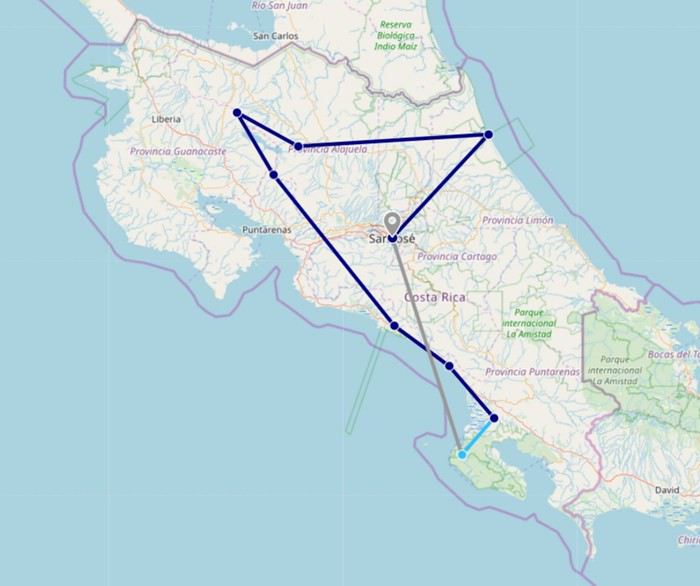
DAY 2 – Off to Tortuguero
This morning, we had a meet-up at the hotel with ToutCostaRica, where we’d rented our 4x4. They held a briefing in small groups for all the car renters to discuss our routes, tips, the country, and other advice. We found it interesting, but *way* too long! They could’ve kept it shorter—reminding us to wear sunscreen in the sun and not to leave valuables in the car seems pretty obvious... Anyway, after a while, we thanked them for all the advice and set off in our brand-new Toyota Rav4! The rental went perfectly with TCR—everything was great. After leaving the traffic jams of San José behind, we hit some pretty little roads (some in better shape than others) until we reached La Pavona. There, we left our car in a guarded parking lot and took a boat (departure at 3:00 PM) to Tortuguero on the Caribbean coast. Just the boat ride was amazing—we were lucky enough to spot a basilisk, iguanas, and tons of birds. After 40 minutes, we docked right at the pier of our hotel, Casa Marbella. After dropping off our stuff in the room, we headed out to explore the village via its one main street. Lively, colorful, and hot! Since we didn’t have anything else planned for the day, we went back to the hotel terrace to enjoy a juice by the canals. Then, a quick dinner and off to bed to be fresh for tomorrow morning!
Casa Marbella: Really nice, with a convenient pier/terrace for arriving and leaving by boat. Breakfast was absolutely delicious! The room was good, though the AC wasn’t working.
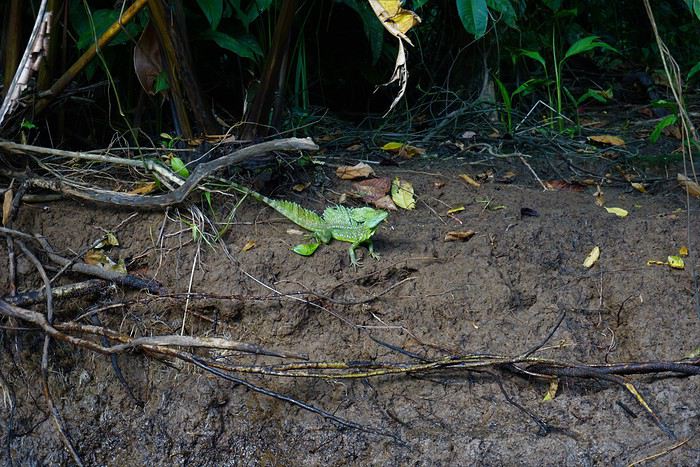
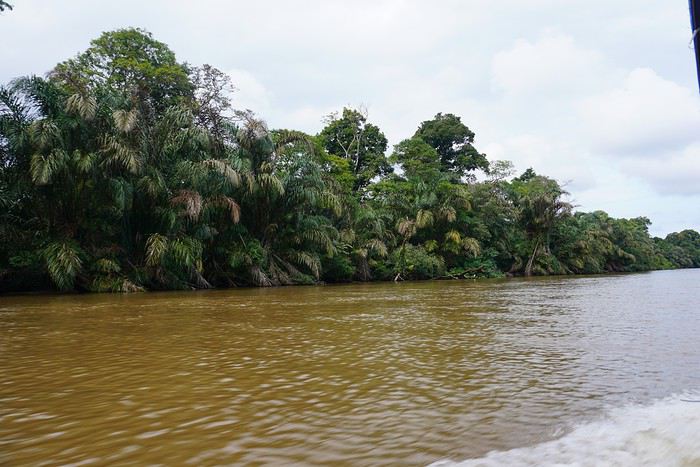
More to come soon!
Taking advantage of the quiet days that Covid-19 has brought us, I thought it was time to share my experience in Costa Rica. Once again, I found a lot of helpful information on this forum, so if I can help in return, I’d be happy to!
Here’s some general info: - 2-week trip in a 4x4 during the dry season, from 01/27 to 02/10 - Two 27-year-old travelers, no kids And here’s our itinerary: Day 1: Arrival in San José Day 2: San José - Tortuguero Day 3: Tortuguero Day 4: Tortuguero - Arenal Day 5: Arenal Day 6: Arenal - Tenorio Day 7: Tenorio - Monteverde Day 8: Monteverde - Quepos Day 9: Quepos Day 10: Quepos - Uvita Day 11: Uvita - Sierpe - Bahía Drake Day 12 & 13: Bahía Drake Day 14: Bahía Drake - San José Day 15: Flight back to Switzerland...
Of course, we had to make choices—it’s impossible to see everything in two weeks—but honestly, we’re *really* happy with our route. We even saw more than we expected!
So, ready 😉? Here we go!
DAY 1 – Arrival in San José
After a smooth Zürich-Frankfurt-San José flight, we finally made it to San José 😎!! After months of planning and excitement, we’re here! Since we’d booked a 4x4 with the ToutCostaRica agency for the next day, we stayed at one of their hotels, the Melrost. One of their agents was there to pick us up at the airport and take us to the hotel, which is really close. It was early evening, and it was already dark, so no exploring the city tonight. We treated ourselves to a first local beer on the terrace, listening to the birds, and then headed straight to bed.
Hotel Melrost: A simple little building, but super convenient for just one night in San José (well, Alajuela) before moving on. The room was great, and breakfast was excellent!
DAY 2 – Off to Tortuguero
This morning, we had a meet-up at the hotel with ToutCostaRica, where we’d rented our 4x4. They held a briefing in small groups for all the car renters to discuss our routes, tips, the country, and other advice. We found it interesting, but *way* too long! They could’ve kept it shorter—reminding us to wear sunscreen in the sun and not to leave valuables in the car seems pretty obvious... Anyway, after a while, we thanked them for all the advice and set off in our brand-new Toyota Rav4! The rental went perfectly with TCR—everything was great. After leaving the traffic jams of San José behind, we hit some pretty little roads (some in better shape than others) until we reached La Pavona. There, we left our car in a guarded parking lot and took a boat (departure at 3:00 PM) to Tortuguero on the Caribbean coast. Just the boat ride was amazing—we were lucky enough to spot a basilisk, iguanas, and tons of birds. After 40 minutes, we docked right at the pier of our hotel, Casa Marbella. After dropping off our stuff in the room, we headed out to explore the village via its one main street. Lively, colorful, and hot! Since we didn’t have anything else planned for the day, we went back to the hotel terrace to enjoy a juice by the canals. Then, a quick dinner and off to bed to be fresh for tomorrow morning!
Casa Marbella: Really nice, with a convenient pier/terrace for arriving and leaving by boat. Breakfast was absolutely delicious! The room was good, though the AC wasn’t working.
More to come soon!
Itinéraire pour le Cap Nord à moto au départ de Montpellier English translation pending
Bonjour à tous,
En ces temps de confinement (.....), je suis à le recherche de conseils pour un voyage en VFR800 de mi-juin à mi-juillet.
Que me conseillez vous comme itinéraire?
Je partirai de Montpellier en solo, je compte dormir en hôtel économique.
L'équipement du motard?
Le budget?
Merci de votre aide
Patrick