Results for "Rance+|+127"
8186 results found.
Porc au caramel English translation pending
Porc au caramel (Vietnam)
Ce plat, très commun au Vietnam, peut se servir avec du riz gluant ou du riz parfumé.
Ingrédients pour 4 pers. Temps de cuisson : 30 mn à 1 heure
500 g de maigre de poitrine de porc (ou d'échine) 1 cuil. à soupe de maïzena 1 gros oignon 3 cuil. à soupe de sucre 3 cuil. à soupe de nuoc mâm (sauce de poisson) sel, poivre 1 cuil. à café de 5 parfums (mélange d'épices tout prêt) 1 étoile de badiane (anis étoilé) Coriandre fraîche (facultatif)
Découper la viande en dés en éliminant les parties trop grasses. Les assaisoner de sel (peu) et poivre et les mélanger avec la maïzena. Dans une cocotte en fonte (ou sauteuse), faire caraméliser 2 cuil. à soupe de sucre à feu très doux sans eau. Faire un caramel bien foncé. Ajouter le porc, l'oignon haché et le nuoc mâm et remuer jusqu'à évaporation de l'eau résiduelle du porc. Ajouter les 5 parfums et l'étoile de badiane, puis recouvrir d'eau. Ajouter la dernière cuil. à soupe de sucre et laisser mijoter à feu doux en couvrant aux 2 tiers jusqu'à évaporation presque complète de l'eau. Surveiller l'eau pour que le plat n'attache pas, ne pas hésiter à en remettre. Servir en parsemant le plat de coriandre hachée avec du riz non salé. Proposer piment et nuoc mâm aux convives.
C'est le plat favori de mon dernier.
Conseils sur la Namibie English translation pending
Nous envisageons de visiter ce pays en aout ou septembre de cette année.
Que faut il savoir sur ce pays?
protection sanitaire, sécurité, endroits à visiter....
Peut on partir sac a dos ?
tous les conseils sont les bienvenus.
Le Transsibérien, extraits de carnets de route, seconde partie English translation pending
Samedi 13/09/03, Irkoutsk, 15:30 LOC, 10:30 MOS
J'attends le bus de 16h30 pour Listvianka. J'ai manqué le précédent à cause d'une erreur de débutant relative au décalage horaire. J'avais fini par trouver au centre ville un cyber-café, où j'envoyais tranquillement mes premiers mails d'une série que je prévoyais longue, quand j'ai vu l'heure sur l'ordinateur. J'ai tout d'abord pensé que, comme d'habitude, il n'étais pas à l'heure du lieu dans lequel nous nous trouvions lui et moi, mais j'ai alors immédiatement pensé à ce qui vient naturellement suite à une telle réflexion: j'avais changé de fuseau horaire, et j'avais oublié de donner à manger à ma montre une heure de plus. La cinquième depuis Moscou. J'en suis quitte pour prendre le prochain bus, seule conséquence de cette erreur. J'ai donc une heure d'attente en sus à dépenser dans cette gare routière. J'en profite pour observer, et je me retrouve plongé quatre ans en arrière, à la gare routière de Bernaoul.
J'ai trop pris l'habitude de resserrer l'écriture, si bien que j'oublie de sauter de nouveau les lignes, quand bien même j'ai acheté un nouveau cahier, flambant neuf, que je réserve pour plus tard.
Pour changer mon billet de car, ce ne fut pas une mince affaire. Je me serais cru dans une parodie particulièrement caricaturée. Après avoir fait une première queue, importante, et souvent anarchique, notamment ignorée de certaines vieilles babaïagas à l'air mauvais, quand ce fut mon tour, je me suis fait renvoyer dans mes vingt deux par la caissière, qui m'a dit que les remboursements, c'était la caisse d'à côté. J'ai eu beau lui expliquer que je venais de faire la queue, et que c'était injuste, elle n'en eut, évidemment, cure. La nouvelle queue fut en tout point identique à la première. Ensuite, pour le remboursement, outre les vingt cinq pour cent de frais d'annulation, il a fallu que la caissière remplisse un immense cahier, sur lequel elle devait noter mes noms, prénoms, et patronymes. Je lui ai donné mon passeport, mais elle a fini par se décourager. Ensuite, elle m'a remboursé, lentement, alors que je lui avais bien précisé que je voulais juste prendre le bus d'après. Derrière, ça poussait comme dans un mirage 2000 qui met la post-combustion. Rien que des fait routiniers, au final. J'ai hésité à les relater sur ce cahier, tant ce genre de scènes est banal ici.
Avant cet incident somme toute mineur, j'ai visité la ville qui a un certain charme. Les maisons sont de vieilles bâtisses toutes de bois construites, très joliment décorées, mais elles mériteraient un coupe de restauration. Il y a de belles églises, sans trop d'or, pour une fois, peintes avec beaucoup de goût. Le grand marché central est également charmant, véritablement authentique.
Avant cela, j'ai réussi à acheter mon billet de train de Ulan Udé à Vladivostok. Départ d'Ulan Ude mardi après midi. En attendant, je vais essayer de visiter le Baïkal, et d'aller par un moyen ou un autre de l'autre côté, en Bouriatie, jusqu'à sa capitale, Ulan Udé. Ce soir, je serai donc à Listvianka, village situé au bord du mythique Lac, et j'espère trouver un petit hôtel sympathique où me poser un peu. Je vais essayer de me laver, et de laver quelques habits.
Le voyage et les langues English translation pending
J'ai comme principe de visiter que les pays dont je connais la langue.
C'est en partie une question de respect pour les gens, mais c'est aussi une question de sécurité. Le français ou l'anglais n'ont aucune utilité dans de nombreux coins du monde. On oublie souvent que dans cet "ère de mondialisation" 90% des gens de la planète ne vont pas plus loin que leur "dépanneur" et n'ont aucune utilité pour une langue étrangère.
Vous ne trouvez pas que le commerce mondial du tourisme (inclut le tourisme écologique, social, extrême sport etc.) ne fait qu'éroder les limites du monde de nombreuses cultures avec des cabanes ou hôtels dédiés aux touristes et d'imposer sur leur culture une langue "internationale", que ce soit le français, l'anglais, l'espagnol, le portugais, le russe, le japonais, thai...
Je me suis rendu compte que d'étudier l'espagnol ne fait que soutenir la classe hispanophone dominant d'anciennes culture nobles, celles que les Conquistadores ont soumises : Mayas, Toltèques, Olmèques, Incas, Quechuas...
Maintenant que j'apprends le japonais, je ne voudrais pas contacter les "pauvres" Ainus dont le pays et la culture a été réduit à quelques milliers de personnes à Hokkaido, à la veille de leur disparition.
Le tourisme n'est pas un droit international. Dans bien des cas, ça ne fait que répondre à des basses obsessions commerciales qui donnent des "jobs minables qu'ils auraient pas autrement". Les voyageurs se motivent avec le prétexte de "voir les gens dans leur milieu". Mais qui a invité ces gens à observer les gens dans leur misère ?
Qu'en pensez-vous ?
Pour ou contre le bent (vélo couché) English translation pending
Salut tout le monde! J'envisage dans un proche futur (tout est relatif) un tour du monde en vélo, sur plusieurs années. D'abord décidé pour le bent (ou vélo couché), je me suis ensuite redirigé vers le simple et robuste VTT, qui est surtout beaucoup moins cher... et puis là, je recommence à me poser des questions... Le bent est un vélo qui m'attire par son coté différent, mais en même temps, j'ai peur qu'il soit source de galère, par ce caractère différent justement (vol, regard des autres, mais aussi trouver les pièces de rechange, etc). Et puis je me pose aussi des questions sur la tenue de route et l'équilibre que l'on peut avoir sur tous les terrain (piste défoncée, route mouillée et glissante, pente ou montée très raides, verglas, etc...)
Enfin, je ne sais vers quel produit ni quel marque me diriger... j'ai aussi vu qu'il existait des tricycles... pourquoi pas, mais l'encombrement sur la route doit être beaucoup plus important, en revanche, on gagne encore en aérodynamisme... Encore une chose : Guidon en haut, ou en bas?
Bon, voila, j'espère que vous serez nombreux à me donner vos impressions, ou à me faire part de vos expérience vécues. Que ce soit positif ou négatif, n'hesitez pas, que je puisse peser le pour et le contre...
Voila, c'est tout. Bonne route à tous. Bastoche.
Le Transsibérien, extraits de carnets de route English translation pending
Bonjour à tous.
Voici un premier extrait de mes carnets de route écrits pendant mon voyage dans le Transsibérien. Il s'agit d'une rencontre surréaliste. Cette rencontre n'a pas eu lieu dans le train lui-même, mais dans un restaurant à Ekaterinburg (anciennement Sverdlovsk).
Mercredi 10/09/03
Ekaterinbourg
Restaurant “Sunday” 13 :30 LOC 11 :30 MOS
Sverdlovsk est bien un trou, j’en ai maintenant la certitude, et à part deux trois jolis bâtiments et la cathédrale fraîchement reconstruite des Romanov, il n’y a rien à voir ; on en regrette presque de s’y être arrêté. Certes, le temps ne joue pas en la faveur de l’impression que peut donner la ville au voyageur solitaire à petit budget, sans parapluie, que je suis (horreur des parapluies). Cette ville n’est pas faite pour les étrangers, ni pour les piétons. Or, je suis piéton, étranger. Tout ici, est assez difficile. Trouver un cyber (Siber ?) café est une aventure plus ardue que je ne l’aurais pensé, dégotter un petit restaurant bon marché où s’asseoir, au sec, est un vrai défi. Tout est payant, des toilettes de la gare, par ailleurs au plus bas de l’échelle absolue de la saleté des toilettes déjà visités dans ma vie, au bout de pain du restaurant où je suis finalement, d’ailleurs assez cher pour la qualité. En gros, les prix de Moscou. Ce restaurant est un fast-food aux allures de kebab parisien, avec des plats russes, et un décor de jardin zen, si on fait abstraction de l’inévitable télé à clips qui braille dans un coin.
Avoir à tuer douze heures dans cette ville, sans endroit où pouvoir se poser tranquillement au sec, sans payer, est une perspective relativement désagréable. Si seulement il ne pleuvait pas ! Je pourrais m’allonger dans l’herbe sauvage d’un parc de la ville, un de ces parcs où il y a tellement peu de passages qu’on en finit par avoir de fortes montées d’adrénaline à la seule rencontre avec un chien errant au regard fuyant.
Ce qui réconforte, comme partout dans ce pays, ce sont les belles filles. Je suis assis dans ce restaurant mi-sushi, mi fast-food russe étrange, et mon attention est souvent perturbée par des passages non loin de ma table. Se dire que la plupart de ces belles filles sont seules, et luttent pour se trouver un homme rend malade. Hier soir encore, dans le cyber café que j’avais fini par trouver, finalement, une magnifique blonde était sur un site de rencontre. Si j’avais résidé dans cette ville, je l’aurais aidé volontiers ! Et là, à mes deux heures, une femme seule est attablée, et une autre, plus jeune, s’installe une table plus loin. C’est terrible ! Mais que font les hommes ! Et je ne parle pas des filles accompagnées. Que les hommes sont chanceux dans ce pays ! Mais le concept même de drague, tout au moins dans les lieux publics, semble avoir été oublié. A part, hier, où Volodia a abordé une femme qui attendait dans la gare comme lui, je n’ai pas vu d’entreprise masculine de rapprochement. Où sont les méditerranéens ?
Bon, l’une des filles seules ne l’était pas. Elle était la première au rendez-vous, nuance. Deux hommes charmants viennent de la rejoindre.
Je vais demander à cette femme seule, attablée juste à côté de moi, qui lit, si elle connaît un musée intéressant pas trop loin.
Où aller en République Dominicaine? English translation pending
Bonjour,
Moi et 4 de mes copines iront en voyage au mois de février ou mars prochain et nous souhaiterions avoir des suggestions d'endroit? Nous aimerions aller dans un endroit où la plage est de sable blanc avec des cocotiers, pas nécessairement un endroit des plus branché mais où on peut avoir du plaisir! Nous avons pensé à la RD mais es-ce un bon choix et si oui à quel endroit devrions-nous aller?
Moi et 4 de mes copines iront en voyage au mois de février ou mars prochain et nous souhaiterions avoir des suggestions d'endroit? Nous aimerions aller dans un endroit où la plage est de sable blanc avec des cocotiers, pas nécessairement un endroit des plus branché mais où on peut avoir du plaisir! Nous avons pensé à la RD mais es-ce un bon choix et si oui à quel endroit devrions-nous aller?
L'Inde? English translation pending
Mettre le pied pour la première fois en Inde... c'est être étourdi par la foule et le bruit qui nous entoure, c'est être surpris et parfois écoeuré par les rues sales et poussiéreuses. Dans un premier temps, on se sent l'objet de tous les regards, sentiment d'être constamment agressé, par les passants, par les mendiants, on étouffe, on voudrait fuir tous ces gens qui nous collent et essayent de nous prendre quelques roupies. Mais pourquoi en veulent-ils donc tant à notre porte-monnaie ? pourquoi ne nous lâchent-ils pas un peu ?... Mais il faut comprendre que eux n'ont rien, et que nous, on a tout... Même le voyageur routard le plus démuni qui sillonne l'Inde est tellement riche par rapport au peuple indien. Alors c'est vrai, certains ne verront dans les voyageurs que nous sommes que nos roupies, mais il faut comprendre que chaque jour des millions d'indiens se demandent comment ils vont faire pour trouver de quoi acheter la farine pour nourrir la famille, pour un soir, car demain il faudra de nouveau chercher..., comment vont-ils réussir, tous ces pères, à financer la dot de leur fille, cette petite fille qui vient de naître ? Ce sont pour des raisons quotidiennes de survie que la plupart nous accoste et cherche nos roupies. Que ferions-nous à leur place ?
Ne pas chercher à comprendre l'Inde, ne pas se poser de questions qui resteraient trop souvent sans réponse, mais faire totale abstraction de notre mentalité occidentale... Laissons l'Inde nous surprendre, nous choquer, nous émerveiller...
Laissons l'Inde venir à nous.
Prendre le temps d'observer ces hommes et femmes dans leur vie quotidienne, regarder les petits sortir de l'école en discutant et en riant, avec l'insouciance de leur âge, et puis, tout d'un coup, les voir s'arrêter devant un temple, le visage soudain devenu grave et plein de ferveur... voir au détour d'une rue une jeune maman bercer et masser longuement son tout petit...
L'Inde s'offre à nous.
Arriver sur les ghats de Varanasi, où on entend les battements de coeur de l'Inde toute entière, où les mystères de la vie et de sa poursuite logique dans le Grand Voyage prennent tout leur sens... "Ganga oh ma Mère", rester des heures auprès du fleuve, descendre dans ses eaux glacées, murmurer des prières, chercher et parfois trouver la paix intérieure... S'asseoir sur les ghats, s'imprégner de ce lieu de vie, sourire en voyant les enfants plonger et se baigner, hommes qui se lavent, femmes qui, après avoir fait leurs ablutions et bu une gorgée d'eau sacrée font décher leur sari et se cachent pudiquement pour s'habiller...
L'Inde s'offre à nous.
Et, lorsqu'un sourire timide et complice s'échange entre un homme ou une femme indienne et nous les voyageurs, lorsque d'un petit signe de la main on nous invite à s'approcher, alors là, la magie de l'Inde opère, et c'est nous qui allons vers Elle.
Sandrine
"On ne voit bien qu'avec le coeur. L'essentiel est invisible pour les yeux". St Exupery
Qui connait le groupe Manà? English translation pending
qqun connait il le groupe manà?jen suis devenue fan par le biais d'amis mexicain.est ce qu'ils font des concerts en france???
Comment faites-vous pour vivre et voyager? English translation pending
🤪 Bonjour à toutes et à tous !!!!
Si jai décidé de démarrer une nouvelle discussion, c'est parce que j'ai un gros problème existenciel !
Je m'explique :
Cela fait maintenant 1 ou 2 mois que je suis menbre de ce forum et je suis devenu complètement accro : je reste des heures devant mon poste (d'ailleurs je pense que ça ne plairait pas trop à mon patron !!!) en train de lire les discussions sur n'importe quel thème, regarder les profils de chaque membre, ... et tout me fait rêver, chaque destination me donne envie d'y aller ...
Mais je me pose quand même une petite question ... 😕 COMMENT FAITES VOUS ?????? Bon, c'est vrai je n'ai que 23 ans, mais en regardant certains profils (agatha), je me rends compte que certaines personnes de mon âge ont déjà fait pas mal de voyages ... Et puis même les personnes plus âgées (30, 40 ou 50 ans), je me demande comment vous faîtes pour pouvoir partir autant. c'ets vrai vous devez avoir un boulot qui ne vous donne pas forcément la possibilité de partir 1 ou 2 mois en voyage. Et puis si vous avez des enfants, comment faîtes vous pour "bourlinguer"avec des gosses. Et au niveau financier ... Là aussi ça me fait peur. Je sais qu'en cherchant bien on peut se débrouiller pour partir pas cher (j'ai fait un week-end à Londres où le vol m'a couté pour 2 personnes 300 F aller -retour), mais si on sort un peu de l'Union Europééne, alors là, il faut aligner la monnaie. Mais bon, je me dis que si on n'a vraiment envie de partir il faut économiser et c'est tout ... En fait, je crois qu'il me faudrait plusieurs vies : - 1 vie pour avoir une super carrière profesionnelle : j'ai envie de faire pleins de choses, traviller dans une agence de voyage, dans la presse, la communication, la déco, ... - 1 vie pour m'occuper de mes futurs enfants : je veux 4 enfants, donc je pense que ça m'occupera pendant au moins toute une vie non ?!? - et bien-sur, 1 vie pour voyager : je voudrais vivre un peu dans chaque pays pour avoir le temps de découvrir chaque culture, chaque coutume, chaque religion, ... 🤪 Vous vous rendez bien compte vous aussi que je ne pourrais pas faire tout ça en 1 seule vie !!! En fait, si j'ai décidé d'écrire ce message, c'est surtout pour vous remercier, vous tous qui me font tant rêver dans ce forum avec vos multiples expériences autour du monde. 🙂 Merci et à très beintôt. Mumu
Trekking des Annapurnas (Népal) English translation pending
Salut à tous
Je suis à la recherche de nombreuses informations concernant le trekking des Annapurnas! En effet, je pars au mois d'octobre au Népal avec 3 de mes potes. Et je voudrais savoir comment relier BESI-SAHAR ( point de départ de notre trek) à partir de KTM? Quelle est la compagnie la plus sûre, la plus économique? Faut-il prendre le bus, le taxi ou faire de l'auto-stop? Pareil pour le retour: comment rejoindre KTM à partir de POKHARA?
J'ai evidemment pleins d'autres questions qui me viennent en tête, mais j'aimerais être en relation avec une personne ayant déjà fait ce trek recemment ou quelqu'un qui connait bien la région. Vous pouvez me laissez un message sur ce forum ou bien m'envoyer un mail
MERCI . OZAN
Hôtel Palmariva club coralia (Marrakech) English translation pending
🙁 Bonjour à tous!!!!
Suite à mon premier message je n'ai eu aucune réponse jusqu'à présent....( je désespère 😕)
N'y a-t-il personne qui puisse me donner des infos sur Marrakech et sur cet hôtel en particulier, Palmariva club coralia.J'attends vos réponses avec impatience.
Merci beaucoup et à très vite!!!!
Suite à mon premier message je n'ai eu aucune réponse jusqu'à présent....( je désespère 😕)
N'y a-t-il personne qui puisse me donner des infos sur Marrakech et sur cet hôtel en particulier, Palmariva club coralia.J'attends vos réponses avec impatience.
Merci beaucoup et à très vite!!!!
Livres à ne pas lire quand on est déjà mordu English translation pending
Bonjour
je propose ce nouveau sujet de discussion.
Parlez des livres que vous avez lu, qui traitent du voyage, et qui donnent encore plus envie de partir.
Je sais, c'est pas bien de faire ça, c'est malsain, parce qu'on a tous suffisamment envie de se barrer, mais c'est plus fort que nous, n'est-ce pas?
J'ouvre, avec l'Usage du Monde de Nicolas Bouvier.
Entre 1951 et 1953, Nicolas Bouvier est parti avec un ami peintre (Thierry Vernet) en fiat facile à réparer qui tombe tout le temps en panne à travers l'Europe Balkanique, puis la Turquie, le Kurdistan, l'Iran, l'Afganistan. Il raconte ses souvenirs et ses analyses d'une manière simple et très émouvante. Les rencontres et les moments insolites donnent particulièrement envie de vivre des instants similaires, même s'ils ont quand même pas mal galéré. Mais la galère est un véhicule comme un autre...
Donc voilà, pour ceux qui n'aiment pas voyager, lisez ce bouquin, les autres, surtout, abstenez vous, sinon, vous serez irrémédiablement perdus, korzéam.
Chine: Conseils sur la route de la soie (Kashgar-Pekin) English translation pending
🤪 🤪 🤪
nous preparons gros voyage sur la route de la soie a partir de l'ouzbekistan jusqu'a pekin pendant plusieurs mois.
nous aurions besoin de conseils et d'impressions en tous genres surtout sur la partie chinoise:de kashgar à pekin et de facon generale sur le xingkiang (nord ouest) et aussi sur le tibet .
merci d'avance
Inde: 1200 ours torturés par des gitants kalandars English translation pending
Prenez SVP quelques minutes pour lire ce message, il s'agit d'une torture qui NE DOIT PLUS durer. Merci
Plus de 1200 ours à miel sont torturés par des gitans Kalandars qui forcent les ours à exécuter un simulacre de danse pour divertir les touristes. Cette pratique barbare, issue d’une tradition du XVIe siècle, enferme à tout jamais les ours dans la terreur et la douleur. Depuis 1972, il existe pourtant une loi de protection de la faune sauvage qui interdit de vendre des ours et des parties de leur corps. Une autre loi condamne les méthodes de dressage. Les braconniers attendent que la mère ourse sorte pour chercher de la nourriture, et enlèvent l’ourson âgé de quelques jours. Les mères qui surprennent les malfaiteurs défendent leurs petits au prix de leur vie. Le nouveau-né, transporté dans un sac pendant de longues heures, est drogué à l’opium pour empêcher la faim et les cris de détresse. Nombre d’entre eux meurent en chemin. Les survivants sont vendus aux Kalandars. À l’âge de 3 mois, avant d’être exhibé sur les routes et devant les hôtels, l’ourson, déjà traumatisé, subit des actes d’une extrême barbarie.
Les gitans perforent sa cavité nasale avec un tisonnier chauffé à blanc pour y insérer une corde qui ressort par la narine. Cette terrible mutilation est effectuée sans anesthésie.
😕En Inde, la population est révoltée par les tortures infligées aux ours par les gitans, en totale infraction avec la loi. Ces pratiques perdurent parce que les touristes donnent de l’argent aux Kalandars pour voir danser les ours.😠
🙂Prenez quelques minutes pour visiter ce site internet suivant, afin de voyager intelligent !!!!
http://www.onevoice-ear.org/
Merci
David
Breathtaking Kyrgyzstan!
This trip had been on my mind for about fifteen years.
But the discomfort of overnight stays, the difficulty of communication, and the prices of the few car rental options kept making me postpone the project.
And then, everything suddenly fell into place—I told myself, it’s time!
The preparations took longer than usual; the destination is still far from mainstream.
A bit of Kazakhstan? Not in the end.
The south or not the south? Yes, in the end.
Pre-book or go with the flow? Only two stops were a leap into the unknown.
To help me find the ideal route, I made great use of this forum (thanks to everyone for patiently answering my questions!), pored over travel journals and blogs (Christian, Jeff), zoomed in on Google Maps and Yandex, and bought the guide published by OunTravela about this destination (the guide has been updated since).
---/---
You’ve got your passport, international driver’s license, bank cards, and euros?
Off we go to Lyon—just one night left before our early morning flight.
Tomorrow night, we’ll be sleeping in Bishkek! (Steak for my partner’s mischievous nephews...)
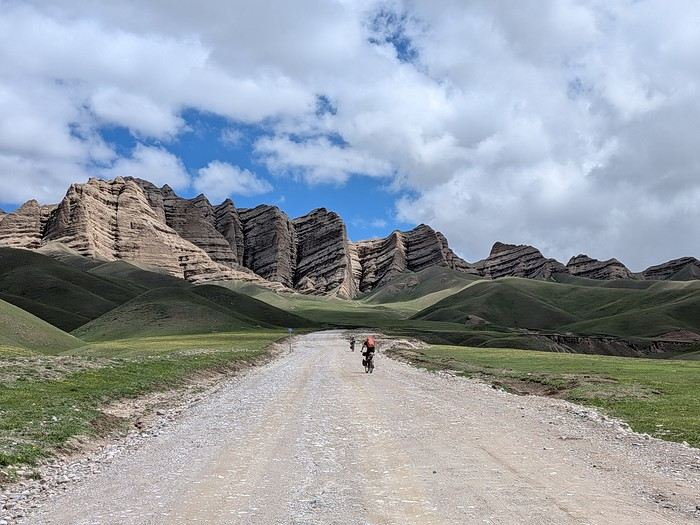
You’ll find here a post with some practical information.
And here, the version of the travel journal without comments.
---/---
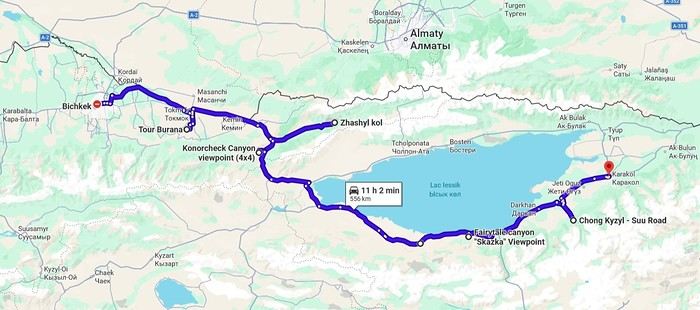
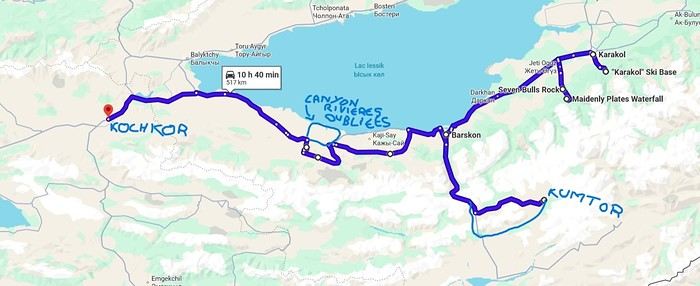
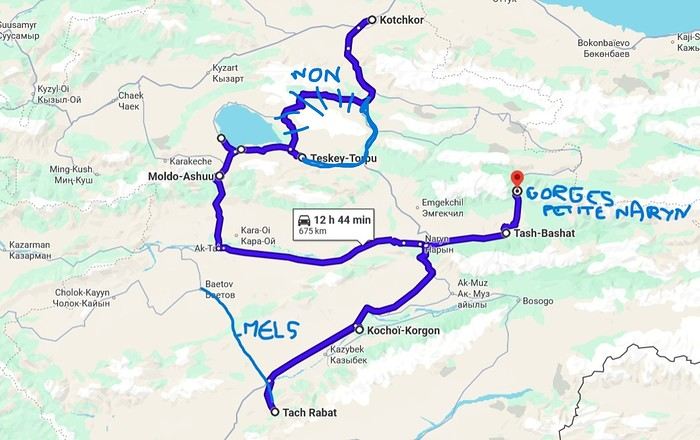
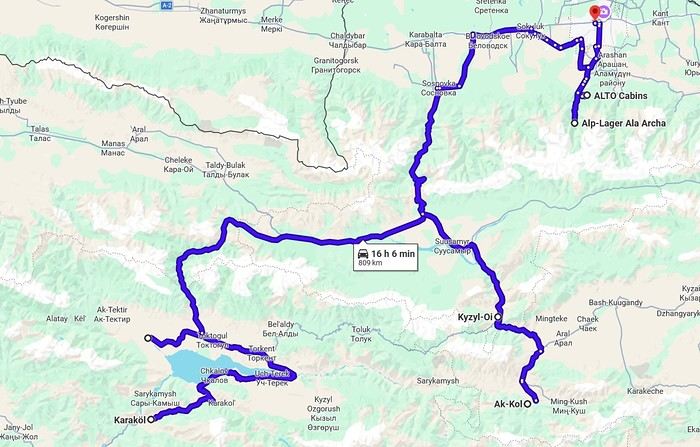
As a supplement, the route track. Not necessarily ultra-accurate since Google has serious gaps for this destination...
From Bishkek to Karakol:
From Karakol to Kochkor:
From Kochkor to Baetov:
From Baetov to Kara-Köl:
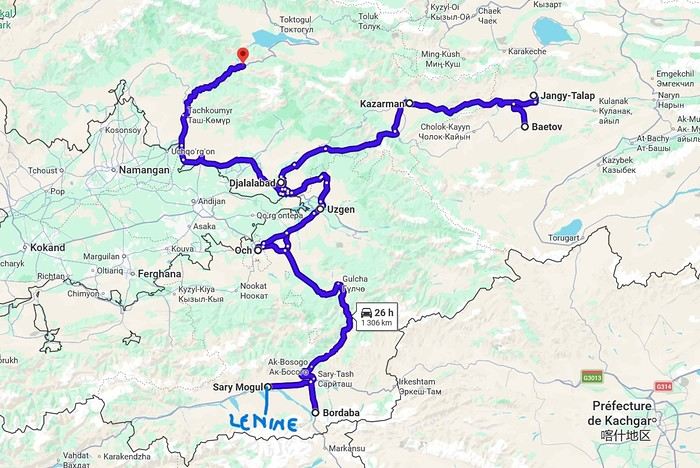
From Kara-Köl to Bishkek:

But the discomfort of overnight stays, the difficulty of communication, and the prices of the few car rental options kept making me postpone the project.
And then, everything suddenly fell into place—I told myself, it’s time!
The preparations took longer than usual; the destination is still far from mainstream.
A bit of Kazakhstan? Not in the end.
The south or not the south? Yes, in the end.
Pre-book or go with the flow? Only two stops were a leap into the unknown.
To help me find the ideal route, I made great use of this forum (thanks to everyone for patiently answering my questions!), pored over travel journals and blogs (Christian, Jeff), zoomed in on Google Maps and Yandex, and bought the guide published by OunTravela about this destination (the guide has been updated since).
---/---
You’ve got your passport, international driver’s license, bank cards, and euros?
Off we go to Lyon—just one night left before our early morning flight.
Tomorrow night, we’ll be sleeping in Bishkek! (Steak for my partner’s mischievous nephews...)
You’ll find here a post with some practical information.
And here, the version of the travel journal without comments.
---/---
As a supplement, the route track. Not necessarily ultra-accurate since Google has serious gaps for this destination...
From Bishkek to Karakol:
From Karakol to Kochkor:
From Kochkor to Baetov:
From Baetov to Kara-Köl:
From Kara-Köl to Bishkek:
The 2026 Southwest USA Road Trip
Hi everyone, we're back from a DIY USA road trip we organized from July 31, 2026, to August 26, 2026.
The destination: The Southwest USA, including Texas, Arizona, and New Mexico. Roughly 7,000 kilometers covered.
The car: A Chevrolet Equinox for two, rented through BSP Auto and Avis. Inside, we had 2 suitcases, a travel bag, two carry-on bags, a Walmart cooler, photo gear, and water bottles (a 40-pack).
The route: Dallas DFW, Fort Worth, Houston, Austin, San Antonio, Alpine, El Paso, Tucson, Sedona, Albuquerque, Amarillo, and back to Dallas to finish with a departure from DFW.
The travelers: Two seniors well advanced in years (73 and 75) but still active (nothing too physically demanding—to stay alive and fund our trips), fully independent physically, though a bit less so mentally. Big USA fans, a country where anything is possible. More walkers than hikers, preferring 3-star hotels over roadside motels, Italian restaurants over US food, frequent stops for photos, museums over nothing, naps over forced marches. Not too whiny, just enough to stay French in the land of the "great Satan," as they say. Not great with languages—street English (but handy), and my Spanish is non-existent except for: "Hola! Una cerveza por favor!" That’s about it. My wife understands everything but refuses to speak.
The cost of the road trip: Around 12,000 €, including AF flights, the car, gas, gifts, visits, and everything else. Well managed, since we’d budgeted 13,500 € initially.
The positive side: A delight, with those endless open roads. Museums to discover. The realization of the Hispanic presence and its important history in this part of America. Lovely locals. Tourists who were more or less friendly. A terrible Texan accent that was hard to understand. Gas stations that were like real stores, with prepared food, alcohol sold in Arizona and New Mexico, and employees who were always up for a laugh!
The negative side: The heat throughout the trip... 43°C in Dallas at the end. Impossible to walk the streets. Lots of homeless people in downtown Dallas. Hotel breakfasts that were always the same. You get used to it.
So, it was positive overall, but the concept is starting to wear us out. We might rethink the DIY road trip model for next time. If the man upstairs grants us more time.
Next up, we’ll wait for the first batch of sorted photos to go through the wringer.
See you soon.
A Few Days in Turkmenistan from Uzbekistan
The latest travel journal about Turkmenistan dates back to 2019. Here’s a quick update on this vast desert country, which is now a bit easier to visit than before.
This is my first travel journal. If you have any questions, don’t hesitate to ask. The country is slowly opening up, but it’s still possible to visit sites where you’ll be completely alone. In five days, I saw two Hongkongers, a few Germans, and a Chilean at the crater, ten Chinese people in a capital bazaar, and that’s it!
It’s possible to visit Turkmenistan from Uzbekistan. The easiest and most economical way is to take a taxi to the border from Bukhara. The trip takes a little over an hour.
Crossing the border takes quite a while because many Turkmen bring back items bought in Uzbekistan to resell in Turkmenistan. For example, diapers, baby products, or beauty products. It took me over 2.5 hours to cross the border. To visit Turkmenistan, it’s mandatory to have a guide and go through a travel agency. British agencies often offer three-, five-, or seven-day trips for over 1,500 or 2,000 €. But if your budget is more limited, you can contact a few Turkmen agencies directly by email, and they’ll make you an offer between 700 and 1,300 € for three to seven days. I took a five-day trip from Turkmenabat in the northeast of the country to Dashoguz in the north. The goal was to visit the main UNESCO-listed sites, including Merv, and archaeological sites like Nisa or Gonur Tepe.
Your guide will also be your driver. They’ll pick you up at the border. The formalities are very long because customs officers have to stamp multiple documents, and obtaining the visa you previously requested from your travel agency requires several checks. But the process goes relatively smoothly, even if each step takes a while.
Once on the other side, the first surprise is the brand-new highway all the way to Turkmenabat. A very long line of trucks stretches for several kilometers on the Turkmen side to cross the border into Uzbekistan. According to my guide, Turkmen trucks transport gas and cotton (though not this season, since the harvest is in September), but they mainly fill up their tanks because fuel is much cheaper in Turkmenistan. A full tank for a car costs about 3 €, which is unbeatable.

From the Farap border post, the goal is to reach the city of Mary, which is home to the UNESCO-listed site of Merv in its suburbs, about thirty kilometers away. This city is known as a foundation by Alexander the Great in the 4th century BC under the name Alexandria of Margiana. Several fortresses are visible.
After more than three hours on the road, we have lunch at a Turkish restaurant called Aladdin. Several quotes from the president are visible along the highway, but the road is in good condition, and we move along easily. This will be by far the best road in the country—things will get much worse later.


 Roundabouts are particularly interesting because they feature emblems of Turkmen culture, like the dog, a carpet, the Ahal Teke horse, or Muslim symbols, even though the presence of Islamic artifacts is quite limited.

This is my first travel journal. If you have any questions, don’t hesitate to ask. The country is slowly opening up, but it’s still possible to visit sites where you’ll be completely alone. In five days, I saw two Hongkongers, a few Germans, and a Chilean at the crater, ten Chinese people in a capital bazaar, and that’s it!
It’s possible to visit Turkmenistan from Uzbekistan. The easiest and most economical way is to take a taxi to the border from Bukhara. The trip takes a little over an hour.
Crossing the border takes quite a while because many Turkmen bring back items bought in Uzbekistan to resell in Turkmenistan. For example, diapers, baby products, or beauty products. It took me over 2.5 hours to cross the border. To visit Turkmenistan, it’s mandatory to have a guide and go through a travel agency. British agencies often offer three-, five-, or seven-day trips for over 1,500 or 2,000 €. But if your budget is more limited, you can contact a few Turkmen agencies directly by email, and they’ll make you an offer between 700 and 1,300 € for three to seven days. I took a five-day trip from Turkmenabat in the northeast of the country to Dashoguz in the north. The goal was to visit the main UNESCO-listed sites, including Merv, and archaeological sites like Nisa or Gonur Tepe.
Your guide will also be your driver. They’ll pick you up at the border. The formalities are very long because customs officers have to stamp multiple documents, and obtaining the visa you previously requested from your travel agency requires several checks. But the process goes relatively smoothly, even if each step takes a while.
Once on the other side, the first surprise is the brand-new highway all the way to Turkmenabat. A very long line of trucks stretches for several kilometers on the Turkmen side to cross the border into Uzbekistan. According to my guide, Turkmen trucks transport gas and cotton (though not this season, since the harvest is in September), but they mainly fill up their tanks because fuel is much cheaper in Turkmenistan. A full tank for a car costs about 3 €, which is unbeatable.
From the Farap border post, the goal is to reach the city of Mary, which is home to the UNESCO-listed site of Merv in its suburbs, about thirty kilometers away. This city is known as a foundation by Alexander the Great in the 4th century BC under the name Alexandria of Margiana. Several fortresses are visible.
After more than three hours on the road, we have lunch at a Turkish restaurant called Aladdin. Several quotes from the president are visible along the highway, but the road is in good condition, and we move along easily. This will be by far the best road in the country—things will get much worse later.
Roundabouts are particularly interesting because they feature emblems of Turkmen culture, like the dog, a carpet, the Ahal Teke horse, or Muslim symbols, even though the presence of Islamic artifacts is quite limited.
Oman, at the edge of the sands and the horizon
If I close my eyes and think of the Sultanate of Oman, I first smell a light scent of incense, feel the warmth of a sunbeam on my skin, before sand slips through my fingers. I taste the sweetness of a date, a real candy, then the flavor of coffee with a hint of cardamom and rosewater... I hear the desert wind whistling in my ears, the distant call of a muezzin, then the murmur of water. I open my eyes to see smiles, welcoming gestures, a turquoise sea, rocks ranging from ochre to purple, deep wadis where torrents burst forth, orange dunes, white sandy beaches where tiny crabs scurry at full speed. I see incredible oases emerging between arid mountains. I see abandoned villages that I’d dream were full of life, imposing fortresses overlooking valleys, and lively souks where offers are delicate and negotiation is a mutual courtesy.
All that, and so much more.
This is what I tried to capture in my illustrated travel journal, which I’ll fill in here and there with photos. I drew this journal “cold,” after my return (actually, I made it this summer, while our trip was last winter). It’s a pretty special format—I bought it in Japan without really knowing what I’d do with it. Well, it found its purpose! Below is a photo of this accordion-style journal: here, it’s only partially open, because when fully unfolded, it’s 5 meters long!
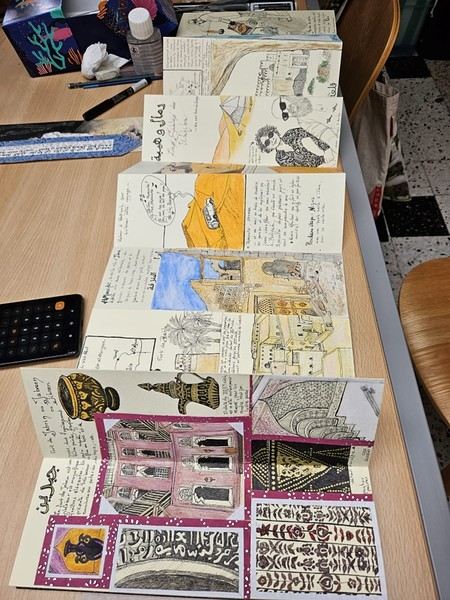
For drawing enthusiasts: The accordion format is both a constraint (each sheet is 9 cm x 27 cm) and a freedom (you can create a fresco). The paper is also a bit special: it doesn’t allow for fine lines, but it takes ink well (liner pen). However, everything has to be done almost in one go (with a very light pencil sketch) because it erases poorly. It absorbs too much water for coloring with markers or watercolors (unless you avoid soaking it), but it works well with oil pastels and their use with a brush and solvent. Since it’s yellowish, it allowed me to create contrasts even with white pastel.
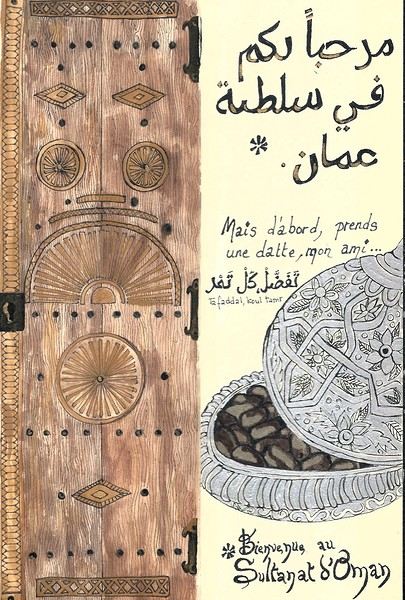 On the right, the "welcome marker"—those dates offered everywhere as a sign of hospitality. On the left, a tribute to those stunning doors worn by time, admired all over the old quarters, including the abandoned ones.
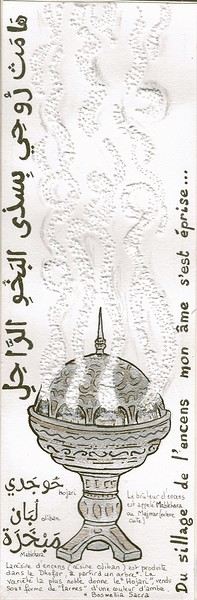
Oman is one of the world’s largest producers of frankincense resin. Incense burners are everywhere, from the simplest clay ones to the most precious handcrafted silver ones...
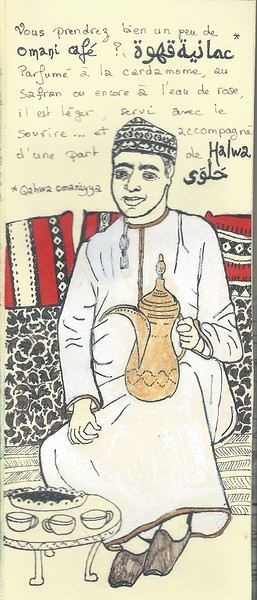 Hospitality will often lead you to accept a small coffee, an "Omani coffee," very light, subtly flavored with cardamom, maybe a touch of saffron, and occasionally rosewater.
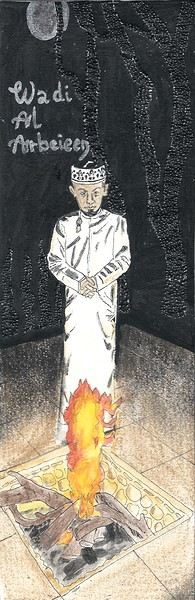
Here, I’ve depicted a man in the common everyday attire of Omanis: the dishdasha, mostly white (during the week and daytime; colors are more common in the evening or on Fridays and Saturdays). While you’ll see some men dressed in Western clothes, they’re very few. The white dishdasha is truly the shared attire of all men. The dishdasha, which has no hood, is distinguished by a small pom-pom attached to the collar, the furakha, which is soaked in perfume. And believe me, Omanis go overboard with it! "It smells like the pom-pom" is an expression that’s now part of our shared language, my husband and I.
Another must of men’s attire is the kuma, a small round head covering, usually white with brightly colored patterns. The keffiyeh is also worn (but without the cord called an agal in Arab countries), and it’s mostly worn by those with roots in the desert, from what I understood.
And what about the women, you might ask? Some are veiled, some in full black (but not a burka—more like a chador + abaya), due to the influence of Saudi Arabia and the United Arab Emirates, whereas the traditional outfit used to be a layering of very colorful dresses. Most of the women we saw wore neutral clothing, a plain veil over their hair, but with their faces uncovered. We also saw many saris and colorful veils—don’t forget that 40% of the population consists of Indian, Nepalese, and Bangladeshi immigrants, who work a lot in tourism, hospitality, restaurants, services, and construction.
Just to clarify, as a tourist, there’s no pressure to wear a veil, and never any disapproving looks. Of course, you’ll save the mini shorts, plunging necklines, bare shoulders, and midriffs for the hotel terrace—but I’d say that’s the same for men and women, and with the sun being strong, it’s better for your skin too.
Here’s the introduction! In the next post, I’ll tell you about my itinerary, and we can dive in!
Off to explore Egypt!
February 9 - Day 1
"So, my little wanderers, back at the decks? What’s this mystery destination you’ve got in store for us at the start of the year?"
Yes, the schoolyard bell’s ringing again! We’re hitting the road... or rather, the skies! At first glance, our destination might surprise more than a few. First off, simply because I was here exactly twenty years ago, and I don’t usually like retracing my own footsteps. Secondly, because the name of this place screams mass tourism—basically the opposite of what Flo and I look for.
Despite that, in this land of backsheesh, I’d promised myself I’d come back one day to experience it my way. And since Flo told me, during our wanderer chats, that this destination straddling Africa and the Middle East was in her top 2 travel dreams, the stars aligned for this roots-style trip to quickly make it onto our pharaonic festivities program! Unless you’re totally clueless in general knowledge, you’ve probably guessed by now—we’re off to Egypt! Of course, a few classics will be on our itinerary, but above all, we want to soak up a culture that can’t be appreciated in four-star resorts or on a Nile cruise boat. And let’s be clear, these next two weeks won’t be a walk in the park—neither for our two daughters who are joining us, nor for our bodies!
And that’s clear from the get-go: after our first flight, eight hours of trying (and failing) to sleep on Milan airport’s metal seats, our second flight, landing, passport stamps, our Uber ride, and our first Cairo kilometers, we finally drop our exhaustion at the little guesthouse we booked in Giza. Doesn’t all that energy deserve a little reward?
Oh, absolutely! And here it is: a full-on slap in the face for everyone! But just look at this view from our hotel terrace? For 20 € a night for four, even with this incredible view, I figured the room must be pretty shabby, right? Nope... Is the staff rude, then? Nope... Okay, so what’s the catch? You’re gonna tell me breakfast is included too? Well, yes! Honestly, this Egypt trip is off to a great start.

And the rest of the afternoon, spent rubbing shoulders with locals, only confirmed this vibe. After digesting our pyramid view, we dove into the hustle and bustle of our neighborhood with the goal of exchanging money, eating at street stalls, and testing the hospitality of the locals. Ten out of ten!




Eight little sun breads with baba ganoush and falafel? 80 pounds, or 1.5 €. A dozen Middle Eastern pastries? Same! 80 pounds! Two hawawshis, those little pita breads stuffed with meat and spices? 10 pounds each, or about twenty cents! Not to mention all those smiles and free "welcomes" left and right!!!

What a welcome! We end this first day with a sunset over the three sisters of Giza—where we’ll obviously be gawking tomorrow...



https://voyageforum.com/images/posts/small/1789072399-cCyLDYuFwPLAZTY.jpg
"So, my little wanderers, back at the decks? What’s this mystery destination you’ve got in store for us at the start of the year?"
Yes, the schoolyard bell’s ringing again! We’re hitting the road... or rather, the skies! At first glance, our destination might surprise more than a few. First off, simply because I was here exactly twenty years ago, and I don’t usually like retracing my own footsteps. Secondly, because the name of this place screams mass tourism—basically the opposite of what Flo and I look for.
Despite that, in this land of backsheesh, I’d promised myself I’d come back one day to experience it my way. And since Flo told me, during our wanderer chats, that this destination straddling Africa and the Middle East was in her top 2 travel dreams, the stars aligned for this roots-style trip to quickly make it onto our pharaonic festivities program! Unless you’re totally clueless in general knowledge, you’ve probably guessed by now—we’re off to Egypt! Of course, a few classics will be on our itinerary, but above all, we want to soak up a culture that can’t be appreciated in four-star resorts or on a Nile cruise boat. And let’s be clear, these next two weeks won’t be a walk in the park—neither for our two daughters who are joining us, nor for our bodies!
And that’s clear from the get-go: after our first flight, eight hours of trying (and failing) to sleep on Milan airport’s metal seats, our second flight, landing, passport stamps, our Uber ride, and our first Cairo kilometers, we finally drop our exhaustion at the little guesthouse we booked in Giza. Doesn’t all that energy deserve a little reward?
Oh, absolutely! And here it is: a full-on slap in the face for everyone! But just look at this view from our hotel terrace? For 20 € a night for four, even with this incredible view, I figured the room must be pretty shabby, right? Nope... Is the staff rude, then? Nope... Okay, so what’s the catch? You’re gonna tell me breakfast is included too? Well, yes! Honestly, this Egypt trip is off to a great start.
And the rest of the afternoon, spent rubbing shoulders with locals, only confirmed this vibe. After digesting our pyramid view, we dove into the hustle and bustle of our neighborhood with the goal of exchanging money, eating at street stalls, and testing the hospitality of the locals. Ten out of ten!
Eight little sun breads with baba ganoush and falafel? 80 pounds, or 1.5 €. A dozen Middle Eastern pastries? Same! 80 pounds! Two hawawshis, those little pita breads stuffed with meat and spices? 10 pounds each, or about twenty cents! Not to mention all those smiles and free "welcomes" left and right!!!
What a welcome! We end this first day with a sunset over the three sisters of Giza—where we’ll obviously be gawking tomorrow...
https://voyageforum.com/images/posts/small/1789072399-cCyLDYuFwPLAZTY.jpg
Southwest USA Road Trip Part II
Here we go with this second travel journal dedicated to the American West! It’s a must when you love it! 😊
We had left off in the charming town of Bisbee, which once thrived thanks to its copper mines. Today, mining is a thing of the past, and the town seems a bit sleepy.
Unfortunately, I didn’t dig deep enough on-site to answer all the questions my observations raised. Guess I’ll have to *dig* into the subject a bit more... no pun intended! 😊
Let’s hop back in the car and head a little further south to check out the esplanade that offers a view—if you can call it that—of the impressive open-pit mine. Then, it’s off to the Lowell neighborhood.
Preserved almost exactly as it was, this area must’ve been bustling in its heyday. The vintage cars are still around, storefronts and signs look like they’re straight out of another era, and the whole place has a pretty amazing vibe. You’d almost think you were on Route 66!
Here, we’re not just discovering an old neighborhood—it’s a little slice of American history. And, a detail that’s great for my physical health: the area isn’t too spread out. Lucky me! 😊
I won’t post too many photos here since I think I can turn them into a future photo exhibit. Between these and some shots from Route 66, I should have more than enough material! So, let’s keep a few under wraps... to preserve the surprise. 😊









We had left off in the charming town of Bisbee, which once thrived thanks to its copper mines. Today, mining is a thing of the past, and the town seems a bit sleepy.
Unfortunately, I didn’t dig deep enough on-site to answer all the questions my observations raised. Guess I’ll have to *dig* into the subject a bit more... no pun intended! 😊
Let’s hop back in the car and head a little further south to check out the esplanade that offers a view—if you can call it that—of the impressive open-pit mine. Then, it’s off to the Lowell neighborhood.
Preserved almost exactly as it was, this area must’ve been bustling in its heyday. The vintage cars are still around, storefronts and signs look like they’re straight out of another era, and the whole place has a pretty amazing vibe. You’d almost think you were on Route 66!
Here, we’re not just discovering an old neighborhood—it’s a little slice of American history. And, a detail that’s great for my physical health: the area isn’t too spread out. Lucky me! 😊
I won’t post too many photos here since I think I can turn them into a future photo exhibit. Between these and some shots from Route 66, I should have more than enough material! So, let’s keep a few under wraps... to preserve the surprise. 😊
CARIBBEAN: The island of SAINT-MARTIN, a different perspective
 When it comes to the Caribbean island of Saint-Martin, it's customary to praise its coastline and dreamy beaches—and they certainly deserve it.
But in this story, I’d like to highlight other memories, aspects, and impressions for a slightly different change of scenery.
Enjoy the read—some text and, above all, lots of photos.
« Byenveni sou zile Sen Maten! » (Welcome to the island of Saint-Martin)
-- -- Full and luminous To avoid seeming too conventional at the start of this alternative take on Saint-Martin... here’s not a stunning sunrise over the sea but rather a moonrise—a less "typical" choice. And when you get to witness it, it’s a truly unique moment of contemplation. However, three conditions are essential for this spectacle: a full moon phase, a cloud-free horizon, and—most importantly—a moonrise at twilight. That early evening, all the conditions aligned—lucky us! Just above the sea, a strange glow gradually appeared. A huge moon was about to shine against a deep blue night sky.

What’s more, its light sparkled on the water’s surface—gorgeous! But so fleeting. We’re on the east coast of the island, by the wide stretch of light sand at Baie Orientale, Saint-Martin’s own. Now, just because I wanted to start with something a little different doesn’t mean we should overlook the bright sunrises you can see on this bay. They’re far more common than a beautiful full moonrise, but they also require two things: being an early riser and a clear horizon without misty clouds. Views to soak in without restraint...


Other memories of beautiful lights and lovely colors—a morning when the sun had a brief meet-up with the rain, creating a stunning rainbow.

And let’s talk about the moon again... On a clear night, a "blood moon," the result of a lunar eclipse that had turned our familiar satellite red.

-- --
A butterfly with golden wings! In the tropics, swarms of butterflies flutter everywhere, from flower to flower. They sip the sweet nectar from stamens and blooming corollas with delight.

Here, a monarch, one of the great migratory butterflies, taking its time to enjoy the pollen of this Ixora coccinea—or Japanese hydrangea, but let’s stick to Saint-Martin.

This one is an *Agraulis vanillae*, to be precise—and thanks to the internet for the ID. Photographing them isn’t always easy; these fearless butterflies often fly off before you can get a good focus, challenging both the framing eye and the autofocus! But on the island, I noticed some butterflies were much easier to shoot—those decorating a few murals. ;)


One of the graffiti artists behind several Saint-Martin murals has made it his signature. The talented Jimmy Sheik slips a little butterfly into each of his works, even if it’s not the main subject. It’s a nod to his home island, Guadeloupe, whose territory—with Basse-Terre and Grande-Terre—looks uncannily like a giant butterfly. In the photo above, a great initiative: turning this beach bungalow, abandoned after Hurricane Irma’s (2017) devastation, into a mural canvas—it’s a real success. Well done, artist!
To be continued >>>>>>
Great Divide Mountain Bike Route
Hello,
Following our trip on the Great Divide Mountain Bike Route this summer, we’re sharing our experience in this travel journal.
We’re Richard and Bernadette, both 64 years old, and we’re gravel bike-packing cyclists.
We’ve completed several gravel bike trips in France and neighboring countries, and Richard has also done some in South America.
We left on July 22, 2026, from Geneva to Calgary via Frankfurt with our bikes carefully packed in boxes, and we returned on October 8 from El Paso to Geneva via Chicago and Frankfurt.
The GDMBR is a mountain route that closely follows the Pacific/Atlantic continental divide, starting in Banff, Canada, and ending at the Mexican border in Antelope Wells, New Mexico. This crossing of the American West is one of the longest mountain biking routes in the world, winding through wild valleys, mountain ranges, and desert plateaus. It stretches about 4,400 km with a total elevation gain of around 60,000 m. The average altitude is 2,000 m, and the highest point reaches 3,600 m. The route is 80% off-pavement (gravel roads, dirt, and a few trail segments). It’s also known for the annual Tour Divide race, which brings together the best riders in the discipline every June and follows roughly the same route.
We prepared for this trip over several months, using a few websites and an older guidebook (the 2013 English edition).
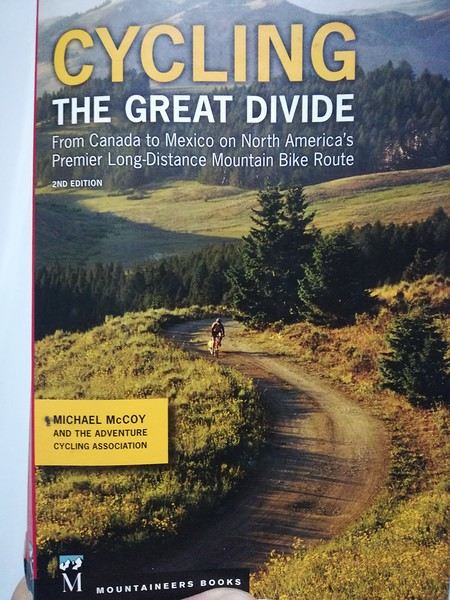
With this, we were able to organize our journey with as much information as possible, a GPS track, and gear suited to the weather conditions, terrain, and sparse resupply points in remote areas.
Once we arrived in Banff, we picked up bear spray to handle a particular challenge: the wildlife we weren’t familiar with.
After landing in Calgary, we assembled and equipped our bikes at the airport. That first evening, we were welcomed by Mike, who invited us to his place when we were looking for a spot to pitch our tent. Then we made our way to Banff over two days, taking a fairly quiet road to Canmore and then a bike path.
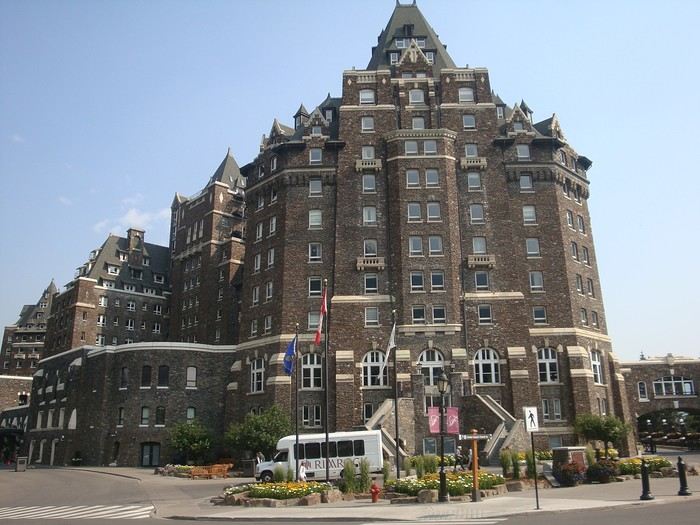
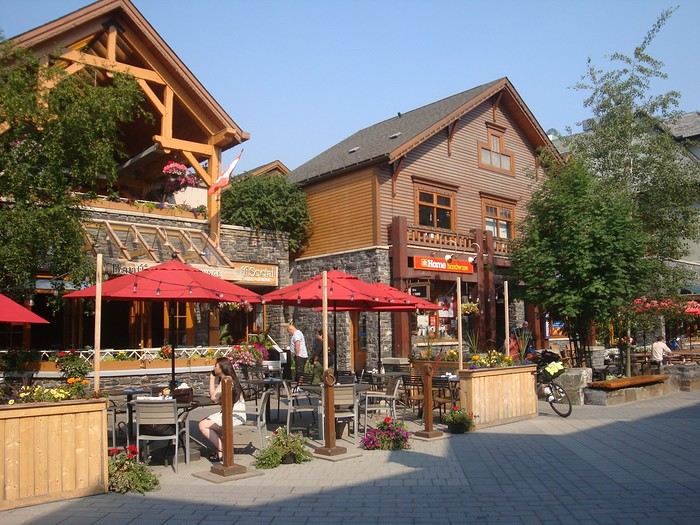
A visit to Banff, a charming tourist town in the national park. Its famous Fairmont Hotel.
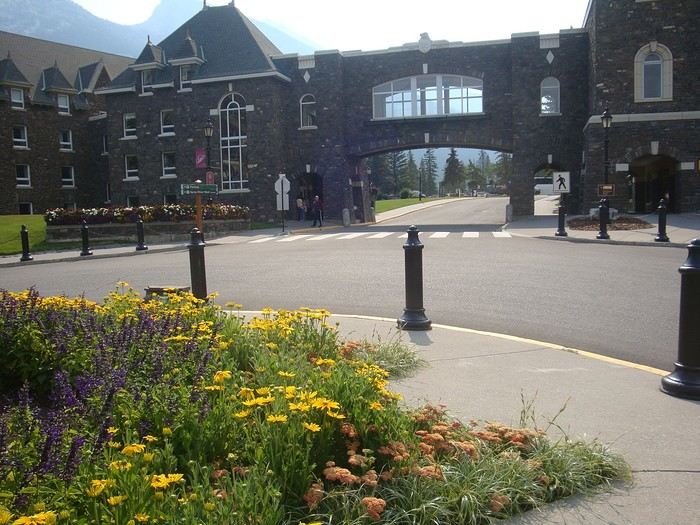
The starting point of the GDMBR at the arch of this hotel complex.
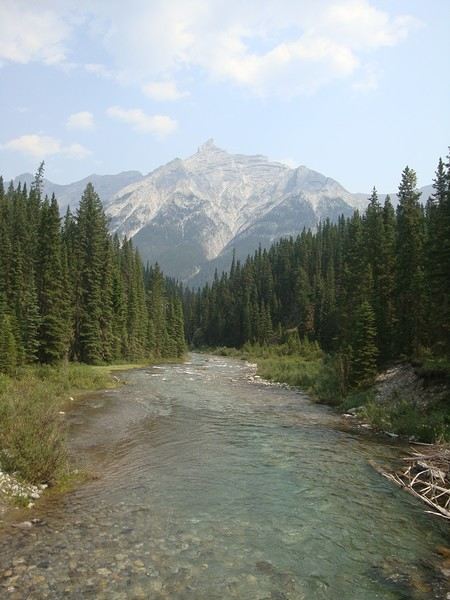
Here we are, immersed in the wilderness—just a few pedal strokes away from the town, the contrast is striking. Powerful rivers, vast landscapes, and our first encounter with a mule deer.
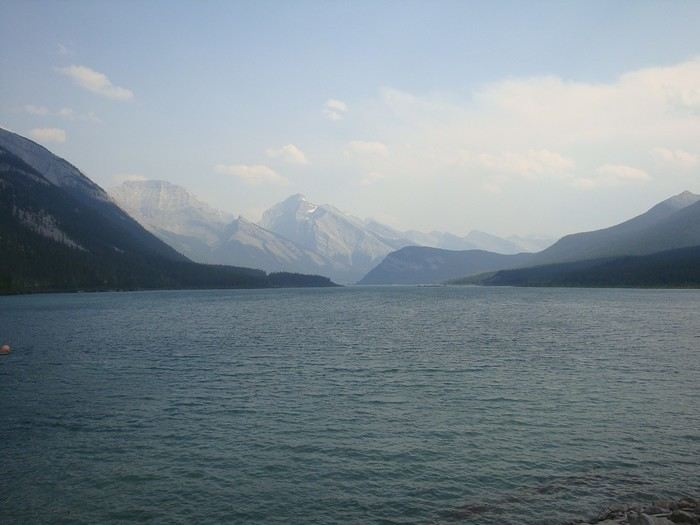
Spray Lake, our first basic campsite: no showers, dry toilets, no water fountain—we filter lake water. Most GDMBR campsites are like this.

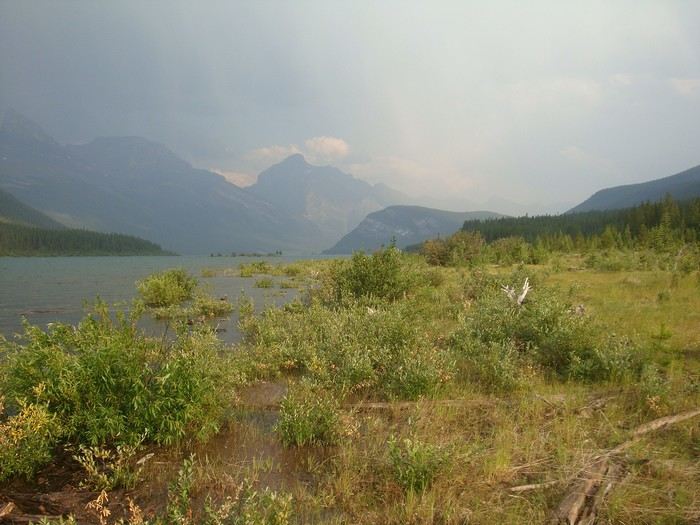
We took the west side of the lake—a longer and wilder route. A few fallen trees blocked the path, forcing us to carry our bikes. But the stunning landscapes made it all worth it!
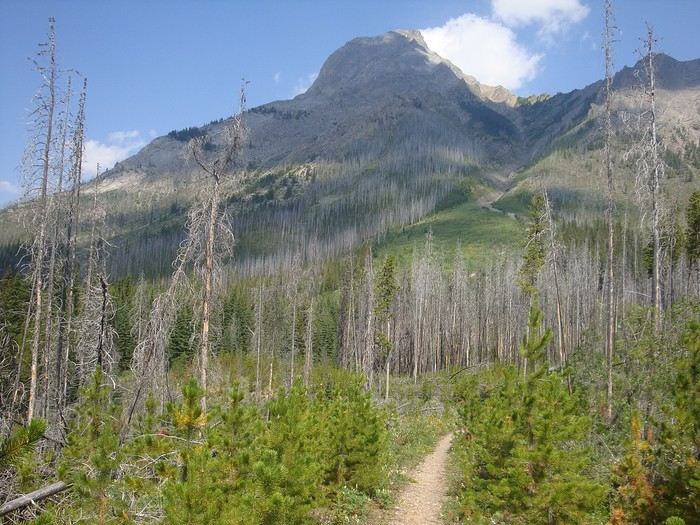
Our first single track through a forest marked by past wildfires.
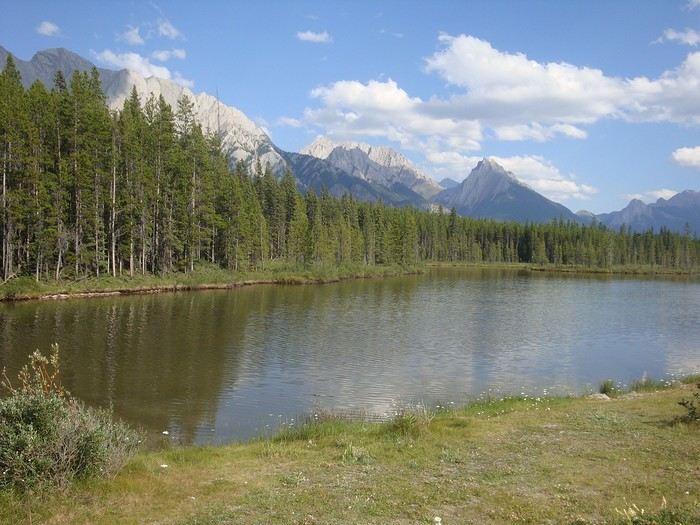
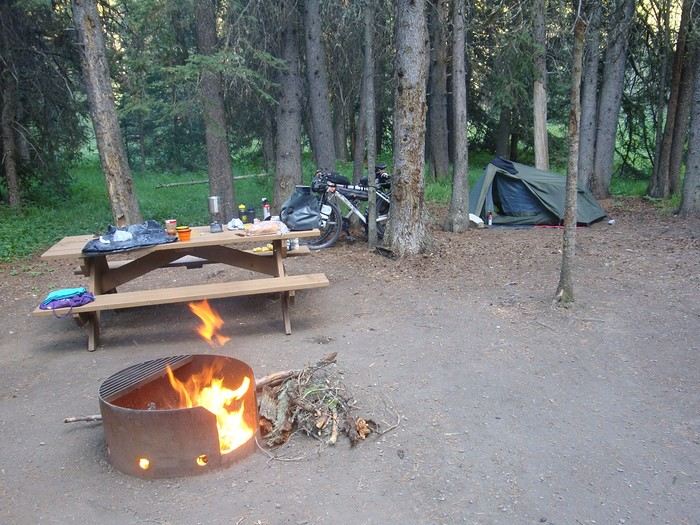
Most campgrounds have tables and metal fire rings for safe campfires, which makes setting up camp much easier—especially nice after a long, tiring day! During this trip, we mostly slept in our tent, either in established campgrounds or wild bivouacs.
To be continued...
The GDMBR is a mountain route that closely follows the Pacific/Atlantic continental divide, starting in Banff, Canada, and ending at the Mexican border in Antelope Wells, New Mexico. This crossing of the American West is one of the longest mountain biking routes in the world, winding through wild valleys, mountain ranges, and desert plateaus. It stretches about 4,400 km with a total elevation gain of around 60,000 m. The average altitude is 2,000 m, and the highest point reaches 3,600 m. The route is 80% off-pavement (gravel roads, dirt, and a few trail segments). It’s also known for the annual Tour Divide race, which brings together the best riders in the discipline every June and follows roughly the same route.
We prepared for this trip over several months, using a few websites and an older guidebook (the 2013 English edition).
With this, we were able to organize our journey with as much information as possible, a GPS track, and gear suited to the weather conditions, terrain, and sparse resupply points in remote areas.
Once we arrived in Banff, we picked up bear spray to handle a particular challenge: the wildlife we weren’t familiar with.
After landing in Calgary, we assembled and equipped our bikes at the airport. That first evening, we were welcomed by Mike, who invited us to his place when we were looking for a spot to pitch our tent. Then we made our way to Banff over two days, taking a fairly quiet road to Canmore and then a bike path.
A visit to Banff, a charming tourist town in the national park. Its famous Fairmont Hotel.
The starting point of the GDMBR at the arch of this hotel complex.
Here we are, immersed in the wilderness—just a few pedal strokes away from the town, the contrast is striking. Powerful rivers, vast landscapes, and our first encounter with a mule deer.
Spray Lake, our first basic campsite: no showers, dry toilets, no water fountain—we filter lake water. Most GDMBR campsites are like this.
We took the west side of the lake—a longer and wilder route. A few fallen trees blocked the path, forcing us to carry our bikes. But the stunning landscapes made it all worth it!
Our first single track through a forest marked by past wildfires.
Most campgrounds have tables and metal fire rings for safe campfires, which makes setting up camp much easier—especially nice after a long, tiring day! During this trip, we mostly slept in our tent, either in established campgrounds or wild bivouacs.
To be continued...
Southern landscapes, northern wildlife: returning to South Africa
After a first trip in 2009 (already!) where, roughly, we did a circuit passing through Hazyview, a private reserve in Sabi Sands, Santa Lucia and Isimangaliso, Hluhluwe and the South African part of Kgalagadi Transfrontier Park, then a quick stop in 2013 to go to Lesotho, we wanted to come back to this country.
Why not the Cape region this time, but there was no way we were coming back to this part of the world without going on a safari. Mountain Zebra or the Karoo seem more about landscapes than animals, and Addo doesn’t excite me much either... So it’ll be Kruger.
Flight prices, schedules, and durations led us to a Paris-Cape Town, return Johannesburg-Paris with British Airways, via Heathrow.
Now we just had to figure out how to fit in quite a few things without driving too many kilometers or changing accommodation every day, at least in the Cape region. Here’s what we ended up with:
Arrival in Cape Town on Saturday, October 10 at 11 AM
2 nights in Hermanus
1 night in Franschhoek
2 nights at Mountceder in the Cederberg
3 nights in Hout Bay
Sunday: transition day—flight to Johannesburg, drive toward Kruger, night in Lydenburg.
Kruger: 1 night in Letaba, 2 in Satara, 1 in Lower Sabie.
Last night in Mbombela (formerly Nelspruit) before heading back to the airport for an early evening return flight.
For those who want to read the full story without interruptions, it’s here.
Friday, 10/9
A pretty stressful departure.
First, I woke up in the middle of the night, convinced I’d swapped my first and last names during check-in 🤪... Couldn’t get back to sleep, even though I knew British Airways wouldn’t answer before 9 AM.
Well, for them, everything was fine... but then they started talking about ETA... an ETA for England 😮? ?? Yes, it’s recent. Apparently, you don’t need one for an air-to-air transit... but you never know, it’s better to have it just in case. No one could give me a clear answer that it wasn’t necessary. In the end, we didn’t get it... and we didn’t need it.
But here’s the thing: our flight ended up leaving Paris 45 minutes late (10 minutes due to a schedule change and 35 minutes of actual delay), so our 2-hour layover shrank to 1 hour and 15 minutes. That should be doable, right? The board showed our flight at Gate B: great, it’s right next door! But at Gate B, three employees were just there to tell everyone who showed up that security had to be done at Gate A... and off we went, sprinting through the corridors, endless escalators going up and down, a little shuttle ride, security at Gate A ("You’re going to be cutting it close!" Oh really? 😠), then pretty much the same route back, only to end up just a few dozen meters from where we started! 😠
Boarding was already well underway, and after all that running, we were hot and thirsty, but phew! We made it onto the plane!
Saturday, 10/10 On the other hand, nothing to complain about on this London-Cape Town flight—it arrived early!
I booked a (small) Suzuki S-Presso because it seemed to have a higher ground clearance than its competitors. Unfortunately, we ended up with a Tata Tiago (yes, it exists), which is lower (and also smaller, with an even more sluggish engine... yes, we were able to compare because in Johannesburg, we *did* get an S-Presso). Somehow, we managed to fit everything in the trunk ("Whatever you do, don’t leave anything visible!") and off we went to our first accommodation in Hermanus, under a glorious sun.
Nikki welcomed us warmly, explained what there was to see in the area, and advised us to book a restaurant for that evening.
After dropping off our bags, we headed to the "cliff path," just 3 minutes from our place. This part of the coast is famous for its southern right whales from June to November. Let’s cut to the chase: there *were* whales, but they were very far away and very sleepy 😕. At best, we saw (photos taken at 600mm): A few ripples or a faint spray,

a bit of tail...

...or a bit of head.

Too bad—the owner of our next accommodation told us she’d seen around thirty of them up close here in early September.
With no whales in sight, the dassies (or rock hyraxes) were everywhere... and fun to watch.
The other local star (when there are no whales 😏)

Why not the Cape region this time, but there was no way we were coming back to this part of the world without going on a safari. Mountain Zebra or the Karoo seem more about landscapes than animals, and Addo doesn’t excite me much either... So it’ll be Kruger.
Flight prices, schedules, and durations led us to a Paris-Cape Town, return Johannesburg-Paris with British Airways, via Heathrow.
Now we just had to figure out how to fit in quite a few things without driving too many kilometers or changing accommodation every day, at least in the Cape region. Here’s what we ended up with:
Arrival in Cape Town on Saturday, October 10 at 11 AM
2 nights in Hermanus
1 night in Franschhoek
2 nights at Mountceder in the Cederberg
3 nights in Hout Bay
Sunday: transition day—flight to Johannesburg, drive toward Kruger, night in Lydenburg.
Kruger: 1 night in Letaba, 2 in Satara, 1 in Lower Sabie.
Last night in Mbombela (formerly Nelspruit) before heading back to the airport for an early evening return flight.
For those who want to read the full story without interruptions, it’s here.
Friday, 10/9
A pretty stressful departure.
First, I woke up in the middle of the night, convinced I’d swapped my first and last names during check-in 🤪... Couldn’t get back to sleep, even though I knew British Airways wouldn’t answer before 9 AM.
Well, for them, everything was fine... but then they started talking about ETA... an ETA for England 😮? ?? Yes, it’s recent. Apparently, you don’t need one for an air-to-air transit... but you never know, it’s better to have it just in case. No one could give me a clear answer that it wasn’t necessary. In the end, we didn’t get it... and we didn’t need it.
But here’s the thing: our flight ended up leaving Paris 45 minutes late (10 minutes due to a schedule change and 35 minutes of actual delay), so our 2-hour layover shrank to 1 hour and 15 minutes. That should be doable, right? The board showed our flight at Gate B: great, it’s right next door! But at Gate B, three employees were just there to tell everyone who showed up that security had to be done at Gate A... and off we went, sprinting through the corridors, endless escalators going up and down, a little shuttle ride, security at Gate A ("You’re going to be cutting it close!" Oh really? 😠), then pretty much the same route back, only to end up just a few dozen meters from where we started! 😠
Boarding was already well underway, and after all that running, we were hot and thirsty, but phew! We made it onto the plane!
Saturday, 10/10 On the other hand, nothing to complain about on this London-Cape Town flight—it arrived early!
I booked a (small) Suzuki S-Presso because it seemed to have a higher ground clearance than its competitors. Unfortunately, we ended up with a Tata Tiago (yes, it exists), which is lower (and also smaller, with an even more sluggish engine... yes, we were able to compare because in Johannesburg, we *did* get an S-Presso). Somehow, we managed to fit everything in the trunk ("Whatever you do, don’t leave anything visible!") and off we went to our first accommodation in Hermanus, under a glorious sun.
Nikki welcomed us warmly, explained what there was to see in the area, and advised us to book a restaurant for that evening.
After dropping off our bags, we headed to the "cliff path," just 3 minutes from our place. This part of the coast is famous for its southern right whales from June to November. Let’s cut to the chase: there *were* whales, but they were very far away and very sleepy 😕. At best, we saw (photos taken at 600mm): A few ripples or a faint spray,
a bit of tail...
...or a bit of head.
Too bad—the owner of our next accommodation told us she’d seen around thirty of them up close here in early September.
With no whales in sight, the dassies (or rock hyraxes) were everywhere... and fun to watch.
The other local star (when there are no whales 😏)
Off on an adventure in China!
October 9 - Day 1
There’s an old Chinese proverb I particularly like: "Dú wán juán shù, búrú xing wán li lú." In slightly more familiar terms, it means you always learn more by traveling ten thousand miles than by reading ten thousand books. And I’m the perfect guy for this because, first, I don’t have time to read ten thousand books about our new destination... And second, the proverb is literally made in our new adventure playground: China!
China... or should I say, "Paradox-land"! A country we see everywhere—on the news or on the "Made in China" labels of half the objects around us—but one we actually know very little about. A country hurtling toward the future while still casually chatting with its rich past. A country that, through our Western lens, seems uniform and just filled with Chinese people who all look alike, yet reveals an incredible cultural, natural, demographic, and culinary diversity as soon as you dig a little deeper. A country with a reputation for being logistically tricky for solo travelers, yet where you can book public toilets on your smartphone. In short, a delightful mess of disorienting contradictions—and, of course, a destination that was bound to charm our wandering soles for a while.
That "while" will be two weeks... And the "we," since I wanted the best in the world to join me, will be Flo and me in this backpacking duo stamped with wanderlust! Just the two of us for two weeks to explore a tiny part of this continent-sized country, trying to understand how old wooden stilt houses coexist in the middle of futuristic skyscrapers glowing with lights, tasting all the weird and wonderful things that come our way, and—incidentally—covering the famous ten thousand kilometers from our proverb.
Well... we’ll probably cover a little less than that, but enough to let us write our own travel journal instead of reading others’... Because you know us—between living our lives watching others live theirs by reading ten thousand books, or writing our own by truly roaming the world, we’ve long since chosen our side! And you, who’s reading this—team book or team live?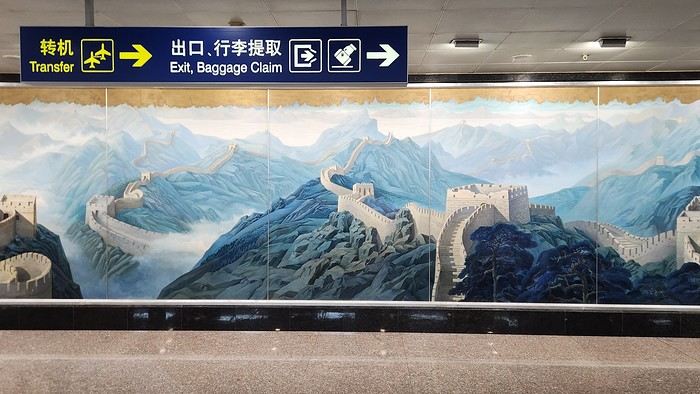
There’s an old Chinese proverb I particularly like: "Dú wán juán shù, búrú xing wán li lú." In slightly more familiar terms, it means you always learn more by traveling ten thousand miles than by reading ten thousand books. And I’m the perfect guy for this because, first, I don’t have time to read ten thousand books about our new destination... And second, the proverb is literally made in our new adventure playground: China!
China... or should I say, "Paradox-land"! A country we see everywhere—on the news or on the "Made in China" labels of half the objects around us—but one we actually know very little about. A country hurtling toward the future while still casually chatting with its rich past. A country that, through our Western lens, seems uniform and just filled with Chinese people who all look alike, yet reveals an incredible cultural, natural, demographic, and culinary diversity as soon as you dig a little deeper. A country with a reputation for being logistically tricky for solo travelers, yet where you can book public toilets on your smartphone. In short, a delightful mess of disorienting contradictions—and, of course, a destination that was bound to charm our wandering soles for a while.
That "while" will be two weeks... And the "we," since I wanted the best in the world to join me, will be Flo and me in this backpacking duo stamped with wanderlust! Just the two of us for two weeks to explore a tiny part of this continent-sized country, trying to understand how old wooden stilt houses coexist in the middle of futuristic skyscrapers glowing with lights, tasting all the weird and wonderful things that come our way, and—incidentally—covering the famous ten thousand kilometers from our proverb.
Well... we’ll probably cover a little less than that, but enough to let us write our own travel journal instead of reading others’... Because you know us—between living our lives watching others live theirs by reading ten thousand books, or writing our own by truly roaming the world, we’ve long since chosen our side! And you, who’s reading this—team book or team live?
Celebrity Equinox Cruise Review – October 20 to 30, 2026
Hello,
We just got back a few days ago from our cruise on the Equinox. While our previous cruises had gone more or less as planned, this one was full of setbacks from start to finish.
Here’s the 10-night itinerary: 10/20 Barcelona 10/21 Palma de Mallorca 10/22 at sea 10/23 La Spezia 10/24 Civitavecchia 10/25 Naples 10/26 at sea 10/27 Valletta 10/28 Palermo 10/29 at sea 10/30 Barcelona
The only port we knew a little was Rome, since we’d spent a night there a long time ago.
We booked through Logitravel in June 2026—the V2 balcony cabin was 3,199 € for four people. I’d hesitated to book, and sure enough, it wasn’t a great deal. A month later, in July, the price for the last V2 cabins at the front was 2,744 €, the category above (midship) was 2,953 €, and the one above that (midship with a larger balcony) was 3,117 €. Usually, I book ocean-view cabins, but none were available.
Also, when I booked, I’d chosen select dining (it was listed as available on Celebrity’s site), but when I received the cruise booklet, I discovered we’d been assigned to the second seating. I think it’s pretty poor of Logitravel not to keep us better informed about the change.
At the time of booking, the most convenient option from the north for transportation seemed to be the train there and the Barcelona-Brussels flight back. But if I’d waited until July, I would’ve had a good round-trip deal from Brussels too. I’ll come back to that.
Instead of spending a night in Barcelona, where hotels for four are very expensive, I’d opted to split the trip into two parts: the train to Montpellier the day before departure, then the Montpellier-Barcelona train the next day.
The trip to Montpellier went pretty well, but the first letdown: when we arrived, it was pouring rain, and the department was on orange alert for rain. So much so that the SNCF screens suggested postponing travel if possible and warned of potential train cancellations—right during the 24 hours we were traveling! Needless to say, the trip started off more stressful than anything else.
Our train arrived at Sud de France station, and I’d booked a hotel (Appart’City Saint-Roch, very nice) near Saint-Roch station since our train the next day was leaving from there. Because of the rain, I couldn’t even show the kids a bit of Montpellier. We just went to dinner close to the hotel and went back to sleep, crossing our fingers that our train the next day wouldn’t be canceled. It rained a lot during the night, but by the next morning, it had calmed down a lot. We got an email in the morning from Renfe saying our train would finally leave from Sud de France. So we had to leave the hotel earlier to get to the station. The train was announced with a few minutes’ delay, but it was there, and we eventually arrived in Barcelona without any issues, just a little quarter-hour late.
When we got to the Barcelona station hall, there was a huge "Taxis" sign on the left directing us outside (Peiro Square). There was a line of taxis and a few people waiting, but it moved quickly. It was around 1 PM when we got into a taxi, and we were expected for boarding between 1:30 and 2 PM. We got a very friendly driver who spoke French. The ride cost about 25 €, which was a good deal for four. We dropped off our suitcases at 1:25 PM. There were quite a few people, but it moved fast. Passport check, we were told the rooms would be ready at 2 PM, and we boarded. To be continued: arrival on board