Results for "Banda+Aceh+|+8+>+188"
10964 results found.
A propos de passeport English translation pending
Bonjour
Possédant des passeports non périmés mais qui ne sont pas à lecture optique, j'aimerais savoir si c'est possible de rajouter dessus, et si oui est ce gratuit?
Possédant des passeports non périmés mais qui ne sont pas à lecture optique, j'aimerais savoir si c'est possible de rajouter dessus, et si oui est ce gratuit?
Argentine: quels animaux à Valdes en aout? English translation pending
Bonjour !
Nous allons en argentine en aout. Nous aimerions savoir quels animaux nous pourrons observer dans la peninsule de Valdes à cette saison. ( orques, baleines, manchots, dauphins ? )
Quels sont les meilleurs endroits pour les observer ? Merci d'avance !!!
Nous allons en argentine en aout. Nous aimerions savoir quels animaux nous pourrons observer dans la peninsule de Valdes à cette saison. ( orques, baleines, manchots, dauphins ? )
Quels sont les meilleurs endroits pour les observer ? Merci d'avance !!!
Plage au Playa Turquesa English translation pending
JE SAIS QUE LA MER AU TURQUESA EST PORTEUSE DE COQUILLAGES, ALGUES...  MON AGENT DE VOYAGE M'A DIT QUE C'ÉTAIT ENVIRON UNE BANDE DE PLUS OU MOIS 40 PIEDS ET QU' APRÈS LA MER ÉTAIT PLUS BELLE. EST-CE BIEN VRAI? 😕
LES SOULIERS DE PLAGE SONT-ILS NÉCESSAIRE POUR LA BAIGNADE? 😕
POUVONS-NOUS AVANCÉ LOIN DANS LA MER AVANT D'AVOIR DE L'EAU AU DESSUS DE LA TÊTE? 😕
COMBIEN DE TEMPS DURE ''LE TOUR'' DE CATAMARAN ET LA VISITE AUX DOPHINS ? 😕
AVEZ- VOUS DES SUGGESTIONS DE VISITES OU D'ACTIVITÉS À ME PROPOSER, JE SERAI À CET HOTEL EN MARS PROCHAIN AVEC DEUX ENFANTS DE 13 ET 11 ANS. C'EST UN PREMIER VOYAGE FAMILIALE ET JE VOUDRAIS EN PROFITER AU MAXIMUM ET SURTOUT GARDER UN BON SOUVENIR...😉
MON AGENT DE VOYAGE M'A DIT QUE C'ÉTAIT ENVIRON UNE BANDE DE PLUS OU MOIS 40 PIEDS ET QU' APRÈS LA MER ÉTAIT PLUS BELLE. EST-CE BIEN VRAI? 😕LES SOULIERS DE PLAGE SONT-ILS NÉCESSAIRE POUR LA BAIGNADE? 😕
POUVONS-NOUS AVANCÉ LOIN DANS LA MER AVANT D'AVOIR DE L'EAU AU DESSUS DE LA TÊTE? 😕
COMBIEN DE TEMPS DURE ''LE TOUR'' DE CATAMARAN ET LA VISITE AUX DOPHINS ? 😕
AVEZ- VOUS DES SUGGESTIONS DE VISITES OU D'ACTIVITÉS À ME PROPOSER, JE SERAI À CET HOTEL EN MARS PROCHAIN AVEC DEUX ENFANTS DE 13 ET 11 ANS. C'EST UN PREMIER VOYAGE FAMILIALE ET JE VOUDRAIS EN PROFITER AU MAXIMUM ET SURTOUT GARDER UN BON SOUVENIR...😉
Playa del carmen et téléphone portable English translation pending
Nous partons le 15 janvier à Playa del Carmen à l'hotel Riu Yucatan, pouvez vous me donner des renseignements sur l' hotel et les environs??
Pour le téléphone, j'ai un portable Bouyges, est ce que je pourrais m'en servir pour téléphoner en France.
Merci pour vos réponses😇
Pour le téléphone, j'ai un portable Bouyges, est ce que je pourrais m'en servir pour téléphoner en France.
Merci pour vos réponses😇
Notre site internet en construction: 1 problème English translation pending
Bonjour à tous,
Le site Internet de notre famille (site de nos voyages avec nos enfants) est en cours de fabrication et j'ai un problème de construction :
je cherche un site en exemple ou on peut "scroller" des photos dans une bande Horizontale. En effet il est très classique de "scroller" en vertical, mais en horizontal... Avez-vous un exemple, une adresse de site ou l'on scrolle des photos en vertical ?
Pour mieux comprendre :
Mon site est accessible à l'adresse suivante : www.lafamily.fr (seul le lien Madagascar fonctionne dans la rubrique "Albums par pays"). Vous trouverez sur cette page des photos que je souhaite pouvoir faire défiler en horizontal puis cliquer pour agrandir..
Merci !!
Le site Internet de notre famille (site de nos voyages avec nos enfants) est en cours de fabrication et j'ai un problème de construction :
je cherche un site en exemple ou on peut "scroller" des photos dans une bande Horizontale. En effet il est très classique de "scroller" en vertical, mais en horizontal... Avez-vous un exemple, une adresse de site ou l'on scrolle des photos en vertical ?
Pour mieux comprendre :
Mon site est accessible à l'adresse suivante : www.lafamily.fr (seul le lien Madagascar fonctionne dans la rubrique "Albums par pays"). Vous trouverez sur cette page des photos que je souhaite pouvoir faire défiler en horizontal puis cliquer pour agrandir..
Merci !!
Aller aux Etats-Unis sans passeport à lecture optique? English translation pending
bonjour,
je suis au Canada pour une durée de 1 an, j'ai un permi de travail canadien, et je voudrais me rendre aux U.S.
cependant je sais que depuis le 26 Octobre 2004, les americains exigent le nouveau passeport avec bande magnetique. mon passeport n'a pas cette bande magnetique, mais il est encore valable pendant 7 ans !!!
y-a-t-il un autre moyen pour aller aux U.S, que de refaire mon passeport ??? (visa? dérogation?...) sachant qu'ils parlent en plus d'exiger un nouveau passeport biologique dans 2 ans !
merci à quiconque à une solution
y-a-t-il un autre moyen pour aller aux U.S, que de refaire mon passeport ??? (visa? dérogation?...) sachant qu'ils parlent en plus d'exiger un nouveau passeport biologique dans 2 ans !
merci à quiconque à une solution
Réseau GSM Orange English translation pending
Partant à l'hôtel SUNSCAPE CASA DEL MAR à BAYAHIBE ce jeudi - pouvez vous m'indiquer si l'on obtient du réseau GSM ORANGE - réponse urgente
Sécurité des campings en Espagne English translation pending
Bonjour,
Je dois partir en juillet en Espagne et une question me tourne autour de la tête : les campings sont-ils sûrs ? Peut-on laisser tout un barda dans une tente et savoir qu'on le retrouvera le soir en rentrant ? Merci,
Thibault
Je dois partir en juillet en Espagne et une question me tourne autour de la tête : les campings sont-ils sûrs ? Peut-on laisser tout un barda dans une tente et savoir qu'on le retrouvera le soir en rentrant ? Merci,
Thibault
Ascensions en Puna de Atacama (Chili-Argentine) English translation pending
Salut,
Je compte me rendre dans les Andes en Août prochain pour faire quelques ascensions. J'aimerai avoir quelques infos sur la bande située entre le Llullaillaco et l'Ojos del Salado. Peut-on s'y loger ou bien faut-il compter uniquement sur sa tente ? Les routes et chemins sont-ils en assez bon état pour une voiture non 4x4 ? La laguna verde est elle aussi belle qu'elle en a l'air ? Quels sont les endroits à ne pas rater dans le coin ? La ville de Copiapo est-elle sympa ?... Avez vous quelques tuyaux sur les ascensions de 6000 dans la Puna (Llullaillaco, Socompa, Tres Cruces, Barrancas Blancas, Incahuasi, Ojos del Salado...)? Je suis preneur de toutes les infos sur ces endroits.
Merci d'avance
PS : Connaissant bien le Chili et l'Argentine, je souhaite sortir des grands circuits touristiques du genre San Pedro de Atacama-Salta pour me retrouver dans des coins les plus "préservés" possibles. Je serais d'ailleurs content de vous donner quelques renseignements sur ces pays (+ Bolivie, Equateur, Pérou)
Je compte me rendre dans les Andes en Août prochain pour faire quelques ascensions. J'aimerai avoir quelques infos sur la bande située entre le Llullaillaco et l'Ojos del Salado. Peut-on s'y loger ou bien faut-il compter uniquement sur sa tente ? Les routes et chemins sont-ils en assez bon état pour une voiture non 4x4 ? La laguna verde est elle aussi belle qu'elle en a l'air ? Quels sont les endroits à ne pas rater dans le coin ? La ville de Copiapo est-elle sympa ?... Avez vous quelques tuyaux sur les ascensions de 6000 dans la Puna (Llullaillaco, Socompa, Tres Cruces, Barrancas Blancas, Incahuasi, Ojos del Salado...)? Je suis preneur de toutes les infos sur ces endroits.
Merci d'avance
PS : Connaissant bien le Chili et l'Argentine, je souhaite sortir des grands circuits touristiques du genre San Pedro de Atacama-Salta pour me retrouver dans des coins les plus "préservés" possibles. Je serais d'ailleurs content de vous donner quelques renseignements sur ces pays (+ Bolivie, Equateur, Pérou)
Namibie, terre de mirages English translation pending
 Comme le laisse suposer mes différentes interventions dans divers forums je suis un amoureux de ce superbe pays d'Afrique australe qu'est la Namibie.
Du Fish River Canyon au sud au Parc National d'Etosha au nord en passant par les sables du Namib, du Kalahari ou de la côte des squelettes; de la bande de Caprivi au Damaraland ; de la Petrified Forest au monts du Naukluft ; du plateau de Waterberg à Twiffelfontein ; de White Lady aux Welvetchias ........
Dans ce pays où un léger vent vous rafraichis tout au long de l'année, on ne peut faire beaucoup de Km sans s'émerveiller. Les sables et les dunes rouges sombres de Sossusvlei sont toujours un choc la première fois, nues ou couvertes d'herbes rases jaunies; quelques kilomètres plus loin les monts sombres du Naukluft; encore un peu plus loin cette vision lunaire du désert au portes de Swakopmund.
Et encore : le désert, la mer et ....... 60.000 phoques . Ou alors : le Damaraland avec ses sites pariétaux exeptionnels, sa forêt pétrifiée, Organ pipe, ses Welvetchias et ses cratères de météorites.
Et que dire du spectacle offert dans le parc national d'Etosha, au détour d'un point d'eau, derrrière le moindre buisson la vie animale africaine dans toute sa splendeur. Lions qui s'abreuvent, troupeaux de zèbres, gnous, oryx, et autres antiloppes et gazelles qui paissent, léopards repus sur sa branches, Hyènes, chacals, renards du Cap, Troupeaux d'éléphants ou mâles solitaires parcourant le bush, rhinocéros noirs trotinant près du pan ......
🙂 Et les nuits passé à veiller autour des "waterholes" éclairés pour fixer au fond de ma mémoire ces scènes nocturnes incroyables de la vie animale.
La bande de Caprivi et sa verdeur pleines de petits parcs nationaux sublimes. Le plateau du Waterberg où Isolés au sommet rhinocéros blancs et noirs y cotoient antiloppes roannes et hypodragues. et le Kalahari et ses Sans, ces petits bushimens si accueillant et vivant en parfaite harmonie avec sa terre hostile.
Ce pays mérite DES séjours et non pas UN car il y a tellement à y découvrir.
🙂 Vivement avril 2004 🙂
Vos impressions sur le Sri Lanka English translation pending
🙂 voila! c'est bientot fait je m envole pour le Sri Lanka
j'aimerai savoir si j'ai bien choisie ma destination🤪 pour ceux qui veulent me conseiller je serai ravie d'ecouter vos experiences😮
merçi! je part avec nouvelles frontieres😉
j'aimerai savoir si j'ai bien choisie ma destination🤪 pour ceux qui veulent me conseiller je serai ravie d'ecouter vos experiences😮
merçi! je part avec nouvelles frontieres😉
Arusha, Tanzania - October 2025
I would wish never to go to bed where I had woken up, to wander my tent from the shores of Egypt to those of the Persian Gulf; to have no goal for the evening other than the evening itself; to traverse on foot, with my eyes and my heart, all these unknown lands, all these races of people so different from my own; to contemplate humanity, God’s finest creation, in all its forms.
Lamartine in Fatalla Sayeghir’s Account (1861)
As soon as it’s about flying, I lose all willpower. Being reasonable and thoughtful, I still lose all my composure at the mere possibility of a flight—especially if it’s piloted by F.—and even more so if that flight can take me to unexplored lands. I’ve long wanted to unravel the mystery of animal tourism, and why not in Tanzania, following up on my trip from four years ago, when I was already questioning the glaring inequalities in Zanzibar: the coastal strip sacrificed to capitalism, and the inland areas, just a hundred meters from the waves, where you find—though a bit more peaceful than elsewhere on the continent—the chaos of Africa.
I’m an adventurer at heart. When it comes to the terrain, though, it’s a whole different story. I see people setting off for months at a time; I know my endurance doesn’t last beyond three days. It’s not that I’m afraid of this unfamiliar environment when it comes to embracing different realities. I’m mostly afraid of myself—of this heightened sensitivity that makes me see things I’d rather not see and understand others that sometimes overwhelm me.
After an absolutely fantastic daytime flight, I land in Zanzibar and have to resign myself—this is the whole point of the trip—to what feels like a real spacewalk. I’m alone. My lucky star, backed up by my phone, will serve as my lifeline. I step out of the airport and breathe in the scent of Africa full-on: a mix of exotic perfumes, baked earth, and poorly refined fuel, inevitably mingled with the smell of wood smoke. So many images come flooding back. So many stories. Another world.
I head to Arusha the very next day. The gateway to the country’s northern national parks, this city of half a million offers one of those rare breath-holding dives that Africa keeps secret. As the only white person walking the streets, I know I’m visible and vulnerable, yet I move forward confidently, barely bothered. But where are all my fellow Westerners? While this city draws countless tourists, I only cross paths with one white couple in nearly three hours of walking. Because you have to hold on tight to wander here. You have to stay alert. The traffic is dense and erratic—don’t even trust the fact that in Tanzania, people drive on the left. That can change from one minute to the next, especially with motorbikes. With barely centimeters between vehicles, I weave my way through the urban jungle, trying not to stumble into the huge ditch on my left or get sideswiped by cars brushing past me on the right. Speakers blare music, ads, or political speeches at will—the explosion of yellow and green tells us we’re on the eve of the presidential election—but they barely compete with the calls to prayer, nearly nonstop on this holy Friday. The vital space is as saturated as the sound. Imagine an unbroken line of shops and stalls of every kind—supermarkets haven’t made it here yet—where you can find just about anything: phones, copper pipes, Chinese-made hardware, shoes, clothes, basins, and professional tools… The luckiest own a big store; others spend their lives trying to survive on the profits from selling toothbrushes one at a time on the streets. But maybe it’s more lucrative than spending the day slumped on the sidewalk, preferably missing a limb, trusting your survival to the mercy of passersby.
I think I’ll escape the street by slipping into the narrow alleys of the central market. Here, I know I won’t run into anyone like me! The vendors’ stalls start at waist height; the sellers, perched higher up, haggle or not while discussing prices. Here, colorful fruits and vegetables; there, huge piles of dried fish. Spices, seeds, roots. Smells. Noises. Africa. Life. Further on, the fresh fish aisle makes a right angle with the butchers’. Everywhere, flies—everywhere, the same gesture from vendors swatting blindly at these relentless pests. Aware that I’ll be eating this same meat within the hour, displayed with total disregard for basic hygiene, I reassure myself that Arusha sits at 1400m altitude. Yes, we can probably do without a fridge.
*
It’s time to leave the city and go wildlife spotting in the surrounding parks. To that end, I’ve negotiated a package deal with a local agency that prides itself on grouping solo travelers into a vehicle meant for seven. We leave behind the imposing masses of Mount Meru and Kilimanjaro, peaking at 4565m and 5895m respectively, and head west to conquer Tarangire and Ngorongoro parks. I’ve been promised a spectacle; I remain cautious. I’ve read rave reviews; I know how to temper my expectations. Above all, I know what I came for—and paradoxically, my hopes are less about animals than strictly anthropological. So I’m sure I won’t go home disappointed.
I’m in the thick of it. Since 2021, tourism has been booming: I’m one of the two million tourists who come here every year seeking thrills. I also contribute, in a small way, to the 20% of the country’s GDP generated by tourism revenue. Around 3 billion € annually… Tanzania has 16 national parks, twice as many reserves; it charges meticulously for every entry, every night, every activity, to the tune of several dozen euros. I calculated that Tarangire Park alone rakes in around 15 million € a year. Mind-boggling. Yet to get there, a dusty, rickety old track is used daily by hundreds of vehicles that literally saturate the surrounding area with white dust and exhaust fumes. At the park entrance, we wait a good hour while the driver pays the entry fees. Then it’s a free-for-all: dozens of 4x4s try to enter at the same time through the single access point, to the left of the building, while the three barriers are stuck due to a computer glitch. It’s pure chaos: no way to buy your ticket in advance—the QR code revolution hasn’t arrived; no smart layout before the barriers; nothing smooth, nothing practical, everything improvised.
So, the animals? Given the time and money involved, I’d be tempted to say it’s not worth the hassle and there’s really no need to break five legs off one of the too-many zebras we pass. Hours and hours of travel to get to Tanzania, specifically Arusha; hours and hours on the road—up to 12 hours a day—to spend barely three in the parks; at least 200 € per day for the most basic option, so 400 € in my case, and up to several thousand for those wealthy couples opting for the luxury package with a private vehicle. Sure, I saw zebras and elephants in their natural habitat, wildebeest, buffalo, and a few hippos, but I didn’t feel the thrill touted in the articles or even by my two-day trip organizer. Would I have been more satisfied if I’d seen the lion, the leopard, and the rhino? Maybe. But the story won’t be rewritten in light of those assumptions.
Yet I’m not disappointed. As I said earlier: I know what I came for. I wanted to see the world as it is with my own eyes. And the safari world fascinates me more for its anthropological aspect than for what it offers. Yes, the fact that people from all over the world come here, juggling hotels and big 4x4s—while notably avoiding the streets of cities and villages—truly fascinates me. Two worlds coexist on either side of a barely porous border. As soon as the tourist sets foot in the airport, they’re whisked away, sight unseen, into a tourist vehicle. Dropped off at the hotel, they rest there, shielded from view, until the 4x4 departs. Then they speed through those same cities and villages they scorn out of fear or disdain, leaving on the roadside the Maasai herding their flocks and all those poignant or mundane scenes that make up daily African life. In the evening, in their lodge, far from the city’s pulse, they fall asleep thinking about the images they’ve collected, those long hours on the road, the wait for the animals. And the days go by… Maybe the term *luxury*, whether for food or accommodation, refers to what we experience as utterly ordinary in the West? Forgetting that you’re there, in Africa, just steps away from poverty and a certain arbitrariness. And at the end of the journey: back to the airport, back to normal life.
Maybe we need to take a broader view. All that money seems invisible, yet it must serve the population at some point, right? The main roads are passable, the power grid seems well-maintained—I can tell by the excellent condition of the high-voltage transmission towers. Is it really too expensive to significantly improve all the infrastructure? I hoped this windfall would truly serve the people’s interests. The driver taking me back to the airport on the last evening dashes my sweet illusions: « All this is bad. Africa is bad. But you have no choice. The hospitals don’t work, the schools don’t work, the roads don’t work (just as he says this, roadworks force us onto a terrible detour for several kilometers—a rutted track, in fact), and if you say anything, if you speak up too much, they come for you and then you disappear. » That’s just one opinion. Nothing empirical. But I don’t need to be a West Point graduate to realize how rampant corruption is in these regions: while the muezzin bellows the greatness of Allah, I consider the dilapidated equipment and the energy expended by the masses just to survive here. But maybe all that money keeps the country afloat by paying civil servants’ salaries? Meanwhile, one thing is certain: regardless of where the profits go, tourism supports millions of people, and I’m in no position to judge this system too harshly. Maybe I’m too much of an aesthete to appreciate the almost exclusive use of corrugated iron at its true value…
*
I’ll give this system credit for one thing: the chance to set foot in spaces impossible to visit otherwise. At one point, in the heart of the Ngorongoro Crater—a vast 20km-wide plain topped by a 600m-high caldera—I was simply happy to be there. Barely bothered by the constant ballet of 4x4s—the space is vast—I contemplate the simple life of the local animals. Buffalo, wildebeest, zebras as numerous as the flamingos patiently standing on one leg, waiting for the day to pass. Over there, you can make out a few hyenas with vultures circling above. Finally, in a large body of water, hippos surface at regular intervals. I’m aware of my luck. I’m especially aware that, unlike all the people I’ve met there, a lot of money and a little resourcefulness greatly favor the luck factor.
I’m heading home. I soak up the last images of this improbable Africa as night falls quickly over the countryside. I’m fascinated by the number of Maasai herding their livestock along the main road. Some pass the time, globalization obliges, on an old phone; others, sometimes as young as my eldest—barely 10 years old—watch us pass, indifferent. We overtake or are overtaken; the two-lane road is the stage for a majestic ballet of semi-trailers, *dalas-dalas*, and other 4x4s, as numerous as the names of their companies: Leopard Tours, Climbing Kilimanjaro, Smiling Zebra, Nomad Life Enhanced, Elephant Roaming, Mountain Warrior, Master of the Ambush… They drop me off at the hotel, where I have an hour to shower and change into clean clothes before my return flight. Already, I’m slipping back into my own world without really seeing it, leaving behind the hotel’s glass window that African life to which nothing truly binds me. Then that chaotic, suffocating nighttime drive to the airport. Check-in; the stupid questions (« Where are you going? »); the slow police officer who, in the end, stamps my passport anywhere; the idiocy of the security agent (my empty 33cl bottle is forbidden); the rather shabby lounge at Kilimanjaro Airport. Then the return to the vessel—to the Air France plane that left Zanzibar an hour earlier—after this 72-hour spacewalk without a real lifeline. I’ve never been so happy to see F. again.
As soon as it’s about flying, I lose all willpower. Being reasonable and thoughtful, I still lose all my composure at the mere possibility of a flight—especially if it’s piloted by F.—and even more so if that flight can take me to unexplored lands. I’ve long wanted to unravel the mystery of animal tourism, and why not in Tanzania, following up on my trip from four years ago, when I was already questioning the glaring inequalities in Zanzibar: the coastal strip sacrificed to capitalism, and the inland areas, just a hundred meters from the waves, where you find—though a bit more peaceful than elsewhere on the continent—the chaos of Africa.
I’m an adventurer at heart. When it comes to the terrain, though, it’s a whole different story. I see people setting off for months at a time; I know my endurance doesn’t last beyond three days. It’s not that I’m afraid of this unfamiliar environment when it comes to embracing different realities. I’m mostly afraid of myself—of this heightened sensitivity that makes me see things I’d rather not see and understand others that sometimes overwhelm me.
After an absolutely fantastic daytime flight, I land in Zanzibar and have to resign myself—this is the whole point of the trip—to what feels like a real spacewalk. I’m alone. My lucky star, backed up by my phone, will serve as my lifeline. I step out of the airport and breathe in the scent of Africa full-on: a mix of exotic perfumes, baked earth, and poorly refined fuel, inevitably mingled with the smell of wood smoke. So many images come flooding back. So many stories. Another world.
I head to Arusha the very next day. The gateway to the country’s northern national parks, this city of half a million offers one of those rare breath-holding dives that Africa keeps secret. As the only white person walking the streets, I know I’m visible and vulnerable, yet I move forward confidently, barely bothered. But where are all my fellow Westerners? While this city draws countless tourists, I only cross paths with one white couple in nearly three hours of walking. Because you have to hold on tight to wander here. You have to stay alert. The traffic is dense and erratic—don’t even trust the fact that in Tanzania, people drive on the left. That can change from one minute to the next, especially with motorbikes. With barely centimeters between vehicles, I weave my way through the urban jungle, trying not to stumble into the huge ditch on my left or get sideswiped by cars brushing past me on the right. Speakers blare music, ads, or political speeches at will—the explosion of yellow and green tells us we’re on the eve of the presidential election—but they barely compete with the calls to prayer, nearly nonstop on this holy Friday. The vital space is as saturated as the sound. Imagine an unbroken line of shops and stalls of every kind—supermarkets haven’t made it here yet—where you can find just about anything: phones, copper pipes, Chinese-made hardware, shoes, clothes, basins, and professional tools… The luckiest own a big store; others spend their lives trying to survive on the profits from selling toothbrushes one at a time on the streets. But maybe it’s more lucrative than spending the day slumped on the sidewalk, preferably missing a limb, trusting your survival to the mercy of passersby.
I think I’ll escape the street by slipping into the narrow alleys of the central market. Here, I know I won’t run into anyone like me! The vendors’ stalls start at waist height; the sellers, perched higher up, haggle or not while discussing prices. Here, colorful fruits and vegetables; there, huge piles of dried fish. Spices, seeds, roots. Smells. Noises. Africa. Life. Further on, the fresh fish aisle makes a right angle with the butchers’. Everywhere, flies—everywhere, the same gesture from vendors swatting blindly at these relentless pests. Aware that I’ll be eating this same meat within the hour, displayed with total disregard for basic hygiene, I reassure myself that Arusha sits at 1400m altitude. Yes, we can probably do without a fridge.
*
It’s time to leave the city and go wildlife spotting in the surrounding parks. To that end, I’ve negotiated a package deal with a local agency that prides itself on grouping solo travelers into a vehicle meant for seven. We leave behind the imposing masses of Mount Meru and Kilimanjaro, peaking at 4565m and 5895m respectively, and head west to conquer Tarangire and Ngorongoro parks. I’ve been promised a spectacle; I remain cautious. I’ve read rave reviews; I know how to temper my expectations. Above all, I know what I came for—and paradoxically, my hopes are less about animals than strictly anthropological. So I’m sure I won’t go home disappointed.
I’m in the thick of it. Since 2021, tourism has been booming: I’m one of the two million tourists who come here every year seeking thrills. I also contribute, in a small way, to the 20% of the country’s GDP generated by tourism revenue. Around 3 billion € annually… Tanzania has 16 national parks, twice as many reserves; it charges meticulously for every entry, every night, every activity, to the tune of several dozen euros. I calculated that Tarangire Park alone rakes in around 15 million € a year. Mind-boggling. Yet to get there, a dusty, rickety old track is used daily by hundreds of vehicles that literally saturate the surrounding area with white dust and exhaust fumes. At the park entrance, we wait a good hour while the driver pays the entry fees. Then it’s a free-for-all: dozens of 4x4s try to enter at the same time through the single access point, to the left of the building, while the three barriers are stuck due to a computer glitch. It’s pure chaos: no way to buy your ticket in advance—the QR code revolution hasn’t arrived; no smart layout before the barriers; nothing smooth, nothing practical, everything improvised.
So, the animals? Given the time and money involved, I’d be tempted to say it’s not worth the hassle and there’s really no need to break five legs off one of the too-many zebras we pass. Hours and hours of travel to get to Tanzania, specifically Arusha; hours and hours on the road—up to 12 hours a day—to spend barely three in the parks; at least 200 € per day for the most basic option, so 400 € in my case, and up to several thousand for those wealthy couples opting for the luxury package with a private vehicle. Sure, I saw zebras and elephants in their natural habitat, wildebeest, buffalo, and a few hippos, but I didn’t feel the thrill touted in the articles or even by my two-day trip organizer. Would I have been more satisfied if I’d seen the lion, the leopard, and the rhino? Maybe. But the story won’t be rewritten in light of those assumptions.
Yet I’m not disappointed. As I said earlier: I know what I came for. I wanted to see the world as it is with my own eyes. And the safari world fascinates me more for its anthropological aspect than for what it offers. Yes, the fact that people from all over the world come here, juggling hotels and big 4x4s—while notably avoiding the streets of cities and villages—truly fascinates me. Two worlds coexist on either side of a barely porous border. As soon as the tourist sets foot in the airport, they’re whisked away, sight unseen, into a tourist vehicle. Dropped off at the hotel, they rest there, shielded from view, until the 4x4 departs. Then they speed through those same cities and villages they scorn out of fear or disdain, leaving on the roadside the Maasai herding their flocks and all those poignant or mundane scenes that make up daily African life. In the evening, in their lodge, far from the city’s pulse, they fall asleep thinking about the images they’ve collected, those long hours on the road, the wait for the animals. And the days go by… Maybe the term *luxury*, whether for food or accommodation, refers to what we experience as utterly ordinary in the West? Forgetting that you’re there, in Africa, just steps away from poverty and a certain arbitrariness. And at the end of the journey: back to the airport, back to normal life.
Maybe we need to take a broader view. All that money seems invisible, yet it must serve the population at some point, right? The main roads are passable, the power grid seems well-maintained—I can tell by the excellent condition of the high-voltage transmission towers. Is it really too expensive to significantly improve all the infrastructure? I hoped this windfall would truly serve the people’s interests. The driver taking me back to the airport on the last evening dashes my sweet illusions: « All this is bad. Africa is bad. But you have no choice. The hospitals don’t work, the schools don’t work, the roads don’t work (just as he says this, roadworks force us onto a terrible detour for several kilometers—a rutted track, in fact), and if you say anything, if you speak up too much, they come for you and then you disappear. » That’s just one opinion. Nothing empirical. But I don’t need to be a West Point graduate to realize how rampant corruption is in these regions: while the muezzin bellows the greatness of Allah, I consider the dilapidated equipment and the energy expended by the masses just to survive here. But maybe all that money keeps the country afloat by paying civil servants’ salaries? Meanwhile, one thing is certain: regardless of where the profits go, tourism supports millions of people, and I’m in no position to judge this system too harshly. Maybe I’m too much of an aesthete to appreciate the almost exclusive use of corrugated iron at its true value…
*
I’ll give this system credit for one thing: the chance to set foot in spaces impossible to visit otherwise. At one point, in the heart of the Ngorongoro Crater—a vast 20km-wide plain topped by a 600m-high caldera—I was simply happy to be there. Barely bothered by the constant ballet of 4x4s—the space is vast—I contemplate the simple life of the local animals. Buffalo, wildebeest, zebras as numerous as the flamingos patiently standing on one leg, waiting for the day to pass. Over there, you can make out a few hyenas with vultures circling above. Finally, in a large body of water, hippos surface at regular intervals. I’m aware of my luck. I’m especially aware that, unlike all the people I’ve met there, a lot of money and a little resourcefulness greatly favor the luck factor.
I’m heading home. I soak up the last images of this improbable Africa as night falls quickly over the countryside. I’m fascinated by the number of Maasai herding their livestock along the main road. Some pass the time, globalization obliges, on an old phone; others, sometimes as young as my eldest—barely 10 years old—watch us pass, indifferent. We overtake or are overtaken; the two-lane road is the stage for a majestic ballet of semi-trailers, *dalas-dalas*, and other 4x4s, as numerous as the names of their companies: Leopard Tours, Climbing Kilimanjaro, Smiling Zebra, Nomad Life Enhanced, Elephant Roaming, Mountain Warrior, Master of the Ambush… They drop me off at the hotel, where I have an hour to shower and change into clean clothes before my return flight. Already, I’m slipping back into my own world without really seeing it, leaving behind the hotel’s glass window that African life to which nothing truly binds me. Then that chaotic, suffocating nighttime drive to the airport. Check-in; the stupid questions (« Where are you going? »); the slow police officer who, in the end, stamps my passport anywhere; the idiocy of the security agent (my empty 33cl bottle is forbidden); the rather shabby lounge at Kilimanjaro Airport. Then the return to the vessel—to the Air France plane that left Zanzibar an hour earlier—after this 72-hour spacewalk without a real lifeline. I’ve never been so happy to see F. again.
Trip to Thailand and Laos
Hello! 🙂
January 2026 Here we go again for new adventures and the pleasure of sharing them with you here! First of all, I’d like to thank everyone who helped me with the preparations, even with some last-minute improvisations just days before departure. Thanks to Montagnard74, Jojoone1, Songsam, Attila, Dennis2, NadegerFERM, and the authors whose travel journals about Laos inspired me (Montagnard74, Muriel18, Mavietongs...).
In this story, written by Richard and illustrated by me, we’ll tell you about the journey of four friends: Catherine, Richard, Nathalie, and Bruno. A reinvented but overall successful trip, filled with discoveries and surprises, the scents of spices and frangipani flowers, (too) spicy food, sunsets, and... one big mess.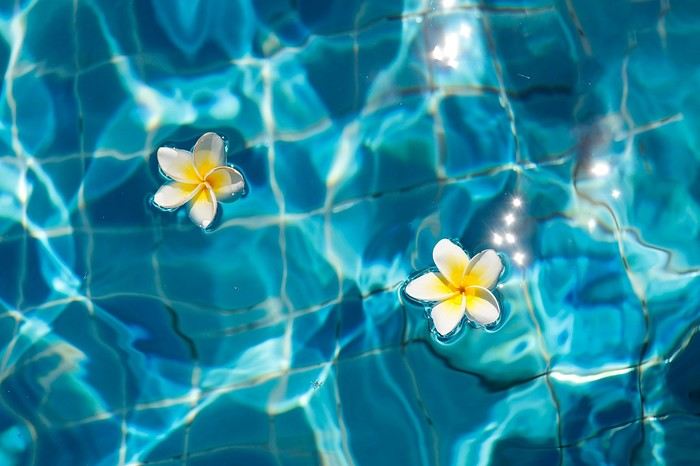
January 2026 Here we go again for new adventures and the pleasure of sharing them with you here! First of all, I’d like to thank everyone who helped me with the preparations, even with some last-minute improvisations just days before departure. Thanks to Montagnard74, Jojoone1, Songsam, Attila, Dennis2, NadegerFERM, and the authors whose travel journals about Laos inspired me (Montagnard74, Muriel18, Mavietongs...).
In this story, written by Richard and illustrated by me, we’ll tell you about the journey of four friends: Catherine, Richard, Nathalie, and Bruno. A reinvented but overall successful trip, filled with discoveries and surprises, the scents of spices and frangipani flowers, (too) spicy food, sunsets, and... one big mess.
ROCK & CARS Festival in Lavaur (81) from June 12 to 14, 2026
ROCK & CARS Festival in Lavaur (81) from June 12 to 14, 2026
- Open to all
- Vintage cars, US cars, Rods, Kustoms, and Motorcycles,
- Blues, Rockabilly, and Rock 'n' Roll festival.
FREE ENTRY - Over 900 cars expected, - Hundreds of Harley bikes and other brands, - Pin-up contests, various stalls, refreshment stands, - Several rides, - On-site food options.
FRIDAY, JUNE 12: 7:00 PM – Bands playing in Lavaur bars
SATURDAY, JUNE 13: 2:00 PM – Site opens / Car and motorcycle exhibition / Stalls / on-site food
6:00 PM – THE SOPHISTICATED CATS Big Band (France – Rock 'n' Roll) 8:00 PM – GAELLE BUSWEL (France – Blues Rock) 10:00 PM – THE LORDS OF ALTAMONT (USA – Garage Rock) Midnight – ROD BARTHET (France – Blues Rock)
SUNDAY, JUNE 14: 9:00 AM – Site opens 10:00 AM – Car and motorcycle ride 11:00 AM – Car exhibition / stalls / on-site food 12:00 PM – Pin-up parade and contest
1:00 PM – MAT & The Messengers (France – Americana) 3:00 PM – ERVIN TRAVIS & His Wild Blue Caps (France – Rockabilly) 5:00 PM – Awards for cars and motorcycles 5:30 PM – ERVIN TRAVIS & His Wild Blue Caps (France – Rockabilly)
FREE ENTRY - Over 900 cars expected, - Hundreds of Harley bikes and other brands, - Pin-up contests, various stalls, refreshment stands, - Several rides, - On-site food options.
FRIDAY, JUNE 12: 7:00 PM – Bands playing in Lavaur bars
SATURDAY, JUNE 13: 2:00 PM – Site opens / Car and motorcycle exhibition / Stalls / on-site food
6:00 PM – THE SOPHISTICATED CATS Big Band (France – Rock 'n' Roll) 8:00 PM – GAELLE BUSWEL (France – Blues Rock) 10:00 PM – THE LORDS OF ALTAMONT (USA – Garage Rock) Midnight – ROD BARTHET (France – Blues Rock)
SUNDAY, JUNE 14: 9:00 AM – Site opens 10:00 AM – Car and motorcycle ride 11:00 AM – Car exhibition / stalls / on-site food 12:00 PM – Pin-up parade and contest
1:00 PM – MAT & The Messengers (France – Americana) 3:00 PM – ERVIN TRAVIS & His Wild Blue Caps (France – Rockabilly) 5:00 PM – Awards for cars and motorcycles 5:30 PM – ERVIN TRAVIS & His Wild Blue Caps (France – Rockabilly)
Is Zanzibar worth visiting?
Hi everyone, I’m planning a two-week trip to Tanzania at the end of December and beginning of January, including 3 or 4 days in Zanzibar. But after reading some posts about the island, I’m wondering if it’s really worth it.
Are the beaches on the mainland just as idyllic as Zanzibar’s? I’ve also seen there are other islands, like Mafia Island, which is less touristy.
Another question: for my arrival, I don’t want to stay in Dar es Salaam, as big cities don’t really appeal to me. Would Bagamoyo be a good base, or would you recommend somewhere else?
To give you more details, I’m not traveling with a tour operator—I’m more of a backpacker and prefer local transport.
Thanks for your advice!
Are the beaches on the mainland just as idyllic as Zanzibar’s? I’ve also seen there are other islands, like Mafia Island, which is less touristy.
Another question: for my arrival, I don’t want to stay in Dar es Salaam, as big cities don’t really appeal to me. Would Bagamoyo be a good base, or would you recommend somewhere else?
To give you more details, I’m not traveling with a tour operator—I’m more of a backpacker and prefer local transport.
Thanks for your advice!
New Navi Mumbai International Airport
India inaugurates the new Navi Mumbai International Airport and the final phase of Mumbai’s Metro Line 3—a major turning point for the country’s infrastructure.
Mumbai, India’s economic capital, is entering a new era of modernization. The Indian government has officially inaugurated the Navi Mumbai International Airport, one of the country’s most ambitious infrastructure projects, along with the final phase of Metro Line 3, a key axis to ease congestion in the megacity.
The Navi Mumbai International Airport (NMIA), located about 35 km from the city center, aims to eventually handle up to 60 million passengers per year. Built to reduce pressure on the already saturated Chhatrapati Shivaji Maharaj Airport, it features ultra-modern facilities, sustainable design, and cutting-edge technologies for air traffic management and energy efficiency.
At the same time, the completion of Mumbai’s Metro Line 3, connecting Colaba to Bandra-SEEPZ, marks a major advancement in urban mobility. This 33.5 km underground section will significantly reduce travel time and congestion in a city known for its chronic traffic jams.
These two projects reflect the Indian government’s commitment to transforming Mumbai into a global hub, combining connectivity, sustainability, and economic development.
The Navi Mumbai International Airport (NMIA), a project two decades in the making, has finally come to fruition. Phase one of the airport was inaugurated Wednesday by Prime Minister Narendra Modi, in the presence of Chief Minister Devendra Fadnavis and Deputy Chief Ministers Eknath Shinde and Ajit Pawar. Although the first phase, which includes Terminal 1 and Runway 1 with 10 bus gates and 29 aero bridges, has been inaugurated, flight operations will not begin immediately.
"Post-inauguration, the airport will be handed over to the Central Industrial Security Force (CISF) for a security sweep, which could take 30 to 45 days. We also need to mobilize customs and immigration teams and complete end-to-end testing, which is a 45-60-day process," said Arun Bansal, CEO of Adani Airports Holdings Ltd, developer and operator of the NMIA, during a press briefing at the NMIA premises Monday. Even though an exact date hasn’t been announced, NMIA CEO Captain B V J K Sharma and Bansal said commercial flights are expected to begin in December 2025. Plans of major carriers Three major airlines—Air India, Akasa Air, and IndiGo—have already signed on to shift part of their operations to NMIA. Last month, Air India announced plans to start with 20 daily departures (40 air traffic movements) through Air India Express, connecting 15 Indian cities in the first phase. By mid-2026, it aims to scale up to 55 daily departures, including up to five international flights. IndiGo, which made its announcement in May, plans to operate 18 daily flights to more than 15 cities from the first day of commercial operations and intends to expand to 140 daily flights—30 of which will be international—within 18 months. In June, Akasa Air said it will start with 15 daily domestic flights, scaling up to over 300 domestic and 50 international flights a week within a few months. When asked which airline will operate the first flight, Bansal said, "We want all three airlines to be there on Day 1. It depends on who has the earliest slot that day, and the destination choice lies entirely with the airlines." Operations to begin with 12-hour window In the first month, flights will operate between 8 am and 8 pm, with the 12-hour window likely to be extended as operations stabilize. Although NMIA’s full capacity is 40 air traffic movements (ATMs) per hour, the initial phase will handle 10 ATMs—allowing 10 aircraft to land or take off every hour. Airlines are expected to announce routes and ticket sales soon. Touted as an international aviation hub, NMIA positions Mumbai alongside global twin-airport cities such as London, Dubai, and New York, and plans to launch both domestic and international operations from Day 1. Concession for international carriers When asked if international carriers will be given any concessions, Bansal said, "For international airlines, we will not charge them parking fees for the first year." The duo added that NMIA aims to reclaim Mumbai’s rightful place on the global aviation map. "For a decade… travelers didn’t have a choice—airlines couldn’t get additional slots (at the Mumbai airport), so traffic shifted to Delhi. We are course-correcting that with NMIA. It won’t happen overnight, but over the next five–seven years, you’ll see the change," said Bansal. He noted that Mumbai currently lacks direct flights to major destinations in Europe and the U.S., something NMIA hopes to change. "If you see east-to-west flights, Mumbai is a natural stop," added Sharma. As reported earlier, NMIA will eventually feature four terminals and two parallel runways, with a total capacity to handle up to 90 million passengers per annum (MPPA), compared to 20 MPPA in the first phase. In the long term, the airport aims to serve as a key transfer hub between the East and the West, enabling passengers from Southeast Asia to connect seamlessly to Europe and North America.
The Navi Mumbai International Airport (NMIA), a project two decades in the making, has finally come to fruition. Phase one of the airport was inaugurated Wednesday by Prime Minister Narendra Modi, in the presence of Chief Minister Devendra Fadnavis and Deputy Chief Ministers Eknath Shinde and Ajit Pawar. Although the first phase, which includes Terminal 1 and Runway 1 with 10 bus gates and 29 aero bridges, has been inaugurated, flight operations will not begin immediately.
"Post-inauguration, the airport will be handed over to the Central Industrial Security Force (CISF) for a security sweep, which could take 30 to 45 days. We also need to mobilize customs and immigration teams and complete end-to-end testing, which is a 45-60-day process," said Arun Bansal, CEO of Adani Airports Holdings Ltd, developer and operator of the NMIA, during a press briefing at the NMIA premises Monday. Even though an exact date hasn’t been announced, NMIA CEO Captain B V J K Sharma and Bansal said commercial flights are expected to begin in December 2025. Plans of major carriers Three major airlines—Air India, Akasa Air, and IndiGo—have already signed on to shift part of their operations to NMIA. Last month, Air India announced plans to start with 20 daily departures (40 air traffic movements) through Air India Express, connecting 15 Indian cities in the first phase. By mid-2026, it aims to scale up to 55 daily departures, including up to five international flights. IndiGo, which made its announcement in May, plans to operate 18 daily flights to more than 15 cities from the first day of commercial operations and intends to expand to 140 daily flights—30 of which will be international—within 18 months. In June, Akasa Air said it will start with 15 daily domestic flights, scaling up to over 300 domestic and 50 international flights a week within a few months. When asked which airline will operate the first flight, Bansal said, "We want all three airlines to be there on Day 1. It depends on who has the earliest slot that day, and the destination choice lies entirely with the airlines." Operations to begin with 12-hour window In the first month, flights will operate between 8 am and 8 pm, with the 12-hour window likely to be extended as operations stabilize. Although NMIA’s full capacity is 40 air traffic movements (ATMs) per hour, the initial phase will handle 10 ATMs—allowing 10 aircraft to land or take off every hour. Airlines are expected to announce routes and ticket sales soon. Touted as an international aviation hub, NMIA positions Mumbai alongside global twin-airport cities such as London, Dubai, and New York, and plans to launch both domestic and international operations from Day 1. Concession for international carriers When asked if international carriers will be given any concessions, Bansal said, "For international airlines, we will not charge them parking fees for the first year." The duo added that NMIA aims to reclaim Mumbai’s rightful place on the global aviation map. "For a decade… travelers didn’t have a choice—airlines couldn’t get additional slots (at the Mumbai airport), so traffic shifted to Delhi. We are course-correcting that with NMIA. It won’t happen overnight, but over the next five–seven years, you’ll see the change," said Bansal. He noted that Mumbai currently lacks direct flights to major destinations in Europe and the U.S., something NMIA hopes to change. "If you see east-to-west flights, Mumbai is a natural stop," added Sharma. As reported earlier, NMIA will eventually feature four terminals and two parallel runways, with a total capacity to handle up to 90 million passengers per annum (MPPA), compared to 20 MPPA in the first phase. In the long term, the airport aims to serve as a key transfer hub between the East and the West, enabling passengers from Southeast Asia to connect seamlessly to Europe and North America.
Slovak travel journal
Hello and welcome aboard this travel journal.
We’re heading to Slovakia together!
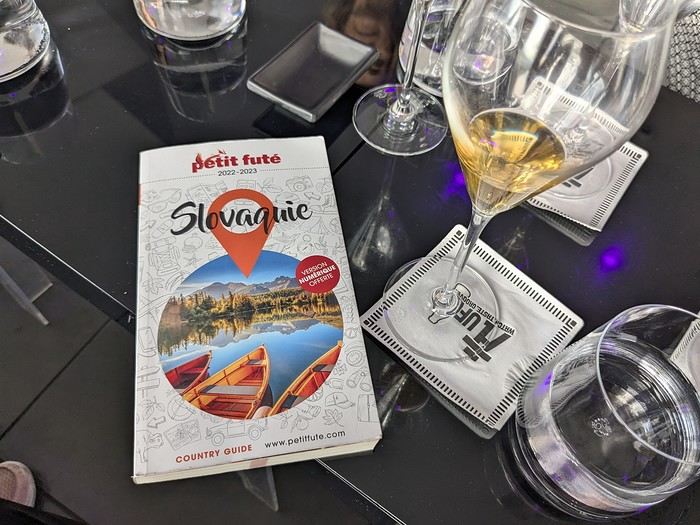 Why this country?
After visiting Hungary, Slovenia, Romania, and Poland in recent years, I’ve fallen in love with Eastern European countries. I adore the Slavic soul, its Austro-Hungarian villages, the gentle landscapes, the Carpathian Mountains, and that slightly mysterious atmosphere.
Slovakia evokes a certain imagination with its deep forests, medieval castles, and cobbled villages.
After seeing photos of the High Tatras—especially Lake Štrbské Pleso and Spiš Castle—I thought, "Let’s do it! We’re going!"
So, will Slovakia live up to what I imagine?
We’ll find out together.
We decided to travel as a group of six (five adults and a six-year-old child), by car (we needed two).
Here’s the day-by-day itinerary for this family trip, which started with a 3-day stay in Vienna (see the dedicated travel journal):
Why this country?
After visiting Hungary, Slovenia, Romania, and Poland in recent years, I’ve fallen in love with Eastern European countries. I adore the Slavic soul, its Austro-Hungarian villages, the gentle landscapes, the Carpathian Mountains, and that slightly mysterious atmosphere.
Slovakia evokes a certain imagination with its deep forests, medieval castles, and cobbled villages.
After seeing photos of the High Tatras—especially Lake Štrbské Pleso and Spiš Castle—I thought, "Let’s do it! We’re going!"
So, will Slovakia live up to what I imagine?
We’ll find out together.
We decided to travel as a group of six (five adults and a six-year-old child), by car (we needed two).
Here’s the day-by-day itinerary for this family trip, which started with a 3-day stay in Vienna (see the dedicated travel journal):
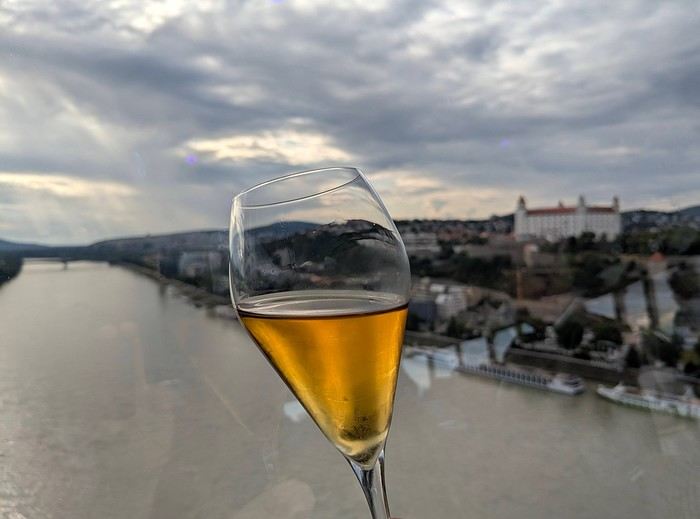
The itinerary: Day 1: Drive from Vienna to Banská Štiavnica and visit the town, then drive to Handlová Day 2: Bojnice Castle, the village of Čičmany, and a walk in the treetops at Bojnice, return to Handlová Day 3: Depart for Orava, visit Orava Castle and the Orava Skansen, drive to Veľký Slavkov Day 4: Visit Slovak Paradise—its gorges, lakes, and ice cave—overnight in Veľký Slavkov Day 5: Visit Bardejov, the "Death Road," wooden churches, and Ľubovňa Castle, overnight in Veľký Slavkov Day 6: Walks and hikes in the High Tatras, Lake Štrbské Pleso, Solisko summit, treetop walk in Ždiar, overnight in Veľký Slavkov Day 7: Drive to Košice, visit Spiš Castle, Tokaj wine route in Veľká Trňa, overnight in Košice Day 8: Visit Košice, overnight in Košice Day 9: Drive to Bratislava, stop at the Aragonite Cave in the Slovak Karst, overnight in Bratislava Day 10: Visit Bratislava, overnight stay Day 11 and 12: Return to France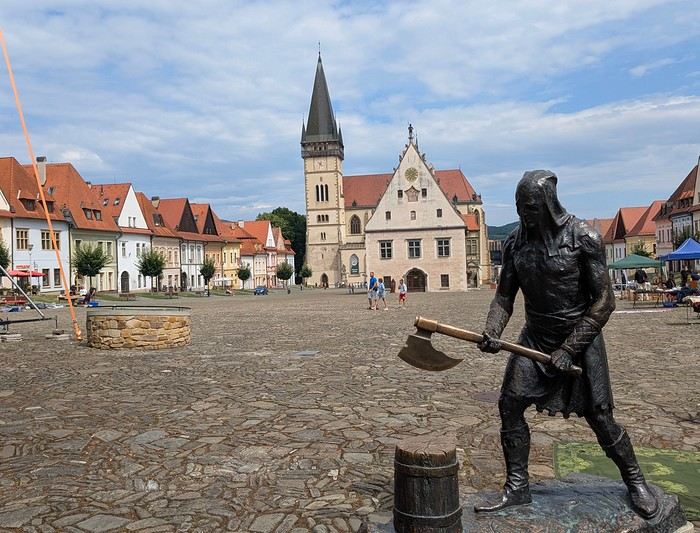
Budget: I’m giving prices for 2 adults / 1 child. Slovakia is more expensive than it seems, and some expenses shouldn’t be underestimated. Transportation: Tolls and gas from France: 500 € round trip Slovak vignette for one month: 17.10 € Gas is fixed at 1.49 € per liter (E10) Parking at sites (all paid by the day, even in the most remote villages, even if you stay for just an hour). Payment is often required in cash upon arrival: total 63 € We didn’t pay at Spiš (we arrived before the cashier) or Ľubovňa (we arrived after the cashier left). Parking at Orava Village was free. In Košice and Bratislava, we parked for free at our accommodations. Public transport in Bratislava and Košice: 1-1.2 € for a bus ticket. Vending machines are available at some stops; otherwise, buy via SMS (Slovak phones only) or official sales points.
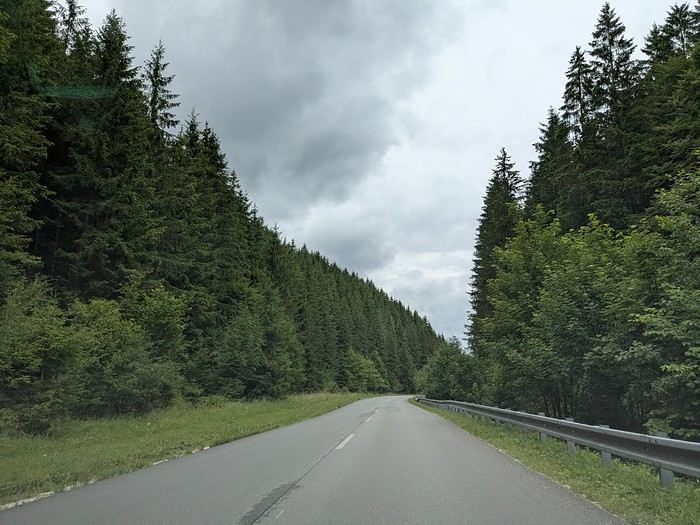
Accommodation: We mostly chose houses so we could cook ourselves and save on food. I’ve rated our satisfaction with these accommodations from 1 to 5 stars. Padua: DC Hotel: 1 night, 77 € ***** Handlová: Chata Remata: 2 nights, 120 € ***** Veľký Slavkov: Aplend: 4 nights, 220 € ** Košice: Luxury Old Town Loft 320m²: 2 nights, 120 € ***** Bratislava: Hotel Viktor: 2 nights, 138 € *** Brescia: Hotel Antica Fonte: 1 night, 82 € ***** Total: 757 €
Food: Groceries at Lidl for 5 meals for 3: 100 € (really cheap) Restaurants: 10-15 € per dish, ice cream 1-2.4 € per scoop, crêpes 8-12 €, a glass of wine 6-10 €... total: 500 €
Visits: There are discounts for seniors and children, which is great. We spent nearly 600 € in total, which is a lot. However, it’s a cultural destination with many castles, museums, caves, wine cellars, and nature activities: cable cars, canopy walks, paid hikes (Slovak Paradise gorges)... In the end, this trip to Slovakia cost nearly 2500 € for 3. We also need to add the Vienna portion to that. Now, here’s the day-by-day account of this beautiful journey.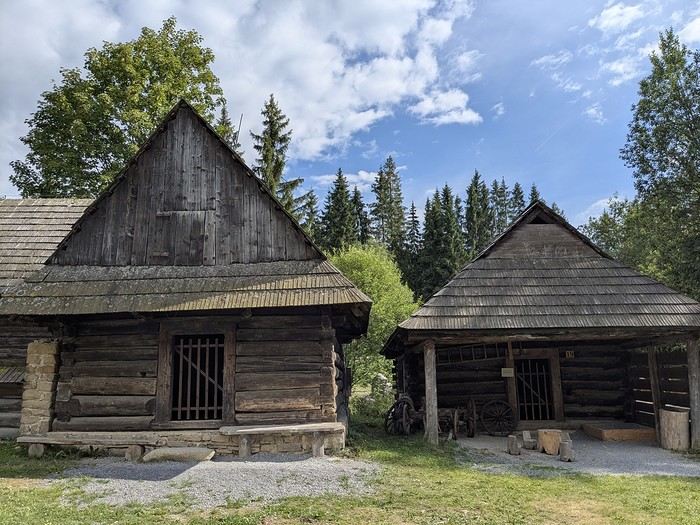
Why this country?
After visiting Hungary, Slovenia, Romania, and Poland in recent years, I’ve fallen in love with Eastern European countries. I adore the Slavic soul, its Austro-Hungarian villages, the gentle landscapes, the Carpathian Mountains, and that slightly mysterious atmosphere.
Slovakia evokes a certain imagination with its deep forests, medieval castles, and cobbled villages.
After seeing photos of the High Tatras—especially Lake Štrbské Pleso and Spiš Castle—I thought, "Let’s do it! We’re going!"
So, will Slovakia live up to what I imagine?
We’ll find out together.
We decided to travel as a group of six (five adults and a six-year-old child), by car (we needed two).
Here’s the day-by-day itinerary for this family trip, which started with a 3-day stay in Vienna (see the dedicated travel journal):
The itinerary: Day 1: Drive from Vienna to Banská Štiavnica and visit the town, then drive to Handlová Day 2: Bojnice Castle, the village of Čičmany, and a walk in the treetops at Bojnice, return to Handlová Day 3: Depart for Orava, visit Orava Castle and the Orava Skansen, drive to Veľký Slavkov Day 4: Visit Slovak Paradise—its gorges, lakes, and ice cave—overnight in Veľký Slavkov Day 5: Visit Bardejov, the "Death Road," wooden churches, and Ľubovňa Castle, overnight in Veľký Slavkov Day 6: Walks and hikes in the High Tatras, Lake Štrbské Pleso, Solisko summit, treetop walk in Ždiar, overnight in Veľký Slavkov Day 7: Drive to Košice, visit Spiš Castle, Tokaj wine route in Veľká Trňa, overnight in Košice Day 8: Visit Košice, overnight in Košice Day 9: Drive to Bratislava, stop at the Aragonite Cave in the Slovak Karst, overnight in Bratislava Day 10: Visit Bratislava, overnight stay Day 11 and 12: Return to France
Budget: I’m giving prices for 2 adults / 1 child. Slovakia is more expensive than it seems, and some expenses shouldn’t be underestimated. Transportation: Tolls and gas from France: 500 € round trip Slovak vignette for one month: 17.10 € Gas is fixed at 1.49 € per liter (E10) Parking at sites (all paid by the day, even in the most remote villages, even if you stay for just an hour). Payment is often required in cash upon arrival: total 63 € We didn’t pay at Spiš (we arrived before the cashier) or Ľubovňa (we arrived after the cashier left). Parking at Orava Village was free. In Košice and Bratislava, we parked for free at our accommodations. Public transport in Bratislava and Košice: 1-1.2 € for a bus ticket. Vending machines are available at some stops; otherwise, buy via SMS (Slovak phones only) or official sales points.
Accommodation: We mostly chose houses so we could cook ourselves and save on food. I’ve rated our satisfaction with these accommodations from 1 to 5 stars. Padua: DC Hotel: 1 night, 77 € ***** Handlová: Chata Remata: 2 nights, 120 € ***** Veľký Slavkov: Aplend: 4 nights, 220 € ** Košice: Luxury Old Town Loft 320m²: 2 nights, 120 € ***** Bratislava: Hotel Viktor: 2 nights, 138 € *** Brescia: Hotel Antica Fonte: 1 night, 82 € ***** Total: 757 €
Food: Groceries at Lidl for 5 meals for 3: 100 € (really cheap) Restaurants: 10-15 € per dish, ice cream 1-2.4 € per scoop, crêpes 8-12 €, a glass of wine 6-10 €... total: 500 €
Visits: There are discounts for seniors and children, which is great. We spent nearly 600 € in total, which is a lot. However, it’s a cultural destination with many castles, museums, caves, wine cellars, and nature activities: cable cars, canopy walks, paid hikes (Slovak Paradise gorges)... In the end, this trip to Slovakia cost nearly 2500 € for 3. We also need to add the Vienna portion to that. Now, here’s the day-by-day account of this beautiful journey.
Second trip to Sardinia from 05/01/25 to 05/11/25
Following my first trip from May 1st to 11th, 2025:
-Flight: easyJet Geneva-Olbia 11:50 AM-1:20 PM (306 € for 2) + 102 € for checked baggage (408 € total)
-Flight: easyJet Cagliari-Geneva 12:45 PM-2:25 PM (308 € for 2)
-Car rental: Olbia-Cagliari (rental: 338.31 € + 120 € for one-way drop-off) + 320 € mandatory insurance imposed by Centauro) 778.31 € total
*May 1st: ***OLBIA: arrived at the airport at 3:15 PM: 1-hour delay with EasyJet! 😕 Car rental issue** Big scam with B Rent (hard to find their counter because of poor signage—they demanded an extra 320 €! But after 5.5 hours, Centauro also charged 320 € for insurance!!!) On top of that, we only got the car at 6:30 PM. Due to the delay, we went straight to our accommodation after grocery shopping. -Bandi House via Mastru Giogliu, San Teodoro 0039 338 852 8569 70 € (very nice apartment, spacious, great welcome from Paola but hard to find) -Nearby: San Teodoro: stagno (birds) Lonely Planet p.159
*May 2nd: -Heading to Isola Tavolara: boat from San Paolo. It was a holiday weekend, and all the Sardinians plus tourists were heading to the island. Everyone wanted to visit the cave and all the beaches—so crowded we gave up. Plus, we had to wait for the first departure at 11 AM with a return no earlier than 2 PM, and all boats left at the same time, so everyone ended up at the cave simultaneously! GUIDES: Green Guide p.140 and Lonely Planet p.158 -Capo Coda Cavallo: beautiful spot with a stunning beach (reserve) -EAST COAST: Budoni, Posada, La Caletta (port) with many white sand beaches
*Orosei (Green Guide p.102, Lonely Planet p.201) and Galtelli (lovely medieval village) *Dorgali (Green Guide p.96, Lonely Planet p.205): don’t skip Pasticceria Mulas (exceptional pastries at very reasonable prices) -Agriturismo Nennelle in Loculi: great welcome at this fairly new site—a farm with sheep. Large room with private bathroom and outdoor tables/chairs. Small fridge, kettle, and coffee machine. 54 0039 3495343765 €
***May 3rd:*** -Hike to Gola Su Gorropu: magnificent 4-hour trek (Lonely Planet p.205, Green Guide p.96)
-Arbatax: Rocce Rosse: stunning red porphyry rocks at the end of the port (Green Guide p.87, Lonely Planet p.210) -Aer Sana in Arzana: a remote village with a very narrow, picturesque road (there’s actually a second one). Via Don Bosco No. 12. 68.60 € 0039 347 9601599 Great welcome from Bruna/message—decorated with lots of taste and care. One room with private bathroom and a super well-equipped shared kitchen.
***May 4th:*** -Supramonte National Park and Gulf of Orosei (Green Guide p.98, Lonely Planet p.201) -Arzana-Ussassai-Seui-Sadali-Goldoni -Aritzo: small village on a slope—very friendly locals -Antonio Mura Museum: Sardinian expressionist painter -Ethnographic Museum: quite comprehensive -Spanish Prison "Sa Bovida" (prison under Spanish rule where people were imprisoned for witchcraft) -Antico Restauro: Via Umberto 38, Fonni. Small Sardinian house in the village with little light but tastefully decorated. Warm welcome from Mario Loddo. 65.02 €
*May 5th: Gennargentu Massif and Supramonte -Orgosolo: Lonely Planet p.190, Green Guide p.123 -Nuraghe di Tiscali (Green Guide p.122, Lonely Planet p.207): allow over 1 hour of hiking to reach a slope with a cave (good shoes required) -Arrival in Nuoro: large city. Via Salvatore Manniri 39 (0039 33118617847). French expat living in Sardinia—very large, well-designed apartment on the 5th floor. 73 €
*May 6th: -NUORO (Lonely Planet p.186, Green Guide p.112) .Museum of Sardinian writer Grazia Deledda (1871-1936), Nobel Prize in Literature 1927 .Sardinian Ethnographic Museum -Ulassai: Stazione dell’Arte Maria Lai (1919-2013) (Lonely Planet p.212, Green Guide p.85). Major climbing spot in a charming little village -Jerzu: "La Finestra sulla Volla" Via Umberto I 551 0039 3403754751 72 € apartment with 1 bedroom, 1 bathroom, and 1 kitchen
*May 7th: OGLIASTRA: -Jerzu to Tortolì via Barisardo: quite difficult route through narrow streets in various villages! Return to Porto Corallo, Capo Ferrato (Green Guide p.64) -Hotel in San Vito: "Su Furriadroxiu" Via Lamarmora 35/37 0039 3501041432 61.20 € (Green Guide p.65)
*May 8th: -San Vito -Armungia (Green Guide p.65): small village at 566 m with nuraghe and museum + fresco "Homage to the Sassari Brigade" -Goni: cork oak forests and Nuraghe di Pranu Muteddu (60 aligned menhirs and tombs) (Green Guide p.66, Lonely Planet p.197) -San Vito: restaurant "La Capinera" Via Nazionale 80, 09040: very good -From Villasimius to Costa Rei: Lonely Planet p.65, Green Guide p.60 .Punta Molentis: white sand, rocks, but very touristy -Capo Carbonara: military zone, not much to see -Accommodation in Cagliari: Villa Volta 18, Monserrato 0039 3480640592: 74.70 € Well-equipped studio, city center, quiet
*May 9th: -Visit to Cagliari with underground tunnels Regina at the foot of the citadel (elevator) (Lonely Planet p.48, Green Guide p.32) .Castello, prefecture, San Maria church .Charming and picturesque Villanova district -Barumini (Green Guide p.70, Lonely Planet p.90): Nuraghe di Su Nuraxi, 1500 BC with its tower and fortifications—the largest Sardinian site (UNESCO) Entry: 15 € with mandatory guided tour -Parco della Giara di Gesturi (basaltic plateau): great for hiking Presence of the Sardinian pony: small Sardinian horse -Accommodation in Sanluri: 2 Via Giacomo Mozart 0039 3495343765: 80 €
*May 10th: -Beautiful Isola di San Pietro: ferry from Portovesme to Carloforte (round trip) 33.50 € with car (Green Guide p.318, Lonely Planet p.81) 15 km long and 15 km wide .Carloforte: peaceful little town with its palazzi and colorful houses .Tonnara della Punta: former tuna cannery—can be visited by reservation .Capo Sandalo: with its lighthouse (nice little trail to hike) .La Caletta: beaches and cliffs .Punta delle Colonne: 2 trachyte formations—very pretty
-TOTAL: 2432 € for 2 -1400 km by car: 160 € for gas (between 1.60 and 1.76 €/L) -Food, including 2 restaurants: 265 € -Accommodation via Booking: 685 € -Flights: 614 € for 2 -Car: 708.50 € + one-way drop-off: 120 € + mandatory insurance of 320 € (not planned!)
*May 1st: ***OLBIA: arrived at the airport at 3:15 PM: 1-hour delay with EasyJet! 😕 Car rental issue** Big scam with B Rent (hard to find their counter because of poor signage—they demanded an extra 320 €! But after 5.5 hours, Centauro also charged 320 € for insurance!!!) On top of that, we only got the car at 6:30 PM. Due to the delay, we went straight to our accommodation after grocery shopping. -Bandi House via Mastru Giogliu, San Teodoro 0039 338 852 8569 70 € (very nice apartment, spacious, great welcome from Paola but hard to find) -Nearby: San Teodoro: stagno (birds) Lonely Planet p.159
*May 2nd: -Heading to Isola Tavolara: boat from San Paolo. It was a holiday weekend, and all the Sardinians plus tourists were heading to the island. Everyone wanted to visit the cave and all the beaches—so crowded we gave up. Plus, we had to wait for the first departure at 11 AM with a return no earlier than 2 PM, and all boats left at the same time, so everyone ended up at the cave simultaneously! GUIDES: Green Guide p.140 and Lonely Planet p.158 -Capo Coda Cavallo: beautiful spot with a stunning beach (reserve) -EAST COAST: Budoni, Posada, La Caletta (port) with many white sand beaches
*Orosei (Green Guide p.102, Lonely Planet p.201) and Galtelli (lovely medieval village) *Dorgali (Green Guide p.96, Lonely Planet p.205): don’t skip Pasticceria Mulas (exceptional pastries at very reasonable prices) -Agriturismo Nennelle in Loculi: great welcome at this fairly new site—a farm with sheep. Large room with private bathroom and outdoor tables/chairs. Small fridge, kettle, and coffee machine. 54 0039 3495343765 €
***May 3rd:*** -Hike to Gola Su Gorropu: magnificent 4-hour trek (Lonely Planet p.205, Green Guide p.96)
-Arbatax: Rocce Rosse: stunning red porphyry rocks at the end of the port (Green Guide p.87, Lonely Planet p.210) -Aer Sana in Arzana: a remote village with a very narrow, picturesque road (there’s actually a second one). Via Don Bosco No. 12. 68.60 € 0039 347 9601599 Great welcome from Bruna/message—decorated with lots of taste and care. One room with private bathroom and a super well-equipped shared kitchen.
***May 4th:*** -Supramonte National Park and Gulf of Orosei (Green Guide p.98, Lonely Planet p.201) -Arzana-Ussassai-Seui-Sadali-Goldoni -Aritzo: small village on a slope—very friendly locals -Antonio Mura Museum: Sardinian expressionist painter -Ethnographic Museum: quite comprehensive -Spanish Prison "Sa Bovida" (prison under Spanish rule where people were imprisoned for witchcraft) -Antico Restauro: Via Umberto 38, Fonni. Small Sardinian house in the village with little light but tastefully decorated. Warm welcome from Mario Loddo. 65.02 €
*May 5th: Gennargentu Massif and Supramonte -Orgosolo: Lonely Planet p.190, Green Guide p.123 -Nuraghe di Tiscali (Green Guide p.122, Lonely Planet p.207): allow over 1 hour of hiking to reach a slope with a cave (good shoes required) -Arrival in Nuoro: large city. Via Salvatore Manniri 39 (0039 33118617847). French expat living in Sardinia—very large, well-designed apartment on the 5th floor. 73 €
*May 6th: -NUORO (Lonely Planet p.186, Green Guide p.112) .Museum of Sardinian writer Grazia Deledda (1871-1936), Nobel Prize in Literature 1927 .Sardinian Ethnographic Museum -Ulassai: Stazione dell’Arte Maria Lai (1919-2013) (Lonely Planet p.212, Green Guide p.85). Major climbing spot in a charming little village -Jerzu: "La Finestra sulla Volla" Via Umberto I 551 0039 3403754751 72 € apartment with 1 bedroom, 1 bathroom, and 1 kitchen
*May 7th: OGLIASTRA: -Jerzu to Tortolì via Barisardo: quite difficult route through narrow streets in various villages! Return to Porto Corallo, Capo Ferrato (Green Guide p.64) -Hotel in San Vito: "Su Furriadroxiu" Via Lamarmora 35/37 0039 3501041432 61.20 € (Green Guide p.65)
*May 8th: -San Vito -Armungia (Green Guide p.65): small village at 566 m with nuraghe and museum + fresco "Homage to the Sassari Brigade" -Goni: cork oak forests and Nuraghe di Pranu Muteddu (60 aligned menhirs and tombs) (Green Guide p.66, Lonely Planet p.197) -San Vito: restaurant "La Capinera" Via Nazionale 80, 09040: very good -From Villasimius to Costa Rei: Lonely Planet p.65, Green Guide p.60 .Punta Molentis: white sand, rocks, but very touristy -Capo Carbonara: military zone, not much to see -Accommodation in Cagliari: Villa Volta 18, Monserrato 0039 3480640592: 74.70 € Well-equipped studio, city center, quiet
*May 9th: -Visit to Cagliari with underground tunnels Regina at the foot of the citadel (elevator) (Lonely Planet p.48, Green Guide p.32) .Castello, prefecture, San Maria church .Charming and picturesque Villanova district -Barumini (Green Guide p.70, Lonely Planet p.90): Nuraghe di Su Nuraxi, 1500 BC with its tower and fortifications—the largest Sardinian site (UNESCO) Entry: 15 € with mandatory guided tour -Parco della Giara di Gesturi (basaltic plateau): great for hiking Presence of the Sardinian pony: small Sardinian horse -Accommodation in Sanluri: 2 Via Giacomo Mozart 0039 3495343765: 80 €
*May 10th: -Beautiful Isola di San Pietro: ferry from Portovesme to Carloforte (round trip) 33.50 € with car (Green Guide p.318, Lonely Planet p.81) 15 km long and 15 km wide .Carloforte: peaceful little town with its palazzi and colorful houses .Tonnara della Punta: former tuna cannery—can be visited by reservation .Capo Sandalo: with its lighthouse (nice little trail to hike) .La Caletta: beaches and cliffs .Punta delle Colonne: 2 trachyte formations—very pretty
-TOTAL: 2432 € for 2 -1400 km by car: 160 € for gas (between 1.60 and 1.76 €/L) -Food, including 2 restaurants: 265 € -Accommodation via Booking: 685 € -Flights: 614 € for 2 -Car: 708.50 € + one-way drop-off: 120 € + mandatory insurance of 320 € (not planned!)
Feedback on our summer trip to Bulgaria
Hi there,
This summer, we’re heading to Bulgaria as a family (2 adults and 2 kids aged 15 and 12). Our flights and rental car are already booked, and our accommodations are pre-reserved (cancellable). Just so you know, we prefer nature over cities for our vacations.
I’d love your thoughts on our itinerary—specifically, any interesting sites, hikes, or nature activities you’d recommend. - Day 1: Arrival in Sofia at 11 PM - Day 2: Sofia - Day 3: Drive to Veliko Tarnovo, overnight there - Day 4: Drive to the Black Sea (we were supposed to go to Varna, but our booking was canceled) - Days 5–8: We were planning to stay in Varna and visit Balchik and Nesebar. But since our accommodation fell through, we’re wondering if we should spend only 2 nights in Varna and 3 in Nesebar instead. What do you think? - Day 9: Drive to Sinemorets - Days 10–11: Sinemorets, Strandja (3 nights in Sinemorets) - Days 12–13: Plovdiv - Days 14–16: Rhodopes, staying in Yagodina for 3 nights - Day 17: Melnik - Days 18–20: Bansko (Bansko Jazz Fest, hikes) - Day 21: Rila Monastery, then overnight in Sapareva Banya - Day 22: Seven Rila Lakes hike - Day 23: Return to Sofia and fly home
Does this route feel balanced, or too rushed? What do you think are the must-see spots along the way?
Thanks! PM
This summer, we’re heading to Bulgaria as a family (2 adults and 2 kids aged 15 and 12). Our flights and rental car are already booked, and our accommodations are pre-reserved (cancellable). Just so you know, we prefer nature over cities for our vacations.
I’d love your thoughts on our itinerary—specifically, any interesting sites, hikes, or nature activities you’d recommend. - Day 1: Arrival in Sofia at 11 PM - Day 2: Sofia - Day 3: Drive to Veliko Tarnovo, overnight there - Day 4: Drive to the Black Sea (we were supposed to go to Varna, but our booking was canceled) - Days 5–8: We were planning to stay in Varna and visit Balchik and Nesebar. But since our accommodation fell through, we’re wondering if we should spend only 2 nights in Varna and 3 in Nesebar instead. What do you think? - Day 9: Drive to Sinemorets - Days 10–11: Sinemorets, Strandja (3 nights in Sinemorets) - Days 12–13: Plovdiv - Days 14–16: Rhodopes, staying in Yagodina for 3 nights - Day 17: Melnik - Days 18–20: Bansko (Bansko Jazz Fest, hikes) - Day 21: Rila Monastery, then overnight in Sapareva Banya - Day 22: Seven Rila Lakes hike - Day 23: Return to Sofia and fly home
Does this route feel balanced, or too rushed? What do you think are the must-see spots along the way?
Thanks! PM
Scams and Violence in Thailand
Hi,
If you take the bus from Bangkok Ekkamai to Pattaya, foreigners will be asked to pay an extra 20k for checked baggage, even though it’s already been paid for and listed on the ticket. They don’t even weigh it—a woman just demands you pay again, and if you refuse, she goes to get security colleagues who yell at you and threaten not to let you board. We later found out at the hotel that this is a well-known organized scam. The company is ROONG REUANG COACH, and we were about fifteen people—all foreign tourists—in the same situation. For Thai passengers, they didn’t ask for anything.
Then in Pattaya, violence and corruption rule. The next day, we learned the city is classified as "scarlet" (high-risk). A hotel guest was attacked with a knife by four Thais on a scooter—they stole his bag with his bank card and cash inside, luckily not his passport. A large hotel near ours was just shut down administratively for pedophilia. On Apple Maps, many reviews warn about how dangerous the city is. I’ve been coming to Thailand regularly for over 30 years, but I barely recognize the country since COVID. The "Land of Smiles" is turning into the "Land of Scowls," and a form of racism is emerging. For us, this will be the last time—next stop, Vietnam, and even China, which pleasantly surprised us.
Finally, China and the U.S. are advising their citizens against traveling to Thailand due to violence. Right now, most tourists here are Indians and Russians—together, they make up the majority—along with some from the Gulf (Qatar, Dubai, Oman).
If you take the bus from Bangkok Ekkamai to Pattaya, foreigners will be asked to pay an extra 20k for checked baggage, even though it’s already been paid for and listed on the ticket. They don’t even weigh it—a woman just demands you pay again, and if you refuse, she goes to get security colleagues who yell at you and threaten not to let you board. We later found out at the hotel that this is a well-known organized scam. The company is ROONG REUANG COACH, and we were about fifteen people—all foreign tourists—in the same situation. For Thai passengers, they didn’t ask for anything.
Then in Pattaya, violence and corruption rule. The next day, we learned the city is classified as "scarlet" (high-risk). A hotel guest was attacked with a knife by four Thais on a scooter—they stole his bag with his bank card and cash inside, luckily not his passport. A large hotel near ours was just shut down administratively for pedophilia. On Apple Maps, many reviews warn about how dangerous the city is. I’ve been coming to Thailand regularly for over 30 years, but I barely recognize the country since COVID. The "Land of Smiles" is turning into the "Land of Scowls," and a form of racism is emerging. For us, this will be the last time—next stop, Vietnam, and even China, which pleasantly surprised us.
Finally, China and the U.S. are advising their citizens against traveling to Thailand due to violence. Right now, most tourists here are Indians and Russians—together, they make up the majority—along with some from the Gulf (Qatar, Dubai, Oman).
Our first trip to Senegal – a review
Hey everyone,
I wanted to share a little feedback on our first trip to Senegal, hoping it might help others who are on the fence about taking the plunge. We went in mid-February with my wife and our two daughters (6 and 9 years old), for 15 days in Saly, on the Petite Côte. It was our first time in West Africa, and honestly, we fell in love with the place.
We landed at Blaise Diagne Airport, and right away, the change of scenery hit us. The weather was pleasantly warm, the people were super welcoming, and it felt like we’d arrived somewhere where time moves differently. The ride to Saly was by taxi, and I’ll admit, the first encounter with Senegalese traffic was a bit of an adventure! 😅 But you get used to it fast—it’s lively, colorful, and there’s a lot of honking, but there’s a kind of logic in the chaos.
We rented a small apartment in Saly Niakh Niakhal, a 10-minute walk from the beach. It was perfect for the kids: huge beach, golden sand, warm water, and not too crowded. We went every morning—the girls built sandcastles, we chatted with the street vendors (who were really friendly, not pushy at all), and my wife quickly became addicted to iced bissap juice.
We did quite a few excursions: Bandia Reserve (the kids loved the giraffes and zebras roaming free), Gorée Island (a deeply moving experience, especially visiting the House of Slaves—it really puts things into perspective), and Lake Retba (which was a little less pink than we’d hoped, but the 4x4 tour was worth it!).
Fun little story: one day, we went to the market in Mbour, and our 6-year-old daughter was given a mango by a vendor just because she said “Bonjour Monsieur” with a big smile. It might seem like nothing, but those little gestures of kindness are what stood out the most during our trip. Senegalese people have a natural warmth and friendliness you don’t find everywhere. That famous “Teranga”—you really understand what it means when you’re there.
Food-wise, we ate grilled fish every other day, the girls discovered a love for chicken yassa, and I fell for thiéboudienne (with plenty of spice 😅). We also tried dishes at local spots—never got sick, and always felt welcome.
The trip back to Dakar was relaxed; we’d planned one night there before our flight. On our last evening, we sat on the corniche, watching the ocean and the sun set slowly. The girls didn’t want to leave. And honestly... neither did we.
So, if you’re hesitating about discovering Senegal with your family, go for it. Sure, it’s different. But that’s exactly what makes it so refreshing.
Happy to answer any questions!
– Nico.
France-Mongolia Road Trip: Which Route to Choose?
For the first quarter of 2026, I’m planning a 4x4 trip from France to Mongolia. I’ve got two route options: the safer one through the Balkans, Turkey, Georgia... to Mongolia, or the other via Morocco, Tunisia, Egypt, Jordan, Syria, Georgia... to Mongolia.
My question: Is it currently possible to cross Libya? Or are there ferries from Tunisia or Algeria to Egypt?
I’m also looking for a travel companion.
Thanks for your replies
Name issue on a child's flight ticket
Hi, I have to leave for Bali and I’ve got a problem. We’re traveling as a family, but when my partner filled out our daughter’s ticket, they only put one last name, even though she has both—mine and her dad’s—on her passport. I tried to fix it to make sure everything’s correct, but the airline won’t do anything about it. Do you think this will be an issue at boarding?
Name difference between ticket and passport for Mauritius
Hi, I’m traveling to Mauritius and my ticket has my married name. My passport, however, lists both my maiden name and my married name.
Will this cause any issues at the airport?
Feedback on a 7-day itinerary in Senegal
Hi there,
We’re heading to Senegal for the first time at the end of February as a group of four, and we’re eager to make the most of our 7 days. So, not much (if any) downtime—just a heads-up! ;)
For such a short trip, we’ve had to make some tough choices. We’ve decided to skip Lompoul due to the 24/7 noise and light pollution from the mine. Casamance is too far for this time around. We love animals and birds (and it seems late February/early March is still a good time to spot migratory birds). We’re planning to rent a car.
Putting all these factors together, here’s the rough itinerary we’ve come up with:
- Day 1: Dakar, Gorée
- Day 2: Kayar, Saint-Louis, Lac de Barbarie
- Day 3: Makhana, Djoudj Bird Sanctuary, Lac de Barbarie
- Day 4: Drive to Somone
- Day 5: Bandia, Somone
- Day 6: Saloum Delta
- Day 7: Saloum Delta
- Day 8: Return to Dakar Airport
What do you think? How much extra does it cost, roughly, to hire a guide compared to just renting a car on our own? Thanks so much for your insights—we really appreciate it! Christophe
What do you think? How much extra does it cost, roughly, to hire a guide compared to just renting a car on our own? Thanks so much for your insights—we really appreciate it! Christophe
Mora Mora in Boraha, One Week on a Little Malagasy Polynesian Vibe
Just back from a week on Nosy Boraha, better known as Île Sainte-Marie. Mostly on Île aux Nattes, actually, at the very south of the island—literally just a few hundred meters from Sainte-Marie’s airport. Far east of Madagascar, and if you keep going straight, you’ll hit Australia.
We flew in through that airport to avoid a long, rough road trip before and after Tamatave, plus a boat ride that could be short or long (boat time was inversely proportional to the bus ride to the port for the Sainte-Marie ferry). No issues with Tsaradia—departures and returns were on time, service was impeccable, and the ATR plane was smooth. Too bad the prices are so high. We managed a change due to a delayed Kenya Airways flight.
First, we stayed in the northern half, on the west coast of the island, at Natiora Green Lodge. The place is absolutely stunning—a little cove opening onto a small bay dotted with rocky outcrops under lush vegetation. The bungalows are practically on the beach, in a gorgeous, forested setting alive with birdsong. It’s the perfect spot for a pirate crew and just begs for daydreaming. No reef barrier, so it gets deep pretty quickly, but the rocks have healthy coral and plenty of small fish. Great snorkeling—we even saw a turtle. Really, really nice. The only downside is that it’s a bit far from the island’s center and kinda isolated, so eating anywhere but the hotel or going for a walk without a rental car or tuk-tuk is tricky. Not impossible, but harder than if you’re somewhere livelier.
Next, we moved to Île aux Nattes at Baboo Village, which overlooks the channel between Nosy Boraha and Nosy Nato. The bungalows are right on the water, nicely and simply decorated, with a restaurant and terrace right next door. You get to the hotel directly by pirogue from Sainte-Marie’s "embarcadère"—it takes 2-3 minutes, or a little longer if the motor’s acting up. The owner is super friendly and welcoming, with a relaxed, "family/friendly" vibe. There are often a few lemurs in the hotel’s park, adding life to the place, and the vegetation is beautiful once again. The path that circles the island starts right at the hotel entrance, making it easy to reach the island’s dock and the different beaches on the west, east, or even south. Several restaurants are within walking distance, and nothing’s far by pirogue anyway. You can also find the island’s "center" with a few small shops for basic supplies or a meal at a hotely. Since there’s no electricity on the island, the generator at the hotel runs from 6 PM to 10 PM, but you can charge your phone anytime by leaving it at reception. Kayaks are free to use and great for exploring—the whole island is doable, even if you’re not an expert. Just take your time. The upside of Île aux Nattes and Sainte-Marie’s east coast is the reef barrier and lagoon (unlike the west side), which means those gorgeous water colors, accessible coral, and shallow swimming spots. The only downside of Baboo for me, since I love snorkeling, is its location right on the channel. Personally, I prefer the south side of Île aux Nattes (near the Aurora) or the east side (like Kintana) for the lagoon views and easier snorkeling (though my wife didn’t agree). But as I said, those spots are still super easy to reach from Baboo. The west side’s okay, but I like it less—except for the view of Madagascar and the sunset. Again, totally subjective.
On Sainte-Marie, we didn’t try any restaurants other than Natiora’s. Not a ton of options, but it was fine. We weren’t fans of Chez Nono in Baie d’Ampanihy—overpriced for the tiny portions. Sure, the crab was good, but there was so little of it for the price. A bit of a rip-off, since crabs are everywhere and can’t cost much for Nono. On Île aux Nattes, there are plenty of little restaurants. We tried three—Chez Adelaide, La Buvette, and Coco Sud—and every time, we had fish or seafood, and it was always good and generous, with great achards. Prices were very reasonable.
Of course, we soaked up the time, the light, the beauty of the place, the sounds, the smells... just chilling in full *tranquillou billou* mode.
We also did some activities. Snorkeling—I’ll come back to it. In 2019, I thought it was a disaster, with no nice spots and really disappointing. This year, I jumped in everywhere I could and tested spots I’d spotted on Maps or during my last trip. And it was *really* good. Mostly on Île aux Nattes: the south side near the sacred islet, west in front of Kintana, west north of the channel (especially the sand islets), and on Sainte-Marie at Natiora’s rocks. Lots of healthy coral and plenty of fish typical of the area. If you’re into big fish, this isn’t the place, but if you love coral and little critters, it’s awesome. Snorkeling outside the reef was disappointing again, and diving was too. Unless you get lucky, it’s not worth it, in my opinion.
The tour of Île aux Nattes with a meal included was great—perfect for taking breaks whenever you find a pretty spot to snorkel or just relax on a nice beach.
A trip to the sand islets was also really fun. You can’t stay long because it gets super hot, and you’re at the mercy of the tides. There’s a good flock of terns that probably nest there. The coral reefs on the east side of the islet are gorgeous. Really, really nice. Plus, the islets themselves are just stunning.
We chose to go to Ampanihy via the lagoon, hugging the shore—it’s beautiful, with amazing colors, a wilder coastline than the west, and views of seaweed farms. It’s a long trip, though, and at Ampanihy, there’s a pretty beach (but there are tons elsewhere) and a nice mangrove. Maybe it’s better to go by road to the bay and take a boat to explore the lagoon and stop somewhere without going all the way to Ampanihy, saving yourself 2 hours of boat time round-trip. Once there, you can take a little pirogue tour to the beach and through the mangrove. The way we did it, the trip wasn’t essential. As I said, Chez Nono was disappointing—bring a picnic or try Chez Samson instead.
Of course, we visited the pirate cemetery, a place I love even though there’s not much left to see—just a few graves, unfortunately, and some vandalism. The site is still magical, though, and you can let your thoughts drift with La Buse and William Kidd, who passed through here.
We organized all our outings with Crépin, who runs two small boats with his brother. We met him totally by chance, but we don’t regret it. We could adjust the trips based on what we wanted—where to stop or which spot to visit next—and Crépin handled the meals. Prices were super affordable for a full day. I can share his number if you want. We didn’t try anyone else, but I’m sure there are other great operators—I just can’t compare or recommend.
Good prep for anyone looking for an alternative to Nosy Be. Way fewer activities, sure, but also way fewer people and a really nice vibe on Sainte-Marie in general, and Île aux Nattes in particular. The beaches are more beautiful than Nosy Be’s, and there’s a reef and lagoon (it *is* the pirate island, after all). And in whale season, well, the whales.
All in all, a great place to stay for a trip.
We flew in through that airport to avoid a long, rough road trip before and after Tamatave, plus a boat ride that could be short or long (boat time was inversely proportional to the bus ride to the port for the Sainte-Marie ferry). No issues with Tsaradia—departures and returns were on time, service was impeccable, and the ATR plane was smooth. Too bad the prices are so high. We managed a change due to a delayed Kenya Airways flight.
First, we stayed in the northern half, on the west coast of the island, at Natiora Green Lodge. The place is absolutely stunning—a little cove opening onto a small bay dotted with rocky outcrops under lush vegetation. The bungalows are practically on the beach, in a gorgeous, forested setting alive with birdsong. It’s the perfect spot for a pirate crew and just begs for daydreaming. No reef barrier, so it gets deep pretty quickly, but the rocks have healthy coral and plenty of small fish. Great snorkeling—we even saw a turtle. Really, really nice. The only downside is that it’s a bit far from the island’s center and kinda isolated, so eating anywhere but the hotel or going for a walk without a rental car or tuk-tuk is tricky. Not impossible, but harder than if you’re somewhere livelier.
Next, we moved to Île aux Nattes at Baboo Village, which overlooks the channel between Nosy Boraha and Nosy Nato. The bungalows are right on the water, nicely and simply decorated, with a restaurant and terrace right next door. You get to the hotel directly by pirogue from Sainte-Marie’s "embarcadère"—it takes 2-3 minutes, or a little longer if the motor’s acting up. The owner is super friendly and welcoming, with a relaxed, "family/friendly" vibe. There are often a few lemurs in the hotel’s park, adding life to the place, and the vegetation is beautiful once again. The path that circles the island starts right at the hotel entrance, making it easy to reach the island’s dock and the different beaches on the west, east, or even south. Several restaurants are within walking distance, and nothing’s far by pirogue anyway. You can also find the island’s "center" with a few small shops for basic supplies or a meal at a hotely. Since there’s no electricity on the island, the generator at the hotel runs from 6 PM to 10 PM, but you can charge your phone anytime by leaving it at reception. Kayaks are free to use and great for exploring—the whole island is doable, even if you’re not an expert. Just take your time. The upside of Île aux Nattes and Sainte-Marie’s east coast is the reef barrier and lagoon (unlike the west side), which means those gorgeous water colors, accessible coral, and shallow swimming spots. The only downside of Baboo for me, since I love snorkeling, is its location right on the channel. Personally, I prefer the south side of Île aux Nattes (near the Aurora) or the east side (like Kintana) for the lagoon views and easier snorkeling (though my wife didn’t agree). But as I said, those spots are still super easy to reach from Baboo. The west side’s okay, but I like it less—except for the view of Madagascar and the sunset. Again, totally subjective.
On Sainte-Marie, we didn’t try any restaurants other than Natiora’s. Not a ton of options, but it was fine. We weren’t fans of Chez Nono in Baie d’Ampanihy—overpriced for the tiny portions. Sure, the crab was good, but there was so little of it for the price. A bit of a rip-off, since crabs are everywhere and can’t cost much for Nono. On Île aux Nattes, there are plenty of little restaurants. We tried three—Chez Adelaide, La Buvette, and Coco Sud—and every time, we had fish or seafood, and it was always good and generous, with great achards. Prices were very reasonable.
Of course, we soaked up the time, the light, the beauty of the place, the sounds, the smells... just chilling in full *tranquillou billou* mode.
We also did some activities. Snorkeling—I’ll come back to it. In 2019, I thought it was a disaster, with no nice spots and really disappointing. This year, I jumped in everywhere I could and tested spots I’d spotted on Maps or during my last trip. And it was *really* good. Mostly on Île aux Nattes: the south side near the sacred islet, west in front of Kintana, west north of the channel (especially the sand islets), and on Sainte-Marie at Natiora’s rocks. Lots of healthy coral and plenty of fish typical of the area. If you’re into big fish, this isn’t the place, but if you love coral and little critters, it’s awesome. Snorkeling outside the reef was disappointing again, and diving was too. Unless you get lucky, it’s not worth it, in my opinion.
The tour of Île aux Nattes with a meal included was great—perfect for taking breaks whenever you find a pretty spot to snorkel or just relax on a nice beach.
A trip to the sand islets was also really fun. You can’t stay long because it gets super hot, and you’re at the mercy of the tides. There’s a good flock of terns that probably nest there. The coral reefs on the east side of the islet are gorgeous. Really, really nice. Plus, the islets themselves are just stunning.
We chose to go to Ampanihy via the lagoon, hugging the shore—it’s beautiful, with amazing colors, a wilder coastline than the west, and views of seaweed farms. It’s a long trip, though, and at Ampanihy, there’s a pretty beach (but there are tons elsewhere) and a nice mangrove. Maybe it’s better to go by road to the bay and take a boat to explore the lagoon and stop somewhere without going all the way to Ampanihy, saving yourself 2 hours of boat time round-trip. Once there, you can take a little pirogue tour to the beach and through the mangrove. The way we did it, the trip wasn’t essential. As I said, Chez Nono was disappointing—bring a picnic or try Chez Samson instead.
Of course, we visited the pirate cemetery, a place I love even though there’s not much left to see—just a few graves, unfortunately, and some vandalism. The site is still magical, though, and you can let your thoughts drift with La Buse and William Kidd, who passed through here.
We organized all our outings with Crépin, who runs two small boats with his brother. We met him totally by chance, but we don’t regret it. We could adjust the trips based on what we wanted—where to stop or which spot to visit next—and Crépin handled the meals. Prices were super affordable for a full day. I can share his number if you want. We didn’t try anyone else, but I’m sure there are other great operators—I just can’t compare or recommend.
Good prep for anyone looking for an alternative to Nosy Be. Way fewer activities, sure, but also way fewer people and a really nice vibe on Sainte-Marie in general, and Île aux Nattes in particular. The beaches are more beautiful than Nosy Be’s, and there’s a reef and lagoon (it *is* the pirate island, after all). And in whale season, well, the whales.
All in all, a great place to stay for a trip.
Martine and DD in Colorado and Utah
Hello everyone! 🙂
So many silent months, and now Voyage Forum is accessible again. That’s cool because we can pick up our discussions for our mutual enjoyment.
I hope everyone is doing well and that you’ve been able to take some great trips, whether to the USA or elsewhere.
In September 2020, we had planned a round trip to explore Colorado, but unfortunately, a nasty virus messed up our plans, closing borders and keeping us stuck at home. Luckily for us, canceling the car, flights, and accommodations didn’t cost us a thing—everything was refunded.
In 2023, a loop from Las Vegas let us revisit places we’d seen in 2017 and discover new ones, this time spending more time at each stop with some lovely hikes.
In 2024, we finally revisited the 2020 plan, and I’ll start with that.
However, unforeseen circumstances mean I have much less time than before, so I’ll keep my trip reports shorter (ha ha ha—you’ll have less of my prose to endure).
Another change: for those who remember the "Gang of Four crazy sixty-somethings," it was just DD and me this time. Our dear Mimi and Maumau left the Var to focus on raising horses and can’t leave their little green paradise to join us anymore. We were unfortunately much tamer without them.
We traveled from September 11 to October 3.
The itinerary
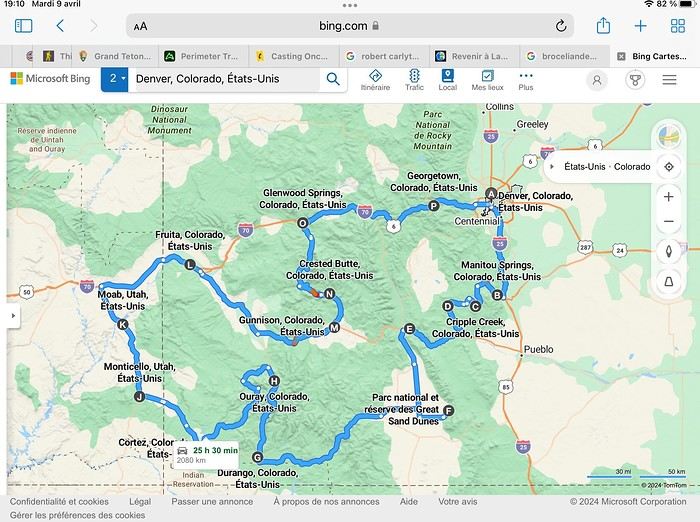
Day 1: Flight Marseille-Paris-Denver, then Manitou Springs (133 km) Day 2: Manitou Springs (49 km) Day 3: Cripple Creek (104 km) Day 4: Salida (254 km) Day 5: Great Sand Dunes (231 km) Day 6: Durango (283 km) Day 7: Durango (Durango-Silverton train) Day 8: Ouray (121 km) Day 9: Ouray (Perimeter Trail hike) Day 10: Cortez (213 km) Day 11: Cortez (Mesa Verde National Park, 134 km) Day 12: Monticello (268 km, detour to Chesler Park) Day 13: Moab (171 km, Delicate Arch) Day 14: Moab (98 km, Fisher Towers) Day 15: Moab (171 km, Canyonlands) Day 16: Fruita (210 km, Colorado National Monument) Day 17: Crested Butte (224 km via Kebler Pass) Day 18: Crested Butte (57 km) Day 19: Glenwood Springs (150 km) Day 20: Glenwood Springs (118 km, Rifle State Park) Day 21: Georgetown (258 km via Independence Pass) Day 22: Denver (123 km), then return flight
We speak very little English. We spent 21 nights there and covered a 3,400 km loop by car and 160 km on foot (we’re still trying to hike while we’re in shape) from Denver in September 2024. We wanted this road trip to help us explore Colorado a bit more—we’d only spent 6 nights there in 2019—and to see it during the fall foliage season. We also wanted to return to Utah (we love Moab) to enjoy its red rocks, which we adore.
In the prices you see (some in euros, others in dollars), I’ve included bank fees and exchange charges. The flights, car, and parking were paid by credit card when we booked in February. Usually, we book around November, but some obligations kept us from doing it earlier. We downloaded the MPC (Mobile Passport Control) app on our phone, which saved us time at immigration.
📊 **Budget: just under 8,500 € for both of us, all included**
📊 **Flights** Marseille-Paris (CDG)-Denver: 2,152 € for both of us, with one checked bag each
📊 **ESTA and America the Beautiful Pass** The ones from our 2023 road trip were still valid
📊 **Parking at Marseille airport: 122 €**
📊 **Car: Nissan Rogue (the French X-Trail) from Hertz: 1,165 €** By booking through Air France (and earning miles), we got a 15% discount. Hertz offers a free Hertz Gold Plus Rewards program, which gives us priority counter service.
📊 **Accommodation: 3,050 €** We stayed in motels and hotels of various ranges (from 100 € to 270 € per night, depending on the city), all booked through Hotels.com or Booking. Booking sometimes offers cheaper rates if you book via the "Booking mobile" app. We also got some preferential rates thanks to our Genius 2 status. Out of 21 nights, only one place didn’t include breakfast.
📊 **Other expenses (activities booked by credit card before leaving)** Durango-Silverton train: 210 € (we booked the enclosed vintage coach in March) Mesa Verde: Balcony House: 15.15 € (booked 14 days before the visit) Timed-entry passes for Arches National Park: 6 € for 3 days (booked June 1 for September entries via http://récreation.gov/). We booked three different days to play with the weather.
📊 **Supplementary insurance with AVA: 204 €** (due to our age 😅 and the high cost of medical consultations in the USA)
📊 **Cash: 1,540 €** We left with 1,000 € exchanged before departure and made two withdrawals (500 $ and 200 $). This cash was used to pay for: - Evening restaurants and tips (between 70 $ and 95 $ for two meals and two drinks) - Two state parks: Dead Horse State Park (20 $) and Rifle State Park (10 $) - The Monarch Pass gondola (24 $) - Midday picnics - Gas (slightly cheaper with cash): 204 $ for 3,400 km - Personal souvenirs and little treats.
Like in our previous road trips, we didn’t rent a GPS. We used the offline GPS app Here We Go, for which we’d downloaded maps of Colorado and Utah from France, as well as a new offline app called Organic Maps as a backup—though we didn’t end up needing it.
❤️❤️❤️ **Highlights (there are so many!)** 📍 The stunning landscapes of Colorado, especially with the fall colors 📍 A step back in time at the old farm in Florissant Fossil Beds National Monument 📍 The prairies of Cripple Creek and the mining remnants of the Vindicator Trail 📍 The cheeky chipmunks in the ghost town of St. Elmo 📍 Great Sand Dunes and its soft sand 📍 The steam train between Durango and Silverton: we’re glad we chose the round-trip because it rained heavily on the way there, but we got to enjoy the scenery on the way back when the sun came out 📍 The unexpected meet-up with Michèle from the group outside a restaurant in Durango 📍 The hot springs in Ouray 📍 Mesa Verde and its still-vibrant past 📍 The red rocks of Moab and Delicate Arch at sunset 📍 The lace-like Fisher Towers and the view from the end of the trail 📍 The gorgeous Route 128 leading to Colorado National Monument—small, easy to visit, and so beautiful 📍 The colors of the fabulous Kebler Pass, Crested Butte, and especially the hike through the golden aspens (Lower and Upper Loop) 📍 The waterfalls at Rifle State Park 📍 The tundra of Independence Pass 📍 The Halloween decorations in Georgetown and Idaho Springs
😞😞 **Flops (there are very few!)** 📍 The viewpoints we missed because they weren’t well-marked or we didn’t see the signs 📍 The closure of some hiking trails (Hanging Lake and parts of Canyonlands) and the Sal Mountain Loop road, which kept us from accessing it 📍😢 The Chesler Park hike we had to cut short due to poor time management—180 km between our stop in Cortez meant we didn’t arrive until 10:30 AM, way too late for a 17 km hike.
Hope this helps! Have a great evening, everyone, and see you soon! 😊
The itinerary
Day 1: Flight Marseille-Paris-Denver, then Manitou Springs (133 km) Day 2: Manitou Springs (49 km) Day 3: Cripple Creek (104 km) Day 4: Salida (254 km) Day 5: Great Sand Dunes (231 km) Day 6: Durango (283 km) Day 7: Durango (Durango-Silverton train) Day 8: Ouray (121 km) Day 9: Ouray (Perimeter Trail hike) Day 10: Cortez (213 km) Day 11: Cortez (Mesa Verde National Park, 134 km) Day 12: Monticello (268 km, detour to Chesler Park) Day 13: Moab (171 km, Delicate Arch) Day 14: Moab (98 km, Fisher Towers) Day 15: Moab (171 km, Canyonlands) Day 16: Fruita (210 km, Colorado National Monument) Day 17: Crested Butte (224 km via Kebler Pass) Day 18: Crested Butte (57 km) Day 19: Glenwood Springs (150 km) Day 20: Glenwood Springs (118 km, Rifle State Park) Day 21: Georgetown (258 km via Independence Pass) Day 22: Denver (123 km), then return flight
We speak very little English. We spent 21 nights there and covered a 3,400 km loop by car and 160 km on foot (we’re still trying to hike while we’re in shape) from Denver in September 2024. We wanted this road trip to help us explore Colorado a bit more—we’d only spent 6 nights there in 2019—and to see it during the fall foliage season. We also wanted to return to Utah (we love Moab) to enjoy its red rocks, which we adore.
In the prices you see (some in euros, others in dollars), I’ve included bank fees and exchange charges. The flights, car, and parking were paid by credit card when we booked in February. Usually, we book around November, but some obligations kept us from doing it earlier. We downloaded the MPC (Mobile Passport Control) app on our phone, which saved us time at immigration.
📊 **Budget: just under 8,500 € for both of us, all included**
📊 **Flights** Marseille-Paris (CDG)-Denver: 2,152 € for both of us, with one checked bag each
📊 **ESTA and America the Beautiful Pass** The ones from our 2023 road trip were still valid
📊 **Parking at Marseille airport: 122 €**
📊 **Car: Nissan Rogue (the French X-Trail) from Hertz: 1,165 €** By booking through Air France (and earning miles), we got a 15% discount. Hertz offers a free Hertz Gold Plus Rewards program, which gives us priority counter service.
📊 **Accommodation: 3,050 €** We stayed in motels and hotels of various ranges (from 100 € to 270 € per night, depending on the city), all booked through Hotels.com or Booking. Booking sometimes offers cheaper rates if you book via the "Booking mobile" app. We also got some preferential rates thanks to our Genius 2 status. Out of 21 nights, only one place didn’t include breakfast.
📊 **Other expenses (activities booked by credit card before leaving)** Durango-Silverton train: 210 € (we booked the enclosed vintage coach in March) Mesa Verde: Balcony House: 15.15 € (booked 14 days before the visit) Timed-entry passes for Arches National Park: 6 € for 3 days (booked June 1 for September entries via http://récreation.gov/). We booked three different days to play with the weather.
📊 **Supplementary insurance with AVA: 204 €** (due to our age 😅 and the high cost of medical consultations in the USA)
📊 **Cash: 1,540 €** We left with 1,000 € exchanged before departure and made two withdrawals (500 $ and 200 $). This cash was used to pay for: - Evening restaurants and tips (between 70 $ and 95 $ for two meals and two drinks) - Two state parks: Dead Horse State Park (20 $) and Rifle State Park (10 $) - The Monarch Pass gondola (24 $) - Midday picnics - Gas (slightly cheaper with cash): 204 $ for 3,400 km - Personal souvenirs and little treats.
Like in our previous road trips, we didn’t rent a GPS. We used the offline GPS app Here We Go, for which we’d downloaded maps of Colorado and Utah from France, as well as a new offline app called Organic Maps as a backup—though we didn’t end up needing it.
❤️❤️❤️ **Highlights (there are so many!)** 📍 The stunning landscapes of Colorado, especially with the fall colors 📍 A step back in time at the old farm in Florissant Fossil Beds National Monument 📍 The prairies of Cripple Creek and the mining remnants of the Vindicator Trail 📍 The cheeky chipmunks in the ghost town of St. Elmo 📍 Great Sand Dunes and its soft sand 📍 The steam train between Durango and Silverton: we’re glad we chose the round-trip because it rained heavily on the way there, but we got to enjoy the scenery on the way back when the sun came out 📍 The unexpected meet-up with Michèle from the group outside a restaurant in Durango 📍 The hot springs in Ouray 📍 Mesa Verde and its still-vibrant past 📍 The red rocks of Moab and Delicate Arch at sunset 📍 The lace-like Fisher Towers and the view from the end of the trail 📍 The gorgeous Route 128 leading to Colorado National Monument—small, easy to visit, and so beautiful 📍 The colors of the fabulous Kebler Pass, Crested Butte, and especially the hike through the golden aspens (Lower and Upper Loop) 📍 The waterfalls at Rifle State Park 📍 The tundra of Independence Pass 📍 The Halloween decorations in Georgetown and Idaho Springs
😞😞 **Flops (there are very few!)** 📍 The viewpoints we missed because they weren’t well-marked or we didn’t see the signs 📍 The closure of some hiking trails (Hanging Lake and parts of Canyonlands) and the Sal Mountain Loop road, which kept us from accessing it 📍😢 The Chesler Park hike we had to cut short due to poor time management—180 km between our stop in Cortez meant we didn’t arrive until 10:30 AM, way too late for a 17 km hike.
Hope this helps! Have a great evening, everyone, and see you soon! 😊
Africa Mia English translation pending
C'est l'histoire d'un groupe de jeunes musiciens du Mali qui, en 1964, fut envoyé à Cuba pour faire partie d'une formation musicale qui donnera des représentations un peu partout sur l'île. Ce groupe s'appelle Las Maravillas de Mali , et à l'époque il connait un certain succès en Afrique.
Plusieurs années plus tard de l'eau a passé sous le pont, mais un réalisateur qui voyageait au Mali fait la connaissance de Dramane qui lui raconte l'aventure des Maravillas de Mali ... Maintenant l'histoire est en film ! Y a plus qu'aller le voir 😎
https://www.fip.fr/emissions/certains-l-aiment-fip/africa-mia-la-fabuleuse-histoire-de-las-maravillas-de-mali
Bande-annonce :
https://www.youtube.com/watch?v=Gmxv9-L3Uvo
Plusieurs années plus tard de l'eau a passé sous le pont, mais un réalisateur qui voyageait au Mali fait la connaissance de Dramane qui lui raconte l'aventure des Maravillas de Mali ... Maintenant l'histoire est en film ! Y a plus qu'aller le voir 😎
https://www.fip.fr/emissions/certains-l-aiment-fip/africa-mia-la-fabuleuse-histoire-de-las-maravillas-de-mali
Bande-annonce :
https://www.youtube.com/watch?v=Gmxv9-L3Uvo
Disparition de Keith Tippett (Grande-Bretagne) English translation pending
« With his mutton-chop sideburns and penchant for countrymen’s tweed jackets, waistcoats and collarless shirts, Keith Tippett suggested a quirky Edwardian gentleman farmer more than an experimental music firebrand. » (John Fordham, The Guardian, juin 2020)
Entre jazz libre et rock progressif
Un grand nom du jazz britannique vient de disparaître. En juin, le compositeur, improvisateur et pianiste anglais Keith Tippett est mort à l’âge de 72 ans. Curieux de tous les styles et tous les genres, infatigable à la quête de nouvelles expériences musicales, il est une figure pionnière de la scène anglaise de jazz libre depuis le début des années 70. Mais il se fait surtout connaître pour avoir fondé le méga-orchestre CENTIPEDE, comprenant une cinquantaine de musiciens, et par sa participation à trois albums du groupe de rock progressif KING CRIMSON. Sa discographie est immense...
Né à Bristol en 1947, Keith Tippett étudie le piano et l’orgue d’église et forme son premier groupe quand il est adolescent. En 1967, il s‘installe à la capitale britannique, la date qui équivaut au début de sa vie musicale professionnelle. Déjà sa première formation, le KEITH TIPPETT GROUP, un sextet comprenant notamment le saxophoniste Elton Dean, le trompettiste Mark Charig et le tromboniste Nick Evans, atteint un certain degré de notorité. Le groupe enregistre deux disques de jazz-rock qui font date, You are here...I am There en 1970, et Dedicated to You, but You weren’t Listening en 1971, auquel participe aussi Robert Wyatt, entre autres. A cette époque également, Keith Tippett collabore à la chanteuse Shelag McDonald et effectue plusieurs sessions de King Crimson où il laisse son imparable touche pianistique : faut écouter p.ex. la pièce Cat Food ou aussi Lizard, really great !)...
En 1970 de même, Keith Tippett fonde un orchestre hors du commun comprenant d’une cinquantaine de musiciens issus des scènes jazz et rock britannique, CENTIPEDE, laissant un double album, Septober Energy, qui reste unique en son genre : une composition déclinée en quatre parties, chacune faisant intervenir les musiciens soit en solo, en duos, en trios, en quartets, en orchestre complet, mélangeant et mariant différents styles – jazz, classique, rock, free music, etc. Peu de temps après, Keith Tippett crée une autre formation, OVARY LODGE, avec le contrebassiste Roy Babington, le batteur Frank Perry et – plus tard – le bassiste sud-africain, Harry Miller. Sa femme, la vocaliste et percussionniste Julie Tippetts (née Driscoll) y participe également : qui ne se souvient pas d‘une voix soul, celle de Julie, accompagnée du groupe Brian Auger & The Trinity ayant eu plusieurs hits à l‘époque : This Wheel‘s on Fire, Road to Cairo, Season of the Witch... Ce quartet s’oriente vers une musique entièrement improvisée, au croisement du free et de la musique contemporaire, préfigurant même l’ambient.
En 1976, Keith Tippett joue en duo avec un autre pianiste britannique, Stan Tracey, et en 1978, il forme sa deuxième grande formation, ARK, un big-band de 22 musiciens, cette fois issu du jazz et des musiques improvisées, se déplaçant musicalement entre Charles Mingus et Sun Ra. Cette grande formation comprend notamment des membres d’OVARY LODGE et du Chris McGregor’s Brotherhood of Breath, n’ayant enregistré, tout comme CENTIPEDE, qu’un seul double album, Frames (Music for an Imaginary Film). Par la suite, le pianiste crée d’autres formations orchestrales qui, même sans avoir dépassé le nombre de participants d’ARK et de CENTIPEDE, témoigne d’une densité et d’un foisonnement musicaux tout aussi impressionnants, comme le KEITH TIPPETT SEPTET, le KEITH TIPPETT TAPESTRY ORCHESTRA, VIVE LA BLACK et le KEITH TIPPETT OCTET. En somme, une carrière musicale qui présente diverses formes musicalement assez contrastées...
A l’opposé de ces grandes formations, le fécond talent pianistique de Keith Tippett s’exprime également sous la stricte forme du solo piano, une démarche qu’il initie à partir des années 80 avec le double album The Unlonely Raindancer et qu’il développe dans les décennies suivantes au sein de sa série de disques solistes Mujician I, II, III (August Air) et IV (Live in Piacenza) et dans d’autres albums comme The Dartington Concert, Friday the 13th et Live in Triest. Ce sont tous des albums qui illustrent toute l’amplitude créative de Keith Tippett sur le piano, rayonnant d’un lyrisme brûlant, d’un souffle vital et d’une inventivité infaillible, souvent le traitant d’un "piano préparé à la John Cage" (le son des cordes étant modifié par des pièces de bois et autres objets). MUJICIAN devient aussi le nom de l’un des groupes les plus éloquents du pianiste, un quartet improvisé d’harmonie intuitive, avec le saxophoniste Paul Dunmall, inspiré de Coltrane, le virtuose de basse, Paul Rogers, et le batteur Tony Levin...
Au cours de sa longue carrière, Keith Tippett multiplie les rencontres musicales sous plusieurs formes, en duos, en trios, etc. etc., et participe, de la même façon, dans différentes formations d‘amis musiciens, dont Elton Dean (Quartet, Quintet, Ninesense), Harry Miller (Isipingo), le violoniste de King Crimson, David Cross (Low Flying Aircraft), le bassiste de Soft Machine, Hugh Hopper (Hopper-Dean-Tippett-Gallivan), Paul Dunmall ou en duo avec le pianiste Howard Riley, le saxophoniste Andy Sheppard, ou encore avec sa femme Julie, avec laquelle il enregistre plusieurs albums (Couple in Spirit). En 2000, il écrit une musique pour un quartet à cordes contemporain, le Kreutzer Strings Quartet (Linuckea. Let The Music Speak).
Toute sa vie (musicale), Keith Tippett a la vision idéaliste que les gens qui écoutent de la musique entrent dans un espace sacré. Il envisage d'atteindre ses objectifs humanistes et musicaux sans tout compromis. Sa classe pianistique, ses compétences artistiques ne sont pas toujours reconnues et la reconnaissance que son travail mérite ne lui est pas toujours témoignée. A cet égard, Keith Tippett n’est certainement pas le seul. En Grande-Bretagne et ailleurs, on ne traite pas toujours les trésors nationaux comme il faut. En tout cas, Keith Tippett en est un...
Quel que soient les projets musicaux dans lesquels il s’investit, Keith Tippett laisse des traces immanquables et remarquées, avec son jeu de piano aussi endiablé que raffiné, fécond et innovant, son swing habité et hypnotique. Par sa mort, la musique du XXe siècle perd l’un de ses plus inspirés serviteurs. Les traces qu’il laisse, en Grande-Bretagne et ailleurs, sont profondes et durables, mes souvenirs de plusieurs concerts que j’ai pu voir – en particulier à Berlin – restent inoubliables : THANK YOU, KEITH TIPPETT !!!
Hery
(Keith Tippett et sa femme Julie : © Frank Schindelbeck)
https://www.youtube.com/watch?v=JW2qdrPBikA
(Keith Tippett solo, live in Italy)
Entre jazz libre et rock progressif
Un grand nom du jazz britannique vient de disparaître. En juin, le compositeur, improvisateur et pianiste anglais Keith Tippett est mort à l’âge de 72 ans. Curieux de tous les styles et tous les genres, infatigable à la quête de nouvelles expériences musicales, il est une figure pionnière de la scène anglaise de jazz libre depuis le début des années 70. Mais il se fait surtout connaître pour avoir fondé le méga-orchestre CENTIPEDE, comprenant une cinquantaine de musiciens, et par sa participation à trois albums du groupe de rock progressif KING CRIMSON. Sa discographie est immense...
Né à Bristol en 1947, Keith Tippett étudie le piano et l’orgue d’église et forme son premier groupe quand il est adolescent. En 1967, il s‘installe à la capitale britannique, la date qui équivaut au début de sa vie musicale professionnelle. Déjà sa première formation, le KEITH TIPPETT GROUP, un sextet comprenant notamment le saxophoniste Elton Dean, le trompettiste Mark Charig et le tromboniste Nick Evans, atteint un certain degré de notorité. Le groupe enregistre deux disques de jazz-rock qui font date, You are here...I am There en 1970, et Dedicated to You, but You weren’t Listening en 1971, auquel participe aussi Robert Wyatt, entre autres. A cette époque également, Keith Tippett collabore à la chanteuse Shelag McDonald et effectue plusieurs sessions de King Crimson où il laisse son imparable touche pianistique : faut écouter p.ex. la pièce Cat Food ou aussi Lizard, really great !)...
En 1970 de même, Keith Tippett fonde un orchestre hors du commun comprenant d’une cinquantaine de musiciens issus des scènes jazz et rock britannique, CENTIPEDE, laissant un double album, Septober Energy, qui reste unique en son genre : une composition déclinée en quatre parties, chacune faisant intervenir les musiciens soit en solo, en duos, en trios, en quartets, en orchestre complet, mélangeant et mariant différents styles – jazz, classique, rock, free music, etc. Peu de temps après, Keith Tippett crée une autre formation, OVARY LODGE, avec le contrebassiste Roy Babington, le batteur Frank Perry et – plus tard – le bassiste sud-africain, Harry Miller. Sa femme, la vocaliste et percussionniste Julie Tippetts (née Driscoll) y participe également : qui ne se souvient pas d‘une voix soul, celle de Julie, accompagnée du groupe Brian Auger & The Trinity ayant eu plusieurs hits à l‘époque : This Wheel‘s on Fire, Road to Cairo, Season of the Witch... Ce quartet s’oriente vers une musique entièrement improvisée, au croisement du free et de la musique contemporaire, préfigurant même l’ambient.
En 1976, Keith Tippett joue en duo avec un autre pianiste britannique, Stan Tracey, et en 1978, il forme sa deuxième grande formation, ARK, un big-band de 22 musiciens, cette fois issu du jazz et des musiques improvisées, se déplaçant musicalement entre Charles Mingus et Sun Ra. Cette grande formation comprend notamment des membres d’OVARY LODGE et du Chris McGregor’s Brotherhood of Breath, n’ayant enregistré, tout comme CENTIPEDE, qu’un seul double album, Frames (Music for an Imaginary Film). Par la suite, le pianiste crée d’autres formations orchestrales qui, même sans avoir dépassé le nombre de participants d’ARK et de CENTIPEDE, témoigne d’une densité et d’un foisonnement musicaux tout aussi impressionnants, comme le KEITH TIPPETT SEPTET, le KEITH TIPPETT TAPESTRY ORCHESTRA, VIVE LA BLACK et le KEITH TIPPETT OCTET. En somme, une carrière musicale qui présente diverses formes musicalement assez contrastées...
A l’opposé de ces grandes formations, le fécond talent pianistique de Keith Tippett s’exprime également sous la stricte forme du solo piano, une démarche qu’il initie à partir des années 80 avec le double album The Unlonely Raindancer et qu’il développe dans les décennies suivantes au sein de sa série de disques solistes Mujician I, II, III (August Air) et IV (Live in Piacenza) et dans d’autres albums comme The Dartington Concert, Friday the 13th et Live in Triest. Ce sont tous des albums qui illustrent toute l’amplitude créative de Keith Tippett sur le piano, rayonnant d’un lyrisme brûlant, d’un souffle vital et d’une inventivité infaillible, souvent le traitant d’un "piano préparé à la John Cage" (le son des cordes étant modifié par des pièces de bois et autres objets). MUJICIAN devient aussi le nom de l’un des groupes les plus éloquents du pianiste, un quartet improvisé d’harmonie intuitive, avec le saxophoniste Paul Dunmall, inspiré de Coltrane, le virtuose de basse, Paul Rogers, et le batteur Tony Levin...
Au cours de sa longue carrière, Keith Tippett multiplie les rencontres musicales sous plusieurs formes, en duos, en trios, etc. etc., et participe, de la même façon, dans différentes formations d‘amis musiciens, dont Elton Dean (Quartet, Quintet, Ninesense), Harry Miller (Isipingo), le violoniste de King Crimson, David Cross (Low Flying Aircraft), le bassiste de Soft Machine, Hugh Hopper (Hopper-Dean-Tippett-Gallivan), Paul Dunmall ou en duo avec le pianiste Howard Riley, le saxophoniste Andy Sheppard, ou encore avec sa femme Julie, avec laquelle il enregistre plusieurs albums (Couple in Spirit). En 2000, il écrit une musique pour un quartet à cordes contemporain, le Kreutzer Strings Quartet (Linuckea. Let The Music Speak).
Toute sa vie (musicale), Keith Tippett a la vision idéaliste que les gens qui écoutent de la musique entrent dans un espace sacré. Il envisage d'atteindre ses objectifs humanistes et musicaux sans tout compromis. Sa classe pianistique, ses compétences artistiques ne sont pas toujours reconnues et la reconnaissance que son travail mérite ne lui est pas toujours témoignée. A cet égard, Keith Tippett n’est certainement pas le seul. En Grande-Bretagne et ailleurs, on ne traite pas toujours les trésors nationaux comme il faut. En tout cas, Keith Tippett en est un...
Quel que soient les projets musicaux dans lesquels il s’investit, Keith Tippett laisse des traces immanquables et remarquées, avec son jeu de piano aussi endiablé que raffiné, fécond et innovant, son swing habité et hypnotique. Par sa mort, la musique du XXe siècle perd l’un de ses plus inspirés serviteurs. Les traces qu’il laisse, en Grande-Bretagne et ailleurs, sont profondes et durables, mes souvenirs de plusieurs concerts que j’ai pu voir – en particulier à Berlin – restent inoubliables : THANK YOU, KEITH TIPPETT !!!
Hery
(Keith Tippett et sa femme Julie : © Frank Schindelbeck)
https://www.youtube.com/watch?v=JW2qdrPBikA
(Keith Tippett solo, live in Italy)
Travel2be, une entreprise fantôme? English translation pending
Bonjour !
Je devais voyager en Russie, au mois de mai, donc j'ai acheté un billet d'avion avec une assurance annulation au cas ou, à cette entreprise frauduleuse qu’est Travel2be, ensuite est arrivé le confinement, les fermetures des frontières, l'arrêt total et brutal des transports aériens, la psychose planétaire du couillonavirus. Tout le monde chez soi à se tourner les pouces et à se palucher !
Donc pour moi le voyage en Russie est devenu un rêve lointain dans le temps et assez utopique.
Bref j'ai contacté dans un premier temps par E-mail cette bande d'escrocs qu'est -Travel2be- pour me faire rembourser mon billet, ils ont mis un mois pour répondre en me disant que je peux toujours me tâter et me toucher le rectum et ne serai pas remboursé, j'essaye depuis le mois de juin de les joindre par téléphone, numéro surtaxé, au bout de 30 minutes ça me raccroche au nez sans personne au bout du fil à qui parler, un truc de fous !
Je déconseille vivement a toutes personnes d'éviter ces danseurs de claquettes espagnoles-Travel2be-, des fois vaut mieux rajouter 50 € de plus mais prendre une officine honnête, et lire les avis laissés sur le net, au diable l'avarice.
Quand à moi je ne sais que faire ? Je suis dans le désarroi total.
A qui m'adresser pour me faire rembourser ou a qui me plaindre ? ?
Mon code réservation : 17654706