Results for "musée+|+127"
36177 results found.
Visiting Philadelphia and Washington in 8 days
Hi,
Do you think 8 days is enough to visit Philadelphia, especially the Rocky spots (my son is a huge fan), and the White House in Washington? For mid-April or mid-July.
Thanks
Trip to Japan in autumn 2025 with a child
Hi everyone,
So great to be back on this forum😉
I just lightened my wallet by 3000 € for 3 tickets: Paris > Tokyo > Osaka > Paris (well, not just mine—I’m exaggerating, there are two of us). For my daughter’s 10th birthday, we’re heading to Japan—it’s her "decade gift," though I thought she’d pick London🏴☠️. But I’ve been dreaming of going back to Japan since my 2013 trip, so I’ll admit this trip is (a lot) for me too. We’re traveling during school holidays, so the ticket prices are unfortunately sky-high. Maybe I could’ve gotten a better deal if I’d waited, but who knows... oh well, it’s done now. We leave at the end of October, so we still have a few months to prepare. That said, I’d rather start early to make sure we don’t miss anything (like the Ghibli Museum—I couldn’t go last time, and anyway, I’ll have to wait until September to book). Last time, there were three adults, so it was pretty straightforward. Eleven years later, well, now it’s two adults with a 10-year-old😛.
So I’m wondering how many days to spend in Tokyo. My daughter idealizes the city (that’s why she wants to go to Japan), and she’s really drawn to Japanese culture and food. Actually, what first got her interested in Japan were all the *kawaii* character products... Tokyo is such a fascinating city, but it can also be exhausting—especially for a kid, and I’m not sure what to expect. Beyond Tokyo, honestly, I’m not entirely sure. I was thinking of Hakone and maybe stopping by Fujikyu Highlands. Then heading down to Osaka for a few days in Kyoto before flying home (our return flight is from Osaka). We only have 11 days there (not counting the arrival day, and since our flight leaves at 11:30 PM on departure day, we’ll have the whole day), so it’s not a ton of time. I already spent a week in Kyoto on my last trip (huge crush on it), and I’d love to have two months there, but... well, you know how it is.
For example: 5 days in Tokyo 2 days in Hakone 4 days in Osaka/Kyoto
What do you think? If you’ve done this trip with kids, do you have any tips for family-friendly accommodations in Tokyo and Hakone? My daughter would love to try an onsen. We have a decent budget, but it’s not unlimited. We’d like to book as we go to spread out the costs a bit.
Thanks in advance for your thoughts
I just lightened my wallet by 3000 € for 3 tickets: Paris > Tokyo > Osaka > Paris (well, not just mine—I’m exaggerating, there are two of us). For my daughter’s 10th birthday, we’re heading to Japan—it’s her "decade gift," though I thought she’d pick London🏴☠️. But I’ve been dreaming of going back to Japan since my 2013 trip, so I’ll admit this trip is (a lot) for me too. We’re traveling during school holidays, so the ticket prices are unfortunately sky-high. Maybe I could’ve gotten a better deal if I’d waited, but who knows... oh well, it’s done now. We leave at the end of October, so we still have a few months to prepare. That said, I’d rather start early to make sure we don’t miss anything (like the Ghibli Museum—I couldn’t go last time, and anyway, I’ll have to wait until September to book). Last time, there were three adults, so it was pretty straightforward. Eleven years later, well, now it’s two adults with a 10-year-old😛.
So I’m wondering how many days to spend in Tokyo. My daughter idealizes the city (that’s why she wants to go to Japan), and she’s really drawn to Japanese culture and food. Actually, what first got her interested in Japan were all the *kawaii* character products... Tokyo is such a fascinating city, but it can also be exhausting—especially for a kid, and I’m not sure what to expect. Beyond Tokyo, honestly, I’m not entirely sure. I was thinking of Hakone and maybe stopping by Fujikyu Highlands. Then heading down to Osaka for a few days in Kyoto before flying home (our return flight is from Osaka). We only have 11 days there (not counting the arrival day, and since our flight leaves at 11:30 PM on departure day, we’ll have the whole day), so it’s not a ton of time. I already spent a week in Kyoto on my last trip (huge crush on it), and I’d love to have two months there, but... well, you know how it is.
For example: 5 days in Tokyo 2 days in Hakone 4 days in Osaka/Kyoto
What do you think? If you’ve done this trip with kids, do you have any tips for family-friendly accommodations in Tokyo and Hakone? My daughter would love to try an onsen. We have a decent budget, but it’s not unlimited. We’d like to book as we go to spread out the costs a bit.
Thanks in advance for your thoughts
Road trip: Las Vegas, Texas, and Tennessee
Hi everyone,
After already exploring the West, which was amazing, I’ve got a new plan—I’d like to visit Texas and Tennessee.
I want to start in Las Vegas, revisit Monument Valley, and head toward Dallas, stopping in Albuquerque and other cool spots along the way.
Then, I’ll leave Dallas for Nashville, with several stops in between—any suggestions on where to go?
Do you think 20 days is enough for this trip?
Thanks for your input!
Continuing Greece trip preparations: the itinerary
Hello,
We’ve finally decided on which Cycladic island to visit...
My partner and I are planning our first trip to Greece for June 2025. We’re leaving France for 15 days.
Here’s our itinerary, and I’d love your feedback on whether it’s doable, plus any other suggestions...
Arrival in Athens for 2 nights =
- Visiting the Acropolis, Parthenon, Theatre of Dionysus, Archaeological Museum, Syntagma Square for the changing of the guard, and strolling through the Plaka neighborhood...
4 nights in Nafplio
- To explore the town of Nafplio, the Theatre of Epidaurus, Mycenae, and Olympia
Then off to Milos for 7/8 nights (it was so hard to pick just one island). I’m considering flying from Athens with Olympic Air.
Is it worth doing a guided tour of the Acropolis or the other sites?
I’m open to all your tips.
Thanks so much.
Itinerary dilemma in Louisiana and Texas
After days of reading, I've put together the following route... the issue is that we can't find many travelers who've done this exact itinerary. We've already done a road trip on the West Coast.
My round-trip ticket to New Orleans is booked—it's my home base.
What do you think? Too much time spent in some stops, not enough in others? Could I get your thoughts?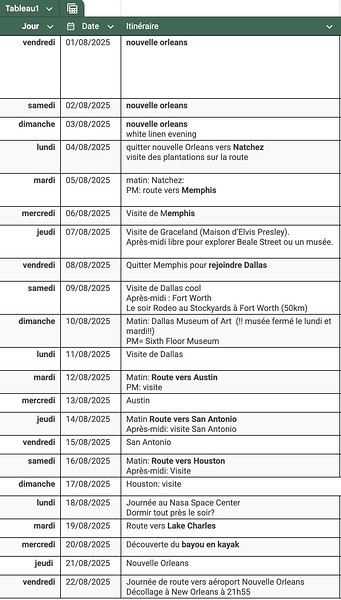
My round-trip ticket to New Orleans is booked—it's my home base.
What do you think? Too much time spent in some stops, not enough in others? Could I get your thoughts?
Tips and advice for a 3-week trip to Egypt
Hi everyone! 🙂
I’m planning a 3-week trip to Egypt in July 2025, and my itinerary isn’t set yet. I’ve traveled solo as a backpacker before and I’m really into history. Here’s how I’m thinking of organizing it:
Since I’ll be arriving and departing from Cairo, I’m thinking of visiting the Giza sites on the 2nd day and saving the city of Cairo and the Grand Egyptian Museum for a few days before my departure, after seeing the sites where the collections come from.
After Giza, I’m planning two days of visits to Saqqara: the first in North Saqqara with the tomb of Horemheb, the Pyramid of Unas (entering), the Step Pyramid of Djoser (entering), the Serapeum of Saqqara (entering), the Pyramid of Teti (entering), the Mastaba of Mereruka (entering), the tomb of Maia, and the Imhotep Museum. Does that sound doable in one day? The idea is to have slept in Saqqara the night before to arrive right at opening. The second day would include the Red Pyramids (entering) and admiring the Bent, White, and Black Pyramids from afar in the morning, then the Pyramids of Pepi I and Pepi II, the tomb of Mehu (entering), and the ruins of the Pyramid of Djedkare Isesi in the afternoon. Does anyone know if there are drivers who can take you to these places and what the price range might be? The ruins of Memphis don’t really excite me (maybe I’m wrong), so I might just stop by the museum with the giant reclining statue.
I get the impression that the buildings in Abusir are closed to the public—maybe I got that wrong? 😉
It seems complicated to visit the sites of Tell el-Amarna and around Tuna el-Gebel in terms of transport.
Next, I’d like to visit the sites of Abydos and the temple at Dendera. I understand it’s necessary to go to Luxor first and then head back to Abydos and Dendera to visit them comfortably in one day. By the way, do you know if negotiated prices with a local guide would be lower than those from agencies like Get Your Guide (110 € if I’m alone)?
How many days do you recommend for visiting the tombs in Luxor? I’d like to see a lot of them—would 3 full days be enough?
After that, I’d really like to visit the sites of Esna, Edfu, and Kom Ombo on the way to Aswan. The only options I’ve found for this kind of route are by boat. Do you think it’s possible to hire a taxi for the day to make the trip to Aswan with these stops (and at what price!)?
After Aswan, I’ll visit the temples of Philae and Abu Simbel over two days.
Then, the rest of the trip is less clear: I’m considering visiting Alexandria and Rosetta. Maybe also, depending on how many days I have left, the sites of Bubastis (I’m having trouble understanding the significance of the remaining ruins) to continue to Tanis, which looks nice (is it?). But again, there’s the question of transport to get there.
This is quite a long post for a first message—sorry for all the questions! Have a great evening, Nico
This is quite a long post for a first message—sorry for all the questions! Have a great evening, Nico
NCL Spirit for Northeast Asia
Hi, I'm currently looking into a cruise departing from Taipei with an arrival in Seoul.
It really interests me, and I’ve put a hold on it. However, it’s a guaranteed balcony cabin, which makes me a bit nervous—has anyone had this type of cabin with a bad experience?
Any info on the NCL Spirit?
Regarding the stops, I’d love to know what we can do with an overnight in Osaka, and the same for an overnight in Yokohama (not necessarily Tokyo).
Thanks
Regarding the stops, I’d love to know what we can do with an overnight in Osaka, and the same for an overnight in Yokohama (not necessarily Tokyo).
Thanks
From Caño Cristales to Tayrona Park
After about 12 hours of flying from Toulouse (via Paris), we landed in Bogotá six years after our first trip to Colombia. This time, our journey will be very different, with only this stop in the Colombian capital in common.
Our travel itinerary
Bogotá / La Macarena (Caño Cristales) / Villa de Leyva / Barichara / San Gil / Girón / Mompox / Ciénaga and the Santa Marta lagoon / Minca / Los Naranjos (Tayrona Park) / Bogotá.
Step 1: Bogotá (and Nemecon)
Bogotá (1/3)
This morning, we had a meet-up with Flora from Aventure Colombia, who helped me organize one of our stops, a few transfers, and tomorrow’s day trip, the program of which I changed at the last minute after deciding to skip the visit to the Salt Cathedral of Zipaquirá. Flora is a kind and lovely person, always available, and she did everything to answer my questions and give me advice.
She’s a local contact I highly recommend. Flora can help you plan your trip, whether you want a fully organized tour or, like us, just need assistance with a specific stop or one or more transfers between cities.
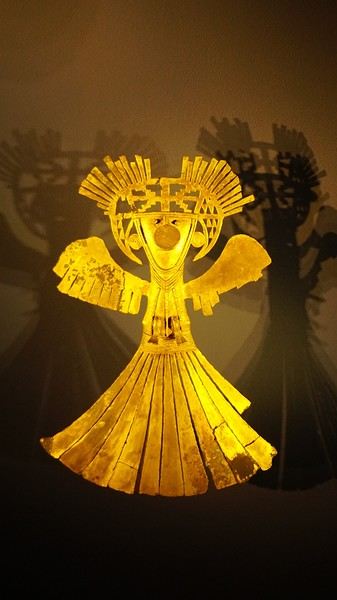
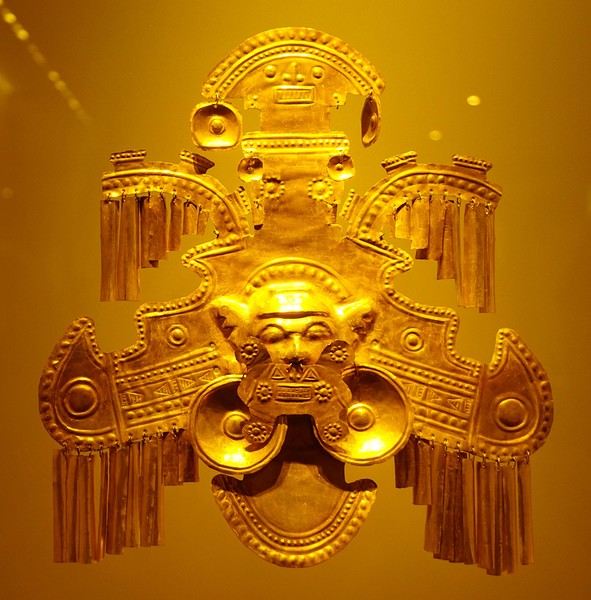
We left Flora after setting a meet-up for our return to Bogotá in a month. As we walked out of her agency, we headed to the wonderful Gold Museum, located just a hundred meters away. I was excited to revisit this amazing museum.
Note: Free entry for those over 60, regardless of nationality. Just show your passport.
Like six years ago, I was amazed by its museography, the beauty of the pieces on display, and that breathtaking shamanic room.
About two hours later, we decided to walk (careful, it’s a climb!) to the Monserrate cable car (3152m). Long wait to buy tickets and board the cable car! Once we arrived, a few raindrops, an impressive panoramic view of Bogotá’s vastness, a quick visit to the basilica (a pilgrimage site for Colombians), a walk through the tourist market, and at the top, plenty of small restaurants where we had our first Colombian meal. After our hearty lunch, we were lucky to see the sun return! No line for the descent. We then headed back to the hotel because Justine wanted to rest and recover from the trip. As for me, I continued my walk. I discovered a really nice craft market recommended by Flora, Pasaje Rivas, returned to Bolívar Square, and wandered through different streets, including the main pedestrian avenue (Calle 7), where there’s always something to see.
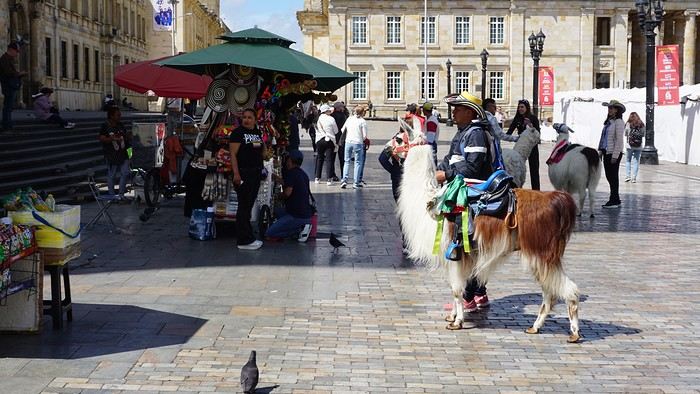
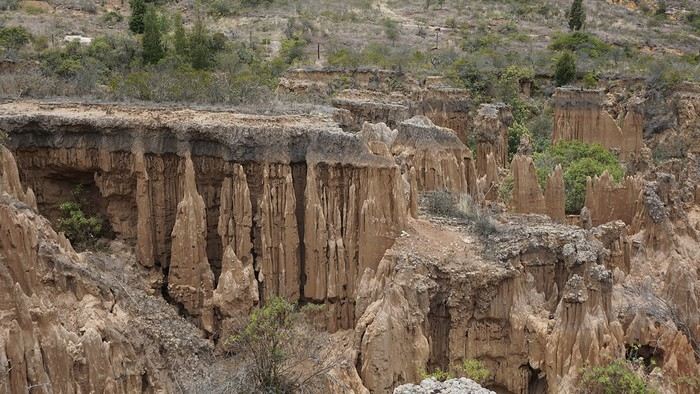
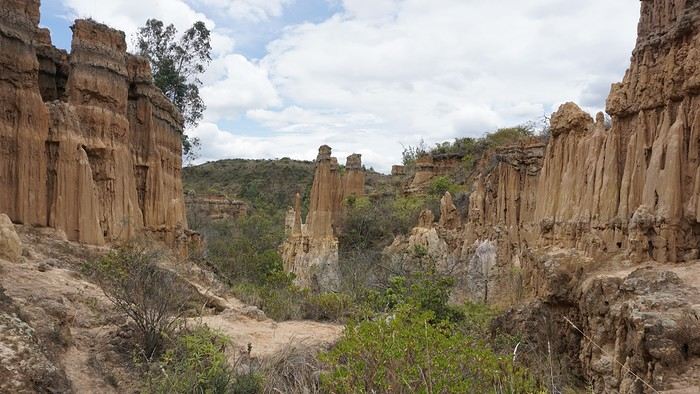
Tomorrow, a change of scenery as we head out for a hike in a small desert (Desierto de Chueca), located about 2 hours from Bogotá in the village of Nemecon. For this outing from Bogotá, with Flora’s help, we booked a car with a driver for the day. Flora also took care of booking the guide (since the site can only be visited with one). Nemecon (2/3) Today, we went to Nemecon to hike about 7.5 km in the ‘Desert of Checua.’ It’s nothing like sandy deserts! Instead, it’s geological formations sculpted by time, wind, and water. After two hours on the road—almost one of them spent navigating traffic jams with cars, trucks, buses, and a continuous flow of motorcycles on either side of our taxi—we reached Nemecon! The village center is really (too?) quiet. We met up with Deisy and headed toward the ‘desert,’ about twenty minutes away on a bumpy dirt road. Once there, a quick briefing, and off we went! Deisy didn’t stop talking (in Spanish) for over 3 hours!!! She told us so much about her region (flower farming, water management, traditions, songs, etc.), the origin of the site, and even mentioned Antonio Banderas, who filmed *The 33* in the village’s salt mine (the story of the survival of 33 Chilean miners after a collapse in their copper and gold mine). One hour of walking to reach the site, one hour to explore it, and one hour to return.
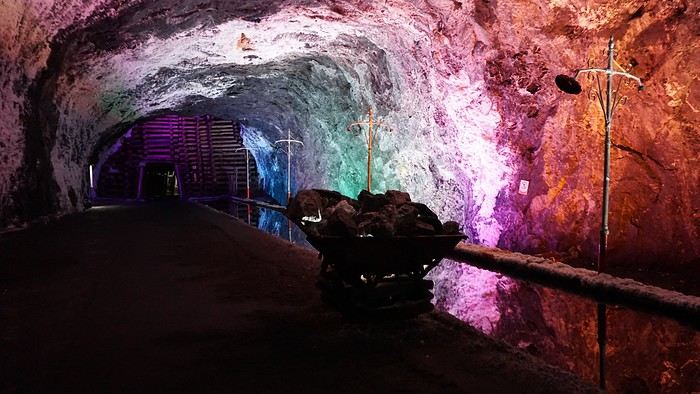
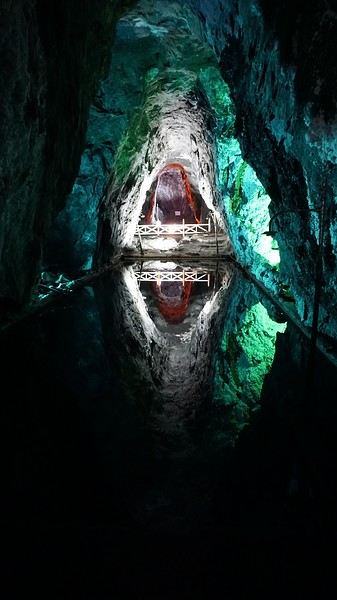
The advantage of this non-stop chatter was that it forced us to brush up on our Spanish at lightning speed. I even wondered if the effort to concentrate wasn’t more exhausting than the physical effort! Especially since on the way back, I got an oral quiz. Deisy wanted to make sure I remembered some of the information she’d given me during the visit: why is this rock white, that one red, and that one black? Back in the village, we had lunch at a restaurant recommended by Deisy before visiting the Nemecon salt mine. Before entering, a guide spent a good half-hour explaining the origin of the salt and the presence of many fossils in the area. Again, concentrating was tough because all the comments were exclusively in Spanish! An hour and a half wandering through the tunnels with a ‘lovely miner’s helmet’ on our heads!
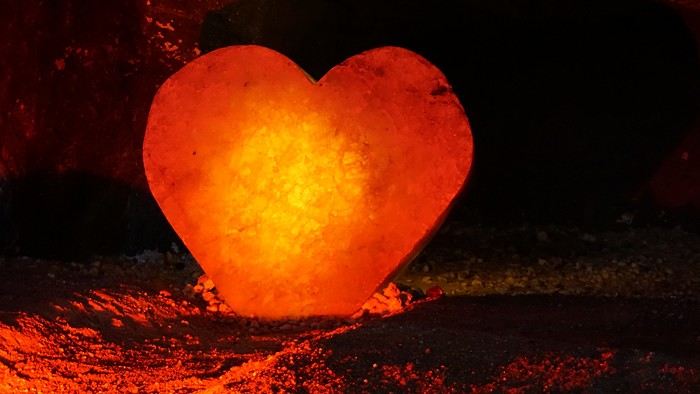
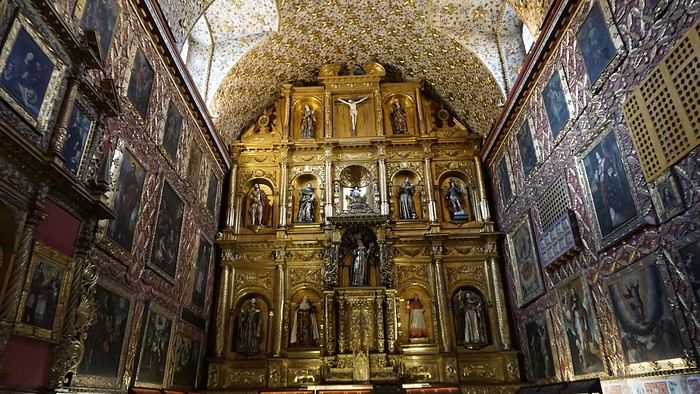
We met our driver at the mine entrance. The return to Bogotá was a bit faster, but traffic in the city center was still heavy! We arrived in front of our hotel between 8:00 and 8:30 PM. It’s been a pretty intense start to the trip! Tonight, our legs are tired. Hopefully, tomorrow will be a bit more relaxed! Bogotá (3/3) We started the day by visiting the Santa Clara Church Museum, located next to the presidential palace. Alejandra (from the local agency ‘Gaia Tours Colombia,’ which organized our stay in Caño Cristales (La Macarena)) had recommended this visit for its rich mural paintings.
A few hundred meters further, after crossing the Plaza Mayor again, we visited the cultural complex housing the Botero Museum, the Mint Museum, and the Bank of the Republic Art Museum. Note that entry is free for all three museums. Botero Museum: There are fewer works by Botero here than in the Medellín museum, but more paintings and sculptures by other artists, all from Botero’s private collection (donated to Colombia). Mint Museum: We limited ourselves to visiting one room (on Flora’s advice) where three gold and gemstone monstrances and a Christ with a crown of emerald thorns are displayed. Photos are not allowed. Art Museum: We visited two temporary exhibitions. Lunchtime came quickly. We had a good meal at a reasonably priced small restaurant in the La Candelaria micro-district, near the Chorro de Quevedo square. We decided to spend the afternoon wandering the streets and alleys of the historic center to discover local street art.
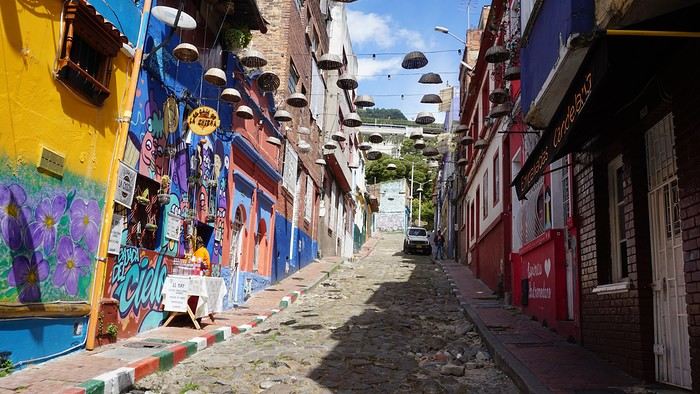
We also passed through very lively pedestrian streets. I also decided to revisit Pasaje Rivas to show Justine all the shops selling more or less artisanal products. Tomorrow morning, we fly to La Macarena at 10:30 AM. Not to dance (you’d be surprised if I told you we were going to take a South American dance class, right?!), but to visit the fabulous Caño Cristales, a river naturally colored by aquatic plants. The planned program includes hiking, horseback riding, canoeing, and swimming among these plants. This site was long inaccessible because the area was controlled by the FARC. Access and tourism development became possible after agreements and amnesty measures between the Colombian government and paramilitary groups. As in other regions, former FARC members have been able to transition into various tourism-related activities.
About two hours later, we decided to walk (careful, it’s a climb!) to the Monserrate cable car (3152m). Long wait to buy tickets and board the cable car! Once we arrived, a few raindrops, an impressive panoramic view of Bogotá’s vastness, a quick visit to the basilica (a pilgrimage site for Colombians), a walk through the tourist market, and at the top, plenty of small restaurants where we had our first Colombian meal. After our hearty lunch, we were lucky to see the sun return! No line for the descent. We then headed back to the hotel because Justine wanted to rest and recover from the trip. As for me, I continued my walk. I discovered a really nice craft market recommended by Flora, Pasaje Rivas, returned to Bolívar Square, and wandered through different streets, including the main pedestrian avenue (Calle 7), where there’s always something to see.
Tomorrow, a change of scenery as we head out for a hike in a small desert (Desierto de Chueca), located about 2 hours from Bogotá in the village of Nemecon. For this outing from Bogotá, with Flora’s help, we booked a car with a driver for the day. Flora also took care of booking the guide (since the site can only be visited with one). Nemecon (2/3) Today, we went to Nemecon to hike about 7.5 km in the ‘Desert of Checua.’ It’s nothing like sandy deserts! Instead, it’s geological formations sculpted by time, wind, and water. After two hours on the road—almost one of them spent navigating traffic jams with cars, trucks, buses, and a continuous flow of motorcycles on either side of our taxi—we reached Nemecon! The village center is really (too?) quiet. We met up with Deisy and headed toward the ‘desert,’ about twenty minutes away on a bumpy dirt road. Once there, a quick briefing, and off we went! Deisy didn’t stop talking (in Spanish) for over 3 hours!!! She told us so much about her region (flower farming, water management, traditions, songs, etc.), the origin of the site, and even mentioned Antonio Banderas, who filmed *The 33* in the village’s salt mine (the story of the survival of 33 Chilean miners after a collapse in their copper and gold mine). One hour of walking to reach the site, one hour to explore it, and one hour to return.
The advantage of this non-stop chatter was that it forced us to brush up on our Spanish at lightning speed. I even wondered if the effort to concentrate wasn’t more exhausting than the physical effort! Especially since on the way back, I got an oral quiz. Deisy wanted to make sure I remembered some of the information she’d given me during the visit: why is this rock white, that one red, and that one black? Back in the village, we had lunch at a restaurant recommended by Deisy before visiting the Nemecon salt mine. Before entering, a guide spent a good half-hour explaining the origin of the salt and the presence of many fossils in the area. Again, concentrating was tough because all the comments were exclusively in Spanish! An hour and a half wandering through the tunnels with a ‘lovely miner’s helmet’ on our heads!
We met our driver at the mine entrance. The return to Bogotá was a bit faster, but traffic in the city center was still heavy! We arrived in front of our hotel between 8:00 and 8:30 PM. It’s been a pretty intense start to the trip! Tonight, our legs are tired. Hopefully, tomorrow will be a bit more relaxed! Bogotá (3/3) We started the day by visiting the Santa Clara Church Museum, located next to the presidential palace. Alejandra (from the local agency ‘Gaia Tours Colombia,’ which organized our stay in Caño Cristales (La Macarena)) had recommended this visit for its rich mural paintings.
A few hundred meters further, after crossing the Plaza Mayor again, we visited the cultural complex housing the Botero Museum, the Mint Museum, and the Bank of the Republic Art Museum. Note that entry is free for all three museums. Botero Museum: There are fewer works by Botero here than in the Medellín museum, but more paintings and sculptures by other artists, all from Botero’s private collection (donated to Colombia). Mint Museum: We limited ourselves to visiting one room (on Flora’s advice) where three gold and gemstone monstrances and a Christ with a crown of emerald thorns are displayed. Photos are not allowed. Art Museum: We visited two temporary exhibitions. Lunchtime came quickly. We had a good meal at a reasonably priced small restaurant in the La Candelaria micro-district, near the Chorro de Quevedo square. We decided to spend the afternoon wandering the streets and alleys of the historic center to discover local street art.
We also passed through very lively pedestrian streets. I also decided to revisit Pasaje Rivas to show Justine all the shops selling more or less artisanal products. Tomorrow morning, we fly to La Macarena at 10:30 AM. Not to dance (you’d be surprised if I told you we were going to take a South American dance class, right?!), but to visit the fabulous Caño Cristales, a river naturally colored by aquatic plants. The planned program includes hiking, horseback riding, canoeing, and swimming among these plants. This site was long inaccessible because the area was controlled by the FARC. Access and tourism development became possible after agreements and amnesty measures between the Colombian government and paramilitary groups. As in other regions, former FARC members have been able to transition into various tourism-related activities.
From Narai (Nakasendo) to Mount Fuji (Japan)
Hi there,
The Nakasendo trail will take us to Narai. From there, we’d like to take the train to the Mount Fuji area. Which base would be the most convenient from Narai for a 2-day trip around Fuji?
Thanks in advance for your tips!
Feedback on Louisiana and Texas road trip (United States)
We were lucky enough to explore the American West a few years ago... a VERY fond travel memory. The urge to return to the USA is calling us...
We're heading out in August with our two grown sons: 21 and 18 years old.
We want to discover another part of the US and I found this itinerary on a website:
Day 1 - New Orleans Day 2 - New Orleans Day 3 - Natchez Day 4 - Dallas Day 5 - Dallas Day 6 - Dallas Day 7 - Austin Day 8 - Austin Day 9 - San Antonio Day 10 - San Antonio Day 11 - Houston Day 12 - Houston - NASA Day 13 - Lake Charles Day 14 - Lake Charles Day 15 - Lafayette Day 16 - Lafayette - White Castle Day 17 - White Castle - Vacherie (Oak Alley) Day 18 - New Orleans Day 19 - New Orleans Does this seem like too many cities?
We love: big landscapes, museums, history, and shopping.
What do you think?
Gaetano
We're heading out in August with our two grown sons: 21 and 18 years old.
We want to discover another part of the US and I found this itinerary on a website:
Day 1 - New Orleans Day 2 - New Orleans Day 3 - Natchez Day 4 - Dallas Day 5 - Dallas Day 6 - Dallas Day 7 - Austin Day 8 - Austin Day 9 - San Antonio Day 10 - San Antonio Day 11 - Houston Day 12 - Houston - NASA Day 13 - Lake Charles Day 14 - Lake Charles Day 15 - Lafayette Day 16 - Lafayette - White Castle Day 17 - White Castle - Vacherie (Oak Alley) Day 18 - New Orleans Day 19 - New Orleans Does this seem like too many cities?
We love: big landscapes, museums, history, and shopping.
What do you think?
Gaetano
Photographing the Venice Carnival
Hi! I’m an amateur photographer and I dream of photographing the Venice Carnival. I’m not really much of a partygoer, so I’m wondering how I’d feel at this event—I’m afraid I might feel a bit like an intruder... I know I’m overthinking it since hundreds of photographers go there. How did you feel about it? Thanks!
What to prioritize in Mauritius?
Hi there, we’re heading to Mauritius in December-January.
The question is: what should we visit first?
Thanks for your tips!
JP
Thanks for your tips!
JP
Notre-Dame’s reopening in Paris set to boost tourism
Notre-Dame Cathedral in Paris will reopen to the public on December 8th after five years of intensive restoration. The announcement has already sparked significant interest among both international tourists and French visitors.
Before the tragic fire on April 15, 2019—which deeply moved people and mobilized numerous patrons—Notre-Dame was one of Paris’s most iconic sites. With 12 million annual visitors, according to data from the Parisian Tourism Economic Observatory, it was the capital’s most popular cultural attraction, even outranking prestigious landmarks like the Louvre Museum.
The reopening of this Gothic masterpiece could mark a new chapter in Paris’s tourist appeal. Read more...
Before the tragic fire on April 15, 2019—which deeply moved people and mobilized numerous patrons—Notre-Dame was one of Paris’s most iconic sites. With 12 million annual visitors, according to data from the Parisian Tourism Economic Observatory, it was the capital’s most popular cultural attraction, even outranking prestigious landmarks like the Louvre Museum.
The reopening of this Gothic masterpiece could mark a new chapter in Paris’s tourist appeal. Read more...
Da Nang and Hoi An (Vietnam)
DANANG
A big city in the midst of an economic boom. The setting is stunning, with its large bay, the Son Tra Peninsula, and the Annamite Mountains on the horizon.
Where to stay and eat? Da Nang is a bustling business hub, so hotels are pricier and often fully booked. I was lucky to find a motorbike taxi driver who, after six full hotels, took me to Mai Son Hotel, 113 Nguyen Van Linh, a spotless 2-star place. Plus, right next door, there’s a great restaurant that seems popular with locals, and a good Chinese restaurant just a 5-minute walk away, Phi Lu (178 Nguyen Van Linh), recommended by the *Guide du Routard*. So, I’d definitely recommend this hotel. For a pricier option, the very Christian Dai A Hotel, near the tiny pink cathedral, is nice, but why pay more?
Actually, why stay in Da Nang when the gorgeous Hoi An is just 34 km to the south?
What to see? - The lovely Cham Museum (small, takes at most an hour) - The climb up Son Tra Peninsula (great views of the whole area) - The “tour” of the peninsula—quotation marks because the road stops two-thirds of the way. There’s an interesting little museum on the left before reaching the base of the huge statue, the Đong Đinh (large entrance on the left side of the hill), with traditional houses in the jungle holding artifacts over 2,000 years old (Sa Huynh culture; if you’re interested, check out the small Sa Huynh Museum in Hoi An, just before the Japanese Bridge). However, the big Linh Ung Pagoda is just colorful concrete! A beautiful resort, the Son Tra Beach Resort and Spa, sits on a pristine beach and isn’t too expensive: $120 for a garden room and $200–$270 for duplexes with a pool, where you can sleep six. Before reaching the resort, you’ll find two excellent seafood restaurants with large beachfront terraces on your right. - On the way to Hoi An, Marble Mountain, where I loved the village of marble sculpture workshops, the pretty pagodas and caves, and the stunning view from the top of the last promontory (the stairs are steep!). However, you can skip the famous China Beach and its resorts—all pretentious and expensive, not to mention the ones under construction on both sides of the road (they’re multiplying like crazy!). So, when traveling from Da Nang to Hoi An, I recommend two stops: the Cham Museum and Marble Mountain. - The beautiful drive to the Hai Van Pass (there weren’t any clouds!), offering spectacular views of the Da Nang region to the south and the coast to the north. The descent leads to the fishing village and beach of Lang Co, which is lovely but destined for rampant resort development, judging by the huge projects advertised on billboards along the road after the village. - Some affordable guesthouses ($15) and big resorts, including the lovely Lang Co Beach Resort, with a large pool and great value given the beautiful gardens and elegant bungalows. Recommended in Lang Co: lunch at one of the two stilt restaurants over the lagoon—great views and fresh seafood.
The public bus to Hoi An, 34 km south of Da Nang, takes 45 minutes for 50,000 dong. There’s one every half hour.
HOI AN This is a “must-see” for so many reasons: stunning old houses, temples, and pagodas; a colorful daily open-air and covered market near the bridge; charming little streets in the old quarter—especially at night, with all the multicolored lanterns and riverside restaurant terraces, it’s very romantic. The local food is delicious, the people are friendly and kind, there are two beautiful beaches, and attractions like the Cham ruins of My Son. Some say Hoi An is overrun with tourists and should be avoided. That’s true for the historic center and An Bang Beach, but not at all once you step outside.
WHERE TO STAY For a 2-star option, I recommend Ngo House Villa (99 Nguyen Phuc Tan St), very quiet on the island just across from the Old Quarter: 3-star rooms + suites, a large “Family” room, and a nice pool, all for $20 ($40 for the “Family” room). The same charming owner has a second hotel 20 meters away (No. 74), Phan Ngô, which is older but has a large terrace and a small pool—I prefer this one. For 3 stars, Thuy Duong 3 (92 Ba Trieu) is perfect, with a pool and garden ($40–$60). A bit pricier but great is A Han on Phan Bai Chau, with a large garden and terrace restaurant.
For those with a bigger budget, I recommend two riverside spots with rooms, suites, and pools, priced at $200–$350: the secluded Coco River Resort (formerly Ancient House River, with a large wooden terrace for romantic dinners by the river) and Anantara, (formerly Heritage), with bungalows close to the old town—but pricey.
Outside the city, my favorite hotel is Villa Loan, the new place from the famous Loan of Tam Coc, very quiet in the countryside, 15 minutes by bike from Old Hoi An and An Bang Beach. Beautiful rooms ($35), a Family room with two double beds ($55), two 65 m² twins that can sleep six (two large beds + two single beds—$80), a terrace restaurant, and a lovely pool. Prices include a buffet breakfast and a bike.
Also great is Daisy Anbang on An Bang Beach, elegant with a pool and beach just 50 meters away (skip the Aira next door—too expensive).
WHERE TO EAT Hoi An is Vietnam’s culinary capital. For Vietnamese food, I recommend Dao Tien, 21 Phan Bai Chau. No surprise—the chef is a former chef at the luxury 4-star Victoria Hoi An, a solid reference. The restaurant now has a beautiful terrace by the river (take the alley on the right side of the main street Dao Tien). Plus, you’re doing a good deed: a large part of the profits goes toward educating underprivileged children—one year of free hospitality, cooking, and English training, followed by job placement in local establishments. Madame Hien Hoi An (formerly Co Mai), 2 Nguyen Thai Hoc (left of the market), is another great spot—the chef is Didier Corlou, formerly of the famous *Porte d’Annam* and *Madame Hien* in Hanoi (closed in March 2022 due to COVID, so foreign tourists are still scarce). Also worth checking out is Secret Garden, in the Phuong Minh An alley (entrance at 60 Le Loi), set in a beautiful space. One of my favorites is Madam Kieu, 43 Nguyen Phuc Chu, right on the river across from the little bridge—very elegant with excellent Vietnamese cuisine. Unfortunately, all the restaurants on this esplanade blast “music” (boom boom boom yeah yeah yeah) in the evenings, so it’s impossible to talk—go for lunch instead.
For a break from Vietnamese food, try Good Morning Vietnam, a ridiculous name for an excellent Italian restaurant (11 Le Loi). The cheerful chef is from Bologna, the “Lyon of Italy”: lasagna like an Italian *mama*’s, delicious tagliatelle ai porcini (porcini mushrooms imported from Italy), and a divine homemade tiramisu (pro tip: order a grappa and drizzle a few drops on the tiramisu). It’s also one of the few places where you can get an excellent bottle of red wine for 350,000 dong instead of the usual 600,000–800,000 dong (South African Robertson Chapel). Another gem: the Japanese restaurant Samurai Kitchen (no sushi, but divine gyoza), 21 Phan Chau Trinh—the street on the right side of the market when you turn your back to the river. Finally, Ganesh, which I consider the best Indian restaurant in Vietnam (99 Tran Hung Dao St).
At An Bang, there are plenty of beachfront restaurants. The two best are the large one at the far right of the parking lot (huge seafood selection) and the fantastic La Luna d’Autumno, owned by the same person as the Italian restaurant of the same name, once considered the best in Vietnam but closed in 2020 due to COVID. Divine pizzas, including the vegetariana.
WHAT TO VISIT The Japanese Bridge and all the old Chinese houses, temples, and pagodas in the three historic streets. Don’t miss the extraordinary gallery-museum of the great French photographer Réhahn, the Precious Heritage Museum at 26 Phan Boi Chau. His remarkable photo collection—including the famous shot of the little Cham girl with clear blue eyes—has graced the covers of many magazines. His Montagnard Museum is a wonder, with a larger collection of tribal women’s costumes than the Museum of Ethnology in Hanoi. Free entry.
THE BEACHES Cua Dai Beach has mostly disappeared, a victim of the waves, except in a few spots. The beautiful An Bang Beach remains, with great beachfront restaurants, or you can head to Cham Island.
MY SON A beautiful complex of Cham ruins surrounded by mountains, 50 km southwest of Hoi An via a scenic road. You can rent a motorbike, take a motorbike taxi, or join a half-day organized tour. It’s best to go in the afternoon—less crowded than in the morning.
CHAM ISLANDS (Cu Lao Cham) Wow, I loved it! It reminded me of St. Barts 35 years ago. The archipelago, 19 km from Hoi An, consists of eight small islands within the Cu Lao Cham Marine Reserve, declared a “Biosphere Reserve” by UNESCO. The largest and only inhabited island, Hon Lao (Pearl Island), covers 1,317 hectares, and its highest peak reaches 517 meters. Hon Lao has two villages: Bai Lang, where the boats from Hoi An dock, and the charming little fishing port of Bai Huong. Part of the island is a military zone, so only the east coast is accessible to tourists.
To get there, you have three options: - The public boat (100,000 dong) that leaves from in front of Café des Amis at 7:30 AM. The catch is it returns to Hoi An at noon, so to enjoy the charm of the place, you’ll need to spend a night on the island (which I highly recommend). - Organized tours by Cham Diving Club, with two options: diving or snorkeling only. - A private speedboat, but it’s not cheap: $200 for the day!
Note: Even if the weather seems fine, the large public boat won’t leave if the sea is too rough. The only solution is to go to the port around 7:30 AM and check (easy, since it brings all the supplies for the island’s locals—if it’s leaving, it’ll be loading up). Avoid weekends—it gets swarmed with locals.
Small coves with dreamy beaches, as they say. Two are very close to Bai Lang: one to the left (facing the village), Bai Ong, lined with restaurants, and a tiny one to the right of the village. The other two beaches, including Bai Chong and the little fishing port of Bai Huong, are accessible by motorbike or boat. I recommend renting a motorbike (biking is tough due to steep hills) and taking the road that overlooks the coast—it’s stunning.
Great diving. The Cham Diving Club is superbly organized by a very friendly Italian, Lodovico, and two French guys (www.chamislanddiving.com).
When you arrive at Bai Lang’s pier, they’ll offer you TWO family-run guesthouses in the village. There are also homestays, but they’re really basic (usually bamboo mats on wooden planks as beds), no English or French is spoken, and locals speak a dialect that’s hard to understand even if you’re decent at Vietnamese. Anyway, I don’t recommend staying in Bai Lang because of the public loudspeakers. Two options if you want a quiet night: - A small guesthouse facing the tiny rice field on the way to Bai Ong Beach. Very clean rooms and a large terrace overlooking the “rice field.” 300,000 dong, with meals available on the terrace. Nha Nghi Vu Truong Tel: 235 386 4783 Mobile: 01 67 76 63 110. - Homestays in the little fishing port of Bai Huong.
Where to stay and eat? Da Nang is a bustling business hub, so hotels are pricier and often fully booked. I was lucky to find a motorbike taxi driver who, after six full hotels, took me to Mai Son Hotel, 113 Nguyen Van Linh, a spotless 2-star place. Plus, right next door, there’s a great restaurant that seems popular with locals, and a good Chinese restaurant just a 5-minute walk away, Phi Lu (178 Nguyen Van Linh), recommended by the *Guide du Routard*. So, I’d definitely recommend this hotel. For a pricier option, the very Christian Dai A Hotel, near the tiny pink cathedral, is nice, but why pay more?
Actually, why stay in Da Nang when the gorgeous Hoi An is just 34 km to the south?
What to see? - The lovely Cham Museum (small, takes at most an hour) - The climb up Son Tra Peninsula (great views of the whole area) - The “tour” of the peninsula—quotation marks because the road stops two-thirds of the way. There’s an interesting little museum on the left before reaching the base of the huge statue, the Đong Đinh (large entrance on the left side of the hill), with traditional houses in the jungle holding artifacts over 2,000 years old (Sa Huynh culture; if you’re interested, check out the small Sa Huynh Museum in Hoi An, just before the Japanese Bridge). However, the big Linh Ung Pagoda is just colorful concrete! A beautiful resort, the Son Tra Beach Resort and Spa, sits on a pristine beach and isn’t too expensive: $120 for a garden room and $200–$270 for duplexes with a pool, where you can sleep six. Before reaching the resort, you’ll find two excellent seafood restaurants with large beachfront terraces on your right. - On the way to Hoi An, Marble Mountain, where I loved the village of marble sculpture workshops, the pretty pagodas and caves, and the stunning view from the top of the last promontory (the stairs are steep!). However, you can skip the famous China Beach and its resorts—all pretentious and expensive, not to mention the ones under construction on both sides of the road (they’re multiplying like crazy!). So, when traveling from Da Nang to Hoi An, I recommend two stops: the Cham Museum and Marble Mountain. - The beautiful drive to the Hai Van Pass (there weren’t any clouds!), offering spectacular views of the Da Nang region to the south and the coast to the north. The descent leads to the fishing village and beach of Lang Co, which is lovely but destined for rampant resort development, judging by the huge projects advertised on billboards along the road after the village. - Some affordable guesthouses ($15) and big resorts, including the lovely Lang Co Beach Resort, with a large pool and great value given the beautiful gardens and elegant bungalows. Recommended in Lang Co: lunch at one of the two stilt restaurants over the lagoon—great views and fresh seafood.
The public bus to Hoi An, 34 km south of Da Nang, takes 45 minutes for 50,000 dong. There’s one every half hour.
HOI AN This is a “must-see” for so many reasons: stunning old houses, temples, and pagodas; a colorful daily open-air and covered market near the bridge; charming little streets in the old quarter—especially at night, with all the multicolored lanterns and riverside restaurant terraces, it’s very romantic. The local food is delicious, the people are friendly and kind, there are two beautiful beaches, and attractions like the Cham ruins of My Son. Some say Hoi An is overrun with tourists and should be avoided. That’s true for the historic center and An Bang Beach, but not at all once you step outside.
WHERE TO STAY For a 2-star option, I recommend Ngo House Villa (99 Nguyen Phuc Tan St), very quiet on the island just across from the Old Quarter: 3-star rooms + suites, a large “Family” room, and a nice pool, all for $20 ($40 for the “Family” room). The same charming owner has a second hotel 20 meters away (No. 74), Phan Ngô, which is older but has a large terrace and a small pool—I prefer this one. For 3 stars, Thuy Duong 3 (92 Ba Trieu) is perfect, with a pool and garden ($40–$60). A bit pricier but great is A Han on Phan Bai Chau, with a large garden and terrace restaurant.
For those with a bigger budget, I recommend two riverside spots with rooms, suites, and pools, priced at $200–$350: the secluded Coco River Resort (formerly Ancient House River, with a large wooden terrace for romantic dinners by the river) and Anantara, (formerly Heritage), with bungalows close to the old town—but pricey.
Outside the city, my favorite hotel is Villa Loan, the new place from the famous Loan of Tam Coc, very quiet in the countryside, 15 minutes by bike from Old Hoi An and An Bang Beach. Beautiful rooms ($35), a Family room with two double beds ($55), two 65 m² twins that can sleep six (two large beds + two single beds—$80), a terrace restaurant, and a lovely pool. Prices include a buffet breakfast and a bike.
Also great is Daisy Anbang on An Bang Beach, elegant with a pool and beach just 50 meters away (skip the Aira next door—too expensive).
WHERE TO EAT Hoi An is Vietnam’s culinary capital. For Vietnamese food, I recommend Dao Tien, 21 Phan Bai Chau. No surprise—the chef is a former chef at the luxury 4-star Victoria Hoi An, a solid reference. The restaurant now has a beautiful terrace by the river (take the alley on the right side of the main street Dao Tien). Plus, you’re doing a good deed: a large part of the profits goes toward educating underprivileged children—one year of free hospitality, cooking, and English training, followed by job placement in local establishments. Madame Hien Hoi An (formerly Co Mai), 2 Nguyen Thai Hoc (left of the market), is another great spot—the chef is Didier Corlou, formerly of the famous *Porte d’Annam* and *Madame Hien* in Hanoi (closed in March 2022 due to COVID, so foreign tourists are still scarce). Also worth checking out is Secret Garden, in the Phuong Minh An alley (entrance at 60 Le Loi), set in a beautiful space. One of my favorites is Madam Kieu, 43 Nguyen Phuc Chu, right on the river across from the little bridge—very elegant with excellent Vietnamese cuisine. Unfortunately, all the restaurants on this esplanade blast “music” (boom boom boom yeah yeah yeah) in the evenings, so it’s impossible to talk—go for lunch instead.
For a break from Vietnamese food, try Good Morning Vietnam, a ridiculous name for an excellent Italian restaurant (11 Le Loi). The cheerful chef is from Bologna, the “Lyon of Italy”: lasagna like an Italian *mama*’s, delicious tagliatelle ai porcini (porcini mushrooms imported from Italy), and a divine homemade tiramisu (pro tip: order a grappa and drizzle a few drops on the tiramisu). It’s also one of the few places where you can get an excellent bottle of red wine for 350,000 dong instead of the usual 600,000–800,000 dong (South African Robertson Chapel). Another gem: the Japanese restaurant Samurai Kitchen (no sushi, but divine gyoza), 21 Phan Chau Trinh—the street on the right side of the market when you turn your back to the river. Finally, Ganesh, which I consider the best Indian restaurant in Vietnam (99 Tran Hung Dao St).
At An Bang, there are plenty of beachfront restaurants. The two best are the large one at the far right of the parking lot (huge seafood selection) and the fantastic La Luna d’Autumno, owned by the same person as the Italian restaurant of the same name, once considered the best in Vietnam but closed in 2020 due to COVID. Divine pizzas, including the vegetariana.
WHAT TO VISIT The Japanese Bridge and all the old Chinese houses, temples, and pagodas in the three historic streets. Don’t miss the extraordinary gallery-museum of the great French photographer Réhahn, the Precious Heritage Museum at 26 Phan Boi Chau. His remarkable photo collection—including the famous shot of the little Cham girl with clear blue eyes—has graced the covers of many magazines. His Montagnard Museum is a wonder, with a larger collection of tribal women’s costumes than the Museum of Ethnology in Hanoi. Free entry.
THE BEACHES Cua Dai Beach has mostly disappeared, a victim of the waves, except in a few spots. The beautiful An Bang Beach remains, with great beachfront restaurants, or you can head to Cham Island.
MY SON A beautiful complex of Cham ruins surrounded by mountains, 50 km southwest of Hoi An via a scenic road. You can rent a motorbike, take a motorbike taxi, or join a half-day organized tour. It’s best to go in the afternoon—less crowded than in the morning.
CHAM ISLANDS (Cu Lao Cham) Wow, I loved it! It reminded me of St. Barts 35 years ago. The archipelago, 19 km from Hoi An, consists of eight small islands within the Cu Lao Cham Marine Reserve, declared a “Biosphere Reserve” by UNESCO. The largest and only inhabited island, Hon Lao (Pearl Island), covers 1,317 hectares, and its highest peak reaches 517 meters. Hon Lao has two villages: Bai Lang, where the boats from Hoi An dock, and the charming little fishing port of Bai Huong. Part of the island is a military zone, so only the east coast is accessible to tourists.
To get there, you have three options: - The public boat (100,000 dong) that leaves from in front of Café des Amis at 7:30 AM. The catch is it returns to Hoi An at noon, so to enjoy the charm of the place, you’ll need to spend a night on the island (which I highly recommend). - Organized tours by Cham Diving Club, with two options: diving or snorkeling only. - A private speedboat, but it’s not cheap: $200 for the day!
Note: Even if the weather seems fine, the large public boat won’t leave if the sea is too rough. The only solution is to go to the port around 7:30 AM and check (easy, since it brings all the supplies for the island’s locals—if it’s leaving, it’ll be loading up). Avoid weekends—it gets swarmed with locals.
Small coves with dreamy beaches, as they say. Two are very close to Bai Lang: one to the left (facing the village), Bai Ong, lined with restaurants, and a tiny one to the right of the village. The other two beaches, including Bai Chong and the little fishing port of Bai Huong, are accessible by motorbike or boat. I recommend renting a motorbike (biking is tough due to steep hills) and taking the road that overlooks the coast—it’s stunning.
Great diving. The Cham Diving Club is superbly organized by a very friendly Italian, Lodovico, and two French guys (www.chamislanddiving.com).
When you arrive at Bai Lang’s pier, they’ll offer you TWO family-run guesthouses in the village. There are also homestays, but they’re really basic (usually bamboo mats on wooden planks as beds), no English or French is spoken, and locals speak a dialect that’s hard to understand even if you’re decent at Vietnamese. Anyway, I don’t recommend staying in Bai Lang because of the public loudspeakers. Two options if you want a quiet night: - A small guesthouse facing the tiny rice field on the way to Bai Ong Beach. Very clean rooms and a large terrace overlooking the “rice field.” 300,000 dong, with meals available on the terrace. Nha Nghi Vu Truong Tel: 235 386 4783 Mobile: 01 67 76 63 110. - Homestays in the little fishing port of Bai Huong.
Traveling with kids in Finnish Lapland in winter
Hi everyone,
We’re planning a week-long trip to Finnish Lapland in February 2026 with two kids aged 7 and 4.
I’ve spent quite a bit of time browsing websites and this forum, but I still have a few questions left.
We’ll be landing in Rovaniemi but won’t be staying there, so we’re planning to rent a car. Do you have any recommendations for rental companies? Is a Golf-sized car sufficient, or should we opt for something better suited to the conditions?
I found some nice accommodations near Akaslompolo. Is the area nice? Are there restaurants, shops, etc.? If it were just me, I’d go for total isolation, but I’m not alone 😎 If not, do you have any alternatives within a 2-hour radius of Rovaniemi? I’d also spotted Luosto.
We’re planning the classic activities: - Visiting a reindeer farm (but no sled ride); - A dog-sledding excursion; - Ice fishing; - A few evenings hunting for auroras using our car and a dedicated app; - A day in Rovaniemi for Santa Claus Village, the Arctic Museum, and the small Ranua Zoo; - An ice hockey game; - And maybe a day of skiing.
Do you have any recommendations for activity providers?
What kind of clothing layers do you recommend for the kids at this time of year?
Is the amethyst mine in Luosto worth it? I think the prices are over the top and can’t figure out why… Maybe there’s a good reason?
Thanks in advance for your answers.
Best regards.
We’re planning a week-long trip to Finnish Lapland in February 2026 with two kids aged 7 and 4.
I’ve spent quite a bit of time browsing websites and this forum, but I still have a few questions left.
We’ll be landing in Rovaniemi but won’t be staying there, so we’re planning to rent a car. Do you have any recommendations for rental companies? Is a Golf-sized car sufficient, or should we opt for something better suited to the conditions?
I found some nice accommodations near Akaslompolo. Is the area nice? Are there restaurants, shops, etc.? If it were just me, I’d go for total isolation, but I’m not alone 😎 If not, do you have any alternatives within a 2-hour radius of Rovaniemi? I’d also spotted Luosto.
We’re planning the classic activities: - Visiting a reindeer farm (but no sled ride); - A dog-sledding excursion; - Ice fishing; - A few evenings hunting for auroras using our car and a dedicated app; - A day in Rovaniemi for Santa Claus Village, the Arctic Museum, and the small Ranua Zoo; - An ice hockey game; - And maybe a day of skiing.
Do you have any recommendations for activity providers?
What kind of clothing layers do you recommend for the kids at this time of year?
Is the amethyst mine in Luosto worth it? I think the prices are over the top and can’t figure out why… Maybe there’s a good reason?
Thanks in advance for your answers.
Best regards.
French-language food and history tour in New Orleans
We're planning a trip through Louisiana and would love to do a food and history tour led by a guide—but I’m only finding options in English. Do any of you have recommendations for an experience where the guide spoke French and the food was good?
Thanks for your help
Costa Favolosa departing from Marseille on May 3, 2025
The destination is Le Havre....
Are there any members?
15-Day Family Road Trip: Rovaniemi - Swedish Lapland - Lofoten
Hello,
I’m starting to plan our summer 2025 trip. We’ll be traveling as a family (2 adults and 2 teens), most likely in mid-July. Here’s a first draft of our itinerary. I’d love to hear your thoughts on whether this 15-day route is doable. We’ll be renting a car in Rovaniemi.
- Rovaniemi (2 nights) - Jokkmokk (1 night) - Kiruna (1 or 2 nights???) - Narvik (1 night) - Lofoten Islands (3 or 4 nights???) - Bodø (2 nights) - Return through Sweden, but where to stay between Bodø and Luleå to break up the drive????? (1 night) - Luleå (1 or 2 nights???) - Return to Rovaniemi (1 night)
What do you think of this route? I’m open to all suggestions—whether there are places to add, remove, or adjust. Thanks in advance for your help!
I’m starting to plan our summer 2025 trip. We’ll be traveling as a family (2 adults and 2 teens), most likely in mid-July. Here’s a first draft of our itinerary. I’d love to hear your thoughts on whether this 15-day route is doable. We’ll be renting a car in Rovaniemi.
- Rovaniemi (2 nights) - Jokkmokk (1 night) - Kiruna (1 or 2 nights???) - Narvik (1 night) - Lofoten Islands (3 or 4 nights???) - Bodø (2 nights) - Return through Sweden, but where to stay between Bodø and Luleå to break up the drive????? (1 night) - Luleå (1 or 2 nights???) - Return to Rovaniemi (1 night)
What do you think of this route? I’m open to all suggestions—whether there are places to add, remove, or adjust. Thanks in advance for your help!
Cruise departing from Le Havre: what to see?
Hi everyone, I’m so happy Voyage Forum is back online.
This is perfect timing since we’re leaving on November 28th for a cruise departing from Le Havre (Southampton, Zeebrugge, Rotterdam, Hamburg). Could you share some info on the distances from the ports to the city centers, sights to see, etc.?
Thanks so much, and see you soon!
What to do in Uzbekistan beyond the 3 museum cities?
Hi everyone, happy to be back on VF!
I’ll be in Uzbekistan this coming April and will of course visit the three classics—Samarkand, Bukhara, and Khiva. However, I’d also love to get out of these cities to explore the Uzbek countryside and experience its nature. Mountains, steppes, etc. Ideally, with some great hikes passing through villages. Any spots you’d recommend? Thanks in advance
5 days on Easter Island
Easter Island, located between Tahiti and Chile, fascinated me with its volcanic landscapes and legendary Moai statues, erected by the first Polynesian inhabitants to honor their ancestors. Mysterious and iconic, this isolated land intrigues with its history and the enigmas that researchers and explorers are still trying to unravel.
To help you prepare for your trip, here’s my five-day itinerary. I was able to explore major sites while leaving room for some free and adventurous moments. Here’s the program I followed:
Day 1: Discovering Hanga Roa and nearby moais
For my arrival, I started slowly by visiting the village of Hanga Roa. I took the time to stroll around, check out some local shops, and especially admire the first moais accessible for free, to ease into the island’s fascinating history.
Day 2: The must-see sites with a guide (Vaihu, Te Pito Kura, Anakena, Tongariki, Rano Raraku)
The second day was dedicated to the highlights. With a guide, I explored the island’s iconic sites, including the imposing aligned moais of Tongariki and the ancient "statue factory" of Rano Raraku. This intense day helped me understand more about the island’s culture and mysterious history, especially with the paradise-like beach of Anakena at the end of the day.
Day 3: Historical sites and museum (Orongo, Rano Kau, Puna Pau, Akivi)
On the third day, I continued with a guided morning, particularly at the ceremonial village of Orongo, perched atop Rano Kau. After visiting Puna Pau and Akivi, I spent the afternoon at the museum to deepen my knowledge of the Rapa Nui civilization.
Day 4: Bike ride in nature
Craving freedom, I devoted this day to a bike ride along the coastline and through the island’s natural spots. It was the perfect opportunity to explore at my own pace and stop at secret coves, enjoying the tranquility of the landscapes.
Day 5: Hike to the summit of Terevaka
For my last day, I set off on a hike to the summit of Terevaka, the island’s highest point. From there, the 360° view of the island and the ocean is breathtaking and gave me a memorable souvenir of this trip.
This five-day stay was a real journey through time, landscapes, and the mysteries of Easter Island!
If you want more details on my favorite spots, accommodation ideas, or practical tips, you can check out my article: https://un-tour-dans-le-sac.fr/ile-de-paques-5-jours/
Visiting the Acropolis in Athens
Hi there,
After checking out different sites for buying tickets to visit the Acropolis, I have to admit I’m a bit lost.
I saw that since April 2024, the visiting time has been limited to 1 hour.
Entry is free for kids, but can you only buy the ticket at the counter?😮
Can anyone confirm this info for me?
We’ll be in Athens at the end of October. Thanks.
I saw that since April 2024, the visiting time has been limited to 1 hour.
Entry is free for kids, but can you only buy the ticket at the counter?😮
Can anyone confirm this info for me?
We’ll be in Athens at the end of October. Thanks.
What to do in Honolulu?
Hi there,
What are some great tips for things to do in Honolulu?
Thanks,
Mich74
Visiter Bastia en 4 jours English translation pending
Bonjours
Du 22 au 26 septembre, je pars quelques jours à Bastia. Je me rends compte un peu tard, que je n'ai pas peut être pas choisi le meilleur endroit pour visiter la Corse. Je connais le coin d'Ajaccio et de Calvi. Quels coins me conseillerez vous tout en sachant que je ne conduits pas ? Je compte passer une journée ou 2 à St Florent, mais le reste du temps je ne sais pas trop.
Merci de votre aide😎
Du 22 au 26 septembre, je pars quelques jours à Bastia. Je me rends compte un peu tard, que je n'ai pas peut être pas choisi le meilleur endroit pour visiter la Corse. Je connais le coin d'Ajaccio et de Calvi. Quels coins me conseillerez vous tout en sachant que je ne conduits pas ? Je compte passer une journée ou 2 à St Florent, mais le reste du temps je ne sais pas trop.
Merci de votre aide😎
Endroits "sympas" pour se poser à Venise? English translation pending
Bonjour/bonsoir
Si tout va bien (on croise les doigts) je pars bientôt à Venise, bien sûr très contente de redécouvrir la Sérénissime avec je l'espère moins de monde qu'une année classique.
Comme il a été remarqué sur ce même forum, Venise a beau être une ville unique et magnifique, elle ne semble pas regorger d'endroits pour se poser tranquillement entre deux balades (j'avais un peu remarqué ça lors de mon passage éclair dans la ville il y a des années).
Alors je ne demande pas la lune, je sais que si l'Italie est le pays de la gastronomie (et je compte bien en profiter 😛 ) ce n'est pas celui des salons de thé, mais j'avoue qu'on aime bien faire des petites pauses après avoir marché des heures ou avoir visité un musée, palais, etc. J'aime bien reposer mes pattes 😇
Bien sûr j'imagine qu'on trouve facilement des bars ou s'arrêter boire un café (et faire une pause pipi 😊) mais certains ont-ils des adresses un peu sympas à me conseiller ?
Pâtisseries où on peut s'asseoir ? Salons de thé (soyons fous !), endroit où boire son Aperol Spritz ?
Bien sûr je préfère éviter les trucs trop à touristes (non, pas de Café Florian pour nous) ou hors de prix (genre 10€ le cappuccino, je passe mon tour).
Bon j'ai trouvé un appartement assez central qui permettra au pire de se poser un peu avant de ressortir dîner, mais je suis quand même preneuse de bons plans ! 🙂
Si tout va bien (on croise les doigts) je pars bientôt à Venise, bien sûr très contente de redécouvrir la Sérénissime avec je l'espère moins de monde qu'une année classique.
Comme il a été remarqué sur ce même forum, Venise a beau être une ville unique et magnifique, elle ne semble pas regorger d'endroits pour se poser tranquillement entre deux balades (j'avais un peu remarqué ça lors de mon passage éclair dans la ville il y a des années).
Alors je ne demande pas la lune, je sais que si l'Italie est le pays de la gastronomie (et je compte bien en profiter 😛 ) ce n'est pas celui des salons de thé, mais j'avoue qu'on aime bien faire des petites pauses après avoir marché des heures ou avoir visité un musée, palais, etc. J'aime bien reposer mes pattes 😇
Bien sûr j'imagine qu'on trouve facilement des bars ou s'arrêter boire un café (et faire une pause pipi 😊) mais certains ont-ils des adresses un peu sympas à me conseiller ?
Pâtisseries où on peut s'asseoir ? Salons de thé (soyons fous !), endroit où boire son Aperol Spritz ?
Bien sûr je préfère éviter les trucs trop à touristes (non, pas de Café Florian pour nous) ou hors de prix (genre 10€ le cappuccino, je passe mon tour).
Bon j'ai trouvé un appartement assez central qui permettra au pire de se poser un peu avant de ressortir dîner, mais je suis quand même preneuse de bons plans ! 🙂
Visites à Venise, Padoue, Vérone, ou autre en octobre (en train) English translation pending
Bonjour,
Je pars avec une amie en Octobre à Venise pour une semaine, pourriez vous me donner des idées de visite, promenades, ou escapades sur place mais également alentour, en train à Padoue Vérone, ou autre!
Merci de vos conseils qui m'ont été précieux lors de mon voyage en Turquie!
Parcours pour un séjour en Corse en octobre English translation pending
Bonjour, on ira en Corse en octobre, 13 nuits, on a pensé à ce parcours ci-dessous, nous serons 2 couples, 1 couple orienté rando (à la journée de 11 à 20 km) et 1 autre orienté cool, découverte, ville avec un bébé, .... Que pensez-vous de cet itinéraire et des points de chutes ?
Impondérable, retourner à AJA en milieu de séjour pour récupérer les enfants à l'aéroports (17-11 ans). Pour le SUD, 2 villes sont elles suffisantes pour rayonner ? Choix des villes OK ?
Merci
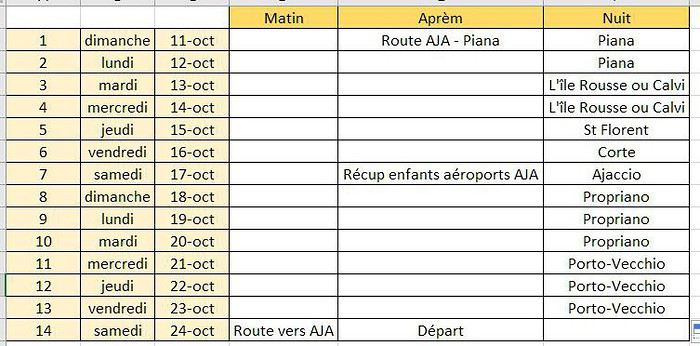
Impondérable, retourner à AJA en milieu de séjour pour récupérer les enfants à l'aéroports (17-11 ans). Pour le SUD, 2 villes sont elles suffisantes pour rayonner ? Choix des villes OK ?
Merci
54,4°C à l'ombre dans la Vallée de la Mort English translation pending
La Death Valley, en Californie, a enregistré ce dimanche une température de 54,4 °C à l'ombre, ce qui en fait la troisième température la plus chaude jamais enregistrée sur terre.
Lire la suite...
Les gorges de l'Aveyron entre Saint-Antonin et Montricoux English translation pending
Petite balade, le plus souvent aérienne, dans cette partie des gorges de l'Aveyron...
Saint-Antonin, Penne, Bruniquel....
https://youtu.be/7l_Hlm358x4
https://youtu.be/7l_Hlm358x4
La Laponie finlandaise en été English translation pending
Je suis en Laponie avec mon van aménagé jusqu'à fin septembre. Aucun programme de prévu.
Connaîtriez-vous des endroits à ne pas manquer, des endroits cachés (genre cascades, formations géologiques, ...).
Les parcs nationaux offrent-ils des paysages variés ?
Pour le moment, je suis dans la région de Rovaniemi pour un peu de bénévolat mais je vais monter vers le nord ensuite.
Le nord semble être un peu plus vallonné même si il n'y a pas toute la diversité qu'on peut trouver en Norvège. J'espère bien me faire plaisir.
Merci d'avance.
Julien
Merci d'avance.
Julien