Results for "Vallée+sacrée+|+4+>+133"
40547 results found.
Notre année sabbatique à six au Costa Rica English translation pending
Bonjour à tous.
Depuis des mois que nous écrivons un blog sur notre vie au Costa-Rica, je n'avais même pas pensé à venir le présenter, quels distrait suis-je !
Alors voilà : nous sommes partis pour une année sabbatique tropicale, le papa, Jean-Mi, la maman, Véro, et les quatre enfants Sylvain, 11 ans, Paul, 9 ans, Jean, 7 ans, et Lucie, 5 ans. Maintenant, nous y sommes depuis des mois. Les enfants parlent espagnol couramment, ils sont bronzés comme c'est pas permis (nous aussi) et nous sommes tous très très heureux d'être venus.
Alors pour les voyageurs des quatre coins du monde, pour tout ceux qui ont aussi envie de partir et pour tout ceux qui ont envie de rêver, nous avons écris ce blog.
http://coucouducostarica.over-blog.com/
Nous vous y invitons cordialement à y venir et à y revenir.
Pura Vida ! Comme on dit ici.
Jean-Mi
Depuis des mois que nous écrivons un blog sur notre vie au Costa-Rica, je n'avais même pas pensé à venir le présenter, quels distrait suis-je !
Alors voilà : nous sommes partis pour une année sabbatique tropicale, le papa, Jean-Mi, la maman, Véro, et les quatre enfants Sylvain, 11 ans, Paul, 9 ans, Jean, 7 ans, et Lucie, 5 ans. Maintenant, nous y sommes depuis des mois. Les enfants parlent espagnol couramment, ils sont bronzés comme c'est pas permis (nous aussi) et nous sommes tous très très heureux d'être venus.
Alors pour les voyageurs des quatre coins du monde, pour tout ceux qui ont aussi envie de partir et pour tout ceux qui ont envie de rêver, nous avons écris ce blog.
http://coucouducostarica.over-blog.com/
Nous vous y invitons cordialement à y venir et à y revenir.
Pura Vida ! Comme on dit ici.
Jean-Mi
Retour de croisière à bord du Coral English translation pending
Bonjour a tous,
Depuis hier je suis de retour d'une belle croisiere Iberique a bord du Coral, personne ne semblait connaitre ce bateau qui bien qu'assez ancien, est tres bien entretenu, les cabines sont spacieuses celle que j'avais devais faire environ 12M2, les salons retros sont confortables, les animations et les spectacles tres attractifs. Je n'ai eu qu'un regret c'est le souper le soir a 21H qui pour moi etait trop tardif, ne pouvant ensuite profiter des distractions et spectacles jusqu'a la fin car le ledemain les excursions debutaient de bonne heure vers 8H. Autrement rapport qualité prix rien a redire, la nourriture y est copieuse et bonne, petit dejeuner (tres copieux et varié, dejeuner, the avec gateaux et sandwiches et souper) le personnel est tres gentil, les annonces sont toutes faites en anglais, francais, allemand, italien, espagnol. Il s'agissait de ma premiere croisiere et je ne suis en rien decue, si bien que je suis a la recherche d'une autre croisiere pour septembre octobre. - Amitiés a tous - desbell83
ps- je tiens egalement a preciser l'ambiance tres conviviale qui régne sur ce bateau.
Depuis hier je suis de retour d'une belle croisiere Iberique a bord du Coral, personne ne semblait connaitre ce bateau qui bien qu'assez ancien, est tres bien entretenu, les cabines sont spacieuses celle que j'avais devais faire environ 12M2, les salons retros sont confortables, les animations et les spectacles tres attractifs. Je n'ai eu qu'un regret c'est le souper le soir a 21H qui pour moi etait trop tardif, ne pouvant ensuite profiter des distractions et spectacles jusqu'a la fin car le ledemain les excursions debutaient de bonne heure vers 8H. Autrement rapport qualité prix rien a redire, la nourriture y est copieuse et bonne, petit dejeuner (tres copieux et varié, dejeuner, the avec gateaux et sandwiches et souper) le personnel est tres gentil, les annonces sont toutes faites en anglais, francais, allemand, italien, espagnol. Il s'agissait de ma premiere croisiere et je ne suis en rien decue, si bien que je suis a la recherche d'une autre croisiere pour septembre octobre. - Amitiés a tous - desbell83
ps- je tiens egalement a preciser l'ambiance tres conviviale qui régne sur ce bateau.
Les pieds en Mongolie... et la tête dans les étoiles English translation pending
Avant d'attaquer cette aventure mongole, quelques mots pour ressituer le contexte. Nous (Christophe et Sophie)descendons a Ulan Bator apres une semaine de transsiberien voyage au cours duquel nous avons rencontre Lenny, un americain bien sympathique. Mardi 26 juillet: Sain bainuu Mongolie
La nuit fut courte avec 4 heures de sommeil. Il est 6h et nous nous réveillons avec le lever de soleil au milieu des steppes, c'est magnifique…
A la fois désertique et plein de vie avec ses gers, ses chevaux et ses chèvres qui se promenent librement au milieu des paysans mongols, cette vision nous laisse entrevoir un depaysement total.
6000km de traversee, 5 litres de soupe, 12 bouteilles de vodka et 2kg de nouilles plus tard, nous voila dans la patrie de Genghis Khan. Cette ambiance de croisiere nous laissera un très bon de souvenir et déja, à la descente du train, une étrange nostalgie nous innonde. Quelques petites informations avant de rentrer dans le vif du sujet; la Mongolie c'est: 1 cheval, 1 vache ou un yak et demi, 4 chevres et 6 moutons par habitant.
L'empire mongol du 18e siecle, le plus vaste que le monde n'ait jamais porte, s'etendait de la Coree a la Hongrie. Les Mongols le doivent a leur Napoleon national: Genghis Khan (qui a prefere donne son nom a une vodka plutot qu a un type de cognac!).
Enfin, dadvantage de Mongols vivent a l etranger (3.5 milions en Chine, 1 milion en URSS) et seulement 2, 4 milions (pour un pays grand comme 4 fois la France) au pays. Fin de la parenthese. Sophie s'est faite abordee au dernier arret avant Ulan Bator (UB). Une jeune femme mongole lui a propose de dormir chez l'habitant dans le centre: 5$ la nuit, on viendra nous chercher a notre arrive et y a de la place notre compagnon de route Kenny, affaire conclue.
La personne qui devait nous remettre les billets pour Pekin n'est pas sur le quai comme prevu, c'est embetant mais on a le temps de voir venir.
On passe la journee entre internet et la collecte d'info pour les excursions, de toutes facons Ulaan Bator, c'est vraiment laid! On retire nos premiers tobroks, 700 000 (500E), ca fait une sacree liasse de billets, heureusement que les pieces n'existent pas ici.
Lorsque nous arrivons a domicile, 3 francais d'environ 23 ans campent dans le salon sur des matelas et une en solo dans notre future chambre, ca fait plus squatte qu'hebergement chez l'habitanht. La nuit confortable tant esperee malheureusement attendra encore: pas de volets et ce n'est pas la fenetre cassee qui nous a isole du bruit de la rue passante, et klaxonnante! Qunat aux matelas a meme le sol, ils etaient si peu confortable qu'on a du gonfler les notres. Nous serons reveilles tot le matin par le pere qui, apres avoir repare la porte d'entree a grands coups de marteau, a telephone un bon ¼ d'heure dans notre chambre! Vivement le camping…
Mercredi 27 juillet: Ulan Bator, Beurk…
Toujours en compagnie de Lenny, nous visitons le Black Market, un immense marche- foire-aux-trouvailles puis le plus important centre religieux de Mongolie, le monastere Gandan. Les moines y vendent une poudre "purificatrice" lorsqu'on la brule.
Au detour des rues, on trouve de nombreuses echoppes qui vendent bonbons et cigarettes et des marchands de fruits et legumes un peu partout. Les plus incongrues restent leur cabines telephoniques "humaines": des personnes, souvent des femmes avec un masque sur le nez et parfois des gants, attendent le client avec un telephone sur les genoux (on ne sait toujours pas ou elles chopent la connections puisqu'il n'y a pas de fil! Dans le meme registre, nous croisons ca et la des gens postes a cote d'un pese-personne qui se font remunerer pour la pesee.
Heureusement que tous ces personages anecdotiques egayent un peu la ville qui manque cruellement de charme.
L'architecture sous influence russe est sinistre et sans aucun gout esthetique, le tout dans une anarchie totale; dans certains quartiers, les yourtes se melangent a des batiments gris ou a des buildings modernes, sans parler des cages a poules sordides que nous avons vues a la peripherie. Les trottoirs ne sont pas paves, ce n'est que sable et cailloux, et il faut faire attention aux plaques d'egout non fermees, notammemt la nuit, puisque les rues ne sont pas eclairees! On a d'ailleurs failli visiter une ou deux fois les canalizations… La circulation est assez anarchique et ici on aime jouer du klaxon, les pietons n'ont qu'a bien se tenir! Concernant l'alimentation, c'est assez peu varie et pas trop mauvais (mouton, agneau, riz, pates), le menu n'etant pas toujours traduit en anglais, on poursuit nos Blind test, sans trop de mauvaises surprises pour l'instant.
Jeudi 28 juillet: Tiens, c'est la Saint Samson aujourd'hui On a trouve nos coequipieres pour se partager les frais de routes; Sylvie et Claire en stage a l'ambassade de France vont nous accompagner 14 jours au lac Kovsgol et en Arkangai. Petite anecdote assez cocasse: alors que nous prenions un verre en terrasse pour faire connaissance, un manchot SDF qui n'a pas froid aux yeux, s'est precipite sur nos voisines de table pour leur subtiliser leur bouteille de sodas avec ses deux moignons, puis une fois a l'ecart, se l'est engloutie aussi sec. Il s'en est ensuite pris a nous a plusieurs reprises, les filles etaient partagees entre rires et peur. Sylvie le connaissait deja puisqu'il l'avait course un soir. De retour "at home", nous negocions une petite viree d'une semaine puisque nous ne partons que dans 10 jours. Notre logeuse nous a trouve une famille qui ne donne pas dans le business touristique et qui pourrait nous recevoir a la mongol's way, le cul sur une selle et du lait de jument au p'tit dej. Nous partons demain a une centaine de Km plein ouest. Bye-bye Kenny, c'etait vraiment sympa cette semaine avec toi.
Vendredi 29 juillet: Arrive chez Archaa et Marcha 3 heures de trajet dont 2 sur la route principale truffee de nids de poule et 1 sur les pistes sableuses. Nous arrivons a bon port, au milieu de la steppe semi-aride, de vastes plaines bordees de collines s'enchainant a perte de vue. La, se trouvent deux yourtes (ou gers) entourees d'une trentaine de chevaux, d'un grand troupeau de brebis et de moutons ainsi que trois chiens ne devant leur presence qu'a leur role de chien de garde. A l'horizon, on apercoit des points blancs, on devine d'autres gers, nos premiers voisins. Voila pour le cadre, quand a l'odeur, on vous laisse imaginer…Le "sain bain nu" (bonjour) de rigeur puis on plante la tente a une trentaine de metres, distance offrant a la fois intimite et proximite de la famille. Les premiers a nous rendre visite sont les enfants. Nous avons vite repere leur stratageme; curieux mais intimides, ils avancaient progressivement en s'asseyant tous les cinq metres jusqu'a ce que Sophie etablisse un premier contact en les saluant avec un nez de clown. On est alors invites sous la yourte et ce fut au tour des grands-parents de s'amuser avec le nez rouge. Vint alors le moment que nous apprehendions depuis notre arrive en Mongolie: la degustation de lait de jument fermente, le celebre airag. Celui-ci avait en outre l'avantage d'etre parseme de points noirs, a savoir des moucherons (c'est d'ailleurs pourquoi, ils ont l'habitude de souffler sur la surface du liquide avant de le boire). Difficile d'en decrier le gout: acide, odorant, long en bouche, on pourrait l'assimiler a du concentre d'odeur de cheval, en pire…pour etre plus explicite, c'est imbuvable! Ce n'est pas sans rappeler cette replique dans "Les Bronzes font du ski" : "Ah…c'est goutu, il a du r'tour!". Les lois de l'hospitalite etant tres ancrees ici, on y aura droit plusieurs fois par jour, et pas question de refuser. Christophe leur fera honneur en avalant de franches gorges, pendant que Sophie pauffinera sa technique du trempage de levres (ainsi que la dissociation bucco-nasale, fort utile pour la plongee sous-marine!). !! Description de la gers: pas de cuisine, pas de chambre, pas de salle a manger, et bien sur pas de toilettes, la piece d'un rayon de 2, 5 metres est polyvalente. Un poele mobile alimente en crottin de cheval seche se tient au centre avec un conduit pour evacuer la fumee par l'ouverture du "toit", indispensable pour les journees d'hiver a -30. Plusieurs lits sont repartis autour ainsi que 2 ou 3 petites commodes dont une a usage religieux. Plusieurs photos sont rassemblees dans un cadre ou l'on voit la famille parmis ses chevaux, le tout surmonte des trophees et medailles remportes pendant le Naadam (fete annuelle). Notre regard se pose aussi sur des morceaux de barbaque provenant d'un mouton fraichement tue qui pendent au dessus d'une bassine de sang ou marinent des visceres douteuses, accolee a une autre remplie de la creme du lait. Les croisillons en bois qui servent d'armature sur les cotes sont aussi utilises comme sechoir, cintres ou etageres et sont souvent decores de tapis. A l'interieur, les bois des meubles sont peints et tres colores avec une dominante d'oranges. L'exterieur est recouvert de molleton en poils de chevre et peut etre releve en bas pour permettre le circulation d'air a 360 degre. C'est tres bien concu car il y fait frais l'ete et sans doute chaud l'hiver. Ca ne coute pas tres cher ici, on envisage peut etre d'en ramener une, les parents faites de la place dans le jardin, les Yaks arrivent… La premiere ger appartient aux doyens, Archaa et Marcha, et la seconde a leur fille ainee Orcho qui y vit avec son mari et leur fille de 4 ans. A cela s'ajoutent les neveux et petits-enfants en vacances qui sont quatre. On passera l'apres-midi a jouer avec ces derniers puis nous assisterons a la traite des juments. L'orage eclata en fin de journee nous obligeant a nous entasser avec nos sacs et nos provisions dans les 2m2 de notre tente, tout en nous debrouillant pour y faire cuire les pates du diner. Il va sans dire que pour ce qui est des "accommodations" nous satisferons nos besoins naturels en pleine nature, au milieu des cranes de mouton et autres femurs en decomposition. Samedi 30 juillet: Naadam a Luun Lever 7h00, pas le temps ni pour la toilette, ni pour le petit dej'. On est embarque dans un vieux camion russe en direction du Naadam local. Les vapeurs d'airag de la "betaillere" et le trajet chaotique achevent de nous reveiller. Nous voici plonges dans l'evenement de l'annee pour cette famille mongole, le Naadam. Toute la journee, combats de lutte et courses de chevaux seront au coeur de cette fete. Les courses sont reserves aux enfants, en majorite des garcons de 6 a 11 ans et consiste a parcourir 20 Km. C'est impressionnant de voir ces p'tits bout de choux sur des bestiaux de plusieurs ceintaines de kilos et jouer avec eux avec autant de dexterite que ceux de chez nous avec la playstation…La lutte est elle pratiquee par les jeunes hommes. Elle debute par un rituel de presentation et s'acheve avec la mise a terre d'un des adversaires, le tout sur fond de musique traditionnelle et en costume d'apparat. La lutte est tres ancree dans la tradition, les enfants la pratiquent entre eux des leur plus jeune age; Christophe s'est meme vu proposer un combat hier a son arrive, en signe de bienvenue. En les cotoyant, on s'apercoit qu'il n'y a ni agressivite, ni mauvais geste de la part des perdants, meme dans les sports de combat. L'ambiance est bon enfant, tres fair-play et l'etat d'esprit est sain compare a celui que l'on peut trouver en Europe lors de competitions. Pas "d'encules l'arbitre" ici… Le peuple mongol garde un esprit tres fraternel, meme les enfants ont des gestes tendres les uns envers les autres. C'est vraiment mignon de les voir se tenir par l'epaule ou se consoler. Sinjhun, 9ans est arrive 3e l'an dernier, il n'etait pas peu fier de nous montrer ses photos et sa recompense. Cette annee il remet ca et nous assistons a tous les preparatifs: tressage des crinieres de chevaux, habits et enfillage de cossards, rituel de l'encens autour du cavalier et de sa cravache, puis, juste avant la course, chant des enfants sur leur cheval autour du ara improvise. Ces chants sont un mélange de tradition et de mysticisme, pas vraiment de paroles, une melodie plutot agreable, ca ressemble un peu a ses rituals indiens pour se donner du courage et stimuler sa monture. Tout le monde s'est mis sur son 31 pour l'occasion, car c'est peut-etre aussi celle de faire des rencontres… Pas d'internet ici, "le bal du village" est souvent une des rares oportunites de rencontrer son bel etalon! Nos hostesses ne s'y sont pas trompees et l'atelier maquillage n a pas ete negligee. A l'arrivee de la course, on ne s'est plus trop ou donner de la tete, les chevaux qui sont le principal moyen de locomotion sont partout et se melangent aux voitures et aux pietons comme nous, c'est l'anarchie la plus totale. Lorsque les premiers cavaliers pointent a l'horizon, l'agitation gagne la foule et une cinquantaine de cavaliers sur leur monture vient s'agglutiner, nous assistons pour la premiere fois a un embouteillage de chevaux! C'est dans la liesse generale que le gagnant franchit la ligne d'arrivee, ce n'est malheureusement pas notre favori qui arrivera quand meme 8e. Nous avons ensuite teste la friterie locale sous la yourte-restaurant ou une marmite d'huile bouillante recoit l'unique plat prepare, des huushuurs, sortes de galette fourree a la viande de chevre, c'est tres bon. Nous avons ete acceuillis comme des princes car ici, le manque de touristes nous vaut tous les egards. Les epreuves d'adresse sont venues cloturer cette journee: ramasser des foulards au sol sur un cheval au galop (nous seront d'ailleurs temoins d'une belle gamelle du cheval et de son cavalier), sauts d'une monture a l'autre dont certaines finiront dans la foule. Le retour a 5 a l'arriere d'une berline fut aussi terrible que l'aller. En milieu de chemin, nous avons ete surpris par un arret subit de la voiture pour une pause pipi-vodka. Tout le monde est sorti faire ses besoins a 2 metres de la voiture puis s'est assis en pleine brousse pour boire la bouteille de vodka que nous venions d'offrir au patriarche pour l'occasion. Nous nous sommes endormis le soir berces par les chants Mongols de nos hotes qui recevaient de la famille, c'etait tres joli a ecouter, malheureusement, les chiens les ont accompagnes…!
Dimanche 31 juillet, tomate party 11h, reveil tardif; nos voisins ont eu le temps de tuer un mouton et, c'est devant le depecage de la bete que nous petit-dejeunons. Un autre attend son tour a quelques metres mais ici tout est fait pour que l'animal souffre le moins possible et meurt rapidement; les Mongols respectent toute forme de vie. Nous avons vu toutes les etapes de la decoupe du mouton a l'assiette en passant par le vidage des trippes et leur nettoyage, et tout ca en famille. Le mouton a cuit longtemps comme un bourguignon de sorte que, meme Sophie en a mange sans grimacer, Christophe en a evidemment repris sans se faire prier (il faut bien faire honneur a la cuisiniere). Avant de passer a table, nous nous sommes adonnes a un drole de rituel ou l'on fait passer une pierre bouillante sortant de la marmite d'une main a l'autre. L' echange verbal etant assez limite avec nos hotes, nous avons d'abord pense que c'etait pour preparer nos mains a la chaleur de la viande, c'est en fait pour se purifier et eloigner les maladies. Pour les maladies on ne sait pas, en tout cas Christophe s'est brule la main… Toujours est il qu'on a bien rit pendant ce repas et nous avons fait un grand pas dans la communication, la vodka aidant. Nous nous sommes presentes a notre tour au travers de nos photos de famille de Paris et de notre projet grace a la mappemonde gonflable. Se sont enchainees partie de volley et "tomate" (souvenez vous, les jambes ecartees, on se faisait passer la balle entre les jambes, puis on a grandi et…). En tout cas, ca leur a beaucoup plu. Les Mongols sont d'un naturel tres rieur et d'une grande gentillesse. On nous avait parle de leur sens de l'hospitalite et de leur joie de vivire, on cofirme, c'est un vrai plaisir de pouvoir vivre ces moments avec eux. La journee se termine au puit a quelques kilometres de la, histoire de rapporter 3/4 bidons. d'eau. C'est dans ces moments la qu'on prend conscience de la valeur de certaines choses devenu tres banales chez nous, comme l'eau qui coule d'un robinet.
Lundi 1er aout, Premiere chevauchee Orcho, 25 ans invite Sophie a une initiation de traite de jument en lui montrant la technique. D'abord, les poulains font venir le lait puis elle prend le relais de ses mains expertes. Sophie s'y essaiera sans grand succes, les quelques gouttes qui sont sorti d'un seul pie (sur deux) ayant atterri sur son avant bras! La survie en milieu campagnard, c'est pas gagne. Elle nous a ensuite ouvert sa gers pour une seance d'essayage de costumes traditionnels fait main (les Mongols deels), meme Christophe y a eu droit malgre les 20 cm qui le separent de son proprietaire. Elle en offrira un a Sophie qui, tres emue, lui offrira en retour son beau boitier de poudre compact l'Oreal parce qu'elle "le vaut bien"! La fin de journee sera marque par une heure de cheval qui aura suffit a marquer de bleus l'interieur de nos cuisses; les selles mongoles sont en bois, c'est sans doute une des raisons pour lesquelles ils montent debout sur les etriers. Du haut des collines, nous avons pu nous rendre compte de l'immensite des paysages environnants et assister a l'envol majestueux d'une chouette. Nous partagerons un dernier diner chez Orcho agremente de tours de magie qui les ont bien amuses. Que la guide des magicians nous pardonnent, nous avons divulgues nos tours… Abracadabra! Du Mardi 2 Aout au jeudi 4 : Terelj Nous disons au revoir à toute la famille avec une petite pointe au coeur puis nous repartons en direction de l'est à 2h d'UB; nous passerons 3 jours en gher dans le parc national de Terelj. Les paysages sont très différents: conifères, hautes collines et torrents à foisons justifient son surnom de "Petite Suisse asiatique". Malheureusement c'est aussi beaucoup plus touristique et artificiel: nous avons trouvé les dinosaures en carton pâte assez pitoyables, sans parler des camps de ghers bien disposées en enfilade qui défigurent le paysage. Nous sommes dans une gher appartenant a des amis de notre logeuse d'UB au milieu d'autres ghers habitées par des Mongols, car, après notre dernière expérience, pas question de se retrouver parqués avec les groupes de touristes japonais! Seul hic: l'absence de WC ( sauf si on supporte bien les fosses a purin) et pas d'endroit a l'abris des regards de ces jeunes Mongols en vacances; Sophie obligée à faire plusieurs centaines de mètres, trouvera une solution moins contraignante: pisser aux quatres coins de la yourte (et ca la fait rire! Christophe beaucoup moins.).Même si ce n'est pas aussi authentique, malgré une pluie battante, nous aurons droit au chaleureux accueil mongol : la maîtresse de maison, après nous avoir allumé un feu et porté du thé, nous a gracieusement offert des "buuz", raviolis de mouton cuits a la vapeur et specialité culinaire numero 1 de la Mongolie. C'est ensuite un défilé de joyeux drilles qui s' invite sans frapper pour nous saluer autant que pour nous réclamer de la vodka ou encore pour nous vendre de la vaisselle! La yourte s'apparente en fait à un moulin, ni verrous, ni cadenas, les lois de l'hospitalité sont telles en Mongolie qu'on entre sans s'annoncer, qu'on se sert en viande ou en thé même si personne n'est présent. Peut-être qu'au-delà de la rigueur des conditions de vie, c' est l' absence de biens matériels qui entretient cette culture de l' hospitalité chez ce peuple nomade. Finalement, la seule chose qu ils ont vraiment peur de perdre, ce sont leurs chevaux et leur élevage. Cela durera sans doute jusqu'a ce que la pensée capitaliste n'arrive dans ce coin reculé du monde et encore préservé du matérialisme. Nous nous endormirons dans une cacophonie de chants accompagnée d'une guitare mal accordée que nous ont infligé des jeunes carburant a la vodka.Nous profiterons de ce coin très agréable à cheval car les marches sont rendues impossibles compte tenu de nombre de ruisseaux et rivières qui parsèment le sol. C'est donc sur des selles russes plus confortables que les mongoles que nous traverserons ces cours d'eau parfois profonds.La cuisine se fait sur le poële, il faut l'allumer deux à trois fois par jour et chercher du bois, mais ce n'est plus un problème depuis qu'on nous a appris le technique de la bougie, pas bêtes les Mongols! Ca prend quand même du temps pour faire bouillir de l'eau mais comme on n'a rien a faire.Accompagnés de notre hôte, Christophe s'est essayé a la pêche. Nous avions rapporté un hameçon et du fil, il ne manquait plus que le reste: il a trouvé une belle branche de bois incurvée et Sophie s'est occupé du morceau qui fera office de flotteur. Les pieds dans l'eau, Christophe lance l'hameçon puis le tire a nouveau, il en sortira un fil nu, un mauvais réglage du bouchon étant sans doute responsable de la perte du crochet dans les galets! Christophe persiste a dire qu' il s'agissait en fait d'une truite énoooorme. La partie aura dure 30 secondes. Retour a la maison pour un dernier repas avec la famille qui nous a invités. Eclairés à la bougie (pas d'électricité oblige), nous sommes un peu gênés car nous dînons seuls avec le père attablés par terre alors que les autres sont assis autour sur les lits, leur bol a la main. Suite a cette deuxième expérience mongole, nous constatons qu'il n'est pas facile d'enchaîner les rencontres avec la même ferveur. La semaine précédente passée aux côtés de la famille d Archa et Marcha nous a demandés un certain investissement pour les connaître, les comprendre et partager tous ces moments. Comme un voyage, on a besoin de digérer une rencontre pour mieux se rendre disponible pour la suivante. Dans la même journée quitter les uns et se retrouver en présence de toutes ces nouvelles têtes dans notre yourte nous a rendu au début probablement moins enthousiastes qu'a l'habitude. On imagine que c'est le lot de l'itinérance. Avec notre regard d'occidental sur certains pays dit "pauvres", on débarque avec nos clichés en tête et la réalité est souvent très différente de ce qu'on imaginait, avec pour résultat quelques comportements maladroits. Les Mongols ne manquaient de rien et nous avons parfois eu l'air ridicule avec nos échantillons de shampooing et nos crayons. De même on les croit en dehors de la modernité, et nos discours peuvent parfois sembler décalés, alors qu'ils sont au fait de beaucoup plus de choses qu on ne pense. La prochaine fois, on prendra certainement un peu plus de recul avant de nous lancer.
Samedi 6 aout: c'est parti pour 15 jours. Nous retrouvons Sylvie et Claire qui nous ont dégoté un mini van russe avec chauffeur pour 35$ par jour sans les frais d'essence. Monté haut sur roue, il est capitonné gris style corbillard (c'est sans doute pour amortir les chocs) et rivalise en look avec le combi VW de nos parents. Notre chauffeur Zolo, dans les 100kgs, nous a l'air très sympathique. Avec ses quelques mots d'anglais et ses 9 ans d'expérience, il devrait nous trimballer pour une virée de 2500 km. Avant de partir, nous devons faire quelques provisions car en dehors des 2 capitales d'aimag, il est très difficile de se ravitailler sur la route notamment en produit frais tels que les oeufs, les fruits ou les légumes.Apres 6 heures de route, nous plantons la tente aux abords du monastère bouddhique Amarbayalgalatt, perdu au milieu de la steppe ou grouillent chiens de prairie et autres petits rongeurs. Nous verrons le soleil se coucher du haut des collines environnantes et le parer d'un rouge flamboyant. De style chinois, préservé malgré les purges religieuses des années 30, son charme réside dans ses murs légèrement délabrés et la tranquillité du lieu. 2000 moines y habitaient au début du XX e siècle, ils ne sont plus que 50 aujourd'hui. Une tablette porte des inscriptions en 3 langues: chinois, tibétain, et ouighour. Ce dernier est l'alphabet originel des Mongols, les russes ont imposé le cyrillique en 1940 et même si une tentative de retour a l'ancien a été faite récemment, l'alphabet russe s'est définitivement imposé, ce qui aurait rompu le lien entre les générations (les anciens parlent tous le russe). Les mongols apparemment "aiment" bien jongler avec les alphabets puisque les chinois jadis avaient imposé le leur. Le gouvernement pense aujourd'hui adopter l'alphabet latin afin de promouvoir les affaires et surtout le tourisme. Les Mongols n'ont pas attendu pour l'utiliser notamment pour Internet (heureusement pour nous!) ou pour s'envoyer des textos. Dimanche 7 Aout: on roule, on roule, on roule. La journée se résume aux 9 heures de pistes au milieu des vapeurs de fuel. La fourgonnette va partout et accuse bosses, nids de poules et même traverse les ruisseaux comme un 4X4 mais elle met à mal notre dos. Elle se traîne un peu et atteint difficilement les 50 km/h dans les côtes, nous avons quand même réussi les 100km/h en descente sur route asphaltée. On s'occupe comme on peut en alternant sur le poste les derniers hits Mongols du moment et la chanson française (merci au lecteur MP3). "Mets de l'huile petit homme, dans la vie il faut qu'ça glisse."Le trajet est parfois ponctué d'arrêts subits, Zolo descend pour mettre son nez dans le moteur pour changer la courroie ou.aspirer l'essence qui a noyé le moteur! L'avantage de ces vieilles machines russes contrairement aux véhicules bourrés d'électronique, c'est que ce n'est que de la mécanique et donc facile a réparer (pour qui s'y connaît un minimum). Quelquefois, sans crier gare, Zolo sort de la piste pour couper a travers champs, il s'arrête, observe au loin ou bien demande aux habitants d'une yourte puis rejoint une autre piste, ce sont des raccourcis, et, lui seul sait le temps qu'il nous a fait gagner.ou perdre. Partout dans les steppes, aux sommets ou sur les versants des montagnes on rencontre des "ovoo". Non, non, ce n'est pas le cri du Yak comme certains pourraient penser, mais un monticule composé de pierres, de fragments de rochers ou de branches d'arbres. C'est un symbole religieux du lien entre le ciel et la terre. Un mongol n'y passe pas devant sans s'arrêter pour en faire trois fois le tour en disant des prières après y avoir jeté une pierre ou autre bouteille de vodka! Il honore alors le lieu. On y trouve aussi accrochées des "khadag", longues écharpes rituelles aux 5 couleurs essentielles chacune ayant une signification: rouge, jaune, bleu, blanc et vert. Le bleu est la couleur par excellence, symbole de l'éternel dieu-ciel. A chaque changement d'aimag, nous tombons sur des postes de contrôle avec leurs taxes inhérentes. Heureusement que nos deux coéquipières se sont fait faire un pseudo laisser-passer de l'ambassade, ce qui nous permet quelques menues économies. De passage a Edernet, grande ville industrielle connue pour ses mines de cuivre, nous en profitons pour nous arrêter au resto et Christophe pour se vautrer lamentablement dans une bouche d'égoût ouverte, chose assez courante par ici. Il s'est innocemment retourné a l'appel de son nom (bien joué Claire!) pendant qu'il marchait, un gag qui lui valut quand même de s'arracher la peau du gros orteil! Nous plantons a nouveau la tente sous un ciel étoilé et allumons un beau feu de camp. Il n'y a aucune pollution visuelle étant donné le peu d'habitants et de grandes villes. Le ciel fourmille de mille lumières, les constellations sont facilement repérables, même la Voie Lactée se détache distinctement, c'est splendide. Christophe a vu ses premières étoiles filantes, ses 4 voeux resteront secrets. (un magret, 30/0 cet hiver pour France Angleterre, les Bronzés III en- avant première à Ulan Bator et l'augmentation de la couche d'ozone bien sur).
Lundi 8 aout: La faune locale Cette nouvelle journée de 9 h de route sera marquée par l'observation d'animaux dans leur environnement naturel. Nous avons eu la chance de voir trois aigles, un troupeau de chameaux (assez surprenant puisqu'ils se concentrent normalement a Gobi!), des yacks, deux marmottes et une bonne trentaine de vautours affairés a nettoyer la carcasse d'un cheval, sans oublier buses, milans et chiens de prairie comme d'hab. Les paysages sont toujours aussi beaux mais ne varient pas beaucoup; la distance parcourue nous permet de réaliser néanmoins combien c'est immense surtout lorsque l'on arrive au sommet d'un col avec un arrêt pour admirer des étendues de steppes et de plaines à perte de vue. Le soir nous nous arrêtons dans une guest-house-gher a Khajdal au sud du lac Kovsgol. Soudain, nos oreilles sont attirées par une mélodie bien connue: « Quand on a que l'amour », de Jacques Brel. Quelle ne fut pas la surprise de Christophe d'entendre son idole Lenny Escudero en s'approchant:.. « Pour une amourette qui passait par la. »... Un groupe de voyageurs est installé autour d'un feu et discute. Le D-J, un français bien entendu, est sans doute le deuxième fan de ce grand poète franco-espagnol à des milliers de Kms à la ronde! En s'éloignant du feu on réalise qu'on a perdu quelques degrés et qu'il fait froid. L'amplitude thermique est très importante en Mongolie car nous passons de 25 la journée a près de 0 degré la nuit, à tel point que nous devons sortir nos sacs à viande, mettre le caleçon long et zipper nos duvets ensemble (voire garder les chaussettes qui puent!).
Mardi 9 aout: le lac sous la pluie Nous aurons droit au p'tit dej' a la Mongole: thé traditionnel c'est-à-dire du lait assez fort relevé de sel (nous n'avons toujours pas trouvé le goût du thé mais nous n'insisterons pas, on se contentera d'un Nescafé), yoghourt fait maison au goût très acide et tranche de pain a tartiner, non pas avec de la confiture mais avec de la crême de lait, l'orom (écoeurant car encore plus fort que le lait) que l'on appelle aussi "beurre jaune", les Mongols la soupoudrent de sucre ou en mettent une cuillère dans leur "thé". A étaler avec parcimonie et surtout à additionner de beaucoup de sucre. Vient ensuite le tour de la douche tant attendue: imaginer un stepper sur lequel il faut piétiner en passant d'un pied sur l'autre pour actionner une pompe reliée à un bidon tout juste rempli d'eau chaude, et dont le tuyau s'éjecte soit du pédalier, soit de la paume de douche toutes les 30 secondes, sans oublier que lorsque la pompe se trouve au fond du bidon l'eau est froide mais lorsqu'elle est au-dessus elle est bouillante, pas évident pour Sophie dans ces conditions de se faire un shampoing.folklorique! Nous longeons les bords du lac sous la pluie et nous arrêtons a un petit campement de Tsaatans. Cette ethnie nomade présente dans les montagnes du Nord vit de l'élevage du renne local, le "reindeer", dans des conditions climatiques extrêmes, jusqu'a -50 l'hiver et +30 l'ete. Cette inaccessibilité leur a permis dans les années 30 de fuir l'arrivée des russes et leur politique "sociale" peu adaptée à leur mode de vie. Ceci les a aussi préservés des contacts avec la civilisation moderne et du tourisme (pourvu que ça dure), puisqu'il faut 2 jours de jeep plus 2 jours de cheval pour les atteindre. La fermeture des frontières avec la Sibérie rend la survie des 80 familles restantes de plus en plus difficile. Ceux que nous rencontrons ne sont malheureusement que leurs pâles représentants qui se sont sédentarisés pour faire visiter leurs "tipis", faire monter les touristes sur les rennes attachés a 30 cm de corde, les faire photographier avec leurs enfants prenant la pose moyennant de l'argent sans oublier la vente d'objets et d'artisanat. Nous préférons éviter ce type "d'attraction". Difficile de savoir que penser de l'impact du tourisme sur le mode de vie et l'asservissement au sacro- saint dollar de certaines populations, les aide-t-on vraiment. Après avoir monté le camp, nous partons pour une petite ballade, toujours sous la pluie. Le lendemain, c'est parti pour un footing car le ciel nous laisse espérer un répit, qui sera de courte durée puisque nous rentrerons trempés. Sophie ayant baissé les bras finira en marchant, Christophe venant la sauver des cordes diluviennes avec le van. Zorro est arrivé, sans se presser... On nous avait chanté les beautés de ce lac, ses couleurs bleues, vertes, turquoises, roses suivant l'ensoleillement, ses montagnes sauvages mais le brouillard et la pluie nous aurons finalement caché leur vue par un gris uniforme. On reste sur notre faim.
Mercredi 10 aout: le lait de yack, enfin! Le soleil reviendra sur le chemin du départ nous offrant ainsi les plus beaux paysages découverts depuis notre arrivée. Les massifs boisés, les plaines verdoyantes parsemées de yourtes et de camps d'hiver en bois abandonnés pendant l'été et parcourues d'une multitudes de cours d'eau ravissent notre regard. Nous croisons quelques cavaliers Mongols dont l'allure majestueuse se détache a l'horizon. Les odeurs très "animales" provenant des troupeaux de chèvres, vaches, yacks et chevaux sont parfois rehaussées d'une pointe mentholée provenant d'une fleur médicinale tres usitée des Mongols. On prendra en stop au passage 2 allemands qui en feraient rêver plus d'un: ils enchaînent les cycles de 2 ans et demi, 1 an et demi de travail en Autriche puis 1 an de voyage. Bon 10000 euros pour 2 sur un an ça oblige a voyager "roots", mais c est quand même 1 an de vacances tous les 30 mois. A réfléchir... Nous passerons la soirée chez des amis de Zolo dans un environnement splendide. C'est aujourd'hui un grand jour car nous allons goûter au lait de yack, bizutage dont se moquaient par avance certains individus avant notre départ! Et bien, ce n'est pas si terrible que ça, c'est même presque bon comparé a l'airag. Cet animal aux longs poils et au comportement parfois canin et très sympathique donne un nectar qui ressemble au lait de vache, à cela près qu'il est trois fois plus riche en matière grasse. Voila, ça, c'est fait! On nous offre aussi des tranches de pain et des "aaruul", sortes de yaourts déshydratés coupés en cubes ou crottes qu'ils font sécher au soleil sur les toits des ghers. C'est très aigre et on ne prend en général que le pain par politesse. Comme la cuisine mongole n'est pas très variée, on nous sert un "guriltai chool", soupe de pâtes et de fins morceaux de mouton, cuite dans le bouillon, une variante existe avec du riz. Christophe s'en régale, quand à Sophie elle use de sauce tomate ou de sauce soja quand on lui en propose mais c'est généralement Christophe qui finit la viande discrètement. La soirée sera interrompue par une attaque surprise du troupeau de chèvres a l'encontre de notre tente, il faut dire qu'elle est verte! C'est à s'y tromper. Christophe intervient juste a temps: 2 chèvres étaient allongées de chaque côté et l'autre se régalait des cordons et des joints. Le fils aîné interviendra pour lui prêter main forte en éloignant les vilaines. Bilan des dommages: 1 arceau tordu, heureusement que la tente est solide.En tous cas, cet épisode a mis tout le monde de bonne humeur et c'est une eurovision franco-mongole qui clôture la soirée, les "Champs-Elysées" succédant aux beaux chants Mongols. Très bonne soirée qui aura également permis de dégeler nos relations avec Claire et sylvie dont les rapports avaient été légèrement tendus au début, notamment à cause de nos divergences sur la manière d'appréhender le voyage. Cela nous donne l'occasion de vous en dire un peu plus sur ces 2 copines: Sylvie, 23 ans, finit ses études à HEC. Ces 8 mois de stage lui auront permis de se débrouiller en mongol et de nous aider à déchiffrer les menus. Tombée amoureuse de la Mongolie, elle trouve la cuisine mongole "très bonne" et des allures de station balnéaire a Edernet, la grosse ville industrielle du pays (Rectification: tombée "très" amoureuse de la Mongolie!). Avec son humeur toujours joviale, elle a animé notre voyage de son rire fréquent lorsqu'elle n'est pas plongée dans "Le deuxième sexe" de Simone de Beauvoir. Claire toute aussi gaie, 22 ans, fait des études en sciences politiques. Elle a déjà pas mal voyagé et rêve de faire un tour du monde; elle se prépare pour l'instant à passer une année d'étude en Allemagne. Fan de Balzac et de son "Père Goriot", elle restera obsédée par la peur d'une attaque nocturne de biquettes contre leur tente depuis notre mésaventure.
Jeudi 11 aout: la marmotte On s'arrête pour demander le chemin chez une famille et nous voila invités à boire un "thé". Cela nous permet aussi de pouvoir observer l'intérieur d'une maison en bois ainsi que la chasse du jour: une grosse marmotte dont la tête a disparu. Il faut savoir que cette chasse est désormais interdite en Mongolie et que, traditionnellement, les chasseurs se déguisent en marmotte pour intriguer l'animal et lui tirer dans la tête dès que la curieuse sort de son terrier. Zolo sera ravi de repartir avec une cuisse, la viande lui manque et il ne se fait pas à nos repas (riz, pâtes, riz, pâtes, pâtes, pâtes). Il nous fera goûter un morceau de cette viande assez douce et fumée au crottin de cheval. Apres l'installation du campement, le ramassage de bois pour le feu et la corvée de remplissage d'eau à la rivière, c'est l'heure de la douche. Sophie ne supportant pas de se laver dans l'eau fraîche des cours d'eau environnants, elle vous livre ici, en exclusivité, sa recette miracle ou comment se laver avec 1 litre d'eau (praticable n'importe où, même sous la tente en cas de vent froid ou invasion de moustiques): faire chauffer l'eau, se munir d'un second récipient, ajouter de l'eau froide pour obtenir de l'eau tiède puis la répartir équitablement, utiliser le premier pour tremper son gant et se savonner tout le corps se rincer toujours à l'aide du gant dans le deuxième récipient, se sécher puis terminer de salir l'eau avec ses chaussettes ou ses petites culottes.
Vendredi 12 aout: l'aile ou la cuisse? On attaque la route par un pont en bois comme on n'en voit plus en France, tout droit sorti d'une BD de Lucky Luke. Il enjambe une rivière de cinquante mètres non pas en ligne droite mais en serpentant, et son plancher fait plus de vagues qu'une tempête au large de la pointe du raz (selon Christophe!), vraiment très joli. Nous entrons alors dans l'Arkangai, région célèbre pour ses paysages. Quelques passages délicats de rivières nous confirmeront que notre chauffeur est très compétent en plus d'être un bon vivant dont le rire enfantin déclenche souvent le nôtre. Le midi (15 h), nous nous arrêtons au milieu de nulle part, dans une yourte indiquée par un panneau comme étant un "gwans" (restaurant). Ce sont leurs enfants qui nous y ont attiré en nous vendant leurs groseilles sur le bords de la "route". Ils sont assez sales, leurs vêtements comme leurs peaux sont plutôt crasseux mais l'hygiène n'est pas la priorité dans cette vie nomade. Décidément, difficile de s'habituer a cette odeur forte de mouton et de lait fermenté qui vous écoeure, à la limite de la nausée, il faut dire que l'endroit sert aussi de garde-manger et de fromagerie! Au menu, nous avons le choix entre le guriltai chool au riz ou les pâtes, bon ben on va choisir les pâtes pour changer! Cela nous permettra d'assister à la préparation du repas, puisque bien évidemment nous sommes les seuls clients et qu'il n'y a pas de plat du jour, pas plus qu'il n'y a de "restaurant". Alors voila: farine + sel + eau = pâte, étalée au rouleau puis légèrement cuite sur le poële afin de faciliter l'étape du découpage "technique" en très fines lamelles pour aboutir à des sortes de nouilles. Pendant ce temps-là, le père découpe la viande (de mouton) et la fille aînée (12 ans) nettoie la marmite. Nous arrivons le soir a Tsaagan nuur, le lac Blanc. Le ciel couvert qui nous y attend nous donne aucun scrupule à aller nous enfermer dans le restaurant panoramique à deux pas de la "maison". En plus ce soir, y'a pesstacle! Quatre artistes mongols nous font découvrir avec joie un spectacle traditionnel: contorsionniste à vous couper le souffle et chanteur diphonique qui, en faisant vibrer ses deux cordes vocales, produit une voie métallique époustouflante.
Samedi 13 aout: Le Lac Blanc entre soleil et tempête Nous attendrons l'après-midi pour découvrir le lac, une terrible tempête nous empêchant de sortir. La tente se contorsionne sous l'effet du vent, les filles sont même obligées de tenir les arceaux pour que la leur ne s'envole pas, le crépitement de la pluie et le claquement de la toile nous laisse augurer une journée "au coin du feu". Profitant d'un répit, nous sommes retournés au resto de la veille pour profiter de cette inactivité forcée et mettre à jour notre carnet de route. Heureusement cela n'a pas duré et nous avons pu profiter de la beauté du lieu en nous promenant sur les crêtes des collines environnantes. Les pierres volcaniques contrastent avec le bleu de l'eau du lac et le vert des prairies qui le bordent. Le panorama est splendide et on est tranquille, à part quelques rapaces et écureuils, on ne rencontre personne. Ps: pour les fans de champignons, c'est le paradis sur terre, on peut les ramasser par dizaines de kilos. Par prudence on n'en fera rien, mais une petite fricassée ne nous aurait pas fait de mal!
Dimanche 14 aout: le volcan Khorgo oul Nous quittons le lac, vêtu de sa couleur blanche ce matin, et regrettons de ne pas y avoir passé plus de temps mais les distances à parcourir compte tenu du temps dont nous disposons ne nous permettent pas d'en profiter davantage, les heures de routes bouffant une bonne partie de nos journées. La région connut une grande activité sismique au vue des nombreux volcans éteints qui s'y trouvent. C'est du plus haut, le Khorgo oul 2967 mètres, que nous observerons l'intérieur du cratère, Christophe se risquera même à y descendre, ce sera bien sur le seul! En route, nous avons une altercation avec un fonctionnaire véreux qui veut nous faire payer la "sortie" du parc! Il menace d'appeler la police pendant qu'au passage, plusieurs voitures lui passent sous le nez sans que cela lui pose le moindre problème. On refuse toujours et on se tire. Hasta la vista, baby.La température est bien fraîche, proche de 0, heureusement nous avons monté la tente peu avant une tempête de grêle. Imaginez un peu ce que ça doit donner l'hiver.
Lundi 15 Aout: 1000 toubrouks la douche, ok! En même temps que nous replions notre tente, la famille a côté de laquelle nous nous étions installés déménage pour aller à leur camp d'automne et c'est avec curiosité que nous observons le démontage de leur gher. Nous remarquons au passage les multiples couches de feutre dont quelques unes sont rapiécées de jeans et tissus en tous genres. Cela tient dans une charrette tirée par un yack. Certaines familles nomades comme celle- là continuent de déménager 4 fois dans l'année, mais la grande majorité maintenant évolue entre 2 camps, ceux d'hiver et d'été. La sédentarisation gagne du terrain... Nous nous arrêtons a Tsertserleg (enfin une ville!) pour un réapprovisionnement bien venu. On attendait ça depuis une semaine: une bonne douche et un repas équilibré. Le "hic", c'est que dans le seul hôtel libre et pas trop cher qu'on ait déniché, il n'y a pas de douche mais une discothèque! Qu'à cela ne tienne, on prendra la douche dans la guest house d'à côté et les boules Quiès feront l'affaire. On commence d'ailleurs à s'y habituer, chose étonnante pour un pays si faiblement peuplé : en ville, l'absence de carreaux et d'isolation phonique nous font profiter des différentes sonorités de klaxons, et dans la campagne, ce sont les chèvres (qui font des sortes de gros pets en broutant), les chiens, le vent et la pluie qui mettent à mal notre sommeil!
Mardi 16 Aout: la vallee de l'Orkhon Sur le chemin nous faisons une agréable halte aux hot spring, les sources d'eau chaudes. Malgré les odeurs d'oeuf pourri, le bain de pieds est relaxant. Nous en avons aussi bu une gorgée gentiment offerte par une famille mongole venue remplir des bouteilles, il paraît que c'est bon pour le ventre... Arrivés a la fameuse chute d'eau de la vallée de l'Orkhon, nous décidons de planter la tente près de la rivière qui s'y jette. Le montage à peine terminé, un jeune homme arrive à toute bombe sur son cheval pour nous déloger; nous sommes sur leur territoire et cela les dérange, (autant que nous de devoir la démonter pour la remonter quelques mètres plus loin). Paradoxalement ils profitent bien de ces touristes qui les envahissent puisqu'ils commercent avec une petite échoppe et des ghers a louer! On s'installera près de la falaise (attention au pipi de nuit!) sans regret au regard des six hommes inflexibles à toute négociation et déjà bien allumés à la vodka! Mercredi 17 Aout: bagarre a la mongole Départ le matin pour une très belle randonnée de 2h. On commence a maîtriser le cheval mongol: 1, il va ou on veut (tant mieux étant donné les nombreux précipices qui jalonnent le parcours), 2, il galope a tout va (et on aime ça), 3, nos fesses supportent beaucoup mieux le contrecoup! L'Orkhon est un cours d'eau niché au creux d'un canyon et très poissonneux, des groupes de mongols ont attrapé des truites de 40cm sans difficulté. Petit malentendu au retour sur le prix défini au départ, lequel prendra de proportions "inattendues". Notre guide équestre qui accuse 50 kgs à la pesée s'en prendra à notre vaillant Zolo qui nous fit une impressionnante démonstration de lutte mongole, rien à voir avec une bagarre "occidentale" à base de coups de poing et autres baffes. Les filles ont eu très peur quand l'autre s'est muni d'une pierre par dépit. Tout s'est finalement bien terminé puisque sur les recommandations de Zolo nous avons payé ce qu'il demandait; son clan étant proche, nous redoutions quelques représailles. Comme à son habitude, Zolo a squatté une gher pour déjeûner car malgré les talents culinaires de Sophie, il ne se fait pas à notre manière de manger. Heureusement la tradition mongole veut qu'on offre à boire et à manger au voyageur, surtout si celui-ci subit les affres d'une cuisine européenne. Il nous permettra d'y acheter de la viande de mouton qui aurait mérité de mijoter plusieurs heures pour être moins caoutchouteuse! Il nous a appris au passage que l'ail, en plus de lutter contre les infections était un anti-moustiques naturel; une gousse par jour écrasée à avaler avec de l'eau et bye-bye le paludisme. Ballade l'après-midi sur les collines en compagnie d'un jeune chien baptise "Ouighour" pour la journée. Quelques caresses et 2 morceaux de chocolat auront suffit a l'apprivoiser; Christophe l'a même aidé à chasser des sauterelles qui grouillent dans la région. Il nous abandonnera au profit d'une vieille peau de marmotte a l'odeur nauséabonde, le pauvre ne doit pas manger grand-chose et c'est sans doute pour lui une belle prise.
Jeudi 18 Aout: Kharakorum, l'ancienne capitale mongole Détruite par les chinois, les pierres de la cite impériale post Gengis Khan ont servi à construire le premier monastère bouddhique du pays, Erdenezu qui justifie le passage des touristes (quoique...). Peu de choses ont survécu aux purges religieuses russes des années 30: l'enceinte blanche surmontée de stuppas à intervales réguliers, trois temples de style chinois et un de style tibétain. C'est assez décevant car présenté comme à ne pas manquer, nous avions préféré celui d'Amarbayalgalatt isolé au milieu des collines. La soirée sera agrémentée d'un spectacle traditionnel assez semblable au précédent. Même si les chants diphoniques sont surprenants, nous préférons l'atmosphère chaleureuse de la guer et des chants familiaux des mongols que nous avons croisés.
Vendredi 19 Aout: "Que la force soit avec toi." Beaucoup de route ponctuée par deux arrêts: les Mongol els, des dunes de sable fin au milieu de la steppe et le parc national Khustain Nuruu, célèbre pour apercevoir les fameux takhis, les derniers chevaux sauvages existants. Ils ont ete réintroduits en 1993 grâce a l'initiative d'un zoo hollandais, ils sont désormais une centaine. Zolo a réussi à soudoyer le garde forestier que nous avons suivi sur sa mobylette, il n'aura son "backchish" que si nous sommes chanceux. On s'attendait à rester sur notre faim, bien au contraire, un groupe de 10 takhis s'est dirigé vers nous comme si nous étions inexistants pour venir se désaltérer dans le ruisseau. Résultat, on a pu les voir de très près, environs 4 mètres. A bien y réfléchir, ils ne connaissent pas encore le "côté obscur" de l'être humain et n'ont a priori aucune raison de se méfier (pourvu qu'ça dure!). Le bémol de la journée fut pour nos oreilles: Zolo s'est fait prêter une cassette audio des premiers hits de house music des années 90 qu'il se plaît a écouter puissance maximum, C'est un CAUCHEMAR! « No no, no no no, no no no no, there's no limit..." le tout en version mongole.
Samedi 20 aout: Retour au point de depart: Ulaan Bator (UB pour les intimes) Un petit tour a l'usine de cachemire, histoire de se faire mal. La texture est très agréable à même la peau, dommage que les modèles ne soient pas un peu plus "fashion". On ne prélève que quelques grammes de poils sur les chèvres issues du Kashmir dans l'Himalaya, soit 1/4 de pull, pas étonnant que ce soit si cher! Nous offrons à Zolo un dictionnaire anglo-mongol et un phrase-book en français pour le remercier de ses services. L'après-midi est chargé: on récupère enfin les tickets de train pour Beijing (Pekin), non sans avoir bataillé ferme avec l'intermédiaire d'Estcapade, pas cool on ne leur fera pas de pub. Puis c'est la course: on passe a la laverie (marre de laver a la main a l'eau froide), on passe un coup de fil en France, on fait quelques courses pour le train, on va rechercher le linge, on passe a l'internet-café et c'est la qu'on croise a nouveau Israel et Nave, nos partenaires de Transsiberien. Israel doit venir aussi à Pekin, avec un peu de chance... Chez notre logeuse, nous retrouvons les 3 français qui étaient là à notre arrivée, décidemment c'est un vrai chassé-croisé ce voyage! La douche chaude et le shampoing tant attendus de Sophie attendront la Chine, cela fait 2 jours qu'il n'y a plus d'eau chaude! Et rebelote, obligés de faire chauffer de l'eau chaude a 23h30 en réveillant la famille au passage, mais bon, à la guerre comme à la guerre.
L'architecture sous influence russe est sinistre et sans aucun gout esthetique, le tout dans une anarchie totale; dans certains quartiers, les yourtes se melangent a des batiments gris ou a des buildings modernes, sans parler des cages a poules sordides que nous avons vues a la peripherie. Les trottoirs ne sont pas paves, ce n'est que sable et cailloux, et il faut faire attention aux plaques d'egout non fermees, notammemt la nuit, puisque les rues ne sont pas eclairees! On a d'ailleurs failli visiter une ou deux fois les canalizations… La circulation est assez anarchique et ici on aime jouer du klaxon, les pietons n'ont qu'a bien se tenir! Concernant l'alimentation, c'est assez peu varie et pas trop mauvais (mouton, agneau, riz, pates), le menu n'etant pas toujours traduit en anglais, on poursuit nos Blind test, sans trop de mauvaises surprises pour l'instant.
Jeudi 28 juillet: Tiens, c'est la Saint Samson aujourd'hui On a trouve nos coequipieres pour se partager les frais de routes; Sylvie et Claire en stage a l'ambassade de France vont nous accompagner 14 jours au lac Kovsgol et en Arkangai. Petite anecdote assez cocasse: alors que nous prenions un verre en terrasse pour faire connaissance, un manchot SDF qui n'a pas froid aux yeux, s'est precipite sur nos voisines de table pour leur subtiliser leur bouteille de sodas avec ses deux moignons, puis une fois a l'ecart, se l'est engloutie aussi sec. Il s'en est ensuite pris a nous a plusieurs reprises, les filles etaient partagees entre rires et peur. Sylvie le connaissait deja puisqu'il l'avait course un soir. De retour "at home", nous negocions une petite viree d'une semaine puisque nous ne partons que dans 10 jours. Notre logeuse nous a trouve une famille qui ne donne pas dans le business touristique et qui pourrait nous recevoir a la mongol's way, le cul sur une selle et du lait de jument au p'tit dej. Nous partons demain a une centaine de Km plein ouest. Bye-bye Kenny, c'etait vraiment sympa cette semaine avec toi.
Vendredi 29 juillet: Arrive chez Archaa et Marcha 3 heures de trajet dont 2 sur la route principale truffee de nids de poule et 1 sur les pistes sableuses. Nous arrivons a bon port, au milieu de la steppe semi-aride, de vastes plaines bordees de collines s'enchainant a perte de vue. La, se trouvent deux yourtes (ou gers) entourees d'une trentaine de chevaux, d'un grand troupeau de brebis et de moutons ainsi que trois chiens ne devant leur presence qu'a leur role de chien de garde. A l'horizon, on apercoit des points blancs, on devine d'autres gers, nos premiers voisins. Voila pour le cadre, quand a l'odeur, on vous laisse imaginer…Le "sain bain nu" (bonjour) de rigeur puis on plante la tente a une trentaine de metres, distance offrant a la fois intimite et proximite de la famille. Les premiers a nous rendre visite sont les enfants. Nous avons vite repere leur stratageme; curieux mais intimides, ils avancaient progressivement en s'asseyant tous les cinq metres jusqu'a ce que Sophie etablisse un premier contact en les saluant avec un nez de clown. On est alors invites sous la yourte et ce fut au tour des grands-parents de s'amuser avec le nez rouge. Vint alors le moment que nous apprehendions depuis notre arrive en Mongolie: la degustation de lait de jument fermente, le celebre airag. Celui-ci avait en outre l'avantage d'etre parseme de points noirs, a savoir des moucherons (c'est d'ailleurs pourquoi, ils ont l'habitude de souffler sur la surface du liquide avant de le boire). Difficile d'en decrier le gout: acide, odorant, long en bouche, on pourrait l'assimiler a du concentre d'odeur de cheval, en pire…pour etre plus explicite, c'est imbuvable! Ce n'est pas sans rappeler cette replique dans "Les Bronzes font du ski" : "Ah…c'est goutu, il a du r'tour!". Les lois de l'hospitalite etant tres ancrees ici, on y aura droit plusieurs fois par jour, et pas question de refuser. Christophe leur fera honneur en avalant de franches gorges, pendant que Sophie pauffinera sa technique du trempage de levres (ainsi que la dissociation bucco-nasale, fort utile pour la plongee sous-marine!). !! Description de la gers: pas de cuisine, pas de chambre, pas de salle a manger, et bien sur pas de toilettes, la piece d'un rayon de 2, 5 metres est polyvalente. Un poele mobile alimente en crottin de cheval seche se tient au centre avec un conduit pour evacuer la fumee par l'ouverture du "toit", indispensable pour les journees d'hiver a -30. Plusieurs lits sont repartis autour ainsi que 2 ou 3 petites commodes dont une a usage religieux. Plusieurs photos sont rassemblees dans un cadre ou l'on voit la famille parmis ses chevaux, le tout surmonte des trophees et medailles remportes pendant le Naadam (fete annuelle). Notre regard se pose aussi sur des morceaux de barbaque provenant d'un mouton fraichement tue qui pendent au dessus d'une bassine de sang ou marinent des visceres douteuses, accolee a une autre remplie de la creme du lait. Les croisillons en bois qui servent d'armature sur les cotes sont aussi utilises comme sechoir, cintres ou etageres et sont souvent decores de tapis. A l'interieur, les bois des meubles sont peints et tres colores avec une dominante d'oranges. L'exterieur est recouvert de molleton en poils de chevre et peut etre releve en bas pour permettre le circulation d'air a 360 degre. C'est tres bien concu car il y fait frais l'ete et sans doute chaud l'hiver. Ca ne coute pas tres cher ici, on envisage peut etre d'en ramener une, les parents faites de la place dans le jardin, les Yaks arrivent… La premiere ger appartient aux doyens, Archaa et Marcha, et la seconde a leur fille ainee Orcho qui y vit avec son mari et leur fille de 4 ans. A cela s'ajoutent les neveux et petits-enfants en vacances qui sont quatre. On passera l'apres-midi a jouer avec ces derniers puis nous assisterons a la traite des juments. L'orage eclata en fin de journee nous obligeant a nous entasser avec nos sacs et nos provisions dans les 2m2 de notre tente, tout en nous debrouillant pour y faire cuire les pates du diner. Il va sans dire que pour ce qui est des "accommodations" nous satisferons nos besoins naturels en pleine nature, au milieu des cranes de mouton et autres femurs en decomposition. Samedi 30 juillet: Naadam a Luun Lever 7h00, pas le temps ni pour la toilette, ni pour le petit dej'. On est embarque dans un vieux camion russe en direction du Naadam local. Les vapeurs d'airag de la "betaillere" et le trajet chaotique achevent de nous reveiller. Nous voici plonges dans l'evenement de l'annee pour cette famille mongole, le Naadam. Toute la journee, combats de lutte et courses de chevaux seront au coeur de cette fete. Les courses sont reserves aux enfants, en majorite des garcons de 6 a 11 ans et consiste a parcourir 20 Km. C'est impressionnant de voir ces p'tits bout de choux sur des bestiaux de plusieurs ceintaines de kilos et jouer avec eux avec autant de dexterite que ceux de chez nous avec la playstation…La lutte est elle pratiquee par les jeunes hommes. Elle debute par un rituel de presentation et s'acheve avec la mise a terre d'un des adversaires, le tout sur fond de musique traditionnelle et en costume d'apparat. La lutte est tres ancree dans la tradition, les enfants la pratiquent entre eux des leur plus jeune age; Christophe s'est meme vu proposer un combat hier a son arrive, en signe de bienvenue. En les cotoyant, on s'apercoit qu'il n'y a ni agressivite, ni mauvais geste de la part des perdants, meme dans les sports de combat. L'ambiance est bon enfant, tres fair-play et l'etat d'esprit est sain compare a celui que l'on peut trouver en Europe lors de competitions. Pas "d'encules l'arbitre" ici… Le peuple mongol garde un esprit tres fraternel, meme les enfants ont des gestes tendres les uns envers les autres. C'est vraiment mignon de les voir se tenir par l'epaule ou se consoler. Sinjhun, 9ans est arrive 3e l'an dernier, il n'etait pas peu fier de nous montrer ses photos et sa recompense. Cette annee il remet ca et nous assistons a tous les preparatifs: tressage des crinieres de chevaux, habits et enfillage de cossards, rituel de l'encens autour du cavalier et de sa cravache, puis, juste avant la course, chant des enfants sur leur cheval autour du ara improvise. Ces chants sont un mélange de tradition et de mysticisme, pas vraiment de paroles, une melodie plutot agreable, ca ressemble un peu a ses rituals indiens pour se donner du courage et stimuler sa monture. Tout le monde s'est mis sur son 31 pour l'occasion, car c'est peut-etre aussi celle de faire des rencontres… Pas d'internet ici, "le bal du village" est souvent une des rares oportunites de rencontrer son bel etalon! Nos hostesses ne s'y sont pas trompees et l'atelier maquillage n a pas ete negligee. A l'arrivee de la course, on ne s'est plus trop ou donner de la tete, les chevaux qui sont le principal moyen de locomotion sont partout et se melangent aux voitures et aux pietons comme nous, c'est l'anarchie la plus totale. Lorsque les premiers cavaliers pointent a l'horizon, l'agitation gagne la foule et une cinquantaine de cavaliers sur leur monture vient s'agglutiner, nous assistons pour la premiere fois a un embouteillage de chevaux! C'est dans la liesse generale que le gagnant franchit la ligne d'arrivee, ce n'est malheureusement pas notre favori qui arrivera quand meme 8e. Nous avons ensuite teste la friterie locale sous la yourte-restaurant ou une marmite d'huile bouillante recoit l'unique plat prepare, des huushuurs, sortes de galette fourree a la viande de chevre, c'est tres bon. Nous avons ete acceuillis comme des princes car ici, le manque de touristes nous vaut tous les egards. Les epreuves d'adresse sont venues cloturer cette journee: ramasser des foulards au sol sur un cheval au galop (nous seront d'ailleurs temoins d'une belle gamelle du cheval et de son cavalier), sauts d'une monture a l'autre dont certaines finiront dans la foule. Le retour a 5 a l'arriere d'une berline fut aussi terrible que l'aller. En milieu de chemin, nous avons ete surpris par un arret subit de la voiture pour une pause pipi-vodka. Tout le monde est sorti faire ses besoins a 2 metres de la voiture puis s'est assis en pleine brousse pour boire la bouteille de vodka que nous venions d'offrir au patriarche pour l'occasion. Nous nous sommes endormis le soir berces par les chants Mongols de nos hotes qui recevaient de la famille, c'etait tres joli a ecouter, malheureusement, les chiens les ont accompagnes…!
Dimanche 31 juillet, tomate party 11h, reveil tardif; nos voisins ont eu le temps de tuer un mouton et, c'est devant le depecage de la bete que nous petit-dejeunons. Un autre attend son tour a quelques metres mais ici tout est fait pour que l'animal souffre le moins possible et meurt rapidement; les Mongols respectent toute forme de vie. Nous avons vu toutes les etapes de la decoupe du mouton a l'assiette en passant par le vidage des trippes et leur nettoyage, et tout ca en famille. Le mouton a cuit longtemps comme un bourguignon de sorte que, meme Sophie en a mange sans grimacer, Christophe en a evidemment repris sans se faire prier (il faut bien faire honneur a la cuisiniere). Avant de passer a table, nous nous sommes adonnes a un drole de rituel ou l'on fait passer une pierre bouillante sortant de la marmite d'une main a l'autre. L' echange verbal etant assez limite avec nos hotes, nous avons d'abord pense que c'etait pour preparer nos mains a la chaleur de la viande, c'est en fait pour se purifier et eloigner les maladies. Pour les maladies on ne sait pas, en tout cas Christophe s'est brule la main… Toujours est il qu'on a bien rit pendant ce repas et nous avons fait un grand pas dans la communication, la vodka aidant. Nous nous sommes presentes a notre tour au travers de nos photos de famille de Paris et de notre projet grace a la mappemonde gonflable. Se sont enchainees partie de volley et "tomate" (souvenez vous, les jambes ecartees, on se faisait passer la balle entre les jambes, puis on a grandi et…). En tout cas, ca leur a beaucoup plu. Les Mongols sont d'un naturel tres rieur et d'une grande gentillesse. On nous avait parle de leur sens de l'hospitalite et de leur joie de vivire, on cofirme, c'est un vrai plaisir de pouvoir vivre ces moments avec eux. La journee se termine au puit a quelques kilometres de la, histoire de rapporter 3/4 bidons. d'eau. C'est dans ces moments la qu'on prend conscience de la valeur de certaines choses devenu tres banales chez nous, comme l'eau qui coule d'un robinet.
Lundi 1er aout, Premiere chevauchee Orcho, 25 ans invite Sophie a une initiation de traite de jument en lui montrant la technique. D'abord, les poulains font venir le lait puis elle prend le relais de ses mains expertes. Sophie s'y essaiera sans grand succes, les quelques gouttes qui sont sorti d'un seul pie (sur deux) ayant atterri sur son avant bras! La survie en milieu campagnard, c'est pas gagne. Elle nous a ensuite ouvert sa gers pour une seance d'essayage de costumes traditionnels fait main (les Mongols deels), meme Christophe y a eu droit malgre les 20 cm qui le separent de son proprietaire. Elle en offrira un a Sophie qui, tres emue, lui offrira en retour son beau boitier de poudre compact l'Oreal parce qu'elle "le vaut bien"! La fin de journee sera marque par une heure de cheval qui aura suffit a marquer de bleus l'interieur de nos cuisses; les selles mongoles sont en bois, c'est sans doute une des raisons pour lesquelles ils montent debout sur les etriers. Du haut des collines, nous avons pu nous rendre compte de l'immensite des paysages environnants et assister a l'envol majestueux d'une chouette. Nous partagerons un dernier diner chez Orcho agremente de tours de magie qui les ont bien amuses. Que la guide des magicians nous pardonnent, nous avons divulgues nos tours… Abracadabra! Du Mardi 2 Aout au jeudi 4 : Terelj Nous disons au revoir à toute la famille avec une petite pointe au coeur puis nous repartons en direction de l'est à 2h d'UB; nous passerons 3 jours en gher dans le parc national de Terelj. Les paysages sont très différents: conifères, hautes collines et torrents à foisons justifient son surnom de "Petite Suisse asiatique". Malheureusement c'est aussi beaucoup plus touristique et artificiel: nous avons trouvé les dinosaures en carton pâte assez pitoyables, sans parler des camps de ghers bien disposées en enfilade qui défigurent le paysage. Nous sommes dans une gher appartenant a des amis de notre logeuse d'UB au milieu d'autres ghers habitées par des Mongols, car, après notre dernière expérience, pas question de se retrouver parqués avec les groupes de touristes japonais! Seul hic: l'absence de WC ( sauf si on supporte bien les fosses a purin) et pas d'endroit a l'abris des regards de ces jeunes Mongols en vacances; Sophie obligée à faire plusieurs centaines de mètres, trouvera une solution moins contraignante: pisser aux quatres coins de la yourte (et ca la fait rire! Christophe beaucoup moins.).Même si ce n'est pas aussi authentique, malgré une pluie battante, nous aurons droit au chaleureux accueil mongol : la maîtresse de maison, après nous avoir allumé un feu et porté du thé, nous a gracieusement offert des "buuz", raviolis de mouton cuits a la vapeur et specialité culinaire numero 1 de la Mongolie. C'est ensuite un défilé de joyeux drilles qui s' invite sans frapper pour nous saluer autant que pour nous réclamer de la vodka ou encore pour nous vendre de la vaisselle! La yourte s'apparente en fait à un moulin, ni verrous, ni cadenas, les lois de l'hospitalité sont telles en Mongolie qu'on entre sans s'annoncer, qu'on se sert en viande ou en thé même si personne n'est présent. Peut-être qu'au-delà de la rigueur des conditions de vie, c' est l' absence de biens matériels qui entretient cette culture de l' hospitalité chez ce peuple nomade. Finalement, la seule chose qu ils ont vraiment peur de perdre, ce sont leurs chevaux et leur élevage. Cela durera sans doute jusqu'a ce que la pensée capitaliste n'arrive dans ce coin reculé du monde et encore préservé du matérialisme. Nous nous endormirons dans une cacophonie de chants accompagnée d'une guitare mal accordée que nous ont infligé des jeunes carburant a la vodka.Nous profiterons de ce coin très agréable à cheval car les marches sont rendues impossibles compte tenu de nombre de ruisseaux et rivières qui parsèment le sol. C'est donc sur des selles russes plus confortables que les mongoles que nous traverserons ces cours d'eau parfois profonds.La cuisine se fait sur le poële, il faut l'allumer deux à trois fois par jour et chercher du bois, mais ce n'est plus un problème depuis qu'on nous a appris le technique de la bougie, pas bêtes les Mongols! Ca prend quand même du temps pour faire bouillir de l'eau mais comme on n'a rien a faire.Accompagnés de notre hôte, Christophe s'est essayé a la pêche. Nous avions rapporté un hameçon et du fil, il ne manquait plus que le reste: il a trouvé une belle branche de bois incurvée et Sophie s'est occupé du morceau qui fera office de flotteur. Les pieds dans l'eau, Christophe lance l'hameçon puis le tire a nouveau, il en sortira un fil nu, un mauvais réglage du bouchon étant sans doute responsable de la perte du crochet dans les galets! Christophe persiste a dire qu' il s'agissait en fait d'une truite énoooorme. La partie aura dure 30 secondes. Retour a la maison pour un dernier repas avec la famille qui nous a invités. Eclairés à la bougie (pas d'électricité oblige), nous sommes un peu gênés car nous dînons seuls avec le père attablés par terre alors que les autres sont assis autour sur les lits, leur bol a la main. Suite a cette deuxième expérience mongole, nous constatons qu'il n'est pas facile d'enchaîner les rencontres avec la même ferveur. La semaine précédente passée aux côtés de la famille d Archa et Marcha nous a demandés un certain investissement pour les connaître, les comprendre et partager tous ces moments. Comme un voyage, on a besoin de digérer une rencontre pour mieux se rendre disponible pour la suivante. Dans la même journée quitter les uns et se retrouver en présence de toutes ces nouvelles têtes dans notre yourte nous a rendu au début probablement moins enthousiastes qu'a l'habitude. On imagine que c'est le lot de l'itinérance. Avec notre regard d'occidental sur certains pays dit "pauvres", on débarque avec nos clichés en tête et la réalité est souvent très différente de ce qu'on imaginait, avec pour résultat quelques comportements maladroits. Les Mongols ne manquaient de rien et nous avons parfois eu l'air ridicule avec nos échantillons de shampooing et nos crayons. De même on les croit en dehors de la modernité, et nos discours peuvent parfois sembler décalés, alors qu'ils sont au fait de beaucoup plus de choses qu on ne pense. La prochaine fois, on prendra certainement un peu plus de recul avant de nous lancer.
Samedi 6 aout: c'est parti pour 15 jours. Nous retrouvons Sylvie et Claire qui nous ont dégoté un mini van russe avec chauffeur pour 35$ par jour sans les frais d'essence. Monté haut sur roue, il est capitonné gris style corbillard (c'est sans doute pour amortir les chocs) et rivalise en look avec le combi VW de nos parents. Notre chauffeur Zolo, dans les 100kgs, nous a l'air très sympathique. Avec ses quelques mots d'anglais et ses 9 ans d'expérience, il devrait nous trimballer pour une virée de 2500 km. Avant de partir, nous devons faire quelques provisions car en dehors des 2 capitales d'aimag, il est très difficile de se ravitailler sur la route notamment en produit frais tels que les oeufs, les fruits ou les légumes.Apres 6 heures de route, nous plantons la tente aux abords du monastère bouddhique Amarbayalgalatt, perdu au milieu de la steppe ou grouillent chiens de prairie et autres petits rongeurs. Nous verrons le soleil se coucher du haut des collines environnantes et le parer d'un rouge flamboyant. De style chinois, préservé malgré les purges religieuses des années 30, son charme réside dans ses murs légèrement délabrés et la tranquillité du lieu. 2000 moines y habitaient au début du XX e siècle, ils ne sont plus que 50 aujourd'hui. Une tablette porte des inscriptions en 3 langues: chinois, tibétain, et ouighour. Ce dernier est l'alphabet originel des Mongols, les russes ont imposé le cyrillique en 1940 et même si une tentative de retour a l'ancien a été faite récemment, l'alphabet russe s'est définitivement imposé, ce qui aurait rompu le lien entre les générations (les anciens parlent tous le russe). Les mongols apparemment "aiment" bien jongler avec les alphabets puisque les chinois jadis avaient imposé le leur. Le gouvernement pense aujourd'hui adopter l'alphabet latin afin de promouvoir les affaires et surtout le tourisme. Les Mongols n'ont pas attendu pour l'utiliser notamment pour Internet (heureusement pour nous!) ou pour s'envoyer des textos. Dimanche 7 Aout: on roule, on roule, on roule. La journée se résume aux 9 heures de pistes au milieu des vapeurs de fuel. La fourgonnette va partout et accuse bosses, nids de poules et même traverse les ruisseaux comme un 4X4 mais elle met à mal notre dos. Elle se traîne un peu et atteint difficilement les 50 km/h dans les côtes, nous avons quand même réussi les 100km/h en descente sur route asphaltée. On s'occupe comme on peut en alternant sur le poste les derniers hits Mongols du moment et la chanson française (merci au lecteur MP3). "Mets de l'huile petit homme, dans la vie il faut qu'ça glisse."Le trajet est parfois ponctué d'arrêts subits, Zolo descend pour mettre son nez dans le moteur pour changer la courroie ou.aspirer l'essence qui a noyé le moteur! L'avantage de ces vieilles machines russes contrairement aux véhicules bourrés d'électronique, c'est que ce n'est que de la mécanique et donc facile a réparer (pour qui s'y connaît un minimum). Quelquefois, sans crier gare, Zolo sort de la piste pour couper a travers champs, il s'arrête, observe au loin ou bien demande aux habitants d'une yourte puis rejoint une autre piste, ce sont des raccourcis, et, lui seul sait le temps qu'il nous a fait gagner.ou perdre. Partout dans les steppes, aux sommets ou sur les versants des montagnes on rencontre des "ovoo". Non, non, ce n'est pas le cri du Yak comme certains pourraient penser, mais un monticule composé de pierres, de fragments de rochers ou de branches d'arbres. C'est un symbole religieux du lien entre le ciel et la terre. Un mongol n'y passe pas devant sans s'arrêter pour en faire trois fois le tour en disant des prières après y avoir jeté une pierre ou autre bouteille de vodka! Il honore alors le lieu. On y trouve aussi accrochées des "khadag", longues écharpes rituelles aux 5 couleurs essentielles chacune ayant une signification: rouge, jaune, bleu, blanc et vert. Le bleu est la couleur par excellence, symbole de l'éternel dieu-ciel. A chaque changement d'aimag, nous tombons sur des postes de contrôle avec leurs taxes inhérentes. Heureusement que nos deux coéquipières se sont fait faire un pseudo laisser-passer de l'ambassade, ce qui nous permet quelques menues économies. De passage a Edernet, grande ville industrielle connue pour ses mines de cuivre, nous en profitons pour nous arrêter au resto et Christophe pour se vautrer lamentablement dans une bouche d'égoût ouverte, chose assez courante par ici. Il s'est innocemment retourné a l'appel de son nom (bien joué Claire!) pendant qu'il marchait, un gag qui lui valut quand même de s'arracher la peau du gros orteil! Nous plantons a nouveau la tente sous un ciel étoilé et allumons un beau feu de camp. Il n'y a aucune pollution visuelle étant donné le peu d'habitants et de grandes villes. Le ciel fourmille de mille lumières, les constellations sont facilement repérables, même la Voie Lactée se détache distinctement, c'est splendide. Christophe a vu ses premières étoiles filantes, ses 4 voeux resteront secrets. (un magret, 30/0 cet hiver pour France Angleterre, les Bronzés III en- avant première à Ulan Bator et l'augmentation de la couche d'ozone bien sur).
Lundi 8 aout: La faune locale Cette nouvelle journée de 9 h de route sera marquée par l'observation d'animaux dans leur environnement naturel. Nous avons eu la chance de voir trois aigles, un troupeau de chameaux (assez surprenant puisqu'ils se concentrent normalement a Gobi!), des yacks, deux marmottes et une bonne trentaine de vautours affairés a nettoyer la carcasse d'un cheval, sans oublier buses, milans et chiens de prairie comme d'hab. Les paysages sont toujours aussi beaux mais ne varient pas beaucoup; la distance parcourue nous permet de réaliser néanmoins combien c'est immense surtout lorsque l'on arrive au sommet d'un col avec un arrêt pour admirer des étendues de steppes et de plaines à perte de vue. Le soir nous nous arrêtons dans une guest-house-gher a Khajdal au sud du lac Kovsgol. Soudain, nos oreilles sont attirées par une mélodie bien connue: « Quand on a que l'amour », de Jacques Brel. Quelle ne fut pas la surprise de Christophe d'entendre son idole Lenny Escudero en s'approchant:.. « Pour une amourette qui passait par la. »... Un groupe de voyageurs est installé autour d'un feu et discute. Le D-J, un français bien entendu, est sans doute le deuxième fan de ce grand poète franco-espagnol à des milliers de Kms à la ronde! En s'éloignant du feu on réalise qu'on a perdu quelques degrés et qu'il fait froid. L'amplitude thermique est très importante en Mongolie car nous passons de 25 la journée a près de 0 degré la nuit, à tel point que nous devons sortir nos sacs à viande, mettre le caleçon long et zipper nos duvets ensemble (voire garder les chaussettes qui puent!).
Mardi 9 aout: le lac sous la pluie Nous aurons droit au p'tit dej' a la Mongole: thé traditionnel c'est-à-dire du lait assez fort relevé de sel (nous n'avons toujours pas trouvé le goût du thé mais nous n'insisterons pas, on se contentera d'un Nescafé), yoghourt fait maison au goût très acide et tranche de pain a tartiner, non pas avec de la confiture mais avec de la crême de lait, l'orom (écoeurant car encore plus fort que le lait) que l'on appelle aussi "beurre jaune", les Mongols la soupoudrent de sucre ou en mettent une cuillère dans leur "thé". A étaler avec parcimonie et surtout à additionner de beaucoup de sucre. Vient ensuite le tour de la douche tant attendue: imaginer un stepper sur lequel il faut piétiner en passant d'un pied sur l'autre pour actionner une pompe reliée à un bidon tout juste rempli d'eau chaude, et dont le tuyau s'éjecte soit du pédalier, soit de la paume de douche toutes les 30 secondes, sans oublier que lorsque la pompe se trouve au fond du bidon l'eau est froide mais lorsqu'elle est au-dessus elle est bouillante, pas évident pour Sophie dans ces conditions de se faire un shampoing.folklorique! Nous longeons les bords du lac sous la pluie et nous arrêtons a un petit campement de Tsaatans. Cette ethnie nomade présente dans les montagnes du Nord vit de l'élevage du renne local, le "reindeer", dans des conditions climatiques extrêmes, jusqu'a -50 l'hiver et +30 l'ete. Cette inaccessibilité leur a permis dans les années 30 de fuir l'arrivée des russes et leur politique "sociale" peu adaptée à leur mode de vie. Ceci les a aussi préservés des contacts avec la civilisation moderne et du tourisme (pourvu que ça dure), puisqu'il faut 2 jours de jeep plus 2 jours de cheval pour les atteindre. La fermeture des frontières avec la Sibérie rend la survie des 80 familles restantes de plus en plus difficile. Ceux que nous rencontrons ne sont malheureusement que leurs pâles représentants qui se sont sédentarisés pour faire visiter leurs "tipis", faire monter les touristes sur les rennes attachés a 30 cm de corde, les faire photographier avec leurs enfants prenant la pose moyennant de l'argent sans oublier la vente d'objets et d'artisanat. Nous préférons éviter ce type "d'attraction". Difficile de savoir que penser de l'impact du tourisme sur le mode de vie et l'asservissement au sacro- saint dollar de certaines populations, les aide-t-on vraiment. Après avoir monté le camp, nous partons pour une petite ballade, toujours sous la pluie. Le lendemain, c'est parti pour un footing car le ciel nous laisse espérer un répit, qui sera de courte durée puisque nous rentrerons trempés. Sophie ayant baissé les bras finira en marchant, Christophe venant la sauver des cordes diluviennes avec le van. Zorro est arrivé, sans se presser... On nous avait chanté les beautés de ce lac, ses couleurs bleues, vertes, turquoises, roses suivant l'ensoleillement, ses montagnes sauvages mais le brouillard et la pluie nous aurons finalement caché leur vue par un gris uniforme. On reste sur notre faim.
Mercredi 10 aout: le lait de yack, enfin! Le soleil reviendra sur le chemin du départ nous offrant ainsi les plus beaux paysages découverts depuis notre arrivée. Les massifs boisés, les plaines verdoyantes parsemées de yourtes et de camps d'hiver en bois abandonnés pendant l'été et parcourues d'une multitudes de cours d'eau ravissent notre regard. Nous croisons quelques cavaliers Mongols dont l'allure majestueuse se détache a l'horizon. Les odeurs très "animales" provenant des troupeaux de chèvres, vaches, yacks et chevaux sont parfois rehaussées d'une pointe mentholée provenant d'une fleur médicinale tres usitée des Mongols. On prendra en stop au passage 2 allemands qui en feraient rêver plus d'un: ils enchaînent les cycles de 2 ans et demi, 1 an et demi de travail en Autriche puis 1 an de voyage. Bon 10000 euros pour 2 sur un an ça oblige a voyager "roots", mais c est quand même 1 an de vacances tous les 30 mois. A réfléchir... Nous passerons la soirée chez des amis de Zolo dans un environnement splendide. C'est aujourd'hui un grand jour car nous allons goûter au lait de yack, bizutage dont se moquaient par avance certains individus avant notre départ! Et bien, ce n'est pas si terrible que ça, c'est même presque bon comparé a l'airag. Cet animal aux longs poils et au comportement parfois canin et très sympathique donne un nectar qui ressemble au lait de vache, à cela près qu'il est trois fois plus riche en matière grasse. Voila, ça, c'est fait! On nous offre aussi des tranches de pain et des "aaruul", sortes de yaourts déshydratés coupés en cubes ou crottes qu'ils font sécher au soleil sur les toits des ghers. C'est très aigre et on ne prend en général que le pain par politesse. Comme la cuisine mongole n'est pas très variée, on nous sert un "guriltai chool", soupe de pâtes et de fins morceaux de mouton, cuite dans le bouillon, une variante existe avec du riz. Christophe s'en régale, quand à Sophie elle use de sauce tomate ou de sauce soja quand on lui en propose mais c'est généralement Christophe qui finit la viande discrètement. La soirée sera interrompue par une attaque surprise du troupeau de chèvres a l'encontre de notre tente, il faut dire qu'elle est verte! C'est à s'y tromper. Christophe intervient juste a temps: 2 chèvres étaient allongées de chaque côté et l'autre se régalait des cordons et des joints. Le fils aîné interviendra pour lui prêter main forte en éloignant les vilaines. Bilan des dommages: 1 arceau tordu, heureusement que la tente est solide.En tous cas, cet épisode a mis tout le monde de bonne humeur et c'est une eurovision franco-mongole qui clôture la soirée, les "Champs-Elysées" succédant aux beaux chants Mongols. Très bonne soirée qui aura également permis de dégeler nos relations avec Claire et sylvie dont les rapports avaient été légèrement tendus au début, notamment à cause de nos divergences sur la manière d'appréhender le voyage. Cela nous donne l'occasion de vous en dire un peu plus sur ces 2 copines: Sylvie, 23 ans, finit ses études à HEC. Ces 8 mois de stage lui auront permis de se débrouiller en mongol et de nous aider à déchiffrer les menus. Tombée amoureuse de la Mongolie, elle trouve la cuisine mongole "très bonne" et des allures de station balnéaire a Edernet, la grosse ville industrielle du pays (Rectification: tombée "très" amoureuse de la Mongolie!). Avec son humeur toujours joviale, elle a animé notre voyage de son rire fréquent lorsqu'elle n'est pas plongée dans "Le deuxième sexe" de Simone de Beauvoir. Claire toute aussi gaie, 22 ans, fait des études en sciences politiques. Elle a déjà pas mal voyagé et rêve de faire un tour du monde; elle se prépare pour l'instant à passer une année d'étude en Allemagne. Fan de Balzac et de son "Père Goriot", elle restera obsédée par la peur d'une attaque nocturne de biquettes contre leur tente depuis notre mésaventure.
Jeudi 11 aout: la marmotte On s'arrête pour demander le chemin chez une famille et nous voila invités à boire un "thé". Cela nous permet aussi de pouvoir observer l'intérieur d'une maison en bois ainsi que la chasse du jour: une grosse marmotte dont la tête a disparu. Il faut savoir que cette chasse est désormais interdite en Mongolie et que, traditionnellement, les chasseurs se déguisent en marmotte pour intriguer l'animal et lui tirer dans la tête dès que la curieuse sort de son terrier. Zolo sera ravi de repartir avec une cuisse, la viande lui manque et il ne se fait pas à nos repas (riz, pâtes, riz, pâtes, pâtes, pâtes). Il nous fera goûter un morceau de cette viande assez douce et fumée au crottin de cheval. Apres l'installation du campement, le ramassage de bois pour le feu et la corvée de remplissage d'eau à la rivière, c'est l'heure de la douche. Sophie ne supportant pas de se laver dans l'eau fraîche des cours d'eau environnants, elle vous livre ici, en exclusivité, sa recette miracle ou comment se laver avec 1 litre d'eau (praticable n'importe où, même sous la tente en cas de vent froid ou invasion de moustiques): faire chauffer l'eau, se munir d'un second récipient, ajouter de l'eau froide pour obtenir de l'eau tiède puis la répartir équitablement, utiliser le premier pour tremper son gant et se savonner tout le corps se rincer toujours à l'aide du gant dans le deuxième récipient, se sécher puis terminer de salir l'eau avec ses chaussettes ou ses petites culottes.
Vendredi 12 aout: l'aile ou la cuisse? On attaque la route par un pont en bois comme on n'en voit plus en France, tout droit sorti d'une BD de Lucky Luke. Il enjambe une rivière de cinquante mètres non pas en ligne droite mais en serpentant, et son plancher fait plus de vagues qu'une tempête au large de la pointe du raz (selon Christophe!), vraiment très joli. Nous entrons alors dans l'Arkangai, région célèbre pour ses paysages. Quelques passages délicats de rivières nous confirmeront que notre chauffeur est très compétent en plus d'être un bon vivant dont le rire enfantin déclenche souvent le nôtre. Le midi (15 h), nous nous arrêtons au milieu de nulle part, dans une yourte indiquée par un panneau comme étant un "gwans" (restaurant). Ce sont leurs enfants qui nous y ont attiré en nous vendant leurs groseilles sur le bords de la "route". Ils sont assez sales, leurs vêtements comme leurs peaux sont plutôt crasseux mais l'hygiène n'est pas la priorité dans cette vie nomade. Décidément, difficile de s'habituer a cette odeur forte de mouton et de lait fermenté qui vous écoeure, à la limite de la nausée, il faut dire que l'endroit sert aussi de garde-manger et de fromagerie! Au menu, nous avons le choix entre le guriltai chool au riz ou les pâtes, bon ben on va choisir les pâtes pour changer! Cela nous permettra d'assister à la préparation du repas, puisque bien évidemment nous sommes les seuls clients et qu'il n'y a pas de plat du jour, pas plus qu'il n'y a de "restaurant". Alors voila: farine + sel + eau = pâte, étalée au rouleau puis légèrement cuite sur le poële afin de faciliter l'étape du découpage "technique" en très fines lamelles pour aboutir à des sortes de nouilles. Pendant ce temps-là, le père découpe la viande (de mouton) et la fille aînée (12 ans) nettoie la marmite. Nous arrivons le soir a Tsaagan nuur, le lac Blanc. Le ciel couvert qui nous y attend nous donne aucun scrupule à aller nous enfermer dans le restaurant panoramique à deux pas de la "maison". En plus ce soir, y'a pesstacle! Quatre artistes mongols nous font découvrir avec joie un spectacle traditionnel: contorsionniste à vous couper le souffle et chanteur diphonique qui, en faisant vibrer ses deux cordes vocales, produit une voie métallique époustouflante.
Samedi 13 aout: Le Lac Blanc entre soleil et tempête Nous attendrons l'après-midi pour découvrir le lac, une terrible tempête nous empêchant de sortir. La tente se contorsionne sous l'effet du vent, les filles sont même obligées de tenir les arceaux pour que la leur ne s'envole pas, le crépitement de la pluie et le claquement de la toile nous laisse augurer une journée "au coin du feu". Profitant d'un répit, nous sommes retournés au resto de la veille pour profiter de cette inactivité forcée et mettre à jour notre carnet de route. Heureusement cela n'a pas duré et nous avons pu profiter de la beauté du lieu en nous promenant sur les crêtes des collines environnantes. Les pierres volcaniques contrastent avec le bleu de l'eau du lac et le vert des prairies qui le bordent. Le panorama est splendide et on est tranquille, à part quelques rapaces et écureuils, on ne rencontre personne. Ps: pour les fans de champignons, c'est le paradis sur terre, on peut les ramasser par dizaines de kilos. Par prudence on n'en fera rien, mais une petite fricassée ne nous aurait pas fait de mal!
Dimanche 14 aout: le volcan Khorgo oul Nous quittons le lac, vêtu de sa couleur blanche ce matin, et regrettons de ne pas y avoir passé plus de temps mais les distances à parcourir compte tenu du temps dont nous disposons ne nous permettent pas d'en profiter davantage, les heures de routes bouffant une bonne partie de nos journées. La région connut une grande activité sismique au vue des nombreux volcans éteints qui s'y trouvent. C'est du plus haut, le Khorgo oul 2967 mètres, que nous observerons l'intérieur du cratère, Christophe se risquera même à y descendre, ce sera bien sur le seul! En route, nous avons une altercation avec un fonctionnaire véreux qui veut nous faire payer la "sortie" du parc! Il menace d'appeler la police pendant qu'au passage, plusieurs voitures lui passent sous le nez sans que cela lui pose le moindre problème. On refuse toujours et on se tire. Hasta la vista, baby.La température est bien fraîche, proche de 0, heureusement nous avons monté la tente peu avant une tempête de grêle. Imaginez un peu ce que ça doit donner l'hiver.
Lundi 15 Aout: 1000 toubrouks la douche, ok! En même temps que nous replions notre tente, la famille a côté de laquelle nous nous étions installés déménage pour aller à leur camp d'automne et c'est avec curiosité que nous observons le démontage de leur gher. Nous remarquons au passage les multiples couches de feutre dont quelques unes sont rapiécées de jeans et tissus en tous genres. Cela tient dans une charrette tirée par un yack. Certaines familles nomades comme celle- là continuent de déménager 4 fois dans l'année, mais la grande majorité maintenant évolue entre 2 camps, ceux d'hiver et d'été. La sédentarisation gagne du terrain... Nous nous arrêtons a Tsertserleg (enfin une ville!) pour un réapprovisionnement bien venu. On attendait ça depuis une semaine: une bonne douche et un repas équilibré. Le "hic", c'est que dans le seul hôtel libre et pas trop cher qu'on ait déniché, il n'y a pas de douche mais une discothèque! Qu'à cela ne tienne, on prendra la douche dans la guest house d'à côté et les boules Quiès feront l'affaire. On commence d'ailleurs à s'y habituer, chose étonnante pour un pays si faiblement peuplé : en ville, l'absence de carreaux et d'isolation phonique nous font profiter des différentes sonorités de klaxons, et dans la campagne, ce sont les chèvres (qui font des sortes de gros pets en broutant), les chiens, le vent et la pluie qui mettent à mal notre sommeil!
Mardi 16 Aout: la vallee de l'Orkhon Sur le chemin nous faisons une agréable halte aux hot spring, les sources d'eau chaudes. Malgré les odeurs d'oeuf pourri, le bain de pieds est relaxant. Nous en avons aussi bu une gorgée gentiment offerte par une famille mongole venue remplir des bouteilles, il paraît que c'est bon pour le ventre... Arrivés a la fameuse chute d'eau de la vallée de l'Orkhon, nous décidons de planter la tente près de la rivière qui s'y jette. Le montage à peine terminé, un jeune homme arrive à toute bombe sur son cheval pour nous déloger; nous sommes sur leur territoire et cela les dérange, (autant que nous de devoir la démonter pour la remonter quelques mètres plus loin). Paradoxalement ils profitent bien de ces touristes qui les envahissent puisqu'ils commercent avec une petite échoppe et des ghers a louer! On s'installera près de la falaise (attention au pipi de nuit!) sans regret au regard des six hommes inflexibles à toute négociation et déjà bien allumés à la vodka! Mercredi 17 Aout: bagarre a la mongole Départ le matin pour une très belle randonnée de 2h. On commence a maîtriser le cheval mongol: 1, il va ou on veut (tant mieux étant donné les nombreux précipices qui jalonnent le parcours), 2, il galope a tout va (et on aime ça), 3, nos fesses supportent beaucoup mieux le contrecoup! L'Orkhon est un cours d'eau niché au creux d'un canyon et très poissonneux, des groupes de mongols ont attrapé des truites de 40cm sans difficulté. Petit malentendu au retour sur le prix défini au départ, lequel prendra de proportions "inattendues". Notre guide équestre qui accuse 50 kgs à la pesée s'en prendra à notre vaillant Zolo qui nous fit une impressionnante démonstration de lutte mongole, rien à voir avec une bagarre "occidentale" à base de coups de poing et autres baffes. Les filles ont eu très peur quand l'autre s'est muni d'une pierre par dépit. Tout s'est finalement bien terminé puisque sur les recommandations de Zolo nous avons payé ce qu'il demandait; son clan étant proche, nous redoutions quelques représailles. Comme à son habitude, Zolo a squatté une gher pour déjeûner car malgré les talents culinaires de Sophie, il ne se fait pas à notre manière de manger. Heureusement la tradition mongole veut qu'on offre à boire et à manger au voyageur, surtout si celui-ci subit les affres d'une cuisine européenne. Il nous permettra d'y acheter de la viande de mouton qui aurait mérité de mijoter plusieurs heures pour être moins caoutchouteuse! Il nous a appris au passage que l'ail, en plus de lutter contre les infections était un anti-moustiques naturel; une gousse par jour écrasée à avaler avec de l'eau et bye-bye le paludisme. Ballade l'après-midi sur les collines en compagnie d'un jeune chien baptise "Ouighour" pour la journée. Quelques caresses et 2 morceaux de chocolat auront suffit a l'apprivoiser; Christophe l'a même aidé à chasser des sauterelles qui grouillent dans la région. Il nous abandonnera au profit d'une vieille peau de marmotte a l'odeur nauséabonde, le pauvre ne doit pas manger grand-chose et c'est sans doute pour lui une belle prise.
Jeudi 18 Aout: Kharakorum, l'ancienne capitale mongole Détruite par les chinois, les pierres de la cite impériale post Gengis Khan ont servi à construire le premier monastère bouddhique du pays, Erdenezu qui justifie le passage des touristes (quoique...). Peu de choses ont survécu aux purges religieuses russes des années 30: l'enceinte blanche surmontée de stuppas à intervales réguliers, trois temples de style chinois et un de style tibétain. C'est assez décevant car présenté comme à ne pas manquer, nous avions préféré celui d'Amarbayalgalatt isolé au milieu des collines. La soirée sera agrémentée d'un spectacle traditionnel assez semblable au précédent. Même si les chants diphoniques sont surprenants, nous préférons l'atmosphère chaleureuse de la guer et des chants familiaux des mongols que nous avons croisés.
Vendredi 19 Aout: "Que la force soit avec toi." Beaucoup de route ponctuée par deux arrêts: les Mongol els, des dunes de sable fin au milieu de la steppe et le parc national Khustain Nuruu, célèbre pour apercevoir les fameux takhis, les derniers chevaux sauvages existants. Ils ont ete réintroduits en 1993 grâce a l'initiative d'un zoo hollandais, ils sont désormais une centaine. Zolo a réussi à soudoyer le garde forestier que nous avons suivi sur sa mobylette, il n'aura son "backchish" que si nous sommes chanceux. On s'attendait à rester sur notre faim, bien au contraire, un groupe de 10 takhis s'est dirigé vers nous comme si nous étions inexistants pour venir se désaltérer dans le ruisseau. Résultat, on a pu les voir de très près, environs 4 mètres. A bien y réfléchir, ils ne connaissent pas encore le "côté obscur" de l'être humain et n'ont a priori aucune raison de se méfier (pourvu qu'ça dure!). Le bémol de la journée fut pour nos oreilles: Zolo s'est fait prêter une cassette audio des premiers hits de house music des années 90 qu'il se plaît a écouter puissance maximum, C'est un CAUCHEMAR! « No no, no no no, no no no no, there's no limit..." le tout en version mongole.
Samedi 20 aout: Retour au point de depart: Ulaan Bator (UB pour les intimes) Un petit tour a l'usine de cachemire, histoire de se faire mal. La texture est très agréable à même la peau, dommage que les modèles ne soient pas un peu plus "fashion". On ne prélève que quelques grammes de poils sur les chèvres issues du Kashmir dans l'Himalaya, soit 1/4 de pull, pas étonnant que ce soit si cher! Nous offrons à Zolo un dictionnaire anglo-mongol et un phrase-book en français pour le remercier de ses services. L'après-midi est chargé: on récupère enfin les tickets de train pour Beijing (Pekin), non sans avoir bataillé ferme avec l'intermédiaire d'Estcapade, pas cool on ne leur fera pas de pub. Puis c'est la course: on passe a la laverie (marre de laver a la main a l'eau froide), on passe un coup de fil en France, on fait quelques courses pour le train, on va rechercher le linge, on passe a l'internet-café et c'est la qu'on croise a nouveau Israel et Nave, nos partenaires de Transsiberien. Israel doit venir aussi à Pekin, avec un peu de chance... Chez notre logeuse, nous retrouvons les 3 français qui étaient là à notre arrivée, décidemment c'est un vrai chassé-croisé ce voyage! La douche chaude et le shampoing tant attendus de Sophie attendront la Chine, cela fait 2 jours qu'il n'y a plus d'eau chaude! Et rebelote, obligés de faire chauffer de l'eau chaude a 23h30 en réveillant la famille au passage, mais bon, à la guerre comme à la guerre.
Rencontre à Paris le dimanche 22 janvier 2006 English translation pending
Bonjour à tous,
Le gang de Paris revient après une longue pause cet automne pour une nouvelle rencontre ouverte à tous les voyageurs d’ici et d’ailleurs.
Date : Dimanche 22 Janvier 2006 à midi pour pouvoir profiter de la journée
Lieu : je laisse le soin aux pros des restos atypiques de vous l’annoncer plus tard dans le post ( lieu à déterminer en fonction du nombre de participants )
Thème : chaque participant emmène un objet ( en rapport avec le voyage ) lui appartenant et qui lui tient particulièrement à cœur ( ça peut être un objet acheté ici ou là qui a une valeur inestimable, matérielle ou sentimentale, ça peut être un objet qu’on vous a offert lors d’un voyage et qui ne vous quitte plus, une trouvaille, du sable magique, etc… ) Cet objet a certainement une histoire puisqu’il vous tient tellement à cœur et ce serait sympa de la raconter….et de partager ensemble nos coups de cœur.
Si l’idée vous tente, rendez-vous le 22 Janvier…..
Sur ce, je m’éclipse pour quelque temps et laisse le soin aux participants de faire vivre ce post en mon absence… Je passerai de temps en temps dire bonjour…😉
A bientôt de vous voir ou de vous revoir, avec le sourire…..🙂
Ailleurs
Le gang de Paris revient après une longue pause cet automne pour une nouvelle rencontre ouverte à tous les voyageurs d’ici et d’ailleurs.
Date : Dimanche 22 Janvier 2006 à midi pour pouvoir profiter de la journée
Lieu : je laisse le soin aux pros des restos atypiques de vous l’annoncer plus tard dans le post ( lieu à déterminer en fonction du nombre de participants )
Thème : chaque participant emmène un objet ( en rapport avec le voyage ) lui appartenant et qui lui tient particulièrement à cœur ( ça peut être un objet acheté ici ou là qui a une valeur inestimable, matérielle ou sentimentale, ça peut être un objet qu’on vous a offert lors d’un voyage et qui ne vous quitte plus, une trouvaille, du sable magique, etc… ) Cet objet a certainement une histoire puisqu’il vous tient tellement à cœur et ce serait sympa de la raconter….et de partager ensemble nos coups de cœur.
Si l’idée vous tente, rendez-vous le 22 Janvier…..
Sur ce, je m’éclipse pour quelque temps et laisse le soin aux participants de faire vivre ce post en mon absence… Je passerai de temps en temps dire bonjour…😉
A bientôt de vous voir ou de vous revoir, avec le sourire…..🙂
Ailleurs
Miami-New York, 3 semaines de feu! English translation pending
Voici donc le récit de mon mois de septembre, certainement une de mes plus belles expériences jusqu'à présent...
03-09 Bruxelles-Miami Vu l'heure matinale du vol, le réveil sonne tôt, et on se met en route vers 6h du mat'. Heureusement que le but de tout ça, c'est de s'envoler pour Miami... Une fois à Zaventem, le temps d'une pause wc et de se faire agrafer par la maréchaussée locale (tout ça pour 10 min de stationnement grrrrrr), enregistrement, sécu et attente du vol... Avec un chouia de retard (bcause brouillard) je m'envole enfin... direction Newark pour le changement d'avion, puis Miami! A 22h locales justement, je suis enfin dans ma chambre
04/09 Miami C'est ce dimanche que commence notre tour. On commence par Miami Beach, autour de l'hotel... la plage cool, le reste bof bof... On se dirige ensuite vers le district Art deco... Pas mal, mais de jour, je trouve ça défraichit, vieux... De nuit, avec l'animation, ça doit être beaucoup mieux. On poursuit vers le quartier de Bayside, plus orienté business. Gratte ciels, banques, quelques photos... On se met ensuite en route pour le campground.
* *C'est ici que je dois expliquer le type de voyage... J'ai donc décidé de faire confiance à Suntrek, organisateur de tours en Amérique du nord. Le principe: on se fait véhiculer en Van par notre guide, on dort et mange en camping, on est responsable des repas, courses, on détermine ce que l'on veut voir (sur base du trajet bien sur). En bref, on partage une belle expérience de vie loin du train train quotidien...** (NB: si vous souhaitez en savoir plus, un petit MP fera l'affaire)
Au passage arrêt au supermarché pour les premiers repas. Puis direction Homestead ou se trouve le campground. Déchargement du van, installation, repas et nuit à la belle étoile
05/09 Surprise: Key West! Levé à 6h du mat' mais ça en vaut la peine. En effet, après le passage de Katrina sur la Louisiane, notre trajet a été modifié. Comme on dispose d'un peu de temps libéré par l'absence de la Nouvelle Orléans, notre guide nous propose de descendre jusqu'à Key West. Bonne idée, on fonce donc vers le paradis, un des meilleurs moments... On passe en effet l'après midi à faire du snorkeling (masque tuba) dans les eaux chaudes des Keys... Oubliés le boulot et la météo belges... Vive le soleil, la mer et les poissons...Le pied! Sans oublier que l'on campe au bord de l'eau.. Avec un superbe lever de soleil le lendemain matin
06/09 En route pour Orlando Aujourd'hui, on reprend la route en direction d'Orlando, et plus précisemment Kissimmee. Route assez longue mais on est aux States! A midi, on s'arrête à Fort Lauderdale. Lunch sur la plage, avant de déambuler dans les rues... Au passage, on constate la réalité des choses: nombreuses sont les propriétés abritant de sompteux bateaux... les guides ne mentent pas! On a malheureusement pas le temps d'approfondir, on se remet en route. On s'arrête aussi dans un outlet, histoire de faire quelques achats. Enfin, arrivée à Kissimmee ou nous choisissons de faire un upgrade... plutôt que dormir en tente, nous partageons une cabine. Le prix étant modeste et la météo annonçant un peu d'orages... Super équipé, confortable... cool!
07/09 Sea World Dans le principe de Suntrek, on est donc libre de faire ce qu'on veut, dans la mesure ou ça ne chamboule pas tout le programme. On se coupe donc en deux: Seaworld pour certains, et Magic Kingdom de Disney pour une autre. Beaucoup de choses à voir, mais on a eu le temps de quasi tout voir, sauf le premier spectacle... Nous sommes arrivés un peu tard pour ça! On est proche des animaux, on peut meme les toucher et les nourrir... Bon, on ne peut s'empêcher de penser que ces bêtes seraient mieux en liberté... Mais elles sont là, on profite donc du spectacle! Dauphins, orques, mannatee, ours polaires, phoques, otaries... Chouette tout ça! On termine juste avant l'orage! En soirée, petite folie de ma part, je fais un tour de skycoaster... Dément mais un pied terrible :))
A Suivre: Daytona, Savannah, Atlanta...
03-09 Bruxelles-Miami Vu l'heure matinale du vol, le réveil sonne tôt, et on se met en route vers 6h du mat'. Heureusement que le but de tout ça, c'est de s'envoler pour Miami... Une fois à Zaventem, le temps d'une pause wc et de se faire agrafer par la maréchaussée locale (tout ça pour 10 min de stationnement grrrrrr), enregistrement, sécu et attente du vol... Avec un chouia de retard (bcause brouillard) je m'envole enfin... direction Newark pour le changement d'avion, puis Miami! A 22h locales justement, je suis enfin dans ma chambre
04/09 Miami C'est ce dimanche que commence notre tour. On commence par Miami Beach, autour de l'hotel... la plage cool, le reste bof bof... On se dirige ensuite vers le district Art deco... Pas mal, mais de jour, je trouve ça défraichit, vieux... De nuit, avec l'animation, ça doit être beaucoup mieux. On poursuit vers le quartier de Bayside, plus orienté business. Gratte ciels, banques, quelques photos... On se met ensuite en route pour le campground.
* *C'est ici que je dois expliquer le type de voyage... J'ai donc décidé de faire confiance à Suntrek, organisateur de tours en Amérique du nord. Le principe: on se fait véhiculer en Van par notre guide, on dort et mange en camping, on est responsable des repas, courses, on détermine ce que l'on veut voir (sur base du trajet bien sur). En bref, on partage une belle expérience de vie loin du train train quotidien...** (NB: si vous souhaitez en savoir plus, un petit MP fera l'affaire)
Au passage arrêt au supermarché pour les premiers repas. Puis direction Homestead ou se trouve le campground. Déchargement du van, installation, repas et nuit à la belle étoile
05/09 Surprise: Key West! Levé à 6h du mat' mais ça en vaut la peine. En effet, après le passage de Katrina sur la Louisiane, notre trajet a été modifié. Comme on dispose d'un peu de temps libéré par l'absence de la Nouvelle Orléans, notre guide nous propose de descendre jusqu'à Key West. Bonne idée, on fonce donc vers le paradis, un des meilleurs moments... On passe en effet l'après midi à faire du snorkeling (masque tuba) dans les eaux chaudes des Keys... Oubliés le boulot et la météo belges... Vive le soleil, la mer et les poissons...Le pied! Sans oublier que l'on campe au bord de l'eau.. Avec un superbe lever de soleil le lendemain matin
06/09 En route pour Orlando Aujourd'hui, on reprend la route en direction d'Orlando, et plus précisemment Kissimmee. Route assez longue mais on est aux States! A midi, on s'arrête à Fort Lauderdale. Lunch sur la plage, avant de déambuler dans les rues... Au passage, on constate la réalité des choses: nombreuses sont les propriétés abritant de sompteux bateaux... les guides ne mentent pas! On a malheureusement pas le temps d'approfondir, on se remet en route. On s'arrête aussi dans un outlet, histoire de faire quelques achats. Enfin, arrivée à Kissimmee ou nous choisissons de faire un upgrade... plutôt que dormir en tente, nous partageons une cabine. Le prix étant modeste et la météo annonçant un peu d'orages... Super équipé, confortable... cool!
07/09 Sea World Dans le principe de Suntrek, on est donc libre de faire ce qu'on veut, dans la mesure ou ça ne chamboule pas tout le programme. On se coupe donc en deux: Seaworld pour certains, et Magic Kingdom de Disney pour une autre. Beaucoup de choses à voir, mais on a eu le temps de quasi tout voir, sauf le premier spectacle... Nous sommes arrivés un peu tard pour ça! On est proche des animaux, on peut meme les toucher et les nourrir... Bon, on ne peut s'empêcher de penser que ces bêtes seraient mieux en liberté... Mais elles sont là, on profite donc du spectacle! Dauphins, orques, mannatee, ours polaires, phoques, otaries... Chouette tout ça! On termine juste avant l'orage! En soirée, petite folie de ma part, je fais un tour de skycoaster... Dément mais un pied terrible :))
A Suivre: Daytona, Savannah, Atlanta...
Il etait une fois, Pili, Parvat et Tama en Turquie... English translation pending
8 avril 05...
Nous adorons Istanbul, hier visite de la vieille ville, et aujourdhui visite de la rive asiatique et du palais Beylerbeyi avec un tour sur le Bosphore en vapür... Je me regale des bons cafes turcs, des boreks, kebab, pide et puis de la vue... Partout je ne sais ou donner du regard... Les minarets tout fins chantant le muezin (Allaaaaaaaaa ouakbarrr) 5 fois par jour, les cireurs de chaussures a tous les coins de rues, les petites ruelles qui montent et qui descendent a travers les mausolees, palais, mosquees qui rivalisent de finesses les unes avec les autres... Genial Istanbul, vraiment... A tout bientot, un grand merci pour mes 18 mails prives, sorry que je ne prenne le temps d'y repondre personnellement...
En tout cas, on s'amuse comme des petits fous! (enfin, ya des fois... surtout quand on me traite de maman de pili et tama euh...;)) Bon, je resterais bien plus longtemps, mais je prends un temps fou a taper sur ce clavier turc, et puis la vue est plus belle du toit de l'hotel (genial le Sinbad hotel, on recommande!) M'en vais redeguster un p'tit cafe turc sur la terasse avec vue sur le Bosphore.... Gros bisous!!!
9/4
Cappadoce, nous voila! Nous nous sommes installes au petit village de Mustafapasa, tres mignon, tout calme, vraiment tranquille... Acceuillis a la Monastery Pension par Leilah, n'arretant pas de parler turc... Peu apres, Erjan, le manager arrive, il parle parfaitement le francais comme l'anglais et l'espagnol... Quelle dure negociation pour le prix des chambres, mais nous sommes d'accord en restant 3 nuits, il nous fait un tres bon prix... Cette pension comme son nom l'indique, est un ancien monastere joliment amenage en confortable petit hotel... Nos chambres sont des grottes avec sdb eau chaude et chauffage central!
Nous partons explorer les environs, et nous tombons sur notre cul devant le paysage... Des rochers pointus ou en forme de champignons, jaunes, oranges, ocres, mauves, gris, bleus... La roche est tres friable, ces grottes et eglises ont ete creusees bien avant JC... Pili, Tama et moi nous hallucinons...
Il fait super bon ici compare a Istanbul, j'entends un ane braire a tord et a travers, des abeilles bourdonnent autour des abricotiers en fleurs, et plein d'oiseaux pepillent joyeusement... Installee pres d'une vieille eglise en forme en peu comme un champignon, j'ai laisse Tama et Pili et je reve devant ces pierres delirantes...
Je suis vraiment sideree de cette douceur de vivre qu'on rencontre partout... Un paysan passant non loin de moi me lance un joyeux "Meraba" Bonjour! :) Mmmh que je suis bien....
Nous adorons Istanbul, hier visite de la vieille ville, et aujourdhui visite de la rive asiatique et du palais Beylerbeyi avec un tour sur le Bosphore en vapür... Je me regale des bons cafes turcs, des boreks, kebab, pide et puis de la vue... Partout je ne sais ou donner du regard... Les minarets tout fins chantant le muezin (Allaaaaaaaaa ouakbarrr) 5 fois par jour, les cireurs de chaussures a tous les coins de rues, les petites ruelles qui montent et qui descendent a travers les mausolees, palais, mosquees qui rivalisent de finesses les unes avec les autres... Genial Istanbul, vraiment... A tout bientot, un grand merci pour mes 18 mails prives, sorry que je ne prenne le temps d'y repondre personnellement...
En tout cas, on s'amuse comme des petits fous! (enfin, ya des fois... surtout quand on me traite de maman de pili et tama euh...;)) Bon, je resterais bien plus longtemps, mais je prends un temps fou a taper sur ce clavier turc, et puis la vue est plus belle du toit de l'hotel (genial le Sinbad hotel, on recommande!) M'en vais redeguster un p'tit cafe turc sur la terasse avec vue sur le Bosphore.... Gros bisous!!!
9/4
Cappadoce, nous voila! Nous nous sommes installes au petit village de Mustafapasa, tres mignon, tout calme, vraiment tranquille... Acceuillis a la Monastery Pension par Leilah, n'arretant pas de parler turc... Peu apres, Erjan, le manager arrive, il parle parfaitement le francais comme l'anglais et l'espagnol... Quelle dure negociation pour le prix des chambres, mais nous sommes d'accord en restant 3 nuits, il nous fait un tres bon prix... Cette pension comme son nom l'indique, est un ancien monastere joliment amenage en confortable petit hotel... Nos chambres sont des grottes avec sdb eau chaude et chauffage central!
Nous partons explorer les environs, et nous tombons sur notre cul devant le paysage... Des rochers pointus ou en forme de champignons, jaunes, oranges, ocres, mauves, gris, bleus... La roche est tres friable, ces grottes et eglises ont ete creusees bien avant JC... Pili, Tama et moi nous hallucinons...
Il fait super bon ici compare a Istanbul, j'entends un ane braire a tord et a travers, des abeilles bourdonnent autour des abricotiers en fleurs, et plein d'oiseaux pepillent joyeusement... Installee pres d'une vieille eglise en forme en peu comme un champignon, j'ai laisse Tama et Pili et je reve devant ces pierres delirantes...
Je suis vraiment sideree de cette douceur de vivre qu'on rencontre partout... Un paysan passant non loin de moi me lance un joyeux "Meraba" Bonjour! :) Mmmh que je suis bien....
Éthiopie English translation pending
Rentrant d’Ethiopie, où je vais à peu près deux fois par an depuis six ans, je ne résiste pas à l’envie de partager mon enthousiasme.
D’abord, il faut savoir qu’il s’agit d’une « République Fédérale » et que ce nom n’est pas usurpé. En effet, ce sont des pays bien différents. En ne prenant que les quatre points cardinaux, on a :
LE NORD : le berceau du christianisme en Afrique. C’est le pays des monuments (églises enterrées de Lalibela, églises troglodytes vers Chelekot, monastères dans les îles du lac Tana, Axum la cité antique avec ses tombeaux, stèles, l’enceinte royale, Gondar avec le Campement Impérial) plus le Nil Bleu, les montagnes du Simien. Les amateurs d’histoire et de vieilles pierres se régaleront. Il faut ajouter les somptueuses fêtes de Noël et du Jour de l’An (calendrier julien) et, bien sûr, Timkat.
L’OUEST : Une nature exubérante, une succession de panorama superbes et, au bout du chemin, deux ethnies aux rites séculaires :les Nuer et les Anuak.
Installés vers Gog et le lac Tatta, les Anuak sont des agriculteurs sédentaires. Leurs villages sont disséminés dans la forêt. Passer d'un village à l'autre, sous des arbres immenses, découvrir leurs cases, leur mode de vie, est un réel plaisir. Un système de type féodal, toujours en vigueur, régit leur existence.
On découvre les Nuer dans les environs d’Itang. Ces hommes et femmes aux allures élancées sont immenses. Ils vivent dans des zones inondables et doivent donc déplacer leurs cases à chaque période de crues. Ils sont avant tout éleveurs, le soin qu'ils apportent aux troupeaux rythme leurs activités quotidiennes. Leurs traditions, leurs rites, dont celui de l'initiation des jeunes hommes, restent aussi vivants que ceux des Anuak.
Gambela sert de base pour partir à la découverte de ces peuples. Le retour par Bedele permet d'approcher la région de Kafa, ses plantations de café, ses forêts immenses puis, en passant par Jimma, de traverser le pays Gouragué.
L’EST : deux grandes directions : la dépression du Danakil (le site de Lucy) et Harar.
Aller vers le Danakil, c’est emprunter la très belle route Addis-Kombolcha. C’est ensuite bifurquer pour aller vers la Mer Rouge par une des routes les plus spectaculaires d’Ethiopie. C’est aussi visiter quelques marchés dont (le lundi) celui de Bati (41 km. de Kombolcha) le plus important d’Ethiopie après le « Merkato » d’Addis, lieu de rencontre des Afars, Oromos, Amaras, … C’est enfin le désert du Danakil et les fouilles de Hadar (3-4 millions d’années).
Sur le retour, en empruntant la route qui suit la vallée de l’Awash, on peut rejoindre la deuxième direction.
Allant vers Harar, on rencontre le parc national d’Awash, d’une superficie de 827 km.2, c’est le plus ancien et le mieux entretenu d’Ethiopie. Autrefois territoire de chasse de l’Empereur Hailé Sélassié, il abrite près de 50 espèces de mammifères (oryx, petits et grands koudou, bubales, gazelles…).
Puis la route d’Awash à Harar longe d’abord la voie de chemin de fer. A partir de Mieso, elle grimpe dans la montagne et suit pratiquement les crêtes, découvrant de magnifiques panoramas.
Flâner dans Harar, la quatrième ville sainte de l'Islam, c'est découvrir les maisons harari, leur cour intérieure, leur petit jardin et l'accueil de leurs habitants. Au détour d'une ruelle : la maison de Rimbaud, un peu plus loin : un marché très coloré et très achalandé. Cette ville mérite, à elle seule, quelques jours de visite.
Vous êtes dans le pays des Afars. Ils vivent dans une région désertique où la température peut atteindre 50 °. C’est l'un des déserts les plus inhospitaliers mais aussi des plus étranges : lacs saumâtres, eau sulfureuse, laves incandescentes, fumerolles, …
Dans cet environnement les Afars essaient de survivre avec leurs chameaux et leurs troupeaux, en perpétuelle recherche d'eau, de nourriture, de pâturages.
Tous se parent avec soin, les hommes portent le"gilé", impressionnant grand couteau courbe. Les femmes portent des coiffures complexes, tressées et décorées de perles multicolores ainsi que des vêtements chamarrés.
LE SUD : coupé en deux par la vallée du Rift, la région des grands lacs.
A l’est, touchant la Somalie, au sud d’Harar, l’Ogaden ressemble à l’image que certains ont de l’Ethiopie : un désert, le pays des grandes famines.
Mais entre cette région et le Rift, la route qui va vers le Kenya traverse la partie probablement la plus riche d’Ethiopie. En passant et selon la saison, on peut y acheter à peu près tous les fruits locaux (ananas, mangues, papayes, bananes, pastèques, …), des légumes et, bien entendu le célèbre café de Sidamo (origine du Moka).
A environ 150 km., entre la route principale et l’Ogaden, les montagnes de Bale sont le paradis des ornithologues. On y trouve des centaines d’espèces différentes dont certaines n’existent nulle part ailleurs.
A l’ouest, c’est principalement la vallée de l’Omo, qui alimente le lac Turkana. Christian Bader, dans « Les Guerriers nus », donne une bonne idée de cette région :
« Il est en Afrique une région presque aussi vaste que la France que les grandes villes et vieilles civilisations du continent n'ont fait qu'effleurer, que les expéditions dépêchées par les colonisateurs européens se sont contentées de traverser, et que les différents Etats dont elle relève aujourd'hui ne gouvernent encore que de loin. Cette région, dont les cartes les plus récentes n'offrent pour l'instant qu'une couverture approximative, comprend le sud-est du Soudan, le nord-est de l'Ouganda, le nord-ouest du Kenya et le sud-ouest de l'Ethiopie.
Dans ces lointains confins, où le temps semble s'être arrêté, coexistent près d'une quarantaine de groupes ethniques, certains fort nombreux, d'autres réduits à quelques familles, certains établis sur d'immenses territoires où ils nomadisent avec leurs troupeaux, d'autres confinés dans quelque vallée isolée où ils subsistent de chasse et d'agriculture sur brûlis. C'est sans aucun doute dans le sud-ouest de l'Ethiopie que se trouve l'une des plus prodigieuse concentration de ces peuples qui, à l'aube du XXIe siècle, continuent de donner l'impression de surgir tout droit des premiers matins du monde. »
Qu’ajouter à cela sinon que c’est la région dont je suis tombé amoureux, que parmi ces peuples (Karo, Dassanecht, Konso, Mursi, etc.) les Hamer m’ont séduit, que c’est chez eux que j’ai ma « maison » et qu’il ne faut pas me demander trop d’objectivité à leur sujet.
Bien sûr, je suis prêt à partager mes petites connaissances avec tous ceux qui envisagent de partir dans ce pays
D’abord, il faut savoir qu’il s’agit d’une « République Fédérale » et que ce nom n’est pas usurpé. En effet, ce sont des pays bien différents. En ne prenant que les quatre points cardinaux, on a :
LE NORD : le berceau du christianisme en Afrique. C’est le pays des monuments (églises enterrées de Lalibela, églises troglodytes vers Chelekot, monastères dans les îles du lac Tana, Axum la cité antique avec ses tombeaux, stèles, l’enceinte royale, Gondar avec le Campement Impérial) plus le Nil Bleu, les montagnes du Simien. Les amateurs d’histoire et de vieilles pierres se régaleront. Il faut ajouter les somptueuses fêtes de Noël et du Jour de l’An (calendrier julien) et, bien sûr, Timkat.
L’OUEST : Une nature exubérante, une succession de panorama superbes et, au bout du chemin, deux ethnies aux rites séculaires :les Nuer et les Anuak.
Installés vers Gog et le lac Tatta, les Anuak sont des agriculteurs sédentaires. Leurs villages sont disséminés dans la forêt. Passer d'un village à l'autre, sous des arbres immenses, découvrir leurs cases, leur mode de vie, est un réel plaisir. Un système de type féodal, toujours en vigueur, régit leur existence.
On découvre les Nuer dans les environs d’Itang. Ces hommes et femmes aux allures élancées sont immenses. Ils vivent dans des zones inondables et doivent donc déplacer leurs cases à chaque période de crues. Ils sont avant tout éleveurs, le soin qu'ils apportent aux troupeaux rythme leurs activités quotidiennes. Leurs traditions, leurs rites, dont celui de l'initiation des jeunes hommes, restent aussi vivants que ceux des Anuak.
Gambela sert de base pour partir à la découverte de ces peuples. Le retour par Bedele permet d'approcher la région de Kafa, ses plantations de café, ses forêts immenses puis, en passant par Jimma, de traverser le pays Gouragué.
L’EST : deux grandes directions : la dépression du Danakil (le site de Lucy) et Harar.
Aller vers le Danakil, c’est emprunter la très belle route Addis-Kombolcha. C’est ensuite bifurquer pour aller vers la Mer Rouge par une des routes les plus spectaculaires d’Ethiopie. C’est aussi visiter quelques marchés dont (le lundi) celui de Bati (41 km. de Kombolcha) le plus important d’Ethiopie après le « Merkato » d’Addis, lieu de rencontre des Afars, Oromos, Amaras, … C’est enfin le désert du Danakil et les fouilles de Hadar (3-4 millions d’années).
Sur le retour, en empruntant la route qui suit la vallée de l’Awash, on peut rejoindre la deuxième direction.
Allant vers Harar, on rencontre le parc national d’Awash, d’une superficie de 827 km.2, c’est le plus ancien et le mieux entretenu d’Ethiopie. Autrefois territoire de chasse de l’Empereur Hailé Sélassié, il abrite près de 50 espèces de mammifères (oryx, petits et grands koudou, bubales, gazelles…).
Puis la route d’Awash à Harar longe d’abord la voie de chemin de fer. A partir de Mieso, elle grimpe dans la montagne et suit pratiquement les crêtes, découvrant de magnifiques panoramas.
Flâner dans Harar, la quatrième ville sainte de l'Islam, c'est découvrir les maisons harari, leur cour intérieure, leur petit jardin et l'accueil de leurs habitants. Au détour d'une ruelle : la maison de Rimbaud, un peu plus loin : un marché très coloré et très achalandé. Cette ville mérite, à elle seule, quelques jours de visite.
Vous êtes dans le pays des Afars. Ils vivent dans une région désertique où la température peut atteindre 50 °. C’est l'un des déserts les plus inhospitaliers mais aussi des plus étranges : lacs saumâtres, eau sulfureuse, laves incandescentes, fumerolles, …
Dans cet environnement les Afars essaient de survivre avec leurs chameaux et leurs troupeaux, en perpétuelle recherche d'eau, de nourriture, de pâturages.
Tous se parent avec soin, les hommes portent le"gilé", impressionnant grand couteau courbe. Les femmes portent des coiffures complexes, tressées et décorées de perles multicolores ainsi que des vêtements chamarrés.
LE SUD : coupé en deux par la vallée du Rift, la région des grands lacs.
A l’est, touchant la Somalie, au sud d’Harar, l’Ogaden ressemble à l’image que certains ont de l’Ethiopie : un désert, le pays des grandes famines.
Mais entre cette région et le Rift, la route qui va vers le Kenya traverse la partie probablement la plus riche d’Ethiopie. En passant et selon la saison, on peut y acheter à peu près tous les fruits locaux (ananas, mangues, papayes, bananes, pastèques, …), des légumes et, bien entendu le célèbre café de Sidamo (origine du Moka).
A environ 150 km., entre la route principale et l’Ogaden, les montagnes de Bale sont le paradis des ornithologues. On y trouve des centaines d’espèces différentes dont certaines n’existent nulle part ailleurs.
A l’ouest, c’est principalement la vallée de l’Omo, qui alimente le lac Turkana. Christian Bader, dans « Les Guerriers nus », donne une bonne idée de cette région :
« Il est en Afrique une région presque aussi vaste que la France que les grandes villes et vieilles civilisations du continent n'ont fait qu'effleurer, que les expéditions dépêchées par les colonisateurs européens se sont contentées de traverser, et que les différents Etats dont elle relève aujourd'hui ne gouvernent encore que de loin. Cette région, dont les cartes les plus récentes n'offrent pour l'instant qu'une couverture approximative, comprend le sud-est du Soudan, le nord-est de l'Ouganda, le nord-ouest du Kenya et le sud-ouest de l'Ethiopie.
Dans ces lointains confins, où le temps semble s'être arrêté, coexistent près d'une quarantaine de groupes ethniques, certains fort nombreux, d'autres réduits à quelques familles, certains établis sur d'immenses territoires où ils nomadisent avec leurs troupeaux, d'autres confinés dans quelque vallée isolée où ils subsistent de chasse et d'agriculture sur brûlis. C'est sans aucun doute dans le sud-ouest de l'Ethiopie que se trouve l'une des plus prodigieuse concentration de ces peuples qui, à l'aube du XXIe siècle, continuent de donner l'impression de surgir tout droit des premiers matins du monde. »
Qu’ajouter à cela sinon que c’est la région dont je suis tombé amoureux, que parmi ces peuples (Karo, Dassanecht, Konso, Mursi, etc.) les Hamer m’ont séduit, que c’est chez eux que j’ai ma « maison » et qu’il ne faut pas me demander trop d’objectivité à leur sujet.
Bien sûr, je suis prêt à partager mes petites connaissances avec tous ceux qui envisagent de partir dans ce pays
Bonnes stations de ski au Canada? English translation pending
salut à tous,
si jamais par hasard y'avait des quebequois ou des canadiens sur forum qui connaissent des bonnes stations de ski au canada (freeride off-pist et freestyle park), merci à eux de m'aider à les découvrir!
c'est cool, merci!
si jamais par hasard y'avait des quebequois ou des canadiens sur forum qui connaissent des bonnes stations de ski au canada (freeride off-pist et freestyle park), merci à eux de m'aider à les découvrir!
c'est cool, merci!
L'Inde? English translation pending
Mettre le pied pour la première fois en Inde... c'est être étourdi par la foule et le bruit qui nous entoure, c'est être surpris et parfois écoeuré par les rues sales et poussiéreuses. Dans un premier temps, on se sent l'objet de tous les regards, sentiment d'être constamment agressé, par les passants, par les mendiants, on étouffe, on voudrait fuir tous ces gens qui nous collent et essayent de nous prendre quelques roupies. Mais pourquoi en veulent-ils donc tant à notre porte-monnaie ? pourquoi ne nous lâchent-ils pas un peu ?... Mais il faut comprendre que eux n'ont rien, et que nous, on a tout... Même le voyageur routard le plus démuni qui sillonne l'Inde est tellement riche par rapport au peuple indien. Alors c'est vrai, certains ne verront dans les voyageurs que nous sommes que nos roupies, mais il faut comprendre que chaque jour des millions d'indiens se demandent comment ils vont faire pour trouver de quoi acheter la farine pour nourrir la famille, pour un soir, car demain il faudra de nouveau chercher..., comment vont-ils réussir, tous ces pères, à financer la dot de leur fille, cette petite fille qui vient de naître ? Ce sont pour des raisons quotidiennes de survie que la plupart nous accoste et cherche nos roupies. Que ferions-nous à leur place ?
Ne pas chercher à comprendre l'Inde, ne pas se poser de questions qui resteraient trop souvent sans réponse, mais faire totale abstraction de notre mentalité occidentale... Laissons l'Inde nous surprendre, nous choquer, nous émerveiller...
Laissons l'Inde venir à nous.
Prendre le temps d'observer ces hommes et femmes dans leur vie quotidienne, regarder les petits sortir de l'école en discutant et en riant, avec l'insouciance de leur âge, et puis, tout d'un coup, les voir s'arrêter devant un temple, le visage soudain devenu grave et plein de ferveur... voir au détour d'une rue une jeune maman bercer et masser longuement son tout petit...
L'Inde s'offre à nous.
Arriver sur les ghats de Varanasi, où on entend les battements de coeur de l'Inde toute entière, où les mystères de la vie et de sa poursuite logique dans le Grand Voyage prennent tout leur sens... "Ganga oh ma Mère", rester des heures auprès du fleuve, descendre dans ses eaux glacées, murmurer des prières, chercher et parfois trouver la paix intérieure... S'asseoir sur les ghats, s'imprégner de ce lieu de vie, sourire en voyant les enfants plonger et se baigner, hommes qui se lavent, femmes qui, après avoir fait leurs ablutions et bu une gorgée d'eau sacrée font décher leur sari et se cachent pudiquement pour s'habiller...
L'Inde s'offre à nous.
Et, lorsqu'un sourire timide et complice s'échange entre un homme ou une femme indienne et nous les voyageurs, lorsque d'un petit signe de la main on nous invite à s'approcher, alors là, la magie de l'Inde opère, et c'est nous qui allons vers Elle.
Sandrine
"On ne voit bien qu'avec le coeur. L'essentiel est invisible pour les yeux". St Exupery
Ne pas chercher à comprendre l'Inde, ne pas se poser de questions qui resteraient trop souvent sans réponse, mais faire totale abstraction de notre mentalité occidentale... Laissons l'Inde nous surprendre, nous choquer, nous émerveiller...
Laissons l'Inde venir à nous.
Prendre le temps d'observer ces hommes et femmes dans leur vie quotidienne, regarder les petits sortir de l'école en discutant et en riant, avec l'insouciance de leur âge, et puis, tout d'un coup, les voir s'arrêter devant un temple, le visage soudain devenu grave et plein de ferveur... voir au détour d'une rue une jeune maman bercer et masser longuement son tout petit...
L'Inde s'offre à nous.
Arriver sur les ghats de Varanasi, où on entend les battements de coeur de l'Inde toute entière, où les mystères de la vie et de sa poursuite logique dans le Grand Voyage prennent tout leur sens... "Ganga oh ma Mère", rester des heures auprès du fleuve, descendre dans ses eaux glacées, murmurer des prières, chercher et parfois trouver la paix intérieure... S'asseoir sur les ghats, s'imprégner de ce lieu de vie, sourire en voyant les enfants plonger et se baigner, hommes qui se lavent, femmes qui, après avoir fait leurs ablutions et bu une gorgée d'eau sacrée font décher leur sari et se cachent pudiquement pour s'habiller...
L'Inde s'offre à nous.
Et, lorsqu'un sourire timide et complice s'échange entre un homme ou une femme indienne et nous les voyageurs, lorsque d'un petit signe de la main on nous invite à s'approcher, alors là, la magie de l'Inde opère, et c'est nous qui allons vers Elle.
Sandrine
"On ne voit bien qu'avec le coeur. L'essentiel est invisible pour les yeux". St Exupery
Pérou, le volcan Misti English translation pending
😛La semaine dernière j'ai effectué, en individuel, l'ascension du volcan MISTI situé à Arequipa au Pérou. Il culmine à 5822 mètres d'altitude. Si vous souhaitez des infos pour y accéder, je me ferais un plaisir de vous répondre. Aussi si vous voulez des infos d'hôtel, circuit sur le Pérou ou autres, prix des bus, budget à prévoir... je me ferais un plaisir de vous aider dans vos recherches. Je suis un ancien routard, français et vivant au Pérou.
Off on a winter adventure in the American West!
Day 1 – February 14
We all have two lives. And the second one kicks off the day you realize you only have one, with the determination to spend the time you have left on what truly adds sparkle to your life, Kevin! I like to elegantly introduce a trip with a philosophical quote. First, it gives you the illusion that I’m some kind of deep thinker, and second, it lets me fill up the first few lines of my blank page when I don’t know how to tell you I’m diving back into what really lights up my life: another adventure beyond the horizon! And nearly every other year, like a toxic relationship, my horizon tends to take shape in Uncle Sam’s backyard. And this, despite his cousin Donald calling the shots. Speaking of which, it was partly that impulsive guy who pushed us to be just as impulsive and snag our four flight tickets at a ridiculously low price—a direct result of foreign tourism taking a hit from BetaMax’s repeated antics... Four tickets? Who are the other lucky ones? In this case, our lucky ones are actually lucky ladies: My Flo, always up for exploring the world with me on foot, camelback, or scooter, is obviously in on the fun. The other two seats went to our daughters, Sasha and Luna, both thrilled to be part of this new American adventure...
But what’s the American West like in February?... A gamble. Let’s call it Russian roulette since we’re not landing during peak weather season. That’s why we encouraged our transportation and accommodation to get cozy and produce a little camper van, so we can stay ultra-flexible in the face of any weather tantrums. We’ll be roaming in Kara the van with the motto "Follow the sun!" Bad weather? We bolt. Snow? We speed up. Sunny? We act like it was the plan all along and soak it up.
"Okay, but why keep coming back to the same corner of the globe? After ten American adventures, you must be tired of seeing the same things, right?" But I’m not crazy, you know!... The American West is like making love to your gorgeous wife over and over, always enjoying it just as much. And contrary to what you might think, the American West isn’t just the Grand Canyon, Monument Valley, Las Vegas, and Bryce Canyon. Proof is, after ten trips to the U.S., my retinas are still untouched by three-quarters of the places I scribbled on a napkin for this adventure... Oh, and add to that my wife, who I’ve easily converted to my religion, and boom... relapse is even easier! Because yes, we’ve landed in Los Angeles after a sunny flight over Greenland, still under Danish flag for now. And we’re already heading east through the XXL traffic of L.A.’s eight-lane highways, eager to dive into our first discoveries. But first, night is taking over the sky, and second, we’ve been officially awake for 24 hours, so I suggest wrapping up this intro. I’ll tell you more tomorrow morning. Sound good?

We all have two lives. And the second one kicks off the day you realize you only have one, with the determination to spend the time you have left on what truly adds sparkle to your life, Kevin! I like to elegantly introduce a trip with a philosophical quote. First, it gives you the illusion that I’m some kind of deep thinker, and second, it lets me fill up the first few lines of my blank page when I don’t know how to tell you I’m diving back into what really lights up my life: another adventure beyond the horizon! And nearly every other year, like a toxic relationship, my horizon tends to take shape in Uncle Sam’s backyard. And this, despite his cousin Donald calling the shots. Speaking of which, it was partly that impulsive guy who pushed us to be just as impulsive and snag our four flight tickets at a ridiculously low price—a direct result of foreign tourism taking a hit from BetaMax’s repeated antics... Four tickets? Who are the other lucky ones? In this case, our lucky ones are actually lucky ladies: My Flo, always up for exploring the world with me on foot, camelback, or scooter, is obviously in on the fun. The other two seats went to our daughters, Sasha and Luna, both thrilled to be part of this new American adventure...
But what’s the American West like in February?... A gamble. Let’s call it Russian roulette since we’re not landing during peak weather season. That’s why we encouraged our transportation and accommodation to get cozy and produce a little camper van, so we can stay ultra-flexible in the face of any weather tantrums. We’ll be roaming in Kara the van with the motto "Follow the sun!" Bad weather? We bolt. Snow? We speed up. Sunny? We act like it was the plan all along and soak it up.
"Okay, but why keep coming back to the same corner of the globe? After ten American adventures, you must be tired of seeing the same things, right?" But I’m not crazy, you know!... The American West is like making love to your gorgeous wife over and over, always enjoying it just as much. And contrary to what you might think, the American West isn’t just the Grand Canyon, Monument Valley, Las Vegas, and Bryce Canyon. Proof is, after ten trips to the U.S., my retinas are still untouched by three-quarters of the places I scribbled on a napkin for this adventure... Oh, and add to that my wife, who I’ve easily converted to my religion, and boom... relapse is even easier! Because yes, we’ve landed in Los Angeles after a sunny flight over Greenland, still under Danish flag for now. And we’re already heading east through the XXL traffic of L.A.’s eight-lane highways, eager to dive into our first discoveries. But first, night is taking over the sky, and second, we’ve been officially awake for 24 hours, so I suggest wrapping up this intro. I’ll tell you more tomorrow morning. Sound good?
Storm in the Canary Islands
15 days across Gran Canaria, El Hierro, and a dash of Tenerife under the storm Thérèse!
The planned itinerary will be slightly disrupted...
(The version without discussions is here)
The planned itinerary will be slightly disrupted...
(The version without discussions is here)
Off on an adventure in Sri Lanka
Day 1 – December 6
Our decision is our decision. And it’s firm and final. Next winter, our plane will spread its great wings toward the island of Ceylon! "Wait a minute... Ceylon... Ceylon... that name rings a bell, but I can’t quite place it on the globe Grandma gave me for Christmas! Ceylon... Oh right, I’ve got it: Ceylon is the name of my tea!" Exactly. But the name on your pretty tea box is also the one used until 1972 for this island nation, a speck on the Indian Ocean at the southern tip of the Indian subcontinent: Sri Lanka!
For this new adventure, I’m exceptionally leaving my Flo behind, cowardly replaced by a double dose of testosterone. To write the book of this journey with me, I’m bringing along my brother, who’s used to this kind of thing, and... a guest star: My model of resilience. My dad! All aboard! Or rather, all aboard our tuk-tuk! Yes, you read that right: A real tuk-tuk, a little colorful rolling box that putters along at two miles an hour. The idea? Well, Sri Lanka and its winding roads overlooking the vastness of lush nature are tailor-made for this kind of vehicle. And since it’s one of only two countries in the world that allow foreigners to rent and drive these mini speedsters, we’ll be crisscrossing the island in our two-square-meter rolling box. Plus, adopting this mode of transport is a surefire way to connect directly with the locals, who’ll surely be curious to see a foreigner driving their iconic vehicle. Not to mention the... let’s say... spicy anecdotes it might generate. I mean, heading into a subtropical zone with my jet-black dad and his unpredictable digestive flora while deliberately choosing the tuk-tuk as our *only* means of transport? That’s the winning combo for an unforgettable adventure! "More seriously, Dad, Sullivan, I’m already loving the idea of living this adventure together, the three of us—brothers and father..."
So, does the intro to this new adventure get your salivary glands going? Yes? Too bad. Because unfortunately, the program handed out by the lady at the entrance has been slightly... let’s say *crumpled*. Some might even say "scrunched up and nearly tossed in the trash." First, six days ago, as the countdown echoed in us like a call to adventure, Cyclone Ditwah grabbed Sri Lanka, played with it like a rag doll, and left it battered on the ground. The toll is devastating: over a thousand dead, thousands of homes wiped out by relentless rains, roads and railways swallowed by massive mudslides. A country wounded once again, after the civil war, the 2004 tsunami, and the post-Covid economic crisis.
But as if this weather disaster wasn’t enough to shake our unbreakable adventurer spirit, fate decided to mess with us further by cutting our trio down to two. The victim? My brother, violently turned away because of a simple date on his passport that didn’t match the border officials’ expectations. Return to sender!
So now it’s just the two of us allowed to board the Qatar Airways Airbus A380 for this trip. If he were here, Denis Brognart would say, "And in the end, only one remains!" Except I know you’ll be with us, following our adventures! Right?
Our decision is our decision. And it’s firm and final. Next winter, our plane will spread its great wings toward the island of Ceylon! "Wait a minute... Ceylon... Ceylon... that name rings a bell, but I can’t quite place it on the globe Grandma gave me for Christmas! Ceylon... Oh right, I’ve got it: Ceylon is the name of my tea!" Exactly. But the name on your pretty tea box is also the one used until 1972 for this island nation, a speck on the Indian Ocean at the southern tip of the Indian subcontinent: Sri Lanka!
For this new adventure, I’m exceptionally leaving my Flo behind, cowardly replaced by a double dose of testosterone. To write the book of this journey with me, I’m bringing along my brother, who’s used to this kind of thing, and... a guest star: My model of resilience. My dad! All aboard! Or rather, all aboard our tuk-tuk! Yes, you read that right: A real tuk-tuk, a little colorful rolling box that putters along at two miles an hour. The idea? Well, Sri Lanka and its winding roads overlooking the vastness of lush nature are tailor-made for this kind of vehicle. And since it’s one of only two countries in the world that allow foreigners to rent and drive these mini speedsters, we’ll be crisscrossing the island in our two-square-meter rolling box. Plus, adopting this mode of transport is a surefire way to connect directly with the locals, who’ll surely be curious to see a foreigner driving their iconic vehicle. Not to mention the... let’s say... spicy anecdotes it might generate. I mean, heading into a subtropical zone with my jet-black dad and his unpredictable digestive flora while deliberately choosing the tuk-tuk as our *only* means of transport? That’s the winning combo for an unforgettable adventure! "More seriously, Dad, Sullivan, I’m already loving the idea of living this adventure together, the three of us—brothers and father..."
So, does the intro to this new adventure get your salivary glands going? Yes? Too bad. Because unfortunately, the program handed out by the lady at the entrance has been slightly... let’s say *crumpled*. Some might even say "scrunched up and nearly tossed in the trash." First, six days ago, as the countdown echoed in us like a call to adventure, Cyclone Ditwah grabbed Sri Lanka, played with it like a rag doll, and left it battered on the ground. The toll is devastating: over a thousand dead, thousands of homes wiped out by relentless rains, roads and railways swallowed by massive mudslides. A country wounded once again, after the civil war, the 2004 tsunami, and the post-Covid economic crisis.
But as if this weather disaster wasn’t enough to shake our unbreakable adventurer spirit, fate decided to mess with us further by cutting our trio down to two. The victim? My brother, violently turned away because of a simple date on his passport that didn’t match the border officials’ expectations. Return to sender!
So now it’s just the two of us allowed to board the Qatar Airways Airbus A380 for this trip. If he were here, Denis Brognart would say, "And in the end, only one remains!" Except I know you’ll be with us, following our adventures! Right?
Review of an expedition cruise to the Seychelles with Ponant from January 25 to February 2, 2026
Hi everyone,
It was totally by chance that I found this cruise while chatting with Alfred in November 2024. It wasn’t planned, but the price was attractive—one of those "great deals" from Ponant that I love and that don’t exist anymore. Since everyone’s wondering, here’s the answer without waiting for the end of the story: after my various loyalty discounts, I paid **3,250 € per person** for 8 nights/9 days on the expedition cruise *The Essentials of the Seychelles*.
Expedition cruises are by far our favorites. The outings are done by Zodiac with the ship’s naturalist guides, everything’s included, and there’s no need to add any excursions or prepare anything.
We’re liking long flights less and less, so to break up the trip, we decided to stop over in Doha for four days on the way there and one day on the way back.
I’m happy to share the good and not-so-good moments, the great surprises, and the disappointments of this trip with you.
It was totally by chance that I found this cruise while chatting with Alfred in November 2024. It wasn’t planned, but the price was attractive—one of those "great deals" from Ponant that I love and that don’t exist anymore. Since everyone’s wondering, here’s the answer without waiting for the end of the story: after my various loyalty discounts, I paid **3,250 € per person** for 8 nights/9 days on the expedition cruise *The Essentials of the Seychelles*.
Expedition cruises are by far our favorites. The outings are done by Zodiac with the ship’s naturalist guides, everything’s included, and there’s no need to add any excursions or prepare anything.
We’re liking long flights less and less, so to break up the trip, we decided to stop over in Doha for four days on the way there and one day on the way back.
I’m happy to share the good and not-so-good moments, the great surprises, and the disappointments of this trip with you.
Nepal Feedback
NAMASTE NEPAL! PRACTICAL INFO AND EXPERIENCE FEEDBACK
Stay from March 25 to April 16, 2025
· Flight tickets Air India (via Delhi) (via Skyscanner) = 1130 € per person · Planned budget (and respected without too many restrictions and while buying a few small gifts) = 2000 € for the stay for two. Buses, taxis, and entrance fees to various sites represent a budget to consider. Meals are cheap. Drinks like beer/Coke, however, are not cheap and cost the equivalent of a meal. · Exchange rate of the rupee during our stay = 0.0064 € (the exchange rate is almost identical everywhere, including at the airport). · At the airport, purchase of two SIM cards (phone) = 1000 NPR x 2 for 28 days. · Kathmandu: we had booked the hotel upon arrival: Kathmandu Boutique Hotel (+977 015 357 446 – email: booking@kathmanduboutiquehotel.com), very well located in a quiet alley off the street, south of Thamel, a 10-minute walk from Durbar Square. A hotel like Nepal knows how to do, where tall people will have to duck. Night + breakfast = 18 € for two. Very warm welcome, great location, excellent value for money. · Bhaktapur: we had also booked a hotel for the end of our stay because the chance of the year 2025 made the Nepali New Year and Bisket Jatra particularly festive in Bhaktapur: Manju Baha Hotel School (+977 976 7234014 – email: manjubahahotel@gmail.com) located in an old monastery. "A social enterprise transforming an old monastery into a charming hotel, offering professional hospitality training to underprivileged Nepali youth." Night + breakfast = 32 € for two. Beautifully decorated room. Very warm welcome. Don’t miss the Changunarayan site (near Bhaktapur), it’s amazing. And if you’re lucky enough to be in Bhaktapur in mid-April for 3 days, there’s the Bisket Jatra festivities (Newari festival), joyful, noisy, fun, and wild… · Pokhara (hotel recommended by the Kathmandu hotel): Hotel Green Tara, Lakeside, 10th street, set back, quiet (Tel. +977 61 462698 – email: greentara_67@hotmail.com) · Trek permit (Lower Mustang, no need for an agency or guide, permits checked at Ghasa and Jomsom) = 2000 NPR per person (2 ID photos) · Bus Kathmandu/Pokhara and return = 2000 NPR per person · Bus Pokhara/Jomsom, 2 one-way tickets = 2800 NPR. · Taxi: negotiation with a driver we recommend, Vicky (+977 984 075 599). You explain what you want, negotiate the price, and he waits for you during the visit. Very charming, we used him several times. For example: departure from our hotel at 10 AM -> Boudhanath/Pashupatinath/Patan return at 5 PM to the hotel = 6500 NPR – Swayambhunath (round trip) = 1200 NPR · Site prices: https://ntb.gov.np/plan-your-trip/before-you-come/heritage-site-entry-fees o Visitor Pass for Kathmandu Durbar Square (for the duration of the stay, show your visa) = 1000 NPR per person (1 ID photo) o Bhaktapur Durbar Square (old town) = 1800 NPR per person o Patan = 1000 NPR per person o Swayambhu Stupa = 200 NPR per person o Boudha Stupa = 200 NPR per person o Pashupatinath Temple = 1000 NPR per person (interesting to take a guide) o Changunarayan Temple (6 km north of Bhaktapur) = 400 NPR per person o Mountain Museum in Pokhara = 750 NPR per person · E-cigarettes: e-cigarettes are banned in India and confiscated whether they’re in carry-on or checked luggage. On the way there, we had kept them in our carry-on, they were confiscated in Delhi. On the way back, learning from our previous experience, we put them in our checked luggage. Someone came to get us to take them out of our bags and confiscate them… You can find e-cigarettes and products in Kathmandu.
* * *
I’m 74 years old. I went to Nepal in 1982, 1983, and the last time in 1986. I wanted to introduce this beautiful and endearing country to my husband, and it was… now or never. So we decided it was now.
I knew the trek starting from Pokhara: Naudanda/Birethanti/Ghorepani/Tatopani/Kalopani. There was no way I was going to do that trek, especially the 1000-meter staircase to reach Ghorepani… You have to stay humble with age.
Back then, the road didn’t exist. I didn’t consider, with the construction of this road (NH48) along the western bank of the Kali Gandaki, doing a trek along a windy and dusty road. Was there an alternative hiking trail on the eastern bank? No one answered my question on VoyageForum, so I did my research online. And I found this site: "Andrées de Ruiter and Prem Rai - Trekking the Annapurna Circuit, including the new NATT trails that avoid the road - A guide to one of the most beautiful trekking regions in Nepal and the world (2011) - NATT = New Annapurna Trekking Trail".
Phew! A solution was emerging. This circuit from 2011 wasn’t fully marked. The idea was to go from Jomsom to Tatopani, so we needed to make sure the path was well-marked all the way, which we did, and the path exists, marked in red and white!
So, with the walking times information, we built our 8-day circuit:
· Jomsom/Thinigaon · Thinigaon/Chimang · Chimang/Saura · Saura/Kokhetanti · Rest day or, if in good shape: loop to Sekong Lake · Kokhetanti/Jhipra Deurali · Jhipra Deurali/Kopchepani · Kopchepani/Tatopani
It’s a senior trek, after all. So the walking times noted on the sites indicated 3 hours or even 4 hours for the two longest stages. That pace suited us fine.
On March 29, we left Kathmandu (1400m), after visiting the must-see sites, by bus to Pokhara: 200 km and 8.5 hours on a chaotic road under construction. I had a memory of Pokhara where it was the first city where you could see the Himalayan range, especially Machhapuchhare. But the pollution is such, the dust raised by traffic and construction, that no horizon is visible except the first hills around Pokhara.
We stayed 24 hours in Pokhara (820m), and on March 31, we left our luggage at the hotel and set off with our lightest backpacks: change of clothes, toiletries, first aid kit, anti-chafing cream, water bottle, sleeping bag liner, and light shoes for the stages.
We took the bus to Jomsom: 160 km/7.5 hours including stops for bathroom breaks, tea, and lunch. The road is nothing but a chaos of potholes, landslides, construction, dust, rebuilding, and mudslides. In Ghasa, the bus stops, and we’re told we’re at a checkpoint and that the two foreigners in the bus, my husband and I, need to have our permits checked, which takes a few minutes. The driving is rock-and-roll, surprising, and courteous. The drivers have their codes, and on these improbable roads, they’re virtuosos.
We could have chosen the plane, but several reasons dissuaded us: if there’s too much wind, the planes don’t take off; personally, I wasn’t reassured about landing in Jomsom, and this transport has a cost.
We arrived around 2 PM in Jomsom (2720m), and despite the early wake-up, the nearly 8 hours on the bus, and the altitude, we decided to head straight to Thinigaon (2840m). At the Jomsom checkpoint, they told us it was a 30-minute walk. Great! Except we took an hour and a half on an uphill road, bent over to fight a strong wind. But the Himalayan range is there! The Dhaulagiri, the Nilgiri, the Annapurnas as a reward.
In Thinigaon, we found a room at the "Nilgiri View Hotel" run by a didi (big sister in Nepali). From the lodge’s roof, she proudly showed us the different peaks surrounding the village and told us, worried, that it hadn’t snowed here for 3 years. She said there are very few tourists, that the season is rather in September/October/November. It seems there’s not a soul in this village, yet mules pass through the narrow street paved with large flat stones, their bells ringing. We dine at 6 PM and go to bed… Room = 1200 NPR and dinner, breakfast, and drinks = 2560 NPR.
On April 1, we set off at 9 AM, not for Chimang as planned but for Marpha! The didi from the Thinigaon lodge had said it was a 3-hour walk. The first part of this stage is attractive, the mountains are magnificent and imposing, the landscape is superb, there’s no one around, a feeling of being "alone in the world." We follow Dhumbra Tal, this small green lake. The path is a rocky track that climbs steeply. Then, around a hill, we start the big descent that joins the Kali Gandaki. We face the wind head-on, and the violent gusts take our breath away, throw us off balance, and envelop us in dust. We see the road on the other side of the Kali Gandaki. We arrive in the village of Chhairo at 2 PM, completely exhausted and with blistered feet, after 5 hours of walking instead of the planned 3.5 hours.
We’re welcomed by the village nurse, who tells us there’s a lodge in the village. Chhairo is a Tibetan village, a 20-minute walk from Marpha (according to the locals, multiply by 2 or even 3 for us…). We’re going to revise our trek plan and, first of all, spend the night in Chhairo.
The lodge is quite pleasant, and Karma, the hostess, is very friendly. She asks about our plans and suggests we stay in Chhairo the next day, from where we can visit Marpha and also Chimang, a 1-hour walk away, in light mode, meaning without backpacks. She invites us to participate in a village ceremony the next evening.
We immediately accept the proposal, as our feet need rest and the welcome is so warm… Dinner and bed!
We reworked our trek plan, which was too ambitious for our untrained bodies and, let’s face it… no longer in our first youth. In the initial plan, we thought there wouldn’t be too much elevation gain following the Kali Gandaki, but checking the map, we realize there might be significant elevation changes between Sauru and Sirkung. So we plan:
· Tomorrow: visit Marpha (2670m) and Chimang (2744m) · April 3: bus from Chhairo (2700m) to Kalopani (2530m) and continue on foot to Ghasa (2010m) · April 4: Ghasa/Pairataplo (1940m) · April 5: Pairatapla/Gadpar (1580m) · April 6: Gadpar/Narchyang (1510m) · April 7: Narchyang/Tatopani (1190m) · April 8: return to Pokhara.
Normally, it’s all downhill…
April 2, a rest day then… We set off in the morning to explore Marpha. We have to take a temporary bridge because the suspension bridge is closed due to road construction. We join the road and arrive in Marpha, a village famous for its apple orchards, brandy, cider, and apple juice production. This village is magnificent with its stone houses and monastery clinging to the hillside. The road construction spared it. There are people, but very few Western tourists.
We have lunch in Marpha and go back through Chhairo to take the path to Chimang. We cross a fragrant pine forest and find the rocky path; the landscape is splendid. We walk quietly, passing peaceful buffaloes and cows, and arrive at the foot of a stone staircase… 275 steps (which we counted on the way back) leading us to the village of Chimang. Chimang is an isolated Newari village that seems a bit desolate. Despite the slopes, there are crops on every little bit of land. Thankfully, we changed our initial program because there’s no lodge in this village, contrary to what we saw on a map… We wander through the village, which seems very deserted, have coffee in a house from another world, and then head back to Chhairo.
A rest day? = 5 hours of walking!!
Dinner and village ceremony. From what we understand, this ceremony is in honor of the Dalai Lama. Men, women, and children in traditional costumes gather twice a month; they dance, make, and offer small sweet cakes with Tibetan tea (made from tea, yak butter—often rancid—water, and salt). Surprising for first-timers…
Around 10 PM, we leave the ceremony; tomorrow morning, we need to be on the roadside by 7 AM to catch the bus to Kalopani…
This village of Chhairo is very pleasant and welcoming, no tourists, just two motorcyclists who arrived in the evening, one of whom participated in the ceremony and discreetly poured his Tibetan tea outside.
Lodge: "Norsang Tibetan Guesthouse and Restaurant". Total bill for 2 nights, 2 dinners, 2 breakfasts, and drinks = 8000 NPR.
April 3: bus from Chhairo to Kalopani, about 1.5 hours for the 20 km (200 NPR per person). We descend on the right bank of the Kali Gandaki. We find the red and white markings to resume the trek toward Ghasa. We’re in a fragrant pine forest, the Dhaulagiri on one side and the Annapurnas on the other, magnificent, and the path is pleasant and easy. We get a bit lost in this forest, always looking for the markings. Near Lete, two trekkers pass us, and we meet them again a little further on with two very young children, to whom we give the 2 hard-boiled eggs I didn’t eat this morning. They accepted them without hesitation.
We arrive in a village and ask for directions to Ghasa. The young girls point the way. But we come across a forest being logged, trees cut in all directions. We turn back and ask for confirmation. They confirm… But the two young girls catch up with us and clear the way. We have to step over, go around, and cross the felled trees, with no indication at all. Through this pick-up sticks of felled trees, the girls lead us to the top of a stone staircase, indicating that was the path. It’s the only place where we saw rhododendrons in bloom.
We descend the staircase. At the bottom, to the left, there’s a bridge to go toward Choyo, and to the right, a path to Ghasa. We take the right path and join the road. We should normally find the red and white markings, but we don’t… So we continue on the western bank road of the Kali Gandaki.
A little before the village of Misi, we see fumaroles on the opposite bank that seem to come from the ground. We don’t understand. We stopped to eat in the village of Misi (noodle soup = 600 NPR), but it’s hard to communicate with the elderly people running the guesthouse.
We continued on the road, not finding the marked path parallel to the road. Landslides, both on the left and right banks, seem to have taken over the marked routes. It’s a place where the Kali Gandaki gorge narrows, and on the opposite bank, the mountain smokes more and more, and we now hear the crackling of fire. Across from us, the mountain is burning… Our initial plan had us passing on that burning bank right now…
We arrive in Ghasa at 3:30 PM, a 6.5-hour stage but with a 1-hour stop at noon. We’re at the "Florida Guesthouse and Restaurant." From our room, we see the mountain smoking on the other side of the river, and at night, we see the flames. In this village, posters show Himalayan eagles and vultures that seem to be protected species. Indeed, we saw (and heard) 3 eagles circling today.
April 4 – Today, heading to Pairothapla or Kopchepani depending on our feet, accommodation options, and simply our desires.
No more smoke on the mountain this morning. It’s chilly, 7:45 AM, the sky is clear, just a smell of smoke outside.
Price of the lodge = 1000 NPR for the night + 3580 NPR for meals.
We cross Ghasa, which stretches over more than a kilometer. We have a drink at the last guesthouse in the village, and the didi, when she learns our destination, tells us to be careful because the villages we’re going to aren’t safe. Should we distribute our rupees in different pockets? Nah, we kept going.
At the exit of Ghasa, we find the red and white markings and take the suspension bridge to cross the boiling waters of the Kali Gandaki. The passage is impressive because the river is tumultuous. Lots of climbs and even more descents. We’re back on the eastern bank. It’s hot! On the narrow path, we meet a group of buffaloes. Who has the right of way? We decide to stick as close as possible to the rock wall and move forward calmly. The buffaloes look at us, chewing placidly, with no intention of jumping on us. Phew!
After a 5-hour stage (including stops), we arrive in Pairothapla, with hot feet and firm thighs, and decide we won’t go any further. It’s a good thing because there’s a lodge, the most basic so far, but with a great welcome. We have a meal and a short nap. The buffaloes we met on the way belong to this house. They come to drink at the fountain by the path.
Our host, very pleasant, doesn’t know what to do to please us and is very attentive. He wants to chat. He has two children, a 4-year-old girl and a 7-year-old boy. Where do they go to school? Do they go? He tells us that the fires in the mountain are caused by people, but for what reason? We won’t find out, but it’s illegal. From here, we can still see smoke rising in the distance. The wife is a bit less friendly. Corn kernels dry on a woven straw mat on the ground, and the mom sorts them.
From where we are, we overlook the valley and see the road under construction winding along the mountainside on the other bank.
Dinner on the terrace of the house overlooking the path, windbreaker and fleece on: dal bhat chicken for me and chicken curry for my husband: "organic" products, at least local production. There are small vegetable gardens everywhere with all sorts of vegetables.
April 5 – While we’re having breakfast on the terrace of our lodge, 5 porters, straps on their foreheads, heavily loaded, pass by on the path. A few minutes later, a group of 9 people appears. It must be said that since the beginning of our journey, we’ve met very few hikers. Two backpackers in Chhairo, the two hikers near Lete, two female hikers passed us before Pairothapla, a solo female hiker passed us…
The lodge in Pairothapla is called "Bimala Lodge & Thakali Kitchen" – Price for night + 4 meals + 2 breakfasts = 3000 NPR.
The descent toward the Kali Gandaki involves climbs whose steps we didn’t count. Clearly, the landslides on the mountain cause changes to the official ACAP trek marked in red and white, and the marking updates can’t keep up with the pace of these landslides. It’s almost always by chance that we find the markings. Fortunately, we can follow the power line that guides us somewhat.
Drink stop in Kopchepani, the legs are fine, but the feet don’t like being tightly enclosed. A group of trekkers with porters passes on the path. We met buffaloes that we kindly let pass; the path was wide enough, but it was a staircase going up, and we didn’t want to take any risks.
Across, a view of the magnificent Rupse Waterfall on the other bank of the Kali Gandaki, at the bottom, lots of vehicles and people.
Arrival in Gadpar after crossing a rather unwelcoming small village and cultivated gardens between dry stone walls, each better built than the last.
First lodge spotted, first lodge adopted to answer the call of our feet, and a very warm welcome from the owner. Since we hadn’t eaten at noon, we had Tibetan bread/jam. 6-hour stage including 1 hour of stops. Night + dinner + breakfast + drinks = 5060 NPR
April 6 – Today, heading to Narchyang.
For several days, we’ve seen banana trees with their bunches of fruit and even a prickly pear with large fruits ripening.
This stage is quite peaceful and pleasant. We take a suspension bridge to cross a tributary of the Kali Gandaki. While we’re resting for a moment before crossing the bridge, a couple of porters, a man and a woman, arrive and start across the bridge with their wood load in a basket held by a strap on their forehead, making them bend. We set off too… lighter than them.
On the other side of the bridge… a stone staircase, and it climbs steeply. The porter couple didn’t take this staircase; they went right on the path.
At the top of the staircase, we arrive in Narchyang after a 4-hour stage. A magnificent waterfall overlooks the village. We get lost in this fairly large village looking for a lodge. After wandering around for a while, we ask for directions, and an 84-year-old man takes us through the whole village and accompanies us to a very nice lodge run by a woman.
We chat with our hostess, who asks where we’re from and where we’re going. We explain that we want to reach Tatopani the next day and then return to Pokhara. She tells us there are 4x4s going directly to Pokhara and that it would probably be easier than taking a bus that might be full in Tatopani. After a quick consultation, we decide to return to Pokhara the next day by 4x4. She finds us a 4x4 with 2 seats left, departure at 8 AM – 5 hours on the road and 1500 NPR per person. A charming didi who does everything to be pleasant and helpful.
Narchyang community lodge = night + snacks + dinner + breakfast = 3000 NPR.
There you go, our trek ends tomorrow. Many necessary changes and adaptations to our initial trek, but no regrets, it was superb and a great experience that, for my part, I won’t be able to repeat. Always this encounter with the endearing, welcoming, curious, and very kind Nepali people. It was now or never, and we did it!
* * *
In conclusion, 3 full weeks in Nepal is a duration that allows visiting Kathmandu, Patan, and Bhaktapur, enjoying the various sites, and soaking in the atmosphere and urban Nepali life.
The trek, even revised and corrected, allowed us to get close to the impressive Annapurna and Dhaulagiri peaks. One or two acclimatization days might be necessary to get the body in tune with this magical and extraordinary land.
Stay from March 25 to April 16, 2025
· Flight tickets Air India (via Delhi) (via Skyscanner) = 1130 € per person · Planned budget (and respected without too many restrictions and while buying a few small gifts) = 2000 € for the stay for two. Buses, taxis, and entrance fees to various sites represent a budget to consider. Meals are cheap. Drinks like beer/Coke, however, are not cheap and cost the equivalent of a meal. · Exchange rate of the rupee during our stay = 0.0064 € (the exchange rate is almost identical everywhere, including at the airport). · At the airport, purchase of two SIM cards (phone) = 1000 NPR x 2 for 28 days. · Kathmandu: we had booked the hotel upon arrival: Kathmandu Boutique Hotel (+977 015 357 446 – email: booking@kathmanduboutiquehotel.com), very well located in a quiet alley off the street, south of Thamel, a 10-minute walk from Durbar Square. A hotel like Nepal knows how to do, where tall people will have to duck. Night + breakfast = 18 € for two. Very warm welcome, great location, excellent value for money. · Bhaktapur: we had also booked a hotel for the end of our stay because the chance of the year 2025 made the Nepali New Year and Bisket Jatra particularly festive in Bhaktapur: Manju Baha Hotel School (+977 976 7234014 – email: manjubahahotel@gmail.com) located in an old monastery. "A social enterprise transforming an old monastery into a charming hotel, offering professional hospitality training to underprivileged Nepali youth." Night + breakfast = 32 € for two. Beautifully decorated room. Very warm welcome. Don’t miss the Changunarayan site (near Bhaktapur), it’s amazing. And if you’re lucky enough to be in Bhaktapur in mid-April for 3 days, there’s the Bisket Jatra festivities (Newari festival), joyful, noisy, fun, and wild… · Pokhara (hotel recommended by the Kathmandu hotel): Hotel Green Tara, Lakeside, 10th street, set back, quiet (Tel. +977 61 462698 – email: greentara_67@hotmail.com) · Trek permit (Lower Mustang, no need for an agency or guide, permits checked at Ghasa and Jomsom) = 2000 NPR per person (2 ID photos) · Bus Kathmandu/Pokhara and return = 2000 NPR per person · Bus Pokhara/Jomsom, 2 one-way tickets = 2800 NPR. · Taxi: negotiation with a driver we recommend, Vicky (+977 984 075 599). You explain what you want, negotiate the price, and he waits for you during the visit. Very charming, we used him several times. For example: departure from our hotel at 10 AM -> Boudhanath/Pashupatinath/Patan return at 5 PM to the hotel = 6500 NPR – Swayambhunath (round trip) = 1200 NPR · Site prices: https://ntb.gov.np/plan-your-trip/before-you-come/heritage-site-entry-fees o Visitor Pass for Kathmandu Durbar Square (for the duration of the stay, show your visa) = 1000 NPR per person (1 ID photo) o Bhaktapur Durbar Square (old town) = 1800 NPR per person o Patan = 1000 NPR per person o Swayambhu Stupa = 200 NPR per person o Boudha Stupa = 200 NPR per person o Pashupatinath Temple = 1000 NPR per person (interesting to take a guide) o Changunarayan Temple (6 km north of Bhaktapur) = 400 NPR per person o Mountain Museum in Pokhara = 750 NPR per person · E-cigarettes: e-cigarettes are banned in India and confiscated whether they’re in carry-on or checked luggage. On the way there, we had kept them in our carry-on, they were confiscated in Delhi. On the way back, learning from our previous experience, we put them in our checked luggage. Someone came to get us to take them out of our bags and confiscate them… You can find e-cigarettes and products in Kathmandu.
* * *
I’m 74 years old. I went to Nepal in 1982, 1983, and the last time in 1986. I wanted to introduce this beautiful and endearing country to my husband, and it was… now or never. So we decided it was now.
I knew the trek starting from Pokhara: Naudanda/Birethanti/Ghorepani/Tatopani/Kalopani. There was no way I was going to do that trek, especially the 1000-meter staircase to reach Ghorepani… You have to stay humble with age.
Back then, the road didn’t exist. I didn’t consider, with the construction of this road (NH48) along the western bank of the Kali Gandaki, doing a trek along a windy and dusty road. Was there an alternative hiking trail on the eastern bank? No one answered my question on VoyageForum, so I did my research online. And I found this site: "Andrées de Ruiter and Prem Rai - Trekking the Annapurna Circuit, including the new NATT trails that avoid the road - A guide to one of the most beautiful trekking regions in Nepal and the world (2011) - NATT = New Annapurna Trekking Trail".
Phew! A solution was emerging. This circuit from 2011 wasn’t fully marked. The idea was to go from Jomsom to Tatopani, so we needed to make sure the path was well-marked all the way, which we did, and the path exists, marked in red and white!
So, with the walking times information, we built our 8-day circuit:
· Jomsom/Thinigaon · Thinigaon/Chimang · Chimang/Saura · Saura/Kokhetanti · Rest day or, if in good shape: loop to Sekong Lake · Kokhetanti/Jhipra Deurali · Jhipra Deurali/Kopchepani · Kopchepani/Tatopani
It’s a senior trek, after all. So the walking times noted on the sites indicated 3 hours or even 4 hours for the two longest stages. That pace suited us fine.
On March 29, we left Kathmandu (1400m), after visiting the must-see sites, by bus to Pokhara: 200 km and 8.5 hours on a chaotic road under construction. I had a memory of Pokhara where it was the first city where you could see the Himalayan range, especially Machhapuchhare. But the pollution is such, the dust raised by traffic and construction, that no horizon is visible except the first hills around Pokhara.
We stayed 24 hours in Pokhara (820m), and on March 31, we left our luggage at the hotel and set off with our lightest backpacks: change of clothes, toiletries, first aid kit, anti-chafing cream, water bottle, sleeping bag liner, and light shoes for the stages.
We took the bus to Jomsom: 160 km/7.5 hours including stops for bathroom breaks, tea, and lunch. The road is nothing but a chaos of potholes, landslides, construction, dust, rebuilding, and mudslides. In Ghasa, the bus stops, and we’re told we’re at a checkpoint and that the two foreigners in the bus, my husband and I, need to have our permits checked, which takes a few minutes. The driving is rock-and-roll, surprising, and courteous. The drivers have their codes, and on these improbable roads, they’re virtuosos.
We could have chosen the plane, but several reasons dissuaded us: if there’s too much wind, the planes don’t take off; personally, I wasn’t reassured about landing in Jomsom, and this transport has a cost.
We arrived around 2 PM in Jomsom (2720m), and despite the early wake-up, the nearly 8 hours on the bus, and the altitude, we decided to head straight to Thinigaon (2840m). At the Jomsom checkpoint, they told us it was a 30-minute walk. Great! Except we took an hour and a half on an uphill road, bent over to fight a strong wind. But the Himalayan range is there! The Dhaulagiri, the Nilgiri, the Annapurnas as a reward.
In Thinigaon, we found a room at the "Nilgiri View Hotel" run by a didi (big sister in Nepali). From the lodge’s roof, she proudly showed us the different peaks surrounding the village and told us, worried, that it hadn’t snowed here for 3 years. She said there are very few tourists, that the season is rather in September/October/November. It seems there’s not a soul in this village, yet mules pass through the narrow street paved with large flat stones, their bells ringing. We dine at 6 PM and go to bed… Room = 1200 NPR and dinner, breakfast, and drinks = 2560 NPR.
On April 1, we set off at 9 AM, not for Chimang as planned but for Marpha! The didi from the Thinigaon lodge had said it was a 3-hour walk. The first part of this stage is attractive, the mountains are magnificent and imposing, the landscape is superb, there’s no one around, a feeling of being "alone in the world." We follow Dhumbra Tal, this small green lake. The path is a rocky track that climbs steeply. Then, around a hill, we start the big descent that joins the Kali Gandaki. We face the wind head-on, and the violent gusts take our breath away, throw us off balance, and envelop us in dust. We see the road on the other side of the Kali Gandaki. We arrive in the village of Chhairo at 2 PM, completely exhausted and with blistered feet, after 5 hours of walking instead of the planned 3.5 hours.
We’re welcomed by the village nurse, who tells us there’s a lodge in the village. Chhairo is a Tibetan village, a 20-minute walk from Marpha (according to the locals, multiply by 2 or even 3 for us…). We’re going to revise our trek plan and, first of all, spend the night in Chhairo.
The lodge is quite pleasant, and Karma, the hostess, is very friendly. She asks about our plans and suggests we stay in Chhairo the next day, from where we can visit Marpha and also Chimang, a 1-hour walk away, in light mode, meaning without backpacks. She invites us to participate in a village ceremony the next evening.
We immediately accept the proposal, as our feet need rest and the welcome is so warm… Dinner and bed!
We reworked our trek plan, which was too ambitious for our untrained bodies and, let’s face it… no longer in our first youth. In the initial plan, we thought there wouldn’t be too much elevation gain following the Kali Gandaki, but checking the map, we realize there might be significant elevation changes between Sauru and Sirkung. So we plan:
· Tomorrow: visit Marpha (2670m) and Chimang (2744m) · April 3: bus from Chhairo (2700m) to Kalopani (2530m) and continue on foot to Ghasa (2010m) · April 4: Ghasa/Pairataplo (1940m) · April 5: Pairatapla/Gadpar (1580m) · April 6: Gadpar/Narchyang (1510m) · April 7: Narchyang/Tatopani (1190m) · April 8: return to Pokhara.
Normally, it’s all downhill…
April 2, a rest day then… We set off in the morning to explore Marpha. We have to take a temporary bridge because the suspension bridge is closed due to road construction. We join the road and arrive in Marpha, a village famous for its apple orchards, brandy, cider, and apple juice production. This village is magnificent with its stone houses and monastery clinging to the hillside. The road construction spared it. There are people, but very few Western tourists.
We have lunch in Marpha and go back through Chhairo to take the path to Chimang. We cross a fragrant pine forest and find the rocky path; the landscape is splendid. We walk quietly, passing peaceful buffaloes and cows, and arrive at the foot of a stone staircase… 275 steps (which we counted on the way back) leading us to the village of Chimang. Chimang is an isolated Newari village that seems a bit desolate. Despite the slopes, there are crops on every little bit of land. Thankfully, we changed our initial program because there’s no lodge in this village, contrary to what we saw on a map… We wander through the village, which seems very deserted, have coffee in a house from another world, and then head back to Chhairo.
A rest day? = 5 hours of walking!!
Dinner and village ceremony. From what we understand, this ceremony is in honor of the Dalai Lama. Men, women, and children in traditional costumes gather twice a month; they dance, make, and offer small sweet cakes with Tibetan tea (made from tea, yak butter—often rancid—water, and salt). Surprising for first-timers…
Around 10 PM, we leave the ceremony; tomorrow morning, we need to be on the roadside by 7 AM to catch the bus to Kalopani…
This village of Chhairo is very pleasant and welcoming, no tourists, just two motorcyclists who arrived in the evening, one of whom participated in the ceremony and discreetly poured his Tibetan tea outside.
Lodge: "Norsang Tibetan Guesthouse and Restaurant". Total bill for 2 nights, 2 dinners, 2 breakfasts, and drinks = 8000 NPR.
April 3: bus from Chhairo to Kalopani, about 1.5 hours for the 20 km (200 NPR per person). We descend on the right bank of the Kali Gandaki. We find the red and white markings to resume the trek toward Ghasa. We’re in a fragrant pine forest, the Dhaulagiri on one side and the Annapurnas on the other, magnificent, and the path is pleasant and easy. We get a bit lost in this forest, always looking for the markings. Near Lete, two trekkers pass us, and we meet them again a little further on with two very young children, to whom we give the 2 hard-boiled eggs I didn’t eat this morning. They accepted them without hesitation.
We arrive in a village and ask for directions to Ghasa. The young girls point the way. But we come across a forest being logged, trees cut in all directions. We turn back and ask for confirmation. They confirm… But the two young girls catch up with us and clear the way. We have to step over, go around, and cross the felled trees, with no indication at all. Through this pick-up sticks of felled trees, the girls lead us to the top of a stone staircase, indicating that was the path. It’s the only place where we saw rhododendrons in bloom.
We descend the staircase. At the bottom, to the left, there’s a bridge to go toward Choyo, and to the right, a path to Ghasa. We take the right path and join the road. We should normally find the red and white markings, but we don’t… So we continue on the western bank road of the Kali Gandaki.
A little before the village of Misi, we see fumaroles on the opposite bank that seem to come from the ground. We don’t understand. We stopped to eat in the village of Misi (noodle soup = 600 NPR), but it’s hard to communicate with the elderly people running the guesthouse.
We continued on the road, not finding the marked path parallel to the road. Landslides, both on the left and right banks, seem to have taken over the marked routes. It’s a place where the Kali Gandaki gorge narrows, and on the opposite bank, the mountain smokes more and more, and we now hear the crackling of fire. Across from us, the mountain is burning… Our initial plan had us passing on that burning bank right now…
We arrive in Ghasa at 3:30 PM, a 6.5-hour stage but with a 1-hour stop at noon. We’re at the "Florida Guesthouse and Restaurant." From our room, we see the mountain smoking on the other side of the river, and at night, we see the flames. In this village, posters show Himalayan eagles and vultures that seem to be protected species. Indeed, we saw (and heard) 3 eagles circling today.
April 4 – Today, heading to Pairothapla or Kopchepani depending on our feet, accommodation options, and simply our desires.
No more smoke on the mountain this morning. It’s chilly, 7:45 AM, the sky is clear, just a smell of smoke outside.
Price of the lodge = 1000 NPR for the night + 3580 NPR for meals.
We cross Ghasa, which stretches over more than a kilometer. We have a drink at the last guesthouse in the village, and the didi, when she learns our destination, tells us to be careful because the villages we’re going to aren’t safe. Should we distribute our rupees in different pockets? Nah, we kept going.
At the exit of Ghasa, we find the red and white markings and take the suspension bridge to cross the boiling waters of the Kali Gandaki. The passage is impressive because the river is tumultuous. Lots of climbs and even more descents. We’re back on the eastern bank. It’s hot! On the narrow path, we meet a group of buffaloes. Who has the right of way? We decide to stick as close as possible to the rock wall and move forward calmly. The buffaloes look at us, chewing placidly, with no intention of jumping on us. Phew!
After a 5-hour stage (including stops), we arrive in Pairothapla, with hot feet and firm thighs, and decide we won’t go any further. It’s a good thing because there’s a lodge, the most basic so far, but with a great welcome. We have a meal and a short nap. The buffaloes we met on the way belong to this house. They come to drink at the fountain by the path.
Our host, very pleasant, doesn’t know what to do to please us and is very attentive. He wants to chat. He has two children, a 4-year-old girl and a 7-year-old boy. Where do they go to school? Do they go? He tells us that the fires in the mountain are caused by people, but for what reason? We won’t find out, but it’s illegal. From here, we can still see smoke rising in the distance. The wife is a bit less friendly. Corn kernels dry on a woven straw mat on the ground, and the mom sorts them.
From where we are, we overlook the valley and see the road under construction winding along the mountainside on the other bank.
Dinner on the terrace of the house overlooking the path, windbreaker and fleece on: dal bhat chicken for me and chicken curry for my husband: "organic" products, at least local production. There are small vegetable gardens everywhere with all sorts of vegetables.
April 5 – While we’re having breakfast on the terrace of our lodge, 5 porters, straps on their foreheads, heavily loaded, pass by on the path. A few minutes later, a group of 9 people appears. It must be said that since the beginning of our journey, we’ve met very few hikers. Two backpackers in Chhairo, the two hikers near Lete, two female hikers passed us before Pairothapla, a solo female hiker passed us…
The lodge in Pairothapla is called "Bimala Lodge & Thakali Kitchen" – Price for night + 4 meals + 2 breakfasts = 3000 NPR.
The descent toward the Kali Gandaki involves climbs whose steps we didn’t count. Clearly, the landslides on the mountain cause changes to the official ACAP trek marked in red and white, and the marking updates can’t keep up with the pace of these landslides. It’s almost always by chance that we find the markings. Fortunately, we can follow the power line that guides us somewhat.
Drink stop in Kopchepani, the legs are fine, but the feet don’t like being tightly enclosed. A group of trekkers with porters passes on the path. We met buffaloes that we kindly let pass; the path was wide enough, but it was a staircase going up, and we didn’t want to take any risks.
Across, a view of the magnificent Rupse Waterfall on the other bank of the Kali Gandaki, at the bottom, lots of vehicles and people.
Arrival in Gadpar after crossing a rather unwelcoming small village and cultivated gardens between dry stone walls, each better built than the last.
First lodge spotted, first lodge adopted to answer the call of our feet, and a very warm welcome from the owner. Since we hadn’t eaten at noon, we had Tibetan bread/jam. 6-hour stage including 1 hour of stops. Night + dinner + breakfast + drinks = 5060 NPR
April 6 – Today, heading to Narchyang.
For several days, we’ve seen banana trees with their bunches of fruit and even a prickly pear with large fruits ripening.
This stage is quite peaceful and pleasant. We take a suspension bridge to cross a tributary of the Kali Gandaki. While we’re resting for a moment before crossing the bridge, a couple of porters, a man and a woman, arrive and start across the bridge with their wood load in a basket held by a strap on their forehead, making them bend. We set off too… lighter than them.
On the other side of the bridge… a stone staircase, and it climbs steeply. The porter couple didn’t take this staircase; they went right on the path.
At the top of the staircase, we arrive in Narchyang after a 4-hour stage. A magnificent waterfall overlooks the village. We get lost in this fairly large village looking for a lodge. After wandering around for a while, we ask for directions, and an 84-year-old man takes us through the whole village and accompanies us to a very nice lodge run by a woman.
We chat with our hostess, who asks where we’re from and where we’re going. We explain that we want to reach Tatopani the next day and then return to Pokhara. She tells us there are 4x4s going directly to Pokhara and that it would probably be easier than taking a bus that might be full in Tatopani. After a quick consultation, we decide to return to Pokhara the next day by 4x4. She finds us a 4x4 with 2 seats left, departure at 8 AM – 5 hours on the road and 1500 NPR per person. A charming didi who does everything to be pleasant and helpful.
Narchyang community lodge = night + snacks + dinner + breakfast = 3000 NPR.
There you go, our trek ends tomorrow. Many necessary changes and adaptations to our initial trek, but no regrets, it was superb and a great experience that, for my part, I won’t be able to repeat. Always this encounter with the endearing, welcoming, curious, and very kind Nepali people. It was now or never, and we did it!
* * *
In conclusion, 3 full weeks in Nepal is a duration that allows visiting Kathmandu, Patan, and Bhaktapur, enjoying the various sites, and soaking in the atmosphere and urban Nepali life.
The trek, even revised and corrected, allowed us to get close to the impressive Annapurna and Dhaulagiri peaks. One or two acclimatization days might be necessary to get the body in tune with this magical and extraordinary land.
7 weeks and 150 years between us on a southern Morocco road trip
We arrive in the evening in Marrakesh, and a taxi arranged by our friendly Riad is waiting for us. The driver takes us to the door, where we’re briefly greeted by our hosts. The room is heated—phew—because it’s really cold on this January 17th for our arrival. Riad Alisma, where we’re staying for 2 nights. The next morning, it’s pouring rain when we wake up, but after a good breakfast, the rain has calmed down. Off we go to the medersa, which allows for a relatively sheltered visit. We’d visited this palace 15 years ago—it’s been renovated since then.
From there, without the rain, we wander aimlessly and eventually end up near the tanneries, but it’s Sunday, and there’s very little activity. Of course, we get hassled by a tout.
Here, the hides after being treated with lime—I love the colors.
We part ways a bit annoyed. He gets a little revenge by giving us bad directions, and we end up outside the city walls. We decide to take a taxi to the new modern art museum—60 dirhams for the 5 km, which is nothing when you think about it. That tout, who we didn’t ask for anything and made it clear we weren’t buying anything, dragged us into a shop supposedly only open that day and demanded 50 dirhams for his "services"! Let’s forget that bad moment and enjoy the exhibition at the MACAL.
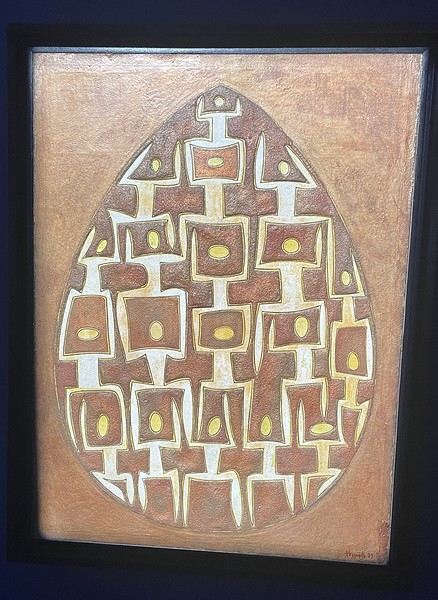
The taxi on the way back drops us off at Place des Ferblantiers, not far from our Riad. We’re a little peckish—it’s worth mentioning that at lunchtime, we only ate a plate of beans from a street vendor. So, we buy a bunch of little sweets, each more delicious than the last, at Ajar. We snack while sipping mint tea and watching life go by around us. A final visit to the Museum of Moroccan Cuisine on our way back helps us dodge a few more showers. Then it’s back to the Riad. The atmosphere in the city is heating up—it’s the AFCON final tonight. The temperatures, though? Not so much. We ordered a meal at the Riad, and it was a good call—not only was it really tasty, but the rain also picked up again. Our day in Marrakesh ends under the covers with a good book and some photo sorting. Still, we managed 10,750 steps. View of our Riad
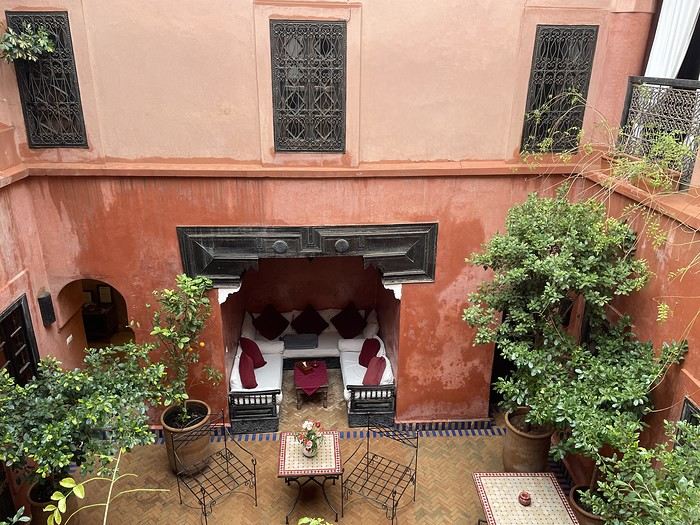
Tomorrow, we’ll pick up our rental car from Medloc and head to Essaouira.
From there, without the rain, we wander aimlessly and eventually end up near the tanneries, but it’s Sunday, and there’s very little activity. Of course, we get hassled by a tout.
Here, the hides after being treated with lime—I love the colors.
We part ways a bit annoyed. He gets a little revenge by giving us bad directions, and we end up outside the city walls. We decide to take a taxi to the new modern art museum—60 dirhams for the 5 km, which is nothing when you think about it. That tout, who we didn’t ask for anything and made it clear we weren’t buying anything, dragged us into a shop supposedly only open that day and demanded 50 dirhams for his "services"! Let’s forget that bad moment and enjoy the exhibition at the MACAL.
The taxi on the way back drops us off at Place des Ferblantiers, not far from our Riad. We’re a little peckish—it’s worth mentioning that at lunchtime, we only ate a plate of beans from a street vendor. So, we buy a bunch of little sweets, each more delicious than the last, at Ajar. We snack while sipping mint tea and watching life go by around us. A final visit to the Museum of Moroccan Cuisine on our way back helps us dodge a few more showers. Then it’s back to the Riad. The atmosphere in the city is heating up—it’s the AFCON final tonight. The temperatures, though? Not so much. We ordered a meal at the Riad, and it was a good call—not only was it really tasty, but the rain also picked up again. Our day in Marrakesh ends under the covers with a good book and some photo sorting. Still, we managed 10,750 steps. View of our Riad
Tomorrow, we’ll pick up our rental car from Medloc and head to Essaouira.
Martine from DD in Arizona and New Mexico
Good evening everyone! 🙂
We’re back from our September 2025 road trip, this time to explore Arizona and New Mexico, and it’s time for me to start my travel journal—especially since everything’s already booked for another trip in September 2026 (to California), and I need to get started on the planning.
I was a little worried this new visit to Uncle Sam’s country might not be as "wow" as the others, but we still discovered some incredible places.
For those who don’t know us, we’re a couple in our seventies who speak very little English, but that didn’t stop us from fully enjoying our stay.
For this 6th road trip in the U.S., we spent 21 nights there, drove 4,160 km by car, and walked nearly 160 km in a loop starting from Phoenix.
We’d been to Arizona before (but not this side) and never to New Mexico. This whole road trip was a huge discovery for us.
In the prices mentioned (some in euros, others in dollars), bank fees and exchange charges are included. The flights, car rental, and parking were all paid for in December 2024 when we booked.
We’d downloaded the MPC (Mobile Passport Control) app, but there wasn’t a dedicated line at Phoenix Airport. Still, we got through quickly with friendly, smiling agents.
I don’t drive at all (I hate it), so the stops were chosen based on activities but also, for some, to limit daily mileage for the sole driver. The kilometers listed in the itinerary are the daily distances.
We traveled from September 9th to 22nd, unfortunately once again without our dear friends Mimi and Maumau.
The itinerary
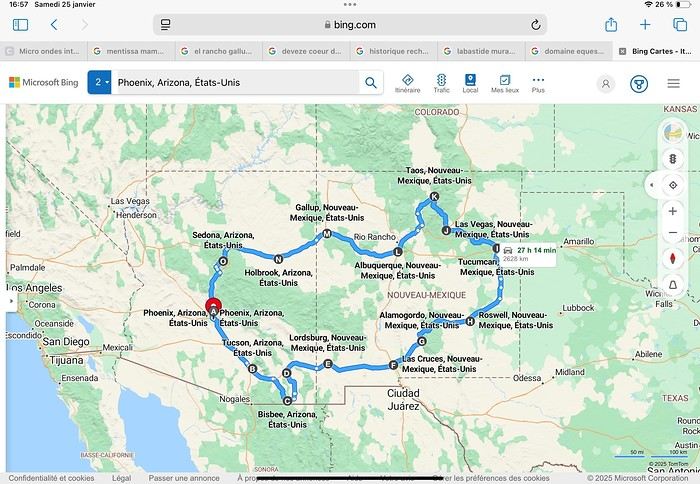
Day 1: Flight Marseille-Paris-Phoenix, then Gold Canyon (133 km) Day 2: Tucson (271 km) Lost Dutchman State Park Day 3: Tucson (155 km) Day 4: Tucson (34 km) Day 5: Bisbee (182 km) Day 6: Lordsburg (345 km) Day 7: Las Cruces (253 km) Day 8: Alamogordo (162 km) Day 9: Roswell (264 km) Day 10: Tucumcari (369 km) Day 11: Las Vegas (281 km) – the one in New Mexico Day 12: Taos (213 km) Day 13: Santa Fe (224 km) Day 14: Albuquerque (123 km) Day 15: Gallup (246 km) Day 16: Holbrook (224 km) Day 17: Flagstaff (179 km) Day 18: Sedona (118 km) Day 19: Sedona (48 km) Day 20: Sedona (41 km) Day 21: Phoenix (256 km) Day 22: Phoenix Airport (35 km)
📊 **Budget**: A little over 7,500 € for both of us, all included. The exchange rate was in our favor (1.17 dollars to 1 €). 📊 **Flights**: Marseille-Paris Charles de Gaulle-Phoenix: 1,787 € for two, with one checked bag each (Air France) 📊 **ESTA**: $42 📊 **America the Beautiful Pass**: $80 📊 **Parking**: 134 € (super eco at Marseille) 📊 **Car rental (Hertz)**: 865 €. Since there were no SUVs left in the reserved category (Nissan Rogue), we got an upgrade (4x4 Ford Explorer). We booked through Air France (15% discount). We’d originally reserved it in December for 1,140 €, but since prices dropped in March, we canceled and rebooked for 865 €. Hertz offers a free Hertz Gold Plus Rewards program, which gives you priority counter service when picking up the car. 📊 **Accommodation**: 2,400 € We stayed in hotels and motels of varying standards (from 60 to 203 € per night, depending on the city), all booked through Booking.com or Hotels.com. Out of 21 nights, only two didn’t include breakfast in the price. Booking.com sometimes offers slightly cheaper rates if you book by phone using the mobile app, and our Genius 3 status on the site also got us some preferential rates. 📊 **Supplementary insurance**: AVA 200 € for medical care if needed 📊 **Cash**: $2,078. We left with 1,000 € exchanged before departure and made two withdrawals of $500. This cash covered: - Evening restaurants and tips - Midday picnics - Gas: $298 for 4,160 km - Museum and private park entries (per person): - Lost Dutchman: $10 - Arizona-Sonora Desert Museum: $28 - Bird Cage Theater: $16 - Tombstone Shootout: $8 - New Mexico Farm & Ranch Museum: $12 - Roswell International UFO Museum: $5 - Billy the Kid Museum: $7 - Rancho de Taos: $22 - West Fork Oak Creek Trail entry: $15 We got a few discounts thanks to our senior age (+65). - Souvenirs and little treats
Like on our previous road trips, we didn’t rent a GPS. We got around using offline GPS apps Here WeGo and Organic Maps, with maps of the states we visited downloaded before we left (on our phones).
❤️❤️❤️ **Highlights** (there are so many!) 📍 Goldfield Ghost Town (even if it’s a reconstruction) 📍 The standing army of Saguaro cacti at Saguaro National Park West 📍 Diving into the cowboy universe of Tombstone 📍 The welcome from Rick and Henry at our guesthouse in Bisbee (Garden at Mile High Ranch) 📍 The tangled rocks of Chiricahua National Monument 📍 The flavored pistachios from Dwayne’s Fresh Jerky and Mac Ginnis Pistachioland 📍 Restaurants: La Posta (Las Cruces), Diner 66 (Albuquerque), and the Haunted Hamburger (Jerome) 📍 The old plazas of New Mexico 📍 The solitude and beauty of the white dunes at White Sands National Park 📍 Stepping back in time at the Billy the Kid Museum (Fort Stanton) 📍 Sections of historic Route 66 and the old motels of Tucumcari, especially at night when all the neon lights are on 📍 Taos Pueblo and diving into Native American culture 📍 After the Rio Grande Bridge, the descent via NM 567 to the very bottom of the Rio Grande Gorge, then the road along the riverbanks to Taos 📍 The tranquility of the Chimayo Sanctuary 📍 Discovering the ingenious native dwellings at Bandelier National Monument and Walnut Canyon National Park 📍 The small towns along the Turquoise Trail 📍 The red rocks of Red Rock Park and the Painted Desert 📍 The extraordinary colors of the petrified trees at Petrified Forest National Park 📍 Sedona, its red rocks, and the reward of the viewpoints at the end of hikes (Devil’s Bridge, The Subway, and West Fork Oak Creek) 📍 The immersion in Mexico when visiting Tlaquepaque 📍 The almost-ghost town of Jerome and its terraced streets 📍 The incredible kindness of Americans, always ready to help and up for a chat ❤️
☹️☹️☹️ **Flops** (there are very few) 📍 Several museums and churches being closed, so we couldn’t visit them 📍 Some museums and visitor centers opening late (10 AM) and closing early (4 PM) 📍 A 64 € phone roaming charge because we got near the Mexican border and picked up their cell tower 📍 The outrageous price ($5.99) for a gallon of gas at the Shell near Phoenix Airport
I hope this helps! Anyway, thanks for reading my long post. Don’t hesitate to reach out, even via PM, if you see I haven’t replied and you’d like more details. Have a great evening, everyone! 🙂
We’re back from our September 2025 road trip, this time to explore Arizona and New Mexico, and it’s time for me to start my travel journal—especially since everything’s already booked for another trip in September 2026 (to California), and I need to get started on the planning.
I was a little worried this new visit to Uncle Sam’s country might not be as "wow" as the others, but we still discovered some incredible places.
For those who don’t know us, we’re a couple in our seventies who speak very little English, but that didn’t stop us from fully enjoying our stay.
For this 6th road trip in the U.S., we spent 21 nights there, drove 4,160 km by car, and walked nearly 160 km in a loop starting from Phoenix.
We’d been to Arizona before (but not this side) and never to New Mexico. This whole road trip was a huge discovery for us.
In the prices mentioned (some in euros, others in dollars), bank fees and exchange charges are included. The flights, car rental, and parking were all paid for in December 2024 when we booked.
We’d downloaded the MPC (Mobile Passport Control) app, but there wasn’t a dedicated line at Phoenix Airport. Still, we got through quickly with friendly, smiling agents.
I don’t drive at all (I hate it), so the stops were chosen based on activities but also, for some, to limit daily mileage for the sole driver. The kilometers listed in the itinerary are the daily distances.
We traveled from September 9th to 22nd, unfortunately once again without our dear friends Mimi and Maumau.
The itinerary
Day 1: Flight Marseille-Paris-Phoenix, then Gold Canyon (133 km) Day 2: Tucson (271 km) Lost Dutchman State Park Day 3: Tucson (155 km) Day 4: Tucson (34 km) Day 5: Bisbee (182 km) Day 6: Lordsburg (345 km) Day 7: Las Cruces (253 km) Day 8: Alamogordo (162 km) Day 9: Roswell (264 km) Day 10: Tucumcari (369 km) Day 11: Las Vegas (281 km) – the one in New Mexico Day 12: Taos (213 km) Day 13: Santa Fe (224 km) Day 14: Albuquerque (123 km) Day 15: Gallup (246 km) Day 16: Holbrook (224 km) Day 17: Flagstaff (179 km) Day 18: Sedona (118 km) Day 19: Sedona (48 km) Day 20: Sedona (41 km) Day 21: Phoenix (256 km) Day 22: Phoenix Airport (35 km)
📊 **Budget**: A little over 7,500 € for both of us, all included. The exchange rate was in our favor (1.17 dollars to 1 €). 📊 **Flights**: Marseille-Paris Charles de Gaulle-Phoenix: 1,787 € for two, with one checked bag each (Air France) 📊 **ESTA**: $42 📊 **America the Beautiful Pass**: $80 📊 **Parking**: 134 € (super eco at Marseille) 📊 **Car rental (Hertz)**: 865 €. Since there were no SUVs left in the reserved category (Nissan Rogue), we got an upgrade (4x4 Ford Explorer). We booked through Air France (15% discount). We’d originally reserved it in December for 1,140 €, but since prices dropped in March, we canceled and rebooked for 865 €. Hertz offers a free Hertz Gold Plus Rewards program, which gives you priority counter service when picking up the car. 📊 **Accommodation**: 2,400 € We stayed in hotels and motels of varying standards (from 60 to 203 € per night, depending on the city), all booked through Booking.com or Hotels.com. Out of 21 nights, only two didn’t include breakfast in the price. Booking.com sometimes offers slightly cheaper rates if you book by phone using the mobile app, and our Genius 3 status on the site also got us some preferential rates. 📊 **Supplementary insurance**: AVA 200 € for medical care if needed 📊 **Cash**: $2,078. We left with 1,000 € exchanged before departure and made two withdrawals of $500. This cash covered: - Evening restaurants and tips - Midday picnics - Gas: $298 for 4,160 km - Museum and private park entries (per person): - Lost Dutchman: $10 - Arizona-Sonora Desert Museum: $28 - Bird Cage Theater: $16 - Tombstone Shootout: $8 - New Mexico Farm & Ranch Museum: $12 - Roswell International UFO Museum: $5 - Billy the Kid Museum: $7 - Rancho de Taos: $22 - West Fork Oak Creek Trail entry: $15 We got a few discounts thanks to our senior age (+65). - Souvenirs and little treats
Like on our previous road trips, we didn’t rent a GPS. We got around using offline GPS apps Here WeGo and Organic Maps, with maps of the states we visited downloaded before we left (on our phones).
❤️❤️❤️ **Highlights** (there are so many!) 📍 Goldfield Ghost Town (even if it’s a reconstruction) 📍 The standing army of Saguaro cacti at Saguaro National Park West 📍 Diving into the cowboy universe of Tombstone 📍 The welcome from Rick and Henry at our guesthouse in Bisbee (Garden at Mile High Ranch) 📍 The tangled rocks of Chiricahua National Monument 📍 The flavored pistachios from Dwayne’s Fresh Jerky and Mac Ginnis Pistachioland 📍 Restaurants: La Posta (Las Cruces), Diner 66 (Albuquerque), and the Haunted Hamburger (Jerome) 📍 The old plazas of New Mexico 📍 The solitude and beauty of the white dunes at White Sands National Park 📍 Stepping back in time at the Billy the Kid Museum (Fort Stanton) 📍 Sections of historic Route 66 and the old motels of Tucumcari, especially at night when all the neon lights are on 📍 Taos Pueblo and diving into Native American culture 📍 After the Rio Grande Bridge, the descent via NM 567 to the very bottom of the Rio Grande Gorge, then the road along the riverbanks to Taos 📍 The tranquility of the Chimayo Sanctuary 📍 Discovering the ingenious native dwellings at Bandelier National Monument and Walnut Canyon National Park 📍 The small towns along the Turquoise Trail 📍 The red rocks of Red Rock Park and the Painted Desert 📍 The extraordinary colors of the petrified trees at Petrified Forest National Park 📍 Sedona, its red rocks, and the reward of the viewpoints at the end of hikes (Devil’s Bridge, The Subway, and West Fork Oak Creek) 📍 The immersion in Mexico when visiting Tlaquepaque 📍 The almost-ghost town of Jerome and its terraced streets 📍 The incredible kindness of Americans, always ready to help and up for a chat ❤️
☹️☹️☹️ **Flops** (there are very few) 📍 Several museums and churches being closed, so we couldn’t visit them 📍 Some museums and visitor centers opening late (10 AM) and closing early (4 PM) 📍 A 64 € phone roaming charge because we got near the Mexican border and picked up their cell tower 📍 The outrageous price ($5.99) for a gallon of gas at the Shell near Phoenix Airport
I hope this helps! Anyway, thanks for reading my long post. Don’t hesitate to reach out, even via PM, if you see I haven’t replied and you’d like more details. Have a great evening, everyone! 🙂
Scotland - Skye Trail and a little extra
After our amazing experience in the Lofoten Islands in summer 2023, I suggested to Jean Marie another trek I’d been wanting to do for a long time: the Skye Trail in Scotland.
A few photos of this stunning island and he was sold and ready to go.
The route is available on the excellent WalkHighlands site HERE (there’s also a Cicerone guide on the subject). And since I thought it was a shame it avoided the Black Cuillins, I added a 3-day detour in that area.
We took advantage of the May bank holidays in 2024, partly to avoid the peak tourist season and also the midge period—because for some reason, mosquitoes love me 😠!!
27/04 – Day 1 – Transfer to Skye and start of the trek: Rubha Hunish - Flodigarry 28/04 – Day 2 – Flodigarry – just before the Old Man of Storr 29/04 – Day 3 – Old Man of Storr – Portree, then bus to Sligachan 30/04 - Day 4 - Sligachan - Glenbrittle campsite via the Fairy Pools 01/05 – Day 5 – Round trip to Sgùrr na Banachdich from Glenbrittle campsite 02/05 – Day 6 – Round trip to Coire Lagan and walk on the Rubh an Dùnain peninsula 03/05 – Day 7 – Return (hitchhiking) to Sligachan campsite and hike in the Red Cuillins 04/05 – Day 8 – Resuming the Skye Trail – Sligachan – Elgol 05/05 – Day 9 – Elgol – Somewhere on the climb to Bla Bheinn 06/05 – Day 10 – Somewhere on the climb to Bla Bheinn - Broadford 07/05 – Day 11 – Visit to the Armadale Castle and park 08 & 09/05 – Return to Glasgow, visit the city, and return flight And here’s the summary
A few photos of this stunning island and he was sold and ready to go.
The route is available on the excellent WalkHighlands site HERE (there’s also a Cicerone guide on the subject). And since I thought it was a shame it avoided the Black Cuillins, I added a 3-day detour in that area.
We took advantage of the May bank holidays in 2024, partly to avoid the peak tourist season and also the midge period—because for some reason, mosquitoes love me 😠!!
27/04 – Day 1 – Transfer to Skye and start of the trek: Rubha Hunish - Flodigarry 28/04 – Day 2 – Flodigarry – just before the Old Man of Storr 29/04 – Day 3 – Old Man of Storr – Portree, then bus to Sligachan 30/04 - Day 4 - Sligachan - Glenbrittle campsite via the Fairy Pools 01/05 – Day 5 – Round trip to Sgùrr na Banachdich from Glenbrittle campsite 02/05 – Day 6 – Round trip to Coire Lagan and walk on the Rubh an Dùnain peninsula 03/05 – Day 7 – Return (hitchhiking) to Sligachan campsite and hike in the Red Cuillins 04/05 – Day 8 – Resuming the Skye Trail – Sligachan – Elgol 05/05 – Day 9 – Elgol – Somewhere on the climb to Bla Bheinn 06/05 – Day 10 – Somewhere on the climb to Bla Bheinn - Broadford 07/05 – Day 11 – Visit to the Armadale Castle and park 08 & 09/05 – Return to Glasgow, visit the city, and return flight And here’s the summary
15-Day Road Trip Recap: Colorado and New Mexico
Hello, here’s a totally subjective recap of our 15-day road trip between Colorado and New Mexico, from late September to mid-October.
Our main interests are culture, museums, and landscapes—no hiking or trails for us. Personally, I’m pretty contemplative, and luckily, there’s always something to see out there! We’re pretty used to the US; we’ve been going there often for a long time (let’s just say we’re not exactly young anymore).
Budget: Even though we don’t set a strict budget beforehand, we try to keep costs as low as possible. This time, we managed to spend around 4000 € for two, all included. To do this: avoid expensive accommodations, staying between 60 and 120 € per night with an average of 90 €/night, mixing Airbnb and motels. And skip the “real” restaurants, which are pretty pricey in the US: sandwiches for lunch, takeout or cooking in the Airbnb in the evening. We shop at Sprouts or Whole Foods—organic-style chains that are pricier than Walmart but better. In the evenings, Sprouts has discounts on items that didn’t sell during the day. Also, avoid toll roads, paid parking, and overly expensive attractions or sites. The dispensary budget is separate…
Route: Denver/Colorado Springs/Alamosa/Raton/Santa Fe/Cuba/Cortez/Grand Junction/Glenwood Springs/Denver This wasn’t too planned in advance—we booked a few nights upon arrival and went with the flow. Flight from CDG to Denver with AF/Delta, car rental at Dollar for a standard SUV. The guy at the Dollar counter upsold me on extra insurance for flat tires (and since I knew we’d be off-roading, I took it). Without telling me, he upgraded me to a Jeep Sahara 4X4 Hybrid. Nice.
Listening to the news upon arrival, the anchor announced, “It’s officially fall now.” We hadn’t really thought about that before leaving, but yeah—it’s the time when the trees turn fluorescent yellow and red. Amazing.
Colorado Springs: Garden of the Gods is a free park with paved trails winding through red/orange rock formations. Magical at sunrise—groups of deer roam around, along with birds and rabbits. It’s small but wow! Didn’t try the Manitou Incline in Manitou Springs, a staircase with thousands of steps going straight up the mountain. Impressive from the bottom, but the parking is paid, which is a downside for those willing to tackle it. The Cog Railway goes up to the summit of Pikes Peak—around $100 when we were there. No thanks. And of course, the parking is paid too. For fans, Maggie’s Farm dispensary is great.
On Route 24, Eleven Mile Canyon Recreation Area is fly-fishing paradise—just like in the movie *A River Runs Through It*. Entry is $11, and a trail follows the river at the bottom of the canyon to the dam. Dozens of people in waders are in the water, casting their lines over and over. You can see the salmon in the clear water, and we had a picnic in the sun, imagining Brad Pitt catching a fish.
Buena Vista: A cute little tourist town with an Outdoor Fair that day—some pretty impressive vehicles for sale, set up for mountain living (like Juniper outfitting a RAM).
Alamosa: The closest town to Great Sand Dunes National Park, crossed by the Rio Grande (and let’s be real—it’s more of a stream than a river!). Park access was free because it was National Park Day. A park with massive dunes—climbing them is pretty exhausting, with lots of wind and sinking sand. Glad we didn’t do it in summer; I can’t imagine how tough it’d be in the heat. It’s a bit deceptive: it looks easy to get to the top of a dune, but it’s really not. The campsites were nice, and it was busy that weekend. We passed the “Point of No Return,” a sandy trail winding through the hills and connecting to Route 559 from above. Didn’t go all the way, but it’s possible the entrance is free from that side. However, you need a 4X4 with good ground clearance. After 1 or 2 km on the trail, you’re alone between the dunes and hills—hardly anyone around. But tricky to turn around or pass other vehicles; the trail isn’t wide. We crossed paths with a Hanomag (registered in the Netherlands—impressive!) coming down without stopping, or risking getting stuck.
On the way out, we took the small Route 403, which quickly turns into a trail crossing the mountain. Entire sections of forest were turning fluorescent yellow with patches of green and red—an incredible sight.
Raton: A small town that probably peaked in the late 19th century and has been in slow decline ever since. The Raton Pass Motor Inn is the kind of place that makes the US legendary—entirely 50s and 60s decor, really well done. I had the Betty Page room—too cool. Felt like we were on Route 66. Even better.
Santa Fe: A small city with no high-rises—almost all low-rise buildings, many in adobe, blending perfectly into the landscape. The old downtown is touristy but nice, with its plaza and church. There’s a really cool vibe—we loved it. For drinks, the bar at the top of La Fonda Hotel was packed for sunset, with a diverse crowd. Not overpriced for the location. SITE Santa Fe is a contemporary art space near the train station. It’s free, and the temporary exhibit was really good—high quality. Museum Hill is, as the name suggests, where several museums are located. We visited the Museum of Indian Art and Culture—great if you’re into “First Nations” history. Saw The Dandy Warhols at The Bridge—an outdoor venue, one of the last concerts of the season before winter makes it too cold. Oddly, there was no bag check, just an ID required (even though it was obvious we were over 21!). Tickets were reasonable, around $30 (concerts in the US can be crazy expensive). The band was good, with fewer than 300 people in front. A sign at the bar warned: Don’t forget you’re at 1,500 meters—alcohol hits harder up here!
Albuquerque: A sprawling city with an old historic center that feels a bit like Disneyland—too perfect for my taste. The real highlight is the Sandia Peak Tramway, which goes up to the old ski resort above the city. Tickets are around $35, and it’s worth it—the ride over the canyons is pretty wild. The ski resort is a bit abandoned; apparently, like elsewhere, there’s no snow anymore. I asked several people about the lack of snow, and the answer was always the same: “It’s cyclical.” Okay then. We arrived for the start of the International Balloon Fiesta (one of the world’s largest hot-air balloon gatherings), hoping to see hundreds of balloons in the sky. Nope—windy today, so no one took off. Bummer.
Las Vegas: New Mexico has its own Las Vegas, but it’s nothing like the other one—a sleepy little town with a perfectly preserved 19th-century Historic Plaza Hotel, brick buildings, and vintage streetlights. Everything is so well-preserved it’s often used as a filming location. NM attracts a lot of productions thanks to tax incentives and its Western landscapes—and it’s cheaper than California! That day, a huge Texas flag was flying in the wind: they were filming the second season of *Ransom Canyon* for Netflix in the town center. If we’d been dressed more “Western,” we could’ve been extras.
Jemez Springs: Its Jemez Hot Springs is super cute—several thermal pools at different temperatures, a New Age vibe. The pools are surrounded by big rocks, and you’re asked to speak softly. A place where you could spend hours. $50 for two hours for two.
Los Alamos: A town made legendary by the bomb, the movie, etc. Heads up: It’s still a research center, and to cross part of the town, you need to show ID. No stopping or taking photos allowed. Other than the Oppenheimer House (currently closed—only the neighboring house is open to visitors), there’s not much to see. There’s a replica of the camp entrance, but it’s been turned into restrooms.
Georgia O’Keeffe Trail (American painter, 1887–1986): Her museum in Santa Fe is pretty good, even if they don’t have tons of works. Entry is $20. Her house in Abiquiu is open for visits, but it’s way overpriced at $65. So we skipped it. You can get an idea of it by stopping at the Welcome Center on Route 84. Further down the same road, Ghost Ranch is worth a visit—beautiful setting, free to enter, with trails to explore and a great atmosphere.
Chaco Culture National Historical Park: A pretty isolated park—25 km of trails to get there, with only a small section paved. The road is decent except for the last few kilometers, which have potholes. I can’t imagine it being accessible after rain, though that doesn’t happen often! This park, in the middle of a desert plain with a few canyons, is one of the rare places where you can find multi-story structures from pre-Columbian civilizations—so, before the “current” tribes. But cruel disappointment: it’s been shut down for a few days. We met a Native ranger—tall, with long hair—who explained that even though he wasn’t being paid, he was still guarding the park and had closed all access to the sites. Darn. Turned around and headed back down the trail.
Same story in the next town, Aztec (a funny name, right?): Aztec Ruins National Monument was closed too.
We passed Ship Rock, the Navajo’s sacred mountain—really impressive. Couldn’t find a trail to get closer, but it’s better from a distance anyway! The town of Shiprock itself is pretty depressing—poor living conditions for some Natives, with rundown mobile homes and piles of junk cars.
Stopped in Cortez to visit Mesa Verde National Park. Ate at Denny’s—hadn’t been there in ages (though it’s the kind of place I should feel at home in!). The customers all looked like they’d stepped out of *The Addams Family*—a little creepy. Or funny, depending on your perspective. For Mesa Verde, after discussing it on this forum with the honorable member Caussat (who didn’t find it that amazing), we were on the fence. Problem solved: it was closed too. Back on the road.
Durango: Really nice with its Main Ave and its shops, cafés—touristy but with local life. Famous for its tourist train to Silverton, but we didn’t do it—way too expensive. Choice between a steam locomotive or diesel (which belches black, stinky smoke—yuck). The diesel should be replaced with electric as soon as they get the funds.
Million Dollar Highway: The road winds through the mountains, and every turn (and there are a lot) is breathtaking—unbelievable landscapes with fluorescent yellow, green, and snow-capped mountains. Just wow.
Silverton: A Western town nestled between two mountains, preserved in its original state despite the tourists arriving by train. Around it, abandoned mines and old wooden ties—must’ve been tough for the 19th-century miners.
Grand Junction: The city is surrounded by giant mesas—pretty impressive. The old downtown is *too* clean—almost sterile.
Colorado National Monument: Just outside the city, a winding road climbs between stunning canyons, with sweeping views of the valley. Entry was free that day due to the shutdown.
Route 330, which we took to get back to the highway, passes through a place called “Cowboy Country”—and it’s true. We saw guys in Stetsons with huge pickups, the road turned into a trail with cows wandering on it, and we had to honk to get them to move. The trail to I-70 was full of potholes—the 4X4 came in handy. Had a picnic by Vega Reservoir: the booth at the entrance was empty, but people left cash in envelopes for camping fees. Anyone passing by could’ve taken it, but it’s an example of US trust and honesty!
Glenwood Springs: A small town famous for its hot springs pool—they claim it’s the largest in the world. I don’t know about that, but it has a great look. Unfortunately, it was closed for maintenance those days! Blew our budget by staying at the Hotel Colorado, a huge 1893 building with a real atmosphere in its grand lobby and fake fireplaces. Fire pits in front of wooden chairs in the garden with mountain views—just really great.
Aspen: The billionaires’ ski resort, but surprisingly, parking was free for 2 hours. Rare to see a place for the super-rich that doesn’t scream “not for you” (like Palm Beach, for example). A former mining town completely redone, every shop occupied by a luxury brand. There’s even a thrift shop run by sweet retirees—funny as hell. Two ski lifts to start directly with your skis, but we didn’t see the price—they were still closed. Lots of houses that aren’t huge but are cute, though looking at real estate prices made us think, “Is there an extra zero on that listing?” A 6-bedroom villa for $52 million? Wow. The mountains around are gorgeous—no wonder it became what it is.
Another fancy resort nearby: Vail, more modern in its construction. The restaurants opted for a “Schwarzwald” decor—kind of odd.
Denver: Nothing really stood out for us in this city, except the Design Museum—the Kirkland, where a local painter collected furniture and supplies from Arts and Crafts to Postmodern. Just really great. Entry is included with a visit to the Denver Art Museum, which has diverse collections—from Impressionism (they have a Manet, a Van Gogh, a Cézanne, several Sisleys) to photography. The best part for me was the “Ancient Americas” totems—huge, impressive wooden sculptures, painted, the kind you’re more used to seeing in Polynesia or Easter Island. Personally, I didn’t know Natives made them too. That’s what museums are for!
Back at the airport, where I had to tag my own luggage (you have to do everything yourself with these US airlines). The tag said SLC/CDG! But we were supposed to connect through JFK. Turns out, they’d put us on a DEN/SLC/CDG flight without telling us. In the end, we gained 30 minutes on our original arrival time in Paris!
There you go—hope this inspires other travelers! !
Our main interests are culture, museums, and landscapes—no hiking or trails for us. Personally, I’m pretty contemplative, and luckily, there’s always something to see out there! We’re pretty used to the US; we’ve been going there often for a long time (let’s just say we’re not exactly young anymore).
Budget: Even though we don’t set a strict budget beforehand, we try to keep costs as low as possible. This time, we managed to spend around 4000 € for two, all included. To do this: avoid expensive accommodations, staying between 60 and 120 € per night with an average of 90 €/night, mixing Airbnb and motels. And skip the “real” restaurants, which are pretty pricey in the US: sandwiches for lunch, takeout or cooking in the Airbnb in the evening. We shop at Sprouts or Whole Foods—organic-style chains that are pricier than Walmart but better. In the evenings, Sprouts has discounts on items that didn’t sell during the day. Also, avoid toll roads, paid parking, and overly expensive attractions or sites. The dispensary budget is separate…
Route: Denver/Colorado Springs/Alamosa/Raton/Santa Fe/Cuba/Cortez/Grand Junction/Glenwood Springs/Denver This wasn’t too planned in advance—we booked a few nights upon arrival and went with the flow. Flight from CDG to Denver with AF/Delta, car rental at Dollar for a standard SUV. The guy at the Dollar counter upsold me on extra insurance for flat tires (and since I knew we’d be off-roading, I took it). Without telling me, he upgraded me to a Jeep Sahara 4X4 Hybrid. Nice.
Listening to the news upon arrival, the anchor announced, “It’s officially fall now.” We hadn’t really thought about that before leaving, but yeah—it’s the time when the trees turn fluorescent yellow and red. Amazing.
Colorado Springs: Garden of the Gods is a free park with paved trails winding through red/orange rock formations. Magical at sunrise—groups of deer roam around, along with birds and rabbits. It’s small but wow! Didn’t try the Manitou Incline in Manitou Springs, a staircase with thousands of steps going straight up the mountain. Impressive from the bottom, but the parking is paid, which is a downside for those willing to tackle it. The Cog Railway goes up to the summit of Pikes Peak—around $100 when we were there. No thanks. And of course, the parking is paid too. For fans, Maggie’s Farm dispensary is great.
On Route 24, Eleven Mile Canyon Recreation Area is fly-fishing paradise—just like in the movie *A River Runs Through It*. Entry is $11, and a trail follows the river at the bottom of the canyon to the dam. Dozens of people in waders are in the water, casting their lines over and over. You can see the salmon in the clear water, and we had a picnic in the sun, imagining Brad Pitt catching a fish.
Buena Vista: A cute little tourist town with an Outdoor Fair that day—some pretty impressive vehicles for sale, set up for mountain living (like Juniper outfitting a RAM).
Alamosa: The closest town to Great Sand Dunes National Park, crossed by the Rio Grande (and let’s be real—it’s more of a stream than a river!). Park access was free because it was National Park Day. A park with massive dunes—climbing them is pretty exhausting, with lots of wind and sinking sand. Glad we didn’t do it in summer; I can’t imagine how tough it’d be in the heat. It’s a bit deceptive: it looks easy to get to the top of a dune, but it’s really not. The campsites were nice, and it was busy that weekend. We passed the “Point of No Return,” a sandy trail winding through the hills and connecting to Route 559 from above. Didn’t go all the way, but it’s possible the entrance is free from that side. However, you need a 4X4 with good ground clearance. After 1 or 2 km on the trail, you’re alone between the dunes and hills—hardly anyone around. But tricky to turn around or pass other vehicles; the trail isn’t wide. We crossed paths with a Hanomag (registered in the Netherlands—impressive!) coming down without stopping, or risking getting stuck.
On the way out, we took the small Route 403, which quickly turns into a trail crossing the mountain. Entire sections of forest were turning fluorescent yellow with patches of green and red—an incredible sight.
Raton: A small town that probably peaked in the late 19th century and has been in slow decline ever since. The Raton Pass Motor Inn is the kind of place that makes the US legendary—entirely 50s and 60s decor, really well done. I had the Betty Page room—too cool. Felt like we were on Route 66. Even better.
Santa Fe: A small city with no high-rises—almost all low-rise buildings, many in adobe, blending perfectly into the landscape. The old downtown is touristy but nice, with its plaza and church. There’s a really cool vibe—we loved it. For drinks, the bar at the top of La Fonda Hotel was packed for sunset, with a diverse crowd. Not overpriced for the location. SITE Santa Fe is a contemporary art space near the train station. It’s free, and the temporary exhibit was really good—high quality. Museum Hill is, as the name suggests, where several museums are located. We visited the Museum of Indian Art and Culture—great if you’re into “First Nations” history. Saw The Dandy Warhols at The Bridge—an outdoor venue, one of the last concerts of the season before winter makes it too cold. Oddly, there was no bag check, just an ID required (even though it was obvious we were over 21!). Tickets were reasonable, around $30 (concerts in the US can be crazy expensive). The band was good, with fewer than 300 people in front. A sign at the bar warned: Don’t forget you’re at 1,500 meters—alcohol hits harder up here!
Albuquerque: A sprawling city with an old historic center that feels a bit like Disneyland—too perfect for my taste. The real highlight is the Sandia Peak Tramway, which goes up to the old ski resort above the city. Tickets are around $35, and it’s worth it—the ride over the canyons is pretty wild. The ski resort is a bit abandoned; apparently, like elsewhere, there’s no snow anymore. I asked several people about the lack of snow, and the answer was always the same: “It’s cyclical.” Okay then. We arrived for the start of the International Balloon Fiesta (one of the world’s largest hot-air balloon gatherings), hoping to see hundreds of balloons in the sky. Nope—windy today, so no one took off. Bummer.
Las Vegas: New Mexico has its own Las Vegas, but it’s nothing like the other one—a sleepy little town with a perfectly preserved 19th-century Historic Plaza Hotel, brick buildings, and vintage streetlights. Everything is so well-preserved it’s often used as a filming location. NM attracts a lot of productions thanks to tax incentives and its Western landscapes—and it’s cheaper than California! That day, a huge Texas flag was flying in the wind: they were filming the second season of *Ransom Canyon* for Netflix in the town center. If we’d been dressed more “Western,” we could’ve been extras.
Jemez Springs: Its Jemez Hot Springs is super cute—several thermal pools at different temperatures, a New Age vibe. The pools are surrounded by big rocks, and you’re asked to speak softly. A place where you could spend hours. $50 for two hours for two.
Los Alamos: A town made legendary by the bomb, the movie, etc. Heads up: It’s still a research center, and to cross part of the town, you need to show ID. No stopping or taking photos allowed. Other than the Oppenheimer House (currently closed—only the neighboring house is open to visitors), there’s not much to see. There’s a replica of the camp entrance, but it’s been turned into restrooms.
Georgia O’Keeffe Trail (American painter, 1887–1986): Her museum in Santa Fe is pretty good, even if they don’t have tons of works. Entry is $20. Her house in Abiquiu is open for visits, but it’s way overpriced at $65. So we skipped it. You can get an idea of it by stopping at the Welcome Center on Route 84. Further down the same road, Ghost Ranch is worth a visit—beautiful setting, free to enter, with trails to explore and a great atmosphere.
Chaco Culture National Historical Park: A pretty isolated park—25 km of trails to get there, with only a small section paved. The road is decent except for the last few kilometers, which have potholes. I can’t imagine it being accessible after rain, though that doesn’t happen often! This park, in the middle of a desert plain with a few canyons, is one of the rare places where you can find multi-story structures from pre-Columbian civilizations—so, before the “current” tribes. But cruel disappointment: it’s been shut down for a few days. We met a Native ranger—tall, with long hair—who explained that even though he wasn’t being paid, he was still guarding the park and had closed all access to the sites. Darn. Turned around and headed back down the trail.
Same story in the next town, Aztec (a funny name, right?): Aztec Ruins National Monument was closed too.
We passed Ship Rock, the Navajo’s sacred mountain—really impressive. Couldn’t find a trail to get closer, but it’s better from a distance anyway! The town of Shiprock itself is pretty depressing—poor living conditions for some Natives, with rundown mobile homes and piles of junk cars.
Stopped in Cortez to visit Mesa Verde National Park. Ate at Denny’s—hadn’t been there in ages (though it’s the kind of place I should feel at home in!). The customers all looked like they’d stepped out of *The Addams Family*—a little creepy. Or funny, depending on your perspective. For Mesa Verde, after discussing it on this forum with the honorable member Caussat (who didn’t find it that amazing), we were on the fence. Problem solved: it was closed too. Back on the road.
Durango: Really nice with its Main Ave and its shops, cafés—touristy but with local life. Famous for its tourist train to Silverton, but we didn’t do it—way too expensive. Choice between a steam locomotive or diesel (which belches black, stinky smoke—yuck). The diesel should be replaced with electric as soon as they get the funds.
Million Dollar Highway: The road winds through the mountains, and every turn (and there are a lot) is breathtaking—unbelievable landscapes with fluorescent yellow, green, and snow-capped mountains. Just wow.
Silverton: A Western town nestled between two mountains, preserved in its original state despite the tourists arriving by train. Around it, abandoned mines and old wooden ties—must’ve been tough for the 19th-century miners.
Grand Junction: The city is surrounded by giant mesas—pretty impressive. The old downtown is *too* clean—almost sterile.
Colorado National Monument: Just outside the city, a winding road climbs between stunning canyons, with sweeping views of the valley. Entry was free that day due to the shutdown.
Route 330, which we took to get back to the highway, passes through a place called “Cowboy Country”—and it’s true. We saw guys in Stetsons with huge pickups, the road turned into a trail with cows wandering on it, and we had to honk to get them to move. The trail to I-70 was full of potholes—the 4X4 came in handy. Had a picnic by Vega Reservoir: the booth at the entrance was empty, but people left cash in envelopes for camping fees. Anyone passing by could’ve taken it, but it’s an example of US trust and honesty!
Glenwood Springs: A small town famous for its hot springs pool—they claim it’s the largest in the world. I don’t know about that, but it has a great look. Unfortunately, it was closed for maintenance those days! Blew our budget by staying at the Hotel Colorado, a huge 1893 building with a real atmosphere in its grand lobby and fake fireplaces. Fire pits in front of wooden chairs in the garden with mountain views—just really great.
Aspen: The billionaires’ ski resort, but surprisingly, parking was free for 2 hours. Rare to see a place for the super-rich that doesn’t scream “not for you” (like Palm Beach, for example). A former mining town completely redone, every shop occupied by a luxury brand. There’s even a thrift shop run by sweet retirees—funny as hell. Two ski lifts to start directly with your skis, but we didn’t see the price—they were still closed. Lots of houses that aren’t huge but are cute, though looking at real estate prices made us think, “Is there an extra zero on that listing?” A 6-bedroom villa for $52 million? Wow. The mountains around are gorgeous—no wonder it became what it is.
Another fancy resort nearby: Vail, more modern in its construction. The restaurants opted for a “Schwarzwald” decor—kind of odd.
Denver: Nothing really stood out for us in this city, except the Design Museum—the Kirkland, where a local painter collected furniture and supplies from Arts and Crafts to Postmodern. Just really great. Entry is included with a visit to the Denver Art Museum, which has diverse collections—from Impressionism (they have a Manet, a Van Gogh, a Cézanne, several Sisleys) to photography. The best part for me was the “Ancient Americas” totems—huge, impressive wooden sculptures, painted, the kind you’re more used to seeing in Polynesia or Easter Island. Personally, I didn’t know Natives made them too. That’s what museums are for!
Back at the airport, where I had to tag my own luggage (you have to do everything yourself with these US airlines). The tag said SLC/CDG! But we were supposed to connect through JFK. Turns out, they’d put us on a DEN/SLC/CDG flight without telling us. In the end, we gained 30 minutes on our original arrival time in Paris!
There you go—hope this inspires other travelers! !
Road Trip USA 2023 - Part 2
HIGHWAY 1
Highway 1 runs along the Pacific coast of California from Leggett in the north to Dana Point in the south. It's the longest state route in California, stretching 1,050 km.
It's famous for its breathtaking ocean views. That’s actually why it’s become such a popular route for road trips, with tons of attractions and points of interest all along the way.
After crossing the U.S. interior on our way out (see Road Trip USA 2023 - Part 1), we’re starting our return trip along this route from Leggett.
Videos are embedded throughout the summary. Please click on the image to start the video. To jump to a specific post, here are the appropriate links:
CALIFORNIA:
Scenic Overlooks on Route 1 Between Leggett and Fort Bragg The Pudding Creek Trestle Bridge in Fort Bragg Glass Beach - Fort Bragg Jenner Lookout Point - Highway 1 Goat Rock Beach - Sonoma Coast State Park - Jenner Point Reyes National Seashore - White House Pool Trail Point Reyes National Seashore - Limantour Beach Point Reyes National Seashore - Point Reyes Shipwreck Point Reyes National Seashore - Kehoe Beach Trail Point Reyes National Seashore - McClures Beach Trail Point Reyes National Seashore - Cypress Tree Tunnel Point Reyes National Seashore - Point Reyes Beach North Point Reyes National Seashore - Elephant Seals on Drakes Beach Point Reyes National Seashore - Point Reyes Beach South Point Reyes National Seashore – Elephant Seals Overlooks Point Reyes National Seashore - Chimney Rock Trail Point Reyes National Seashore - Point Reyes Lighthouse Trail Point Reyes National Seashore – Tule Elk Observation Point Bonita Lighthouse Trail - Sausalito Hawk Hill - Sausalito Battery Spencer Trail - Sausalito Rodeo Beach - Sausalito Point Cavallo - Golden Gate View - Sausalito Exploring Downtown Sausalito Visiting Sausalito’s Houseboats Crossing the Golden Gate Bridge - San Francisco Golden Gate Bridge Viewpoints - San Francisco Cruise to Alcatraz Island - San Francisco Visiting Alcatraz Island - San Francisco Civic Center - Downtown San Francisco Market Street & Yerba Buena Gardens - Downtown San Francisco Union Square & Financial District - Downtown San Francisco Fisherman's Wharf, Pier 39 & Embarcadero - San Francisco Sea Lion Observation - Pier 39 - San Francisco Lombard Street & Cable Car - Russian Hill - San Francisco Macondray Lane Historic District - Russian Hill - San Francisco Grace Cathedral & Huntington Park - Nob Hill - San Francisco Telegraph Hill - San Francisco Chinatown - San Francisco Alamo Square & Painted Ladies - Western Addition - San Francisco Palace of Fine Arts - Marina District - San Francisco Presidio of San Francisco California Coastal Trail - Lincoln Park - San Francisco California Palace of the Legion of Honor - Lincoln Park - San Francisco Sutro Baths - Lincoln Park - San Francisco Queen Wilhelmina Garden - Golden Gate Park - San Francisco Bison Paddock - Golden Gate Park - San Francisco Portals of the Past - Golden Gate Park - San Francisco Strawberry Hill - Golden Gate Park – San Francisco Prayerbook Cross & Robin Williams Meadow - Golden Gate Park - San Francisco Hidden Garden Steps & 16th Avenue Tiled Steps - San Francisco Grandview Park - San Francisco Hike - Twin Peaks Three Summits - San Francisco Longboarding Down Twin Peaks Blvd in San Francisco Haight-Ashbury - San Francisco Corona Heights Park - San Francisco Mission Dolores - San Francisco Mural Frescoes (Part 1) - Mission District - San Francisco Mural Frescoes (Part 2) - Mission District - San Francisco Devil's Slide Bunker - Pacifica Mavericks Beach - Half Moon Bay Martins Beach - Half Moon Bay Pigeon Point Lighthouse State Historic Park - Pescadero What to See in Santa Cruz Visiting Capitola What to See in Monterey Carmel-by-the-Sea Lovers Point Park - Pacific Grove Castle Rock, Hurricane Point & Little Sur River Viewpoints Pfeiffer Falls Trail Julia Pfeiffer Burns State Park Vista Point & McWay Falls Highway 1 - Big Sur Viewpoints Salmon Creek Falls San Carpoforo Creek Trail Elephant Seal Vista Point - San Simeon San Simeon Pier Moonstone Beach Boardwalk Shipwreck - Estero Bluffs State Park Surfing Competition in Morro Bay Port San Luis Pier - San Luis Obispo Pismo Beach Monarch Butterfly Grove - Pismo State Beach Nojoqui Falls Park - Solvang Arroyo Hondo Vista Point Solvang, a Charming Danish Town in California Chumash Painted Cave - Santa Barbara Goleta San Marcos Rd & Cachuma Lake Vista Points - Santa Barbara Old Santa Barbara Mission Walking Tour of Santa Barbara’s Historic Downtown West Beach - Santa Barbara What to See in Ventura Paradise Falls - Wildwood Regional Park - Thousand Oaks Sandy Dune & El Matador State Beach - Malibu Point Dume Nature Reserve - Malibu Malibu Pier Road Trip in the Malibu Mountains Los Liones Trail - Santa Monica Santa Monica Pier Rodeo Drive - Beverly Hills Greystone Mansion - Beverly Hills Hollywood Walk of Fame - Los Angeles Griffith Observatory - Los Angeles Hollywood Forever Cemetery - Los Angeles What to See in Venice Beach Venice Beach Skatepark ShoreLine Aquatic Park - Long Beach Alamitos Beach - Long Beach Naples Island - Long Beach Crescent Bay Point Park & Helser Park Kiosk - Laguna Beach Shell Beach at Twin Points - Laguna Beach Prairie Dogs at Agra Vista Point Top Gun House & Oceanside Pier Annie's Canyon Trail - Solana Beach (Via North Rios Trailhead Loop) Old Town San Diego La Jolla Coastal Trail - San Diego Balboa Park - San Diego Pacific Beach - San Diego Mission Beach - San Diego Ocean Beach Tide Pools - San Diego Sunset Cliffs Natural Park - San Diego Tuna Harbor Park - San Diego Seaport Village & Embarcadero Marina Park - San Diego Gaslamp Quarter - Downtown San Diego Coronado Island - San Diego Dead Dolly Lane - Alpine Galleta Meadows Metal Sculptures - Borrego Springs What to See in Palm Springs Robolights - Palm Springs Andreas Canyon Trail - Indian Canyons - Palm Springs Palm Canyon Trail - Indian Canyons - Palm Springs West Fork Falls Trail - Indian Canyons - Palm Springs Tahquitz Canyon Loop Trail - Indian Canyons - Palm Springs Desert Christ Park - Yucca Valley Pioneertown Salvation Mountain - Niland Slab City - Niland
Highway 1 runs along the Pacific coast of California from Leggett in the north to Dana Point in the south. It's the longest state route in California, stretching 1,050 km.
It's famous for its breathtaking ocean views. That’s actually why it’s become such a popular route for road trips, with tons of attractions and points of interest all along the way.
After crossing the U.S. interior on our way out (see Road Trip USA 2023 - Part 1), we’re starting our return trip along this route from Leggett.
Videos are embedded throughout the summary. Please click on the image to start the video. To jump to a specific post, here are the appropriate links:
CALIFORNIA:
Scenic Overlooks on Route 1 Between Leggett and Fort Bragg The Pudding Creek Trestle Bridge in Fort Bragg Glass Beach - Fort Bragg Jenner Lookout Point - Highway 1 Goat Rock Beach - Sonoma Coast State Park - Jenner Point Reyes National Seashore - White House Pool Trail Point Reyes National Seashore - Limantour Beach Point Reyes National Seashore - Point Reyes Shipwreck Point Reyes National Seashore - Kehoe Beach Trail Point Reyes National Seashore - McClures Beach Trail Point Reyes National Seashore - Cypress Tree Tunnel Point Reyes National Seashore - Point Reyes Beach North Point Reyes National Seashore - Elephant Seals on Drakes Beach Point Reyes National Seashore - Point Reyes Beach South Point Reyes National Seashore – Elephant Seals Overlooks Point Reyes National Seashore - Chimney Rock Trail Point Reyes National Seashore - Point Reyes Lighthouse Trail Point Reyes National Seashore – Tule Elk Observation Point Bonita Lighthouse Trail - Sausalito Hawk Hill - Sausalito Battery Spencer Trail - Sausalito Rodeo Beach - Sausalito Point Cavallo - Golden Gate View - Sausalito Exploring Downtown Sausalito Visiting Sausalito’s Houseboats Crossing the Golden Gate Bridge - San Francisco Golden Gate Bridge Viewpoints - San Francisco Cruise to Alcatraz Island - San Francisco Visiting Alcatraz Island - San Francisco Civic Center - Downtown San Francisco Market Street & Yerba Buena Gardens - Downtown San Francisco Union Square & Financial District - Downtown San Francisco Fisherman's Wharf, Pier 39 & Embarcadero - San Francisco Sea Lion Observation - Pier 39 - San Francisco Lombard Street & Cable Car - Russian Hill - San Francisco Macondray Lane Historic District - Russian Hill - San Francisco Grace Cathedral & Huntington Park - Nob Hill - San Francisco Telegraph Hill - San Francisco Chinatown - San Francisco Alamo Square & Painted Ladies - Western Addition - San Francisco Palace of Fine Arts - Marina District - San Francisco Presidio of San Francisco California Coastal Trail - Lincoln Park - San Francisco California Palace of the Legion of Honor - Lincoln Park - San Francisco Sutro Baths - Lincoln Park - San Francisco Queen Wilhelmina Garden - Golden Gate Park - San Francisco Bison Paddock - Golden Gate Park - San Francisco Portals of the Past - Golden Gate Park - San Francisco Strawberry Hill - Golden Gate Park – San Francisco Prayerbook Cross & Robin Williams Meadow - Golden Gate Park - San Francisco Hidden Garden Steps & 16th Avenue Tiled Steps - San Francisco Grandview Park - San Francisco Hike - Twin Peaks Three Summits - San Francisco Longboarding Down Twin Peaks Blvd in San Francisco Haight-Ashbury - San Francisco Corona Heights Park - San Francisco Mission Dolores - San Francisco Mural Frescoes (Part 1) - Mission District - San Francisco Mural Frescoes (Part 2) - Mission District - San Francisco Devil's Slide Bunker - Pacifica Mavericks Beach - Half Moon Bay Martins Beach - Half Moon Bay Pigeon Point Lighthouse State Historic Park - Pescadero What to See in Santa Cruz Visiting Capitola What to See in Monterey Carmel-by-the-Sea Lovers Point Park - Pacific Grove Castle Rock, Hurricane Point & Little Sur River Viewpoints Pfeiffer Falls Trail Julia Pfeiffer Burns State Park Vista Point & McWay Falls Highway 1 - Big Sur Viewpoints Salmon Creek Falls San Carpoforo Creek Trail Elephant Seal Vista Point - San Simeon San Simeon Pier Moonstone Beach Boardwalk Shipwreck - Estero Bluffs State Park Surfing Competition in Morro Bay Port San Luis Pier - San Luis Obispo Pismo Beach Monarch Butterfly Grove - Pismo State Beach Nojoqui Falls Park - Solvang Arroyo Hondo Vista Point Solvang, a Charming Danish Town in California Chumash Painted Cave - Santa Barbara Goleta San Marcos Rd & Cachuma Lake Vista Points - Santa Barbara Old Santa Barbara Mission Walking Tour of Santa Barbara’s Historic Downtown West Beach - Santa Barbara What to See in Ventura Paradise Falls - Wildwood Regional Park - Thousand Oaks Sandy Dune & El Matador State Beach - Malibu Point Dume Nature Reserve - Malibu Malibu Pier Road Trip in the Malibu Mountains Los Liones Trail - Santa Monica Santa Monica Pier Rodeo Drive - Beverly Hills Greystone Mansion - Beverly Hills Hollywood Walk of Fame - Los Angeles Griffith Observatory - Los Angeles Hollywood Forever Cemetery - Los Angeles What to See in Venice Beach Venice Beach Skatepark ShoreLine Aquatic Park - Long Beach Alamitos Beach - Long Beach Naples Island - Long Beach Crescent Bay Point Park & Helser Park Kiosk - Laguna Beach Shell Beach at Twin Points - Laguna Beach Prairie Dogs at Agra Vista Point Top Gun House & Oceanside Pier Annie's Canyon Trail - Solana Beach (Via North Rios Trailhead Loop) Old Town San Diego La Jolla Coastal Trail - San Diego Balboa Park - San Diego Pacific Beach - San Diego Mission Beach - San Diego Ocean Beach Tide Pools - San Diego Sunset Cliffs Natural Park - San Diego Tuna Harbor Park - San Diego Seaport Village & Embarcadero Marina Park - San Diego Gaslamp Quarter - Downtown San Diego Coronado Island - San Diego Dead Dolly Lane - Alpine Galleta Meadows Metal Sculptures - Borrego Springs What to See in Palm Springs Robolights - Palm Springs Andreas Canyon Trail - Indian Canyons - Palm Springs Palm Canyon Trail - Indian Canyons - Palm Springs West Fork Falls Trail - Indian Canyons - Palm Springs Tahquitz Canyon Loop Trail - Indian Canyons - Palm Springs Desert Christ Park - Yucca Valley Pioneertown Salvation Mountain - Niland Slab City - Niland
Off on an adventure to Java (and a bit of Bali)
Hey there, community! Back this weekend, below is my travel journal from my adventure in Indonesia. Enjoy the read!!!
Day 1 - August 10, 2025 New life downloading for three weeks! And for that, Flo and I launched a public tender... A public tender? What’s that got to do with a travel journal???... Well, when you think about it, few destinations tick all the boxes for an August adventure: Meaning, finding a place that’s exotic in the middle of August, not too expensive, not too packed with tourists, warm but not *too* warm, with postcard-perfect landscapes, dreamy beaches, tasty cuisine with a hint of exoticism, friendly and welcoming locals, where you’re free to sleep under the stars among the mosquitos, take transport surrounded by chickens, and even eat from a pig trough if you feel like it—well, turns out it’s not that easy to find! I’d even say, given how thick the list of requirements is, there’s a big risk the tender could be declared unsuccessful for failing to meet just one criterion. Let’s just say the candidates better submit a rock-solid proposal!
After reviewing all the responses and presentations from the candidates, the obvious choice for us is... Indonesia! Except that trying to explore a country as vast as Indonesia and its 17,504 islands in less than five years is a bit like reading the summary of a Proust novel without taking the time to savor each of its 950 pages! Don’t worry, I won’t name them all here. Besides, do they even all have names? No! Only 7,870 have been named—their parents clearly ran out of ideas for the rest. Anyway, our society, which worships the "work more to earn more" mantra, unfortunately limits our adventure time. So we’ll only get to see a small part of Indonesia, and we’ll have to make a tough choice to head for the best of the best in this archipelago of over seventeen thousand islands. Each one has its own selling points: Sumatra, Sulawesi, Java, the Celebes, Bali, Borneo, Papua, Timor, the Moluccas... So many names that smell of adventure... Another tender, another list of requirements, another review of proposals... Drumroll... Splash splash... And the lucky winner is... Ta-da... Java, Bali’s big sister, where I’ve already been eight years ago... Java the programming language. The Java of Broadway. We’re gonna *do* the Java. Java the coffee. And yes, Java is also an island!
This island, four times smaller than France, is home to 136 million people, making it the most populated island in the world! Fun fact: Indonesia, with its 260 million inhabitants, is just shy of the podium for the world’s most populated countries, after the winning trio of India, China, and the United States. And it’s on this island of Java that you’ll find Jakarta, the (soon-to-be-former) capital and main airport of the country, where we’ll soon land after our nineteen-hour flight! Yep, nineteen hours! I mean, Indonesia in general—and Java in particular—is a *tad* farther than going on vacation to Grandma Yoyo’s! Not sure where it is? Easy. Grab a map. Plant your finger on the big island at the bottom right—aka Australia for those who struggle with geography—move it up two centimeters, and bam, welcome to Indonesia!
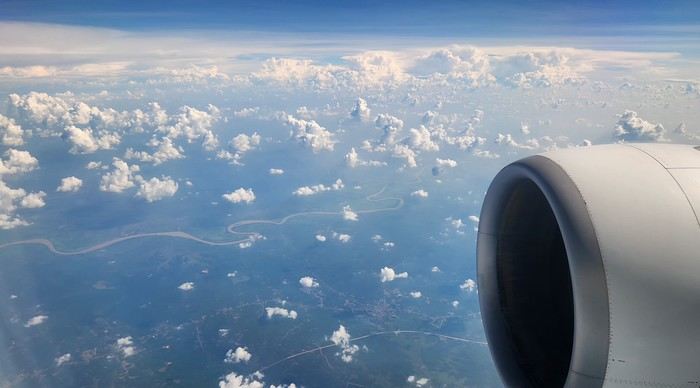
Nice transition, right? Because "Welcome to Indonesia" is exactly what the friendly flight attendant just said to me as we got off the plane! That’s it, our chakras are open, we’ve arrived at our (air)port. Time for rest, pool, cocktails, and a beach with our toes spread out... Wait, if you bought that, you clearly don’t know us yet! Since we still have energy to burn and need to adjust to the flight and time difference, we tackle the long administrative formalities to enter Indonesia, just to earn the right to hop in a 45-minute Grab taxi to the train station. The train station? What train station?... What do you usually do at a train station? Take a train, of course! Off we go for a three-hour train ride to Bandung, where we’ll officially start our adventure tomorrow after our first Indonesian night...
Unfortunately, we were a bit slow off the mark, which meant we missed the 6:25 PM train by two minutes. Oh well, we’ll have to wait until 11 PM. We take the opportunity to stretch our legs in Jakarta, soak up the atmosphere, and enjoy the delicious smells wafting from the *warungs*—those little typical street restaurants. A quick stop at the National Monument, a detour to a night market to devour our first *kwetiaw goreng* and *teh manis* for 60,000 rupiahs (that’s 3 € for two), and just like that, our penalty is lifted, and we’re allowed to hit the road again. Off to Bandung, where we arrive at 2 AM for... a *very* short night...
Day 1 - August 10, 2025 New life downloading for three weeks! And for that, Flo and I launched a public tender... A public tender? What’s that got to do with a travel journal???... Well, when you think about it, few destinations tick all the boxes for an August adventure: Meaning, finding a place that’s exotic in the middle of August, not too expensive, not too packed with tourists, warm but not *too* warm, with postcard-perfect landscapes, dreamy beaches, tasty cuisine with a hint of exoticism, friendly and welcoming locals, where you’re free to sleep under the stars among the mosquitos, take transport surrounded by chickens, and even eat from a pig trough if you feel like it—well, turns out it’s not that easy to find! I’d even say, given how thick the list of requirements is, there’s a big risk the tender could be declared unsuccessful for failing to meet just one criterion. Let’s just say the candidates better submit a rock-solid proposal!
After reviewing all the responses and presentations from the candidates, the obvious choice for us is... Indonesia! Except that trying to explore a country as vast as Indonesia and its 17,504 islands in less than five years is a bit like reading the summary of a Proust novel without taking the time to savor each of its 950 pages! Don’t worry, I won’t name them all here. Besides, do they even all have names? No! Only 7,870 have been named—their parents clearly ran out of ideas for the rest. Anyway, our society, which worships the "work more to earn more" mantra, unfortunately limits our adventure time. So we’ll only get to see a small part of Indonesia, and we’ll have to make a tough choice to head for the best of the best in this archipelago of over seventeen thousand islands. Each one has its own selling points: Sumatra, Sulawesi, Java, the Celebes, Bali, Borneo, Papua, Timor, the Moluccas... So many names that smell of adventure... Another tender, another list of requirements, another review of proposals... Drumroll... Splash splash... And the lucky winner is... Ta-da... Java, Bali’s big sister, where I’ve already been eight years ago... Java the programming language. The Java of Broadway. We’re gonna *do* the Java. Java the coffee. And yes, Java is also an island!
This island, four times smaller than France, is home to 136 million people, making it the most populated island in the world! Fun fact: Indonesia, with its 260 million inhabitants, is just shy of the podium for the world’s most populated countries, after the winning trio of India, China, and the United States. And it’s on this island of Java that you’ll find Jakarta, the (soon-to-be-former) capital and main airport of the country, where we’ll soon land after our nineteen-hour flight! Yep, nineteen hours! I mean, Indonesia in general—and Java in particular—is a *tad* farther than going on vacation to Grandma Yoyo’s! Not sure where it is? Easy. Grab a map. Plant your finger on the big island at the bottom right—aka Australia for those who struggle with geography—move it up two centimeters, and bam, welcome to Indonesia!
Nice transition, right? Because "Welcome to Indonesia" is exactly what the friendly flight attendant just said to me as we got off the plane! That’s it, our chakras are open, we’ve arrived at our (air)port. Time for rest, pool, cocktails, and a beach with our toes spread out... Wait, if you bought that, you clearly don’t know us yet! Since we still have energy to burn and need to adjust to the flight and time difference, we tackle the long administrative formalities to enter Indonesia, just to earn the right to hop in a 45-minute Grab taxi to the train station. The train station? What train station?... What do you usually do at a train station? Take a train, of course! Off we go for a three-hour train ride to Bandung, where we’ll officially start our adventure tomorrow after our first Indonesian night...
Unfortunately, we were a bit slow off the mark, which meant we missed the 6:25 PM train by two minutes. Oh well, we’ll have to wait until 11 PM. We take the opportunity to stretch our legs in Jakarta, soak up the atmosphere, and enjoy the delicious smells wafting from the *warungs*—those little typical street restaurants. A quick stop at the National Monument, a detour to a night market to devour our first *kwetiaw goreng* and *teh manis* for 60,000 rupiahs (that’s 3 € for two), and just like that, our penalty is lifted, and we’re allowed to hit the road again. Off to Bandung, where we arrive at 2 AM for... a *very* short night...
Yet Another Travel Journal in this (Too) Familiar Rajasthan, But with Family and Kids
Prologue
This journal recounts a trip to Rajasthan that’s already over a year old and that I’ve only now found the chance to write about. The summer of 2024 marked my return to India—my tenth trip—after six long years away since my last solo wanderings in Tamil Nadu in 2018 (the journal of which is published on this site). That absence was partly (but not only) due to the long COVID and post-COVID period, which saw a complete halt and then a major slowdown in global tourism. To top it off, Voyage Forum announced its closure in an end-of-the-world atmosphere. A sad time for our favorite social activity…
A few weeks after returning from Rajasthan, I tried to motivate myself to start writing a journal to publish on a forum claiming to be VF’s successor, which I’d eventually signed up for out of desperation. But I kept hesitating and putting the project off because, for one, I no longer have the time I used to. For another, the vibe wasn’t really taking off on that forum—it was overrun with ads and not very active, contrary to what its host’s name suggested. Despite its good intentions and commendable role as a stopgap, it also turned out to be very impractical to use, especially when you don’t have much time like me. I’ll admit I’d occasionally check back on VF to see if anything was happening. But all the discussions remained frozen in time, stuck in that fateful year, 2020. Then, rumors swirled online about shady reasons behind its closure, leaving little room for hope.
And then, one fine morning, I got a message at work from Marien informing me that VF had reopened. What a huge surprise! Even though the forum’s “end” had played out in a somewhat apocalyptic atmosphere, the memories of passionate and heated discussions, the frank debates, and the useful exchanges that made this site a traveler’s goldmine and a unique hub of conviviality all came rushing back to me like a breath of fresh air. I finally saw a sign and tried to motivate myself to find the time to publish the journal of this tenth trip to India and fifth to Rajasthan. But in the end, I got bogged down in professional and family obligations and never managed to find the time to get started. That’s now fixed, though, because I had two reasons for wanting to do it: I find that looking back on a trip to tell others about it is a highly beneficial introspective exercise. Also, I thought this journal could be useful to other travelers on a few points.
Because, “do we really need yet another journal about Rajasthan?” you might rightly ask! Especially in a time when so many journals about the “Land of Kings” have been published since VF’s return, not to mention the countless stories you can already find online about this region, one of India’s most touristy. And I’d add, why go back to Rajasthan for a fifth time, where I’ve already dragged my feet more than enough—through its forts, deserts, temples, cities, villages, bumpy roads, train stations, tasty street food stalls, cheap guesthouses, and more? Where some might see just another overhyped tourist destination full of the same old *Arabian Nights* clichés, worn to a thread, that I mentioned earlier, when there’s so much else to see in India? Well, first because it’s a magnificent country I never tire of, where I started an academic study and made so many connections. It’s also packed with places where you won’t find a single tourist (right, Marie-Jo?), even in the heart of well-trodden paths and classic itineraries. And most importantly, as I said earlier, things have changed in recent years. First, after six years without traveling far, the urge to go back to India was getting stronger. But this time, no more solo trips (often) or duo adventures (sometimes)—now it’s a team of four that has to come along! And even if you can argue with that, what better place than Rajasthan to introduce India to people who’ve never seen it? To kids you want to amaze? Plus, traveling with your new little family to your favorite country isn’t the same as going solo in often spartan conditions that only affect you. It’s a different challenge, but ultimately probably much harder. So, is it really reasonable to take two kids to India, including a two-year-old baby? That’s one of the main goals of this journal (but not the only one)—to try to answer that question.
As you can tell, it’s not so much the destination but the slightly unusual setup of this trip that, in my opinion, will make this journal interesting. Despite my experience and expertise (yes, I dare say it) in India, there were plenty of questions before we finalized the plan and said, “Alright, let’s go!” The questions were flying for us parents. Is it wise to travel to India with a two-year-old? What would we do (it happened) if the kids got very sick? Would they be able to handle a road trip on Rajasthan’s bumpy, dusty roads using public transport? Could they handle the shock of such a different world—the dirt, poverty, pollution, noise (…and the smell, as they say), the spicy food, monkeys, mosquitoes, snakes, tigers, leopards, and so on? In short, all the clichés that I usually joke about suddenly became potential realities. Another concern: as a mixed Franco-African family (not me, but my partner and her oldest), wouldn’t we risk not always being well received, given what you sometimes hear about that in India? How would Indians react to seeing a mixed-race family, the ultimate taboo in a country of purity and social segregation, which would undoubtedly raise many questions for them? Of course, not everything went as expected… Because, as you know, with India—and what makes it charming for some—there are always complications: sometimes where you don’t expect them… and sometimes where you do. I’ll go into detail about that in the journal to come (not right away) and in the final review (even later). These experiences could be useful to travelers who find themselves in similar situations and have the same questions we did before embarking on such a journey. And maybe it’ll spark the curiosity of those who aren’t concerned and will read yet another Rajasthan journal, but with its own unique twists.
Despite my unchanged constraints, which mean I have little time to write this, I don’t want to rush the story, so I’ll take my time. There will probably be lulls. I hope that won’t stop people from coming to react, debate, share their impressions, or ask for information.
This journal recounts a trip to Rajasthan that’s already over a year old and that I’ve only now found the chance to write about. The summer of 2024 marked my return to India—my tenth trip—after six long years away since my last solo wanderings in Tamil Nadu in 2018 (the journal of which is published on this site). That absence was partly (but not only) due to the long COVID and post-COVID period, which saw a complete halt and then a major slowdown in global tourism. To top it off, Voyage Forum announced its closure in an end-of-the-world atmosphere. A sad time for our favorite social activity…
A few weeks after returning from Rajasthan, I tried to motivate myself to start writing a journal to publish on a forum claiming to be VF’s successor, which I’d eventually signed up for out of desperation. But I kept hesitating and putting the project off because, for one, I no longer have the time I used to. For another, the vibe wasn’t really taking off on that forum—it was overrun with ads and not very active, contrary to what its host’s name suggested. Despite its good intentions and commendable role as a stopgap, it also turned out to be very impractical to use, especially when you don’t have much time like me. I’ll admit I’d occasionally check back on VF to see if anything was happening. But all the discussions remained frozen in time, stuck in that fateful year, 2020. Then, rumors swirled online about shady reasons behind its closure, leaving little room for hope.
And then, one fine morning, I got a message at work from Marien informing me that VF had reopened. What a huge surprise! Even though the forum’s “end” had played out in a somewhat apocalyptic atmosphere, the memories of passionate and heated discussions, the frank debates, and the useful exchanges that made this site a traveler’s goldmine and a unique hub of conviviality all came rushing back to me like a breath of fresh air. I finally saw a sign and tried to motivate myself to find the time to publish the journal of this tenth trip to India and fifth to Rajasthan. But in the end, I got bogged down in professional and family obligations and never managed to find the time to get started. That’s now fixed, though, because I had two reasons for wanting to do it: I find that looking back on a trip to tell others about it is a highly beneficial introspective exercise. Also, I thought this journal could be useful to other travelers on a few points.
Because, “do we really need yet another journal about Rajasthan?” you might rightly ask! Especially in a time when so many journals about the “Land of Kings” have been published since VF’s return, not to mention the countless stories you can already find online about this region, one of India’s most touristy. And I’d add, why go back to Rajasthan for a fifth time, where I’ve already dragged my feet more than enough—through its forts, deserts, temples, cities, villages, bumpy roads, train stations, tasty street food stalls, cheap guesthouses, and more? Where some might see just another overhyped tourist destination full of the same old *Arabian Nights* clichés, worn to a thread, that I mentioned earlier, when there’s so much else to see in India? Well, first because it’s a magnificent country I never tire of, where I started an academic study and made so many connections. It’s also packed with places where you won’t find a single tourist (right, Marie-Jo?), even in the heart of well-trodden paths and classic itineraries. And most importantly, as I said earlier, things have changed in recent years. First, after six years without traveling far, the urge to go back to India was getting stronger. But this time, no more solo trips (often) or duo adventures (sometimes)—now it’s a team of four that has to come along! And even if you can argue with that, what better place than Rajasthan to introduce India to people who’ve never seen it? To kids you want to amaze? Plus, traveling with your new little family to your favorite country isn’t the same as going solo in often spartan conditions that only affect you. It’s a different challenge, but ultimately probably much harder. So, is it really reasonable to take two kids to India, including a two-year-old baby? That’s one of the main goals of this journal (but not the only one)—to try to answer that question.
As you can tell, it’s not so much the destination but the slightly unusual setup of this trip that, in my opinion, will make this journal interesting. Despite my experience and expertise (yes, I dare say it) in India, there were plenty of questions before we finalized the plan and said, “Alright, let’s go!” The questions were flying for us parents. Is it wise to travel to India with a two-year-old? What would we do (it happened) if the kids got very sick? Would they be able to handle a road trip on Rajasthan’s bumpy, dusty roads using public transport? Could they handle the shock of such a different world—the dirt, poverty, pollution, noise (…and the smell, as they say), the spicy food, monkeys, mosquitoes, snakes, tigers, leopards, and so on? In short, all the clichés that I usually joke about suddenly became potential realities. Another concern: as a mixed Franco-African family (not me, but my partner and her oldest), wouldn’t we risk not always being well received, given what you sometimes hear about that in India? How would Indians react to seeing a mixed-race family, the ultimate taboo in a country of purity and social segregation, which would undoubtedly raise many questions for them? Of course, not everything went as expected… Because, as you know, with India—and what makes it charming for some—there are always complications: sometimes where you don’t expect them… and sometimes where you do. I’ll go into detail about that in the journal to come (not right away) and in the final review (even later). These experiences could be useful to travelers who find themselves in similar situations and have the same questions we did before embarking on such a journey. And maybe it’ll spark the curiosity of those who aren’t concerned and will read yet another Rajasthan journal, but with its own unique twists.
Despite my unchanged constraints, which mean I have little time to write this, I don’t want to rush the story, so I’ll take my time. There will probably be lulls. I hope that won’t stop people from coming to react, debate, share their impressions, or ask for information.
From Southern Shikoku, between land and sea, to the blue waters of Miyakojima and finally the Tokyo metropolis
From Southern Shikoku, between land and sea, to the blue waters of Miyakojima and finally Tokyo’s megacity
Hi everyone,
I have to admit, I really hesitated before deciding to write this travel journal... Writing one takes a lot of time and energy, and since this is my 4th trip, I wondered if it would even interest anyone other than myself (both for the discovery and the writing). But after a few people asked, "Are you going to write a journal?" and especially after rediscovering the joy of reading other travelers’ journals about Japan or elsewhere on this forum, I’ve decided to share my 4th installment in the Land of the Rising Sun here.
The itinerary: 27 full days, from late May to late June 2025, right in the middle of the rainy season, including:
-->13 days in Shikoku, from Kochi (Kochi Prefecture) to Matsuyama (Ehime Prefecture)
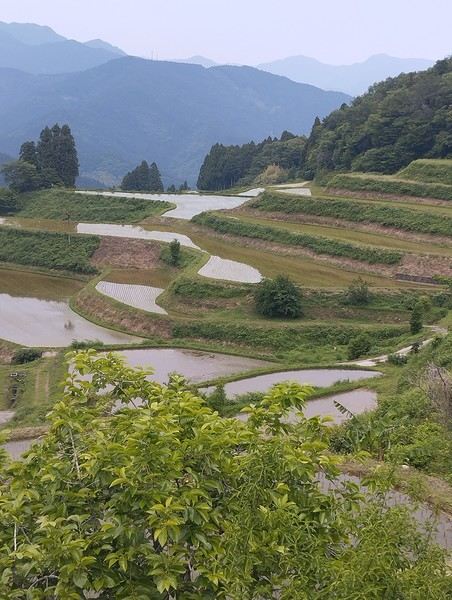
-->7 days in Miyakojima (Okinawa Prefecture)
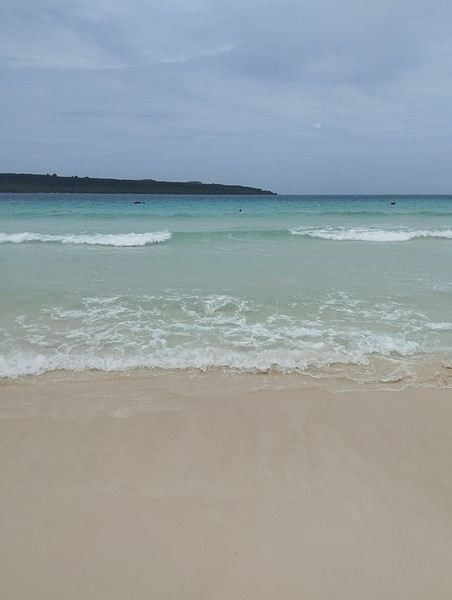
-->7 days in Tokyo
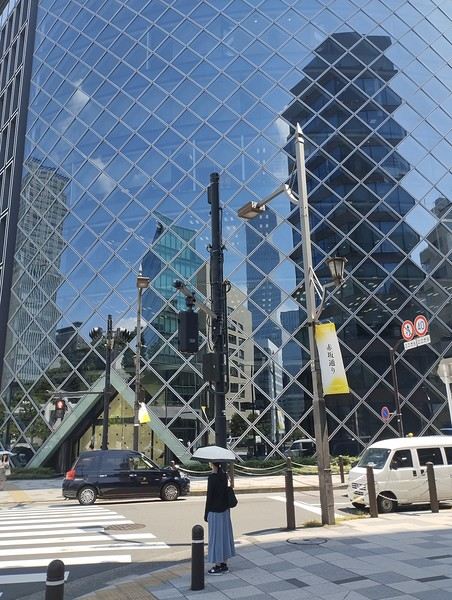
The trip was decided on fairly last-minute again this year.
Since I regularly check flight prices to track fluctuations for this destination even without concrete plans, stumbling upon a slightly cheaper direct flight (900 €) than what I’d seen in previous months (around 1,200–1,400 € on average) for a Paris-Tokyo route with Japanese airline ANA was too tempting to resist the urge to return to this enchanting country. After much hesitation between exploring the San’in region (Matsue, Tottori, Yamaguchi) and Southern Shikoku, the decision was made—I took the plunge! The ticket is booked: Paris to Kochi with a layover in Tokyo, all with ANA, the airline I’d been dreaming of... for 1,120 € per person. Okay, it’s not cheap, but it’s better than in 2023.
Departure in 2 weeks! Now I just have to get everything ready!
Intense prep work over these next 2 weeks to:
finalize a more precise itinerary and reach an agreement—yep, because even though we both love Japan, our preferences differ slightly, and we have to choose between exploring new places or revisiting beloved spots... decide how much time to spend in each area without rushing while still exploring research places that might interest us and watch videos about Japan book accommodations: yes, it’s possible to do this on the spot, but last year, we realized that last-minute options were pretty expensive, so we’re booking ahead—though we’ll keep a few options open in case better deals pop up later reserve rental cars order yen check the weather regularly and wonder if choosing the *tsuyu* (rainy season) was really a good idea—are we going to be drenched the whole time???
"What hard work," you might say! Going to Japan for a month—what a tough life! Despite this being my 4th trip, the excitement is just as intense as the first time.
The only small downside is that when we booked the flight, there weren’t many seats left, so we’re only sitting together on the international return flight. Plus, on the way there, we have middle seats. Another lingering question: what French-language films will be available? According to the internet, the selection seems limited. Oh well, these are just minor details—it’s already time to fly! PS: I’ll be posting slowly and irregularly... so for those interested, be patient, and maybe set an alert...
Hi everyone,
I have to admit, I really hesitated before deciding to write this travel journal... Writing one takes a lot of time and energy, and since this is my 4th trip, I wondered if it would even interest anyone other than myself (both for the discovery and the writing). But after a few people asked, "Are you going to write a journal?" and especially after rediscovering the joy of reading other travelers’ journals about Japan or elsewhere on this forum, I’ve decided to share my 4th installment in the Land of the Rising Sun here.
The itinerary: 27 full days, from late May to late June 2025, right in the middle of the rainy season, including:
-->13 days in Shikoku, from Kochi (Kochi Prefecture) to Matsuyama (Ehime Prefecture)
-->7 days in Miyakojima (Okinawa Prefecture)
-->7 days in Tokyo
The trip was decided on fairly last-minute again this year.
Since I regularly check flight prices to track fluctuations for this destination even without concrete plans, stumbling upon a slightly cheaper direct flight (900 €) than what I’d seen in previous months (around 1,200–1,400 € on average) for a Paris-Tokyo route with Japanese airline ANA was too tempting to resist the urge to return to this enchanting country. After much hesitation between exploring the San’in region (Matsue, Tottori, Yamaguchi) and Southern Shikoku, the decision was made—I took the plunge! The ticket is booked: Paris to Kochi with a layover in Tokyo, all with ANA, the airline I’d been dreaming of... for 1,120 € per person. Okay, it’s not cheap, but it’s better than in 2023.
Departure in 2 weeks! Now I just have to get everything ready!
Intense prep work over these next 2 weeks to:
finalize a more precise itinerary and reach an agreement—yep, because even though we both love Japan, our preferences differ slightly, and we have to choose between exploring new places or revisiting beloved spots... decide how much time to spend in each area without rushing while still exploring research places that might interest us and watch videos about Japan book accommodations: yes, it’s possible to do this on the spot, but last year, we realized that last-minute options were pretty expensive, so we’re booking ahead—though we’ll keep a few options open in case better deals pop up later reserve rental cars order yen check the weather regularly and wonder if choosing the *tsuyu* (rainy season) was really a good idea—are we going to be drenched the whole time???
"What hard work," you might say! Going to Japan for a month—what a tough life! Despite this being my 4th trip, the excitement is just as intense as the first time.
The only small downside is that when we booked the flight, there weren’t many seats left, so we’re only sitting together on the international return flight. Plus, on the way there, we have middle seats. Another lingering question: what French-language films will be available? According to the internet, the selection seems limited. Oh well, these are just minor details—it’s already time to fly! PS: I’ll be posting slowly and irregularly... so for those interested, be patient, and maybe set an alert...
Another side of my trip to Thailand: Villages, nature, countryside, mountains...
February 9th is a pivotal day during my trip to Thailand. Up until this date, my focus had been on cities, temples, and other urban landmarks. Starting February 10th, I’ll finally leave the city behind for the outskirts—one town, one life, farther from tourism, more real, more authentic... Then comes the bucolic surroundings of Chiang Mai, nature, the countryside, the mountains.
This morning, I head to visit the ethnographic museum. I’d been told about another one, but it’s permanently closed. I wonder if it’s the same one that might have changed its name and location.
I thoroughly enjoy visiting this museum. At first, I’m a bit annoyed because the place is packed with noisy school groups blocking the display cases without even showing the slightest interest. But soon, their chaperones manage to lead them into another room, giving me some peace. They maintain this distance throughout the tour, allowing me to explore the museum in complete tranquility. I really appreciate their tact.
I’m amazed by the absolutely stunning fabric displays and the countless everyday objects, especially the very old pottery. There’s so much beautiful basketry and intricately carved wood. The statues are also incredible... After seeing all of them, I no longer feel like buying any from the shops.
On my way back, not far from my hotel, I discover a rather unique place that only serves one drink, which they’ve made their specialty: egg coffee! A pretty surprising novelty. I have to try it.

At the bottom of the cup, they pour a layer of milk, topped with a layer of liquid coffee, followed by a layer of egg yolk, and finally a top layer that turns out to be a mix of coffee and cocoa powder. It’s a cold drink that, in the end, doesn’t have much flavor, and the price is pretty steep for such a small cup. You’re paying for the exclusivity!
Later in the day, I venture once again into small alleys, something I love doing when exploring a new city—no specific goal, just wandering east of the city, outside the walls.

I encounter very few tourists there and discover unsuspected little shops overflowing with lovely items, much cheaper than what you find in the heart of the tourist district. Then I wander through the floors of Warorot Market. I discover another kind of temple there: the temple of good deals. I love finding clothes that are really original for locals, not the flood of shirts and pants that tourists love but no Thai would ever buy, which invade the shops in the "Historic Square." I stop in my tracks in front of a stall with beautiful shirts featuring stunning geometric patterns in elegant color combinations and very short sleeves. Hmm, these would be perfect for showing off my biceps, one of which is adorned with the magnificent Ganesh tattoo I got last year in Bali. "When you’ve got nice things, you’ve got to show them off!" he said. 😜🙏💪 I pick out two for 380 baht and negotiate them down to 300. But the seller won’t go any lower. I understand I’ve reached the limit of her commercial possibilities. Just as I’m leaving the shop, happy with my purchase, my ever-helpful inner voice, Petite Voix, suggests: - You didn’t try them on because you were too lazy to take off the one you’re wearing and also because of the sweat, but you could just put one on over the one you’re wearing. It’s light enough that it won’t bother you.
I go back to the two sellers, who burst out laughing when I ask to try them on. - Oh no, it’s way too small for you! It’s a women’s shirt! - But they don’t look particularly feminine in style! And I chose XXL... I put the shirt on, and of course, it won’t close. Then I notice the buttons are on the wrong side. That’s why the sleeves seemed so short!!! They put the shirts back on the rack and refund me without any fuss, commenting amid total hilarity: - Well, thank goodness you tried it on just as you were leaving the shop!
Since I don’t want to walk too much before tomorrow’s first Big Outing with the driver, I end my stroll with a visit to two very pretty temples recommended by Joël.

I’d rather not post more temple photos. But these ones smell like village and countryside...


I’ve never seen anything like Wat Ket Karam, so extravagant...


And I end my day with two other lesser-known temples: Wat Noung Kham, simple and finally free of gold and glitter,

and Wat Dap Phai, where an intimate ceremony is taking place at the end of the day.
This morning, I head to visit the ethnographic museum. I’d been told about another one, but it’s permanently closed. I wonder if it’s the same one that might have changed its name and location.
I thoroughly enjoy visiting this museum. At first, I’m a bit annoyed because the place is packed with noisy school groups blocking the display cases without even showing the slightest interest. But soon, their chaperones manage to lead them into another room, giving me some peace. They maintain this distance throughout the tour, allowing me to explore the museum in complete tranquility. I really appreciate their tact.
I’m amazed by the absolutely stunning fabric displays and the countless everyday objects, especially the very old pottery. There’s so much beautiful basketry and intricately carved wood. The statues are also incredible... After seeing all of them, I no longer feel like buying any from the shops.
On my way back, not far from my hotel, I discover a rather unique place that only serves one drink, which they’ve made their specialty: egg coffee! A pretty surprising novelty. I have to try it.
At the bottom of the cup, they pour a layer of milk, topped with a layer of liquid coffee, followed by a layer of egg yolk, and finally a top layer that turns out to be a mix of coffee and cocoa powder. It’s a cold drink that, in the end, doesn’t have much flavor, and the price is pretty steep for such a small cup. You’re paying for the exclusivity!
Later in the day, I venture once again into small alleys, something I love doing when exploring a new city—no specific goal, just wandering east of the city, outside the walls.
I encounter very few tourists there and discover unsuspected little shops overflowing with lovely items, much cheaper than what you find in the heart of the tourist district. Then I wander through the floors of Warorot Market. I discover another kind of temple there: the temple of good deals. I love finding clothes that are really original for locals, not the flood of shirts and pants that tourists love but no Thai would ever buy, which invade the shops in the "Historic Square." I stop in my tracks in front of a stall with beautiful shirts featuring stunning geometric patterns in elegant color combinations and very short sleeves. Hmm, these would be perfect for showing off my biceps, one of which is adorned with the magnificent Ganesh tattoo I got last year in Bali. "When you’ve got nice things, you’ve got to show them off!" he said. 😜🙏💪 I pick out two for 380 baht and negotiate them down to 300. But the seller won’t go any lower. I understand I’ve reached the limit of her commercial possibilities. Just as I’m leaving the shop, happy with my purchase, my ever-helpful inner voice, Petite Voix, suggests: - You didn’t try them on because you were too lazy to take off the one you’re wearing and also because of the sweat, but you could just put one on over the one you’re wearing. It’s light enough that it won’t bother you.
I go back to the two sellers, who burst out laughing when I ask to try them on. - Oh no, it’s way too small for you! It’s a women’s shirt! - But they don’t look particularly feminine in style! And I chose XXL... I put the shirt on, and of course, it won’t close. Then I notice the buttons are on the wrong side. That’s why the sleeves seemed so short!!! They put the shirts back on the rack and refund me without any fuss, commenting amid total hilarity: - Well, thank goodness you tried it on just as you were leaving the shop!
Since I don’t want to walk too much before tomorrow’s first Big Outing with the driver, I end my stroll with a visit to two very pretty temples recommended by Joël.
I’d rather not post more temple photos. But these ones smell like village and countryside...
I’ve never seen anything like Wat Ket Karam, so extravagant...
And I end my day with two other lesser-known temples: Wat Noung Kham, simple and finally free of gold and glitter,
and Wat Dap Phai, where an intimate ceremony is taking place at the end of the day.
Swedish Lapland - Padjelantaledden solo trek
A travel journal—it’s been a while!
I must say, my personal situation has "changed a bit" since my last journals (my 3 kids are grown up + a divorce finalized in early 2021). So, no more long-haul family trips; now I’m focusing on multi-day hikes for my vacations. I found a hiking buddy in 2021 to join me on the Laugavegur trek in Iceland, but this year, no one was available.
That’s how the idea of a solo trek in Lapland took root—a region I’ve been dreaming about ever since I read Marie Lefevre’s 2012 journal on the topic.
Marie, who I hiked with for the first time in 2015 during my very first multi-day trek, and whom I can never thank enough for sharing her knowledge and saving me so much time.
To build my confidence for this solo trek, I hiked around Cantal in May (okay, I’m capable of spending nights alone in the middle of nowhere without being overly terrified) and camped in the Mercantour in July, where a massive storm made me realize I still had room for improvement in managing wet conditions...
After some research, I bought 2 Nylofume bags—large, ultra-lightweight ones to protect my gear in my backpack—and a set of 4 Aloksak bags in different sizes for my passport, camera, battery, etc. (and I’m so glad I did!!)
Well, I think I’m all set...
My 16/08 - Day 1 - Ritsem – Gisuris (well, almost) Wed 17/08 – Day 2 - Partly in the tent + minimal progress toward Gisuris Thu 18/08 – Day 3 - Gisuris – Laddejakha (23 km) Fri 19/08 – Day 4 – Laddejakha – Arasluokta (13 km) Sat 20/08 - Day 5 - Arasluokta – Staloluokta (12 km) Sun 21/08 – Day 6 - Staloluokta – Duottar (18 km) Mon 22/08 Day 7 - Duottar – Dareluoppal (10 km) Sammarlappa (15.3 km) Tue 23/08 - Day 8 - Sammarlappa – Tarrekaise (12 km) + halfway to Tarrekaise-Nunjes (approx. 3 km) Wed 24/08 – Day 9 – Finish Tarrekaise-Nunjes (approx. 4 km) Kvikkjokk (12.6 km) Thu 25/08 and Fri 26/08 – Around Kvikkjokk Food and gear summary
I must say, my personal situation has "changed a bit" since my last journals (my 3 kids are grown up + a divorce finalized in early 2021). So, no more long-haul family trips; now I’m focusing on multi-day hikes for my vacations. I found a hiking buddy in 2021 to join me on the Laugavegur trek in Iceland, but this year, no one was available.
That’s how the idea of a solo trek in Lapland took root—a region I’ve been dreaming about ever since I read Marie Lefevre’s 2012 journal on the topic.
Marie, who I hiked with for the first time in 2015 during my very first multi-day trek, and whom I can never thank enough for sharing her knowledge and saving me so much time.
To build my confidence for this solo trek, I hiked around Cantal in May (okay, I’m capable of spending nights alone in the middle of nowhere without being overly terrified) and camped in the Mercantour in July, where a massive storm made me realize I still had room for improvement in managing wet conditions...
After some research, I bought 2 Nylofume bags—large, ultra-lightweight ones to protect my gear in my backpack—and a set of 4 Aloksak bags in different sizes for my passport, camera, battery, etc. (and I’m so glad I did!!)
Well, I think I’m all set...
My 16/08 - Day 1 - Ritsem – Gisuris (well, almost) Wed 17/08 – Day 2 - Partly in the tent + minimal progress toward Gisuris Thu 18/08 – Day 3 - Gisuris – Laddejakha (23 km) Fri 19/08 – Day 4 – Laddejakha – Arasluokta (13 km) Sat 20/08 - Day 5 - Arasluokta – Staloluokta (12 km) Sun 21/08 – Day 6 - Staloluokta – Duottar (18 km) Mon 22/08 Day 7 - Duottar – Dareluoppal (10 km) Sammarlappa (15.3 km) Tue 23/08 - Day 8 - Sammarlappa – Tarrekaise (12 km) + halfway to Tarrekaise-Nunjes (approx. 3 km) Wed 24/08 – Day 9 – Finish Tarrekaise-Nunjes (approx. 4 km) Kvikkjokk (12.6 km) Thu 25/08 and Fri 26/08 – Around Kvikkjokk Food and gear summary
What to see in Madagascar in 10 days with kids?
Hello,
A few months ago, I posted a message in the Southern Africa section about a family trip in July/August. In the end, since I had too much trouble deciding on the destination and procrastinated too much with the planning 😎, I changed my mind and we’re going for a completely different trip—to Madagascar, a country we already know a bit since we’ve traveled there several times for 4 to 6 months each time, though our last visit was back in 2012!
The tickets are booked: 19 days on the ground (excluding arrival and departure days in Tana), spanning July and August.
We’re not looking to rack up landscapes (and kilometers). The kids really want to see lots of animals, while we mostly want to show them what daily life is like in Malagasy villages. So ideally, we’d like a trip split into two parts: - For 8/10 days, a hiking portion. The idea isn’t to do a tough trek in very remote areas but rather to walk from one village to another. Let’s say 3-4 hours a day. And when we arrive in each village, we’d have time to explore a bit, chat with the locals, let our kids play with the village children, etc. Stay with locals when possible. Move to a new village every day or every 2-3 days. - A few days visiting 1 or 2 national parks (with lemurs if possible to keep everyone happy!) - With the inevitable travel days, we’ll quickly hit 19 days.
Does this kind of trip sound doable (and fun) to you? Do you know of any villages that would fit our hiking plans?
I don’t have a preferred region yet, except that very dry landscapes appeal to me less. My real love from past trips was the highlands and their bright green rice paddies against red earth, but I’m a bit worried about the cold at this time of year.
After my initial research (thanks to this forum), I get the impression that the Ambalavao/Ambohimahamasina area might meet our criteria. I saw there are "accueil paysan" (farm stays) in that area, which could match what we’re looking for and would let us visit Andringitra National Park and Ranomafana on the way there or back.
But I’m open to all your more original ideas!
For logistical questions (transport, guides, accommodations, etc.), I’ll tackle those later—it’ll depend on the area we choose.
Thanks in advance for your suggestions
A few months ago, I posted a message in the Southern Africa section about a family trip in July/August. In the end, since I had too much trouble deciding on the destination and procrastinated too much with the planning 😎, I changed my mind and we’re going for a completely different trip—to Madagascar, a country we already know a bit since we’ve traveled there several times for 4 to 6 months each time, though our last visit was back in 2012!
The tickets are booked: 19 days on the ground (excluding arrival and departure days in Tana), spanning July and August.
We’re not looking to rack up landscapes (and kilometers). The kids really want to see lots of animals, while we mostly want to show them what daily life is like in Malagasy villages. So ideally, we’d like a trip split into two parts: - For 8/10 days, a hiking portion. The idea isn’t to do a tough trek in very remote areas but rather to walk from one village to another. Let’s say 3-4 hours a day. And when we arrive in each village, we’d have time to explore a bit, chat with the locals, let our kids play with the village children, etc. Stay with locals when possible. Move to a new village every day or every 2-3 days. - A few days visiting 1 or 2 national parks (with lemurs if possible to keep everyone happy!) - With the inevitable travel days, we’ll quickly hit 19 days.
Does this kind of trip sound doable (and fun) to you? Do you know of any villages that would fit our hiking plans?
I don’t have a preferred region yet, except that very dry landscapes appeal to me less. My real love from past trips was the highlands and their bright green rice paddies against red earth, but I’m a bit worried about the cold at this time of year.
After my initial research (thanks to this forum), I get the impression that the Ambalavao/Ambohimahamasina area might meet our criteria. I saw there are "accueil paysan" (farm stays) in that area, which could match what we’re looking for and would let us visit Andringitra National Park and Ranomafana on the way there or back.
But I’m open to all your more original ideas!
For logistical questions (transport, guides, accommodations, etc.), I’ll tackle those later—it’ll depend on the area we choose.
Thanks in advance for your suggestions
Discovering Assam and Nagaland 2025
Before I begin, I’d like to thank Michèle Buisson and her "Misha’s travel journals," which really helped me plan this trip. It’s tough to find information about this part of India, which is quite different from the "more traditional India." I’m so grateful to her for introducing me to a family who hosted me for 4 nights and 3 days. I can’t wait to return the favor and welcome you all to my place in early July!
Thursday, March 20th. The alarm goes off super early, but I’m already awake—I was too worried I’d sleep through it. I leave the house at 4:00 AM. The rain has stopped, and at this hour, there aren’t many trucks on the road. I arrive at Barcelona Airport easily by 6:20 AM, let the valet know I’m there, and he quickly picks up my car. This time, I’m flying with Etihad Airways again. I booked the ticket during my trip to Cambodia: Barcelona/Kolkata, Delhi/Barcelona for 567 €. At that price, I didn’t hesitate for long—I knew I had to take it. And I’m glad I did because, by the time I returned, the price had gone up to 700 €. I can already hear the reactions: "Wow, how’d you get a ticket for that price? What site did you use? You’re amazing, MarieJo!" One thing’s for sure—I’m really happy with this deal. The flights from Barcelona to Abu Dhabi and Abu Dhabi to Kolkata go smoothly, and we arrive on time at 2:55 AM. There aren’t many people at immigration, so I get through quickly. My luggage isn’t on the carousel yet. After collecting my bag, I check in for my next flight with IndiGo, a 5:40 AM flight to Guwahati, arriving at 7:00 AM. I’m starting to feel pretty tired, so I take a taxi from the airport to Gruham Sojourn Homestay. The house is upstairs, and the neighborhood seems quiet, with restaurants lining the street. The room won’t be ready until 10:00 AM, so I rest on the bench in the meantime. Once in the room, I take a shower—it really helps me feel refreshed. I need to exchange some euros, so I look up a nearby exchange bureau on Google and head out to find it. I locate it easily, and the staff are super friendly. I get a great rate (1 € = 90 INR). I wander around the neighborhood. The train station isn’t far, and small markets line the streets. I head back to my area, walking along the main avenue. About 500 meters from my street, I discover a museum. The visit is fascinating—I see the famous Majuli masks, among other things.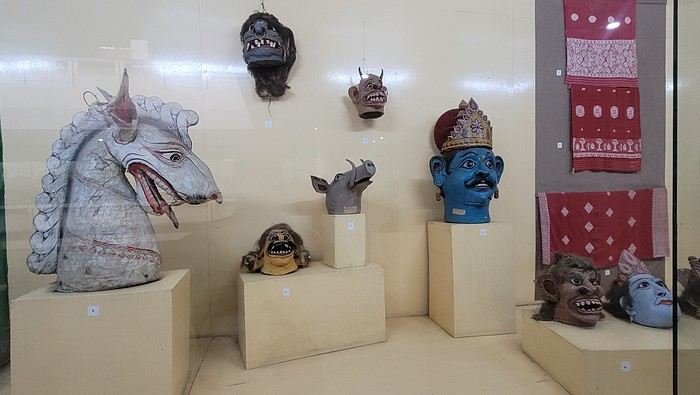

I’m not far from the Brahmaputra River, and the temptation to visit is too strong to resist. I’d hoped to find a promenade along the river, but that doesn’t exist here. I walk back calmly and notice several restaurants in my street. On the doorstep of my accommodation, I spot a pastry shop with cakes that look more like the ones we have in France than the typical ones here in India. A visit is a must, and I’m not disappointed!
Tonight, I’m dining at a restaurant in the street. The menu is a bit disappointing—burgers, pizzas, pasta—nothing very Indian. So, I’ll go with tomato pasta.
Thursday, March 20th. The alarm goes off super early, but I’m already awake—I was too worried I’d sleep through it. I leave the house at 4:00 AM. The rain has stopped, and at this hour, there aren’t many trucks on the road. I arrive at Barcelona Airport easily by 6:20 AM, let the valet know I’m there, and he quickly picks up my car. This time, I’m flying with Etihad Airways again. I booked the ticket during my trip to Cambodia: Barcelona/Kolkata, Delhi/Barcelona for 567 €. At that price, I didn’t hesitate for long—I knew I had to take it. And I’m glad I did because, by the time I returned, the price had gone up to 700 €. I can already hear the reactions: "Wow, how’d you get a ticket for that price? What site did you use? You’re amazing, MarieJo!" One thing’s for sure—I’m really happy with this deal. The flights from Barcelona to Abu Dhabi and Abu Dhabi to Kolkata go smoothly, and we arrive on time at 2:55 AM. There aren’t many people at immigration, so I get through quickly. My luggage isn’t on the carousel yet. After collecting my bag, I check in for my next flight with IndiGo, a 5:40 AM flight to Guwahati, arriving at 7:00 AM. I’m starting to feel pretty tired, so I take a taxi from the airport to Gruham Sojourn Homestay. The house is upstairs, and the neighborhood seems quiet, with restaurants lining the street. The room won’t be ready until 10:00 AM, so I rest on the bench in the meantime. Once in the room, I take a shower—it really helps me feel refreshed. I need to exchange some euros, so I look up a nearby exchange bureau on Google and head out to find it. I locate it easily, and the staff are super friendly. I get a great rate (1 € = 90 INR). I wander around the neighborhood. The train station isn’t far, and small markets line the streets. I head back to my area, walking along the main avenue. About 500 meters from my street, I discover a museum. The visit is fascinating—I see the famous Majuli masks, among other things.
I’m not far from the Brahmaputra River, and the temptation to visit is too strong to resist. I’d hoped to find a promenade along the river, but that doesn’t exist here. I walk back calmly and notice several restaurants in my street. On the doorstep of my accommodation, I spot a pastry shop with cakes that look more like the ones we have in France than the typical ones here in India. A visit is a must, and I’m not disappointed!
Tonight, I’m dining at a restaurant in the street. The menu is a bit disappointing—burgers, pizzas, pasta—nothing very Indian. So, I’ll go with tomato pasta.
Photo Safaris in Kenya
Back on the forum, I’m starting to write up two 3-week trips to Kenya in August 2021 and 2023.
In 2021, Quynh and I traveled with Régis (Rjulie95 on VF). Our son joined us in Baringo for the second half of the trip.
In 2023, we went with two friends who’d been dreaming of seeing wild animals ever since we got back from Kenya. We didn’t need much convincing to go with them!
The two itineraries are almost identical (well, when you love something...) but we did make a few tweaks.
- The first part of the trip was with a local driver/guide, Félix, who was recommended by Sylvie56. Sylvie and her husband Ben are Kenya enthusiasts—they’ve been there countless times, always with Félix... and for good reason! He’s fantastic!
- The second part was with Melting Pot Safari, an agency that adapted to our photography needs. Tony Crocetta, the co-founder (along with his Kenyan friend Simon Chebon), is a wildlife photographer himself.
Here are the itineraries for both trips, including accommodations:
In 2021: Day 0: Paris / Nairobi - 67 Airport Hotel Day 1: Nairobi / Amboseli - Simba Cottage Day 2: Amboseli - Simba Cottage Day 3: Amboseli / Aberdares - Fishing Lodge Day 4: Aberdares - Fishing Lodge Day 5: Aberdares - Fishing Lodge Day 6: Aberdares / Samburu - Riverside Camp Day 7: Samburu - Riverside Camp Day 8: Samburu - Riverside Camp Day 9: Samburu / Nakuru - Merica Hotel Day 10: Nakuru / Baringo - Tumbili Cliff Lodge Day 11: Baringo - Tumbili Cliff Lodge Day 12: Baringo - Tumbili Cliff Lodge Day 13: Baringo / Maasai Mara – Meltingpot Bush Camp Day 14 to 18: Maasai Mara – Meltingpot Bush Camp Day 19: Maasai Mara / Nairobi – Roussel Guest House Day 20: Nairobi / Paris
In 2023: Day 0: Lyon / Paris / Nairobi - 67 Airport Hotel Day 1: Nairobi / Meru - Ikweta Camp Day 2: Meru - Ikweta Camp Day 3: Meru - Ikweta Camp Day 4: Meru / Samburu - Riverside Camp Day 5: Samburu – Riverside Camp Day 6: Samburu / Buffalo Springs – Samburu Simba Day 7: Buffalo Springs / Ol Pejeta – Sweetwater Camp Day 8: Ol Pejeta / Amboseli - Simba Cottage Day 9: Amboseli - Simba Cottage Day 10: Amboseli - Simba Cottage Day 11: Amboseli / Nakuru – Lake Nakuru Lodge Day 12: Nakuru / Baringo - Tumbili Cliff Lodge Day 13: Baringo - Tumbili Cliff Lodge Day 14: Baringo - Tumbili Cliff Lodge Day 15: Baringo / Maasai Mara – Meltingpot Bush Camp Day 16 to 20: Maasai Mara – Meltingpot Bush Camp Day 21: Maasai Mara / Nairobi / Paris
Here’s an itinerary—it’s not exactly what we did, but a combination of both.
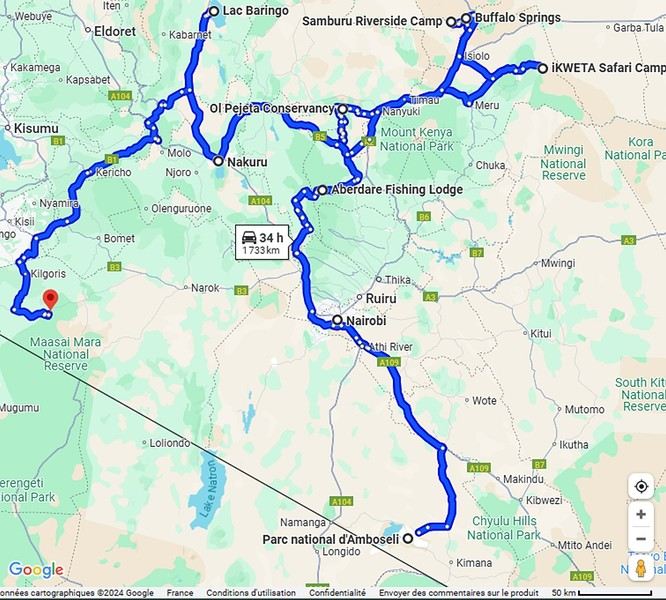
Ready to join us on safari to see some wild animals?
The two itineraries are almost identical (well, when you love something...) but we did make a few tweaks.
- The first part of the trip was with a local driver/guide, Félix, who was recommended by Sylvie56. Sylvie and her husband Ben are Kenya enthusiasts—they’ve been there countless times, always with Félix... and for good reason! He’s fantastic!
- The second part was with Melting Pot Safari, an agency that adapted to our photography needs. Tony Crocetta, the co-founder (along with his Kenyan friend Simon Chebon), is a wildlife photographer himself.
Here are the itineraries for both trips, including accommodations:
In 2021: Day 0: Paris / Nairobi - 67 Airport Hotel Day 1: Nairobi / Amboseli - Simba Cottage Day 2: Amboseli - Simba Cottage Day 3: Amboseli / Aberdares - Fishing Lodge Day 4: Aberdares - Fishing Lodge Day 5: Aberdares - Fishing Lodge Day 6: Aberdares / Samburu - Riverside Camp Day 7: Samburu - Riverside Camp Day 8: Samburu - Riverside Camp Day 9: Samburu / Nakuru - Merica Hotel Day 10: Nakuru / Baringo - Tumbili Cliff Lodge Day 11: Baringo - Tumbili Cliff Lodge Day 12: Baringo - Tumbili Cliff Lodge Day 13: Baringo / Maasai Mara – Meltingpot Bush Camp Day 14 to 18: Maasai Mara – Meltingpot Bush Camp Day 19: Maasai Mara / Nairobi – Roussel Guest House Day 20: Nairobi / Paris
In 2023: Day 0: Lyon / Paris / Nairobi - 67 Airport Hotel Day 1: Nairobi / Meru - Ikweta Camp Day 2: Meru - Ikweta Camp Day 3: Meru - Ikweta Camp Day 4: Meru / Samburu - Riverside Camp Day 5: Samburu – Riverside Camp Day 6: Samburu / Buffalo Springs – Samburu Simba Day 7: Buffalo Springs / Ol Pejeta – Sweetwater Camp Day 8: Ol Pejeta / Amboseli - Simba Cottage Day 9: Amboseli - Simba Cottage Day 10: Amboseli - Simba Cottage Day 11: Amboseli / Nakuru – Lake Nakuru Lodge Day 12: Nakuru / Baringo - Tumbili Cliff Lodge Day 13: Baringo - Tumbili Cliff Lodge Day 14: Baringo - Tumbili Cliff Lodge Day 15: Baringo / Maasai Mara – Meltingpot Bush Camp Day 16 to 20: Maasai Mara – Meltingpot Bush Camp Day 21: Maasai Mara / Nairobi / Paris
Here’s an itinerary—it’s not exactly what we did, but a combination of both.
Ready to join us on safari to see some wild animals?
A long journey around Australia
Sunday, October 1st, 2023
Mulhouse-London
We dumped our trash on our neighbors. We hugged, overflowing with emotion. Then Léa from Taxis S showed up. She knows us well. For ages, she’s been our driver. She was practically the official taxiwoman for the trips of the company where Dom and I met. She knew us when we were single! Almost teenagers! She knows everyone and fills in the biographies of people we’d forgotten.
 Across the street, while we loaded the luggage, S., perched in his window frame, waved a handkerchief. This wasn’t just any trip.
 Then things got tricky. It’s funny how fate sinks its teeth into our happy moments—there’s this whole intermediate phase where the poison seeps in unnoticed because you’re still in the dark...
First, there was a delay on our flight to London. Dom immediately went on high alert, while I stayed calm. In my mind, we had two hours. I knew we had to go from Terminal 5 to Terminal 4, but two hours—come on, that’s plenty, right?
Then things got tricky. It’s funny how fate sinks its teeth into our happy moments—there’s this whole intermediate phase where the poison seeps in unnoticed because you’re still in the dark...
First, there was a delay on our flight to London. Dom immediately went on high alert, while I stayed calm. In my mind, we had two hours. I knew we had to go from Terminal 5 to Terminal 4, but two hours—come on, that’s plenty, right?
Bad calculation! Because those two hours were between the first flight’s landing and the second’s takeoff. But flights close at least half an hour before departure. Getting from one terminal to another means taking a shuttle bus. We waited for the one going to Terminal 4... until a young guy paid to direct people (who hadn’t seen us) informed us it was no longer possible to access Terminal 4 without going through Terminal 2 first for a connection! That really cranked up the pressure. We started installing a mental countdown with a programmed explosion at the end—guaranteed stress with added beads of sweat. The terminal bus was driven by a young Pakistani guy. We were *so* tense we bombarded him with our frantic, repetitive questions. “So? When are we getting there? What’s happening? Why aren’t we moving?” Our eyes were glued to our watches. The poor guy knew. Perfectly. Because it was obvious—no way around it. We weren’t going to make it. It was impossible. But Dom and I stubbornly refused to believe it. Then the kid stopped the bus. Me, hysterical: “What are you doing? What’s going on? Our plane takes off in... in... 4 minutes!!!! We’re gonna miss iiiiiit!” He wasn’t calm either. “You’ve already missed it!” He explained we had to cross a zone that required an escort car to clear a path through the runways. Impossible to do without. It’s forbidden. We had to WAIT (!!!). Then he got a radio call—he had to rush to Terminal 3 to pick up a passenger who was *super* tight on time. “Amir!!!! It’s RIGHT NOW!” they yelled in his already-red ears, thanks to the complaints of two hysterical Frenchies. Dom and I were in overdrive, hallucinating! We wanted to stop him, maybe even hit him to prevent him from turning around. He picked up the girl, whom we instantly hated like the most despicable witch. I turned on my data, searched for Malaysia Airlines’ number at Terminal 4, called, and actually got someone—quite a feat. A woman cut off my frantic rambling with a blunt “It’s over, the check-in is closed, the plane is about to take off.” I heard her but refused to accept it. I yelled, “We’re coming!” She shot back her monolithic “It’s over.” Finally at the doors of that damn Terminal 4, we ran—*really* ran—a marathon, Gate 6, security checks, pat-downs, “Take off your belts,” we asked questions, everyone seemed confident, we ran with one hand holding up our pants, the other clutching our belt, Gate 6—the room was empty. A girl was sitting there, calmly on the phone. We pounced on her. She calmed us down. Little by little, the light came back. Our brains rebooted. We finally understood it was over. We’d have to start crafting a new plan with the new reality. It started with a return to Terminal 5 to talk to British Airways, which took a good hour. With the same driver as before. We were alone with him. He took the time to apologize, to assure us it wasn’t his fault, that our problem had no solution, that nothing could’ve changed the outcome. At BA, we were exhausted. We were greeted by a handsome young man in a navy-blue uniform with gold stripes everywhere. We could’ve made a scene, but we were just relieved to find someone who’d take charge of our story. It was a minimal response, but it was *a* response. I suppose we could’ve demanded a business-class upgrade or a free trip, but we were just happy with a few vouchers for food, a hotel room with breakfast, and a little bag with plastic toys, a razor, toothbrush, hygiene products, and a T-shirt... Trinkets... But we were fine with it all—we said thank you eagerly because the essential was assured. He found us seats on flights tomorrow. *Tomorrow.* We were afraid to hope! We had the exact same flights but a day later. The same crappy times, but it was all good. We felt saved from the shipwreck, like survivors. - And what about the luggage? - .... !!!!
Monday, October 2nd, 2023 London - Kuala Lumpur
It wasn’t the Ritz, but with exhaustion on our side, we slept well. The continental breakfast was way better than we’d expected from an Ibis Budget. Still, it wasn’t enough to restore my joy for life. The course correction had turned into an arduous obstacle course. I scoured the car rental site every which way. Couldn’t reschedule the car. I’d done it before, but this time... Not to mention the laptop battery was complaining—the Brits have this quirk of making their power outlets incompatible with our chargers. Frustrated, I called them but ended up with a girl who declared herself incompetent and offered to have someone from Avis in Perth call me back—someone who’d supposedly handle rentals better. I decided to wait while taking a bath. Barely settled in, the phone rang. I was soaking wet, of course, and asked Dom to answer. Unfortunately, she’s known for disliking my phone, and in a clumsy move, she hung up. We got annoyed. She put dry towels on the edge of the bathtub, but—another false move—they fell in the water. The phone rang again... I completely redid the plans for the next two days, then transferred the files to my phone to consult them later offline. I plugged in my USB cable... *Plop!* The battery died abruptly—my PC shut down without any of the usual polite warnings! I looked around, hoping to find someone to strangle... Long story short, you can tell the day started under the worst omens. I was in a foul mood and spread my bad vibes to Dominique, who was initially in much better spirits... I called Mastercard, hoping to get a refund for the non-refundable night in Perth we’d already paid for. Same old song: “We’ll call you back”... Then... I’ll cut it short—buses, trains, lots of waiting... We rushed to reach the infamous Terminal 4.
We tried new options and convinced ourselves that a delayed departure flight is unrecoverable, no matter the scenario. We were furious that BA hadn’t bothered to tell us, leaving us to run around like rats in a burning house.
Tuesday, October 3rd, 2023 Kuala Lumpur-Perth
The flight was pretty nice. 13 hours, though. Dom and I were facing each other across the aisle. We could get up easily whenever we wanted without bothering anyone and chat when we felt like it. Besides, their chicken was amazing. They were kind enough to offer Dom a truly remarkable glass of rum. Good movies too, including the excellent *Prisoners* by Denis Villeneuve. At KL, during boarding, we developed a nagging worry about our luggage. We checked with some Malaysian Airlines staff. I sensed their hesitation. They made calls. Then changed their minds, giving us smiles and thumbs up...
Wednesday, October 4th, 2023 Perth
*Happy is the man who, like Ulysses, has had a fine voyage.* Well, for us, it wasn’t that. Finally arrived, we experienced the loneliness of tourists watching the baggage carousel spin, emptying of its precious containers one by one, until only a handful of travelers were left, staring at each other in disbelief. Without luggage, you’re kinda screwed. Not even a change of socks—our feet had been swimming in the same shoes for 3 days. No adapter, so no laptop. No toiletries. We could’ve cried! The lost luggage guy played his part. If you want compensation, fill out the disclaimer on the website made for that. And then, “Don’t worry, your luggage will arrive tomorrow!” “Don’t worry?!” From the start of the trip, we’ve been jerked around, fed lies. Tomorrow is the *absolute* last chance to get them back. Beyond that, we’d have to scramble a whole new trip. And lose a lot in the process! I have no idea how to go about it. Tomorrow... OMG... Tomorrow... We landed at 1 AM. Avis, the car rental place, opens at 6:30. Luckily, we found some decent breakfast. It cheered us up and gave us a second wind. Incorrigible, we started believing again! Well, then we just killed time. What else was there to do?

In front of Avis’s little shack, we were freezing. We’d been there since dawn. The girl who showed up, a Latina, immediately saw us as a nuisance who’d ruin her hopes of a peaceful start. Her face and tone were as unwelcoming as possible. You know us—it ended with hugs. She gave us a gorgeous, brand-new car! A hybrid with ultra-sophisticated features, all buttons you shouldn’t touch if you want to drive this thing without causing irreparable damage! We’re off! Driving on the left is easy at first. You think about it constantly. It’s counterintuitive, it takes effort. It’s later, when you get used to it and confidence sets in, that it becomes dangerous—old reflexes can send you into a wall. Anyway, the car and I immediately clicked.
In Perth, underground parking next to the hotel, friendly welcome—we ended up forgetting all the morning’s mishaps. Should we go sightseeing?
https://voyageforum.com/images/posts/small/1733767537-5Nwk6t3DsBZNOzf.jpg
Across the street, while we loaded the luggage, S., perched in his window frame, waved a handkerchief. This wasn’t just any trip.
Then things got tricky. It’s funny how fate sinks its teeth into our happy moments—there’s this whole intermediate phase where the poison seeps in unnoticed because you’re still in the dark...
First, there was a delay on our flight to London. Dom immediately went on high alert, while I stayed calm. In my mind, we had two hours. I knew we had to go from Terminal 5 to Terminal 4, but two hours—come on, that’s plenty, right?
Bad calculation! Because those two hours were between the first flight’s landing and the second’s takeoff. But flights close at least half an hour before departure. Getting from one terminal to another means taking a shuttle bus. We waited for the one going to Terminal 4... until a young guy paid to direct people (who hadn’t seen us) informed us it was no longer possible to access Terminal 4 without going through Terminal 2 first for a connection! That really cranked up the pressure. We started installing a mental countdown with a programmed explosion at the end—guaranteed stress with added beads of sweat. The terminal bus was driven by a young Pakistani guy. We were *so* tense we bombarded him with our frantic, repetitive questions. “So? When are we getting there? What’s happening? Why aren’t we moving?” Our eyes were glued to our watches. The poor guy knew. Perfectly. Because it was obvious—no way around it. We weren’t going to make it. It was impossible. But Dom and I stubbornly refused to believe it. Then the kid stopped the bus. Me, hysterical: “What are you doing? What’s going on? Our plane takes off in... in... 4 minutes!!!! We’re gonna miss iiiiiit!” He wasn’t calm either. “You’ve already missed it!” He explained we had to cross a zone that required an escort car to clear a path through the runways. Impossible to do without. It’s forbidden. We had to WAIT (!!!). Then he got a radio call—he had to rush to Terminal 3 to pick up a passenger who was *super* tight on time. “Amir!!!! It’s RIGHT NOW!” they yelled in his already-red ears, thanks to the complaints of two hysterical Frenchies. Dom and I were in overdrive, hallucinating! We wanted to stop him, maybe even hit him to prevent him from turning around. He picked up the girl, whom we instantly hated like the most despicable witch. I turned on my data, searched for Malaysia Airlines’ number at Terminal 4, called, and actually got someone—quite a feat. A woman cut off my frantic rambling with a blunt “It’s over, the check-in is closed, the plane is about to take off.” I heard her but refused to accept it. I yelled, “We’re coming!” She shot back her monolithic “It’s over.” Finally at the doors of that damn Terminal 4, we ran—*really* ran—a marathon, Gate 6, security checks, pat-downs, “Take off your belts,” we asked questions, everyone seemed confident, we ran with one hand holding up our pants, the other clutching our belt, Gate 6—the room was empty. A girl was sitting there, calmly on the phone. We pounced on her. She calmed us down. Little by little, the light came back. Our brains rebooted. We finally understood it was over. We’d have to start crafting a new plan with the new reality. It started with a return to Terminal 5 to talk to British Airways, which took a good hour. With the same driver as before. We were alone with him. He took the time to apologize, to assure us it wasn’t his fault, that our problem had no solution, that nothing could’ve changed the outcome. At BA, we were exhausted. We were greeted by a handsome young man in a navy-blue uniform with gold stripes everywhere. We could’ve made a scene, but we were just relieved to find someone who’d take charge of our story. It was a minimal response, but it was *a* response. I suppose we could’ve demanded a business-class upgrade or a free trip, but we were just happy with a few vouchers for food, a hotel room with breakfast, and a little bag with plastic toys, a razor, toothbrush, hygiene products, and a T-shirt... Trinkets... But we were fine with it all—we said thank you eagerly because the essential was assured. He found us seats on flights tomorrow. *Tomorrow.* We were afraid to hope! We had the exact same flights but a day later. The same crappy times, but it was all good. We felt saved from the shipwreck, like survivors. - And what about the luggage? - .... !!!!
Monday, October 2nd, 2023 London - Kuala Lumpur
It wasn’t the Ritz, but with exhaustion on our side, we slept well. The continental breakfast was way better than we’d expected from an Ibis Budget. Still, it wasn’t enough to restore my joy for life. The course correction had turned into an arduous obstacle course. I scoured the car rental site every which way. Couldn’t reschedule the car. I’d done it before, but this time... Not to mention the laptop battery was complaining—the Brits have this quirk of making their power outlets incompatible with our chargers. Frustrated, I called them but ended up with a girl who declared herself incompetent and offered to have someone from Avis in Perth call me back—someone who’d supposedly handle rentals better. I decided to wait while taking a bath. Barely settled in, the phone rang. I was soaking wet, of course, and asked Dom to answer. Unfortunately, she’s known for disliking my phone, and in a clumsy move, she hung up. We got annoyed. She put dry towels on the edge of the bathtub, but—another false move—they fell in the water. The phone rang again... I completely redid the plans for the next two days, then transferred the files to my phone to consult them later offline. I plugged in my USB cable... *Plop!* The battery died abruptly—my PC shut down without any of the usual polite warnings! I looked around, hoping to find someone to strangle... Long story short, you can tell the day started under the worst omens. I was in a foul mood and spread my bad vibes to Dominique, who was initially in much better spirits... I called Mastercard, hoping to get a refund for the non-refundable night in Perth we’d already paid for. Same old song: “We’ll call you back”... Then... I’ll cut it short—buses, trains, lots of waiting... We rushed to reach the infamous Terminal 4.
We tried new options and convinced ourselves that a delayed departure flight is unrecoverable, no matter the scenario. We were furious that BA hadn’t bothered to tell us, leaving us to run around like rats in a burning house.
Tuesday, October 3rd, 2023 Kuala Lumpur-Perth
The flight was pretty nice. 13 hours, though. Dom and I were facing each other across the aisle. We could get up easily whenever we wanted without bothering anyone and chat when we felt like it. Besides, their chicken was amazing. They were kind enough to offer Dom a truly remarkable glass of rum. Good movies too, including the excellent *Prisoners* by Denis Villeneuve. At KL, during boarding, we developed a nagging worry about our luggage. We checked with some Malaysian Airlines staff. I sensed their hesitation. They made calls. Then changed their minds, giving us smiles and thumbs up...
Wednesday, October 4th, 2023 Perth
*Happy is the man who, like Ulysses, has had a fine voyage.* Well, for us, it wasn’t that. Finally arrived, we experienced the loneliness of tourists watching the baggage carousel spin, emptying of its precious containers one by one, until only a handful of travelers were left, staring at each other in disbelief. Without luggage, you’re kinda screwed. Not even a change of socks—our feet had been swimming in the same shoes for 3 days. No adapter, so no laptop. No toiletries. We could’ve cried! The lost luggage guy played his part. If you want compensation, fill out the disclaimer on the website made for that. And then, “Don’t worry, your luggage will arrive tomorrow!” “Don’t worry?!” From the start of the trip, we’ve been jerked around, fed lies. Tomorrow is the *absolute* last chance to get them back. Beyond that, we’d have to scramble a whole new trip. And lose a lot in the process! I have no idea how to go about it. Tomorrow... OMG... Tomorrow... We landed at 1 AM. Avis, the car rental place, opens at 6:30. Luckily, we found some decent breakfast. It cheered us up and gave us a second wind. Incorrigible, we started believing again! Well, then we just killed time. What else was there to do?
In front of Avis’s little shack, we were freezing. We’d been there since dawn. The girl who showed up, a Latina, immediately saw us as a nuisance who’d ruin her hopes of a peaceful start. Her face and tone were as unwelcoming as possible. You know us—it ended with hugs. She gave us a gorgeous, brand-new car! A hybrid with ultra-sophisticated features, all buttons you shouldn’t touch if you want to drive this thing without causing irreparable damage! We’re off! Driving on the left is easy at first. You think about it constantly. It’s counterintuitive, it takes effort. It’s later, when you get used to it and confidence sets in, that it becomes dangerous—old reflexes can send you into a wall. Anyway, the car and I immediately clicked.
In Perth, underground parking next to the hotel, friendly welcome—we ended up forgetting all the morning’s mishaps. Should we go sightseeing?
https://voyageforum.com/images/posts/small/1733767537-5Nwk6t3DsBZNOzf.jpg
4 friends discover a piece of North India
Hello fellow travelers!
I’m adding my small contribution to the reopening celebration by posting this travel journal from India, made in January 2024. We’re 4 friends (2 couples), and we did a 3-week loop in Rajasthan, stopping by Delhi and Agra (which, as everyone knows, aren’t in Rajasthan 😛). Delhi - Agra - Jaipur - Bundi - Udaipur - Jodhpur - Jaisalmer - Delhi
We rented a car with a driver from Agra to Jaisalmer, 550 € for 14 days. https://chauffeurpriveeninde.com/fr/
We took the train from Delhi to Agra and the plane (Spicejet) from Jaisalmer to Delhi.
Most of the accommodations were booked on Booking before we left.
I’m sharing this story written by Richard and illustrated by me. We dedicate it to Nathalie and Bruno, our amazing travel companions.
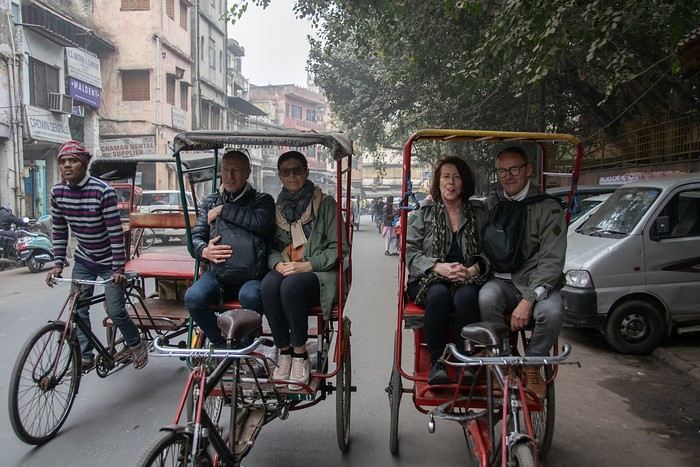
I’m adding my small contribution to the reopening celebration by posting this travel journal from India, made in January 2024. We’re 4 friends (2 couples), and we did a 3-week loop in Rajasthan, stopping by Delhi and Agra (which, as everyone knows, aren’t in Rajasthan 😛). Delhi - Agra - Jaipur - Bundi - Udaipur - Jodhpur - Jaisalmer - Delhi
We rented a car with a driver from Agra to Jaisalmer, 550 € for 14 days. https://chauffeurpriveeninde.com/fr/
We took the train from Delhi to Agra and the plane (Spicejet) from Jaisalmer to Delhi.
Most of the accommodations were booked on Booking before we left.
I’m sharing this story written by Richard and illustrated by me. We dedicate it to Nathalie and Bruno, our amazing travel companions.