Results for "General+Santos+|+8+>+191"
79147 results found.
Blog sur la Polynésie-française English translation pending
Ia ora na,
Mon blog a un mois, il parle de la vie à Tahiti... de la Polynésie en général. Laissez moi des messages lors de votre passage http://polynesietahiti.canalblog.com/
Merci.
Mon blog a un mois, il parle de la vie à Tahiti... de la Polynésie en général. Laissez moi des messages lors de votre passage http://polynesietahiti.canalblog.com/
Merci.
Réflexologue: reconnu en France? English translation pending
Bonjour !
Est-ce que quelqu'un sait si la profession de réflexologue est reconnue en France, en Espagne, ou en Europe en général? Et qu'en est-il de la profession de masseur en général ?
Merci d'avance !
A bientôt.
Sarlu
Est-ce que quelqu'un sait si la profession de réflexologue est reconnue en France, en Espagne, ou en Europe en général? Et qu'en est-il de la profession de masseur en général ?
Merci d'avance !
A bientôt.
Sarlu
Température en mai et camping pour un voyage en Corse English translation pending
bonjour,
nous partons fin mai en vacances en corse en camping, qui peut me dire quelle temps il fait en général las bas en mai???? Et avez vous des adresses de camping pas trop cher???
Merci d'avance😉
angélique
nous partons fin mai en vacances en corse en camping, qui peut me dire quelle temps il fait en général las bas en mai???? Et avez vous des adresses de camping pas trop cher???
Merci d'avance😉
angélique
Hôtel avec enfant de deux ans English translation pending
Bonjour
on souahite partir en republique dom avec notre petit garçon de 2 ans
En general les mini club commencent à 4 ans
quelles sont les possibilités pour le faire garder un peu ?
peut on avoir confiance avec les baby sitter ?quel est le tarif ?
bref merci de nous faire part de vos experience en la matiere et de nous conseiller un hotel bien avec des enfant de 2ans
merci
merci
Sites incontournables de Djerba et météo en février English translation pending
Bonjour 🙂,
je vais à djerba du 18 au 25/02, j'aimerais déjà avoir des infos sur le temps en général à cette époque, il parait que ça peut être très agréable comme froid !! 🙁 casse tête pour préparer la valise !!😕
qu'est ce qu'il ne faut pas râter là bas : sur midoun, houmt souk ?? ailleurs ? ce qu'il peut y avoir de plus curieux ?? et les excursions les plus intéressantes ?
j'aimerais bien aussi faire une rando à cheval, y a t-il des centres equestres ? ou ? comment s'est organisé ?
à propos des soins thalasso, est ce que réellement ils sont reconnus et valables ?
Pour info, je précise que je séjournerai au club fiesta beach à 5 km de midoun.
Merci beaucoup en avance pour vos bons tuyaux !
je vais à djerba du 18 au 25/02, j'aimerais déjà avoir des infos sur le temps en général à cette époque, il parait que ça peut être très agréable comme froid !! 🙁 casse tête pour préparer la valise !!😕
qu'est ce qu'il ne faut pas râter là bas : sur midoun, houmt souk ?? ailleurs ? ce qu'il peut y avoir de plus curieux ?? et les excursions les plus intéressantes ?
j'aimerais bien aussi faire une rando à cheval, y a t-il des centres equestres ? ou ? comment s'est organisé ?
à propos des soins thalasso, est ce que réellement ils sont reconnus et valables ?
Pour info, je précise que je séjournerai au club fiesta beach à 5 km de midoun.
Merci beaucoup en avance pour vos bons tuyaux !
Prises et courant en Chine pour recharge batteries English translation pending
Bonjour,
Je pars en Chine et je voudrais savoir quel est le type de prise et quel est le courant délivré en général ds le pays, 220V?
faut- il aussi se munir d´un stabilisateur?
Merci marion
Je pars en Chine et je voudrais savoir quel est le type de prise et quel est le courant délivré en général ds le pays, 220V?
faut- il aussi se munir d´un stabilisateur?
Merci marion
Hôtel Decameron Beach Resort San Pedros de Macoris English translation pending
je voudrais de l information sur san pedros de macoris sur l hotel arc decameron beach resort les lieux en general et la plage de juan dolio
Faut-t-il avoir un nom de fille pour avoir une réponse? English translation pending
Voila, 1 fois de plus internet me deçois enormément, et peut-etre par la meme occasion les gens en général me déçoivent également.
En effet, je me suis harassé à concocter un mail qui m a pris enormement de temps à écrire. J y ai passé du temps. j ai chercher à expliquer qui je suis et ce que je compte faire en detail.
et................ aucune réponse....
je lis le courier de personnes faisant quasiment la meme demarche que moi, mais étalé sur 4 lignes...
et......deja une dizaine de réponse!!
Et je remarque que tt ces mails qui ont deja bcp de réponses sont écrit par.............des filles!!
Faut il que je fasse croire que je suis une fille, faut il que je change de nom au fond de mes e-mails que que quelqu un s en interesse.
Je trouve ca pathétique et cela me rend presque un peu furieux.
Quand on veut réelement donner son temps, qu on soit une fille ou un garcon je crois qu il n y a pas de difference et que chacun mérilte un peu d attention.
A bon entendeur.
Stev"ette" !!!!!
En effet, je me suis harassé à concocter un mail qui m a pris enormement de temps à écrire. J y ai passé du temps. j ai chercher à expliquer qui je suis et ce que je compte faire en detail.
et................ aucune réponse....
je lis le courier de personnes faisant quasiment la meme demarche que moi, mais étalé sur 4 lignes...
et......deja une dizaine de réponse!!
Et je remarque que tt ces mails qui ont deja bcp de réponses sont écrit par.............des filles!!
Faut il que je fasse croire que je suis une fille, faut il que je change de nom au fond de mes e-mails que que quelqu un s en interesse.
Je trouve ca pathétique et cela me rend presque un peu furieux.
Quand on veut réelement donner son temps, qu on soit une fille ou un garcon je crois qu il n y a pas de difference et que chacun mérilte un peu d attention.
A bon entendeur.
Stev"ette" !!!!!
Hôtel Limra en Turquie English translation pending
😎 Salut à tous.
Je recherche des photos et une description de l'hotel et de l'ambiance en général.
C'est pour un prochain voyage fin octobre 2005. ( Limra Turky)
Merci d'avance à tous
Je recherche des photos et une description de l'hotel et de l'ambiance en général.
C'est pour un prochain voyage fin octobre 2005. ( Limra Turky)
Merci d'avance à tous
Météo à Djerba en décembre English translation pending
bonjour,
j'aimerais savoir quel temps fait-il à Djerba au mois de décembre en général, merci😉
Infos sur le LTI beach resort English translation pending
J'aimerais avoir des renseignement sur le LTI beach resort. (punta cana)
L'hotel en général...la propreté...la bouffe (buffet et les restaurants a la carte)...la plage...la piscine... et dernière chose y a t'il des choses a visiter au tour de l'hotel (village, boutiques...ect.)
Je veux y aller au debut fevrier et je les trouver a 1, 920$ pour 14 jours.
Merci a tous.
L'hotel en général...la propreté...la bouffe (buffet et les restaurants a la carte)...la plage...la piscine... et dernière chose y a t'il des choses a visiter au tour de l'hotel (village, boutiques...ect.)
Je veux y aller au debut fevrier et je les trouver a 1, 920$ pour 14 jours.
Merci a tous.
Thaïlande: trek à Chiang Mai English translation pending
Je serais bien tentée par du trekking pour découvrir Chiang Mai. J'ai vu sur internet que les agences proposent en général des formules de 1, 2 ou 3 journées. Qu'elle est la plus interressante? Est-ce très physique? Si vous avez des agences à me recommander je suis preneuse (il faut réserver combien de temps avant?). Je recherche plutôt une agence qui s'adresse à une clientèle de jeunes voyageurs (juste parceque je suis jeune, seule et que j'ai peur de tenir la chandelle auprès d'un couple bcp plus agé) mais même si ça n'est pas le cas, ça m'interresse quand même.
Bons plans en Syrie English translation pending
Si parmi vous, vous êtes déja aller en syrie, j'aimerai bien que vous me racontiez comment vous trouvez la syrie en général, j'ai entendu dire qu'il y avait une belle plage, en bref je voudrai savoir comment c'est histoire de ne pas regretter ce voyage!!!!! parfois je me pose des questions sur ce voyages et j'aimerai etre claire et determiné a partir la bas!! voila mes chers amis!!!
Bisous.
😉 Kathryn 😉
Bisous.
😉 Kathryn 😉
Visites, prix des hôtels en Lithuanie, Estonie, Lettonie? English translation pending
Qui a déjà visité ces pâys Lithuanie, Estonie et Letonie
Quel estle niveau de prix des hotels, le cout de la vie en général, quels sont les sites interessants
combien de temps pour en faire le tour
merci de vos réponses
Quel estle niveau de prix des hotels, le cout de la vie en général, quels sont les sites interessants
combien de temps pour en faire le tour
merci de vos réponses
visas chinois depuis la mongolie English translation pending
Je prend le transsibérien depuis moscou, je m'arrète a irkoutsk ou je demande le visa mongole au consulat général. Ensuite je randonne vers le lac baîkal.
Je vais rester un mois ou deux en mongolie et je voudrai savoir comment obtenir le visa chinois depuis la bas.
je part avec un pote en sac a dos début juin, arrivée en mongolie début juillet. Je suis preneur de tout vos conseils. Merci
je part avec un pote en sac a dos début juin, arrivée en mongolie début juillet. Je suis preneur de tout vos conseils. Merci
Bénévolat - Europe de l'est English translation pending
Bonjour, je suis présentement en Europe. Je voudrais savoir s'il existe des possibilités de faire du bénévolat(dans sa forme général) en Europe de l'Est.
Je voudrais passer environ 2 mois à pouvoir vivre de nouvelles expériences en Europe de l'Est.
Je sais que je suis vague et j'en suis désolé, mais je veux en connaître plus en général. Merci
Je voudrais passer environ 2 mois à pouvoir vivre de nouvelles expériences en Europe de l'Est.
Je sais que je suis vague et j'en suis désolé, mais je veux en connaître plus en général. Merci
Bangkok songkang a kaosan rd avis a la population English translation pending
Je suppose que je dois pas expliquer ce que c'est le Songkan ..
les jours de songkan .. en général BKK i n'y a pas grand chose sauf a kaosan road
ou tout le monde s'éclate a s'asperger de l'eau .. .. bien depuis 2 ans maintenant il y a la tourisme police qui demande gentiment aux demoiselles de mètre un soutien gorge ( un trompe couillon en argot !) il ne faut pas le prendre mal .. car du a la quantité d'eau sur le corps ... il est normal que l'on voit .. vos jolis rondeurs .. mais le songkan est avant tout un festival traditionnel thaïlandais .. et du a leur pudeur .. ils demandent aux étranger d'en faire autant .. .. je sais que je vais me mètre a dos les MLF mais
j'en prend la responsabilité .. merci Mesdames et Mademoiselle pour garder un respect pour ce pays .. et gare au petit malin qui jette de la glace .. ce n'est pas drôle ...
l'espagne pas cher English translation pending
hola !
je fais un voyage de 2 semaines en train (interrail) en espagne (mi juillet) avec ma copine. l'itinéraire général est madrid, tolède, ségovia, sallamanque, caceres, séville, cordoue, grenade, cuenca, valence et Barcelone pour finir.
si vous avez des bons plans à nous proposer, ils seraient les bienvenus !
merci d'avance, huffy
je fais un voyage de 2 semaines en train (interrail) en espagne (mi juillet) avec ma copine. l'itinéraire général est madrid, tolède, ségovia, sallamanque, caceres, séville, cordoue, grenade, cuenca, valence et Barcelone pour finir.
si vous avez des bons plans à nous proposer, ils seraient les bienvenus !
merci d'avance, huffy
puerto plata le merengue RD English translation pending
qq peut-il me renseigner sur cet hôtel ?
et sur les visites à faire dans le coin
+ qq précisions d'ordre général
(voyage, argent, clientèle, etc.)
merci à vous** déaprt prévu le 16/04
et sur les visites à faire dans le coin
+ qq précisions d'ordre général
(voyage, argent, clientèle, etc.)
merci à vous** déaprt prévu le 16/04
recherche info sur le transport train européen English translation pending
Salut amis voyageur,
je cherche des infos pour un trajet france roumanie en train ou en général pour des trajet européens en tain, bons plans, tarifs, sites...
meci
je cherche des infos pour un trajet france roumanie en train ou en général pour des trajet européens en tain, bons plans, tarifs, sites...
meci
Etrange le prix du billet pour l'ile de Pâques... English translation pending
Quand on va sur le site de la compagnie Lan chile, le billet A/R Ile de Paques est affiché en général au prix 250 000 Chilean Pesos (soit environ 440$ au taux de change d'aujourd'hui) Mais quand on tente de l'acheter, avec une carte étrangère, le site le passe automatiquement en dollar, et la boum ! il fait un bon plus de 1000 $ !!😠
Cela veut-il dire que si on attend d'etre au chili pour acheter son billet (quitte à ne plus avoir de place) on le paye moitié moins cher qu'en europe ??? Est ce que certains d'entre vous on dejà fait ca ?
Je compte me rendre sur l'ile fin mai, savez vous si la frequentation touristique est tres importante à cette epoque de l'anné ?
Merci d'avance de vos réponse 😉 !
Zee
Cela veut-il dire que si on attend d'etre au chili pour acheter son billet (quitte à ne plus avoir de place) on le paye moitié moins cher qu'en europe ??? Est ce que certains d'entre vous on dejà fait ca ?
Je compte me rendre sur l'ile fin mai, savez vous si la frequentation touristique est tres importante à cette epoque de l'anné ?
Merci d'avance de vos réponse 😉 !
Zee
Dollars ou euros en Asie du Sud-Est? English translation pending
Salut a vous....
En fait est-il preferable de prendre du Dollard pour la Birmanie, Laos, Vietnam, Cambodge ????
En general on m'ouvre grand les bras quand je me pointe avec mes euros en Inde notamment.....
Thanks a lot....😉
En fait est-il preferable de prendre du Dollard pour la Birmanie, Laos, Vietnam, Cambodge ????
En general on m'ouvre grand les bras quand je me pointe avec mes euros en Inde notamment.....
Thanks a lot....😉
Avis sur Sucre, Potosi et Copacabana English translation pending
je souhaiterai avoir des avis et des tuyaux pour sucre, potosi et copacabana
hotels, sites à voir et un avis général sur ces 3 villes
merci
hotels, sites à voir et un avis général sur ces 3 villes
merci
Taxis à Paris: attention à l'arnaque English translation pending
Amis touristes qui debarquez dans nos fameux aeroports Parisiens, prenez garde!
des faux taximan courent ces lieux (en general ils se deplacent à l'interieur pour venir vous aborder) ils vous proposeront un trajet hors de prix (genre Roissy jusqu'à une porte nord de Paris pour plus de 100euros!) et vous presenteront même une carte soit disant professionnelle…
A savoir, j'ai fais ce même trajet avec un vrai chauffeur, trouvé le plus simplement du monde en faisant la queue dans les espaces reservés aux sorties, il va sans dire que j'avais avec moi un sacré paquet de bagages …et un velo …ça m'a coûté 22 petits Euros …ok???!!!
Marchandage en République Dominicaine English translation pending
Bonjour !
Je lis trés souvent qu'il faut marchander dans ce pays... Comment procédez-vous ? En général, cette pratique est de coutume justement dans les pays pauvres.... c'est la raison pour laquelle, je ne sais pas marchander car je culpabilise quelque part !
Du coup (exemple en tunisie l'année dernière), je n'achéte pas, je repars sans rien !!!!🙁
Quelqu'un a des conseils ?
Merci
Je lis trés souvent qu'il faut marchander dans ce pays... Comment procédez-vous ? En général, cette pratique est de coutume justement dans les pays pauvres.... c'est la raison pour laquelle, je ne sais pas marchander car je culpabilise quelque part !
Du coup (exemple en tunisie l'année dernière), je n'achéte pas, je repars sans rien !!!!🙁
Quelqu'un a des conseils ?
Merci
Transports au Pérou + trek English translation pending
salut!
1)quelqu'un peut il me renseigner sur les trajets arequipa/puno puno/cuzco?
Bus ou train (compagnie, prix, confort général
+des sièges, sorroche, durée, beauté des paysages...) de jour ou de nuit, achat des billets, sécurité des bagages...
Ce serait pour la dernière quinzaine de juillet
2)canyon del colca:
au depart de cabanaconde et pour dormir une nuit en bas à l'oasis, il semblerait que le chemin en 2001 soit assez mal indiqué; qu'en est il maintenant?
peut on aller voir la cruz del condor à cheval le matin au départ de cabanaconde?y a t'il des guides et faut il en prendre un?
pour revenir sur aréquipa y a t'il des bus dans l'après midi ou le soir?
merci pour vos sympathiques réponses!!!
1)quelqu'un peut il me renseigner sur les trajets arequipa/puno puno/cuzco?
Bus ou train (compagnie, prix, confort général
+des sièges, sorroche, durée, beauté des paysages...) de jour ou de nuit, achat des billets, sécurité des bagages...
Ce serait pour la dernière quinzaine de juillet
2)canyon del colca:
au depart de cabanaconde et pour dormir une nuit en bas à l'oasis, il semblerait que le chemin en 2001 soit assez mal indiqué; qu'en est il maintenant?
peut on aller voir la cruz del condor à cheval le matin au départ de cabanaconde?y a t'il des guides et faut il en prendre un?
pour revenir sur aréquipa y a t'il des bus dans l'après midi ou le soir?
merci pour vos sympathiques réponses!!!
Travailler dans une ONG au Mali English translation pending
bonjour!
ce message s'adresse a toute personne connaissant de pres ou de loin les ONG au Mali, ou en Afrique en general. j'ai besoin de votre aide!!! je pars au Mali en fevrier 2004 dans l'espoir de trouver un travail ds une ONG et de m'installer à Bamako. pouvez-vous me donner des conseils pour ma recherche d'emploi au Mali? (j'ai une maitrise de psychologie, mais mes stages ont plutot trait au comportement animal... cela dit, j'ai fait du bénévolat dans diverses association d'aide aux handicapés, de soutien scolaire, et j'apporte mon aide au CDTM (Centre de Documentation sur le Tiers Monde a Paris) en resumant et indexant des articles...) ai-je mes chances...?
ce message s'adresse a toute personne connaissant de pres ou de loin les ONG au Mali, ou en Afrique en general. j'ai besoin de votre aide!!! je pars au Mali en fevrier 2004 dans l'espoir de trouver un travail ds une ONG et de m'installer à Bamako. pouvez-vous me donner des conseils pour ma recherche d'emploi au Mali? (j'ai une maitrise de psychologie, mais mes stages ont plutot trait au comportement animal... cela dit, j'ai fait du bénévolat dans diverses association d'aide aux handicapés, de soutien scolaire, et j'apporte mon aide au CDTM (Centre de Documentation sur le Tiers Monde a Paris) en resumant et indexant des articles...) ai-je mes chances...?
Cherche toute info sur le Panama English translation pending
bonjour j aimerais savoir si il y une persone qui pourrais me donner des renseignements general sur le panama merci
Where to stay in Hamburg for practicality the night before a cruise embarkation?
Hi there, The day before boarding the Costa Favolosa for the Norwegian Fjords cruise departing from Hamburg, I'd like to book a hotel. Which one would be the most convenient location-wise relative to the port?
Thanks in advance for your reply.
"Glory": an Animal Farm for Zimbabwe—and the world
"400 pages of verbal pyrotechnics and animal magic" — The Times
"Bulawayo leans into exaggeration and irony to tell hard truths. *Glory* is jam-packed with comedy and farce, poking fun at an autocratic regime while illustrating the absurdity and surreal nature of a police state." — The Guardian
The cruelty and savagery of Zimbabwe’s (and Africa’s in general) "powerful animals"
Zimbabwean author NoViolet Bulawayo has written a novel that illustrates better than any documentary the complexity of colonial legacy. In doing so, she revisits George Orwell’s Animal Farm. Her novel *Glory* is a political satire about Zimbabwe—and it’s brimming with humor.
For thirty years, Zimbabwe has been stagnating under Robert Mugabe’s presidency. Human rights violations, corruption, and international sanctions have kept the population mired in poverty and oppression, while the regime exploits the meager earnings of the economy. As the 2017 elections approach, a power struggle erupts over the succession of the very elderly Father of the Nation (Mugabe). On the streets, people hope for long-awaited reforms; the people feel their moment has come.
And indeed, the army ousts Mugabe and his wife—"with her Gucci heels" (p.32)—who was positioning herself for the presidency. Hopes are dashed, however. The generals install former vice-president Emmerson Mnangagwa in power; the regime merely changes faces, but the problems remain the same.
In the novel, the country is called "Jidada, with a -da and another -da" (p.1); there’s no mistaking that this fictional state is Zimbabwe.
For *Glory*, her second novel, NoViolet Bulawayo invents a whole series of codes whose strength lies precisely in how easy they are to decipher. Like George Orwell’s Animal Farm, the characters populating Bulawayo’s universe aren’t humans but horses, goats, or crocodiles with all-too-human traits. Mugabe and Mnangagwa are horses, the spiritual leader is a pig, the soldiers are all bloodthirsty dogs, while the populace consists of goats, chickens, donkeys, and cats. The shift to the animal world serves only to better grasp the laws of despotism—and to ridicule real-life models. On one hand, the animals are humanized: they tweet, torture, travel in private jets. On the other, their greed, stupidity, and brutality stem from their animal nature.
It’s the old trick of fable: dressing men in animal disguises to make them easier to recognize. That’s how Orwell, in Animal Farm, traced how the promise of liberation from the Russian Revolution turned into Stalinist terror. In his 1945 fable, George Orwell describes how the animals of a farm drive out their farmer to organize the exploitation themselves, collectively. For a time, they truly taste freedom, but a clique of pigs ends up taking control. The central figures of the Soviet story—Stalin, Trotsky, Molotov—were easily recognizable.
Yet Bulawayo departs sharply from Orwell. She’s less concerned with precision and the force of argument than with satirical exaggeration. The deposed president is a senile old man who believes he can control even the sun’s course. The new stallion in power is a greedy debaucher. His soldiers sniff respectfully at his tail and backside.
In Bulawayo’s *Glory*, things are more complicated, but her novel also tells of a failed, incomplete liberation. In the author’s Animal Farm, Jidada, the colonial exploiters are followed by new forms of oppression. Because the former liberators become tyrants themselves. And because global power dynamics persist in neocolonial structures.
Wouldn’t that be enough to fuel a deeply depressing narrative? No—Bulawayo turns it into a blazing satire, full of wit and uncompromising criticism of power, a thread running through contemporary (not just) Zimbabwean history. The old warhorses in NoViolet Bulawayo’s Jidada, who continue to act as pack leaders, are easily recognizable as caricatures of the longtime dictator Robert Mugabe and his successor, current president Emmerson Mnangagwa.
The plot kicks off in high gear with independence day festivities. From the crack of dawn, everyone waits on Jidada Square for the Old Horse, the Father of the Nation and former liberator, whose reign "was nearing all of—not one, not two, not three, but four solid decades" (p.1). Everywhere, the colors of the Jidada Party shine; everywhere, true supporters cheer. Even the scorching sun plays its part: "At this point the sun, upon seeing arrive the leader who was decreed by God himself to rule and rule and keep ruling, a leader who'd in turn decreed the very sun to head his cheerleading squad, took a deep, deep breath and thoroughly blazed to impress" (p.2).
Finally, the Old Horse’s luxury carriage approaches "with the slowness of a hearse" (p.2), and "hoping to catch a glimpse of the legendary Father of the Nation," which causes "the animals fell over themselves like intoxicated frogs" (p.2). The sovereign’s speech is delayed a moment longer: "what I really want is a nap," groans the Old Horse as he takes his seat with such care "like his backside was made of expensive porcelain" (p.6).
Meanwhile, Bulawayo parades his entourage: the president’s wife (who earns her doctorate at Jidada University faster than "you could say diss, for dissertation. Tholukuthi it was as easy as ordering from a KFC drive-through, or perhaps even easier being that it was cheaper than KFC; it in fact cost her nothing and the degree actually came with a zero-calorie Diet Coke and a purple straw" (p.41), and she’s now known as Dr Sweet Mother. The cabinet includes "the Minister of the Revolution, the Minister of Corruption, the Minister of Order, the Minister of Things, the Minister of Nothing, the Minister of Propaganda, the Minister of Homophobic Affairs, the Minister of Disinformation and the Minister of Looting" (p.9). And of course the vice-president, who will soon become interim president when the Old Horse finally kicks the bucket—and then settle in as the new long-term president, who in the novel is called Tuvius Delight Shasha, or "Tuvy" for short (p.253), none other than Emmerson Mnangagwa. It’s him Bulawayo reserves her most merciless character description for.
"New Dispensation" (p.109) is Tuvy’s slogan for Jidada, and he loves repeating it so much he even named his parrot after it ("So inspired was Tuvy by the realisation that he rechristened his new pet parrot with the name New Dispensation—tholukuthi the bird having been acquired explicitly for the purposes of tweeting eulogies and accordingly glorifying the Saviour throughout the airs and skies of the nation. Tuvy then went on to hire a lecturer in English from the University of Jidada to teach New Dispensation to say the phrase 'New Dispensation'" p.110). But Tuvy’s Zimbabwe remains a nation without free, fair, and credible elections ("#freefairncredibleelection" p.161), and the promised equal treatment applies only insofar as Zimbabweans now queue up without discrimination in endless lines—and everyone is as poor as the next in the "queuenation" (p.283). Except for the powerful. They can "yes, tholukuthi, her immeasurable riches theirs to take. And take they did—
just take—take—take—take—take—take—take—take—take—take—take—take—take—take—take—take—take—take—take—take—take—take—take—take—take—take—take" (p.249-250).
In short: Bulawayo brilliantly depicts how former independence fighters become exploiters themselves. And how the country threatens to suffocate under the weight of corruption and repression. But she also literally stages the polyphony with which the people oppose imposed obedience to the official line.
Controversial online discussions keep interrupting the narrative—dialogues and social threads (see photo below) that Bulawayo masterfully integrates. From a literary standpoint, it’s a brilliant idea. And it shows, above all, that the author’s sympathy—so likeable—goes to all those who refuse to let their dream of true freedom be stolen, not even by the corrupt elites of their own country.
In the book’s acknowledgments, the first tribute goes to "The Jidadas of the world, clamouring for freedom on many fronts—A luta continua." (p.401) This reflects the realization that, not only in Jidada-Zimbabwe but in many other corners of the world, the end of colonial domination is still far from meaning the freedom hoped for by the vast majority of people. But it also means, more broadly, that this freedom must be won "on many fronts" (see above), both domestically and geopolitically.
That’s precisely what *Glory* so vividly highlights: how complex the project behind the term "postcolonialism" really is. With *Glory*, Bulawayo also delivers a scathing critique of the persistence of colonial mindsets in the West.
In the novel, the murder of George Floyd, racist police violence, and white-supremacist ideology in Trump’s United States perfectly illustrate the persistence of racism. It’s especially in the final chapters that Bulawayo lets Jidada’s inhabitants explicitly and unflinchingly criticize a neocolonial world order:
"It was not lost on us how the West, which loved to 'save' Africa and announce every action to the whole world, did so with one limb while manipulating, looting and fleecing us with the rest of its limbs so that more money in fact poured out of the continent than trickled in." (p.376)
"It was no mistake that multinational corporations yearly reaped and shipped colossal profits from Africa back to their countries as had been the case during colonial times. Even the sticks and stones would tell you that the African earth at any given time howled and shook and heaved from the extraction of its precious minerals that rarely benefited its own miserable children." (p.376)
"(...) we vowed to wage yet another war for Africa's second Liberation from neocolonial oppression. From exploitation. From plunder. From Western dominion. From indignity. From Abuse. We wanted real freedom. We wanted greedy, thieving paws off our wealth. We wanted Justice. We wanted a new world; we wanted a brand-new world so much we didn't sleep a wink that night." (p.377)
The Jidadas of this world must fight two enemies: Western neocolonialism and the autocratic instrumentalization of that argument; the persistence of Western racism and the populist appropriation of that humiliation by tyrants from their own ranks. Neither of these obstacles to freedom diminishes the historical and current guilt of the other. But the path to postcolonial liberation must overcome all these forms of oppression. After all, the colonizers didn’t bequeath democracies to formerly dominated nations, but instability and the principles of oppression and exploitation—which the so-called liberators have also internalized. Yet the fact that a satirical novel can capture the complexity of historical relationships while remaining, despite all the darkness of the subject, hilarious—well, that’s truly astonishing.
Finally, *Glory* ties into a major trauma in Zimbabwe’s post-independence history: the so-called Gukurahundi massacres. Between 1983 and 1987, tens of thousands of civilians were murdered by Mugabe’s bloody henchmen, most of them Ndebele. The State Security Minister and head of secret services at the time? You guessed it—Emmerson Mnangagwa.
When *Glory* turns to the massacres, the novel’s tone shifts completely. The story is now told through the narrative of the goat called Destiny, who, like NoViolet Bulawayo herself, left her home country at 18 for the United States and only returned after 13 years. In the book, the city of Bulawayo becomes a village where Destiny retraces her family’s history—and learns that part of it was also brutally murdered during the massacres.
The abuse of power and life under a dictatorship, dispossession, and a fiercely proud awareness of the psychological wounds and emotional vulnerability of a uprooted and disenfranchised people who had to forge a new language—a new set of names—to express their lived experiences are at the heart of this wonderful Zimbabwean author’s literary work, NoViolet Bulawayo. Shortly after her studies, she was already writing short stories about postcolonial power dynamics in Africa. But her playful, masterful, and often unconventional approach to language also plays a key role in her work. With virtuosity, she shifts from cynical images of power-obsessed elites to compassionate descriptions of the people’s suffering, ending with a hopeful sermon on courage—the courage to break free from fear and thus gain the strength for change ("And every one of them understood that whatever they heard within those hearts was the new national anthem, tholukuthi an anthem that spoke of the kind of glory that burns eternal and glows with living light." p.400). This novel is a genuine pleasure to read. And it’s exceptional. Good, African...
Book info (original English and German translation):
NoViolet Bulawayo. Glory. Chatto & Windus, 2022. NoViolet Bulawayo. Glory. Suhrkamp, 2023.
Hery
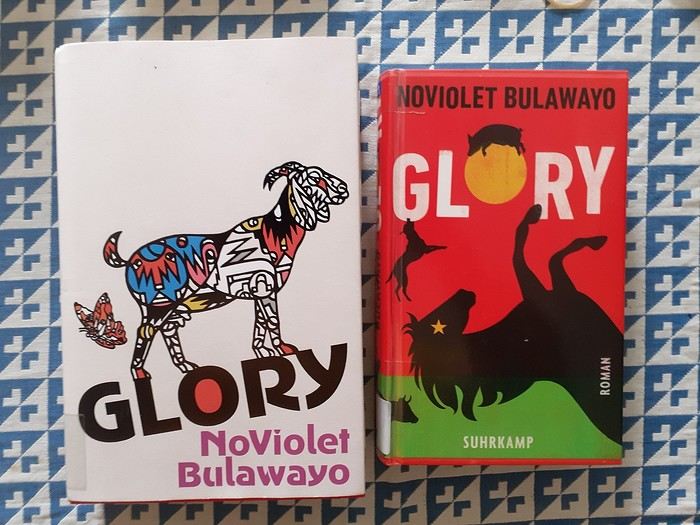 The books (in English, in German)
 Author NoViolet Bulawayo, Zimbabwe
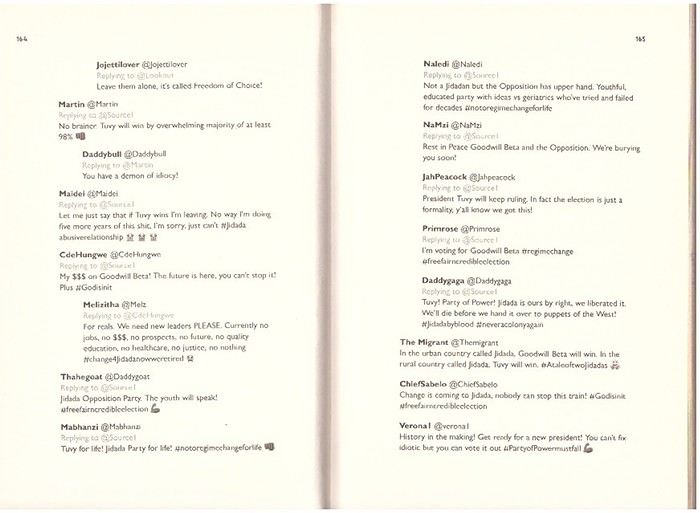 Threads (p.164-165)
"Bulawayo leans into exaggeration and irony to tell hard truths. *Glory* is jam-packed with comedy and farce, poking fun at an autocratic regime while illustrating the absurdity and surreal nature of a police state." — The Guardian
The cruelty and savagery of Zimbabwe’s (and Africa’s in general) "powerful animals"
Zimbabwean author NoViolet Bulawayo has written a novel that illustrates better than any documentary the complexity of colonial legacy. In doing so, she revisits George Orwell’s Animal Farm. Her novel *Glory* is a political satire about Zimbabwe—and it’s brimming with humor.
For thirty years, Zimbabwe has been stagnating under Robert Mugabe’s presidency. Human rights violations, corruption, and international sanctions have kept the population mired in poverty and oppression, while the regime exploits the meager earnings of the economy. As the 2017 elections approach, a power struggle erupts over the succession of the very elderly Father of the Nation (Mugabe). On the streets, people hope for long-awaited reforms; the people feel their moment has come.
And indeed, the army ousts Mugabe and his wife—"with her Gucci heels" (p.32)—who was positioning herself for the presidency. Hopes are dashed, however. The generals install former vice-president Emmerson Mnangagwa in power; the regime merely changes faces, but the problems remain the same.
In the novel, the country is called "Jidada, with a -da and another -da" (p.1); there’s no mistaking that this fictional state is Zimbabwe.
For *Glory*, her second novel, NoViolet Bulawayo invents a whole series of codes whose strength lies precisely in how easy they are to decipher. Like George Orwell’s Animal Farm, the characters populating Bulawayo’s universe aren’t humans but horses, goats, or crocodiles with all-too-human traits. Mugabe and Mnangagwa are horses, the spiritual leader is a pig, the soldiers are all bloodthirsty dogs, while the populace consists of goats, chickens, donkeys, and cats. The shift to the animal world serves only to better grasp the laws of despotism—and to ridicule real-life models. On one hand, the animals are humanized: they tweet, torture, travel in private jets. On the other, their greed, stupidity, and brutality stem from their animal nature.
It’s the old trick of fable: dressing men in animal disguises to make them easier to recognize. That’s how Orwell, in Animal Farm, traced how the promise of liberation from the Russian Revolution turned into Stalinist terror. In his 1945 fable, George Orwell describes how the animals of a farm drive out their farmer to organize the exploitation themselves, collectively. For a time, they truly taste freedom, but a clique of pigs ends up taking control. The central figures of the Soviet story—Stalin, Trotsky, Molotov—were easily recognizable.
Yet Bulawayo departs sharply from Orwell. She’s less concerned with precision and the force of argument than with satirical exaggeration. The deposed president is a senile old man who believes he can control even the sun’s course. The new stallion in power is a greedy debaucher. His soldiers sniff respectfully at his tail and backside.
In Bulawayo’s *Glory*, things are more complicated, but her novel also tells of a failed, incomplete liberation. In the author’s Animal Farm, Jidada, the colonial exploiters are followed by new forms of oppression. Because the former liberators become tyrants themselves. And because global power dynamics persist in neocolonial structures.
Wouldn’t that be enough to fuel a deeply depressing narrative? No—Bulawayo turns it into a blazing satire, full of wit and uncompromising criticism of power, a thread running through contemporary (not just) Zimbabwean history. The old warhorses in NoViolet Bulawayo’s Jidada, who continue to act as pack leaders, are easily recognizable as caricatures of the longtime dictator Robert Mugabe and his successor, current president Emmerson Mnangagwa.
The plot kicks off in high gear with independence day festivities. From the crack of dawn, everyone waits on Jidada Square for the Old Horse, the Father of the Nation and former liberator, whose reign "was nearing all of—not one, not two, not three, but four solid decades" (p.1). Everywhere, the colors of the Jidada Party shine; everywhere, true supporters cheer. Even the scorching sun plays its part: "At this point the sun, upon seeing arrive the leader who was decreed by God himself to rule and rule and keep ruling, a leader who'd in turn decreed the very sun to head his cheerleading squad, took a deep, deep breath and thoroughly blazed to impress" (p.2).
Finally, the Old Horse’s luxury carriage approaches "with the slowness of a hearse" (p.2), and "hoping to catch a glimpse of the legendary Father of the Nation," which causes "the animals fell over themselves like intoxicated frogs" (p.2). The sovereign’s speech is delayed a moment longer: "what I really want is a nap," groans the Old Horse as he takes his seat with such care "like his backside was made of expensive porcelain" (p.6).
Meanwhile, Bulawayo parades his entourage: the president’s wife (who earns her doctorate at Jidada University faster than "you could say diss, for dissertation. Tholukuthi it was as easy as ordering from a KFC drive-through, or perhaps even easier being that it was cheaper than KFC; it in fact cost her nothing and the degree actually came with a zero-calorie Diet Coke and a purple straw" (p.41), and she’s now known as Dr Sweet Mother. The cabinet includes "the Minister of the Revolution, the Minister of Corruption, the Minister of Order, the Minister of Things, the Minister of Nothing, the Minister of Propaganda, the Minister of Homophobic Affairs, the Minister of Disinformation and the Minister of Looting" (p.9). And of course the vice-president, who will soon become interim president when the Old Horse finally kicks the bucket—and then settle in as the new long-term president, who in the novel is called Tuvius Delight Shasha, or "Tuvy" for short (p.253), none other than Emmerson Mnangagwa. It’s him Bulawayo reserves her most merciless character description for.
"New Dispensation" (p.109) is Tuvy’s slogan for Jidada, and he loves repeating it so much he even named his parrot after it ("So inspired was Tuvy by the realisation that he rechristened his new pet parrot with the name New Dispensation—tholukuthi the bird having been acquired explicitly for the purposes of tweeting eulogies and accordingly glorifying the Saviour throughout the airs and skies of the nation. Tuvy then went on to hire a lecturer in English from the University of Jidada to teach New Dispensation to say the phrase 'New Dispensation'" p.110). But Tuvy’s Zimbabwe remains a nation without free, fair, and credible elections ("#freefairncredibleelection" p.161), and the promised equal treatment applies only insofar as Zimbabweans now queue up without discrimination in endless lines—and everyone is as poor as the next in the "queuenation" (p.283). Except for the powerful. They can "yes, tholukuthi, her immeasurable riches theirs to take. And take they did—
just take—take—take—take—take—take—take—take—take—take—take—take—take—take—take—take—take—take—take—take—take—take—take—take—take—take—take" (p.249-250).
In short: Bulawayo brilliantly depicts how former independence fighters become exploiters themselves. And how the country threatens to suffocate under the weight of corruption and repression. But she also literally stages the polyphony with which the people oppose imposed obedience to the official line.
Controversial online discussions keep interrupting the narrative—dialogues and social threads (see photo below) that Bulawayo masterfully integrates. From a literary standpoint, it’s a brilliant idea. And it shows, above all, that the author’s sympathy—so likeable—goes to all those who refuse to let their dream of true freedom be stolen, not even by the corrupt elites of their own country.
In the book’s acknowledgments, the first tribute goes to "The Jidadas of the world, clamouring for freedom on many fronts—A luta continua." (p.401) This reflects the realization that, not only in Jidada-Zimbabwe but in many other corners of the world, the end of colonial domination is still far from meaning the freedom hoped for by the vast majority of people. But it also means, more broadly, that this freedom must be won "on many fronts" (see above), both domestically and geopolitically.
That’s precisely what *Glory* so vividly highlights: how complex the project behind the term "postcolonialism" really is. With *Glory*, Bulawayo also delivers a scathing critique of the persistence of colonial mindsets in the West.
In the novel, the murder of George Floyd, racist police violence, and white-supremacist ideology in Trump’s United States perfectly illustrate the persistence of racism. It’s especially in the final chapters that Bulawayo lets Jidada’s inhabitants explicitly and unflinchingly criticize a neocolonial world order:
"It was not lost on us how the West, which loved to 'save' Africa and announce every action to the whole world, did so with one limb while manipulating, looting and fleecing us with the rest of its limbs so that more money in fact poured out of the continent than trickled in." (p.376)
"It was no mistake that multinational corporations yearly reaped and shipped colossal profits from Africa back to their countries as had been the case during colonial times. Even the sticks and stones would tell you that the African earth at any given time howled and shook and heaved from the extraction of its precious minerals that rarely benefited its own miserable children." (p.376)
"(...) we vowed to wage yet another war for Africa's second Liberation from neocolonial oppression. From exploitation. From plunder. From Western dominion. From indignity. From Abuse. We wanted real freedom. We wanted greedy, thieving paws off our wealth. We wanted Justice. We wanted a new world; we wanted a brand-new world so much we didn't sleep a wink that night." (p.377)
The Jidadas of this world must fight two enemies: Western neocolonialism and the autocratic instrumentalization of that argument; the persistence of Western racism and the populist appropriation of that humiliation by tyrants from their own ranks. Neither of these obstacles to freedom diminishes the historical and current guilt of the other. But the path to postcolonial liberation must overcome all these forms of oppression. After all, the colonizers didn’t bequeath democracies to formerly dominated nations, but instability and the principles of oppression and exploitation—which the so-called liberators have also internalized. Yet the fact that a satirical novel can capture the complexity of historical relationships while remaining, despite all the darkness of the subject, hilarious—well, that’s truly astonishing.
Finally, *Glory* ties into a major trauma in Zimbabwe’s post-independence history: the so-called Gukurahundi massacres. Between 1983 and 1987, tens of thousands of civilians were murdered by Mugabe’s bloody henchmen, most of them Ndebele. The State Security Minister and head of secret services at the time? You guessed it—Emmerson Mnangagwa.
When *Glory* turns to the massacres, the novel’s tone shifts completely. The story is now told through the narrative of the goat called Destiny, who, like NoViolet Bulawayo herself, left her home country at 18 for the United States and only returned after 13 years. In the book, the city of Bulawayo becomes a village where Destiny retraces her family’s history—and learns that part of it was also brutally murdered during the massacres.
The abuse of power and life under a dictatorship, dispossession, and a fiercely proud awareness of the psychological wounds and emotional vulnerability of a uprooted and disenfranchised people who had to forge a new language—a new set of names—to express their lived experiences are at the heart of this wonderful Zimbabwean author’s literary work, NoViolet Bulawayo. Shortly after her studies, she was already writing short stories about postcolonial power dynamics in Africa. But her playful, masterful, and often unconventional approach to language also plays a key role in her work. With virtuosity, she shifts from cynical images of power-obsessed elites to compassionate descriptions of the people’s suffering, ending with a hopeful sermon on courage—the courage to break free from fear and thus gain the strength for change ("And every one of them understood that whatever they heard within those hearts was the new national anthem, tholukuthi an anthem that spoke of the kind of glory that burns eternal and glows with living light." p.400). This novel is a genuine pleasure to read. And it’s exceptional. Good, African...
Book info (original English and German translation):
NoViolet Bulawayo. Glory. Chatto & Windus, 2022. NoViolet Bulawayo. Glory. Suhrkamp, 2023.
Hery
The books (in English, in German)
Author NoViolet Bulawayo, Zimbabwe
Threads (p.164-165)