Results for "Natal+|+4+>+126"
4730 results found.
Les tribulations d'un Vfestiste en Chine English translation pending
Bonsoir a tous ...
Ici en France il est 00h15 ..., je suis à 19h heure de mon décollage et je vient enfin de finir mes bagages ....
19 kg pour le bagage en soute et 12 kg pour le bagage a main, et mois qui aime vayagé legé, ... bon en même temps je part pour 6 mois et j'enmène mon matos sportif (escrime et ouais sa pèse ...)😄😄😄
Je vient de finir une petite fête avec mes parents et un pote de toujours et je suis dans un état proche de l'apesentheur ..., mais sa fait du bien, sa permet de vidé la tête ...
Shanghai ma parrut si loin pendant tant de mois et elle me parait si proche tous d'un coup, trop proche ?, l'histoire et mes postes le diront ...
Bon ce poste est juste pour commencer un file qui je l'éspère me suivra pendant mes périgrinations des 6 prochains moi (et ouais je vais pas me passé de VF ...)
Sa commence demain avec la première (?) rencontre VF organisé dans un avion avec le membre Kelaer !!!, ouais tant cas faire, j'aime rien faire comme les autres ... !!! 😏😏
Merci a tous ceux qui mon encouragé et aider a préparer ce voyage, notament Francois, SylvieF, Walinette, Nawal, EspritZen, Fabricia, Simba, Parva, Sandrine, Juju, n Loopkin, Béné et Alan (et tous les autres ...)
Mon prochain post sera soit de roissy soit de Shanghai ... !!! c'est partie pour de nouvelles aventure, j'ai un mélanges de sentiment dans la tête c'est pourtant pas la première fois que je part, mais dans ces conditions si ..., il vont rien comprendre a ce que je vais leurs dires ces pauvres chinois ..., alors en plus quand je vais leurs expliquer qu'il me faut une connection internet par ce que je suis accro à VF ....
Pleins de gros bisous à tous ...
Philo
Ici en France il est 00h15 ..., je suis à 19h heure de mon décollage et je vient enfin de finir mes bagages ....
19 kg pour le bagage en soute et 12 kg pour le bagage a main, et mois qui aime vayagé legé, ... bon en même temps je part pour 6 mois et j'enmène mon matos sportif (escrime et ouais sa pèse ...)😄😄😄
Je vient de finir une petite fête avec mes parents et un pote de toujours et je suis dans un état proche de l'apesentheur ..., mais sa fait du bien, sa permet de vidé la tête ...
Shanghai ma parrut si loin pendant tant de mois et elle me parait si proche tous d'un coup, trop proche ?, l'histoire et mes postes le diront ...
Bon ce poste est juste pour commencer un file qui je l'éspère me suivra pendant mes périgrinations des 6 prochains moi (et ouais je vais pas me passé de VF ...)
Sa commence demain avec la première (?) rencontre VF organisé dans un avion avec le membre Kelaer !!!, ouais tant cas faire, j'aime rien faire comme les autres ... !!! 😏😏
Merci a tous ceux qui mon encouragé et aider a préparer ce voyage, notament Francois, SylvieF, Walinette, Nawal, EspritZen, Fabricia, Simba, Parva, Sandrine, Juju, n Loopkin, Béné et Alan (et tous les autres ...)
Mon prochain post sera soit de roissy soit de Shanghai ... !!! c'est partie pour de nouvelles aventure, j'ai un mélanges de sentiment dans la tête c'est pourtant pas la première fois que je part, mais dans ces conditions si ..., il vont rien comprendre a ce que je vais leurs dires ces pauvres chinois ..., alors en plus quand je vais leurs expliquer qu'il me faut une connection internet par ce que je suis accro à VF ....
Pleins de gros bisous à tous ...
Philo
Faut-il signer son passeport? English translation pending
Bonjour,
j'ai signé dans la case "signature du titulaire". Mais je me suis rendu compte qu'il y marqué "page reservée aux autoritées comptétentes".
Ais-je fait une boulette ?😮
j'ai signé dans la case "signature du titulaire". Mais je me suis rendu compte qu'il y marqué "page reservée aux autoritées comptétentes".
Ais-je fait une boulette ?😮
Cours d'arabe dans le 78 ou 95? (France) English translation pending
Je souhaiterais prendre des cours d'arabe vers Poissy (78) ou Cergy (95). J'ai trouvé des associations à Paris mais ça me fait trop loin et je me suis renseignée auprès d'organismes de cours mais ça coûte une fortune (3000 € pour une heure par semaine !). Si vous connaissez quelqu'un qui donne des cours à prix raisonnable dans ces environs, please, contactez-moi !
Le fado à Porto (Portugal) English translation pending
bonjhour a tous,
je pars a porto dans deux semaines et je compte rester dans la region du nord du portugal. Mais qui dit portugal dit bien sur fado et j'aurai aimé assister a une représentation de fado a porto. Quelqu'un peut il m'indiquer les meilleurs coins a porto pour aller ecouter du fado???
merci d'avance
je pars a porto dans deux semaines et je compte rester dans la region du nord du portugal. Mais qui dit portugal dit bien sur fado et j'aurai aimé assister a une représentation de fado a porto. Quelqu'un peut il m'indiquer les meilleurs coins a porto pour aller ecouter du fado???
merci d'avance
20 ans d'images English translation pending
😉20 ans d'images est un ouvrage édité par GEO aux éditions SOLAR.
DEs photos admirables pour montrer comment les hommes voyagent, prennent conscience de leur environnement, sauvegarde le patrimoine, construisent l'avenir, des photos pleines de joies et de misère aussi sur notre planète et ceux qui l'habitent, 200 pages qui donnent envie de partir aussitôt.
Une attention particulière est accordée à l'environnement, l'écologie et la protection de la faune menacée. --
on me l'a offert, j'ai pleuré...
DEs photos admirables pour montrer comment les hommes voyagent, prennent conscience de leur environnement, sauvegarde le patrimoine, construisent l'avenir, des photos pleines de joies et de misère aussi sur notre planète et ceux qui l'habitent, 200 pages qui donnent envie de partir aussitôt.
Une attention particulière est accordée à l'environnement, l'écologie et la protection de la faune menacée. --
on me l'a offert, j'ai pleuré...
Les plus belles Eglises et Cathédrales! English translation pending
... Puisque les sondages sont à la mode sur VF, je me lance !!!
Quels sont vos plus beaux souvenirs d' Eglises ou de Cathédrales de par le monde. Les Mosquées, Synagogues et Temples, sont bienvenues aussi of course !!!
Pour moi, la plus petite et la plus secrète : En plein coeur du Begijnhof à Amsterdam, l'Eglise catholique clandestine, installée dans 2 résidences privées. Elle abrita des reliques du Miracle d'Amsterdam.
Nawal auréolée .
.
Quels sont vos plus beaux souvenirs d' Eglises ou de Cathédrales de par le monde. Les Mosquées, Synagogues et Temples, sont bienvenues aussi of course !!!
Pour moi, la plus petite et la plus secrète : En plein coeur du Begijnhof à Amsterdam, l'Eglise catholique clandestine, installée dans 2 résidences privées. Elle abrita des reliques du Miracle d'Amsterdam.
Nawal auréolée
.Qui a la plus belle photo sur son profil? English translation pending
à part moi bien evidemment 😛
Le Rocher d'OR à KYAIKHTIYO en Birmanie 🙂
Le Rocher d'OR à KYAIKHTIYO en Birmanie 🙂
Voyage autour des 5 sens English translation pending
Les 5 sens:
L'ouïe😏
Le toucher😊
Le goût😛
L'odorat😄
La vue🙂
Pour chacun d'eux, quels sont vos plus forts souvenirs de voyage?
L'ouïe😏
Le toucher😊
Le goût😛
L'odorat😄
La vue🙂
Pour chacun d'eux, quels sont vos plus forts souvenirs de voyage?
Russe pour les nuls English translation pending
Hello,
Dans le cadre de mon TDM il parrait innévitable d'apprendre cette langue, d'après vous afin de baraguinée un minimum vital voir un peut plus combien faut il de temps et outre les cours de langues (ce que j'envisage), est ce qu'une méthode de type assimil suffit ???
Merci d'avance ...
Philo
Dans le cadre de mon TDM il parrait innévitable d'apprendre cette langue, d'après vous afin de baraguinée un minimum vital voir un peut plus combien faut il de temps et outre les cours de langues (ce que j'envisage), est ce qu'une méthode de type assimil suffit ???
Merci d'avance ...
Philo
Les Jardins d'Allah English translation pending
"Les Jardins d'Allah", recueil * de quatorze nouvelles écrites par Sylvain TESSON, "géographe arpenteur du vaste monde", compagnon d'aventures d'Alexandre Poussin.
De très jolis textes ironiques, tendres ou malicieux. Plume élégante, humour, dérision... En faire son livre de chevet pour rêver un peu avant de s'endormir...
J'ai infiniment aimé cet ouvrage.
* Editions PHEBUS
De très jolis textes ironiques, tendres ou malicieux. Plume élégante, humour, dérision... En faire son livre de chevet pour rêver un peu avant de s'endormir...
J'ai infiniment aimé cet ouvrage.
* Editions PHEBUS
Tous derrière? English translation pending
Coucou,
Je ne sais pas s'il y a un endroit pour un tel message.
C'est un évènement (pour moi) : je vais passer mon partiel sur les religions du monde Indien à 14h. Faites une petite demande à Ganesh pour moi !
Dhanyavâd !
Je ne sais pas s'il y a un endroit pour un tel message.
C'est un évènement (pour moi) : je vais passer mon partiel sur les religions du monde Indien à 14h. Faites une petite demande à Ganesh pour moi !
Dhanyavâd !
Epaves en Namibie English translation pending
Peut-on voir facilement des épaves de bateaux le long de la côte des squelettes ?
Ces épaves sont-elles facilement accessibles avec un véhicules à 2 roues motrices ?
Ces épaves sont-elles facilement accessibles avec un véhicules à 2 roues motrices ?
Location de résidence à Cuba English translation pending
En Mars 2003 moi et ma conjointe avons passé une semaine tout inclus a l'hotel Villa Cuba de Varadéro. J'aimerais loué une résidence comme second voyage a Cuba. Par hazard ma cojointe a rencontré un québécois sur la plage qui est propriétaire d'une cantine au Québec. Il passe six mois a Trinidad. Il loue une résidence avec service femme de ménage. Le hic je n'ai pas les coordonnés de cette personne. Si quelqu'un a des coordonné d'endroit de location. Peu importe la localité. Je suis ouvert a vos suggestion. Merci
Shang😎
Shang😎
Bavaro Princess Punta Cana English translation pending
Bonjour,
Nous partons en voyage de noces au Bavaro Princess à Punta Cana du 12 au 26 juillet 2004.
J'aimerais simplement savoir si cet hötel est un bon choix ?
J'aimerais savoir aussi si il y a des moustiques en juillet, et comment est le temps question averses, orages etc ..
Au sujet du passeport, en faut-il un ou non ? Dans d'autres messages sur ce forum, les avis n'étaient pas partagés, mais peut-être est-ce dû au pays d'origine du voyageur ?
Et la mer à cet endroit la, est elle calme sans vague, ou plûtot agitée ?
Si quelqu'un pourrait me décrire ses expériences, j'en serais ravie. Merci !
Nath. 🙂
Nous partons en voyage de noces au Bavaro Princess à Punta Cana du 12 au 26 juillet 2004.
J'aimerais simplement savoir si cet hötel est un bon choix ?
J'aimerais savoir aussi si il y a des moustiques en juillet, et comment est le temps question averses, orages etc ..
Au sujet du passeport, en faut-il un ou non ? Dans d'autres messages sur ce forum, les avis n'étaient pas partagés, mais peut-être est-ce dû au pays d'origine du voyageur ?
Et la mer à cet endroit la, est elle calme sans vague, ou plûtot agitée ?
Si quelqu'un pourrait me décrire ses expériences, j'en serais ravie. Merci !
Nath. 🙂
Voyage au Vietnam en mai-juin 2004 English translation pending
Bonjour à tous,
Je viens de m'inscire et j'aurai aimé un peu d'infos sur un voyage que j'envisage de faire au Vietnam au mois de mai 2004 (je pars avec ma mère qui va retourner dans son pays pour la 1ère fois depuis qu'elle y est née, c'est donc un pélerinage car elle en est partie à l'âge de 3 ans !!!!).
Tout d'abord, j'ai un budget de 2000 euros pour 3 semaines par personne. Ce que nous voulons faire c'est visiter le pays du nord au sud et rester 1 semaine à Phan Thiet sa ville natale ou il y a encore de la famille... J'ai trouvé un circuit de 16 jours + 5 jours d'extension à Phan Thiet pour 2050 euros tout compris sur le site internet www.amisvoyages.com (spécialiste de l'Asie), quelqu'un les connait il ? ils sont basés dans le 13ème à Paris. Il y a également www.afatvoyages.fr qui fait un circuit quasi identique... sinon, comme je l'ai lu sur ce forum, cela à l'air assez facile de prendre le vol sec et le circuit sur place, est-ce qu'on économise beaucoup par ce principe et ne perd t'on pas trop de temps à courrir les agences sur place ? Hanoi me semble être une grande ville...
Je suis assez pressée et excitée d'organiser tout ça car c'est la première fois que j'organise un aussi grand voyage à long terme, je suis plutôt du genre à partir au dernier moment avec internet d'habitudes... et j'aimerai tant ne pas être déçue, surtout pour ma mère... Pouvez-vous me donner des conseils sur ce voyage ?
merci d'avançe
Je viens de m'inscire et j'aurai aimé un peu d'infos sur un voyage que j'envisage de faire au Vietnam au mois de mai 2004 (je pars avec ma mère qui va retourner dans son pays pour la 1ère fois depuis qu'elle y est née, c'est donc un pélerinage car elle en est partie à l'âge de 3 ans !!!!).
Tout d'abord, j'ai un budget de 2000 euros pour 3 semaines par personne. Ce que nous voulons faire c'est visiter le pays du nord au sud et rester 1 semaine à Phan Thiet sa ville natale ou il y a encore de la famille... J'ai trouvé un circuit de 16 jours + 5 jours d'extension à Phan Thiet pour 2050 euros tout compris sur le site internet www.amisvoyages.com (spécialiste de l'Asie), quelqu'un les connait il ? ils sont basés dans le 13ème à Paris. Il y a également www.afatvoyages.fr qui fait un circuit quasi identique... sinon, comme je l'ai lu sur ce forum, cela à l'air assez facile de prendre le vol sec et le circuit sur place, est-ce qu'on économise beaucoup par ce principe et ne perd t'on pas trop de temps à courrir les agences sur place ? Hanoi me semble être une grande ville...
Je suis assez pressée et excitée d'organiser tout ça car c'est la première fois que j'organise un aussi grand voyage à long terme, je suis plutôt du genre à partir au dernier moment avec internet d'habitudes... et j'aimerai tant ne pas être déçue, surtout pour ma mère... Pouvez-vous me donner des conseils sur ce voyage ?
merci d'avançe
Soupe au potiron thaïlandaise English translation pending
Recette de saison, facile et délicieuse.
POTAGE DE POTIRON A LA THAILANDAISE Ingrédients pour 4 personnes : 500 à 750g de chair de potiron 3 échalotes 1 cube de bouillon de poule 1 boîte de 400ml de lait de coco 1/2 c. à café de pâte de crevettes fermentées 1 c. à soupe de jus de citron sel, poivre, piment Faire cuire le potiron 10 minutes dans le bouillon de poule dilué dans ½ litre d'eau avec les échalotes hachées, la pâte de crevettes, le piment, le sel et le poivre. Ajouter le lait de coco et le jus de citron et faire cuire à feu très doux (le lait de coco n'aime pas bouillir) pendant 15 à 20 minutes. Passer la soupe au mixeur. Rectifier l'assaisonnement. Parsemez de coriandre fraîche avant de servir (facultatif, mais joli). Régalez vous.
POTAGE DE POTIRON A LA THAILANDAISE Ingrédients pour 4 personnes : 500 à 750g de chair de potiron 3 échalotes 1 cube de bouillon de poule 1 boîte de 400ml de lait de coco 1/2 c. à café de pâte de crevettes fermentées 1 c. à soupe de jus de citron sel, poivre, piment Faire cuire le potiron 10 minutes dans le bouillon de poule dilué dans ½ litre d'eau avec les échalotes hachées, la pâte de crevettes, le piment, le sel et le poivre. Ajouter le lait de coco et le jus de citron et faire cuire à feu très doux (le lait de coco n'aime pas bouillir) pendant 15 à 20 minutes. Passer la soupe au mixeur. Rectifier l'assaisonnement. Parsemez de coriandre fraîche avant de servir (facultatif, mais joli). Régalez vous.
Quoi voir au Portugal? English translation pending
Bonjour,
J'envisage de partir au portugal fin juin 2003 pour 10 jours. Si quelqu'un pouvait me conseiller sur les villes qu'il faut voir absolument et me faire profiter de ses expériences à travers ce pays. Merci d'avance
J'envisage de partir au portugal fin juin 2003 pour 10 jours. Si quelqu'un pouvait me conseiller sur les villes qu'il faut voir absolument et me faire profiter de ses expériences à travers ce pays. Merci d'avance
Quel état des USA choisir? English translation pending
Hello tout le monde!
Je vais faire un séjour linguistique aux States au mois de juillet prochain...on me propose plusieurs destinations du type : Virginie, Pennsylvanie, Delaware, Maryland...je sais que ce ne sont pas de très grands lieux touristiques, mais c'est justement ce qui m'intéresse...j'ai plutôt envie de m'intéresser aux autochtones et aux paysages plutôt qu'aux touristes européens et japonais! Toute info sur ces différents états me sera très précieuse (visites, accueil des américains, activités sur place...)!
Merci d'avance pour tout vos renseignements!
@ + 😉
Je vais faire un séjour linguistique aux States au mois de juillet prochain...on me propose plusieurs destinations du type : Virginie, Pennsylvanie, Delaware, Maryland...je sais que ce ne sont pas de très grands lieux touristiques, mais c'est justement ce qui m'intéresse...j'ai plutôt envie de m'intéresser aux autochtones et aux paysages plutôt qu'aux touristes européens et japonais! Toute info sur ces différents états me sera très précieuse (visites, accueil des américains, activités sur place...)!
Merci d'avance pour tout vos renseignements!
@ + 😉
Camping recommendations in Cape Town and around
Hi there,
We’ll be traveling in January 2027 in a 4x4 with a rooftop tent with our three kids, from Johannesburg to Cape Town. We’ve already booked several campsites in national parks (Golden Gate / Mountain Zebra / Addo Elephant / Garden Route).
We still need to reserve the stretch between De Hoop Nature Reserve and Cape Town. Any suggestions?
We’d love to stay around Cape Town for 5 days to explore the wine route, the peninsula, and do some hikes in Table Mountain.
Any camping recommendations? Or, on the contrary, places to avoid?
Also, we have 2 nights left near Wilderness National Park / Knysna. Any recommendations? Thanks so much for your help!
Also, we have 2 nights left near Wilderness National Park / Knysna. Any recommendations? Thanks so much for your help!
Seeking testimonials from Pieds-Noirs who recently returned to Algeria
Hello,
I’m looking for testimonials from Pieds-Noirs who have recently returned to Algeria.
There can’t be many left after 65 years of the country’s independence.
I’m planning to go back myself soon to reconnect with my roots... before I pass away...
I’ve started making a few pre-bookings for hotels and apartments to rent in Algiers. At first, I received friendly and welcoming responses. Then, when I mentioned I wanted to stay for two or three weeks—maybe even a month—explaining that my trip wouldn’t be strictly touristy but more of a pilgrimage to the places of my childhood, and that it would likely be a very emotional journey, I expected a positive and warm reaction to my approach. Instead, I suddenly stopped getting replies from the three or four people I’d contacted. So now I’m wondering about the reception former Pieds-Noirs can expect...
Anyone here who can share their experience of returning? I specified “recently” because it seems that right now, diplomatic relations between the two governments are extremely tense, not to say hostile... even if Macron claims otherwise...
There can’t be many left after 65 years of the country’s independence.
I’m planning to go back myself soon to reconnect with my roots... before I pass away...
I’ve started making a few pre-bookings for hotels and apartments to rent in Algiers. At first, I received friendly and welcoming responses. Then, when I mentioned I wanted to stay for two or three weeks—maybe even a month—explaining that my trip wouldn’t be strictly touristy but more of a pilgrimage to the places of my childhood, and that it would likely be a very emotional journey, I expected a positive and warm reaction to my approach. Instead, I suddenly stopped getting replies from the three or four people I’d contacted. So now I’m wondering about the reception former Pieds-Noirs can expect...
Anyone here who can share their experience of returning? I specified “recently” because it seems that right now, diplomatic relations between the two governments are extremely tense, not to say hostile... even if Macron claims otherwise...
Single Russia-Belarus visa and new train routes
Since last year, the unification of the Russian visa with Belarus has been in effect.
For reference, EU citizens haven’t needed a visa for Belarus for two years. However, it wasn’t possible to travel to Russia. Only Belarusian and Russian citizens could move freely within the union.
With the unified system, if you enter one of the two countries with a visa from either, you can now travel between them freely.
In the case of a Russian visa, it must be a paper visa glued into your passport—not an electronic visa.
This opens up the possibility of traveling to Russia from Lithuania via Minsk, for example, starting from Vilnius.
It also allows for travel circuits that would otherwise be difficult, despite the proximity of the cities.
So, I’m leaving on June 12th for Vilnius. A one-hour flight for around thirty euros with a carry-on bag, and from Vilnius Airport, there’s a bus to Minsk. My planned route for now is Vilnius-Minsk-Smolensk-Vitebsk-Polotsk-Pskov-Riga.
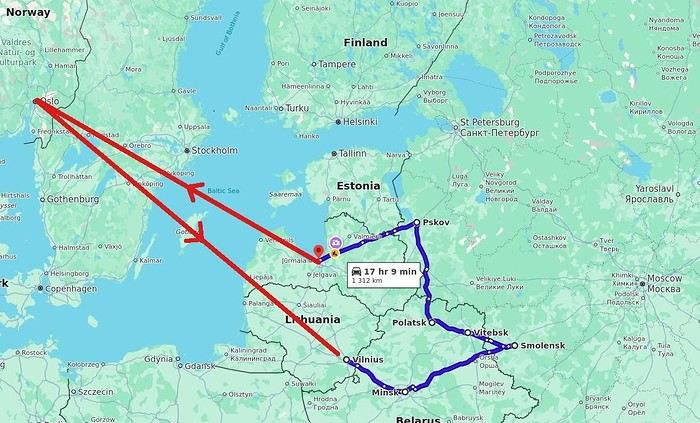
This crosses the Belarus-Russia border three times: from Minsk to Smolensk, then from Smolensk to Vitebsk, and finally from Polotsk to Pskov.
The region of this itinerary was, a thousand years ago, essentially that of the Krivichs, a local Slavic political entity. The term comes from "blood," *krew* in Polish, *krov* in Russian—basically "blood brothers." In Latvian, the word for Russians is *krievu*, by the way. Historically, the region corresponds to some of the old Russian principalities. Later, what marks Belarusian regions in general is, after the Great Schism of 1054, the division between Catholic and Orthodox zones, particularly as the Polish-Lithuanian Commonwealth expanded and contracted. In architecture, this corresponds to variations in Baroque styles, for example.
Vitebsk is known in France as the birthplace of Chagall. Born Russian, he first trained at the art school in Vitebsk, which was also attended by Malevich and Lissitzky, before completing his studies in Saint Petersburg, then moving to Berlin and later Paris. In Paris, Chagall met Cendrars, who had spent three years in Russia before and spoke enough Russian to help the newcomer get by a bit.
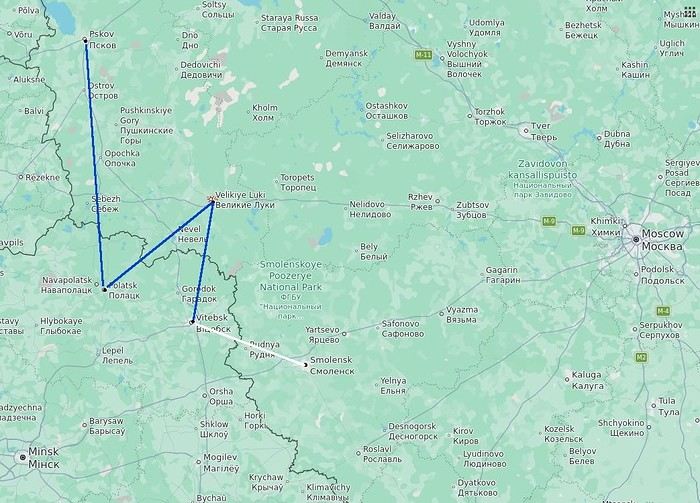
Back to the practical travel aspects: a local Pskov newspaper mentions that the Russian and Belarusian governments have a project for a Pskov-Polotsk train line. Previously, there were also plans for lines between Veliky Luki and Vitebsk, and Polotsk. A recently launched railway is Smolensk-Vitebsk, shown in white on the map, with projected lines in blue. https://pln-pskov.ru/society/583817.html https://pln-pskov.ru/society/578335.html
These will likely be "Hirondelle"—that is, *Lastochka*—the fast, spacious regional trains in Russia. Currently, all of this is done by bus, so the train is a very appealing and comfortable option. We’ll see how it goes.
With the unified system, if you enter one of the two countries with a visa from either, you can now travel between them freely.
In the case of a Russian visa, it must be a paper visa glued into your passport—not an electronic visa.
This opens up the possibility of traveling to Russia from Lithuania via Minsk, for example, starting from Vilnius.
It also allows for travel circuits that would otherwise be difficult, despite the proximity of the cities.
So, I’m leaving on June 12th for Vilnius. A one-hour flight for around thirty euros with a carry-on bag, and from Vilnius Airport, there’s a bus to Minsk. My planned route for now is Vilnius-Minsk-Smolensk-Vitebsk-Polotsk-Pskov-Riga.
This crosses the Belarus-Russia border three times: from Minsk to Smolensk, then from Smolensk to Vitebsk, and finally from Polotsk to Pskov.
The region of this itinerary was, a thousand years ago, essentially that of the Krivichs, a local Slavic political entity. The term comes from "blood," *krew* in Polish, *krov* in Russian—basically "blood brothers." In Latvian, the word for Russians is *krievu*, by the way. Historically, the region corresponds to some of the old Russian principalities. Later, what marks Belarusian regions in general is, after the Great Schism of 1054, the division between Catholic and Orthodox zones, particularly as the Polish-Lithuanian Commonwealth expanded and contracted. In architecture, this corresponds to variations in Baroque styles, for example.
Vitebsk is known in France as the birthplace of Chagall. Born Russian, he first trained at the art school in Vitebsk, which was also attended by Malevich and Lissitzky, before completing his studies in Saint Petersburg, then moving to Berlin and later Paris. In Paris, Chagall met Cendrars, who had spent three years in Russia before and spoke enough Russian to help the newcomer get by a bit.
Back to the practical travel aspects: a local Pskov newspaper mentions that the Russian and Belarusian governments have a project for a Pskov-Polotsk train line. Previously, there were also plans for lines between Veliky Luki and Vitebsk, and Polotsk. A recently launched railway is Smolensk-Vitebsk, shown in white on the map, with projected lines in blue. https://pln-pskov.ru/society/583817.html https://pln-pskov.ru/society/578335.html
These will likely be "Hirondelle"—that is, *Lastochka*—the fast, spacious regional trains in Russia. Currently, all of this is done by bus, so the train is a very appealing and comfortable option. We’ll see how it goes.
From Avignon to Casamance Without Flying
Hi there,
Last February, I made a trip using "public transport" from France to southern Senegal via Spain, Morocco, Western Sahara, and Mauritania.
It’s a journey of about 5,000 km, where I took trains (as far as Marrakech), ferries (to cross Gibraltar and then to reach Casamance from Dakar), and mostly buses on the long desert straightaways. I hadn’t planned any stops in advance or booked any hotels, except for the very first train to Spain, which left plenty of room for the unexpected. Why travel by land and sea? In recent years, flight-free travel has been gaining popularity. On social media, posts explaining how to cross Europe by train as quickly as possible go viral. Traveling without flying—and making sure people know about it—has become a great way to earn a badge of eco-responsibility: an essential totem for anyone wanting to prove both their dedication to the ecological cause and the wisdom of slow travel. I haven’t flown in years, and this journey to West Africa could easily be filed under "responsible travel." But it wouldn’t be honest to say that: in reality, it wasn’t really my aversion to flying that motivated this long trek. I see overland travel primarily as a way to experience the world’s geography at a grounded, earthly pace—the pace of the locals. Besides, I’ll be flying back, which disqualifies any claim to being a model of sustainability. So no eco-badge, and no adventurer’s badge either: you won’t find any heroic tales of camel rides in lost lands or mineral train wagons in this account (popular with influencers, the Mauritania iron ore train now attracts tourists from all over the world, turning "the experience" into something you "have to do at least once in your life"). This five-part story, written on the road, has no other ambition than to recount a journey through places and people, and to share the thoughts they inspire in me. As simply and, I hope, as humbly as possible.
I’m posting the episodes here, which you can also find on my blog (with more photos) at the following links:
Episode 1: Spain, from Avignon to Algeciras
Episode 2: Morocco, from Tangier to Tarfaya
Episode 3: Western Sahara, from Tarfaya to Guerguerat
Episode 4: Mauritania, from Guerguerat to Nouakchott
Episode 5: Senegal, from Rosso to Saloulou
To help those who might want to make the same trip, I’ve also put together a summary of the route with recommendations—you can read it at the end of the story and on the blog: From France to Senegal Without Flying: Route and Itinerary Recommendations
Happy reading, and safe travels!
Last February, I made a trip using "public transport" from France to southern Senegal via Spain, Morocco, Western Sahara, and Mauritania.
It’s a journey of about 5,000 km, where I took trains (as far as Marrakech), ferries (to cross Gibraltar and then to reach Casamance from Dakar), and mostly buses on the long desert straightaways. I hadn’t planned any stops in advance or booked any hotels, except for the very first train to Spain, which left plenty of room for the unexpected. Why travel by land and sea? In recent years, flight-free travel has been gaining popularity. On social media, posts explaining how to cross Europe by train as quickly as possible go viral. Traveling without flying—and making sure people know about it—has become a great way to earn a badge of eco-responsibility: an essential totem for anyone wanting to prove both their dedication to the ecological cause and the wisdom of slow travel. I haven’t flown in years, and this journey to West Africa could easily be filed under "responsible travel." But it wouldn’t be honest to say that: in reality, it wasn’t really my aversion to flying that motivated this long trek. I see overland travel primarily as a way to experience the world’s geography at a grounded, earthly pace—the pace of the locals. Besides, I’ll be flying back, which disqualifies any claim to being a model of sustainability. So no eco-badge, and no adventurer’s badge either: you won’t find any heroic tales of camel rides in lost lands or mineral train wagons in this account (popular with influencers, the Mauritania iron ore train now attracts tourists from all over the world, turning "the experience" into something you "have to do at least once in your life"). This five-part story, written on the road, has no other ambition than to recount a journey through places and people, and to share the thoughts they inspire in me. As simply and, I hope, as humbly as possible.
I’m posting the episodes here, which you can also find on my blog (with more photos) at the following links:
Episode 1: Spain, from Avignon to Algeciras
Episode 2: Morocco, from Tangier to Tarfaya
Episode 3: Western Sahara, from Tarfaya to Guerguerat
Episode 4: Mauritania, from Guerguerat to Nouakchott
Episode 5: Senegal, from Rosso to Saloulou
To help those who might want to make the same trip, I’ve also put together a summary of the route with recommendations—you can read it at the end of the story and on the blog: From France to Senegal Without Flying: Route and Itinerary Recommendations
Happy reading, and safe travels!
What are the best tips for accommodation, markets, and restaurants in Lisbon?
Hi everyone,
It’s been ages since I last dropped by here... maybe simply because, apart from Nepal, I haven’t really had the chance to hit the road lately. 😉
This year, I’d love to spend a few days in Lisbon, probably in late May or early June. But with my budget being what it is, I’m looking for great tips to avoid wasting time once I’m there and risk missing out on hidden gems or unusual culinary specialties and/or quirky activities! I’m hoping to find a room in a local’s home where I can stay in a quiet neighborhood near the center, so I can get around without relying too much on public transport—my walking shoes are my best travel buddies. I’d love all your recommendations, especially for parks, small neighborhood markets, casual eateries for a quick bite, your favorite viewpoints to soak in the scenery (I’m bringing my travel journal to sketch my getaway in watercolors), events around traditional art and crafts, and so on. All your advice will definitely help me travel peacefully and come back with my head full of vibrant memories! Thanks in advance, everyone! Isabelle
It’s been ages since I last dropped by here... maybe simply because, apart from Nepal, I haven’t really had the chance to hit the road lately. 😉
This year, I’d love to spend a few days in Lisbon, probably in late May or early June. But with my budget being what it is, I’m looking for great tips to avoid wasting time once I’m there and risk missing out on hidden gems or unusual culinary specialties and/or quirky activities! I’m hoping to find a room in a local’s home where I can stay in a quiet neighborhood near the center, so I can get around without relying too much on public transport—my walking shoes are my best travel buddies. I’d love all your recommendations, especially for parks, small neighborhood markets, casual eateries for a quick bite, your favorite viewpoints to soak in the scenery (I’m bringing my travel journal to sketch my getaway in watercolors), events around traditional art and crafts, and so on. All your advice will definitely help me travel peacefully and come back with my head full of vibrant memories! Thanks in advance, everyone! Isabelle
Munich to Venice by bike: what transport options for the return to France?
Hi there, we’re planning a Munich to Venice bike trip at the end of June 2026. Getting back from Venice to Toulouse by train with 4 bikes isn’t straightforward. What return options have others who’ve done this trip chosen? Any tips or great deals would be much appreciated. Thanks a bunch! !
Transfer from Maun to Kasane
Happy New Year 2026!
We’re planning a trip to Botswana.
Thanks in advance for your tips on getting from Maun to Kasane (or the other way around) by road (taxi or rental car) or by air.
Is it possible by road? If so, which route is best?
And by air, what do you think of Air Botswana? Mackair seems really expensive to us.
Best regards
Looking for feedback on bike touring in Central Asia
Hi everyone,
We’re planning to spend 5 months cycling as a family in Central Asia. To align with the weather, we’re thinking of arriving in Uzbekistan in April, heading toward the Ferghana Valley in late April/early May, and wrapping up with a long stretch in Kyrgyzstan from mid-May to early August.
I haven’t really dug into the third part (Kyrgyzstan) yet, but from what I’ve seen on the forum and online, cycling across Uzbekistan doesn’t seem all that appealing: long, straight desert stretches with lots of trucks.
Has anyone come across any "hidden gem" routes they’d be willing to share? I’ve already noted that it’s best to avoid riding toward Tashkent. I’m looking for routes between Bukhara and Samarkand, and any nearby areas that are nice for cycling.
I’d love to fly into Dushanbe to reach Samarkand, but we all agree that it’s not a good fit for the season (early April) if we’re cycling, right?
Thanks for your feedback! Ludo
I haven’t really dug into the third part (Kyrgyzstan) yet, but from what I’ve seen on the forum and online, cycling across Uzbekistan doesn’t seem all that appealing: long, straight desert stretches with lots of trucks.
Has anyone come across any "hidden gem" routes they’d be willing to share? I’ve already noted that it’s best to avoid riding toward Tashkent. I’m looking for routes between Bukhara and Samarkand, and any nearby areas that are nice for cycling.
I’d love to fly into Dushanbe to reach Samarkand, but we all agree that it’s not a good fit for the season (early April) if we’re cycling, right?
Thanks for your feedback! Ludo
11 unforgettable days in Oman
We visited the northern/northeast part of Oman, the most touristy area, last February over 11 days there. It’s a great time to go because the temperatures are pleasant and there aren’t too many tourists, even though the country is only just starting to develop its image. 11 days was enough for us to see the essentials, but you can always extend your stay depending on what you want.
2 days in Muscat, 2 days in the desert—we would’ve happily stayed longer—2 days in the mountains, 3 days in the wadis, and the rest for the cities, villages, and the coast.
Oman offers stunning landscapes and a genuinely warm welcome. We always felt safe, never experienced any malicious looks or gestures.
As usual for our trips, we chose to organize everything ourselves but with a guide to better explore and soak up the local culture.
The point of my post isn’t to recount our journey but to encourage and reassure anyone considering this destination.
If I can be of help, I’m happy to answer your questions based on what I know.
2 days in Muscat, 2 days in the desert—we would’ve happily stayed longer—2 days in the mountains, 3 days in the wadis, and the rest for the cities, villages, and the coast.
Oman offers stunning landscapes and a genuinely warm welcome. We always felt safe, never experienced any malicious looks or gestures.
As usual for our trips, we chose to organize everything ourselves but with a guide to better explore and soak up the local culture.
The point of my post isn’t to recount our journey but to encourage and reassure anyone considering this destination.
If I can be of help, I’m happy to answer your questions based on what I know.
Madeira Between Lockdowns - July-August 2021
Hi there,
I'm starting a new travel journal with my itinerary and memories in mind, and maybe a few photos if I can find some.
The context:
April 2020, I was supposed to go to Uzbekistan, and October 2020 to Texas: both canceled due to COVID. Summer vacations in 2020 weren’t gonna be fun. Optimistic, I’d rescheduled both trips for roughly the same dates in 2021: the first was canceled again because of COVID, the second due to U.S. entry conditions (still COVID-related!). Summer vacations in 2021 *had* to be more fun, or I was gonna lose it!!! Plus, our parents are dealing with health issues, which is weighing us down—we really need to get away!
So I looked into where we could go, somewhere we could live almost normally. I saw that Madeira had implemented strict COVID measures but that life on the island was pretty chill afterward. For me, Madeira = sun + hiking + landscapes. BINGO.
Day 1: The flight and arrival on the island
Flight with TAP via Lisbon, departing around noon. We wore our masks properly on the plane. (My last flight was to Portugal, and I told myself I’d break the jinx and leave COVID behind us.) Layover in Lisbon, then an afternoon flight to Madeira. The landing went smoothly, no wind. Cristiano Ronaldo Airport in Funchal is known for being one of the trickiest in the world due to crosswinds. The checks were standard, except COVID added an extra step. Before the trip, I had to fill out a questionnaire (Madeira Safe). Once there, a group of young people—probably students—greeted us, each with a tablet. The health questionnaire and vaccine check were super quick. Then we saw a doctor, and just like that, we were wished a great stay. Honestly, it was so well organized that it only took 10 minutes. We wouldn’t put our masks back on until we returned!
A taxi took us to our hotel in the hills above Funchal—a pretty upscale place, which isn’t our usual style, but we needed it this time! Dinner on the hotel terrace with the city at our feet. Amazing!
HOTEL: Quinta da Bela Vista
The +: We’re traveling!!! The -: Nothing.
The context:
April 2020, I was supposed to go to Uzbekistan, and October 2020 to Texas: both canceled due to COVID. Summer vacations in 2020 weren’t gonna be fun. Optimistic, I’d rescheduled both trips for roughly the same dates in 2021: the first was canceled again because of COVID, the second due to U.S. entry conditions (still COVID-related!). Summer vacations in 2021 *had* to be more fun, or I was gonna lose it!!! Plus, our parents are dealing with health issues, which is weighing us down—we really need to get away!
So I looked into where we could go, somewhere we could live almost normally. I saw that Madeira had implemented strict COVID measures but that life on the island was pretty chill afterward. For me, Madeira = sun + hiking + landscapes. BINGO.
Day 1: The flight and arrival on the island
Flight with TAP via Lisbon, departing around noon. We wore our masks properly on the plane. (My last flight was to Portugal, and I told myself I’d break the jinx and leave COVID behind us.) Layover in Lisbon, then an afternoon flight to Madeira. The landing went smoothly, no wind. Cristiano Ronaldo Airport in Funchal is known for being one of the trickiest in the world due to crosswinds. The checks were standard, except COVID added an extra step. Before the trip, I had to fill out a questionnaire (Madeira Safe). Once there, a group of young people—probably students—greeted us, each with a tablet. The health questionnaire and vaccine check were super quick. Then we saw a doctor, and just like that, we were wished a great stay. Honestly, it was so well organized that it only took 10 minutes. We wouldn’t put our masks back on until we returned!
A taxi took us to our hotel in the hills above Funchal—a pretty upscale place, which isn’t our usual style, but we needed it this time! Dinner on the hotel terrace with the city at our feet. Amazing!
HOTEL: Quinta da Bela Vista
The +: We’re traveling!!! The -: Nothing.
Feedback on Livingston-Cape Town itinerary (Africa)
My partner and I are planning a 21-day self-drive trip from Victoria Falls to Cape Town, flying from Montreal to Victoria Falls and renting a 4x4. I’d love to hear members’ thoughts on our itinerary and its feasibility, along with your recommendations for must-see spots, essential parks, lodges, etc.
Our ideal is to start our stay at the falls and head south to South Africa, finishing in Cape Town by the sea for two days of relaxation before returning to Canada. We’re big on photography, not so much on cities, and we usually book accommodations where we can prepare our own dinner. Is this itinerary too ambitious? I’ve read a lot of travel journals and sometimes it seems very doable, other times completely the opposite...
Proposed itinerary: 17 October: Montreal-Livingstone, Zambia (Z) 18-19 Oct.: Victoria Falls, Z 20 Oct.: Kasane, Botswana (BO) 21-22 Oct.: Chobe Park, BO 23 Oct.: Francistown, BO 24 Oct.: Khama Rhino Sanctuary, BO 25 Oct.: Palapye, BO 26 Oct.: Polokwane, South Africa (SA) 27 Oct.: Phalaborwa, SA 28-29 Oct.: Kruger Park, SA 30 Oct.: Malelane Gate, SA 31 Oct.: Winburg, SA 1 November: Bloemfontein, SA 2 November: Beaufort West, SA 3-5 November: Cape Town, SA
Our ideal is to start our stay at the falls and head south to South Africa, finishing in Cape Town by the sea for two days of relaxation before returning to Canada. We’re big on photography, not so much on cities, and we usually book accommodations where we can prepare our own dinner. Is this itinerary too ambitious? I’ve read a lot of travel journals and sometimes it seems very doable, other times completely the opposite...
Proposed itinerary: 17 October: Montreal-Livingstone, Zambia (Z) 18-19 Oct.: Victoria Falls, Z 20 Oct.: Kasane, Botswana (BO) 21-22 Oct.: Chobe Park, BO 23 Oct.: Francistown, BO 24 Oct.: Khama Rhino Sanctuary, BO 25 Oct.: Palapye, BO 26 Oct.: Polokwane, South Africa (SA) 27 Oct.: Phalaborwa, SA 28-29 Oct.: Kruger Park, SA 30 Oct.: Malelane Gate, SA 31 Oct.: Winburg, SA 1 November: Bloemfontein, SA 2 November: Beaufort West, SA 3-5 November: Cape Town, SA
Romania with the wind in my face
Hi there,
In spring 2023, I headed to Romania by motorcycle. I’ve been going there for over 20 years—by car, bike, and plane—and I’ve really fallen for this country. I feel so at home there. The big difference this time? I had all the time in the world, no constraints at all.
I left the Paris region (IDF) and headed for the Sundgau, avoiding the motorways. I know a little hotel tucked away in the countryside there. The next day, I followed the Swiss border on a small road along the Lucelle River, which acts as the frontier. Around a bend, you cross to the other side and then back into France—kind of fun.

I crossed Switzerland via the motorway—I know the route well, so no sightseeing. I arrived in Austria, which I also know pretty well, and took the Arlberg Pass. It was deserted, everything was closed, and there was still snow.

The weather wasn’t great—it was raining—so I stopped for the night at a remote inn. Perfect for drying off! I set off in the rain the next morning and kept going. Gradually, the rain stopped. I took a detour through the Trentino-Alto Adige region and the Sella Pass. Up there, it was rain, snow, and a bit of black ice in a tunnel (wind + rain + sub-zero temps = skating rink).

I arrived in Burgenland to see the famous giant glass-and-metal grape cluster, the largest in Europe. The region is hilly, full of tiny roads, and covered in vineyards.

Burgenland

Then into Slovenia.

I stopped for the night at a winegrower’s B&B perched on a ridge straddling the Croatian border. The welcome was fantastic—I spent the evening with the owners and their friends who arrived later. The white wine was amazing! The next day, I hit the road again.

I headed for Vukovar, on the Danube, a symbol of resistance during the Balkan War. I found a really comfortable B&B by the river and stayed for two nights to explore. What a strange monument!

I visited the water tower, which you can go inside—it’s riddled with bullet holes. There’s an exhibition inside. I also checked out a museum of equipment used during the Balkan War. Since it’s in a barracks, it’s guarded. I asked if I could bring my motorcycle in, and a Croatian officer came to meet me and gave me permission, along with a sticker to put on the bike. I met some fellow bikers from Marseille riding beautiful vintage bikes.

I left Vukovar following the Danube toward Serbia. The rain caught up with me. The roads were busy, with construction causing mud everywhere and crazy truck drivers. At one point, I cut through the construction zone! I stopped for coffee in a village—it had a *Deliverance* vibe. Total silence when I walked in, and the owner gave me a suspicious look. Finally, the Romanian border... and the sun came out! The Romanian customs officer asked if I had anything to declare. "Yes—just happy to be back in Romania!" I stopped for the night at a *cabana* (mountain hut) lost in the forest. Chaos ensued—a tourist! So they rushed to get supplies, quench my thirst, give me a room, and then the owner took charge: țuică (plum brandy), omelette, beers... Everyone bent over backwards to make me happy.
I love these Romanian roads!


I passed through Băile Herculane, which isn’t as beautiful as it once was—everything’s run-down. What are they waiting for to restore this *Mittel Europa*-style spa town that’s still active?
I stopped at the birthplace of Constantin Brâncuși.

Keep your eyes peeled on the roads!

Via the Jiu Valley, I arrived in Craiova to visit my in-laws. A few days of laughs and outings. I picked up my wife at the airport.
My favorite brand

We took a trip to Horezu, a village famous for its beautiful ceramics.


After those few days together, I dropped my wife off at the airport, and the next day, I set off for Dobrogea, a region split in two after the war with Bulgaria. The road was dull—flat as far as the eye could see—but the sun was out. I followed a military convoy of about fifty vehicles, with orders not to overtake. I stopped by the roadside for some homemade *ciorbă* (sour soup). That evening, I stopped in Călărași. The next day, I crossed the Danube by ferry. There are two ferries—one goes to Bulgaria, the other stays in Romania.

A priest on board came over to bless the motorcycle, the rider, and the ferry. I arrived on the other side with some traffic. Dobrogea

It’s like that all the way to the Bulgarian border—no restaurants, hotels, or gas stations, just old collective farms. And it’s the same in Bulgaria! I stopped at Adamclisi, site of a major battle in Moesia (now Dobrogea) in 101–102 BC, one of Trajan’s most important Dacian Wars.

An oasis in the agricultural steppe.

I arrived at the Bulgarian border.

A customs officer—built like a weightlifter, shaved head, thick neck, and as square as a truck—saw me take this photo and came over to ask me to delete it. I did... but I didn’t empty the trash! The weather turned stormy. I arrived in Balchik, a resort town where the last queen of Romania, Maria, used to vacation.
The Black Sea and the Bulgarian coast

The weather wasn’t great, so I headed back to Romania to follow the coastline. Constanța and its casino

Then came the seaside resorts—just as ugly as each other: Neptun, Mangalia, Eforie Nord, Eforie Sud. I stopped at a B&B near the Danube Delta, in some random village. The welcome was nice. The next day, I headed for Dunavățu de Jos, the last stretch of tarmac in Romania. After that, it’s the Danube Delta. The area is flat and sandy, with typical houses featuring reed roofs.

Now, I’m following the Ukrainian border. I passed the last active quarantine station in Europe. I came across a funeral procession—it’s customary to honk as you pass. If you’re on foot, you cross yourself. When I arrived in Galați, it was raining. I boarded the ferry in a downpour. On board, we were packed in like sardines. As soon as the ramp hit land, the drivers rushed out, revving their engines and honking. I let them go and exited calmly. I continued toward the Székely Land. These are Hungarians who, back in the day, were border guards for the king. They’ve kept their own script (it looks like runes), their flag, and their independence streak. For them, Romania is Hungarian, despite the Treaty of Sèvres in 1920. There are still clashes between Romanians and Székely Hungarians now and then. Since I speak a bit of Romanian, I used it—logical, since it’s the language there—and it put everyone in a good mood! Székely flag

I passed through Bicaz Chei, arriving via one of my favorite kinds of roads. During a break, a bear came to check me out from a distance.

Bicaz Chei

I arrived at the "Heart of Jesus" monument, built by public subscription to thank God for sparing the village from severe flooding.

Now, I’m heading west—next stop, Transylvania, with the in-laws. On the road

Roma house

Bozorka—a Hungarian specialty... 450 grams of meat!
I made it back to France without any issues, already thinking about my next trip. Actually, I just got back from one!
I left the Paris region (IDF) and headed for the Sundgau, avoiding the motorways. I know a little hotel tucked away in the countryside there. The next day, I followed the Swiss border on a small road along the Lucelle River, which acts as the frontier. Around a bend, you cross to the other side and then back into France—kind of fun.
I crossed Switzerland via the motorway—I know the route well, so no sightseeing. I arrived in Austria, which I also know pretty well, and took the Arlberg Pass. It was deserted, everything was closed, and there was still snow.
The weather wasn’t great—it was raining—so I stopped for the night at a remote inn. Perfect for drying off! I set off in the rain the next morning and kept going. Gradually, the rain stopped. I took a detour through the Trentino-Alto Adige region and the Sella Pass. Up there, it was rain, snow, and a bit of black ice in a tunnel (wind + rain + sub-zero temps = skating rink).
I arrived in Burgenland to see the famous giant glass-and-metal grape cluster, the largest in Europe. The region is hilly, full of tiny roads, and covered in vineyards.
Burgenland
Then into Slovenia.
I stopped for the night at a winegrower’s B&B perched on a ridge straddling the Croatian border. The welcome was fantastic—I spent the evening with the owners and their friends who arrived later. The white wine was amazing! The next day, I hit the road again.
I headed for Vukovar, on the Danube, a symbol of resistance during the Balkan War. I found a really comfortable B&B by the river and stayed for two nights to explore. What a strange monument!
I visited the water tower, which you can go inside—it’s riddled with bullet holes. There’s an exhibition inside. I also checked out a museum of equipment used during the Balkan War. Since it’s in a barracks, it’s guarded. I asked if I could bring my motorcycle in, and a Croatian officer came to meet me and gave me permission, along with a sticker to put on the bike. I met some fellow bikers from Marseille riding beautiful vintage bikes.
I left Vukovar following the Danube toward Serbia. The rain caught up with me. The roads were busy, with construction causing mud everywhere and crazy truck drivers. At one point, I cut through the construction zone! I stopped for coffee in a village—it had a *Deliverance* vibe. Total silence when I walked in, and the owner gave me a suspicious look. Finally, the Romanian border... and the sun came out! The Romanian customs officer asked if I had anything to declare. "Yes—just happy to be back in Romania!" I stopped for the night at a *cabana* (mountain hut) lost in the forest. Chaos ensued—a tourist! So they rushed to get supplies, quench my thirst, give me a room, and then the owner took charge: țuică (plum brandy), omelette, beers... Everyone bent over backwards to make me happy.
I love these Romanian roads!
I passed through Băile Herculane, which isn’t as beautiful as it once was—everything’s run-down. What are they waiting for to restore this *Mittel Europa*-style spa town that’s still active?
I stopped at the birthplace of Constantin Brâncuși.
Keep your eyes peeled on the roads!
Via the Jiu Valley, I arrived in Craiova to visit my in-laws. A few days of laughs and outings. I picked up my wife at the airport.
My favorite brand
We took a trip to Horezu, a village famous for its beautiful ceramics.
After those few days together, I dropped my wife off at the airport, and the next day, I set off for Dobrogea, a region split in two after the war with Bulgaria. The road was dull—flat as far as the eye could see—but the sun was out. I followed a military convoy of about fifty vehicles, with orders not to overtake. I stopped by the roadside for some homemade *ciorbă* (sour soup). That evening, I stopped in Călărași. The next day, I crossed the Danube by ferry. There are two ferries—one goes to Bulgaria, the other stays in Romania.
A priest on board came over to bless the motorcycle, the rider, and the ferry. I arrived on the other side with some traffic. Dobrogea
It’s like that all the way to the Bulgarian border—no restaurants, hotels, or gas stations, just old collective farms. And it’s the same in Bulgaria! I stopped at Adamclisi, site of a major battle in Moesia (now Dobrogea) in 101–102 BC, one of Trajan’s most important Dacian Wars.
An oasis in the agricultural steppe.
I arrived at the Bulgarian border.
A customs officer—built like a weightlifter, shaved head, thick neck, and as square as a truck—saw me take this photo and came over to ask me to delete it. I did... but I didn’t empty the trash! The weather turned stormy. I arrived in Balchik, a resort town where the last queen of Romania, Maria, used to vacation.
The Black Sea and the Bulgarian coast
The weather wasn’t great, so I headed back to Romania to follow the coastline. Constanța and its casino
Then came the seaside resorts—just as ugly as each other: Neptun, Mangalia, Eforie Nord, Eforie Sud. I stopped at a B&B near the Danube Delta, in some random village. The welcome was nice. The next day, I headed for Dunavățu de Jos, the last stretch of tarmac in Romania. After that, it’s the Danube Delta. The area is flat and sandy, with typical houses featuring reed roofs.
Now, I’m following the Ukrainian border. I passed the last active quarantine station in Europe. I came across a funeral procession—it’s customary to honk as you pass. If you’re on foot, you cross yourself. When I arrived in Galați, it was raining. I boarded the ferry in a downpour. On board, we were packed in like sardines. As soon as the ramp hit land, the drivers rushed out, revving their engines and honking. I let them go and exited calmly. I continued toward the Székely Land. These are Hungarians who, back in the day, were border guards for the king. They’ve kept their own script (it looks like runes), their flag, and their independence streak. For them, Romania is Hungarian, despite the Treaty of Sèvres in 1920. There are still clashes between Romanians and Székely Hungarians now and then. Since I speak a bit of Romanian, I used it—logical, since it’s the language there—and it put everyone in a good mood! Székely flag
I passed through Bicaz Chei, arriving via one of my favorite kinds of roads. During a break, a bear came to check me out from a distance.
Bicaz Chei
I arrived at the "Heart of Jesus" monument, built by public subscription to thank God for sparing the village from severe flooding.
Now, I’m heading west—next stop, Transylvania, with the in-laws. On the road
Roma house
Bozorka—a Hungarian specialty... 450 grams of meat!
I made it back to France without any issues, already thinking about my next trip. Actually, I just got back from one!