Results for "restaurant+et+Haddou+|+1+>+66"
54768 results found.
L'Inde du sud à la papy - septembre 2005 English translation pending
INDE DU SUD 02/09/2005 – 17/09/2005
Présentation caricaturale : L’inde de l’extrême Sud se compose de 2 états séparés par une chaîne montagneuse. A l’ouest le Kérala plutôt très vert et à l’Est le Tamil Nadu plus sec. La chaîne montagneuse se situe à une altitude entre 1500 et 3500m. Après avoir réservé le billet d’avion, j’avais prévu de visiter ces 2 états. La consultation de forum et la lecture de guide ont fait changer ce circuit en une visite du Kérala uniquement car nous aurions passé trop de temps dans les transports sans pouvoir profiter de la vie quotidienne indienne.
Pour les données chiffrées : 1 euro = 53 Indian Roupies INR. Départ le 02/09/2005 Vol Air France Charles de Gaulle (opéré par Delta Airlines) 11h00 Arrivée Chennai (Anciennement Madras) le lendemain à 00h 45.
03/09/2005 Nous avons pu profiter dans ce vol de la compagnie américaine de 3 sièges pour nous 2. Cela nous permet d’arriver à Chennai assez reposés. Il est à noter que, même sur les vols longs courriers, les américains font payer les extras et notamment toutes boissons alcoolisées avec un taux de change 1 euro = 1 dollar (chaque boisson à 5 euros). A notre arrivée nous changeons un peu d’argent au bureau de change de l’aéroport dans la salle de réception des bagages : nous nous apercevrons plus tard que le taux appliqué est l’un des meilleurs. Nous devons rejoindre l’aéroport pour les vols nationaux qui se trouve à quelques dizaines de mètres de l’aéroport international. Nous y prenons un vol Jet Airways http://www.jetairways.com pour Kochi (Anciennement Cochin) à 06h30. Ce vol a été réservé par mail à l’agence de Paris car étonnamment et contrairement aux autres vols de la compagnie ils ne se font pas directement par internet. (105 euros/pers) Nous avons le temps de profiter de la chaleur à l’extérieur de l’aéroport et d’essayer plusieurs sièges du hall !! Notre arrivée à Kochi est à 08h00 et s’effectue sous la pluie. J’avais négocié et réservé un package de 4 nuits au Malabar House http://www.malabarhouse.com/ (2 nuits à Kochi et 2 nuits dans les backwaters près d’Allepey). Dans ce package, un chauffeur de taxi nous attendait à notre arrivée avec une vieille Ambassador blanche : superbe. Les 35 km qui nous séparent de l’hôtel nous mettent dans l’ambiance au niveau du trafic et de la manière de conduire en Inde. Il faudra savoir fermer les yeux de temps en temps. Le Malabar House est conforme à ce que l’on attendait. Il se situe à Fort Cochin, la vieille ville. Pour y arriver nous devons traverser plusieurs ponts qui font ressentir que nous sommes en fait sur une île. L’hôtel est un vieux bâtiment merveilleusement meublé et décoré par un marchand d’art allemand. Nous y dormons immédiatement une paire d’heures pour nous remettre de notre voyage. En fin de matinée nous partons faire nos premières visites à pied malgré les incessantes demandes des auto rickshaws (les ferraris !) . Nous visitons en face de l’hôtel la plus vielle église chrétienne 1524, Vasco de Gama y fut inhumé pendant 14 ans, avant que sa dépouille soit ramenée à Lisbonne. Son tombeau est visible dans l’église. Nous nous dirigeons vers la mer et les fameux pécheurs aux carrelets chinois. A Kochi, ils requièrent plusieurs hommes pour manœuvrer les contrepoids. Ces pécheurs très sympathiques invitent grand-mère à les aider. Il est l’heure de déjeuner et nous sommes invités à acheter le poisson au sortir des filets et de les faire cuisiner par les cuisines qui se trouvent le long des quais. Il est un peu difficile pour nous d’apprécier le prix raisonnable de ce poisson. Nous prenons une bonne part de Tiger prawns, grosses crevettes pour 200 INR. La cuisine « Le rendez-vous », nous les grille avec une portion de riz. Un délice. Au retour à l’hôtel, nous sympathisons avec un chauffeur d’auto rickshaw Babou, il nous propose de visiter l’île pour 50 INR. Babou ne se contente pas de nous conduire, il nous introduit aussi dans des sociétés de ventes d’épices en gros, de séchage de gingembre, de confection de sachets de chili liquide ou de pickles épicés (mangue au chili ou ananas au chili). Babou espérait beaucoup de la farce classique : faire goûter ces pickles à un occidental : malheureusement pour lui, je suis amateur de mets épicés et il est un peu dépité de m’entendre dire : « yes very soft » !!!. Babou ne manque pas non plus de nous emmener dans des magasins de souvenirs ou il nous demande d’y rentrer même si nous n’y achetons rien. Car s’il a 5% de nos achats je crois qu’il a une commission fixe pour emmener des touristes. Au deuxième, nous lui demandons d’arrêter et de nous faire visiter les lieux. Nous survolons avec sa ferrari les différents endroits que nous visiterons de façon approfondie et à pieds le lendemain. Le soir nous dînons à l’hôtel. Le dîner est servi au restaurant et dans la cour intérieur ou une scène est dressée pour le spectacle du soir. Des musiciens y prennent place pour jouer. Nous décidons de manger dans le restaurant par crainte des moustiques. Bien nous en a pris car 10 minutes après être assis, la pluie survint. Le dîner et les plats proposés sont très classes. Le chef doit être italien car aux mets purement indiens, des plats italo-indiens sont présents.
04/09/2005 Petit déjeuner à l’hôtel. Grand-mère prend le continental traditionnel, tandis que je m’essaye comme j’y suis invité au petit déjeuner indien. Le masala dosa, crêpe de farine de lentilles croustillante et dorée, fourrée et accompagnée de sauces pimentées, constitue la base de ce petit déjeuner. Nous partons à la découverte de l’île et très rapidement la pluie survient et ne nous quittera plus de la journée. Sous capes, nous visitons le vieux Cochin. Les maisons des différentes époques coloniales sont dans la majorité d’entre elles en très mauvais état et proches du délabrement. Nous visitons le musée indo-portuguais . Situé dans de beaux jardins, ce musée ne vaut pas la visite pour son prix d’entrée (50 INR). Seuls quelques éléments vestimentaires religieux s’y trouvent. En prime le gardien essaye de nous vendre de ses parfums. La basilique Santa-Cruz est très belle et paraît comme neuve puisque restaurée en 1902. Nous déjeunons dans un restaurant modeste par son aspect et service mais plus qu’acceptable par les plats proposés « Addy’s restaurant » propose du poulet mollee c'est-à-dire une sauce épicée à base de coco. Nous nous perdons l’après midi dans les dédales de rues et canaux de Kochi, sous la pluie. Nous visitons le Mattancherry Palace ou Dutch Palace (4 INR) qui est très intéressant. Edifié en 1555 par les portuguais, les hollandais le rénovèrent en 1663. La salle de couronnement, de fabuleuses fresques qui dépeignent des scènes ou des légendes, d’anciennes cartes, l’appartement des femmes sont au nombre des joyaux de ce musée. En attendant la fin de la forte pluie, nous sympathisons avec la caissière et le gardien. A la sortie nous allons aux « toilets and baths » (qu’est ce qu’il va encore nous raconter celui-la !!!), et nous sympathisons avec dame-pipi qui est un jeune garçon du nom de Rémi. Nous discutons une heure dans ce lieu !!! Rémi est très désireux de parler et d’apprendre le Français. Il sort le vieux cahier pris par l’humidité où sont inscrites des phrases en Français, la traduction anglaise et la transcription phonétique du Français en indous. Cet étudiant travaille là la journée et le soir dans une cuisine sur les quais près des pécheurs « à la bonne franquette ». Nous ne pouvons lui promettre d’y être ce soir, nous avions prévu d’aller à l’Old Courtyard. La synagogue et le quartier juif, comme la veille, sont fermés pour cause de jours fériés. Le retour à l’hôtel se fait sous une pluie battante. Pluie qui nous empêchera de sortir le soir et donc nous dînons une nouvelle fois au Malabar House. 05/09/2005 Nous quittons Kochi pour le lac Vembanad, et le Privacy du Malabar http://www.malabarescapes.com/html/privacy.htm . Cette dépendance du Malabar House est une maison à 2 chambres qui n’est louée qu’à un client à la fois. Ainsi nous disposons de tout le staff de l’hôtel pour nous seuls. Cette merveille se trouve au bord du lac Vembanad à Tannirmukkam, dans un village de pécheur qui n’a pas encore été atteint par le tourisme. Les pistes y menant sont défoncées et inondées. Nous avons la possibilité de faire du vélo mais nous préférons randonner à pieds vu l’état des routes. Notre ballade de l’après-midi, sous les parapluies, est fantastique. Au milieu d’une végétation luxuriante, nous traversons des villages paisibles et des habitants surpris de voir des touristes. Une dame, croisée dans le chemin, sympathise avec nous et nous invite à venir chez elle. Nous la suivons dans un chemin sous bois et arrivons à un groupe de maisons dont la sienne. A notre surprise, sa maison est en dur. Cette dame doit être aisée. Elle nous présente sa vieille maman et rameute ses enfants. Elle nous offre le thé, demande à son fils d’aller chercher le voisin qui est ingénieur et qui s’exprime un peu mieux en Anglais. Lorsque nous lui proposons de faire la photo de famille et de lui envoyer, elle a dans les yeux toute la fierté d’avoir des étrangers dans sa maison. Elle nous emmène voir un voisin qui fabrique des tapis avec le crin des noix de coco. La fabrication y est faite de a à z. En retournant vers notre maison, nous arrêtons à la place du village où jouent des villageois et des enfants au badminton, j’y participe un peu jusqu’à ce qu’une pluie forte a raison des grands sportifs. Dominique, notre maître d’hôtel qui nous attendait sur le seuil de la propriété et qui regardait la scène, était positivement étonné et amusé par le comportement de ces Français avec sacs à dos. Il nous avouera que les touristes venant dans ce lieu sont là avec des valises et en général n’osent pas sortir de la propriété. Dans le package nous avions prévu cet isolement et pris la pension complète. Bien nous en a pris car dans les alentours visités nous n’avons vu aucun restaurant. Les repas servis sont délicieux. C’est là que la cuisinière nous a concocté notre premier dîner végétarien, très fins et goûteux. Dominique et tout le personnel sont très attentionnés et donnent l’impression d’être honorés d’avoir des invités. Il nous dira que cette maison est relativement peu utilisée. (5 à 10 clients par mois). Dominique aime nous préparer des dîners romantiques sous la véranda. Il nous allume les tortillons anti-moustiques et les bougies. Nous nous restaurons alors que vers 19 heures les pêcheurs aux carrelets chinois commencent à travailler devant nous. Ces pécheurs travailleront une bonne partie de la nuit et recommenceront au crépuscule.
06/09/2005 Une nouvelle journée de pluie nous attend. Sous les parapluies, nous nous baladons aux environs et repérons les lieux pour partir demain. Nous avons une route, fréquentée par des bus, qui se situe à quelques centaines de mètres de l’habitation. Nous y prendrons le bus demain pour Alappuzha (anciennement Allepey). Grand-mère est très sensible à la météo lors des voyages. La pluie la déprime et Dominique nous indique, que d’après lui, la pluie devrait durer encore une semaine. Cette année la mousson tarde à s’en aller, les nuages n’arrivent pas à passer la chaîne montagneuse et restent sur le Kérala. Le niveau du lac est très haut. Les pécheurs aux carrelets chinois en face de la maison et sur le lac devront arrêter car le niveau est au dessus de leur plate-forme. Nous décidons de lentement nous diriger vers le Tamil Nadu voisin qui est ensoleillé d’après les journaux.
07/09/2005 Pluie torrentielle ce matin nous obligeant à demander à Dominique de commander un auto rickshaw pour nous emmener jusqu’à l’arrêt de bus. Le conducteur nous fait le prix du Malabar (50 INR). Par chance, le bus (17INR) nous emmenant à Allepey (30km) a 2 places libres à l’avant avec un dégagement pour y poser nos sacs à dos. Très vite le bus est surchargé. La conduite du bus est encore pire que celle des taxis. C’est la loi du plus fort. 1h30 après nous arrivons à Allepey où nous prendrons le bateau public (à 11h30) qui va nous mener à Kottayam par les backwaters. La traversée d’Allepey à Kottayam dure 2h30 (20INR), traverse le Vembanad et croise plusieurs villages dont les habitations sont bâties sur les digues des canaux. Parfois le bateau se fraye son chemin dans des champs de nénuphars qui se referme aussitôt le passage effectué. Les pluies incessantes et l’eau venant de la montagne Munnar et Peryar font que les villages traversés sont inondés. Le bateau avance lentement pour ne pas créer de vagues trop importantes, la population inquiète a quand même un sourire à notre passage. L’arrivée à Kottayam doit se faire en déchaussant car les quais de débarquement sont inondés. Nous arrivons à 14h et nous décidons d’aller directement à la station des bus. Le conducteur de rickshaw essaye de nous vendre un taxi jusqu’à Peryar en nous disant que les bus n’accèdent plus à Péryar car les routes sont inondées. Nous ne l’écoutons pas et prenons un bus pour effectuer immédiatement les 120 km (105INR) qui nous séparent de Kumily – Peryar. Ce trajet se fera en 4 heures et nous arrivons vers 18h30. Les paysages que nous traversons sont superbes (malgré la faible visibilité due à la pluie). A l’approche de Peryar la montagne est sculptée par les plantations de thé. A kumily nous logerons au Michael’s inn (1200INR) qui a des chambres et un restaurant corrects.
08/09/2005 Kumily est la ville la plus fournie en hôtel et restauration aux abords de la réserve Peryar. Elle doit être à une altitude de 1500m. De cette ville, il est possible de visiter les plantations de thé, les jardins d’épices, de randonner avec guide ou de visiter la réserve par bateau ou de se promener à dos d’éléphants. Nous décidons de randonner dans la réserve par nos propres moyens. La réserve (300INR) s’étend sur 777 km² et comprend un lac artificiel de 26 km². Dans cette réserve, les tigres semblent avoir disparu complètement. Inutile de vous préciser que cette journée se fera également sous parapluie.
09/09/2005 Nous décidons de rentrer dans l’état Tamil Nadu et de nous rendre par bus à Kodaikanal qui se trouve à 2400m d’altitude. Nous prenons le premier bus vers 6h30, avec un changement au bas de Kodaikanal (108INR) qui fera les 120km en 6 heures. A noter que les 2 bus avaient une sono à la limite du supportable. La transition Kérala – Tamil Nadu est impressionnante. Dès le passage de la frontière nous remarquons lors de traversée dans les villages, la pauvreté est beaucoup plus visible. Nous arrivons à destination en début d’après-midi, nous déposons nos bagages au sympathique et calme hôtel Garden Manor (1600INR). Pour le week end l’hôtel est complet, aussi le lendemain nous aurons à changer. A Kodaikanal, nous sommes dans les nuages, nous arpentons cet agréable village. Pour fêter notre anniversaire de mariage, nous décidons de dîner au Carlton et de profiter du buffet. Comme indiqué dans nos guides, la classe de l’hôtel fait que ce repas est un peu décevant.
10/09/2005 Nous déménageons nos bagages à l’hôtel Sivapriya (650INR) qui est très moyen. Le temps nuageux nous incite à ne pas randonner trop loin du village aussi nous faisons le Coaker’s walk (9INR) d’où nous ne voyons rien car tout est dans un nuage. Nous visitons l’agréable jardin Bryant Park (35INR) et nous faisons le tour du lac soit une dizaine de km. Nous déjeunons dans un restaurant végétarien Mana Bakery qui propose un célèbre crumble aux pommes délicieux. A la sortie du restaurant, une pluie torrentielle nous pousse à rentrer à l’hôtel. Dehors il fait 12°, les locaux sont emmitouflés comme nous pourrions l’être en plein hiver dans nos contrées. Le soir nous dînons à l’excellant restaurant tibétain Tibetan’s brothers (200INR). Nous décidons de redescendre dès le lendemain vers Madurai. Nous avions prévu de passer 2 jours à Madurai au Taj Garden Retreat. Nous décidons d’y aller 2 jours plus tôt et d’y rester 4 jours.
11/09/2005 Le matin tôt nous allons à la station de bus pour y prendre le premier départ vers Madurai. En attendant, un rabatteur nous propose de faire le trajet en taxi pour 300 INR soit 140km. Après de maintes vérifications et négociations, il nous laissera au Taj hotel pour 400INR. En descendant le temps s’améliore et nous pouvons visiter sur la route quelques cascades dont l’une des plus hautes au monde : 980m de tombée. L’arrivée au Tah hôtel est impressionnante car l’hôtel http://www.tajhotels.com/..., MADURAI/default.htm Se situe en périphérie de Madurai et sur une colline lui appartenant totalement. Cet établissement est magnifique, nos chambres supérieures ont une énorme terrasse en balcon de la ville de Madurai. Nous avons négocié avec l’hôtel 2 ½ journées de taxi pour visiter les environs. L’après midi est consacrée à visiter le parc et les installations de l’hôtel. A noter que quelques gouttes de pluie tomberont ce qui n’était plus arrivé dans la région depuis plus de 6 mois !!!
12/09/2005 – 13/09/2005 – 14/09/2005 La visite du plus grand temple d’Inde Le Sri Meenakshi Temple est très intréssante. Construit en 1560, ce temple couvre une superficie de 6 ha et comporte 4 très hautes tours de 45 à 50m. Elles sont agrémentées de près d’un millier de sculptures. Un mandapam à l’intérieur du temple comporte mille colonnes sculptées. (985 exactement). La visite des marchés aux abords du temple est très intéressante également. L’air ambiant, comme dans beaucoup d’endroits, révèle successivement des odeurs épicées puis fleuries puis nauséabondes. La pression des rabatteurs, des guides, des vendeurs, des mendiants est à son comble autour du temple. Un jour suivant, nous visitons 3 temples touristiquement plus confidentiels et auxquels vont mes préférences et mes souvenirs. Le Pazhamudir Cholai se trouve à 30 km de Madurai et est très proche du second temple Alagar Koil. Ces temples de « campagne » ont une activité intense mais beaucoup plus zen que le grand temple de Madurai. Ils n’en sont pas moins richement décorés et intéressants. Le troisième temple se trouve dans Madurai Koodal Alagar Perumal Temple. Un guide à l’entrée nous en fait la visite (200INR) et se révèle être très instructifs. Le temps bien que couvert, lors de ces 4 jours, nous permet de profiter de la piscine et des services de l’hôtel. Grand-mère essaye même le massage ayurvédique. Je dois préciser que le Taj nous permet de complimenter un membre du personnel et cela doit être très important pour eux car les salariés se démènent pour vous rendre service. Cela fait que le service est très personnalisé et rend ce séjour encore plus agréable. Un exemple de ce comportement : le Taj est reconnu pour ses buffets (effectivement rien à voir avec le buffet du Carlton à Kodaikanal). Au bout du 2ème jour, nous trouvions lassants, le système de buffet. Le chef cuistot Joseph s’en aperçut et pour les 2 dernières soirées nous préparât un menu complètement personnalisé un soir avec des spécialités du Tamil Nadu et l’autre du Kérala.
16/09/2005 Aujourd’hui, nous retournons à Chennai (anciennement Madras) par un vol Indian Airlines http://indian-airlines.nic.in/scripts/index.asp (75 euros) que nous avions réservé depuis la France par Internet. Notre point de chute à Chennai sera Le Royal Méridien http://www.lemeridien.com/...i/hotel_in1632.shtml qui bien qu’étant un hôtel de grande classe est cependant impersonnel et froid humainement.
17/09/2005 Nous visitons la ville de Chennai sous un soleil de plomb. Sans nuage, la chaleur est à peine supportable. Notre marche sur la plage de Madras sera écourtée, de ce fait. Nous ressentons dans l’activité et la circulation de cette ville, les près de 7 millions d’habitants. En fin de journée, nous dînons à l’hôtel avant de partir pour l’aéroport et prendre le vol pour Paris à 02h45 du matin.
Cette visite de l’Inde a été volontairement très différente de nos autres voyages notamment au niveau du logement. Nous avions une crainte de recevoir de plein fouet la pauvreté et la situation du pays. Pour s’en protéger et pour se ressourcer, nous avons choisi des hôtels de grande classe. Une autre raison est de voir que la fréquentation de tels établissements participe à l’emploi dans l’établissement et hors de celui-ci. Le personnel y est très nombreux et d’une compétence rare. L’Inde est un pays immense dans sa réalité géographique mais aussi humaine, culturelle …. Il est très difficile de capter et de comprendre un tel pays. De ce court voyage, nous ne pouvons qu’en tirer des connaissances partielles. Mais ce qui est sur : l’Inde marque le voyageur à jamais. Les questions sur l’humain et le fonctionnement de notre monde s’en trouvent exacerbées et demeurent que … des questions.
Présentation caricaturale : L’inde de l’extrême Sud se compose de 2 états séparés par une chaîne montagneuse. A l’ouest le Kérala plutôt très vert et à l’Est le Tamil Nadu plus sec. La chaîne montagneuse se situe à une altitude entre 1500 et 3500m. Après avoir réservé le billet d’avion, j’avais prévu de visiter ces 2 états. La consultation de forum et la lecture de guide ont fait changer ce circuit en une visite du Kérala uniquement car nous aurions passé trop de temps dans les transports sans pouvoir profiter de la vie quotidienne indienne.
Pour les données chiffrées : 1 euro = 53 Indian Roupies INR. Départ le 02/09/2005 Vol Air France Charles de Gaulle (opéré par Delta Airlines) 11h00 Arrivée Chennai (Anciennement Madras) le lendemain à 00h 45.
03/09/2005 Nous avons pu profiter dans ce vol de la compagnie américaine de 3 sièges pour nous 2. Cela nous permet d’arriver à Chennai assez reposés. Il est à noter que, même sur les vols longs courriers, les américains font payer les extras et notamment toutes boissons alcoolisées avec un taux de change 1 euro = 1 dollar (chaque boisson à 5 euros). A notre arrivée nous changeons un peu d’argent au bureau de change de l’aéroport dans la salle de réception des bagages : nous nous apercevrons plus tard que le taux appliqué est l’un des meilleurs. Nous devons rejoindre l’aéroport pour les vols nationaux qui se trouve à quelques dizaines de mètres de l’aéroport international. Nous y prenons un vol Jet Airways http://www.jetairways.com pour Kochi (Anciennement Cochin) à 06h30. Ce vol a été réservé par mail à l’agence de Paris car étonnamment et contrairement aux autres vols de la compagnie ils ne se font pas directement par internet. (105 euros/pers) Nous avons le temps de profiter de la chaleur à l’extérieur de l’aéroport et d’essayer plusieurs sièges du hall !! Notre arrivée à Kochi est à 08h00 et s’effectue sous la pluie. J’avais négocié et réservé un package de 4 nuits au Malabar House http://www.malabarhouse.com/ (2 nuits à Kochi et 2 nuits dans les backwaters près d’Allepey). Dans ce package, un chauffeur de taxi nous attendait à notre arrivée avec une vieille Ambassador blanche : superbe. Les 35 km qui nous séparent de l’hôtel nous mettent dans l’ambiance au niveau du trafic et de la manière de conduire en Inde. Il faudra savoir fermer les yeux de temps en temps. Le Malabar House est conforme à ce que l’on attendait. Il se situe à Fort Cochin, la vieille ville. Pour y arriver nous devons traverser plusieurs ponts qui font ressentir que nous sommes en fait sur une île. L’hôtel est un vieux bâtiment merveilleusement meublé et décoré par un marchand d’art allemand. Nous y dormons immédiatement une paire d’heures pour nous remettre de notre voyage. En fin de matinée nous partons faire nos premières visites à pied malgré les incessantes demandes des auto rickshaws (les ferraris !) . Nous visitons en face de l’hôtel la plus vielle église chrétienne 1524, Vasco de Gama y fut inhumé pendant 14 ans, avant que sa dépouille soit ramenée à Lisbonne. Son tombeau est visible dans l’église. Nous nous dirigeons vers la mer et les fameux pécheurs aux carrelets chinois. A Kochi, ils requièrent plusieurs hommes pour manœuvrer les contrepoids. Ces pécheurs très sympathiques invitent grand-mère à les aider. Il est l’heure de déjeuner et nous sommes invités à acheter le poisson au sortir des filets et de les faire cuisiner par les cuisines qui se trouvent le long des quais. Il est un peu difficile pour nous d’apprécier le prix raisonnable de ce poisson. Nous prenons une bonne part de Tiger prawns, grosses crevettes pour 200 INR. La cuisine « Le rendez-vous », nous les grille avec une portion de riz. Un délice. Au retour à l’hôtel, nous sympathisons avec un chauffeur d’auto rickshaw Babou, il nous propose de visiter l’île pour 50 INR. Babou ne se contente pas de nous conduire, il nous introduit aussi dans des sociétés de ventes d’épices en gros, de séchage de gingembre, de confection de sachets de chili liquide ou de pickles épicés (mangue au chili ou ananas au chili). Babou espérait beaucoup de la farce classique : faire goûter ces pickles à un occidental : malheureusement pour lui, je suis amateur de mets épicés et il est un peu dépité de m’entendre dire : « yes very soft » !!!. Babou ne manque pas non plus de nous emmener dans des magasins de souvenirs ou il nous demande d’y rentrer même si nous n’y achetons rien. Car s’il a 5% de nos achats je crois qu’il a une commission fixe pour emmener des touristes. Au deuxième, nous lui demandons d’arrêter et de nous faire visiter les lieux. Nous survolons avec sa ferrari les différents endroits que nous visiterons de façon approfondie et à pieds le lendemain. Le soir nous dînons à l’hôtel. Le dîner est servi au restaurant et dans la cour intérieur ou une scène est dressée pour le spectacle du soir. Des musiciens y prennent place pour jouer. Nous décidons de manger dans le restaurant par crainte des moustiques. Bien nous en a pris car 10 minutes après être assis, la pluie survint. Le dîner et les plats proposés sont très classes. Le chef doit être italien car aux mets purement indiens, des plats italo-indiens sont présents.
04/09/2005 Petit déjeuner à l’hôtel. Grand-mère prend le continental traditionnel, tandis que je m’essaye comme j’y suis invité au petit déjeuner indien. Le masala dosa, crêpe de farine de lentilles croustillante et dorée, fourrée et accompagnée de sauces pimentées, constitue la base de ce petit déjeuner. Nous partons à la découverte de l’île et très rapidement la pluie survient et ne nous quittera plus de la journée. Sous capes, nous visitons le vieux Cochin. Les maisons des différentes époques coloniales sont dans la majorité d’entre elles en très mauvais état et proches du délabrement. Nous visitons le musée indo-portuguais . Situé dans de beaux jardins, ce musée ne vaut pas la visite pour son prix d’entrée (50 INR). Seuls quelques éléments vestimentaires religieux s’y trouvent. En prime le gardien essaye de nous vendre de ses parfums. La basilique Santa-Cruz est très belle et paraît comme neuve puisque restaurée en 1902. Nous déjeunons dans un restaurant modeste par son aspect et service mais plus qu’acceptable par les plats proposés « Addy’s restaurant » propose du poulet mollee c'est-à-dire une sauce épicée à base de coco. Nous nous perdons l’après midi dans les dédales de rues et canaux de Kochi, sous la pluie. Nous visitons le Mattancherry Palace ou Dutch Palace (4 INR) qui est très intéressant. Edifié en 1555 par les portuguais, les hollandais le rénovèrent en 1663. La salle de couronnement, de fabuleuses fresques qui dépeignent des scènes ou des légendes, d’anciennes cartes, l’appartement des femmes sont au nombre des joyaux de ce musée. En attendant la fin de la forte pluie, nous sympathisons avec la caissière et le gardien. A la sortie nous allons aux « toilets and baths » (qu’est ce qu’il va encore nous raconter celui-la !!!), et nous sympathisons avec dame-pipi qui est un jeune garçon du nom de Rémi. Nous discutons une heure dans ce lieu !!! Rémi est très désireux de parler et d’apprendre le Français. Il sort le vieux cahier pris par l’humidité où sont inscrites des phrases en Français, la traduction anglaise et la transcription phonétique du Français en indous. Cet étudiant travaille là la journée et le soir dans une cuisine sur les quais près des pécheurs « à la bonne franquette ». Nous ne pouvons lui promettre d’y être ce soir, nous avions prévu d’aller à l’Old Courtyard. La synagogue et le quartier juif, comme la veille, sont fermés pour cause de jours fériés. Le retour à l’hôtel se fait sous une pluie battante. Pluie qui nous empêchera de sortir le soir et donc nous dînons une nouvelle fois au Malabar House. 05/09/2005 Nous quittons Kochi pour le lac Vembanad, et le Privacy du Malabar http://www.malabarescapes.com/html/privacy.htm . Cette dépendance du Malabar House est une maison à 2 chambres qui n’est louée qu’à un client à la fois. Ainsi nous disposons de tout le staff de l’hôtel pour nous seuls. Cette merveille se trouve au bord du lac Vembanad à Tannirmukkam, dans un village de pécheur qui n’a pas encore été atteint par le tourisme. Les pistes y menant sont défoncées et inondées. Nous avons la possibilité de faire du vélo mais nous préférons randonner à pieds vu l’état des routes. Notre ballade de l’après-midi, sous les parapluies, est fantastique. Au milieu d’une végétation luxuriante, nous traversons des villages paisibles et des habitants surpris de voir des touristes. Une dame, croisée dans le chemin, sympathise avec nous et nous invite à venir chez elle. Nous la suivons dans un chemin sous bois et arrivons à un groupe de maisons dont la sienne. A notre surprise, sa maison est en dur. Cette dame doit être aisée. Elle nous présente sa vieille maman et rameute ses enfants. Elle nous offre le thé, demande à son fils d’aller chercher le voisin qui est ingénieur et qui s’exprime un peu mieux en Anglais. Lorsque nous lui proposons de faire la photo de famille et de lui envoyer, elle a dans les yeux toute la fierté d’avoir des étrangers dans sa maison. Elle nous emmène voir un voisin qui fabrique des tapis avec le crin des noix de coco. La fabrication y est faite de a à z. En retournant vers notre maison, nous arrêtons à la place du village où jouent des villageois et des enfants au badminton, j’y participe un peu jusqu’à ce qu’une pluie forte a raison des grands sportifs. Dominique, notre maître d’hôtel qui nous attendait sur le seuil de la propriété et qui regardait la scène, était positivement étonné et amusé par le comportement de ces Français avec sacs à dos. Il nous avouera que les touristes venant dans ce lieu sont là avec des valises et en général n’osent pas sortir de la propriété. Dans le package nous avions prévu cet isolement et pris la pension complète. Bien nous en a pris car dans les alentours visités nous n’avons vu aucun restaurant. Les repas servis sont délicieux. C’est là que la cuisinière nous a concocté notre premier dîner végétarien, très fins et goûteux. Dominique et tout le personnel sont très attentionnés et donnent l’impression d’être honorés d’avoir des invités. Il nous dira que cette maison est relativement peu utilisée. (5 à 10 clients par mois). Dominique aime nous préparer des dîners romantiques sous la véranda. Il nous allume les tortillons anti-moustiques et les bougies. Nous nous restaurons alors que vers 19 heures les pêcheurs aux carrelets chinois commencent à travailler devant nous. Ces pécheurs travailleront une bonne partie de la nuit et recommenceront au crépuscule.
06/09/2005 Une nouvelle journée de pluie nous attend. Sous les parapluies, nous nous baladons aux environs et repérons les lieux pour partir demain. Nous avons une route, fréquentée par des bus, qui se situe à quelques centaines de mètres de l’habitation. Nous y prendrons le bus demain pour Alappuzha (anciennement Allepey). Grand-mère est très sensible à la météo lors des voyages. La pluie la déprime et Dominique nous indique, que d’après lui, la pluie devrait durer encore une semaine. Cette année la mousson tarde à s’en aller, les nuages n’arrivent pas à passer la chaîne montagneuse et restent sur le Kérala. Le niveau du lac est très haut. Les pécheurs aux carrelets chinois en face de la maison et sur le lac devront arrêter car le niveau est au dessus de leur plate-forme. Nous décidons de lentement nous diriger vers le Tamil Nadu voisin qui est ensoleillé d’après les journaux.
07/09/2005 Pluie torrentielle ce matin nous obligeant à demander à Dominique de commander un auto rickshaw pour nous emmener jusqu’à l’arrêt de bus. Le conducteur nous fait le prix du Malabar (50 INR). Par chance, le bus (17INR) nous emmenant à Allepey (30km) a 2 places libres à l’avant avec un dégagement pour y poser nos sacs à dos. Très vite le bus est surchargé. La conduite du bus est encore pire que celle des taxis. C’est la loi du plus fort. 1h30 après nous arrivons à Allepey où nous prendrons le bateau public (à 11h30) qui va nous mener à Kottayam par les backwaters. La traversée d’Allepey à Kottayam dure 2h30 (20INR), traverse le Vembanad et croise plusieurs villages dont les habitations sont bâties sur les digues des canaux. Parfois le bateau se fraye son chemin dans des champs de nénuphars qui se referme aussitôt le passage effectué. Les pluies incessantes et l’eau venant de la montagne Munnar et Peryar font que les villages traversés sont inondés. Le bateau avance lentement pour ne pas créer de vagues trop importantes, la population inquiète a quand même un sourire à notre passage. L’arrivée à Kottayam doit se faire en déchaussant car les quais de débarquement sont inondés. Nous arrivons à 14h et nous décidons d’aller directement à la station des bus. Le conducteur de rickshaw essaye de nous vendre un taxi jusqu’à Peryar en nous disant que les bus n’accèdent plus à Péryar car les routes sont inondées. Nous ne l’écoutons pas et prenons un bus pour effectuer immédiatement les 120 km (105INR) qui nous séparent de Kumily – Peryar. Ce trajet se fera en 4 heures et nous arrivons vers 18h30. Les paysages que nous traversons sont superbes (malgré la faible visibilité due à la pluie). A l’approche de Peryar la montagne est sculptée par les plantations de thé. A kumily nous logerons au Michael’s inn (1200INR) qui a des chambres et un restaurant corrects.
08/09/2005 Kumily est la ville la plus fournie en hôtel et restauration aux abords de la réserve Peryar. Elle doit être à une altitude de 1500m. De cette ville, il est possible de visiter les plantations de thé, les jardins d’épices, de randonner avec guide ou de visiter la réserve par bateau ou de se promener à dos d’éléphants. Nous décidons de randonner dans la réserve par nos propres moyens. La réserve (300INR) s’étend sur 777 km² et comprend un lac artificiel de 26 km². Dans cette réserve, les tigres semblent avoir disparu complètement. Inutile de vous préciser que cette journée se fera également sous parapluie.
09/09/2005 Nous décidons de rentrer dans l’état Tamil Nadu et de nous rendre par bus à Kodaikanal qui se trouve à 2400m d’altitude. Nous prenons le premier bus vers 6h30, avec un changement au bas de Kodaikanal (108INR) qui fera les 120km en 6 heures. A noter que les 2 bus avaient une sono à la limite du supportable. La transition Kérala – Tamil Nadu est impressionnante. Dès le passage de la frontière nous remarquons lors de traversée dans les villages, la pauvreté est beaucoup plus visible. Nous arrivons à destination en début d’après-midi, nous déposons nos bagages au sympathique et calme hôtel Garden Manor (1600INR). Pour le week end l’hôtel est complet, aussi le lendemain nous aurons à changer. A Kodaikanal, nous sommes dans les nuages, nous arpentons cet agréable village. Pour fêter notre anniversaire de mariage, nous décidons de dîner au Carlton et de profiter du buffet. Comme indiqué dans nos guides, la classe de l’hôtel fait que ce repas est un peu décevant.
10/09/2005 Nous déménageons nos bagages à l’hôtel Sivapriya (650INR) qui est très moyen. Le temps nuageux nous incite à ne pas randonner trop loin du village aussi nous faisons le Coaker’s walk (9INR) d’où nous ne voyons rien car tout est dans un nuage. Nous visitons l’agréable jardin Bryant Park (35INR) et nous faisons le tour du lac soit une dizaine de km. Nous déjeunons dans un restaurant végétarien Mana Bakery qui propose un célèbre crumble aux pommes délicieux. A la sortie du restaurant, une pluie torrentielle nous pousse à rentrer à l’hôtel. Dehors il fait 12°, les locaux sont emmitouflés comme nous pourrions l’être en plein hiver dans nos contrées. Le soir nous dînons à l’excellant restaurant tibétain Tibetan’s brothers (200INR). Nous décidons de redescendre dès le lendemain vers Madurai. Nous avions prévu de passer 2 jours à Madurai au Taj Garden Retreat. Nous décidons d’y aller 2 jours plus tôt et d’y rester 4 jours.
11/09/2005 Le matin tôt nous allons à la station de bus pour y prendre le premier départ vers Madurai. En attendant, un rabatteur nous propose de faire le trajet en taxi pour 300 INR soit 140km. Après de maintes vérifications et négociations, il nous laissera au Taj hotel pour 400INR. En descendant le temps s’améliore et nous pouvons visiter sur la route quelques cascades dont l’une des plus hautes au monde : 980m de tombée. L’arrivée au Tah hôtel est impressionnante car l’hôtel http://www.tajhotels.com/..., MADURAI/default.htm Se situe en périphérie de Madurai et sur une colline lui appartenant totalement. Cet établissement est magnifique, nos chambres supérieures ont une énorme terrasse en balcon de la ville de Madurai. Nous avons négocié avec l’hôtel 2 ½ journées de taxi pour visiter les environs. L’après midi est consacrée à visiter le parc et les installations de l’hôtel. A noter que quelques gouttes de pluie tomberont ce qui n’était plus arrivé dans la région depuis plus de 6 mois !!!
12/09/2005 – 13/09/2005 – 14/09/2005 La visite du plus grand temple d’Inde Le Sri Meenakshi Temple est très intréssante. Construit en 1560, ce temple couvre une superficie de 6 ha et comporte 4 très hautes tours de 45 à 50m. Elles sont agrémentées de près d’un millier de sculptures. Un mandapam à l’intérieur du temple comporte mille colonnes sculptées. (985 exactement). La visite des marchés aux abords du temple est très intéressante également. L’air ambiant, comme dans beaucoup d’endroits, révèle successivement des odeurs épicées puis fleuries puis nauséabondes. La pression des rabatteurs, des guides, des vendeurs, des mendiants est à son comble autour du temple. Un jour suivant, nous visitons 3 temples touristiquement plus confidentiels et auxquels vont mes préférences et mes souvenirs. Le Pazhamudir Cholai se trouve à 30 km de Madurai et est très proche du second temple Alagar Koil. Ces temples de « campagne » ont une activité intense mais beaucoup plus zen que le grand temple de Madurai. Ils n’en sont pas moins richement décorés et intéressants. Le troisième temple se trouve dans Madurai Koodal Alagar Perumal Temple. Un guide à l’entrée nous en fait la visite (200INR) et se révèle être très instructifs. Le temps bien que couvert, lors de ces 4 jours, nous permet de profiter de la piscine et des services de l’hôtel. Grand-mère essaye même le massage ayurvédique. Je dois préciser que le Taj nous permet de complimenter un membre du personnel et cela doit être très important pour eux car les salariés se démènent pour vous rendre service. Cela fait que le service est très personnalisé et rend ce séjour encore plus agréable. Un exemple de ce comportement : le Taj est reconnu pour ses buffets (effectivement rien à voir avec le buffet du Carlton à Kodaikanal). Au bout du 2ème jour, nous trouvions lassants, le système de buffet. Le chef cuistot Joseph s’en aperçut et pour les 2 dernières soirées nous préparât un menu complètement personnalisé un soir avec des spécialités du Tamil Nadu et l’autre du Kérala.
16/09/2005 Aujourd’hui, nous retournons à Chennai (anciennement Madras) par un vol Indian Airlines http://indian-airlines.nic.in/scripts/index.asp (75 euros) que nous avions réservé depuis la France par Internet. Notre point de chute à Chennai sera Le Royal Méridien http://www.lemeridien.com/...i/hotel_in1632.shtml qui bien qu’étant un hôtel de grande classe est cependant impersonnel et froid humainement.
17/09/2005 Nous visitons la ville de Chennai sous un soleil de plomb. Sans nuage, la chaleur est à peine supportable. Notre marche sur la plage de Madras sera écourtée, de ce fait. Nous ressentons dans l’activité et la circulation de cette ville, les près de 7 millions d’habitants. En fin de journée, nous dînons à l’hôtel avant de partir pour l’aéroport et prendre le vol pour Paris à 02h45 du matin.
Cette visite de l’Inde a été volontairement très différente de nos autres voyages notamment au niveau du logement. Nous avions une crainte de recevoir de plein fouet la pauvreté et la situation du pays. Pour s’en protéger et pour se ressourcer, nous avons choisi des hôtels de grande classe. Une autre raison est de voir que la fréquentation de tels établissements participe à l’emploi dans l’établissement et hors de celui-ci. Le personnel y est très nombreux et d’une compétence rare. L’Inde est un pays immense dans sa réalité géographique mais aussi humaine, culturelle …. Il est très difficile de capter et de comprendre un tel pays. De ce court voyage, nous ne pouvons qu’en tirer des connaissances partielles. Mais ce qui est sur : l’Inde marque le voyageur à jamais. Les questions sur l’humain et le fonctionnement de notre monde s’en trouvent exacerbées et demeurent que … des questions.
Indonésie - Bali (fin) English translation pending
Bali Ubud - Sanur
Le téléphone sonne dans notre chambre, c'est la réception de l'hôtel qui nous prie de refermer soigneusement porte et fenêtres car le personnel va procéder au démoustiquage du parc autour des bungalows. Un préposé à l'opération, masqué d'un simple mouchoir, porte une vieille sulfateuse qui asperge en toutes directions un nuage toxique dégageant une violente odeur à faire tomber raide mort tout être vivant, à deux ou à multiples pattes..
Il faut attendre un long moment que le danger soit écarté avant de mettre le nez dehors.
Jour de marché à Ubud : c'est un plaisir de se balader dans les allées bordées de petites échoppes débordant de bibelots artisanaux fabriqués dans la région. On achète des jouets en bois peint, des fleurs séchées et une cassette de musique locale. De nombreux marchands proposent des chapelets de vanneries de toutes tailles, des kilomètres de tissus imprimés de toutes les couleurs, du linge brodé, des bocaux d'épices, des ribambelles de casseroles... Et des fruits, des légumes, des poissons dans une symphonie d'odeurs et de couleurs vives.
Cette promenade ouvre les appétits : on nous a signalé un "must", le Kupu-Kupu Barong, merveilleux hôtel dont le chanteur Antoine-le Globe flotteur a dit que c'était le plus beau et le plus fou de Bali. Nous faisons confiance à ce connaisseur qui aime les bonnes choses et qui a si bien réussi sa vie. C'est enchanteur : construit sur un promontoire au bout d'un chemin privé, le palace est blotti dans un parc foisonnant d'hibiscus et de fougères géantes. La salle du restaurant et sa terrasse sont édifiées en surplomb au-dessus de l'immense vallée où coule une rivière. Décoration raffinée de pierre et de bois sombre, personnel courtois, plats exquis, musique douce, l'ami Antoine a bon goût ! Une jolie boutique expose à la vente vêtements élégants, sacs précieux, bijoux ethniques, tableaux et livres d'art. Nous décidons de retourner à Sanur, pour quelques achats. Et tant que nous y sommes, nous allons à Kuta, sur la côte ouest, qui évoque un Saint-Tropez où se regroupent de nombreux routards amateurs de surf et de soirées arrosées dans les nombreuses boîtes de nuit. Entre autres, un "Sari-Club" dont la destinée tragique est encore inconnue de tous (en octobre 2002, des bombes détruiront cet endroit grouillant de jeunes, australiens pour la plupart, faisant environ 200 morts en quelques minutes). C'est effectivement l'endroit de prédilection des étrangers qui envahissent les plages, les marchés, les boutiques, où l'on trouve absolument tout. C'est un lieu à éviter si l'on redoute le bruit et la frime. La petite ville voisine de Legian est nettement plus agréable. Sur une terrasse à l'ombre, un restaurateur français concocte des plats traditionnels aux nostalgiques de la cuisine hexagonale.
Putu-Aya, au volant de son taxi, nous fait découvrir une campagne isolée, au détour de petites routes forestières à l'écart du tourisme. Garçons et filles se baignent presque nus dans les étangs et tous vaquent à leurs occupations sans s'émouvoir au passage de notre voiture. C'est l'avant-dernier jour à Bali, nous quittons l'hôtel Villa Bukit pour regagner la ville de Sanur. Sur le trajet, une halte pour visiter le Batubulan Temple. Sculptures, statues de dieux grimaçants, c'est un enclos à l'écart de la route, où se déroulent chaque jour des spectacles de danses que nous fuyons en apercevant un car qui déverse son plein de touristes bruyants. Même hâte pour sortir de la fabrique d'objets en argent où le chauffeur vient de nous déposer.
Notre nouvel hôtel de Sanur, le Puri Kelapa ("Palais de la noix de coco") est un ensemble de bungalows posés dans un grand jardin, sous les cocotiers et les manguiers. Architecture balinaise, toits en pagode et kiosques à charpente style coque de bateau. Dernières démarches auprès de la "Garuda Air Indonesia" pour obtenir nos cartes d'embarquement, ce qui évitera une longue attente au comptoir de l'aéroport, demain soir. Un dîner sous le carbet de l'hôtel, avec pour voisins de table un couple suédois et leurs trois jeunes enfants. Nous les avions déjà vus au début de notre séjour sur l'île. Nous bavardons longuement avec eux, échangeant nos expériences réciproques avec beaucoup de points communs. On fait table commune après le repas pour trinquer aux rencontres internationales à l'autre bout du monde. Nous regagnons très tard notre chambre dans la nuit noire. Profitant de l'obscurité, deux visiteurs se sont introduits en maraude dans la salle de bains : un gecko cavale sur les murs à la verticale, pour disparaître derrière le miroir. Banal. L'autre intrus est plus étonnant : un scolopendre venimeux de 8cm de long, de couleur jaune, se prélasse dans la baignoire. Sans pitié, un jet d'eau brûlante envoie le gros mille-pattes dans le gouffre des sanitaires.
L'Indonésie va bientôt faire partie de nos beaux souvenirs de voyage à travers l'Asie. Dernier matin à Bali : matinée culturelle, consacrée à la visite du musée Le Mayeur. Peintre belge, cet artiste a bourlingué entre 1932 et 1958 dans les contrées exotiques pour en rapporter de charmants tableaux. Afrique, Inde, Italie, Pacifique sud et Indonésie ont été des sources d'inspiration incomparables. Couleurs chatoyantes, modèles croqués sur le vif, jolis décors, toutes ces toiles sont assez abimées et mal entretenues, faute de moyens et d'intérêt de la part des responsables de ce musée-paillotte niché sous les arbres en bordure de la plage. Parmi ces beautés, je garde le souvenir de deux femmes berbères aux yeux de turquoise, Venise, Varanasi au bord du Gange, et de ravissantes balinaises qui ont partagé la vie du peintre... Déjeuner d'adieu au Hyatt, dans le restaurant orné de faïences bleu de Chine, dont les larges baies vitrées s'ouvrent sur un parc avec l'océan pour toile de fond.
Notre séjour indonésien s'est effectué à petite allure et nous avons choisi de ne voir qu'une faible partie de ces milliers d'îles et visiter seulement trois d'entre elles, Sumatra, Java et Bali, en sachant que beaucoup d'autres renferment des paysages tout aussi beaux... Partout, nous avons aimé la gentillesse des habitants, l'attention constante à notre bien-être dans les hôtels et les restaurants ainsi que les nombreuses rencontres avec les passants, toujours prêts à nous aider dans nos recherches. Embarquement à 18h50 sur le vol Garuda à destination de Frankfurt. Le stop à Bangkok qui devait être d'une heure s'éternise : l'attente va durer quatre heures durant lesquelles des techniciens révisent certaines pièces du Jumbo Jet... Malgré le retard pris à Bangkok, l'organisation de la Lufthansa à Frankfurt est irréprochable. Des employés armés de panneaux dirigent les voyageurs en transit vers leurs avions respectifs. Dernière étape : Nice. Je rêvais de croissants chauds et d'un thé parfumé... Hélas, je dois me contenter d'un sévère sandwich-saucisse et d'une tisane insipide... Nous posons enfin nos pieds sur le sol niçois dans l'état d'apesanteur où baigne chaque voyageur au retour d'un si lointain voyage.
Jour de marché à Ubud : c'est un plaisir de se balader dans les allées bordées de petites échoppes débordant de bibelots artisanaux fabriqués dans la région. On achète des jouets en bois peint, des fleurs séchées et une cassette de musique locale. De nombreux marchands proposent des chapelets de vanneries de toutes tailles, des kilomètres de tissus imprimés de toutes les couleurs, du linge brodé, des bocaux d'épices, des ribambelles de casseroles... Et des fruits, des légumes, des poissons dans une symphonie d'odeurs et de couleurs vives.
Cette promenade ouvre les appétits : on nous a signalé un "must", le Kupu-Kupu Barong, merveilleux hôtel dont le chanteur Antoine-le Globe flotteur a dit que c'était le plus beau et le plus fou de Bali. Nous faisons confiance à ce connaisseur qui aime les bonnes choses et qui a si bien réussi sa vie. C'est enchanteur : construit sur un promontoire au bout d'un chemin privé, le palace est blotti dans un parc foisonnant d'hibiscus et de fougères géantes. La salle du restaurant et sa terrasse sont édifiées en surplomb au-dessus de l'immense vallée où coule une rivière. Décoration raffinée de pierre et de bois sombre, personnel courtois, plats exquis, musique douce, l'ami Antoine a bon goût ! Une jolie boutique expose à la vente vêtements élégants, sacs précieux, bijoux ethniques, tableaux et livres d'art. Nous décidons de retourner à Sanur, pour quelques achats. Et tant que nous y sommes, nous allons à Kuta, sur la côte ouest, qui évoque un Saint-Tropez où se regroupent de nombreux routards amateurs de surf et de soirées arrosées dans les nombreuses boîtes de nuit. Entre autres, un "Sari-Club" dont la destinée tragique est encore inconnue de tous (en octobre 2002, des bombes détruiront cet endroit grouillant de jeunes, australiens pour la plupart, faisant environ 200 morts en quelques minutes). C'est effectivement l'endroit de prédilection des étrangers qui envahissent les plages, les marchés, les boutiques, où l'on trouve absolument tout. C'est un lieu à éviter si l'on redoute le bruit et la frime. La petite ville voisine de Legian est nettement plus agréable. Sur une terrasse à l'ombre, un restaurateur français concocte des plats traditionnels aux nostalgiques de la cuisine hexagonale.
Putu-Aya, au volant de son taxi, nous fait découvrir une campagne isolée, au détour de petites routes forestières à l'écart du tourisme. Garçons et filles se baignent presque nus dans les étangs et tous vaquent à leurs occupations sans s'émouvoir au passage de notre voiture. C'est l'avant-dernier jour à Bali, nous quittons l'hôtel Villa Bukit pour regagner la ville de Sanur. Sur le trajet, une halte pour visiter le Batubulan Temple. Sculptures, statues de dieux grimaçants, c'est un enclos à l'écart de la route, où se déroulent chaque jour des spectacles de danses que nous fuyons en apercevant un car qui déverse son plein de touristes bruyants. Même hâte pour sortir de la fabrique d'objets en argent où le chauffeur vient de nous déposer.
Notre nouvel hôtel de Sanur, le Puri Kelapa ("Palais de la noix de coco") est un ensemble de bungalows posés dans un grand jardin, sous les cocotiers et les manguiers. Architecture balinaise, toits en pagode et kiosques à charpente style coque de bateau. Dernières démarches auprès de la "Garuda Air Indonesia" pour obtenir nos cartes d'embarquement, ce qui évitera une longue attente au comptoir de l'aéroport, demain soir. Un dîner sous le carbet de l'hôtel, avec pour voisins de table un couple suédois et leurs trois jeunes enfants. Nous les avions déjà vus au début de notre séjour sur l'île. Nous bavardons longuement avec eux, échangeant nos expériences réciproques avec beaucoup de points communs. On fait table commune après le repas pour trinquer aux rencontres internationales à l'autre bout du monde. Nous regagnons très tard notre chambre dans la nuit noire. Profitant de l'obscurité, deux visiteurs se sont introduits en maraude dans la salle de bains : un gecko cavale sur les murs à la verticale, pour disparaître derrière le miroir. Banal. L'autre intrus est plus étonnant : un scolopendre venimeux de 8cm de long, de couleur jaune, se prélasse dans la baignoire. Sans pitié, un jet d'eau brûlante envoie le gros mille-pattes dans le gouffre des sanitaires.
L'Indonésie va bientôt faire partie de nos beaux souvenirs de voyage à travers l'Asie. Dernier matin à Bali : matinée culturelle, consacrée à la visite du musée Le Mayeur. Peintre belge, cet artiste a bourlingué entre 1932 et 1958 dans les contrées exotiques pour en rapporter de charmants tableaux. Afrique, Inde, Italie, Pacifique sud et Indonésie ont été des sources d'inspiration incomparables. Couleurs chatoyantes, modèles croqués sur le vif, jolis décors, toutes ces toiles sont assez abimées et mal entretenues, faute de moyens et d'intérêt de la part des responsables de ce musée-paillotte niché sous les arbres en bordure de la plage. Parmi ces beautés, je garde le souvenir de deux femmes berbères aux yeux de turquoise, Venise, Varanasi au bord du Gange, et de ravissantes balinaises qui ont partagé la vie du peintre... Déjeuner d'adieu au Hyatt, dans le restaurant orné de faïences bleu de Chine, dont les larges baies vitrées s'ouvrent sur un parc avec l'océan pour toile de fond.
Notre séjour indonésien s'est effectué à petite allure et nous avons choisi de ne voir qu'une faible partie de ces milliers d'îles et visiter seulement trois d'entre elles, Sumatra, Java et Bali, en sachant que beaucoup d'autres renferment des paysages tout aussi beaux... Partout, nous avons aimé la gentillesse des habitants, l'attention constante à notre bien-être dans les hôtels et les restaurants ainsi que les nombreuses rencontres avec les passants, toujours prêts à nous aider dans nos recherches. Embarquement à 18h50 sur le vol Garuda à destination de Frankfurt. Le stop à Bangkok qui devait être d'une heure s'éternise : l'attente va durer quatre heures durant lesquelles des techniciens révisent certaines pièces du Jumbo Jet... Malgré le retard pris à Bangkok, l'organisation de la Lufthansa à Frankfurt est irréprochable. Des employés armés de panneaux dirigent les voyageurs en transit vers leurs avions respectifs. Dernière étape : Nice. Je rêvais de croissants chauds et d'un thé parfumé... Hélas, je dois me contenter d'un sévère sandwich-saucisse et d'une tisane insipide... Nous posons enfin nos pieds sur le sol niçois dans l'état d'apesanteur où baigne chaque voyageur au retour d'un si lointain voyage.
A Sabaidee: un très bon anniversaire... English translation pending


Notre séjour au Coralia Las Palmas (Cuatro Palmas) English translation pending
Bonjour,
nous avons passé 15 jours en Juin 2005 au Coralia Las Palmas de Varadero, qui est la partie All Inclusive du Cuatro Palmas. Très bien situé, au centre de Varadero, près des marchés. A l'écart de la partie centrale du Cuatro Palmas. Au calme. Chambres assez grandes et propres, dans des petits bâtiments d'un étage. Plage superbe. Bouffe : bauf. On est vite lassé. Mais on ne vient pas à Cuba pour manger! Ca a l'air général aux hôtels de Varadero : pour bien manger, il faut aller chez l'habitant. Animation : les animateurs ne sont pas très motivés et s'occupent de ceux qui donnent des pourboires! Excursions depuis l'hôtel : le 4*4, c'était génial. Nous avons nagé dans une grotte, puis dans la barrière de corail et nous avons ensuite découvert la campagne. Varadero : ce n'est pas le vrai Cuba. Bien pour la plage et le farniente. Pour voir Cuba et les cubains, il faut de louer une voiture et aller découvrir la vallée de Vinales + Cienfuegos et ses dauphins + Trinidad.
Quel hôtel choisir à l'Ile Maurice? English translation pending
Entre : Pirogue / Canonier / sugar beach resort / victoria / trou aux biche / méridien
Nous aimerions partir à l'île maurice fin octobre 2006 pour notre voyage de noce, lequel de ces hotels nous conseillez vous? Qu'est ce qui les différencie réellement?
Sachant que nos priorités sont : 1 - La beauté du site (hotel - plage)
2 - La possibilité de faire du palme masque tubas
3 - Les activités nautiques
4 - La tranquilité - romantisme (voyage de noce oblige!!!)
Le reste étant pour nous moins important (Repas - Chambre...)
Merci d'avance à tout ceux qui nous réponderont.
Marianne & Sam
Merci d'avance à tout ceux qui nous réponderont.
Marianne & Sam
Paris Moscou en bus, Moscou-Pekin en train English translation pending
Bonjour ! L'un d'entre vous peut-il me dire ou m'adresser pour partir en bus de Paris à Moscou ? (pour trouver un tarif le moins cher possible) et après pour trouver un billet de train Moscou-Pekin, via Oulan Bator (pour assister au Naadam) au vrai prix ! Nous souhaitons aussi nous arrêter un certain nombre de fois durant le trajet du transsibérien....Mon ami et moi voulons faire ce voyage mais nous n'arrivons à trouver que des agences qui veulent se prendre des tas de coms...et nous faire payer tous les arrêts avec le transsibérien...alors que nous voulons voyager en solitaire, et le moins cher possible...Est-ce vrai qu'il faut payer qq chose de + pour chaque stop avec le transibérien en Russie...Nous attendons vos réponses avec une grande impatience les amis ! Nous comptons partir dans 11 mois, ça va passer vite !
Thaïlande en août English translation pending
Nous partons donc dans 15 jours avec Léo, notre fils, pour qui il s'agit du premier voyage en Asie.
L'idée c'est de lui faire prendre contact avec ce continent en se servant des attraits naturels (plage et snorkelling) pour un enfant. Je lis le LP (pas le meilleur que j'ai eu !)et consulte le forum plusieurs fois par semaine mais j'ai encore pleins d'hésitations. Je commence un peu à flipper quand je vois des images de la thailande (et malheureusement nous en avons vu bcp). Je ne vais pas en Asie pour trouver des fronts de mer qui ressemble à la Costa Brava ou à Royan. Les hôtels somptueux avec piscine qui est presque dans la mer ne m'ont jamais fait rêver quelque soit le prix de la chambre.
1 : Nous souhaitons aller ver koh chang. y'a t'il un endroit plus sympa qu'un autre pour se poser, une miraculeuse GH dans un village de pêcheurs. Koh mac, koh kood ? ça vaut le coup ? Pdt la mousson la mer doit être plus brassée, peut on qd même faire du snorkelling
2 : ensuite nous comptons monter vers phimai aussi pour que Léo ne voit pas que de la plage. des commentaires, des adresses ?
3 : nous finirons certainement par koh tao. Le piaf m'a déjà indiqué des endroits sympa (tanote de mémoire) je cherche des endroits où l'on puisse juste aller dans l'eau de la plage pour faire du snorkelling (ici ou dans tout autre endroit que vous connaitriez)
4: entre BKK et l'embarquement pour tao phanang samui y'a t'il des endroits sympa. hua hin ? khao sam roi yot ?
nous aurions bien aimé marcher un peu dans des parcs, vers des cascades etc mais sont ils pratiquables en période de mousson.
J'arrête là, j'ai peur de vous avoir déjà ecoeuré !!!!
Petite plage sympa sud de Patong (Phuket) English translation pending
En surfant pour la préparation de mon voyage en novembre je suis tombé sur cet article, peut-être que ça en intéressera certains :) Etat post-tsunami à vérifier, l'article n'était pas daté :)
Freedom Beach Un trajet de dix minutes en bateau longtail contournant le promontoire à l'extrémité sud de Patong Beach vous amènera sur l'une des plus belles plages isolées de Phuket. Accessible uniquement par la mer, recouverte d'un sable blanc éblouissant, elle vous fera oublier le tourbillon de Patong. Sur cette plage privée mais ouverte au publique, vous trouverez un petit restaurant et quelques transats, mais les propriétaires refoulent les visiteurs arrivant en jet-ski. Tout en lézardant au soleil, vous pourrez admirer et réfléchir à de nouveaux noms pour les artistiques formations rocheuses gardant l'entrée de la baie. N'oubliez pas votre masque et vos palmes, la vie sous-marine étant abondante sur le récif de corail, l'un des plus beaux de l'île. Pour trouver un bateau longtail à louer, renseignez-vous auprès d'un Thaï sur la plage et un propriétaire ne tardera pas à apparaître. Il ne vous restera plus qu'à négocier le prix. Il faut compter 400 Baht pour une heure, 1000 Baht pour la journée, avec possibilité d'embarquer 6 à 8 passagers.
Freedom Beach Un trajet de dix minutes en bateau longtail contournant le promontoire à l'extrémité sud de Patong Beach vous amènera sur l'une des plus belles plages isolées de Phuket. Accessible uniquement par la mer, recouverte d'un sable blanc éblouissant, elle vous fera oublier le tourbillon de Patong. Sur cette plage privée mais ouverte au publique, vous trouverez un petit restaurant et quelques transats, mais les propriétaires refoulent les visiteurs arrivant en jet-ski. Tout en lézardant au soleil, vous pourrez admirer et réfléchir à de nouveaux noms pour les artistiques formations rocheuses gardant l'entrée de la baie. N'oubliez pas votre masque et vos palmes, la vie sous-marine étant abondante sur le récif de corail, l'un des plus beaux de l'île. Pour trouver un bateau longtail à louer, renseignez-vous auprès d'un Thaï sur la plage et un propriétaire ne tardera pas à apparaître. Il ne vous restera plus qu'à négocier le prix. Il faut compter 400 Baht pour une heure, 1000 Baht pour la journée, avec possibilité d'embarquer 6 à 8 passagers.
De retour de El portillo beach resort English translation pending
Koukou tout le monde
Comme promis voici le petit bilan de notre séjour à el portillo, nous somme parti du 15 au 22 juin .... c'etais vraiment super
Mercredi 15 juin
Nous avons pris l'avion à 15 h (pas de retard) avec corsaire, il est vrai tout de meme que pour les fumeur 8h 30 d'avion c'est tout de meme un peu long! lol! mais tout c'est bien passé arrivé à puerto plata à 18 h heure local, et dès les premier pas dans la pacerelle de l'avion la chaleur nous envahie surtout avec cet air éttoufant ... ca fait tout drole 🤪 ensuite c'est partie pour 4 h de bus heuresement il étais climatisé, tout le monde est un peu dans le brouillard avec le trajet et le décallage horaires mais le paysage est tellement magnifique on en à plein les yeux ...
Arrivé à l'hotel à 22h et déjà il faut remplir de la paprasse un peu dur avec la fatigue, ensuite on nous guide vers le restaurant et le bar pour ceux qui ont fain ... nous ont c'est plutot rafraichi à coup de pina colada (délicieux) 😎 et ensuite on à gagné notre chambre, très correct, propre, la clim marchais bien rein a redire ... c'est sur qu'il ne faut pas non plus s'attendre à un hotel 4 ou 5* francais mais y'a quand meme tut le confort, en il y a un énorme lit super agréable !
Jeudi 16 juin
Le lendemain debout à 6h 30 car avec le décalage on a peu de mal les premier jour, le temps de prendre une tite douche et de ce préparer et ojn va prendre le petit dej ... le meilleur repas de la journée ! hi hi ! petit croissant, pan cake, omelette, fruits, charcuterie, y'a vraiment de tout et tout est bon .... les petits oiseaux et les lézard viennent nous tenir compagnie ... par contre la quantité de mouche est assez désagréable et 1er jour en ouvrant la sucrière on découvre un nid de pucerons ... mais on nous l'a changé tout de suite ....Ensuite réunion marsans ou on nous explique un petit peu les précotions à prendre comme ne pas boire l'ezu du robinet, ne pas abusé du lait de coco (tres bon laxatif! lol), faire attention aux immitations pour les cigarres (certain sont fait avec de la feuille de banane) les bijoux ... ect et bien sur ils nous expliquent qu'il vaux mieu prendre les excusions pas leur bié pour des raisons de sécurité car apparament beaucoup de dominicains propose des excirtions pas suffisament sécurisé, il y a parfois des probleme d'assurance, un manque de sécurité, les guide ne parle pas francais ect... nous bête et décipliné on prefere prendre les excusion avec eux .... ellle sont quand meme assez cher ... nous on a juste pris un jour los haitises +el limon et une journée safari et ons'en est tiré pour 230 € ... sachant qu'on a eu 10% .... ce que je regrette c'est le manque d'info sur le contenant des excurtions, tout ce qu'ils veulent c'est vendre à point c'est tout.
Apres direct à la plage qui est magnifique et surtout propre ce qui n'est pas la cas de toute les plages des allentours, l'eau est transparente on rencontre souvant des petits poissons qui nous tournent autour, l'eau est très chaude ....super agréable
On décide de faire un tour à Las terrenas, mais vu que c'etais le premier jour et qu'on etait blanc comme neige tout les vendeurs nous ont repéré ont à du ce faire accoster plus d'une vingtaine de fois mais la ville est tout de meme sympa, totallement dépaysant certe comme beaucoup de monde disent un peu poluée par le nombre de 2 roues qui circulent mais trouvé une ville dominicaine sans deux roues ... impossible donc forcement ... mais c'est du tout génant. On à craqué pour plusieur tableaux un énorme et un moyen pour 30 €(aiment pas cher) des cigarres, des cigarette (12 € la cartouche!!) et plein de petite bricoles ... 2 h apres la tite camionette de l'hotel viens nous chercher et hop dans l'eau ....
Pour ce qui est du déjeuner et du dioner il faut avouer que c'est vraiment pas terrible ... 🙁 mais bon on y va pas pour manger ... pour ce qui est des annimations je peux rien vous dire, là bas on avais un rythme de papi et mami couché à 22h réveillé à 7h ! lol! La chaleur sa fatigue ! lol
vendredi 17 juin
Playa toute la journée l'eau est tellement bonne ... par contre garre au coup de soleil 😎
Samedi 18 juin
Excusion à Los haitises le matin avec elvis un guide génial, on prend une tite camionette ou nous somme a l'air libre (et ca fait du bien) direction samana ou nous avons pris le bateau, visite superbe on c'est arrété dans deux grottes pour découvrir les dessins indiens fait il y a 900 ans, on découvre aussi une grotte aux chauves souries qu'on vois pas mal circuler dans la grotte (qui j'avoue me fait un peu flipper) 🤪... ensuite on découvre l'ile aux oiseaux c'est superbe et on s'arrete sur une petite iles ou on peu trouver plein de petits coquillages ... on reprend le bateau et on part mangé une tres bonne paella sur la route on à meme eu la chance de voir deux daphins ! et c'est repartie on prend la camionnette direction el limon ...
On s'arrete prendre les chevaux, et il est vrai qu'ils sont tous maigres mais heuresement ils sont habitués et nous somme accompagné pour faire la traversé qui n'est que montée et descente dans la boue, les rochers ... on passe près des falaises, on traverse des rivieres et tout et tout ... moi j'ai adoré mais ne faite pas la meme betise que moi, éviter les tongs prener de bonne basket et des vetements que vous n'utiliserez plus apres ... lol car apres les chevaux ils nous font déscendre une déscente bien boueuse et glissante ... on arrive tous essouflé mais la vu est magnifique je n'avais jamais vu de cascade mais là qu'elle beau spetacle ... du coup on part tous se raffraichir et certain casque coup vont meme jusqu'a un tite grotte derriere la cascade .... quelque photo et ont repart ramemner les chevaux on nous propose des photos, du cacao, du café .... et on repart pour l'hotel sur le chemin tout les petits gamins nous salut c'est vraiement agréable, ils sont tellement craquant et gentil.
Dimanche 19 juin
Playa encore tout la journée
Lundi 20 juin
Départ pour le safari ... un pêu déçu trout de meme car on pensait y aller en 4x4 mais en fait c'est avec la caminette (1er manque d'info) on passe prendre d'autre personne aux windom samana et à un hotel horrible ... le punta bonita ou d'ailleur la personne qui s'y trouvais nous à expliqué un peu comment etais l'hotel ... immonde, l'eau de la piscine verte, l'entré c'est un terrain vague avec 3 plantes qui se battent en duel et l'enseigne est cassé on ne voyais meme plus le nom de l'otel .. enfin bref un hotel fortement déconseillé ... et c'est parti pour la découverte des terres, on vois des cafeillé, du cacao, une végétations abandantes ... on s'arrete chez un habitant on nous explique leur mode de vie, on nous fait visiter la maison et on nous propose une dégustation de fruits, de café, de cacao ect ... c'est super l'ambiance est détendu tout le monde plaisante ... ensuite on est est partie au marché de samana assez petit mais les prix sont beaucoup moin cher qu'a las terrenas, on peu beaucoup plus marchandé ... le marché est assez petit et on en fait vite le tour ... on part ensuite magé chez l'habitant, un ragout asse bizard que je n'est pas osé mangé, encuite on a voulu nous montrer un combat de coq mais vu la violence ... et nos tete un peu décoposé en voyant ce carnage ils ont vite stoppé la démonstration .... du coup on repart et surprise ... on va a une plage !!! (on nous avais pas prevenu et on vais pas apporté de maillot de bain 😕) mais on visite la plage qui est magnifique jonché de roche volcanique et de palmier est est vraiment pur personne à l'horizon ... et on repart pour une tite casade tres belle mais pareil on ne ce beigne pas ... snif esuite retour a l'hotel
Mardi 21 juin
Playa toute la matinée et on part à las terrenas faire nos dernier achat, du rhum et plein de ti cadeaux pour la famille
Mercredi 22 juin
Déjà le dernier jour on prepare toute nos valise le coeur gros juste le temps de mangé un ti bout et on à pris notre bus à 13h ... cette fois ci pas de chance la clim ne fonctionne pas plus de4 h de trajet sans clim un peu dur .. et pour la premiere fois depuis le debut de notre voyage il y a quelque goute de pluie .... (on a eu de la chance d'avoir une semaine de soleil) l'avion à décollé à 20 h 50 (20 min de retard et on est arrivé sur paris à 11h ...snif
En bref
C'est vraiment une destination et un hotel que je recommende, meme si la bouffe est pas terrible le cadre est agréable avec le jardin tropical et la plage magnifique, les gens sont super agréables acceuillant et chaleureux, el limon est une excurtion a ne pas ratter maintenant nous ne pensaons plus qu'a revenir ... on aimerais y aller entre le 15 fevrier et le 30 pour aller voir les baleine on m'a disq ue c'etais la periode la plus propice pour les voirs ... 😎
Comme promis voici le petit bilan de notre séjour à el portillo, nous somme parti du 15 au 22 juin .... c'etais vraiment super
Mercredi 15 juin
Nous avons pris l'avion à 15 h (pas de retard) avec corsaire, il est vrai tout de meme que pour les fumeur 8h 30 d'avion c'est tout de meme un peu long! lol! mais tout c'est bien passé arrivé à puerto plata à 18 h heure local, et dès les premier pas dans la pacerelle de l'avion la chaleur nous envahie surtout avec cet air éttoufant ... ca fait tout drole 🤪 ensuite c'est partie pour 4 h de bus heuresement il étais climatisé, tout le monde est un peu dans le brouillard avec le trajet et le décallage horaires mais le paysage est tellement magnifique on en à plein les yeux ...
Arrivé à l'hotel à 22h et déjà il faut remplir de la paprasse un peu dur avec la fatigue, ensuite on nous guide vers le restaurant et le bar pour ceux qui ont fain ... nous ont c'est plutot rafraichi à coup de pina colada (délicieux) 😎 et ensuite on à gagné notre chambre, très correct, propre, la clim marchais bien rein a redire ... c'est sur qu'il ne faut pas non plus s'attendre à un hotel 4 ou 5* francais mais y'a quand meme tut le confort, en il y a un énorme lit super agréable !
Jeudi 16 juin
Le lendemain debout à 6h 30 car avec le décalage on a peu de mal les premier jour, le temps de prendre une tite douche et de ce préparer et ojn va prendre le petit dej ... le meilleur repas de la journée ! hi hi ! petit croissant, pan cake, omelette, fruits, charcuterie, y'a vraiment de tout et tout est bon .... les petits oiseaux et les lézard viennent nous tenir compagnie ... par contre la quantité de mouche est assez désagréable et 1er jour en ouvrant la sucrière on découvre un nid de pucerons ... mais on nous l'a changé tout de suite ....Ensuite réunion marsans ou on nous explique un petit peu les précotions à prendre comme ne pas boire l'ezu du robinet, ne pas abusé du lait de coco (tres bon laxatif! lol), faire attention aux immitations pour les cigarres (certain sont fait avec de la feuille de banane) les bijoux ... ect et bien sur ils nous expliquent qu'il vaux mieu prendre les excusions pas leur bié pour des raisons de sécurité car apparament beaucoup de dominicains propose des excirtions pas suffisament sécurisé, il y a parfois des probleme d'assurance, un manque de sécurité, les guide ne parle pas francais ect... nous bête et décipliné on prefere prendre les excusion avec eux .... ellle sont quand meme assez cher ... nous on a juste pris un jour los haitises +el limon et une journée safari et ons'en est tiré pour 230 € ... sachant qu'on a eu 10% .... ce que je regrette c'est le manque d'info sur le contenant des excurtions, tout ce qu'ils veulent c'est vendre à point c'est tout.
Apres direct à la plage qui est magnifique et surtout propre ce qui n'est pas la cas de toute les plages des allentours, l'eau est transparente on rencontre souvant des petits poissons qui nous tournent autour, l'eau est très chaude ....super agréable
On décide de faire un tour à Las terrenas, mais vu que c'etais le premier jour et qu'on etait blanc comme neige tout les vendeurs nous ont repéré ont à du ce faire accoster plus d'une vingtaine de fois mais la ville est tout de meme sympa, totallement dépaysant certe comme beaucoup de monde disent un peu poluée par le nombre de 2 roues qui circulent mais trouvé une ville dominicaine sans deux roues ... impossible donc forcement ... mais c'est du tout génant. On à craqué pour plusieur tableaux un énorme et un moyen pour 30 €(aiment pas cher) des cigarres, des cigarette (12 € la cartouche!!) et plein de petite bricoles ... 2 h apres la tite camionette de l'hotel viens nous chercher et hop dans l'eau ....
Pour ce qui est du déjeuner et du dioner il faut avouer que c'est vraiment pas terrible ... 🙁 mais bon on y va pas pour manger ... pour ce qui est des annimations je peux rien vous dire, là bas on avais un rythme de papi et mami couché à 22h réveillé à 7h ! lol! La chaleur sa fatigue ! lol
vendredi 17 juin
Playa toute la journée l'eau est tellement bonne ... par contre garre au coup de soleil 😎
Samedi 18 juin
Excusion à Los haitises le matin avec elvis un guide génial, on prend une tite camionette ou nous somme a l'air libre (et ca fait du bien) direction samana ou nous avons pris le bateau, visite superbe on c'est arrété dans deux grottes pour découvrir les dessins indiens fait il y a 900 ans, on découvre aussi une grotte aux chauves souries qu'on vois pas mal circuler dans la grotte (qui j'avoue me fait un peu flipper) 🤪... ensuite on découvre l'ile aux oiseaux c'est superbe et on s'arrete sur une petite iles ou on peu trouver plein de petits coquillages ... on reprend le bateau et on part mangé une tres bonne paella sur la route on à meme eu la chance de voir deux daphins ! et c'est repartie on prend la camionnette direction el limon ...
On s'arrete prendre les chevaux, et il est vrai qu'ils sont tous maigres mais heuresement ils sont habitués et nous somme accompagné pour faire la traversé qui n'est que montée et descente dans la boue, les rochers ... on passe près des falaises, on traverse des rivieres et tout et tout ... moi j'ai adoré mais ne faite pas la meme betise que moi, éviter les tongs prener de bonne basket et des vetements que vous n'utiliserez plus apres ... lol car apres les chevaux ils nous font déscendre une déscente bien boueuse et glissante ... on arrive tous essouflé mais la vu est magnifique je n'avais jamais vu de cascade mais là qu'elle beau spetacle ... du coup on part tous se raffraichir et certain casque coup vont meme jusqu'a un tite grotte derriere la cascade .... quelque photo et ont repart ramemner les chevaux on nous propose des photos, du cacao, du café .... et on repart pour l'hotel sur le chemin tout les petits gamins nous salut c'est vraiement agréable, ils sont tellement craquant et gentil.
Dimanche 19 juin
Playa encore tout la journée
Lundi 20 juin
Départ pour le safari ... un pêu déçu trout de meme car on pensait y aller en 4x4 mais en fait c'est avec la caminette (1er manque d'info) on passe prendre d'autre personne aux windom samana et à un hotel horrible ... le punta bonita ou d'ailleur la personne qui s'y trouvais nous à expliqué un peu comment etais l'hotel ... immonde, l'eau de la piscine verte, l'entré c'est un terrain vague avec 3 plantes qui se battent en duel et l'enseigne est cassé on ne voyais meme plus le nom de l'otel .. enfin bref un hotel fortement déconseillé ... et c'est parti pour la découverte des terres, on vois des cafeillé, du cacao, une végétations abandantes ... on s'arrete chez un habitant on nous explique leur mode de vie, on nous fait visiter la maison et on nous propose une dégustation de fruits, de café, de cacao ect ... c'est super l'ambiance est détendu tout le monde plaisante ... ensuite on est est partie au marché de samana assez petit mais les prix sont beaucoup moin cher qu'a las terrenas, on peu beaucoup plus marchandé ... le marché est assez petit et on en fait vite le tour ... on part ensuite magé chez l'habitant, un ragout asse bizard que je n'est pas osé mangé, encuite on a voulu nous montrer un combat de coq mais vu la violence ... et nos tete un peu décoposé en voyant ce carnage ils ont vite stoppé la démonstration .... du coup on repart et surprise ... on va a une plage !!! (on nous avais pas prevenu et on vais pas apporté de maillot de bain 😕) mais on visite la plage qui est magnifique jonché de roche volcanique et de palmier est est vraiment pur personne à l'horizon ... et on repart pour une tite casade tres belle mais pareil on ne ce beigne pas ... snif esuite retour a l'hotel
Mardi 21 juin
Playa toute la matinée et on part à las terrenas faire nos dernier achat, du rhum et plein de ti cadeaux pour la famille
Mercredi 22 juin
Déjà le dernier jour on prepare toute nos valise le coeur gros juste le temps de mangé un ti bout et on à pris notre bus à 13h ... cette fois ci pas de chance la clim ne fonctionne pas plus de4 h de trajet sans clim un peu dur .. et pour la premiere fois depuis le debut de notre voyage il y a quelque goute de pluie .... (on a eu de la chance d'avoir une semaine de soleil) l'avion à décollé à 20 h 50 (20 min de retard et on est arrivé sur paris à 11h ...snif
En bref
C'est vraiment une destination et un hotel que je recommende, meme si la bouffe est pas terrible le cadre est agréable avec le jardin tropical et la plage magnifique, les gens sont super agréables acceuillant et chaleureux, el limon est une excurtion a ne pas ratter maintenant nous ne pensaons plus qu'a revenir ... on aimerais y aller entre le 15 fevrier et le 30 pour aller voir les baleine on m'a disq ue c'etais la periode la plus propice pour les voirs ... 😎
Choisir une île en Malaisie English translation pending
Bonjour,
si vous deviez choisir une île une seule (en Malaisie) laquelle serait- elle ?
nous partons début juillet en Malaisie et Bornéo, je nous connais nous allons pas mal bouger au moins tous les 2 ou 3 jours, nous partons avec nos enfants et pendant une petite semaine au moins, nous aimerions trouver une belle plage tranquille pour se reposer, magnifique, bungalow au bord de l'eau, enfin le paradis !😉
pour le moment notre choix se porte sur l'île de Tioman
qu'en pensez vous ?
A Vous ....
si vous deviez choisir une île une seule (en Malaisie) laquelle serait- elle ?
nous partons début juillet en Malaisie et Bornéo, je nous connais nous allons pas mal bouger au moins tous les 2 ou 3 jours, nous partons avec nos enfants et pendant une petite semaine au moins, nous aimerions trouver une belle plage tranquille pour se reposer, magnifique, bungalow au bord de l'eau, enfin le paradis !😉
pour le moment notre choix se porte sur l'île de Tioman
qu'en pensez vous ?
A Vous ....
Informations sur l'Hôtel Wydham Samana? English translation pending
Bonjour
Début juillet, je vais séjourner en famille avec mon fils de 5 ans au Wyndham Samana, si vous aviez des infos "toutes fraiches "sur cet hotel, elles seraient les bienvenues car je me pose encore pleins de questions : Est ce que le "fameux" Serge, représentant de Marsans "sévit" toujours dans cet hotel ? Quelqu'un peut t-il m'en dire un peu plus sur le mini club pour les enfants ? (horaires, activités, fiabilité...) Quelles chambres nous conseillez vous pour être "au calme"? Par la plage, quel temps de marche pour rejoindre LT ? Est ce que les gua-gua passent à proximité de l'hotel ?
Si vous avez d'autres infos utiles, je prends !
Merci bcp pour toutes vos infos
BONNE JOURNEE
Début juillet, je vais séjourner en famille avec mon fils de 5 ans au Wyndham Samana, si vous aviez des infos "toutes fraiches "sur cet hotel, elles seraient les bienvenues car je me pose encore pleins de questions : Est ce que le "fameux" Serge, représentant de Marsans "sévit" toujours dans cet hotel ? Quelqu'un peut t-il m'en dire un peu plus sur le mini club pour les enfants ? (horaires, activités, fiabilité...) Quelles chambres nous conseillez vous pour être "au calme"? Par la plage, quel temps de marche pour rejoindre LT ? Est ce que les gua-gua passent à proximité de l'hotel ?
Si vous avez d'autres infos utiles, je prends !
Merci bcp pour toutes vos infos
BONNE JOURNEE
De retour du Playa De Oro (Varadero) English translation pending
🙁De retour depuis le 12 avril de Cuba Playa De Oro Varadero
Pour notre premier voyage a Cuba je suis très déçu, on parle de 3*½ ou 4* pour cet hôtel mais selon moi on devrait le classer 2*½. La bouffe y est très ordinaire et certain jours mauvaise, quand il pleuvait le toît a des fuites et les planchers des corridors étaient mouillés ce qui les rendaient glissants et assez dangereux, dans la chambre de ma belle-mère l'air climatisé provoquait une fuite d'eau qui mouillait le plancher là également et impossible de se faire changer de chambre on nous répondait que toutes les chambres étaient occupé (ce qui était faux bien sûr).
Et que dire du service pourri de Tour Mont-Royal et de leur représentante qui ne te salue même pas si on la rencontre dans l'hôtel, elle semble nous reconnaître uniquement quand c'est le temps de nous vendre une excursion et n'est même pas capable de nous répondre a une question simple exemple :" Si on a un excédent de bagage a notre retour a l'aéroport doit-on payer en argent Canadien ou en Pesos Convertible? Réponse je ne sais pas informez-vous! Oui je me suis informé a la représentante de Go Travel et elle a été capable de me répondre sans hésitation et en passant celle-çi était beaucoup plus sympatique et avenante que notre représentante.
Quant au service a lhôtel (quel service ? ) On a essayé de nous voler 3 fois en changeant de l'argent a la reception, au restaurant et au bar même en donnant de généreux pourboire jamais un sourire, jamais un merçi, ils sont juste bon a essayer de nous vendre a très bas prix du stock volé a l'hôtel, du café, du rhum et des cigares mais je n'ai pas marché dans leur petit jeu et j'ai été en ville et j'ai payé le prix réel car a ce petit jeu c'est nous les touristes qui allons payer la facture en bout de ligne par l'augmentation des prix des hôtels.
Toutefois la femme de chambre était très sympatique et a apprécié nos cadeaux et nos pourboires on a eu droit a de beaux sourires et des merçi ainsi qu'a de petits mots gentils écrits en anglais mais qui était lisibles et sans fautes.
Nous avons beaucoup apprécié notre excursion en catamaran et nager avec les dauphins ainsi que notre dîner sur l'île celui-çi au contraire des repas a l'hôtel était excellent (langouste, crevettes et poisson grillé).
Nous avons apprécié egalement notre visite du marché au puces de Varadero, là les gens y sont très sympatique même que l'on achète ou qu' on achète pas .
Je comprend que les employés dans les hôtels sont frustrés au cause du pesos convertible mais ce n'est pas une raison pour se venger sur les touristes.
En terminant je retournerai surement un jour a Cuba, mais pour mes prochains voyages je retournerai en République Dominicaine là bas quand je donne un pourboire même si je n'ai pas plus de services j'ai droit a un sourrire et a un merçi ce qui pour moi est le plus important .
Vous avez droit d'avoir un avis différent et j'espère que votre voyage a été ou seras plus agréable que le mien car je me suis senti de trop a cet hôtel et ce n'est pas l'ambiance que je cherche en vacances.
Merçi d'avoir lu mes commentaires même s'ils n'étaient pas très réjouissant mais certaines choses mérites d'ètres dites .
Gilles
Pour notre premier voyage a Cuba je suis très déçu, on parle de 3*½ ou 4* pour cet hôtel mais selon moi on devrait le classer 2*½. La bouffe y est très ordinaire et certain jours mauvaise, quand il pleuvait le toît a des fuites et les planchers des corridors étaient mouillés ce qui les rendaient glissants et assez dangereux, dans la chambre de ma belle-mère l'air climatisé provoquait une fuite d'eau qui mouillait le plancher là également et impossible de se faire changer de chambre on nous répondait que toutes les chambres étaient occupé (ce qui était faux bien sûr).
Et que dire du service pourri de Tour Mont-Royal et de leur représentante qui ne te salue même pas si on la rencontre dans l'hôtel, elle semble nous reconnaître uniquement quand c'est le temps de nous vendre une excursion et n'est même pas capable de nous répondre a une question simple exemple :" Si on a un excédent de bagage a notre retour a l'aéroport doit-on payer en argent Canadien ou en Pesos Convertible? Réponse je ne sais pas informez-vous! Oui je me suis informé a la représentante de Go Travel et elle a été capable de me répondre sans hésitation et en passant celle-çi était beaucoup plus sympatique et avenante que notre représentante.
Quant au service a lhôtel (quel service ? ) On a essayé de nous voler 3 fois en changeant de l'argent a la reception, au restaurant et au bar même en donnant de généreux pourboire jamais un sourire, jamais un merçi, ils sont juste bon a essayer de nous vendre a très bas prix du stock volé a l'hôtel, du café, du rhum et des cigares mais je n'ai pas marché dans leur petit jeu et j'ai été en ville et j'ai payé le prix réel car a ce petit jeu c'est nous les touristes qui allons payer la facture en bout de ligne par l'augmentation des prix des hôtels.
Toutefois la femme de chambre était très sympatique et a apprécié nos cadeaux et nos pourboires on a eu droit a de beaux sourires et des merçi ainsi qu'a de petits mots gentils écrits en anglais mais qui était lisibles et sans fautes.
Nous avons beaucoup apprécié notre excursion en catamaran et nager avec les dauphins ainsi que notre dîner sur l'île celui-çi au contraire des repas a l'hôtel était excellent (langouste, crevettes et poisson grillé).
Nous avons apprécié egalement notre visite du marché au puces de Varadero, là les gens y sont très sympatique même que l'on achète ou qu' on achète pas .
Je comprend que les employés dans les hôtels sont frustrés au cause du pesos convertible mais ce n'est pas une raison pour se venger sur les touristes.
En terminant je retournerai surement un jour a Cuba, mais pour mes prochains voyages je retournerai en République Dominicaine là bas quand je donne un pourboire même si je n'ai pas plus de services j'ai droit a un sourrire et a un merçi ce qui pour moi est le plus important .
Vous avez droit d'avoir un avis différent et j'espère que votre voyage a été ou seras plus agréable que le mien car je me suis senti de trop a cet hôtel et ce n'est pas l'ambiance que je cherche en vacances.
Merçi d'avoir lu mes commentaires même s'ils n'étaient pas très réjouissant mais certaines choses mérites d'ètres dites .
Gilles
les tout inclus c'est tres bien mais...... English translation pending
🙁Je rentre de las galeras du casa marina bay en tout inclus ou tout c'est tres bien passé.Le "MAIS" ce sont certains comportements en particuler des français qui m'ont choqué .A L'appui 2 exemples le premier : un matin au petit dej, qui est tres copieux il y absolument de tout, j'ai vu des personnes demander du papier aluminium aux employés du restaurant et se charger en nourriture car ils allaient pique niquer sur une plage autre que celle de l'hotel .je voudrais dire a ce genre de personne que quand on va dans un pays aussi magnifique avec des gens aussi accueillants ayant des revenus bien inferieurs aux notres la moindre des choses serait de leur laisser de l'argent en mangeant aux restos ou en achetant dans les epiceries leur pique nique.Le deuxieme exemple c'est a propos des pourboires les guides conseillent de laisser 100 pesos(3euros) ce qui represente un bon pourboire vu que le salaire moyen est d environs 150 dollars et la on commente en estimant que c'est vraiment beaucoup trop .Excusez moi mais je trouve ça vraiment désolant.pour ma part j'ai souvent mange dans les restos dominicains ou j'ai tres bien mange et j'ai laisse des pourboires superieur a 100 pesos et je vous rassure je ne roule pas sur l'or mais quand je pars en vacances vu que je profite du soleil et des plages des autres j'essaye au moins d'apporter un petit quelque chose.Alors a bon entendeur hasta la vista.😉
Où les plages sont-elles les plus belles? English translation pending
Jaimerais savoir a quel endroit ds les Antilles les plages sont-elles les plus belles????!
bye!!! merci!🙂
bye!!! merci!🙂
Retour du Punta Bonita English translation pending
Bonjour,
De retour du punta bonita il y a quelques jours je tiens à vous faire part de notre avis après avoir lu tant de mauvaises critiques sur cet hotel !
Déjà partis en République Dominicaine il y a deux ans à Juan Dolio on n'a pu faire la comparaison entre les deux hotels et se rendre compte que le sud et le nord sont totalement différents.
JOUR 1,
Départ de Paris à 13H à bord d'un Airbus avec la compagnie Corsair, le vol a été agréable même si les places assises en charter à bord d'un airbus sont peu confortables surtout pour les "grandes jambes"! le Boeing emprunté au retour était beaucoup plus confortable.Un repas servi à bord, pas mauvais mais pas très copieux a été suivi d'une collation avec sandwich quelques minutes avant l'arrivée à Puerto Plata.
Arrivée à Puerto Plata vers 17H45, heure locale, on a récupéré rapidement nos bagages et on a été accueillie par la correspondante Marsans de l'hotel Manuela avant d'embarquer à bord de mini bus (voyage plus rapide en mini bus qu'en autocar mais tout de même 4h de trajet très chaotique, on s'y attendait vu qu'on avait déjà l'expérience de la république dominicaine, de leurs routes et de leur conduite !)
Arrivée à l'hotel à 22h30, un cocktail de bienvenue est proposé en attendant l'arrivée des valises et la distribution des chambres puis un buffet, simple mais on était tellement crevé par le voyage (parti le matin à 06h30 de notre province), qu'on y a à peine gouté!
Nuit courte à cause du décalage horaire et des chiens qui se battaient joyeusement derrière la fenêtre de notre chambre!
JOUR 2
Lever très tôt, décalage horaire oblige, on en profite pour mieux découvrir la chambre, simple mais sympa et déballer un minimum d'affaires pour prendre notre première douche!
Petit déjeuner à 07H30, on goute les croissants et "viennoiseries" et on se rend compte de suite qu'ils sont infects et qu'il vaudra mieux se contenter des pancakes et du pain perdu au petit déjeuner par la suite ! autre inconvénient pour les lèves tôt, le beurre est congelé... On a passé la semaine à chercher une solution pour pouvoir l'étaler facilement ;)
Promenade le long de la plage vers une petite crique accessible à se mouillant les pieds et en contournant les rochers ou en escaladant un peu ... cependant ça vaut le coup pour les amateurs de petits poissons exotiques car ils sont nombreux le long des rochers (possibilité de prendre des palmes, masques et tubas au bureau d'animation de l'hotel).On retourne à l'hotel chercher des serviettes et prendre notre premier bain de soleil.
A 11h réunion d'information avec Oliv (le mari de Manuela) et Carole, on nous explique quelques formalités et on nous propose des excursions, on opte pour l'excursion en hors bord dans la baie de Samana pour aller voir les baleines (99dollars par personne) et le safari quad (150dollars pour deux personnes).
A midi découverte de la nourriture du buffet de l'hotel, pas de surprises, on était prévenu, , , c'est pas terrible mais bon, , , y'a toujours un certain choix et on trouve toujours quelquechose à se mettre sous la dent de pas trop mauvais ! On a même dès fois eu de bonnes surprises (attention, ils cuisinent le manioc comme les pommes de terre, sauté ou en frites et au début on peut confondre, ça surprend!);Les amateurs d'ananas se sont régalés toute la semaine, entre la confiture à l'ananas, les tranches d'ananas en dessert, les morceaux d'ananas dans les salades composées et les ananas flambés ...sans parler des gateaux à l'ananas ! par contre on a eu très peu de noix de coco et de bananes au buffet.
L'après midi on décide d'aller à Las Terrenas car la boutique de l'hotel est fermée et nous n'avons pas de cigarettes... on part en Motoconcho, moyen le plus rapide de s'y rendre et ma foi, on a bien aimé ! (200pesos pour deux personnes aller retour).On a passé une bonne partie de l'après midi là bas à découvrir à la fois la rue principale très polluée par les déchets et les gaz d'échappement.Mais il faut pousser la ballade jusqu'au bord de mer pour découvrir des petits restos (en direction d'El Portillo) sympas.
Retour à l'hotel, premiers cocktails et connaissance des autres touristes;
JOUR 3
On reste à l'hotel pour la journée, on en profite pour faire une longue ballade le long des plages du coté non exploré par nos soins la veille, on y trouve des coraux et des coquillages, sympas pour ceux qui ont des aquariums à la maison ! plongée pour aller voir les poissons, farniente et pétanque au programme.
Repas du soir au restaurant au dessus du beach bar ou on est servi à table, ça change un peu du buffet mais ce n'est pas très copieux (limité normalement à un repas par chambre par semaine et sous réservation la veille à l'accueil de l'hotel, mais certains ont réussi sans payer de supplément à y manger trois soirs dans la semaine!)
JOUR 4
Excursion pour aller voir les baleines, on est resté 3h sur le hors bord et on a pu voir une dizaine de baleines et un dauphin, très sympa ! les baleines étaient proches de l'embarcation!On a pris le repas de midi sur la plus belle plage de république dominicaine dans une baie (personnellement on avait trouvé la plage de CATALINA plus jolie), le repas était très copieux et très bon, du poisson grillé et du poulet délicieux. Par contre le retour à l'hotel malgré une pause près des récifs de marbre était très long, environ 3hde guagua.
JOUR 5
Il pleut ! grrrrrrrrrrrrrrrrrrrr !!! après un petit déjeuner trainé en longueur, on a fait un billard (enfin ce qu'il reste du billard qui penche, tapis en mauvais étât, queues de billard en mauvaise état etc...) puis on fait une partie de scrabble...
On est allée à Las Terrenas manger à midi dans un petit resto sympa qui proposait des langoustines, calamars, crevettes etc... on a très bien mangé puis on en a profité pour chercher quelques souvenirs dans les boutiques.
Retour à l'hotel et partie de pétanque
soirée à la discothèque avec pour une fois une organisation de jeux ;
De retour du punta bonita il y a quelques jours je tiens à vous faire part de notre avis après avoir lu tant de mauvaises critiques sur cet hotel !
Déjà partis en République Dominicaine il y a deux ans à Juan Dolio on n'a pu faire la comparaison entre les deux hotels et se rendre compte que le sud et le nord sont totalement différents.
JOUR 1,
Départ de Paris à 13H à bord d'un Airbus avec la compagnie Corsair, le vol a été agréable même si les places assises en charter à bord d'un airbus sont peu confortables surtout pour les "grandes jambes"! le Boeing emprunté au retour était beaucoup plus confortable.Un repas servi à bord, pas mauvais mais pas très copieux a été suivi d'une collation avec sandwich quelques minutes avant l'arrivée à Puerto Plata.
Arrivée à Puerto Plata vers 17H45, heure locale, on a récupéré rapidement nos bagages et on a été accueillie par la correspondante Marsans de l'hotel Manuela avant d'embarquer à bord de mini bus (voyage plus rapide en mini bus qu'en autocar mais tout de même 4h de trajet très chaotique, on s'y attendait vu qu'on avait déjà l'expérience de la république dominicaine, de leurs routes et de leur conduite !)
Arrivée à l'hotel à 22h30, un cocktail de bienvenue est proposé en attendant l'arrivée des valises et la distribution des chambres puis un buffet, simple mais on était tellement crevé par le voyage (parti le matin à 06h30 de notre province), qu'on y a à peine gouté!
Nuit courte à cause du décalage horaire et des chiens qui se battaient joyeusement derrière la fenêtre de notre chambre!
JOUR 2
Lever très tôt, décalage horaire oblige, on en profite pour mieux découvrir la chambre, simple mais sympa et déballer un minimum d'affaires pour prendre notre première douche!
Petit déjeuner à 07H30, on goute les croissants et "viennoiseries" et on se rend compte de suite qu'ils sont infects et qu'il vaudra mieux se contenter des pancakes et du pain perdu au petit déjeuner par la suite ! autre inconvénient pour les lèves tôt, le beurre est congelé... On a passé la semaine à chercher une solution pour pouvoir l'étaler facilement ;)
Promenade le long de la plage vers une petite crique accessible à se mouillant les pieds et en contournant les rochers ou en escaladant un peu ... cependant ça vaut le coup pour les amateurs de petits poissons exotiques car ils sont nombreux le long des rochers (possibilité de prendre des palmes, masques et tubas au bureau d'animation de l'hotel).On retourne à l'hotel chercher des serviettes et prendre notre premier bain de soleil.
A 11h réunion d'information avec Oliv (le mari de Manuela) et Carole, on nous explique quelques formalités et on nous propose des excursions, on opte pour l'excursion en hors bord dans la baie de Samana pour aller voir les baleines (99dollars par personne) et le safari quad (150dollars pour deux personnes).
A midi découverte de la nourriture du buffet de l'hotel, pas de surprises, on était prévenu, , , c'est pas terrible mais bon, , , y'a toujours un certain choix et on trouve toujours quelquechose à se mettre sous la dent de pas trop mauvais ! On a même dès fois eu de bonnes surprises (attention, ils cuisinent le manioc comme les pommes de terre, sauté ou en frites et au début on peut confondre, ça surprend!);Les amateurs d'ananas se sont régalés toute la semaine, entre la confiture à l'ananas, les tranches d'ananas en dessert, les morceaux d'ananas dans les salades composées et les ananas flambés ...sans parler des gateaux à l'ananas ! par contre on a eu très peu de noix de coco et de bananes au buffet.
L'après midi on décide d'aller à Las Terrenas car la boutique de l'hotel est fermée et nous n'avons pas de cigarettes... on part en Motoconcho, moyen le plus rapide de s'y rendre et ma foi, on a bien aimé ! (200pesos pour deux personnes aller retour).On a passé une bonne partie de l'après midi là bas à découvrir à la fois la rue principale très polluée par les déchets et les gaz d'échappement.Mais il faut pousser la ballade jusqu'au bord de mer pour découvrir des petits restos (en direction d'El Portillo) sympas.
Retour à l'hotel, premiers cocktails et connaissance des autres touristes;
JOUR 3
On reste à l'hotel pour la journée, on en profite pour faire une longue ballade le long des plages du coté non exploré par nos soins la veille, on y trouve des coraux et des coquillages, sympas pour ceux qui ont des aquariums à la maison ! plongée pour aller voir les poissons, farniente et pétanque au programme.
Repas du soir au restaurant au dessus du beach bar ou on est servi à table, ça change un peu du buffet mais ce n'est pas très copieux (limité normalement à un repas par chambre par semaine et sous réservation la veille à l'accueil de l'hotel, mais certains ont réussi sans payer de supplément à y manger trois soirs dans la semaine!)
JOUR 4
Excursion pour aller voir les baleines, on est resté 3h sur le hors bord et on a pu voir une dizaine de baleines et un dauphin, très sympa ! les baleines étaient proches de l'embarcation!On a pris le repas de midi sur la plus belle plage de république dominicaine dans une baie (personnellement on avait trouvé la plage de CATALINA plus jolie), le repas était très copieux et très bon, du poisson grillé et du poulet délicieux. Par contre le retour à l'hotel malgré une pause près des récifs de marbre était très long, environ 3hde guagua.
JOUR 5
Il pleut ! grrrrrrrrrrrrrrrrrrrr !!! après un petit déjeuner trainé en longueur, on a fait un billard (enfin ce qu'il reste du billard qui penche, tapis en mauvais étât, queues de billard en mauvaise état etc...) puis on fait une partie de scrabble...
On est allée à Las Terrenas manger à midi dans un petit resto sympa qui proposait des langoustines, calamars, crevettes etc... on a très bien mangé puis on en a profité pour chercher quelques souvenirs dans les boutiques.
Retour à l'hotel et partie de pétanque
soirée à la discothèque avec pour une fois une organisation de jeux ;
Hôtel Sirenis English translation pending
Bonjour Bluteau
Bienvenue dans le froid québecois, j'espère que tu as passé un beau séjour.
Je pars bientôt pour le sirenis. J'aimerai avoir tes commentaires sur l'hôtel (propreté, service aux chambres, services dans les restos et aux bars etc), ainsi que des infos sur l'habillement aux soupers, la disponibilité des transats, (est-ce qu'il faut se lever très tôt pour réserver des chaises?) température de jour et de soir, de la température de l'eau (mer et piscine), les activités possibles pour un garçon de 11 ans. Ici, les médias parlent de plusieurs cas de gastro à Punta Cana, est-ce le cas au sirenis ?
Merci pour tes infos
Anny
Nice, Acte V: samedi 4 décembre 2004 English translation pending
Bon, on en parle à mots couverts mais comme on ne peut plus se passer les uns des autres, je mets en ligne la future rencontre du mois de décembre afin que tout le monde en prenne bien connaissance et que cette fois ci on batte tous les records de participation ...... on peut le faire, on est nombreux sur la région, allez on table sur une cinquantaine de personnes ..... 🤪 c'est trop, non je suis sur que l'on peut y arriver et justement ça s'organise ......
Je propose comme celà sera juste avant les fêtes, une soirée au Baroque à St Laurent du Var, dîner spectacle avec quelques numéros super, je me souviens d'une bonne soirée là bas, et on peut même danser ensuite ...... on peut aussi faire un premier rendez vous dans l'aprés midi, plus calme, pour discuter ..... lieu à trouver, et un after aprés ..... suivez moi, je connais toutes les adresses pour s'éclater ...... 😉
Allez, je lance les invitations .......
Je propose comme celà sera juste avant les fêtes, une soirée au Baroque à St Laurent du Var, dîner spectacle avec quelques numéros super, je me souviens d'une bonne soirée là bas, et on peut même danser ensuite ...... on peut aussi faire un premier rendez vous dans l'aprés midi, plus calme, pour discuter ..... lieu à trouver, et un after aprés ..... suivez moi, je connais toutes les adresses pour s'éclater ...... 😉
Allez, je lance les invitations .......
Boca chica: hôtel Dominican bay English translation pending
nous partons au dominican bay a boca chica au mois de septembre tout renseignments est le bien venu.plage, argent, raffinerie(soit disant affreuse et gachan le paysage), population, hotel en lui meme etc.......😮
en vous remercian a tous......😏
en vous remercian a tous......😏
Article sur le pseudo humanitaire English translation pending
Bonjour
Ce poste va déranger, j'en suis sûr ... Je ne suis pas le créateur de l'article et je l'ai trouvé sur un autre site internet de voyage (ouais, je sais, j'ai fait une infidélité à VF)...
Un article du journal "La Croix":
"La truelle et le crayon" par Odon Vallet
Avec l’été voici le retour des voyages humanitaires, versions ethnologiques des safaris photos. En un mois, des jeunes croient pouvoir découvrir et secourir des populations inconnues et des civilisations ignorées. Ils vont aider des gens dont ils ne parlent pas la langue et méconnaissent les mœurs. Les résultats sont consternants. Tel groupe d’étudiants construit une école au Vietnam alors que pas un ne sait manier la truelle : les murs ne tiennent pas debout. Tel autre va lutter contre le sida en Afrique avec des affichettes représentant des phallus géants : il scandalise la population. Tel autre encore fait du soutien scolaire au Togo pendant les vacances d’été : les lycéens togolais étant aux champs pour gagner un peu d’argent, les tuteurs français ne soutiennent pas grand monde. Et avec le prix d’un seul billet d’avion aller retour Paris – Lomé, on peut faire vivre quatre élèves africains pendant un an. Certains de ces jeunes amènent du matériel scolaire inutile ou mal adapté qu’il aurait été moins coûteux d’acheter sur place. D’autres offrent des cédéroms à des écoles qui n’ont même pas l’électricité. Voici trente ans, un ministre français voulait sauver l’Afrique en parachutant des ordinateurs dans la brousse. Mais des petits écoliers africains n’ont toujours pas de quoi acheter des cahiers et des crayons au bazar du coin. Les organismes sérieux, comme la Délégation catholique à la coopération, se méfient de cette charité estivale et proposent aux jeunes de vraies missions d’un ou deux ans précédés d’une solide formation. Nombre de congrégations religieuses assaillies de demandes aussi brouillonnes que généreuses, ne savent plus quoi répondre. Il serait dommage de décevoir l’altruisme des jeunes, mais il serait tout aussi regrettable de gaspiller leurs ardeurs par des efforts inutiles et de dilapider leur enthousiasme par des gestes inefficaces. Il faudra donc inventer de nouvelles formes de solidarité conciliant spiritualité, générosité, efficacité. Ce sera long et difficile si l’on en juge par le déclin de la persévérance et la montée de l’éphémère. Il y a cent ans, un missionnaire partait pour sa vie entière dans une contrée où l’attendait sa tombe. Il y a vingt ans, un coopérant partait vers un pays où il enseignait durant deux années scolaires. Aujourd’hui des étudiants partent pour un mois, soit la moitié de leurs vacances. Il faudra renverser la vapeur en se souvenant qu’un mois, c’était la durée d’un Paris – Saigon à l’époque des steamers et d’un Paris – Dakar au temps des marines à voiles."
Inutile de vous dire que je suis d'accord avec l'article ...
Philo
Ce poste va déranger, j'en suis sûr ... Je ne suis pas le créateur de l'article et je l'ai trouvé sur un autre site internet de voyage (ouais, je sais, j'ai fait une infidélité à VF)...
Un article du journal "La Croix":
"La truelle et le crayon" par Odon Vallet
Avec l’été voici le retour des voyages humanitaires, versions ethnologiques des safaris photos. En un mois, des jeunes croient pouvoir découvrir et secourir des populations inconnues et des civilisations ignorées. Ils vont aider des gens dont ils ne parlent pas la langue et méconnaissent les mœurs. Les résultats sont consternants. Tel groupe d’étudiants construit une école au Vietnam alors que pas un ne sait manier la truelle : les murs ne tiennent pas debout. Tel autre va lutter contre le sida en Afrique avec des affichettes représentant des phallus géants : il scandalise la population. Tel autre encore fait du soutien scolaire au Togo pendant les vacances d’été : les lycéens togolais étant aux champs pour gagner un peu d’argent, les tuteurs français ne soutiennent pas grand monde. Et avec le prix d’un seul billet d’avion aller retour Paris – Lomé, on peut faire vivre quatre élèves africains pendant un an. Certains de ces jeunes amènent du matériel scolaire inutile ou mal adapté qu’il aurait été moins coûteux d’acheter sur place. D’autres offrent des cédéroms à des écoles qui n’ont même pas l’électricité. Voici trente ans, un ministre français voulait sauver l’Afrique en parachutant des ordinateurs dans la brousse. Mais des petits écoliers africains n’ont toujours pas de quoi acheter des cahiers et des crayons au bazar du coin. Les organismes sérieux, comme la Délégation catholique à la coopération, se méfient de cette charité estivale et proposent aux jeunes de vraies missions d’un ou deux ans précédés d’une solide formation. Nombre de congrégations religieuses assaillies de demandes aussi brouillonnes que généreuses, ne savent plus quoi répondre. Il serait dommage de décevoir l’altruisme des jeunes, mais il serait tout aussi regrettable de gaspiller leurs ardeurs par des efforts inutiles et de dilapider leur enthousiasme par des gestes inefficaces. Il faudra donc inventer de nouvelles formes de solidarité conciliant spiritualité, générosité, efficacité. Ce sera long et difficile si l’on en juge par le déclin de la persévérance et la montée de l’éphémère. Il y a cent ans, un missionnaire partait pour sa vie entière dans une contrée où l’attendait sa tombe. Il y a vingt ans, un coopérant partait vers un pays où il enseignait durant deux années scolaires. Aujourd’hui des étudiants partent pour un mois, soit la moitié de leurs vacances. Il faudra renverser la vapeur en se souvenant qu’un mois, c’était la durée d’un Paris – Saigon à l’époque des steamers et d’un Paris – Dakar au temps des marines à voiles."
Inutile de vous dire que je suis d'accord avec l'article ...
Philo
De retour du Sol Cayo Largo English translation pending
Nous avons fait ce voyage au Sol Cayo Largo du 27 juin au 11 juillet 2004. C’était la 3e fois que nous y allions.
L’AEROPORT DE CAYO LARGO : Arrivés à l’aéroport de Cayo Largo après un vol sans anicroche sur Jetsgo, tout se déroule assez rapidement. Nous obtenons nos bagages, passons l’immigration et repérons la représentante de Tours Mont-Royal qui nous remet notre enveloppe et nous dirige vers l’autobus qui nous conduira à l’hôtel. Il fait super chaud en cette soirée et une douce brise nous caresse tout en faisant valser les branches des palmiers. Le trajet entre l’aéroport et l’hôtel dure environ 10 minutes.
ACCUEIL À L’HÔTEL: Une fois arrivés à l’hôtel, des musiciens et danseurs nous attendent et nous accueillent. On nous sert des rhum punch. Quel accueil!!! Toute notre fatigue disparaît soudainement dans cette ambiance de fête. On procède à l’enregistrement qui se fait rapidement. On nous remet la clé de la chambre et du coffret de sûreté et une clé additionnelle pour l’électricité. Nous nous rendons directement à notre chambre sans s’occuper de nos valises qui nous seront apportées par le maletero. La chambre est bien celle que j’avais demandée, la même que lors de nos deux séjours précédents. Je m’y sens presque comme chez nous. Une fois les bagages dans la chambre, nous les défaisons puis allons au lobby bar El Cayito qui est ouvert 24/24 heures prendre un verre. On y sert aussi des sandwichs. Après quelque temps, nous retournons vers notre chambre. Il est environ 04:00heures AM.
LA CHAMBRE: Elle est assez grande et confortable, décorée avec des couleurs chaleureuses où domine le jaune. Vue sur les dunes, dans une section très tranquille de l’hôtel, notre chambre était le 1813. La salle de bain fermée comporte une baignoire avec douche, un lavabo avec vanité, la toilette et un bidet. La douche a suffisamment de pression. Nous n’avons jamais manqué d’eau chaude. L’espace de rangement pour les vêtements est amplement suffisant pour 2 personnes. Le coffret de sûreté est dans le garde-robe et il y a un mini-frigo; une grosse bouteille d’eau nous est fournie tous les jours. Le balcon est assez grand et on y trouve 2 chaises et une petite table blanches en résine de synthèse.
BOUFFE: Nous avons toujours bien mangé. Le restaurant buffet Las Dunas est ouvert pour le déjeuner et le souper. Au déjeuner, on y trouve des œufs, omelettes, crêpes, pain doré, viandes froides et bacon, fromage, pain, yogourt, céréales, etc. Le café capuccino y est excellent. Le soir on y sert une excellente variété de plats avec divers comptoirs pour faire préparer des pizzas, des pâtes, des grillades de poissons ou de viandes variées. Un comptoir de fromages et de salades variées est aussi invitant. Les desserts sont excellents et spécialement les bananes flambées par Gisela qui est d’une très grande gentillesse.
Le restaurant international Las Trinas n’est ouvert que le soir et on doit réserver. C’est très bien décoré, l’atmosphère y est très feutrée et le service y est très bien. On y mange encore une fois très bien.
Le Ranchon Lindarena est ouvert le midi et le soir sur réservation avec un menu différent. Là encore nous n’avons pas été déçus. Le midi, un buffet de salades et de desserts complète le menu où on retrouve de la viande et des poissons grillés. C’est très décontracté et très agréable pour le dîner. La vue sur la mer est saisissante. Des musiciens ajoutent encore leur touche à ce charmant décor. Le soir, c’est un service aux tables. Nous avions réservé pour y aller mais avons changé d’idée car il y avait trop de moustiques la deuxième semaine.
Le Snack Bar Solazul près de la piscine est ouvert pour le dîner et tout l’après-midi. On y sert des hot dogs, hamburgers, salades et pizzas variées qui sont délicieuses.
Donc en ce qui concerne la bouffe, on est bien servi. Je dois préciser que c’est une question bien personnelle et que je ne suis pas difficile. Lorsque je vais dans le Sud, je ne m’attends pas à faire un voyage gastronomique. Mais c’est un des hôtels où je n’ai jamais entendu dire que des gens étaient malades.
BARS: Excellent service à tous les bars òu l’on ne ménage pas l’alcool dans les verres qui nous sont servis. Il y en a cinq en tout. Le lobby bar El Cayito ouvert 24/24 heures est très achalandé le soir. Les barmans sont généralement gentils mais le service est parfois lent à cause de l’affluence. Le bar de la piscine est le même que celui du Snack bar Solazul . Un côté donne sur le snack bar et l’autre sur la piscine. Il est lui aussi très occupé, surtout en fin d’aprè-midi, mais le service y est excellent. Le bar du Ranchon Lindarena est surtout utilisé lors du dîner. Mais il est ouvert de 10 à 18 heures. Le Beach bar, directement sur la plage, est ouvert de 10 à 18 heures aussi. Le service y est très bien. Le Fun Pub La Marimba comporte des tables de billard. Ce bar ouvre à compter de 19:00 hres et se transforme en discothèque après les spectacles, de 23:00 à 02:00 hres.
LA VÉGÉTATION : Le site est assez vaste. La végétation n’y est pas encore très mature. Mais il y a beaucoup d’arbustes et de fleurs. Les jardiniers entretiennent très bien le site et on complète encore l’aménagement paysager en faisant de nouvelles plantations.
SPECTACLES ET ANIMATION: Il y a des spectacles tous les soirs et ils sont annoncés à l’entrée du buffet. En ayant déjà vus beaucoup par le passé, nous n’y sommes pas allés. Je ne peux donc me prononcer sur la qualité des spectacles, mais on retrouvait comme thème Noche romantica, Noche cubana, Quiz musical, extraits de comédies musicales, etc. Pour ce qui est de l’animation, encore une fois je ne peux vraiment me prononcer car nous ne sommes pas le genre de personnes qui participent à toutes les activités offertes. Nous faisons surtout de la plage le jour et aimons la tranquillité et relaxer. Par contre je peux dire que les animateurs sont gentils et nous sollicitent sans trop insister, ce que nous apprécions. En plus de faire des activités sur le site, ils font de petites excursions, telles le tour du village de Cayo Largo, Isla del Sol, un éco-tour, une excursion de pêche à la cubaine, une de plongée en apnée, randonnée à bicyclette.
PLAGES: Elles sont à couper le souffle!!! Le sable est fin et blanc, comme de la farine. L’eau d’un turquoise incroyable et translucide. Il y a suffisamment de chaises et de palapas pour tout le monde. Il y a toujours d’assez bonnes vagues devant la zone hôtelière. Le drapeau était jaune durant les 2 semaines. Encore une fois j’ai laissé mes verres fumés à la mer!!! Pour ceux qui préfèrent les eaux plus calmes, un petit train nous conduit gratuitement à Playa Paraiso qui est magnifique et où les eaux sont généralement plus tranquilles. De cette plage, on peut se rendre à pied à Playa Sirena en 20 minutes environ en marchant vers l’ouest. Ces deux plages sont spectaculaires par leur étendue et la couleur de l’eau. On peut aussi se rendre à Sirena directement en prenant un autobus qui nous conduit à la marina; de là on prend un petit bateau qui nous amène à Sirena. Il en coûte 4$US par personne aller-retour. Pour les adeptes de la marches, il faut environ 1hre 15 minutes pour se rendre du Sol Cayo Largo à Playa Paraiso. C’est tout simplement magnifique comme décor. Des plages vierges à perte de vue et parfois on ne croise pas un être humain. On se croirait vraiment seul au monde. Pour ceux qui seraient intéressés à voir ces plages, on peut demander un pique-nique la veille à la réception. On trouve un bar à Playa Paraiso et un restaurant et bar à Sirena. Il y a quelques palapas et chaises aux 2 plages mais il pourrait en manquer. Se munir d’un parasol est alors indiqué car il y a très peu d’ombre. Le naturisme est toléré uniquement sur la plage, à l’extrémité ouest de la plage de l’hôtel. Les derniers palapas sont généralement occupés par des naturistes .
TEMPÉRATURE: Beau et super chaud durant les deux semaines. Beaucoup d’éclairs de chaleur le soir et de la pluie un soir et quelques nuits. Le matin plus rien ne paraissait.
MOUSTIQUES: Peu de moustiques la première semaine car il n’avait presque pas plu depuis 2 mois et les lagunes étaient à sec. Mais durant la 2e semaine il y en avait plus. Généralement quand il y en a beaucoup la fumigation est faite mais cette année cela n’a pas été le cas. Il est donc important de se munir d’un bon insecticide pour le soir, au cas où…
SPORTS NAUTIQUES: Disponibles sur réservation, le kayac, le la planche à voile, le petit catamaran, petit voilier. Le personnel du club nautique est vraiment très gentil. Mais à cause des vagues qui sont assez fortes, ils sont peu pratiqués.
EXCURSIONS : Il y en a plusieurs qui sont offertes. Voici les principales.
Visite de la Havane : 124$US/personne Visite de Pinar del Rio : 134$US/personne Visite de l’île de la jeunesse : 89$US/personne Visite de Trinidad Catamaran (plongée en apnée, visite de Cayo Iguana, piscine naturelle, repas et boissons): 69$US/personne (journée complète) Croisière du coucher de soleil (souper de langoustes et boissons): 50$US/personne
PLAN DE L’HÔTEL :
http://community.webshots.com/photo/33372972/72270722nkJORq
Voilà, je crois avoir tout dit. Je suis encore sous le charme et ne pense qu’à repartir. Nous avons vraiment profité pleinement de notre séjour et les contacts que nous avons eus avec plusieurs Cubains nous ont enrichis et ont beaucoup ajouté à notre voyage. Merci de votre lecture, même si c'était un peu long.
Nicole
L’AEROPORT DE CAYO LARGO : Arrivés à l’aéroport de Cayo Largo après un vol sans anicroche sur Jetsgo, tout se déroule assez rapidement. Nous obtenons nos bagages, passons l’immigration et repérons la représentante de Tours Mont-Royal qui nous remet notre enveloppe et nous dirige vers l’autobus qui nous conduira à l’hôtel. Il fait super chaud en cette soirée et une douce brise nous caresse tout en faisant valser les branches des palmiers. Le trajet entre l’aéroport et l’hôtel dure environ 10 minutes.
ACCUEIL À L’HÔTEL: Une fois arrivés à l’hôtel, des musiciens et danseurs nous attendent et nous accueillent. On nous sert des rhum punch. Quel accueil!!! Toute notre fatigue disparaît soudainement dans cette ambiance de fête. On procède à l’enregistrement qui se fait rapidement. On nous remet la clé de la chambre et du coffret de sûreté et une clé additionnelle pour l’électricité. Nous nous rendons directement à notre chambre sans s’occuper de nos valises qui nous seront apportées par le maletero. La chambre est bien celle que j’avais demandée, la même que lors de nos deux séjours précédents. Je m’y sens presque comme chez nous. Une fois les bagages dans la chambre, nous les défaisons puis allons au lobby bar El Cayito qui est ouvert 24/24 heures prendre un verre. On y sert aussi des sandwichs. Après quelque temps, nous retournons vers notre chambre. Il est environ 04:00heures AM.
LA CHAMBRE: Elle est assez grande et confortable, décorée avec des couleurs chaleureuses où domine le jaune. Vue sur les dunes, dans une section très tranquille de l’hôtel, notre chambre était le 1813. La salle de bain fermée comporte une baignoire avec douche, un lavabo avec vanité, la toilette et un bidet. La douche a suffisamment de pression. Nous n’avons jamais manqué d’eau chaude. L’espace de rangement pour les vêtements est amplement suffisant pour 2 personnes. Le coffret de sûreté est dans le garde-robe et il y a un mini-frigo; une grosse bouteille d’eau nous est fournie tous les jours. Le balcon est assez grand et on y trouve 2 chaises et une petite table blanches en résine de synthèse.
BOUFFE: Nous avons toujours bien mangé. Le restaurant buffet Las Dunas est ouvert pour le déjeuner et le souper. Au déjeuner, on y trouve des œufs, omelettes, crêpes, pain doré, viandes froides et bacon, fromage, pain, yogourt, céréales, etc. Le café capuccino y est excellent. Le soir on y sert une excellente variété de plats avec divers comptoirs pour faire préparer des pizzas, des pâtes, des grillades de poissons ou de viandes variées. Un comptoir de fromages et de salades variées est aussi invitant. Les desserts sont excellents et spécialement les bananes flambées par Gisela qui est d’une très grande gentillesse.
Le restaurant international Las Trinas n’est ouvert que le soir et on doit réserver. C’est très bien décoré, l’atmosphère y est très feutrée et le service y est très bien. On y mange encore une fois très bien.
Le Ranchon Lindarena est ouvert le midi et le soir sur réservation avec un menu différent. Là encore nous n’avons pas été déçus. Le midi, un buffet de salades et de desserts complète le menu où on retrouve de la viande et des poissons grillés. C’est très décontracté et très agréable pour le dîner. La vue sur la mer est saisissante. Des musiciens ajoutent encore leur touche à ce charmant décor. Le soir, c’est un service aux tables. Nous avions réservé pour y aller mais avons changé d’idée car il y avait trop de moustiques la deuxième semaine.
Le Snack Bar Solazul près de la piscine est ouvert pour le dîner et tout l’après-midi. On y sert des hot dogs, hamburgers, salades et pizzas variées qui sont délicieuses.
Donc en ce qui concerne la bouffe, on est bien servi. Je dois préciser que c’est une question bien personnelle et que je ne suis pas difficile. Lorsque je vais dans le Sud, je ne m’attends pas à faire un voyage gastronomique. Mais c’est un des hôtels où je n’ai jamais entendu dire que des gens étaient malades.
BARS: Excellent service à tous les bars òu l’on ne ménage pas l’alcool dans les verres qui nous sont servis. Il y en a cinq en tout. Le lobby bar El Cayito ouvert 24/24 heures est très achalandé le soir. Les barmans sont généralement gentils mais le service est parfois lent à cause de l’affluence. Le bar de la piscine est le même que celui du Snack bar Solazul . Un côté donne sur le snack bar et l’autre sur la piscine. Il est lui aussi très occupé, surtout en fin d’aprè-midi, mais le service y est excellent. Le bar du Ranchon Lindarena est surtout utilisé lors du dîner. Mais il est ouvert de 10 à 18 heures. Le Beach bar, directement sur la plage, est ouvert de 10 à 18 heures aussi. Le service y est très bien. Le Fun Pub La Marimba comporte des tables de billard. Ce bar ouvre à compter de 19:00 hres et se transforme en discothèque après les spectacles, de 23:00 à 02:00 hres.
LA VÉGÉTATION : Le site est assez vaste. La végétation n’y est pas encore très mature. Mais il y a beaucoup d’arbustes et de fleurs. Les jardiniers entretiennent très bien le site et on complète encore l’aménagement paysager en faisant de nouvelles plantations.
SPECTACLES ET ANIMATION: Il y a des spectacles tous les soirs et ils sont annoncés à l’entrée du buffet. En ayant déjà vus beaucoup par le passé, nous n’y sommes pas allés. Je ne peux donc me prononcer sur la qualité des spectacles, mais on retrouvait comme thème Noche romantica, Noche cubana, Quiz musical, extraits de comédies musicales, etc. Pour ce qui est de l’animation, encore une fois je ne peux vraiment me prononcer car nous ne sommes pas le genre de personnes qui participent à toutes les activités offertes. Nous faisons surtout de la plage le jour et aimons la tranquillité et relaxer. Par contre je peux dire que les animateurs sont gentils et nous sollicitent sans trop insister, ce que nous apprécions. En plus de faire des activités sur le site, ils font de petites excursions, telles le tour du village de Cayo Largo, Isla del Sol, un éco-tour, une excursion de pêche à la cubaine, une de plongée en apnée, randonnée à bicyclette.
PLAGES: Elles sont à couper le souffle!!! Le sable est fin et blanc, comme de la farine. L’eau d’un turquoise incroyable et translucide. Il y a suffisamment de chaises et de palapas pour tout le monde. Il y a toujours d’assez bonnes vagues devant la zone hôtelière. Le drapeau était jaune durant les 2 semaines. Encore une fois j’ai laissé mes verres fumés à la mer!!! Pour ceux qui préfèrent les eaux plus calmes, un petit train nous conduit gratuitement à Playa Paraiso qui est magnifique et où les eaux sont généralement plus tranquilles. De cette plage, on peut se rendre à pied à Playa Sirena en 20 minutes environ en marchant vers l’ouest. Ces deux plages sont spectaculaires par leur étendue et la couleur de l’eau. On peut aussi se rendre à Sirena directement en prenant un autobus qui nous conduit à la marina; de là on prend un petit bateau qui nous amène à Sirena. Il en coûte 4$US par personne aller-retour. Pour les adeptes de la marches, il faut environ 1hre 15 minutes pour se rendre du Sol Cayo Largo à Playa Paraiso. C’est tout simplement magnifique comme décor. Des plages vierges à perte de vue et parfois on ne croise pas un être humain. On se croirait vraiment seul au monde. Pour ceux qui seraient intéressés à voir ces plages, on peut demander un pique-nique la veille à la réception. On trouve un bar à Playa Paraiso et un restaurant et bar à Sirena. Il y a quelques palapas et chaises aux 2 plages mais il pourrait en manquer. Se munir d’un parasol est alors indiqué car il y a très peu d’ombre. Le naturisme est toléré uniquement sur la plage, à l’extrémité ouest de la plage de l’hôtel. Les derniers palapas sont généralement occupés par des naturistes .
TEMPÉRATURE: Beau et super chaud durant les deux semaines. Beaucoup d’éclairs de chaleur le soir et de la pluie un soir et quelques nuits. Le matin plus rien ne paraissait.
MOUSTIQUES: Peu de moustiques la première semaine car il n’avait presque pas plu depuis 2 mois et les lagunes étaient à sec. Mais durant la 2e semaine il y en avait plus. Généralement quand il y en a beaucoup la fumigation est faite mais cette année cela n’a pas été le cas. Il est donc important de se munir d’un bon insecticide pour le soir, au cas où…
SPORTS NAUTIQUES: Disponibles sur réservation, le kayac, le la planche à voile, le petit catamaran, petit voilier. Le personnel du club nautique est vraiment très gentil. Mais à cause des vagues qui sont assez fortes, ils sont peu pratiqués.
EXCURSIONS : Il y en a plusieurs qui sont offertes. Voici les principales.
Visite de la Havane : 124$US/personne Visite de Pinar del Rio : 134$US/personne Visite de l’île de la jeunesse : 89$US/personne Visite de Trinidad Catamaran (plongée en apnée, visite de Cayo Iguana, piscine naturelle, repas et boissons): 69$US/personne (journée complète) Croisière du coucher de soleil (souper de langoustes et boissons): 50$US/personne
PLAN DE L’HÔTEL :
http://community.webshots.com/photo/33372972/72270722nkJORq
Voilà, je crois avoir tout dit. Je suis encore sous le charme et ne pense qu’à repartir. Nous avons vraiment profité pleinement de notre séjour et les contacts que nous avons eus avec plusieurs Cubains nous ont enrichis et ont beaucoup ajouté à notre voyage. Merci de votre lecture, même si c'était un peu long.
Nicole
Suncape Casa del Mar English translation pending
😉 Bonjour à tous,
Je prépare un voyage avec ma fiançée à la république dominicaine à l'hôtel sunscape (date prévu le 11 septembre, même pas peur des crash!).......... J'en entends dire que du bien!
D'après ce que j'ai pu lire sur ce forum, il vaut mieux etre au 3ème étage pour avoir de belles chambres, est ce bien vrai? Et faut il vraiment s'acheter un transformateur 110/220v car j'ai du mal a en trouver, si vous connaissez un bon site pour en trouver faite le moi savoir....
Et est ce que quelqu'un pourrait nous faire un petit descriptif(+ photos si vous avez) de cet hotel qui parait si merveilleux(d'après les brochures et mon agences), j'espère ne pas mettre tromper, c la premiere fois que l'on part a l'étranger avec ma fiancée et je ne voudrais pas la decevoir!!!!!
Merci d'avance pour vos réponses😉
Je prépare un voyage avec ma fiançée à la république dominicaine à l'hôtel sunscape (date prévu le 11 septembre, même pas peur des crash!).......... J'en entends dire que du bien!
D'après ce que j'ai pu lire sur ce forum, il vaut mieux etre au 3ème étage pour avoir de belles chambres, est ce bien vrai? Et faut il vraiment s'acheter un transformateur 110/220v car j'ai du mal a en trouver, si vous connaissez un bon site pour en trouver faite le moi savoir....
Et est ce que quelqu'un pourrait nous faire un petit descriptif(+ photos si vous avez) de cet hotel qui parait si merveilleux(d'après les brochures et mon agences), j'espère ne pas mettre tromper, c la premiere fois que l'on part a l'étranger avec ma fiancée et je ne voudrais pas la decevoir!!!!!
Merci d'avance pour vos réponses😉
Retour du Gran Playa Turquesa (Holguin) English translation pending
bonjour à tous,
nous avons séjourné au playa turquesa du 8 au 15 février, bel hotel, belles piscines, malheureusement à la plage l'eau est très peu profonde, algues et vase, nous allions à la plage en taxi à guardalavaca qui est splendide . La nourriture est très moyenne et nous vous déconseillons de manger la langouste à l'hotel, par contre sur la plage de guardalavaca à une extrémité il y a un très bon resto ANELCA ou la langouste est délicieuse . L'excursion pour voir les dauphins vaut le coup. Les chambres sont grandes et agréables mais attention aux moustiques . Le personnel de l'hotel est en général très sympatique, mais ne parle que très peu le français .
nous avons séjourné au playa turquesa du 8 au 15 février, bel hotel, belles piscines, malheureusement à la plage l'eau est très peu profonde, algues et vase, nous allions à la plage en taxi à guardalavaca qui est splendide . La nourriture est très moyenne et nous vous déconseillons de manger la langouste à l'hotel, par contre sur la plage de guardalavaca à une extrémité il y a un très bon resto ANELCA ou la langouste est délicieuse . L'excursion pour voir les dauphins vaut le coup. Les chambres sont grandes et agréables mais attention aux moustiques . Le personnel de l'hotel est en général très sympatique, mais ne parle que très peu le français .
Visites sur la riviera italienne autour de Menton? (France) English translation pending
bonjour cela fait déjà plusieurs mois que je vous ai ecrit pour vous demander des idées a l'epoque nous voulions partir en Andalousie, mais voila nous avons changé pos projets et finalement nous restons en France, plus exactement nous allons à Menton la deuxième semaine du mois de mars, j'aimerai si quelqu'un connait l'endroit qu'il mes donne des idées d'excursion autour de la rivièrra italiènne des petits coins charmants a vister autour de 100 a 150km de menton Merci a vous si vous me répondez amicalement
Autotour dans le Yucatan au Mexique English translation pending
bonjour,
je projete de partir 15 jours en janvier ou février faire un autotour dans la province du yucatan, je voudrais avoir des infos au niveau du risque pour les bagages et les personnes, connaitre l'état des routes et le cout de la vie, peut on partir qu'avec des euros. je compte faire le circuit sur 8 jours et 7 jours de repos sur l'hotel le shangri la. si vous avez des infos et des conseils il seront les bienvenus. mon espagnol et mon anglais sont un peu limites est ce que les mexicains parlent un peu le francais !
je projete de partir 15 jours en janvier ou février faire un autotour dans la province du yucatan, je voudrais avoir des infos au niveau du risque pour les bagages et les personnes, connaitre l'état des routes et le cout de la vie, peut on partir qu'avec des euros. je compte faire le circuit sur 8 jours et 7 jours de repos sur l'hotel le shangri la. si vous avez des infos et des conseils il seront les bienvenus. mon espagnol et mon anglais sont un peu limites est ce que les mexicains parlent un peu le francais !
Excursions a Riviera maya en octobre English translation pending
Bonjour Je pars pour Riviera Maya en octobre. Suggestions d'hotels ou d'excursions ??? Merci, julie😉
Playa Pesquero - nager avec les dauphins English translation pending
Bonjour,
Je pars pour Playa Pesquero le 5 avril prochain.
J'aimerais savoir commbien coûte l'excursion pour nager avec les dauphins.
Aussi quelles autres excusions puis-je faire?
Celles à faire et celles à éviter.
Merci
Merci
Megacom SIM card, how does it work?
Hi there,
I’ve never bought a SIM card abroad or even used prepaid cards in France...
So I’m wondering how it all works?
You buy a SIM card and pop it into your phone. Okay, so far so good... 😏
But after that?
I can’t find the price of prepaid cards or how they work with MegaCom.
If someone could give me a step-by-step guide... 😊
Thanks! 🙂
I’ve never bought a SIM card abroad or even used prepaid cards in France...
So I’m wondering how it all works?
You buy a SIM card and pop it into your phone. Okay, so far so good... 😏
But after that?
I can’t find the price of prepaid cards or how they work with MegaCom.
If someone could give me a step-by-step guide... 😊
Thanks! 🙂
Lisbon/Galveston Transatlantic Review – NCL Viva in The Haven
Hi everyone,
Okay, here I go—I haven’t done a cruise review in ages, and even longer since I’ve posted one on this forum. So, this is kinda your fault, Catherine, if I’m getting back into it... I just hope I haven’t lost my touch!
It’s a transatlantic cruise, so there are a lot of sea days. That means this review will mostly focus on the ship, especially the "Haven" section, which doesn’t get much coverage on this forum. There’ll definitely be some comparisons with MSC’s Yacht Club, since they’re direct competitors.
This will be my third cruise with NCL—a company I really love—but my first in The Haven.
My two previous cruises were on smaller ships: the NCL Sun for the Chilean fjords and the NCL Spirit in February 2025 in Asia, departing from Taiwan and arriving in Korea. I *loved* the Spirit.
Alright, let’s get started!
This trip was booked almost last-minute in early October for late November, after I had to cut short my August trip for medical reasons.
At first, when I looked at this cruise, I hadn’t specifically decided to go for The Haven. I wanted a relaxing cruise but still with destinations I hadn’t been to before. I kinda stumbled upon this one, and the itinerary appealed to me. I also found the balcony cabin price pretty good—around 2800 € for a balcony cabin (for two), all-inclusive package included. Not including flights, of course. In the end, we decided to try The Haven (obviously not the same price), but I think we got a great deal for the promised perks.
Itinerary: Departure from Lisbon, arrival in Galveston, Texas. Stops: St. Martin, St. Thomas, La Romana, Cabo Rojo, Falmouth in Jamaica.
It’s a transatlantic cruise, so there are a lot of sea days. That means this review will mostly focus on the ship, especially the "Haven" section, which doesn’t get much coverage on this forum. There’ll definitely be some comparisons with MSC’s Yacht Club, since they’re direct competitors.
This will be my third cruise with NCL—a company I really love—but my first in The Haven.
My two previous cruises were on smaller ships: the NCL Sun for the Chilean fjords and the NCL Spirit in February 2025 in Asia, departing from Taiwan and arriving in Korea. I *loved* the Spirit.
Alright, let’s get started!
This trip was booked almost last-minute in early October for late November, after I had to cut short my August trip for medical reasons.
At first, when I looked at this cruise, I hadn’t specifically decided to go for The Haven. I wanted a relaxing cruise but still with destinations I hadn’t been to before. I kinda stumbled upon this one, and the itinerary appealed to me. I also found the balcony cabin price pretty good—around 2800 € for a balcony cabin (for two), all-inclusive package included. Not including flights, of course. In the end, we decided to try The Haven (obviously not the same price), but I think we got a great deal for the promised perks.
Itinerary: Departure from Lisbon, arrival in Galveston, Texas. Stops: St. Martin, St. Thomas, La Romana, Cabo Rojo, Falmouth in Jamaica.
Travel Journal - 28 Days in China in August 2025
Hi everyone! I’m sharing a modest travel journal from my trip to China in August 2025.
There wasn’t much room for improvisation on this trip—everything was planned in advance. Since August is peak season, I decided to book train tickets early, and once that was set, I reserved all the accommodations too. I got everything on Trip.com.
I bought the flight tickets back in March from Hainan Airlines. They were super expensive, but with these travel dates, I couldn’t exactly dream of a bargain!
I picked up e-SIMs valid for a month from Free just before departure: 10 € for the e-SIM + 19.90 € for a one-month plan with 35 GB of data abroad.
No need for a VPN with these e-SIMs, but D. still got one—a multi-device plan for 5 € with a discount from Let’s VPN, valid for a month. It was for evenings at the hotel on Wi-Fi to avoid burning through the 35 GB with video.
I downloaded Alipay, WeChat, Amap (Baidu Maps), and Trip.com. We also have Google Translate and Maps.me—absolute must-haves.
We’re ready to go!
I’ve been waiting for this day for nearly 15 years!! I travel a lot, but this one—this is MY TRIP 🙂 It’s been postponed so many times: because I wanted to do it with the right person, because I have a Turkish stamp in my passport and heard they don’t issue visas with that, because of COVID... and then China introduced a 30-day visa exemption, and that was the green light! Ugh, they forced us to take our vacation in August this year—far from ideal—but no more delays. Saturday, August 2, 2025: it’s finally the big day!
Days 1 and 2: We got dropped off at Charles de Gaulle at 9:30 AM. I supposedly checked in online, but only for the first flight and without getting the boarding pass... Might as well scrap online check-in in that case. So, we spent over an hour in line at the counter to get them. We didn’t have any checked luggage—just our backpacks as carry-ons—so this was a step we’d never had to deal with before, but whatever, it’s done. No wait at passport control, 5 minutes through security, a quick walk around the terminal, 10 minutes in the boarding area, and it was already time to board. Departure around 12:45 PM, arrival in Chongqing at 4:50 AM. We had a few hours of layover before our next flight. Went through immigration, connecting flight control, and security. Pro tip: check your next flight’s boarding gate right after immigration. We never saw it displayed again anywhere in the terminal.
The Free e-SIMs work—phew!
Took off at 9:30 AM, arrived in Guangzhou (Canton) at 11:20 AM in the rain. I love how Chongqing is translated as "Tchoung King" on the screens in the plane—very French!
During my first two trips to China, we paid for everything in cash, but this time, we’re going all-in on Alipay and WeChat. I still brought the leftover change from previous trips—it might come in handy. At the metro station, they showed us a QR code to buy tickets via WeChat. There were probably machines and even a ticket counter, but we didn’t see them, and buying via WeChat was pretty simple. 8 yuan to Changshu Lu, which is 22 stops. So far, so good. Then, we had to find the hotel, which wasn’t on Google Maps, Maps.me, or Amap... Easy 😎! We found it without too much hassle, though. Dropped off our stuff and went out to eat. 55 yuan for two claypots with fish/eel, rice, cabbage, and purple eggplant. When we left, it was pouring. We grabbed our umbrellas and set off to explore the neighborhood: Enning Road (we’ll come back later to check out a specific spot), Shangxiajiu (the pedestrian shopping street), Baohua Road... The area is pretty diverse—one street to the next, it’s like stepping into a different world.

There weren’t many people around, probably because of the rain. We grabbed a quick street food dinner and went to bed—we were exhausted. We struggled to stay awake until 11 PM to adjust to the time change as quickly as possible. There’s a 6-hour time difference.
There wasn’t much room for improvisation on this trip—everything was planned in advance. Since August is peak season, I decided to book train tickets early, and once that was set, I reserved all the accommodations too. I got everything on Trip.com.
I bought the flight tickets back in March from Hainan Airlines. They were super expensive, but with these travel dates, I couldn’t exactly dream of a bargain!
I picked up e-SIMs valid for a month from Free just before departure: 10 € for the e-SIM + 19.90 € for a one-month plan with 35 GB of data abroad.
No need for a VPN with these e-SIMs, but D. still got one—a multi-device plan for 5 € with a discount from Let’s VPN, valid for a month. It was for evenings at the hotel on Wi-Fi to avoid burning through the 35 GB with video.
I downloaded Alipay, WeChat, Amap (Baidu Maps), and Trip.com. We also have Google Translate and Maps.me—absolute must-haves.
We’re ready to go!
I’ve been waiting for this day for nearly 15 years!! I travel a lot, but this one—this is MY TRIP 🙂 It’s been postponed so many times: because I wanted to do it with the right person, because I have a Turkish stamp in my passport and heard they don’t issue visas with that, because of COVID... and then China introduced a 30-day visa exemption, and that was the green light! Ugh, they forced us to take our vacation in August this year—far from ideal—but no more delays. Saturday, August 2, 2025: it’s finally the big day!
Days 1 and 2: We got dropped off at Charles de Gaulle at 9:30 AM. I supposedly checked in online, but only for the first flight and without getting the boarding pass... Might as well scrap online check-in in that case. So, we spent over an hour in line at the counter to get them. We didn’t have any checked luggage—just our backpacks as carry-ons—so this was a step we’d never had to deal with before, but whatever, it’s done. No wait at passport control, 5 minutes through security, a quick walk around the terminal, 10 minutes in the boarding area, and it was already time to board. Departure around 12:45 PM, arrival in Chongqing at 4:50 AM. We had a few hours of layover before our next flight. Went through immigration, connecting flight control, and security. Pro tip: check your next flight’s boarding gate right after immigration. We never saw it displayed again anywhere in the terminal.
The Free e-SIMs work—phew!
Took off at 9:30 AM, arrived in Guangzhou (Canton) at 11:20 AM in the rain. I love how Chongqing is translated as "Tchoung King" on the screens in the plane—very French!
During my first two trips to China, we paid for everything in cash, but this time, we’re going all-in on Alipay and WeChat. I still brought the leftover change from previous trips—it might come in handy. At the metro station, they showed us a QR code to buy tickets via WeChat. There were probably machines and even a ticket counter, but we didn’t see them, and buying via WeChat was pretty simple. 8 yuan to Changshu Lu, which is 22 stops. So far, so good. Then, we had to find the hotel, which wasn’t on Google Maps, Maps.me, or Amap... Easy 😎! We found it without too much hassle, though. Dropped off our stuff and went out to eat. 55 yuan for two claypots with fish/eel, rice, cabbage, and purple eggplant. When we left, it was pouring. We grabbed our umbrellas and set off to explore the neighborhood: Enning Road (we’ll come back later to check out a specific spot), Shangxiajiu (the pedestrian shopping street), Baohua Road... The area is pretty diverse—one street to the next, it’s like stepping into a different world.
There weren’t many people around, probably because of the rain. We grabbed a quick street food dinner and went to bed—we were exhausted. We struggled to stay awake until 11 PM to adjust to the time change as quickly as possible. There’s a 6-hour time difference.
Namibia Travel Journal: May 2025 - Trip Review
NAMIBIA TRIP 2025: April 24 to May 20: Feel free to comment or ask us any questions about this amazing journey.
>> Find all our photos and videos for each day on our website here: www.montagne-aventure.net
**DAY 1: Thursday, April 24, 2025: Outbound Flights from Lyon to Windhoek via Munich - Visit to Munich:**
Off we go on a new adventure. The alarm rings at 6:30 AM, the travel bags are packed, and we head to Lyon Airport. We booked our flight tickets with Lufthansa. The first leg to Munich, Germany, is operated by AirBaltic. Departure at 1:05 PM for a 1-hour and 20-minute flight. We arrive at 2:30 PM.
**We now have a 7-hour layover, so we take the opportunity to get some fresh air and explore Munich.** We quickly exit Terminal 2 of the airport and head towards the subway. We buy a group day ticket "Airport-city Day Zone M-5," valid for 2 to 5 people at a price of 30.50 € (instead of 16.30 € per person). We take the S8 line to **Marienplatz** in 35 minutes. **This is the heart of the city.** The weather is overcast, quite cool, but dry. Perfect for a little city trip between two flights while leaving our large luggage in transit at the airport. **Munich is the third-largest German city after Berlin and Hamburg, in the Bavaria region.** **The center has a lot of charm and brings together several religious buildings, easy to explore on foot.** We are impressed by the number of people enjoying these 100% pedestrian streets, which are very pleasant. After Marienplatz, the most famous square with the town hall, we head to the Cathedral of Our Lady, a Gothic church, then continue to **Karlsplatz** and move on to **the food market offering a wide selection of high-end food products in an atmosphere where a certain art of living prevails.** We also visit St. Peter's Church before grabbing a bite to eat. Two good hours were enough for this 10 km city walk. It's time to take the subway back: by 6:30 PM, we are back at the airport. Now, it's time for a bit of waiting and rest. Our second flight is scheduled for 9:35 PM for a 9-hour and 30-minute journey to our final destination in Namibia: **Windhoek.**
> Round-trip flight tickets with Lufthansa from Lyon: 2029 €, or 1,014.50 € per person.
> Lyon Airport parking: 120 €
> Today's expenses: 7 € for 2 pizzas in France / 14 € for the restaurant in Munich / 30.50 € for the daily subway ticket in Munich.
**DAY 2: Friday, April 25, 2024: Arrival in Windhoek, Visit to the Namibian Capital:**
After a 9-hour and 30-minute overnight flight with Discover Airlines, we finally land on Namibian soil just before 7:30 AM. The day is breaking, and the colors are already stunning. We are eager despite the usual fatigue from the flight. The airline was punctual, with friendly staff and good meals, though a bit light. We are the first flight of the day to land, with no more than 15 flights per day here, from 7 AM to 8 PM. We disembark on the tarmac at this airport located in the middle of nowhere, **I finally set foot on African soil for the first time.** We exit among the first from the aircraft to go through the long formalities at the front of the line, as the wait can quickly become endless. Allow at least 5 minutes per person for e-visas. We still wait 45 minutes despite only about twenty people ahead of us. Phew, it's done. We collect our luggage and then withdraw money from an ATM. We make 4 withdrawals of the maximum amount, 2000 NAD $ per withdrawal, for a total of 380 €, or 95.33 € per withdrawal.
Our driver arrives at the same time, perfect timing, we were quick.
We leave the airport at 8:45 AM. By 9:30 AM, we arrive at the **Gracious Whisp vehicle rental agency**, located at the entrance of Windhoek, small and human-sized with a fleet of recent vehicles. More formalities, then a short wait as our vehicle is not yet ready. Time to decompress, catch our breath, and enjoy the very pleasant morning temperature. Not a cloud in sight. Next, a briefing on the vehicle, always with a bit of apprehension due to our approximate English. Allow 45 minutes of explanations, including setting up the roof tent, camping equipment, technical information in case of a flat tire, driving tips in Namibia, and a tour of the 4x4. We have all the necessary equipment for camping: mattresses, sleeping bags, pillows, table, chairs, gas stove, BBQ grill... as well as 2 spare tires, a compressor, a dual tank, and accessories for removing wheels. Off we go, it's time to muster our courage and get behind the wheel. **Heading to SuperSpar Maerua**, fortunately located less than 10 minutes away. We park with the help of a parking attendant; it's very crowded, the space is narrow, but everything goes well despite the cursed right-hand drive. Today's new mission: stock up on groceries. The store is well-stocked with local and imported products, catering to all tastes. We spend 114 € on groceries, from pasta to meat, BBQ lighters to dishwashing products. Two people load our groceries into two carts and transfer them to our vehicle; we feel compelled to leave a tip, 50 NAD $, as we don't have change yet. Now, we head to the hotel, 15 minutes away. Traffic is difficult at a complicated intersection; this will likely be the only traffic jam in Namibia. **We arrive at Kate's Nest Guesthouse & Backpackers around 1:15 PM, quite tired.** We take some well-deserved rest at this recent establishment, quite calm with secure private parking. After a short nap, we enjoy the quiet by the hotel pool. Night falls between 6:30 PM and 7 PM. We eat quietly in our room tonight before starting this long 4x4 road trip in camping mode in the heart of Namibia.
> Today's grocery expenses: 114 € at Super Spar Marua (2395.21 NAD $).
> Round-trip flight tickets with Lufthansa from Lyon: 2029 €, or 1,014.50 € per person.
> Vehicle rental: 4x4 Toyota with roof tent for 24 days: Gracious Whisp Car Rentals: 2,638 € (N$50,640) or **1,319 €** per person - (https://gwcarrentals.com/)
> Distance driven today: 15 km.
> Accommodation: Kate's Nest Guesthouse & Backpackers - 4 Aristotles Street Academia, 9000 Windhoek - 36 € for two for one night.
> Windhoek International Airport website: (https://www.airports.com.na/)
**DAY 3: Saturday, April 26, 2025: Windhoek to Hardap: Mariental Region - Kalahari Desert:**
After a good, restful night, we wake up leisurely around 7 AM. We enjoy the comfort provided by this first and last hotel before 24 nights under the tent.
**We leave Kate's Nest Guesthouse at 8:30 AM to tackle the Namibian roads.** We quickly leave the capital; in just 30 minutes, we find ourselves almost alone in the world. The landscape is dotted with small domes. We leave the **paved B1** quickly to turn left onto the **C15**. **From there, we won't see more than 10 vehicles all day.** After passing through the few houses of **Lekkerwaterpoort**, we tackle our first gravel road. These road sections are limited to 100 km/h, but even at 70 km/h, I find it already challenging. However, I quickly get used to it and gradually pick up speed to reach my cruising speed of around 80 to 90 km/h. **We are on immense straight lines crossing wild expanses as far as the eye can see.** **We come across two baboons, a few ostriches, and numerous cattle and sheep farms.** We pass through the charming village of **Uhlenhorst** with its typical houses and children with broad smiles waving at us. Life here is already very different from Windhoek. **The thermometer rises quickly from 16°C at 8:30 AM to over 28°C in the early afternoon.**
**We arrive at the Hardap Dam reserve at 2 PM.** We stop at the toll booth at the park entrance to pay the entrance fee: 250 NAD $ for 2 people and 1 vehicle. We continue to the dam and then the camp entrance, located a bit further. We had booked in advance, but this place remains little frequented by foreigners.
We take advantage of the hottest hours to rest by the large pool overlooking the immense lake, a very enjoyable moment. Would this be a bit of a vacation?
Around 4:30 PM, we head to the campsite. We overlook this vast water reserve. We arrive first; we will be only 3 vehicles spending the night here. It's time to get to work and set up our equipment for the first time. It takes us a good 20 minutes to set everything up, with a slight apprehension about unfolding the tent. Once this task is done, which we will have to repeat for almost a month, we will become much more efficient over time. Time for rest and contemplation in total silence. The sun gradually sets, and the heat quickly becomes bearable again. Bliss! **This dam is located 20 km northwest of Mariental in an area dotted with conical hills topped with dolerite buttons (Hardap means "hillock" in Nama). It captures the Fish River, which flows south, creating a large lake in the middle of an arid environment. The contrast is striking.** We enjoy our first sunset facing this 360° otherworldly landscape.
Around 7 PM, we start our first BBQ, or "braai" as it's called here. The temperature is perfect. The sun sets, giving way to a star-filled sky of incredible beauty thanks to the absence of any light pollution. The Milky Way will lull us throughout the evening. After some good sausages and potatoes on the BBQ, we head to our roof tent around 9:30 PM with a complete change of scenery in just 24 hours. France already seems so far away...
This campsite has shared showers and toilets, quite clean and functional, as well as a central area with several BBQs and tables. The sites are arranged in a semicircle, each with an electrical outlet. The sites are close to each other but spacious, some slightly shaded. We are only three vehicles tonight, so it's perfectly comfortable and quiet. Not to mention the large pool near the restaurant. Our trip is off to a great start.
> Today's road itinerary: Windhoek > Head south on the B1 to Rehoboth > Turn left onto the C25 then C15 to Stampriet > C20 to Hardap > Full north on the B1 > Then turn left onto the M93 - 5 hours of driving.
> Distance driven today: 354 km.
> Accommodation: Hardap Recreation Resort - 23.3 € for two - Large pool - GR6W+3M2, Hardap Game Reserve, Mariental, Namibia - (http://www.nwr.com.na/resorts/hardap-resort/)
**DAY 4: Sunday, April 27, 2025: Hardap - Brukkaros Volcano - Keetmanshoop - Quivertree Forest Rest Camp**
Our first night under the tent was very pleasant; the little wind quickly calmed down, giving way to absolute silence. The mattress is decent, more comfortable than some nights in Nepal. The length and width give us enough space for maximum comfort, despite my height (1.91 m). We wake up a little before 7 AM as the sun rises, and the lights dazzle us from the start of the day. We pack up the equipment in 30 minutes, quite easily. Then we enjoy the sun, which warms up quickly while we keep our light fleece on.
At 8:30 AM, **we hit the road again, heading south** to our first stop in **Mariental**. We want to do some shopping at SuperSpar, but once we arrive in the parking lot, a young local is fighting with the supermarket security guards and then threatens to throw stones. We don't want to take any risks right at the start, so despite the baton blows he receives, he doesn't stop. We leave empty-handed but fill up with fuel at the Shell station 1 km further. The price per liter is 21.33 NAD $, we fill our 107-liter tank for 107 €. In Namibia, you get served, and they bring the card machine to the window to pay. It's then customary to leave a tip.
We then take the B1 heading due south on a recently renovated road. Around 11:30 AM, we leave it on our right to take **a wild gravel road, the M98**. Just before **Berseba**, we turn right onto a small track, the **D3904 towards Brukkaros Crater up to a camp at 1588 m altitude**. The track then becomes too bumpy. We stop on the counter-slopes where **a wide panorama unfolds over these immense plains as far as the eye can see**. It's 12:15 PM, time for us to eat a rice and tuna salad facing this landscape.
**We are alone in the world until a vehicle arrives and parks next to us.** A bit of apprehension, 4 men head towards us. It turns out to be 4 shepherds looking for a lost foal. The conversation is pleasant, lost in the middle of nowhere. We find ourselves alone again in this absolute silence. **The heat becomes stifling with a good 30°C**. We get back on the road around 1 PM. Back on the B1, **we continue due south to Keetmanshoop**, which we reach around 3 PM. We stop there to do some shopping for 262 NAD $ (12 eggs, a can of tuna, a can of corn, bread, a soda, and a 5-liter water container), or 12.48 €. Two quite insistent children ask us for money or candy at the store exit, yet we give them a small tip, but they continue to cling to the car. Locals parked next to us tell them to leave us alone. Anyway, we finish the trip to **Quivertree Forest**, 15 km away. We will spend the night in this **pleasant farm run by a German**. Upon arrival, as the day before, and as I suppose in the future, we dive straight into the cool pool to relax after all these kilometers. A bliss. Then we take our 4x4 and choose a spot near these famous trees. After the 33°C this afternoon, once 4 PM passed, the temperature drops again and becomes very pleasant. **We are in the middle of the Kokerboom, one of the most interesting and characteristic plants of hot and arid regions. It's not really a tree but a variant of the aloe plant whose botanical name is Aloe Dichotoma. This Kokerboom has a smooth and thick trunk reaching up to 1 m in thickness and 9 m in height. They bloom for the first time at the age of 20 to 30 years.** The flowers are yellow and reach about thirty centimeters during the season between June and July. **They grow mainly in an environment with a high concentration of black rocks absorbing a large amount of heat (38°C). The rocks also serve to anchor the tree with its tentacle-like roots. It also resists frost. Each is between 200 and 300 years old.**
Around 5 PM, we walk to the farm reception to watch the feeding of **two cheetahs**. Magnificent carnivores taking their time to savor their piece of meat. **Then we return near our campsite to enjoy the sunset among these trees. The colors are sublime, as every evening apparently. A magnificent spectacle with colors evolving from yellow to orange then to pink, before giving way once again to a sky filled with thousands of stars.** Our campsite at Quiver Tree Forest Camp is very comfortable; we have a water supply, a stone table, a small lamp, an electrical outlet, a small tree for shade, and a BBQ that we won't use tonight; we'll cook on gas. The sites are far apart, with some shared facilities scattered around, a very beautiful setting. No reservation possible, no need, just show up directly. **The campsite accommodation for 2 people costs 28 €, including the reserve entrance fee of 5 €**. We finish this second bivouac evening around 9:30 PM, time for some reading and sleep in peaceful silence without wind.
> Today's road itinerary: Mariental > B1 heading south to Brukkaros > At Tses turn right towards Berseba via the M98 > Turn right onto the D3904 > 8 km > Brukkaros Volcano (stop at the lower camp as the track is difficult for 1 hour) > Keetmanshoop > Turn left onto the M29 > Quivertree Forest - 4 hours of driving.
> Distance driven today: 371 km.
> Distance walked today: 6 km.
> Today's expenses: Groceries for 12.48 € (262 NAD $) / Fuel for 107 € (1 liter of diesel for 21.33 NAD $).
> Accommodation: Quivertree Forest Rest Camp, P.O. Box 262, Keetmanshoop, Namibia - BBQ, hot showers, toilets, and electricity - No reservation - Pool - 18 €/Person (N$ 340.00 with park entrance) - (http://www.quivertreeforest.com/)
**DAY 5: Monday, April 28, 2025: Quivertree Forest Rest Camp - Giant's Playground - Keetmanshoop - Fish River Canyon - Canyon Roadhouse:**
After an excellent start to the night, we are woken up by the wind shortly before 6 AM, but the sunrise is not far off. We get up at 6:30 AM to enjoy it. The atmosphere is a bit cooler this morning, but the reward is already here.
The adventure continues. At 7:45 AM, we head towards **Giant's Playground**, 4 km away. We take a 3-kilometer walk through this expanse of blocks and igneous rocks.
We continue south at 8:45 AM, passing through Keetmanshoop again where we do some shopping for 25 €, a big stock-up for a good part of the trip: meats, canned goods, pasta, fruits... At 9:30 AM, we take the B4 to Fish River Canyon.
At 11:30 AM, we arrive at the entrance to the NWR park (350 NAD $ entrance for 2 people and 1 vehicle). The track becomes bumpy immediately upon entering the park. After about ten kilometers, we come upon this landscape carved by nature. In the end, it's well worth the detour. We were at the Grand Canyon in the USA exactly (https://www.montagne-aventure.net/2024/04/29/j21-3-juin-2024-grand-canyon-et-lac-powell/) and can thus confirm that this Fish River Canyon is comparable. We make several stops along the southern flank. **Here, nothing is developed; nature is almost in the wild state.** **With 160 km in length, up to 27 km in width, and a depth of 150 m, it is indeed the second-largest canyon in the world.** The history of the canyon is apparent in its different earth layers and stratification: the antiquity of the place is tangible, and the absence of vegetation is surprising. **It consists of two nested canyons, formed at distinct periods. The first distinct layer of schist, sandstone, and eruptive material surrounding the canyon was formed a few two billion years ago, then transformed due to heat and pressure into more solid rock such as gneiss. The inner canyon, carved more recently by the Fish River, has a depth of 270 m.**
We have a picnic once again alone in the world facing this grand panorama at the **Sulphur Spring View Point**. This is where the hiking trail begins, plunging into this narrow canyon, but it is forbidden to venture there alone without a guide. It's 30°C, but a slight wind makes the atmosphere bearable. At 1 PM, we retrace our steps and continue to the **Main View Point** then to the **Hikers View Point**.
In the south of Namibia, the Fish River Canyon, 160 km long, is a true geological wonder: a canyon nested within another canyon, one of the largest in the world. The first sedimentary layers formed two billion years ago; 500 million years ago, a period of tectonic activity caused these layers to crack and tilt, opening a vast canyon in the Earth's crust. The second canyon, with a depth of 270 m, was carved over time by the passage of the Fish River in this new valley.
At 3 PM, we arrive at our very charming camp for the evening, the **Canyon Road House**. We fill up with fuel right away because tomorrow we have a long day of isolated driving: 55 liters for 1240 NAD $. Then we settle into the campsite we had previously reserved in France. We are assigned site 2, very well set up under a tree with its BBQ and stone table just steps from the pool. We quickly set up the tent and jump straight into the pool for the relaxation moment of the day. As usual, the water is quite cool, but it's a real pleasure. Then we stroll around this Canyon Road House, which recreates the atmosphere of the roadside inns of the 1950s with old car wrecks and vintage gas pumps in a bygone era. **Around 5:45 PM, we start a short walk leading us to the top of a hill overlooking the wide plateau where we are to watch the sunset.**
And finally, to end this beautiful day, it's time for the braai, with grilled sausages and white beans on the evening menu.
> Park entrance: 150 DN/person + 50 DN/vehicle (18 € for two). It is possible to enter at two access points: Hobas in the north and Ai-Ais in the south.
> Today's road itinerary: M29 > Keetmanshoop > B1 > B4 > C12 (track) > After Holoog turn right onto the D601 (C37 track) > Accommodation on our right (stop just to check in before 6 PM) > Continue 30 km (30 minutes of track) to the viewpoints after Hobas where you must pay the entrance fee. Sunset View Point to the left > Return before sunset as the park closes (best lights at sunrise). 3 hours.
> Distance driven today: 228 km.
> Distance walked today: 10 km.
> Today's expenses: 25 € for groceries / 17 € for the Fish River Canyon park entrance / 58 € for fuel.
> Accommodation: Canyon Roadhouse, Gondwana Collection Namibia – 34.4 € for two - Pool - Near Hobas - (http://www.gondwana-collection.com/fr/accommodation/canyon-road-campsite)
**DAY 6: Tuesday, April 29, 2025: Canyon Roadhouse - Orange River - South African Border - Vista Trail - Gondwana Sperrgebiet Park - Aus:**
The night was excellent in this very comfortable campsite. **We wake up to the sound of birds** before the alarm at 6:45 AM. Our little morning routine starts as the sun rises. **A big day of driving awaits us to the South African border. This will be the southernmost point of our journey.** We hit the road at 8 AM via the C37, pass through **Hobas**, then turn onto the D207 to **Aussenkehr.** **We cross a mountainous barrier with some high peaks and perfect cones. The rock varies from orange to pink to black.**
We then cross a lunar desert as far as the eye can see on a giant dome; the track winds through nowhere without meeting anyone for hours. The landscapes are surprising. **We spot several ostriches and a gemsbok.** In the middle of this endless expanse, we come to an improbable intersection and continue right onto the D278.
In the middle of these arid lands, we come across a green zone: a vast vineyard. At 10:30 AM, **we come across a "Road closed" sign, fortunately, a local resident waves us to continue; a bit stressed, we proceed.** We start to follow the beautiful Orange River. On the other side of the bank, just a few meters away, South Africa is there. It is the second-longest river in Southern Africa, after the Zambezi. It flows over 2,000 km to the Atlantic. After passing through narrow gorges, we regain altitude before starting the descent, gently heading back north.
**We now cross and follow the Fish River, which joins the Orange River further south** **along this gorge dating back millennia.** At exactly noon, we take a lunch break by the Fish River, still without meeting a soul in this landscape between greenery and aridity. The temperature here is cooler with a pleasant 23°C on the banks, the perfect spot. **We continue on the track to Rosh Pinah**, where we find a paved road again. **The section along the Orange River and the Fish River was officially closed, but we were able to pass without any issues, avoiding a detour of at least 3 hours.** Phew. We now drive at high speed (limited to 120 km/h) through these vast spaces. We come across many ostriches after the **dozens of monkeys along the Fish River**. Around 3 PM, 3 km after the very small town of **Aus**, we reach **our campsite for the evening at Klein Aus Vista**. A new **small peaceful haven very well set up**. As usual, after checking in at reception, we jump straight into the beautiful pool to get our well-deserved dose of coolness, another good thermal shock that our bodies appreciate. Once this moment of relaxation is over, we take our 4x4 to reach the campsite located a bit higher, set apart at the foot of a hill that overlooks us.
After setting up, **around 5 PM, we head to the Vista Trail to climb to the top of a mountain overlooking the vast plain that surrounds us at 360°**. It takes about 30 minutes to climb. The place is just magical, **the perfect viewpoint to admire the sunset**. **We fully savor the moment. We also spot one of the few wild horses in the world capable of living in the desert.** Their numbers have decreased in recent years due to predation and drought (around 100 to 150). At 7 PM, we return to the camp, time for the braai and preparing the meal in this peaceful little camp.
In the south of Namibia, the Fish River Canyon, 160 km long, is a true geological wonder: a canyon nested within another canyon, one of the largest in the world. The first sedimentary layers formed two billion years ago; 500 million years ago, a period of tectonic activity caused these layers to crack and tilt, opening a vast canyon in the Earth's crust. The second canyon, with a depth of 270 m, was carved over time by the passage of the Fish River in this new valley.
> Today's road itinerary: 5 hours of driving: D324 heading south (track) > turn right onto the C10 (track) > D316 heading south > turn right onto the C13 > In Aus turn left onto the B4 > Campsite via a track on the left.
> Fuel station: Solitaire or Aus.
> Distance driven today: 398 km.
> Distance walked today: 7 km.
> Accommodation: Klein-Aus Vista Desert Horse Campsite - Farm Klein-Aus No 8 on the B4 main road to Luederitz Aus 9000, Aus, Namibia - (http://www.klein-aus-vista.com/accommodation/desert-horse-campsite/) 17908 420 DN - Water + Shared shower (hot water). No electricity.
**DAY 7: Wednesday, April 30, 2025: Aus - Kolmanskop - Diaz Point - Luderitz - Kanaan Desert:**
We wake up around 6:45 AM, with partly cloudy weather for once; we feel the ocean's influence gradually. But the sun isn't far off. At 7 AM, we leave the campsite heading west towards Luderitz via the B4. **First stop of the day: Kolmanskop, the ghost town we reach at 8:30 AM**, entry costs 180 NAD $ per person. We discover this **timeless place** in 1.5 hours, moving from building to building amidst violent sand-laden gusts of wind. There's a lot of charm in these different living spaces. **The sand quickly reclaimed the place after this mining town was abandoned.** This was once the headquarters of Consolidated Diamond Mines. It's hard to believe that this former town, where the diamond industry once flourished, had a hospital, a bowling alley, and a theater. The decline in diamond sales after World War II and the discovery of richer deposits put an end to this golden age. By 1956, the town was already completely deserted, and the sand had reclaimed its rights. **These dilapidated buildings swallowed by shifting dunes have something surreal about them.**
At 10:15 AM, we hit the road again **heading to Luderitz, 22 km away**, and first to **Diaz Point** **facing the Atlantic Ocean**. It's a wind-swept peninsula with its characteristic red and white lighthouse. There's a campsite and a coffee shop on site, but the place doesn't inspire rest without shade or shelter from the wind. We return to the city via the D701 track that runs along the ocean, be careful at low tide. We come across **a few fishermen and a fox as well as flamingos.**
We walk through the few streets of the city, much smaller than I imagined, then climb to the **famous little Lutheran church that overlooks the city, the Felsenkirchr.** **The wind blows very strongly here, and the sand is omnipresent, surrounded by the Namib Desert and the southern Atlantic coast.** **A German colonial relic barely touched by the 21st century, Luderitz seems frozen in the past, giving it both a gloomy and a certain charm. In short, it's certainly one of the most incongruous places in Africa.**
At 1:15 PM, just before leaving Luderitz, we do some shopping for 20.50 € and fill up with fuel: 61.50 €, 1290 NAD $ for 61 liters (21.18 $ per liter).
**We return via the B4 to Aus** (paved), **then via rougher tracks**, the C13 then the D707, magnificent as it runs along a mountain range with multiple colors on our right and an endless flat desert on the other side.
To access our campsite for the evening, we must take a **narrow private track for 7 km** on our right to emerge, in this total vastness, at the **isolated Kanaan Desert Retreat on a small hill**. I don't have time today to jump into the pool near the reception; we arrive at 5 PM at 8 small, isolated, and unique sites with a small kitchen, a shower, and a private toilet under a small tarp shelter. **A crazy charm with a unique view...** **This will be my favorite accommodation of this trip. The photos speak for themselves.** We jump into the outdoor shower while savoring the landscape, then prepare our evening braai while enjoying the colors fading, facing this plateau with bushes turning a vivid orange. **A moment that will remain etched for life.** **Savanna atmosphere under a thin emerging moon. Every minute offers different colors. Facing our meal, we have a natural giant screen.**
We end this day contemplating the stars and admire this thin orange moon setting on the horizon (8:42 PM).
**Ghost town just before Luderitz: Kolmanskop** (open from 8 AM to 3 PM - N$ 180 p.p – 9 €). Once, Kolmanskoppe was organized around diamond mining. After finding new, more prolific spots, the town was abandoned and is now a ghost town. The sand and dunes have reclaimed their rights and buried everything humans had built. Houses, train station, bakery, everything has been covered by sand, which passes through the windows, even though they are 1 meter high.
> Today's road itinerary: 5h30: B4 to Luderitz (paved) > Round trip > Kolmanskop on the left > Return via the previous campsite > Then C13 (track) > Turn left D707 (track) > Then track to the right to the campsite.
> Distance driven today: 438 km.
> Distance walked today: 8 km.
> Today's expenses: Groceries at the Spar in Luderitz for 20.50 € / Fuel fill-up in Luderitz for 61.50 €.
> Official Kolmanskop website: (https://kolmanskuppe.com) (open from 8 AM to 1 PM - N$ 180 p.p – 9 €).
> Accommodation: Night at the south of the Namibrand Nature Reserve: Kanaan Desert Retreat – 26.5 € for two - (http://www.kanaannamibia.com/) - Farm 104 Karas 9000 - Sanitary facilities + BBQ + Water + Pool - No electricity - My favorite accommodation of this trip.
**DAY 8: Thursday, May 1, 2025: Kanaan Desert Retreat - Namib Desert - Crossing the Namibrand Nature Reserve – Sesriem Canyon - Elim Dune - Little Sossus Lodge**
After a cooler night than the previous ones with about 10°C, we wake up around 7 AM. We admire, as usual, the sunrise between the desert and the mountains. **The spot from last night was truly perfect, isolated from the world, in total serenity, with a wake-up call to the sound of birds.**
We hit the road a little after 8 AM, heading north via the D707 to Spes Bona, then the gravel road C27 via Betta to Sesriem. **The landscapes roll by and dazzle us.** **We are right in the heart of the Namibrand reserve**, coming across numerous **zebras**, **impalas**, **ruminants that reproduce in large numbers**, and **gemsboks**. At noon, we stop in the shade of a tree to eat. The spot is so romantic facing orange arid mountains and a vast green plateau. **A landscape full of contrasts, timeless and silent.**
**The Namib Desert is the oldest on the planet; its name means "vast arid plain," and it also gave its name to the entire country: Namibia.** The majority of these arid and semi-arid lands dotted with viewpoints are part of the Namib-Naukluft National Park, which covers 23,000 km².
At 1 PM, we enter the Sossusvlei park. We start with the **Sesriem Canyon**, which is 3 km long and 30 m deep. We enter it with a short 1-hour hike into its depths. **It was carved by the Tsauchab River in an agglomerate of sand and pebbles over 15 million years old.** We retrace our steps back to Sesriem, which means "six belts," referring to the number of leather belts (from ox wagons) needed to draw water from the canyon. This remote locality is mainly the gateway to Sossusvlei but offers a gas station and some accommodations. For our part, we sleep 40 km away tonight.
**We then move on to Elim Dune.** It takes about 45 minutes of walking to reach its summit, and the climb is very breath-taking as we progress in the sand where we almost slide back with each step. **A first grand 360° panorama unfolds. The ochre color of the sand contrasts completely with the yellow plain and the brown and black mountains in the distance.**
At 3:15 PM, we start the descent facing Sesriem. We were completely alone once again on this dune. **These Namib dunes are composed of colored quartzite sand, presenting hues ranging from cream to orange and from red to purple. Unlike the ancient dunes of the Kalahari, these move with the wind and adopt distinct, ever-changing shapes.** Star dunes resemble stars seen from above, while transverse dunes, like those on the coast south of Walvis Bay, stand perpendicular to the prevailing southwest wind. The most stable dunes, which thus have the most vegetation, are parabolic dunes, due to the variability of the winds. Longitudinal (seif) dunes measure up to 100 m in height, while barchan dunes, crescent-shaped and predominant at the extreme north of the Skeleton Coast and south of Luderitz, are the most mobile, created by unidirectional winds.
**We get back on the road for 45 minutes to our campsite for the evening, Little Sossus, which we reach at 5 PM**, via C27 then right onto C19. As often upon our arrival, I jump into the cool pool to relax after all this driving, then we proceed to set up the camp. As the day before, the campsite consists of 10 fairly distant sites, with private sanitary facilities and a small roof. We are delighted with this crazy charm. The hot water for our shower is wood-heated: a Namibian lights it every evening around 5 PM.
For a change, or not, the menu features a small BBQ with pork ribs and pasta, facing another sunset, this time with partial cloud cover giving equally splendid colors. Time for a well-deserved rest after long corrugated tracks covered in our 4x4 today.
> Today's road itinerary: 4h45 of driving: Find the D707 and head north (track) > At Spesbona turn left onto the C27 (track) > At Sesriem after entering the park, turn left following View Point Sesriem > Continue 4.5 km to the Sesriem Canyon Parking > Return then head towards Elim Dune > Exit the park then take the D826 > Turn right onto the C19 heading SE > Turn right facing the D854 to the campsite (campsite closes at 7 PM).
> Distance driven today: 272 km.
> Distance walked today: 8 km.
> Today's expenses: Entry to the Sossusvlei Namib-Naukluft Park: 17 € for two (with one car).
> Accommodation: Little Sossus Lodge – 35 € for two - At the junction of the C19 and D854 roads Maltahohe 9000, Maltahohe, Namibia - (http://www.littlesossus.net/) - Pool + Private bathroom + Hot water + Electricity + BBQ + Grocery store (bread to order the day before).
**DAY 9: Friday, May 2, 2025: Little Sossus Lodge - Namib-Naukluft National Park – Sesriem - Sossusvlei - Big Daddy – Deadvlei - Tsauchab River Camp**
Today we start the day early to tackle **the famous dunes of Sossusvlei at first light**. The alarm goes off at 6 AM to leave the camp at 6:45 AM. The wind is blowing quite strongly in gusts this morning, but it only woke us up a quarter of an hour before sunrise. The park opens at 7:15 AM. We start with a small encounter: a friendly **jackal lounging by the roadside.**
We first have to cover the 40 km of track to Sesriem, pay the entrance fee (350 NAD $), and drive 65 km on a paved road this time to reach the **vast salt pan (a lake whose sediments are made of salts) of Sossusvlei**. **It appears amidst the gigantic red dunes that rise on either side. The wind constantly changes the shape of the dunes, as well as their colors, which vary with the light. The setting is breathtaking, giving an impression of immensity and timeless grandeur.**
The paved road ends; the last 4 kilometers become technical and are reserved for 4x4s. Phew, I pass without any problems, though not without stress, switching to L4 mode. **We start the ascent to Big Daddy at 8:45 AM, 325 m of elevation gain in the sand nonetheless.** We climb at an excellent speed despite the strong wind, in exactly 1 hour. At 9:45 AM, we are at the summit of what will remain etched for a long time. The 360° view is simply unimaginable; you have to experience it to believe it. The wind blows violently up there, **it feels like being in the high mountains, on a snow ridge, with a strong transport of sand. The atmosphere is magical.** We start the descent running barefoot in the steep sand.
**We then move on to its neighbor, Deadvlei.** **Here, petrified trees stand in the "vlei" (basin) with their dried branches casting desolate shadows on the white ground. The juxtaposition of the deep blue sky and the towering dunes is captivating.**
We return to the 4x4 parking at 11 AM, the stress rises again for the sandy track passage. We retrace our steps and stop at **Dune 45**.
At noon, we take the opportunity to picnic at the foot of **the beautiful Dune 40**, where there is already no one left. We enjoy the quiet again, well, almost, as the wind remains omnipresent.
At 1 PM, we return to **Sesriem**, where we fill up with fuel (21.15 NAD $ per liter), totaling 1630 for 77 liters (78 €), and do some shopping for 245 NAD $ (two nice pieces of pork, 2 cans, 2 sandwiches for tomorrow, and 1 soda), which is 12.48 €. It's 27°C. We hit the road again, heading to a new destination at 2 PM. We take the C19 back to Little Sossus where we spent the night, then turn left onto the gravel road D854 for about 40 km to **Tsauchab River camp**. Finally, we won't be sleeping here; we are redirected 7 km downstream to **Naukluft View Camp**, which also belongs to Tsauchab River Camp.
We arrive at 4 PM, and thankfully, the fatigue was starting to set in. **Our campsite is located under a small forest, providing some protection from the wind that blew strongly all day. The calm does us a world of good. Once again, a lot of charm**, with very spaced-out sites without any visibility. We can't wait to take our shower. It will be possible from 5 PM with, as the day before, water heated by a wood fire. Time to prepare the campsite for the night. And on the menu, a braai with two superb pieces of pork bought in Sesriem and fries!!!!
**The Namib Desert**
An impressive coastal desert stretching from the Atlantic to a high plateau inland, the narrow Namib Desert runs along the southwest African coast for about 1,300 km. **Considered one of the oldest deserts in the world**, it is bordered to the north by the Kaokoland Desert, which extends into Angola, and to the south by South Africa's Karoo. The narrow Namib is mostly less than 160 km wide. Despite this, it is considered to consist of three sections: the coastal strip influenced by the Atlantic; the Outer Namib, occupying what remains of the western half; and the Inner Namib, comprising the eastern half of the desert. Generally called the Skeleton Coast, the coastal Namib receives almost no rain and depends on regular marine fogs for moisture. From sea level, the terrain rises to 900 m, where the desert meets the base of the Great Escarpment to the east. In the Inner Namib, average annual rainfall is only about 50 mm.
The dryness is such a characteristic of the Namib that it is thought to have been in this arid state for at least 55 million years. It is all the more surprising to learn that animals such as vipers, geckos, zebras, and elephants live in this desert. Some areas of the Namib are also rich in flora, including Welwitschia mirabilis, which grows near the ground with seemingly exhausted leaves, extracting moisture from marine fogs and can live over 1,000 years. In the southern Namib, some dunes are up to 32 km long and 240 m high.
**The frequent fog of the Skeleton Coast:** Driving north along the coast of Namibia, the cold Benguela Current in the Atlantic cools the moist air above the ocean, which, upon meeting the warm desert air, leads to the formation of thick fog banks that drift up to 100 km into the center of the Namib before evaporating under the sun.
> Today's road itinerary: 4 hours of driving: C19 towards Sesriem (track) > D826 (paved) > Foot of Big Daddy via a technical sandy track > Return via the same route > D854 to Tsauchab.
> Gas station: Sesriem.
> Distance driven today: 254 km.
> Distance walked today: 12 km.
> Today's expenses: Park entry at Sesriem for 2 people: 17 € / Fuel fill-up: 78 € / Groceries at Sesriem gas station: 12 € (245 NAD $).
> Accommodation: Tsauchab River Camp - Naukluft View Camp - D054 & D850 GPS: S24 26' 37" E16 10' 11" Sossusvlei 22007, Maltahohe, Namibia - BBQ + Private sanitary facilities + Water - www.tsauchab.com
**DAY 10: Saturday, May 3, 2025: Tsauchab River Camp - Naukluft National Park - Olive Trail Hike (10 km) - Ababis Guest Farm**
We pack up the camp at 8 AM and continue our road trip north via the D854, a bumpy track with many corrugated sections. It's cool this morning, 12°C.
**We enter the Naukluft massif, discovering landscapes with very different terrain than before.** We first need to check in at the campsite, 13 km from the entrance at the end of the track: 350 NAD $ for 2 people and 1 vehicle, then return 4 km back. **On the agenda is the lovely Olive Trail, a 10 km hiking loop that starts 4 km northwest of the park office**, along the D854 that we follow. At 9:45 AM, the hike begins with a fairly steep ascent (about 45 minutes) among the **wild olive trees** from which the trail gets its name. **At the summit, we enjoy a view that embraces the Naukluft Valley.** We then turn east and gradually descend into a deep valley, passing over sometimes slippery rocks. We have a snack around 11:30 AM in these small gorges. **Further on, to cross the wall of a canyon in front of us, some chains are fixed to the rock to help us pass.** We finish this superb loop clockwise at 1:15 PM, taking 3.5 hours including 30 minutes of breaks. We only crossed a small group of 3 people on this wild adventure far from everything. At 1:45 PM, we exit the park and take the **D854 track north to Bullsport**. From there, we turn left and take the C14, which **runs along the bed of the Tsondab River.**
**We arrive at our campsite for the evening, Ababis Guest Farm, at 3 PM.** Quite early for once, allowing us to rest a bit in this peaceful farm where many sheep wander around us. We also enjoy the pool under a magnificent sun, less hot than the previous days, it's 22°C. The camp has only 4 spaced-out sites around shared sanitary facilities. **We are in the middle of a vast plain facing the Naukluft massif mountains.** We will have another beautiful sunset on these mountains. For the first time on this trip, **we will be completely alone at this campsite.** **We haven't encountered many people today**, just 3 during the hike and fewer than 10 vehicles all day.
> Today's road itinerary: Head north on the D854 (track) > Turn left to enter the Naukfluft National Park > Continue on the track then turn right to the Olive Trail hike parking lot (1 hour for 45 km). Return to the D854 and continue north > At Bullsport turn left onto the C14 to Ababis (still a track) > The camp is located on the left facing the D1261 (1 hour for 60 km from Olive Trail). Total: 2 hours of driving for 100 km.
> Gas station: No gas station on the route, except in Solitaire.
> Distance driven today: 115 km.
> Distance walked today: 13 km.
> Accommodation: Ababis Gaestefarm - Night booked by email – payment on site: (https://www.ababis-gaestefarm.de/) - P.O.Box 1004, Maltahöhe - N$ 300.00 per person
**DAY 11: Sunday, May 4, 2025: Ababis Gaestefarm - Namib-Naukluft National Park – Solitaire - Gaub Pass - Kuiseb Canyon - Moon Landscape - Walvis Bay**
The night was, for the first time since the start of this road trip, quite difficult. A strong wind accompanied us all night, making the tent flap constantly. A racket that drove us crazy. We still managed to sleep a few hours. The morning sun brings back our smiles. We hit the road for this new stage a little before 7:45 AM.
We start the day with a first stop less than 15 km away **on the C14 in Solitaire** at 8:15 AM. **This town is lost in the middle of nowhere with its small gas station with a western atmosphere adorned with rusted and sand-covered car wrecks.** After a quick supply stop: 86 NAD $, or 4 € for 1 water container and a box of cookies, we continue north still on the C14, **crossing the Tropic of Capricorn** then devouring this **magnificent track up to Gaub Pass**. **A succession of narrow gorges, turns, climbs, and descents breaking the monotony of the previous long straight lines.** We are right in the heart of no man's land for 200 km. We then start the descent to the **Kuiseb Canyon. It houses the wide bed of the eponymous river, dry almost all year.** Even when it flows for 2 to 3 weeks during the rainy season, it doesn't go beyond Gobabeb and then seeps into the sand. **The drinking water that supplies Walvis Bay is pumped at Rooibank from this underground water table.** **We now cross the Kuiseb Desert where impressive dunes roll down.** We make a short stop at a **natural rock arch** reminding us of our (https://www.montagne-aventure.net/2024/04/29/j19-1-juin-2024-canyonlands-national-park-et-arches-national-park/). Then we gradually descend towards **Walvis Bay** where we will spend the night. At noon, we enter the **Dorob National Park**. The thermometer drops 10°C in 10 minutes as we get closer to the Atlantic Ocean.
At 12:45 PM, much earlier than initially planned, we arrive at the **Moon Landscape** (View Point 4, free) to have a snack, via a very recent surprising dual carriageway in the middle of nowhere, then via the C28. We are again in the hinterlands, the temperature has soared: 30°C without a bit of shade. Even if the colors and the panorama must be exceptional at sunrise or sunset, the detour for this 360° panorama is still worth it. Extreme aridity as far as the eye can see. The place lives up to its name; it really feels like being on the moon. We get back on the road at 1:30 PM via the D1991, C28, then again the A2, which is very new. The latter runs along the beautiful dunes up to the **Dune 7**, where we make another stop.
Then we head towards our final destination of the day, **Walvis Bay. Its port is sheltered by a sand spit, a natural breakwater that protects the city from the powerful assaults of the ocean. Its port was long a strategic place: claimed by the Cape Colony in 1795, it was officially annexed by the British in 1878 to counter Germany's ambitions in the region. A colony of fur seals, pelicans, flamingos, and whale terns have made it their home.**
We do a big grocery shopping at the Spar located in the center for 66 €; it's very easy to park there. Then we fill up with fuel at an Engen station right across for 1117 NAD $ for 54 liters (20.6 NAD $ per liter), which is 54 €. We then **enjoy the seaside in the Lagoon neighborhood**, where it's also easy to park. After kilometers in the desert, **this cool break is more than welcome. The outside temperature is 22°C. In the distance, we can clearly see the clouds lingering over Swakopmund.**
We take the 4x4 one last time to the **Lagoon Chalets where we will spend the night**. The spot is well set up and surprising in the heart of a residential neighborhood. The sites are quite large, separated by fences around very comfortable shared sanitary facilities. BBQ, electricity, and shaded area. We settle in quietly before going out on foot to watch the **sunset over the Pacific Ocean along Lagoon Promenade Road**. We can still see this impressive persistent mist in the distance. The neighborhood is very peaceful, certainly without much charm, but with a very well-developed seafront that inspires relaxation after kilometers without meeting anyone in inhospitable lands. We end the day with our traditional braai: grilled chicken thighs and sautéed potatoes in the coolness of a starry sky.
> Today's road itinerary: 5h30 of driving (or 3h30 of driving for 250 km without the Moon Landscape): Head north on the C14 > Cross the Tropic of Capricorn > Gaub Pass > Kuiseb Canyon on our left in a round trip > Continue to Green Valley and leave the C14 to the right on the D1984 > Turn right on the C28 > Then left D1991 to Moon Landscape D1991 View Point 4 > Return via the same road and stop at Dune 7 for sunset > Walvis Bay.
> Gas station: Solitaire or Walvis Bay.
> Distance driven today: 372 km.
> Distance walked today: 5 km.
> Today's expenses: Fuel fill-up for 54 € + Groceries for 66 € at Spar.
> Accommodation: Walvis Bay: Lagoon Chalets – 36.6 € for two - (http://www.lagoonchaletswb.com/) - 8th Road West, Meersig Meersig 9000, Walvis Bay, Namibia - BBQ – Electricity – Shared sanitary facilities.
**DAY 12: Monday, May 5, 2025: Walvis Bay - Swakopmund - Round Trip to Cape Cross (seals) - Wreck of the Zeila en route - Henties Bay - Spitzkoppe Tented Camp & Campsite**
After an excellent night, a bit cooler and more humid than usual, we wake up around 7 AM and leave the camp at 7:45 AM to **follow the Atlantic coast heading north**. We thus leave **Walvis Bay**, a very pleasant stopover town, and follow the ocean via the B2. **We enter the mist and Swakopmund** at 8:40 AM, parking **near the lighthouse**. The atmosphere is very quiet, the streets seem dead with large empty parking lots and very little traffic, but the few open shops are filled with expatriates enjoying their breakfasts, French bakeries, cafes, travel agencies... **We are in this Benguela Current, a fast cold ocean current that flows from South Africa, up the coasts of Namibia and Angola, towards the northwest to join a warm equatorial current. Hence the supply of very fish-rich waters and this tenacious mist depending on the seasons. In the northern part of the Namib Desert, fogs are frequent during the southern winter. It's almost the only source of moisture since the city of Swakopmund receives, on average, only 11 liters of water per m² in December and January.**
**Swakopmund is wedged between the dunes and the Atlantic rollers. It is the Namibian capital of adventure activities and has a ghostly colonial remnant. With its German architecture, its seaside promenade, it resembles a seaside town of the North Sea or the Baltic.** It is also a bustling African city. **Nearly two-thirds of Swakopmund's population live in Mondesa, a township created during apartheid, northeast of the city center, a legacy of the South African mandate.** The heart of the city is located in the area of the pier, at the foot of the lighthouse, better known as the Mole. During the South African occupation of Swakopmund, the port took a back seat to Walvis Bay.
Continuing on this C34, sometimes on salt, we come across the famous **wreck of the Zeila, stranded in 2008**, on our left. We can see it through the thick fog, being very close to the beach. It's 10:15 AM. Further on, Henties Bay is a bay that attracts many fishermen; it's teeming with vehicles equipped with fishing rods. Besides its fish-rich waters, it enjoys a relaxed atmosphere and a large beach suitable for walks.
We continue further north, heading to Cape Cross, this time a round trip because we will turn off later here in Henties Bay to reach Spitzkoppe via good gravel roads that are quiet alternatives to the very busy paved B2 further south. **Henties Bay is part of the Dorob National Park, a multi-purpose park protecting coastal ecosystems and hosting the many renowned recreational activities of the region. The part of the coast north of Swakopmund up to the Ugab is particularly popular with fishermen who come in droves to fish for saltwater fish.** The small concrete buildings spaced at regular intervals are actually toilets for fishermen and campers. The coastline is also dotted with world-renowned surf spots.
Even before arriving, we can already smell it before we come across thousands of seals (population in 2021: 1.5 million). **The Cape Cross Seal Reserve, the most renowned on the Namibian coast, is home to the most famous breeding colony of fur seals, which seems to take full advantage of the high concentrations of fish present in the icy waters of the Benguela Current. We are impressed by the sight of these 100,000 pinnipeds lounging on the beach and frolicking in the waves.** We have a picnic a little away from the smells facing the ocean in the sun.
At 12:45 PM, it's time to hit the road again. We retrace our steps back to Henties Bay. We stop there to do another big grocery run before not encountering any big cities for many days. We will only buy fresh items day by day until the end of the trip; we have 23 € worth. **In the space of 30 minutes, we go from 15 to 36°C. The thermal shock with an amplitude of more than 20°C.** At 1:45 PM, we hit the road again via the D1918, then we try a very small track on our left, the D1925. It becomes narrow and rough; I have a bit of apprehension. We arrive at a gate to open in the middle of nowhere, then young children run up to us asking for water or food... We then drive to **Spitzkoppe. The arrival right in front of the mountains is majestic, off the beaten path. This mountain appears in the distance like a mirage above the dusty plains of southern Damaraland.** We come across a second gate held by a guard. We enter the "Community Camp" campsite without realizing it through the west entrance. We are given a small paper, then we go to the reception passing **at the foot of these gigantic, magnificent rocks.** Once at the reception, we are informed that this is not the camp we had booked. Ours is located just a little further, and in the end, it's better because the latter was packed. We were able to cross the park very close to these rocks without paying. We exit through the main entrance; 5 Himba children cling to our doors and trunk asking for bread and food again. We continue despite them staying attached, worried about hurting them. Phew, more fear than harm. We cross the few houses and arrive at the right camp at 4:30 PM, the Spitzkoppe Tented & Campsite. The spot is much quieter and well set up. We have site C12, cozy to perfection with its sink, a private shower and toilet, as well as electricity, under the shade of a tree and facing the mountains. The sunset and sunrise will be perfect. We set up the tent and, without delay, head to the pool for a big dose of coolness. Then it's time to prepare the BBQ and **contemplate the fading lights on the Spitzkoppe massif.**
> Today's road itinerary: 5 hours of driving: Head north on the B2 (paved) along the ocean > Swakopmund > C34 (paved) still heading north > On the left, the wreck of the Zeila before Henties Bay > Cape Cross round trip > Henties Bay > D1916 heading east (track) > Turn left onto D3716 > Turn left to the campsite.
> Gas station: Swakopmund or Henties Bay.
> Distance driven today: 344 km.
> Distance walked today: 6 km.
> Today's expenses: Groceries in Henties Bay: 23 € + Cape Cross park entry: 17 €.
> Accommodation: Spitzkoppe Tented Camp & Campsite - Spitzkoppe River Valley 00000, Spitzkoppe river valley, Namibia - (http://spitzkoppemountaincamp.com/) - 26 € - Pool - BBQ - Shower and toilet.
**DAY 13: Tuesday, May 6, 2025: Spitzkoppe - Rock Pools - Uis**
It's 6:45 AM, **we wake up at the foot of one of the most emblematic landscapes of the country, Spitzkoppe, which towers over the valley at 1,728 m.** **The Spitzkoppe massif, "pointed hat" in Afrikaans, is actually a set of three rock formations: Big Spitzkoppe, the granite domes of the Pontok Mountains that surround it, and Little Spitzkoppe, to the southwest. It was first climbed in 1946 and has never stopped attracting experienced climbers; it remains one of the most challenging ascents in the country. The climate in the region is hot**, so try to visit during the cooler months, as it can quickly reach 36°C in the sun in the afternoon. **Spitzkoppe is particularly striking at dusk, as it was last night, and at dawn this morning when the low light sets the rocks ablaze with red and orange hues. The spectacle is unique.**
We re-enter the park managed by the local community (160 NAD $ per person), then start with the **arch sector**. We quietly enjoy all the viewpoints under perfect orange colors. We leave this magnificent spot, reminding us of (https://www.montagne-aventure.net/2024/04/29/j19-1-juin-2024-canyonlands-national-park-et-arches-national-park/), but with much less crowding here. Around 10 AM, we head closer to these mythical peaks, including the main one nicknamed the Matterhorn of Namibia. Then we finish with the **ascent of the rock above Rock Pool. The 360° view of the park is a must-see. Small natural pools carved into the rock bring a bit of water to this arid and rocky landscape.** The wind blows strongly up there, and during a photo shoot with a tripod, it falls forward right onto the lens glass, cracking it... Frustration and shouts, these will be the last quality photos of this trip, and a new bill to pay when we return to replace it... Disgusted.
We continue to **Bushmans Paradise**, have a lunch break in the shade of a rock before hitting the road again around 12:30 PM after thoroughly exploring the park, feeling weakened and sad about my passion: photography...
We fill up with fuel as soon as we arrive in Uis at the price of 21 NAD $ per liter, a total of 1021 NAD $ for 50 liters (52 € by card). **Uis is a former mining town. Tin mining ceased in the early 1990s, but the high white mountain where the ore was dumped is clearly visible. The region is rich in amethysts, Brandberg crystals, and other semi-precious stones; we come across many vendors on the roadside.**
We then head to our final destination of the day, the **Daureb Isib Restcamp**. We arrive quite early for once at 2:45 PM in the heat, but the camp is just perfectly set up, surely the most upscale we will have during this trip. We are in a fortunately shaded area under palm leaves, with a table, chairs with cushions, a sink, a hot shower, toilets, a beautiful pool, and of course our private BBQ. Perfect for regaining a bit of a smile after the fall of my DSLR camera. **We are facing the Brandberg massif, the "fire mountain" in Afrikaans, dominated by Königstein (2,573 m), the highest peak in Namibia.** **The Brandberg owes its name to the reddish-orange glow that forms on its slopes at dawn and dusk, when the sun's rays awaken its red granite faces studded with crystals. It also hides a real treasure inside, as it contains an exceptional concentration of prehistoric rock art**, mainly paintings and some petroglyphs, including the most famous of them, the **White Lady in the Tsisab Gorge**. There are over 43,000 in total, dating back 2,000 to 4,000 years, scattered in hundreds of crevices around the mountain.
Time for the usual swim, laundry, and evening cooking. On the braai menu, local sausages with cheese pasta and leftovers for a good salad the next day.
> Today's road itinerary: 1h45: Head north on the D3716 > Then D1930 (gravel and sand track) to Uis.
> Gas station: Uis.
> Distance driven today: 113 km.
> Distance walked today: 6 km.
> Today's expenses: Fuel fill-up in Uis for 52 € (1,021 NAD $).
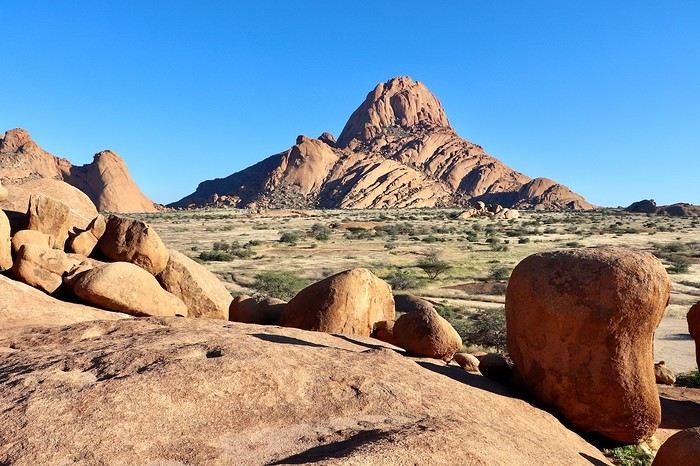
> Accommodation: Daureb Isib Restcamp - Erf 672 C/O 3rd & 4th Avenue Uis 9000, Uis, Namibia - (http://www.daurebisib.com/) – 31 € - Pool. Comfort with private bathroom + electricity + Wi-Fi at the restaurant. Clear sky for a beautiful starry night.
**DAY 14: Wednesday, May 7, 2025: Brandberg (Namibia's Highest Mountain) - Damaraland:**
**The Brandberg massif is an isolated, dome-shaped mountain, an inselberg, that towers over the gravel plains scorched by the sun of the Namib Desert to the northwest. It measures 23 km long and 20 km wide. It is the highest point in Namibia at 2,573 meters.**
This massif formed about 130 million years ago when a gigantic viscous mass of magma from deep within the Earth's crust rose through the surrounding rock layers before solidifying. Later, the granite mass was exposed by the erosion of the surrounding rocks.
**The Brandberg is the highest mountain in Namibia, peaking at an altitude of 2,573 m. The indigenous San people call it the "burning mountain," as it appears to glow with a red light at sunset. With its considerable height and width, this massif influences the local climate, attracting more rain on its slopes than the desert below.** The rain seeps through the springs. Unique animal and plant species thrive in this high-altitude environment, and prehistoric paintings adorn the rock faces hidden in the ravines around the base of the mountain.
The first night was also hot since the start of this trip, the thermometer did not drop below 20°C. We wake up gently around 8 AM, a pleasant sleep-in, the sun is already out. After a quick morning cleanup of the 4x4, we have time today, we hit the road at 9:30 AM, getting lost in the Brandberg massif. We are now in the **Damaraland, which stretches from the majestic rock formations of the Brandberg in the south, where we are today, to the bushy expanses at the foot of the rugged mountains of Sesfontein in the north, where we will be tomorrow. It is the perfect destination for wildlife and flora observation.**
We take the track heading towards the **White Lady**, but we want an alternative to this guided visit only. So, just before arriving, we turn right towards a viewpoint named on Google Maps **Rastplatz**. We come across **small Himba villages, living in extreme poverty with no natural resources; the inhabitants ask for water with every passing vehicle...** A bit further, we encounter about ten **ostriches** in the middle of the track, magnificent, as we get closer to the mountains in the background, and a few meters further, **a herd of Oryx**. Then we approach the **bed of the Ugab River**. We then go back and have a snack in the middle of nowhere, under the shade of our 4x4, facing the mountainous massif. We get back on the road around noon, while the temperature is at its peak in this very hot region, 35°C on the gauge with very dry air. We go up the C35 slightly then turn left onto the small track D2319 until we reach the Ugab bed again. Back to Uis in the mid-afternoon.
We did not book the same campsite as the previous night; today we are at the Brandberg Rest Camp. Unfortunately, the camp is not at the same level as the previous one, which was perfect. But the price is also much lower. The sites are next to each other, separated by small fences behind the main building. But it will do just fine. We have our BBQ and electricity, the shared sanitary facilities are decent. We then lounge in the large pool. We will then buy some water for 10 € at the supermarket located right across.
> Gas station: Uis.
> Distance driven today: 118 km.
> Today's expenses: Groceries in Uis: 10 €.
> Accommodation: Brandberg Rest Camp Uis - No 3 Uis Street Namibia 9000, Damaraland, Namibia - (http://www.brandbergrestcamp.com/) - Large pool – Shower – Electricity
**DAY 15: Thursday, May 8, 2025: Damaraland: Petrified Forest - Ugab Valley - Palmwag**
The night was excellent and slightly cooler than the previous one. We wake up around 7 AM and hit the road just before 7:45 AM heading to a new destination as we continue this Namibian road trip. **We cross Damaraland today from south to north.** First via the C35 to **Khorixas**, then turning left onto the C39. **We come across some villagers walking kilometers under the scorching sun with only a small water container in their hand... What a tough life, light-years away from ours.** About 40 km west of this town, we arrive at the **Petrified Forest National Monument**. It is a vast expanse of veld (open vegetation area), dotted with petrified tree trunks that can reach 34 m in length and 6 m in circumference, estimated to be over 260 million years old. These trees belonged to the Gymnospermae family, conifers among which we find today's cycads and welwitschias. The absence of roots and branches suggests that the trunks were deposited here during a significant flood. The site has about fifty trees, some half-buried in sandstone, others perfectly petrified in silica with their bark and growth rings. A guide is mandatory at the entrance to visit the site.
We then continue on this C39 due west to the junction of the D2612. We make a round trip to the south to **Twyfelfontein, which means "uncertain spring" or "bubbling spring" in Damara**. The site is a UNESCO World Heritage site, located at the entrance of the grassy Aba Huab Valley and houses one of the largest collections of rock art on the continent. More than **2,500 petroglyphs** have been discovered on over 200 stones, as well as some rock paintings. They date back about 6,000 years and others 2,500 years. Many engravings depict species that have since disappeared from the region, such as elephants, rhinoceroses, giraffes, and lions. The presence of a seal attests to the existence of links with the coastline at the time, now over 100 km away. It is here, as well as at Brandberg, that the human history of Namibia began with these testimonies of ritual and economic practices among hunter-gatherer peoples.
We continue a bit further south on the D3214 then D3254 to visit the **Organ Pipes, "organ pipes"**. The entrance is also paid, much to our regret... 500 NAD $ for two. We take a well-marked trail leading to a small gorge containing dolerite (coarse-grained basalt) columns 4 m high and aligned on an astonishing 100 m long wall. We are in a volcanic chain stretching over a dozen kilometers, a pile of scoria that seems to have been exposed to fire, the Burnt Mountain "burnt mountain" stands in a bleak and desolate landscape where almost nothing grows.
We head back north and return to the C39 then the C43 to **Palmwag where we will spend the night**. **This concession, covering an area of 5,500 km², is a region of red hills and plains, remarkable for its rolling landscapes as well as its rich fauna and flora**. The region serves as a **buffer zone between Etosha and the Skeleton Coast**. We have a good chance of encountering black rhinos, desert elephants, and lions, as well as spotted hyenas, giraffes, gemsboks, and other antelopes.
We pass the sanitary control barrier at 4 PM, just before entering Palmwag. In our direction, from south to north, we are simply asked about our future destinations and to present my French driver's license. A few meters further, there is a small gas station, then on our left our final destination of the day: the Palmwag Lodge Campsites. We are happy to arrive after this long journey. The welcome is very pleasant, and the site is very comfortable with a real brick shelter housing our shower and toilet, as well as water and electricity. We always have a BBQ available, but today we unfortunately no longer have meat due to concerns about the sanitary control, but we were not sure if it was rather in the other direction that the transport of fresh meat and dairy products is prohibited. We now cross our fingers to be able to observe some different animals, as the place is renowned for elephants, giraffes, and rhinos. We first take some time to relax in the pool before going for a walk around the reserve, without encountering anything unfortunately this evening, but the wake-up will be up to par... Time for the sunset, which is always one of the highlights of the day.
> Today's road itinerary: 5h30 of driving: C35 heading north > Then turn left onto the C39 > Petrified Forest > Go down on the D3612 in a round trip to Twyfelfontain (rock paintings and Organ Pipes) > Go back up on the C39 then C43 to Palmwag > Round trip on the C40 to Mount Grootberg Pass.
For info on the C43, there is a sanitary control at the entrance and exit (transporting raw meat is prohibited).
Palmwag: black rhinos (guided or free visit? at sunrise or sunset).
> Gas station: Twyfelfontain or Palmwag (07:00 – 19:00) – Tire repair in Palmwag.
> Distance driven today: 349 km.
> Distance walked today: km.
> Accommodation: North of Palmwag Lodge Campsites - GPS Coordinates -19.88556°, 13.93694° - Pool – Water and electricity – 34 € - (https://gondwana-collection.com/accommodation/palmwag-campsite?LodgeName=PALMWAG%20CAMPSITE)
**DAY 16: Friday, May 9, 2025: Palmwag - Sesfontein - Entry into Kaokoland - Opuwo**
This morning, we take our time watching for wildlife. We can finally observe our first **kudus** as the sun begins to illuminate the plain in front of us (see video and time-lapse of the day). A few minutes later, we also spot **a couple of giraffes with their calf**, moving calmly and serenely.
**We leave Palmwag** at 9 AM, heading to the northernmost point of Damaraland via the C43 to Sesfontein.
A few kilometers on the track, and we come across **a herd of zebras**, 11 to be exact, in the middle of green hills. Even further, it's more than twenty that cross right in front of us, a treat for our eyes. Their gait is majestic; they are very sensitive to noise. Some are more curious than others and don't hesitate to stay close if we remain quiet. We then cross numerous rough riverbeds. We must always stay very attentive at the wheel because we can drive at over 80 km/h on straight lines and then suddenly have to brake to cross these small streams, usually already dry at this time of year. Many antelopes are still present by the side of the track; the heat is already rising, and they are often lying on the ground at this hour.
**We arrive in Sesfontein at 11:15 AM**, just as the children are leaving school. Transportation is done by donkey-drawn carts. The villagers spend their time in the shade of the trees and in front of the few small shops. The atmosphere of its streets is dusty with a laid-back pace; this town has the feel of an oasis located **by the Hoanib River**, the town of six springs from which it gets its name. Founded in 1896, it was a military outpost built after a cattle plague epidemic. This page of its history is reflected in Fort Sesfontein, erected in 1905 to fight cattle diseases, arms smuggling, and poaching.
We take a lunch break at the exit of the village around 11:30 AM in the shade of a tree, so peaceful, it's 32°C. We continue further north, away from the usual tourist routes, and **enter the Kunene region, also called Kaokoland**. The track becomes narrower and more winding. **These are now vast solitary spaces largely devoid of roads, simply crossed by sandy tracks opened by the South African army just a few decades ago.** The fauna and flora have managed to adapt to this harsh and dry environment, like the desert elephant, an endangered species whose slender legs are perfectly suited to the long journeys the animal must make to find water, a rare resource. This region is also the territory of the Himba people, emblematic of the country. Its name comes from the Kunene River, which marks a narrow belt of vegetation at the Angolan border.
**We arrive in Opuwo at 3 PM**, **this town is the capital of the Kunene region**. Its name means "the end" in the Herero language, a fitting term for this dusty collection of commercial buildings surrounded by traditional huts with round thatched roofs.
**Opuwo is a strong cultural moment of this trip in Himba territory, this semi-nomadic people traditionally settles in an onganda (small village), moving if necessary to find access to water. Himba women are known for their ochre-colored cream, otjize, a mixture of butterfat and ochre powder, applied to protect and moisturize the skin and hair. Fire and smoke play an important role in their culture.** Smoke, often scented with herbs, is used by women for purification. It can also convey prayers to the supreme being, Muluru. In traditional celebrations, there is always a sacred fire that remains lit between the main hut and the animal enclosure, to maintain ties with the ancestors.
Right upon arrival, we fill up with fuel at the Shell station at the price of 21.48 NAD $ per liter, or 67 liters for 1454 NAD $ (72 €) by card. We then quickly stock up on meat at the Spar **where Himba women with bare breasts mix with us, the only white people shopping in the aisles**. **Since the beginning of this trip, this is where life is most bustling**. There are many people on these dusty streets, after kilometers without seeing anyone, the shock is brutal. There are small markets, poverty but also wealth. The town is quite spread out. There are no white people left, **we finally discover the true, harsh African life.**
We arrive at the **Opuwo Country Lodge at 3:30 PM**, located slightly on the heights. We have site 9 at the end of the property for maximum isolation as we like. Once again, we have private sanitary facilities, a BBQ, and electricity. Once settled, we walk 10 minutes to the reception where the pool is located to cool off. An infinity pool that is just magnificent facing the vast landscape before us. But this contrast between this little comfort and the town below makes us uneasy. The employees walk back down. A guard is present at the entrance of the lodge to ensure security; the park where we are is fenced. We enjoy a good braai, then enjoy the few lights of the town gradually lighting up. The night will be quite noisy for once with very loud music rising from a party below until 2:30 AM... And yet it comes from far away... Maybe a bar? In any case, we rule out what we thought was just a party during our visit here on Friday.
> Today's road itinerary: 4 hours of track: Return via the C43 heading south to Opuwo.
> Gas station: Okangwati or Opuwo
> Distance driven today: 261 km.
> Today's expenses: Fuel fill-up in Opuwo for 72 € + Groceries in Opuwo for 21 €.
> Accommodation: Opuwo Country Hotel - Opuwo Hilltop Opuwo 9000, Opuwo, Namibia - -18.044682 / 13.833861 - (http://www.opuwolodge.com/) - N$600.00 - Pool / Water / Private sanitary facilities / Electricity / BBQ.
**DAY 17: Saturday, May 10, 2025: Opuwo to Epupa Falls:**
We take our time this morning by the **Kunene River**, then we hit the road at 8:45 AM. This is our return trip to Opuwo.
After 4 good hours of driving, **we return to the bustling life of Opuwo**. We refill with fuel at the Shell station (21.48 NAD $ per liter) 820 NAD $ (40 €) for 38 liters and do a quick grocery run at the Spar for 488 NAD $ (24 €). We don't take any meat because we have the **sanitary barrier** to cross tomorrow before entering Etosha Park. We pay for these two expenses in cash for the first time; until now, the credit card was always accepted, so we now have to use the cash we withdrew at the airport. Then we head back to the Opuwo Country Lodge, arriving at the campsite at 2 PM. We are the first to arrive, we rest for a moment before heading to the pool and then end the day around our traditional BBQ with sausages and sautéed potatoes. The full moon accompanies us, perfect for nighttime observations in Etosha starting tomorrow.
The campsite's location should be avoided because we again have infernal music that gets louder from 7 PM to 2:30 AM... And yet it comes from far away... Maybe a bar? In any case, we eliminate what we thought was just a party during our visit here on Friday.
> Today's road itinerary: 4 hours of track: Return via the C43 heading south to Opuwo.
> Gas station: Okangwati or Opuwo
> Distance driven today: 180 km.
> Accommodation: Opuwo Country Hotel - Opuwo Hilltop Opuwo 9000, Opuwo, Namibia - -18.044682 / 13.833861 - (http://www.opuwolodge.com/) - N$600.00 - Pool / Water / Electricity / BBQ
**DAY 18: Sunday, May 11, 2025: Epupa Falls:**
Time for a "vacation" day; we wake up leisurely at 8 AM and take our time this morning. Breakfast and even coffee. The night was good, lulled by the sound of the waterfalls.
In the late morning, we head out on the small path along the banks of the Kunene River, which offers magnificent landscapes. We have a beautiful view of Angola from the opposite bank. The falls extend over about 1.5 km and flow over a series of promontories, the highest of which reaches 37 m.
At noon, we return to our campsite to eat in the shade of the palm trees. On the menu: fried eggs and pasta. We take advantage of this afternoon to rest before the last part of this road trip, with reading, writing, and pool time on the agenda.
In the late afternoon, we return to one of the viewpoints overlooking Epupa Falls to once again enjoy the sunset colors from a different angle. We are over the moon; our thoughts wander in all directions. We discuss future trips, adventures, reminisce about our memories, and think about the world around us... We savor the luck of being here. On the way back, a Himba woman asks if we can give her a ride in our 4x4 to Opuwo tomorrow.
Tonight, we dine on our traditional braai with white beans by the Kunene River. We are lulled by the sound of this powerful river flowing under the song of insects. The coolness sets in, and we fall asleep under the stars.
> Distance driven today: 0 km.
> Distance walked today: 10 km.
> Accommodation: Omarunga Lodge Campsites - 68 € for two nights - Site by the river - (https://gondwana-collection.com/fr/accommodation/omarunga-epupa-falls-campsite?LodgeName=OMARUNGA%20EPUPA-FALLS%20CAMPSITE&hsLang=en)
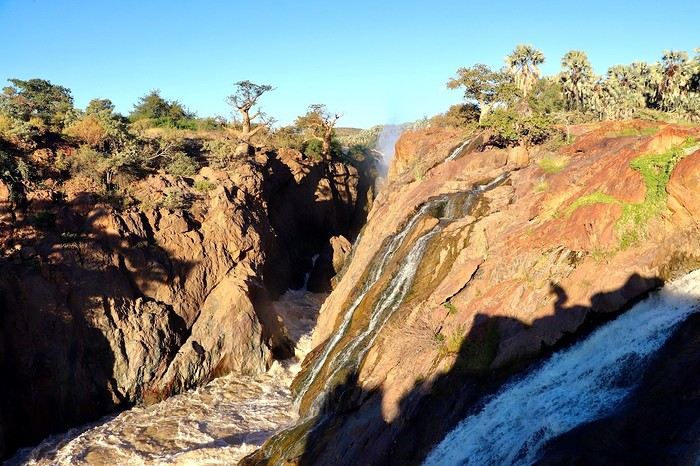
**DAY 19: Monday, May 12, 2025: Epupa to Opuwo**
We enjoy the morning a bit more by the **Kunene River**, then we hit the road at 8:45 AM. This is our return trip to Opuwo.
After 4 good hours on the road, **we return to the bustling life of Opuwo**. We refill with fuel at the Shell station (21.48 NAD $ per liter) for 820 NAD $ (40 €) for 38 liters and do a quick grocery run at the Spar for 488 NAD $ (24 €). We don't take any meat because we have the **sanitary barrier** to cross tomorrow before entering Etosha Park. We pay in cash for these two expenses for the first time; until now, the credit card was always accepted, so we have to use the cash we withdrew at the airport. Then we head back to the Opuwo Country Lodge, arriving at the campsite at 2:30 PM. We are the first to arrive, rest for a moment before heading to the pool, and then end the day with our traditional BBQ: sausages and sautéed potatoes. The full moon accompanies us, perfect for nighttime observations in Etosha starting tomorrow.
The campsite's location should be avoided, as we again have loud music until 2:30 AM... And it comes from far away... Maybe a bar? In any case, we rule out what we thought was just a party during our visit here on Friday.
> Today's road itinerary: 4 hours of track: Return via the C43 heading south to Opuwo.
> Gas station: Okangwati or Opuwo
> Distance driven today: 180 km.
> Accommodation: Opuwo Country Hotel - Opuwo Hilltop Opuwo 9000, Opuwo, Namibia - -18.044682 / 13.833861 - (http://www.opuwolodge.com/) - N$600.00 - Pool / Water / Private sanitary facilities / Electricity / BBQ
**DAY 20: Tuesday, May 13, 2025: Opuwo – Etosha - Olifantsrus**
We wake up before dawn around 6:30 AM. We pack up the camp at 7:15 AM heading to a first waterhole to watch the sunrise and start our day of observations and discoveries. It's 11°C, and as soon as we leave the campsite, we come across numerous zebras, foxes, and springboks with the sun rising on the horizon. Magnificent images.
**At 8:30 AM, we are still alone**, we witness **one of the most beautiful scenes of this trip: 3 lionesses hunting springboks**. It's thanks to the latter, slowing down, that we manage to spot 4 lionesses' heads barely above the tall grass. They hide, stand up, move slowly... We wait without moving. This is their perfect terrain for camouflage. **We are on the lookout and try to be discreet during this hunting scene**. We leave the area to let them finish their remarkable work and continue the track towards the East. The terrain becomes completely flat. It's now been 3 hours since we left the campsite without noticing the time passing, and especially without meeting anyone. Around 10 AM, near a waterhole, we come across a solitary elephant mixed with zebras, buffaloes, and springboks.
Around 11 AM, we take a lunch break; here, it's us who are enclosed in enclosures. Whether in the campsites or the few small equipped areas, we are fenced in by a gate. The animals are free on their territory. The wind has picked up again, just like the sun. We eat alone in absolute calm in the heart of this incredible, unique park; there are no words to describe what nature offers us here, far from any human activity. We start to see some safari vehicles arriving, but the attendance remains much lower than I had imagined. At most, a total of fifteen throughout the day.
Etosha is also a wonderful reserve of vegetation; you can find multiple mopane groves. But also acacias and other trees appreciated by ruminants. The south and east of the park have the most waterholes, which is where most animals gather. In the West, the vegetation is denser, and the wildlife is harder to spot, but it is well present, especially the black-faced impala and Hartmann's mountain zebra, which are found almost nowhere else. The area being less frequented, the bush feeling is more pronounced.
30 minutes of track after eating, **we come across a solitary male lion. The build compared to the females this morning is noticeable from afar**, even though this one is quite far from us unfortunately, unlike this morning when they were right on top of us.
**Etosha is the preferred habitat of lions in Namibia, with about 330 individuals roaming the park's plains, nearly half of the country's wild lions.** The big cats rest under the trees near waterholes, especially the one at Okaukuejo where we arrive today, but it's also a good spot for elephants and rhinos.
We then enter the territory of buffaloes, which we come across by the dozens now. Wow, the encounters keep coming. Then around 2 PM, we follow this immense **Etosha Pan** for the first time, which we will follow for a good part of tomorrow's day.
We arrive at our campsite at 3:30 PM after more than 8 hours of self-safari filled with discoveries. We sleep tonight at the **Olifantsrus Camp**, which we had previously booked in France. We had to wait and click several times for a spot to open up, as the camp has very few sites, and that's a good thing. It is located in one of the wildest areas of Etosha and has a practical observation tower overlooking a waterhole, offering us great opportunities to spot wildlife after nightfall (see photos). **The sunset is once again memorable.** In the guestbook at the reception, where each visitor can note their observations, 3 lions were seen the day before just a few steps from here (1 male, 1 female, and their cub), on a part of the track we didn't cover today; it will be on tomorrow morning's program. We cross our fingers for these predators.
> Today's road itinerary: 6 hours of driving: Leave Opuwo via the C41 (paved road) > Turn right onto the C35 (paved road) to the Galton Gate > Enter Etosha Park.
> Gas station: Opuwo.
> Distance driven today: 369 km.
> Accommodation: Olifantsrus Camping site - 53.4 € for two – Shared sanitary facilities – Electricity – BBQ – No grocery store - (https://www.etoshanationalpark.org/fr/accommodation/olifantsrus-camp)
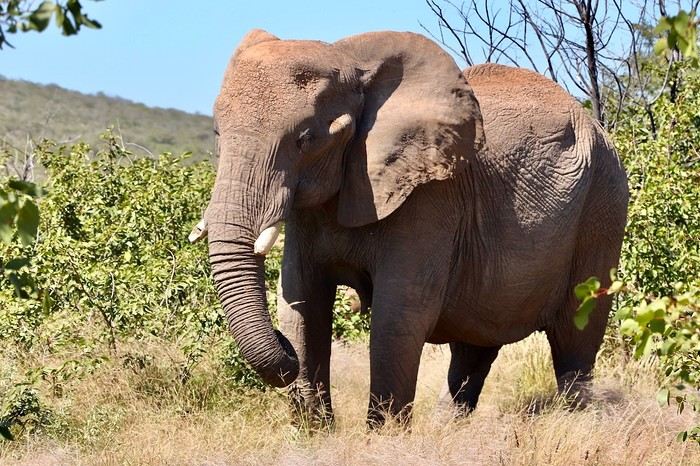
**DAY 21: Wednesday, May 14, 2025: Etosha National Park: From Olifantsrus to Okaukuejo:**
We wake up before dawn around 6:30 AM. We pack up the camp at 7:15 AM as the gates open, heading to a first waterhole to watch the sunrise and start our day of observations. It's 11°C, and just outside the campsite, we come across numerous zebras, foxes, and springboks with the sun rising on the horizon. Magnificent scenes.
**At 8:30 AM, we are still alone**, and we witness **one of the most beautiful moments of this trip: three lionesses hunting springboks**. Thanks to the springboks slowing down, we manage to spot four lionesses' heads barely above the tall grass. They hide, stand up, and move slowly... We wait without moving. This is their perfect terrain for camouflage. **We stay alert and try to be discreet during this hunting scene**. We leave the area to let them finish their remarkable work and continue the track towards the east. The terrain becomes completely flat. It's been 3 hours since we left the campsite without noticing the time, and especially without meeting anyone. Around 10 AM, near a waterhole, we come across a solitary elephant mixed with zebras, buffaloes, and springboks.
Around 11 AM, we take a lunch break; here, it's us who are enclosed in enclosures. Whether in the campsites or the few small equipped areas, we are fenced in by a gate. The animals are free on their territory. The wind has picked up again, just like the sun. We eat alone in absolute calm in the heart of this incredible, unique park; there are no words to describe what nature offers us here, far from any human activity. We start to see some safari vehicles arriving, but the attendance remains much lower than I had imagined. At most, a total of fifteen throughout the day.
Etosha is also a wonderful reserve of vegetation; you can find multiple mopane groves. But also acacias and other trees appreciated by ruminants. The south and east of the park have the most waterholes, which is where most animals gather. In the west, the vegetation is denser, and the wildlife is harder to spot, but it is well present, especially the black-faced impala and Hartmann's mountain zebra, which are found almost nowhere else. The area being less frequented, the bush feeling is more pronounced.
Thirty minutes of track after eating, **we come across a solitary male lion. The build compared to the females this morning is noticeable from afar**, even though this one is quite far from us unfortunately, unlike this morning when they were right on top of us.
**Etosha is the preferred habitat of lions in Namibia, with about 330 individuals roaming the park's plains, nearly half of the country's wild lions.** The big cats rest under the trees near waterholes, especially the one at Okaukuejo where we arrive today, but it's also a good spot for elephants and rhinos.
We then enter the territory of buffaloes, which we come across by the dozens now. Wow, the encounters keep coming. Then around 2 PM, we follow this immense **Etosha Pan** for the first time, which we will follow for a good part of tomorrow's day.
We arrive at our campsite at 3:30 PM after more than 8 hours of self-safari filled with discoveries. We sleep tonight at the **Okaukuejo Resort**. Upon arrival, this impression of a small town in the middle of hundreds of kilometers without infrastructure remains shocking. **The atmosphere is quite different from last night in our small wild campsite**. However, even though the attendance is higher, we are lucky to get a site in a corner (number 46). **The lit waterhole will also be a reward**. After checking in, we take advantage of the small grocery store to buy two meats for our next BBQs in the park, 3 pork chops and sausages, as well as a cold drink for 252 NAD $. This locality also offers a gas station, a restaurant, and a nice pool, but our goal during this park stay remains focused on the wildlife, so I won't give in this time. Time to set up, followed by a short rest, then our toilette before heading to the "waterhole" for the sunset around 6 PM. **A new grand spectacle unfolds before us, a hundred zebras come to hydrate right before our eyes at the water reserve facing the sunset in a cloud of dust. Then a couple of lions approach stealthily without managing to fill their stomachs. A third guest arrives, a second male lion also comes to drink. The waterhole now becomes the territory of the lions... We are speechless facing what nature offers us, we savor for over an hour scrutinizing the smallest details. What an intense day, images that will remain forever etched in our minds.** It's our turn to have our meal with three beautiful pork chops on the BBQ accompanied by curry vegetables.
At 9 PM, we decide to return to the waterhole, a wonderful idea because we find **an elephant and two black rhinos courting in the water. The male has a hard time seducing his sweetheart and eventually leaves, but a third rhino appears out of nowhere to join her. The scenes unfold under the spotlights** accompanied by a sky full of stars. We eventually go to bed. Looking forward to the rest of the story tomorrow.
> Today's road itinerary: Camp Olifantsrus > Camp Okaukuejo.
> Gas station: Okaukuejo camp.
> Distance driven today: 229 km. > Today's expenses: Groceries for 12 €.
> Accommodation: Okaukuejo Camping Site - 48.12 € for two - Pool - Gas station - Lit waterhole - Grocery store - (https://www.etoshanationalpark.org/fr/accommodation/okaukuejo)
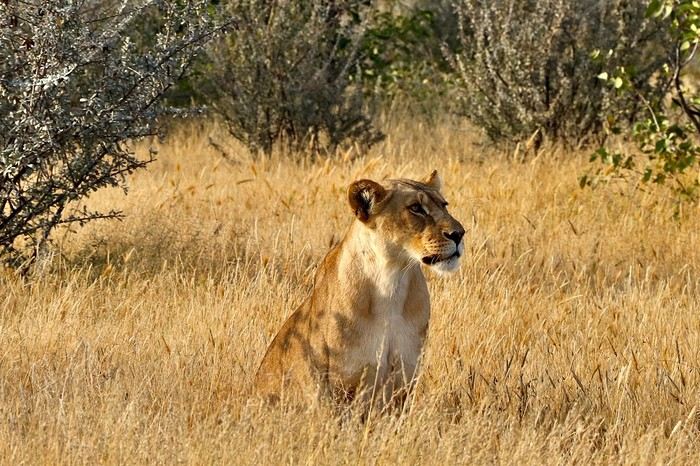
**DAY 22: Thursday, May 15, 2025: Etosha National Park: From Okaukuejo to Halali:**
We wake up around 5:30 AM to a strange noise getting closer, a few thunderclaps, then heavy rain pours down on us! The first since the start of this trip, we had forgotten its sound and smell. We leave the campsite quickly at 7:13 AM as the gates open, the rain stops just in time!
We are right in the heart of the park today. We arrive at the Etosha Pan, an immense flat salt desert that, a few days a year, transforms into a shallow expanse teeming with flamingos and pelicans. At the end of the dry season, everything, from elephants to grasslands, is covered in the white, chalky dust of Etosha.
Around noon, at the Riedfontein waterhole, we spot two male lions in this picturesque savannah. As we've noticed, the females hunt while the males protect the territory. The males and cubs will benefit first.
The day was less emotional than the previous one. We encounter far fewer animals, often at a greater distance. Is it because of the stormy rain we had at dawn this morning, or is it the area? The tracks were also more exhausting, especially the Rhino Drive without meeting a soul. But the view over the immense salt pan as far as the eye can see is worth seeing. Maybe the waterhole at the campsite will surprise us tonight as it did yesterday?
We arrive at 4 PM at the Halali Resort for our last night in the park. We still have a lit waterhole, more intimate than yesterday's, and we can walk around the park thanks to a hiking trail. The sanitary facilities are shared and quite recent, with each site offering its own BBQ and electrical outlet. After setting up and a quick wash, we head on foot to the Halali waterhole for sunset. Tonight's menu features local sausages (beef and pork) with curry pasta.
> Today's road itinerary: Camp Okaukuejo > Camp Halali.
> Gas station: Halali Camp.
> Distance driven today: 242 km.
> Accommodation: Halali Camping Site - 48.12 € for two - Pool - Gas station - Lit waterhole - Grocery store - (https://www.nwr.com.na/resorts/halali-resort/)
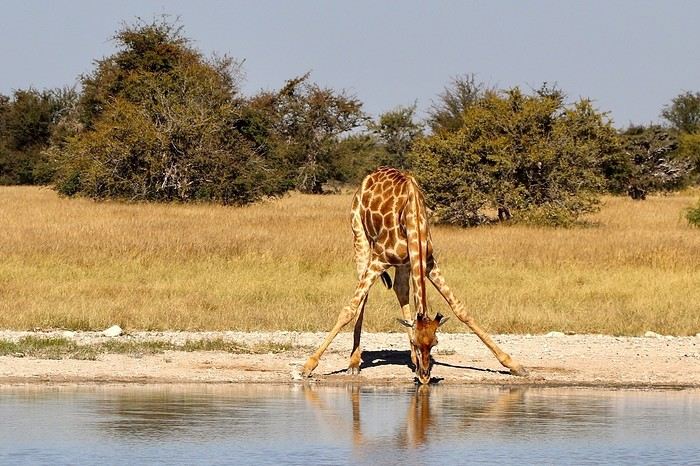
**DAY 23: Friday, May 16, 2025: Etosha National Park: From Halali to Namutoni - Waterberg Park:**
We pack up the camp at 7:15 AM as the gates open. It's 17°C, and the sun is out as usual. **We follow the Etosha Pan, still quite wet at this time of year.** The small track offers different viewpoints under a sun gradually rising higher.
The further east we go, the more we encounter gnus, kudus, and impalas. **We are once again spoiled and delighted by everything we discover this morning.** A majestic **giraffe** appears before our eyes just before arriving at **Namutoni** around 9:45 AM, quickly followed by 4 other companions. From there, we change plans, do the **Fischer's Pan** loop, and then decide to exit through the northern gate, allowing us to cover the entire park. Our last encounters will be with these tallest animals, the giraffes, and what a spectacle to see them spread their legs to hydrate, followed by gnus.
Just before the exit, we take a lunch break at an equipped area at 11:30 AM.
**We leave Etosha National Park with a touch of nostalgia through the King Nehale Iya Mpingana gate** at 12:30 PM. We find the beautiful paved B1 road, which is a great relief. Cows and goats take over; driving at 120 km/h on these single-lane, two-way roads with these animals we brush past requires constant vigilance. We fill up with fuel at 1:30 PM in **Oshivelo** (21.33 $ per liter), 93 liters for 99 € by card. Since we hadn't planned to go so far north out of Etosha, we are surprised to go through a **sanitary check** at the exit of the town, but it turns out to be even quicker than the previous one, a simple glance in the fridge by very smiling women, much more pleasant than the staff at the Etosha entrances and exits.
We pass **near Lake Otjikoto** ("deep hole" in Herero), which is **one of the only two natural lakes in Namibia along with its neighbor Lake Guinas**. In 1851, explorers Charles Andersson and Francis Galton came across this karst lake occupying a limestone cauldron 100 m long, 150 m wide, and 55 m deep. Its steep walls, about 20 m high, are the result of the collapse of the rock roof of the sinkhole under water pressure. This lake is also known for the large quantity of weapons and ammunition found in its depths. Remnants of the region's violent past, they were dumped there in 1915 by the retreating German army, refusing to let South African troops get their hands on them. Unfortunately, it's paid entry, and given the late hour, we continue on our way. To our great surprise, there is a lot of traffic on this B1, including many trucks, the first time we've seen so many people in this country. The landscapes change; we even discover deciduous trees taking on their autumn colors.
We pass through **Tsumeb**, and the road continues to **Otjiwarongo**, which means "pleasant place" in the Herero language, and the town lives up to its name. Prosperous and peaceful, with wide avenues and a relaxed atmosphere, we stop there to do some shopping. We buy some local meat to treat ourselves during these last two remaining camping nights: skewers, pork, and sausages, as well as biscuits, a last water tank, and yogurt for Mimi; 388 NAD $ - 20 €. We get back on the road heading south via the B1 for 15 minutes, then turn left onto the C42, still paved, for 30 minutes and 41 km, then left again onto the D2512, a wavy sandy track for 15 minutes.
**We enter the Waterberg National Park this evening.** The arrival facing this mountainous massif in the middle of the plains under the end-of-day lights of a deep red makes us even more eager to discover it. **Composed of impressive sandstone cliffs, tangles of vines, a canopy teeming with birds, elusive wildlife, and improbable dinosaur footprints. The Waterberg occupies a large sandstone plateau 50 km long and 16 km wide, at an altitude of 150 m above the plain.** It is possible to encounter elands, black wildebeests, roan antelopes, buffaloes, and red hartebeests, and with luck, leopards, as well as 200 identified bird species.
We arrive at the NWR campsite at 6 PM, the first time we arrive so late, just before nightfall. It's from here that various hiking trails start for tomorrow's day, including the **Mountain View Trail** that climbs to the edge of the plateau. We quickly settle into this peaceful camp where calm reigns, no more than 5 vehicles tonight. The place is shaded, with fairly recent shared sanitary facilities, electricity, and a BBQ for each. We savor our second-to-last braai under the stars, hearing our plane that brought us to Frankfurt fly over, every day at the same time over the Waterberg then Etosha. Very rare, as there are very few flights that land or fly over Namibian skies.
> Today's road itinerary: 10 hours of driving: B1 then C42 then D2512.
> Gas station: Exit of Etosha Park, Tsumeb, Otavi, or Waterberg Park.
> Distance driven today: 616 km.
> Accommodation: NWR Waterberg Camping Site - Pool - Water - 45 € for two - (https://www.nwr.com.na/resorts/waterberg-resort/#1577510913112-8f243e49-35a647e7-1997)
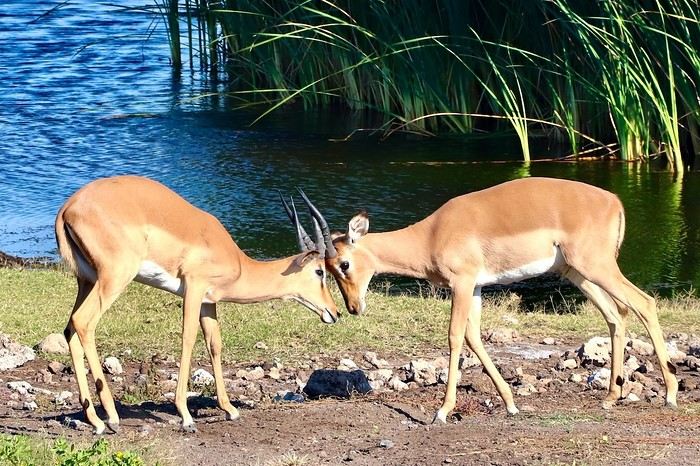
**DAY 24: Saturday, May 17, 2025: Waterberg Park - Otjiwa:**
We wake up around 7 AM after a very cool night.
**At sunrise, the cliffs appear even redder, and the cries of baboons echo around us.** We come across about thirty of them. We start the hike around 8:15 AM. **The Mountain View Trail will take us to the Waterberg Plateau.** The temperature is pleasant for walking. **The trail starts in a thick forest where the song of birds resonates.** The path is little frequented, so progress is slow and irregular; we regularly have to duck, step over, and climb rocks. However, in 35 minutes, we reach the top of the plateau. We are once again alone in the world in this Namibian nature. **The 360° panorama extends over a wide plain of green shrubs below, then over these steep red cliffs** giving access to this suspended plateau of the Waterberg. To enter, unfortunately, a special permit is required, and you must be accompanied by a guide. We savor the moment under the already hot sun at 9 AM. After an hour reminiscing about our journey on our rocky promontory, we start the descent at 10 AM, completing a loop back to our starting point. **At 10:30 AM, we pass by the small cemetery of German fighters who died in 1904**, then we hit the road back to the B1. We take a lunch break at noon at one of the tables scattered regularly along the paved roads. We are watched by **baboons** perched in their tree. We then decide to make a **detour through the town of Otjiwarongo**, which we didn't have time to explore properly yesterday. **A quick visit to the train station is a must to see locomotive No. 41, built in 1912 by the German company Henschel. It was transported to Namibia to carry ore between the mines of Tsumeb and the port of Swakopmund before being decommissioned in 1960 when the tracks were modified.**
We return to do some shopping and bring back some souvenirs for 300 NAD $ (14 €). We then take the road south on the B1. I start to feel the end of this immense loop through Namibia. Morale is gradually dropping. But we still have plenty of beautiful things to discover. We arrive at 3 PM at the **Otjiwa Safari Lodge. This will be our last night camping after 22 nights sleeping in the wild to the sound of animals.** The nostalgia is palpable. We enter this high-end private park; we don't really feel at home upon arrival. The reception, the pool, the restaurant, everything is very upscale, unlike anything we've experienced during this road trip. However, the reserve has its charm; we come across our beautiful antelopes again. The 10 sites are very comfortable, spaced apart under some bushes. Each has, of course, its BBQ, electricity, lighting, and sink. Before enjoying our last evening, we need to do a thorough dusting of the 4x4 and a good cleaning and organizing of our belongings. Then it's time for our last perfect braai: chicken and pork skewers, as well as tomato-flavored white beans.
> Today's road itinerary: 1h30 of driving: Waterberg > Otjiwarongo > Okonjima wildlife reserve - D2512 then C22 then B1 then turn right onto a 3 km track.
> Gas station: Waterberg Park.
> Distance driven today: 135 km.
> Distance walked today: 6 km.
> Today's expenses: Souvenirs for 14 €.
> Accommodation: Otjiwa Safari Lodge - B1 main road, west side Otjiwarongo 12001, Otjiwarongo, Namibia - (http://www.otjiwa.com.na/) – 40 € for two – From 3 PM.
**DAY 25: Sunday, May 18, 2025: Otjiwa - Windhoek:**
For this last leg of our Namibian journey, we complete the loop back to our starting point, Windhoek. We leave our last campsite at Otjiwa, later than usual, at 10 AM. We head due south on the B1 in less than 3 hours to the country's capital, not without a touch of nostalgia after all these kilometers traveled through Namibia. The landscapes roll by with a lot of melancholy. We make a stop 60 km north, in Okahandja. We take the opportunity to fill up with fuel (21.10 $ per liter), 500 NAD $ for 23 liters; the card machine wasn't working, so we had to withdraw from an ATM at the next gas station. A local was quite insistent at my window, asking for food or money. Anyway, after 15 minutes, we get back on the road.
From here, we take the new A1, a 2x2 lane highway limited, like the previous roads, to 120 km/h. Then we gradually see some of the country's industries before entering the capital in the blink of an eye. We arrive at 1:45 PM at Chameleon Backpackers. It's a small hostel-style hotel with a central pool, a shared kitchen, secure indoor parking, and a restaurant. They also organize tours (3 Day Express, 3 Day Link, 4 Days Etosha, 7 Day Norbert Adventure), very different from everything we've encountered so far, a kind of atmosphere like in Thailand. There are dormitories, rooms with shared bathrooms, and our little cocoon, the Love Bird, a room located alone on the upper floor with its small balcony, a swing, its bathroom, and its large bed with a thatched roof. A lot of charm while overlooking the pool. We eat before setting off to explore the capital.
Windhoek is a modern and well-maintained city, contrasting completely with the rest of the country. It is heavily influenced by its German colonial heritage, still very present in some streets of the capital. The architecture is colorful and surprising. The skyline is shared between the spires of a neo-baroque cathedral, the unusual silhouette of three castles from the German colonial era, and glass and steel skyscrapers. Office workers head to Zoo Park at lunchtime.
We enjoy the smell of grills at some street corners lined with small single-story houses with zinc roofs.
We first head to Windhoek's emblematic monument, its unofficial symbol: Christuskirche, just a 10-minute walk away. This German Lutheran church rises above the traffic at the center of an intersection. Built in 1907 with local sandstone. The roof and other elements were imported from Europe. The result evokes a gingerbread house.
We then walk along the pedestrian shopping street of **Post Street Mall** to admire African crafts, but on this Sunday, most shops are closed; we'll come back tomorrow. We return via the Wernhil shopping center.
> Today's road itinerary: Return to Windhoek in 3 hours via the B1 then the A1. In the capital, turn left onto Florence Nightingale, then right onto Beethoven Street then C28 then B6, then Bismarck Street. Take Church Street and Trift Street towards Voight Street.
> Gas station: Okahandja or Windhoek.
> Distance driven today: 245 km.
> Accommodation: Chameleon Backpackers & Guesthouse – 49 € for two - 5-7 Voigt St, North Windhoek Central, 9000 Windhoek
**DAY 26: Monday, May 19, 2025: Windhoek, Visit to the Namibian Capital:**
Our last sleep in Namibia... The wake-up is a bit sad; we still enjoy this return to comfort in a real bed. After a hearty breakfast, we check out of our little cocoon at 10 AM. We leave our vehicle in the secure parking lot and return for a walk in the center of Windhoek. On this Monday, the center is immediately livelier while still remaining extremely calm for a capital. The pace of life is slow; employees move slowly without rushing, each task is performed with a slowness that is almost surprising. A few skyscrapers further on, we quickly leave the hyper-center. We retrace our steps to the shopping gallery where we linger for a while. We eat around noon with African music in the background, making us even more nostalgic. Then the trip will gradually come to an end, unfortunately, until the moment when we will have to, not without regret, return our rental vehicle around 3 PM... We stop by the hotel again and then head to the rental agency and then to the airport by shuttle, included in our contract.
At 4:20 PM, we are back at the airport. We see ourselves upon arrival as if it were yesterday... Tears are not far off; we wait, the formalities are much quicker than upon arrival. **We board by walking across the tarmac on foot, escorted by about fifteen Namibians, facing the sunset. It will be there until the end, beautifully drawn on the horizon, to say goodbye to Namibia...**
> Round-trip flight tickets with Lufthansa from Lyon: 2029 €, or **1,014.50 €** per person.
> Vehicle rental: 4x4 Toyota with roof tent for 24 days: Gracious Whisp Car Rentals: 2,638 € (N$50,640) or **1,319 €** per person - (https://gwcarrentals.com/)
**DAY 27: Tuesday, May 20, 2025:** Flight FRA 8:15 AM -> 9:35 AM LYS (Air Dolomite No. 1074)
Total expenses including flight tickets + vehicle rental + visa + Lyon parking + food + fuel:
Cost per person: 3467 € Cost for two: 6935 €
>> All our photos and videos for each day on our website here: (https://www.montagne-aventure.net/voyages-découvertes/namibie-2025/)
>> Find all our photos and videos for each day on our website here: www.montagne-aventure.net
**DAY 1: Thursday, April 24, 2025: Outbound Flights from Lyon to Windhoek via Munich - Visit to Munich:**
Off we go on a new adventure. The alarm rings at 6:30 AM, the travel bags are packed, and we head to Lyon Airport. We booked our flight tickets with Lufthansa. The first leg to Munich, Germany, is operated by AirBaltic. Departure at 1:05 PM for a 1-hour and 20-minute flight. We arrive at 2:30 PM.
**We now have a 7-hour layover, so we take the opportunity to get some fresh air and explore Munich.** We quickly exit Terminal 2 of the airport and head towards the subway. We buy a group day ticket "Airport-city Day Zone M-5," valid for 2 to 5 people at a price of 30.50 € (instead of 16.30 € per person). We take the S8 line to **Marienplatz** in 35 minutes. **This is the heart of the city.** The weather is overcast, quite cool, but dry. Perfect for a little city trip between two flights while leaving our large luggage in transit at the airport. **Munich is the third-largest German city after Berlin and Hamburg, in the Bavaria region.** **The center has a lot of charm and brings together several religious buildings, easy to explore on foot.** We are impressed by the number of people enjoying these 100% pedestrian streets, which are very pleasant. After Marienplatz, the most famous square with the town hall, we head to the Cathedral of Our Lady, a Gothic church, then continue to **Karlsplatz** and move on to **the food market offering a wide selection of high-end food products in an atmosphere where a certain art of living prevails.** We also visit St. Peter's Church before grabbing a bite to eat. Two good hours were enough for this 10 km city walk. It's time to take the subway back: by 6:30 PM, we are back at the airport. Now, it's time for a bit of waiting and rest. Our second flight is scheduled for 9:35 PM for a 9-hour and 30-minute journey to our final destination in Namibia: **Windhoek.**
> Round-trip flight tickets with Lufthansa from Lyon: 2029 €, or 1,014.50 € per person.
> Lyon Airport parking: 120 €
> Today's expenses: 7 € for 2 pizzas in France / 14 € for the restaurant in Munich / 30.50 € for the daily subway ticket in Munich.
**DAY 2: Friday, April 25, 2024: Arrival in Windhoek, Visit to the Namibian Capital:**
After a 9-hour and 30-minute overnight flight with Discover Airlines, we finally land on Namibian soil just before 7:30 AM. The day is breaking, and the colors are already stunning. We are eager despite the usual fatigue from the flight. The airline was punctual, with friendly staff and good meals, though a bit light. We are the first flight of the day to land, with no more than 15 flights per day here, from 7 AM to 8 PM. We disembark on the tarmac at this airport located in the middle of nowhere, **I finally set foot on African soil for the first time.** We exit among the first from the aircraft to go through the long formalities at the front of the line, as the wait can quickly become endless. Allow at least 5 minutes per person for e-visas. We still wait 45 minutes despite only about twenty people ahead of us. Phew, it's done. We collect our luggage and then withdraw money from an ATM. We make 4 withdrawals of the maximum amount, 2000 NAD $ per withdrawal, for a total of 380 €, or 95.33 € per withdrawal.
Our driver arrives at the same time, perfect timing, we were quick.
We leave the airport at 8:45 AM. By 9:30 AM, we arrive at the **Gracious Whisp vehicle rental agency**, located at the entrance of Windhoek, small and human-sized with a fleet of recent vehicles. More formalities, then a short wait as our vehicle is not yet ready. Time to decompress, catch our breath, and enjoy the very pleasant morning temperature. Not a cloud in sight. Next, a briefing on the vehicle, always with a bit of apprehension due to our approximate English. Allow 45 minutes of explanations, including setting up the roof tent, camping equipment, technical information in case of a flat tire, driving tips in Namibia, and a tour of the 4x4. We have all the necessary equipment for camping: mattresses, sleeping bags, pillows, table, chairs, gas stove, BBQ grill... as well as 2 spare tires, a compressor, a dual tank, and accessories for removing wheels. Off we go, it's time to muster our courage and get behind the wheel. **Heading to SuperSpar Maerua**, fortunately located less than 10 minutes away. We park with the help of a parking attendant; it's very crowded, the space is narrow, but everything goes well despite the cursed right-hand drive. Today's new mission: stock up on groceries. The store is well-stocked with local and imported products, catering to all tastes. We spend 114 € on groceries, from pasta to meat, BBQ lighters to dishwashing products. Two people load our groceries into two carts and transfer them to our vehicle; we feel compelled to leave a tip, 50 NAD $, as we don't have change yet. Now, we head to the hotel, 15 minutes away. Traffic is difficult at a complicated intersection; this will likely be the only traffic jam in Namibia. **We arrive at Kate's Nest Guesthouse & Backpackers around 1:15 PM, quite tired.** We take some well-deserved rest at this recent establishment, quite calm with secure private parking. After a short nap, we enjoy the quiet by the hotel pool. Night falls between 6:30 PM and 7 PM. We eat quietly in our room tonight before starting this long 4x4 road trip in camping mode in the heart of Namibia.
> Today's grocery expenses: 114 € at Super Spar Marua (2395.21 NAD $).
> Round-trip flight tickets with Lufthansa from Lyon: 2029 €, or 1,014.50 € per person.
> Vehicle rental: 4x4 Toyota with roof tent for 24 days: Gracious Whisp Car Rentals: 2,638 € (N$50,640) or **1,319 €** per person - (https://gwcarrentals.com/)
> Distance driven today: 15 km.
> Accommodation: Kate's Nest Guesthouse & Backpackers - 4 Aristotles Street Academia, 9000 Windhoek - 36 € for two for one night.
> Windhoek International Airport website: (https://www.airports.com.na/)
**DAY 3: Saturday, April 26, 2025: Windhoek to Hardap: Mariental Region - Kalahari Desert:**
After a good, restful night, we wake up leisurely around 7 AM. We enjoy the comfort provided by this first and last hotel before 24 nights under the tent.
**We leave Kate's Nest Guesthouse at 8:30 AM to tackle the Namibian roads.** We quickly leave the capital; in just 30 minutes, we find ourselves almost alone in the world. The landscape is dotted with small domes. We leave the **paved B1** quickly to turn left onto the **C15**. **From there, we won't see more than 10 vehicles all day.** After passing through the few houses of **Lekkerwaterpoort**, we tackle our first gravel road. These road sections are limited to 100 km/h, but even at 70 km/h, I find it already challenging. However, I quickly get used to it and gradually pick up speed to reach my cruising speed of around 80 to 90 km/h. **We are on immense straight lines crossing wild expanses as far as the eye can see.** **We come across two baboons, a few ostriches, and numerous cattle and sheep farms.** We pass through the charming village of **Uhlenhorst** with its typical houses and children with broad smiles waving at us. Life here is already very different from Windhoek. **The thermometer rises quickly from 16°C at 8:30 AM to over 28°C in the early afternoon.**
**We arrive at the Hardap Dam reserve at 2 PM.** We stop at the toll booth at the park entrance to pay the entrance fee: 250 NAD $ for 2 people and 1 vehicle. We continue to the dam and then the camp entrance, located a bit further. We had booked in advance, but this place remains little frequented by foreigners.
We take advantage of the hottest hours to rest by the large pool overlooking the immense lake, a very enjoyable moment. Would this be a bit of a vacation?
Around 4:30 PM, we head to the campsite. We overlook this vast water reserve. We arrive first; we will be only 3 vehicles spending the night here. It's time to get to work and set up our equipment for the first time. It takes us a good 20 minutes to set everything up, with a slight apprehension about unfolding the tent. Once this task is done, which we will have to repeat for almost a month, we will become much more efficient over time. Time for rest and contemplation in total silence. The sun gradually sets, and the heat quickly becomes bearable again. Bliss! **This dam is located 20 km northwest of Mariental in an area dotted with conical hills topped with dolerite buttons (Hardap means "hillock" in Nama). It captures the Fish River, which flows south, creating a large lake in the middle of an arid environment. The contrast is striking.** We enjoy our first sunset facing this 360° otherworldly landscape.
Around 7 PM, we start our first BBQ, or "braai" as it's called here. The temperature is perfect. The sun sets, giving way to a star-filled sky of incredible beauty thanks to the absence of any light pollution. The Milky Way will lull us throughout the evening. After some good sausages and potatoes on the BBQ, we head to our roof tent around 9:30 PM with a complete change of scenery in just 24 hours. France already seems so far away...
This campsite has shared showers and toilets, quite clean and functional, as well as a central area with several BBQs and tables. The sites are arranged in a semicircle, each with an electrical outlet. The sites are close to each other but spacious, some slightly shaded. We are only three vehicles tonight, so it's perfectly comfortable and quiet. Not to mention the large pool near the restaurant. Our trip is off to a great start.
> Today's road itinerary: Windhoek > Head south on the B1 to Rehoboth > Turn left onto the C25 then C15 to Stampriet > C20 to Hardap > Full north on the B1 > Then turn left onto the M93 - 5 hours of driving.
> Distance driven today: 354 km.
> Accommodation: Hardap Recreation Resort - 23.3 € for two - Large pool - GR6W+3M2, Hardap Game Reserve, Mariental, Namibia - (http://www.nwr.com.na/resorts/hardap-resort/)
**DAY 4: Sunday, April 27, 2025: Hardap - Brukkaros Volcano - Keetmanshoop - Quivertree Forest Rest Camp**
Our first night under the tent was very pleasant; the little wind quickly calmed down, giving way to absolute silence. The mattress is decent, more comfortable than some nights in Nepal. The length and width give us enough space for maximum comfort, despite my height (1.91 m). We wake up a little before 7 AM as the sun rises, and the lights dazzle us from the start of the day. We pack up the equipment in 30 minutes, quite easily. Then we enjoy the sun, which warms up quickly while we keep our light fleece on.
At 8:30 AM, **we hit the road again, heading south** to our first stop in **Mariental**. We want to do some shopping at SuperSpar, but once we arrive in the parking lot, a young local is fighting with the supermarket security guards and then threatens to throw stones. We don't want to take any risks right at the start, so despite the baton blows he receives, he doesn't stop. We leave empty-handed but fill up with fuel at the Shell station 1 km further. The price per liter is 21.33 NAD $, we fill our 107-liter tank for 107 €. In Namibia, you get served, and they bring the card machine to the window to pay. It's then customary to leave a tip.
We then take the B1 heading due south on a recently renovated road. Around 11:30 AM, we leave it on our right to take **a wild gravel road, the M98**. Just before **Berseba**, we turn right onto a small track, the **D3904 towards Brukkaros Crater up to a camp at 1588 m altitude**. The track then becomes too bumpy. We stop on the counter-slopes where **a wide panorama unfolds over these immense plains as far as the eye can see**. It's 12:15 PM, time for us to eat a rice and tuna salad facing this landscape.
**We are alone in the world until a vehicle arrives and parks next to us.** A bit of apprehension, 4 men head towards us. It turns out to be 4 shepherds looking for a lost foal. The conversation is pleasant, lost in the middle of nowhere. We find ourselves alone again in this absolute silence. **The heat becomes stifling with a good 30°C**. We get back on the road around 1 PM. Back on the B1, **we continue due south to Keetmanshoop**, which we reach around 3 PM. We stop there to do some shopping for 262 NAD $ (12 eggs, a can of tuna, a can of corn, bread, a soda, and a 5-liter water container), or 12.48 €. Two quite insistent children ask us for money or candy at the store exit, yet we give them a small tip, but they continue to cling to the car. Locals parked next to us tell them to leave us alone. Anyway, we finish the trip to **Quivertree Forest**, 15 km away. We will spend the night in this **pleasant farm run by a German**. Upon arrival, as the day before, and as I suppose in the future, we dive straight into the cool pool to relax after all these kilometers. A bliss. Then we take our 4x4 and choose a spot near these famous trees. After the 33°C this afternoon, once 4 PM passed, the temperature drops again and becomes very pleasant. **We are in the middle of the Kokerboom, one of the most interesting and characteristic plants of hot and arid regions. It's not really a tree but a variant of the aloe plant whose botanical name is Aloe Dichotoma. This Kokerboom has a smooth and thick trunk reaching up to 1 m in thickness and 9 m in height. They bloom for the first time at the age of 20 to 30 years.** The flowers are yellow and reach about thirty centimeters during the season between June and July. **They grow mainly in an environment with a high concentration of black rocks absorbing a large amount of heat (38°C). The rocks also serve to anchor the tree with its tentacle-like roots. It also resists frost. Each is between 200 and 300 years old.**
Around 5 PM, we walk to the farm reception to watch the feeding of **two cheetahs**. Magnificent carnivores taking their time to savor their piece of meat. **Then we return near our campsite to enjoy the sunset among these trees. The colors are sublime, as every evening apparently. A magnificent spectacle with colors evolving from yellow to orange then to pink, before giving way once again to a sky filled with thousands of stars.** Our campsite at Quiver Tree Forest Camp is very comfortable; we have a water supply, a stone table, a small lamp, an electrical outlet, a small tree for shade, and a BBQ that we won't use tonight; we'll cook on gas. The sites are far apart, with some shared facilities scattered around, a very beautiful setting. No reservation possible, no need, just show up directly. **The campsite accommodation for 2 people costs 28 €, including the reserve entrance fee of 5 €**. We finish this second bivouac evening around 9:30 PM, time for some reading and sleep in peaceful silence without wind.
> Today's road itinerary: Mariental > B1 heading south to Brukkaros > At Tses turn right towards Berseba via the M98 > Turn right onto the D3904 > 8 km > Brukkaros Volcano (stop at the lower camp as the track is difficult for 1 hour) > Keetmanshoop > Turn left onto the M29 > Quivertree Forest - 4 hours of driving.
> Distance driven today: 371 km.
> Distance walked today: 6 km.
> Today's expenses: Groceries for 12.48 € (262 NAD $) / Fuel for 107 € (1 liter of diesel for 21.33 NAD $).
> Accommodation: Quivertree Forest Rest Camp, P.O. Box 262, Keetmanshoop, Namibia - BBQ, hot showers, toilets, and electricity - No reservation - Pool - 18 €/Person (N$ 340.00 with park entrance) - (http://www.quivertreeforest.com/)
**DAY 5: Monday, April 28, 2025: Quivertree Forest Rest Camp - Giant's Playground - Keetmanshoop - Fish River Canyon - Canyon Roadhouse:**
After an excellent start to the night, we are woken up by the wind shortly before 6 AM, but the sunrise is not far off. We get up at 6:30 AM to enjoy it. The atmosphere is a bit cooler this morning, but the reward is already here.
The adventure continues. At 7:45 AM, we head towards **Giant's Playground**, 4 km away. We take a 3-kilometer walk through this expanse of blocks and igneous rocks.
We continue south at 8:45 AM, passing through Keetmanshoop again where we do some shopping for 25 €, a big stock-up for a good part of the trip: meats, canned goods, pasta, fruits... At 9:30 AM, we take the B4 to Fish River Canyon.
At 11:30 AM, we arrive at the entrance to the NWR park (350 NAD $ entrance for 2 people and 1 vehicle). The track becomes bumpy immediately upon entering the park. After about ten kilometers, we come upon this landscape carved by nature. In the end, it's well worth the detour. We were at the Grand Canyon in the USA exactly (https://www.montagne-aventure.net/2024/04/29/j21-3-juin-2024-grand-canyon-et-lac-powell/) and can thus confirm that this Fish River Canyon is comparable. We make several stops along the southern flank. **Here, nothing is developed; nature is almost in the wild state.** **With 160 km in length, up to 27 km in width, and a depth of 150 m, it is indeed the second-largest canyon in the world.** The history of the canyon is apparent in its different earth layers and stratification: the antiquity of the place is tangible, and the absence of vegetation is surprising. **It consists of two nested canyons, formed at distinct periods. The first distinct layer of schist, sandstone, and eruptive material surrounding the canyon was formed a few two billion years ago, then transformed due to heat and pressure into more solid rock such as gneiss. The inner canyon, carved more recently by the Fish River, has a depth of 270 m.**
We have a picnic once again alone in the world facing this grand panorama at the **Sulphur Spring View Point**. This is where the hiking trail begins, plunging into this narrow canyon, but it is forbidden to venture there alone without a guide. It's 30°C, but a slight wind makes the atmosphere bearable. At 1 PM, we retrace our steps and continue to the **Main View Point** then to the **Hikers View Point**.
In the south of Namibia, the Fish River Canyon, 160 km long, is a true geological wonder: a canyon nested within another canyon, one of the largest in the world. The first sedimentary layers formed two billion years ago; 500 million years ago, a period of tectonic activity caused these layers to crack and tilt, opening a vast canyon in the Earth's crust. The second canyon, with a depth of 270 m, was carved over time by the passage of the Fish River in this new valley.
At 3 PM, we arrive at our very charming camp for the evening, the **Canyon Road House**. We fill up with fuel right away because tomorrow we have a long day of isolated driving: 55 liters for 1240 NAD $. Then we settle into the campsite we had previously reserved in France. We are assigned site 2, very well set up under a tree with its BBQ and stone table just steps from the pool. We quickly set up the tent and jump straight into the pool for the relaxation moment of the day. As usual, the water is quite cool, but it's a real pleasure. Then we stroll around this Canyon Road House, which recreates the atmosphere of the roadside inns of the 1950s with old car wrecks and vintage gas pumps in a bygone era. **Around 5:45 PM, we start a short walk leading us to the top of a hill overlooking the wide plateau where we are to watch the sunset.**
And finally, to end this beautiful day, it's time for the braai, with grilled sausages and white beans on the evening menu.
> Park entrance: 150 DN/person + 50 DN/vehicle (18 € for two). It is possible to enter at two access points: Hobas in the north and Ai-Ais in the south.
> Today's road itinerary: M29 > Keetmanshoop > B1 > B4 > C12 (track) > After Holoog turn right onto the D601 (C37 track) > Accommodation on our right (stop just to check in before 6 PM) > Continue 30 km (30 minutes of track) to the viewpoints after Hobas where you must pay the entrance fee. Sunset View Point to the left > Return before sunset as the park closes (best lights at sunrise). 3 hours.
> Distance driven today: 228 km.
> Distance walked today: 10 km.
> Today's expenses: 25 € for groceries / 17 € for the Fish River Canyon park entrance / 58 € for fuel.
> Accommodation: Canyon Roadhouse, Gondwana Collection Namibia – 34.4 € for two - Pool - Near Hobas - (http://www.gondwana-collection.com/fr/accommodation/canyon-road-campsite)
**DAY 6: Tuesday, April 29, 2025: Canyon Roadhouse - Orange River - South African Border - Vista Trail - Gondwana Sperrgebiet Park - Aus:**
The night was excellent in this very comfortable campsite. **We wake up to the sound of birds** before the alarm at 6:45 AM. Our little morning routine starts as the sun rises. **A big day of driving awaits us to the South African border. This will be the southernmost point of our journey.** We hit the road at 8 AM via the C37, pass through **Hobas**, then turn onto the D207 to **Aussenkehr.** **We cross a mountainous barrier with some high peaks and perfect cones. The rock varies from orange to pink to black.**
We then cross a lunar desert as far as the eye can see on a giant dome; the track winds through nowhere without meeting anyone for hours. The landscapes are surprising. **We spot several ostriches and a gemsbok.** In the middle of this endless expanse, we come to an improbable intersection and continue right onto the D278.
In the middle of these arid lands, we come across a green zone: a vast vineyard. At 10:30 AM, **we come across a "Road closed" sign, fortunately, a local resident waves us to continue; a bit stressed, we proceed.** We start to follow the beautiful Orange River. On the other side of the bank, just a few meters away, South Africa is there. It is the second-longest river in Southern Africa, after the Zambezi. It flows over 2,000 km to the Atlantic. After passing through narrow gorges, we regain altitude before starting the descent, gently heading back north.
**We now cross and follow the Fish River, which joins the Orange River further south** **along this gorge dating back millennia.** At exactly noon, we take a lunch break by the Fish River, still without meeting a soul in this landscape between greenery and aridity. The temperature here is cooler with a pleasant 23°C on the banks, the perfect spot. **We continue on the track to Rosh Pinah**, where we find a paved road again. **The section along the Orange River and the Fish River was officially closed, but we were able to pass without any issues, avoiding a detour of at least 3 hours.** Phew. We now drive at high speed (limited to 120 km/h) through these vast spaces. We come across many ostriches after the **dozens of monkeys along the Fish River**. Around 3 PM, 3 km after the very small town of **Aus**, we reach **our campsite for the evening at Klein Aus Vista**. A new **small peaceful haven very well set up**. As usual, after checking in at reception, we jump straight into the beautiful pool to get our well-deserved dose of coolness, another good thermal shock that our bodies appreciate. Once this moment of relaxation is over, we take our 4x4 to reach the campsite located a bit higher, set apart at the foot of a hill that overlooks us.
After setting up, **around 5 PM, we head to the Vista Trail to climb to the top of a mountain overlooking the vast plain that surrounds us at 360°**. It takes about 30 minutes to climb. The place is just magical, **the perfect viewpoint to admire the sunset**. **We fully savor the moment. We also spot one of the few wild horses in the world capable of living in the desert.** Their numbers have decreased in recent years due to predation and drought (around 100 to 150). At 7 PM, we return to the camp, time for the braai and preparing the meal in this peaceful little camp.
In the south of Namibia, the Fish River Canyon, 160 km long, is a true geological wonder: a canyon nested within another canyon, one of the largest in the world. The first sedimentary layers formed two billion years ago; 500 million years ago, a period of tectonic activity caused these layers to crack and tilt, opening a vast canyon in the Earth's crust. The second canyon, with a depth of 270 m, was carved over time by the passage of the Fish River in this new valley.
> Today's road itinerary: 5 hours of driving: D324 heading south (track) > turn right onto the C10 (track) > D316 heading south > turn right onto the C13 > In Aus turn left onto the B4 > Campsite via a track on the left.
> Fuel station: Solitaire or Aus.
> Distance driven today: 398 km.
> Distance walked today: 7 km.
> Accommodation: Klein-Aus Vista Desert Horse Campsite - Farm Klein-Aus No 8 on the B4 main road to Luederitz Aus 9000, Aus, Namibia - (http://www.klein-aus-vista.com/accommodation/desert-horse-campsite/) 17908 420 DN - Water + Shared shower (hot water). No electricity.
**DAY 7: Wednesday, April 30, 2025: Aus - Kolmanskop - Diaz Point - Luderitz - Kanaan Desert:**
We wake up around 6:45 AM, with partly cloudy weather for once; we feel the ocean's influence gradually. But the sun isn't far off. At 7 AM, we leave the campsite heading west towards Luderitz via the B4. **First stop of the day: Kolmanskop, the ghost town we reach at 8:30 AM**, entry costs 180 NAD $ per person. We discover this **timeless place** in 1.5 hours, moving from building to building amidst violent sand-laden gusts of wind. There's a lot of charm in these different living spaces. **The sand quickly reclaimed the place after this mining town was abandoned.** This was once the headquarters of Consolidated Diamond Mines. It's hard to believe that this former town, where the diamond industry once flourished, had a hospital, a bowling alley, and a theater. The decline in diamond sales after World War II and the discovery of richer deposits put an end to this golden age. By 1956, the town was already completely deserted, and the sand had reclaimed its rights. **These dilapidated buildings swallowed by shifting dunes have something surreal about them.**
At 10:15 AM, we hit the road again **heading to Luderitz, 22 km away**, and first to **Diaz Point** **facing the Atlantic Ocean**. It's a wind-swept peninsula with its characteristic red and white lighthouse. There's a campsite and a coffee shop on site, but the place doesn't inspire rest without shade or shelter from the wind. We return to the city via the D701 track that runs along the ocean, be careful at low tide. We come across **a few fishermen and a fox as well as flamingos.**
We walk through the few streets of the city, much smaller than I imagined, then climb to the **famous little Lutheran church that overlooks the city, the Felsenkirchr.** **The wind blows very strongly here, and the sand is omnipresent, surrounded by the Namib Desert and the southern Atlantic coast.** **A German colonial relic barely touched by the 21st century, Luderitz seems frozen in the past, giving it both a gloomy and a certain charm. In short, it's certainly one of the most incongruous places in Africa.**
At 1:15 PM, just before leaving Luderitz, we do some shopping for 20.50 € and fill up with fuel: 61.50 €, 1290 NAD $ for 61 liters (21.18 $ per liter).
**We return via the B4 to Aus** (paved), **then via rougher tracks**, the C13 then the D707, magnificent as it runs along a mountain range with multiple colors on our right and an endless flat desert on the other side.
To access our campsite for the evening, we must take a **narrow private track for 7 km** on our right to emerge, in this total vastness, at the **isolated Kanaan Desert Retreat on a small hill**. I don't have time today to jump into the pool near the reception; we arrive at 5 PM at 8 small, isolated, and unique sites with a small kitchen, a shower, and a private toilet under a small tarp shelter. **A crazy charm with a unique view...** **This will be my favorite accommodation of this trip. The photos speak for themselves.** We jump into the outdoor shower while savoring the landscape, then prepare our evening braai while enjoying the colors fading, facing this plateau with bushes turning a vivid orange. **A moment that will remain etched for life.** **Savanna atmosphere under a thin emerging moon. Every minute offers different colors. Facing our meal, we have a natural giant screen.**
We end this day contemplating the stars and admire this thin orange moon setting on the horizon (8:42 PM).
**Ghost town just before Luderitz: Kolmanskop** (open from 8 AM to 3 PM - N$ 180 p.p – 9 €). Once, Kolmanskoppe was organized around diamond mining. After finding new, more prolific spots, the town was abandoned and is now a ghost town. The sand and dunes have reclaimed their rights and buried everything humans had built. Houses, train station, bakery, everything has been covered by sand, which passes through the windows, even though they are 1 meter high.
> Today's road itinerary: 5h30: B4 to Luderitz (paved) > Round trip > Kolmanskop on the left > Return via the previous campsite > Then C13 (track) > Turn left D707 (track) > Then track to the right to the campsite.
> Distance driven today: 438 km.
> Distance walked today: 8 km.
> Today's expenses: Groceries at the Spar in Luderitz for 20.50 € / Fuel fill-up in Luderitz for 61.50 €.
> Official Kolmanskop website: (https://kolmanskuppe.com) (open from 8 AM to 1 PM - N$ 180 p.p – 9 €).
> Accommodation: Night at the south of the Namibrand Nature Reserve: Kanaan Desert Retreat – 26.5 € for two - (http://www.kanaannamibia.com/) - Farm 104 Karas 9000 - Sanitary facilities + BBQ + Water + Pool - No electricity - My favorite accommodation of this trip.
**DAY 8: Thursday, May 1, 2025: Kanaan Desert Retreat - Namib Desert - Crossing the Namibrand Nature Reserve – Sesriem Canyon - Elim Dune - Little Sossus Lodge**
After a cooler night than the previous ones with about 10°C, we wake up around 7 AM. We admire, as usual, the sunrise between the desert and the mountains. **The spot from last night was truly perfect, isolated from the world, in total serenity, with a wake-up call to the sound of birds.**
We hit the road a little after 8 AM, heading north via the D707 to Spes Bona, then the gravel road C27 via Betta to Sesriem. **The landscapes roll by and dazzle us.** **We are right in the heart of the Namibrand reserve**, coming across numerous **zebras**, **impalas**, **ruminants that reproduce in large numbers**, and **gemsboks**. At noon, we stop in the shade of a tree to eat. The spot is so romantic facing orange arid mountains and a vast green plateau. **A landscape full of contrasts, timeless and silent.**
**The Namib Desert is the oldest on the planet; its name means "vast arid plain," and it also gave its name to the entire country: Namibia.** The majority of these arid and semi-arid lands dotted with viewpoints are part of the Namib-Naukluft National Park, which covers 23,000 km².
At 1 PM, we enter the Sossusvlei park. We start with the **Sesriem Canyon**, which is 3 km long and 30 m deep. We enter it with a short 1-hour hike into its depths. **It was carved by the Tsauchab River in an agglomerate of sand and pebbles over 15 million years old.** We retrace our steps back to Sesriem, which means "six belts," referring to the number of leather belts (from ox wagons) needed to draw water from the canyon. This remote locality is mainly the gateway to Sossusvlei but offers a gas station and some accommodations. For our part, we sleep 40 km away tonight.
**We then move on to Elim Dune.** It takes about 45 minutes of walking to reach its summit, and the climb is very breath-taking as we progress in the sand where we almost slide back with each step. **A first grand 360° panorama unfolds. The ochre color of the sand contrasts completely with the yellow plain and the brown and black mountains in the distance.**
At 3:15 PM, we start the descent facing Sesriem. We were completely alone once again on this dune. **These Namib dunes are composed of colored quartzite sand, presenting hues ranging from cream to orange and from red to purple. Unlike the ancient dunes of the Kalahari, these move with the wind and adopt distinct, ever-changing shapes.** Star dunes resemble stars seen from above, while transverse dunes, like those on the coast south of Walvis Bay, stand perpendicular to the prevailing southwest wind. The most stable dunes, which thus have the most vegetation, are parabolic dunes, due to the variability of the winds. Longitudinal (seif) dunes measure up to 100 m in height, while barchan dunes, crescent-shaped and predominant at the extreme north of the Skeleton Coast and south of Luderitz, are the most mobile, created by unidirectional winds.
**We get back on the road for 45 minutes to our campsite for the evening, Little Sossus, which we reach at 5 PM**, via C27 then right onto C19. As often upon our arrival, I jump into the cool pool to relax after all this driving, then we proceed to set up the camp. As the day before, the campsite consists of 10 fairly distant sites, with private sanitary facilities and a small roof. We are delighted with this crazy charm. The hot water for our shower is wood-heated: a Namibian lights it every evening around 5 PM.
For a change, or not, the menu features a small BBQ with pork ribs and pasta, facing another sunset, this time with partial cloud cover giving equally splendid colors. Time for a well-deserved rest after long corrugated tracks covered in our 4x4 today.
> Today's road itinerary: 4h45 of driving: Find the D707 and head north (track) > At Spesbona turn left onto the C27 (track) > At Sesriem after entering the park, turn left following View Point Sesriem > Continue 4.5 km to the Sesriem Canyon Parking > Return then head towards Elim Dune > Exit the park then take the D826 > Turn right onto the C19 heading SE > Turn right facing the D854 to the campsite (campsite closes at 7 PM).
> Distance driven today: 272 km.
> Distance walked today: 8 km.
> Today's expenses: Entry to the Sossusvlei Namib-Naukluft Park: 17 € for two (with one car).
> Accommodation: Little Sossus Lodge – 35 € for two - At the junction of the C19 and D854 roads Maltahohe 9000, Maltahohe, Namibia - (http://www.littlesossus.net/) - Pool + Private bathroom + Hot water + Electricity + BBQ + Grocery store (bread to order the day before).
**DAY 9: Friday, May 2, 2025: Little Sossus Lodge - Namib-Naukluft National Park – Sesriem - Sossusvlei - Big Daddy – Deadvlei - Tsauchab River Camp**
Today we start the day early to tackle **the famous dunes of Sossusvlei at first light**. The alarm goes off at 6 AM to leave the camp at 6:45 AM. The wind is blowing quite strongly in gusts this morning, but it only woke us up a quarter of an hour before sunrise. The park opens at 7:15 AM. We start with a small encounter: a friendly **jackal lounging by the roadside.**
We first have to cover the 40 km of track to Sesriem, pay the entrance fee (350 NAD $), and drive 65 km on a paved road this time to reach the **vast salt pan (a lake whose sediments are made of salts) of Sossusvlei**. **It appears amidst the gigantic red dunes that rise on either side. The wind constantly changes the shape of the dunes, as well as their colors, which vary with the light. The setting is breathtaking, giving an impression of immensity and timeless grandeur.**
The paved road ends; the last 4 kilometers become technical and are reserved for 4x4s. Phew, I pass without any problems, though not without stress, switching to L4 mode. **We start the ascent to Big Daddy at 8:45 AM, 325 m of elevation gain in the sand nonetheless.** We climb at an excellent speed despite the strong wind, in exactly 1 hour. At 9:45 AM, we are at the summit of what will remain etched for a long time. The 360° view is simply unimaginable; you have to experience it to believe it. The wind blows violently up there, **it feels like being in the high mountains, on a snow ridge, with a strong transport of sand. The atmosphere is magical.** We start the descent running barefoot in the steep sand.
**We then move on to its neighbor, Deadvlei.** **Here, petrified trees stand in the "vlei" (basin) with their dried branches casting desolate shadows on the white ground. The juxtaposition of the deep blue sky and the towering dunes is captivating.**
We return to the 4x4 parking at 11 AM, the stress rises again for the sandy track passage. We retrace our steps and stop at **Dune 45**.
At noon, we take the opportunity to picnic at the foot of **the beautiful Dune 40**, where there is already no one left. We enjoy the quiet again, well, almost, as the wind remains omnipresent.
At 1 PM, we return to **Sesriem**, where we fill up with fuel (21.15 NAD $ per liter), totaling 1630 for 77 liters (78 €), and do some shopping for 245 NAD $ (two nice pieces of pork, 2 cans, 2 sandwiches for tomorrow, and 1 soda), which is 12.48 €. It's 27°C. We hit the road again, heading to a new destination at 2 PM. We take the C19 back to Little Sossus where we spent the night, then turn left onto the gravel road D854 for about 40 km to **Tsauchab River camp**. Finally, we won't be sleeping here; we are redirected 7 km downstream to **Naukluft View Camp**, which also belongs to Tsauchab River Camp.
We arrive at 4 PM, and thankfully, the fatigue was starting to set in. **Our campsite is located under a small forest, providing some protection from the wind that blew strongly all day. The calm does us a world of good. Once again, a lot of charm**, with very spaced-out sites without any visibility. We can't wait to take our shower. It will be possible from 5 PM with, as the day before, water heated by a wood fire. Time to prepare the campsite for the night. And on the menu, a braai with two superb pieces of pork bought in Sesriem and fries!!!!
**The Namib Desert**
An impressive coastal desert stretching from the Atlantic to a high plateau inland, the narrow Namib Desert runs along the southwest African coast for about 1,300 km. **Considered one of the oldest deserts in the world**, it is bordered to the north by the Kaokoland Desert, which extends into Angola, and to the south by South Africa's Karoo. The narrow Namib is mostly less than 160 km wide. Despite this, it is considered to consist of three sections: the coastal strip influenced by the Atlantic; the Outer Namib, occupying what remains of the western half; and the Inner Namib, comprising the eastern half of the desert. Generally called the Skeleton Coast, the coastal Namib receives almost no rain and depends on regular marine fogs for moisture. From sea level, the terrain rises to 900 m, where the desert meets the base of the Great Escarpment to the east. In the Inner Namib, average annual rainfall is only about 50 mm.
The dryness is such a characteristic of the Namib that it is thought to have been in this arid state for at least 55 million years. It is all the more surprising to learn that animals such as vipers, geckos, zebras, and elephants live in this desert. Some areas of the Namib are also rich in flora, including Welwitschia mirabilis, which grows near the ground with seemingly exhausted leaves, extracting moisture from marine fogs and can live over 1,000 years. In the southern Namib, some dunes are up to 32 km long and 240 m high.
**The frequent fog of the Skeleton Coast:** Driving north along the coast of Namibia, the cold Benguela Current in the Atlantic cools the moist air above the ocean, which, upon meeting the warm desert air, leads to the formation of thick fog banks that drift up to 100 km into the center of the Namib before evaporating under the sun.
> Today's road itinerary: 4 hours of driving: C19 towards Sesriem (track) > D826 (paved) > Foot of Big Daddy via a technical sandy track > Return via the same route > D854 to Tsauchab.
> Gas station: Sesriem.
> Distance driven today: 254 km.
> Distance walked today: 12 km.
> Today's expenses: Park entry at Sesriem for 2 people: 17 € / Fuel fill-up: 78 € / Groceries at Sesriem gas station: 12 € (245 NAD $).
> Accommodation: Tsauchab River Camp - Naukluft View Camp - D054 & D850 GPS: S24 26' 37" E16 10' 11" Sossusvlei 22007, Maltahohe, Namibia - BBQ + Private sanitary facilities + Water - www.tsauchab.com
**DAY 10: Saturday, May 3, 2025: Tsauchab River Camp - Naukluft National Park - Olive Trail Hike (10 km) - Ababis Guest Farm**
We pack up the camp at 8 AM and continue our road trip north via the D854, a bumpy track with many corrugated sections. It's cool this morning, 12°C.
**We enter the Naukluft massif, discovering landscapes with very different terrain than before.** We first need to check in at the campsite, 13 km from the entrance at the end of the track: 350 NAD $ for 2 people and 1 vehicle, then return 4 km back. **On the agenda is the lovely Olive Trail, a 10 km hiking loop that starts 4 km northwest of the park office**, along the D854 that we follow. At 9:45 AM, the hike begins with a fairly steep ascent (about 45 minutes) among the **wild olive trees** from which the trail gets its name. **At the summit, we enjoy a view that embraces the Naukluft Valley.** We then turn east and gradually descend into a deep valley, passing over sometimes slippery rocks. We have a snack around 11:30 AM in these small gorges. **Further on, to cross the wall of a canyon in front of us, some chains are fixed to the rock to help us pass.** We finish this superb loop clockwise at 1:15 PM, taking 3.5 hours including 30 minutes of breaks. We only crossed a small group of 3 people on this wild adventure far from everything. At 1:45 PM, we exit the park and take the **D854 track north to Bullsport**. From there, we turn left and take the C14, which **runs along the bed of the Tsondab River.**
**We arrive at our campsite for the evening, Ababis Guest Farm, at 3 PM.** Quite early for once, allowing us to rest a bit in this peaceful farm where many sheep wander around us. We also enjoy the pool under a magnificent sun, less hot than the previous days, it's 22°C. The camp has only 4 spaced-out sites around shared sanitary facilities. **We are in the middle of a vast plain facing the Naukluft massif mountains.** We will have another beautiful sunset on these mountains. For the first time on this trip, **we will be completely alone at this campsite.** **We haven't encountered many people today**, just 3 during the hike and fewer than 10 vehicles all day.
> Today's road itinerary: Head north on the D854 (track) > Turn left to enter the Naukfluft National Park > Continue on the track then turn right to the Olive Trail hike parking lot (1 hour for 45 km). Return to the D854 and continue north > At Bullsport turn left onto the C14 to Ababis (still a track) > The camp is located on the left facing the D1261 (1 hour for 60 km from Olive Trail). Total: 2 hours of driving for 100 km.
> Gas station: No gas station on the route, except in Solitaire.
> Distance driven today: 115 km.
> Distance walked today: 13 km.
> Accommodation: Ababis Gaestefarm - Night booked by email – payment on site: (https://www.ababis-gaestefarm.de/) - P.O.Box 1004, Maltahöhe - N$ 300.00 per person
**DAY 11: Sunday, May 4, 2025: Ababis Gaestefarm - Namib-Naukluft National Park – Solitaire - Gaub Pass - Kuiseb Canyon - Moon Landscape - Walvis Bay**
The night was, for the first time since the start of this road trip, quite difficult. A strong wind accompanied us all night, making the tent flap constantly. A racket that drove us crazy. We still managed to sleep a few hours. The morning sun brings back our smiles. We hit the road for this new stage a little before 7:45 AM.
We start the day with a first stop less than 15 km away **on the C14 in Solitaire** at 8:15 AM. **This town is lost in the middle of nowhere with its small gas station with a western atmosphere adorned with rusted and sand-covered car wrecks.** After a quick supply stop: 86 NAD $, or 4 € for 1 water container and a box of cookies, we continue north still on the C14, **crossing the Tropic of Capricorn** then devouring this **magnificent track up to Gaub Pass**. **A succession of narrow gorges, turns, climbs, and descents breaking the monotony of the previous long straight lines.** We are right in the heart of no man's land for 200 km. We then start the descent to the **Kuiseb Canyon. It houses the wide bed of the eponymous river, dry almost all year.** Even when it flows for 2 to 3 weeks during the rainy season, it doesn't go beyond Gobabeb and then seeps into the sand. **The drinking water that supplies Walvis Bay is pumped at Rooibank from this underground water table.** **We now cross the Kuiseb Desert where impressive dunes roll down.** We make a short stop at a **natural rock arch** reminding us of our (https://www.montagne-aventure.net/2024/04/29/j19-1-juin-2024-canyonlands-national-park-et-arches-national-park/). Then we gradually descend towards **Walvis Bay** where we will spend the night. At noon, we enter the **Dorob National Park**. The thermometer drops 10°C in 10 minutes as we get closer to the Atlantic Ocean.
At 12:45 PM, much earlier than initially planned, we arrive at the **Moon Landscape** (View Point 4, free) to have a snack, via a very recent surprising dual carriageway in the middle of nowhere, then via the C28. We are again in the hinterlands, the temperature has soared: 30°C without a bit of shade. Even if the colors and the panorama must be exceptional at sunrise or sunset, the detour for this 360° panorama is still worth it. Extreme aridity as far as the eye can see. The place lives up to its name; it really feels like being on the moon. We get back on the road at 1:30 PM via the D1991, C28, then again the A2, which is very new. The latter runs along the beautiful dunes up to the **Dune 7**, where we make another stop.
Then we head towards our final destination of the day, **Walvis Bay. Its port is sheltered by a sand spit, a natural breakwater that protects the city from the powerful assaults of the ocean. Its port was long a strategic place: claimed by the Cape Colony in 1795, it was officially annexed by the British in 1878 to counter Germany's ambitions in the region. A colony of fur seals, pelicans, flamingos, and whale terns have made it their home.**
We do a big grocery shopping at the Spar located in the center for 66 €; it's very easy to park there. Then we fill up with fuel at an Engen station right across for 1117 NAD $ for 54 liters (20.6 NAD $ per liter), which is 54 €. We then **enjoy the seaside in the Lagoon neighborhood**, where it's also easy to park. After kilometers in the desert, **this cool break is more than welcome. The outside temperature is 22°C. In the distance, we can clearly see the clouds lingering over Swakopmund.**
We take the 4x4 one last time to the **Lagoon Chalets where we will spend the night**. The spot is well set up and surprising in the heart of a residential neighborhood. The sites are quite large, separated by fences around very comfortable shared sanitary facilities. BBQ, electricity, and shaded area. We settle in quietly before going out on foot to watch the **sunset over the Pacific Ocean along Lagoon Promenade Road**. We can still see this impressive persistent mist in the distance. The neighborhood is very peaceful, certainly without much charm, but with a very well-developed seafront that inspires relaxation after kilometers without meeting anyone in inhospitable lands. We end the day with our traditional braai: grilled chicken thighs and sautéed potatoes in the coolness of a starry sky.
> Today's road itinerary: 5h30 of driving (or 3h30 of driving for 250 km without the Moon Landscape): Head north on the C14 > Cross the Tropic of Capricorn > Gaub Pass > Kuiseb Canyon on our left in a round trip > Continue to Green Valley and leave the C14 to the right on the D1984 > Turn right on the C28 > Then left D1991 to Moon Landscape D1991 View Point 4 > Return via the same road and stop at Dune 7 for sunset > Walvis Bay.
> Gas station: Solitaire or Walvis Bay.
> Distance driven today: 372 km.
> Distance walked today: 5 km.
> Today's expenses: Fuel fill-up for 54 € + Groceries for 66 € at Spar.
> Accommodation: Walvis Bay: Lagoon Chalets – 36.6 € for two - (http://www.lagoonchaletswb.com/) - 8th Road West, Meersig Meersig 9000, Walvis Bay, Namibia - BBQ – Electricity – Shared sanitary facilities.
**DAY 12: Monday, May 5, 2025: Walvis Bay - Swakopmund - Round Trip to Cape Cross (seals) - Wreck of the Zeila en route - Henties Bay - Spitzkoppe Tented Camp & Campsite**
After an excellent night, a bit cooler and more humid than usual, we wake up around 7 AM and leave the camp at 7:45 AM to **follow the Atlantic coast heading north**. We thus leave **Walvis Bay**, a very pleasant stopover town, and follow the ocean via the B2. **We enter the mist and Swakopmund** at 8:40 AM, parking **near the lighthouse**. The atmosphere is very quiet, the streets seem dead with large empty parking lots and very little traffic, but the few open shops are filled with expatriates enjoying their breakfasts, French bakeries, cafes, travel agencies... **We are in this Benguela Current, a fast cold ocean current that flows from South Africa, up the coasts of Namibia and Angola, towards the northwest to join a warm equatorial current. Hence the supply of very fish-rich waters and this tenacious mist depending on the seasons. In the northern part of the Namib Desert, fogs are frequent during the southern winter. It's almost the only source of moisture since the city of Swakopmund receives, on average, only 11 liters of water per m² in December and January.**
**Swakopmund is wedged between the dunes and the Atlantic rollers. It is the Namibian capital of adventure activities and has a ghostly colonial remnant. With its German architecture, its seaside promenade, it resembles a seaside town of the North Sea or the Baltic.** It is also a bustling African city. **Nearly two-thirds of Swakopmund's population live in Mondesa, a township created during apartheid, northeast of the city center, a legacy of the South African mandate.** The heart of the city is located in the area of the pier, at the foot of the lighthouse, better known as the Mole. During the South African occupation of Swakopmund, the port took a back seat to Walvis Bay.
Continuing on this C34, sometimes on salt, we come across the famous **wreck of the Zeila, stranded in 2008**, on our left. We can see it through the thick fog, being very close to the beach. It's 10:15 AM. Further on, Henties Bay is a bay that attracts many fishermen; it's teeming with vehicles equipped with fishing rods. Besides its fish-rich waters, it enjoys a relaxed atmosphere and a large beach suitable for walks.
We continue further north, heading to Cape Cross, this time a round trip because we will turn off later here in Henties Bay to reach Spitzkoppe via good gravel roads that are quiet alternatives to the very busy paved B2 further south. **Henties Bay is part of the Dorob National Park, a multi-purpose park protecting coastal ecosystems and hosting the many renowned recreational activities of the region. The part of the coast north of Swakopmund up to the Ugab is particularly popular with fishermen who come in droves to fish for saltwater fish.** The small concrete buildings spaced at regular intervals are actually toilets for fishermen and campers. The coastline is also dotted with world-renowned surf spots.
Even before arriving, we can already smell it before we come across thousands of seals (population in 2021: 1.5 million). **The Cape Cross Seal Reserve, the most renowned on the Namibian coast, is home to the most famous breeding colony of fur seals, which seems to take full advantage of the high concentrations of fish present in the icy waters of the Benguela Current. We are impressed by the sight of these 100,000 pinnipeds lounging on the beach and frolicking in the waves.** We have a picnic a little away from the smells facing the ocean in the sun.
At 12:45 PM, it's time to hit the road again. We retrace our steps back to Henties Bay. We stop there to do another big grocery run before not encountering any big cities for many days. We will only buy fresh items day by day until the end of the trip; we have 23 € worth. **In the space of 30 minutes, we go from 15 to 36°C. The thermal shock with an amplitude of more than 20°C.** At 1:45 PM, we hit the road again via the D1918, then we try a very small track on our left, the D1925. It becomes narrow and rough; I have a bit of apprehension. We arrive at a gate to open in the middle of nowhere, then young children run up to us asking for water or food... We then drive to **Spitzkoppe. The arrival right in front of the mountains is majestic, off the beaten path. This mountain appears in the distance like a mirage above the dusty plains of southern Damaraland.** We come across a second gate held by a guard. We enter the "Community Camp" campsite without realizing it through the west entrance. We are given a small paper, then we go to the reception passing **at the foot of these gigantic, magnificent rocks.** Once at the reception, we are informed that this is not the camp we had booked. Ours is located just a little further, and in the end, it's better because the latter was packed. We were able to cross the park very close to these rocks without paying. We exit through the main entrance; 5 Himba children cling to our doors and trunk asking for bread and food again. We continue despite them staying attached, worried about hurting them. Phew, more fear than harm. We cross the few houses and arrive at the right camp at 4:30 PM, the Spitzkoppe Tented & Campsite. The spot is much quieter and well set up. We have site C12, cozy to perfection with its sink, a private shower and toilet, as well as electricity, under the shade of a tree and facing the mountains. The sunset and sunrise will be perfect. We set up the tent and, without delay, head to the pool for a big dose of coolness. Then it's time to prepare the BBQ and **contemplate the fading lights on the Spitzkoppe massif.**
> Today's road itinerary: 5 hours of driving: Head north on the B2 (paved) along the ocean > Swakopmund > C34 (paved) still heading north > On the left, the wreck of the Zeila before Henties Bay > Cape Cross round trip > Henties Bay > D1916 heading east (track) > Turn left onto D3716 > Turn left to the campsite.
> Gas station: Swakopmund or Henties Bay.
> Distance driven today: 344 km.
> Distance walked today: 6 km.
> Today's expenses: Groceries in Henties Bay: 23 € + Cape Cross park entry: 17 €.
> Accommodation: Spitzkoppe Tented Camp & Campsite - Spitzkoppe River Valley 00000, Spitzkoppe river valley, Namibia - (http://spitzkoppemountaincamp.com/) - 26 € - Pool - BBQ - Shower and toilet.
**DAY 13: Tuesday, May 6, 2025: Spitzkoppe - Rock Pools - Uis**
It's 6:45 AM, **we wake up at the foot of one of the most emblematic landscapes of the country, Spitzkoppe, which towers over the valley at 1,728 m.** **The Spitzkoppe massif, "pointed hat" in Afrikaans, is actually a set of three rock formations: Big Spitzkoppe, the granite domes of the Pontok Mountains that surround it, and Little Spitzkoppe, to the southwest. It was first climbed in 1946 and has never stopped attracting experienced climbers; it remains one of the most challenging ascents in the country. The climate in the region is hot**, so try to visit during the cooler months, as it can quickly reach 36°C in the sun in the afternoon. **Spitzkoppe is particularly striking at dusk, as it was last night, and at dawn this morning when the low light sets the rocks ablaze with red and orange hues. The spectacle is unique.**
We re-enter the park managed by the local community (160 NAD $ per person), then start with the **arch sector**. We quietly enjoy all the viewpoints under perfect orange colors. We leave this magnificent spot, reminding us of (https://www.montagne-aventure.net/2024/04/29/j19-1-juin-2024-canyonlands-national-park-et-arches-national-park/), but with much less crowding here. Around 10 AM, we head closer to these mythical peaks, including the main one nicknamed the Matterhorn of Namibia. Then we finish with the **ascent of the rock above Rock Pool. The 360° view of the park is a must-see. Small natural pools carved into the rock bring a bit of water to this arid and rocky landscape.** The wind blows strongly up there, and during a photo shoot with a tripod, it falls forward right onto the lens glass, cracking it... Frustration and shouts, these will be the last quality photos of this trip, and a new bill to pay when we return to replace it... Disgusted.
We continue to **Bushmans Paradise**, have a lunch break in the shade of a rock before hitting the road again around 12:30 PM after thoroughly exploring the park, feeling weakened and sad about my passion: photography...
We fill up with fuel as soon as we arrive in Uis at the price of 21 NAD $ per liter, a total of 1021 NAD $ for 50 liters (52 € by card). **Uis is a former mining town. Tin mining ceased in the early 1990s, but the high white mountain where the ore was dumped is clearly visible. The region is rich in amethysts, Brandberg crystals, and other semi-precious stones; we come across many vendors on the roadside.**
We then head to our final destination of the day, the **Daureb Isib Restcamp**. We arrive quite early for once at 2:45 PM in the heat, but the camp is just perfectly set up, surely the most upscale we will have during this trip. We are in a fortunately shaded area under palm leaves, with a table, chairs with cushions, a sink, a hot shower, toilets, a beautiful pool, and of course our private BBQ. Perfect for regaining a bit of a smile after the fall of my DSLR camera. **We are facing the Brandberg massif, the "fire mountain" in Afrikaans, dominated by Königstein (2,573 m), the highest peak in Namibia.** **The Brandberg owes its name to the reddish-orange glow that forms on its slopes at dawn and dusk, when the sun's rays awaken its red granite faces studded with crystals. It also hides a real treasure inside, as it contains an exceptional concentration of prehistoric rock art**, mainly paintings and some petroglyphs, including the most famous of them, the **White Lady in the Tsisab Gorge**. There are over 43,000 in total, dating back 2,000 to 4,000 years, scattered in hundreds of crevices around the mountain.
Time for the usual swim, laundry, and evening cooking. On the braai menu, local sausages with cheese pasta and leftovers for a good salad the next day.
> Today's road itinerary: 1h45: Head north on the D3716 > Then D1930 (gravel and sand track) to Uis.
> Gas station: Uis.
> Distance driven today: 113 km.
> Distance walked today: 6 km.
> Today's expenses: Fuel fill-up in Uis for 52 € (1,021 NAD $).
> Accommodation: Daureb Isib Restcamp - Erf 672 C/O 3rd & 4th Avenue Uis 9000, Uis, Namibia - (http://www.daurebisib.com/) – 31 € - Pool. Comfort with private bathroom + electricity + Wi-Fi at the restaurant. Clear sky for a beautiful starry night.
**DAY 14: Wednesday, May 7, 2025: Brandberg (Namibia's Highest Mountain) - Damaraland:**
**The Brandberg massif is an isolated, dome-shaped mountain, an inselberg, that towers over the gravel plains scorched by the sun of the Namib Desert to the northwest. It measures 23 km long and 20 km wide. It is the highest point in Namibia at 2,573 meters.**
This massif formed about 130 million years ago when a gigantic viscous mass of magma from deep within the Earth's crust rose through the surrounding rock layers before solidifying. Later, the granite mass was exposed by the erosion of the surrounding rocks.
**The Brandberg is the highest mountain in Namibia, peaking at an altitude of 2,573 m. The indigenous San people call it the "burning mountain," as it appears to glow with a red light at sunset. With its considerable height and width, this massif influences the local climate, attracting more rain on its slopes than the desert below.** The rain seeps through the springs. Unique animal and plant species thrive in this high-altitude environment, and prehistoric paintings adorn the rock faces hidden in the ravines around the base of the mountain.
The first night was also hot since the start of this trip, the thermometer did not drop below 20°C. We wake up gently around 8 AM, a pleasant sleep-in, the sun is already out. After a quick morning cleanup of the 4x4, we have time today, we hit the road at 9:30 AM, getting lost in the Brandberg massif. We are now in the **Damaraland, which stretches from the majestic rock formations of the Brandberg in the south, where we are today, to the bushy expanses at the foot of the rugged mountains of Sesfontein in the north, where we will be tomorrow. It is the perfect destination for wildlife and flora observation.**
We take the track heading towards the **White Lady**, but we want an alternative to this guided visit only. So, just before arriving, we turn right towards a viewpoint named on Google Maps **Rastplatz**. We come across **small Himba villages, living in extreme poverty with no natural resources; the inhabitants ask for water with every passing vehicle...** A bit further, we encounter about ten **ostriches** in the middle of the track, magnificent, as we get closer to the mountains in the background, and a few meters further, **a herd of Oryx**. Then we approach the **bed of the Ugab River**. We then go back and have a snack in the middle of nowhere, under the shade of our 4x4, facing the mountainous massif. We get back on the road around noon, while the temperature is at its peak in this very hot region, 35°C on the gauge with very dry air. We go up the C35 slightly then turn left onto the small track D2319 until we reach the Ugab bed again. Back to Uis in the mid-afternoon.
We did not book the same campsite as the previous night; today we are at the Brandberg Rest Camp. Unfortunately, the camp is not at the same level as the previous one, which was perfect. But the price is also much lower. The sites are next to each other, separated by small fences behind the main building. But it will do just fine. We have our BBQ and electricity, the shared sanitary facilities are decent. We then lounge in the large pool. We will then buy some water for 10 € at the supermarket located right across.
> Gas station: Uis.
> Distance driven today: 118 km.
> Today's expenses: Groceries in Uis: 10 €.
> Accommodation: Brandberg Rest Camp Uis - No 3 Uis Street Namibia 9000, Damaraland, Namibia - (http://www.brandbergrestcamp.com/) - Large pool – Shower – Electricity
**DAY 15: Thursday, May 8, 2025: Damaraland: Petrified Forest - Ugab Valley - Palmwag**
The night was excellent and slightly cooler than the previous one. We wake up around 7 AM and hit the road just before 7:45 AM heading to a new destination as we continue this Namibian road trip. **We cross Damaraland today from south to north.** First via the C35 to **Khorixas**, then turning left onto the C39. **We come across some villagers walking kilometers under the scorching sun with only a small water container in their hand... What a tough life, light-years away from ours.** About 40 km west of this town, we arrive at the **Petrified Forest National Monument**. It is a vast expanse of veld (open vegetation area), dotted with petrified tree trunks that can reach 34 m in length and 6 m in circumference, estimated to be over 260 million years old. These trees belonged to the Gymnospermae family, conifers among which we find today's cycads and welwitschias. The absence of roots and branches suggests that the trunks were deposited here during a significant flood. The site has about fifty trees, some half-buried in sandstone, others perfectly petrified in silica with their bark and growth rings. A guide is mandatory at the entrance to visit the site.
We then continue on this C39 due west to the junction of the D2612. We make a round trip to the south to **Twyfelfontein, which means "uncertain spring" or "bubbling spring" in Damara**. The site is a UNESCO World Heritage site, located at the entrance of the grassy Aba Huab Valley and houses one of the largest collections of rock art on the continent. More than **2,500 petroglyphs** have been discovered on over 200 stones, as well as some rock paintings. They date back about 6,000 years and others 2,500 years. Many engravings depict species that have since disappeared from the region, such as elephants, rhinoceroses, giraffes, and lions. The presence of a seal attests to the existence of links with the coastline at the time, now over 100 km away. It is here, as well as at Brandberg, that the human history of Namibia began with these testimonies of ritual and economic practices among hunter-gatherer peoples.
We continue a bit further south on the D3214 then D3254 to visit the **Organ Pipes, "organ pipes"**. The entrance is also paid, much to our regret... 500 NAD $ for two. We take a well-marked trail leading to a small gorge containing dolerite (coarse-grained basalt) columns 4 m high and aligned on an astonishing 100 m long wall. We are in a volcanic chain stretching over a dozen kilometers, a pile of scoria that seems to have been exposed to fire, the Burnt Mountain "burnt mountain" stands in a bleak and desolate landscape where almost nothing grows.
We head back north and return to the C39 then the C43 to **Palmwag where we will spend the night**. **This concession, covering an area of 5,500 km², is a region of red hills and plains, remarkable for its rolling landscapes as well as its rich fauna and flora**. The region serves as a **buffer zone between Etosha and the Skeleton Coast**. We have a good chance of encountering black rhinos, desert elephants, and lions, as well as spotted hyenas, giraffes, gemsboks, and other antelopes.
We pass the sanitary control barrier at 4 PM, just before entering Palmwag. In our direction, from south to north, we are simply asked about our future destinations and to present my French driver's license. A few meters further, there is a small gas station, then on our left our final destination of the day: the Palmwag Lodge Campsites. We are happy to arrive after this long journey. The welcome is very pleasant, and the site is very comfortable with a real brick shelter housing our shower and toilet, as well as water and electricity. We always have a BBQ available, but today we unfortunately no longer have meat due to concerns about the sanitary control, but we were not sure if it was rather in the other direction that the transport of fresh meat and dairy products is prohibited. We now cross our fingers to be able to observe some different animals, as the place is renowned for elephants, giraffes, and rhinos. We first take some time to relax in the pool before going for a walk around the reserve, without encountering anything unfortunately this evening, but the wake-up will be up to par... Time for the sunset, which is always one of the highlights of the day.
> Today's road itinerary: 5h30 of driving: C35 heading north > Then turn left onto the C39 > Petrified Forest > Go down on the D3612 in a round trip to Twyfelfontain (rock paintings and Organ Pipes) > Go back up on the C39 then C43 to Palmwag > Round trip on the C40 to Mount Grootberg Pass.
For info on the C43, there is a sanitary control at the entrance and exit (transporting raw meat is prohibited).
Palmwag: black rhinos (guided or free visit? at sunrise or sunset).
> Gas station: Twyfelfontain or Palmwag (07:00 – 19:00) – Tire repair in Palmwag.
> Distance driven today: 349 km.
> Distance walked today: km.
> Accommodation: North of Palmwag Lodge Campsites - GPS Coordinates -19.88556°, 13.93694° - Pool – Water and electricity – 34 € - (https://gondwana-collection.com/accommodation/palmwag-campsite?LodgeName=PALMWAG%20CAMPSITE)
**DAY 16: Friday, May 9, 2025: Palmwag - Sesfontein - Entry into Kaokoland - Opuwo**
This morning, we take our time watching for wildlife. We can finally observe our first **kudus** as the sun begins to illuminate the plain in front of us (see video and time-lapse of the day). A few minutes later, we also spot **a couple of giraffes with their calf**, moving calmly and serenely.
**We leave Palmwag** at 9 AM, heading to the northernmost point of Damaraland via the C43 to Sesfontein.
A few kilometers on the track, and we come across **a herd of zebras**, 11 to be exact, in the middle of green hills. Even further, it's more than twenty that cross right in front of us, a treat for our eyes. Their gait is majestic; they are very sensitive to noise. Some are more curious than others and don't hesitate to stay close if we remain quiet. We then cross numerous rough riverbeds. We must always stay very attentive at the wheel because we can drive at over 80 km/h on straight lines and then suddenly have to brake to cross these small streams, usually already dry at this time of year. Many antelopes are still present by the side of the track; the heat is already rising, and they are often lying on the ground at this hour.
**We arrive in Sesfontein at 11:15 AM**, just as the children are leaving school. Transportation is done by donkey-drawn carts. The villagers spend their time in the shade of the trees and in front of the few small shops. The atmosphere of its streets is dusty with a laid-back pace; this town has the feel of an oasis located **by the Hoanib River**, the town of six springs from which it gets its name. Founded in 1896, it was a military outpost built after a cattle plague epidemic. This page of its history is reflected in Fort Sesfontein, erected in 1905 to fight cattle diseases, arms smuggling, and poaching.
We take a lunch break at the exit of the village around 11:30 AM in the shade of a tree, so peaceful, it's 32°C. We continue further north, away from the usual tourist routes, and **enter the Kunene region, also called Kaokoland**. The track becomes narrower and more winding. **These are now vast solitary spaces largely devoid of roads, simply crossed by sandy tracks opened by the South African army just a few decades ago.** The fauna and flora have managed to adapt to this harsh and dry environment, like the desert elephant, an endangered species whose slender legs are perfectly suited to the long journeys the animal must make to find water, a rare resource. This region is also the territory of the Himba people, emblematic of the country. Its name comes from the Kunene River, which marks a narrow belt of vegetation at the Angolan border.
**We arrive in Opuwo at 3 PM**, **this town is the capital of the Kunene region**. Its name means "the end" in the Herero language, a fitting term for this dusty collection of commercial buildings surrounded by traditional huts with round thatched roofs.
**Opuwo is a strong cultural moment of this trip in Himba territory, this semi-nomadic people traditionally settles in an onganda (small village), moving if necessary to find access to water. Himba women are known for their ochre-colored cream, otjize, a mixture of butterfat and ochre powder, applied to protect and moisturize the skin and hair. Fire and smoke play an important role in their culture.** Smoke, often scented with herbs, is used by women for purification. It can also convey prayers to the supreme being, Muluru. In traditional celebrations, there is always a sacred fire that remains lit between the main hut and the animal enclosure, to maintain ties with the ancestors.
Right upon arrival, we fill up with fuel at the Shell station at the price of 21.48 NAD $ per liter, or 67 liters for 1454 NAD $ (72 €) by card. We then quickly stock up on meat at the Spar **where Himba women with bare breasts mix with us, the only white people shopping in the aisles**. **Since the beginning of this trip, this is where life is most bustling**. There are many people on these dusty streets, after kilometers without seeing anyone, the shock is brutal. There are small markets, poverty but also wealth. The town is quite spread out. There are no white people left, **we finally discover the true, harsh African life.**
We arrive at the **Opuwo Country Lodge at 3:30 PM**, located slightly on the heights. We have site 9 at the end of the property for maximum isolation as we like. Once again, we have private sanitary facilities, a BBQ, and electricity. Once settled, we walk 10 minutes to the reception where the pool is located to cool off. An infinity pool that is just magnificent facing the vast landscape before us. But this contrast between this little comfort and the town below makes us uneasy. The employees walk back down. A guard is present at the entrance of the lodge to ensure security; the park where we are is fenced. We enjoy a good braai, then enjoy the few lights of the town gradually lighting up. The night will be quite noisy for once with very loud music rising from a party below until 2:30 AM... And yet it comes from far away... Maybe a bar? In any case, we rule out what we thought was just a party during our visit here on Friday.
> Today's road itinerary: 4 hours of track: Return via the C43 heading south to Opuwo.
> Gas station: Okangwati or Opuwo
> Distance driven today: 261 km.
> Today's expenses: Fuel fill-up in Opuwo for 72 € + Groceries in Opuwo for 21 €.
> Accommodation: Opuwo Country Hotel - Opuwo Hilltop Opuwo 9000, Opuwo, Namibia - -18.044682 / 13.833861 - (http://www.opuwolodge.com/) - N$600.00 - Pool / Water / Private sanitary facilities / Electricity / BBQ.
**DAY 17: Saturday, May 10, 2025: Opuwo to Epupa Falls:**
We take our time this morning by the **Kunene River**, then we hit the road at 8:45 AM. This is our return trip to Opuwo.
After 4 good hours of driving, **we return to the bustling life of Opuwo**. We refill with fuel at the Shell station (21.48 NAD $ per liter) 820 NAD $ (40 €) for 38 liters and do a quick grocery run at the Spar for 488 NAD $ (24 €). We don't take any meat because we have the **sanitary barrier** to cross tomorrow before entering Etosha Park. We pay for these two expenses in cash for the first time; until now, the credit card was always accepted, so we now have to use the cash we withdrew at the airport. Then we head back to the Opuwo Country Lodge, arriving at the campsite at 2 PM. We are the first to arrive, we rest for a moment before heading to the pool and then end the day around our traditional BBQ with sausages and sautéed potatoes. The full moon accompanies us, perfect for nighttime observations in Etosha starting tomorrow.
The campsite's location should be avoided because we again have infernal music that gets louder from 7 PM to 2:30 AM... And yet it comes from far away... Maybe a bar? In any case, we eliminate what we thought was just a party during our visit here on Friday.
> Today's road itinerary: 4 hours of track: Return via the C43 heading south to Opuwo.
> Gas station: Okangwati or Opuwo
> Distance driven today: 180 km.
> Accommodation: Opuwo Country Hotel - Opuwo Hilltop Opuwo 9000, Opuwo, Namibia - -18.044682 / 13.833861 - (http://www.opuwolodge.com/) - N$600.00 - Pool / Water / Electricity / BBQ
**DAY 18: Sunday, May 11, 2025: Epupa Falls:**
Time for a "vacation" day; we wake up leisurely at 8 AM and take our time this morning. Breakfast and even coffee. The night was good, lulled by the sound of the waterfalls.
In the late morning, we head out on the small path along the banks of the Kunene River, which offers magnificent landscapes. We have a beautiful view of Angola from the opposite bank. The falls extend over about 1.5 km and flow over a series of promontories, the highest of which reaches 37 m.
At noon, we return to our campsite to eat in the shade of the palm trees. On the menu: fried eggs and pasta. We take advantage of this afternoon to rest before the last part of this road trip, with reading, writing, and pool time on the agenda.
In the late afternoon, we return to one of the viewpoints overlooking Epupa Falls to once again enjoy the sunset colors from a different angle. We are over the moon; our thoughts wander in all directions. We discuss future trips, adventures, reminisce about our memories, and think about the world around us... We savor the luck of being here. On the way back, a Himba woman asks if we can give her a ride in our 4x4 to Opuwo tomorrow.
Tonight, we dine on our traditional braai with white beans by the Kunene River. We are lulled by the sound of this powerful river flowing under the song of insects. The coolness sets in, and we fall asleep under the stars.
> Distance driven today: 0 km.
> Distance walked today: 10 km.
> Accommodation: Omarunga Lodge Campsites - 68 € for two nights - Site by the river - (https://gondwana-collection.com/fr/accommodation/omarunga-epupa-falls-campsite?LodgeName=OMARUNGA%20EPUPA-FALLS%20CAMPSITE&hsLang=en)
**DAY 19: Monday, May 12, 2025: Epupa to Opuwo**
We enjoy the morning a bit more by the **Kunene River**, then we hit the road at 8:45 AM. This is our return trip to Opuwo.
After 4 good hours on the road, **we return to the bustling life of Opuwo**. We refill with fuel at the Shell station (21.48 NAD $ per liter) for 820 NAD $ (40 €) for 38 liters and do a quick grocery run at the Spar for 488 NAD $ (24 €). We don't take any meat because we have the **sanitary barrier** to cross tomorrow before entering Etosha Park. We pay in cash for these two expenses for the first time; until now, the credit card was always accepted, so we have to use the cash we withdrew at the airport. Then we head back to the Opuwo Country Lodge, arriving at the campsite at 2:30 PM. We are the first to arrive, rest for a moment before heading to the pool, and then end the day with our traditional BBQ: sausages and sautéed potatoes. The full moon accompanies us, perfect for nighttime observations in Etosha starting tomorrow.
The campsite's location should be avoided, as we again have loud music until 2:30 AM... And it comes from far away... Maybe a bar? In any case, we rule out what we thought was just a party during our visit here on Friday.
> Today's road itinerary: 4 hours of track: Return via the C43 heading south to Opuwo.
> Gas station: Okangwati or Opuwo
> Distance driven today: 180 km.
> Accommodation: Opuwo Country Hotel - Opuwo Hilltop Opuwo 9000, Opuwo, Namibia - -18.044682 / 13.833861 - (http://www.opuwolodge.com/) - N$600.00 - Pool / Water / Private sanitary facilities / Electricity / BBQ
**DAY 20: Tuesday, May 13, 2025: Opuwo – Etosha - Olifantsrus**
We wake up before dawn around 6:30 AM. We pack up the camp at 7:15 AM heading to a first waterhole to watch the sunrise and start our day of observations and discoveries. It's 11°C, and as soon as we leave the campsite, we come across numerous zebras, foxes, and springboks with the sun rising on the horizon. Magnificent images.
**At 8:30 AM, we are still alone**, we witness **one of the most beautiful scenes of this trip: 3 lionesses hunting springboks**. It's thanks to the latter, slowing down, that we manage to spot 4 lionesses' heads barely above the tall grass. They hide, stand up, move slowly... We wait without moving. This is their perfect terrain for camouflage. **We are on the lookout and try to be discreet during this hunting scene**. We leave the area to let them finish their remarkable work and continue the track towards the East. The terrain becomes completely flat. It's now been 3 hours since we left the campsite without noticing the time passing, and especially without meeting anyone. Around 10 AM, near a waterhole, we come across a solitary elephant mixed with zebras, buffaloes, and springboks.
Around 11 AM, we take a lunch break; here, it's us who are enclosed in enclosures. Whether in the campsites or the few small equipped areas, we are fenced in by a gate. The animals are free on their territory. The wind has picked up again, just like the sun. We eat alone in absolute calm in the heart of this incredible, unique park; there are no words to describe what nature offers us here, far from any human activity. We start to see some safari vehicles arriving, but the attendance remains much lower than I had imagined. At most, a total of fifteen throughout the day.
Etosha is also a wonderful reserve of vegetation; you can find multiple mopane groves. But also acacias and other trees appreciated by ruminants. The south and east of the park have the most waterholes, which is where most animals gather. In the West, the vegetation is denser, and the wildlife is harder to spot, but it is well present, especially the black-faced impala and Hartmann's mountain zebra, which are found almost nowhere else. The area being less frequented, the bush feeling is more pronounced.
30 minutes of track after eating, **we come across a solitary male lion. The build compared to the females this morning is noticeable from afar**, even though this one is quite far from us unfortunately, unlike this morning when they were right on top of us.
**Etosha is the preferred habitat of lions in Namibia, with about 330 individuals roaming the park's plains, nearly half of the country's wild lions.** The big cats rest under the trees near waterholes, especially the one at Okaukuejo where we arrive today, but it's also a good spot for elephants and rhinos.
We then enter the territory of buffaloes, which we come across by the dozens now. Wow, the encounters keep coming. Then around 2 PM, we follow this immense **Etosha Pan** for the first time, which we will follow for a good part of tomorrow's day.
We arrive at our campsite at 3:30 PM after more than 8 hours of self-safari filled with discoveries. We sleep tonight at the **Olifantsrus Camp**, which we had previously booked in France. We had to wait and click several times for a spot to open up, as the camp has very few sites, and that's a good thing. It is located in one of the wildest areas of Etosha and has a practical observation tower overlooking a waterhole, offering us great opportunities to spot wildlife after nightfall (see photos). **The sunset is once again memorable.** In the guestbook at the reception, where each visitor can note their observations, 3 lions were seen the day before just a few steps from here (1 male, 1 female, and their cub), on a part of the track we didn't cover today; it will be on tomorrow morning's program. We cross our fingers for these predators.
> Today's road itinerary: 6 hours of driving: Leave Opuwo via the C41 (paved road) > Turn right onto the C35 (paved road) to the Galton Gate > Enter Etosha Park.
> Gas station: Opuwo.
> Distance driven today: 369 km.
> Accommodation: Olifantsrus Camping site - 53.4 € for two – Shared sanitary facilities – Electricity – BBQ – No grocery store - (https://www.etoshanationalpark.org/fr/accommodation/olifantsrus-camp)
**DAY 21: Wednesday, May 14, 2025: Etosha National Park: From Olifantsrus to Okaukuejo:**
We wake up before dawn around 6:30 AM. We pack up the camp at 7:15 AM as the gates open, heading to a first waterhole to watch the sunrise and start our day of observations. It's 11°C, and just outside the campsite, we come across numerous zebras, foxes, and springboks with the sun rising on the horizon. Magnificent scenes.
**At 8:30 AM, we are still alone**, and we witness **one of the most beautiful moments of this trip: three lionesses hunting springboks**. Thanks to the springboks slowing down, we manage to spot four lionesses' heads barely above the tall grass. They hide, stand up, and move slowly... We wait without moving. This is their perfect terrain for camouflage. **We stay alert and try to be discreet during this hunting scene**. We leave the area to let them finish their remarkable work and continue the track towards the east. The terrain becomes completely flat. It's been 3 hours since we left the campsite without noticing the time, and especially without meeting anyone. Around 10 AM, near a waterhole, we come across a solitary elephant mixed with zebras, buffaloes, and springboks.
Around 11 AM, we take a lunch break; here, it's us who are enclosed in enclosures. Whether in the campsites or the few small equipped areas, we are fenced in by a gate. The animals are free on their territory. The wind has picked up again, just like the sun. We eat alone in absolute calm in the heart of this incredible, unique park; there are no words to describe what nature offers us here, far from any human activity. We start to see some safari vehicles arriving, but the attendance remains much lower than I had imagined. At most, a total of fifteen throughout the day.
Etosha is also a wonderful reserve of vegetation; you can find multiple mopane groves. But also acacias and other trees appreciated by ruminants. The south and east of the park have the most waterholes, which is where most animals gather. In the west, the vegetation is denser, and the wildlife is harder to spot, but it is well present, especially the black-faced impala and Hartmann's mountain zebra, which are found almost nowhere else. The area being less frequented, the bush feeling is more pronounced.
Thirty minutes of track after eating, **we come across a solitary male lion. The build compared to the females this morning is noticeable from afar**, even though this one is quite far from us unfortunately, unlike this morning when they were right on top of us.
**Etosha is the preferred habitat of lions in Namibia, with about 330 individuals roaming the park's plains, nearly half of the country's wild lions.** The big cats rest under the trees near waterholes, especially the one at Okaukuejo where we arrive today, but it's also a good spot for elephants and rhinos.
We then enter the territory of buffaloes, which we come across by the dozens now. Wow, the encounters keep coming. Then around 2 PM, we follow this immense **Etosha Pan** for the first time, which we will follow for a good part of tomorrow's day.
We arrive at our campsite at 3:30 PM after more than 8 hours of self-safari filled with discoveries. We sleep tonight at the **Okaukuejo Resort**. Upon arrival, this impression of a small town in the middle of hundreds of kilometers without infrastructure remains shocking. **The atmosphere is quite different from last night in our small wild campsite**. However, even though the attendance is higher, we are lucky to get a site in a corner (number 46). **The lit waterhole will also be a reward**. After checking in, we take advantage of the small grocery store to buy two meats for our next BBQs in the park, 3 pork chops and sausages, as well as a cold drink for 252 NAD $. This locality also offers a gas station, a restaurant, and a nice pool, but our goal during this park stay remains focused on the wildlife, so I won't give in this time. Time to set up, followed by a short rest, then our toilette before heading to the "waterhole" for the sunset around 6 PM. **A new grand spectacle unfolds before us, a hundred zebras come to hydrate right before our eyes at the water reserve facing the sunset in a cloud of dust. Then a couple of lions approach stealthily without managing to fill their stomachs. A third guest arrives, a second male lion also comes to drink. The waterhole now becomes the territory of the lions... We are speechless facing what nature offers us, we savor for over an hour scrutinizing the smallest details. What an intense day, images that will remain forever etched in our minds.** It's our turn to have our meal with three beautiful pork chops on the BBQ accompanied by curry vegetables.
At 9 PM, we decide to return to the waterhole, a wonderful idea because we find **an elephant and two black rhinos courting in the water. The male has a hard time seducing his sweetheart and eventually leaves, but a third rhino appears out of nowhere to join her. The scenes unfold under the spotlights** accompanied by a sky full of stars. We eventually go to bed. Looking forward to the rest of the story tomorrow.
> Today's road itinerary: Camp Olifantsrus > Camp Okaukuejo.
> Gas station: Okaukuejo camp.
> Distance driven today: 229 km. > Today's expenses: Groceries for 12 €.
> Accommodation: Okaukuejo Camping Site - 48.12 € for two - Pool - Gas station - Lit waterhole - Grocery store - (https://www.etoshanationalpark.org/fr/accommodation/okaukuejo)
**DAY 22: Thursday, May 15, 2025: Etosha National Park: From Okaukuejo to Halali:**
We wake up around 5:30 AM to a strange noise getting closer, a few thunderclaps, then heavy rain pours down on us! The first since the start of this trip, we had forgotten its sound and smell. We leave the campsite quickly at 7:13 AM as the gates open, the rain stops just in time!
We are right in the heart of the park today. We arrive at the Etosha Pan, an immense flat salt desert that, a few days a year, transforms into a shallow expanse teeming with flamingos and pelicans. At the end of the dry season, everything, from elephants to grasslands, is covered in the white, chalky dust of Etosha.
Around noon, at the Riedfontein waterhole, we spot two male lions in this picturesque savannah. As we've noticed, the females hunt while the males protect the territory. The males and cubs will benefit first.
The day was less emotional than the previous one. We encounter far fewer animals, often at a greater distance. Is it because of the stormy rain we had at dawn this morning, or is it the area? The tracks were also more exhausting, especially the Rhino Drive without meeting a soul. But the view over the immense salt pan as far as the eye can see is worth seeing. Maybe the waterhole at the campsite will surprise us tonight as it did yesterday?
We arrive at 4 PM at the Halali Resort for our last night in the park. We still have a lit waterhole, more intimate than yesterday's, and we can walk around the park thanks to a hiking trail. The sanitary facilities are shared and quite recent, with each site offering its own BBQ and electrical outlet. After setting up and a quick wash, we head on foot to the Halali waterhole for sunset. Tonight's menu features local sausages (beef and pork) with curry pasta.
> Today's road itinerary: Camp Okaukuejo > Camp Halali.
> Gas station: Halali Camp.
> Distance driven today: 242 km.
> Accommodation: Halali Camping Site - 48.12 € for two - Pool - Gas station - Lit waterhole - Grocery store - (https://www.nwr.com.na/resorts/halali-resort/)
**DAY 23: Friday, May 16, 2025: Etosha National Park: From Halali to Namutoni - Waterberg Park:**
We pack up the camp at 7:15 AM as the gates open. It's 17°C, and the sun is out as usual. **We follow the Etosha Pan, still quite wet at this time of year.** The small track offers different viewpoints under a sun gradually rising higher.
The further east we go, the more we encounter gnus, kudus, and impalas. **We are once again spoiled and delighted by everything we discover this morning.** A majestic **giraffe** appears before our eyes just before arriving at **Namutoni** around 9:45 AM, quickly followed by 4 other companions. From there, we change plans, do the **Fischer's Pan** loop, and then decide to exit through the northern gate, allowing us to cover the entire park. Our last encounters will be with these tallest animals, the giraffes, and what a spectacle to see them spread their legs to hydrate, followed by gnus.
Just before the exit, we take a lunch break at an equipped area at 11:30 AM.
**We leave Etosha National Park with a touch of nostalgia through the King Nehale Iya Mpingana gate** at 12:30 PM. We find the beautiful paved B1 road, which is a great relief. Cows and goats take over; driving at 120 km/h on these single-lane, two-way roads with these animals we brush past requires constant vigilance. We fill up with fuel at 1:30 PM in **Oshivelo** (21.33 $ per liter), 93 liters for 99 € by card. Since we hadn't planned to go so far north out of Etosha, we are surprised to go through a **sanitary check** at the exit of the town, but it turns out to be even quicker than the previous one, a simple glance in the fridge by very smiling women, much more pleasant than the staff at the Etosha entrances and exits.
We pass **near Lake Otjikoto** ("deep hole" in Herero), which is **one of the only two natural lakes in Namibia along with its neighbor Lake Guinas**. In 1851, explorers Charles Andersson and Francis Galton came across this karst lake occupying a limestone cauldron 100 m long, 150 m wide, and 55 m deep. Its steep walls, about 20 m high, are the result of the collapse of the rock roof of the sinkhole under water pressure. This lake is also known for the large quantity of weapons and ammunition found in its depths. Remnants of the region's violent past, they were dumped there in 1915 by the retreating German army, refusing to let South African troops get their hands on them. Unfortunately, it's paid entry, and given the late hour, we continue on our way. To our great surprise, there is a lot of traffic on this B1, including many trucks, the first time we've seen so many people in this country. The landscapes change; we even discover deciduous trees taking on their autumn colors.
We pass through **Tsumeb**, and the road continues to **Otjiwarongo**, which means "pleasant place" in the Herero language, and the town lives up to its name. Prosperous and peaceful, with wide avenues and a relaxed atmosphere, we stop there to do some shopping. We buy some local meat to treat ourselves during these last two remaining camping nights: skewers, pork, and sausages, as well as biscuits, a last water tank, and yogurt for Mimi; 388 NAD $ - 20 €. We get back on the road heading south via the B1 for 15 minutes, then turn left onto the C42, still paved, for 30 minutes and 41 km, then left again onto the D2512, a wavy sandy track for 15 minutes.
**We enter the Waterberg National Park this evening.** The arrival facing this mountainous massif in the middle of the plains under the end-of-day lights of a deep red makes us even more eager to discover it. **Composed of impressive sandstone cliffs, tangles of vines, a canopy teeming with birds, elusive wildlife, and improbable dinosaur footprints. The Waterberg occupies a large sandstone plateau 50 km long and 16 km wide, at an altitude of 150 m above the plain.** It is possible to encounter elands, black wildebeests, roan antelopes, buffaloes, and red hartebeests, and with luck, leopards, as well as 200 identified bird species.
We arrive at the NWR campsite at 6 PM, the first time we arrive so late, just before nightfall. It's from here that various hiking trails start for tomorrow's day, including the **Mountain View Trail** that climbs to the edge of the plateau. We quickly settle into this peaceful camp where calm reigns, no more than 5 vehicles tonight. The place is shaded, with fairly recent shared sanitary facilities, electricity, and a BBQ for each. We savor our second-to-last braai under the stars, hearing our plane that brought us to Frankfurt fly over, every day at the same time over the Waterberg then Etosha. Very rare, as there are very few flights that land or fly over Namibian skies.
> Today's road itinerary: 10 hours of driving: B1 then C42 then D2512.
> Gas station: Exit of Etosha Park, Tsumeb, Otavi, or Waterberg Park.
> Distance driven today: 616 km.
> Accommodation: NWR Waterberg Camping Site - Pool - Water - 45 € for two - (https://www.nwr.com.na/resorts/waterberg-resort/#1577510913112-8f243e49-35a647e7-1997)
**DAY 24: Saturday, May 17, 2025: Waterberg Park - Otjiwa:**
We wake up around 7 AM after a very cool night.
**At sunrise, the cliffs appear even redder, and the cries of baboons echo around us.** We come across about thirty of them. We start the hike around 8:15 AM. **The Mountain View Trail will take us to the Waterberg Plateau.** The temperature is pleasant for walking. **The trail starts in a thick forest where the song of birds resonates.** The path is little frequented, so progress is slow and irregular; we regularly have to duck, step over, and climb rocks. However, in 35 minutes, we reach the top of the plateau. We are once again alone in the world in this Namibian nature. **The 360° panorama extends over a wide plain of green shrubs below, then over these steep red cliffs** giving access to this suspended plateau of the Waterberg. To enter, unfortunately, a special permit is required, and you must be accompanied by a guide. We savor the moment under the already hot sun at 9 AM. After an hour reminiscing about our journey on our rocky promontory, we start the descent at 10 AM, completing a loop back to our starting point. **At 10:30 AM, we pass by the small cemetery of German fighters who died in 1904**, then we hit the road back to the B1. We take a lunch break at noon at one of the tables scattered regularly along the paved roads. We are watched by **baboons** perched in their tree. We then decide to make a **detour through the town of Otjiwarongo**, which we didn't have time to explore properly yesterday. **A quick visit to the train station is a must to see locomotive No. 41, built in 1912 by the German company Henschel. It was transported to Namibia to carry ore between the mines of Tsumeb and the port of Swakopmund before being decommissioned in 1960 when the tracks were modified.**
We return to do some shopping and bring back some souvenirs for 300 NAD $ (14 €). We then take the road south on the B1. I start to feel the end of this immense loop through Namibia. Morale is gradually dropping. But we still have plenty of beautiful things to discover. We arrive at 3 PM at the **Otjiwa Safari Lodge. This will be our last night camping after 22 nights sleeping in the wild to the sound of animals.** The nostalgia is palpable. We enter this high-end private park; we don't really feel at home upon arrival. The reception, the pool, the restaurant, everything is very upscale, unlike anything we've experienced during this road trip. However, the reserve has its charm; we come across our beautiful antelopes again. The 10 sites are very comfortable, spaced apart under some bushes. Each has, of course, its BBQ, electricity, lighting, and sink. Before enjoying our last evening, we need to do a thorough dusting of the 4x4 and a good cleaning and organizing of our belongings. Then it's time for our last perfect braai: chicken and pork skewers, as well as tomato-flavored white beans.
> Today's road itinerary: 1h30 of driving: Waterberg > Otjiwarongo > Okonjima wildlife reserve - D2512 then C22 then B1 then turn right onto a 3 km track.
> Gas station: Waterberg Park.
> Distance driven today: 135 km.
> Distance walked today: 6 km.
> Today's expenses: Souvenirs for 14 €.
> Accommodation: Otjiwa Safari Lodge - B1 main road, west side Otjiwarongo 12001, Otjiwarongo, Namibia - (http://www.otjiwa.com.na/) – 40 € for two – From 3 PM.
**DAY 25: Sunday, May 18, 2025: Otjiwa - Windhoek:**
For this last leg of our Namibian journey, we complete the loop back to our starting point, Windhoek. We leave our last campsite at Otjiwa, later than usual, at 10 AM. We head due south on the B1 in less than 3 hours to the country's capital, not without a touch of nostalgia after all these kilometers traveled through Namibia. The landscapes roll by with a lot of melancholy. We make a stop 60 km north, in Okahandja. We take the opportunity to fill up with fuel (21.10 $ per liter), 500 NAD $ for 23 liters; the card machine wasn't working, so we had to withdraw from an ATM at the next gas station. A local was quite insistent at my window, asking for food or money. Anyway, after 15 minutes, we get back on the road.
From here, we take the new A1, a 2x2 lane highway limited, like the previous roads, to 120 km/h. Then we gradually see some of the country's industries before entering the capital in the blink of an eye. We arrive at 1:45 PM at Chameleon Backpackers. It's a small hostel-style hotel with a central pool, a shared kitchen, secure indoor parking, and a restaurant. They also organize tours (3 Day Express, 3 Day Link, 4 Days Etosha, 7 Day Norbert Adventure), very different from everything we've encountered so far, a kind of atmosphere like in Thailand. There are dormitories, rooms with shared bathrooms, and our little cocoon, the Love Bird, a room located alone on the upper floor with its small balcony, a swing, its bathroom, and its large bed with a thatched roof. A lot of charm while overlooking the pool. We eat before setting off to explore the capital.
Windhoek is a modern and well-maintained city, contrasting completely with the rest of the country. It is heavily influenced by its German colonial heritage, still very present in some streets of the capital. The architecture is colorful and surprising. The skyline is shared between the spires of a neo-baroque cathedral, the unusual silhouette of three castles from the German colonial era, and glass and steel skyscrapers. Office workers head to Zoo Park at lunchtime.
We enjoy the smell of grills at some street corners lined with small single-story houses with zinc roofs.
We first head to Windhoek's emblematic monument, its unofficial symbol: Christuskirche, just a 10-minute walk away. This German Lutheran church rises above the traffic at the center of an intersection. Built in 1907 with local sandstone. The roof and other elements were imported from Europe. The result evokes a gingerbread house.
We then walk along the pedestrian shopping street of **Post Street Mall** to admire African crafts, but on this Sunday, most shops are closed; we'll come back tomorrow. We return via the Wernhil shopping center.
> Today's road itinerary: Return to Windhoek in 3 hours via the B1 then the A1. In the capital, turn left onto Florence Nightingale, then right onto Beethoven Street then C28 then B6, then Bismarck Street. Take Church Street and Trift Street towards Voight Street.
> Gas station: Okahandja or Windhoek.
> Distance driven today: 245 km.
> Accommodation: Chameleon Backpackers & Guesthouse – 49 € for two - 5-7 Voigt St, North Windhoek Central, 9000 Windhoek
**DAY 26: Monday, May 19, 2025: Windhoek, Visit to the Namibian Capital:**
Our last sleep in Namibia... The wake-up is a bit sad; we still enjoy this return to comfort in a real bed. After a hearty breakfast, we check out of our little cocoon at 10 AM. We leave our vehicle in the secure parking lot and return for a walk in the center of Windhoek. On this Monday, the center is immediately livelier while still remaining extremely calm for a capital. The pace of life is slow; employees move slowly without rushing, each task is performed with a slowness that is almost surprising. A few skyscrapers further on, we quickly leave the hyper-center. We retrace our steps to the shopping gallery where we linger for a while. We eat around noon with African music in the background, making us even more nostalgic. Then the trip will gradually come to an end, unfortunately, until the moment when we will have to, not without regret, return our rental vehicle around 3 PM... We stop by the hotel again and then head to the rental agency and then to the airport by shuttle, included in our contract.
At 4:20 PM, we are back at the airport. We see ourselves upon arrival as if it were yesterday... Tears are not far off; we wait, the formalities are much quicker than upon arrival. **We board by walking across the tarmac on foot, escorted by about fifteen Namibians, facing the sunset. It will be there until the end, beautifully drawn on the horizon, to say goodbye to Namibia...**
> Round-trip flight tickets with Lufthansa from Lyon: 2029 €, or **1,014.50 €** per person.
> Vehicle rental: 4x4 Toyota with roof tent for 24 days: Gracious Whisp Car Rentals: 2,638 € (N$50,640) or **1,319 €** per person - (https://gwcarrentals.com/)
**DAY 27: Tuesday, May 20, 2025:** Flight FRA 8:15 AM -> 9:35 AM LYS (Air Dolomite No. 1074)
Total expenses including flight tickets + vehicle rental + visa + Lyon parking + food + fuel:
Cost per person: 3467 € Cost for two: 6935 €
>> All our photos and videos for each day on our website here: (https://www.montagne-aventure.net/voyages-découvertes/namibie-2025/)