Results for "confort+|+55"
38523 results found.
Bon plan logement à Arequipa au Pérou English translation pending
Bonjour,
voici une excellente adresse pour vous loger à Arequipa: La Casa de Tintin. Ce sont des chambres d'hôtes de luxe, vraiment très jolies et avec tout le confort voulu. Les proprios sont très sympas et parlent français. On n'a payé que 10 $ par personne avec le petit dej (super le petit dej). Le soir, y avait une bonne ambiance au coin du feu, le pisco coulait à flots (hem!).
On part maintenant sur Puno et Cusco. Si quelqu'un connaît des bonnes adresses sur ces villes, on est preneurs.
Merci.
Hôtels Mexique (voyage de noces) English translation pending
Nous partons en voyage de noces au Mexique en juillet. Après un petit périple, nous souhaitons nous reposer quelques jours dans un bel hôtel au bord de la mer.
Quelqu'un a-t-il des renseignements sur le Xpu-Ha Palace (situé à Puerto Aventuras) et le Paradisus Riviera Cancun (entre playa del carmen et Puerto Morelos) ? Confort, ambiance, nourriture, belle plage...?
Merci.
Quelqu'un a-t-il des renseignements sur le Xpu-Ha Palace (situé à Puerto Aventuras) et le Paradisus Riviera Cancun (entre playa del carmen et Puerto Morelos) ? Confort, ambiance, nourriture, belle plage...?
Merci.
Noël en Inde English translation pending
😉salut à tous(tes)
mes parents comptent me rejoindre en inde à noel
j'avais pensé a goa, il fait beau, il y a la plage et on fete noel!! mais j'aimerai leur faire decouvrir un peu le pays
que me conseillez vous? a savoir qu'ils ont bientot la cinquantaine qu'ils aiment leur confort et la chaleur!! et qu'ils restent 15 jrs aussi
merci à tous(tes)
mes parents comptent me rejoindre en inde à noel
j'avais pensé a goa, il fait beau, il y a la plage et on fete noel!! mais j'aimerai leur faire decouvrir un peu le pays
que me conseillez vous? a savoir qu'ils ont bientot la cinquantaine qu'ils aiment leur confort et la chaleur!! et qu'ils restent 15 jrs aussi
merci à tous(tes)
Budget pour 4 à 6 mois en Inde? English translation pending
Bonjour,
C'est ma première apparition sur ce site : je souhaite partir 4 à 6 mois en Inde et je voudrais avoir une idée de budget.
Nous sommmes 2. Nous allons rester au moins 3 mois à Delhi, voyager un peu : le gange, goa et peut-être un peu du sud.
Pour le confort : manger à notre faim, quelques restaus quand même, une chambre d'hôtel avec eau chaude et toilettes. Pas le luxe mais un minimum de confort...
Pour les transports on se contentera largement du bus et du train pour les longues distances.
Ah oui! Je voulais aussi connaître le prix des vols en charter : lyon/New Delhi.
Merci
Hésitation entre Varadero et Cayo Coco English translation pending
J'hésite entre Varadero et Cayo Coco 🤪 pour février ou mars . Pourriez-vous me dire les meilleurs hôtels pour ces endroit pour les plage, le confort et la bouffe ? Cela pourrais m'aider dans ma décision.
Merci.😎
Merci.😎
Croisière aux Antilles English translation pending
Bonjour,
j aimerais faire une croisiere avec Costa cet hiver a defaut de pouvoir aller a Cuba.
Quelqu un connait "perles des antilles" ou "perles des caraibes" et pourrait me renseigner?
Merci par avance
j aimerais faire une croisiere avec Costa cet hiver a defaut de pouvoir aller a Cuba.
Quelqu un connait "perles des antilles" ou "perles des caraibes" et pourrait me renseigner?
Merci par avance
Train en Inde English translation pending
Je suis à la recherche de qques précisiosn sur les conditions de voyage en train en Inde du Sud. J'ai vu qu'il existe des compartiments privés pour les couchettes. On va voyager avec notre fils de 3 ans et on souhaite donc un peu de confort pour que ce ne soit pas trop galère pour lui. Quelqu'un a-t-il déjà voyagé dans ces compartiements, est-ce que ça permet de passer une nuit correct? Faut-il s'y prendre en avance pour les réservations (on voyagera sur janvier/février)? avez-vous une estimation des prix; je n'arrive pas à me connecter sur le site d'Indianrail, je pense que j'ai un problème de navigateur.
Merci d'avance pour vos infos.
Merci d'avance pour vos infos.
Hôtel Palma Real (Varadero) English translation pending
Merci de me donner des infos sur cet hotel (animation, situation et bouffe), le prix étant raisonnable pour un 4*, j'ai peur qu'il y ait un problème, sinon lequel pouvez-vous me conseiller ? (j'aime le confort et la bonne bouffe mais mon budget est limité). Je pense partir fin janvier, quelle température aurais-je ? dois-je reculer mon départ pour assurer question soleil ? et dernière question la compagnie aérienne Cubana est-elle fiable question horaire et escales imprévues ?
Quel hôtel choisir? English translation pending
😉 pour un départ en novembre, avec mon mari.
Cherchons une idée d'hotel, surtout pas de tourisme de masse!.
J'aime le grand confort, danser le soir, bien et bon manger......
quelqu'un aurait un hotel à me proposer ?
Cherchons une idée d'hotel, surtout pas de tourisme de masse!.
J'aime le grand confort, danser le soir, bien et bon manger......
quelqu'un aurait un hotel à me proposer ?
Hébergement à Haïti English translation pending
Helloo
Je souhaiterai fortement voyager à Haïti cet hiver.. Le problème est que je suis activement à la recherche d'endroits où dormir mais la seule chose que j'ai trouvé c'est des hotels très dispendieux.
J'essaie de voyager pour le moins cher possible et le confort ne m'importe peu. Par contre, je pars seule alors je souhaiterai un minimun de sécurité....
Si quelqu'un connaît des hotels pas cher ou d'autres idées d'hébergement, svp faite le moi savoir.
Merci Beaucoup 🙂
Je souhaiterai fortement voyager à Haïti cet hiver.. Le problème est que je suis activement à la recherche d'endroits où dormir mais la seule chose que j'ai trouvé c'est des hotels très dispendieux.
J'essaie de voyager pour le moins cher possible et le confort ne m'importe peu. Par contre, je pars seule alors je souhaiterai un minimun de sécurité....
Si quelqu'un connaît des hotels pas cher ou d'autres idées d'hébergement, svp faite le moi savoir.
Merci Beaucoup 🙂
Hôtel Bahia Principe Tulum English translation pending
Bonjour à tous,
J'envisage de visiter le MEXIQUE pour mes prochaines vacances.
Mon attention a été attirée par l'hôtel BAHIA PRINCIPE TULUM.
Qui peut me donner des infos sur cet hôtel (situation, confort, nourriture, y parle-t-on le Français, est-il fréquenté par des francophones, ...)
D'avance merci pour vos renseignements,
Francis.
J'envisage de visiter le MEXIQUE pour mes prochaines vacances.
Mon attention a été attirée par l'hôtel BAHIA PRINCIPE TULUM.
Qui peut me donner des infos sur cet hôtel (situation, confort, nourriture, y parle-t-on le Français, est-il fréquenté par des francophones, ...)
D'avance merci pour vos renseignements,
Francis.
Superclub Breezes Punta Cana English translation pending
Bonjour,
Mon conjoint et moi envisageons un voyage de 2 semaines au Superclub Breezes de Punta Cana en février 2004 avec nos 3 enfants (4 - 6½ - 9 ans). On nous offre une suite familiale. Est-ce que quelqu'un d'entre vous y est déjà allé avec des jeunes enfants? Comment était-ce pour eux? Comment était le confort de la suite, si vous y êtes déjà allés? J'aimerais aussi avoir des commentaires sur le miniclub. Tous vos commentaires sont les bienvenus! Merci d'avance!!
Johanne
Mon conjoint et moi envisageons un voyage de 2 semaines au Superclub Breezes de Punta Cana en février 2004 avec nos 3 enfants (4 - 6½ - 9 ans). On nous offre une suite familiale. Est-ce que quelqu'un d'entre vous y est déjà allé avec des jeunes enfants? Comment était-ce pour eux? Comment était le confort de la suite, si vous y êtes déjà allés? J'aimerais aussi avoir des commentaires sur le miniclub. Tous vos commentaires sont les bienvenus! Merci d'avance!!
Johanne
Quel hôtel en République Dominicaine (novembre) English translation pending
Bonjour, nous souhaitons partir en républic dominicaine la première semaine de Novembre mais il y'a tellement d'hotels que l'on ne sait lequel choisir.
Nous cherchons un bon confort, une belle plage, de bons restaurants et des excursions sympa. Les activités ne sont pas notre priorité.
Merci de vos conseils.
Nous cherchons un bon confort, une belle plage, de bons restaurants et des excursions sympa. Les activités ne sont pas notre priorité.
Merci de vos conseils.
Trasport et hébergement pour le backpacking en Europe English translation pending
Salut salut!
Je pars quelques mois en Europe (France, Allemagne, Espagne, Portugal, Pays-bas, alouette!) cet automne et je me posais quelques petites questions...
J'hésite bcp entre la Eurail Pass et la passe d'autobus de Eurolines...Par expérience, si je veux voyager le plus économiquement possible, au détriment parfois du confort et de la longueur des trajets, mais que je veux quelque chose d'assez polyvalent dans les destinations (pas seulement les gros centre-villes), laquelle devrais-je privilégier?
Ah oui, et si je pense dormir surtout dans les auberges de jeunesse et chez les gens, du moins j'aimerais beaucoup, est-il nécessaire de s'embarrasser d'un sac de couchage? Ou de simples draps d'auberge suffiront-ils amplement??
Autre interrogation; En France, par exemple, y a t il d'assez bonnes chances de se trouver des petites jobines en dessous de la table 😇 (oups, pas visa de travail!) en cas de pénurie de sous?
Dernière question, et non la moindre.. S'il y a des gens du Québec qui se sont déjà promenés en Europe à budget réduit, via auberges de jeunesse et compagnie, pas d'orgies gastronomiques, plutôt la simplicité, je voudrais savoir quel est le montant à avoir en poche avant de partir. Évidemment ça varie bcp d'une personne à l'autre et il y a des imprévus et tout, mais j'ai entendu parler de 1 000$ par mois.. Plus? Moins?
Ouf! Merci bien! 😉
Je pars quelques mois en Europe (France, Allemagne, Espagne, Portugal, Pays-bas, alouette!) cet automne et je me posais quelques petites questions...
J'hésite bcp entre la Eurail Pass et la passe d'autobus de Eurolines...Par expérience, si je veux voyager le plus économiquement possible, au détriment parfois du confort et de la longueur des trajets, mais que je veux quelque chose d'assez polyvalent dans les destinations (pas seulement les gros centre-villes), laquelle devrais-je privilégier?
Ah oui, et si je pense dormir surtout dans les auberges de jeunesse et chez les gens, du moins j'aimerais beaucoup, est-il nécessaire de s'embarrasser d'un sac de couchage? Ou de simples draps d'auberge suffiront-ils amplement??
Autre interrogation; En France, par exemple, y a t il d'assez bonnes chances de se trouver des petites jobines en dessous de la table 😇 (oups, pas visa de travail!) en cas de pénurie de sous?
Dernière question, et non la moindre.. S'il y a des gens du Québec qui se sont déjà promenés en Europe à budget réduit, via auberges de jeunesse et compagnie, pas d'orgies gastronomiques, plutôt la simplicité, je voudrais savoir quel est le montant à avoir en poche avant de partir. Évidemment ça varie bcp d'une personne à l'autre et il y a des imprévus et tout, mais j'ai entendu parler de 1 000$ par mois.. Plus? Moins?
Ouf! Merci bien! 😉
Votre avis sur la classe Alizée sur Air France? English translation pending
Bonjour à tous !
Sur les bons conseils de mon agent de voyage, j'ai payé un supplément (235 Euros par personne) pour bénéficier de la classe Alizée sur Air France pour mon vol de retour (qui m'est toujours le plus douloureux et le plus déprimant) concernant un futur séjour à Cuba.
Je ne connais pas cette classe de confort et je ne connais personne qui puisse témoigner. J'ai encore la possibilité de changer d'avis (heureusement !). Le "jump" pour bénéficier de la classe business étant trop onéreux pour moi (sniff...), je ne peux que m'offir la classe Alizée. Avez-vous déjà voyagé dans cette classe ? Quelle est la différence avec la classe éco ? Pensez-vous que cela vaille le prix pour ce vol ? Comment avez-vous vécu ce vol ?
Pour info, je voyage sur un vol régulier (est-ce que cela fait une différence?) et je ne connais que la classe éco sur Aire France pour Paris/Punta Cana et ce fut hoooorrible : 10 heures de vols sans fermer l'oeil et à désespérer de regarder un minuscule écran éloigné à 10m de mon siège. YERK!
Je sais que le confort et les prestations dépendent uniquement des compagnies aériennes, mais mon expérience des vols longs courriers étant très restreints, merci d'avance pour vos témoignages et vos conseils !🙂
Si vous le souhaitez, je peux vous raconter: la première et la business sur Air France pour Paris/New York (merci les miles du programme Fréquence Plus...) l'éco et la business sur Corsair pour Paris/République Dominicaine la classe éco sur Continental AirLines la classe éco et l'équivalent de la business sur Thai Air
J'attends avec impatience tous vos avis sur les vols longs courriers que vous avez vécus car cela me permettra de choisir avec circonspection mes vols avec mes prochaines vacances!!!
A très bientôt !!
Sur les bons conseils de mon agent de voyage, j'ai payé un supplément (235 Euros par personne) pour bénéficier de la classe Alizée sur Air France pour mon vol de retour (qui m'est toujours le plus douloureux et le plus déprimant) concernant un futur séjour à Cuba.
Je ne connais pas cette classe de confort et je ne connais personne qui puisse témoigner. J'ai encore la possibilité de changer d'avis (heureusement !). Le "jump" pour bénéficier de la classe business étant trop onéreux pour moi (sniff...), je ne peux que m'offir la classe Alizée. Avez-vous déjà voyagé dans cette classe ? Quelle est la différence avec la classe éco ? Pensez-vous que cela vaille le prix pour ce vol ? Comment avez-vous vécu ce vol ?
Pour info, je voyage sur un vol régulier (est-ce que cela fait une différence?) et je ne connais que la classe éco sur Aire France pour Paris/Punta Cana et ce fut hoooorrible : 10 heures de vols sans fermer l'oeil et à désespérer de regarder un minuscule écran éloigné à 10m de mon siège. YERK!
Je sais que le confort et les prestations dépendent uniquement des compagnies aériennes, mais mon expérience des vols longs courriers étant très restreints, merci d'avance pour vos témoignages et vos conseils !🙂
Si vous le souhaitez, je peux vous raconter: la première et la business sur Air France pour Paris/New York (merci les miles du programme Fréquence Plus...) l'éco et la business sur Corsair pour Paris/République Dominicaine la classe éco sur Continental AirLines la classe éco et l'équivalent de la business sur Thai Air
J'attends avec impatience tous vos avis sur les vols longs courriers que vous avez vécus car cela me permettra de choisir avec circonspection mes vols avec mes prochaines vacances!!!
A très bientôt !!
Hôtel Dominican Bay English translation pending
Quelqu 'un a t -il un avis sur l'hotel Dominican Bay à Boca Chica ?
Quels sont les coins sympas à voir dans les environs ? Merci d'avance pour vos réponses .😏
Quels sont les coins sympas à voir dans les environs ? Merci d'avance pour vos réponses .😏
Prix moyen d'un repas et nécessité de prendre un sac pour les hôtels en Birmanie? English translation pending
Dans un mois je pars pour la Birmanie, il me manque quelques renseignements? Le prix des repas moyen sans tralala
est-il necessaire de prendre des( sacs à viande) pour les hotels
de 2*
questions un peu idiotes mais sans avoir un grand besoin de confort c'est plus le coté hygiene, car en chine le problème à été présent
merci à vous . Doublech. 😮
Que visiter en Alaska en 4 semaines? English translation pending
Bonjour,
J'envisage de partir en Alaska cet été, si vous avez des tuyaux, je suis preneur. Je ne suis pas à la recherche du confort, mais plutôt à la recherche de la nature et des grands espaces sauvages. J'envisage de rester 4 semaines et de voir le maximum de choses. Je compte sur ceux qui connaissent déjà pour m'indiquer des itinéraires sympas, des moyens de transport et de couchage pas trop cher pour organiser mon voyage.
merci d'avance
Patrick
J'envisage de partir en Alaska cet été, si vous avez des tuyaux, je suis preneur. Je ne suis pas à la recherche du confort, mais plutôt à la recherche de la nature et des grands espaces sauvages. J'envisage de rester 4 semaines et de voir le maximum de choses. Je compte sur ceux qui connaissent déjà pour m'indiquer des itinéraires sympas, des moyens de transport et de couchage pas trop cher pour organiser mon voyage.
merci d'avance
Patrick
Bangkok-Vientiane en train? English translation pending
🙂salut a tous j'aimerais connaitre le prix de la liaison en train bankok vientiane s'il y a?
Et est ce qu'il y aurait des bus qui ferait cette meme liaison ??????????????????????
Kyrgyzstan: Practical Information 2026
Recent information about this country is scarce, so I’m starting this post in addition to my travel journal to help fill the gap.
- Which airline from Europe?
Turkish Airlines seems like an excellent option. The price is very reasonable (just over 500 €), the layover isn’t too long, the in-flight comfort is decent (great movie selection), and the planes are modern. Plus, the price automatically includes 30 kilos of luggage, which is perfect for campers.
The downside: the outrageous prices at Istanbul Airport.
- Bishkek Airport
The airport is under full reconstruction. It’s chaotic. There are SIM card vendors upon arrival, but no currency exchange or ATMs in the baggage claim area. You’ll find those in the departures section, which means you have to exit and re-enter under the current setup.
Personally, I pre-booked a VTC with my hotel for the transfer to the city. (Prices vary depending on the hotel’s standard—1200 soms for mine.)
There are taxis and a bus available.
- Entry Requirements
No visa is required for French citizens for stays of up to 30 days.
- Currency
The currency is the som, and the conversion is easy—just divide by 100...
You can get soms by exchanging euros (dollars are useless) or by withdrawing from an ATM. Some ATMs charge fees. Those from Mbank and Optimabank are fee-free.
The maximum withdrawal is usually 20,000 soms.
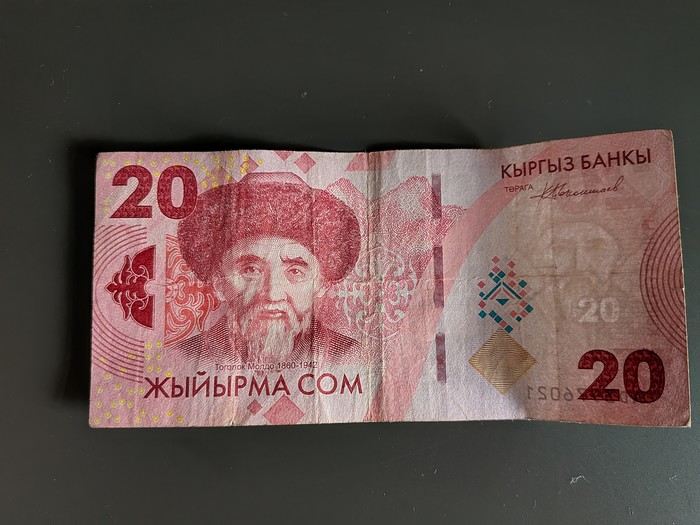
Bills come in 5000, 1000, 500, 200, 100, 50, and 20 soms.
Coins: 10, 5, 3, and 1 som.
- Paying
Card payments are accepted in supermarkets like Globus, some restaurants, gas stations of major chains (Bishkek Petroleum, Partner Neft, Red Petroleum), some hotels, national park entrances, tolls, etc.
But it doesn’t always work.
So always carry cash with you!
If the card works, great—otherwise, it’s back to the old days of wads of bills.
- Cost of Living
It’s really cheap (gas, affordable restaurants even at a decent standard, hotels, souvenirs, fruits, vegetables, water, bread...). For example, a lagman costs only 3.20 €, fixing a flat tire is 3.5 €, a full hour-long wash for a filthy 4x4 is 6 €, washing a big bag of laundry is 3 €, and a liter of 95-octane gas is 0.86 €...
On the pricier side: guesthouses and meals in guesthouses. The value for money is poor. I paid 40 € for a mediocre room with a very basic shared bathroom, while a double with AC, private bathroom, and fridge in a non-touristy hotel cost 20 €... Meals in guesthouses are the worst I’ve eaten and often the most expensive. Plus, they’re very light—don’t expect to fill up after a long day of hiking!
Car rentals are also quite expensive (70 $ per day for a RAV4 in my case).
In short, for two people, excluding accommodation and car rental, we spent an average of 45 € per day (groceries, restaurants, guesthouse dinners, souvenirs, paid activities, gas).
The trip cost us 2200 € per person all-inclusive for 3 weeks on the ground. Roughly 1/4 for the flight, 1/4 for the car, 1/4 for accommodation, and 1/4 for everything else.
- Getting Around
I’ve met cyclists, motorcyclists, people renting cars, those who drove their own vehicles from Europe, and others using public transport and taxis.
Personally, I chose to rent a car.
If you’re not planning long hikes or multi-day horse treks, it’s a great option for exploring the country.
Each car rental company has its own list of forbidden tracks. Make sure your planned route is allowed! Don’t think about ignoring this—vehicles are equipped with GPS trackers...
An international driver’s permit is required.
Police and speed cameras are everywhere, so it’s best to respect the signs (daytime running lights, seatbelts, 40-60 km/h in populated areas, 90 km/h on roads, zero tolerance for alcohol).
Locals have a unique driving style, and it can be dangerous on main roads (they overtake recklessly...). Like in Greece, South Africa, or Malta, a two-lane road is treated as a three-lane one. You pull over to let others pass or to let oncoming traffic overtake.
Without a car (at least a pseudo-4x4), you won’t be able to go everywhere. This country is a nature destination, but nature isn’t always accessible by public transport.
If a spot is near a road, great—the bus will get you almost to the door. Otherwise, you’ll need to hire an agency or take a taxi.
Cyclists will face steep climbs and dust. I’d advise avoiding main roads as much as possible—traffic isn’t on your side...
Motorcyclists will also eat a lot of dust and should research gas stations along their route (this advice also applies to vehicles running on 95-octane).
There’s a 95-octane pump in Kazarman and Gulcha.
Bikes and motorcycles have an advantage over cars, even 4x4s, as they can access some very remote tracks that other vehicles can’t (hikers and horses can obviously take them too!).
Be careful: some areas require a permit (border zones). Research this well in advance—the formalities don’t take an hour or even a day!
Be warned: Google Maps is completely unreliable (it shows roads that don’t exist, routes you through difficult tracks instead of paved roads, etc.). It’s essential to download Maps.me in advance. This app is much more reliable for this country, works offline, and is handy for hiking navigation.
A reminder: horseback riding is like cycling... If you’re not used to it or naturally padded in the right places, your backside will suffer in no time!
Think carefully before embarking on a multi-day trek!
Finally, this country is a kingdom of construction... The Chinese have taken over the market to improve truck circulation and are paving everywhere. (Good news: the Kazarman-Osh section via the tunnel is finally open in summer, even if the road isn’t quite finished.)
- Eating
I had prejudices about Kyrgyz food.
I was both wrong and right.
Supermarkets don’t offer much that’s appealing for picnics. It’s cheap, filling food, full of junk, and not gourmet. If you follow Yuka, I think you’ll be on a diet the whole trip. Bringing some pâté, sausages, or freeze-dried meals for certain nights is a good idea...
Guesthouse dinners consist of the eternal cucumber-tomato salad, a soup, and a light noodle or rice dish where you’ll be searching for the meat... Usually tough and unidentifiable. Beef? The bread is stale, and there’s no dessert or fruit.
Breakfasts always revolve around eggs or porridge... The homemade jam is usually good.
Tea is the number one drink, followed by kompot (a fruit-based drink), Coke, and Fanta.
If you want real coffee, bring your own—it’s very rare.
On the other hand, you eat well in restaurants. Lagman (homemade noodles, vegetables, spices, and usually beef), crispy eggplant, kuurdak (a kind of lamb stew with potatoes), kebabs, plov (pilaf rice with onions, carrots, and meat), and rainbow trout... For dessert? Nada!
And alcohol?
It’s available in all Globus stores: beer, wine, spirits, and you can consume your purchases in some guesthouses (depending on the owner’s religious tolerance). It’s also available in some restaurants (Bishkek, Karakol, Osh...).
The deadly specialty?
White fermented milk balls called kurut. If you think a raw-milk camembert is strong, steer clear! This is more like an old, dry, spicy goat cheese.
- Accommodation
In remote areas, it’s better to check availability on Booking a few days in advance rather than showing up last minute with high hopes.
Booking and Airbnb only offer a small portion of what’s available.
Not necessarily guesthouses, but mostly accommodations aimed at locals (business or leisure travel).
These places are generally more comfortable. There’s even some upscale options.
So it’s necessary to scour Google Maps or Yandex Maps... These accommodations are usually found on Instagram, and WhatsApp is handy for booking!
Prices are a bit of a lottery. So is the comfort. From 20 to 80 € for a double, usually with a private bathroom. (Average around 40 €). These rates are for mid-range options.
Otherwise, this country is a paradise for wild camping. In a camper van, rooftop tent, or ground tent... There are beautiful spots everywhere!
- Climate
I thought it would be quite cool/cold at altitude.
I packed too many warm clothes...
If you’re not doing high-altitude treks or sleeping in a tent, there’s no need to overload yourself with winter gear.
A good fleece, a windproof rain jacket, and technical base layers will be enough.
It only got really cold in the evenings at Song Kul Lake and Tash Rabat, and the yurts are equipped with thick blankets and a stove.
Elsewhere, temperatures ranged from 15 to 30 °C.
In short, I used the AC more than the heater! (It’s hard to drive with the windows open unless you want to be covered in dust in no time...)
- Communication
I bought an eSIM before the trip with a data plan for Kyrgyzstan (Beeline network). Perfect for communicating via WhatsApp right after landing, but this network isn’t the best in Kyrgyzstan.
We then got a physical SIM card with an unlimited one-month plan (less than 4 € including the SIM) at a Mega store downtown. This network is much better, and you get coverage in all cities and most villages. Usually in the mountain passes too.
To make yourself understood, it’s essential to download Google Translate with French, Kyrgyz, Russian, and English options.
Very useful for translating menus, signs, and communicating with locals.
Hosts and other tourism professionals will even pull out their phones to communicate with non-Russian speakers.
The police too...
- Religion
There’s a noticeable difference between the north and the southwest of the country.
In the north, it’s a bit like Albania. People are Muslim by culture but not really by religion.
In the southwest, radical Islam is growing. Mosques are more numerous and imposing. Men are more bearded, women more veiled.
For travelers, religion isn’t an issue except for the near-total absence of pork.
There’s Russian sausage, but reading the ingredient list, it’s more like a one-way ticket to cancer than an Auvergne dry sausage...
You can find the detailed account of the trip here.
- Which airline from Europe?
Turkish Airlines seems like an excellent option. The price is very reasonable (just over 500 €), the layover isn’t too long, the in-flight comfort is decent (great movie selection), and the planes are modern. Plus, the price automatically includes 30 kilos of luggage, which is perfect for campers.
The downside: the outrageous prices at Istanbul Airport.
- Bishkek Airport
The airport is under full reconstruction. It’s chaotic. There are SIM card vendors upon arrival, but no currency exchange or ATMs in the baggage claim area. You’ll find those in the departures section, which means you have to exit and re-enter under the current setup.
Personally, I pre-booked a VTC with my hotel for the transfer to the city. (Prices vary depending on the hotel’s standard—1200 soms for mine.)
There are taxis and a bus available.
- Entry Requirements
No visa is required for French citizens for stays of up to 30 days.
- Currency
The currency is the som, and the conversion is easy—just divide by 100...
You can get soms by exchanging euros (dollars are useless) or by withdrawing from an ATM. Some ATMs charge fees. Those from Mbank and Optimabank are fee-free.
The maximum withdrawal is usually 20,000 soms.
Bills come in 5000, 1000, 500, 200, 100, 50, and 20 soms.
Coins: 10, 5, 3, and 1 som.
- Paying
Card payments are accepted in supermarkets like Globus, some restaurants, gas stations of major chains (Bishkek Petroleum, Partner Neft, Red Petroleum), some hotels, national park entrances, tolls, etc.
But it doesn’t always work.
So always carry cash with you!
If the card works, great—otherwise, it’s back to the old days of wads of bills.
- Cost of Living
It’s really cheap (gas, affordable restaurants even at a decent standard, hotels, souvenirs, fruits, vegetables, water, bread...). For example, a lagman costs only 3.20 €, fixing a flat tire is 3.5 €, a full hour-long wash for a filthy 4x4 is 6 €, washing a big bag of laundry is 3 €, and a liter of 95-octane gas is 0.86 €...
On the pricier side: guesthouses and meals in guesthouses. The value for money is poor. I paid 40 € for a mediocre room with a very basic shared bathroom, while a double with AC, private bathroom, and fridge in a non-touristy hotel cost 20 €... Meals in guesthouses are the worst I’ve eaten and often the most expensive. Plus, they’re very light—don’t expect to fill up after a long day of hiking!
Car rentals are also quite expensive (70 $ per day for a RAV4 in my case).
In short, for two people, excluding accommodation and car rental, we spent an average of 45 € per day (groceries, restaurants, guesthouse dinners, souvenirs, paid activities, gas).
The trip cost us 2200 € per person all-inclusive for 3 weeks on the ground. Roughly 1/4 for the flight, 1/4 for the car, 1/4 for accommodation, and 1/4 for everything else.
- Getting Around
I’ve met cyclists, motorcyclists, people renting cars, those who drove their own vehicles from Europe, and others using public transport and taxis.
Personally, I chose to rent a car.
If you’re not planning long hikes or multi-day horse treks, it’s a great option for exploring the country.
Each car rental company has its own list of forbidden tracks. Make sure your planned route is allowed! Don’t think about ignoring this—vehicles are equipped with GPS trackers...
An international driver’s permit is required.
Police and speed cameras are everywhere, so it’s best to respect the signs (daytime running lights, seatbelts, 40-60 km/h in populated areas, 90 km/h on roads, zero tolerance for alcohol).
Locals have a unique driving style, and it can be dangerous on main roads (they overtake recklessly...). Like in Greece, South Africa, or Malta, a two-lane road is treated as a three-lane one. You pull over to let others pass or to let oncoming traffic overtake.
Without a car (at least a pseudo-4x4), you won’t be able to go everywhere. This country is a nature destination, but nature isn’t always accessible by public transport.
If a spot is near a road, great—the bus will get you almost to the door. Otherwise, you’ll need to hire an agency or take a taxi.
Cyclists will face steep climbs and dust. I’d advise avoiding main roads as much as possible—traffic isn’t on your side...
Motorcyclists will also eat a lot of dust and should research gas stations along their route (this advice also applies to vehicles running on 95-octane).
There’s a 95-octane pump in Kazarman and Gulcha.
Bikes and motorcycles have an advantage over cars, even 4x4s, as they can access some very remote tracks that other vehicles can’t (hikers and horses can obviously take them too!).
Be careful: some areas require a permit (border zones). Research this well in advance—the formalities don’t take an hour or even a day!
Be warned: Google Maps is completely unreliable (it shows roads that don’t exist, routes you through difficult tracks instead of paved roads, etc.). It’s essential to download Maps.me in advance. This app is much more reliable for this country, works offline, and is handy for hiking navigation.
A reminder: horseback riding is like cycling... If you’re not used to it or naturally padded in the right places, your backside will suffer in no time!
Think carefully before embarking on a multi-day trek!
Finally, this country is a kingdom of construction... The Chinese have taken over the market to improve truck circulation and are paving everywhere. (Good news: the Kazarman-Osh section via the tunnel is finally open in summer, even if the road isn’t quite finished.)
- Eating
I had prejudices about Kyrgyz food.
I was both wrong and right.
Supermarkets don’t offer much that’s appealing for picnics. It’s cheap, filling food, full of junk, and not gourmet. If you follow Yuka, I think you’ll be on a diet the whole trip. Bringing some pâté, sausages, or freeze-dried meals for certain nights is a good idea...
Guesthouse dinners consist of the eternal cucumber-tomato salad, a soup, and a light noodle or rice dish where you’ll be searching for the meat... Usually tough and unidentifiable. Beef? The bread is stale, and there’s no dessert or fruit.
Breakfasts always revolve around eggs or porridge... The homemade jam is usually good.
Tea is the number one drink, followed by kompot (a fruit-based drink), Coke, and Fanta.
If you want real coffee, bring your own—it’s very rare.
On the other hand, you eat well in restaurants. Lagman (homemade noodles, vegetables, spices, and usually beef), crispy eggplant, kuurdak (a kind of lamb stew with potatoes), kebabs, plov (pilaf rice with onions, carrots, and meat), and rainbow trout... For dessert? Nada!
And alcohol?
It’s available in all Globus stores: beer, wine, spirits, and you can consume your purchases in some guesthouses (depending on the owner’s religious tolerance). It’s also available in some restaurants (Bishkek, Karakol, Osh...).
The deadly specialty?
White fermented milk balls called kurut. If you think a raw-milk camembert is strong, steer clear! This is more like an old, dry, spicy goat cheese.
- Accommodation
In remote areas, it’s better to check availability on Booking a few days in advance rather than showing up last minute with high hopes.
Booking and Airbnb only offer a small portion of what’s available.
Not necessarily guesthouses, but mostly accommodations aimed at locals (business or leisure travel).
These places are generally more comfortable. There’s even some upscale options.
So it’s necessary to scour Google Maps or Yandex Maps... These accommodations are usually found on Instagram, and WhatsApp is handy for booking!
Prices are a bit of a lottery. So is the comfort. From 20 to 80 € for a double, usually with a private bathroom. (Average around 40 €). These rates are for mid-range options.
Otherwise, this country is a paradise for wild camping. In a camper van, rooftop tent, or ground tent... There are beautiful spots everywhere!
- Climate
I thought it would be quite cool/cold at altitude.
I packed too many warm clothes...
If you’re not doing high-altitude treks or sleeping in a tent, there’s no need to overload yourself with winter gear.
A good fleece, a windproof rain jacket, and technical base layers will be enough.
It only got really cold in the evenings at Song Kul Lake and Tash Rabat, and the yurts are equipped with thick blankets and a stove.
Elsewhere, temperatures ranged from 15 to 30 °C.
In short, I used the AC more than the heater! (It’s hard to drive with the windows open unless you want to be covered in dust in no time...)
- Communication
I bought an eSIM before the trip with a data plan for Kyrgyzstan (Beeline network). Perfect for communicating via WhatsApp right after landing, but this network isn’t the best in Kyrgyzstan.
We then got a physical SIM card with an unlimited one-month plan (less than 4 € including the SIM) at a Mega store downtown. This network is much better, and you get coverage in all cities and most villages. Usually in the mountain passes too.
To make yourself understood, it’s essential to download Google Translate with French, Kyrgyz, Russian, and English options.
Very useful for translating menus, signs, and communicating with locals.
Hosts and other tourism professionals will even pull out their phones to communicate with non-Russian speakers.
The police too...
- Religion
There’s a noticeable difference between the north and the southwest of the country.
In the north, it’s a bit like Albania. People are Muslim by culture but not really by religion.
In the southwest, radical Islam is growing. Mosques are more numerous and imposing. Men are more bearded, women more veiled.
For travelers, religion isn’t an issue except for the near-total absence of pork.
There’s Russian sausage, but reading the ingredient list, it’s more like a one-way ticket to cancer than an Auvergne dry sausage...
You can find the detailed account of the trip here.
Travel buddy for Laos for 1 month
For February 2027,
Since it's so much better to travel as a pair, I'm looking for a friendly female travel buddy to visit Laos, with a stop in northern Thailand first to explore the Chiang Mai region before heading to Laos.
I travel backpacker-style but with comfort—staying with locals or in small hotels with private bathrooms, using the country's trains and buses. I'm easygoing, love joking around and laughing, and I'm experienced with independent travel. To avoid flight surprises, it'd be best to book them 6 to 8 months in advance. If you're interested, get in touch!
Travel companion for exploring Armenia in September 2026
I’m 72 years old but in great shape and a seasoned long-term traveler. I’m looking for a travel companion to join me in Armenia this coming September (I’ll be booking my flight ticket soon—I live in Auvergne, so I’ll be flying out of Lyon). Just so you know, I’m not after luxury hotels, guest houses, or Airbnbs—I love street food and get around by bus or taxi using local apps!
... Looking forward to hearing from you! :-))
Getting from Malacca to Jerantut
Hi,
From Malacca to get to Jerantut, is it better to go back to KL and take a bus from there, or take a bus to Tampin and then a train? Any feedback on the "Jungle Train"? (duration, price, comfort, etc.). Thanks
Summer 2027 - Uzbekistan/Kyrgyzstan Family Trip (19 Nights)
Hello,
Summer 2026 hasn’t even arrived yet, and I’m already thinking about summer 2027! We’re a family with two kids, who will be 9.5 and 4.5 years old next summer (turning 5 at the end of October 2027, actually). We’d love to spend 19 nights in Uzbekistan and Kyrgyzstan—a part of the world that’s completely new to us. We enjoy traveling, do it often, and the kids are used to it (though we still need a bit of organization and comfort!). Here’s the rough outline of our itinerary: Day 1 - Arrival in Tashkent (ideally in the late afternoon). Head to the train station (by taxi?) to take the overnight sleeper train to Urgench (1 night). Day 2 - Khiva (2 nights): Taxi transfer from the station to the city. Visit Itchan Kala, the walls, and sunset. Day 4 - Head to Bukhara (3 nights) by train (about 6 hours). Visit the historic center, domes, and workshops. Day 7 - On to Samarkand (2 nights), but this time with a private driver. Visit Registan, the necropolis, and local crafts. Day 9 - Head to Osh (1 night) in Kyrgyzstan with the private driver, who’ll drop us at the border. Long transition day (including border crossing). If it’s not too late, visit Osh’s market (otherwise, the next morning). Day 10 - Pick up our rental car (4x4 without a driver this time) and drive to Toktogul (2 nights) and the Suusamyr Valley. Day 12 - Head to the Kochkor region (350 km - 4 nights): Tash Rabat, Song-Kul Lake (yurt stay), and Aigliers. Day 16 - Depart for Karakol/Issyk-Kul (250 km - 4 nights): Jeti-Oguz, Altyn Arashan, beaches, and hot springs. Day 20: Fly home. TOTAL = 19 nights What do you think? Budget-wise:
Flight tickets: 3000 € Uzbekistan logistics (accommodation ideally with a pool for the kids and vehicle): 1600 € Kyrgyzstan logistics (accommodation and 4x4 vehicle like a Pajero/Land Cruiser): 1600 € Living & food: 800 € TOTAL: 7000 €
Does this seem reasonable? Not overestimated or underestimated? Thanks for any feedback or tips from your own experiences.
Summer 2026 hasn’t even arrived yet, and I’m already thinking about summer 2027! We’re a family with two kids, who will be 9.5 and 4.5 years old next summer (turning 5 at the end of October 2027, actually). We’d love to spend 19 nights in Uzbekistan and Kyrgyzstan—a part of the world that’s completely new to us. We enjoy traveling, do it often, and the kids are used to it (though we still need a bit of organization and comfort!). Here’s the rough outline of our itinerary: Day 1 - Arrival in Tashkent (ideally in the late afternoon). Head to the train station (by taxi?) to take the overnight sleeper train to Urgench (1 night). Day 2 - Khiva (2 nights): Taxi transfer from the station to the city. Visit Itchan Kala, the walls, and sunset. Day 4 - Head to Bukhara (3 nights) by train (about 6 hours). Visit the historic center, domes, and workshops. Day 7 - On to Samarkand (2 nights), but this time with a private driver. Visit Registan, the necropolis, and local crafts. Day 9 - Head to Osh (1 night) in Kyrgyzstan with the private driver, who’ll drop us at the border. Long transition day (including border crossing). If it’s not too late, visit Osh’s market (otherwise, the next morning). Day 10 - Pick up our rental car (4x4 without a driver this time) and drive to Toktogul (2 nights) and the Suusamyr Valley. Day 12 - Head to the Kochkor region (350 km - 4 nights): Tash Rabat, Song-Kul Lake (yurt stay), and Aigliers. Day 16 - Depart for Karakol/Issyk-Kul (250 km - 4 nights): Jeti-Oguz, Altyn Arashan, beaches, and hot springs. Day 20: Fly home. TOTAL = 19 nights What do you think? Budget-wise:
Flight tickets: 3000 € Uzbekistan logistics (accommodation ideally with a pool for the kids and vehicle): 1600 € Kyrgyzstan logistics (accommodation and 4x4 vehicle like a Pajero/Land Cruiser): 1600 € Living & food: 800 € TOTAL: 7000 €
Does this seem reasonable? Not overestimated or underestimated? Thanks for any feedback or tips from your own experiences.
Question about how Kruger Park works for accommodations and visits
Hi everyone, I’m here to get some advice on visiting KRUGER Park.
From what I’ve gathered through my reading, I understand there are two ways to visit the park:
- Independently with your own vehicle
=> Do you drive all day?
- By booking with a professional
=> Safari early in the morning and late in the afternoon. But what do you do in between?
When it comes to accommodations, the options are: - Booking in one of the park’s camps, where the lodging is basic but functional - Booking in a private reserve, which is more comfortable but prohibitively expensive - Booking outside the park, which means entering the park every morning. But if you want to stay for 3 days, that doesn’t seem practical to me. Do you have any advice for accommodations?
To be honest, I’m really struggling to understand how it all works... Thanks to everyone for your help. Bidule 27
When it comes to accommodations, the options are: - Booking in one of the park’s camps, where the lodging is basic but functional - Booking in a private reserve, which is more comfortable but prohibitively expensive - Booking outside the park, which means entering the park every morning. But if you want to stay for 3 days, that doesn’t seem practical to me. Do you have any advice for accommodations?
To be honest, I’m really struggling to understand how it all works... Thanks to everyone for your help. Bidule 27
From Mexico to the Wonderful Chiapas
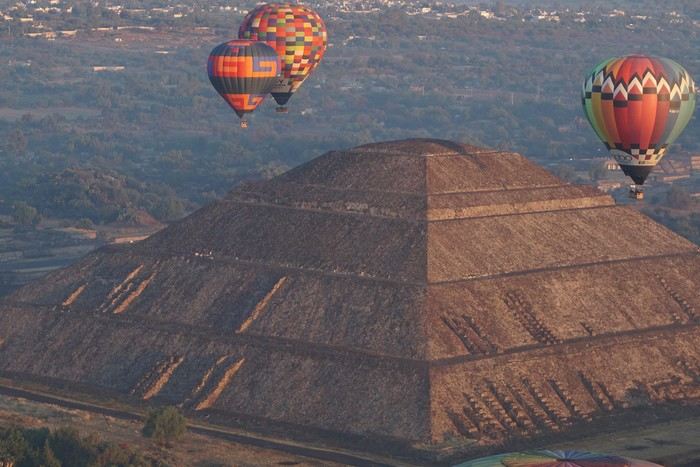
This one-month trip, from January 18 to February 17, 2026, allowed us to visit Mexico City and travel through the states of Puebla, Oaxaca, and Chiapas. We mainly used buses (ADO company) for medium and long distances and colectivos or taxis (or Uber) for shorter trips. Before leaving, I had contacted several people on the ground: Harry, a Vendéan settled in Oaxaca offering, among other things, discoveries of artisan villages or the Monte Albán site, and Oscar in Comitán de Domínguez. I’ll come back to our meeting with Oscar, who runs a local agency (CVL Travel Turismo Alternativo & Corre la voz) and owns a very pleasant hostel, a real highlight of our trip. Our journey took place in 8 stages on a loop starting from Mexico City. The connections between each were made by day or night buses depending on the trip duration. I had booked our seats in advance, either directly on the ADO company’s website or through booking platforms depending on the rates offered. Note that by planning ahead, I was able to benefit from very interesting "Early Booking" rates. There are several comfort classes. For all our trips, I had booked seats in Primera class buses, except for two in GL (Grand Luxe) class. The rates are very reasonable, and the buses turned out to be comfortable or even very comfortable (only the basic seat recline might surprise you).
Our itinerary and number of days per stage: Stage 1 – Mexico City: 4 days Stage 2 – Puebla: 2 days Stage 3 – Oaxaca: 4 days Stage 4 – San Agustinillo: 4 days Stage 5 – San Cristóbal de las Casas: 3 days Stage 6 – Comitán de Domínguez: 6 days Stage 7 – Palenque: 4 days Stage 8 – Mexico City: 2 days If I were to do it again, I’d remove one day from Palenque and add it either to Puebla or San Cristóbal to visit nearby sites or villages, or to San Agustinillo to enjoy one more day by the Pacific Ocean.
Stage 1: Mexico City (2,200 m / 9.2 million inhabitants) We arrived in the Mexican capital around 10:00 PM. The simplified customs process was very quick. After exchanging some money at the airport, we took a taxi to our youth hostel. We got around the capital on foot, of course, but also by metro. Signs are very rare, and we took the train in the wrong direction several times. After a few mistakes, we systematically asked on the platform if we were going the right way. The metro is very affordable. You need to get a rechargeable card (the Tarjeta de Movilidad Integrada) and top it up as needed. This card (less than 1 €) isn’t personal, so there’s no need to get one per person.
Mexico City: Day 1.
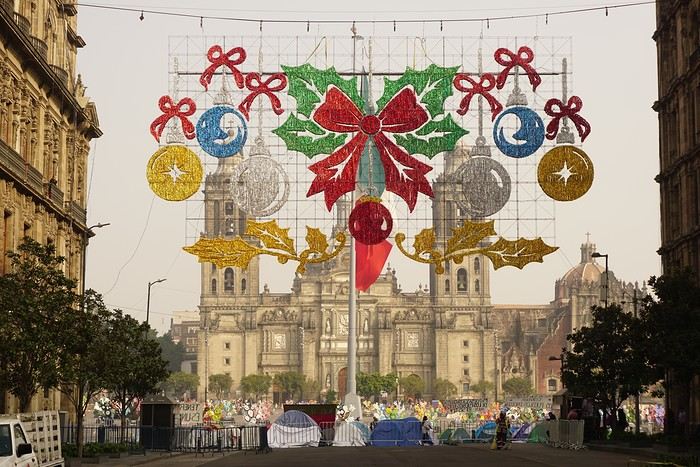
Visits and walks of the day (note: many museums are closed on Mondays): The Zócalo or Constitution Square: it’s one of the most beautiful, largest (195m x 240m), and oldest squares in the world. This is where Cortés decided to build the center of the new Spanish city on the site of the former Tenochtitlan market. Stones from the pyramids were used to pave the esplanade and build the surrounding colonial churches and buildings. During our visit, the huge square was covered with (resin) cacti, the theme of the temporary exhibition at the time. Indeed, temporary events or exhibitions take place here throughout the year. It’s also the endpoint for many protest marches.
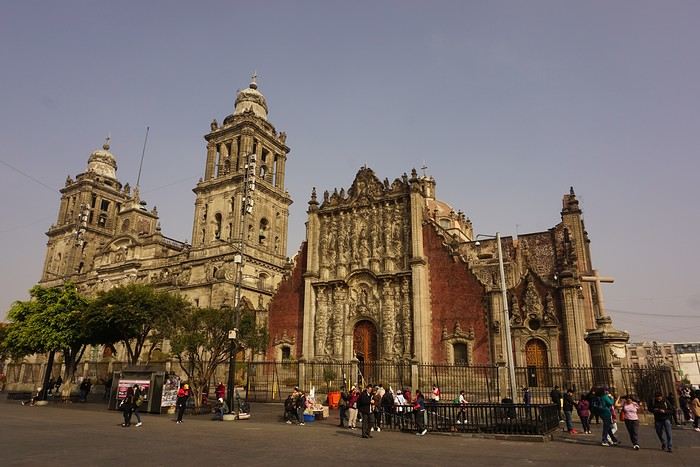
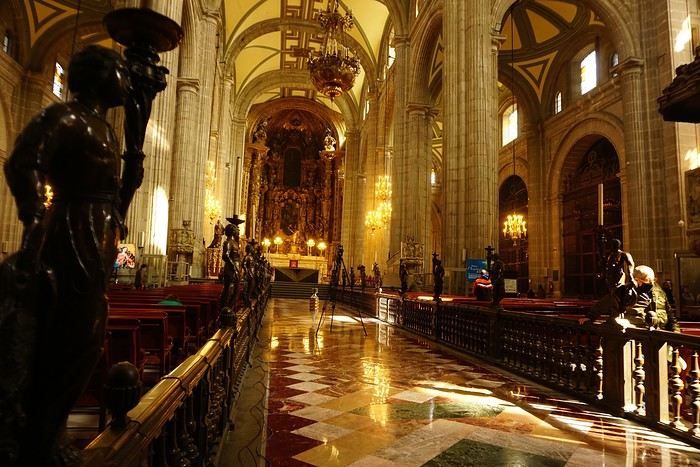


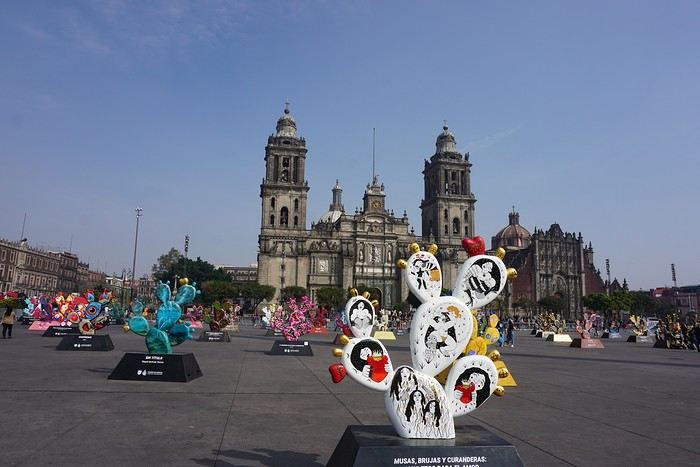
The cathedral: it’s sinking by one centimeter per year despite massive stabilization work (the collapse of many Mexican buildings—30 cm/year—is due to groundwater pumping). It was built starting in 1571 and completed in... 1813. The modest remains of the Templo Mayor (exterior view): they have high symbolic value, as this monument was the most important in the Mexica Empire.
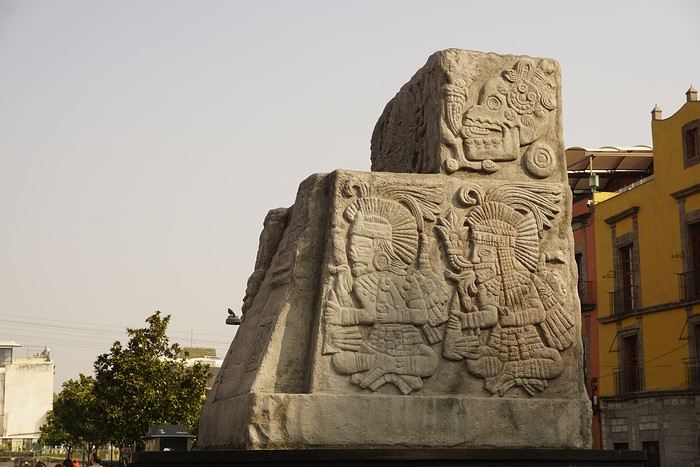 We then walked through the streets of the historic center to the Santísima Church, unfortunately closed for renovation work.
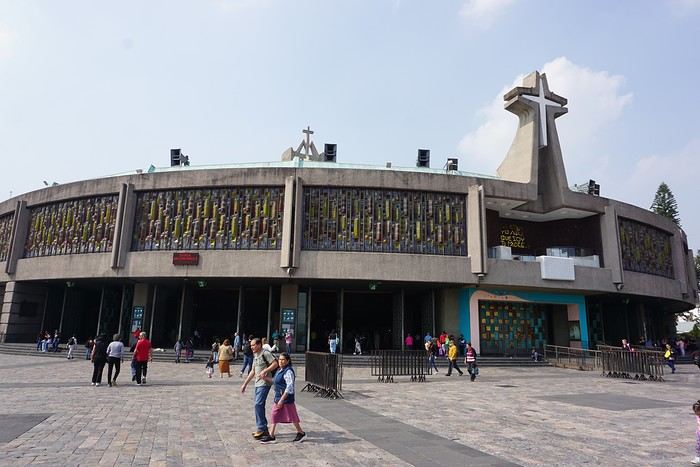
Next, we took the metro to visit one of Mexico’s most important pilgrimage sites: the Insigne y Nacional Basílicas de Santa María de Guadalupe, as well as the Capilla del Cerrito on the hill.
The first, dating from the colonial era, is really leaning a lot.
We then walked through the streets of the historic center to the Santísima Church, unfortunately closed for renovation work.
Next, we took the metro to visit one of Mexico’s most important pilgrimage sites: the Insigne y Nacional Basílicas de Santa María de Guadalupe, as well as the Capilla del Cerrito on the hill.
The first, dating from the colonial era, is really leaning a lot.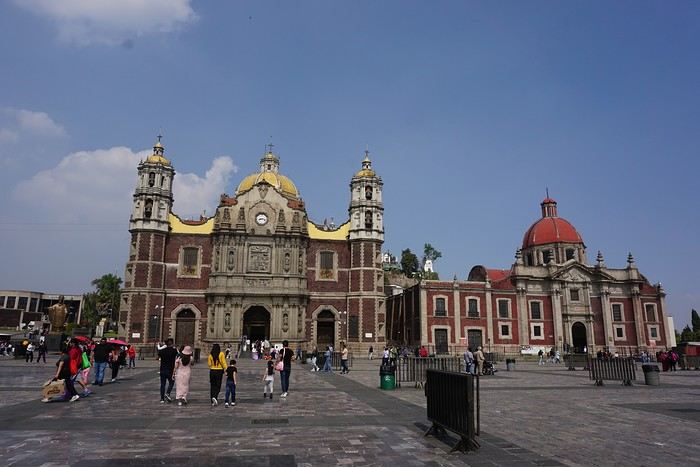
The second, shaped like a rotunda, is very impressive from the inside.
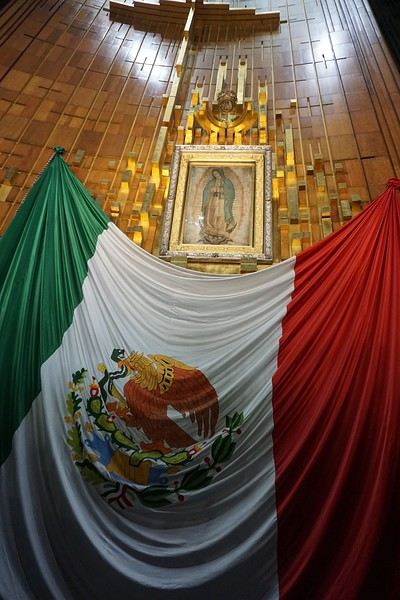
In the basement, there’s a sacred tunic where, in 1531, an image of the Virgin Mary is said to have appeared. A real mystery for scientists, the garment has never deteriorated since that date. Slow-moving conveyor belts allow pilgrims to admire it, preventing crowds from gathering in front of the image for hours. Well thought out!
 From the top of the Capilla del Cerrito, you get beautiful views of huge Mexico City.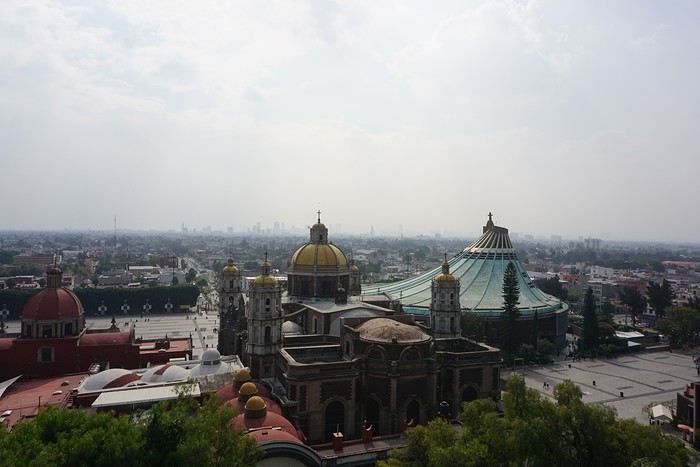
A Bold Combo: Southern Peru, Bolivia, and Northern Chile
Hello everyone,
For our latest 3-week family trip (yes, the kids are growing up, and two of them are about to enter the working world), we’re heading to South America! For our first time on this continent, I had planned a classic 3-week loop in Peru.
But since we won’t be returning to this part of the world anytime soon, I thought: why not follow in the footsteps of Franck, aka Bibouns51, who, in 18 days, didn’t just stick to Peru but also added two of the planet’s most stunning landscapes to his itinerary... the Salar de Uyuni in Bolivia and its neighbor, the fabulous Atacama Desert in northern Chile !!
So, I set about the tricky task of limiting the regions we’d visit in Peru to those we considered must-sees, to avoid rushing too much. The visit schedules were optimized, including several comfortable overnight buses that have the huge advantage of letting us hop between regions.
So, we’re off on a somewhat adventurous trip with three domestic flights (two on the first day and one on the last), two overnight buses for quick hops, several car rentals, the services of a few drivers to make the trip more comfortable, and even a tour operator for crossing the Salar...
Our main concern is altitude sickness, and we’re bringing Diamox, aspirin, etc., just in case.
Our second worry before departure was not even getting off the ground... Yes, for once, we’re leaving from France—Marseille, to be exact. The week before our departure, with the surprise air traffic controllers’ strike, I remembered why we usually prefer to leave from abroad, like Turin or Barcelona... In the end, it wasn’t the air traffic controllers who made us nervous but the early July wildfires that paralyzed the airport a few days before our departure. Fortunately, the fires were quickly brought under control, and on the big day, everything was smooth sailing!
Detailed itinerary (which changed on Day 1 due to departure hiccups): Day 0: Flight Marseille - Madrid - Lima PERU Theoretical and abandoned Day 1: Flight Lima - Cuzco and visit Cuzco (Puka Pukara, Tambomachay, Cristo Blanco Observatory, Sacsayhuaman sunset) - Night in Cuzco Day 2: Taxi -> Chinchero - Moray - Maras Salt Mines - Ollantaytambo - Train to Aguas Calientes Day 3: Machu Picchu - Return train to Ollantaytambo Day 4: 2-day taxi -> Pisac - Tipon - Andahuaylillas - Huaro - Night in San Pedro Day 5: Palcoyo - Checacupe - Vinicunca - Return and night in Cuzco Day 6: Day in Cuzco (catch-up on Sacsayhuaman, San Blas district, Temple of the Sun) - Overnight bus to Arequipa Day 7: Rental car -> On the road to Colca Canyon, night in Cabanaconde Day 8: Descent to the bottom of Colca Canyon, night at Oasis Sangalle Day 9: Ascent from the canyon - Maca - Chivay - Return and night in Arequipa Day 10: Visit Arequipa (Santa Catalina Convent, La Recoleta Church and Monastery, La Compañía Church, Cathedral) - Overnight bus to Puno Day 11: Lake Titicaca - Night in Puno BOLIVIA Day 12: Shared taxi -> Road to La Paz, visit downtown La Paz - Night 1 in La Paz Day 13: Moon Valley and Las Animas Valley - Night 2 in La Paz Day 14: Day in La Paz - Night 3 in La Paz Day 15: Flight to Uyuni - Day 1 of Salar de Uyuni tour - Night at the edge of the Salar Day 16: Crossing the Lipez region and lagoons - Night near Laguna Colorada Day 17: Sol de Mañana CHILE Day 17 cont.: Pre-booked transfer to SPDA - 4x4 rental - Pukara de Quitor - Stargazing tour - Night 1 in SPDA Day 18: Death Valley and Moon Valley - Night 2 in SPDA Day 19: Miscanti and Miniques Lagoons, Salar de Aguas Calientes and its Piedra Roja, Tebenquiche Lagoon and Quebrada del Diablo - Night 3 in SPDA Day 20: Rainbow Valley and swim in the Puritama River - Night 4 in SPDA Day 21: Tebenquiche Lagoon - Bus to Calama - Flight to Santiago Day 22: Return Santiago - Madrid - Marseille
Day 0 - 11/07: Destination Lima
Our first flight from Marseille went smoothly to our Iberia layover in Madrid.
In Madrid, just after getting off the plane around 8 PM, and as we were walking through the terminal, we got a rude awakening!!
We saw the word "Cancelled" next to our flight number on the display boards. Thinking it must be a glitch, we checked another screen, but the system was stubborn, and the same dreaded word appeared !
So, we headed to the Iberia counter, where an agent confirmed that our Friday evening flight was canceled and rescheduled for the next morning. The reason? A breakdown and no replacement plane, even though we were in Madrid, Iberia’s home base!
To make matters worse, I remembered our super-tight schedule, planned to the minute, with no buffer day in Lima. Since I’m a bit phobic of megacities and hadn’t found anything appealing in the Peruvian capital in our guidebooks, we’d planned to leave Lima as soon as possible for Cusco, the heart of the Sacred Valley, to spend our first day there.
Bad idea, because we already knew the 4-hour buffer wouldn’t be enough, and we’d miss the domestic flight, which was, of course, non-refundable and non-changeable. So, we had to call LATAM from Madrid to find another flight for Saturday evening and negotiate a rate to recover some of our initial outlay.
After an hour on the phone with customer service, several endless holds, and three failed attempts to dictate our credit card number over the phone to a Spaniard speaking English with a thick accent, we finally managed to confirm the transaction, securing our new flight tickets for a moderate extra cost of just 150 € total.
At first, we were pretty bummed about losing a day and incurring extra fees to reschedule the domestic flight, but then, when we learned from an Iberia customer service rep that we’d receive the max compensation of 600 € per traveler, we even ended up grinning... because 3000 € in refunds for only losing the first day in Cusco? We’d sign up for that 10 times over!!
Iberia then took care of us, putting us up in a hotel where we had dinner before a short 5-hour night and an early morning departure. I took the opportunity to improvise a quick day of sightseeing in Lima, focusing on the Barranco and Miraflores districts.
For our latest 3-week family trip (yes, the kids are growing up, and two of them are about to enter the working world), we’re heading to South America! For our first time on this continent, I had planned a classic 3-week loop in Peru.
But since we won’t be returning to this part of the world anytime soon, I thought: why not follow in the footsteps of Franck, aka Bibouns51, who, in 18 days, didn’t just stick to Peru but also added two of the planet’s most stunning landscapes to his itinerary... the Salar de Uyuni in Bolivia and its neighbor, the fabulous Atacama Desert in northern Chile !!
So, I set about the tricky task of limiting the regions we’d visit in Peru to those we considered must-sees, to avoid rushing too much. The visit schedules were optimized, including several comfortable overnight buses that have the huge advantage of letting us hop between regions.
So, we’re off on a somewhat adventurous trip with three domestic flights (two on the first day and one on the last), two overnight buses for quick hops, several car rentals, the services of a few drivers to make the trip more comfortable, and even a tour operator for crossing the Salar...
Our main concern is altitude sickness, and we’re bringing Diamox, aspirin, etc., just in case.
Our second worry before departure was not even getting off the ground... Yes, for once, we’re leaving from France—Marseille, to be exact. The week before our departure, with the surprise air traffic controllers’ strike, I remembered why we usually prefer to leave from abroad, like Turin or Barcelona... In the end, it wasn’t the air traffic controllers who made us nervous but the early July wildfires that paralyzed the airport a few days before our departure. Fortunately, the fires were quickly brought under control, and on the big day, everything was smooth sailing!
Detailed itinerary (which changed on Day 1 due to departure hiccups): Day 0: Flight Marseille - Madrid - Lima PERU Theoretical and abandoned Day 1: Flight Lima - Cuzco and visit Cuzco (Puka Pukara, Tambomachay, Cristo Blanco Observatory, Sacsayhuaman sunset) - Night in Cuzco Day 2: Taxi -> Chinchero - Moray - Maras Salt Mines - Ollantaytambo - Train to Aguas Calientes Day 3: Machu Picchu - Return train to Ollantaytambo Day 4: 2-day taxi -> Pisac - Tipon - Andahuaylillas - Huaro - Night in San Pedro Day 5: Palcoyo - Checacupe - Vinicunca - Return and night in Cuzco Day 6: Day in Cuzco (catch-up on Sacsayhuaman, San Blas district, Temple of the Sun) - Overnight bus to Arequipa Day 7: Rental car -> On the road to Colca Canyon, night in Cabanaconde Day 8: Descent to the bottom of Colca Canyon, night at Oasis Sangalle Day 9: Ascent from the canyon - Maca - Chivay - Return and night in Arequipa Day 10: Visit Arequipa (Santa Catalina Convent, La Recoleta Church and Monastery, La Compañía Church, Cathedral) - Overnight bus to Puno Day 11: Lake Titicaca - Night in Puno BOLIVIA Day 12: Shared taxi -> Road to La Paz, visit downtown La Paz - Night 1 in La Paz Day 13: Moon Valley and Las Animas Valley - Night 2 in La Paz Day 14: Day in La Paz - Night 3 in La Paz Day 15: Flight to Uyuni - Day 1 of Salar de Uyuni tour - Night at the edge of the Salar Day 16: Crossing the Lipez region and lagoons - Night near Laguna Colorada Day 17: Sol de Mañana CHILE Day 17 cont.: Pre-booked transfer to SPDA - 4x4 rental - Pukara de Quitor - Stargazing tour - Night 1 in SPDA Day 18: Death Valley and Moon Valley - Night 2 in SPDA Day 19: Miscanti and Miniques Lagoons, Salar de Aguas Calientes and its Piedra Roja, Tebenquiche Lagoon and Quebrada del Diablo - Night 3 in SPDA Day 20: Rainbow Valley and swim in the Puritama River - Night 4 in SPDA Day 21: Tebenquiche Lagoon - Bus to Calama - Flight to Santiago Day 22: Return Santiago - Madrid - Marseille
Day 0 - 11/07: Destination Lima
Our first flight from Marseille went smoothly to our Iberia layover in Madrid.
In Madrid, just after getting off the plane around 8 PM, and as we were walking through the terminal, we got a rude awakening!!
We saw the word "Cancelled" next to our flight number on the display boards. Thinking it must be a glitch, we checked another screen, but the system was stubborn, and the same dreaded word appeared !
So, we headed to the Iberia counter, where an agent confirmed that our Friday evening flight was canceled and rescheduled for the next morning. The reason? A breakdown and no replacement plane, even though we were in Madrid, Iberia’s home base!
To make matters worse, I remembered our super-tight schedule, planned to the minute, with no buffer day in Lima. Since I’m a bit phobic of megacities and hadn’t found anything appealing in the Peruvian capital in our guidebooks, we’d planned to leave Lima as soon as possible for Cusco, the heart of the Sacred Valley, to spend our first day there.
Bad idea, because we already knew the 4-hour buffer wouldn’t be enough, and we’d miss the domestic flight, which was, of course, non-refundable and non-changeable. So, we had to call LATAM from Madrid to find another flight for Saturday evening and negotiate a rate to recover some of our initial outlay.
After an hour on the phone with customer service, several endless holds, and three failed attempts to dictate our credit card number over the phone to a Spaniard speaking English with a thick accent, we finally managed to confirm the transaction, securing our new flight tickets for a moderate extra cost of just 150 € total.
At first, we were pretty bummed about losing a day and incurring extra fees to reschedule the domestic flight, but then, when we learned from an Iberia customer service rep that we’d receive the max compensation of 600 € per traveler, we even ended up grinning... because 3000 € in refunds for only losing the first day in Cusco? We’d sign up for that 10 times over!!
Iberia then took care of us, putting us up in a hotel where we had dinner before a short 5-hour night and an early morning departure. I took the opportunity to improvise a quick day of sightseeing in Lima, focusing on the Barranco and Miraflores districts.
Looking for travel companions for Brazil end of May 2026
Hi there,
We’re a pair in our 40s (young at heart!) from the Île-de-France region, and we don’t know each other yet.
We’re potentially looking for 1 or 2 people around our age to join us in Brazil from May 26 to June 8-9 for me, and until June 14 for Sébastien.
Estimated budget: around 2200-2500 €, including flights.
Our planned itinerary: Rio - Iguazu Falls - Costa Verde (requires a domestic round-trip flight from Rio to Iguazu, about 1h30 each way)
The idea is to share, have fun, explore, eat, and alternate between beaches, relaxation, hikes, and boat excursions... And why not try paragliding in Rio? Let’s go wild! ;)
We’re traveling in comfortable hotel/Airbnb mode.
Don’t hesitate to send us a quick email intro if you’re interested!
Looking forward to it, Kim
We’re potentially looking for 1 or 2 people around our age to join us in Brazil from May 26 to June 8-9 for me, and until June 14 for Sébastien.
Estimated budget: around 2200-2500 €, including flights.
Our planned itinerary: Rio - Iguazu Falls - Costa Verde (requires a domestic round-trip flight from Rio to Iguazu, about 1h30 each way)
The idea is to share, have fun, explore, eat, and alternate between beaches, relaxation, hikes, and boat excursions... And why not try paragliding in Rio? Let’s go wild! ;)
We’re traveling in comfortable hotel/Airbnb mode.
Don’t hesitate to send us a quick email intro if you’re interested!
Looking forward to it, Kim
Hotel recommendations in Agadir
Hi fellow travelers,
I’m looking for a nice hotel in Agadir, in a lively neighborhood, with a room that has a private bathroom, toilet, and AC (not essential). We’ll be staying for 2 or 3 nights before heading south.
We land in the late afternoon—definitely not the best time to go hunting for a place to stay, especially since it’s our first trip to Morocco.
Thanks for your tips!
Mamoudzou, Mayotte - December 2025
There exists a rare land where life expresses itself, a land where everything is destroyed, patched up, where everything is dirty and faded, yet paradoxically, each passing day is synonymous with light and joy. Seen from the sea, magnified by its translucent waters, the island is splendid; seen from inland, ochre and green dress a landscape one would wish to be pristine. As you approach the coast with the tides, countless boat wrecks never finish dying; returning from a hike, you know you’re nearing the city by the increasingly obvious proliferation of all kinds of trash. Overflowing the towns, makeshift homes made of corrugated iron stand here and there, wherever the eye lands; from a height, looking toward the horizon, you find the calm blue of the ocean and the beauty of infinity.
But where does all this corrugated iron come from? Blue, gray, red, or black, you find it pretty much everywhere—except, of course, on the island’s heights, where the heat is such that all life seems impossible. Yet, a few kilometers from the capital, more than an hour’s walk away, the corrugated iron is very much there, omnipresent, guaranteeing a land registry as hypothetical for us Europeans as it is very real for those who live there, far from civilization and comfort. I keep climbing. I’m precisely looking to meet these people who live on very little, if not nothing.
- Jéjé Mogné (Hello, sir in Shimahorais)! Where do you get water here, in this place? How do you drink, irrigate your plants?
- I wait for the rain. We have tanks that fill up well with each rainfall. But right now, it’s not raining much.
At the top of the next hill, lost in the bushes, it’s easier for me to guess the distant city, Mamoudzou, than the rest of the path, a remnant of a magnificent GR called the Island Tour, abandoned for the most part, sometimes maintained between two lost hamlets. The city, the pulse, water. Below, the ocean, running water, drinking water—despite regular interruptions; here, up high, an hour and a half’s walk away, tanks, arbitrariness. On other slopes, however, during another hike, I saw the water supply network, made of sturdy pipes tangled in the earth, right there by the path. It seems there are places where water climbs. Others not. Each to their own karma. In 2025. In a French department.
A path of misfortune, lost and regained, thanks to a sign, an inscription, or the compass’s directions. No one walks here anymore, except those who live here or come to harvest their crops. I remember that breathtaking hike in 2013, when I connected Bandrélé to Mamoudzou, passing by the peaks of Bénara (660m) and Bépilipili (643m), barely pausing at Tsararano and Vahibé: 34 km of intense effort on a rollercoaster path, along a trail that was still discernible. Today, it’s as if everything had disappeared. By also destroying the paths and vegetation, Chido* broke the last momentum of these cautious hikers: insecurity has made its way across the archipelago, and Sunday strolls are no longer the norm. Me, I keep going. I will have walked here and there during these three weeks to get an idea of the places, the people, the landscapes, and the superhuman effort required to move forward in over 40°C. To tell the truth, during my last hike, I cut my plans short and let myself be carried by a group of young people heading back to the city. The path is now just an inextricable network of small trails, the specter of Providence** comes to mind. True wisdom is knowing when to give up. I leave.
* A cyclone named "desire" (in Shona), which ravaged the island of Mayotte on December 14, 2024. ** June 2023, a very poorly prepared hike on Providence Island (Caribbean) from which I miraculously escaped.
On Petite-Terre, Marie takes me to visit some locals, white people who have lived there for a long time and make a living from their art; jewelry for her, all kinds of objects for him. We love this little shop, this oasis amid the chaos that embodies Dostoevsky’s phrase: "Beauty will save the world." It’s clean and tidy, beautiful, well-kept. Invariably, the question of insecurity resurfaces in the middle of the conversation. The woman says:
- I know someone who slipped in their bathtub. Still, I keep taking baths…
So, is this insecurity a myth or reality? I hear stories that are often true but sometimes seemingly exaggerated through the lens of misunderstanding and one-upmanship. Like that of this midwife assaulted one evening (it gets dark early) on her way home from work. Sometimes she was attacked on the path, dragged by the hair for several meters, sometimes she made it home, but it was her roommate who let the two men in. One version talks about a snatched phone and gratuitous violence, another about violence outright. In short, one thing is certain: walking around at night flaunting your phone isn’t a good idea, no more in Mamoudzou than in the rough neighborhoods of Nantes. Also, I played it safe: nothing flashy, nothing bling-bling, and always something to give if needed. I was never approached. It’s not easy to get a sense of the realities, between the hazy reports from journalists sensationalizing everything and the real lives of real people. But I know I can’t rely on these few ideas I’ve formed: I’m nobody, and above all, I don’t live here. What I do know, however, is that since my last visit to the island in 2017, over 80,000 babies have been born, and tens of thousands of immigrants have reached the archipelago’s shores. What’s also obvious is that poverty, hunger, and—let’s say it—indignity foster delinquency and insecurity. So, without taking journalists’ alarmist speeches at face value, we’ll try to keep in mind that a young person rendered orphaned by circumstances (parents expelled), poor and often hungry, involved more or less against their will in village wars and fueled by synthetic drugs*, will readily turn to violence when they truly have nothing to lose. We can trace the origin of this despair to the fact that in Mayotte, those without legal existence have virtually no hope of accessing anything.
* "Chimique" is a series of synthetic cannabinoids
Meanwhile, in the evening, it’s good to go home before the time of stone-throwing. From time to time, along the roads, gangs throw stones at vehicles and school buses, but mostly at police cars—almost all the white Dusters on the island! In front of the Mamoudzou police station, all parked vehicles—mostly Dusters—bear the scars of these attacks. Maybe it’s only at night that gangs unleash and all the burglaries happen? I saw nothing, heard nothing. I lived three weeks in a sort of bunker with no real access to outside light, protected by a fake wooden door doubled with a real metal door, both locked at all times. You don’t tempt fate. You endure it differently.
Today, extraordinarily, it’s raining. Yet, it’s the rainy season! But with my karma helping (what selfishness to want to walk dry when so many souls live off the rain) or is it climate change? The rain only falls once I’ve put on my horrible green pajamas. In front of the board outlining the program, I’m told that out of the six scheduled C-sections today (sic), they’ll probably only do two, maybe three. Because it’s raining. And when it rains, people don’t move around. Not for lack of will. Rather, for lack of means. And that ties into those sad days when the police patrol around the hospital: patients don’t come. They’ll come back tomorrow. To compensate, I’m happy at the thought of tackling the abscess program, but the sterilization unit is acting up and blocking the instrument trays. When it’s not the rain, it’s the unions. And when both finally quiet down, there’s always someone to find fault with the order of operations. You have to imagine an operating room where the question of urgency reigns supreme. Here, no surgery is scheduled more than 24 hours in advance—only emergencies, nothing but emergencies. So, following that reasonable adage that what’s done is no longer to be done, it’s sheer madness when the rain meets the interests of Force Ouvrière and the bad will of some combines with the laziness of others. To tell the truth, I’ve never seen so much energy expended to… do nothing. Hallucinating. But who am I, a small-time striver, an islander in my spare time, a temporary worker at the end of the world? I came, I saw, I was disappointed? Not really. Here again, I can’t judge a system in so little time. I can barely utter a few bitter words in front of obvious facts. But nothing will take away my joy of being here for three weeks. Here, they heal with somewhat outdated but still functional means. You do what you can with what you have, 8,000 km from the Métropole. Yes, the operating room doors hesitate, and the operating tables stutter, but in this blessed period, we lack neither medicines nor supplies. So we examine, anesthetize, and repair, far more undocumented people than French—if I may play with somewhat borderline statistics here; we deliver babies, dress wounds, and relieve pain in this hospital at the end of the world where neither white women nor Mahorais women would ever consider giving birth or getting treated.
What’s the solution? The obstetrician talks to the woman during a C-section under spinal anesthesia:
- Bouéni! (Madame, in Shimahorais) You need to think about tubal ligation. This is your fourth C-section. Your uterus is like tissue paper. Your next pregnancy will be very risky.
No answer. Culture. It’s all about culture. The funniest thing is that France also gets bogged down with the idea of other cultures’… cultures. The woman in question arrived illegally a few years ago to give birth to her first child. Since then, rejecting the very idea of contraception—her husband, for his part, will invoke God or Allah to refuse a vasectomy—she comes back every 12-14 months. And the obstetrician explains to me how his idea of making information about permanent contraception mandatory was deemed racist by associations. It’s always the same story. I suggest to the associations that they take charge of all these extra births, not only the medical costs but also the entire education, not just financial, of all these children doomed to live a life of misery on this forsaken archipelago. The probability that one of these offspring will emerge as a gifted, sensitive, and fiercely happy individual must truly be weighed against the degradation and abandonment that will invariably afflict the thousands of others living around him. In reality, simply mentioning a very real danger to the mother should be enough to impose sterilization. But we are a country whose greatness of soul is measured by the number of heads cut off to uphold the famous rights of man... Already a proponent at home of ending family allowances after the third child—you can’t subscribe to a certain idea of society and, at the same time, accept that tens of thousands of children are sacrificed on the altar of thoughtlessness and financial interest*—I will weakly advocate here for a controlled right to have children. Well, what will they say about me when I express the idea of imposing sterilization on women in irregular situations after the birth of their third child? National solidarity funds the noblest ideals? In Mayotte? Let’s be serious. It’s so much easier to hide behind the inalienable right of women to control their bodies than to acknowledge one’s own powerlessness to assume the consequences of such a policy. Because after 18 years of struggles as a second-class citizen, the young stateless person will have no choice but to live in hiding: faced with the impossibility of claiming birthright citizenship**, they will be deportable. In Mayotte, there aren’t enough schools, not enough housing, not enough projects for youth, not enough jobs, not enough money, not enough future… In Mayotte, an average of 5 children are born per woman. In reality, we never ask about the right of children to control their own lives.
* Single parent with 4 children: RSA at 1937 € + family allowances… ** Law of May 12, 2025 aiming to strengthen the conditions for accessing French nationality in Mayotte.
I live in the city in a clean apartment where air conditioning eases my aches and sweat, and where water flows abundantly, thanks to huge tanks that fill up between water cuts. On the hills of Koungou, I was struck by this image: there, women (a matriarchal society?) do the dishes in a miserable stream. Upstream of the same stream, the same image as downstream: disgusting water with bits of foam floating on it. A little further, however, there are taps with running water that children play with. Strange. In any case, water is a question. They tell me it’s drinkable; I doubt it. A system that’s regularly cut doesn’t seem reliable to me. In any case, I can’t help but think of the Canary Islands and their chronic water shortage, especially in Lanzarote. Without entering the debate on desalination plants—I’m quite ignorant about environmental repercussions—I’ll just say that in the Canary Islands, you can buy 8 L jugs of purified water for less than 2 €. Here, in Mayotte, the price of water—as is the price of gasoline—is the same everywhere: 0.65 € for a bottle of Cristaline (1 €/L)*. While I was walking up there with a couple of farmers shuttling between two remote spots, I know I hit the mark by offering them one of my two bottles I’d brought for the occasion.
* At home, we find Cristaline at 1.14 € for a 9 L pack, i.e., 0.13 € per liter.
Outside, everything is broken, abandoned, old, worn, torn, faded, heavy, dirty, forsaken. But life goes on. And that’s fascinating. At home, at 5:45 PM, people close their shutters and watch cable TV, sometimes late into the night, emptying the streets of any salutary clamor, unwittingly extinguishing the necessary pulse of life. At home, we die of boredom. In Mamoudzou, between two dying trash cans, metal frames laid on the ground are covered by the elements of a broken garden set. A bare concrete staircase, without railings, provides access to the upper floor of a dwelling. On the steps, you can read: Private space - Please take your trash with you. Metal rods protrude from the said dwelling. On the ground, it’s a festival of screws and nails… A cat passes by. It doesn’t look great. A madwoman crosses the street dancing. A slightly hurried driver brakes. A six- or seven-year-old boy comes out in his underwear from his low house made of corrugated iron. He smiles. He’s having fun doing acrobatic figures over an old mattress on the sidewalk. Forward roll, backward roll. You wonder if he eats enough. Different culture. Different customs.
I will remember for a long time this blinding morning light, a raw, vital, striking light. I almost forgot where I came from, the grayness and boredom of that continental European country where nothing really happens anymore. Here, I could join Camus, contemplating these people placed halfway between misery and the sun, resigned for the most part and, for the other part, not too unhappy with their lot. But the Mahorais discourse is unanimous: "France really screwed us over!" Today, more than half of the island’s inhabitants are undocumented; a tremendous amount of energy is spent expelling 20,000 to 25,000 of them each year; colossal sums are swallowed up to care for all these people, and the island is drifting. I talk with some gendarmes. One of them tells me:
- They intercept one kwassa* out of three… Can you explain to me why they can’t catch everyone? It’s 2025! Can’t they put the necessary boats in place?
Clearly, and this is also my opinion, this whole mess serves interests beyond us. For who can believe for a second that this glaring incompetence isn’t orchestrated? Shared interests between secret France and the Union of the Comoros? A desire to bring insecurity to its peak, either by the Comoros to eventually take back control of Mayotte, or by our own government, in a deliberate effort to see all the white people leave the archipelago and let the Mahorais fend for themselves? At one point, I’m even told about an extraordinary deposit beneath Mayotte’s soil, a promise of infinite wealth**. Not to infringe on human rights, to do some cleaning from time to time, to calm things down to avoid implosion, while waiting to go after this providential bounty? Decidedly, Mayotte hasn’t said its last word!
*What’s paradoxical is that in the early 2010s, to revive traditional fishing activity, the UN financed in Anjouan the construction of a factory to produce these light boats, 7-10m long and 1m wide, which largely served the interests of smugglers. This skiff owes its name to a Congolese dance known for being as rhythmic as it is jerky, much like the navigation experience offered during a crossing to Mayotte. ** A 2025 study revealed the existence of a gigantic magmatic reservoir located 23km beneath the archipelago. If the Icelandic experiment succeeds (Project KMT, see here), Mayotte will then possess almost unlimited energy.
Hell on earth. Paradise at sea. The world’s largest lagoon offering spectacular marine depths, Mayotte’s coral reef suffers less from the abundance of tourists* than from tropical storms**. So, let’s admit that Mayotte is best appreciated when approached from the lagoon. The heights are for old hands like me. The sea spray is rather for the snobs who shun the sun god Ra, risking too much exposure and ending up on sick leave for sunstroke! But I’m not exclusive: I twice don my snob attire and head out to tackle the waves, the seabeds, and the elusive. Because yes, underwater, we leave our landlubber reflexes behind, and flying over corals and other magnificent drop-offs, it’s as if we’re soaring, keeping in memory only what our eyes can store. Multicolored, even phosphorescent fish, sharks, rays, the immensity of the blue, and then, there, dolphins, just a few meters from me, underwater. Incredible.
* 70,000 tourists annually, mostly affinity tourism (links with family or an expatriate). ** Present almost at the water’s surface, the reefs were largely destroyed by Chido.
Paradise at sea? When you think that Mayotte comes from the Arabic Jazirat al Mawet—literally, Island of Death—because of its double coral barrier where many skiffs have run aground and continue to do so… Paradise. Eldorado. The Comoros now face an unprecedented influx of immigrants from the African Great Lakes. And Mayotte, for its part, continues to attract relentlessly, thanks to the evolution of the law*. In reality, whether hidden interests exist or not, France remains bound hand and foot by international, European, and French rules: it can’t do much. Barely has it boarded a kwassa when the one who flees by swimming cries attempted murder; barely has one been sent back to the Comoros when an association will look into their detention conditions and find a loophole; barely has one told a bouéni how her next pregnancy could be fatal when so-called human voices cry scandal.
* Regarding the Métropole, the rights of squatters and other bad payers against the notion of private property, legally violated in favor of the right to housing… ** You can read about France being condemned for its illegal practices of expelling Comorian minors. Inhumane treatment, arbitrary detention, collective expulsion.
Everyone forms their own idea of justice, and no one can claim a monopoly on good thinking. So, as long as I treat without prejudice, as long as my hands are sincerely guided by the love I bear for our humanity, I’ll allow myself to think what I think, understanding that I’m rather open to dialogue and that my opinions evolve with time and events. Today, Mayotte represents for me the failure of a model, a European one in this case, where opulence quickly meets its limits. For it’s not wrong to think that our society can’t share more than it produces, nor is it wrong to think that every human being has a right to their share of the pie; in Mayotte, you’ll find the proven result of our civilization: it doesn’t work. Exclusively financed by the right, the ideas of the left jam in Mayotte more than anywhere else: national solidarity coupled with a sense of guilt creates chaos. Political courage, or true social justice, would be to offer a future to those who have no choice—the one who’s already here, the child to be born—not to offer a present to those who can choose or to whom one can give keys to understanding—the woman of childbearing age, the candidate for exile. Ultimately, the Comoros’ coup d’état over France comes at the cost of many innocent victims, starting with the children*.
* Tens of thousands of deaths by drowning between Anjouan and Mayotte, tens of thousands of children left to fend for themselves and doomed to a non-existent future.
On the evening of the 31st, I go for my usual run and notice near a roundabout a fool in rags pedaling the wrong way. A police car passes by: the guy gets stopped. A rather quick identity check. The guy is taken away. Would he still be among us if he had ridden the right way? In the evening, the line is long in front of the club near the dock. Me, I’m just passing by, greeting my friends of the season, much more inclined to savor rest than to exhaust myself on an overheated dance floor. There, a man, thirty or forty years old, clearly in a world of his own, is searching the trash for something to eat. He’s barefoot. I console myself by thinking that at least he won’t die of cold. Out of ten children born in Mayotte, I can reasonably think that only one will be able to afford an existence that minimally meets any of our criteria.
It’s time to go home. After sweating and thinking so much about this gem of the Mozambique Channel, I spend peaceful hours by the pool at a hotel next to the airport. We checked out at 8 AM, and the flight is at 7 PM. The perfect opportunity to slack off and chat a bit more. I’m happy to get to know one of the co-pilots of tonight’s flight, staying at this hotel, while one of my flight attendant friends from this airline had already recommended me to the crew. But it’s not the captain’s day, who’s in a rather gloomy mood. I’ll travel in the back, up to the vertical of Cairo. Midnight has just struck; it’s January 2nd, my name day. Concerned about solving an unsolvable problem with a passenger, the crew asks me to give up my exit row seat and takes me to the front for the last four hours of the flight. In the end, the captain gave in? I laugh to myself: if there’s one thing I mustn’t forget, it’s that God never abandons me!
But where does all this corrugated iron come from? Blue, gray, red, or black, you find it pretty much everywhere—except, of course, on the island’s heights, where the heat is such that all life seems impossible. Yet, a few kilometers from the capital, more than an hour’s walk away, the corrugated iron is very much there, omnipresent, guaranteeing a land registry as hypothetical for us Europeans as it is very real for those who live there, far from civilization and comfort. I keep climbing. I’m precisely looking to meet these people who live on very little, if not nothing.
- Jéjé Mogné (Hello, sir in Shimahorais)! Where do you get water here, in this place? How do you drink, irrigate your plants?
- I wait for the rain. We have tanks that fill up well with each rainfall. But right now, it’s not raining much.
At the top of the next hill, lost in the bushes, it’s easier for me to guess the distant city, Mamoudzou, than the rest of the path, a remnant of a magnificent GR called the Island Tour, abandoned for the most part, sometimes maintained between two lost hamlets. The city, the pulse, water. Below, the ocean, running water, drinking water—despite regular interruptions; here, up high, an hour and a half’s walk away, tanks, arbitrariness. On other slopes, however, during another hike, I saw the water supply network, made of sturdy pipes tangled in the earth, right there by the path. It seems there are places where water climbs. Others not. Each to their own karma. In 2025. In a French department.
A path of misfortune, lost and regained, thanks to a sign, an inscription, or the compass’s directions. No one walks here anymore, except those who live here or come to harvest their crops. I remember that breathtaking hike in 2013, when I connected Bandrélé to Mamoudzou, passing by the peaks of Bénara (660m) and Bépilipili (643m), barely pausing at Tsararano and Vahibé: 34 km of intense effort on a rollercoaster path, along a trail that was still discernible. Today, it’s as if everything had disappeared. By also destroying the paths and vegetation, Chido* broke the last momentum of these cautious hikers: insecurity has made its way across the archipelago, and Sunday strolls are no longer the norm. Me, I keep going. I will have walked here and there during these three weeks to get an idea of the places, the people, the landscapes, and the superhuman effort required to move forward in over 40°C. To tell the truth, during my last hike, I cut my plans short and let myself be carried by a group of young people heading back to the city. The path is now just an inextricable network of small trails, the specter of Providence** comes to mind. True wisdom is knowing when to give up. I leave.
* A cyclone named "desire" (in Shona), which ravaged the island of Mayotte on December 14, 2024. ** June 2023, a very poorly prepared hike on Providence Island (Caribbean) from which I miraculously escaped.
On Petite-Terre, Marie takes me to visit some locals, white people who have lived there for a long time and make a living from their art; jewelry for her, all kinds of objects for him. We love this little shop, this oasis amid the chaos that embodies Dostoevsky’s phrase: "Beauty will save the world." It’s clean and tidy, beautiful, well-kept. Invariably, the question of insecurity resurfaces in the middle of the conversation. The woman says:
- I know someone who slipped in their bathtub. Still, I keep taking baths…
So, is this insecurity a myth or reality? I hear stories that are often true but sometimes seemingly exaggerated through the lens of misunderstanding and one-upmanship. Like that of this midwife assaulted one evening (it gets dark early) on her way home from work. Sometimes she was attacked on the path, dragged by the hair for several meters, sometimes she made it home, but it was her roommate who let the two men in. One version talks about a snatched phone and gratuitous violence, another about violence outright. In short, one thing is certain: walking around at night flaunting your phone isn’t a good idea, no more in Mamoudzou than in the rough neighborhoods of Nantes. Also, I played it safe: nothing flashy, nothing bling-bling, and always something to give if needed. I was never approached. It’s not easy to get a sense of the realities, between the hazy reports from journalists sensationalizing everything and the real lives of real people. But I know I can’t rely on these few ideas I’ve formed: I’m nobody, and above all, I don’t live here. What I do know, however, is that since my last visit to the island in 2017, over 80,000 babies have been born, and tens of thousands of immigrants have reached the archipelago’s shores. What’s also obvious is that poverty, hunger, and—let’s say it—indignity foster delinquency and insecurity. So, without taking journalists’ alarmist speeches at face value, we’ll try to keep in mind that a young person rendered orphaned by circumstances (parents expelled), poor and often hungry, involved more or less against their will in village wars and fueled by synthetic drugs*, will readily turn to violence when they truly have nothing to lose. We can trace the origin of this despair to the fact that in Mayotte, those without legal existence have virtually no hope of accessing anything.
* "Chimique" is a series of synthetic cannabinoids
Meanwhile, in the evening, it’s good to go home before the time of stone-throwing. From time to time, along the roads, gangs throw stones at vehicles and school buses, but mostly at police cars—almost all the white Dusters on the island! In front of the Mamoudzou police station, all parked vehicles—mostly Dusters—bear the scars of these attacks. Maybe it’s only at night that gangs unleash and all the burglaries happen? I saw nothing, heard nothing. I lived three weeks in a sort of bunker with no real access to outside light, protected by a fake wooden door doubled with a real metal door, both locked at all times. You don’t tempt fate. You endure it differently.
Today, extraordinarily, it’s raining. Yet, it’s the rainy season! But with my karma helping (what selfishness to want to walk dry when so many souls live off the rain) or is it climate change? The rain only falls once I’ve put on my horrible green pajamas. In front of the board outlining the program, I’m told that out of the six scheduled C-sections today (sic), they’ll probably only do two, maybe three. Because it’s raining. And when it rains, people don’t move around. Not for lack of will. Rather, for lack of means. And that ties into those sad days when the police patrol around the hospital: patients don’t come. They’ll come back tomorrow. To compensate, I’m happy at the thought of tackling the abscess program, but the sterilization unit is acting up and blocking the instrument trays. When it’s not the rain, it’s the unions. And when both finally quiet down, there’s always someone to find fault with the order of operations. You have to imagine an operating room where the question of urgency reigns supreme. Here, no surgery is scheduled more than 24 hours in advance—only emergencies, nothing but emergencies. So, following that reasonable adage that what’s done is no longer to be done, it’s sheer madness when the rain meets the interests of Force Ouvrière and the bad will of some combines with the laziness of others. To tell the truth, I’ve never seen so much energy expended to… do nothing. Hallucinating. But who am I, a small-time striver, an islander in my spare time, a temporary worker at the end of the world? I came, I saw, I was disappointed? Not really. Here again, I can’t judge a system in so little time. I can barely utter a few bitter words in front of obvious facts. But nothing will take away my joy of being here for three weeks. Here, they heal with somewhat outdated but still functional means. You do what you can with what you have, 8,000 km from the Métropole. Yes, the operating room doors hesitate, and the operating tables stutter, but in this blessed period, we lack neither medicines nor supplies. So we examine, anesthetize, and repair, far more undocumented people than French—if I may play with somewhat borderline statistics here; we deliver babies, dress wounds, and relieve pain in this hospital at the end of the world where neither white women nor Mahorais women would ever consider giving birth or getting treated.
What’s the solution? The obstetrician talks to the woman during a C-section under spinal anesthesia:
- Bouéni! (Madame, in Shimahorais) You need to think about tubal ligation. This is your fourth C-section. Your uterus is like tissue paper. Your next pregnancy will be very risky.
No answer. Culture. It’s all about culture. The funniest thing is that France also gets bogged down with the idea of other cultures’… cultures. The woman in question arrived illegally a few years ago to give birth to her first child. Since then, rejecting the very idea of contraception—her husband, for his part, will invoke God or Allah to refuse a vasectomy—she comes back every 12-14 months. And the obstetrician explains to me how his idea of making information about permanent contraception mandatory was deemed racist by associations. It’s always the same story. I suggest to the associations that they take charge of all these extra births, not only the medical costs but also the entire education, not just financial, of all these children doomed to live a life of misery on this forsaken archipelago. The probability that one of these offspring will emerge as a gifted, sensitive, and fiercely happy individual must truly be weighed against the degradation and abandonment that will invariably afflict the thousands of others living around him. In reality, simply mentioning a very real danger to the mother should be enough to impose sterilization. But we are a country whose greatness of soul is measured by the number of heads cut off to uphold the famous rights of man... Already a proponent at home of ending family allowances after the third child—you can’t subscribe to a certain idea of society and, at the same time, accept that tens of thousands of children are sacrificed on the altar of thoughtlessness and financial interest*—I will weakly advocate here for a controlled right to have children. Well, what will they say about me when I express the idea of imposing sterilization on women in irregular situations after the birth of their third child? National solidarity funds the noblest ideals? In Mayotte? Let’s be serious. It’s so much easier to hide behind the inalienable right of women to control their bodies than to acknowledge one’s own powerlessness to assume the consequences of such a policy. Because after 18 years of struggles as a second-class citizen, the young stateless person will have no choice but to live in hiding: faced with the impossibility of claiming birthright citizenship**, they will be deportable. In Mayotte, there aren’t enough schools, not enough housing, not enough projects for youth, not enough jobs, not enough money, not enough future… In Mayotte, an average of 5 children are born per woman. In reality, we never ask about the right of children to control their own lives.
* Single parent with 4 children: RSA at 1937 € + family allowances… ** Law of May 12, 2025 aiming to strengthen the conditions for accessing French nationality in Mayotte.
I live in the city in a clean apartment where air conditioning eases my aches and sweat, and where water flows abundantly, thanks to huge tanks that fill up between water cuts. On the hills of Koungou, I was struck by this image: there, women (a matriarchal society?) do the dishes in a miserable stream. Upstream of the same stream, the same image as downstream: disgusting water with bits of foam floating on it. A little further, however, there are taps with running water that children play with. Strange. In any case, water is a question. They tell me it’s drinkable; I doubt it. A system that’s regularly cut doesn’t seem reliable to me. In any case, I can’t help but think of the Canary Islands and their chronic water shortage, especially in Lanzarote. Without entering the debate on desalination plants—I’m quite ignorant about environmental repercussions—I’ll just say that in the Canary Islands, you can buy 8 L jugs of purified water for less than 2 €. Here, in Mayotte, the price of water—as is the price of gasoline—is the same everywhere: 0.65 € for a bottle of Cristaline (1 €/L)*. While I was walking up there with a couple of farmers shuttling between two remote spots, I know I hit the mark by offering them one of my two bottles I’d brought for the occasion.
* At home, we find Cristaline at 1.14 € for a 9 L pack, i.e., 0.13 € per liter.
Outside, everything is broken, abandoned, old, worn, torn, faded, heavy, dirty, forsaken. But life goes on. And that’s fascinating. At home, at 5:45 PM, people close their shutters and watch cable TV, sometimes late into the night, emptying the streets of any salutary clamor, unwittingly extinguishing the necessary pulse of life. At home, we die of boredom. In Mamoudzou, between two dying trash cans, metal frames laid on the ground are covered by the elements of a broken garden set. A bare concrete staircase, without railings, provides access to the upper floor of a dwelling. On the steps, you can read: Private space - Please take your trash with you. Metal rods protrude from the said dwelling. On the ground, it’s a festival of screws and nails… A cat passes by. It doesn’t look great. A madwoman crosses the street dancing. A slightly hurried driver brakes. A six- or seven-year-old boy comes out in his underwear from his low house made of corrugated iron. He smiles. He’s having fun doing acrobatic figures over an old mattress on the sidewalk. Forward roll, backward roll. You wonder if he eats enough. Different culture. Different customs.
I will remember for a long time this blinding morning light, a raw, vital, striking light. I almost forgot where I came from, the grayness and boredom of that continental European country where nothing really happens anymore. Here, I could join Camus, contemplating these people placed halfway between misery and the sun, resigned for the most part and, for the other part, not too unhappy with their lot. But the Mahorais discourse is unanimous: "France really screwed us over!" Today, more than half of the island’s inhabitants are undocumented; a tremendous amount of energy is spent expelling 20,000 to 25,000 of them each year; colossal sums are swallowed up to care for all these people, and the island is drifting. I talk with some gendarmes. One of them tells me:
- They intercept one kwassa* out of three… Can you explain to me why they can’t catch everyone? It’s 2025! Can’t they put the necessary boats in place?
Clearly, and this is also my opinion, this whole mess serves interests beyond us. For who can believe for a second that this glaring incompetence isn’t orchestrated? Shared interests between secret France and the Union of the Comoros? A desire to bring insecurity to its peak, either by the Comoros to eventually take back control of Mayotte, or by our own government, in a deliberate effort to see all the white people leave the archipelago and let the Mahorais fend for themselves? At one point, I’m even told about an extraordinary deposit beneath Mayotte’s soil, a promise of infinite wealth**. Not to infringe on human rights, to do some cleaning from time to time, to calm things down to avoid implosion, while waiting to go after this providential bounty? Decidedly, Mayotte hasn’t said its last word!
*What’s paradoxical is that in the early 2010s, to revive traditional fishing activity, the UN financed in Anjouan the construction of a factory to produce these light boats, 7-10m long and 1m wide, which largely served the interests of smugglers. This skiff owes its name to a Congolese dance known for being as rhythmic as it is jerky, much like the navigation experience offered during a crossing to Mayotte. ** A 2025 study revealed the existence of a gigantic magmatic reservoir located 23km beneath the archipelago. If the Icelandic experiment succeeds (Project KMT, see here), Mayotte will then possess almost unlimited energy.
Hell on earth. Paradise at sea. The world’s largest lagoon offering spectacular marine depths, Mayotte’s coral reef suffers less from the abundance of tourists* than from tropical storms**. So, let’s admit that Mayotte is best appreciated when approached from the lagoon. The heights are for old hands like me. The sea spray is rather for the snobs who shun the sun god Ra, risking too much exposure and ending up on sick leave for sunstroke! But I’m not exclusive: I twice don my snob attire and head out to tackle the waves, the seabeds, and the elusive. Because yes, underwater, we leave our landlubber reflexes behind, and flying over corals and other magnificent drop-offs, it’s as if we’re soaring, keeping in memory only what our eyes can store. Multicolored, even phosphorescent fish, sharks, rays, the immensity of the blue, and then, there, dolphins, just a few meters from me, underwater. Incredible.
* 70,000 tourists annually, mostly affinity tourism (links with family or an expatriate). ** Present almost at the water’s surface, the reefs were largely destroyed by Chido.
Paradise at sea? When you think that Mayotte comes from the Arabic Jazirat al Mawet—literally, Island of Death—because of its double coral barrier where many skiffs have run aground and continue to do so… Paradise. Eldorado. The Comoros now face an unprecedented influx of immigrants from the African Great Lakes. And Mayotte, for its part, continues to attract relentlessly, thanks to the evolution of the law*. In reality, whether hidden interests exist or not, France remains bound hand and foot by international, European, and French rules: it can’t do much. Barely has it boarded a kwassa when the one who flees by swimming cries attempted murder; barely has one been sent back to the Comoros when an association will look into their detention conditions and find a loophole; barely has one told a bouéni how her next pregnancy could be fatal when so-called human voices cry scandal.
* Regarding the Métropole, the rights of squatters and other bad payers against the notion of private property, legally violated in favor of the right to housing… ** You can read about France being condemned for its illegal practices of expelling Comorian minors. Inhumane treatment, arbitrary detention, collective expulsion.
Everyone forms their own idea of justice, and no one can claim a monopoly on good thinking. So, as long as I treat without prejudice, as long as my hands are sincerely guided by the love I bear for our humanity, I’ll allow myself to think what I think, understanding that I’m rather open to dialogue and that my opinions evolve with time and events. Today, Mayotte represents for me the failure of a model, a European one in this case, where opulence quickly meets its limits. For it’s not wrong to think that our society can’t share more than it produces, nor is it wrong to think that every human being has a right to their share of the pie; in Mayotte, you’ll find the proven result of our civilization: it doesn’t work. Exclusively financed by the right, the ideas of the left jam in Mayotte more than anywhere else: national solidarity coupled with a sense of guilt creates chaos. Political courage, or true social justice, would be to offer a future to those who have no choice—the one who’s already here, the child to be born—not to offer a present to those who can choose or to whom one can give keys to understanding—the woman of childbearing age, the candidate for exile. Ultimately, the Comoros’ coup d’état over France comes at the cost of many innocent victims, starting with the children*.
* Tens of thousands of deaths by drowning between Anjouan and Mayotte, tens of thousands of children left to fend for themselves and doomed to a non-existent future.
On the evening of the 31st, I go for my usual run and notice near a roundabout a fool in rags pedaling the wrong way. A police car passes by: the guy gets stopped. A rather quick identity check. The guy is taken away. Would he still be among us if he had ridden the right way? In the evening, the line is long in front of the club near the dock. Me, I’m just passing by, greeting my friends of the season, much more inclined to savor rest than to exhaust myself on an overheated dance floor. There, a man, thirty or forty years old, clearly in a world of his own, is searching the trash for something to eat. He’s barefoot. I console myself by thinking that at least he won’t die of cold. Out of ten children born in Mayotte, I can reasonably think that only one will be able to afford an existence that minimally meets any of our criteria.
It’s time to go home. After sweating and thinking so much about this gem of the Mozambique Channel, I spend peaceful hours by the pool at a hotel next to the airport. We checked out at 8 AM, and the flight is at 7 PM. The perfect opportunity to slack off and chat a bit more. I’m happy to get to know one of the co-pilots of tonight’s flight, staying at this hotel, while one of my flight attendant friends from this airline had already recommended me to the crew. But it’s not the captain’s day, who’s in a rather gloomy mood. I’ll travel in the back, up to the vertical of Cairo. Midnight has just struck; it’s January 2nd, my name day. Concerned about solving an unsolvable problem with a passenger, the crew asks me to give up my exit row seat and takes me to the front for the last four hours of the flight. In the end, the captain gave in? I laugh to myself: if there’s one thing I mustn’t forget, it’s that God never abandons me!