last edited Dec 11, 2019
Introduction to Madagascar
Location Map of Madagascar
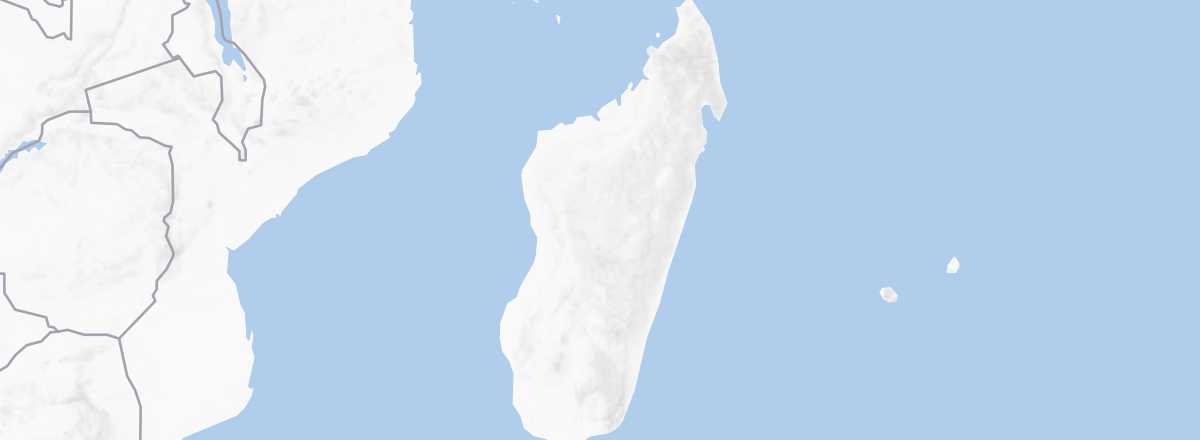 Madagascar
Open the interactive map
Madagascar
Open the interactive map
Quick Overview
At over 1,500 km long and 600 km wide, the island is located in the tropical zone of the Indian Ocean, 600 km from the African coast, from which it is separated by the Mozambique Channel. Madagascar is a "platform" composed of hills and high plateaus (in the centre) from which imposing volcanic reliefs emerge, exceeding 2,500 m, mainly along the east coast.
Malagasy society consists of 18 different ethnic groups and is two-thirds rural. Although the island is officially Christian, with as many Catholics as Protestants, a majority of the population is also animist and practises the ancestor worship. There is also a small Muslim minority on the island, representing 1 to 2%. The centre and the east coast are the most populated; the rest of the country is almost deserted.
Sugarcane, vanilla, rice, livestock, and some mineral products are the main resources of this country, which remains one of the poorest in the world and has been experiencing a socio-political situation that is at the very least turbulent, along with growing insecurity, which has had consequences for tourism, which has been in constant decline for some time.
Key Facts
- Type of place: country.
- Location: in the southeast of Africa, it is the largest island in the Indian Ocean.
- Latitude/longitude: 20.00 S, 47.00 E.
- Local time:
- Capital: Antananarivo.
- Nature of the state: Semi-presidential republic.
- Official languages: French and Malagasy.
- Currency: Ariary.
- Population: 25,683,610 (2018)
- Area: 587,040 km².
- Density: 43 inhabitants/km².
- Highest point: Mount Maromokotro (2,876 m).
- Lowest point: sea level.
- Coastline: 4,828 km.
- Driving: on the right.
Tourism
"The Red Island", as Madagascar is nicknamed, with its unique and grand nature, is one of those destinations you want to visit but which, in a way, also "earns" its place, as independent travel is not always easy, at least if you want to venture off the beaten path...
Traditionally, Madagascar has its share of devoted followers, and the proximity of Réunion, Mayotte, and occasionally South Africa also provides it with a certain clientele. However, beyond the lack of infrastructure, the socio-political situation and recurring tensions in recent years, combined with insecurity and certain grim incidents such as the lynchings in Nosy Be in 2013, have dampened the island’s tourism potential. A potential that, in any case, is far from being fully exploited, with only 250,000 to 300,000 visitors each year (257,000 in 2018), half of whom are French.
Essentials for Travel
- Destination: for experienced travellers.
- By air: France - Antananarivo for 750 to 1,150 €.
- Entry requirements: passport + visa on arrival.
- Currency to bring: euros.
- Exchange rate:
- Daily "backpacker" budget: 25 to 40 € per person.
- Accommodation: mid-range hotels or guesthouses.
- Getting around: bush taxis and/or car hire with driver.
- Risks: moderate (and even higher locally/occasionally) in terms of health, and moderate to occasionally relatively high in terms of security.
- Best time for climate/crowds/prices: May and especially September to the end of November.
- Interests (out of ): Nature ; Adventure ; Culture ; Relaxation-holidays .
Addresses in France
- Tourist Office: see online.
-- 73 bd Haussmann, 75008 Paris. Tel.: 01 53 43 88 33.
-- 176 cours Lieutaud, 13006 Marseille. Tel.: 04 84 08 00 41.
-- 31 rue Jules Auber, BP 60033, 97461 Saint-Denis Cedex.
Addresses in Belgium, Switzerland, and Quebec
- Tourist Office: see online.
Socio-Economic Statistics
- "Quality of life": 161/188 (rank in 2018)
- GDP per capita: $1,600 (2017)
- Average monthly income: $40 (2012)
- Inflation: +8.3% (2017)
- "Official" unemployment:
- Population below the poverty line: 70.7% (2012)
- Life expectancy: 66.6 years (2018)
- Migration rate per 1,000 inhabitants: 0 (2017)
- Population growth: +2.46% (2018)
- Literacy rate: 64.7% (2015)
- Urban population: 37.2% (2017)
- Press freedom: 54/180 (rank in 2018)
- Political regime: hybrid regime (95/167 in 2018)
Sources: World Bank, Human Development Indicators, RSF, The Economist, The World Factbook