last edited Dec 11, 2019
Money, Budget, and Shopping in Madagascar
Location Map of Madagascar
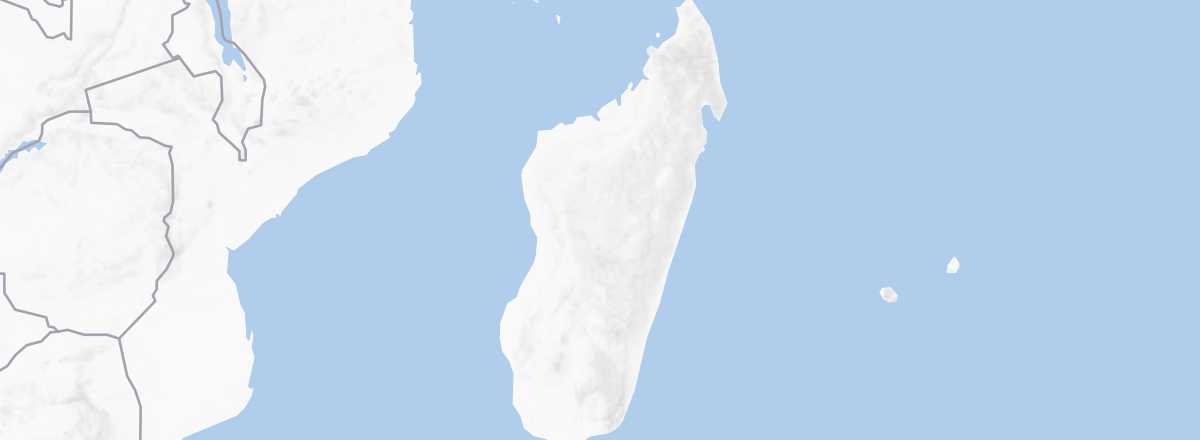 Madagascar
Open the interactive map
Madagascar
Open the interactive map
Money
Currency
- Currency: Ariary (5 iraimbilanja)
- Banknotes: 100, 200, 500, 1,000, 2,000, 5,000 and 10,000 Ar
- Coins: 1/5, 2/5 + 1, 2, 4, 5, 10, 20 and 50 Ar
- Exchange:
The Ariary (Ar) was already the monetary unit of the Kingdom of Madagascar in the 19th century. It was reintroduced in 2005, replacing the Malagasy Franc that had been in circulation since 1960. A peculiarity: the Ariary is one of the very few currencies in the world whose subunit (iraimbilanja) does not correspond to 1/10 or 1/100 of it. 1 Ariary = 5 iraimbilanja. The smallest coins are used less and less.
It’s worth noting that on certain occasions or among some people, prices are still quoted in Malagasy Francs. If in doubt, it’s useful to clarify which currency is being referred to. For reference, 1 Ariary = 5 Malagasy Francs (which also means 1 Malagasy Franc = 1 iraimbilanja).
Exchange
While exchanging money is fairly easy in major cities and some tourist spots, it becomes much harder once you move away from them. It’s therefore essential to carry enough Ariary, especially in small denominations, when traveling between towns. Otherwise, you can exchange money at ATMs (Visa cards preferred), bank counters, and exchange bureaus—primarily in cities or tourist areas. As a general rule, it’s useful to compare exchange rates between different establishments. Banks are typically open weekdays from 8:00 AM to 11:00 AM and from 2:00 PM to 4:00 PM.
Black Market
A black market exists, offering better exchange rates. However, it’s not necessarily advisable due to the risks of scams (or even assault) and the possibility of receiving counterfeit money.
Which Currency to Bring
If you live in the eurozone, it’s obvious to bring euros (cash, and traveler’s checks as a backup), including small denominations. The euro (like the US dollar) is widely accepted for exchange and can also serve as a parallel currency for certain expenses. The Swiss Franc and Canadian dollar, however, are harder to exchange outside major exchange locations.
Payment Methods
It’s essential to always carry cash and small change to cover daily expenses and small purchases. Card payments (Visa preferred) remain very limited, and may also incur significant fees, mainly at large hotels or with certain agency services.
Unlike most countries, it can be useful to arrive with a stock of cash in euros. Since the European currency serves as a "parallel currency," it comes in handy when you haven’t been able to exchange money or at the end of your trip. However, it’s best to know the current exchange rate when paying in euros, keeping in mind that the same price will always be higher when quoted in euros rather than Ariary.
Upon Return
It’s in your best interest to spend all your Ariary locally, as the currency—which theoretically cannot be exported beyond the equivalent of around 150 €—is also very difficult to exchange outside the country. Moreover, given the country’s situation and occasional foreign currency shortages, many Malagasy banks refuse to convert local currency back into hard currency.
Budget
Madagascar isn’t an expensive destination to travel in, as long as you move around, eat, and—for the more adventurous—sleep like a local. In that case, a daily budget of 25 € will suffice. The only downside is that traveling under these conditions, especially when it comes to transport, can quickly become exhausting or even discouraging. In short, for more convenience, freedom, and even "pleasures," it’s better to plan for a budget of 35–40 € per person for two.
What Can Be Expensive
- Flights to get there, and especially domestic connections.
What Doesn’t Have to Be Expensive
- Meals, especially in hotely.
- Bush taxis.
- Souvenir gifts (if well negotiated).
Price Range
- Budget double room: 15 to 20 €
- Mid-range double room: around 40–50 €.
- Local restaurant meal: under 4 or 5 € in hotely.
- Tourist restaurant meal: around 10 €.
- Park entry (public): roughly 3 to 8 €/day depending on the site.
- Car rental "with driver": 35 to 40 €/day for a non-4x4 vehicle at an agency’s base rate.
- 100 km by bush taxi: around 2 €.
- 100 km by private bus: on average 6 to 7 € per 100 km.
- Urban taxi: around 2 € per ride.
Bargaining, Tipping
Bargaining
Bargaining is a common and even traditional practice in markets, with urban taxis (which don’t have meters), or for any service you might request. However, there’s no bargaining in restaurants or with bush taxis and, occasionally, hotels. Generally speaking, regardless of the outcome, the vaza (foreigner) is seen as "rich" by the local population and will always pay accordingly.
Tipping
Since incomes are extremely low for the vast majority of the population, tips are all the more appreciated, even if they’re not mandatory. In restaurants, you can leave around 10% of the bill, a few coins for a porter, or the equivalent of 4 or 5 €/day (for all passengers) to a rental vehicle driver. In any case, while you can be generous, there’s no need to leave disproportionately large tips like those you might leave in Europe or North America. The amount of a tip, wherever you are, should reflect the service provided and the local cost of living. And this is true even if some recipients may pressure you for much more. On that note, if you felt harassed or overcharged for a service, there’s no need to add a tip on top!
It’s also customary in rural villages to leave a small something (or small gifts) for the people or the village chief if you’ve requested accommodation or any other service.
Finally, in another area, it’s important to know that "corruption" exists at all levels in Madagascar and can help resolve certain situations. For visitors (not to mention expats), this is true, for example, when negotiating an extension of a visa by a few days.
Shopping, Souvenirs
Madagascar is rich in (inexpensive) souvenirs to bring back and has a certain craftsmanship that can even be found beyond the country, in shops in Réunion or Mayotte, though not at the same prices. Everything can be seen and negotiated in markets, especially in the capital, where there’s plenty of choice (though at slightly higher prices).
What to Bring Back
- Bottles with sand: These are bottles with different-colored sands forming patterns or landscapes inside. But be careful—transport can cause the sands to mix.
- Embroidery: Especially tablecloths.
- Spices: Vanilla, green pepper, cloves, cinnamon, lemongrass, etc., to be seen and negotiated in markets.
- Musical instruments: Percussion and traditional Malagasy instruments.
- Boat models: Pirogues or traditional Malagasy *boutres* (wooden boats).
- Vehicle models: Small models of bush taxis, 2CVs, buses, planes, etc., often made from recycled cans and tins. This is one of the island’s most famous souvenirs.
- Wooden objects: Including various carved items (chairs, games, animals...) and marquetry, especially in Ambositra, which is renowned for it.
- (Semi-)precious stones: Available in all types and at all prices. It’s worth knowing a bit about them or consulting a jeweler if you plan to spend a significant amount (and comply with export regulations).
- Basketry: Very present in local crafts, with hats, bags, baskets, etc.
- Zebu: You’ll find zebu leather transformed into bags, belts, hats, shoes, as well as its horn for various carved objects.