last edited Aug 4, 2026
Getting Around Bolivia
Road Network and Traffic
Bolivia’s road network has long been a challenge. With barely over 15% of roads paved, traveling across the country requires patience and, especially when leaving the main routes, a four-wheel drive. Add to that roads and tracks cut off or damaged during the rainy season, plus roadblocks—known as bloqueos—that disrupt traffic during the many protests the country experiences almost constantly.
It’s best not to forget this and plan your route and travel times accordingly. Also, as in many countries, road rules and signage can be somewhat unpredictable here. Outside urban areas, it’s better to avoid driving at night.
Car Rental

Renting a vehicle in Bolivia isn’t always the best option due to long distances, poor signage, road conditions, potential police shakedowns, and local driving habits that require caution and experience. Moreover, unless you stick to main routes, a 4x4 is often necessary, which means a hefty rental budget.
In short, it’s better to use public transport and then hire a taxi for the day as needed. This will also be cheaper—expect around 30 to 40 € per day for a standard vehicle and double that for a four-wheel drive. Some agencies offer rentals with a driver, which, despite the extra cost, simplifies things considerably. These agencies also often organize tours for visits requiring logistical support, especially for transport.
Buses and Shared Vehicles
Buses
Bolivia has an extensive bus network connecting most towns, except in some areas of the Amazon Rainforest, where rivers replace roads. There are many local and national companies offering varying levels of comfort; the best options are on major routes with fewer stops, where some companies provide premium services with sleeper seats, toilets, etc. However, Bolivian buses are never fast—whether due to their sometimes dilapidated condition or simply the state of the roads, which can be cut off during the rainy season or blocked by social movements. In short, don’t expect speed or strict safety standards, to the point that some routes might be better flown.
That said, buses are never expensive, even the best ones, with regulated fares. Expect around 4 or 5 € per 100 km for major companies and less for standard ones. As for what to bring, always pack a light layer against the air conditioning (if available) and the altitude, plus an eye mask and earplugs for overnight trips. Many long journeys run at night (a shame for the scenery), with departures in the late afternoon and arrivals in the morning, so it’s worth choosing the most comfortable option, even if it costs a little more.
Shared Taxis
Whether in cars, "micros," or minibuses of varying sizes, these are found in cities and their outskirts. They leave when full, stop on demand, and follow set routes over short or medium distances. They’re practical and economical for these trips, just slightly more expensive than local buses.
Trucks
As in other Andean countries, trucks or pickups sometimes serve as an alternative to buses. It’s usually paid (cheaper than the bus), and you travel either in the cabin or in the back. For tourists, it’s more of an "experience" or a fallback when other transport is lacking, especially since progress is slow.
By Bike
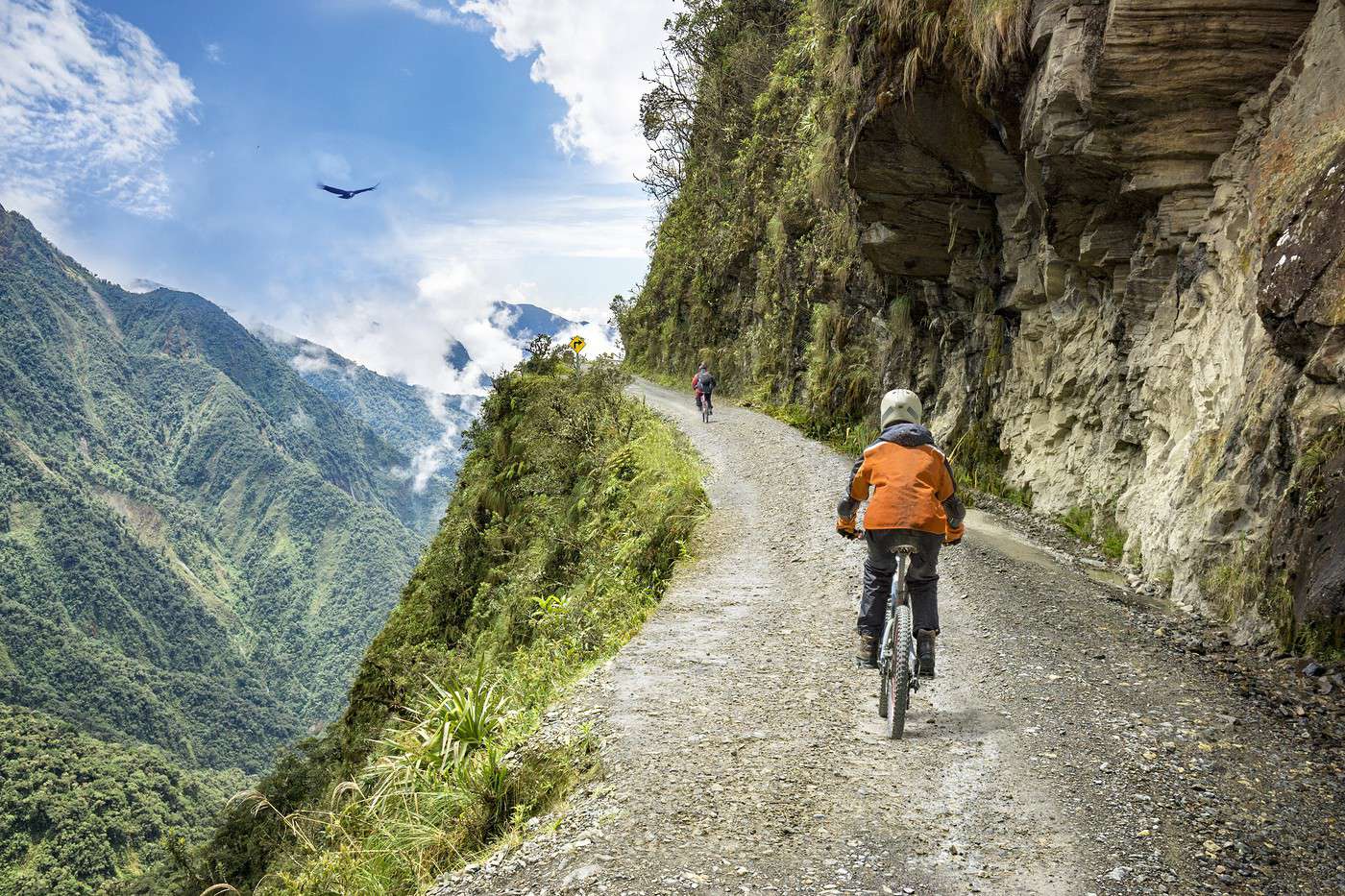
Cycling in Bolivia is an incredible but also one of the most challenging and demanding adventures for bike travelers. Between the altitude—often riding between 3,500 and 4,500 meters in the Andean region—unpredictable weather, rough roads and tracks, and the need to be self-sufficient in water and food in some areas due to the distance between villages, it’s clear that exploring Bolivia by bike isn’t for everyone. Best to know that upfront...
Hitchhiking
Hitchhiking is common in areas poorly served by transport, usually with trucks and pickups (and often for a fee). There’s no reason not to try it occasionally, though caution is advised, and the low cost of transport doesn’t make it a necessity for getting around the country.
Trains
Bolivia has a small rail network divided into two separate, unconnected parts: the Western and Eastern networks. Though Bolivian trains are often slow and crowded, they’re relatively comfortable and can easily replace buses where available, as their fares (except first class) are roughly the same.
Expect around 2 € per hour for the cheapest option or double that for the best class. Since journeys are long and sometimes partly overnight, plan accordingly. Two companies operate the lines:
- Ferroviaria Andina: Runs Oruro-Uyuni-Tupiza-Villazón and onward to Argentina (4 times/week), plus Uyuni-Avaroa and onward to Chile (2 times/week). The company also offers a railbus service (3 times/week) between Sucre and Potosí, as well as Cochabamba and Aiquile. A tourist train also runs between La Paz and Lake Titicaca on the second Sunday of each month.
- Ferroviaria Oriental: Operates two lines—Santa Cruz-Puerto Quijarro on the Brazilian border (3 times/week) and Santa Cruz-Yacuiba on the Argentine border (once a week).
Boats
Beyond the small boats of the Lake Titicaca, boats are found in the Amazon Rainforest, where, along with planes, they’re often the only means of transport in many areas. Most operate like buses or taxis (with charter options), though for long trips, it’s useful to bring at least a hammock, mosquito repellent, and some food. One notable route is the multi-day journey from Puerto Villaroel (northwest of Santa Cruz) to Guayaramerín (on the Brazilian border) and then Rurrenabaque (north of La Paz).
Domestic Flights
Bolivia has a well-developed air network with several local carriers, including the national airline, Boliviana de Aviación. Flying is always an option, if only because it saves a tremendous amount of time compared to ground transport, which can take hours for just a few hundred kilometers. What’s more, fares aren’t excessive for a traveler’s budget (expect 50 to 100 € per flight), so many travelers use planes for some of their trips in the country—and enjoy the Andean views as a bonus. The only downside: weather-related delays or cancellations, which are always possible.
In Town
Getting around Bolivian cities is simple and affordable, but relies mainly on an informal system. Beyond the La Paz/El Alto cable car (worth trying at least once), you’ll have the choice between shared minibuses and traditional urban buses, or private options like taxis (some bookable via dedicated apps) and motorcycle taxis.
What to Choose for Getting Around?
Bolivia is best explored using public transport, given the constraints and drawbacks of renting a car—unless you opt for a vehicle with a driver and the budget that entails. That said, it’s wise—even preferable—to vary your means of transport depending on your itinerary and the travel times between different options for the same leg.
In short, while buses will likely form the backbone of your trip, you can also use trains and even flights (not too expensive and offering stunning Andean views) for some journeys. Occasionally, you might hire a taxi or other transport for off-the-beaten-path visits.
Distances Between Cities
Distances (km) between major cities in the country:
| Cochab. | La Paz | Oruro | Potosí | Rurre. | Sta Cruz | Sucre | Tarija | Uyuni | |
|---|---|---|---|---|---|---|---|---|---|
| Cochabamba | 375 | 210 | 490 | 810 | 495 | 330 | 835 | 675 | |
| La Paz | 375 | 220 | 530 | 420 | 870 | 560 | 880 | 535 | |
| Oruro | 210 | 220 | 315 | 645 | 710 | 340 | 660 | 320 | |
| Potosí | 490 | 530 | 315 | 960 | 660 | 155 | 350 | 205 | |
| Rurrenabaque | 810 | 420 | 645 | 960 | 940 | 980 | 1300 | 960 | |
| Santa Cruz | 495 | 870 | 710 | 660 | 940 | 500 | 710 | 860 | |
| Sucre | 330 | 560 | 340 | 155 | 980 | 500 | 500 | 360 | |
| Tarija | 835 | 880 | 660 | 350 | 1300 | 710 | 500 | 410 | |
| Uyuni | 675 | 535 | 320 | 205 | 960 | 860 | 360 | 410 |