last edited Dec 11, 2019
Overview of the Seychelles
Location Map of Seychelles
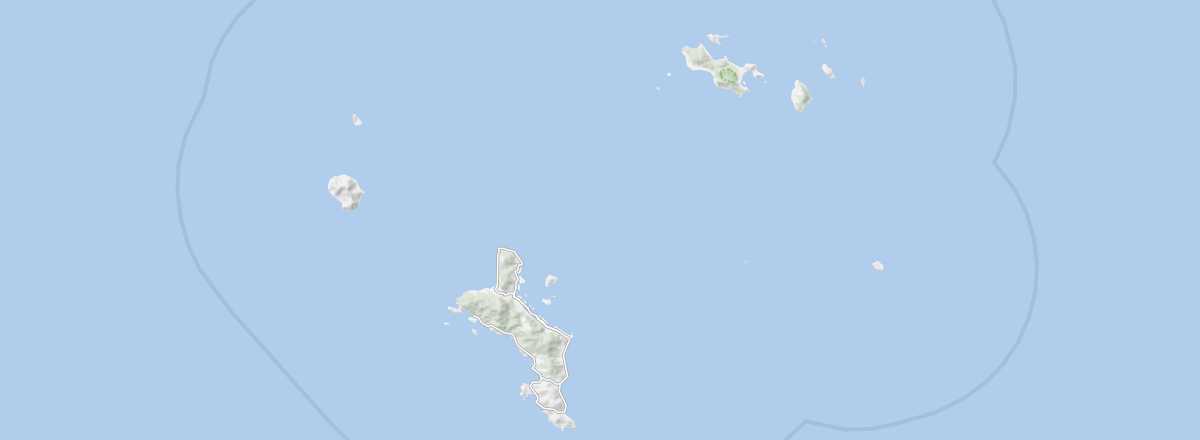 Seychelles
Open the interactive map
Seychelles
Open the interactive map
Quick Overview
The Seychelles archipelago consists of 115 granite and coral islands, with three main ones: Mahé (155 km²; 80,000 inhabitants), Praslin (37.5 km²; 7,000 inhabitants), and La Digue (9.8 km²; 2,500 inhabitants). Traditionally, the archipelago is divided into "inner islands" (the most significant) and "outer islands." The latter are primarily small atolls, sometimes remote, formed by the emergence of a coral barrier around extinct volcanoes. Their unique feature is that they do not rest on what is geologically known as the "Seychelles Plateau," where the country's other lands are located. The "inner islands" alone account for 54% of the country's total area and are home to over 95% of the population, spread across 33 islands.
The population of the Seychelles is a blend of origins shaped by the country's history. It mainly comprises descendants of immigrants from Europe, Africa, India, and China. The country's primary resources are fishing and a luxury and honeymoon-oriented tourism industry, greatly favored by the archipelago's paradise-like scenery with its stunning white-sand beaches lined with coconut palms.
Key Facts
- Type of place: country.
- Location: in the Indian Ocean, northeast of Madagascar.
- Latitude/longitude: 4.35' S, 55.40' E.
- Local time:
- Capital: Victoria.
- Nature of the state: presidential republic.
- Official languages: Seychellois Creole, English, and French.
- Currency: Seychellois rupee.
- Population: 94,633 inhabitants (2018).
- Area: 455 km².
- Density: 207 inhabitants/km².
- Highest point: Morne Seychellois (905 m).
- Lowest point: sea level.
- Coastline: 491 km.
- Driving: on the left (right-hand drive).
Tourism
With its paradise-like beaches, temperate tropical climate, aquatic attractions and activities, coral reefs, unique wildlife, and culinary delights, the Seychelles archipelago is a safe destination ideal for discovery and relaxation. Tourism is the country's primary economic resource, though the number of visitors to the archipelago is far lower than in other regional destinations like Mauritius or Réunion. However, the Seychelles have always prioritized luxury and honeymoon tourism aimed at a high-spending audience.
In 2018, the country welcomed 362,000 visitors, two-thirds of whom came from Europe, particularly the United Kingdom, Germany, and metropolitan France (along with many from Réunion). In total, 43,000 French travelers visited the Seychelles in 2016. Notably, the archipelago has recently seen an increase in visitors from China and even the United Arab Emirates, thanks to new air routes.
Travel Essentials
- Destination: for beginner travelers.
- By air: Paris-Mahé for 650 to 900 €.
- Entry requirements: passport + return ticket + proof of accommodation and financial means.
- Currency to bring: euros.
- Exchange rate:
- Backpacker daily budget: 40 to 50 €/person for "basic," but at least 100 € to truly enjoy the archipelago.
- Accommodation: all-inclusive or guesthouse/B&B depending on the type of stay.
- Getting around: bus or bike on the islands, and inter-island boats.
- Risks: low health and safety risks.
- Best time for climate/crowds/prices: late March-June and September-mid November.
- Interests (out of ): Nature ; Adventure ; Culture ; Relaxation-holidays .
Addresses in France
- Tourist Office 18 rue de Mogador, 75009 Paris. Tel.: +33 1 44 53 93 20.
- Air Seychelles: 122 av. des Champs-Élysées, 75008 Paris. Tel.: +33 974 75 50 10.
Addresses in Belgium, Switzerland, and Quebec
Socio-Economic Statistics
- "Quality of life": 62/188 (rank in 2018)
- GDP per capita: $29,300 (2017)
- Average monthly income: $1,165 (2014)
- Inflation: +2.9% (2017)
- "Official" unemployment: 3% (2017)
- Population below the poverty line: 39.3% (2013)
- Life expectancy: 75.2 years (2018)
- Migration rate per 1,000 inhabitants: 1 (2017)
- Population growth: +0.74% (2018)
- Literacy rate: 91.8% (2014)
- Urban population: 56.7% (2018)
- Press freedom: 85/180 (rank in 2018)
- Political regime:
Sources: World Bank, Human Development Indicators, RSF, The Economist, The World Factbook