last edited Jan 29, 2026
Money, Budget, and Shopping in Morocco
Location Map of Morocco
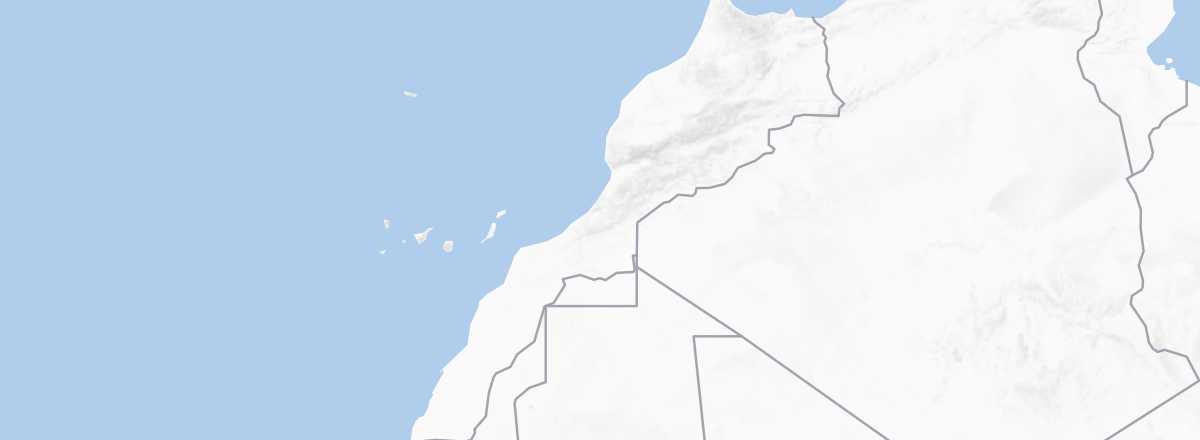 Morocco
Open the interactive map
Morocco
Open the interactive map
Money
Currency
- Currency: Dirham (100 centimes).
- Banknotes: 20, 50, 100 and 200 dirhams. Note that 10-dirham banknotes have been out of circulation since 2026, replaced by coins of the same value.
- Coins: 10, 20 and 50 centimes + 1, 2, 5 and 10 dirhams.
- Exchange:
Exchange
Since the Moroccan dirham is not, in principle, convertible outside the country, you will need to wait until you arrive to exchange your money. This poses no problem, as exchange bureaus are easily found at ports and airports, in most banks, some hotels, and many tourist spots.
Additionally, ATMs are widely available across the country, with most major banks offering them.
Which currency to bring
If you live in the Eurozone, it is clearly best to bring euros, including small denominations. These can always serve as a means of payment on many occasions once you are there. Otherwise, the main foreign currencies can be exchanged without issue in Morocco.
Payment methods
Generally, it is best to always have cash and small change on hand to cover daily expenses and small purchases, especially in souks. Card payments, however, can be used for hotels, vehicle rentals, and in many shops in tourist areas.
Note that in tourist zones, and almost everywhere else, you can also pay directly for purchases in euros. This is always an option, even advantageous if you have few dirhams left, but it requires knowing the current exchange rate.
Upon return
Since the Moroccan dirham is not convertible abroad, there is no point in bringing any home.
Therefore, plan to spend everything or exchange any remaining dirhams back into euros before leaving, even if the exchange rates for such transactions are not always the most favorable. In any case, especially if the amount is significant, keep your previous exchange receipts to justify the origin of the dirhams you wish to exchange.
Budget
The budget for a trip to Morocco can vary significantly depending on the type of stay and the period. However, the country remains affordable compared to Europe.
Expect roughly 35 to 45 € per day per person for a budget trip as a pair, using public transport, eating at markets or small restaurants, and staying in mid-range hotels. For more comfort and activities, it is better to budget at least 50 to 60 € per day to be comfortable.
What can be expensive
- Forgetting or poorly negotiating prices, especially for purchases.
- Traveling during high season.
What can be inexpensive
- Meals by eating local.
- Local hotels.
- Public transport.
- Traveling off-season.
Price range
- Budget double room: 15 to 25 €
- Mid-range double room: around 40 €
- Local breakfast: 1 to 1.5 €
- Tourist breakfast: 3 to 5 €
- Local restaurant meal: 5 to 10 €
- Tourist restaurant meal: around 15 €
- Budget car rental: 45 to 50 € per day
- 1 hour of local bus: around 1 €
- 1 hour of express/comfort bus: around 2 €
- 1 hour of train: around 2.5 €
- Urban taxi: 2 to 3 € for a 5-6 km daytime trip
- Urban bus: 0.5 € per trip
Bargaining and tips
Bargaining
Bargaining is part of Moroccan culture. You will have many opportunities to negotiate prices during your stay, which will significantly impact your budget.
However, not everything is negotiable. Bargaining primarily applies to purchases in souks and other shops. While you can also negotiate for a guide or agree on a taxi fare, there is no bargaining for meals, public transport (though it is useful to check the rates), or entry fees to sites and monuments.
To bargain well, first determine the maximum amount you want to spend and research the prices of items or services that interest you (fixed-price shops, hotels, etc.).
In shops, only start the discussion if you are genuinely interested, and do not haggle over the equivalent of a few euro cents. For the first price quoted (avoid stating your price first), you can generally offer a third, aiming to settle at 50 or 60% of the initial price. In any case, bargaining takes time but should remain a pleasure and a kind of "mutual exchange" between both parties.
Tips
Since wages are low for many people in Morocco, tips are especially appreciated, even if they are not "mandatory." It is customary to leave about 10% of the bill at restaurants or for taxi drivers. For services like vehicle guarding, 5 or 6 dirhams (less than 1 €) will suffice. For guides, it depends on the service provided.
While you can be generous, there is no need to leave disproportionately large tips, like those you might leave in Europe or North America. The amount of a tip, regardless of the country, should reflect the service provided and the local cost of living. Even if some recipients may pressure you for more, stay reasonable.
Shopping and souvenirs
Morocco is renowned for its craftsmanship, which you can discover in its souks where bargaining is customary. If you have no idea about prices, start by visiting shops where prices are fixed and displayed, or check online.
What to bring back
Jewelry: Before emigrating, Moroccan Jews long monopolized the creation and sale of jewelry. However, you can still find interesting pieces, including necklaces, brooches, bracelets, earrings, and ankle rings in silver or gold, with or without precious stones.
Wood and marquetry: Made from cedar or thuya, you will find chairs and other furniture, boxes, figurines, and remarkable chess sets. Essaouira is famous for its marquetry.
Brass, copper, and silver: These are all hand-hammered and decorated objects made by artisans. There is a wide selection, including trays of all kinds, bowls, ashtrays, teapots, etc. There is also plenty of wrought ironwork, such as lanterns, grilles, mirror frames, and candleholders.
Leather goods: This is what made the country famous, and the word "maroquinerie" actually comes from "Maroc." Leather is found everywhere, in suitcases, bags, babouches, belts, wallets, poufs, and saddles. The main traditional tanneries are in Fez and Marrakech.
Stones and minerals: In Taroudant, decorative limestone is used to make candleholders, boxes, and paperweights. Elsewhere, along the roads, you will often see vendors selling fossils, quartz, amethyst, rock crystal, and other minerals.
Pottery and ceramics: Choose from plates, dishes, tea sets, ashtrays... The artisans of Fez and Safi are behind this craft, which is now found throughout Morocco. Similar to these are zellige tiles (small mosaic tiles), used to decorate fountains, walls, or floors.
Carpets: Carpet weaving is the oldest craft in Morocco. The main production centers are in Rabat, Meknes, Fez, and Marrakech, though carpets are sold everywhere in the country.
Basketry: Countless basketry items (baskets, trays, boxes, straw hats) are sold throughout the country, but the widest selection is in the souks of Tetouan, Fez, and Marrakech.
Clothing: Among traditional clothing that can serve as souvenirs, note babouches, djellabas, burnouses, cheches, and for women, caftans—long, flowing robes often adorned with embroidery.
Other souvenirs: Among these, you will find essential Moroccan spices for local cuisine, ubiquitous dates, henna for hair coloring or cosmetics, and argan oil from the argan tree, used for cooking as well as cosmetics.