Court Ruling on Compensation for Delays of "3 Hours or More" by Airlines
FR

Translated into English.

Original post
EL
Hi, On October 30, 2025, the Court of Justice of the European Union issued its ruling in case C-558/24 Corendon.

When an airline issues a ticket (or booking confirmation) and later issues a new ticket delaying the arrival time at the final destination, the delay of "3 hours or more"—which entitles passengers to compensation of 250, 400, or 600 euros (depending on the distance) per paying passenger—must be calculated based on the arrival time stated in the initial booking.

In the case examined, the airline had issued a new booking confirmation that delayed the flight. The passenger arrived less than 3 hours late compared to the arrival time in the new confirmation but was more than 3 hours late compared to the original booking confirmation.

This puts an end to interpretations that the previous texts allowed.

The ruling states:

"Article 5(1)(c) and Article 7(1) of Regulation (EC) No 261/2004 of the European Parliament and of the Council of 11 February 2004 [...] must be interpreted as meaning that: in the event of a change to the departure and arrival times of a flight, announced in advance by an air carrier and accompanied by the issuance of a new booking confirmation to the passengers concerned, the duration of the delay suffered by those passengers upon arrival must be determined by taking into consideration the initially scheduled arrival time."

Full ruling here:

https://eur-lex.europa.eu/legal-content/FR/TXT/PDF/?uri=CELEX:62024CJ0558

Best regards
https://retardimportantavion.wordpress.com
SI Sinforosa Veteran ·
Thanks for the info! !
" Celui qui voyage sans rencontrer l'autre ne voyage pas , il se déplace " ( Alexandra David-Néel )

" Ahora todos quieren ser latinos , no , ey , pero les falta sazon , bateria y reggaeton " ( Bad Bunny )
GI Gilmau Regular ·
Hello, A big thank you for your skills and determination. Thanks. Best regards,

Si tous les gens qui disent du mal de moi savaient ce que je pense d'eux, ils en diraient bien davantage...
NT NTO Regular ·
Hello,

I think it should have been specified: "in the case examined, the airline had issued a new booking confirmation the day before departure that delayed the flight." This is a key point. Because if the carrier had done this more than 14 days before departure and not the day before, no compensation claim would have succeeded... The passenger would have had no choice but to accept the rescheduling (without compensation) or request a full refund.
EL ElviajeroPar Globetrotter ·
Hello,

I think it should have been specified: "in the case examined, the airline had issued a new booking confirmation the day before departure that delayed the flight." This is a key point. Because if the carrier had done this more than 14 days before departure and not the day before, no compensation claim would have succeeded... The passenger would have had no choice but to accept the rescheduling (without compensation) or request a full refund.

Hello NTO,

You're confusing canceled flights with delayed flights! See the definition in point (l) of Article 2 of Regulation 261/2004 of the European Parliament and Council, then Article 5 of the same regulation. It has nothing to do with a delayed flight. Moreover, the CJEU case law always takes care not to equate canceled flights with delayed flights. It only equates passengers (not the flights) who arrive at their final destination with "3 hours or more" delay to passengers of canceled flights.

Read the operative part of the CJEU ruling more carefully—it sets no condition regarding the timing of passenger notification.

It’s clear that airlines will now be more inclined to declare a cancellation with re-routing than to proceed with a simple modification involving a delayed schedule.

Best regards,
https://retardimportantavion.wordpress.com
NT NTO Regular ·
Hello,

Interesting! Because this would mean that if an airline changes a flight's schedule (resulting in the passenger arriving more than 3 hours after the original time) without affecting the flight number, the passenger would be eligible for delay compensation—even if the schedule change happens several months in advance and they were notified and accepted it.

I still have serious doubts, though...
EL ElviajeroPar Globetrotter ·
Hello,

Just a reminder: rulings by the Court of Justice of the European Union set legal precedents that bind every judge within the EU, overriding any decisions from lower courts (including, therefore, any rulings by the French Court of Cassation). What binds all judges—provided they’re made aware of it—is the "operative part" (always in bold at the end of CJEU rulings).

To clear up any doubts, you just need to read the operative part of case C-558/24 from the Court of Justice of the European Union (quoting directly):

"On those grounds, the Court (Eighth Chamber) hereby rules:

Article 5(1)(c) and Article 7(1) of Regulation (EC) No 261/2004 of the European Parliament and of the Council of 11 February 2004 establishing common rules on compensation and assistance to passengers in the event of denied boarding and of cancellation or long delay of flights, and repealing Regulation (EEC) No 295/91, must be interpreted as meaning that: in the event of a flight’s departure and arrival times being rescheduled, announced in advance by an air carrier and accompanied by the issuance of a new booking confirmation to the passengers concerned, the length of the delay suffered by those passengers upon arrival must be calculated based on the originally scheduled arrival time."

Doesn’t that seem clear enough?

Airlines are free, instead of informing passengers of a flight plan change more than 14 days in advance involving a delayed schedule, to cancel the flight and offer passengers—under Article 8 of Regulation 261/2004—a choice between three options (quoting):

Article 8 Right to reimbursement or re-routing 1. Where reference is made to this Article, passengers shall be offered the choice between: a) - reimbursement within seven days, by the means provided for in Article 7(3), of the full cost of the ticket at the price at which it was bought, for the part or parts of the journey not made, and for the part or parts already made if the flight is no longer serving any purpose in relation to the passenger’s original travel plan, and where relevant, - a return flight to the first point of departure, at the earliest opportunity; b) re-routing, under comparable transport conditions, to their final destination at the earliest opportunity, or c) re-routing, under comparable transport conditions, to their final destination at a later date at the passenger’s convenience, subject to availability of seats." (end of quote)

This has little to do with Article 6 on departure delays, which only references Article 8 (but limits its scope under point iii of Article 6) for cases of departure delays of 5 hours or more. In such cases, only paragraph 1(a) of Article 8 applies, meaning options (b) and (c) no longer apply for departure delays (quoting):

"iii) where the delay is at least five hours, the assistance provided for in Article 8(1)(a)." (end of quote). See Article 8 above.

So, in cases of departure delays of 5 hours or more, passengers only have the choice between accepting the departure delay or opting for a refund—or, if it’s a connecting flight, returning to their point of origin. Note that passenger consent isn’t required for departure delays of less than 5 hours.

It’s therefore very clear that canceled flights and delayed flights shouldn’t be confused.

The only common points are the right to assistance (though under slightly different conditions) and the right to compensation (unless the airline can PROVE extraordinary circumstances AND PROVE that "reasonable measures" were taken to avoid them) if: - the flight is canceled less than 14 days before departure without a re-routing offer that results in a small time difference (various scenarios, but max 4 hours), - the passenger arrives at their final destination with "3 hours or more" of delay.

Best regards,
https://retardimportantavion.wordpress.com
NA Nataly03 Globetrotter ·
Hi, I’d like to point out that the reverse is also true. Compensation is also due if the flight is brought forward by more than 3 hours.
nathalie
EL ElviajeroPar Globetrotter ·
Hello, I’d like to point out that the reverse is also true. Compensation is also due if the flight is brought forward by more than 3 hours.

Hello,

You’re mistaken when you mention a flight being moved up by 3 hours. It’s actually much less!

A flight whose schedule is brought forward must be considered as cancelled, or not, depending on the timeframe in which the airline informed the passenger, according to the ruling C-146/20 of the Court of Justice of the European Union. https://infocuria.curia.europa.eu/tabs/document?source=document&text=&docid=251508&pageIndex=0&doclang=FR&mode=req&dir=&occ=first&part=1&cid=187567

It’s important to look at the timeframes in which the airline must inform passengers of the flight’s rescheduling to be exempt from the obligation to pay flat-rate compensation. Reference should be made to point 86 of the CJEU ruling of December 21, 2021, mentioned above, as well as Article 5, paragraph 1 of the regulation it refers to.

There are three timeframes:

– At least two weeks before the departure time: no right to flat-rate compensation; – Between two weeks and seven days before the departure time: if the flight is brought forward by a maximum of two hours; – Less than 7 days before the departure time: if the flight is brought forward by a maximum of one hour.

Furthermore, the 50% reduction in compensation provided for in Article 7, paragraph 2 of the European Parliament and Council regulation does not apply to flights that are brought forward. Finally, since a flight brought forward will be considered as cancelled, compensation will be due unless the airline can PROVE (simply alleging is not enough) that the issue was due to (I quote) "extraordinary circumstances which could not have been avoided even if all reasonable measures had been taken" (end of quote).

This text (Article 5, paragraph 3 of Regulation 261/2004 of the European Parliament and Council) therefore implies that the airline must provide 2 PIECES OF EVIDENCE:

- EVIDENCE of the alleged extraordinary circumstances;

- EVIDENCE (and this is just as important) of the "reasonable measures" taken.

For more details (and the procedure to follow) on all of the above, see here: https://retardimportantavion.wordpress.com/2021/12/29/indemnisation-forfaitaire-vol-avance-de-plus-dune-heure-modele-de-lettre-et-procedure/ Best regards,
https://retardimportantavion.wordpress.com
NA Nataly03 Globetrotter ·
That’s right. In my case, the flight was moved up by more than 3 hours on the same day. I got an email with the new ticket. It took me nearly 2 years and an appeal to finally get the compensation. Even with a favorable ruling from the justice mediator, Air France refused to pay, claiming I didn’t actually experience a flight delay...
nathalie
EL ElviajeroPar Globetrotter ·
Hello,

Air France isn’t the only case. Most airlines are reluctant to compensate passengers, even when they’re legally entitled to it. While there are exceptions, you’ll almost always have to take legal action. And at that point, airlines will almost always settle before a ruling if your case is well-prepared. However, in rare cases, an airline may go all the way to a ruling, even when they know they’ll lose. Here’s a particularly telling example:

https://retardimportantavion.wordpress.com/2024/10/23/lufthansa-championne-du-refus-des-droits-des-passagers/

For a step-by-step guide on how to demand your rights—broken down in detail for all types of cases—check here:

https://retardimportantavion.wordpress.com/

Don’t be mistaken about the role and powers of a mediator. A mediator has only one power: mediation, which means NONE. Moreover, their role isn’t to interpret the law but simply to try to reach an agreement (good or bad, it doesn’t matter) to avoid going to court.

That’s why airlines almost always ignore the mediator’s opinion. But under French procedure (which will soon be mandatory), you must go through the tourism and travel mediator before you can take legal action.

Note, however, that the mediator isn’t required if you use the "European Small Claims Procedure."

https://retardimportantavion.wordpress.com/2025/09/30/les-differences-majeures-entre-la-procedure-francaise-et-la-procedure-europeenne-de-reglement-des-petits-litiges/ Best regards
https://retardimportantavion.wordpress.com
NA Nataly03 Globetrotter ·
Well, I can only speak for my case, but in my situation, they went to court... The first trial was lost—God knows how—even though they didn’t even show up... I had to appeal... Air France lost the appeal. The compensation was doubled, and all court costs had to be reimbursed by Air France as well.

It’s clear that if I hadn’t had legal protection, I wouldn’t have gone as far as the appeal... And that’s exactly what Air France is banking on.
nathalie
EL ElviajeroPar Globetrotter ·
But in my case, they went to court... The first trial was lost, God knows how, even though they didn’t even show up... I had to appeal... Air France lost on appeal. The compensation was doubled, and all court costs had to be reimbursed by Air France as well.

Hello,

The civil justice system works like clockwork. When it comes to air passenger rights, to win your case, all you need to do is cite: 1° the relevant articles of Regulation 261/2004 of the European Parliament and Council; 2° the rulings (mainly from the Court of Justice of the European Union, and secondarily those from the Council of State) that apply to your situation.

And the judge has no choice but to apply the relevant texts.

I’m surprised you mentioned an appeal after a first-instance ruling, unless the amount in dispute allowed for it.

If you send me, at my email address (which is listed on every page of my website https://retardimportantavion.wordpress.com/), the arguments submitted to the court by both parties and the ruling issued (anonymized if you prefer), as well as the same for the appeal, I’ll be able to explain why things turned out the way they did.

By the way, you’ll likely find the explanation on my website yourself.

Best regards,
https://retardimportantavion.wordpress.com
NA Nataly03 Globetrotter ·
Well, I can't really tell you why it happened like that... What I do know is that the judge in the first instance dismissed my case... I appealed, and I won. The appeal judge overturned the first ruling... And ordered Air France to pay double the compensation, which came to 1,200 € per passenger, plus 2,500 € in legal fees (it has another name, but I’ve forgotten it).
nathalie
EL ElviajeroPar Globetrotter ·
Hello,

I’m getting more and more confused. For amounts under 5,000 €, the case falls under the local court, which, in this type of dispute, rules as a final decision (meaning no possibility of appeal).

The only recourse in this case is the Court of Cassation, which, if it overturns the ruling, will send the case back to another local court. Indeed, the Court of Cassation does not examine the case itself but only whether the rules of law—and particularly procedure—were respected. As a result, the Court of Cassation only has two options: uphold the ruling or overturn it and send it back to another court.

So, in your case, since compensation is calculated per passenger, the number of passengers meant the total amount exceeded 5,000 €. In this situation, an appeal is possible.

A judge cannot double the compensation amount set by Article 7 of Regulation 261/2004 of the European Parliament and Council. However, they *can* grant "additional compensation" under Article 12 of the same regulation. It’s rare, but it happens. But for that, the airline has to really mess up! See an example here: https://retardimportantavion.wordpress.com/2024/01/12/reacheminement-catastrophique-droit-indemnisation-meme-circonstances-extraordinaires-2/

If your "additional compensation" was the same amount as the compensation due under Article 7, that was pure coincidence. In the case linked above, the additional compensation was 500 € on top of the 600 € compensation set by Article 7.

But the compensation under Article 7 can only be 600 € for a non-EU flight over 3,500 km. It cannot, under any circumstances, be 599 € or 601 €, let alone double. So in your case, it could only have been "additional compensation," meaning the airline really messed up.

The explanation for your situation necessarily lies in the details of your case. If you send it to me (anonymized if you prefer), I can give you a clearer answer.

Finally, "legal fees" correspond to Article 700 of the Code of Civil Procedure. The judge orders the losing party to reimburse the winning party for the costs they incurred to defend themselves.

Best regards,
https://retardimportantavion.wordpress.com
NA Nataly03 Globetrotter ·
not at all we were 2.. and I’m not talking about cassation but appeal... and I’m sure of what I’m saying.
nathalie
NA Nataly03 Globetrotter ·
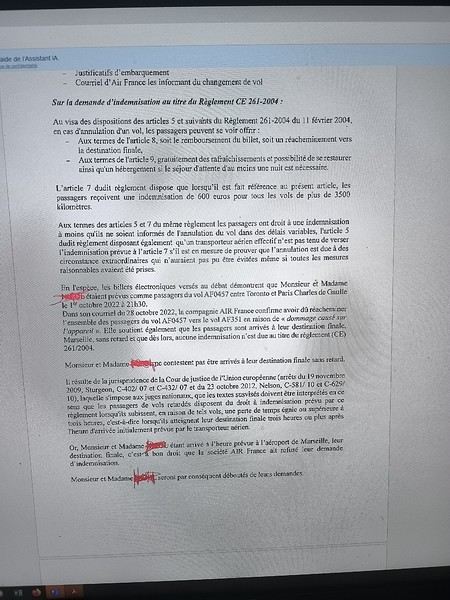
" The court, ruling by contradictory judgment, Overturns the referred judgment and rules anew: Orders AIR FRANCE to pay each of the appellants: - A sum of 600 € as the flat-rate compensation provided for by European Regulation No. 261/2004 of February 11, 2004, - A sum of 600 € in compensation for the moral damage caused by its abusive resistance, And 2,500 € in legal costs"
nathalie
NA Nataly03 Globetrotter ·
Here’s the first "lost" ruling

nathalie
EL ElviajeroPar Globetrotter ·
" The court, ruling by contradictory judgment, Overturns the referred judgment and rules anew: Orders AIR FRANCE to pay each of the appellants: - A sum of 600 euros as the flat-rate compensation provided for by European Regulation No. 261/2004 of February 11, 2004, - A sum of 600 euros in compensation for the moral damage caused by its abusive resistance, And 2500 € in legal costs."

Hello,

Things are becoming much clearer regarding the "doubling" of compensation.

As I already explained, a judge cannot double the amount of the flat-rate compensation provided for in Article 7 of Regulation 261/2004 of the European Parliament and Council, but they can grant (which is very rare) "additional compensation." It’s pure coincidence that the judge set the amount of this additional compensation equal to the amount provided for in Article 7.

Reason for the initial judgment’s failure: You only provided a single page of the judgment in question and did not provide the conclusions submitted by both parties to the court. As a result, my opinion can only be a guess based on this very partial information, and in no way an affirmation.

This single page of the judgment mentions the Sturgeon ruling by the Court of Justice of the European Union. Given procedural rules, if the judge refers to it, it can only be because either your lawyer or Air France’s lawyer brought it up.

However, this ruling only concerns the right to compensation for arriving at the final destination with "3 hours or more" of delay. If your lawyer claimed compensation on this basis, it’s obvious the judge could only dismiss your case since you had no delay upon arrival at your final destination... Still, I can’t believe your lawyer would make such a mistake!

What’s more, this makes the error even more unlikely: your flight wasn’t delayed but was simply canceled and rebooked (your first flight segment) 3 hours earlier, according to your explanation. From what you said, it seems you were informed of the cancellation of your first flight segment and the rebooking 3 hours earlier at the last minute—or at least less than 7 days before.

It therefore seems (once again, this is just a guess given the very limited information you provided) that your lawyer "forgot" to cite Article 5, paragraph 1, subsection c) of Regulation 261/2004 of the European Parliament and Council (I quote):

Article 5 Cancellations 1. In the event of a flight cancellation, the passengers concerned: [...] c) are entitled to compensation from the operating air carrier in accordance with Article 7, unless they are informed of the cancellation of the flight: [...] iii) less than seven days before the scheduled departure time if they are offered re-routing allowing them to depart no more than one hour before the scheduled departure time and to reach their final destination less than two hours after the scheduled arrival time. (end of quote) But again, I find it hard to believe your lawyer would "forget" something like that! However, it’s clear that no judge could have dismissed your case if Article 5, paragraph 1, subsection c) had been cited.

Just a reminder: in civil matters, a judge, who is bound by impartiality, can only rule on a dispute based on the "grounds" (laws, case law, regulations, contractual rights) cited by both parties, while their duty of impartiality prevents them from "suggesting" to either party a "ground" they may have omitted.

I have no way of forming an opinion on this "appeal," especially since, in this case, a judgment rendered by the local court is issued "as a final decision," meaning it cannot be appealed, except in cases provided for by Article 473 of the Code of Civil Procedure (I quote):

When the defendant does not appear, the judgment is rendered by default if the decision is final and if the summons was not served in person.

The judgment is deemed contradictory when the decision is subject to appeal or when the summons was served on the defendant in person. (end of quote)

The question is why the judgment was "deemed" contradictory and subject to appeal. Only a complete file consisting of the conclusions submitted by each party in both instances, plus the two full judgments, would shed light on this. But I must admit, my curiosity is piqued...

Best regards
https://retardimportantavion.wordpress.com
NA Nataly03 Globetrotter ·
It clearly states in the claim that the flight was canceled and rescheduled more than 3 hours earlier on the same day... When we lost the first case, my lawyer really didn’t understand why... He just concluded that a judge is sovereign in making the decisions they want... In this case, the judge ruled there was no damage... since we arrived without delay... He told me that’s what appeals are for... And sure enough, we won on appeal... In the end, it was mostly the lawyer who made extra money... But the appeal judge still recognized moral damages...
nathalie
EL ElviajeroPar Globetrotter ·
It does clearly state "flight canceled and brought forward by more than 3 hours on the same day" in the request..

But did your lawyer write—and confirm verbally during the hearing before the judge—the terms of Article 5, paragraph 1, subsection c) of Regulation (EC) No 261/2004 of the European Parliament and of the Council (quoting):

Article 5 Cancellations 1. In the event of cancellation of a flight, the passengers concerned: [..] c) shall be entitled to compensation by the operating air carrier in accordance with Article 7, unless they are informed of the cancellation of the flight: [..] iii) less than seven days before the scheduled time of departure if they are offered re-routing, allowing them to depart no more than one hour before the scheduled time of departure and to reach their final destination less than two hours after the scheduled arrival time. (end of quote)

It does seem like everything is there, because if they didn’t, the judge simply couldn’t rule in your favor. In civil matters, a judge can only base their decision on the "arguments" put forward by both parties.

A guess: your opponent likely invoked the Sturgeon ruling (compensation for passengers who arrive at their final destination with a delay of "3 hours or more"). They may have done so in writing only, requesting that the case be handled without a hearing.

If your lawyer didn’t cite Article 5, paragraph 1, subsection c), the judgment dismissing your claim makes perfect sense.

Best regards,
https://retardimportantavion.wordpress.com
NA Nataly03 Globetrotter ·
He even mentioned "corandon" (not sure about the spelling). Unfortunately, the first judge didn’t agree. Luckily, the appeals judge did.

. When there’s an appeal ruling, the same things are requested as in the first hearing—no changes—so yes, everything was done by the book.
nathalie
EL ElviajeroPar Globetrotter ·
He even mentioned Corendon (not sure about the spelling). Unfortunately, the first judge didn’t agree. Luckily, the appeals judge did. . When there’s an appeal ruling, the same things are requested as in the first hearing—no changes—so yes, everything was done by the book.

Hello,

That the same things are requested on appeal is one thing, but it doesn’t mean they’re argued with the same *"means"* (laws, case law, regulations, contract law). Otherwise, in such a straightforward case, the ruling would’ve been the same as the first judgment! Again, in civil matters, a judge CANNOT have a personal opinion. They can only decide based on the *"means"* presented by both parties.

If your lawyer cited the Corendon ruling (https://eur-lex.europa.eu/legal-content/FR/TXT/PDF/?uri=CELEX:62024CJ0558) instead of referencing Article 5(1)(c)(iii) of Regulation 261/2004 of the European Parliament and Council, they simply handed your opponent the win!!!

Here’s the operative part of the Corendon ruling, as you can read in the link above (quoting):

"On those grounds, the Court (Eighth Chamber) hereby rules: Article 5(1)(c) and Article 7(1) of Regulation (EC) No 261/2004 of the European Parliament and of the Council of 11 February 2004 establishing common rules on compensation and assistance to passengers in the event of denied boarding and of cancellation or long delay of flights, and repealing Regulation (EEC) No 295/91, must be interpreted as meaning that:

in the event of a rescheduled flight where the departure and arrival times are changed in advance by the airline and accompanied by a new booking confirmation for the affected passengers, the length of the delay upon arrival must be calculated based on the originally scheduled arrival time." (end of quote).

The Corendon ruling states that the delay must be assessed against the originally scheduled arrival time.

The Sturgeon ruling (likely cited by your opponent in the first judgment) states that passengers must be compensated if they reach their final destination with *"a delay of 3 hours or more."*

However, you didn’t experience any delay upon arrival at your final destination since you were rebooked on another flight 3 hours earlier!

On these grounds, the judge had no choice but to side with your opponent—since you arrived at your final destination with no delay whatsoever!!! Furthermore, it’s important to note that this ruling applies to delayed flights, not canceled ones, whereas your first flight segment was *canceled*, not delayed! It’s understandable that your opponent cited the Sturgeon ruling to argue you didn’t suffer a *"3-hour or more delay."* But for your lawyer to cite the Corendon ruling, which only strengthens your opponent’s position, is a whole different story!

Given your description, we can assume your flight was canceled last-minute—less than 7 days before departure—and you were rebooked 3 hours earlier. The outcome would’ve been entirely different if your lawyer had cited (which they likely did on appeal) Article 5(1)(c)(iii), emphasizing to the judge that compensation was being sought for *cancellation*, not delay. (Quoting):

"Article 5 Cancellations 1. In the event of a flight cancellation, the affected passengers: [...] c) are entitled to compensation from the operating air carrier in accordance with Article 7, unless they are informed of the cancellation: [...]
https://retardimportantavion.wordpress.com
NA Nataly03 Globetrotter ·
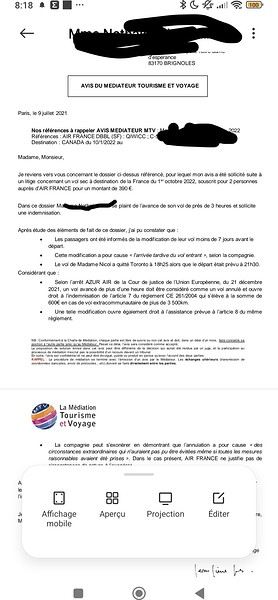
Attached to the file. There was no error, just a poor decision by the initial judge. Even the tourism mediator agreed with us.

nathalie
EL ElviajeroPar Globetrotter ·
Hello,

There’s a major difference between the role of a mediator and that of a judge. A mediator’s role isn’t to interpret the law but to try to reach an agreement to avoid going to court.

As a result, a mediator gives their opinion, which they can’t enforce. On the other hand, a judge can’t give their opinion because they CANNOT have one. They can only make a decision based on the "arguments" (laws, case law, regulations, contractual rights) raised by both parties. Therefore, they CANNOT consider the mediator’s opinion because, precisely, it’s just an opinion.

What’s more, the mediator’s opinion confirms that your lawyer made a mistake. Indeed, according to the mediator’s assessment, your flight wasn’t classified as canceled (even though it clearly was) but only as rescheduled earlier. The mediator even cites the Court of Justice of the European Union’s ruling on flights rescheduled by more than one hour. However, it was clearly a canceled flight with rebooking on another flight—not a rescheduled one—since the rebooking flight had a different flight number. If, as you say, your lawyer cited the Corendon ruling (which determines the relevant schedule for a delayed flight) while it seems your opponent cited the Sturgeon ruling (compensation only for "3 hours or more" delays), the judge could only rule in favor of your opponent.

These exchanges are becoming completely pointless since you haven’t provided the full judgment (only 1 page), the ruling, the submissions filed in court, or those filed with the Court.

Therefore, I’m ending this exchange, which is turning into a useless debate.

Best regards
https://retardimportantavion.wordpress.com
NA Nataly03 Globetrotter ·
My original flight wasn’t canceled... It was delayed so much that they moved some passengers to the previous flight, which wasn’t full.
nathalie
SI Sinforosa Veteran ·
Hi ElviajeroPar,

I just saw that new rules for air travel disputes are coming into effect today, and apparently, for consumers, it’s going to be longer, more complicated, and more expensive.

Here’s the article where I read this info: https://www.franceinfo.fr/economie/transports/litiges-aeriens-de-nouvelles-regles-entrent-en-vigueur-pour-se-faire-rembourser-en-cas-de-vols-retardes-ou-annules_7789154.html
" Celui qui voyage sans rencontrer l'autre ne voyage pas , il se déplace " ( Alexandra David-Néel )

" Ahora todos quieren ser latinos , no , ey , pero les falta sazon , bateria y reggaeton " ( Bad Bunny )
EL ElviajeroPar Globetrotter ·
Hello, This decree dates back to last August. My website https://retardimportantavion.wordpress.com has long since been updated. While the decree only came into force six months later, it was already necessary to account for the airline's response time to a claim sent by registered letter with acknowledgment of receipt (A.R.), as well as the processing time for the conciliation procedure before taking the matter to court. Note—given the many questions visitors to my site ask on this point—many still haven’t understood that a registered letter with A.R. is the *only* valid method of communication for the initial claim.

The decree has a clear purpose: to paralyze agencies that charge "I’ll take 30%" (or more!!!). Since court action must now *mandatorily* be initiated by summons—meaning through a *commissaire de justice* (the new name for bailiffs)—you’ll need to spend around 100 to 150 € to file a case. This will obviously create a serious cash-flow problem for these agencies.

The obvious solution would have been to enforce Article 16 of Regulation 261/2004 of the European Parliament and Council: imposing dissuasive fines on airlines that routinely violate the regulation. But during discussions to update the same 2004 regulation (particularly the compensation amounts, which have never been adjusted), the Council (heads of state and government of the 27 EU member states) and the European Parliament have failed to reach an agreement for years. The Council is always very receptive to airlines’ arguments, while the Parliament remains strongly focused on consumer rights.

For consumers, the key changes are as follows: 1. Before taking a case to court, instead of contacting the *conciliateur de justice*, you must now contact the *médiateur du tourisme et du voyage* (MTV). 2. Instead of filing a simple *requête* (petition) after an unsuccessful mediation, you must now do so by summons, meaning you’ll need to hire a *commissaire de justice*. 3. In practice, this mainly affects agencies—mass procedures are no longer possible.

Let’s look at the first two points: Contacting the *médiateur du tourisme et du voyage* (MTV) instead of the conciliator doesn’t change much. What’s more, the MTV can only handle cases involving member companies. Many foreign airlines aren’t members, so you’ll need to prove that the MTV rejected your case.

The second point (summons) is major: Airlines will now resist passenger claims even more, betting that even fewer passengers will take legal action than before.

However, for passengers determined to enforce their rights, the consequences are limited to:

Paying the *commissaire de justice* (around 100 to 150 €). This amount will be part of the sum claimed in court and will be covered by the losing party under Article 700 of the French Code of Civil Procedure.

More than ever, *not deviating in the slightest* from the rules outlined on my website;

Pressing the airline even harder than before to provide the *two proofs* (mere allegations aren’t enough) that allow airlines to avoid paying due compensation: proof of the "extraordinary circumstances" they invoke and proof that they took all "reasonable measures" to mitigate them. https://retardimportantavion.wordpress.com/2021/03/01/force-majeure-circonstances-exceptionnelles-circonstances-extraordinaires-quest-ce-que-cest-definition-refus-dindemnisation/

For canceled flights or missed connections, to completely invalidate any excuse of "extraordinary circumstances," carefully follow the instructions here: https://retardimportantavion.wordpress.com/2023/09/29/indemnisation-meme-si-circonstance-extraordinaire-droit-reacheminement-dans-les-meilleurs-delais/ and a concrete example of the procedure in this case: https://retardimportantavion.wordpress.com/2024/01/12/reacheminement-catastrophique-droit-indemnisation-meme-circonstances-extraordinaires-2/

It’s worth noting that this decree does *not* apply to the "European Small Claims Procedure": https://retardimportantavion.wordpress.com/2021/03/02/procedure-europeenne-de-reglement-des-petits-litiges/

Finally, it’s important to note:

This new decree has been *strongly* criticized by legal professionals (both judges and lawyers).

It can reasonably be argued that this decree violates EU law, which has led to an ongoing legal challenge for its annulment. However, this process is likely to take a long time.

Best regards
https://retardimportantavion.wordpress.com
SI Sinforosa Veteran ·
Hello,

This decree is also strongly criticized by consumer associations. UFC-Que Choisir filed a case with the Council of State on October 6th to demand its annulment.
" Celui qui voyage sans rencontrer l'autre ne voyage pas , il se déplace " ( Alexandra David-Néel )

" Ahora todos quieren ser latinos , no , ey , pero les falta sazon , bateria y reggaeton " ( Bad Bunny )

Similar discussions

You might also like