Bonjour,
Je sais que le sujet a déjà été traité mais je n'ai pas eu toutes les réponses souhaitées.
Pour notre périple de 7 jours sur le Canal de Nantes à Brest, nous aurons quelques appareils nécéssitant d'être rechargés(appareils photos, telephone voire tablette). Je cherche un moyen simple, pas trop onereux et efficace pour garder nos appareils chargés une semaine.
Je sais, cette réponse semble "facile".
Mais non, elle est le fruit de l'expérience. En France, le plus simple, le plus rapide et le moins cher reste la prise électrique 220V que tu trouveras partout si tu demandes avec le sourire et un peu d'aplomb.
Sur une petite semaine, avec une utilisation raisonnée de ces joujoux, cela devrai suffire.
+1 sinon au moins 70/80 euros roue avant avec dynamo moyeu, puis de 94 à 147 euros l'ewerk (oui, c'est la variation de prix sur le www pour le même produit) puis peut être une batterie tampon du même ewerk (de 49 à 47 euros selon fournisseur)
faites vos comptes !!
Bien sûr que les accros aux gadgets vont l'acheter (comme moi) mais j'avoue que ce n'est pas raisonnable
Pour notre périple de 7 jours sur le Canal de Nantes à Brest, nous aurons quelques appareils nécéssitant d'être rechargés(appareils photos, telephone voire tablette). Je cherche un moyen simple, pas trop onereux et efficace pour garder nos appareils chargés une semaine.
Si vous allez dans les campings, ça ne vous coûtera rien, pas la peine de prendre un branchement électrique, vous allez dans les sanitaires et hop !! y' a juste à surveiller !! c'est comme ça que je procède !!
moins cher que l'E- WERK, il y a ça :
http://eurecart.free.fr/
derrière un moyeu-dynamo (c'est là où l'investissement est le plus utile : rendement électrique + qualité de roulement ...), le régulateur + la batterie-tampon ... c'est vrai que c'est un peu cher, mais, après tout, la différence, par rapport à une roue "ordinaire" n'est pas si important, et être autonome vaut qqs sacrifices ... en plus, ça permet de disposer toujours d'un éclairage puissant : ça peut rendre service !!
cela dit, tout dépend du type de voyage ... c'est vrai que si l'on loge en gîte ou hôtel, si l'on alimente juste un téléphone portable et si le GPS ou la tablette n'est mise en route que pendant les qqs minutes où l'itinéraire devient "complexe" ... on peut se passer d'alimentation électrique
Tu branches la batterie sur le secteur, tu la laisses charger (camping : sanitaires par ex ca t'evite de laisser le telephone sans surveillance) et ensuite tu branches dessus tes appareils a charger
L'été dernier, par une météo mitigée le long du Danube, donc pas forcement ensoleillée, nous avons été 12 jours en autonomie électrique avec un petit panneau solaire couplé à une batterie, pas cher et d'aspect gadget, comme il en existe des dizaines chez une multitude de marchands.
J'avais suivi celui-ci sur la seule base des photos du site, donc un peu au hasard: http://dx.com/p/portable-solar-powered- … ers-101004
C'est d'ailleurs plutôt un bon signe qu'il soit toujours en vente presque un an plus tard, même s'il y a surement mieux pour un prix comparable.
Fais cependant attention de choisir un modèle capable de débiter au moins 1 A pour charger correctement tes appareils (par ex. mon téléphone Motorola refuse de se mettre en charge si je le branche sur une prise USB un peu faible).
Bien chargée avant de partir, et laissée au soleil dans la journée (dans le porte carte de la sacoche de guidon), cette batterie a suffit pour assurer une recharge de l'appareil photo tous les 4 ou 5 jours et du smartphone presque tous les soirs.
C'était d'ailleurs une bonne surprise, car je n'y croyais pas trop au départ.
Aussi, j'avais également emporté le chargeur secteur du téléphone, pour squatter une prise au cas où dans les sanitaires des campings, mais je ne m'en suis pas servi.
Par contre, il est dommage que je n'ai pas cherché à savoir si la batterie était toujours chargée à fond à la fin du voyage, ce qui aurait indiqué que le panneau était suffisant.
Donc, dans le pire des cas, rester en autonomie électrique quelques jours, et quand une prise est disponible (resto, camping), redonner un coup de boost à la batterie, sans chercher à savoir si c'est nécessaire ou non.
La batterie est aussi intéressante dans le cas où tu recharges sur une prise que tu ne peux pas surveiller, typiquement les sanitaires des campings: tu as moins de scrupules avec une batterie à 30 Euros qu'avec un smartphone ou un appareil photo.
Comme d'autres, je ne pense pas que tu aies besoin de t'encombrer inutilement pour 7 jours. Les prises électriques te suffiront!
Quant à moi, j'utilise généralement un Freeloader Pro avec le panneau d'extension SuperCharger pour recharger plus rapidement. Tu peux aussi l'alimenter à l'aide d'une prise de courant, histoire d'avoir du jus de réserve même quand le soleil n'est pas au rendez-vous...
C'est vrai, l'ewerk avec dynamo et batterie c'est pas raisonnable mais c'est tellement plus confortable que de passer n heures dans les ch.. du camping à surveiller le smartphone, la batterie de l'APN, ... et puis, pas besoin d'apporter n chargeurs, les cables USB (bien sûr) tous différents mais moins encombrant suffisent. Et enfin, cerise sur le gateau, en plus ou à la place de la dynamo, tu peux brancher un petit panneau soliare sur l'ewerk et là, même pendant la sieste (au soleil bien entendu) ça charge!
bonsoir
toujours d' actualités le chargement de nos gadgets...
c'est vrai que la prise de courant c'est le plus simple, mais dans un camping je me suis fait piquer mon GPS alors a part prendre l' option alimentation électrique ......
j'ai donc opter pour USB2B avec une batterie tampon et je charge même l' Iphone tu peux téléphoner au fabriquant super sympa ou le panneau solaire mais il faut du soleil....
bonne soirée
Gérard
Cet été j'ai essayé le chargeur tekkeon MP1580 (attention le modèle précédent est moins puissant) + un régulateur de charge M172 Kemo.
Alors, ça marche (avec une dynamo b&m), mais qu'est-ce que c'est long ! il faut en avaler des km pour recharger 4 malheureuses piles... Donc à réserver pour les cas d'urgence. En revanche ce chargeur est intéressant car il fonctionne dans les deux sens, donc on peut s'en servir de manière classique pour recharger des piles (LR6) sur le secteur (avec un chargeur usb, c'est tout petit, on laisse le tout dans les sanitaires...), et ensuite on le change de sens pour que les piles rechargent l'appareil, le téléphone ou gps... Pour les LR6 il faut utiliser des eneloop, elles gardent la charge plus longtemps. On peut aussi mettre des LR6 déjà chargées et les utiliser pour charger l'appareil...
Quelqu'un a acheté ou a testé ? Sur le papier ça parait vraiment super (design tout intégré). Il s'agit d'une nouvelle lampe b&m puissante avec commande au guidon. Mais le plus intéressant ici, c'est que dans sa version USB, elle possède un connecteur USB (sur la commande au guidon) et une batterie tampon intégrée dans la lampe. Un bémol, le prix, env. 180€.
Si vous allez dans les campings, ça ne vous coûtera rien, pas la peine de prendre un branchement électrique, vous allez dans les sanitaires et hop !! y' a juste à surveiller !! c'est comme ça que je procède !!
ça veut dire que tu vas rester 3-4 heures dans les sanitaires à surveiller la recharge de tes appareils ?
Leonick
camera embarquée sur l'ironman de Lanzarote, récits de voyages en vélo,
Agenda des épreuves d'endurance
Jusqu'ici j'avais qu'un téléphone à recharger et j'ai toujours réussi dans les sanitaires, par contre maintenant j'ai monté une assistance électrique sur mon Trike (5 heures de recharge) je ne pourrais pas faire autrement que de prendre un branchement électrique !!
Usb et Lumière, au guidon Génial!
Moi aussi, j'attends cette lampe. Busch et muller à du retard.
pour le prix, j'ai vu 149 € sur xxcycle.com.
Bonne route.
Je viens d’acquérir l'USB2BYK pour recharger mes appareils USB et avoir un éclairage constant. Cet appareil est vraiment pratique en l'associant à une batterie…
Je lis ici et là que certains chargeurs usb pour vélo possèdent une batterie tampon qui apparemment a pour rôle d'alimenter une tension suffisante à l'appareil…
Bonjpour à tous Je souhaite faire un voyage pour retrouver des amis en Moselle cet été en partant de Chambéry à vélo. pour cela je m'équipe petit à petit. Je…
Déçu. Acheté en décembre il a fonctionné 2 jours puis connexion et déconnexion sans arrêt. Meme il a vidé mon iphone. Retour chez le vendeur qui me dis…
Ca y est j'ai mon billet d'avion, départ mi novembre, retour mi-mars.
arrivée santiago et je repars depuis Buenos Aires.
J'ai deja été dans le sud de l'argentine, notamment le parc torres del Paine, et j'ai très envie d'y retourner pour faire le grand W, j'avais fait le petit.
Je souhaite aussi randonner qq foois et pourquoi pas faire un sommet. Je grimpe et je fais occasionnellement de l'alpinisme, donc ce sera avec un guide de toute façon.
Je compte démarrer vers temuco au chili, j'ai dans l'idée d'aller vers les lac, puis prendre la careterra austral.
Je sais pas si je vais aller jusqu'à Ushuaia, parait que cela vaut pas tant que cela la peine, à part pour dire qu'on a été au bout de la terre.
j'ai vu vite fait qu'il y'avait des lac en Argentine.
Je n'ai pas d'itinéraire précis. Mais ce que je souhiaterai, c'est qu'une fois arriver le plus au sud de mon vooayage, faire une mini croisière pour voir des annimaux.
Des conseils pour cela?
qu'avez vous pris comme sac de couchage? un 0 degré suffit?
et ultime question, réchaud à essence ou est-ce que je peux m'en sortir avec mon réchaud gaz?
Cet été nous prévoyons de pédaler sur l'EV 19 qui longe la Meuse de Langres jusqu'à Rotterdam.
Mon questionnement concerne le retour jusqu'à Nantes.
Savez vous quel est le meilleur retour possible? J'en appelle à vos expériences.
Je voyais que Flixbus ne prenait pas les vélos.
En train, je pense que c'est possible avec de multiples petits trains.
On se questionnait aussi sur l'existence d'un bateau qui irait de Rotterdam jusqu'à St Nazaire et qui pourrait charger des passagers avec vélos.
Toutes vos expériences partagées nous seront bien utiles et nous vous en remercions.
Bonne soirée
Je souhaite faire Morlaix Brest ( via Roscoff et la littoral V45) nous commencerons à rouler le 16 aout pour 13 jours (avec des pauses visites iles , surf etc..) Est ce qu'il y a beaucoup de circulation à cette époque de l'année car j'ai 2 enfants de11 et 13 ans et on n'aime pas rouler au milieu des voitures (on a déjà fait velomaritime ; Caen - Cherbourg, loire : Orléans- Saumur, Velodyssée : Nantes - Royans, les canaux : nivernais , bourgogne etc ... et il y avait beaucoup de voies réservées aux vélos ce qui n'est pas le cas sur cet itinéraire).
Merci de votre aide si vous avez déjà parcourue cet itinéraire fin aout.
Virginie
Hi there,
I’ve been road cycling for several years, and I’m about to switch to gravel in the next few days—I’m waiting for my bike, which should arrive this week.
I’m planning a bikepacking trip in a few weeks along the Véloroute V81, also known as the Vélosud, from Biarritz to Le Barcarès.
Has anyone here already done this route? Any info is welcome, whether it’s about the route itself, gear, or accommodation. I’ll prioritize staying with locals as much as possible. On that note, I just signed up for the brand-new site *Guidon et Couette* ((www.guidon-et-couette.fr)), which offers free accommodation between cyclists across the country, but there’s almost no one listed along my route!
Thanks in advance.
Laurent.
I’m planning to build a new touring bike.
I want to prioritize lightness.
That said, I’m tempted by a suspension fork that could offer some comfort on rougher roads.
The recent appearance of gravel suspension forks on the market might meet my needs—at least on paper.
I’m particularly considering the RockShox Rudy Ultimate XPLR fork.
Unlike MTB forks, its travel is short: either 30 mm or 40 mm.
It weighs 1400 g, which is 400/500 g more than a steel fork.
Any thoughts or real-world feedback on this?
I’m also wondering about the durability of magnesium (lower leg) for long-distance bike touring.
And what’s the impact of skipping the manufacturer-recommended maintenance every 50 and 200 hours? That’s bound to happen on a long trip unless you carry extra gear.
More generally, how reliable are these kinds of forks?
Hi everyone,
I wanted to share with you the incredible feat my friend José, who’s 72 years old, is currently undertaking. He left Auterive near Toulouse on Monday, May 18, 2026, on his non-electric bike, heading for the North Cape in Norway!
You can follow his route on the link below—he’s currently in Sweden:
https://thierry-thomas.travelmap.net/jose-de-toulouse-a-nord-cap-2026
You can zoom in on the map and click on each stopover town to see the photos
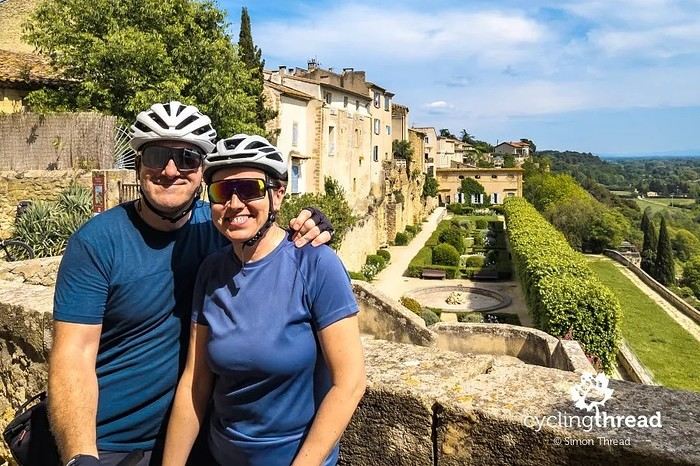
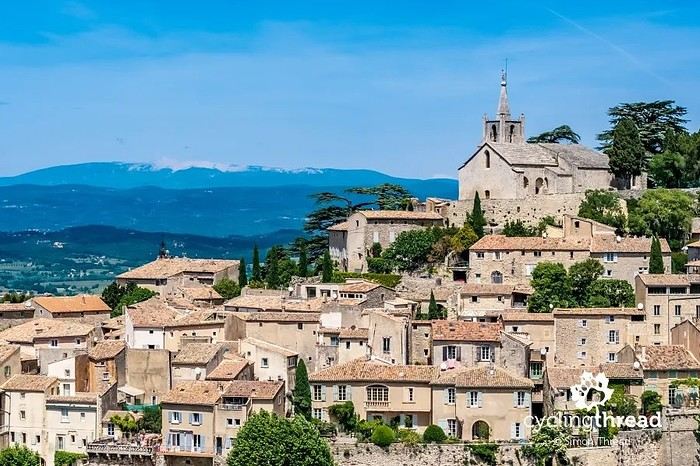
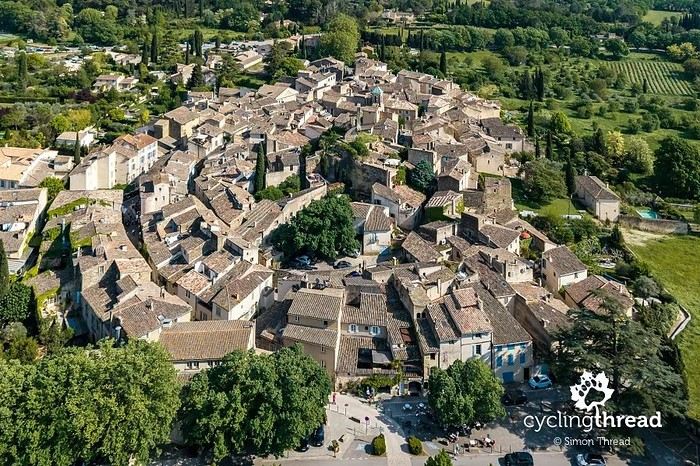
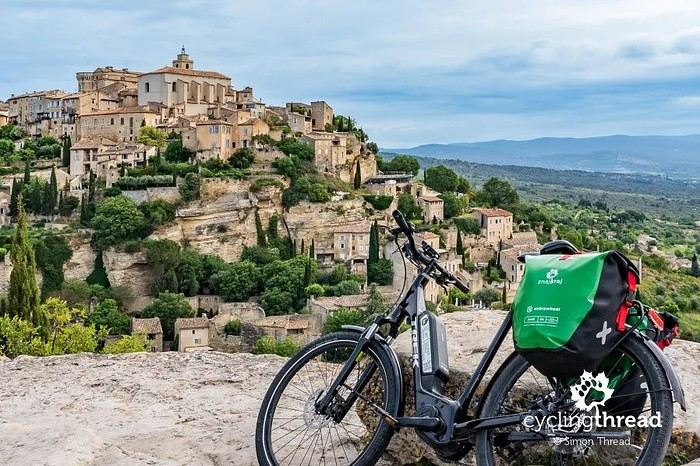
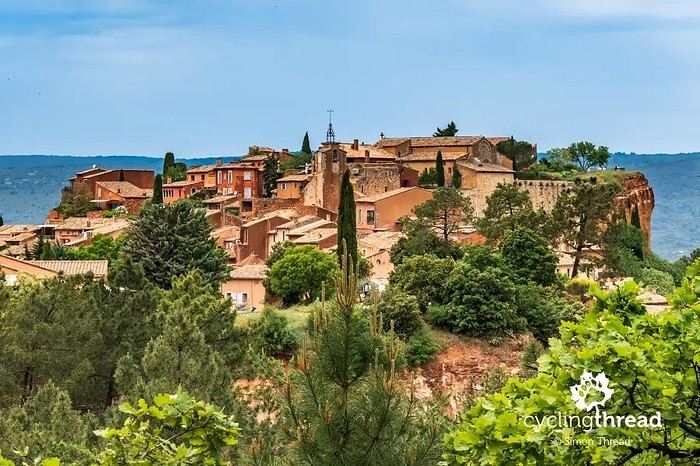
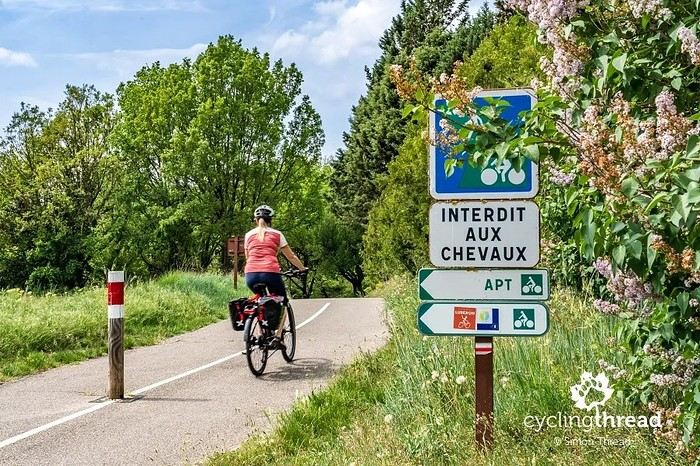
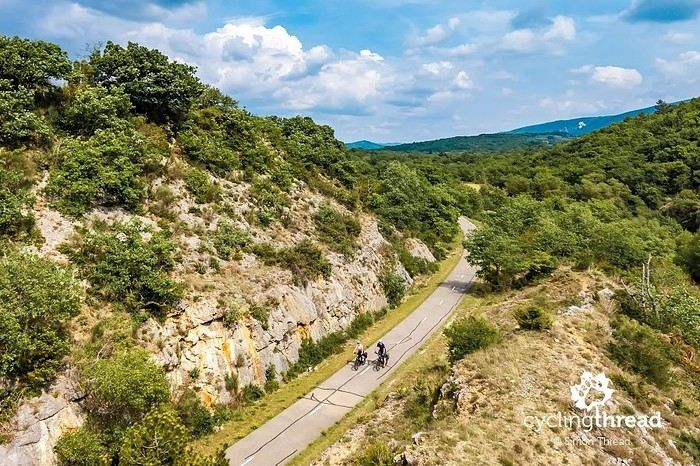
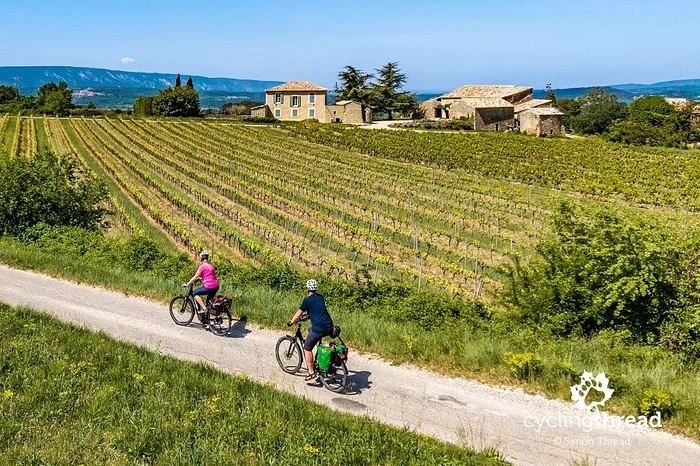
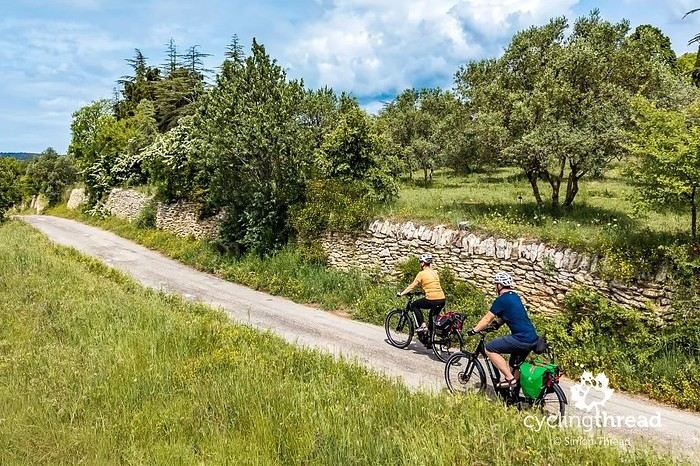
I’m making an exception and creating a separate post this time, since it’s all about France. In May, we spent a week in Provence, specifically in the Luberon, exploring the cycling routes *Autour du Luberon à Vélo*, the *Véloroute du Calavon* (part of EuroVelo 8), and the shorter *Les Ocres à Vélo* route. Together, they gave us an amazing journey through rolling hills, vineyards, lavender fields still green in spring, and some of the most stunning landscapes in southern France.
It was, of course, the perched villages that impressed us the most. We visited Gordes, Roussillon, Bonnieux, Lacoste, Lourmarin, Ménerbes, Oppède-le-Vieux, Cucuron, and Lauris. Many of them are among the most beautiful villages in Provence, and it’s hard not to agree with that reputation.
One interesting point is the route of EuroVelo 8 in this part of the region. The official path mainly follows the old railway line of the *Véloroute du Calavon*, which is very comfortable and safe. But in our opinion, cyclists traveling EuroVelo 8 around the Mediterranean would discover even more treasures if the route passed through villages like Bonnieux, Lacoste, or Oppède-le-Vieux.
We were also pleasantly surprised by how safe cycling felt. Most of the route takes small local roads, but traffic is light, drivers are respectful, and road design really takes cyclists into account. It’s one of those places where you can ride peacefully even without separated bike lanes.
Our full story:
Around Luberon by bicycle - the most beautiful villages of Provence
You can also find all our cycling travel stories on the forum:
Cycling Thread - Europe’s most beautiful bike routes
Hi there, we’re a group of 4 cyclists looking to get from Treviso in Italy to Munich with our 4 non-folding bikes. It seems complicated! Are there any solutions? Thanks so much.
hello fellow cycling enthusiasts
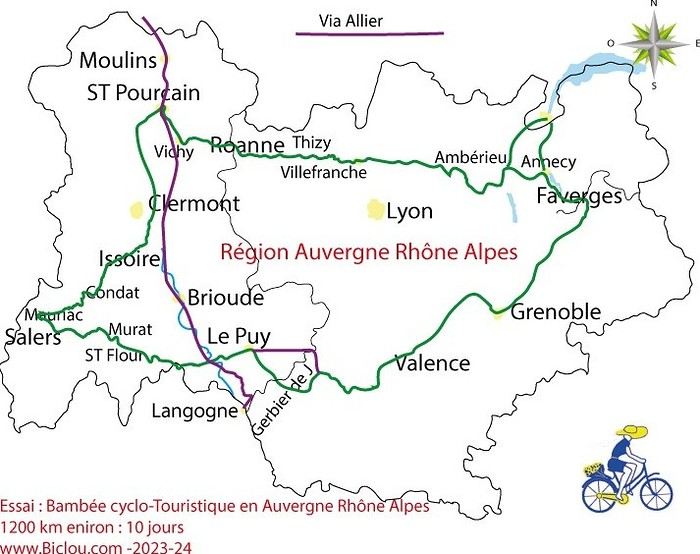
here’s a travel journal of the cycling tour through the Rhône-Alpes Auvergne region by Claudio
zouli
it was the plan
http://cbandiera.free.fr/parcours/auvergne-Ralpes/
the trip was completed
story being posted online soon
1100 km in 11 days
beautiful and varied regions
Hi there, we’re planning a Munich to Venice bike trip at the end of June 2026. Getting back from Venice to Toulouse by train with 4 bikes isn’t straightforward. What return options have others who’ve done this trip chosen? Any tips or great deals would be much appreciated. Thanks a bunch! !
Hi everyone,
Happy owner of a Pegasus Estremo bike with a Rohloff hub, which is giving me trouble with the SF11-NCX-FT-E-LITE 700C TS 300/0 fork (serial number TD01329060). It’s starting to show its age, and I’d like to repair it to extend the life of my beloved bike.
The suspension is gone, and there’s an oil leak from the seals.
Does anyone know how to repair it? Where can I find parts that are about fifteen years old? Or where to find an identical replacement fork? Just to clarify, the Magura HS11 brakes are mounted using Firm Tech, meaning they’re on pivots behind the fork, facing the frame.
Hi, I'd like to know if anyone has done this route recently or has reliable info.
Does the track exist, and most importantly, is there sand (for biking)?
Any info is welcome.
Cheers,
diego ambilobe: mangaoka, manondro, ramena
vohemar sambava: masondrono, tanambao
Hi there,
New to bike touring,
I’d love to start with a section of the Via Rhona to explore and share (route to be decided).
Looking forward to exchanging tips!
I’m landing in Madagascar with a buddy before the end of April 2026. We’re planning to bike around for about twenty days or so. We don’t have a specific goal other than exploring the country and meeting the locals.
Ideally, we’d prefer a loop route starting from Antananarivo with a good chunk of it along the coast. On the bike side, we’re used to riding 6 to 8 hours a day, depending on the needs, encounters, and mood 😉 Any feedback or tips from trips around this length?
A big thank you to Lazarou for all the info you share in this forum!
I'm passionate about Morocco, which I cycled through back in 2009.
Last year, my wife and I explored the High Atlas by tandem. Completely smitten, we're heading back in April (Anti Atlas) and May (High and Middle Atlas), still on our tandem.
Do you have any info on the track between Amezri and Ali Ait Nito? Are the river crossings in the Tessaout still there? It's not easy to navigate with a loaded tandem... especially if the river level is high due to this year's heavy snowmelt!
Thanks in advance for any tips you might have, and best wishes for health in this new year!
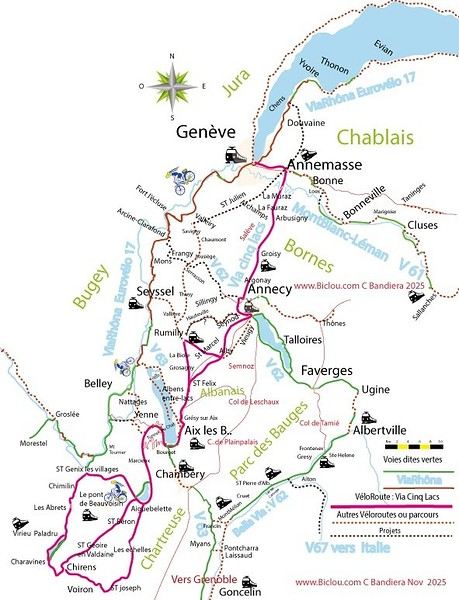
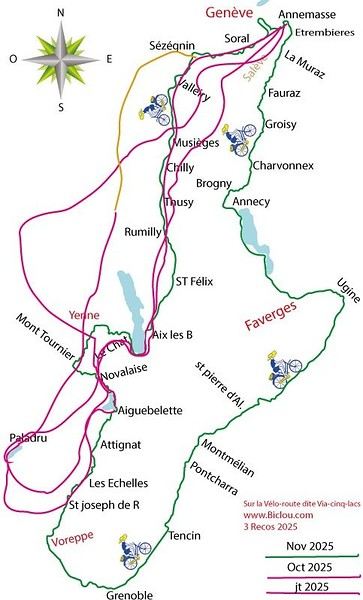
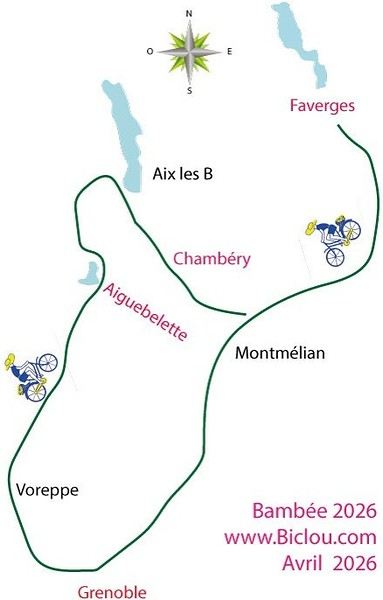
Claudio specializes in the route of the Savoie lakes
Here are his travels
Between Bornes, Chartreuse, the Savoie foothills, and Dauphiné
Five lakes: Léman, Annecy, Paladru, Aiguebelette, Bourget, not to mention a few ponds along the way
Plenty of accommodation options: camping, hotels, and more...
A lovely route not far from his place
Rural and quite peaceful
A road cycling route created by Serge B...
Tout d'abord... bonne année ! De belles routes à vous en 2017 !
Je voyage depuis quelques années avec un VTT de très bonne qualité mais équipé de freins à disques hydrauliques. Je vis (pédale) avec l'inquiétude d'avoir une panne (fuite, bulle d'air, chaleur qui fait que le liquide...). Mon vélociste me dit qu'il est impossible de les changer pour des V brakes.
Qu'en pensez-vous ? Est-ce que je prends un gros risque à continuer (seule) avec ces freins ? D'avance je vous remercie pour vos bonnes idées.
First post here to share a quick recap of our west-to-east bike trip along Algeria’s coast in January 2025.
It was just the two of us—my partner and I—with French passports and not a word of Arabic. No friends or welcoming hosts in the country.
Under those conditions, we’d strongly advise against going.
Our original plan was to follow the coast from Algiers to Tunis. We ended up cycling from Algiers to Béjaia, then took the train from Béjaia to Annaba (with a stop in Constantine), and finally biked to the border.
We were tailed by police the whole way—whether on our bikes, on the train, or even on foot while exploring towns. On top of that, we couldn’t wild camp and were limited to the few state-approved hotels that accept foreigners. Under those circumstances, connecting with locals was especially tough.
With such an omnipresent and intrusive police presence, we’d definitely recommend against this destination for bike touring. A really sad situation that completely cuts you off from the local population...
We’d been warned, we went to check it out, and we weren’t disappointed!
Hi there,
I’m planning the route to cycle from Lille to Nordkapp with my partner.
Duration: 3 months, from May 1st to July 31st, 2026.
In the attached details below, I need to add some "non-riding" days (rest days, basically).
So I’m looking to "shorten" the trip by taking ferries or trains for some stretches. Which areas could I skip?
Thanks in advance for your great tips.
Have a good evening.
https://www.komoot.com/fr-fr/collection/4023980/-lille-cap-nord-1er-mai-au-31-juillet-2026?ref=collection
I’m planning to bike back from Poland this summer. Does anyone know a way to ship it there without having to take it apart? Otherwise, it’s a real hassle to fine-tune all the settings before departure!
Thanks in advance.
Hi, has anyone recently bought Primus or Butagaz gas, possibly puncture-style, in Dubrovnik or the surrounding area? Same question for Albania... thanks. aichatou
Just a few words about the loop I did by bike in Yunnan.
Entry and exit
I entered China through the Sino-Vietnamese border crossing at Lào Cai / Hekou under the 30-day visa exemption currently available to French nationals and others.
The process was simple and quick. A Chinese police officer even helped me complete my electronic pre-registration at a computer kiosk. I wasn’t aware this formality was required—it’s similar to Thailand’s TM6.
No issues with the bike.
I left the country via the Sino-Laotian border crossing at Mohan / Boten.
The atmosphere was a bit chaotic there, but again, no problems with the bike.
The timing
I visited Yunnan in February 2026.
Weather-wise, at higher altitudes (between 1,500 and 2,000 meters), it was around ten degrees at night and in the mornings, and around twenty degrees at the hottest part of the day.
I had two days of rain, so I took the bus to keep moving. Otherwise, clear blue skies.
Culturally, Chinese New Year fell on February 17th (and the 15 days following), right in the middle of my trip. Because of this, my take on the traffic might be off.
Accommodation and food
I always found a hotel to stay in for prices ranging from 8 to 15 €. Except in Kunming (the capital), where many hotels were fully booked (Chinese New Year). I ended up at a 100 € hotel with great value for money.
A bowl of noodles costs about 1.5 € on average.
Onboard electronics
Since my smartphone doesn’t support eSIMs, I subscribed to a China plan with my carrier. Otherwise, for much cheaper, Alipay offers eSIMs for foreigners that allow access to services usually blocked for Chinese users (WhatsApp, Facebook, etc.).
An internet connection is essential for paying with Alipay or WeChat, as this payment method is widespread.
I only managed to use Alipay.
Either way, always carry cash because sometimes there’s no signal, or the merchant only accepts WeChat.
Also, it’s best to bring a power adapter when you arrive rather than struggling to find one.
Traffic and roads
The Chinese aren’t reckless drivers. They follow traffic rules and watch out for cyclists. This is slightly less true in Xishuangbanna (the region bordering Myanmar and Laos).
In urban areas, there are almost always wide bike lanes, separated from other roads, where bikes, electric mini-scooters, and scooters share the space pretty harmoniously.
The roads are in great condition, and traffic is generally manageable—even light—except for one stretch (Eshan -> Yangwu).
Most traffic is absorbed by expressways, China’s equivalent of highways: toll roads that are off-limits to slow vehicles.
You’re never far from these expressways; sometimes you even ride alongside them, which can be noisy at times.
The climbs are usually reasonable, around 5% to 6%. From what I remember, the steepest section was between Menglun and Mengla, with gradients of 8% to 10%, sometimes more.
Riding at these altitudes—though modest—took a bit of getting used to.
The route
I didn’t plan anything in advance. My only goal was to reach Kunming. I don’t know why, but just hearing the name of that city, like Yunnan, always felt dreamy to me.
Hi! I’m planning to visit the Stockholm Archipelago by bike in early April.
Do you know if the boats will be running between the different islands at that time of year? For those who’ve already been, all your tips and recommendations are welcome—accommodation, etc. Also, do you know where I can rent a bike in Stockholm? Thanks so much in advance for your help!
Hello there, pedal-powered Young Boys!
Claudio (still from Faverges)
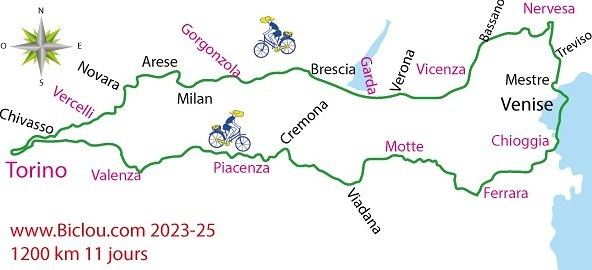
dreaming about a cycling getaway in Italy from Faverges (train all the way to Turin)
from Turin down to Venice along the Po River and back via the Padana (Alta Italia da attraversare – Northern Italy to cross)
The tricky part is getting from Chioggia to Venice.
I read it’s possible by hopping on a boat from island to island,
but it sounds a bit stressful.
Has anyone already tackled this route?
I’m currently looking for a bike to do my first bike trip across France, with the ultimate goal of cycling through Latin America. I’ve got a lot of questions and I’d love to hear if you have any answers or advice to share.
First off, I’ve been through this before with hiking. I want to get top-quality gear right away. When I started hiking, I ended up buying everything three times—first beginner gear, then intermediate, then expert, etc.
For biking, I’d prefer to skip that process and invest right now in a bike that could ideally handle Latin America.
I’ve set a total max budget of around 5000 € (roughly 4000–4500 € for the bike and the rest for accessories: panniers, helmet, cycling shorts, etc.).
So, I’ve got quite a few questions:
* I’ve read in several places that some people recommend buying the bike directly in Latin America. Since I need a first bike to train in Europe, would it be better to buy an entry-level bike in France (and sell it before the big departure)? Or is it preferable to start right away with my final bike to get used to it? Is buying it there just to save a bit of money?
* For a long-term trip (around six months) in Latin America, is it better to go for a gravel bike or a mountain bike?
* Should I buy a new bike or a refurbished one? Even more so given that I’m planning a long trip—could a refurbished bike end up causing more breakdowns?
If you have any advice on models, technical features to prioritize, or recommended sellers or resellers, I’d love to hear it. I’m a total beginner—I’ve only just started watching videos and reading up on the subject, and all the technical specs are new to me!
Calling all travelers.
We’ll be landing at Lyon Airport and want to bike to La Verpillière train station (with panniers and camping gear, etc.) to catch a TER to Voreppe.
What’s the safest route for this bike trip?
Thanks in advance
hi,
I'm planning a recumbent bike trip from the Pyrenees to Greece. On the EuroVelo 8 route, it doesn't specify the path through the Alps.
Are there any experienced cyclists here who can tell me where they go to avoid climbing too high?
Also, is there another traveler/bike forum better suited for broadening the responses?
thanks