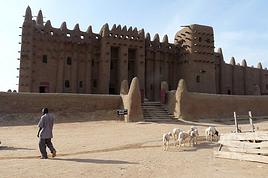
le crépissage de la Mosquée de Djenné aura lieu lors du Festival de Djennery fin-février 2008 (ce festival débutera le 19 février et durera jusqu'au 25 environ) ...
je peux pas te dire mais c est pour moi la plus belle mosquee d afrique de l ouest et de loin
apres il y a celle de bobo!!au burkina
Salut Jipi !!!😉
Oui tu as raison, la mosquée de Djenné est très belle, celle de Bobo, je ne la connais pas mais il y a aussi celle d'Agades qui est très belle en Banco aussi!!🙂
Amicalement
Tant que la couleur de la peau sera plus importante que la couleur des yeux, nous ne connaitrons pas la paix.
les champions de la reponse rapide et respectivement specialistes du mali et burki ont encore frappé !!😉
Merci !!!!!!!!
Il y a une mosquée tout aussi merveilleuse dans les environs de djenne mais moins grande et dont je ne me rappelle plus le nom
eviedemment😊
c'est ce qu'un ami m'a écrit récemment ... MAIS : à vrai dire, je doute un peu. En 2007, le crépissage a été fait le 12 avril ... Au fond, c'est un peu difficile de prédire la date en avance ...
Je te conseillerais de contacter M. Joseph Brunet-Jailly, ancien Directeur Général de l'IRD au Mali et membre fondateur de cette asso. Retraite maintenant et vivant à Clermont-Ferrand, il a de meilleurs contacts à Djenné.
Ou écrire à M. Amadou Tahirou Bah (enseignant à Djenné et membre du comité directeur de Djenné Patrimoine) !
je vais aller explorer ce site
toujours difficile de savoir les dates d' un evenement .Il y a quelques années il m' a fallu interroger des dizaines de personnes à mopti ( pourtant nid de " guides" )pour savoir la date du passage des boeufs à diafarabe 8 jours avant😏
Peux tu me transmettre en message privé les coordonnées de Mr brunet ( merci ), quant à contacter djenne si c' est par courrier j' irai aussi vite sur place😛
il y a deux ans le bruit courait sur place que la date de recrepissage serait influencée dans l' avenir par la période touristique donc pas impossible fin février....C' est pourquoi je me dépêche de tenter de voir cet evenement avant que ce ne devienne trop artificiel
Peut être cela a t il changé avec les incidents de l' année dernière ???
pour réhabiliter un peu mon ami ayant donné les infos en haut, j'ai trouvé un site qui dit tout à fait que les crépissage de cette année avait lieu en fait fin-février :
toujours difficile de savoir les dates d' un evenement .Il y a quelques années il m' a fallu interroger des dizaines de personnes à mopti ( pourtant nid de " guides" )pour savoir la date du passage des boeufs à diafarabe 8 jours avant
C'est ça exactement !!! Quant aux "guides", il ne faut pas y ajouter de mot. Tu en connais mon attitude !
Peut être cela a t il changé avec les incidents de l' année dernière ???
Il ne reste qu'à espérer que ces incidents ne se referont pas, bien sûr ...
en message privé les coordonnées de Mr brunet
Je le ferai ce soir (à ce moment, je ne suis pas chez moi), promis. Espérons que je trouve encore son adresse Internet. Rien entendu parler de lui depuis longtemps ... Il est un vieux homme, on ne sait jamais.
(Moi, je n'ai jamais visiter la fête Djennery. Tu sais qu'il y a aussi des courses de pirogues entre les divers quartiers djennéois ?! J'ai vu des photos ...)
C'est ça exactement !!! Quant aux "guides", il ne faut pas y ajouter de mot. Tu en connais mon attitude !
Peut être cela a t il changé avec les incidents de l' année dernière ???
Il ne reste qu'à espérer que ces incidents ne se referont pas, bien sûr ...
je fais allusion au théâtre d'émeutes d'une rare violence à Djenné en 2006. Une émeute, des jeunes se voyaient provoqués par les travaux de la mosquée. Un mort aussi ...
bonjour hery
Tu m'as devancé pour la réponse. En effet Djénné- Patrimoine, Joseph BJ et A T bah peuvent donner cette information mais la date peut être aléatoire dans la mesure où il a beaucoup plu cette année. Jusque là les maçons ne pouvaient travailler le banco en grande quantité, mais la chaleur aidant... Prendre en compte qu'à Djénné les décisions se modifient très vite et parfois sans prévenir (exemple le centenaire de la Mosquée).
Au passage je peux dire à Annesiby que la" Maison de l'Amitié" de Diabolo devient opérationnelle pour dormir dans un bon lit avec moustiquaire et écouter les bruits de la brousse dans un village charmant, loin de la pollution. C'est génial. Renseignements auprès de Amadou Koureissi à l'Omatho. Voir site Mali-teriya so.
Cordialement à tous.
Djénéba
Annesiby bonjour
Bien des renseignements peuvent aussi être obtenu par le service de l'OMATHO à Djénné.
Amadou Koureissi le chef d'antenne est très serviable et compétent, bien placé pour avoir des infos fraîches. Arrivé à Djénné c'est un passage obligé pour l'info, le recensement des touristes. Nous avons pu évaluer ses qualités pour la mise en place du festival de marionnettes de novembre à Diabolo et comptons sur son aide et ses conseils pour celui de fév 2009. Je peux te fournir ses coordonnées.
Bien cordialement
Djénéba
bonjour
en effet la mosqué de djenné est magnifique, elle a été recrépi en 2007 et a l'air en parfait état, d'aprés ce que j'ai vu en décembre .
il y a en effet de belles petites mosqués dans les villages le long du fleuve et aussi le tombeau et la mosqué des Askia a Gao, merci a Héry de m'avoir conseillé sa visite !
j'ai de belles photos, je vais essayer d'en insérer une, mais c'est pas gagné !!!!!
francia
le mérite d'un homme réside dans sa connaissance et dans ses actes et non point dans la couleur de sa peau ou de sa religion!
Khalil Gibran
On retient surtout que c’est le manque de communication qui a été le plus cité comme cause de la révolte des populations contre les travaux de rénovation de la célèbre mosquée.
Bonsoir,
Je te remercie de m'avoir communiquer ce lien, mais l'article n'explique pas pourquoi les populations étaient contre les travaux de rénovation ???
p.ex. la population n'avait pas été informée de ces travaux à effectuer par une équipe européenne (il faut savoir de l'immense importance de cette mosquée pour les Djennéois pour comprendre* cette réaction) ...
pour gagner du temps, je vous présente un interview donné du chef de la Mission culturelle de Djenné. Là, il s'explique ... :
Écrit par Levy DOUGNON 13-08-2007
YAMOUSSA FANE, CHEF MISSION CULTURELLE DE DJENNÉ
« Djenné renferme les témoignages d'une civilisation disparue »
Djenné devra son développement rapide à son inscription sur la liste du patrimoine mondial de l'Unesco. Dans l'interview ci-dessous le chef de la Mission culturelle de Djenné, Yamoussa Fané, évoque l'architecture unique de Djenné, les contraintes liées à son statut mondial, les infrastructures acquises et les retombées du tourisme sur la ville historique.
OKN : Vous étes le chef de la Mission culturelle de Djenné, pouvez-vous nous dire ce que c'est qu'une mission culturelle et quels sont ses objectifs ?
Yamoussa Fané : Une Mission culturelle a pour mission d'assurer la mise en ouvre de la politique nationale en matière de préservation et de mise en valeur du patrimoine culturel, classé patrimoine national du Mali et patrimoine mondial de l'Organisation des Nations unies pour l'éducation, la science et la culture (Unesco). A cet effet, elle est chargée d'inventorier les biens culturels mobiliers et immobiliers présents sur le site ; élaborer et mettre en ouvre un plan de conservation, de restauration et de promotion du site ; assurer la participation des structures communautaires et des associations culturelles à la gestion du site ; exploiter et diffuser les sources écrites et orales de l'histoire locale.
Une mission culturelle est dirigée par un chef de mission nommé par arrêté du ministre chargé de la Culture sur proposition du directeur national du patrimoine culturel. Le chef de mission culturelle est chargé, sous l'autorité du ministre chargé de la Culture, de diriger, coordonner, animer et contrôler les activités du service. Il a rang de chef de division.
Une mission culturelle comprend les bureaux suivants : le bureau recherche et conservation, le bureau sensibilisation et promotion.
Le bureau recherche et conservation a pour mission d'inventorier les biens mobiliers et immobiliers du site et assurer leur conservation et leur mise en valeur ; élaborer et mettre en ouvre un plan de conservation, de restauration et de promotion du site ; assurer le contrôle des activités de recherche sur le terrain ; collaborer avec les institutions nationales et internationales de recherche ; contribuer à l'élaboration et à la mise en ouvre du programme d'aménagement culturel.
Le bureau sensibilisation et promotion a pour mission de diffuser les informations relatives au site pour le faire connaître ; assurer une large diffusion des textes en vigueur relatifs à la protection du patrimoine, notamment classé ; mener des activités culturelles tendant à préserver et à valoriser l'ensemble du patrimoine du ressort de la mission ; associer les structures communautaires traditionnelles, les associations culturelles, les commissions régionales et locales de sauvegarde du patrimoine culturel et les collectivités territoriales à la protection et à la promotion du site ; exploiter et diffuser les sources écrites et orales de l'histoire locale.
OKN : Quels ont été les critères qui ont prévalu au classement de Djenné comme patrimoine mondial par l'Unesco ?
Y. F. : Les villes anciennes de Djenné sont inscrites depuis décembre 1988 sur la liste du patrimoine mondial selon les critères III et IV ; à savoir la valeur exceptionnelle de son architecture de terre, qui a influencé le mode de construction de toute la sous-région et les sites archéologiques (Djenné Djéno, Hambarkatolo, Tonomba, Kaniana, Algassouba et Welingara), qui renferment les témoignages d'une civilisation exceptionnelle disparue.
OKN : Qu'est-ce que Djenné gagne grâce à son statut de patrimoine mondial ?
Y. F. : Le statut de patrimoine mondial de Djenné confère à la ville une renommée touristique presque inégalée dans la sous-région. Depuis quelque temps le nombre de touristes ne fait que croître (8981 touristes en 2003 et 9456 en 2004, selon l'Omatho/Djenné). La ville a reçu plus de 15 000 visiteurs en 2005, toutes nationalités confondues. Les implications économiques sont nombreuses et se traduisent par des créations d'emploi, la restauration, l'artisanat et les retombées pour le petit commerce.
Le tourisme contribue pour 30 % aux ressources internes de la Commune et a constitué 60 % des ressources mobilisées en 2003 et 2004. En plus des ressources générées par le tourisme, la ville a bénéficié de plusieurs projets dont entre autres : la construction en 1993 de la route bitumée Djenné-RN6 d'une longueur de 30 km dont environ 4 km entre le fleuve et la ville ; l'électrification en 1996 de la ville sur financement propre d'EDM-SA ; le projet d'adduction d'eau de la ville en 1992 financé par le Canada ; la réalisation du château d'eau en 1996, ouvre de la Coopération allemande (KFW) ; les projets de restauration et de réhabilitation de l'architecture traditionnelle financés par le Musée national d'ethnologie de Leyde (Rijksmuseum voor Volkenkunde Leiden), etc. La première phase de ce projet (1996-2003) a permis de restaurer une centaine de maisons monumentales. La seconde phase (2004-2007), en cours d'exécution, prévoit la réalisation des activités suivantes : 21 crépissages ; 5 crépissages plus documentation ; 11 restaurations.
Le projet pilote pour l'infiltration des eaux usées : ce projet, financé par les Pays-Bas, a permis la construction dans les quartiers de Algassouba et de Yoboucaïna de plus de cent systèmes d'infiltration des eaux usées et la formation d'ouvriers locaux. Les résultats sont probants. Les rues desdits quartiers sont assainies, remédiant ainsi à la stagnation des eaux usées.
Le projet de réalisation de systèmes d'infiltration : ce projet, financé par la KFW, a permis de réaliser 800 minis égouts à travers la ville.
Le réseau d'évacuation des eaux pluviales : le réseau d'évacuation des eaux pluviales prévu dans le cadre du schéma directeur d'aménagement et d'urbanisme de 1992 a été réalisé. Il comprend 6, 5 km de caniveaux de dimensions variables : 40/40, 60/60, 70/70 et 80/80 ; 1, 160 m de cunettes. La longueur totale des ouvrages d'évacuation des eaux pluviales est de 8, 4 km (caniveaux et cunettes)
La voie digue Djenné Mougna-Saye avec des voies secondaires à l'intérieur de la ville ; la restauration de la Grande mosquée de Djenné par le Réseau Aga Khan pour la culture. La construction du Musée de Djenné financée par l'Union européenne. La construction de la bibliothèque des manuscrits financée par le Psic.
OKN : Le statut de patrimoine mondial comporte-t-il des contraintes et quelles sont les mesures d'accompagnement ?
Y. F. : L'inscription des villes anciennes de Djenné en lettres d'or au panthéon des sites du patrimoine mondial n'est plus un bien des populations, mais un patrimoine universel. Elle constitue non seulement une fierté seulement pour les Djennékés en particulier mais aussi pour les Maliens en général. Ce classement sur la prestigieuse liste du patrimoine mondial pose le problème de la gestion et de la conservation surtout pour un site vivant.
Ainsi, les populations sont portées sur les modifications de plan par l'introduction de matériaux durables à cause des difficultés économiques auxquelles elles sont confrontées depuis une décennie. La diminution du pouvoir d'achat des populations, due au déficit pluviométrique, ne permettait plus de faire face aux exigences d'entretien annuel que demandent les constructions en terre. Il a été constaté, qu'en dix ans, suite à deux inventaires que 30 % des maisons avaient disparu faute d'entretien.
Pour préserver cette belle architecture, caractéristique de notre identité nationale, d'une disparition inexorable, le Mali a initié en 1996 le Projet de restauration et de conservation de l'architecture de Djenné financé par le Royaume des Pays-Bas. La première phase de ce projet (1996-2003) a permis de restaurer une centaine (100) de maisons. La seconde phase (2004-2007) en cours d'exécution prévoit les activités suivantes : 21 crépissages ; 5 crépissages plus documentation ; 11 restaurations.
Ces projets de restauration, qui ont privilégié les façades monumentales, ont permis de sauver de la disparition de plusieurs maisons et de transformer l'ancien tissu urbain. Cette dynamique de restauration doit se poursuivre afin de couvrir l'ensemble du tissu ancien. En plus de la restauration de l'architecture, la ville a bénéficié de plusieurs projets de développement cités plus haut.
OKN : Vous êtes à la phase d'élaboration du plan de gestion et de conservation des villes anciennes de Djenné, pourquoi maintenant et quels sont les avantages de ce plan ?
Y. F. : Depuis son inscription en décembre sur la liste du patrimoine mondial, les villes anciennes de Djenné n'ont pas disposé d'un plan de gestion et de conservation.
Eu égard aux nombreux changements constatés tant dans l'ancien tissu urbain que sur les sites archéologiques, la Mission culturelle procède à l'élaboration d'un plan de gestion et de conservation des villes anciennes de Djenné dont l'objectif final est une vision partagée de tous les acteurs pour une bonne conservation et une promotion des villes anciennes de Djenné.
Ce plan de gestion et de conservation permettra une gestion consensuelle des villes anciennes de Djenné. Il permettra aussi de contribuer de la façon la plus efficace à la préservation et à la mise en valeur de la ville de Djenné dans une perspective de développement durable. A l'issue de ce travail, les limites de la zone classée ainsi que les zones tampons seront mieux définies permettant aux populations de réaliser certaines de leurs aspirations.
Propos recueillis par
Lévy Dougnon (Radio Jamana Djenné)
Ah non, trop tôt, il faut chercher un peu ...
Bon d'accord, je donne un indice de taille, cette mosquée n'est pas sur le continent africain !
A vous de jouer.
Bonne soirée.
On dit des "immigrés" ou des "émigrés" (en fonction qu'ils entrent ou quittent le pays) et le terme qui fait abstraction du sens du mouvement c'est "migrant"
Bonsoir,
Elle existe vraiment dans le département du Var.
"La Mosquée Missiri, édifiée en 1930, se trouve en périphérie de Fréjus dans le camp militaire de Caïs. C'est une réplique de la Grande mosquée de Djenné au Mali dont l’initiative de la construction revient au capitaine Abdel Kader Mademba, appuyé par le colonel Lame, commandant d’armes, selon un document des archives du Musée des troupes de Marine à Fréjus." Elle est classée monument historique depuis 1987 et aujourd’hui désaffectée.
Voir aussi le lien suivant : http://fr.wikipedia.org/wiki/Mosqu%C3%A9e_Missiri
Je serai devant la vraie dans une quinzaine ...
Bonne fin de semaine à tout le monde.
bonsoir
quelle surprise, je suis passée vers Frégus en novembre, le 15 exactement, il y avait de la neige, oui oui, mais je n'ai pas vue de mosquée !
en tout cas profite bien de ton séjour au Mali, pour moi ce sera a nouveau en fin d'année, car 2 semaines passé en déc, c'était trop court !
n'oublie pas de contacter mes amis si besoin !
a bientot
francia
le mérite d'un homme réside dans sa connaissance et dans ses actes et non point dans la couleur de sa peau ou de sa religion!
Khalil Gibran
I’ve been looking for a destination for a 2-week trip early next spring, and Cape Verde has been growing on me. (The flight isn’t too long, the temperatures are more than pleasant, and it’s an unknown country for me.)
The thing is, Cape Verde is pretty complicated when it comes to inter-island transfers, and I don’t want to spend my time in airports or on ferries—especially since those transfers aren’t exactly known for their reliability...
So, I’d like to limit internal flights to just 2, meaning the island I arrive on plus one other.
I’ve ruled out the all-inclusive islands: Sal and Boa Vista.
I’m torn between combining Santo Antão + São Vicente or Fogo + Santiago.
The goal of the trip is to see beautiful landscapes, go on day hikes (nothing multi-day), swim a little—though I prefer quiet spots—and enjoy 1 or 2 days in a city, but not much more than that!
In your opinion, which option would be the best, and why?
Hi,
Have you got any recent feedback from a trip back from São Tomé?
We're heading there in a few months.
One question among others: is swimming—well, snorkeling—risky there?
Thanks for your feedback, tips, etc.
I’m heading to Abidjan, Côte d'Ivoire for a long stay from July to September 2026. Could you please recommend any apartments for rent or a real estate agency? Thanks
I’m planning a trip to Benin in July, and I saw there were a few recent discussions about this destination. Would you have any suggestions for nice places to stay in Cotonou that won’t break the bank, as well as in other cities (Porto-Novo, Ouidah, etc.)? Thanks sooo much for all your valuable tips!
Hello,
We’re two senior travelers and would like to visit Cape Verde in Feb 2027.
We don’t hike but love meeting people, culture, and nature.
Which islands would you recommend, and do you know of any local agencies?
Thanks a million!
Hello,
We’re a family of 5 (2 adults and 3 kids who’ll be 2, 7, and 10 years old) planning to visit the islands of Santiago, Fogo, and Maio this summer. We’ll have 22 full days on the ground. It’s a shame (financially, logistically, and environmentally speaking!), but we’ll be taking 4 flights: a round-trip from Santiago to Fogo and another from Santiago to Maio. We’d like to position Maio toward the end of our stay since we enjoy ending our trips with a quieter beach phase.
For now, based on flight schedules and dates, we’re thinking of doing:
23/07: Arrival in Santiago
24/07 – 30/07: Fogo (5 full days)
30/07 – 05/08: Santiago (5 full days)
05/08 – 11/08: Maio (5 full days)
11/08 – 15/08: Santiago (3 full days)
15/08: Return to France
FOGO: Of course, we want to visit Cha das Caldeiras, where we’d like to spend 3 nights. We’d love to explore the valley and are also considering hiking the smaller Pico (the taller one seems too ambitious for us with the kids). Do you have any info on that hike?
What else do you recommend doing on the other days? Where can we go for other walks? I’ve seen that it’s possible to descend from Cha das Caldeiras to Monteiros, but I’m worried it might still be too challenging. It looks amazing!! But how do we manage with our luggage? Otherwise, the north of the island intrigues me, though we’re not thrilled about São Filipe, even though we know we’ll have to spend at least one night there before returning to Santiago.
On this island, we initially thought about not renting a car, but I’m wondering if that’s a good idea for us with all the luggage. If we do rent one, is it easy to reach Cha das Caldeiras by car?
Any advice is welcome!
MAIO: Here, I think renting a car will be essential for us to get around easily. We’d like to do an excursion to observe turtle nesting. I haven’t found much info on this—where and with whom should we go? Otherwise, the plan is to do some snorkeling directly from the beach, independently, since we’ll need to take turns so one adult can stay with our 2-year-old. Any spots you’d recommend?
Which towns would you suggest staying in? All options work for us—we’re fine with settling in one place or splitting our time (e.g., 3 nights in one spot and 3 nights elsewhere).
Basically, I’m open to all tips and recommendations for this little week on Maio (short walks, places to relax, beaches, etc.)!
SANTIAGO: Nothing too original, but for Santiago, we’re considering visiting Cidade Velha, Tarrafal, and Ribeira da Prata (for the black sand beach and natural pools), as well as Serra Malagueta for a hike.
There must be so much more to do, especially with the time we have. What else would you recommend?
I’m struggling to figure out how to organize our time there since we’ll have 5 full days first, then 3 more. How would you do it?
Hello from Quebec,
I’m a French-Canadian from Montreal. I’d love to go to Senegal during the Quebec winter to shorten this long season. Two people told me it’s not worth spending a lot of money to get there from Canada because there’s not much to discover. But I’m still skeptical. I’d love to read real testimonials from travelers who’ve been there, with as much info as possible. Thanks
Hello, my wife and I are planning a trip to Cape Verde at the end of May for 20 days. We’re still unsure which islands to prioritize (they all look amazing!). Santo Antão and São Vicente seem like must-sees. Which other islands should we visit, given that we love hiking (nothing too challenging) and swimming?
Thanks
Hi everyone!
The forum has been a huge help during my moments of doubt, and since Cape Verde isn’t a destination with many discussions, I felt I had to share my trip report 🙂
First, the EASE: I could never validate it from my phone—I tried 50 times without success, and on the computer, it worked the first time.
Then, Cabo Verde Airlines: forget online check-in. I went to the airport early to get my window seat (and in the end, the plane wasn’t full—I had three seats to myself, so I could finish my night peacefully). No in-flight entertainment for those who don’t sleep on planes.
Monday 9: Flight + arrival at Antonio’s (Oia Mindelo Guesthouse). Antonio’s apartment is up on the hill, but really, it’s only a 10-minute walk to the beach and 10 minutes to the city center (depending on where in the center). He picked me up at the airport (1000$). I continued relaxing by doing... nothing on the beach. Dinner in town at Café Mindelo: a pretty place, but otherwise meh—expensive and not necessarily good (2100$ for a beer and a fish that didn’t seem freshly caught as advertised).
Tuesday 10: Antonio offered to do a tour of the island (for cheap), and we left with his other guests (a lovely English couple, 76 and 77 years old). Stops at Salamansa (I felt something special on that beach—I could’ve stayed there for an hour doing nothing), then another scenic spot, a restaurant, and Baias das Gatas (I took a quick dip, but to me, it had less charm than Salamansa). Then we crossed the island to return to São Pedro (beautiful but windy; the village looks cute). Exhausted, I went to bed early because of the ferry to Santo Antão the next day.
Wednesday 11: Antonio took me to the ferry, and we’ll see each other again since he’s hosting me at his aunt’s place during Carnival. On the ferry, I had a Booking.com reservation for what I thought was in Ribeira Grande (the town), but it was actually *in* the ribeira—specifically in Manta Velha (aluguer to Cruzinha ~600$). I thought I’d fallen into a hole, but I ended up loving it—Casa Familiar Gilda. Gilda is a divine cook (dinner for 1000$—don’t eat lunch, or there won’t be room), the village has a typical rural Santo Antão vibe, the place has great energy, and you can get around easily by aluguer.
Thursday 12: I left early by aluguer to Ribeira Grande (250$), then another aluguer to Ponta do Sol (100$)—a sleepy beauty at that hour—to do the Ponta do Sol-Cruzinha hike, finishing in Cha de Igreja. Departure at 8:22 AM from the cemetery in Ponta do Sol, passing through Fontainhas (those doing it the other way will have a fabulous climb at the end 😏), and let’s go! I loved this glimpse of rural life—past or present—the sea is stunning, and we were shaded most of the way (though it goes up and down, it’s manageable). The arrival at Cha de Mar is breathtaking, and Cruzinha is a charming little town (arrived at 12:30 PM). I’d brought my swimsuit after reading there was a beach, but I packed it back up—too many waves and big pebbles. I continued to Cha de Igreja (25 more minutes) after a short break (ask for the path that doesn’t go by the road). It’s adorable with its church square (you don’t see this layout much elsewhere). I might’ve stayed longer to enjoy the place, but a taxi driver asked if I wanted to return to Manta Velha (1000$), and like a fool, I said yes (it was 2:30 PM—I could’ve waited for the 4:30 PM aluguer for 100$, but oh well).
But since I still had energy, I decided to see if I could find a grog distillery. I ran into a French guy arriving at Gilda’s, and we ended up talking to Rodrigo, who explained everything from A to Z about how they make grog (the simple cane juice is amazingly good—but the work is clearly tough).
Friday 13: Transfer to Xoxo on Djalma’s advice 😉, where I’d booked a room at Casa Xoxo. I did the hike to Rabo Crusto... it’s tough, but I kept quiet when I saw a pregnant woman doing it with her two little ones 😄. There’s also a distillery I didn’t linger in, and I took a tea break with that wonderful landscape before heading back. I couldn’t find the path Jean-Michel had told me about (take a right at the village entrance), so I went back down to the water reservoir to turn off and take the waterfall path (anyone can point it out if needed). The bedding at Casa Xoxo was perfect, but the dinner atmosphere was less family-like.
Saturday 14: No one at Casa Xoxo could tell me when the aluguer passed, so I scarfed down my breakfast and headed down a bit. I found one (not sure if he’d planned to work, but there were three of us, so he left). Arrived in Ribeira Grande, an aluguer driver told me the coastal road to Porto Novo was closed and we had to take the Corde road—but no one was leaving, so we’d have to charter... Sometimes, you just have to say it: aluguer drivers say there’s no ride just to make you pay the private price (3500$). But this time, it was true! With another French couple, we wanted to go to Tarrafal. Our driver called the Porto Novo-Tarrafal aluguer to wait for us. The Corde road is stunning—more different landscapes (thorny forest, misty peaks...). Changed aluguers in Porto Novo and headed to Tarrafal. Another world—lunar landscape on the way. Arrived in Tarrafal and relaxed.
Sunday 15: Hike from Tarrafal to Monte Trigo, left at 8 AM, and I’m glad I did—I was in the shade until about 9:30 AM, then the sun got strong. Beautiful walk, arrived in Monte Trigo around 11:30 AM. The people weren’t particularly friendly, but oh well. Swam at the little beach in Monte Trigo (the water is *so* good). I waited for other French people who had “booked” a boat for the return. Came back with Javi (50 min—1000$ each), who lent us masks and snorkels for some snorkeling. Had grog with Ludo, Estelle’s husband, who was waiting at the bar, then filled my grog bottle at the *mercearia*. I admit, it’s delicious, but I don’t remember much of that evening 😇🤪. Except Javi put on a show saying he’d been robbed, had no money, and needed to pay the boat owner, etc. People paid again (apparently not me, since Ludo, Estelle, and I arrived at the restaurant after Javi’s drama). FYI, Javi does this often—my host had warned the couple renting the other room to watch out for him because he scams people for money. So Javi is 35 with hazel/special-colored eyes. But if you don’t repay the “service,” the day was still great.
Monday 16: Several of us were taking the late-afternoon boat, so we chartered an aluguer (7000$) to avoid the 6 AM one—trip—boat to Mindelo. Antonio picked me up at the ferry, and boom—Carnival!
I found a spot on Rua de Lisboa. My neighbor was from Santo Antão just for Carnival, spoke French, and explained that last year’s Carnival started 3 hours late because a float couldn’t fit under the power lines 😏 (like they don’t know the height by now hahaha). On Monday, it’s the teachers (nice—kind of a warm-up) and the Madingas. Once they passed my spot, I followed them along the route—I LOVED it! By midnight, they still hadn’t reached Praça Nova, and the police told them to speed up, but I loved that energy!
Tuesday 17—Mardi Gras: Beach day, then Carnival! Antonio had bought me a seated ticket just in case (300$). Ended up in front of a punch stand, where I ran into two French women I’d met in Manta Velha. Two guys from Mindelo talked to us, and we did Carnival with them. And what was bound to happen, happened: a float couldn’t pass because... it was taller than the power lines 😏😏😏. The dancers kept dancing while the crowd tried to lift the cable. Finally, a guy in a tree climbed higher and used a pole to lift it... and the parade could continue 😉. Around 12:30–1:30 AM, when the concert was supposed to start, the power went out. I went home and later learned the concert started around 3 AM.
Wednesday 18: I went home because I was taking the boat back to Santo Antão, heading to Casa Familiar Gilda. Walked the loop from Manta Velha.
Thursday 19: Left early for Ribeira da Paul to do the loop to Sandra’s House. It’s truly breathtaking! Back at Gilda’s, I chilled. I wanted to go to Sinagoga’s natural pools, but the hike had worn me out.
Friday 20: Return to Mindelo on the red company’s ferry—no comparison: way more comfortable than the blue company’s, especially for someone prone to seasickness. Beach. Exhausted, I struggled to sleep because the shop on the ground floor of my rental had a party until 3 AM (and the windows aren’t double-glazed—*hi*—but that’s common in Mindelo).
Saturday 21: Ran into Estelle and Ludo by chance (the city’s small), and we arranged to share a taxi the next day since we had the same return flight. Beach (I tried Lazaretto Beach, but nope—not great—dead fish + weird smell = bad signs). So Laginhia was fine, and in the evening, a restaurant with singers, then Caravelle (the ground-floor shop didn’t bother me since I got home when they were saying goodbye 😏). Too bad—I dance salsa, bachata, kompa, zouk, but not kizomba hahaha, but it was still fun.
Sunday 22: Took a taxi with Ludo and Estelle (1200$). Arrived *ages* before takeoff (no exchange office—get escudos in town if you have any left). Boom—CDG, boom—RER... home.
There you go—a super long trip report. Not sure if it’ll help, but the digital detox was amazing. These two islands are very different but so beautiful. I only got a glimpse, but they’re worth the trip. I was lucky to see Carnival (what joy in that city!) and happy the Cambodia ticket (my first idea) was way too expensive 😉
Hi,
Without booking in advance through an agency, is it possible/easy to organize luggage transfer from one night to the next between accommodations in Santo Antão?
Thanks.
Easily accessible from Sal or São Vicente, São Nicolau is the forgotten island of the Barlavento group. With two large villages, volcanoes, jagged peaks, lush valleys, and vast rocky expanses, it has nothing to envy its big sister Santo Antão. It’s slipped under travelers’ radar a bit (in January, there were probably fewer than a hundred European tourists on the whole island), and that’s just fine! Accommodations aren’t overrun by groups like in Santo Antão, and connecting with locals is even easier. But don’t come to São Nicolau for wild nightlife—it’s incredibly peaceful here, and on Sundays, it’s total silence!
A little favorite of mine: Pensão Jardim in Ribeira Brava, the capital; Residencial Palice in Queimadas; and especially Pousada d’Anna in Estância de Brás, where the raging sea crashes against the black lava spurs.
Weather-wise, it was chilly this year but perfect for hiking. If you’re up high (like Monte Gordo), dress warmly or wait for spring! Fog gusts can ground you completely. Trails are generally less marked than in Santo Antão; if you’re wary of apps, you can find a 1:50,000 map at the small travel agency in Tarrafal.
Those who enjoy sharing experiences with other travelers over a Strela or two in the evening might feel a bit frustrated on São Nicolau, but the island’s beauty, the resilience of its farmers in extreme conditions, and the kindness of its people make it a fantastic stop for any visitor to Cape Verde!
Hi everyone,
I’m planning a trip to Senegal in early July 2026 for a week with my teenage daughter.
We’ll be staying in a bungalow at Club Les Filaos.
I’d love to hear your advice, especially about visits and excursions. The hotel offers them directly, but I’m wondering if it’s better to go with their organized tours or hire local guides you’d recommend.
What do you think are the pros and cons of each option?
I’d also appreciate tips on currency exchange—where’s the best place to do it to avoid any nasty surprises?
Finally, if anyone’s stayed at this hotel recently, I’d love to hear your thoughts! I’ve read both glowing and terrible reviews, so I’d really value your firsthand experiences.
Which taxi app do you recommend for Senegal? Are there shared taxis from Dakar Airport to La Somone? If not, do you have an idea of the price for a taxi?
Hi everyone,
After a year where I’ve worked way too much and with a house under renovation, it’s become essential to take a breather. My contract ends on 01/30, and I’ll try to find a new client for early March, so overall, let’s go somewhere in February!
I thought Réunion with the full trek around the Mafate cirque for reconnecting with Nature would be perfect, but since it’s cyclone season, it wasn’t such a great idea. Then came the idea that Southeast Asia could fulfill the peace-and-beach vibe, especially Cambodia with its cultural past, but the flight ticket price and a chat with a friend made me change my mind—and boom, Cape Verde popped up, with Santo Antão for hiking and São Vicente for culture and the beach.
So I bought a ticket a week ago, and oh, what a coincidence—it’s during Carnival!
Except now, I don’t know if it’s reality or just exhaustion talking, but I feel like I’m making a mess of things.
I’ve traveled a lot without even booking the first night, but this time, I pre-booked 2 nights in Mindelo (though one of them ended up canceling itself).
But the main issue is that I arrive on Monday, 02/09 at 6 PM and leave on Sunday, 02/22 at 11 AM, and there’s a little hiccup in the logical organization—actually, several hiccups—since I don’t really have any organization right now, and that’s where I need help
Because Carnival is in full swing from 02/15 to 02/17, right in the middle of my trip, so the logic of my visit to Santo Antão isn’t clicking for me. Plus, I just checked, and there’s zero accommodation available in Mindelo from 02/15 to 02/18 😕
So I don’t know: should I skip Carnival, should I forget about planning and just wing it once I’m there, should I stay on São Vicente after Carnival (because I read Montaganrd’s trip report, and he made São Vicente sound like a rock !), or should I keep in mind the option of heading to Santiago afterward and buying a return flight to Paris from Praia?
I need help 🏴☠️
Hi everyone, thanks for your advice! I’m starting a new thread because it seems my first one about Senegal was deleted—or maybe it’s just my computer acting up again 😉. Anyway, I’ve decided to go to Benin instead. I’ll be there from January 5th to February 2nd—why count the days when you love traveling😄? I’d love all your tips on accommodations, restaurants, and itineraries. I’m basically starting from scratch to plan my trip.
Hi there,
We’re heading to Senegal for 4 weeks in February 2025.
We’ve booked a 7-day cruise on the Bou el Mogdad departing from Saint-Louis.
That’s all we’ve planned so far—we’re also thinking of exploring Casamance after the cruise.
Any ideas for things to do while traveling between Dakar and Saint-Louis? We’ll arrive in Dakar 5 days before the cruise sets off.
Thanks so much for your tips!
Edith
I’d planned to go to Benin in 2026, but given the recent events and upcoming elections, I’m thinking I’ll wait to see what happens after the elections.
Has anyone traveled to Benin recently or is planning to go soon?
I’m trying to find out the dates for the best parades at the Mindelo Carnival in 2026, but I’m having trouble figuring it out. When I search for "Mindelo Carnival 2026," I get different dates and no clear schedule.
I’ve found the parade on Tuesday, February 17, 2026, and the one on Sunday, February 22, with the grotesque makeup, which seem the most interesting. On the other hand, some say the São Nicolau Carnival is more authentic than Mindelo’s.
If you’ve experienced this firsthand—not just theoretically but actually been there—I’d love to hear your practical tips.
Hi,
We’re heading to Cape Verde in January. We’re scheduled to arrive in Praia on a Saturday around 11 AM.
I read somewhere that the exchange rate for Euros to Escudos is the same everywhere—110 escudos for 1 euro. Can anyone confirm this? If that’s the case, I assume there’s a currency exchange desk at the airport, and the rate isn’t too bad? So, it’s better to exchange at the airport, right? What do you think? I don’t want to use ATMs.
Otherwise, are banks in town open on Saturdays? I read they close by 3 PM?
Hi there, I’m planning a trip to Santo Antão with some hiking (for me) but not for my partner. I’d love some help figuring out if my plan is doable in terms of time and transportation:
- Day 1 – Arrival by boat from Mindelo, then aluguer to Cova (and overnight nearby)
- Day 2 – Hike to Paul / aluguer for my partner
- Day 3 – Aluguer to Ponta do Sol
- Days 4 & 5 – Ponta do Sol
- Day 6 – Hike to Cruzinha / aluguer for my partner (overnight in Cruzinha)
- Day 7 – Aluguer (or taxi) to Xoxo (overnight in Xoxo)
- Day 8 – Aluguer to Porto Novo + boat to Mindelo
Does this plan make sense with the local transport options?
For accommodations, I’d love any suggestions you might have.
Thanks so much for your help!
We’ve booked our tickets for July—there’ll be 4 of us, maybe 6 (all in our sixties). We’d like to visit 4 islands:
Arrival in Praia on July 8th
Return from São Vicente on July 29th
Between those dates, I’m not sure how to split our time across each island. We’ll definitely spend at least a week on Santo Antão. We’re planning to visit Santiago, Fogo, São Vicente, and Santo Antão.
We’re looking for easy hikes, diving, sightseeing, and a little beach time (but not too much).
How do you think we should divide the 3 weeks among the islands? Is 3 days in Fogo enough?
Are guides essential, and can we easily find them on the spot?
Should we rent a car, given we won’t just be hiking?
Thanks in advance for your advice, tips, warnings, and anything else you can share… and I’ve still got plenty more questions!
Valéry
I arrive in Fogo at 11 a.m. (if the ferry is on time) from the ferry departing Praia. From what I understand, the collectivos to Cha das Caldeiras leave late morning? Do you think I can leave the same day?
My question is: should I spend a night in São Filipe?
I don’t want to take a taxi—it’s too expensive.
Hello,
We’re a couple in our sixties and have finally decided to spend 15 days in Cape Verde from March 1 to 15, 2025, focusing exclusively on the four Leeward Islands.
We’ve planned to take the boat between these four islands and adjust our stays based on the ferry schedules. If there are any difficulties or need to adjust the route, we might take a flight instead.
Here’s our planned itinerary with the boats:
Day 1: Flight from France to Santiago Island
Day 2: Boat from Santiago Island to Brava Island
Day 3: Brava Island
Day 4: Brava Island
Day 5: Boat from Brava Island to Fogo Island
Day 6: Fogo Island
Day 7: Fogo Island
Day 8: Fogo Island
Day 9: Boat from Fogo Island to Santiago Island
Day 10: Santiago Island
Day 11: Boat from Santiago Island to Maio Island
Day 12: Maio Island
Day 13: Boat from Maio Island to Santiago Island
Day 14: Santiago Island
Day 15: Flight from Santiago Island to France.
Based on your experiences and knowledge, could you share:
- Your favorite places to visit and hikes
- Accommodations that charmed you
- Restaurants you enjoyed
Thanks in advance to all travelers and locals from these islands who’d like to share their favorite spots! !
Hello,
We’ve just returned (2 senior couples) from 18 days in Cape Verde (21/01 to 7/02) that we really enjoyed. The temperature was great—20° to 27°—admittedly a bit windy at times, but the friendliness of the Cape Verdeans made up for it.
Paris Orly, direct flight with Transavia (cheap if you book in advance). We landed in São Vicente, with a 12 € city transfer. We had a fantastic 2-bedroom apartment in downtown Mindelo—Av. Fernando Ferreira Fortes, "Casa So Morabeza"—for 58 € per night. The owner lives in France and communicates instantly via WhatsApp.
We spent 2 days exploring the (beautiful) city of Mindelo and its port activity, plus a private taxi tour of the island (6000 CVE for the day).
Then we took the Armas ferry (recommended company—1500 CVE) to Santo Antão.
From there, a collectivo (450 CVE per person) took us to Ribeira Grande, a central base for hikes.
We stayed in a brand-new, modern, and well-equipped 2-bedroom apartment—*Apartamentos Modernos*—for 6770 CVE per night, staying 6 nights. I highly recommend it for its location in town and proximity to *aluguers* and *collectivos* for hiking.
The hikes were stunning:
- The coastal trail from Fontainhas to Cruzinha (taxi for 1500 CVE)
- The route from Corda to Coculi (taxi for 2000 CVE + 100 CVE per person for the return)
- The trail from Cova to Cidade de Pombas (taxi for 2000 CVE + 100 CVE per person for the return)
- The hike from Miradouro to Ribeira Grande (taxi for 2000 CVE)
- The coastal road from Ribeira Grande to Ponta do Sol (visit and lunch at *Mini Familiar* in the city center—excellent and affordable) for the round trip.
Ribeira Grande has plenty of restaurants, but avoid *5 de Julho*—it’s loud and slow.
We loved: *Bellcanto*, *Cantinho da Amizade*, and *Boca-Fina Churrasqueria*.
Meals with drinks cost around 800–1000 CVE.
Back to São Vicente by ferry (1500 CVE), then an airport transfer (12 €) and a flight (99 €) to Santiago’s Praia. The airport-to-city transfer was 15 €.
We stayed at *Kelly’s* in Plato, Praia, which was disappointing—not ideal for two couples—but well-located.
One day was spent visiting the massive *Suspicia* market, then a collectivo to Cidade Velha (2 x 200 CVE round trip per person). We hiked up to the fort, explored *Rua Banana*, and had lunch at *Praça do Mar* by the beach.
We rented a car for 6 days (29000 CVE) from *Slimpycar* in Praia.
On Saturday, we visited the huge *Assomada* market—don’t miss it!—then hiked to *Boa Entrada* and *Poilon*, the largest and most impressive tree we’ve ever seen.
We stayed for 2 nights (138 €) in a beautiful valley in *Picos*—a spacious, lovely house with 2 bedrooms, 2 bathrooms, and a large living area, surrounded by nature and animals.
Lina, the charming neighbor, prepared dinner (8.50 €) and breakfast (4.50 €) for us.
Next, we headed to *Tarrafal*, stopping to visit the concentration camp (500 CVE)—a must-see—before arriving.
We spent 3 nights (184 €) in a fantastic house called *"Maison Familiale"*—huge, with 3 bedrooms, 2 bathrooms, 2 kitchens, 5 toilets, and a large terrace with sea views. It was absolutely stunning and very close to the beach and numerous restaurants.
We did a beautiful 3.8 km hike to the *Farol da Ponta Preta* lighthouse.
Tarrafal’s beach is lively and pleasant, with bars, restaurants, and even acrobats!
We also explored *Ribeira da Prata* to see the *Piscina Natural de Cuba* (not easy to find).
We loved discovering isolated villages like *Ponta Furna*, *Ponta Labrão*, and *Fazenda*.
For food, I recommend *Mira Mar* at *Mama’s*.
On the way back to Praia, we took the east coast route via *Calheta de São Miguel*, *Pedra Badejo*, and *Praia Baixo*—nothing extraordinary, just a rugged, wild coastline with beaches that seemed a bit tricky to access.
Our last evening in Praia was nice. The seaside esplanade was lively, and many Cape Verdeans were swimming at *Prainha* beach, which seemed very accessible and safe.
If you’d like more info—addresses, etc.—feel free to message me privately. I’ll respond.
Jacquesler.
I’d like to share our travel plans for March 2026 to get your valuable feedback...
- Arrival in Sao Vicente on Tuesday, March 3rd at 9:20 AM from Lisbon (EasyJet)
- Direct departure the same day or the next day for Santo Antao – 3 or 4 nights on Santo Antao (depending on whether we spend the first night in Mindelo or on Santo Antao)
- Return to Sao Vicente for 3 nights
- Flight to Boa Vista via Sal (Cabo Verde Airlines) on Tuesday, March 10th – 5 nights on Boa Vista
- Return flight on Sunday, March 15th (Boa Vista to Porto: EasyJet)
Given the various bits of info I’ve seen about the unreliability of inter-island transport, is this itinerary realistically doable without stress? Would it be better to just take a simple flight from Sao Vicente to Sal and end the trip there (from where it’s also possible to return to Europe or France)? I’m still more drawn to Boa Vista... but I’m worried that two flights in a row might be complicated, unless it’s the same plane that just makes a stopover and continues...
Also, I’m calling on the expertise of hikers for Santo Antao:
I’m not a big sports enthusiast—I enjoy walking when I travel, but not distances much longer than 10 km, and nothing too difficult (especially steep climbs where I quickly run out of breath)...
For the hike from Ponta do Sol to Cruzinha: can you confirm that the hike is easier in the direction from Ponta do Sol to Cruzinha (less climbing)? I’ve found info that this hike is 14 km and takes about 5 hours. Do you think it’s possible to shorten it by taking a taxi or *aluguer* to Fontainhas? If so, how long would the hike be then, and how much time would it take?
For the hike from Xoxo (starting at the Bela Vista kiosk on the Cova road), I’ve found info that it’s 12 km and takes 5 hours of walking. I think it goes to Ribeira Grande. Apparently, you can shorten the hike and find *aluguers* on the road near Café Melicia... In that case, do you know how long the hike would be? Is this the hike that lets you walk along *levadas* (like in Madeira), cross banana plantations, and pass by the Cachoeira de Vinha waterfall?
Sorry for all these questions, but I can’t find a guide with hikes and difficulty levels... I think two hikes (one along the coast and one inland with terraces, *levadas*, and banana plantations) would suit our level.
On the third free day, do you think we could rent a 4x4 to explore: take the two scenic routes on the east side and maybe venture a little off the beaten path (without taking risks, of course)... Otherwise, hire a guide for the day: do you have any recommendations and an idea of the price?
One last thing: in March, is it worth (or pointless) to choose accommodation with a pool (especially on Santo Antao)? Is the pool water warm enough? What about the ocean temperature?
Hi there,
We're on a backpacking trip, traveling by public transport/motorcycle taxis. We're in Noubou, south of Salemata in Senegal, just a stone's throw from the Guinean border. Do you know if it's possible to cross the border in this area? Where do we register? Can we cross the border without an official border post and just register in the first town we come to? We have our visas for Guinea.
Hi there,
Which island would be best for a one-week solo trip at the end of November?
I’d like to explore with a local guide who can help me discover Cape Verdean culture.
It’s still just the beginning of the plan…
Thanks to anyone who’d like to share some tips!
Which hotels offer half-board on Santiago Island?
Also, I’d love some contacts for guide-taxis—I’m traveling solo and really want to discover authentic spots.
Hi there,
I’m leaving for Cape Verde at the end of the week. I’ve heard that transportation isn’t very reliable, so I’d love your advice:
- My return flight is from Sal on the night of August 13–14
- I’ll be in São Vicente until August 10
- I found an indirect flight (São Vicente–Praia–Sal) on August 9–10 and a ferry on August 10 as well
- I’m traveling alone with two kids, ages 6 and 9
In your opinion, which option is more reliable and comfortable?
Hello,
We’re planning a trip to São Vicente and Santo Antão in January.
We’re a couple (ages 51 and 57).
My husband is really into hiking. As for me, I’m not at my best right now—I’ve just recovered from a long illness and am still on medication that exhausts me and causes a lot of pain, so I won’t be able to keep up with very "physical" hikes.
That said, I still enjoy walking in nature.
We’re looking for advice on where we could stay. A place where my husband can go hiking while I take shorter walks. But also somewhere I can relax in nature, maybe go for a swim if possible, and enjoy local life—markets, music, etc.
Boat trips would be a great bonus for us.
Thanks in advance for your suggestions.
Virginie