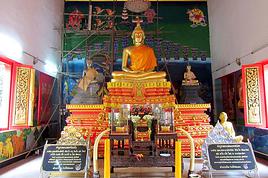
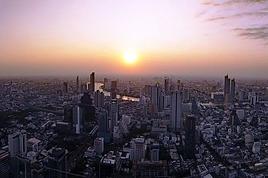
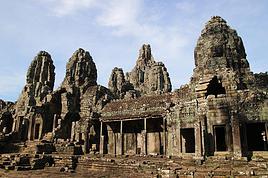
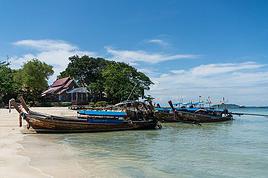
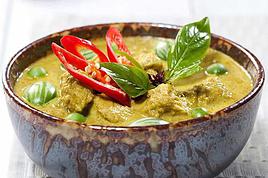
I really loved Thailand, but it was too touristy for my taste. So I'm hesitating about going back and wondering if Cambodia or Vietnam would be less crowded with tourists...
Hi everyone,
I’m starting to plan my next trip to Southeast Asia this winter (2.5 months, leaving in early December), and here’s a rough outline of my route—I’d love to share it with you and hear your thoughts and tips.
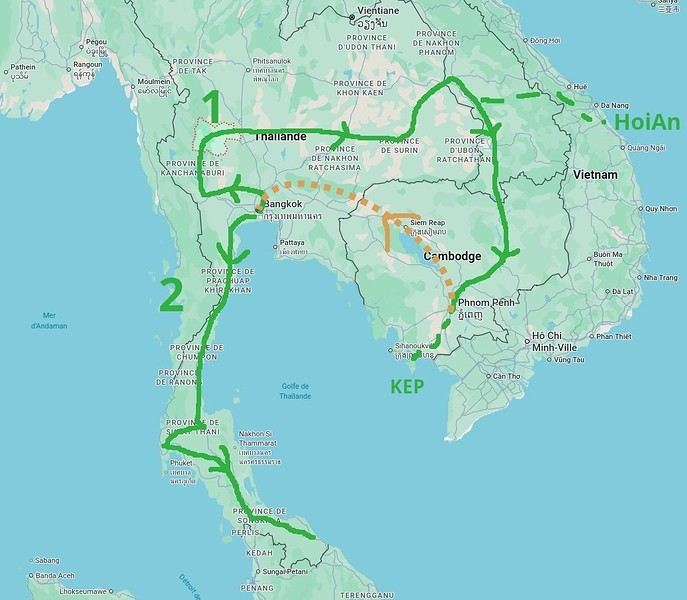
- I’ll start in Bangkok and already have three spots I’ve marked: Ayutthaya, Kanchanaburi, and Uthai Thani (I haven’t been to any of these places yet). - Next, I’d like to cross the country from west to east to reach the Laos border. I’d love suggestions for any interesting stops along this route—I don’t know this part of Thailand at all... - Then I’ll head into Laos, probably at Savannakhet (you can usually get a visa at the border). - > I’m tempted to spend a week in Hoi An, Vietnam, since I loved that city and the area when I visited two years ago. No visa needed for Vietnam now, so it could be a nice little detour. On the map, it doesn’t look too far, but I know you’ve got to be careful with these things, and I’m not sure if it’s a good idea. Any opinions on this? - Back to Laos (maybe via Dakta), and I’ll head south along the Mekong, probably doing the Bolaven Plateau loop that I missed last time. Then Paksé, the 4,000 Islands... I’ve been before, but I’d happily go back. - Crossing into Cambodia, I’ll follow the Mekong down to Phnom Penh (I know this area and love how untouristy it is). From there, I’ll probably spend a few days in Kep (quieter than Kampot). Still undecided, though. - Then back to Thailand (BKK), likely by plane from Phnom Penh since the borders between the two countries are currently closed (plus, let’s be honest, Cambodian roads... ;-). We’ll see how things look when the time comes. - After that, I’d like to explore southern Thailand, taking it slow with short hops. I’ve got my eye on Khao Sok National Park, and I’ve heard good things about Krabi... Again, I don’t know this region well, so any info or tips would be great.
So, I think this should be doable in 2.5 months, especially since I prefer short hops of 300 km max to avoid getting too tired, and I like staying 2-3 days in each place to explore. Plus, I’ll take a week off to relax if I find a spot I love—maybe by the sea for some real downtime.
Thanks for your feedback and for sharing your favorite spots! Pascal
- I’ll start in Bangkok and already have three spots I’ve marked: Ayutthaya, Kanchanaburi, and Uthai Thani (I haven’t been to any of these places yet). - Next, I’d like to cross the country from west to east to reach the Laos border. I’d love suggestions for any interesting stops along this route—I don’t know this part of Thailand at all... - Then I’ll head into Laos, probably at Savannakhet (you can usually get a visa at the border). - > I’m tempted to spend a week in Hoi An, Vietnam, since I loved that city and the area when I visited two years ago. No visa needed for Vietnam now, so it could be a nice little detour. On the map, it doesn’t look too far, but I know you’ve got to be careful with these things, and I’m not sure if it’s a good idea. Any opinions on this? - Back to Laos (maybe via Dakta), and I’ll head south along the Mekong, probably doing the Bolaven Plateau loop that I missed last time. Then Paksé, the 4,000 Islands... I’ve been before, but I’d happily go back. - Crossing into Cambodia, I’ll follow the Mekong down to Phnom Penh (I know this area and love how untouristy it is). From there, I’ll probably spend a few days in Kep (quieter than Kampot). Still undecided, though. - Then back to Thailand (BKK), likely by plane from Phnom Penh since the borders between the two countries are currently closed (plus, let’s be honest, Cambodian roads... ;-). We’ll see how things look when the time comes. - After that, I’d like to explore southern Thailand, taking it slow with short hops. I’ve got my eye on Khao Sok National Park, and I’ve heard good things about Krabi... Again, I don’t know this region well, so any info or tips would be great.
So, I think this should be doable in 2.5 months, especially since I prefer short hops of 300 km max to avoid getting too tired, and I like staying 2-3 days in each place to explore. Plus, I’ll take a week off to relax if I find a spot I love—maybe by the sea for some real downtime.
Thanks for your feedback and for sharing your favorite spots! Pascal
Does it seem feasible and reasonable to travel to Laos (or Cambodia) as early as January or February 2025?
I don’t have any precise information about the damage these countries have suffered.
Hi, just a quick note mainly for Samsong, even if he’s still giving me the silent treatment.
I’ve been in Nan since yesterday and... I love it! So thanks, Thierry. It’s exactly the kind of place I’d been dreaming of... Even if communication is a bit tough, it’s not impossible. They don’t even know the most basic English words! Everyone laughs and they’re the first to pull out their phones to... translate. They’re even quicker on the uptake than I am.
And then there’s the time I say Nan (pronounced "Nane"). They don’t understand me. After a while (sometimes a long one), they reply: "Ah, Nan?" (pronounced "Nane") 😵🤳😃
The town is exactly how you described it back in 2022. Though I’m surprised to find so many trendy, slightly intellectual "Cafés." Apparently, coffee—excellent everywhere—is king in Nan. It feels like a university town. And it seems pretty lively at night! But for now, I’m going to bed early. I caught a nasty cold, which didn’t stop me from walking 12 km this morning. But I came back to my accommodation by 3 PM (gorgeous and luxurious with top-notch service for 800 baht—even a cute local welcome gift this morning, plus other unexpected touches like a bottle of honey and chrysanthemum flowers for tea. The lady must’ve guessed I was coming down with something yesterday). I thought about going out for dinner but didn’t have the energy. I think I’ve got at least 39°C fever...
Anyway, I’m sending you this message, Thierry, because you mentioned a daily bus to Chiang Rai, so I didn’t look into it. But now it’s a real problem—no buses to Chiang Rai, only taxis. At least 2,500 baht for the cheapest one! I’ll check the bus station directly tomorrow. Online, it’s all taxis, no buses. I’d like to explore the countryside/mountains if I can find an affordable driver. Any ideas for destinations or itineraries? Thanks.
The town is exactly how you described it back in 2022. Though I’m surprised to find so many trendy, slightly intellectual "Cafés." Apparently, coffee—excellent everywhere—is king in Nan. It feels like a university town. And it seems pretty lively at night! But for now, I’m going to bed early. I caught a nasty cold, which didn’t stop me from walking 12 km this morning. But I came back to my accommodation by 3 PM (gorgeous and luxurious with top-notch service for 800 baht—even a cute local welcome gift this morning, plus other unexpected touches like a bottle of honey and chrysanthemum flowers for tea. The lady must’ve guessed I was coming down with something yesterday). I thought about going out for dinner but didn’t have the energy. I think I’ve got at least 39°C fever...
Anyway, I’m sending you this message, Thierry, because you mentioned a daily bus to Chiang Rai, so I didn’t look into it. But now it’s a real problem—no buses to Chiang Rai, only taxis. At least 2,500 baht for the cheapest one! I’ll check the bus station directly tomorrow. Online, it’s all taxis, no buses. I’d like to explore the countryside/mountains if I can find an affordable driver. Any ideas for destinations or itineraries? Thanks.
Hi everyone!
I’ve booked flights to Phnom Penh for August 26 (no layover in the Emirates as a precaution...). We arrive on Sunday, August 2 in the morning and leave on August 19 around 9 PM (also from Phnom Penh). We’re a couple traveling with three kids aged 9 to 16.
Among the many questions I have about our itinerary, a few are standing out:
If we arrive in Phnom Penh exhausted, I imagine we’ll need to stay one night there before heading to Siem Reap... but how much time should we spend there to enjoy Angkor in good conditions? Then, Mondulkiri or Battambang? (Because I don’t want it to be a total rush, changing accommodation every two days and praying that bus transfers or private drivers go as planned...). Where does Tonlé Sap Lake fit into all this? And if we end with a beach stay: is Koh Rong a must, or is there another spot? Also, what about the return logistics: should we spend the night before our flight in Phnom Penh to be safe... or do we do everything on August 19... like taking a boat and then the road from Sihanoukville to Phnom Penh, risking missing our flight if anything goes wrong?
Anyway, a huge thank you in advance for your valuable tips and feedback!
Hi there,
I’ve found so many tips and reviews on this forum, so it’s my turn to contribute a little.
We spent just over two weeks with our family, with the following itinerary:
- Hanoi: 5 days
- Halong Bay: 3 days and 2 nights
- Tam Coc: 3 days
- Mai Chau: 2 days
- Sapa: 3 days
We got around by bike, scooter, Grab, and bus.
Our main accommodations were homestays and hotels in Hanoi.
We visited lots of museums, temples, and neighborhoods in Hanoi.
We did a 2-day, 1-night trek in Sapa with May, a Hmong local, without going through an agency.
A few small regrets: the weather was overcast, and we couldn’t make it to Fansipan, but nothing major 😅. We also couldn’t find transport to get from Sapa to Mu Cang Chai.
Other than that, this trip will stay in our memories for the kindness of the Vietnamese people, the connections we made, the food (street food, homestays...), the coffee 😋, the landscapes, and how easy it was to get around...
Our goal was to take our time and focus only on a small part of northern Vietnam.
If you need any tips or recommendations, don’t hesitate to ask.
Looking forward to hearing from you.
Cédric.
Hi everyone,
I’ve got a big project in northern Vietnam—discovering the most beautiful rice terraces before the harvest...
I’m planning to leave around September 15th until October 15th, then spend 15 days exploring the two bays, Lan Ha and Ha Long. In total, 45 days without a visa...
I’m traveling solo and very independent.
But is it possible to do this kind of trip using local trains and buses?
My plan is to leave Hanoi for Nghia Lo (2 days), then Mu Cang Chai (4 days), Sapa (4 days), Bac Ha (2 days), Ha Giang... Hoang Su Phi, then do the Meo Vac loop, Dong Van, etc., to see those stunning karst peaks before heading back to Hanoi.
In my research, I haven’t found any buses or vans going from Hanoi to Nghia Lo, even though it’s super popular for its rice terrace landscapes....
I don’t want a daily driver, but I’m thinking I could use moto-taxis to get around locally once I’m there....
What do you think?
These rice terraces are a dream for me, along with the markets and all the different ethnic groups, not to mention those spectacular rocky peaks...
Is the itinerary too ambitious? I’ve got time on my side.
Do you have any solutions? I’ve browsed the forum a lot, but the discussions are 5 or 6 years old, and I think things have changed since then.
Thanks for your help planning this adventure!
Hi fellow travelers,
First trip to Vietnam.
We’ll be arriving in Ho Chi Minh City during Tet.
Is it complicated to find accommodation and get around during this period?
Any tips would be welcome.
Thanks for your replies.
Alright, I’m scaling back the kilometers thanks to the relevance and patience of our Cambodia experts!
Here’s yet another hesitation /\
When I arrive early on 01/12 in PP, I have the choice between spending a day in PP (booking a convenience room for half a day and leaving by night bus), sleeping in PP and taking the bus to SR the next morning, or hiring a driver to head back up to PP with a nice little stop and maybe sleeping in Kampong Thom or Kampong Chhnang, then heading to SP on the 13th.
Then from the 13th to the 17th or 18th, exploring Angkor.
I continue to Kampong Thom and stay for 2 nights (if I didn’t do it on the way there), but I might be templed-out by then.
I head to Kampong Cham, where I’ll spend 2 nights—one on the island and one on the mainland.
Next, I go to Kampot and Kep: probably 2 nights in Kampot, 2 in Kep, and 1 night on Tonsay Island.
On 01/28, I return to PP until 01/29.
One detail: how long does it take to get from downtown PP to the new airport? Because I leave on 01/29 around 7:50 PM...
Anyway, I’m ready to read your unfiltered reactions 🤓 and thank you in advance for your help!
Hi everyone!
I’m heading back to Thailand in July 2026 with a stopover in Cambodia to visit the Angkor site.
After Angkor, I’ve booked a stay on Ko Chang island. Does anyone know if there are direct transport options from Cambodia to Ko Chang without having to go back through Bangkok? That would be amazing!!
I think there are, but I’d need more details!!
I went to Thailand in February 2025 and don’t remember having to apply for a visa—is that still the case now? And for Cambodia too?
Thanks so much!!!
Laurence from Bayonne
Hi there,
After arriving in Ho Chi Minh City at the beginning of March 26, where I think I’ll stay for maybe two days (or more?), we’d like to spend a few days in the Mekong Delta.
Is it better to stay in one place (Vinh Long, Cai Be, My Tho, An Binh, etc.) and take boat trips every day, or split our time between two or three spots, which means changing accommodation and moving our luggage around? Of course, agencies offer 3- or 5-day tours from Ho Chi Minh City, but are they really worth it, both financially and in terms of the visits themselves?
What’s your experience with this? How did you do it, and if you had to do it again? Any tips?
Thanks in advance for your help.
Dominique
hi everyone,
I want to travel in the north for 3 weeks in September-October 2026 to meet ethnic minorities, photograph mountain rice terraces and their harvest, and revisit Halong Bay—but maybe Lan Ha Bay instead. Can you recommend one or more local agencies?
Thanks, and happy holidays!
Hello everyone,
we’re planning a trip to Vietnam at the end of June 2026 for at least two weeks.
Our goal is to avoid rushing around too much and take our time, focusing on nature, hiking, and getting to know the locals.
Here’s my first draft itinerary:
Arrival and departure from Hanoi
Sapa and its surrounding area
Tam Coc – the "land Halong Bay"
and Ninh Binh...
Halong Bay (maritime)
Cat Ba Island...
I’d love to hear your thoughts, advice, and feedback.
Looking forward to reading your replies.
Cédric
Imagine a peaceful fishing village, completely transformed by artists who worked their magic on the walls of 100 residential houses. That’s the remarkable story of the Tam Thanh mural village in Quang Nam province. Once similar to many other coastal villages in the area, it now firmly stands out on the tourist map for a day trip from Hoi An.
In the summer of 2016, Tam Thanh was selected by a Korean-Vietnamese joint project called Art For A Better Community. The village was chosen to be their blank canvas, inspired by the success of mural villages in Korea. The project aimed to make Tam Thanh the first painted village of its kind in Vietnam.
The joint project included five Korean artists and seven Vietnamese artists, along with local volunteers. They aimed to show Vietnamese people that art could be part of everyday life, no matter where you stand in society. The effort began with about three weeks of wall washing, followed by painting the walls of over 100 residents' houses.
The project was a success, and the village came alive with the paintings. The entire village is now a breathtaking gallery just waiting to be explored. The murals capture the life and soul of the village—from young children playing to fishermen in the ocean. A mix of fantastic pieces offers stunning backdrops for photos.
The painted art around the town didn’t just have a visual impact; it also had a social one. The village itself was chosen not only for the layout of the houses but also to contribute to economic development opportunities in Tam Thanh. Tourists now visit the once-overlooked village, creating more income for locals and making it a successful "art for a cause" project. For example, an entrepreneurial resident who owned a small local café invested 1,000,000 VND ($390 USD) in a sugarcane press a week before the paintings were completed. Sugarcane juice vendors then multiplied with the growth of tourism (5,000 VND - $0.20 USD).
Walking down the village’s single street, it’s common to find locals selling refreshments and handmade crafts. In one house in particular, a tailor and his family are painted on an outer wall with incredible detail. The family started selling tote bags decorated by their young daughter. The asking price for the bags is 100,000 VND ($4 USD). If you’re looking for a way to support the village’s economy, this is it. Since there’s no middleman here, you can be sure your money goes directly to the community.
Since the project’s completion, two other villages in the province have now been painted. The new mural villages were created with different local Vietnamese artists to raise awareness about each community’s issues. Tam Hai Island was redecorated to highlight the serious waste problem the population faces due to the lack of treatment plants. Another village on An Binh Island was painted to raise awareness among locals and tourists about the importance of environmental protection.
How to get there
Route No. 1: Cross the large Cua Dai bridge. Once you’ve crossed it, continue onto Duong 129/Duong Ven Bien. Stay on this road for 33 kilometers. Upside: this route has light traffic, no traffic lights, and no trucks or buses. It’s a great direct route to the village but offers little to see. You’ll eventually reach a crossroads. Turn right toward Tam Ky town, while the left will take you toward the mural village; stay on Road 608 as it turns twice before reaching a bridge. Cross the bridge, and you’ll arrive at Thanh Nien Road. Finally, turn right to reach the village. This route takes about an hour.
Route #2: Cross the large Cua Dai bridge. Once you’ve crossed it, continue onto Duong 129/Duong Ven Bien. Stay on this road for 12 kilometers, then turn left onto Road 613, where you’ll continue for 1.5 kilometers until you reach Thanh Nien Road. Finally, turn right and drive 23 kilometers to the painted village. For most of the trip, taking Thanh Nien Road will take you through a much more local part of the region. The journey takes about an hour and a half.
Hi everyone,
I’m heading back to Cambodia in a few weeks and had a couple of questions:
1/ the new airport Does anyone have info on the average tuk-tuk fare? From the old one, we’d usually pay between $7 and $10. Are we looking at the same range? It seems a bit farther, so maybe a little pricier. If you’ve got a rough idea of the time (always better to budget extra), I’m guessing around an hour?
2/ access to Preah Vihear temple I haven’t been back in a few years, but I was thinking of revisiting it this year. Given the border troubles, is access still allowed at the moment?
Looking forward to hearing from you,
Mathieu
I’m heading back to Cambodia in a few weeks and had a couple of questions:
1/ the new airport Does anyone have info on the average tuk-tuk fare? From the old one, we’d usually pay between $7 and $10. Are we looking at the same range? It seems a bit farther, so maybe a little pricier. If you’ve got a rough idea of the time (always better to budget extra), I’m guessing around an hour?
2/ access to Preah Vihear temple I haven’t been back in a few years, but I was thinking of revisiting it this year. Given the border troubles, is access still allowed at the moment?
Looking forward to hearing from you,
Mathieu
Hi there,
I’m planning a trip to Cambodia and was set on visiting the Ratanakiri region, which seemed to match what we love most in terms of landscapes: forests, jungle, greenery...
However, as I started looking into the area, I read that deforestation there is massive, and some of the info on the topic is years old—the situation hasn’t improved since, unfortunately.
So my question is: is Ratanakiri still worth visiting, and does it justify the long travel time and distance to get there?
I’ve seen that jungle treks are possible, but from experience, I know guides sometimes hesitate to venture deep into the forest and stick to shorter walks along the edges of parks.
Thanks in advance for your feedback.
I’m planning a trip to Cambodia and was set on visiting the Ratanakiri region, which seemed to match what we love most in terms of landscapes: forests, jungle, greenery...
However, as I started looking into the area, I read that deforestation there is massive, and some of the info on the topic is years old—the situation hasn’t improved since, unfortunately.
So my question is: is Ratanakiri still worth visiting, and does it justify the long travel time and distance to get there?
I’ve seen that jungle treks are possible, but from experience, I know guides sometimes hesitate to venture deep into the forest and stick to shorter walks along the edges of parks.
Thanks in advance for your feedback.
We got back enchanted from a 6-week trip to Cambodia!
Our itinerary: Kampot - Kampong Chhnang - Battambang - Siem Reap - Kampong Cham - Sen Monorom (Mondulkiri) - Banlung (Ratanakiri) - Kratie - Kampong Thom - Phnom Penh.
We traveled by bus, minivan, boat (between Battambang and Siem Reap), overnight bus, scooter, tuk-tuk, and rickshaw for shorter distances. We stayed in guesthouses, homestays, and even in the jungle during a trek.
While the Angkor temples are fabulous, it’s the people you should visit Cambodia for—the "Land of Smiles" truly lives up to its nickname! Tourists gather in Angkor but are quite rare elsewhere, even though the country is easy to travel around.
I won’t describe our trip in detail but instead highlight a few favorite moments.
From Kampot, don’t hesitate to head out around 6 AM to see the fishermen return and their wives selling their catch (just 10 minutes away by the coast). Guaranteed picturesque!
In Battambang, known for its food scene, we discovered a cooking class with Smokin’ Pot (authentic Khmer cooking class). They pick you up from your guesthouse to shop for ingredients (we made fish amok and beef lok lak) at their village market, then cook and eat together. A private class—just the two of us! They also send the recipes via WhatsApp as a PDF. +855 12 821 400
In Siem Reap, I can recommend a francophone tuk-tuk driver who was very attentive to our wishes. We visited tourist spots but also more remote villages and local grilled-pork restaurants with him. He’s a wealth of information about local life, and chatting with him was a real pleasure—we left with regret! You can reach him on WhatsApp: Vung Hem, +855 96 614 0146.
We did a 2-day, 1-night trek in Mondulkiri. Don’t expect a super dense jungle—it looks more like a forest similar to ours. But Nara, our Bunong ethnic guide, made the experience adventurous and ultimately very immersive! WhatsApp +855 86 630 489
Bee Bee’s Chalets homestay: If you pass through Banlung in Ratanakiri, we *loved* this family and their budget-friendly bungalows. Playing Uno, enjoying Nita’s cooking (ask for her fish amok—amazing!), it was a true homestay experience! Contact Nita on WhatsApp: +855 88 818 5525.
In Kratie, rent a scooter and follow the Mekong north for 40 km at your own pace. Being so close to the locals was a treat! Same goes for heading south if you have time.
Kampong Thom: Head 25 km out to visit the pre-Angkorian temples of Sambor Prei Kuk. Around a hundred monuments spread across three sites… and hardly anyone there!
A few practical tips: Though prices are often listed in dollars, you can always pay in riels (1 USD = 4000 riels), which is what we preferred. PassApp: An app to book tuk-tuks or rickshaws (and most importantly, know the price upfront). Virak Buntham: A bus company connecting several cities, bookable online.
Feel free to ask me questions about places, accommodations, etc.—I’d be happy to answer!
A few practical tips: Though prices are often listed in dollars, you can always pay in riels (1 USD = 4000 riels), which is what we preferred. PassApp: An app to book tuk-tuks or rickshaws (and most importantly, know the price upfront). Virak Buntham: A bus company connecting several cities, bookable online.
Feel free to ask me questions about places, accommodations, etc.—I’d be happy to answer!
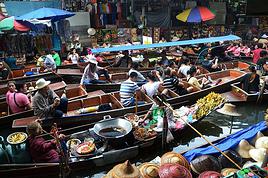
Hi everyone, has anyone been to the delta recently and has up-to-date info on the floating markets? We’ll be there at the end of February 2026 and would love to visit one—touristy is fine as long as there’s activity and it’s not deserted. Thanks for your feedback!
Idea for a 15-day itinerary in Cambodia...
- 3 nights in Phnom Penh, arriving at 6:30 PM.
(2 days to explore the city).
- 2 nights in Battambang
- 4 or 5 nights in Siem Reap
(2 days for Angkor, 1 day for Kulen, 1 day for Tonlé Sap Lake)
- 2 nights in Kampot
- 2 nights on Koh Rong.
What do you think?
Thanks...
Alain.
So, my flight tickets have just been booked for a trip to Cambodia from November 4th to 27th, 2025.
I’ll be traveling solo and want to explore this amazing country while getting a bit off the beaten path.
I’m arriving in Phnom Penh and also departing from Phnom Penh.
My goal is to travel as much as possible by bus and scooter.
What itinerary would you recommend?
What are the must-do things?
I’m open to all tips and info.
Thanks in advance for your help and responses.
I'd love to get some suggestions for central Vietnam in February for seniors. We'd like to stay in one place, near a beach, and visit the surrounding areas. Then after a month, we'd head to the south of the country.
Hi there,
we’ll be in Mai Chau in June and we’re thinking of heading to Sapa, but first spending a few days in Bac Ha to do some hiking and explore the area.
Is this a good idea for those who’ve been there?
How do you get there?
Thanks for your feedback.
Looking forward to hearing from you.
Cédric.
Hello!
We’re heading to Cambodia for a month in March. We’re planning to visit Phnom Penh, Battambang, Siem Reap, the Angkor temples, Kompong Luong, then head down to Kampot, Kep, and finish our trip on the islands of Koh Rong. Has anyone done this trip recently?
Any great spots to recommend? Neighborhoods to stay in Phnom Penh (lively but not too touristy)?
Tips for getting around between the major cities—bus, train, boat, motorbike?
Thanks for all the advice!
Fabienne
For centuries, until its capture by the Vietnamese in 1407, Quy Nhon was Asia’s busiest port. Marco Polo stopped here on his way back from China to Venice. It was the port of Viraja, capital of the Champa kingdom, which explains the many Cham towers found all over the place, including right in the city center. Today, it’s a lovely beach resort, less crowded than others. There’s a gigantic seaside esplanade lined with alternating gardens and hotel towers, with not a single tree (not on the beach either), except at the café-restaurant-terrace of the 4-star hotel Hoang Yen and another one to the right of it. I was lucky to find a brand-new, spotless little hotel run by a very friendly family, the Ngoc Linh, on a quiet little street just 50 meters from the beach. $12 for a single room and $14 for a double. There’s a terrace restaurant. No bikes, but motorbike rentals are available ($10 per day). 6 Tran Van On 0563 54 66 99 or nearby on the esplanade (19 Xuan Dieu).
Beautiful beach establishments north of the city.
That said, it allowed me to indulge my passion for history with the beautiful Cham towers, especially those at Banh It, 20 km north of Quy Nhon on the Mandarin Road (you can see them in the distance as they sit atop a hill, offering a magnificent view of the entire region). Four well-preserved towers (the largest has been very well restored), built in the late 11th to early 12th century. At the foot of the mountain, you’ll find a beautiful 14th-century pagoda and the ruins of Viraja. Right in the middle of the city on Tran Hung Dao, there are also the two beautiful towers of Thap Doi.
Beautiful beach establishments north of the city.
That said, it allowed me to indulge my passion for history with the beautiful Cham towers, especially those at Banh It, 20 km north of Quy Nhon on the Mandarin Road (you can see them in the distance as they sit atop a hill, offering a magnificent view of the entire region). Four well-preserved towers (the largest has been very well restored), built in the late 11th to early 12th century. At the foot of the mountain, you’ll find a beautiful 14th-century pagoda and the ruins of Viraja. Right in the middle of the city on Tran Hung Dao, there are also the two beautiful towers of Thap Doi.
Hi everyone,
I have a Visa card with international option.
How do I pay in Vietnam?
Hotels booked on Booking—do hotel owners charge a commission?
How do I withdraw money? ATM fees?
Where can I exchange euros at the lowest cost?
Thanks in advance for your tips!
Larri
Hi there,
I’m heading to Hanoi and Da Nang for the first time for about ten days in mid-January 2026.
Should I book hotels in advance, or can I find decent places available from one day to the next?
Same question for prices—do rates vary depending on when you book?
Hi there,
I’m currently in Hoi An—I hadn’t set foot here for 8 years. The city has already changed a lot, with lots of construction, and even in the old town, along one side of the riverbank, there are huge residential buildings going up that take away some of the charm of this place. But the worst part is the overtourism—it’s impossible to walk across the famous bridge in the middle of the canal in the evening because it’s so packed with people. There’s also a new trend: massage parlors have opened in the old town and around the city. I was shocked—people call out to you or even grab your arm on the sidewalk, and it’s everywhere. Bangkok and Phuket might start shaking—Hanoi’s the same way.
Anyway, let’s talk about the dual pricing specifically for non-Vietnamese tourists. We went to a restaurant near our hotel last night, and they gave us an English menu—okay, fine! But I noticed the table next to us, where Vietnamese tourists had a different menu. Weird! I asked to see the same menu as my neighbors, but the waitress refused, saying it was in Vietnamese and we wouldn’t understand. I insisted, and she finally agreed. Surprise!!! The prices on the two menus were different, with the English one up to 50% more expensive. I asked why, and she got flustered, telling me to just order from the Vietnamese menu, which I translated with my phone to see the local prices. I mentioned this to the hotel this morning, and the receptionist told me to go to restaurants where prices are displayed at the entrance to avoid getting ripped off. I just bought fresh bread this morning, and it was the same thing—the little loaf costs 4000 dong for Vietnamese people and 5000 dong for non-Vietnamese. It’s not a huge difference, but this way of doing things isn’t right. At supermarkets like VinMart+, prices are displayed, so there’s no surprise or dual pricing there.
I’m currently in Hoi An—I hadn’t set foot here for 8 years. The city has already changed a lot, with lots of construction, and even in the old town, along one side of the riverbank, there are huge residential buildings going up that take away some of the charm of this place. But the worst part is the overtourism—it’s impossible to walk across the famous bridge in the middle of the canal in the evening because it’s so packed with people. There’s also a new trend: massage parlors have opened in the old town and around the city. I was shocked—people call out to you or even grab your arm on the sidewalk, and it’s everywhere. Bangkok and Phuket might start shaking—Hanoi’s the same way.
Anyway, let’s talk about the dual pricing specifically for non-Vietnamese tourists. We went to a restaurant near our hotel last night, and they gave us an English menu—okay, fine! But I noticed the table next to us, where Vietnamese tourists had a different menu. Weird! I asked to see the same menu as my neighbors, but the waitress refused, saying it was in Vietnamese and we wouldn’t understand. I insisted, and she finally agreed. Surprise!!! The prices on the two menus were different, with the English one up to 50% more expensive. I asked why, and she got flustered, telling me to just order from the Vietnamese menu, which I translated with my phone to see the local prices. I mentioned this to the hotel this morning, and the receptionist told me to go to restaurants where prices are displayed at the entrance to avoid getting ripped off. I just bought fresh bread this morning, and it was the same thing—the little loaf costs 4000 dong for Vietnamese people and 5000 dong for non-Vietnamese. It’s not a huge difference, but this way of doing things isn’t right. At supermarkets like VinMart+, prices are displayed, so there’s no surprise or dual pricing there.
Hi everyone, we’ll be in Thailand from August 2nd to 21st, arriving in Bangkok on the 2nd for a visit.
From the 5th to the 8th: Angkor temples.
Then, starting on the 9th, we’re planning to head to Chiang Mai, and by the 14th or 15th, we’d like to be on an island until the 19th, when we return to Bangkok. Five days in Chiang Mai seems a bit long to us. What do you recommend between the 9th and 15th, and which island? We’re not big fans of sunbathing—we’d love to snorkel and explore the island. Ideally, I’d have liked to find a house to rent, but every time, I end up with places far from the beach, whereas we’d really like to be able to walk to the beach for strolls. By the way, are there a lot of shells? Can we collect them? It seems that in August, swimming can sometimes be tricky due to tides—is that true?
Thanks to all the contributors! 😊
Hi there,
Planning a trip in January to the Mekong Delta.
Question: I’m stopping at Gieng Island—are there public buses from Ho Chi Minh City or Sa Dec that go near the ferry dock for this little island?
Question: How do you get to Tram Chim National Park (the bird sanctuary) by bus?
Finally, is there an app for public transport in southern Vietnam?
Maybe some of you have been there before 🙂
Thanks for your tips!
Hi there,
We’ll be arriving in Phnom Penh this coming January and we’re thinking of starting our trip with a stop in Kampong Cham, then Kratie.
After Kratie, we’re considering heading toward Siem Reap with a stop in Kampong Thom.
That said, I’m not really sure how long the Kratie–Kampong Thom journey might take or how complicated it is.
Does this stop on the way to Siem Reap seem like a good idea to you? If we don’t visit the Sambor Prei Kuk site, are there still any walks or sights worth checking out in Kampong Thom?
Thanks in advance for your help.
We’ll be arriving in Phnom Penh this coming January and we’re thinking of starting our trip with a stop in Kampong Cham, then Kratie.
After Kratie, we’re considering heading toward Siem Reap with a stop in Kampong Thom.
That said, I’m not really sure how long the Kratie–Kampong Thom journey might take or how complicated it is.
Does this stop on the way to Siem Reap seem like a good idea to you? If we don’t visit the Sambor Prei Kuk site, are there still any walks or sights worth checking out in Kampong Thom?
Thanks in advance for your help.