Bonjour,
Nous allons effectuer un voyage au Vietnam fin octobre à mi novembre.
Nous arrivons au Nord et descendons vers le sud.
Nous souhaitons pour finir le voyage ce poser sur une île 4 à 5 jour. Nous hésitons entre koh rong et phu quoc.
Phu quoc semble plus accessible étant déjà dans le sud du Vietnam mais selon mes commentaires lu cette ile s'est très devellope et donc a perdu du charme, beaucoup de saletés... contrairement à l'île de koh rong qui semble plus paisible et avec de très belle plage.
Si des personnes sont aller à l'un ou les deux, je suis preneuse d'avis...
Merci
bonjours à tous habituée à ko samui en thailande j'aimerai changer et trouver un hôtel à échelle humaine en bord de plage avec piscine
au vietnam qui serait en mesure de me recommander quelque chose
Trés important je souhaite qu'il y ai un village (superette, marché, restaurant) tout prés à pieds
merci d'avance
merci d'avance
Bonjour,
après presque 30 ans de voyages en Asie, je vais enfin découvrir le Vietnam en couple puis en solo au mois de Février. Je vous soumets donc mon ébauche d'itinéraire puis des questions suivront J1 : arrivée à Hanoi à 16 h J2 et J3 : Hanoi J4 : Baie d Halong J5 TRajet Baie Halong / tam coc j6 Tam coc + train de nuit pour hué J7 Hué J8 hué J9 Hué/ hoi an par la route ??? J 10 à J 18 Hoi an puis séjour plage pour moi, mon compagnon retourne en France à J14 J19 retour sur Hanoi J 20 Hanoi, retour en France
Je désire absolument faire un séjour balneaire et comme je serai seule pendant ce séjour, je ne souhaite pas être isolée sur une ile , donc l'idée d'être proche d'activités me plait.
Ma 1er question concerne le J5, peut on rejoindre facilement Tam coc depuis la baie d'Halong ? Est ce que c'est faisable en voiture privée, et combien de temps prend le trajet ? Je n'ai aucune idée des distances et surtout de la rapidité des transports. D'autre part, comme je vais rester pas mal de temps sur Hoi an, j'aimerai découvrir la région en sortant un peu des sentiers.
Voilà pour l'instant
Merci pour votre aide. M.
après presque 30 ans de voyages en Asie, je vais enfin découvrir le Vietnam en couple puis en solo au mois de Février. Je vous soumets donc mon ébauche d'itinéraire puis des questions suivront J1 : arrivée à Hanoi à 16 h J2 et J3 : Hanoi J4 : Baie d Halong J5 TRajet Baie Halong / tam coc j6 Tam coc + train de nuit pour hué J7 Hué J8 hué J9 Hué/ hoi an par la route ??? J 10 à J 18 Hoi an puis séjour plage pour moi, mon compagnon retourne en France à J14 J19 retour sur Hanoi J 20 Hanoi, retour en France
Je désire absolument faire un séjour balneaire et comme je serai seule pendant ce séjour, je ne souhaite pas être isolée sur une ile , donc l'idée d'être proche d'activités me plait.
Ma 1er question concerne le J5, peut on rejoindre facilement Tam coc depuis la baie d'Halong ? Est ce que c'est faisable en voiture privée, et combien de temps prend le trajet ? Je n'ai aucune idée des distances et surtout de la rapidité des transports. D'autre part, comme je vais rester pas mal de temps sur Hoi an, j'aimerai découvrir la région en sortant un peu des sentiers.
Voilà pour l'instant
Merci pour votre aide. M.
I'd love to get some suggestions for central Vietnam in February for seniors. We'd like to stay in one place, near a beach, and visit the surrounding areas. Then after a month, we'd head to the south of the country.
For centuries, until its capture by the Vietnamese in 1407, Quy Nhon was Asia’s busiest port. Marco Polo stopped here on his way back from China to Venice. It was the port of Viraja, capital of the Champa kingdom, which explains the many Cham towers found all over the place, including right in the city center. Today, it’s a lovely beach resort, less crowded than others. There’s a gigantic seaside esplanade lined with alternating gardens and hotel towers, with not a single tree (not on the beach either), except at the café-restaurant-terrace of the 4-star hotel Hoang Yen and another one to the right of it. I was lucky to find a brand-new, spotless little hotel run by a very friendly family, the Ngoc Linh, on a quiet little street just 50 meters from the beach. $12 for a single room and $14 for a double. There’s a terrace restaurant. No bikes, but motorbike rentals are available ($10 per day). 6 Tran Van On 0563 54 66 99 or nearby on the esplanade (19 Xuan Dieu).
Beautiful beach establishments north of the city.
That said, it allowed me to indulge my passion for history with the beautiful Cham towers, especially those at Banh It, 20 km north of Quy Nhon on the Mandarin Road (you can see them in the distance as they sit atop a hill, offering a magnificent view of the entire region). Four well-preserved towers (the largest has been very well restored), built in the late 11th to early 12th century. At the foot of the mountain, you’ll find a beautiful 14th-century pagoda and the ruins of Viraja. Right in the middle of the city on Tran Hung Dao, there are also the two beautiful towers of Thap Doi.
Beautiful beach establishments north of the city.
That said, it allowed me to indulge my passion for history with the beautiful Cham towers, especially those at Banh It, 20 km north of Quy Nhon on the Mandarin Road (you can see them in the distance as they sit atop a hill, offering a magnificent view of the entire region). Four well-preserved towers (the largest has been very well restored), built in the late 11th to early 12th century. At the foot of the mountain, you’ll find a beautiful 14th-century pagoda and the ruins of Viraja. Right in the middle of the city on Tran Hung Dao, there are also the two beautiful towers of Thap Doi.
Bonsoir
Nous sommes 5 adultes pour un voyage de 3 semaines en thailande dont 4 jours au cambodge.
Combien etapes et ou et comment se rentre au cambodge.
merci
Hi everyone,
I’m starting to plan my next trip to Southeast Asia this winter (2.5 months, leaving in early December), and here’s a rough outline of my route—I’d love to share it with you and hear your thoughts and tips.
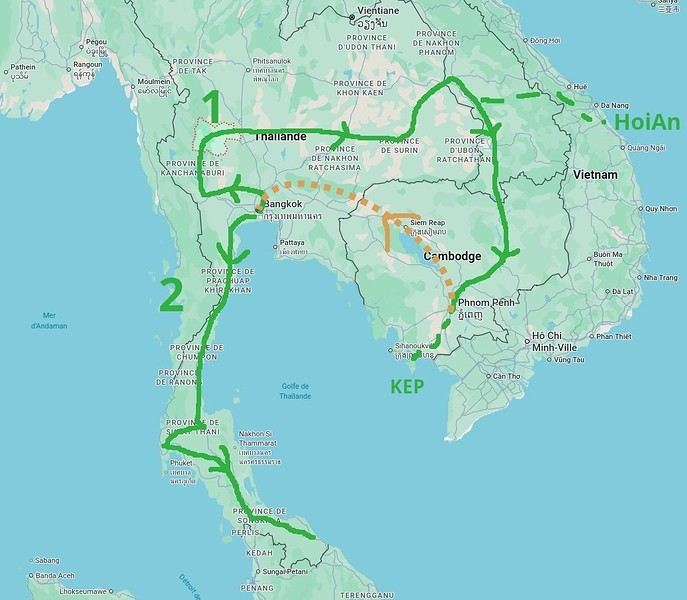
- I’ll start in Bangkok and already have three spots I’ve marked: Ayutthaya, Kanchanaburi, and Uthai Thani (I haven’t been to any of these places yet). - Next, I’d like to cross the country from west to east to reach the Laos border. I’d love suggestions for any interesting stops along this route—I don’t know this part of Thailand at all... - Then I’ll head into Laos, probably at Savannakhet (you can usually get a visa at the border). - > I’m tempted to spend a week in Hoi An, Vietnam, since I loved that city and the area when I visited two years ago. No visa needed for Vietnam now, so it could be a nice little detour. On the map, it doesn’t look too far, but I know you’ve got to be careful with these things, and I’m not sure if it’s a good idea. Any opinions on this? - Back to Laos (maybe via Dakta), and I’ll head south along the Mekong, probably doing the Bolaven Plateau loop that I missed last time. Then Paksé, the 4,000 Islands... I’ve been before, but I’d happily go back. - Crossing into Cambodia, I’ll follow the Mekong down to Phnom Penh (I know this area and love how untouristy it is). From there, I’ll probably spend a few days in Kep (quieter than Kampot). Still undecided, though. - Then back to Thailand (BKK), likely by plane from Phnom Penh since the borders between the two countries are currently closed (plus, let’s be honest, Cambodian roads... ;-). We’ll see how things look when the time comes. - After that, I’d like to explore southern Thailand, taking it slow with short hops. I’ve got my eye on Khao Sok National Park, and I’ve heard good things about Krabi... Again, I don’t know this region well, so any info or tips would be great.
So, I think this should be doable in 2.5 months, especially since I prefer short hops of 300 km max to avoid getting too tired, and I like staying 2-3 days in each place to explore. Plus, I’ll take a week off to relax if I find a spot I love—maybe by the sea for some real downtime.
Thanks for your feedback and for sharing your favorite spots! Pascal
- I’ll start in Bangkok and already have three spots I’ve marked: Ayutthaya, Kanchanaburi, and Uthai Thani (I haven’t been to any of these places yet). - Next, I’d like to cross the country from west to east to reach the Laos border. I’d love suggestions for any interesting stops along this route—I don’t know this part of Thailand at all... - Then I’ll head into Laos, probably at Savannakhet (you can usually get a visa at the border). - > I’m tempted to spend a week in Hoi An, Vietnam, since I loved that city and the area when I visited two years ago. No visa needed for Vietnam now, so it could be a nice little detour. On the map, it doesn’t look too far, but I know you’ve got to be careful with these things, and I’m not sure if it’s a good idea. Any opinions on this? - Back to Laos (maybe via Dakta), and I’ll head south along the Mekong, probably doing the Bolaven Plateau loop that I missed last time. Then Paksé, the 4,000 Islands... I’ve been before, but I’d happily go back. - Crossing into Cambodia, I’ll follow the Mekong down to Phnom Penh (I know this area and love how untouristy it is). From there, I’ll probably spend a few days in Kep (quieter than Kampot). Still undecided, though. - Then back to Thailand (BKK), likely by plane from Phnom Penh since the borders between the two countries are currently closed (plus, let’s be honest, Cambodian roads... ;-). We’ll see how things look when the time comes. - After that, I’d like to explore southern Thailand, taking it slow with short hops. I’ve got my eye on Khao Sok National Park, and I’ve heard good things about Krabi... Again, I don’t know this region well, so any info or tips would be great.
So, I think this should be doable in 2.5 months, especially since I prefer short hops of 300 km max to avoid getting too tired, and I like staying 2-3 days in each place to explore. Plus, I’ll take a week off to relax if I find a spot I love—maybe by the sea for some real downtime.
Thanks for your feedback and for sharing your favorite spots! Pascal
Hi everyone, we’ll be in Thailand from August 2nd to 21st, arriving in Bangkok on the 2nd for a visit.
From the 5th to the 8th: Angkor temples.
Then, starting on the 9th, we’re planning to head to Chiang Mai, and by the 14th or 15th, we’d like to be on an island until the 19th, when we return to Bangkok. Five days in Chiang Mai seems a bit long to us. What do you recommend between the 9th and 15th, and which island? We’re not big fans of sunbathing—we’d love to snorkel and explore the island. Ideally, I’d have liked to find a house to rent, but every time, I end up with places far from the beach, whereas we’d really like to be able to walk to the beach for strolls. By the way, are there a lot of shells? Can we collect them? It seems that in August, swimming can sometimes be tricky due to tides—is that true?
Thanks to all the contributors! 😊
Bonjour,
nous partons le 22/12 /2019 pour 18jours au Cambodge .
Voici le circuit que j'ai crée et j'aimerai avoir votre avis sachant que nous arrivons et repartons de Phnom Penh (PP)
PP : 2 nuits, visite des marchés et des pagodes.
Savez vous si la messe de Noël est célébrée et si oui , dans quelle église? (je n'ai rien trouvé sur ce sujet sur internet)
Kompong Cham: 2 nuits, peut être prendre un guide avec tuk tuk pour visiter la ville et les villages environnants, louer un vélo pour se rendre sur l'ile de Koh Pen
Kompong Thom: 2 nuits, visite des villages environnants.
Kampong Phluk ? pour être au bord du Tolé Sap.
Siem REap: 4 nuits, visites des temples d'Ankor et de la ville.
Puis prendre le bateau jusqu'à Battambang : 8 h de bateau
Battambang: 2 nuits , visite de la ville.
Puis bus jusquà Kep ou alors faire une escale dans une ville entre Batttambang et PP ?
A kep : louer une vespa et se ballader ,
Puis Kampot: louer une vespa, visiter une ferme de poivre Aller sur une ile?
retour sur PP
voilà plus ou moins notre périple . Le nombre de nuits n'est pas fixe.
Pensez vous que c'est jouable en 18jours ou bien est ce trop fatiguant?
Avez vous d'autres propositions?
En arrivant à PP quel est le transport le plus adapté pour se rendre en ville? J'ai lu que le train était gratuit.
Merci par avance pour vos conseils.
Bonjour,
Après avoir glané beaucoup d'infos sur ce forum (merci en particulier à Asia7, Larsay, Kimtwo, et Henon21 avec qui j'ai échangé sur le forum Indonésie qui est plus ma spécialité😊), il me reste qqs questions sur notre voyage qui débutera le 19 sept a Hanoi et se terminera un mois plus tard à Ho Chi Minh Ville.
Comme d'habitude, le parcours est à peu prêt décidé dans ses grandes lignes, , sachant qu'il sera modifié au gré des rencontres, de la météo, des imprévus, On sautera aussi une ou plusieurs étapes si ce beau programme est trop chargé😛 Seul l'hotel à l'arrivée à Hanoi est réservé.
Voila donc le parcours prévu (pas très original) à la louche (ça va forcément bouger pendant le voyage) et les questions qui en découlent :
Hanoi 2j Cat Ba + baie de Lan Ha (+ Halong ?) 4j (dont 0,5j transport depuis Hanoi et 2j de "croisière") "Boucle" de Ha Giang-Dong Van-Meo Vac 3j Bac Ha 2j Tam Coc 2j Hue, 1 ou 2 j en fc de la météo Hoi An 1 ou 2j en fc de la météo Mui Ne ou Con Dao ( ou ... ?) 4j Delta du Mekong 2-3j suivant le temps restant HCV et environs 1 ou 2j suivant le temps restant On louera les services d'un chauffeur pour le nord (Ha Giang Dong Van) et peut-être dans le delta du Mekong Pour le reste, tous les billets de transports seront achetés sur place : billets combinés Hanoi->Cat Ba, Cat ->Ba-Ha Giang , Sapa ou Lao Cai -> Nonh Binh, puis train pour Hue et train ou bus pour le sud (Mui Ne ou autre ?)
Mes questions :
- baies de Lan Ha/Halong : la baie de Lan Ha est-elle aussi belle que Halong (la foule en moins) ? Est-il nécessaire de parcourir une partie de la baie d'Along en plus de la baie de Lan Ha en 2j (1 nuit a bord) depuis Bac Ha ? - j'ai lu qu'on peut réserver ss pb cette "croisière" dans de nombreuses agences à Cat Ba : avez-vous des agences a conseiller/éviter ? - achat à Cat Ba d'un billet combiné Cat Ba-Hanoi-Ha Giang : je suppose que les hotels ou des agences proposent ce service ?
- pour la boucle Ha Giang - Dong Van-Meo Vac" : * Est-il possible de prendre une voiture à Ha Giang et se faire déposer au retour à Bac Ha ? * La réservation d'une voiture avec chauffeur parlant anglais (ou français si cela existe) est-t-elle possible depuis Hanoi ? Connaissez-vous des agences ? On souhaiterait se faire récupérer a Ha Giang à la sortie du bus et se faire déposer à la fin à Bac Ha : est-ce possible ? - après la "boucle du nord-est", le détour pas Sapa vaut-il le coup pour les paysages ? les paysages de rizières sont-ils vraiment les plus beaux autour de Sapa, ou y en-a-t-il d'autres vers Bac Ha/Ha Giang/Dong Van ?
- on sait qu'on risque un temps (très ?) pluvieux à Hue-Hoi An fin septembre/début octobre : bien que la météo ne soit pas une science exacte, est-on sur d'etre sous un déluge ou peut-on avoir des journées seulement humide avec des pluies intermittentes ? Si on est certain d'etre sous l'eau du matin au soir, on ira au sud directement.
- Mui Ne : on aime bien se poser qqs jours en bord de mer pour snorkeling/repos en fin de voyage : j'avais envisagé d'aller à Con Dao mais la mer a l'air agitée a cette période, du coup j'ai pensé aller à Mui Ne qui a l'air au soleil et assez sympa (surtout les environs) malgré l'absence de snorkeling et la langue russe que je ne maitrise pas (!) : votre avis sur ces 2 destinations (ou autre ?) - Delta du Mekong : être basé à Can Tho 2 jours est-il un bon plan pour visiter les environs (avec agence ou chauffeur ? qu'est ce qui est le mieux ?) Sinon quel parcours conseillez-vous en 2-3 jours ? faut-il avoir un chauffeur ou peut-on se débrouiller sans perdre trop de temps et sans rater des bons plans (canaux, villages, ...)
Merci pour vos réponses et pour vos suggestions éventuelles
Après avoir glané beaucoup d'infos sur ce forum (merci en particulier à Asia7, Larsay, Kimtwo, et Henon21 avec qui j'ai échangé sur le forum Indonésie qui est plus ma spécialité😊), il me reste qqs questions sur notre voyage qui débutera le 19 sept a Hanoi et se terminera un mois plus tard à Ho Chi Minh Ville.
Comme d'habitude, le parcours est à peu prêt décidé dans ses grandes lignes, , sachant qu'il sera modifié au gré des rencontres, de la météo, des imprévus, On sautera aussi une ou plusieurs étapes si ce beau programme est trop chargé😛 Seul l'hotel à l'arrivée à Hanoi est réservé.
Voila donc le parcours prévu (pas très original) à la louche (ça va forcément bouger pendant le voyage) et les questions qui en découlent :
Hanoi 2j Cat Ba + baie de Lan Ha (+ Halong ?) 4j (dont 0,5j transport depuis Hanoi et 2j de "croisière") "Boucle" de Ha Giang-Dong Van-Meo Vac 3j Bac Ha 2j Tam Coc 2j Hue, 1 ou 2 j en fc de la météo Hoi An 1 ou 2j en fc de la météo Mui Ne ou Con Dao ( ou ... ?) 4j Delta du Mekong 2-3j suivant le temps restant HCV et environs 1 ou 2j suivant le temps restant On louera les services d'un chauffeur pour le nord (Ha Giang Dong Van) et peut-être dans le delta du Mekong Pour le reste, tous les billets de transports seront achetés sur place : billets combinés Hanoi->Cat Ba, Cat ->Ba-Ha Giang , Sapa ou Lao Cai -> Nonh Binh, puis train pour Hue et train ou bus pour le sud (Mui Ne ou autre ?)
Mes questions :
- baies de Lan Ha/Halong : la baie de Lan Ha est-elle aussi belle que Halong (la foule en moins) ? Est-il nécessaire de parcourir une partie de la baie d'Along en plus de la baie de Lan Ha en 2j (1 nuit a bord) depuis Bac Ha ? - j'ai lu qu'on peut réserver ss pb cette "croisière" dans de nombreuses agences à Cat Ba : avez-vous des agences a conseiller/éviter ? - achat à Cat Ba d'un billet combiné Cat Ba-Hanoi-Ha Giang : je suppose que les hotels ou des agences proposent ce service ?
- pour la boucle Ha Giang - Dong Van-Meo Vac" : * Est-il possible de prendre une voiture à Ha Giang et se faire déposer au retour à Bac Ha ? * La réservation d'une voiture avec chauffeur parlant anglais (ou français si cela existe) est-t-elle possible depuis Hanoi ? Connaissez-vous des agences ? On souhaiterait se faire récupérer a Ha Giang à la sortie du bus et se faire déposer à la fin à Bac Ha : est-ce possible ? - après la "boucle du nord-est", le détour pas Sapa vaut-il le coup pour les paysages ? les paysages de rizières sont-ils vraiment les plus beaux autour de Sapa, ou y en-a-t-il d'autres vers Bac Ha/Ha Giang/Dong Van ?
- on sait qu'on risque un temps (très ?) pluvieux à Hue-Hoi An fin septembre/début octobre : bien que la météo ne soit pas une science exacte, est-on sur d'etre sous un déluge ou peut-on avoir des journées seulement humide avec des pluies intermittentes ? Si on est certain d'etre sous l'eau du matin au soir, on ira au sud directement.
- Mui Ne : on aime bien se poser qqs jours en bord de mer pour snorkeling/repos en fin de voyage : j'avais envisagé d'aller à Con Dao mais la mer a l'air agitée a cette période, du coup j'ai pensé aller à Mui Ne qui a l'air au soleil et assez sympa (surtout les environs) malgré l'absence de snorkeling et la langue russe que je ne maitrise pas (!) : votre avis sur ces 2 destinations (ou autre ?) - Delta du Mekong : être basé à Can Tho 2 jours est-il un bon plan pour visiter les environs (avec agence ou chauffeur ? qu'est ce qui est le mieux ?) Sinon quel parcours conseillez-vous en 2-3 jours ? faut-il avoir un chauffeur ou peut-on se débrouiller sans perdre trop de temps et sans rater des bons plans (canaux, villages, ...)
Merci pour vos réponses et pour vos suggestions éventuelles
Hello!
We’re heading to Cambodia for a month in March. We’re planning to visit Phnom Penh, Battambang, Siem Reap, the Angkor temples, Kompong Luong, then head down to Kampot, Kep, and finish our trip on the islands of Koh Rong. Has anyone done this trip recently?
Any great spots to recommend? Neighborhoods to stay in Phnom Penh (lively but not too touristy)?
Tips for getting around between the major cities—bus, train, boat, motorbike?
Thanks for all the advice!
Fabienne
Imagine a peaceful fishing village, completely transformed by artists who worked their magic on the walls of 100 residential houses. That’s the remarkable story of the Tam Thanh mural village in Quang Nam province. Once similar to many other coastal villages in the area, it now firmly stands out on the tourist map for a day trip from Hoi An.
In the summer of 2016, Tam Thanh was selected by a Korean-Vietnamese joint project called Art For A Better Community. The village was chosen to be their blank canvas, inspired by the success of mural villages in Korea. The project aimed to make Tam Thanh the first painted village of its kind in Vietnam.
The joint project included five Korean artists and seven Vietnamese artists, along with local volunteers. They aimed to show Vietnamese people that art could be part of everyday life, no matter where you stand in society. The effort began with about three weeks of wall washing, followed by painting the walls of over 100 residents' houses.
The project was a success, and the village came alive with the paintings. The entire village is now a breathtaking gallery just waiting to be explored. The murals capture the life and soul of the village—from young children playing to fishermen in the ocean. A mix of fantastic pieces offers stunning backdrops for photos.
The painted art around the town didn’t just have a visual impact; it also had a social one. The village itself was chosen not only for the layout of the houses but also to contribute to economic development opportunities in Tam Thanh. Tourists now visit the once-overlooked village, creating more income for locals and making it a successful "art for a cause" project. For example, an entrepreneurial resident who owned a small local café invested 1,000,000 VND ($390 USD) in a sugarcane press a week before the paintings were completed. Sugarcane juice vendors then multiplied with the growth of tourism (5,000 VND - $0.20 USD).
Walking down the village’s single street, it’s common to find locals selling refreshments and handmade crafts. In one house in particular, a tailor and his family are painted on an outer wall with incredible detail. The family started selling tote bags decorated by their young daughter. The asking price for the bags is 100,000 VND ($4 USD). If you’re looking for a way to support the village’s economy, this is it. Since there’s no middleman here, you can be sure your money goes directly to the community.
Since the project’s completion, two other villages in the province have now been painted. The new mural villages were created with different local Vietnamese artists to raise awareness about each community’s issues. Tam Hai Island was redecorated to highlight the serious waste problem the population faces due to the lack of treatment plants. Another village on An Binh Island was painted to raise awareness among locals and tourists about the importance of environmental protection.
How to get there
Route No. 1: Cross the large Cua Dai bridge. Once you’ve crossed it, continue onto Duong 129/Duong Ven Bien. Stay on this road for 33 kilometers. Upside: this route has light traffic, no traffic lights, and no trucks or buses. It’s a great direct route to the village but offers little to see. You’ll eventually reach a crossroads. Turn right toward Tam Ky town, while the left will take you toward the mural village; stay on Road 608 as it turns twice before reaching a bridge. Cross the bridge, and you’ll arrive at Thanh Nien Road. Finally, turn right to reach the village. This route takes about an hour.
Route #2: Cross the large Cua Dai bridge. Once you’ve crossed it, continue onto Duong 129/Duong Ven Bien. Stay on this road for 12 kilometers, then turn left onto Road 613, where you’ll continue for 1.5 kilometers until you reach Thanh Nien Road. Finally, turn right and drive 23 kilometers to the painted village. For most of the trip, taking Thanh Nien Road will take you through a much more local part of the region. The journey takes about an hour and a half.
Hi there,
We’re thinking of heading to Cambodia in August for two weeks with our three older kids (after considering Sri Lanka, Malaysia, etc.). We know it’s the rainy season, but the kids are a bit worried they won’t enjoy the trip. They’d love to end with two or three nights by the sea, but I’ve read that the weather can be even worse on the islands. For those who’ve visited Cambodia in August—would you still recommend it? Given that, apart from Thailand, we haven’t had the chance to take them on any long-haul trips yet... And with three young adults/older teens? Thanks in advance for your tips!
We’re thinking of heading to Cambodia in August for two weeks with our three older kids (after considering Sri Lanka, Malaysia, etc.). We know it’s the rainy season, but the kids are a bit worried they won’t enjoy the trip. They’d love to end with two or three nights by the sea, but I’ve read that the weather can be even worse on the islands. For those who’ve visited Cambodia in August—would you still recommend it? Given that, apart from Thailand, we haven’t had the chance to take them on any long-haul trips yet... And with three young adults/older teens? Thanks in advance for your tips!
bonjour, nous partons souvent en fevrier mars avec nos enfants 6 et 9 ans, et cette année nous envisageons le vietnam. Je suis hesitante car j'ai dans l'idée que ce pays est tres touristique et qu'on se fait un peu "harceler", et je ne sais pas s'il y a des chouettes coins tranquilles ou se poser au bord de la mer. nous partons généralement un mois , et alternons visites historiques, rando nature et farniente aquatique. Nous preferons les coins tranquilles au luxe, les bungalows en bambou ou logements chez l'habitant aux hotels , et si nous sommes un peu timides dans nos relations aux gens, nous aimons nous balader simplement sans trop se faire remarquer, plus observer. Quel sont vos experiences de ce pays ? ou d'autres suggestions de destinations pour lesquelles la saison serait adaptée ? ( avec les enfants nous sommes deja partis aux philippines, à cuba , au sri lanka, au bresil et en guadeloupe à la meme epoque, avec un gros coup de coeur pour les philippines, et le bresil - mais on est timides pour y retourner car la periode politique est pas idéale....). Merci!
Bonjour,
Je suis allée à 2 reprises (1999 et 2006) au nord de Hoi An voir la tombe dite du "marchand japonais". Elle était au milieu d'une rizière, au bord d'une route à quelques kilomètres de Hoi An et je ne parviens pas à retrouver ladite route sur la carte. Il est possible que la rizière soit devenue un hôtel et que le marchand japonais ait disparu au fond de la piscine...
Je dois aller à Hoi An début octobre et aimerais savoir si le tombeau existe toujours. Ce n'est pas un site d'un intérêt majeur mais c'était un lieu paisible et un petit morceau d'histoire de la région puis qu'il date du milieu du XVIIème. Les vieux GDR et autres guides papier le mentionnaient mais je n'ai rien trouvé dans les versions actuelles.
Donc si vous connaissez la tombe du japonais ou possédez un vieux guide papier, merci de me transmettre des informations permettant de le retrouver ou de constater sa disparition...
Anne
Je suis allée à 2 reprises (1999 et 2006) au nord de Hoi An voir la tombe dite du "marchand japonais". Elle était au milieu d'une rizière, au bord d'une route à quelques kilomètres de Hoi An et je ne parviens pas à retrouver ladite route sur la carte. Il est possible que la rizière soit devenue un hôtel et que le marchand japonais ait disparu au fond de la piscine...
Je dois aller à Hoi An début octobre et aimerais savoir si le tombeau existe toujours. Ce n'est pas un site d'un intérêt majeur mais c'était un lieu paisible et un petit morceau d'histoire de la région puis qu'il date du milieu du XVIIème. Les vieux GDR et autres guides papier le mentionnaient mais je n'ai rien trouvé dans les versions actuelles.
Donc si vous connaissez la tombe du japonais ou possédez un vieux guide papier, merci de me transmettre des informations permettant de le retrouver ou de constater sa disparition...
Anne
DANANG
A big city in the midst of an economic boom. The setting is stunning, with its large bay, the Son Tra Peninsula, and the Annamite Mountains on the horizon.
Where to stay and eat? Da Nang is a bustling business hub, so hotels are pricier and often fully booked. I was lucky to find a motorbike taxi driver who, after six full hotels, took me to Mai Son Hotel, 113 Nguyen Van Linh, a spotless 2-star place. Plus, right next door, there’s a great restaurant that seems popular with locals, and a good Chinese restaurant just a 5-minute walk away, Phi Lu (178 Nguyen Van Linh), recommended by the *Guide du Routard*. So, I’d definitely recommend this hotel. For a pricier option, the very Christian Dai A Hotel, near the tiny pink cathedral, is nice, but why pay more?
Actually, why stay in Da Nang when the gorgeous Hoi An is just 34 km to the south?
What to see? - The lovely Cham Museum (small, takes at most an hour) - The climb up Son Tra Peninsula (great views of the whole area) - The “tour” of the peninsula—quotation marks because the road stops two-thirds of the way. There’s an interesting little museum on the left before reaching the base of the huge statue, the Đong Đinh (large entrance on the left side of the hill), with traditional houses in the jungle holding artifacts over 2,000 years old (Sa Huynh culture; if you’re interested, check out the small Sa Huynh Museum in Hoi An, just before the Japanese Bridge). However, the big Linh Ung Pagoda is just colorful concrete! A beautiful resort, the Son Tra Beach Resort and Spa, sits on a pristine beach and isn’t too expensive: $120 for a garden room and $200–$270 for duplexes with a pool, where you can sleep six. Before reaching the resort, you’ll find two excellent seafood restaurants with large beachfront terraces on your right. - On the way to Hoi An, Marble Mountain, where I loved the village of marble sculpture workshops, the pretty pagodas and caves, and the stunning view from the top of the last promontory (the stairs are steep!). However, you can skip the famous China Beach and its resorts—all pretentious and expensive, not to mention the ones under construction on both sides of the road (they’re multiplying like crazy!). So, when traveling from Da Nang to Hoi An, I recommend two stops: the Cham Museum and Marble Mountain. - The beautiful drive to the Hai Van Pass (there weren’t any clouds!), offering spectacular views of the Da Nang region to the south and the coast to the north. The descent leads to the fishing village and beach of Lang Co, which is lovely but destined for rampant resort development, judging by the huge projects advertised on billboards along the road after the village. - Some affordable guesthouses ($15) and big resorts, including the lovely Lang Co Beach Resort, with a large pool and great value given the beautiful gardens and elegant bungalows. Recommended in Lang Co: lunch at one of the two stilt restaurants over the lagoon—great views and fresh seafood.
The public bus to Hoi An, 34 km south of Da Nang, takes 45 minutes for 50,000 dong. There’s one every half hour.
HOI AN This is a “must-see” for so many reasons: stunning old houses, temples, and pagodas; a colorful daily open-air and covered market near the bridge; charming little streets in the old quarter—especially at night, with all the multicolored lanterns and riverside restaurant terraces, it’s very romantic. The local food is delicious, the people are friendly and kind, there are two beautiful beaches, and attractions like the Cham ruins of My Son. Some say Hoi An is overrun with tourists and should be avoided. That’s true for the historic center and An Bang Beach, but not at all once you step outside.
WHERE TO STAY For a 2-star option, I recommend Ngo House Villa (99 Nguyen Phuc Tan St), very quiet on the island just across from the Old Quarter: 3-star rooms + suites, a large “Family” room, and a nice pool, all for $20 ($40 for the “Family” room). The same charming owner has a second hotel 20 meters away (No. 74), Phan Ngô, which is older but has a large terrace and a small pool—I prefer this one. For 3 stars, Thuy Duong 3 (92 Ba Trieu) is perfect, with a pool and garden ($40–$60). A bit pricier but great is A Han on Phan Bai Chau, with a large garden and terrace restaurant.
For those with a bigger budget, I recommend two riverside spots with rooms, suites, and pools, priced at $200–$350: the secluded Coco River Resort (formerly Ancient House River, with a large wooden terrace for romantic dinners by the river) and Anantara, (formerly Heritage), with bungalows close to the old town—but pricey.
Outside the city, my favorite hotel is Villa Loan, the new place from the famous Loan of Tam Coc, very quiet in the countryside, 15 minutes by bike from Old Hoi An and An Bang Beach. Beautiful rooms ($35), a Family room with two double beds ($55), two 65 m² twins that can sleep six (two large beds + two single beds—$80), a terrace restaurant, and a lovely pool. Prices include a buffet breakfast and a bike.
Also great is Daisy Anbang on An Bang Beach, elegant with a pool and beach just 50 meters away (skip the Aira next door—too expensive).
WHERE TO EAT Hoi An is Vietnam’s culinary capital. For Vietnamese food, I recommend Dao Tien, 21 Phan Bai Chau. No surprise—the chef is a former chef at the luxury 4-star Victoria Hoi An, a solid reference. The restaurant now has a beautiful terrace by the river (take the alley on the right side of the main street Dao Tien). Plus, you’re doing a good deed: a large part of the profits goes toward educating underprivileged children—one year of free hospitality, cooking, and English training, followed by job placement in local establishments. Madame Hien Hoi An (formerly Co Mai), 2 Nguyen Thai Hoc (left of the market), is another great spot—the chef is Didier Corlou, formerly of the famous *Porte d’Annam* and *Madame Hien* in Hanoi (closed in March 2022 due to COVID, so foreign tourists are still scarce). Also worth checking out is Secret Garden, in the Phuong Minh An alley (entrance at 60 Le Loi), set in a beautiful space. One of my favorites is Madam Kieu, 43 Nguyen Phuc Chu, right on the river across from the little bridge—very elegant with excellent Vietnamese cuisine. Unfortunately, all the restaurants on this esplanade blast “music” (boom boom boom yeah yeah yeah) in the evenings, so it’s impossible to talk—go for lunch instead.
For a break from Vietnamese food, try Good Morning Vietnam, a ridiculous name for an excellent Italian restaurant (11 Le Loi). The cheerful chef is from Bologna, the “Lyon of Italy”: lasagna like an Italian *mama*’s, delicious tagliatelle ai porcini (porcini mushrooms imported from Italy), and a divine homemade tiramisu (pro tip: order a grappa and drizzle a few drops on the tiramisu). It’s also one of the few places where you can get an excellent bottle of red wine for 350,000 dong instead of the usual 600,000–800,000 dong (South African Robertson Chapel). Another gem: the Japanese restaurant Samurai Kitchen (no sushi, but divine gyoza), 21 Phan Chau Trinh—the street on the right side of the market when you turn your back to the river. Finally, Ganesh, which I consider the best Indian restaurant in Vietnam (99 Tran Hung Dao St).
At An Bang, there are plenty of beachfront restaurants. The two best are the large one at the far right of the parking lot (huge seafood selection) and the fantastic La Luna d’Autumno, owned by the same person as the Italian restaurant of the same name, once considered the best in Vietnam but closed in 2020 due to COVID. Divine pizzas, including the vegetariana.
WHAT TO VISIT The Japanese Bridge and all the old Chinese houses, temples, and pagodas in the three historic streets. Don’t miss the extraordinary gallery-museum of the great French photographer Réhahn, the Precious Heritage Museum at 26 Phan Boi Chau. His remarkable photo collection—including the famous shot of the little Cham girl with clear blue eyes—has graced the covers of many magazines. His Montagnard Museum is a wonder, with a larger collection of tribal women’s costumes than the Museum of Ethnology in Hanoi. Free entry.
THE BEACHES Cua Dai Beach has mostly disappeared, a victim of the waves, except in a few spots. The beautiful An Bang Beach remains, with great beachfront restaurants, or you can head to Cham Island.
MY SON A beautiful complex of Cham ruins surrounded by mountains, 50 km southwest of Hoi An via a scenic road. You can rent a motorbike, take a motorbike taxi, or join a half-day organized tour. It’s best to go in the afternoon—less crowded than in the morning.
CHAM ISLANDS (Cu Lao Cham) Wow, I loved it! It reminded me of St. Barts 35 years ago. The archipelago, 19 km from Hoi An, consists of eight small islands within the Cu Lao Cham Marine Reserve, declared a “Biosphere Reserve” by UNESCO. The largest and only inhabited island, Hon Lao (Pearl Island), covers 1,317 hectares, and its highest peak reaches 517 meters. Hon Lao has two villages: Bai Lang, where the boats from Hoi An dock, and the charming little fishing port of Bai Huong. Part of the island is a military zone, so only the east coast is accessible to tourists.
To get there, you have three options: - The public boat (100,000 dong) that leaves from in front of Café des Amis at 7:30 AM. The catch is it returns to Hoi An at noon, so to enjoy the charm of the place, you’ll need to spend a night on the island (which I highly recommend). - Organized tours by Cham Diving Club, with two options: diving or snorkeling only. - A private speedboat, but it’s not cheap: $200 for the day!
Note: Even if the weather seems fine, the large public boat won’t leave if the sea is too rough. The only solution is to go to the port around 7:30 AM and check (easy, since it brings all the supplies for the island’s locals—if it’s leaving, it’ll be loading up). Avoid weekends—it gets swarmed with locals.
Small coves with dreamy beaches, as they say. Two are very close to Bai Lang: one to the left (facing the village), Bai Ong, lined with restaurants, and a tiny one to the right of the village. The other two beaches, including Bai Chong and the little fishing port of Bai Huong, are accessible by motorbike or boat. I recommend renting a motorbike (biking is tough due to steep hills) and taking the road that overlooks the coast—it’s stunning.
Great diving. The Cham Diving Club is superbly organized by a very friendly Italian, Lodovico, and two French guys (www.chamislanddiving.com).
When you arrive at Bai Lang’s pier, they’ll offer you TWO family-run guesthouses in the village. There are also homestays, but they’re really basic (usually bamboo mats on wooden planks as beds), no English or French is spoken, and locals speak a dialect that’s hard to understand even if you’re decent at Vietnamese. Anyway, I don’t recommend staying in Bai Lang because of the public loudspeakers. Two options if you want a quiet night: - A small guesthouse facing the tiny rice field on the way to Bai Ong Beach. Very clean rooms and a large terrace overlooking the “rice field.” 300,000 dong, with meals available on the terrace. Nha Nghi Vu Truong Tel: 235 386 4783 Mobile: 01 67 76 63 110. - Homestays in the little fishing port of Bai Huong.
Where to stay and eat? Da Nang is a bustling business hub, so hotels are pricier and often fully booked. I was lucky to find a motorbike taxi driver who, after six full hotels, took me to Mai Son Hotel, 113 Nguyen Van Linh, a spotless 2-star place. Plus, right next door, there’s a great restaurant that seems popular with locals, and a good Chinese restaurant just a 5-minute walk away, Phi Lu (178 Nguyen Van Linh), recommended by the *Guide du Routard*. So, I’d definitely recommend this hotel. For a pricier option, the very Christian Dai A Hotel, near the tiny pink cathedral, is nice, but why pay more?
Actually, why stay in Da Nang when the gorgeous Hoi An is just 34 km to the south?
What to see? - The lovely Cham Museum (small, takes at most an hour) - The climb up Son Tra Peninsula (great views of the whole area) - The “tour” of the peninsula—quotation marks because the road stops two-thirds of the way. There’s an interesting little museum on the left before reaching the base of the huge statue, the Đong Đinh (large entrance on the left side of the hill), with traditional houses in the jungle holding artifacts over 2,000 years old (Sa Huynh culture; if you’re interested, check out the small Sa Huynh Museum in Hoi An, just before the Japanese Bridge). However, the big Linh Ung Pagoda is just colorful concrete! A beautiful resort, the Son Tra Beach Resort and Spa, sits on a pristine beach and isn’t too expensive: $120 for a garden room and $200–$270 for duplexes with a pool, where you can sleep six. Before reaching the resort, you’ll find two excellent seafood restaurants with large beachfront terraces on your right. - On the way to Hoi An, Marble Mountain, where I loved the village of marble sculpture workshops, the pretty pagodas and caves, and the stunning view from the top of the last promontory (the stairs are steep!). However, you can skip the famous China Beach and its resorts—all pretentious and expensive, not to mention the ones under construction on both sides of the road (they’re multiplying like crazy!). So, when traveling from Da Nang to Hoi An, I recommend two stops: the Cham Museum and Marble Mountain. - The beautiful drive to the Hai Van Pass (there weren’t any clouds!), offering spectacular views of the Da Nang region to the south and the coast to the north. The descent leads to the fishing village and beach of Lang Co, which is lovely but destined for rampant resort development, judging by the huge projects advertised on billboards along the road after the village. - Some affordable guesthouses ($15) and big resorts, including the lovely Lang Co Beach Resort, with a large pool and great value given the beautiful gardens and elegant bungalows. Recommended in Lang Co: lunch at one of the two stilt restaurants over the lagoon—great views and fresh seafood.
The public bus to Hoi An, 34 km south of Da Nang, takes 45 minutes for 50,000 dong. There’s one every half hour.
HOI AN This is a “must-see” for so many reasons: stunning old houses, temples, and pagodas; a colorful daily open-air and covered market near the bridge; charming little streets in the old quarter—especially at night, with all the multicolored lanterns and riverside restaurant terraces, it’s very romantic. The local food is delicious, the people are friendly and kind, there are two beautiful beaches, and attractions like the Cham ruins of My Son. Some say Hoi An is overrun with tourists and should be avoided. That’s true for the historic center and An Bang Beach, but not at all once you step outside.
WHERE TO STAY For a 2-star option, I recommend Ngo House Villa (99 Nguyen Phuc Tan St), very quiet on the island just across from the Old Quarter: 3-star rooms + suites, a large “Family” room, and a nice pool, all for $20 ($40 for the “Family” room). The same charming owner has a second hotel 20 meters away (No. 74), Phan Ngô, which is older but has a large terrace and a small pool—I prefer this one. For 3 stars, Thuy Duong 3 (92 Ba Trieu) is perfect, with a pool and garden ($40–$60). A bit pricier but great is A Han on Phan Bai Chau, with a large garden and terrace restaurant.
For those with a bigger budget, I recommend two riverside spots with rooms, suites, and pools, priced at $200–$350: the secluded Coco River Resort (formerly Ancient House River, with a large wooden terrace for romantic dinners by the river) and Anantara, (formerly Heritage), with bungalows close to the old town—but pricey.
Outside the city, my favorite hotel is Villa Loan, the new place from the famous Loan of Tam Coc, very quiet in the countryside, 15 minutes by bike from Old Hoi An and An Bang Beach. Beautiful rooms ($35), a Family room with two double beds ($55), two 65 m² twins that can sleep six (two large beds + two single beds—$80), a terrace restaurant, and a lovely pool. Prices include a buffet breakfast and a bike.
Also great is Daisy Anbang on An Bang Beach, elegant with a pool and beach just 50 meters away (skip the Aira next door—too expensive).
WHERE TO EAT Hoi An is Vietnam’s culinary capital. For Vietnamese food, I recommend Dao Tien, 21 Phan Bai Chau. No surprise—the chef is a former chef at the luxury 4-star Victoria Hoi An, a solid reference. The restaurant now has a beautiful terrace by the river (take the alley on the right side of the main street Dao Tien). Plus, you’re doing a good deed: a large part of the profits goes toward educating underprivileged children—one year of free hospitality, cooking, and English training, followed by job placement in local establishments. Madame Hien Hoi An (formerly Co Mai), 2 Nguyen Thai Hoc (left of the market), is another great spot—the chef is Didier Corlou, formerly of the famous *Porte d’Annam* and *Madame Hien* in Hanoi (closed in March 2022 due to COVID, so foreign tourists are still scarce). Also worth checking out is Secret Garden, in the Phuong Minh An alley (entrance at 60 Le Loi), set in a beautiful space. One of my favorites is Madam Kieu, 43 Nguyen Phuc Chu, right on the river across from the little bridge—very elegant with excellent Vietnamese cuisine. Unfortunately, all the restaurants on this esplanade blast “music” (boom boom boom yeah yeah yeah) in the evenings, so it’s impossible to talk—go for lunch instead.
For a break from Vietnamese food, try Good Morning Vietnam, a ridiculous name for an excellent Italian restaurant (11 Le Loi). The cheerful chef is from Bologna, the “Lyon of Italy”: lasagna like an Italian *mama*’s, delicious tagliatelle ai porcini (porcini mushrooms imported from Italy), and a divine homemade tiramisu (pro tip: order a grappa and drizzle a few drops on the tiramisu). It’s also one of the few places where you can get an excellent bottle of red wine for 350,000 dong instead of the usual 600,000–800,000 dong (South African Robertson Chapel). Another gem: the Japanese restaurant Samurai Kitchen (no sushi, but divine gyoza), 21 Phan Chau Trinh—the street on the right side of the market when you turn your back to the river. Finally, Ganesh, which I consider the best Indian restaurant in Vietnam (99 Tran Hung Dao St).
At An Bang, there are plenty of beachfront restaurants. The two best are the large one at the far right of the parking lot (huge seafood selection) and the fantastic La Luna d’Autumno, owned by the same person as the Italian restaurant of the same name, once considered the best in Vietnam but closed in 2020 due to COVID. Divine pizzas, including the vegetariana.
WHAT TO VISIT The Japanese Bridge and all the old Chinese houses, temples, and pagodas in the three historic streets. Don’t miss the extraordinary gallery-museum of the great French photographer Réhahn, the Precious Heritage Museum at 26 Phan Boi Chau. His remarkable photo collection—including the famous shot of the little Cham girl with clear blue eyes—has graced the covers of many magazines. His Montagnard Museum is a wonder, with a larger collection of tribal women’s costumes than the Museum of Ethnology in Hanoi. Free entry.
THE BEACHES Cua Dai Beach has mostly disappeared, a victim of the waves, except in a few spots. The beautiful An Bang Beach remains, with great beachfront restaurants, or you can head to Cham Island.
MY SON A beautiful complex of Cham ruins surrounded by mountains, 50 km southwest of Hoi An via a scenic road. You can rent a motorbike, take a motorbike taxi, or join a half-day organized tour. It’s best to go in the afternoon—less crowded than in the morning.
CHAM ISLANDS (Cu Lao Cham) Wow, I loved it! It reminded me of St. Barts 35 years ago. The archipelago, 19 km from Hoi An, consists of eight small islands within the Cu Lao Cham Marine Reserve, declared a “Biosphere Reserve” by UNESCO. The largest and only inhabited island, Hon Lao (Pearl Island), covers 1,317 hectares, and its highest peak reaches 517 meters. Hon Lao has two villages: Bai Lang, where the boats from Hoi An dock, and the charming little fishing port of Bai Huong. Part of the island is a military zone, so only the east coast is accessible to tourists.
To get there, you have three options: - The public boat (100,000 dong) that leaves from in front of Café des Amis at 7:30 AM. The catch is it returns to Hoi An at noon, so to enjoy the charm of the place, you’ll need to spend a night on the island (which I highly recommend). - Organized tours by Cham Diving Club, with two options: diving or snorkeling only. - A private speedboat, but it’s not cheap: $200 for the day!
Note: Even if the weather seems fine, the large public boat won’t leave if the sea is too rough. The only solution is to go to the port around 7:30 AM and check (easy, since it brings all the supplies for the island’s locals—if it’s leaving, it’ll be loading up). Avoid weekends—it gets swarmed with locals.
Small coves with dreamy beaches, as they say. Two are very close to Bai Lang: one to the left (facing the village), Bai Ong, lined with restaurants, and a tiny one to the right of the village. The other two beaches, including Bai Chong and the little fishing port of Bai Huong, are accessible by motorbike or boat. I recommend renting a motorbike (biking is tough due to steep hills) and taking the road that overlooks the coast—it’s stunning.
Great diving. The Cham Diving Club is superbly organized by a very friendly Italian, Lodovico, and two French guys (www.chamislanddiving.com).
When you arrive at Bai Lang’s pier, they’ll offer you TWO family-run guesthouses in the village. There are also homestays, but they’re really basic (usually bamboo mats on wooden planks as beds), no English or French is spoken, and locals speak a dialect that’s hard to understand even if you’re decent at Vietnamese. Anyway, I don’t recommend staying in Bai Lang because of the public loudspeakers. Two options if you want a quiet night: - A small guesthouse facing the tiny rice field on the way to Bai Ong Beach. Very clean rooms and a large terrace overlooking the “rice field.” 300,000 dong, with meals available on the terrace. Nha Nghi Vu Truong Tel: 235 386 4783 Mobile: 01 67 76 63 110. - Homestays in the little fishing port of Bai Huong.
Bonjour,
je suis en train de faire le planning pour notre voyage du Delta du Mekong en janvier2020.
J'ai déjà pu trouver la première partie, c'est à dire le nord et Hanoi puis Phu Quoc. Nous rentrons donc de Phu Quoc le 3 Janvier et nous voulons faire de Ha Tien, en bus à Rach Gia, puis en speedboat sur le canal jusqu'à Ca Mau, monter vers Soc Trang en bus ou si cela existe en canalboat, vers Can Tho, puis Vinh Long -marché flottant de Cai Be, Ben Tre pour finir à Ho Chi Minh 2-3 jours. Nous ne parlons pas le vietnamien, mais anglais et aurons un Translator comme petite aide. Qui peut nous donner des adresses et infos pour avoir un maximum de belles choses à voir? Merci pour vos infos
Bonjour à toutes et tous,
Si - pour un circuit d'une dizaine de jours au mois de février - vous aviez à choisir entre le Vietnam et la Malaisie (la partie continentale) ... vers quelle destination pencheriez-vous ? Merci de vos conseils.
Bonjour à tous,
Je pars avec des amis 12 jours au Cambodge au mois de janvier, et nous allons passer rapidement Phnom Penh, visiter Siem Reap (3j) et aller sur la cote pendant 4 jours. J'aimerais bien faire un petit tour dans une ville afin de voir un peu de campagne, pourquoi pas faire des petites randonnées, si possible dans des coins authentiques.
J'hésite entre aller 3 jours soit à Battambang ou soit à Kampong Cham. Quel coin me conseillez-vous ? Ce serait plutôt pour des visites de lieux culturels, voir de beaux paysages et trouver des villages avec des gens sympas.
Merci par avance pour votre aide !
Je pars avec des amis 12 jours au Cambodge au mois de janvier, et nous allons passer rapidement Phnom Penh, visiter Siem Reap (3j) et aller sur la cote pendant 4 jours. J'aimerais bien faire un petit tour dans une ville afin de voir un peu de campagne, pourquoi pas faire des petites randonnées, si possible dans des coins authentiques.
J'hésite entre aller 3 jours soit à Battambang ou soit à Kampong Cham. Quel coin me conseillez-vous ? Ce serait plutôt pour des visites de lieux culturels, voir de beaux paysages et trouver des villages avec des gens sympas.
Merci par avance pour votre aide !
I really loved Thailand, but it was too touristy for my taste. So I'm hesitating about going back and wondering if Cambodia or Vietnam would be less crowded with tourists...
Hi there, I’m planning a trip to Southeast Asia and would love to do a cruise on the Mekong. The thing is, I’m finding surprisingly little info on the topic—way less than I expected. Especially when it comes to prices, the few times I’ve managed to get a quote without doing a full booking simulation (and even then, I didn’t succeed), the costs seem way too high for me (500 €/night is way out of my budget).
Ideally, I’d love to travel the river cruise by cruise, country by country. 😇
But I’ve heard that even with an unlimited budget, it wouldn’t be possible—if only because of the dams in certain areas. And well, my budget is far from unlimited... 🤪
Cambodia? Yes, please. Laos? Yes, please. 🙂 500 €/day? No way. 🏴☠️
Has anyone here cruised the Mekong on a modest budget but with decent comfort (so you’re not counting the minutes until you dock...)? If so, which part of the river? 😐
Ideally, I’d love to travel the river cruise by cruise, country by country. 😇
But I’ve heard that even with an unlimited budget, it wouldn’t be possible—if only because of the dams in certain areas. And well, my budget is far from unlimited... 🤪
Cambodia? Yes, please. Laos? Yes, please. 🙂 500 €/day? No way. 🏴☠️
Has anyone here cruised the Mekong on a modest budget but with decent comfort (so you’re not counting the minutes until you dock...)? If so, which part of the river? 😐
L’ile de Koh Dach (prononcer "Kodak"), baptisée « ile de la Soie " par les Français, car il y a de nombreuses maisons où est tissée de la soie brute chinoise et japonaise, se trouve à environ 10 km au nord de Phnom Penh au beau milieu du Mékong. Pour y aller, c’est le tuk-tuk ou le scooter de location si vous choisissez cette solution, il faut traverser le pont japonais et prendre la route 6, direction Siem Reap plusieurs bacs indiqués par une photo sur un panneau à droite quelques kilomètres après le pont.
Trois hôtels dans l’ile, tous de l’autre côté de l’ile par rapport aux bacs, donc, en scooter, tourner à gauche en haut de la rampe de sortie du bac, puis à droite après deux salons de coiffure et encore à droite au marché. La Villa Kroma, avec piscine, mais du béton nu et, en arrivant, la réception est à gauche et la zone de gravats à droite, le tout pour 40$. La Red House est enfouie sous des arbres, donc très sombre à l’intérieur, et au bord d’une morne route en béton. Séjourner à la très charmante Villa Koh Dach, juste après la Kroma, propriété du très sympathique et cultivé notre ami Roger Barthas. Bavarder avec lui, c’est un puits de connaissances sur le Cambodge et l’ile ! Une jolie terrasse pleine de fleurs et d’arbres, 4 chambres très correctes (2 doubles à 12$, une triple à 22 et une quadruple à 25, petit-déjeuner non inclus) et un restaurant où l’on se régale (plats très copieux – Si vous voulez du poisson, il faut le commander le matin je me suis régalé avec du tout frais à la sauce tomate). Location de vélos (2$) et de scooters (8$). Service impeccablement souriant. Bref, j’étais parti pour une nuit et j’y suis resté trois.
Cinq belles pagodes, avec une unique, celle qui est juste après le dernier bac quand on arrive de la Villa Koh Dach vous allez au fond du complexe et prenez une jolie petite route bordée de grands arbres vous arrivez dans une pagode étonnante, car la cour est pleine de statues multicolores représentant des épisodes de récits bouddhistes et, à l’intérieur, les murs et le plafond sont couverts de belles peintures.
Il y a également à la pointe nord de l’ile une petite plage aménagée (3$ de droit d’entrée).
Trois hôtels dans l’ile, tous de l’autre côté de l’ile par rapport aux bacs, donc, en scooter, tourner à gauche en haut de la rampe de sortie du bac, puis à droite après deux salons de coiffure et encore à droite au marché. La Villa Kroma, avec piscine, mais du béton nu et, en arrivant, la réception est à gauche et la zone de gravats à droite, le tout pour 40$. La Red House est enfouie sous des arbres, donc très sombre à l’intérieur, et au bord d’une morne route en béton. Séjourner à la très charmante Villa Koh Dach, juste après la Kroma, propriété du très sympathique et cultivé notre ami Roger Barthas. Bavarder avec lui, c’est un puits de connaissances sur le Cambodge et l’ile ! Une jolie terrasse pleine de fleurs et d’arbres, 4 chambres très correctes (2 doubles à 12$, une triple à 22 et une quadruple à 25, petit-déjeuner non inclus) et un restaurant où l’on se régale (plats très copieux – Si vous voulez du poisson, il faut le commander le matin je me suis régalé avec du tout frais à la sauce tomate). Location de vélos (2$) et de scooters (8$). Service impeccablement souriant. Bref, j’étais parti pour une nuit et j’y suis resté trois.
Cinq belles pagodes, avec une unique, celle qui est juste après le dernier bac quand on arrive de la Villa Koh Dach vous allez au fond du complexe et prenez une jolie petite route bordée de grands arbres vous arrivez dans une pagode étonnante, car la cour est pleine de statues multicolores représentant des épisodes de récits bouddhistes et, à l’intérieur, les murs et le plafond sont couverts de belles peintures.
Il y a également à la pointe nord de l’ile une petite plage aménagée (3$ de droit d’entrée).
Allo,
Actuellement au Vietnam, j’aimerais visiter la baie d’Along, mais je n’ai pas envie de passer une nuit sur un bateau, ni de faire du kayak, ni de pique-niquer sur une île... Je n’ai pas non plus envie de partir pour la journée depuis Hanoi et de passer plus de temps en transport que dans la baie.
Me rendre à Along ou à Cat Ba par mes propres moyens, et ensuite prendre directement un tour pour la journée, tout simplement, ça se fais-tu?
J’ai regardé dans les anciens posts, mais j’ai l’impression qu’absolument tout le monde y va en croisière...
Merci à l’avance,
Actuellement au Vietnam, j’aimerais visiter la baie d’Along, mais je n’ai pas envie de passer une nuit sur un bateau, ni de faire du kayak, ni de pique-niquer sur une île... Je n’ai pas non plus envie de partir pour la journée depuis Hanoi et de passer plus de temps en transport que dans la baie.
Me rendre à Along ou à Cat Ba par mes propres moyens, et ensuite prendre directement un tour pour la journée, tout simplement, ça se fais-tu?
J’ai regardé dans les anciens posts, mais j’ai l’impression qu’absolument tout le monde y va en croisière...
Merci à l’avance,
Bonsoir tout le monde.
Nous organisons un voyage du 12 au 31 juillet au Cambodge avec chauffeur et guide pour certains sites.
Voici le programme en construction
Arrivée le 13 juillet à Siem Reap
J1 Angkor : petit circuit -
J2 Angkor : grand circuit
J3 Trajet : Temple de Beng Mealea et balade au Lac Tonlé Sap
J4 Trajet : Temple de Preah Vihear
J5 Chute d'au du mekong à Stoeung Trend
J6 Kampi visite des dauphins d'eau nuit à Kratie
J7 Visite de l'ile de Koh Rong
J8 Chute d'eau de Bou Sra et colline de Doh Kromom
J9 Trajet pour Phnom Penh avec promenade au bord du lac - visite
J10 Phnom Penh : palais royal, musée national, musée du génocide, marché central
J11 Kep - Kampot avec nuit à Kampot
J12 - 13 - 14 - 15 Sihanoukville
J16 Départ pour Battambang
J17 Battambang : production sauce de poisson, papier de riz, etc et visite chauve souris à Phnom Sampeou
J18 départ pour Siem Reap
Que pensez-vous de ce circuit ? Quelles sont vos suggestions pour l'améliorer ? Pensez-vous que ce soit mieux d'aller sur une île plutôt que rester sur Sihanoukville ? Merci d'avance Laurence
Que pensez-vous de ce circuit ? Quelles sont vos suggestions pour l'améliorer ? Pensez-vous que ce soit mieux d'aller sur une île plutôt que rester sur Sihanoukville ? Merci d'avance Laurence
Nous serons au Cambodge en avril prochain.
Nous voudrions aller de Phnom Penh à Battambang, en visitant sur le trajet le village flottant de Kompong Luong. Est-ce faisable dans la journée ? Faut-il dormir une nuit sur place ?
Je ne trouve pas de bus pour y aller ni pour en repartir...
Je suis preneuse de toutes les infos que vous pouvez avoir sur le sujet..
A moins que Kampong Chnang soit plus facaile ?
Merci de votre aide. !!
Bonjour,
De retour du Laos avec un vol sur Saïgon il me restera 3 ,4 ou 5 jours pour faire un tour dans le delta du Mékong . ( Aller retour sur Saïgon ) J'aimerais m'arrêter dans les lieux que vous pensez intéressants et parcourir, de- ci , de-là quand c'est possible, la campagne à vélo, loger si possible chez l'habitant ( "maison d'hôtes" homestays.) voir des marchés etc......Si vous avez un itinéraire à me suggérer des lieux à ne pas manquer et des adresses de homestays j'attends vos conseils. PS: J'utiliserai les transports en commun, bus et taxis...
De retour du Laos avec un vol sur Saïgon il me restera 3 ,4 ou 5 jours pour faire un tour dans le delta du Mékong . ( Aller retour sur Saïgon ) J'aimerais m'arrêter dans les lieux que vous pensez intéressants et parcourir, de- ci , de-là quand c'est possible, la campagne à vélo, loger si possible chez l'habitant ( "maison d'hôtes" homestays.) voir des marchés etc......Si vous avez un itinéraire à me suggérer des lieux à ne pas manquer et des adresses de homestays j'attends vos conseils. PS: J'utiliserai les transports en commun, bus et taxis...
Bonjour,
Hier matin pris à 07.30 am Bayon vip bus (aussi appelée Golden Bayon) de PP à Sihanoukville. Billet acheté la veille à leur bureau derrière le marché central. Siège solo n°11 réservé à l'achat)
Ai choisi cet horaire car plus pratique pour arriver fin de matinée et parce qu'ils m'ont dit qu'à cet horaire, c'était les petits minibus (comme sur la photo)
Y être pour 07h15.Prix 11 USD
Partie à l'heure et arrivée 12h15 (le trafic était fluide) avec 2 arrêts pour toilettes ou snacks, un de 10 mns, l'autre de 20 mns) soit 4h45 de trajet total. Confortable. Bon conducteur. Clim. Parfait
Leur bureau arrivée à Sihanoukville est sur une grande place, pratique, car à 10 mns à pied de l'embarcadère.
A l'embarcadère, acheté billet one way 12 $ pour Samloen (Saracen Bay) avec C. T. V. G (voir photo ). N'ai pas voulu prendre l'aller retour revenant un peu moins cher au cas où je veuille utiliser une autre Cie au retour, selon les horaires)
Bateau environ 30 passagers, rapide, 30 mns. Arrivée 14h30
CONCLUSION Très satisfaite de ces 2 Cies
HEBERGEMENT
Onederz Hostel (voir leur site Web, ils ont plusieurs GH sur la région, dont PP) à 8 mns de la jetée. Très satisfait de ce choix, car bord de très belle plage, convivial, beaucoup d'endroits où buller dans des hamacs ou autre, restaurant bon et pas cher (4$plat copieux), bar (bière 0,75$), wifi parfaite, dortoirs ou chambres, billard, bonne ambiance. Résa par leur site ou Agoda). A partir de 7 $/nuit
JE RECOMMANDE CES TROIS PRESTATAIRES
Bonne journée
Bonjour, demain je dois prendre un autobus de la compagnie Futa Bus à partir de Can Tho pour me rendre à la station d’autobus Mien Tay à Ho chi minh. J’aimerais savoir si à la station Mien Tay je peux prendre un autobus qui m’amènera près de mon hôtel le Duc Vuong Hôtel dans le district 1 de Ho Chi Minh. Pour être allé à la station Mien Tay il y a quelques jours, ce n’est vraiment pas facile de trouver quelqu’un qui parle anglais et encore moins français. merci de votre aide.
Hi fellow travelers,
First trip to Vietnam.
We’ll be arriving in Ho Chi Minh City during Tet.
Is it complicated to find accommodation and get around during this period?
Any tips would be welcome.
Thanks for your replies.
Hi there,
I’m planning an itinerary and would love some feedback on whether it’s doable and if the number of days per destination is enough—or too much. I was also debating whether to add an extra night on an island or spend an extra night in Kampot to visit Kep or Battambang.
March 23: Arrival in Phnom Penh in the morning March 24: Phnom Penh March 25: Phnom Penh March 26: Depart for Kampot March 27: Kampot March 28: Depart for Battambang March 29: Battambang March 30: Tonlé SAP to Siem Reap March 31: Siem Reap April 1: Siem Reap April 2: Siem Reap April 3: Siem Reap April 4: Siem Reap April 5: Departure
Thanks for any suggestions or help!
March 23: Arrival in Phnom Penh in the morning March 24: Phnom Penh March 25: Phnom Penh March 26: Depart for Kampot March 27: Kampot March 28: Depart for Battambang March 29: Battambang March 30: Tonlé SAP to Siem Reap March 31: Siem Reap April 1: Siem Reap April 2: Siem Reap April 3: Siem Reap April 4: Siem Reap April 5: Departure
Thanks for any suggestions or help!