Bonjour à tous,
J'envisage de faire un voyage au Népal à l'automne prochain. Je suis très intéressée par la culture népalaise, j'aimerai m'y rendre et pouvoir en apprendre plus sur les traditions de ce pays. J'ai entendu parlé d'un événement assez connu qui aura lieu pendant la période où j'envisage d'effectuer mon voyage. Il s'agit de la fête de Teej. Est que quelqu’un pourrait m'expliquer en quoi consiste réellement cette fête ?
Qu’est ce qu'il s'y passe et que font les femmes ?
Il paraît qu’il y a une énorme foule de femmes au temple de Shiva à Pashupati, qu’en est-il ? J’ai aussi lu que femmes vénèrent "shivalingam", l’icône phallique de Shiva, est-ce que cette fête à une relation avec la sexualité des femmes ?
Merci pour votre aide !
E.
Bonjour
Alors voilà j'ai pris l'envie ce midi d'aller au Nepal en octobre pour 2 semaines !
Je ne sais pas encore où ni comment ;) , mais j'aimerais avoir une idée du séjour pour me décider rapidement si oui ou non nous partons, car je dois m'organiser pour trouver un remplaçant au boulot.
nous aimerions
- un itinéraire pas trop compliqué en terme de déplacements ( vaut il mieux louer un véhicule au nepal?)
-des rando (niveau moyen mais si elles sont sur une journée on le fera si le but est spectaculaire !)
- j'aimerai côtoyer la faune sauvage 😍
-les coups de cœurs? Bons plans? Autre?
Et des demain je vais acheter un lonely planet ^^
Merci :)
Cécile
Et des demain je vais acheter un lonely planet ^^
Merci :)
Cécile
Bonjour,
Je serai au Népal du 9 au 28 octobre et j'aurais souhaité connaître les dates de la fête Tihar cette année!
Les connaissez-vous?
Merci! 😉
Je serai au Népal du 9 au 28 octobre et j'aurais souhaité connaître les dates de la fête Tihar cette année!
Les connaissez-vous?
Merci! 😉
Bonjour à tous
Nous partons de mi Février à la mi Mars au Népal et nous aimerions savoir s'il y a des fêtes religieuses à cette période. Merci pour vos réponses. A bientôt
Nous partons de mi Février à la mi Mars au Népal et nous aimerions savoir s'il y a des fêtes religieuses à cette période. Merci pour vos réponses. A bientôt
Bonjour à tous, je serais au nepal durant la fetes national et Shiva Ratri ( 19 et 21 fevrier).
Je serais avec ma fille de 18 ans et je pensais vivre ces deux fetes à Kathmandou, est ce que c'est une bonne idée? et comment les passer au mieux?
ou sinon serait-il plus interessant d'aller en dehors de kathmandou?
merci d'avance de vos avis ou retour d'experience.
Je serais avec ma fille de 18 ans et je pensais vivre ces deux fetes à Kathmandou, est ce que c'est une bonne idée? et comment les passer au mieux?
ou sinon serait-il plus interessant d'aller en dehors de kathmandou?
merci d'avance de vos avis ou retour d'experience.
Bonjour, je vais passer trois semaines au Népal au mois de Novembre et compte aller quelques jours à Janakpur quelqu'un a t-il des infos récentes à ce sujet : transports; fêtes de la lune montante fin Novembre, hébergements, etc.cordialement, merci par avance.
bonjour
est ce que quelqun se serait rendu a lumbini au crane sanctuary
est ce que ca vaut le détour ? est il facile d approcher les grues antigones ? interet ornitho ?
Bonjour,
Je souhaite me rendre au Népal en octobre prochain, et m'y trouver pendant Dasain. Quelle est la meilleure période? Au début, pendant ou à la fin des festivités?
Je souhaite me rendre au Népal en octobre prochain, et m'y trouver pendant Dasain. Quelle est la meilleure période? Au début, pendant ou à la fin des festivités?
Bonjour à tous,
J'ai l'intention de remonter la vallée de l'Inkhu Khola depuis Bung (lorsque ce sera possible !).
Je voudrais savoir si entre Sibuje et Khote il y a de quoi dormir (lodge ou chez l'habitant).Merci.
Bonjour
Ma question semble stupide mais voila, il y a t'il des comptoirs d'enregistrement dans cet aéroport. Car il semble très petit, lol.
Et comme Je suis avec Air China, pas de billet sur le tel.
Désolé encore oour la question idiote, c'est juste que s'il faut arriver billet en main, j'aurai l'air idiot :p
Et comme Je suis avec Air China, pas de billet sur le tel.
Désolé encore oour la question idiote, c'est juste que s'il faut arriver billet en main, j'aurai l'air idiot :p
Bonjour ou bonsoir, je dois me rendre au Népal depuis Pondicherry en janvier.
Je recherche des infos sur :
1) quel itinéraire depuis Pondy, arrivée à Delhi ou Varanasi ?
2) Ensuite train ou bus jusqu'à Katmandou ?
3) Qu'en est-il du visa en arrivant par voie terrestre ?
4) Peut-on obtenir un visa touriste depuis KTM pour l'Inde ?
Merci de votre aide et de vos conseils.
Bien cordialement
Merci de votre aide et de vos conseils.
Bien cordialement
Bonjour à tous,
Je suis actuellement à katmandou et je veux me rendre à lumbini. Je dois prendre un bus local, qqun aurait deja fait ce voyage ?
Quel temps ça prend ? pour éviter un trop long trajet, je souhaite marretter dans une ville entre ktm et lumbini . Des conseils ? Suggestions ?
Merci !
Je suis actuellement à katmandou et je veux me rendre à lumbini. Je dois prendre un bus local, qqun aurait deja fait ce voyage ?
Quel temps ça prend ? pour éviter un trop long trajet, je souhaite marretter dans une ville entre ktm et lumbini . Des conseils ? Suggestions ?
Merci !
Bonjour,
Ma femme et moi prévoyons de partir juillet 2014 pour 4 à 6 mois de voyage autour de l'Himalaya (Tibet, Népal, Inde du Nord, peut-être Bhoutan). Nos thèmes préférés : trekking moyennement physique et découverte de la culture de ces régions). Nous aimerions nous donner le choix de revenir à une date non-fixée d'avance. Nous en sommes au début de la préparation de ce voyage et nous cherchons les premières sources d'informations pour faire notre chemin 😉
1) quelle est la meilleure solution en termes de billets d'avion sachant que nous ne pensons pas dépasser les 6 mois de voyage ?
Nous avons entendu que les formalités nécessaires pour des treks au Tibet sont à prévoir bien à l'avance (6 mois avant).
2) Qu'en pensez-vous ?
Nous aimerions définir les grandes lignes de notre voyage (ville d'arrivée - ville de départ - villes étape ; transports) en fonction du climat local.
3) Connaissez-vous des références sur ce forum et sur le web qui pourrait nous aider à préparer ce voyage en dehors des guides de voyage habituels (guide du routard, lonely planet) ?
4) Connaissez-vous une agence de voyage sur Montpellier qui pourrait nous donner des pistes pour les transports ?
5) quels sont vos conseils et vos expériences pour le trekking ?
Je vous remercie d'avance pour votre temps et votre aide !
Gigi
Ma femme et moi prévoyons de partir juillet 2014 pour 4 à 6 mois de voyage autour de l'Himalaya (Tibet, Népal, Inde du Nord, peut-être Bhoutan). Nos thèmes préférés : trekking moyennement physique et découverte de la culture de ces régions). Nous aimerions nous donner le choix de revenir à une date non-fixée d'avance. Nous en sommes au début de la préparation de ce voyage et nous cherchons les premières sources d'informations pour faire notre chemin 😉
1) quelle est la meilleure solution en termes de billets d'avion sachant que nous ne pensons pas dépasser les 6 mois de voyage ?
Nous avons entendu que les formalités nécessaires pour des treks au Tibet sont à prévoir bien à l'avance (6 mois avant).
2) Qu'en pensez-vous ?
Nous aimerions définir les grandes lignes de notre voyage (ville d'arrivée - ville de départ - villes étape ; transports) en fonction du climat local.
3) Connaissez-vous des références sur ce forum et sur le web qui pourrait nous aider à préparer ce voyage en dehors des guides de voyage habituels (guide du routard, lonely planet) ?
4) Connaissez-vous une agence de voyage sur Montpellier qui pourrait nous donner des pistes pour les transports ?
5) quels sont vos conseils et vos expériences pour le trekking ?
Je vous remercie d'avance pour votre temps et votre aide !
Gigi
Bonjour,
Je souhaiterai partir au Népal au mois d'octobre ou novembre pour deux semaines, suivant les aléas pour obtenir le renouvellement de mon passeport et le visa népalais.
Etant handicapé physique, je ne peux pas participer aux treks et je n'ai aucune envie de suivre le sentier des treks à bord d'un 4X4 ou sur le dos d'un lama.
Ayant regardé furtivement le forum dédié au Népal, la majorité des questions sont toutes dédiées au trek. Est-ce intéressant de voyager au Népal sans participer à aucun trek ?
Merci pour les réponses de chacun, chacune
Je souhaiterai partir au Népal au mois d'octobre ou novembre pour deux semaines, suivant les aléas pour obtenir le renouvellement de mon passeport et le visa népalais.
Etant handicapé physique, je ne peux pas participer aux treks et je n'ai aucune envie de suivre le sentier des treks à bord d'un 4X4 ou sur le dos d'un lama.
Ayant regardé furtivement le forum dédié au Népal, la majorité des questions sont toutes dédiées au trek. Est-ce intéressant de voyager au Népal sans participer à aucun trek ?
Merci pour les réponses de chacun, chacune
Namasté,
Bien sûr il a des milliers de morts dans le monde liés au COVD 19, bien sûr il y a bien plus de désastres dans les familles touchées par l’infection, mais je voulais juste avoir une pensée pour les Népalais qui subissent la double peine de cette pandémie.
J’ai des relations avec un responsable d’agence de treks à KTM, avec deux accompagnateurs de moyenne ( ?!) montagne et un guide de haute montagne. Pour eux l’avenir est très sombre et leur situation à court terme par le manque de touristes étrangers est quasi dramatique, mais je pense aussi à toutes ces personnes qui en vivent : porteurs, guesthouses, commerces etc etc..
Fait chier !
A++ Le Belu
Bien sûr il a des milliers de morts dans le monde liés au COVD 19, bien sûr il y a bien plus de désastres dans les familles touchées par l’infection, mais je voulais juste avoir une pensée pour les Népalais qui subissent la double peine de cette pandémie.
J’ai des relations avec un responsable d’agence de treks à KTM, avec deux accompagnateurs de moyenne ( ?!) montagne et un guide de haute montagne. Pour eux l’avenir est très sombre et leur situation à court terme par le manque de touristes étrangers est quasi dramatique, mais je pense aussi à toutes ces personnes qui en vivent : porteurs, guesthouses, commerces etc etc..
Fait chier !
A++ Le Belu
Salut à tout les voyageurs,
En pleine préparation de boucle du monde (oui nous passerons pas par l'Océanie), nous passerons en Asie par la Thaïlande, le Cambodge, le Laos, le Vietnam et les Phillipines. Pour finir, à la base on voulait passer par le Népal, mais nous hésitons beaucoup avec le Japon.
Je sais vous allez me dire que ces pays sont complètements différents, que ce soit au niveau de la culture, du budget...
Nous avons commencé à nous intéresser au Népal suite au séisme, et j'ai peur que ce soit "uniquement" pour cela qui nous a touché et nous donne envie par curiosité d'y aller...
Pourquoi devrons nous aller au Népal ? Convainquez nous 🙂
En pleine préparation de boucle du monde (oui nous passerons pas par l'Océanie), nous passerons en Asie par la Thaïlande, le Cambodge, le Laos, le Vietnam et les Phillipines. Pour finir, à la base on voulait passer par le Népal, mais nous hésitons beaucoup avec le Japon.
Je sais vous allez me dire que ces pays sont complètements différents, que ce soit au niveau de la culture, du budget...
Nous avons commencé à nous intéresser au Népal suite au séisme, et j'ai peur que ce soit "uniquement" pour cela qui nous a touché et nous donne envie par curiosité d'y aller...
Pourquoi devrons nous aller au Népal ? Convainquez nous 🙂
namaste sur Pokhara quelque jour pour fete le nouvel an. je connai pas du tout la ville; auriez vous quelque adresse a me propose; et si ya des gens sur Pokhara, jpourai peu etre me joindre a vous.
Bonjour,
je pars en Inde du 7mars au 10avril avec mon copain.
Nous voudrions participer à la fête des couleurs mais la grande question est où aller?
- Inde ou Nepal pour commencer?
- de ce que j'ai lu Dehli est à éviter
- Mathura
- Vrindavan, apparement il y aurait 1 semaine de festivités
- Jaipur avec la fête des éléphants le 16
- Varanasi, plus calme que les autres villes apparement
- ou le holi cow festival?
- ou Nepal : Kathmandu ?
Merci, si vous avez déjà participé à cette fête je serais très heureuse de lire votre expérience
Natacha
Merci, si vous avez déjà participé à cette fête je serais très heureuse de lire votre expérience
Natacha
Bonjour à tous,
Nous allons au Népal du 16 décembre au 10 janvier.
J'aimerais avoir votre avis sur "le lieu de rêve" où passer le réveillon. Je n'ai pas envie de faire la fête à Kathmandou, sur les artères principales, je n'aime plus la foule et j'ai un fils de 4 ans. Par contre, j'aimerais aller quelque part (paysage exceptionnel...), où au réveil du 1 janvier, je me dis: "là, je commence bien ma nouvelle année!".
Merci pour vos réponses!
Nous allons au Népal du 16 décembre au 10 janvier.
J'aimerais avoir votre avis sur "le lieu de rêve" où passer le réveillon. Je n'ai pas envie de faire la fête à Kathmandou, sur les artères principales, je n'aime plus la foule et j'ai un fils de 4 ans. Par contre, j'aimerais aller quelque part (paysage exceptionnel...), où au réveil du 1 janvier, je me dis: "là, je commence bien ma nouvelle année!".
Merci pour vos réponses!
Bonjour, je viens visiter le nepal avec ma fille de 18 ans.
Ni elle ni moi ne sommes partant pour des treks de plusieurs jours (ballade à la journée autour des villes visitée)
Nous venons 19 jours mais avec l'envie de profiter de shiva ratri au milieu du sejour que nous pensons passer à Kathmandou. ce qui complique pour faire un grand tour.
Je pensais donc passer les Premiers jours à et autour de kathmandou puis partir un peu plus loin.
que faire donc autour de kathmandou?
Pour un tour de 8 jours? le classique Bandipur - pokhara - lumbini - chitwan ?? ce n'est pas beaucoup de route en si peu de temps?
merci de vos conseils
Ni elle ni moi ne sommes partant pour des treks de plusieurs jours (ballade à la journée autour des villes visitée)
Nous venons 19 jours mais avec l'envie de profiter de shiva ratri au milieu du sejour que nous pensons passer à Kathmandou. ce qui complique pour faire un grand tour.
Je pensais donc passer les Premiers jours à et autour de kathmandou puis partir un peu plus loin.
que faire donc autour de kathmandou?
Pour un tour de 8 jours? le classique Bandipur - pokhara - lumbini - chitwan ?? ce n'est pas beaucoup de route en si peu de temps?
merci de vos conseils
Bonjour,
Quelqu'un aurait il une expérience à partager pour Holi à Katmandou? Un lieu à privilégier?
Idéalement j'aimerais trouver un endroit en hauteur, dans un temple ou au dessus d'une rue comme sur cette photo; Une idée?
Quelqu'un aurait il une expérience à partager pour Holi à Katmandou? Un lieu à privilégier?
Idéalement j'aimerais trouver un endroit en hauteur, dans un temple ou au dessus d'une rue comme sur cette photo; Une idée?
Bonjour,
je suis en train d'organiser mon voyage au Népal pour fevrier-mars.
Je voudrais faire Nagarkot-Dulhikel-Namo Boudha à pied, est-ce facile à faire, est ce que quelqu'un aurait des trucs pour éviter qu'on se perde ? Y a t'il assez de gens sur cet itinéraire pour qu'on puisse demander notre route ?
Merci d'avance
je suis en train d'organiser mon voyage au Népal pour fevrier-mars.
Je voudrais faire Nagarkot-Dulhikel-Namo Boudha à pied, est-ce facile à faire, est ce que quelqu'un aurait des trucs pour éviter qu'on se perde ? Y a t'il assez de gens sur cet itinéraire pour qu'on puisse demander notre route ?
Merci d'avance
bonjour,
je serais au nepal du 6 avril au 21 avril.
a quel dates est le nouvel an nepalais.
ou faut t il allez pour y assister.
cordialement
NAMASTE NEPAL! PRACTICAL INFO AND EXPERIENCE FEEDBACK
Stay from March 25 to April 16, 2025
· Flight tickets Air India (via Delhi) (via Skyscanner) = 1130 € per person · Planned budget (and respected without too many restrictions and while buying a few small gifts) = 2000 € for the stay for two. Buses, taxis, and entrance fees to various sites represent a budget to consider. Meals are cheap. Drinks like beer/Coke, however, are not cheap and cost the equivalent of a meal. · Exchange rate of the rupee during our stay = 0.0064 € (the exchange rate is almost identical everywhere, including at the airport). · At the airport, purchase of two SIM cards (phone) = 1000 NPR x 2 for 28 days. · Kathmandu: we had booked the hotel upon arrival: Kathmandu Boutique Hotel (+977 015 357 446 – email: booking@kathmanduboutiquehotel.com), very well located in a quiet alley off the street, south of Thamel, a 10-minute walk from Durbar Square. A hotel like Nepal knows how to do, where tall people will have to duck. Night + breakfast = 18 € for two. Very warm welcome, great location, excellent value for money. · Bhaktapur: we had also booked a hotel for the end of our stay because the chance of the year 2025 made the Nepali New Year and Bisket Jatra particularly festive in Bhaktapur: Manju Baha Hotel School (+977 976 7234014 – email: manjubahahotel@gmail.com) located in an old monastery. "A social enterprise transforming an old monastery into a charming hotel, offering professional hospitality training to underprivileged Nepali youth." Night + breakfast = 32 € for two. Beautifully decorated room. Very warm welcome. Don’t miss the Changunarayan site (near Bhaktapur), it’s amazing. And if you’re lucky enough to be in Bhaktapur in mid-April for 3 days, there’s the Bisket Jatra festivities (Newari festival), joyful, noisy, fun, and wild… · Pokhara (hotel recommended by the Kathmandu hotel): Hotel Green Tara, Lakeside, 10th street, set back, quiet (Tel. +977 61 462698 – email: greentara_67@hotmail.com) · Trek permit (Lower Mustang, no need for an agency or guide, permits checked at Ghasa and Jomsom) = 2000 NPR per person (2 ID photos) · Bus Kathmandu/Pokhara and return = 2000 NPR per person · Bus Pokhara/Jomsom, 2 one-way tickets = 2800 NPR. · Taxi: negotiation with a driver we recommend, Vicky (+977 984 075 599). You explain what you want, negotiate the price, and he waits for you during the visit. Very charming, we used him several times. For example: departure from our hotel at 10 AM -> Boudhanath/Pashupatinath/Patan return at 5 PM to the hotel = 6500 NPR – Swayambhunath (round trip) = 1200 NPR · Site prices: https://ntb.gov.np/plan-your-trip/before-you-come/heritage-site-entry-fees o Visitor Pass for Kathmandu Durbar Square (for the duration of the stay, show your visa) = 1000 NPR per person (1 ID photo) o Bhaktapur Durbar Square (old town) = 1800 NPR per person o Patan = 1000 NPR per person o Swayambhu Stupa = 200 NPR per person o Boudha Stupa = 200 NPR per person o Pashupatinath Temple = 1000 NPR per person (interesting to take a guide) o Changunarayan Temple (6 km north of Bhaktapur) = 400 NPR per person o Mountain Museum in Pokhara = 750 NPR per person · E-cigarettes: e-cigarettes are banned in India and confiscated whether they’re in carry-on or checked luggage. On the way there, we had kept them in our carry-on, they were confiscated in Delhi. On the way back, learning from our previous experience, we put them in our checked luggage. Someone came to get us to take them out of our bags and confiscate them… You can find e-cigarettes and products in Kathmandu.
* * *
I’m 74 years old. I went to Nepal in 1982, 1983, and the last time in 1986. I wanted to introduce this beautiful and endearing country to my husband, and it was… now or never. So we decided it was now.
I knew the trek starting from Pokhara: Naudanda/Birethanti/Ghorepani/Tatopani/Kalopani. There was no way I was going to do that trek, especially the 1000-meter staircase to reach Ghorepani… You have to stay humble with age.
Back then, the road didn’t exist. I didn’t consider, with the construction of this road (NH48) along the western bank of the Kali Gandaki, doing a trek along a windy and dusty road. Was there an alternative hiking trail on the eastern bank? No one answered my question on VoyageForum, so I did my research online. And I found this site: "Andrées de Ruiter and Prem Rai - Trekking the Annapurna Circuit, including the new NATT trails that avoid the road - A guide to one of the most beautiful trekking regions in Nepal and the world (2011) - NATT = New Annapurna Trekking Trail".
Phew! A solution was emerging. This circuit from 2011 wasn’t fully marked. The idea was to go from Jomsom to Tatopani, so we needed to make sure the path was well-marked all the way, which we did, and the path exists, marked in red and white!
So, with the walking times information, we built our 8-day circuit:
· Jomsom/Thinigaon · Thinigaon/Chimang · Chimang/Saura · Saura/Kokhetanti · Rest day or, if in good shape: loop to Sekong Lake · Kokhetanti/Jhipra Deurali · Jhipra Deurali/Kopchepani · Kopchepani/Tatopani
It’s a senior trek, after all. So the walking times noted on the sites indicated 3 hours or even 4 hours for the two longest stages. That pace suited us fine.
On March 29, we left Kathmandu (1400m), after visiting the must-see sites, by bus to Pokhara: 200 km and 8.5 hours on a chaotic road under construction. I had a memory of Pokhara where it was the first city where you could see the Himalayan range, especially Machhapuchhare. But the pollution is such, the dust raised by traffic and construction, that no horizon is visible except the first hills around Pokhara.
We stayed 24 hours in Pokhara (820m), and on March 31, we left our luggage at the hotel and set off with our lightest backpacks: change of clothes, toiletries, first aid kit, anti-chafing cream, water bottle, sleeping bag liner, and light shoes for the stages.
We took the bus to Jomsom: 160 km/7.5 hours including stops for bathroom breaks, tea, and lunch. The road is nothing but a chaos of potholes, landslides, construction, dust, rebuilding, and mudslides. In Ghasa, the bus stops, and we’re told we’re at a checkpoint and that the two foreigners in the bus, my husband and I, need to have our permits checked, which takes a few minutes. The driving is rock-and-roll, surprising, and courteous. The drivers have their codes, and on these improbable roads, they’re virtuosos.
We could have chosen the plane, but several reasons dissuaded us: if there’s too much wind, the planes don’t take off; personally, I wasn’t reassured about landing in Jomsom, and this transport has a cost.
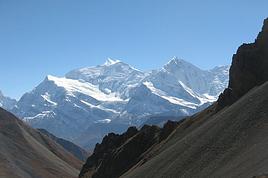
We arrived around 2 PM in Jomsom (2720m), and despite the early wake-up, the nearly 8 hours on the bus, and the altitude, we decided to head straight to Thinigaon (2840m). At the Jomsom checkpoint, they told us it was a 30-minute walk. Great! Except we took an hour and a half on an uphill road, bent over to fight a strong wind. But the Himalayan range is there! The Dhaulagiri, the Nilgiri, the Annapurnas as a reward.
In Thinigaon, we found a room at the "Nilgiri View Hotel" run by a didi (big sister in Nepali). From the lodge’s roof, she proudly showed us the different peaks surrounding the village and told us, worried, that it hadn’t snowed here for 3 years. She said there are very few tourists, that the season is rather in September/October/November. It seems there’s not a soul in this village, yet mules pass through the narrow street paved with large flat stones, their bells ringing. We dine at 6 PM and go to bed… Room = 1200 NPR and dinner, breakfast, and drinks = 2560 NPR.
On April 1, we set off at 9 AM, not for Chimang as planned but for Marpha! The didi from the Thinigaon lodge had said it was a 3-hour walk. The first part of this stage is attractive, the mountains are magnificent and imposing, the landscape is superb, there’s no one around, a feeling of being "alone in the world." We follow Dhumbra Tal, this small green lake. The path is a rocky track that climbs steeply. Then, around a hill, we start the big descent that joins the Kali Gandaki. We face the wind head-on, and the violent gusts take our breath away, throw us off balance, and envelop us in dust. We see the road on the other side of the Kali Gandaki. We arrive in the village of Chhairo at 2 PM, completely exhausted and with blistered feet, after 5 hours of walking instead of the planned 3.5 hours.
We’re welcomed by the village nurse, who tells us there’s a lodge in the village. Chhairo is a Tibetan village, a 20-minute walk from Marpha (according to the locals, multiply by 2 or even 3 for us…). We’re going to revise our trek plan and, first of all, spend the night in Chhairo.
The lodge is quite pleasant, and Karma, the hostess, is very friendly. She asks about our plans and suggests we stay in Chhairo the next day, from where we can visit Marpha and also Chimang, a 1-hour walk away, in light mode, meaning without backpacks. She invites us to participate in a village ceremony the next evening.
We immediately accept the proposal, as our feet need rest and the welcome is so warm… Dinner and bed!
We reworked our trek plan, which was too ambitious for our untrained bodies and, let’s face it… no longer in our first youth. In the initial plan, we thought there wouldn’t be too much elevation gain following the Kali Gandaki, but checking the map, we realize there might be significant elevation changes between Sauru and Sirkung. So we plan:
· Tomorrow: visit Marpha (2670m) and Chimang (2744m) · April 3: bus from Chhairo (2700m) to Kalopani (2530m) and continue on foot to Ghasa (2010m) · April 4: Ghasa/Pairataplo (1940m) · April 5: Pairatapla/Gadpar (1580m) · April 6: Gadpar/Narchyang (1510m) · April 7: Narchyang/Tatopani (1190m) · April 8: return to Pokhara.
Normally, it’s all downhill…
April 2, a rest day then… We set off in the morning to explore Marpha. We have to take a temporary bridge because the suspension bridge is closed due to road construction. We join the road and arrive in Marpha, a village famous for its apple orchards, brandy, cider, and apple juice production. This village is magnificent with its stone houses and monastery clinging to the hillside. The road construction spared it. There are people, but very few Western tourists.
We have lunch in Marpha and go back through Chhairo to take the path to Chimang. We cross a fragrant pine forest and find the rocky path; the landscape is splendid. We walk quietly, passing peaceful buffaloes and cows, and arrive at the foot of a stone staircase… 275 steps (which we counted on the way back) leading us to the village of Chimang. Chimang is an isolated Newari village that seems a bit desolate. Despite the slopes, there are crops on every little bit of land. Thankfully, we changed our initial program because there’s no lodge in this village, contrary to what we saw on a map… We wander through the village, which seems very deserted, have coffee in a house from another world, and then head back to Chhairo.
A rest day? = 5 hours of walking!!
Dinner and village ceremony. From what we understand, this ceremony is in honor of the Dalai Lama. Men, women, and children in traditional costumes gather twice a month; they dance, make, and offer small sweet cakes with Tibetan tea (made from tea, yak butter—often rancid—water, and salt). Surprising for first-timers…
Around 10 PM, we leave the ceremony; tomorrow morning, we need to be on the roadside by 7 AM to catch the bus to Kalopani…
This village of Chhairo is very pleasant and welcoming, no tourists, just two motorcyclists who arrived in the evening, one of whom participated in the ceremony and discreetly poured his Tibetan tea outside.
Lodge: "Norsang Tibetan Guesthouse and Restaurant". Total bill for 2 nights, 2 dinners, 2 breakfasts, and drinks = 8000 NPR.
April 3: bus from Chhairo to Kalopani, about 1.5 hours for the 20 km (200 NPR per person). We descend on the right bank of the Kali Gandaki. We find the red and white markings to resume the trek toward Ghasa. We’re in a fragrant pine forest, the Dhaulagiri on one side and the Annapurnas on the other, magnificent, and the path is pleasant and easy. We get a bit lost in this forest, always looking for the markings. Near Lete, two trekkers pass us, and we meet them again a little further on with two very young children, to whom we give the 2 hard-boiled eggs I didn’t eat this morning. They accepted them without hesitation.
We arrive in a village and ask for directions to Ghasa. The young girls point the way. But we come across a forest being logged, trees cut in all directions. We turn back and ask for confirmation. They confirm… But the two young girls catch up with us and clear the way. We have to step over, go around, and cross the felled trees, with no indication at all. Through this pick-up sticks of felled trees, the girls lead us to the top of a stone staircase, indicating that was the path. It’s the only place where we saw rhododendrons in bloom.
We descend the staircase. At the bottom, to the left, there’s a bridge to go toward Choyo, and to the right, a path to Ghasa. We take the right path and join the road. We should normally find the red and white markings, but we don’t… So we continue on the western bank road of the Kali Gandaki.
A little before the village of Misi, we see fumaroles on the opposite bank that seem to come from the ground. We don’t understand. We stopped to eat in the village of Misi (noodle soup = 600 NPR), but it’s hard to communicate with the elderly people running the guesthouse.
We continued on the road, not finding the marked path parallel to the road. Landslides, both on the left and right banks, seem to have taken over the marked routes. It’s a place where the Kali Gandaki gorge narrows, and on the opposite bank, the mountain smokes more and more, and we now hear the crackling of fire. Across from us, the mountain is burning… Our initial plan had us passing on that burning bank right now…
We arrive in Ghasa at 3:30 PM, a 6.5-hour stage but with a 1-hour stop at noon. We’re at the "Florida Guesthouse and Restaurant." From our room, we see the mountain smoking on the other side of the river, and at night, we see the flames. In this village, posters show Himalayan eagles and vultures that seem to be protected species. Indeed, we saw (and heard) 3 eagles circling today.
April 4 – Today, heading to Pairothapla or Kopchepani depending on our feet, accommodation options, and simply our desires.
No more smoke on the mountain this morning. It’s chilly, 7:45 AM, the sky is clear, just a smell of smoke outside.
Price of the lodge = 1000 NPR for the night + 3580 NPR for meals.
We cross Ghasa, which stretches over more than a kilometer. We have a drink at the last guesthouse in the village, and the didi, when she learns our destination, tells us to be careful because the villages we’re going to aren’t safe. Should we distribute our rupees in different pockets? Nah, we kept going.
At the exit of Ghasa, we find the red and white markings and take the suspension bridge to cross the boiling waters of the Kali Gandaki. The passage is impressive because the river is tumultuous. Lots of climbs and even more descents. We’re back on the eastern bank. It’s hot! On the narrow path, we meet a group of buffaloes. Who has the right of way? We decide to stick as close as possible to the rock wall and move forward calmly. The buffaloes look at us, chewing placidly, with no intention of jumping on us. Phew!
After a 5-hour stage (including stops), we arrive in Pairothapla, with hot feet and firm thighs, and decide we won’t go any further. It’s a good thing because there’s a lodge, the most basic so far, but with a great welcome. We have a meal and a short nap. The buffaloes we met on the way belong to this house. They come to drink at the fountain by the path.
Our host, very pleasant, doesn’t know what to do to please us and is very attentive. He wants to chat. He has two children, a 4-year-old girl and a 7-year-old boy. Where do they go to school? Do they go? He tells us that the fires in the mountain are caused by people, but for what reason? We won’t find out, but it’s illegal. From here, we can still see smoke rising in the distance. The wife is a bit less friendly. Corn kernels dry on a woven straw mat on the ground, and the mom sorts them.
From where we are, we overlook the valley and see the road under construction winding along the mountainside on the other bank.
Dinner on the terrace of the house overlooking the path, windbreaker and fleece on: dal bhat chicken for me and chicken curry for my husband: "organic" products, at least local production. There are small vegetable gardens everywhere with all sorts of vegetables.
April 5 – While we’re having breakfast on the terrace of our lodge, 5 porters, straps on their foreheads, heavily loaded, pass by on the path. A few minutes later, a group of 9 people appears. It must be said that since the beginning of our journey, we’ve met very few hikers. Two backpackers in Chhairo, the two hikers near Lete, two female hikers passed us before Pairothapla, a solo female hiker passed us…
The lodge in Pairothapla is called "Bimala Lodge & Thakali Kitchen" – Price for night + 4 meals + 2 breakfasts = 3000 NPR.
The descent toward the Kali Gandaki involves climbs whose steps we didn’t count. Clearly, the landslides on the mountain cause changes to the official ACAP trek marked in red and white, and the marking updates can’t keep up with the pace of these landslides. It’s almost always by chance that we find the markings. Fortunately, we can follow the power line that guides us somewhat.
Drink stop in Kopchepani, the legs are fine, but the feet don’t like being tightly enclosed. A group of trekkers with porters passes on the path. We met buffaloes that we kindly let pass; the path was wide enough, but it was a staircase going up, and we didn’t want to take any risks.
Across, a view of the magnificent Rupse Waterfall on the other bank of the Kali Gandaki, at the bottom, lots of vehicles and people.
Arrival in Gadpar after crossing a rather unwelcoming small village and cultivated gardens between dry stone walls, each better built than the last.
First lodge spotted, first lodge adopted to answer the call of our feet, and a very warm welcome from the owner. Since we hadn’t eaten at noon, we had Tibetan bread/jam. 6-hour stage including 1 hour of stops. Night + dinner + breakfast + drinks = 5060 NPR
April 6 – Today, heading to Narchyang.
For several days, we’ve seen banana trees with their bunches of fruit and even a prickly pear with large fruits ripening.
This stage is quite peaceful and pleasant. We take a suspension bridge to cross a tributary of the Kali Gandaki. While we’re resting for a moment before crossing the bridge, a couple of porters, a man and a woman, arrive and start across the bridge with their wood load in a basket held by a strap on their forehead, making them bend. We set off too… lighter than them.
On the other side of the bridge… a stone staircase, and it climbs steeply. The porter couple didn’t take this staircase; they went right on the path.
At the top of the staircase, we arrive in Narchyang after a 4-hour stage. A magnificent waterfall overlooks the village. We get lost in this fairly large village looking for a lodge. After wandering around for a while, we ask for directions, and an 84-year-old man takes us through the whole village and accompanies us to a very nice lodge run by a woman.
We chat with our hostess, who asks where we’re from and where we’re going. We explain that we want to reach Tatopani the next day and then return to Pokhara. She tells us there are 4x4s going directly to Pokhara and that it would probably be easier than taking a bus that might be full in Tatopani. After a quick consultation, we decide to return to Pokhara the next day by 4x4. She finds us a 4x4 with 2 seats left, departure at 8 AM – 5 hours on the road and 1500 NPR per person. A charming didi who does everything to be pleasant and helpful.
Narchyang community lodge = night + snacks + dinner + breakfast = 3000 NPR.
There you go, our trek ends tomorrow. Many necessary changes and adaptations to our initial trek, but no regrets, it was superb and a great experience that, for my part, I won’t be able to repeat. Always this encounter with the endearing, welcoming, curious, and very kind Nepali people. It was now or never, and we did it!
* * *
In conclusion, 3 full weeks in Nepal is a duration that allows visiting Kathmandu, Patan, and Bhaktapur, enjoying the various sites, and soaking in the atmosphere and urban Nepali life.
The trek, even revised and corrected, allowed us to get close to the impressive Annapurna and Dhaulagiri peaks. One or two acclimatization days might be necessary to get the body in tune with this magical and extraordinary land.
Stay from March 25 to April 16, 2025
· Flight tickets Air India (via Delhi) (via Skyscanner) = 1130 € per person · Planned budget (and respected without too many restrictions and while buying a few small gifts) = 2000 € for the stay for two. Buses, taxis, and entrance fees to various sites represent a budget to consider. Meals are cheap. Drinks like beer/Coke, however, are not cheap and cost the equivalent of a meal. · Exchange rate of the rupee during our stay = 0.0064 € (the exchange rate is almost identical everywhere, including at the airport). · At the airport, purchase of two SIM cards (phone) = 1000 NPR x 2 for 28 days. · Kathmandu: we had booked the hotel upon arrival: Kathmandu Boutique Hotel (+977 015 357 446 – email: booking@kathmanduboutiquehotel.com), very well located in a quiet alley off the street, south of Thamel, a 10-minute walk from Durbar Square. A hotel like Nepal knows how to do, where tall people will have to duck. Night + breakfast = 18 € for two. Very warm welcome, great location, excellent value for money. · Bhaktapur: we had also booked a hotel for the end of our stay because the chance of the year 2025 made the Nepali New Year and Bisket Jatra particularly festive in Bhaktapur: Manju Baha Hotel School (+977 976 7234014 – email: manjubahahotel@gmail.com) located in an old monastery. "A social enterprise transforming an old monastery into a charming hotel, offering professional hospitality training to underprivileged Nepali youth." Night + breakfast = 32 € for two. Beautifully decorated room. Very warm welcome. Don’t miss the Changunarayan site (near Bhaktapur), it’s amazing. And if you’re lucky enough to be in Bhaktapur in mid-April for 3 days, there’s the Bisket Jatra festivities (Newari festival), joyful, noisy, fun, and wild… · Pokhara (hotel recommended by the Kathmandu hotel): Hotel Green Tara, Lakeside, 10th street, set back, quiet (Tel. +977 61 462698 – email: greentara_67@hotmail.com) · Trek permit (Lower Mustang, no need for an agency or guide, permits checked at Ghasa and Jomsom) = 2000 NPR per person (2 ID photos) · Bus Kathmandu/Pokhara and return = 2000 NPR per person · Bus Pokhara/Jomsom, 2 one-way tickets = 2800 NPR. · Taxi: negotiation with a driver we recommend, Vicky (+977 984 075 599). You explain what you want, negotiate the price, and he waits for you during the visit. Very charming, we used him several times. For example: departure from our hotel at 10 AM -> Boudhanath/Pashupatinath/Patan return at 5 PM to the hotel = 6500 NPR – Swayambhunath (round trip) = 1200 NPR · Site prices: https://ntb.gov.np/plan-your-trip/before-you-come/heritage-site-entry-fees o Visitor Pass for Kathmandu Durbar Square (for the duration of the stay, show your visa) = 1000 NPR per person (1 ID photo) o Bhaktapur Durbar Square (old town) = 1800 NPR per person o Patan = 1000 NPR per person o Swayambhu Stupa = 200 NPR per person o Boudha Stupa = 200 NPR per person o Pashupatinath Temple = 1000 NPR per person (interesting to take a guide) o Changunarayan Temple (6 km north of Bhaktapur) = 400 NPR per person o Mountain Museum in Pokhara = 750 NPR per person · E-cigarettes: e-cigarettes are banned in India and confiscated whether they’re in carry-on or checked luggage. On the way there, we had kept them in our carry-on, they were confiscated in Delhi. On the way back, learning from our previous experience, we put them in our checked luggage. Someone came to get us to take them out of our bags and confiscate them… You can find e-cigarettes and products in Kathmandu.
* * *
I’m 74 years old. I went to Nepal in 1982, 1983, and the last time in 1986. I wanted to introduce this beautiful and endearing country to my husband, and it was… now or never. So we decided it was now.
I knew the trek starting from Pokhara: Naudanda/Birethanti/Ghorepani/Tatopani/Kalopani. There was no way I was going to do that trek, especially the 1000-meter staircase to reach Ghorepani… You have to stay humble with age.
Back then, the road didn’t exist. I didn’t consider, with the construction of this road (NH48) along the western bank of the Kali Gandaki, doing a trek along a windy and dusty road. Was there an alternative hiking trail on the eastern bank? No one answered my question on VoyageForum, so I did my research online. And I found this site: "Andrées de Ruiter and Prem Rai - Trekking the Annapurna Circuit, including the new NATT trails that avoid the road - A guide to one of the most beautiful trekking regions in Nepal and the world (2011) - NATT = New Annapurna Trekking Trail".
Phew! A solution was emerging. This circuit from 2011 wasn’t fully marked. The idea was to go from Jomsom to Tatopani, so we needed to make sure the path was well-marked all the way, which we did, and the path exists, marked in red and white!
So, with the walking times information, we built our 8-day circuit:
· Jomsom/Thinigaon · Thinigaon/Chimang · Chimang/Saura · Saura/Kokhetanti · Rest day or, if in good shape: loop to Sekong Lake · Kokhetanti/Jhipra Deurali · Jhipra Deurali/Kopchepani · Kopchepani/Tatopani
It’s a senior trek, after all. So the walking times noted on the sites indicated 3 hours or even 4 hours for the two longest stages. That pace suited us fine.
On March 29, we left Kathmandu (1400m), after visiting the must-see sites, by bus to Pokhara: 200 km and 8.5 hours on a chaotic road under construction. I had a memory of Pokhara where it was the first city where you could see the Himalayan range, especially Machhapuchhare. But the pollution is such, the dust raised by traffic and construction, that no horizon is visible except the first hills around Pokhara.
We stayed 24 hours in Pokhara (820m), and on March 31, we left our luggage at the hotel and set off with our lightest backpacks: change of clothes, toiletries, first aid kit, anti-chafing cream, water bottle, sleeping bag liner, and light shoes for the stages.
We took the bus to Jomsom: 160 km/7.5 hours including stops for bathroom breaks, tea, and lunch. The road is nothing but a chaos of potholes, landslides, construction, dust, rebuilding, and mudslides. In Ghasa, the bus stops, and we’re told we’re at a checkpoint and that the two foreigners in the bus, my husband and I, need to have our permits checked, which takes a few minutes. The driving is rock-and-roll, surprising, and courteous. The drivers have their codes, and on these improbable roads, they’re virtuosos.
We could have chosen the plane, but several reasons dissuaded us: if there’s too much wind, the planes don’t take off; personally, I wasn’t reassured about landing in Jomsom, and this transport has a cost.
We arrived around 2 PM in Jomsom (2720m), and despite the early wake-up, the nearly 8 hours on the bus, and the altitude, we decided to head straight to Thinigaon (2840m). At the Jomsom checkpoint, they told us it was a 30-minute walk. Great! Except we took an hour and a half on an uphill road, bent over to fight a strong wind. But the Himalayan range is there! The Dhaulagiri, the Nilgiri, the Annapurnas as a reward.
In Thinigaon, we found a room at the "Nilgiri View Hotel" run by a didi (big sister in Nepali). From the lodge’s roof, she proudly showed us the different peaks surrounding the village and told us, worried, that it hadn’t snowed here for 3 years. She said there are very few tourists, that the season is rather in September/October/November. It seems there’s not a soul in this village, yet mules pass through the narrow street paved with large flat stones, their bells ringing. We dine at 6 PM and go to bed… Room = 1200 NPR and dinner, breakfast, and drinks = 2560 NPR.
On April 1, we set off at 9 AM, not for Chimang as planned but for Marpha! The didi from the Thinigaon lodge had said it was a 3-hour walk. The first part of this stage is attractive, the mountains are magnificent and imposing, the landscape is superb, there’s no one around, a feeling of being "alone in the world." We follow Dhumbra Tal, this small green lake. The path is a rocky track that climbs steeply. Then, around a hill, we start the big descent that joins the Kali Gandaki. We face the wind head-on, and the violent gusts take our breath away, throw us off balance, and envelop us in dust. We see the road on the other side of the Kali Gandaki. We arrive in the village of Chhairo at 2 PM, completely exhausted and with blistered feet, after 5 hours of walking instead of the planned 3.5 hours.
We’re welcomed by the village nurse, who tells us there’s a lodge in the village. Chhairo is a Tibetan village, a 20-minute walk from Marpha (according to the locals, multiply by 2 or even 3 for us…). We’re going to revise our trek plan and, first of all, spend the night in Chhairo.
The lodge is quite pleasant, and Karma, the hostess, is very friendly. She asks about our plans and suggests we stay in Chhairo the next day, from where we can visit Marpha and also Chimang, a 1-hour walk away, in light mode, meaning without backpacks. She invites us to participate in a village ceremony the next evening.
We immediately accept the proposal, as our feet need rest and the welcome is so warm… Dinner and bed!
We reworked our trek plan, which was too ambitious for our untrained bodies and, let’s face it… no longer in our first youth. In the initial plan, we thought there wouldn’t be too much elevation gain following the Kali Gandaki, but checking the map, we realize there might be significant elevation changes between Sauru and Sirkung. So we plan:
· Tomorrow: visit Marpha (2670m) and Chimang (2744m) · April 3: bus from Chhairo (2700m) to Kalopani (2530m) and continue on foot to Ghasa (2010m) · April 4: Ghasa/Pairataplo (1940m) · April 5: Pairatapla/Gadpar (1580m) · April 6: Gadpar/Narchyang (1510m) · April 7: Narchyang/Tatopani (1190m) · April 8: return to Pokhara.
Normally, it’s all downhill…
April 2, a rest day then… We set off in the morning to explore Marpha. We have to take a temporary bridge because the suspension bridge is closed due to road construction. We join the road and arrive in Marpha, a village famous for its apple orchards, brandy, cider, and apple juice production. This village is magnificent with its stone houses and monastery clinging to the hillside. The road construction spared it. There are people, but very few Western tourists.
We have lunch in Marpha and go back through Chhairo to take the path to Chimang. We cross a fragrant pine forest and find the rocky path; the landscape is splendid. We walk quietly, passing peaceful buffaloes and cows, and arrive at the foot of a stone staircase… 275 steps (which we counted on the way back) leading us to the village of Chimang. Chimang is an isolated Newari village that seems a bit desolate. Despite the slopes, there are crops on every little bit of land. Thankfully, we changed our initial program because there’s no lodge in this village, contrary to what we saw on a map… We wander through the village, which seems very deserted, have coffee in a house from another world, and then head back to Chhairo.
A rest day? = 5 hours of walking!!
Dinner and village ceremony. From what we understand, this ceremony is in honor of the Dalai Lama. Men, women, and children in traditional costumes gather twice a month; they dance, make, and offer small sweet cakes with Tibetan tea (made from tea, yak butter—often rancid—water, and salt). Surprising for first-timers…
Around 10 PM, we leave the ceremony; tomorrow morning, we need to be on the roadside by 7 AM to catch the bus to Kalopani…
This village of Chhairo is very pleasant and welcoming, no tourists, just two motorcyclists who arrived in the evening, one of whom participated in the ceremony and discreetly poured his Tibetan tea outside.
Lodge: "Norsang Tibetan Guesthouse and Restaurant". Total bill for 2 nights, 2 dinners, 2 breakfasts, and drinks = 8000 NPR.
April 3: bus from Chhairo to Kalopani, about 1.5 hours for the 20 km (200 NPR per person). We descend on the right bank of the Kali Gandaki. We find the red and white markings to resume the trek toward Ghasa. We’re in a fragrant pine forest, the Dhaulagiri on one side and the Annapurnas on the other, magnificent, and the path is pleasant and easy. We get a bit lost in this forest, always looking for the markings. Near Lete, two trekkers pass us, and we meet them again a little further on with two very young children, to whom we give the 2 hard-boiled eggs I didn’t eat this morning. They accepted them without hesitation.
We arrive in a village and ask for directions to Ghasa. The young girls point the way. But we come across a forest being logged, trees cut in all directions. We turn back and ask for confirmation. They confirm… But the two young girls catch up with us and clear the way. We have to step over, go around, and cross the felled trees, with no indication at all. Through this pick-up sticks of felled trees, the girls lead us to the top of a stone staircase, indicating that was the path. It’s the only place where we saw rhododendrons in bloom.
We descend the staircase. At the bottom, to the left, there’s a bridge to go toward Choyo, and to the right, a path to Ghasa. We take the right path and join the road. We should normally find the red and white markings, but we don’t… So we continue on the western bank road of the Kali Gandaki.
A little before the village of Misi, we see fumaroles on the opposite bank that seem to come from the ground. We don’t understand. We stopped to eat in the village of Misi (noodle soup = 600 NPR), but it’s hard to communicate with the elderly people running the guesthouse.
We continued on the road, not finding the marked path parallel to the road. Landslides, both on the left and right banks, seem to have taken over the marked routes. It’s a place where the Kali Gandaki gorge narrows, and on the opposite bank, the mountain smokes more and more, and we now hear the crackling of fire. Across from us, the mountain is burning… Our initial plan had us passing on that burning bank right now…
We arrive in Ghasa at 3:30 PM, a 6.5-hour stage but with a 1-hour stop at noon. We’re at the "Florida Guesthouse and Restaurant." From our room, we see the mountain smoking on the other side of the river, and at night, we see the flames. In this village, posters show Himalayan eagles and vultures that seem to be protected species. Indeed, we saw (and heard) 3 eagles circling today.
April 4 – Today, heading to Pairothapla or Kopchepani depending on our feet, accommodation options, and simply our desires.
No more smoke on the mountain this morning. It’s chilly, 7:45 AM, the sky is clear, just a smell of smoke outside.
Price of the lodge = 1000 NPR for the night + 3580 NPR for meals.
We cross Ghasa, which stretches over more than a kilometer. We have a drink at the last guesthouse in the village, and the didi, when she learns our destination, tells us to be careful because the villages we’re going to aren’t safe. Should we distribute our rupees in different pockets? Nah, we kept going.
At the exit of Ghasa, we find the red and white markings and take the suspension bridge to cross the boiling waters of the Kali Gandaki. The passage is impressive because the river is tumultuous. Lots of climbs and even more descents. We’re back on the eastern bank. It’s hot! On the narrow path, we meet a group of buffaloes. Who has the right of way? We decide to stick as close as possible to the rock wall and move forward calmly. The buffaloes look at us, chewing placidly, with no intention of jumping on us. Phew!
After a 5-hour stage (including stops), we arrive in Pairothapla, with hot feet and firm thighs, and decide we won’t go any further. It’s a good thing because there’s a lodge, the most basic so far, but with a great welcome. We have a meal and a short nap. The buffaloes we met on the way belong to this house. They come to drink at the fountain by the path.
Our host, very pleasant, doesn’t know what to do to please us and is very attentive. He wants to chat. He has two children, a 4-year-old girl and a 7-year-old boy. Where do they go to school? Do they go? He tells us that the fires in the mountain are caused by people, but for what reason? We won’t find out, but it’s illegal. From here, we can still see smoke rising in the distance. The wife is a bit less friendly. Corn kernels dry on a woven straw mat on the ground, and the mom sorts them.
From where we are, we overlook the valley and see the road under construction winding along the mountainside on the other bank.
Dinner on the terrace of the house overlooking the path, windbreaker and fleece on: dal bhat chicken for me and chicken curry for my husband: "organic" products, at least local production. There are small vegetable gardens everywhere with all sorts of vegetables.
April 5 – While we’re having breakfast on the terrace of our lodge, 5 porters, straps on their foreheads, heavily loaded, pass by on the path. A few minutes later, a group of 9 people appears. It must be said that since the beginning of our journey, we’ve met very few hikers. Two backpackers in Chhairo, the two hikers near Lete, two female hikers passed us before Pairothapla, a solo female hiker passed us…
The lodge in Pairothapla is called "Bimala Lodge & Thakali Kitchen" – Price for night + 4 meals + 2 breakfasts = 3000 NPR.
The descent toward the Kali Gandaki involves climbs whose steps we didn’t count. Clearly, the landslides on the mountain cause changes to the official ACAP trek marked in red and white, and the marking updates can’t keep up with the pace of these landslides. It’s almost always by chance that we find the markings. Fortunately, we can follow the power line that guides us somewhat.
Drink stop in Kopchepani, the legs are fine, but the feet don’t like being tightly enclosed. A group of trekkers with porters passes on the path. We met buffaloes that we kindly let pass; the path was wide enough, but it was a staircase going up, and we didn’t want to take any risks.
Across, a view of the magnificent Rupse Waterfall on the other bank of the Kali Gandaki, at the bottom, lots of vehicles and people.
Arrival in Gadpar after crossing a rather unwelcoming small village and cultivated gardens between dry stone walls, each better built than the last.
First lodge spotted, first lodge adopted to answer the call of our feet, and a very warm welcome from the owner. Since we hadn’t eaten at noon, we had Tibetan bread/jam. 6-hour stage including 1 hour of stops. Night + dinner + breakfast + drinks = 5060 NPR
April 6 – Today, heading to Narchyang.
For several days, we’ve seen banana trees with their bunches of fruit and even a prickly pear with large fruits ripening.
This stage is quite peaceful and pleasant. We take a suspension bridge to cross a tributary of the Kali Gandaki. While we’re resting for a moment before crossing the bridge, a couple of porters, a man and a woman, arrive and start across the bridge with their wood load in a basket held by a strap on their forehead, making them bend. We set off too… lighter than them.
On the other side of the bridge… a stone staircase, and it climbs steeply. The porter couple didn’t take this staircase; they went right on the path.
At the top of the staircase, we arrive in Narchyang after a 4-hour stage. A magnificent waterfall overlooks the village. We get lost in this fairly large village looking for a lodge. After wandering around for a while, we ask for directions, and an 84-year-old man takes us through the whole village and accompanies us to a very nice lodge run by a woman.
We chat with our hostess, who asks where we’re from and where we’re going. We explain that we want to reach Tatopani the next day and then return to Pokhara. She tells us there are 4x4s going directly to Pokhara and that it would probably be easier than taking a bus that might be full in Tatopani. After a quick consultation, we decide to return to Pokhara the next day by 4x4. She finds us a 4x4 with 2 seats left, departure at 8 AM – 5 hours on the road and 1500 NPR per person. A charming didi who does everything to be pleasant and helpful.
Narchyang community lodge = night + snacks + dinner + breakfast = 3000 NPR.
There you go, our trek ends tomorrow. Many necessary changes and adaptations to our initial trek, but no regrets, it was superb and a great experience that, for my part, I won’t be able to repeat. Always this encounter with the endearing, welcoming, curious, and very kind Nepali people. It was now or never, and we did it!
* * *
In conclusion, 3 full weeks in Nepal is a duration that allows visiting Kathmandu, Patan, and Bhaktapur, enjoying the various sites, and soaking in the atmosphere and urban Nepali life.
The trek, even revised and corrected, allowed us to get close to the impressive Annapurna and Dhaulagiri peaks. One or two acclimatization days might be necessary to get the body in tune with this magical and extraordinary land.
Bien le bonjour à la communauté de VoyageForum !
Comme le titre du post l'indique, je cherche un maximum d'informations/tuyaux sur le Nepal.
En effet j'ai prévu de faire un périple seul d'environs 8 mois en Asie du Sud Est et je compte passer 2 mois au Népal à partir de mi-septembre. Ma vision du voyage est basée sur le partage, l'ouverture d'esprit, et la découverte. C'est dans cette optique que j'aimerais intégrer une association durant le 1er mois et faire un trek/tourisme le deuxième mois.
Concernant l'association sur Katmandou, j'aimerais pouvoir faire du bénévolat dans l'agriculture, car mon BTS d'aménagements paysagers me permettrait d'aider plus efficacement, tout en apprenant de nouvelles méthodes (j'ai pensé au woofing). Cependant j'ai conscience de la pauvreté du Nepal, et je sais qu'il y a beaucoup d'orphelins livrés à eux même à Katmandou, et cette misère sociale me donne envie d'agir. Je n'ai pas de diplôme type BAFA, mais je suis volontaire et motivé. J'ai également quelques bases dans le BTP, et je suis sauveteur secouriste. Je suis donc à la recherche d'association locale, sérieuse, fiable, avec un staff parlant anglais (j'ai un niveau d'anglais que je qualifierais de moyen), avec si possible, un hébergement. Si vous en connaissez n'hésitez pas ;)
Concernant le deuxième mois dont l'objectif serait de découvrir le Népal, j'envisage de faire un trek d'une vingtaine de jours. Je suis plutôt sportif (natation, footing). Je me suis déjà renseigné un petit peu sur les différents circuits, mais j'ai du mal à me décider... De plus étant donné que je pars seul, louer les services d'un guide serait hors de prix. Cependant je ne pense pas vraiment être seul (selon les circuits), car je compte faire le trek durant le mois d'octobre qui correspond à la haute saison. J'aimerais d’ailleurs avoir votre avis par rapport à cela, niveau sécurité et savoir si il est aisé de trouver un hébergement durant le trek?
Le tour des Annapurna serait un bon compromis, mais peut être trop court, et peut être trop "classique".. J'attends vos suggestions :)
Pour finir j'aimerais avoir des idées pour profiter de la dizaine de jours qu'il me resterait pour explorer les alentours de Katmandou.
Merci ! ;)
Comme le titre du post l'indique, je cherche un maximum d'informations/tuyaux sur le Nepal.
En effet j'ai prévu de faire un périple seul d'environs 8 mois en Asie du Sud Est et je compte passer 2 mois au Népal à partir de mi-septembre. Ma vision du voyage est basée sur le partage, l'ouverture d'esprit, et la découverte. C'est dans cette optique que j'aimerais intégrer une association durant le 1er mois et faire un trek/tourisme le deuxième mois.
Concernant l'association sur Katmandou, j'aimerais pouvoir faire du bénévolat dans l'agriculture, car mon BTS d'aménagements paysagers me permettrait d'aider plus efficacement, tout en apprenant de nouvelles méthodes (j'ai pensé au woofing). Cependant j'ai conscience de la pauvreté du Nepal, et je sais qu'il y a beaucoup d'orphelins livrés à eux même à Katmandou, et cette misère sociale me donne envie d'agir. Je n'ai pas de diplôme type BAFA, mais je suis volontaire et motivé. J'ai également quelques bases dans le BTP, et je suis sauveteur secouriste. Je suis donc à la recherche d'association locale, sérieuse, fiable, avec un staff parlant anglais (j'ai un niveau d'anglais que je qualifierais de moyen), avec si possible, un hébergement. Si vous en connaissez n'hésitez pas ;)
Concernant le deuxième mois dont l'objectif serait de découvrir le Népal, j'envisage de faire un trek d'une vingtaine de jours. Je suis plutôt sportif (natation, footing). Je me suis déjà renseigné un petit peu sur les différents circuits, mais j'ai du mal à me décider... De plus étant donné que je pars seul, louer les services d'un guide serait hors de prix. Cependant je ne pense pas vraiment être seul (selon les circuits), car je compte faire le trek durant le mois d'octobre qui correspond à la haute saison. J'aimerais d’ailleurs avoir votre avis par rapport à cela, niveau sécurité et savoir si il est aisé de trouver un hébergement durant le trek?
Le tour des Annapurna serait un bon compromis, mais peut être trop court, et peut être trop "classique".. J'attends vos suggestions :)
Pour finir j'aimerais avoir des idées pour profiter de la dizaine de jours qu'il me resterait pour explorer les alentours de Katmandou.
Merci ! ;)
Bonjour à tous !
Je vous lis depuis déjà quelques semaines, mais comme je trouvais les informations dont j'avais besoin grâce à vos messages, je n'avais pas encore posté. Merci à tous pour tous ces éclairages sur le Népal.
Je pars fin septembre - jusqu'à mi octobre. Pas de trek à l'horizon. J'ai déjà booké une partie du voyage (je voyage seule avec mon sac à dos). Je voulais aller jusqu'à Lumbini. Je pensais prendre un bus touristique pour faire Kathmandou - Lumbini, puis ensuite remonter vers Pokhara en faisant une halte de 2 ou 3 jours à Tansen.
Mais voila, au moment de réserver une guest house pour Lumbini... c'est le drame... le lonely conseille avec un gros coup de coeur le village lodge... mais ... depuis les critiques sont plus qu'alarmistes... Et je ne sais quoi en penser. Du coup tout avis, conseils, adresse est la bienvenue.
Je ne cherche pas forcément une adresse ultra petit prix, je peux mettre entre 10 et 20 euros. Je ne cherche pas forcément à côté des temple ou dans lumbini bazaar. Ca peut être un peu plus éloigné... Je compte y passer 3 nuits.
Merci d'avance pour vos suggestions !
Je vous lis depuis déjà quelques semaines, mais comme je trouvais les informations dont j'avais besoin grâce à vos messages, je n'avais pas encore posté. Merci à tous pour tous ces éclairages sur le Népal.
Je pars fin septembre - jusqu'à mi octobre. Pas de trek à l'horizon. J'ai déjà booké une partie du voyage (je voyage seule avec mon sac à dos). Je voulais aller jusqu'à Lumbini. Je pensais prendre un bus touristique pour faire Kathmandou - Lumbini, puis ensuite remonter vers Pokhara en faisant une halte de 2 ou 3 jours à Tansen.
Mais voila, au moment de réserver une guest house pour Lumbini... c'est le drame... le lonely conseille avec un gros coup de coeur le village lodge... mais ... depuis les critiques sont plus qu'alarmistes... Et je ne sais quoi en penser. Du coup tout avis, conseils, adresse est la bienvenue.
Je ne cherche pas forcément une adresse ultra petit prix, je peux mettre entre 10 et 20 euros. Je ne cherche pas forcément à côté des temple ou dans lumbini bazaar. Ca peut être un peu plus éloigné... Je compte y passer 3 nuits.
Merci d'avance pour vos suggestions !
Bonjour a tous je vais bientôt partir au nepal dans 2 semaine par contre j'ai trouvez un guest house a bhaktapur la tout va bien🏴☠️😉😉
mais on dit que il faut payez entrée 1100 roupie cela me dérange pas ma question ....
Mais est ce que faut payez a chaque fois entrée sachant je séjourne a bhaktapur je compte partir faire des tours au alentour katmandou temple .......ect ?? y a t il un pass ou suis je bloqué dans cette ville si il faut payez a chaque fois ?? 😕😕
a votre avis bhaktapur et il calme a par rapport thamel ou la pollution et insupportable ?
peut on trouvez des taxis pour des long trajet ou des bus dans cette ville pour ceux qui ont séjourné a votre avis combien coute un trajet en bus juste de connaissance ? 🙂
je part dans 15 jours merci d'avance de votre réponse 😇😇
cdt sebastien
mais on dit que il faut payez entrée 1100 roupie cela me dérange pas ma question ....
Mais est ce que faut payez a chaque fois entrée sachant je séjourne a bhaktapur je compte partir faire des tours au alentour katmandou temple .......ect ?? y a t il un pass ou suis je bloqué dans cette ville si il faut payez a chaque fois ?? 😕😕
a votre avis bhaktapur et il calme a par rapport thamel ou la pollution et insupportable ?
peut on trouvez des taxis pour des long trajet ou des bus dans cette ville pour ceux qui ont séjourné a votre avis combien coute un trajet en bus juste de connaissance ? 🙂
je part dans 15 jours merci d'avance de votre réponse 😇😇
cdt sebastien
Bonjour,
J'essaie de préparer notre voyage. Pourriez vous me dire ce que vous pensez de cet itinéraire et le cas échéant me faire partager vos idées. Nous sommes tenus d'être à Kathmandou entre le 13 et le 19 car notre fille vient nous y rejoindre. Nous aimons les voyages culturels, nous perdre dans les marchés et les randonnées. Nous ne supportons pas les voyages en groupe et aimons le contact avec la population locale. Je vous copie mon programme provisoire. Nous pouvons aussi envisager bus et avion pour les distances les plus longues. Merci de votre aide. Programme de voyage Népal/Inde option 2 voiture de location avec chauffeur ou taxi
Samedi 1er février 7h15 arrivée à l’aéroport, visas, transfert, repos. Prise de contact avec la ville et réservations hôtel et voiture pour le retour
Dimanche 2 février Fin des réservations et départ pour Vanarasi par le vol Air İndia à 14h 25 Installation à Vanarasi et prise de contact avec la ville. Promenade sur les ghâts et cérémonie sur le ghât Dasasvamedha en fin d’après midi.
Lundi 3 février Ghâts , bazaars et ballade en bateau en fin de soirée.
Mardi 4 février Visite de Sarnath et visite des bazaars
Mercredi 5 février Visite des temples et ballade à travers la ville
Jeudi 6 février Vol pour kathmandou à 12h30
Vendredi 7 février Départ pour Chitwan et installation à Sauhara . Installation et organisation de la visite du parc avec ballade à dos d’éléphant et/ou descente en pirogue avec visite de la nursery et retour à pied
Vendredi 8 février Visite du parc
Samedi 9 février Fin de la visite du parc le matin et départ pour Pokhara vers 12h ou 13h
Dimanche 10 février Visite de Pokhara et ballade en bateau en fin d’après- midi
Lundi 11 février Randonnée à Sarangkot et visite de Tarshi Palkhiel (tissage de tapis tibétains)
Mardi 12 février Pokhara/Bandipur et visite de Bandipur
Mercredi 13 février Bandipur / Kathmandou
Jeudi 14 février arrivée de Oya Visite de kathmandou Durbar square et alentours. Jardins des rêves si on a le temps
Vendredi 15 février Visite de Patan et des environs: bungamati et khokhana, retour par Kirtipur
Samedi 16 février Visite de Changu Narayan et Bhaktapur
Dimanche 17 février Visite de Swayambunath (nouvel an tibétain) et Buddha Nilanka
Lundi 18 février Derniers achats à Kathmandou et visite de Bodhnath(nouvel an tibétain, vérifier que cela dure 2 jours) İnstallation à l'hôtel de Bodhnath plus près de l'aéroport?
Mardi 19 février Départ pour Istanbul
J'essaie de préparer notre voyage. Pourriez vous me dire ce que vous pensez de cet itinéraire et le cas échéant me faire partager vos idées. Nous sommes tenus d'être à Kathmandou entre le 13 et le 19 car notre fille vient nous y rejoindre. Nous aimons les voyages culturels, nous perdre dans les marchés et les randonnées. Nous ne supportons pas les voyages en groupe et aimons le contact avec la population locale. Je vous copie mon programme provisoire. Nous pouvons aussi envisager bus et avion pour les distances les plus longues. Merci de votre aide. Programme de voyage Népal/Inde option 2 voiture de location avec chauffeur ou taxi
Samedi 1er février 7h15 arrivée à l’aéroport, visas, transfert, repos. Prise de contact avec la ville et réservations hôtel et voiture pour le retour
Dimanche 2 février Fin des réservations et départ pour Vanarasi par le vol Air İndia à 14h 25 Installation à Vanarasi et prise de contact avec la ville. Promenade sur les ghâts et cérémonie sur le ghât Dasasvamedha en fin d’après midi.
Lundi 3 février Ghâts , bazaars et ballade en bateau en fin de soirée.
Mardi 4 février Visite de Sarnath et visite des bazaars
Mercredi 5 février Visite des temples et ballade à travers la ville
Jeudi 6 février Vol pour kathmandou à 12h30
Vendredi 7 février Départ pour Chitwan et installation à Sauhara . Installation et organisation de la visite du parc avec ballade à dos d’éléphant et/ou descente en pirogue avec visite de la nursery et retour à pied
Vendredi 8 février Visite du parc
Samedi 9 février Fin de la visite du parc le matin et départ pour Pokhara vers 12h ou 13h
Dimanche 10 février Visite de Pokhara et ballade en bateau en fin d’après- midi
Lundi 11 février Randonnée à Sarangkot et visite de Tarshi Palkhiel (tissage de tapis tibétains)
Mardi 12 février Pokhara/Bandipur et visite de Bandipur
Mercredi 13 février Bandipur / Kathmandou
Jeudi 14 février arrivée de Oya Visite de kathmandou Durbar square et alentours. Jardins des rêves si on a le temps
Vendredi 15 février Visite de Patan et des environs: bungamati et khokhana, retour par Kirtipur
Samedi 16 février Visite de Changu Narayan et Bhaktapur
Dimanche 17 février Visite de Swayambunath (nouvel an tibétain) et Buddha Nilanka
Lundi 18 février Derniers achats à Kathmandou et visite de Bodhnath(nouvel an tibétain, vérifier que cela dure 2 jours) İnstallation à l'hôtel de Bodhnath plus près de l'aéroport?
Mardi 19 février Départ pour Istanbul
Bonsoir
De retour d'un voyage de 20 jrs au Népal, je souhaite remercier le site (et ses membres) pour l'aide apportée lors de la préparation de mon circuit.
En résumé :
- Marseille/Katmandu via Istanbul : très bon plan avec Turkish Airlines (570 € A/R)
- 2 jours à visiter Katmandu et ses environs : Coup de coeur pour les villages de Khokana et Bungmati (Pas un touriste croisé ds la journée)
- Katmandu / Pokkhara avec Buddha Air (No prob)
- 5 jrs de trek : Ulleri / Ghorepani / Tadapani (Poon Hill) / Ghandruk / : Coup de Coeur : Ghandruk superbe village et quasiment aucun touriste de tout l' AM. La descente dur Pokkhara est aussi superbe
- Balade en vélo ds Pokkhara puis destination Chitwan en bus : 4 jrs de découverte du parc mais bof bof aucun animal en vue : Tigre , Rhino, .... Nada. Heureusement la campagne et les villages aux alentours sont très agrébles à découvrir tranquillement en vélo.
- Retour sur KTM tjrs avec Buddha Air: No prob
- Vallée de KTM : Panauti (Autre gd coup de coeur pour ce village déserté par les touristes), Namobuddha (bof) Dulikhel
- 1 nuit à Bhaktapur : superbe ville bien que très touristique
- KTM avec les incontournables visites
Pour certaines étapes et particulierement le trek , j'ai fait appel à une agence locale , Sunshine pour la nommer: Nickel à tt point de vue. C'est une agence de petite taille à caractère familial et très sérieuse. Le boss Rishi nous a accompagné à partir de Panauti (nuit chez l'habitant) et sa charmante épouse Rabina nous a fait découvrir les premiers villages de Khokana et Bungmati.
A votre disposition si je peux à mon tour vous apporter mon aide...
Bruno
Pour certaines étapes et particulierement le trek , j'ai fait appel à une agence locale , Sunshine pour la nommer: Nickel à tt point de vue. C'est une agence de petite taille à caractère familial et très sérieuse. Le boss Rishi nous a accompagné à partir de Panauti (nuit chez l'habitant) et sa charmante épouse Rabina nous a fait découvrir les premiers villages de Khokana et Bungmati.
A votre disposition si je peux à mon tour vous apporter mon aide...
Bruno