3 weeks in Kazakhstan and Kyrgyzstan, preliminary travel questions
by Attila
Translated into English.
Perju’s photos really sell the dream! 😍 Makes you want to go!
Anyway, can’t wait to hear about the trip when you’re back! !
"Le véritable voyage de découverte ne consiste pas à chercher de nouveaux paysages, mais à avoir de nouveaux yeux."
Marcel Proust
It reminds me of public restrooms in India...
I’ll definitely be sharing a travel journal in a few months, but I already think this destination is gaining popularity. If we want to go without too many crowds, the next few years are the time to do it.
La rue comme gagne-pain : concours de photos amical de septembre 2026
Rubrique Jeux Voyages
C'est le moment de poster vos meilleurs clichés !
I agree about the enthusiasm for this destination.
But I think we still have a few years before we start talking about overtourism in this part of the world 😊
I’d already looked into a trip to neighboring Mongolia, but our travel dates (December/January) aren’t ideal for these destinations. Guess we’ll have to wait for total travel freedom!
"Le véritable voyage de découverte ne consiste pas à chercher de nouveaux paysages, mais à avoir de nouveaux yeux."
Marcel Proust
Not overtourism like the French Riviera, but too much domestication of nature and a shift in local attitudes.😉
La rue comme gagne-pain : concours de photos amical de septembre 2026
Rubrique Jeux Voyages
C'est le moment de poster vos meilleurs clichés !
When I see the proliferation of yurt camps between 2019 and 2024 (for example on the shores of Lake Son Kul or at the Tash Rabat site) to accommodate mass tourism, you shouldn’t wait too long if you want to see a country that still holds onto its traditions.
@Attila Oh! Tash Rabat—you’ve got your spot there! !
CS
www.lescs.fr
www.lescs.fr
Yeah, I noticed there are loads of camps around Song Kol.
Some seem to have a ton of yurts and are set up purely for tourist accommodation, not just as a side activity for nomads anymore. There are even permanent chalets and dome tents. Prices then go over 150 €...
I get the feeling these places cater more to group travelers and organized tours rather than independent travelers.
I haven’t booked anything yet.
It’s starting to be the same at Lenin Peak.
We won’t be staying overnight at Tash Rabat.
Some seem to have a ton of yurts and are set up purely for tourist accommodation, not just as a side activity for nomads anymore. There are even permanent chalets and dome tents. Prices then go over 150 €...
I get the feeling these places cater more to group travelers and organized tours rather than independent travelers.
I haven’t booked anything yet.
It’s starting to be the same at Lenin Peak.
We won’t be staying overnight at Tash Rabat.
La rue comme gagne-pain : concours de photos amical de septembre 2026
Rubrique Jeux Voyages
C'est le moment de poster vos meilleurs clichés !
In Sary-Tash you’ve got a hostel, ATM, and fuel. It’s a small village.
In Sary Mogol there are guesthouses.
There are several places to stay in Sary-Tash. In summer, there’s a flow of 4x4s with drivers for four or five travelers coming from Osh. I skimmed the thread and don’t get why "guesthouse" is used instead of "maison d’hôte." Otherwise, there are some clichés—like French hipsters wanting to see amazing landscapes but ugh, gross, they’re not like us, their food is crap, etc.
Otherwise, there are clichés, like those French hipsters who want to see cool landscapes but ugh, yuck, they’re not like us, their food is gross, etc.
Hey there, hipster Atilla...
Alright, I’m waiting for the backlash...
Hey there, hipster Atilla...
Alright, I’m waiting for the backlash...
Qui boit l'eau d'une terre étrangère doit en suivre les coutumes (proverbe Mongol)
A little help for Attila:
https://www.radiofrance.fr/franceinter/podcasts/grand-bien-vous-fasse/how-to-recognize-a-minor-injury-7854139
https://www.youtube.com/watch?v=LZzR7-apnKA
CS
www.lescs.fr
www.lescs.fr
I skimmed the thread and don’t get why "guesthouse" is used instead of "maison d'hôte."
If you’d traveled this region and read the signs by the road, you would’ve seen and read "guesthouse." I didn’t see "maison d'hôtes" anywhere.
Surprising such a comment when people here write city names with acronyms in thread titles.
Anyway, a flavorless intervention! !
If you’d traveled this region and read the signs by the road, you would’ve seen and read "guesthouse." I didn’t see "maison d'hôtes" anywhere.
Surprising such a comment when people here write city names with acronyms in thread titles.
Anyway, a flavorless intervention! !
CS
www.lescs.fr
www.lescs.fr
The word 'guesthouse' is used because that's roughly how you can find them online.
With 'maison d’hôtes,' I might be searching for a long time.
Shouldn’t we just say 'gostevoy dom' anyway? 😇 Or better yet, 'konok üyü'?
pouâh beurk they’re not like us, their food is shit, etc.
They’re like us—two legs, two arms, two eyes, two ears, a brain... They’re like us in watching TV, using WhatsApp and Instagram, drinking, etc.
And their cuisine might not seem great, but they’re not the only ones—it’s no reason to avoid the country. Why not be realistic? Some countries are a treat for my taste buds even if the food is different from mine (Morocco, Thailand, India, Sri Lanka...), while others will have me pulling a face (USA, Iceland, Faroe Islands, Norway...).
I don’t know if I’m a 'bobo,' and I couldn’t care less. But I do know I’m not the type to be starry-eyed about just anything...
Shouldn’t we just say 'gostevoy dom' anyway? 😇 Or better yet, 'konok üyü'?
pouâh beurk they’re not like us, their food is shit, etc.
They’re like us—two legs, two arms, two eyes, two ears, a brain... They’re like us in watching TV, using WhatsApp and Instagram, drinking, etc.
And their cuisine might not seem great, but they’re not the only ones—it’s no reason to avoid the country. Why not be realistic? Some countries are a treat for my taste buds even if the food is different from mine (Morocco, Thailand, India, Sri Lanka...), while others will have me pulling a face (USA, Iceland, Faroe Islands, Norway...).
I don’t know if I’m a 'bobo,' and I couldn’t care less. But I do know I’m not the type to be starry-eyed about just anything...
La rue comme gagne-pain : concours de photos amical de septembre 2026
Rubrique Jeux Voyages
C'est le moment de poster vos meilleurs clichés !
I skimmed the thread and don’t get why the word "guesthouse" is used instead of "maison d'hôte".
If you’d traveled this region and read the signs by the road, you’d have seen and read "guesthouse". I didn’t see "maison d'hôtes" anywhere.
They’re certainly not going to put up "maison d'hôtes", just like in Spain "finca" or "venta" don’t say "auberge", "panadería" don’t say "boulangerie", or in Germany "Gasthaus" don’t say "auberge" and "Konditorei" don’t say "pâtisserie salon de thé". Some guesthouses in Central Asia’s tourist hotspots use the English "guesthouse" because they assume foreigners use English. Some don’t display anything at all. You’d know that if you’d traveled this region.
If you’d traveled this region and read the signs by the road, you’d have seen and read "guesthouse". I didn’t see "maison d'hôtes" anywhere.
They’re certainly not going to put up "maison d'hôtes", just like in Spain "finca" or "venta" don’t say "auberge", "panadería" don’t say "boulangerie", or in Germany "Gasthaus" don’t say "auberge" and "Konditorei" don’t say "pâtisserie salon de thé". Some guesthouses in Central Asia’s tourist hotspots use the English "guesthouse" because they assume foreigners use English. Some don’t display anything at all. You’d know that if you’d traveled this region.
What you'd know if you'd traveled this region.
Yeah, right. For your long winter days: https://lescs.fr/-Asie-83-
CS
www.lescs.fr
www.lescs.fr
What are the real value-added tips you could share in this discussion?
I’ve looked everywhere and can’t find any.
La rue comme gagne-pain : concours de photos amical de septembre 2026
Rubrique Jeux Voyages
C'est le moment de poster vos meilleurs clichés !
Some guest houses don’t display anything.
So I’m lost... by Lake Karakul in Tajikistan... is it a guest house or a homestay? 😏

So I’m lost... by Lake Karakul in Tajikistan... is it a guest house or a homestay? 😏

Qui boit l'eau d'une terre étrangère doit en suivre les coutumes (proverbe Mongol)
This visit should be really interesting.
https://en.nabu.de/topics/species/snow-leopard/rehabilitation-centre.html
CS
www.lescs.fr
www.lescs.fr
Some guesthouses don’t display anything.
So I’m lost... by Lake Kara-Kul in Tajikistan... is this a guesthouse or a homestay? 😏

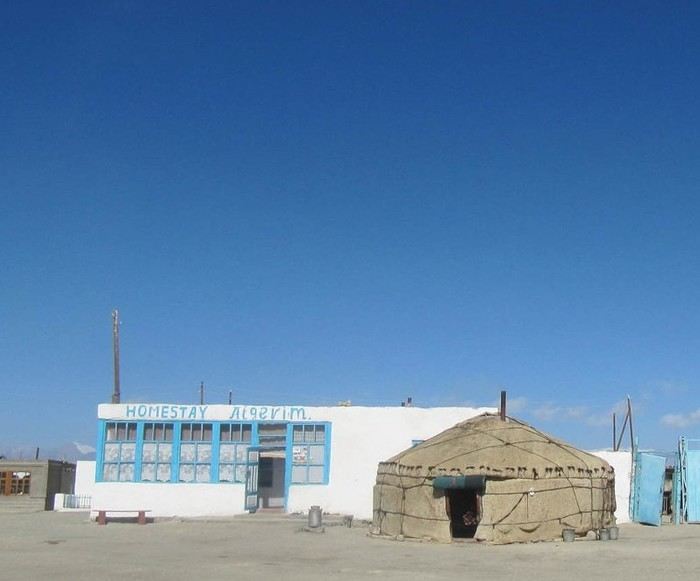
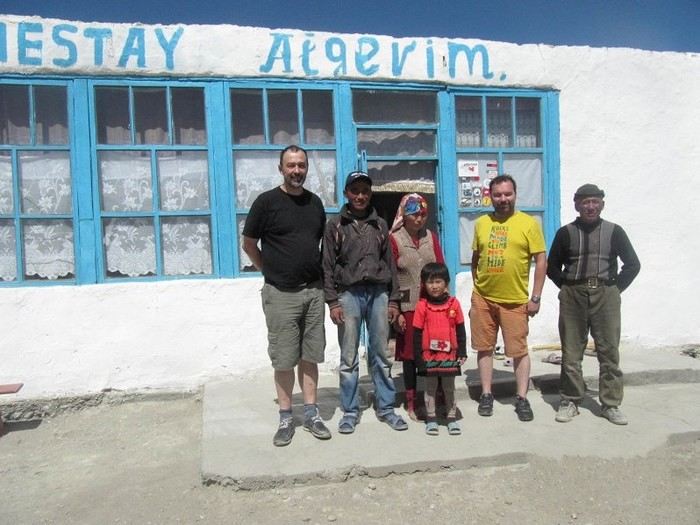
The first guesthouse—or gîte, to use the French term—when you arrive at Lake Kara-Kul from the Kyrgyz border is the one called Aigerim. Over time, between washes, it’s had signs saying "guesthouse" and later "homestay." That one:

The yurt, which was recently removed, used to be there before the house. The owner, with his wife and youngest daughter, has interesting stories about this corner of the high plateau and is Kyrgyz himself:

This lakeside spot by the main road is kind of a tourist trap, given the location. Groups in big 4x4s from Osh tend to stop either in Sary-Tash or Murghab at smaller, better-equipped hostels.
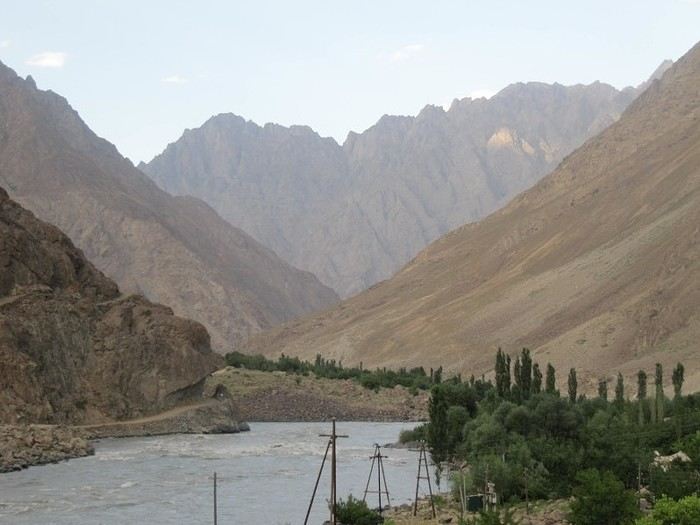
You’ll recognize this—the Panj River just outside Khorog, with Afghanistan on the left bank:

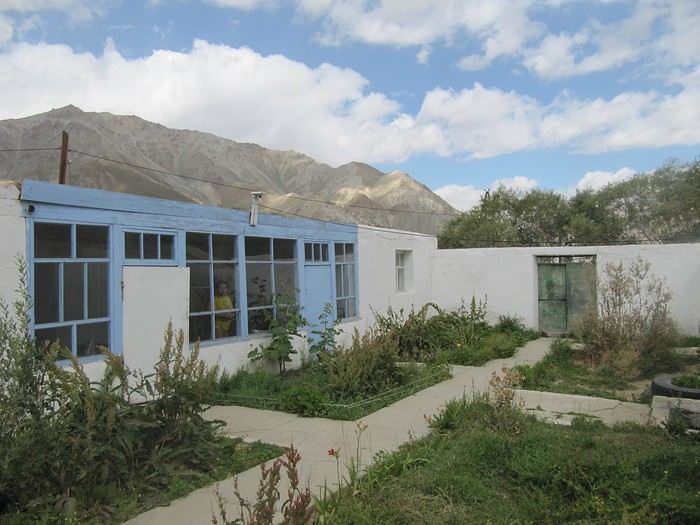
Further on, past Kalai Khumb, I stayed here—no sign, just word of mouth, after asking someone at another house:

Sometimes accommodations are marked with мехмонхона/меҳмонхона, which is Tajik for the idea of a hotel, hostel, or gîte.
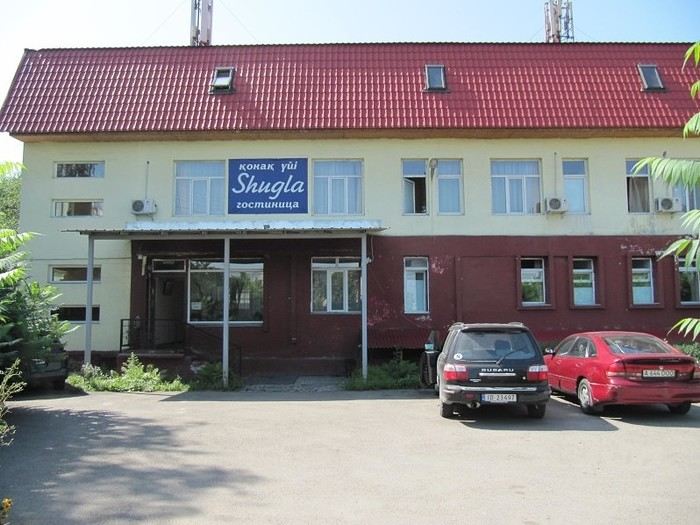
In Kazakhstan and Kyrgyzstan, in places off the tourist trail, you’ll often find bilingual signs. Here’s a "mini-hotel," Shougla, in Almaty, outside the city center—конал ли/гостиница:

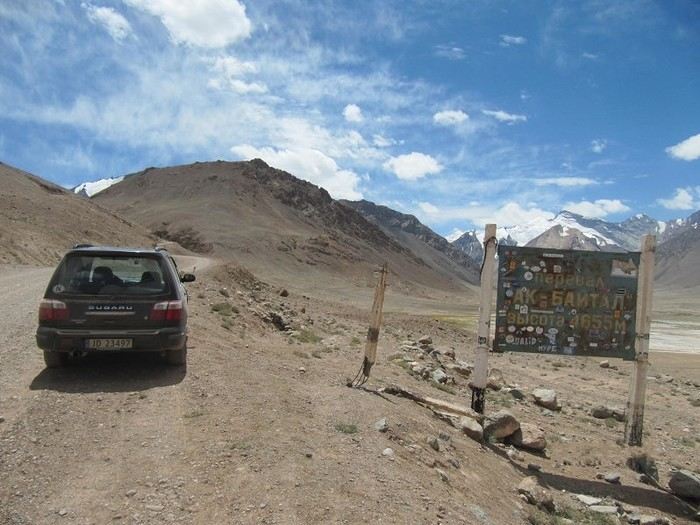
The Forester parked out front is my car, and for the most part—not everywhere, but mostly—it handles the main roads just fine. At the Ak-Baital Pass on the way to Murghab:

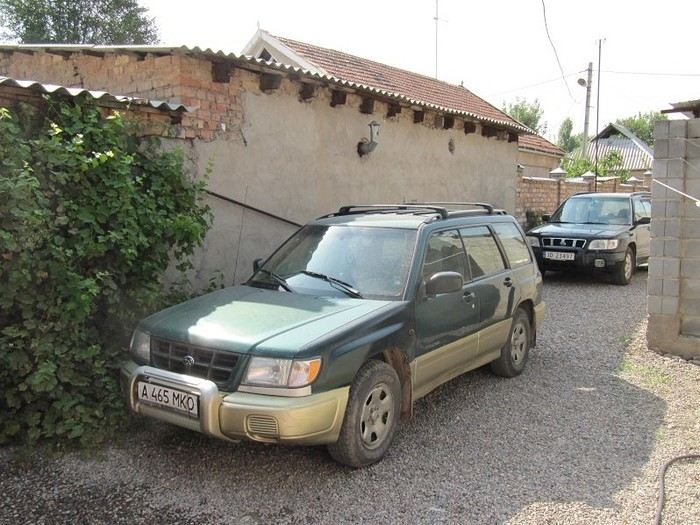
Old Foresters are rare in Kazakhstan, where big Japanese 4x4s are common, and even more so in Kyrgyzstan. At this stop, it was with a first-generation "colleague":

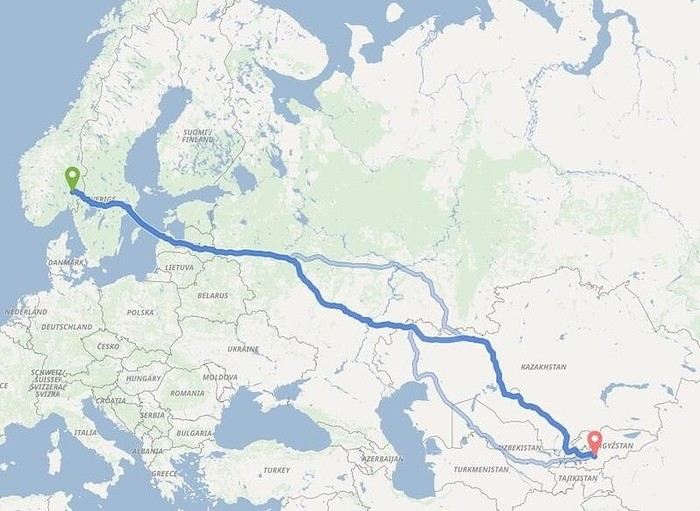
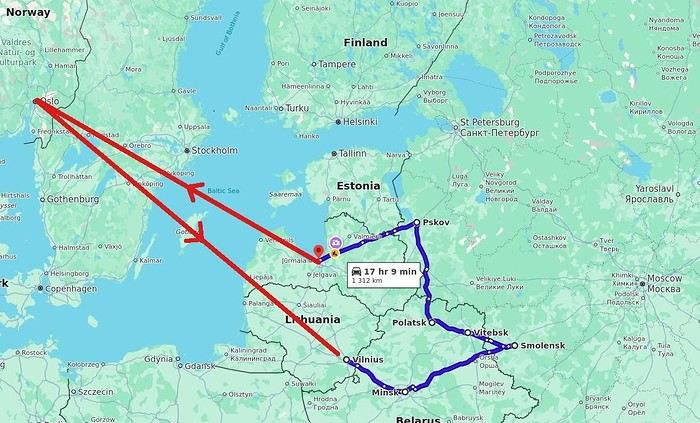
Norwegian plates because I live in Norway (since 1998), and from my place, the route to Osh is straightforward:

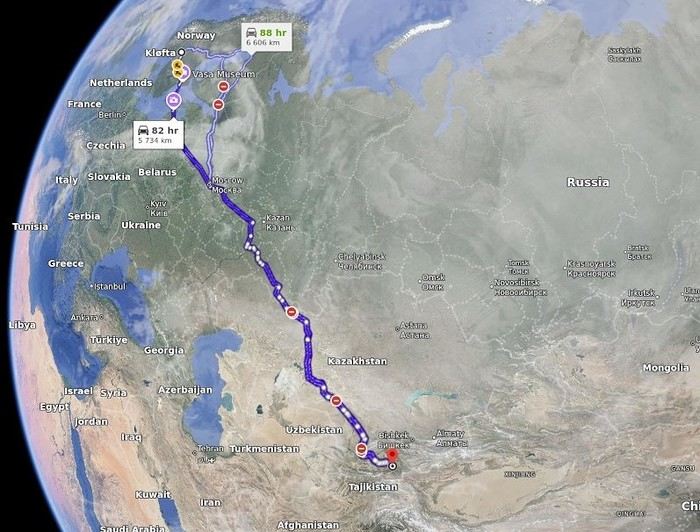
Map projections can be more or less intuitive—a rough spherical representation makes more sense:

The ferry to Stockholm, then straight on—I cross the Russian-Kazakh border between Orenburg and Aktobe. With gas three times cheaper in Russia than in the NATO zone, it’s still a reasonable deal.
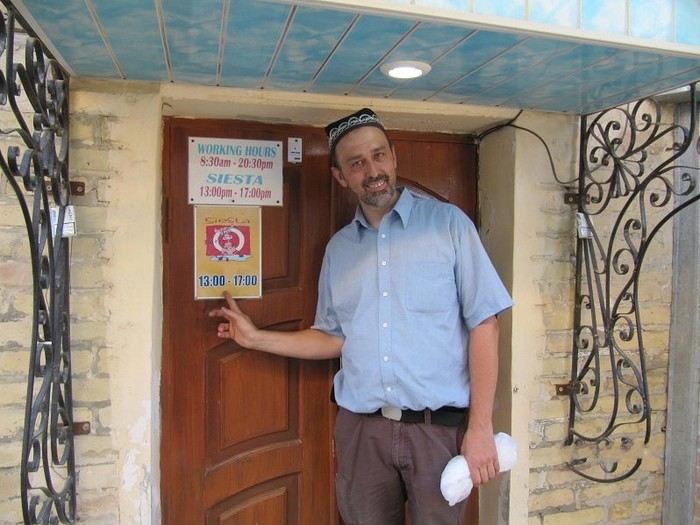
To continue on the topic of accommodation signs, here in the old town of Bukhara, a tourist hotspot if there ever was one, they’ve got English here and there, and they’re also clued into Spanish customs, as I point out on their sign (though I didn’t stay there):

So I’m lost... by Lake Kara-Kul in Tajikistan... is this a guesthouse or a homestay? 😏

The first guesthouse—or gîte, to use the French term—when you arrive at Lake Kara-Kul from the Kyrgyz border is the one called Aigerim. Over time, between washes, it’s had signs saying "guesthouse" and later "homestay." That one:

The yurt, which was recently removed, used to be there before the house. The owner, with his wife and youngest daughter, has interesting stories about this corner of the high plateau and is Kyrgyz himself:

This lakeside spot by the main road is kind of a tourist trap, given the location. Groups in big 4x4s from Osh tend to stop either in Sary-Tash or Murghab at smaller, better-equipped hostels.
You’ll recognize this—the Panj River just outside Khorog, with Afghanistan on the left bank:

Further on, past Kalai Khumb, I stayed here—no sign, just word of mouth, after asking someone at another house:

Sometimes accommodations are marked with мехмонхона/меҳмонхона, which is Tajik for the idea of a hotel, hostel, or gîte.
In Kazakhstan and Kyrgyzstan, in places off the tourist trail, you’ll often find bilingual signs. Here’s a "mini-hotel," Shougla, in Almaty, outside the city center—конал ли/гостиница:

The Forester parked out front is my car, and for the most part—not everywhere, but mostly—it handles the main roads just fine. At the Ak-Baital Pass on the way to Murghab:

Old Foresters are rare in Kazakhstan, where big Japanese 4x4s are common, and even more so in Kyrgyzstan. At this stop, it was with a first-generation "colleague":

Norwegian plates because I live in Norway (since 1998), and from my place, the route to Osh is straightforward:

Map projections can be more or less intuitive—a rough spherical representation makes more sense:

The ferry to Stockholm, then straight on—I cross the Russian-Kazakh border between Orenburg and Aktobe. With gas three times cheaper in Russia than in the NATO zone, it’s still a reasonable deal.
To continue on the topic of accommodation signs, here in the old town of Bukhara, a tourist hotspot if there ever was one, they’ve got English here and there, and they’re also clued into Spanish customs, as I point out on their sign (though I didn’t stay there):

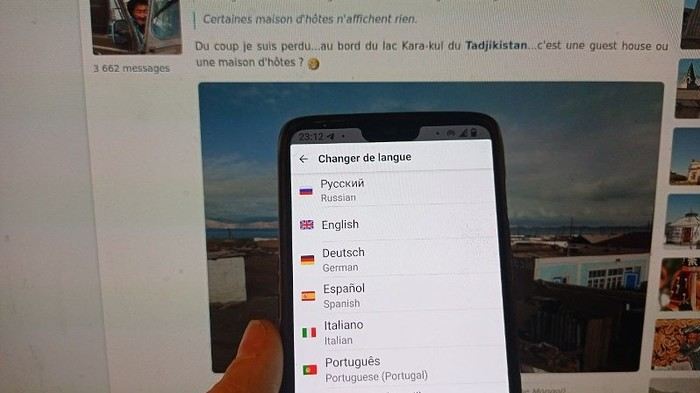
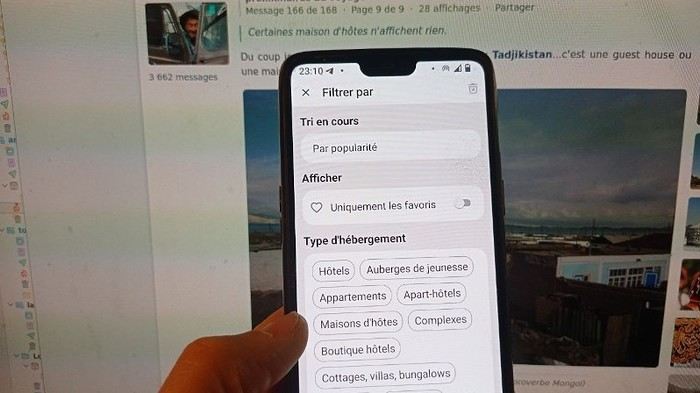
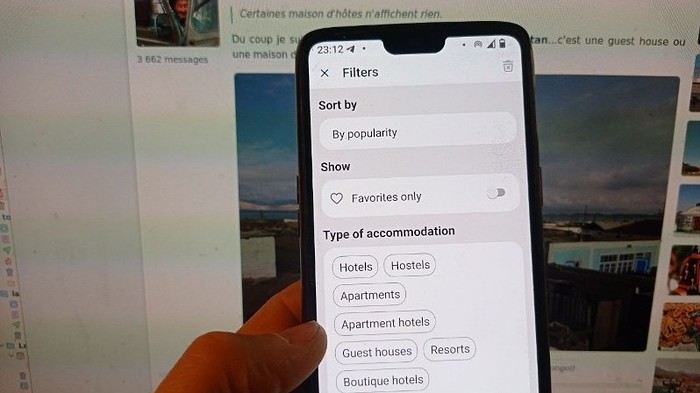
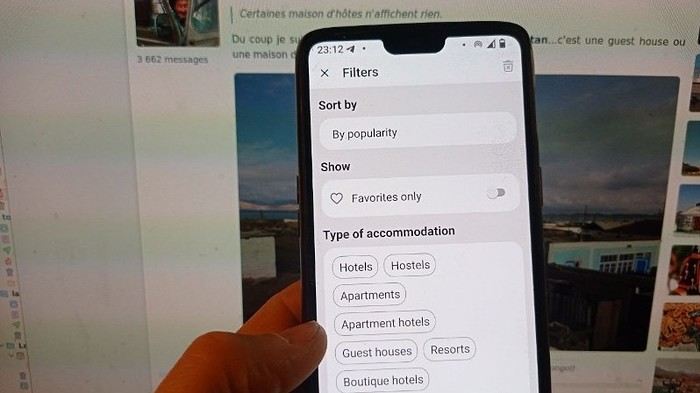
Regarding accommodation searches, Ostrovok offers several languages, and depending on the language, the appropriate names for types of accommodations.
Part of the language menu:

In French, choice of "maison d'hôtes":

In English, "guest houses":

In Norwegian, "gjestgiveri":

On the ground, the place might display юназ үй (KZ/KG), мехмонхона (TJ), отель, гостиница, гостевой дом, homestay...
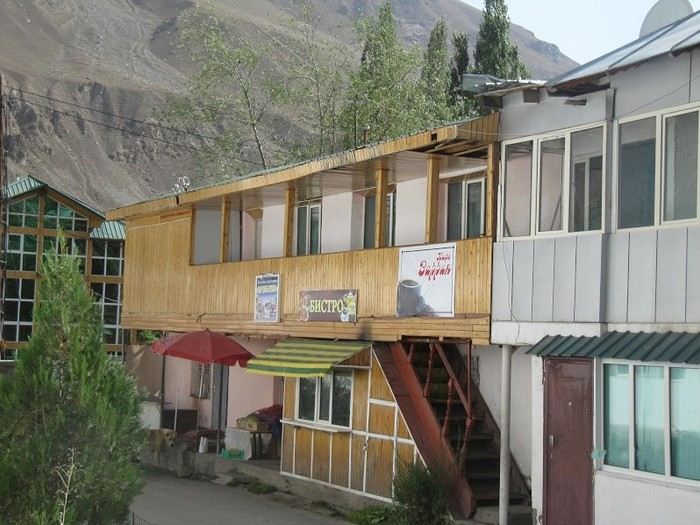
Then there are the restaurants, where "restaurant" is rare. In KG and TJ, you’ll find signs like бистро, like here in Khorog:

But generally, the terms for restaurants are something else entirely—I won’t list them all here.
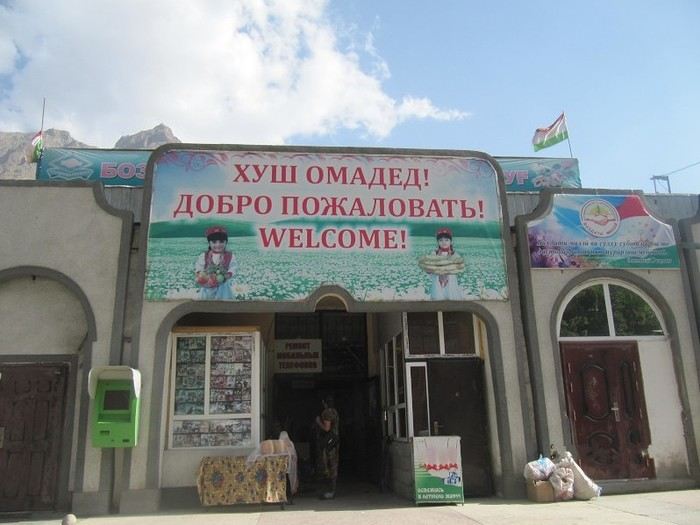
Khorog, as a must-pass through from the High Pamir to the Panj Valley, sees its share of tourism, and the local covered market welcomes visitors in three languages, including English:

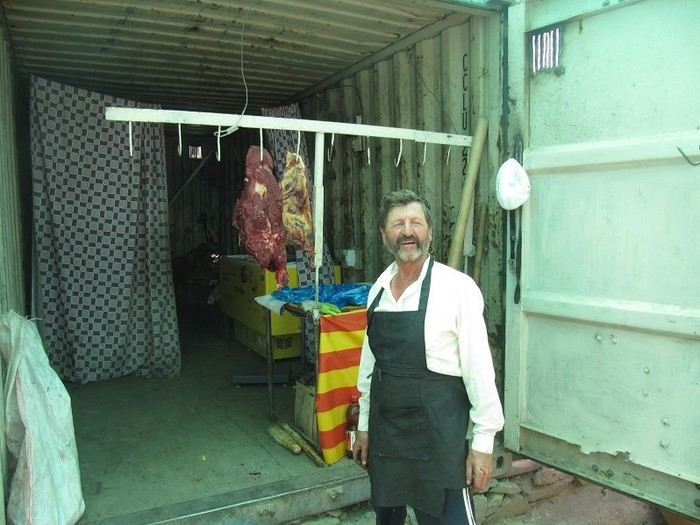
That said, here’s a butcher in the back courtyard with containers at this rynok and bazaar:

Other common businesses without signs are mechanics, like you often find in small neighborhoods and outside city centers across Eurasia, starting with Russia: auto garages.
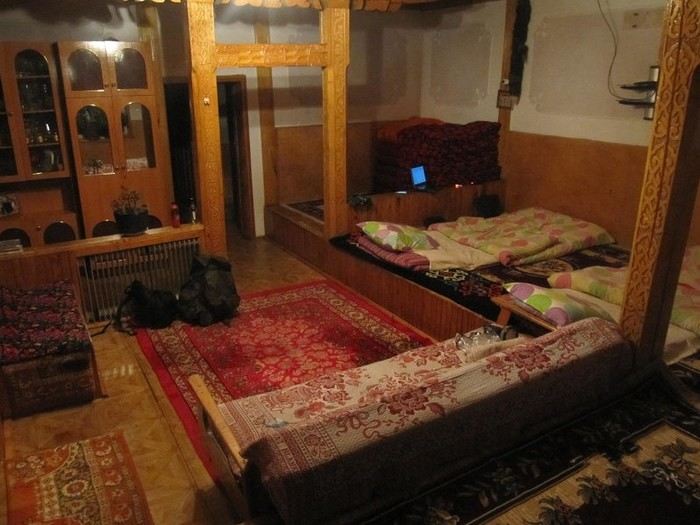
When I had a hole in my exhaust pipe after Murghab, I was looking for a mechanic in Khorog, asking a police officer in the center. He gave me an address—a house with no sign. The guy was really friendly, a great person, and after a chat, we told him we had to go to a hostel downtown for the night, since the welding on the exhaust would be done the next day. But he insisted on hosting us. The Tajiks of Badakhshan are Ismaili, and their homes are often spacious, designed to accommodate families during domestic worship, somewhat like the Druze. We were in this living room, with carpet-beds arranged along the walls around a small square space under a glass opening in the middle of the roof. It’s a bit like the principle of a yurt but in a permanent, square structure. In this photo, the opening is directly above the central carpet, with the carpet-beds arranged along the three walls—you can see a bit of the one on the right. The columns and interior wooden archway are carved with specific motifs:

Okay, there’s a lot more to mention in terms of everyday practicalities—food, houses, shops, nationalities, social life, cultural quirks—but I’ve got other things to do.
Part of the language menu:

In French, choice of "maison d'hôtes":

In English, "guest houses":

In Norwegian, "gjestgiveri":

On the ground, the place might display юназ үй (KZ/KG), мехмонхона (TJ), отель, гостиница, гостевой дом, homestay...
Then there are the restaurants, where "restaurant" is rare. In KG and TJ, you’ll find signs like бистро, like here in Khorog:

But generally, the terms for restaurants are something else entirely—I won’t list them all here.
Khorog, as a must-pass through from the High Pamir to the Panj Valley, sees its share of tourism, and the local covered market welcomes visitors in three languages, including English:

That said, here’s a butcher in the back courtyard with containers at this rynok and bazaar:

Other common businesses without signs are mechanics, like you often find in small neighborhoods and outside city centers across Eurasia, starting with Russia: auto garages.
When I had a hole in my exhaust pipe after Murghab, I was looking for a mechanic in Khorog, asking a police officer in the center. He gave me an address—a house with no sign. The guy was really friendly, a great person, and after a chat, we told him we had to go to a hostel downtown for the night, since the welding on the exhaust would be done the next day. But he insisted on hosting us. The Tajiks of Badakhshan are Ismaili, and their homes are often spacious, designed to accommodate families during domestic worship, somewhat like the Druze. We were in this living room, with carpet-beds arranged along the walls around a small square space under a glass opening in the middle of the roof. It’s a bit like the principle of a yurt but in a permanent, square structure. In this photo, the opening is directly above the central carpet, with the carpet-beds arranged along the three walls—you can see a bit of the one on the right. The columns and interior wooden archway are carved with specific motifs:

Okay, there’s a lot more to mention in terms of everyday practicalities—food, houses, shops, nationalities, social life, cultural quirks—but I’ve got other things to do.
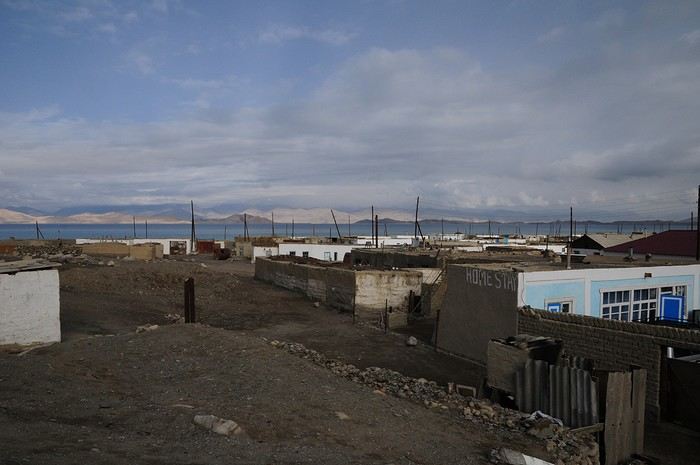
The Aigerim guesthouse in Karakul, on the right side of the road coming from the border, with its "Home stay" sign. I was a bit short of breath because we'd driven straight from Osh with only a short stop at the Kyrgyz mausoleum along the way. Crossed the border in half an hour—no one ahead of us.
Osh is between 900 and 1,000 meters in altitude, and the Kyzyl-Art border pass is around 4,300 meters, while Karakul is at about 3,900–4,000 meters.
https://youtu.be/loQiTZ-hF-w
I’m not usually too sensitive to rapid altitude gain, but still a little. The effects hit in the hours that follow—in my case, it felt like a bit of lightheadedness. My buddy Vadim, who was traveling with me, was completely wiped out by a migraine that evening and had to lie down. So people who are sensitive really shouldn’t do this route in one go.
https://youtu.be/loQiTZ-hF-w
I’m not usually too sensitive to rapid altitude gain, but still a little. The effects hit in the hours that follow—in my case, it felt like a bit of lightheadedness. My buddy Vadim, who was traveling with me, was completely wiped out by a migraine that evening and had to lie down. So people who are sensitive really shouldn’t do this route in one go.
I get the feeling something’s really bitten you...😄
La rue comme gagne-pain : concours de photos amical de septembre 2026
Rubrique Jeux Voyages
C'est le moment de poster vos meilleurs clichés !
No point going there anymore, you’ve already got all the photos! 😄
"Le véritable voyage de découverte ne consiste pas à chercher de nouveaux paysages, mais à avoir de nouveaux yeux."
Marcel Proust
that said, here’s a butcher in the back-alley container area of this rynok and bazaar:
Mmm, that beautiful meat looks so tempting! Perfect for making some good shashlik from lamb!Food’s no problem, but when it comes to lodging—what a dilemma! We’ve got mini hotels, hostels, guesthouses, B&Bs, guesthouses, yurts, and more... Sometimes it’s written in English, but also in Russian or Tajik... I’m totally lost!
Mostly ended up with photos of places I’m not going to...
Still no idea where I’ll sleep near Baetov/Jangy-Talap.
Jef’s suggestion seems a bit rough with the squat toilets in the garden... Might as well push on to Jangy-Talap, which would shorten the long leg the next day!
Same for the yurt near Song Kol... There’s everything, at every price...
Still no idea where I’ll sleep near Baetov/Jangy-Talap.
Jef’s suggestion seems a bit rough with the squat toilets in the garden... Might as well push on to Jangy-Talap, which would shorten the long leg the next day!
Same for the yurt near Song Kol... There’s everything, at every price...
La rue comme gagne-pain : concours de photos amical de septembre 2026
Rubrique Jeux Voyages
C'est le moment de poster vos meilleurs clichés !
War in the Middle East: should you cancel your trip planned in an area affected by the conflict?
https://www.ledauphine.com/economie/2026/03/14/guerre-au-moyen-orient-faut-il-annuler-son-voyage-prevu-dans-une-zone-affectee-par-le-conflit
I can put together an itinerary a thousand times more beautiful than the one planned in Kyrgyzstan... and with restaurant "spots" much closer to your criteria 😏😏
Qui boit l'eau d'une terre étrangère doit en suivre les coutumes (proverbe Mongol)
Hi,
Text
War in the Middle East: Should you cancel your trip planned in an area affected by the conflict? https://www.ledauphine.com/economie/2026/03/14/guerre-au-moyen-orient-faut-il-annuler-son-voyage-prevu-dans-une-zone-affectee-par-le-conflit
I can put together an itinerary a thousand times more beautiful than the one you planned in Kyrgyzstan... and with restaurant "spots" much closer to your criteria 😏😏
That’s exactly what I’m thinking. After seeing my Iranian trip disappear—again—and the discussion that came with it thanks to the chronic excitement of a few people, I’m not exactly thrilled about a ballistic Iranian or Israeli-Iranian detour to get to Kyrgyzstan. Some Alpine peaks will replace Lenin Peak.
Catherine
Text
War in the Middle East: Should you cancel your trip planned in an area affected by the conflict? https://www.ledauphine.com/economie/2026/03/14/guerre-au-moyen-orient-faut-il-annuler-son-voyage-prevu-dans-une-zone-affectee-par-le-conflit
I can put together an itinerary a thousand times more beautiful than the one you planned in Kyrgyzstan... and with restaurant "spots" much closer to your criteria 😏😏
That’s exactly what I’m thinking. After seeing my Iranian trip disappear—again—and the discussion that came with it thanks to the chronic excitement of a few people, I’m not exactly thrilled about a ballistic Iranian or Israeli-Iranian detour to get to Kyrgyzstan. Some Alpine peaks will replace Lenin Peak.
Catherine
By this, and this only, we have existed. Which is not to be found in our obituaries. (T.S. Eliot)
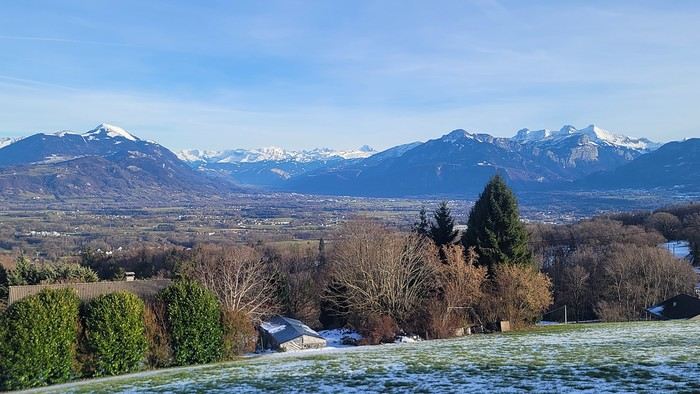
A little view from my place... not too shabby...😉 and I provide lodging, meals, and outings...😏


Qui boit l'eau d'une terre étrangère doit en suivre les coutumes (proverbe Mongol)
yeah...but you leave the truck....😏
Qui boit l'eau d'une terre étrangère doit en suivre les coutumes (proverbe Mongol)
I’ll bring dessert and a bottle of Faugeres 😛
Mes photos sur Flickr:
https://www.flickr.com/photos/153304262@N05/albums
"Le Temps nous égare. Le Temps nous étreint. Le Temps nous est gare. Le Temps nous est train".
There are still 2,140 kilometers between Tehran and Bishkek.
In the area, it's more Vladimir who gives me the creeps...
We'll see later if Turkey is affected since that's the route I'm taking.
La rue comme gagne-pain : concours de photos amical de septembre 2026
Rubrique Jeux Voyages
C'est le moment de poster vos meilleurs clichés !
Missiles will run out.
Not drones and other low-cost weapons, but they don’t go as far...
It’s crazy how dictators always find money to destroy both the world and their own people. If they put that much energy into humanitarian projects, Earth might be a Garden of Eden—minus the religious fanfare and the dreary vibe.
Not drones and other low-cost weapons, but they don’t go as far...
It’s crazy how dictators always find money to destroy both the world and their own people. If they put that much energy into humanitarian projects, Earth might be a Garden of Eden—minus the religious fanfare and the dreary vibe.
La rue comme gagne-pain : concours de photos amical de septembre 2026
Rubrique Jeux Voyages
C'est le moment de poster vos meilleurs clichés !
Challenge accepted! 😉
Qui boit l'eau d'une terre étrangère doit en suivre les coutumes (proverbe Mongol)
I’m really not thrilled about a ballistic Iranian or Israeli-Iranian meet-up to get to Kyrgyzstan.
This reminds me of 1988, just before the end of the war, when an American ship was sent to the Strait of Hormuz to secure the oil tankers of the Gulf’s "friends," who, of course, aren’t Islamic theocracies with veiled women. And they shot down an Iranian Airbus A300 heading to Dubai, claiming it was a small Iranian F-14 fighter jet. The Airbus was full of little kids, and the Iranians weren’t happy. So the other day, after the Americans fired a missile at the Shiite leader and another at a school full of little kids during negotiations in Geneva, the memory of 1988 came flooding back to the Persians.
Flights to Bishkek from Western Europe go either through Russia and Kazakhstan or through Turkey, another hub for Central Asia, and then over Russia, the Caspian Sea, and Uzbekistan. Well north of Iran.
Back in the 1240s, John of Plano Carpini left Lyon for southern Germany, met Russians in Poland who took him to Kiev—and he doesn’t mention any Ukraine, since it didn’t exist yet—and from there to the lower Volga, where the western capital of the Mongols and Tatars, Sarai, was located near Volgograd. The Russians came there to pledge allegiance. He then continued north of the Caspian Sea to the Aral Sea, followed the Syr Darya through Kazakhstan, and entered Mongolia via the southern Altai.
Plano Carpini, one of the first buddies of St. Francis of Assisi, was an ambassador for Innocent IV, who gave him two letters: one for Alexander Nevsky, asking him to submit to the Papacy (which the Russians took very badly, since the Carolingian Catholics had besieged Constantinople in 1204, carved up the Roman Empire, and were exterminating the Prussians while eyeing Pskov and Novgorod). The Germans’ kindness made the Russians prefer to ally with the Mongols. The other letter was for the Great Khan in Karakorum, asking him to convert. You can imagine the Mongols’ reaction in their capital.
In the 1250s, William of Rubruck went south to Constantinople and took a ship to Feodosia in Crimea, where he didn’t mention any Ukrainians since there weren’t any. From there, he followed the Don River with the Russians, crossed the steppe to Sarai, and more or less took the same route as Plano Carpini.
Plano Carpini and Rubruck didn’t cross the Kyrgyz valleys—they skirted the mountains to the north. But what beautiful journeys they were.
It was Marco Polo who went through the Levant, Anatolia, Iran, and then up through the Pamir, leaving Kyrgyzstan to the north of his route. There’s a roadside restaurant in the Pamir with a Marco Polo sign, but he wasn’t there when the Venetian passed by.
This reminds me of 1988, just before the end of the war, when an American ship was sent to the Strait of Hormuz to secure the oil tankers of the Gulf’s "friends," who, of course, aren’t Islamic theocracies with veiled women. And they shot down an Iranian Airbus A300 heading to Dubai, claiming it was a small Iranian F-14 fighter jet. The Airbus was full of little kids, and the Iranians weren’t happy. So the other day, after the Americans fired a missile at the Shiite leader and another at a school full of little kids during negotiations in Geneva, the memory of 1988 came flooding back to the Persians.
Flights to Bishkek from Western Europe go either through Russia and Kazakhstan or through Turkey, another hub for Central Asia, and then over Russia, the Caspian Sea, and Uzbekistan. Well north of Iran.
Back in the 1240s, John of Plano Carpini left Lyon for southern Germany, met Russians in Poland who took him to Kiev—and he doesn’t mention any Ukraine, since it didn’t exist yet—and from there to the lower Volga, where the western capital of the Mongols and Tatars, Sarai, was located near Volgograd. The Russians came there to pledge allegiance. He then continued north of the Caspian Sea to the Aral Sea, followed the Syr Darya through Kazakhstan, and entered Mongolia via the southern Altai.
Plano Carpini, one of the first buddies of St. Francis of Assisi, was an ambassador for Innocent IV, who gave him two letters: one for Alexander Nevsky, asking him to submit to the Papacy (which the Russians took very badly, since the Carolingian Catholics had besieged Constantinople in 1204, carved up the Roman Empire, and were exterminating the Prussians while eyeing Pskov and Novgorod). The Germans’ kindness made the Russians prefer to ally with the Mongols. The other letter was for the Great Khan in Karakorum, asking him to convert. You can imagine the Mongols’ reaction in their capital.
In the 1250s, William of Rubruck went south to Constantinople and took a ship to Feodosia in Crimea, where he didn’t mention any Ukrainians since there weren’t any. From there, he followed the Don River with the Russians, crossed the steppe to Sarai, and more or less took the same route as Plano Carpini.
Plano Carpini and Rubruck didn’t cross the Kyrgyz valleys—they skirted the mountains to the north. But what beautiful journeys they were.
It was Marco Polo who went through the Levant, Anatolia, Iran, and then up through the Pamir, leaving Kyrgyzstan to the north of his route. There’s a roadside restaurant in the Pamir with a Marco Polo sign, but he wasn’t there when the Venetian passed by.
Hi Catherine and everyone else,
Turkish Airlines flights to Manas Bishkek follow the same route—Georgia, Azerbaijan, Kazakhstan, Uzbekistan—as most European or Turkish airlines heading to Asia. If there’s a risk in taking Turkish Airlines to Bishkek, there’s the same risk in taking Air France to Hong Kong or ANA to Tokyo.
Michel
Turkish Airlines flights to Manas Bishkek follow the same route—Georgia, Azerbaijan, Kazakhstan, Uzbekistan—as most European or Turkish airlines heading to Asia. If there’s a risk in taking Turkish Airlines to Bishkek, there’s the same risk in taking Air France to Hong Kong or ANA to Tokyo.
Michel
Yes.
Except that the Iranian dictatorship is in a tight spot and is trying to drag all the countries in the region, including Turkey, into the mix to put pressure on Trump.
Erdogan is also feeling the heat a bit—voters are turning away from him and his increasingly dictatorial party.
In short, when everyone’s trying to secure their power and wealth, no one can predict what might happen in the end.
On the other hand, China doesn’t really want the global economy to collapse or its own economy to go down the drain. A impoverished population is one that could revolt...
So, I’m pretty optimistic about this trip going ahead.
Much less so about the fate of Iranians at the hands of the revolution’s bloodthirsty regime.
Erdogan is also feeling the heat a bit—voters are turning away from him and his increasingly dictatorial party.
In short, when everyone’s trying to secure their power and wealth, no one can predict what might happen in the end.
On the other hand, China doesn’t really want the global economy to collapse or its own economy to go down the drain. A impoverished population is one that could revolt...
So, I’m pretty optimistic about this trip going ahead.
Much less so about the fate of Iranians at the hands of the revolution’s bloodthirsty regime.
La rue comme gagne-pain : concours de photos amical de septembre 2026
Rubrique Jeux Voyages
C'est le moment de poster vos meilleurs clichés !
Hi there,
Maybe it’s wiser to head back to Southern Africa 😄
So, I'm pretty optimistic about how this trip will turn out.
So, how's it looking?
"Le véritable voyage de découverte ne consiste pas à chercher de nouveaux paysages, mais à avoir de nouveaux yeux."
Marcel Proust
So, is Kyrgyzstan still on the itinerary? 😉
La rue comme gagne-pain : concours de photos amical de septembre 2026
Rubrique Jeux Voyages
C'est le moment de poster vos meilleurs clichés !
Cool! A travel journal to come 😄
"Le véritable voyage de découverte ne consiste pas à chercher de nouveaux paysages, mais à avoir de nouveaux yeux."
Marcel Proust
If she comes back...😇
Qui boit l'eau d'une terre étrangère doit en suivre les coutumes (proverbe Mongol)
If it happens...
The main issue is still the flight.
La rue comme gagne-pain : concours de photos amical de septembre 2026
Rubrique Jeux Voyages
C'est le moment de poster vos meilleurs clichés !
CS
www.lescs.fr
www.lescs.fr
There’s so much to see along the southern route.
Watch out—this road is currently under construction almost the whole way.
The Chinese went all out: a four-lane highway!
To build it, they tore up nearly all the existing pavement for 180 kilometers...
Basically, right now it’s a dirt track with construction everywhere...😏
That said, the landscapes are still gorgeous! ;)
Watch out—this road is currently under construction almost the whole way.
The Chinese went all out: a four-lane highway!
To build it, they tore up nearly all the existing pavement for 180 kilometers...
Basically, right now it’s a dirt track with construction everywhere...😏
That said, the landscapes are still gorgeous! ;)
La rue comme gagne-pain : concours de photos amical de septembre 2026
Rubrique Jeux Voyages
C'est le moment de poster vos meilleurs clichés !
I can confirm that the word "guesthouse" is prominently displayed in Kyrgyz towns and villages.
As for the food, I take back part of what I said! Only one bad meal so far. At a guesthouse. Greasy rice is definitely not my thing!
The mutton is actually lamb, and in a stew with potatoes—delicious!
Breakfast, on the other hand, isn’t great...
Good thing I brought ground coffee, a filter, and a filter holder...
Coffee isn’t really their thing, like in many countries!
(Who’s the idiot who invented Nescafé? )
As for the food, I take back part of what I said! Only one bad meal so far. At a guesthouse. Greasy rice is definitely not my thing!
The mutton is actually lamb, and in a stew with potatoes—delicious!
Breakfast, on the other hand, isn’t great...
Good thing I brought ground coffee, a filter, and a filter holder...
Coffee isn’t really their thing, like in many countries!
(Who’s the idiot who invented Nescafé? )
La rue comme gagne-pain : concours de photos amical de septembre 2026
Rubrique Jeux Voyages
C'est le moment de poster vos meilleurs clichés !
This is utter nonsense to ruin the whole road instead of doing it 10 kilometers at a time...🤪
And I don’t really see the point of a four-lane highway.😮 It’s busy but flows really well.
Good thing I didn’t plan a direct leg all the way to Karakol from Chon-Kemin!😄
And I don’t really see the point of a four-lane highway.😮 It’s busy but flows really well.
Good thing I didn’t plan a direct leg all the way to Karakol from Chon-Kemin!😄
La rue comme gagne-pain : concours de photos amical de septembre 2026
Rubrique Jeux Voyages
C'est le moment de poster vos meilleurs clichés !
And I’m glad I brought ground coffee, a filter, and a filter holder!
It’s not their thing in many countries!
(Who’s the idiot who invented Nescafé?)
Not even a little Nespresso machine sometimes?
A live travel journal is pretty cool too!!
Not even a little Nespresso machine sometimes?
A live travel journal is pretty cool too!!
"Le véritable voyage de découverte ne consiste pas à chercher de nouveaux paysages, mais à avoir de nouveaux yeux."
Marcel Proust
Okay, that’s enough of that...
Tell us about the weather—hot with thunderstorms and rain 😏
Qui boit l'eau d'une terre étrangère doit en suivre les coutumes (proverbe Mongol)
Log in first, then come back to this page.
You might also like
More discussions
Hi everyone,
We’ve got our tickets for Mongolia in August 2027 (yes, booking way ahead saves money...).
We’re looking for contacts at a reliable local agency that could help us organize our trip, preferably with a French-speaking contact. First, we’d like to see what’s possible to do in 2 weeks, at what price, knowing we’d like to visit at least the Gobi Desert and Terejii National Park.
On one hand, we want to be independent for some things (accommodation in Ulaanbaatar, for example), but have support for the rest (domestic flights, driver, visits, transfers, etc.). If you’ve already traveled with an agency that exceeded your expectations, I’d love to get their details. Thanks a bunch!
Hello!
We headed to Uzbekistan at the end of February 2026. The main goal of the trip was to explore the mountains on skis, but of course, we did some backpacking along the way too!
For skiing, we checked out two spots: first, the Chimgan and Amirsoy region. The infrastructure is brand new (hotels, ski lifts, restaurants). We managed some great tours, especially in Amirsoy, where the gondola gave us a real boost and let us go even further.
Next, we moved on to Gilan, just a stone’s throw from the Tajik border. The scenery was completely different—wild and rugged. We stayed in a super cozy little guesthouse, learned how to make Plov, and ate like kings. Despite the unpredictable weather, we had amazing ski tours. The villagers got a kick out of seeing us walk around with our skis on our shoulders—it’s probably not something they see every day!
After our skiing buddies headed home, we explored Khiva, Moynaq, Bukhara, Samarkand, and Tashkent before flying back.
As usual, we didn’t plan anything in advance, and traveling off-season was definitely the way to go. There was plenty of space everywhere. We traveled by train (except for Moynaq). It’s super easy—you buy tickets through the app, and you don’t even need to print them.
I couldn’t figure out how to post the links to the three videos I made from this trip, but you can find my channel in my profile. Have a look around! ;-)
If you’ve got any questions, feel free to reach out—I’d be happy to answer as best as I can!
For skiing, we checked out two spots: first, the Chimgan and Amirsoy region. The infrastructure is brand new (hotels, ski lifts, restaurants). We managed some great tours, especially in Amirsoy, where the gondola gave us a real boost and let us go even further.
Next, we moved on to Gilan, just a stone’s throw from the Tajik border. The scenery was completely different—wild and rugged. We stayed in a super cozy little guesthouse, learned how to make Plov, and ate like kings. Despite the unpredictable weather, we had amazing ski tours. The villagers got a kick out of seeing us walk around with our skis on our shoulders—it’s probably not something they see every day!
After our skiing buddies headed home, we explored Khiva, Moynaq, Bukhara, Samarkand, and Tashkent before flying back.
As usual, we didn’t plan anything in advance, and traveling off-season was definitely the way to go. There was plenty of space everywhere. We traveled by train (except for Moynaq). It’s super easy—you buy tickets through the app, and you don’t even need to print them.
I couldn’t figure out how to post the links to the three videos I made from this trip, but you can find my channel in my profile. Have a look around! ;-)
If you’ve got any questions, feel free to reach out—I’d be happy to answer as best as I can!
Recent information about this country is scarce, so I’m starting this post in addition to my travel journal to help fill the gap.
- Which airline from Europe?
Turkish Airlines seems like an excellent option. The price is very reasonable (just over 500 €), the layover isn’t too long, the in-flight comfort is decent (great movie selection), and the planes are modern. Plus, the price automatically includes 30 kilos of luggage, which is perfect for campers.
The downside: the outrageous prices at Istanbul Airport.
- Bishkek Airport
The airport is under full reconstruction. It’s chaotic. There are SIM card vendors upon arrival, but no currency exchange or ATMs in the baggage claim area. You’ll find those in the departures section, which means you have to exit and re-enter under the current setup.
Personally, I pre-booked a VTC with my hotel for the transfer to the city. (Prices vary depending on the hotel’s standard—1200 soms for mine.)
There are taxis and a bus available.
- Entry Requirements
No visa is required for French citizens for stays of up to 30 days.
- Currency
The currency is the som, and the conversion is easy—just divide by 100...
You can get soms by exchanging euros (dollars are useless) or by withdrawing from an ATM. Some ATMs charge fees. Those from Mbank and Optimabank are fee-free.
The maximum withdrawal is usually 20,000 soms.
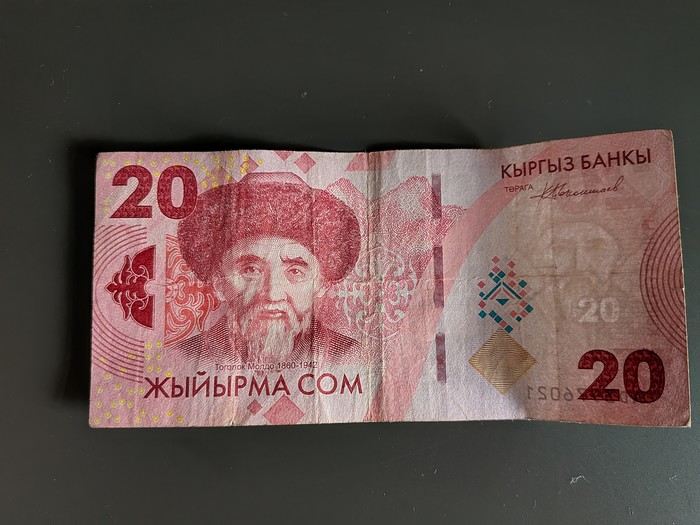
Bills come in 5000, 1000, 500, 200, 100, 50, and 20 soms.
Coins: 10, 5, 3, and 1 som.
- Paying
Card payments are accepted in supermarkets like Globus, some restaurants, gas stations of major chains (Bishkek Petroleum, Partner Neft, Red Petroleum), some hotels, national park entrances, tolls, etc.
But it doesn’t always work.
So always carry cash with you!
If the card works, great—otherwise, it’s back to the old days of wads of bills.
- Cost of Living
It’s really cheap (gas, affordable restaurants even at a decent standard, hotels, souvenirs, fruits, vegetables, water, bread...). For example, a lagman costs only 3.20 €, fixing a flat tire is 3.5 €, a full hour-long wash for a filthy 4x4 is 6 €, washing a big bag of laundry is 3 €, and a liter of 95-octane gas is 0.86 €...
On the pricier side: guesthouses and meals in guesthouses. The value for money is poor. I paid 40 € for a mediocre room with a very basic shared bathroom, while a double with AC, private bathroom, and fridge in a non-touristy hotel cost 20 €... Meals in guesthouses are the worst I’ve eaten and often the most expensive. Plus, they’re very light—don’t expect to fill up after a long day of hiking!
Car rentals are also quite expensive (70 $ per day for a RAV4 in my case).
In short, for two people, excluding accommodation and car rental, we spent an average of 45 € per day (groceries, restaurants, guesthouse dinners, souvenirs, paid activities, gas).
The trip cost us 2200 € per person all-inclusive for 3 weeks on the ground. Roughly 1/4 for the flight, 1/4 for the car, 1/4 for accommodation, and 1/4 for everything else.
- Getting Around
I’ve met cyclists, motorcyclists, people renting cars, those who drove their own vehicles from Europe, and others using public transport and taxis.
Personally, I chose to rent a car.
If you’re not planning long hikes or multi-day horse treks, it’s a great option for exploring the country.
Each car rental company has its own list of forbidden tracks. Make sure your planned route is allowed! Don’t think about ignoring this—vehicles are equipped with GPS trackers...
An international driver’s permit is required.
Police and speed cameras are everywhere, so it’s best to respect the signs (daytime running lights, seatbelts, 40-60 km/h in populated areas, 90 km/h on roads, zero tolerance for alcohol).
Locals have a unique driving style, and it can be dangerous on main roads (they overtake recklessly...). Like in Greece, South Africa, or Malta, a two-lane road is treated as a three-lane one. You pull over to let others pass or to let oncoming traffic overtake.
Without a car (at least a pseudo-4x4), you won’t be able to go everywhere. This country is a nature destination, but nature isn’t always accessible by public transport.
If a spot is near a road, great—the bus will get you almost to the door. Otherwise, you’ll need to hire an agency or take a taxi.
Cyclists will face steep climbs and dust. I’d advise avoiding main roads as much as possible—traffic isn’t on your side...
Motorcyclists will also eat a lot of dust and should research gas stations along their route (this advice also applies to vehicles running on 95-octane).
There’s a 95-octane pump in Kazarman and Gulcha.
Bikes and motorcycles have an advantage over cars, even 4x4s, as they can access some very remote tracks that other vehicles can’t (hikers and horses can obviously take them too!).
Be careful: some areas require a permit (border zones). Research this well in advance—the formalities don’t take an hour or even a day!
Be warned: Google Maps is completely unreliable (it shows roads that don’t exist, routes you through difficult tracks instead of paved roads, etc.). It’s essential to download Maps.me in advance. This app is much more reliable for this country, works offline, and is handy for hiking navigation.
A reminder: horseback riding is like cycling... If you’re not used to it or naturally padded in the right places, your backside will suffer in no time!
Think carefully before embarking on a multi-day trek!
Finally, this country is a kingdom of construction... The Chinese have taken over the market to improve truck circulation and are paving everywhere. (Good news: the Kazarman-Osh section via the tunnel is finally open in summer, even if the road isn’t quite finished.)
- Eating
I had prejudices about Kyrgyz food.
I was both wrong and right.
Supermarkets don’t offer much that’s appealing for picnics. It’s cheap, filling food, full of junk, and not gourmet. If you follow Yuka, I think you’ll be on a diet the whole trip. Bringing some pâté, sausages, or freeze-dried meals for certain nights is a good idea...
Guesthouse dinners consist of the eternal cucumber-tomato salad, a soup, and a light noodle or rice dish where you’ll be searching for the meat... Usually tough and unidentifiable. Beef? The bread is stale, and there’s no dessert or fruit.
Breakfasts always revolve around eggs or porridge... The homemade jam is usually good.
Tea is the number one drink, followed by kompot (a fruit-based drink), Coke, and Fanta.
If you want real coffee, bring your own—it’s very rare.
On the other hand, you eat well in restaurants. Lagman (homemade noodles, vegetables, spices, and usually beef), crispy eggplant, kuurdak (a kind of lamb stew with potatoes), kebabs, plov (pilaf rice with onions, carrots, and meat), and rainbow trout... For dessert? Nada!
And alcohol?
It’s available in all Globus stores: beer, wine, spirits, and you can consume your purchases in some guesthouses (depending on the owner’s religious tolerance). It’s also available in some restaurants (Bishkek, Karakol, Osh...).
The deadly specialty?
White fermented milk balls called kurut. If you think a raw-milk camembert is strong, steer clear! This is more like an old, dry, spicy goat cheese.
- Accommodation
In remote areas, it’s better to check availability on Booking a few days in advance rather than showing up last minute with high hopes.
Booking and Airbnb only offer a small portion of what’s available.
Not necessarily guesthouses, but mostly accommodations aimed at locals (business or leisure travel).
These places are generally more comfortable. There’s even some upscale options.
So it’s necessary to scour Google Maps or Yandex Maps... These accommodations are usually found on Instagram, and WhatsApp is handy for booking!
Prices are a bit of a lottery. So is the comfort. From 20 to 80 € for a double, usually with a private bathroom. (Average around 40 €). These rates are for mid-range options.
Otherwise, this country is a paradise for wild camping. In a camper van, rooftop tent, or ground tent... There are beautiful spots everywhere!
- Climate
I thought it would be quite cool/cold at altitude.
I packed too many warm clothes...
If you’re not doing high-altitude treks or sleeping in a tent, there’s no need to overload yourself with winter gear.
A good fleece, a windproof rain jacket, and technical base layers will be enough.
It only got really cold in the evenings at Song Kul Lake and Tash Rabat, and the yurts are equipped with thick blankets and a stove.
Elsewhere, temperatures ranged from 15 to 30 °C.
In short, I used the AC more than the heater! (It’s hard to drive with the windows open unless you want to be covered in dust in no time...)
- Communication
I bought an eSIM before the trip with a data plan for Kyrgyzstan (Beeline network). Perfect for communicating via WhatsApp right after landing, but this network isn’t the best in Kyrgyzstan.
We then got a physical SIM card with an unlimited one-month plan (less than 4 € including the SIM) at a Mega store downtown. This network is much better, and you get coverage in all cities and most villages. Usually in the mountain passes too.
To make yourself understood, it’s essential to download Google Translate with French, Kyrgyz, Russian, and English options.
Very useful for translating menus, signs, and communicating with locals.
Hosts and other tourism professionals will even pull out their phones to communicate with non-Russian speakers.
The police too...
- Religion
There’s a noticeable difference between the north and the southwest of the country.
In the north, it’s a bit like Albania. People are Muslim by culture but not really by religion.
In the southwest, radical Islam is growing. Mosques are more numerous and imposing. Men are more bearded, women more veiled.
For travelers, religion isn’t an issue except for the near-total absence of pork.
There’s Russian sausage, but reading the ingredient list, it’s more like a one-way ticket to cancer than an Auvergne dry sausage...
You can find the detailed account of the trip here.
- Which airline from Europe?
Turkish Airlines seems like an excellent option. The price is very reasonable (just over 500 €), the layover isn’t too long, the in-flight comfort is decent (great movie selection), and the planes are modern. Plus, the price automatically includes 30 kilos of luggage, which is perfect for campers.
The downside: the outrageous prices at Istanbul Airport.
- Bishkek Airport
The airport is under full reconstruction. It’s chaotic. There are SIM card vendors upon arrival, but no currency exchange or ATMs in the baggage claim area. You’ll find those in the departures section, which means you have to exit and re-enter under the current setup.
Personally, I pre-booked a VTC with my hotel for the transfer to the city. (Prices vary depending on the hotel’s standard—1200 soms for mine.)
There are taxis and a bus available.
- Entry Requirements
No visa is required for French citizens for stays of up to 30 days.
- Currency
The currency is the som, and the conversion is easy—just divide by 100...
You can get soms by exchanging euros (dollars are useless) or by withdrawing from an ATM. Some ATMs charge fees. Those from Mbank and Optimabank are fee-free.
The maximum withdrawal is usually 20,000 soms.
Bills come in 5000, 1000, 500, 200, 100, 50, and 20 soms.
Coins: 10, 5, 3, and 1 som.
- Paying
Card payments are accepted in supermarkets like Globus, some restaurants, gas stations of major chains (Bishkek Petroleum, Partner Neft, Red Petroleum), some hotels, national park entrances, tolls, etc.
But it doesn’t always work.
So always carry cash with you!
If the card works, great—otherwise, it’s back to the old days of wads of bills.
- Cost of Living
It’s really cheap (gas, affordable restaurants even at a decent standard, hotels, souvenirs, fruits, vegetables, water, bread...). For example, a lagman costs only 3.20 €, fixing a flat tire is 3.5 €, a full hour-long wash for a filthy 4x4 is 6 €, washing a big bag of laundry is 3 €, and a liter of 95-octane gas is 0.86 €...
On the pricier side: guesthouses and meals in guesthouses. The value for money is poor. I paid 40 € for a mediocre room with a very basic shared bathroom, while a double with AC, private bathroom, and fridge in a non-touristy hotel cost 20 €... Meals in guesthouses are the worst I’ve eaten and often the most expensive. Plus, they’re very light—don’t expect to fill up after a long day of hiking!
Car rentals are also quite expensive (70 $ per day for a RAV4 in my case).
In short, for two people, excluding accommodation and car rental, we spent an average of 45 € per day (groceries, restaurants, guesthouse dinners, souvenirs, paid activities, gas).
The trip cost us 2200 € per person all-inclusive for 3 weeks on the ground. Roughly 1/4 for the flight, 1/4 for the car, 1/4 for accommodation, and 1/4 for everything else.
- Getting Around
I’ve met cyclists, motorcyclists, people renting cars, those who drove their own vehicles from Europe, and others using public transport and taxis.
Personally, I chose to rent a car.
If you’re not planning long hikes or multi-day horse treks, it’s a great option for exploring the country.
Each car rental company has its own list of forbidden tracks. Make sure your planned route is allowed! Don’t think about ignoring this—vehicles are equipped with GPS trackers...
An international driver’s permit is required.
Police and speed cameras are everywhere, so it’s best to respect the signs (daytime running lights, seatbelts, 40-60 km/h in populated areas, 90 km/h on roads, zero tolerance for alcohol).
Locals have a unique driving style, and it can be dangerous on main roads (they overtake recklessly...). Like in Greece, South Africa, or Malta, a two-lane road is treated as a three-lane one. You pull over to let others pass or to let oncoming traffic overtake.
Without a car (at least a pseudo-4x4), you won’t be able to go everywhere. This country is a nature destination, but nature isn’t always accessible by public transport.
If a spot is near a road, great—the bus will get you almost to the door. Otherwise, you’ll need to hire an agency or take a taxi.
Cyclists will face steep climbs and dust. I’d advise avoiding main roads as much as possible—traffic isn’t on your side...
Motorcyclists will also eat a lot of dust and should research gas stations along their route (this advice also applies to vehicles running on 95-octane).
There’s a 95-octane pump in Kazarman and Gulcha.
Bikes and motorcycles have an advantage over cars, even 4x4s, as they can access some very remote tracks that other vehicles can’t (hikers and horses can obviously take them too!).
Be careful: some areas require a permit (border zones). Research this well in advance—the formalities don’t take an hour or even a day!
Be warned: Google Maps is completely unreliable (it shows roads that don’t exist, routes you through difficult tracks instead of paved roads, etc.). It’s essential to download Maps.me in advance. This app is much more reliable for this country, works offline, and is handy for hiking navigation.
A reminder: horseback riding is like cycling... If you’re not used to it or naturally padded in the right places, your backside will suffer in no time!
Think carefully before embarking on a multi-day trek!
Finally, this country is a kingdom of construction... The Chinese have taken over the market to improve truck circulation and are paving everywhere. (Good news: the Kazarman-Osh section via the tunnel is finally open in summer, even if the road isn’t quite finished.)
- Eating
I had prejudices about Kyrgyz food.
I was both wrong and right.
Supermarkets don’t offer much that’s appealing for picnics. It’s cheap, filling food, full of junk, and not gourmet. If you follow Yuka, I think you’ll be on a diet the whole trip. Bringing some pâté, sausages, or freeze-dried meals for certain nights is a good idea...
Guesthouse dinners consist of the eternal cucumber-tomato salad, a soup, and a light noodle or rice dish where you’ll be searching for the meat... Usually tough and unidentifiable. Beef? The bread is stale, and there’s no dessert or fruit.
Breakfasts always revolve around eggs or porridge... The homemade jam is usually good.
Tea is the number one drink, followed by kompot (a fruit-based drink), Coke, and Fanta.
If you want real coffee, bring your own—it’s very rare.
On the other hand, you eat well in restaurants. Lagman (homemade noodles, vegetables, spices, and usually beef), crispy eggplant, kuurdak (a kind of lamb stew with potatoes), kebabs, plov (pilaf rice with onions, carrots, and meat), and rainbow trout... For dessert? Nada!
And alcohol?
It’s available in all Globus stores: beer, wine, spirits, and you can consume your purchases in some guesthouses (depending on the owner’s religious tolerance). It’s also available in some restaurants (Bishkek, Karakol, Osh...).
The deadly specialty?
White fermented milk balls called kurut. If you think a raw-milk camembert is strong, steer clear! This is more like an old, dry, spicy goat cheese.
- Accommodation
In remote areas, it’s better to check availability on Booking a few days in advance rather than showing up last minute with high hopes.
Booking and Airbnb only offer a small portion of what’s available.
Not necessarily guesthouses, but mostly accommodations aimed at locals (business or leisure travel).
These places are generally more comfortable. There’s even some upscale options.
So it’s necessary to scour Google Maps or Yandex Maps... These accommodations are usually found on Instagram, and WhatsApp is handy for booking!
Prices are a bit of a lottery. So is the comfort. From 20 to 80 € for a double, usually with a private bathroom. (Average around 40 €). These rates are for mid-range options.
Otherwise, this country is a paradise for wild camping. In a camper van, rooftop tent, or ground tent... There are beautiful spots everywhere!
- Climate
I thought it would be quite cool/cold at altitude.
I packed too many warm clothes...
If you’re not doing high-altitude treks or sleeping in a tent, there’s no need to overload yourself with winter gear.
A good fleece, a windproof rain jacket, and technical base layers will be enough.
It only got really cold in the evenings at Song Kul Lake and Tash Rabat, and the yurts are equipped with thick blankets and a stove.
Elsewhere, temperatures ranged from 15 to 30 °C.
In short, I used the AC more than the heater! (It’s hard to drive with the windows open unless you want to be covered in dust in no time...)
- Communication
I bought an eSIM before the trip with a data plan for Kyrgyzstan (Beeline network). Perfect for communicating via WhatsApp right after landing, but this network isn’t the best in Kyrgyzstan.
We then got a physical SIM card with an unlimited one-month plan (less than 4 € including the SIM) at a Mega store downtown. This network is much better, and you get coverage in all cities and most villages. Usually in the mountain passes too.
To make yourself understood, it’s essential to download Google Translate with French, Kyrgyz, Russian, and English options.
Very useful for translating menus, signs, and communicating with locals.
Hosts and other tourism professionals will even pull out their phones to communicate with non-Russian speakers.
The police too...
- Religion
There’s a noticeable difference between the north and the southwest of the country.
In the north, it’s a bit like Albania. People are Muslim by culture but not really by religion.
In the southwest, radical Islam is growing. Mosques are more numerous and imposing. Men are more bearded, women more veiled.
For travelers, religion isn’t an issue except for the near-total absence of pork.
There’s Russian sausage, but reading the ingredient list, it’s more like a one-way ticket to cancer than an Auvergne dry sausage...

You can find the detailed account of the trip here.
Since last year, the unification of the Russian visa with Belarus has been in effect.
For reference, EU citizens haven’t needed a visa for Belarus for two years. However, it wasn’t possible to travel to Russia. Only Belarusian and Russian citizens could move freely within the union.
With the unified system, if you enter one of the two countries with a visa from either, you can now travel between them freely.
In the case of a Russian visa, it must be a paper visa glued into your passport—not an electronic visa.
This opens up the possibility of traveling to Russia from Lithuania via Minsk, for example, starting from Vilnius.
It also allows for travel circuits that would otherwise be difficult, despite the proximity of the cities.
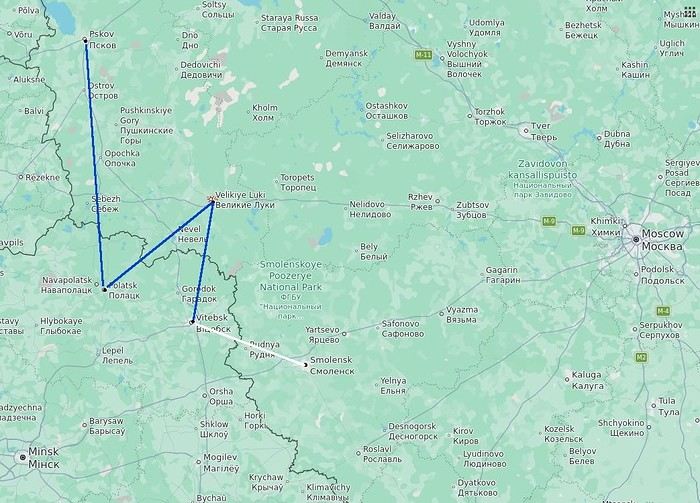
So, I’m leaving on June 12th for Vilnius. A one-hour flight for around thirty euros with a carry-on bag, and from Vilnius Airport, there’s a bus to Minsk. My planned route for now is Vilnius-Minsk-Smolensk-Vitebsk-Polotsk-Pskov-Riga.

This crosses the Belarus-Russia border three times: from Minsk to Smolensk, then from Smolensk to Vitebsk, and finally from Polotsk to Pskov.
The region of this itinerary was, a thousand years ago, essentially that of the Krivichs, a local Slavic political entity. The term comes from "blood," *krew* in Polish, *krov* in Russian—basically "blood brothers." In Latvian, the word for Russians is *krievu*, by the way. Historically, the region corresponds to some of the old Russian principalities. Later, what marks Belarusian regions in general is, after the Great Schism of 1054, the division between Catholic and Orthodox zones, particularly as the Polish-Lithuanian Commonwealth expanded and contracted. In architecture, this corresponds to variations in Baroque styles, for example.
Vitebsk is known in France as the birthplace of Chagall. Born Russian, he first trained at the art school in Vitebsk, which was also attended by Malevich and Lissitzky, before completing his studies in Saint Petersburg, then moving to Berlin and later Paris. In Paris, Chagall met Cendrars, who had spent three years in Russia before and spoke enough Russian to help the newcomer get by a bit.
Back to the practical travel aspects: a local Pskov newspaper mentions that the Russian and Belarusian governments have a project for a Pskov-Polotsk train line. Previously, there were also plans for lines between Veliky Luki and Vitebsk, and Polotsk. A recently launched railway is Smolensk-Vitebsk, shown in white on the map, with projected lines in blue. https://pln-pskov.ru/society/583817.html https://pln-pskov.ru/society/578335.html
These will likely be "Hirondelle"—that is, *Lastochka*—the fast, spacious regional trains in Russia. Currently, all of this is done by bus, so the train is a very appealing and comfortable option. We’ll see how it goes.

With the unified system, if you enter one of the two countries with a visa from either, you can now travel between them freely.
In the case of a Russian visa, it must be a paper visa glued into your passport—not an electronic visa.
This opens up the possibility of traveling to Russia from Lithuania via Minsk, for example, starting from Vilnius.
It also allows for travel circuits that would otherwise be difficult, despite the proximity of the cities.
So, I’m leaving on June 12th for Vilnius. A one-hour flight for around thirty euros with a carry-on bag, and from Vilnius Airport, there’s a bus to Minsk. My planned route for now is Vilnius-Minsk-Smolensk-Vitebsk-Polotsk-Pskov-Riga.

This crosses the Belarus-Russia border three times: from Minsk to Smolensk, then from Smolensk to Vitebsk, and finally from Polotsk to Pskov.
The region of this itinerary was, a thousand years ago, essentially that of the Krivichs, a local Slavic political entity. The term comes from "blood," *krew* in Polish, *krov* in Russian—basically "blood brothers." In Latvian, the word for Russians is *krievu*, by the way. Historically, the region corresponds to some of the old Russian principalities. Later, what marks Belarusian regions in general is, after the Great Schism of 1054, the division between Catholic and Orthodox zones, particularly as the Polish-Lithuanian Commonwealth expanded and contracted. In architecture, this corresponds to variations in Baroque styles, for example.
Vitebsk is known in France as the birthplace of Chagall. Born Russian, he first trained at the art school in Vitebsk, which was also attended by Malevich and Lissitzky, before completing his studies in Saint Petersburg, then moving to Berlin and later Paris. In Paris, Chagall met Cendrars, who had spent three years in Russia before and spoke enough Russian to help the newcomer get by a bit.
Back to the practical travel aspects: a local Pskov newspaper mentions that the Russian and Belarusian governments have a project for a Pskov-Polotsk train line. Previously, there were also plans for lines between Veliky Luki and Vitebsk, and Polotsk. A recently launched railway is Smolensk-Vitebsk, shown in white on the map, with projected lines in blue. https://pln-pskov.ru/society/583817.html https://pln-pskov.ru/society/578335.html
These will likely be "Hirondelle"—that is, *Lastochka*—the fast, spacious regional trains in Russia. Currently, all of this is done by bus, so the train is a very appealing and comfortable option. We’ll see how it goes.

Hi everyone,
We’re heading to Uzbekistan in three weeks for a month.
We still haven’t finalized our itinerary, and the extreme heat forecasted might really impact our plans. I’d love any advice on places where the heat might be a bit more bearable...
We’re arriving in Urgench and leaving from Tashkent. Generally, we only travel by bus, train, or group excursions—we don’t rent vehicles...
Originally, the plan was to visit Khiva, possibly head to Nukus for an excursion to the Aral Sea. I would’ve preferred a detour into Kazakhstan to Mangystau, but it seems either impossible or very complicated... Next, we’d head toward Tashkent, obviously stopping in Bukhara and Samarkand, with a possible stop in Nurata? Or maybe from Samarkand, a quick trip to Tajikistan in the mountains? From Tashkent, we could go to Chorvoq or the surrounding area, where it seems a little cooler, and do some hikes around Charvak Lake. I’m struggling to find solid info on Ugam-Chatkal National Park... What about the Ferghana Valley or Kokand, where the heat seems more intense? Then back to Tashkent.
If you’ve got any great tips, I’d really appreciate it!
Philippe
We’re heading to Uzbekistan in three weeks for a month.
We still haven’t finalized our itinerary, and the extreme heat forecasted might really impact our plans. I’d love any advice on places where the heat might be a bit more bearable...
We’re arriving in Urgench and leaving from Tashkent. Generally, we only travel by bus, train, or group excursions—we don’t rent vehicles...
Originally, the plan was to visit Khiva, possibly head to Nukus for an excursion to the Aral Sea. I would’ve preferred a detour into Kazakhstan to Mangystau, but it seems either impossible or very complicated... Next, we’d head toward Tashkent, obviously stopping in Bukhara and Samarkand, with a possible stop in Nurata? Or maybe from Samarkand, a quick trip to Tajikistan in the mountains? From Tashkent, we could go to Chorvoq or the surrounding area, where it seems a little cooler, and do some hikes around Charvak Lake. I’m struggling to find solid info on Ugam-Chatkal National Park... What about the Ferghana Valley or Kokand, where the heat seems more intense? Then back to Tashkent.
If you’ve got any great tips, I’d really appreciate it!
Philippe
Hi everyone,
My partner and I are planning a 3-week trip to Kazakhstan in August and would love your input to refine our itinerary.
We’re thinking of spending the first part of the trip in the Almaty region, including the following spots:
Singing Barkhan (singing dune)
Altyn-Emel National Park
Charyn Canyon National Park
Ozora Ushchel'ya Reki Kensu (Kensu River Valley lakes)
possibly Ile-Alatau National Park
After that, we’d like to explore the Mangystau region around Aktau, with highlights like:
Airakty
Tuzbair Salt Lake
Kyzylkup ("Tiramisu")
Gora Bokty
Bozzhyra
Three Brothers Peaks
We’re planning to rent a 4x4 in each region and have a few questions:
Could you recommend any reliable 4x4 rental companies in both the Almaty and Aktau/Mangystau regions?
I’ve read that the Mangystau region can get extremely hot in August. Do you think it’s better to start with Almaty and finish with Aktau to hopefully have milder temperatures (less extreme😛)? For us, doing the reverse would be simpler in terms of international flights, the domestic flight, and it’d also be significantly cheaper.
Regarding the places listed above, do you think there are any must-see spots we should add, or conversely, any sites that aren’t worth the detour?
More generally, do you have any practical tips for a 3-week trip to Kazakhstan in August (road conditions, fuel availability, reservations, weather, safety, etc.)?
Thanks so much for your feedback and advice! P.S.: We’re used to traveling independently and driving 4x4s in sometimes challenging conditions (Namibia, Tanzania, Bolivia—South Lipez, Chile, etc.), and we’re also experienced hikers, used to self-sufficient treks (Patagonia, Huayhuash, Three Peaks in Nepal, among others). We’re just mentioning this to give you an idea of our level of self-sufficiency for this kind of trip.
Singing Barkhan (singing dune)
Altyn-Emel National Park
Charyn Canyon National Park
Ozora Ushchel'ya Reki Kensu (Kensu River Valley lakes)
possibly Ile-Alatau National Park
After that, we’d like to explore the Mangystau region around Aktau, with highlights like:
Airakty
Tuzbair Salt Lake
Kyzylkup ("Tiramisu")
Gora Bokty
Bozzhyra
Three Brothers Peaks
We’re planning to rent a 4x4 in each region and have a few questions:
Could you recommend any reliable 4x4 rental companies in both the Almaty and Aktau/Mangystau regions?
I’ve read that the Mangystau region can get extremely hot in August. Do you think it’s better to start with Almaty and finish with Aktau to hopefully have milder temperatures (less extreme😛)? For us, doing the reverse would be simpler in terms of international flights, the domestic flight, and it’d also be significantly cheaper.
Regarding the places listed above, do you think there are any must-see spots we should add, or conversely, any sites that aren’t worth the detour?
More generally, do you have any practical tips for a 3-week trip to Kazakhstan in August (road conditions, fuel availability, reservations, weather, safety, etc.)?
Thanks so much for your feedback and advice! P.S.: We’re used to traveling independently and driving 4x4s in sometimes challenging conditions (Namibia, Tanzania, Bolivia—South Lipez, Chile, etc.), and we’re also experienced hikers, used to self-sufficient treks (Patagonia, Huayhuash, Three Peaks in Nepal, among others). We’re just mentioning this to give you an idea of our level of self-sufficiency for this kind of trip.
Hi everyone!
I wanted to share my experience from the trip I had this summer in Mongolia, in case it helps anyone get their bearings—I also relied a lot on forums myself.
We went as a couple with a French-speaking guide, Hacha, for a 17-day trek through the steppes and the Gobi Desert.
The experience was amazing—the landscapes are truly diverse and stunning. We started with a quick visit to Ulaanbaatar, then headed into the steppes for half the trip, including the Orkhon Valley, before moving on to the desert, which isn’t just sand but has incredibly varied scenery.
We traveled with Hacha, who has been a guide for 27 years and knows Mongolia inside out. She was accompanied by her daughter (with our consent). Hacha teaches French the rest of the year and speaks it perfectly. Her kindness and humor were much appreciated, and she’s become a friend. She prepared delicious homemade meals throughout the trip, adapted to European tastes since she’s used to it. We also had a driver who was really friendly and professional.
I injured myself on the way there with a sprained ankle, and Hacha immediately adjusted the pace and some activities to accommodate my injury, as well as booking more comfortable lodgings for the first few nights. She didn’t tell us it cost her extra, and we only found out later—we chose to pay a supplement, but she never asked for anything. Hacha was very fair with money, and her rates seem a bit lower than what we’d found elsewhere. She also tailors the program to the budget we gave her, and we had the option to adjust accommodations to fit our budget.
As for lodging, we stayed in tourist yurt camps (more comfortable with restaurants, showers, etc.), guest yurts, nights with nomadic families, and a few nights in tents. Our most memorable experience was two nights with nomads who welcomed us warmly, even though it was only the second time they’d hosted tourists. They shared their traditions with us, and the location was beautiful—right by a lake.
Hacha also adapted to our last-minute requests. For example, I mentioned wanting to see a shaman, which was tricky since it wasn’t planned in advance (my fault for not bringing it up earlier), but she used her contacts to see if there was a possibility. Unfortunately, no shamans were available, but we spontaneously stopped by the family of a young shaman during one of our trips. She wasn’t there, but we got to hear her parents’ stories and ask questions about the rituals to become a shaman and their experiences. It was a rare and unique moment I won’t forget!
We’ll definitely return to Mongolia as a family to explore less touristy regions (though we weren’t really bothered by tourism), as Hacha offers other off-the-beaten-path itineraries, including one that visits a turquoise lake surrounded by sand dunes—which sounds incredible, according to her.
I highly recommend Mongolia to anyone looking for an authentic trip that pushes you slightly out of your comfort zone while still feeling safe and enjoying breathtakingly diverse landscapes. And I 100% recommend Hacha—she created a personalized trip based on our requests and adapted to our needs and wishes on the spot!
I wanted to share my experience from the trip I had this summer in Mongolia, in case it helps anyone get their bearings—I also relied a lot on forums myself.
We went as a couple with a French-speaking guide, Hacha, for a 17-day trek through the steppes and the Gobi Desert.
The experience was amazing—the landscapes are truly diverse and stunning. We started with a quick visit to Ulaanbaatar, then headed into the steppes for half the trip, including the Orkhon Valley, before moving on to the desert, which isn’t just sand but has incredibly varied scenery.
We traveled with Hacha, who has been a guide for 27 years and knows Mongolia inside out. She was accompanied by her daughter (with our consent). Hacha teaches French the rest of the year and speaks it perfectly. Her kindness and humor were much appreciated, and she’s become a friend. She prepared delicious homemade meals throughout the trip, adapted to European tastes since she’s used to it. We also had a driver who was really friendly and professional.
I injured myself on the way there with a sprained ankle, and Hacha immediately adjusted the pace and some activities to accommodate my injury, as well as booking more comfortable lodgings for the first few nights. She didn’t tell us it cost her extra, and we only found out later—we chose to pay a supplement, but she never asked for anything. Hacha was very fair with money, and her rates seem a bit lower than what we’d found elsewhere. She also tailors the program to the budget we gave her, and we had the option to adjust accommodations to fit our budget.
As for lodging, we stayed in tourist yurt camps (more comfortable with restaurants, showers, etc.), guest yurts, nights with nomadic families, and a few nights in tents. Our most memorable experience was two nights with nomads who welcomed us warmly, even though it was only the second time they’d hosted tourists. They shared their traditions with us, and the location was beautiful—right by a lake.
Hacha also adapted to our last-minute requests. For example, I mentioned wanting to see a shaman, which was tricky since it wasn’t planned in advance (my fault for not bringing it up earlier), but she used her contacts to see if there was a possibility. Unfortunately, no shamans were available, but we spontaneously stopped by the family of a young shaman during one of our trips. She wasn’t there, but we got to hear her parents’ stories and ask questions about the rituals to become a shaman and their experiences. It was a rare and unique moment I won’t forget!
We’ll definitely return to Mongolia as a family to explore less touristy regions (though we weren’t really bothered by tourism), as Hacha offers other off-the-beaten-path itineraries, including one that visits a turquoise lake surrounded by sand dunes—which sounds incredible, according to her.
I highly recommend Mongolia to anyone looking for an authentic trip that pushes you slightly out of your comfort zone while still feeling safe and enjoying breathtakingly diverse landscapes. And I 100% recommend Hacha—she created a personalized trip based on our requests and adapted to our needs and wishes on the spot!
Hi there,
After a long absence, I’m back on this forum where I used to post under the username NealMorse (mostly about off-the-beaten-path spots in the American West...).
I’m planning a trip to Uzbekistan—details still up in the air (8–10 days)—but I’d love to combine it with a stop in Kazakhstan at Mangystau (5–7 days).
One of my main reasons for traveling is to seek out and photograph deserts, especially dramatic landscapes. Mangystau fits the bill perfectly!
Has anyone here got any tips for this trip, especially how to connect the two countries? Thanks in advance
I’m planning a trip to Uzbekistan—details still up in the air (8–10 days)—but I’d love to combine it with a stop in Kazakhstan at Mangystau (5–7 days).
One of my main reasons for traveling is to seek out and photograph deserts, especially dramatic landscapes. Mangystau fits the bill perfectly!
Has anyone here got any tips for this trip, especially how to connect the two countries? Thanks in advance
Hi there,
I wanted to book a train between these two cities, but there’s no availability at the times I need.
Could you tell me if it’s possible to find a taxi to connect these two cities, or book a shared taxi for the four of us?
Thanks for your help
Estonians have become real pests at the Narva border control.
EER is the Estonian public radio and television service. They have a website, err.ee, with a section in Russian. The other day, on 26.06.2026, in Narva, a Swedish citizen was asked if she had any foreign currency. She mentioned $1,800 USD and 4,400 RUB. However, she was searched, and 21,000 SEK were found in her underwear (!) Here’s what the article says: "They eventually discovered 21,000 Swedish kronor" Maybe the stash seemed suspicious... She tried to backpedal, meaning to return to Estonia with the Swedish kronor, but was fined 280 €:
https://rus.err.ee/1610037940/tamozhenniki-v-narve-oshtrafovali-grazhdanku-shvecii-pytavshujusja-pronesti-v-nizhnem-bele-krony
Earlier this year, on 10.03.2026, a German citizen had 1,820 € found in the lining of her coat. She was denied entry and also fined 480 €.
https://rus.err.ee/1609962977/grazhdanka-germanii-pytalas-provezti-nalichnye-cherez-granicu-v-narve-no-byla-oshtrafovana
Bottom line: if you need to carry cash to exchange, only take USD—and make sure it’s brand new...
EER is the Estonian public radio and television service. They have a website, err.ee, with a section in Russian. The other day, on 26.06.2026, in Narva, a Swedish citizen was asked if she had any foreign currency. She mentioned $1,800 USD and 4,400 RUB. However, she was searched, and 21,000 SEK were found in her underwear (!) Here’s what the article says: "They eventually discovered 21,000 Swedish kronor" Maybe the stash seemed suspicious... She tried to backpedal, meaning to return to Estonia with the Swedish kronor, but was fined 280 €:
https://rus.err.ee/1610037940/tamozhenniki-v-narve-oshtrafovali-grazhdanku-shvecii-pytavshujusja-pronesti-v-nizhnem-bele-krony
Earlier this year, on 10.03.2026, a German citizen had 1,820 € found in the lining of her coat. She was denied entry and also fined 480 €.
https://rus.err.ee/1609962977/grazhdanka-germanii-pytalas-provezti-nalichnye-cherez-granicu-v-narve-no-byla-oshtrafovana
Bottom line: if you need to carry cash to exchange, only take USD—and make sure it’s brand new...
Hello,
Summer 2026 hasn’t even arrived yet, and I’m already thinking about summer 2027! We’re a family with two kids, who will be 9.5 and 4.5 years old next summer (turning 5 at the end of October 2027, actually). We’d love to spend 19 nights in Uzbekistan and Kyrgyzstan—a part of the world that’s completely new to us. We enjoy traveling, do it often, and the kids are used to it (though we still need a bit of organization and comfort!). Here’s the rough outline of our itinerary: Day 1 - Arrival in Tashkent (ideally in the late afternoon). Head to the train station (by taxi?) to take the overnight sleeper train to Urgench (1 night). Day 2 - Khiva (2 nights): Taxi transfer from the station to the city. Visit Itchan Kala, the walls, and sunset. Day 4 - Head to Bukhara (3 nights) by train (about 6 hours). Visit the historic center, domes, and workshops. Day 7 - On to Samarkand (2 nights), but this time with a private driver. Visit Registan, the necropolis, and local crafts. Day 9 - Head to Osh (1 night) in Kyrgyzstan with the private driver, who’ll drop us at the border. Long transition day (including border crossing). If it’s not too late, visit Osh’s market (otherwise, the next morning). Day 10 - Pick up our rental car (4x4 without a driver this time) and drive to Toktogul (2 nights) and the Suusamyr Valley. Day 12 - Head to the Kochkor region (350 km - 4 nights): Tash Rabat, Song-Kul Lake (yurt stay), and Aigliers. Day 16 - Depart for Karakol/Issyk-Kul (250 km - 4 nights): Jeti-Oguz, Altyn Arashan, beaches, and hot springs. Day 20: Fly home. TOTAL = 19 nights What do you think? Budget-wise:
Flight tickets: 3000 € Uzbekistan logistics (accommodation ideally with a pool for the kids and vehicle): 1600 € Kyrgyzstan logistics (accommodation and 4x4 vehicle like a Pajero/Land Cruiser): 1600 € Living & food: 800 € TOTAL: 7000 €
Does this seem reasonable? Not overestimated or underestimated? Thanks for any feedback or tips from your own experiences.
Summer 2026 hasn’t even arrived yet, and I’m already thinking about summer 2027! We’re a family with two kids, who will be 9.5 and 4.5 years old next summer (turning 5 at the end of October 2027, actually). We’d love to spend 19 nights in Uzbekistan and Kyrgyzstan—a part of the world that’s completely new to us. We enjoy traveling, do it often, and the kids are used to it (though we still need a bit of organization and comfort!). Here’s the rough outline of our itinerary: Day 1 - Arrival in Tashkent (ideally in the late afternoon). Head to the train station (by taxi?) to take the overnight sleeper train to Urgench (1 night). Day 2 - Khiva (2 nights): Taxi transfer from the station to the city. Visit Itchan Kala, the walls, and sunset. Day 4 - Head to Bukhara (3 nights) by train (about 6 hours). Visit the historic center, domes, and workshops. Day 7 - On to Samarkand (2 nights), but this time with a private driver. Visit Registan, the necropolis, and local crafts. Day 9 - Head to Osh (1 night) in Kyrgyzstan with the private driver, who’ll drop us at the border. Long transition day (including border crossing). If it’s not too late, visit Osh’s market (otherwise, the next morning). Day 10 - Pick up our rental car (4x4 without a driver this time) and drive to Toktogul (2 nights) and the Suusamyr Valley. Day 12 - Head to the Kochkor region (350 km - 4 nights): Tash Rabat, Song-Kul Lake (yurt stay), and Aigliers. Day 16 - Depart for Karakol/Issyk-Kul (250 km - 4 nights): Jeti-Oguz, Altyn Arashan, beaches, and hot springs. Day 20: Fly home. TOTAL = 19 nights What do you think? Budget-wise:
Flight tickets: 3000 € Uzbekistan logistics (accommodation ideally with a pool for the kids and vehicle): 1600 € Kyrgyzstan logistics (accommodation and 4x4 vehicle like a Pajero/Land Cruiser): 1600 € Living & food: 800 € TOTAL: 7000 €
Does this seem reasonable? Not overestimated or underestimated? Thanks for any feedback or tips from your own experiences.
Hi there,
I’ve never bought a SIM card abroad or even used prepaid cards in France...
So I’m wondering how it all works?
You buy a SIM card and pop it into your phone. Okay, so far so good... 😏
But after that?
I can’t find the price of prepaid cards or how they work with MegaCom.
If someone could give me a step-by-step guide... 😊
Thanks! 🙂
I’ve never bought a SIM card abroad or even used prepaid cards in France...
So I’m wondering how it all works?
You buy a SIM card and pop it into your phone. Okay, so far so good... 😏
But after that?
I can’t find the price of prepaid cards or how they work with MegaCom.
If someone could give me a step-by-step guide... 😊
Thanks! 🙂
Hi there! 🙂
I’m not planning to bring all my meals for the 3 weeks of travel, but I’d like to spice up my picnic lunches and a few dinners in this country that’s not exactly known for its cuisine...
I’ve seen that fruits and vegetables are easy to find. Bread is also no problem.
I’m a bit unsure about the local cheese, but I’ll manage.
Actually, it’s what I’d put in my sandwiches that I’d like to pack: cured sausage, pâtés.
Are these foods allowed through customs?
Also, I’m thinking that bringing 3-4 freeze-dried meals could be a good option. I’ve never bought any before. Which brands are the most flavorful?
I’ve also noticed that real coffee is rare. (Meaning Kyrgyz people drink Nescafé. Sacrilege!) Can I easily find coffee there to make my own?

Finally, which supermarket chain is the best? (Meaning the one with the most variety and, above all, quality!)
Last question: where can I buy a gas stove in Bishkek? (I’ve heard that local gas canisters aren’t compatible with the stove I already own)
Thanks!
I’m not planning to bring all my meals for the 3 weeks of travel, but I’d like to spice up my picnic lunches and a few dinners in this country that’s not exactly known for its cuisine...
I’ve seen that fruits and vegetables are easy to find. Bread is also no problem.
I’m a bit unsure about the local cheese, but I’ll manage.
Actually, it’s what I’d put in my sandwiches that I’d like to pack: cured sausage, pâtés.
Are these foods allowed through customs?
Also, I’m thinking that bringing 3-4 freeze-dried meals could be a good option. I’ve never bought any before. Which brands are the most flavorful?
I’ve also noticed that real coffee is rare. (Meaning Kyrgyz people drink Nescafé. Sacrilege!) Can I easily find coffee there to make my own?
Finally, which supermarket chain is the best? (Meaning the one with the most variety and, above all, quality!)
Last question: where can I buy a gas stove in Bishkek? (I’ve heard that local gas canisters aren’t compatible with the stove I already own)
Thanks!
I was lucky enough to spend two stays in Tajikistan between October and November 2025. I met Fayziddin, who’s a French-speaking guide and very knowledgeable—he really knows how to share his love for his country and his valley. He’ll welcome you to his village and, in the future, to a hostel that’s currently under construction. I can’t recommend him enough!
Hi there,
We’re planning to explore Uzbekistan this summer (with the weather constraints that come with it). Our itinerary includes the three classic cities plus a few side trips here and there. We still have one week left that we’d like to dedicate to hiking. We were thinking of heading to Kyrgyzstan, but I’m open to other suggestions if we stay in Uzbekistan. Thanks!
Hi there,
After making good use of the tips on this site, I’m now adding my own contribution.
We’ve just returned from 25 days exploring Mongolia.
A trip that took us from the capital to the Gobi Desert, from the ancient capital Karakhorum to the Orkhon Valley, and also off the beaten path to places close to nature and nomadic life, all thanks to our guide Hacha.
I’m used to traveling as a couple or solo, in "backpacker" mode, and I rarely—or only occasionally—hire a guide. But this time, I have to admit that choosing a guide-interpreter and a driver was an excellent idea.
We set off as a group of four to share the costs. I’d spoken with Hacha, a Mongolian who used to work at the French Alliance, speaks perfect French, and has been organizing trips for over 25 years.
Needless to say, she knows her job inside out and has built strong relationships with nomadic families over the years. Since she only works with small groups, she can steer clear of the main tourist spots. With her help, we were able to personalize our itinerary—and even adjust it as we went along. For example, we’d planned to attend the Naadam festival in a small town, but we found out there was another festival two days later that wasn’t on the schedule. So we tweaked our route to catch both, and we didn’t regret it.
Anyway, if you’d like more details or Hacha’s contact info, feel free to reach out.
I took a few days to get some fresh air outside the Schengen-NATO prison. Between March 18, 2026, and March 25, 2026, as shown by the passport stamps:

Borisoglebsk is the Russian border checkpoint after Kirkenes, on the road to Murmansk.
Kirkenes is a tiny town with a correspondingly small airport. Nothing has changed there: the minibuses to Murmansk wait on the right as you exit the airport. They’re synchronized with the two daily flights from Oslo—the SAS around 11:00 AM and Norwegian around 11:30 AM. They stop in Kirkenes at the corner of the Scandic for an hour, where other passengers can board, then head straight to the nearby border.
This is the least hassle Frontex/Schengen border. The Norwegian agent quickly scans your passport, and that’s it. No customs, since Norway is Schengen but not in the EU. On the Russian side, there’s a passport check and a quick customs inspection. All in all, crossing both the Norwegian and Russian checkpoints takes about 15 minutes.
A paper visa is required; e-visas aren’t accepted.
Two companies run the route: Avto Ekspress and Borodin: https://ae51.ru/routes/kirkenes-murmansk/ https://borodinbus.com/
The one-way fare is 5,500 ₽. You can either buy it online in rubles with a MIR card or make a formal reservation and pay in NOK cash to the driver. I took Borodin, and the price in NOK was much more expensive than in ₽.
=========================
On March 25, I left from Pskov via the Estonian border post at Luhaama. I spent three days in Murmansk, flew to St. Petersburg (SPB), stayed there for two days, then took an evening train to Pskov.
Since the end of February—and reportedly until the end of May—the Estonians have restricted the opening hours of the two border crossings near Pskov: Koidula (Pechory on the Russian side) and Luhaama (Izborsk on the Russian side). They’re closed at night between 7:00 PM and 7:00 AM. Right now, there’s a bus from Pskov at 7:00 AM to the border. It drops you off at the end of the road where truckers—many Kazakh and Serbian—are parked on the side. You finish the rest on foot to the barrier, where there’s a quick initial check for Ukrainian stamps in passports. Then you walk to the customs building, followed by passport control at the kiosk for motorists. After that, it’s a 500-meter walk to the Estonian checkpoint. At the moment, things seem calmer. Passport control is quick. The usual silly questions in English: "Where were you? Where are you going?" I just gave my most clueless smile: "Sorry, I don’t understand." Yeah, right—I don’t speak English, especially not at an Estonian border with a French passport. If they’re in a mood, though... A very quick bag inspection. Once you exit the Estonian post, walk to the bus stop sign by the road where another coach takes you to Riga.
The catch: in my case, last Wednesday, there were two passengers (Russians) with old Ukrainian stamps in their passports. The bus from the Estonian post to Riga was supposed to leave around 9:30 AM. We ended up leaving around noon after the two were grilled by the FSB. Since it was a weekday outside of holidays, the bus was half-empty. The fuller the bus and the more people with Ukrainian stamps, the worse the nightmare. Don’t book a same-day flight from Riga. I had a flight at 6:00 PM, so it worked out.
=============
The Kirkenes-Murmansk route is still clearly the easiest and fastest. But it’s not the most convenient since it’s way up north.
Next, I’d say the Gdansk-Kaliningrad route in the middle of the week. Avoid weekends and holiday departures/returns.
Avoid the Narva-Ivangorod route during Christmas, Easter, May 9, and *all* summer.
==============
About flights from Murmansk to St. Petersburg: prices are good. I bought my ticket the day before departure on Rossiya for 7,500 ₽, including 10 kg of luggage + a handbag.

It’s the tail end of the northern lights season, and there were still crowds of Chinese tourists.

By the way, Murmansk is twinned with Harbin:

Chinese tourists are the largest foreign group, followed by Indians, then a mix of others from the Far East, Turks, Arabs, etc. Brochures are bilingual—Russian and Chinese:

============================
But let’s talk practical stuff. --
My domestic SIM card was restricted for SMS and internet for 24 hours. After that, if you want to keep using SMS, don’t turn off your phone—restarting triggers another 24-hour purgatory.
My Russian SIM cards (Megafon, MTS, Beeline) were activated as soon as I logged into their respective apps with my credentials.
Internet --
Telegram is heavily slowed down by authorities. To use it, you need to connect through proxy servers, which you load into the latest version of the app. Traffic is then rerouted internally within Telegram to servers outside Russia (Germany, Poland, Sweden, etc.). You can find these proxies on various channels. One is ChatVPN—check their website too.
For general internet use, like browsing the web, VPNs that work right now use the VLESS protocol. You can find several on Telegram by searching "VPN." A few free days, then payment in rubles or crypto.
Rozkomnadzor’s team are experts at this, so things can change. It’s a constant cat-and-mouse game.
Pskov is a special case. The city is near Estonia and has a large military base. Depending on NATO drone swarms launched from the Baltics, Wi-Fi can be completely suspended except for the most essential mobile apps. The drone swarms use the 4G network, and the powerful electronic jamming and drone suppression systems cause periods without Wi-Fi—including in hotels. Wired connections aren’t affected.

Borisoglebsk is the Russian border checkpoint after Kirkenes, on the road to Murmansk.
Kirkenes is a tiny town with a correspondingly small airport. Nothing has changed there: the minibuses to Murmansk wait on the right as you exit the airport. They’re synchronized with the two daily flights from Oslo—the SAS around 11:00 AM and Norwegian around 11:30 AM. They stop in Kirkenes at the corner of the Scandic for an hour, where other passengers can board, then head straight to the nearby border.
This is the least hassle Frontex/Schengen border. The Norwegian agent quickly scans your passport, and that’s it. No customs, since Norway is Schengen but not in the EU. On the Russian side, there’s a passport check and a quick customs inspection. All in all, crossing both the Norwegian and Russian checkpoints takes about 15 minutes.
A paper visa is required; e-visas aren’t accepted.
Two companies run the route: Avto Ekspress and Borodin: https://ae51.ru/routes/kirkenes-murmansk/ https://borodinbus.com/
The one-way fare is 5,500 ₽. You can either buy it online in rubles with a MIR card or make a formal reservation and pay in NOK cash to the driver. I took Borodin, and the price in NOK was much more expensive than in ₽.
=========================
On March 25, I left from Pskov via the Estonian border post at Luhaama. I spent three days in Murmansk, flew to St. Petersburg (SPB), stayed there for two days, then took an evening train to Pskov.
Since the end of February—and reportedly until the end of May—the Estonians have restricted the opening hours of the two border crossings near Pskov: Koidula (Pechory on the Russian side) and Luhaama (Izborsk on the Russian side). They’re closed at night between 7:00 PM and 7:00 AM. Right now, there’s a bus from Pskov at 7:00 AM to the border. It drops you off at the end of the road where truckers—many Kazakh and Serbian—are parked on the side. You finish the rest on foot to the barrier, where there’s a quick initial check for Ukrainian stamps in passports. Then you walk to the customs building, followed by passport control at the kiosk for motorists. After that, it’s a 500-meter walk to the Estonian checkpoint. At the moment, things seem calmer. Passport control is quick. The usual silly questions in English: "Where were you? Where are you going?" I just gave my most clueless smile: "Sorry, I don’t understand." Yeah, right—I don’t speak English, especially not at an Estonian border with a French passport. If they’re in a mood, though... A very quick bag inspection. Once you exit the Estonian post, walk to the bus stop sign by the road where another coach takes you to Riga.
The catch: in my case, last Wednesday, there were two passengers (Russians) with old Ukrainian stamps in their passports. The bus from the Estonian post to Riga was supposed to leave around 9:30 AM. We ended up leaving around noon after the two were grilled by the FSB. Since it was a weekday outside of holidays, the bus was half-empty. The fuller the bus and the more people with Ukrainian stamps, the worse the nightmare. Don’t book a same-day flight from Riga. I had a flight at 6:00 PM, so it worked out.
=============
The Kirkenes-Murmansk route is still clearly the easiest and fastest. But it’s not the most convenient since it’s way up north.
Next, I’d say the Gdansk-Kaliningrad route in the middle of the week. Avoid weekends and holiday departures/returns.
Avoid the Narva-Ivangorod route during Christmas, Easter, May 9, and *all* summer.
==============
About flights from Murmansk to St. Petersburg: prices are good. I bought my ticket the day before departure on Rossiya for 7,500 ₽, including 10 kg of luggage + a handbag.

It’s the tail end of the northern lights season, and there were still crowds of Chinese tourists.

By the way, Murmansk is twinned with Harbin:

Chinese tourists are the largest foreign group, followed by Indians, then a mix of others from the Far East, Turks, Arabs, etc. Brochures are bilingual—Russian and Chinese:

============================
But let’s talk practical stuff. --
My domestic SIM card was restricted for SMS and internet for 24 hours. After that, if you want to keep using SMS, don’t turn off your phone—restarting triggers another 24-hour purgatory.
My Russian SIM cards (Megafon, MTS, Beeline) were activated as soon as I logged into their respective apps with my credentials.
Internet --
Telegram is heavily slowed down by authorities. To use it, you need to connect through proxy servers, which you load into the latest version of the app. Traffic is then rerouted internally within Telegram to servers outside Russia (Germany, Poland, Sweden, etc.). You can find these proxies on various channels. One is ChatVPN—check their website too.
For general internet use, like browsing the web, VPNs that work right now use the VLESS protocol. You can find several on Telegram by searching "VPN." A few free days, then payment in rubles or crypto.
Rozkomnadzor’s team are experts at this, so things can change. It’s a constant cat-and-mouse game.
Pskov is a special case. The city is near Estonia and has a large military base. Depending on NATO drone swarms launched from the Baltics, Wi-Fi can be completely suspended except for the most essential mobile apps. The drone swarms use the 4G network, and the powerful electronic jamming and drone suppression systems cause periods without Wi-Fi—including in hotels. Wired connections aren’t affected.
Hi there,
I’m planning to visit Kazakhstan and Kyrgyzstan in early June, assuming the war doesn’t spread ??? Could anyone give me some info about the eastern border after visiting Charyn Canyon? First, is it possible to head east using public transport, or should I book a tour from Almaty and stay in the east to continue on to Kyrgyzstan toward Karakol? (I mean, not return to Almaty with the tour.) It’s a bit of a vague question, but those who’ve been there will know what I’m talking about;
Thanks!
Patrice
I’m planning to visit Kazakhstan and Kyrgyzstan in early June, assuming the war doesn’t spread ??? Could anyone give me some info about the eastern border after visiting Charyn Canyon? First, is it possible to head east using public transport, or should I book a tour from Almaty and stay in the east to continue on to Kyrgyzstan toward Karakol? (I mean, not return to Almaty with the tour.) It’s a bit of a vague question, but those who’ve been there will know what I’m talking about;
Thanks!
Patrice
Hello,
New year, new questions...😛
Since the Chinese highway isn’t finished yet (opening postponed year after year), I’m wondering what condition this track is in come June?
I’m a bit worried that the snowmelt might completely soak the track—or even that the snow might still be clinging to the mountainside near the pass...
Thanks 🙂
New year, new questions...😛
Since the Chinese highway isn’t finished yet (opening postponed year after year), I’m wondering what condition this track is in come June?
I’m a bit worried that the snowmelt might completely soak the track—or even that the snow might still be clinging to the mountainside near the pass...
Thanks 🙂
Hi,
Does anyone know if the travel agency "NOUVINI" in Tashkent still exists???
Or do you have another agency to recommend???
Thanks in advance!
Best regards,
Jean Pierre
Hi there,
We’re a group of 4 people who prefer to travel independently but also want to use local guides at different stages of our trip.
My question is: should we plan to hire a different guide for each stage, or just one guide for all the different legs? We’re planning to travel between stages either by taxi or public transport (train, plane…).
Our itinerary is pretty classic (3 weeks):
Visit Tashkent
Tashkent – Ferghana Valley (by train)
Explore the valley and return to Tashkent with a guide and taxi
Tashkent – Nukus (flight)
Nukus – Khiva by taxi + guide for Khiva visit
Khiva – Bukhara by taxi + guide for Bukhara visit
Bukhara – Lake Aydar Kul – Samarkand by taxi + guide for Samarkand
Samarkand – Tashkent (by train).
Is the cost reasonable for the transfers between stages? Also, I’m open to any suggestions or tips (recommended guides, etc.).
Thanks!
Bernard
Hi there,
I’d like to spend 2–3 days in the Korgaljyn area in May to photograph flamingos and other birds.
I’ll be in Astana and I’m looking for a tour that includes accommodation so I can stay for 2 days.
I’ve found the buses from Astana and info about the park’s facilities, but no accommodation or guided outings.
Has anyone done this?
Thanks for your help
Hi,
Did you attend the show at the Nadir Divan Begi Madrasa in Bukhara? What are the details for booking? Thanks in advance.
Have a great day and happy travels!
Danielle
Hi,
Planning a solo trip to Kyrgyzstan in May. Any tips or info?
Thanks
Planning a solo trip to Kyrgyzstan in May. Any tips or info?
Thanks
Hi everyone, happy to be back on VF!
I’ll be in Uzbekistan this coming April and will of course visit the three classics—Samarkand, Bukhara, and Khiva. However, I’d also love to get out of these cities to explore the Uzbek countryside and experience its nature. Mountains, steppes, etc. Ideally, with some great hikes passing through villages. Any spots you’d recommend? Thanks in advance
Hi,
We were wondering if anyone has recently experienced the Tashkent / Fergana Valley route by bus or taxi?
We’re landing in Tashkent at 10:30 PM with our international flight. To head to Fergana the next day, the only trains available are very early in the morning or very late in the evening (arriving at 11:30 PM in Fergana). So, we’d like to avoid that mode of transport if possible to spend half a day in Tashkent and relax a bit.
Thanks
Hi there,
We’re heading to Saint Petersburg from June 30 to July 7, 2026, and we’ll be arriving late (9 PM) at our hotel on June 30. Unfortunately, the hotel can’t pick us up from the train station. Is it easy to get a taxi at Saint Petersburg coach station?
Thanks for your help!
Hi,
We’d like to know if it’s easy to visit the Sarmych-Sai gorges from Bukhara as a day trip. Do homestays and hotels offer this?
Thanks
Hello,
We’re a senior couple planning to spend around 3 weeks in Uzbekistan, either starting at the end of March or mid-April. We’ll begin in Khiva (Urgench) and finish in Tashkent (via Termez). We prefer traveling independently as much as possible, at our own pace, and are considering hiring drivers for specific legs of our journey.
Here’s our rough itinerary:
4 nights in Khiva
4 in Bukhara
5 or 6 in Samarkand (we’d like to do a day trip to the Seven Lakes in Tajikistan)
2 in Termez
Then Tashkent and the Fergana Valley
2 in Tashkent
Does this seem balanced? Any suggestions? We’re not planning to go as far as the Aral Sea or stay in a yurt camp.
Is the weather favorable at the end of March (risk of rain)? Or would mid-April be better?
What’s the typical cost for a driver’s services?
Thank you in advance for any tips that could help us with our plans.
Andrea