Prenez le temps pour répondre, je n'y vais pas tout de suite et j'ai l'habitude de mijoter mes coups assez longtemps. Merci d'avance
Auroville en Inde
by Lylivalley
This discussion is in French, the community’s main language.
Original post
Lors de mon dernier voyage en Inde, je n'ai pas eu l'occasion de visiter Pondichery et encore moins Auroville. Cette communauté m'intrigue depuis un moment. Qu'est qu'il y a là-bas? Ya qui ? Je me souviens avoir lu un livre de Sri Aurobindo sur les Upanishads et d'avoir lu quelques lignes écrites par la "la Mère"... Enfin bref, cette communauté m'interesse et je connais certains produits qu'ils exportent notament dans le cadre du commerce équitable.
Est-ce que quelqu'un est passé les voir ? Est-ce que quelqu'un y a vécu ? y a fait un chantier ? Y vit ?
Prenez le temps pour répondre, je n'y vais pas tout de suite et j'ai l'habitude de mijoter mes coups assez longtemps. Merci d'avance
lyliofthevalley
"Le temps d'apprendre à vivre, il est déjà trop tard..."
AUROVILLE ??? Mystere et boule de gomme
C'est à voir sur le plan architectural tres interessant archi des années 70 avec une certaine recherche tres joli (pour moi )
j'ai visité un peu qq ateliers le travail manuel est fait par les AUTOCTHONES les blancs que j'y ai vu faisaient parti de l'encadrement, il y avait des produits qui partaient pour la france notemment des coffrets d'emballage de vin de bourgogne tres bien concu Il y avait une plage(avant tsunami 2004) reservée aux seuls aurovilliens encadrée par des barriéres en bambous et defense d'entrée si t'es pas aurovilien
PONDI EST DIVISE EN 4 QUARTIERS Ancien français, Tamoul, Musulman, et AUROVIULLE En discutant à PONDI LES GENS PARLENT DE SECTE C'est tres certainement un gros groupe financier vu les BIENS IMMOBILIERS et l'enorme centre informatique, il faut bien que ça serve a qq chose ou qq'un Parlé de commerce équitable surement je réponds non, les autocthones ne sont pas les premiers servis, il n'y a qu' à voir les logements reservés aux blancs et aux indigénes
Il faut prendre garde au commerce équitable dont la gestion n'est pas sous la coupe des producteurs à auroville ça semble l'inverse
je crois que l'unesco a financé jusqu'en 1995 environ et s'est retiré depuis ILy a un refectoire ou on ne parle pas QUAND ON POSE DES QUESTIONS LES REPONSES NE SONT PAS TOUJOURS TRES NETTES VOILA QQ INFOS Pëut etre est on éloigné des premiers fondements datant du debut du 20° Siecle 1921 ou proche mais ça merite une visite d'au moins une journée, tres interessant CES AVIS N ENGAGAE QUE MOI D AUTRES Y AURONT PEUT ETRE VU AUTRE CHOSE DIFFEREMMENT
j'ai visité un peu qq ateliers le travail manuel est fait par les AUTOCTHONES les blancs que j'y ai vu faisaient parti de l'encadrement, il y avait des produits qui partaient pour la france notemment des coffrets d'emballage de vin de bourgogne tres bien concu Il y avait une plage(avant tsunami 2004) reservée aux seuls aurovilliens encadrée par des barriéres en bambous et defense d'entrée si t'es pas aurovilien
PONDI EST DIVISE EN 4 QUARTIERS Ancien français, Tamoul, Musulman, et AUROVIULLE En discutant à PONDI LES GENS PARLENT DE SECTE C'est tres certainement un gros groupe financier vu les BIENS IMMOBILIERS et l'enorme centre informatique, il faut bien que ça serve a qq chose ou qq'un Parlé de commerce équitable surement je réponds non, les autocthones ne sont pas les premiers servis, il n'y a qu' à voir les logements reservés aux blancs et aux indigénes
Il faut prendre garde au commerce équitable dont la gestion n'est pas sous la coupe des producteurs à auroville ça semble l'inverse
je crois que l'unesco a financé jusqu'en 1995 environ et s'est retiré depuis ILy a un refectoire ou on ne parle pas QUAND ON POSE DES QUESTIONS LES REPONSES NE SONT PAS TOUJOURS TRES NETTES VOILA QQ INFOS Pëut etre est on éloigné des premiers fondements datant du debut du 20° Siecle 1921 ou proche mais ça merite une visite d'au moins une journée, tres interessant CES AVIS N ENGAGAE QUE MOI D AUTRES Y AURONT PEUT ETRE VU AUTRE CHOSE DIFFEREMMENT
ne marchez jamais sur le chemin tracé
il ne te m��ne que là ou d'autres sont déjà allés
jps
Auroville... difficile à comprendre, difficile à appréhender.
J'y ai passé un dizaine de jours il y a quelques années pour tourner un reportage sur cette communauté peu banale et difficilement définissable. Pas de hiérarchie, pas de salaire... les habitants mettent tout en commun et retirent à la fin du mois quelques roupies pour vivre. En fait Auroville est insaisissable car elle regroupe des personnes très différentes et aux aspirations complètement opposées. Tu as les babas qui sont partis dans les années 60 et qui en avaient mare de la vie occidentale. ils ont souhaité crééer une société à leur image. Tu as ensuite de riches occidentaux qui ont investi dans la communauté et se sont fait construire de vrais palaces. Ils emploient des locaux pour toutes les taches ménagères... et là on retombe un peu beaucoup dans un modèle colonialiste. Ils vous diront qu'ils aident les populations locales en leur donnant un boulot... ça se défend. un des buts d'Auroville est la mise en commun du savoir de chacun afin de faire progresser la communauté. Et de vrais chercheurs, savants... sont à Auroville et développent chaque jour des modèles de technologies. En témoigne la cantine de la communauté qui fonctionne entièrement à l'énérgie solaire avec d'immenses paraboles sur les toîts qui captent l'énergie solaire pour faire fonctionner les fours et autre marmites géantes... un modèle du genre en terme d'écologie et d'énergie renouvelable... chapeau! D'anciens médecins d'ONG se sont retirés à Auroville pour construire dispensaire et clinique pour les indiens locaux et enseigner aux autochtones les rudiments de l'hygiène, des soins dentaires, des premiers soins chirurgicaux... un modèles du genre et d'intégration sans pub ni fond internationaux.
Enfin Auroville a son côté mystérieux et mysthique avec son matrimandire (je ne suis plus sûr de l'orthographe). Une immense boule recouverte de disques dorés. Un lieux de reccueillement pour certains des habitants. Auroville n'est pas une secte, mais pour certains habitants un côté sectaire ressort quand même... Pour quoi par exemple chaque visiteur est suivi à la trace dans ce bel espace de nature? certains auroviliens auraient ils quelque chose à cacher?
Un lieu à voir, à visite, à vivre, une expérience d'un jour, d'un mois, d'une vie où chacun fait sa vie.
tu trouveras sans problème à te loger à Auroville car des aurovilliens tiennent des guesthouse dans le périmètre même de la communauté. Le mieux est de louer une mobylette pour la période pendant laquelle tu reste à Auroville car les distances sont grandes et difficiles à faire à pied. En plus tu peux ainsi faire des excursions à Pondychéry toute proche ou se trouve le monument érigé en mémoire d'Aurobindu
Bonjour,
Auroville et l'ashram d'auroville sont bien distincts. Tu peux t'installer et vivre à Auroville, devenir ainsi aurovillien, travailler où tu veux, bref à ce niveau c'est une ville comme les autres qui attire plein de gens jeunes et moins jeunes. Les premiers aurovilliens vivent depuis à peu près 1968 sont encore là-bas, ont des enfants qui ont suivi leur scolarité à Auroville mais aussi au lycée français de pondicherry. Cà, c'est pour Auroville.
Ensuite, tu as l'ashram de Sri Aurobindo, la "mère" est décédée depuis 1973 mais ces adeptes poursuivent l'idéologie. Ils ne se mêlent que de loin aux Aurovilliens. Secte ou pas secte, la question demeure, c'est en tout cas un empire financier qui dépasse les frontières et même en France on voit les produits artisanaux qui viennent de là-bas. A mon sens il n'y a pas de commerce équitable, ce n'est que mon opinion.
A Pondicherry, facile de voir tout ce qui appartient a l'ashram : tous les immeubles, bâtiments peints en gris et blanc. En quelques années, le territoire s'est agrandi, les rues deviennent pavées et avec trottoir, les boutiques fleurissent etc...
Bref, la ville utopique où tout fonctionnait selon un échange de compétences et sans monnaie est loin. Il y a depuis peu une agence de voyage qui propose des "tours" dans le Tamil Nadu, tu trouveras ça sur le Net.
Dom.
Bonjour a tous
D'accord avec Pondy... Le New Auroville version business n'a rien a voir a l'ideal utopique qui a preside a sa fondation et ces "aurovilliens fondateurs" ne vivent plus aujourd'hui a Auroville, dont la majorite se sont fait meme jete... avec la nouvelle vague d'Aurovilliens... disons plus tecno
Auroville sent l'argent et aime l'argent, l'Ashram egalement mais avec moins d'ostentation (tous les edifices en blanc et gris que vous voyez a Pondi, appartiennent a l'Ashram dont les membres dument uniformes ne quittent guere les rues de la ville Blanche... et ne sont pas exempts non plus de scandales)
Les deux font travailler a tres petits salaires des indiens et revendent par contre leur production a prix d'or touriste dans les nombreux magasins qu'ils possedent... et non seulement a Pondi...
Donc exit le commerce equitable... et bonjour toutes les derives... Il y a deux ans, un scandale a eclate (vite etouffe) dans ce bon vieux Auroville ou tout, absolument tout, s'achete et circule (tant en matiere qu'en humains), suite a l'assassinat d'un adolescent... et donc decouverte d'un circuit de prostituition infantile...
Normalement, Auroville depend de delhi, et la police de Pondi n'y entre jamais... sauf dans des cas "delicats' pour tout le monde comme celui ci...
En bref, il faut savoir regarder ce qui se cache derriere le dore du fameux dome dont la visite est payante et rapide...
Un exemple, produits bio d'Auroville ??? qui arrose abondemment de pesticides ses champs (je connais des gens qui y ont travaille)
Aujourd'hui Auroville est entre les mains de businessmen indiens et europeens... qui font fortune, il faut bien le dire, parce qu'il y a un marche de la demande...
En outre, beaucoup d'Aurovilliens se prennent pour des illumines ambulants, nous autres etant la masse confuse et hebetee, et traitent au propre comme au figure les indiens de "singes"...
Et commerce oblige, ne devient membre de cette selecte utopie que celui qui a de l'argent ou des connaissances propres a servir le capitalisme aurovillien...
amities... desolee pour le pot d'eau froide...
D'accord avec Pondy... Le New Auroville version business n'a rien a voir a l'ideal utopique qui a preside a sa fondation et ces "aurovilliens fondateurs" ne vivent plus aujourd'hui a Auroville, dont la majorite se sont fait meme jete... avec la nouvelle vague d'Aurovilliens... disons plus tecno
Auroville sent l'argent et aime l'argent, l'Ashram egalement mais avec moins d'ostentation (tous les edifices en blanc et gris que vous voyez a Pondi, appartiennent a l'Ashram dont les membres dument uniformes ne quittent guere les rues de la ville Blanche... et ne sont pas exempts non plus de scandales)
Les deux font travailler a tres petits salaires des indiens et revendent par contre leur production a prix d'or touriste dans les nombreux magasins qu'ils possedent... et non seulement a Pondi...
Donc exit le commerce equitable... et bonjour toutes les derives... Il y a deux ans, un scandale a eclate (vite etouffe) dans ce bon vieux Auroville ou tout, absolument tout, s'achete et circule (tant en matiere qu'en humains), suite a l'assassinat d'un adolescent... et donc decouverte d'un circuit de prostituition infantile...
Normalement, Auroville depend de delhi, et la police de Pondi n'y entre jamais... sauf dans des cas "delicats' pour tout le monde comme celui ci...
En bref, il faut savoir regarder ce qui se cache derriere le dore du fameux dome dont la visite est payante et rapide...
Un exemple, produits bio d'Auroville ??? qui arrose abondemment de pesticides ses champs (je connais des gens qui y ont travaille)
Aujourd'hui Auroville est entre les mains de businessmen indiens et europeens... qui font fortune, il faut bien le dire, parce qu'il y a un marche de la demande...
En outre, beaucoup d'Aurovilliens se prennent pour des illumines ambulants, nous autres etant la masse confuse et hebetee, et traitent au propre comme au figure les indiens de "singes"...
Et commerce oblige, ne devient membre de cette selecte utopie que celui qui a de l'argent ou des connaissances propres a servir le capitalisme aurovillien...
amities... desolee pour le pot d'eau froide...
katiouchka
Mouais... Ca sent pas bon tout ça mais ça ne me surprend pas tellement. J'avais bien eu quelques échos du même tonneau mais tout ça n'est pas très réjouissant et je suis finalement un peu déçue. Quel dommage! Quelle corruption ! Je n'aime pas trop cettte idée d'une "gentry" blanche qui ferait marner des sbires locaux et puis quand j'y réfléchis j'ai déjà vu ce genre de dérive en d'autres endroits...
Merci pour vos promptes réponses; il y a matière à cogiter... Vos réponses sont instructives et aussi très nuancées et éclairent bien ma lanterne. Merci encore et à bientôt peut-être.
lyliofthevalley
"Le temps d'apprendre à vivre, il est déjà trop tard..."
Très belle analyse de la Réalité....
La seule religion est la Vérité.
Mahatma Gandhi
😊Bonjour
Je pars en Inde dans trois jours et terminerai mon périple en arrivant par le train à Chennai. Je dois ensuite aller jusqu'à Pondichéry. Je pense que nous prendrons un taxi (nous serons deux). Pouvez-vous me donner une idée du prix de la course sur cette distance et la durée du trajet ? Merci pour votre réponse et félicitations pour tous ces échanges sur ce pays que je vais enfin découvrir. Suzanne
Bonjour
Duree du trajet Chennai pondicherry : maximum trois heures en taxi pour un prix maximum de 1800 roupies en ambassador... et de 1500 roupies maxi en Indiga.
Bon Voyage
Duree du trajet Chennai pondicherry : maximum trois heures en taxi pour un prix maximum de 1800 roupies en ambassador... et de 1500 roupies maxi en Indiga.
Bon Voyage
katiouchka
Poure uner fois les avis semblent converger en ce qui concerne le commerce a Auroville il n'est pas équitable pour tout le monde
Pour avoir discuter avec une française travaillant à l'imprimerie d'Auroville; pour etre admis a etre Aurovillien, il, faut faire un stage sur place de 9 mois (si mes souvenirs sont bons ), et si tu es bien dans le moule tu as le droit d'etre Aurovillien
Si ce n'est pas un groupe sectaire, ce n'en est pas loin, c'est comme tout ces groupes ou grand nombre d'intellectuels ou grosses tétes fragiles y croient et mettent leur savoir à disposition de ces organisations comme beaucoup de gens un peu '' égarés ''
ne marchez jamais sur le chemin tracé
il ne te méne que là ou d'autres sont déjà allés
jps
😄Hello Katioucha
Merci pour l'info. Penses-tu qu'il soit possible de trouver rapidement un taxi en arrivant à 17 h en gare de Chennai pour Pondi car nous devons arriver avant 22 heures à la guest house ? Est-il dangereux de rouler de nuit comme le laisse entendre certains ? Merci et à bientôt Suzanne
tu peux trouver un taxi tres rapidement, mais mais il y a une espece de mafia locale qui a la main mise sur tous les taxis en gare de chennai et fixe des prix beaucoup plus cher, pour avoir des meilleurs prix il faut s'éloigner de la gare et trouver un taxi isolé qui n'est pas chos toujours facile
I L Y A LA MEMME SITUATION ?encor pire à l'aéroport domestique de Bombay ou les taxis qui attendent à l'intérieur( apparemment tout les taxis ne sont pas autorisés a penetrer à l'interieur de la zone aéroportuaire), t'emmenes juste à l'extérieur de l'aéroport pour un autre taxi donc tres difficile de négocier
c'est exact la nuit cv'est un peu plus délicat de rouler, c'est une conduite sportive toutes rampes de phare allumées
ne marchez jamais sur le chemin tracé
il ne te méne que là ou d'autres sont déjà allés
jps
Bonjour à tous
Devant cette avalanche de critiques, je prends la plume pour répondre et défendre un peu Auroville.
A la base il y a Sri Aurobindo, philosophe et sage indien dont le credo est : « L’homme n’est pas le sommet du processus évolutif, l’évolution continue et l’homme sera dépassé. L’homme est un être de transition. » Auroville a été créé par La Mère pour mettre en oeuvre et hater cette mutation. A l'origine le territoire d'Auroville a été donné à Mère par l'Inde (1968). Ce n'était qu'un désert de terre rouge et les premiers aurovilliens en ont fait un petit oasis a force de travail. L'objectif était de batir une ville internationnale de 50 000 habitants vivants sur des principes différents . A la mort de Mère, ses successeurs autoproclamés ( la SAS : Sri Aurobino Society ) ont voulu faire de l'ashram de Pondy une espèce de Lourdes dans un but mercantile . Ils ont voulu également mettre la main sur Auroville et après quelques jugements, le gouvernement Indien les a déboutés.-- Auroville n'est pas une secte car elle a une constitution et elle est co dirigée par 3 entités : The governing board constitué de 7 personalités nommées par le gouvernement indien The internationnal advisory Council constitué de 5 personnes maxi nommées par L'UNESCO L'assemblée des résidents constituée de tous les Auroviliens de plus de 18 ans.-- Auroville a une charte : La Charte d’Auroville
1. Auroville n'appartient à personne en particulier. Auroville appartient à toute l'humanité dans son ensemble. Mais pour séjourner à Auroville, il faut être le serviteur volontaire de la Conscience Divine.
2. Auroville sera le lieu de l'éducation perpétuelle, du progrès constant, et d'une jeunesse qui ne vieillit point.
3. Auroville veut être le pont entre le passé et l'avenir. Profitant de toutes les découvertes extérieures et intérieures, elle veut hardiment s'élancer vers les réalisations futures.
4. Auroville sera le lieu des recherches matérielles et spirituelles pour donner un corps vivant à une unité humaine concrète.-- Pour devenir Aurovilien, une période de probation de 2 ans est nécessaire. S'il n'y a pas d'objection de la part des autre Auroviliens, pas de problème. Entre temps on est un newcomer qui doit démontrer qu'il est digne de devenir Aurovilien selon les quelques règles edictés par La Mère ( pas de drogues, volonté de collaborer au projet de Sri Aurobindo, etc. ) . Il y a un accord d'immigration entre Auroville et le gouvernement indien.--
Auroville emploie des indiens pour fonctionner et les paie selon les tarifs en vigueur en inde ( et non de très petits salaires ) de même que les voyageurs en inde paient les hotels, les taxis, les restos selon les tarifs indiens et non selon les tarifs occindentaux : est ce choquant ?-- En Mars 2004 un Aurovillien de 41 ans (Sydo ) a été assassiné dans sa maison par un gang indien pour des raisons inconnues . Ce meutre a donné lieu a des processions et des manifestations mais les coupables n'ont pas été découverts : c'est le seul cas de meutre que je connaisse.-- Auroville tente de créer une communauté vivant sur les principes édictées par la Mère. Qu'il y ait des loupés, des erreurs sûrement . Mais juger Auroville uniquement la-dessus me parait un tantinet exagéré au regard du travail fourni et de l'ampleur du projet et de la qualité des personnes que j'y ai rencontré. Auroville est une utopie qui est en marche depuis presque 40 ans et mérite mieux que quelques ragots colportés ( mais tout n'est pas rose non plus )
Fin de mon rapide petit playdoyer
Pour les gens interressés par Auroville, le site officiel : http://www.auroville.org/index.htm
Devant cette avalanche de critiques, je prends la plume pour répondre et défendre un peu Auroville.
A la base il y a Sri Aurobindo, philosophe et sage indien dont le credo est : « L’homme n’est pas le sommet du processus évolutif, l’évolution continue et l’homme sera dépassé. L’homme est un être de transition. » Auroville a été créé par La Mère pour mettre en oeuvre et hater cette mutation. A l'origine le territoire d'Auroville a été donné à Mère par l'Inde (1968). Ce n'était qu'un désert de terre rouge et les premiers aurovilliens en ont fait un petit oasis a force de travail. L'objectif était de batir une ville internationnale de 50 000 habitants vivants sur des principes différents . A la mort de Mère, ses successeurs autoproclamés ( la SAS : Sri Aurobino Society ) ont voulu faire de l'ashram de Pondy une espèce de Lourdes dans un but mercantile . Ils ont voulu également mettre la main sur Auroville et après quelques jugements, le gouvernement Indien les a déboutés.-- Auroville n'est pas une secte car elle a une constitution et elle est co dirigée par 3 entités : The governing board constitué de 7 personalités nommées par le gouvernement indien The internationnal advisory Council constitué de 5 personnes maxi nommées par L'UNESCO L'assemblée des résidents constituée de tous les Auroviliens de plus de 18 ans.-- Auroville a une charte : La Charte d’Auroville
1. Auroville n'appartient à personne en particulier. Auroville appartient à toute l'humanité dans son ensemble. Mais pour séjourner à Auroville, il faut être le serviteur volontaire de la Conscience Divine.
2. Auroville sera le lieu de l'éducation perpétuelle, du progrès constant, et d'une jeunesse qui ne vieillit point.
3. Auroville veut être le pont entre le passé et l'avenir. Profitant de toutes les découvertes extérieures et intérieures, elle veut hardiment s'élancer vers les réalisations futures.
4. Auroville sera le lieu des recherches matérielles et spirituelles pour donner un corps vivant à une unité humaine concrète.-- Pour devenir Aurovilien, une période de probation de 2 ans est nécessaire. S'il n'y a pas d'objection de la part des autre Auroviliens, pas de problème. Entre temps on est un newcomer qui doit démontrer qu'il est digne de devenir Aurovilien selon les quelques règles edictés par La Mère ( pas de drogues, volonté de collaborer au projet de Sri Aurobindo, etc. ) . Il y a un accord d'immigration entre Auroville et le gouvernement indien.--
Auroville emploie des indiens pour fonctionner et les paie selon les tarifs en vigueur en inde ( et non de très petits salaires ) de même que les voyageurs en inde paient les hotels, les taxis, les restos selon les tarifs indiens et non selon les tarifs occindentaux : est ce choquant ?-- En Mars 2004 un Aurovillien de 41 ans (Sydo ) a été assassiné dans sa maison par un gang indien pour des raisons inconnues . Ce meutre a donné lieu a des processions et des manifestations mais les coupables n'ont pas été découverts : c'est le seul cas de meutre que je connaisse.-- Auroville tente de créer une communauté vivant sur les principes édictées par la Mère. Qu'il y ait des loupés, des erreurs sûrement . Mais juger Auroville uniquement la-dessus me parait un tantinet exagéré au regard du travail fourni et de l'ampleur du projet et de la qualité des personnes que j'y ai rencontré. Auroville est une utopie qui est en marche depuis presque 40 ans et mérite mieux que quelques ragots colportés ( mais tout n'est pas rose non plus )
Fin de mon rapide petit playdoyer
Pour les gens interressés par Auroville, le site officiel : http://www.auroville.org/index.htm
Kergréach
Bonjour a tous et en reponse a Kergreach
Tout ce que tu dis sur Auroville (fondation, constitution, modalites d'entree) est exact...
La web d'Auroville est a la hauteur de ce paradigme idyllique...
Ceci pour la facade allechante, la realite, de prime abord ... Mais celle, disons, beaucoup plus discrete est tout autre...
Auroville, dans son concept, appartient a toute l'humanite... Dans sa realite financiere "business nirvana", il appartient a des hommes d'affaires indiens et a un europeen...
Les 7 personnalites sont ce qu'elles sont, 7 personnalites representatives. Dans la finalite et devant la loi indienne, Auroville depend du gouvernement de Delhi et de sa legislation....
Ce monde a part dans le monde permet aussi tous les commerces possibles... Car derriere le circuit d'Auroville montre aux visiteurs, il en est d'autres beaucoup plus pervers... et souterrains
Quant a l'assassinat mentionne, les raisons n'en sont pas inconnues... pour tout le monde...
Il est vrai que les salaires en Inde ne peuvent se comparer a ceux pratiques en france... Mais il existe un difference entre payer quelqu'un qui bosse 10 heures par jour (et il faut voir ou...!!!) 2000 roupies et entre lui donner, ne serait ce que le double... quand on connait le prix des loyers a Pondi et dans ses alentours... exemple, a Kutchikuppam, quartier des pecheurs qui est loin d'avoir le luxe de la Ville Blanche, pour une surface de 30m2, sans salle de bains et une seule ampoule electrique, dans une maison sans confort et insalubre et en outre partagee par plusieurs familles - et il faut voir les drames que cela engendre !!!! - (la famille a laquelle je pense vivent a 5 sur ces 30m2), on paie deja 1000 roupies... Ajoutez a cela qu'une bouteille de gas en vaut 300 (donc exit le gaz), et le litre de lait 7 roupies... Faites les comptes...
Et entre le prix du sac en cuir vendu par Auroville et le salaire de celui qui le fait... la marge beneficiaire est colossale...
J'arreterais la mon rectificatif... Je n'ai rien contre Auroville... Il y a des gens a qui ce lieu plait et qui s'y trouvent bien...
Mais cela donne une idee de l'Inde a nos yeux occidentaux qui est archi fausse, a mon avis. La realite de l'Inde n'a rien a voir avec ses ashrams ou nous venont etancher notre mal de vivre de nanti...
Tout ce que tu dis sur Auroville (fondation, constitution, modalites d'entree) est exact...
La web d'Auroville est a la hauteur de ce paradigme idyllique...
Ceci pour la facade allechante, la realite, de prime abord ... Mais celle, disons, beaucoup plus discrete est tout autre...
Auroville, dans son concept, appartient a toute l'humanite... Dans sa realite financiere "business nirvana", il appartient a des hommes d'affaires indiens et a un europeen...
Les 7 personnalites sont ce qu'elles sont, 7 personnalites representatives. Dans la finalite et devant la loi indienne, Auroville depend du gouvernement de Delhi et de sa legislation....
Ce monde a part dans le monde permet aussi tous les commerces possibles... Car derriere le circuit d'Auroville montre aux visiteurs, il en est d'autres beaucoup plus pervers... et souterrains
Quant a l'assassinat mentionne, les raisons n'en sont pas inconnues... pour tout le monde...
Il est vrai que les salaires en Inde ne peuvent se comparer a ceux pratiques en france... Mais il existe un difference entre payer quelqu'un qui bosse 10 heures par jour (et il faut voir ou...!!!) 2000 roupies et entre lui donner, ne serait ce que le double... quand on connait le prix des loyers a Pondi et dans ses alentours... exemple, a Kutchikuppam, quartier des pecheurs qui est loin d'avoir le luxe de la Ville Blanche, pour une surface de 30m2, sans salle de bains et une seule ampoule electrique, dans une maison sans confort et insalubre et en outre partagee par plusieurs familles - et il faut voir les drames que cela engendre !!!! - (la famille a laquelle je pense vivent a 5 sur ces 30m2), on paie deja 1000 roupies... Ajoutez a cela qu'une bouteille de gas en vaut 300 (donc exit le gaz), et le litre de lait 7 roupies... Faites les comptes...
Et entre le prix du sac en cuir vendu par Auroville et le salaire de celui qui le fait... la marge beneficiaire est colossale...
J'arreterais la mon rectificatif... Je n'ai rien contre Auroville... Il y a des gens a qui ce lieu plait et qui s'y trouvent bien...
Mais cela donne une idee de l'Inde a nos yeux occidentaux qui est archi fausse, a mon avis. La realite de l'Inde n'a rien a voir avec ses ashrams ou nous venont etancher notre mal de vivre de nanti...
katiouchka
Bonjour tout le monde
Je défends Auroville et évidemmenet je ne suis pas tout à fait objectif. Mais néanmoins si la réalité est plus sombre que je le pense j'aimerais bien avoir quelques renseignements précis. 1- Auroville " appartient a des hommes d'affaires indiens et a un europeen " : je ne vois pas trop comment cela est possible puisque à part le gouvernement indien, personne n'est propriétaite . est ce que tu ne confonds pas avec l' ashram de Pondy ?
2 - " Car derriere le circuit d'Auroville montre aux visiteurs, il en est d'autres beaucoup plus pervers... et souterrains " des exemples de faits avérés ?
3 - "Quant a l'assassinat mentionne, les raisons n'en sont pas inconnues... pour tout le monde... " : si tu as des infos précises, je suis preneur.
4 - " Mais il existe un difference entre payer quelqu'un qui bosse 10 heures par jour (et il faut voir ou...!!!) " : la majorité des activités d'Auroville se situe à Auroville et les conditions de travail sont plutôt excellentes. Les villageois des 14 villages entourant Auroville considèrent comme une chance de travailler à Auroville qui, d'ailleurs, a une politique particulière pour ces villages . 5000 indiens environ travaillent pour Auroville, de l'ingénieur au balayeur. Les villageois sont soignés à Auroville et le enfants peuvent aller dans les école d'Auroville. ( cf site + réalité que j'ai vécue ).
5 - " Et entre le prix du sac en cuir vendu par Auroville et le salaire de celui qui le fait... la marge beneficiaire est colossale... " Des exemples précis ?
6 - " La realite de l'Inde n'a rien a voir avec ses ashrams ou nous venont etancher notre mal de vivre de nanti... " Tu confonds Auroville et l'ashram de Pondy qui sont 2 entités complétement différentes. D'autres part les ashrams sont des spécificité indiennes qui ne servent pas "qu'à étancher notre mal de vivre" mais sont surtout des écoles de recherche spirituelle, domaine où l'Inde est en pointe.
7- En cumulant Auroviliens, newcomers et les invités à lon term (Long-term Guest ) la population d'auroville est de 1780 habitants dont 736 sont indiens, 262 francais, 226 allemands et 37 autres nationalités de tous les continents (de 85 à 1 représentants ). Ce n'est donc pas que un truc d'occidental.
La meilleure façon de juger est d'aller voir mais en prenant le temps de regarder et de discuter avec les gens lorsque le contact se fait ( car les Auroviliens ont tendance à fuir les touristes ) .
Je défends Auroville et évidemmenet je ne suis pas tout à fait objectif. Mais néanmoins si la réalité est plus sombre que je le pense j'aimerais bien avoir quelques renseignements précis. 1- Auroville " appartient a des hommes d'affaires indiens et a un europeen " : je ne vois pas trop comment cela est possible puisque à part le gouvernement indien, personne n'est propriétaite . est ce que tu ne confonds pas avec l' ashram de Pondy ?
2 - " Car derriere le circuit d'Auroville montre aux visiteurs, il en est d'autres beaucoup plus pervers... et souterrains " des exemples de faits avérés ?
3 - "Quant a l'assassinat mentionne, les raisons n'en sont pas inconnues... pour tout le monde... " : si tu as des infos précises, je suis preneur.
4 - " Mais il existe un difference entre payer quelqu'un qui bosse 10 heures par jour (et il faut voir ou...!!!) " : la majorité des activités d'Auroville se situe à Auroville et les conditions de travail sont plutôt excellentes. Les villageois des 14 villages entourant Auroville considèrent comme une chance de travailler à Auroville qui, d'ailleurs, a une politique particulière pour ces villages . 5000 indiens environ travaillent pour Auroville, de l'ingénieur au balayeur. Les villageois sont soignés à Auroville et le enfants peuvent aller dans les école d'Auroville. ( cf site + réalité que j'ai vécue ).
5 - " Et entre le prix du sac en cuir vendu par Auroville et le salaire de celui qui le fait... la marge beneficiaire est colossale... " Des exemples précis ?
6 - " La realite de l'Inde n'a rien a voir avec ses ashrams ou nous venont etancher notre mal de vivre de nanti... " Tu confonds Auroville et l'ashram de Pondy qui sont 2 entités complétement différentes. D'autres part les ashrams sont des spécificité indiennes qui ne servent pas "qu'à étancher notre mal de vivre" mais sont surtout des écoles de recherche spirituelle, domaine où l'Inde est en pointe.
7- En cumulant Auroviliens, newcomers et les invités à lon term (Long-term Guest ) la population d'auroville est de 1780 habitants dont 736 sont indiens, 262 francais, 226 allemands et 37 autres nationalités de tous les continents (de 85 à 1 représentants ). Ce n'est donc pas que un truc d'occidental.
La meilleure façon de juger est d'aller voir mais en prenant le temps de regarder et de discuter avec les gens lorsque le contact se fait ( car les Auroviliens ont tendance à fuir les touristes ) .
Kergréach
bonne réflexion et questions à katiouchka, kerqréach. dommage qu'elles restent sans réponse..... facile d'affirmer des trucs que l'on ne peut pas vérifier par la suite....
je reprends la converse sur ce post, aprés avoir consulté les pages mentionnées par le piaf. et le dernier post relancé par sativir sur auroville la semaine dernière...
j'avais l'intention de passer, voir de rester à auroville, pour l'alternatif, le bio et j'espérais, la fraternité.... mais tout ce que j'ai lut sur le sujet est trés refroidissant. bon bien sur il y a bcp de jugement à l'emporte piéce comme de svt, mais tout de même....
bcp de questions sont restées sans réponses.... : comme par exemple des infos récentes sur l'aprés tsunami.
quelqu'un ou quelqu'une est il passé(e) récemment à auroville pour donner des infos fraiches sur ce qui se passe là-bas ?
et tant que j'y suis, des conseils pour faire le trajet de Chennai-Auroville : bus ? train ?
enfin quelqu'un a t'il des infos pour des logements sur place à petit prix ? (ou à Pondichery)
A+
Om
Yv
Pranique le Sit ! - http://pranique.com - Cinq onglets principaux : Culture, Pranique, Indigos, Ascension, Générique
salut,
Je continue dans la grande lancée de ce débat ! J'ai pris connaissance de tous les messages sur ce site qui concernent auroville car j'ai pour projet de m'y rendre.Tout ce que j'ai lu (les messages depuis 2004) allait dans un meme et unique sens sans véritablement de nuances mais en s'emportant dans les extremes. Bien sur que cela ne reste qu'une utopie, surtout pour ceux qui ne s'intéressent nullement à la spiritualité, et que des dérives possibles existent tant que certains poursuivent leurs interets personnels, avides de pouvoirs. Mais tout mettre dans un meme lot sans aucun discernemet et traiter à tort et à travers de faux guru sans parler en connaissance de cause est dommage. Juger sans savoir, sans faire la démarche de chercher à comprendre est pour moi une preuve de manque d'ouverture et une limitation à ce que l'on connait, à ce qui nous sécurise sans aller au dela de ses propres limites. Il me paraitrait plus judicieux de s'appuyer sur des éléments afin de développer son raisonnement, comme l'a fait Kergréach, en commençant par savoir de quoi l'on parle et qui l'on traite d'imposteur et de mégalo. Après chacun est dans son droit de ne pas etre en accord, que cela ne lui convienne pas, mais etre catégorique sans etre respestueux envers ceux qui sont inspirés par les paroles de la mère et de Sri Aurobindo ne me parait pas juste comme attitude. Voir par soi meme, dénué de préjugés, est surement le meilleur moyen de se rendre compte :
"Douter de tout surtout ce que je vais vous dire "Bouddha
deb
y'a vraiment personne qui a des fraiches d'auroville ?
Om
Yv
Pranique le Sit ! - http://pranique.com - Cinq onglets principaux : Culture, Pranique, Indigos, Ascension, Générique
Bonjour,
Je suis allé à Auroville il y qq semaines (un dimanche) et c t fermé... Apparement il un quota de places?
bonjour, je suis aller aussi qq jour à auroville, et je n'ai rien retrouvé de l'idéal de la mére ou de sri aurobindo, le monde change
L'idee d'Auroville etait bonne au depart mais si tu y va tu verra qu'il s'agit tout simplement d'une entreprise a but lucratif qui ne s'occupe en realite ni des gens du pays ni du commerce equitable bien qu'ils veulent le faire croire.
Personellement, et ca n'engage que moi, je les classe dans le dossier sectes a eviter.
Carpe Diem
Une petite vidéo sympa qui permet de découvrir des auroviliens et leurs projets :
http://www.ark-tv.org/index.php?pid=11
Kergréach
Namaste, j'ai moi aussi ete tres interesse par le concept d'auroville qui avait l'air d'une communaute hippies mais aprespas mal de recherche, je suis tombee la dessus
http://www.place-publique.fr/imprimersans.php3?id_article=1304
et la le mythe s'est effondre !!
L'idee de base etait bonne mais l'argent pourri tout malheureusement.
Je sais qu'il existe d'autres communautes dans le monde mais elle sont assez peu connu (peut etre preservees ?), si ca t'interesse je pourrai sans doute en retrouver quelques unes. 😉
L'idee de base etait bonne mais l'argent pourri tout malheureusement.
Je sais qu'il existe d'autres communautes dans le monde mais elle sont assez peu connu (peut etre preservees ?), si ca t'interesse je pourrai sans doute en retrouver quelques unes. 😉
OM SHANTI
"Vis comme si tu devais mourir demain et apprends comme si tu devais vire toujours"
"Les voyages sont une fenetre ouverte sur le monde"
"Vis comme si tu devais mourir demain et apprends comme si tu devais vire toujours"
"Les voyages sont une fenetre ouverte sur le monde"
Auroville n'est pas un quartier de Pondy, mais une localité située à 20km, sur le territoire du Tamil Nadu.
Tu confonds sûrement avec les maisons grises de l'Ashram, qui n'a rien à voir avec Auroville. Il appartient à la Sri Aurobindo Society et il est parfaitement intégré à la Ville Blanche.
Je ne me suis pas encore fait une opinion claire sur Auroville, mais je peux affirmer deux ou trois choses en vrac.
Il est facile d'entrer dans une secte et difficile d'en sortir. Auroville, c'est tout le contraire: deux ans de période probatoire pour les Néo-Aurovilliens Tout Aurovillien peut faire sa valise du jour au lendemain s'il le désire, et personne ne lui demande de comptes.
Auroville est une autre planète, un ilôt de paix, de tranquillité, de fleurs... Il y a même un micro-climat qui épate les spécialistes mondiaux du reboisement (car les Aurovilliens ont transformé un désert en forêt).
Mes amis indiens appellent Auroville stupid city. J'ai eu moi même des moments de malaise lors de soirées à Auroville, me trouvant au milieu d'Occidentaux qui avaient plus l'air de vivre sur l'Inde qu'en Inde (comme un corps étranger, juste posé). L'Inde était quasi absente des conversations. Auroville est pourtant né du rêve de Sri Aurobindo, sage indien, concrétisé par la Mère, et ne vivrait pas sans une interaction permanente avec le pays qui l'entoure. D'aucuns prétendent qu'Auroville s'engraisse sur son dos.
L'on sait néanmoins qu'Auroville scolarise les gosses des villages voisins, soigne les villageois dans ses dispensaires, et emploie des tas d'Indiens qui autrement n'auraient pas de travail . Il ne faut d'ailleurs pas oublier que la moitié des Aurovilliens sont des Indiens.
Les Aurovilliens se ferment quand on leur pose des questions qui remettent en cause leur cité, mais ils en ont peut-être assez de répondre depuis des années à des conseilleurs qui ne sont pas les payeurs.
Tu confonds sûrement avec les maisons grises de l'Ashram, qui n'a rien à voir avec Auroville. Il appartient à la Sri Aurobindo Society et il est parfaitement intégré à la Ville Blanche.
Je ne me suis pas encore fait une opinion claire sur Auroville, mais je peux affirmer deux ou trois choses en vrac.
Il est facile d'entrer dans une secte et difficile d'en sortir. Auroville, c'est tout le contraire: deux ans de période probatoire pour les Néo-Aurovilliens Tout Aurovillien peut faire sa valise du jour au lendemain s'il le désire, et personne ne lui demande de comptes.
Auroville est une autre planète, un ilôt de paix, de tranquillité, de fleurs... Il y a même un micro-climat qui épate les spécialistes mondiaux du reboisement (car les Aurovilliens ont transformé un désert en forêt).
Mes amis indiens appellent Auroville stupid city. J'ai eu moi même des moments de malaise lors de soirées à Auroville, me trouvant au milieu d'Occidentaux qui avaient plus l'air de vivre sur l'Inde qu'en Inde (comme un corps étranger, juste posé). L'Inde était quasi absente des conversations. Auroville est pourtant né du rêve de Sri Aurobindo, sage indien, concrétisé par la Mère, et ne vivrait pas sans une interaction permanente avec le pays qui l'entoure. D'aucuns prétendent qu'Auroville s'engraisse sur son dos.
L'on sait néanmoins qu'Auroville scolarise les gosses des villages voisins, soigne les villageois dans ses dispensaires, et emploie des tas d'Indiens qui autrement n'auraient pas de travail . Il ne faut d'ailleurs pas oublier que la moitié des Aurovilliens sont des Indiens.
Les Aurovilliens se ferment quand on leur pose des questions qui remettent en cause leur cité, mais ils en ont peut-être assez de répondre depuis des années à des conseilleurs qui ne sont pas les payeurs.
Si tu ouvres tes yeux d'enfant, le voyage commence au seuil de ta maison
je suis d'accord avec toi sur la situation géographique d'Auroville nouvelle villen'empeche que des Pondicherriens appellent le quartier en bordure du front de mer à l'est en arrivant de chennai le quartier Auroville, car telle une pieuvre Auroville rachéte tout ce qui s'y vend en immobilier ce quarier se délimite, du square vers le marché couvert et tout ce qui est à droite de l'avenue à droite du quartier Tamul en gros je n'ai pas le plan sous les yeux pour te donner plus de précision
ne marchez jamais sur le chemin tracé
il ne te méne que là ou d'autres sont déjà allés
jps
Après la mort de Mère, c'était la guerre pour accaparer l'héritage spirituel, avec morts d'hommes !
Satprem a beaucoup contribué à faire connaître les écrits de Mère, et, après la mort de Mère, vu la tournure que celà prenait, et aussi après avoir échappé à deux hommes qui voulaient le précipiter dans le vide, il a finit par quitter ce lieu où il avait tant fait ! ( Il méditait au bord d'un ravin, quand il les a entendus ; alors il s'est levé, et il les a regardés droit dans les yeux... un moment de flottement, une éternité, ils ont fait demi-tour)
Satprem, est toujours vivant, et vit toujours en Inde - il doit avoir environ 90 ans. A 17 ans, il a survécu aux camps de concentration, puis, il le raconte dans ses souvenirs, il est parti à l'aventure pour oublier l'indicible, chercher, se chercher. C'est ma professeur de yoga, Elizabeth, qui m'a parlé de son... frère, auquel elle voue une grande admiration.
Swami Prajnanpad est plus profitable à fréquenter plutôt que ces considérations sur la nature de l'homme en devenir : pour Prajanpad, la vérité est ce qui est ! Au moins, ça le mérite d'être clair !
Voyager c'est découvrir que tout le monde a tort.
Aldous Huxley
Je ne comprends pas très bien à quelle partie de mon message tu réponds.
Tu ne dis pas non plus qui était, selon toi, derrière l'assassinat manqué de Satprem que tu décris.
Je ne sais pas non plus quelle "tournure cela prenait", ni ce que désigne "cela".
Quand à la dernière phrase (Swami Prajnanpad est plus profitable à fréquenter plutôt que ces considérations sur la nature de l'homme en devenir : pour Prajanpad, la vérité est ce qui est ! Au moins, ça le mérite d'être clair ! ) elle est est plus nébuleuse que les idéogrammes d'une écriture inconnue...
Tu ne dis pas non plus qui était, selon toi, derrière l'assassinat manqué de Satprem que tu décris.
Je ne sais pas non plus quelle "tournure cela prenait", ni ce que désigne "cela".
Quand à la dernière phrase (Swami Prajnanpad est plus profitable à fréquenter plutôt que ces considérations sur la nature de l'homme en devenir : pour Prajanpad, la vérité est ce qui est ! Au moins, ça le mérite d'être clair ! ) elle est est plus nébuleuse que les idéogrammes d'une écriture inconnue...
Si tu ouvres tes yeux d'enfant, le voyage commence au seuil de ta maison
Ah bon ! Je m'imaginais répondre sur Auroville en général ! Eh oui ! A la mort de Mère, ç'était la foire d'empoigne ! Pour plus de précisions sur la tentative d'assassinat de Satprem... il suffit de le lire ! Et Satprem a été le personnage le plus important d'Auroville, après, cela va de soi, Mère et son compagnon.
La vérité, c'est ce qui est ! Le passé, ce n'est plus la vérité, et le futur est une vérité hypothétique, donc la seule réalité tangible, c'est le présent, ce qui est ! Mais, si c'est incompréhensible, pas de problème, écoutez Maître Eckhart, dans le sermon : " Quasi vas auri solidum "
" A celui qui comprend, on a suffisamment prêché... Que celui qui ne comprend pas ne s'en soucie pas."
Voyager c'est découvrir que tout le monde a tort.
Aldous Huxley
geob, je suis sincèrement désolé mais pour moi aussi tes posts( que j'arrive à lire) reste au niveau de la compréhension plus difficile que les Upanishad dans le texte ......🙁
Chacun a raison de son propre point de vue, mais il n'est pas impossible que tout le monde ait tort.
Tu as raison Auroville n'est pas une secte, c'est juste une communauté avec ses qualites et ses defauts . Ce que je n'ai pas trop aimé c'est la prise de sang qui doit etre clean pour en faire partie, le budjet minimum ( en fait maximum ) pour pouvoir construire et le leger climat de pretention qui se degage des aurovilliens mais c'est juste mon avis .
La vocation d'Auroville, fondée sur sa charte, n'est pas de racheter Pondy mais les terrains autour d'Auroville.
Par contre la SAS ( Sri Aurobindo Society = ashram de Sri Aurobindo après le départ de la mère), oui.
Il ne faut pas confondre ces 2 organisations dont les but et les moyens diffèrent.
Satprem est né en 1923 à Paris (et élevé en Bretagne ) : ça lui fait 83 ans ( et non 90 ).
Kergréach
"le leger climat de pretention qui se degage des aurovilliens"
De tous les Auroviliens ?
De tous les Auroviliens que tu as croisés ?
De certains Auroviliens que tu as croisés ?
Comment reconnaît-on de visu un Aurovilien d'un Newcomer, d'un Guest qui vit à Auroville, d'un touriste ou d'un ami d'un Aurovilien de passage ou etc. ?
Pour rester à Auroville + de 6 mois( 6 mois = visa normal ), le gouvernement indien exige que les individus de plus de 16 ans fournissent un test negatif du S.I.D.A. provenant d'une institution reconnue par le World Health Organization . Avant de devenir Aurovilien il faut passer 2 années en tant que "newcommer" et que l'assemblée des résidents vous accepte.
Kergréach
Si j'ai ecorché ta sensibilité, je m'en excuse 😛 . Si tu relis : " le leger climat ... " . Donc evidemment ce n'est pas general, c'est juste une impresion que nous avons ressenti . Comme je l'ai deja dit, mon plus grand sejour à Pondy à ete de 3 mois, en sejournant à coté d'Auroville, nous en avons croisé et frequenté de toutes sortes et peut etre que certains nous ont laissé ce sentiment trompeur qui a supplanté le reste, ce qui est souvent le cas . Pour ce qui est de les reconnaitre, il suffit de leur demander 😉 . Il y a aussi le fait qu'il y avait un appriori vis à vis des français, alors est ce un effet miroir ??? ...
Non, non, pas de problème pour ma sensibilité, la peau est épaisse.
J'essaye juste d'attirer l'attention sur la tendance à généraliser : l'aurovilien exploite les indiens, l'aurovilien est ( légèrement ) prétentieux etc.
Les Auroviliens ne sont pas des êtres parfaits et ils partagent les mêmes défauts que le reste de l'humanité. Mais s'ils sont à Auroville, c'est bien pour tenter d'extraire les racines du mal . Il ne faut pas voir l'Aurovilien comme un être supérieur et accompli ( ce qui souvent nous met dans la position de celui qui guette le moindre faut pas pour dénoncer la soi disante escroquerie sectaire ) mais comme un frère humain qui a choisi ce terrain pour se battre contre le pouvoir, l'argent, l'ignorance, la peur, l'égoisme etc. en construisant, différemment, un pont ( Auroville ) vers autre chose ( cf Sri Aurobindo et Satprem ). Evidemment il trébuche, évidemment parfois il fait fausse route mais dans tous les cas il balise le(s) chemin(s) : un peu d'indulgence donc même si les voies qu'il emprunte, ne correspondent pas à nos schémas mentaux. Mais il ne faut pas s'empêcher de critiquer non plus ( c'est important ), juste éviter les ragots non avérés, les généralisations, les jugements de valeur sans fondements....
Kergréach
Beaucoup de gens ont ressenti la même chose que toi.
Mais on croit aussi que certaines personnes sont hautaines alors que leur timidité les raidit. Les Aurovilliens ont tellement l'habitude de vivre entre eux qu'il sont peut-être mal à l'aise avec les personnes extérieures, qui sont, ne l'oublions pas, toujours promptes à les juger...
Si tu ouvres tes yeux d'enfant, le voyage commence au seuil de ta maison
Bonjour,
Malheureusement, la tentative d'assasinat de Satprem est avérée, sa soeur, une dame de plus de 70 ans, professeur de yoga, me l'a raconté, et, je ne me souviens plus dans quel texte, Satprem le raconte ! Lui, vraiment, il s'est battu contre la marchandisation puisqu'il a fini par partir, sous la pression des partisans de ce qu'est devenu Auroville.
Auroville se bat contre le pouvoir, contre l'argent 😏 !!!!
Après tout, que chacun pense ce qu'il veut, et je ne cherche pas la polémique, et je n'ai rien à vendre !!!
__
" Les religions, comme les idéologies qui en ont hérité les vices, se réduisent à des croisades contre l'humour "
Cioran
Voyager c'est découvrir que tout le monde a tort.
Aldous Huxley
Efectivement il y a eu tentative d'assassinat sur Satprem le 27/08/1976 et le 01/01/1978 les autorités de l'ashram ont expulsés Satprem qui quittera définitivement Pondi cette année là. L'objectif de l'ashram ( la SAS ) était de faire main basse sur les manuscrits de Satprem, résultat des confidences de Mère pendant presque 20 ans et qui a retranscrit dans les 13 volumes de l'Agenda de Mère ses confidences) afin d'éviter la publication de témoignages pas très glorieux pour eux en tant que successeurs autoproclamés. L'ashram a également essayé de prendre le contrôle d'Auroville ( parfois avec la violence) mais a été finalement débouté de tous droits après procès .
Il ne faut donc pas confondre Ashram (SAS) et Auroville, 2 entités complétement différentes.
"Après tout, que chacun pense ce qu'il veut" oui mais pour alimenter une réflexion pertinente il faut des faits précis et exacts. "je n'ai rien à vendre " une certaine conception d'Auroville, un petit peu quand même ....
Kergréach
Salut, j'avais juste envie d'intervenir 😛
Les gens qui te parlent d'Auroville au-dessus n'en ont qu'une vague idée, j'y ai habité et y retourne sous peu, crois moi si tu veux t'en faire une opinion, vas faire un tour par là bas, ça vaut à mon avis plus le coup que les "on dit". Peu-être au plaisir de te croiser sans le savoir 😎
Oh et pour celles et ceux qui sont intéressés, le podcast local en anglais, français et espagnol (qui a dit fermé? ^^)
http://www.aurovilletv.org/
Les gens qui te parlent d'Auroville au-dessus n'en ont qu'une vague idée, j'y ai habité et y retourne sous peu, crois moi si tu veux t'en faire une opinion, vas faire un tour par là bas, ça vaut à mon avis plus le coup que les "on dit". Peu-être au plaisir de te croiser sans le savoir 😎
Oh et pour celles et ceux qui sont intéressés, le podcast local en anglais, français et espagnol (qui a dit fermé? ^^)
http://www.aurovilletv.org/
Everyday is just an extension of yesterday
Log in first, then come back to this page.
You might also like
More discussions
Hello,
We’ve already traveled to India twice before, but only for two-week stretches (2013, a loop from Mumbai including Hampi, and in 2019, Tamil Nadu). This time, we’re leaving at the end of October for nearly three months of travel—something completely new for us! We’ll arrive in Delhi and depart from Bangalore. Our goal is to explore Northern India and then head down to Kerala, taking a maximum of one flight and prioritizing trains.
Traveling for this long should let us plan longer stops to slow down the pace and fully enjoy our trip...
What are the places you’ve loved with this in mind? I’ve already thought of Gokarna... Do you have any other suggestions, especially in Northern India? Thanks in advance for your tips!
Traveling for this long should let us plan longer stops to slow down the pace and fully enjoy our trip...
What are the places you’ve loved with this in mind? I’ve already thought of Gokarna... Do you have any other suggestions, especially in Northern India? Thanks in advance for your tips!
Hi everyone,
I’ll be landing in Srinagar on October 23rd. I’ve decided to visit this region of India that I haven’t explored yet to discover new landscapes and, especially, their crafts. I don’t have anything planned so far. I’ll be staying for about two weeks before heading back to Pushkar. I’d love any tips you can share—small towns or villages to visit, ideas for affordable and authentic accommodations, workshops to check out, and so on. I’m open to all your suggestions! I might head toward Jammu, where a host has offered to put me up for a few days. Thanks in advance, and take care!
Hello,
We are two couples of friends aged between 65 and 70. Do you have a local agency or a local French-speaking driver-guide to recommend for a trip around Sri Lanka between February 14 and March 14, 2027? We’re open to any tips for our trip. The reviews and advice for agencies found on the forum are several years old. Thanks for your help.
Hi,
I’m looking for an organized tour in Northern India that goes through Agra (of course!) over about twenty days, prioritizing 2-day stops given the long distances or flights.
So far, my search has led me to these tours:
Intimate Rajasthan + Ganges Valley
Intimate Rajasthan and Goa
Confidential Rajasthan + Goa circuit
The number of kilometers is still pretty overwhelming and a bit scary.
Thanks for your feedback!
bcricri14
Hi there! 🙂
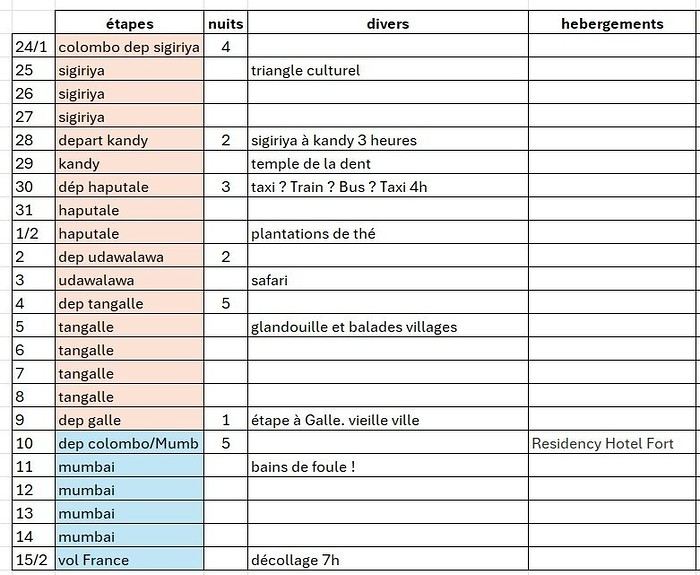
We’re heading to Sri Lanka for 23 days in January 2027—there are four of us—and we’ll wrap up the trip with 5 days in Mumbai. Our itinerary is coming together, but what do you think? (We can’t change the dates since our flights are already booked.)
We still have one night to slot in, and I’ve tentatively planned it in Tangalle, though it was a bit random. Would it make more sense to place it at a different stop? Or is there an intermediate stop I might be missing?
I’ve got accommodations sorted everywhere except Mumbai—it’s a nightmare (either way too expensive or really dodgy). By default, we’ve spotted the Residency Hotel Fort, but 70 € a night (with a discount) for a hotel that doesn’t offer anything special in India?!
Thanks so much for your help!


We’re heading to Sri Lanka for 23 days in January 2027—there are four of us—and we’ll wrap up the trip with 5 days in Mumbai. Our itinerary is coming together, but what do you think? (We can’t change the dates since our flights are already booked.)
We still have one night to slot in, and I’ve tentatively planned it in Tangalle, though it was a bit random. Would it make more sense to place it at a different stop? Or is there an intermediate stop I might be missing?
I’ve got accommodations sorted everywhere except Mumbai—it’s a nightmare (either way too expensive or really dodgy). By default, we’ve spotted the Residency Hotel Fort, but 70 € a night (with a discount) for a hotel that doesn’t offer anything special in India?!
Thanks so much for your help!


Practical tips from my 105 days of erratic wandering in India
Day 1 (10/10/2006): arrived in Mumbai around noon. Bus No. 338 5 Rs + 5 Rs (bag) 20' to Andheri station. Train 6 Rs to Dadar. Train 41 Rs to Lonavla 2h30 Hotel Chandralok 500 Rs **
Day 2: bike rental 7 Rs/h (too expensive, normal price 2-3 Rs/h) visit to the caves of Bhaja and Karla.
Day 3: train 28 Rs to Pune 1h20 Hotel National 416 Rs *
Day 4: train 141 Rs (with reservation) to Satara 2h45 Hotel Sagar 364 Rs **
Day 5: bus 110 Rs to Pandharpur 4h Hotel Aishwarya 450 Rs ***
Day 6: bike rental 2 Rs/h
Day 7: bus 125 Rs to Ahmadnagar 4h20 Hotel Parijat 250 Rs *
Day 8: train 151 Rs (!ticket for a mini 600 km trip!) to Jalgaon 5h30 Hotel Plaza 200 Rs **
Day 9: round-trip bus 38 Rs to Ajanta 1h30 + shuttle 6 Rs 5' Site entrance 250 Rs
Day 10: train 47 Rs to Khandwa 3h + bus 40 Rs to Omkareshwar 2h Ganesh G.H. 150 Rs *
Day 11 to 13: Omkareshwar
Day 14: bus 35 Rs to Maheshwar 2h45 Akashdeep Rest House 200 Rs **
Day 15: bus 8 Rs to Dhamnod 20' bus 20 Rs to crossroads 14 km from Mandu 1h40 bus 9 Rs to Mandu 20' Ram Mandir Dharamshala 100 Rs + 5 Rs for hot water *
Day 16: bike rental 3 Rs/h
Day 17: bus 50 Rs to Indore 4h Hotel Neelam 209 Rs
Day 18 to 20: Indore + round-trip bus 30 Rs to Ujjain 1h45
Day 21: train 82 Rs to Bhopal 5h30 Hotel Ranjeet 358 Rs *
Day 22: train 10 Rs to Sanchi 1h20 Jaiswal Lodge 200 Rs + 15 Rs for hot water! *
Day 23 and 24: visit to Sanchi + bike rental to visit the caves of Udayagiri
Day 25: train 69 Rs to Jhansi 5h + tempo 5 Rs to bus station + tempo 10 Rs + 5 Rs (bag) to Orccha 25' Sri Mahant G.H. 200 Rs **
Day 26 and 27: bike rental + train 20 Rs to Datia 30' + bemo 6 Rs to city center. Return bus 15 Rs 1h15
Day 28: bus 100 Rs to Khajuraho 4h Yogi Lodge 150 Rs **
Day 29: bike rental 30 Rs/day to visit the temples
Day 30: bus 70 Rs to Satna 4h + train 56 Rs to Jabalpur 3h Hotel Banjara 350 Rs **
Day 31: bike rental 2 Rs/h and visit to the Marble Rocks (50 km round trip)
Day 32: bus 50 Rs to Mandla 3h Hotel Satyam 250 Rs ** Round-trip bus 15 Rs to Ramnagar 1h15
Day 33: bus 60 Rs to Dindori 4h + bus 45 Rs to Amarkantak 3h (hellish road) Sarvodya Lodge 250 Rs °
Day 34: Amarkantak
Day 35: bus 25 Rs to Pendra Road 1h30 + train 120 Rs + 109 Rs (reservation) to Nagpur 8h Hotel Grand 257 Rs **
Day 36 and 37: bike rental + round-trip 25 Rs to Ramtek 1h40
Day 38: train 141 Rs + 125 Rs to Hyderabad 10h Hotel 3 Castles 200 Rs ° + Hotel Suhail 200 Rs °
Day 39 to 41: stay in Hyderabad
Day 42: train 48 Rs to Warangal 3h30 Hotel Surya 410 Rs **
Day 43: 60 Rs to Vijayawada 4h15 Hotel Sindhuri 275 Rs **
Day 44: round-trip bus 21 Rs to Amaravati 2h
Day 45: train 98 Rs to Visakhapatnam 7h30! (normally 6h) Hotel Sri Sampath Residency 250 Rs **
Day 46: train 111 Rs + 95 Rs to Puri 11h30 Travellers Inn 100 Rs ° + Hotel Z 300 Rs ***
Day 47 to 52: Puri + round-trip to Konarak
Day 53: train 38 Rs to Bhubaneshwar 1h15 Hotel Upasana 275 Rs *
Day 54: train 70 Rs to Balasore 4h bus 26 Rs to Baripada 1h40 Hotel Ambika 225 Rs °
Day 55: bus 25 Rs to Balasore 1h40 train 66 Rs + 68 Rs to Calcutta 6h30 Hotel Paragon 270 Rs * Hotel Crystal 350 Rs **
Day 56 to 62: Calcutta
Day 63: 60 Rs to Bishnupur 5h Hotel Monalisa 200 Rs *
Day 64: stay in Bishnupur no bike rental!
Day 65: bus 20 Rs to Bankura 1h30 bus 20 Rs to Durgapur 1h15 bus 28 Rs to Bolpur 2h15 Hotel Nisa 150 Rs *
Day 66 and 67: visit to Bolpur/Shantiniketan. Refused bike rental at ... 100 Rs/day!!! (Communist state of Bengal!!!)
Day 68: bus 20 Rs to Sainthia bus 35 Rs to Baharampur 4h30 bus 7 Rs to Murshidabad 40' Hotel Manjusha 350 Rs **
Day 69: bike lent by the friendly hotel owner and visit to Murshidabad
Day 70: bus 8 Rs to Baharampur 35' bus 60 Rs to Malda 6h (hellish road) Hotel Pratapaditya 231 Rs **
Day 71: train 66 Rs + 70 Rs to New Jalpaiguri 4h Hotel Holydon 250 Rs °
Day 72: train 52 Rs to Darjeeling 9h30! (normally 7h) Hotel Pineridge 500 Rs **
Day 73 to 75: Darjeeling
Day 76: train to New Jalpaiguri 9h30 + overnight train 271 Rs
Day 77: Patna Hotel President 482 Rs **
Day 78: stay in Patna
Day 79: train 18 Rs to Gaya 3h10 tempo 10 Rs to Bodhgaya 30' Deep G.H. 400 Rs!! °°
Day 80: return to Patna
Day 81: round-trip train 36 Rs to Rajgir 4h! (normally 3h)
Day 82: train 75 Rs to Varanasi 5h! (normally 4h) Yogi Lodge 150 Rs *
Day 83 to 87: Varanasi
Day 88: overnight train 310 Rs to Jaipur Evergreen G.H. 250 Rs **
Day 89: bike rental 30 Rs/day round-trip to Amber
Day 90: bus 59 Rs to Sikar 2h30 bus 23 Rs to Fatehpur 1h30 Rajshri Rest House 300 Rs *
Day 91: round-trip bus 12 Rs to Mandawa 30'
Day 92: round-trip bus 17 Rs to Churu 1h30
Day 93: bus 80 Rs to Jaipur 3h30 Evergreen G.H.
Day 94: bus 105 Rs to Bundi 5h30 Shivam G.H. 200 Rs **
Day 95: bike rental 3 Rs/h
Day 96: auto-rickshaw to station 45 Rs 25' train 44 Rs + 50 Rs to Chittorgarh train 21 Rs to Udaipur (total trip 8h) Badi Haveli 330 Rs **
Day 97 to 99: Udaipur + round-trip bus 45 Rs to Ranakpur 3h30
Day 100: bus 143 Rs to Ahmedabad 5h30 Hotel Manila 300 Rs **
Day 101: Ahmedabad
Day 102: bus 99 Rs to Bhavnagar 4h30 Hotel Vrindavan 200 Rs *
Day 103: round-trip bus 22 Rs to Palitana 1h10
Day 104: bus 85 Rs! to Ahmedabad 5h30 + overnight train ? Rs (feels like the end of the trip!)
Day 105 (January 22, 2007): train 6 Rs from Dadar to Andheri 20' + bus 5 Rs + 5 Rs (bag) to International Airport 20'
More figures British Airways flight price Brussels-London-Mumbai-London-Brussels 576 € Exchange rate from 55 Rs to 58.6 Rs per euro Average room price 272 Rs/night Daily budget 11 € Chai from 1 Rs (Calcutta-Bengal) to 6/7 Rs (Rajasthan) Bottle of water from 6 Rs (Udaipur), 8 Rs (Varanasi) to 12/13 Rs Internet from 8 Rs (Warangal), 10 Rs (Calcutta, Indore, Hyderabad), 20 Rs (often) to 40/60 Rs!! (Rajasthan) Beer in a restaurant from 85/100 Rs (often) to 150/165 Rs (Varanasi/Udaipur) More details on request
Hello everyone,
we got back from our trip to Kashmir and Ladakh three weeks ago.
We spent 4 weeks there, including one in Kashmir.
We’re really happy with our stay in Srinagar and Sonamarg. The Kashmiris gave us a very warm welcome and seemed pleased to see tourists who weren’t Indian. In fact, over the 4 days we spent in Srinagar, we only saw 4 people who looked European... Srinagar is stunning with its lakes and the lively Mughal gardens. No trouble getting around, whether by shikara, rickshaw, taxi, or on foot. The houseboats are gorgeous, unfortunately controlled by consortiums. We took a taxi to Sonamarg (20 €).
Sonamarg (two nights) and its glacier are easy to explore, either on horseback or on foot, but it’s becoming a leisure spot for Indians. To get to Ladakh afterward, we opted for a private taxi (quite expensive at 100 €, but the road is long). Since we’re a couple, it allowed us to stop whenever we wanted... and the route is beautiful all the way to Lamayuru, with our first snow-covered pass under snow when we crossed around May 21st. Then we stopped in Mulbek and Kargil before arriving in Lamayuru (three nights). We took another taxi to Alchi (26 €), spent one night there, and took the local bus at around 8 AM to Leh (3 €, a comfortable one-hour ride). We arrived in Leh around 9:30 AM, and Gyatsel from Tsarap Guesthouse came to pick us up with our backpacks. His guesthouse is located 500 meters from the market square in Leh, in a quiet little alley with no traffic. We highly recommend it because Gyatsel is invaluable for arranging taxis and organizing off-agency circuits...
His accommodation is super comfortable, and he cooks with vegetables from his garden. His wife also helps out... It’s Gyatsel’s mother who tends the garden. Through him, we arranged permits for the Nubra Valley up to Turtuk, then the Pangong and Tso Moriri lakes (we didn’t do the latter due to snow overnight!). We also crossed the Changtang (magnificent) to reach Thiksey, Stakna, Hemis, and returned to Leh. Six days in a private taxi (400 €). Since the roads were clear, we headed to Zanskar for 5 days in a shared taxi (28 € round trip for both of us). The route from Leh to Zangla follows the Zanskar gorges (impressive!).
We discovered Padum, Pibiting, Karsha, and Puktal, which you can reach via a small 7 km road and a 45-minute walk to finish, plus the sacred summit on the way to Manali.
Back in Leh, we extended our permit to visit the Aryan Valley by taxi (round trip, two days, 90 €). We spent our last two days resting in Leh—the altitude is really tiring...
I’m sharing these taxi prices as a guide for a couple. Accommodation ranged from 12 € in Leh to 30 € at Pangong Lake (the most expensive), but averaged around 15-17 € per night.
We’re not trekkers, but we love walks, discovery, and meeting people along the way. It was an amazing trip, and we even discovered a very old monastery a few kilometers before Lamayuru, where a monk took us—timeless...
I’m sharing these details because it’s hard to find precise information about Kashmir.
Sonamarg (two nights) and its glacier are easy to explore, either on horseback or on foot, but it’s becoming a leisure spot for Indians. To get to Ladakh afterward, we opted for a private taxi (quite expensive at 100 €, but the road is long). Since we’re a couple, it allowed us to stop whenever we wanted... and the route is beautiful all the way to Lamayuru, with our first snow-covered pass under snow when we crossed around May 21st. Then we stopped in Mulbek and Kargil before arriving in Lamayuru (three nights). We took another taxi to Alchi (26 €), spent one night there, and took the local bus at around 8 AM to Leh (3 €, a comfortable one-hour ride). We arrived in Leh around 9:30 AM, and Gyatsel from Tsarap Guesthouse came to pick us up with our backpacks. His guesthouse is located 500 meters from the market square in Leh, in a quiet little alley with no traffic. We highly recommend it because Gyatsel is invaluable for arranging taxis and organizing off-agency circuits...
His accommodation is super comfortable, and he cooks with vegetables from his garden. His wife also helps out... It’s Gyatsel’s mother who tends the garden. Through him, we arranged permits for the Nubra Valley up to Turtuk, then the Pangong and Tso Moriri lakes (we didn’t do the latter due to snow overnight!). We also crossed the Changtang (magnificent) to reach Thiksey, Stakna, Hemis, and returned to Leh. Six days in a private taxi (400 €). Since the roads were clear, we headed to Zanskar for 5 days in a shared taxi (28 € round trip for both of us). The route from Leh to Zangla follows the Zanskar gorges (impressive!).
We discovered Padum, Pibiting, Karsha, and Puktal, which you can reach via a small 7 km road and a 45-minute walk to finish, plus the sacred summit on the way to Manali.
Back in Leh, we extended our permit to visit the Aryan Valley by taxi (round trip, two days, 90 €). We spent our last two days resting in Leh—the altitude is really tiring...
I’m sharing these taxi prices as a guide for a couple. Accommodation ranged from 12 € in Leh to 30 € at Pangong Lake (the most expensive), but averaged around 15-17 € per night.
We’re not trekkers, but we love walks, discovery, and meeting people along the way. It was an amazing trip, and we even discovered a very old monastery a few kilometers before Lamayuru, where a monk took us—timeless...
I’m sharing these details because it’s hard to find precise information about Kashmir.
Hi everyone!
I’m planning a short visit to Pokhara around mid-February 2027 (it’ll be my 4th time in Nepal 😊, over 40 years!). I’d like to book a room in advance rather than looking when I arrive. I’ve checked a bit on Bxxking.com and see lots of options. I’m used to scoping out the surroundings of places listed, just to avoid ending up in areas that are either unappealing or far from everything.
So, I see quite a few offers around the lake (Lakeside?), but every time I check what it looks like, the streets seem really uninviting. It’s kind of like a construction site with buildings everywhere… Nothing like Bhaktapur (for example) or even Thamel, where the streets seem way more pleasant.
Could anyone give me some advice?
Also, I don’t really get the impression that Pokhara is worth a visit of several days. The lake, sure, but once you’ve seen it—what else is there?
I’m planning a short visit to Pokhara around mid-February 2027 (it’ll be my 4th time in Nepal 😊, over 40 years!). I’d like to book a room in advance rather than looking when I arrive. I’ve checked a bit on Bxxking.com and see lots of options. I’m used to scoping out the surroundings of places listed, just to avoid ending up in areas that are either unappealing or far from everything.
So, I see quite a few offers around the lake (Lakeside?), but every time I check what it looks like, the streets seem really uninviting. It’s kind of like a construction site with buildings everywhere… Nothing like Bhaktapur (for example) or even Thamel, where the streets seem way more pleasant.
Could anyone give me some advice?
Also, I don’t really get the impression that Pokhara is worth a visit of several days. The lake, sure, but once you’ve seen it—what else is there?
Hi there. I’d like to know about accommodation options for unguided hikers. I see there are campsites—are the tents already set up, or do we need to bring our own? Same question for sleeping bags—ours are a bit tight, I think (comfort temp 0°C). Are blankets provided? I’m picturing a camp where everything’s taken care of, including meals, but I’m worried I might be mistaken...
Thanks in advance
Hi everyone,
I’m heading to Assam and I’d like to know what type of electrical adapter I need—is it M or D, or both?
Thanks
Hello,
I’m heading to Sri Lanka for 3 weeks in July with my two 11-year-old kids, and I’m wondering about how to organize the trip. We’re used to traveling on the go, staying 1 to 2 or 3 nights per place depending on how we feel.
Do you recommend planning the itinerary and booking accommodations in advance to save time once we’re there? Or is it pretty easy to organize everything as we go without any issues?
Same question for activities: Should we book safaris and tours ahead of time, or can we arrange them easily on the spot? Is there a risk of not getting a spot, for example, to visit a park since we’ll be there in July?
We’ll be using local transport (train, VTC via PickMe, tuk-tuk) to get from one place to another.
In short: Are there any must-book things we should reserve now? So far, I only have the flight tickets!
Thanks in advance for your help! 😊
I’m heading to Sri Lanka for 3 weeks in July with my two 11-year-old kids, and I’m wondering about how to organize the trip. We’re used to traveling on the go, staying 1 to 2 or 3 nights per place depending on how we feel.
Do you recommend planning the itinerary and booking accommodations in advance to save time once we’re there? Or is it pretty easy to organize everything as we go without any issues?
Same question for activities: Should we book safaris and tours ahead of time, or can we arrange them easily on the spot? Is there a risk of not getting a spot, for example, to visit a park since we’ll be there in July?
We’ll be using local transport (train, VTC via PickMe, tuk-tuk) to get from one place to another.
In short: Are there any must-book things we should reserve now? So far, I only have the flight tickets!
Thanks in advance for your help! 😊
Hi there, I think you're on the right track—you plan the itinerary and book the rooms in advance, and that’s it.
Not only do you save time, but you also know where you’ll be staying each night. Choosing well on Booking (or elsewhere) is actually a pleasure!
For safaris, given the number of jeeps with drivers available, it’s unlikely you’ll be turned away... the real issue is more about the concentration of jeeps around the animals.
I travel like you do—train, bus, tuk-tuk, and sometimes taxi. Ride-hailing apps like PickMe and other VTCs are mostly in big cities.
For the mountain train, due to severe flooding, service was interrupted on the line between Kandy and Ella. Check ahead, because reservations for this train are very complicated, if not impossible.
For the Colombo/Kandy train, you reserve your seats by buying the ticket before boarding. In the south, no need to book in advance for trains.
In Sri Lanka, there’s always a solution for getting around—just ask your hosts. They have trusted contacts at their fingertips. But still, compare prices—😏 smart move!
I stick to booking my nights and keep pre-planned activities to a minimum.
For reservations you can’t skip, it’s the beach stays you’ll want to secure.
Hi there,
I’m trying to find out if it’s still possible to travel from Mumbai to Goa by ferry or any other sea route. My search results aren’t very clear, and if it *is* possible, I can’t figure out where to book... If anyone has any info, I’d really appreciate it—thanks in advance!
Have a great day,
Virginie
I’m trying to find out if it’s still possible to travel from Mumbai to Goa by ferry or any other sea route. My search results aren’t very clear, and if it *is* possible, I can’t figure out where to book... If anyone has any info, I’d really appreciate it—thanks in advance!
Have a great day,
Virginie
It seems there’s a ferry from Nagapattinam to Jaffna in India. Has anyone here taken this ferry before? My main question is how to get to Nagapattinam—by train, bus? And from which town further south, of course.
Thanks, friends!
Gaston
Gaston
Hi there.
We’re spending a month in Sri Lanka in March, and we’ll have one week left after leaving Polonnaruwa.
We’re torn between spending it in the Jaffna region or on the east coast between Batticaloa and Trincomalee.
We’re divers, so the east coast appeals to us for snorkeling, beaches, and lagoons—but it seems like late March might not be the best time for that coast. What do you think?
As for Jaffna, the culture of the region, its more authentic feel since it’s less touristy, and the offshore islands all appeal to us too—but it seems far from the rest of the country and harder to access.
We have to choose because we won’t be able to visit both sides, and I’d love to hear your thoughts.
Thanks, Marie
Hi there,
We just got back from a 2-week trip to Sri Lanka as a couple, and while planning the trip, we found plenty of info on the itinerary, places to see, and transportation, but much fewer clear reports on the actual budget to expect once there. Yet, that was an important point for us because we like to plan ahead a little before traveling.
So, we took the time to break down our complete budget after the trip. In our case, we spent around **930 € per person** for 2 weeks, being careful without depriving ourselves, mixing guesthouses, more comfortable hotels, quite a few activities, and even a private driver for part of the stay.
What we found interesting when crunching the numbers is that in Sri Lanka, it’s not necessarily meals or short trips that blow the budget, but rather flights, certain accommodations, cultural activities, and all those little expenses we sometimes forget, like tips.
If this can help other travelers get a better idea, we’ve put everything together on our blog with our experience, a detailed breakdown of expenses, and practical info on money while there, withdrawals, and tipping:
https://aventures-sans-mesaventure.com/budget-sri-lanka-pour-un-voyage-de-2-semaines/
Happy travels and enjoy your adventure! !
Hi everyone,
We’re a group of 5 heading to the Everest Base Camp trek in early April. We won’t have a porter or guide—we’re used to hiking independently and have already done the Langtang trek and the Annapurna Circuit (back in 2003!).
I’d love to know if it’s necessary to book lodges in advance or if we’ll easily find availability during this busy season. Also, will we find lodges all along the route between the main stopover villages, or only in those villages? I remember there were plenty everywhere on the Annapurna Circuit. We want to stay as flexible as possible.
Thanks for your feedback!
We’re a group of 5 heading to the Everest Base Camp trek in early April. We won’t have a porter or guide—we’re used to hiking independently and have already done the Langtang trek and the Annapurna Circuit (back in 2003!).
I’d love to know if it’s necessary to book lodges in advance or if we’ll easily find availability during this busy season. Also, will we find lodges all along the route between the main stopover villages, or only in those villages? I remember there were plenty everywhere on the Annapurna Circuit. We want to stay as flexible as possible.
Thanks for your feedback!
Hi there,
We’re heading to India in March 2026 and had planned to visit the parts of the Meenakshi Temple that are open to non-Hindus. However, the temple is currently undergoing major renovations—with all the towers covered in scaffolding—which might really take away from the experience and our stop in Madurai.
After some frustrating and vague online searches, and before we reshuffle our itinerary, I’d love to know—if possible—the most accurate expected completion date for the renovation work.
Thanks in advance.
We’re heading to India in March 2026 and had planned to visit the parts of the Meenakshi Temple that are open to non-Hindus. However, the temple is currently undergoing major renovations—with all the towers covered in scaffolding—which might really take away from the experience and our stop in Madurai.
After some frustrating and vague online searches, and before we reshuffle our itinerary, I’d love to know—if possible—the most accurate expected completion date for the renovation work.
Thanks in advance.
Hi there,
We’re planning a trip to Nepal and would love to do a helicopter tour to Everest with Namche Heli Service. Has anyone here used this agency? I can’t seem to find any reviews online. Thanks in advance!
Kloki
We’re planning a trip to Nepal and would love to do a helicopter tour to Everest with Namche Heli Service. Has anyone here used this agency? I can’t seem to find any reviews online. Thanks in advance!
Kloki
Hey fellow travelers,
I’m spending two weeks studying Hindi in the mornings in Delhi, in the Hauz Khas neighborhood. What spots should I check out in this area? Any cafés to chill at? How do I get to other parts of Delhi? By rickshaw? Is it easy to negotiate the price upfront?
Thanks in advance. 😊 Marlène
I’m spending two weeks studying Hindi in the mornings in Delhi, in the Hauz Khas neighborhood. What spots should I check out in this area? Any cafés to chill at? How do I get to other parts of Delhi? By rickshaw? Is it easy to negotiate the price upfront?
Thanks in advance. 😊 Marlène
Hi,
I’m leaving this Saturday for Northern India from 15/02 to 27/02. I’m planning to visit New Delhi, Agra, Chand Baori, Jaipur, Ranthambore, Bundi, Udaipur, and Jodhpur.
What’s the best way to get around? I was thinking of doing everything by train. Maybe taking the bus for some stretches?
As for renting a car with a driver, it seems expensive, so I’ve pretty much ruled that out. Unless someone’s got space for the same dates?
Thanks for your insights!
What’s the best way to get around? I was thinking of doing everything by train. Maybe taking the bus for some stretches?
As for renting a car with a driver, it seems expensive, so I’ve pretty much ruled that out. Unless someone’s got space for the same dates?
Thanks for your insights!
Hi everyone,
We’re heading out in March for this trek. We’re used to hiking and long-distance treks, but this’ll be our first time in Nepal.
QUESTION: People from Nepal are telling us it’s MANDATORY to have guides! Is this true, or is it just agencies trying to get work for their staff?
The Lonely Planet says: "In April 2023, the government announced that every trekker would need to hire the services of a porter or a licensed guide to obtain the TIMS permit. The law isn’t enforced, and by 2025, there were no longer any obligations for teahouse treks."
What do you think? What’s your experience? Thanks for your feedback.
We’re heading out in March for this trek. We’re used to hiking and long-distance treks, but this’ll be our first time in Nepal.
QUESTION: People from Nepal are telling us it’s MANDATORY to have guides! Is this true, or is it just agencies trying to get work for their staff?
The Lonely Planet says: "In April 2023, the government announced that every trekker would need to hire the services of a porter or a licensed guide to obtain the TIMS permit. The law isn’t enforced, and by 2025, there were no longer any obligations for teahouse treks."
What do you think? What’s your experience? Thanks for your feedback.
Hi,
I’d like to arrive in India at New Delhi Airport with some cash. I was wondering if the exchange rates at the airport are any good or if it’s best to avoid them (and exchange in the city instead?).

Thanks for your help.
NAMASTE NEPAL! PRACTICAL INFO AND EXPERIENCE FEEDBACK
Stay from March 25 to April 16, 2025
· Flight tickets Air India (via Delhi) (via Skyscanner) = 1130 € per person · Planned budget (and respected without too many restrictions and while buying a few small gifts) = 2000 € for the stay for two. Buses, taxis, and entrance fees to various sites represent a budget to consider. Meals are cheap. Drinks like beer/Coke, however, are not cheap and cost the equivalent of a meal. · Exchange rate of the rupee during our stay = 0.0064 € (the exchange rate is almost identical everywhere, including at the airport). · At the airport, purchase of two SIM cards (phone) = 1000 NPR x 2 for 28 days. · Kathmandu: we had booked the hotel upon arrival: Kathmandu Boutique Hotel (+977 015 357 446 – email: booking@kathmanduboutiquehotel.com), very well located in a quiet alley off the street, south of Thamel, a 10-minute walk from Durbar Square. A hotel like Nepal knows how to do, where tall people will have to duck. Night + breakfast = 18 € for two. Very warm welcome, great location, excellent value for money. · Bhaktapur: we had also booked a hotel for the end of our stay because the chance of the year 2025 made the Nepali New Year and Bisket Jatra particularly festive in Bhaktapur: Manju Baha Hotel School (+977 976 7234014 – email: manjubahahotel@gmail.com) located in an old monastery. "A social enterprise transforming an old monastery into a charming hotel, offering professional hospitality training to underprivileged Nepali youth." Night + breakfast = 32 € for two. Beautifully decorated room. Very warm welcome. Don’t miss the Changunarayan site (near Bhaktapur), it’s amazing. And if you’re lucky enough to be in Bhaktapur in mid-April for 3 days, there’s the Bisket Jatra festivities (Newari festival), joyful, noisy, fun, and wild… · Pokhara (hotel recommended by the Kathmandu hotel): Hotel Green Tara, Lakeside, 10th street, set back, quiet (Tel. +977 61 462698 – email: greentara_67@hotmail.com) · Trek permit (Lower Mustang, no need for an agency or guide, permits checked at Ghasa and Jomsom) = 2000 NPR per person (2 ID photos) · Bus Kathmandu/Pokhara and return = 2000 NPR per person · Bus Pokhara/Jomsom, 2 one-way tickets = 2800 NPR. · Taxi: negotiation with a driver we recommend, Vicky (+977 984 075 599). You explain what you want, negotiate the price, and he waits for you during the visit. Very charming, we used him several times. For example: departure from our hotel at 10 AM -> Boudhanath/Pashupatinath/Patan return at 5 PM to the hotel = 6500 NPR – Swayambhunath (round trip) = 1200 NPR · Site prices: https://ntb.gov.np/plan-your-trip/before-you-come/heritage-site-entry-fees o Visitor Pass for Kathmandu Durbar Square (for the duration of the stay, show your visa) = 1000 NPR per person (1 ID photo) o Bhaktapur Durbar Square (old town) = 1800 NPR per person o Patan = 1000 NPR per person o Swayambhu Stupa = 200 NPR per person o Boudha Stupa = 200 NPR per person o Pashupatinath Temple = 1000 NPR per person (interesting to take a guide) o Changunarayan Temple (6 km north of Bhaktapur) = 400 NPR per person o Mountain Museum in Pokhara = 750 NPR per person · E-cigarettes: e-cigarettes are banned in India and confiscated whether they’re in carry-on or checked luggage. On the way there, we had kept them in our carry-on, they were confiscated in Delhi. On the way back, learning from our previous experience, we put them in our checked luggage. Someone came to get us to take them out of our bags and confiscate them… You can find e-cigarettes and products in Kathmandu.
* * *
I’m 74 years old. I went to Nepal in 1982, 1983, and the last time in 1986. I wanted to introduce this beautiful and endearing country to my husband, and it was… now or never. So we decided it was now.
I knew the trek starting from Pokhara: Naudanda/Birethanti/Ghorepani/Tatopani/Kalopani. There was no way I was going to do that trek, especially the 1000-meter staircase to reach Ghorepani… You have to stay humble with age.
Back then, the road didn’t exist. I didn’t consider, with the construction of this road (NH48) along the western bank of the Kali Gandaki, doing a trek along a windy and dusty road. Was there an alternative hiking trail on the eastern bank? No one answered my question on VoyageForum, so I did my research online. And I found this site: "Andrées de Ruiter and Prem Rai - Trekking the Annapurna Circuit, including the new NATT trails that avoid the road - A guide to one of the most beautiful trekking regions in Nepal and the world (2011) - NATT = New Annapurna Trekking Trail".
Phew! A solution was emerging. This circuit from 2011 wasn’t fully marked. The idea was to go from Jomsom to Tatopani, so we needed to make sure the path was well-marked all the way, which we did, and the path exists, marked in red and white!
So, with the walking times information, we built our 8-day circuit:
· Jomsom/Thinigaon · Thinigaon/Chimang · Chimang/Saura · Saura/Kokhetanti · Rest day or, if in good shape: loop to Sekong Lake · Kokhetanti/Jhipra Deurali · Jhipra Deurali/Kopchepani · Kopchepani/Tatopani
It’s a senior trek, after all. So the walking times noted on the sites indicated 3 hours or even 4 hours for the two longest stages. That pace suited us fine.
On March 29, we left Kathmandu (1400m), after visiting the must-see sites, by bus to Pokhara: 200 km and 8.5 hours on a chaotic road under construction. I had a memory of Pokhara where it was the first city where you could see the Himalayan range, especially Machhapuchhare. But the pollution is such, the dust raised by traffic and construction, that no horizon is visible except the first hills around Pokhara.
We stayed 24 hours in Pokhara (820m), and on March 31, we left our luggage at the hotel and set off with our lightest backpacks: change of clothes, toiletries, first aid kit, anti-chafing cream, water bottle, sleeping bag liner, and light shoes for the stages.
We took the bus to Jomsom: 160 km/7.5 hours including stops for bathroom breaks, tea, and lunch. The road is nothing but a chaos of potholes, landslides, construction, dust, rebuilding, and mudslides. In Ghasa, the bus stops, and we’re told we’re at a checkpoint and that the two foreigners in the bus, my husband and I, need to have our permits checked, which takes a few minutes. The driving is rock-and-roll, surprising, and courteous. The drivers have their codes, and on these improbable roads, they’re virtuosos.
We could have chosen the plane, but several reasons dissuaded us: if there’s too much wind, the planes don’t take off; personally, I wasn’t reassured about landing in Jomsom, and this transport has a cost.
We arrived around 2 PM in Jomsom (2720m), and despite the early wake-up, the nearly 8 hours on the bus, and the altitude, we decided to head straight to Thinigaon (2840m). At the Jomsom checkpoint, they told us it was a 30-minute walk. Great! Except we took an hour and a half on an uphill road, bent over to fight a strong wind. But the Himalayan range is there! The Dhaulagiri, the Nilgiri, the Annapurnas as a reward.
In Thinigaon, we found a room at the "Nilgiri View Hotel" run by a didi (big sister in Nepali). From the lodge’s roof, she proudly showed us the different peaks surrounding the village and told us, worried, that it hadn’t snowed here for 3 years. She said there are very few tourists, that the season is rather in September/October/November. It seems there’s not a soul in this village, yet mules pass through the narrow street paved with large flat stones, their bells ringing. We dine at 6 PM and go to bed… Room = 1200 NPR and dinner, breakfast, and drinks = 2560 NPR.
On April 1, we set off at 9 AM, not for Chimang as planned but for Marpha! The didi from the Thinigaon lodge had said it was a 3-hour walk. The first part of this stage is attractive, the mountains are magnificent and imposing, the landscape is superb, there’s no one around, a feeling of being "alone in the world." We follow Dhumbra Tal, this small green lake. The path is a rocky track that climbs steeply. Then, around a hill, we start the big descent that joins the Kali Gandaki. We face the wind head-on, and the violent gusts take our breath away, throw us off balance, and envelop us in dust. We see the road on the other side of the Kali Gandaki. We arrive in the village of Chhairo at 2 PM, completely exhausted and with blistered feet, after 5 hours of walking instead of the planned 3.5 hours.
We’re welcomed by the village nurse, who tells us there’s a lodge in the village. Chhairo is a Tibetan village, a 20-minute walk from Marpha (according to the locals, multiply by 2 or even 3 for us…). We’re going to revise our trek plan and, first of all, spend the night in Chhairo.
The lodge is quite pleasant, and Karma, the hostess, is very friendly. She asks about our plans and suggests we stay in Chhairo the next day, from where we can visit Marpha and also Chimang, a 1-hour walk away, in light mode, meaning without backpacks. She invites us to participate in a village ceremony the next evening.
We immediately accept the proposal, as our feet need rest and the welcome is so warm… Dinner and bed!
We reworked our trek plan, which was too ambitious for our untrained bodies and, let’s face it… no longer in our first youth. In the initial plan, we thought there wouldn’t be too much elevation gain following the Kali Gandaki, but checking the map, we realize there might be significant elevation changes between Sauru and Sirkung. So we plan:
· Tomorrow: visit Marpha (2670m) and Chimang (2744m) · April 3: bus from Chhairo (2700m) to Kalopani (2530m) and continue on foot to Ghasa (2010m) · April 4: Ghasa/Pairataplo (1940m) · April 5: Pairatapla/Gadpar (1580m) · April 6: Gadpar/Narchyang (1510m) · April 7: Narchyang/Tatopani (1190m) · April 8: return to Pokhara.
Normally, it’s all downhill…
April 2, a rest day then… We set off in the morning to explore Marpha. We have to take a temporary bridge because the suspension bridge is closed due to road construction. We join the road and arrive in Marpha, a village famous for its apple orchards, brandy, cider, and apple juice production. This village is magnificent with its stone houses and monastery clinging to the hillside. The road construction spared it. There are people, but very few Western tourists.
We have lunch in Marpha and go back through Chhairo to take the path to Chimang. We cross a fragrant pine forest and find the rocky path; the landscape is splendid. We walk quietly, passing peaceful buffaloes and cows, and arrive at the foot of a stone staircase… 275 steps (which we counted on the way back) leading us to the village of Chimang. Chimang is an isolated Newari village that seems a bit desolate. Despite the slopes, there are crops on every little bit of land. Thankfully, we changed our initial program because there’s no lodge in this village, contrary to what we saw on a map… We wander through the village, which seems very deserted, have coffee in a house from another world, and then head back to Chhairo.
A rest day? = 5 hours of walking!!
Dinner and village ceremony. From what we understand, this ceremony is in honor of the Dalai Lama. Men, women, and children in traditional costumes gather twice a month; they dance, make, and offer small sweet cakes with Tibetan tea (made from tea, yak butter—often rancid—water, and salt). Surprising for first-timers…
Around 10 PM, we leave the ceremony; tomorrow morning, we need to be on the roadside by 7 AM to catch the bus to Kalopani…
This village of Chhairo is very pleasant and welcoming, no tourists, just two motorcyclists who arrived in the evening, one of whom participated in the ceremony and discreetly poured his Tibetan tea outside.
Lodge: "Norsang Tibetan Guesthouse and Restaurant". Total bill for 2 nights, 2 dinners, 2 breakfasts, and drinks = 8000 NPR.
April 3: bus from Chhairo to Kalopani, about 1.5 hours for the 20 km (200 NPR per person). We descend on the right bank of the Kali Gandaki. We find the red and white markings to resume the trek toward Ghasa. We’re in a fragrant pine forest, the Dhaulagiri on one side and the Annapurnas on the other, magnificent, and the path is pleasant and easy. We get a bit lost in this forest, always looking for the markings. Near Lete, two trekkers pass us, and we meet them again a little further on with two very young children, to whom we give the 2 hard-boiled eggs I didn’t eat this morning. They accepted them without hesitation.
We arrive in a village and ask for directions to Ghasa. The young girls point the way. But we come across a forest being logged, trees cut in all directions. We turn back and ask for confirmation. They confirm… But the two young girls catch up with us and clear the way. We have to step over, go around, and cross the felled trees, with no indication at all. Through this pick-up sticks of felled trees, the girls lead us to the top of a stone staircase, indicating that was the path. It’s the only place where we saw rhododendrons in bloom.
We descend the staircase. At the bottom, to the left, there’s a bridge to go toward Choyo, and to the right, a path to Ghasa. We take the right path and join the road. We should normally find the red and white markings, but we don’t… So we continue on the western bank road of the Kali Gandaki.
A little before the village of Misi, we see fumaroles on the opposite bank that seem to come from the ground. We don’t understand. We stopped to eat in the village of Misi (noodle soup = 600 NPR), but it’s hard to communicate with the elderly people running the guesthouse.
We continued on the road, not finding the marked path parallel to the road. Landslides, both on the left and right banks, seem to have taken over the marked routes. It’s a place where the Kali Gandaki gorge narrows, and on the opposite bank, the mountain smokes more and more, and we now hear the crackling of fire. Across from us, the mountain is burning… Our initial plan had us passing on that burning bank right now…
We arrive in Ghasa at 3:30 PM, a 6.5-hour stage but with a 1-hour stop at noon. We’re at the "Florida Guesthouse and Restaurant." From our room, we see the mountain smoking on the other side of the river, and at night, we see the flames. In this village, posters show Himalayan eagles and vultures that seem to be protected species. Indeed, we saw (and heard) 3 eagles circling today.
April 4 – Today, heading to Pairothapla or Kopchepani depending on our feet, accommodation options, and simply our desires.
No more smoke on the mountain this morning. It’s chilly, 7:45 AM, the sky is clear, just a smell of smoke outside.
Price of the lodge = 1000 NPR for the night + 3580 NPR for meals.
We cross Ghasa, which stretches over more than a kilometer. We have a drink at the last guesthouse in the village, and the didi, when she learns our destination, tells us to be careful because the villages we’re going to aren’t safe. Should we distribute our rupees in different pockets? Nah, we kept going.
At the exit of Ghasa, we find the red and white markings and take the suspension bridge to cross the boiling waters of the Kali Gandaki. The passage is impressive because the river is tumultuous. Lots of climbs and even more descents. We’re back on the eastern bank. It’s hot! On the narrow path, we meet a group of buffaloes. Who has the right of way? We decide to stick as close as possible to the rock wall and move forward calmly. The buffaloes look at us, chewing placidly, with no intention of jumping on us. Phew!
After a 5-hour stage (including stops), we arrive in Pairothapla, with hot feet and firm thighs, and decide we won’t go any further. It’s a good thing because there’s a lodge, the most basic so far, but with a great welcome. We have a meal and a short nap. The buffaloes we met on the way belong to this house. They come to drink at the fountain by the path.
Our host, very pleasant, doesn’t know what to do to please us and is very attentive. He wants to chat. He has two children, a 4-year-old girl and a 7-year-old boy. Where do they go to school? Do they go? He tells us that the fires in the mountain are caused by people, but for what reason? We won’t find out, but it’s illegal. From here, we can still see smoke rising in the distance. The wife is a bit less friendly. Corn kernels dry on a woven straw mat on the ground, and the mom sorts them.
From where we are, we overlook the valley and see the road under construction winding along the mountainside on the other bank.
Dinner on the terrace of the house overlooking the path, windbreaker and fleece on: dal bhat chicken for me and chicken curry for my husband: "organic" products, at least local production. There are small vegetable gardens everywhere with all sorts of vegetables.
April 5 – While we’re having breakfast on the terrace of our lodge, 5 porters, straps on their foreheads, heavily loaded, pass by on the path. A few minutes later, a group of 9 people appears. It must be said that since the beginning of our journey, we’ve met very few hikers. Two backpackers in Chhairo, the two hikers near Lete, two female hikers passed us before Pairothapla, a solo female hiker passed us…
The lodge in Pairothapla is called "Bimala Lodge & Thakali Kitchen" – Price for night + 4 meals + 2 breakfasts = 3000 NPR.
The descent toward the Kali Gandaki involves climbs whose steps we didn’t count. Clearly, the landslides on the mountain cause changes to the official ACAP trek marked in red and white, and the marking updates can’t keep up with the pace of these landslides. It’s almost always by chance that we find the markings. Fortunately, we can follow the power line that guides us somewhat.
Drink stop in Kopchepani, the legs are fine, but the feet don’t like being tightly enclosed. A group of trekkers with porters passes on the path. We met buffaloes that we kindly let pass; the path was wide enough, but it was a staircase going up, and we didn’t want to take any risks.
Across, a view of the magnificent Rupse Waterfall on the other bank of the Kali Gandaki, at the bottom, lots of vehicles and people.
Arrival in Gadpar after crossing a rather unwelcoming small village and cultivated gardens between dry stone walls, each better built than the last.
First lodge spotted, first lodge adopted to answer the call of our feet, and a very warm welcome from the owner. Since we hadn’t eaten at noon, we had Tibetan bread/jam. 6-hour stage including 1 hour of stops. Night + dinner + breakfast + drinks = 5060 NPR
April 6 – Today, heading to Narchyang.
For several days, we’ve seen banana trees with their bunches of fruit and even a prickly pear with large fruits ripening.
This stage is quite peaceful and pleasant. We take a suspension bridge to cross a tributary of the Kali Gandaki. While we’re resting for a moment before crossing the bridge, a couple of porters, a man and a woman, arrive and start across the bridge with their wood load in a basket held by a strap on their forehead, making them bend. We set off too… lighter than them.
On the other side of the bridge… a stone staircase, and it climbs steeply. The porter couple didn’t take this staircase; they went right on the path.
At the top of the staircase, we arrive in Narchyang after a 4-hour stage. A magnificent waterfall overlooks the village. We get lost in this fairly large village looking for a lodge. After wandering around for a while, we ask for directions, and an 84-year-old man takes us through the whole village and accompanies us to a very nice lodge run by a woman.
We chat with our hostess, who asks where we’re from and where we’re going. We explain that we want to reach Tatopani the next day and then return to Pokhara. She tells us there are 4x4s going directly to Pokhara and that it would probably be easier than taking a bus that might be full in Tatopani. After a quick consultation, we decide to return to Pokhara the next day by 4x4. She finds us a 4x4 with 2 seats left, departure at 8 AM – 5 hours on the road and 1500 NPR per person. A charming didi who does everything to be pleasant and helpful.
Narchyang community lodge = night + snacks + dinner + breakfast = 3000 NPR.
There you go, our trek ends tomorrow. Many necessary changes and adaptations to our initial trek, but no regrets, it was superb and a great experience that, for my part, I won’t be able to repeat. Always this encounter with the endearing, welcoming, curious, and very kind Nepali people. It was now or never, and we did it!
* * *
In conclusion, 3 full weeks in Nepal is a duration that allows visiting Kathmandu, Patan, and Bhaktapur, enjoying the various sites, and soaking in the atmosphere and urban Nepali life.
The trek, even revised and corrected, allowed us to get close to the impressive Annapurna and Dhaulagiri peaks. One or two acclimatization days might be necessary to get the body in tune with this magical and extraordinary land.
Stay from March 25 to April 16, 2025
· Flight tickets Air India (via Delhi) (via Skyscanner) = 1130 € per person · Planned budget (and respected without too many restrictions and while buying a few small gifts) = 2000 € for the stay for two. Buses, taxis, and entrance fees to various sites represent a budget to consider. Meals are cheap. Drinks like beer/Coke, however, are not cheap and cost the equivalent of a meal. · Exchange rate of the rupee during our stay = 0.0064 € (the exchange rate is almost identical everywhere, including at the airport). · At the airport, purchase of two SIM cards (phone) = 1000 NPR x 2 for 28 days. · Kathmandu: we had booked the hotel upon arrival: Kathmandu Boutique Hotel (+977 015 357 446 – email: booking@kathmanduboutiquehotel.com), very well located in a quiet alley off the street, south of Thamel, a 10-minute walk from Durbar Square. A hotel like Nepal knows how to do, where tall people will have to duck. Night + breakfast = 18 € for two. Very warm welcome, great location, excellent value for money. · Bhaktapur: we had also booked a hotel for the end of our stay because the chance of the year 2025 made the Nepali New Year and Bisket Jatra particularly festive in Bhaktapur: Manju Baha Hotel School (+977 976 7234014 – email: manjubahahotel@gmail.com) located in an old monastery. "A social enterprise transforming an old monastery into a charming hotel, offering professional hospitality training to underprivileged Nepali youth." Night + breakfast = 32 € for two. Beautifully decorated room. Very warm welcome. Don’t miss the Changunarayan site (near Bhaktapur), it’s amazing. And if you’re lucky enough to be in Bhaktapur in mid-April for 3 days, there’s the Bisket Jatra festivities (Newari festival), joyful, noisy, fun, and wild… · Pokhara (hotel recommended by the Kathmandu hotel): Hotel Green Tara, Lakeside, 10th street, set back, quiet (Tel. +977 61 462698 – email: greentara_67@hotmail.com) · Trek permit (Lower Mustang, no need for an agency or guide, permits checked at Ghasa and Jomsom) = 2000 NPR per person (2 ID photos) · Bus Kathmandu/Pokhara and return = 2000 NPR per person · Bus Pokhara/Jomsom, 2 one-way tickets = 2800 NPR. · Taxi: negotiation with a driver we recommend, Vicky (+977 984 075 599). You explain what you want, negotiate the price, and he waits for you during the visit. Very charming, we used him several times. For example: departure from our hotel at 10 AM -> Boudhanath/Pashupatinath/Patan return at 5 PM to the hotel = 6500 NPR – Swayambhunath (round trip) = 1200 NPR · Site prices: https://ntb.gov.np/plan-your-trip/before-you-come/heritage-site-entry-fees o Visitor Pass for Kathmandu Durbar Square (for the duration of the stay, show your visa) = 1000 NPR per person (1 ID photo) o Bhaktapur Durbar Square (old town) = 1800 NPR per person o Patan = 1000 NPR per person o Swayambhu Stupa = 200 NPR per person o Boudha Stupa = 200 NPR per person o Pashupatinath Temple = 1000 NPR per person (interesting to take a guide) o Changunarayan Temple (6 km north of Bhaktapur) = 400 NPR per person o Mountain Museum in Pokhara = 750 NPR per person · E-cigarettes: e-cigarettes are banned in India and confiscated whether they’re in carry-on or checked luggage. On the way there, we had kept them in our carry-on, they were confiscated in Delhi. On the way back, learning from our previous experience, we put them in our checked luggage. Someone came to get us to take them out of our bags and confiscate them… You can find e-cigarettes and products in Kathmandu.
* * *
I’m 74 years old. I went to Nepal in 1982, 1983, and the last time in 1986. I wanted to introduce this beautiful and endearing country to my husband, and it was… now or never. So we decided it was now.
I knew the trek starting from Pokhara: Naudanda/Birethanti/Ghorepani/Tatopani/Kalopani. There was no way I was going to do that trek, especially the 1000-meter staircase to reach Ghorepani… You have to stay humble with age.
Back then, the road didn’t exist. I didn’t consider, with the construction of this road (NH48) along the western bank of the Kali Gandaki, doing a trek along a windy and dusty road. Was there an alternative hiking trail on the eastern bank? No one answered my question on VoyageForum, so I did my research online. And I found this site: "Andrées de Ruiter and Prem Rai - Trekking the Annapurna Circuit, including the new NATT trails that avoid the road - A guide to one of the most beautiful trekking regions in Nepal and the world (2011) - NATT = New Annapurna Trekking Trail".
Phew! A solution was emerging. This circuit from 2011 wasn’t fully marked. The idea was to go from Jomsom to Tatopani, so we needed to make sure the path was well-marked all the way, which we did, and the path exists, marked in red and white!
So, with the walking times information, we built our 8-day circuit:
· Jomsom/Thinigaon · Thinigaon/Chimang · Chimang/Saura · Saura/Kokhetanti · Rest day or, if in good shape: loop to Sekong Lake · Kokhetanti/Jhipra Deurali · Jhipra Deurali/Kopchepani · Kopchepani/Tatopani
It’s a senior trek, after all. So the walking times noted on the sites indicated 3 hours or even 4 hours for the two longest stages. That pace suited us fine.
On March 29, we left Kathmandu (1400m), after visiting the must-see sites, by bus to Pokhara: 200 km and 8.5 hours on a chaotic road under construction. I had a memory of Pokhara where it was the first city where you could see the Himalayan range, especially Machhapuchhare. But the pollution is such, the dust raised by traffic and construction, that no horizon is visible except the first hills around Pokhara.
We stayed 24 hours in Pokhara (820m), and on March 31, we left our luggage at the hotel and set off with our lightest backpacks: change of clothes, toiletries, first aid kit, anti-chafing cream, water bottle, sleeping bag liner, and light shoes for the stages.
We took the bus to Jomsom: 160 km/7.5 hours including stops for bathroom breaks, tea, and lunch. The road is nothing but a chaos of potholes, landslides, construction, dust, rebuilding, and mudslides. In Ghasa, the bus stops, and we’re told we’re at a checkpoint and that the two foreigners in the bus, my husband and I, need to have our permits checked, which takes a few minutes. The driving is rock-and-roll, surprising, and courteous. The drivers have their codes, and on these improbable roads, they’re virtuosos.
We could have chosen the plane, but several reasons dissuaded us: if there’s too much wind, the planes don’t take off; personally, I wasn’t reassured about landing in Jomsom, and this transport has a cost.
We arrived around 2 PM in Jomsom (2720m), and despite the early wake-up, the nearly 8 hours on the bus, and the altitude, we decided to head straight to Thinigaon (2840m). At the Jomsom checkpoint, they told us it was a 30-minute walk. Great! Except we took an hour and a half on an uphill road, bent over to fight a strong wind. But the Himalayan range is there! The Dhaulagiri, the Nilgiri, the Annapurnas as a reward.
In Thinigaon, we found a room at the "Nilgiri View Hotel" run by a didi (big sister in Nepali). From the lodge’s roof, she proudly showed us the different peaks surrounding the village and told us, worried, that it hadn’t snowed here for 3 years. She said there are very few tourists, that the season is rather in September/October/November. It seems there’s not a soul in this village, yet mules pass through the narrow street paved with large flat stones, their bells ringing. We dine at 6 PM and go to bed… Room = 1200 NPR and dinner, breakfast, and drinks = 2560 NPR.
On April 1, we set off at 9 AM, not for Chimang as planned but for Marpha! The didi from the Thinigaon lodge had said it was a 3-hour walk. The first part of this stage is attractive, the mountains are magnificent and imposing, the landscape is superb, there’s no one around, a feeling of being "alone in the world." We follow Dhumbra Tal, this small green lake. The path is a rocky track that climbs steeply. Then, around a hill, we start the big descent that joins the Kali Gandaki. We face the wind head-on, and the violent gusts take our breath away, throw us off balance, and envelop us in dust. We see the road on the other side of the Kali Gandaki. We arrive in the village of Chhairo at 2 PM, completely exhausted and with blistered feet, after 5 hours of walking instead of the planned 3.5 hours.
We’re welcomed by the village nurse, who tells us there’s a lodge in the village. Chhairo is a Tibetan village, a 20-minute walk from Marpha (according to the locals, multiply by 2 or even 3 for us…). We’re going to revise our trek plan and, first of all, spend the night in Chhairo.
The lodge is quite pleasant, and Karma, the hostess, is very friendly. She asks about our plans and suggests we stay in Chhairo the next day, from where we can visit Marpha and also Chimang, a 1-hour walk away, in light mode, meaning without backpacks. She invites us to participate in a village ceremony the next evening.
We immediately accept the proposal, as our feet need rest and the welcome is so warm… Dinner and bed!
We reworked our trek plan, which was too ambitious for our untrained bodies and, let’s face it… no longer in our first youth. In the initial plan, we thought there wouldn’t be too much elevation gain following the Kali Gandaki, but checking the map, we realize there might be significant elevation changes between Sauru and Sirkung. So we plan:
· Tomorrow: visit Marpha (2670m) and Chimang (2744m) · April 3: bus from Chhairo (2700m) to Kalopani (2530m) and continue on foot to Ghasa (2010m) · April 4: Ghasa/Pairataplo (1940m) · April 5: Pairatapla/Gadpar (1580m) · April 6: Gadpar/Narchyang (1510m) · April 7: Narchyang/Tatopani (1190m) · April 8: return to Pokhara.
Normally, it’s all downhill…
April 2, a rest day then… We set off in the morning to explore Marpha. We have to take a temporary bridge because the suspension bridge is closed due to road construction. We join the road and arrive in Marpha, a village famous for its apple orchards, brandy, cider, and apple juice production. This village is magnificent with its stone houses and monastery clinging to the hillside. The road construction spared it. There are people, but very few Western tourists.
We have lunch in Marpha and go back through Chhairo to take the path to Chimang. We cross a fragrant pine forest and find the rocky path; the landscape is splendid. We walk quietly, passing peaceful buffaloes and cows, and arrive at the foot of a stone staircase… 275 steps (which we counted on the way back) leading us to the village of Chimang. Chimang is an isolated Newari village that seems a bit desolate. Despite the slopes, there are crops on every little bit of land. Thankfully, we changed our initial program because there’s no lodge in this village, contrary to what we saw on a map… We wander through the village, which seems very deserted, have coffee in a house from another world, and then head back to Chhairo.
A rest day? = 5 hours of walking!!
Dinner and village ceremony. From what we understand, this ceremony is in honor of the Dalai Lama. Men, women, and children in traditional costumes gather twice a month; they dance, make, and offer small sweet cakes with Tibetan tea (made from tea, yak butter—often rancid—water, and salt). Surprising for first-timers…
Around 10 PM, we leave the ceremony; tomorrow morning, we need to be on the roadside by 7 AM to catch the bus to Kalopani…
This village of Chhairo is very pleasant and welcoming, no tourists, just two motorcyclists who arrived in the evening, one of whom participated in the ceremony and discreetly poured his Tibetan tea outside.
Lodge: "Norsang Tibetan Guesthouse and Restaurant". Total bill for 2 nights, 2 dinners, 2 breakfasts, and drinks = 8000 NPR.
April 3: bus from Chhairo to Kalopani, about 1.5 hours for the 20 km (200 NPR per person). We descend on the right bank of the Kali Gandaki. We find the red and white markings to resume the trek toward Ghasa. We’re in a fragrant pine forest, the Dhaulagiri on one side and the Annapurnas on the other, magnificent, and the path is pleasant and easy. We get a bit lost in this forest, always looking for the markings. Near Lete, two trekkers pass us, and we meet them again a little further on with two very young children, to whom we give the 2 hard-boiled eggs I didn’t eat this morning. They accepted them without hesitation.
We arrive in a village and ask for directions to Ghasa. The young girls point the way. But we come across a forest being logged, trees cut in all directions. We turn back and ask for confirmation. They confirm… But the two young girls catch up with us and clear the way. We have to step over, go around, and cross the felled trees, with no indication at all. Through this pick-up sticks of felled trees, the girls lead us to the top of a stone staircase, indicating that was the path. It’s the only place where we saw rhododendrons in bloom.
We descend the staircase. At the bottom, to the left, there’s a bridge to go toward Choyo, and to the right, a path to Ghasa. We take the right path and join the road. We should normally find the red and white markings, but we don’t… So we continue on the western bank road of the Kali Gandaki.
A little before the village of Misi, we see fumaroles on the opposite bank that seem to come from the ground. We don’t understand. We stopped to eat in the village of Misi (noodle soup = 600 NPR), but it’s hard to communicate with the elderly people running the guesthouse.
We continued on the road, not finding the marked path parallel to the road. Landslides, both on the left and right banks, seem to have taken over the marked routes. It’s a place where the Kali Gandaki gorge narrows, and on the opposite bank, the mountain smokes more and more, and we now hear the crackling of fire. Across from us, the mountain is burning… Our initial plan had us passing on that burning bank right now…
We arrive in Ghasa at 3:30 PM, a 6.5-hour stage but with a 1-hour stop at noon. We’re at the "Florida Guesthouse and Restaurant." From our room, we see the mountain smoking on the other side of the river, and at night, we see the flames. In this village, posters show Himalayan eagles and vultures that seem to be protected species. Indeed, we saw (and heard) 3 eagles circling today.
April 4 – Today, heading to Pairothapla or Kopchepani depending on our feet, accommodation options, and simply our desires.
No more smoke on the mountain this morning. It’s chilly, 7:45 AM, the sky is clear, just a smell of smoke outside.
Price of the lodge = 1000 NPR for the night + 3580 NPR for meals.
We cross Ghasa, which stretches over more than a kilometer. We have a drink at the last guesthouse in the village, and the didi, when she learns our destination, tells us to be careful because the villages we’re going to aren’t safe. Should we distribute our rupees in different pockets? Nah, we kept going.
At the exit of Ghasa, we find the red and white markings and take the suspension bridge to cross the boiling waters of the Kali Gandaki. The passage is impressive because the river is tumultuous. Lots of climbs and even more descents. We’re back on the eastern bank. It’s hot! On the narrow path, we meet a group of buffaloes. Who has the right of way? We decide to stick as close as possible to the rock wall and move forward calmly. The buffaloes look at us, chewing placidly, with no intention of jumping on us. Phew!
After a 5-hour stage (including stops), we arrive in Pairothapla, with hot feet and firm thighs, and decide we won’t go any further. It’s a good thing because there’s a lodge, the most basic so far, but with a great welcome. We have a meal and a short nap. The buffaloes we met on the way belong to this house. They come to drink at the fountain by the path.
Our host, very pleasant, doesn’t know what to do to please us and is very attentive. He wants to chat. He has two children, a 4-year-old girl and a 7-year-old boy. Where do they go to school? Do they go? He tells us that the fires in the mountain are caused by people, but for what reason? We won’t find out, but it’s illegal. From here, we can still see smoke rising in the distance. The wife is a bit less friendly. Corn kernels dry on a woven straw mat on the ground, and the mom sorts them.
From where we are, we overlook the valley and see the road under construction winding along the mountainside on the other bank.
Dinner on the terrace of the house overlooking the path, windbreaker and fleece on: dal bhat chicken for me and chicken curry for my husband: "organic" products, at least local production. There are small vegetable gardens everywhere with all sorts of vegetables.
April 5 – While we’re having breakfast on the terrace of our lodge, 5 porters, straps on their foreheads, heavily loaded, pass by on the path. A few minutes later, a group of 9 people appears. It must be said that since the beginning of our journey, we’ve met very few hikers. Two backpackers in Chhairo, the two hikers near Lete, two female hikers passed us before Pairothapla, a solo female hiker passed us…
The lodge in Pairothapla is called "Bimala Lodge & Thakali Kitchen" – Price for night + 4 meals + 2 breakfasts = 3000 NPR.
The descent toward the Kali Gandaki involves climbs whose steps we didn’t count. Clearly, the landslides on the mountain cause changes to the official ACAP trek marked in red and white, and the marking updates can’t keep up with the pace of these landslides. It’s almost always by chance that we find the markings. Fortunately, we can follow the power line that guides us somewhat.
Drink stop in Kopchepani, the legs are fine, but the feet don’t like being tightly enclosed. A group of trekkers with porters passes on the path. We met buffaloes that we kindly let pass; the path was wide enough, but it was a staircase going up, and we didn’t want to take any risks.
Across, a view of the magnificent Rupse Waterfall on the other bank of the Kali Gandaki, at the bottom, lots of vehicles and people.
Arrival in Gadpar after crossing a rather unwelcoming small village and cultivated gardens between dry stone walls, each better built than the last.
First lodge spotted, first lodge adopted to answer the call of our feet, and a very warm welcome from the owner. Since we hadn’t eaten at noon, we had Tibetan bread/jam. 6-hour stage including 1 hour of stops. Night + dinner + breakfast + drinks = 5060 NPR
April 6 – Today, heading to Narchyang.
For several days, we’ve seen banana trees with their bunches of fruit and even a prickly pear with large fruits ripening.
This stage is quite peaceful and pleasant. We take a suspension bridge to cross a tributary of the Kali Gandaki. While we’re resting for a moment before crossing the bridge, a couple of porters, a man and a woman, arrive and start across the bridge with their wood load in a basket held by a strap on their forehead, making them bend. We set off too… lighter than them.
On the other side of the bridge… a stone staircase, and it climbs steeply. The porter couple didn’t take this staircase; they went right on the path.
At the top of the staircase, we arrive in Narchyang after a 4-hour stage. A magnificent waterfall overlooks the village. We get lost in this fairly large village looking for a lodge. After wandering around for a while, we ask for directions, and an 84-year-old man takes us through the whole village and accompanies us to a very nice lodge run by a woman.
We chat with our hostess, who asks where we’re from and where we’re going. We explain that we want to reach Tatopani the next day and then return to Pokhara. She tells us there are 4x4s going directly to Pokhara and that it would probably be easier than taking a bus that might be full in Tatopani. After a quick consultation, we decide to return to Pokhara the next day by 4x4. She finds us a 4x4 with 2 seats left, departure at 8 AM – 5 hours on the road and 1500 NPR per person. A charming didi who does everything to be pleasant and helpful.
Narchyang community lodge = night + snacks + dinner + breakfast = 3000 NPR.
There you go, our trek ends tomorrow. Many necessary changes and adaptations to our initial trek, but no regrets, it was superb and a great experience that, for my part, I won’t be able to repeat. Always this encounter with the endearing, welcoming, curious, and very kind Nepali people. It was now or never, and we did it!
* * *
In conclusion, 3 full weeks in Nepal is a duration that allows visiting Kathmandu, Patan, and Bhaktapur, enjoying the various sites, and soaking in the atmosphere and urban Nepali life.
The trek, even revised and corrected, allowed us to get close to the impressive Annapurna and Dhaulagiri peaks. One or two acclimatization days might be necessary to get the body in tune with this magical and extraordinary land.
Hi there,
My partner and I are heading to Nepal for 15 days in March—she’s a schoolteacher. We’ll be trekking to Everest Base Camp and then doing the loop via the Gokyo Lakes.
We’d love to set up a fundraiser to donate to a school in Namche, along with visiting the school. It’s something that really matters to us. But it’s been tough to get in touch with a school—any ideas on how to go about this? Thanks!
My partner and I are heading to Nepal for 15 days in March—she’s a schoolteacher. We’ll be trekking to Everest Base Camp and then doing the loop via the Gokyo Lakes.
We’d love to set up a fundraiser to donate to a school in Namche, along with visiting the school. It’s something that really matters to us. But it’s been tough to get in touch with a school—any ideas on how to go about this? Thanks!
Hello my fellow globetrotters, could anyone tell me how to find the French colonial cemetery in Pondicherry? It seems tricky to locate.
Thanks so much for your help! Take care, pace yourselves, and travel far.
Cheers, Régine
Thanks so much for your help! Take care, pace yourselves, and travel far.
Cheers, Régine
I'm looking for a small, not-too-touristy restaurant in Fort Kochi. Do you know one not too far from Jacob Road?
Thanks
Hi there,
My wife and I are getting ready for this tour from March 27 to April 8.
I’d love to know if anyone’s traveled with Salaun Holidays before? How many people are usually in a group? How much cash should we bring?
We’re also unsure about what clothes to pack..... plus sheets and pillowcases?
And if you’ve got any tips to avoid being too bothered by beggars and touts.
Any advice you’ve got would be really helpful.
Thanks in advance!
Hi there,
I’d like to travel to Rajasthan and the Ganges Valley—it’s my first time going on a long-haul trip, and I’m thinking of booking with BTtours from Belgium (or Salaün in France). Has anyone here traveled with this agency before and can share their experience? I was planning to go around November, but some people tell me it might still be pretty cold (around 8°C)—is that true?
Also, what’s the best way to get money there? Can you enter India with cash on you?
Thanks for your help!
Also, what’s the best way to get money there? Can you enter India with cash on you?
Thanks for your help!
hi everyone,
I’m planning a trip to Northern India (Rajasthan, Ganges Valley with Varanasi (Benares)).
My travel agency is offering me two tour operators: Asia with the "Saris and Saddhus" circuit, and Salaun with the "Northern India and the Ganges Valley" circuit. I’ve already traveled to Sri Lanka and Southern India with Asia. The trips went really well.
I don’t know Salaun Holidays. Their circuit seems more comprehensive, with a day of relaxation (16 days on site). Travel with Air France.
Has any member of this forum done the "Northern India and the Ganges Valley" circuit with Salaun? Can I get your feedback on the tour operator Salaun Holidays?
Thanks so much
I’m planning a trip to Northern India (Rajasthan, Ganges Valley with Varanasi (Benares)).
My travel agency is offering me two tour operators: Asia with the "Saris and Saddhus" circuit, and Salaun with the "Northern India and the Ganges Valley" circuit. I’ve already traveled to Sri Lanka and Southern India with Asia. The trips went really well.
I don’t know Salaun Holidays. Their circuit seems more comprehensive, with a day of relaxation (16 days on site). Travel with Air France.
Has any member of this forum done the "Northern India and the Ganges Valley" circuit with Salaun? Can I get your feedback on the tour operator Salaun Holidays?
Thanks so much