Bangladesh en juillet août
by Lul
This discussion is in French, the community’s main language.
Original post
Bonjour,
Il y a quelques comptes-rendus de voyageurs revenant du Bangladesh, mais aucun ne concerne les mois de juillet et août.
Donc ma question est : la période de mousson est-elle si terrible pour qu'un voyageur n'ose y poser ses sandales ?
Luc
Bonjour Luc,
la mousson au Bangladesh n'a rien de plus terrible qu'en Inde. La différence et elle est de taille, c'est la topographie du pays. Une grande partie des terres se situe en dessous du niveau de la mer, et par ailleurs toute la partie au sud de Dhaka est un enchevêtrement de fleuves, bras de mer, etc... Donc le (très gros) problème à cette période est que, soit tu ne peux te rendre dans certaines régions qui deviennent inaccessibles, soit tu restes bloqué. Si tu en as la possibilité, essaie d'y aller donc à une autre période, car tu risques de rater pas mal de chouettes coins. Perso, je réfléchi à y retourner début 2016. Enjoy. André
Il vaut mieux allumer une bougie que de maudire l'obscurité........
départ mi-juillet, retour mi-août : bottes en caoutchouc et parapluie !
bonsoir Luc,
je reste en attente de ton carnet de voyage sur VF.
Après 8 voyages en Inde, le Bangladesh fait parti d'une de nos destinations futures.
passe de bons moments et fait de belles rencontres 😏
je reste en attente de ton carnet de voyage sur VF.
Après 8 voyages en Inde, le Bangladesh fait parti d'une de nos destinations futures.
passe de bons moments et fait de belles rencontres 😏
On est la somme de nos rencontres
Bonjour,
De retour après 26 jours au Bangladesh : que du bonheur.
J'ai pourtant un peu roulé ma bosse, mais ce pays est particulièrement singulier et en particulier le rapport avec la population.
Au moindre début de commencement de problèmes, de doutes, d'envie de se gratter le nez, de froncement de sourcil... tu as entre 1 et 30 personnes qui vont t'apporter leur aide. Et si ça ne suffit pas, on fait appel à d'autres dans les alentours ou par téléphone. Et tu as toutes ses personnes qui t'ont laissé leurs coordonnées. L'envie de donner une bonne image de son pays l'emporte sur tout.
J'ai trouvé que le Bangladesh est moins bordélique, bruyant, sale ou pauvre que l'Inde.
Un seul risque pour le touriste qui serait tenté : que les problèmes de circulation ne deviennent insupportables.
Juillet-août n'est certainement pas la meilleure période. J'ai trouvé les pluies de mousson particulièrement absentes, mais la chaleur et l'humidité rendent parfois la vie dure. Quand il n'y a pas de nuage, ouaouh qu'il fait chaud.
Si ça intéresse quelqu'un, je peux toujours compléter, dans un autre message, par mes impressions de voyage.
Luc
PS : Mon guide de voyage était le Bradt. Ce guide est assez exhaustif, mais les auteurs semblent plus concernés par rédiger des commentaires sur les 5 étoiles que faire des cartes. Il est vrai que le guide est peut-être plus acheté par des expat que des touristes. Les explications et les cartes m'ont rappelé les guides du routard des débuts ; mais c'était peut-être aussi l'objectif des auteurs du Bradt : en mettant un pied au Bangladesh, tu te retrouves 20 ans en arrière ! Moralité : ne tente rien seul, laisse-toi guider par les Bangladais.
Au moindre début de commencement de problèmes, de doutes, d'envie de se gratter le nez, de froncement de sourcil... tu as entre 1 et 30 personnes qui vont t'apporter leur aide. Et si ça ne suffit pas, on fait appel à d'autres dans les alentours ou par téléphone. Et tu as toutes ses personnes qui t'ont laissé leurs coordonnées. L'envie de donner une bonne image de son pays l'emporte sur tout.
J'ai trouvé que le Bangladesh est moins bordélique, bruyant, sale ou pauvre que l'Inde.
Un seul risque pour le touriste qui serait tenté : que les problèmes de circulation ne deviennent insupportables.
Juillet-août n'est certainement pas la meilleure période. J'ai trouvé les pluies de mousson particulièrement absentes, mais la chaleur et l'humidité rendent parfois la vie dure. Quand il n'y a pas de nuage, ouaouh qu'il fait chaud.
Si ça intéresse quelqu'un, je peux toujours compléter, dans un autre message, par mes impressions de voyage.
Luc
PS : Mon guide de voyage était le Bradt. Ce guide est assez exhaustif, mais les auteurs semblent plus concernés par rédiger des commentaires sur les 5 étoiles que faire des cartes. Il est vrai que le guide est peut-être plus acheté par des expat que des touristes. Les explications et les cartes m'ont rappelé les guides du routard des débuts ; mais c'était peut-être aussi l'objectif des auteurs du Bradt : en mettant un pied au Bangladesh, tu te retrouves 20 ans en arrière ! Moralité : ne tente rien seul, laisse-toi guider par les Bangladais.
Bonsoir Luc,
ton mail m'encourage à "goûter" à cette destination.
peux tu détailler ton itinéraire et par rapport à cela : les transports et les facilités ou difficultés à les trouver et les utiliser les logements les endroits où tu conseilles d'aller et ceux pour lesquels tu penses que ce n'est pas essentiel
Hé oui, l'inde l'été, j'ai donné 2 fois puis j'ai opté pour la fin d'année ou février. et c'était parfait. mais en même temps, cela dépend de l'état !
dans l'attente de te lire et d'avance 😏 merci !
ton mail m'encourage à "goûter" à cette destination.
peux tu détailler ton itinéraire et par rapport à cela : les transports et les facilités ou difficultés à les trouver et les utiliser les logements les endroits où tu conseilles d'aller et ceux pour lesquels tu penses que ce n'est pas essentiel
Hé oui, l'inde l'été, j'ai donné 2 fois puis j'ai opté pour la fin d'année ou février. et c'était parfait. mais en même temps, cela dépend de l'état !
dans l'attente de te lire et d'avance 😏 merci !
On est la somme de nos rencontres
Quelques détails : 25 jours sur place, pour un premier contact avec le pays, ça peut être suffisant.
Dhaka mérite quelques jours : fort Lalbagh, histoire d'être une fois dans sa vie dans la peau de George Clooney (ou Claudia Schiffer), Sadarghat, old Dhaka, l'Alliance française, les souks, le liberation war museum, les parcs... Sonargaon n'est pas loin et mérite la journée (parcs et plusieurs sites) Nord-ouest : Rajshahi et Saïdpur sont de bonnes bases pour visiter le coin, quelques sites intéressants : Puthia, Natore, Chotto Sona Masjid & Firozpur (Takhana, Darasbari), Paharpur, Mahasthan, Katanaga (Kantajew, superbe et en plus le repas est offert) Sud-ouest : je n'ai vu que Naldanga (bof) et Bagerhat nord-est : Srimongol et Sylhet pour la découverte de l'arrière pays et se balader dans les champs de thé (Jaintiapur : bof)
Les musées et les sites coûtent entre 0 et deux euros, il est parfois interdit de prendre des photos (du moins la première minute de visite), certains sites sont fermés ou interdit aux touristes, mais la visite (sauf une fois) est quand même possible.
Je n'ai pas été dans les Sundarban, Barisal, ni Bandarban : malheureusement, il fallait faire des choix
Tout le monde parle de Cox Bazar, mais j'ai comme l'impression que des plages de sable, il y en a de bien plus belles ailleurs.
Des hôtels pour tous les goûts, j'ai toujours trouvé une chambre sans aucun problème
Transports : train : réserver un ou deux jours avant, les trains n'ont pas forcément toujours des couchettes, horaires assez respectées bus : grand luxe avec Greenline, sinon il y a toujours un bus qui part bientôt pour ta destination, mais les conducteurs sont parmi les pires de la planète, jamais d'arnaque sur le prix du ticket avion : les prix ne semblaient pas exorbitants taxi : trishaw à pédale ou électrique, CNG (tuk-tuk en thaïlande), tu paies souvent le même prix que l'autochtone et sinon tu laisses le conducteur faire son cinéma, tu peux rallonger la note, ça ne couteras que quelques centimes (attention quand même à ne pas trop gonfler la note). tu peux louer un vélo, notamment à Srimongol J'ai testé le trajet Sadarghat-Gulshan en CNG, en milieu de journée : un bon exercice pour apprendre à rester zen. La circulation à Dhaka est infernale !
manger et boire : jamais d'arnaque, il faut aimer le sucre et parfois l'épicé, les en-cas sont souvent gras, dans les resto, on peut facilement manger indien, ou des simili chinois, malais. Le matin, tchai, parata, omelette et dhal dans les échoppes avec vue sur la rue Tous les restaurateurs ont des notions d'hygiène, même le petit vendeur de tchaï tu peux demander un doggybag et donner les restes de ton repas si un mendiant est dans la rue
A mon avis, voyager seulE, ne pose pas de problème, car je ne crois pas que quelqu'un risquerait un geste déplacé sur une occidentale (le foule environnante lui ferait passer un très sale quart d'heure !)
Finalement, voyager au Bangladesh est super simple, pour résoudre ton problème du moment, la meilleure chose à faire et d'attendre que la solution arrive.
Un voyage qui marque Luc
Dhaka mérite quelques jours : fort Lalbagh, histoire d'être une fois dans sa vie dans la peau de George Clooney (ou Claudia Schiffer), Sadarghat, old Dhaka, l'Alliance française, les souks, le liberation war museum, les parcs... Sonargaon n'est pas loin et mérite la journée (parcs et plusieurs sites) Nord-ouest : Rajshahi et Saïdpur sont de bonnes bases pour visiter le coin, quelques sites intéressants : Puthia, Natore, Chotto Sona Masjid & Firozpur (Takhana, Darasbari), Paharpur, Mahasthan, Katanaga (Kantajew, superbe et en plus le repas est offert) Sud-ouest : je n'ai vu que Naldanga (bof) et Bagerhat nord-est : Srimongol et Sylhet pour la découverte de l'arrière pays et se balader dans les champs de thé (Jaintiapur : bof)
Les musées et les sites coûtent entre 0 et deux euros, il est parfois interdit de prendre des photos (du moins la première minute de visite), certains sites sont fermés ou interdit aux touristes, mais la visite (sauf une fois) est quand même possible.
Je n'ai pas été dans les Sundarban, Barisal, ni Bandarban : malheureusement, il fallait faire des choix
Tout le monde parle de Cox Bazar, mais j'ai comme l'impression que des plages de sable, il y en a de bien plus belles ailleurs.
Des hôtels pour tous les goûts, j'ai toujours trouvé une chambre sans aucun problème
Transports : train : réserver un ou deux jours avant, les trains n'ont pas forcément toujours des couchettes, horaires assez respectées bus : grand luxe avec Greenline, sinon il y a toujours un bus qui part bientôt pour ta destination, mais les conducteurs sont parmi les pires de la planète, jamais d'arnaque sur le prix du ticket avion : les prix ne semblaient pas exorbitants taxi : trishaw à pédale ou électrique, CNG (tuk-tuk en thaïlande), tu paies souvent le même prix que l'autochtone et sinon tu laisses le conducteur faire son cinéma, tu peux rallonger la note, ça ne couteras que quelques centimes (attention quand même à ne pas trop gonfler la note). tu peux louer un vélo, notamment à Srimongol J'ai testé le trajet Sadarghat-Gulshan en CNG, en milieu de journée : un bon exercice pour apprendre à rester zen. La circulation à Dhaka est infernale !
manger et boire : jamais d'arnaque, il faut aimer le sucre et parfois l'épicé, les en-cas sont souvent gras, dans les resto, on peut facilement manger indien, ou des simili chinois, malais. Le matin, tchai, parata, omelette et dhal dans les échoppes avec vue sur la rue Tous les restaurateurs ont des notions d'hygiène, même le petit vendeur de tchaï tu peux demander un doggybag et donner les restes de ton repas si un mendiant est dans la rue
A mon avis, voyager seulE, ne pose pas de problème, car je ne crois pas que quelqu'un risquerait un geste déplacé sur une occidentale (le foule environnante lui ferait passer un très sale quart d'heure !)
Finalement, voyager au Bangladesh est super simple, pour résoudre ton problème du moment, la meilleure chose à faire et d'attendre que la solution arrive.
Un voyage qui marque Luc
Bonjour,
Je retourne pour la seconde fois au Bangladesh très prochainement et je souhaiterais connaître le nom de l'hotel où vous avez résidé à Dacca. Mon expérience précédente dans ce domaine n'a pas été très satisfaisante.
Merci
Bonne journée
Cordialement
La vie n'est pas un long fleuve tranquille
Dhanmondi : Ambala Inn (à côté de l'Alliance française 2808/3510 takas). A côté, Ambrosia : prix très exagéré (6500 takas), mais le jardin est sympa
Old Dhaka : à partir de 650 takas (pacific Hotel, Imperial : plus cher, pas mieux)
En résumé, pas de coup de cœur, sûrement que quelqu'un d'autre a une meilleure adresse à proposer
Je valide.🙂
Le Pacific a le meilleur rapport qualité/prix pour Old Dhaka.
Je n'ai jamais trouvé mieux (à ce prix) dans le quartier.
Il vaut mieux allumer une bougie que de maudire l'obscurité........
MERCI
Jai logé au Pacific, pour le prix demandé j'ai trouvé que c'était particulièrement sale. J'ai également fait l'expérience du Al razzaque dans le vieux dacca, beaucoup moins cher que le Pacific et propre ... Le seul inconvénient est qu'il est un peu loin des lieux d'habitation de mes "amis" bangladeshis. Je connais également le Radial et le Regent dans Banani mais nettement plus chers, surtout pour une chambre seule. A deux certes c'est mieux, l'addition est moins salée.
L'hotel que vous m'indiquez près de l'alliance française me conviendrait tout à fait du point de vue situation géographique seulement il est un peu cher pour mon budget. Je vais tenté de faire une réservation au FARMGATE.
Bonne soirée
Cordialement
La vie n'est pas un long fleuve tranquille
Désolé, je mes suis loupé sur la phrase sur old Dhaka, il fallait lire :
Old Dhaka : HOTEL RAMNA à partir de 650 takas (pacific Hotel ET Imperial : plus cher, pas mieux)
bonjour Luc,
Merci pour toutes ces infos. c'est une aide précieuse pour la préparation d'un futur voyage car tu donnes ton ressenti sur ton vécu et quelques infos pratiques.
je reviens vers toi quand j'aurais approfondi la destination.
laurence
Merci pour toutes ces infos. c'est une aide précieuse pour la préparation d'un futur voyage car tu donnes ton ressenti sur ton vécu et quelques infos pratiques.
je reviens vers toi quand j'aurais approfondi la destination.
laurence
On est la somme de nos rencontres
Merci pour ce retour.
Je suis moi aussi impatiente de lire un compte-rendu détaillé (avec photos svp) de ton voyage. Je commence à avoir de plus en plus envie d'aller au Bangladesh, si bien vanté par Jyjo (que je lis depuis un certain temps) sur d'autres posts. J'ai trouvé le lien vers le blog dont parle Claude19100 sur un autre post concernant le Bangladesh.
http://asiedusud200910.canalblog.com/archives/5__bangladesh_/index.html
Je ne me rendais pas compte qu'il y avait autant à voir. Malheureusement, quand on parle du Bangladesh à la télé, c'est surtout à cause de la pauvreté et des inondations.
Jyjo, si un jour, tu viens faire une conférence en Belgique...
Je suis moi aussi impatiente de lire un compte-rendu détaillé (avec photos svp) de ton voyage. Je commence à avoir de plus en plus envie d'aller au Bangladesh, si bien vanté par Jyjo (que je lis depuis un certain temps) sur d'autres posts. J'ai trouvé le lien vers le blog dont parle Claude19100 sur un autre post concernant le Bangladesh.
http://asiedusud200910.canalblog.com/archives/5__bangladesh_/index.html
Je ne me rendais pas compte qu'il y avait autant à voir. Malheureusement, quand on parle du Bangladesh à la télé, c'est surtout à cause de la pauvreté et des inondations.
Jyjo, si un jour, tu viens faire une conférence en Belgique...
Mon "carnet de voyage" + quelques photos :
1/ Pèlerinage chez les Musulmans (été 2015)
Istanbul : un autre apéro avant l'apéro ?
Cette année, j'avoue que je me la joue peinard : je voyage en structure organisée, quasiment tout compris. […]
Bangladesh : 10.000 papas, mamans, enfants... et moi
Mais Istanbul n'était que le prologue à l'objectif : mettre un pied dans un pays plus connu pour ses catastrophes et ses maux de vivre, le Bangladesh.
L'organisation est toujours au top. Un exemple : hier après-midi, je décide de prendre le bus pour aller de Comilla à Srimongol. J'aurais mieux fait de prendre le train, mais il fallait pour cela que je respecte un timing. Le responsable de l'hôtel m'indique le lieu de départ du bus : Sachengasa. J’hèle un rickshaw, un taxi-tricycle à pédale, qui comme très souvent, craint tellement de ne pas me comprendre, qu'il me montre son ignorance pendant que je baragouine un ou deux mots clés. Immanquablement des badauds et autres gérants d'échoppes suivent la scène et l'un d'entre eux s'approche. Je lui représente les mots clés : Sachengasa, bus, Srimongol. Tout s'arrange. Quand on est arrêté ET que le conducteur se retourne en me fixant, c'est qu'on est à destination, sinon c'est un simple embouteillage ou que le conducteur cherche son chemin. Comme je commence à avoir une certaine habitude, je donne l'appoint.
Aparté : à destination, dans les quelques cas où le conducteur de taxi/rickshaws tenterait de négocier ou renégocier à la hausse le trajet, aussitôt un attroupement se forme et le pauvre n'aura jamais le beau rôle. En général ça se termine par quelques phrases certainement bien sentis et appropriées de quelques uns et un anglophone qui fait l'intermédiaire et me propose de verser un petit supplément.
Et donc me voici déposé là où il y a des bus : une rue engorgée de bus qui fait office de gare routière. Un grand classique dans ce pays ; c'est le bordel dans une rue qui uniformise la couleur des pieds. On se rue sur moi pour savoir le pourquoi du comment et un Bangladais m'emmène devant quelques planches et une tôle ondulée qui font office de guichet pour les bus allant au nord-est. Bon, lui s'est pour le bakchich, mais il est au petit soin : il veillera à ce que j'ai un siège à l'ombre, me montrera mon siège dans le bus, s'occupera de mon sac à dos.
J'achète un ticket et d'office on me donnera la place de choix : dans la première rangée du bus, même si elle était déjà réservée à quelqu'un d'autres. Au guichet, je suis l'attraction et le superviseur me montre quantités de signe de sympathies qui feraient rougir même la plus délurée. Le moindre mot que je prononce en bangladais déclenche l'hilarité des 20 personnes présentes, pas toujours les mêmes car il y a un système de roulement, il ne faut pas que le touriste se lasse. Du coup, j'offre une tournée générale de "rosh galla" une confiserie locale nationalement réputée, mais qui a détrempé dangereusement le sac en papier les contenants et donc qui devrait bientôt contaminer tout mon sac. C'est très sucré, tellement que je ne sais pas si c'est également très gras, donc les Bangladais adorent, même si comme à ce moment là, le papier colle aux bonbons.
Le trajet est, disons, classique, s'est à dire qu'on frôle la catastrophe des centaines de fois. L'expression "pas la place pour passer une feuille de papier à cigarette" prend tout son sens quand on se déplace au Bangladesh. Mais ça, je le raconterai dans un autre billet d'humeur. Le superviseur n'oublie pas de m'offrir le thé lors d'un arrêt et de surveiller tout le long du trajet que tout va bien pour moi. Il est d'ailleurs secondé par la quasi-totalité des occupants du bus. Mes voisins de sièges se relaient pour me faire la conversation, entre accents anglais non oxfordiens, on se comprend. Proche de la destination, changement de bus : le superviseur appelle un mec qui passe par la pour qu'il m'accompagne dans ma quête. Mais bien entendu, les murs ont des oreilles. Un bangladais va aussi à Srimongol et il lui reprend aussitôt le relais. On monte dans un baby-taxi, un tricycle électrique, il me paie le trajet. On arrive à l'arrêt de bus : une simple file d'attente dans un carrefour, ça semble bien organisé et structuré. Le bus arrive, ne s'arrête pas au démarrage de la file et du coup, c'est la cohue pour monter et ainsi avoir une place assise. Mais je m'en fous, je sais que j'en aurais une, les Bangladais tiennent à donner une bonne image de leur pays. Pendant le trajet mon guide téléphone à un copain qui m'attend à la descente du bus et m'accompagne jusqu'a ma chambre d'hôtel. Enfin, il m'indique le restau où diner.
Une dernière remarque : si tu veux pouvoir manger sans être fixée par tes voisins consommateurs, le staff toujours pléthorique, le gérant, les badauds et les personnels des magasins voisins et ce quelque soit la classe de resto, ne va pas au Bangladesh.
Ca c'est de l'organisation !
2/ L’immigré est vraiment bien accueilli
Un exemple pour illustrer la bienveillance de tout un peuple à mon égard.
Je quitte Dhaka, la capitale, et arrive en fin d’après-midi à Rajshahi, une ville au nord-est du pays. Je trouve rapidement un hôtel et vais à la recherche de renseignements sur les nombreux sites historiques du coin : mon guide papier donne le nom d’un propriétaire d’une guesthouse particulièrement compétent. Devant un hôtel proche du mien, dans lequel je logerai ensuite, je rencontre une famille en vacances. Ni une, ni deux, ils décident de m’aider à chercher cette fameuse adresse. Ils sont venus en voiture et ont un chauffeur, ce qui semble la norme ici. On passe au peigne fin le quartier, en vain puisque la guesthouse n’existe plus. Bien sûr, le chef de famille me laisse sa carte, je n’ai qu’à l’appeler au moindre problème.
Ma deuxième mission consiste à trouver un cybercafé afin de donner des nouvelles à mes parents : ici, les musulmans ne mangent pas les occidentaux. Mon guide papier m’indique qu’un cybercafé se situe près d’un hôtel. Ne connaissant pas la ville, un rickshaw, c’est-à-dire un tricycle-taxi à pédale, m’y emmènera. Comme très souvent, le conducteur du rickshaw – rickshawwala – panique à l’idée de ne pas comprendre ce que je vais dire et donc fais la mou dès que j’émets le premier son. J’appelle le policier qui se trouve à côté de nous et qui n’attend que ça et le message passe. J’arrive devant l’hôtel, mais pas de cybercafé à l’horizon. Un tailleur dont le magasin est en face de l’hôtel, m’interpelle. Aussitôt les 4 employés du magasin discutent entre eux : où y a-t-il un cybercafé dans le coin ? L’un d’entre eux va chercher un collègue et finalement un passant m’emmène. Me voilà arrivé devant un immeuble, il m’indique l’ascenseur et le cybercafé se trouve au deuxième étage. Comme il commence à se faire tard, il est fermé. Je redescends et le surveillant de l’immeuble m’emmène alors vers un deuxième, qui ferme dans quelques minutes. Le surveillant me voit ressortir et donc questionne les alentours, une personne m’emmène dans un troisième cybercafé, où tous les ordinateurs sont occupés. Pas de souci, une personne me laisse sa place. Je demande à utiliser Skype, il me faut donc un casque, un micro et un ordinateur compatible : on est à quatre dessus, mais si j’ai le son, je ne peux transmettre. Une autre personne me laisse sa place et cette fois-ci tout fonctionne : j’ai mes parents au bout du fil ! Pour me remettre de toutes ses émotions, rien de tel qu’un passage chez le barbier : rasage, re-rasage, re-re-rasage, masque visage, massage, onguents…
3/ Bangladesh : un pays dont vous êtes le héros
On a beaucoup exagéré sur le Bangladesh
Pourquoi le Bangladesh ? Même les Bangladais sont surpris : « Pourquoi es-tu là ? » Il pense plus à un businessman qu’à un touriste. Mais l’interlocuteur est toujours heureux que quelqu’un vienne leur rendre visite. En fait la vue d’un touriste est tellement rare qu’il m’est arrivé plusieurs fois de répondre à la négative à la question « tu es japonais ? ». Il y a même un Japonais qui m’a demandé si je n’étais pas bangladais. Les Japonais semblent être majoritaires chez les touristes.
Le Bangladesh est un pays boudés des tours opérators, et finalement je trouve ça très injuste. D’accord, c’est un pays très pauvre. Il est vrai que le système de protection social est perfectible. Le touriste est là pour pallier à certaines de ses failles en distribuant sa monnaie. Il faut dire que le plus petit billet ici est de 2 centimes, donc l'achat d'une bonne conscience est bon marché. Mais hélas (?) comme le pays n’est absolument touristique, les déshérités doivent plutôt compter sur la générosité de ces compatriotes. Un système de doggy-bag permet de donner les restes de son repas à un pauvre qui attend parfois devant le resto. C’est un pays très pauvre, mais pas misérable.
Si les touristes ne sont pas là, il faut dire aussi que ça n’est pas la saison. En juillet-août, c’est assez nuageux, donc humide. Et quand les nuages sont absents, c’est une fournaise ! Mais la mousson n’est plus ce qu’elle était et mon poncho n’est jamais sorti du sac. Donc ça n’est pas si pire.
What else ?
J’arrive la semaine qui suit le ramadan, donc de nombreux Bangladais sont en congés, enfin ceux qui ont assez de revenus pour se le permettre, le terme nombreux n’est donc peut-être pas le plus approprié. Le lendemain de mon arrivée, je vais visiter le Fort Lalbagh, un site historique situé au centre de la capitale Dhaka, agrémenté d’un beau parc. Le billet d’entrée coûte 40 fois plus cher pour l’étranger que pour l’autochtone, ce qui permet aux bangladais de profiter de ce havre de paix. Un lieu fermé, un occidental et des centaines de Bangladais, forcément la scène est assez peu fréquente. Me voilà donc devenu pendant un moment George Clooney : Les selfies s’enchainent. Parfois, il y a même la queue, il faudrait que je me trimballe avec un distributeur de tickets, comme au rayon charcuterie des supermarchés. En plus, pour un pays musulman, les filles ne sont pas très timides. Les copains, maris, frères, pères, fils et les synonymes au féminin m’interpellent pour une photo avec un ou des membres du groupe, le tout dans la bonne humeur. Ce petit goût de célébrité est ma foi assez valorisant. Un Bangladais me conseille de demander 10 centimes par photo, ça rembourserait une bonne partie de mon billet d’avion. Combien de centaines de personnes ont ma pomme dans leur boite à images ?
En parlant de cliché, un autre cliché, ce pays est plat. Les seules côtes sont les montées des ponts et les points culminants, les cheminées des fours à briques. La découverte de ce pays à bicyclette aurait pu être idéale, mais l'instinct de survie prendra le dessus. J'ai quand même sillonné la campagne en vélos ; mais même sans effort, l'effet mousson fait dégouliner l'européen. Je n’ai emprunté que des routes sans aucun véhicule, même l’idée de croiser un enfant en tricycle donne des sueurs froides.
Fluide non newtonien et effet doppler
Un pays sans alcool vit aussi au rythme des embouteillages et sait trouver d’autres moyens de conserver un nombre élevé de morts sur la route. Ici, un aveugle peut conduire, mais un sourd sûrement pas. Je me demande d’ailleurs si les conducteurs bangladais ne seraient pas équipés de sonars, comme les dauphins ou les chauves-souris.
On ne peut pas dire que la circulation au Bengladesh soit anarchique, puisqu’elle suit des règles précises en fonction de critères aussi très précis :
- je suis devant/derrière/à côté/en face de toi, - plus/moins/aussi gros/rapide/bloqué que toi.
Le rétroviseur est inutile sauf l’intérieur qui sert à vérifier que le blanc n’a pas bougé une oreille, et ainsi peut-être émis un désir, un sentiment de gêne… bref à besoin d’aide.
Si quelqu’un est derrière toi, que tu sois en véhicule ou à pied, le ton et la longueur du coup de klaxon donnent toutes les données suffisantes pour évaluer : sa vitesse, son éloignement, sa grosseur et sa volonté de te dépasser. L’effet doppler te renseigne très efficacement sur son intention de te dépasser et l’imminence de l’action. Un coup de klaxon : tu ne bouges pas, plusieurs coups : tu bouges ou dévie ta trajectoire de quelques millimètres. Un long coup signifie : « fais comme tu le sens, mais je suis plus gros que toi, j’ai des protections contre les chocs éventuels donc même s’il n’y a pas la place ni la visibilité, je compte te dépasser. »
Ici on ne double pas, on envoie dans le bas-côté, on contourne au plus juste ou on bloque. Mais surtout, on tente de passer devant, le principal objectif quand on démarre. L’arrêt peut se faire n’importe où, n’importe comment. Le demi-tour, qui peut devenir contre-sens, agrémente la monotonie. Le concept du cédez-le-passage n’existe même pas en rêve.
Les routes et les sentiers sont composés d’au moins trois voies : le centre pour ceux qui ont à partir de trois roues et les bas-côtés pour les petits.
Mais qui sont les petits : vélos, motos. Puis par ordre d’importance, les vélos transportant de longs tuyaux ou des tiges de cannes à sucre, les tricycles, les tricycles transportant des charges encombrantes, non humaines, toutes les sortes de tricycles à moteur, les voitures, rares, et autres véhicules à quatre roues.
Les gros sont les bus et les camions. Les camions ont un avantage : ils ont des pare-troupeaux de buffles à l’avant et à l’arrière. Les bus aussi ont souvent un avantage, leur carrosserie n’est plus à un choc près.
Mais revenons au cœur du sujet : l’embouteillage. Tout est prétexte à cela, un rétrécissement, un croisement ou une différence de vitesse entre deux véhicules. Chacun donc avance en klaxonnant, même si manifestement le passage n’est pas possible. Comme seuls les hommes conduisent, le combat de coq est aussi une explication.
1) La file ralenti ou s’arrête : notre véhicule entre dans le bouchon.
2) Notre véhicule double sur la droite ou sur la gauche : trois files se forment.
3) Du coup, la file en sens inverse est bloquée.
4) Les files se multiplient : arriverait-on au cœur du bouchon ? Non, simplement, la chaussée est plus large ou un parking permettent au fluide de s’écouler : un fluide occupe tout l’espace ! Sa viscosité évolue : ça bouge, ça bloque.
5) Les véhicules en face sont sur plusieurs files et nous enfin sur une seule : nous avons passé le cœur du bouchon, donc suivant le 3), nous sommes bloqués ! Il est alors toujours possible de penser à recréer d’autres files parallèles… ou pas.
6) Le changement de file est toujours très délicat car chacun défend farouchement sa place de suivant celui qu’il suit. La technique du sandwich peut marcher : un force par la droite, un autre par la gauche, celui du centre est peu à peu bloqué. Bien entendu, un seul gagnant et la deuxième manche établit la hiérarchie entre les deux perdants, sauf qu’entre-temps, bien sûr, au moins un quatrième est entré dans la danse.
7) Si, on sort de la file, il est très difficile de la réintégrer, même en adoptant un ton pleurnichard, grand spécialité du pays.
8) La circulation redevient fluide, on sonne la charge à coup de klaxon : à partir de maintenant, c’est à fond. L’objectif est : doubler, dépasser tout ce qui bouge et surprendre celui qui est derrière en changeant parfois de trajectoire avec l’aide des irrégularités du terrain. Et, pourquoi pas, participer à la création du prochain bouchon.
Dans le cas d’un croisement, on est plus dans un amoncellement de type Tetris, avec la mauvaise volonté de chacun : pas de problème pour passer derrière moi, mais devant moi, impossible !
Parfois, on voit un véhicule sans aucune éraflure ni bosse. Deux solutions, c’est une voiture neuve ou un bus qui vient juste d’être repeint. J’ai bien l’impression que certains n’ont pas été repeints depuis le départ des anglais en 1947. Des autobus à impérial sillonnent Dhaka. Imaginez un vague parallélépipède de pâte à modelé malaxée qui roule. En fait, j’ai vu que c’était un autobus à impérial, car ce véhicule à un étage.
La municipalité de Dhaka a investit dans des feux de circulation… Mais pas dans la formation ni l’information des conducteurs. Donc tout le monde passe sans distinction de couleur et sous les yeux des policiers qui du coup font la circulation.
4/ Juste prix modique (Problème de riche)
Remarque préalable : dans le texte qui suit, les sommes sont grosso-modo en centimes d’euros.
Vendredi 14 août, déjà plus de trois semaines de voyage da ns ce Bangladesh qui m’offre tant. Je décide d’aller à Sonargaon, une ville proche de Dhaka où il y a tout un tas de sites historiques et un beau parc apprécié des Bangladais. Je loge dans le Old Dhaka. Par expérience, je sais que le trajet de l’hôtel à la gare routière est de 25 à 30 takas. En sortant de l’hôtel, je monte dans un rickshaws. C’est un tricycle-taxi qui pèse à vide une centaine de kilos et qui n’a qu’un plateau et un pignon donc une seule vitesse. Ces « cycliste » sont donc parmi les plus pauvres de la ville et donc soit des « migrants économiques » soit des personnes qui n’ont jamais trop connu l’école. Celui-là arrive à comprendre du premier coup mon charabia, et nous voilà partis. A l’issue du trajet, je donne un billet de 100 au cycliste, qui me rend 70, normal !? Je lui donne un pourboire de 10, soit + 33%, ce qui en relatif est donc important pour lui et qui ne change rien pour moi. Il est content et moi je suis content qu’il soit content. Je « récompense » son honnêteté et mon karma gagne un pouième. Il est facile d’en déduire que le salaire journalier de ce forçat de la route est de quelques euros, qu’il ne peut faire des journées à rallonge et qu’il ne pourra compter sur aucune protection sociale s’il tombe malade.
Je passe la journée à Sonargaon, et vis des anecdotes qui illustrent ce que je suis en train d’exprimer.
Je suis donc en fin de journée de nouveau dans la gare routière, où je commence à chercher un rickshaw qui me ramènera à mon hôtel. En fait, très rapidement on doit être entre 10 et 15 à chercher un rickshaw et donc à tomber sur le premier venu. Bien sûr mes anges gardiens prennent les devants, « Tu ne lui demandes que 30 », « Tu l’amènes à l’hôtel » et autres que je ne comprends pas, les remarques fusent et se répètent afin de s’assurer que tout se passera bien. Le voyage est semblable à l’aller, dans les mêmes conditions de circulation et de météo. Arrivée à destination, je donne 40 au cycliste, qui entame alors la fameuse scène de la pleureuse, enseigné dans toutes les bonnes écoles de taximen : il veut 50. Immanquablement, la foule nous entoure et veut assister, et pourquoi pas participer, à cette scène de rue. Le contexte circule très rapidement et la foule qui nous entoure reste insensible à son manège, mais attend la suite. L’acte suivant demande alors l’intervention d’un anglophone : « donnes-lui ces 10, ça ne te coûte rien ». Ce qui est vrai, mais pour moi la question n’est pas là : comment arrêter alors cet effet multiplicatif ? Lui donner le double ou le triple, ne me coûte rien. Il arrive dans les sites très touristiques d’autres contrées que les services ne soient alors plus accessibles aux autochtones, les professionnels ne s’occupant que des touristes qui leur jettent leur richesse. Par exemple, la veille, je me balade dans Dhanmondi, un quartier où les expatriés européens logent assez souvent. Je prends un rickshaw pour une distance plus courte que celle citée précédemment A l’arrivée, je donne 50, et les pleurs arrivent : « je veux 100 ». On en arrive à 3 à 4 fois le prix demandé par un rickshaw « ingénu ».
A Sonargaon, les touristes viennent et donc on en arrive à des dizaines de takas « en plus » pour un café, et des centaines pour un trajet ! Est-ce une bonne idée que le touriste étranger paye beaucoup plus, car pour lui ça reste des centimes ? Dans ce cas, le plus gonflé s’en sortira toujours mieux que l’honnête, devant l’étranger considéré davantage comme un porte-monnaie que comme une source d’échanges. Le Bangladesh est un cas d’école, car les touristes sont très peu nombreux et donc les cas de surfacturations sont extrêmement rares, mais comment faire ?
Sites touristiques
Car, dans ce pays, les sites touristiques sont toujours sans touriste étranger :
Dans le superbe temple hindou de Katanaga, non seulement l’entrée était gratuite et le site pour moi tout seul, mais en plus on m’a invité au repas pris en commun.
A Sonargaon, un des sites est bien caché et interdit aux étrangers, mais j’en ai déduit que les français ne sont pas des étrangers, ou bien ?
J’arrive au temple de Mahasthan trop tard : le site est fermé. Une petite foule est là et donc s’intéresse à mon cas. Soudain un déclare : « Passe par-dessus la grille ». Je regarde autour de moi et personne ne semble trouver l’idée mal appropriée. Du coup, j’ai le droit à un superbe couché de soleil au sommet du site. En échange, les autochtones ont de quoi alimenter les discussions de ce soir !
A Puthia, je rencontre un universitaire spécialiste des temples hindous, il me décrit longuement le site et ne se lasse pas de montrer les actes des soldats pakistanais : il est désolé que ces barbares aient détruit les sculptures hindous du temple pendant la guerre d’indépendance du Bangladesh en 1971. Ah oui, il est musulman !
Au musée de Comilla, il est bien précisé à l’entrée que les photos sont interdites et le responsable me le rappelle lorsqu’il me tend le billet… Mais quelques minutes après, je le vois frétiller, il ne tient plus, son naturel reprend le dessus et il tient absolument à me prendre en photo tenant un des plus précieux objets du musée !
5/ Le train-train
Alors que j’expose mon projet de poursuivre au nord-est après avoir visité le nord-ouest, mon GO du moment me reprend : « Non, tu ferais mieux d’aller à Khulna, au sud-est, car tu as des trains de nuit direct, ça sera plus simple et plus agréable qu’en bus »
OK
D’après ce que j’ai compris, les billets de trains, soit tu les achètes à l’avance, soit au dernier moment car des places et des couchettes sont toujours réservées pour d’éventuels apparatchiks ou autres fonctionnaires. Pour éviter le stress, j’opte pour la deuxième solution. En vacances, l’organisation est source de contraintes.
J’arrive à la gare et le guichetier me dit que le train de nuit est complet mais qu’il y aura peut-être de la place dans celui de demain, il m’invite à le revoir dans 1h. Je suis perplexe ! Je déambule dans la gare et des Bangladais m’interpellent : ils connaissent mon problème, ils ont leur billet, vont en acheter un ou ils l’ignorent et se renseignent : « What is your name ? », « Where you come from ? », « Selfie ? », la routine reprend ses droits. En fait de déambuler, je bataille avec d’autres pour être juste dans l’axe d’un ventilateur.
Aparté : dans une autre gare, j’avoue que j’ai péché : je m’installe sur un banc réservé à la police. Bien sûr, à moi on ne me reproche rien, au contraire. Et pourtant tous les bangladais qui voudront profiter eux aussi de ses bancs se feront jeter. Comme quoi, on s’accommode très rapidement de l’injustice surtout quand elle vous montre la hauteur de votre piédestal. Dans cette même gare, avant de m’offrir ce plaisir, je m’étais installé dans la salle d’attente. Soudainement les représentants de l’autorité, ou autoproclamés, se sont mis à faire du zèle, les sans-billets dehors !
Reprenons, je refais la queue et tandis que j’approche du guichet, des policiers et un homme commencent à s’agiter, notamment à réguler la queue et à interpeller le guichetier : visiblement les occupants de la gare qui n’étaient pas au courant de mon cas, l’étaient parfois et les autres maintenant le sont ! Effectivement, dans le train du lendemain, il n’y a plus de couchette disponible pour Khulna, mais il en reste pour l’arrêt précédent : Jassore. A priori, quelqu’un à besoin d’une couchette dans ce train entre 5h et 7h demain matin ?! L’ensemble de la gare est soulagé : une solution a été trouvée. Les sourires et les regards amicaux accompagnent mon chemin je montre maintes fois mon billet : preuve de la réussite collective.
Le lendemain, je retourne à la gare et retrouve des têtes connues. Très régulièrement, on m’offre des friandises, on m’indique le temps d’attente avant l’arrivée du train et finalement, on m’aide à trouver mon wagon (le bon) et ma place (presque !). L’arrêt suivant, gros problème, mon billet ne colle pas : comment faire comprendre à l’occidental qu’il s’est trompé ? Je change donc de compartiment et me retrouve avec un couple et leur bébé qui dort : ne pas faire de bruit.
Peu après, un groupe arrivent, fait un boucan de tous les diables dans le wagon et décident de transformer la fonction de mon compartiment, cette partie du wagon-lit devient wagon-restaurant. De plus, de vieilles connaissances viennent s’assurer une nouvelle fois que je vais bien. Bilan, bébé pleure.
Peu à peu, le compartiment se vide et ne reste qu’un peu plus que la contenance légale. Le calme revient et tout le monde s’endort… jusqu’à ce que le contrôleur mettent la sono en marche : une musique douce qui n’énerve que moi. La capacité qu’ont les habitants du sous-continent indiens à dormir quelque soient les conditions m’étonnera toujours. Je pars à la recherche du responsable du wagon, et découvre alors que beaucoup de voyageurs passeront la nuit debout dans le couloir. Un interrupteur permet de replonger le compartiment dans le silence. L’interrupteur extérieur est une spécialité du pays : il permet d’éviter les gaspillages d’électricité, notamment dans les chambres inoccupées des hôtels.
Peu avant 5h du matin, le contrôleur et les voisins s’activent : on est à Jessore dans 5mn et ils sont surpris que je m’arrête là ! L’organisation n’est pas si parfaite finalement. Dans la gare, tout le monde dort encore, je slalome entre les corps. Un coup de trishaw électrique et me voilà à BanchtaShekha, une ONG qui s’occupe de l’émancipation des femmes et du sommeil des touristes. A 5h du matin, y a-t-il âme qui vive ? Un raclement de gorge et un bruit de crachat : signe de vie typique de la région. « Good mo’nin’ » Comment sait-elle que je suis un étranger dans cette pénombre ?!
On me montre ma chambre, qui me convient, mais est-ce que l’air conditionné fonctionne ? Un coup d’interrupteur et on entend son grondement de gros félin asthmatique ! « no problem ! » « Ah bon ? » Ah oui, c’est vrai que le sommeil ici est de plomb. Bon allez, une douche est au lit. Un ergonome ferait fortune dans ce pays, il n’est pas rare que la douche soit entre l’étendoir à serviette et la porte de la salle de bain : comment se sécher les pieds, je sèche !
Au petit-déjeuner, je discute enfin avec un occidental : Gabriel est un milanais en projet universitaire dans cette ONG. C’est la première fois qu’il est en extrême orient. Que va-t-il faire ? Il ne sait pas trop, comme beaucoup d’occidentaux pleins de bonne volonté mais sans qualification qui arrivent pour aider les autres sans avoir rien préparer. Ca me rappelle tout un groupe de djeuns qui venait offrir toutes leurs compétences dans une école à Madagascar et qui découvre en arrivant que c’était la période de vacances scolaires !


1/ Pèlerinage chez les Musulmans (été 2015)
Istanbul : un autre apéro avant l'apéro ?
Cette année, j'avoue que je me la joue peinard : je voyage en structure organisée, quasiment tout compris. […]
Bangladesh : 10.000 papas, mamans, enfants... et moi
Mais Istanbul n'était que le prologue à l'objectif : mettre un pied dans un pays plus connu pour ses catastrophes et ses maux de vivre, le Bangladesh.
L'organisation est toujours au top. Un exemple : hier après-midi, je décide de prendre le bus pour aller de Comilla à Srimongol. J'aurais mieux fait de prendre le train, mais il fallait pour cela que je respecte un timing. Le responsable de l'hôtel m'indique le lieu de départ du bus : Sachengasa. J’hèle un rickshaw, un taxi-tricycle à pédale, qui comme très souvent, craint tellement de ne pas me comprendre, qu'il me montre son ignorance pendant que je baragouine un ou deux mots clés. Immanquablement des badauds et autres gérants d'échoppes suivent la scène et l'un d'entre eux s'approche. Je lui représente les mots clés : Sachengasa, bus, Srimongol. Tout s'arrange. Quand on est arrêté ET que le conducteur se retourne en me fixant, c'est qu'on est à destination, sinon c'est un simple embouteillage ou que le conducteur cherche son chemin. Comme je commence à avoir une certaine habitude, je donne l'appoint.
Aparté : à destination, dans les quelques cas où le conducteur de taxi/rickshaws tenterait de négocier ou renégocier à la hausse le trajet, aussitôt un attroupement se forme et le pauvre n'aura jamais le beau rôle. En général ça se termine par quelques phrases certainement bien sentis et appropriées de quelques uns et un anglophone qui fait l'intermédiaire et me propose de verser un petit supplément.
Et donc me voici déposé là où il y a des bus : une rue engorgée de bus qui fait office de gare routière. Un grand classique dans ce pays ; c'est le bordel dans une rue qui uniformise la couleur des pieds. On se rue sur moi pour savoir le pourquoi du comment et un Bangladais m'emmène devant quelques planches et une tôle ondulée qui font office de guichet pour les bus allant au nord-est. Bon, lui s'est pour le bakchich, mais il est au petit soin : il veillera à ce que j'ai un siège à l'ombre, me montrera mon siège dans le bus, s'occupera de mon sac à dos.
J'achète un ticket et d'office on me donnera la place de choix : dans la première rangée du bus, même si elle était déjà réservée à quelqu'un d'autres. Au guichet, je suis l'attraction et le superviseur me montre quantités de signe de sympathies qui feraient rougir même la plus délurée. Le moindre mot que je prononce en bangladais déclenche l'hilarité des 20 personnes présentes, pas toujours les mêmes car il y a un système de roulement, il ne faut pas que le touriste se lasse. Du coup, j'offre une tournée générale de "rosh galla" une confiserie locale nationalement réputée, mais qui a détrempé dangereusement le sac en papier les contenants et donc qui devrait bientôt contaminer tout mon sac. C'est très sucré, tellement que je ne sais pas si c'est également très gras, donc les Bangladais adorent, même si comme à ce moment là, le papier colle aux bonbons.
Le trajet est, disons, classique, s'est à dire qu'on frôle la catastrophe des centaines de fois. L'expression "pas la place pour passer une feuille de papier à cigarette" prend tout son sens quand on se déplace au Bangladesh. Mais ça, je le raconterai dans un autre billet d'humeur. Le superviseur n'oublie pas de m'offrir le thé lors d'un arrêt et de surveiller tout le long du trajet que tout va bien pour moi. Il est d'ailleurs secondé par la quasi-totalité des occupants du bus. Mes voisins de sièges se relaient pour me faire la conversation, entre accents anglais non oxfordiens, on se comprend. Proche de la destination, changement de bus : le superviseur appelle un mec qui passe par la pour qu'il m'accompagne dans ma quête. Mais bien entendu, les murs ont des oreilles. Un bangladais va aussi à Srimongol et il lui reprend aussitôt le relais. On monte dans un baby-taxi, un tricycle électrique, il me paie le trajet. On arrive à l'arrêt de bus : une simple file d'attente dans un carrefour, ça semble bien organisé et structuré. Le bus arrive, ne s'arrête pas au démarrage de la file et du coup, c'est la cohue pour monter et ainsi avoir une place assise. Mais je m'en fous, je sais que j'en aurais une, les Bangladais tiennent à donner une bonne image de leur pays. Pendant le trajet mon guide téléphone à un copain qui m'attend à la descente du bus et m'accompagne jusqu'a ma chambre d'hôtel. Enfin, il m'indique le restau où diner.
Une dernière remarque : si tu veux pouvoir manger sans être fixée par tes voisins consommateurs, le staff toujours pléthorique, le gérant, les badauds et les personnels des magasins voisins et ce quelque soit la classe de resto, ne va pas au Bangladesh.
Ca c'est de l'organisation !
2/ L’immigré est vraiment bien accueilli
Un exemple pour illustrer la bienveillance de tout un peuple à mon égard.
Je quitte Dhaka, la capitale, et arrive en fin d’après-midi à Rajshahi, une ville au nord-est du pays. Je trouve rapidement un hôtel et vais à la recherche de renseignements sur les nombreux sites historiques du coin : mon guide papier donne le nom d’un propriétaire d’une guesthouse particulièrement compétent. Devant un hôtel proche du mien, dans lequel je logerai ensuite, je rencontre une famille en vacances. Ni une, ni deux, ils décident de m’aider à chercher cette fameuse adresse. Ils sont venus en voiture et ont un chauffeur, ce qui semble la norme ici. On passe au peigne fin le quartier, en vain puisque la guesthouse n’existe plus. Bien sûr, le chef de famille me laisse sa carte, je n’ai qu’à l’appeler au moindre problème.
Ma deuxième mission consiste à trouver un cybercafé afin de donner des nouvelles à mes parents : ici, les musulmans ne mangent pas les occidentaux. Mon guide papier m’indique qu’un cybercafé se situe près d’un hôtel. Ne connaissant pas la ville, un rickshaw, c’est-à-dire un tricycle-taxi à pédale, m’y emmènera. Comme très souvent, le conducteur du rickshaw – rickshawwala – panique à l’idée de ne pas comprendre ce que je vais dire et donc fais la mou dès que j’émets le premier son. J’appelle le policier qui se trouve à côté de nous et qui n’attend que ça et le message passe. J’arrive devant l’hôtel, mais pas de cybercafé à l’horizon. Un tailleur dont le magasin est en face de l’hôtel, m’interpelle. Aussitôt les 4 employés du magasin discutent entre eux : où y a-t-il un cybercafé dans le coin ? L’un d’entre eux va chercher un collègue et finalement un passant m’emmène. Me voilà arrivé devant un immeuble, il m’indique l’ascenseur et le cybercafé se trouve au deuxième étage. Comme il commence à se faire tard, il est fermé. Je redescends et le surveillant de l’immeuble m’emmène alors vers un deuxième, qui ferme dans quelques minutes. Le surveillant me voit ressortir et donc questionne les alentours, une personne m’emmène dans un troisième cybercafé, où tous les ordinateurs sont occupés. Pas de souci, une personne me laisse sa place. Je demande à utiliser Skype, il me faut donc un casque, un micro et un ordinateur compatible : on est à quatre dessus, mais si j’ai le son, je ne peux transmettre. Une autre personne me laisse sa place et cette fois-ci tout fonctionne : j’ai mes parents au bout du fil ! Pour me remettre de toutes ses émotions, rien de tel qu’un passage chez le barbier : rasage, re-rasage, re-re-rasage, masque visage, massage, onguents…
3/ Bangladesh : un pays dont vous êtes le héros
On a beaucoup exagéré sur le Bangladesh
Pourquoi le Bangladesh ? Même les Bangladais sont surpris : « Pourquoi es-tu là ? » Il pense plus à un businessman qu’à un touriste. Mais l’interlocuteur est toujours heureux que quelqu’un vienne leur rendre visite. En fait la vue d’un touriste est tellement rare qu’il m’est arrivé plusieurs fois de répondre à la négative à la question « tu es japonais ? ». Il y a même un Japonais qui m’a demandé si je n’étais pas bangladais. Les Japonais semblent être majoritaires chez les touristes.
Le Bangladesh est un pays boudés des tours opérators, et finalement je trouve ça très injuste. D’accord, c’est un pays très pauvre. Il est vrai que le système de protection social est perfectible. Le touriste est là pour pallier à certaines de ses failles en distribuant sa monnaie. Il faut dire que le plus petit billet ici est de 2 centimes, donc l'achat d'une bonne conscience est bon marché. Mais hélas (?) comme le pays n’est absolument touristique, les déshérités doivent plutôt compter sur la générosité de ces compatriotes. Un système de doggy-bag permet de donner les restes de son repas à un pauvre qui attend parfois devant le resto. C’est un pays très pauvre, mais pas misérable.
Si les touristes ne sont pas là, il faut dire aussi que ça n’est pas la saison. En juillet-août, c’est assez nuageux, donc humide. Et quand les nuages sont absents, c’est une fournaise ! Mais la mousson n’est plus ce qu’elle était et mon poncho n’est jamais sorti du sac. Donc ça n’est pas si pire.
What else ?
J’arrive la semaine qui suit le ramadan, donc de nombreux Bangladais sont en congés, enfin ceux qui ont assez de revenus pour se le permettre, le terme nombreux n’est donc peut-être pas le plus approprié. Le lendemain de mon arrivée, je vais visiter le Fort Lalbagh, un site historique situé au centre de la capitale Dhaka, agrémenté d’un beau parc. Le billet d’entrée coûte 40 fois plus cher pour l’étranger que pour l’autochtone, ce qui permet aux bangladais de profiter de ce havre de paix. Un lieu fermé, un occidental et des centaines de Bangladais, forcément la scène est assez peu fréquente. Me voilà donc devenu pendant un moment George Clooney : Les selfies s’enchainent. Parfois, il y a même la queue, il faudrait que je me trimballe avec un distributeur de tickets, comme au rayon charcuterie des supermarchés. En plus, pour un pays musulman, les filles ne sont pas très timides. Les copains, maris, frères, pères, fils et les synonymes au féminin m’interpellent pour une photo avec un ou des membres du groupe, le tout dans la bonne humeur. Ce petit goût de célébrité est ma foi assez valorisant. Un Bangladais me conseille de demander 10 centimes par photo, ça rembourserait une bonne partie de mon billet d’avion. Combien de centaines de personnes ont ma pomme dans leur boite à images ?
En parlant de cliché, un autre cliché, ce pays est plat. Les seules côtes sont les montées des ponts et les points culminants, les cheminées des fours à briques. La découverte de ce pays à bicyclette aurait pu être idéale, mais l'instinct de survie prendra le dessus. J'ai quand même sillonné la campagne en vélos ; mais même sans effort, l'effet mousson fait dégouliner l'européen. Je n’ai emprunté que des routes sans aucun véhicule, même l’idée de croiser un enfant en tricycle donne des sueurs froides.
Fluide non newtonien et effet doppler
Un pays sans alcool vit aussi au rythme des embouteillages et sait trouver d’autres moyens de conserver un nombre élevé de morts sur la route. Ici, un aveugle peut conduire, mais un sourd sûrement pas. Je me demande d’ailleurs si les conducteurs bangladais ne seraient pas équipés de sonars, comme les dauphins ou les chauves-souris.
On ne peut pas dire que la circulation au Bengladesh soit anarchique, puisqu’elle suit des règles précises en fonction de critères aussi très précis :
- je suis devant/derrière/à côté/en face de toi, - plus/moins/aussi gros/rapide/bloqué que toi.
Le rétroviseur est inutile sauf l’intérieur qui sert à vérifier que le blanc n’a pas bougé une oreille, et ainsi peut-être émis un désir, un sentiment de gêne… bref à besoin d’aide.
Si quelqu’un est derrière toi, que tu sois en véhicule ou à pied, le ton et la longueur du coup de klaxon donnent toutes les données suffisantes pour évaluer : sa vitesse, son éloignement, sa grosseur et sa volonté de te dépasser. L’effet doppler te renseigne très efficacement sur son intention de te dépasser et l’imminence de l’action. Un coup de klaxon : tu ne bouges pas, plusieurs coups : tu bouges ou dévie ta trajectoire de quelques millimètres. Un long coup signifie : « fais comme tu le sens, mais je suis plus gros que toi, j’ai des protections contre les chocs éventuels donc même s’il n’y a pas la place ni la visibilité, je compte te dépasser. »
Ici on ne double pas, on envoie dans le bas-côté, on contourne au plus juste ou on bloque. Mais surtout, on tente de passer devant, le principal objectif quand on démarre. L’arrêt peut se faire n’importe où, n’importe comment. Le demi-tour, qui peut devenir contre-sens, agrémente la monotonie. Le concept du cédez-le-passage n’existe même pas en rêve.
Les routes et les sentiers sont composés d’au moins trois voies : le centre pour ceux qui ont à partir de trois roues et les bas-côtés pour les petits.
Mais qui sont les petits : vélos, motos. Puis par ordre d’importance, les vélos transportant de longs tuyaux ou des tiges de cannes à sucre, les tricycles, les tricycles transportant des charges encombrantes, non humaines, toutes les sortes de tricycles à moteur, les voitures, rares, et autres véhicules à quatre roues.
Les gros sont les bus et les camions. Les camions ont un avantage : ils ont des pare-troupeaux de buffles à l’avant et à l’arrière. Les bus aussi ont souvent un avantage, leur carrosserie n’est plus à un choc près.
Mais revenons au cœur du sujet : l’embouteillage. Tout est prétexte à cela, un rétrécissement, un croisement ou une différence de vitesse entre deux véhicules. Chacun donc avance en klaxonnant, même si manifestement le passage n’est pas possible. Comme seuls les hommes conduisent, le combat de coq est aussi une explication.
1) La file ralenti ou s’arrête : notre véhicule entre dans le bouchon.
2) Notre véhicule double sur la droite ou sur la gauche : trois files se forment.
3) Du coup, la file en sens inverse est bloquée.
4) Les files se multiplient : arriverait-on au cœur du bouchon ? Non, simplement, la chaussée est plus large ou un parking permettent au fluide de s’écouler : un fluide occupe tout l’espace ! Sa viscosité évolue : ça bouge, ça bloque.
5) Les véhicules en face sont sur plusieurs files et nous enfin sur une seule : nous avons passé le cœur du bouchon, donc suivant le 3), nous sommes bloqués ! Il est alors toujours possible de penser à recréer d’autres files parallèles… ou pas.
6) Le changement de file est toujours très délicat car chacun défend farouchement sa place de suivant celui qu’il suit. La technique du sandwich peut marcher : un force par la droite, un autre par la gauche, celui du centre est peu à peu bloqué. Bien entendu, un seul gagnant et la deuxième manche établit la hiérarchie entre les deux perdants, sauf qu’entre-temps, bien sûr, au moins un quatrième est entré dans la danse.
7) Si, on sort de la file, il est très difficile de la réintégrer, même en adoptant un ton pleurnichard, grand spécialité du pays.
8) La circulation redevient fluide, on sonne la charge à coup de klaxon : à partir de maintenant, c’est à fond. L’objectif est : doubler, dépasser tout ce qui bouge et surprendre celui qui est derrière en changeant parfois de trajectoire avec l’aide des irrégularités du terrain. Et, pourquoi pas, participer à la création du prochain bouchon.
Dans le cas d’un croisement, on est plus dans un amoncellement de type Tetris, avec la mauvaise volonté de chacun : pas de problème pour passer derrière moi, mais devant moi, impossible !
Parfois, on voit un véhicule sans aucune éraflure ni bosse. Deux solutions, c’est une voiture neuve ou un bus qui vient juste d’être repeint. J’ai bien l’impression que certains n’ont pas été repeints depuis le départ des anglais en 1947. Des autobus à impérial sillonnent Dhaka. Imaginez un vague parallélépipède de pâte à modelé malaxée qui roule. En fait, j’ai vu que c’était un autobus à impérial, car ce véhicule à un étage.
La municipalité de Dhaka a investit dans des feux de circulation… Mais pas dans la formation ni l’information des conducteurs. Donc tout le monde passe sans distinction de couleur et sous les yeux des policiers qui du coup font la circulation.
4/ Juste prix modique (Problème de riche)
Remarque préalable : dans le texte qui suit, les sommes sont grosso-modo en centimes d’euros.
Vendredi 14 août, déjà plus de trois semaines de voyage da ns ce Bangladesh qui m’offre tant. Je décide d’aller à Sonargaon, une ville proche de Dhaka où il y a tout un tas de sites historiques et un beau parc apprécié des Bangladais. Je loge dans le Old Dhaka. Par expérience, je sais que le trajet de l’hôtel à la gare routière est de 25 à 30 takas. En sortant de l’hôtel, je monte dans un rickshaws. C’est un tricycle-taxi qui pèse à vide une centaine de kilos et qui n’a qu’un plateau et un pignon donc une seule vitesse. Ces « cycliste » sont donc parmi les plus pauvres de la ville et donc soit des « migrants économiques » soit des personnes qui n’ont jamais trop connu l’école. Celui-là arrive à comprendre du premier coup mon charabia, et nous voilà partis. A l’issue du trajet, je donne un billet de 100 au cycliste, qui me rend 70, normal !? Je lui donne un pourboire de 10, soit + 33%, ce qui en relatif est donc important pour lui et qui ne change rien pour moi. Il est content et moi je suis content qu’il soit content. Je « récompense » son honnêteté et mon karma gagne un pouième. Il est facile d’en déduire que le salaire journalier de ce forçat de la route est de quelques euros, qu’il ne peut faire des journées à rallonge et qu’il ne pourra compter sur aucune protection sociale s’il tombe malade.
Je passe la journée à Sonargaon, et vis des anecdotes qui illustrent ce que je suis en train d’exprimer.
Je suis donc en fin de journée de nouveau dans la gare routière, où je commence à chercher un rickshaw qui me ramènera à mon hôtel. En fait, très rapidement on doit être entre 10 et 15 à chercher un rickshaw et donc à tomber sur le premier venu. Bien sûr mes anges gardiens prennent les devants, « Tu ne lui demandes que 30 », « Tu l’amènes à l’hôtel » et autres que je ne comprends pas, les remarques fusent et se répètent afin de s’assurer que tout se passera bien. Le voyage est semblable à l’aller, dans les mêmes conditions de circulation et de météo. Arrivée à destination, je donne 40 au cycliste, qui entame alors la fameuse scène de la pleureuse, enseigné dans toutes les bonnes écoles de taximen : il veut 50. Immanquablement, la foule nous entoure et veut assister, et pourquoi pas participer, à cette scène de rue. Le contexte circule très rapidement et la foule qui nous entoure reste insensible à son manège, mais attend la suite. L’acte suivant demande alors l’intervention d’un anglophone : « donnes-lui ces 10, ça ne te coûte rien ». Ce qui est vrai, mais pour moi la question n’est pas là : comment arrêter alors cet effet multiplicatif ? Lui donner le double ou le triple, ne me coûte rien. Il arrive dans les sites très touristiques d’autres contrées que les services ne soient alors plus accessibles aux autochtones, les professionnels ne s’occupant que des touristes qui leur jettent leur richesse. Par exemple, la veille, je me balade dans Dhanmondi, un quartier où les expatriés européens logent assez souvent. Je prends un rickshaw pour une distance plus courte que celle citée précédemment A l’arrivée, je donne 50, et les pleurs arrivent : « je veux 100 ». On en arrive à 3 à 4 fois le prix demandé par un rickshaw « ingénu ».
A Sonargaon, les touristes viennent et donc on en arrive à des dizaines de takas « en plus » pour un café, et des centaines pour un trajet ! Est-ce une bonne idée que le touriste étranger paye beaucoup plus, car pour lui ça reste des centimes ? Dans ce cas, le plus gonflé s’en sortira toujours mieux que l’honnête, devant l’étranger considéré davantage comme un porte-monnaie que comme une source d’échanges. Le Bangladesh est un cas d’école, car les touristes sont très peu nombreux et donc les cas de surfacturations sont extrêmement rares, mais comment faire ?
Sites touristiques
Car, dans ce pays, les sites touristiques sont toujours sans touriste étranger :
Dans le superbe temple hindou de Katanaga, non seulement l’entrée était gratuite et le site pour moi tout seul, mais en plus on m’a invité au repas pris en commun.
A Sonargaon, un des sites est bien caché et interdit aux étrangers, mais j’en ai déduit que les français ne sont pas des étrangers, ou bien ?
J’arrive au temple de Mahasthan trop tard : le site est fermé. Une petite foule est là et donc s’intéresse à mon cas. Soudain un déclare : « Passe par-dessus la grille ». Je regarde autour de moi et personne ne semble trouver l’idée mal appropriée. Du coup, j’ai le droit à un superbe couché de soleil au sommet du site. En échange, les autochtones ont de quoi alimenter les discussions de ce soir !
A Puthia, je rencontre un universitaire spécialiste des temples hindous, il me décrit longuement le site et ne se lasse pas de montrer les actes des soldats pakistanais : il est désolé que ces barbares aient détruit les sculptures hindous du temple pendant la guerre d’indépendance du Bangladesh en 1971. Ah oui, il est musulman !
Au musée de Comilla, il est bien précisé à l’entrée que les photos sont interdites et le responsable me le rappelle lorsqu’il me tend le billet… Mais quelques minutes après, je le vois frétiller, il ne tient plus, son naturel reprend le dessus et il tient absolument à me prendre en photo tenant un des plus précieux objets du musée !
5/ Le train-train
Alors que j’expose mon projet de poursuivre au nord-est après avoir visité le nord-ouest, mon GO du moment me reprend : « Non, tu ferais mieux d’aller à Khulna, au sud-est, car tu as des trains de nuit direct, ça sera plus simple et plus agréable qu’en bus »
OK
D’après ce que j’ai compris, les billets de trains, soit tu les achètes à l’avance, soit au dernier moment car des places et des couchettes sont toujours réservées pour d’éventuels apparatchiks ou autres fonctionnaires. Pour éviter le stress, j’opte pour la deuxième solution. En vacances, l’organisation est source de contraintes.
J’arrive à la gare et le guichetier me dit que le train de nuit est complet mais qu’il y aura peut-être de la place dans celui de demain, il m’invite à le revoir dans 1h. Je suis perplexe ! Je déambule dans la gare et des Bangladais m’interpellent : ils connaissent mon problème, ils ont leur billet, vont en acheter un ou ils l’ignorent et se renseignent : « What is your name ? », « Where you come from ? », « Selfie ? », la routine reprend ses droits. En fait de déambuler, je bataille avec d’autres pour être juste dans l’axe d’un ventilateur.
Aparté : dans une autre gare, j’avoue que j’ai péché : je m’installe sur un banc réservé à la police. Bien sûr, à moi on ne me reproche rien, au contraire. Et pourtant tous les bangladais qui voudront profiter eux aussi de ses bancs se feront jeter. Comme quoi, on s’accommode très rapidement de l’injustice surtout quand elle vous montre la hauteur de votre piédestal. Dans cette même gare, avant de m’offrir ce plaisir, je m’étais installé dans la salle d’attente. Soudainement les représentants de l’autorité, ou autoproclamés, se sont mis à faire du zèle, les sans-billets dehors !
Reprenons, je refais la queue et tandis que j’approche du guichet, des policiers et un homme commencent à s’agiter, notamment à réguler la queue et à interpeller le guichetier : visiblement les occupants de la gare qui n’étaient pas au courant de mon cas, l’étaient parfois et les autres maintenant le sont ! Effectivement, dans le train du lendemain, il n’y a plus de couchette disponible pour Khulna, mais il en reste pour l’arrêt précédent : Jassore. A priori, quelqu’un à besoin d’une couchette dans ce train entre 5h et 7h demain matin ?! L’ensemble de la gare est soulagé : une solution a été trouvée. Les sourires et les regards amicaux accompagnent mon chemin je montre maintes fois mon billet : preuve de la réussite collective.
Le lendemain, je retourne à la gare et retrouve des têtes connues. Très régulièrement, on m’offre des friandises, on m’indique le temps d’attente avant l’arrivée du train et finalement, on m’aide à trouver mon wagon (le bon) et ma place (presque !). L’arrêt suivant, gros problème, mon billet ne colle pas : comment faire comprendre à l’occidental qu’il s’est trompé ? Je change donc de compartiment et me retrouve avec un couple et leur bébé qui dort : ne pas faire de bruit.
Peu après, un groupe arrivent, fait un boucan de tous les diables dans le wagon et décident de transformer la fonction de mon compartiment, cette partie du wagon-lit devient wagon-restaurant. De plus, de vieilles connaissances viennent s’assurer une nouvelle fois que je vais bien. Bilan, bébé pleure.
Peu à peu, le compartiment se vide et ne reste qu’un peu plus que la contenance légale. Le calme revient et tout le monde s’endort… jusqu’à ce que le contrôleur mettent la sono en marche : une musique douce qui n’énerve que moi. La capacité qu’ont les habitants du sous-continent indiens à dormir quelque soient les conditions m’étonnera toujours. Je pars à la recherche du responsable du wagon, et découvre alors que beaucoup de voyageurs passeront la nuit debout dans le couloir. Un interrupteur permet de replonger le compartiment dans le silence. L’interrupteur extérieur est une spécialité du pays : il permet d’éviter les gaspillages d’électricité, notamment dans les chambres inoccupées des hôtels.
Peu avant 5h du matin, le contrôleur et les voisins s’activent : on est à Jessore dans 5mn et ils sont surpris que je m’arrête là ! L’organisation n’est pas si parfaite finalement. Dans la gare, tout le monde dort encore, je slalome entre les corps. Un coup de trishaw électrique et me voilà à BanchtaShekha, une ONG qui s’occupe de l’émancipation des femmes et du sommeil des touristes. A 5h du matin, y a-t-il âme qui vive ? Un raclement de gorge et un bruit de crachat : signe de vie typique de la région. « Good mo’nin’ » Comment sait-elle que je suis un étranger dans cette pénombre ?!
On me montre ma chambre, qui me convient, mais est-ce que l’air conditionné fonctionne ? Un coup d’interrupteur et on entend son grondement de gros félin asthmatique ! « no problem ! » « Ah bon ? » Ah oui, c’est vrai que le sommeil ici est de plomb. Bon allez, une douche est au lit. Un ergonome ferait fortune dans ce pays, il n’est pas rare que la douche soit entre l’étendoir à serviette et la porte de la salle de bain : comment se sécher les pieds, je sèche !
Au petit-déjeuner, je discute enfin avec un occidental : Gabriel est un milanais en projet universitaire dans cette ONG. C’est la première fois qu’il est en extrême orient. Que va-t-il faire ? Il ne sait pas trop, comme beaucoup d’occidentaux pleins de bonne volonté mais sans qualification qui arrivent pour aider les autres sans avoir rien préparer. Ca me rappelle tout un groupe de djeuns qui venait offrir toutes leurs compétences dans une école à Madagascar et qui découvre en arrivant que c’était la période de vacances scolaires !


Log in first, then come back to this page.
You might also like
Bangladesh, trois semaines de bruits, de poussière et d'odeursFR
Comme un rêve, divagations indiennes!FR
Off on an adventure in Sri Lanka
The Hippie Trail to India in the 60s and 70s
Nos premiers pas en Inde, deux semaines au Ladakh et à AgraFR
Meghalaya: A Very Rainy Week
Madhya Pradesh et alentoursFR
More discussions
Hi there! 🙂
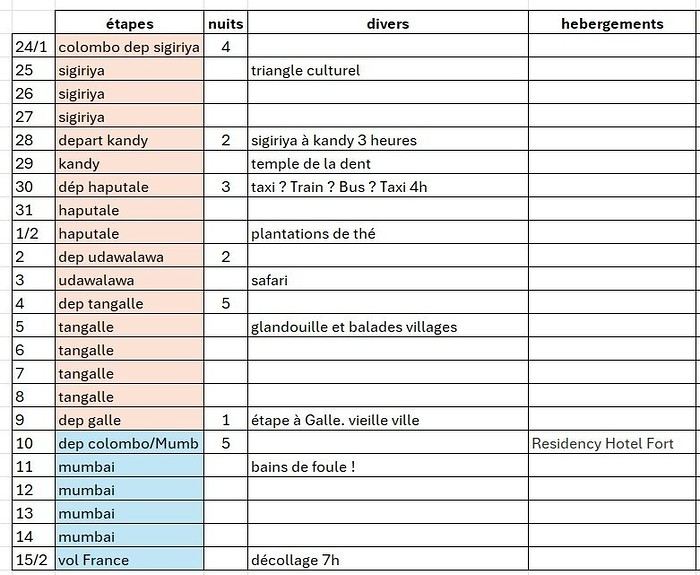
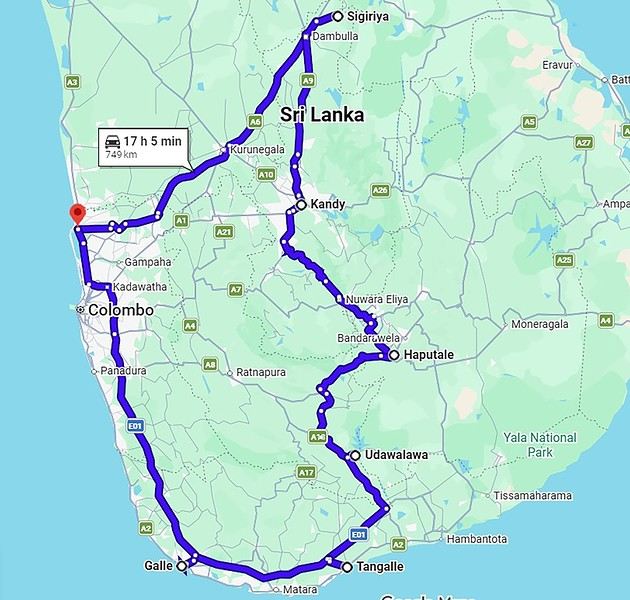
We’re heading to Sri Lanka for 23 days in January 2027—there are four of us—and we’ll wrap up the trip with 5 days in Mumbai. Our itinerary is coming together, but what do you think? (We can’t change the dates since our flights are already booked.)
We still have one night to slot in, and I’ve tentatively planned it in Tangalle, though it was a bit random. Would it make more sense to place it at a different stop? Or is there an intermediate stop I might be missing?
I’ve got accommodations sorted everywhere except Mumbai—it’s a nightmare (either way too expensive or really dodgy). By default, we’ve spotted the Residency Hotel Fort, but 70 € a night (with a discount) for a hotel that doesn’t offer anything special in India?!
Thanks so much for your help!


We’re heading to Sri Lanka for 23 days in January 2027—there are four of us—and we’ll wrap up the trip with 5 days in Mumbai. Our itinerary is coming together, but what do you think? (We can’t change the dates since our flights are already booked.)
We still have one night to slot in, and I’ve tentatively planned it in Tangalle, though it was a bit random. Would it make more sense to place it at a different stop? Or is there an intermediate stop I might be missing?
I’ve got accommodations sorted everywhere except Mumbai—it’s a nightmare (either way too expensive or really dodgy). By default, we’ve spotted the Residency Hotel Fort, but 70 € a night (with a discount) for a hotel that doesn’t offer anything special in India?!
Thanks so much for your help!


Hello,
I’m interested in the 10-day/8-night "Discover Nepal" tour offered by Capitales Tours, among others. For Day 4, it lists Kathmandu-Mugling-Pokhara as 200 km and 8/9 hours of travel. Is this duration due to the road conditions? I assume the stop in Mugling for lunch is included in the travel time.
For Pokhara-Chitwan, only the distance is mentioned: 160 km. Should I expect a long bus ride there as well?
The proposed flights would be with AIR-INDIA via DELHI. We had issues with AIR-INDIA before—they denied us boarding for Paris even though we arrived at the airport more than 3 hours early. There was no specific counter for PARIS; the counters were for all destinations, and we waited in line for over 2.5 hours only to be told "too late"... Thanks for your advice: Mum49 Is it still like this?
I’m interested in the 10-day/8-night "Discover Nepal" tour offered by Capitales Tours, among others. For Day 4, it lists Kathmandu-Mugling-Pokhara as 200 km and 8/9 hours of travel. Is this duration due to the road conditions? I assume the stop in Mugling for lunch is included in the travel time.
For Pokhara-Chitwan, only the distance is mentioned: 160 km. Should I expect a long bus ride there as well?
The proposed flights would be with AIR-INDIA via DELHI. We had issues with AIR-INDIA before—they denied us boarding for Paris even though we arrived at the airport more than 3 hours early. There was no specific counter for PARIS; the counters were for all destinations, and we waited in line for over 2.5 hours only to be told "too late"... Thanks for your advice: Mum49 Is it still like this?
Hello,
We’ve already traveled to India twice before, but only for two-week stretches (2013, a loop from Mumbai including Hampi, and in 2019, Tamil Nadu). This time, we’re leaving at the end of October for nearly three months of travel—something completely new for us! We’ll arrive in Delhi and depart from Bangalore. Our goal is to explore Northern India and then head down to Kerala, taking a maximum of one flight and prioritizing trains.
Traveling for this long should let us plan longer stops to slow down the pace and fully enjoy our trip...
What are the places you’ve loved with this in mind? I’ve already thought of Gokarna... Do you have any other suggestions, especially in Northern India? Thanks in advance for your tips!
Traveling for this long should let us plan longer stops to slow down the pace and fully enjoy our trip...
What are the places you’ve loved with this in mind? I’ve already thought of Gokarna... Do you have any other suggestions, especially in Northern India? Thanks in advance for your tips!
Hi there,
I’m planning a trip to Bangladesh for tourism during All Saints' Day 25. The government website is pretty discouraging! I’d love to hear from people living there or who’ve been recently before I buy my tickets.
How’s the security level and feasibility of a circuit (boat, train, bus around the country)? We’re used to basic conditions :)
Thanks in advance for your tips!
Cécile
I’ll be in central KERALA (4 hours from KOCHI airport by car). For the rest of my stay, I’m planning to do "nothing" except brisk walking, Tai Chi... and swimming. The spot could be Varkala or somewhere else. If the place has nearby tourist sites like monuments, temples, or anything else, I’d be happy to let myself be guided. I’m traveling solo. GOA is a 7-hour drive away, or a flight, so I’d rather skip it (too far from KOCHI airport). This break will last a week, with a return to KOCHI airport. Thanks in advance for your ideas, experiences, and tips!
Hi everyone,
I’ll be landing in Srinagar on October 23rd. I’ve decided to visit this region of India that I haven’t explored yet to discover new landscapes and, especially, their crafts. I don’t have anything planned so far. I’ll be staying for about two weeks before heading back to Pushkar. I’d love any tips you can share—small towns or villages to visit, ideas for affordable and authentic accommodations, workshops to check out, and so on. I’m open to all your suggestions! I might head toward Jammu, where a host has offered to put me up for a few days. Thanks in advance, and take care!
Hello,
We are two couples of friends aged between 65 and 70. Do you have a local agency or a local French-speaking driver-guide to recommend for a trip around Sri Lanka between February 14 and March 14, 2027? We’re open to any tips for our trip. The reviews and advice for agencies found on the forum are several years old. Thanks for your help.
Hi,
I’m looking for an organized tour in Northern India that goes through Agra (of course!) over about twenty days, prioritizing 2-day stops given the long distances or flights.
So far, my search has led me to these tours:
Intimate Rajasthan + Ganges Valley
Intimate Rajasthan and Goa
Confidential Rajasthan + Goa circuit
The number of kilometers is still pretty overwhelming and a bit scary.
Thanks for your feedback!
bcricri14
Practical tips from my 105 days of erratic wandering in India
Day 1 (10/10/2006): arrived in Mumbai around noon. Bus No. 338 5 Rs + 5 Rs (bag) 20' to Andheri station. Train 6 Rs to Dadar. Train 41 Rs to Lonavla 2h30 Hotel Chandralok 500 Rs **
Day 2: bike rental 7 Rs/h (too expensive, normal price 2-3 Rs/h) visit to the caves of Bhaja and Karla.
Day 3: train 28 Rs to Pune 1h20 Hotel National 416 Rs *
Day 4: train 141 Rs (with reservation) to Satara 2h45 Hotel Sagar 364 Rs **
Day 5: bus 110 Rs to Pandharpur 4h Hotel Aishwarya 450 Rs ***
Day 6: bike rental 2 Rs/h
Day 7: bus 125 Rs to Ahmadnagar 4h20 Hotel Parijat 250 Rs *
Day 8: train 151 Rs (!ticket for a mini 600 km trip!) to Jalgaon 5h30 Hotel Plaza 200 Rs **
Day 9: round-trip bus 38 Rs to Ajanta 1h30 + shuttle 6 Rs 5' Site entrance 250 Rs
Day 10: train 47 Rs to Khandwa 3h + bus 40 Rs to Omkareshwar 2h Ganesh G.H. 150 Rs *
Day 11 to 13: Omkareshwar
Day 14: bus 35 Rs to Maheshwar 2h45 Akashdeep Rest House 200 Rs **
Day 15: bus 8 Rs to Dhamnod 20' bus 20 Rs to crossroads 14 km from Mandu 1h40 bus 9 Rs to Mandu 20' Ram Mandir Dharamshala 100 Rs + 5 Rs for hot water *
Day 16: bike rental 3 Rs/h
Day 17: bus 50 Rs to Indore 4h Hotel Neelam 209 Rs
Day 18 to 20: Indore + round-trip bus 30 Rs to Ujjain 1h45
Day 21: train 82 Rs to Bhopal 5h30 Hotel Ranjeet 358 Rs *
Day 22: train 10 Rs to Sanchi 1h20 Jaiswal Lodge 200 Rs + 15 Rs for hot water! *
Day 23 and 24: visit to Sanchi + bike rental to visit the caves of Udayagiri
Day 25: train 69 Rs to Jhansi 5h + tempo 5 Rs to bus station + tempo 10 Rs + 5 Rs (bag) to Orccha 25' Sri Mahant G.H. 200 Rs **
Day 26 and 27: bike rental + train 20 Rs to Datia 30' + bemo 6 Rs to city center. Return bus 15 Rs 1h15
Day 28: bus 100 Rs to Khajuraho 4h Yogi Lodge 150 Rs **
Day 29: bike rental 30 Rs/day to visit the temples
Day 30: bus 70 Rs to Satna 4h + train 56 Rs to Jabalpur 3h Hotel Banjara 350 Rs **
Day 31: bike rental 2 Rs/h and visit to the Marble Rocks (50 km round trip)
Day 32: bus 50 Rs to Mandla 3h Hotel Satyam 250 Rs ** Round-trip bus 15 Rs to Ramnagar 1h15
Day 33: bus 60 Rs to Dindori 4h + bus 45 Rs to Amarkantak 3h (hellish road) Sarvodya Lodge 250 Rs °
Day 34: Amarkantak
Day 35: bus 25 Rs to Pendra Road 1h30 + train 120 Rs + 109 Rs (reservation) to Nagpur 8h Hotel Grand 257 Rs **
Day 36 and 37: bike rental + round-trip 25 Rs to Ramtek 1h40
Day 38: train 141 Rs + 125 Rs to Hyderabad 10h Hotel 3 Castles 200 Rs ° + Hotel Suhail 200 Rs °
Day 39 to 41: stay in Hyderabad
Day 42: train 48 Rs to Warangal 3h30 Hotel Surya 410 Rs **
Day 43: 60 Rs to Vijayawada 4h15 Hotel Sindhuri 275 Rs **
Day 44: round-trip bus 21 Rs to Amaravati 2h
Day 45: train 98 Rs to Visakhapatnam 7h30! (normally 6h) Hotel Sri Sampath Residency 250 Rs **
Day 46: train 111 Rs + 95 Rs to Puri 11h30 Travellers Inn 100 Rs ° + Hotel Z 300 Rs ***
Day 47 to 52: Puri + round-trip to Konarak
Day 53: train 38 Rs to Bhubaneshwar 1h15 Hotel Upasana 275 Rs *
Day 54: train 70 Rs to Balasore 4h bus 26 Rs to Baripada 1h40 Hotel Ambika 225 Rs °
Day 55: bus 25 Rs to Balasore 1h40 train 66 Rs + 68 Rs to Calcutta 6h30 Hotel Paragon 270 Rs * Hotel Crystal 350 Rs **
Day 56 to 62: Calcutta
Day 63: 60 Rs to Bishnupur 5h Hotel Monalisa 200 Rs *
Day 64: stay in Bishnupur no bike rental!
Day 65: bus 20 Rs to Bankura 1h30 bus 20 Rs to Durgapur 1h15 bus 28 Rs to Bolpur 2h15 Hotel Nisa 150 Rs *
Day 66 and 67: visit to Bolpur/Shantiniketan. Refused bike rental at ... 100 Rs/day!!! (Communist state of Bengal!!!)
Day 68: bus 20 Rs to Sainthia bus 35 Rs to Baharampur 4h30 bus 7 Rs to Murshidabad 40' Hotel Manjusha 350 Rs **
Day 69: bike lent by the friendly hotel owner and visit to Murshidabad
Day 70: bus 8 Rs to Baharampur 35' bus 60 Rs to Malda 6h (hellish road) Hotel Pratapaditya 231 Rs **
Day 71: train 66 Rs + 70 Rs to New Jalpaiguri 4h Hotel Holydon 250 Rs °
Day 72: train 52 Rs to Darjeeling 9h30! (normally 7h) Hotel Pineridge 500 Rs **
Day 73 to 75: Darjeeling
Day 76: train to New Jalpaiguri 9h30 + overnight train 271 Rs
Day 77: Patna Hotel President 482 Rs **
Day 78: stay in Patna
Day 79: train 18 Rs to Gaya 3h10 tempo 10 Rs to Bodhgaya 30' Deep G.H. 400 Rs!! °°
Day 80: return to Patna
Day 81: round-trip train 36 Rs to Rajgir 4h! (normally 3h)
Day 82: train 75 Rs to Varanasi 5h! (normally 4h) Yogi Lodge 150 Rs *
Day 83 to 87: Varanasi
Day 88: overnight train 310 Rs to Jaipur Evergreen G.H. 250 Rs **
Day 89: bike rental 30 Rs/day round-trip to Amber
Day 90: bus 59 Rs to Sikar 2h30 bus 23 Rs to Fatehpur 1h30 Rajshri Rest House 300 Rs *
Day 91: round-trip bus 12 Rs to Mandawa 30'
Day 92: round-trip bus 17 Rs to Churu 1h30
Day 93: bus 80 Rs to Jaipur 3h30 Evergreen G.H.
Day 94: bus 105 Rs to Bundi 5h30 Shivam G.H. 200 Rs **
Day 95: bike rental 3 Rs/h
Day 96: auto-rickshaw to station 45 Rs 25' train 44 Rs + 50 Rs to Chittorgarh train 21 Rs to Udaipur (total trip 8h) Badi Haveli 330 Rs **
Day 97 to 99: Udaipur + round-trip bus 45 Rs to Ranakpur 3h30
Day 100: bus 143 Rs to Ahmedabad 5h30 Hotel Manila 300 Rs **
Day 101: Ahmedabad
Day 102: bus 99 Rs to Bhavnagar 4h30 Hotel Vrindavan 200 Rs *
Day 103: round-trip bus 22 Rs to Palitana 1h10
Day 104: bus 85 Rs! to Ahmedabad 5h30 + overnight train ? Rs (feels like the end of the trip!)
Day 105 (January 22, 2007): train 6 Rs from Dadar to Andheri 20' + bus 5 Rs + 5 Rs (bag) to International Airport 20'
More figures British Airways flight price Brussels-London-Mumbai-London-Brussels 576 € Exchange rate from 55 Rs to 58.6 Rs per euro Average room price 272 Rs/night Daily budget 11 € Chai from 1 Rs (Calcutta-Bengal) to 6/7 Rs (Rajasthan) Bottle of water from 6 Rs (Udaipur), 8 Rs (Varanasi) to 12/13 Rs Internet from 8 Rs (Warangal), 10 Rs (Calcutta, Indore, Hyderabad), 20 Rs (often) to 40/60 Rs!! (Rajasthan) Beer in a restaurant from 85/100 Rs (often) to 150/165 Rs (Varanasi/Udaipur) More details on request
Hello everyone,
we got back from our trip to Kashmir and Ladakh three weeks ago.
We spent 4 weeks there, including one in Kashmir.
We’re really happy with our stay in Srinagar and Sonamarg. The Kashmiris gave us a very warm welcome and seemed pleased to see tourists who weren’t Indian. In fact, over the 4 days we spent in Srinagar, we only saw 4 people who looked European... Srinagar is stunning with its lakes and the lively Mughal gardens. No trouble getting around, whether by shikara, rickshaw, taxi, or on foot. The houseboats are gorgeous, unfortunately controlled by consortiums. We took a taxi to Sonamarg (20 €).
Sonamarg (two nights) and its glacier are easy to explore, either on horseback or on foot, but it’s becoming a leisure spot for Indians. To get to Ladakh afterward, we opted for a private taxi (quite expensive at 100 €, but the road is long). Since we’re a couple, it allowed us to stop whenever we wanted... and the route is beautiful all the way to Lamayuru, with our first snow-covered pass under snow when we crossed around May 21st. Then we stopped in Mulbek and Kargil before arriving in Lamayuru (three nights). We took another taxi to Alchi (26 €), spent one night there, and took the local bus at around 8 AM to Leh (3 €, a comfortable one-hour ride). We arrived in Leh around 9:30 AM, and Gyatsel from Tsarap Guesthouse came to pick us up with our backpacks. His guesthouse is located 500 meters from the market square in Leh, in a quiet little alley with no traffic. We highly recommend it because Gyatsel is invaluable for arranging taxis and organizing off-agency circuits...
His accommodation is super comfortable, and he cooks with vegetables from his garden. His wife also helps out... It’s Gyatsel’s mother who tends the garden. Through him, we arranged permits for the Nubra Valley up to Turtuk, then the Pangong and Tso Moriri lakes (we didn’t do the latter due to snow overnight!). We also crossed the Changtang (magnificent) to reach Thiksey, Stakna, Hemis, and returned to Leh. Six days in a private taxi (400 €). Since the roads were clear, we headed to Zanskar for 5 days in a shared taxi (28 € round trip for both of us). The route from Leh to Zangla follows the Zanskar gorges (impressive!).
We discovered Padum, Pibiting, Karsha, and Puktal, which you can reach via a small 7 km road and a 45-minute walk to finish, plus the sacred summit on the way to Manali.
Back in Leh, we extended our permit to visit the Aryan Valley by taxi (round trip, two days, 90 €). We spent our last two days resting in Leh—the altitude is really tiring...
I’m sharing these taxi prices as a guide for a couple. Accommodation ranged from 12 € in Leh to 30 € at Pangong Lake (the most expensive), but averaged around 15-17 € per night.
We’re not trekkers, but we love walks, discovery, and meeting people along the way. It was an amazing trip, and we even discovered a very old monastery a few kilometers before Lamayuru, where a monk took us—timeless...
I’m sharing these details because it’s hard to find precise information about Kashmir.
Sonamarg (two nights) and its glacier are easy to explore, either on horseback or on foot, but it’s becoming a leisure spot for Indians. To get to Ladakh afterward, we opted for a private taxi (quite expensive at 100 €, but the road is long). Since we’re a couple, it allowed us to stop whenever we wanted... and the route is beautiful all the way to Lamayuru, with our first snow-covered pass under snow when we crossed around May 21st. Then we stopped in Mulbek and Kargil before arriving in Lamayuru (three nights). We took another taxi to Alchi (26 €), spent one night there, and took the local bus at around 8 AM to Leh (3 €, a comfortable one-hour ride). We arrived in Leh around 9:30 AM, and Gyatsel from Tsarap Guesthouse came to pick us up with our backpacks. His guesthouse is located 500 meters from the market square in Leh, in a quiet little alley with no traffic. We highly recommend it because Gyatsel is invaluable for arranging taxis and organizing off-agency circuits...
His accommodation is super comfortable, and he cooks with vegetables from his garden. His wife also helps out... It’s Gyatsel’s mother who tends the garden. Through him, we arranged permits for the Nubra Valley up to Turtuk, then the Pangong and Tso Moriri lakes (we didn’t do the latter due to snow overnight!). We also crossed the Changtang (magnificent) to reach Thiksey, Stakna, Hemis, and returned to Leh. Six days in a private taxi (400 €). Since the roads were clear, we headed to Zanskar for 5 days in a shared taxi (28 € round trip for both of us). The route from Leh to Zangla follows the Zanskar gorges (impressive!).
We discovered Padum, Pibiting, Karsha, and Puktal, which you can reach via a small 7 km road and a 45-minute walk to finish, plus the sacred summit on the way to Manali.
Back in Leh, we extended our permit to visit the Aryan Valley by taxi (round trip, two days, 90 €). We spent our last two days resting in Leh—the altitude is really tiring...
I’m sharing these taxi prices as a guide for a couple. Accommodation ranged from 12 € in Leh to 30 € at Pangong Lake (the most expensive), but averaged around 15-17 € per night.
We’re not trekkers, but we love walks, discovery, and meeting people along the way. It was an amazing trip, and we even discovered a very old monastery a few kilometers before Lamayuru, where a monk took us—timeless...
I’m sharing these details because it’s hard to find precise information about Kashmir.
Hi everyone!
I’m planning a short visit to Pokhara around mid-February 2027 (it’ll be my 4th time in Nepal 😊, over 40 years!). I’d like to book a room in advance rather than looking when I arrive. I’ve checked a bit on Bxxking.com and see lots of options. I’m used to scoping out the surroundings of places listed, just to avoid ending up in areas that are either unappealing or far from everything.
So, I see quite a few offers around the lake (Lakeside?), but every time I check what it looks like, the streets seem really uninviting. It’s kind of like a construction site with buildings everywhere… Nothing like Bhaktapur (for example) or even Thamel, where the streets seem way more pleasant.
Could anyone give me some advice?
Also, I don’t really get the impression that Pokhara is worth a visit of several days. The lake, sure, but once you’ve seen it—what else is there?
I’m planning a short visit to Pokhara around mid-February 2027 (it’ll be my 4th time in Nepal 😊, over 40 years!). I’d like to book a room in advance rather than looking when I arrive. I’ve checked a bit on Bxxking.com and see lots of options. I’m used to scoping out the surroundings of places listed, just to avoid ending up in areas that are either unappealing or far from everything.
So, I see quite a few offers around the lake (Lakeside?), but every time I check what it looks like, the streets seem really uninviting. It’s kind of like a construction site with buildings everywhere… Nothing like Bhaktapur (for example) or even Thamel, where the streets seem way more pleasant.
Could anyone give me some advice?
Also, I don’t really get the impression that Pokhara is worth a visit of several days. The lake, sure, but once you’ve seen it—what else is there?
Hi everyone,
I’m heading to Assam and I’d like to know what type of electrical adapter I need—is it M or D, or both?
Thanks
Hello,
I’m heading to Sri Lanka for 3 weeks in July with my two 11-year-old kids, and I’m wondering about how to organize the trip. We’re used to traveling on the go, staying 1 to 2 or 3 nights per place depending on how we feel.
Do you recommend planning the itinerary and booking accommodations in advance to save time once we’re there? Or is it pretty easy to organize everything as we go without any issues?
Same question for activities: Should we book safaris and tours ahead of time, or can we arrange them easily on the spot? Is there a risk of not getting a spot, for example, to visit a park since we’ll be there in July?
We’ll be using local transport (train, VTC via PickMe, tuk-tuk) to get from one place to another.
In short: Are there any must-book things we should reserve now? So far, I only have the flight tickets!
Thanks in advance for your help! 😊
I’m heading to Sri Lanka for 3 weeks in July with my two 11-year-old kids, and I’m wondering about how to organize the trip. We’re used to traveling on the go, staying 1 to 2 or 3 nights per place depending on how we feel.
Do you recommend planning the itinerary and booking accommodations in advance to save time once we’re there? Or is it pretty easy to organize everything as we go without any issues?
Same question for activities: Should we book safaris and tours ahead of time, or can we arrange them easily on the spot? Is there a risk of not getting a spot, for example, to visit a park since we’ll be there in July?
We’ll be using local transport (train, VTC via PickMe, tuk-tuk) to get from one place to another.
In short: Are there any must-book things we should reserve now? So far, I only have the flight tickets!
Thanks in advance for your help! 😊
Hi there, I think you're on the right track—you plan the itinerary and book the rooms in advance, and that’s it.
Not only do you save time, but you also know where you’ll be staying each night. Choosing well on Booking (or elsewhere) is actually a pleasure!
For safaris, given the number of jeeps with drivers available, it’s unlikely you’ll be turned away... the real issue is more about the concentration of jeeps around the animals.
I travel like you do—train, bus, tuk-tuk, and sometimes taxi. Ride-hailing apps like PickMe and other VTCs are mostly in big cities.
For the mountain train, due to severe flooding, service was interrupted on the line between Kandy and Ella. Check ahead, because reservations for this train are very complicated, if not impossible.
For the Colombo/Kandy train, you reserve your seats by buying the ticket before boarding. In the south, no need to book in advance for trains.
In Sri Lanka, there’s always a solution for getting around—just ask your hosts. They have trusted contacts at their fingertips. But still, compare prices—😏 smart move!
I stick to booking my nights and keep pre-planned activities to a minimum.
For reservations you can’t skip, it’s the beach stays you’ll want to secure.
Hi there,
I’m trying to find out if it’s still possible to travel from Mumbai to Goa by ferry or any other sea route. My search results aren’t very clear, and if it *is* possible, I can’t figure out where to book... If anyone has any info, I’d really appreciate it—thanks in advance!
Have a great day,
Virginie
I’m trying to find out if it’s still possible to travel from Mumbai to Goa by ferry or any other sea route. My search results aren’t very clear, and if it *is* possible, I can’t figure out where to book... If anyone has any info, I’d really appreciate it—thanks in advance!
Have a great day,
Virginie
It seems there’s a ferry from Nagapattinam to Jaffna in India. Has anyone here taken this ferry before? My main question is how to get to Nagapattinam—by train, bus? And from which town further south, of course.
Thanks, friends!
Gaston
Gaston
Hi there.
We’re spending a month in Sri Lanka in March, and we’ll have one week left after leaving Polonnaruwa.
We’re torn between spending it in the Jaffna region or on the east coast between Batticaloa and Trincomalee.
We’re divers, so the east coast appeals to us for snorkeling, beaches, and lagoons—but it seems like late March might not be the best time for that coast. What do you think?
As for Jaffna, the culture of the region, its more authentic feel since it’s less touristy, and the offshore islands all appeal to us too—but it seems far from the rest of the country and harder to access.
We have to choose because we won’t be able to visit both sides, and I’d love to hear your thoughts.
Thanks, Marie
Hi there,
We just got back from a 2-week trip to Sri Lanka as a couple, and while planning the trip, we found plenty of info on the itinerary, places to see, and transportation, but much fewer clear reports on the actual budget to expect once there. Yet, that was an important point for us because we like to plan ahead a little before traveling.
So, we took the time to break down our complete budget after the trip. In our case, we spent around **930 € per person** for 2 weeks, being careful without depriving ourselves, mixing guesthouses, more comfortable hotels, quite a few activities, and even a private driver for part of the stay.
What we found interesting when crunching the numbers is that in Sri Lanka, it’s not necessarily meals or short trips that blow the budget, but rather flights, certain accommodations, cultural activities, and all those little expenses we sometimes forget, like tips.
If this can help other travelers get a better idea, we’ve put everything together on our blog with our experience, a detailed breakdown of expenses, and practical info on money while there, withdrawals, and tipping:
https://aventures-sans-mesaventure.com/budget-sri-lanka-pour-un-voyage-de-2-semaines/
Happy travels and enjoy your adventure! !

Hi everyone,
We’re a group of 5 heading to the Everest Base Camp trek in early April. We won’t have a porter or guide—we’re used to hiking independently and have already done the Langtang trek and the Annapurna Circuit (back in 2003!).
I’d love to know if it’s necessary to book lodges in advance or if we’ll easily find availability during this busy season. Also, will we find lodges all along the route between the main stopover villages, or only in those villages? I remember there were plenty everywhere on the Annapurna Circuit. We want to stay as flexible as possible.
Thanks for your feedback!
We’re a group of 5 heading to the Everest Base Camp trek in early April. We won’t have a porter or guide—we’re used to hiking independently and have already done the Langtang trek and the Annapurna Circuit (back in 2003!).
I’d love to know if it’s necessary to book lodges in advance or if we’ll easily find availability during this busy season. Also, will we find lodges all along the route between the main stopover villages, or only in those villages? I remember there were plenty everywhere on the Annapurna Circuit. We want to stay as flexible as possible.
Thanks for your feedback!
Hi there,
We’re heading to India in March 2026 and had planned to visit the parts of the Meenakshi Temple that are open to non-Hindus. However, the temple is currently undergoing major renovations—with all the towers covered in scaffolding—which might really take away from the experience and our stop in Madurai.
After some frustrating and vague online searches, and before we reshuffle our itinerary, I’d love to know—if possible—the most accurate expected completion date for the renovation work.
Thanks in advance.
We’re heading to India in March 2026 and had planned to visit the parts of the Meenakshi Temple that are open to non-Hindus. However, the temple is currently undergoing major renovations—with all the towers covered in scaffolding—which might really take away from the experience and our stop in Madurai.
After some frustrating and vague online searches, and before we reshuffle our itinerary, I’d love to know—if possible—the most accurate expected completion date for the renovation work.
Thanks in advance.
Hi there,
We’re planning a trip to Nepal and would love to do a helicopter tour to Everest with Namche Heli Service. Has anyone here used this agency? I can’t seem to find any reviews online. Thanks in advance!
Kloki
We’re planning a trip to Nepal and would love to do a helicopter tour to Everest with Namche Heli Service. Has anyone here used this agency? I can’t seem to find any reviews online. Thanks in advance!
Kloki
Hey fellow travelers,
I’m spending two weeks studying Hindi in the mornings in Delhi, in the Hauz Khas neighborhood. What spots should I check out in this area? Any cafés to chill at? How do I get to other parts of Delhi? By rickshaw? Is it easy to negotiate the price upfront?
Thanks in advance. 😊 Marlène
I’m spending two weeks studying Hindi in the mornings in Delhi, in the Hauz Khas neighborhood. What spots should I check out in this area? Any cafés to chill at? How do I get to other parts of Delhi? By rickshaw? Is it easy to negotiate the price upfront?
Thanks in advance. 😊 Marlène
Hi,
I’m leaving this Saturday for Northern India from 15/02 to 27/02. I’m planning to visit New Delhi, Agra, Chand Baori, Jaipur, Ranthambore, Bundi, Udaipur, and Jodhpur.
What’s the best way to get around? I was thinking of doing everything by train. Maybe taking the bus for some stretches?
As for renting a car with a driver, it seems expensive, so I’ve pretty much ruled that out. Unless someone’s got space for the same dates?
Thanks for your insights!
What’s the best way to get around? I was thinking of doing everything by train. Maybe taking the bus for some stretches?
As for renting a car with a driver, it seems expensive, so I’ve pretty much ruled that out. Unless someone’s got space for the same dates?
Thanks for your insights!
Hi everyone,
We’re heading out in March for this trek. We’re used to hiking and long-distance treks, but this’ll be our first time in Nepal.
QUESTION: People from Nepal are telling us it’s MANDATORY to have guides! Is this true, or is it just agencies trying to get work for their staff?
The Lonely Planet says: "In April 2023, the government announced that every trekker would need to hire the services of a porter or a licensed guide to obtain the TIMS permit. The law isn’t enforced, and by 2025, there were no longer any obligations for teahouse treks."
What do you think? What’s your experience? Thanks for your feedback.
We’re heading out in March for this trek. We’re used to hiking and long-distance treks, but this’ll be our first time in Nepal.
QUESTION: People from Nepal are telling us it’s MANDATORY to have guides! Is this true, or is it just agencies trying to get work for their staff?
The Lonely Planet says: "In April 2023, the government announced that every trekker would need to hire the services of a porter or a licensed guide to obtain the TIMS permit. The law isn’t enforced, and by 2025, there were no longer any obligations for teahouse treks."
What do you think? What’s your experience? Thanks for your feedback.
Hi,
I’d like to arrive in India at New Delhi Airport with some cash. I was wondering if the exchange rates at the airport are any good or if it’s best to avoid them (and exchange in the city instead?).
Thanks for your help.
NAMASTE NEPAL! PRACTICAL INFO AND EXPERIENCE FEEDBACK
Stay from March 25 to April 16, 2025
· Flight tickets Air India (via Delhi) (via Skyscanner) = 1130 € per person · Planned budget (and respected without too many restrictions and while buying a few small gifts) = 2000 € for the stay for two. Buses, taxis, and entrance fees to various sites represent a budget to consider. Meals are cheap. Drinks like beer/Coke, however, are not cheap and cost the equivalent of a meal. · Exchange rate of the rupee during our stay = 0.0064 € (the exchange rate is almost identical everywhere, including at the airport). · At the airport, purchase of two SIM cards (phone) = 1000 NPR x 2 for 28 days. · Kathmandu: we had booked the hotel upon arrival: Kathmandu Boutique Hotel (+977 015 357 446 – email: booking@kathmanduboutiquehotel.com), very well located in a quiet alley off the street, south of Thamel, a 10-minute walk from Durbar Square. A hotel like Nepal knows how to do, where tall people will have to duck. Night + breakfast = 18 € for two. Very warm welcome, great location, excellent value for money. · Bhaktapur: we had also booked a hotel for the end of our stay because the chance of the year 2025 made the Nepali New Year and Bisket Jatra particularly festive in Bhaktapur: Manju Baha Hotel School (+977 976 7234014 – email: manjubahahotel@gmail.com) located in an old monastery. "A social enterprise transforming an old monastery into a charming hotel, offering professional hospitality training to underprivileged Nepali youth." Night + breakfast = 32 € for two. Beautifully decorated room. Very warm welcome. Don’t miss the Changunarayan site (near Bhaktapur), it’s amazing. And if you’re lucky enough to be in Bhaktapur in mid-April for 3 days, there’s the Bisket Jatra festivities (Newari festival), joyful, noisy, fun, and wild… · Pokhara (hotel recommended by the Kathmandu hotel): Hotel Green Tara, Lakeside, 10th street, set back, quiet (Tel. +977 61 462698 – email: greentara_67@hotmail.com) · Trek permit (Lower Mustang, no need for an agency or guide, permits checked at Ghasa and Jomsom) = 2000 NPR per person (2 ID photos) · Bus Kathmandu/Pokhara and return = 2000 NPR per person · Bus Pokhara/Jomsom, 2 one-way tickets = 2800 NPR. · Taxi: negotiation with a driver we recommend, Vicky (+977 984 075 599). You explain what you want, negotiate the price, and he waits for you during the visit. Very charming, we used him several times. For example: departure from our hotel at 10 AM -> Boudhanath/Pashupatinath/Patan return at 5 PM to the hotel = 6500 NPR – Swayambhunath (round trip) = 1200 NPR · Site prices: https://ntb.gov.np/plan-your-trip/before-you-come/heritage-site-entry-fees o Visitor Pass for Kathmandu Durbar Square (for the duration of the stay, show your visa) = 1000 NPR per person (1 ID photo) o Bhaktapur Durbar Square (old town) = 1800 NPR per person o Patan = 1000 NPR per person o Swayambhu Stupa = 200 NPR per person o Boudha Stupa = 200 NPR per person o Pashupatinath Temple = 1000 NPR per person (interesting to take a guide) o Changunarayan Temple (6 km north of Bhaktapur) = 400 NPR per person o Mountain Museum in Pokhara = 750 NPR per person · E-cigarettes: e-cigarettes are banned in India and confiscated whether they’re in carry-on or checked luggage. On the way there, we had kept them in our carry-on, they were confiscated in Delhi. On the way back, learning from our previous experience, we put them in our checked luggage. Someone came to get us to take them out of our bags and confiscate them… You can find e-cigarettes and products in Kathmandu.
* * *
I’m 74 years old. I went to Nepal in 1982, 1983, and the last time in 1986. I wanted to introduce this beautiful and endearing country to my husband, and it was… now or never. So we decided it was now.
I knew the trek starting from Pokhara: Naudanda/Birethanti/Ghorepani/Tatopani/Kalopani. There was no way I was going to do that trek, especially the 1000-meter staircase to reach Ghorepani… You have to stay humble with age.
Back then, the road didn’t exist. I didn’t consider, with the construction of this road (NH48) along the western bank of the Kali Gandaki, doing a trek along a windy and dusty road. Was there an alternative hiking trail on the eastern bank? No one answered my question on VoyageForum, so I did my research online. And I found this site: "Andrées de Ruiter and Prem Rai - Trekking the Annapurna Circuit, including the new NATT trails that avoid the road - A guide to one of the most beautiful trekking regions in Nepal and the world (2011) - NATT = New Annapurna Trekking Trail".
Phew! A solution was emerging. This circuit from 2011 wasn’t fully marked. The idea was to go from Jomsom to Tatopani, so we needed to make sure the path was well-marked all the way, which we did, and the path exists, marked in red and white!
So, with the walking times information, we built our 8-day circuit:
· Jomsom/Thinigaon · Thinigaon/Chimang · Chimang/Saura · Saura/Kokhetanti · Rest day or, if in good shape: loop to Sekong Lake · Kokhetanti/Jhipra Deurali · Jhipra Deurali/Kopchepani · Kopchepani/Tatopani
It’s a senior trek, after all. So the walking times noted on the sites indicated 3 hours or even 4 hours for the two longest stages. That pace suited us fine.
On March 29, we left Kathmandu (1400m), after visiting the must-see sites, by bus to Pokhara: 200 km and 8.5 hours on a chaotic road under construction. I had a memory of Pokhara where it was the first city where you could see the Himalayan range, especially Machhapuchhare. But the pollution is such, the dust raised by traffic and construction, that no horizon is visible except the first hills around Pokhara.
We stayed 24 hours in Pokhara (820m), and on March 31, we left our luggage at the hotel and set off with our lightest backpacks: change of clothes, toiletries, first aid kit, anti-chafing cream, water bottle, sleeping bag liner, and light shoes for the stages.
We took the bus to Jomsom: 160 km/7.5 hours including stops for bathroom breaks, tea, and lunch. The road is nothing but a chaos of potholes, landslides, construction, dust, rebuilding, and mudslides. In Ghasa, the bus stops, and we’re told we’re at a checkpoint and that the two foreigners in the bus, my husband and I, need to have our permits checked, which takes a few minutes. The driving is rock-and-roll, surprising, and courteous. The drivers have their codes, and on these improbable roads, they’re virtuosos.
We could have chosen the plane, but several reasons dissuaded us: if there’s too much wind, the planes don’t take off; personally, I wasn’t reassured about landing in Jomsom, and this transport has a cost.
We arrived around 2 PM in Jomsom (2720m), and despite the early wake-up, the nearly 8 hours on the bus, and the altitude, we decided to head straight to Thinigaon (2840m). At the Jomsom checkpoint, they told us it was a 30-minute walk. Great! Except we took an hour and a half on an uphill road, bent over to fight a strong wind. But the Himalayan range is there! The Dhaulagiri, the Nilgiri, the Annapurnas as a reward.
In Thinigaon, we found a room at the "Nilgiri View Hotel" run by a didi (big sister in Nepali). From the lodge’s roof, she proudly showed us the different peaks surrounding the village and told us, worried, that it hadn’t snowed here for 3 years. She said there are very few tourists, that the season is rather in September/October/November. It seems there’s not a soul in this village, yet mules pass through the narrow street paved with large flat stones, their bells ringing. We dine at 6 PM and go to bed… Room = 1200 NPR and dinner, breakfast, and drinks = 2560 NPR.
On April 1, we set off at 9 AM, not for Chimang as planned but for Marpha! The didi from the Thinigaon lodge had said it was a 3-hour walk. The first part of this stage is attractive, the mountains are magnificent and imposing, the landscape is superb, there’s no one around, a feeling of being "alone in the world." We follow Dhumbra Tal, this small green lake. The path is a rocky track that climbs steeply. Then, around a hill, we start the big descent that joins the Kali Gandaki. We face the wind head-on, and the violent gusts take our breath away, throw us off balance, and envelop us in dust. We see the road on the other side of the Kali Gandaki. We arrive in the village of Chhairo at 2 PM, completely exhausted and with blistered feet, after 5 hours of walking instead of the planned 3.5 hours.
We’re welcomed by the village nurse, who tells us there’s a lodge in the village. Chhairo is a Tibetan village, a 20-minute walk from Marpha (according to the locals, multiply by 2 or even 3 for us…). We’re going to revise our trek plan and, first of all, spend the night in Chhairo.
The lodge is quite pleasant, and Karma, the hostess, is very friendly. She asks about our plans and suggests we stay in Chhairo the next day, from where we can visit Marpha and also Chimang, a 1-hour walk away, in light mode, meaning without backpacks. She invites us to participate in a village ceremony the next evening.
We immediately accept the proposal, as our feet need rest and the welcome is so warm… Dinner and bed!
We reworked our trek plan, which was too ambitious for our untrained bodies and, let’s face it… no longer in our first youth. In the initial plan, we thought there wouldn’t be too much elevation gain following the Kali Gandaki, but checking the map, we realize there might be significant elevation changes between Sauru and Sirkung. So we plan:
· Tomorrow: visit Marpha (2670m) and Chimang (2744m) · April 3: bus from Chhairo (2700m) to Kalopani (2530m) and continue on foot to Ghasa (2010m) · April 4: Ghasa/Pairataplo (1940m) · April 5: Pairatapla/Gadpar (1580m) · April 6: Gadpar/Narchyang (1510m) · April 7: Narchyang/Tatopani (1190m) · April 8: return to Pokhara.
Normally, it’s all downhill…
April 2, a rest day then… We set off in the morning to explore Marpha. We have to take a temporary bridge because the suspension bridge is closed due to road construction. We join the road and arrive in Marpha, a village famous for its apple orchards, brandy, cider, and apple juice production. This village is magnificent with its stone houses and monastery clinging to the hillside. The road construction spared it. There are people, but very few Western tourists.
We have lunch in Marpha and go back through Chhairo to take the path to Chimang. We cross a fragrant pine forest and find the rocky path; the landscape is splendid. We walk quietly, passing peaceful buffaloes and cows, and arrive at the foot of a stone staircase… 275 steps (which we counted on the way back) leading us to the village of Chimang. Chimang is an isolated Newari village that seems a bit desolate. Despite the slopes, there are crops on every little bit of land. Thankfully, we changed our initial program because there’s no lodge in this village, contrary to what we saw on a map… We wander through the village, which seems very deserted, have coffee in a house from another world, and then head back to Chhairo.
A rest day? = 5 hours of walking!!
Dinner and village ceremony. From what we understand, this ceremony is in honor of the Dalai Lama. Men, women, and children in traditional costumes gather twice a month; they dance, make, and offer small sweet cakes with Tibetan tea (made from tea, yak butter—often rancid—water, and salt). Surprising for first-timers…
Around 10 PM, we leave the ceremony; tomorrow morning, we need to be on the roadside by 7 AM to catch the bus to Kalopani…
This village of Chhairo is very pleasant and welcoming, no tourists, just two motorcyclists who arrived in the evening, one of whom participated in the ceremony and discreetly poured his Tibetan tea outside.
Lodge: "Norsang Tibetan Guesthouse and Restaurant". Total bill for 2 nights, 2 dinners, 2 breakfasts, and drinks = 8000 NPR.
April 3: bus from Chhairo to Kalopani, about 1.5 hours for the 20 km (200 NPR per person). We descend on the right bank of the Kali Gandaki. We find the red and white markings to resume the trek toward Ghasa. We’re in a fragrant pine forest, the Dhaulagiri on one side and the Annapurnas on the other, magnificent, and the path is pleasant and easy. We get a bit lost in this forest, always looking for the markings. Near Lete, two trekkers pass us, and we meet them again a little further on with two very young children, to whom we give the 2 hard-boiled eggs I didn’t eat this morning. They accepted them without hesitation.
We arrive in a village and ask for directions to Ghasa. The young girls point the way. But we come across a forest being logged, trees cut in all directions. We turn back and ask for confirmation. They confirm… But the two young girls catch up with us and clear the way. We have to step over, go around, and cross the felled trees, with no indication at all. Through this pick-up sticks of felled trees, the girls lead us to the top of a stone staircase, indicating that was the path. It’s the only place where we saw rhododendrons in bloom.
We descend the staircase. At the bottom, to the left, there’s a bridge to go toward Choyo, and to the right, a path to Ghasa. We take the right path and join the road. We should normally find the red and white markings, but we don’t… So we continue on the western bank road of the Kali Gandaki.
A little before the village of Misi, we see fumaroles on the opposite bank that seem to come from the ground. We don’t understand. We stopped to eat in the village of Misi (noodle soup = 600 NPR), but it’s hard to communicate with the elderly people running the guesthouse.
We continued on the road, not finding the marked path parallel to the road. Landslides, both on the left and right banks, seem to have taken over the marked routes. It’s a place where the Kali Gandaki gorge narrows, and on the opposite bank, the mountain smokes more and more, and we now hear the crackling of fire. Across from us, the mountain is burning… Our initial plan had us passing on that burning bank right now…
We arrive in Ghasa at 3:30 PM, a 6.5-hour stage but with a 1-hour stop at noon. We’re at the "Florida Guesthouse and Restaurant." From our room, we see the mountain smoking on the other side of the river, and at night, we see the flames. In this village, posters show Himalayan eagles and vultures that seem to be protected species. Indeed, we saw (and heard) 3 eagles circling today.
April 4 – Today, heading to Pairothapla or Kopchepani depending on our feet, accommodation options, and simply our desires.
No more smoke on the mountain this morning. It’s chilly, 7:45 AM, the sky is clear, just a smell of smoke outside.
Price of the lodge = 1000 NPR for the night + 3580 NPR for meals.
We cross Ghasa, which stretches over more than a kilometer. We have a drink at the last guesthouse in the village, and the didi, when she learns our destination, tells us to be careful because the villages we’re going to aren’t safe. Should we distribute our rupees in different pockets? Nah, we kept going.
At the exit of Ghasa, we find the red and white markings and take the suspension bridge to cross the boiling waters of the Kali Gandaki. The passage is impressive because the river is tumultuous. Lots of climbs and even more descents. We’re back on the eastern bank. It’s hot! On the narrow path, we meet a group of buffaloes. Who has the right of way? We decide to stick as close as possible to the rock wall and move forward calmly. The buffaloes look at us, chewing placidly, with no intention of jumping on us. Phew!
After a 5-hour stage (including stops), we arrive in Pairothapla, with hot feet and firm thighs, and decide we won’t go any further. It’s a good thing because there’s a lodge, the most basic so far, but with a great welcome. We have a meal and a short nap. The buffaloes we met on the way belong to this house. They come to drink at the fountain by the path.
Our host, very pleasant, doesn’t know what to do to please us and is very attentive. He wants to chat. He has two children, a 4-year-old girl and a 7-year-old boy. Where do they go to school? Do they go? He tells us that the fires in the mountain are caused by people, but for what reason? We won’t find out, but it’s illegal. From here, we can still see smoke rising in the distance. The wife is a bit less friendly. Corn kernels dry on a woven straw mat on the ground, and the mom sorts them.
From where we are, we overlook the valley and see the road under construction winding along the mountainside on the other bank.
Dinner on the terrace of the house overlooking the path, windbreaker and fleece on: dal bhat chicken for me and chicken curry for my husband: "organic" products, at least local production. There are small vegetable gardens everywhere with all sorts of vegetables.
April 5 – While we’re having breakfast on the terrace of our lodge, 5 porters, straps on their foreheads, heavily loaded, pass by on the path. A few minutes later, a group of 9 people appears. It must be said that since the beginning of our journey, we’ve met very few hikers. Two backpackers in Chhairo, the two hikers near Lete, two female hikers passed us before Pairothapla, a solo female hiker passed us…
The lodge in Pairothapla is called "Bimala Lodge & Thakali Kitchen" – Price for night + 4 meals + 2 breakfasts = 3000 NPR.
The descent toward the Kali Gandaki involves climbs whose steps we didn’t count. Clearly, the landslides on the mountain cause changes to the official ACAP trek marked in red and white, and the marking updates can’t keep up with the pace of these landslides. It’s almost always by chance that we find the markings. Fortunately, we can follow the power line that guides us somewhat.
Drink stop in Kopchepani, the legs are fine, but the feet don’t like being tightly enclosed. A group of trekkers with porters passes on the path. We met buffaloes that we kindly let pass; the path was wide enough, but it was a staircase going up, and we didn’t want to take any risks.
Across, a view of the magnificent Rupse Waterfall on the other bank of the Kali Gandaki, at the bottom, lots of vehicles and people.
Arrival in Gadpar after crossing a rather unwelcoming small village and cultivated gardens between dry stone walls, each better built than the last.
First lodge spotted, first lodge adopted to answer the call of our feet, and a very warm welcome from the owner. Since we hadn’t eaten at noon, we had Tibetan bread/jam. 6-hour stage including 1 hour of stops. Night + dinner + breakfast + drinks = 5060 NPR
April 6 – Today, heading to Narchyang.
For several days, we’ve seen banana trees with their bunches of fruit and even a prickly pear with large fruits ripening.
This stage is quite peaceful and pleasant. We take a suspension bridge to cross a tributary of the Kali Gandaki. While we’re resting for a moment before crossing the bridge, a couple of porters, a man and a woman, arrive and start across the bridge with their wood load in a basket held by a strap on their forehead, making them bend. We set off too… lighter than them.
On the other side of the bridge… a stone staircase, and it climbs steeply. The porter couple didn’t take this staircase; they went right on the path.
At the top of the staircase, we arrive in Narchyang after a 4-hour stage. A magnificent waterfall overlooks the village. We get lost in this fairly large village looking for a lodge. After wandering around for a while, we ask for directions, and an 84-year-old man takes us through the whole village and accompanies us to a very nice lodge run by a woman.
We chat with our hostess, who asks where we’re from and where we’re going. We explain that we want to reach Tatopani the next day and then return to Pokhara. She tells us there are 4x4s going directly to Pokhara and that it would probably be easier than taking a bus that might be full in Tatopani. After a quick consultation, we decide to return to Pokhara the next day by 4x4. She finds us a 4x4 with 2 seats left, departure at 8 AM – 5 hours on the road and 1500 NPR per person. A charming didi who does everything to be pleasant and helpful.
Narchyang community lodge = night + snacks + dinner + breakfast = 3000 NPR.
There you go, our trek ends tomorrow. Many necessary changes and adaptations to our initial trek, but no regrets, it was superb and a great experience that, for my part, I won’t be able to repeat. Always this encounter with the endearing, welcoming, curious, and very kind Nepali people. It was now or never, and we did it!
* * *
In conclusion, 3 full weeks in Nepal is a duration that allows visiting Kathmandu, Patan, and Bhaktapur, enjoying the various sites, and soaking in the atmosphere and urban Nepali life.
The trek, even revised and corrected, allowed us to get close to the impressive Annapurna and Dhaulagiri peaks. One or two acclimatization days might be necessary to get the body in tune with this magical and extraordinary land.
Stay from March 25 to April 16, 2025
· Flight tickets Air India (via Delhi) (via Skyscanner) = 1130 € per person · Planned budget (and respected without too many restrictions and while buying a few small gifts) = 2000 € for the stay for two. Buses, taxis, and entrance fees to various sites represent a budget to consider. Meals are cheap. Drinks like beer/Coke, however, are not cheap and cost the equivalent of a meal. · Exchange rate of the rupee during our stay = 0.0064 € (the exchange rate is almost identical everywhere, including at the airport). · At the airport, purchase of two SIM cards (phone) = 1000 NPR x 2 for 28 days. · Kathmandu: we had booked the hotel upon arrival: Kathmandu Boutique Hotel (+977 015 357 446 – email: booking@kathmanduboutiquehotel.com), very well located in a quiet alley off the street, south of Thamel, a 10-minute walk from Durbar Square. A hotel like Nepal knows how to do, where tall people will have to duck. Night + breakfast = 18 € for two. Very warm welcome, great location, excellent value for money. · Bhaktapur: we had also booked a hotel for the end of our stay because the chance of the year 2025 made the Nepali New Year and Bisket Jatra particularly festive in Bhaktapur: Manju Baha Hotel School (+977 976 7234014 – email: manjubahahotel@gmail.com) located in an old monastery. "A social enterprise transforming an old monastery into a charming hotel, offering professional hospitality training to underprivileged Nepali youth." Night + breakfast = 32 € for two. Beautifully decorated room. Very warm welcome. Don’t miss the Changunarayan site (near Bhaktapur), it’s amazing. And if you’re lucky enough to be in Bhaktapur in mid-April for 3 days, there’s the Bisket Jatra festivities (Newari festival), joyful, noisy, fun, and wild… · Pokhara (hotel recommended by the Kathmandu hotel): Hotel Green Tara, Lakeside, 10th street, set back, quiet (Tel. +977 61 462698 – email: greentara_67@hotmail.com) · Trek permit (Lower Mustang, no need for an agency or guide, permits checked at Ghasa and Jomsom) = 2000 NPR per person (2 ID photos) · Bus Kathmandu/Pokhara and return = 2000 NPR per person · Bus Pokhara/Jomsom, 2 one-way tickets = 2800 NPR. · Taxi: negotiation with a driver we recommend, Vicky (+977 984 075 599). You explain what you want, negotiate the price, and he waits for you during the visit. Very charming, we used him several times. For example: departure from our hotel at 10 AM -> Boudhanath/Pashupatinath/Patan return at 5 PM to the hotel = 6500 NPR – Swayambhunath (round trip) = 1200 NPR · Site prices: https://ntb.gov.np/plan-your-trip/before-you-come/heritage-site-entry-fees o Visitor Pass for Kathmandu Durbar Square (for the duration of the stay, show your visa) = 1000 NPR per person (1 ID photo) o Bhaktapur Durbar Square (old town) = 1800 NPR per person o Patan = 1000 NPR per person o Swayambhu Stupa = 200 NPR per person o Boudha Stupa = 200 NPR per person o Pashupatinath Temple = 1000 NPR per person (interesting to take a guide) o Changunarayan Temple (6 km north of Bhaktapur) = 400 NPR per person o Mountain Museum in Pokhara = 750 NPR per person · E-cigarettes: e-cigarettes are banned in India and confiscated whether they’re in carry-on or checked luggage. On the way there, we had kept them in our carry-on, they were confiscated in Delhi. On the way back, learning from our previous experience, we put them in our checked luggage. Someone came to get us to take them out of our bags and confiscate them… You can find e-cigarettes and products in Kathmandu.
* * *
I’m 74 years old. I went to Nepal in 1982, 1983, and the last time in 1986. I wanted to introduce this beautiful and endearing country to my husband, and it was… now or never. So we decided it was now.
I knew the trek starting from Pokhara: Naudanda/Birethanti/Ghorepani/Tatopani/Kalopani. There was no way I was going to do that trek, especially the 1000-meter staircase to reach Ghorepani… You have to stay humble with age.
Back then, the road didn’t exist. I didn’t consider, with the construction of this road (NH48) along the western bank of the Kali Gandaki, doing a trek along a windy and dusty road. Was there an alternative hiking trail on the eastern bank? No one answered my question on VoyageForum, so I did my research online. And I found this site: "Andrées de Ruiter and Prem Rai - Trekking the Annapurna Circuit, including the new NATT trails that avoid the road - A guide to one of the most beautiful trekking regions in Nepal and the world (2011) - NATT = New Annapurna Trekking Trail".
Phew! A solution was emerging. This circuit from 2011 wasn’t fully marked. The idea was to go from Jomsom to Tatopani, so we needed to make sure the path was well-marked all the way, which we did, and the path exists, marked in red and white!
So, with the walking times information, we built our 8-day circuit:
· Jomsom/Thinigaon · Thinigaon/Chimang · Chimang/Saura · Saura/Kokhetanti · Rest day or, if in good shape: loop to Sekong Lake · Kokhetanti/Jhipra Deurali · Jhipra Deurali/Kopchepani · Kopchepani/Tatopani
It’s a senior trek, after all. So the walking times noted on the sites indicated 3 hours or even 4 hours for the two longest stages. That pace suited us fine.
On March 29, we left Kathmandu (1400m), after visiting the must-see sites, by bus to Pokhara: 200 km and 8.5 hours on a chaotic road under construction. I had a memory of Pokhara where it was the first city where you could see the Himalayan range, especially Machhapuchhare. But the pollution is such, the dust raised by traffic and construction, that no horizon is visible except the first hills around Pokhara.
We stayed 24 hours in Pokhara (820m), and on March 31, we left our luggage at the hotel and set off with our lightest backpacks: change of clothes, toiletries, first aid kit, anti-chafing cream, water bottle, sleeping bag liner, and light shoes for the stages.
We took the bus to Jomsom: 160 km/7.5 hours including stops for bathroom breaks, tea, and lunch. The road is nothing but a chaos of potholes, landslides, construction, dust, rebuilding, and mudslides. In Ghasa, the bus stops, and we’re told we’re at a checkpoint and that the two foreigners in the bus, my husband and I, need to have our permits checked, which takes a few minutes. The driving is rock-and-roll, surprising, and courteous. The drivers have their codes, and on these improbable roads, they’re virtuosos.
We could have chosen the plane, but several reasons dissuaded us: if there’s too much wind, the planes don’t take off; personally, I wasn’t reassured about landing in Jomsom, and this transport has a cost.
We arrived around 2 PM in Jomsom (2720m), and despite the early wake-up, the nearly 8 hours on the bus, and the altitude, we decided to head straight to Thinigaon (2840m). At the Jomsom checkpoint, they told us it was a 30-minute walk. Great! Except we took an hour and a half on an uphill road, bent over to fight a strong wind. But the Himalayan range is there! The Dhaulagiri, the Nilgiri, the Annapurnas as a reward.
In Thinigaon, we found a room at the "Nilgiri View Hotel" run by a didi (big sister in Nepali). From the lodge’s roof, she proudly showed us the different peaks surrounding the village and told us, worried, that it hadn’t snowed here for 3 years. She said there are very few tourists, that the season is rather in September/October/November. It seems there’s not a soul in this village, yet mules pass through the narrow street paved with large flat stones, their bells ringing. We dine at 6 PM and go to bed… Room = 1200 NPR and dinner, breakfast, and drinks = 2560 NPR.
On April 1, we set off at 9 AM, not for Chimang as planned but for Marpha! The didi from the Thinigaon lodge had said it was a 3-hour walk. The first part of this stage is attractive, the mountains are magnificent and imposing, the landscape is superb, there’s no one around, a feeling of being "alone in the world." We follow Dhumbra Tal, this small green lake. The path is a rocky track that climbs steeply. Then, around a hill, we start the big descent that joins the Kali Gandaki. We face the wind head-on, and the violent gusts take our breath away, throw us off balance, and envelop us in dust. We see the road on the other side of the Kali Gandaki. We arrive in the village of Chhairo at 2 PM, completely exhausted and with blistered feet, after 5 hours of walking instead of the planned 3.5 hours.
We’re welcomed by the village nurse, who tells us there’s a lodge in the village. Chhairo is a Tibetan village, a 20-minute walk from Marpha (according to the locals, multiply by 2 or even 3 for us…). We’re going to revise our trek plan and, first of all, spend the night in Chhairo.
The lodge is quite pleasant, and Karma, the hostess, is very friendly. She asks about our plans and suggests we stay in Chhairo the next day, from where we can visit Marpha and also Chimang, a 1-hour walk away, in light mode, meaning without backpacks. She invites us to participate in a village ceremony the next evening.
We immediately accept the proposal, as our feet need rest and the welcome is so warm… Dinner and bed!
We reworked our trek plan, which was too ambitious for our untrained bodies and, let’s face it… no longer in our first youth. In the initial plan, we thought there wouldn’t be too much elevation gain following the Kali Gandaki, but checking the map, we realize there might be significant elevation changes between Sauru and Sirkung. So we plan:
· Tomorrow: visit Marpha (2670m) and Chimang (2744m) · April 3: bus from Chhairo (2700m) to Kalopani (2530m) and continue on foot to Ghasa (2010m) · April 4: Ghasa/Pairataplo (1940m) · April 5: Pairatapla/Gadpar (1580m) · April 6: Gadpar/Narchyang (1510m) · April 7: Narchyang/Tatopani (1190m) · April 8: return to Pokhara.
Normally, it’s all downhill…
April 2, a rest day then… We set off in the morning to explore Marpha. We have to take a temporary bridge because the suspension bridge is closed due to road construction. We join the road and arrive in Marpha, a village famous for its apple orchards, brandy, cider, and apple juice production. This village is magnificent with its stone houses and monastery clinging to the hillside. The road construction spared it. There are people, but very few Western tourists.
We have lunch in Marpha and go back through Chhairo to take the path to Chimang. We cross a fragrant pine forest and find the rocky path; the landscape is splendid. We walk quietly, passing peaceful buffaloes and cows, and arrive at the foot of a stone staircase… 275 steps (which we counted on the way back) leading us to the village of Chimang. Chimang is an isolated Newari village that seems a bit desolate. Despite the slopes, there are crops on every little bit of land. Thankfully, we changed our initial program because there’s no lodge in this village, contrary to what we saw on a map… We wander through the village, which seems very deserted, have coffee in a house from another world, and then head back to Chhairo.
A rest day? = 5 hours of walking!!
Dinner and village ceremony. From what we understand, this ceremony is in honor of the Dalai Lama. Men, women, and children in traditional costumes gather twice a month; they dance, make, and offer small sweet cakes with Tibetan tea (made from tea, yak butter—often rancid—water, and salt). Surprising for first-timers…
Around 10 PM, we leave the ceremony; tomorrow morning, we need to be on the roadside by 7 AM to catch the bus to Kalopani…
This village of Chhairo is very pleasant and welcoming, no tourists, just two motorcyclists who arrived in the evening, one of whom participated in the ceremony and discreetly poured his Tibetan tea outside.
Lodge: "Norsang Tibetan Guesthouse and Restaurant". Total bill for 2 nights, 2 dinners, 2 breakfasts, and drinks = 8000 NPR.
April 3: bus from Chhairo to Kalopani, about 1.5 hours for the 20 km (200 NPR per person). We descend on the right bank of the Kali Gandaki. We find the red and white markings to resume the trek toward Ghasa. We’re in a fragrant pine forest, the Dhaulagiri on one side and the Annapurnas on the other, magnificent, and the path is pleasant and easy. We get a bit lost in this forest, always looking for the markings. Near Lete, two trekkers pass us, and we meet them again a little further on with two very young children, to whom we give the 2 hard-boiled eggs I didn’t eat this morning. They accepted them without hesitation.
We arrive in a village and ask for directions to Ghasa. The young girls point the way. But we come across a forest being logged, trees cut in all directions. We turn back and ask for confirmation. They confirm… But the two young girls catch up with us and clear the way. We have to step over, go around, and cross the felled trees, with no indication at all. Through this pick-up sticks of felled trees, the girls lead us to the top of a stone staircase, indicating that was the path. It’s the only place where we saw rhododendrons in bloom.
We descend the staircase. At the bottom, to the left, there’s a bridge to go toward Choyo, and to the right, a path to Ghasa. We take the right path and join the road. We should normally find the red and white markings, but we don’t… So we continue on the western bank road of the Kali Gandaki.
A little before the village of Misi, we see fumaroles on the opposite bank that seem to come from the ground. We don’t understand. We stopped to eat in the village of Misi (noodle soup = 600 NPR), but it’s hard to communicate with the elderly people running the guesthouse.
We continued on the road, not finding the marked path parallel to the road. Landslides, both on the left and right banks, seem to have taken over the marked routes. It’s a place where the Kali Gandaki gorge narrows, and on the opposite bank, the mountain smokes more and more, and we now hear the crackling of fire. Across from us, the mountain is burning… Our initial plan had us passing on that burning bank right now…
We arrive in Ghasa at 3:30 PM, a 6.5-hour stage but with a 1-hour stop at noon. We’re at the "Florida Guesthouse and Restaurant." From our room, we see the mountain smoking on the other side of the river, and at night, we see the flames. In this village, posters show Himalayan eagles and vultures that seem to be protected species. Indeed, we saw (and heard) 3 eagles circling today.
April 4 – Today, heading to Pairothapla or Kopchepani depending on our feet, accommodation options, and simply our desires.
No more smoke on the mountain this morning. It’s chilly, 7:45 AM, the sky is clear, just a smell of smoke outside.
Price of the lodge = 1000 NPR for the night + 3580 NPR for meals.
We cross Ghasa, which stretches over more than a kilometer. We have a drink at the last guesthouse in the village, and the didi, when she learns our destination, tells us to be careful because the villages we’re going to aren’t safe. Should we distribute our rupees in different pockets? Nah, we kept going.
At the exit of Ghasa, we find the red and white markings and take the suspension bridge to cross the boiling waters of the Kali Gandaki. The passage is impressive because the river is tumultuous. Lots of climbs and even more descents. We’re back on the eastern bank. It’s hot! On the narrow path, we meet a group of buffaloes. Who has the right of way? We decide to stick as close as possible to the rock wall and move forward calmly. The buffaloes look at us, chewing placidly, with no intention of jumping on us. Phew!
After a 5-hour stage (including stops), we arrive in Pairothapla, with hot feet and firm thighs, and decide we won’t go any further. It’s a good thing because there’s a lodge, the most basic so far, but with a great welcome. We have a meal and a short nap. The buffaloes we met on the way belong to this house. They come to drink at the fountain by the path.
Our host, very pleasant, doesn’t know what to do to please us and is very attentive. He wants to chat. He has two children, a 4-year-old girl and a 7-year-old boy. Where do they go to school? Do they go? He tells us that the fires in the mountain are caused by people, but for what reason? We won’t find out, but it’s illegal. From here, we can still see smoke rising in the distance. The wife is a bit less friendly. Corn kernels dry on a woven straw mat on the ground, and the mom sorts them.
From where we are, we overlook the valley and see the road under construction winding along the mountainside on the other bank.
Dinner on the terrace of the house overlooking the path, windbreaker and fleece on: dal bhat chicken for me and chicken curry for my husband: "organic" products, at least local production. There are small vegetable gardens everywhere with all sorts of vegetables.
April 5 – While we’re having breakfast on the terrace of our lodge, 5 porters, straps on their foreheads, heavily loaded, pass by on the path. A few minutes later, a group of 9 people appears. It must be said that since the beginning of our journey, we’ve met very few hikers. Two backpackers in Chhairo, the two hikers near Lete, two female hikers passed us before Pairothapla, a solo female hiker passed us…
The lodge in Pairothapla is called "Bimala Lodge & Thakali Kitchen" – Price for night + 4 meals + 2 breakfasts = 3000 NPR.
The descent toward the Kali Gandaki involves climbs whose steps we didn’t count. Clearly, the landslides on the mountain cause changes to the official ACAP trek marked in red and white, and the marking updates can’t keep up with the pace of these landslides. It’s almost always by chance that we find the markings. Fortunately, we can follow the power line that guides us somewhat.
Drink stop in Kopchepani, the legs are fine, but the feet don’t like being tightly enclosed. A group of trekkers with porters passes on the path. We met buffaloes that we kindly let pass; the path was wide enough, but it was a staircase going up, and we didn’t want to take any risks.
Across, a view of the magnificent Rupse Waterfall on the other bank of the Kali Gandaki, at the bottom, lots of vehicles and people.
Arrival in Gadpar after crossing a rather unwelcoming small village and cultivated gardens between dry stone walls, each better built than the last.
First lodge spotted, first lodge adopted to answer the call of our feet, and a very warm welcome from the owner. Since we hadn’t eaten at noon, we had Tibetan bread/jam. 6-hour stage including 1 hour of stops. Night + dinner + breakfast + drinks = 5060 NPR
April 6 – Today, heading to Narchyang.
For several days, we’ve seen banana trees with their bunches of fruit and even a prickly pear with large fruits ripening.
This stage is quite peaceful and pleasant. We take a suspension bridge to cross a tributary of the Kali Gandaki. While we’re resting for a moment before crossing the bridge, a couple of porters, a man and a woman, arrive and start across the bridge with their wood load in a basket held by a strap on their forehead, making them bend. We set off too… lighter than them.
On the other side of the bridge… a stone staircase, and it climbs steeply. The porter couple didn’t take this staircase; they went right on the path.
At the top of the staircase, we arrive in Narchyang after a 4-hour stage. A magnificent waterfall overlooks the village. We get lost in this fairly large village looking for a lodge. After wandering around for a while, we ask for directions, and an 84-year-old man takes us through the whole village and accompanies us to a very nice lodge run by a woman.
We chat with our hostess, who asks where we’re from and where we’re going. We explain that we want to reach Tatopani the next day and then return to Pokhara. She tells us there are 4x4s going directly to Pokhara and that it would probably be easier than taking a bus that might be full in Tatopani. After a quick consultation, we decide to return to Pokhara the next day by 4x4. She finds us a 4x4 with 2 seats left, departure at 8 AM – 5 hours on the road and 1500 NPR per person. A charming didi who does everything to be pleasant and helpful.
Narchyang community lodge = night + snacks + dinner + breakfast = 3000 NPR.
There you go, our trek ends tomorrow. Many necessary changes and adaptations to our initial trek, but no regrets, it was superb and a great experience that, for my part, I won’t be able to repeat. Always this encounter with the endearing, welcoming, curious, and very kind Nepali people. It was now or never, and we did it!
* * *
In conclusion, 3 full weeks in Nepal is a duration that allows visiting Kathmandu, Patan, and Bhaktapur, enjoying the various sites, and soaking in the atmosphere and urban Nepali life.
The trek, even revised and corrected, allowed us to get close to the impressive Annapurna and Dhaulagiri peaks. One or two acclimatization days might be necessary to get the body in tune with this magical and extraordinary land.
Hi there,
My partner and I are heading to Nepal for 15 days in March—she’s a schoolteacher. We’ll be trekking to Everest Base Camp and then doing the loop via the Gokyo Lakes.
We’d love to set up a fundraiser to donate to a school in Namche, along with visiting the school. It’s something that really matters to us. But it’s been tough to get in touch with a school—any ideas on how to go about this? Thanks!
My partner and I are heading to Nepal for 15 days in March—she’s a schoolteacher. We’ll be trekking to Everest Base Camp and then doing the loop via the Gokyo Lakes.
We’d love to set up a fundraiser to donate to a school in Namche, along with visiting the school. It’s something that really matters to us. But it’s been tough to get in touch with a school—any ideas on how to go about this? Thanks!
Hello my fellow globetrotters, could anyone tell me how to find the French colonial cemetery in Pondicherry? It seems tricky to locate.
Thanks so much for your help! Take care, pace yourselves, and travel far.
Cheers, Régine
Thanks so much for your help! Take care, pace yourselves, and travel far.
Cheers, Régine
I'm looking for a small, not-too-touristy restaurant in Fort Kochi. Do you know one not too far from Jacob Road?
Thanks
Hi there,
My wife and I are getting ready for this tour from March 27 to April 8.
I’d love to know if anyone’s traveled with Salaun Holidays before? How many people are usually in a group? How much cash should we bring?
We’re also unsure about what clothes to pack..... plus sheets and pillowcases?
And if you’ve got any tips to avoid being too bothered by beggars and touts.
Any advice you’ve got would be really helpful.
Thanks in advance!