I love islands...
I love islands. So it’s no surprise that the Azores have been catching my eye for a few years now. The first time I suggested them to my dear partner back in 2021, he preferred the Lofoten Islands—an excellent choice, as it turned out, since we got to visit with hardly any crowds. But for various reasons, the opportunity didn’t come up again in the following years. Until last year, that is. But by then, we’d left it too late—too late for the Azores, I mean—and the accommodation options on Flores and São Jorge were extremely limited. We decided to skip it without even looking at car rentals. So this year, we booked our flights, lodging, and cars *way* in advance (between December of last year and early this year).
The Azores consist of nine islands, so you have to make choices. I quickly ruled out São Miguel, which deserves a week all to itself: from what I’d read on various blogs, some travelers seemed disappointed after visiting the other islands, even feeling it lacked the Azores’ unique charm. True or not, that was reason enough to skip it.
In the end, we wanted to go to Flores for its lush nature (and because it’s reputed to be the most breathtaking), São Jorge for its rural/nature vibe, and Terceira for its cultural side and *impérios* (more on that later). With the time we had, we could add another island without rushing. We like to take our time and wander a bit—whether it’s a viewpoint or a hike, we always spend longer than *everyone* else. Pico won out over Faial thanks to its wine culture. And of course, there’s Corvo, which is usually visited as a day trip from Flores. I thought it’d be nice to spend the night there to experience the atmosphere once most tourists had left. I hesitated between one or two nights but ultimately went with two (so we wouldn’t be rushed by the boat schedule). It was an excellent decision.
Here’s how it all panned out:
August 25: departure for Terceira via Lisbon at 7:40 AM;
August 25–29: Terceira;
August 29: flight to Corvo. It was supposed to take half a day, and we were meant to arrive in the early afternoon, but between schedule changes and delays, it ended up taking almost the whole day;
August 29–31: Corvo;
August 31: boat to Flores around 8:30 AM;
August 31–September 5: Flores;
September 5: flight to Faial in the early afternoon (originally scheduled for the morning, but the times changed)—visit to Horta;
September 6: boat to São Jorge around 9:00 AM;
September 6–11: São Jorge;
September 11: boat to Pico at 11:15 AM;
September 11–16: Pico;
September 16: flight to Paris via Lisbon from Pico around 10:30 AM.
We had to juggle a bit to optimize the prices of our flight tickets from Paris and the inter-island travel.
Ongoing discussions · Western Europe
Ongoing discussions posted in the forum sections, sorted by latest message.
Showing 1–30 of 33 discussions.
Many threads here are in French, the community’s main language. English translations are added over time.
Bonjour,
Je tenais à vous faire part de ma grande desillusion suite à mon voyage à Madere.
L'ile étant connue pour ses randos, je m'y suis interessé.
Malheureusement, 2026 a fortement restreint l'esprit de liberté lié à la Montagne et aux trails; en effet, les plus belles randos sont devenues payantes et obligatoirement planifiables par créneaux horaires d'entrée sur les chemins... Le controle se fait sur les billets et non pas sur les creneaux ce qui démontre bien que la preservation de la nature n'était pas la priorité de cette mesure... Bien sur, on peut trouver des alternatives aux PR payants, mais, si comme moi vous etes attaché à la liberté de randonner, n'allez pas à Madere !
Introduction :
Comme cela devient une habitude, j'ai organisé un voyage pour fin octobre, voyage surprise pour ma pauvre femme qui me suit sans rien dire ( ou presque).
Elle sait qu'elle va partir, quand mais pas où !
Notre entourage me harcèle de questions pour avoir l'info, mais je résiste.
Les pronostics vont bon train, le meilleur étant "le connaissant on est sur que c'est vers le soleil qu'il va, même si toutes les destinations au sud ont été faites pour un court séjour"
Cela me fait marrer car il y a encore quelques destinations qui me manquent à découvrir.
Alors effectivement, choisir d'aller en Belgique fin octobre, pour un frileux de première c'est osé.
Je ne suis pas quand même qu niveau de Philippe Abrams, mais quand même aller dans le Nooooord, de ma part, c'est audacieux.
Du coup, et contrairement aux prévisions de mes potes, je ne m'envole pas vers le sud, mais prends ma voiture et hop, tourne la volant vers le nord et c'est parti !
Jour 1 : Le voyage aller Quand je dis que je ne m'envole pas, c'est à moitié vrai, car nous partons le jour où les médias français annoncent avec le catastrophisme qui les caractérise, une tempête terrible. Si effectivement la tempête Austen est prévue, du côté belge, elle est signalée comme la première tempête de l'année avec plus de retenue. Effectivement le trajet ne sera pas de tout repos en arrivant dans les Hauts de France, car le vent souffle pas mal, il pleut fort, mais c'est pas l'apocalypse non plus. Il suffit d'être prudent et ralentir sa vitesse surtout. (on dirait un message de la prévention routière !) Départ à 8h de la région Lyonnaise, arrivée à 16h à Bruges, "...et encore on a eu les camions à l'entrée d'Angoulême !". Qu'est-ce qu'il raconte ? Passer par Angoulême ? Les cinéphiles français auront la ref. Accueil sympa dans notre B&B, puis comme il bruine à peine, un petit tour dans la ville pour se dégourdir les jambes. Direction le Markt, visite du Prinsenhof, Palais des ducs de Flandres. En fait on y est entré car il commençait à bien pleuvoir. C'est gratuit, c'est une première incursion dans la culture flamande, c'est bien.
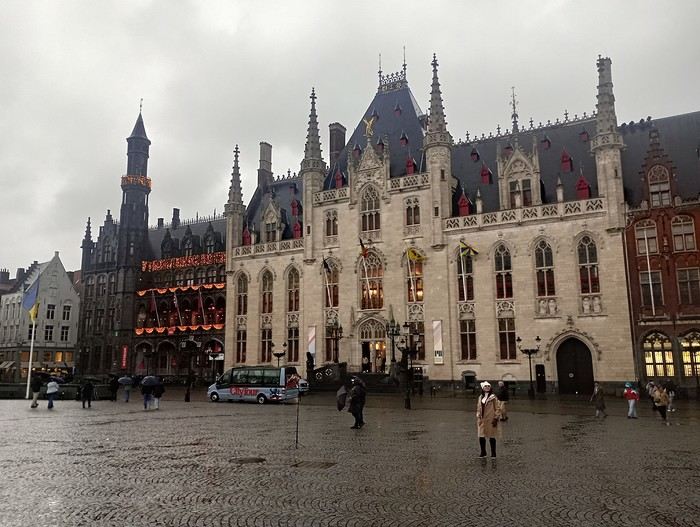
Un peu fatigués, c'est vers notre B&B que nous nous dirigeons et surtout c'est une forte pluie qui nous l'oblige. C'est bien trempés que nous rentrons. (y'en a qui doivent se marrer) Après une séance séchage, nous allons au resto le plus proche, le Parazzar, typiquement brugeois et Mme goûte sa première bière. Perso, je n'aime pas la bière (Que diable allait-il faire dans cette galère ?), donc un vin rouge Tinto, qui aurait été du pays au temps de Charles Quint. Premières frites, car par contre j'adore et il est temps de se rentrer. Une bonne nuit nous attend
Le + : On y est Le - : Il pleut, il vente, il mouille c'est la fête à la ..
Jour 1 : Le voyage aller Quand je dis que je ne m'envole pas, c'est à moitié vrai, car nous partons le jour où les médias français annoncent avec le catastrophisme qui les caractérise, une tempête terrible. Si effectivement la tempête Austen est prévue, du côté belge, elle est signalée comme la première tempête de l'année avec plus de retenue. Effectivement le trajet ne sera pas de tout repos en arrivant dans les Hauts de France, car le vent souffle pas mal, il pleut fort, mais c'est pas l'apocalypse non plus. Il suffit d'être prudent et ralentir sa vitesse surtout. (on dirait un message de la prévention routière !) Départ à 8h de la région Lyonnaise, arrivée à 16h à Bruges, "...et encore on a eu les camions à l'entrée d'Angoulême !". Qu'est-ce qu'il raconte ? Passer par Angoulême ? Les cinéphiles français auront la ref. Accueil sympa dans notre B&B, puis comme il bruine à peine, un petit tour dans la ville pour se dégourdir les jambes. Direction le Markt, visite du Prinsenhof, Palais des ducs de Flandres. En fait on y est entré car il commençait à bien pleuvoir. C'est gratuit, c'est une première incursion dans la culture flamande, c'est bien.
Un peu fatigués, c'est vers notre B&B que nous nous dirigeons et surtout c'est une forte pluie qui nous l'oblige. C'est bien trempés que nous rentrons. (y'en a qui doivent se marrer) Après une séance séchage, nous allons au resto le plus proche, le Parazzar, typiquement brugeois et Mme goûte sa première bière. Perso, je n'aime pas la bière (Que diable allait-il faire dans cette galère ?), donc un vin rouge Tinto, qui aurait été du pays au temps de Charles Quint. Premières frites, car par contre j'adore et il est temps de se rentrer. Une bonne nuit nous attend
Le + : On y est Le - : Il pleut, il vente, il mouille c'est la fête à la ..
Hi,
I’ll be in Barcelona at the end of October.
I can choose to be there over the weekend or during the week. Probably 4 nights.
Is there a big difference in terms of crowds in the city and in the museums?
Little or no difference would simplify my itinerary on the way.
Thanks
Little or no difference would simplify my itinerary on the way.
Thanks
Hi everyone,
We traveled to Norway in the summer of 2025, from July 17 to 29, to visit Senja Island and the Lofoten archipelago with a rental car. The common thread of these twelve days was clearly hiking, along with a few visits and experiences, and nights spent in a tent or in the car (which made it possible). We chose Narvik Airport for both arrival and departure for several complementary reasons: the desire to visit nearby Senja Island, slightly more affordable airfare, and finally, the rental price of the vehicle—especially the car model we were looking for. We only made one reservation, for the first campsite, as sleeping in a tent made things much easier. But we had the whole structure of the trip planned, a flexible outline that could adapt to the weather conditions we’d encounter. Senja Island isn’t part of the Lofoten archipelago, and during the early stages of planning this trip, we hadn’t planned to visit it. But its relative proximity to Narvik Airport and, above all, its unique geography definitely made us change our minds. We arrived in Evenes, where Narvik Airport is located, nearly 60 km from the city itself. Our first stop was 40 km further in Bjerkvik on the way to Senja, where there’s a Rema 1000 (a very common supermarket chain in Norway). We needed to buy some food and a gas cartridge for our stove. I’d emailed the store manager beforehand, who told me they didn’t sell them but that the two gas stations in the village were likely to have some in stock.
It was only at the Esso station that I found what I needed, but unfortunately, only one cartridge. Luckily, we quickly realized that most campsites (like in Iceland) have a shared kitchen with hotplates. That single small cartridge was just enough for the few nights we spent outside of campsites... We got our first taste of Norway’s characteristic landscapes: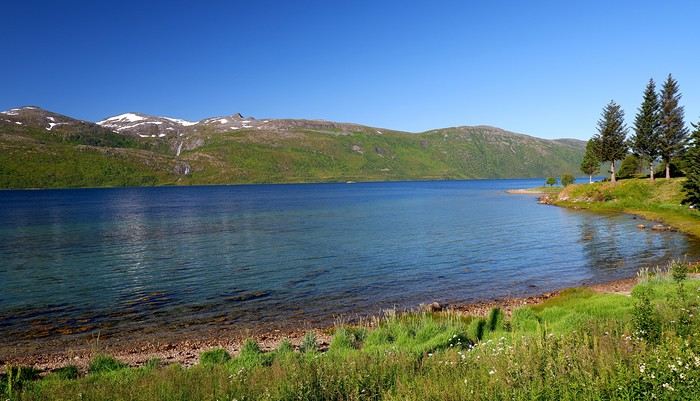
When we arrived at the Senja campsite, it was already 9:30 PM. A sign announced it was full, but luckily, I’d booked it 10 days earlier. By 10:30 PM, as we settled in to eat, it was still broad daylight, and the thermometer read 25°C—despite being at a latitude of 69° North! We went to bed around midnight, exhausted but under the light of a sun that was still very much present. Thanks to Earth’s tilted axis. We’d anticipated this by buying opaque sleep masks because, yes, at this time of year, it’s daylight all the time.
Friday, July 18:
Today, we planned two hikes on the island and a few stops along the way. The map clearly shows that the deepest fjords are in the north and west. Due to time and accessibility, we focused on the northern part of the island. Our first stop was at the viewing platform in Bergbotn:
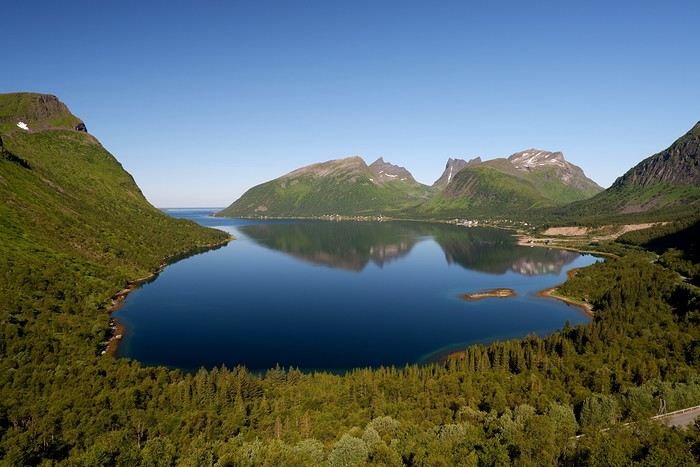
Then we headed toward Skaland, the starting point for our first hike. Along the way, we found plenty of reasons to stop—especially since, on this first day of travel, our thirst for Nordic landscapes was far from quenched.
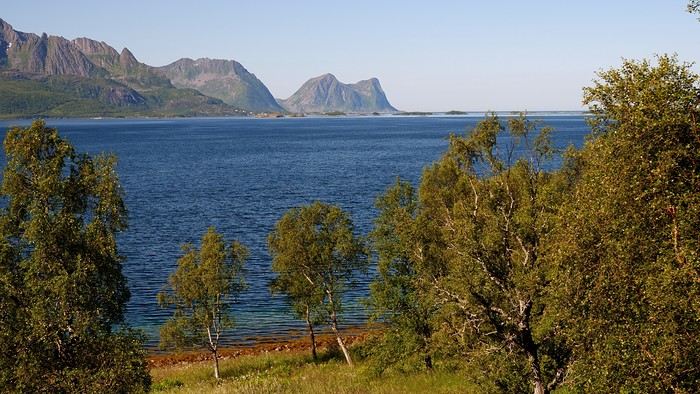
The town of Skaland is very practical: free parking, picnic tables for after the hike, and a Joker convenience store right next door. Our goal was the summit of Husfjellet: 670 m of elevation gain, between 8 and 9 km in length, and an estimated 4 hours and 30 minutes.
This hike offers two major viewpoints. The first overlooks the Bergsoyan islands to the west:
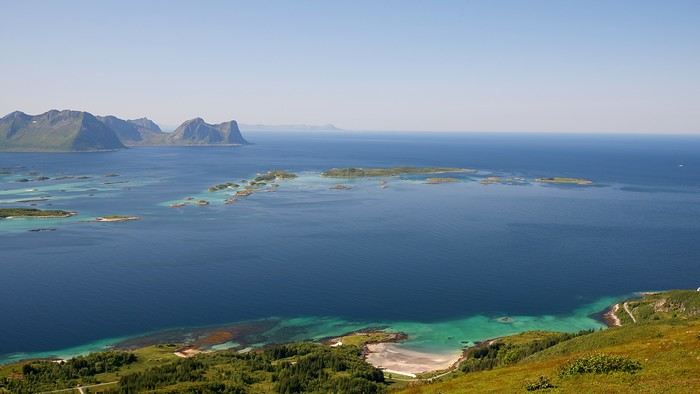
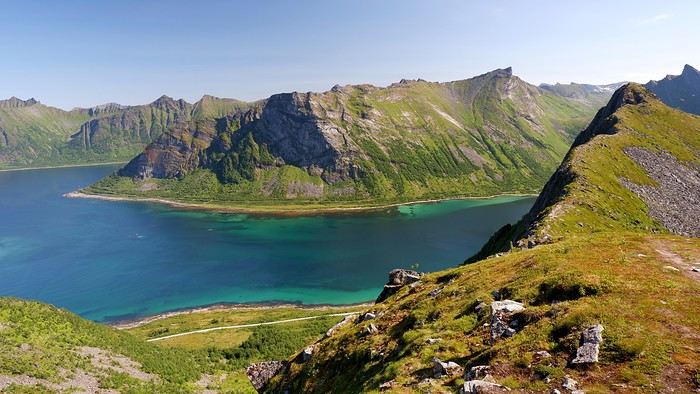
At the summit, the view shifts to the Steinfjorden fjord:
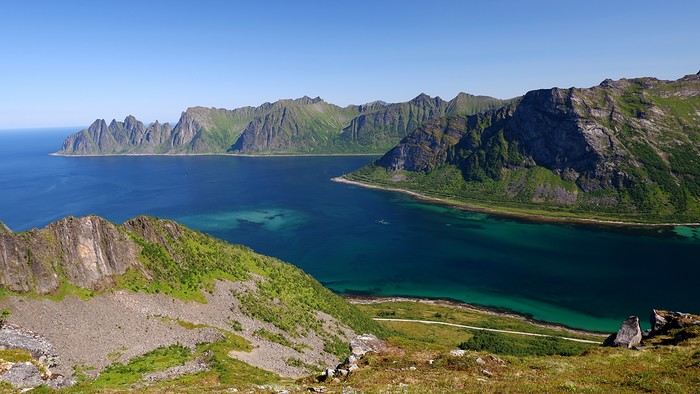
You can even clearly see the "Devil’s Teeth," which we’d see from below later:
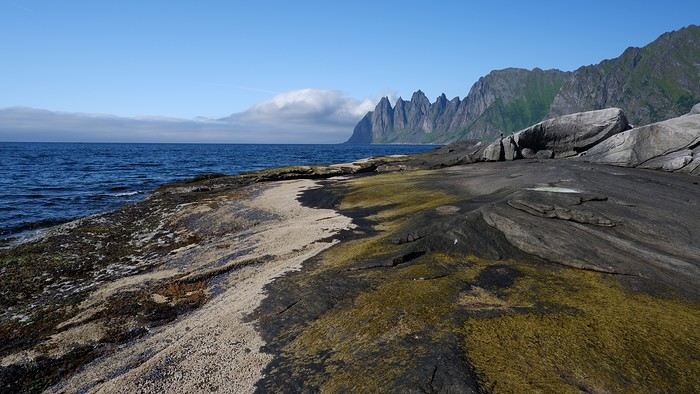
In total, the hike took us 4 hours and 30 minutes, including all the breaks. We treated ourselves to an ice cream in Skaland to recharge for the next hike. We hit the road again and stopped at Tungeneset to get a closer look at the Devil’s Teeth:
We continued to Fjordgard, the starting point for our second hike. Fjordgard isn’t very welcoming. There was a time when you could park right at the start of the hike up Mount Segla. Now, everything’s blocked off, and locals have even taken to blocking all possible parking spots nearby. You now have to park outside the town at a paid parking lot (90 NOK for 3 hours), adding an extra 2 km (round trip) of walking. Still, that was just a minor inconvenience because the hike that followed quickly made us forget all about it. The hike is fairly short (2 hours) but still has 520 m of elevation gain. This hike was a stark contrast to the first. This morning, we had sweeping views of the vast landscape. Here, Mount Segla, perched on the edge of the cliff, dominates the foreground:
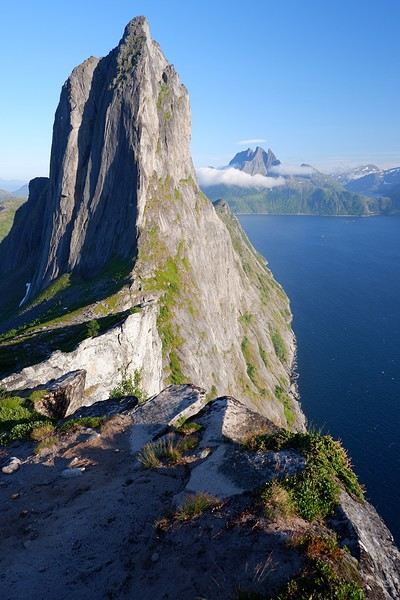
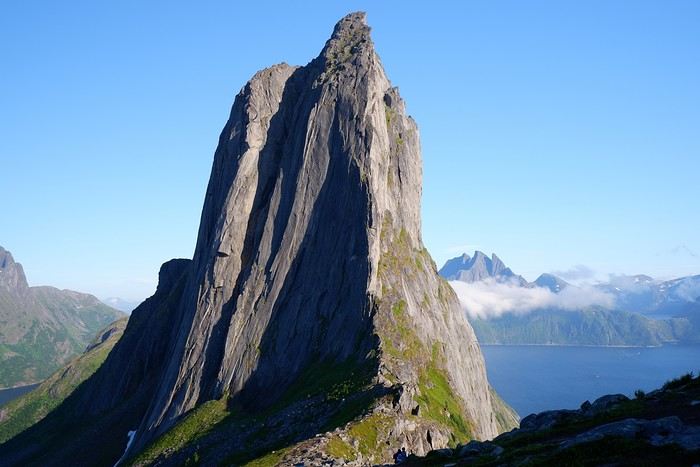
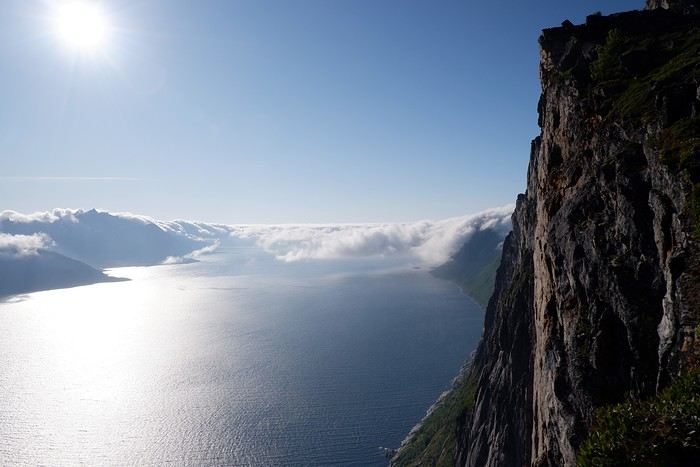
For those prone to vertigo, it might be best to stay at the foot of the mountain, as the trail climbs right along the cliff edge. And from that point on, you quickly understand what verticality really means...
In total, we took 2 hours and 50 minutes, including breaks and the extra walk to the parking lot. The day was already well underway, and with 1,200 m of cumulative elevation gain, it was time to find a spot to eat and sleep. Since we hadn’t made any reservations, we’d planned to bivouac for the night. We weren’t too picky—just practical—so we decided to sleep in the car at the parking lot for tomorrow morning’s hike, just 5 km from Fjordgard.
We traveled to Norway in the summer of 2025, from July 17 to 29, to visit Senja Island and the Lofoten archipelago with a rental car. The common thread of these twelve days was clearly hiking, along with a few visits and experiences, and nights spent in a tent or in the car (which made it possible). We chose Narvik Airport for both arrival and departure for several complementary reasons: the desire to visit nearby Senja Island, slightly more affordable airfare, and finally, the rental price of the vehicle—especially the car model we were looking for. We only made one reservation, for the first campsite, as sleeping in a tent made things much easier. But we had the whole structure of the trip planned, a flexible outline that could adapt to the weather conditions we’d encounter. Senja Island isn’t part of the Lofoten archipelago, and during the early stages of planning this trip, we hadn’t planned to visit it. But its relative proximity to Narvik Airport and, above all, its unique geography definitely made us change our minds. We arrived in Evenes, where Narvik Airport is located, nearly 60 km from the city itself. Our first stop was 40 km further in Bjerkvik on the way to Senja, where there’s a Rema 1000 (a very common supermarket chain in Norway). We needed to buy some food and a gas cartridge for our stove. I’d emailed the store manager beforehand, who told me they didn’t sell them but that the two gas stations in the village were likely to have some in stock.
It was only at the Esso station that I found what I needed, but unfortunately, only one cartridge. Luckily, we quickly realized that most campsites (like in Iceland) have a shared kitchen with hotplates. That single small cartridge was just enough for the few nights we spent outside of campsites... We got our first taste of Norway’s characteristic landscapes:
When we arrived at the Senja campsite, it was already 9:30 PM. A sign announced it was full, but luckily, I’d booked it 10 days earlier. By 10:30 PM, as we settled in to eat, it was still broad daylight, and the thermometer read 25°C—despite being at a latitude of 69° North! We went to bed around midnight, exhausted but under the light of a sun that was still very much present. Thanks to Earth’s tilted axis. We’d anticipated this by buying opaque sleep masks because, yes, at this time of year, it’s daylight all the time.
Friday, July 18:
Today, we planned two hikes on the island and a few stops along the way. The map clearly shows that the deepest fjords are in the north and west. Due to time and accessibility, we focused on the northern part of the island. Our first stop was at the viewing platform in Bergbotn:
Then we headed toward Skaland, the starting point for our first hike. Along the way, we found plenty of reasons to stop—especially since, on this first day of travel, our thirst for Nordic landscapes was far from quenched.
The town of Skaland is very practical: free parking, picnic tables for after the hike, and a Joker convenience store right next door. Our goal was the summit of Husfjellet: 670 m of elevation gain, between 8 and 9 km in length, and an estimated 4 hours and 30 minutes.
This hike offers two major viewpoints. The first overlooks the Bergsoyan islands to the west:
At the summit, the view shifts to the Steinfjorden fjord:
You can even clearly see the "Devil’s Teeth," which we’d see from below later:
In total, the hike took us 4 hours and 30 minutes, including all the breaks. We treated ourselves to an ice cream in Skaland to recharge for the next hike. We hit the road again and stopped at Tungeneset to get a closer look at the Devil’s Teeth:
We continued to Fjordgard, the starting point for our second hike. Fjordgard isn’t very welcoming. There was a time when you could park right at the start of the hike up Mount Segla. Now, everything’s blocked off, and locals have even taken to blocking all possible parking spots nearby. You now have to park outside the town at a paid parking lot (90 NOK for 3 hours), adding an extra 2 km (round trip) of walking. Still, that was just a minor inconvenience because the hike that followed quickly made us forget all about it. The hike is fairly short (2 hours) but still has 520 m of elevation gain. This hike was a stark contrast to the first. This morning, we had sweeping views of the vast landscape. Here, Mount Segla, perched on the edge of the cliff, dominates the foreground:
For those prone to vertigo, it might be best to stay at the foot of the mountain, as the trail climbs right along the cliff edge. And from that point on, you quickly understand what verticality really means...
In total, we took 2 hours and 50 minutes, including breaks and the extra walk to the parking lot. The day was already well underway, and with 1,200 m of cumulative elevation gain, it was time to find a spot to eat and sleep. Since we hadn’t made any reservations, we’d planned to bivouac for the night. We weren’t too picky—just practical—so we decided to sleep in the car at the parking lot for tomorrow morning’s hike, just 5 km from Fjordgard.
In the summer of 2026, we packed our backpacks again to wander around Jotunheimen National Park in Norway.
We’d never heard of this park just a few months earlier—we discovered it by following threads online.
It’s billed as the most mountainous park in the country, which really appealed to us after scrapping our original plan further north.
Unfortunately, it’s also the most crowded, which immediately made it less appealing! The presence of the highest peak in the Scandinavian Alps and the "famous" Bessengen ridge (famous because it’s apparently well-known across the country) probably has a lot to do with that.
Since we’d managed to avoid the crowds on the Kungsleden trails by camping away from the huts and timing our hike to miss the biggest groups of walkers, we figured we had the formula down and gave in to the call of the Norwegian mountains.
It’s the most mountainous park, sure, but also quite challenging in terms of progress, as we’d soon discover during the trek. And with uncooperative weather, we got the winning combo of a demanding hike. But I’m getting ahead of myself...
For the end of the trip, we planned a few days in Dovrefjell National Park—these two parks are easily connected by public transport—to see something different and, most importantly, to try and spot the musk oxen that live there.
My 04/08 - Arrival in Oslo Wed 05/08 - Bygdin – Torfinsbu Thu 06/08 - Torfinsbu - Gjendebu Fri 07/08 - Gjendebu - Fondsbu Sat 08/08 - Day hike to Slotafjellet Sun 09/08 - Day hike to Lake Kvitevatnet Mon 10/08 - Fondsbu - Gjendebu Tue 11/08 - Gjendebu - Before the Bessengen ridge Wed 12/08 - Bessengen ridge – Maurvangen campsite Thu 13/08 - Knutshoe ridge Fri 14/08 - Bus transfer to Spiterstulen hut via Lom Sat 15/08 - Day hike to Galdhøpiggen Sun 16/08 to Wed 19/08: Dovrefjell End of the trip and wrap-up
Hello, We’re heading to Italy for five weeks next spring. It’ll be our first trip there. We’d love to see some must-see spots and beautiful countryside regions. Our main transport will be trains, and sometimes buses to reach smaller villages. We’re less interested in the mountains and lakes in the north. We’ll try to stay 4–5 days in some places and explore the surrounding area by train or bus. Any suggestions for planning our trip? Itineraries and must-sees! Thanks
Hi everyone,
We're heading to Madrid in November and looking for a centrally located hotel. I saw one on Calle de Alcalá.
Does anyone know this street, or do you have other suggestions?
Thanks in advance.
After a pretty disastrous weather-wise trip to Gran Canaria, we’re hoping this time the sun will shine in Puglia.
It’s not a sure thing, though—the weather’s been awful all over Europe in early May.
For those who’d like to (re)read the story without the digressions, it’s here.
Saturday, May 16: This time we’re flying out of Charleroi (Brussels South): the ticket prices, flight times, and proximity all worked for us. The airport (Ryanair) was recently renovated... but it’s still not very well organized. There are hardly any seats in the boarding areas, and... the restrooms cost money!!! The flight goes smoothly, though, and we land in Bari a little late.
We quickly pick up our rental car, a very local-looking Pandina (even more so than the Fiat 500 in this region), and hit the Italian roads... and their unique driving quirks (like the fact that the countless road signs along the streets and in towns are purely decorative 😏, and that Italian cars don’t have turn signals 😮... except for rental cars).
About an hour later, we arrive at our first accommodation, right in the middle of the countryside near Monopoli. The owner isn’t there, but they’ve left us a ton of info via messages and even turned on the space heater, which is a nice touch. We explore the property:
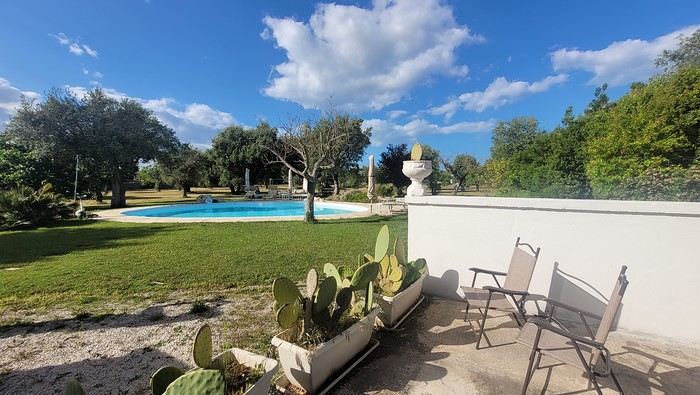
And the next morning before breakfast, its immediate surroundings:
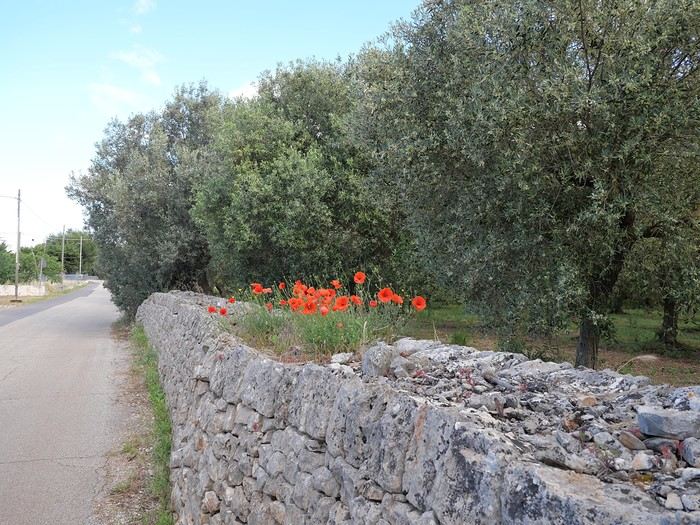
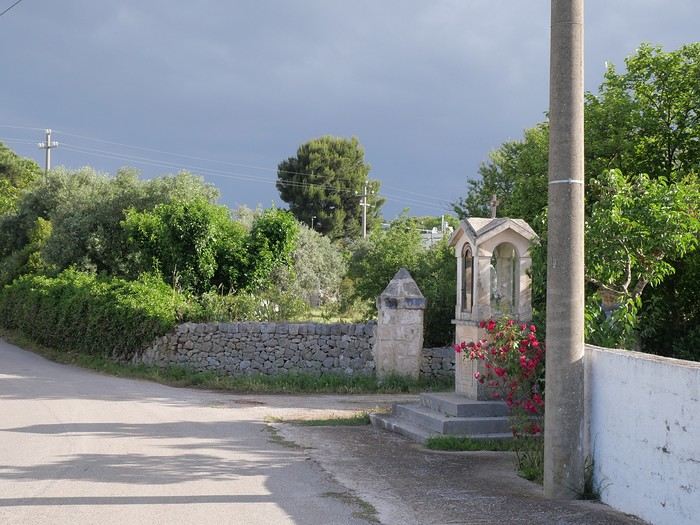
Sunday, May 17: After our "seaside" experience in Gran Canaria last weekend (packed with people and locals), we decide to start inland. After a hearty breakfast,
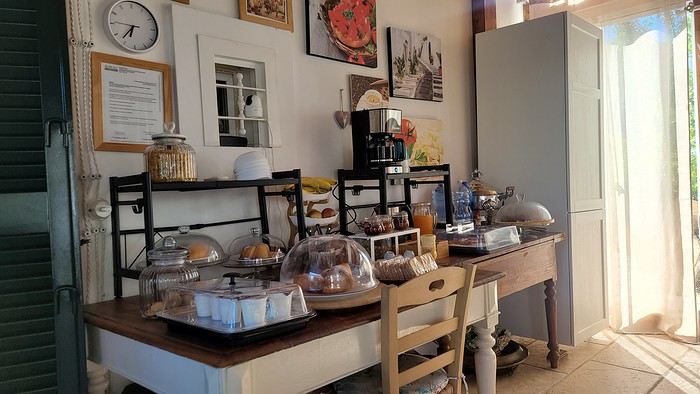
we head toward Alberobello, a super touristy village famous for its trulli—those stone houses with conical roofs. We easily find a free parking spot on a street near the Aia Piccola district, where some trulli are still lived in year-round.
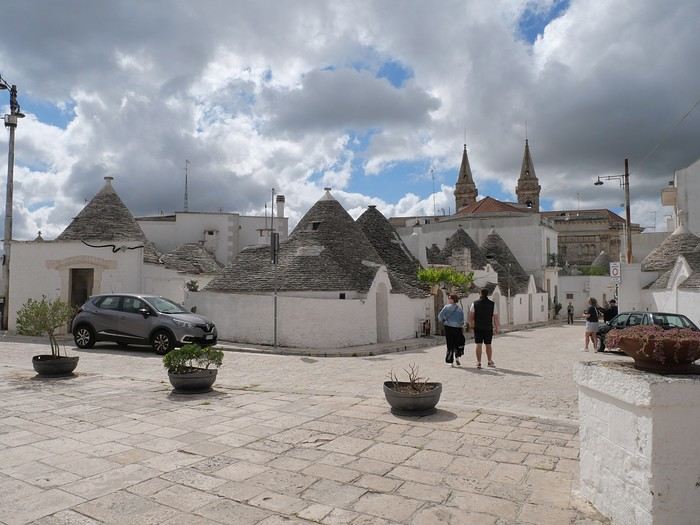
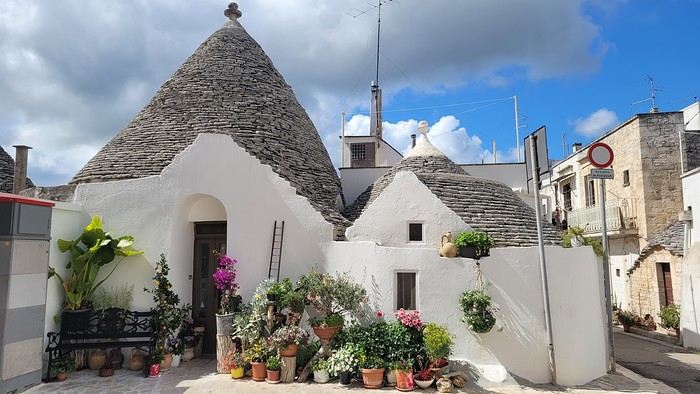
We almost immediately come across the Trullo Sovrano (the only two-story one), which you can visit (but we skip it—it’s opening time, and there’s already a line).
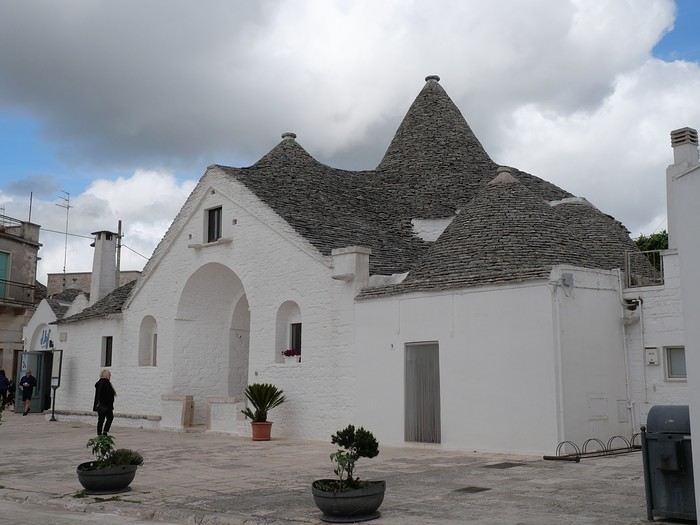
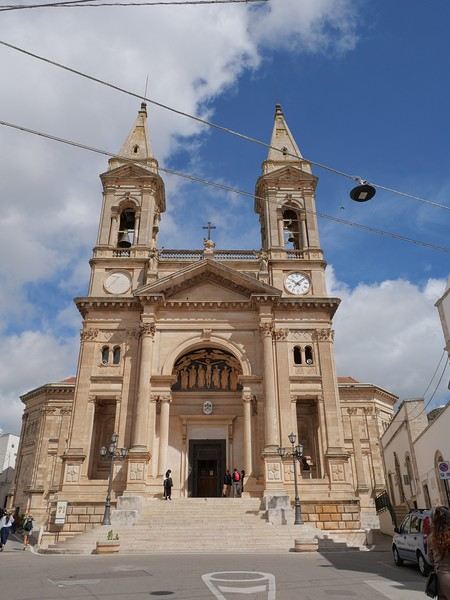
From there, we head down toward the Basilica of Cosma e Damiano... but we don’t go in because there’s a mass.
Now we’re on the main Piazza del Popolo, which connects the two districts of Alberobello: Rione Aia Piccola and Rione Monti, the more touristy one.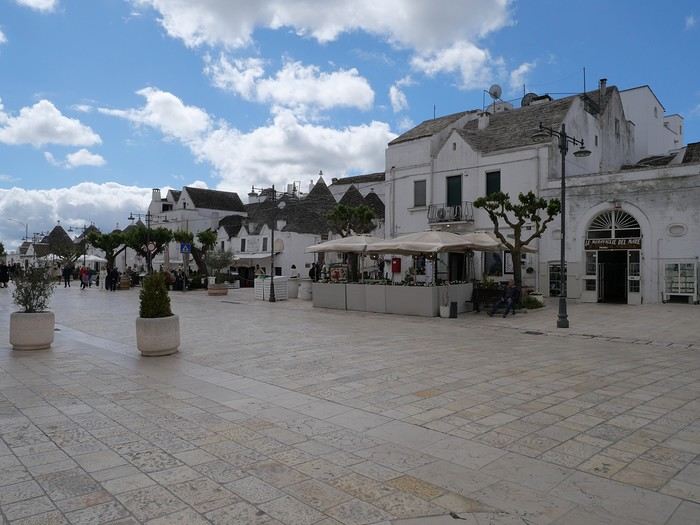
For those who’d like to (re)read the story without the digressions, it’s here.
Saturday, May 16: This time we’re flying out of Charleroi (Brussels South): the ticket prices, flight times, and proximity all worked for us. The airport (Ryanair) was recently renovated... but it’s still not very well organized. There are hardly any seats in the boarding areas, and... the restrooms cost money!!! The flight goes smoothly, though, and we land in Bari a little late.
We quickly pick up our rental car, a very local-looking Pandina (even more so than the Fiat 500 in this region), and hit the Italian roads... and their unique driving quirks (like the fact that the countless road signs along the streets and in towns are purely decorative 😏, and that Italian cars don’t have turn signals 😮... except for rental cars).
About an hour later, we arrive at our first accommodation, right in the middle of the countryside near Monopoli. The owner isn’t there, but they’ve left us a ton of info via messages and even turned on the space heater, which is a nice touch. We explore the property:
And the next morning before breakfast, its immediate surroundings:
Sunday, May 17: After our "seaside" experience in Gran Canaria last weekend (packed with people and locals), we decide to start inland. After a hearty breakfast,
we head toward Alberobello, a super touristy village famous for its trulli—those stone houses with conical roofs. We easily find a free parking spot on a street near the Aia Piccola district, where some trulli are still lived in year-round.
We almost immediately come across the Trullo Sovrano (the only two-story one), which you can visit (but we skip it—it’s opening time, and there’s already a line).
From there, we head down toward the Basilica of Cosma e Damiano... but we don’t go in because there’s a mass.
Now we’re on the main Piazza del Popolo, which connects the two districts of Alberobello: Rione Aia Piccola and Rione Monti, the more touristy one.
Hi everyone,
From January 1st to 4th, I’m heading to Barcelona for the first time. Beyond the tourist sites—which are going to cost me an arm and a leg!!—I’d love to spend a day off the beaten path and see some less touristy spots. What do you recommend? I’ll be getting around on foot, by metro, or possibly by train if it’s not too far. I love both nature and cultural spots. And one last thing—is Barcelona at night safe for a woman alone, or is it sketchy?
Thanks for your help! :)
Hi,
We’d like to rent a small car (something like a Peugeot 208) when we arrive at Catania Airport.
... and we’d like to return it in Milazzo on a Sunday.
Could you recommend any rental companies for this kind of one-way rental—affordable and open on Sundays in Milazzo? Thanks in advance! Seb
Could you recommend any rental companies for this kind of one-way rental—affordable and open on Sundays in Milazzo? Thanks in advance! Seb
Hi there,
We’re three adults planning a trip to Norway in May 2027. What do you recommend for the Lofoten Islands? We’d prefer to group the places to visit (flights, rental car...??).
Thanks!
We’re three adults planning a trip to Norway in May 2027. What do you recommend for the Lofoten Islands? We’d prefer to group the places to visit (flights, rental car...??).
Thanks!
Hi there,
I’m heading to Lapland from November 12th to 19th.
I know it’s not the best time for snow cover… so I’ve opted for Saariselkä since it’s further north.
At this point, no activities—reindeer rides, snowmobiling, sledding, etc.—are available online yet, with just a few starting in early December.
My question: if snow arrives in early November 🤞, will it be possible to book things on-site? I’m guessing there aren’t dozens of providers.
Thanks for your feedback!
Hello Voyage Forum members.
For my wife’s birthday and her 64th year, I’d love to plan a two-week road trip with her—using our own car—preferably avoiding overly touristy spots, so off the beaten path where possible. That said, we wouldn’t mind stopping at must-see places along the way. The trip would cover Emilia-Romagna and/or Tuscany if combining both regions is doable in that timeframe, with the option for some hikes during the period. We’re looking at late November 2026. I’d prioritize the most authentic accommodations, ideally with breakfast included, without exceeding 100 € per night if that’s possible. So, stays like private rooms in hostels or homestays would be perfect.
Based on these details, I’d really appreciate any recent tips or insights from Voyage Forum members to help me plan this surprise anniversary trip.
I'm probably going to spend a week in Naples, but I'd love to hear your thoughts! I've heard that the city is quite dangerous and crime-ridden? I've also heard that "Neapolitans" aren't very welcoming and have a bad temper?
Is this true or just rumors?😊
Hi there, I'm looking for a friendly person who knows about the capabilities of donkeys/mules and horses for long-term, round-the-clock travel.
(I already do this, but with a donkey that's far from indestructible)
I struggle to assess the potential of some equines, so I'd like someone at least somewhat competent in this area whom I can contact from time to time to share photos of animals I'm considering buying.
I'm not in France, I don't plan to return, and I often come across charlatans who'd sell their animals to anyone for a few good bills... But that's not my case—I'm primarily looking for a female donkey or a mule (my sweetheart isn’t a big fan of horses), and as a last resort, a mare strong and enduring enough to carry me in the mountains, meaning a constant load of about 80kg: - Me: 60/65kg - Saddle: 2/4kg - 8/10L of water - A rope: 800g
Based on what I've read online and advice from people, I understand the load should represent a maximum of 15/20% of the animal's weight or at least 1.40m at the withers? Mules would be ideal for me, but they sell out VERY quickly, so I never get a chance to find one... (I always leave a safety margin with the equines I meet to ensure their spine doesn’t get damaged over time)
Anyway, advice won’t be much help because I don’t want to make this decision ALONE when buying this female, to ensure I choose a relatively indestructible creature.
I’ve been visiting long and short ears for a year now, but I still haven’t found the right fit out of concern for her, which is why someone who stays in my contacts to help me make the final decision would be more than welcome :)
Thanks for your attention, hope to hear from you soon!
After 3 nights in Naples, we want to visit the Amalfi Coast. Which town would be the best base?
Hi there,
I’m looking for some great tips for a stay in Palma de Mallorca this summer.
I need cheap flights departing from Toulouse and affordable accommodation for 4 people.
What do you recommend?
Best regards,
Has anyone done the Atlantic cycling route crossing Norway (EuroVelo 1)?
Which direction is the hardest?
From NORTH to SOUTH or the other way around?
Hi there,
who has already done the EURO VELO 1 in Norway from the south to the North Cape, and what are the main difficulties:
elevation gain, etc.......
Otherwise, who has already done the EURO VELO 7 from south to north, crossing Sweden up to the North Cape? If so, what are the difficulties, elevation gain, and does it pass through villages for supplies, etc.......
Hello fellow travelers
We’re heading to Norway for the first time as a couple for 8 days in December
I’m really torn about how much time to spend at each stop (and how many stops to make) We’d like to explore the cities, visit the Christmas market, see some beautiful landscapes, and if we have time, a stave church.
We arrive in Oslo on December 5th around 5 PM and leave from Bergen on December 12th around 11 AM.
Initially, we were thinking: Oslo from the 5th to the 8th Train to Bergen on the 8th, then stay until the 12th
But now we’d like to fit Flåm into the itinerary
Do you think it’s better to do: From the 5th to the 8th: Oslo On the 8th: train from Oslo to Flåm (arriving at 3 PM) On the 9th: a short fjord cruise, then the 2 PM train to Bergen (but then the Myrdal–Bergen stretch will be in the dark) From the 9th to the 12th: Bergen
Or should we adjust the number of nights in each place? Maybe shorten Oslo? Add a night in Flåm? Skip Flåm altogether? I’m not sure 😅
Thanks!
Preamble: Why La Gomera?
When we started looking for a summer destination a few months ago, our first criterion was to avoid extreme heat and heatwaves. We had already been to Norway two years ago and are considering going back in the future for other occasions. So, we had some fun asking ChatGPT which destinations enjoyed a mild climate during the summer without going too far. Among the list provided by the AI were the Canary Islands... The idea of a place we wouldn’t have thought of first, both not too far away and exotic enough, appealed to us: “Hmm, why not?”
This destination had never really attracted me, though Magali was a bit more interested. Five years earlier, COVID had caused a short break in my professional activity, and I had planned a trip because the flight price was attractive, and I was looking for a destination different from what usually appeals to me, more than out of deep interest. From a distance and with a social judgment I acknowledge (it’s not great, but it’s not completely wrong), I had the image of a destination for party-goers enjoying the sun without the slightest interest in local culture, with concrete coastlines and denatured landscapes—everything I detest the most. Still, I had done some quick research on the different islands and spotted Lanzarote for its beautiful volcanic landscapes, hiking trails, beaches, and the impression of a good balance between activity and fewer crowds than Tenerife or Gran Canaria. Then I dropped the idea of going, without ever reconsidering traveling to the Canaries...
Until now! Because we started researching the different islands of the archipelago to see which ones might appeal to us the most. It was La Gomera, the third smallest island of the archipelago, more praised for its hiking trails and preserved nature than for its beaches, away from mass tourism (fifty times fewer tourists than Tenerife) but still a bit more developed than its wild neighbor El Hierro, that caught our attention. Contrary to what might be suggested later, I’m not at all addicted to AI, but I use it from time to time to synthesize quick research or simply for experimentation. Since ChatGPT had started anticipating my tastes lately as if it had become my buddy (often successfully, sometimes off the mark), I asked which Canary Island would suit me best for a trip with my family. The tool answered first with... La Gomera. So, I tested it and teased it a bit to see if this suggestion was well-founded, as the method sometimes makes it contradict itself. But no luck: “You’d appreciate the wild nature of El Hierro, but with family, you’ll find little activity for the kids. You won’t like the touristy vibe of the big islands like Tenerife, Gran Canaria, Lanzarote, and Fuerteventura. You could consider La Palma, but it’s really La Gomera that will suit you best, based on your interests and the criteria given.” So, we dug deeper into our research and were convinced without a shadow of a doubt that this island was the one waiting for us.
Without knowing it, we had Canarians in our circle who revealed their origins when they heard about our travel plans. One from Tenerife insisted we’d be better off choosing Tenerife (obviously...) because it also has preserved spots and that La Gomera, “you can explore it in two or three days, you’ll get bored quickly...” The other, a colleague from Gran Canaria who had never visited La Gomera, still recommended it without hesitation because it turned out her parents had just gone there on vacation: they loved it and had encountered few tourists. She also tended to think this destination was usually the subject of short stays, but according to what her parents told her, taking your time there was also a great idea. However, in our research, the idea that La Gomera is an island you can explore in three or four days max kept coming up. So, we considered combining its visit with La Palma or El Hierro, the other two that caught our eye. But hopping between islands by ferry represents a significant budget for non-Canarians, even more so for a family of four. Then, scrutinizing Google Maps, it seemed obvious that two weeks were too short to discover two islands as they deserve, and that there seemed to be plenty to see in La Gomera, given its very unique culture. After all, we read that some people spend several months a year there, others never even leave... Finally, these landscapes and this atmosphere, which seemed to us a mix of Europe, North Africa, and Latin America, tempted us. So, it would be two weeks in La Gomera, deal!
La Gomera is therefore the second... well, the third smallest island of the Canaries since La Graciosa was recently recognized as a fully inhabited island. It has the shape of a rough circle about 20 to 25 kilometers in diameter and has just over 20,000 inhabitants, half of them in its capital, San Sebastián de la Gomera, the only real town. Like its Canarian sisters, La Gomera is a volcanic formation that rose about 10 million years ago. The island is very mountainous and rugged, covered with red and black rocky landscapes. Geological activity has shaped, between the sprawling massifs that end in steep cliffs in the ocean, six coastal valleys with tropical vegetation that have favored human settlement. They divide the island like slices of a cake; from the north clockwise: the agricultural Vallehermoso, the rustic Agulo, the green, humid, and fertile Hermigua, the sunny capital San Sebastián de la Gomera, the southern and isolated Alajeró-Santiago, and the seaside Valle Gran Rey. They constitute the six municipalities (more like cantons to our French understanding) of the territory.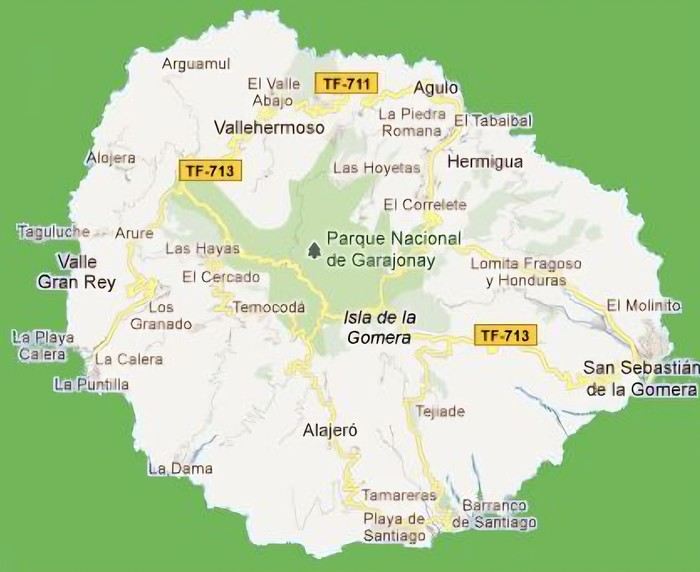 The large solidified magma massifs that shape the heart of the island have created a large depression more protected from the sun at its center, allowing the growth of a vast laurel forest, today grouped within the Garajonay National Park, La Gomera’s green lung, which has earned it the status of a World Biosphere Reserve. Its completely European appearance contrasts sharply with the rocky and tropical landscapes of the rest of the island. Thus, the climate varies greatly from one point to another on the island: in summer, you can quickly go from a dry and sunny valley at 35°C to a humid forest area at altitude at 18°C.
La Gomera was populated late. As with the rest of the Canaries, human presence is thought to have begun about 2,000 years ago. Groups of animist Berbers, probably fleeing persecution, gradually populated the archipelago, especially the western islands and La Gomera, becoming its small aboriginal population: the Guanches (or later Gomeros). The animist and pastoral civilization of the Guanches thrived until the Spanish takeover in the 15th century, which, after a short period of harmony and mixing with the indigenous people, suddenly ended in bloodshed... La Gomera later became the “Columbus Island” after Christopher Columbus’s stopover, increasing the blending of populations. In the 20th century, many Gomeros emigrated to Cuba and other Latin American countries in search of a better life, bringing back a mix of cultures and traits quite palpable in today’s Gomeran culture. It is, however, in La Gomera that the vestiges of Guanche culture seem to have left the most traces, in the language, gastronomy, social practices... Moreover, most Gomeros, especially in remote villages, have a particular identifiable type and proudly claim their ancestral roots, even making La Gomera a bit exotic in the eyes of other Canarians.
Perhaps that’s why it has never really wanted to develop its tourist infrastructure too much. If we set aside the tourists who visit for the day by bus or boat from Tenerife on a marked itinerary (and whom we ultimately rarely encounter), La Gomera has remained a hidden gem, a destination focused on nature discovery that attracts hikers, nature-loving divers, and scientists for its fauna and flora, and to a lesser extent, beachgoers who don’t seek overly developed coastlines. Tourist activity is therefore limited. Roughly speaking, you’ll find a majority of Spaniards, including a substantial number of residents from other Canary Islands, many Germans who have a particular fondness for La Gomera and spend long stays there or own second homes, to the point that the German cultural footprint is clearly noticeable in some places (it’s said to be Angela Merkel’s favorite holiday spot), and still quite a few French. The presence of other nationalities seemed negligible to us. Most travelers come mainly for hiking, but it’s also a prime spot for whale watching. Additionally, the seaside resorts of La Gomera—San Sebastián, Santiago, and especially Valle Gran Rey—are well-known destinations for hippies, especially German ones, ranging from chic boho hippies to old-school hippies who’ve been there for decades, quite similar to those you’d meet in India in Goa, Rishikesh, or Paharganj. Thus, practices like naturism, vegetarianism, and local organic production are quite well established in some areas.
Some practical info: - The round-trip flight from Paris to Tenerife cost us 365 € per person (outbound with Transavia, return with EasyJet), including checked luggage and three seats reserved side by side. - We chose two bases to explore the island: one week in Valle Gran Rey, reputed to be the most pleasant of the three seaside resorts, and one week in Hermigua, more mountainous and close to the natural park. We booked two houses with balconies and views: the first at 120 € per night, the second at 99 €. - The round-trip ferry between Tenerife and La Gomera cost us 270 € with the company Baleària Canarias, including discounts for children aged 4 and 12, but I don’t have the exact details. It was a bit cheaper than with the other company, Fred Olsen. - Finally, we rented a car through the agency Cicar for 360 € for 16 days, which comes to 22.50 € per day. - Apart from that, we didn’t plan anything and decided the day before or even the morning of what we wanted to do. We didn’t invest in any paper guide on the Canaries, as information on La Gomera was scarce, but we used the very comprehensive site La Gomera Travel, a travel guide published by the Canary Islands Tourism Council, a real goldmine of almost exhaustive information on the island.
Alright, off we go for 16 days of adventure discovering La Gomera!
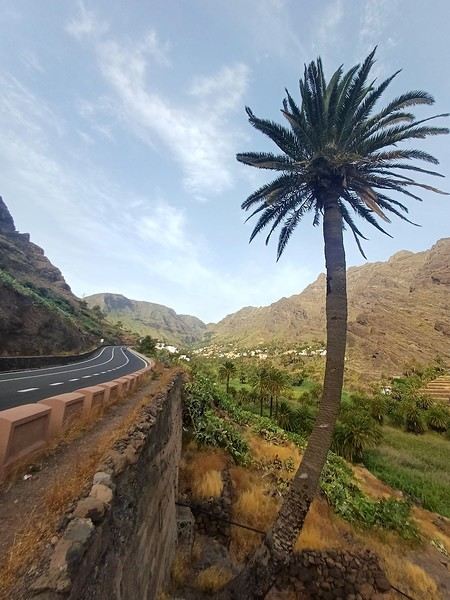
And we start the trip with music!
We start the trip with music!
When we started looking for a summer destination a few months ago, our first criterion was to avoid extreme heat and heatwaves. We had already been to Norway two years ago and are considering going back in the future for other occasions. So, we had some fun asking ChatGPT which destinations enjoyed a mild climate during the summer without going too far. Among the list provided by the AI were the Canary Islands... The idea of a place we wouldn’t have thought of first, both not too far away and exotic enough, appealed to us: “Hmm, why not?”
This destination had never really attracted me, though Magali was a bit more interested. Five years earlier, COVID had caused a short break in my professional activity, and I had planned a trip because the flight price was attractive, and I was looking for a destination different from what usually appeals to me, more than out of deep interest. From a distance and with a social judgment I acknowledge (it’s not great, but it’s not completely wrong), I had the image of a destination for party-goers enjoying the sun without the slightest interest in local culture, with concrete coastlines and denatured landscapes—everything I detest the most. Still, I had done some quick research on the different islands and spotted Lanzarote for its beautiful volcanic landscapes, hiking trails, beaches, and the impression of a good balance between activity and fewer crowds than Tenerife or Gran Canaria. Then I dropped the idea of going, without ever reconsidering traveling to the Canaries...
Until now! Because we started researching the different islands of the archipelago to see which ones might appeal to us the most. It was La Gomera, the third smallest island of the archipelago, more praised for its hiking trails and preserved nature than for its beaches, away from mass tourism (fifty times fewer tourists than Tenerife) but still a bit more developed than its wild neighbor El Hierro, that caught our attention. Contrary to what might be suggested later, I’m not at all addicted to AI, but I use it from time to time to synthesize quick research or simply for experimentation. Since ChatGPT had started anticipating my tastes lately as if it had become my buddy (often successfully, sometimes off the mark), I asked which Canary Island would suit me best for a trip with my family. The tool answered first with... La Gomera. So, I tested it and teased it a bit to see if this suggestion was well-founded, as the method sometimes makes it contradict itself. But no luck: “You’d appreciate the wild nature of El Hierro, but with family, you’ll find little activity for the kids. You won’t like the touristy vibe of the big islands like Tenerife, Gran Canaria, Lanzarote, and Fuerteventura. You could consider La Palma, but it’s really La Gomera that will suit you best, based on your interests and the criteria given.” So, we dug deeper into our research and were convinced without a shadow of a doubt that this island was the one waiting for us.
Without knowing it, we had Canarians in our circle who revealed their origins when they heard about our travel plans. One from Tenerife insisted we’d be better off choosing Tenerife (obviously...) because it also has preserved spots and that La Gomera, “you can explore it in two or three days, you’ll get bored quickly...” The other, a colleague from Gran Canaria who had never visited La Gomera, still recommended it without hesitation because it turned out her parents had just gone there on vacation: they loved it and had encountered few tourists. She also tended to think this destination was usually the subject of short stays, but according to what her parents told her, taking your time there was also a great idea. However, in our research, the idea that La Gomera is an island you can explore in three or four days max kept coming up. So, we considered combining its visit with La Palma or El Hierro, the other two that caught our eye. But hopping between islands by ferry represents a significant budget for non-Canarians, even more so for a family of four. Then, scrutinizing Google Maps, it seemed obvious that two weeks were too short to discover two islands as they deserve, and that there seemed to be plenty to see in La Gomera, given its very unique culture. After all, we read that some people spend several months a year there, others never even leave... Finally, these landscapes and this atmosphere, which seemed to us a mix of Europe, North Africa, and Latin America, tempted us. So, it would be two weeks in La Gomera, deal!
La Gomera is therefore the second... well, the third smallest island of the Canaries since La Graciosa was recently recognized as a fully inhabited island. It has the shape of a rough circle about 20 to 25 kilometers in diameter and has just over 20,000 inhabitants, half of them in its capital, San Sebastián de la Gomera, the only real town. Like its Canarian sisters, La Gomera is a volcanic formation that rose about 10 million years ago. The island is very mountainous and rugged, covered with red and black rocky landscapes. Geological activity has shaped, between the sprawling massifs that end in steep cliffs in the ocean, six coastal valleys with tropical vegetation that have favored human settlement. They divide the island like slices of a cake; from the north clockwise: the agricultural Vallehermoso, the rustic Agulo, the green, humid, and fertile Hermigua, the sunny capital San Sebastián de la Gomera, the southern and isolated Alajeró-Santiago, and the seaside Valle Gran Rey. They constitute the six municipalities (more like cantons to our French understanding) of the territory.
The large solidified magma massifs that shape the heart of the island have created a large depression more protected from the sun at its center, allowing the growth of a vast laurel forest, today grouped within the Garajonay National Park, La Gomera’s green lung, which has earned it the status of a World Biosphere Reserve. Its completely European appearance contrasts sharply with the rocky and tropical landscapes of the rest of the island. Thus, the climate varies greatly from one point to another on the island: in summer, you can quickly go from a dry and sunny valley at 35°C to a humid forest area at altitude at 18°C.La Gomera was populated late. As with the rest of the Canaries, human presence is thought to have begun about 2,000 years ago. Groups of animist Berbers, probably fleeing persecution, gradually populated the archipelago, especially the western islands and La Gomera, becoming its small aboriginal population: the Guanches (or later Gomeros). The animist and pastoral civilization of the Guanches thrived until the Spanish takeover in the 15th century, which, after a short period of harmony and mixing with the indigenous people, suddenly ended in bloodshed... La Gomera later became the “Columbus Island” after Christopher Columbus’s stopover, increasing the blending of populations. In the 20th century, many Gomeros emigrated to Cuba and other Latin American countries in search of a better life, bringing back a mix of cultures and traits quite palpable in today’s Gomeran culture. It is, however, in La Gomera that the vestiges of Guanche culture seem to have left the most traces, in the language, gastronomy, social practices... Moreover, most Gomeros, especially in remote villages, have a particular identifiable type and proudly claim their ancestral roots, even making La Gomera a bit exotic in the eyes of other Canarians.
Perhaps that’s why it has never really wanted to develop its tourist infrastructure too much. If we set aside the tourists who visit for the day by bus or boat from Tenerife on a marked itinerary (and whom we ultimately rarely encounter), La Gomera has remained a hidden gem, a destination focused on nature discovery that attracts hikers, nature-loving divers, and scientists for its fauna and flora, and to a lesser extent, beachgoers who don’t seek overly developed coastlines. Tourist activity is therefore limited. Roughly speaking, you’ll find a majority of Spaniards, including a substantial number of residents from other Canary Islands, many Germans who have a particular fondness for La Gomera and spend long stays there or own second homes, to the point that the German cultural footprint is clearly noticeable in some places (it’s said to be Angela Merkel’s favorite holiday spot), and still quite a few French. The presence of other nationalities seemed negligible to us. Most travelers come mainly for hiking, but it’s also a prime spot for whale watching. Additionally, the seaside resorts of La Gomera—San Sebastián, Santiago, and especially Valle Gran Rey—are well-known destinations for hippies, especially German ones, ranging from chic boho hippies to old-school hippies who’ve been there for decades, quite similar to those you’d meet in India in Goa, Rishikesh, or Paharganj. Thus, practices like naturism, vegetarianism, and local organic production are quite well established in some areas.
Some practical info: - The round-trip flight from Paris to Tenerife cost us 365 € per person (outbound with Transavia, return with EasyJet), including checked luggage and three seats reserved side by side. - We chose two bases to explore the island: one week in Valle Gran Rey, reputed to be the most pleasant of the three seaside resorts, and one week in Hermigua, more mountainous and close to the natural park. We booked two houses with balconies and views: the first at 120 € per night, the second at 99 €. - The round-trip ferry between Tenerife and La Gomera cost us 270 € with the company Baleària Canarias, including discounts for children aged 4 and 12, but I don’t have the exact details. It was a bit cheaper than with the other company, Fred Olsen. - Finally, we rented a car through the agency Cicar for 360 € for 16 days, which comes to 22.50 € per day. - Apart from that, we didn’t plan anything and decided the day before or even the morning of what we wanted to do. We didn’t invest in any paper guide on the Canaries, as information on La Gomera was scarce, but we used the very comprehensive site La Gomera Travel, a travel guide published by the Canary Islands Tourism Council, a real goldmine of almost exhaustive information on the island.
Alright, off we go for 16 days of adventure discovering La Gomera!
And we start the trip with music!
We start the trip with music!
Hello,
We’ve booked our flights to Tromsø from January 9th to 16th, 2027.
Now it’s time to plan our stay, and I’ll admit I’m feeling a bit unsure...
We definitely intend to rent a car, but what route should we take?
Should we book accommodation for the entire stay (7 nights) in Tromsø and do day trips (Sommarøy, Kvaløya, Lyngen, a day in Tromsø, a boat excursion, and then... what else?)? Or spend 3–4 days in Tromsø and hit the road for another 3–4 days somewhere else—but where?
I’d also considered splitting it: 3 days in Tromsø and 3 days in Målselv, so we could explore a different region by car and maybe try some downhill or cross-country skiing.
Is this area interesting beyond skiing?
During a recent trip to Lapland, we already tried dog sledding and snowmobiling, so we’re not planning to repeat those activities. Instead, we’d love to discover the landscapes and Sami culture.
I’d love to hear about your experiences or suggestions to help us plan our trip.
Thanks,
Hello everyone,
This is my first time traveling to Italy
For a short cultural trip
From October 8th to 17th
Solo as a senior woman
I booked my one-way ticket with FlixBus
From Lille Europe
On October 8th at 11:55 PM
I arrive at Porte de Maillot (Paris Pershing)
At 3:05 AM
And I’d like to get to Palermo, Italy
Starting October 9th
I’ve checked tickets—prices are sky-high everywhere, and there are even scams
Can you advise me on how to get to this city
Affordably
By train, plane, or bus
I need to arrive by October 9th
For my hostel room
Which is located at
Address provided
5.4K followers • 426 following
Travel, meet, be surprised, and fall in love with Palermo
Book at: www.acasadiamici.com
Via Dante 57, Palermo | +39 091 7654650
Palermo
acasadiamicihostel
+39 328 317 2205
A Casa di Amici, a place to live!
And from Palermo, how do I get to the hostel where I’ve booked? I’m counting on your support and understanding To make things easier before I arrive And to recommend the best ways to get there Safely Can I count on you? Thanks for your trust. Looking forward to your advice, best regards.
And from Palermo, how do I get to the hostel where I’ve booked? I’m counting on your support and understanding To make things easier before I arrive And to recommend the best ways to get there Safely Can I count on you? Thanks for your trust. Looking forward to your advice, best regards.
Hi everyone,
We're heading to Genoa and the Cinque Terre in mid-October for a full week. We're planning to spend two and a half days—three nights—in the Cinque Terre. The idea is to hike between the villages and use the train (or boat) for the trip out (or back). We're thinking of staying overnight, and I was wondering which village to prioritize.
Thanks in advance for your tips!
Hi,
My trip to the Algarve, which was postponed, is now taking shape.
On October 13th, I’m leaving for 2 weeks. When I arrive, I’ll be staying in Lisbon for 3 nights. So, I’d love to find somewhere affordable and well-located to stay—any suggestions would be great!
After that, I’ll head to Faro, where I plan to rent a car. Would it be best to rent directly from the airport? I can’t seem to find any agencies in Faro city where I could pick up the car and drop it off at the airport at the end of my stay. Is it possible to return a car at 6 AM at the airport?
Can I get the Portuguese motorway pass in France?
Thanks so much for your help!
Jofra
We're planning to go at the end of November/beginning of December to visit (with a rental car) and hike on La Palma and El Hierro for 15 full days, including 1 day for inter-island ferry transfers. What’s the best split between the two islands—8 days on La Palma and 6 on El Hierro, or even more time for La Palma? Should we have one or two home bases on La Palma? Thanks for your tips!
Annie
We’re in Vienna for two days. What are the main sites to visit?
Thanks in advance
Hi there, after reading a well-known travel guide, it seems like there’s a lot to see and do in Valletta (I’m only talking about Valletta itself). That’s why I’m thinking of spending 2 days there. I don’t want to rush and would like to get a complete overview. However, I’ve noticed that some travelers only spend one day there. For those who know the city well, what do you think? (I’ve also planned the Three Cities for another day, by the way).
Thanks in advance for your thoughts!
Hi there,
Our accommodation for 5 days will be near a "Carrefour by Deliveroo Hop." There doesn’t seem to be anything else nearby (it’s a very residential area).
I can’t figure out if it’s delivery-only or if you can also do your grocery shopping there. Does anyone know this type of store and could help me out, please?
Thanks in advance!
PS: I called, but I don’t speak Italian and the store doesn’t speak English—so they hung up on me.
Recommended for you
 A "relaxed" 16-day tour of Corsica in autumn 2024
 After Tenerife, a beautiful discovery of Lanzarote
 A wonderful week around Tromsø, Kvaløya, and the Lyngen Alps
 Tuscany: Arezzo province and the Siena area
 Kattegat Tour and Norway’s Majestic Fjords – 32 Days (Denmark, Sweden, Norway)
 A Few Days in Turkmenistan from Uzbekistan
 Slovak travel journal
 14 Days in Japan – September-October 2026