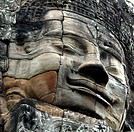
En lisant quelques blogs par-ci par-là, j'ai remarqué sur les photos de Angkor Vat de 2011 à 2012 un vilain échafaudage sur le côté droit du temple.
Est il toujours en place ?
Les photos me rappellent Pékin en 2007 avant les JO avec la porte de Tian An Men toute recouverte d'échafaudage et protection verte, si j'avais été touriste qui se payait le voyage de sa vie à Pékin pour voir la cité interdite j'aurai été très triste...
😛Echafaudage oui encore là avec une bache verte.
Demande à que l'on te l'enlève pendant ta venue
🤪Petite remarque, heureusement que certaines nation investissent dans la restauration des differents lieux de Angkor (France, Allemagne, Chine etc...)😏
Les photos me rappellent Pékin en 2007 avant les JO avec la porte de Tian An Men toute recouverte d'échafaudage et protection verte, si j'avais été touriste qui se payait le voyage de sa vie à Pékin pour voir la cité interdite j'aurai été très triste...
Si c'est le "voyage de sa vie", il vaut mieux s'informer avant, surtout pour une telle visite ; on peut toujours envisager de reporter son voyage !
Pas comme pour la Sagrada Familia ! Même en photo, elle est toujours toujours sous échafaudages ou entourée de grues... Inachevée ! 🤪
Hello,
Angkor vat est assez fourni en échafaudage depuis quelques années. Bon c'est sur qu'avec le levé du soleil cela ne fait pas top mais bon, on dira que c'est pour la bonne cause.... Passes voir mes photos sur mon blog, j'ai tout retiré avec paint (oui il est gentil photo shop mais pas des plus simple!!).
c'est marrant les travaux, tu prend une photo et quand tu y retournera tu verra l’avancement les machines acheté, les différentes nationalité sur les chantiers et puis dans 20 ans ta photos seras ancré dans un moment et bien plus personnel (ce n'est pas non plus une forêt d’échafaudages avec 300 personne qui bosse dans un boucan d'enfer) niveau pollution visuel ce qu'est devenus siem reap(en partis) fais bien plus fort.
je ne me rappel pas avoir vu d'échaffaudage en 2004 ou 2005, en tout cas pas sur Angkor Vat, pas de ballon nippon sur Bayon... j'ai vu des sortes d'échaffaudages sur d'autres temples plus petits, mais je sais pas si c'était pour restauration ou tout simplement pour faire tenir le tout🤪😄😏😏!!!
En tout cas échaffaudage ou pas, c'est pas le principal la bas, c'est surtout les sensations et l'ampleur des temples qui reste meme si forcement si , sur les photos, il y a quelques "polution visuelles"!!!
A+
PS : c'est magic encore donc comme pour les tour de passe passe notre attention est ailleurs😇
J'y étais il y a quinze jours. J'ai passé six jours à Siem Reap.
Oui, il y avait un bout d'échafaudage sur Angkor Vat mais vu la taille, tu n'as pas l'impression de ne rien voir !
Qui plus est, Angkor Vat n'est qu'une petite partie des temples d'Angkor, il y a largement de quoi se régaler !
Merci pour ces nouvelles fraiches. C'est vrai que sur les photos d'Angkor que je vois je trouve que certains temple sont tout aussi magnifiques et photogéniques.
Et puis la technique de Damifree a l'air pas mal (avec Paint) en allant voir ses photos j'ai pas vu les détails de la retouche...
Nous revenons du Cambodge pour la 3ème fois, mais cette année nous ne sommes pas allés à Siem Reap.
Mais en 2010 et 2011 oui, et Angkor Watt étaient avec d'autres temples en restauration et en général les tranches de travaux durent plusieurs années.
Mais il est impératif pour le pays que cela soit restauré, Angkor est le site le plus visité au Cambodge et donc une ressource économique importante pour le pays.
Cependant cela n'enlève rien au charme du site d'Angkor, il faut juste être astucieux pour prendre les photos et éviter les "belles" toiles vertes qui sont tendues le long des monuments.
Angkor est un site à visiter à différentes heures de la journée, les atmosphères, le rendu des temples seront totalement différents en fonction des heures.
Il ne faut surtout pas que les échafaudages te freine pour y aller, aller au Cambodge et ne pas voir Angkor serait vraiment dommage
Si tu as besoin d'autres renseignements et si je peux t'aider, n'hésites pas !!!! 😉
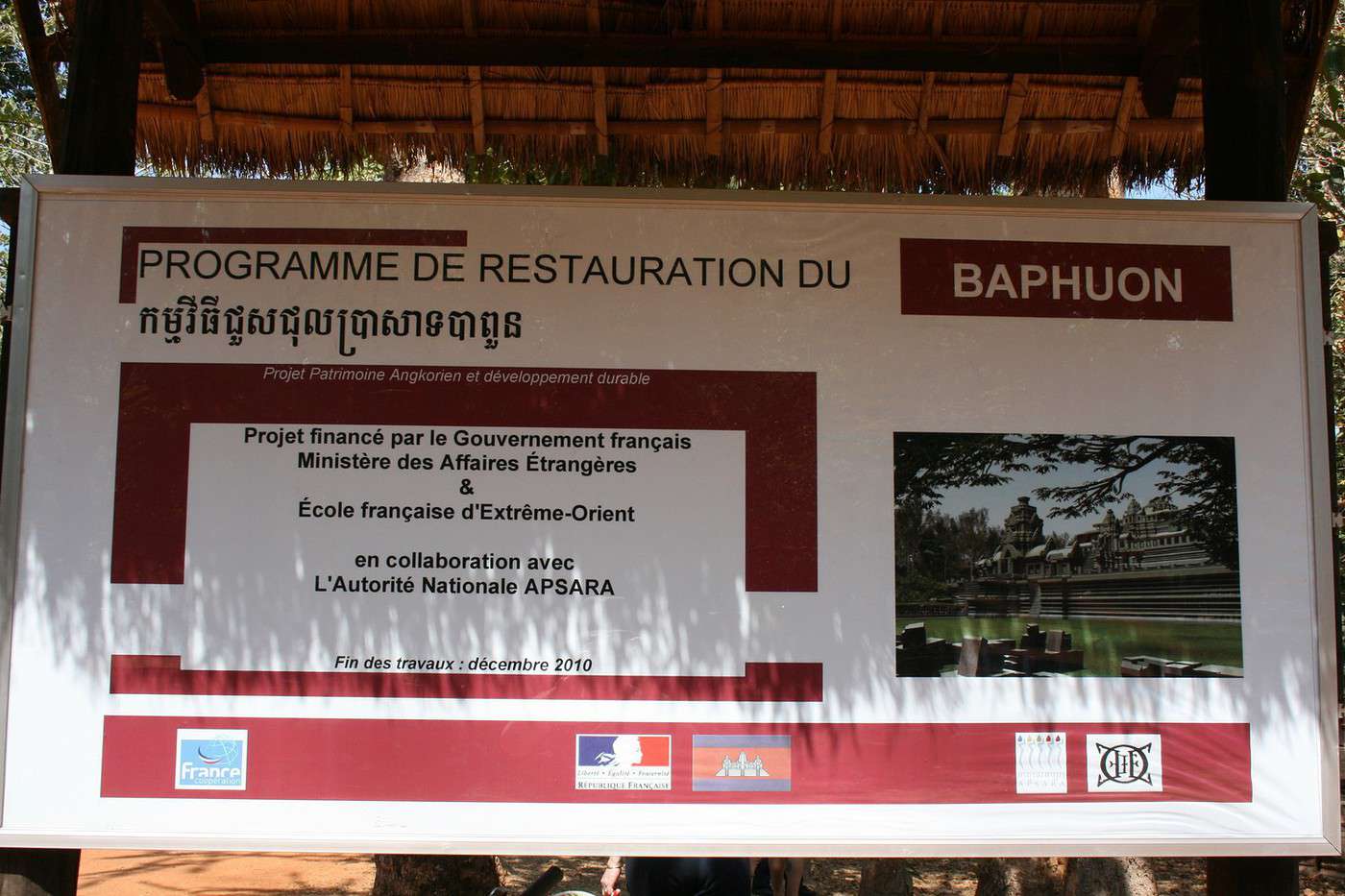
Il y a peu de temps, les Français étaient fiers de voir leur drapeau flotter sur le BAPHUON au milieu des grues et des échafaudages.
Si tu ne connais pas l'histoire de Angkor de sa découverte à nos jours, je te recommande de lire les nombreux ouvrages de ce sujet. Tu comprendras, ensuite, pourquoi il reste quelques échafaudages.
Shanghai ne s'est pas fait en un jour, ni Paris....
Ma question concernait surtout la taille de l'échafaudage et le fait qu'il pourrait être très gênant ou non. Visiblement ils ont fait les choses bien...
Tu sais j'ai lu énormément et depuis plusieurs années beaucoup de choses sur Angkor, Macchu Picchu et les cités Mayas : Je suis en train de lire l'ouvrage de Zhou Daguan, c'est passionnant !
Ma reflexion sur les 700 ans était bien entendu ironique et j'ai été fier de mon pays lorsqu'ils ont terminé la restauration du Baphuon que notre premier ministre ait fait le déplacement pour cela ça change des déplacements pour parler de la crise. Le travail de l'EFEO est impressionnant. De voir des équipes même chinoises aider le Cambodge à restaurer ce patrimoine national et de l'humanité est un bel exemple de coopération qui fait plaisir.
Je rentre du Cambodge et c'est vrai il y a des échafaudages sur une petite partie d'Angkor Wat que l'on voit bien quand on arrive de façe mais tu peux trouver des angles pour prendre des photos sans les voir...c'est juste dommage d'avoir choisi cette couleur verte pour la bâche !! Sur la Bayon il n'y a plus rien par contre
Oui, bâche visible de loin sur Angkor Wat + des travaux de réfection avec exposition de panneaux explicatifs côté intérieur pour des travaux de réfection en cours par une équipe allemande sur une série d'Apsaras. Mais il n'y a pas qu'Angkor Wat.
Travaux de réfection actuellement menés sous l'autorité d'une équipe japonaise sur un côté extérieur du Bayon (ancien bassin), à gauche de l'entrée principale. Cordelettes de couleur déployées pour constitution du maillage destiné à aider les archéologues dans le report des données de terrain. Hauteur du maillage : à peu près 0,5 m de hauteur.
Travaux (avec quelques éléments de renfort métalliques) au sommet du Baphuon mais présents que sur un côté et sans grande gêne pour le photographe.
Barres de soutènement (étais) dans l'embrasure de 2 ou 3 fenêtres au Ta Prohm, heureusement dans l'ombre + grosse corde et bornes tout du long sur le devant pour marquer la limite à ne pas franchir (gênante cette corde pour la photo) car il y a comme toujours, une fraction de visiteurs indélicats qui ne respectent rien.
Si vous avez le temps allez faire un tour au Bantaey Srei (environ 30 km au nord de Siem Reap). C'est loin, mais ça vaut le coup. Certes, partie centrale (tours) entièrement ceinturée par des bornes et une corde pour maintenir le visiteur à distance, mais gêne potentielle modérée car placée assez bas.
Sinon, pour Mébon oriental, Angkor Thom et Pre Rup, pas souvenir de grands travaux ou de gêne particulière pour le photographe. Je n'ai pas eu le temps de visiter les autres sites.
En fait, pour vos cadrages, vous risquez d'être plus gêné par le flot de touristes (dont on fait tous partie un jour ou l'autre, je n'en disconviens pas !), ou pire par la lumière qui est violente même tôt le matin. A cet égard, si vous parvenez à être matinal, voire très matinal, vous serez récompensé pour vos images ; les sites autour de Siem Reap sont ouverts à la visite à partir de 5h30. Et pour croiser moins de groupes de touristes, restez sur site à l'heure du déjeuner, et allez déjeuner après.
Si pas de solution à la prise de vue, alors il vous restera comme il a été dit précédemment, un travail de retouche sur ordinateur.
Alors bonnes visites, bonnes photos...et bonnes retouches !
Alors là ! Merci pour ce super message détaillé et les conseils.
Je suis en train de me composer un document sur les temples et je vais essayer d'en voir un certain nombre dont le Banteay Srei qui a l'air très beau. J'ai un planning large de 11 jours complets de vacances au Cambodge à dispatcher...
C'est bien entendu nécessaire de restaurer ce n'était pas le propos de mon message et ta réponse est exactement ce que je demandais, encore une fois un grand merci !!!
PS : si tu as un blog ou un site avec tes photos je serai ravi d'y faire un tour. ;)
Après recoupement de mes souvenirs et de mes archives papier, je me permettrais de citer aussi le site de Sambor Prei Kuk non loin de Kompong Thom, si vous disposez d'assez de temps car 11 jours c'est à la fois une durée confortable et courte. Bus direct de Siem Reap vers Kompong Thom pour 20000 Riel. C'est ce que j'avais fait avant de rentrer sur PP. Le site de Sambor Prei Kuk se trouve en forêt et les vestiges ou édifices encore préservés sont principalement en pierre et en brique rouge.
Temps de parcours depuis le centre de K. Thom : 1 h à 1,5 h en motodop selon qu'on s'arrête souvent ou pas en chemin pour faire des photos. Il existe plusieurs itinéraires possibles pour s'y rendre mais le plus souvent, celui emprunté par les motodop se traduit par 11 km de RN6 et ensuite virage à droite toute pour traverser une campagne très pittoresque sur environ 18 km. Si vous aimez les édifices anciens (là il s'agit de la période VII à X ième siècle), vous pouvez vous y arrêter. La différence d'avec la cité d'Angkor, c'est le fait de l'éparpillement des temples sur un large territoire en pleine forêt, et le fait que certains soient étouffés par des fromagers et des ficus un peu comme l'est le Ta Prohm. Peu de touristes et beaucoup de moustiques en saison des pluies. Préférer y aller vêtu d'un pantalon plutôt que d'un bermuda, surtout si vous tenez à vos mollets. J'y suis allé deux fois et la première fois - en bermuda - j'ai dégusté. La seconde fois, je n'ai été attaqué qu'aux avant bras et aux coudes, ce qui fut déjà une belle consolation.
Questions travaux, seul le Prasat Sambor qui fait partie des 3 sites regroupés les plus proches de la route, est l'objet de travaux, avec présence d'échafaudages et d'une clôture métallique périphérique interdisant l'accès à cause des risques de chute de pierres. Mais discrètement, et qd on est seul, on passe. Si on est un groupe de 40 visiteurs, c'est moins évident.
Cet endroit m'a un peu surpris par la diversité de la faune et de la flore. Peut-être que la saison des pluies aide à cette profusion ; on y croise beaucoup de papillons, d'araignées, de criquets, de batraciens dans les flaques d'eau, de scolopendres, de fourmis en colonne, d'oiseaux, de serpents et de chauve-souris. Certaines chauve-souris ont d'ailleurs investi les tours en brique qui sont ajourées au sommet. Elles entrent et sortent par le haut.
Si vous longez la rivière le long de sa berge qui est très évasée, vous y verrez des espèces végétales typiques de zones humides à tourbe, du genre Drosera. Il s'agit de plantes carnivores. Bien sûr, on y trouve aussi beaucoup d'arbres à noix de cajou et de palmiers à sucre.
Autre idée dans le même secteur pour la thématique "temples et architecture" , le Sambor Prei Kuk Temple en forme de navire et très impressionnant de beauté et d'élégance. Pour s'y rendre en mobylette, il faut traverser la ville de K. Thom vers le nord en longeant les 2 ponts (ancien et nouveau), et après les ponts, prendre à droite toute pendant environ une demi heure. On arrive à un débarcadère et on traverse la rivière Stung Sen avec un bateau-barge à moteur (durée : 2 mn). Le temple se trouve de l'autre côté. A mon grand étonnement, ce temple majestueux n'est pas cité dans le Lonely Planet et ne figure pas non plus sur la carte Reise du Cambodge, à moins que je doive changer de lunettes. C'est le conducteur de mobylette qui m'a proposé d'y faire un tour. C'est par un de ses amis que j'ai pu louer aussi un VTT à la journée pour d'autres ballades. Si vous décidez de consacrer qq temps à la région de K. Thom, je vous donnerai volontiers des renseignements pratiques.
Encore une fois, 11 jours cela passe vraiment très vite. Le temps de se remettre du voyage, de s'acclimater, de régler une ou deux tourista, ...et il est déjà temps de repartir ! A Siem Reap, j'ai perdu du temps dans la visite des temples à cause des intempéries et il a fallu attendre le retour du beau temps avant de placer le dernier jour de visite auquel mon billet d'entrée me donnait droit.
En tout cas, je ne doute pas que vos choix seront les bons choix.
Bonnes visites.
Hi everyone,
I’ll be in western Malaysia for 20 days in January and February.
I’m coming from southern Thailand to Ipoh for the Thaipusam festivities.
Then it’s off to Pangkor Island.
I’ll finish up in Malacca for the Chinese New Year celebrations before heading to Singapore.
I’ve got a 6-day gap.
I was thinking of going to K.Lipis for the jungle train and heading to Dabong, but the caves might not be open.
Any suggestions around K.L.?
Day treks?
A stopover between K.L. and Malacca?
Thanks
Hello everyone! I’m heading off solo in February and wanted to share my rough itinerary with you. Does this sound doable?
PS: I’m not really into beaches.
D1 Departure on February 17, 2027
D2 Arrival in Kuala Lumpur – stroll through Chinatown and visit the Petronas Towers
D3: Kuala Lumpur – Chow Kit Market, Batu Caves, Little India, Bukit Bintang downtown area
D4: Early morning bus to Malacca. Explore Malacca in the afternoon and evening
D5: Another 2–3 hours in Malacca in the morning, then bus back to Kuala Lumpur. Merdeka Square area. Stay in Chinatown
D6: Bus trip to Kuala Tahan. Night tour
D7: Morning – canopy walk and Bukit Terisek hike. Afternoon – off to Lata Berkoh
D8 & D9: 2-day jungle trek in Taman Negara National Park
D10: Head to Cameron Highlands
D11: Morning hike through the plantations. Afternoon still to be decided
D12: Morning – excursion to Mossy Forest and Sungei Plantation. Afternoon bus to Ipoh
D13: Morning – Mirror Lake / Sam Poh Temple area. Afternoon – explore downtown Ipoh
D14: Morning train to Penang. Afternoon – wander around Georgetown
D15: Morning – Penang Hill and Keh Loh Temple. Afternoon – Georgetown
D16: Bus to Butterfly Garden and Spice Garden. Late afternoon – Burmese and Thai temples
D17: Morning flight to Singapore. Afternoon – Chinatown and Marina Bay tour
D18: Morning – Gardens by the Bay area. Afternoon – Boat Quay, Clarke Quay, Kampong Glam
D19: Morning – The Ridges area and Botanical Garden. Afternoon – Little India, then back to Chinatown before 11:15 PM return flight
D20: Morning arrival
Hi, I’ve read that these two volcanoes are super popular and that there are *tons* of people for sunrise, especially in July. I’m looking for firsthand accounts from anyone who’s done it later, around 9–10 a.m.
Thanks for your help!
Laëtitia
I’m heading to Cambodia at the end of December 2026 – January 2027 for 3-4 weeks. Since I’ve already visited Cambodia twice, my itinerary is a bit different this time—I’d love to explore Botum Sakor Park, Chi Pat, the Tatai region, and the Cardamom Mountains. I’m traveling solo. If you have any tips on transportation, excursions, treks, sights, or accommodations in the area, I’d really appreciate it. Thanks for your feedback!
Has anyone traveled with the Laos travel agency ADV ?
I’m planning a trip to Laos and have received several quotes. Among them, this agency’s seem very reasonable, and so far, the interactions have been positive.
I’ve found a few positive reviews online, but I’d love to hear from travelers who’ve actually booked with them: how’s the organization, guide quality, accommodations, on-the-ground responsiveness, etc.
Thanks for sharing your experiences!
First stop on our discovery of the peninsula: Amphawa. It’s our first night in Thailand (we arrived at Suvarnabhumi at 8:50 AM).
Our initial plan was to explore the area before heading further south. The Mae Klong Railway Market is tempting... but what else is there to do????
We’ll be there on a Wednesday, and from what I’ve read on the forum, some say there’s absolutely nothing to do during the week—no floating market, barely any shops open, no restaurants, etc.
Others, though, say the place is actually more charming without the weekend crowds.
Could you share your thoughts? Missing the floating market is one thing, but if it’s really a ghost town on Wednesdays, I might just drop our bags somewhere else.
Amphawa seemed like a good first stop, just 1.5 hours from the airport, but I’d still like to settle somewhere a bit lively for our first evening.
We’ll be there at the end of October.
Thanks!
Hi,
I wanted to visit the plantations in the morning with GetYourGuide or by just showing up.
How much time should I really plan for?
I’d like to catch either the 3 PM or 5 PM bus back to KL.
Thanks
Hi,
I wanted to get some info about the cable car and the bridge—I see lots of different options...
How much time should we allow for these two activities? If we arrive around 4 PM, will we have enough time to visit without rushing?
Thanks
Hi there,
I didn’t plan to return to Thailand this year, but my health conditions mean it’ll be the best place for me to stay between two trips to India. The tourism setup there is so well-organized that it’s the most "comfortable" country for a short visit. Thailand feels too sanitized for my taste, and there’s too much religion, Buddha, and the King, but it’s still the best option given how my health has been evolving. I’d considered two weeks in ThaTon for hiking, but I got too sick from the burn-offs during my trips to the mountains around Chiang Rai. So I’m not sure where to go this year. Definitely not the sea, touristy spots, or the mountains with burn-offs...
Hi,
On September 1st, we're heading to Kalimantan for six weeks, probably from Pontianak to the Derawan Islands.
I've scoured this site, which is usually my go-to 😉, and others like VoyageForum, but recent info is pretty scarce.
I'd love any tips on places you've visited—our itinerary is still a work in progress.
We're two couples traveling with backpacks, using buses, boats, guesthouses, and homestays.
Thanks in advance!
Hi fellow travelers,
First trip to Vietnam.
We’ll be arriving in Ho Chi Minh City during Tet.
Is it complicated to find accommodation and get around during this period?
Any tips would be welcome.
Thanks for your replies.
Hi! I’d like to split my trip into two parts: 15 days in Phuket and 15 days in Krabi. Do you know if I can rent a car and drop it off in Krabi when I fly back to France?
Thanks for your feedback!
Have a great Sunday!
Martine
Hello,
After 1 night in Khao Sok, I’d like to find a 2 Days 1 Night package on the lake.
After reading a lot, I decided to "break the bank" and treat ourselves to a private tour—mainly to avoid the crowds.
But after contacting several operators, they offer "private tours" that are very expensive (around 700 €), yet in the details, the boats can only leave from the pier at 10 AM like everyone else. (I was hoping to leave much earlier.) The morning program is the same for everyone too (private or not). They drop us off at noon at our floating hotel (I’d chosen Phupha Waree). Free afternoon (swimming or kayaking in front of the hotel). We head back by boat for a 1-hour sunset ride. And the next morning, we leave the hotel at 8 AM to be at the pier by 9:30 AM at the latest—end of the trip.
So basically, we’re paying a lot for a private tour just to do the same thing as everyone else at the same time.
Or maybe I just had bad luck in my search.
I contacted Panida Ladi, who’s very popular on forums. We’d agreed on a private tour that matched my request (departure from the pier at 8 AM, very personalized itinerary). We settled on the itinerary and price, she asked for a Wise transfer for a 30% deposit, confirmed receipt of the deposit. Then 30 minutes later, she messaged me to say she was canceling everything because it was impossible to do the requested tour—and promised a quick refund of my deposit.
So here’s my question: Who’s done a *real* private tour on this lake? Who can recommend a reliable agency? Is it even really possible to do a private tour here?
I’m searching for a real gem for my 3rd stay in Koh Lanta: a lovely, high-quality hotel right by an easily accessible beach in a lively spot.
If you know of anything that fits what I’m looking for and want to share, don’t hesitate!
Hi, is anyone there in Flores right now? According to some websites, everything is closed and the situation is tough. But our guide says it's fine. Who should we believe? We're supposed to leave on September 2nd. Thanks to anyone in Flores at the moment!
Hi dear community,
I'm planning to visit Cambodia this winter, right after Christmas, for my first solo trip and my first trip to Asia. For two weeks (yes, I know it's short, but I really can't do more...). I have two main desires: Siem Reap and the countryside, the villages, the Mekong...
What do you think of this itinerary? Arrival in Siem Reap, departure from Phnom Penh.
SR: 5 days (1 day for arrival, 3 for the temples, 1 for the lake and its villages)
Kratie (stop on the way to Mondolkiri): 3 days (1 day of travel, 2 days there)
Mondolkiri/Sen Monorom: 4 days (1 day of travel, 1 day there, 2 days of treks)
PP: 3 days (1 day of travel, 2 days of sightseeing)
I think I need to cut one day somewhere if I travel from Saturday to Saturday or Sunday to Sunday. In Kratie, maybe? Or in PP? And I'll miss the boat trip that everyone recommends (SR-Battambang), but I don't see where to fit it in. Unless I do a PP-PP loop starting in the east, skip Kratie or just stay one night, then SR, then PP.
In my timing, Mondolkiri seems closer than Ratanakiri, which also tempted me a lot! Will it be too complicated alone? I'm thinking of using local guides or a small local agency for a nature and village getaway.
I've read that Siem Reap is very crowded between Christmas and New Year's. I could also do the circuit in the opposite direction. But I thought it would be easier to get familiar with the country by arriving in a touristy area—I might be wrong...
Thanks for your advice and opinions!
Hi everyone.
I’m planning my trip, and based on all the posts I’ve read, this country is amazing.
Of course, I’ve got a ton of questions for you.
Here’s a possible itinerary: Vientiane - Vang Vieng - Phonsavan - Sam Neua - Nong Khiaw + villages - Phongsali - Luang Namtha and the area - Udomxai - Huay Xai - Luang Prabang and back to Vientiane.
What do you think?
We’re planning to prioritize local transport—is it possible to do this loop?
We’d also love to go kayaking, but I’m not sure if the season’s right or where the best spot is.
For trekking—I read that Phongsali is the most authentic spot to visit villages and see wildlife. Do you know of a reliable agency and a guesthouse with reasonable prices?
Is it worth taking a slow boat for a stretch on the Mekong, and if so, which route?
For accommodations, is it better to book through Booking.com and Agoda or look when we arrive?
Are mosquitoes bad in Laos, and should we take malaria prophylaxis?
What’s the average daily budget (accommodation, food, visits)?
Is renting scooters a good option for exploring towns, and if so, which ones?
From what I’ve read, it’s best to carry cash—euros or dollars? Is it risky to walk around with that much cash?
I’ve still got tons of questions. Thanks to anyone who can help, and I’m open to all tips, info, etc.
Thanks again
Hi there,
I’m planning a family trip (my wife and I, both 47, and our two sons, aged 5 and 12) to Malaysia for the last week of June and the first two weeks of July 2027.
We used to love road trips as a couple, then as a trio, but since our second child arrived, we’ve taken a break with "camping village" style trips.
Now feels like the right time to get back to our old habits, while adjusting the pace for the kids.
We’re craving Asia. We’ve been lucky enough to visit Thailand, Indonesia (Bali and Lombok), and Sri Lanka before.
Friends have raved about Malaysia, so we’re definitely tempted.
For those who know and love Malaysia, what would be a good itinerary starting from Kuala Lumpur, with a maximum of 3-4 stops? We’d like a mix of culture, nature, and relaxation (just to clarify, we’re not big beach fans). All of this without rushing, of course.
Hello,
We’re a family of four with two teens aged 16 and 18. We’re heading to Thailand this summer. We’ll arrive in Bangkok and plan to take a flight to Luang Prabang.
I’ve seen there are some great visits and excursions to do (temples, markets, waterfalls) and maybe even venture a bit north to places like Nong Khiaw, Muang Xay, Muang Ngoy, or Oudom Xay.
But I’ve also heard about the Bokeo region with the Gibbon Experience.
Since we won’t be able to do everything, I’d love to hear about your experiences, impressions, and advice on the two options I’m considering, especially since we’ll be meeting family in Chiang Mai, Thailand, afterward.
Option 1: A loop from Luang Prabang heading slightly north, then a flight from Luang Prabang to Chiang Mai.
Option 2: A few days in Luang Prabang, exploring within a few dozen kilometers around, then heading to Bokeo province for the 2-day/1-night Gibbon Experience. For this option, I saw on Rome2Rio that it’s possible to book a ferry trip on the Mekong from Luang Prabang to Huay Xay—they mention about 8 hours. But is that realistic? What type of boat is it?
Then, to get to Chiang Mai, there aren’t many options—bus or minivan—but how does crossing the border work?
Finally, for those of you who’ve been to Laos in August, what was the weather like?
We’ve already visited Thailand, Vietnam, and Cambodia during the same period over the past four years and weren’t really bothered by bad weather.
I’m starting a discussion about guides in the Mekong Delta because we’ve just finished our trip in this region and had a hard time finding a French-speaking guide. We had Thanh—she speaks French really well and travels all over the delta region, including Ho Chi Minh City. She’s super friendly and flexible. I recommend her wholeheartedly. If it can help someone...
Feel free to contact us for her number.
Hi everyone,
I couldn’t find any recent info on Kuching.
Can anyone recommend a hotel or guesthouse for under 100 RM that’s nice and affordable? No dorms, please.
Also, does it rain a lot in November, and is it still worth visiting Semenggoh or Bako?
We’ll be arriving in Phnom Penh this coming January and we’re thinking of starting our trip with a stop in Kampong Cham, then Kratie.
After Kratie, we’re considering heading toward Siem Reap with a stop in Kampong Thom.
That said, I’m not really sure how long the Kratie–Kampong Thom journey might take or how complicated it is.
Does this stop on the way to Siem Reap seem like a good idea to you?
If we don’t visit the Sambor Prei Kuk site, are there still any walks or sights worth checking out in Kampong Thom?
Silly question—backpack or hard-shell suitcase for the Sepilok, Kinabatangan, Tioman, KL trip?
I’m struggling to fit all my son’s and my stuff into the 70L backpack... and I’m thinking a suitcase would be easier, but I’m not sure if it’ll work for getting around.
After a stay on Koh Phayam this coming November, I’d like to spend 2 or 3 days on Koh Phra Thong before heading further south.
Do you think it’s doable to leave Koh Phayam early enough to catch the 10 AM boat from Khura Buri to Koh Phra Thong? The next one isn’t until 4 PM, which would cost me a whole day.
I’m planning a trip to Indonesia, specifically Sulawesi and Java, in September for 10 days.
I don’t know this part of the world at all—any advice is welcome!
I’ll be traveling solo and would also love tips on meeting other travelers or locals.
Hello everyone,
Not long ago, I used to travel as a couple, but my husband has since passed away, and I’ve decided to set off again. The trip I took to Cambodia in January 2025 did me a world of good.
I’m now considering Thailand, a destination we never included in our plans because even 15 years ago, people said it was too touristy. Still, I’m thinking about the itinerary below, but I don’t feel up to arranging buses, trains, or guides on my own while I’m there. I’m looking for one or more drivers and have been in touch with an agency, but their offers are just copy-paste group tours that I don’t want.
So, if you have any contacts, experiences, or advice, I’d be so grateful if you’d share them with me. Here’s my rough plan:
Arrival in Bangkok
Ayutthaya (2 nights)
Kanchanaburi (2 or 3 nights)
Sangkhlaburi/Sai Yok (3 nights)
Sukhothai (2 nights)
Lampang (I’ve planned 3 nights, but that might be a bit much—it depends on what time I arrive in the city)
Chiang Mai
Chiang Dao
Pai
Chiang Rai
I was thinking about the Mae Hong Son loop—thoughts?
What do you think about staying overnight at the Golden Triangle?
When I look online, of course, I can find agencies that organize tours to national parks, etc.
I’m retired but in great physical shape. I’d rather go hiking than sit in hot springs with crowds of tourists who’ve all arranged meet-ups. I don’t want to spend a day at an elephant camp, and I don’t want to visit Karen villages.
I’d love to hear your advice.
Thank you all,
Hi everyone,
Could you share your thoughts on my 3-week itinerary?
We’re a small group (family + friends) of 12 people, planning to leave around January 21, 2027.
Here’s my itinerary:
3 nights in Bangkok
4 nights in Chiang Mai
3 nights on Koh Samui
3 nights on Koh Phangan
4 nights in Krabi
4 nights in Phuket
I’m also open to any great tips you might have...
Thanks, everyone! Alain.
Hi there,
We’re planning a 3-week family trip next summer with our three kids, who’ll be 8, 8, and 7 years old.
After some research, we’re leaning toward Malaysia to combine nature/forests and paradise beaches. The idea is to introduce our kids to the country’s culture, nature, and wildlife.
We want a great trip but without splurging on luxury options like high-end lodges and resorts. We’re looking for comfort with a touch of authenticity—basically, a good middle ground.
I’ve started putting together an itinerary and would love your expert advice and tips to help us build this amazing trip with our little ones.
Day 1: Departure from France
Day 2: Kuala Lumpur
Stay at a hotel near the airport or KL Sentral.
Just one night.
Day 3: Morning flight to Sandakan (Borneo).
Stay in Sepilok
Day 4: Sepilok:
* Orangutan Center
* Malayan Sun Bear Center
* Rainforest Discovery Centre
Day 5: Depart for Kinabatangan.
Boat safari in the late afternoon.
Day 6: Sunrise safari.
Jungle walk.
Evening safari.
Day 7: Final safari.
Return to Sandakan.
Flight to Kuala Lumpur, then to Kota Bharu (or overnight transit depending on schedules).
Day 8: Transfer to the port.
Boat to the Perhentian Islands.
Days 9 to 13: Perhentian Besar
5 full days.
* Snorkeling
* Hiking
* Turtle watching
* Wild beaches
* Relaxation
Day 14: Return to the mainland.
Bus or private car to Taman Negara.