Chers tous, vous n’êtes pas sans ignorer (je l’ai fait exprès, encore que…) que j’ai commis un site sur le safari photo, avec l’aide, ô combien précieuse, de ma blonde pour le traitement des photos et l’identification des piafous - un travail d’équipe, je m’occupe des chardonnerets et autruches (je vous donne le truc, l’un vole l’autre pas, hop, un petit coup d’œil à la fiche pour savoir lequel fait quoi, et c’est réglé), elle des 1142 espèces restantes à l’heure actuelle.
Paresseux de nature, je ne m’occupe pas autant du site qu’il le faudrait, aussi une idée astucieuse autant que merveilleuse, et vice-versa, m’a illuminé. Pourquoi ne pas faire faire le travail par les copains ? Certes, en actant leur participation et en les récompensant de ma gracieuse considération, mais sans BL-effort, une idée que je devais creuser.
Il m’a semblé que rassembler les mots du safari, ceux plus ou moins spécifiques et plus ou moins compréhensibles pour le profane, pourrait être assez utile. D’où la création d’une sorte de dictionnaire (en essayant de s’écarter des idées reçues - un dico déjà fait, s’pas ?)/index où j’ai essayé de définir chaque entrée dans l’acception la plus safarienne possible.
Alors, voilà.
Ma blonde et moi connaissons assez bien Maroc et Tunisie, un peu l’Afrique de l’Est, une vingtaine de safaris en tout dans ces deux Mecque du safari photo animalier, mais assez mal le Sénégal (deux séjours avec une copine expat ‘) et encore plus mal Botswana et Zimbabwe (un seul, merveilleux, safari) et pas du tout tout le reste (un seul stop, trop court en Afrique du Sud, sans photos valables). D’où mon désir de vous voir chiader à ma place, en enrichissant cet index safari d’entrées nouvelles, en affinant-corrigeant mes définitions e tutti quanti.
En espérant vous intéresser un chouïa (et surtout vous faire chiader), je vous adresse, comme de BL-coutume, mes
4x4 : le véhicule de choix du safari, ne serait-ce que pour le folklore quand les conditions sont bonnes, saison sèche, bonne pistes, mais aussi pour sa résistance aux ornières, cailloux et pierres de certaines pistes et ses qualités de franchissement des flaques et mares des pistes boueuses ou inondées.
Existe en complètement ouvert, sans portes ni fenêtres, dans le Sud tanzanien (et en Afrique australe) ou en fermé avec toit ouvrant en une partie relevable (on reste à l’ombre mais on voit moins le ciel, les oiseaux en vol ou haut perchés, le léo ou les singes au sommet des grands arbres e tutti quanti) ou en deux parties rabattables (le soleil tape mais on voit mieux le ciel, les oiseaux en vol ou etc.). Les 4x4 peuvent être à châssis court ou long, le 4x4 à châssis court est moins spacieux mais avec de meilleures qualités de franchissement.
Agence de safari : agence de voyage, en général de voyage africain connoté observation de la nature.
Agence locale : agence (de voyage).
Banda : bungalow, cabane, habitation individuelle en dur.
Big five : les cinq grands, terme obsolète employé par les chasseurs à une époque (presque) révolue où le but était de tuer dans le même safari buffle, éléphant, rhinocéros, lion et léopard, un concentré de connerie humaine satisfaite. Pour le big five de chasse photo, le guépard a largement supplanté le buffle, animal difficile à tuer mais facile à photographier.
Boma : terme sud africain, employé pour le feu de camp vespéral autour duquel les hôtes se réunissent (vespéralement, œuf corse).
Bush : littéralement buisson, désigne une savane arbustive.
Brûlis : incendie volontaire des étendues herbeuses effectué, en principe - trop rarement respecté -, en début de saison sèche. Cette pratique, l'écobuage, est censée enrichir les sols en minéraux, limiter les insectes nuisibles, comme les tsé-tsé. En fait, les vents, les pluies, qui arrivent rapidement quand le brûlis est fait trop tard dans la saison sèche, délavent les sols et emportent les précieux minéraux loin de la savane. En revanche, les insectes, les petits rongeurs, tous ceux qui s'en nourrissent, servals, chacals, otocyons, oiseaux en pâtissent. L'écobuage répété tous les ans est aussi néfaste pour les arbres, mais comme il favorise les herbages, donc les grands herbivores, donc les si appréciés et si photogéniques grands chats, cet inconvénient est plutôt vu comme un avantage par les rangers et responsables des parcs. Et puis, jouer avec les allumettes, à tout âge, c'est tellement amusant !
Camp de brousse : camp de brousse.
Camp de toile (camp de tentes) : tented lodge pour les plus importants.
Camp mobile : camp non fixe, démonté à certaines périodes de l’année, voire tous les jours ou quelques jours pour les "fly camps".
Camp privé : camp où l’on ne peut monter sa tente.
Campsite et Special Campsite : terrains de camping dans les parcs nationaux, le Special Campsite est ainsi appelé, je crois, parce qu’il est spécialement cher pour les prestations offertes…
Chauffeur : personne conduisant le 4x4 ou minibus ou bus qui nous transporte en safari.
Crossing (franchissement) : passage de rivière pendant la migration par les gnous, zèbres, élands, gazelles.
Fees : les droits d'entrée et de séjour dans les parcs et réserves sont un élément important, et souvent ignoré, dans le budget d'un safari. Ces droits sont comptés pour chaque non-résident, élevés, pour le véhicule, élevé, pour les chauffeurs, guides, cuisiniers, réduits. En Tanzanie, ils se comptent par tranche de 24 heures, toute tranche entamée est due, d'où des acrobaties dans la conception du parcours et parfois des trajets précipités pour rester dans les clous.
Franchissement de rivière : crossing.
Game drive : déplacement en voiture à faible allure pour repérer et observer la faune (game = gibier).
Grande migration : voir ma page MIGRATION sur ce site, et l’on saura tout, tout, tout (bon, OK, c’est très exagéré) sur ce phénomène cyclique sur un an.
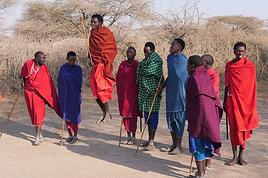
Guerrier massai : morane, massai mâle sorti de l’adolescence et pas encore marié, armé d’une belle lance ! Souvent réduit à la fonction d’askari (gardien) nocturne, parfois chauffeur ou spotter…
Guide de safari : guide de voyage .
Guide de montagne : accompagnateur de plongée sous-marine (je crois, mais il faut que je vérifie).
Guide privé : guide de safari affecté à l’accompagnement exclusif du ou des donneurs d’ordre.
Guide-chauffeur (chauffeur-guide) : chauffeur assurant aussi les fonctions de guide.
Hébergements de safari (types) : belle étoile, fly camp, camp de tentes, banda, hutte, bungalow, lodge, hôtel.
Hicking : trek pas pour moi, car bien trop sportif et je n'aime pas quand ça monte.
Hors-piste : faire du hors-piste, c'est sortir de la piste balisée et rouler dans la nature. Cela abime la végétation, tasse la terre, dérange la faune. Et c’est interdit dans les parcs nationaux, sauf autorisation spéciale, accordée par exemple, à Masai Mara, aux photographes professionnels comme Michel Denis-Huot, aux équipes de la BBC ou aux ONG de protection de la faune comme Cheetah for ever.
Hôtels (catégories pour safaris) : de basique (et cher) à luxe (et encore plus cher).
Jambo! : salutation « swahili » employée par les wamuzungu, les blancs, quand ils veulent saluer comme les locaux, qui n'emploient même pas la forme correcte, Hujambo, mais comme nous, se demandent simplement si ça va, Habari? (Mzuri sana! très bien !).
Kill (scène de chasse) : mise à mort, ou résultat de la mise à mort, repas de fauves. Ce terme est employé pour l’activité de prédation des fauves, hyènes et canidés mangeurs de viande, mais on ne parle pas de kill pour un otocyon qui attrape un termite.
Kopje : petite tête en afrikaaner, c'est le nom des petites collines rocheuses qui émergent du plat Serengeti et qui sont toujours à explorer, riches qu'elles sont en damans, oiseaux de proie, et souvent en lions...
Lodge (catégories) : de basique (et cher) à luxe (et encore plus cher). Un lodge offre plus de capacité qu'un camp et est généralement construit en dur, alors que les camps font appel aux tentes, plus ou moins "sédentarisées".
Minibus : véhicule peu photogénique mais pratique pour la photo, pratique aussi pour les grandes familles. Mais même s’il est - rarement - 4x4, un minibus est moins agile et débrouillard qu'un 4x4 Land ou Toyota. Notamment, il ne supporte pas bien la saison des pluies. À certains endroits, comme le cratère du Ngorongoro, l'accès peut être réservé aux véhicules 4x4, donc interdit aux banals minibus.
Parc national : espace répondant aux critères définis par chaque état pour la préservation et éventuellement la mise en valeur de ressources naturelles, paysages, flore, faune. Le premier parc national a été celui du Yellowstone aux USA. Les parcs nationaux tanzaniens édictent des règles précises et drastiques : pas d’exploitation de la faune ou de la flore, donc pas de ramassage d’aiguilles de porc-épic, de carapaces ou de plumes de rollier, pas de présence humaine permanente autre que pour le tourisme (une exception, en principe temporaire, à Saadani), perception de droits d’entrée pour véhicules et personnes auxquels s'ajoutent des droits de séjour quotidien.
Philanthropie : si une proposition de safari est moins chère, il y a une ou des raisons, c'est selon, ce qui est sûr, c'est que la philanthropie en fait rarement partie.
Pisteur : personne compétente pour détecter la présence d’un animal et le suivre grâce aux traces et empreintes qu’il a laissées.
Politesse : je ne prétends apprendre la politesse à personne, mais les conceptions que l'on se fait de la politesse peuvent différer d'un continent à l'autre.
En Afrique, saluer, sourire et éviter de s'énerver sont des impératifs. Les personnes plus âgées que nous (c'est de plus en plus rare dans mon cas) ont droit à des marques de respect encore plus élevées : en kiswahili, on appellera Mzee les seniors Messieurs, Mama les dames, Bwana les mâles de nos âges ou -ils sont de plus en plus nombreux dans mon cas- plus jeunes. Des remerciements dans la langue locale sont appréciés, en Tanzanie-Kenya Asante sana.
Et il faut à tout prix éviter les colères, même justifiées (mon certificat fièvre jaune est valable ! Comment plus de chambre libre, j'ai mon voucher ! L'avion de Precision Air est parti 10 mn en avance sans nous attendre ! etc.). Discuter, palabrer, oui, s'exciter, non, c'est absolument contre-productif.
Populations : qu'elles soient constituées d'Herreros, Massais, Bushmen, Hadzabe, Himbas, etc.pouvons-nous, nous, riches -richissimes par rapport à eux- occidentaux, établir le contact avec les "authentiques" populations indigènes ? Est-ce une gageure, comme je le pense, si l’on n’est pas ethnologue ou simplement un jeu d’enfant quand le TO prévoit une journée de chasse avec les Hadzabe, une journée de traite avec les Massai, la visite d’un authentique village ? Sans parler la langue, sans partager repas, nuits, soucis et travaux, la communication ne peut être que superficielle, artificielle. On en apprendra plus en lisant les bons ouvrages qu’en quelques heures de contact tarifé.
La pression sur leur environnement, pression démographique, la limitation de leurs territoires de pâturage ou de chasse au profit de cultures ou d’exploitations minières, les contacts avec les blancs et les africains « plus évolués » contribuent à la perte de leur identité séculaire.
En les "déculturant" ou en les "aculturant", en les coupant de leurs racines, n'en fait-on pas trop souvent des employés de dernière catégorie, askaris ou porteurs, des chômeurs SDF ou des marionnettes pour touristes, et/ou dans le pire des cas, des alcooliques ou des drogués ? Mais si ces populations authentiques perdent de leur authenticité pur jus à chaque instant, doit-on le regretter ? Faut-il confiner hommes, femmes et enfants comme les sujets d’un zoo humain, leur empêcher de fait l’accès aux progrès médicaux, sociaux, techniques, en perpétuant le mythe du bon sauvage en accord total avec le nature ?
Quelle(s) solution(s) ? De bien plus intelligents et plus informés que moi s’y sont cassés les dents, mais cela reste pour chacun un bien intéressant sujet de réflexion...
Réceptif : agence locale de safari travaillant avec un TO non implanté directement dans le pays.
Réserves : zones de protection naturelles où l'implantation d'habitations et une certaine exploitation de la nature, comme la chasse, le ramassage de bois, parfois du pâturage, sont permises.
Safari : mot kiswahili pour voyage, le safari se met à toutes les sauces en fonction de ses modalités, de son standing, des moyens de déplacement, de sa durée, du moment, etc.
Safari peut désigner l’ensemble du voyage ou chacun des habituels game-drives, ce qui permet en rentrant d’une petite semaine de safari avec ses habituels deux game-drive/safaris par jour d’avoir fait en un seul séjour plus de 10 safaris…
Le safari se fait le plus souvent en voiture, à allure réduite, game-drive safari, mais aussi à pied, à allure encore plus réduite, walking safari, et de mille autres manières, à cheval, horseback safari, en vélo tout-terrain, mountain bike safari, en ULM, en montgolfière, balloon safari, en hélicoptère, helicopter safari, en ULM, en bateau à moteur, motor boat safari, comme en canoë moderne ou traditionnel, canoe safari ou mokoro canoe safari, à dos de chameau, camel safari et et même à dos d'éléphant...
Classiquement la journée de safari comporte deux safaris, un aux premières heures de la journée, dès le lever du soleil si possible, et un en fin de journée de 15-16H à la nuit, qui tombe tôt près de l’équateur. Mais on peut avoir un full-day safari commencé tôt le matin et terminé aussi tard que possible, avec pique-nique le midi.
Le safari peut être nocturne, night safari, uniquement hors des parcs ou dans les concessions privées, car dans les parcs nationaux, les safaris doivent être terminés avant le couche du soleil, 18H ou 18H30, ce qui nous a valu quelques rentrées tardives de nuit phares coupés pour ne pas être repérés, avec notamment une épique traversée au clair de lune de la Mwagusi Sand River, à sec certes mais avec des rochers et des creux peu sympathiques…
Safari à la carte : voyage à la carte
Safari de luxe : voyage de luxe
Safari lodge : lodge de voyage
Safari photo : voyage où la prise de photographies, généralement de la faune, joue un rôle important, sinon primordial. En ce cas, penser au sacro-saint "principe de précaution" : toujours avoir au moins deux boîtiers et deux optiques qui vont bien.
Safari privatif : organisé uniquement pour le ou les demandeurs, sans participants externes
Safari privé : voyage privé par opposition aux voyages de groupe, groupe plus ou moins fourni, des 4 à 6 occupants d’un 4x4 à la trentaine véhiculée en camion…
Savane : étendue herbeuse de graminées avec de rares arbres.
Spotter : traqueur de faune sauvage, soit embarqué (…) dans le 4x4, soit posté aux endroits stratégiques et communiquant alors par mobile (vive le progrès des communications qui permet à vingt-douze autres véhicules de partager notre léopard).
Swahili : le swahili, ou plus correctement kiswahili, est la langue par excellence du safari, si l’on considère que safari est le mot swahili pour voyage ! Mais même si, à partir de son foyer initial, les côtes du Kenya et de la Tanzanie, le swahili est en progression, notamment en Ouganda, Rwanda, Congo, Burundi, c'est essentiellement la langue véhiculaire de l’Afrique de l’Est. Et l'on peut donc faire d’excellents safaris dans bien d’autres pays où l’on ne parle pas swahili, mais tswana (Botswana), zoulou, sotho, xhosa, tswana ou autre (Afrique du Sud), shona (Zimbabwe), ouolof (Sénégal), etc.
TATO : organisation rassemblant des T.O. et agences de safari tanzaniens ayant rédigé et s'étant engagés à suivre une charte de services. Qui a dit que les promesses n'engageaient que ceux qui les écoutaient ? Bon, j'arrête le mauvais esprit, disons que, sauf exception, il vaut mieux contracter avec un membre de la Tato (de la Kato au Kenya), une condition que l'on dira nécessaire (aux quelques exceptions près) mais pas forcément suffisante...
Temps libre : temps perdu, comme dit ma blonde. Qu'il s'agisse d'une après-midi libre dans la brousse, d'une journée libre à Arusha (ville pas désagréable mais peu réputée pour ses attraits touristiques intrinsèques), voire dans certains cas d'une visite abusive de plantation, de marché ou de pseudo-village, toutes les astuces sont bonnes pour éviter de payer des fees (cf. supra). Et, subséquemment, nonobstant nos souhaits (OK, j'arrête le sabir à képi), réduire le temps passé en game-drive à la recherche et à l'observation de la faune.
Tented lodge : camp de tente.
TO : Tour Operator, intermédiaire se chargeant d’organiser un voyage de A à Z : réservation moyens de transport, hébergements, guides. Ne prend parfois pas en charge les transports internationaux.
Trek : déplacement pédestre long et qui fait mal aux pieds (et aux poumons) mais du bien au cœur (et à la tête).
Véhicule privatif : véhicule réservé au donneur d’ordre. Cher si retenu à l'avance, possiblement moins cher si pris sur place, éventuellement gratuit si l'on est gentil (ou très embêtant pour ceux qui safarisent dans le même 4x4)...
Voucher : attestation écrite remise par le TO confirmant la mise à disposition d'une chambre/tente/banda ou/et d'un repas ou d'un vol en avion-charter ou avion-taxi. Le voucher est, en principe, remis au prestataire qui le conserve pour se faire payer. Il peut arriver - l'Afrique est imprévisible, s'pas ? - que le voucher ne soit pas honoré, pour une raison x. D'où, quand c'est que notre tête qui ne revient pas, l'expression bien connue "avoir une tête à voucher dehors". Désolé.
Walking safari : safari à pied, la faune a tendance à avoir une distance de fuite plus grande, voire beaucoup plus grande qu’en game-drive, certes on voit moins mais différemment, c’est une expérience à mener au moins une fois, ne serait-ce que pour le folklore du ranger armé qui accompagne et donne à la promenade des allures de safari de chasse du siècle dernier.
Je me suis d'abord réjoui de cette initiative venant d'un auteur béni (blessed) mais j'ai vite déchanté: le titi omet dès le sixième article un mot incontournable du safari.
Bleslerie: (dérivé de brêle, n.f.) écriture au second degré (deux est son maximum, c'est un animal binaire). Syn. Dilettantisme. Contr. Pédanterie.
Par ailleurs il conviendrait de compléter l'article Banda en précisant qu'il ne peut-être érigé qu'en bois bandé sous peine de s'affaisser.
Avant de lire plus avant peut-on espérer une intervention de la blonslde, celle qui assure 99,82% du travail habituel? Si la tienne est faite, votre réputation est en jeu! 😉
Boma: c'est l'enclos dans lequel on regroupe les animaux, la nuit pour les protéger des animaux...désormais, bien souvent, ce sont des touristes que l'on regroupe autour du feu de bois.
Kraal: idem mais en pierre sèche
safari lodge...en AFS un safari lodge n'est pas obligatoirement un lodge avec des animaux...c'est l'apanage exclusif du game lodge.
Shangaan: ethnie sud-africaine réputée pour ses qualités de pisteur.
Plan: "we make a plan", expression typiquement sud-af..."on s'en occupe".
Je te réponds en français, car je ne pratique la langue de la perfide Albion qu'à la lecture (j'ai fait allemand-latin-grec, nobody's perfect! comme disait Osgood) ou qu'à l'oral quand je veux faire rire mon entourage.
Le but, c'est celui qu'ont saisi Jean-Luc et Michel, compléter avec bonne humeur ce catalogue de mots couramment employés par TO et accompagnateurs et parfois abscons pour le profane. Et m'éviter les erreurs, corriger les imprécisions (banda et boma) sans avoir à me fatiguer, un rêve !
Le tout est destiné à être mis sur notre site sous sa version corrigée. Toujours sans avoir à me fatiguer, I had a dream!
B comme Braaï
copieux barbecue d'une délicieuse viande locale dégustée autour du feu en compagnie d'un doux nectar rouge sud'af, d'une bière namibienne ou d'un cidre local.
(bon encore faut-il savoir faire un feu ... pour les autres il reste la boisson 😉)
Et voilà, on essaye de bosser sérieux, de faire avancer le schmilblic, et c'est pas facile de le faire sans le casser, et hop ! une suggestion farfelue, une ! Que je suis chiche de mettre sur saf-tanz, mais en te caftant, œuf corse ! Pas qu'on me prenne pour un farfelu, des fois !
Rondavel : Habitation typique sud africaine qui, comme son nom ne l'indique pas, est de forme circulaire...
Les logements proposés dans le parc du Kruger reprennent souvent et ce vocable et cette architecture.
Wild card : Précieux sésame de couleur verte permettant l'accès illimité aux nombreux parcs sud africains affiliés à ce programme durant une année.
Existe pour un solitaire, un duo de n'importe quelle nature ou une famille et est envoyée par voie postale contre le paiement d'une somme très modique si on la compare aux Fees exigés en Tanzanie, en Zambie et au Kenya.
Dam: Retenue d'eau artificielle créée par l'homme.
Lake: retenue d'eau naturelle.
"at own risk" : devise sud-africaine qui permet de laisser accessible des endroits qui ne le seraient plus depuis longtemps en Europe.
Riverbed: lit de rivière.
endroit particulièrement magique quand à sec on y voit un éléphant y creuser un trou...d'eau.
endroit particulièrement frisquet au petit matin ou le soir venu.
Potholses: nids d'autruches qui engloutissent régulièrement des conducteurs imprudents ou mal équipés.
Beware of animals: avertissement à ne jamais négliger
Hide: cache pour l'observation des animaux
waterhole: point d'eau où, avec un peu de chance, de nombreux animaux viendront se désaltérer en votre présence.
bushfire: incendie campagnard accidentel ou provoqué...
Je n'ai pas d'humour: excuse moi !!! juste une petite avant l'apéro: "la ville de Paris envisage de débaptiser le square du Vert Galant ! Comment: pour le rebaptiser square Denis Baupin !!
Ugly Five : Cette affectueuse appellation désigne les vilains petits canards de la savane. Le quintette change suivant les goûts esthétiques du safariste mais comprend généralement la hyène - qui fait également partie des smelly five, NDLR -, le phacochère, l'autruche, le vautour et le marabout.
Rusk : Délicieux biscuits offerts en guise de petit déjeuner avant le morning drive.
La consommation de cette spécialité sud africaine est déconseillée aux porteurs de dentier et doit être effectuée concomitamment avec l'absorption d'une boisson sous peine d'étouffement.
Biltong : Viande séchée de boeuf ou de gibier qui se grignote en cours de safari ou à l'heure du Sundowner.
Comme le Rusk, sa consommation est à vos risques et périls...
Sundowner : Apéritif pris dans la savane en admirant le coucher du soleil.
Meilleur moment du safari pour certains, remède efficace en cas de safari infructueux pour d'autres...
(Note du Ministère de la Santé : A consommer avec modération.)
G comme Game (meat) : délicieuse viande locale au choix kudu (ma préférée), oryx, impala, bubale, springbok, zebra ... qui se cuisine parfaitement bien au braaï
A comme Amarula : une liqueur dont raffolent les humains
ou M comme Marula : un fruit dont raffolent les éléphants.
Comment ça je ne pense qu'à manger ou boire, mais pas du tout 😏
Je ne suis pas spécialiste, alors je laisse écrire ceux qui le sont et je me contente (avec beaucoup de plaisir) de lire 😊 (...et de corriger 😇: hiking, pas hicking).
Et puis, Emmanuelle a déjà parlé d'amarula, alors...à part ça, les rusks (déjà fait aussi) et la sav...mais oui!
Savanna: marque de cidre très répandue en Afrique australe qui remplace avantageusement la bière pour ceux qui n'aiment pas.
Muriel
Si tu diffères de moi, mon frère, loin de me léser, tu m'enrichis (Saint Exupéry)
B comme Braaï
copieux barbecue d'une délicieuse viande locale dégustée autour du feu en compagnie d'un doux nectar rouge sud'af, d'une bière namibienne ou d'un cidre local.
(bon encore faut-il savoir faire un feu... pour les autres il reste la boisson
Euh..... et si il y a du Coca, est-ce que c'est un braii quand même???? 😏
Merci Bernard!!En tout cas, pour la non initiée que je suis, je garde en réserve ce joli concentré de termes safaristiques qui pourrait m'être utile dans un temps pas si éloigné.
J'ai trouvé ceci :
T Comme Touriste : animal loin de ses terres, en proie aux phénomènes naturels les plus étranges comme le regroupement en meute autour d’un guide spirituel et trois bouts de pierre. Reconnaissable à son camouflage souvent composé d'un bob, de lunettes de soleil et de couleurs criardes. Le touriste aime se glisser bruyamment dans des places sacrées afin de capturer l’instant avec son gros zoom.
;-)
Franck
Tanzanie-2010
Kawaza Village
Botswana : https://voyageforum.com/v.f?post=2037270
East and Southern Africa › South Africa · 4 replies
Il semblerait que les équipements, ustensiles de cuisine ne soient pas fournis dans les bungalows des Rest amps du Park Kruger Nous avons réservé un bungalow à…
Tout est dans le titre. Avis aux personnes qui sont déjà allées en Afrique du Sud, je me demandais si nos prises françaises type C sont compatibles avec les…
Visas & paperwork › Zimbabwe / Mozambique · 8 replies
Tous, Nous sommes des selfs drivers, nous voulons faire un passage par le Zimbabwe en 2026, notre parcour, Johannesburg, Zimbabwe, Mosambique. Nous aurons un…
Hello everyone!
It's been a year since I've been longing for South Africa. Our first trip in August 2025 amazed us, and—rarely—it was a unanimous hit with our little family! We were touched to the core, and from the moment we got home, we couldn’t stop talking about going back. 😄
I’d like to take this opportunity to thank everyone who gave me advice on the itinerary for that first trip (Johannesburg loop: Blyde, Kruger, Eswatini, St. Lucia, Durban, Drakensberg)! Thanks to you, our trip went like a dream!
Since then, I haven’t stopped reading articles and discussions on VoyageForum to keep my head in South Africa a little longer!
So, we finally caved and just booked our tickets for January 2027 (from the 3rd to the 26th), with a plan to do a road trip from Cape Town to Johannesburg in about 3 weeks.
I’ve got a rough itinerary that seems great based on what I’ve read on various forums, but there are still some uncertain points, and that’s where I could use your advice.
3/01: Arrival in Johannesburg at 11:45 PM
4/01: Flight to Cape Town, pick up rental car. Afternoon sightseeing
5,6,7/01: Cape Town to visit the big classics in the area (any tips for finding accommodation: which neighborhood, a specific place?)
8/01: Overnight stop before Oudtshoorn—but where??? (Is it essential, or is the CT-Oudtshoorn drive manageable? If so, I’d gain a day in Oudtshoorn. Google Maps shows over 5 hours of driving...)
9,10/01: Oudtshoorn (or would 3 nights be better to really enjoy the area?)
11,12/01: Knysna, Plettenberg Bay (to have time for hiking—if you’ve got hiking tips, I’m all ears!)
13,14/01: Tsitsikamma (still to have time for hiking—who knows the must-do hikes in the area? But maybe 4 nights in the Knysna-Tsitsikamma area is too much—I’m not sure)
16,17/01: Addo Elephant (I’m torn between 3 nights at Addo or 3 nights at Mountain Zebra. Based on travel journals, especially Michel’s on MZ, I’ve scheduled 3 nights at MZ 😄...)
18,19,20/01: Mountain Zebra NP
21/01: Camdeboo NP (because it looks so beautiful!)
22/01: Overnight stop (where?) before wrapping up the trip with either 2 or 3 nights at Golden Gate NP or the Lesotho option, which appeals to me, but I don’t know if it’s doable in 3 days to be back in Johannesburg by the afternoon of the 26th.
That’s my trip idea for now...
I’m eagerly waiting for your advice, ideas, and comments...
Can’t wait to be back there again!
We're heading to South Africa for a month with 5 adults.
We'd like to rent a vehicle that can accommodate 5 people and all our luggage.
We're starting in Cape Town and ending in Johannesburg.
What vehicle would you recommend?
EDITH
Hi everyone!
I’m still planning my Cape Town to Johannesburg trip in January 2027.
I saw a documentary about the San people in Namibia, and the same day, I stumbled upon the Lonely Planet page about !Kwah Ttu.
I checked out their website to learn more, including Michel’s travel journal about it. I’m really keen to go.
So, I’m thinking of dedicating:
- either 1 day out of the 4.5 I have in Cape Town...
- or making a detour to !Kwah Ttu on the day I leave Cape Town for Montagu, instead of visiting Franschhoek and its Saturday market...
To the VFers who’ve already been: is it really worth spending a day there?
Thanks in advance for your feedback!
Malijp
Hi there,
I’m planning a gorilla trek in Bwindi, Uganda. I’m torn between the classic option (1 hour with the gorillas) and the habituation trek (4 hours with the gorillas but a more expensive permit). Has anyone done the habituation trek? Both? If so, I’d love to hear your feedback (including on the difficulty).
Thanks
I’ve read some travel journals here but I still have a question.
We’re heading to Uganda next February. The gorilla permits are booked, and the flight tickets are sorted too.
My question is about the chimpanzee trek. I’d love to know whether it’s better to book the habituation experience (4 hours) or the standard trek (1 hour).
The price difference isn’t huge, but I keep wondering and I’d hate to miss out on a great experience.
Thirty years ago, I traveled to Zanzibar (Tanzania) with my children. Since I’ve since started a new family, I took the opportunity of a trip to Kenya to bring my new family along: my wife, who’s Kenyan, and my 10-year-old daughter.
Zanzibar has really changed in 30 years.
It’s become the island of taxes.
It all starts upon arrival: I think it’s the only country in the world, besides the visa, where Zanzibar insurance (and no other) is mandatory—it costs 40 €. If you didn’t purchase it before arriving, good luck getting it: the IT systems are unreliable. With a bit of luck, it’ll take at least an hour to process! And of course, this insurance is useless—if you get sick, it’s recommended to use your home country’s insurance because if you use Zanzibar’s, your national insurance won’t cover you anymore.
I wanted to show my daughter the red colobus monkey, which is endemic to Zanzibar. I paid for a tour that was supposed to be all-inclusive. First, we visited a spice farm, where a farm guide took charge of us—meaning commissions were involved, of course! The tour was very good and informative, though. When we arrived at Jenzhi Park (the colobus park), the guide told us he "forgot" there was an entrance fee (50$).
Aware of the system, I decided to book an Ocean Blue tour through the Zanzibar Tourism Office. After two hours of driving, we stopped at a beach—and were left there. No boat was ready to take us. Since my wife speaks Swahili (the language in Zanzibar), after an hour, a captain with his own boat agreed to take us along with his family.
Another attempt. The main attraction in Zanzibar (besides the city) is Changuu, the Prison Island. You have to take a motorboat and pay the captain, which is normal.
But in Zanzibar, to even get on a boat, you first have to pay a tax! Once we arrived at the island, it started all over again! Thirty years ago, access was free, and the entire island (about 1 km²) was open. Today, there’s a small office, and you have to pay a hefty fee to enter. But enter where? A paved path leads to about 15% of the island—the rest is off-limits. In total, I paid 100 € for my wife, daughter, and myself just to visit a tiny portion of the island! Avoid this!
For the rest of our stay, we stayed at a 5-star hotel with golf, horseback riding, tennis courts, evening concerts, etc.—undeniably high-level comfort. One last thing: if you want to rent a car, it’s affordable and useful for exploring the island’s diverse landscapes, but there are speed cameras at every corner on the main roads. The fine is supposedly 100 $, and it’s hard not to get one!
I told you: Zanzibar, the land of taxes. I used to think my country, Belgium, was the tax champion—I’ve found something even better!
Hi everyone,
We’re revising our travel plans for January 2027. Originally, we were considering Uganda for about 14/15 days, but given the current health situation and the restrictions that might affect my partner, who’s American, we’ve decided to switch to Tanzania instead.
I’m used to traveling in South Africa and organizing my trips myself, but I get the impression that planning a safari in Tanzania is quite different.
I know self-drive isn’t really an option in Tanzania. So my main question is: can you organize your own itinerary and book lodges directly, then hire a local driver-guide? Or is it better to go through a local agency that handles the entire safari?
For the itinerary, which parks would you recommend for a first-time visit in January? Serengeti, Ngorongoro, Tarangire, Manyara, Ruaha, Arusha, Selous…
We’d also like to include Zanzibar to end the trip with a few days at the beach. Over 14/15 days, does that sound realistic or too ambitious?
Finally, for flights, is it better to arrive at Kilimanjaro (JRO) or Dar es Salaam (DAR) based on the itinerary we’re considering?
Thanks in advance for your feedback, especially on the best way to organize the safari and which parks to prioritize in January!
In Nov./Dec. 2022, I went on a safari in the region and we suffered from the extreme temperatures caused by the "El Niño" phenomenon in the Indian Ocean at that time. On top of the extreme heat, there can be torrential rains, flooding, etc., which have led to disasters with casualties.
We're now just 5 weeks away from our trip to South Africa 🙂 and *so* excited to explore (just a tiny bit of) this amazing country.
I need to buy some binoculars but have no idea which model to choose. I don’t really know what to look for (and I don’t want to spend too much).
Thanks in advance to anyone who can give me some tips!
We just got back from ten days in Tanzania. We were lucky enough to be guided by Gishaman. Always in a great mood, a good driver, and an excellent guide. Thanks to him, we not only saw the Big Five in one day but also loads of other animals. He works for the local agency Blit Safaris, which provided excellent support throughout our trip. Highly recommended!
I’m planning a potential trip to Namibia for a classic circuit in April 2027.
I’m surprised by how expensive the accommodations inside the parks are—really steep! Is it possible to stay outside the parks but still close enough to enjoy the game drives?
Do you have any recommendations for more reasonably priced lodging? I’m okay with spending 200 to 250 € per night.
No camping—the friend I’m traveling with absolutely refuses 😉, but maybe upgraded tents would work.
Hi, I'm looking for information on the road conditions in Moremi. We're leaving in 15 days, and from what I've heard, the roads are pretty tough to drive on. Any advice?
Thanks
My trip to South Africa is getting closer (still 2 months to go 😏), and I’m diving back into my itinerary: from Saturday to the following Sunday around Cape Town, then from Sunday to the following Saturday in Kruger.
For Cape Town, the plan was to avoid changing accommodation every day (we’ll do enough of that in the second part) but still see different landscapes.
I know, I’m missing out on a lot, but you’ve got to make choices, and after all this time, I know what I like—and especially what I don’t (or like less) 😉
Here’s the breakdown:
Arrival Saturday at 11 AM: heading to Hermanus (2 nights). The idea is to stroll along the cliff path in the afternoon, and possibly drive to the Klein River Lagoon. Sunday: Stony Point, then depending on time and weather, a hike in Kogelberg Nature Reserve or Fernkloof Nature Reserve (which seems less scenic but has shorter walks).
Monday: drive to Franschhoek (1 night). If everything lines up, a hike in Jonkershoek NR and a visit to a wine estate.
Tuesday: drive to Mountceder Lodge in the Cederberg (2 nights). I’m thinking of visiting the Stadsaal Caves and the elephant paintings, and maybe one of the hikes listed on the lodge’s site or Maltese Cross.
Thursday: heading to Hout Bay for 3 nights. In no particular order: a classic day trip around the peninsula, half a day at Kirstenbosch Gardens, and half a day at Lion’s Head.
Sunday: flight to Johannesburg.
My questions are mostly about (short) hikes:
Has anyone here done hikes in Kogelberg, Fernkloof, or Jonkershoek?
At Mountceder Lodge (Michel, if you’re reading this… 😉), has anyone tried the hikes (guided or not) offered by the lodge?
There’s still half a day to fill when we’re in Hout Bay—any ideas (not necessarily hikes)?
Lastly, regarding safety: the French foreign ministry (always alarmist, but still) recommends hiking in groups. Is it really risky in broad daylight? (I’m not sure a group of two women counts as a "group"…)
Thanks in advance for your answers, ideas, and comments!
Question: we’re doing a 3-week trip in Namibia, including 5 days for Victoria Falls.
I’ve booked one night in Brandberg, and then I have some questions.
I was thinking of spending 2 nights in Palmwag, then heading to Etosha for one night in Okaukuejo and then 2 nights in Halali.
Alternatively, from Brandberg, I could book a night near Galton Gate and then enter Etosha.
I’m not really sure about the distances, especially with a 4x4.
Same for the return trip: Halali to Windhoek seems long. Maybe it’d be smart to break it up on the way back? (We have 2 days to get back if needed.) If so, where?
Jambo! I organized my trip through this kind of group, so I thought I’d share my experience here. We traveled as a group of four, including two kids aged 9 and 11. After requesting around twenty quotes, I decided to book the safari portion with MAKING MEMORIES IN AFRICA. Ally responded quickly and listened to all my requests—unlike other agencies—such as having a French-speaking guide, the order of park visits (Tarangire, Manyara, Serengeti, then Ngorongoro), and a mix of budget hotels and camping to keep costs down. There were still four agencies in the running, and price was the deciding factor. Even though they were the cheapest, I felt better taken care of than with others. For example, all meals were prepared by a Maasai chef, Louis, who accompanied us throughout the trip, while some others ate meals out of cardboard boxes. Samuel, our guide, explained so many things and answered all our questions. José drove us safely the whole way. Everything was done with great cheer!
At the end of the stay, Ally came to meet us and gave us t-shirts with the agency’s logo—we loved that they took the time to hear our feedback in person. In short, I highly recommend them +++, especially since it’s a local agency that also supports a charity for women and children.
For Zanzibar, I organized everything myself. I hesitated for a long time but eventually booked all four nights at the same place. We don’t like crowds, so I initially considered Jambiani but ended up choosing EVERGREEN BUNGALOWS in Bwejuu. We took their first airport-to-hotel transfer since we arrived at night, and it felt safer. Great value for money, in our opinion. Just be aware that it’s quite isolated—perfect for relaxing and going on excursions. There were very few beach vendors, unlike what I’d read about Zanzibar. We lived with our feet in the sand from morning to night, with a small basin of water outside our room to rinse off. Such a lovely spot!
I had asked for some excursion prices before leaving but ended up booking on-site. Not at our hotel, but at a nearby restaurant that was cheaper. After some thought, since we were based in Bwejuu, I wanted to do Blue Lagoon and Pungume (both departing from the south of Zanzibar).
Blue Lagoon: About 3 hours total, with snorkeling on a small reef full of fish (coral wasn’t great) and a stop at a spot with tons of starfish, plus local snacks, fruit, and drinks.
Pungume: An amazing day with a 50% chance of seeing dolphins (we missed them), a visit to the mangroves, then snorkeling at a spot with some nice coral and, of course, fish. We ended with a fantastic grill (tuna, shrimp, squid, lobster, and fries) on a sandbank in the shade.
Finally, before heading to Stone Town, we visited Paje Cave, which is much less known than Maalum. It’s smaller, but we saw bats, went for a swim, and fed the chickens and rabbits (great for the kids). To finish, we explored Stone Town on our own and had dinner at Forodhani Market.
For flights, we flew with Turkish Airlines from Barcelona to Kilimanjaro and back from Zanzibar—no issues there. However, I don’t recommend the Kilimanjaro-Zanzibar leg with Precision Air. Our luggage didn’t arrive, and according to the hotel, this happens often. We only got it back a day and a half later.
March or May 2027.
Around 15 days in the Western Cape,
then 15 days in the southern KNP.
Arrival either in PE or George.
The pros know I’m somewhat familiar with the area... that I don’t camp... that my accommodations can be simple and remote, self-catering but with basic comforts... that I’m looking for spots that are a bit off the beaten path... in a relaxed mode...
From George:
Late arrival... need some rest... Herolds Bay from George to the N1.
Tsitsikamma is catching my eye (Storms River)... with or without a stop in Knysna.
Question:
What’s the current condition of the pass from Knysna to Uniondale? R339.
And while I’m at it, the condition of the R340.
Tsitsikamma, Knysna, and my questions still apply if arriving in PE.
Is the Swartberg still closed?
Any recommendations for accommodation in Prince Albert?
If I cross the escarpment, I’ll continue via Anysberg NR, Touwsrivier... any thoughts?
From there... Tankwa Karoo or Mount Cedar (or both).
Then heading back down to the coast... the highlands of Hermanus or Kogelberg NR (any opinions on the latter?).
Or,
A more classic route along the coast...
If I arrive (fairly late) in PE... any ideas for accommodation in that little area?
Given that Nyathi Camp is winking at me...
(For context... a while back, I stayed at Riverbend (same Addo sector, private concession)... and I visited the ruins of that abandoned lodge at the time, which has clearly been renovated since... located in a very quiet part of Addo...).
Any feedback from the pros?
Well, that’s about it...
I’m open to any other tips or advice!
I’m reaching out with a question about which park to choose for a 3-day safari in Kenya.
After 20 days in Uganda, I’m meeting up with my dad for a 3-day safari (that works for him). We’ll be meeting in Nairobi and have a full day to travel to a park (preferably the farthest from Nairobi to avoid crowds?) and spend 4 nights there before heading back to the capital for our flight to France.
I’d love to hear your recommendations since I’ve read so many great tips on this forum.
At the end of July, we’re heading to Namibia with a group of five for a three-week road trip and visit to the national parks.
We’ve read conflicting info about buying entry tickets—either online (where?) or at the gate when we arrive?
I’d love to hear your thoughts on the agencies you used to plan your trip to Uganda.
There’s the whole issue of gorilla permits, which need to be booked in advance and involve a significant financial commitment. That’s where I’m at with my trip planning. Between checking lutb.go.ug/ and reading online reviews, it’s hard to move forward with confidence.
I contacted the French Embassy, but they don’t provide any recommendations. I almost booked with an agency that had a really bad review from February specifically about the permit process.
How did you go about choosing your agency? Given the large sum involved, I’m this close to booking through a travel agency in France for this part.
From what I understand, no matter which agency books the permit, you’re ultimately guided by professionals trained for gorilla trekking based on the permit itself? I’m assuming that’s how it works.
Thanks for your feedback, and I’m really happy to see the forum’s new energy—it’s been super helpful to me in the past.
We’re heading to Uganda next summer for three weeks with our two kids, who’ll be 7 and 9 years old.
We’ve been to Southern Africa before but not East Africa, and after a trip to South Africa two years ago, the kids wanted to return to Africa, while we wanted to explore a new region while staying independent... Uganda’s been catching our eye for a while, and with Rwandair offering relatively attractive prices, we’re going for it!
We’ll be traveling in a 4x4 (self-drive) with roof tents. I don’t have any 4x4 driving experience, so it’ll be a first for me, but we’ll manage 😉 No great apes for us—kids need to be 15, and we don’t want to do that experience without them.
I don’t usually ask the forum much for trip planning, but this time, I’d love your thoughts and advice!
First question: Karamoja or not? At first glance, if we want to add it to a "classic" loop in the southwest, it doesn’t seem realistic—too packed, too much driving. We could consider doing the full loop via Kidepo and then heading down to Murchison, but I’m worried the trip might feel less varied and less kid-friendly. That said, the region looks stunning, and I’m struggling to accept not going at all... What do you think?
If we skip Karamoja, we’d do a loop: Murchison/Fort Portal/QENP/Bunyonyi/Mburo, which seems pretty comprehensive and would let us take our time, which is nice. A few random questions:
- How much time should we plan for the Fort Portal area? I was thinking at least 3 days to visit Bigodi Swamp, walk around the craters, and maybe do a community walk (any thoughts on that?).
- Between Murchison Falls and the Fort Portal area, is it worth breaking up the drive? I spotted Lake Albert Safari Lodge on the shores of Lake Albert—it’s not too expensive and looks nice.
- I’d love to do some easy walks/hikes at the foot of the Rwenzori Mountains, ideally without a guide, but it doesn’t seem straightforward. Do you know if it’s possible to do nice walks independently? I’ve read about hikes in the hills near Kilembe but nothing very specific. Maybe staying somewhere at the foot of the mountains, like Ruboni Community Camp, would allow that.
- Lake Mutanda looks really cool, and so does Lake Bunyonyi... Ideally, I’d like to see both, but won’t that feel repetitive? Is Lake Mutanda worth the detour?
Last practical question, since we don’t have experience with this: for the car with kids, would you recommend two tents (a bit more space) or a four-person tent?
I’ll stop here—already a lot of questions...
Thanks in advance for your feedback, and looking forward to exchanging ideas!
Gabriel
We’re planning our second trip to South Africa in July 2026. In 2023, we did a loop from Joburg, Golden Gate, Drakensberg, Hluhluwe, St Lucia, Eswatini, Kruger, Blyde River Canyon, and back to Joburg.
This time, we’d like to go to Cape Town and do a road trip to Port Elizabeth, then fly back to Joburg to return to Kruger. At this stage of my planning, here’s what it could look like:
D1 to D4: Cape Town and Cape of Good Hope (Table Mountain, Lion’s Head, Waterfront, Bo-Kaap, Boulders, Cape Point, Chapman’s Peak Drive). I’ve spotted a few places to stay between Camps Bay and Hout Bay (3 nights).
D5 and D6: Either Karoo NP or Hermanus and De Hoop. Any opinions to tip the scales? I’ll admit I’m already leaning toward Karoo (the "wild" vibe of the landscapes and wildlife encounters appeal to me much more than the seaside, which feels less exotic). If we go for Karoo, where should we stay? Inside the park or in Beaufort West? I’ve seen good reviews for Ko-ka Tsara Bush Camp, but maybe it’s better to stay in the Sanparks cottages to make the most of the park? (2 nights)
Option B is to do Stellenbosch (though vineyards aren’t great in winter) and/or the Whale Route—Betty’s Bay, Hermanus, De Hoop (2 nights near Gansbaai).
D7 and D8: Klein Karoo, Oudtshoorn. Staying at De Cango Guest Farm (2 nights).
D9 and D10: Knysna, Robberg Nature Reserve, Tsitsikamma (2 nights in Plettenberg Bay and 1 night in PE).
D11: Flight from Port Elizabeth to Joburg at 7 AM and drive to Marloth Park.
For Kruger, I’ve booked 2 nights in Marloth Park, 1 night in Skukuza, 2 nights in Satara, and 1 night in Talamati, which we loved. I’ll book the last night in Graskop later since we want to revisit the Blyde Canyon area.
I’d love all the feedback you can give on my itinerary, especially for days 5 and 6.
If you have recommendations for accommodations for 4 people, I’d appreciate those too.
Thanks! 🙂
We’re a family of four (two daughters aged 18 and 21) and we’re planning a three-week trip to Tanzania. Zanzibar would be our main base, but we’d also like to do a safari on the mainland.
Could you share any tips on:
- the ideal length for such a safari, the best place to go during this period (and easily accessible by flight from Zanzibar)
- your recommendations for the most suitable type of stay for a family like ours
- reliable local agencies with reasonable prices that could help us with this plan
Hi everyone, I’m here to get some advice on visiting KRUGER Park.
From what I’ve gathered through my reading, I understand there are two ways to visit the park:
- Independently with your own vehicle
=> Do you drive all day?
- By booking with a professional
=> Safari early in the morning and late in the afternoon. But what do you do in between?
When it comes to accommodations, the options are:
- Booking in one of the park’s camps, where the lodging is basic but functional
- Booking in a private reserve, which is more comfortable but prohibitively expensive
- Booking outside the park, which means entering the park every morning. But if you want to stay for 3 days, that doesn’t seem practical to me.
Do you have any advice for accommodations?
To be honest, I’m really struggling to understand how it all works...
Thanks to everyone for your help.
Bidule 27
Hey everyone!
Heading to Namibia in a few days and I just read that the entry fees for all parks in Namibia have skyrocketed. Increases between 86 and 100%, and this has been in effect since April 1st (no joke). Have any of you heard about this, and if so, do you know if it’s actually being enforced?
For example, the fee for Etosha has gone from 150 NAD to 280 NAD per day per person.
Thanks in advance!
I’m really interested in traveling to South Africa in September 2020. My question is whether I should go on an organized tour or plan my own itinerary. Organized trips are pretty expensive $$$$, but the security aspect reassures me. I’d love to hear your thoughts on safety in South Africa and whether it’s easy to arrange activities like visiting vineyards, Cape Town, and going on a safari on our own. Which is better in terms of cost—booking an organized trip or doing it ourselves? It’s definitely less exciting to follow a group for 10 days. We’re a couple in our 50s who love nature.
😊🦁
We’re heading out in April 2027 with our 4x4 to explore part of Southern Africa. Right now we’re researching all these beautiful countries and deciding where to ship our vehicle. We’re from Le Havre—has anyone here already shipped from that port to South Africa or East Africa?
As for all these countries, is wild camping allowed, tolerated, easy, or difficult?
We’ve already visited a few, but you can read just about anything online, so getting tips from real independent travelers is way better :)
We’re all ears for any hacks, experiences, or spots you’d recommend.
See you on the road with Doddy