I’m finishing a house on classic foundations (like ours 😉)—450 m² over 2 levels—for around 500,000 baht.
1,000 baht per finished m²???... Hats off! Two years ago, I couldn’t get below 4,500 baht/m² for 400 m² on one floor like yours... and I didn’t have particularly luxurious finishes. Oh well, why not... 😉
Less than 12,000 € for 400 m²—you’re going to make more than one person dream! 😏
Hey, and you're right to have some doubts. My initial response was "400,000 is doable, but it can easily go over a million." I only looked into the market around me superficially since I already have a house and just need to renovate it (but that costs a fortune!). But every time I see a nice house nearby—like, say, a "modern" one (meaning recently built and with designs closer to what we know in Europe—really beautiful houses, by the way)—I’m told "3 million" or around that. Those are the only houses I see that might reach 400 square meters, and even then, it’s a stretch. In the traditional style, I don’t see much that would get to that size.
A small traditional house that would still need some work, in a tiny village off the beaten path, I think you could find one for, say, 300-400,000, and maybe even as low as 200,000, but at that point, it’d be a real basic shack.
Still in the traditional style, I saw a house larger than average—I’d say over 100 square meters counting the ground floor and upper level—and it was a restaurant. I was told, "a great deal: 700,000 baht." It was beautiful and tempting, but it would take several 100,000 baht in renovations to make it nice. Again, we’d be way over a million (so more than 25,000 €).
So, sorry for the lack of precision, but I ultimately agree with your doubts. Be careful not to get your hopes up too high! Though there are forum members who know this market much better than I do.
Yeah, I can see you’ve been through this too—you really summed up what daily life on a construction site in Thailand is like.
If I ever get frustrated, I have no intention of giving up. I *have* to finish these four houses. I’ve already completed one, and the result isn’t bad at all. The neighbors, whether kids or elderly, seem to have never seen anything like it. They keep coming by to look, and strangers even ask if they can visit. I feel like I’ve built Disneyland 😏.
One day, a group of neighborhood kids who wanted to peek inside the house clung to the protective window grille like monkeys. Talk about protection! Out of the four bolts holding the grille, two had already given way, and the other two didn’t look like they’d last much longer—all under the weight of a few kids who couldn’t have weighed more than 20 kg each!
As for purchases, I handle them personally with my wife’s help.
When it comes to an 8-hour workday, that’s not how I operate. I give them work, and when it’s done, they can go home. Once, after redoing what wasn’t right, they finished at 3 AM—after starting at 9 AM the day before. That’s a 17-hour day!
One of them, probably egged on by his buddies, came to demand overtime pay. He wasn’t thinking about all the material wasted because of their screw-ups. He only lasted 15 minutes—by then, the rest of the team was just thinking about going to bed after that hellish day.
If they’re respectful, I can be too. But those who try to act tough—Thai or not—believe me, they’ll get what’s coming to them. I’m not the only one busting my butt on this site. If the work’s shoddy, they’ll pay for it one way or another.
Once, a guy I refused to pay because of the crap job he did tried to intimidate me by raising his voice and gesturing wildly. I told him to get lost. I know how to handle myself—my size and physical condition give me confidence. I know Thais well, and generally, you shouldn’t push them too far, but I refuse to back down to threats or intimidation. He was *this* close to finding out what I’m made of. It was only thanks to two of his friends that we didn’t come to blows.
I don’t want to generalize because most of them are obedient and polite, even if they’re not always competent. When I ask them to redo something, they don’t complain—they just do it. In this case, I’d just run into a real nutcase—covered in tattoos and hyperactive. I realized it afterward. Thais are usually pretty laid-back and easygoing, but this guy couldn’t sit still for a second. He was constantly moving around and scratching. Some told me he’s into drugs, and I’m inclined to believe them.
I set out to renovate a house and ended up in this kind of mess. It’s certainly been a human experience, but I wasn’t asking for all this.
I’ve been living in a village in Thailand for a while now, and I see houses being built. A nice single-story house around 80–100 m², built by Thais for Thais... = 700,000 baht: 2 bedrooms, 2 bathrooms... solid construction 😉
You can do it cheaper by skipping the false ceilings and tiling. 😎
I've been living in a village in Thailand for a while now, and I see houses being built. A nice single-story house, about 80/100 m², built by Thais for Thais... = 700,000 baht: 2 bedrooms, 2 bathrooms... solid construction 😉
You can do it cheaper by skipping the false ceilings and tiles....😎
Even cheaper if you remove the doors and windows—everyone knows a house needs to be well-ventilated!!!!
I handle everything myself—the issue with using a company is the worker teams, which often change from one project to another. So, a builder might do an amazing job on one site and a disaster on the next. I’ve already seen this firsthand in Phuket when I had a hotel built. A friend, impressed by the quality of the work, decided to hire the same company and ended up with serious extra costs! The workers who’d worked on my project had gone back home after the job, and a completely new team took over. 😕
Tell me, Thuan, this Canadian well thing still seems pretty complicated to me. In any case, it's not the kind of installation you can easily add later—that is, if the house is already built. Plus, there’s probably an important question: how to size the different components based on local data (soil temperature at a certain depth, etc., etc.). In my humble opinion, this isn’t something to try lightly, even if it’s cheap and the idea is brilliant. Do you know if it’s actually been done somewhere in Thailand?
For my part, I wasn’t familiar with the "Canadian well," but this age-old technique is also called a "Provençal well," and as the name suggests, it’s been used for centuries in the south of France.
I have friends who renovated a house in the Luberon back in the 80s, and they did it by trial and error.
It’s making a comeback now with the focus on energy savings, by the way.
More often than not, we’re just rediscovering what’s been lost.
The principle is actually the same as Thai double roofs: hot air rises.
I’m not sure if a Canadian/Provençal well would work well in Thailand, though, given the humidity, among other things.
In my opinion, it’s simpler to draw inspiration from local techniques that have proven effective locally—provided you know what you’re doing.
I've been living in a village in Thailand for a while now, and I see houses being built. A nice single-story house of about 80/100 m², built by Thais for Thais... = 700,000 Baht: 2 bedrooms, 2 bathrooms... solid construction 😉
You can do it cheaper by skipping false ceilings and tiling....😎
These prices seem closer to what I’ve observed as well.
400,000 Baht might be the baseline price.[;)
Yes, it’s the same thing as a Provençal well, and it’s obviously a brilliant idea since it uses the thermal inertia of the environment to heat the house, and it doesn’t seem too expensive. But here’s the question: is it only for heating (which makes sense in Canada) or is it also for cooling, maybe in Provence? If it’s for heating, cold air naturally sinks into the ground since it’s heavier, warms up, and then rises into the house, plus a few filters and fans to push the air properly (if I understood correctly). Would it work just as well for cooling a house? The idea is interesting because the ground in Thailand will probably be cooler at, say, 2 meters deep than outside (over 30°C during the day).
You might be right—if it could work and be more effective than a roof ventilation system, Thais would’ve figured it out long ago!
We use it to heat in winter and cool in summer.
But if we base it on an ambient air temperature of 38°C, I doubt we can get more than 5 to 8°C cooler with a Canadian well.
That would make the ambient air around 32°C.
On the other hand, it can save quite a bit of energy, but I’m not knowledgeable enough to go further.
On the other hand, it can save a fair amount of energy, but I’m not knowledgeable enough to go further.
- --
That’s exactly why I’m bringing the question back to Thuan. It might be interesting to reach a first level of cooler temperature (even if it’s still 32°C!), to minimize the effort for further cooling... but as you said, you’ve got to calculate it right. So I hope Thuan will come back and shed some light on this!
I’ve got another question about air conditioning. In the big department store in the nearby major city (and it’s really impressive, believe me!), they recommend AC units way above 12,000 BTU for rooms of 12 to 20 square meters (rough estimate—I don’t have my notes in front of me). On the other hand, I read a well-written chapter on AC in a book (by an American who knows Thai construction well), and he recommends between 11,000 and 18,000 BTU for the same-sized rooms. The problem is, I found other websites explaining how to size AC units (this time taking volume into account, not just area, which seems more logical to me), and I end up with a range between 6,000 and 8,000 BTU (it all depends, of course, on the quality of insulation). That’s *not* the same thing at all!
That’s why I’m asking people with experience in this—because if I trust the salespeople at the big store, they’re very nice, but I don’t have much confidence. Having a unit that’s too big is just as bad as having one that’s too small (not to mention the cost).
I live about a 2-hour drive from Chayapum. If you're interested in coming to see my constructions:
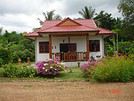
1- A bungalow of 80 m² (living room 28 m², 2 bedrooms of 14 m² each, kitchen and bathroom 24 m²)
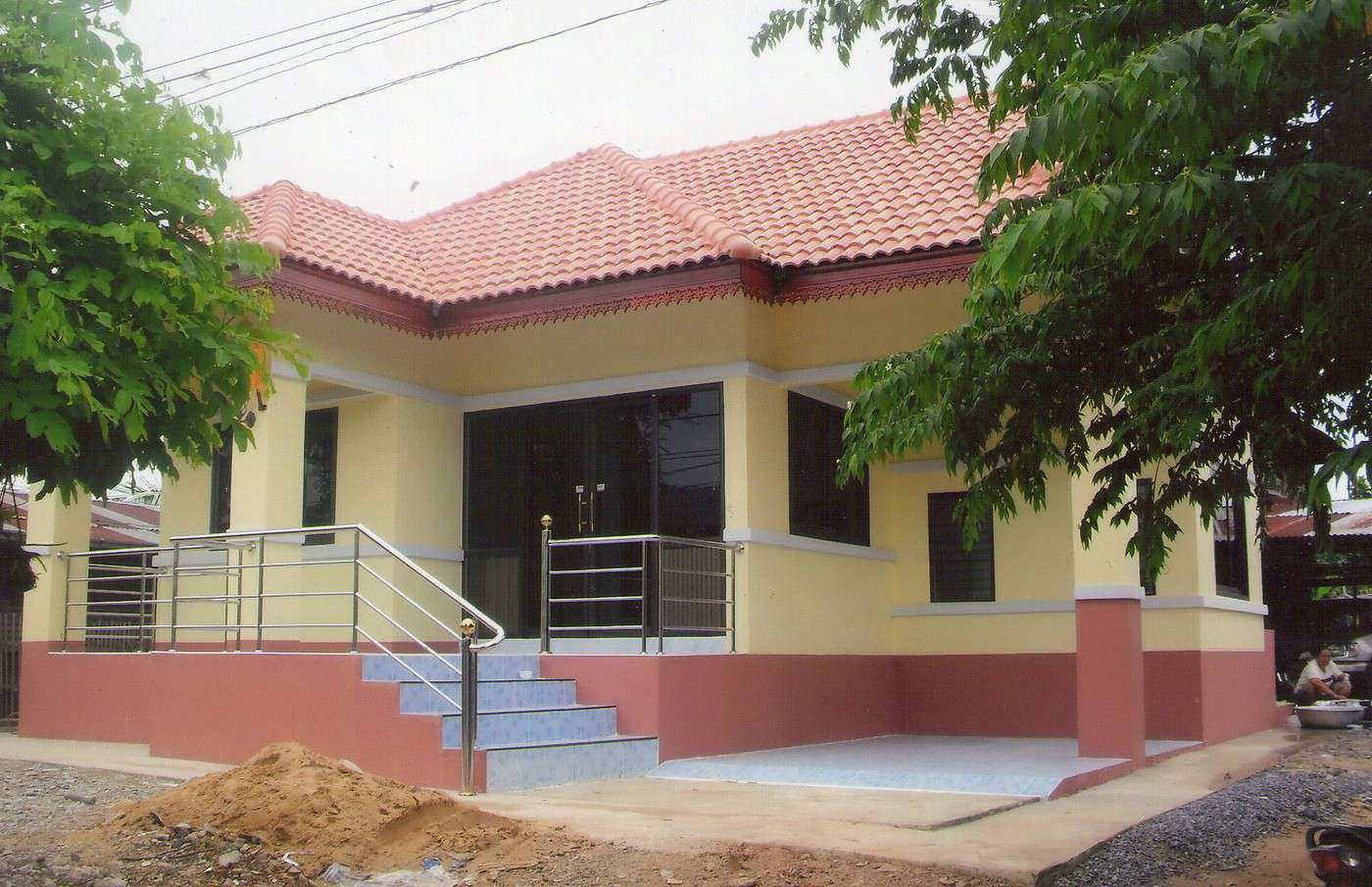
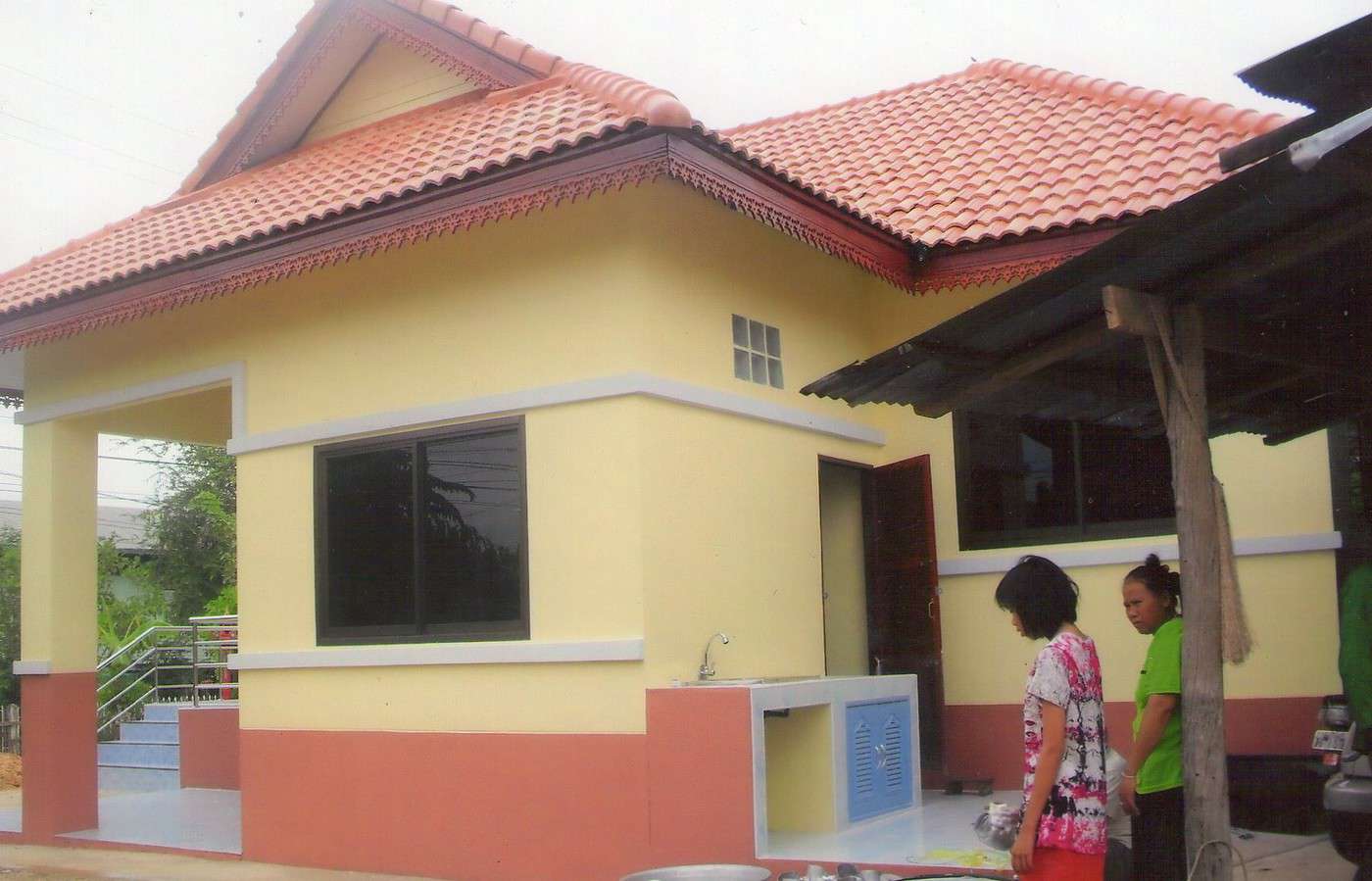
The photo you see with my username cost 450,000 THB in 2007.
2- The house I’m currently building, which will be finished in a month:
230 m² single-story for 2,300,000 THB.
So if you need advice, I’m happy to help. I think it’s best to see things on-site to spot any potential issues.
No problem with accommodation—I’d be happy to host you. You can come with your wife.
See you soon,
Reply in private
But if we base it on an ambient air temperature of 38°, I doubt we could get more than 5 to 8° less with a Canadian well.
That makes the ambient air 32°.
32 degrees instead of 38—I’ll take it😉 At 38, I’m boiling🤪! 32 is still manageable😛
32 degrees instead of 38, I'll take it😉 at 38, I'm boiling🤪! 32 is still manageable😛
- --
Every little bit helps! In France, if I'm not mistaken, hot water is produced in two stages: (1) solar heating; (2) electric (or something like that), right? So it's not a stupid question to lower the temperature by a few degrees if you no longer need AC or can save on the necessary AC. The key is knowing whether this can actually be done in Thailand and how much it costs. Waiting for the experts! 🙂
Being there in person won’t be possible since I’m only staying for 3 weeks. I’ll have to trust the builder and my father-in-law, who lives right nearby. At first, my wife and I wanted a two-story house, but to make the work less overwhelming, it’ll be a single-story home instead...
Hey there!
I hate to be the party pooper, but I’ve been through this kind of project before, so I’ll share a few thoughts.
1) First off, it’s (generally) not a great idea for a Westerner to build in Thailand if you can’t oversee the work yourself. Thais usually have a *very* different idea of what makes a house "good" compared to us farangs—think aesthetics, colors, doors, windows, bathrooms, electricity (grounding, cable protection, switch quality, etc.), insulation, material quality, you name it. If your in-laws are supervising, you won’t have much say if the final result doesn’t meet your expectations. Culturally, a Thai given a budget by a farang often "splurges" rather than negotiating—it’s about status: if you’ve got money here, you’re expected to show it (flex), and haggling is seen as "beneath" you. Not everyone’s like that, but I’ve seen this a lot with locals who suddenly come into money. A farang is usually a better negotiator if they research local prices, but you’ve got to be on-site to do it right.
2) Why rush into building if you can’t stay longer than 3 weeks? Renting in Thailand is *super* cheap. It’s better to take your time (and supervise the build yourself) and rent in the meantime—it won’t break the bank and could save you a ton of headaches.
3) It sounds like you’re building near your in-laws. That’s not always the best move. I know it’s convenient (often because the land comes from family), but once you’re settled, you’ll be within arm’s reach of them *daily*, and trust me, the requests will be endless! If you want to keep control of your schedule, privacy, and even some of your money, it’s wiser not to live too close to Thai in-laws, no matter how nice they are. Culturally, a Thai’s spouse *always* comes second to family. You won’t be fully in charge of your own life if you’re in their "territory." Also, think about the pros and cons of the location—how’s the internet access? Nearby shops? Distance to the nearest hospital? School options for the kids?
Anyway, I’d urge you to be cautious and not rush things. For reference, even with me on-site, my house took three times longer than planned, and the budget *easily* doubled (plan for at least twice the initial quote if you want quality work).
I hate to be the party pooper, but I’ve been through this kind of project before, so I’ll share a few thoughts.
1) First off, it’s (generally) not a great idea for a Westerner to have a house built in Thailand if you can’t oversee the work yourself. Thais usually have a completely different idea of what makes a house "good" compared to us farangs—think overall aesthetics, colors, doors, windows, bathrooms, electrical work (grounding, cable protection, switch quality, etc.), insulation, material quality, and so on. If your in-laws are in charge of supervising the construction, you won’t have much say if the final result doesn’t meet your expectations or match what you wanted. Plus, for cultural reasons, a Thai who’s given a budget by a farang will often "splash the cash" without counting, rather than haggling too much—it’s partly about status: when you’ve got money here, you’re expected to show it (flexing), and you don’t "stoop" to arguing over prices "like poor people." I know not everyone’s like that, but it’s an attitude I’ve seen a lot among locals who’ve never had much money and suddenly find themselves in charge of a big sum. A farang is often a better negotiator than a "nouveau riche" Thai if they take the time to research local prices, but you’ve got to be on-site to do that properly.
But his Thai wife has a role to play in this build—she must know what she wants, right? Should she just stay quiet and accept whatever her family decides? She’s got to be smart enough to negotiate.
Now, it’s true that if she’s on-site during construction, it’s still better.
3) Apparently, you’re planning to build near your in-laws. That’s not always the best idea. I know it’s often the easiest solution (especially since the land usually comes from the family), but once you’re living there, you’ll be within their reach every day, and trust me, the requests of all kinds will be endless! If, as a farang, you want to keep control of your schedule, your privacy, and—incidentally—some of your money, it’s wiser not to live too close to a Thai in-law family, no matter how nice they are. Again, it’s cultural (don’t forget that for a Thai, their spouse comes *way* after family in terms of priorities), and believe me or not, you won’t be fully in charge of your own destiny if you move into their "territory." Plus, you’ve got to weigh all the pros and cons of the location. For example, if it matters to you, what are the internet options like? What shops are nearby? How far is the nearest hospital? What are the schooling options for the kids, etc.?
Honestly, it really depends on the family—you might get lucky, or it could go badly.
Anyway, I’d urge you to be cautious and not rush things more than necessary. For the record, even with me on-site, building my own house took three times longer than planned, and the initial budget was blown way out of the water (plan for at least double what you’re told if you want quality work and materials).
Yeah, but it all depends on what you want from the start—it can range from basic toilets at Home Pro to tinted aluminum windows, tiling, insulation, etc. Once you’ve set your budget and decided on the quality of materials you want, you might only end up paying 25% more for the finishing touches.
What I didn’t account for: water heater, pump for the heater, the wall separating us from the neighbor, the front wall with the gate...
FYI: the price for the wall is 1,500 baht per meter x 1.60 meters high.
... But his Thai wife has a role to play in this construction—she must know what she wants too... Should she stay quiet and accept what her family decides?
She’s probably smart enough to negotiate.
Still, it’s definitely better if the wife is on-site during the construction.
Attitudes linked to the new status (now we’re "rich" and want to show it) often apply—first and foremost, in most cases—to the wife of a Farang as well. Plus, a Thai woman will rarely (if ever, generally speaking) go against her parents, no matter what they do.
... Honestly, it depends on the families... You can get lucky or really unlucky.
I said it myself at the start of my previous post: this isn’t an absolute truth in every case, but statistically, it’s what I’ve observed very often around me (and I know many mixed couples in the Land of Smiles).
Same goes for the construction budget—it’s an average (a rough estimate, I admit), but generally, a Farang will want a certain quality (for things like sanitary equipment, tiles, flooring, paint, etc.) that’s much higher (and usually more expensive) than what a Thai would choose for themselves. Not to mention the things that might need redoing (sometimes completely) the day you’re unlucky enough not to be present on the construction site (I’ve got several concrete examples in mind, and not just about my own project!).
Do you know if this has actually been done somewhere in Thailand?
Works really well with 10 cm PVC pipes and a 40-watt motor (400 THB) in Chinatown.
(With a Thai friend, we took it further with a 150-watt solar panel—it works, by the way.)
This Canadian well system works really well if you pay attention to insulation (beige or light blue tiles with 4 waves, not the classic 3-wave ones). It’s actually a whole system you need to respect, and as lukmee said, orientation is super important.
Don’t forget to plant fast-growing trees like Moraceae.
That’s exactly why I’m bringing this up again with Thuan. It might be interesting to reach a first level of cooler temperature (even if it’s still 32°C!), to minimize the effort for further cooling... but as you said, you’ve got to calculate it right. I hope Thuan comes back to shed some light on this!
I’m always surprised by some members who doubt every idea shared here 🤪 without knowing anything about it or even testing it... Oh well, there’s always a negative side on VF, I guess.
(I’m not talking about you, by the way 😉). It’s obvious the Canadian well won’t replace AC, but it does save a lot of money in the long run, and you won’t need to use the AC as often.
This non-revolutionary principle is being applied in what’s called a *mou ban* here, which means Thais know how to adapt to ideas from elsewhere.
Calculate the cost? Is 3,000 THB really not worth trying?
I did it with no special knowledge—I just researched Thai materials, and it works.
Being on-site won't be possible since I'm only staying for 3 weeks. I'll have to trust the mason and my father-in-law, who lives nearby. Initially, my wife and I wanted a two-story house, but to make the work less overwhelming, it'll be a single-story house...
Hey there!
I hate to be the party pooper, but I’ve been through this kind of project before, so I’ll share a few thoughts.
1) First off, it’s (generally) not a great idea for a Westerner to build in Thailand if you can’t oversee the work yourself. Thais usually have a very different idea of what makes a house "good" compared to us farangs—think aesthetics, colors, doors, windows, bathrooms, electricity (grounding, cable protection, switch quality, etc.), insulation, material quality, and so on. If your in-laws are supervising, you won’t have much say if the final result doesn’t meet your expectations. Culturally, a Thai managing a farang’s budget often splurges rather than negotiates—it’s partly about status: if you’ve got money here, you’re expected to show it (flaunt it), and haggling is seen as "beneath" those who aren’t struggling. Not everyone’s like this, but I’ve seen this attitude a lot among locals who suddenly come into money. A farang is usually a better negotiator than a newly rich Thai if they take the time to research local prices, but you’ve got to be on-site to do that properly.
2) Why rush into building if you can’t stay longer than 3 weeks? Renting in Thailand is super cheap. It’s better to take your time with construction (and oversee it yourself) while renting in the meantime—it won’t break the bank and will likely save you from a lot of headaches.
3) It sounds like you’re building near your in-laws. That’s not always the best idea. I know it’s convenient (especially if the land comes from family), but once you’re living there, you’ll be within their reach daily, and trust me, the requests will be endless! If you want to keep control of your schedule, privacy, and even some of your money, it’s wiser not to live too close to Thai in-laws, no matter how nice they are. Culturally, a Thai’s spouse often comes second to family priorities. You won’t be fully in charge of your own life if you settle in their "territory." Also, consider the pros and cons of the location—like internet access, nearby shops, hospital distance, and school options for kids if that matters to you.
Long story short, I’d urge you to be cautious and not rush things. For reference, even with me on-site, my house took three times longer than planned, and the budget doubled (plan for at least twice the initial quote if you want quality work and materials).
+1 to all of that. Also, architects aren’t too expensive in Thailand, especially younger ones. For various builds, I’ve used them—they can oversee the site and even find their own teams. Trying to save too much can end up costing more in the long run...
Also, architects aren’t very expensive in Thailand, especially the younger ones.
+1 Sometimes it’s almost free because they’ll use the opportunity of designing a house for foreigners to build their future contacts. ;)
And let’s be honest, they have some really great ideas.
For info, there are some excellent little books called construction maison en thailande in the big bookstores—around 400 THB, and there are about 20 different editions that can give you a solid foundation.
thanks a lot for your advice, but I probably didn’t explain myself well about what I’m looking for in a house. First off, it’ll be a vacation home—just once every two years—and somewhere we’ll stay much longer when my wife and I retire. But that’s not happening anytime soon (at least 15 more years of work! 😕). When you mention renting, it’s not easy at all because when we go to Thailand with our four kids (16, 14, 11, and 8), it’s really hard to find a house to rent in my wife’s village. That’s actually why we go as a family—to let my wife see her relatives and for her parents to spend time with their grandkids once every two years.
So, just to clarify, it’s not for living there year-round. As for the house, I just want something comfortable—nothing fancy—so I won’t be too picky. I’ve got a budget of 20 000 €, which is around 800 000 baht, and I think that’ll be enough for what we want. It’s true there are quite a few families who take full advantage of their son-in-law, and I know a lot of them, unfortunately 🙁. But when it comes to my in-laws, they’ve never—I mean *never*—asked me for money or anything, and we’ve been married for 18 years now. Sure, at first, like many, they thought *farang* = rich, but when you explain how much you earn in France and what you have to pay every month, plus the flight tickets for six of us, well, my in-laws—who I adore—understood perfectly and have never asked for anything. In fact, they’re the ones doing us an amazing favor by giving us a plot of land right next to their house to build ours. My father-in-law works as a taxi driver with his tuk-tuk in a small village called Ban Niou, about 6 km from Jaturat. He’s not exactly rolling in money, but he’s an honest and upright man I really respect 🙂.
But yeah, there are also the opposite cases—I’d say it’s like anywhere in the world. Anyway, thanks again for your advice, and don’t hesitate to reach out if you’ve got any great tips for housing.
Thanks Thuan, good to know! 🙂 3,000 baht is nothing in the grand scheme of such work. By the way, we were just talking about water containers and pumps earlier. For a buried tank, a pump, the necessary piping, plus a water heater, it’s around 25,000 baht. And there’s a good chance that wasn’t even included in the "quote."
Speaking of which, when Y proudly showed me the "contract" she signed with "Châang Phaawn," I was floored. It was just a photocopy of her ID with three handwritten lines and a signature. With that, you’re committing to work worth hundreds of thousands of baht. Trust is everything!
But in my humble opinion, you’ve got to approach this with realism *and* a healthy dose of philosophy:
Realism: as others have said, there will be plenty of surprises, and you need to budget extra for costs.
Philosophy: it often happens that a *farang* is technically right about something but is seen by Thais as completely wrong because of *how* they try to solve problems. You’ve got to stay *jai yen* above all—it pays off in the long run!
Words of wisdom to keep in mind, no matter what some stubborn folks might say 😉 Thanks for saying it—I totally agree, knowing this issue all too well 🙂
Especially since you see the problems (and the solutions...) with construction based on farang references, without having enough perspective on the local way of life: bathrooms, kitchens... the local weather: rain, wind, sun... the local wildlife: the little and big critters... etc.
In short, construction choices or technical solutions that seem obvious to us don’t always hold up when tested against the reality of the terrain... 😉
Same goes for the construction budget—it’s an average (a rough estimate, I admit), but generally, a foreigner will want a certain quality (for example, sanitary equipment, tiles, hardwood flooring, paint, etc.) that’s much higher (and usually more expensive) than what a Thai would choose for themselves.
Absolutely, that’s why you need to know exactly what you want before starting, as precisely as possible.
Go to Home Pro with a list and check the prices of all the materials you want—the hardest part is not forgetting anything! 🙂
Not to mention things that might need redoing (sometimes completely) the day you’re unlucky enough not to be on-site (I’ve got several real-life examples in mind, and not just about my own project!)
+1, and always ask for corrections with a smile... 🙂
I’m not running to build anything, but this discussion is fascinating!
We’re learning so much, and a lot of the opinions are really professional!
Well done.
+1
I really enjoyed reading your exchanges.
From experience, there are renovation projects in France that are just as much of a rollercoaster—with workers who confidently tell you upfront that they’re the best… or even experts in their field… which definitely explains their higher prices…
The contractors juggling 5 or 6 projects at once… making you wonder after 3 weeks if they’ve disappeared with your deposits…
Who keep informing you about all the extras that weren’t included in the initial quote…
Who lay your expensive tiles with one or two missing for "balance"… and then charge you extra to remove the tiles that need breaking…
Where your beautiful kitchen cabinets end up misaligned with your ‘expensive’ Gaudin cast-iron stove… because they ‘simply’ messed up the measurements… by just 7 cm…
Etc… etc… etc… It’s almost like a book—hilarious in hindsight…
Those site meetings… so many memories. Stay calm, zen… I’ve never worked out so much during that period… let’s move on…
I had 4 levels of 60 m² in the Southeast!! Exactly where there’s plenty of money to squeeze, lots of easy targets, and no shortage of projects. The construction dragged on forever.
I think this is pretty common even in France—maybe not comparable, but definitely more expensive. Every little mistake costs more.
The most "hilarious" thing that ever happened to me (in Thailand) was realizing while taking my first shower that the floor drain was at the *top* of the slope... (bloody thing in Thai!)
I then asked where I could find water that flows *uphill* to fill my tank. 😉
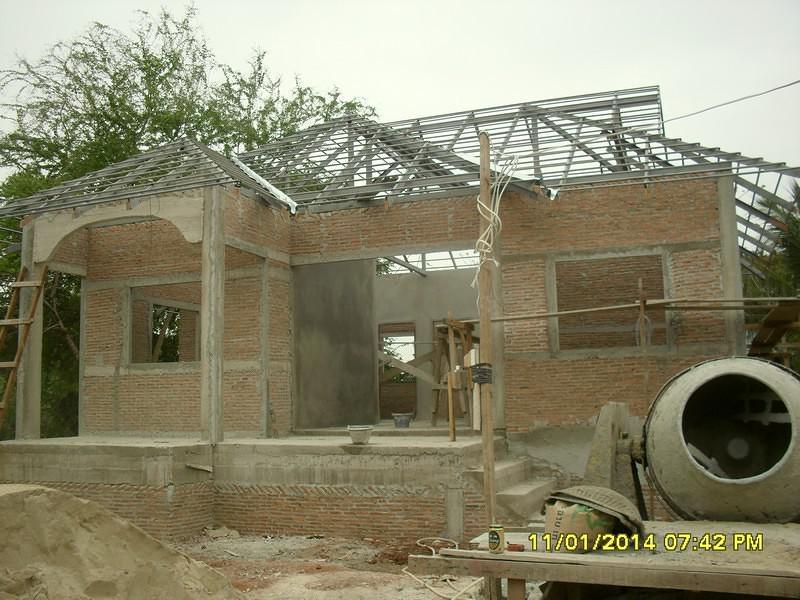
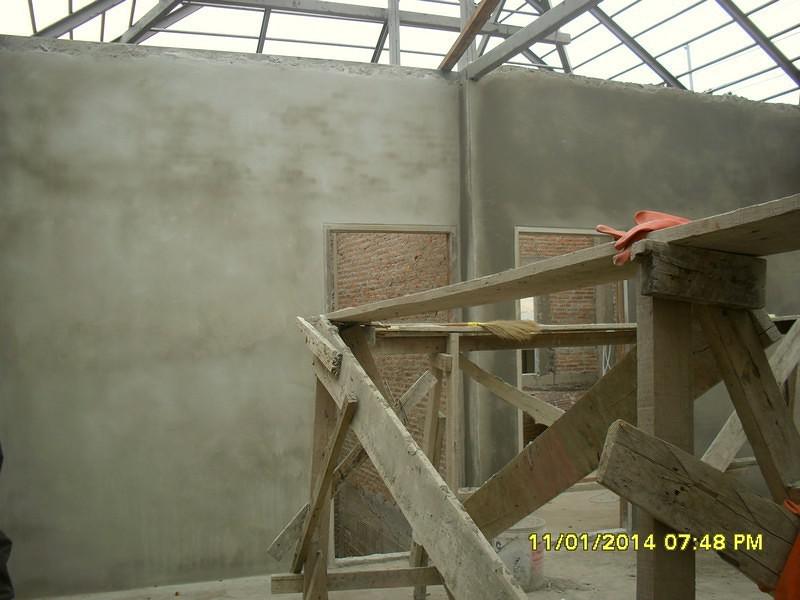
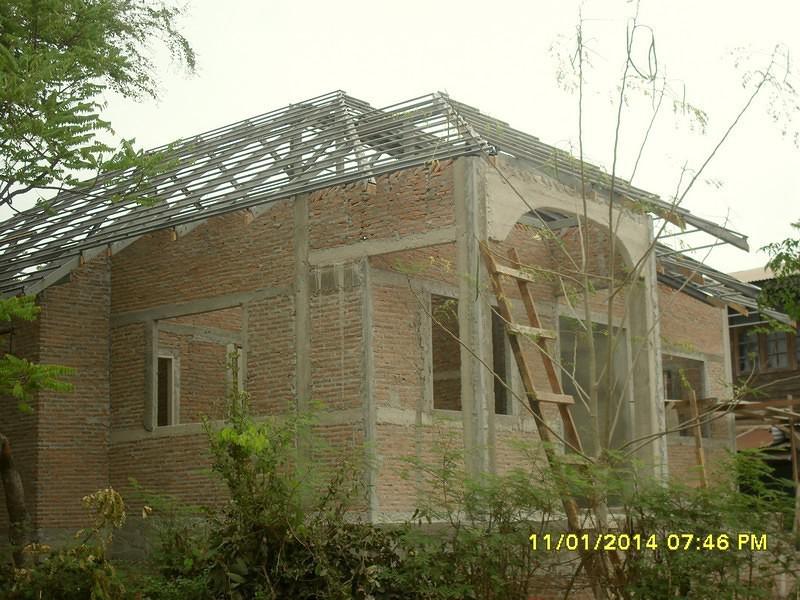
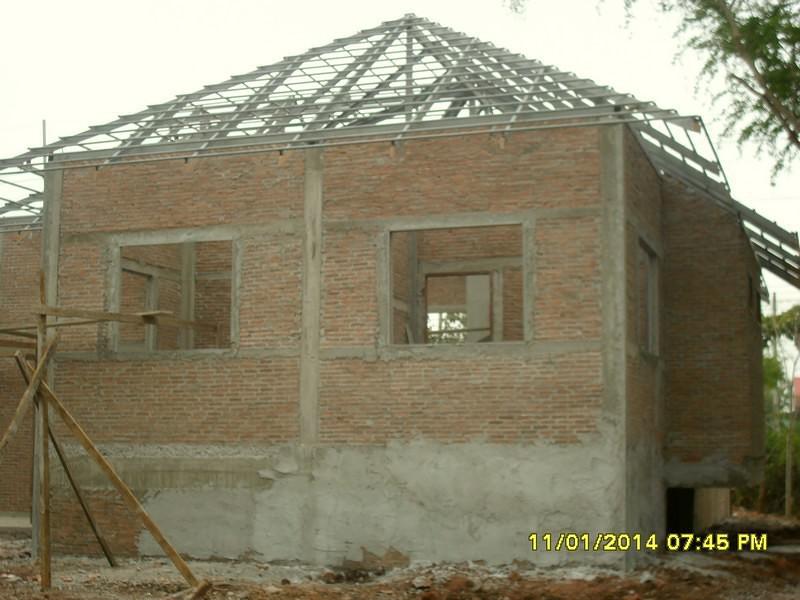
Hi, the structural work on my house is finished. Construction started on November 15th with the foundations, and the tiles were laid about 15 days ago, but no new photos since then. Here are some photos from around 15 days ago. I’m currently in France, so I haven’t been able to follow the progress, but I trust my builder :) And yes!
Thanks for your reply! I’d like to know if it’s possible to estimate the cost of just the structural work—like a single-story building, 16m by 12m, with an aluminum profile roof. I’d handle all the finishes myself. Is this doable in Thailand without a huge budget? I’ve got a lot of friends in France who can help me finish it properly and just the way I want, since I don’t really trust quotes, especially from *falangs*. Thanks so much for your advice!
Thanks for your reply. I was wondering if it’s possible to get an estimate for just the structural work—like the shell of a single-story building, 16m by 12m, with an aluminum profile roof. I’d handle all the finishes myself. Also, is it even possible to do it this way in Thailand without a huge budget? I’ve got a lot of friends in France who could help me finish it properly and the way I want, since I don’t really trust the quotes I get here, especially from falangs. Thanks so much for your advice!
I’d say wait a little while… until these Thais realize that concrete is outdated…
And by the way, they’re major exporters of gypsum… … how come they haven’t thought of making gypsum sheets yet? They sell it in bags… and honestly, for me, building with gypsum using low-cost mechanics would work just fine for Thailand’s climate. It’s even fireproof… I’m not talking about the flooring, but the walls! What are they waiting for? GYPSUM SHEETS—it’s not that complicated, is it?!
Concrete walls… why? The neighbor lives in a straw hut with bamboo vines! Sorry, but there’s a huge gap between concrete construction and straw huts. If you ask me, they don’t know the story of the Three Little Pigs…
The middle one didn’t hold up against the wolf, but here, the only thing to worry about is termites. So why not build with galvanized metal joists like we do back home?
Wait, I’m gonna ship a container full of materials that’ll make headlines in Thailand… … I saw universities in Bangkok, but this is beyond me! Guess they just don’t want to know and swear by concrete…
I don’t know the exact price for the structural work alone, but hey, it’s not exactly a fortune either! For example, my 110 m² fully finished house—painting, tiling, plumbing, everything—cost me 20,000 € (800,000 baht), so you don’t need a huge budget. In my case, the structural work should be around 10,000 €.
Hello, the structural work on my house is finished. The construction started on November 15th with the foundations, and the tiles were laid about 15 days ago, but there haven’t been any new photos since. Here are some photos from around 15 days ago. I’m currently in France, so I haven’t been able to follow the work, but I trust my builder 🙂 and yes!
Yeah, well, that’s it...!!! Gorgeous design...😉 very Thai-style... and what’s better than settling in comfortably to live peacefully.
It would’ve cost a lot more to lay a foundation for a half-basement... and to continue on the topic of the famous Canadian well... this innovation came about in 2007 if I remember correctly... with a basement, even when it’s 32°C outside, my half-basement stays cool... a huge plus +++ for avoiding air conditioning... plus, being a bit of an early adopter, I installed this piping system back in 2001...😊... still, you’ve got to factor in the labor cost for the necessary excavation...😮
there’s a crawl space—see the photo—you can clearly see an opening about 1 meter high
Yeah, okay...it needs to be sealed up. It’s actually for draining water from the land and also allows for installing insulating conduits, like polyurethane, under the floor.
You’ve gotta think energy-efficient...back home, we’ve got a Canadian program called R-2000...
It’s actually: Energy Objective – The house’s energy consumption is projected to be at least 15% lower than the energy target (a measure aimed at reducing greenhouse gas emissions).
Thanks to everyone for your advice. If you have any other tips, I’d really appreciate it. I’ll soon be able to take a 5-year break before retirement, and I hope to invite all of you to my long-awaited home so I can relax there and live many happy years. Thanks again to everyone!
Thanks to everyone for your advice. If you have any other tips, I’d be very grateful, because I’ll soon be able to take a 5-year break before retirement and hope to invite you all to my long-awaited home to relax and live happily for many years. Thanks again to everyone!
Well, you can count on that... same for me when my "container" finally arrives😏😏😏... unless I teach them some advanced methods... and they start making sheetrock themselves...
It’s crazy!!! Thailand is the third-largest exporter of gypsum in the world, I think, and yet they don’t use it to revolutionize house or hotel construction—or any other industrial buildings. It’s concrete!!! and nothing less... or not at all.
Galvanized steel studs in 2" x 6" for the exterior walls... a good Ramset to start... on a concrete floor and ceiling with aluminum trusses, and you’re set. A steel frame in the corners, and bingo... plumbing and electricity in the 2" x 4" interior walls... the mechanics??? Just screws!!!
Here, we even have sheets up to 12 feet long; normally 4' x 8'. Joint compound and finishing as you like...
It’s not me who’s going to start mixing concrete... the floors are available in large concrete slabs, 16 inches by 20 feet, if I remember correctly from a job building a small house on stilts...
Anyway, there are tons of ways to build your house... for example, you could insulate your roof with a false ceiling of 1.5 feet in the attic...
and then install tightly packed bales of hay against each other. This old method is great against both cold and heat!!! The cost??? Next to nothing... you could even raise the gable in the roof for a skylight with a water system that trickles down, constantly bringing coolness into the whole house... with just a simple fan... forget air conditioning, plus a Canadian well... coming from a semi-habitable basement. There’s coolness just 4 feet underground... even from the French drain...
Isn’t that eco-friendly??? 😉😉😉 ... that’s the kind of home I’ll welcome you to... very modestly...😊🙂
Some people even bury their houses under peat... a kind of green roof if you will???😏 Later!
Check out my photo... my kid’s 15, and he and his buddy are my workers... so there’s no one who can’t build their own house in Thailand.
and that they start manufacturing sheet gypsum....
It's crazy!!! Thailand is the third-largest exporter of gypsum in the world; I think, and yet it doesn’t use it to revolutionize the house, hotel, or other industrial building construction sector...
😏 Well, that’s worth looking into—it’s an innovation. We should find out why they (the Thais) aren’t using it for construction..... Okay, I’ll get to work on that to figure out why......😕 My only problem is that I don’t know much about sheet gypsum construction... 😏That’ll be something new to learn
😉 there you go, Mr. Christian, you gotta look to the big players... seems like the Thais can't build 'em on their own—they need farang or Japanese tech.
Entered into a joint venture with Sakisui Chemical Co., Ltd. (Japan) to manufacture modular houses with the sales target of 100 units by 2010.
It's crazy!!! Thailand is the third-largest exporter of gypsum in the world; I think, and they don't use it to revolutionize the construction of houses, hotels, or other industrial buildings... it's
😏 Well, that deserves some research. It's an innovation. We should look into why they (the Thais) don't use it for construction..... OK, I'll get to work to find out why......😕 My only problem is that I don't know much about sheet gypsum construction... 😏It'll be something new to learn
Well, gypsum is like chalk or lime... actually, it's one of the softest stones, and here, they only have it in bulk... nobody's lifted a finger to say... tut-tut!!! ...hey friends!!! ...you have to do it like this with this stone... it's not just for making cake mix... you need a big press with carbon paper on each side... let it bake in the oven...
Thais aren't crazy... the seven houses I was talking about... they'll practically cost nothing to build... and I'll leave them behind for families in need, with a big room next door for when I stay there or rent or sell... I don't care!!! ...the labor is theirs, but I'm the one paying... isn't that nice😏😏😏
😉 and there you go, Mr. Christian, you have to look among the big players.......it seems like the Thais can't build them on their own, they need farang or Japanese technology
Entered into a joint venture with Sakisui Chemical Co., Ltd. (Japan) to manufacture modular houses with the sales target of 100 units by 2010.
Well, yeah... we're gonna make friends... and teach them. I'm sure they'll be receptive...
Thuan said they won't let a single baht slip through their fingers into farang hands... so we'll see... I'm gonna kick their butts and challenge them... oh yeah... with a big smile stretching from ear to ear... you see that, thaiboss!? ??? I wanna mess with their heads and do it with a big smile... I'm definitely in the right country, aren't I???😏😏😏😎 Okay, gotta hit the sack... my stomach's cramping from laughing... I'm already laughing up my sleeve... It's a joke, I'm practically hairless....😛 😄 😏@+
Hi Christian,
Drywall sheets for walls and ceilings, called "plasterboard" in English-speaking countries, are made in Thailand 😉
You can find them at all the big building supply stores.
Hi everyone, I m about to head to Thailand with my kids and I ve been put in touch with a French-speaking driver who ll be with us for 3 4 days (for a little…
Hi everyone, I m planning a trip to Thailand. Since we ll only be there for two and a half weeks, we want to visit the Krabi area and then Chiang Mai. So we…
Hi there! I think the question s in the title... What price can I expect to pay in 2025 for a ride of about two kilometers in the tourist center? Thanks
Hi there! Right now, we're in the southeast part, Isan, staying with a French guy. We don t cook much at most, a restaurant meal for 5 people costs us 1000…
Hi, I d been told it was between 2,000 and 2,500 THB per day. 3,000 THB for Doi Inthanon... The driver I found gave me different prices depending on my…
Hello everyone! I’m heading off solo in February and wanted to share my rough itinerary with you. Does this sound doable?
PS: I’m not really into beaches.
D1 Departure on February 17, 2027
D2 Arrival in Kuala Lumpur – stroll through Chinatown and visit the Petronas Towers
D3: Kuala Lumpur – Chow Kit Market, Batu Caves, Little India, Bukit Bintang downtown area
D4: Early morning bus to Malacca. Explore Malacca in the afternoon and evening
D5: Another 2–3 hours in Malacca in the morning, then bus back to Kuala Lumpur. Merdeka Square area. Stay in Chinatown
D6: Bus trip to Kuala Tahan. Night tour
D7: Morning – canopy walk and Bukit Terisek hike. Afternoon – off to Lata Berkoh
D8 & D9: 2-day jungle trek in Taman Negara National Park
D10: Head to Cameron Highlands
D11: Morning hike through the plantations. Afternoon still to be decided
D12: Morning – excursion to Mossy Forest and Sungei Plantation. Afternoon bus to Ipoh
D13: Morning – Mirror Lake / Sam Poh Temple area. Afternoon – explore downtown Ipoh
D14: Morning train to Penang. Afternoon – wander around Georgetown
D15: Morning – Penang Hill and Keh Loh Temple. Afternoon – Georgetown
D16: Bus to Butterfly Garden and Spice Garden. Late afternoon – Burmese and Thai temples
D17: Morning flight to Singapore. Afternoon – Chinatown and Marina Bay tour
D18: Morning – Gardens by the Bay area. Afternoon – Boat Quay, Clarke Quay, Kampong Glam
D19: Morning – The Ridges area and Botanical Garden. Afternoon – Little India, then back to Chinatown before 11:15 PM return flight
D20: Morning arrival
Hi, I’ve read that these two volcanoes are super popular and that there are *tons* of people for sunrise, especially in July. I’m looking for firsthand accounts from anyone who’s done it later, around 9–10 a.m.
Thanks for your help!
Laëtitia
I’m heading to Cambodia at the end of December 2026 – January 2027 for 3-4 weeks. Since I’ve already visited Cambodia twice, my itinerary is a bit different this time—I’d love to explore Botum Sakor Park, Chi Pat, the Tatai region, and the Cardamom Mountains. I’m traveling solo. If you have any tips on transportation, excursions, treks, sights, or accommodations in the area, I’d really appreciate it. Thanks for your feedback!
Has anyone traveled with the Laos travel agency ADV ?
I’m planning a trip to Laos and have received several quotes. Among them, this agency’s seem very reasonable, and so far, the interactions have been positive.
I’ve found a few positive reviews online, but I’d love to hear from travelers who’ve actually booked with them: how’s the organization, guide quality, accommodations, on-the-ground responsiveness, etc.
Thanks for sharing your experiences!
First stop on our discovery of the peninsula: Amphawa. It’s our first night in Thailand (we arrived at Suvarnabhumi at 8:50 AM).
Our initial plan was to explore the area before heading further south. The Mae Klong Railway Market is tempting... but what else is there to do????
We’ll be there on a Wednesday, and from what I’ve read on the forum, some say there’s absolutely nothing to do during the week—no floating market, barely any shops open, no restaurants, etc.
Others, though, say the place is actually more charming without the weekend crowds.
Could you share your thoughts? Missing the floating market is one thing, but if it’s really a ghost town on Wednesdays, I might just drop our bags somewhere else.
Amphawa seemed like a good first stop, just 1.5 hours from the airport, but I’d still like to settle somewhere a bit lively for our first evening.
We’ll be there at the end of October.
Thanks!
Hi,
I wanted to visit the plantations in the morning with GetYourGuide or by just showing up.
How much time should I really plan for?
I’d like to catch either the 3 PM or 5 PM bus back to KL.
Thanks
Hi,
I wanted to get some info about the cable car and the bridge—I see lots of different options...
How much time should we allow for these two activities? If we arrive around 4 PM, will we have enough time to visit without rushing?
Thanks
Hi there,
I didn’t plan to return to Thailand this year, but my health conditions mean it’ll be the best place for me to stay between two trips to India. The tourism setup there is so well-organized that it’s the most "comfortable" country for a short visit. Thailand feels too sanitized for my taste, and there’s too much religion, Buddha, and the King, but it’s still the best option given how my health has been evolving. I’d considered two weeks in ThaTon for hiking, but I got too sick from the burn-offs during my trips to the mountains around Chiang Rai. So I’m not sure where to go this year. Definitely not the sea, touristy spots, or the mountains with burn-offs...
Hi,
On September 1st, we're heading to Kalimantan for six weeks, probably from Pontianak to the Derawan Islands.
I've scoured this site, which is usually my go-to 😉, and others like VoyageForum, but recent info is pretty scarce.
I'd love any tips on places you've visited—our itinerary is still a work in progress.
We're two couples traveling with backpacks, using buses, boats, guesthouses, and homestays.
Thanks in advance!
Hi fellow travelers,
First trip to Vietnam.
We’ll be arriving in Ho Chi Minh City during Tet.
Is it complicated to find accommodation and get around during this period?
Any tips would be welcome.
Thanks for your replies.
Hi! I’d like to split my trip into two parts: 15 days in Phuket and 15 days in Krabi. Do you know if I can rent a car and drop it off in Krabi when I fly back to France?
Thanks for your feedback!
Have a great Sunday!
Martine
Hello,
After 1 night in Khao Sok, I’d like to find a 2 Days 1 Night package on the lake.
After reading a lot, I decided to "break the bank" and treat ourselves to a private tour—mainly to avoid the crowds.
But after contacting several operators, they offer "private tours" that are very expensive (around 700 €), yet in the details, the boats can only leave from the pier at 10 AM like everyone else. (I was hoping to leave much earlier.) The morning program is the same for everyone too (private or not). They drop us off at noon at our floating hotel (I’d chosen Phupha Waree). Free afternoon (swimming or kayaking in front of the hotel). We head back by boat for a 1-hour sunset ride. And the next morning, we leave the hotel at 8 AM to be at the pier by 9:30 AM at the latest—end of the trip.
So basically, we’re paying a lot for a private tour just to do the same thing as everyone else at the same time.
Or maybe I just had bad luck in my search.
I contacted Panida Ladi, who’s very popular on forums. We’d agreed on a private tour that matched my request (departure from the pier at 8 AM, very personalized itinerary). We settled on the itinerary and price, she asked for a Wise transfer for a 30% deposit, confirmed receipt of the deposit. Then 30 minutes later, she messaged me to say she was canceling everything because it was impossible to do the requested tour—and promised a quick refund of my deposit.
So here’s my question: Who’s done a *real* private tour on this lake? Who can recommend a reliable agency? Is it even really possible to do a private tour here?
I’m searching for a real gem for my 3rd stay in Koh Lanta: a lovely, high-quality hotel right by an easily accessible beach in a lively spot.
If you know of anything that fits what I’m looking for and want to share, don’t hesitate!
Hi, is anyone there in Flores right now? According to some websites, everything is closed and the situation is tough. But our guide says it's fine. Who should we believe? We're supposed to leave on September 2nd. Thanks to anyone in Flores at the moment!
Hi dear community,
I'm planning to visit Cambodia this winter, right after Christmas, for my first solo trip and my first trip to Asia. For two weeks (yes, I know it's short, but I really can't do more...). I have two main desires: Siem Reap and the countryside, the villages, the Mekong...
What do you think of this itinerary? Arrival in Siem Reap, departure from Phnom Penh.
SR: 5 days (1 day for arrival, 3 for the temples, 1 for the lake and its villages)
Kratie (stop on the way to Mondolkiri): 3 days (1 day of travel, 2 days there)
Mondolkiri/Sen Monorom: 4 days (1 day of travel, 1 day there, 2 days of treks)
PP: 3 days (1 day of travel, 2 days of sightseeing)
I think I need to cut one day somewhere if I travel from Saturday to Saturday or Sunday to Sunday. In Kratie, maybe? Or in PP? And I'll miss the boat trip that everyone recommends (SR-Battambang), but I don't see where to fit it in. Unless I do a PP-PP loop starting in the east, skip Kratie or just stay one night, then SR, then PP.
In my timing, Mondolkiri seems closer than Ratanakiri, which also tempted me a lot! Will it be too complicated alone? I'm thinking of using local guides or a small local agency for a nature and village getaway.
I've read that Siem Reap is very crowded between Christmas and New Year's. I could also do the circuit in the opposite direction. But I thought it would be easier to get familiar with the country by arriving in a touristy area—I might be wrong...
Thanks for your advice and opinions!
Hi everyone.
I’m planning my trip, and based on all the posts I’ve read, this country is amazing.
Of course, I’ve got a ton of questions for you.
Here’s a possible itinerary: Vientiane - Vang Vieng - Phonsavan - Sam Neua - Nong Khiaw + villages - Phongsali - Luang Namtha and the area - Udomxai - Huay Xai - Luang Prabang and back to Vientiane.
What do you think?
We’re planning to prioritize local transport—is it possible to do this loop?
We’d also love to go kayaking, but I’m not sure if the season’s right or where the best spot is.
For trekking—I read that Phongsali is the most authentic spot to visit villages and see wildlife. Do you know of a reliable agency and a guesthouse with reasonable prices?
Is it worth taking a slow boat for a stretch on the Mekong, and if so, which route?
For accommodations, is it better to book through Booking.com and Agoda or look when we arrive?
Are mosquitoes bad in Laos, and should we take malaria prophylaxis?
What’s the average daily budget (accommodation, food, visits)?
Is renting scooters a good option for exploring towns, and if so, which ones?
From what I’ve read, it’s best to carry cash—euros or dollars? Is it risky to walk around with that much cash?
I’ve still got tons of questions. Thanks to anyone who can help, and I’m open to all tips, info, etc.
Thanks again
Hi there,
I’m planning a family trip (my wife and I, both 47, and our two sons, aged 5 and 12) to Malaysia for the last week of June and the first two weeks of July 2027.
We used to love road trips as a couple, then as a trio, but since our second child arrived, we’ve taken a break with "camping village" style trips.
Now feels like the right time to get back to our old habits, while adjusting the pace for the kids.
We’re craving Asia. We’ve been lucky enough to visit Thailand, Indonesia (Bali and Lombok), and Sri Lanka before.
Friends have raved about Malaysia, so we’re definitely tempted.
For those who know and love Malaysia, what would be a good itinerary starting from Kuala Lumpur, with a maximum of 3-4 stops? We’d like a mix of culture, nature, and relaxation (just to clarify, we’re not big beach fans). All of this without rushing, of course.
Hello,
We’re a family of four with two teens aged 16 and 18. We’re heading to Thailand this summer. We’ll arrive in Bangkok and plan to take a flight to Luang Prabang.
I’ve seen there are some great visits and excursions to do (temples, markets, waterfalls) and maybe even venture a bit north to places like Nong Khiaw, Muang Xay, Muang Ngoy, or Oudom Xay.
But I’ve also heard about the Bokeo region with the Gibbon Experience.
Since we won’t be able to do everything, I’d love to hear about your experiences, impressions, and advice on the two options I’m considering, especially since we’ll be meeting family in Chiang Mai, Thailand, afterward.
Option 1: A loop from Luang Prabang heading slightly north, then a flight from Luang Prabang to Chiang Mai.
Option 2: A few days in Luang Prabang, exploring within a few dozen kilometers around, then heading to Bokeo province for the 2-day/1-night Gibbon Experience. For this option, I saw on Rome2Rio that it’s possible to book a ferry trip on the Mekong from Luang Prabang to Huay Xay—they mention about 8 hours. But is that realistic? What type of boat is it?
Then, to get to Chiang Mai, there aren’t many options—bus or minivan—but how does crossing the border work?
Finally, for those of you who’ve been to Laos in August, what was the weather like?
We’ve already visited Thailand, Vietnam, and Cambodia during the same period over the past four years and weren’t really bothered by bad weather.
I’m starting a discussion about guides in the Mekong Delta because we’ve just finished our trip in this region and had a hard time finding a French-speaking guide. We had Thanh—she speaks French really well and travels all over the delta region, including Ho Chi Minh City. She’s super friendly and flexible. I recommend her wholeheartedly. If it can help someone...
Feel free to contact us for her number.
Hi everyone,
I couldn’t find any recent info on Kuching.
Can anyone recommend a hotel or guesthouse for under 100 RM that’s nice and affordable? No dorms, please.
Also, does it rain a lot in November, and is it still worth visiting Semenggoh or Bako?
We’ll be arriving in Phnom Penh this coming January and we’re thinking of starting our trip with a stop in Kampong Cham, then Kratie.
After Kratie, we’re considering heading toward Siem Reap with a stop in Kampong Thom.
That said, I’m not really sure how long the Kratie–Kampong Thom journey might take or how complicated it is.
Does this stop on the way to Siem Reap seem like a good idea to you?
If we don’t visit the Sambor Prei Kuk site, are there still any walks or sights worth checking out in Kampong Thom?
Silly question—backpack or hard-shell suitcase for the Sepilok, Kinabatangan, Tioman, KL trip?
I’m struggling to fit all my son’s and my stuff into the 70L backpack... and I’m thinking a suitcase would be easier, but I’m not sure if it’ll work for getting around.
After a stay on Koh Phayam this coming November, I’d like to spend 2 or 3 days on Koh Phra Thong before heading further south.
Do you think it’s doable to leave Koh Phayam early enough to catch the 10 AM boat from Khura Buri to Koh Phra Thong? The next one isn’t until 4 PM, which would cost me a whole day.
I’m planning a trip to Indonesia, specifically Sulawesi and Java, in September for 10 days.
I don’t know this part of the world at all—any advice is welcome!
I’ll be traveling solo and would also love tips on meeting other travelers or locals.
Hello everyone,
Not long ago, I used to travel as a couple, but my husband has since passed away, and I’ve decided to set off again. The trip I took to Cambodia in January 2025 did me a world of good.
I’m now considering Thailand, a destination we never included in our plans because even 15 years ago, people said it was too touristy. Still, I’m thinking about the itinerary below, but I don’t feel up to arranging buses, trains, or guides on my own while I’m there. I’m looking for one or more drivers and have been in touch with an agency, but their offers are just copy-paste group tours that I don’t want.
So, if you have any contacts, experiences, or advice, I’d be so grateful if you’d share them with me. Here’s my rough plan:
Arrival in Bangkok
Ayutthaya (2 nights)
Kanchanaburi (2 or 3 nights)
Sangkhlaburi/Sai Yok (3 nights)
Sukhothai (2 nights)
Lampang (I’ve planned 3 nights, but that might be a bit much—it depends on what time I arrive in the city)
Chiang Mai
Chiang Dao
Pai
Chiang Rai
I was thinking about the Mae Hong Son loop—thoughts?
What do you think about staying overnight at the Golden Triangle?
When I look online, of course, I can find agencies that organize tours to national parks, etc.
I’m retired but in great physical shape. I’d rather go hiking than sit in hot springs with crowds of tourists who’ve all arranged meet-ups. I don’t want to spend a day at an elephant camp, and I don’t want to visit Karen villages.
I’d love to hear your advice.
Thank you all,
Hi everyone,
Could you share your thoughts on my 3-week itinerary?
We’re a small group (family + friends) of 12 people, planning to leave around January 21, 2027.
Here’s my itinerary:
3 nights in Bangkok
4 nights in Chiang Mai
3 nights on Koh Samui
3 nights on Koh Phangan
4 nights in Krabi
4 nights in Phuket
I’m also open to any great tips you might have...
Thanks, everyone! Alain.
Hi there,
We’re planning a 3-week family trip next summer with our three kids, who’ll be 8, 8, and 7 years old.
After some research, we’re leaning toward Malaysia to combine nature/forests and paradise beaches. The idea is to introduce our kids to the country’s culture, nature, and wildlife.
We want a great trip but without splurging on luxury options like high-end lodges and resorts. We’re looking for comfort with a touch of authenticity—basically, a good middle ground.
I’ve started putting together an itinerary and would love your expert advice and tips to help us build this amazing trip with our little ones.
Day 1: Departure from France
Day 2: Kuala Lumpur
Stay at a hotel near the airport or KL Sentral.
Just one night.
Day 3: Morning flight to Sandakan (Borneo).
Stay in Sepilok
Day 4: Sepilok:
* Orangutan Center
* Malayan Sun Bear Center
* Rainforest Discovery Centre
Day 5: Depart for Kinabatangan.
Boat safari in the late afternoon.
Day 6: Sunrise safari.
Jungle walk.
Evening safari.
Day 7: Final safari.
Return to Sandakan.
Flight to Kuala Lumpur, then to Kota Bharu (or overnight transit depending on schedules).
Day 8: Transfer to the port.
Boat to the Perhentian Islands.
Days 9 to 13: Perhentian Besar
5 full days.
* Snorkeling
* Hiking
* Turtle watching
* Wild beaches
* Relaxation
Day 14: Return to the mainland.
Bus or private car to Taman Negara.
Summer seems to be the best time weather-wise for Bali.
And since summer’s when we can take a long trip, let’s go for Bali... even though we know it’ll be *packed* with people!
So we’ll steer clear of the island’s south...
Our current plan (19 days on the ground, 7 stops):
- 4 Nights (3 days) in Ubud
2 days for rice terraces / activities (Tegallalang, Campuhan Ridge, Monkey Forest, Bird Park, coffee plantation, market (?), dance "pestacle," cooking class and/or spa)
1 day with a driver for the Temples (Pura Gunung Kawi, Tirta Empul Spring, Pura Mengening, Goa Gajah...)
- 2 nights in Sidemen (1 day for Pura Kehen + Batur Caldera + Pura Besakih and 1 day to relax in the rice terraces)
- 3 nights on Gili Meno (Rest and beaches) from Padangbai
- 2 nights in Amed (1 day from Padangbai with the Abang rice terrace and Tirta Gangga baths, and the next day a boat tour in Amed)
- 4 nights in Pemuteran (1 day for transfer and rest, 1 day to visit Kawah Ijen, and 2 days of snorkeling at Menjangan Island)
- 2 nights in Munduk (1 day with the Dayang rice terrace and the 3-waterfall hike, 1 day at Pura Ulun Danu Bratan)
- 2 nights in Jatiluwih (1 day in the rice terraces, and on the last day, we’ll stop by Pura Taman Ayun in Mengwi and Pura Tanah Lot before catching our red-eye flight).
Accommodations in homestays or hotels.
Transportation to be arranged on-site with the lodgings (?)
Boat to Gili Meno to book in advance (?)
Kawah Ijen excursion to plan ahead (?)—check with the homestay (?)
Thanks for your thoughts/comments to help us explore this destination...