Travel journals
FR

Many threads here are in French, the community’s main language. English translations are added over time.

SO
Solene40 6 months ago
Spring getaway in search of Moroccan sunshine
Hey fellow travelers!

This isn’t meant to be a full-on travel journal—just a little springtime dip into the Moroccan coast (and maybe a bit more if we click).

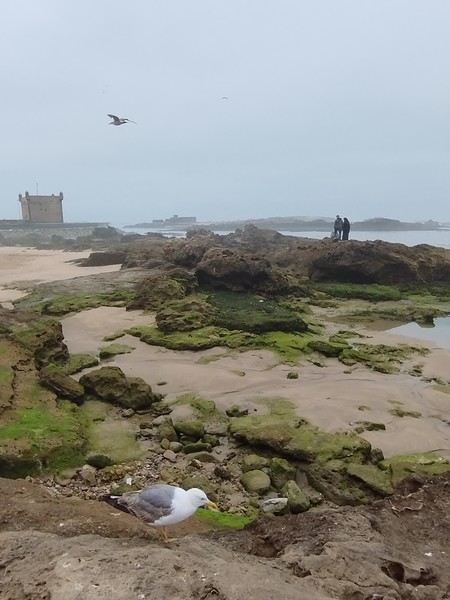
For our third trip to this country, we set off for 8 days in early June 2025, *sure* we’d be greeted by non-stop sunshine...
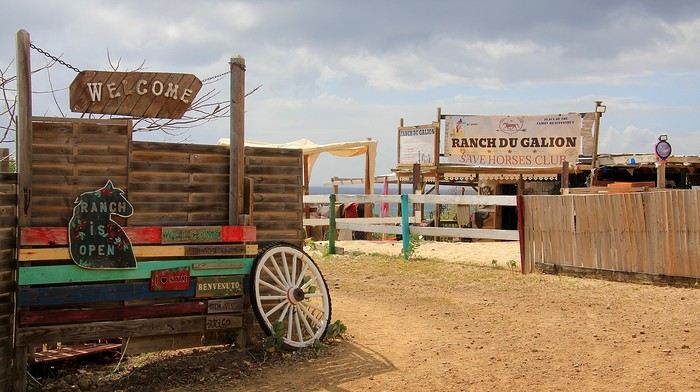


...and well, that didn’t happen! The gray stuck around for a day, then two, then three (while back home in the Landes, we had gorgeous sunshine 🤦‍♂️😂).

Now, unlike us, the Morocco experts here probably already know this, but apparently, it’s pretty common—especially in spring—when the warm air from inland meets the cool ocean breeze. Locals even have to warm up with hot water bottles, can you believe it? 😄!


And of course, it had to happen now, since our plan is to follow the coast from Essaouira to Mirleft!!

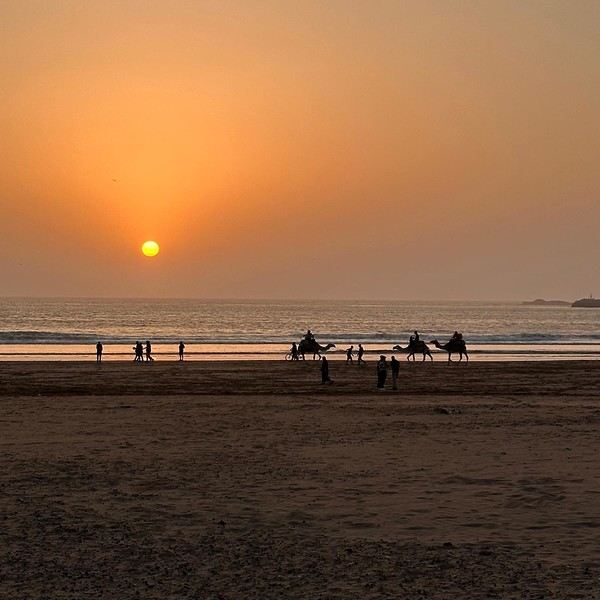
Oh well, we’ll see how it goes—but luckily, this first stunning sunset made up for the weather 🌅.


See you soon to anyone who’s up for it! 😊
Open
ES
Escale56 6 months ago · Pagaljavab
Tips and addresses for backpackers traveling from Tanzania to South Africa
Since Voyage Forum is restarting after a few years of hiatus, I couldn’t find any recent info about my trip between late November 2024 and January 20, 2025, going from DAR ES SALAAM to the Cape Town area via ZAMBIA and BOTSWANA. I’m really happy the site is back up, but I’ve noticed more and more people planning their trips down to the day, mentioning what they’ve scheduled and asking for technical advice for their 4x4 routes. That’s not how I travel at all—I prefer to leave a lot to the unexpected, like public transport (and the weather) and the people you meet along the way. The tips I’m sharing below come from the current situation, the randomness that makes unplanned trips special, and the strong connections you can make when you take your time without knowing what tomorrow will bring.

😏 TANZANIA: I had booked a TAZARA train ticket via WhatsApp before leaving to go from DAR ES SALAAM to MBEYA near the Zambian border. I’d contacted the station manager in Dar at +255 713 413 141, who kindly confirmed my reservation. Unfortunately, the train was out of service for an indefinite period, so I had to take the bus from the new Mwenge bus station on the city’s outskirts (allow extra time to get there—traffic is heavy). There’s no longer a direct train to ZAMBIA. You have to get off at MBEYA, then take a bus to the TUNDUMA border (2 hours to the bus station, then a 2 km taxi ride to the border). Crossing is easy—visa is free, no no-man’s-land, and you arrive directly in NAKONDE, Zambia. Exchange money on the Zambian side, but don’t change with the first person you see—check the rate first. I preferred to stop for the night in IRINGA since I took the bus at 4 PM. I arrived at 2 AM at Georges’ place, who picked me up directly from the bus station (several km from town). I’d booked the accommodation via Booking under Travellers Backpackers and Free City Tours. Georges and his employee were extremely helpful—they organized my bus trip to MBEYA the next day (bought the ticket and dropped me off, no commission). The place is decent, clean, and comfortable (10 € per night). Georges also organizes tours and safaris in the area (+255 679 529 700 direct). In MBEYA, I stayed at Karibuni Center Hotel (a quiet evangelical convent, very friendly and open to everyone, 13 € per night with breakfast). You can eat at a restaurant across the street. The rooms are clean and quiet (contact +255 754 510 174). To head to Lake MALAWI or the tea fields in TUKUYU, it’s best to take a moto-taxi from MBEYA to the Uyole junction. From there, you’ll find minibuses heading south frequently—change buses in TUKUYU (the tea fields are 4-5 km away).

😏 ZAMBIA: In NAKONDE, I highly recommend Izukanji Lodge—very quiet and clean, 2 km from the station (take a moto-taxi). The main building’s rooms are pricier than the annex across the street (where the restaurant and pool are). The rooms are just as clean and quiet but only 10 €, breakfast included. Contact the manager directly on WhatsApp at +260 979 649 452. If it’s full, try Divine Guest House (+260 973 127 816). The train isn’t always on time—if you catch it on the scheduled day, consider yourself lucky. The stationmaster, Mr. Chulu, is lovely. Contact him on WhatsApp at +260 777 550 302 for real-time updates. First-class berths are great (4 per compartment), 15 € one-way to KAPIRI MPOSHI. There always seems to be space. Book two berths if you want extra comfort. No need to bring food—the dining car serves decent meals, and there’s a bar. In KAPIRI MPOSHI, I stayed at Kapiri Council Lodge, 2 km from the train station. It’s okay, but there are often power outages in the evening, which means no water either. You’ll have to wait until 8 PM. Breakfast is very basic. For LUSAKA, there are plenty of buses in the morning from the downtown bus station (2-3 hours). The best companies are Power Tools (yellow buses) or UBZ if you can find it (the best in Zambia—Western comfort). In LUSAKA, use Yango taxis (download the app—it’s like Uber in Zambia, very affordable). I stayed at Natwange (Hostelworld chain), reachable at +260 966 303 816. It’s a beautiful, quiet place 3-4 km from downtown, very shady, with a pool. The rooms are clean and comfortable, and the food is excellent (great salads). The staff is super friendly, as they are everywhere in the country. There’s also a mini-supermarket nearby with everything, including takeout meals. Book your bus ticket to LIVINGSTONE at least the day before (UBZ). The trip is pleasant. In LIVINGSTONE, many backpackers stay at Jolly Boys—it’s a nice place to relax by the pool with a beer at the end of the day, but it’s mostly a party hostel for young people doing rafting or canyoning on the Zambezi (pricier than elsewhere). For those who prefer peace and quiet, I highly recommend Likute Guest House on the same street, right near Jolly Boys. The rooms are decent for 10 €, breakfast included (same price as a dorm at JB). You can order dinner in advance. The staff is friendly. Great value at Da Canton restaurant on the main road (pizza, pasta, meat, salads, etc.). The Livingstone Museum is worth a visit if you have time. At the bottom of Kapondo Street, you can take a shared taxi to Victoria Falls or even to KAZUNGULA at the Botswana border (cheap—the taxi leaves when full). People short on time often compare the views of Victoria Falls from the Zambian side (20 $) and the Zimbabwean side (30 $). Honestly, they’re very different, and it’s worth seeing the falls from Zimbabwe even if it’s pricier (visa required, easy to get at the border—everything is done on foot). Cross the bridge where you can bungee jump. Take your time at the falls—it’s truly stunning. You can visit Zimbabwe for half a day and stay in Zambia (cheaper, since everything in Zimbabwe is paid in dollars). There’s more water on the Zimbabwean side, but the Zambian side is beautiful too.
😏 BOTSWANA: Crossing the border at KAZUNGULA from Zambia is quick and easy (brand-new bridge over the Zambezi). Visa is free. Don’t exchange money at the border. There’s a shopping center 1 km away (Choppies store) with an ATM (no commission). I hitched a ride with tourists to the bank since they had a car. In the shopping center parking lot, you can easily find a shared taxi to KASANE. In the area, you can get around easily by shared taxi (just give the name of your guesthouse, and the drivers will tell you which vehicle to take). The fare is fixed (0.50 €). I stayed at Elephant Trail GH and Backpackers—a great spot where you can stay in a 4-bed dorm for 10 €. There are also huts for two in the garden (clean and comfortable) with a pool. You can order dinner (great food) or cook your own meals. The place is quiet and friendly (they organize safaris with early-morning pickups for Chobe and evening boat trips in the Kwando marshes to see animals). I preferred flying (Air Botswana) with a friend to MAUN (55 €) instead of taking an 8-10 hour bus (tickets can be bought directly at the airport). In MAUN, I stayed at Jayla Homestay with Mapula (+267 71 658 737)—a wonderful, kind woman always ready to help. The homestay is in a beautiful family home 3-4 km from downtown, past the Kwanokeng gas station. It’s easy to get there by shared taxi from the downtown taxi stand near Shoprite. Mapula cooks refined, varied meals on request. She also organizes safaris in the OKAVANGO with morning pickups from the guesthouse (picnic included) at a great price. Her rooms are comfortable and very clean (microwave, coffee/tea, and kettle available). The day trip by canoe in the OKAVANGO marshes is a must. However, we saw very few animals because the rainy season had started (zebras, giraffes, buffaloes, hippos). The atmosphere, serenity, and changing light throughout the day were remarkable. Direct flight from MAUN to CAPE TOWN with Airlink for 280 € on December 24.

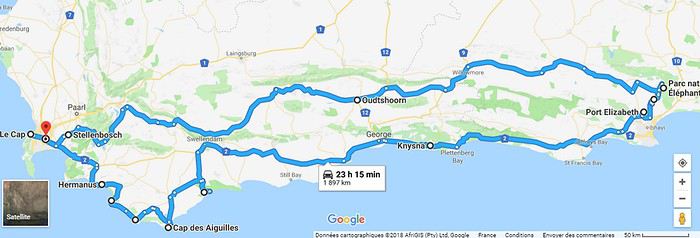
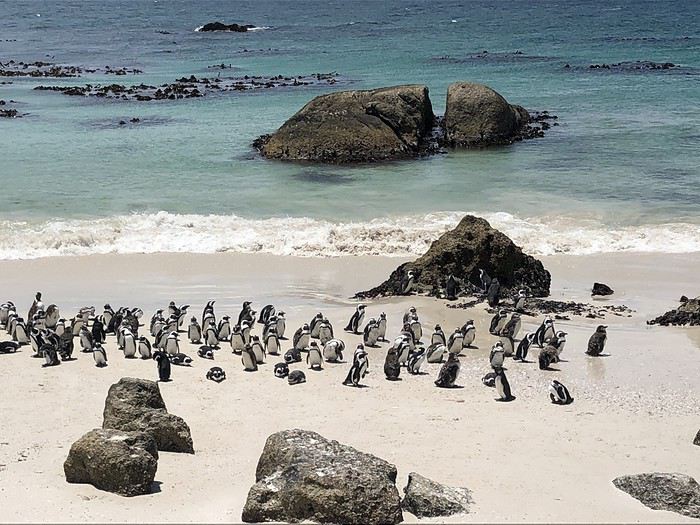
😏 SOUTH AFRICA: In Cape Town, I stayed at Sunflower Stop Backpackers in the Green Point neighborhood—very quiet and safe. This hostel is perfect for meeting travelers of all ages. Everything is nearby (supermarkets, bars, restaurants, the sea, the park, tourist areas, the stadium, Sea Point, and the Waterfront). I spent 13 days in Cape Town and always found something to do—this city is so pleasant to live in, welcoming, and packed with sports and cultural activities. Don’t miss the Minstrel Carnival in early January if you’re in the area. Kalk Bay beach (with its colorful beach huts) is worth the detour on the way to SIMON’S TOWN and Boulders Beach. Stop for lunch at Salt in FISH HOEK—the homemade ravioli and fish are amazing. Everything is excellent there. At Boulders Beach, when you arrive at the main beach after the entrance gate, don’t hesitate to wade into the water up to your waist if the tide is high and head straight past the northern end of the beach—the penguins are farther out. Beautiful beach and sunset at Scarborough Beach. I took the 8-day Bazbus pass (134 €) for the Garden Route and stopped in STELLENBOSCH on the last day of my loop back to Cape Town. This lets you extend the trip to 10 days if you stay 2 nights in STELLENBOSCH, since it’s easy and cheap to get back to Cape Town with an Uber. I really liked this Bazbus option—it’s convenient because they drop you off and pick you up directly at your chosen hostel or hotel. I loved HERMANUS, even though I didn’t see any whales. The atmosphere is very British and classy. The coastline is beautiful and rugged. Don’t miss the walk to Mosselberg, which overlooks the entire bay. MOSSEL BAY is more working-class and run-down—nothing particularly interesting, in my opinion. In WILDERNESS, try to stay at Beach House Backpackers Lodge. The sea view is stunning, even from the dorm. In KNYSNA, Thesen Island is overrated—it’s full of soulless new buildings. Prefer Leisure Island, which is just as busy with wealthy owners but nice for walks and swimming. Head to The Heads to wander the coastal trails with incredible views of the bay. Don’t hesitate to explore the heart of the artistic Concordia neighborhood (Rastafarian) to Judah Square on your own. The locals are warm and laid-back. No need to go through a tour operator. Anchorage restaurant is excellent for refined dishes and a great variety of food. In STELLENBOSCH, I stayed at Just a Bed (booked for one person on Booking). Don’t hesitate to contact the owner—she has several rooms in her guesthouse. The place is cozy and charming. The town is pleasant but feels disconnected from the surrounding population. You can walk to the Lanzerac vineyard, but don’t miss Boschendal a few kilometers away on the way to FRANSCHHOEK. People talk a lot about safety in South Africa, but as long as you respect the local norms, everything goes smoothly—the people are really welcoming, no matter their social background.
Open
FA
FamilleUS 6 months ago
Two weeks in the Cyclades
The Cyclades attract a lot (a LOT) of people in the summer, and it's not always clear how to visit them.

For our first family trip to the Cyclades (in 2016), we took a route that seems great for discovering the islands: - Flight Paris / Santorini (Transavia) - 3 nights in Santorini - Ferry Santorini / Milos - 4 nights in Milos - Ferry Milos / Sifnos - 4 nights in Sifnos - Ferry Sifnos / Athens - 3 nights in Athens - Flight Athens / Paris

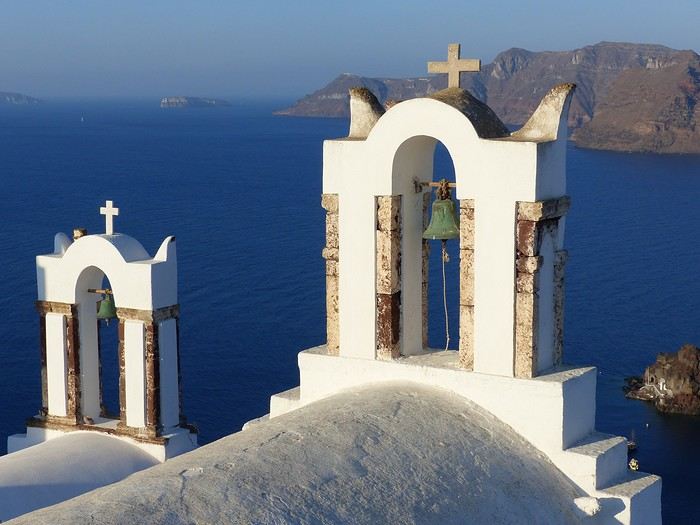
Santorini is the postcard image of the Cyclades... but not really any beaches for kids. My tip: you should stay in Oia because it's really "the spot" on the island. We chose the Pension "The Flower": simple but very well located and with a pool for the kids. Another tip: rent a car as soon as you arrive at the airport because the island is vast.

Our favorite moment: Oia around 6:00 AM, a paradise for photographers. It’s nothing like the daytime, or especially the evening when all the crowds rush in for the famous "sunset." Another favorite, the hike between Fira and Oia, 10 km, 4 hours of walking with extraordinary views (especially around Imerovigli). For the rest, we toured the island—it’s nice but nothing to marvel at.

After a 2.5-hour ferry ride, we arrived in Milos, home of the famous Venus de Milo. This is our favorite island in the Cyclades (though we haven’t seen them all!). In the port of Adamantas, we stayed at the Liogerma Hotel (very well located near the port).

Our favorite experience: the boat tour around the island (and swimming at Kleftiko). Absolutely a must-do, but book it as soon as you arrive because it’s often fully booked for the next two days.

I also recommend renting a car to explore this island. Other favorites: the incredible fishing village of Klima with its colorful boat houses, the rocks of Sarakiniko (best in the morning sun), the beach at Tsigrado (with its ladder access through the rocks), Plaka, the caves of Papafragas, the waters of Firopotamos, and Fyriplaka...

Just a 1-hour ferry ride, and you’re already in Sifnos. A small island with a bus network that means you don’t need to rent a vehicle. We stayed in Kamares (Hotel Afroditi).

Sifnos has charming villages typical of the Cyclades (Kastro, Apollonia), beautiful chapels (Chrisopigi, the Church of the Seven Martyrs...), and lovely beaches (Cherronissos, Platis Galios...). Our favorite: hiking around Faros and the Chrisopigi Monastery.

A 3-hour ferry ride takes you back to the port of Piraeus to visit Athens: the Acropolis, its museums, and the Plaka district. A little favorite of ours: the Archaeological Museum, slightly off the tourist trail... With this route, you’ll see the diversity of the Cyclades and Athens without wasting too much time on ferries.

PS: We also did the loop Mykonos / Paros / Amorgos / Mykonos, but that’s a good idea... for a second trip ;)

Open
PH
Phil31600 6 months ago
A Turquoise Dream Come True in Uzbekistan - 2022
We took this trip from September 12 to October 7, 2022. I didn’t post this travel journal earlier in Voyage Forum because the site wasn’t back up yet (and also because I was short on time). Then, at the end of 2024, I made a promise to a friend: to publish my travel journal on VF. So here it is! We took off from Paris in the late afternoon on September 12 and arrived in Tashkent around 7:15 AM on the 13th. This trip was the result of long contemplation and preparation (it was originally planned for the year of the lockdown (2020) and was prepared with the help and advice of Nasrullo Jumanov from Turquoise Travel. Stages and Itinerary Stage 1: Tashkent - September 13 and 14 Stage 2: Ferghana Valley – September 15 to 17 Stage 3: Nukus and Moynaq - September 18 and 19 Stage 4: Mysterious Khiva - September 20 to 22 Stage 5: Holy Bukhara - September 23 to 26 Stage 6: Asraf - September 27 and 28 Stage 7: Mythical Samarkand - September 29 to October 2 Stage 8: Tersak (via Shakhrisabz and Urgut) – October 3 and 4 Stage 9: Samarkand – October 5 and 6 Stage 10: Tashkent/Istanbul/Paris – October 6 and 7 Stage 1: Tashkent September 13 At the airport exit, we were greeted by the owner of our B&B (B&B Gulnara). Today was all about recovery and our first steps in the capital. Our first currency exchange made us feel like sudden millionaires. Our first stroll down the avenue leading to Chorsu Market introduced us to the fact that 80 to 90% of the cars here are white Chevrolets. A walk under the arcades facing Chorsu: hardware stores, cabinetmakers, lute makers (one of them gave me a little concert/demo of a few string instruments).
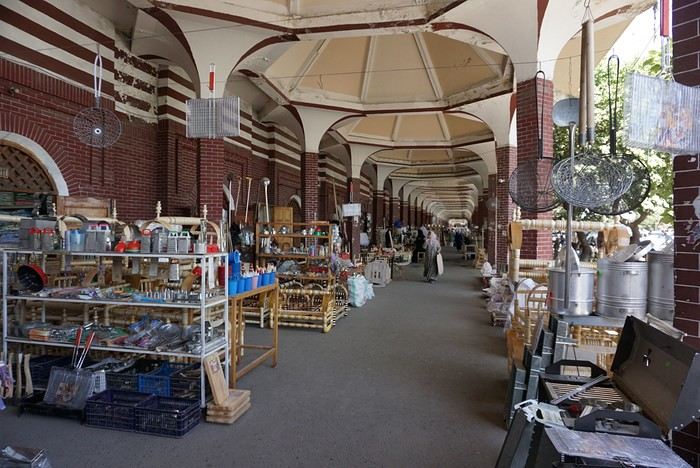
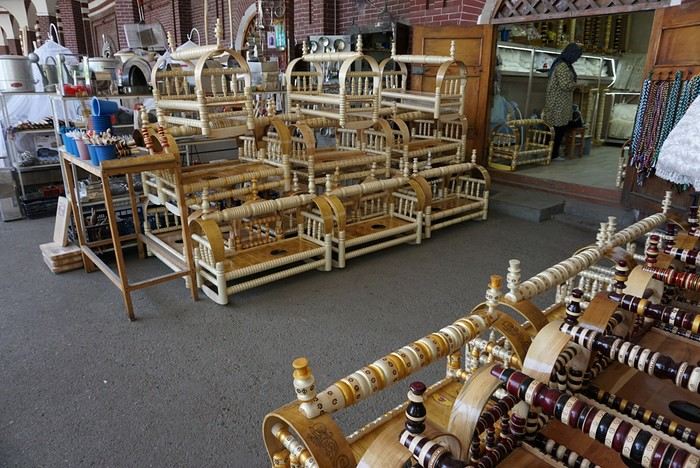
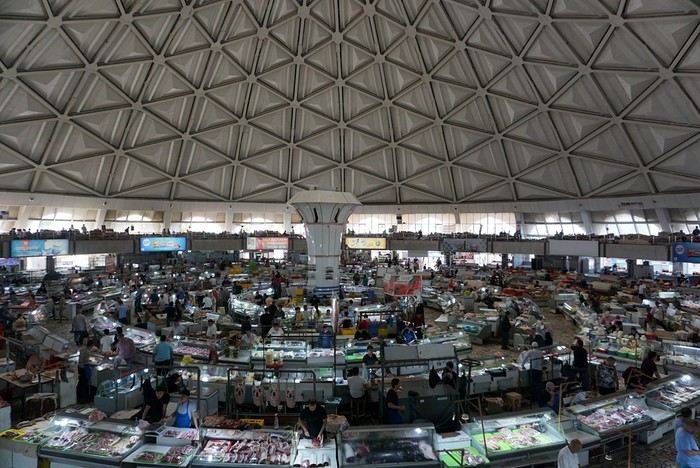
As we entered the market, many vendors called out to us, including this florist who asked where we were from: ‘France? Ah! Macron! PSG!’ He then recited a list of players from the Parisian team as well as past (Platini, Zidane, etc.) and current (Giroud, Griezmann, Mbappé, etc.) French national team players. Since we’re more into rugby (we live near Toulouse), he knew more players than I did!

The market sprawls outside around the large circular, multi-story hall. We bought some grapes and bottles of freshly squeezed pomegranate juice for just a few sums. This evening, we had a meet-up with Nasrullo. The reunion was very warm: we’d been exchanging messages for over two years, and I’d been ‘torturing’ him with changes to our itinerary and trip duration. We were finally eager to meet, and honestly, I wasn’t disappointed—in fact, it was the opposite. Nasrullo was very attentive throughout our trip and always made sure, even from a distance (and most often from a distance!), that everything went smoothly. His goal was for us to leave delighted with our trip and, why not, indirectly become ambassadors for this destination. September 14 Breakfast with Nasrullo, then we set off with him by taxi to explore some of the capital’s sites.


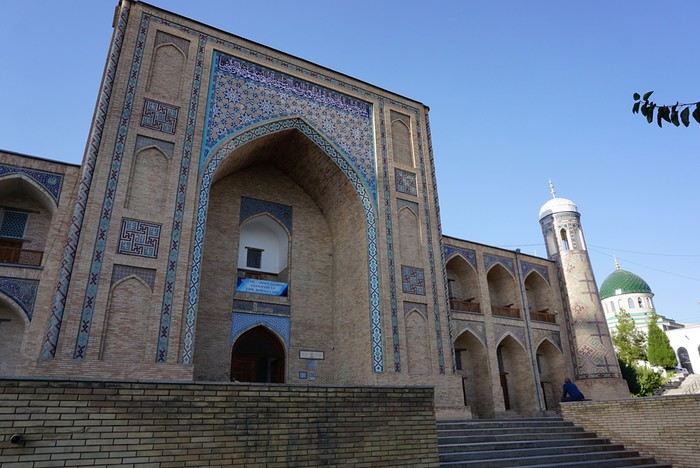
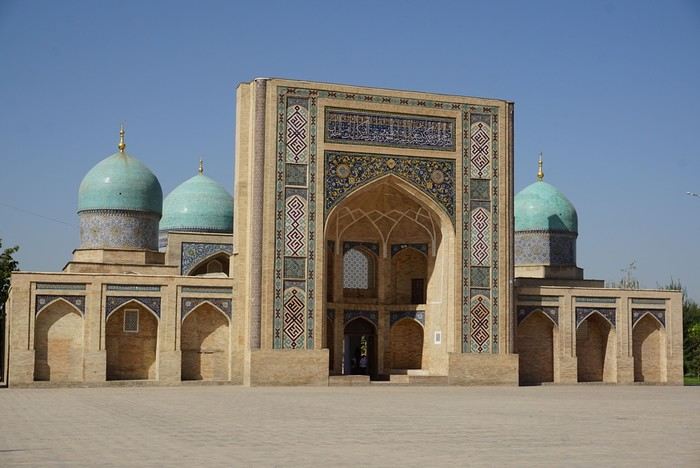
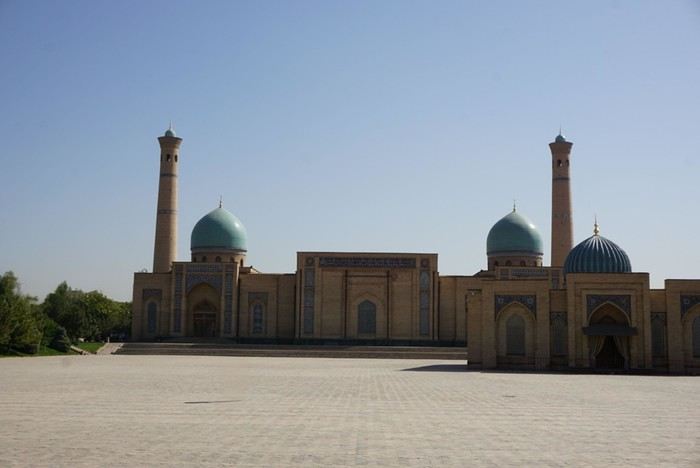
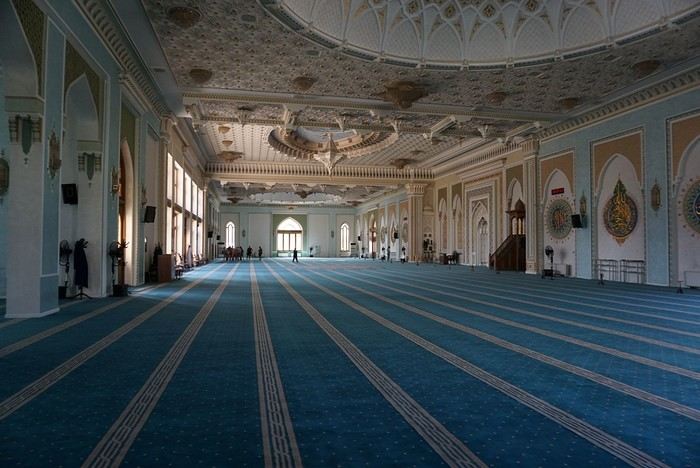
We started by visiting the Khazrati Imam complex, which includes the mausoleum of Kaffal Shashi, the Barak Khan and Muyi Muborak madrasas, and the great Khazrati Imam Mosque with its immense prayer hall.


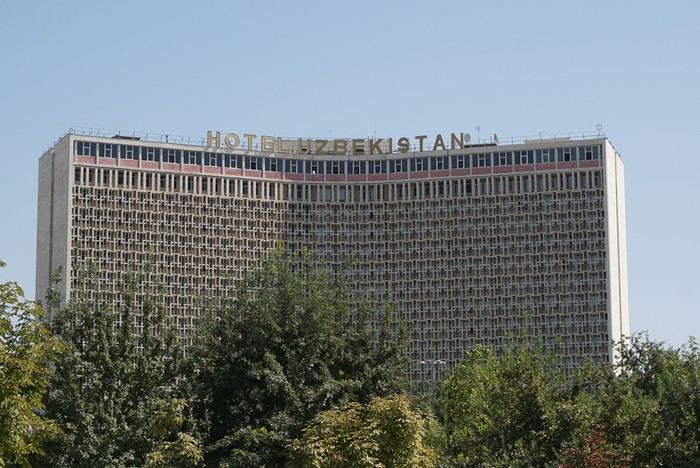
In the Muyi Muborak madrasa, now a museum, you can see the oldest Quran in the world. It was written by three religious scholars, including the secretary of the Prophet Muhammad, on large ‘pages’ made of antelope skin. Next, we explored Soviet-era Tashkent, discovering its parks, canals, and squares: Independence Square with its storks and phoenixes, Amir Temur Square with its large statue and, in the background, the massive Soviet-era hotel that has become one of Tashkent’s iconic buildings. Nasrullo took us through Broadway Boulevard and along what he calls ‘Tashkent’s Montmartre’… Well, it’s far, very far from Montmartre (in every sense of the word!). Then we took the metro to Chorsu station. Rush hour is pretty much the same everywhere in the metro… When we arrived at Chorsu, it was time to say goodbye. Nasrullo had to head back to Samarkand. Before leaving, he recommended some chaikhanas at the end of the galleries facing the market. We ate there for just a few euros (2 or 3 € for two people). After eating, we headed back to our room to cool off (our B&B is about a 10-minute walk away).


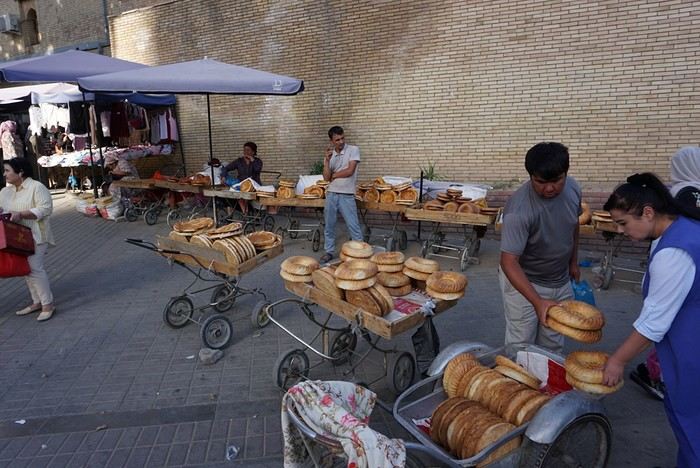
Around 4 PM, we set off to visit the Kokeldash Madrasa, which is still active. On the way, we stopped to watch some bread vendors and take a few photos. We were hesitating about buying some for our evening picnic when a young woman approached us. In perfect English, she asked: ‘Are you looking for something? Do you want to buy bread? Which one? How much?’ She then spoke to one of the vendors and negotiated the price. ‘Do you want one?’ And she took two. She paid directly. I took out my wallet to reimburse her, but she refused. It’s on the house! Then the vendor asked where we were from. And off we went again: Macron, PSG, football players… We’ll have to get used to it. The young woman smiled at the questions and comments, barely gave us time to thank her, and left as quickly as she had approached us.

We continued our walk. Visited the madrasa. Then we crossed the boulevard to see the Tashkent Circus. I would’ve loved to go in and visit, but the ticket seller wouldn’t hear of it. We carried on around what should’ve been a park with old-fashioned rides and attractions. All we found was a construction site. Oh well! Back at our hotel, a message from Nasrullo was waiting for us. He had managed to change our train ticket for the next day. Instead of taking the 6:00 AM train, we’d take the 8:00 AM one. And instead of second class, we’d be in first class! Great! This evening, we had a picnic at one of the breakfast tables in the B&B courtyard. Under a shelter, the owner and his family were celebrating a birthday. The owner started by offering us some tea. Then they brought us some fruit (watermelon and melon). Finally, after the song, candles, and cake cutting, they brought us two generous slices of that beautiful birthday cake. Delicious!
Open
LH
Lhorizon 6 months ago
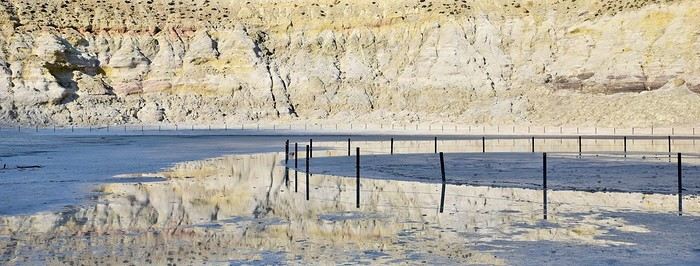
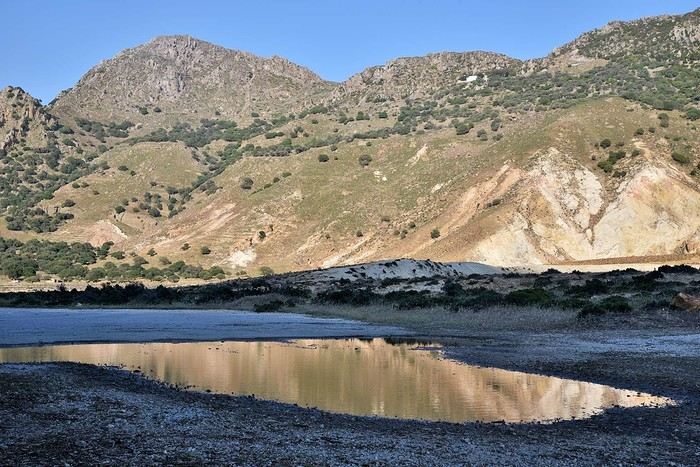
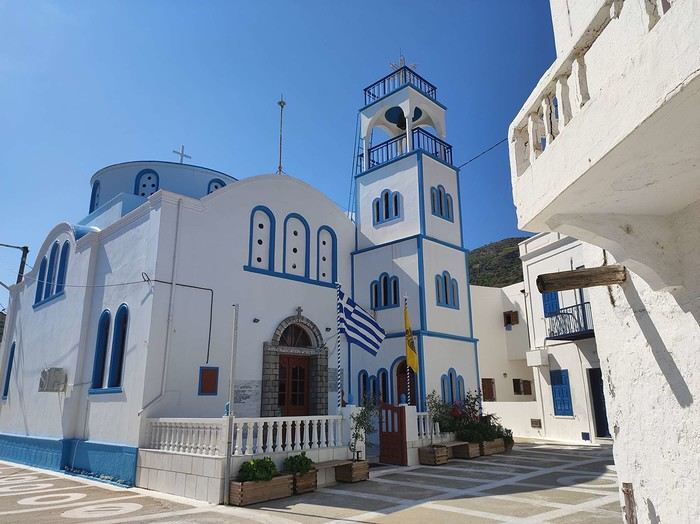
Nisyros: Greece’s most beautiful island?
Hi everyone,

I hesitated for a long time before publishing this travel journal since it’s been 8 months now since I left Nisyros. But in the end, I found it too beautiful to keep quiet about. So here we go—I finally got around to writing it. Nisyros is a stunning little Greek island, and luckily, it’s well hidden. Located a good twenty hours by boat from Athens, its distance from the Greek mainland deters most tourists from visiting. That’s what makes it an off-the-beaten-path destination. So much for the general info.


Before diving into the details, I should mention that I visited by bike (despite its severe and constant volcanic elevation) as part of a solo trip from France to Turkey. Why this detail? Because out of the ten countries I crossed and the dozens of sites I saw, Nisyros is one of my top three favorites (along with Pag Island, off-season, in Croatia, and Albania for its overall beauty—stunning natural landscapes and the incredible hospitality of its people). Anyway, welcome to this travel journal dedicated to the lovely little volcanic island of Nisyros…


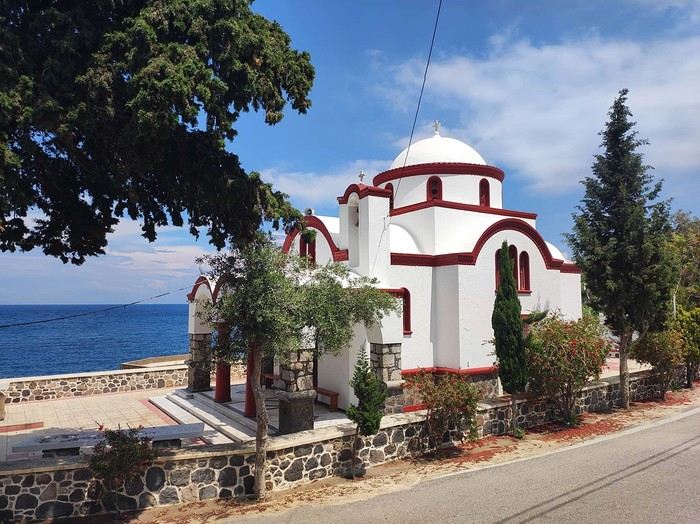
I arrived one beautiful morning in Mandraki, the island’s main port. The twenty-hour boat ride from Athens went by like a breeze. I slept on the deck for three or four hours, sprawled on a bench that was more or less sheltered from the wind. At this time of year (it’s May 2nd), tourists aren’t exactly flocking here, so the boat was far from full. My first glimpse of Nisyros is classic Greek island scenery: blazing sun, an azure sky, and an even deeper blue sea. The trip is off to a great start. I quickly found a small, out-of-the-way hotel (I’m one of those people who avoids crowds as much as possible when traveling, which is getting harder and harder to do). While everyone else from the boat turned right out of the port toward the center of Mandraki, I went left! My nice little hotel was just a hundred meters away, facing a pretty little Orthodox church whose red color contrasted beautifully with the deep blue sea.


I dropped off my panniers in my room so I could ride light for once, then headed toward the next village: Pali. It’s a small fishing village that apparently comes to life a bit in the summer with a few tourists.


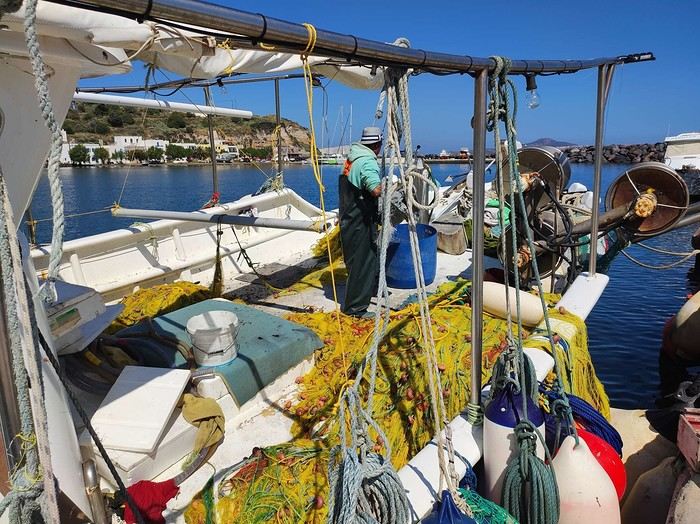
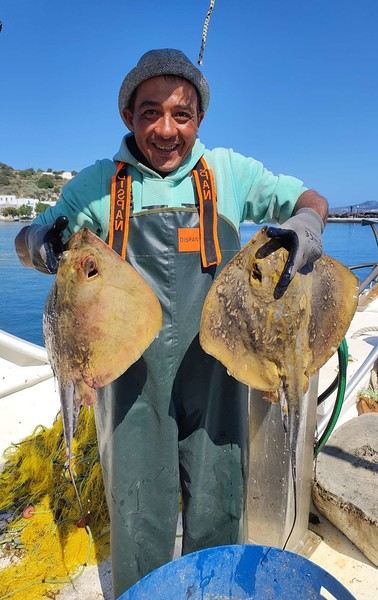
As I pedaled along the dock, I passed right by a guy sitting in a chair in full sun. Unfazed despite the sweat pouring down his forehead, he untangled his fishing net with a precision that commanded respect. I gave him the obligatory kalimera (good morning), but he reacted like a deaf-mute—no response at all. On the other hand, his employee answered me kindly from the trawler docked right next to him. Standing on deck, he was also untangling a mess of nets and invited me aboard to chat. That’s Mohamed.


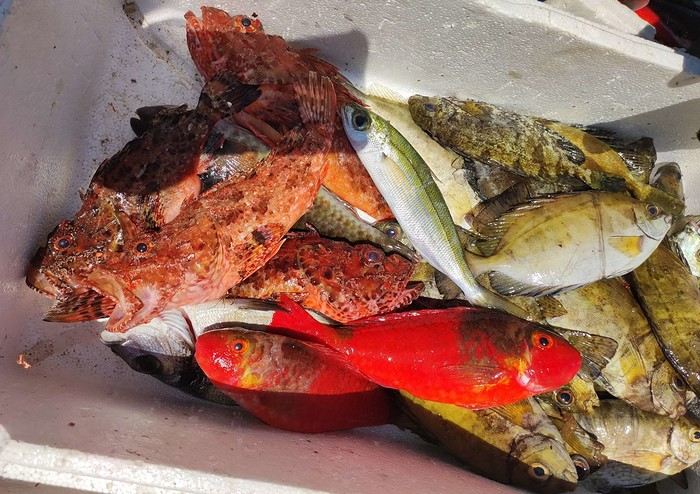
Communication wasn’t easy since he only spoke Greek and I didn’t, but he was cheerful, and his joy was contagious. He proudly showed off their catch of the day: two beautiful rays and a few brightly colored fish. We chatted like that for about fifteen minutes.


When it was time to hit the road again, I said goodbye to Mohamed, who smiled back. But this time, his boss—still dripping sweat in his chair under the scorching sun—greeted me too. Turns out he wasn’t deaf or mute after all.


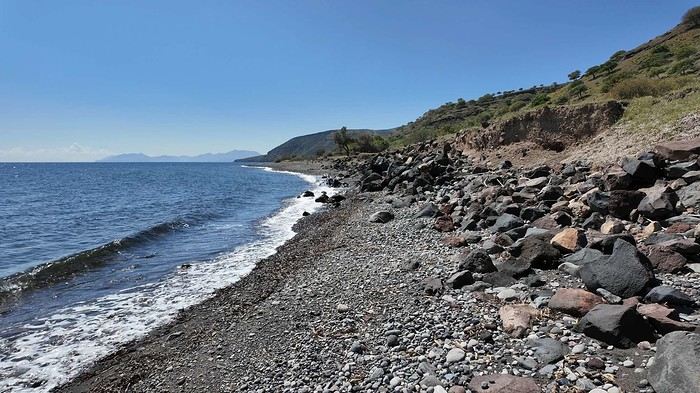
I continued along the coast since that’s where most of Nisyros’ beaches are. They start lining up just outside Pali. These are black sand beaches, which can’t hide their volcanic origins.


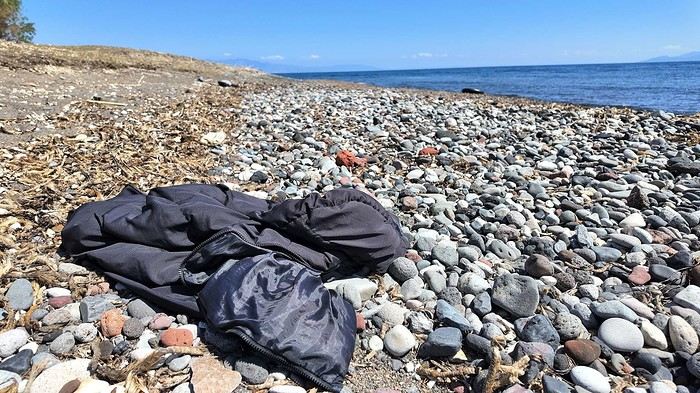
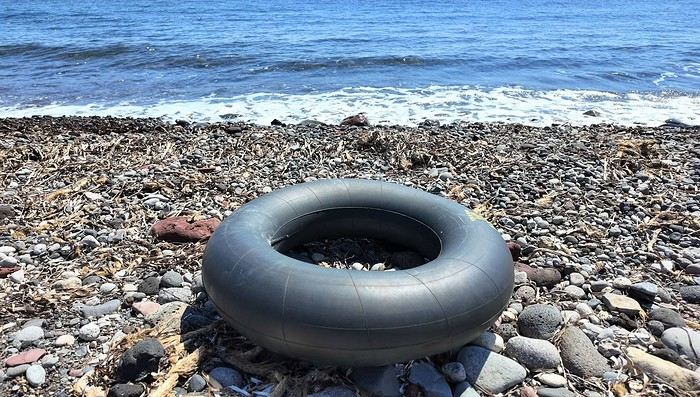
Yesterday afternoon in Athens, I met Peter and Michelle, a Dutch-French couple, while we were waiting for the ferry to depart. The Greek sailors were on strike, so we ended up waiting about twelve hours before setting off. Anyway, we had plenty of time to chat, and Peter, who’s lived on Tilos—a small island near Nisyros—for about twenty years, told me that many migrants pass through these two islands. Most come from Afghanistan and Syria, fleeing authoritarian regimes and the massacres that come with them. They’re looking for *anywhere* else where the future can’t possibly be worse. Peter explained that you often find their belongings on the local beaches. And sure enough, I didn’t have to look far to spot some—clothes, life jackets…


I glanced around, hoping to see one of them to maybe exchange a few words, but no—no one. I was completely alone.


I got back on my bike and spent the rest of the day wandering aimlessly, just exploring this beautiful part of Nisyros. I also picked up some supplies because tomorrow, I’d be heading inland for two days, deep into its four-kilometer-wide caldera to explore the volcano. I’d be sleeping in a tent, so I needed to stock up on food. After a restful night in a real bed—something rare on this bike trip (and I won’t even mention the shower…)—I finally set off for the volcano (I’ll share details about that charming little hotel with the amazing breakfasts at the end of the journal). To reach Stefanos (the name of the main crater), I had to climb to the top of the caldera. It was hot, and some of the slopes were between 10 and 15%, which is steep, especially with a 54 kg bike. But who cares? I was admiring the scenery, and I have to say, I was surprised by how green it was. The higher I climbed, the more beautiful the vegetation became. It stood out against the blue of the sea, and the landscapes inside the island were truly stunning. So, I stopped every five minutes to take photos. Every now and then, I’d come across cows in the middle of the road—or goats in the trees! They climbed with the agility of monkeys to munch on the leaves. I couldn’t get a photo of them because they’d all scatter before I got close. It was actually the noise they made climbing down that tipped me off to their presence. Two villages sit at the top of the caldera: Emporios and Nikia. I passed the first one without climbing up to it, then continued to the second. And let me tell you, Nikia was love at first sight! I found myself pedaling through tiny streets, some barely wider than my bike with its panniers. The walls were white, and the doors were painted in all sorts of colors—green, blue, red… The streets were empty, and silence reigned. But it wasn’t a dead silence. It was more like the kind you find in small, secret, peaceful places. The village exuded tranquility, calm, and well-being. I leaned my bike—with all its gear—against a wall without locking it. It was the first time on this trip that I’d done that. Sure, its weight made it more like a tank than a bike, so you’d have to be *really* motivated to steal it, but here, for some reason, I felt completely at ease. Maybe it wasn’t the smartest move, but I go a lot by instinct, and here, it felt right. So I left my bike there and went to eat a little farther away, at a small restaurant on the village’s main square. It’s famous all over Greece for the beautiful mosaic that covers and decorates the floor. Once I’d eaten and drunk my fill, I hopped back on my bike, which had waited patiently without running off. And the best part? After riding uphill all morning to reach the top of the caldera, all I had to do now was coast downhill to the volcano. Pure bliss in such breathtaking scenery.
Open
SO
Songsam 6 months ago · Travel1234
Old Burmese Adventures (oh, so many!)
Hey everyone,

Yesterday, I checked the Thailand forum to see if there were any questions to answer, but not much was happening—it was pretty quiet. Then I scrolled through the Southeast Asia section and realized that, even though Burma (Myanmar) was included, there weren’t many posts about it... I’ve only been there once, back in 1987, so it’s hard to create a photo thread about multiple trips like I sometimes do for Thailand. Still, that one trip was packed with unusual adventures, so I thought I’d share a few stories from it.

Since I didn’t take any notes at the time, this is all from memory—it’s not an exhaustive travel journal and isn’t meant to help plan a future trip to Myanmar.

Don’t expect photos; there won’t be any. I have some, but they’re slides that would need scanning and editing one by one to fix the wear and tear of time—way too much work.

The Context.

Back then (reminder: 1987), I was volunteering in Paris at the counter of a travel agency on Rue des Écoles. The agency was part of a well-known organization based in Mulhouse that mostly offered scheduled flights to Asia, charter flights to the Mediterranean, and flights to Mali with their own plane. They also had a few rare "roots"-style trips to certain destinations—trips where you didn’t bring your tennis racket but were ready to soak in everything, even if it meant tough conditions.

I’d already been to Thailand, Indonesia, and the Philippines in Asia. The director knew this, so he asked me to accompany a group to Burma. At the time, tours to Burma were already being sold by competitors, but they all had to go through the state-run agency, Touristburma (buses and hotels for tourists, and they only showed you what they wanted you to see—kind of like traveling in North Korea today). The service was only payable in dollars at the official exchange rate (which was six times worse than the black market rate, mind you...), and since it went through the state agency, all the money ended up with the junta.

My job was to do everything *without* going through Touristburma, which was completely illegal there. Nothing would be booked in advance. Back then, the Burmese visa was only valid for 8 days/7 nights, and since clients were paying for the experience, the itinerary was planned ahead. I’d have to find transport and a guide on the black market as soon as I arrived.

The clients weren’t misled—they knew from the start that the trip would be off the books, that officially we’d be a small group of friends (not an agency), unlike the truth (Touristburma wasn’t mandatory for individual travelers), and that it would be challenging. They also knew their trip would cost 3-4 times less while giving them a much better experience of Burma. As for pretending to be a group of friends, there were only six of us, so it worked out.

To cover all expenses (accommodation, transport, excursions), the agency gave me a sufficient budget. They also gave me the *same* budget a second time, which was strictly for bribing officials who might cause trouble, for backshish (tips), and, if needed, to "help" me get out of prison.

Before I left, I was thoroughly briefed by another guy who’d led the previous trip (he’d dealt with all the initial challenges). He explained everything I needed to know, what to watch out for, and advised me on what to bring as "gifts" (samples of well-known perfumes, specific cigarette and whisky brands, etc.). For the perfume samples, I rallied my family, friends, and even stores. For the rest, I’d pick things up at the duty-free shops in Don Muang (Bangkok’s only airport at the time)—I had the budget for it.

I couldn’t wait to leave...
Open
PO
Pondy 6 months ago
Climbing Haut-Folin via the southern route, in stages
Hello everyone,

I’m so happy to share my climb with you, and if it inspires you to take it on, then it’ll be a success. Sometimes I’ll use the local language because I think it’s essential to connect with the people we meet along the way.

This adventure took place last year, just before winter, right after summer, and smack in the middle of autumn. That really sets the time of year. After climbing Mont-Beuvray—a story I shared here ages ago—I decided to tackle a much more adventurous peak: the summit of Haut-Folin, which rises to 901 m, and that’s no small feat, let’s be honest. It’s located in the Bois du Roi massif. Up there, you often brush against the clouds, which seem to take a mischievous pleasure in wrapping around you.

I’m going fully self-sufficient—no porters, no guide, no cook. I’m just treating myself to a very short approach flight. The flight is early in the morning on a small plane, the *Spirit of St Bernadette*, and it’s perfect. I’ll enjoy watching it deliver mail in the mountains. The pilot will drop me off at the hamlet of *La Pierre en Eau*, near Anost, a small village at the foot of this forest-covered giant.

Physical condition I’m now really seasoned for such an expedition because I’ve trained every day by walking to the village grocery store—round trip, in all weather, that’s 2.1 km. The 451 m elevation gain won’t be a problem for me. .../...

Open
MI
Missnine 6 months ago · Pinkfloyd76
Escapade Byzantine... 4 jours à Istanbul
Byzance... Constantinople...Istanbul... 3 noms c'etait forcement synonyme de belles promesses.... 3 noms pour une seule ville...et quelle ville !!!


ça annonçait des choses à voir, admirer , un plongeon dans le passé, la culture, les 1001 nuits des merveilles .... TOUT JUSTE !!! et franchement 4 jours c'est déjà bien mais loin d'être assez !!! Pour ceux qui seraient frileux (à juste titre) d' aller à Istanbul vue le climat ambiant je répondrais qu'ils ont tort... je me suis sentie plus en sécurité que dans ma propre ville !! je suis partie avec mari et enfants et je recommencerais sans hésiter une seconde !! je commencerais par dire que 4 jours donne un bon aperçu, on a presque tout fait à pieds ( je me suis faites des ennemis dans ma propre famille...) le nez en l'air , 20 km / jours... MAIS 4 JOURS CA NE SUFFIT PAS DU TOUT !!! c'est dit !

On est parti par Turkish airlines Lyon Istanbul direct, très bien rien à redire . appartement loué via airbn'b à Balat 5 nuits /400 € appartement tout refait à neuf dans une maison typique du quartier toute en bois genre datcha, la propriétaire très sympa nous a laissé 2 appartements (comme rien n'était loué) un pour nous les parents , un pour les ados !!! Alors le quartier de Balat, c'était un choix délibéré de ma part, je ne voulais pas loger avec les touristes, donc on s'est un peu expatrié vers le vieux quartier orthodoxe très très dans son jus on a adoré !!! Mais dire que je le conseillerais je ne sais pas... des maisons en bois dont beaucoup sont encore en ruine, des petites rues sinueuses pavées, des chats, des enfants qui jouent dans la rue , des chats, le vendeurs de pain le matin qui pousse sa charrette en criant , des chats, des papis alignés dehors sur leur chaises prenant le cafés ( le fameux café turc a ne surtout pas remuer... si on aime ...!) des mamies en noir, des chien, des poules.. assez surnaturel, hors du temps, on se serait cru en 1920 après guerre... tellement à l'opposé dde l'Istanbul moderne qui se reveille ; ici un vrai décor de cinema... Tellement dépaysant tellement hors du temps que lorsque qu'on a donné l'adresse à un chauffeur de taxi en arrivant à 23h il nous a dit "oh lala je ne vous emmène pas là bas à chaque fois que j'y vais je me perds..." enfin ça semblait dire ça.. le second pas mieux... on ne parle pas turc mais c'etait très explicite quand même !! mes enfants on trouvé ça très encourageant " ou tu nous emmènes ??? ça doit craindre à mort ... mais t' as raison maman, mourir à Istanbul c'est bien plus exotique qu'à Lyon !!" donc quand le 3eme à dit "OK" on n'a rien négocié du tout !! et on a dit merci !! il s'est perdu 1 fois, 2 foisen ralant et soupirant, il a demandé à un vieux en balade nocturne et on a trouvé !!


en explorant le quartier le lendemain matin en faisant des courses pour le petit dejeuner je me suis grandement félicitée de mon choix le quartier etait parfait !! et la miche de pain à 10 centimes !! Un mélange passé /présent ou orthodoxes et musulmans cohabitent sans problème (enfin avec notre regard de touristes occidentaux ) quartier coloré entre ruines et renaissance, entre 2 siecles. on a donc fait le tour du quartier on s'est perdu... retrouvé, reperdu .... notre logeuse nous avait expliqué où acheter un pass pour les bus et comment ça fonctionnait, on l'a fait mais pour commencer on a décidé de rejoindre le centre à pieds en longeant la corne d'Or, enfin j'ai vendu ma bonne idée à toute la tribu ... ils se sont fait avoir une fois, pas 2 !! On a pris (toujours à pieds) le pont Ataturk traversé le Bosphore et déambulé dans les petites rues jusqu'à la tour Galata. on a une très belle vue du pont, et aussi de la tour que je conseille vivement . Et comme on etait vendredi midi on a eu droit à la parade des muezzins de toutes les mosquées appelant à la prière, dépaysement assuré ! la vue est magique les mosquées, les minarets, le Bosphore et de l'autre coté l' Asie; coup de foudre immédiat pour cette ville !!


c'est un quartier très vivant très touristique aussi on dit que c'est la rive moderne d'Istanbul mais qui a su garder son âme, on a de suite été frappé part les contrastes culturels, religieux et ça bouillonne dans une bonne ambiance , des femmes voilées en terrasse avec leurs copines maquillées et en mini jupe , tout semble vivre en harmonie, tout le sejour on s'est senti en parfaite securité et jamais oppréssés on a vue une jeunesse dynamique, libre, mais c'est peut etre une vision de touristes et on est bien conscient que la situation pourrait changer... on a déambulé dans le quartier de Beyoglu et du Galatasaray jusqu'à la place Taskim , entre églises et Mosquées petites rues , impasses, marchés couverts ou cotoie Zara et les boutiques centenaires ;mon regret est de ne pas y passé 2 jours, ça donnera une excuse pour revenir... On a avalé 3 loukoums et poursuivi en descendant cette fois ( PARCE QU' ISTANBUL N'EST PAS PLAT !!) jusqu'à l'embarcadère de Kabatas sur le Bosphore , je n'avais pas prévu de croisière mais vue le prix et le besoin de se poser les fesses quelque part on a opté pour le bateau. On a fait une croisière pendant 1h30 et on a pas regretté c'était super , la vue est magnifique sur les rives de Bosphore de sublimes maisons, des palais, des datchas en bois vestiges de la bourgeoisie, on a croisés des portes containers de 200m des voiliers, des hors bords et des dizaines de dauphins , tellement dépaysants !!


on aurait pu faire des haltes (descendre, visité, remonté dans le bateau suivant ) mais on s'est laissé porté au son des mouettes, et se demandant quel chemin on allait prendre pour le retour... donc à quai on a pris un bus... un peu au hazard on s'etait juste fixé qu'il fallait qu'on traverse un pont, coup de chance on l'a traversé ! on a marché jusqu'au Bazar aux Epices, mangé dans un boui boui un truc epicé mais pas trop avec du riz... pour 3 fois rien . Et rentrant par le plus grand des hasards j'ai sorti mon guide qui parlait de ne pas rater la visite de Rustem Pacha Camii, petite mosquée sur le toit du Bazar c'est presque un coup de chance pour la trouver, ici rien que pour nous avec sa belle moquette ... mon gros coup de coeur rien de grandiose mais presque magique et puis on etait tout seul , elle a eu le charme de la première . j'adore les églises italiennes.... mais les mosquées stambouillottes n'ont vraiment rien a leur envier ! suite à cette rencontre j'en ai rajouté plein à mon programme sachant qu'il y en a pas loin de 2800 à Istanbul on n'etait pas rentré !!! et mon fils de dire je vais finir le voyage en chaussettes moi, s'il faut enlever les chaussures à chaque fois !!!


Le lendemain en déambulant toujours à l' aveugle dans notre quartier nous sommes allés à pied visiter St Sauveur Chora Kariye Muzeum eglise catholique qui etait au centre d'un monastère datant de l'époque romaine dont les premiers vestiges datent du 6 ème siècle, c'est devenu un musée et les magnifiques mosaiques dorées valent vraiment le detour , un vrai petit bijou, tout comme le quartier encore une peut dans sont jus mais en pleine renaissance.


on a rejoint le centre historique par les grands boulevards ou les boutiques de robes de mauvais gout se suivent et se ressemblent... sans oublier les boutiques de robe de mariées par dizaines ( ça confirme la jeunesse de la population... ou ils se marient souvent..) On a visité la mosquée FATIH encore pour nous tout seul très belle toute rénovée.


Puis la mosquée Sehzade et pas très loin la mosquée Laleli ; mon mari dirait "quand tu en a vu une tu les a toutes vues... "c'est un point de vue mais je ne m'en suis pas lassée , ce sont des lieux avec une telle sérénité, tellement lumineux, blanc vaste, calme, j'aurais pu y passer la journée, de purs chefs d'oeuvre d'architecture et de culte..... mais d'autres mosquées m'attendaient !! on est arrivés dans le centre historique de Sultanahmet, avec les cars de touristes... mais on est là un pour ça aussi non !! DONC Ste Sophie ....AYASOFIA ... joyau Bizantin , bon je vous épargne l'historique , tout le monde va à Istanbul pour la voir, c'est l'incontournable: la star d'Istanbul ! je vous conseille les audioguides. De l'exterieur c'est un peu massif pas très beau il faut être honnête on est indulgent car elle n'est pas toute jeune la grande dame, elle a commencé son voyage au 6eme siècle; l'intérieur est un peu déroutant, on sent de suite toutes les epoques qui se sont succedées , donc on ne sait pas trop ce qu'on vient voir une eglise, une mosquée... c'est un musée !! mais toutes les epoques ont malgré tout respecté les lieux et l'ensemble est très impressionnant et assez harmonieux , je m' attendais à un nid a touristes et bien pas du tout il y avait presque personne et on s'est promené en se laissant inspirer par le lieux.


Quite à etre sur place on a enchainé avec la moquée Bleue : sultan ahmet camii... tout les touristes étaient là... on a fait la queue, foulard sur la tête chaussures à la main... tout ce monde lui a enlevé son charme et son âme , 21000 carreaux de faience pas si bleue en fait , elle est très belle mais pas notre coup de coeur ... par contre vue de l'extérieur elle en jette et est très photogénique.


par contre il parait que la "petite sainte Sophie" un peu plus loin vaut vraiment le coup et bien moins de monde. On n'a pas fait non plus la citerne basilique qui me tentait tant car trop de monde... Sultanahmet regorge de trésors ancestraux qui font le charme et la réputation d'Istanbul et sont les témoignages de la grandeur passée de cette sublime ville.

on est remonté en direction du Grand Bazar d'Istanbul... Aladin, Sheérazade, sultan, favorites et les 1001 nuits ... c'est magique !! on peut s'y perdre avec Bonheur un dédale de couleurs et d'odeur à l'intérieur comme à l'extérieur (moins touristique et moins cher !!) bien sur il y a de quoi vider le porte monnaie des touristes mais après avoir fait à différentes reprises les souks marocains assez oppressants à mon avis , ici aucune pression, vraiment on s'est senti très bien, entourés de gens polis bienveillants et souriants. on a trouvé notre bonheur en magnets et autres souvenirs... ma fille s'est trouvée 2 foulards, des bracelets et 4 maris !!! à midi c'etait noir de monde , à 17h personne.... MAIS personnellement j'ai préferé le marché aux Epices qui se situe juste derriere Yeni Camii (oh celle là on l'a pas fait...) , la nouvelle moquée sur le Bosphore, c'est plus petit mais de meilleurs qualités, on a ramené des bijoux, des épices, des draps de bain (ça prend pas de place dans une valises... mais tellement beaux...) bref on a trouvé notre bonheur ... mais ce n'est que notre avis....


Petites balades sur le pont de Galata et ses pêcheurs, et on a fini par manger un vrai Kebab au pied de la nouvelle mosquée super bon , (et celui qui est épicée est vraiment épicée celui qui ne l'ai pas, l'est aussi !!) assis sur les quais à regarder la ville effervescente !

on est rentrée en bus 99 jusqu'à Balat ( parce qu'on est personna non grata pour les taxis !)... et ce qu 'il y a de bien à Istanbul avec les turques c'est que bien sur ils nous ont repérés en bons français qui parlent forts, déjà ils nous ont sauvé la mise car on partait en sens inverse, puis dans le bus on regardait les arrêts genre : " tu crois qu'on descend à cet arrêt là ou plutot celui là ??" et bien à chaque fois on a eu des gentils personnes qui nous ont abordés: " ohh vous etes français, mon beau frere il travaille à Besançon, vous connaissez Besançon?" "non..." "c'est joli, mais il fait froid... moi j'ai travaillé 3 ans et puis je suis rentré ..." et voilà tous les soir on avait des nouveaux amis !! ils ont tous de la famille en France.. le premier soir il est même descendu au même arrêt que nous et nous a raccompagné de peur qu'on se perde "parce que les touristes ils se perdent dans ce coin ... les taxi aussi d'ailleurs!" ...m'en parlez pas mon brave monsieur !!!

jour 3 ..... Après un bon petit déjeuner à la turque dans notre décor de cinéma à Balat Fener, où errent les chats, les chiens, les papis ( j 'adore +++) hop dans le 99 direction le palais de Topkapi ... palais des 1001 nuits du sultan ottoman du 15eme au 19 siecle ..et son harem !!!! et on n'est pas tout seul !! mais c'est très bien organisé et les audio guides très utiles. on a tous les 4 adoré. on ne peut s'empêcher de comparer avec l'Alambra en Andalousie ... c'est moins grandiose mais très beau quand même. très bleu, très vert, très beau ! et très grand... on y bien passé 4heures à rêver d'un autre temps...


après un bon resto en terrasse , histoire de se reposer les pieds , digérer les loukoums... flaneries dans les rues : direction la collines et visite de Souleymaniye Camii : mosquée du sultan ottoman Soliman le Magnifique !! on ne peut pas la rater perchée sur sa colline on ne voit quelle quel que soit le lieu ou l'on se trouve à Istanbul !! on a rangé nos chaussures dans des petits casiers, mis notre foulard sur la tête, on s'est arrêté de parler et on s'est assis sur la belle moquette rouge et on a profité de la quiétude ambiante.... ma fille a trouvé que c'etait la plus jolie. Immense, gracieuse, lumineuse, harmonieuse , un vrai joyau (bien sur quand on aime les mosquées, et qu'on n'a pas atteint l'overdose !!)


on est redescendu tranquillement par les petites rues environnantes, en se disant qu'on en profitera plus la prochaine fois...


on est repassé au bazar des épices, au cas ou on oublierait quelque chose.... et on est rentré à 18H30 manger du pastrami et du fromage local dans notre maison de poupées en bois...

dernier jour.. il pleut... mince.... on reprend notre bus, et grand jour on prend le métro Marmarail pour aller EN ASIE !!! pour des ados et pour pour les grands aussi c'est trop fun !!! un rien nous amuse ! en une station de métro on change de continent... magique ! c'est très moderne propre et il n'y a personne.... on ne va pas explorer toute la rive asiatique qui mériterait bien mieux que ce que nous lui accorder comme temps mais on fait avec ce que l'on a... on a fait le tour de Kadikoy c'est très sympa vivant très commerçant, on sent que ça se réveille, pleins de petites boutiques branchées très sympas; vue la météo assez peu de touristes une très belle surprise on a déjeuné chez Ciya réputé pour ses spécialités turques, c'est très bon.

il y a une vue magnifique sur le Bosphore et Sultanahmet , au coucher du soleil ce doit être magique . on est rentré en bateau pour profiter de la vue plus de pluie mais un bon vent en contre partie... entre tankers mouettes et dauphins !!


on a traversé encore un beau dédale de petites rues commerçantes , bouillonnantes pleines d'histoire , on a rejoint le grand Bazar , au cas ou on aurait encore oublié quelque chose.. et parce qu'il pleut de nouveau... donc un petit thé au chaud est toujours bienvenue. on a acheté des baklava et des loukoums chez Afiz mustafa , pour les grands parents qui gardent le chien... on a mangé un dernier kebab et on est rentré faire nos bagages, ranger nos draps de bain dans des sacs trop petits... demain le taxi vient nous chercher à 6h... s'il trouve l'adresse !!!


j'ai adoré... en fait tout le monde adore Istanbul... j'ai trouvé que c'était une ville tellement contrastée entre modernité et tradition, passé et présent, tellement jeune et dynamique optimiste et souriante. certes c'est désordonné parfois moche, pas entretenu mais c'est son charme, tellement authentique. et pourvu que ça dure ....
Open
VA
Vaikeaiti 6 months ago · Marcelila
Voyage aux îles Marquises au départ de Papeete en 8 jours
Ce voyage est une alternative plus économique - et plus courte aussi- à la croisière sur l'Aranui 5 qui dure 14 jours dont quelques jours en pleine mer, avec un détour par Bora Bora dans les îles sous le Vent au retour. L' avantage de la croisière est de permettre de voir et visiter ( trop rapidement cependant ) les deux îles de Tahuata ainsi que Fatu Iva , dépourvues d'aéroport. En avion, on ne pourra que se poser sur 4 îles sur 6. Cependant Tahuata est accessible, à partir de Hiva Oa, en navette à la journée ( ou pour deux jours ). Prévoir deux jours supplémentaires dans le total dédié aux Îles Marquises ( appelées ' Fenua Enata ' en langue marquisienne ). Notre circuit convient à ceux qu'une croisière n'excite pas et qui préfèrent aller plus au contact des populations. Ce séjour de 9 jours nous aura coûté environ 2500 euros tout compris. Pour une croisière sur l' Aranui de 14 jours, compter 2300 euros par personne en cabine économique à 4 et 3800 euros par personne en cabine double supérieure.

La compagnie Air Tahiti offre un Pass Marquises 4 îles ( Nuku Hiva, Ua Pou, Ua Huka et Hiva Oa ) au tarif de 86000 FCP ( environ 700 euros ). Le voyage se fait en ATR 72 de Tahiti à Nuku Hiva ou Hiva Oa et en Twin Otter 19 places entre les îles ( souvent 13 ou 15 en raison du frêt, d'où la nécessité de réserver très à l' avance ). Nous voyageons en couple. Les séjours en pension de famille ont été réservés au Salon du Tourisme du début février, là où l'on peut rencontrer les propriétaires de pensions et faire son choix. Les séjours sont pratiquement toujours en demi-pension ou avec petit déjeuner seulement. Les transferts sont généralement inclus, mais on peut toujours réserver une voiture ou un taxi.

NUKU HIVA

UN PEU DE GEOGRAPHIE NH est située à environ 1500 kms de Tahiti au nord du Territoire. Avec ses 387 km2, c'est la seconde plus grande île de Polynésie française après Tahiti. Elle est issue de formidables phénomènes et cataclysmes volcaniques survenus il y a entre 1 et 6 millions d'années qui ont surélevé l'île de plusieurs milliers de mètres au dessus de la mer. Même après des millénaires de lente érosion, d'écroulements et de tassements, NH reste la plus majestueuse des Marquises, avec ses falaises abruptes, ses vallées encaissées dotées d'immenses cascades et ses murailles noires correspondant à d'anciennes parois internes de volcans énormes.

UN PEU D'HISTOIRE Les premiers contacts des habitants de NH se firent en 1595 avec des navigateurs espagnols qui ne restèrent sur place que brièvement. il fallu attendre la fin du 18ème siècle pour voir les Européens débarquer en plus grand nombre sur NH ( et les autres îles des Marquises ) et bouleverser un équilibre social et culturel très fragile. On pense qu'il y avait presque 100.000 personnes qui habitaient Nuku Hiva à cette époque, une population décimée au fil des décennies par les épidémies, les maladies apportées par les Européens et l' alcool qui servait de troc. Résultat calamiteux de cette période : il ne restait plus que 2500 personnes au début des années 30, qui avaient largement perdu leur identité et vivaient dans le dénuement. Actuellement, l'île compte environ 2600 âmes répartis sur plusieurs villages, dont Taioahe, le village principal.

NUKU HIVA DANS LA LITTERATURE

1 / L'un des célèbres écrivains ayant visité NH et y ayant séjourné fut Herman Melville, débarquant en juillet 1842, auteur célèbre de 'Moby Dick '. L'île vient de passer sous protectorat français. Melville, séduit par les vahinés enjôleuses et étourdi par sa vision paradisiaque des lieux, déserte le navire.il se retrouve prisonnier d'une tribu locale, les Taipi, à Taipivai, y demeure pendant 1 mois et demie jusqu'à ce qu'un capitaine de navire australien obtienne sa libération en échange d'un mousquet et d'un rouleau de cotonnade ! Melville fera un roman, considéré comme classique de la littérature de voyage, de cet épisode mouvementé de sa vie. Ce roman, intitulé ' Typee : A Peep at Polynesian Life ', publié en 1846 aux Etats-Unis, aura un succès considérable.

2 / Un autre écrivain célèbre écossais, Robert Louis Stevenson, arrivera à NH à bord d'un yacht qui jette l' ancre dans la baie d' Anaho, la plus belle de l'île, en juillet 1888. Stevenson est déjà connu pour deux magnifiques romans qui ont marqué leur époque: 'Treasure Island ' et Dr Jekyll & Mr. Hyde '. Stevenson, lui aussi, est conquis par la beauté naturelle de l' île, ce qui ne l'empêche pas de faire le constat accablant du déclin identitaire, socio-culturel et physique d'une population ravagée par la maladie et l' alcool. Le récit de son séjour, " In the South Seas , an account of experiences and observations in the Marquesas, Paumotus and Gilbert Islands, in the course of two cruises on the yacht Casco ( 1888 ) and the schooner Equator " ( 1889 ). Son récit sera publié en 1896 à New York, quatre ans après sa mort à Apia, aux Îles Samoa Occidentales où il était venu s'installer. Il sera aussi publié en 1900 à Londres.

3 / En août 1903, c'est Victor Segalen, médecin de marine, ethnologue et archéologue français qui débarque à NH du navire La Durance expédié en Polynésie pour récupérer les possessions du peintre Paul Gauguin mort en avril de la même année. Lui aussi est subjugué par les Marquises, mais déplore la perte d'identité, de dignité et de fierté des Maori aliénés par une christianisation qui détruit leur culture et leurs coutumes, renie leurs dieux et annihile leur passé. Il parlera de son expérience, de ses doutes et de ses craintes dans ' Les Immémoriaux '.

4 / En décembre 1907, c'est Jack London qui débarque à NH du voilier le Stark, sur les traces de son illustre prédécesseur, Herman Melville. London est dans un mauvais état physique, épuisé par ses voyages incessants qui l'ont mené du Klondike au Canada, au Japon, puis en Australie puis à Londres en Europe. Il est effaré et choqué par la situation sanitaire dégradée de Nuku Hiva : Là où son prédécesseur Melville avait rencontré plus de 2000 guerriers marquisiens vigoureux et en bonne santé, il n' en retrouve plus que 12 souffrant de diverses maladies : les autres ont été décimés par la tuberculose ! Sa démarche est toujours humaniste et il garde une conscience géopolitique aigüe devant ces cultures traditionnelles polynésiennes fragilisées par l' avancée inexorable de la modernité en ce début de 20ème siècle.... Il continuera son voyage vers les Tuamotu puis Tahiti et publiera ' Martin Eden ', le récit émouvant de son voyage initiatique dans le Pacifique Sud en 1911.

5 / Alain Gerbault enfin, écrivain, linguiste, ethnologue et voyageur infatigable, arrive aux Marquises, via le Canal de Panama, en décembre 1933. Il est totalement épuisé par une traversée interminable sur un simple voilier, le Firecrest. Enthousiasmé par son séjour aux Marquises, il continue vers les Tuamotu en 1934, puis Tahiti en 1935. Gerbault se bat pour que perdurent les traditions ainsi que les chants et les danses interdites par les Eglises et par l' Administration Française. ( Ces interdictions dureront plus de 50 ans tout de même... !!! ) Bora Bora restera son île de prédilection. Pétainiste farouche pendant la Seconde Guerre Mondiale, il sera obligé de fuir BB vers les Samoa, puis les Tonga et enfin Timor, île à moitié portugaise, donc neutre pendant la guerre en cours. Les récits de ses voyages et de ses séjours, ' A la Poursuite du Soleil, Journal de bord, de New York à Tahiti ' et ' Un paradis se meurt ' seront publiés à la fin des années 40. Il mourra à Timor en 1941 et ses cendres seront rapatriées à Bora Bora.

Retour à notre voyage et séjour.

1er jour : 27 avril

Départ de Papeete à 6 H 30, il faut se lever deux heures auparavant et rejoindre l'aéroport dans la nuit. Décollage à l'aube, beau temps sur le trajet, durée du vol 4 heures.

Arrivée vers 10 heures 30 à Nuku Hiva, première étape de ce voyage. Nous avons réservé deux nuits en demi-pension à la Pension Koku'u, transferts inclus. Peut-être pas une si bonne idée que cela, les transferts inclus, en ce qui concerne cette île singulière où l'aéroport est situé sur Terre Déserte, de l' autre côté de la montagne, à l' opposé et à quelque 45 kms du village principal de Taioahe . Ceux-ci sont facturés à un prix trop élevé. Compter 6000 FCP AR en taxi, 15000 FCP facturés par les pensions ou hôtels. La différence est donc notable. Ce n' était pas la meilleure idée, mais on ne peut revenir en arrière. Même pour des résidents comme nous qui savons voyager en Polynésie, l' employé d' Air Tahiti qui m' a vendu le Pass a été incapable de donner en sus des conseils judicieux relatifs au séjour lui-même, n' étant sans doute jamais allé aux Marquises. C 'est vraiment agaçant ! En bref, la bonne idée à retenir, c'est la location d'une voiture ( genre Suzuki ) pour être libre de gérer son temps et de s'arrêter à loisir. La signalisation sur route est un peu sommaire, mais on s'en sort facilement tout de même. Notre hôte Alvane nous attend - sans pancarte ( sic! ) - et nous voilà - après nous être cherchés pendant 5 minutes- embarqués pour un trajet de plus d'une heure ( avec les arrêts-photos ) en Land Rover aux pneus lisses ( Heureusement il ne pleut pas ! ). La route de montagne, récemment goudronnée et balisée, est impeccable. Pas le temps de souffler à la pension, nous repartons immédiatement ( voilà une très mauvaise idée après un lever aux aurore plus 4 heures d'avion ) pour une randonnée à la demie-journée qui était aussi incluse dans le séjour pré-payé. Un sandwich a été prévu ( vraiment minable pour l' effort physique qui sera exigé ), nous avons de l'eau et nous allons remplir quelques bouteilles à la source près de l'ensemble cérémoniel de Taipivai, premier arrêt. Ensuite commence la randonnée dans la vallée de Hanaheu avec re-descente vers la baie de Anaho et sa plage du même nom. Endroit magnifique et sauvage, quelques bateaux de voiles à l'ancre, on se baigne, l' eau est vraiment très chaude, plus de 30° au bord. Aussi chaud, c'est rare et pas forcément agréable. Il faudra ensuite remonter une pente très raide, cette randonnée est finalement assez difficile, l'air est immobile, humide et étouffant sous les frondaisons, il y a un peu de boue, et de minuscules fourmis ( qui ne piquent pas, je le précise ) , dites " fofolles " localement , qui courent sur les chaussures, les chevilles et les mollets. Pas très agréable...! Il y a de surcroît des moustiques dont il faut se protéger ! A posteriori, il me semble judicieux de se munir, avant le départ de Papeete, de barres chocolatées énergétiques, si l'on décide de randonner l' après-midi du jour d'arrivée. Nous ne nous étions pas méfiés... Résultat : un coup de faiblesse pour moi, et une crise d'hyper-ventilation à la remontée de la baie de Anaho !!! Retour à la nuit à la pension. On y retrouve Claudine et ses 4 enfants, ambiance à la marquisienne, sympathique et sans façon. On partage la vie familiale. Chambre très simple avec salle de bain, pas de moustiques, on peut dormir la fenêtre ouverte, mais la nuit sera bruyante comme souvent en Polynésie. Les coqs pullulent et ne dorment pas, les chiens aboient ou gémissent. On est donc amené à se lever tôt... comme tout le monde.

2ème jour, 28 avril

Nous avons réservé une excursion à la journée avec Thierry: elle commence par 45 mn en pleine mer pour rejoindre la plage de Hakatea cachée dans une petite baie secrète comme il en existe beaucoup le long des côtes de Nuku Hiva. A partir de là, la randonnée dure la journée, 11 kms AR sur terrain plat, mais aussi accidenté - les anciens chemins de circulation empierrés et surélevés et qui ont plus de 1000 ans - et puis des traversées de rivières à gué. Prévoir les bonnes chaussures ( genre crocs en plastique avec chaussettes montantes, pas très élégantes mais pratiques ). On traverse l'ancien village de Hakaui, on longe les soubassements des habitations, il y a encore des tikis patinés et usés par le temps et le climat humide dans la végétation luxuriante. Le but ultime de cette randonnée est d'atteindre la grande et haute cascade de Vaipo. Le lieu est magique, les ouvertures dans la végétation et les arbres immenses permettent de prendre des photos des cimes et de voir les grottes où l'on déposait autrefois les pirogues funéraires contenant les os de chefs ou grands guerriers. Retour par le même chemin vers la plage et de nouveau un tour en mer pour rejoindre le port de Taihoae. Retour à la pension après un aperçu du front de mer de Taihoae.


UA POU

3ème jour, 29 avril

Retour à l'aéroport en fin de matinée pour le second vol du séjour vers Ua Pou. 20 mn de traversée en Twin Otter ( 18 places mais seulement 13 sont effectivement occupées car il y a toujours du prêt à transporter entre les îles ). Temps magnifique, mer bleue, jolies photos à prendre au départ de NH et à l'arrivée sur UP. Nous sommes attendus par Jérome, ancien militaire reconverti dans le tourisme et qui tient la pension Pukue'e avec sa femme Elisa, originaire de UP. Nous allons passer deux jours exceptionnels. La pension est confortable, Jérome et Elisa sont très professionnels et agréables. Jérome est randonneur professionnel aussi, Elisa, elle, est excellente cuisinière. Nous repartons rapidement pour une excursion à la demi-journée vers Hohoi, après un arrêt sur le site archéologique- culturel et cultuel- de Maui'a, tribu des Tavaka. Jérome est là pour donner toutes les explications permettant de comprendre comment fonctionnait la société marquisienne à l'époque et les évènements qui avaient lieu sur un site dont une grande partie est encore enfouie sous la végétation. Ensuite nous allons voir un sculpteur de pierres fleuries de sa connaissance, le seul endroit aux Marquises on l' on trouve ces pierres. On les ramasse dans la rivière qui se jette dans la mer à Hohoi, parfois sur la plage elle-même. Retour à la pension.

4ème jour,30 avril

Est inscrite à notre programme une randonné- nature en montagne- moyennement difficile -vers la cascade Vaiea pendant 4 bonnes heures. Il fait chaud, il y a des moustiques, et le bain dans la vasque sous cascade ( eau à 24° ) est un plaisir rare. Déjeuner chez un ami de Jérome, ancien cuisinier de François Fillon ministre et qui nous prépare de bonnes choses. Elisa vient nous chercher en voiture pour le retour à la pension. Très belle et élégante île que Ua Pou avec ses pics effilés et sa nature sauvage. Notre coup de coeur, grâce à Jérome et son épouse également.


UA HUKA

4ème jour,1er mai

Départ pour Ua Huka, la plus petite île habitée du groupe nord des Marquises et située à environ 1300 Kms au nord-est de Tahiti. L'atterrissage se fait sur le plus ancien aérodrome des Marquises, construit en 1972, entre les villages de Vaipaee et Hane. Ua Huka compte environ 680 habitants au dernier recensement répartis sur 3 villages ( dès les années 1870 ) : Vaipaee, Hane et Hokatu. L' île culmine au mont Hitikau à 884 mètres seulement. A son origine : un volcan-bouclier de genre hawaiien qui - sur une durée de quelques millions d' années- s'est effondré pour devenir une caldeira ( ou depression elliptique ) dans laquelle deux petits volcans sont apparus, les cratères de Tahoatikiau et de Teepoepo faisant actuellement partie du parc de Vaikivi. L'île est rugueuse et sauvage, plus basse que les autres, donc moins accrochée par les nuages et plus sèche. Les baies sont déchiquetées, le littoral donne dans les tons d'ocre au dessus du bleu intense de la mer, les plages sont en permanence troublées par le ressac puissant de la mer. Le village de Hokatu est à quelques kms ( seulement 14 kms de route dans l'île ) mais Maurice, notre hôte, roule au pas et on met du temps à monter et descendre. La route est entièrement goudronnée ou bétonnée, ce qui n'est pas le cas à Ua Pou par exemple. Pension décevante en surplomb du village donc isolée. Belle vue sur le fameux motu Hane et la mer qui scintille sous le beau soleil. A part cela, il y a des moustiques et des cafards, le bungalow n'est pas propre. Les repas sont pris chez Maurice et Delphine au village, la gastronomie n'est pas de mise ! Aïe !!! On est mal tombé....

5ème jour, 2 mai

Tôt le matin, après le petit-déjeuner, Delphine nous conduit au centre artisanal qui se révèle être une déception, les objets offerts à la vente étant - à mon avis - grossiers et mal sculptés. Rien à voir avec ce qu'offre le Salon des Marquises qui se tient deux fois l' an à Papeete, et où l'on peut admirer et acheter de petites merveilles, sculptures sur bois, pierre fleurie et corail. Delphine est déçue que nous ne soyons pas intéressés, et cela se voit... Elle fait un peu la tête ! Ce sont des articles que l'on doit refiler aux croisiéristes de l' Aranui qui débarquent sur Ua Huka une fois tous les quinze jours... Delphine ne parle que de cela, des touristes en solo comme nous ne l' intéressant que moyennement, semble-t-il. Le reste de la journée - passée avec Maurice - sera consacrée à la visite des centres culturels et petits musées tels le Musée de la Mer à Hane et ses pirogues anciennes, le musée archéologique municipal sur le site de Te Tumu, au dessus de l' aérodrome, la maison du pétroglyphe aux abords de la plage de Hokatu, enfin l'arboretum de Papuakeikaraa qui rassemble des plantes endémiques de toute la Polynésie et une impressionnante collection d'agrumes. Pas d' excursion prévue dans le parc de Vaikivi, vers les cratères précédemment nommés qui rappellent le passé volcanique de l'île. Aussi pour les points de vue, la végétation endémique unique et surtout les pétroglyphes. C'est dommage... au prix de la journée !!! Tout de même, en soirée, nous irons pêcher - avec sandwiches et boissons dans des glacières- avec d'autres villageois à partir du quai du village situé au bout de la route goudronnée. Il fait frais, avec du vent, pas de moustiques, beaucoup de poissons pêchés et une bonne ambiance . En prime, des cieux magnifiquement étoilés .

Ua Huka est l' une des rares îles n' ayant pas été envahie par le rat noir, ce qui a préservé sa faune aviaire, en particulier le lori ultra-marin ( ou ' pihiti ' en marquisien ) qui se nourrit presque exclusivement de nectars de fleurs ( bananier, cocotier, hibiscus, manguier, goyavier). Une chienne importée de Nouvelle-Zélande a été dressée spécialement à détecter les rats : elle inspecte le frêt débarqué des bateaux et les quais du port.

Je vous conseille de passer deux jours complets sur l'île, l'une pour la visite des différents musées, l' autre pour randonner dans le parc du centre de île, là où se trouvent les sites archéologiques , dans leur jus, c'est à dire sous forme de vestiges : soubassements de murs de terrasses agricoles, places de rassemblement ( ou ' tohua ' ), pavages d'habitations ( ou ' paepae ' ), édifices sacrés ( ou ' me'ae ' en marquisien , 'marae ' en tahitien ) avec leurs tikis et pétroglyphes.

Pour terminer, quelques infos sur le nom de l'île, liées à la culture orale marquisienne : si l'on en croit la légende de création des 6 îles marquisiennes, Ua Huka est celle qui met la touche finale à la construction de la maison du dieu Oatea, chacune d'entre elles ayant une fonction architecturale définie. Ua Huka représente le trou ( dit 'ua ' ) dans lequel le dieu dépose ce qui reste ( en marquisien ' huka ' ) des matériaux inutilisés lors de la construction.

HIVA OA

6ème jour, 3 mai

Départ en fin de matinée pour Hiva Oa. Maurice- qui avait autre chose à faire - nous largués à l' aérodrome avec 3 heures d' avance... pour dire que cette escale est un peu ratée, même si nous avons décidé de positiver ! Hiva Oa est la troisième plus grande île de Polynésie Française après Tahiti et Nuku Hiva et avant Raiatea dans les Îles sous le Vent. L' île est belle, verdoyante, luxuriante, découpée. Les montagnes grimpent au ciel, les ouvertures sur la mer sont grandioses, la lumière est sublime, nous avons de la chance. Temps magnifique. Tania de la pension Kanahau nous attend à l'aéroport. Nous allons passer, en sa compagnie, deux jours formidables. Tania est avenante, souriante, dynamique. Quel plaisir d'être avec elle, chez elle, elle cuisine divinement et sert le meilleur thon du monde ( le Big Eye réservé aux Japonais ) et des croquettes de langouste, chevrette et crabe avec des dés de uru ( arbre à pain ) par exemple. Bungalow confortable, pas de moustiques la nuit, on peut dormir fenêtre ouverte. C' est formidable ! Après installation, Tania nous conduit en ville à Atuona, petite bourgade agréable et bien agencée. On commence par déjeuner d'un poisson cru au lait de coco excellent, et puis on poursuit avec le tour des attractions incontournables : le cimetière catholique où se trouvent les tombes de Paul Gauguin et de Jacques Brel en surplomb de la ville, le cimetière protestant, désaffecté et retourné à la brousse, où se trouvent d'impressionnants tombeaux de guerriers marquisiens faits d'énormes dalles de corail et ornés d'une tête de tiki ( plus difficile à trouver, car personne n' y va... demander le chemin ! ) le centre artisanal, le musée Gauguin ( et le musée Jacques Brel ), le front de mer. Pendant que nous nous promenons tranquillement, Tania nous a organisé une excursion pour le lendemain 4 mai, la journée entière avec Pifa O' Connor, un garçon de 36 ans qui connait son île par coeur, est féru d'histoire locale et avec qui nous allons sympathiser.

7ème jour, 4 mai

Pifa débarque à 8 heures tapantes à la pension, et nous allons derechef acheter les sandwiches et l' eau dans une supérette de Atuona. Nous allons d'abord faire une brève halte en bord de route, un endroit non signalé, à partir duquel nous dévalons un petit sentier dans la végétation dense qui nous mène au célèbre tiki souriant, le seul du genre aux Marquises et en Polynésie. L' endroit est improbable, le tiki n' est pas immense, mais beau et impressionnant. Puis nous voilà roulant sur la route qui, de façon vertigineuse, longe et surplombe la côte nord de l' île, en limite de l' ancien volcan. On croise peu de véhicules, la route devenue piste empierrée est pleine de trous et on avance au pas. ( A signaler que cette route est entièrement goudronnée depuis 2018 ). Les panoramas sont majestueux, avec tous les verts de la création sur bleu de la mer. Nous faisons halte de nouveau en haut d'une falaise agrémentée d'une énorme pierre, dite ' pierre aux sacrifices ', d'où l'on jetait à la mer, aux temps anciens, de jeunes fille vierges offertes aux dieux courroucés. Encore une pause pour le déjeuner cette fois, dans un petit restaurant proche de l' exceptionnel site archéologique de Puamau. Nous allons connaître les moments forts de ce séjour lors de cette excursion avec notre guide, Pifa, jamais avare d'explications. Nous découvrons sur une immense esplanade, les ensembles cérémoniels de Ta'a Oa et de Meae Te I'Ipona, ce dernier possédant de superbes tikis, en particulier le tiki couché - ou ' Maki Taua Pepe ' représentant la Maternité, à savoir une femme accouchant en position accroupie comme c'était souvent le cas dans de nombreuses civilisations, et le ' Takaii ', le plus grand tiki répertorié de Polynésie à ce jour. A noter aussi, une énorme pierre au tranchant désormais émoussé et sur l' arête de laquelle on pratiquait la circoncision de fils de chefs et de notables pré-adolescents. Rude épreuve ! Mais voilà, ce n' est pas tout ! Il parait qu'il y en a d'autres encore sur le flanc de la montagne qui s'élance en pente raide derrière le site archéologique, tikis renversés, plates-formes et , parait-il, un tiki géant tout en haut, qui a du tomber mais que l'on voyait de loin sur la mer il y a encore 30 ou 40 ans., selon les anciens de l' île. Cet endroit de rencontre, de culte et de vie - c'était en fait une petite ville - étant immense. Il y avait autrefois dans cette partie de île des milliers d'habitants. Le site - sanctuaire religieux, social, culturel - aurait la taille des plus grands sites maya du Yucatan, mais les quelques propriétaires concernés - deux Lou trois familles, ceux qui possèdent le versant de montagne - ne veulent pour l'instant pas entendre parler de débroussaillage intensif ni de coupes d'arbres. L'UNESCO demande - à juste titre - quelques efforts de mise en conformité pour accorder un traitement de faveur à Hiva Oa en particulier et aux Marquises en général. On n' en est pas là, car, hélas, il y a des rigidités locales insurmontables ! Ce genre d'attitude est assez typique en Polynésie : on a peur de mettre à jour les " marae " enfouis sous la végétation : ils sont tabous et parfois censés dégager des ondes négatives et mortelles, et donc il vaut mieux ne pas déranger ou fâcher les esprits ou les dieux anciens qui pourraient se venger. La religion ancienne n' est jamais loin en Polynésie malgré les succès engrangés par les missionnaires.

Retour à la pension en fin d'après-midi. Dernière nuit aux Marquises chez Tania qui nous a préparé un repas fin et succulent. A noter que le dîner est facturé 2500 FCP par personne.

8ème jour, 5 mai

Nous reprenons l' avion comme prévu, via Nuku Hiva ( escale courte ). Arrivée à l'heure à Papeete.

Puisse ce carnet donner l'envie à beaucoup d'entre vous de visiter un jour les Marquises. C' est loin, c'est cher, c'est le voyage d'une vie, c' est incontournable et inoubliable.
Open
SO
Songsam 6 months ago
Far from the daily grind*
Hello, Since I enjoy not only the countryside but also everything related to rail travel, I’m starting this photo thread dedicated to trains in Thailand (I’d guess most of us have taken one at some point...). Feel free to post your pictures here as long as they fit the theme: rolling stock**, stations**, platforms, tracks (even without a train on them), technical equipment, engineering structures (bridges, viaducts), etc.—all in Thailand. For each photo, I’ll (or you can) note the station or line where it was taken. Comments and questions are welcome.

* train ** interiors or exteriors

All aboard!
Open
CA
Caroki 6 months ago
Three weeks in Albania with two older teens
We went to Albania in August 2025. Our itinerary included adventure (sporty activities, site visits), naps on the beach interspersed with swims, incredible natural sites, and a bit of culture.

I booked all our accommodations on Booking.com. Note: almost all places ask to be paid in cash!! You can obviously withdraw from banks, but the fees are pretty high. Luckily, we had plenty of cash, and the country is very safe. You can pay in euros most of the time, which avoids exchange fees. We started in Tirana. I’d read a really interesting post about Albania’s bunkers (link in my profile). We chose to visit Bunk’Art with a guide from the agency that wrote the post. It was fascinating—not only to better understand the country’s history but also because her grandfather was repressed by the regime, and she shared her family’s experience with us.

Bunkers are everywhere! In Tirana, Bunk’Art is the most interesting and largest. You’ll see the dictator Enver Hoxha’s office, where he would’ve taken refuge in case of an attack on the country. Bring a sweater—it’s really cold in the underground tunnels and their huge corridors. You can visit other bunkers around the country, in Tirana and elsewhere. Almost all are just abandoned. The cable car up Mount Dajti is right next to Bunk’Art. The view is stunning—you realize Tirana is so close to the mountains and the sea... But otherwise, it’s not that exciting for older teens (17 and 19) and their parents. We picked up a rental car in Tirana—it’d be ours for the next three weeks. We used Goalbania’s agency to avoid any hassles. First, there aren’t many cars available in Albania in summer. Second, French credit cards can be a nightmare abroad. So we preferred to sort that out in advance. After Tirana, we headed to Permet. Just a heads-up: the roads are in great condition except in the mountains. And Albanian drivers aren’t stressful to deal with. Though you might suddenly encounter a herd of goats crossing the road—haha—but if you’re not going too fast, it’s fine. In Permet, I’d been dreaming of rafting on the Vjosa, one of Europe’s last wild rivers. And we did it with a local agency! It’s beautiful, accessible to everyone, not too physical but still a bit lively—just how we like it. You can even jump into the river in some spots. In Permet, we also hiked through a canyon and visited a lovely little church.


And we took a workshop to make their local culinary pride: gliko. It’s a jam with whole fruits inside. We’d seen it on Goalbania’s site, and it was really fun. We were with a family where the secret to making gliko has been passed down for generations... Next, we headed to Gjirokastër. A city we loved: its old traditional houses (Skendulli and Zekate), its grand castle, the Ali Pasha Bridge. Along the way, we stopped for artisanal ice cream at a little shop run by a grandmother who’s been making it herself for ages.


One afternoon, my husband *had* to go to the coast in the south, to Ksamil (he’d read it was better than Sarandë). Verdict: we didn’t like it. Parking is a nightmare, the beaches are super noisy and crowded. The sea is packed with jet skis, boats, pedalos, and ropes. Avoid it.

On the other hand, we really liked Himarë, where we went next. We stayed at a campsite where we rented tents with mattresses and sheets inside. Right by the sea, on a low cliff (about 2 meters high). You can hear the waves at night... Magical!! To swim, you either jump straight into the sea (almost from the tent) or climb down a ladder, which you’ll need to climb back up to get out.


I was a little worried the campsite wouldn’t be very comfortable, so afterward, I’d booked a small place in Gjilek. Turns out, the place was really tiny (one room for four, no kitchen) and pretty expensive (over 100 € a night). We’d drive to the beach or restaurants—it’s on a steep slope, so not very accessible. Parking near the sea is tricky. But the (private) beaches were nice—we’d rent an umbrella not too close to the music and spend the day there. We also went to a wilder beach, harder to reach, via a long path. Behind the beach, there’s an amazing canyon where we’d sometimes climb using ropes (already in place, no need to bring your own) over big boulders rolled around by the stream, which must swell a lot in spring. So, the sea in Albania: it’s nice if you like swimming and relaxing, but it’s not the most interesting part of the country. There are so many other amazing things to see and discover—so many stunning sites! Maybe an agency could’ve helped us find more practical accommodations and avoid Ksamil and its surroundings. We left the coast to head to the beautiful city of Berat and its "thousand windows." We explored the city, its fortress, and its icon museum.


Then we discovered the Osum Canyon—it’s incredible. The view from the top is breathtaking. And at the bottom, it’s magical. There’s little water in summer, so rafting isn’t an option. We weren’t tempted by the big-tube descent offered by an agency—it looked fun, but the group had 40 people. We preferred hiking on our own as a family of four. We scouted the area on Google Maps... and found where to descend. We walked in the water, then it rose to our waists, then our shoulders... We weren’t moving fast. And how to get back up?? Eventually, we followed a group with a guide—the path was hard to find.


After that unforgettable hike, we visited the Bogovë Waterfalls. It’s pretty, and we swam, but the water was *really* cold. We passed through Tirana again and then headed to Shkodër. We explored a bit—its charming little streets, the Rozafa Fortress. There’s a tiny museum where you can see *huge* Ottoman stone cannonballs. And they tell you the (charming) story of the young woman who was walled alive in the castle’s foundations to ensure its strength... Shkodër is mostly a stopover to head into the mountains and discover Theth. Our goal: hiking in the Valbona Valley, from Valbona to Theth. We organized the trip ourselves, without an agency, but it took some time to figure everything out. So I’ll save you the trouble—haha. Book your tickets on the Komanilakeferry website. The ticket includes: 🙂 minibus transfer from downtown Shkodër to Koman 🙂 ferry ticket from Koman to Fierze. This ferry ride is *gorgeous*—between mountain slopes covered in pine trees, and sometimes a little house with a few fields...


🙂 minibus ticket from Fierze to Valbona. Now you’re in the mountains! The minibus drops you off near your accommodation—pick one as close as possible to the start of the hike (if that’s your goal!). The ones at the far end of the village add up to 1.5 hours of walking. Our choice: Guesthouse Dioni. The host is really lovely, it’s in the woods, and it’s basic but great. After a day of hiking, we arrived in Theth. What beautiful mountains! Then we explored Theth and the surrounding area. It’s pretty busy, but you can still enjoy the Blue Eye of Theth and its swim. It’s *so* cold! But so beautiful!


🙂 minibus ticket from Theth back to Shkodër. After a night in Shkodër, we drove to Kepi i Rodonit. A guidebook (I forget which one) raved about its beauty. And it *is* beautiful!


But the view is ruined by plastic bottles and other trash in the bushes, along the paths, and of course on the beaches. The only peaceful spot: the private beach at Kepi i Rodonit, which is cleaned. You can rent an umbrella and have lunch there. That’s where we spent our last few days—very relaxing. In short... Albania turned out to be perfect for us and our teens!
Open
NA
Nancy 6 months ago · Quatrevingt
Madagascar - June 2025
Five years of an unintended break... The closure of VF, COVID... What a joy to rediscover the pleasure of sharing!

I’ve stayed true to my habits: the following account is a collection of practical tips rather than a travel journal...

Madagascar is as big as France and Belgium combined. In three weeks, choices have to be made! It was the Great Tsingy that inspired our trip. We decided to focus on the southwest and the RN7. We skipped the Deep South and the North. Oh well...

OUR ITINERARY IN 3 WEEKS:

Fri 6 June – Direct AF flight to Tana – Flight arrives at 10:30 PM – Tana Sat – Antsirabe Sun – Miandrivazo Mon – Drive to the Masiakampy pier – Descent of the Tsiribihina River by pirogue - Bivouac Tue – Descent of the Tsiribihina River by pirogue - Bivouac Wed – Descent of the Tsiribihina River by pirogue – Bekopaka Thu – Pirogue on the Manambolo River and Small Tsingy of Bemaraha – Bekopaka Fri – Great Tsingy of Bemaraha – Bekopaka Sat – Avenue of the Baobabs – Morondava Sun – Belo sur Mer Mon – Free day – Belo sur Mer Tue – Manja Wed – Andavadoaka Thu – Free day – Andavadoaka Fri – Salary Lagoon – Mangily Sat – Ranohira Sun – Isalo National Park - Ranohira Mon – Anja Reserve - Ambalavao - Fianarantsoa Tue – FCE train canceled – Visit to a Tanala village - Manakara Wed – Pirogue on the Pangalanes Canal – Ranomafana Thu – Ranomafana NP – Ranomafana Fri – Ambositra – Antsirabe Sat 28 June – AF flight to Paris – Flight departs at 11:55 PM

TRIP ORGANIZATION: I prepared my trip using the usual guides (LP and Rough Guide), the internet, and the Freytag & Berndt map (1:1,000,000). I’m old-school—I still love visualizing my route on a paper map, even though in Madagascar, it’s misleading because some National Roads are only national in name!...

The agency: Since we couldn’t deal directly with a driver-guide (we lacked reliable info to take the plunge), we went through an agency to organize the logistics of our trip. We didn’t feel like using bush taxis (not enough time) or driving a 4x4 ourselves (neither the skills nor the boldness). The French agency connected us with a local agency, to whom I sent my detailed itinerary by email. A few exchanges via email and WhatsApp calls allowed us to finalize everything quickly after some adjustments. As you’ve gathered... we multiplied the commissions, which inflated the budget. That said, in the end, we were thrilled with our decision and our choice. Our trip was booked by the end of 2024, and reservations were made immediately. No bad surprises: the bookings in the planned hotels were honored, often with one of the best rooms. On our last day in Tana, before departure, we were lucky enough to meet the director I’d been communicating with, who helped build and validate our circuit. A very warm debriefing.

The driver-guide: The agency assigned us Faly, 33, a driver-guide for over 10 years. He stayed with us from start to finish: he picked us up at the airport on arrival and dropped us off 23 days later. A very experienced driver (which is important here), an open and cultured guide, reliable, punctual, and a great companion. And a provider of good advice throughout the trip. We made the most of the long stretches on dirt roads or highways to listen to him talk about daily life, rituals, wildlife, and flora... No time wasted! With a great playlist in the background, we combined business with pleasure! Faly’s accommodation and meals were included (quite often, hotels offer free lodging and meals to driver-guides who bring clients), as was the fuel. That didn’t stop us from inviting Faly to share a beer or our evening meal sometimes. He didn’t always accept, wanting to let us "enjoy our romantic evenings," as he put it. Present without being intrusive! Faly is fully capable of organizing a tailor-made trip directly. I recommend him without any hesitation—we were delighted with his service. I’ll gladly share his contact details via PM to anyone who asks.

Local guides: It’s the national guide’s prerogative to choose the local guides (mandatory in the parks). Thanks to his experience, Faly always booked us amazing, competent, and interesting local guides.

Hotels: I told the agency I wanted charming, comfortable accommodations, without falling into flashy luxury. We loved all the hotels (except the Hôtel Kanto in Manja). The rooms, mostly bungalows, were always spacious and clean. Unfortunately, I can’t give the prices—I didn’t get the details. Breakfast is always included, usually fresh and hearty. Very often, a small bottle of water is provided in the room.

Tana Hôtel Les 3 Métis Power cuts are common (!) in Tana. Bring a headlamp.

Antsirabe Ecolodge – Les chambres du voyageur Maybe our favorite! A few bungalows, beautifully arranged in a splendid tropical garden. The dog Kodak welcomes us warmly.

Miandrivazo Hôtel Princesse Tsiribihina Magnificent view of the valley.

Bekopaka Hôtel Orchidée du Bemaraha 2 (yes, 2) beautiful pools, a large open common room.

Morondava Hôtel Baobab Café Brand new or at least, according to Faly, just renovated. Very comfortable but without much charm (international style).

Belo sur Mer Ecolodge du Menabe The bungalows, all made of wood, bamboo, and thatch, are set on the beach. Very spacious and fully equipped! Large open-air restaurant by the sea. No hot water from the tap—it’s available in plastic bottles heated by the sun in front of each bungalow. Actually, we never used it... Another very, very beautiful spot.

Manja Hôtel Kanto The only hotel on this leg of the journey, so no choice. The owner knows it and, as a result, doesn’t bother. It’s a real dive! Tiny, dark room, a sordid bathroom with only a trickle of water—we skipped the shower! Clean sheets, though. Obviously, no Wi-Fi. The only place where I didn’t leave a tip. We were well warned about the discomfort of this stop, both by the agency and Faly. We weren’t surprised, and it even became a running joke during the trip. On the other hand, we found a nice little market in town.

Andavadoaka Manga Lodge What bliss! Especially after the horrible Hôtel Kanto. A paradise-like spot, overlooking three beautiful deserted white-sand beaches. Meals are served on the terrace facing the sea. Stunning sunset. We loved spending a day lounging here! We were the only guests and were pampered.

Mangily (Ifaty) Mangily is the "suburb" of Ifaty. Hôtel Vovo Telo A large beachfront bungalow complex. More touristy but pleasant—we spent a lovely evening there with our feet in the sand.

Ranohira Le Relais de la Reine A splendid resort built by a Frenchman, at the foot of the rocks, very well integrated into the environment. Beautiful marked trail starting from the garden.

Fianarantsoa Villa Sylvestre Contrary to what its name suggests, it’s a hotel right in the city center. Quite decent, though.

Manakara Parthenay Club Pretty bungalows in a large garden by the sea, but swimming isn’t safe—the water is too dangerous and rough.

Ranomafana Hôtel Thermal Very spacious rooms.

Meals: Not all our meals were included. It’s really not expensive. 1 meat or fish dish: around 35,000 Ar 1 full menu (starter, main, dessert): around 70,000 Ar 1 large THB beer (65 cl): between 8,000 and 12,000 Ar 1 piña colada: 15,000 Ar 1 flavored rum: 6,000 Ar (sometimes free) 1 glass of baobab juice (!): 5,000 Ar

We always ate very well. Rice is everywhere, served in large quantities. Zebu meat is quite good if not overcooked. Personally, I prefer fish, and I feasted: grouper, captain, crab, small lobsters...

We happily discovered baobab juice (especially in Belo, on the west coast). And of course, flavored rums!

We bought 2 packs of 6 bottles of mineral water at Carrefour (!) (about 5,000 Ar per large bottle) at the start of our trip. That was enough, especially since we often got water in the bungalows.

We had a few picnics included in our trip. Instead of picking up the hotel’s lunchbox, Faly prepared delicious, fresh, and varied picnics for us: tuna pasta salad, fried rice with eggs, grilled vegetables, and avocado...

An exceptional address not to miss: Mad Zébu – Belo sur Tsiribihina A highly reputed restaurant, a favorite of LP and Rough Guide, and rightly so! Gourmet cuisine, refined and elegant. Barely more expensive than elsewhere, and it’s worth it. We stopped there on our way up to Bekopaka and the Tsingy NP. Fully booked! So Faly reserved for our return, three days later. We’re still thanking him! What a treat!

THE BUDGET: Ariary exchange rate: 5,000 Ar = 1 €

Pre-trip expenses: Direct Air France flights: 930 € per person round trip Cost of the circuit with the agency: 2,880 € per person

The visa: Issued on arrival, very quickly. 35 € per person for a stay under 30 days. Super simple. Super fast.

On-site expenses: As soon as we arrived at the airport (it was nearly midnight), Faly advised us to exchange our euros for all our needs. There are few opportunities on our route to find an ATM or an open bank with a good rate. To be more comfortable, he took us to a small office under military protection just outside the airport. I exchanged 1,200 € (I had asked the agency for advice on the amount to bring) at a rate of 4,750 Ar and became a millionaire. Faly recounted all the stacks. That covered all our expenses (meals, drinks, tips) without ever feeling deprived. Personal purchases were made at the end of the trip. Convenient—it served as an adjustment variable. We spent our last million (200 €) on marquetry and vanilla. Tip: We asked for 200,000 Ar in 5,000 Ar bills for tips. That wasn’t too much—I even ran short of small bills in the last two days.

Tips: Madagascar is a poor country where every service deserves a small reward. While not mandatory, it’s customary. But no one ever demanded or expected it openly. On the contrary, I sometimes had to remind a porter to give them my small bill. We never carried our luggage—porters were always present when the car arrived or waiting at our door to watch for our departure. I gave each of them 5,000 Ar. In restaurants, I rounded up to the nearest ten and left the change. Local guides also expect a tip: I gave around 20,000 Ar per day for the two of us. Finally, the national guide also expects a gratuity. I had read online to budget 5 € per day per person. I added more since we were so happy with his services. The tip was given at the end of the trip, in euros, outside the budget.

Total budget all included (excluding personal purchases): 8,690 € Clearly, Madagascar is a country where life isn’t expensive, but travel costs add up quickly due to the need to rent a 4x4 with a driver.

HIGHLIGHTS:

· The dirt roads Yes, I’m listing them among the highlights! We loved those long hours spent driving at 20 km/h on rocky, muddy, white, red, or gray sand tracks... surrounded by tropical vegetation, palm trees, pandanus, mango trees... The experiences were sometimes thrilling: crossing a river on a ferry (just planks of wood fixed on two motorized pirogues side by side) or crossing a river without a ferry, with just a kid running ahead of the 4x4 to show the way; soft sand where the 4x4 easily gets stuck... The tracks are quite narrow, and crossing paths with a bush taxi, a zebu cart, or a herd of goats is always epic. So many beautiful images, so many beautiful photos! Much more beautiful than on asphalt. So yes, we loved those long stretches on dirt roads. For us, it was clearly part of the journey. Faly was particularly careful, and the 4x4 was comfortable. No injuries, no fatigue, even after 7 or 8 hours on rough tracks. The national roads (including the famous RN7) are badly damaged by cyclones, huge trucks, and lack of maintenance. Potholes have turned into ostrich nests, and we didn’t drive much faster than on the dirt roads.

· The landscapes, villages, encounters... We crossed a variety of stunning landscapes: mountains with slopes covered in terraced crops, rice fields from apple green to emerald green, sugarcane fields, then tropical forests, baobab forests (they deserve a special paragraph below), traveler’s tree forests. And then coastlines with white sand dunes against a backdrop of blue hues!... Magical! We also passed through many villages with houses whose architecture varied by region. The Betsileo houses display beautiful decorative brick reliefs. On the west coast, the houses are more precarious, made of bamboo with palm-thatched roofs. In the Highlands region, we found solid houses with pastel plaster. Each region has its own landscape, crops, habitat, and clothing. Zebu carts are often the only means of transport in remote villages. We saw them very frequently. Again, the cart’s decoration depends on the region. And then, we met many villagers coming out of the bush and walking to the next market, carrying their crops on their heads or shoulders. More beautiful photos!

· The descent of the Tsiribihina River We boarded around 9 AM in a long pirogue with Gana, the local guide, and two pirogue men. So, five of us. The pirogue is long but narrow, about 65 cm wide. We sat one behind the other at the front on seats padded with what would become our mattresses during the bivouacs. We only took the bare essentials for two nights. A little goodbye to Faly, whom we’d see again in three days! Don’t forget us! The river is silty—meaning orange, opaque but clean. We glided along silently. Gana showed us the trees, birds, crocodiles (we saw five—apparently, we were lucky). The pirogue men rowed to get us as close as possible to these crocs sunbathing on the roots of big trees. Yeah, right!... as soon as we got too close, *splash*, they disappeared into the water. We marveled at the mini rice fields lining the river. Every tiny plot, no matter how small, is cultivated. Above them, banana fields. And on the water, a whole life of fishermen and villagers living with and from the river. Gana warned us we’d eat on the pirogue because the journey was long. So, I expected chips... But no—fried rice and zebu steak, cooked right in the pirogue!! Incredible! In the middle of the afternoon, we reached a small beach where we disembarked. Gana led us about a hundred meters to a sublime waterfall. We were alone there. We had time to swim. We’d brought our swimsuits and a towel (bought at the Carrefour in Antsirabe on Faly’s wise advice!). This swim in this paradise-like spot remains one of our best memories. We found our pirogue again and set off until our first bivouac. We’d sailed for 7 hours today. The tents were set up on a wide beach, without a single tree. A moment of solitude... Uh, where can we go to the bathroom?... Especially since it was a full moon, so we felt like we were in the spotlight. Anyway... we did as everyone else—walked away, dug a hole, and the others turned their backs. A hearty meal on the beach before a comfortable and silent night. The next day, same program, with slightly different landscapes. The gorges widened, the trees were different. But still many colorful birds. Again, we ate on the pirogue: grilled chicken and vegetables. 9 hours of sailing. A similar bivouac. This time, we got it. On the third day, we finished the descent with 5 hours of sailing. So, 7 hours, 9 hours, 5 hours... doing nothing. It might sound boring... but it wasn’t. Like the dirt roads, these were contemplative moments. It glides, it’s calm, relaxing, and there’s a lot of life on this river, animal and human. Contemplation. Suspended time. On arrival, we disembarked at a sort of joyful, bustling river port. Of course, Faly was already there to pick us up.

· The Tsingy de Bemaraha NP (Small and Great) I have vertigo. During my research, several agencies advised me against visiting the Great Tsingy. "Stick to the Small ones," they said. Grrr, no, not what I wanted—we’ve dreamed of this for years! The agency we chose also warned me but didn’t discourage me. So we started with the Small Tsingy, quite close to Bekopaka, guided by Alisha. This forest of sharp limestone rocks is impressive. No vertigo issues here. The day was completed with a short pirogue ride on the Manambolo River and a visit to two caves with pretty formations. The next day, Faly and Alisha drove us to the Great Tsingy (a good hour on a terrible track). Arriving at the park entrance, Alisha equipped us with harnesses, carabiners, and gave us some safety instructions. Faly was also equipped. Wait? He’s coming with us? I quickly understood he was there for me—if I got stuck, he could go back with me, and Philippe could continue with Alisha. A wise precaution that delighted and reassured me. In the end, it was unnecessary since the famous bridge crossing was fully secured by the harness and carabiners. 18 meters on planks, one by one, it didn’t sway too much—I walked looking straight ahead, not a glance down. I even managed to smile in the middle of the crossing—I have a photo to prove it! I was overjoyed! The circuit in the Great Tsingy is a loop, so we didn’t have to cross the bridge again. We climbed to viewpoints offering breathtaking panoramic views. It’s extraordinary, unique, incredible. All this to say that if you have vertigo, don’t hesitate! It’s doable! It’s completely safe and really worth pushing your limits a bit! For those who’ve done treetop adventure courses, it’s similar. Also, no need to be a great athlete—just a bit of agility to climb a few ladders and high steps. Don’t censor yourself! I even had a small regret—the loop was a bit short (about 2 hours). I would’ve liked to continue or even redo it, with less apprehension. Tip: Do the Small Tsingy before the Great ones, or not at all. And if you can only do one, do the Great ones without hesitation.

· Canoeing in the Belo mangrove The Belo sur Mer ecolodge lends small individual canoes for free to go to the mangrove. We left at high tide, paddled for about twenty minutes to reach a fairly sparse forest where we could easily venture in. Very shallow water, crystal clear—we could see the roots of all these trees, schools of tiny fish... It was quite surprising. Until then, I only knew impenetrable, tangled mangroves. Here, nothing like that—we walked through an aquatic forest. We loved this adventure so much we left a bit late. The tide had gone out, and we had to carry our canoes for the last few meters... Of course, the staff came to help (probably laughing silently!). The lodge owners gave all the necessary explanations and lent a waterproof bag for the phone (because yes, it’s worth taking photos!). A very useful precaution—the canoes are small, low in the water, and paddling quickly soaks you. Again, this isn’t just for Tony Estanguet! It didn’t cause us any problems, not even sore muscles the next day. A great experience. It’ll take about 2 hours.

· Isalo NP Big surprise when we saw this huge rocky massif appear on the RN7! A massif of colored sandstone, carved with crevasses giving it a ruined look. Le Relais de la Reine is a little gem cleverly nestled in the heart of these rocks. A small marked trail starts from the garden. We picked up the description at reception and set off. Without a guide, alone following the markers, it took us 2 hours to complete this magnificent little trail, giving us a first glimpse of the massif before the hike the next day. And we enjoyed being completely alone for this walk. It’s free, easy, and well-signposted. Don’t miss it. In the evening, Faly took us to the so-called Isalo Window site—a hole in a wall through which we could see the sunset. We met all the tourists in the area here. We weren’t blown away by the show... The next day, we left early to reach the start of the hike. We met Zozoly at the guides’ office in the small town of Ranohira. During this hike, we climbed through the rocks to a viewpoint offering stunning 360° views of the massif. Then we reached a site called the "natural pool," breathtakingly beautiful, especially since we were alone again. A sort of oasis, a cascading waterfall, palm trees and tree ferns, fine sand, all nestled at the bottom of a small canyon. Paradise-like. We resisted swimming, but it was really tempting. A long walk on the plateaus then led us to a well-equipped picnic site where a local team prepared grills. Concrete tables were tiered in a spacious, shady clearing where a whole family of ring-tailed lemurs frolicked. They knew the tourists’ habits and tried to snatch food. Playful and not very shy, they amused us with their antics! We had to resist not luring them with a piece of banana!! Thousands of photos!! After the meal, we set off again with Zozoly for another landscape. This time, we were by a small river at the bottom of a canyon with high walls covered in vegetation. The trail was narrow and slippery, on a ledge of the wall. We progressed carefully. No danger, though. We first reached the Blue Pool, which only turns blue in photos (surprise!), then the Black Pool fed by a shower of waterfalls. Two magnificent spots that showed us a completely different aspect of the massif.

· Anja Reserve This ficus forest is home to many groups of lemurs. Used to humans, whom they don’t fear, they move around us, ignoring us completely. It’s almost annoying... The best place on our trip to see lemurs.

· The FCE train To the great regret of Manakara’s inhabitants, the FCE train hasn’t reached here for over a year and a half. As a result, there are far fewer tourists—the train was part of the experience. We drove there and didn’t regret coming to this port on the east coast.

· Visit to a Tanala village This visit wasn’t part of our program—it was added by the agency to compensate for the train not running. Which was the case. Not big fans of this kind of visit, where we feel like we’re at a zoo, voyeuristic, lacking authenticity, we followed the local guide with some skepticism and exchanged dubious looks. And yet... the guide’s explanations about village life and the warm, smiling welcome from the villagers charmed us and dispelled all our concerns. We learned a lot, met smiling families, and were able to enter these beautiful bamboo houses. A very pleasant surprise, rich in lessons.

· The Pangalanes Canal Arriving in Manakara, we crossed a bridge overlooking the Pangalanes Canal. A cry of surprise: the water is turquoise! We took a short pirogue ride with a team of three pirogue men and Joël, a local guide who explained the drama caused by the train’s halt. We stopped in a fishing village where Joël bought fish for the barbecue. We ended up on a beach where the team prepared the meal while we went to watch the fishermen return on the nearby beach. We admired the fishermen’s dexterity in untangling their nets, sorting their fish, cleaning their gear. On our return, we found a small table set up on the beach, in the shade of palm trees and casuarinas. Lobsters, captain fish, grilled vegetables, sautéed potatoes. A real feast (included in the trip cost).

· Ranomafana NP A 4-5 hour hike (some climbing) in a dense secondary forest to look for lemurs. As usual, we were accompanied by a local guide who, while waiting to find our furry friends, gave us lots of info on the vegetation, birds, and Tanala ethnic rituals. In the forest, we met 4 or 5 trackers, armed with radios to alert guides of their findings. In the end, we saw several lemurs of different types. Quite far, quite high... A nice complement to our lemur encounters in Isalo. Here, it rains 200 days a year. We started the hike in thick fog, but the forest’s density protected us from the humidity. Be careful—it can be a bit frustrating to see the lemurs so far away, so high. Nothing like the Anja Reserve or Isalo NP. Here, what’s fun is the hunt.

· The baobabs We were captivated by these kings of the forest, noble, imposing, majestic. We spotted them from very far away, towering over the rest of the vegetation. Alone, in small groups, or in forests, our trip allowed us to see hundreds of them! Mainly on the west coast. All different—bald, hairy, shaggy, short and stout, tall and thin, like Laurel and Hardy. Philippe took to naming them. Respectfully!

OUR FAVORITES: · The variety of landscapes. · The Tsingy NP.

OUR DISAPPOINTMENTS: · The Avenue of the Baobabs, very overrated and the only place where we saw crowds. We saw many other "forests" of baobabs that were much more impressive. · It’s hard to approach the population calmly as swarms of children run up as soon as we arrive, asking for sweets. Without any aggression, their smiles and laughter quickly made us forget this small inconvenience. We never gave out candy, clothes, or money. We left pens at a school and clothes with Faly.

IF WE WERE TO DO IT AGAIN: · Same period, same duration, same pace, same itinerary, but if we were to do it again today, I’d go through Faly directly! · Maybe we should’ve stayed in Ambalavao instead of Fianarantsoa. · Plan a longer loop in the Great Tsingy—it felt a bit too short.

MISCELLANEOUS: The welcome: ‘Samala Vazaha,’ there are many, many kids, sometimes overwhelming, never aggressive. We were impressed by the villagers’ smiles and good humor, towards us or even among themselves—laughter was everywhere. Safety: No problems. Out of (excessive?) caution, we spread all our money across several bags that we padlocked whenever we left the hotel. Bribes: We were stopped several times on the road by police or gendarmes. They checked our papers, sometimes our passports. Faly was perfectly in order. No discussion, no bribes, a cordial greeting from the officers. However, several times we found ourselves at small "tolls" on the tracks for villagers who had leveled the road or filled a hole, or for the young guy who ran through the river to show the way... Faly complied without discussion: every service deserves a small bill. Language: French is still widely spoken. Credit card: Unused. Cash: You need it! The climate at this time: Ideal—blue skies, sunshine, and mild temperatures (20-25°C) throughout our trip. Temperatures started to drop by our departure—winter was setting in. Clothing: T-shirt or polo and a vest sometimes in the evening, sandals on our feet, hiking shoes for all the hikes. Tip: We left a bag in the car (completely safe) with things we didn’t need daily and dirty laundry. The two bags to take out at each stop were much lighter. Before leaving, we left several polos and T-shirts with Faly, which, once washed, will make a few people happy. Tourist crowds at this time: Low—we were sometimes the only guests at the hotel. Faly explained that at the Isalo picnic site, in high season, you have to queue for a table, whereas we had our pick. Photos: Lots! Too many! That’s the problem with digital—we take so many! Health issues: Nothing serious, just the usual mild traveler’s diarrhea. Mosquitoes: They’re voracious. We took anti-malaria treatment. I’m still not sure if it was the right thing to do... I’m always very skeptical about such precautions. Internet: Free Wi-Fi at the lodges’ reception (except at Hôtel Kanto!), sometimes (rarely) in the bungalows. Phone: We didn’t try to get a local SIM card—the evening Wi-Fi was enough for us to make calls and send messages via WhatsApp. Make sure to turn off mobile data and switch to airplane mode (I activated it a bit late—received calls, spam ones at that, were charged...). Electricity: French plugs. Personal purchases: Beautiful wooden objects (sculptures and marquetry) or zebu horn items in Ambositra. 1 kg of vanilla (400,000 Ar – 80 € per kg) in Tana.

IN CONCLUSION: A trip of contemplation. A pause for admiration, as our local guide in Isalo NP said. Nothing else to do but walk, look, and enjoy. Here, there are no old stones, no museums—it’s a trip where nature reigns supreme. And what nature!
Open
YA
Yan55 6 months ago
Trip to Morocco in September-October 2025, in our camper van
Hi everyone, We’re just back from a month-long trip to Morocco in our camper van. After crossing France (we left from the Nantes area) and Spain, we arrived in Algeciras where we bought our boat tickets to Tangier. When we got to Tangier, as we were going through customs, you can imagine our surprise when the customs officer took our road map of Morocco and pointed out the label "Western Sahara" (just like in the forum’s destination section, by the way!). He wanted it to say "Moroccan Sahara" instead!!! But there was nothing we could do—it was an old map... He wouldn’t listen, and after long discussions with the other (younger) customs officers, he finally gave it back and let us through... Unbelievable! Later, we heard that other travelers had their maps confiscated outright. So, hide it well if you want to keep yours!!!

Anyway, we skirted around Tangier’s suburbs—pretty grim—and finally arrived in Asilah.

Following the coast and the long promenade along the beach, we reached the campsite. It was a bit crowded, not much shade, but it wasn’t far from the medina or the beach, and it wasn’t expensive. There’s some life here: Moroccan families seem to live on-site, in tents or basic bungalows. A woman was cooking tagine on a brazier—we were right in the atmosphere! The night was quiet, and we slept well. We set off on foot, walking along the seafront to the medina... We’d already been here in 2009. It was less touristy back then! Still, at this early hour, the little streets inside were very quiet. The walls had been freshly whitewashed, and there were even more murals than before. Around 11:30 AM, we strolled along the ramparts by the sea. There was a nice breeze! And a lot more people around. We enjoyed a milkshake on the terrace of a café overlooking the beach that stretches out at the foot of the medina. Some young guys were having fun diving off the rocks—and even off the top of the wall!


Open
RH
Rhaya 6 months ago · Tatra
Road trip 14 jours en Slovaquie
Hello à tous,

Voici le retour de mon voyage en Slovaquie de cet été. C'est vraiment une chouette destination, encore oubliée du tourisme de masse, et parfaite si vous aimez les vieilles pierres et la randonnée. Mini budget garanti !

Quand : du 3 au 17 juillet 2019 Billets d’avion CRL-BTS : €60 par personne avec Ryanair, achetés 4 semaines à l’avance Budget logement : €601 (chambre double avec sdb privée, sans petit-déjeuner) Location voiture : Škoda Fabia à €180 pour 14 jours avec Budget + €90 d’essence (environ 1300 km) GPS : Google maps sur téléphone portable, itinéraires enregistrés et consultables hors ligne Coût de la vie : €4,50 pour une assiette de bryndzové halušky (gnocchi au fromage de brebis), €1,50 le demi de bière avec ou sans alcool

Pour préparer ce premier roadtrip, comme je m’y suis prise en juin et que la destination est due au prix du billet d’avion (merci Skyscanner !), je me suis très fortement inspirée de ce fil : voyageforum.com/...-slovaquie-d6596505/

Itinéraire : Mercredi 3/7 : arrivée à Bratislava, prise la voiture, visite et nuit à Pezinok Jeudi 4/7 : Visite de Červený Kameň et Trnava en faisant route vers Trenčín, nuit à Trenčín Vendredi 5/7 : Visite de Trenčín et nuit à Trenčín Samedi 6/7 : Visite de Bojnice sur la route vers les Malá Fatra, nuit à Terchová Dimanche 7/7 : rando dans les Malá Fatra (chemin Jánošíkove Diery), nuit à Terchová Lundi 8/7 : Visite de Vlkolínec, Oravský Podzámok, Zuberec sur la route vers Poprad, nuit à Poprad Mardi 9/7 : Visite de Spišská Sobota, rando autours de Tatranská Lomnica, nuit à Poprad Mercredi 10/7 : rando du côté de Štrbské Pleso, nuit à Poprad Jeudi : 11/7 : visite de Kežmarok, nuit à Poprad Vendredi 12/7 : rando à Slovenský raj (chemin Suchá Belá), nuit à Poprad Samedi 13/7 : Visite de Levoča et du château de Spiš sur la route pour Košice, nuit à Košice Dimanche 14/7 : Visite de Košice et route vers Banská Štiavnica, visite et nuit à Banská Štiavnica Lundi 15/7 : retour prévu pour Bratislava au matin mais nous sommes resté la journée à Banská Štiavnica, nuit à Bratislava Mardi 16/7 : Bratislava visite et nuit Mercredi 17/7 : Bratislava, retour vers Charleroi

Si c’était à refaire : - Je passerais une nuit de moins à Trenčín. La visite du château et de la vieille ville est rapide ; - Et du coup, je passerais une nuit de plus dans les Malá Fatra. Je pense d’ailleurs y retourner une semaine entière juste pour randonner. Le logement était parfaitement situé et très confortable : www.montanask.eu/ ; - J’emporterais une doudoune pour les rando dans les Tatras. On a eu 12 degrés et de la pluie 4 jours sur les 5… ; - Je passerais plus de temps à Banská Štiavnica, véritable coup de cœur de ce voyage ; - Chemin entre Košice et Banská Štiavnica trop long, il aurait fallu le couper en deux ; - Je n’ai fait aucune église en bois, ça sera l’occasion d’y retourner…

En vrac : - Le territoire Slovaque fait 1,5 fois celui de la Belgique pour moitié moins d’habitants. Du coup, les villes sont de taille acceptable et pas surpeuplées, on croise de touts petits villages très fréquemment. - Les centres historiques sont globalement bien conservés, mais je déplore qu’ils ne soient pas tous piétons. Une voiture devant un bâtiment classé par l’Unesco, ça fait tâche. - A propos de voiture, la majorité des parkings sont payants et chers (€1 ou €2 de l’heure). Pensez à faire une recherche des parkings gratuits avec Google maps, Tripadvisor, etc. - Du coup, du côté de Poprad, laissez votre voiture à l’hôtel et prenez le train de montagne qui s’arrête à toutes les stations de ski des Hautes Tatras. €4 le pass à la journée, €16 pour la semaine, bien moins cher que le parking à la journée. - La nature est omniprésente et propice à la randonnée : forêts primaires, via ferrata, haute montagne, vous avez l'embarras du choix. - Le tourisme m’a paru très « local », j’ai l’impression que les slovaques visitent et randonnent énormément dans leur pays. - J’ai visité beaucoup de châteaux (Červený Kameň, Bojnice, Trenčín, Oravský Podzámok, Kežmarok, Spiš, Banská Štiavnica) et pas deux ne se ressemblaient. Malheureusement, pour beaucoup, la visite guidée est obligatoire et se fait uniquement en Slovaque. Comptez malgré tout entre €7 et €10 l’entrée. - Idem pour les mines d’argent de Banská Štiavnica : la visite s’est résumée à une marche de 2km sous terre avec des arrêts pour des explications incompréhensibles qui avaient pourtant l’air intéressantes. - On mange bien et pour pas cher surtout dans les koliba, maison en rondins servant des plats traditionnels. Fait amusant : le poids du plat est indiqué sur le menu. - Les vins locaux sont excellents et se payent souvent au décilitre (1dl = €0,70). Ne pas hésiter à faire la route des vins du côté de Pezinok, mais attention, tolérance zéro quant à l’alcool au volant. - Depuis Bratislava, de juin à septembre, il est possible d'aller à Vienne en profitant d'une croisière sur le Danube. Par la route ou le train, Vienne est à seulement 1 heure de route de la capitale Slovaque. Du coup, si vous trouvez les vols pour Vienne trop chers, pensez à faire un détour par Bratislava qui se visite très rapidement.

En images : Château de Trenčín

Château de Bojnice

Randonnée dans les Malá Fatra

Vlkolínec (Unesco world site)

Oravský Podzámok

Zuberec

Spišská Sobota

Štrbské Pleso

Château de Spiš

Banská Štiavnica (Unesco World site)

Bratislava
Open
CH
Chris51 6 months ago · Xrctn
My first trip to Iceland, over 50 years ago.
My first trip to Iceland, in 1974.

Yes, you might be surprised: my first trip to Iceland dates back to July 1974. It’s been a little over 50 years since I first set foot on Icelandic soil. I was 23 years old. At the time, I was a geography student. I had just earned my bachelor’s degree and was finishing my master’s (what we’d now call a "master’s 2") in physical geography, with two specialties: glaciology and volcanology. In both fields, professors showed us slides of Iceland—glaciers and volcanoes—and in tutorials, we worked on maps and documents related to the physical geography of Iceland. So there you have it: ice and fire, in Icelandic « ís og eldur », I learned that year that it was Iceland’s national motto, and that’s what drew me there for my first big trip.

Iceland in 1974 was very different from today. It wasn’t a common destination. There were practically no tourists or tourist infrastructure. Some sites now famous and overcrowded were only accessible after hours of hiking on rough, unmarked trails. GPS didn’t exist, but I had managed to get local 1:100,000 maps that were pretty well done. I took my time to circle the entire island, camping in the wild. Most of my meager budget went toward the flight ticket and renting a Volkswagen "Beetle."

There were no paved roads in the country except in central Reykjavík and the main street of Akureyri. What’s now called Route 1 was everywhere dirt and gravel, pretty bumpy in places. According to my maps, this road didn’t allow for a full loop around Iceland: a section of about a hundred kilometers was missing on the south coast. But when I arrived in that area, I learned at a gas station that the last missing section had just been completed, finally allowing a full loop without backtracking. It was the section crossing the vast Skeiðarársandur, southwest of Vatnajökull. The new road was just a bulldozer track through this black ash desert. We crossed the multiple channels of the sandur on long single-lane wooden bridges. On these long pilings, the road was made of roughly nailed thick planks that made an awful racket when the car drove over them.

A nasty surprise: the cost of living. The difference with France seemed huge—everything was two to three times more expensive than back home. Prices were way beyond my tiny budget, and I wondered how I’d manage to get by.

The Icelanders back then were very different from today. From the start, I felt like a real outsider, ostracized, even outright rejected. Several times, when I asked for permission to pitch my small tent near a farm, the door would slam shut as soon as I asked (in English). Without a word… *Bam!*

So I struggled to feed myself, lacking money. I mostly bought loaves of sliced bread and corn flakes (unknown in France at the time), which I ate with cold, sugary milk. It was the cheapest and most filling thing I could find.

In Reykjavík, my only luxury was daring to enter a snack bar. There, I’d treat myself to a coffee or tea, having quickly learned that after paying for a cup once, you could go back to the counter and have it refilled as much as you wanted. I dreaded being asked if I wanted something to eat because I couldn’t afford it. Luckily, no one asked. So, alone in my corner, I’d pull out my loaf of sliced bread from my backpack and make sandwiches with the contents of the two plastic bottles on every table—one red, one yellow: ketchup and sweet mustard. I avoided the sideways glances from other customers. I’d eat my sandwiches and leave, both full and warmed up.

One time, near Selfoss, I saw a truck stop by the road and pick up two large aluminum cans left at the end of a farm track. A little further down the road, two more similar cans. I realized these cans were there to be collected by… well, I didn’t know who. No one in sight for miles. So, I’ll admit it: I stopped and opened one of those large cans, which contained a dairy product—a kind of very dense, compact white cheese (I later learned it was skyr). I scooped a nice layer from the top, smoothed the surface with my spoon, and carefully closed the can again. Yes, I know it wasn’t right, but that was over fifty years ago, and I can admit it now since the statute of limitations has surely passed, right? Another time, I boiled a piece of dried fish, hard as wood, for a long time on my camping stove—fish I’d taken from huge outdoor drying racks by the side of the road. On the road heading north from Reykjavík, the Akranes underwater tunnel didn’t exist yet. To get to Borgarnes and Snæfellsnes, you had to go around Hvalfjörður. Following the shore of this long fjord, I stumbled upon a whaling station in full operation. Intrigued by the plumes of steam and the sounds of machinery from the road, I stopped, and surprisingly, no one stopped me from entering the vast platform where workers were butchering a large whale. I’ll never forget the acrid smell of those huge piles of meat and bones, fat and guts, the screams of saws and winches, the steam from the boilers… A monstrous, hallucinatory sight that would shape a major interest for the rest of my life: whales.

At the end of my journey, I spent three days in the Westman Islands. The famous eruption of the Eldfell volcano had happened just months earlier, in 1973, and was barely over. Visiting Heimaey was one of the goals of my trip to Iceland, given my volcanology studies. Part of the fishing port was filled in by lava flows, and the entrance channel was reduced to just a few meters wide. Most of the village was covered by a layer of black, hot ash eight to ten meters thick. I walked on the roofs of houses—every now and then, a chimney or skylight would stick out. In the rain, this hot ash released intense steam; you couldn’t see twenty meters ahead. It felt like being in a giant outdoor sauna. The entire population had been evacuated during the eruption, but some residents were starting to return. Bulldozers and excavators were gradually clearing this gigantic mass of ash, street by street, layer by layer, avoiding demolishing the buried houses. A constant stream of trucks dumped these millions of tons of ash into the sea from a cliff. To finish clearing the houses, it was done with shovels and wheelbarrows, and this task was left to the homeowners. One day, I had the chance to lend a hand (or rather, a shovel) to a couple finishing clearing their house. They offered to let me pitch my tent near their place, on a thick layer of warm ash (I’d never experienced such comfort through my sleeping mat), and I’ll never forget that they gave me a big bowl of delicious soup they’d just made. The best meal I had during that trip. The next day, climbing the volcano, which was still smoking and spewing furiously, I nearly suffocated from sulfur dioxide and almost melted the soles of my shoes. So it was during this initiatory trip, 50 years ago, that my addiction to Iceland was born. The following year in Paris, by sheer chance—and perhaps helped by the magic of my amazing Kodachrome slides—I met a young woman who would become my wife. Very quickly, she became as hooked as I was on "the island of the world’s creation" (as I called it back then), and later, it was often her who’d say, "So… how about going back to Iceland this year?" We went back many times, in every season, summer and winter, and in every region of the country. And every time, when the plane starts its descent toward Keflavík Airport, we look at each other like kids invited to a birthday party, discovering the cake buffet… "Here we are… we’re back!"

Our travel conditions changed a lot afterward. With a better budget but still traveling independently, renting well-equipped 4x4s that let us go almost anywhere, at our own pace, including the highlands of the country’s interior. But always taking our time, dedicating each trip to fully exploring one region rather than rushing through kilometers. And leaving time for beautiful hikes or simply doing nothing—sitting at a viewpoint and just watching, observing the wild nature, in contemplative mode… Always staying with locals in the countryside, preferably on real farms with animals, thanks to an association of farmers offering accommodations. We speak fluent English and have learned a few common Icelandic phrases and expressions over time. With a bit of experience, we developed our little techniques for starting interesting conversations with Icelanders… who, thankfully, are no longer as distant as they were in 1974! We even made friends there.

We particularly loved the rugged, wild Iceland—not necessarily the desolate highlands of the interior, but rather the isolated regions where a few very old families still cling to their land and roots. With a soft spot for the Snæfellsnes Peninsula and especially the Westfjords, the "Vestfirðir," as the Icelanders call them. But we also love the Northeast, and even the far Northeast, so remote and where almost no one goes. Over time, we’ve done a lot of reading. We’ve learned a great deal about Iceland—its painful history, its tormented geography, its economy, its incredible medieval literature (the Sagas), and some quirks of its culture. And we greatly appreciate its contemporary authors, whose books fill several shelves in our library.

In 2008, on a return trip to Iceland, we went to the Westman Islands, to Heimaey. I hadn’t been back since my first trip in 1974, right after the Eldfell eruption. It was a pilgrimage for me, so many years later! An emotional moment seeing the huge frozen lava flow again. On the trails now set up to explore this vast chaos, people have put up signs indicating the names of the streets buried under the lava and the nature of the crushed buildings fifteen meters below. Plaques mark the locations of public buildings—here was the school, down there was the hospital… The part of the town that was under ash has been cleared, but not entirely—two streets were left partially buried, probably to show tourists. The volcano is still hot at the top. We climbed it, but this time I didn’t melt my soles.

We often talk about Iceland. We still call it "the island of the world’s creation" and tell our traveler friends how much this country fascinated and enchanted us. Those who’ve never been find it a bit odd, but everyone who’s been there understands.

You may have noticed I’m talking about it in the past tense… Indeed, I’ll admit that for several years now, we haven’t been back to Iceland, and I don’t think we’ll return. What we see on social media and in the news puts us off a bit. Mass tourism has arrived, and many developments have been made—not always for the best. Now, with two and a half million visitors a year, Iceland welcomes nearly six times its population. Tourism has become a key source of income for Icelanders. Good for them, maybe, but we don’t like it at all. We’re a bit wild, perhaps. And besides… the world is vast… We loved Iceland passionately, but we’ve always been inveterate travelers in general. So over the past fifty years, we’ve certainly explored all of Iceland’s regions, but also in the North Atlantic—the beautiful Norway, the stunning Lofoten Islands, the Shetland archipelago, the rugged and grand Faroe Islands, and then further north in the Arctic—the icy Greenland, Svalbard at the edge of the world, and even the Sjuøyane, the last islands before the North Pole, with small groups of enthusiasts and scientists on expedition ships. And many other regions of the world, but always with a taste for slightly offbeat places, both in terms of landscapes and nature and ways of life. Central Asia, the Azores, Peru, Bolivia, the Andes, Chile, Argentina, the vast Patagonia, Tierra del Fuego… and other little secret gems we won’t reveal. Not even on Voyage Forum.

But everywhere—yes, I mean everywhere—wherever you are, wherever you go, there’s always a moment when you think of Iceland…

Chris 51 - November 2025.
Open
BL
Bluequark 6 months ago · Max68
Trois semaines au Japon en famille
Bonjour à tous,

Le Japon, en réalité, c’est par raccroc que nous y sommes allés. J’avais entr’aperçu ce pays lors de déplacements professionnels. Il était depuis inscrit dans ma « wish list », mais je pensais que nous irions « lorsque les enfants ne seraient plus là. ».

Mais cet été (2016), ceux-ci n’arrivaient pas à se mettre d’accord sur notre destination, avec des souhaits diamétralement opposés. C’est alors que constatant que les billets d’avion n’étaient pas hors de prix – et ayant lu que le Japon n’était pas aussi cher que l’on pouvait le croire, nous, les parents, avons proposé le Japon… tout en prévenant qu’il ferait une chaleur torride et humide et qu’il ne faudrait pas râler. Enthousiasme immédiat chez notre aînée – 18 ans : « Oh ! Maman ! Mais j’ai toujours rêvé d’aller au Japon ». Elle a convaincu son frère – 16 ans – que c’était la destination idéale. Le deal était conclu : nous partons au Japon mais personne ne se plaindra de la chaleur.

Après quelques échanges sur le forum et concertation familiale, j’ai arrêté le parcours suivant. Un impératif a dicté une partie des choix : être à Hiroshima le 6 août pour assister au « lâcher » de lanternes. Pour ne pas alourdir en trajet et éviter des transports, nous avons éliminé les Nara, Nikko et autres Kamakura.

J1 - arrivée 8 h30 à Osaka – Kyoto - autour de la gare J2 - Kyoto - Est - nuit : Kyoto J3 - Kyoto - Nord et centre - nuit : Kyoto J4 - Osaka (balade avec Osaka Safari)- Fushimi Inari -nuit : Kyoto J5 - Train - Noashima- nuit : Uno J6 - Teshima - nuit : Uno J7 - Noashima – Hiroshima - nuit : Hiroshima J8 - Hiroshima – Commémorations - nuit : Hiroshima J10 - Miyajima- nuit : Miyajima J10 - Miyajima - château Himeji - nuit : Osaka J11 - Osaka - nuit : Osaka J12 - Kyoto - Ouest - nuit : Osaka J13 - Trajet Kanazawa- Ainokura - nuit : Ainokura J14 - Shirakawa-go -Takayama - nuit : Takayama J15 - Kamikochi nuit : Takayama J16 - Takayama- retour Kanazawa nuit : Kanazawa J17 - Kanazawa - nuit : Kanazawa J18 - Trajet Tokyo (Shibuya) -nuit : Tokyo J19 - Tokyo (visite avec Tokyo Free Guide – Parc de Yoyogi - Sanctuaire Meiji- Harajuku- Takeshita-dori - Omote Sando - Odaiba) - nuit : Tokyo J20 - Tokyo (avec Tokyo Safari) - nuit : Tokyo J21 - Tokyo (Tsukiji, Hama-Rikyu-Onshi-Teien, Asakusa et Senso-ji, Kappabashi, Ameyoko et Ueno) - nuit : Tokyo J22 - Tokyo (Shibuya-Yoyo Gi bis- Ikebukuro-Shinjuku (Tokyo Metropolitan Governement Building, Omoide-yokocho, Golden Gai) - nuit : Tokyo J23- Tokyo (Yanaka – Uneo – Edo -Tokyo Museum- Takashita-Dori le retour- retour vers Shibuya) - départ 22h 50 pour Paris

(Il est possible d'accéder directement aux journées publiées en cliquant dessus).

Il a parfaitement convenu à nos attentes : bon rythme, grande diversité de visites, les incontournables mais aussi une première approche du Japon plus rural. Si c’était à refaire, je ferais exactement pareil (sauf les allers retours entre Kyoto et Osaka en J4 et 12 qui ont été imposés par mon souhait de découvrir Osaka avec Osaka safari). Bien sûr, nous avons dû renoncer à certaines visites, en particulier à Kyoto où nous avons manqué quelques « highlights » mais c’est de manière délibérée que j’avais restreint le séjour dans cette ville réputée comme particulièrement étouffante en été.

Pour les logements, nous avons mixé appartements sur AirBnB et chambres de quatre en guesthouse et ryokan. Parfait aussi. Les appartements nous ont permis d’avoir plus d’espace et de dîner tranquillement certains soirs et les guesthouses et ryokans de mieux découvrir les coutumes japonaises.

Un premier bilan d’abord : nous avons, tous quatre, été enchantés de notre séjour. D’abord, le Japon est un émerveillement permanent, comme le décrit si bien la préface de Tokyo Sanpo de Florent Chavouet – j’en profite pour faire la pub pour ce livre que j’ai lu avec grand plaisir à mon retour de vacances. C’est exactement cela, tout est prétexte à émerveillement. Tout est si différent de chez nous. J’avais envie de tout photographier autour de moi en permanence. Promis, je ne dirai plus « photographier comme un Japonais » : pendant ce séjour le Japonais, c’était moi. Et je comprends mieux le choc des Japonais voyageant en Europe.

Comme m’a dit une mienne connaissance : « C’est simple, comme ils ont dix doigts, ils comptent en base 10. Sinon, ils font tout différent de nous. ». Bien résumé.

Autre élément : tout est facile. Tout a l’air d’avoir une place et d’être à sa place. Le moindre détail a l’air d’avoir été pensé pour faciliter la vie. Me viennent à l’esprit : la signalétique si bien faite dans les gares ou le métro, les toilettes publics omniprésentes, les zones pour fumer, ces plans hyper détaillés avec toutes les informations utiles disponibles pour chaque endroit que nous avons visité … Ces plans sont si bien faits que nous avons pris l’habitude de les récupérer systématiquement. C’est bien simple : je suis rentrée à Paris avec une collection complète. Et quand nous sommes arrivés à Takayama en voiture, notre premier arrêt a été pour la gare pour avoir LE plan. Mais cet ordre va bien au-delà de tous ces éléments pratiques. Il y a un je-ne-sais-quoi qui laisse penser que tout est parfaitement où il doit être. Même aux heures de pointe, dans la cohue, les gens arrivent à s’éviter dans un mouvement fluide et sans heurts, le contraire du métro parisien. Ceux qui pratiquent à Paris certains changements à certaines heures comprendront.

La politesse exquise des Japonais et le souci d’être agréable à l’autre sont un autre attrait du voyage. Toujours, les personnes que nous avons croisées ont essayé de nous aider, de nous faciliter la vie. C’était vraiment super.

Ah ! J’allais oublier : le côté hypra sécuritaire du Japon. Rarement je me suis sentie aussi en confiance qu’au Japon. Pas la peine de surveiller ses affaires, elles ne risquent rien. Un exemple parmi tant d’autres : à Tokyo, les Japonaises laissent leur sac ouvert avec le smartphone posé négligemment sur le dessus. Même moi, j’aurais pu les prendre sans qu’elles s’en aperçoivent, alors un pickpocket… Pas étonnant, que la France soit vue comme dangereuse.

Attention, je ne dis pas que la société japonaise est sans défaut. La place de la femme, les relations entre sexes sont tout bonnement stupéfiantes et archaïques de notre point de vue européen. Je ne crois pas non plus pouvoir vivre dans une société aussi codée, dans une société où l’individu est aussi dissous dans le collectif. Mais pour des vacances, c’est simplement délicieux. A ce propos, je recommande le livre «Nââândé !?» d’Eriko Nakamura, découvert à notre retour du Japon sur les recommandations à notre aînée d’une amie. C’est le récit d’une Japonaise mariée à un Français installée à Paris qui raconte sa stupéfaction face aux habitudes et aux mœurs français. Même en ayant fait attention, je crois bien que j’ai dû faire un certain nombre de gaffes.

Quant au climat, il ne nous a pas empêché de profiter de notre séjour. Certes, nous avons eu chaud, trèèèèèss chaud même, mais en se protégeant du soleil (chapeau pour moi, casquettes pour les autres doublés de parapluies – ombrelles à la mode japonaise) et en buvant des litres et des litres d’eau, cela passe et ne nous a pas trop dérangés même si nous avons sans doute eu un rythme moins soutenu qu’avec un temps plus tempéré. Ceci dit, avec des petits enfants, nous aurions été plus embêtés.

Dernier point, avant de rentrer dans le vif du voyage, le prix de voyage. Malgré ce que j’avais pu lire, voyager au Japon reste cher. Je ne parle pas de notre voyage pour lequel, tirant prétexte des 18 ans de notre fille et de nos 20 ans de mariage, j’ai pris quelques options qui en ont renchéri le coût. J’ai été en particulier surprise du prix de chambres pour quatre qui est sensiblement le même que pour deux chambres de deux. Donc pour une famille, cela représente une source de non-économie non négligeable. Les différents sites payants à Kyoto finissent aussi par peser. Quant à la nourriture, elle est certes en général bon marché, mais il serait dommage de ne pas prévoir quelques extras pour goûter quelques spécialités moins abordables, par exemple dans notre cas, le bœuf de Hidda.
Open
WE
Weric 6 months ago · Aleph240758
7-week trip feedback: Rajasthan and Varanasi, October-November-December 2025
We traveled as a couple from October 20 to December 11, 2025, for our second trip to India and our first time in Rajasthan, plus Mathura and Agra, which are in Uttar Pradesh but right on the border, and a 4-day flight hop to Varanasi. Here’s a non-detailed trip report—just to share some info we found useful for other travelers, along with a few places and addresses we particularly enjoyed. First off, a big thank you to (I’m using usernames) Aleph240758, Solene40, Montagnard74, and Pagaljavab, who took the time to reply to me. Some of them even take the time to create detailed and illustrated travel stories. Since I only started planning the trip in mid-August, I didn’t have much time and used the trip reports on VoyageForum to build our itinerary. One more note: everyone travels differently and has their own preferences... so I’ll just share our personal feelings, which are obviously subjective.

We bought a physical SIM card upon arriving at the airport. The Airtel stand only offers one package for 500 rupees (just under 5 €) for 28 days, with 1.5 GB of data, unlimited national SMS, and calls—more than enough. Contrary to what we’d read, we asked for activation at the counter, and it was active within 10 minutes. The SIM worked well everywhere. Watch out—like in all airports, there’s a tendency to take advantage of tourists. The Airtel counter offers to exchange money directly, and we saw people paying 20 € for the SIM.

Since we arrived at night, the metro wasn’t running anymore. Plus, if you don’t know the city, we’d recommend taking a prepaid taxi—the price is fixed, and the driver knows the destination. Be careful: the prepaid taxi counter is on the right as you exit the hall, with large fixed signs above. Many counters put out a card on the desk saying "prepaid taxi," and even the Airtel stand tries to offer supposedly prepaid taxis, which is completely false. The price they ask for could be double or triple.

Here’s an app that was super useful for us In most big cities, we used "Rapido," an Indian app like Uber, to book auto-rickshaws (you can also book motorbikes or cars). You need a local phone number for this. The big advantage? The price is fixed, though you can still leave a tip. It tracks your ride, and most importantly, the destination is entered—way more practical than hailing an auto-rickshaw on the street, where the driver says "yes, yes," gives a price, and then doesn’t know where to go once you’re on the way. No need to enter a credit card. There’s also OlaCabs, which is similar, but we couldn’t get it to work.

For transportation between stops, we used government buses (RSRTC, blue buses), sometimes taxis via apps or by asking the guesthouse for visits and hard-to-reach places. This choice was really personal and made on the spot. - **Pros:** Buses leave almost every 30 minutes everywhere, giving you a lot of freedom. Every time we left from the bus station (bus stand), we had seats. Several times, we even got to sit in the driver’s cabin! The trip takes longer than a taxi, but not *that* much longer. The price is ridiculously low—1.30 € for 100 km for men, 70 cents for women. The bus stations are in the city centers, unlike many private bus companies. We met some great people. - **Cons:** It’s not exactly clean, and you’re obviously not in the comfort of a taxi. It’s not door-to-door service, so you need to travel light. You can’t stop along the way. If you need to catch the bus mid-route, it’s usually full, and you’ll have to elbow your way in without hesitation. For a short trip, I think hiring a taxi for the whole stay makes sense. Like I said, there’s no one-size-fits-all choice, but there’s no need to be apprehensive about taking public buses.

Here’s our route map, showing the number of nights spent at each stop. Compared to our initial plan, we slept one night in Barmer instead of two because we had time to visit the market in the afternoon, saw the Kiradu site the next morning, and didn’t see the point in staying longer. We cut two of the six nights in Shekhawati. After our flight to Varanasi was canceled, we had to stay in Delhi, which actually turned out well—it let us arrive in Varanasi earlier and more rested. The timing worked well for us, with longer stops in Bundi and Udaipur.

I won’t go into detail about each stop here, but I’d be happy to answer any questions. The accommodations and restaurants mentioned are the ones that had that little something extra, and the hearts (❤️❤️❤️) mark the sites we particularly loved.

Tijana Fort Palace - Accommodation and recovery from the trip

Alwar - Palace with museum - Moosi Maharani Ki Chhatri - Large reservoir

Bharatpur Accommodation: Iora Guesthouse, 14 €/night without breakfast—great value, cheap, good meals, close to the reserve Morning at Keoladeo Reserve by bike

Mathura - Ghats (Yamuna Ghats, Vishram Ghat) to visit in the evening - Market (Chattu Bazar) - Hindu temple Shri Dwarkadheesh dedicated to Krishna - Vrindavan temple Banke Bihari, ❤️❤️❤️ a very important temple with incredible religious fervor - Vrindavan Hindu temple Balaram ISKCON

Agra Accommodation: Shivalayaa - The Divine Abode, 16 €/night with breakfast on Booking—welcoming, clean, close to the Taj Mahal - Mausoleum of Akbar the Great (in Sikandra) ❤️❤️❤️ - Mausoleum of Itimad-ud-Daulah (mini Taj) ❤️❤️❤️ - Visit the Taj early in the morning (closed on Fridays) ❤️❤️❤️ - Agra Fort ❤️❤️❤️

Dholpur - Machkund Temple with its water body - Clock Tower Ghanta Ghar - Royal stepwell Dhaulpur Bavdi

Karauli - City Palace, private visit with a guard ❤️❤️❤️ - Shri Madan Mohan Temple for the puja starting at 5:30 PM ❤️❤️❤️ - Wandering the streets We loved this stop, which is off the main tourist trail, for its pleasant atmosphere

Bhandarej This is a stop as a starting point to visit the Chand Baori stepwell in Abhaneri ❤️❤️❤️ Accommodation: Bhadrawati Palace, 53 €/night with breakfast in Bhandarej—nice, an old palace, warm welcome, booked via Hotels.com We were the only guests and had dinner with the current manager, the grandson of the Maharaja. There’s a pretty stepwell in the village, and we visited a tiny neighborhood temple where we were invited to join in the singing and dancing. Walking through the market was really enjoyable because of the kindness of the locals, who aren’t used to tourism ❤️❤️❤️

Jaipur - Hawa Mahal (Palace of Winds) - Jal Mahal - Gaitore Ki Chhatriyan ❤️❤️❤️ - Amber Fort ❤️❤️❤️ - Panna Meena Ka Kund stepwell - Galta Ji Temple (Monkey Temple) ❤️❤️❤️ - Bagru, 33 km away: visit to a fabric printing workshop with block prints (I’d noted some addresses on Google Maps). The first workshop wasn’t very welcoming and had no workers because of the humid weather. We were lucky to find another, more welcoming workshop. When the sun came out, the three female workers arrived and started their work—it was a great visit ❤️❤️❤️.

Bundi Accommodation: Hotel Bundi Inn, 25 €/night with breakfast—lovely room in a haveli, good meals with a rooftop view of the fort - Garh Palace Don’t miss: at the exit of the palace, to the left, you can access a beautiful garden with a pool and, at the back, a large hall called Chitrashala ❤️❤️❤️ - Raniji Ki Baori ❤️❤️❤️ - Nahar Dhunk Ki Baori - Chaurasi Khambun Ki Chhatri (cenotaph with 84 pillars) - Ksar Bagh, an interesting set of royal cenotaphs at the end of Jait Sagar Lake. On the other hand, we could’ve skipped Sukh Mahal and its museum. Bundi is still pleasant but is no longer a secret spot.
Open
VA
Valmichel86 6 months ago · Sinforosa
Tuscany: Arezzo province and the Siena area
So happy the forum reopened last October!!! I’ve started reading again (posts, travel journals) and chiming in on a few discussions. Now I’m stepping it up by writing a new travel journal—I’ve already posted a few between 2018 and 2020.

My latest trip was to Italy from August 27 to September 26, 2024. As the title says, it was a wander through Tuscany in parts of the region that aren’t the most visited. No Firenze-Siena-Pisa trilogy, no San Gimignano; there’ll be a quick detour into Siena, but I’ll skip the best-known sights. That choice, plus traveling in September, should help dodge overtourism. It worked out—crowds were light, sometimes very light, the whole way. Here’s the practical rundown: - a long trip outside peak season (ah, retirees!) - solo camping (caravan) - a mix of activities (hiking, mountain biking, sightseeing) in places that aren’t always packed with tourists. Still, I don’t feel like I ended up in some hidden-away spots. Not sure if this will draw any readers.

DAY 1: Tuesday, August 27, 2024 The heat was intense on the drive in across the plain; two big storms—more rain and hail than lightning and thunder—threw the weather off, the first near Imola, the second on the four-lane road up the Savio valley. I left the Cesena-Roma four-lane at the Verghereto exit and climbed up to Balze (1,100 meters). The campsite is even higher (1,200 meters), in the forest near the source of the Tevere (Tiber). Staying up here will cut down on driving for the first part of the trip: a route through the Appennino (Apennines) on the border between Toscana and Emilia-Romagna. The temperature was surprisingly mild for the altitude, the air thick with moisture by late afternoon. I drove back down from the campsite to Balze (2 km on the road) to grab groceries (it’s doable) and scout tomorrow’s hike. .

The endpoint of the planned hike is just a few meters from this sign (the trail crosses this road about 3 km from Balze). I realized Balze and the source of the Tevere (Tiber) are actually in Emilia-Romagna, not Toscana. I always thought the Tevere (Tiber), which flows toward Roma (Tyrrhenian side), started in Toscana! I’ll come back to this quirk in Day 3’s write-up.
Open
CH
ChrisEtLolo 6 months ago · Lescaribous
Travel Journal: A Christmas in Quebec
Hi everyone, we’re sharing our day-by-day travel journal from Quebec in December. 10 days in Montreal and Quebec City during the holiday season and deep winter.

Quebec in winter is something truly exceptional to experience. The Christmas period is magical, especially in Quebec City. We share our story in this travel journal.
Open
MA
Marcalamar 6 months ago
Martine and DD in Colorado and Utah
Hello everyone! 🙂 So many silent months, and now Voyage Forum is accessible again. That’s cool because we can pick up our discussions for our mutual enjoyment. I hope everyone is doing well and that you’ve been able to take some great trips, whether to the USA or elsewhere. In September 2020, we had planned a round trip to explore Colorado, but unfortunately, a nasty virus messed up our plans, closing borders and keeping us stuck at home. Luckily for us, canceling the car, flights, and accommodations didn’t cost us a thing—everything was refunded. In 2023, a loop from Las Vegas let us revisit places we’d seen in 2017 and discover new ones, this time spending more time at each stop with some lovely hikes. In 2024, we finally revisited the 2020 plan, and I’ll start with that. However, unforeseen circumstances mean I have much less time than before, so I’ll keep my trip reports shorter (ha ha ha—you’ll have less of my prose to endure). Another change: for those who remember the "Gang of Four crazy sixty-somethings," it was just DD and me this time. Our dear Mimi and Maumau left the Var to focus on raising horses and can’t leave their little green paradise to join us anymore. We were unfortunately much tamer without them. We traveled from September 11 to October 3.

The itinerary


Day 1: Flight Marseille-Paris-Denver, then Manitou Springs (133 km) Day 2: Manitou Springs (49 km) Day 3: Cripple Creek (104 km) Day 4: Salida (254 km) Day 5: Great Sand Dunes (231 km) Day 6: Durango (283 km) Day 7: Durango (Durango-Silverton train) Day 8: Ouray (121 km) Day 9: Ouray (Perimeter Trail hike) Day 10: Cortez (213 km) Day 11: Cortez (Mesa Verde National Park, 134 km) Day 12: Monticello (268 km, detour to Chesler Park) Day 13: Moab (171 km, Delicate Arch) Day 14: Moab (98 km, Fisher Towers) Day 15: Moab (171 km, Canyonlands) Day 16: Fruita (210 km, Colorado National Monument) Day 17: Crested Butte (224 km via Kebler Pass) Day 18: Crested Butte (57 km) Day 19: Glenwood Springs (150 km) Day 20: Glenwood Springs (118 km, Rifle State Park) Day 21: Georgetown (258 km via Independence Pass) Day 22: Denver (123 km), then return flight

We speak very little English. We spent 21 nights there and covered a 3,400 km loop by car and 160 km on foot (we’re still trying to hike while we’re in shape) from Denver in September 2024. We wanted this road trip to help us explore Colorado a bit more—we’d only spent 6 nights there in 2019—and to see it during the fall foliage season. We also wanted to return to Utah (we love Moab) to enjoy its red rocks, which we adore.

In the prices you see (some in euros, others in dollars), I’ve included bank fees and exchange charges. The flights, car, and parking were paid by credit card when we booked in February. Usually, we book around November, but some obligations kept us from doing it earlier. We downloaded the MPC (Mobile Passport Control) app on our phone, which saved us time at immigration.

📊 **Budget: just under 8,500 € for both of us, all included**

📊 **Flights** Marseille-Paris (CDG)-Denver: 2,152 € for both of us, with one checked bag each

📊 **ESTA and America the Beautiful Pass** The ones from our 2023 road trip were still valid

📊 **Parking at Marseille airport: 122 €**

📊 **Car: Nissan Rogue (the French X-Trail) from Hertz: 1,165 €** By booking through Air France (and earning miles), we got a 15% discount. Hertz offers a free Hertz Gold Plus Rewards program, which gives us priority counter service.

📊 **Accommodation: 3,050 €** We stayed in motels and hotels of various ranges (from 100 € to 270 € per night, depending on the city), all booked through Hotels.com or Booking. Booking sometimes offers cheaper rates if you book via the "Booking mobile" app. We also got some preferential rates thanks to our Genius 2 status. Out of 21 nights, only one place didn’t include breakfast.

📊 **Other expenses (activities booked by credit card before leaving)** Durango-Silverton train: 210 € (we booked the enclosed vintage coach in March) Mesa Verde: Balcony House: 15.15 € (booked 14 days before the visit) Timed-entry passes for Arches National Park: 6 € for 3 days (booked June 1 for September entries via http://récreation.gov/). We booked three different days to play with the weather.

📊 **Supplementary insurance with AVA: 204 €** (due to our age 😅 and the high cost of medical consultations in the USA)

📊 **Cash: 1,540 €** We left with 1,000 € exchanged before departure and made two withdrawals (500 $ and 200 $). This cash was used to pay for: - Evening restaurants and tips (between 70 $ and 95 $ for two meals and two drinks) - Two state parks: Dead Horse State Park (20 $) and Rifle State Park (10 $) - The Monarch Pass gondola (24 $) - Midday picnics - Gas (slightly cheaper with cash): 204 $ for 3,400 km - Personal souvenirs and little treats.

Like in our previous road trips, we didn’t rent a GPS. We used the offline GPS app Here We Go, for which we’d downloaded maps of Colorado and Utah from France, as well as a new offline app called Organic Maps as a backup—though we didn’t end up needing it.

❤️❤️❤️ **Highlights (there are so many!)** 📍 The stunning landscapes of Colorado, especially with the fall colors 📍 A step back in time at the old farm in Florissant Fossil Beds National Monument 📍 The prairies of Cripple Creek and the mining remnants of the Vindicator Trail 📍 The cheeky chipmunks in the ghost town of St. Elmo 📍 Great Sand Dunes and its soft sand 📍 The steam train between Durango and Silverton: we’re glad we chose the round-trip because it rained heavily on the way there, but we got to enjoy the scenery on the way back when the sun came out 📍 The unexpected meet-up with Michèle from the group outside a restaurant in Durango 📍 The hot springs in Ouray 📍 Mesa Verde and its still-vibrant past 📍 The red rocks of Moab and Delicate Arch at sunset 📍 The lace-like Fisher Towers and the view from the end of the trail 📍 The gorgeous Route 128 leading to Colorado National Monument—small, easy to visit, and so beautiful 📍 The colors of the fabulous Kebler Pass, Crested Butte, and especially the hike through the golden aspens (Lower and Upper Loop) 📍 The waterfalls at Rifle State Park 📍 The tundra of Independence Pass 📍 The Halloween decorations in Georgetown and Idaho Springs

😞😞 **Flops (there are very few!)** 📍 The viewpoints we missed because they weren’t well-marked or we didn’t see the signs 📍 The closure of some hiking trails (Hanging Lake and parts of Canyonlands) and the Sal Mountain Loop road, which kept us from accessing it 📍😢 The Chesler Park hike we had to cut short due to poor time management—180 km between our stop in Cortez meant we didn’t arrive until 10:30 AM, way too late for a 17 km hike.

Hope this helps! Have a great evening, everyone, and see you soon! 😊
Open
MI
MirandaMouse 6 months ago · Ticapi
Mice in Switzerland, the Other Cheese Country!
I'm starting my first travel journal since VF reopened!

This will mostly be to share my impressions and some photos, with a few days' delay, but I'm starting this journal while I'm still here.

First, I'd like to thank those who helped me prepare for this trip.

I was able to organize this stay in one of the most expensive countries in the world thanks to the home-exchange principle. Not necessarily a direct swap, but through a points system, which is more practical for choosing where you want to go without it having to be a reciprocal exchange.

For this trip, there will already be two different accommodations. We'll see how it goes after that.

The first place is near Yverdon-les-Bains, close to Lake Neuchâtel.

So, we're going to explore this area!

We arrived under capricious weather that won’t leave us for the next few days!

We had dinner at a pizzeria recommended by *Le Routard* in Yverdon, then took a little nighttime stroll through the town center before heading inland to settle into our accommodation.

We discovered a very large, quiet house—and especially the cat that stayed behind! Funny for a couple of mice! He’ll be sleeping with us 😹
Open
MA
MarieBenoit0 6 months ago · Max68
Back from 3 weeks in Guatemala – self-drive trip
Hi everyone.

I wanted to share a little feedback from our trip to Guatemala—we got back a month ago, and I really appreciated the well-commented posts here that helped us out. So, in turn, I wanted to share our own little recap.

We’ve traveled quite a bit together (we’re 38 and 42), and Guatemala had been on our radar for a while. But with so much info out there, it was hard to sort through it all—especially since we only had 3 weeks on the ground and didn’t want to waste time.

Here’s the itinerary we followed: Antigua, the Pacific coast, Lake Atitlán, a private coffee and bird reserve, Chichicastenango, Sayaxché, El Remate, Río Dulce, and Lake Izabal.

We rented a 4x4, which was essential given the state of some roads.

Our highlights: * **Pacific coast**: So authentic and preserved. We met sea turtles, cooked and baked coconut bread with a women’s community—such a meaningful exchange—and kayaked through a pristine mangrove full of birds. * **Lake Atitlán**: Even though we were worried it might feel too touristy, a private tour let us discover local crafts, hidden workshops (weaving, pottery), and the stunning views from the boat. * **Sayaxché**: The starting point for the Aguateca and Dos Pilas sites—one of our favorite outings. The site is breathtaking: walking through the canyon and jungle-covered ruins with almost no one around. We stayed in a little bungalow on an island, totally off the grid. * **In Petén**, we met an Itza Maya tribe—an unforgettable day sharing a meal and plant-based healing rituals. Wow. This tribe resisted the conquistadors and still lives traditionally. We also took a tour on Lake Petén and swam at hidden little beaches. Tikal was nice, but we preferred Yaxhá. * **Río Dulce**: A day at a private cocoa plantation—an adventure in a buggy with the owner himself. We harvested cocoa and ate the chocolate paste afterward, then swam in a waterfall on the property. Since it’s private, there was no one else around. A real privilege. * **Boat tour on the Río Dulce**: For us, the highlight. We visited a school where they’re committed to giving kids a solid education while blending Maya rituals. * **Lake Izabal**: A peaceful end to the trip in a magical setting. We visited Quiriguá.

We went through an organizer who knows the country really well. We weren’t initially planning on that, but thanks to her, we had experiences we never would’ve found on our own. On top of that, we actually paid less for the trip overall because of her local rates. I’m not getting anything out of this—I just think it could help other travelers. Her business is Secretplaceincostarica (she also does Costa Rica, which we’re now eager to explore).

On the ground, we felt completely safe. The people are lovely, the roads can be a little chaotic at times, but we loved every minute of it.

Happy travels to all! Marie
Open
MO
Mondusthan 6 months ago · Georgie1
My Cuba trip experience
Hi everyone.

Here’s my personal account (just my own opinion, of course):

My trip lasted 2 months (January to March 2025). Backpacking, solo, and on a very tight budget (15 € per day on average). I traveled from Havana to: Viñales, Santa Marta/Varadero, Cienfuegos, Trinidad, Sancti Spíritus, Camagüey, Bayamo, Santiago de Cuba, Guantánamo, Baracoa, Moa, Holguín, Santa Clara, Cienfuegos, and back to Havana.

In Cuba, if you stay in *casas particulares*, you’ll have plenty of options. They’re everywhere. When I did door-to-door, I negotiated prices based on my small budget. Not always accepted, but I still managed to find families willing to host me. The island has fewer and fewer tourists each year, so many now prefer to rent a room at a low price rather than leave it empty. Inflation is insane, and Cubans struggle to get by day to day.

Door-to-door works really well (look for the blue logo of a roof on the house, which means it’s licensed to rent to foreigners)—you’ll see them everywhere. If it makes you feel more secure, you can also book through Airb’n’b, but you won’t be able to negotiate there. Important: make sure to get a VPN subscription on your phone, otherwise you won’t be able to book anything (since Airbnb is a U.S. site).

Now, for the West:

- Viñales: very pretty but *super* touristy! So, food prices are a bit high… but it’s the cheapest place to stay I found in the whole country (3 €-4 per night!!!), because there’s so much competition with *casas* (you’ll find them on every street!).

- Cienfuegos: a human-scale city, I really liked it because it’s so peaceful. Waterfront, pretty square, good prices, wide and well-lit streets—very pleasant…

- Trinidad: very expensive and very touristy. Pretty (cobblestone streets, historic center, natural surroundings), but packed with people…

- Havana: easy to find cheap accommodation if you look in Chinatown. However, you shouldn’t mind the noise and street prostitution (getting approached every 10 meters)… Central Havana is the only well-maintained and upscale part of the city (so very expensive, for tourists with money). Outside of that, everything is run-down, in ruins, or very poor (and cheap as a result).

- Varadero: no interest at all. Very expensive, superficial, and ultra-touristy. Absolutely nothing Cuban about the place. If you still want to go, stay 3 km before in Santa Marta—it’s cheaper, and you can easily walk there.

- Santa Clara: a very pretty small city with its central square. Hard to find a good place to eat with electricity—if you can afford it, go to *El Sol* restaurant, no hesitation! Great welcome and a charming spot to enjoy a meal. For accommodation, I recommend a wonderful person, Juan Carlos. *Casa San Lorenzo* on Calle Martí! Always attentive, a great spirit, and good advice…

For the Center:

- Sancti Spíritus: nothing special… just a stopover city.

- Camagüey: a nice city with welcoming people (like everywhere else), but nothing particularly noteworthy.

For the Southeast:

- Bayamo: very small, nothing special.

- Santiago de Cuba: I loved it! It felt like San Francisco with its hilly layout! Lots of street life, musicians, affordable *casas*, easy to make friendly connections, quiet spots by the water, and lively areas downtown (despite the downside of being approached every 2 minutes). And always, a warm welcome from locals (shoutout to the adorable Erika, Souleydis, and her partner—I’m giving a shoutout to *Casa San Pedro* on Calle Princesa!).

- Guantánamo: no interest. Hard to find accommodation or even food. Nothing special and not very pretty either…

- Baracoa: very pretty, though! Kept in its own juice, very typical, authentic, a peaceful waterfront, and stunning natural surroundings… Easy to find cheap accommodation.

- Moa: the only small town where I stayed 3 days and couldn’t find bottled water… Not much interest, except to rest before hitting the road again.

- Holguín: one of the cities I loved! I stayed over 10 days. Human-scale, lots of places to stay and sleep. No one bothers you in the street (except money changers). It’s a great place to live, and the people are very friendly.

Overall positives: no need to worry—Cuba is ultra-safe, no aggression, no risks. Cubans are very welcoming, smiling, and always ready to help. Public transport everywhere—buses, trucks, *collectivos*, *taxi wha-wha*… The ice cream is to die for (just watch out for power outages and freezers). Great breakfasts in *casas*—hearty and delicious… Movie theaters are practically free (in Cuban pesos), so cheap it’d be a shame to skip them (they’re often empty, by the way). Chess clubs in every city, open to everyone and free (they’re really good!). The general vibe is warm and joyful despite the hardships…

Overall negatives: lots of scams, theft, and prostitution. Except in Havana, the rest of the island has no electricity for most of the day. Hard to find good cheap food (without going to big restaurants or hotels). Often mediocre: pasta or pizza usually have no taste. Paranoia among many people who fear crime, even though the country is very safe… Inflation is so bad that many Cubans struggle to eat or get healthcare (medicine is rare and expensive).

That’s a lot to say, but that’s the gist of it… 😊
Open
AL
Aleph240758 6 months ago · Fran38
Discovering Assam and Nagaland 2025
Before I begin, I’d like to thank Michèle Buisson and her "Misha’s travel journals," which really helped me plan this trip. It’s tough to find information about this part of India, which is quite different from the "more traditional India." I’m so grateful to her for introducing me to a family who hosted me for 4 nights and 3 days. I can’t wait to return the favor and welcome you all to my place in early July!

Thursday, March 20th. The alarm goes off super early, but I’m already awake—I was too worried I’d sleep through it. I leave the house at 4:00 AM. The rain has stopped, and at this hour, there aren’t many trucks on the road. I arrive at Barcelona Airport easily by 6:20 AM, let the valet know I’m there, and he quickly picks up my car. This time, I’m flying with Etihad Airways again. I booked the ticket during my trip to Cambodia: Barcelona/Kolkata, Delhi/Barcelona for 567 €. At that price, I didn’t hesitate for long—I knew I had to take it. And I’m glad I did because, by the time I returned, the price had gone up to 700 €. I can already hear the reactions: "Wow, how’d you get a ticket for that price? What site did you use? You’re amazing, MarieJo!" One thing’s for sure—I’m really happy with this deal. The flights from Barcelona to Abu Dhabi and Abu Dhabi to Kolkata go smoothly, and we arrive on time at 2:55 AM. There aren’t many people at immigration, so I get through quickly. My luggage isn’t on the carousel yet. After collecting my bag, I check in for my next flight with IndiGo, a 5:40 AM flight to Guwahati, arriving at 7:00 AM. I’m starting to feel pretty tired, so I take a taxi from the airport to Gruham Sojourn Homestay. The house is upstairs, and the neighborhood seems quiet, with restaurants lining the street. The room won’t be ready until 10:00 AM, so I rest on the bench in the meantime. Once in the room, I take a shower—it really helps me feel refreshed. I need to exchange some euros, so I look up a nearby exchange bureau on Google and head out to find it. I locate it easily, and the staff are super friendly. I get a great rate (1 € = 90 INR). I wander around the neighborhood. The train station isn’t far, and small markets line the streets. I head back to my area, walking along the main avenue. About 500 meters from my street, I discover a museum. The visit is fascinating—I see the famous Majuli masks, among other things.


I’m not far from the Brahmaputra River, and the temptation to visit is too strong to resist. I’d hoped to find a promenade along the river, but that doesn’t exist here. I walk back calmly and notice several restaurants in my street. On the doorstep of my accommodation, I spot a pastry shop with cakes that look more like the ones we have in France than the typical ones here in India. A visit is a must, and I’m not disappointed!


Tonight, I’m dining at a restaurant in the street. The menu is a bit disappointing—burgers, pizzas, pasta—nothing very Indian. So, I’ll go with tomato pasta.
Open
DI
Disederius 7 months ago · Marsyork
KERALA - 3 weeks with a Driver - December 2025
For those planning a trip to Kerala, here’s a quick, practical summary. For the most part: the stunning landscapes, the natural kindness of the locals, their cuisine, and their culture—you’ll get to enjoy all of that once you’re there... Flight (arrival and departure to/from Cochin) Avoid Air India and opt for flights via the Middle East: Saudi Arabia, Qatar, United Arab Emirates, Oman, etc. Price: between 500 € and 600 € Accommodations Average price: 20 € per night for a couple (max: 40 €, min: 10 €, often including breakfast), via the usual booking sites. Homestays (staying in the owner’s house) are of a higher standard. Only 2 nights were spent in questionable cleanliness. The rest were good, even very good, or even *very* very good. Car with Driver All-inclusive daily price: tolls, fuel, driver’s lodging and meals... and of course, we often shared our meals with our driver too. Toyota sedan (e.g., Corolla) for 4 travelers (1 in front, 3 in the back): 50 € / day, Toyota SUV (e.g., Innova) for up to 6 travelers: 60 € / day DM me if you’d like more details.

Overall budget (excluding flights and shopping) Around 1500 € for 1 couple for the 3 weeks... in "2-couple mode"! (i.e., sharing the driver’s cost). Itinerary

Night 1: Arrival in Cochin in the morning, departure for Attirappily Beautiful waterfalls

Night 2: Thrissur Via Vallachira, not much tourist interest, a stop to ease into the trip and shorten the journey to Wayanad

Nights 3, 4, 5: Wayanad, staying in Sultan Battery Coffee and tea plantations, dam lake, URAVU (bamboo craft workshop), ...

Night 6: Ooty Botanical garden, then a really fun tourist train the next afternoon to Metupalaiyam

Night 7: Toward Coimbatore

Nights 8, 9, 10: Munnar City visit, stunning tea plantations

Nights 11, 12: Thekkady/Kumilly Amazing tea plantations, sightseeing, Jeep ride, not-so-interesting boat tour on Periyar Lake, trekking options

Night 13: Marari Beach (near Alleppey) 4-hour backwaters tour, then beach (swimming, dinner)

Nights 14, 15, 16: Munroe Island Super chill, walks around the island (small coir rope factory), sunrise by boat or canoe, sunset

Night 17: Varkala Gorgeous beaches, shopping

Night 18: Trivandrum City center visit, then train back to Cochin the next day in 3 hours.

Night 19: Cochin Fort Kochi is a lovely way to wrap up the trip

Have a great trip in this incredible region, so unique in India!
Open
CA
Carriole 7 months ago · Léa83
La vallée heureuse ou Ait Bougmez
Je reviens d'un voyage au Maroc et je veux vous faire partager mon expérience sur les quelques jours que j'ai passés dans la vallée heureuse (on dit aussi vallée des Ait Bouguemez et c'est pareil !) J'avais contacté mon guide Youssef dont j'avais trouvé l'adresse ici, sur voyage forum. Comme j'arrivais du sud, il me fallait d'abord trouver le transport collectif qui me permettait de passer, à travers l'Atlas, de la vallée des roses (vers Boulmane Dadès) à la vallée heureuse. Je suis donc parti de Kelaat M'Gouna où j'étais descendu la veille à l'hôtel du grand Atlas, juste à côté de l'arrêt du bus. Régulièrement informé par Youssef au téléphone, j'ai trouvé (en cherchant un peu) le petit bus Mercedes de Brahim qui part entre 10h et 13h ... selon le monde qu'il y a et la saison. Le trajet a été impressionnant. La route n'est qu'en construction et le bus passe encore par le fond des gorges, roulant parfois dans l'eau pour remonter ensuite et s'extirper pour attaquer une piste en esses qui monte par deux fois jusqu'à 3000 m d'altitude aux cols: Tizi n-Ait-Hamed et Tizi n-Ait-Imi. Je suis arrivé à Tabant alors que la nuit tombait et Youssef m'attendait pour me conduire au gîte Timite, la maison Amazighne . C'est une maison traditionnelle, construite en terre avec des toits en terrasse. Pendant deux jours j'ai été accueilli là, partageant les repas avec la famille . Ce fut vraiment un accueil très chaleureux. Nous avons fait deux belles randonnées tout en restant au fond de la vallée. En effet, les sommets étaient enneigés et ce n'était pas la bonne saison pour faire l'ascension du Mont Mgoun qui culmine à 4000m. La première journée, nous avons remonté la vallée pour aller voir les traces de dinosaures (site classé) . la vallée est très verte et spécialisée dans les pommes et les noix. Nous étions en pleine saison de cueillette des pommes: il y en avait partout !!! Nous sommes allés déjeuner dans une famille très sympathique, au village de Rbat puis, après une rude ascension nous sommes redescendus dans une autre partie de la vallée, avant de revenir à Timite. Le deuxième jour, nous sommes partis dans l'autre sens, vers l'Ouest, à l'autre bout de la vallée. Ce fut aussi très beau. On est monté sur quelques collines qui dominent le fond de la vallée, à la découverte des greniers à grains et nous avons déjeuné dans la famille, chez un monsieur qui fabrique du charbon de bois. Le soir, j'ai eu droit au couscous, que nous avons partagé avec toute la famille, hommes, femmes et enfants (qui sont un peu les rois) assis sur les banquettes. On a beaucoup ri quand je m'entrainais à dire quelques mots en tamazight, ou quand nous faisions de la musique rythmique, tapant dans nos mains et sur la table ... J'ai vraiment passé deux jours hors du temps, très bien accueilli, et j'ai bien dormi. Le confort n'est pas formidable. J'avais un wc mais pas de douche. Mais ça fait partie du partage de la vie des gens de la vallée heureuse. Merci à youssef , à Mina et aux enfants ! "Gite Timit Youssef" ou
Open
LH
Lhorizon 7 months ago · Dnlgyp
Une destination hors des sentiers battus? Le Cap Vert!


Cela fait un mois et demi que nous sommes rentrés en famille du Cap-Vert, et l'heure est enfin venue pour moi d'écrire ce carnet, à propos de cette destination aussi belle que méconnue.

Le Cap Vert est un petit archipel volcanique, composé de dix îles isolées au milieu de l'Océan Atlantique. A la croisée des routes maritimes entre trois continents, l'Afrique, l'Amérique et l'Europe, son nom reste lié à l'histoire de l'esclavage.

Mais aujourd'hui, ce petit morceau d'Afrique aux accents créoles a beaucoup à offrir aux voyageurs en mal de dépaysement et d'escapades hors des sentiers battus.

Nous avons visité trois de ces dix jolis cailloux qui émergent de l'océan : Maio l'île sauvage et authentique, Fogo la volcanique et Santiago la cosmopolite.

MAIO : LA PETITE ÎLE SAUVAGE ET AUTHENTIQUE

Pour effectuer le trajet entre les îles voisines de Santiago où nous avons atterri depuis la France, et Maio, la première étape de notre voyage, il existe deux moyens : l'avion et le bateau. Afin d'éviter une éventuelle annulation du bateau en cas de mer trop forte, mais aussi pour gagner un peu de temps, nous avons choisi de prendre l'avion : le vol dure en effet quinze petites minutes, alors que la traversée en bateau prend trois heures. Notre séjour ne durant que quinze jours, cette petite demi-journée gagnée n'est pas négligeable.

Les maisons colorées de Vila de Maio

Notre première journée sur l'île ne nous permettra pas d'apercevoir le soleil. Il faut dire que nous sommes mi-août, ce qui correspond au tout début de la saison des pluies, qu'on devrait d'ailleurs plutôt appeler la saison des nuages. Car cette période de pluies n'a rien à voir avec ce qui se passe dans d'autres régions du monde, comme l'Asie du Sud-Est par exemple où la mousson est parfois dévastatrice. Ici, les habitants n'ont pas vu tomber une goutte d'eau depuis un an, à quelques jours près, et pour eux c'est un drame. C'est pourquoi le sol est si sec et la végétation si pauvre.

Du coup, les fruits et légumes sont rares, et le cheptel souffre à un tel point que certains éleveurs sont parfois obligés d'abattre quelques bêtes. Ironie du sort, en France, nous sortons d'un hiver abominable avec près de cinq mois de grisaille incessante et de pluies fréquentes, notamment dans certaines régions. Déréglé, notre climat ?...

La plage qui borde le village de Vila de Maio

Nous allons rester une semaine sur Maio. Nous sommes logés au Stella Maris Village, une petite résidence située à l'extrémité de Vila. Une piscine commune, juchée sur le rebord d'une petite falaise, domine la Grande Bleue.

Le crépuscule sur Stella Maris Village

Cette falaise n'est donc pas bien haute mais elle permet d'avoir une vue agréable sur les alentours.


Depuis cette résidence, il suffit de dix petites minutes de marche pour traverser le village et rejoindre la plage.

> La plage et les pêcheurs

Nous n'avons pas choisi l'île de Maio que pour son côté calme, sauvage et authentique. Il s'agit aussi pour Victor et Arthur, nos deux fils, de passer leur niveau 1 de plongée dans les jolies eaux du Cap Vert, réputées poissonneuses mais relativement épargnées par les plongeurs. Du moins pour le moment...

Dès le premier jour, nous partons donc à la rencontre de Bernard, qui tient le club AAA Maio Plongée, afin de planifier les cinq plongées nécessaires à la formation en vue du diplôme.

Les sites de plongée sont accessibles en bateau mais pour rejoindre ce dernier, il faut passer la barre. Les vagues sont en effet plus ou moins fortes et, si elles sont clémentes pour la première sortie en snorkeling, passer la barre sera un peu plus sportif pour les plongées suivantes avec les bouteilles sur le dos.


Sortie snorkeling : cette fois, les vagues sont clémentes...

La semaine de plongée avec Bernard se déroulera à merveille, dans des eaux cap-verdiennes étonnamment poissonneuses. Le matin de la dernière plongée, en observant la mer afin de passer la barre sans encombre, nous apercevrons même un banc de dauphins traverser la baie au loin. Un moment toujours magique...

En une semaine, la plage de Vila, où est situé le club de plongée, est l'endroit le plus animé que nous verrons sur toute l'île. A longueur de journée, les bateaux de pêche reviennent chargés de poissons plus ou moins gros.

Retour de pêche

Ici, tous les pêcheurs ont un sens aigu de la solidarité, car ils ne peuvent sortir tout seuls leur bateau de l'eau, a fortiori lorsqu'il est ballotté par des vagues parfois puissantes.

Ainsi, tout au long de la journée, chaque fois qu'un bateau rentre, les pêcheurs présents sur la plage accourent pour l'aider à tirer son bateau et le poser un peu plus haut sur le sable, à l'abri de la mer.


La présence de ces bateaux de pêche colorés sur la plage est une constante que nous rencontrerons un peu partout au Cap Vert.


Parfois, les pêcheurs ramènent de superbes prises. Plutôt que de transporter le poisson à la main dans un lieu adéquat, ils le découpent alors sur la plage.


Espadon-voilier

Mais tous les soirs pendant notre séjour, c'est également sur cette plage qu'a lieu le tournoi de foot annuel de Maio : les habitants des différents villages de toute l'île se donnent rendez-vous ici en fin de journée pour s'affronter, y compris quelques équipes féminines.

Joueurs et joueuses sont encouragés par quelques centaines de spectateurs, ce qui n'est pas rien sur une petite île qui compte à peine 8000 habitants.


La plage fait ainsi office de stade : le sable remplace la pelouse, et les bateaux multicolores des pêcheurs servent de sièges et de gradins. La fête se déroule dans une ambiance bon enfant, au son de la musique que crachent de puissantes enceintes, et au milieu des odeurs de poisson grillé.


Pendant ce temps, les jeunes barbotent dans une mer qui peut s'avérer parfois dangereuse. Les vagues peuvent être fortes, mais surtout les courants aussi.


Open
MO
Montagnard74 7 months ago · Dnlgyp
CAPE VERDE 2025: 3 weeks, 4 islands.
And we still haven’t seen everything! Before setting off for new horizons at the end of this year, it’s time for me to share my trip to Cape Verde this summer 2025.

I particularly love these spontaneous trips, and our stay in Cape Verde is one of those because it was only at the beginning of April that we decided on this getaway, which had been catching our eye for a while, given our love for the mountains.

As always—well, when it’s open—I turned to VF, and I want to immediately thank Marie, aka ptitortue, who helped me a lot in planning this trip through her travel journals and our exchanges!

Because Cape Verde is both small and vast! We decided not to rush from one airport to another, to enjoy the places and the people, but also to relax, since the work backlog from being stuck in May (see my previous travel journal 😅) had to be caught up on in June.

So, 4 islands will be our winners from 06/28 to 07/19:

Santiago first for logistical reasons, as round-trip flights from the capital Praia were the cheapest (650 €/person from Lyon via Lisbon with TAP, still!)

São Vicente, because it’s the gateway to the next one but ultimately more than that...

Santo Antão, pretty much the main goal of the trip since Marie (and the photos) had really sold it to me.

And finally, Sal Island, for some rest—a non-negotiable condition for my other half—and we’ll see that I should’ve listened to Marie...

That said, what a chatterbox I am—buckle up, flight attendants at the doors, off we go on new beautiful escapes! (Thanks to Sophie for the easy loan)

Last note for my eager fan club 😏: yes, there will be alcohol—how could there not be in the land of grogue!

It starts here:

https://voyageforum.com/v.f?post=10790234;a=10790234

Open
CD
Cdave 7 months ago · Kammouraska
Touriste sac à dos à destination la Polynésie française
😎Bonjour les amis routards de la Polynésie française,

Je vous donne mes impressions perso et qqs infos pour les touristes sac à dos à budget limité. La Polynésie n’est pas forcément réservé pour les riches car au cours de mes voyages j’ai pas mal rencontré des routards et des routardes qui sillonnent ses îles ! Le budget le plus lourd est certainement le billet d’avion car depuis le début du mois d’avril 2003 Corsair ne dessert plus la destination vers Papeete, il ne reste que la compagnie Air France et Air Tahiti-Nui et vive la concurrence ! (AF est le partenaire de ATN, aller/retour Paris-Papeete coûte au moins dans les 1300€ TTC) « Un accord a été signé le 14/08/2002 entre le Gouvernement de la Polynésie Française, Nouvelles Frontieres Touraventure, Air Thaiti Nui et Corsair . Le maintien de l'exploitation de la ligne Papeete par Corsair est prévue jusqu' au 31 Mars 2003. A cette date, le transporteur polynésien Air Tahiti Nui renforcera la desserte de cette ligne et mettra en opérations les deux A 340-300. » Avant de parir pour la Polynésie demandez la brochure "La petite hôtellerie & l'hébergement chez l'habitant à Tahiti et ses Iles" rééditer chaque année et bien sûr le guide de voyage vendu dans le commerce est très utile. Adresse : Maison de Tahiti et ses îles 28, bld Saint Germain 75005 Paris Tél : 0155426464 www.voyageatahiti.com Ce brochure m'a pas mal aidé : le tarif, le tél, le prix du transfert, le camping... La polynésie est vaste ! Quelles îles voulez-vous visiter ? Marquises de sept au dec, et le reste 2 saisons : chaud et humide de nov à mars et saison + fraîche d'avril à oct. A savoir la saison des pluies s'étend de nov à avril. Il peut pleuvoir pendant 3 ou 4 jours d'affilé ... mais bon, comme disaient les tahitiens : et alors ! Ou bien les plantes ont besoin de la pluie. Juillet et août il fait frais le soir à Tahiti et Moorea (le record est à 16°c) ! Ile de Tahiti à faire : tour de l'île et excursion vers l'intérieur de l'île, le musée de la perle, musée de Tahiti et ses îles, prendre un dîner aux roulottes sur le parking du front de mer (bateaux VIP), le marché de Papeete, après il faut partir vers les autres îles... Hébergement le moins cher en plein centre de Papeete ! : Teamo Hostel ( 5 mn à pieds du marché !) En dortoir 2100 CFP (vétustes mais on est routard oui ou non !) tenue par une mamie d’origine chinoise mariée à un tahitien (On ne peut plus faire la cuisine, ni le café car il y a certain routard pique les ustensiles de cuisine). Il paraît à côté de l’hôpital il y a un endroit pour dormir pas cher et on peut faire cuisine mais je ne connaît pas l’adresse…Tarif truck de aéroport FAA vers le centre de Papeete : 130 jour et 200 CFP la nuit (fonctionne 24h/24). On peut se restaurer pas cher au marché de Papeete (sandwich à 300 CFP, plat en barquette de 400 à 700 CFP). Tarif transport maritime de Papeete vers Moorea : Aremiti Ferry 1060 FCP aller simple, truck vers le Moorea camping ou camping Nelson et Josiane 300 FCP, tarif chez Nelson : camping 1100 FCP/j/p ; dortoir 1600FCP/j/p, propre et bcp mieux que Moorea camping. A Moorea camping, le shark tour (repas des requins et des raies + snorkeling) 2500CFP/p pour ses clients et 3000 FCP pour les autres (c’est le moins cher de l’île, j’en ai fait 3 fois…), le déplacement n’est pas aisé car le truck passe selon les horaires des ferry cad 3 ou 4 fois/j donc il faut louer le vélo ou le scooter mais très cher, location de vélo pour 8h : 2000 FCP, pour les sportifs le tour de l’île fait 60 kms. Je n'ai pas le moyen de m'héberger chez Sofitel de Moorea, ce que je sais Sofitel possède la + belle plage de Moorea ! Pour pouvoir repartir vers les autres îles il faut soit retourner à Papeete soit prendre l’avion, mais comme on est fauché on repart à Papeete pour rattraper les bateaux qui se trouve à Motu-Uta (Port maritime qui se trouve à 15’ à pieds du centre), desserte vers les Tuamotu : Tikehau, Rangiroa, Ahe, Apataki, Manihi, Fakarava, … ; les Australes : Rimatara, Rurutu, Tubuai, Raivavae, Rapa ; les iles sous-le-vent : Huahine-Raiatea-Tahaa-Bora Bora- Maupiti ; Gambier et les îles Marquises : Nuku-Hiva, Hiva-Oa, … Vous pouvez procurer les listes desertes maritimes à l’office de tourisme (Très utiles pour connaître les bateaux, les horaires, les destinations, les tarifs, …) Pour le transport, optez les navires inter-îles : goélettes ou bonitier (pas cher du tout) mais cela implique bcp de temps avec un minimun de confort et le mal de mer... ex: de Rurutu vers Papeete 42 heures de mer ! De Papeete vers Bora 22h ! Info : Le cargo Dory 2 est coulé (explosion d'essence), et Vaeanu II est échoué sur le récif à Rimatara (les Austales). La suite dans l'épisode (2/)...
Open
NA
Nanati 7 months ago
Fifth trip to Algeria
Tuesday, November 18th, flight from Montpellier to Oran and 4 days at Ali’s place in a rented apartment for 8,000 dinars per day. Saturday the 22nd, direct flight from Oran to Ghardaïa for 33 euros, which I booked through Booking since you can’t book domestic Air Algérie flights from France unless you have an Algerian credit card. The only foreigner on board, they asked me three times if everything was okay, if I needed anything... Upon arrival, the police knew, asked where I was staying, I waited for the hostel taxi (Taskift for 8,000 dinars with half-board), they took a photo of his papers, and that was it. Tuesday the 25th, Ghardaïa to Ouargla by minibus for 400 dinars, then a big bus to Biskra for 750 dinars. Night at the brand-new Cristal Hotel for 4,500 dinars. And of course, on the way to the balconies of Ghoufi and the Aurès massif—breathtaking!!! Wednesday the 26th, left too late for Batna, no shared taxis after 3 PM, but my taxi to the bus station handed me off to a minibus driver and asked him to find me a taxi in Batna for Timgad. One call, and it was all set. 250 dinars to Batna and 1,200 dinars to Timgad. It was dark, 1°C, and raining—slippery. Phew, arrived at 6:45 PM. Lovely Trajan Hotel right on the Roman ruins site for 9,000 dinars. Thursday the 27th, Timgad at 9 AM, 5°C, and no more than 8°C expected all day. Gotta bundle up for the visit. Snow on the mountain and a freezing cold wind. That’s the logistics. The euro is at 180 dinars. Thanks to the Algerians for taking such good care of me like a queen—I can’t wait to come back. See you soon
Open
Previous Page 5 of 183 Next

You might also like