Hi there,
I wanted to share my huge disappointment after my trip to Madeira.
The island is known for its hikes, so I was really interested in checking them out.
Unfortunately, in 2026, the freedom associated with mountain trails was heavily restricted. The most beautiful hikes are now paid and require mandatory time slots for entry—talk about planning ahead! The control is based on tickets, not time slots, which clearly shows that nature preservation wasn’t the priority behind this measure...
Of course, you can find alternatives to the paid PRs, but if, like me, you value the freedom to hike, don’t go to Madeira!
Travel journals
Travel journals, memorable souvenir descriptions, reports, travel reviews, etc.
Showing 1–30 of 439 discussions in English.

October 9 - Day 1
There’s an old Chinese proverb I particularly like: "Dú wán juán shù, búrú xing wán li lú." In slightly more familiar terms, it means you always learn more by traveling ten thousand miles than by reading ten thousand books. And I’m the perfect guy for this because, first, I don’t have time to read ten thousand books about our new destination... And second, the proverb is literally made in our new adventure playground: China!
China... or should I say, "Paradox-land"! A country we see everywhere—on the news or on the "Made in China" labels of half the objects around us—but one we actually know very little about. A country hurtling toward the future while still casually chatting with its rich past. A country that, through our Western lens, seems uniform and just filled with Chinese people who all look alike, yet reveals an incredible cultural, natural, demographic, and culinary diversity as soon as you dig a little deeper. A country with a reputation for being logistically tricky for solo travelers, yet where you can book public toilets on your smartphone. In short, a delightful mess of disorienting contradictions—and, of course, a destination that was bound to charm our wandering soles for a while.
That "while" will be two weeks... And the "we," since I wanted the best in the world to join me, will be Flo and me in this backpacking duo stamped with wanderlust! Just the two of us for two weeks to explore a tiny part of this continent-sized country, trying to understand how old wooden stilt houses coexist in the middle of futuristic skyscrapers glowing with lights, tasting all the weird and wonderful things that come our way, and—incidentally—covering the famous ten thousand kilometers from our proverb.
Well... we’ll probably cover a little less than that, but enough to let us write our own travel journal instead of reading others’... Because you know us—between living our lives watching others live theirs by reading ten thousand books, or writing our own by truly roaming the world, we’ve long since chosen our side! And you, who’s reading this—team book or team live?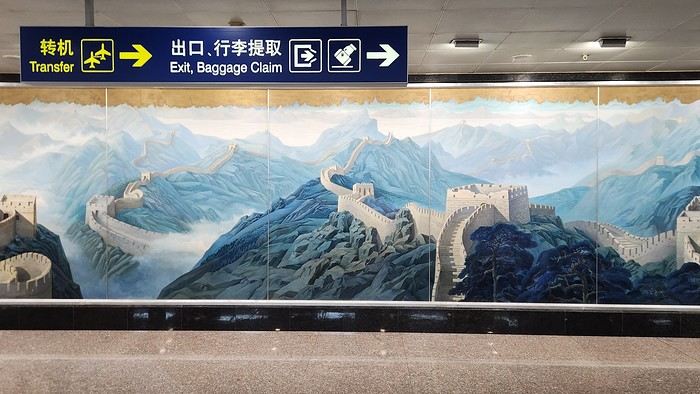
There’s an old Chinese proverb I particularly like: "Dú wán juán shù, búrú xing wán li lú." In slightly more familiar terms, it means you always learn more by traveling ten thousand miles than by reading ten thousand books. And I’m the perfect guy for this because, first, I don’t have time to read ten thousand books about our new destination... And second, the proverb is literally made in our new adventure playground: China!
China... or should I say, "Paradox-land"! A country we see everywhere—on the news or on the "Made in China" labels of half the objects around us—but one we actually know very little about. A country hurtling toward the future while still casually chatting with its rich past. A country that, through our Western lens, seems uniform and just filled with Chinese people who all look alike, yet reveals an incredible cultural, natural, demographic, and culinary diversity as soon as you dig a little deeper. A country with a reputation for being logistically tricky for solo travelers, yet where you can book public toilets on your smartphone. In short, a delightful mess of disorienting contradictions—and, of course, a destination that was bound to charm our wandering soles for a while.
That "while" will be two weeks... And the "we," since I wanted the best in the world to join me, will be Flo and me in this backpacking duo stamped with wanderlust! Just the two of us for two weeks to explore a tiny part of this continent-sized country, trying to understand how old wooden stilt houses coexist in the middle of futuristic skyscrapers glowing with lights, tasting all the weird and wonderful things that come our way, and—incidentally—covering the famous ten thousand kilometers from our proverb.
Well... we’ll probably cover a little less than that, but enough to let us write our own travel journal instead of reading others’... Because you know us—between living our lives watching others live theirs by reading ten thousand books, or writing our own by truly roaming the world, we’ve long since chosen our side! And you, who’s reading this—team book or team live?

Introduction:
As has become a habit, I’ve organized a trip for late October—a surprise trip for my poor wife, who follows along without saying much (or almost nothing).
She knows she’s going away, when, but not where!
Our friends and family keep bombarding me with questions to get the info, but I’m holding strong.
The guesses are flying, the best one being, “Knowing him, he’s definitely heading somewhere sunny, even if all the southern destinations have already been done for a short stay.”
It makes me laugh because there are still a few places I haven’t discovered yet.
So yes, choosing to go to Belgium at the end of October—especially for someone as sensitive to the cold as I am—is bold.
I’m not quite at Philippe Abrams’ level, but still, heading *Noooorth* from me is pretty daring.
So, contrary to my friends’ predictions, I’m not flying south but taking my car, turning the wheel north, and off we go!
Day 1: The outbound trip When I say I’m not flying, it’s only half true because we’re leaving the day French media—with their signature doom-and-gloom—announce a terrible storm. While Storm Austen is indeed forecasted, the Belgians are reporting it as the first storm of the year with a bit more restraint. The drive won’t be entirely smooth as we reach the Hauts-de-France region: the wind is strong, the rain is heavy, but it’s not the apocalypse. Just drive carefully and slow down—sounds like a road safety message! We left Lyon at 8 AM and arrived in Bruges at 4 PM, “...and that’s even with the trucks at the entrance to Angoulême!” What’s he talking about—going through Angoulême? French cinephiles will get the reference. We got a warm welcome at our B&B, and since it was barely drizzling, we took a quick stroll around town to stretch our legs. Headed to the Markt, visited the Prinsenhof, the Palace of the Dukes of Flanders. We actually went in because it started pouring. It’s free, a first taste of Flemish culture, and it’s great.
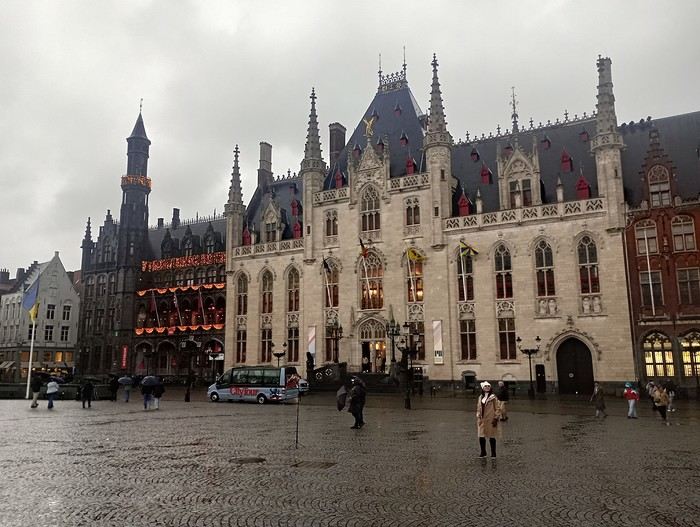
A little tired, we headed back to our B&B, mostly because the heavy rain forced us to. We got soaked (some people must be laughing). After drying off, we went to the nearest restaurant, Parazzar, typically Bruges-style, and my wife tried her first beer. Personally, I don’t like beer—*What the heck was I thinking?*—so I had a red wine, a Tinto, which would’ve been local back in Charles V’s time. First fries—because I *love* them—and it’s time to call it a night. A good night’s sleep awaits.
The +: We made it! The -: It’s raining, it’s windy, it’s wet—party at the...
Day 1: The outbound trip When I say I’m not flying, it’s only half true because we’re leaving the day French media—with their signature doom-and-gloom—announce a terrible storm. While Storm Austen is indeed forecasted, the Belgians are reporting it as the first storm of the year with a bit more restraint. The drive won’t be entirely smooth as we reach the Hauts-de-France region: the wind is strong, the rain is heavy, but it’s not the apocalypse. Just drive carefully and slow down—sounds like a road safety message! We left Lyon at 8 AM and arrived in Bruges at 4 PM, “...and that’s even with the trucks at the entrance to Angoulême!” What’s he talking about—going through Angoulême? French cinephiles will get the reference. We got a warm welcome at our B&B, and since it was barely drizzling, we took a quick stroll around town to stretch our legs. Headed to the Markt, visited the Prinsenhof, the Palace of the Dukes of Flanders. We actually went in because it started pouring. It’s free, a first taste of Flemish culture, and it’s great.
A little tired, we headed back to our B&B, mostly because the heavy rain forced us to. We got soaked (some people must be laughing). After drying off, we went to the nearest restaurant, Parazzar, typically Bruges-style, and my wife tried her first beer. Personally, I don’t like beer—*What the heck was I thinking?*—so I had a red wine, a Tinto, which would’ve been local back in Charles V’s time. First fries—because I *love* them—and it’s time to call it a night. A good night’s sleep awaits.
The +: We made it! The -: It’s raining, it’s windy, it’s wet—party at the...
Hi everyone,
We're leaving on November 1st for five weeks, just the two of us, from north to south and then east: Santiago, Puerto Varas and the Lake District, Punta Arenas, Puerto Natales and Torres del Paine, El Calafate, El Chaltén, Ushuaïa, then Montevideo, José Ignacio, and Buenos Aires, returning on December 3rd. Everything is planned by us, without an agency, just like our previous trips. I’d like to thank everyone who shared their travel stories—they’ve been a huge inspiration. I’ll post an update here each week: first about the trip itself, with some great tips, and then a few lines about an experiment I’m running alongside it. Feel free to ask questions—I’ll answer as soon as I have signal.
The experiment is about the *method*. For twenty years, every trip started with a paper notebook, then the same Excel spreadsheet: one line per stop, dates, where we sleep, how we get there, what we do. But every time, the same limitations: paper gets messy, the spreadsheet doesn’t recalculate when a stop changes, neither tracks what’s left to book or by when, confirmations get buried in my inbox, tickets stay in a binder at home, and every evening, I’m juggling updates across three group chats.
So I built a tool that centralizes everything: the stops and their dates, which auto-update; what’s left to book, with deadlines and reminders; confirmations, organized by email forwarding; the planned and actual budget; the offline map on my phone; and the evening journal for my loved ones. This trip is the first I’m doing entirely with it, from planning to return—each update will share what worked and what didn’t. It’s already been a huge help in the planning phase, but now, let the adventure begin!
First update next Sunday from Puerto Natales.

After a first trip in 2009 (already!) where, roughly, we did a circuit passing through Hazyview, a private reserve in Sabi Sands, Santa Lucia and Isimangaliso, Hluhluwe and the South African part of Kgalagadi Transfrontier Park, then a quick stop in 2013 to go to Lesotho, we wanted to come back to this country.
Why not the Cape region this time, but there was no way we were coming back to this part of the world without going on a safari. Mountain Zebra or the Karoo seem more about landscapes than animals, and Addo doesn’t excite me much either... So it’ll be Kruger.
Flight prices, schedules, and durations led us to a Paris-Cape Town, return Johannesburg-Paris with British Airways, via Heathrow.
Now we just had to figure out how to fit in quite a few things without driving too many kilometers or changing accommodation every day, at least in the Cape region. Here’s what we ended up with:
Arrival in Cape Town on Saturday, October 10 at 11 AM
2 nights in Hermanus
1 night in Franschhoek
2 nights at Mountceder in the Cederberg
3 nights in Hout Bay
Sunday: transition day—flight to Johannesburg, drive toward Kruger, night in Lydenburg.
Kruger: 1 night in Letaba, 2 in Satara, 1 in Lower Sabie.
Last night in Mbombela (formerly Nelspruit) before heading back to the airport for an early evening return flight.
For those who want to read the full story without interruptions, it’s here.
Friday, 10/9
A pretty stressful departure.
First, I woke up in the middle of the night, convinced I’d swapped my first and last names during check-in 🤪... Couldn’t get back to sleep, even though I knew British Airways wouldn’t answer before 9 AM.
Well, for them, everything was fine... but then they started talking about ETA... an ETA for England 😮? ?? Yes, it’s recent. Apparently, you don’t need one for an air-to-air transit... but you never know, it’s better to have it just in case. No one could give me a clear answer that it wasn’t necessary. In the end, we didn’t get it... and we didn’t need it.
But here’s the thing: our flight ended up leaving Paris 45 minutes late (10 minutes due to a schedule change and 35 minutes of actual delay), so our 2-hour layover shrank to 1 hour and 15 minutes. That should be doable, right? The board showed our flight at Gate B: great, it’s right next door! But at Gate B, three employees were just there to tell everyone who showed up that security had to be done at Gate A... and off we went, sprinting through the corridors, endless escalators going up and down, a little shuttle ride, security at Gate A ("You’re going to be cutting it close!" Oh really? 😠), then pretty much the same route back, only to end up just a few dozen meters from where we started! 😠
Boarding was already well underway, and after all that running, we were hot and thirsty, but phew! We made it onto the plane!
Saturday, 10/10 On the other hand, nothing to complain about on this London-Cape Town flight—it arrived early!
I booked a (small) Suzuki S-Presso because it seemed to have a higher ground clearance than its competitors. Unfortunately, we ended up with a Tata Tiago (yes, it exists), which is lower (and also smaller, with an even more sluggish engine... yes, we were able to compare because in Johannesburg, we *did* get an S-Presso). Somehow, we managed to fit everything in the trunk ("Whatever you do, don’t leave anything visible!") and off we went to our first accommodation in Hermanus, under a glorious sun.
Nikki welcomed us warmly, explained what there was to see in the area, and advised us to book a restaurant for that evening.
After dropping off our bags, we headed to the "cliff path," just 3 minutes from our place. This part of the coast is famous for its southern right whales from June to November. Let’s cut to the chase: there *were* whales, but they were very far away and very sleepy 😕. At best, we saw (photos taken at 600mm): A few ripples or a faint spray,

a bit of tail...

...or a bit of head.

Too bad—the owner of our next accommodation told us she’d seen around thirty of them up close here in early September.
With no whales in sight, the dassies (or rock hyraxes) were everywhere... and fun to watch.
The other local star (when there are no whales 😏)

Why not the Cape region this time, but there was no way we were coming back to this part of the world without going on a safari. Mountain Zebra or the Karoo seem more about landscapes than animals, and Addo doesn’t excite me much either... So it’ll be Kruger.
Flight prices, schedules, and durations led us to a Paris-Cape Town, return Johannesburg-Paris with British Airways, via Heathrow.
Now we just had to figure out how to fit in quite a few things without driving too many kilometers or changing accommodation every day, at least in the Cape region. Here’s what we ended up with:
Arrival in Cape Town on Saturday, October 10 at 11 AM
2 nights in Hermanus
1 night in Franschhoek
2 nights at Mountceder in the Cederberg
3 nights in Hout Bay
Sunday: transition day—flight to Johannesburg, drive toward Kruger, night in Lydenburg.
Kruger: 1 night in Letaba, 2 in Satara, 1 in Lower Sabie.
Last night in Mbombela (formerly Nelspruit) before heading back to the airport for an early evening return flight.
For those who want to read the full story without interruptions, it’s here.
Friday, 10/9
A pretty stressful departure.
First, I woke up in the middle of the night, convinced I’d swapped my first and last names during check-in 🤪... Couldn’t get back to sleep, even though I knew British Airways wouldn’t answer before 9 AM.
Well, for them, everything was fine... but then they started talking about ETA... an ETA for England 😮? ?? Yes, it’s recent. Apparently, you don’t need one for an air-to-air transit... but you never know, it’s better to have it just in case. No one could give me a clear answer that it wasn’t necessary. In the end, we didn’t get it... and we didn’t need it.
But here’s the thing: our flight ended up leaving Paris 45 minutes late (10 minutes due to a schedule change and 35 minutes of actual delay), so our 2-hour layover shrank to 1 hour and 15 minutes. That should be doable, right? The board showed our flight at Gate B: great, it’s right next door! But at Gate B, three employees were just there to tell everyone who showed up that security had to be done at Gate A... and off we went, sprinting through the corridors, endless escalators going up and down, a little shuttle ride, security at Gate A ("You’re going to be cutting it close!" Oh really? 😠), then pretty much the same route back, only to end up just a few dozen meters from where we started! 😠
Boarding was already well underway, and after all that running, we were hot and thirsty, but phew! We made it onto the plane!
Saturday, 10/10 On the other hand, nothing to complain about on this London-Cape Town flight—it arrived early!
I booked a (small) Suzuki S-Presso because it seemed to have a higher ground clearance than its competitors. Unfortunately, we ended up with a Tata Tiago (yes, it exists), which is lower (and also smaller, with an even more sluggish engine... yes, we were able to compare because in Johannesburg, we *did* get an S-Presso). Somehow, we managed to fit everything in the trunk ("Whatever you do, don’t leave anything visible!") and off we went to our first accommodation in Hermanus, under a glorious sun.
Nikki welcomed us warmly, explained what there was to see in the area, and advised us to book a restaurant for that evening.
After dropping off our bags, we headed to the "cliff path," just 3 minutes from our place. This part of the coast is famous for its southern right whales from June to November. Let’s cut to the chase: there *were* whales, but they were very far away and very sleepy 😕. At best, we saw (photos taken at 600mm): A few ripples or a faint spray,
a bit of tail...
...or a bit of head.
Too bad—the owner of our next accommodation told us she’d seen around thirty of them up close here in early September.
With no whales in sight, the dassies (or rock hyraxes) were everywhere... and fun to watch.
The other local star (when there are no whales 😏)
Japan, five weeks between unknown lands and familiar paths

Hello everyone,
I invite you to follow me on this fifth exploration trip to Japan.
Five weeks or so!
For the itinerary, my usual mix: New discoveries, well-known places, and others less so.
At the heart of the trip, a two-week road trip by car. I wavered for a long time between the San'in region, from Tottori to Yamaguchi, and southern Kyushu. By a narrow margin, southern Kyushu won out.
Waterfalls that seem even more impressive. A more exotic atmosphere. Tea-growing lands to savor... Kagoshima will be the starting point. Then a loop from west to east.
And, of course, the must-see stops... Those little Japanese touches. Gourmet cuisine. Japanese, but not only!
And then, the soul of the trip, I hope: Human connections. Big or small.
Otherwise? Several local festivals. Osaka, unexpected. Miyakojima, between beauty and small disappointments. Tokyo... it's Tokyo!
So, travel with me. The suitcase is waiting, with stories that are sometimes generous, but always driven by the love of travel experienced firsthand.
Yōkoso, Nihon! Welcome to Japan!
Hello,
Following our trip on the Great Divide Mountain Bike Route this summer, we’re sharing our experience in this travel journal.
We’re Richard and Bernadette, both 64 years old, and we’re gravel bike-packing cyclists.
We’ve completed several gravel bike trips in France and neighboring countries, and Richard has also done some in South America.
We left on July 22, 2026, from Geneva to Calgary via Frankfurt with our bikes carefully packed in boxes, and we returned on October 8 from El Paso to Geneva via Chicago and Frankfurt.
The GDMBR is a mountain route that closely follows the Pacific/Atlantic continental divide, starting in Banff, Canada, and ending at the Mexican border in Antelope Wells, New Mexico. This crossing of the American West is one of the longest mountain biking routes in the world, winding through wild valleys, mountain ranges, and desert plateaus. It stretches about 4,400 km with a total elevation gain of around 60,000 m. The average altitude is 2,000 m, and the highest point reaches 3,600 m. The route is 80% off-pavement (gravel roads, dirt, and a few trail segments). It’s also known for the annual Tour Divide race, which brings together the best riders in the discipline every June and follows roughly the same route.
We prepared for this trip over several months, using a few websites and an older guidebook (the 2013 English edition).

With this, we were able to organize our journey with as much information as possible, a GPS track, and gear suited to the weather conditions, terrain, and sparse resupply points in remote areas.
Once we arrived in Banff, we picked up bear spray to handle a particular challenge: the wildlife we weren’t familiar with.

After landing in Calgary, we assembled and equipped our bikes at the airport. That first evening, we were welcomed by Mike, who invited us to his place when we were looking for a spot to pitch our tent. Then we made our way to Banff over two days, taking a fairly quiet road to Canmore and then a bike path.

A visit to Banff, a charming tourist town in the national park. Its famous Fairmont Hotel.

The starting point of the GDMBR at the arch of this hotel complex.

Here we are, immersed in the wilderness—just a few pedal strokes away from the town, the contrast is striking. Powerful rivers, vast landscapes, and our first encounter with a mule deer.

Spray Lake, our first basic campsite: no showers, dry toilets, no water fountain—we filter lake water. Most GDMBR campsites are like this.


We took the west side of the lake—a longer and wilder route. A few fallen trees blocked the path, forcing us to carry our bikes. But the stunning landscapes made it all worth it!

Our first single track through a forest marked by past wildfires.


Most campgrounds have tables and metal fire rings for safe campfires, which makes setting up camp much easier—especially nice after a long, tiring day! During this trip, we mostly slept in our tent, either in established campgrounds or wild bivouacs.
To be continued...
The GDMBR is a mountain route that closely follows the Pacific/Atlantic continental divide, starting in Banff, Canada, and ending at the Mexican border in Antelope Wells, New Mexico. This crossing of the American West is one of the longest mountain biking routes in the world, winding through wild valleys, mountain ranges, and desert plateaus. It stretches about 4,400 km with a total elevation gain of around 60,000 m. The average altitude is 2,000 m, and the highest point reaches 3,600 m. The route is 80% off-pavement (gravel roads, dirt, and a few trail segments). It’s also known for the annual Tour Divide race, which brings together the best riders in the discipline every June and follows roughly the same route.
We prepared for this trip over several months, using a few websites and an older guidebook (the 2013 English edition).
With this, we were able to organize our journey with as much information as possible, a GPS track, and gear suited to the weather conditions, terrain, and sparse resupply points in remote areas.
Once we arrived in Banff, we picked up bear spray to handle a particular challenge: the wildlife we weren’t familiar with.
After landing in Calgary, we assembled and equipped our bikes at the airport. That first evening, we were welcomed by Mike, who invited us to his place when we were looking for a spot to pitch our tent. Then we made our way to Banff over two days, taking a fairly quiet road to Canmore and then a bike path.
A visit to Banff, a charming tourist town in the national park. Its famous Fairmont Hotel.
The starting point of the GDMBR at the arch of this hotel complex.
Here we are, immersed in the wilderness—just a few pedal strokes away from the town, the contrast is striking. Powerful rivers, vast landscapes, and our first encounter with a mule deer.
Spray Lake, our first basic campsite: no showers, dry toilets, no water fountain—we filter lake water. Most GDMBR campsites are like this.
We took the west side of the lake—a longer and wilder route. A few fallen trees blocked the path, forcing us to carry our bikes. But the stunning landscapes made it all worth it!
Our first single track through a forest marked by past wildfires.
Most campgrounds have tables and metal fire rings for safe campfires, which makes setting up camp much easier—especially nice after a long, tiring day! During this trip, we mostly slept in our tent, either in established campgrounds or wild bivouacs.
To be continued...

Hello everyone! 🙂
No wonder Tangier has inspired so many artists, writers, painters, and musicians… The "Pearl of the North" will be the first stop on a 12-day journey that will take us through Rabat, Fez, and Meknes.
This is my 15th trip to Morocco, and I’d never been to Tangier before! A round-trip flight from Carcassonne for just 55 € sealed the deal, and here we are, landing two hours later.
Four medinas, four perspectives—an enchantment that remains untouched. Once again, Richard and I will combine our viewpoints in a travel journal, sharing them with you—his through words, mine through images.
No wonder Tangier has inspired so many artists, writers, painters, and musicians… The "Pearl of the North" will be the first stop on a 12-day journey that will take us through Rabat, Fez, and Meknes.
This is my 15th trip to Morocco, and I’d never been to Tangier before! A round-trip flight from Carcassonne for just 55 € sealed the deal, and here we are, landing two hours later.
Four medinas, four perspectives—an enchantment that remains untouched. Once again, Richard and I will combine our viewpoints in a travel journal, sharing them with you—his through words, mine through images.

Hi everyone!
A quick travel journal entry to tell you about the Pont de Gau Ornithological Park, near Saintes-Maries-de-la-Mer in the Camargue (13).
A real paradise for flamingos... but also for swarms of mosquitoes that attack in squadrons, without warning and dive-bombing! 🦟😄
And I thought these critters didn’t go for spoiled meat! Clearly, they’re not too picky about freshness! 😵
More seriously, it’s a really nice spot for photography and nature lovers. Kids love it too! If you’re in the area, it’s a great discovery to make.
Here are a few shots from my session yesterday at the end of the day.
675 photos on the counter, currently sorting through them... Still testing the camera body. If I keep about twenty, that’ll already be a win!
Anyway, there’s work to do... and some itching on top of that! 📸🦟😄










A quick travel journal entry to tell you about the Pont de Gau Ornithological Park, near Saintes-Maries-de-la-Mer in the Camargue (13).
A real paradise for flamingos... but also for swarms of mosquitoes that attack in squadrons, without warning and dive-bombing! 🦟😄
And I thought these critters didn’t go for spoiled meat! Clearly, they’re not too picky about freshness! 😵
More seriously, it’s a really nice spot for photography and nature lovers. Kids love it too! If you’re in the area, it’s a great discovery to make.
Here are a few shots from my session yesterday at the end of the day.
675 photos on the counter, currently sorting through them... Still testing the camera body. If I keep about twenty, that’ll already be a win!
Anyway, there’s work to do... and some itching on top of that! 📸🦟😄

In the summer of 2026, we packed our backpacks again to wander around Jotunheimen National Park in Norway.
We’d never heard of this park just a few months earlier—we discovered it by following threads online.
It’s billed as the most mountainous park in the country, which really appealed to us after scrapping our original plan further north.
Unfortunately, it’s also the most crowded, which immediately made it less appealing! The presence of the highest peak in the Scandinavian Alps and the "famous" Bessengen ridge (famous because it’s apparently well-known across the country) probably has a lot to do with that.
Since we’d managed to avoid the crowds on the Kungsleden trails by camping away from the huts and timing our hike to miss the biggest groups of walkers, we figured we had the formula down and gave in to the call of the Norwegian mountains.
It’s the most mountainous park, sure, but also quite challenging in terms of progress, as we’d soon discover during the trek. And with uncooperative weather, we got the winning combo of a demanding hike. But I’m getting ahead of myself...
For the end of the trip, we planned a few days in Dovrefjell National Park—these two parks are easily connected by public transport—to see something different and, most importantly, to try and spot the musk oxen that live there.
My 04/08 - Arrival in Oslo Wed 05/08 - Bygdin – Torfinsbu Thu 06/08 - Torfinsbu - Gjendebu Fri 07/08 - Gjendebu - Fondsbu Sat 08/08 - Day hike to Slotafjellet Sun 09/08 - Day hike to Lake Kvitevatnet Mon 10/08 - Fondsbu - Gjendebu Tue 11/08 - Gjendebu - Before the Bessengen ridge Wed 12/08 - Bessengen ridge – Maurvangen campsite Thu 13/08 - Knutshoe ridge Fri 14/08 - Bus transfer to Spiterstulen hut via Lom Sat 15/08 - Day hike to Galdhøpiggen Sun 16/08 to Wed 19/08: Dovrefjell End of the trip and wrap-up
 When it comes to the Caribbean island of Saint-Martin, it's customary to praise its coastline and dreamy beaches—and they certainly deserve it.
But in this story, I’d like to highlight other memories, aspects, and impressions for a slightly different change of scenery.
Enjoy the read—some text and, above all, lots of photos.
« Byenveni sou zile Sen Maten! » (Welcome to the island of Saint-Martin)
-- -- Full and luminous To avoid seeming too conventional at the start of this alternative take on Saint-Martin... here’s not a stunning sunrise over the sea but rather a moonrise—a less "typical" choice. And when you get to witness it, it’s a truly unique moment of contemplation. However, three conditions are essential for this spectacle: a full moon phase, a cloud-free horizon, and—most importantly—a moonrise at twilight. That early evening, all the conditions aligned—lucky us! Just above the sea, a strange glow gradually appeared. A huge moon was about to shine against a deep blue night sky.

What’s more, its light sparkled on the water’s surface—gorgeous! But so fleeting. We’re on the east coast of the island, by the wide stretch of light sand at Baie Orientale, Saint-Martin’s own. Now, just because I wanted to start with something a little different doesn’t mean we should overlook the bright sunrises you can see on this bay. They’re far more common than a beautiful full moonrise, but they also require two things: being an early riser and a clear horizon without misty clouds. Views to soak in without restraint...


Other memories of beautiful lights and lovely colors—a morning when the sun had a brief meet-up with the rain, creating a stunning rainbow.

And let’s talk about the moon again... On a clear night, a "blood moon," the result of a lunar eclipse that had turned our familiar satellite red.

-- --
A butterfly with golden wings! In the tropics, swarms of butterflies flutter everywhere, from flower to flower. They sip the sweet nectar from stamens and blooming corollas with delight.

Here, a monarch, one of the great migratory butterflies, taking its time to enjoy the pollen of this Ixora coccinea—or Japanese hydrangea, but let’s stick to Saint-Martin.

This one is an *Agraulis vanillae*, to be precise—and thanks to the internet for the ID. Photographing them isn’t always easy; these fearless butterflies often fly off before you can get a good focus, challenging both the framing eye and the autofocus! But on the island, I noticed some butterflies were much easier to shoot—those decorating a few murals. ;)


One of the graffiti artists behind several Saint-Martin murals has made it his signature. The talented Jimmy Sheik slips a little butterfly into each of his works, even if it’s not the main subject. It’s a nod to his home island, Guadeloupe, whose territory—with Basse-Terre and Grande-Terre—looks uncannily like a giant butterfly. In the photo above, a great initiative: turning this beach bungalow, abandoned after Hurricane Irma’s (2017) devastation, into a mural canvas—it’s a real success. Well done, artist!
To be continued >>>>>>

I had to leave Thailand as my 60-day visa was coming to an end, and this time I opted for a 14-day visit to Japan. I’d already spent 3 days in Tokyo a few years ago on a business trip, which left me with a great impression. Y, my Thai partner, had never been there. That’s why we chose a fairly classic itinerary, including a few castles and Kyoto among other things.
Before diving into the details of our trip, I’d like to recap the expenses we incurred. This will be useful for some of you, and it’ll help us prepare for our next trip to Japan.
I’ve categorized our expenses into 5 groups: - Hotels: 1150 € (breakfast included) - Transportation: 278 € (trains, buses) - Big expenses: 487 € (souvenirs and a few necessary items) - Excursions: 116 € (museum visits, temples, castles) - Daily expenses: 1125 € (meals, small purchases) Total = 3194 €, or 228 € per day on average. I’m excluding flights, as those depend on everyone’s arrangements (departure location, travel dates, etc.).
Jpeg below: apologies for “hotel” without a circumflex—my software isn’t French!

For hotels, we always chose decent but not luxurious places, well-located to let us walk to and from transportation hubs. We systematically avoided taxis, which are notoriously expensive in Japan. We’ve also gotten into the habit over several trips of traveling with minimal luggage: one duffel bag each (7-8 kg) plus the small carry-on allowed on planes (2-3 kg). This lets us travel with three sets of clothes (what we’re wearing plus two changes). We add a checked bag for the return trip to accommodate the things we buy along the way.
‘Transportation’ and ‘Big expenses’: I’ll give more details in the day-by-day account.
We didn’t do any extravagant excursions, like safaris or sports activities.
Meals and food make up the bulk of our daily expenses. We often ate at izakayas, which offer great value—between 2000 and 6000 yen for two (about 11-12 to 33-34 € for two, usually around 20-25 €). We didn’t hold back, but we also didn’t go to high-end restaurants.
More to come while I gather my photos: General Remarks.
Before diving into the details of our trip, I’d like to recap the expenses we incurred. This will be useful for some of you, and it’ll help us prepare for our next trip to Japan.
I’ve categorized our expenses into 5 groups: - Hotels: 1150 € (breakfast included) - Transportation: 278 € (trains, buses) - Big expenses: 487 € (souvenirs and a few necessary items) - Excursions: 116 € (museum visits, temples, castles) - Daily expenses: 1125 € (meals, small purchases) Total = 3194 €, or 228 € per day on average. I’m excluding flights, as those depend on everyone’s arrangements (departure location, travel dates, etc.).
Jpeg below: apologies for “hotel” without a circumflex—my software isn’t French!
For hotels, we always chose decent but not luxurious places, well-located to let us walk to and from transportation hubs. We systematically avoided taxis, which are notoriously expensive in Japan. We’ve also gotten into the habit over several trips of traveling with minimal luggage: one duffel bag each (7-8 kg) plus the small carry-on allowed on planes (2-3 kg). This lets us travel with three sets of clothes (what we’re wearing plus two changes). We add a checked bag for the return trip to accommodate the things we buy along the way.
‘Transportation’ and ‘Big expenses’: I’ll give more details in the day-by-day account.
We didn’t do any extravagant excursions, like safaris or sports activities.
Meals and food make up the bulk of our daily expenses. We often ate at izakayas, which offer great value—between 2000 and 6000 yen for two (about 11-12 to 33-34 € for two, usually around 20-25 €). We didn’t hold back, but we also didn’t go to high-end restaurants.
More to come while I gather my photos: General Remarks.

After exploring Dawson City, the final stop on our incredible road trip to the Yukon (see travel journal), it was time to head back to Quebec.
Instead of returning directly, we took advantage of this cross-country drive to make several stops in British Columbia and Alberta.
This part of the trip allowed us to discover some of the most beautiful attractions in Western Canada, from breathtaking landscapes to iconic natural sites that are must-sees in Canada.
Between majestic mountains, turquoise lakes, and jaw-dropping panoramas, every stop added a memorable touch to this already exceptional adventure.
A wonderful way to wrap up this journey across Canada while fully enjoying the richness and diversity of its vast landscapes.
In the upcoming posts, you’ll discover the highlights that marked our journey through Western Canada.
I invite you to watch the associated videos to fully experience the atmosphere, landscapes, and attractions we were lucky enough to explore.
To navigate to a specific post, here are the appropriate links:
Adventure on the Alaska Highway: Bald Eagles, Bison & Moose Adventure on the Alaska Highway: Bison, Caribou & Bears Yellowhead Highway (Alberta): Roche Miette, Jasper Lake & Emerald Pond Maligne Lake Road (Jasper) | Moose and Elk Exploring Mount Robson Provincial Park (BC) Must-Sees on the Icefields Parkway - Alberta David Thompson Highway11 (AB): A Stunning Scenic Route What to See in Yoho National Park (BC) Johnston Canyon: Hike to the Lower & Upper Falls Iconic Sites of East Kootenay, BC Lundbreck Falls - A Spectacular Waterfall in Southern Alberta Trails of Red Rock Canyon & Blakiston Falls - Waterton Waterton Village Under the Snow - A Unique Place Writing-on-Stone: A Park Famous for Its Hoodoos Red Rock Coulee Natural Area Alberta – A Supernatural Landscape Dinosaur Provincial Park Alberta - Mysterious Badlands Drumheller: Dinos, Hoodoos & Badlands Interpretive Trail Hike at Horsethief Canyon | Drumheller Badlands Red Deer: Public Art & Murals Downtown Calgary | Public Art, Skyline & Iconic Spots Medicine Hat | Public Art & Iconic Spots

My first trip to Morocco dates back to the early 90s.
Four more followed...
I’d never gone further north than Casablanca, Volubilis, or Fez—it was time to fix that!
So I planned a route that would fill in the gaps while revisiting a few places.
This route is pretty classic—if you’re looking for something original, you might want to skip it!
The starting point of the trip: the city of Rabat.
The stops?
Azrou, Fez, Al Hoceïma, Akchour, Tetouan, Tangier, Asilah, and finally Rabat.
Mostly an urban trip, then.
Too much?
We’ll see at the end of the travel journal!

Four more followed...
I’d never gone further north than Casablanca, Volubilis, or Fez—it was time to fix that!
So I planned a route that would fill in the gaps while revisiting a few places.
This route is pretty classic—if you’re looking for something original, you might want to skip it!
The starting point of the trip: the city of Rabat.
The stops?
Azrou, Fez, Al Hoceïma, Akchour, Tetouan, Tangier, Asilah, and finally Rabat.
Mostly an urban trip, then.
Too much?
We’ll see at the end of the travel journal!
For a long time, the Yukon had been one of those dream travel destinations for us. Its vast wilderness, majestic mountains, and fascinating history tied to the gold rush irresistibly drew us in.
We finally made this ambitious project a reality: a road trip across Canada heading toward the Yukon.
Since the journey from Quebec is considerable, we chose to turn the trip itself into a series of adventures.
Instead of just racking up the kilometers, we made plenty of stops to discover several tourist attractions spread across different provinces.
Along the way, each province offered its share of landscapes and discoveries. We crossed vast forests, admired beautiful lakes, explored historic sites, and visited several local attractions that helped us better appreciate Canada’s diversity.
These breaks made the trip much more enjoyable and allowed us to take the time to fully enjoy each region we visited.
One of the great pleasures of a road trip is the freedom it provides. We could adjust our itinerary based on our mood, extend a visit we particularly enjoyed, or stop spontaneously at a spectacular viewpoint.
Often, it’s these unexpected discoveries that become the best memories.
As we moved northwest, the landscapes became more and more impressive. The roads seemed endless, the mountains drew closer, and nature took on an even greater presence. Traffic gradually thinned out, giving way to a sense of freedom that’s hard to describe.
Arriving in the Yukon marked the culmination of several days of travel. From the first kilometers, we were amazed by the vastness of the territory.
The breathtaking panoramas, the wildlife everywhere, and the unique atmosphere of the Canadian North more than made up for all the kilometers we’d covered.
This road trip to the Yukon reminded us that the destination is important, but the journey is just as much a part of it.
The many stops we made along the way allowed us to discover extraordinary places we probably never would’ve visited otherwise.
Every province we crossed helped make this adventure even more memorable.
The Yukon will certainly remain one of the highlights of our travels, but the memories we gathered along the way hold a special place in our hearts too.
That’s what makes a great Canadian road trip so magical: every kilometer tells a story.
In the upcoming posts, you’ll discover the places that caught our attention throughout this road trip.
Don’t hesitate to watch the videos to complete the experience and explore these attractions as if you were there.
To jump to a specific post, here are the appropriate links:
Roland Lake Falls - Lac-Pythonga (Quebec) | First Stop on the Way to the Yukon Must-See Stops in Ontario Stop at the Center of Canada | Manitoba Stop in Winnipeg (Manitoba) Discovering Regina (Saskatchewan) Stops in Moose Jaw, Chaplin & Saskatoon (Saskatchewan) Stops in Vegreville & Edmonton (Alberta) Stop at West Edmonton Mall, a World of Attractions Under One Roof Stops in Beaverlodge (AB) & Dawson Creek (BC) Adventure on the Alaska Highway: Between Dawson Creek and Liard River (BC) Discovering Liard River Hot Springs (BC) The Sign Post Forest (Watson Lake) Stops at Rancheria Falls, Teslin, and Tagish Discovering Carcross and Its Must-See Spots Carcross Desert Yukon: A Surprising Desert in the Heart of Canada Must-See Stop at Emerald Lake (Yukon) Hike at Miles Canyon (Whitehorse) - Yukon Discovering Whitehorse Spectacular Northern Lights - Fish Lake - Whitehorse (Yukon) Must-See Stops Between Whitehorse and Dawson City Road Trip on the Dempster Highway (Yukon) - 100 km of Adventure Complete Visit of the Historic Town of Dawson City in the Yukon Midnight Dome Dawson City - Magical Northern Lights in the Yukon
I love islands...
I love islands. So it’s no surprise that the Azores have been catching my eye for a few years now. The first time I suggested them to my dear partner back in 2021, he preferred the Lofoten Islands—an excellent choice, as it turned out, since we got to visit with hardly any crowds. But for various reasons, the opportunity didn’t come up again in the following years. Until last year, that is. But by then, we’d left it too late—too late for the Azores, I mean—and the accommodation options on Flores and São Jorge were extremely limited. We decided to skip it without even looking at car rentals. So this year, we booked our flights, lodging, and cars *way* in advance (between December of last year and early this year).
The Azores consist of nine islands, so you have to make choices. I quickly ruled out São Miguel, which deserves a week all to itself: from what I’d read on various blogs, some travelers seemed disappointed after visiting the other islands, even feeling it lacked the Azores’ unique charm. True or not, that was reason enough to skip it.
In the end, we wanted to go to Flores for its lush nature (and because it’s reputed to be the most breathtaking), São Jorge for its rural/nature vibe, and Terceira for its cultural side and *impérios* (more on that later). With the time we had, we could add another island without rushing. We like to take our time and wander a bit—whether it’s a viewpoint or a hike, we always spend longer than *everyone* else. Pico won out over Faial thanks to its wine culture. And of course, there’s Corvo, which is usually visited as a day trip from Flores. I thought it’d be nice to spend the night there to experience the atmosphere once most tourists had left. I hesitated between one or two nights but ultimately went with two (so we wouldn’t be rushed by the boat schedule). It was an excellent decision.
Here’s how it all panned out:
August 25: departure for Terceira via Lisbon at 7:40 AM; August 25–29: Terceira; August 29: flight to Corvo. It was supposed to take half a day, and we were meant to arrive in the early afternoon, but between schedule changes and delays, it ended up taking almost the whole day; August 29–31: Corvo; August 31: boat to Flores around 8:30 AM; August 31–September 5: Flores; September 5: flight to Faial in the early afternoon (originally scheduled for the morning, but the times changed)—visit to Horta; September 6: boat to São Jorge around 9:00 AM; September 6–11: São Jorge; September 11: boat to Pico at 11:15 AM; September 11–16: Pico; September 16: flight to Paris via Lisbon from Pico around 10:30 AM.
We had to juggle a bit to optimize the prices of our flight tickets from Paris and the inter-island travel.
I’m reposting here a travel journal originally published on the Routard forum in 2022 during VoyageForum’s hiatus. Without altering its content, I’ll try to streamline it. The few comments on the political situation reflect my feelings at the time and don’t account for events since then! I’d rather avoid debates on the topic. The photos are nothing fancy—just illustrative.
The context: we’re coming out of COVID. We’re looking for a not-too-distant destination, and Jordan has been catching our eye for a while. After some thought, we wonder if we shouldn’t take advantage of the geography to hop over to Israel. After all, Jerusalem is less than 100 km from Amman. Plus, Transavia lets you combine both destinations.
To plan our trip (February 19 to March 4, 2022), we contacted three French-speaking agencies in Amman. Their itinerary proposals were pretty similar, but the prices varied significantly. Given the many positive reviews we read on travel forums and a very attractive rate compared to competitors, we quickly settled on Ahmad Ababseh’s agency. Still, deep down, we had a slight worry—so many glowing reviews seemed a bit over the top, but we took the chance.
During the preparation, which happened in a very short timeframe (less than 10 days), Ahmad didn’t provide detailed roadbooks, and we made do with brief email or phone exchanges. Few details were shared either. We discussed hotels, with Ahmad preferring the ones he knew. We picked our hotel for our arrival in Amman, but before agreeing, Ahmad insisted on inspecting the rooms.
For payment, Ahmad only asked for a 500 € deposit and trusted our word for the balance, which we paid upon arrival. He also committed in writing to refund the full deposit if our trip was canceled due to COVID.
Finally, for the Israeli part, Ahmad contacted an agency in Jerusalem to handle the logistics. He didn’t take a commission.
Off to Southern Africa again! This time, the trip wasn’t just about wildlife—it was also about the local cultures and the breathtaking landscapes Mother Nature has to offer. It was an emotional rollercoaster in every way, as you’ll see.
We visited two countries: Zambia, known for its reserves, and Malawi, which is less well-known but absolutely worth a visit. Our flight landed in Lilongwe, Malawi’s capital, where our vehicle was waiting—though with a 3-hour delay. It was a 4x4 without the rooftop tent this time, since we stayed in lodges (prices are very reasonable in Malawi). Just a heads-up: don’t exchange money at the airport or banks—the official rate was 1,750 Malawian kwacha to $1. On the black market, the rate was between 3,000 and 3,500 kwacha, making the cost of living much cheaper.
With that out of the way, our first stop was South Luangwa National Park in Zambia. The first hiccup came at the Malawi-Zambia border: we were missing a document the rental company had forgotten. After some back-and-forth, they sent it via WhatsApp ($20 to get it validated by the police). But things got worse—the car’s chassis number was off by one digit from the registered one. I thought our trip was over before it even started! After what felt like forever, we got through with a "tip" of $200. Total border crossing time: 3 hours, costing nearly $400. We arrived in South Luangwa after dark.
Thankfully, the next day made up for it with an incredible day in the park (check out the photos).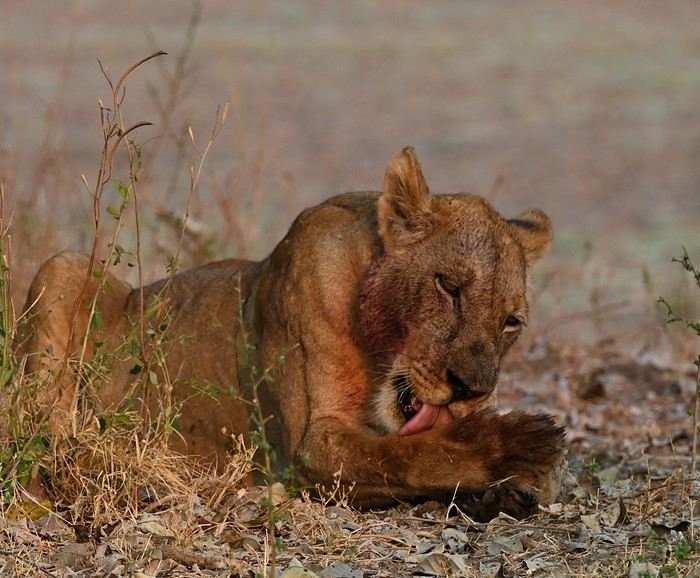

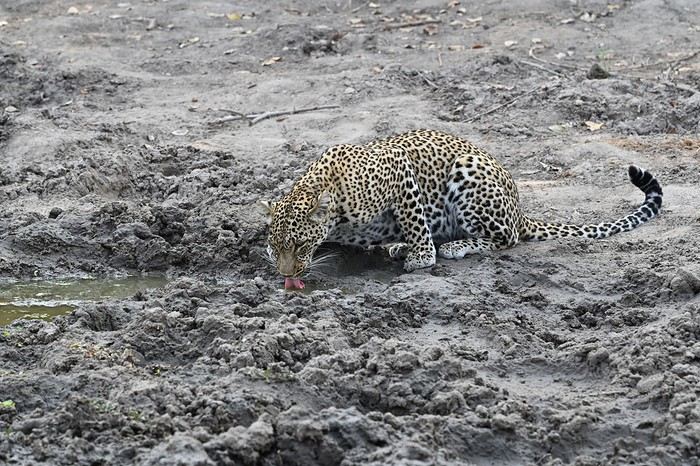
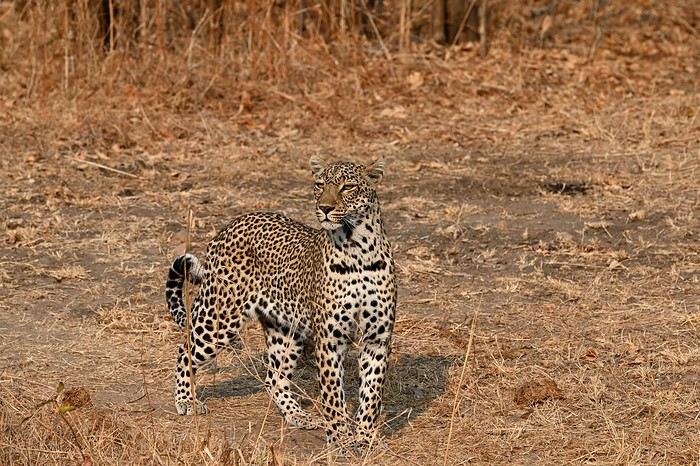
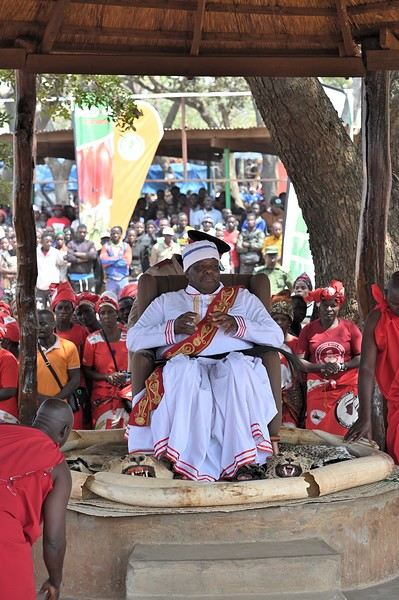
We spent two full days in South Luangwa before heading to Katete for the Kulamba ceremony. Kulamba is an annual event held at the end of August, celebrating the Chewa people, who live across Zambia, Malawi, and Mozambique. The Chewa king attends, and representatives from neighboring nations bring offerings. Thousands gather for dances, speeches, and a massive market. There are few tourists, making it a truly authentic experience.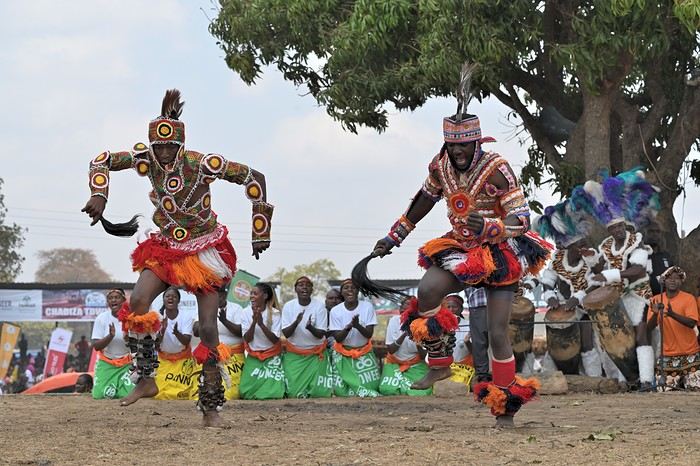
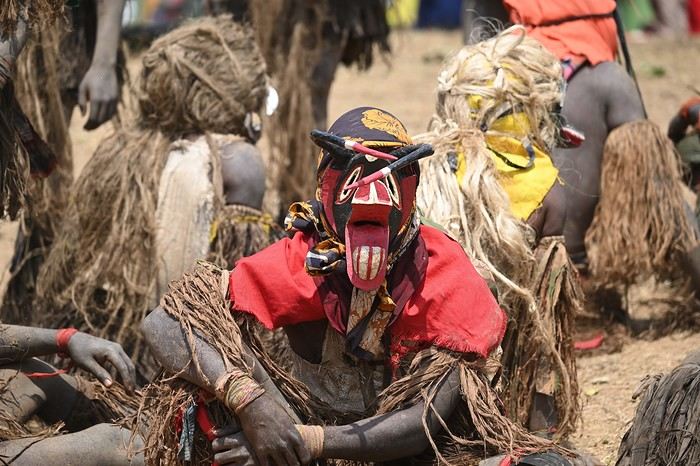
After a few days in Zambia, we returned to Malawi (the border crossing this time was smooth—just 45 minutes). Next stop: Lake Malawi. Lake Malawi covers over 20% of the country and stretches 580 km. It’s home to a family of fish called cichlids, some of which are endemic to the lake. I recommend taking a day trip from Cape Maclear for snorkeling and to watch the fishing eagles swoop down to catch fish.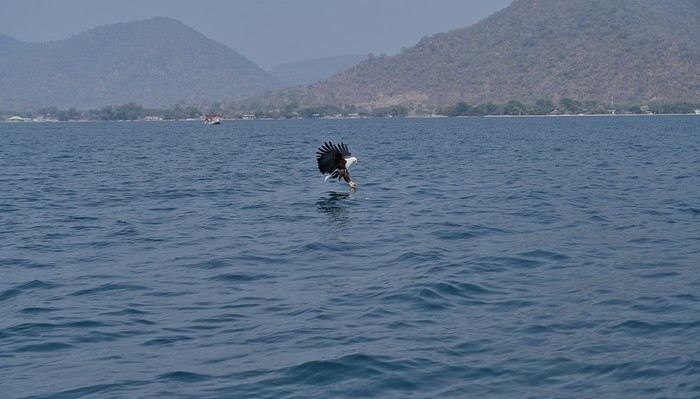
We hit the road again to visit Liwonde Reserve, where we had a few surprises. The lodge was on the other side of the river that borders the park, and the elephants didn’t seem to care. On the way from reception to our rooms, elephants blocked our path, and one even charged just before the stairs leading to our treehouse-style rooms.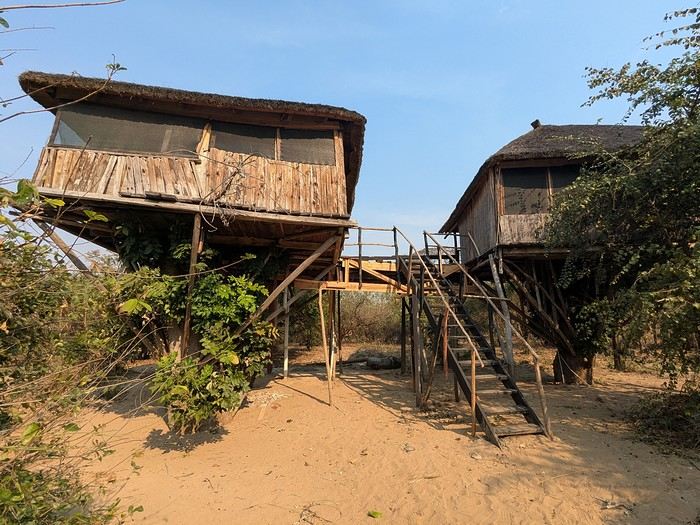
To top it off, monkeys ransacked our rooms, tearing through plastic bags for food. A mixed experience, but no real harm done. Next up: the mountains, specifically the Mulanje Massif. This is where Malawi’s tea is grown, and it’s also a great spot for day hikes or multi-day treks. The scenery is stunning, though sometimes the mist rolls in and hides it. After the mountains, we visited another reserve: Majete. The park is growing and now has more wildlife. We saw lions and even caught a fleeting glimpse of a leopard. And of course, the elephants got involved again—this time giving us a real scare. During the morning game drive with a guide, we stopped to watch a herd of elephants feeding. Everything was fine until, for some reason, a female got spooked—probably for her calf—and positioned herself in front of us on the track. After a few minutes, we thought the elephants would move on, but then a young one started provoking us. The problem? We had females and calves in front of us, but also two large adult males—one behind us and one to the side.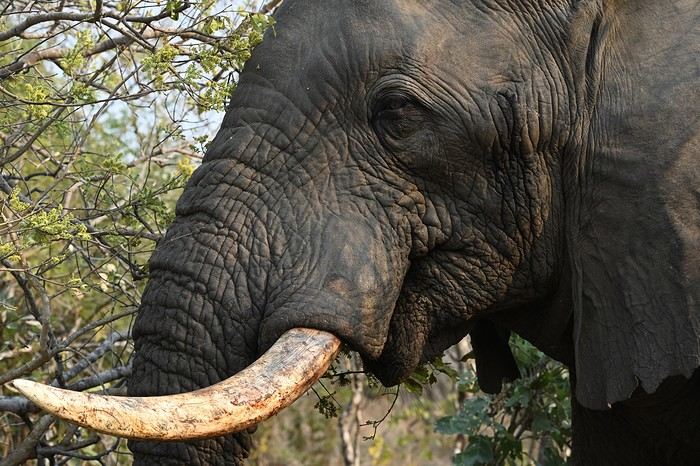 We were trapped, and even our guide looked nervous. After what felt like an eternity (though it was only a few minutes), the herd finally moved on, freeing the track. That afternoon, we did a self-drive safari and—you guessed it—we had zero interest in running into elephants again.
The next day, we headed back to Lilongwe for our flight home. It was a fantastic, varied trip with some intense moments (sometimes *too* intense). Malawi offers amazing opportunities for those who want more than just wildlife reserves.
We visited two countries: Zambia, known for its reserves, and Malawi, which is less well-known but absolutely worth a visit. Our flight landed in Lilongwe, Malawi’s capital, where our vehicle was waiting—though with a 3-hour delay. It was a 4x4 without the rooftop tent this time, since we stayed in lodges (prices are very reasonable in Malawi). Just a heads-up: don’t exchange money at the airport or banks—the official rate was 1,750 Malawian kwacha to $1. On the black market, the rate was between 3,000 and 3,500 kwacha, making the cost of living much cheaper.
With that out of the way, our first stop was South Luangwa National Park in Zambia. The first hiccup came at the Malawi-Zambia border: we were missing a document the rental company had forgotten. After some back-and-forth, they sent it via WhatsApp ($20 to get it validated by the police). But things got worse—the car’s chassis number was off by one digit from the registered one. I thought our trip was over before it even started! After what felt like forever, we got through with a "tip" of $200. Total border crossing time: 3 hours, costing nearly $400. We arrived in South Luangwa after dark.
Thankfully, the next day made up for it with an incredible day in the park (check out the photos).
We spent two full days in South Luangwa before heading to Katete for the Kulamba ceremony. Kulamba is an annual event held at the end of August, celebrating the Chewa people, who live across Zambia, Malawi, and Mozambique. The Chewa king attends, and representatives from neighboring nations bring offerings. Thousands gather for dances, speeches, and a massive market. There are few tourists, making it a truly authentic experience.
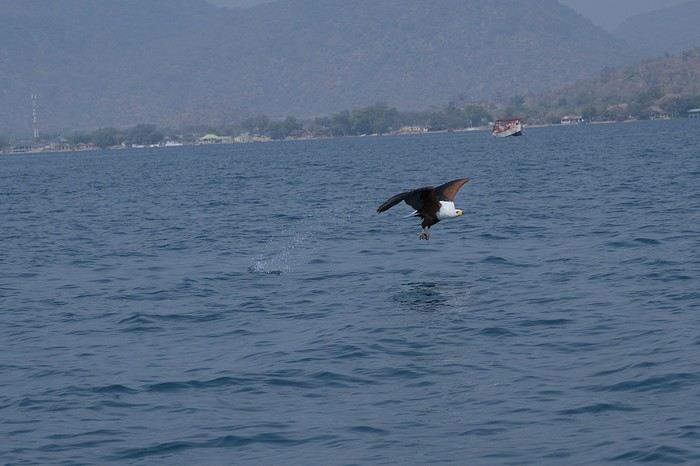
After a few days in Zambia, we returned to Malawi (the border crossing this time was smooth—just 45 minutes). Next stop: Lake Malawi. Lake Malawi covers over 20% of the country and stretches 580 km. It’s home to a family of fish called cichlids, some of which are endemic to the lake. I recommend taking a day trip from Cape Maclear for snorkeling and to watch the fishing eagles swoop down to catch fish.
We hit the road again to visit Liwonde Reserve, where we had a few surprises. The lodge was on the other side of the river that borders the park, and the elephants didn’t seem to care. On the way from reception to our rooms, elephants blocked our path, and one even charged just before the stairs leading to our treehouse-style rooms.
To top it off, monkeys ransacked our rooms, tearing through plastic bags for food. A mixed experience, but no real harm done. Next up: the mountains, specifically the Mulanje Massif. This is where Malawi’s tea is grown, and it’s also a great spot for day hikes or multi-day treks. The scenery is stunning, though sometimes the mist rolls in and hides it. After the mountains, we visited another reserve: Majete. The park is growing and now has more wildlife. We saw lions and even caught a fleeting glimpse of a leopard. And of course, the elephants got involved again—this time giving us a real scare. During the morning game drive with a guide, we stopped to watch a herd of elephants feeding. Everything was fine until, for some reason, a female got spooked—probably for her calf—and positioned herself in front of us on the track. After a few minutes, we thought the elephants would move on, but then a young one started provoking us. The problem? We had females and calves in front of us, but also two large adult males—one behind us and one to the side.
We were trapped, and even our guide looked nervous. After what felt like an eternity (though it was only a few minutes), the herd finally moved on, freeing the track. That afternoon, we did a self-drive safari and—you guessed it—we had zero interest in running into elephants again.
The next day, we headed back to Lilongwe for our flight home. It was a fantastic, varied trip with some intense moments (sometimes *too* intense). Malawi offers amazing opportunities for those who want more than just wildlife reserves.
Here we go with this second travel journal dedicated to the American West! It’s a must when you love it! 😊
We had left off in the charming town of Bisbee, which once thrived thanks to its copper mines. Today, mining is a thing of the past, and the town seems a bit sleepy.
Unfortunately, I didn’t dig deep enough on-site to answer all the questions my observations raised. Guess I’ll have to *dig* into the subject a bit more... no pun intended! 😊
Let’s hop back in the car and head a little further south to check out the esplanade that offers a view—if you can call it that—of the impressive open-pit mine. Then, it’s off to the Lowell neighborhood.
Preserved almost exactly as it was, this area must’ve been bustling in its heyday. The vintage cars are still around, storefronts and signs look like they’re straight out of another era, and the whole place has a pretty amazing vibe. You’d almost think you were on Route 66!
Here, we’re not just discovering an old neighborhood—it’s a little slice of American history. And, a detail that’s great for my physical health: the area isn’t too spread out. Lucky me! 😊
I won’t post too many photos here since I think I can turn them into a future photo exhibit. Between these and some shots from Route 66, I should have more than enough material! So, let’s keep a few under wraps... to preserve the surprise. 😊









We had left off in the charming town of Bisbee, which once thrived thanks to its copper mines. Today, mining is a thing of the past, and the town seems a bit sleepy.
Unfortunately, I didn’t dig deep enough on-site to answer all the questions my observations raised. Guess I’ll have to *dig* into the subject a bit more... no pun intended! 😊
Let’s hop back in the car and head a little further south to check out the esplanade that offers a view—if you can call it that—of the impressive open-pit mine. Then, it’s off to the Lowell neighborhood.
Preserved almost exactly as it was, this area must’ve been bustling in its heyday. The vintage cars are still around, storefronts and signs look like they’re straight out of another era, and the whole place has a pretty amazing vibe. You’d almost think you were on Route 66!
Here, we’re not just discovering an old neighborhood—it’s a little slice of American history. And, a detail that’s great for my physical health: the area isn’t too spread out. Lucky me! 😊
I won’t post too many photos here since I think I can turn them into a future photo exhibit. Between these and some shots from Route 66, I should have more than enough material! So, let’s keep a few under wraps... to preserve the surprise. 😊
My partner and I traveled from Sunday, July 5, 2026, to Wednesday, July 22, 2026.
We spent a long time debating whether to rent a car or use public transportation. In the end, after reading so many posts about travelers getting scammed by police or rental companies—even those recommended by blogs and reviews—we decided to stick with public transport. It worked out really well. Sure, we had a little less freedom to go where we wanted, but it was way less stressful for us.
Sunday, July 5:
Arrived at Cancun Airport. Withdrew cash from the ATM in the terminal just before exiting. The ADO bus counter (they pronounce it "A-Jee-O") is right behind you when you're facing the ATM. Bus to downtown Cancun cost 145 pesos per person. Stayed at "Rose 5," booked on Booking. The studio was super clean and perfect for one night. The owner’s instructions for accessing the place were very precise, with photos included. Check-in was self-service with a code. The ADO bus terminal isn’t far, and there are shops and restaurants nearby. We really appreciated that the AC was already on when we arrived. By the way, I’d recommend always booking places with AC—it’s *really* hot in Mexico.
Monday, July 6:
Bought a SIM card with data from a TELCEL store. My partner, who’s on Free Mobile, was able to use her regular plan. Just so you know, I found the network pretty unstable. As soon as we left the cities, neither of us—me with TELCEL or her with Free—had any signal. Another thing to watch out for: roaming charges. I had to turn my SIM back on for less than 30 seconds to get a bank SMS code, and my phone apparently connected to the internet—resulting in an 8-euro roaming fee. Left on an ADO bus to Chiquila for 278 pesos per person. During our trip, ADO buses were always on time, comfortable, and clean. The AC is *cranked* though, so bring something to cover up with—it gets cold. Some routes were fully booked even in the low season, so try to reserve 1 or 2 days in advance either via the app (when it works) or at the counter. When we arrived at the ADO terminal in Chiquila, the ferry company counters were right next to it. Ferries leave every 30 minutes, alternating between companies, so no need to book ahead. Just take whichever one is leaving next (330 pesos per person). When we got to Holbox (pronounced "Hol-bosh"), we’d booked a place via Booking called "Casa de Nana." It was a huge studio with a fridge, cooking plate, and utensils. The best part? The *location*. It was 100 meters from the beach and 200 meters from a Chedraui supermarket. They provided bath towels and beach towels, and the AC worked perfectly. There’s a key box so you can leave your keys inside when you go out. The only downside was that no one was there to let us in when we arrived, so we had to wait a while. The Wi-Fi was good, which was lucky because during our 4-day stay in Holbox, the phone network *never* worked. According to locals, that’s pretty common in Holbox, along with water outages. Luckily, I’d had the good idea to download an offline map, which helped us find our way back to the place more easily. You can walk there from the dock.
The restaurant next to our place (La Barracuda) was great if you like seafood—I’d recommend their octopus dishes.
Tuesday, July 7:
We did a kayak tour in Holbox’s mangroves at 6 AM. We were looking for a sunrise kayak tour with a French-speaking guide. That’s exactly what we got with "Kayaking Holbox," where Diego, the owner, speaks English and French. He was joined by Gustavo, another guide. We’d booked for a group tour, but we were the only ones. Diego still went ahead with it instead of canceling due to lack of participants, so we got a private tour at the group rate—really professional of him. They showed us this amazing ecosystem for over 3 hours. We saw all kinds of birds: pink flamingos, pelicans, egrets, frigatebirds... rays, a horseshoe crab, and a little crocodile that was *so* well hidden. Diego and Gustavo have a real eye for spotting animals—I could’ve passed by the crocodile 100 times and never seen it, it blended in so well. Their explanations about the flora and fauna were super interesting. We also got a little break where we tasted mangoes and bananas that taste *nothing* like the ones in France. A real treat—those little Mexican yellow mangoes! I’d definitely recommend Diego and his agency for a French-language kayak tour (1000 pesos per person). In the evening, we walked to Punta Coco to see the bioluminescence. No need for a guided tour—if you really don’t want to walk, you can take a taxi. At Punta Coco, you have to pass the beach bar/restaurant and then go left into a kind of inlet that forms a lagoon. You have to wiggle your feet or move your hands in the water to create movement, which makes the light appear. Just don’t expect the kind of photos you’ve seen online—they’re all edited! It’s fun to see, but you won’t be dazzled by the light...
Wednesday, July 8:
Whale shark tour with "My Holbox Tours." Why recommend this agency over others for swimming with whale sharks? Simply because Valérie surrounds herself with top professionals to make your experience unforgettable. We were with Captain Fernando, who does everything to position the boat perfectly and make your swim easier. In the water, we were with Humberto, who also goes above and beyond to make sure you have an incredible time. He doesn’t just "supervise" like some guides from other companies who leave you on your own. No, Humberto reads the whale shark’s trajectory and guides you—all you have to do is follow him. He really puts in the effort, even holding your hand to guide you through this quick but intense encounter. Humberto also films the moment and will offer to show you the videos and sell them to you. His footage is really high quality. Fernando and Humberto also prepared food for us. Special mention for their guacamole! Valérie is there to make sure everything goes smoothly on the boat and to answer your questions in French, English, or Spanish about these animals. If you choose My Holbox Tours, you can be sure you’ll get a top-notch experience. About the tour itself: before you go, you should know that the sharks can be *really* far away. The day we went, it took 3.5 hours by boat to reach them. The boats are small, and let me tell you—on the way there, when we weren’t going with the waves, it was *rough*. Out of 9 passengers, 4 got seasick. But once you’re face-to-face with the shark, you forget all about that. Even if swimming with a whale shark isn’t exactly a walk in the park—they swim pretty fast, so you need some endurance to keep up. You’ll usually get 2 turns. Our first swim lasted a little over 4 minutes, and the second about 2 minutes because the shark was moving fast and we were still tired from the first swim. It might seem short, but when you’re swimming, it feels *long*. Either way, it’s an experience you *have* to do—but choose your company wisely. On the way back, there’s a stop at Cabo Catoche. Honestly, the snorkeling is pretty disappointing if you’ve done it elsewhere in the world. But the lunch stop at Cabo Catoche is really nice for relaxing (white sand and hammocks).
Thursday, July 9:
Short morning walk to Punta Mosquito at 6 AM. Really nice. Ferry to Chiquila (330 pesos per person) + ADO bus to Valladolid (300 pesos per person).
In Valladolid, we booked "Casa Lucia" via Booking. The hotel is gorgeous, with a colonial style, and very close to the ADO bus terminal and downtown. It’s super quiet and clean. There’s a shared kitchen you can use with a fridge, microwave, and water dispenser, plus a big table by the pool and a nice indoor terrace. Breakfast was simple but included. The only small downsides were the tiny room and bathroom, no mirror in the room, and a noisy fan.
Friday, July 10:
Not far from the ADO bus terminal is the colectivo station for Chichen Itza. They offer a round-trip to Chichen Itza with an option to stop at Ik Kil cenote on the way back and then drop you off in Valladolid for 370 pesos per person (Ik Kil entrance included). For the Chichen Itza visit, we’d booked a tour with a guide often mentioned in groups—his name is Juan Pat. He’s a Maya who lives near the site and speaks excellent French. He reserves spots in advance for you and queues up to be the first on-site. It cost 500 pesos per person + entrance fees. His tour lasts 2 hours and focuses mainly on the main pyramid and the ball court. He’s passionate and fascinating, even if some of his claims, as a Maya, might be a little biased. I think it’s *really* important to have a guide—otherwise, you’ll miss so much. You can contact Juan Pat on WhatsApp at +52 985 121 2381. Afterward, we went to Ik Kil cenote (showers and life jackets mandatory, lockers available). It’s *very* crowded, but still really beautiful with its lush vegetation.
Saturday, July 11:
Since we didn’t have a car but still wanted to visit other cenotes that seemed hard to reach by public transport, we decided to book a taxi for the day. We agreed on 1200 pesos to take us to 3 different cenotes and wait for us at each one. (To find taxis, just look where they park near the ADO bus station.) He picked us up at Zaci cenote, which we’d walked to. We got there at opening time and were the first ones there—had the place to ourselves for a while! 150 pesos per person. A pretty cenote in the city center with lush vegetation. It’s a bit like Ik Kil but without the deep cylindrical effect.
Cenote Xcanahaltun: the most beautiful cenote we visited. Entry 250 pesos per person. It’s a closed cenote with a hole that lets light in—a cave-like setting. You can kayak inside. There are little fish at the edge that nibble dead skin off your feet. Since it’s closed, the water is *freezing*!
Cenote Palomitas: entry 250 pesos per person. Another stunning closed cenote, even more enclosed than Xcanahaltun. The hole in the ceiling is smaller, so it was pretty dark when we arrived—kind of an eerie vibe. But when the staff turned on the lights, it looked like a "Gothic cathedral" full of bright stalactites.
Cenote Sac Aua: entry 290 pesos per person. The ticket includes a guided cave tour (tip-based). This cenote is really unique with its central island and way less crowded than Suytun. Just so you know, the water is *really* cold in cenotes. In these three, in July, we had the place to ourselves for a while and never saw more than 2 families at once—so peaceful!
Sunday, July 12:
ADO bus to Bacalar (536 pesos per person). In Bacalar, we stayed via Airbnb with a host named Luli, who offers several rooms with shared bathroom and kitchen.
The room is nicely decorated in a pleasant setting. It’s ideally located near the lagoon and downtown. The shared kitchen is handy. The mosquito net over the bed is useful because there are *a lot* of mosquitoes in Bacalar. Luli provides a water jug, which is really nice. The only big downside is the lack of water pressure in the shower—we had to rinse off by filling a bucket. Also, there’s no real door separating the room from the bathroom. We never met Luli in person, but she was very responsive via messages. The terrace in the middle of the vegetation is lovely. From the ADO terminal to the place, we took a taxi for 40 pesos. Since this driver was honest about the price (we’d checked beforehand), we decided to use him every time we needed a taxi in Bacalar. Here’s his WhatsApp: +52 983 184 3585.
Monday, July 13:
We did a boat tour on the lagoon with "Bacalar Francophone Activities." Since we were just the two of us, it cost 3500 pesos. If we’d managed to be 4 people, it would’ve been 1000 pesos per person. We had a private 4-hour tour on the lagoon with Steeve and his very comfortable boat. He’s from Quebec, so his French is perfect. During those 4 hours, Steeve showed us the lagoon’s iconic spots *and* places other boats don’t go. He told us about the lagoon’s history and gave great tips on where to go and where to eat. As a little bonus, he gave us a video taken with his drone during our swimming break.
Tuesday, July 14:
We went to Los Rapidos by taxi (400 pesos round trip) and entry was 225 pesos per person. It’s *very* touristy but really beautiful. You can eat there (expensive), relax, and go down the "rapids" as many times as you want. It’s worth it if you spend a few hours there. You can’t bring in food or drinks—you leave them at the entrance and pick them up on the way out.
Wednesday, July 15:
On Wednesdays, navigation is banned on Bacalar Lagoon, so we’d planned another excursion. Visit to Calakmul from Bacalar with ABCtours (WhatsApp +52 983 319 8359). This agency organized a trip from Bacalar to Calakmul with a French-speaking guide. Communication beforehand via WhatsApp was smooth. Mr. Checo, the driver, and Fernando, the guide (who spoke great French), picked us up on the day. Mr. Checo drove very carefully on the long road and always made sure we were comfortable. Fernando is passionate about flora and fauna—he’s a biologist with a degree in ornithology, so he knows *everything* about animals. The slightest sound or song, and he knows what it is. He’s got an eye for spotting them, from the biggest to the smallest. During the trip, we stopped at km 27 for a short forest walk, then went to see the two main pyramids on the site. On the way back, we stopped at the bat cave for the magical spectacle of millions of bats flying out at dusk. In the end, we saw or glimpsed (some briefly) spider monkeys, howler monkeys, a toucan, 2 tapirs, turkeys, 2 deer, and lots of birds. If, like us, you’re more into flora and fauna than archaeology, I’d *highly* recommend this agency and tour with Fernando. It’s not cheap, but the road between Bacalar and the site is *long* (3.5 hours). Price: 3900 pesos per person for 2 (3500 for 3, 3200 for 4).
Thursday, July 16:
ADO bus to Playa del Carmen (614 pesos per person). In Playa del Carmen, we stayed in an Airbnb. The building is on the town hall square, next to the casino. The best thing about this place is the *location*—super close to Fifth Avenue (La Quinta). The kitchen is pretty basic, but the fridge works well. There are supermarkets nearby. The rooftop pool is really nice. The two big downsides, though, are the soundproofing (you can *hear* the neighbor’s alarm and all the events on the square) and the *total* lack of water pressure in the shower. We had to fill a trash can with water to pour over ourselves. When we told the owner, he said it wasn’t normal and someone would come fix it, but we never heard back. Based on previous reviews, this seems to be a known issue that never gets resolved. Playa del Carmen is *very* touristy on Fifth Avenue, but in a fun, musical vibe—we never felt unsafe. There are *tons* of little souvenir shops for tourists on this street. There’s a beautiful monumental sculpture on the beach (the two figures meeting in the air), next to which you can see the Voladores show (men climbing a pole, tying themselves with ropes, and descending headfirst while "flying" around the pole). The show is tip-based and happens several times a day. In our opinion, Calle 38 is prettier than Fifth Avenue—it’s lush, green, and quieter, with the sea at the end. Great for an early evening stroll. We had really good meals at great prices at "El Tio Noy" tacos, just a few meters from Fifth Avenue in a side street. For souvenirs, we’d recommend going to Walmart instead of Fifth Avenue—you’ll find skulls, tequila, mezcal, keychains, mugs, glasses... at good, fixed prices.
Friday, July 17:
We did the excursion to Isla Contoy. Isla Contoy is an uninhabited, highly protected island. Only 200 people are allowed to land per day on a rotating basis, so only a few companies have permission to dock there. Most agencies subcontract the day to a third-party company. We booked through VRM (Viviendo Riviera Maya), but it was Ocean Tours Mexico that handled the tour. Contoy is a little paradise. We were accompanied by multilingual guides, including French speakers, throughout the day. Steffy gave us info about the island during a short walk on the marked trails, and Leño Tlatemoa kept the mood up on the boat rides with music and dancing. Isla Contoy is *truly* stunning, and the lunch was delicious: grilled fish and chicken, guacamole and tortilla chips, rice, fruit, drinks (everything is brought and taken back by the guides). The snorkeling part was pretty disappointing if you’ve done it in Cozumel, though. The stop at Isla Mujeres isn’t very interesting either—it’s too short to explore, and the island is *extremely* touristy. Still, the excursion was very well organized, and we had a great day (2970 pesos per person).
Saturday, July 18:
We wanted to go snorkeling in Cozumel but thought the prices from French-speaking agencies were too high. Plus, for snorkeling, we figured we didn’t *need* a French-speaking guide. So we found a much cheaper solution by taking the ferry from Playa del Carmen ourselves and choosing an agency in Playa. The round-trip ferry cost 663.50 pesos per person. Then we took a taxi to the snorkeling boat (100 pesos). The agency we chose is called Mystic Snorkel—they don’t have a physical office. The tour cost 1400 pesos per person. It was a small boat, but that day we were the only ones, so we got a private tour at the group rate. We stopped at 4 different sites, all very different and beautiful. We saw all kinds of fish, corals, a nurse shark, and turtles. El Cielo, with its huge starfish, is *exceptional*. If you’re going snorkeling in the Yucatan Peninsula, this is *the* tour to do—the other sites are pretty "poor" in comparison.
Sunday, July 19:
Morning dive with Triton Diving. I chose the Cozumel dive option. Great experience. Booking via WhatsApp was easy. On the day of the dive, Selene, who speaks French, was our guide. She’s *very* attentive to the group’s safety. The briefings are clear and precise. In Cozumel, we did 2 very different sites: the first was a drift dive with lots of life—beautiful corals and fish. The second was a wreck, the C53, a 56-meter boat you can enter. Not much marine life, but a beautiful wreck intentionally sunk for divers—still in great condition. An unforgettable moment. Selene even took videos during the dive, which the club sends you for free afterward. I’d *highly* recommend this club.
Just so you know, in Playa del Carmen, the beaches were full of sargassum during our stay, despite barriers and daily cleanup. Locals told us the problem is getting worse and the sargassum is arriving earlier in the season. Tourism has taken a *big* hit this summer, and they’re wondering if tourism can even survive the sargassum season anymore. A lot of tourists are heading to the islands—Isla Mujeres and Cozumel—to enjoy the beaches, as the west side of those islands is sargassum-free.
Monday, July 20:
Colectivo to Puerto Morelos. First, a colectivo toward Cancun that drops you off between Puerto Morelos town and Puerto Morelos beach (40 pesos per person), then another from that junction to the beach (10 pesos per person). In Puerto Morelos, we’d booked a room via Airbnb at "Piedra del Caribe." *Best* place we stayed in Mexico. It’s an aparthotel. Our room was ready before check-in, so they let us in early. The place matched the description—spacious, with a comfortable king-size bed. The shower had *great* pressure, which isn’t a given in Mexico. The staff was super friendly and welcoming. They let us use the pool, restrooms, and rooftop shower after check-out while we waited for our ride to Cancun Airport. They even kept our luggage. I *highly* recommend this place. In Puerto Morelos, there was *way* less sargassum than in Playa del Carmen—it was actually swimmable. We did the snorkeling tour with the fishermen’s cooperative for 450 pesos per person for 2 hours. The reef is close to the beach (you’re not allowed to swim there), so the boat ride is short. It’s not as pretty as Cozumel, but it’s nice and affordable. On Puerto Morelos’s page, you can also access a small, not-very-well-preserved reef. There’s also a cenote in the sea where fresh water mixes with saltwater—the water is murky there. We had a great dinner and excellent cocktails at "La Choza del Puerto."
Tuesday, July 21:
Wandered around Puerto Morelos (check out the church and read everything—it’s entertaining!), relaxed by the hotel pool, and left for Cancun Airport by taxi (400 pesos) booked via InDrive to head back to France.
Our highlights: - Holbox - The whale shark tour - The cenotes - The local flora and fauna (so present!) - Isla Contoy - Cabo Catoche (except for the snorkeling)
What we liked least: - The bioluminescence (barely visible despite good conditions) - The food—we found it not very diverse in taquerias - The constant tipping - The lack of water pressure in showers (fixed, wall-mounted, no hose or showerhead)
Don’t hesitate to ask if you have any questions while it’s still fresh in our minds.
February 9 - Day 1
"So, my little wanderers, back at the decks? What’s this mystery destination you’ve got in store for us at the start of the year?"
Yes, the schoolyard bell’s ringing again! We’re hitting the road... or rather, the skies! At first glance, our destination might surprise more than a few. First off, simply because I was here exactly twenty years ago, and I don’t usually like retracing my own footsteps. Secondly, because the name of this place screams mass tourism—basically the opposite of what Flo and I look for.
Despite that, in this land of backsheesh, I’d promised myself I’d come back one day to experience it my way. And since Flo told me, during our wanderer chats, that this destination straddling Africa and the Middle East was in her top 2 travel dreams, the stars aligned for this roots-style trip to quickly make it onto our pharaonic festivities program! Unless you’re totally clueless in general knowledge, you’ve probably guessed by now—we’re off to Egypt! Of course, a few classics will be on our itinerary, but above all, we want to soak up a culture that can’t be appreciated in four-star resorts or on a Nile cruise boat. And let’s be clear, these next two weeks won’t be a walk in the park—neither for our two daughters who are joining us, nor for our bodies!
And that’s clear from the get-go: after our first flight, eight hours of trying (and failing) to sleep on Milan airport’s metal seats, our second flight, landing, passport stamps, our Uber ride, and our first Cairo kilometers, we finally drop our exhaustion at the little guesthouse we booked in Giza. Doesn’t all that energy deserve a little reward?
Oh, absolutely! And here it is: a full-on slap in the face for everyone! But just look at this view from our hotel terrace? For 20 € a night for four, even with this incredible view, I figured the room must be pretty shabby, right? Nope... Is the staff rude, then? Nope... Okay, so what’s the catch? You’re gonna tell me breakfast is included too? Well, yes! Honestly, this Egypt trip is off to a great start.

And the rest of the afternoon, spent rubbing shoulders with locals, only confirmed this vibe. After digesting our pyramid view, we dove into the hustle and bustle of our neighborhood with the goal of exchanging money, eating at street stalls, and testing the hospitality of the locals. Ten out of ten!




Eight little sun breads with baba ganoush and falafel? 80 pounds, or 1.5 €. A dozen Middle Eastern pastries? Same! 80 pounds! Two hawawshis, those little pita breads stuffed with meat and spices? 10 pounds each, or about twenty cents! Not to mention all those smiles and free "welcomes" left and right!!!

What a welcome! We end this first day with a sunset over the three sisters of Giza—where we’ll obviously be gawking tomorrow...



https://voyageforum.com/images/posts/small/1789072399-cCyLDYuFwPLAZTY.jpg
"So, my little wanderers, back at the decks? What’s this mystery destination you’ve got in store for us at the start of the year?"
Yes, the schoolyard bell’s ringing again! We’re hitting the road... or rather, the skies! At first glance, our destination might surprise more than a few. First off, simply because I was here exactly twenty years ago, and I don’t usually like retracing my own footsteps. Secondly, because the name of this place screams mass tourism—basically the opposite of what Flo and I look for.
Despite that, in this land of backsheesh, I’d promised myself I’d come back one day to experience it my way. And since Flo told me, during our wanderer chats, that this destination straddling Africa and the Middle East was in her top 2 travel dreams, the stars aligned for this roots-style trip to quickly make it onto our pharaonic festivities program! Unless you’re totally clueless in general knowledge, you’ve probably guessed by now—we’re off to Egypt! Of course, a few classics will be on our itinerary, but above all, we want to soak up a culture that can’t be appreciated in four-star resorts or on a Nile cruise boat. And let’s be clear, these next two weeks won’t be a walk in the park—neither for our two daughters who are joining us, nor for our bodies!
And that’s clear from the get-go: after our first flight, eight hours of trying (and failing) to sleep on Milan airport’s metal seats, our second flight, landing, passport stamps, our Uber ride, and our first Cairo kilometers, we finally drop our exhaustion at the little guesthouse we booked in Giza. Doesn’t all that energy deserve a little reward?
Oh, absolutely! And here it is: a full-on slap in the face for everyone! But just look at this view from our hotel terrace? For 20 € a night for four, even with this incredible view, I figured the room must be pretty shabby, right? Nope... Is the staff rude, then? Nope... Okay, so what’s the catch? You’re gonna tell me breakfast is included too? Well, yes! Honestly, this Egypt trip is off to a great start.
And the rest of the afternoon, spent rubbing shoulders with locals, only confirmed this vibe. After digesting our pyramid view, we dove into the hustle and bustle of our neighborhood with the goal of exchanging money, eating at street stalls, and testing the hospitality of the locals. Ten out of ten!
Eight little sun breads with baba ganoush and falafel? 80 pounds, or 1.5 €. A dozen Middle Eastern pastries? Same! 80 pounds! Two hawawshis, those little pita breads stuffed with meat and spices? 10 pounds each, or about twenty cents! Not to mention all those smiles and free "welcomes" left and right!!!
What a welcome! We end this first day with a sunset over the three sisters of Giza—where we’ll obviously be gawking tomorrow...
https://voyageforum.com/images/posts/small/1789072399-cCyLDYuFwPLAZTY.jpg
December 13 - Day 1
"How about a Christmas market this year, huh? A little romantic weekend getaway... - Yes! That’d be cool! Strasbourg? Colmar? - Feels a bit déjà vu, doesn’t it? Plus, slim chance of snow there... And I’d love something a bit more exotic with a touch of originality..."
"Okay, Google, give me the list of the five most beautiful Christmas markets in Europe. - In fifth place, the Christmas market in Vilnius, the capital of Lithuania. - Save your breath! Lithuania, here we come!"

We wanted cold, and cold is exactly what we got the moment we set foot in this new, unknown land. As for landscapes, forests and lakes stretch as far as the eye can see across this vast plain, its vegetation scorched by the frost of a winter that’s clearly already well underway here.

Lakes, in fact, set the scene for our first visit to Trakai Castle, whose brick-red towers and walls rise proudly against the azure sky of our first day. Lakes, because this castle was built on an island and is only accessible on foot via a series of walkways spanning half-frozen lake offshoots. I couldn’t have picked a better spot to build my castle! Translation: We’re totally sold! Proof is we spend two hours hiking around the area, alternating between forests, reeds, and cozy houses tastefully decorated for Christmas.








"How about a Christmas market this year, huh? A little romantic weekend getaway... - Yes! That’d be cool! Strasbourg? Colmar? - Feels a bit déjà vu, doesn’t it? Plus, slim chance of snow there... And I’d love something a bit more exotic with a touch of originality..."
"Okay, Google, give me the list of the five most beautiful Christmas markets in Europe. - In fifth place, the Christmas market in Vilnius, the capital of Lithuania. - Save your breath! Lithuania, here we come!"
We wanted cold, and cold is exactly what we got the moment we set foot in this new, unknown land. As for landscapes, forests and lakes stretch as far as the eye can see across this vast plain, its vegetation scorched by the frost of a winter that’s clearly already well underway here.
Lakes, in fact, set the scene for our first visit to Trakai Castle, whose brick-red towers and walls rise proudly against the azure sky of our first day. Lakes, because this castle was built on an island and is only accessible on foot via a series of walkways spanning half-frozen lake offshoots. I couldn’t have picked a better spot to build my castle! Translation: We’re totally sold! Proof is we spend two hours hiking around the area, alternating between forests, reeds, and cozy houses tastefully decorated for Christmas.

Hi everyone,
I’m sharing a little recap of this new 4-week trip to China—nothing fancy, just my experience.
We’re taking advantage of the extended visa exemption to return to China for the 4th time. I loved last summer’s trip so much that I’m a bit worried about being disappointed this year. Plus, I’ve had a few hiccups before this departure: my WeChat account got blocked, and I couldn’t recover it (luckily, Alipay still works fine); I couldn’t verify my 12306 account for weeks; Trip.com failed to book our second train; and I’ve got an injury that’ll slow me down during the trip... Ugh, I hate starting a trip with these kinds of issues. Then, oh surprise! Just before leaving, my 12306 account got verified! Super easy to use from that point on—I could book a few train tickets without fees.
We’re sticking with Free’s e-SIMs, which work great in China.
August 2–3
Anyway, on the morning of August 2nd, we took the RER to CDG. As usual, we couldn’t check in online. It’s always a bit frustrating, especially since we didn’t have any checked luggage. We flew with Air China. We arrived at the check-in counter at 9:50 AM, 2 hours and 40 minutes before the flight. The line for our check-in stretched 300 meters across the airport in both directions. What a joke!! We spent 1 hour and 45 minutes in that line just to reach the counter and get our boarding passes. By then, it was 11:35 AM, and boarding had already started at 11:20 AM. The screens showed a 25-minute walk to our gate—on the other side of the airport, of course—plus we had to go through passport control and security... Long story short, the plane didn’t leave without us 🙂 We boarded among the last passengers, and we took off at 12:30 PM. We’d flown Air China four times before, but this time, it felt *really* low-cost. The check-in chaos, the cramped seats (12 seats per row), no music by artists known outside China, mediocre food, and a boarding area at Beijing Airport with only 10 seats—worthy of Ryanair or EasyJet. And yet, the price was sky-high. Again, D.’s vacation requests were denied outside of July and August, so we’re traveling from August 2nd to 30th. We couldn’t have picked a worse time for inflated prices, and with the situation in Iran, we got hit with a 390 € fuel surcharge. I’ve never paid so much for flights—I felt like I’d bought business class, but nope, far from it!!
We landed in Beijing around 4:15 AM. It was 28°C with thick fog. We drove and drove and drove for 20 minutes, as usual in Beijing. Then we went through a first check, a second check, a third check, and waited for our connecting flight at 6:40 AM. A small Airbus A320, but way more space than in the Boeing 777 from the first flight. We landed in Kunming, Yunnan, around 10:15 AM in the rain.
We headed to the subway. You can’t pay at the machines with Alipay here either, so we set up the transport QR code directly in Alipay to scan at the subway gates. The process is a bit long the first time if you haven’t entered your info before, but once it’s done, it’s *so* much easier! We took Line 6 to the terminus for 6 yuan each.
We’d booked a hotel nearby, on the 16th floor. It’s actually studios on different floors of a huge residential building. The view’s pretty nice from here. We settled in quickly—back to those wooden beds, or rather, mattresses as hard as wood, which we *hadn’t* missed... Then we went out for our first bowl of noodles of the trip and wandered through the shopping streets of the old town.

It was crowded, and the weather was cool—around 19–20°C. We tried a local specialty: milk skin, thick, dried, then grilled with rose jam. Yeah... we won’t be having that again. The taste and texture of the milk skin... no thanks.

We saw a lot of wild mushroom hotpot too. It’s on our list for later. We also passed through the Jinma and Biji gates, where I played with reflections in puddles. I *love* doing that 🙂

At the end of the day, we headed to a temple advertised as open 24/7 on Amap. Of course, when we got there, it was closed. We’ll go back tomorrow. That was the first of many disappointments with Amap this trip—I hadn’t had that issue on previous visits.
We were exhausted after that sleepless flight. Night was falling, and we decided to grab a quick bite without much appetite. We shared a delicious vegetable fried rice for 12 yuan—we even left half of it. The portions are *huge*.
After a couple of small purchases, we headed back at 9 PM, wiped out, after walking 17 km between the airports and these first steps in Kunming. I expected to see quite a few Western travelers here, but we didn’t spot a single one. Instead, we met lots of curious Chinese people, many of them super friendly and helpful—almost *too* eager, like when they’d run to serve us as fast as possible. It’s a bit much, but it’s great to be back!
I’m sharing a little recap of this new 4-week trip to China—nothing fancy, just my experience.
We’re taking advantage of the extended visa exemption to return to China for the 4th time. I loved last summer’s trip so much that I’m a bit worried about being disappointed this year. Plus, I’ve had a few hiccups before this departure: my WeChat account got blocked, and I couldn’t recover it (luckily, Alipay still works fine); I couldn’t verify my 12306 account for weeks; Trip.com failed to book our second train; and I’ve got an injury that’ll slow me down during the trip... Ugh, I hate starting a trip with these kinds of issues. Then, oh surprise! Just before leaving, my 12306 account got verified! Super easy to use from that point on—I could book a few train tickets without fees.
We’re sticking with Free’s e-SIMs, which work great in China.
August 2–3
Anyway, on the morning of August 2nd, we took the RER to CDG. As usual, we couldn’t check in online. It’s always a bit frustrating, especially since we didn’t have any checked luggage. We flew with Air China. We arrived at the check-in counter at 9:50 AM, 2 hours and 40 minutes before the flight. The line for our check-in stretched 300 meters across the airport in both directions. What a joke!! We spent 1 hour and 45 minutes in that line just to reach the counter and get our boarding passes. By then, it was 11:35 AM, and boarding had already started at 11:20 AM. The screens showed a 25-minute walk to our gate—on the other side of the airport, of course—plus we had to go through passport control and security... Long story short, the plane didn’t leave without us 🙂 We boarded among the last passengers, and we took off at 12:30 PM. We’d flown Air China four times before, but this time, it felt *really* low-cost. The check-in chaos, the cramped seats (12 seats per row), no music by artists known outside China, mediocre food, and a boarding area at Beijing Airport with only 10 seats—worthy of Ryanair or EasyJet. And yet, the price was sky-high. Again, D.’s vacation requests were denied outside of July and August, so we’re traveling from August 2nd to 30th. We couldn’t have picked a worse time for inflated prices, and with the situation in Iran, we got hit with a 390 € fuel surcharge. I’ve never paid so much for flights—I felt like I’d bought business class, but nope, far from it!!
We landed in Beijing around 4:15 AM. It was 28°C with thick fog. We drove and drove and drove for 20 minutes, as usual in Beijing. Then we went through a first check, a second check, a third check, and waited for our connecting flight at 6:40 AM. A small Airbus A320, but way more space than in the Boeing 777 from the first flight. We landed in Kunming, Yunnan, around 10:15 AM in the rain.
We headed to the subway. You can’t pay at the machines with Alipay here either, so we set up the transport QR code directly in Alipay to scan at the subway gates. The process is a bit long the first time if you haven’t entered your info before, but once it’s done, it’s *so* much easier! We took Line 6 to the terminus for 6 yuan each.
We’d booked a hotel nearby, on the 16th floor. It’s actually studios on different floors of a huge residential building. The view’s pretty nice from here. We settled in quickly—back to those wooden beds, or rather, mattresses as hard as wood, which we *hadn’t* missed... Then we went out for our first bowl of noodles of the trip and wandered through the shopping streets of the old town.
It was crowded, and the weather was cool—around 19–20°C. We tried a local specialty: milk skin, thick, dried, then grilled with rose jam. Yeah... we won’t be having that again. The taste and texture of the milk skin... no thanks.
We saw a lot of wild mushroom hotpot too. It’s on our list for later. We also passed through the Jinma and Biji gates, where I played with reflections in puddles. I *love* doing that 🙂
At the end of the day, we headed to a temple advertised as open 24/7 on Amap. Of course, when we got there, it was closed. We’ll go back tomorrow. That was the first of many disappointments with Amap this trip—I hadn’t had that issue on previous visits.
We were exhausted after that sleepless flight. Night was falling, and we decided to grab a quick bite without much appetite. We shared a delicious vegetable fried rice for 12 yuan—we even left half of it. The portions are *huge*.
After a couple of small purchases, we headed back at 9 PM, wiped out, after walking 17 km between the airports and these first steps in Kunming. I expected to see quite a few Western travelers here, but we didn’t spot a single one. Instead, we met lots of curious Chinese people, many of them super friendly and helpful—almost *too* eager, like when they’d run to serve us as fast as possible. It’s a bit much, but it’s great to be back!
Week 1 - July 2026
Traveling with just one spare pair of underwear, considering a hot shower a miracle, never staying in the same place too long by sleeping wherever night catches us, taking whatever local, improbable, and rickety transport we can find—this is the DNA of us wanderers. Except this time, the script for our movie is going to be a whole different genre. On paper, the destination doesn’t exactly scream epic adventure: Réunion! And what’s more... we won’t be two, or four, or even ten. We’ll be a solid thirty. All from the same family. Yes, thirty. At this point, it’s not just a trip—it’s a summer camp on the move! Why inflict this on such a peaceful island? Because my brother decided to get married there with his lovely bride. A great idea, you might say... especially when it involves relocating the equivalent of a small Ardennes village 10,000 kilometers from home for three weeks! So who’s stepping up to be the guide and wave the little flag?
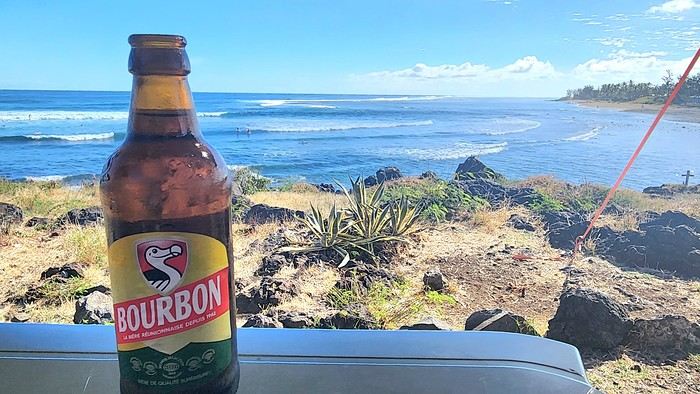
So, for an exceptional trip, exceptional stories! Don’t worry, the debates at the supermarket over whether to choose plain chips or roast chicken chips, the beach picnics washed down with ti’ punch, and other rougail sausages to digest by the pool will only make it into the family archives. Here, I’ll stick to the tales of our beautiful escapes, the ones where we explore the wild corners of this little volcanic rock planted in the middle of the Indian Ocean. So where exactly are we headed?
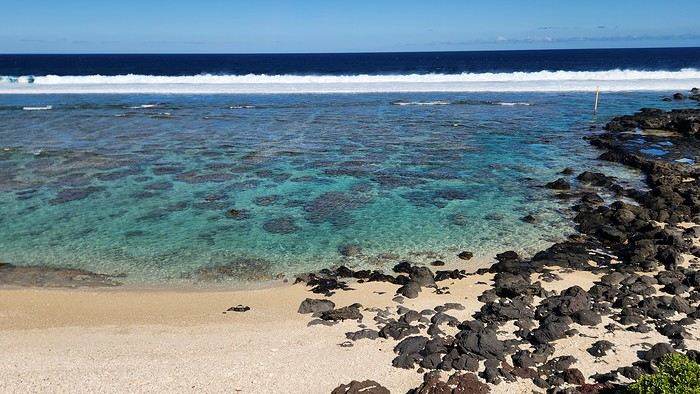
For the first week—the subject of this first installment—we’re taking it easy. We’ll start by rediscovering the coastline, from the Souffleur in Saint-Leu to the Hermitage lagoon, before a little trip to the Cirque de Cilaos and its legendary road with 400 turns, just to get our legs warmed up.
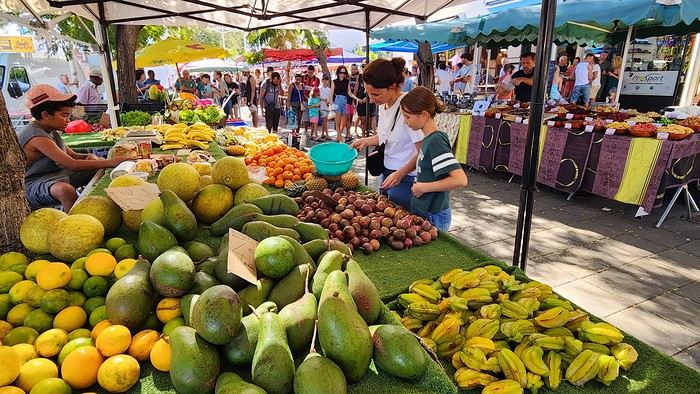
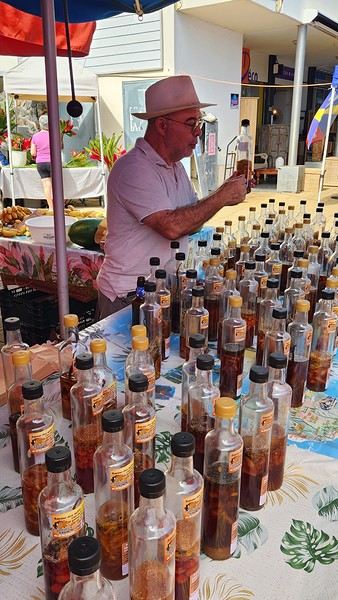
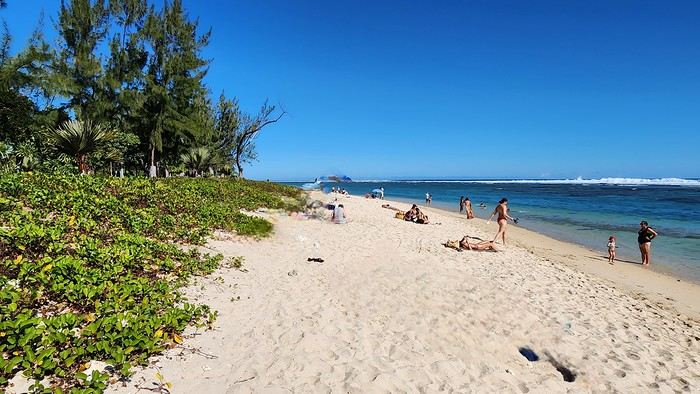
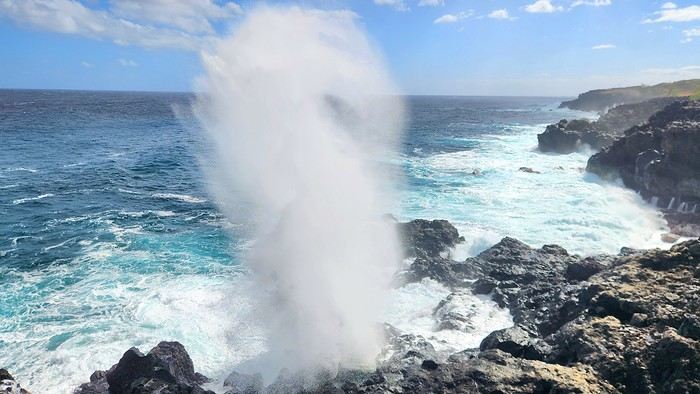
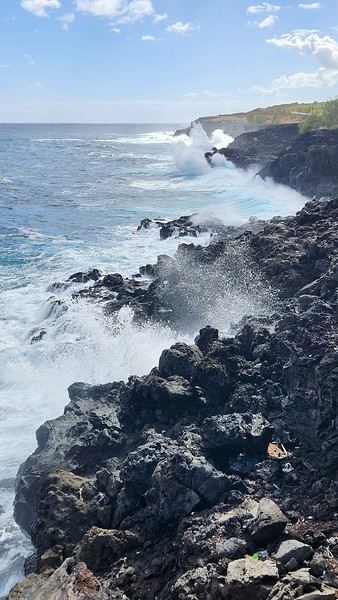
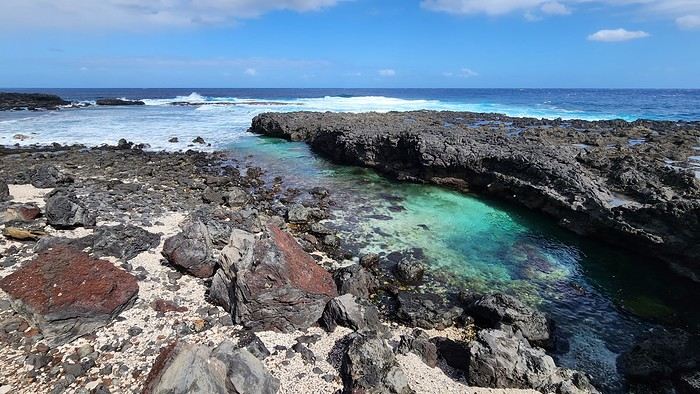
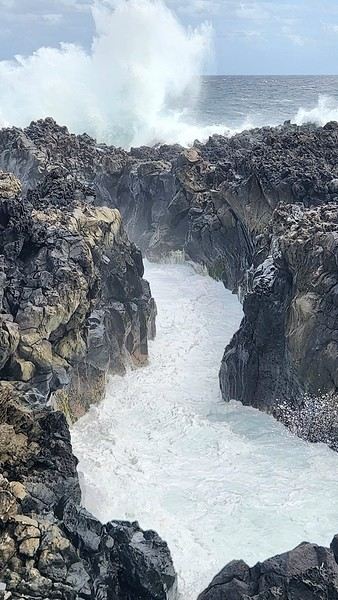
Traveling with just one spare pair of underwear, considering a hot shower a miracle, never staying in the same place too long by sleeping wherever night catches us, taking whatever local, improbable, and rickety transport we can find—this is the DNA of us wanderers. Except this time, the script for our movie is going to be a whole different genre. On paper, the destination doesn’t exactly scream epic adventure: Réunion! And what’s more... we won’t be two, or four, or even ten. We’ll be a solid thirty. All from the same family. Yes, thirty. At this point, it’s not just a trip—it’s a summer camp on the move! Why inflict this on such a peaceful island? Because my brother decided to get married there with his lovely bride. A great idea, you might say... especially when it involves relocating the equivalent of a small Ardennes village 10,000 kilometers from home for three weeks! So who’s stepping up to be the guide and wave the little flag?
So, for an exceptional trip, exceptional stories! Don’t worry, the debates at the supermarket over whether to choose plain chips or roast chicken chips, the beach picnics washed down with ti’ punch, and other rougail sausages to digest by the pool will only make it into the family archives. Here, I’ll stick to the tales of our beautiful escapes, the ones where we explore the wild corners of this little volcanic rock planted in the middle of the Indian Ocean. So where exactly are we headed?
For the first week—the subject of this first installment—we’re taking it easy. We’ll start by rediscovering the coastline, from the Souffleur in Saint-Leu to the Hermitage lagoon, before a little trip to the Cirque de Cilaos and its legendary road with 400 turns, just to get our legs warmed up.
It’s an ancient city that breathes, a living spring.
Here, no kitschy signs like “I miss you in Fengyu,” nor mass-produced fake antiques.
The century-old houses still bear the marks of wind and rain; in the morning, you hear roosters crowing, and at dusk, smoke gently rises from the kitchens.
This city doesn’t try to please anyone—like the spring water flowing through it, it simply keeps living at its own pace.
Located in Eryuan County, in the Dali Prefecture of Yunnan, the ancient town of Fengyu is a nationally designated historical and cultural city. It’s nicknamed the “land of scholars and ink”—during the Qing Dynasty, the Fengxiang Academy produced four *jinshi* and eleven *juren* in the imperial examinations. The Bai families made studying and farming a true legacy. Even on market days, you’ll find stalls of calligraphy and paintings, while lintels and screen walls are covered with family mottos.
Fengyu was also an important stop on the ancient Tea Horse Road. It preserves the second-largest Bai architectural complex in China, just after Xizhou. The famous traveler Xu Xiake spent seven days here and compared it to the “peach blossom paradise.”

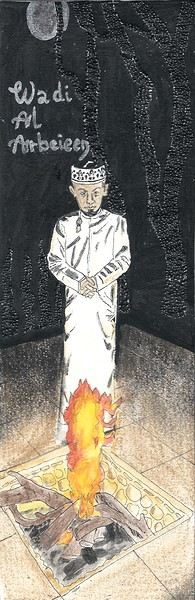
If I close my eyes and think of the Sultanate of Oman, I first smell a light scent of incense, feel the warmth of a sunbeam on my skin, before sand slips through my fingers. I taste the sweetness of a date, a real candy, then the flavor of coffee with a hint of cardamom and rosewater... I hear the desert wind whistling in my ears, the distant call of a muezzin, then the murmur of water. I open my eyes to see smiles, welcoming gestures, a turquoise sea, rocks ranging from ochre to purple, deep wadis where torrents burst forth, orange dunes, white sandy beaches where tiny crabs scurry at full speed. I see incredible oases emerging between arid mountains. I see abandoned villages that I’d dream were full of life, imposing fortresses overlooking valleys, and lively souks where offers are delicate and negotiation is a mutual courtesy.
All that, and so much more.
This is what I tried to capture in my illustrated travel journal, which I’ll fill in here and there with photos. I drew this journal “cold,” after my return (actually, I made it this summer, while our trip was last winter). It’s a pretty special format—I bought it in Japan without really knowing what I’d do with it. Well, it found its purpose! Below is a photo of this accordion-style journal: here, it’s only partially open, because when fully unfolded, it’s 5 meters long!
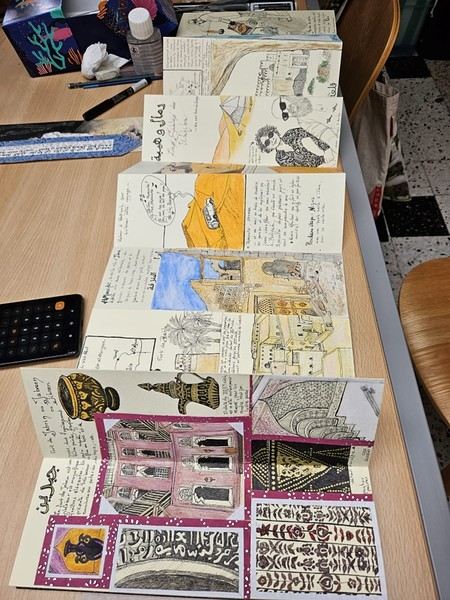
For drawing enthusiasts: The accordion format is both a constraint (each sheet is 9 cm x 27 cm) and a freedom (you can create a fresco). The paper is also a bit special: it doesn’t allow for fine lines, but it takes ink well (liner pen). However, everything has to be done almost in one go (with a very light pencil sketch) because it erases poorly. It absorbs too much water for coloring with markers or watercolors (unless you avoid soaking it), but it works well with oil pastels and their use with a brush and solvent. Since it’s yellowish, it allowed me to create contrasts even with white pastel.
 On the right, the "welcome marker"—those dates offered everywhere as a sign of hospitality. On the left, a tribute to those stunning doors worn by time, admired all over the old quarters, including the abandoned ones.
Oman is one of the world’s largest producers of frankincense resin. Incense burners are everywhere, from the simplest clay ones to the most precious handcrafted silver ones...
 Hospitality will often lead you to accept a small coffee, an "Omani coffee," very light, subtly flavored with cardamom, maybe a touch of saffron, and occasionally rosewater.
Here, I’ve depicted a man in the common everyday attire of Omanis: the dishdasha, mostly white (during the week and daytime; colors are more common in the evening or on Fridays and Saturdays). While you’ll see some men dressed in Western clothes, they’re very few. The white dishdasha is truly the shared attire of all men. The dishdasha, which has no hood, is distinguished by a small pom-pom attached to the collar, the furakha, which is soaked in perfume. And believe me, Omanis go overboard with it! "It smells like the pom-pom" is an expression that’s now part of our shared language, my husband and I.
Another must of men’s attire is the kuma, a small round head covering, usually white with brightly colored patterns. The keffiyeh is also worn (but without the cord called an agal in Arab countries), and it’s mostly worn by those with roots in the desert, from what I understood.
And what about the women, you might ask? Some are veiled, some in full black (but not a burka—more like a chador + abaya), due to the influence of Saudi Arabia and the United Arab Emirates, whereas the traditional outfit used to be a layering of very colorful dresses. Most of the women we saw wore neutral clothing, a plain veil over their hair, but with their faces uncovered. We also saw many saris and colorful veils—don’t forget that 40% of the population consists of Indian, Nepalese, and Bangladeshi immigrants, who work a lot in tourism, hospitality, restaurants, services, and construction.
Just to clarify, as a tourist, there’s no pressure to wear a veil, and never any disapproving looks. Of course, you’ll save the mini shorts, plunging necklines, bare shoulders, and midriffs for the hotel terrace—but I’d say that’s the same for men and women, and with the sun being strong, it’s better for your skin too.
Here’s the introduction! In the next post, I’ll tell you about my itinerary, and we can dive in!
The latest travel journal about Turkmenistan dates back to 2019. Here’s a quick update on this vast desert country, which is now a bit easier to visit than before.
This is my first travel journal. If you have any questions, don’t hesitate to ask. The country is slowly opening up, but it’s still possible to visit sites where you’ll be completely alone. In five days, I saw two Hongkongers, a few Germans, and a Chilean at the crater, ten Chinese people in a capital bazaar, and that’s it!
It’s possible to visit Turkmenistan from Uzbekistan. The easiest and most economical way is to take a taxi to the border from Bukhara. The trip takes a little over an hour.
Crossing the border takes quite a while because many Turkmen bring back items bought in Uzbekistan to resell in Turkmenistan. For example, diapers, baby products, or beauty products. It took me over 2.5 hours to cross the border. To visit Turkmenistan, it’s mandatory to have a guide and go through a travel agency. British agencies often offer three-, five-, or seven-day trips for over 1,500 or 2,000 €. But if your budget is more limited, you can contact a few Turkmen agencies directly by email, and they’ll make you an offer between 700 and 1,300 € for three to seven days. I took a five-day trip from Turkmenabat in the northeast of the country to Dashoguz in the north. The goal was to visit the main UNESCO-listed sites, including Merv, and archaeological sites like Nisa or Gonur Tepe.
Your guide will also be your driver. They’ll pick you up at the border. The formalities are very long because customs officers have to stamp multiple documents, and obtaining the visa you previously requested from your travel agency requires several checks. But the process goes relatively smoothly, even if each step takes a while.
Once on the other side, the first surprise is the brand-new highway all the way to Turkmenabat. A very long line of trucks stretches for several kilometers on the Turkmen side to cross the border into Uzbekistan. According to my guide, Turkmen trucks transport gas and cotton (though not this season, since the harvest is in September), but they mainly fill up their tanks because fuel is much cheaper in Turkmenistan. A full tank for a car costs about 3 €, which is unbeatable.

From the Farap border post, the goal is to reach the city of Mary, which is home to the UNESCO-listed site of Merv in its suburbs, about thirty kilometers away. This city is known as a foundation by Alexander the Great in the 4th century BC under the name Alexandria of Margiana. Several fortresses are visible.
After more than three hours on the road, we have lunch at a Turkish restaurant called Aladdin. Several quotes from the president are visible along the highway, but the road is in good condition, and we move along easily. This will be by far the best road in the country—things will get much worse later.


 Roundabouts are particularly interesting because they feature emblems of Turkmen culture, like the dog, a carpet, the Ahal Teke horse, or Muslim symbols, even though the presence of Islamic artifacts is quite limited.

This is my first travel journal. If you have any questions, don’t hesitate to ask. The country is slowly opening up, but it’s still possible to visit sites where you’ll be completely alone. In five days, I saw two Hongkongers, a few Germans, and a Chilean at the crater, ten Chinese people in a capital bazaar, and that’s it!
It’s possible to visit Turkmenistan from Uzbekistan. The easiest and most economical way is to take a taxi to the border from Bukhara. The trip takes a little over an hour.
Crossing the border takes quite a while because many Turkmen bring back items bought in Uzbekistan to resell in Turkmenistan. For example, diapers, baby products, or beauty products. It took me over 2.5 hours to cross the border. To visit Turkmenistan, it’s mandatory to have a guide and go through a travel agency. British agencies often offer three-, five-, or seven-day trips for over 1,500 or 2,000 €. But if your budget is more limited, you can contact a few Turkmen agencies directly by email, and they’ll make you an offer between 700 and 1,300 € for three to seven days. I took a five-day trip from Turkmenabat in the northeast of the country to Dashoguz in the north. The goal was to visit the main UNESCO-listed sites, including Merv, and archaeological sites like Nisa or Gonur Tepe.
Your guide will also be your driver. They’ll pick you up at the border. The formalities are very long because customs officers have to stamp multiple documents, and obtaining the visa you previously requested from your travel agency requires several checks. But the process goes relatively smoothly, even if each step takes a while.
Once on the other side, the first surprise is the brand-new highway all the way to Turkmenabat. A very long line of trucks stretches for several kilometers on the Turkmen side to cross the border into Uzbekistan. According to my guide, Turkmen trucks transport gas and cotton (though not this season, since the harvest is in September), but they mainly fill up their tanks because fuel is much cheaper in Turkmenistan. A full tank for a car costs about 3 €, which is unbeatable.
From the Farap border post, the goal is to reach the city of Mary, which is home to the UNESCO-listed site of Merv in its suburbs, about thirty kilometers away. This city is known as a foundation by Alexander the Great in the 4th century BC under the name Alexandria of Margiana. Several fortresses are visible.
After more than three hours on the road, we have lunch at a Turkish restaurant called Aladdin. Several quotes from the president are visible along the highway, but the road is in good condition, and we move along easily. This will be by far the best road in the country—things will get much worse later.
Roundabouts are particularly interesting because they feature emblems of Turkmen culture, like the dog, a carpet, the Ahal Teke horse, or Muslim symbols, even though the presence of Islamic artifacts is quite limited.
Hi everyone, we're back from a DIY USA road trip we organized from July 31, 2026, to August 26, 2026.
The destination: The Southwest USA, including Texas, Arizona, and New Mexico. Roughly 7,000 kilometers covered.
The car: A Chevrolet Equinox for two, rented through BSP Auto and Avis. Inside, we had 2 suitcases, a travel bag, two carry-on bags, a Walmart cooler, photo gear, and water bottles (a 40-pack).
The route: Dallas DFW, Fort Worth, Houston, Austin, San Antonio, Alpine, El Paso, Tucson, Sedona, Albuquerque, Amarillo, and back to Dallas to finish with a departure from DFW.
The travelers: Two seniors well advanced in years (73 and 75) but still active (nothing too physically demanding—to stay alive and fund our trips), fully independent physically, though a bit less so mentally. Big USA fans, a country where anything is possible. More walkers than hikers, preferring 3-star hotels over roadside motels, Italian restaurants over US food, frequent stops for photos, museums over nothing, naps over forced marches. Not too whiny, just enough to stay French in the land of the "great Satan," as they say. Not great with languages—street English (but handy), and my Spanish is non-existent except for: "Hola! Una cerveza por favor!" That’s about it. My wife understands everything but refuses to speak.
The cost of the road trip: Around 12,000 €, including AF flights, the car, gas, gifts, visits, and everything else. Well managed, since we’d budgeted 13,500 € initially.
The positive side: A delight, with those endless open roads. Museums to discover. The realization of the Hispanic presence and its important history in this part of America. Lovely locals. Tourists who were more or less friendly. A terrible Texan accent that was hard to understand. Gas stations that were like real stores, with prepared food, alcohol sold in Arizona and New Mexico, and employees who were always up for a laugh!
The negative side: The heat throughout the trip... 43°C in Dallas at the end. Impossible to walk the streets. Lots of homeless people in downtown Dallas. Hotel breakfasts that were always the same. You get used to it.
So, it was positive overall, but the concept is starting to wear us out. We might rethink the DIY road trip model for next time. If the man upstairs grants us more time.
Next up, we’ll wait for the first batch of sorted photos to go through the wringer.
See you soon.
Before Our Departure
Preparing for this trip started 9 months before our departure in June. For those planning a similar itinerary, it’s important to book accommodations well in advance, especially in the Okavango and Savuti campsites—otherwise, you might not find any availability.
Introduction After visiting Zambia three years ago and Namibia and western Botswana a year and a half ago, this year we chose Zimbabwe (Hwange NP) and the northern half of Botswana. Our flight from Paris was to Victoria Falls with Ethiopian Airlines, with a layover in Addis Ababa. We rented a 4x4 from Bushlore in Kasane, complete with two rooftop tents since there are four of us on this adventure. Bushlore picked us up from our guesthouse to collect our 4x4 and, most importantly, gave us a rundown of the vehicle and its equipment. Pay close attention to what they tell you—it could be crucial if something goes wrong, as it did for us during the trip.
Our Itinerary We arrived on June 12th at noon. At Victoria Falls Airport, we got our double-entry visa right away—I’d already pre-booked it online on the site https://www.evisa.gov.zw/. Since our vehicle was in Botswana, we had to cross the border from Victoria Falls into Botswana for the first time. The next morning, Bushlore picked us up from our guesthouse to collect our 4x4. After completing the formalities, we headed toward Zimbabwe and the town of Victoria Falls. We woke up early the next morning to be at Victoria Falls at sunrise. The scenery was stunning, but since it was the start of the dry season, the Zambezi was still high, so the falls had a strong flow. This made it hard to fully appreciate their beauty. In the early afternoon, we left for Hwange NP, where we stayed for 4 days. Two days at Gwango campsite near Dete, followed by two days at Robins Camp. We expected to see more animals at Robins, but that wasn’t the case. In Hwange, we didn’t spot any predators, but we did see plenty of mammals (buffalo, elephants, giraffes, zebras, and antelopes). After a few days in Zimbabwe, we crossed back into Botswana at Pandamatenga. We stopped at Nata Lodge for a good night’s rest—driving on the dirt roads is exhausting. We left Nata and headed toward Nxai Pan. The road was sandy but manageable. We made a small detour to admire some beautiful baobabs at "Baines Baobabs." Then we continued to our campsite, Nxai Pan South Camp. Keep in mind that many campsites in Botswana aren’t fenced (except for the shower/toilet areas), so animals can roam freely within the camp. Take precautions, especially after dark. After our stop in Nxai Pan, we headed to Maun. We decided to break our journey in Maun before heading to Moremi and the Okavango Delta for three reasons: first, we needed to stock up on supplies and fuel for the next 5 days; second, our fridge had broken (luckily, Bushlore has a branch in Maun); and third, the drive from Nxai to our camp in Xakanaxa in the delta would’ve taken too long. I always avoid driving after dark. We arrived at our Xakanaxa camp on June 21st in the early afternoon. Not wanting to waste time, we booked a boat ride on the Okavango Delta, leaving at 4:00 PM for a 2-hour sunset cruise. For those interested, to the right of the Xakanaxa X1 site, there’s a sign for boat rides. The organizer is very professional and offers prices that are nothing like those of the lodges. It was a beautiful ride through the delta with a stunning sunset. Being on a boat is much more relaxing than driving on the dirt roads. That didn’t stop us from doing self-drive safaris the next morning and late afternoon, though.
Then came the time to leave the delta and head toward Savuti, a much drier region. And that’s when the toughest part of our trip began. First, we decided to go up via Khwai. The rainy season was over, but the area was still marshy. We had to cross a few small water patches, testing the depth to make sure we could get through. Luckily, a sign on the road pointed us toward a drier route. We reached Khwai without any issues, but then we made a major mistake. Instead of taking the main track toward Mababe Gate to reach Savuti Camp, we took a straight path north and then a right turn to get to our camp. Bad call—we got stuck in the sand, with one rear wheel buried halfway and a front wheel off the ground. We were genuinely scared we wouldn’t get out, especially since we were on a deserted track, 20 kilometers from our destination, with night falling in two hours. This is where paying attention to the vehicle instructions really paid off—we had to use the jack to get out of the mess. The result: we arrived at Savuti campsite just before dark (Distance: 146.3 km, Duration: 9 hours, 56 minutes, and 3 seconds, Average speed: 14.7 km/h, tracked with Osmand). At reception, the staff couldn’t understand how we’d gotten there—we hadn’t passed through any of Savuti’s reserve entry gates.
The next morning, no one felt like driving, so we did a game drive with a guide. I don’t know if it was some kind of reward, but the outing was amazing. We saw three lions and, best of all, a pack of African wild dogs that we had time to admire and photograph. The next day, we did a short self-drive and found one of the lions from the day before drinking at a waterhole. That was the end of our Savuti adventure.
Now we’re heading to Kasane. We returned our vehicle and settled in for our last two nights there. The next morning, since we no longer had a car, we decided to do one last early-morning game drive in Chobe NP. It turned out great—we followed two brother lions and saw plenty of other mammals. The only downside of Chobe is the number of tourists, which was a change from the other parks we’d visited. That said, we’re tourists too, so... In the evening, we took one last boat ride on the Chobe River to end on a high note with a beautiful sunset.
After a good night’s sleep and plenty of wonderful memories, landscapes, animals, and emotions, it was time to leave. We left early in the morning with the same taxi company as before to cross the border into Zimbabwe one last time and head to the airport, where we took off to return to France.
We landed in Victoria Falls, Zimbabwe, and headed straight to Kasane in Botswana to pick up our car.
Our vehicle is a 4x4 because in Zambia, it's practically impossible to use anything else, especially in the national parks. I’ve already had the pleasure of visiting South Luangwa National Park—it’s one of the reasons for this trip, the main one being to travel in Africa with one of my sons.
First stop: Livingstone on the banks of the Zambezi River. Along the way, we discovered a lovely restaurant at Socrates with a super-friendly owner (we’ll actually stop there again on our way back). We spent our first night in the rooftop tent after a stunning sunset, accompanied by the grunting of hippos in the river.
The next day, we set off early, heading to Kafue NP. In fact, we’ll always leave early—waking up between 5:00 and 5:30 AM and hitting the road an hour later. Kafue is a lesser-known park, mostly forested, and the animals are skittish because they’re not used to human presence. We crossed the park from south to north and came across various antelopes. Near Lake Itezhi-Tezhi, there are plains where wildlife is easier to spot.
After Kafue, we headed to South Luangwa. This journey requires stops in Mumbwa and Petauke. Two pleasant stops where we found lodges (a nice change from the rooftop tent) at affordable prices and met welcoming people.
For me, South Luangwa is Zambia’s most beautiful park—the river is stunning, the landscapes are gorgeous, and there’s a wide variety of wildlife, including, of course, big cats. A tip for those, like us, who aren’t with a guide: if you’re staying near the park for several days, don’t hesitate to do a "game drive" to scout out where the animals are so you can return the next day with your own vehicle. Of course, in the dry season, you’ll want to focus on waterholes to see the animals—and you’ll need a bit of luck too. The elephant population is growing, and we were lucky enough to see around sixty elephants crossing the Luangwa at dawn, spread across several groups. South Luangwa is the westernmost point of our trip, and we’re now heading east to Lower Zambezi.
Lower Zambezi is Zambia’s side of Mana Pools on the Zimbabwe side. We took a boat ride on the Zambezi to see elephants, hippos, crocodiles, and a multitude of birds living along the water and on the river’s islands. The sunset there is also magnificent.
To explore the park, we followed the waterways parallel to the Zambezi, mostly on the western side (see our route). Lower Zambezi is the last park we visit, and the final leg of our trip will be Victoria Falls.
Victoria Falls—or Mosi-Oa-Tunya ("The Smoke That Thunders")—are truly impressive, even during the dry season. We saw the falls from both countries: in Zambia for the overall view and the bridge that serves as the border, and in Zimbabwe to get as close as possible to the most spectacular parts of the falls.
This marks the end of our trip, which, despite a blown tire on the road, went off without any major issues. Zambia is a beautiful country that immerses you in wild, still-preserved nature.
Recommended for you
 Polynesia: How to choose between the Society Islands, Tuamotu, and the Marquesas?
 A Few Days in Turkmenistan from Uzbekistan
 Slovak travel journal
 14 Days in Japan – September-October 2026
 Trek in Norway: Jotunheimen and Dovrefjell, you’ll adapt to the rain...
 CARIBBEAN: The island of SAINT-MARTIN, a different perspective
 Northern Morocco, the kingdom of kif?
 Summer 2026 - 3 weeks in the Azores