last edited Jul 20, 2026
Getting Around Mauritius
Location Map of Mauritius
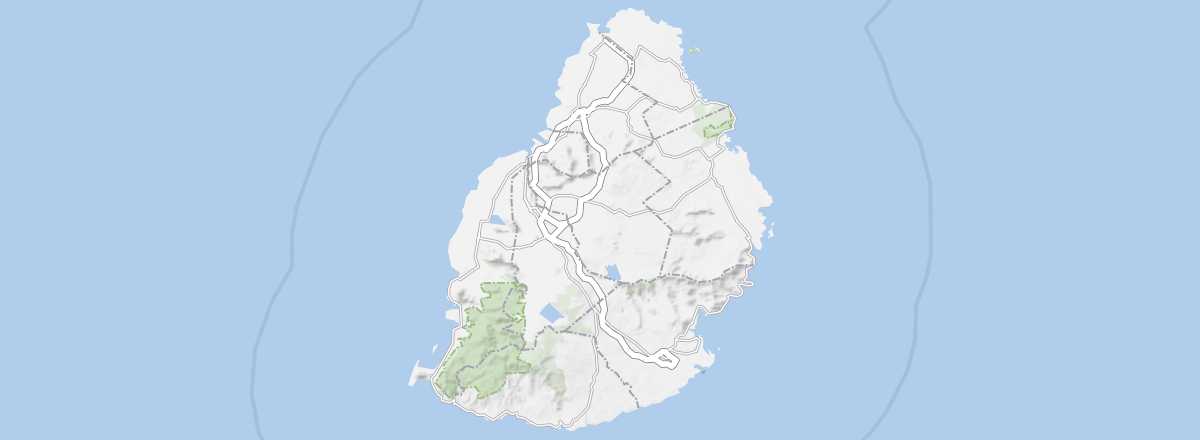 Mauritius
Open the interactive map
Mauritius
Open the interactive map
Road Network and Traffic
First and foremost, it's important to know that you drive on the left in Mauritius. The road network is fairly good (at least on the main routes), with speed limits of 40 km/h in towns, 80 km/h outside urban areas, and 110 km/h on certain sections of the dual carriageway that crosses the island from north to south. Watch out for speed cameras and checks.
While local driving isn’t particularly challenging, you should still be very careful with two-wheelers, pedestrians, or animals that can appear almost anywhere on the roads, especially at dusk. Another thing to note is that the capital and its surroundings are very busy, with heavy traffic jams during rush hours.
Car Rental
You can rent a car from the age of 21 with a licence held for over a year. While an international driving permit is theoretically required, it’s rarely asked for. Whether you go through an "international" or local rental company, check the vehicle’s condition and, most importantly, the insurance coverage and associated excesses. Some cars are actually sub-rented from private owners, who may not always be (properly) insured. However, official rental cars have had yellow number plates for a few years now. In any case, you’ll find both automatic and manual transmission vehicles.
For prices, expect around 30 to 40 € per day for the cheapest "official" rentals, and slightly less for a private vehicle. Given the island’s size and distances, renting a car for the entire duration of your stay is rarely necessary. It’s often better to rent for specific days or even hire a taxi for the day, which means you won’t have to worry about driving (on the left), the vehicle, or "road hazards", and you might even get a good driver-guide who’ll show you around the island—all at a similar price.
Day-Trip Taxis
If you don’t need a car full-time, a good alternative is to hire a taxi occasionally to explore the island, or at least the areas furthest from your accommodation, or if you want to visit as many sites as possible in a short time. Expect around 35 to 45 € per day, depending on your plans. In any case, negotiate clearly by outlining your itinerary, schedule, and sightseeing preferences. Be aware that some drivers may try to steer you towards certain places (restaurants, shops, etc.) where they earn a commission.
Buses and Shared Vehicles
Buses
Although the vehicles aren’t always in top condition, Mauritius has a good bus network with several companies covering the whole island. Buses are actually a good way to get around, despite some delays (average speed of 30 km/h) and occasional transfers on longer routes. What’s more, it’s a very affordable mode of transport, including the slightly pricier express buses. Expect to pay just under 1 to 2 € per hour for a local bus and 4 or 5 € for express/comfort lines. Make sure you have change.
Buses run roughly from 6:00 AM to 7:00/8:00 PM on routes with many stops (except express lines). They’re often crowded, and drivers can be a bit heavy on the accelerator between stops. If you’re carrying luggage, you might be asked to pay an extra fee.
Another thing to know is that the Mauritian network is divided into three zones (north, centre, south), each with its own designated operators. This means you’ll need at least one transfer, especially at the stations in Port Louis and Curepipe, if you’re travelling between zones. However, transfers are quick (including in Port Louis, which has two bus stations), and services are frequent on the main routes. Among the main express lines are Port Louis-Grand Baie and Port Louis-Mahebourg.
Main Companies
The two main companies are United Bus Service (UBS) and National Transport Corporation (NTC), along with several other local operators like Rose Hill Transport, Triolet Bus, Mauritius Bus Transport, etc. (see details).
Shared Taxis
Also called "taxi-trains", these are regular taxis that pick up passengers at bus stops to take them short distances for a few rupees. Direct competitors to buses, they’re usually packed.
Two-Wheelers
Small Motorcycles and Scooters
This is an option for getting around and exploring the island, but it requires extra vigilance due to other drivers and the "hazards" of Mauritian roads. In short, be careful, wear at least a helmet (mandatory), make sure the bike is in good condition, and avoid riding at night. Expect around fifteen euros per day for a small scooter, which isn’t necessarily much cheaper than the cheapest car rental.
Bicycles
This is a borderline option for short distances or if you’re sticking to minor roads. Otherwise, traffic, congestion, and accident risks can be off-putting. You can find bikes in tourist areas for under 10 € per day. Check the condition and make sure there’s a lock before setting off, and avoid cycling at night.
Trains
There aren’t really any trains in Mauritius, just the Metro Express, a recent electric tram-train that connects the capital Port Louis to the town of Curepipe.
Boats
Aside from sea trips or visits to the Ile aux Cerfs, the only maritime route is the Mauritius-Rodrigues link, with one or two weekly crossings depending on the season, operated by the same company as for Réunion. Expect at least 80 € per trip, which usually takes 36 to 48 hours depending on sea conditions.
Domestic Flights
There’s only one internal air route: the Mauritius-Rodrigues line operated by Air Mauritius. Flights take about 1 hour 30 minutes on small aircraft, costing around 100 € per trip. However, the national airline also offers a helicopter shuttle service on demand between different points on the island.
In Town
Or more precisely, in the capital, Port Louis. Urban transport here is a mix of taxis and ride-hailing services (with the usual apps), city buses, and the very useful Metro Express. In any case, including taxis, prices remain very affordable.
For information: a taxi from the airport to Mahebourg costs around 20 to 30 €, 40 to 50 € to Port Louis, and 60 to 70 € to Grand Baie. Night fares are logically higher.
On Rodrigues
Although small (110 km²), Rodrigues has some hilly terrain and roads that aren’t always in good condition. Generally, you can choose between buses, which are cheap and fairly frequent from dawn to dusk, or renting a scooter (with caution). Otherwise, walking or even hitchhiking is common. On the other hand, there are few cars and taxis on the island.
What to Choose for Getting Around?
Since most stays in Mauritius are "semi-sedentary" or "organised", many people find they don’t need a vehicle as much. In short, you’ll choose based on your outings and excursions—buses for medium distances and hiring a taxi (or renting a scooter) for longer trips.
Distances Between Towns
Distances (km) between the main towns in the country:
| Cham. | Cure. | Flic Flac | Grand B. | Ile Cerfs | Mahé. | Pampl. | Port L. | Souillac | Triolet | |
|---|---|---|---|---|---|---|---|---|---|---|
| Chamarel | 29 | 28 | 65 | 73 | 47 | 55 | 45 | 29 | 58 | |
| Curepipe | 29 | 21 | 44 | 43 | 30 | 34 | 25 | 27 | 38 | |
| Flic en Flac | 28 | 21 | 44 | 57 | 51 | 35 | 26 | 48 | 39 | |
| Grand Baie | 65 | 44 | 44 | 46 | 72 | 16 | 21 | 70 | 7 | |
| Île aux Cerfs | 73 | 43 | 57 | 46 | 30 | 37 | 47 | 59 | 44 | |
| Mahébourg | 47 | 30 | 51 | 72 | 30 | 63 | 54 | 34 | 67 | |
| Pamplemousses | 55 | 34 | 35 | 16 | 37 | 63 | 11 | 57 | 12 | |
| Port Louis | 45 | 25 | 26 | 31 | 47 | 54 | 11 | 51 | 15 | |
| Souillac | 29 | 27 | 48 | 70 | 59 | 34 | 57 | 51 | 64 | |
| Triolet | 58 | 38 | 39 | 7 | 44 | 67 | 12 | 15 | 64 |