last edited Dec 11, 2019
Getting to Uruguay by Land or Sea
Location Map of Uruguay
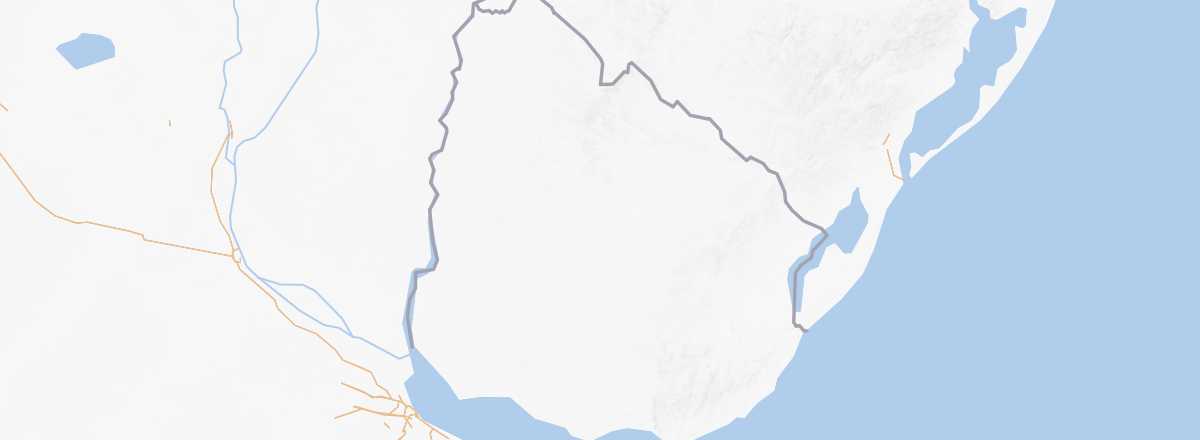 Uruguay
Open the interactive map
By Land
Borders
Uruguay has over 1,500 km of shared borders with its neighbours. That’s 541 km to the west with Argentina and 1,050 km to the north with Brazil.
From Neighbouring Countries
There’s no problem travelling between Uruguay and its neighbours, with several road crossing points available. For public transport, there’s also no difficulty finding (quality) buses to and from Brazil and its major southern cities like São Paulo, Porto Alegre, or Rio. The same goes for Argentina, though many prefer using ferries across the Río de la Plata to reach Buenos Aires. However, there are no passenger train services between countries.
By Sea
Ferries
There’s heavy ferry traffic between Argentina and Uruguay across the Río de la Plata delta, as residents of Buenos Aires enjoy the beaches of Uruguay’s coastline during the season. Four companies dominate the market with strong competition: Cacciola, Colonia Express, Seacat Colonia, and above all Buquebus, which remains the main operator. Services are daily and frequent (over a dozen per day in total), with boats of varying speeds, including the HSC Francisco (Buquebus), reportedly the world’s fastest ferry, reaching speeds over 100 km/h. Despite the frequent rotations, weekends, holiday departures, or certain routes can get busy, so booking in advance may be useful.
Routes
While several routes exist, Buenos Aires–Colonia is by far the main and shortest one, taking roughly 1.5 to 3.5 hours depending on the boat. From Colonia, bus transfers to Montevideo and resorts like Piriápolis or Punta del Este are offered and can be included in the ferry ticket if desired.
Beyond this route, there’s also a direct Buenos Aires–Montevideo ferry (longer and more expensive), as well as a line between Carmelo (northwest of Colonia) and Tigre, a suburb of Buenos Aires. The latter is operated by Cacciola and Seacat and offers a pleasant journey down the Río Uruguay, weaving between islands—a different experience from the "classic" Buenos Aires–Colonia crossing. However, there are fewer departures, and the boats are generally smaller (unlike those serving Colonia). For travellers with time and considering a round trip, combining Buenos Aires–Colonia with Carmelo–Tigre can be a worthwhile experience.
Prices
With competition between companies, the variety of routes (including bus connections), speed options, bundled packages (some including accommodation), trip durations, departure days (weekends and school holidays are the worst), and countless promotions or special offers available online, at agencies, or at ports, prices fluctuate constantly and can vary from double to triple. In short, it’s best to research ahead, plan your trip, and book if you find a good price. Generally, for around $50 to $100 USD, you can usually find a round-trip crossing between the two countries.
Cargo
With the port of Montevideo, Uruguay has the largest container terminal in all of South America. So, arriving by cargo ship isn’t difficult. It’s also worth noting that this port is now well-known among travellers looking to transport a vehicle across the Atlantic, particularly between Europe and South America. You’ll find many freight forwarders, competitive prices, and more options than in other ports along the Brazilian or Argentine coasts.