
Travel guide · Iceland
Iceland
A bit of an outlier in Europe, Iceland remains a unique discovery that will delight nature and adventure lovers, thanks in particular to its landscapes, which are exceptional on a continental scale.
Overview of Iceland
Far removed from the rest of the European continent and geographically closer to America, Iceland has the lowest population density in Europe, with 80% of its territory uninhabited or even uninhabitable. The majority of the population is concentrated in the…
Geography and Environment of Iceland
Geography of the Country
Natural Areas

While almost the entire island can be considered a natural area, Iceland officially has only three national parks:
- Thingvellir National Park: This UNESCO-listed site holds both natural (landscapes) and historical ("the world’s oldest parliament") value. You can also dive in various natural hot springs.
- Vatnajökull National Park: The largest park, home to one of Europe’s biggest and most remarkable glaciers. It covers much of the southeast. Hiking is possible here.
- Snaefellsnes Peninsula: A large peninsula north of Reykjavik with stunning mountain, volcano, and glacier landscapes where a few villages nest. You can walk in Snaefellsjökull National Park, located here.
Wildlife and Flora
Iceland's Climate and Weather
Climate Overview
Thanks to the Gulf Stream along the west and south coasts, Iceland has a much milder climate than one might expect. While summers are never very warm (no more than 20°C at most), winters are not extremely cold either (generally no lower than -5°C), except locally in the central region or at night. However, the climate is quite unstable, with many possible changes in a single day, sometimes violent storms, and frequent harsh winds. As for rain, it falls throughout the year, especially on the southern coast, at least one day out of three—even more in winter, which also sometimes brings heavy snowstorms. In short, while not extreme, Iceland’s climate is somewhat harsh and unpredictable, making it useful to know what to expect.
Best Time to Visit Iceland
Unless you want to experience the unique "winter Iceland," go Nordic skiing, or see the Northern Lights, the ideal time to visit is from July to late August, especially if you plan to hike. Along with more "pleasant" temperatures, you’ll have access to the entire country (some roads are closed for long months), and most importantly, you’ll enjoy long days with almost no night. Beyond the slightly low winter temperatures, it’s the prospect of "endless" nights that deters many potential visitors during that season.
| Jan. | Feb. | Mar. | Apr. | May | Jun. | Jul. | Aug. | Sep. | Oct. | Nov. | Dec. | |
|---|---|---|---|---|---|---|---|---|---|---|---|---|
| Climate |
: very favorable | : favorable | : moderately favorable | : unfavorable.
Sea Temperatures Throughout the Year
| Jan. | Feb. | Mar. | Apr. | May | Jun. | Jul. | Aug. | Sep. | Oct. | Nov. | Dec. | |
|---|---|---|---|---|---|---|---|---|---|---|---|---|
| Reykjavik | 5 | 4 | 5 | 5 | 6 | 8 | 9 | 10 | 9 | 7 | 6 | 6 |
Climate in Reykjavik
Additional Information
History of Iceland
Eyrarbakki, Islande · © VoyageForum Early 9th century: The uninhabited island is discovered by Irish monks, though it is highly likely that it was previously known to some sailors and even the Greek explorer Pytheas in the 4th century BCE. 874:…
Icelandic Society
Population
Political Institutions
Economy
Religion
In Iceland, the state and religion are linked, and three-quarters of the population belong to the Church of Iceland, a Lutheran denomination that effectively serves as the state religion. As for the rest, they identify as Catholic, atheist, unaffiliated with any church, or part of various Protestant denominations—or even the Icelandic pagan religion Ásatrú, which was recognized as an official religion by the Icelandic government in 1973.
Culture and Customs of Iceland
Arts, Crafts, and Architecture
Arts
Crafts
Architecture
Museums
Customs and Traditions
Local Traditions
Etiquette
Dress and Behavior
Sensitive or Taboo Topics
Languages
Oddly, until 2011 and the new constitution, the country had no official language. It was only in recent years that Icelandic became one. That said, Icelanders are also polyglots, with 85% of the population able to speak English and 75% Danish. French and German are taught in schools, and Polish is spoken by the Polish minority, which makes up about 2.5% of the island's inhabitants.
Glossary
A few local words and phrases useful to know while traveling:
Festivals and Celebrations
Major Events and Public Holidays
Books, Films, and Music
Icelandic Gastronomy
Local Cuisine
Icelandic cuisine is traditionally based on local products, whether from fishing—starting with trout and salmon—livestock, particularly sheep, or fruits and vegetables grown in the country in greenhouses thanks to geothermal energy.
Other Cuisines
Logically, it’s in the capital that you’ll find other dining options, with a few Indian, Chinese, Thai, Japanese, Italian, Spanish, French, Danish, American, and Tex-Mex establishments. There are also some fast-food places.
Specialties
Starters
Dishes
Desserts
Drinks
Where to Eat
As with everything in the country, restaurants—and even simple cafés—are discouragingly expensive. For a breakfast buffet, expect to pay between 7 and 10 €; for a very basic menu or a snack like pizza, around 15 €; and for a restaurant with a "decent" menu, you’ll need to budget at least 25 to 30 € per person.
In short, to save money, many travelers opt for picnics and cooking in their accommodations. In summary, supermarkets are generally visited more than restaurants during a stay in Iceland...
Additional Information
What to See in Iceland
Iceland has three sites inscribed on the UNESCO World Heritage list: Surtsey Island (2008): This island, born from a volcanic eruption in the 1960s, is a UNESCO site. Still studied by scientists, public access is not permitted. Thingvellir National Park ★★…
Things to Do in Iceland
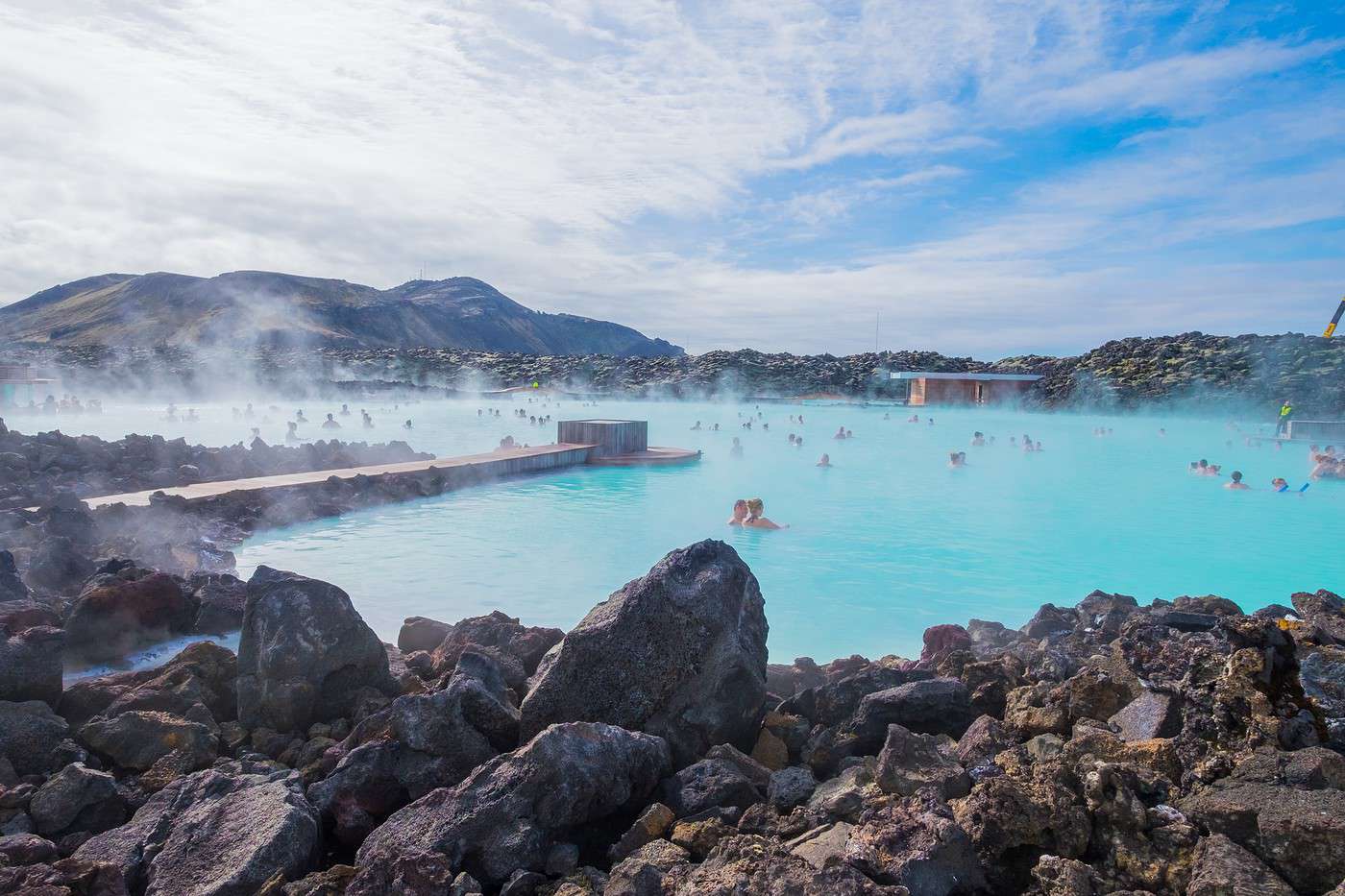
Blue Lagoon, Islande · © VoyageForum With water rarely above 10°C, it’s clear that Iceland doesn’t encourage sea swimming, and its beaches (usually black sand) are primarily for walking. But since Iceland is also the land of hot springs and…
Types of Trips to Iceland
Interests (rated ★★★★ ) : Nature ★★★★ ; Adventure ★★★★ ; Culture ★ ; Relaxation-holidays ⊘ . Iceland is undeniably an ecotourism destination, with its volcanoes, glaciers, geysers, mountains, desert areas, and rugged coastline. It’s also the land of the…
When and Where to Go in Iceland
Best Times to Visit Iceland
Finding the best time to visit means balancing climate constraints with crowd levels and the most attractive prices for travel and on-site expenses.
Unless you want to experience the unique "Iceland in winter", go Nordic skiing, or see the Northern Lights, the ideal climatic window for visiting is from July to late August—especially if you plan to hike. Unfortunately, this is also when the destination is busiest (particularly in July), with prices to match. Alternatively, mid-May to late June or late August to mid-September can also work well, even if the weather may be slightly less reliable and some treks may not be fully accessible.
| Jan. | Feb. | Mar. | Apr. | May | Jun. | Jul. | Aug. | Sep. | Oct. | Nov. | Dec. | |
|---|---|---|---|---|---|---|---|---|---|---|---|---|
| Climate | ||||||||||||
| Avoid crowds | ||||||||||||
| Low prices | / |
: very favourable | : favourable | : moderately favourable | : unfavourable.
Where to Go Based on Travel Style and Interests
Flying to Iceland
Of the fifty or so airports and airfields in the country, only around fifteen receive regular flights. Just one, Keflavik about fifty kilometres from the capital on a former US base, truly serves an international purpose. This airport now handles over 8…
Getting to Iceland by Sea
Ferries
There is a regular weekly or bi-weekly ferry service for passengers and vehicles with the company Smyril Line between Denmark (Hirtshals) and Iceland, via the Faroe Islands (Tórshavn). The ferry arrives on Iceland’s east coast at Seyðisfjörður, nearly 700 km from the capital Reykjavik, which can then be reached by an 8- or 9-hour bus ride.
The Denmark-Iceland crossing takes roughly two and a half days and costs at least just under 200 € one way in the low season and 250/300 € in July-August for a foot passenger. While multiple packages, deals, and options are available, the ferry—given the fares and departure point—remains primarily appealing for those who want to arrive with their own vehicle. Otherwise, for a trip to the Faroe Islands from Iceland, expect at least around 300 € round trip and about twenty hours at sea each way.
Apart from this route, there are no other ferry connections to or from Iceland.
Cargo
Cruises
Sailboats
Additional Information
Getting Around in Iceland
Iceland has over 12,000 km of roads and tracks, with a relatively dense network around the capital and a much more unpredictable one elsewhere. Overall, about a third is paved, and you can drive without difficulty around Reykjavik as well as on the ring road…
Accommodation in Iceland
Iceland offers a fairly wide range of accommodation (which is best booked in summer), including hotels and guesthouses, youth hostels, gîtes, farm stays, campsites, "summer residences", and mountain huts for hikers. The only downside for (almost) everything:…
Entry Requirements and Visa for Iceland
Nothing could be simpler since Iceland is part of the Schengen Area. For a tourist trip lasting less than 3 months, a valid passport or national identity card is sufficient, provided it covers the entire duration of your stay. The same applies to Canadians,…
Money, budget and shopping for Iceland
Devise: Couronne islandaise. Billets: 500, 1 000, 2 000, 5 000 et 10 000 kr. Pièces: 1, 5, 10, 50 et 100 kr. Change: Les principales monnaies s'échangent sans problème dans les bureaux de change ou les banques qui proposent toutes ce service. Celles-ci sont…
Health and Safety in Iceland
In France, both for individuals and professionals, the "travel advice" from the Ministry of Foreign Affairs regarding precautions for each country has legal value. A similar online travel advice system exists in several countries: Foreign Affairs Belgium…
Other Practical Information for Iceland
For equipment, plan for mid-season clothing in summer, including woolen layers, windbreakers, and rain gear. In winter, pack warm clothes. Also bring good hiking shoes and appropriate gear if you plan to hike independently. Don’t forget your swimsuit for…
Something wrong or out of date? Report this page