last edited Dec 11, 2019
Introduction to Uruguay
Location Map of Uruguay
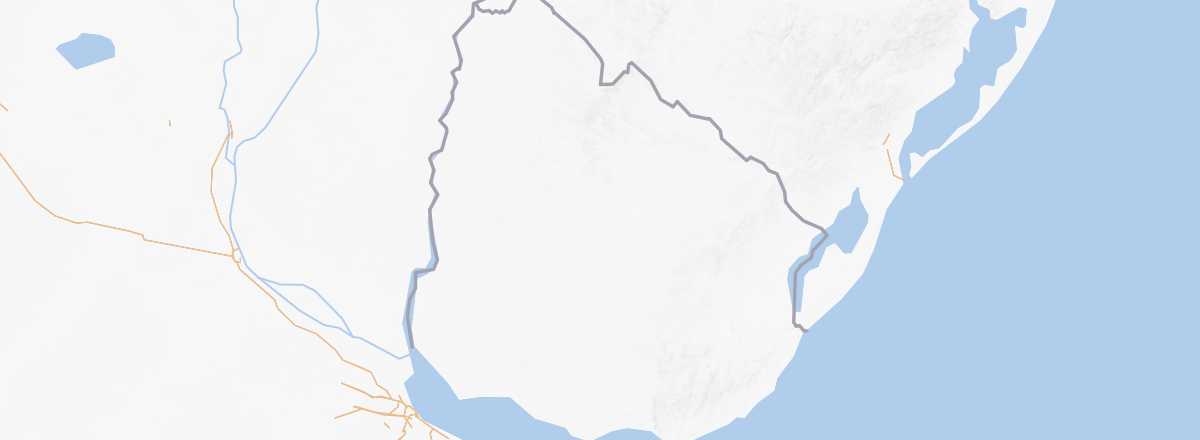 Uruguay
Open the interactive map
Uruguay
Open the interactive map
Quick Overview
Uruguay, along with Suriname, is the smallest country in South America. Most of its territory consists of plains with vast prairies that extend from the Argentine pampas. Only the northern part, bordering Brazil, features some hills. The southern part of the country opens onto the Río de la Plata estuary, the largest in the world, while the east faces the Atlantic Ocean.
Uruguay is a largely urban country, predominantly populated by descendants of Spanish and Italian migrants, which in many ways feels more like Europe than South America. On a continental scale, it is also a wealthy country, benefiting, among other things, from the income of "proximity" coastal tourism. It boasts one of the highest education levels in the region and, under the leadership of former President "Pepe" Mujica, is a global leader in democracy and social progress.
Key Facts
- Type of place: country.
- Location: in the southern part of Latin America, facing the Atlantic and between Argentina and Brazil.
- Latitude/longitude: 33.00' S and 56.00' W.
- Local time:
- Capital: Montevideo
- Nature of the state: presidential republic.
- Official language: Spanish.
- Currency: Uruguayan peso.
- Population: 3,369,299 (2018)
- Area: 176,215 km².
- Density: 19 inhabitants/km².
- Highest point: Cerro Catedral (514 m).
- Lowest point: sea level.
- Coastline: 660 km.
- Driving: on the right.
Tourism
Although not widely known, Uruguay remains a major tourist destination in Latin America. Each year, over 3 million people (3.469 million in 2018), many from neighboring countries, visit the country. Most come to enjoy its beautiful beaches and seaside resorts (including Punta del Este), which are the country’s main tourist attractions. Additionally, the stunning colonial city of Colonia draws visitors as it is easily accessible by ferry from Buenos Aires for a one- or two-day trip from the Argentine capital.
Travel Essentials
- Destination: for beginner travelers.
- By air: France–Montevideo
- Entry requirements: passport.
- Currency to bring: euros.
- Exchange rate:
- Daily budget for backpackers: 45 to 60 € per person.
- Best for accommodation: small hotels and guesthouses, or camping on the coast in season.
- Best way to get around: bus.
- Risks: (very) low in terms of health and safety.
- Best time for climate/crowds/prices: March–May or November offer a good balance in terms of climate, crowds (limited to the coastal areas), and high-season rates.
- Interests (out of ): Nature ; Adventure ; Culture ; Relaxation/Holidays .
Useful Addresses
Tourist Office: online only (in English).
Socio-Economic Statistics
- Quality of life: 55/188 (rank in 2018)
- GDP per capita: $22,400 (2017)
- Average monthly income:
- Inflation: +6.2% (2017)
- Official unemployment: 7.6% (2017)
- Population below poverty line: 9.7% (2015)
- Life expectancy: 77.6 years (2018)
- Migration rate per 1,000 inhabitants: -0.9 (2017)
- Population growth: +0.27% (2018)
- Literacy rate: 98.5% (2015)
- Urban population: 95.3% (2018)
- Press freedom: 20/180 (rank in 2018)
- Political regime: democracy (15/167 in 2018)
Sources: World Bank, Human Development Indicators, RSF, The Economist, The World Factbook