Travel guide · France
Lille
Lively and vibrant, Lille also boasts a beautiful city centre and historic districts. The regional capital hosts its famous annual Braderie every September—the largest flea market in Europe.
Introduction to Lille
Overview of Lille
Dynamic and lively, Lille also boasts a very beautiful city centre and historic districts. The regional capital also hosts its famous Braderie every September, the largest flea market in Europe.
Key Facts
- Type of place: main city.
- Tourist interest: (recommended).
- Location:
- Latitude/longitude:
- Distances:
- Local time: .
- Population: 232,787 inhabitants and approximately 1.187 million for the metropolitan area (2017).
- Area: 34.51 km².
- Density: 6,778 inhabitants/km².
- Altitude: from 18 to 46 m.
Tourism
Travel Essentials
- Tourist interest: (recommended).
- Backpacker daily budget:
- Best for accommodation:
- Best for getting around:
- Best time for climate/crowds/prices:
- Website: http://www.lilletourism.com
Additional Information
Climate and Weather in Lille
Climate Overview
Best Time to Visit Lille
| Jan. | Feb. | Mar. | Apr. | May | Jun. | Jul. | Aug. | Sep. | Oct. | Nov. | Dec. | |
|---|---|---|---|---|---|---|---|---|---|---|---|---|
| Climate |
Climate and Forecast
Additional Information
What to See in Lille
Euralille ★ This is the business district (France’s third-largest) built in the 1990s around the TGV station, featuring offices, shops, hotels, housing, and a large 8-hectare park (Parc Matisse). Old Lille ★★★ In the northern part of the city, this…
Tips for Lille
Best times to visit Lille
Exploring the city
Must-see
Offbeat
With family
Depending on length of stay
Nearby
Among the interesting sites to see within a sixty-kilometre radius of Lille:

Arras
The capital of Pas-de-Calais offers a charming city centre in Flemish-Baroque style. This is complemented by a military heritage ranging from Vauban’s citadel to First World War sites, including numerous underground tunnels.
The capital of Pas-de-Calais offers a charming city centre in Flemish-Baroque style. This is complemented by a military heritage ranging from Vauban’s citadel to First World War sites, including numerous underground tunnels.

Bergues
A town with long ramparts and a belfry listed as a UNESCO World Heritage Site, like many others in the region.
A town with long ramparts and a belfry listed as a UNESCO World Heritage Site, like many others in the region.


Douai
The sub-prefecture of the Nord department has preserved some remnants of its military past (arsenal, cannon foundry, fortifications), two collegiate churches, and a magnificent UNESCO-listed belfry.
The sub-prefecture of the Nord department has preserved some remnants of its military past (arsenal, cannon foundry, fortifications), two collegiate churches, and a magnificent UNESCO-listed belfry.

Lewarde
At the heart of the mining basin, this large village is home to the Lewarde Historical Mining Centre.
At the heart of the mining basin, this large village is home to the Lewarde Historical Mining Centre.

Vimy Memorial
Canada's most important First World War memorial. Other traces of the 1917 Battle of Vimy, including trenches, tunnels, and an interpretation centre.
Canada's most important First World War memorial. Other traces of the 1917 Battle of Vimy, including trenches, tunnels, and an interpretation centre.
and on the Belgian side...

Kortrijk
An old Flemish city not far from Lille, known for its UNESCO-listed belfry and béguinage, both recognized under these monument categories in Flanders and/or Wallonia.
An old Flemish city not far from Lille, known for its UNESCO-listed belfry and béguinage, both recognized under these monument categories in Flanders and/or Wallonia.

Tournai
One of Belgium’s oldest cities. Among the historic buildings in its charming centre, its belfry and cathedral are both UNESCO World Heritage sites.
One of Belgium’s oldest cities. Among the historic buildings in its charming centre, its belfry and cathedral are both UNESCO World Heritage sites.

Ypres
Close to the French border, Ypres is primarily known for the battles that took place here during World War I. Several memorials, museums, and monuments commemorate the events, as does its charming rebuilt city centre in its own way.
Close to the French border, Ypres is primarily known for the battles that took place here during World War I. Several memorials, museums, and monuments commemorate the events, as does its charming rebuilt city centre in its own way.
Further reading
Flying to Lille
Lille Airport
Airport details
- Name: Lille-Lesquin Airport.
- IATA code: LIL
- Hub: no.
- Number of terminals: 1.
- Annual passenger capacity:
- Passenger traffic: 2,078,000 (2018).
- Distance from city centre: 7 km southwest of the city.
- Website: http://lille.aeroport.fr
Services
Sleeping at the airport
Transport to the city centre
- Public transport:
- Taxis:
Other nearby airports
From the rest of the country
From elsewhere
Additional information
Getting to Lille by Land
By Land
By Bus
By Train
Distances
Between Lille and the main cities in the country (in km):
| Biarritz | Bordeaux | Brest | Limoges | Lyon | Marseille | Nantes | Nice | Paris | Perpignan | Strasbourg | Toulouse | |
|---|---|---|---|---|---|---|---|---|---|---|---|---|
| Lille |
Additional Information
General de Gaulle Square
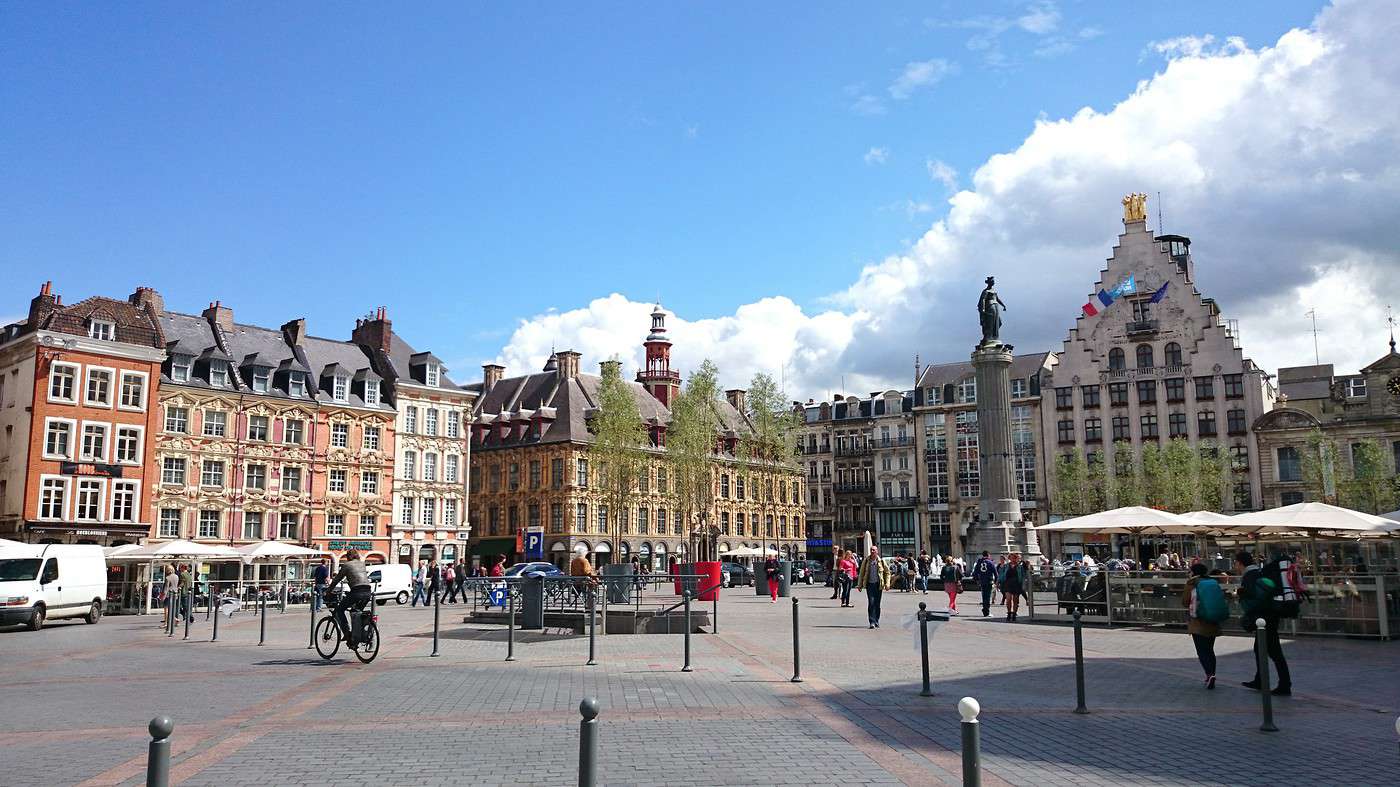
Also known as Grand'Place. It is the heart of the city and a historic site that once housed the medieval market. It is surrounded by remarkable buildings, including the Théâtre du Nord, the Vieille Bourse, and various structures built between the 17th and 20th centuries. At its center, the Goddess Column commemorates the siege of Lille in 1792.
View guide page: General de Gaulle SquareSomething wrong or out of date? Report this page