
Overview of Narbonne
It is the largest city in the Aude department. Visitors come to see its cathedral and the Abbey of Fontfroide, as well as to enjoy its beaches.
Key Facts
- Type de lieu: small town.
- Intérêt touristique: (worth seeing).
- Localisation:
- Distances:
- Heure locale: .
- Population: 54,700 inhabitants (2017).
- Surface area: 172.96 km².
- Altitude: sea level.
- Website: http://www.narbonne-tourisme.com
History of Narbonne
What to See in Narbonne
Fontfroide Abbey
This is a beautiful 12th-century Cistercian abbey, complete with its cloister, set in a pleasant forested area within the municipality.
This is a beautiful 12th-century Cistercian abbey, complete with its cloister, set in a pleasant forested area within the municipality.
Robine Canal
This lateral branch of the Canal du Midi runs through the city of Narbonne. Its banks have been developed into a greenway.
This lateral branch of the Canal du Midi runs through the city of Narbonne. Its banks have been developed into a greenway.
Saint-Just and Saint-Pasteur Cathedral
The city's main landmark. Massive and visible from afar, the cathedral was built in the "Southern Gothic" style in the late 13th century.
The city's main landmark. Massive and visible from afar, the cathedral was built in the "Southern Gothic" style in the late 13th century.
Clos de la Lombarde
These are the remains, mostly Gallo-Roman, discovered during excavations on the site. Several artifacts (mosaics, frescoes, etc.) are displayed at the city’s archaeological museum.
These are the remains, mostly Gallo-Roman, discovered during excavations on the site. Several artifacts (mosaics, frescoes, etc.) are displayed at the city’s archaeological museum.
Horreum
This is a well-preserved underground Roman-era warehouse. You can explore its underground galleries.
This is a well-preserved underground Roman-era warehouse. You can explore its underground galleries.
Archbishops' Palace of Narbonne
Alongside the cathedral, it is a complex consisting of three square towers, the Old Palace of Romanesque origin, and the New Palace in Gothic style. It also houses the Museum of Art and History and the city's (local) Archaeology Museum.
Alongside the cathedral, it is a complex consisting of three square towers, the Old Palace of Romanesque origin, and the New Palace in Gothic style. It also houses the Museum of Art and History and the city's (local) Archaeology Museum.
Merchants' Bridge
This is a small bridge with Roman origins, lined with two rows of inhabited houses, spanning the Robine Canal.
This is a small bridge with Roman origins, lined with two rows of inhabited houses, spanning the Robine Canal.
What to Do in Narbonne
Climate and Weather in Narbonne
The city has a Mediterranean climate, very sunny, with mild winters and hot, dry summers. Rainfall occurs in autumn, particularly around October-November. As for the wind, it is ever-present and can sometimes blow in (very) strong gusts.
Transportation
Getting There
Getting Around
Accommodation
Dining
Useful Addresses
Nearby Attractions
Some interesting sites to see around Narbonne:
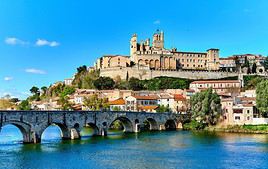
Béziers
The second-largest urban area in Hérault boasts a charming centre, notably featuring significant religious heritage, with its cathedral towering over the city.
The second-largest urban area in Hérault boasts a charming centre, notably featuring significant religious heritage, with its cathedral towering over the city.

Canal du Midi
A UNESCO-listed canal linking the Mediterranean (Sète) to Toulouse before continuing toward the Atlantic via the Canal de Garonne, this is a prime destination for river tourism in France. Its banks are also developed in many places to accommodate hiking and cycling.
A UNESCO-listed canal linking the Mediterranean (Sète) to Toulouse before continuing toward the Atlantic via the Canal de Garonne, this is a prime destination for river tourism in France. Its banks are also developed in many places to accommodate hiking and cycling.

Carcassonne
The capital of the Aude department is a must-see for tourism in the region thanks to its stunning medieval citadel, the largest in Europe and a UNESCO World Heritage site.
The capital of the Aude department is a must-see for tourism in the region thanks to its stunning medieval citadel, the largest in Europe and a UNESCO World Heritage site.

Salses Fortress
It's a beautiful fortress built around 1500 and very well preserved in the town of the same name.
It's a beautiful fortress built around 1500 and very well preserved in the town of the same name.


Lagrasse
A charming medieval village in the Corbières region, listed among the "Most Beautiful Villages of France".
A charming medieval village in the Corbières region, listed among the "Most Beautiful Villages of France".

Leucate
A large seaside resort located between Narbonne and Perpignan, known for its beaches and marina.
A large seaside resort located between Narbonne and Perpignan, known for its beaches and marina.

Minerve
Located in a wine-growing area (the "Minervois"), this commune is listed among the "Most Beautiful Villages of France" and boasts a stunning natural setting.
Located in a wine-growing area (the "Minervois"), this commune is listed among the "Most Beautiful Villages of France" and boasts a stunning natural setting.