last edited Dec 11, 2019
Overview of France
Location Map of France
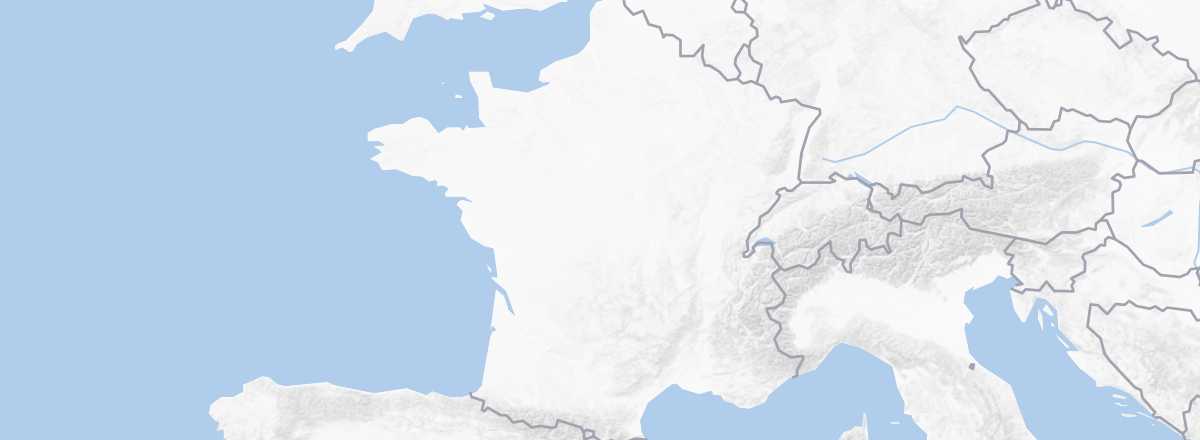 France
Open the interactive map
Quick Overview
Metropolitan France in Thirteen Tourist Regions
- Aquitaine: From the Atlantic beaches to the Pyrenees massif, including the charms of Périgord and the Basque Country, not to forget the riches of Bordeaux wine country, Aquitaine is one of France’s most interesting and varied regions. Every year, summer and winter alike, it attracts millions of visitors.
- Brittany: Beyond a few persistent clichés, Brittany remains a region with a strong culture and wild landscapes often born from the meeting of land and sea. It’s a destination for nature lovers and those seeking a certain "tranquility."
- Centre: This is the France of castles. Those of the Middle Ages in Burgundy, but above all the famous and magnificent châteaux of the Loire, built in the purest Renaissance style. Whether world-renowned like Chambord and Chenonceau or more "confidential" like many others, they alone justify a visit to the region.
- Corsica: Very different from the mainland in many ways, Corsica, with its distinct culture and traditions, its breathtaking sea and mountain landscapes, its coastline, and its inviting beaches, is a destination in its own right that will delight all types of travelers.
- Eastern France: While Alsace with its half-timbered houses, the Vosges forest, and the Champagne vineyards are well-known, the East also boasts other treasures, including beautiful cities, castles, remnants of the last two world wars, and above all a natural heritage that, while not spectacular, is perfect for outdoor activities.
- Hauts-de-France: Picardy and Nord-Pas de Calais are not necessarily synonymous with "holiday destinations." Yet, the area has its charms, especially along the coastline. Add to that dynamic cities like Amiens and Lille, as well as everything related to "remembrance tourism," and the region is well worth a visit.
- Massif Central: Limousin and Auvergne offer their forests, countryside, and ancient mountain ranges for discovery. Far from the summer bustle of the coast or big cities, this is a quiet, rural France that will appeal to nature lovers and those seeking a restful holiday.
- Normandy: Sought after by Parisians for weekend getaways to the countryside or the sea, Normandy also has many other attractions that can easily enrich much longer stays.
- Occitania: Languedoc and Midi-Pyrénées have merged into this new region, adding even more to the pleasures of sea and mountains, along with a rich cultural heritage thanks to cities like Toulouse, Carcassonne, Cathar castles, and the Catalan region.
- West: From the Gironde Estuary to Brittany, this part of France attracts visitors with its beaches, several beautiful islands near the coast, and two major parks: Futuroscope and Puy du Fou. In short, the West is primarily a relaxation and holiday destination, though cities like Nantes, La Rochelle, and Angers are also worth a visit.
- Paris-Île de France: While for many the Paris region is limited to visits to Paris and Versailles, it still has much more to offer. The outskirts of the capital include numerous cultural riches and even some natural sites perfect for outdoor activities.
- Provence-Côte d'Azur: Marseille, Nice, Avignon, Saint-Tropez, Provence—this entire region is synonymous with holidays and relaxation for many. Between the Mediterranean and the first Alpine ranges, it is also rich in both natural and cultural discoveries.
- Rhône-Alpes: The Ardèche Gorges, Vanoise, Vercors, Mont Blanc—this region is rich in natural heritage and has everything to please "nature-adventure" enthusiasts. On a cultural level, the city of Lyon and the charming medieval villages of Ardèche also deserve a visit.
Key Facts
- Type of place: country.
- Location:
- Latitude/longitude: 48°52' N, 2°19' E.
- Local time:
- Capital: Paris.
- Nature of the state: republic.
- Official language: French.
- Currency: euro.
- Population: 67,795,000 inhabitants (2018).
- Area: 551,695 km².
- Density: 122 inhabitants/km².
- Highest point: Mont Blanc (4,809 m).
- Lowest point: Les Moëres (-4 m) in the Nord department.
- Coastline: 5,853 km.
- Driving: on the right
Tourism
Always one of the world’s top destinations, France is a highly diverse country for tourism, long delighting nature lovers, cultural travelers, and those simply seeking a relaxing holiday. Overall, the tourism sector accounts for 7% of France’s GDP and 2 million direct and indirect jobs.
In 2018, 89.4 million people visited France, primarily from Germany and the UK (15% of arrivals each), followed by Belgium, Italy, and Switzerland. Many Americans and an increasing number of Chinese also visit the country. Unsurprisingly, Paris attracts the majority of foreign visitors, followed by the French Riviera. Among specific sites, Disneyland, the Louvre, the Palace of Versailles, and the Eiffel Tower draw the largest crowds.
Travel Essentials
- Destination: for beginner travelers
- Entry requirements:
- Currency to bring: euros.
- Exchange rate:
- Backpacker daily budget:
- Best for accommodation:
- Best for getting around:
- Risks:
- Best period (climate/crowds/prices):
- Interests (out of ): Nature ; Adventure ; Culture ; Relaxation
Addresses for Belgium, Switzerland, and Quebec
Socio-Economic Statistics
- "Quality of life": 24/188 (rank in 2018)
- GDP per capita: $44,100 (2017)
- Average monthly income: ()
- Inflation: +1.85% (2018)
- "Official" unemployment: 9.1% (2018)
- Population below poverty line: 14.2% (2015)
- Life expectancy: 82 years (2018)
- Migration rate per 1,000 inhabitants: +1.1 (2017)
- Population growth: +0.37% (2018)
- Literacy rate: 100% (2019)
- Urban population: 80.4% (2018)
- Press freedom: 33/180 (rank in 2018)
- Political regime: flawed democracy (29/167 in 2018)
Sources: World Bank, Human Development Indicators, RSF, The Economist, The World Factbook