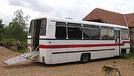

Bonjour, je prévois un séjour à minorque en fourgon, est il possible de dormir sur des parkings , ds les abords des villages ?
Ou faut il forcément aller camping?
Converting a heavy-duty bus/coach/truck into a motorhome
by Patrick26
Translated into English.
Ce que tu dis est vrais pour le 24v, moins de pertes en ligne, moins de gros cables.
Pour ce qui est de passer du 24 en 12 c'est possible via une sorte de transfo qui est en fait un système à découpage et qui te permet suivant la puissance admissible de ce "transfo" d'alimenter des appareils en 12 V.
Cepandant, pour recharger à une vitesse raisonable par exemple une batterie de 200 Ah il te faud au moins du 20 A de dispo soit 10% de la capacité de la batterie environ. Il vaud mieux à ce moment là installer un alternateur en 12 V bien que des chuteur de tension de 24 à 12 V existent pour cette puissance (Environ 150 Euros).
En tout cas évite à tout prix ton idée de résistance en série pour faire tomber la tension. A ce niveau de puissance ta résitance se résume à un chauffage electrique.En effet, ton sytème fonctionne, on s'en servait pour faire des potentiometres dans le temp car on ne savait pas gerer les grosses intensitées comme maintenant avec le découpage(comme pour les lampes halogènes de salon), le probleme est que tu elimines le surplus de tension en dissipant l'énergie en chaleur. Donc tu pert déjà la moitié de ta capacité de production mais d'un autre coté pour l'hivers, si tu met ta résistance dans la cellule habitable, tu te chauffes, pas terrible pour l'été...
Eh ben, Ya du boulot!!
http://www.aavl.fr
http://gasmobil.skyrock.fr
super merci beaucoup pour vos réponse!🙂
je vais essayer de contacter la drire et veritas pour voir ce que je peux faire mais si je ne peux pas percer la caisse ni le plancher du 0303 (car c'est un treilli) ca va etre vite reglé!
je vais devoir en choisir un autre. Dommage il me plaisait bien😕
Bonjour, et merçi pour l'info j'ai pris contacte avec Pandrée j'attends sa réponse, quant aux mesures de mon fr1 les voiçi:
Du sol au plafond 200 cm
De la marche au plafond 183 cm
De la marche au dessous des rangements 155 cm
La version du fr1 je ne la connais pas il s'agit d'un Fr1 qui avait servi aux transports des délégations des athlètes des jeux olympiques d'Albertville, à l'époque il avait un salon arrière, puis il a été transformé son millésime est 1985 et son numéro de série est SFR 1106.2 Série VF6SFR11000000210
A bientôt
jl Corouge
La version du fr1 je ne la connais pas il s'agit d'un Fr1 qui avait servi aux transports des délégations des athlètes des jeux olympiques d'Albertville, à l'époque il avait un salon arrière, puis il a été transformé son millésime est 1985 et son numéro de série est SFR 1106.2 Série VF6SFR11000000210
A bientôt
jl Corouge
mon blog
http:/kersode.skyblog.com
bon je recommence a rien comprendre!!!!
j'ai passé l'aprem a telephoner a la drire, a ivobus, veritas et l'afnor au sujet du percage du trailli (génial ma semaine de vacances!).
la DRIRE me dit qu'il faut juste l'accord constructeur donc j'appele ivobus qui me dit qu'ils veulent juste un petit croquis de mon amenagement pour avoir leur accord Moi ca me convient parfaitement mais je ne voudrai pas de mauvaises surprises lors des controls aux mines
bon je la pose enfin ma question: EST CE QUE TOUT CA VOUS PARRAIT NORMAL?
Comment le constructeur va savoir combiens je vais percer de trous et de quel taille avec juste un petit croquis
je vais toujours chercher mon mercedes 0303 a 2500euros lundi mais j'hesite quand meme, quand pensez vous?
Bon, tu vas pas m'en vouloir, je m'acharne pas contre toi, mais je peux pas laisser les internautes dans le doute.😉
Tu raisonne mal car à court therme, 2x moins de conso mais 2 x plus de batteries à l'achat ok à l'utilisation pas d'accord, --> 2x moins de décharge, durée de vie suppérieure mais la question pour un CC n'est pas là, la VRAIS question est : l'AUTOMOMIE à l'arrêt.🤪
Petit rappel de physique appliquée (10 ans que j'ai quitée tout çà çà va me faire du bien ha nostalgie😇)
Ben oui l'électricité, c'est ma formation scolaire BEP, CAP, BAC PRO, et ensuite mon job dont 5 ans en milieu scolaire. HA la belle époque d'insouciance, d'inventions, de montages bidouilles, d'essais explosifs, de chèque fixe à la fin du mois😎 ma jeunesse, ... HOLA je divague, je divague, revenons à nos moutons !😮
Sortez une feuille un crayon, notez : (j'ai pas pu m'en empêcher😏)
pour une résistance pure (lampe à filament, frigo à absorbsion, radiateur électrique, cafetière sans trop d'électronique...) on a la formule suivante :
W (la puissance en watt ) = A (le courant en ampère) x V (la tension en volt) --> jusque là on est d'accord on dit aussi volt Ampère (VA) dans l'industrie
si W = 100W V = 24V A = 4.17A (100/24) --> on est toujours d'accord
Si W = 100W V = 12V A = 8, 33A (100/2) --> çà deviens lassant mais, toujours d'accord
DONC 2 X plus de consommation ! je persiste et signe ce que j'ai déjà écris plusieurs fois--> HA là, désolé.
si 1 Batterie 12V de 200A/H soit : pour 8, 33A de conso. une autonomie de 24 heures (200 /8.33)
si 2 batteries de 12V en série soit 24V et TOUJOURS 200A/H (en série les tensions s'additionnent, les intensités restent les même--> c'est l'inverse en parrallèle) on trouve pour 4.17A de conso. une autonomie de 47H58min (47, 96H)
SOIT presque 2 X plus d'autonomie (à 2 min près) ATTENTION : Mathématique : --> 2 x + avec la même base de départ donne (j'ai pas le signe !) ha si : ==> presque 2 x moins de consomation
C.Q.F.D. merci merci mon chère Watson houf ! Bon les autres : 4 heures et vous me copierez çà 10 X
juste pour être lourd car ici c'est le Post des PL donc : pour 100W sous 40000V on obtiend 0.0025 A (2, 5ma le top !)
Hé pis tiens CADEAU : si vous passez du 12 ou 24 en 220, il faut le faire QUE pour le strict nécéssaire, car il y a une déperdition non négligeable avec les survolteurs et vous viderez donc les batteries plus rapidement
Voilà, voilà, je donne des conseils, mais moi je suis en 12V parce que peu de besoin électrique, mais je le déconseil car j'ai déjà "niqué" les 2 batteries moteur du bus, car la recharge se fait en prenant sur une seule batterie, (j'ai acheté un coupleur/séparateur 24V/12V très chère et en fait c'est un vulguère 12V/12V) donc on tire sur 1 batterie, le régulateur/alternateur charge 24V entre les 2 bornes (27V exactement) mais vu qu'il y a 1 batterie plus déchargée (à cause du coupleur qui tire dessus et que bizarrement avec le temps les tensions s'égalisent mal ???) donc, on se retrouve avec une batterie à 11, 5V au lieu de 12.7V et l'autre à 13.9V au lieu de 12V et là problème d'usure prématurée pourquoi comment ? 😕 enfin j'ai 2 neuves çà va allez mieux.
Désolé pour ce long cours théorique🤪 GX47
Tu raisonne mal car à court therme, 2x moins de conso mais 2 x plus de batteries à l'achat ok à l'utilisation pas d'accord, --> 2x moins de décharge, durée de vie suppérieure mais la question pour un CC n'est pas là, la VRAIS question est : l'AUTOMOMIE à l'arrêt.🤪
Petit rappel de physique appliquée (10 ans que j'ai quitée tout çà çà va me faire du bien ha nostalgie😇)
Ben oui l'électricité, c'est ma formation scolaire BEP, CAP, BAC PRO, et ensuite mon job dont 5 ans en milieu scolaire. HA la belle époque d'insouciance, d'inventions, de montages bidouilles, d'essais explosifs, de chèque fixe à la fin du mois😎 ma jeunesse, ... HOLA je divague, je divague, revenons à nos moutons !😮
Sortez une feuille un crayon, notez : (j'ai pas pu m'en empêcher😏)
pour une résistance pure (lampe à filament, frigo à absorbsion, radiateur électrique, cafetière sans trop d'électronique...) on a la formule suivante :
W (la puissance en watt ) = A (le courant en ampère) x V (la tension en volt) --> jusque là on est d'accord on dit aussi volt Ampère (VA) dans l'industrie
si W = 100W V = 24V A = 4.17A (100/24) --> on est toujours d'accord
Si W = 100W V = 12V A = 8, 33A (100/2) --> çà deviens lassant mais, toujours d'accord
DONC 2 X plus de consommation ! je persiste et signe ce que j'ai déjà écris plusieurs fois--> HA là, désolé.
si 1 Batterie 12V de 200A/H soit : pour 8, 33A de conso. une autonomie de 24 heures (200 /8.33)
si 2 batteries de 12V en série soit 24V et TOUJOURS 200A/H (en série les tensions s'additionnent, les intensités restent les même--> c'est l'inverse en parrallèle) on trouve pour 4.17A de conso. une autonomie de 47H58min (47, 96H)
SOIT presque 2 X plus d'autonomie (à 2 min près) ATTENTION : Mathématique : --> 2 x + avec la même base de départ donne (j'ai pas le signe !) ha si : ==> presque 2 x moins de consomation
C.Q.F.D. merci merci mon chère Watson houf ! Bon les autres : 4 heures et vous me copierez çà 10 X
juste pour être lourd car ici c'est le Post des PL donc : pour 100W sous 40000V on obtiend 0.0025 A (2, 5ma le top !)
Hé pis tiens CADEAU : si vous passez du 12 ou 24 en 220, il faut le faire QUE pour le strict nécéssaire, car il y a une déperdition non négligeable avec les survolteurs et vous viderez donc les batteries plus rapidement
Voilà, voilà, je donne des conseils, mais moi je suis en 12V parce que peu de besoin électrique, mais je le déconseil car j'ai déjà "niqué" les 2 batteries moteur du bus, car la recharge se fait en prenant sur une seule batterie, (j'ai acheté un coupleur/séparateur 24V/12V très chère et en fait c'est un vulguère 12V/12V) donc on tire sur 1 batterie, le régulateur/alternateur charge 24V entre les 2 bornes (27V exactement) mais vu qu'il y a 1 batterie plus déchargée (à cause du coupleur qui tire dessus et que bizarrement avec le temps les tensions s'égalisent mal ???) donc, on se retrouve avec une batterie à 11, 5V au lieu de 12.7V et l'autre à 13.9V au lieu de 12V et là problème d'usure prématurée pourquoi comment ? 😕 enfin j'ai 2 neuves çà va allez mieux.
Désolé pour ce long cours théorique🤪 GX47
GX47
ex transformation, homologation et utilisation d'un car en CC 9places route en utilisation pro. Plus un CC 6pl VL, plus un fourgon en cabine approfondie 6 pl VL. si je peu aider...
ex transformation, homologation et utilisation d'un car en CC 9places route en utilisation pro. Plus un CC 6pl VL, plus un fourgon en cabine approfondie 6 pl VL. si je peu aider...
salut, je croyais que le 0303 était l'évolution du 0302 ?
le 0302 lui à un chassis, un vrais 30cm de haut ! je l'ai vu de près, c'est pas un chassis de ... 😊 ho pardon.
donc si c'est la même bouille essais un 0302
en tout cas comme l'a déjà marqué Patrick26 vaux mieux pas découper un treillis.
le 0302 lui à un chassis, un vrais 30cm de haut ! je l'ai vu de près, c'est pas un chassis de ... 😊 ho pardon.
donc si c'est la même bouille essais un 0302
en tout cas comme l'a déjà marqué Patrick26 vaux mieux pas découper un treillis.
GX47
ex transformation, homologation et utilisation d'un car en CC 9places route en utilisation pro. Plus un CC 6pl VL, plus un fourgon en cabine approfondie 6 pl VL. si je peu aider...
ex transformation, homologation et utilisation d'un car en CC 9places route en utilisation pro. Plus un CC 6pl VL, plus un fourgon en cabine approfondie 6 pl VL. si je peu aider...
En simplifiant un peu, la drire accepte toutes transformations du moment que tu as l'autorisation
du constructeur.
Avant de donner son accord, le constructeur veux savoir ce que tu veux faire avant, ce qui me parais normal.
Il m'étonnerait fort que le constructeur accepte que tu découpe son chassis treilli mais par contre, tu peux sans doute faires des trous et ouvertures dans la tole sans toucher à la structure principale.
Par exemple, pour moi, SETRA m'autorise le décaissement du plancher. Pour eux, la partie où on marche dans le bus ne participe pas à sa rigidité ou solidité. Je peux donc baisser le plancher.
Chaque constructeur est different. Négocie avec eux est surtout fournis leur un plan assez précis et pas un brouillon. Faud faire un dossier qui inspire confiance si tu veux un accord.
Eh ben, Ya du boulot!!
http://www.aavl.fr
http://gasmobil.skyrock.fr
bsoir et merci pour ce debat endiablé sur le sijet electrique.😛
Jcommence a y voir plus clair. dans la logique c'est donc vers le 24v que je vais me tourner. La deperdition en 220v est vraiment trop importante? car je vais certainement avoir besoin de 220v... c'est possible de la calculer cette deperdition? et mici encore pour vos reponse.
Jcommence a y voir plus clair. dans la logique c'est donc vers le 24v que je vais me tourner. La deperdition en 220v est vraiment trop importante? car je vais certainement avoir besoin de 220v... c'est possible de la calculer cette deperdition? et mici encore pour vos reponse.
normalement oui mais prise de tête, faut connaitre l'impédance, la raisonnance, savoir comment est constitué l'onduleur, avec quel composants, bref la mouise! en bac pro, j'étais au top là dessus, mais je suis actuellement complètement dépassé une bille même faute de pratique et mise à niveau (et puis je hais les maths et les intégrales😠)
il ne faut pas hésiter à monter le 220V, c'est toujours utile, achète un survolteur normalement la déperdition doit se retrouver facilement en soustraiant (je doute de l'orthographe) la puissance délivrée de la consomation (normalement tout çà est indiqué par le fabriquant)
attention, on ne doit pas passer le 220V dans la même gaine que le 24V (risque d'impédance dans le circuit continu (24V), de courant résiduel et surtout, isolation différente) pour éviter les risque n'achetez que du câble ou fil U1000 ou U500 (prévu pour le 220V) pour la section : 10A par mm2 mais les norme oblige 1, 5mm2 pour 10A ; 2, 5mm2 pour 16A ; 4mm2 pour 20A ; 6mm2 pour 32A ; et j'ai un trou 16 ou 25 pour 63A aïe aïe aïe je sais plus😕 bououou le nul 😊 là j'ai honte bon déjà 6 mm2 c'est déjà pas mal dans un bus
attention, on ne doit pas passer le 220V dans la même gaine que le 24V (risque d'impédance dans le circuit continu (24V), de courant résiduel et surtout, isolation différente) pour éviter les risque n'achetez que du câble ou fil U1000 ou U500 (prévu pour le 220V) pour la section : 10A par mm2 mais les norme oblige 1, 5mm2 pour 10A ; 2, 5mm2 pour 16A ; 4mm2 pour 20A ; 6mm2 pour 32A ; et j'ai un trou 16 ou 25 pour 63A aïe aïe aïe je sais plus😕 bououou le nul 😊 là j'ai honte bon déjà 6 mm2 c'est déjà pas mal dans un bus
GX47
ex transformation, homologation et utilisation d'un car en CC 9places route en utilisation pro. Plus un CC 6pl VL, plus un fourgon en cabine approfondie 6 pl VL. si je peu aider...
ex transformation, homologation et utilisation d'un car en CC 9places route en utilisation pro. Plus un CC 6pl VL, plus un fourgon en cabine approfondie 6 pl VL. si je peu aider...
Sans vouloir te contrarier je pense que françois57 et toi avez raison.
J'ai pas toujours été policier, je suis electricien également de formation.
Question intensitée, en effet même sans ta démo il est évident qu'on utilise deux fois moins de courrant en 24 V qu'en 12. Par contre en ce qui concerne l'énergie consommée, à part une petite économie de pertes en ligne ou de rendement en 24 V par rapport au 12 V, Pour moi c'est pareil. On divise par 2 le courrant mais on double la tension, donc pour la plupart des appareils d'un camping car qui ont un cosinus de 1 on a pour 100 W: en 12: 8.33(A)x 12(V)= 100(W) en 24: 4.17(A)x 24(V)= 100(W).
Néanmoins tu as raison de dire qu'en 24 on double la capacité, c'est vrai que le fait de passer en 24 double l'autonomie. Le nombre d'Ah reste le même avec deux batteries de 12 en série mais comme la conso en ampères est divisée par deux on a deux fois + d'énérgie en stock voir + a cause de l'économie des pertes en ligne et du coeficient de décharge batterie( C10, C20, C100) moins on tire de jus à la fois plus la batterie en donne.
La capacité d'une batterie varie en fonction du courant de décharge. Un notion essentielle! la capacité des batteries est évaluée en fonction du courant de décharge. Exemple une BSG68 est une batterie dont la capacité de 68 Ah est évaluée en la déchargeant totalement (Ce qui est très vivement déconseillé pour sa durée de vie!) avec un courant égal au 1/100 de la capacité (0.68A). Ce qui revient à dire, et qui est clairement explicité sur le document ci-contre que cette même batterie déchargée avec un courant égal à 1/20 de sa capacité (2.75A) ne présentera plus qu'une capacité de 55Ah, et en C/10 (Capacité sur 10) 50Ah soit un courant de 5 A pendant dix heures. Il est évident qu'avec un courant de plus de 5A, la capacité (en Ah) sera encore plus réduite! On pourra de la même façon immaginer une décharge avec un courant à C/500 (0.16A) ce qui nous donnerait une capacité de l'ordre de 80 ou 85 Ah en C/500. Voilà une notion très pratique, mais aussi "très élastique" à laquelle il importe de prendre garde. Sans vouloir te contrarier je pense que cette petite explication complete la tienne.
Question intensitée, en effet même sans ta démo il est évident qu'on utilise deux fois moins de courrant en 24 V qu'en 12. Par contre en ce qui concerne l'énergie consommée, à part une petite économie de pertes en ligne ou de rendement en 24 V par rapport au 12 V, Pour moi c'est pareil. On divise par 2 le courrant mais on double la tension, donc pour la plupart des appareils d'un camping car qui ont un cosinus de 1 on a pour 100 W: en 12: 8.33(A)x 12(V)= 100(W) en 24: 4.17(A)x 24(V)= 100(W).
Néanmoins tu as raison de dire qu'en 24 on double la capacité, c'est vrai que le fait de passer en 24 double l'autonomie. Le nombre d'Ah reste le même avec deux batteries de 12 en série mais comme la conso en ampères est divisée par deux on a deux fois + d'énérgie en stock voir + a cause de l'économie des pertes en ligne et du coeficient de décharge batterie( C10, C20, C100) moins on tire de jus à la fois plus la batterie en donne.
La capacité d'une batterie varie en fonction du courant de décharge. Un notion essentielle! la capacité des batteries est évaluée en fonction du courant de décharge. Exemple une BSG68 est une batterie dont la capacité de 68 Ah est évaluée en la déchargeant totalement (Ce qui est très vivement déconseillé pour sa durée de vie!) avec un courant égal au 1/100 de la capacité (0.68A). Ce qui revient à dire, et qui est clairement explicité sur le document ci-contre que cette même batterie déchargée avec un courant égal à 1/20 de sa capacité (2.75A) ne présentera plus qu'une capacité de 55Ah, et en C/10 (Capacité sur 10) 50Ah soit un courant de 5 A pendant dix heures. Il est évident qu'avec un courant de plus de 5A, la capacité (en Ah) sera encore plus réduite! On pourra de la même façon immaginer une décharge avec un courant à C/500 (0.16A) ce qui nous donnerait une capacité de l'ordre de 80 ou 85 Ah en C/500. Voilà une notion très pratique, mais aussi "très élastique" à laquelle il importe de prendre garde. Sans vouloir te contrarier je pense que cette petite explication complete la tienne.
Eh ben, Ya du boulot!!
http://www.aavl.fr
http://gasmobil.skyrock.fr
On trouve facilement des convertisseurs avec 94% de rendement.
Je mettrais en ligne si j'y arrive la doc pour info.
Eh ben, Ya du boulot!!
http://www.aavl.fr
http://gasmobil.skyrock.fr
Bonjour
Je suis nouveau pour vous mais voici plusieurs mois que je viens vous lire sur ce forum. Je vous ai observé jusqu'a présent et j'ai bien enregistré les conseils des uns et de autres (y a des conneries aussi😉). Merci Patrick d'avoir créé ce forum.
S'il y a une concentration 2007, je serai parmi vous. J'habites le nord (59) entre Douai et Valenciennes
En ce qui concerne les vitres du FR1, moi je ne n'y ai pas touché, je les ai dégraissé avec un diluant puissant et je les ai peintes de l'intérieur, puis posé les cloisons. Cela n'a pas bougé pour l'instant. Peut être dans quelques années je devrais recommencer, et bien alors je le ferais de l'extérieur. En ce qui concerne les rails en alu sur le côté, je te conseille de ne pas les enléver. Je m'en suis servi pour fixer les meubles, les cloisons... Si veux savoir d'autres choses sur le FR1 tu peux m'appeler 06.80.43.49.96. Tu peux voir aussi l'état du mien: http://fr15966.skyblog.com/
A bientôt
Je suis nouveau pour vous mais voici plusieurs mois que je viens vous lire sur ce forum. Je vous ai observé jusqu'a présent et j'ai bien enregistré les conseils des uns et de autres (y a des conneries aussi😉). Merci Patrick d'avoir créé ce forum.
S'il y a une concentration 2007, je serai parmi vous. J'habites le nord (59) entre Douai et Valenciennes
En ce qui concerne les vitres du FR1, moi je ne n'y ai pas touché, je les ai dégraissé avec un diluant puissant et je les ai peintes de l'intérieur, puis posé les cloisons. Cela n'a pas bougé pour l'instant. Peut être dans quelques années je devrais recommencer, et bien alors je le ferais de l'extérieur. En ce qui concerne les rails en alu sur le côté, je te conseille de ne pas les enléver. Je m'en suis servi pour fixer les meubles, les cloisons... Si veux savoir d'autres choses sur le FR1 tu peux m'appeler 06.80.43.49.96. Tu peux voir aussi l'état du mien: http://fr15966.skyblog.com/
A bientôt
Bonjour et merçi pour le message, je suis allé sur ton blog et j'y ai vu beaucoup de choses intéresantes, mais ma première question est ton bus a t'il été homologué par la Drire?
Deuxièmement en ce qui concerne les rails alu côté fenetres en bas je pense qu'il véhiculent l'air chaud et il semble sur les photos que tu as posé les meubles devant comment à tu gérer le problème, par le haut il y a également une ventilation mécanique qui maintenant doit se trouver dans tes meubles, et enfin en haut des fenêtres existe une aération naturelle sans doute pour éviter le buée quid?
Le réservoir pour les eaux propres acheté sur ebay sans doute est'il cloisonné?
Enfin dernière question pour ce matin qu'as tu fait des coffres haut et pense que ce soit standard, je pense que je vais en rechercher quelques un
A bientôt et merçi encore
jl Corouge
mon blog
http:/kersode.skyblog.com
pour les photos du week end, il faut que j'explique....
pris par l'organisation, j'en avais oublié mon apareil! j'ai donc demandé aux forumeurs presents de me transmettre celles qu'ils avaient prises pour que je fasse une compil que je puisses mettre en ligne... et pour l'instant je n'ai recu que celles de ggdbdb65!
j'attends celles des autres et je mets en ligne! promis!
a part ca, j'ai une nouvelle:
Sébastien, mon ami, mon pote, mon complice, que ceux qui etaient au week end on connu, et que d'autres ont eu en contact au travers de ces plans notament, va nous rejoindre sur ce forum sous le pseudo de "junior"!
son parcours de designer industriel avec une option en amenagement d'espace devrait en interresser plusieurs!
son point fort:
l'analyse du besoin et de la valeur (un terme barbare que je vais expliquer de facon simple)
quand nous avons reflechi a nos besoins pour la cuisine du camping car, j'ai eu une discution avec lui. est-ce que je met une cuisiniere 3 ou 4 feux? un four? un micro ondes? quelle taille de frigo? de congel? etc....
et lui, tres pragmatique, m'a repondu: il faut faire une analyse! moi: "comment?" lui:"oublies tout du point de vue materiel, et met moi par ecrit ce que tu va manger dans ton camping car. ne reflechi pas a comment tu vas cuisiner, conserver au frais, rechauffer, etc.liste moi les petit dejeuner, midi, gouter et soir sur 3 semaines de vacances. indiques moi si les repas son pris au camping car ou a l'exterieur (resto par exemple)."
et bien avec ma femme, on a fait la liste!
et ensemble, avec "junior", on a pu determiner quels equipements il fallait!
voila, lui il appelles ca des "contraintes constructives"! et en appliquant ces methodes qui servent a ammeliorer les produits et outils de notre vie courante, il arrive a determiner le niveau de couverture du besoin sans exces, mais surtout sans manque!
sa marche pour les places assises, l'espace d'une salle d'eau, le volume des soutes ou la quantité d'eau a embarquer!
il saura vous indiquer les cotes de confort pour vos banquettes, vos portes, vos plans de travail, etc...
se faire un bus camping car n'est pas dans ces projets, mais le mien et les votres l'amusent! (n'est ce pas famillede8 qui a passé 2 heures avec lui et qui est reparti avec ses plans informatiques sous le bras!).
reservez lui un bon accueil (il est un peu timide😊....), et n'hésitez pas a le questionner. il ne vous dira pas quel type de batterie (ni de combien d'amperes) prendre, mais pourra vous aider pour etudier vos besoins journaliers par exemple.
et un intervenant en direct sur le forum!
PATRICK26
pris par l'organisation, j'en avais oublié mon apareil! j'ai donc demandé aux forumeurs presents de me transmettre celles qu'ils avaient prises pour que je fasse une compil que je puisses mettre en ligne... et pour l'instant je n'ai recu que celles de ggdbdb65!
j'attends celles des autres et je mets en ligne! promis!
a part ca, j'ai une nouvelle:
Sébastien, mon ami, mon pote, mon complice, que ceux qui etaient au week end on connu, et que d'autres ont eu en contact au travers de ces plans notament, va nous rejoindre sur ce forum sous le pseudo de "junior"!
son parcours de designer industriel avec une option en amenagement d'espace devrait en interresser plusieurs!
son point fort:
l'analyse du besoin et de la valeur (un terme barbare que je vais expliquer de facon simple)
quand nous avons reflechi a nos besoins pour la cuisine du camping car, j'ai eu une discution avec lui. est-ce que je met une cuisiniere 3 ou 4 feux? un four? un micro ondes? quelle taille de frigo? de congel? etc....
et lui, tres pragmatique, m'a repondu: il faut faire une analyse! moi: "comment?" lui:"oublies tout du point de vue materiel, et met moi par ecrit ce que tu va manger dans ton camping car. ne reflechi pas a comment tu vas cuisiner, conserver au frais, rechauffer, etc.liste moi les petit dejeuner, midi, gouter et soir sur 3 semaines de vacances. indiques moi si les repas son pris au camping car ou a l'exterieur (resto par exemple)."
et bien avec ma femme, on a fait la liste!
et ensemble, avec "junior", on a pu determiner quels equipements il fallait!
voila, lui il appelles ca des "contraintes constructives"! et en appliquant ces methodes qui servent a ammeliorer les produits et outils de notre vie courante, il arrive a determiner le niveau de couverture du besoin sans exces, mais surtout sans manque!
sa marche pour les places assises, l'espace d'une salle d'eau, le volume des soutes ou la quantité d'eau a embarquer!
il saura vous indiquer les cotes de confort pour vos banquettes, vos portes, vos plans de travail, etc...
se faire un bus camping car n'est pas dans ces projets, mais le mien et les votres l'amusent! (n'est ce pas famillede8 qui a passé 2 heures avec lui et qui est reparti avec ses plans informatiques sous le bras!).
reservez lui un bon accueil (il est un peu timide😊....), et n'hésitez pas a le questionner. il ne vous dira pas quel type de batterie (ni de combien d'amperes) prendre, mais pourra vous aider pour etudier vos besoins journaliers par exemple.
et un intervenant en direct sur le forum!
PATRICK26
Nous n avons certe pas encore eu les photos (dommage)🙁mais pas eu non plus beaucoup d informations sur le deroulement des journees.
Combien y avait il de bus qui se sont deplaces et une éval de visiteurs, les pros, les plus belles realisations, les techniques, technologies, tout quoi !
Allé PATRICK, on compte sur toi et ceux qui ont infos et photos.😉
fab
Bon, Patrick a commencé à me présenter (sauf que "junior" est déjà pris)... Je me lance donc dans votre discussion, bien que ça fasse un moment que je la suive (depuis le premier post) . Pour rééquilibréer les choses je vais me présenter...
Je suis donc le pote et ancien associé de Patrick, je connais donc son projet par coeur puisque j'y ai participé (j'ai encore tendance à parler de son bus comme de "notre" bus). Certains d'entre vous me connaissent pour m'avoir rencontré lors du week end à Chabeuil, d'autres parce que je les ai déjà eu au tel. Vos projets d'aménagement m'éclatent et je suis tenté de me lancer l'aventure, mais le seul hic pour moi, c'est que c'est le moyen et pas la finalité qui m'amuse. Autrement dit, pour l'instant, je ne me vois pas vivre ni partir en vacances dans un CC (mais si c'était le cas, ce serait dans un PL). Je suis designer industriel de formation (après un DUT génie méca). Pour faire court, oubliez que design veut dire beau... Le design c'est donner un sens et une forme et avant tout c'est répondre à un cahier des charges. Autrement dit, j'applique des méthodologies de réflexion créatives (ça a l'air compliqué comme ça) pour répondre à des besoins. Pour beaucoup, vous envisagez les problématiques auquelles vous etes confrontés commes à des contraintes restrictives. Pour moi, les contraintes sont des sources d'inspiration et le seul vrai support de la décision. Pour ceux qui veulent vivre à l'année dans leur CC, la vraie question est comment vous allez vivre (quelles activités, combien de temps, combiens de personnes vont partager cette activité...) et les réponses que vous donnerez seront forcément différentes de celui qui veut partir en vacances en famille et donc vos solutions, d'aménagement et d'équipement, seront différentes. De la même manière, c'est bien de s'inspirer des solutions que vous avez pu voir dans d'autres Pl ou CC mais n'oubliez pas que la plupart sont conçus pour répondre aux besoins du plus grand nombre (fabrication en série, location) ou a des besoins qui ne sont pas les votres ! Concernant le bus de Patrick, on a du faire un dizaine de plans d'implantations différents, et comme pour vous tous, comme c'est un proto, il est susceptible d'être modifié. Il ne s'agit pas d'ailleurs de plans de fab (pour les puristes, j'ai fait les plans sur Adobe Illustrator et pas sur un logiciel technique type Autocad).
Voilà pour mon premier post, maintenant, vous savez que je suis là, alors si je peux vous aider... Bon courage dans vous projet et ne lachez pas le morceau !
Je suis donc le pote et ancien associé de Patrick, je connais donc son projet par coeur puisque j'y ai participé (j'ai encore tendance à parler de son bus comme de "notre" bus). Certains d'entre vous me connaissent pour m'avoir rencontré lors du week end à Chabeuil, d'autres parce que je les ai déjà eu au tel. Vos projets d'aménagement m'éclatent et je suis tenté de me lancer l'aventure, mais le seul hic pour moi, c'est que c'est le moyen et pas la finalité qui m'amuse. Autrement dit, pour l'instant, je ne me vois pas vivre ni partir en vacances dans un CC (mais si c'était le cas, ce serait dans un PL). Je suis designer industriel de formation (après un DUT génie méca). Pour faire court, oubliez que design veut dire beau... Le design c'est donner un sens et une forme et avant tout c'est répondre à un cahier des charges. Autrement dit, j'applique des méthodologies de réflexion créatives (ça a l'air compliqué comme ça) pour répondre à des besoins. Pour beaucoup, vous envisagez les problématiques auquelles vous etes confrontés commes à des contraintes restrictives. Pour moi, les contraintes sont des sources d'inspiration et le seul vrai support de la décision. Pour ceux qui veulent vivre à l'année dans leur CC, la vraie question est comment vous allez vivre (quelles activités, combien de temps, combiens de personnes vont partager cette activité...) et les réponses que vous donnerez seront forcément différentes de celui qui veut partir en vacances en famille et donc vos solutions, d'aménagement et d'équipement, seront différentes. De la même manière, c'est bien de s'inspirer des solutions que vous avez pu voir dans d'autres Pl ou CC mais n'oubliez pas que la plupart sont conçus pour répondre aux besoins du plus grand nombre (fabrication en série, location) ou a des besoins qui ne sont pas les votres ! Concernant le bus de Patrick, on a du faire un dizaine de plans d'implantations différents, et comme pour vous tous, comme c'est un proto, il est susceptible d'être modifié. Il ne s'agit pas d'ailleurs de plans de fab (pour les puristes, j'ai fait les plans sur Adobe Illustrator et pas sur un logiciel technique type Autocad).
Voilà pour mon premier post, maintenant, vous savez que je suis là, alors si je peux vous aider... Bon courage dans vous projet et ne lachez pas le morceau !
bonjour,
Je suis un p tit nouveau expatrié en martinique avec ma femme et mes deux enfants, nous prevoyons un retour en metropole en 2007 et pas question pour nous de revivre enfermes dans un appart de 50m2 a 700euros de loyer par mois (on compte pas les impots les charges les cautions et les formalités de ces cheres agences immobilières!).
J ai travaillé pendant 2 ans en tant que technicien d atelier chez un concessionnaire de camping car et l idée du bus habitation m avait effleuré.
J ai donc quelques questions a vous poser (merci d avance pour vos reponses!)
J ai pas de permis pl lequel dois je passer (je souhaite garder 9 places assises dans le bus)?
Les demarches d homologation seront telles plus facile si les travaux (electrique gaz eau)sont effectues chez un proffessionel(j ai de bon contacts avec mon ex boss)
et enfin pour pas faire trop long pour un premier post une idée du cout annuel de l assurance?(j aime bien aussi les assureurs comme les agences immobilieres!).
Voila c est tout pour aujour dhui si l un d entre vous passe par ici (sans son bus vu l eau qui nous separe!) n hesitez pas a venir nous faire un p tit coucou en attendant je dépiote toutes les pages du forum et ya du boulot!!
Abientot Quick
😉Salut, bienvenus aux nouveaux
g rencontré un mec qui a un bus aménagé et qui va en refaire un autre avec une CG fourgon, il n'a pas de problèmes .
tous c pots sont dans le meme cas personne n'a de problemes.
Sinon, que pensez vous d'installer des chiottes secs a la place des chiottes chimique???
Rebonjour a tous!
Je suis a la page 10 du forum et je vient de me rappeler qu un ami de mon pere qui avait une replique d ac cobra roulait en france avec des plaques anglaises (impossible de l homologuer en france mais en gb pas de soucis)
Quelqu un connait t il la legislation anglaise pour une transformation de car en sachant que nous sommes maintenant tous citoyens européens et avoir une adresse chez nos amis anglais et rouler avec une plaque anglaise ne doit pas poser de soucis!
C est peut etre une grosse betisse mais si c est plus facile la bas pourquoi pas!
a plus Quick
salut et bienvenue🙂 c'est clair qu'on trouve des tonnes de renseignement pour y arriver et donc merci a tous;
d'ailleur😊 me revoila avec mes questions electrique...
j'abandonne le solaire(pour le moment) vu que l'hiver en haute-savoie on sera garé a l'ombre...
bref histoire que je capte comment ça fonctionne: en combien de temp un groupe electro recharge une batterie? Je sai la question est bete vu que je donne aucune valeur concernant le groupe et la batterie mais ceux qui marche avec un groupe comment ça se passe en faite. un groupe ça pollue et fais du bruit de plus le coup de reviens de l'electricité est assez elevé(enfin je crois) alors soit je trouve un autre terrain(heu pas possible je crois) pour me poser et tourner au solaire soit bin je prie pour qu'avec un groupe on s'en prenne pas plein les oreilles pdt 10h le temp de recharger les batteries... en faite c'est me rassurer que je vous demande de faire...😊
amicalement pierrick
d'ailleur😊 me revoila avec mes questions electrique...
j'abandonne le solaire(pour le moment) vu que l'hiver en haute-savoie on sera garé a l'ombre...
bref histoire que je capte comment ça fonctionne: en combien de temp un groupe electro recharge une batterie? Je sai la question est bete vu que je donne aucune valeur concernant le groupe et la batterie mais ceux qui marche avec un groupe comment ça se passe en faite. un groupe ça pollue et fais du bruit de plus le coup de reviens de l'electricité est assez elevé(enfin je crois) alors soit je trouve un autre terrain(heu pas possible je crois) pour me poser et tourner au solaire soit bin je prie pour qu'avec un groupe on s'en prenne pas plein les oreilles pdt 10h le temp de recharger les batteries... en faite c'est me rassurer que je vous demande de faire...😊
amicalement pierrick
salut au fait comment ca ce passe si on abite a l année dans un bus avantages inconvenients ect...
by!
si ca peut servir
http://cgi.ebay.fr/...3AMEWA%3AIT&rd=1
by!
si ca peut servir
http://cgi.ebay.fr/...3AMEWA%3AIT&rd=1
motard a bord
Bienvenue Junior et un grand merci.
Je n'ai pas eu la chance de te voir à ce fameux week end, on ne se connait que par telephone interposé.
La majorité des membres de ce forum sont la pour, en principe, echanger des infos. Dans les faits, ce sont en gros toujours les même qui donnent les infos.
Pour toi c'est totalement l'inverse, ici tu n'as besoin de rien et tu est la que pour DONNER dans le sens large du terme.
Alors un grand merci pour cette action altruiste.
Cordialement, Gaël.
Eh ben, Ya du boulot!!
http://www.aavl.fr
http://gasmobil.skyrock.fr
Un grand merci à tous ces messages de bienvenue...
C'est vrai que pour l'instant, je vais plus "donner" (si vous en avez besoin) que prendre de l'info puisque je n'ai pas de réel projet, mais qui sait, un jour peut être? Et puis c'est toujours valorisant de servir à quelque chose!😉
Au plaisir de te rencontrer Gasmobil (je sais par Patrick, qu'avec ta femme, donner de l'info "altruiste" ne vous est pas étranger 🙂) Salut à tous
C'est vrai que pour l'instant, je vais plus "donner" (si vous en avez besoin) que prendre de l'info puisque je n'ai pas de réel projet, mais qui sait, un jour peut être? Et puis c'est toujours valorisant de servir à quelque chose!😉
Au plaisir de te rencontrer Gasmobil (je sais par Patrick, qu'avec ta femme, donner de l'info "altruiste" ne vous est pas étranger 🙂) Salut à tous
You're right, without giving any specific values it's not easy to give a precise answer.
Actually you have to work backwards. Before knowing which generator you need, you have to assess your energy needs, and once you roughly know how many Ah you'll need, you'll need to size your battery bank based on the autonomy you want without the generator. ATTENTION: the more you draw from a battery at once, the more its capacity decreases and its aging increases (it's in one or two of my previous posts).
Once you know how many amp-hours your battery bank consists of, then and only then you'll be able to choose a generator powerful enough to supply your battery charger.
In practice, nothing stops you from charging for 1 hour one day and 3 hours the next. It all depends on what you'll have consumed.
Eh ben, Ya du boulot!!
http://www.aavl.fr
http://gasmobil.skyrock.fr
Yeah gasmobil, you're absolutely right – I'm coming at this backwards. First thing, I gotta figure out what I actually need (and yeah, that's definitely the logical place to start) then work out everything else to meet those needs. I'm doing it all wrong, ugh – off to a great start – the motorhome isn't even here and I'm already jumping to the finish... thanks for the response.
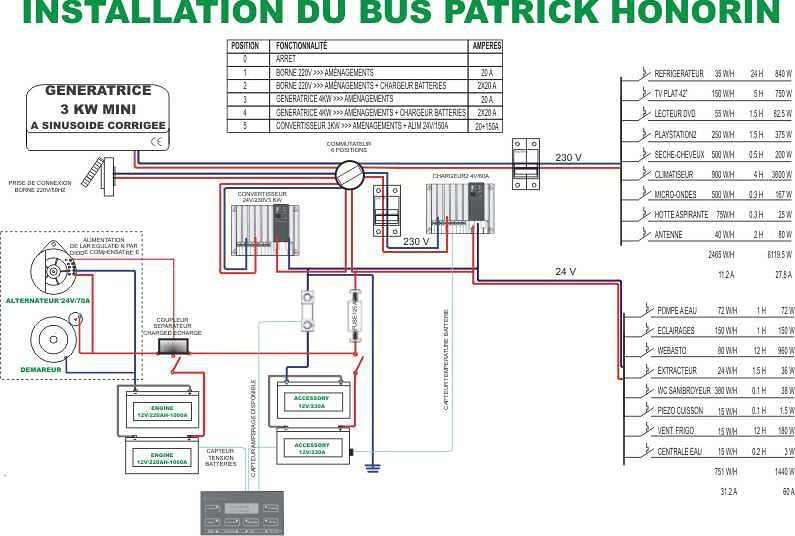
Around page 30 (if I remember correctly) I attached a schematic of a bus electrical installation.
With this schematic, there's a table of daily power consumption for each piece of equipment. You might be able to get some inspiration from it....
Here's the link to the post where you can find the schematic: http://voyageforum.com/v.f?post=635472;search_string=;#635472
PATRICK26
With this schematic, there's a table of daily power consumption for each piece of equipment. You might be able to get some inspiration from it....
Here's the link to the post where you can find the schematic: http://voyageforum.com/v.f?post=635472;search_string=;#635472
PATRICK26
Pros and cons really depend on each person.
What I mean is that maybe something that's an advantage from one person's perspective could be a disadvantage for another. We all have our own viewpoint.
For my own use – that is, purely for vacations – the advantages are: The freedom to come and go as you please. Not having to necessarily plan where you're going, and being able to change your mind from moment to moment while traveling. (I know that's related to what I just said)
The disadvantages are: Finding a level enough spot in the evening for the night. Finding where to refill water, but especially finding a proper place to dump greywater. Dealing with the hostile looks from locals due to bad behavior by other motorhome users.
For residential use: as an advantage I see no property tax and the legal status of a residence. as disadvantages, limited space year-round, having to refill water and empty tanks all year long.
For my own use – that is, purely for vacations – the advantages are: The freedom to come and go as you please. Not having to necessarily plan where you're going, and being able to change your mind from moment to moment while traveling. (I know that's related to what I just said)
The disadvantages are: Finding a level enough spot in the evening for the night. Finding where to refill water, but especially finding a proper place to dump greywater. Dealing with the hostile looks from locals due to bad behavior by other motorhome users.
For residential use: as an advantage I see no property tax and the legal status of a residence. as disadvantages, limited space year-round, having to refill water and empty tanks all year long.
Eh ben, Ya du boulot!!
http://www.aavl.fr
http://gasmobil.skyrock.fr
Yes, you're right, the voltages add up, but battery capacity is in amp-hours, that is amps multiplied by hours (a 75 A.h battery will draw one amp for 75 hours or 75 amps for one hour)
Where I agree with you is that in series the current stays the same, so 1 amp stays 1 amp.
But if you put 2 batteries of 75 A.h in series, you'll have a total capacity of 150 A.h, and you're going to consume the same AMOUNT of electricity, even if the currents are different. Otherwise at that point we could think about running at 220V in the camper, because indeed if you're drawing 5 amps at 24 volts, you'll draw 0.5 at 220, but you're still going to drain all the batteries anyway.
That's basically what you're saying too, since you buy 2 batteries of 12V/200 A.h then you have 2 times more runtime. That makes sense because you're buying 2 batteries so you have 2 times your capacity, whether it's at 12 or 24 volts (whether in parallel or series)
So there you have it and all that, but for the gas (really dangerous) there I'm still trusting your word.
As for battery wear and charging, it's true you'll discharge them less quickly (and if you have 2 in parallel at 12V that wear evenly it'll be the same anyway) but I'm skeptical about that too, because at Narbonne Accessoire, they were offering me a battery and the manufacturer's notice states:
1000 charge/discharge cycles at 30% discharge versus only 300 cycles at 80% discharge.
But you're still using 50% more of your battery so you come out even (in other words you're drawing more from it, but you'll charge it less often) so in my opinion that's the same there too.
On the other hand for your problem with damaging your engine batteries you need to couple your auxiliary batteries to the alternator with a battery isolator, but after that I'm not exactly sure how, but the whole point is you shouldn't drain one battery that's going to want to rebalance with your auxiliary battery
Where I agree with you is that in series the current stays the same, so 1 amp stays 1 amp.
But if you put 2 batteries of 75 A.h in series, you'll have a total capacity of 150 A.h, and you're going to consume the same AMOUNT of electricity, even if the currents are different. Otherwise at that point we could think about running at 220V in the camper, because indeed if you're drawing 5 amps at 24 volts, you'll draw 0.5 at 220, but you're still going to drain all the batteries anyway.
That's basically what you're saying too, since you buy 2 batteries of 12V/200 A.h then you have 2 times more runtime. That makes sense because you're buying 2 batteries so you have 2 times your capacity, whether it's at 12 or 24 volts (whether in parallel or series)
So there you have it and all that, but for the gas (really dangerous) there I'm still trusting your word.
As for battery wear and charging, it's true you'll discharge them less quickly (and if you have 2 in parallel at 12V that wear evenly it'll be the same anyway) but I'm skeptical about that too, because at Narbonne Accessoire, they were offering me a battery and the manufacturer's notice states:
1000 charge/discharge cycles at 30% discharge versus only 300 cycles at 80% discharge.
But you're still using 50% more of your battery so you come out even (in other words you're drawing more from it, but you'll charge it less often) so in my opinion that's the same there too.
On the other hand for your problem with damaging your engine batteries you need to couple your auxiliary batteries to the alternator with a battery isolator, but after that I'm not exactly sure how, but the whole point is you shouldn't drain one battery that's going to want to rebalance with your auxiliary battery
HEY, HEY....
so about the batteries.....(I hadn't really weighed in on this yet!)
françois57: when you say: a 75 A.h battery will consume one amp for 75 hours or 75 amps for one hour
that's wrong! but no worries!😛
a 75ah will indeed give you 75 amps for one hour (theoretical value), but well over 1 amp for 75 hours!
indeed, the chemical transfer inside your battery, if done very slowly, will cause very little electron loss in the electrolyte (to simplify!), and at 1 amp per hour, your 75 amp-hour battery should give you 1 amp for over 100 hours!
on the other hand, nothing stops you from drawing 100 amps from your battery. but only occasionally and for short periods. to be honest, it'll actually be good for it! yes, it'll help unstick the sulfate! but don't overdo it....
for cycles, you need to do the math...
if you have 500 amps of cell batteries: 1000 cycles at 30/100 give 150,000 amps available 300 cycles at 80/100 give 120,000 amps available 700 cycles at 50/100 give 175,000 amps available!
me, I've chosen to recharge my batteries before they're completely empty (at 50/100!), that way I have the maximum amps available and...always a little juice in reserve!
and then 700 cycles at 50/100 of my 560 amps of batteries (2 of 280 amps, according to my consumption calculation, if I live in it full time, I change my batteries every 4622.6 days, that's over 12 years....
280 A of batteries X 2 = 560 amps that I use at 50/100. So I have 280 amps available per cycle. 700 cycles at 280 amps gives me 196,000 amps. My calculated daily consumption is 42.4 amps. 196,000 amps available divided by 42.4 gives me 4622.6 days
so put in at least 400 amps of GOOD batteries and ... stop asking yourself questions!
to properly charge a pack of 2 batteries of about 250 amps (2 batteries in series at 12v), you need a 3-stage charger that pushes at least 50 amps. at 30 amps you'll be just fine and at 20 you'll be tickling them!
with a 50 amp charger you'll recharge your pack from empty to 50/100 in about 7 hours. your charger will consume about 8 amps on 220v during this period. don't hesitate to use a 70 amp charger! a 500 amp pack will handle it just fine.
so, in order: a generator that gives you 10 amps at 220v (no need to rectify it, in principle, the charger will handle it just fine). apart from the charger, nothing else plugged into the generator! otherwise you'd need to protect the 220v equipment with circuit breakers, and you'd need to install a system to "correct the current" for the fridge, TV, etc.... the charger connected to the cell batteries the cell batteries the 24v-220v converters for the RV setup the 24v equipment is connected directly to the cell batteries don't forget fuses between the converters and equipment for 220v and fuses between the battery and equipment for 24v
from the engine alternator, install a pilot-wire separator coupler on the specific regulation for one set of starter batteries and one set of cell batteries (important to raise the voltage slightly. slow-discharge batteries need to be charged with a current slightly stronger than regular batteries)
inside the RV, you install: a cell battery level gauge with alarm a generator start button, or better, a relay connected to the alarm that will start the generator automatically (I'll skip the details!)
all that's left is to install a big disconnect switch to cut all the power....
there you go.... for those who didn't quite understand, you NEVER live on the generator! always on the batteries!
the generator only recharges the batteries. the converters act as isolation transformers (for those with little electrical knowledge, converters "isolate" you from the element producing the current; the battery, for its part, produces nothing—it just stores).
for 24v, be careful with cable and wire gauges—check the standards.
for 220v, you must use only certain types of wires and cables (flexible, braided)—for the gauges, it's like at home!
220v outlets must have a ground pin that should be connected to the generator's differential (which serves no real purpose given the converters, but it's the standard!) and to the plug you use to connect to the campground pedestal.
watch out, for those who want to use campground pedestals! they're often rated for 10 amps! so you need to "adjust" your setup. look at my diagram—if the hair dryer doesn't run at the same time as the A/C, I stay under 10 amps!
the rest continues to be powered by the batteries. when I'm away, I run the charger on just the circuit it needs, since only the fridge is running!
and there, no need to run the generator! in one night of camping a week, I've got all my electrical autonomy sorted, without solar panels (I'd need a full roof of them to get a 50 amp charging current), plus I do my tank dumps, fill my 900 liters of water, and we're off on the adventure....
hey.... do I really even need a generator? (humor)
I'm attaching my installation diagram as an image
happy thinking, everyone!
PATRICK26
so about the batteries.....(I hadn't really weighed in on this yet!)
françois57: when you say: a 75 A.h battery will consume one amp for 75 hours or 75 amps for one hour
that's wrong! but no worries!😛
a 75ah will indeed give you 75 amps for one hour (theoretical value), but well over 1 amp for 75 hours!
indeed, the chemical transfer inside your battery, if done very slowly, will cause very little electron loss in the electrolyte (to simplify!), and at 1 amp per hour, your 75 amp-hour battery should give you 1 amp for over 100 hours!
on the other hand, nothing stops you from drawing 100 amps from your battery. but only occasionally and for short periods. to be honest, it'll actually be good for it! yes, it'll help unstick the sulfate! but don't overdo it....
for cycles, you need to do the math...
if you have 500 amps of cell batteries: 1000 cycles at 30/100 give 150,000 amps available 300 cycles at 80/100 give 120,000 amps available 700 cycles at 50/100 give 175,000 amps available!
me, I've chosen to recharge my batteries before they're completely empty (at 50/100!), that way I have the maximum amps available and...always a little juice in reserve!
and then 700 cycles at 50/100 of my 560 amps of batteries (2 of 280 amps, according to my consumption calculation, if I live in it full time, I change my batteries every 4622.6 days, that's over 12 years....
280 A of batteries X 2 = 560 amps that I use at 50/100. So I have 280 amps available per cycle. 700 cycles at 280 amps gives me 196,000 amps. My calculated daily consumption is 42.4 amps. 196,000 amps available divided by 42.4 gives me 4622.6 days
so put in at least 400 amps of GOOD batteries and ... stop asking yourself questions!
to properly charge a pack of 2 batteries of about 250 amps (2 batteries in series at 12v), you need a 3-stage charger that pushes at least 50 amps. at 30 amps you'll be just fine and at 20 you'll be tickling them!
with a 50 amp charger you'll recharge your pack from empty to 50/100 in about 7 hours. your charger will consume about 8 amps on 220v during this period. don't hesitate to use a 70 amp charger! a 500 amp pack will handle it just fine.
so, in order: a generator that gives you 10 amps at 220v (no need to rectify it, in principle, the charger will handle it just fine). apart from the charger, nothing else plugged into the generator! otherwise you'd need to protect the 220v equipment with circuit breakers, and you'd need to install a system to "correct the current" for the fridge, TV, etc.... the charger connected to the cell batteries the cell batteries the 24v-220v converters for the RV setup the 24v equipment is connected directly to the cell batteries don't forget fuses between the converters and equipment for 220v and fuses between the battery and equipment for 24v
from the engine alternator, install a pilot-wire separator coupler on the specific regulation for one set of starter batteries and one set of cell batteries (important to raise the voltage slightly. slow-discharge batteries need to be charged with a current slightly stronger than regular batteries)
inside the RV, you install: a cell battery level gauge with alarm a generator start button, or better, a relay connected to the alarm that will start the generator automatically (I'll skip the details!)
all that's left is to install a big disconnect switch to cut all the power....
there you go.... for those who didn't quite understand, you NEVER live on the generator! always on the batteries!
the generator only recharges the batteries. the converters act as isolation transformers (for those with little electrical knowledge, converters "isolate" you from the element producing the current; the battery, for its part, produces nothing—it just stores).
for 24v, be careful with cable and wire gauges—check the standards.
for 220v, you must use only certain types of wires and cables (flexible, braided)—for the gauges, it's like at home!
220v outlets must have a ground pin that should be connected to the generator's differential (which serves no real purpose given the converters, but it's the standard!) and to the plug you use to connect to the campground pedestal.
watch out, for those who want to use campground pedestals! they're often rated for 10 amps! so you need to "adjust" your setup. look at my diagram—if the hair dryer doesn't run at the same time as the A/C, I stay under 10 amps!
the rest continues to be powered by the batteries. when I'm away, I run the charger on just the circuit it needs, since only the fridge is running!
and there, no need to run the generator! in one night of camping a week, I've got all my electrical autonomy sorted, without solar panels (I'd need a full roof of them to get a 50 amp charging current), plus I do my tank dumps, fill my 900 liters of water, and we're off on the adventure....
hey.... do I really even need a generator? (humor)
I'm attaching my installation diagram as an image
happy thinking, everyone!
PATRICK26
Our "friends" the Americans.......
The winners of the 2005 STELLA Awards have just been announced. This year's harvest is particularly outrageous. We remind you that the Stella Awards take their name from Stella Liebeck, that 81-year-old woman who spilled coffee on herself and subsequently sued McDonald's, which she won. This landmark case inspired the creation of the Stella Awards, which reward the most grotesque and ridiculous winning lawsuits in America. First place And the grand winner of the year is Mr. Merv Grazinski from Oklahoma City. Mr Grazinski had bought himself a brand new Winnebago motorhome. Coming home after a football game, he took the highway, put the vehicle in automatic transmission at 100 km/h using cruise control, and quietly left the steering wheel to go make himself a coffee in the rear cabin. Unsurprisingly, the vehicle deviated from its course, left the road and flipped over. Mr Grazinski sued Winnebago on the grounds that nothing in the owner's manual indicated it was dangerous to leave the wheel after engaging the automatic speed control! The jury awarded him $1,750,000 (one million seven hundred fifty thousand dollars!!!) and a brand new Winnebago. The company has since modified the manuals for its vehicles, just in case another of their customers was a complete idiot of the same kind! Long live America!!!!
As for us, we don't risk this kind of problem. Our motorhomes, we make them ourselves!
PATRICK26
The winners of the 2005 STELLA Awards have just been announced. This year's harvest is particularly outrageous. We remind you that the Stella Awards take their name from Stella Liebeck, that 81-year-old woman who spilled coffee on herself and subsequently sued McDonald's, which she won. This landmark case inspired the creation of the Stella Awards, which reward the most grotesque and ridiculous winning lawsuits in America. First place And the grand winner of the year is Mr. Merv Grazinski from Oklahoma City. Mr Grazinski had bought himself a brand new Winnebago motorhome. Coming home after a football game, he took the highway, put the vehicle in automatic transmission at 100 km/h using cruise control, and quietly left the steering wheel to go make himself a coffee in the rear cabin. Unsurprisingly, the vehicle deviated from its course, left the road and flipped over. Mr Grazinski sued Winnebago on the grounds that nothing in the owner's manual indicated it was dangerous to leave the wheel after engaging the automatic speed control! The jury awarded him $1,750,000 (one million seven hundred fifty thousand dollars!!!) and a brand new Winnebago. The company has since modified the manuals for its vehicles, just in case another of their customers was a complete idiot of the same kind! Long live America!!!!
As for us, we don't risk this kind of problem. Our motorhomes, we make them ourselves!
PATRICK26
Patrick, hi, following your last message I don't see what a braided flexible cable is – do you happen to know its reference number? As for the camping hook-up, I imagine that's the electrical connection available at campsites, and I didn't understand the procedure about the fridge when you're away with the switch.
See you soon,
jlc
mon blog
http:/kersode.skyblog.com
I notice that GX47's posts and mine haven't really cleared things up. Let's look at things one by one and in order.
The power of a device is expressed in Watts(W). The supply voltage is expressed in Volts(V). The current consumed is expressed in Amperes(A).
There's a really handy formula to work out the current consumed by a device if you know its power and supply voltage. This magic formula works for direct current and also for alternating current, but in the latter case only for purely resistive loads (so cosine=1).
Here's the formula: P(in W) = U(in V) x I(in amps) for example 120(W) = 12(V) x 10(A). Which gives an equivalent equation that also says 120(W)/12(V)=10(A). So you can see that if you divide the power by the voltage, you get the current. Keep the same power and double the voltage: 120(W)/24(V)=5(A) By multiplying the voltage by 2, you divide the current consumed by 2.
And that's what makes this so important. As Patrick26 and I have already explained in the previous posts on this topic, the easier you go on a battery, the more power it gives you, and the less you discharge it—which also saves you recharge cycles. Let me explain again: A battery's capacity varies depending on the discharge current. An essential concept! Battery capacity is rated based on the discharge current. For example, a BSG68 is a battery whose 68 Ah capacity is rated by fully discharging it (which is highly not recommended for battery life!) at a current equal to 1/100 of the capacity (0.68A). This means, and it's clearly explained in the document alongside, that this same battery discharged at a current equal to 1/20 of its capacity (2.75A) will only present a capacity of 55Ah, and at C/10 (Capacity over 10) 50Ah, meaning a current of 5 A for ten hours. Obviously, with a current of more than 5A, the capacity (in Ah) will be even further reduced! Similarly, you could imagine a discharge at C/500 current (0.16A), which would give us a capacity of around 80 or 85 Ah at C/500. That's a very practical concept, but also a "very flexible" one that's worth keeping an eye on.
As for battery configurations, whether in parallel or in series, either way you're doubling your runtime, so why switch to 24V? Less line losses. Smaller cables and fuses. Compatibility with the vehicle's original voltage. Better battery charging (I'll explain why below for the brave ones).
With series and parallel configurations, you're doubling your runtime but not the capacity—be careful not to mix things up. With a series configuration, you double the voltage but not the amp-hours of the battery. There are indeed 2 times more Ah available, but two 100 AH batteries each in series only make a 100 Ah battery, just at 24V. The doubling of runtime comes from the fact that by doubling the voltage, you halve the current consumed. With a parallel configuration, you double the capacity but not the voltage. To double both voltage and capacity, you need 4 batteries—2 in series in parallel with two others in series. Another problem with 12V. Batteries, even with equal capacity, have slightly different internal resistances unique to each one, which creates a difference during charging because each battery acts as a load and charges at its own pace, necessarily different from its neighbor's. When charging stops, the batteries are therefore charged differently, and if you disconnected them and tested them after an hour of rest, you'd have different voltages. The problem with these poor batteries is that they're all in parallel, so FORCED to be at the same voltage. Since they're charged differently, the more-charged one(s) will tend to recharge the less-charged one(s). So gradually it's always the same ones that get stressed the most and age faster. In short, it throws off your whole battery bank, and when one battery fails, the rest suffer because they're more stressed. In series, on the other hand, there's no such problem. In fact, the series configuration forces the same current through both batteries, and since the charging voltage from the charger is also the same for both, the charging is equal. I'm not saying this off the top of my head—I spent 4 years maintaining helicopter batteries at the aeronautical workshops of the St. Mandrier Naval Aviation Service. Coincidentally, that was also 24V—haha!!!
I don't know what else to say or explain to convince you. If you're in doubt, give me a call at 06 64 42 31 59.
The power of a device is expressed in Watts(W). The supply voltage is expressed in Volts(V). The current consumed is expressed in Amperes(A).
There's a really handy formula to work out the current consumed by a device if you know its power and supply voltage. This magic formula works for direct current and also for alternating current, but in the latter case only for purely resistive loads (so cosine=1).
Here's the formula: P(in W) = U(in V) x I(in amps) for example 120(W) = 12(V) x 10(A). Which gives an equivalent equation that also says 120(W)/12(V)=10(A). So you can see that if you divide the power by the voltage, you get the current. Keep the same power and double the voltage: 120(W)/24(V)=5(A) By multiplying the voltage by 2, you divide the current consumed by 2.
And that's what makes this so important. As Patrick26 and I have already explained in the previous posts on this topic, the easier you go on a battery, the more power it gives you, and the less you discharge it—which also saves you recharge cycles. Let me explain again: A battery's capacity varies depending on the discharge current. An essential concept! Battery capacity is rated based on the discharge current. For example, a BSG68 is a battery whose 68 Ah capacity is rated by fully discharging it (which is highly not recommended for battery life!) at a current equal to 1/100 of the capacity (0.68A). This means, and it's clearly explained in the document alongside, that this same battery discharged at a current equal to 1/20 of its capacity (2.75A) will only present a capacity of 55Ah, and at C/10 (Capacity over 10) 50Ah, meaning a current of 5 A for ten hours. Obviously, with a current of more than 5A, the capacity (in Ah) will be even further reduced! Similarly, you could imagine a discharge at C/500 current (0.16A), which would give us a capacity of around 80 or 85 Ah at C/500. That's a very practical concept, but also a "very flexible" one that's worth keeping an eye on.
As for battery configurations, whether in parallel or in series, either way you're doubling your runtime, so why switch to 24V? Less line losses. Smaller cables and fuses. Compatibility with the vehicle's original voltage. Better battery charging (I'll explain why below for the brave ones).
With series and parallel configurations, you're doubling your runtime but not the capacity—be careful not to mix things up. With a series configuration, you double the voltage but not the amp-hours of the battery. There are indeed 2 times more Ah available, but two 100 AH batteries each in series only make a 100 Ah battery, just at 24V. The doubling of runtime comes from the fact that by doubling the voltage, you halve the current consumed. With a parallel configuration, you double the capacity but not the voltage. To double both voltage and capacity, you need 4 batteries—2 in series in parallel with two others in series. Another problem with 12V. Batteries, even with equal capacity, have slightly different internal resistances unique to each one, which creates a difference during charging because each battery acts as a load and charges at its own pace, necessarily different from its neighbor's. When charging stops, the batteries are therefore charged differently, and if you disconnected them and tested them after an hour of rest, you'd have different voltages. The problem with these poor batteries is that they're all in parallel, so FORCED to be at the same voltage. Since they're charged differently, the more-charged one(s) will tend to recharge the less-charged one(s). So gradually it's always the same ones that get stressed the most and age faster. In short, it throws off your whole battery bank, and when one battery fails, the rest suffer because they're more stressed. In series, on the other hand, there's no such problem. In fact, the series configuration forces the same current through both batteries, and since the charging voltage from the charger is also the same for both, the charging is equal. I'm not saying this off the top of my head—I spent 4 years maintaining helicopter batteries at the aeronautical workshops of the St. Mandrier Naval Aviation Service. Coincidentally, that was also 24V—haha!!!
I don't know what else to say or explain to convince you. If you're in doubt, give me a call at 06 64 42 31 59.
Eh ben, Ya du boulot!!
http://www.aavl.fr
http://gasmobil.skyrock.fr
HA the magic of electricity...
😄 IT'S UNSOLVABLE 😄 because it's psychological! by principle it bothers people so we don't understand anything 😏 the more you explain the less we understand 😏 we could make a whole post about it 😐
before I was an electrician, now I'm a magician, it's only the name that changes, the result's the same, people don't understand a thing. 😄😄😄
🙂 yet electricity is so simple... or is it magic? 😮
GX47
😄 IT'S UNSOLVABLE 😄 because it's psychological! by principle it bothers people so we don't understand anything 😏 the more you explain the less we understand 😏 we could make a whole post about it 😐
before I was an electrician, now I'm a magician, it's only the name that changes, the result's the same, people don't understand a thing. 😄😄😄
🙂 yet electricity is so simple... or is it magic? 😮
GX47
GX47
ex transformation, homologation et utilisation d'un car en CC 9places route en utilisation pro. Plus un CC 6pl VL, plus un fourgon en cabine approfondie 6 pl VL. si je peu aider...
ex transformation, homologation et utilisation d'un car en CC 9places route en utilisation pro. Plus un CC 6pl VL, plus un fourgon en cabine approfondie 6 pl VL. si je peu aider...
Hey everyone!!!
Haven't been on the forum in ages... I just wanted to post an announcement about the sale of my bus, a Setra Kassboher 213 H from '79 (the one in the photo beside), currently being converted, completely eco-friendly insulated, (cork for the roof and coconut fiber for the sides...). No electrical installations have been done, nor any gas. The exterior hasn't been finished either. A partition between the driver's section and the living space has been made (in wood). Due to moving abroad, I'm forced to stop the work and put it up for sale, so if anyone's interested, please contact me by email at nkhao.ems@voila.fr I can send you photos!!! Thanks, see you soon
Haven't been on the forum in ages... I just wanted to post an announcement about the sale of my bus, a Setra Kassboher 213 H from '79 (the one in the photo beside), currently being converted, completely eco-friendly insulated, (cork for the roof and coconut fiber for the sides...). No electrical installations have been done, nor any gas. The exterior hasn't been finished either. A partition between the driver's section and the living space has been made (in wood). Due to moving abroad, I'm forced to stop the work and put it up for sale, so if anyone's interested, please contact me by email at nkhao.ems@voila.fr I can send you photos!!! Thanks, see you soon
TRAVEL and TEKITIZY
Indeed, it goes against everything I learned in civil and aeronautical training.
We come off as charlatans rather than qualified professionals.
No problem, I say what I think, but if nobody wants to listen...
When they hit the wall, maybe then they'll listen, thinking that us old-timers weren't so wrong😕.
Eh ben, Ya du boulot!!
http://www.aavl.fr
http://gasmobil.skyrock.fr
If anyone's interested, they can reach me at the email I left and ask whatever questions they have... I don't think this forum is really meant for classified ads, so I'm just posting info here and then we'll handle everything outside the forum. If you're interested, nkhao.ems@voila.fr
TRAVEL and TEKITIZY
HA the magic of electricity...
😄 IT'S UNSOLVABLE 😄 .....................so we understand nothing 😏 the more you explain the less we'll understand 😏 ..................................GX47
You're right, because looking at GASMOBILE we can find:
For series and parallel configurations we double the range but not the capacity, be careful not to confuse everything. With series configuration you double the voltage but not the amp-hours of the battery. There are indeed 2x more Ah available but two 100 Ah batteries each in series make only a 100 Ah battery but at 24V. The doubling of range comes from the fact that by doubling the voltage you divide the current consumed by 2. With parallel configuration, you double the capacity but not the voltage. To double both voltage and capacity, you need 4 batteries, 2 in series in parallel with two others in series.
😮😮😮 😏
Well, overall you're all right 😉
This was just joking around, plus I run 12 volts (2 battery cells on a battery isolator) on my motorhome; but 24 volts on my boat (an old cruiser over 30 years old) with 2x12 volts in series for engine starting, and 4x12 volts: (2x12 volts in series) in parallel with (2x12 volts in series) for service range. (all of this with battery isolators) What I wanted to highlight as important for beginners: When I bought this boat 8 years ago, the previous owner was drawing the 12 volts needed for onboard instruments and devices at that voltage directly from the terminals of one of the service batteries 😮 That's what you should never do, but use a 24V/12V converter instead. Indeed, with this workaround, as GX47 and GASMOBILE explained, you end up with unbalanced series batteries and therefore aging prematurely, but especially: When a battery charges and reaches the same voltage as provided by the charger, it opposes the flow of current: so, in the case of 2 batteries in series, as soon as the least discharged battery is fully charged by the charger, charging stops, and the 2nd battery in series (discharged more by the use of 12 volts at its terminals) can no longer charge fully!!! And the phenomenon accelerates faster and faster with each charge-discharge cycle and quickly leads to the poorly used battery becoming dead and no longer charging. So then you replace this battery with a new one, but then it's no longer balanced with the one that was in series and escaped the previous destruction, and then the entire battery bank gets destroyed again 😠
So: always put new batteries in series with equivalent capacities, and especially use a 24V/12V step-down converter to get your 12 volts.
😄 IT'S UNSOLVABLE 😄 .....................so we understand nothing 😏 the more you explain the less we'll understand 😏 ..................................GX47
You're right, because looking at GASMOBILE we can find:
For series and parallel configurations we double the range but not the capacity, be careful not to confuse everything. With series configuration you double the voltage but not the amp-hours of the battery. There are indeed 2x more Ah available but two 100 Ah batteries each in series make only a 100 Ah battery but at 24V. The doubling of range comes from the fact that by doubling the voltage you divide the current consumed by 2. With parallel configuration, you double the capacity but not the voltage. To double both voltage and capacity, you need 4 batteries, 2 in series in parallel with two others in series.
😮😮😮 😏
Well, overall you're all right 😉
This was just joking around, plus I run 12 volts (2 battery cells on a battery isolator) on my motorhome; but 24 volts on my boat (an old cruiser over 30 years old) with 2x12 volts in series for engine starting, and 4x12 volts: (2x12 volts in series) in parallel with (2x12 volts in series) for service range. (all of this with battery isolators) What I wanted to highlight as important for beginners: When I bought this boat 8 years ago, the previous owner was drawing the 12 volts needed for onboard instruments and devices at that voltage directly from the terminals of one of the service batteries 😮 That's what you should never do, but use a 24V/12V converter instead. Indeed, with this workaround, as GX47 and GASMOBILE explained, you end up with unbalanced series batteries and therefore aging prematurely, but especially: When a battery charges and reaches the same voltage as provided by the charger, it opposes the flow of current: so, in the case of 2 batteries in series, as soon as the least discharged battery is fully charged by the charger, charging stops, and the 2nd battery in series (discharged more by the use of 12 volts at its terminals) can no longer charge fully!!! And the phenomenon accelerates faster and faster with each charge-discharge cycle and quickly leads to the poorly used battery becoming dead and no longer charging. So then you replace this battery with a new one, but then it's no longer balanced with the one that was in series and escaped the previous destruction, and then the entire battery bank gets destroyed again 😠
So: always put new batteries in series with equivalent capacities, and especially use a 24V/12V step-down converter to get your 12 volts.
CHRISTIAN
"Ne pas rire, ce n'est pas sérieux"
"Ne pas rire, ce n'est pas sérieux"
bon, alors pour ce mot à 5 i :
tout comme l'électricité, il faut parler d'ampere.heure et non de ampere/heure. c'est comme les watt.heure consommés a la maison.
sur les chantiers on utilise le terme homme.jour un gros chantier de batiment est un chantier de 10 000 hommes.jour : en gros 50 personnes pendant 200 jours ouvrés, c'est à dire 10 mois (en réalité un an a cause des intempéries et des retards 😉)
bon donc je ne veux plus voir Ampère/heure car en réalité un ampère est une unité représentant un Ampère.heure par heure. (A.h/h ==> A) c'est ce que vous avez déja fait (souvenez vous vous n'etes pas si croulants que ca 😛!) et que l'on appelait l'analyse dimensionnelle, très utile en physique pour démontrer que des m/s² sont équivalents à des Newtons (g= 9.81 N ou 9.81 m/s²) alors la aussi truc de ouf, enfin j pète du hors sujet à gogo mais j'aime ça lol alors je m'arrête avant de souler tout le monde. on devrait peut-être ouvrir un post électricité non? et demander au modo qu'il décharge tout dedans
tout comme l'électricité, il faut parler d'ampere.heure et non de ampere/heure. c'est comme les watt.heure consommés a la maison.
sur les chantiers on utilise le terme homme.jour un gros chantier de batiment est un chantier de 10 000 hommes.jour : en gros 50 personnes pendant 200 jours ouvrés, c'est à dire 10 mois (en réalité un an a cause des intempéries et des retards 😉)
bon donc je ne veux plus voir Ampère/heure car en réalité un ampère est une unité représentant un Ampère.heure par heure. (A.h/h ==> A) c'est ce que vous avez déja fait (souvenez vous vous n'etes pas si croulants que ca 😛!) et que l'on appelait l'analyse dimensionnelle, très utile en physique pour démontrer que des m/s² sont équivalents à des Newtons (g= 9.81 N ou 9.81 m/s²) alors la aussi truc de ouf, enfin j pète du hors sujet à gogo mais j'aime ça lol alors je m'arrête avant de souler tout le monde. on devrait peut-être ouvrir un post électricité non? et demander au modo qu'il décharge tout dedans
François 🙂
Tout est une question de bonnes unités:
par exemple, moi je ne parle pas en kilo watt heure mais en litres de cassette WC 😉
par exemple, moi je ne parle pas en kilo watt heure mais en litres de cassette WC 😉
CHRISTIAN
"Ne pas rire, ce n'est pas sérieux"
"Ne pas rire, ce n'est pas sérieux"
ha ba oui que c'est un bon exemple.
la batterie est à l'électricité domestique ce que le WC chimique à cassette est au réseau d'assainissement communal lool ! ! !
va donc transformer un débit d'eaux usées en ampères...(sauf si t'as une turbine au fond du WC ce qui a pour moi 2 avantages : ça broie la matiere et ça produit de l'électricité). !
la batterie est à l'électricité domestique ce que le WC chimique à cassette est au réseau d'assainissement communal lool ! ! !
va donc transformer un débit d'eaux usées en ampères...(sauf si t'as une turbine au fond du WC ce qui a pour moi 2 avantages : ça broie la matiere et ça produit de l'électricité). !
Tu as raison: un réseau d'électricité ou un réseau d'assainissement, c'est toujours un problème de courant !
CHRISTIAN
"Ne pas rire, ce n'est pas sérieux"
"Ne pas rire, ce n'est pas sérieux"
🙂 c'est pas con çà, la turbine sur la sortie WC, t'as déposé l'idée où on peux essayer.
pour une 12V 105 AH tu calibres à combien ? ... la dynamo, et le régul au cul de la turbine bien sûr.
😊 heu bon d'accord je sors... j'ai rien dis... vous avez rien lu.
😊 heu bon d'accord je sors... j'ai rien dis... vous avez rien lu.
GX47
ex transformation, homologation et utilisation d'un car en CC 9places route en utilisation pro. Plus un CC 6pl VL, plus un fourgon en cabine approfondie 6 pl VL. si je peu aider...
ex transformation, homologation et utilisation d'un car en CC 9places route en utilisation pro. Plus un CC 6pl VL, plus un fourgon en cabine approfondie 6 pl VL. si je peu aider...
😉Que penssait vous des chiottes sec?
g découvert ça lors d'un festival
c un melange de copo de bois
les aventages: ne polu pas, bio degradable, pas d'odeurs, vous pouvez tous metre dedans(megos, tampons, serviette etc...)tres prope
il suffit de mettre l'equivalent d'un verre en plastic de 20CL pour la petite comisition et doublé pour la grosse.
Pour moi c tous vu.
Log in first, then come back to this page.
You might also like
 Storm in the Canary Islands
 New adventures from Perpignan to Ranchi (Jharkhand)
 Amazing Kyrgyzstan!
 Argentine and Chilean Patagonia from El Calafate to Ushuaia
 Turkey 2026: Riviera, Antalya, and Cappadocia
 Page by Page on the Assisi Way – 1,200 km on Foot
 How to nail your trek in wet climates: which pants keep you truly dry?
 Densha Otaku - Lesser-Known Regions
More discussions

Hi everyone.
We’re planning a two-month trip to Morocco and Mauritania this fall (2026). We’d like to use this trip to get some bodywork and paint done on our VW T4 camper bus.
Does anyone have recommendations for trustworthy auto body shops (either personally tested or firsthand recommendations)?
Thanks in advance.
Hi,
How do you manage to charge your battery using a solar panel while keeping your vehicle in the shade so it doesn’t turn into an oven?
I have a Renault Trafic, unfortunately black, and my cooler, battery, and BougeRV solar panel.
My battery is mainly used for my electric cooler.
https://www.amazon.fr/dp/B0CQ4LFVVR?ref_=ppx_hzsearch_conn_dt_b_fed_asin_title_3
Thanks in advance! Nath
How do you manage to charge your battery using a solar panel while keeping your vehicle in the shade so it doesn’t turn into an oven?
I have a Renault Trafic, unfortunately black, and my cooler, battery, and BougeRV solar panel.
My battery is mainly used for my electric cooler.
https://www.amazon.fr/dp/B0CQ4LFVVR?ref_=ppx_hzsearch_conn_dt_b_fed_asin_title_3
Thanks in advance! Nath
Hi everyone, I don’t think there’s already a thread on this topic,
we’re planning—two or three years from now (I know, it’s a ways off...)—a cross-Canada trip from east to west, meaning Montréal ====> Vancouver, and leaving the RV in Vancouver. First, we’ll spend a few days visiting Québec City, then pick up the RV in Montréal. The trip will likely be around 5 weeks, late August to early September. If you’ve got any route ideas, we’d love to hear them! Banff is probably a must-see stop for us. Thanks in advance!
Didier and Nicole

Hello,
Today is January 7th, Orthodox Christmas Day.
It’s the perfect occasion to share on VF a religious site that left a lasting impression on us.
For a long time, we’d admired photos of the Makaryevo Women’s Monastery on Russian websites. They’re always taken from cruise hydrofoils that, in season, depart from Nizhny Novgorod.
This gave us the idea for a crazy challenge: to visit the monastery during a river cruise, with our little plumber’s van that’s become the common thread of our travels!
This challenge seemed impossible to pull off.
The equation was indeed impossible to solve
1. Find a dock 2. Load the van onto a boat 3. Cross the Volga 4. Arrive at sunset 5. Sail past the monastery 6. All with no reliable information. NONE!
Incredibly, every obstacle fell into place one after another! Gifting us unforgettable moments.
The photos follow our exact journey.
1. We arrive on the southern bank of the Volga, searching for a ferry to Makaryevo. First attempt, first failure—we’re way too far east. We find a second ferry, but it serves a different town on the northern bank.
2. We keep going and meet some fishermen. But even they don’t know where to board a vehicle for the monastery.

3. After several fruitless searches, a young man who speaks a few words of English points us to a dock where, in summer, boats *might* serve the monastery. Miraculously, at the end of a rough track, we find an old ferry moored. But no one’s on board, and a chain blocks the entrance. After an hour of waiting, a worker arrives and tells us they *will* cross the Volga tonight,
but the exit ramp at Makaryevo isn’t accessible for our vehicle.
The captain joins him, and seeing our disappointed faces, they confer, discuss,
and load some planks to raise the ramp!
After an hour of waiting, a worker arrives and tells us they *will* cross the Volga tonight,
but the exit ramp at Makaryevo isn’t accessible for our vehicle.
The captain joins him, and seeing our disappointed faces, they confer, discuss,
and load some planks to raise the ramp!
Another miracle!
4. We board, with just one passenger accompanying us— the Trafic is the only vehicle on board.

5. The crossing was magical. And longer than expected, since the Volga here is several kilometers wide, and we’re navigating between countless islands!
6. Under a sky that gradually clears, we discover there are homes on the river— invisible from the banks—that form small communities where people get around by boat!
7. Then, suddenly, around a bend in the channel, the monastery appears in the distance on the northern bank.

8. At the exact moment our boat rounds the buoy and nears the monastery, the sun breaks through the clouds!

9. A breathtaking sight, with our boat gliding along the monastery walls in absolute silence.
10. The sky, now a deep blue, makes the vibrant colors of the onion domes pop.

11. We sail slowly past the monastery under extraordinary light— something our little compact camera can’t fully capture.
12. As promised, the captain and his crew adjust the exit ramp. You can’t tell from the photo, but even with the planks, it was a close call— the van’s chassis barely cleared the ramp. We thanked them warmly.
13. By the end of the day, the monastery is, of course, closed. But another miracle happens! It turns out the passenger who crossed with us is the mayor’s wife. When Sylvie told her we were from France, she called her husband, who immediately contacted the Mother Superior. Like in a dream, the monastery opens just for us. A nun and a guard come to meet us and take us through the chapels and gardens!
14. A visit all the more intimate since only the silent nuns, deep in prayer, are present in these sacred spaces.

15. After dinner in our little van, we enjoy the exceptional light illuminating the now-closed monastery. We’re the only visitors, and the site feels like a massive ship anchored on the Volga.

16. The setting sun now bathes the monastery walls in gorgeous pink hues!
17. Gradually, the legendary Volga itself takes on magical colors! For the night, I’ll just back the van up to level it. It’ll take us a while to fall asleep after such intense moments.
18. Just as inexplicably, the magic continues the next morning! Seeing I’m struggling with my knee, the guard lets us drive slowly along the monastery’s perimeter path. So there we are at dawn, solitary wanderers between the Volga and the monastery walls.

19. The morning light now illuminates the monastery’s eastern façade, which we hadn’t admired yesterday. An exceptional moment.

20. Even more impressive when we realize we’re on the nuns’ prayer path. We cross paths with them—tall, silent, black-clad figures, fully covered.
We leave Makaryevo with regret, following the Volga toward Kostroma on the Golden Ring. That’s about all there is to add.
We’ve already taken three long trips through Russia in our little van. The travel journals are shared in the link in our signature.
Best regards, Sylvie & Bernard
Today is January 7th, Orthodox Christmas Day.
It’s the perfect occasion to share on VF a religious site that left a lasting impression on us.
For a long time, we’d admired photos of the Makaryevo Women’s Monastery on Russian websites. They’re always taken from cruise hydrofoils that, in season, depart from Nizhny Novgorod.
This gave us the idea for a crazy challenge: to visit the monastery during a river cruise, with our little plumber’s van that’s become the common thread of our travels!
This challenge seemed impossible to pull off.
The equation was indeed impossible to solve
1. Find a dock 2. Load the van onto a boat 3. Cross the Volga 4. Arrive at sunset 5. Sail past the monastery 6. All with no reliable information. NONE!
Incredibly, every obstacle fell into place one after another! Gifting us unforgettable moments.
The photos follow our exact journey.
1. We arrive on the southern bank of the Volga, searching for a ferry to Makaryevo. First attempt, first failure—we’re way too far east. We find a second ferry, but it serves a different town on the northern bank.
2. We keep going and meet some fishermen. But even they don’t know where to board a vehicle for the monastery.
3. After several fruitless searches, a young man who speaks a few words of English points us to a dock where, in summer, boats *might* serve the monastery. Miraculously, at the end of a rough track, we find an old ferry moored. But no one’s on board, and a chain blocks the entrance.
After an hour of waiting, a worker arrives and tells us they *will* cross the Volga tonight,
but the exit ramp at Makaryevo isn’t accessible for our vehicle.
The captain joins him, and seeing our disappointed faces, they confer, discuss,
and load some planks to raise the ramp!Another miracle!
4. We board, with just one passenger accompanying us— the Trafic is the only vehicle on board.
5. The crossing was magical. And longer than expected, since the Volga here is several kilometers wide, and we’re navigating between countless islands!
6. Under a sky that gradually clears, we discover there are homes on the river— invisible from the banks—that form small communities where people get around by boat!
7. Then, suddenly, around a bend in the channel, the monastery appears in the distance on the northern bank.
8. At the exact moment our boat rounds the buoy and nears the monastery, the sun breaks through the clouds!
9. A breathtaking sight, with our boat gliding along the monastery walls in absolute silence.
10. The sky, now a deep blue, makes the vibrant colors of the onion domes pop.
11. We sail slowly past the monastery under extraordinary light— something our little compact camera can’t fully capture.
12. As promised, the captain and his crew adjust the exit ramp. You can’t tell from the photo, but even with the planks, it was a close call— the van’s chassis barely cleared the ramp. We thanked them warmly.
13. By the end of the day, the monastery is, of course, closed. But another miracle happens! It turns out the passenger who crossed with us is the mayor’s wife. When Sylvie told her we were from France, she called her husband, who immediately contacted the Mother Superior. Like in a dream, the monastery opens just for us. A nun and a guard come to meet us and take us through the chapels and gardens!
14. A visit all the more intimate since only the silent nuns, deep in prayer, are present in these sacred spaces.
15. After dinner in our little van, we enjoy the exceptional light illuminating the now-closed monastery. We’re the only visitors, and the site feels like a massive ship anchored on the Volga.
16. The setting sun now bathes the monastery walls in gorgeous pink hues!
17. Gradually, the legendary Volga itself takes on magical colors! For the night, I’ll just back the van up to level it. It’ll take us a while to fall asleep after such intense moments.
18. Just as inexplicably, the magic continues the next morning! Seeing I’m struggling with my knee, the guard lets us drive slowly along the monastery’s perimeter path. So there we are at dawn, solitary wanderers between the Volga and the monastery walls.
19. The morning light now illuminates the monastery’s eastern façade, which we hadn’t admired yesterday. An exceptional moment.
20. Even more impressive when we realize we’re on the nuns’ prayer path. We cross paths with them—tall, silent, black-clad figures, fully covered.
We leave Makaryevo with regret, following the Volga toward Kostroma on the Golden Ring. That’s about all there is to add.
We’ve already taken three long trips through Russia in our little van. The travel journals are shared in the link in our signature.
Best regards, Sylvie & Bernard

"Hey fellow road-trippers! 🚐🔥
After 4 years on the road, I’ve noticed something simple: we’re all looking for the same things. Authentic welcomes, great local eateries, and stops that don’t feel like supermarket parking lots.
But it’s always bugged me to see small producers or local guesthouses getting their margins eaten up by big booking platforms.
That’s why I created TerraNomad.
The concept is straightforward:
The pro (farmer, restaurant, small campsite, guesthouse) pays no commission to be on our map. In return, they offer a special welcome or discount to members.
It’s direct, local, and human. We’re starting in France, then heading together toward Morocco, Spain, and Portugal. Quick question: Does this kind of "no-middleman" network speak to you? I’m opening the first 100 Founding Member spots this Friday night (special launch price at 12 € for the year—just 1 € per month). Can’t wait to read your thoughts and see if you’d be up for this adventure! 🌍✋"
The pro (farmer, restaurant, small campsite, guesthouse) pays no commission to be on our map. In return, they offer a special welcome or discount to members.
It’s direct, local, and human. We’re starting in France, then heading together toward Morocco, Spain, and Portugal. Quick question: Does this kind of "no-middleman" network speak to you? I’m opening the first 100 Founding Member spots this Friday night (special launch price at 12 € for the year—just 1 € per month). Can’t wait to read your thoughts and see if you’d be up for this adventure! 🌍✋"

Is it complicated to rent a car and drive in Morocco? Also, is an international driver’s permit mandatory? Thanks
hi
where can you park a camper van in Trieste to sightsee and sleep?
thanks
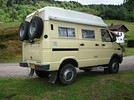
Hi there,
Does anyone have a good agency recommendation for renting a camper van in Morocco (Marrakech or Essaouira) for about two weeks in March 2026?
Thanks for your tips!
Hi everyone,
We’re a family of four—two adults with two kids aged 4 and 7—about to embark on a year-long round-the-world trip in a camper van. I’m currently planning the Asia leg, which should last about 6 months. We’ll arrive in Thailand in January, head north, then move on to Laos. Ideally, we’d continue to Vietnam, Cambodia, and then return to Thailand to head south into Malaysia. If the budget allows, we’d love to include China and Japan. The big question after lots of research is: how easy is it to temporarily import a vehicle into these countries? The info I’ve found is outdated (2019–2020), and given how quickly regulations change, I’d love to hear from anyone currently (or recently) traveling in these countries with their vehicle. I’ve read that you need a local guide in Vietnam, local license plates in China, and that importing a vehicle into China is quite complicated—are these rules still in place? More generally, is there a recommended route for this part of the world with a camper van?
Thanks in advance!
We’re a family of four—two adults with two kids aged 4 and 7—about to embark on a year-long round-the-world trip in a camper van. I’m currently planning the Asia leg, which should last about 6 months. We’ll arrive in Thailand in January, head north, then move on to Laos. Ideally, we’d continue to Vietnam, Cambodia, and then return to Thailand to head south into Malaysia. If the budget allows, we’d love to include China and Japan. The big question after lots of research is: how easy is it to temporarily import a vehicle into these countries? The info I’ve found is outdated (2019–2020), and given how quickly regulations change, I’d love to hear from anyone currently (or recently) traveling in these countries with their vehicle. I’ve read that you need a local guide in Vietnam, local license plates in China, and that importing a vehicle into China is quite complicated—are these rules still in place? More generally, is there a recommended route for this part of the world with a camper van?
Thanks in advance!

hello fellow travelers
For my golden years, I'd like to drive to India in my 508. I want to avoid Iran and Pakistan. Instead, I’m thinking of going through Turkey, Georgia, Armenia, Azerbaijan, then taking the ferry from Baku to Türkmenbaşy in Turkmenistan, followed by the Silk Road through Central Asia—Uzbekistan and Kyrgyzstan.
After that, China? I’ve seen that some travelers manage to drive through China with their own vehicle... Then Tibet, Nepal, and India... But things get tricky with the Himalayan crossing. I’ve checked on Google—it looks tough.
Any tips or info on these routes? Thanks
After that, China? I’ve seen that some travelers manage to drive through China with their own vehicle... Then Tibet, Nepal, and India... But things get tricky with the Himalayan crossing. I’ve checked on Google—it looks tough.
Any tips or info on these routes? Thanks

Hi,
It seems that vans and campervans aren't allowed on Hurtigruten ferries?
We have a California van with a bike rack—length: 5.70 m / height: 2.20 m / width: 1.95 m.
We'd like to take the ferry from Trondheim to the Lofoten Islands this coming September.
Thanks for sharing any info!

regions Brittany, Rhône-Alpes, and Massif Central (Auvergne Limousin)

Hi fellow travelers,
We’re planning our first trip to Iceland.
We’re considering renting a 4x4 where we could sleep from time to time.
My question is: What’s the current regulation in Iceland? Which areas allow sleeping in your vehicle, and where is it prohibited (requiring you to stay in campgrounds)?
In June, is it possible to find spots without having booked in advance?
Sergio

Hi there,
We’re traveling in our camper van from Haute-Savoie.
We’ve got 2 weeks in April and want to explore northern Portugal.
We’re thinking of:
- Peneda-Gerês National Park - the Douro Valley - Porto
We love nature, hiking, and culture (and also good food and wine).😉
Do you have an itinerary to suggest?
Thanks in advance for your replies
We’re traveling in our camper van from Haute-Savoie.
We’ve got 2 weeks in April and want to explore northern Portugal.
We’re thinking of:
- Peneda-Gerês National Park - the Douro Valley - Porto
We love nature, hiking, and culture (and also good food and wine).😉
Do you have an itinerary to suggest?
Thanks in advance for your replies
Hi there,
We're planning a full week in Iceland in April. Given the short timeframe to prepare, I’m asking for some help on the forum.
We’re considering renting a camper van to be more independent with our travel. - Is this really a good idea at this time of year due to weather conditions (cold nights, poor road conditions, etc.)? - Can we just "park" anywhere for the night to sleep, or do we absolutely have to go to a campsite? What are the approximate rates for a van with 2 people? Do we need to book in advance? - If this mode of transport is recommended, do you have any good places to rent one?
Iceland is still a big island with lots of points of interest, so I think it’ll be tough to see everything in 8 days. - Are there parts of the island we should prioritize in April? We like hiking (nothing too long—6 or 7 hours is out of the question) and unique landscapes. - Are some sites inaccessible at this time of year? - Is Reykjavik worth stopping for a day or two?
Thanks in advance for your answers!
Jeff
We're planning a full week in Iceland in April. Given the short timeframe to prepare, I’m asking for some help on the forum.
We’re considering renting a camper van to be more independent with our travel. - Is this really a good idea at this time of year due to weather conditions (cold nights, poor road conditions, etc.)? - Can we just "park" anywhere for the night to sleep, or do we absolutely have to go to a campsite? What are the approximate rates for a van with 2 people? Do we need to book in advance? - If this mode of transport is recommended, do you have any good places to rent one?
Iceland is still a big island with lots of points of interest, so I think it’ll be tough to see everything in 8 days. - Are there parts of the island we should prioritize in April? We like hiking (nothing too long—6 or 7 hours is out of the question) and unique landscapes. - Are some sites inaccessible at this time of year? - Is Reykjavik worth stopping for a day or two?
Thanks in advance for your answers!
Jeff

Hi there,
Most of the time when I travel, I tow a trailer with an ATV for my local trips... I’d love to hear from anyone who’s traveled with a trailer and a second vehicle of any kind—especially the downsides of towing a trailer in Norway, aside from ferry costs.
Thanks!
Most of the time when I travel, I tow a trailer with an ATV for my local trips... I’d love to hear from anyone who’s traveled with a trailer and a second vehicle of any kind—especially the downsides of towing a trailer in Norway, aside from ferry costs.
Thanks!

hi,
I’m planning a trip to Albania in a camper van, most likely between May, June, and early July (2027), for about 60 days. On the way down, I’ll go as far as Bari (or Brindisi) and cross by ferry, and on the way back, I’ll go through the former Yugoslavia (or maybe take the return ferry?).
Has anyone been there recently? What are the roads like, the must-see spots, and any general tips you can share?
There’ll probably be two of us traveling together.
Thanks

Hi there,
During our last trip to Greece in 2021, we used Anek Lines' open deck offer, which allowed us to spend the night in our van on an open deck by the sea with access to the ferry's bars, restaurant, and showers (on the Ancona-Igoumenitsa route).
From my initial research, it seems this service no longer exists—can anyone confirm this?
Any alternatives?
Thanks
Hi everyone,
I’m planning to drive my camper van to southern Spain in autumn 2026. Ideally, I’d like to find a ferry leaving from France (Marseille or Toulon, doesn’t matter) that drops me off as far south in Spain as possible. I’ve done some research but haven’t had any luck.
Thanks for your tips!
Vanouk

We’d like to spend 15 days in August visiting Normandy by camper van, starting from Lyon.
Has anyone got an itinerary to suggest for exploring Normandy?
We’d like to go to Calvados to visit: Flower Coast, Honfleur, Cabourg, Deauville, D-Day landing beaches
Mont Saint-Michel
Alabaster Coast, Étretat cliffs, and maybe Rouen Fabienne
We’d like to go to Calvados to visit: Flower Coast, Honfleur, Cabourg, Deauville, D-Day landing beaches
Mont Saint-Michel
Alabaster Coast, Étretat cliffs, and maybe Rouen Fabienne
Hi there,
I have a bit of a crazy dream... I'd love to drop everything and hit the road with my wife and kids in a camper van.
I want to visit villages to learn, immerse ourselves in other cultures, and see different perspectives on the world. To teach my kids different values.

Hi everyone,
I’m planning a campervan road trip and would love some tips from those who know these countries: Slovenia, Bosnia and Herzegovina, Croatia, Montenegro, and Slovenia again. At the moment, nothing’s set in stone, but for example, is it better to visit Slovenia or Bosnia? My preferences lean toward landscapes (rivers, sea, lakes)—basically anywhere there’s water! :) Wild camping, cheap or even free spots, and a *very* tight budget—it’s the discovery, curiosity, and meeting locals that drive me. I’ll visit cities and sites only if access is easy (by bike, for example, or by train from an affordable campsite) and if visitors aren’t treated like cash cows. Just reasonable stuff, really. So, any advice is welcome—like swimming spots or easy hikes along coasts or rivers. I love caves and offbeat visits (salt mines in Poland, La Roque Saint-Christophe in France, etc.). Castles and old ruins? Not really my thing... Thanks for your help! Sylvia
I’m planning a campervan road trip and would love some tips from those who know these countries: Slovenia, Bosnia and Herzegovina, Croatia, Montenegro, and Slovenia again. At the moment, nothing’s set in stone, but for example, is it better to visit Slovenia or Bosnia? My preferences lean toward landscapes (rivers, sea, lakes)—basically anywhere there’s water! :) Wild camping, cheap or even free spots, and a *very* tight budget—it’s the discovery, curiosity, and meeting locals that drive me. I’ll visit cities and sites only if access is easy (by bike, for example, or by train from an affordable campsite) and if visitors aren’t treated like cash cows. Just reasonable stuff, really. So, any advice is welcome—like swimming spots or easy hikes along coasts or rivers. I love caves and offbeat visits (salt mines in Poland, La Roque Saint-Christophe in France, etc.). Castles and old ruins? Not really my thing... Thanks for your help! Sylvia
Hi, I’m planning to pick up a camper van in Dubai and drive it back to France... is this even possible? What’s the best route? What are the main challenges? Are there secure parking areas along the way? Is diesel fuel available for the whole trip? ... So many questions... Thanks for your help! See you soon!
I'm planning to drive to the UAE by road, going through Iraq. Has anyone done this and can give me some info? Specifically about the border crossings Turkey/Iraq and Iraq/Kuwait.

Hi there,
I’d love to hear your thoughts on a trip to New Zealand in a campervan. Is it a good idea to mix hotels and a car on the North Island and a campervan on the South Island? Or should I do the whole trip in a campervan—though visiting big cities seems trickier that way.
Other questions: which companies do you recommend, and what are the least tiring or most sensible routes? 😄
Thanks for sharing your experiences and ideas!
Hi there,
We’re planning to tour Scandinavia by camper van—Denmark, Sweden, Finland, and Norway (in that order)—for 5 weeks from late May to late June 2026.
I’ve done it before, but that was way back in 1980 😎 and by hitchhiking!
We’d love to hear from anyone who’s done this trip about the best routes, great tips, must-know advice, and what to do or avoid (ferries, campsites, etc.).
Thanks in advance!
hi there,
We’re heading to southern England this summer in our camper van, including a stop in London.
Does anyone have a good experience with a campsite near London that has easy access to public transport to get into the city center? Ideally, we’d like to leave the camper van at the campsite...
Thanks so much in advance for your help!
We’re heading to southern England this summer in our camper van, including a stop in London.
Does anyone have a good experience with a campsite near London that has easy access to public transport to get into the city center? Ideally, we’d like to leave the camper van at the campsite...
Thanks so much in advance for your help!
Hi everyone,
I’m planning a trip with my camper van in autumn 2026 to head to southern Italy from Genoa by ferry.
Ideally, I’d like to leave from Genoa for southern Italy (like Messina) or another city in the boot.
I’ve done some research online but haven’t had any luck.
Can you help or give me some advice?
Thanks in advance!
Vanouk
Hi there, we’ll be in Portugal from March 9 to April 14, 2026. We’ve booked our first five days in Lisbon for sightseeing. After that, we’d like to rent a campervan (RV), but we’re having trouble finding a good site for the rental. The rental would be for about three weeks. Do you have any suggestions for us? We think it’s best to book the campervan before we arrive. And since we’re not mechanics, we need a vehicle in good condition...
Thanks so much for your suggestions. We’re open to everything—even route ideas and places to visit! Pierrette
Thanks so much for your suggestions. We’re open to everything—even route ideas and places to visit! Pierrette