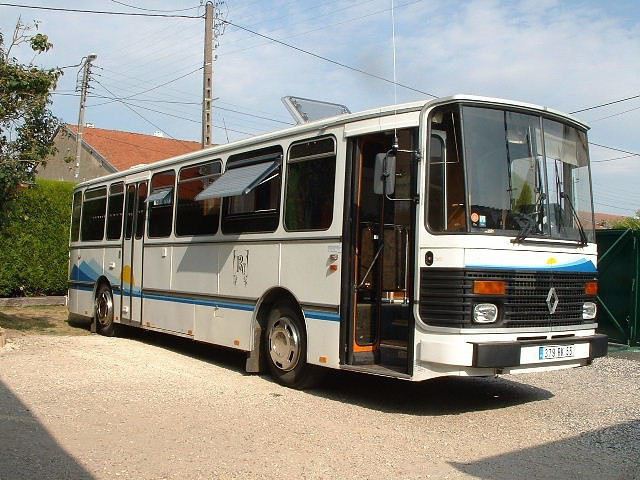
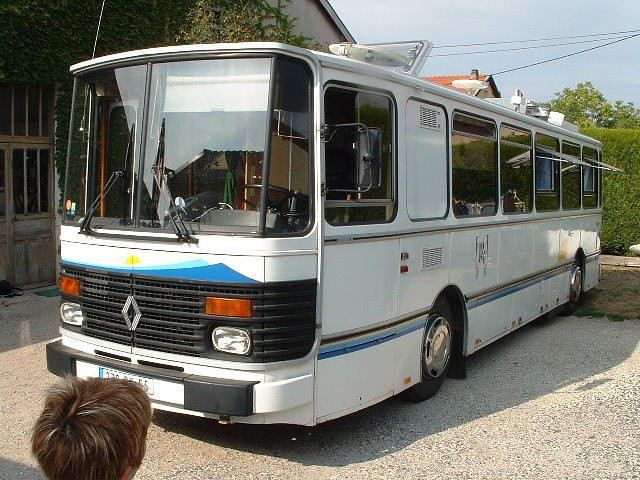
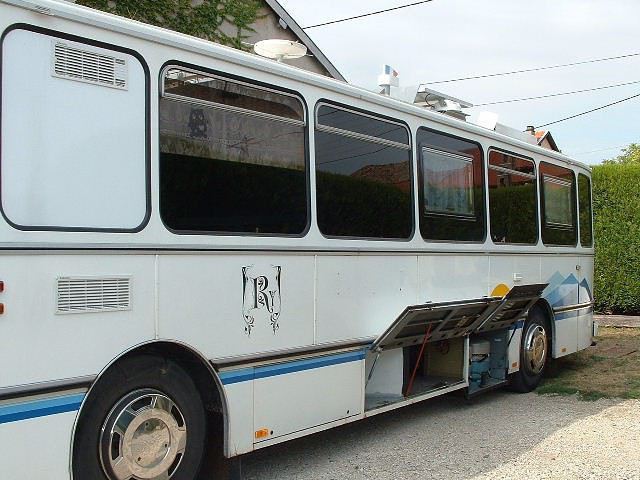
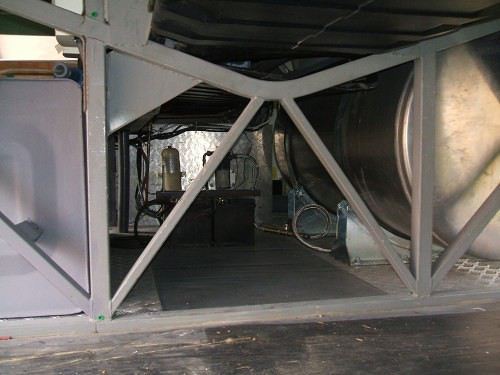
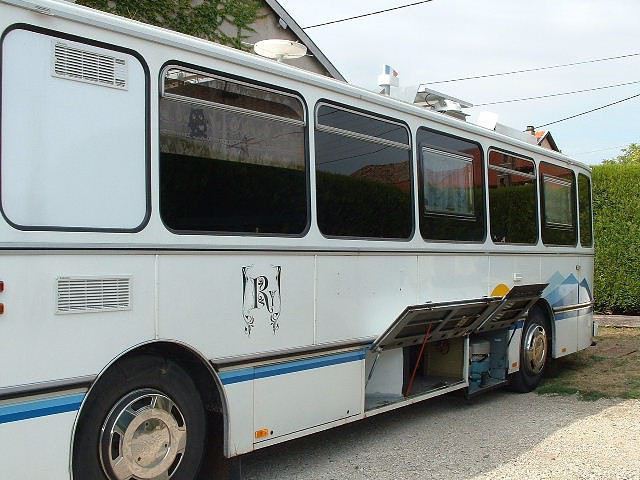
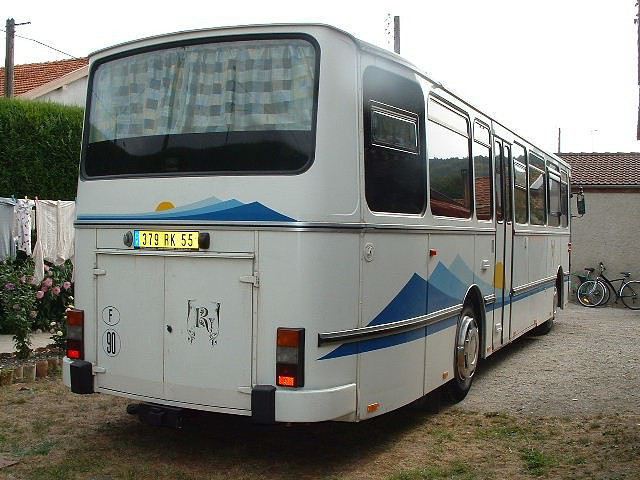
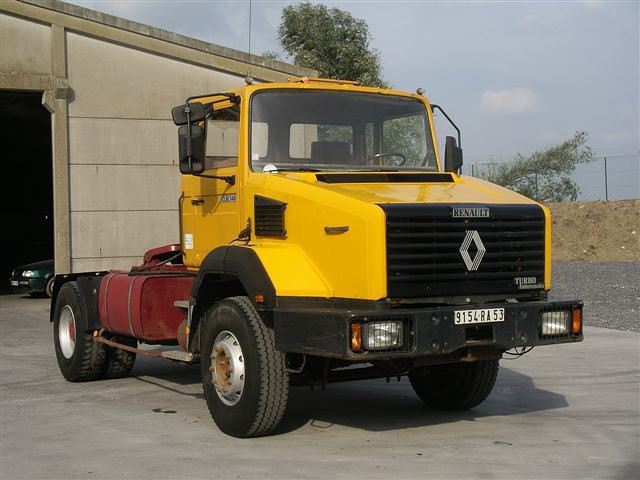
Converting a heavy-duty bus/coach/truck into a motorhome
by Patrick26
Translated into English.
So, here's what to order:
angle grinder discs 10/10 gauge sheet metal brazing rods 2mm rods 2 liters of rust treatment fiberglass mat sauerkraut blackson 30 ml of cargo seals repaint the rims 4 hubcaps 200 sanding discs masking tape primer body paint and ... the 2 or 3 bits and pieces for the interior...
Still plan for 4 or 5 afternoons of work!😉
Well, the easy part's done, now the surprises start!
That's also what happiness is! (Do you remember when I was explaining my sheet metal at the back of the bus, which we ended up changing!)
But anyway, joking aside, you know what a truck is. Don't get carried away with the interior. In your place, I'd start by dealing with everything that's rotten or about to be. Cut it out, redo it, treat it, repaint it. After that, the interior is just details. Boards, pipes and wires. With a bit of cleverness and common sense, it always comes together, even in the rain. On the other hand, the bodywork is a mess! It's not complicated, but it's a mess! It's noise, dirt, welding (no welding in the rain, eh!), etc...
I know you're resourceful, but let yourself have fun with it! Do it in order! Like with a house, you take care of the walls first before laying the tiles!
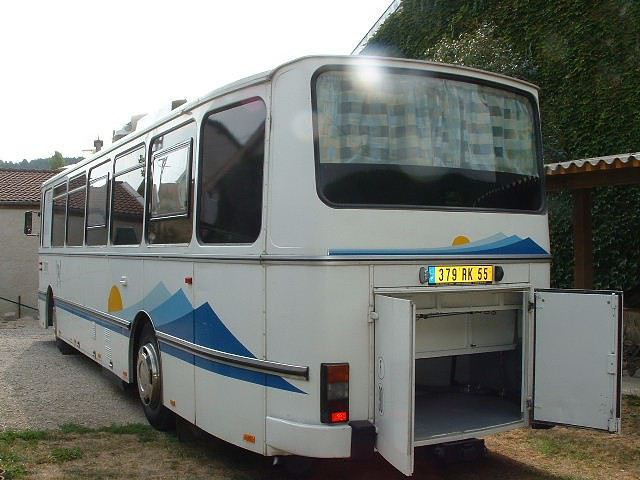
One last thing, use chocks! Working level is heaven! Looking at your curtains in the photos, you're going to need a timber or two!😛
PATRICK26
angle grinder discs 10/10 gauge sheet metal brazing rods 2mm rods 2 liters of rust treatment fiberglass mat sauerkraut blackson 30 ml of cargo seals repaint the rims 4 hubcaps 200 sanding discs masking tape primer body paint and ... the 2 or 3 bits and pieces for the interior...
Still plan for 4 or 5 afternoons of work!😉
Well, the easy part's done, now the surprises start!
That's also what happiness is! (Do you remember when I was explaining my sheet metal at the back of the bus, which we ended up changing!)
But anyway, joking aside, you know what a truck is. Don't get carried away with the interior. In your place, I'd start by dealing with everything that's rotten or about to be. Cut it out, redo it, treat it, repaint it. After that, the interior is just details. Boards, pipes and wires. With a bit of cleverness and common sense, it always comes together, even in the rain. On the other hand, the bodywork is a mess! It's not complicated, but it's a mess! It's noise, dirt, welding (no welding in the rain, eh!), etc...
I know you're resourceful, but let yourself have fun with it! Do it in order! Like with a house, you take care of the walls first before laying the tiles!
One last thing, use chocks! Working level is heaven! Looking at your curtains in the photos, you're going to need a timber or two!😛
PATRICK26
Thanks for the advice, that's what I thought. Rust first and the rest will come later.
But anyway I'm going to have a blast with all this DIY stuff😉, plus I'm pretty well equipped. I'm missing soldering equipment, a big jack, big candles and the big pit that I'm planning to dig on some land I have nearby, plus there's water for the pressure washer. And with the power generator I have for the tools, it'll work out!
Count on me to keep you updated through my photos.
Thanks Patrick, thanks everyone else😎
But anyway I'm going to have a blast with all this DIY stuff😉, plus I'm pretty well equipped. I'm missing soldering equipment, a big jack, big candles and the big pit that I'm planning to dig on some land I have nearby, plus there's water for the pressure washer. And with the power generator I have for the tools, it'll work out!
Count on me to keep you updated through my photos.
Thanks Patrick, thanks everyone else😎
Hey buddy,
First of all, I want to tell you that on this discussion topic, I've been teasing you, but no more!😉
I'm trying to make this discussion space as friendly as possible, and trying out some humor😊
When I said you just had to come, it wasn't ironic, just joking around, but good jokes are often hard to put into writing!
There, it's said! Now, if you chose a job that deprives you of weekends, that's not our fault either! (humor!)
About your weight question:
It's much more complicated than you think, unfortunately!
My bus weighed 11,400 kg empty (that is, with the fuel tank 90/100% full—that's the rule for all tanks!), with all its equipment.
We removed the seats.
We installed partitions, but also water tanks especially, and that's where things get complicated...
As for tanks, we have fresh water, greywater, and blackwater tanks.
In principle, it's like communicating vessels, so if the fresh water tanks are full, the greywater and blackwater are empty, and vice versa. Or even 50-50!
And there's the panic.
My bus, which weighs 11,400 kg empty, from which I removed about 1,100 kg of seats and 300 kg of trim and other things, now weighs only 10,000 kg. Its maximum weight is 17,500 kg. Very good!
But it also has a maximum weight per axle!
And like any bus, the maximum weight on the front axle is low! (especially if there's a mid-mounted engine!) And there, you have to juggle with the tanks!
You must not risk overloading an axle when fresh or dirty water is full! Even if you don't exceed your total maximum weight!
So when, like me, you also load a car at the back!
Well, you weigh the vehicle at several stages of the conversion to know where you stand, or you use software (quite complicated!) for load distribution that Gasmobil found!
Basically, for me, I have 7,500 kg of capacity, and it's up to me to distribute it properly, knowing that I have little on the front axle, more on the rear axle, and anything that sits as weight on the rear overhang gives me back on the front axle! (Yes, the tipping phenomenon, at the midpoint on the rear axle!)🤪
When I say you have to do 'bus sessions'!
PATRICK26
First of all, I want to tell you that on this discussion topic, I've been teasing you, but no more!😉
I'm trying to make this discussion space as friendly as possible, and trying out some humor😊
When I said you just had to come, it wasn't ironic, just joking around, but good jokes are often hard to put into writing!
There, it's said! Now, if you chose a job that deprives you of weekends, that's not our fault either! (humor!)
About your weight question:
It's much more complicated than you think, unfortunately!
My bus weighed 11,400 kg empty (that is, with the fuel tank 90/100% full—that's the rule for all tanks!), with all its equipment.
We removed the seats.
We installed partitions, but also water tanks especially, and that's where things get complicated...
As for tanks, we have fresh water, greywater, and blackwater tanks.
In principle, it's like communicating vessels, so if the fresh water tanks are full, the greywater and blackwater are empty, and vice versa. Or even 50-50!
And there's the panic.
My bus, which weighs 11,400 kg empty, from which I removed about 1,100 kg of seats and 300 kg of trim and other things, now weighs only 10,000 kg. Its maximum weight is 17,500 kg. Very good!
But it also has a maximum weight per axle!
And like any bus, the maximum weight on the front axle is low! (especially if there's a mid-mounted engine!) And there, you have to juggle with the tanks!
You must not risk overloading an axle when fresh or dirty water is full! Even if you don't exceed your total maximum weight!
So when, like me, you also load a car at the back!
Well, you weigh the vehicle at several stages of the conversion to know where you stand, or you use software (quite complicated!) for load distribution that Gasmobil found!
Basically, for me, I have 7,500 kg of capacity, and it's up to me to distribute it properly, knowing that I have little on the front axle, more on the rear axle, and anything that sits as weight on the rear overhang gives me back on the front axle! (Yes, the tipping phenomenon, at the midpoint on the rear axle!)🤪
When I say you have to do 'bus sessions'!
PATRICK26
I won! I wanted post 1133!
Well, it's just a joke – Patrick26 will understand!
Look at the time – how are you going to manage to work on your motorhome tomorrow
Well, it's just a joke – Patrick26 will understand!
Look at the time – how are you going to manage to work on your motorhome tomorrow
Hello,
Congratulations on your bus, it's huge (the rust too 😛). They're going to have others of the same kind (especially at the same price and condition I mean...).
Another question: what's a W garage for 150 euros?
Good luck.
Later, Seb
Congratulations on your bus, it's huge (the rust too 😛). They're going to have others of the same kind (especially at the same price and condition I mean...).
Another question: what's a W garage for 150 euros?
Good luck.
Later, Seb
don't worry, be hippie !
Hey acapola...
Well... a W garage is an insurance that allows the garage owner to drive or transport vehicles with their own registration plates and their own insurance. Otherwise I would've had to insure it for the trip, but this way I have time to find cheap insurance! See ya soon
It's 100% DIY!!
Eh ben, Ya du boulot!!
http://www.aavl.fr
http://gasmobil.skyrock.fr
I've talked to the owner, and where there are windows, they're black-painted metal sheets.
The original windows still have the opening part at the top.
Notice that where there are bay windows, this part is gone.
Eh ben, Ya du boulot!!
http://www.aavl.fr
http://gasmobil.skyrock.fr
Hello everyone
I'm new but I've been reading your posts for several months. I stumbled upon this forum by chance while looking for a bus for sale to convert into a motorhome. 😮 Wow! There are others as crazy as me! Since then I've read everything from the beginning (or almost) and I've learned so much. A huge thanks to everyone for all the advice.
I found an FR1 that I'm picking up this week. I'm looking for ideas for the interior layout. If anyone has photos... Thanks again everyone and I'll keep you updated on the progress. Cheers!
It's normal 😉 Patrick, we tease each other a bit on the site—it would be too sad otherwise, and besides I love the "messing around"🏴☠️.
So basically, if I understand correctly, for the interior setup you'd need to count on about 7.5 tonnes total for a bus like yours, including fluids and passengers. Average weight per person is 75kg times the number of seats, that's already quite substantial.
On an ad from someone who lives near me, a bus was fitted out with drywall for partitions, and the floor was tiled, just like at home. On a chassis with a truss frame or self-supporting body, isn't there a risk that all of that could come loose on a rough road?😮 I'm asking all these questions to avoid making a mistake before buying it—so we don't regret it every time we go on a weekend trip or get in the bus. I'm a bit of a perfectionist type, and once I see a flaw, that's all I can see after that. See you next time, Fab
Well, there's a good one!
Now it's just a matter of getting to work (take it step by step, no need to rush 😉) Take care of the rust and I trust you on that... then reinforce your bus and if you want, we can talk about how to set up that big empty space... I'm here for you...
I'm taking this post as an opportunity to share my thoughts... mrkonn Bus windows are generally made of toughened safety glass, which means they've been treated to make them really hard, almost impossible to machine. So don't think you can drop your windows and get them cut without dealing with all the headaches of mounting new openings onto the glass... and anyway, if you're dropping them you might as well weld them up 😛!
jose6440 Like I said in my first post, don't follow other people's builds or standard vehicles as a guide—their needs aren't necessarily yours! You have a big space to work with, which has its constraints, but it leaves plenty of room for customization. What's important is figuring out what you want to do with your FR1: how you'll use it, whether parked or driving, how many people will live in it and for how long, whether you want to be able to work in it, fit in a whole crew, have friends over, cook meals and what kind, etc. With all that in mind, you'll define what elements to integrate into your layout with their dimensions and space requirements, then add your own personal taste and preferences, and you can start placing your elements, moving them around until you have an interior that feels like you...
Good luck everyone!
I'm taking this post as an opportunity to share my thoughts... mrkonn Bus windows are generally made of toughened safety glass, which means they've been treated to make them really hard, almost impossible to machine. So don't think you can drop your windows and get them cut without dealing with all the headaches of mounting new openings onto the glass... and anyway, if you're dropping them you might as well weld them up 😛!
jose6440 Like I said in my first post, don't follow other people's builds or standard vehicles as a guide—their needs aren't necessarily yours! You have a big space to work with, which has its constraints, but it leaves plenty of room for customization. What's important is figuring out what you want to do with your FR1: how you'll use it, whether parked or driving, how many people will live in it and for how long, whether you want to be able to work in it, fit in a whole crew, have friends over, cook meals and what kind, etc. With all that in mind, you'll define what elements to integrate into your layout with their dimensions and space requirements, then add your own personal taste and preferences, and you can start placing your elements, moving them around until you have an interior that feels like you...
Good luck everyone!
Thanks, tell me what thickness the sheet metals in the joint are?
It's pretty good too. You'll need about as much time as if you had to remove the windows to weld on cross-members and sheet metal, not forgetting the small windows.
IF ANYONE HAS TIPS 😉
CONGRATULATIONS ON YOUR BUS AMAsxmx? See you later 😉
Worth checking on, but you'll probably still need reinforcements behind your metal sheets anyway (for safety and rigidity). A window pane should be about 8mm thick, so I wouldn't use a metal sheet of the same thickness!
Anyway, metal-sheeting a window isn't necessarily a materials problem (easier to find materials than someone who really knows how to use them). And there are other solutions besides welding: simple adhesive bonding, or for added security: 'glue-riveting' (with steel rivets!)
Merci junior… ton aide seras la bienvenue 😉!
D’ici que termine la rouille, tanpis si prendra du temp.
Je compte savouré à la petite cueillere tous les instants qui me permettront de finalisé mes travaux. Si dans le quartier certain m’appelle l’esclave C pas pour rien, je ne suis jamais degouté du travail
et bien surs ceci joue des tours à ma ptite famille 🙁qui préférerait que je me calme un peu pour passer du temp avec eux !
Alors junior ce sera avec plaisir
ACAPOLA : je dirai comme fanan ! Ce car est issu de pas mal de prières et de rage au ventre, telman j’en voulais un ! j’ai du forcer sur la dose🤪, car au prix ou je l’ai toucher . Ca fait partie de la motivation et que ça serve de leçon à tout ce qui hésite de se lancer . les autres y sont bien arriver pourquoi pas moi, voilà ma politique. Mais le plus dur C pas de le trouver, du moins je crois. Souhaiter moi bon courage Aller courage à tous, quelle que part votre BB vous attend
et bien surs ceci joue des tours à ma ptite famille 🙁qui préférerait que je me calme un peu pour passer du temp avec eux !
Alors junior ce sera avec plaisirACAPOLA : je dirai comme fanan ! Ce car est issu de pas mal de prières et de rage au ventre, telman j’en voulais un ! j’ai du forcer sur la dose🤪, car au prix ou je l’ai toucher . Ca fait partie de la motivation et que ça serve de leçon à tout ce qui hésite de se lancer . les autres y sont bien arriver pourquoi pas moi, voilà ma politique. Mais le plus dur C pas de le trouver, du moins je crois. Souhaiter moi bon courage Aller courage à tous, quelle que part votre BB vous attend
Salut tout le monde😉
Bon alors c'est quoi ce bazard (pour rester polie) je m'absente 5 jours du forum et çà part en live
Alors je commence par le début, merci à Patrick26 pour le petit mots à la fin du compte rendu photo du week-end du 16/17 sept. si si j'y tiens, çà fait plaisir🙂 pour une fois que quelqu'un trouve que j'ai soufflé (même si c'était de la déconne😏) une bonne idée
ET surtout qu'on l'a concrétise à ma place.
ben du coûp même si j'ai pas pu y être j'ai l'impression d'avoir participé à quelque chose quant même.
Ensuite :
Félicitation à AMAsxmx pour cette adoption, 😎 t'inquiète pas si un moment t'es découragé, c'est normal, tu vas en trouver des misères, faut juste voir après, et te dire que c'est ton bébé en quelque sorte, et quant t'en viens à bout, t'es tellement heureux et fier😎
Ensuite :
Je veux absolument donner moi aussi mon avis (que Patrick26 connait déjà) mais que je voudrais mettre au jour :
🤪c'est vrais que c'est long à lire, c'est vrais aussi que je m'énnerve à chercher un truc en arrière mais bon...
c'est parce qu'il y à beaucoups d'intervenants, parce que c'est CONVIVIALE un peu comme une grande et longue discution entre pots. perso le post à été créé, en 2004 et j'avais déjàs mis une option sur mon bus depuis 3 ans, je me suis inscris à la 8ème page (la bouteille de champ. pour la porte chauffeur) car le sujet me plaisait et j'avais mon car, je ne suis intervenu qu'à la 11 ème page une fois sortie de la DRIRE parce qu'avant j'avais rien à faire partager. ni rien de spécifique à demander, avec le guide AFNOR, le dossier DRIRE, un peu de connaissance et de recherches sur le net et ailleur, çà roule. 😎
juste pour dire que je suis ce post depuis 2 ans juste parce qu'il est prenant, parce qu'il est différent des autres 🙂 sur lesquelles du coûp je ne vais pratiquement plus en tout cas au niveau intervention (trop de bifurcations, trops de posts à suivre) donc, si vous voulez transformer celui là, il faudra faire attention de ne pas lui faire perdre son origine, sa chaleur et devenir une succursale de la DRIRE sans âme avec des liens textes de loi, des liens photos, des trucs et des machine pré-défini pret à copier/coller. Car vous n'aurez plus que des visiteurs venant "POMPER" direct un schéma type, une implantation pré-formaté etc.... en toute discrétion sans même laisser un petit merci, et donc en "tuant" gentiement ce post qui au contraire est en train actuellement de se transformer gentiement en AMICALE.
ATTENTION : je suis CONTRE la mise en ligne du Guide AFNOR qui est protégé par le Copyright qui signifirait la fermeture du post
et puis, c'est parse que je l'avais avec moi lors du passage chez Véritas que mon installation à été Homologué.
85 € pour avoir son homologation, savoir qu'il n'y à aucun risque pour les occupant et à côté du coût de transformation c'est RIDICULE. 😉
PAR contre, je ne suis pas contre regrouper tous les textes, normes, truc interressant difusable. si çà laisse libre le poste pour échanger voir même pouvoir déconner sans s'occuper de la place prise, pourquoi pas.
Patrick à eu la bonne idée de vous présenter SJunior, qui je pense va énormément contribuer à garder ce post vivant, par contre bonjour la solicitation...😄
Voilà j'en ai encore mis une tartine😕 désolé, mais bon çà faisait bien 5 jours que j'avais rien écrit alors...
je rajoute un truc car le temps que j'écrive il y a d'autres post, pour les tôles dans les joints, c'est fréquents, moi, j'ai même rajouté un contreplaqué de 3 sur une vitre avec du Trisodur entre😛 ... élastique le joint non ?😏 pour la tôle dans le joint, je pense qu'il faut rajouter un liseret soudé tout le tour ou mieu, un CP (contre-plaqué) de 5 ou 8 mm collé à la tôle (régul l'humidité et fourni le support pour fixer l'isolant et le reste en l'isolant de la tôle) pas con hein ?
ET pour le contreplaqué et le carrelage dans un bus, c'est de la connerie, en roulant un car se déforme, se vrille, le placo ne tiendra pas et surtout faudra pas que l'humidité s'installe. c'est comme isoler avec de la laine de verre ou laine de roche, çà se tasse avec les vibrations, tout glisse gentiement et fait boule dans le bas et pond thermique en haut, en plus çà absorbe l'humidité
GX47
Bon alors c'est quoi ce bazard (pour rester polie) je m'absente 5 jours du forum et çà part en live
Alors je commence par le début, merci à Patrick26 pour le petit mots à la fin du compte rendu photo du week-end du 16/17 sept. si si j'y tiens, çà fait plaisir🙂 pour une fois que quelqu'un trouve que j'ai soufflé (même si c'était de la déconne😏) une bonne idée
ET surtout qu'on l'a concrétise à ma place.
ben du coûp même si j'ai pas pu y être j'ai l'impression d'avoir participé à quelque chose quant même.Ensuite :
Félicitation à AMAsxmx pour cette adoption, 😎 t'inquiète pas si un moment t'es découragé, c'est normal, tu vas en trouver des misères, faut juste voir après, et te dire que c'est ton bébé en quelque sorte, et quant t'en viens à bout, t'es tellement heureux et fier😎
Ensuite :
Je veux absolument donner moi aussi mon avis (que Patrick26 connait déjà) mais que je voudrais mettre au jour :
🤪c'est vrais que c'est long à lire, c'est vrais aussi que je m'énnerve à chercher un truc en arrière mais bon...
c'est parce qu'il y à beaucoups d'intervenants, parce que c'est CONVIVIALE un peu comme une grande et longue discution entre pots. perso le post à été créé, en 2004 et j'avais déjàs mis une option sur mon bus depuis 3 ans, je me suis inscris à la 8ème page (la bouteille de champ. pour la porte chauffeur) car le sujet me plaisait et j'avais mon car, je ne suis intervenu qu'à la 11 ème page une fois sortie de la DRIRE parce qu'avant j'avais rien à faire partager. ni rien de spécifique à demander, avec le guide AFNOR, le dossier DRIRE, un peu de connaissance et de recherches sur le net et ailleur, çà roule. 😎
juste pour dire que je suis ce post depuis 2 ans juste parce qu'il est prenant, parce qu'il est différent des autres 🙂 sur lesquelles du coûp je ne vais pratiquement plus en tout cas au niveau intervention (trop de bifurcations, trops de posts à suivre) donc, si vous voulez transformer celui là, il faudra faire attention de ne pas lui faire perdre son origine, sa chaleur et devenir une succursale de la DRIRE sans âme avec des liens textes de loi, des liens photos, des trucs et des machine pré-défini pret à copier/coller. Car vous n'aurez plus que des visiteurs venant "POMPER" direct un schéma type, une implantation pré-formaté etc.... en toute discrétion sans même laisser un petit merci, et donc en "tuant" gentiement ce post qui au contraire est en train actuellement de se transformer gentiement en AMICALE.
ATTENTION : je suis CONTRE la mise en ligne du Guide AFNOR qui est protégé par le Copyright qui signifirait la fermeture du post
et puis, c'est parse que je l'avais avec moi lors du passage chez Véritas que mon installation à été Homologué.
85 € pour avoir son homologation, savoir qu'il n'y à aucun risque pour les occupant et à côté du coût de transformation c'est RIDICULE. 😉
PAR contre, je ne suis pas contre regrouper tous les textes, normes, truc interressant difusable. si çà laisse libre le poste pour échanger voir même pouvoir déconner sans s'occuper de la place prise, pourquoi pas.Patrick à eu la bonne idée de vous présenter SJunior, qui je pense va énormément contribuer à garder ce post vivant, par contre bonjour la solicitation...😄
Voilà j'en ai encore mis une tartine😕 désolé, mais bon çà faisait bien 5 jours que j'avais rien écrit alors...
je rajoute un truc car le temps que j'écrive il y a d'autres post, pour les tôles dans les joints, c'est fréquents, moi, j'ai même rajouté un contreplaqué de 3 sur une vitre avec du Trisodur entre😛 ... élastique le joint non ?😏 pour la tôle dans le joint, je pense qu'il faut rajouter un liseret soudé tout le tour ou mieu, un CP (contre-plaqué) de 5 ou 8 mm collé à la tôle (régul l'humidité et fourni le support pour fixer l'isolant et le reste en l'isolant de la tôle) pas con hein ?
ET pour le contreplaqué et le carrelage dans un bus, c'est de la connerie, en roulant un car se déforme, se vrille, le placo ne tiendra pas et surtout faudra pas que l'humidité s'installe. c'est comme isoler avec de la laine de verre ou laine de roche, çà se tasse avec les vibrations, tout glisse gentiement et fait boule dans le bas et pond thermique en haut, en plus çà absorbe l'humidité
GX47
GX47
ex transformation, homologation et utilisation d'un car en CC 9places route en utilisation pro. Plus un CC 6pl VL, plus un fourgon en cabine approfondie 6 pl VL. si je peu aider...
Hello,
bon et le pipi kk dans tout ca ? petit sondage (très synthetique tout froid et tout 😛 mais c'est important quand meme):
quel systeme ? pour quelle utilisation ? (nb de personnes et rythme d'utilisation) quel avantages ? quel inconvenients ?
ne vous privez pas de repondre si vous avez testé des solutions alternatives, meme si c'etait pas dans un bus...
que penser de systemes comme ca :
http://www.sun-mar.com/products/mobilestraightback12volt.php http://www.envirolet-europe.com/wscfrench.html
ok, ca coute + cher que le bus d'AMAsxmx mais au moins avec ca, c'est pas pour rien qu'on dira "je vais sur le trone" hahahahabofbofbof remarquez c'est quand tard, vous comprendrez bien que j'ai pas pu resister...
a+seb
bon et le pipi kk dans tout ca ? petit sondage (très synthetique tout froid et tout 😛 mais c'est important quand meme):
quel systeme ? pour quelle utilisation ? (nb de personnes et rythme d'utilisation) quel avantages ? quel inconvenients ?
ne vous privez pas de repondre si vous avez testé des solutions alternatives, meme si c'etait pas dans un bus...
que penser de systemes comme ca :
http://www.sun-mar.com/products/mobilestraightback12volt.php http://www.envirolet-europe.com/wscfrench.html
ok, ca coute + cher que le bus d'AMAsxmx mais au moins avec ca, c'est pas pour rien qu'on dira "je vais sur le trone" hahahahabofbofbof remarquez c'est quand tard, vous comprendrez bien que j'ai pas pu resister...
a+seb
don't worry, be hippie !
C'est de l'alu de la même épaisseur que la vitrte d'origine.
Eh ben, Ya du boulot!!
http://www.aavl.fr
http://gasmobil.skyrock.fr
Uh... there's an error at the end of my previous post—it should say:"AND for the plasterboard and tiling" and not "AND for the plywood" which stays in place well (elastic)
Sorry

GX47
ex transformation, homologation et utilisation d'un car en CC 9places route en utilisation pro. Plus un CC 6pl VL, plus un fourgon en cabine approfondie 6 pl VL. si je peu aider...
Hello, and thanks.
By the way, I'm mad at you..... After you missed the meet-up on Saturday ??/??/2006. I was hoping to meet you at the gathering on the 17th, but you cowardly abandoned us.😉
So catch you next time.
Otherwise, do you have any models you can recommend based on a chassis that I can find for not too expensive? (best value for money, you know!)
See you soon and thanks.
By the way, I'm mad at you..... After you missed the meet-up on Saturday ??/??/2006. I was hoping to meet you at the gathering on the 17th, but you cowardly abandoned us.😉
So catch you next time.
Otherwise, do you have any models you can recommend based on a chassis that I can find for not too expensive? (best value for money, you know!)
See you soon and thanks.
Hey,
for the partitions I'm going to use 40mm expanded polystyrene and cover it with 8 or 10mm plywood on both sides.
It absorbs vibrations and it's lightweight.
What do you think?
Hi jose6440,
There's no point in insulating between two sections.
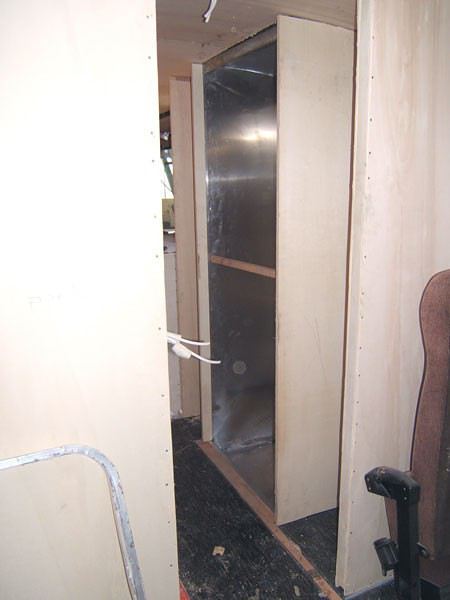
Make some battens out of poplar plywood, 40mm wide by 19mm thick. Glue them with wood glue and screw them down. Then attach your panels (8 or 10mm thick) — glued and screwed to the battens. This lets you run electrical wires, switches, and outlets through them.
If you look at the photo, you can see on the right and left partitions where the switch wires come out.
There's no point in insulating between two sections.
Make some battens out of poplar plywood, 40mm wide by 19mm thick. Glue them with wood glue and screw them down. Then attach your panels (8 or 10mm thick) — glued and screwed to the battens. This lets you run electrical wires, switches, and outlets through them.
If you look at the photo, you can see on the right and left partitions where the switch wires come out.
Hey,
polystyrene in a vehicle isn't ideal. don't let it rub (horrible noise) - you really need to glue it on both sides or leave some space. it tends to trap a bit of moisture. the advantage is it's cheap
GX47
ex transformation, homologation et utilisation d'un car en CC 9places route en utilisation pro. Plus un CC 6pl VL, plus un fourgon en cabine approfondie 6 pl VL. si je peu aider...
😉a link might be useful for some,
the first original with all the pages
the second in French🤪 if you want
http://www.stefan-bauer.de/302-2.htm
http://translate.google.com/translate?hl=fr&sl=de&u=http://www.stefan-bauer.de/302-2.htm&sa=X&oi=translate&resnum=1&ct=result&prev=/search%3Fq%3Dhttp://www.stefan-bauer.de/302-2.htm%26hl%3Dfr%26lr%3D%26sa%3DG
I'm going to mess this up again..... sorry!
Our habitable vehicles must conform to classifications M0, M1, or M2! (see the AFNOR guide) for interior fitouts regarding flame non-spread and toxic fumes.
No polystyrene is classified! When exposed to flame it melts immediately, ignites, and releases toxic vapors (styrene I believe, namely!)
Raw wood is only classified from 40 mm thickness (4 cm!) if it's planed on 4 sides (and even then, it's only classified as M3... and only in vertical sections)
and that's where the headaches start!
For thin wood to be classified, it must be veneered (not paper veneer, only laminate) and on 2 faces! even if the 2nd face is the interior of the partition!
All edges must be protected from potential flame exposure (veneered edges, glued edges, embedded in edge strips, profiles, etc.)
The only other alternative is paint or varnish over your choice of primer that will 'rate' the wood for fire resistance. Only one manufacturer: Lurie.
It costs a fortune! My last order for a booth—20 liters, €1,420!.... but the wood was classified M1!
That's why all interiors made by manufacturers are in laminates or varnished wood!
Very few furniture pieces from sellers like BUT, Conforama, Atlas, or others can be suitable!
Be careful during your Veritas and Mines inspections!
Nowadays, as we know, anything can pass! It depends on the competence of the Veritas inspector and the Mines inspector. But in case of a problem, in court, at some point you'll be asked the famous question: "Sir, why did you use materials that current regulations forbade?" "Do you realize the damage caused by your DIY work?" And then, what do you answer? That the Veritas and Mines guys didn't say anything? If they're questioned, they'll say it wasn't visible that the panels were covered, etc....
For insulation, there aren't 50 solutions. Certain thin films are classified (not all! Some have foams that prevent classification) Green Styrodur is classified Other products in sheet form exist with fire classifications.
Be careful not to choose a product that insulates well against temperature but will trap moisture (like glass wool for example). Nothing like that to kill a van!
But be careful—a bus body, over 12 meters, flexes as it moves and your panels will cause rubbing against the metal sheets (rub Styrodur on metal, you'll hear the noise! It's like a fingernail on a chalkboard!)
So the ideal remains thin films! They can be stapled, glued, taped, applied in 2 crossed layers, etc... (but everyone does as they like!)
I warned you at the beginning of the post..... sorry!
For the post with photos of the German bus—be careful! They don't have the same regulations as us!
If you want to convert a vehicle, it's not necessarily complicated, but the first step is to order the AFNOR guide "Converting a Recreational Vehicle". Half of what I know is in there!
For the other half, I'm not stingy, and besides there's the forum and all the contributors.
PATRICK26
Our habitable vehicles must conform to classifications M0, M1, or M2! (see the AFNOR guide) for interior fitouts regarding flame non-spread and toxic fumes.
No polystyrene is classified! When exposed to flame it melts immediately, ignites, and releases toxic vapors (styrene I believe, namely!)
Raw wood is only classified from 40 mm thickness (4 cm!) if it's planed on 4 sides (and even then, it's only classified as M3... and only in vertical sections)
and that's where the headaches start!
For thin wood to be classified, it must be veneered (not paper veneer, only laminate) and on 2 faces! even if the 2nd face is the interior of the partition!
All edges must be protected from potential flame exposure (veneered edges, glued edges, embedded in edge strips, profiles, etc.)
The only other alternative is paint or varnish over your choice of primer that will 'rate' the wood for fire resistance. Only one manufacturer: Lurie.
It costs a fortune! My last order for a booth—20 liters, €1,420!.... but the wood was classified M1!
That's why all interiors made by manufacturers are in laminates or varnished wood!
Very few furniture pieces from sellers like BUT, Conforama, Atlas, or others can be suitable!
Be careful during your Veritas and Mines inspections!
Nowadays, as we know, anything can pass! It depends on the competence of the Veritas inspector and the Mines inspector. But in case of a problem, in court, at some point you'll be asked the famous question: "Sir, why did you use materials that current regulations forbade?" "Do you realize the damage caused by your DIY work?" And then, what do you answer? That the Veritas and Mines guys didn't say anything? If they're questioned, they'll say it wasn't visible that the panels were covered, etc....
For insulation, there aren't 50 solutions. Certain thin films are classified (not all! Some have foams that prevent classification) Green Styrodur is classified Other products in sheet form exist with fire classifications.
Be careful not to choose a product that insulates well against temperature but will trap moisture (like glass wool for example). Nothing like that to kill a van!
But be careful—a bus body, over 12 meters, flexes as it moves and your panels will cause rubbing against the metal sheets (rub Styrodur on metal, you'll hear the noise! It's like a fingernail on a chalkboard!)
So the ideal remains thin films! They can be stapled, glued, taped, applied in 2 crossed layers, etc... (but everyone does as they like!)
I warned you at the beginning of the post..... sorry!
For the post with photos of the German bus—be careful! They don't have the same regulations as us!
If you want to convert a vehicle, it's not necessarily complicated, but the first step is to order the AFNOR guide "Converting a Recreational Vehicle". Half of what I know is in there!
For the other half, I'm not stingy, and besides there's the forum and all the contributors.
PATRICK26
Hi everyone,
I worked at an RV dealership where I changed quite a few rear panels of factory-made RVs from a major French brand (the most well-known one that makes 2 brands near Valencia, won't name it!!) and what's more, they leaked water even though the vehicles were brand new!!!
And surprise: these factory RVs don't have to meet AFNOR standards!!
Composition of the walls from outside to inside: Polyester laminate gelcoat at 2–3mm A layer of polystyrene (you know, the stuff with little balls that makes thick black smoke when it burns!) About 25–30mm And a 4mm layer of plywood that burns pretty well too!! covered with a decorative finish layer.
One question: did this manufacturer submit these vehicles to Bureau Veritas or does it have fire-resistant polystyrene and polyester?
Have you ever seen a recent caravan that caught fire? there's nothing left of it! except the chassis and wheels.
So that's just to say that buying a brand new RV for 30,000 euros minimum (at that price you should be able to build yourself a nice camper van!) doesn't necessarily mean you're safe from the slightest problem, and they're pushing it a bit with safety standards (that's just my personal opinion!)
Long live plywood, which is a great material (or...) and which in nautical applications for example passes AFNOR standards without any issues!!!
I worked at an RV dealership where I changed quite a few rear panels of factory-made RVs from a major French brand (the most well-known one that makes 2 brands near Valencia, won't name it!!) and what's more, they leaked water even though the vehicles were brand new!!!
And surprise: these factory RVs don't have to meet AFNOR standards!!
Composition of the walls from outside to inside: Polyester laminate gelcoat at 2–3mm A layer of polystyrene (you know, the stuff with little balls that makes thick black smoke when it burns!) About 25–30mm And a 4mm layer of plywood that burns pretty well too!! covered with a decorative finish layer.
One question: did this manufacturer submit these vehicles to Bureau Veritas or does it have fire-resistant polystyrene and polyester?
Have you ever seen a recent caravan that caught fire? there's nothing left of it! except the chassis and wheels.
So that's just to say that buying a brand new RV for 30,000 euros minimum (at that price you should be able to build yourself a nice camper van!) doesn't necessarily mean you're safe from the slightest problem, and they're pushing it a bit with safety standards (that's just my personal opinion!)
Long live plywood, which is a great material (or...) and which in nautical applications for example passes AFNOR standards without any issues!!!
Hi, so if I understand correctly, you need wood veneered on both sides or varnished wood for my partitions, but what thickness for the rest and to stay within code and at a reasonable weight?
AS FOR THE INSULATION FILM YOU MENTIONED; does it come in a glossy form like aluminum foil with several stacked layers (7, 10, 13 layers)?
Fab
Me, when I go through the mines inspection, I don't call myself the 'Trigano group's homologation services'!
And if they do, it's because the trim in front of the polystyrene must be fire-classified.... (I have no idea!)
So I stick to AFNOR and the regulations currently in force!
Now, as I've already said, there's not a single mines engineer or Veritas inspector who knows the standards perfectly! So with that, good luck knowing which rules to follow!
Me, given the choice, I go with what's simplest for me. I don't want polystyrene. I prefer multi-layer. Which is fine because it's thinner, insulates better, doesn't make noise, doesn't hold moisture, and it's fire-classified! Why complicate things! 😕
For the partitions, same deal. I prefer working with laminated panels. It's washable, it looks good, the finish is applied at the same time as the panel, and it's fire-classified! (Plus I've got leftover stock from my old trade show days!) 😕
But everyone does what they want! Me, my bible (or my Quran, take your pick), is AFNOR and the texts that start with CE- and numbers after.
The "someone told me," "the other guy did," "you'll see," "don't sweat it" and others—in the business I was in (trade shows, so public-facing design work!), I've known people who used them. None of them lived trouble-free.
In my company, we never had a safety inspection that went badly! And we always delivered the shows before opening. But we never cut corners. If the specs or standards required this or that, well we did it. Period.
It's the zero-hassle choice.
For my bus, same deal. I want Veritas and the mines inspection to be a formality. Nothing more.
I'll remind you that we're on a forum, that I'M the resident smartass, and that it's ME who's always reminding everyone that there are rules! 😉
After that, everyone does as they please.... (as the song says!)
PATRICK26
And if they do, it's because the trim in front of the polystyrene must be fire-classified.... (I have no idea!)
So I stick to AFNOR and the regulations currently in force!
Now, as I've already said, there's not a single mines engineer or Veritas inspector who knows the standards perfectly! So with that, good luck knowing which rules to follow!
Me, given the choice, I go with what's simplest for me. I don't want polystyrene. I prefer multi-layer. Which is fine because it's thinner, insulates better, doesn't make noise, doesn't hold moisture, and it's fire-classified! Why complicate things! 😕
For the partitions, same deal. I prefer working with laminated panels. It's washable, it looks good, the finish is applied at the same time as the panel, and it's fire-classified! (Plus I've got leftover stock from my old trade show days!) 😕
But everyone does what they want! Me, my bible (or my Quran, take your pick), is AFNOR and the texts that start with CE- and numbers after.
The "someone told me," "the other guy did," "you'll see," "don't sweat it" and others—in the business I was in (trade shows, so public-facing design work!), I've known people who used them. None of them lived trouble-free.
In my company, we never had a safety inspection that went badly! And we always delivered the shows before opening. But we never cut corners. If the specs or standards required this or that, well we did it. Period.
It's the zero-hassle choice.
For my bus, same deal. I want Veritas and the mines inspection to be a formality. Nothing more.
I'll remind you that we're on a forum, that I'M the resident smartass, and that it's ME who's always reminding everyone that there are rules! 😉
After that, everyone does as they please.... (as the song says!)
PATRICK26
The thickness doesn't matter for the fire rating! It's the laminate that determines the fire rating. Wood thickness will give the wall its stiffness.
For the varnish, use only a specific varnish for fire-classing wood, brand "Lurie". Search online.
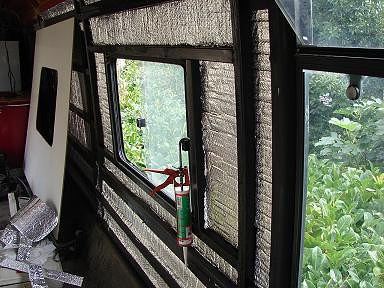
For insulation, I used 5-layer (which is indeed multi-layer aluminum film). The first layer is laid down and glued against the outer metal sheet (from the inside, of course!), everywhere it's possible: on the sides and roof, between the frame arches of the body.
For the second layer, we keep it simpler—we glue it to the lining panels before installing them, so it covers the entire interior surface.
Between the two layers, I have 3.5 cm of air space.
PATRICK26
For the varnish, use only a specific varnish for fire-classing wood, brand "Lurie". Search online.
For insulation, I used 5-layer (which is indeed multi-layer aluminum film). The first layer is laid down and glued against the outer metal sheet (from the inside, of course!), everywhere it's possible: on the sides and roof, between the frame arches of the body.
For the second layer, we keep it simpler—we glue it to the lining panels before installing them, so it covers the entire interior surface.
Between the two layers, I have 3.5 cm of air space.
PATRICK26
AMAsxmx: (but when do you sleep?)
For soundproofing, it's -39 dB per layer with my 5 layers.
Did I answer your question well?
peccin: As for weight, it's the enemy of light vehicles. In our heavy vehicles, while it's not your friend, it's something we can work with. If you go with 8 or 12mm thickness, everything will be fine.
PATRICK26
Did I answer your question well?
peccin: As for weight, it's the enemy of light vehicles. In our heavy vehicles, while it's not your friend, it's something we can work with. If you go with 8 or 12mm thickness, everything will be fine.
PATRICK26
Hey Patrick, hi everyone,
Me sleep early?!!
Whoaaa🤪!! The excitement keeps me from sleeping, I can't even lie down😕
But I still disconnected before you😛!
- 35db is solid. I'm not there yet (soundproofing), but it's always good to know!
CLICK CLICK: save the answer with copy-paste via Word, to my motor-home folder, in the soundproofing subfolder! Ha ha ha, not bad thinking, trucker😉😉!! That's my way of breaking down the posts that interest me! I thought of it a bit late, but I think I'll reread the posts from the first page and collect all the good info! That way I'll know everything about YOU!!!!
WOUAAHAHAHAHAHA hehehehehehehehehehehehehehehehe
- 35db is solid. I'm not there yet (soundproofing), but it's always good to know!
CLICK CLICK: save the answer with copy-paste via Word, to my motor-home folder, in the soundproofing subfolder! Ha ha ha, not bad thinking, trucker😉😉!! That's my way of breaking down the posts that interest me! I thought of it a bit late, but I think I'll reread the posts from the first page and collect all the good info! That way I'll know everything about YOU!!!!
WOUAAHAHAHAHAHA hehehehehehehehehehehehehehehehe
Hello,
So what about pee and poop in all this? Quick little survey (very synthetic and straightforward 😛 but it's important anyway):
what system? for what use? (number of people and frequency of use) what advantages? what disadvantages?
Don't hesitate to reply if you've tested alternative solutions, even if it wasn't in a bus...
What do you think of systems like this:
http://www.sun-mar.com/...raightback12volt.php http://www.envirolet-europe.com/wscfrench.html
OK, it costs more than the AMAsxmx bus, but at least with that, it's not for nothing we say "I'm heading to the throne" hahahahabofbofbof anyway, it's late, you'll understand that I couldn't resist...
catch you later, seb
Hello,
Well, I'll ask and answer the questions myself!
what system? >>>>>>>>>>>>>>>>>>>> macerating toilet
for what use? >>>>>>>>>>>>>>>>>>>> 2 people full-time!
what advantages? >>>>>>>>>>>>>>>>>>>> Small evacuation pipes compared to a conventional system
what disadvantages? >>>>>>>>>>>>>>>>>>>> 1 Power consumption: around 16A. >>>>>>>>>>>>>>>>>>>> 2 Makes a lot of noise. >>>>>>>>>>>>>>>>>>>> 3 Doesn't accept anything except waste and toilet paper (well, after all, that's the main thing)
Note: Since I don't have a bus yet, I'm talking about my apartment's toilets. Those using this system in a bus might see other advantages/disadvantages?
catch you later, seb
So what about pee and poop in all this? Quick little survey (very synthetic and straightforward 😛 but it's important anyway):
what system? for what use? (number of people and frequency of use) what advantages? what disadvantages?
Don't hesitate to reply if you've tested alternative solutions, even if it wasn't in a bus...
What do you think of systems like this:
http://www.sun-mar.com/...raightback12volt.php http://www.envirolet-europe.com/wscfrench.html
OK, it costs more than the AMAsxmx bus, but at least with that, it's not for nothing we say "I'm heading to the throne" hahahahabofbofbof anyway, it's late, you'll understand that I couldn't resist...
catch you later, seb
Hello,
Well, I'll ask and answer the questions myself!
what system? >>>>>>>>>>>>>>>>>>>> macerating toilet
for what use? >>>>>>>>>>>>>>>>>>>> 2 people full-time!
what advantages? >>>>>>>>>>>>>>>>>>>> Small evacuation pipes compared to a conventional system
what disadvantages? >>>>>>>>>>>>>>>>>>>> 1 Power consumption: around 16A. >>>>>>>>>>>>>>>>>>>> 2 Makes a lot of noise. >>>>>>>>>>>>>>>>>>>> 3 Doesn't accept anything except waste and toilet paper (well, after all, that's the main thing)
Note: Since I don't have a bus yet, I'm talking about my apartment's toilets. Those using this system in a bus might see other advantages/disadvantages?
catch you later, seb
don't worry, be hippie !
Hi everyone,
No, Patrick, it's not you who's being a pain, and I get frustrated by too many rules and regulations – some of which aren't really justified – but we need them! And there are some good ones!
I think you're right about motorhome upholstery. Factory ones need to be fireproof.
For laminated plywood – does the Castorama version (for example) meet this standard? Or does it need to be properly certified? (That's probably not the same price!)
For tracing an oddly-shaped wall, here's the method I use:
Take a sheet of plywood 1200×1600 and attach battens at the bottom so it stands up on its own (like a school board).
Prepare a nice straight batten, 20×20, 1.20m long, cut at an angle so it comes to a point.
Position the board where the wall will go and use the batten to trace horizontally every 5 or 10cm from floor to top of the board – mark both the line the batten makes and the spot where the point of the batten touches the wall you're copying.
Trace these lines horizontally, vertically, at 45 degrees – basically in every direction to help you recreate the profile.
Then place the board on the panel you need to cut and reposition the batten where you marked it (at the lines and the end point). Where the point is, make a small pencil mark. Connect all your marks together and you're done – you've got your wall profile.
Fair point, written out it's not very clear, but I can't send pictures yet, but I promise I'll sketch it if you need it.
Have a good evening everyone, see you soon, quick
Alternatively, there are flexible measuring rulers available in stores for about 20 euros—they're made up of lots of small slats (so they work for lengths around 30cm, with a profile variation of about 15 to 20 cm...)
It's the same principle except you press your panel—which will be your final partition—right against the 'maximum' point, meaning the part that sticks out the most, and you mark it with a pencil.
And finally, you do what any normal DIYer does after taking measurements, and you'll be just as accurate as piccin's solution and it won't cost you a euro either: measure your reference points from a vertical line, and if you have curved sections, make rough cuts, then fit your partition several times until it matches the profile. If what you need to match is a recess rather than a bump, apply a bead of sealant (silicone or whatever) and you're done... so a little gap won't hurt
It's the same principle except you press your panel—which will be your final partition—right against the 'maximum' point, meaning the part that sticks out the most, and you mark it with a pencil.
And finally, you do what any normal DIYer does after taking measurements, and you'll be just as accurate as piccin's solution and it won't cost you a euro either: measure your reference points from a vertical line, and if you have curved sections, make rough cuts, then fit your partition several times until it matches the profile. If what you need to match is a recess rather than a bump, apply a bead of sealant (silicone or whatever) and you're done... so a little gap won't hurt
Hi everyone! I'm new to this forum
and I'm looking to convert a semi-trailer box into a camper van
I'd love your advice, as I'm torn between a school bus, a straight truck, or a semi-trailer, knowing that I'll be getting my C and EC licenses soon along with my FIMO
My goal is to travel all over France, making stops of a few months at a time to rebuild my savings. If anyone has suggestions, I'm interested! Thanks in advance
😎😎😎😎😎😎😎😎😎😎😎Hi Patrick and the tribe, I'm new here and had to put on my sunglasses because your vehicles are amazing... With all these tips and info, there's plenty to think about to get a great result. I hope to start a conversion in a few months. A windowed van for now until I can do something bigger.
Patrick, I haven't found the book you're talking about on the web: the AFNOR guide "Converting a Leisure Vehicle". But I found this book: Camper Van Conversion: http://www.eyrolles.com/Scan/MaxiScan/9782124156511.jpg ? Is that the book you're talking about?
Regarding thin insulation (1cm), there's one that's M1 rated (it doesn't burn), it's Airflex made by KdB: www.kdb-isolation.com .
Ciao from Roulmamaison
Patrick, I haven't found the book you're talking about on the web: the AFNOR guide "Converting a Leisure Vehicle". But I found this book: Camper Van Conversion: http://www.eyrolles.com/Scan/MaxiScan/9782124156511.jpg ? Is that the book you're talking about?
Regarding thin insulation (1cm), there's one that's M1 rated (it doesn't burn), it's Airflex made by KdB: www.kdb-isolation.com .
Ciao from Roulmamaison
Great job on the guide, that's the one, and for the thin insulation too!
For the insulation, you can find something simpler and cheaper in my opinion!
I installed 2 layers. One glued to the metal sheets, and another to the back of the panels. That leaves 3.5 cm of air space between them. (See the photo)
PATRICK26
For the insulation, you can find something simpler and cheaper in my opinion!
I installed 2 layers. One glued to the metal sheets, and another to the back of the panels. That leaves 3.5 cm of air space between them. (See the photo)
PATRICK26
You gotta admit, it's still pretty well made, eh?
Hi, lots of great tips are shared by everyone on this site – it's really inspiring. My plans are constantly getting better thanks to all of you, and I really appreciate it.
I hope all these ideas will be applied to my project someday. For a reasonable project, can we estimate the overall cost of a standard conversion (a price range), not including the base bus? Fab
Me, when I'm dealing with the authorities, I'm not claiming to be "Trigano Motors homologation services"!
and if they do, it's because the material in front of the polystyrene must be fire-classified.... (I have no idea!)
so I'll stick with AFNOR and current regulations!
now, like I already said, there's no mining engineer or Veritas inspector who knows these standards perfectly! so with all that, who knows what the rules are!
me, if I had to choose, I'd go with the simplest option for me. I don't want polystyrene. I prefer multi-layer materials. It works out great because it's thinner, it insulates better, doesn't make noise, doesn't retain moisture, and it's fire-classified! Why look for complications!😕
Hi Patrick, I have a Burstner motorhome that's 11 years old, and I was surprised to see that the shell was made of wooden slats, between which polystyrene sheets are inserted, all sandwiched between a few tenths of a mm of embossed aluminum sheet, and a thin interior layer (4 mm) of plywood. On the floor too, insulation with polystyrene. Given your skepticism (which I think is justified) about this material, I looked and found that there was expanded polystyrene and extruded polystyrene that were classified M1 (standard replaced in 2009 by the new European standards B0 B1 B... etc) http://www.sartorius.fr/...tion/polystyrene.htm http://www.caraibesisolation.com/isoletanche.html and Lafarges etc... There's just this information, but it really is surprising that polystyrene can be classified M1
and if they do, it's because the material in front of the polystyrene must be fire-classified.... (I have no idea!)
so I'll stick with AFNOR and current regulations!
now, like I already said, there's no mining engineer or Veritas inspector who knows these standards perfectly! so with all that, who knows what the rules are!
me, if I had to choose, I'd go with the simplest option for me. I don't want polystyrene. I prefer multi-layer materials. It works out great because it's thinner, it insulates better, doesn't make noise, doesn't retain moisture, and it's fire-classified! Why look for complications!😕
Hi Patrick, I have a Burstner motorhome that's 11 years old, and I was surprised to see that the shell was made of wooden slats, between which polystyrene sheets are inserted, all sandwiched between a few tenths of a mm of embossed aluminum sheet, and a thin interior layer (4 mm) of plywood. On the floor too, insulation with polystyrene. Given your skepticism (which I think is justified) about this material, I looked and found that there was expanded polystyrene and extruded polystyrene that were classified M1 (standard replaced in 2009 by the new European standards B0 B1 B... etc) http://www.sartorius.fr/...tion/polystyrene.htm http://www.caraibesisolation.com/isoletanche.html and Lafarges etc... There's just this information, but it really is surprising that polystyrene can be classified M1

CHRISTIAN
"Ne pas rire, ce n'est pas sérieux"
Log in first, then come back to this page.
You might also like
Storm in the Canary Islands
New adventures from Perpignan to Ranchi (Jharkhand)
Amazing Kyrgyzstan!
Argentine and Chilean Patagonia from El Calafate to Ushuaia
Turkey 2026: Riviera, Antalya, and Cappadocia
Page by Page on the Assisi Way – 1,200 km on Foot
How to nail your trek in wet climates: which pants keep you truly dry?
Densha Otaku - Lesser-Known Regions
More discussions
Hi, I’m planning a trip to Minorca in a camper van. Is it possible to sleep in parking lots near villages?
Or do you absolutely have to go to a campsite?
Hi everyone.
We’re planning a two-month trip to Morocco and Mauritania this fall (2026). We’d like to use this trip to get some bodywork and paint done on our VW T4 camper bus.
Does anyone have recommendations for trustworthy auto body shops (either personally tested or firsthand recommendations)?
Thanks in advance.
Hi,
How do you manage to charge your battery using a solar panel while keeping your vehicle in the shade so it doesn’t turn into an oven?
I have a Renault Trafic, unfortunately black, and my cooler, battery, and BougeRV solar panel.
My battery is mainly used for my electric cooler.
https://www.amazon.fr/dp/B0CQ4LFVVR?ref_=ppx_hzsearch_conn_dt_b_fed_asin_title_3
Thanks in advance! Nath
How do you manage to charge your battery using a solar panel while keeping your vehicle in the shade so it doesn’t turn into an oven?
I have a Renault Trafic, unfortunately black, and my cooler, battery, and BougeRV solar panel.
My battery is mainly used for my electric cooler.
https://www.amazon.fr/dp/B0CQ4LFVVR?ref_=ppx_hzsearch_conn_dt_b_fed_asin_title_3
Thanks in advance! Nath
Hi everyone, I don’t think there’s already a thread on this topic,
we’re planning—two or three years from now (I know, it’s a ways off...)—a cross-Canada trip from east to west, meaning Montréal ====> Vancouver, and leaving the RV in Vancouver. First, we’ll spend a few days visiting Québec City, then pick up the RV in Montréal. The trip will likely be around 5 weeks, late August to early September. If you’ve got any route ideas, we’d love to hear them! Banff is probably a must-see stop for us. Thanks in advance!
Didier and Nicole
Hello,
Today is January 7th, Orthodox Christmas Day.
It’s the perfect occasion to share on VF a religious site that left a lasting impression on us.
For a long time, we’d admired photos of the Makaryevo Women’s Monastery on Russian websites. They’re always taken from cruise hydrofoils that, in season, depart from Nizhny Novgorod.
This gave us the idea for a crazy challenge: to visit the monastery during a river cruise, with our little plumber’s van that’s become the common thread of our travels!
This challenge seemed impossible to pull off.
The equation was indeed impossible to solve
1. Find a dock 2. Load the van onto a boat 3. Cross the Volga 4. Arrive at sunset 5. Sail past the monastery 6. All with no reliable information. NONE!
Incredibly, every obstacle fell into place one after another! Gifting us unforgettable moments.
The photos follow our exact journey.
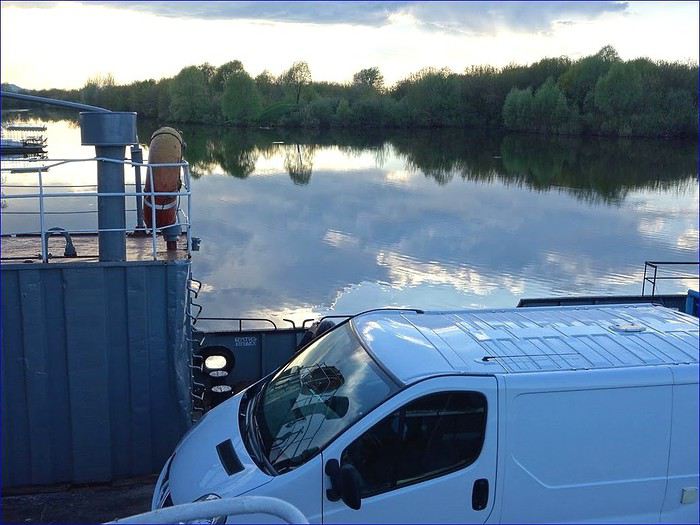
1. We arrive on the southern bank of the Volga, searching for a ferry to Makaryevo. First attempt, first failure—we’re way too far east. We find a second ferry, but it serves a different town on the northern bank.
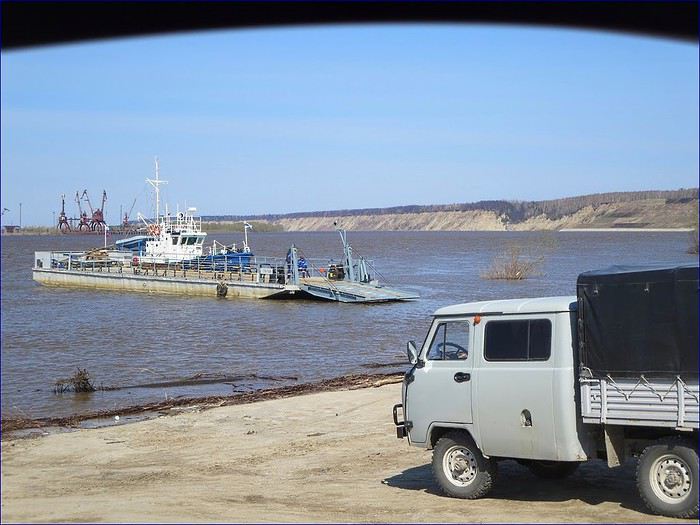
2. We keep going and meet some fishermen. But even they don’t know where to board a vehicle for the monastery.
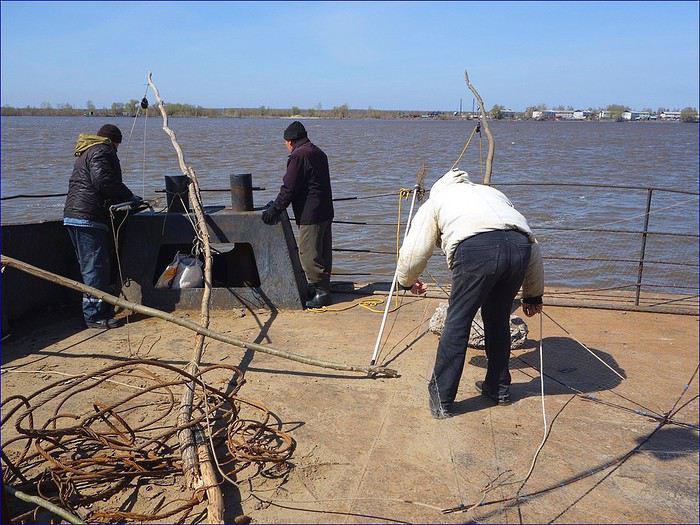
3. After several fruitless searches, a young man who speaks a few words of English points us to a dock where, in summer, boats *might* serve the monastery. Miraculously, at the end of a rough track, we find an old ferry moored. But no one’s on board, and a chain blocks the entrance.
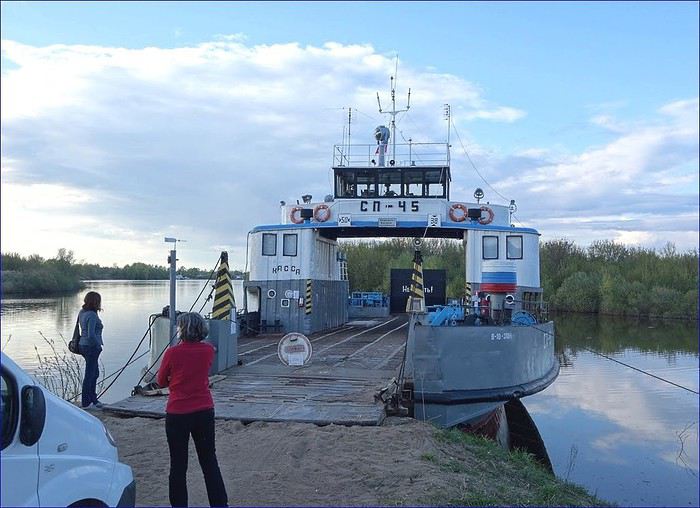
After an hour of waiting, a worker arrives and tells us they *will* cross the Volga tonight,
but the exit ramp at Makaryevo isn’t accessible for our vehicle.
The captain joins him, and seeing our disappointed faces, they confer, discuss,
and load some planks to raise the ramp!
Another miracle!
4. We board, with just one passenger accompanying us— the Trafic is the only vehicle on board.

5. The crossing was magical. And longer than expected, since the Volga here is several kilometers wide, and we’re navigating between countless islands!
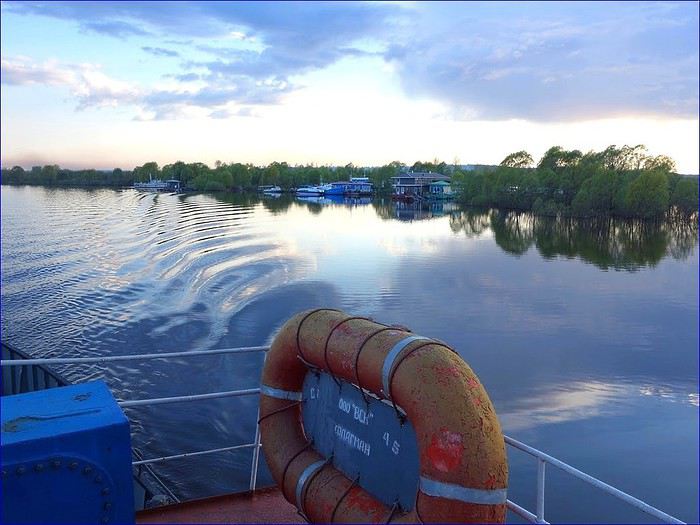
6. Under a sky that gradually clears, we discover there are homes on the river— invisible from the banks—that form small communities where people get around by boat!
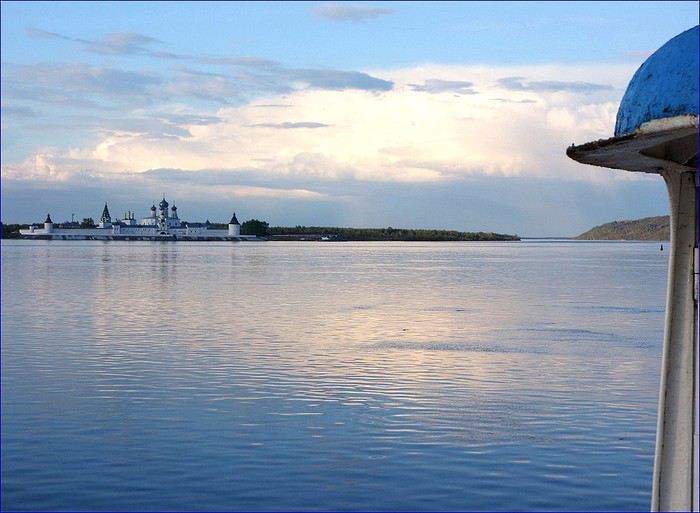
7. Then, suddenly, around a bend in the channel, the monastery appears in the distance on the northern bank.
8. At the exact moment our boat rounds the buoy and nears the monastery, the sun breaks through the clouds!

9. A breathtaking sight, with our boat gliding along the monastery walls in absolute silence.
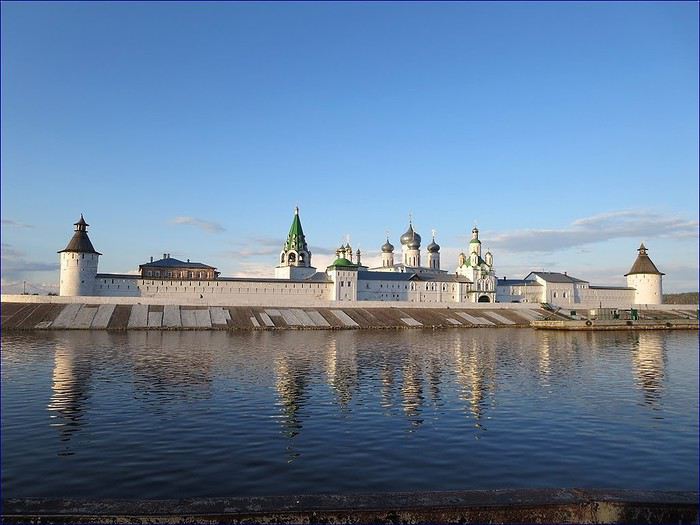
10. The sky, now a deep blue, makes the vibrant colors of the onion domes pop.
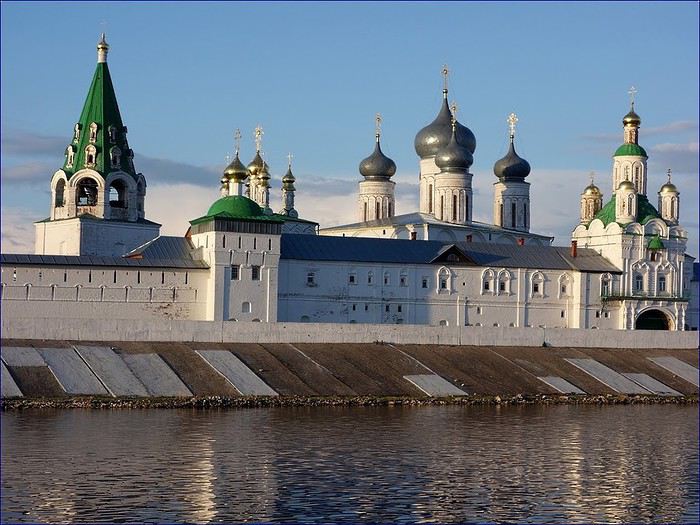
11. We sail slowly past the monastery under extraordinary light— something our little compact camera can’t fully capture.
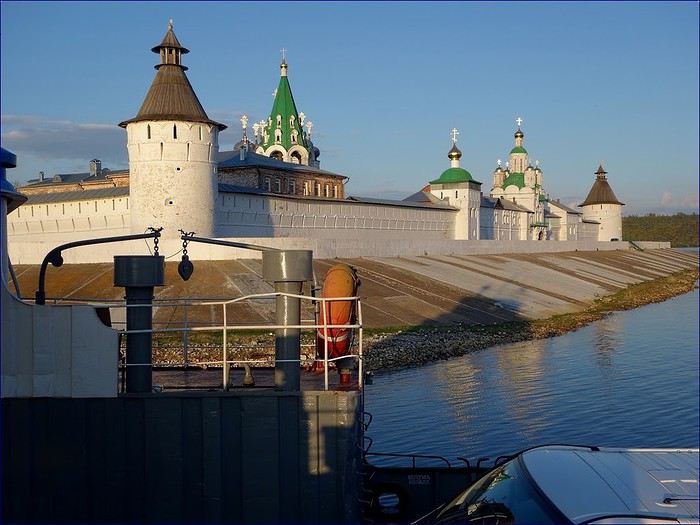
12. As promised, the captain and his crew adjust the exit ramp. You can’t tell from the photo, but even with the planks, it was a close call— the van’s chassis barely cleared the ramp. We thanked them warmly.
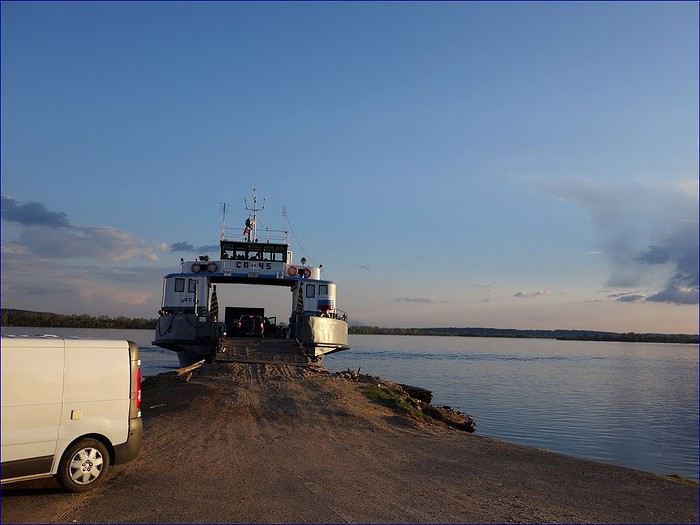
13. By the end of the day, the monastery is, of course, closed. But another miracle happens! It turns out the passenger who crossed with us is the mayor’s wife. When Sylvie told her we were from France, she called her husband, who immediately contacted the Mother Superior. Like in a dream, the monastery opens just for us. A nun and a guard come to meet us and take us through the chapels and gardens!
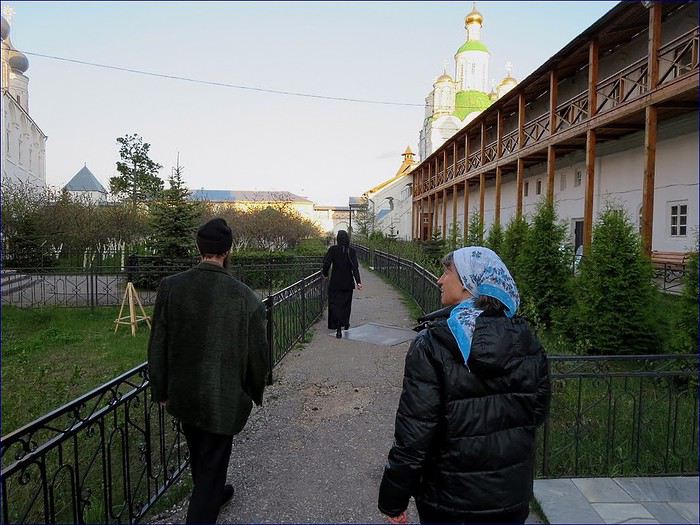
14. A visit all the more intimate since only the silent nuns, deep in prayer, are present in these sacred spaces.
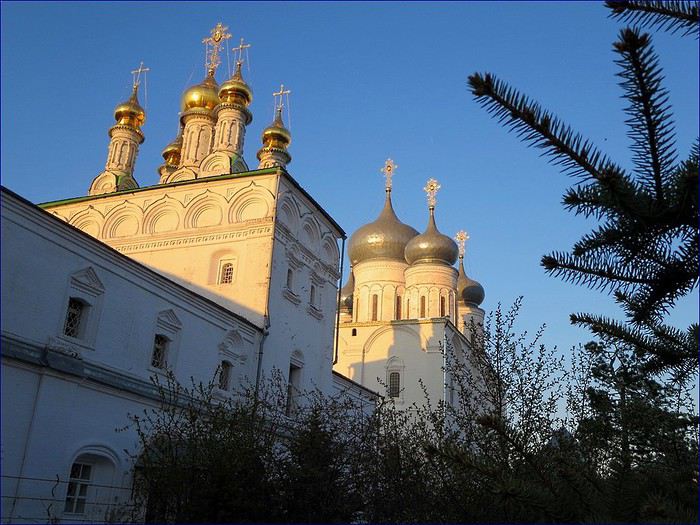
15. After dinner in our little van, we enjoy the exceptional light illuminating the now-closed monastery. We’re the only visitors, and the site feels like a massive ship anchored on the Volga.
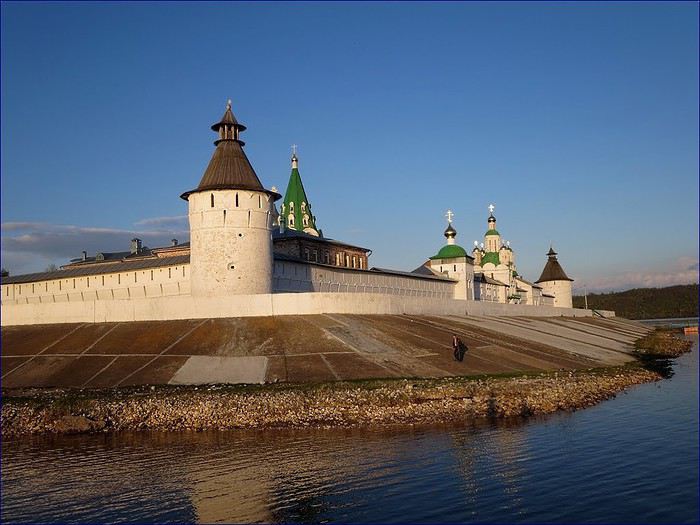
16. The setting sun now bathes the monastery walls in gorgeous pink hues!
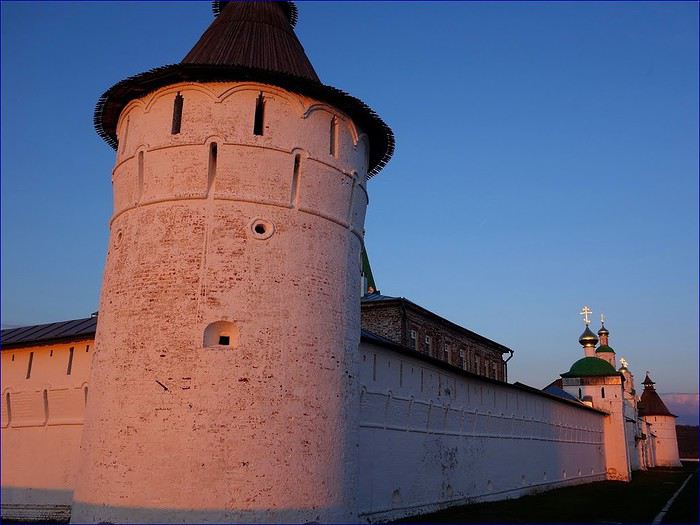
17. Gradually, the legendary Volga itself takes on magical colors! For the night, I’ll just back the van up to level it. It’ll take us a while to fall asleep after such intense moments.
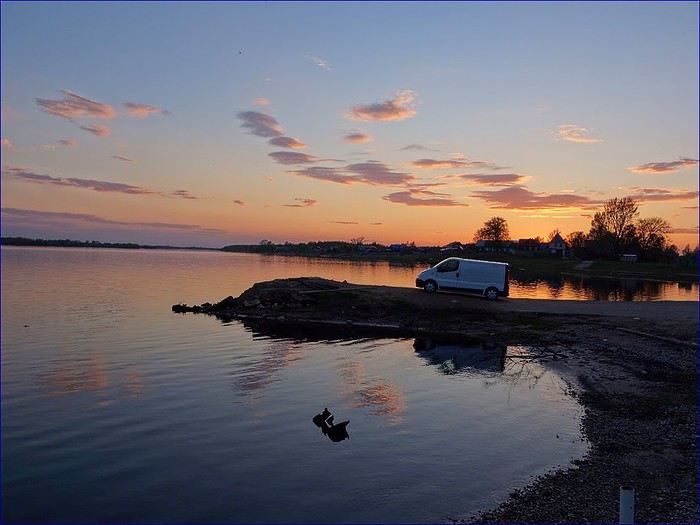
18. Just as inexplicably, the magic continues the next morning! Seeing I’m struggling with my knee, the guard lets us drive slowly along the monastery’s perimeter path. So there we are at dawn, solitary wanderers between the Volga and the monastery walls.
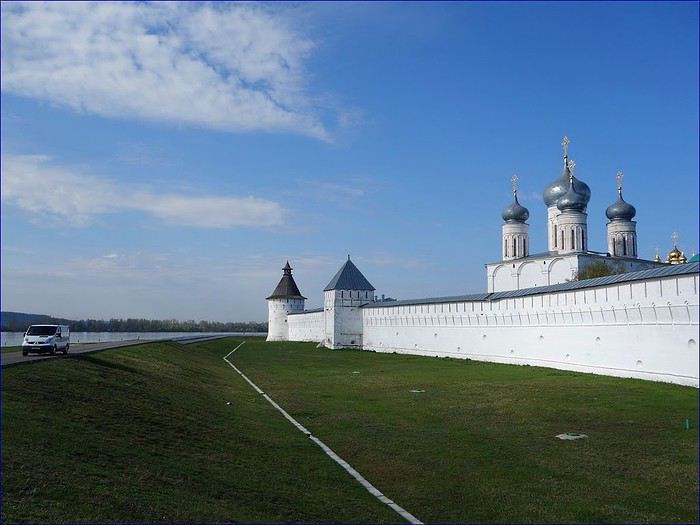
19. The morning light now illuminates the monastery’s eastern façade, which we hadn’t admired yesterday. An exceptional moment.
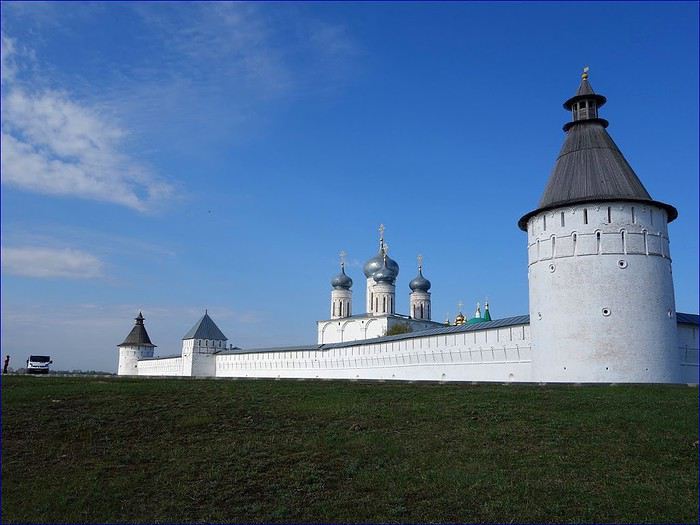
20. Even more impressive when we realize we’re on the nuns’ prayer path. We cross paths with them—tall, silent, black-clad figures, fully covered.
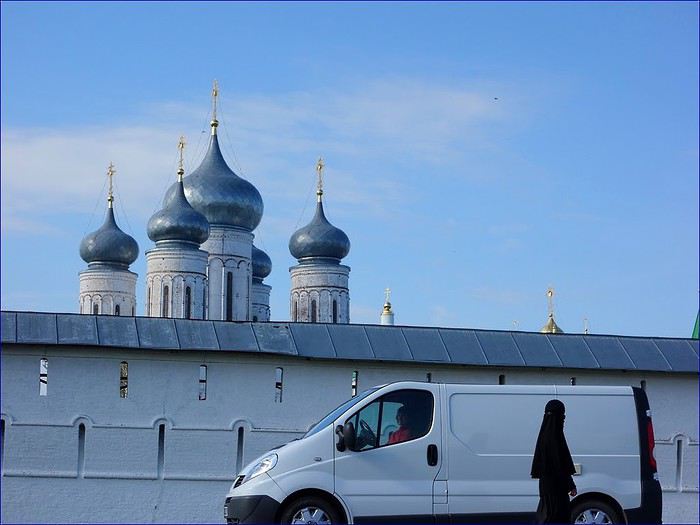
We leave Makaryevo with regret, following the Volga toward Kostroma on the Golden Ring. That’s about all there is to add.
We’ve already taken three long trips through Russia in our little van. The travel journals are shared in the link in our signature.
Best regards, Sylvie & Bernard
Today is January 7th, Orthodox Christmas Day.
It’s the perfect occasion to share on VF a religious site that left a lasting impression on us.
For a long time, we’d admired photos of the Makaryevo Women’s Monastery on Russian websites. They’re always taken from cruise hydrofoils that, in season, depart from Nizhny Novgorod.
This gave us the idea for a crazy challenge: to visit the monastery during a river cruise, with our little plumber’s van that’s become the common thread of our travels!
This challenge seemed impossible to pull off.
The equation was indeed impossible to solve
1. Find a dock 2. Load the van onto a boat 3. Cross the Volga 4. Arrive at sunset 5. Sail past the monastery 6. All with no reliable information. NONE!
Incredibly, every obstacle fell into place one after another! Gifting us unforgettable moments.
The photos follow our exact journey.
1. We arrive on the southern bank of the Volga, searching for a ferry to Makaryevo. First attempt, first failure—we’re way too far east. We find a second ferry, but it serves a different town on the northern bank.

2. We keep going and meet some fishermen. But even they don’t know where to board a vehicle for the monastery.

3. After several fruitless searches, a young man who speaks a few words of English points us to a dock where, in summer, boats *might* serve the monastery. Miraculously, at the end of a rough track, we find an old ferry moored. But no one’s on board, and a chain blocks the entrance.
After an hour of waiting, a worker arrives and tells us they *will* cross the Volga tonight,
but the exit ramp at Makaryevo isn’t accessible for our vehicle.
The captain joins him, and seeing our disappointed faces, they confer, discuss,
and load some planks to raise the ramp!Another miracle!
4. We board, with just one passenger accompanying us— the Trafic is the only vehicle on board.

5. The crossing was magical. And longer than expected, since the Volga here is several kilometers wide, and we’re navigating between countless islands!

6. Under a sky that gradually clears, we discover there are homes on the river— invisible from the banks—that form small communities where people get around by boat!

7. Then, suddenly, around a bend in the channel, the monastery appears in the distance on the northern bank.

8. At the exact moment our boat rounds the buoy and nears the monastery, the sun breaks through the clouds!

9. A breathtaking sight, with our boat gliding along the monastery walls in absolute silence.

10. The sky, now a deep blue, makes the vibrant colors of the onion domes pop.

11. We sail slowly past the monastery under extraordinary light— something our little compact camera can’t fully capture.

12. As promised, the captain and his crew adjust the exit ramp. You can’t tell from the photo, but even with the planks, it was a close call— the van’s chassis barely cleared the ramp. We thanked them warmly.

13. By the end of the day, the monastery is, of course, closed. But another miracle happens! It turns out the passenger who crossed with us is the mayor’s wife. When Sylvie told her we were from France, she called her husband, who immediately contacted the Mother Superior. Like in a dream, the monastery opens just for us. A nun and a guard come to meet us and take us through the chapels and gardens!

14. A visit all the more intimate since only the silent nuns, deep in prayer, are present in these sacred spaces.

15. After dinner in our little van, we enjoy the exceptional light illuminating the now-closed monastery. We’re the only visitors, and the site feels like a massive ship anchored on the Volga.

16. The setting sun now bathes the monastery walls in gorgeous pink hues!

17. Gradually, the legendary Volga itself takes on magical colors! For the night, I’ll just back the van up to level it. It’ll take us a while to fall asleep after such intense moments.

18. Just as inexplicably, the magic continues the next morning! Seeing I’m struggling with my knee, the guard lets us drive slowly along the monastery’s perimeter path. So there we are at dawn, solitary wanderers between the Volga and the monastery walls.

19. The morning light now illuminates the monastery’s eastern façade, which we hadn’t admired yesterday. An exceptional moment.

20. Even more impressive when we realize we’re on the nuns’ prayer path. We cross paths with them—tall, silent, black-clad figures, fully covered.

We leave Makaryevo with regret, following the Volga toward Kostroma on the Golden Ring. That’s about all there is to add.
We’ve already taken three long trips through Russia in our little van. The travel journals are shared in the link in our signature.
Best regards, Sylvie & Bernard
"Hey fellow road-trippers! 🚐🔥
After 4 years on the road, I’ve noticed something simple: we’re all looking for the same things. Authentic welcomes, great local eateries, and stops that don’t feel like supermarket parking lots.
But it’s always bugged me to see small producers or local guesthouses getting their margins eaten up by big booking platforms.
That’s why I created TerraNomad.
The concept is straightforward:
The pro (farmer, restaurant, small campsite, guesthouse) pays no commission to be on our map. In return, they offer a special welcome or discount to members.
It’s direct, local, and human. We’re starting in France, then heading together toward Morocco, Spain, and Portugal. Quick question: Does this kind of "no-middleman" network speak to you? I’m opening the first 100 Founding Member spots this Friday night (special launch price at 12 € for the year—just 1 € per month). Can’t wait to read your thoughts and see if you’d be up for this adventure! 🌍✋"
The pro (farmer, restaurant, small campsite, guesthouse) pays no commission to be on our map. In return, they offer a special welcome or discount to members.
It’s direct, local, and human. We’re starting in France, then heading together toward Morocco, Spain, and Portugal. Quick question: Does this kind of "no-middleman" network speak to you? I’m opening the first 100 Founding Member spots this Friday night (special launch price at 12 € for the year—just 1 € per month). Can’t wait to read your thoughts and see if you’d be up for this adventure! 🌍✋"
Is it complicated to rent a car and drive in Morocco? Also, is an international driver’s permit mandatory? Thanks
hi
where can you park a camper van in Trieste to sightsee and sleep?
thanks
Hi there,
Does anyone have a good agency recommendation for renting a camper van in Morocco (Marrakech or Essaouira) for about two weeks in March 2026?
Thanks for your tips!
Hi everyone,
We’re a family of four—two adults with two kids aged 4 and 7—about to embark on a year-long round-the-world trip in a camper van. I’m currently planning the Asia leg, which should last about 6 months. We’ll arrive in Thailand in January, head north, then move on to Laos. Ideally, we’d continue to Vietnam, Cambodia, and then return to Thailand to head south into Malaysia. If the budget allows, we’d love to include China and Japan. The big question after lots of research is: how easy is it to temporarily import a vehicle into these countries? The info I’ve found is outdated (2019–2020), and given how quickly regulations change, I’d love to hear from anyone currently (or recently) traveling in these countries with their vehicle. I’ve read that you need a local guide in Vietnam, local license plates in China, and that importing a vehicle into China is quite complicated—are these rules still in place? More generally, is there a recommended route for this part of the world with a camper van?
Thanks in advance!
We’re a family of four—two adults with two kids aged 4 and 7—about to embark on a year-long round-the-world trip in a camper van. I’m currently planning the Asia leg, which should last about 6 months. We’ll arrive in Thailand in January, head north, then move on to Laos. Ideally, we’d continue to Vietnam, Cambodia, and then return to Thailand to head south into Malaysia. If the budget allows, we’d love to include China and Japan. The big question after lots of research is: how easy is it to temporarily import a vehicle into these countries? The info I’ve found is outdated (2019–2020), and given how quickly regulations change, I’d love to hear from anyone currently (or recently) traveling in these countries with their vehicle. I’ve read that you need a local guide in Vietnam, local license plates in China, and that importing a vehicle into China is quite complicated—are these rules still in place? More generally, is there a recommended route for this part of the world with a camper van?
Thanks in advance!
hello fellow travelers
For my golden years, I'd like to drive to India in my 508. I want to avoid Iran and Pakistan. Instead, I’m thinking of going through Turkey, Georgia, Armenia, Azerbaijan, then taking the ferry from Baku to Türkmenbaşy in Turkmenistan, followed by the Silk Road through Central Asia—Uzbekistan and Kyrgyzstan.
After that, China? I’ve seen that some travelers manage to drive through China with their own vehicle... Then Tibet, Nepal, and India... But things get tricky with the Himalayan crossing. I’ve checked on Google—it looks tough.
Any tips or info on these routes? Thanks
After that, China? I’ve seen that some travelers manage to drive through China with their own vehicle... Then Tibet, Nepal, and India... But things get tricky with the Himalayan crossing. I’ve checked on Google—it looks tough.
Any tips or info on these routes? Thanks
Hi,
It seems that vans and campervans aren't allowed on Hurtigruten ferries?
We have a California van with a bike rack—length: 5.70 m / height: 2.20 m / width: 1.95 m.
We'd like to take the ferry from Trondheim to the Lofoten Islands this coming September.
Thanks for sharing any info!
regions Brittany, Rhône-Alpes, and Massif Central (Auvergne Limousin)
Hi fellow travelers,
We’re planning our first trip to Iceland.
We’re considering renting a 4x4 where we could sleep from time to time.
My question is: What’s the current regulation in Iceland? Which areas allow sleeping in your vehicle, and where is it prohibited (requiring you to stay in campgrounds)?
In June, is it possible to find spots without having booked in advance?
Sergio
Hi there,
We’re traveling in our camper van from Haute-Savoie.
We’ve got 2 weeks in April and want to explore northern Portugal.
We’re thinking of:
- Peneda-Gerês National Park - the Douro Valley - Porto
We love nature, hiking, and culture (and also good food and wine).😉
Do you have an itinerary to suggest?
Thanks in advance for your replies
We’re traveling in our camper van from Haute-Savoie.
We’ve got 2 weeks in April and want to explore northern Portugal.
We’re thinking of:
- Peneda-Gerês National Park - the Douro Valley - Porto
We love nature, hiking, and culture (and also good food and wine).😉
Do you have an itinerary to suggest?
Thanks in advance for your replies
Hi there,
We're planning a full week in Iceland in April. Given the short timeframe to prepare, I’m asking for some help on the forum.
We’re considering renting a camper van to be more independent with our travel. - Is this really a good idea at this time of year due to weather conditions (cold nights, poor road conditions, etc.)? - Can we just "park" anywhere for the night to sleep, or do we absolutely have to go to a campsite? What are the approximate rates for a van with 2 people? Do we need to book in advance? - If this mode of transport is recommended, do you have any good places to rent one?
Iceland is still a big island with lots of points of interest, so I think it’ll be tough to see everything in 8 days. - Are there parts of the island we should prioritize in April? We like hiking (nothing too long—6 or 7 hours is out of the question) and unique landscapes. - Are some sites inaccessible at this time of year? - Is Reykjavik worth stopping for a day or two?
Thanks in advance for your answers!
Jeff
We're planning a full week in Iceland in April. Given the short timeframe to prepare, I’m asking for some help on the forum.
We’re considering renting a camper van to be more independent with our travel. - Is this really a good idea at this time of year due to weather conditions (cold nights, poor road conditions, etc.)? - Can we just "park" anywhere for the night to sleep, or do we absolutely have to go to a campsite? What are the approximate rates for a van with 2 people? Do we need to book in advance? - If this mode of transport is recommended, do you have any good places to rent one?
Iceland is still a big island with lots of points of interest, so I think it’ll be tough to see everything in 8 days. - Are there parts of the island we should prioritize in April? We like hiking (nothing too long—6 or 7 hours is out of the question) and unique landscapes. - Are some sites inaccessible at this time of year? - Is Reykjavik worth stopping for a day or two?
Thanks in advance for your answers!
Jeff
Hi there,
Most of the time when I travel, I tow a trailer with an ATV for my local trips... I’d love to hear from anyone who’s traveled with a trailer and a second vehicle of any kind—especially the downsides of towing a trailer in Norway, aside from ferry costs.
Thanks!
Most of the time when I travel, I tow a trailer with an ATV for my local trips... I’d love to hear from anyone who’s traveled with a trailer and a second vehicle of any kind—especially the downsides of towing a trailer in Norway, aside from ferry costs.
Thanks!
hi,
I’m planning a trip to Albania in a camper van, most likely between May, June, and early July (2027), for about 60 days. On the way down, I’ll go as far as Bari (or Brindisi) and cross by ferry, and on the way back, I’ll go through the former Yugoslavia (or maybe take the return ferry?).
Has anyone been there recently? What are the roads like, the must-see spots, and any general tips you can share?
There’ll probably be two of us traveling together.
Thanks
Hi there,
During our last trip to Greece in 2021, we used Anek Lines' open deck offer, which allowed us to spend the night in our van on an open deck by the sea with access to the ferry's bars, restaurant, and showers (on the Ancona-Igoumenitsa route).
From my initial research, it seems this service no longer exists—can anyone confirm this?
Any alternatives?
Thanks
Hi everyone,
I’m planning to drive my camper van to southern Spain in autumn 2026. Ideally, I’d like to find a ferry leaving from France (Marseille or Toulon, doesn’t matter) that drops me off as far south in Spain as possible. I’ve done some research but haven’t had any luck.
Thanks for your tips!
Vanouk
We’d like to spend 15 days in August visiting Normandy by camper van, starting from Lyon.
Has anyone got an itinerary to suggest for exploring Normandy?
We’d like to go to Calvados to visit: Flower Coast, Honfleur, Cabourg, Deauville, D-Day landing beaches
Mont Saint-Michel
Alabaster Coast, Étretat cliffs, and maybe Rouen Fabienne
We’d like to go to Calvados to visit: Flower Coast, Honfleur, Cabourg, Deauville, D-Day landing beaches
Mont Saint-Michel
Alabaster Coast, Étretat cliffs, and maybe Rouen Fabienne
Hi there,
I have a bit of a crazy dream... I'd love to drop everything and hit the road with my wife and kids in a camper van.
I want to visit villages to learn, immerse ourselves in other cultures, and see different perspectives on the world. To teach my kids different values.
Hi everyone,
I’m planning a campervan road trip and would love some tips from those who know these countries: Slovenia, Bosnia and Herzegovina, Croatia, Montenegro, and Slovenia again. At the moment, nothing’s set in stone, but for example, is it better to visit Slovenia or Bosnia? My preferences lean toward landscapes (rivers, sea, lakes)—basically anywhere there’s water! :) Wild camping, cheap or even free spots, and a *very* tight budget—it’s the discovery, curiosity, and meeting locals that drive me. I’ll visit cities and sites only if access is easy (by bike, for example, or by train from an affordable campsite) and if visitors aren’t treated like cash cows. Just reasonable stuff, really. So, any advice is welcome—like swimming spots or easy hikes along coasts or rivers. I love caves and offbeat visits (salt mines in Poland, La Roque Saint-Christophe in France, etc.). Castles and old ruins? Not really my thing... Thanks for your help! Sylvia
Hi, I’m planning to pick up a camper van in Dubai and drive it back to France... is this even possible? What’s the best route? What are the main challenges? Are there secure parking areas along the way? Is diesel fuel available for the whole trip? ... So many questions... Thanks for your help! See you soon!
I'm planning to drive to the UAE by road, going through Iraq. Has anyone done this and can give me some info? Specifically about the border crossings Turkey/Iraq and Iraq/Kuwait.
Hi there,
I’d love to hear your thoughts on a trip to New Zealand in a campervan. Is it a good idea to mix hotels and a car on the North Island and a campervan on the South Island? Or should I do the whole trip in a campervan—though visiting big cities seems trickier that way.
Other questions: which companies do you recommend, and what are the least tiring or most sensible routes? 😄
Thanks for sharing your experiences and ideas!
Hi there,
We’re planning to tour Scandinavia by camper van—Denmark, Sweden, Finland, and Norway (in that order)—for 5 weeks from late May to late June 2026.
I’ve done it before, but that was way back in 1980 😎 and by hitchhiking!
We’d love to hear from anyone who’s done this trip about the best routes, great tips, must-know advice, and what to do or avoid (ferries, campsites, etc.).
Thanks in advance!
hi there,
We’re heading to southern England this summer in our camper van, including a stop in London.
Does anyone have a good experience with a campsite near London that has easy access to public transport to get into the city center? Ideally, we’d like to leave the camper van at the campsite...
Thanks so much in advance for your help!
We’re heading to southern England this summer in our camper van, including a stop in London.
Does anyone have a good experience with a campsite near London that has easy access to public transport to get into the city center? Ideally, we’d like to leave the camper van at the campsite...
Thanks so much in advance for your help!
Hi everyone,
I’m planning a trip with my camper van in autumn 2026 to head to southern Italy from Genoa by ferry.
Ideally, I’d like to leave from Genoa for southern Italy (like Messina) or another city in the boot.
I’ve done some research online but haven’t had any luck.
Can you help or give me some advice?
Thanks in advance!
Vanouk
Hi there, we’ll be in Portugal from March 9 to April 14, 2026. We’ve booked our first five days in Lisbon for sightseeing. After that, we’d like to rent a campervan (RV), but we’re having trouble finding a good site for the rental. The rental would be for about three weeks. Do you have any suggestions for us? We think it’s best to book the campervan before we arrive. And since we’re not mechanics, we need a vehicle in good condition...
Thanks so much for your suggestions. We’re open to everything—even route ideas and places to visit! Pierrette