je vais en Namibie cet automne ; Pouvez vous me dire* dans quels villages je peux rencontrer ces ethnies qui vivent encore de maniere traditionnelle ,
Pouvez vous me recommander un guide local ?
Cri Cri,
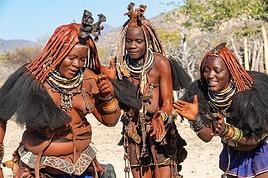
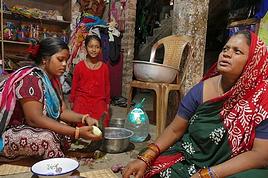
les Herreros , c'est comme les auvergnats!! Il y en a en auvergne et puis un peu partout en France (et à l'étranger!!). Donc les Herreros, ce sont les femmes qui sont reconnaissables par leur manière de s'habiller, . Les hommes , ils sont noirs comme la majorité des Namibiens!!! c'est difficile de les différencier d'un Nama par exemple.
Quant aux Himbas, les femmes c'est assez simple: elles ont le minimum syndical comme vêtement mais presque toujours un téléphone portable donc ce n'est pas comme cela que l'on peut les reconnaître. Ils sont le plus souvent dans le nord ouest à partir d'Opuwo où on les rencontre en grand nombre (aux supermarchés!! il y a des photos géniales à ce sujet qui reprennent mon texte!!). En 2009 , il y avait des villages le long de la route autour de Sesfontein. Des guides s'inviteront pour vous les faire rencontrer. Sinon, il y a le bar d'Epupa falls où toute la jeunesse himba se retrouve le soir à jouer au billard et à trinquer!!!!
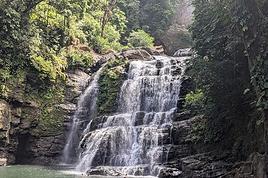
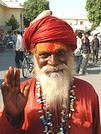
Photos 1 et 2: Himbas
Photos 3 et 4 :Herreros
bon je pense que vous avez intimidé ITIB74 (Pierre est un taquin) puisqu'il n'y a plus de son plus d'image
Il faut savoir que Hereros et Himbas sont le même peuple.
Arrivés en Namibie au 15eme siecle ils sont venus du Botswana mais historiquement ce sont des Bantous.
Leur différenciation provient de l'arrivée des missionnaires allemands qui leur ont "demandé" de s'habiller a la mode Victorienne.
Les Hereros ont acceptés les Himbas non.
D'ailleurs avant de se révolter les Hereros pourchassaient les Himbas aux côtés des allemands.
Luttes, déplacement de population, migration, révoltes... bref ils ont finalement trouvé leur place dans le nord de la Namibie et le sud de l'Angola.
Pour rencontrer des Himbas le nord est donc la meilleure région, bien que malheureusement on en voit de plus en plus partout où ils n'ont rien à faire à part rencontrer des touristes : Windhoek, Swakop, Otjiwarongo....
Ne vous y trompez pas ce sont des fins commerciaux, la plupart, ceux qui se sont installés sur les voies touristiques, se sont repartis la mane des visiteurs.
Mais sans cela ils auraient probablement oubliés leurs coutumes et mode de vie ancestraux donc pas d'état d'ame. Allez voir un village Himba c'est faire oeuvre utile (en général...)
Cependant tous les Himbas n'ont pas accès a cette ressource. Les villages près de Ruacana ou dans le nord ouest du Kunene sont restés très isolés et peu touchés par l'influence de cette nouvelle économie.
Il y a malheureusement peu de chance que vous alliez jusque la.
Un Allemand marié avec une Himba à fait venir la famille près de Kamanjab. Ils ont reconstruit leur village et en plus ils ont ouvert une école.
Les orphelins Himbas y sont accueillis. Le mode de vie, bien que transplanté est tout à fait traditionnel et si on veut voir un village sans remonter trop au nord c'est une bonne solution.
De plus le climat y ait plus détendue et moins "forcée) que près d'Epupa par exemple.
Ce village se visite, il n'est pas facile à trouver, si cela vous tente je peux vous expliquer l'accès. de plus l'argent va directement à la communauté.
Il y a d'ailleurs quelques femmes hereros qui sont revenues y vivre.
Opuwo, capitale du pays Himba est aussi une bonne alternative pour les rencontrer. Ville souvent décriée, elle a cependant une atmosphère unique de cohabitation entre modernité et tradition.
Voir des Himbas faire leur course au Spar est quelque chose d'assez incroyable.
il vous suffit de vous rendre à l'office du tourisme et l'on vous indiquera un ou plusieurs villages bien moins fréquentés que ceux d'Epupa.
je vous conseille un superbe documentaire tourné par... les Himbas eux mêmes : "les himbas font leur cinéma" En fait la réalisatrice est Solenn Bardet, une française qui a vécu longtemps avec eux et les connait très bien.
Ils évoquent leur vie, les relations avec les touristes, ce qui les amuse, les choc.
Pour les Hereros vous en verrez partout. De la a lier connaissance c'est une autre histoire. Peuple éleveur particulièrement fier ils ne se lient pas facilement.
Une chose intéressante est le Heroe's day qui a lieu tout les ans à Okahandja fin aout. C'est la fête nationale Herero (jour de fête nationale) qui commemorent la vistoire contre les allemands et les sud af.
Mais comme rien n'est simple en Afrique les 3 factions Hereros (blanc, rouge et vert) n'ont pas été capable de se mettre d'accord entre elles en 2012 et la fête a été réduite à son minimum.
Ils convergent tous ensemble vers le cimetières ou se trouvent les tombes de Hereros morts a la guerre.
Bon je ne sais pas si j'ai été aussi précis que vous le souhaitiez mais j'ai parlé de ce que je connais.
je ne sais pas pour ITIB74 mais moi, je suis ravie et je m'empresse de conserver ce bout d'histoire locale dans mes trésors, même si mon rêve d'Afrique va durer jusqu'en 2015 🤪
« En effet dans certains cas mieux vaut s'abstenir de commentaires...et rester silencieux »
Les vôtres(comùmentaires) par contre sont extrêmement intéressants.
Mes voyages (ou tour du monde) s'intéressent très souvent aux ethnies, migrations des peuples etc.
Je vais donc avec mon épouse en Afrique Australe principalement pour cela (et aussi fêter nos 40 ans de mariage ....)
Il est vrai que les Himbas et les Hereros (ainsi que les Bushmen) sont d'un grand intérêt pour nous .Il semble cependant qu’il y a différentes possibilités de s'intéresser à ces populations, certaines plus proches de la réalité que d’autres plus « commerciales » Je ne porte aucun jugement sur ces dernières (n’avons-nous pas en Europe des comportements … commerciaux quelques fois ? aucun musée voir églises payantes !!! ) cependant je souhaite le plus possible m’approcher de la réalité vraie et aussi faire bénéficier ces peuples de dons que nous pourrions leur apporter .
Nous allons donc aller dans la région d’Opuwo pour 3/4 jours. Nous avons prévu de visiter aussi l’orphelinat près de Kamanjab mais il semble ??? Que cela soit commercial ?Si vous avez des détails pour l’accès merci d’avance.
En ce qui concerne Opuwo nous avons fait un message au TO local il y a 15 jours mais pas de réponse car nous souhaitons savoir ou (lieu distance, kilométrage, etc.) nous rendre .Si vous avez des précisions ou une autre adresse afin d’obtenir ces renseignements (merci)
Le film nous connaissons bien sur et l’association de Mme Bardet .Nous avons même contacté son association en leur demandant ou on peut rencontrer les Himbas et que devons nous leur apporter. Réponse après 3 relances par mail : On ne répond pas on n’est pas une agence de voyage …. Bon pour une association ayant pour but d’aider les Himbas je n’ai pas compris la réponse ceci d’autant plus qu’ils organisent un voyage en Aout no comments
Par contre merci à vous et aux autres internautes qui échangent leurs connaissances (précises) avec nous.
Conclusion : merci encore et éventuellement si vous avez un contacte à Opuwo .
Me permets-tu quand même de relever que vouloir éviter une approche commerciale avec les Himbas tout en demandant à un T.O de te les localiser et en envisageant de leur apporter des biens matériels recèle, peut-être, un soupçon de contradiction?
Comme Nammanu l'a indiqué dans son message, une démarche logique consisterait à "traîner" dans l'extrême nord-ouest en espérant en rencontrer au fil de leurs propres pérégrinations (tu n'ignores pas que, lorsqu'ils ne sont pas "fixés" par le tourisme ou par la saison, c'est gens-là sont d'abord nomades au gré de l'alimentation de leurs troupeaux).
Je sais que tu vas mal le prendre mais si ta demande à l'association de S.Bardet était formulée comme celle d'ici, je comprends assez bien qu'ils aient décliné.🙁
Dans un village d'estive de Hartmann Valley, un ange passe😇:
Ma petite blague n'a pas suscité de commentaire de ta part...
Mais c'est l'Afrique et on parle de peuples semi-nomades !
Je vais essayer de faire un début de réponse (imprécise) quand même...
La seule façon de rencontrer des Himbas hors des circuits touristiques et commerciaux c'est d'aller là où ils vivent hors des circuits touristiques et commerciaux. C'est à dire en dehors du fameux axe Palmwag / Opuwo / Epupa Falls où tout le monde va se prendre pour Nicolas Hulot ou Solenn Bardet (moi le premier il y a quelques années !).
Plus loin dans le Nord-Ouest du Kaokoland, là où les TO n'envoient pas leurs clients (et ils ont probablement raison).
Si vous êtes assez gonflés, aventureux, autonomes, organisés, compétents pour conduire un 4x4 et éventuellement le dépanner... (rayez les mentions inutiles) pour aller passer du temps dans ces régions, vous ferez sans doutes des rencontres authentiques (mais pas forcément positives, ça peut aussi mal tourner sans qu'on y comprenne grand chose !).
Ils n'attendent pas après vous et si leur choix de vie est de rester à l'écart du monde, c'est vraiment leur choix. Ne les prenez pas pour des imbéciles ou des ignares. En tout état de cause, je serai bien en peine de vous donner un point GPS de l'endroit où votre passage ce jour-là tombera quand ils ont besoin par exemple de médicaments pour soigner quelqu'un... Je peux vous dire où ça s'est produit pour nous dans le passé, mais pour l'avenir, je ne lis pas dans le marc de café.
Pour les Bushmen, c'est en même temps un peu pareil et un peu différent puisqu'ils n'ont plus d'espace où vivre selon leur mode de vie traditionnel de chasseurs-cueilleurs (plus le droit de chasser et beaucoup moins d'animaux, leur espace étant de plus en plus clôturé et découpé en fermes d'élevage bovin). Mais les contacts avec eux sont un peu plus faciles et naturels... Sauf si tu arrives le jour où ils ont touché leur allocation et qu'ils sont soûls comme des barriques.
Sinon, il s'agit d'"exhibitions" dans les fermes d'hôtes et les lodges du Kalahari.
Encore une fois, plus loin des sentiers battus la rencontre aura lieu, plus elle aura des chances d'être un peu naturelle. Vers Tsumkwe et le Nyae Nyae Conservancy où pas grand monde ne va par exemple...
Les Hereros sont partout en Namibie. Y compris à Windhoek.
Rien à redire c'est de la belle explication circonstanciée..🙂
les zones ou les himbas vivent hors "tourisme" se reduisent pourtant au fil des ans... dans les années 2000 les villages étaient tout au bord de la 3707, et les échanges directs avec eux étaient simples..
Quand à la commercialisation de leurs images... himbas et héreros qui ne s'appréciaient guère dans le passé... pourtant proche (relatif a des engagements historiques cités plus haut....) maintenant ils font cause commune dans les boutiques de bords de pistes pour vendre les souvenirs... adaptation mercantile... mais il y a de la demande...
L'assos de Solen B... 😇 parle s'en a Nathalie de chez L..gui, tu en auras un retour plein de belles nuances 😉
Question subsidiaire: comment est-ce qu'on converse avec les "vrais Himbas" ?, je doute qu'ils parlent Anglais et nous leur langue.
En plus j'avais lu qu'il y a une façon de les aborder, et peut-être pas "salut Paul, moi c'est Georges, alors c'est là que tu crèches ?".
Et c'est d'autant plus compliqué si on veut leur donner quelque chose; il faut passer par le chef du village sinon on sape leur autorité.
Pour moi il n'y a que trois solutions:
- on ne rentre en contact qu'avec ceux qui viennent vers nous, car ils le veulent bien ... même si c'est avec des pensées (pas que arrières) mercantiles.
- on fout la paix à ceux qui se sont retirés car justement s'ils se sont mis à l'écart c'est pour l'avoir ... la paix.
- et la plus belle (celle à laquelle tu faisais allusion) la rencontre inopinée au détour d'une piste, mais celle-là ne se commande pas.
Perso n'étant pas attiré par les villages "touristiques" (bien que chez moi en Alsace des jeunes se font aussi de l'argent de poche en se faisant photographier habillés en Alsaciennes) j'ai laissé le hasard faire, je me suis donc contenté de les voir au bord des routes, au supermarché, etc, ...
Après, à la question que pouvons-nous leur apporter ... je ne vois que "des microbes" et une "addiction à l'argent" ! 🏴☠️
j'aime bien ton message, il me semble empreint d'un respect et de bon sens, une seule chose me turlupine, désolé mais c'est quoi le concept de vrai Himba ?
Il n'y a que des Himbas. Qu'ils vivent à Puros, Swakop ou au fin fond du Kunene ce sont les mêmes.
Ils ont fait le même choix de renoncement de la civilisation voulu. Leur vie nomade, elle fut imposée mais est devenue leur héritage.
Après il y a ceux qui vivent grace au tourisme et les autres, bien qu'en fait tout le monde en profite un peu.
Quand on visite un village au bord de la B1 ou en Angola on voit la même chose et le même mode de vie.
Pourquoi allez les rechercher specifiquement la ou ils ne veulent pas être vus ? Simplement parce qu'on peut le faire en arrivant avec nos 4x4 ? Ou alors juste pour dire "moi je ne fais pas comme tout le monde, je vais ou les autres ne vont pas..." quitte à les emm...
En fait tes 3 solutions sont très justes et beaucoup devraient s'en inspirer.
Ce qui ne semble pas être le cas.
On peut raconter tout ce qu'on veut, quand on ne va pas dans un village qui a choisi officiellement (et je dis bien officiellement) d'accueillir des visiteurs, on force la porte. Pratique que beaucoup tenteront de justifier par l'accueil, la rencontre... mais qui s'apparente pour moi a une mauvais forme du tourisme, et un rapport de force économique.
La preuve, le nombre de photos "volées" qu'on voit régulièrement (même dans ce fil de discussion), c'est qu'en plus on est bien conscient de ça. Honte !
Le documentaire de Bardet est très instructif a ce sujet.
Après le personnage, comme beaucoup de ceux qui ont une passion dévorante. C'est comme être chasseur, le mode de fonctionement ne s'explique pas (moi je ne comprends pas et j'ai renoncé).
@ Himba, j'en parlais justement avec Nathalie (puisque tu l'as nommée) il y a 1 heure, car je ne savais pas dans quel sens prendre ton allusion...et bizarement c'est un truc dont je n'avais jamais parlé avec elle.
@ Itib 74 - si tu suis mon idée, ton approche de dire pas dans un village "commercial" n'est pas la mienne et ne veut rien dire.
et enfin @ Max pour la conversation c'est simple, sans interprète il n'y en a pas, impossible de se comprendre et d'avoir le moindre échange sauf a parler leurs langues (avec un s). Bien l'idée de laisser faire le hasard. Et pour la prochaine fois pas de scrupules, un village ou on paye directement aux Himbas, c'est du business pour eux. Un truc, on voit parfois des Dames Himbas brandir des couvertures sur le bord des routes, elles ne veulent pas les vendre mais montrent qu'elles ont une protection pour ne pas salir les sieges de la voiture, elles font du stop !
Ce qu'on veut finalement s'est rapporter une photo de "sauvage" après on peut broder et dire aux amis héberlués qu'on l'a prise à Hartmann, ou encore mieux en Angola. (a prendre au second degré ! ou ?)
c'est du second degré, ça fait allusion au souhait de certains de rencontrer des Himbas en dehors des structures mercantiles, ce qui sous-entend justement que ceux qui commercent ne sont "plus" de vrais Himbas 😉
Je ne sais pas si je suis clair 😊
Un truc, on voit parfois des Dames Himbas brandir des couvertures sur le bord des routes, elles ne veulent pas les vendre mais montrent qu'elles ont une protection pour ne pas salir les sieges de la voiture, elles font du stop !
Après il y a ceux qui vivent grace au tourisme et les autres, bien qu'en fait tout le monde en profite un peu.
C'est très juste, et pas uniquement en Namibie, pour les Himbas : on incite bien certains éleveurs de bétail très connus (ceux qui sont habillés de rouge et qui traditionnellement tuaient un lion pour marquer leur entrée dans l'age adulte) à prendre une part active dans l'économie du tourisme en tant que guide par exemple afin de les intéresser à la préservation des espèces que nous adorons venir photographier ... Et en prime ils nous gratifient de leurs chants et de leurs danses "traditionnels".
Qui est l’instigateur de ce changement de vie ? L’autochtone lui même ? son environnement ? les voyageurs ? Et qui en tire le meilleur parti ?
En tout cas j'aime bien le concept (ironique) de "vrai" (Himba, Masai, ou qui que ce soit) : est-ce celui qui ne veut pas être vu ou celui qui tire parti de la situation et s'adapte ?
@ Himba, j'en parlais justement avec Nathalie (puisque tu l'as nommée) il y a 1 heure, car je ne savais pas dans quel sens prendre ton allusion...et bizarement c'est un truc dont je n'avais jamais parlé avec elle.
M'étonnerais pas d'avoir des réponses.
🙂
Emmanuel
salut Emmanuel
des réponses oui pour sur !!!
je suis bien d'accord avec toi 😉 et alors le retour de Nat sur la miss Solen....!!!!
Après surtout un commentaire sur un fond de sentiment pour le fil... rien que le titre m'a fait bondir... un Guide à Himba... un peu comme un appeau à ortolans 🤪 😠....
Je cherche un guide local pour aller dans un village himba vers Opuwo de manière respectueuse. Nous serons 2 (ma femme et moi) avec une voiture au départ…
Hello everyone!
It's been a year since I've been longing for South Africa. Our first trip in August 2025 amazed us, and—rarely—it was a unanimous hit with our little family! We were touched to the core, and from the moment we got home, we couldn’t stop talking about going back. 😄
I’d like to take this opportunity to thank everyone who gave me advice on the itinerary for that first trip (Johannesburg loop: Blyde, Kruger, Eswatini, St. Lucia, Durban, Drakensberg)! Thanks to you, our trip went like a dream!
Since then, I haven’t stopped reading articles and discussions on VoyageForum to keep my head in South Africa a little longer!
So, we finally caved and just booked our tickets for January 2027 (from the 3rd to the 26th), with a plan to do a road trip from Cape Town to Johannesburg in about 3 weeks.
I’ve got a rough itinerary that seems great based on what I’ve read on various forums, but there are still some uncertain points, and that’s where I could use your advice.
3/01: Arrival in Johannesburg at 11:45 PM
4/01: Flight to Cape Town, pick up rental car. Afternoon sightseeing
5,6,7/01: Cape Town to visit the big classics in the area (any tips for finding accommodation: which neighborhood, a specific place?)
8/01: Overnight stop before Oudtshoorn—but where??? (Is it essential, or is the CT-Oudtshoorn drive manageable? If so, I’d gain a day in Oudtshoorn. Google Maps shows over 5 hours of driving...)
9,10/01: Oudtshoorn (or would 3 nights be better to really enjoy the area?)
11,12/01: Knysna, Plettenberg Bay (to have time for hiking—if you’ve got hiking tips, I’m all ears!)
13,14/01: Tsitsikamma (still to have time for hiking—who knows the must-do hikes in the area? But maybe 4 nights in the Knysna-Tsitsikamma area is too much—I’m not sure)
16,17/01: Addo Elephant (I’m torn between 3 nights at Addo or 3 nights at Mountain Zebra. Based on travel journals, especially Michel’s on MZ, I’ve scheduled 3 nights at MZ 😄...)
18,19,20/01: Mountain Zebra NP
21/01: Camdeboo NP (because it looks so beautiful!)
22/01: Overnight stop (where?) before wrapping up the trip with either 2 or 3 nights at Golden Gate NP or the Lesotho option, which appeals to me, but I don’t know if it’s doable in 3 days to be back in Johannesburg by the afternoon of the 26th.
That’s my trip idea for now...
I’m eagerly waiting for your advice, ideas, and comments...
Can’t wait to be back there again!
We're heading to South Africa for a month with 5 adults.
We'd like to rent a vehicle that can accommodate 5 people and all our luggage.
We're starting in Cape Town and ending in Johannesburg.
What vehicle would you recommend?
EDITH
Hi everyone!
I’m still planning my Cape Town to Johannesburg trip in January 2027.
I saw a documentary about the San people in Namibia, and the same day, I stumbled upon the Lonely Planet page about !Kwah Ttu.
I checked out their website to learn more, including Michel’s travel journal about it. I’m really keen to go.
So, I’m thinking of dedicating:
- either 1 day out of the 4.5 I have in Cape Town...
- or making a detour to !Kwah Ttu on the day I leave Cape Town for Montagu, instead of visiting Franschhoek and its Saturday market...
To the VFers who’ve already been: is it really worth spending a day there?
Thanks in advance for your feedback!
Malijp
Hi there,
I’m planning a gorilla trek in Bwindi, Uganda. I’m torn between the classic option (1 hour with the gorillas) and the habituation trek (4 hours with the gorillas but a more expensive permit). Has anyone done the habituation trek? Both? If so, I’d love to hear your feedback (including on the difficulty).
Thanks
I’ve read some travel journals here but I still have a question.
We’re heading to Uganda next February. The gorilla permits are booked, and the flight tickets are sorted too.
My question is about the chimpanzee trek. I’d love to know whether it’s better to book the habituation experience (4 hours) or the standard trek (1 hour).
The price difference isn’t huge, but I keep wondering and I’d hate to miss out on a great experience.
Thirty years ago, I traveled to Zanzibar (Tanzania) with my children. Since I’ve since started a new family, I took the opportunity of a trip to Kenya to bring my new family along: my wife, who’s Kenyan, and my 10-year-old daughter.
Zanzibar has really changed in 30 years.
It’s become the island of taxes.
It all starts upon arrival: I think it’s the only country in the world, besides the visa, where Zanzibar insurance (and no other) is mandatory—it costs 40 €. If you didn’t purchase it before arriving, good luck getting it: the IT systems are unreliable. With a bit of luck, it’ll take at least an hour to process! And of course, this insurance is useless—if you get sick, it’s recommended to use your home country’s insurance because if you use Zanzibar’s, your national insurance won’t cover you anymore.
I wanted to show my daughter the red colobus monkey, which is endemic to Zanzibar. I paid for a tour that was supposed to be all-inclusive. First, we visited a spice farm, where a farm guide took charge of us—meaning commissions were involved, of course! The tour was very good and informative, though. When we arrived at Jenzhi Park (the colobus park), the guide told us he "forgot" there was an entrance fee (50$).
Aware of the system, I decided to book an Ocean Blue tour through the Zanzibar Tourism Office. After two hours of driving, we stopped at a beach—and were left there. No boat was ready to take us. Since my wife speaks Swahili (the language in Zanzibar), after an hour, a captain with his own boat agreed to take us along with his family.
Another attempt. The main attraction in Zanzibar (besides the city) is Changuu, the Prison Island. You have to take a motorboat and pay the captain, which is normal.
But in Zanzibar, to even get on a boat, you first have to pay a tax! Once we arrived at the island, it started all over again! Thirty years ago, access was free, and the entire island (about 1 km²) was open. Today, there’s a small office, and you have to pay a hefty fee to enter. But enter where? A paved path leads to about 15% of the island—the rest is off-limits. In total, I paid 100 € for my wife, daughter, and myself just to visit a tiny portion of the island! Avoid this!
For the rest of our stay, we stayed at a 5-star hotel with golf, horseback riding, tennis courts, evening concerts, etc.—undeniably high-level comfort. One last thing: if you want to rent a car, it’s affordable and useful for exploring the island’s diverse landscapes, but there are speed cameras at every corner on the main roads. The fine is supposedly 100 $, and it’s hard not to get one!
I told you: Zanzibar, the land of taxes. I used to think my country, Belgium, was the tax champion—I’ve found something even better!
Hi everyone,
We’re revising our travel plans for January 2027. Originally, we were considering Uganda for about 14/15 days, but given the current health situation and the restrictions that might affect my partner, who’s American, we’ve decided to switch to Tanzania instead.
I’m used to traveling in South Africa and organizing my trips myself, but I get the impression that planning a safari in Tanzania is quite different.
I know self-drive isn’t really an option in Tanzania. So my main question is: can you organize your own itinerary and book lodges directly, then hire a local driver-guide? Or is it better to go through a local agency that handles the entire safari?
For the itinerary, which parks would you recommend for a first-time visit in January? Serengeti, Ngorongoro, Tarangire, Manyara, Ruaha, Arusha, Selous…
We’d also like to include Zanzibar to end the trip with a few days at the beach. Over 14/15 days, does that sound realistic or too ambitious?
Finally, for flights, is it better to arrive at Kilimanjaro (JRO) or Dar es Salaam (DAR) based on the itinerary we’re considering?
Thanks in advance for your feedback, especially on the best way to organize the safari and which parks to prioritize in January!
In Nov./Dec. 2022, I went on a safari in the region and we suffered from the extreme temperatures caused by the "El Niño" phenomenon in the Indian Ocean at that time. On top of the extreme heat, there can be torrential rains, flooding, etc., which have led to disasters with casualties.
We're now just 5 weeks away from our trip to South Africa 🙂 and *so* excited to explore (just a tiny bit of) this amazing country.
I need to buy some binoculars but have no idea which model to choose. I don’t really know what to look for (and I don’t want to spend too much).
Thanks in advance to anyone who can give me some tips!
We just got back from ten days in Tanzania. We were lucky enough to be guided by Gishaman. Always in a great mood, a good driver, and an excellent guide. Thanks to him, we not only saw the Big Five in one day but also loads of other animals. He works for the local agency Blit Safaris, which provided excellent support throughout our trip. Highly recommended!
I’m planning a potential trip to Namibia for a classic circuit in April 2027.
I’m surprised by how expensive the accommodations inside the parks are—really steep! Is it possible to stay outside the parks but still close enough to enjoy the game drives?
Do you have any recommendations for more reasonably priced lodging? I’m okay with spending 200 to 250 € per night.
No camping—the friend I’m traveling with absolutely refuses 😉, but maybe upgraded tents would work.
Hi, I'm looking for information on the road conditions in Moremi. We're leaving in 15 days, and from what I've heard, the roads are pretty tough to drive on. Any advice?
Thanks
My trip to South Africa is getting closer (still 2 months to go 😏), and I’m diving back into my itinerary: from Saturday to the following Sunday around Cape Town, then from Sunday to the following Saturday in Kruger.
For Cape Town, the plan was to avoid changing accommodation every day (we’ll do enough of that in the second part) but still see different landscapes.
I know, I’m missing out on a lot, but you’ve got to make choices, and after all this time, I know what I like—and especially what I don’t (or like less) 😉
Here’s the breakdown:
Arrival Saturday at 11 AM: heading to Hermanus (2 nights). The idea is to stroll along the cliff path in the afternoon, and possibly drive to the Klein River Lagoon. Sunday: Stony Point, then depending on time and weather, a hike in Kogelberg Nature Reserve or Fernkloof Nature Reserve (which seems less scenic but has shorter walks).
Monday: drive to Franschhoek (1 night). If everything lines up, a hike in Jonkershoek NR and a visit to a wine estate.
Tuesday: drive to Mountceder Lodge in the Cederberg (2 nights). I’m thinking of visiting the Stadsaal Caves and the elephant paintings, and maybe one of the hikes listed on the lodge’s site or Maltese Cross.
Thursday: heading to Hout Bay for 3 nights. In no particular order: a classic day trip around the peninsula, half a day at Kirstenbosch Gardens, and half a day at Lion’s Head.
Sunday: flight to Johannesburg.
My questions are mostly about (short) hikes:
Has anyone here done hikes in Kogelberg, Fernkloof, or Jonkershoek?
At Mountceder Lodge (Michel, if you’re reading this… 😉), has anyone tried the hikes (guided or not) offered by the lodge?
There’s still half a day to fill when we’re in Hout Bay—any ideas (not necessarily hikes)?
Lastly, regarding safety: the French foreign ministry (always alarmist, but still) recommends hiking in groups. Is it really risky in broad daylight? (I’m not sure a group of two women counts as a "group"…)
Thanks in advance for your answers, ideas, and comments!
Question: we’re doing a 3-week trip in Namibia, including 5 days for Victoria Falls.
I’ve booked one night in Brandberg, and then I have some questions.
I was thinking of spending 2 nights in Palmwag, then heading to Etosha for one night in Okaukuejo and then 2 nights in Halali.
Alternatively, from Brandberg, I could book a night near Galton Gate and then enter Etosha.
I’m not really sure about the distances, especially with a 4x4.
Same for the return trip: Halali to Windhoek seems long. Maybe it’d be smart to break it up on the way back? (We have 2 days to get back if needed.) If so, where?
Jambo! I organized my trip through this kind of group, so I thought I’d share my experience here. We traveled as a group of four, including two kids aged 9 and 11. After requesting around twenty quotes, I decided to book the safari portion with MAKING MEMORIES IN AFRICA. Ally responded quickly and listened to all my requests—unlike other agencies—such as having a French-speaking guide, the order of park visits (Tarangire, Manyara, Serengeti, then Ngorongoro), and a mix of budget hotels and camping to keep costs down. There were still four agencies in the running, and price was the deciding factor. Even though they were the cheapest, I felt better taken care of than with others. For example, all meals were prepared by a Maasai chef, Louis, who accompanied us throughout the trip, while some others ate meals out of cardboard boxes. Samuel, our guide, explained so many things and answered all our questions. José drove us safely the whole way. Everything was done with great cheer!
At the end of the stay, Ally came to meet us and gave us t-shirts with the agency’s logo—we loved that they took the time to hear our feedback in person. In short, I highly recommend them +++, especially since it’s a local agency that also supports a charity for women and children.
For Zanzibar, I organized everything myself. I hesitated for a long time but eventually booked all four nights at the same place. We don’t like crowds, so I initially considered Jambiani but ended up choosing EVERGREEN BUNGALOWS in Bwejuu. We took their first airport-to-hotel transfer since we arrived at night, and it felt safer. Great value for money, in our opinion. Just be aware that it’s quite isolated—perfect for relaxing and going on excursions. There were very few beach vendors, unlike what I’d read about Zanzibar. We lived with our feet in the sand from morning to night, with a small basin of water outside our room to rinse off. Such a lovely spot!
I had asked for some excursion prices before leaving but ended up booking on-site. Not at our hotel, but at a nearby restaurant that was cheaper. After some thought, since we were based in Bwejuu, I wanted to do Blue Lagoon and Pungume (both departing from the south of Zanzibar).
Blue Lagoon: About 3 hours total, with snorkeling on a small reef full of fish (coral wasn’t great) and a stop at a spot with tons of starfish, plus local snacks, fruit, and drinks.
Pungume: An amazing day with a 50% chance of seeing dolphins (we missed them), a visit to the mangroves, then snorkeling at a spot with some nice coral and, of course, fish. We ended with a fantastic grill (tuna, shrimp, squid, lobster, and fries) on a sandbank in the shade.
Finally, before heading to Stone Town, we visited Paje Cave, which is much less known than Maalum. It’s smaller, but we saw bats, went for a swim, and fed the chickens and rabbits (great for the kids). To finish, we explored Stone Town on our own and had dinner at Forodhani Market.
For flights, we flew with Turkish Airlines from Barcelona to Kilimanjaro and back from Zanzibar—no issues there. However, I don’t recommend the Kilimanjaro-Zanzibar leg with Precision Air. Our luggage didn’t arrive, and according to the hotel, this happens often. We only got it back a day and a half later.
March or May 2027.
Around 15 days in the Western Cape,
then 15 days in the southern KNP.
Arrival either in PE or George.
The pros know I’m somewhat familiar with the area... that I don’t camp... that my accommodations can be simple and remote, self-catering but with basic comforts... that I’m looking for spots that are a bit off the beaten path... in a relaxed mode...
From George:
Late arrival... need some rest... Herolds Bay from George to the N1.
Tsitsikamma is catching my eye (Storms River)... with or without a stop in Knysna.
Question:
What’s the current condition of the pass from Knysna to Uniondale? R339.
And while I’m at it, the condition of the R340.
Tsitsikamma, Knysna, and my questions still apply if arriving in PE.
Is the Swartberg still closed?
Any recommendations for accommodation in Prince Albert?
If I cross the escarpment, I’ll continue via Anysberg NR, Touwsrivier... any thoughts?
From there... Tankwa Karoo or Mount Cedar (or both).
Then heading back down to the coast... the highlands of Hermanus or Kogelberg NR (any opinions on the latter?).
Or,
A more classic route along the coast...
If I arrive (fairly late) in PE... any ideas for accommodation in that little area?
Given that Nyathi Camp is winking at me...
(For context... a while back, I stayed at Riverbend (same Addo sector, private concession)... and I visited the ruins of that abandoned lodge at the time, which has clearly been renovated since... located in a very quiet part of Addo...).
Any feedback from the pros?
Well, that’s about it...
I’m open to any other tips or advice!
I’m reaching out with a question about which park to choose for a 3-day safari in Kenya.
After 20 days in Uganda, I’m meeting up with my dad for a 3-day safari (that works for him). We’ll be meeting in Nairobi and have a full day to travel to a park (preferably the farthest from Nairobi to avoid crowds?) and spend 4 nights there before heading back to the capital for our flight to France.
I’d love to hear your recommendations since I’ve read so many great tips on this forum.
At the end of July, we’re heading to Namibia with a group of five for a three-week road trip and visit to the national parks.
We’ve read conflicting info about buying entry tickets—either online (where?) or at the gate when we arrive?
I’d love to hear your thoughts on the agencies you used to plan your trip to Uganda.
There’s the whole issue of gorilla permits, which need to be booked in advance and involve a significant financial commitment. That’s where I’m at with my trip planning. Between checking lutb.go.ug/ and reading online reviews, it’s hard to move forward with confidence.
I contacted the French Embassy, but they don’t provide any recommendations. I almost booked with an agency that had a really bad review from February specifically about the permit process.
How did you go about choosing your agency? Given the large sum involved, I’m this close to booking through a travel agency in France for this part.
From what I understand, no matter which agency books the permit, you’re ultimately guided by professionals trained for gorilla trekking based on the permit itself? I’m assuming that’s how it works.
Thanks for your feedback, and I’m really happy to see the forum’s new energy—it’s been super helpful to me in the past.
We’re heading to Uganda next summer for three weeks with our two kids, who’ll be 7 and 9 years old.
We’ve been to Southern Africa before but not East Africa, and after a trip to South Africa two years ago, the kids wanted to return to Africa, while we wanted to explore a new region while staying independent... Uganda’s been catching our eye for a while, and with Rwandair offering relatively attractive prices, we’re going for it!
We’ll be traveling in a 4x4 (self-drive) with roof tents. I don’t have any 4x4 driving experience, so it’ll be a first for me, but we’ll manage 😉 No great apes for us—kids need to be 15, and we don’t want to do that experience without them.
I don’t usually ask the forum much for trip planning, but this time, I’d love your thoughts and advice!
First question: Karamoja or not? At first glance, if we want to add it to a "classic" loop in the southwest, it doesn’t seem realistic—too packed, too much driving. We could consider doing the full loop via Kidepo and then heading down to Murchison, but I’m worried the trip might feel less varied and less kid-friendly. That said, the region looks stunning, and I’m struggling to accept not going at all... What do you think?
If we skip Karamoja, we’d do a loop: Murchison/Fort Portal/QENP/Bunyonyi/Mburo, which seems pretty comprehensive and would let us take our time, which is nice. A few random questions:
- How much time should we plan for the Fort Portal area? I was thinking at least 3 days to visit Bigodi Swamp, walk around the craters, and maybe do a community walk (any thoughts on that?).
- Between Murchison Falls and the Fort Portal area, is it worth breaking up the drive? I spotted Lake Albert Safari Lodge on the shores of Lake Albert—it’s not too expensive and looks nice.
- I’d love to do some easy walks/hikes at the foot of the Rwenzori Mountains, ideally without a guide, but it doesn’t seem straightforward. Do you know if it’s possible to do nice walks independently? I’ve read about hikes in the hills near Kilembe but nothing very specific. Maybe staying somewhere at the foot of the mountains, like Ruboni Community Camp, would allow that.
- Lake Mutanda looks really cool, and so does Lake Bunyonyi... Ideally, I’d like to see both, but won’t that feel repetitive? Is Lake Mutanda worth the detour?
Last practical question, since we don’t have experience with this: for the car with kids, would you recommend two tents (a bit more space) or a four-person tent?
I’ll stop here—already a lot of questions...
Thanks in advance for your feedback, and looking forward to exchanging ideas!
Gabriel
We’re planning our second trip to South Africa in July 2026. In 2023, we did a loop from Joburg, Golden Gate, Drakensberg, Hluhluwe, St Lucia, Eswatini, Kruger, Blyde River Canyon, and back to Joburg.
This time, we’d like to go to Cape Town and do a road trip to Port Elizabeth, then fly back to Joburg to return to Kruger. At this stage of my planning, here’s what it could look like:
D1 to D4: Cape Town and Cape of Good Hope (Table Mountain, Lion’s Head, Waterfront, Bo-Kaap, Boulders, Cape Point, Chapman’s Peak Drive). I’ve spotted a few places to stay between Camps Bay and Hout Bay (3 nights).
D5 and D6: Either Karoo NP or Hermanus and De Hoop. Any opinions to tip the scales? I’ll admit I’m already leaning toward Karoo (the "wild" vibe of the landscapes and wildlife encounters appeal to me much more than the seaside, which feels less exotic). If we go for Karoo, where should we stay? Inside the park or in Beaufort West? I’ve seen good reviews for Ko-ka Tsara Bush Camp, but maybe it’s better to stay in the Sanparks cottages to make the most of the park? (2 nights)
Option B is to do Stellenbosch (though vineyards aren’t great in winter) and/or the Whale Route—Betty’s Bay, Hermanus, De Hoop (2 nights near Gansbaai).
D7 and D8: Klein Karoo, Oudtshoorn. Staying at De Cango Guest Farm (2 nights).
D9 and D10: Knysna, Robberg Nature Reserve, Tsitsikamma (2 nights in Plettenberg Bay and 1 night in PE).
D11: Flight from Port Elizabeth to Joburg at 7 AM and drive to Marloth Park.
For Kruger, I’ve booked 2 nights in Marloth Park, 1 night in Skukuza, 2 nights in Satara, and 1 night in Talamati, which we loved. I’ll book the last night in Graskop later since we want to revisit the Blyde Canyon area.
I’d love all the feedback you can give on my itinerary, especially for days 5 and 6.
If you have recommendations for accommodations for 4 people, I’d appreciate those too.
Thanks! 🙂
We’re a family of four (two daughters aged 18 and 21) and we’re planning a three-week trip to Tanzania. Zanzibar would be our main base, but we’d also like to do a safari on the mainland.
Could you share any tips on:
- the ideal length for such a safari, the best place to go during this period (and easily accessible by flight from Zanzibar)
- your recommendations for the most suitable type of stay for a family like ours
- reliable local agencies with reasonable prices that could help us with this plan
Hi everyone, I’m here to get some advice on visiting KRUGER Park.
From what I’ve gathered through my reading, I understand there are two ways to visit the park:
- Independently with your own vehicle
=> Do you drive all day?
- By booking with a professional
=> Safari early in the morning and late in the afternoon. But what do you do in between?
When it comes to accommodations, the options are:
- Booking in one of the park’s camps, where the lodging is basic but functional
- Booking in a private reserve, which is more comfortable but prohibitively expensive
- Booking outside the park, which means entering the park every morning. But if you want to stay for 3 days, that doesn’t seem practical to me.
Do you have any advice for accommodations?
To be honest, I’m really struggling to understand how it all works...
Thanks to everyone for your help.
Bidule 27
Hey everyone!
Heading to Namibia in a few days and I just read that the entry fees for all parks in Namibia have skyrocketed. Increases between 86 and 100%, and this has been in effect since April 1st (no joke). Have any of you heard about this, and if so, do you know if it’s actually being enforced?
For example, the fee for Etosha has gone from 150 NAD to 280 NAD per day per person.
Thanks in advance!
I’m really interested in traveling to South Africa in September 2020. My question is whether I should go on an organized tour or plan my own itinerary. Organized trips are pretty expensive $$$$, but the security aspect reassures me. I’d love to hear your thoughts on safety in South Africa and whether it’s easy to arrange activities like visiting vineyards, Cape Town, and going on a safari on our own. Which is better in terms of cost—booking an organized trip or doing it ourselves? It’s definitely less exciting to follow a group for 10 days. We’re a couple in our 50s who love nature.
😊🦁
We’re heading out in April 2027 with our 4x4 to explore part of Southern Africa. Right now we’re researching all these beautiful countries and deciding where to ship our vehicle. We’re from Le Havre—has anyone here already shipped from that port to South Africa or East Africa?
As for all these countries, is wild camping allowed, tolerated, easy, or difficult?
We’ve already visited a few, but you can read just about anything online, so getting tips from real independent travelers is way better :)
We’re all ears for any hacks, experiences, or spots you’d recommend.
See you on the road with Doddy


 Photos 1 et 2: Himbas
Photos 3 et 4 :Herreros
Photos 1 et 2: Himbas
Photos 3 et 4 :Herreros