>> Que voir en Inde du Nord
> Que voir au Rajasthan et l'ouest de l'Inde
> Que voir au Bengale et l'est de l'Inde
> Que voir en Inde du Sud
L'Inde se compose de 28 états, 6 territoires fédéraux et du territoire national de Delhi, la capitale. Un 29e état, le Télangana, devrait voir le jour courant 2014 suite à une partition de l'Andhra Pradesh.
Géographiquement, aussi bien qu'au niveau touristique, on peut découper l'ensemble de l'Inde en plusieurs régions.
- Le Nord
Il s'agit de la capitale Delhi et des états himalayens.
États : Haryana, Jammu et Cachemire, Himachal Pradesh, Penjab, Uttar Pradesh, Uttarakhand.
Territoires : Chandigarh, Delhi.
- L'Ouest
C'est la région qui va de Goa aux portes de la capitale et de la chaîne himalayenne.
États : Goa, Gujarat, Madhya Pradesh, Maharashtra, Rajasthan.
Territoires : Dadra et Nagar Haveli, Daman et Diu
- L'Est
C'est la partie comprise du nord du Golfe du Bengale aux petits états limitrophes de la Birmanie.
États : Arunachal Pradesh, Assam, Bengale Occidental, Bihar, Chhattisgarh, Jharkhand, Manipur, Meghalaya, Mizoram, Nagaland, Orissa, Sikkim, Tripura.
- Le Sud
Ce sont pour l'essentiel les quatre gros états situés sous la ligne Goa - Hyderabad.
États : Andhra Pradesh, Karnataka, Kerala, Tamil Nadu (plus le Télangana à venir).
Territoires : Iles îles Andaman et Nicobar, Lakshadweep, Pondichéry.
Que voir en Inde du Nord ?
Pour préparer votre futur voyage, un aperçu des principaux sites et lieux à visiter sur place (carte).
1- TERRITOIRE FÉDÉRAL DE CHANDIGARH
Chandigarh : même si la ville est la capitale du Penjab et de l'Haryana, elle a un statut à part. Cette ville nouvelle créée dans les années (19)50 est reconnue pour son architecture "moderne" (Le Corbusier et autres).2- TERRITOIRE NATIONAL DE DELHI
Delhi : ou plus exactement New Delhi est la capitale de l'Inde. La métropole (Delhi, New Delhi et Delhi Cantonment) renferme d'innombrables monuments et édifices dont plusieurs classés au patrimoine mondial de l'UNESCO.3- HARYANA
Petit état limitrophe de Delhi, pas du tout touristique, dont une bonne partie fait en quelque sorte office de banlieue pour la capitale.Kurukshetra : ville sainte de l'Inde avec pas mal de temples.Patrimoine naturelParc national de Sultanpur : ce parc naturel de l'Haryana abrite nombre d'oiseaux migrateurs ou sédentaires.
4- HIMACHAL PRADESH
Au nord de l'Inde avec de superbes paysages pour les treks, des monastères et une forte minorité tibétaine en exil pour cet état qui accueille le Dalaï Lama. Bilaspur : le district de la ville du même nom abrite plusieurs forts et vestiges datant de plusieurs siècles.Bir : cette localité accueille une large communauté tibétaine en exil et plusieurs monastères bouddhistes.Chamba : petite ville avec de nombreux temples et palais. On peut randonner dans sa jolie vallée.Dalhousie : station d'altitude de l'Himachal Pradesh avec des possibilités de treks dans ses environs.Dharamsala : la ville est mondialement connue pour être la résidence du Dalaï Lama. C'est aussi un lieu d'études sur le bouddhisme et la culture tibétaine.Khajjiar : un village dans les montagnes, entre Dalhousie et Chamba, appelé la "mini Suisse de l'Inde".Kinnaur : cette région de l'Himachal Pradesh, limitrophe du Tibet, offre de superbes paysages et une culture spécifique à découvrir dans ses villages. C'est une zone de treks.Lahaul et Spiti : ce district de l'Himachal est largement apprécié des voyageurs pour ses paysages, ses treks, ses monastères bouddhistes (Tabo, Kardang Gompa…) ainsi que la culture spécifique de ses populations.Manali : station d'altitude assez touristique avec de nombreux temples et monastères. C'est aussi et surtout une bonne base pour préparer un trek ou des activités nature dans les environs (ski, VTT, raft, escalade…).Shimla : c'est la capitale de l'Himachal Pradesh. Elle est reconnue pour son architecture victorienne.Patrimoine naturelKinnaur : cette région de l'Himachal Pradesh, limitrophe du Tibet, offre de superbes paysages et une culture spécifique à découvrir dans ses petits villages. C'est une zone de treks.Lahaul et Spiti : ce district de l'Himachal est largement apprécié des voyageurs pour ses paysages, ses treks, ses monastères bouddhistes ainsi que la culture spécifique de ses populations.Sangla Valley : une des plus belles vallées de l'Inde située dans le Kinnaur. On peut y randonner.5- JAMMU ET CACHEMIRE
A l'extrême nord de l'Inde, cette région himalayenne (source de conflits récurrents avec le Pakistan) possède de magnifiques paysages et offre d'innombrables possibilités de treks.Gulmarg : c'est LA station de ski de la région, pas très loin de Srinagar.Jammu City : c'est la capitale d'hiver de l'état du Jammu et Cachemire. C'est aussi une ville de temples qui y sont très nombreux.Kargil : la principale ville du Zanskar. Kargill est d'abord utilisée par les voyageurs au niveau transports et pour préparer les treks ou descentes en raft à effectuer dans la région.Katra : petite bourgade servant de base pour la visite du temple sacré Vaishno Devi tout proche.Ladakh : c'est la partie sud-est du Jammu et Cachemire, frontalière du Tibet, avec des paysages himalayens magnifiques, des monastères bouddhistes et surtout le paradis des trekkeurs.Leh : capitale du Ladakh et avant tout le lieu où se préparent les treks (ou les descentes en raft) à effectuer dans la région. Leh accueille aussi beaucoup de réfugiés tibétains et est un centre reconnu pour l'étude du Bouddhisme.Monastère d'Hemis : parmi les très nombreux monastères bouddhistes du Ladakh, Hemis est le plus grand. Il est aussi connu pour son festival annuel.Srinagar : capitale d'été et plus grande ville du Jammu et Cachemire. Srinagar est d'abord connue pour les houseboats du lac Dal au coeur de la ville.Zanskar : c'est une région reculée du Ladakh réputée pour ses superbes paysages himalayens et ses monastères bouddhistes. C'est aussi et surtout une zone de treks et de raft.Patrimoine naturelKhardung La : culminant à 5 602 m d'altitude, cette route (col) qui permet de rejoindre Leh à la Vallée de la Noubra et la plus haute au monde.Ladakh : c'est la partie sud-est du Jammu et Cachemire, frontalière du Tibet, avec des paysages himalayens magnifiques, des monastères bouddhistes et surtout le paradis des trekkeurs.Parc national d'Hemis : vaste parc d'altitude du Ladakh avec de superbes paysages et une faune assez riche (léopards, ours, loups, oiseaux…). On peut y randonner.Vallée du Cachemire : très belle région autour de Srinagar réputée pour ses paysages parmi lesquels on peut randonner ou faire du raft en été et du ski en hiver.Vallée de la Noubra : cette jolie vallée du Ladakh est connue pour ses fleurs et cultures ainsi que ses nombreux villages et monastères bouddhistes.Zanskar : c'est une vallée reculée du Ladakh réputée pour ses superbes paysages himalayens et ses monastères bouddhistes. C'est aussi et surtout une région de treks et de raft.6- PENJAB
Cet état au nord de Delhi, à l'origine partagé avec le Pakistan, est la patrie des Sikhs avec plus particulièrement Amritsar qui en est la ville sainte.Amritsar : ville sainte du Penjab, capitale de la religion Sikh, célèbre pour son Temple d'or.Pathankot : cette ville abrite plusieurs temples, églises et forteresses anciennes.7- UTTAR PRADESH
Située entre Delhi et le Népal, la région est riche au niveau historique et religieux. On y trouve en effet des ville saintes hindoues et bouddhistes, ainsi que des endroits comme Agra et son Taj Mahal ou encore Bénares et ses ghâts.Agra : la cité du célèbre Taj Mahal et du Fort d'Agra tous deux classés au patrimoine de l'UNESCO. Un lieu incontournable de tout voyage en Inde.Allahabad : une ville sainte hindoue en bordure du Gange qui accueille beaucoup d'évènements religieux. Allahabad présente également nombre de musées, temples et édifices de type britannique.Ayodhya : cette localité d'Uttar Pradesh possède beaucoup temples et les vestiges d'une ancienne citadelle.Chunnar : petite ville connue pour son fort.Fatehpur Sikri : classé à l'UNESCO, Fatehpur Sikri est une ancienne ville moghole du XVIe siècle très bien conservée.Gorakhpur : grande ville proche du Népal présentant de multiples témoignages des religions hindoue, bouddhiste, jaïn et sikh.Jaunpur : ville de l'est de l'Uttar Pradesh appréciée des visiteurs pour ses musées, monuments et édifices religieux.Jhansi : cette grande agglomération abrite les vestiges d'un fort et d'un palais construits aux XVIIe et XVIIIe siècle, plus de nombreux temples.Kusinagar : c'est un des quatre lieux saints du Bouddhisme. La ville accueille beaucoup de temples et édifices dédiés à cette religion.Lucknow : la capitale de l'Uttar Pradesh est une ville culturelle animée. Elle abrite nombre d'édifices à l'architecture aussi bien européenne qu'indienne, plus de nombreux parcs.Mathura : c'est là où est né Khrishna. La ville possède logiquement nombre de temples et édifices religieux.Sarnath : site bouddhiste pas loin de Varanasi composé de vestiges de différents édifices et monuments religieux. L'endroit abrite également beaucoup de temples bouddhistes récents et est un lieu de pèlerinage.Varanasi : anciennement Bénarès. Même si sa vieille ville est remarquable, Varanasi est d'abord connue pour ses ghâts le long du Gange. Dédiée à Shiva, elle est une ville sainte de l'hindouisme et un lieu de pèlerinage.Vrindavan : c'est là où Krishna passa son enfance. Lieu de pèlerinage, la ville compte de nombreux temples et de jolis ghâts sur la rivière Yamuna.Patrimoine naturelParc national de Dudhwa : un parc avec des tigres situé à la frontière népalaise. 8- UTTARAKHAND
Un état de l'Himalaya où se mélangent nature (faune, flore, parcs, montagne, activités outdoor…) et spiritualité (plusieurs villes saintes ou de pèlerinages).Char Dham : il s'agit d'un "circuit" de pèlerinage hindou menant les croyants aux sites de Yamunotri, Gangotri, Kedarnath et Badrinath.Haridwar : c'est une des neuf villes saintes de l'Inde. Outre pour ses temples, la présence du Gange attire une foule de pèlerins sur place. Le Kumbh Mela y est célébré tous les douze ans.Jageshwar : une ville de pèlerinage hindou qui compte d'innombrables temples.Kausani : station d'altitude entourée de superbes paysages himalayensMussoorie : station d'altitude de l'Uttarakhand entourée elle aussi de beaux paysages de montagnes et de lacs.Nainital : une autre station d'altitude avec plusieurs lacs dans ses environs.Rishikesh : capitale mondiale du yoga rendue célèbre par les Beatles. C'est aussi une bonne base pour le trek, l'escalade, le raft ou le kayak à pratiquer dans les environs. Patrimoine naturelParc national Corbett : c'est le plus ancien parc de l'Inde. Il est connu pour avoir des tigres et des éléphants. On peut y randonner à dos d'éléphant.Parc national Nanda Devi : classé à l'UNESCO avec la Vallée des fleurs voisine, c'est un superbe site himalayen avec des glaciers et des sommets au delà de 6 000 m.Parc national de la Vallée des fleurs : ce parc himalayen classé à l'UNESCO abrite plus de 500 espèces de fleurs. On peut y randonner. 9- LE PLUS APPRÉCIÉ...
Jammu et Cachemire : Ladakh; Vallée du Cachemire; Zanskar.
Himachal Pradesh, Penjab et Uttarakhand : Amritsar; Chamba; Lahaul et Spiti; Parc national Corbett; Parc national Nanda Devi; Sangla Valley; Shimla.
Hello,
We are two couples of friends aged between 65 and 70. Do you have a local agency or a local French-speaking driver-guide to recommend for a trip around Sri Lanka between February 14 and March 14, 2027? We’re open to any tips for our trip. The reviews and advice for agencies found on the forum are several years old. Thanks for your help.
Hello,
Planning a cruise on the Brahmaputra in January—should we worry about being bothered by those little critters? One of us has allergies.
Thanks for your replies
Hi there,
Our trip to India, starting at the end of October, is taking shape.
I’d like to book a hotel in Delhi for our first three nights and another in Amritsar, where we’ll be staying during Diwali.
I’ve realized it’s really hard to trust the reviews on Booking. Have any of you stayed at and can recommend mid-range hotels in these two cities?
Your feedback could help us decide!
Thanks in advance.
Hi there, we're planning to go to Haridwar and Rishikesh in February, either from Delhi or from Amritsar where we'll be beforehand. What's the best way to get there? Driver, private car, train? Your tips would be much appreciated... thanks
Hi, I'm thinking of attending the Nagaur Fair in Rajasthan, which takes place from February 12 to 15, 2027.
Has anyone been to this fair? Is it just a livestock market or a real festival with music and dancing? Since it’s quite a detour for me, I wanted to know if it’s worth it. Thanks!
I'm also considering a trip to Sri Lanka.
I'm surprised to find so few references to Jaffna in the comments.
Does that mean this destination isn't worth it?
Thanks for your thoughts!
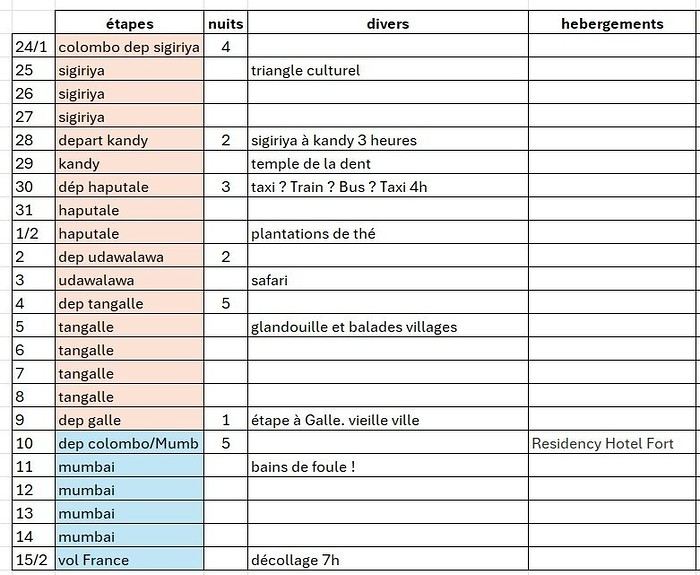
We’re heading to Sri Lanka for 23 days in January 2027—there are four of us—and we’ll wrap up the trip with 5 days in Mumbai. Our itinerary is coming together, but what do you think? (We can’t change the dates since our flights are already booked.)
We still have one night to slot in, and I’ve tentatively planned it in Tangalle, though it was a bit random. Would it make more sense to place it at a different stop? Or is there an intermediate stop I might be missing?
I’ve got accommodations sorted everywhere except Mumbai—it’s a nightmare (either way too expensive or really dodgy). By default, we’ve spotted the Residency Hotel Fort, but 70 € a night (with a discount) for a hotel that doesn’t offer anything special in India?!
I’m planning a short visit to Pokhara around mid-February 2027 (it’ll be my 4th time in Nepal 😊, over 40 years!). I’d like to book a room in advance rather than looking when I arrive. I’ve checked a bit on Bxxking.com and see lots of options. I’m used to scoping out the surroundings of places listed, just to avoid ending up in areas that are either unappealing or far from everything.
So, I see quite a few offers around the lake (Lakeside?), but every time I check what it looks like, the streets seem really uninviting. It’s kind of like a construction site with buildings everywhere… Nothing like Bhaktapur (for example) or even Thamel, where the streets seem way more pleasant.
Could anyone give me some advice?
Also, I don’t really get the impression that Pokhara is worth a visit of several days. The lake, sure, but once you’ve seen it—what else is there?
I’m interested in the 10-day/8-night "Discover Nepal" tour offered by Capitales Tours, among others.
For Day 4, it lists Kathmandu-Mugling-Pokhara as 200 km and 8/9 hours of travel.
Is this duration due to the road conditions? I assume the stop in Mugling for lunch is included in the travel time.
For Pokhara-Chitwan, only the distance is mentioned: 160 km. Should I expect a long bus ride there as well?
The proposed flights would be with AIR-INDIA via DELHI. We had issues with AIR-INDIA before—they denied us boarding for Paris even though we arrived at the airport more than 3 hours early. There was no specific counter for PARIS; the counters were for all destinations, and we waited in line for over 2.5 hours only to be told "too late"...
Thanks for your advice: Mum49
Is it still like this?
Yeah, VF, which used to be so responsive, still doesn’t even have a thread about this devastating mudslide that’s ravaged a region of Nepal where hundreds have died and hundreds more are missing (provisional toll). But from the images, we know the number of victims is going to be terrifying.
Thoughts to everyone affected, including, according to early reports, many travelers..
Hello,
We’ve already traveled to India twice before, but only for two-week stretches (2013, a loop from Mumbai including Hampi, and in 2019, Tamil Nadu). This time, we’re leaving at the end of October for nearly three months of travel—something completely new for us! We’ll arrive in Delhi and depart from Bangalore. Our goal is to explore Northern India and then head down to Kerala, taking a maximum of one flight and prioritizing trains.
Traveling for this long should let us plan longer stops to slow down the pace and fully enjoy our trip...
What are the places you’ve loved with this in mind?
I’ve already thought of Gokarna... Do you have any other suggestions, especially in Northern India?
Thanks in advance for your tips!
Hi there,
I’m planning a trip to Bangladesh for tourism during All Saints' Day 25. The government website is pretty discouraging! I’d love to hear from people living there or who’ve been recently before I buy my tickets.
How’s the security level and feasibility of a circuit (boat, train, bus around the country)? We’re used to basic conditions :)
Thanks in advance for your tips!
Cécile
I’ll be landing in Srinagar on October 23rd. I’ve decided to visit this region of India that I haven’t explored yet to discover new landscapes and, especially, their crafts.
I don’t have anything planned so far. I’ll be staying for about two weeks before heading back to Pushkar.
I’d love any tips you can share—small towns or villages to visit, ideas for affordable and authentic accommodations, workshops to check out, and so on. I’m open to all your suggestions!
I might head toward Jammu, where a host has offered to put me up for a few days.
Thanks in advance, and take care!
Hi,
I’m looking for an organized tour in Northern India that goes through Agra (of course!) over about twenty days, prioritizing 2-day stops given the long distances or flights.
So far, my search has led me to these tours:
Intimate Rajasthan + Ganges Valley
Intimate Rajasthan and Goa
Confidential Rajasthan + Goa circuit
The number of kilometers is still pretty overwhelming and a bit scary.
Thanks for your feedback!
bcricri14
Practical tips from my 105 days of erratic wandering in India
Day 1 (10/10/2006): arrived in Mumbai around noon. Bus No. 338 5 Rs + 5 Rs (bag) 20' to Andheri station. Train 6 Rs to Dadar. Train 41 Rs to Lonavla 2h30 Hotel Chandralok 500 Rs **
Day 2: bike rental 7 Rs/h (too expensive, normal price 2-3 Rs/h) visit to the caves of Bhaja and Karla.
Day 3: train 28 Rs to Pune 1h20 Hotel National 416 Rs *
Day 4: train 141 Rs (with reservation) to Satara 2h45 Hotel Sagar 364 Rs **
Day 5: bus 110 Rs to Pandharpur 4h Hotel Aishwarya 450 Rs ***
Day 6: bike rental 2 Rs/h
Day 7: bus 125 Rs to Ahmadnagar 4h20 Hotel Parijat 250 Rs *
Day 8: train 151 Rs (!ticket for a mini 600 km trip!) to Jalgaon 5h30 Hotel Plaza 200 Rs **
Day 9: round-trip bus 38 Rs to Ajanta 1h30 + shuttle 6 Rs 5' Site entrance 250 Rs
Day 10: train 47 Rs to Khandwa 3h + bus 40 Rs to Omkareshwar 2h Ganesh G.H. 150 Rs *
Day 11 to 13: Omkareshwar
Day 14: bus 35 Rs to Maheshwar 2h45 Akashdeep Rest House 200 Rs **
Day 15: bus 8 Rs to Dhamnod 20' bus 20 Rs to crossroads 14 km from Mandu 1h40 bus 9 Rs to Mandu 20' Ram Mandir Dharamshala 100 Rs + 5 Rs for hot water *
Day 16: bike rental 3 Rs/h
Day 17: bus 50 Rs to Indore 4h Hotel Neelam 209 Rs
Day 18 to 20: Indore + round-trip bus 30 Rs to Ujjain 1h45
Day 21: train 82 Rs to Bhopal 5h30 Hotel Ranjeet 358 Rs *
Day 22: train 10 Rs to Sanchi 1h20 Jaiswal Lodge 200 Rs + 15 Rs for hot water! *
Day 23 and 24: visit to Sanchi + bike rental to visit the caves of Udayagiri
Day 25: train 69 Rs to Jhansi 5h + tempo 5 Rs to bus station + tempo 10 Rs + 5 Rs (bag) to Orccha 25' Sri Mahant G.H. 200 Rs **
Day 26 and 27: bike rental + train 20 Rs to Datia 30' + bemo 6 Rs to city center. Return bus 15 Rs 1h15
Day 28: bus 100 Rs to Khajuraho 4h Yogi Lodge 150 Rs **
Day 29: bike rental 30 Rs/day to visit the temples
Day 30: bus 70 Rs to Satna 4h + train 56 Rs to Jabalpur 3h Hotel Banjara 350 Rs **
Day 31: bike rental 2 Rs/h and visit to the Marble Rocks (50 km round trip)
Day 32: bus 50 Rs to Mandla 3h Hotel Satyam 250 Rs ** Round-trip bus 15 Rs to Ramnagar 1h15
Day 33: bus 60 Rs to Dindori 4h + bus 45 Rs to Amarkantak 3h (hellish road) Sarvodya Lodge 250 Rs °
Day 34: Amarkantak
Day 35: bus 25 Rs to Pendra Road 1h30 + train 120 Rs + 109 Rs (reservation) to Nagpur 8h Hotel Grand 257 Rs **
Day 36 and 37: bike rental + round-trip 25 Rs to Ramtek 1h40
Day 38: train 141 Rs + 125 Rs to Hyderabad 10h Hotel 3 Castles 200 Rs ° + Hotel Suhail 200 Rs °
Day 39 to 41: stay in Hyderabad
Day 42: train 48 Rs to Warangal 3h30 Hotel Surya 410 Rs **
Day 43: 60 Rs to Vijayawada 4h15 Hotel Sindhuri 275 Rs **
Day 44: round-trip bus 21 Rs to Amaravati 2h
Day 45: train 98 Rs to Visakhapatnam 7h30! (normally 6h) Hotel Sri Sampath Residency 250 Rs **
Day 46: train 111 Rs + 95 Rs to Puri 11h30 Travellers Inn 100 Rs ° + Hotel Z 300 Rs ***
Day 47 to 52: Puri + round-trip to Konarak
Day 53: train 38 Rs to Bhubaneshwar 1h15 Hotel Upasana 275 Rs *
Day 54: train 70 Rs to Balasore 4h bus 26 Rs to Baripada 1h40 Hotel Ambika 225 Rs °
Day 55: bus 25 Rs to Balasore 1h40 train 66 Rs + 68 Rs to Calcutta 6h30 Hotel Paragon 270 Rs * Hotel Crystal 350 Rs **
Day 56 to 62: Calcutta
Day 63: 60 Rs to Bishnupur 5h Hotel Monalisa 200 Rs *
Day 64: stay in Bishnupur no bike rental!
Day 65: bus 20 Rs to Bankura 1h30 bus 20 Rs to Durgapur 1h15 bus 28 Rs to Bolpur 2h15 Hotel Nisa 150 Rs *
Day 66 and 67: visit to Bolpur/Shantiniketan. Refused bike rental at ... 100 Rs/day!!! (Communist state of Bengal!!!)
Day 68: bus 20 Rs to Sainthia bus 35 Rs to Baharampur 4h30 bus 7 Rs to Murshidabad 40' Hotel Manjusha 350 Rs **
Day 69: bike lent by the friendly hotel owner and visit to Murshidabad
Day 70: bus 8 Rs to Baharampur 35' bus 60 Rs to Malda 6h (hellish road) Hotel Pratapaditya 231 Rs **
Day 71: train 66 Rs + 70 Rs to New Jalpaiguri 4h Hotel Holydon 250 Rs °
Day 72: train 52 Rs to Darjeeling 9h30! (normally 7h) Hotel Pineridge 500 Rs **
Day 73 to 75: Darjeeling
Day 76: train to New Jalpaiguri 9h30 + overnight train 271 Rs
Day 77: Patna Hotel President 482 Rs **
Day 78: stay in Patna
Day 79: train 18 Rs to Gaya 3h10 tempo 10 Rs to Bodhgaya 30' Deep G.H. 400 Rs!! °°
Day 80: return to Patna
Day 81: round-trip train 36 Rs to Rajgir 4h! (normally 3h)
Day 82: train 75 Rs to Varanasi 5h! (normally 4h) Yogi Lodge 150 Rs *
Day 83 to 87: Varanasi
Day 88: overnight train 310 Rs to Jaipur Evergreen G.H. 250 Rs **
Day 89: bike rental 30 Rs/day round-trip to Amber
Day 90: bus 59 Rs to Sikar 2h30 bus 23 Rs to Fatehpur 1h30 Rajshri Rest House 300 Rs *
Day 91: round-trip bus 12 Rs to Mandawa 30'
Day 92: round-trip bus 17 Rs to Churu 1h30
Day 93: bus 80 Rs to Jaipur 3h30 Evergreen G.H.
Day 94: bus 105 Rs to Bundi 5h30 Shivam G.H. 200 Rs **
Day 95: bike rental 3 Rs/h
Day 96: auto-rickshaw to station 45 Rs 25' train 44 Rs + 50 Rs to Chittorgarh train 21 Rs to Udaipur (total trip 8h) Badi Haveli 330 Rs **
Day 97 to 99: Udaipur + round-trip bus 45 Rs to Ranakpur 3h30
Day 100: bus 143 Rs to Ahmedabad 5h30 Hotel Manila 300 Rs **
Day 101: Ahmedabad
Day 102: bus 99 Rs to Bhavnagar 4h30 Hotel Vrindavan 200 Rs *
Day 103: round-trip bus 22 Rs to Palitana 1h10
Day 104: bus 85 Rs! to Ahmedabad 5h30 + overnight train ? Rs (feels like the end of the trip!)
Day 105 (January 22, 2007): train 6 Rs from Dadar to Andheri 20' + bus 5 Rs + 5 Rs (bag) to International Airport 20'
More figures
British Airways flight price Brussels-London-Mumbai-London-Brussels 576 €
Exchange rate from 55 Rs to 58.6 Rs per euro
Average room price 272 Rs/night
Daily budget 11 €
Chai from 1 Rs (Calcutta-Bengal) to 6/7 Rs (Rajasthan)
Bottle of water from 6 Rs (Udaipur), 8 Rs (Varanasi) to 12/13 Rs
Internet from 8 Rs (Warangal), 10 Rs (Calcutta, Indore, Hyderabad), 20 Rs (often) to 40/60 Rs!! (Rajasthan)
Beer in a restaurant from 85/100 Rs (often) to 150/165 Rs (Varanasi/Udaipur)
More details on request
Hello everyone,
we got back from our trip to Kashmir and Ladakh three weeks ago.
We spent 4 weeks there, including one in Kashmir.
We’re really happy with our stay in Srinagar and Sonamarg. The Kashmiris gave us a very warm welcome and seemed pleased to see tourists who weren’t Indian. In fact, over the 4 days we spent in Srinagar, we only saw 4 people who looked European... Srinagar is stunning with its lakes and the lively Mughal gardens. No trouble getting around, whether by shikara, rickshaw, taxi, or on foot. The houseboats are gorgeous, unfortunately controlled by consortiums. We took a taxi to Sonamarg (20 €).
Sonamarg (two nights) and its glacier are easy to explore, either on horseback or on foot, but it’s becoming a leisure spot for Indians.
To get to Ladakh afterward, we opted for a private taxi (quite expensive at 100 €, but the road is long). Since we’re a couple, it allowed us to stop whenever we wanted... and the route is beautiful all the way to Lamayuru, with our first snow-covered pass under snow when we crossed around May 21st. Then we stopped in Mulbek and Kargil before arriving in Lamayuru (three nights). We took another taxi to Alchi (26 €), spent one night there, and took the local bus at around 8 AM to Leh (3 €, a comfortable one-hour ride). We arrived in Leh around 9:30 AM, and Gyatsel from Tsarap Guesthouse came to pick us up with our backpacks. His guesthouse is located 500 meters from the market square in Leh, in a quiet little alley with no traffic. We highly recommend it because Gyatsel is invaluable for arranging taxis and organizing off-agency circuits...
His accommodation is super comfortable, and he cooks with vegetables from his garden. His wife also helps out... It’s Gyatsel’s mother who tends the garden. Through him, we arranged permits for the Nubra Valley up to Turtuk, then the Pangong and Tso Moriri lakes (we didn’t do the latter due to snow overnight!). We also crossed the Changtang (magnificent) to reach Thiksey, Stakna, Hemis, and returned to Leh. Six days in a private taxi (400 €). Since the roads were clear, we headed to Zanskar for 5 days in a shared taxi (28 € round trip for both of us). The route from Leh to Zangla follows the Zanskar gorges (impressive!).
We discovered Padum, Pibiting, Karsha, and Puktal, which you can reach via a small 7 km road and a 45-minute walk to finish, plus the sacred summit on the way to Manali.
Back in Leh, we extended our permit to visit the Aryan Valley by taxi (round trip, two days, 90 €).
We spent our last two days resting in Leh—the altitude is really tiring...
I’m sharing these taxi prices as a guide for a couple.
Accommodation ranged from 12 € in Leh to 30 € at Pangong Lake (the most expensive), but averaged around 15-17 € per night.
We’re not trekkers, but we love walks, discovery, and meeting people along the way. It was an amazing trip, and we even discovered a very old monastery a few kilometers before Lamayuru, where a monk took us—timeless...
I’m sharing these details because it’s hard to find precise information about Kashmir.
I’m heading to Sri Lanka for 3 weeks in July with my two 11-year-old kids, and I’m wondering about how to organize the trip. We’re used to traveling on the go, staying 1 to 2 or 3 nights per place depending on how we feel.
Do you recommend planning the itinerary and booking accommodations in advance to save time once we’re there?
Or is it pretty easy to organize everything as we go without any issues?
Same question for activities: Should we book safaris and tours ahead of time, or can we arrange them easily on the spot? Is there a risk of not getting a spot, for example, to visit a park since we’ll be there in July?
We’ll be using local transport (train, VTC via PickMe, tuk-tuk) to get from one place to another.
In short: Are there any must-book things we should reserve now?
So far, I only have the flight tickets!
Hi there, I think you're on the right track—you plan the itinerary and book the rooms in advance, and that’s it.
Not only do you save time, but you also know where you’ll be staying each night. Choosing well on Booking (or elsewhere) is actually a pleasure!
For safaris, given the number of jeeps with drivers available, it’s unlikely you’ll be turned away... the real issue is more about the concentration of jeeps around the animals.
I travel like you do—train, bus, tuk-tuk, and sometimes taxi. Ride-hailing apps like PickMe and other VTCs are mostly in big cities.
For the mountain train, due to severe flooding, service was interrupted on the line between Kandy and Ella. Check ahead, because reservations for this train are very complicated, if not impossible.
For the Colombo/Kandy train, you reserve your seats by buying the ticket before boarding. In the south, no need to book in advance for trains.
In Sri Lanka, there’s always a solution for getting around—just ask your hosts. They have trusted contacts at their fingertips. But still, compare prices—😏 smart move!
I stick to booking my nights and keep pre-planned activities to a minimum.
For reservations you can’t skip, it’s the beach stays you’ll want to secure.
I’m trying to find out if it’s still possible to travel from Mumbai to Goa by ferry or any other sea route. My search results aren’t very clear, and if it *is* possible, I can’t figure out where to book...
If anyone has any info, I’d really appreciate it—thanks in advance!
It seems there’s a ferry from Nagapattinam to Jaffna in India. Has anyone here taken this ferry before? My main question is how to get to Nagapattinam—by train, bus? And from which town further south, of course.
Thanks, friends!
Hi there.
We’re spending a month in Sri Lanka in March, and we’ll have one week left after leaving Polonnaruwa.
We’re torn between spending it in the Jaffna region or on the east coast between Batticaloa and Trincomalee.
We’re divers, so the east coast appeals to us for snorkeling, beaches, and lagoons—but it seems like late March might not be the best time for that coast. What do you think?
As for Jaffna, the culture of the region, its more authentic feel since it’s less touristy, and the offshore islands all appeal to us too—but it seems far from the rest of the country and harder to access.
We have to choose because we won’t be able to visit both sides, and I’d love to hear your thoughts.
Thanks, Marie
Hi there,
We just got back from a 2-week trip to Sri Lanka as a couple, and while planning the trip, we found plenty of info on the itinerary, places to see, and transportation, but much fewer clear reports on the actual budget to expect once there. Yet, that was an important point for us because we like to plan ahead a little before traveling.
So, we took the time to break down our complete budget after the trip. In our case, we spent around **930 € per person** for 2 weeks, being careful without depriving ourselves, mixing guesthouses, more comfortable hotels, quite a few activities, and even a private driver for part of the stay.
What we found interesting when crunching the numbers is that in Sri Lanka, it’s not necessarily meals or short trips that blow the budget, but rather flights, certain accommodations, cultural activities, and all those little expenses we sometimes forget, like tips.
If this can help other travelers get a better idea, we’ve put everything together on our blog with our experience, a detailed breakdown of expenses, and practical info on money while there, withdrawals, and tipping:
https://aventures-sans-mesaventure.com/budget-sri-lanka-pour-un-voyage-de-2-semaines/
We’re a group of 5 heading to the Everest Base Camp trek in early April. We won’t have a porter or guide—we’re used to hiking independently and have already done the Langtang trek and the Annapurna Circuit (back in 2003!).
I’d love to know if it’s necessary to book lodges in advance or if we’ll easily find availability during this busy season. Also, will we find lodges all along the route between the main stopover villages, or only in those villages? I remember there were plenty everywhere on the Annapurna Circuit. We want to stay as flexible as possible.
We’re heading to India in March 2026 and had planned to visit the parts of the Meenakshi Temple that are open to non-Hindus. However, the temple is currently undergoing major renovations—with all the towers covered in scaffolding—which might really take away from the experience and our stop in Madurai.
After some frustrating and vague online searches, and before we reshuffle our itinerary, I’d love to know—if possible—the most accurate expected completion date for the renovation work.
We’re planning a trip to Nepal and would love to do a helicopter tour to Everest with Namche Heli Service.
Has anyone here used this agency? I can’t seem to find any reviews online.
Thanks in advance!
I’m spending two weeks studying Hindi in the mornings in Delhi, in the Hauz Khas neighborhood.
What spots should I check out in this area? Any cafés to chill at?
How do I get to other parts of Delhi? By rickshaw? Is it easy to negotiate the price upfront?